SEPTEMBER/OCTOBER 2025
VOLUME 22/NUMBER 5
TODAYSGENERALCOUNSEL.COM
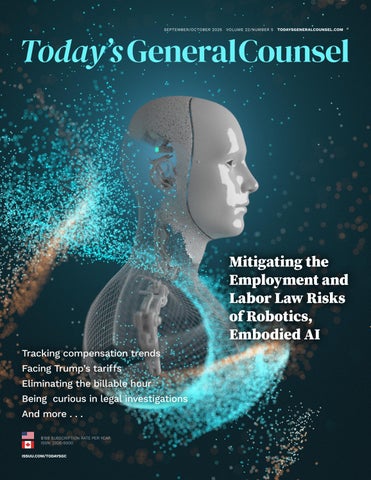
Mitigating the Employment and Labor Law Risks of Robotics, Embodied AI Tracking compensation trends Facing Trump’s tariffs Eliminating the billable hour Being curious in legal investigations And more . . . $199 SUBSCRIPTION RATE PER YEAR ISSN: 2326-5000 ISSUU.COM/TODAYSGC
Tough Calls Need Trusted Voices
Lead in times of uncertainty. From technological disruption to policy shifts, NACD Directorship Certification® signals that you’re ready to navigate today’s complex business environment.
nacdonline.org/certification
EDITOR’S DESK
W
alk into a modern distribution center. You might see autonomous forklifts navigating narrow aisles, sensors scanning inventory in real time, and human workers collaborating seamlessly with robotic arms. Robotics and embodied AI (the integration of artificial intelligence into physical robots) are no longer futuristic concepts. They’re here, moving fast, and transforming how companies operate and deploy human talent. At the same time, these technologies introduce legal challenges and risks that general counsel and their teams must address. This month, Parker Poe attorneys Robert Botkin and Carson Lane explore those risks in their cover story, offering practical guidance on everything from retraining programs and redeployment strategies to governance frameworks that balance innovation with compliance. “Robotics in the workplace has the potential to displace human workers, one of the most significant labor concerns,” they write. “In the event workers are displaced, employers must ensure compliance with applicable labor laws while also taking into consideration workforce morale and productivity.” The theme of anticipating change carries throughout this issue. Another article based on survey data from recruiting firm BarkerGilmore examines how in-house counsel compensation is shifting in 2025. Spoiler alert: salary growth is slowing, but bonus structures remain steady. “This slowdown in compensation growth likely reflects broader market headwinds, including economic and political uncertainty, tighter corporate budgets, and volatility in sectors including tech and finance,” writes Katie Gilmore, going on to explain why cash bonuses have remained largely unchanged since last year. “This reflects high satisfaction levels with GC performance over the past year, as well as an effort to reward and retain top legal talent who were anticipating a more significant salary increase.” Specialized knowledge makes it easier to negotiate a raise or salary at a new company. Don’t miss other valuable insights in this issue, including articles on tracking legal AI KPIs, responding to cyber incidents, navigating Trump’s tariffs, building strategic legal operations, and driving effective legal investigations. Also, be sure to read Today’s Managing Partner’s exclusive interview with Christopher Anderson of New Leaf Family, which explores how eliminating the billable hour in family law has transformed both client relationships and firm culture. I hope this issue inspires you to lead boldly, whether you’re managing technological shifts, adapting to changing trade policies, or innovating new ways to deliver value. Thank you for reading, Amanda Kaiser Editor-in-Chief
BACK TO CONTENTS
SEPTEMBER/OCTOBER 2025
TODAYSGENERALCOUNSEL.COM
3
contents
SEPTEMBER/OCTOBER 2025
Volume 22/Number 4
EDISCOVERY
8 Curious Minds Drive Effective Legal Investigations By Hunter McMahon and Warren Kruse
Learn why curiosity is fundamental to legal investigations and you shouldn’t stop at the first answer. SPONSORED
Presented by
PAGE 10 DATA PRIVACY & CYBERSECURITY
13 Cyber Incident Response in 2025: A Strategic Imperative for General Counsel
COVER STORY
PAGE 12
LABOR & EMPLOYMENT
10 Mitigating the Employment and Labor Law Risks of Robotics, Embodied AI By Robert Botkin and Carson Lane
As businesses increasingly adopt robotics and artificial intelligence (AI)—including “embodied AI”—they must carefully manage the associated employment and labor law risks. Learn how to protect your organization.
By Laney Altamar
Discover why general counsel are essential to cyber incident response. Be informed, involved, and ready.
SEPTEMBER/OCTOBER 2025
TODAYSGENERALCOUNSEL.COM
4
CONTENTS COLUMN CAREER COMPASS
From
16 Tracking the Evolution of In-House Counsel Compensation in 2025 By Katie Gilmore
Learn about the latest in-house counsel compensation trends to emerge from BarkerGilmore’s research. Negotiate with confidence. COMPLIANCE
19 Facing Trump’s Tariffs: 10 Essential Steps for General Counsel
INTERVIEW
21 Managing Partner Christopher Anderson Talks About Reinventing Family Law by Eliminating the Billable Hour
By Charles Baldwin and Gabby Supak
Discover what general counsel should do to ensure their organizations are well-positioned to navigate Trump’s tariffs and the uncertainty surrounding them. PAGE 18
PAGE 19
LEGAL OPERATIONS
24 Legal Is Already Ahead on AI—It’s Time to Track It with Legal AI KPIs By Noga Rosenthal
We need a better way to measure how, where, and why we’re using AI and the value it’s actually delivering. Learn the importance of using legal AI KPIs and aligning them with broader business goals.
In this exclusive interview, Christopher Anderson discusses how New Leaf Family— the firm he co-founded with his wife, Penn Dodson—is reinventing the practice of family law by eliminating the billable hour and introducing innovative pricing models.
COLUMN TALKING LEGAL OPERATIONS WITH COLIN LEVY
26 How to Build Strategic Legal Operations for Business Agility in Uncertain Times By Colin Levy
Learn how to transform your legal team from a cost center into a strategic driver of business adaptability. SEPTEMBER/OCTOBER 2025
TODAYSGENERALCOUNSEL.COM
5
ON-DEMAND WEBINAR
What’s Keeping Legal Leadership Up at Night? Modern Pressures, Measured Responses: A Candid Conversation Between GCs and Law Firm Leaders The ground beneath the legal industry is shifting, and leaders are
MEET
THE PANELISTS
feeling it in real time. From the unpredictable pace of AI adoption to the increasing demands of cybersecurity, today’s legal decisionmakers are navigating more change, risk, and uncertainty than ever before. And while clients expect faster, smarter, and more secure service, the internal realities of training, resourcing, and aligning teams often tell a different story.
Courtney Gahm-Oldman Partner Frost Brown Todd
Eric Dodson Greenberg
Executive Vice President, General Counsel & Corporate Secretary Cox Media Group
Scott C. Pappas
Firmwide Managing Partner Omnus Law
Mike Ryan
Executive Vice President, Chief Legal Officer Trading Technologies Moderator:
Michael Quartararo
President Association of Certified E-Discovery Specialists (ACEDS)
But it’s not just law firm partners under pressure. General Counsel are balancing complex compliance needs, budget scrutiny, and executive expectations, often while contending with the same technological and operational friction as their outside counsel. The tension is real, and the stakes are high: how do we evolve fast enough without losing sight of what matters most? In this dynamic and candid conversation, we'll explore: The pressure to adopt AI responsibly How law firms and legal departments are reskilling teams in real time The cybersecurity threats you can’t afford to overlook (especially now that threat actors are using AI too) The new associate or senior partner mindset and how it’s forcing change in career development and advancement How firms can better align with in-house expectations around service, scope, and value
Register for Webinar
EDITOR-IN-CHIEF Amanda Kaiser
EXECUTIVE EDITOR
SENIOR EDITOR
FEATURES EDITOR
Bruce Rubenstein
Barbara Camm
Jim Gill
CHIEF OPERATING OFFICER
ACCOUNT EXECUTIVE
MANAGING DIRECTOR OF CLIENT PARTNERSHIPS & INITIATIVES
Stephen Lincoln
Stella Vargas
Lainie Geary
DIGITAL EDITOR
WEB EDITOR
DATABASE MANAGER
Catherine Lindsey Nienhouse
Jessica Bajorinas
Patricia McGuinness
ART DIRECTION & PHOTO ILLUSTRATION MPower Ideation, LLC
CONTRIBUTING EDITORS AND WRITERS Laney Altamar Charles Baldwin Robert Botkin Katie Gilmore Warren Kruse Carson Lane Colin Levy Hunter McMahon Noga Rosenthal Gabby Supak
EDITORIAL ADVISORY BOARD David A. Katz
Dennis J. Block
GREENBERG TRAURIG LLP
WACHTELL, LIPTON, ROSEN & KATZ
Thomas W. Brunner
Nikiforos Iatrou
WILEY REIN LLP
MCCARTHY TETRAULT LLP
Mark A. Carter
Steven F. Molo
Jeffery Cross
Robert A. Profusek
Jamie Gorelick
George D. Ruttinger
DINSMORE & SHOHL LLP
MOLOLAMKEN LLP
SMITH, GAMBRELL & RUSSELL LLP
JONES DAY
WILMERHALE LLP
Robert L. Haig
KELLEY, DRYE & WARREN LLP
CROWELL & MORING LLP
Jonathan S. Sack
MORVILLO ABRAMOWITZ GRAND IASON & ANELLO PC
Robert C. Heim
Victor E. Schwartz
DECHERT LLP
SHOOK, HARDY & BACON LLP
Sheila Hollis
Jonathan D. Schiller
DUANE MORRIS LLP
BOIES SCHILLER FLEXNER LLP
SUBSCRIPTION
REPRINTS
Subscription rate per year: $199 For subscription requests, email subscriptions@todaysgc.com
For reprint requests, email Lisa Payne: lpayne@mossbergco.com Mossberg & Company Inc.
All rights reserved. No part of this publication may be reproduced or transmitted in any form or by any means, electronic or mechanical, including photocopy, recording, or any information or retrieval system, without the written permission of the publisher. Articles published in Today’s General Counsel are not to be construed as legal or professional advice, nor unless otherwise stated are they necessarily the views of a writer’s firm or its clients. Today’s General Counsel (ISSN 2326-5000) is published six times per year by Nienhouse Group Inc., 110 N Upper Wacker Dr, Chicago, IL 60606. Image source: iStockphoto | Copyright © 2025 Nienhouse Group Inc. To submit an article, go to todaysgeneralcounsel.com/submissions.
EDISCOVERY
Curious Minds Drive Effective Legal Investigations By HUNTER MCMAHON AND WARREN KRUSE instructions. The kind of consulting that makes a difference requires a shift in posture, from order taker to insight seeker.
BE A CURIOUS INVESTIGATOR
C
uriosity is the spark behind every discovery, at home and in legal investigations. As most parents can relate, we’ve both been on the receiving end of those relentless, curious questions from our kids: “Why is the sky blue?” “Why can’t I have ice cream for breakfast?” That kind of curiosity can be exhausting at the end of a long day, but it’s also revealing. It’s honest. And if you listen closely, you start to see it not as pestering, but as practice. They’re trying to make sense of their world, one “why” at a time. Similarly, between us, we’ve spent decades working in consulting and BACK TO CONTENTS
investigations where that same brand of curiosity, the kind that doesn’t stop at the first answer but keeps pulling the thread, is what separates a good investigator from someone who’s just checking boxes. It’s not about being the smartest person in the room. It’s about being the most engaged, the one who wants to understand, not just deliver. All too often, investigations get reduced to a task list: pull the data, review the documents, summarize the facts. There’s nothing inherently wrong with that, but when consulting becomes a routine process, it loses its value. Anyone can follow
The curious investigator doesn’t just accept the problem as given; they explore it. They challenge the framing. They add value. They ask, “Why is this the problem we’re solving?”, “What is the end goal?” and “What else could be going on here?” This doesn’t mean doubting the client. It means working in partnership, clarifying the goals, understanding the context, and aligning on what success really looks like. There’s a temptation in our field to equate volume with value, to deliver lengthy reports full of timelines, charts, and metadata. But information isn’t the same as insight. The best investigators don’t just assemble dots. They connect them in a way that reveals meaning. They identify patterns that matter, timelines that shift understanding, and recognize that sometimes the absence of information speaks louder than the data itself. Over the years, we’ve both reflected on what we’re passing on, not just in investigations, but in life and to our children. One idea we
SEPTEMBER/OCTOBER 2025
TODAYSGENERALCOUNSEL.COM
8
keep returning to is not only the importance of asking “why” but doing so before diving into “what.” The thoughtful investigator (like Warren’s son, who followed him into this world) pauses to ask: “What’s really at stake here?” “What decision is this effort meant to inform?” “What are the risks of being directionally accurate but contextually wrong?”
WORTH THE EFFORT Asking curious questions may feel like it will slow things down, but it protects against wasted time and costly missteps. In high-stakes investigations, moving too fast can send you racing in the wrong direction. As the Navy SEALs say, “Slow is smooth and smooth is fast.” A moment of inquiry at the outset can save weeks of untangling later. Asking the right questions early isn’t inefficient; it’s essential. Of course, curiosity must be purposeful. It can’t just be a series of open-ended wanderings. The best investigators apply their questions with intent. They follow leads with discipline. They resist the urge to leap to conclusions or to settle for the convenient explanation. You’re not just reporting what happened. You’re working to understand why it happened and what it means in context. We’ve both worked on cases where a single question reshaped the course of the investigation. Sometimes it was something as simple as, “What isn’t in this dataset that should be?” Other times, a client said something that prompted a curious investigator to ask, “Tell me more about that.” That’s when things get interesting. That’s when you find the real story. BACK TO CONTENTS
We’ve also worked on matters where a single question was not welcomed, the “just collect it” request. In one recent example, a client said, “Can you get on a plane today and meet a custodian to image his laptop?” We tried, but were offered no time to ask the custodian or IT anything about the computer or where they store data. As it turned
It’s not about being the smartest person in the room. It’s about being the most engaged, the one who wants to understand, not just deliver. out, the custodian didn’t even need the computer and could have shipped it. To make matters worse, the organization used a roaming profile, so no documents were stored locally. If we were able to ask a few questions upfront, we could have preserved the data remotely and saved significant time and money.
CURIOSITY IS A STRATEGY Curiosity isn’t a soft skill. It’s a strategic one. It allows us to serve not just the task at hand, but the outcome that matters. It’s what transforms a report into a recommendation, and a service into a solution. In the end, the best “curious investigators” who succeed are those who haven’t outgrown the childlike drive to understand. They’ve simply learned how to channel it with purpose. They know that sometimes the most powerful move isn’t delivering an answer,
Prefer to read this online? Click here. but asking a better question. So, how do you spot those curious investigators? They… • Ask for background information (context) on the situation • Want to understand the goal of the investigation, not just tasks • Let questions breed more questions, not just acceptances of answers • Offer ideas for related analysis proactively, not only upon request. • Develop customized protocols based on the need • Probably save you time and money And maybe, if we’re all so lucky, we’ll keep asking “why” long after our kids have stopped asking us questions.
Hunter McMahon is the President of iDiscovery Solutions (iDS). He leads a team of experts who provide industry-leading solutions for clients. McMahon has served as a testifying and consulting expert to corporations both large and small, while working with Am Law 100 and boutique law firms. Warren Kruse is a Managing Director of iDS. He has more than three decades of experience in law enforcement, cybersecurity, and digital forensics. Kruse leads with deep technical acumen and a pragmatic approach to solving complex data challenges.
SEPTEMBER/OCTOBER 2025
TODAYSGENERALCOUNSEL.COM
9
LABOR & EMPLOYMENT
Mitigating the Employment and Labor Law Risks of Robotics, Embodied AI By ROBERT BOTKIN AND CARSON LANE
A
s businesses increasingly adopt robotics and artificial intelligence (AI)—including “embodied AI” that combines physical robotics with AI—they must carefully manage the associated employment and labor law risks. While these technologies can enhance productivity, improve safety, and reduce costs, failure to navigate the complex legal landscape may lead to litigation, regulatory penalties, and reputational harm. This issue is especially timely now, as businesses look to offset high domestic labor costs and navigate an BACK TO CONTENTS
unpredictable import tariff situation, which has prompted a shift of manufacturing operations to the United States. Let’s explore the key legal risks and offer strategies to mitigate them when integrating robotics into the workplace.
MANAGING WORKER DISPLACEMENT AND RETENTION Robotics in the workplace has the potential to displace human workers, one of the most significant labor concerns. In the event workers are displaced, employers must ensure
compliance with applicable labor laws while also taking into consideration workforce morale and productivity. • Compliance with WARN Act: If large-scale layoffs result from robotic integration, employers must comply with the federal Worker Adjustment and Retraining Notification (WARN) Act, which mandates advance notice for mass layoffs and plant closures. Many states impose their own often-stricter “miniWARN” statutes — so companies should verify
SEPTEMBER/OCTOBER 2025
TODAYSGENERALCOUNSEL.COM
10
and follow the most protective standard. • Retraining and Redeployment Programs: By implementing reskilling initiatives and clear internal pathways to new positions, employers can help displaced workers transition to new roles, reducing the risk of wrongful termination claims and fostering goodwill. • Union and Collective Bargaining Agreements: Employers must engage in good-faith discussions with unions when robotics impact bargaining unit employees, ensuring compliance with National Labor Relations Act (NLRA) obligations. As AI adoption grows, unions are seeking protections such as limits on job loss, retraining guarantees, and a role in evaluating new technologies.
ENSURING WORKPLACE SAFETY AND OSHA COMPLIANCE While robotics can reduce workplace injuries, they can also create new hazards if not properly managed. The hazards can be caused by interference with the robots’ sensors, the introduction of new scenarios for which the robots’ algorithms do not have significant training, and of course, the possibility of human error when interacting with the robot. • Occupational Safety and Health Administration (OSHA) Compliance: While OSHA does not yet have regulations that specifically address AI, employers must assess and mitigate risks associated with robotic systems under OSHA’s General Duty Clause. • Robot Safety Standards: Employers should ensure their robotics BACK TO CONTENTS
provider maintains compliance with industrial robotics safety standards (such as ANSI/RIA R15.06), as well as standards on machine guarding. • Employee Training and Incident Reporting: Workers should receive training on safely interacting with robotics, and employers should establish clear incident-reporting mechanisms.
As robotics and embodied AI become more commonplace in modern workplaces, employers must take proactive steps to mitigate employment and labor law risks. ADDRESSING EMPLOYEE MONITORING AND PRIVACY CONCERNS Workplace robotics may involve real-time surveillance, biometric tracking, and AI-driven performance monitoring, which raises privacy concerns. Robots, especially embodied AI robots, may process personal data to properly function. For example, some robots require a fingerprint to engage the robot, while others process their surroundings and may be trained to recognize employees. Other robots that augment human workers may monitor the person’s performance to measure the impact of robotics on productivity.
Prefer to read this online? Click here. • Compliance with Privacy Laws: Employers must adhere to state biometric privacy laws (such as the Illinois Biometric Information Privacy Act) and federal laws regarding employee data collection. State biometric privacy laws typically require prior written consent prior to the collection or processing of a person’s biometric data. • Transparency: Informing employees about data collection, use, and retention practices may be required under certain state laws but may also help mitigate legal risk in states without a biometric privacy law.
PROTECTING WORKERS’ RIGHTS AND AVOIDING RETALIATION CLAIMS Introducing robotics may lead to changes in job roles, compensation structures, or working conditions, potentially triggering retaliation claims. • Whistleblower Protections: Employees who raise concerns about potential safety violations or unethical use of technology are protected under federal and state whistleblower laws. • Fair Labor Standards Act (FLSA) Compliance: The introduction of robotics in the workplace may lead some employers to misclassify employees under the FLSA. For example, maintenance staff who now work to maintain the workplace robots may be incorrectly reclassified as salaried, overtimeexempt “automation engineers”
SEPTEMBER/OCTOBER 2025
TODAYSGENERALCOUNSEL.COM
11
under the computeremployee exemption to the FLSA. However, the maintenance staff’s primary duties may still be manual repair and troubleshooting rather than more complex programming or systems analytics. Because those duties fall outside the exemption, the employees would still be nonexempt under the FLSA.
DRAFTING ROBUST EMPLOYMENT POLICIES AND CONTRACTS To minimize litigation risks, employers should update employment policies and ensure their vendor contracts adequately protect the business against the risk robotics presents in their workplace. • AI and Robotics Governance Policies: Clearly outline the ethical and legal use of AI and robotics in the workplace. These policies should be reviewed at defined intervals to ensure continuing alignment with emerging regulations, technological advances, and the organization’s risk tolerance. • Indemnification and Vendor Agreements: Contracts with robotics vendors should include indemnification clauses to address liability for AI errors or malfunctions. Each agreement should also obligate the vendor to maintain sufficient cyber and professional liability insurance that names the employer as an additional insured and covers all AI-related losses. • Workplace Technology Use Agreements: Employers should establish guidelines for employees interacting with AI-driven robotics to reduce operational risks. The agreement should expressly set acceptable-use parameters, BACK TO CONTENTS
data-handling obligations, and prompt reporting requirements for any anomalies or safety concerns.
CONCLUSION As robotics and embodied AI become more commonplace in modern workplaces, employers must take proactive steps to mitigate employment and labor law risks. By prioritizing compliance with federal and state labor laws, implementing fair and transparent AI policies, and maintaining open communication with employees, businesses can harness the benefits of robotics while minimizing legal exposure. Companies that successfully navigate these challenges will position themselves as industry leaders, balancing innovation with ethical and legal responsibilities.
Robert Botkin is an attorney in Parker Poe’s Raleigh office, where he helps clients of all sizes, from Fortune 50 companies to startups navigate privacy and cybersecurity issues across different industries, including technology, retail, automotive, and finance. Carson Lane is an employment attorney in Parker Poe’s Charlotte office, where she represents both large and small employers across a range of industries, including manufacturing, education, and health care.
SUBSCRIBE NOW
Award-Winning Magazine IN YOUR INBOX
STAY UP-TO-DATE
THOUGHT LEADERSHIP, INTERVIEWS AND THE LATEST LEGAL NEWS
CURRENT BUSINESS DEVELOPMENTS FOR GCs AND IN-HOUSE COUNSEL
Subscribe
SEPTEMBER/OCTOBER 2025
TODAYSGENERALCOUNSEL.COM
12
SPONSORED
DATA PRIVACY & CYBERSECURIT Y
Cyber Incident Response in 2025: A Strategic Imperative for General Counsel By LANEY ALTAMAR | PRESENTED BY
T
he scene feels almost familiar based on the stats and headlines around the growing number of incidents. It’s 2:03 a.m. Your phone buzzes on the nightstand, and the caller ID tells you everything you need to know before you answer. It’s your CISO. “We have a situation.” A visceral reaction is understandable, but feeling helpless and out of control does not need to be inevitable. Cyber incident response begins with readiness, trusting your team, and executing the plan you put in place for these moments. It is possible to shift the script to ensure that legal is ready, steady, and leading from the center of the response.
WHEN THE INCIDENT BECOMES REALITY In 2024, the global average cost of a data breach rose to $4.88 million, reflecting a 10% increase from the previous year, according to IBM’s 2024 Cost of a Data Breach Report. The impact goes beyond lost data. It includes reputational harm, business disruption, and the rising complexity of legal exposure. At the same time, insurers reported a 14% rise in large cyber claims, according to Allianz’s BACK TO CONTENTS
2024 Cyber Risk Trends report. These are no longer edge cases. They have become the norm. Cyber incidents used to be the burden of a few unfortunate entities, but now they will inevitably affect most organizations at some point. In this environment, preventative security measures alone are insufficient, and the leadership should focus on what to do when an incident occurs. General counsel are essential to cyber incident response. Legal teams are positioned to help triage risk and manage disclosure obligations across global jurisdictions. Cyber incidents today require legal leadership that is informed, involved, and ready.
THE CYBER LANDSCAPE HAS SHIFTED Litigation now follows a growing number of incidents, especially those involving personal data, critical systems, or third-party failures. According to Chubb and the Insurance Information Institute, third-party litigation following ransomware attacks rose by 75 percent in 2024 compared to the 2020–2021 average. Governments across North America, Europe, and APAC are accelerating regulatory action. Notification
timelines are shrinking, and enforcement efforts are intensifying. Legal teams must now interpret and respond to overlapping regulatory requirements, often across multiple jurisdictions. Executive and board scrutiny has also increased. Leaders expect rapid, informed legal guidance that balances transparency, risk, and business continuity.
AN ESSENTIAL ROLE FOR GENERAL COUNSEL General counsel are expected to be more than advisors. They are risk managers, communicators, and incident coordinators. They help shape the early response, preserve privilege, and maintain credibility with internal and external stakeholders. They also play a central role in setting the tone. Legal is often the steady hand in the room when pressure peaks, guiding communications, protecting relationships, and keeping the organization aligned. Data identification is an increasingly vital area of readiness and response. Legacy review workflows built for litigation do not support incident response timelines. General counsel must oversee a process that delivers faster and more focused
SEPTEMBER/OCTOBER 2025
TODAYSGENERALCOUNSEL.COM
13
SPONSORED
ways to locate sensitive data using teams and tools aligned with incident response regulatory demands. Before an incident occurs, legal leaders have the opportunity to shape not just policy but performance. The following best practices reflect practical steps General counsel can take to prepare for, respond to, and lead during a cyber event.
SIX BEST PRACTICES FOR GC-LED INCIDENT RESPONSE
1. Build Legal into the Plan: Legal teams should be active participants in designing, testing, and updating incident response plans. Their involvement ensures legal risk, reporting obligations, and escalation triggers are identified as critical elements at the outset. BACK TO CONTENTS
2. Pre-Negotiate Partner Relationship: Having trusted partners in place supports a faster response. Pre-approved providers for forensics, PR, and data mining help restore and maintain control. Legal should also review insurance policy terms, which will likely influence service provider options. 3. Expect More from Data Mining: Traditional eDiscovery tools often delay the process. General counsel benefit from partnering with teams that can analyze and triage data with urgency and precision. Leveraging specialized teams, technology and workflow better position organizations to meet increasingly short notification timelines and provide clarity under pressure.
Prefer to read this online? Click here. 4. Protect Privilege from the Start: Early coordination with external counsel and forensic teams helps preserve privilege and supports informed, protected conversations from the outset. 5. Own the Narrative: Legal should work closely with communications teams to guide disclosures and internal briefings. Understanding the scope and composition of the data early allows for consistent, defensible messaging. 6. Drive Lessons into Policy: Each incident offers an opportunity to learn about organizational data and improve data governance
SEPTEMBER/OCTOBER 2025
TODAYSGENERALCOUNSEL.COM
14
SPONSORED
and readiness. General counsel should lead post-incident reviews to strengthen internal policies specific to retention and date governance, address compliance gaps, and prepare for future response needs. As the cyber landscape continues to evolve, so do the expectations placed on legal teams. General counsel must look beyond the immediate response and anticipate the structural changes reshaping how organizations prepare for and respond to incidents.
•
•
Cyber incidents today require legal leadership that is informed, involved, and ready. TRENDS TO WATCH Legal teams that lead well during an incident are best positioned for what comes next. These broader shifts are redefining expectations for legal leadership in cyber preparedness and response. Legal teams should monitor several developments in how cyber risk intersects with legal strategy: • Expansion of breach notification laws across multiple jurisdictions Breach notification rules are evolving quickly. More countries and states are tightening timelines, broadening definitions of personal data, and imposing higher penalties for noncompliance. For General counsel, this means tracking and aligning BACK TO CONTENTS
•
•
response protocols with a patchwork of standards. Higher frequency of post-incident investigations and class action lawsuits Post-incident fallout is expanding. Regulatory reviews, audits, and litigation now follow many breaches. General counsel play a central role in managing inquiries, supporting defensible documentation, and guiding the organization through potential legal proceedings. Rising expectations for data mining precision The ability to pinpoint sensitive data quickly after an incident has become a core expectation. Legal teams that rely on traditional eDiscovery review workflows often encounter delays and gaps, as well as insufficient results. Data mining methods purpose-built for incident response are valued for their speed, precision, and accuracy. These workflows are tailored for data identification and classification. General counsel who recognize the distinction between data mining and eDiscovery are better positioned to meet regulatory timelines and maintain internal trust. Greater board involvement in incident response Boards are taking a more active role in overseeing cyber preparedness. They expect real-time updates when incidents occur and look to legal leaders to provide clear, risk-based reporting. General counsel must be ready to speak the language of governance, liability, and business continuity. Cyber risk integration into ESG and enterprise risk frameworks Cybersecurity is now viewed as a component of environmental,
social, and governance (ESG) reporting. Investors and regulators are pressing organizations to quantify and disclose cyber risk alongside other operational threats. Legal teams are being asked to help articulate how cyber controls fit into broader governance strategies.
WHERE LEGAL LEADERSHIP MAKES THE DIFFERENCE Cyber incident response is more than a technical imperative; it is legal, reputational, and strategic. General counsel are uniquely positioned to lead the process with clarity and consistency. Readiness shows. Moving forward, it is a defining expectation.
Laney Altamar is Vice President of Cyber Incident Response and Legal Technologies at KLDiscovery. With more than 20 years of experience bridging law, cybersecurity, and digital forensics, she leads a global team at the intersection of breach response, regulatory exposure, and litigation readiness. Working alongside specialized data mining teams and global advisory services, Altamar helps organizations swiftly assess compromised data, meet compliance demands, and move forward with confidence. Her leadership continues to shape how companies respond to cyber events with precision, integrity, and speed.
SEPTEMBER/OCTOBER 2025
TODAYSGENERALCOUNSEL.COM
15
COLUMN
CAREER COMPASS
Tracking the Evolution of In-House Counsel Compensation in 2025 By KATIE GILMORE
O
ver the past few years, the general counsel position has become one of the most consequential roles in the C-suite. For many lawyers, it represents a career pinnacle and a platform to play an important role in enterprise success. However, the rate of in-house counsel compensation growth has slowed in the current climate against a backdrop of macroeconomic uncertainty and market volatility. Companies appear to be exercising greater discretion in GC compensation planning, even as they lean more heavily on that role to guide strategic decisions through turbulent times. In 2025, the median salary increase for GCs was 2.5%, a notable slowdown from the 4.4% rise reported in 2024, BACK TO CONTENTS
according to BarkerGilmore’s 2025 In-House Counsel Compensation Report, conducted in February and March of 2025. Based on a survey of more than 2,700 legal professionals, the report sheds light on compensation trends, career paths, and leadership traits that define today’s successful GCs.
BONUSES STEADY DESPITE HEADWINDS This slowdown in compensation growth likely reflects broader market headwinds, including economic and political uncertainty, tighter corporate budgets, and volatility in sectors including tech and finance. Not surprisingly, nearly 60% of in-house
SEPTEMBER/OCTOBER 2025
TODAYSGENERALCOUNSEL.COM
16
Prefer to read this online? Click here.
counsel surveyed indicated they are considering new opportunities in the coming year, citing better compensation and benefits as key motivators. Offsetting the slower growth in base salaries, cash bonuses for in-house counsel were paid 93% of their target, basically unchanged from last year. This reflects high satisfaction levels with GC performance over the past year, as well as an effort to reward and retain top legal talent who were anticipating a more significant salary increase. Despite softening of compensation growth, most in-house legal counsel are not concerned with losing their jobs, likely because most companies will continue to need legal talent. It’s notable, however, that a sizeable minority (39%) said they are worried about job security, during the period in early spring when layoffs at major companies, and Department of Government Efficiency (DOGE)-related job eliminations were daily news headlines. A striking 81% of in-house lawyers report that staffing or budget limitations often hinder their ability to deliver on the growing demands of the role. On an enterprise level, companies are increasingly reluctant to add staff or overhead in the current economic environment, where much publicized on-again, off-again tariff-related decisions and supply BACK TO CONTENTS
chain uncertainty are putting the brakes on most decision-making.
CHARTING A COURSE TO THE GC ROLE In-house counsel aiming to elevate their careers can take strategic, data-driven steps that align with the key trends highlighted in this year’s report. • Develop business fluency. Trusted general counsel are deeply integrated into business strategy. Again, according to the report, 64% say their input on business issues is always sought and respected, a key differentiator at the executive level. • Target high-opportunity sectors. Life sciences and energy
continue to lead in compensation levels, reflecting both complexity and strategic importance. Legal professionals in these sectors reported the highest median total compensation. • Benchmark thoughtfully. With top GC compensation ranging from over $4.5 million in public companies to $2 million in nonprofits, understanding where your compensation stands — and how it compares to peers in similar roles — is essential to career strategy.
BEYOND THE PAYCHECK: TRAITS OF SUCCESSFUL GCS Compensation offers only one perspective on the value of the general counsel role. Often, the most significant distinction comes from how these legal leaders are perceived and positioned within their organizations. One standout trait among successful GCs is their status as trusted advisors. According to the report,
SEPTEMBER/OCTOBER 2025
TODAYSGENERALCOUNSEL.COM
17
64% of current GCs say their input on business issues is always sought and respected. This level of influence drops off among managing counsel (49%) and senior counsel (37%), highlighting how trust and credibility, particularly with CEOs and boards, are key to ascending the legal leadership ladder.
Companies appear to be exercising greater discretion in GC compensation planning, even as they lean more heavily on that role to guide strategic decisions through turbulent times. Surprisingly, staying in the same role long-term doesn’t always correlate with upward mobility. In fact, 57% of current general counsel have held their position for five years or less, while only 13% have stayed in the role for over a decade. This pattern suggests timely moves, whether through internal promotions or external opportunities, can be a key driver of career advancement. However, meaningful professional growth and increased economic rewards require more than technical legal skills. It calls for intention, focus, and the ability to establish credibility across the organization. Legal professionals at all levels of the organization must consistently demonstrate their value beyond the legal silo by engaging in cross-functional collaboration, communicating clearly, and leading with influence. BACK TO CONTENTS
While the path to general counsel is rarely linear, it is increasingly attainable for those who commit to pairing legal acumen with business savvy. Strategic thinking, a growth mindset, and the patience to build influence over time can position in-house counsel not just as legal experts, but as integral architects of their companies’ success.
FOLLOW US
@TodaysGC Katie Gilmore is a Managing Director at BarkerGilmore, a top legal recruiting firm for in-house counsel and compliance talent, where she specializes in recruiting senior-level in-house counsel and compliance professionals for a diverse range of clients, including publicly traded Fortune 500 companies, private equity-backed businesses, and mission-driven non-profits. She can be reached at kgilmore@barkergilmore.com.
today’s-general -counsel
STAY UP-TO-DATE
THOUGHT LEADERSHIP, INTERVIEWS, WEBINARS, THE LATEST LEGAL NEWS
BEST PRACTICES AND REAL WORLD SOLUTIONS FOR GCs AND IN-HOUSE COUNSEL
SEPTEMBER/OCTOBER 2025
TODAYSGENERALCOUNSEL.COM
18
COMPLIANCE
Facing Trump’s Tariffs: 10 Essential Steps for General Counsel By CHARLES BALDWIN AND GABBY SUPAK antidumping (AD) or countervailing duties (CVD) tariffs imposed under prior administrations? The AD/CVD tariff levels are known. In contrast, the imposition of tariffs by executive order outside of treaty frameworks means that the levels of the new tariffs may remain unpredictable and depend on political as well as economic factors. These tariffs are also likely to vary over time based on the administration’s actions and bilateral agreements.
T
here was considerable debate at the outset over whether the Trump administration’s tariffs would pose only a short-term challenge or have more enduring consequences. With legal rulings on their validity still pending, it’s becoming increasingly evident that these heightened tariffs and the uncertainty surrounding them are here to stay. General counsel must move quickly to ensure their organizations are well-positioned to navigate the evolving landscape of Trump’s tariffs.
of exposure before establishing a suitable plan. Getting input from finance and business personnel is key.
10 PROACTIVE STEPS FOR GCS:
Determine Whether You’re Facing New or Old Tariffs: Are the tariffs identified as material newly imposed tariffs by the Trump administration, or are they
1
Talk to Your CFO/Director of Finance and Assess Risks of Tariff Exposure: It’s critical to determine the potential impacts and risks BACK TO CONTENTS
2
Prioritize Vendors, Clients, and Key Contracts: Where are the impacts from tariffs most likely to affect your company? Start with the most material relationships and agreements. How might they affect your pricing, distributors, and the ultimate consumer? If you are unable to deliver the product, will someone’s production lines be halted?
3
4
Follow General Contract Law Principles in the Absence of Binding Case Law and Statutes: Until these matters work their way through the courts and legislative bodies, economic practicality and the general principles of contract law will need to guide decisions. An example is a manufacturer hitting “pause” on most contracts for purchase or sale in order to reestablish cost of goods and a new Manufacturer’s Suggested Retail Price (MSRP). Contracts and pricing may require a reset. Review provisions and include mechanisms to address tariffs, including changing the destination of delivery, tariff responsibility, surcharges, etc.
5
Consult with In-House Counsel and Outside Tariffs Counsel: Legal input may be helpful on areas
SEPTEMBER/OCTOBER 2025
TODAYSGENERALCOUNSEL.COM
19
such as risk assessment, mitigation, and alternative approaches. Should standard agreements and purchase orders be updated to address tariffs? Consider updates to the provisions mentioned above.
6
Consider Tariff Reduction Measures: These vary widely in nature and scope. Examples include seeking alternate suppliers, establishing or relocating a foreign plant or operation, or modifying supply chains. The uncertain duration of the new tariffs, enacted under a declared emergency, clouds this analysis. Other measures include tariff deferral programs, such as the use of a foreign trade zone or bonded warehouse. As a broad generalization, goods imported into such facilities are not considered to enter the U.S. customs territory, and tariffs are not owed until withdrawn for US consumption. If re-exported, the goods may never enter the US customs territory and be subject to payment of tariffs. Tariffs also may be reduced by reclassification of goods under the US Harmonized Tariff Schedule. These include, among others: • Changing the base tariff classification of goods by focusing on the market or primary intended use rather than discrete technical function, or vice versa. However, this will not avoid the new countrywide tariffs of 10-30%. • Changing the foreign content of goods. • Making the seller the importer of record in cases where formerly goods were shipped directly to the buyer. This move reduces the declared value of goods on which the tariff is calculated. BACK TO CONTENTS
• Importing or exporting goods at an earlier or later stage in the manufacturing process.
7
Determine Strategy: Based upon the analysis of risk and options, determine strategy, actions needed, and timing. Any new strategy may involve legal and practical challenges. Consider: • Does the strategy make sense? Does it pass the laugh test? • Who has the authority to deal? What approvals are needed? • Where are the hidden risks? Find those risks and address them.
If the strategy involves pausing or terminating contracts or relationships, these will be tough discussions.
8
Have Tough Discussions with Key Vendors and Clients: If the strategy involves pausing or terminating contracts or relationships, these will be tough discussions. Consider mutual interests and solutions. In long-term relationships, it may be possible to restructure, extend terms or grant mutual concessions.
Prefer to read this online? Click here.
10
Monitor Developments and Reassess: Assign responsibility for monitoring developments. The specific tariff levels, countries, and economic sectors affected will gain greater clarity with time. Bilateral agreements, if reached, will go a long way in this regard. Keep track of the new tariffs paid in case they are ruled unconstitutional and refunded.
Charles Baldwin, a partner at Brooks Pierce in the port city of Wilmington, North Carolina, uses his broad experience in cross-border transactions to advise businesses on international trade, venture capital, and U.S. market entry. He may be reached at cbaldwin@brookspierce.com. Gabby Supak, an associate at Brooks Pierce, is involved in international trade and business litigation matters. She may be reached at gsupak@brookspierce.com.
9
Execute the Strategy: Businesses that execute their tariff response strategies decisively may gain advantages over those that hesitate during periods of trade policy uncertainty. SEPTEMBER/OCTOBER 2025
TODAYSGENERALCOUNSEL.COM
20
INTERVIEW
Managing Partner Christopher Anderson Talks About Reinventing Family Law by Eliminating the Billable Hour From
I
n this exclusive interview, Christopher Anderson discusses how New Leaf Family—the firm he co-founded with his wife, Penn Dodson—is reinventing the practice of family law by eliminating the billable hour and introducing innovative pricing models. You and your wife cofounded New Leaf Family in the wake of the pandemic. What was the turning point that made you both realize it was time to build something different in family law? Christopher Anderson: The turning point was a long time coming. It's amazing what we can accomplish when given some space, and the pandemic provided that room for my wife, who is also my law partner, and me. We have both experienced family law in our own lives—she in a very difficult way and I in a much more collaborative one. This has given us perspective from both sides. You’ve described the traditional family law system as broken. What were some of the most frustrating aspects you witnessed personally or professionally that shaped your vision for New Leaf? Christopher Anderson: Our overriding mission is to change the entire model of family law. Over 50% of married people will encounter it in one way or another during their lives, and it often involves a large amount of interpersonal conflict, which we view as an opportunity for growth. Family law is a broken system. First, clients frequently expressed frustration with the process. Second, practitioners appeared miserable, experiencing burnout and BACK TO CONTENTS
Christopher Anderson is the managing partner at Anderson Dodson and New Leaf Family in Denver, Colorado, and host of “The Unbillable Hour” podcast. He is an advocate for alternative approaches that benefit clients, attorneys, and staff by fostering a better culture and predictability. struggling to find any joy in what should be meaningful work of helping people achieve their future. We said to ourselves, "This could either be a gripe session, or we can take action. Do we want to do something about it?" The answer was a resounding yes. Your firm rejects the billable hour in favor of more predictable pricing. What made you decide to take that leap? Christopher Anderson: We believe that a significant part of the root cause of why family laws are often violated is the practice of charging clients by the hour. This approach is entirely contrary to helping them achieve their future goals. I want to clarify that I don’t believe lawyers, including family lawyers, are inherently bad people. They are human, and like all humans, we have certain tendencies. When the system is set up to bill clients by the hour, it quickly becomes evident that more hours worked translate to more income for the lawyer. SEPTEMBER/OCTOBER 2025
TODAYSGENERALCOUNSEL.COM
21
While this can be justified as an effort to be thorough Prefer to read this online? Click here. or diligent, the unfortunate reality is that more drama and conflict result in more billable hours. This model has been entrenched since the 1970s, when insurance companies first introduced the concept of billable success looks like for them two years from now, and we hours. dive deep into that vision. To address this issue, we decided to eliminate the This process can be challenging, as clients often come model entirely. As far as I know, we are the only family to us feeling overwhelmed. They tend to focus on the law firm doing this. There are other firms promoting flat past, who hurt whom, or the present frustrations, such fee billing; however, even with flat as wanting more time with their kids fees, the incentive remains the same: or needing to sell the marital home. When the system more conflict equals more work and, However, nobody typically asks is set up to bill consequently, more money. them about their future. By conCases are approached with this centrating on that, we establish a clients by the hour, adversarial mindset. This is a misunclear north star for both the client it quickly becomes and ourselves. Many people see derstanding, especially in family law. evident that more You've heard the expression: "If all this process as a means to help us you've got is a hammer, everything understand the client's goals, but hours worked looks like a nail." Similarly, if what we the primary purpose is to help the translate to more possess are courtroom skills, we tend clients themselves clarify their goals. income for the to view every situation as a potential We find they often haven't had the lawyer. While this trial, even though most cases never opportunity to reflect on their actually go to trial. future. can be justified In our practice, everyone has In the course of our work as an effort to already experienced a loss; there’s together, if a client requests somebe thorough only one win to achieve, which is thing that diverges from their goals, the successful resolution of the case. we pause and remind them that it’s or diligent, the Our goal should be to shift away from perfectly acceptable for their goals unfortunate reality the idea of winning and replace it to change. However, we need to disis that more drama with the concept of achieving. What cuss how those changes affect our and conflict result strategy. Clients are not locked into do we aim to achieve? We focus on what they initially communicated on creating a better future for our cliin more billable the first day of representation; they ents; a future they choose. hours. So, our first step was to remove can evolve just as their needs, wants, the billable hour from our practice and desires can evolve. completely. As a result, clients experience less drama and conflict and can anticipate more predictable costs. This model How has this changed the client experience? sets us apart. Christopher Anderson: We have completely redesigned the way clients pay for legal services by implementing a You've said that rethinking the billable hour benesubscription model, which provides clients with a level fits not just clients, but law firm culture as a whole. of certainty regarding their legal fees that is rare in other What changes have you observed within your own practices. Clients know exactly what they will pay each firm since implementing this model? month until their case is resolved, with no surprises, Christopher Anderson: Our lawyers appreciate having no retainer, and no future replenishment of uncertain the pressure of billing off their shoulders. With us, they amounts. handle fewer cases and can move them along faster, Instead of strategizing up front, we focus on a dif- which actually results in more work being completed in ferent conversation. We ask the client to envision what a shorter amount of time. BACK TO CONTENTS
SEPTEMBER/OCTOBER 2025
TODAYSGENERALCOUNSEL.COM
22
Admittedly, this business model is less profitable than the traditional hourly billing system, and we accept that as a fact. In exchange for being less profitable, we are able to help significantly more people. Since launching in January 2021, we have assisted over 1,800 families, and we currently have nearly 500 families under our guidance. The market has responded positively to our approach. Our recruiting efforts for new lawyers emphasize our model. By the time people come in for interviews, they generally understand and align with our system. Although we have had a few misfires, most of the team members who stay with us for more than six months end up staying with us indefinitely. We have a tight-knit team with a low turnover rate. Regarding the market, we learned that in Colorado, more than half of the family law cases that hire a lawyer end up with the lawyer withdrawing before the case is completed. In contrast, our withdrawal rate is much less than others’, and this includes cases withdrawn due to non-payment or similar issues. I wish this number were zero. When clients get into our metaphorical car, we want to take them all the way to their destination, which is very important to us. We strive to ensure that all of our clients exit the process having achieved their goals.
management models evolving across other practice areas beyond family law? Christopher Anderson: I’ve always made it a point not to cover the practice of law itself. Our discussions don't dive into the best ways to handle family law or criminal law. Instead, we focus on the business of law. We talk about marketing and sales, hiring and firing, buying real estate, technology tools, mindset, and how to approach running a firm and life in general. We have a rotating set of topics all centered around the owner and the business. I consider myself a bit of a teacher. Engaging in this work really fulfills that desire and keeps me learning. I also serve in an advisory capacity for several law firms across the country, which is a major draw for me; it’s something I genuinely enjoy. My partner and other colleagues sometimes question whether that energy might be better spent elsewhere, as it is quite a commitment. However, I find that this involvement allows me to gather ideas and insights from various perspectives. If I were confined to the silo of our own firm, it would be much more challenging to stay motivated and learn continuously. Engaging with other firms helps me bring fresh insights back into my own practice, which adds significant value to my role as a leader in the business.
As host of your podcast, “The Unbillable Hour,” you talk to legal professionals about better ways to run a law firm. How do you see alternative pricing and BACK TO CONTENTS
SEPTEMBER/OCTOBER 2025
TODAYSGENERALCOUNSEL.COM
23
LEGAL OPERATIONS
Legal Is Already Ahead on AI—It’s Time to Track It with Legal AI KPIs By NOGA ROSENTHAL WHAT DO LEGAL AI KPIS LOOK LIKE? We’re aligning our AI-related KPIs to reflect the different levels of responsibility and impact across our function. For instance, as general counsel, my KPI’s are:
A
s organizations begin tracking AI usage across departments, many are surprised to learn that the general counsel is one of the most active AI users, often more than executives in marketing, IT, or product. As GCs, we sit at the crossroads of risk and strategy. We’re asked to respond faster, with fewer resources, to increasingly nuanced legal, regulatory, and operational demands. Some of us may be the only legal person at a company. AI is becoming essential to how we deliver value to the business, or just help us get home in time to have dinner with the family. Like many GCs, I use AI to review contracts, summarize new regulations and draft emails. But as our BACK TO CONTENTS
team’s AI adoption deepens, I am realizing something important: we need a better way to measure how, where, and why we’re using AI and the value it’s actually delivering. To demonstrate the value of this adoption, legal teams must begin incorporating AI usage into their KPIs to show how they’re driving efficiency, leveraging data, and aligning with broader business goals. That’s why I am working with my team to implement formal goals and KPIs around AI adoption and its impact both for myself and our legal department. I recommend all general counsel begin this process now so they have enough feedback and data in preparation for their end-of-year reviews.
1. AI Adoption Rate in Legal Operations • Percentage of legal workflows (e.g., contract review, summarizing regulations) using AI tools 2. AI-Driven Efficiency Gains • Reduction in average contract review/turnaround time due to AI (i.e., reduce contract review cycle time by 30% through AI-assisted tools by year-end) • Percentage decrease in manual legal research hours • Percentage decrease in questions to outside counsel 3. Risk Mitigation and Compliance • Number of AI-related legal/ compliance incidents (e.g., hallucination) detected and resolved • Percentage of AI models and vendors reviewed for legal, privacy, and ethical compliance (i.e., ensure 100% of new AI deployments undergo legal and privacy review before launch)
SEPTEMBER/OCTOBER 2025
TODAYSGENERALCOUNSEL.COM
24
4. Training and Upskilling • Percentage of legal team trained on AI tools and AI risk management • Number of AI/tech-focused CLEs or internal workshops completed per quarter, including AI prompting classes (i.e., deliver quarterly AI risk and ethics training to the legal and compliance teams) 5. AI Governance and Policy Implementation • Completion and regular review of AI governance policies (e.g., responsible AI use, model audit protocols) • Percentage of business AI initiatives reviewed by legal for compliance and risk 6. Data Privacy and Security • Percentage of AI projects with documented privacy impact assessments • Number of privacy/security incidents involving AI systems 7. Stakeholder Engagement • Number of cross-functional meetings with IT, compliance, and business on AI strategy and risk • Legal and privacy team participation in AI steering committees or governance boards I have different goals for my team, such as: 1. AI-Assisted Task Completion Speed • Time reduction percentage on routine tasks like contract review, research, and drafting. (i.e.,reduce SAAS contract review time from 2 hours to 30 minutes using AI tools) 2. AI Tool Utilization Rate • Percentage of eligible tasks BACK TO CONTENTS
where AI tools were used (i.e., drafted demand letter using an AI tool to create the first draft) • Present on 3 ways a team member used AI during weekly team meetings • Show consistent adoption rather than sporadic use
Legal teams must begin incorporating AI usage into their KPIs to show how they’re driving efficiency, leveraging data, and aligning with broader business goals. 3. AI-Enhanced Output Quality • Error reduction in documents created with AI assistance • Error reduction in reviewing and summarizing agreements 4. AI Learning & Process Improvement • Number of new AI workflows or prompts developed • Process improvements identified through AI experimentation • Training or knowledge sharing provided to colleagues on AI tools 5. AI ROI Contribution • Hours saved per week through AI usage • Cost avoidance (reduced need for outside counsel, overtime, etc.) • Value of additional work capacity created through AI efficiency
Prefer to read this online? Click here. the adoption rate (percentage) of team members actively using our AI tool.
LEADING WITH METRICS, NOT JUST MANDATES By establishing these legal AI KPIs now, we’re positioning legal as a strategic partner that drives measurable business value through technology. The data we collect over the next six months will become the foundation for budget requests, headcount justifications, and demonstrating legal’s contribution to enterprise-wide efficiency gains. The question isn’t whether AI will transform legal departments; it’s whether we’ll lead that transformation with clear metrics and accountability, or find ourselves explaining why we didn’t act when we had the chance. The general counsel who can walk into their year-end review with concrete AI performance data will have a very different conversation than the one who cannot.
Noga Rosenthal is a seasoned privacy compliance and data ethics professional specializing in the technology sector. She has developed and managed global privacy programs for companies such as Xaxis, Epsilon and Ampersand. Rosenthal serves as a trustee for the Practicing Law Institute and an adjunct professor at Fordham Law School. LinkedIn profile
For the legal department, my team and I created other KPIs like SEPTEMBER/OCTOBER 2025
TODAYSGENERALCOUNSEL.COM
25
COLUMN
TALKING LEGAL OPERATIONS WITH COLIN LEV Y
How to Build Strategic Legal Operations for Business Agility in Uncertain Times By COLIN LEVY
C
onsider the hypothetical case of a medical device company learning in late 2024 that new FDA medical device regulations would take effect in just 90 days. The company’s legal team would have faced a daunting challenge—one that underscored the urgent need for strategic legal operations during a critical window. This scenario illustrates why legal operations can no longer operate reactively. In today’s volatile business environment, where regulatory shifts, market disruptions, and organizational pivots happen with unprecedented speed, legal teams BACK TO CONTENTS
must transform from cost centers into strategic enablers of business agility.
FROM REACTIVE TO STRATEGIC ANTICIPATION The most resilient legal operations teams share a common characteristic: they go beyond crisis management to develop systematic approaches to navigate uncertainty. This transformation requires fundamentally reimagining how legal departments plan, execute, and measure their work. Consider how a hypothetical global manufacturing company
might restructure its legal operations after supply chain disruptions revealed gaps in contract oversight. Rather than simply fixing immediate problems, it could implement a comprehensive risk-sensing framework that monitors regulatory changes across 50 countries, tracks contract expiration dates 18 months in advance, and maintains pre-approved vendor alternatives for critical services. Uncertainty is now a constant—an insight driving this transformation. While specific disruptions remain unknown, the frequency and magnitude of change events continue to
SEPTEMBER/OCTOBER 2025
TODAYSGENERALCOUNSEL.COM
26
accelerate. Legal operations teams that embrace this reality can build systematic capabilities to thrive in volatile conditions. Modern legal departments are developing early warning systems that combine regulatory monitoring, business intelligence, and predictive analytics. These systems don’t predict specific events, but they identify patterns and trends that signal potential disruption. For instance, tracking regulatory filing patterns across multiple agencies can reveal emerging compliance themes months before formal rule announcements.
BUILDING ADAPTIVE INFRASTRUCTURE FOR DYNAMIC BUSINESS NEEDS Resilient legal operations rest on three foundational elements: flexible processes, scalable technology, and cross-functional integration. Each element must adapt based on changing business demands. The most effective teams implement modular workflows for rapid deployment. Instead of rigid, linear processes, they create component-based approaches where standardized modules like due diligence protocols, contract review procedures, compliance checklists which can be combined in different configurations depending on the situation. Technology plays a crucial role in enabling this flexibility. Cloudbased legal management platforms allow teams to scale capacity up or down based on workload demands, while automated workflow engines can route tasks based on predefined criteria, eliminating bottlenecks. The latest systems go further with AI assistants that handle entire BACK TO CONTENTS
workflows: reviewing contracts, flagging issues, suggesting fixes, and routing documents—all autonomously. When priorities shift, the AI adapts its approach, giving legal teams the agility to stay responsive. Still, even the best technology is ineffective without the cultural and procedural shifts required to unlock its value. Cross-functional integration may be the most critical element of adaptive infrastructure. Legal operations teams that maintain regular communication with business units, IT departments, and external stakeholders can anticipate needs proactively. These relationships also provide alternative resource pools during peak demand periods.
DATA-DRIVEN DECISION MAKING UNDER PRESSURE When business conditions change rapidly, legal departments must make critical decisions with incomplete information. This makes data literacy and analytical capabilities essential for legal operations professionals. The most effective teams establish baseline metrics across five key areas and track deviations that signal emerging challenges or opportunities: 1. Matter velocity tracking: Track resolution times by case type to spot bottlenecks early. A sudden 40% increase in contract timelines, for example, may signal resource constraints or inefficiencies. 2. Risk exposure monitoring: Use quantified assessments to translate legal issues into business impact. This helps prioritize resources and enables strategic discussions with leadership.
Prefer to read this online? Click here. 3. Resource utilization analysis: Monitor internal capacity and external spend to identify optimization opportunities. Agile teams reallocate resources quickly during disruptions. 4. Stakeholder satisfaction measurement: Pulse surveys with internal clients reveal early signs of friction. Declining scores often precede escalations. 5. Compliance trending analysis: Track incident patterns, regulatory changes, and audit findings to drive systemic improvements rather than reactive fixes. 6. Technology adoption metrics: Measure how quickly teams implement new tools, as adoption speed correlates with adaptability. 7. Knowledge management effectiveness: Evaluate how efficiently teams access and apply institutional knowledge—especially critical during turnover or unfamiliar challenges. 8. External relationship health: Assess the strength of ties with outside counsel, vendors, and regulators. These partnerships are crucial during crises. These metrics serve dual purposes: they provide objective measures of current performance while creating early warning systems for potential challenges. Teams with baseline data can identify trends and allocate resources proactively.
COLLABORATIVE NETWORKS THAT SCALE WITH UNCERTAINTY Legal operations excellence increasingly
SEPTEMBER/OCTOBER 2025
TODAYSGENERALCOUNSEL.COM
27
depends on building and maintaining networks that extend far beyond traditional departmental boundaries. The most resilient teams cultivate relationships that they can activate as circumstances change. Internal collaboration networks include formal partnerships with IT, procurement, human resources, and business development teams. These relationships provide legal operations with early visibility into business initiatives while offering other departments access to legal expertise during planning phases rather than approval bottlenecks. External networks encompass relationships with peer legal operations professionals, industry associations, regulatory bodies, and service providers. These connections provide intelligence about emerging trends, access to specialized expertise, and alternative resource options during peak demand periods. The most sophisticated legal departments maintain formal knowledge-sharing agreements with non-competing organizations facing similar challenges. These relationships enable collaborative approaches to common problems such as developing standardized contract languages for emerging technologies or sharing best practices for new regulatory compliance requirements.
Colin Levy leads the legal function as General Counsel and Evangelist of Malbek, a leading CLM provider. Levy also advises startups and invests in emerging technologies that propel the industry forward. He has authored "The Legal Tech Ecosystem" and "CLM for Dummies” and contributes regularly to many publications. He can be reached at colin.levy@malbek.io. BACK TO CONTENTS
Stay ahead of the rapidly evolving Legal Operations landscape with expert, actionable insights and intelligence. Subscribe to Today’s General Counsel’s weekly Legal Operations newsletter!
Subscribe
SEPTEMBER/OCTOBER 2025
TODAYSGENERALCOUNSEL.COM
28
View our upcoming webinars or catch up on-demand Watch Now
UPCOMING WEBINARS Mastering Complexity: How AI Helps Legal Teams Navigate Complex Business Relationships TUESDAY, SEPTEMBER 23 | 1:00PM ET Join us for a practical webinar that shows how AI can be leveraged to help legal teams materially improve the speed, accuracy, and strategic value of contract analysis, surfacing high-value opportunities and potential risks in minutes rather than weeks. IN PARTNERSHIP WITH
Register for Webinar
Cyber Incident Readiness and Response Through a Wider Lens THURSDAY, SEPTEMBER 25 | 1:00PM ET During this webinar, we will break down today’s most sophisticated cyber threats through the lens of defense, legal compliance, and data analysis. IN PARTNERSHIP WITH
Register for Webinar
Data Domino Effect: How a Single Missed Data Point Can Trigger Legal and Compliance Fallout THURSDAY, OCTOBER 16 | 1:00PM ET In this session, we’ll examine the Data Domino Effect—how weak data visibility, incomplete data mapping, and fragmented governance can compromise your legal position—and, more importantly, how to prevent it. IN PARTNERSHIP WITH
Register for Webinar