Today's General Counsel, May/June 2026 - Special Edition: Legal Operations
LEGAL OPERATIONS
CURATING TALENT
Hire new analysts or upskill the team you have?
SMART SOURCING
Delegating high-level tasks to AI agents
CLAUSE CONTROL
Mastering the new era of AI redlining
DATA FLUENCY
Building a strategy that speaks “Boardroom”
CLOSING THE GAP
Fixing the holes in your AI governance
And more…
EDITOR’S DESK
The Corporate Legal Operations Consortium (CLOC) is making a dramatic shift for this edition of its Global Institute, trading the neon and freewheeling spirit of Las Vegas for Chicago’s architectural muscle and hardworking hustle. That change in scenery is apropos. Over the past several decades, the legal ops profession has evolved from basic cost control and risk management functions into a pillar of strategic influence as central to the corporate structure as the steel framework holding up the Willis Tower (or the Sears Tower for the Chicago purists who refuse to move on).
I can’t take full credit for that architectural analogy. I need to give props to Chicago native and CLOC President and CEO Oyango A. Snell and the insights he shared during our recent interview.
“Chicago is the perfect backdrop. It was rebuilt with a master plan, and legal ops is doing the same thing. We’re moving from ‘doing more with less’ to doing it better by designing intentionally and becoming more strategic,” he said. “We are looking at how the entire enterprise makes decisions, modernizing our operations to impact the bottom line. We used the Chicago architectural footprint as a blueprint to mirror how our industry has been intentional by design.”
At Today’s General Counsel, we’re bringing that same strategic focus to this special edition dedicated entirely to the legal ops profession. It features more than a dozen articles spanning topics such as strategic influence, AI governance, data fluency, and technological upskilling.
We are thrilled to bring you this collection of insights and hope they will fuel your work as you head to the Windy City to build the future of legal operations.
Whether you are already a loyal reader or are brand new to us, we are so happy to be a part of your professional journey. Be sure to subscribe to our newsletters and follow us on LinkedIn and X so you don’t miss out on anything.
Thank you for reading!
Amanda Kaiser Editor-in-Chief
10 CLOC’s Oyango Snell Talks Legal Ops Evolution, AI Governance Ahead of CGI Chicago
Read our exclusive interview with CLOC’s Oyango Snell about the legal ops evolution and leadership and governance developments at the organization ahead of the CLOC Global Institute running May 11-14.
LEGAL TECHNOLOGY
14 Unlocking Impact: How GCs Can Turn Legal Operations into a Strategic Business Asset
By Anna Richards
Brightflag’s Anna Richards explores how GCs should treat the legal department like the business function it really is.
21 How Can Legal Build Data Fluency Without Hiring Analysts?
By Evan Wong
Checkbox’s Evan Wong breaks down the critical process of building data fluency for legal teams.
COLUMNS
TALKING LEGAL OPERATIONS WITH COLIN LEVY
17 The New Superpower: Driving C-Suite Strategy with Legal Operations Commercial Intelligence
By Colin Levy
Malbek’s Colin Levy examines the power of legal operations commercial intelligence and how to shape corporate strategy.
THE AI-ENABLED LAWYER WITH JARED COSEGLIA
23 How AI Will Make Legal Operations the New Control Tower and Define Hiring Trends
By Jared Coseglia
Jared Coseglia of TruLegal looks at how AI’s transformative effect on legal operations is reshaping the employment landscape for both job seekers and hiring managers.
LEGAL MAXXING WITH LIZ LUGONES
36 How Legal AI Adoption Shifts the Operating Model
By Liz Lugones
Mitratech’s Liz Lugones discusses best practices on AI adoption and how to operationalize technology.
INFORMATION GOVERNANCE INSIGHTS BY MARK DIAMOND
43 Is the Legal Department the Real Reason Employees Ignore Document Deletion Rules?
By Mark Diamond
Contoural’s Mark Diamond dives into the world of document deletion rules and offers some tough love for legal departments.
CONTRACT MANAGEMENT
27 Tasks to Teammates: How to Delegate Legal Work to AI Agents
By Bärí A. Williams
LegalOn’s Bärí A. Williams explores best practices on how to delegate legal work to AI agents and boost efficiency.
30 Five Questions Every GC Should Ask Before Deploying AI in the Legal Department
By Hunter McMahon and Colin McCarthy
Hunter McMahon of iDS and Colin S. McCarthy of CMC
Legal Strategies reveal what information GCs need to track down before deploying AI in the legal department.
33 Why You Should Pay Attention to Unified Clause Control and AI Redlining in Contracts
By Sean Heck
CobbleStone Software’s Sean Heck explains the importance of a centralized intelligence layer through unified clause control.
INFORMATION GOVERNANCE
40 When Tech Leads and Legal Follows: How to Close the AI Governance Gap
By Sasha A. Carbone
Sasha A. Carbone of the American Arbitration Association (AAA) writes about the AI governance gap and how legal teams need to be more involved in decision-making.
LABOR & EMPLOYMENT
45 How to Upskill Legal Teams and Modernize Legal Operations
By Jamy J. Sullivan
Robert Half’s Jamy J. Sullivan writes about the need to upskill legal teams and bridge the divide between current capabilities and future needs.
CORPORATE GOVERNANCE
48 Strengthening Corporate Governance as General Counsel Put AI to Work
By Emily Williams
Diligent’s Emily Williams explores how legal leaders are using AI in corporate governance to automate recurring administrative friction, allowing them to deliver faster, more accurate insights across board preparation and entity oversight.
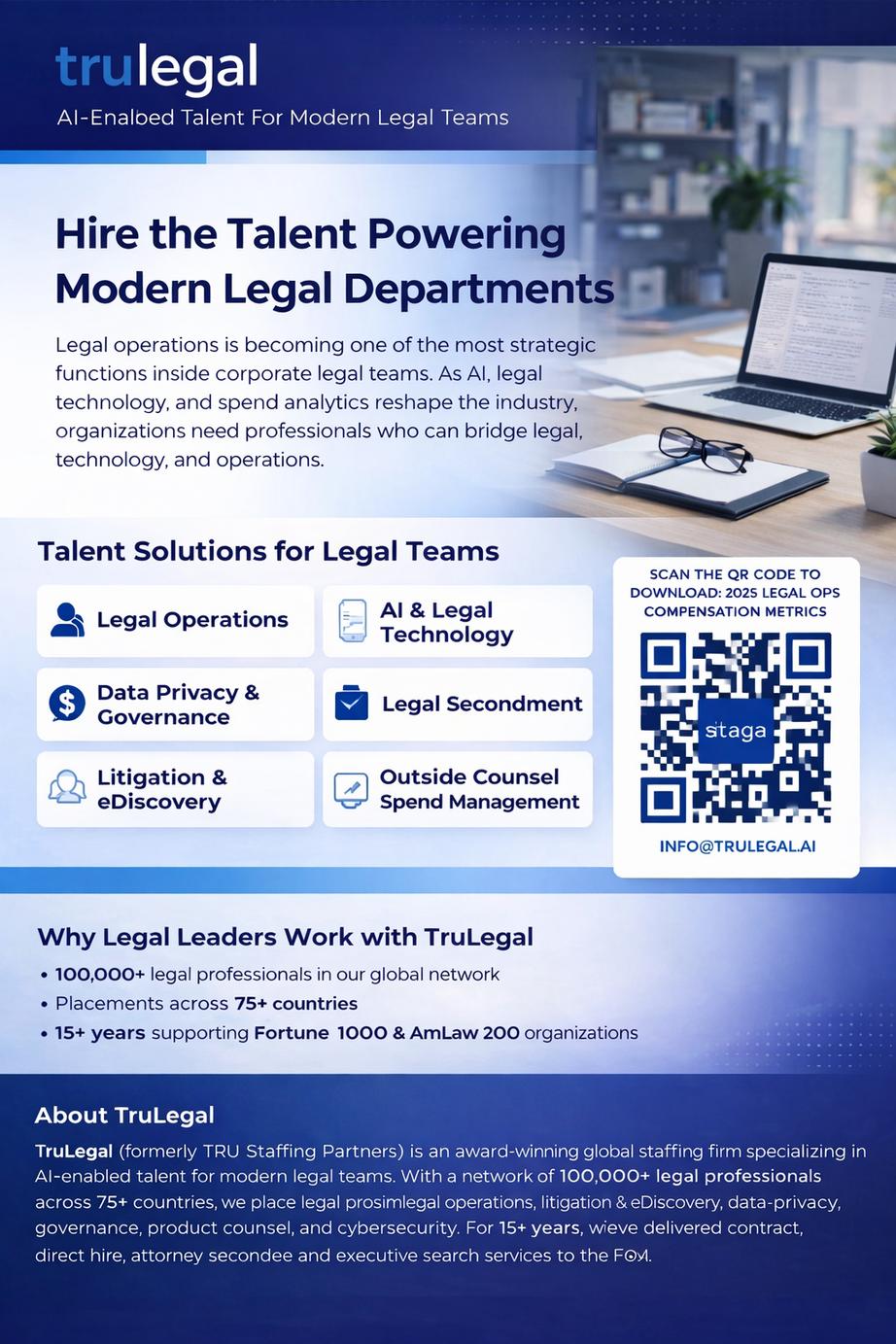
Why Legal Leaders Work with TruLegal
EXECUTIVE EDITOR
Bruce Rubenstein
CHIEF EXECUTIVE OFFICER
Robert Nienhouse
EDITOR-IN-CHIEF
Amanda Kaiser
SENIOR EDITOR
Barbara Camm
ASSOCIATE EDITOR
Jessica Bajorinas
MANAGING DIRECTOR OF CLIENT PARTNERSHIPS & INITIATIVES
Lainie Geary
DIRECTOR OF ADMINISTRATION
Catherine Nienhouse
CONTRIBUTORS
Sasha A. Carbone
Jared Coseglia
Mark Diamond
Sean Heck
Colin Levy
Liz Lugones
Colin McCarthy
Hunter McMahon
Anna Richards
Jamy J. Sullivan
Bärí A. Williams
Emily Williams
Evan Wong
DATABASE MANAGER
Patricia McGuinness
ART DIRECTION & PHOTO ILLUSTRATION MPower Ideation, LLC
CLIENT PARTNERSHIPS MANAGER
Stella Vargas
EDITORIAL ADVISORY BOARD
Dennis J. Block
GREENBERG TRAURIG LLP
Thomas W. Brunner WILEY REIN LLP
Mark A. Carter DINSMORE & SHOHL LLP
Jeffery Cross SMITH, GAMBRELL & RUSSELL LLP
Jamie Gorelick WILMERHALE LLP
Robert L. Haig KELLEY, DRYE & WARREN LLP
Robert C. Heim DECHERT LLP
Sheila Hollis DUANE MORRIS LLP
SUBSCRIPTION
Subscription rate per year: $199
For subscription requests, email subscriptions@todaysgc.com
David A. Katz WACHTELL, LIPTON, ROSEN & KATZ Nikiforos Iatrou MCCARTHY TETRAULT LLP
Steven F. Molo MOLOLAMKEN LLP
Robert A. Profusek JONES DAY
George D. Ruttinger CROWELL & MORING LLP
Jonathan S. Sack
MORVILLO ABRAMOWITZ GRAND IASON & ANELLO PC
Victor E. Schwartz SHOOK, HARDY & BACON LLP
Jonathan D. Schiller BOIES SCHILLER FLEXNER LLP
REPRINTS
For reprint requests, email Lisa Payne: lpayne@mossbergco.com Mossberg & Company Inc.
All rights reserved. No part of this publication may be reproduced or transmitted in any form or by any means, electronic or mechanical, including photocopy, recording, or any information or retrieval system, without the written permission of the publisher. Articles published in Today’s General Counsel are not to be construed as legal or professional advice, nor unless otherwise stated are they necessarily the views of a writer’s firm or its clients.
To submit an article, go to todaysgeneralcounsel.com/submissions
CLOC’s Oyango Snell Talks Legal Ops Evolution, AI Governance Ahead of CGI Chicago
In this interview, Oyango A. Snell of the Corporate Legal Operations Consortium (CLOC) shares insights about what attendees can expect at the CLOC Global Institute (CGI), which runs May 11-14 in Chicago. He also discusses the legal ops evolution as well as leadership and governance developments at CLOC.
You’ve recently transitioned into the executive role from executive director to president and CEO. How does this structural shift specifically empower you to scale CLOC’s global influence and better serve a community that is now more than 6,500 members strong? Oyango A. Snell: There are several things to consider when we talk about the structure of any business. The goal of governance is to be the underlying core facilitation on how decisions get made, how the business moves forward, and how each of the parties within the organization interacts.
When we looked at CLOC’s previous structure, leadership was involved in many operational functions. As the organization has matured, we wanted to look more broadly at the businesses that we actually represent—our members—as well as other associations and how they’re structured to meet the demands of their membership.
In looking at how we could modernize our governance to meet the maturation of our association and our industry, we looked at what titles help the organization get to the meat of the matter: How does it help us scale and perform in a way that meets the demand of our membership? The new title reflects that evolution. It’s not just about scaling; it is about ensuring that we’re able to serve our members as well as key stakeholders who are part of this industry, whether they’re members or not.
CLOC is a leader in the legal ecosystem. Having a president and CEO who has the ability to speak to those different components of the industry was important; that’s
A lawyer with nearly 20 years of experience across law firm, in-house, government, and executive association roles, he is recognized internationally for his leadership and transformative impact.
really what helped elevate the role. We’ve worked to make sure that we had that executive-level presence in the position to lead in that way. As people adjust to the structure, it puts us in a position to serve as the authority on legal ops. When people hear the title “executive director” it can carry different meanings. We’re not a charitable-type nonprofit. That’s not to say that executive directors are not great leaders; some are my mentors. However, as CLOC has matured over the last 10 years, it was important for us to be viewed as the industry leader not just within the United States, but beyond. Sometimes the term “executive director” has conflicting meanings in other
Oyango A. Snell is the President and CEO of the Corporate Legal Operations Consortium (CLOC)
countries. It’s not always meant to be the chief executive officer; sometimes it refers to someone further down the chain of command. Everybody understands what president and CEO means as far as leading an organization and an industry.
You just announced that the board of directors expanded to its largest size in history—16 members. How are you ensuring that this diverse group of voices translates into faster, more agile decision making?
Oyango A. Snell: People often assume that more board members create complexity, but in practice it improves flexibility. When you have a small board, you have to rely on everyone’s schedule aligning to move the business forward. In order to reach a quorum with a small group, you almost have to have everybody.
With a larger board, you’re able to be more nimble and agile. You can get to decisions quicker because, although it takes effort to convene more members, it’s easier to get a quorum out of 16 than it is to get all five or seven of a smaller leadership group. From the structure itself, it makes it more efficient to get to decision making.
of legal operations, and what should a longtime attendee expect?
Oyango A. Snell: Moving from Las Vegas to Chicago was a very tough decision. From the outside looking in, people might ask: “If it ain’t broke, why fix it?” But although it wasn’t broken, it had gaps—one being access. Not everybody in the legal ecosystem can access Las Vegas, whether because of finances, geography, or company cultures that don’t support conferences in a “party city.”
Regardless of location, conferences serve the same core purposes: professional development, networking, and building relationships. But our members shared that it’s difficult for them to get approvals for Vegas. We listened and explored other cities, which led us to Chicago.
Chicago is the perfect backdrop. It was rebuilt with a master plan, and legal ops is doing the same thing.
Chicago’s central location makes it easier for more people to attend. I recently spoke to a professional in LA who has never been to the Vegas CGI but is coming to Chicago. It brings a different accessibility, and the theme “Stronger by Design” ties into the intentional transformation and growth we’re seeing in our industry.
As far as the methods we are employing to ensure those diverse voices get heard, it’s no different than our established processes. Everybody has an opportunity to bring their expertise and their entire authentic self to CLOC. If they see something within the industry that we need to focus on, we pause and create space for those conversations, whether it’s a visionary concept or something practical.
Part of this shift was also stepping into a new way of governance. The board used to be hands-on, helping to make decisions that our staff now makes—like planning our global institute or hiring. Those roles have had fine lines drawn. The board is designed to govern as fiduciaries, ensuring CLOC’s assets, management, leadership, vision, and strategy are intact. That delineation of responsibility—with the board governing and the team executing the strategy—is really important for us. It has helped capture those diverse voices and lead to better decision making at an appropriate level.
Moving CGI from Las Vegas to Chicago is a massive symbolic and logistical shift. How does the “Stronger by Design” theme reflect the current maturity phase
Chicago is the perfect backdrop. It was rebuilt with a master plan, and legal ops is doing the same thing. We’re moving from “doing more with less” to doing it better by designing intentionally and becoming more strategic. We are looking at how the entire enterprise makes decisions, modernizing our operations to impact the bottom line. We used the Chicago architectural footprint as a blueprint to mirror how our industry has been intentional by design.
We’ve moved from an inflection point into a phase of transformation. We understand the technological advances we need while we work to understand how AI impacts that. We’re no longer trying to just “figure it out” or fighting for a seat at the table. We have a seat, and we’re working with general counsel and CEOs to drive the business.
CGI is introducing an exhibit hall-only pass and an AI stage. How are you re-engineering the relationship between buyers and providers?
Oyango A. Snell: CLOC has taken intentional steps to be all-encompassing, including law firm representatives and vendors in our membership and leadership. As the premier association for legal ops, it’s important to understand how we’re working with these components to solve day-to-day business problems.
In Chicago, our exhibit floor is designed to be more educational, not just about hard sales. It’s an opportunity to understand the products that can help businesses thrive. We want open conversations between legal ops professionals and tech vendors about the struggles they face so we can work together toward creative solutions. We introduced the single-day access pass to the exhibit floor to facilitate that relationship development. This also ties back to access. We want to bring in local communities from neighboring states who can drive in for a day, get the information they need, and return home the same day. We didn’t have that direct local component in Vegas. Chicago serves as the central hub to bring these different people together.
With the new AI-focused elements at CGI, how is CLOC moving the conversation from “What is AI?” to “How do we design governance for it?” What is the biggest hurdle for legal ops leaders?
Oyango A. Snell: Great question. Last year, the conversation was: “Should we even be using AI?” I’ve been trying to get people away from the fear element. We’ve shifted from “Are we using it?” to “Why are we using it? How is it driving decisions and helping us scale? How are outside law firms using it to help clients make better business decisions?”
We’ve adjusted from fear to use cases. On the floor, we’ve created opportunities for demonstrations of AI products currently in use. People will get a chance to see success stories and best practices regarding integration, as well as the challenges involving budgets and adoption.
At our recent Europe summit, I learned that participants are really dialed into how clients are using these products. AI has existed for years, but we’ve only started talking about it this way recently. The fear was mostly driven by not understanding when or why to use it. They need to know: How does it help me make better business decisions? CLOC is listening to these trends. We want people to walk away with practical analysis they can take back to their teams for implementation on day one.
How is CLOC moving beyond representation to ensure diverse perspectives are baked into the design of legal operating models?
Oyango A. Snell: In my leadership roles, I have never needed a policy or a quota to do the right thing. You do the right thing because it’s the right thing. Diversity is in my DNA; I actively seek different perspectives to move the business forward.
Prefer to read this online? Click here.
There is an intentionality in our team and board to include diverse voices. Diversity means a tolerance and respect for difference, but other components are equally important: inclusive practices and equitable access to resources and opportunities.
Our board and councils represent significant diversity in gender, generation, race, religion, and industry. What’s great is that CLOC is a peer member-driven organization. For example, our educational programs are decided by a diverse group, but they are scored anonymously. We aren’t elevating projects based on who is presenting; we’re looking at what the industry needs. I’m proud to have a board dedicated to keeping that intentionality at the forefront.
We look at the entire industry. Through a survey we partner with Harbor on, we are learning that demand is rising sharply in key areas like regulatory and cybersecurity issues. Yet, only 37% of departments expect to increase outside counsel spend. When we see those challenges, we have to ensure those diverse voices are helping solve the actual business problems our member companies face.
A year after the Chicago edition of CLOC, what is one tangible framework you hope the community will have adopted?
Oyango A. Snell: I love the “Chicago edition” framing. I’m going to adopt that one. Putting you on notice. If there is one thing I want people to recognize, it’s that the legal ops industry, through CLOC, is unifying the entire industry in a unique way.
Legal ops has moved from the back office to the flight deck of the enterprise. It has grown from administrative work to decision-making, financial management, and data protection. Currently, 80% of legal departments rank technology strategy among their top priorities. Those numbers reflect the growing strategic role of legal operations.
I hope those coming out of the Chicago edition understand the complexity of this field. They are part of a transition from an inflection point to the execution of technological components. We must grow our industry intentionally by working together.
My message is one of unification to solve today’s business problems. I hope each person takes one thing from the conversations we are facilitating back to their offices to immediately enhance their organization’s business decisions.
Unlocking Impact: How GCs Can Turn Legal Operations into a Strategic Business Asset
By ANNA RICHARDS
Most legal departments are run by brilliant people who were never taught how to run a department. Their legal training is exceptional. Their ability to guide an operational infrastructure often isn’t. After nearly two decades of leading legal operations teams and serving as a chief of staff to general counsel, I’ve seen what makes the difference, and it comes down to one thing: treating the legal department like the business function it actually is.
That’s legal operations strategy. And the challenges it addresses are largely the same regardless of organization size. Consider this a field guide to the ones that matter most, written by someone who’s seen what works, and what doesn’t.
SOMEONE HAS TO OWN THE BUSINESS OF LEGAL
Every legal department needs someone thinking about process, data, and systems. Not occasionally. Not as a side project. As an actual job. Someone has to own it.
But ownership alone isn’t enough. How the general counsel (GC) shows up for that function determines what it’s ultimately capable of. Early in my career, a GC sat down with me to build the company’s first billing guidelines;
not delegating from a distance, but genuinely engaging, sharing his perspective, and then trusting me to run with it. That investment didn’t just produce better guidelines. It showed that legal ops was a real function with real authority.
The relationship between a GC and a legal ops leader is not static. The more you put in, the more it becomes capable of giving back.
The relationship between a GC and a legal ops leader is not static. The more you put in, the more it becomes capable of giving back.
VISIBILITY INTO LEGAL SPEND ISN’T A ‘NICE TO HAVE’—IT’S THE PRICE OF ADMISSION
Outside counsel spend is one of the largest controllable costs in a department’s budget, and yet many teams don’t have a clear picture of where that money is going. Almost 45% of chief legal officers (CLOs) say they’re increasing outside counsel spend
this year according to Association of Corporate Counsel (ACC)’s CLO Survey. That’s a lot of money moving faster through systems that, for many departments, still amount to a spreadsheet and a prayer. Without spend visibility, cost control conversations with your firms become negotiations of instinct rather than data. ACC’s 2025 Law Department Benchmarking Report is concrete on this: Companies are consolidating outside counsel relationships, with the median number of firms declining from 14 to 10 in a single year. That doesn’t happen by accident. It happens when someone is watching the data and turning it into a point of view. If you’re still operating without a reliable system of record for legal spend, that’s the first thing to fix. Not a Contract Lifecycle Management (CLM) platform. Not workflows. Clean, structured data, and someone accountable for turning it into insight.
YOUR FINANCE RELATIONSHIP IS A STRATEGIC ASSET—TREAT IT LIKE ONE
One of the most underrated aspects of a senior legal ops role is serving as the translator between legal and finance. Finance thinks in forecasts and return on investment (ROI). Legal thinks in
risk and “it depends.” When they can’t communicate effectively, legal loses every budget conversation, every technology investment ask, and every headcount discussion. According to a recent Axiom survey, 77% of GCs have experienced tension with their chief financial officer (CFO). That friction is usually not about substance, it’s about translation.
When I was serving as a legal chief of staff, it was common for teams outside legal—sales, IT, finance—to come to me before sending communications to my leader, wanting help framing their ask so it would land well. That cross-functional trust gets built when legal ops is embedded in the business, not siloed from it.
TECHNOLOGY WON’T SAVE YOU— BUT YOUR SPONSORSHIP MIGHT
The average legal department uses six dedicated legal technology tools. And yet nearly half of legal professionals say they still don’t have the right tools to do their jobs efficiently. That’s not a vendor problem. That’s an adoption and alignment problem, and it almost always starts at the top.
I once sat in a meeting where a senior leader asked my team to track down a pencil sharpener so he could manually mark up printed invoices while we sat around a table full of laptops with a perfectly functional e-billing platform running. It was a small moment. But it communicated exactly where technology stood in the priority order, and the team took
note. Your team always takes note. Conversely, I once led a technology implementation at a large organization stuck in a multi-year decision cycle; competing priorities, no clear ownership, a committee that couldn’t get to yes. What broke the logjam wasn’t a better demo. It was having the authority, the rigor of process, and visible executive backing to make a call and move. My leader held the line when others pushed back, and we got unstuck. The technology went live. People used it. Value was created. That’s what GC sponsorship actually looks like: not just approval, but cover.
WHETHER YOUR LEGAL OPS FUNCTION IS MATURE OR STILL FINDING ITS FOOTING, THE PATH FORWARD IS THE SAME. START HERE:
• Audit your spend visibility. If your CFO asked right now which matters are at risk of pushing your department over budget this quarter—and why, and what you’re doing about it—could you answer with confidence? If not, task your legal ops function with building clear, real-time visibility into matters, vendors, and spend trends. Without this, every decision becomes reactive. A true system of record for legal spend isn’t a nice-to-have, it’s the foundation everything else is built on.
• Bring legal ops into your finance relationship. Not just budget reviews. The ongoing conversation.
Prefer to read this online? Click here.
Your legal ops leader should be fluent in how finance thinks, what metrics they care about, and where legal’s unpredictability creates friction. That translation layer is one of the highest-value things a strong legal ops function provides.
• Ask your legal ops team for an honest technology audit. Not whether you have the right tools, whether people are actually using them, and why or why not. Adoption gaps are rarely a technology problem. They’re a leadership and change management problem, and legal ops is best positioned to diagnose them.
• Invest in your legal ops function like you mean it. Get into the details with them. Share your perspective. The relationship compounds, the more you put in, the more the function becomes capable of giving back.
Legal ops is ready. Are you?
Anna Richards is Head of Community at Brightflag and a legal operations leader with nearly two decades of experience working with legal departments across high-growth SaaS and Fortune 500 companies. She channels that experience into building the connections and conversations that move the legal operations profession forward.
TALKING LEGAL OPERATIONS WITH COLIN LEVY
The New Superpower: Driving C-Suite Strategy with Legal Operations Commercial Intelligence
By COLIN LEVY
Ask most C-suite executives what legal operations does, and you’ll hear the same story every time: systems administration, contract management, and risk mitigation. That framing isn’t wrong, exactly. But it’s incomplete in a way that has quietly cost legal teams their seat at the table for years.
Here’s what I keep coming back to: legal operations sits on what may be the single most valuable, most
underutilized source of commercial intelligence in the entire enterprise. Every pricing structure, every supplier dependency, every renewal window, every customer concentration risk lives in your contracts. Yet when the chief financial officer (CFO) needs to understand revenue exposure heading into a volatile quarter, or the chief strategy officer (CSO) needs commercial intelligence on an acquisition target, legal is rarely the first call. We spent so long proving
our efficiency that we never demonstrated our insight.
That’s the legal operations commercial intelligence gap we need to close. And we now have the tools to do it.
HOW LEGAL OPERATIONS GOT TYPECAST
Legal operations earned its credibility through years of unglamorous, essential work. Over the past decade, we transformed from administrative
overhead into process engineers who delivered measurable results. We implemented contract lifecycle management systems, built playbooks, drove down cycle times, and made the legal function faster and more consistent. That work mattered. In many organizations, it saved legal from the perception that it existed solely to slow things down.
But the tools we used solved a specific problem: getting contracts done. Managing the process from request to signature and everything in between. They were never designed to turn the output of that process into something the business could act on strategically. Nothing was, until recently.
The reporting we produced looked backward by design. Cycle times. Volume by contract type. Approval bottlenecks. All useful for running the legal function. None of it useful for helping the CFO answer a hard commercial question on a Tuesday afternoon. So, we kept doing what we knew, the business kept going elsewhere for strategic intelligence, and the typecast held. Finance built its own models. Strategy hired consultants. Procurement ran its own vendor analyses. And legal kept optimizing throughput on the assumption that speed and consistency were the best case we could make for our value.
The frustrating part: We had the data the whole time. We just lacked the means to surface it in a form the business could use.
THE INTELLIGENCE HIDDEN IN PLAIN SIGHT
The problem was never the data. It was access.
Think about what actually lives in your contract repository. If your
CFO wanted to quantify the company’s exposure to a key supplier failure, that answer sits in your contracts. If your chief commercial officer needed to calculate the total value of a vendor relationship across subsidiaries before a renegotiation, your contracts hold that number. If your CSO needed to map commercial dependencies before closing an
The problem was never the data. It was access.
acquisition, the answer is there too. Termination triggers, auto-renewal dates, most-favored-nation clauses, volume commitments, liability caps, indemnification obligations: This is the raw material of commercial strategy, and legal operations has been sitting on it for years.
Traditional contract analytics could extract the fields you told it to look for: 50, maybe a 100 pre-defined data points. The rest of the document stayed dark. Everything buried in exhibits, schedules, and commercial terms scattered across pages remained invisible to the system and therefore invisible to the business. A contract might contain a provision that would reshape the economics of a pending deal or trigger obligations nobody planned for, but if that field wasn’t tagged during implementation, it didn’t exist as far as the platform was concerned. You were working with a fraction of the intelligence your contracts actually contained, and over time, the business learned to stop asking for more.
That’s the baseline most of us still operate from. It’s far lower than it needs to be, and the cost of
maintaining it grows every quarter as deal complexity increases and commercial risk accelerates.
WHAT’S ACTUALLY DIFFERENT NOW
Let me be blunt: Most of what the legal tech market has labeled artificial intelligence (AI) over the past few years hasn’t earned the term. Vendors slapped it on keyword search, rules-based extraction, and slightly better optical character recognition. The pitch changed. The capability didn’t. If you’ve sat through demos where “AI-powered” meant the system could find a change-ofcontrol clause as long as someone had already trained it on exactly what that clause looked like in your templates, you know what I’m talking about. That wasn’t intelligence. It was pattern matching with better marketing.
So, I understand the skepticism. You should be skeptical. But dismissing everything under the AI label because the first wave overpromised would be a mistake right now, because something materially different has arrived.
Modern large language models can read a contract portfolio the way a skilled analyst would. They don’t need pre-built extraction templates. They don’t need someone to define every field in advance. They comprehend commercial meaning across the full document: the interplay between a force majeure clause in a supply agreement and a business continuity requirement in a customer contract, the gap between a liability cap and an indemnification obligation that creates unquantified exposure, the pricing ratchet buried in an exhibit that nobody flagged during the original review. And they do this across
thousands of agreements simultaneously, which no team of paralegals or analysts could replicate at any budget. Consider what that makes possible concretely. A global pharmaceutical company preparing for a product launch typically asks regulatory affairs to map compliance exposure across target markets, Finance pulls subscription data from the billing system, maybe cross-references customer relationship management (CRM) records, and produces a forecast. But the actual contractual terms governing that revenue, the renewal mechanics, the pricing ratchets, the termination-for-convenience windows, live in legal’s repository. Without that layer, the forecast is built on assumptions rather than obligations. With it, the company knows not just what revenue it expects but what revenue it can enforce. That’s the difference between a guess and a number the board can rely on.
This is what an emerging category of technology, commercial intelligence platforms, makes possible. Not smarter contract management, but a genuine conversion of contract data into strategic business intelligence. For legal operations, this is less a technology story than a positioning story. The capability now exists to answer the questions the C-suite has always wished legal could answer. The question is whether we step into that role or wait for someone else to claim the data we’ve been managing all along.
THE MOVE THAT’S AVAILABLE RIGHT NOW
Start with an honest audit. What questions are your CFO, CSO, or chief commercial officer asking that your contracts should be able to answer? Revenue concentration,
renewal exposure, pricing variance, supplier dependency: These are business questions with legal data as the answer. Map the gap between what you currently deliver and what your executive team needs. In most organizations, that gap is wider than anyone on the legal team realizes, because the business stopped asking years ago.
Build the bridge. Pick one highvisibility question, something the CFO or CSO has struggled to answer quickly, and deliver an answer from your contract data before they ask for it. Revenue concentration is often a good starting point: Which customers represent outsized exposure, what are the contractual protections (or lack thereof) around that revenue, and what does the renewal timeline look like? That single deliverable can shift how the executive team perceives legal operations more effectively than a year of cycletime improvements.
Share findings proactively, not only when asked. Position your team as the source of commercial truth, not just the keeper of commercial documents. The general counsel (GCs) gaining real influence aren’t the ones who’ve achieved the fastest contract cycle times. They’re the ones who’ve made the intelligence inside those contracts visible to the people who need it most, and who’ve built the muscle to keep delivering it quarter after quarter.
For too long, legal ops has derived its organizational standing from process expertise—the ability to get things done efficiently. That kind of positional power has a ceiling. Commercial intelligence is different. It’s expert power: the kind that comes from knowing something critical that nobody else in the room
Prefer to read this online? Click here.
knows and being the only function with the foundation to deliver it consistently. That’s not a seat at the table. That’s a permanent place at it.
The GCs who will matter most to their organizations over the next decade won’t be remembered for the contracts they managed. They’ll be remembered for the intelligence they unlocked.
We’ve been underestimated long enough. The data was always ours. It’s time to use it.
Colin Levy leads the legal function as General Counsel and Evangelist of Malbek, a leading CLM provider. Levy also advises startups and invests in emerging technologies that propel the industry forward. He has authored “The Legal Tech Ecosystem” and “CLM for Dummies” and contributes regularly to many leading publications. He can be reached at colin.levy@malbek.io
How Can Legal Build Data Fluency Without Hiring Analysts?
By EVAN WONG
Legal teams are being asked to operate differently than they did a decade ago.
General counsel (GC) are no longer expected to just manage risk or review contracts. Today, leadership teams want visibility into how legal operates. They want to know where the work is coming from, how long it takes to resolve, and whether the legal team is operating efficiently. They want data.
For legal, the idea of becoming “data-driven” can be daunting as it’s often associated with hiring analysts, investing in complex analytics platforms, or learning advanced technical skills.
Fortunately, reality is much simpler. Corporate legal teams can build data fluency with the resources they already have. Requests from the
business, contract reviews, compliance questions, vendor approvals, and policy inquiries are all interactions that generate data.
The real opportunity is learning how to capture, interpret, and use it to run legal more effectively.
WHAT DOES DATA FLUENCY ACTUALLY MEAN FOR LEGAL?
When corporate teams hear the phrase data fluency, they assume it means building complex dashboards, hiring analysts, or learning technical tools. However, data fluency for in-house legal means understanding what the numbers behind legal work are saying.
Every legal request creates data, and each one signals something about how legal operates.
Data fluency means learning how
to read those signals and asking simple questions:
• How many requests arrive each month?
• Which types of work appear most often?
• How long does contract review take?
• Where is work getting stuck?
Data allows legal to communicate its impact in business terms, helping GCs and legal leaders demonstrate operational maturity, explain resourcing needs, and support strategic decisions with leadership.
BUILDING DATA FLUENCY
How do legal teams go about building data fluency without having to hire analysts? Here’s how.
1
Start with operational visibility. Legal requests often arrive through disconnected channels such as email threads, Slack messages, shared drives, and in-person meetings. Without structure to help connect these channels to downstream systems, work gets done, but the data disappears. That’s why legal teams need to capture a few basic data points for every request: who submitted it, the request type, priority level, and time to completion.
These fields create the foundation
Data allows legal to communicate its impact in business terms, helping GCs and legal leaders demonstrate operational maturity, explain resourcing needs, and support strategic decisions with leadership.
for understanding how legal operates. Once work becomes visible, teams can identify bottlenecks, understand workload, and allocate resources effectively.
2
Build data skills through everyday legal work. Legal teams can build data fluency through simple habits. One starting point is tagging every matter by type, such as contracts, compliance, marketing review, procurement, or privacy. Once work is categorized, patterns emerge. From there, teams can more easily review trends and ask operational questions. Instead of reacting to individual requests, lawyers begin thinking about how legal workflows through the organization, gradually building analytical thinking across the team.
3
Use technology that surfaces insights automatically. Technology is important in making data fluency practical for legal teams. But the goal is not to build complex analytics environments or require lawyers to manually compile reports. Modern legal work platforms generate insights automatically as workflows through the system. When requests flow through a legal front door and matters are tracked in one place, data is captured as part of everyday workflows. Over time, this creates a reliable dataset without extra effort from the team. Some tools provide built-in capabilities such as real-time dashboards, matter tracking, workflow analytics, and automated reporting, embedding data awareness directly into how legal work is managed.
4
Make data part of legal’s culture. Data fluency ultimately comes down to culture and leadership. GCs and legal ops leaders should encourage teams to review metrics regularly, share operational insights, and use data in planning conversations.
When data becomes part of everyday discussions, legal teams move from reactive problem-solving to proactive operational management, with a clearer understanding of where they create the most value.
WHERE TO START: ACTIONABLE STEPS
Even knowing that building data fluency doesn’t require analysts, complex platforms, or advanced technical skills, it can feel like a big mountain to climb. But with the right foundations in place, everything downstream starts to come together naturally. So, what can you do right now? Here are five steps legal teams can take to create a stable foundation to start building on.
1 Set up a single intake point for legal requests. If work is arriving unstructured, start consolidating it. A legal front door, or a simple intake form, captures the structured data you need to begin tracking volume, type, and turnaround time.
2 Agree on a standard set of matter tags. Define categories for your legal work (i.e. contracts, compliance, marketing review, procurement, privacy, and so on). Consistency is what makes pattern-spotting possible down the line.
3
Prefer to read this online? Click here.
Pick three metrics to track this quarter. Don’t try to measure everything at once. Start with volume, type, and cycle time. Three numbers will tell you more than a complex dashboard you never look at.
4
Schedule a monthly operational review. Block 30 minutes each month for the team to look at the numbers together. This habit is what turns data into decisions.
5 Share one data insight with leadership next month. Take something you’ve observed from your metrics and bring it into a conversation with leadership. Presenting data proactively establishes legal as a function that speaks the language of the business.
The teams that build data fluency fastest are the ones that start small, stay consistent, and let the insights grow from there.
Evan Wong is the Co-Founder and CEO of Checkbox, the AI Legal Front Door for in-house legal teams. He co-founded Checkbox with the belief that everyone should be empowered to automate complex workflows.
THE AI-ENABLED LAWYER WITH JARED COSEGLIA
How AI Will Make Legal Operations the New Control Tower and Define Hiring Trends
By JARED COSEGLIA
This column unpacks the ongoing impact of artificial intelligence (AI) on the legal profession, specifically the legal job market and careers within it. Each column starts with an emerging AI-employment trend and ends with actionable insights on how to successfully hire top talent or level up individual careers in the era of AI. Past editions of the column can be found here.
If you want to understand how AI will change in-house legal over the next three years, don’t
start with attorneys. Start with legal operations.
Legal ops is where strategy becomes execution: budgets become controls, vendor promises become measurable performance, and “we’re using AI” becomes either (a) real adoption with real return on investment (ROI) or (b) theater.
AI won’t just automate legal work. It will rewire legal operations into a control tower governing spend, enforcing outside counsel expectations, and defining the skills that legal teams will hire for (and stop hiring for).
That shift is already visible in market data. CLOC’s 2025 State of the Industry findings show 83% of legal departments expected demand to increase, while AI adoption “has nearly doubled from 2023,” with 30% already using AI and 54% planning to adopt within two years. While the 2026 report does not focus on these same stats, it does signal that 85 % of legal departments now have dedicated AI oversight or governance resources.
At the same time, Thomson Reuters’ 2025 Legal Department
[AI] will rewire legal operations into a control tower governing spend, enforcing outside counsel expectations, and defining the skills that legal teams will hire for (and stop hiring for).
Operations Index highlights legal ops teams’ growing mandate to deliver efficiency and value—moving beyond cost control into systems, process, and technology leadership, with nearly three-quarters planning to use advanced technology to automate tasks and reduce costs.
Legal operations is the function that turns AI from an experiment into an operating model.
WHAT AI IS CHANGING IN LEGAL OPS
Cost control is no longer a project— it’s a product.
Only 20% of legal matters sent to outside counsel stay within their planned budget, according to Gartner’s December 2025 research, So, you can see why legal ops pros are obsessed with spend analytics. Cost control has always been in legal ops’ DNA. What’s changed because of AI is the frequency and precision with which legal ops can enforce it.
AI pushes that mandate from periodic review to continuous governance. Instead of auditing a sample of invoices quarterly, legal ops can use AI-enabled e-billing/spend platforms and analytics to:
• Flag billing guideline violations in near real time
• Benchmark timekeeper rates across firms and matter types
• Identify scope creep early (before it becomes a surprise overage)
• Connect spend to outcomes (cycle time, success rate, settlement bands, deal velocity)
This is why the AI-enabled legal ops professional is so valuable: they don’t just run tools—they build controls that drive financial outcomes in real-time.
CONVERGING ON SYSTEMS, NOT COORDINATION
Legal ops roles are increasingly centering on the systems that drive operational leverage and have been most-rapidly consumed, if not commoditized, by AI-enabled technology in Contract Lifecycle Management (CLM), e-billing, and analytics. Legal operations job descriptions most frequently mention tools such as Ironclad, Icertis, Agiloft, Sirion, DocuSign CLM, Juro, ContractWorks, Malbek, and Checkbox.
This is a quiet but profound shift: legal ops is no longer primarily a coordination function. It’s a systems function.
The market is moving toward hiring people who can:
• Implement platforms (not just administer them)
• Translate legal needs into workflows and data requirements
• Drive adoption (change management and enablement)
• Operationalize AI safely (governance, quality assurance (QA), auditability)
THE SKILLS LEGAL OPS IS HIRING
FOR
Across in-house teams, the most durable “AI-enabled legal ops” skill set clusters into five domains:
1
Spend intelligence and vendor controls: Billing guidelines, invoice QA, rate/rule enforcement, matter budgeting, portfolio reporting, alternative fee arrangement (AFA) strategy.
Analytics and dashboarding: Key performance indicator (KPI) definition, data hygiene, business intelligence (BI) tooling, executive reporting that ties effort to business outcomes.
4 AI enablement and governance operations: Model/tool evaluation, procurement partnership, policy rollout, audit trails, “humanin-the-loop” quality control.
5 Automation across routine legal ops work: Triage, routing, summaries, playbook-based drafting, invoice narrative analysis, contract exception handling.
PUTTING PRESSURE ON OUTSIDE COUNSEL
Here’s the uncomfortable truth for
many law firms: legal ops is turning AI into a procurement-grade expectation. Transparency in the use of AI by outside counsel is emerging, but at an incredibly slow pace. That is all about to change. What begins as “nice-to-have transparency” is becoming a checkbox requirement, then becomes a scoring criterion, then becomes a pricing lever. At TruLegal, we are seeing legal departments contractualize questions such as:
• Where in the matter lifecycle is AI being used (research, drafting, discovery, diligence, project management)?
• What tools/models are being used and were they built internally or using third parties?
• How are AI outputs validated (hallucination controls, citations, validation reporting, review protocol)?
• Whether AI use is billed, and if so, how (and why)?
The wake-up call: Legal ops has a mandate (or will) to use AI to reduce cost and cycle time, not to allow outside counsel to quietly increase margin using AI while keeping hours flat.
This is also why alternatiave fee arrangements (AFAs) are back in the spotlight. As AI makes work materially more efficient, the traditional hourly model strains. Legal operations leaders are going to put pressure toward value-based pricing from outside counsel since the expectation is that hourly work is more efficient thanks to AI.
ACTIONABLE INSIGHTS FOR LEGAL OPS HIRING MANAGERS:
• Hire for adoption, not just
familiarity: “Used Ironclad/DocuSign/Relativity” is table stakes. You want someone who can drive behavior change, training, and measurable utilization.
• Make outside counsel AI expectations contractual: Define disclosure requirements, permitted tools, validation standards, and billing treatment. If it’s important, it belongs in guidelines and engagement letters.
• Separate experimentation from production: Create a sandbox for AI use cases, then promote only what meets QA/audit standards into production workflows.
ACTIONABLE INSIGHTS FOR LEGAL OPS JOB SEEKERS:
• Pick a stack and go deep: CLM plus e-billing and analytics is the career compounding engine right now.
• Learn the language of finance and procurement. Cost control is the long game, and it remains a top mandate.
• Become the “translator” between legal, IT, privacy and security. AI won’t be adopted at scale without governance and risk alignment.
• Build a portfolio of outcomes. Cycle time reduced, dollars saved, adoption increased, risk incidents prevented—this is what gets you promoted in 2026.
Legal operations is where AI becomes real: measured, governed, priced, and enforced. Organizations that treat legal ops as a strategic
Prefer to read this online? Click here.
control tower will be the ones that get AI ROI and keep outside counsel and third-party vendors aligned with the unavoidable AI value mandate.
Jared Coseglia is the founder and CEO of TruLegal (formerly TRU Staffing Partners), a global leader in staffing AI-enabled talent for modern legal teams. He has placed over 5,000 professionals across Fortune 1000 companies and Am Law 200 firms.
Checkbox: The AI
Your GC should walk into leadership with results — Not guesswork or anecdotes.
Checkbox gives legal teams the intake, visibility, and reporting to prove legal value, every quarter.
Get in touch
Tasks to Teammates: How to Delegate Legal Work to AI Agents
By BÄRÍ A. WILLIAMS
Once AI starts behaving like a teammate, we have to think about treating it like one. And that begins with asking ourselves a simple question: How do we delegate legal work to artificial intelligence (AI) agents without delegating responsibility?
Legal technology has been evolving toward this moment for years. Early tools focused on search and extraction, helping lawyers quickly find clauses or pull key data
from contracts more efficiently. Then generative AI arrived, bringing assistants that summarized documents, suggested redlines, or drafted clauses on command. These tools were undeniably helpful, but they still relied heavily on lawyers to drive the work forward.
What we are now entering is something much more powerful. AI systems can now complete multistep workflows and move legal tasks forward in a meaningful way. They
can plan, execute, and operate across tools to help legal professionals complete everyday legal work.
In other words, agentic AI can now function less like a tool and more like a teammate.
FROM ASSISTANT THAT REACTS TO AGENTS THAT ACT
Traditional AI assistants are reactive. They respond to a prompt and generate an output—often in a single interaction. AI agents, by contrast,
can follow entire workflows. They can take several steps, gather information across systems, and make progress toward an outcome without needing constant direction.
In practice, that means legal AI can:
• Take a first pass at contract review
• Apply playbooks consistently across agreements
• Triage and complete intake workflows, escalating exceptions for attorney review
• Translate redlines and reconcile changes
• Convert negotiation standards into structured playbooks that can be combined with other playbooks to create a single, cohesive contract review framework
These capabilities allow in-house legal teams to move much faster on the routine but necessary work that consumes a large portion of their day.
The productivity gains are already visible. According to the 2026 State of AI for In-House Legal, 79% of legal professionals report that AI tools save them time by handling tedious tasks—allowing lawyers to focus on work that was previously too time-consuming or too expensive to be practical.
Yet despite these time savings, only 21% of legal professionals report using AI daily as teams continue to determine how to adopt it responsibly.
DELEGATION STILL REQUIRES ACCOUNTABILITY
Delegation is nothing new in the legal profession. Senior attorneys delegate to junior lawyers or business analysts. Legal teams rely on outside counsel or consultants. But
the principle has always been the same: The lawyer is responsible for the outcome.
AI delegation must follow the same logic. Lean on the technology to perform parts of the work, but attorneys must supervise, verify, and ultimately stand behind the results.
In my work and with my team, I emphasize three foundational questions that every legal team should ask before introducing AI into their workflows.
Legal teams rely on outside counsel or consultants. But the principle has always been the same: The lawyer is responsible for the outcome.
1 Are you educating everyone involved—not just the legal team—on how AI is being used? Sales, procurement, and other stakeholders often interact with the same workflows, and they need to understand how these systems function.
2 Do you have clear and reasonable expectations for what AI can actually do? Overestimating AI capabilities can introduce just as much risk as underusing them.
3 Have you put guardrails in place that protect sensitive data and ensure human judgment remains central to the process? The phrase I often return to is “trust but verify.”
Lawyers must remain actively involved in evaluating the outputs,
and courts are already reinforcing this expectation. “AI drafted it” is not a defense, and recent cases make that clear. In Mata v. Avianca, attorneys submitted fabricated citations generated by ChatGPT and were sanctioned. In Moffatt v. Air Canada, a chatbot provided incorrect fare information. The airline argued the model made the mistake, but the court disagreed.
If you deploy AI, you own the outcome. Accountability does not shift to the machine.
THE RISE OF THE LEGAL ARCHITECT
As AI becomes more embedded in legal workflows, the role of lawyers is evolving. Legal teams today need what I refer to as “legal architects.” These are professionals who can think not only like attorneys but also like system designers.
Legal architects understand both the law and the workflow. They think about which tasks are well-defined enough to delegate, where human judgment is irreplaceable, and how to scale consistency without scaling risk.
They also recognize that not every task belongs to AI. High-value negotiations, sensitive matters, and issues involving privileged or personal data must remain human-led. They establish clear boundaries and build guardrails into each step. Without them, AI can amplify risk just as easily as it improves efficiency.
A QUICK CHECKLIST FOR EVALUATING LEGAL AI TOOLS
Legal leaders should pay close attention to how the systems handle data and security. Before deploying any AI system in your legal workflow, make sure your team does the following:
Prefer to read this online? Click here.
• Confirm how your data is used. Verify whether the tool uses your content to train foundational models or if your data is isolated from model training.
• Review confidentiality protections. Ensure the platform protects sensitive legal and business information.
• Verify security certifications. Look for recognized standards such as SOC 2 Type II and ISO 27001.
• Understand how the AI is built and maintained. Confirm the system is tested, tuned, and monitored by legal experts.
• Establish human oversight. Make sure there is a clear process for lawyers to review outputs before they are used in practice.
Without these safeguards in place, colleagues don’t check outputs before they reach you and you become the risk bearer.
AGENTS IN ACTION: UNLOCKING SCALE IN LEGAL WORKFLOWS
Agents can dramatically expand the capacity of legal teams. But only when properly supervised. Consider contract review. In-house lawyers report spending an average of three hours manually reviewing a master service agreement (MSA), making it challenging to keep pace with the volume of agreements moving through modern businesses. AI agents can help. By turning negotiation guidelines into structured playbooks, applying those standards consistently across contracts, and automatically gathering
missing information during intake, these systems allow lawyers to focus their attention where it matters most.
So now the question becomes: Would you rather perfect one agreement every three hours or invest in building a workflow that helps review hundreds consistently and accurately?
Let’s be clear. This is not about removing lawyers from the process. It is about enabling them to spend more time on the work that requires real judgment: negotiations, strategic advice, and complex decision-making.
AI systems should support legal judgment, not replace it. Lawyers still own the outcome. The teams that learn how to manage AI as a teammate—not just a tool—will shape the future of in-house law.
Bärí A. Williams leads LegalOn’s legal and legal content teams. An attorney with 16+ years in tech transactions, she blends legal expertise with industry insight. Previously, she held pivotal roles at Meta (Facebook) and StubHub, shaping innovative legal strategies. Her email is: bari.williams@legalontech.com
Five Questions Every GC Should Ask Before Deploying AI in the Legal Department
By HUNTER MCMAHON AND COLIN MCCARTHY
As a client once told us, “Litigation is a business problem stuck in the courtroom.”
It’s expensive, unpredictable, often irrational, and always disruptive to the people and operations that actually generate revenue. Yet the way most organizations manage litigation has not fundamentally changed in decades. We’ve added technology, sure, but often in service of the same outdated workflows. The process got faster, but the thinking has not.
Now the pressure is intensifying from a new direction. Boards and C-suites want to know what legal is doing with AI. If you haven’t deployed it yet, the assumption is you’re behind. Budget conversations increasingly come with an implied condition: Show us how you’re leveraging AI, or lose budget.
But here’s the problem with responding to pressure instead of a plan. Efficiency is a valid goal, but it cannot be the ultimate one. Getting to the wrong answer faster doesn’t help anyone. Automating a broken process just makes it break at scale. Before deploying artificial intelligence (AI) in the legal department, leaders need to pause long enough to ask better questions.
1
Do you understand the real problem? This sounds obvious, and that’s exactly why it gets skipped, particularly when timelines are short and budgets are tight. Someone identifies a pain point, and the instinct is to solve it. But surface-level symptoms rarely tell the whole story.
Efficiency is a valid goal, but it cannot be the ultimate one. Getting to the wrong answer faster doesn’t help anyone.
A legal department might look at rising outside counsel costs and conclude the problem is rates and therefore the solution is discounts. But the real issue could be something entirely different: a lack of early case assessment, misalignment with business priorities, or a culture where disputes escalate because there is no internal triage process. AI can help solve each of those, but only if you have diagnosed the correct problem. Otherwise, you risk implementing a tool that efficiently manages the
wrong issue. That is not progress. It is simply a more organized version of the same mess.
2 Are the right people at the table (and being heard)? Technology decisions in legal departments often happen in a small room, with the general counsel (GC), perhaps a legal operations leader, and a vendor. That is rarely enough. The people closest to the work—paralegals, litigation support teams, contract managers, and outside counsel—often understand friction points that leadership never sees. But being in the room and being heard are two very different things. If the most junior person has the clearest insight but does not feel safe sharing it, the organization has the right people at the wrong table. Collaborative decision making is not about slowing progress. It is about avoiding expensive mistakes.
3 Can you envision what a real solution looks like? Too many AI deployments begin with the technology and work backward toward a problem. That’s the equivalent of buying a tool and then walking around the house looking for something to fix. Instead, start with the outcome you actually want. What
would it look like if early case assessment took hours instead of weeks? What if patterns from hundreds of matters surfaced risks before disputes ever formed?
Consider how Waymo’s autonomous driving works. Every mile driven feeds data back into a central intelligence layer. Every unusual situation, a pedestrian crossing unpredictably, a sudden braking event, becomes part of the system’s collective learning. One car learns something, and every car gets smarter. Engineers call it fleet intelligence.
That same shift is beginning inside legal departments. AI can connect data across contracts, disputes, compliance systems, regulatory filings, and historical litigation records. Every negotiation becomes a data signal. Every dispute becomes a learning event. Over time, the legal department stops operating as a collection of isolated matters and begins functioning as a continuous intelligence network for the business.
4 Have you defined the elements of success? If you cannot define success before deploying AI, you will not recognize it afterward, and you certainly will not be able to defend the investment.
Success metrics should go beyond cost savings. Consider measuring time-to-resolution accuracy, speed of early-case assessment, reduction in outside counsel revisions, consistency in matter management,
internal client satisfaction, and early detection of legal and compliance risks. The goal is measurable operational improvement, not an impressive demo.
5
Where are the risks? Every GC is trained to spot risk, so apply that instinct here. What happens when the AI gets it wrong? Who reviews the output before it influences a decision? What’s the data security posture of the platform? How does the tool handle privileged information? These questions are not reasons to avoid AI.
The organizations that will struggle aren’t the ones who move slowly; they’re the ones who move fast without asking what could go wrong. Build in checkpoints and assign accountability, while remembering that AI outputs are only as good as the judgment applied to them.
BONUS QUESTION: HOW WILL AI IMPACT YOUR ROLE?
This is the question many general counsel (GC) consider privately but rarely discuss openly. AI will not eliminate the role, but it will reshape it.
As AI systems generate more insight, someone must still decide what those insights mean for the business. Algorithms can surface patterns, flag risk, and model scenarios, but they cannot decide how much risk an organization should take. That remains a leadership decision. In many ways, AI elevates the
Prefer to read this online? Click here.
GC role rather than diminishing it, positioning the GC as the executive who translates legal intelligence into business strategy.
The future of legal operations is not about choosing between human judgment and artificial intelligence. It is about designing systems where both work together. AI is a force multiplier, but only when there is something worth multiplying.
Start with the questions. The answers will follow.
Hunter McMahon is President of iDiscovery Solutions (iDS). He leads teams across the globe, solving data-centric challenges for corporations and law firms, navigating litigation, investigations, and compliance. He’s handled everything from international product liability matters to national wage and hour class actions— helping legal teams turn structured data into compelling, defensible narratives.
Colin S. McCarthy is the Founder and CEO of CMC Legal Strategies and Co-Founder of Our Legal Community, a global network connecting in-house legal leaders through events, shared knowledge, and collaboration. He brings together legal leaders, technology companies, and innovators to explore practical approaches to AI, legal operations, and the future of legal departments.
TRUSTED BY LEGAL. TRANSFORMED BY AI.
You’re balancing speed, risk, and accountability. Mitratech’s award-winning, AI-powered Enterprise Legal Management platform helps you simplify how work gets done, automate what slows you down, and gain the visibility you need to lead with confidence.
ONE PLATFORM ELEVATING PEOPLE, INNOVATION & IMPACT.
Legal Solutions you can trust:
AI & Expert Invoice Review Document Assembly & Automation Legal Hold Technology Matter Management & eBilling
Legal Intake, Request & Workflow Automation
Outside Counsel Selection and Panel Management Spend Review & Analytics
Why You Should Pay Attention to Unified Clause Control and AI Redlining in Contracts
By SEAN HECK
For the modern general counsel (GC), the pressure to “move faster” has reached a breaking point. However, speed without a framework is merely a faster route to high-risk exposure. In 2026, the industry is reaching a tipping point where Contract Lifecycle Management (CLM) finally aligns with a broader policy of automation. This evolution requires legal teams
to move beyond manual intervention and toward a system of governed velocity.
The era of the “scavenger hunt”— searching through old deals or fragmented inbox threads—is an unsustainable tax on legal talent. True leadership in a modern legal department requires a centralized intelligence layer through unified clause control.
By unifying a governed clause library with AI-driven redlining, legal teams can enforce playbooks across drafts, regardless of who authored it or where it originated, while preserving a comprehensive audit trail for defensibility.
It’s important to have one clause library for many stakeholders. Modern legal departments need a single source of truth for standard,
alternative, and fallback language. A centralized clause library lets legal curate approved positions once, then make them available to business users and outside counsel in Microsoft Word and the browser. No more scavenger hunts through old deals or inbox threads.
Policy adherence at generation time is critical. Rules-based inclusion binds business context (counterparty type, jurisdiction, spend, data categories, etc.) to the clauses that must appear. The right text “snaps in” when templates are generated, keeping nonlawyers on playbook rails and cutting first pass review time.
THE END OF THE SCAVENGER HUNT ERA
The historical workflow for contract drafting has been reactive and improvisational: searching old agreements, copying “good enough” language, or sifting through folder or email-based versions. This practice is not just inefficient; it’s destabilizing. It exposes legal teams to inconsistencies in many directions, makes it impossible to preserve organizational language and knowledge, and hinders scalability due to it being dependent on individuals rather than systems.
WHY CLAUSE GOVERNANCE IS NOW STRATEGIC
A modern clause library is no longer simply a storage location. It’s an operational blueprint for something bigger.
As legal teams support increasingly cross-functional workflows—from procurement and compliance to sales and revenue—they need a single, governed source of truth that defines contract intent, preferred clauses, fallback language, risk positions, and acceptable variations.
Such governance and preparedness allows teams to:
• Maintain consistency across authors, departments, and external partners.
• Reduce cycle times by eliminating clause-level disagreements upstream.
• Improve defensibility through a clear audit trail of clause evolution.
• Scale legal operations without sacrificing quality.
It’s important to have one clause library for many stakeholders. Modern legal departments need a single source of truth for standard, alternative, and fallback language.
AI REDLINING THAT ENFORCES YOUR PLAYBOOK
AI now recognizes clauses in thirdparty drafts, compares them against your approved library, and proposes precise, surgical redlines or replacements. You choose whether this runs automatically the moment a .docx lands in the workspace or on demand. The result: faster alignment to house language with fewer manual line-by-line edits.
PROVE IT WITH DATA
Usage frequency, alteration rates, and similarity trends reveal where your playbook needs tightening—or where the market keeps pushing.
These insights help you prioritize fallback language, refresh templates, and train the business on recurring negotiation pressure points.
WHAT GCS CAN IMPLEMENT THIS QUARTER:
1
Centralize current positions, alternates, and fallbacks in the clause library: Centralization is not merely an organizational exercise, but rather an intellectual consolidation of your institution’s risk posture. By placing primary, alternate, and fallback positions in one governed repository, legal teams eliminate guesswork and create a shared understanding of what the organization stands behind. This preparedness reduces internal friction, preserves institutional memory, and helps ensure that contract decisions are anchored in deliberate, pre - negotiated reasoning rather than ad-hoc edits.
2
Set rules for automated inclusion by contract type and risk factors: Rules-based clause inclusion is where governance becomes operational. Instead of relying on individuals to remember which clauses apply to which agreements, legal teams define clear criteria: contract type, jurisdiction, counterparty profile, risk assessment, data-handling requirements, and more. These rules elevate drafting from a manual art to a policy-guided process — virtually ensuring that contracts begin aligned with organizational intent before lawyer review ever occurs.
3 Mark non-negotiables and assign clause owners: Nonnegotiables represent the boundaries of organizational risk. Identifying them formally gives legal teams a
Prefer to read this online? Click here.
defensible stance in negotiations, unshakable and direct. Assigning clause owners adds accountability and continuity, which guarantees that subject-matter experts steward updates, monitor regulatory shifts, regularly evaluate counterparties, and evolve language intentionally. This transforms clause management from a shared burden into a coordinated governance function with clear ownership.
4
Turn on AI auto-redline for supplier paper: AI - based comparison should not be seen as automation for the sake of speed, but as a mechanism of alignment assurance. By comparing third-party language to internal standards, AI surgical redlining highlights deviations that matter — simplifying attorney review and surfacing risks earlier. This helps legal teams maintain alignment across a growing volume of contracts without burning cycles on manual, line-by-line comparison work.
5 Equip reviewers with the Word add-in and establish workflow: While the specific technology is incidental, the principle is foundational: Meet reviewers where they already work and create low-friction pathways for consistent contract evaluation. Whether inside a word processor, a browser, or a document portal, embedding review tools into natural workflows virtually ensures that clause governance is not bypassed. Strong workflow design enables consistency to feel intuitive rather than imposed.
6
Enable audit logging and schedule monthly clause usage reports: Auditability is not about mere oversight — it’s about proactive intelligence. Understanding which clauses are used most often, which ones trigger negotiation pushback, and where deviations occur gives legal personnel a data-driven view of how the business actually contracts. Monthly reporting helps teams refine their playbook, improve fallback strategies, and identify gaps in training or policy clarity. Governance, in this model, becomes a continuous learning cycle rather than a one-time setup.
THE KEY TAKEAWAY
Legal teams find themselves crossing the threshold of a new world where governed velocity replaces manual improvisation. Unified clause control and AI redlining are among several functionalities and strategic pieces that bring consistency, defensibility, and efficiency in the new age. Organizations that fail to adapt will suffer from elevated risk, more stress, and heavier legal workloads. Conversely, GCs and legal teams who implement the practices mentioned above will set the foundation for scalable, intelligent contracting.
Sean Heck is a content marketing manager for CobbleStone Software and a legal technology thought leader. He helps professionals across different industries embrace unique use cases for contract management software and associated technologies to form future-minded strategies.
LEGAL MAXXING WITH LIZ LUGONES
How Legal AI Adoption Shifts the Operating Model
By LIZ LUGONES
Legal Maxxing with Liz Lugones is a recurring column designed specifically for GCs and legal leaders who want trustworthy, actionable guidance—not theory, buzzwords, or content written for clicks. Legal Maxxing aligns people, process, data, technology, and AI to intentionally upgrade how legal work functions and performs.
Legal teams everywhere are being asked to move quickly on AI adoption. Leadership sees efficiency, insight, and competitive advantage. Legal departments are under pressure to participate.
At the same time, general counsel still carry the same responsibility they always have: to protect the organization, guide risk decisions,
and support the business with sound judgment.
That combination creates real tension. Legal leaders know AI can accelerate work. They also know that introducing systems capable of generating legal analysis or drafting language requires discipline and oversight. Moving quickly without structure introduces risk.
Here’s the shift that resolves the tension: Stop treating AI adoption in legal like “a tool rollout” and start treating it like an operating model change.
AI changes how work enters the department, how it moves, how it’s reviewed, and how decisions are made. Those changes only stick when they’re led through both formal and informal pathways.
THINK OF AI AS A “MANAGED CONTRIBUTOR” TO THE TEAM
One of the most practical ways to approach AI is to stop thinking of it as just another piece of software and instead think about it operationally–using the analogy of it being a member of the legal team.
If AI is participating in legal workflows—generating summaries, analyzing documents, drafting language—then it is contributing work product. Any work contributing to the legal function should be scoped, supervised, and accountable to human judgment.
That mindset instantly creates clarity:
• What is AI allowed to do?
• Where does human review start?
• What data is it allowed to touch?
• Who is responsible for performance over time?
That’s the foundation. The next step that many teams underestimate: Adoption is change management. And change management happens through both formal and informal pathways.
STEP 1: DEFINE THE ROLE AI IS BEING “HIRED” TO PERFORM
Every effective hire begins with role clarity. Before bringing someone
onto the team, leaders define what problems the role is meant to solve and where oversight is required. AI should be introduced with the same discipline.
Many organizations deploy AI broadly and expect teams to “find ways to use it.” This often leads to inconsistent adoption and unnecessary risk.
Instead, start with targeted use cases—especially ones where AI removes friction before legal judgment begins.
Stop treating AI adoption in legal like “a tool rollout” and start treating it like an operating model change.
Strong starting points usually involve high-volume information and repetitive analysis:
• Summarizing document sets
• Generating first-pass contract drafts
• Identifying clause patterns across agreements
• Assembling matter timelines before deeper review
A practical question to ask your team is: “Where do you spend time organizing information before you can begin applying judgment?”
That’s often where AI adds value fastest.
The objective is not replacement. It is removing friction so legal professionals can focus on negotiation, risk assessment, and advising the business.
STEP 2: BUILD THE FORMAL PATHWAY (STRUCTURE THAT MAKES ADOPTION SAFE)
Formal pathways are what most leaders think of first when they hear “change management.” They are the structured mechanisms that make AI adoption safe, consistent, and scalable. At a minimum, your formal pathway should include:
Governance and oversight: Define ownership for AI performance and risk management. Someone must remain accountable for the “AI contributor” over time.
Clear boundaries for data and workflows: Legal teams can operationalize this quickly by documenting three rules to allow innovation without unnecessary exposure:
• Where AI tools are allowed to access information
• What outputs require human validation before use
• Who owns oversight of governance and performance
Training and enablement: Training should be tied to real workflows, not abstract AI education. Show the team how AI can assemble a matter summary, prepare an issue outline, identify precedent clauses, and draft a first-pass playbook section. When people see how it fits into work they already do, adoption becomes faster and safer.
Feedback loops and continuous improvement: Treat AI like you would a new team member. You don't onboard once and never check in again.
Review performance based on outcomes:
• Are outputs accurate and reliable?
• Is the administrative burden actually decreasing?
• Are professionals using it in real workflows?
If it’s not delivering value, adjust the scope, tune the approach, or retire it.
That’s the formal pathway: the structure that prevents chaos. But structure alone does not create adoption.
STEP 3: BUILD THE INFORMAL PATHWAY (DAILY BEHAVIORS THAT MAKE ADOPTION REAL)
Here is where most AI programs succeed or fail. Informal pathways are the everyday moments that normalize the change—how leaders talk, what they reinforce, what gets repeated until it becomes culture. If formal change is the “plan,” informal change is the “practice.”
Connect the dots in real time. When a conversation touches a pain point the AI program is meant to solve, name it.
Example: “This report was burdensome because we had to pull data from three places. One of the reasons we’re adopting this capability is so reporting becomes closer to a button-click—and eventually a dashboard we can trust.”
This is how you build belief: by linking change to lived experience. Create low-friction spaces for learning and feedback. Set up a simple Teams/Slack channel where people can share prompts and tips, post quick feedback, flag risks or limitations, and celebrate small wins.
This turns adoption from a topdown initiative into a shared team effort.
Use one-on-one nudges to unlock quieter voices. Not everyone will
speak up in meetings—especially about new technology. If you know someone has an opinion, message them directly and ask what they think or what they would change. Then amplify their input in the group setting when appropriate.
This improves the quality of feedback and increases psychological safety during change.
Reinforce the “human judgment” line, repeatedly. One of the biggest risks in AI adoption is accidental over-trust. Leaders should normalize language like:
• “AI drafts. Humans decide.”
• “AI accelerates. Humans validate.”
• “AI finds patterns. Humans assess risk.”
That’s how you keep the team fast and disciplined.
MAKE AI ADOPTION
A LEADERSHIP SYSTEM
AI can be a powerful force multiplier in that system—reducing administrative work, accelerating insight, and expanding the capacity of the legal function. But it works best when it is managed intentionally.
Treat AI like a contributor to the team:
• Define its role clearly
• Onboard it with guardrails
• Train professionals to work alongside it
• Evaluate performance over time
And lead adoption through two pathways:
• Formal pathways that create safety and structure
• Informal pathways that create belief and behavior change
Prefer to read this online? Click here.
Legal departments that approach AI this way will not just adopt the technology. They will operationalize it. And that is where real advantage begins.
Liz Lugones is Mitratech’s Vice President of Value Experience. She is a transformational, human-centered leader with over 20 years of experience helping organizations modernize complex work by aligning people, process, data, and technology, bringing a Legal Maxxing mindset to elevate legal operations into a strategic advantage.
AI‑enhanced
entity management software for faster, sharper oversight
Your corporate record becomes a living intelligence system
318% ROI by making entity management a high-impact, high-return function
70% less time on data tasks automates admin work
90% cost reduction by eliminating inefficiencies in entity management
When Tech Leads and Legal Follows: How to Close the AI Governance Gap
By SASHA A. CARBONE
AI governance frameworks are becoming standard across enterprises. Effective implementation is not.
The American Arbitration Association (AAA) recently conducted a national survey of general counsel, technology leaders, and C-suite executives about risk-based governance and human accountability. Its preliminary findings offer an early look at how organizations structure their oversight of artificial intelligence (AI) systems. Concerningly, legal teams appear to be less involved in the decision-making process than their counterparts on the technology side.
Out of 262 senior leader respondents in the United States and Canada, 85% report that their organization has at least some form of AI governance framework in place. On its surface, this suggests meaningful institutional progress. Yet only 15% say those structures and processes work effectively in practice. More than half of respondents (61%) describe execution as inconsistent, and nearly one-quarter acknowledge a significant gap between formal policies and operational reality.
These findings reflect the first half of survey responses collected during the study. The full AI Governance
Survey Report, including deeper analysis and findings from the complete respondent group, will be available in mid-May.
WHY THERE IS AN AI GOVERNANCE GAP
The fractured decision-making structure on AI deployment makes for uneven execution. A majority of respondents (57%) report that the chief technology officer or chief information officer holds final decision-making authority over new AI systems, while only 5% report that the chief legal officer holds final authority. IT functions contribute to governance decisions in 91% of organizations, but legal or compliance teams are involved in just 29%.
This inconsistent involvement of the legal team has big implications. AI deployment decisions increasingly impact privacy, regulatory, contractual, and reputational risk. When technical leaders approve systems independently of legal teams, responsibility for risk, compliance, and operational decision making can quickly become misaligned.
COLLABORATION IS KEY
Encouragingly, respondents identify cross-functional collaboration as the
defining characteristic of effective governance programs. Strong collaboration among legal, technical, and business teams was the most-cited differentiator between organizations that manage AI governance effectively and those that struggle, named in the top three by 69% of respondents. Executive sponsorship and clearly defined governance roles follow closely behind.
Governance effectiveness depends less on documentation and more on coordinated, integrated decision making. Where legal, technology, and business leaders operate in alignment, governance frameworks are more likely to function as intended. Where authority and accountability diverge, execution gaps persist.
WHAT TO DO NEXT
The survey results suggest several areas for general counsel and legal operations leaders to prioritize when evaluating their governance posture:
• Examine how deployment authority is structured and whether legal perspectives are incorporated before final approval decisions are made.
• Align accountability with influence. If legal teams bear accountability
for regulatory and litigation exposure, governance structures should reflect that responsibility.
• Formalize cross-functional engagement so that legal, technical, and business leaders are integrated early in the lifecycle of AI initiatives.
• Evaluate execution consistency across business units to determine whether governance principles are being applied uniformly.
More specifically, legal teams can take the following practical steps:
• Map AI decision authority. Identify who currently approves AI deployments in your organization and whether legal is consulted before those approvals occur. If legal is absent from the approval chain, flag this as a governance gap.
• Catalog active AI tools. Ask IT for a current list of AI systems in use or under development across the organization. Determine which ones may raise privacy, regulatory, contractual, or reputational risk concerns.
• Conduct an AI governance health check. Inventory AI policies, controls and oversight mechanisms, and identify any governance deficiencies.
• Review one recent AI deployment. Examine the most recent AI system implemented in your organization and trace how the decision to implement it was made. Was legal consulted? Were risk assessments
performed? This quick audit can reveal structural weaknesses in governance processes.
• Establish a standing crossfunctional committee. If one does not already exist, propose a recurring AI governance committee with representatives from legal, IT, risk, and relevant business units to oversee AI governance across the organization.
• Define escalation triggers. Work with technology leaders to identify AI use cases that should automatically trigger legal review, such as systems that process personal data, make automated decisions, or interact directly with customers.
THE AAA’S APPROACH TO AI GOVERNANCE
AI governance functions as an operational discipline embedded in system design, deployment, and oversight, rather than a policy layer applied after the fact.
Our enterprise-wide governance program is led by a cross-functional AI governance committee composed of representatives from legal, engineering, risk, compliance, and key business units. We designed this structure to ensure that technical authority and legal accountability remain coordinated from the outset.
We align our practices with the National Institute of Standards and Technology (NIST) AI Risk Management Framework by embedding governance across the entire AI lifecycle
Prefer to read this online? Click here.
—from ideation through deployment and ongoing monitoring.
Our team formally registers and classifies all AI use cases through standardized risk assessments. These risk ratings dictate approval thresholds, required controls, and monitoring rigor. To maintain transparency and executive visibility, we integrate oversight and escalation pathways directly into our enterprise risk management channels.
The objective is not to slow innovation, but to structure it responsibly. By aligning decision rights, risk ownership, and oversight mechanisms, governance becomes part of how AI systems are built and managed.
Organizations that align structure with execution, and authority with accountability, will be best positioned to navigate the next phase of AI adoption responsibly.
Sasha A. Carbone
is Senior Vice President, General Counsel,
Assistant
Secretary
and
Corporate
at the American Arbitration Association (AAA), the world’s leading provider of dispute resolution services. Carbone oversees AAA’s legal, AI governance, corporate governance, inclusion, and enterprise risk management functions. She advises on the ethical, legal, and operational risks associated with emerging technologies, data privacy, and cybersecurity.
Is the Legal Department the Real Reason Employees Ignore Document Deletion Rules?
By MARK DIAMOND
Legal operations teams face a big problem: Employees save everything forever, ignoring document retention and deletion policies. Do employees really need to save the email from seven years ago about there being cake in the break room? Over-retention increases cost and risk in eDiscovery, raises risks of data breaches, and increases storage costs. Additionally, important information like contracts get lost in the clutter.
Employees’ habit of blowing off document deletion rules is frustrating for legal teams, whose instinctive response is to blame the employees. “They need to follow the rules!” “We
need consequences for employees who don’t.” “We need a company-wide data deletion project.” IT is also very receptive to these messages, as they see information repositories filling up. The focus becomes on correcting “misbehaving” employees.
It’s time for some tough love. The problem may not be your employees. The problem may be you. The root cause of employees saving everything forever is often poor policies, burdensome processes, and poorly designed information repositories. Legal operations professionals and larger records teams should start by looking inward.
IS YOUR RECORDS RETENTION POLICY TOO NARROW?
Traditional records retention schedules are based exclusively on legal and regulatory requirements. This is too narrow. The problem is that there is a large amount of needed and useful information that is not subject to these legal requirements, yet should also be retained. This includes processes, intellectual property, and reference information.
For example, take marketing plans. For most industries, there is no legal requirement for retaining these plans, but if you are in marketing and need to develop a new marketing plan, it is certainly helpful to use the last one as a starting point. This information has business value; it is needed to run the business. Marketing employees are probably going to thwart efforts to delete the older marketing plan.
And if employees start ignoring the records retention policy for some things, they soon ignore it for everything. Thus, “save everything, forever” habits are born.
Records retention schedules should be broader, defining records based on legal and regulatory requirements as well as on business value. This doesn’t mean saving
everything forever. Rather, it means defining reasonable retention for high-value information, even if there is no underlying legal and regulatory requirement. This balanced approach actually drives less retention.
DOES YOUR RETENTION PROCESS FOLLOW THE FIVESECOND RULE?
Another frequent problem is overly burdensome classification processes. Employees receive roughly 167 emails and create dozens of files each day. Even a one-minute classification process will consume hours every week. In reality, employees will spend, at most, about five seconds deciding where to store a document. If the process takes longer, even wellmeaning users will eventually ignore it. And if information is never properly classified, it becomes extremely difficult or risky to delete it.
Many companies are now designing classification processes around the “five-second rule:” The entire process for identifying, classifying, moving, and tagging information as records cannot take longer than five seconds
BEWARE OF THE “TAXONOMY TRAP”
Legal and IT teams often invest enormous effort in designing complicated file structures and taxonomies. These structures may look beautiful from an enterprise content management perspective, but they frequently overwhelm the people who are expected to use them.
If employees cannot quickly determine where to store a document, they will hedge their bets by keeping additional copies elsewhere for fear they won’t be able to find it later. In other words, overly complex governance structures can actually
drive duplication and hoarding. Keep it simple for any given employee.
IMPLEMENTING AUTOMATED DELETION
Many records processes depend on employees to manually delete older information. The problem is that most employees don’t—or if they do, they do it inconsistently. Inconsistent deletion bogs down discovery, as you are put in a position of having to prove that something was deleted.
A better approach is to implement automated deletion. Let the repository delete expired emails and files based on retention rules automatically. Limit or eliminate manual
The problem may not be your employees. The problem may be you.
deletion processes. Nearly all repositories suspend deletion when a legal hold is implemented.
Repository-driven automatic deletion sometimes feels a little scary to start, but it is much easier and much more compliant.
STOP CALLING IT A “DATA DELETION INITIATIVE”
Messaging also matters.
Many organizations launch enterprise-wide “data deletion initiatives.” The name alone can generate immediate resistance.
Employees hear: “The company is about to delete my files.”
Behavior change management works far better when the program is framed around employee benefits: “We have an initiative to identify high-value information. We want to
Prefer to read this online? Click here.
make this information searchable and accessible. We also want to clean up the clutter of low-value or unneeded older information that gets in the way of accessing the important stuff.” This is much better messaging.
Clearly, there is frustration from legal and IT on over-retention. But don’t hobble your initiative at the get-go by calling it a data deletion project. Use better messaging.
LOOK IN THE MIRROR FIRST
The next time employees are accused of ignoring document retention rules, legal operations teams should ask a different question:
“Do we have policies and processes that retain all the right information, and that employees will realistically follow?”
If retention schedules reflect real business needs, classification takes seconds rather than minutes, systems automate deletion, leadership communicates clear benefits, and employee compliance improves dramatically. You’re not pushing against employees, you’re working with them, and a lot more data gets deleted without all of the drama. With these tactics, you’ll win friends, not lose them.
Mark Diamond is the founder and CEO of Contoural, the largest independent provider of strategic information governance consulting services. Diamond welcomes discussion on this and other topics. Email him at markdiamond@ contoural.com
How to Upskill Legal Teams and Modernize Legal Operations
By JAMY J. SULLIVAN
The pressure on legal departments to modernize isn’t new. What has changed is the visibility and consequence of the skills gaps that departments must address. To succeed in this environment, leaders must find ways to upskill legal teams and bridge the divide between current capabilities and future needs.
Many legal departments currently lack the talent, structure, and tools needed to meet rising modernization expectations, according to
Robert Half research of more than 140 in-house legal leaders in the U.S. Artificial intelligence (AI) and legal tech integration, and legal operations and efficiency, are priorities for many in-house legal leaders this year. But they face challenges in delivering these initiatives—57% say their team struggles to adopt and execute legal operations practices and 53% lack sufficient legal tools and technology to do their jobs.
What’s more, 84% of in-house legal leaders report skills gaps in
their department, with legal operations and workflow efficiencies as the most significant gap, closely followed by legal technology proficiency. While distinct, both gaps point to the same underlying issue: Modernization for legal teams requires legal ops to design the process, and technology to execute it at scale.
As legal leaders strategize how to operate with greater agility, efficiency and long-term resilience, the path forward requires a talent-
first approach to close critical skills gaps and redesign team structures that blend legal, technical, and process expertise.
THE MODERNIZATION MISMATCH
Legal technology falls squarely within the legal ops function, but many professionals are concentrating on the process side of legal ops rather than the tech capabilities where employers are feeling the pinch. Nearly half of legal professionals surveyed by Robert Half are building legal research and analysis skills, and a third are working on legal operations proficiency. Only 28% are developing legal technology fluency—including AI, eDiscovery, Contract Lifecycle Management (CLM) and matter management platforms—the very areas leaders flag as the biggest deficit.
Your department can address that mismatch by making technology upskilling easier to access and harder to ignore. Pilot projects that let people see firsthand how AI or automation can improve their daily work are more persuasive than any training manual. Reverse mentorship programs that pair senior lawyers with tech-fluent junior staff can build confidence where it’s most needed. The goal is to make technology fluency feel like a natural extension of legal work, not a separate skill set bolted on from the outside.
RETHINKING TEAM STRUCTURE
Closing the skills gap also includes rethinking how legal teams are staffed. A blend of permanent and contract professionals gives you the flexibility to respond to what’s changing without overcommitting
to resources you may not need long term. Contract hires are particularly useful for short-term needs like technology rollouts, system migrations or building out new workflows—and the knowledge transfer that happens during those engagements often outlasts the engagement itself.
Bridging the gap also means broadening the talent pool. Legal operations professionals are in demand —and can be difficult to recruit. The strongest legal ops teams don’t recruit exclusively from
The path forward requires a talentfirst approach to close critical skills gaps and redesign team structures that blend legal, technical, and process expertise.
traditional legal pipelines. People with backgrounds in project management, IT, process design or data analysis bring skills that are hard to develop through legal training alone. Hiring for adjacent expertise and upskilling those professionals in legal concepts and workflows can close gaps faster than waiting for the perfect candidate to appear.
DEVELOPING SKILLS IN A MOVING TARGET ENVIRONMENT
One of the biggest challenges with helping your team become more tech-savvy is that technology is constantly changing, and that includes new tools that assist legal functions. Continual learning is critical because
the pace of change won’t slow down to let your team catch up.
Agentic AI is a good example. Much of the conversation around AI in legal has focused on tools that help with targeted tasks such as reviewing a contract clause or summarizing a deposition. The next shift is likely toward agentic AI: systems that don’t just respond to individual prompts but independently execute multi-step workflows with minimal human direction.
In an in-house setting, this could look like a contract moving through its entire lifecycle with AI orchestrating each stage. A new agreement arrives through intake, gets classified by type and risk level, is compared against the department’s own precedent terms, receives initial redlines, and gets routed to the right reviewer. The lawyer still makes the judgment calls. But the process surrounding those calls is handled end-to-end by AI.
Keeping pace also means breaking down the walls between legal ops and the rest of the business. As legal technology tools become more embedded in workflows, decisions about what to automate and where to invest require input from beyond the legal department. That means collaborating with IT on implementation, with finance on spend management and with procurement on vendor evaluation. Legal departments that continue to operate in isolation will struggle to absorb the changes ahead, regardless of how much they spend on tools.
START ON MONDAY, NOT NEXT QUARTER
Building a more tech-fluent, adaptable legal ops team doesn’t require a multi-year roadmap. Here are five
Prefer to read this online? Click here.
moves legal operations leaders can make right away.
• Assess your team’s technology fluency. Find out which skills your employees possess, not what you assume they have. Start conversations about their current skills and their professional development goals or send out a survey to the team. This assessment can help identify upskilling opportunities and guide the development of a practical roadmap forward.
• Conduct pilot projects with new technology. The results of the skills gap assessment above can also tell you where pilot projects will have the most impact. Pick one workflow, such as contract intake or document review, and run a small-scale test with an AI or automation tool. Let your team learn by doing rather than sitting through a training deck.
• Launch a reverse mentorship program. Match senior lawyers who bring deep legal judgment with junior team members who may generally be more comfortable using new legal tools and technology. Both sides benefit, and it builds the kind of crossgenerational trust that makes adoption stick.
• Adopt a flexible staffing model. If your team lacks the technical expertise for an upcoming rollout or migration, a contract professional can quickly meet that need while transferring knowledge to your permanent staff. And when you’re hiring for permanent roles, widen the search beyond
traditional legal backgrounds. People with experience in project management, IT, or process design can bring the skills your team is missing.
• Talk to your counterparts in IT, finance, and procurement. When making technology decisions, partnering with the teams that manage implementation, budgets, and vendor relationships can streamline processes and integration—so your tools deliver impact faster.
WHAT COMES NEXT
The gap between what legal operations needs to keep pace with modernization and what teams can deliver today is real—but it is manageable. Leaders who invest in technology fluency, strengthen workflows, and build cross-functional partnerships will narrow it deliberately and sustainably. Modernization isn’t a one-time initiative. It’s an operational capability, and developing the right talent is what makes that capability durable.
Jamy J. Sullivan is Executive Director of the legal practice at Robert Half, a premier talent solutions firm. An author and speaker on legal employment and practice management topics, she began her career with Robert Half in 2002 and has managed operations for the legal practice in North America since 2016. Connect with her on LinkedIn.
Strengthening Corporate Governance as General Counsel Put AI to Work
By EMILY WILLIAMS
General counsel (GCs) today are expected to be more than just legal advisors. They are now strategic enablers for the board. However, a massive hurdle remains: The administrative burden of board prep. From formatting board books to tracking action items, the manual labor required to support board—and entity-level corporate governance—often leaves little room for legal teams to deliver timely, decision - ready strategic input.
The most successful legal leaders are using artificial intelligence (AI) in corporate governance to automate recurring administrative friction, allowing them to deliver faster, more accurate insights across board preparation and entity oversight.
TRANSFORMING BOARD GOVERNANCE WITH AI
Boards expect more from GCs than ever before, not just legal advice, but clarity, risk perspective, and strategic input. Yet board preparation remains one of the most manual and time-consuming governance workflows. Gathering materials, formatting documents, cross - checking disclosures, and tracking action items increases the
risk of version-control errors, inconsistencies, and last-minute revisions.
AI is changing this dynamic by standardizing and streamlining how governance teams prepare for meetings. Purpose - built AI tools integrated into board management platforms enable legal teams to build, review, and distribute board materials more efficiently while preserving review controls, approval workflows, and confidentiality.
GCs increasingly own the integrity of the organization’s legal structure while navigating shifting compliance landscapes.
Advanced AI capabilities now help legal and governance teams automatically compile and format board books using past agendas and templates, flag potential legal or regulatory issues before materials are distributed, condense large volumes of content into digestible summaries, and deliver role-specific meeting preparation that highlights
open questions and action items.
In practice, this results in fewer late-stage edits, clearer ownership of follow-ups, and more consistent materials across committees. It also ensures decisions made in the boardroom are accurately captured and tracked between meetings, reducing the risk that important actions stall or go unaddressed.
REVOLUTIONIZING LEGAL ENTITY MANAGEMENT
Beyond the boardroom, GCs increasingly own the integrity of the organization’s legal structure while navigating shifting compliance landscapes. With regulatory expectations rising and scrutiny intensifying, legal teams can no longer afford fragmented systems or manual processes.
AI-powered entity management platforms give legal teams greater visibility and control over corporate records and compliance obligations. Automation reduces routine data entry and validation, while AI surfaces critical information instantly. Legal teams can query entity data through AI assistants, extract key clauses and deadlines from documents, generate real-time organizational charts, and compile audit-ready reports with fewer errors and faster turnaround.
The benefit extends beyond efficiency. Clean, current entity data supports smoother transactions, faster responses to regulators and auditors, and greater confidence when boards or executives ask questions about corporate structure, ownership, or compliance status.
AI AS STRATEGIC ENABLER, NOT REPLACEMENT
The real value of AI in legal work is not novelty. It lies in improving the workflows boards and regulators depend on, while reducing the manual steps where mistakes are most likely to occur. By automating repetitive or time-sensitive tasks, AI frees up capacity for deeper analysis and more informed advice. That value only materializes when the technology is designed for governance environments. Board and entity workflows demand traceability, security, and accountability. Tools purpose-built for governance and legal use cases are better suited to meet those expectations than general-purpose AI applications.
EVALUATE AI TOOLS FOR GOVERNANCE WORKFLOWS
To translate AI interest into measurable results, general counsel should use a structured approach when selecting governance and legal workflow tools:
1 Start with the workflow, not the feature. Identify where friction exists today, such as board pack compilation, agenda creation, action-item tracking, entity obligation
monitoring, or audit reporting, and assess whether the tool supports those workflows end-to-end.
2 Understand data access, permissions, and AI training boundaries. Confirm what data the AI can access, how permissions are enforced, and how sensitive board and entity information is protected, including whether organizational data is used to train models.
3 Require transparency and auditability in outputs. Tools should clearly show the source behind summaries, extracted clauses or flagged risks, and maintain activity logs so outputs can be reviewed, validated and defended if challenged.
4 Preserve human oversight and governance controls. Review and approval steps, document locking, version control and distribution permissions should remain firmly in place so AI accelerates governance work without bypassing accountability.
5 Evaluate security, compliance and risk mitigation together. Look for encryption, access controls, audit logs and retention policies aligned with governance standards, along with safeguards against unapproved sharing, data leakage or reporting gaps.
LEADING RESPONSIBLE
AI ADOPTION
AI adoption requires more than interest. It requires clear ownership,
Prefer to read this online? Click here.
defined outcomes and a controlled rollout. GCs are uniquely positioned to guide this process because they understand both governance requirements and organizational risk.
This does not require overnight transformation. Many teams begin where AI can help most, such as board preparation or entity reporting, and expand once controls and review processes are proven, often starting with a single board cycle or reporting workflow.
THE PATH FORWARD
AI is delivering measurable value today. For GCs, the immediate opportunity lies in reducing friction in board preparation and strengthening the entity record so governance work becomes faster and easier to defend.
With the right tools and approach, GCs are proving that AI can enhance human judgment, support stronger governance discipline, and accelerate strategic impact without introducing unnecessary operational risk.
The question for today’s general counsels is not whether to engage with AI, but how quickly they can apply it to the governance workflows that demand accuracy, accountability, and trust.
Emily Williams is Client Growth Director at Diligent, leading strategic product launches and customer engagement. She co-created Diligent Institute’s Education & Templates Library and previously held marketing and strategy roles at Fujitsu and NP Group in London. She can be reached at ewilliams@diligent.com