SUMMER 2026
NORFOLK THE MAIN | NORFOLK, VA
DataScoutPro Virginia property insights. Anywhere, anytime. Boundary lines, landowners, and sales history — across web and mobile devices.
GIS-powered parcel maps
Toggle T To ggle satellite imagery, y parcel-line lay y, layers, a ers, ay and more
Instant landowner records
See who owns the tract next door
More frequent updates
Daily l updates on millions of parcels ly
Get started — Visit DataScoutPro.com Select your localities and start searching instantly
NEW AND USED MACHINES FOR SALE
SALES, PARTS AND SERVICE
Scottsville, VA 434-286-4157 Aylett, VA 804-752-7500 Keysville, VA 434-208-1818 visit our inventory online at www.forestproinc.com
2
VIRGINIA FORESTS
Virginia Forests Summer 2026 Volume LXXXII, Number 3
Anne Beals (Chairman), Spotsylvania Justin Barnes, Shipman Carolyn Copenheaver, Blacksburg Matt Dowdy, Louisa Glenda Parrish, Edenton, NC Fred Schatzki, Bumpass Luke Shenk, Powhatan Corydon Swift-Turner, Charlottesville Anitra Webster, Lynchburg Lesha L. Berkel, Editor S. Chesterfield
CONTENTS
2026 VIRGINIA FORESTRY SUMMIT 6 The Remarkable Story of Virginia Forests by Paul Franklin
12 Award Winners at the Forestry Summit:
• Rob Farrell Receives VFA’s Distinguished Service Award • Dan Hockenberger Named VFA Member of the Year • John Gee Receives VFA President’s Award • A.K. David Timber & Heavy Repair Receives VFA Logger Merit Award • Porterfield Forests Is Virginia Tree Farm of the Year, by Glen Worrell
18 Virginia Cooperative Extension’s Fall Forestry & Wildlife Field Tours Go Over the Hill by Jennifer Gagnon
DEPARTMENTS
DESIGNED BY: Today Media Custom Communications 1014 West 36th Street, Baltimore MD 21211 410-828-0120 | todaymediacustom.com newbusiness@todaymediacustom.com
PRESIDENT’S COLUMN A Call to Arms, by Steven Peter . . . . . . . . . . . . . . . . . . . . 5
Chairman: Robert Martinelli Group Publisher: Richard Martinelli General Manager: Kim Fortuna Senior Editor: Tina Irgang Leaderman Business Development Manager: Steve Lassiter Senior Account Executive: Holli Muffler Art Director: Ross Meadows
THE LOGROLL More Than 250 Years of Building Our Nation With Wood, by Scott Barrett, Ph.D. . . . . . . . . . . . . 23
A unifying voice for Virginia’s forestry community. 3808 AUGUSTA AVENUE RICHMOND, VA 23230 (804) 278-8733 vfa@vaforestry.org
VISIT US ONLINE www.vaforestry.org SUMMER 2026
Virginia Forestry Association's Board of Directors gathered for a meeting prior to the start of the 2026 Virginia Forestry Summit.
VIRGINIA FORESTRY FOUNDATION Rooted in Place: How Virginia’s Forest Families Are Shaping the Future of Our Forests, by Laurie Wright . . . . . . . . . . . . . . . . . 24 VIRGINIA FORESTRY EDUCATIONAL FOUNDATION From Scholarship Recipient to Foundation Leader: Easton Loving’s Full-Circle Forestry Journey . . . . . . 26
(PHOTO BY FRED SCHATZKI)
Magazine Editorial Committee
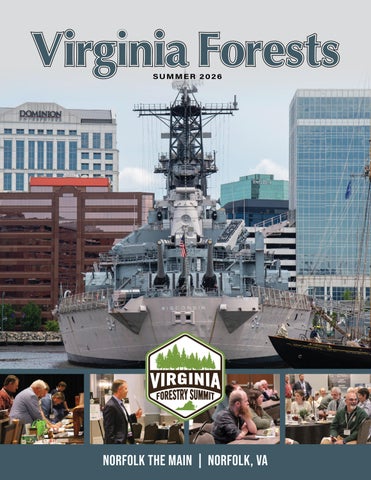
ON THE COVER: The Battleship Wisconsin, one of the largest and last battleships ever built by the U.S. Navy, commands the view from both land and water in her berth in the harbor in Norfolk, Va. Inset: Scenes from the Silent and Live Auctions during the 2026 Virginia Forestry Summit. Enthusiastic participants helped strengthen VFA’s advocacy efforts on behalf of forestry and forest industries in Virginia.
Virginia Forests magazine is published quarterly by the Virginia Forestry Association, 3808 Augusta Avenue, Richmond, VA 23230-3910. Subscription is by membership in the Association with annual dues ranging upward from a minimum of $65 for individuals. Extra copies at $3.00. Advertising rates upon request. The sole criterion for publication in Virginia Forests is that material be sound and informative. All opinions expressed are those of the individual authors and not necessarily those of Virginia Forests or the Virginia Forestry Association. The Association does not pay for materials used. A cumulative index of Virginia Forests is maintained at VFA headquarters. Copyright © 2026 by the Virginia Forestry Association. ISSN 0740-011X.
3
AYLOR FORESTRY, LLC CONSULTING FORESTRY
FORESTRY SOLUTIONS DRIVING INNOVATION. Stay ahead with Nutrien Solutions™.
FOREST MANAGEMENT APPRAISALS TIMBER SALES AYLORFORESTRY@VERIZON.NET OFFICE: 434.372.5370 DAVID EVANS: 804.586.7941 409 BOYD STREET, CHASE CITY, VA 23924
Experienced professionals developing safe, sustainable vegetation management programs for your land.
Local Approach. Nationwide Expertise. NutrienSolutions.com
DOUG POND
804.241.8118 Doug.Pond@nutrien.com
Timberland Management
BRENDAN SCHNELL
804.356.6547 Brendan.Schnell@nutrien.com ©2026 Nutrien Ag Solutions, Inc. All Rights Reserved. All of the trademarks and service marks displayed are marks of their respective owners.
4
Cole
Benjamin D. Cole
9540_B1026
3138 Promise Land Road • Appomattox, Va. 24522 O: 434-352-8605 • C: 434-315-4539 • timberturkey@live.com
VIRGINIA FORESTS
PRESIDENT’S COLUMN
3808 Augusta Avenue Richmond, VA 23230-3910 Phone: 804-278-8733 • Fax: 804-278-8774 vfa@vaforestry.org • www.vaforestry.org
OFFICERS (2026–2027) President Steven Peter South Paw Forest Products Inc. St. Stephens Church Vice President and President Elect Michael Harold Speyside Bourbon Stave Mill Harrisonburg Treasurer Christina Hager Dominion Energy
Richmond
Past President Jay Phaup Packaging Corp. of America Amherst
EX-OFFICIO OFFICERS Dr. Saskia van de Gevel Virginia Tech—CNRE Blacksburg Terry Lasher Virginia Department of Forestry Charlottesville
DIRECTORS
Term Expiring 2027 Jason Critzer Gaines & Critzer, Ltd. Terry Godwin Franklin Lumber Doug Pond Nutrien Solutions John Reid Forest Resources Management
Term Expiring 2028 Ben Cole Cole Timberland Management LLC Joseph “Joey” Jones Gasburg Land and Timber Co. Inc. Laurie Wright Wright Forestry LLC
N. Chesterfield Franklin S. Chesterfield Aylett
Appomattox Gasburg Blackridge
Term Expiring 2029 Scott Barrett Virginia Tech Blacksburg Drew Cockram Eastern Virginia Tree Harvesters Barhamsville Eric Goodman Smurfit WestRock Clarksville Luke Shenk Ridgeline Forestry Company, LLC Powhatan
STAFF Sonnia Montemayor, Deputy Executive Director Chris Frost, Operations Assistant
The Virginia Forestry Association, chartered in 1943, is a notfor-profit, non-governmental, privately supported association of forest landowners, wood product industries and businesses, loggers, foresters, forest use groups, and conservation-minded citizens. New board members are elected annually by mail ballot to all VFA members. Any VFA member may be a candidate for the board.
SUMMER 2026
T
A Call to Arms
hose of you who know me can attest to the deepseated passion I have for the forests and all the benefits they provide, as well as the forest industry and the people involved in the forestry equation. I often say, “Forests matter because people matter!” We find ourselves in a time of rapid change that is causing a real struggle for our forestry community. We are in a fight, so to speak. There are battles everywhere and over every aspect of the forest. Forests are lost to competing land uses; debates are had over forest management Steven Peter techniques; markets that sustain forest landowners and loggers are disappearing. Legislative decisions are increasingly impacting the entire forestry equation, and battles are waged over educating and informing the greater public. Everyone involved with the forests is feeling these struggles. Times are challenging, and budgets are tight. The time for advocacy is more important now than ever, and Virginia Forestry Association’s role has never been more relevant. This is a clear time for “A Call to Arms!” VFA’s efforts across advocacy, member engagement, telling our story, and public outreach have never been more vital to protecting and supporting the forestry community. Participation in networking events and collaboration with peers and other forest lovers has never been more important. Now we must fight harder, and our voice must be louder. Heed the call and recruit at least one new member this year. Adding significantly to our membership numbers will amplify our voice in Richmond and strengthen our ability to support staff, finance advocacy, and support outreach.
As VFA President, I am issuing a “Call to Arms!” Now more than ever we must strengthen our association and grow its membership. We must embolden our community and amplify our voice. What does this mean? It is an urgent appeal to the forestry community to act so that we are engaged in the fight for the forests we cherish and the industry that sustains us—one that touches the lives of all Virginians every single day. What can you do to answer this call? First, support VFA with all your heart. Sustain your membership and encourage new members to join. At a time when things are difficult and budgets are tight, VFA is one organization that must not be cut. —continued on page 28 5
T
VIRGINIA FORESTRY SUMMIT
his spring, Virginia’s forestry community and friends gathered in Norfolk, Va., for three days of education, inspiring presentations, professional networking, and forestry-related tours at the 2026 Virginia Forestry Summit. The Forestry Summit also allows us to recognize those who are making exceptional contributions to forest management and the field of forestry. Hosted by the Virginia Forestry Association in collaboration with the Virginia Chapter of the Society of American Foresters and the Virginia Chapter of the Association of Consulting Foresters, this annual event continues to deliver exceptional programming on the most relevant current issues related to forestry and the forest products industry.
See more photos from the 2026 Virginia Forestry Summit online at www.forestrysummit.com or scan the QR code here:
THE REMARKABLE STORY OF VIRGINIA FORESTS Paul Franklin, President and CEO of Colonial Farm Credit, concluded the 2026 Virginia Forestry Summit with remarks that offered a connecting thread for previous days’ presentations. A native Virginian, Franklin reflected on a lifetime spent close to the land and a career that has given him perspective on the changes, benefits, and challenges in our industry from past to present. He brought to life the deep appreciation many in the forestry community share for Virginia’s rural lands and forests, and we are pleased to share excerpts from his presentation here.
I GREW UP IN ESSEX COUNTY, VA., and graduated from Virginia Tech with a degree
in Agricultural Economics. I have spent 35 years with Colonial Farm Credit, a cooperative that provides financing to farming and forestry operations in Virginia and Maryland. My career has included 15 years as a loan officer, about a decade as Chief Lending Officer, and I’m now in my tenth year as CEO. I never expected to stay employed in one place for so long, but my career with Colonial Farm Credit has afforded me new perspectives, inspiring challenges, and great opportunities to support agriculture and forestry. My thinking on risk management has been influenced by events like the 1980s farm crisis, the Great Recession, and the pandemic, as well as major shifts in Virginia’s economy, including population changes, land conservation, development pressures, and technological change. Personally, my enthusiasm is strongest in helping family businesses. I’d like to share a story about my experience with forestry from my childhood.
6
Paul Franklin, CEO, Colonial Farm Credit
VIRGINIA FORESTS
2026 Virginia Forestry Summit I grew up on a farm with plenty of freedom and room to explore. My mother was the Essex County Commissioner of Revenue, and my father was a grain farmer—they definitely were not “helicopter parents.” As a youth, I inherited a single-barrel, 20-gauge shotgun and became an avid squirrel hunter. The land to the south of our farm was a large tract of mature white oak and red oak forest. It was ideal for hunting, but it was also a place of tranquility, where the sound of the wind rolling over the treetops brought peace and gratitude. Not long after my hunting began, the timber was clearcut, and my squirrel hunting dropped off significantly. I wasn’t a fan of what happened at the time, and I moved on to other things. The property was reseeded in loblolly pine. As the years progressed, I found myself rabbit hunting that land with my beagles, later deer hunting with Walker hounds, and eventually encountering quail coveys with an English setter. I think a lot about how fortunate I was for those experiences—most people never have that opportunity. I learned firsthand how tree farming worked and how wildlife thrives in that environment. What once felt like loss became a lesson in renewal. When I see a clearcut today, I think fondly of the opportunities ahead for that landowner and their family. And I’m not even scratching the surface about the other positives of working forests with this story. So, I have a question to ponder: Does everyone see forestry that way? Most Virginians probably do not. With a population of 8.6 million—largely concentrated in urban and suburban areas—relatively few people have firsthand experience with forestry. There are 4.5 million people in the state labor force (Bureau of Labor Statistics, Dec. 2025), and only 108,000 are employed in the forestry industry, representing 2.4% of the labor force and only 1.3% of Virginia’s total population. While most people don’t know the forest like Virginia Forestry Association members do, their perspectives have a significant impact on how things operate. It is important to understand different perspectives. We know the saying “put yourself in the other person’s shoes,” and I met someone who drove home the importance of that philosophy to me in a very concrete way. That person was Susan Eisenhower, the granddaughter of Dwight D. Eisenhower. I had the privilege of listening to her lecture at the Eisenhower home in Gettysburg, Pa. Susan Eisenhower witnessed her grandfather’s leadership as she grew up. There was a lot to be learned from the former United States President and Supreme Commander of the Allied Expeditionary Force in World War II. One of the main lessons she learned from him was to put yourself in the other person’s shoes. While this is an ancient concept, President Eisenhower was known for leadership
FORESTRY SUMMIT KEYNOTE PRESENTERS
Dr. James Lewis opened the 2026 Virginia Forestry Summit with his presentation, “Timber Market Cycles, Y’All: 200 Years in the South’s Forest Products Industry.”
Dave Donaldson, RF, presented, “The Westervelt Company History— Leading Through Uncertain Time,” in his keynote on Friday morning, May 1.
Dr. Derek Dougherty, Director of the Forest Owner Research and Technology Exchange, delivered the luncheon keynote on Thursday, April 30.
—continued on page 8 SUMMER 2026
7
2026 Virginia Forestry Summit The Remarkable Story of Virginia Forests, continued from page 7 built on empathy, humility, and the ability to understand the perspective of the common soldier. After that lecture, I committed to making this approach a priority. So, in preparation for today, I thought it important to gain insights on non-rural perspectives of forestry. I couldn’t find a comprehensive, statewide public perception survey focused solely on forestry in Virginia, so I used Microsoft CoPilot AI to try to gain more knowledge around the subject:
DEMOGRAPHIC AND GENERATIONAL TRENDS GENERATIONAL DIVIDE: Younger generations (under 25) tend to be more critical of the forestry sector and are more likely to get their information from digital media rather than personal experience. URBAN VS. RURAL: Urban residents often place a higher priority on amenity and recreation, whereas rural residents are more likely to recognize the economic necessity of timber harvesting.
REGIONAL DIFFERENCES: In the Southeastern U.S., there is generally higher acceptance of private timber harvesting compared to other regions, provided it is followed by responsible replanting. ACTIVE MANAGEMENT SKEPTICISM: Many believe forests can “manage themselves,” unaware that over a century of fire suppression and invasive species often makes active management (like thinning or prescribed burns) necessary for forest health. Overall, public perception of forestry is generally defined by a strong value for forest protection and environmental benefits, though it is often marked by a significant gap in technical understanding of forest management practices. While the majority of the public views forests as critical for climate health and well-being, many hold negative or skeptical views toward active practices like logging and clearcutting. So, what are the implications of this research? While public understanding may be limited, the forest products industry has a remarkable story to tell. In Virginia, forestry contributes a $23 billion impact to the state’s economy, forest growth outpaces harvest by 2-to-1 for both hardwood and softwood (Virginia
SESSION PRESENTERS AND PANELISTS
Thursday’s luncheon included a panel discussion of forestry advocacy efforts with (l. to r.) John Magruder, owner, Three Rivers Forestry LLC; Senator Emily Jordan, Virginia District 17; Matthew Wells, Senior Vice President, Advantus Strategies and VFA contract lobbyist; and Martha Moore, Senior Vice President Government Relations, Farm Bureau Federation of Virginia. In his session, Mitchell Goldstein with Setliff Law discussed “Legal Essentials for Forestry Operations.”
8
“Powering Virginia’s Future: Energy Demand, Policy, and the Role of Working Forests,” was presented by (l. to r.) Lisa Messinger, Dominion Energy; Kyle Shreve, Virginia, Maryland & Delaware Association of Electric Cooperatives; and Carrie Hearne, Virginia Commission on Electric Utility Regulation.
(l. to r.) Panelists Steve Peter, South Paw Forest Products, Inc.; Austin Heine, ArborGen; Daniel Deitz, Three Rivers Forestry; and Doug Pond, Nutrien Ag Solutions discussed “Adaptive Land Management: New Strategies for a Changing Landscape.”
VIRGINIA FORESTS
2026 Virginia Forestry Summit Department of Forestry), and about 63 percent of the state (16 million acres) is forested. These forests improve water quality, support wildlife, and store significant amounts of carbon (around 1.5 billion metric tons). Of the 16 million acres, our forests are diverse, with 75% hardwood and 20% pine (two-thirds of which is planted pine). Virginia ranks third nationally for forest carbon uptake even though it ranks 24th in total forested acres. Finally, Virginia’s Department of Forestry practices provide vital keys to fire and pest infestation prevention. In addition to the strong forest management and performance, Virginia is home to world-class port facilities, enabling forest products to reach global markets. We have a tremendous natural resource that is well-managed for production, produced in a sustainable way, and has potential for global reach that can drive a stronger economy for Virginia. It is protected by strong environmental stewardship with fire suppression, forest health, invasive management, clean water, clean air, and more. These are just a few of the positive points that I know many of you are working hard to deliver to stakeholders, but our voices need to be amplified. I’ve spent many
Virginia Tech faculty from the College of Natural Resources and Environment (l. to r.) Jennifer Gagnon, Pipiet Larasatie, Ph.D., Scott Barrett, Ph.D., and Brian Bond, Ph.D., introduced the Sustainable Forest Supply Chain Collaborative in their session.
Michael Harold, Chair of the Virginia Forestry Foundation, spoke to the audience about the foundation’s purpose and mission to strengthen forestry interests and industry across the Commonwealth.
(l. to r.) Matt Wells, Advantus Strategies; Craig Anderson, Forest Landowners Association; Ellen Powell, Virginia Department of Forestry; and Christina Hager, Dominion Energy discussed “Forestry in the Spotlight: Advocacy, Messaging, and Public Engagement.”
SUMMER 2026
years advocating for forestry and agriculture. In order to close perception gaps, we must be ready to tell our story, communicate clearly and concisely, use credible facts, and respond effectively to misconceptions. One of the most effective tools to connect with policy makers is to host them on a working forest or farm so they can gain a much clearer understanding of how these systems function. These “boots on the ground” opportunities can be a challenge to arrange—but they are worth the effort. This is why organizations like the Virginia Forestry Association, the Virginia Loggers Association, the Virginia Forest Products Association, as well as other forestry and farm advocacy groups, are so important. I’ve been a board member of the Virginia Agribusiness Council for over 10 years and was the Chairman of the Council in 2025. I’ve learned that it’s critically important for farm and forestry organizations to coordinate efforts, because the interests of these groups align on most of the big issues, especially around working lands. So, my encouragement is this: get involved, stay engaged, and help tell the story of forestry. Because when people understand it, they will support it—and that makes all the difference for the future of this industry.
“Legacy Planning for Landowners” was presented by panelists (l. to r.) Joel Shelton, Griggs-Trent, Incorporated; Joel Cathey, Ontario Hardwood Company; and Clifton Carr, landowner.
Special guests Virginia Deputy Secretary of Agriculture and Forestry Ben Rowe (second from left) and Virginia State Forester Terry Lasher (far right) provided a welcome and remarks to attendees at the Virginia Forestry Summit, with introductions by VFA leaders Jay Phaup (far left) and Steven Peter, VFA’s President for 2026-27.
9
2026 Virginia Forestry Summit Thanks to our exhibitors and sponsors who generously supported the 2026 Virginia Forestry Summit. SPONSORS
SUPPORTERS
PRESENTING
CHERRY
• Farm Credit
KEYNOTE
• Dominion Energy
• Huber Engineered Woods • Ontario Hardwood Company • Smurfit-WestRock
LUNCHEON KEYNOTE • Virginia Department of Forestry
AWARDS BANQUET
• GCF | Global Cellulose Fibers
SPOTLIGHT • ArborGen
TOUR BUS
• Canfor Southern Pine
LANYARD
• Packaging Corp. of America
OAK
• Alligare • Corteva Agriscience • Enviva • Louisiana Pacific • O-BASF • PRT Growing Services, Ltd. • Ridgeline Forestry Company • Speyside Bourbon Stave Mill • Three Rivers Forestry, LLC • Virginia Forest Resources, LLC
EXHIBITORS PINE
• ArborTech Forest Products • envu • First Bank & Trust Company • Gaines & Critzer • Gasburg Land & Timber Company • Nutrien Solutions • Sustainable Forestry Initiative • Southpaw Forest Products, Inc. • Timber Marketing & Management, Inc. • TimberMart – South • TimberRisk
• American Forest Management, Inc. • ArborGen • Corteva Agriscience • Cruise Control • Enviva • Family Forest Carbon Program • Landmark Spatial Solutions • Landyield • Under Forestry • Project Learning Tree • Nutrien Solutions • PRT Growing Services, Ltd. • Synagro • TimberRisk • Virginia Forest Landowner Education Program
BAG
• Virginia Forestry Educational Foundation
10
VIRGINIA FORESTS
TOURS: ENVIVA BIOMASS FACILITY • STIHL FACTORY • NORFOLK NAVAL HARBOR
SNAPSHOTS
SUMMER 2026
11
Rob Farrell Receives VFA’s
DISTINGUISHED SERVICE AWARD VIRGINIA FORESTRY SUMMIT
Rob Farrell was presented with VFA’s Distinguished Service Award by Adam Downing, District Extension Forester at Virginia Tech.
John Gee Receives VFA
PRESIDENT’S AWARD VIRGINIA FORESTRY SUMMIT
12
R
ob Farrell received Virginia Forestry Association’s 2026 Distinguished Service Award during the Virginia Forestry Summit awards banquet in May. VFA’s Distinguished Service Award gives public recognition to individuals, groups, associations, and/ or companies and corporations who make a significant, continuing, and lasting contribution to the conservation of Virginia’s forest resources and/or the enhancement of Virginia’s forest-based community. Farrell is a former Virginia State Forester, serving as leader of Virginia’s Department of Forestry (DOF) from 2018 to 2026. VFA recognized Farrell with its Outstanding Member award in 2017, and is pleased to recognize him this year for his distinguished service to Virginia and our forestry community.
V
irginia Forestry Association Past President Jay Phaup presented the 2026 President’s Award to John Gee in recognition for his years of service to support the association. The Virginia Forestry Association’s President’s Award recognizes individuals who have spent many hours working behind the scenes and beyond the call of duty to make VFA a quality organization. Gee has been an active member of VFA since 1999, offering his
Adam Downing, District Extension Forester at Virginia Tech, presented the award, saying, “W hile we all know Rob Farrell as our State Forester over the past eight years, his legacy reaches further back and is yet to conclude.” A 1988 graduate of Virginia Tech, Rob began his career as an arborist with Barlett Tree Experts in Newport News, Va., before beginning his long public service career with DOF in 2000. For six years, he served as the local Forester in Gloucester. In 2007, he became DOF’s first Assistant Director for Forestland Conservation, where he was instrumental in developing a program for Virginia to meet conservation goals. Farrell’s efforts also put Virginia on the national map as a leader in forestland conservation. In 2012, Farrell took on the role of Deputy State Forester, working closely with state foresters Carl Garrison and Bettina Ring until 2018, when he was appointed by Governor Northam as Virginia’s 8th State Forester. “DOF is an essential partner for many, including those of us in Extension,” noted Downing. “While the relationships at the field level have always been good, it was under Rob’s leadership that even deeper partnerships and mutual respect were formed.”
help to many of VFA’s committees, including finance, awards, planning, and advocacy. As part of VFA’s Executive Committee, he served as Vice President and led the association as President in 2020. Attendees at the Virginia Forestry Summit have benefited from Gee’s coordination for the silent and live auctions that support VFA’s advocacy fund. His efforts to organize auction items and recruit volunteers ensure everyone can participate. His fundraising efforts and
VIRGINIA FORESTS
event support also extend to VFA’s Sporting Clays tournament, where he helps recruit sponsors and encourage member participation. “John called or texted regularly to ask how he could assist VFA and myself,” said Jay Phaup in his award presentation. “He gave unselfishly of his time and talents. I’m proud to present this award to acknowledge his assistance to me and for the benefit of all of our VFA members.”
D
an Hockenberger, owner of Virginia Forest Resources, LLC, in West Point, Va., received Virginia Forestry Association’s Outstanding Member of the Year award at the Virginia Forestry Summit this year. Since 1949, VFA has recognized an individual for outstanding contributions in conservation, utilization, and enhancement of Virginia’s forest resources. The award honors a member who has gone “above and beyond” normal duties and responsibilities to render service to, and promote the interests of, Virginia forestry, and/or has fostered greater public awareness and understanding of the forests of the Commonwealth and the contributions which they make to all Virginia citizens. Hockenberger has been a member of VFA since 2001. He served on the VFA Board of Directors starting in 2016, including six years as Treasurer on VFA’s Executive Committee beginning in 2019, before being elected to Vice President and leading VFA as President in 2023. In the midst of the pandemic, Hockenberger helped steady VFA’s board and staff. As former Executive Director Corey Connors shared, “At a critical time for the association, he was the right man for the right
SUMMER 2026
(l. to r.) Jay Phaup and John Gee
moment … providing insight that helped stabilize VFA and put it on solid footing. As President, he led by example, giving 120% and taking VFA to the next level.” A graduate of the State University of New York College of Environmental Science and Forestry and a Marine veteran, Hockenberger has used his knowledge and work as a logger to help connect people throughout the forestry community. He has been a welcoming presence for new members and demonstrated a deep sense of ser vice to VFA while offering consistent and generous support of the association through event sponsorship, the VAForestPAC, and VFA’s advocacy efforts.
Dan Hockenberger Named VFA’s
MEMBER OF THE YEAR VIRGINIA FORESTRY SUMMIT
Dan Hockenberger is VFA’s 2026 Outstanding Member of the Year.
13
A.K. Davis Timber & Heavy Repair Receives
LOGGER MERIT AWARD VIRGINIA FORESTRY SUMMIT
Kirk Davis, Jr., VFA’s 2026 Logger Merit Award winner
V (l. to r.) Kevin Dawson, Virginia Department of Forestry, presented the Logger Merit award to Kirk Davis, Jr. at the Virginia Forestry Summit.
14
irginia Forestry Association’s Logger Merit Award recognizes and honors the performance of one or more outstanding logger(s) in the Commonwealth. Winners are chosen based on a written evaluation of the total logging operation. Recipients of the Logger Merit Award represent the “best of the best” and exemplify the highest professional standards, as they serve as effective, positive public role models for the entire logging industry. Kirk Davis, Jr., owner of A.K. Davis Timber & Heavy Repair, LLC, received VFA’s Logger Merit Award during the 2026 Virginia Forestry Summit in Norfolk, Va. Born and raised in Washington, Va., Davis learned the logging business from his father, who owned and operated A.K. Davis Timber, specializing in harvesting mature oak, poplar, and ash hardwoods in Rappahannock County and the surrounding areas. At the age of 11, Davis faced the loss of his father. Just days after his father’s passing, Harvey Largent, a close friend of his father, stepped in and became a guiding influence in Davis’ life. Largent not only supported Davis during a difficult time but also nurtured the passion for logging and farming that Davis and his father had shared. Through his company, Harvey Largent Pulpwood & Timber, Largent mentored Davis in every aspect of the pine pulpwood business.
After school, Davis took a job as a field mechanic with William H. Hazel, Inc. In order to earn money to purchase equipment and begin his logging career, he spent 17 years employed in maintaining and repairing equipment. During this time, he dedicated his evenings and weekends to cutting small hardwood tracts throughout the county. In 2016, he was finally able to purchase the necessary equipment for harvesting both hardwood and softwood and started his own pulpwood and timber business, A.K. Davis Timber & Heavy Repair, LLC. Davis’ logging operation is primarily focused on pine thinnings and clearcuts, although about 20 percent of his harvests are hardwood select cuts and clearcuts. He works mainly by himself but has part-time help from time to time. His equipment includes a John Deere 648G-III skidder, a CAT 559C knuckleboom loader, a CAT 563C feller buncher, a Mack tandem with a pup trailer, two road tractors, and three trailers. Davis approaches each harvest with a forward-thinking mindset, implementing Best Management Practices to ensure the land is left in a condition that meets the landowner’s expectations and encourages repeat business. This commitment to quality and sustainability has earned him a strong reputation and a steady stream of work over the years. To help with operational costs, Davis has utilized the Virginia Department of Forestry’s financial assistance programs: the Logger Best Management Practice Cost-Share Program and the Pine Bark Beetle Prevention Program’s Logger Incentive Cost-Share. Davis is a Certified SHARP Logger and a member of the Virginia Loggers Association. He serves on the Agricultural and Forestal District Advisory Committee in Rappahannock County. VIRGINIA FORESTS
Virginia Tree Farm Foundation Recognizes Outstanding
An eagle nest on Porterfield Forests property.
by Glen Worrell, VTFF Board of Directors
T
he Virginia Tree Farm Program, which is administered by the Virginia Tree Farm Foundation (VTFF), consists of over 630 Tree Farms covering 160,000 acres across the Commonwealth. Each year, VTFF recognizes an Outstanding Tree Farm, the highest honor bestowed by the foundation. The winner is viewed with distinction among the VTFF’s network of Tree Farmers, volunteers, sponsors, and partners across Virginia. Award recipients enjoy free attendance at the Forestry Summit and receive an engraved plaque to recognize their contributions to Virginia forestry. Virginia’s Tree Farm of the Year winners receive a custom sign for their property and will go on to compete for Outstanding Tree Farm of the Year at the regional level. The 2026 Outstanding Tree Farm of the Year is Porterfield Forests, a 219-acre Tree Farm in King and Queen County, owned by Dr. Richard “Dick” and Rita Porterfield. The Porterfields have owned the property for over 25 years and manage it using multiple-use concepts, meeting goals that include managing timber resources for income, improving wildlife habitat, maintaining forest health, and providing outdoor recreation. They have a diverse number of stands on the property, including quality loblolly pine, mixed hardwoods, and longleaf pine plantations. SUMMER 2026
Dr. Porterfield enjoys sharing his forestry philosophy and sound land management ethics with others, welcoming visitors to view his forest management work, especially his longleaf pine management. The Porterfields have welcomed groups such as the Virginia Tree Farm Foundation and the Rappahannock Chapter, Society of American Foresters to tour their property, and hosted a quail management tour. The local Boy Scout troop has used the property several times for outings. Forestry has been a part of Dr. Porterfield’s life since college. He has a forestry degree from Ohio State University, a master’s degree from North Carolina State University, and a Ph.D. from Yale University in forestry and economics. Dr. Porterfield worked for over 20 years with Champion International in various positions. He has served on the faculty of Mississippi State, University of Arkansas, and the College of William and Mary. Dr. Porterfield concluded his forestry career as Dean of the University of Georgia’s Warnell School of Forest and Natural Resources. During his professional career, Dr. Porterfield has served on the boards of the Longleaf Alliance, the Society of American Foresters, the Forest History Society, and the Tidewater Resource Conservation Service. The VTFF congratulates the Porterfields and thanks them for their dedication to keeping Virginia’s forests healthy and productive.
TREE FARM OF THE YEAR VIRGINIA FORESTRY SUMMIT
Dr. Richard “Dick” and Rita Porterfield were presented with a plaque by Glen Worrell, President, Virginia Tree Farm Foundation.
15
Central Virginia Land & Timber, LLC Helping Manage Virginia’s Forest Pine Plantation Thinning Select Harvest of Both Pine and Hardwood Stands Conventional Timber Harvesters Timber Appraisals
John E. Jones III President
Sustaining forest, watersheds, and healthy habitats through the power of private stewardship
17055 Mountain Road, Montpelier, VA 23192 dociii@embarqmail.com 804.883.6331 | fax 804.883.7538 | cell 804.651.5252
VIRGINIA TREE FARM FOUNDATION PO Box 12 • Franklin, VA 23851 vtff.org
Harvesting Possibilities In the forestry industry, your possibilities are endless, that’s why you need a partner who understands the nature of your business. We get it, because supporting agriculture is what we were made to do.
Visit our website to find your local office and learn how Farm Credit can help.
16
VIRGINIA FORESTS
SAVE THE DATE
May 5 7, 2027 Spotsylvania, Virginia Virginia Chapter
Virginia Division
Registration will open in early 2027 at the Virginia Forestry Summit website
www.forestrysummit.com
SUMMER 2026
17
This article focuses on the past 10 years of the 50-year duration of our Fall Forestry & Wildlife Field Tours. For stories about the first 40 years, scan the QR code to read our article in the Summer 2016 edition of Virginia Forests magazine.
Virginia Cooperative Extension’s Fall Forestry & Wildlife Field Tours
GO OVER THE HILL By Jennifer Gagnon
“This experience today was well-planned and covered the topics we are interested in. Very proud of the people who are in careers to protect and preserve our natural resources. Well done!” 2022 Louisa County tour participant
T
he Virginia Forest Landowner Education Program (VFLEP) and Virginia Cooperative Extension (VCE), with key partners, provide a diverse selection of education programs for family woodland owners. These programs offer science-based information to support sound forest management. One program in particular has truly stood the test of time: the Fall Forestry & Wildlife Field Tours. This year is the 50th anniversary of the tours, making them the longest-running forest education program of their type in Virginia and, arguably, the country. 18
At the Start: Purpose, Planning, and Partnerships
In 1976, faculty from the Virginia Tech Depar tment of Forestr y Management-Economics Section, including John Gunter and Harry Haney, asked, “Why not take nonindustrial private landowners into the woods to show them demonstrations of sustainable forest management?” With the assistance of the Virginia Forestry Association and the Virginia Department of Forestry (DOF), they shaped this into a tangible Extension program for landowners—the Forestry & Wildlife Field Tours. Today, tour planning is led by VCE’s four District Extension Foresters—Neil Clark, Adam Downing, Jason Fisher, and Bill Worrell—along with DOF Conservation Education Coordinator Ellen Powell and VFLEP Coordinator Jennifer Gagnon. The Extension Foresters work with local planning committees that include
Above: The Fall Forestry & Wildlife Field Tours’ long-standing partnership with DOF is evident in their 1990 “All Foresters” memo that includes a checklist for tour planning. At the top of the checklist is “Murphy’s Law: Everything that can go wrong will go wrong.” And yes, indeed, we have had some adventures over the years.
natural resource professionals with VCE, DOF, the Virginia Department of Wildlife Resources, USDA’s Natural Resources Conservation Service, Soil & Water Conservation Districts, the forest industry, the USDA Forest Service, land trusts, and many more. The original goal of the tours remains: demonstrate active forest and wildlife management practices to family woodland owners to help them meet a diverse array of ownership goals. Common goals include increasing timber income, investing in management practices that increase productivity and sustainability, growing Christmas trees, producing non-timber forest products, re-establishing and improving wildlife habitat for a wide variety of species, controlling invasive species, participating in cost-share programs, creating recreational opportunities, protecting ecosystem services, and implementing agroforestry practices. VIRGINIA FORESTS
This map shows the number of Fall Forestry & Wildlife Field Tours held in each county and independent city since 1986. (Map by Christine Blinn, Virginia Tech)
Mapping Our History
In an attempt to create a complete history of the tours, I looked at a trove of old documents, including archived copies of the Extension Forestry Notes newsletter (1987-1998), the Virginia Forest Landowner Events Calendar (1997-1998), the Virginia Forest Landowner Update newsletter (1998current), advertising brochures, handwritten tour notes from Harry Haney, as well as registration lists. Unfortunately, the historical records are incomplete; I found no tour information for 19761985 and only spotty attendance records for 1986-2004. Better records can be found for tours that took place over the past 20 years (2005-2025). Nonetheless, the research was enlightening. First, the tours have not always been called the Fall Forestry & Wildlife Field Tours; for many years, they were simply the Bus Tours. In early years, tours were offered in the spring, summer, and fall. Second, I mistakenly thought the Fall Forestry & Wildlife Field Tours had visited every county in Virginia. Turns out, we don’t have documentation of tours in the following counties: Arlington, Chesterfield, Craig, Fairfax, Gloucester, Greene, Lunenberg, Matthews, New Kent, and York. (However, some of these counties may have been visited in tours SUMMER 2026
between 1976-1985, and some locations were simply called Tidewater, which may have included New Kent County.) If you've been around for a while and recall hosting or attending a tour in one of these missing counties, please let me know. We’ve only had tours in a handful of independent cities, which makes sense given the focus on rural land management. While some counties may have been skipped, others have been visited multiple times. Over the years, the most-visited counties are Patrick (eight times), and Pittsylvania, Grayson, and Frederick (six times each). What really surprised me was that we’ve toured Accomack County—which in my opinion is the most difficult county to reach—three times. In all, there have been over 200 tours with close to 7,000 participants!
Following Routes for Learning and Community Building
Each Fall Forestry & Wildlife Tour is a day-long experience that typically involves four to six stops that include a variety of forest landownership types— family, industry, and public. This variety exposes participants to a broad spectrum of management goals, constraints (and ways to work around them), and new ideas. Tour stops on family-owned lands give owner-hosts an opportunity to share their personal experiences with participants. These generous landowners graciously welcome 50-100 people on their property, some even providing lunch for the group, while others have demonstrated quail hunting and forest mulching. This peer-to-peer learning is very effective, as most tour participants appreciate hearing about natural resource management from other non-forestry professionals.
The first stop on the 2023 Fall Forestry & Wildlife Field Tour in Warren County showcased a group of family woodland owners who worked together to conserve a wildlife corridor connecting their lands to the Shenandoah National Park. Participants were greeted with a rainbow.
19
Sussex County has thousands of acres of well-managed publicly owned land. The last tour we had there was in 2018. The final stop of the day was in a cutover area to see a live demonstration of a drone igniting a prescribed fire. The drone pilot dropped 30 ignition balls, with some landing in a shrubby area, resulting in a small brush fire. Thankfully, there were good firebreaks as well as experienced firefighters. Tours also typically include stops at forest product manufacturing facilities. Virginia manufactures a stunningly wide array of forest products. We’ve visited manufacturing facilities for maple syrup, lumber, paper, pallets, OSB, mulch, furniture, flooring, wine and bourbon barrels, and musical instruments.
Participants in the 2018 Sussex County Fall Forestry & Wildlife Field Tour learned about using drones to ignite prescribed fire. Drones increase efficiency and safety.
Refining Tastes and Travel
While interesting tour stops and engaging speakers are extremely important, lunch is right up there. Participants can vouch that the official meal of Extension programs is pulled pork barbecue, but in recent years we’ve also expanded our menu to enjoy some spectacular catered lunches. A few meals really stand out: the 2024 Bedford County tour lunch, prepared by students in the Culinary Program at the Susan G. Gibson Science & Technology Center; the 2025 Virginia Beach tour, with freshly prepared pork burgers at an urban farmette; and the 2018 Goochland/Fluvanna County tour, with lunch at a vineyard where
The Fall Forestry & Wildlife Field Tours give family woodland owners unique opportunities to see the timber they grow turned into value-added products. The 2022 Tour in Smyth and Washington Counties visited both a stave mill and a cooperage. Making barrels is truly an art form.
20
we sat at a table made from a white oak slab over 40 feet long. We also try to provide locally made refreshments, including hot apple cider, apples, and donuts. Once an apt description, the Bus Tours nickname is now a bit passe. Historically, we exclusively used buses to transport our participants, but over the years, bus rental rates have risen tremendously. Not to mention that bus drivers (understandably) aren’t keen on taking their buses off road, which is mostly where our tours go. These days, we mostly tour in 12-passenger vans. They are surprisingly nimble and less likely to sink in the mud.
“Your hard work and creativity is evident. Wonderful, diverse aspects of each topic area.” 2022 Louisa County participant
VIRGINIA FORESTS
Tour organizers use local catering companies as often as possible. (Clockwise from top left) A landowner host in Rockingham County made fall-themed cookies decorated with Hokie-colored frosting; local apples and locally made baked goods are staples on the tours; and Bedford County students at the Susie G. Gibson Science & Technology Center prepared a multi-course lunch in 2024.
Measuring Progress
In Extension, we hope our programs make meaningful impacts for the people we serve. In this case, we create experiences to help change behavior and improve forest management practices. Based on responses in post-tour surveys, we have been able to reach our goals. Tour participants stated that as a result of attending, they would:
Participants in the 2025 Wise County Fall Forestry & Wildlife Field Tour were fortunate to spot the extremely elusive Wood Booger at the Flag Rock Recreation Area. Photo by Bill Worrell, Virginia Tech.
“Ask a consultant to review property and options” (2023 King & Queen County)
“Thin a woodlot; maybe a prescribed burn” (2023 Bland County) “Implement invasive management” (2023 Warren County) “Convert some cool-season grasses to warm-season grasses, forbs, and wildflowers” (2022 Louisa County) “Use the hardwood assessment tool and hardwood habitat initiative project” (2022 Louisa County) Intention is not the same as action, but if even 10 percent of all tour attendees implemented some active management on their land, that would be 700 landowners who, on average, own 55 acres, with an impact on 38,500 acres of land. SUMMER 2026
Although I am perhaps the most experienced 12-passenger van driver in the world, I still get intimidated by some drives. The 2025 Fall Forestry & Wildlife Field Tour took us to the top of the Devil’s Backbone State Forest in Frederick County. The drive up was along the steepest, most uneven, over-grown gravel road I’ve ever driven with a van of landowners.
21
A bull elk, one of many spotted on the Buchanan County Fall Forestry & Wildlife Field Tour. Photo by Bill Worrell, VCE.
Reflecting On the Journey
Looking back through all my photos in preparation for writing this article, I realized a few things. First, my favorite tour—one that will be hard, if not impossible, to repeat—was the 2018 Buchanan County tour. This tour took us to see the recently reintroduced elk. As the sun set behind the mountains, tour participants stood mesmerized, watching them graze and listening to them bugle. It was one of those magical moments you don’t forget. Second, our team is so fortunate to have worked together planning these tours for the past 20 years (after inheriting them from our predecessors). Such long-lasting work relationships (and friendships) are not common. I am beyond grateful for all the things we’ve accomplished over the past 21 years. And finally, these tours have given me the opportunity to see just about every nook and cranny of our beautiful, diverse, sweet Virginia. I am one lucky gal. Jennifer Gagnon is an Extension Specialist and Coordinator of the Virginia Forest Landowner Education Program at Virginia Tech.
Forestry Consultant/Timber Sales
Dowdy’s Forest & Land Management, LLC Call Today for a Free No Cost/No Obligation Meeting About Your Forest and Wildlife Management Matt Dowdy 535 Vigor Road Louisa, Virginia 23093 mailto:Matt@DowdysForest.com
Phone: 540-967-1707 Cell: 434-960-5251 DowdysForest.com
JOIN US FOR OUR 50TH ANNIVERSARY CELEBRATION We’ve seen a lot of things over the past 50 years of the Fall Forestry & Wildlife Field Tours. And we’re not planning to stop. To celebrate the 50th anniversary, we are embarking on a new adventure. We are holding four tours on consecutive days with the entire core team in attendance. Discounted lodging is available for participants who want to attend multiple tours, and we will offer a “Buy 3 Get 1 Free” deal to anyone who wants to attend all four tours. (We would love to see you on all four of our tours this year!) Fall Forestry & Wildlife Field Tours will run from Tuesday, October 20 through Friday, October 23. Lodging is available at the W.E. Skelton 4-H Educational Conference Center on October 19 and 20, and at Lake Anna State Park on October 21 and 22. Tour locations are as follows:
OCTOBER 20 OCTOBER 21 OCTOBER 22 OCTOBER 23
MONTGOMERY COUNTY FRANKLIN COUNTY ORANGE COUNTY HANOVER COUNTY
More details and registration information are available on the VFLEP website at www.forestupdate.frec.vt.edu. Please join us to celebrate!
TimberHaul
We transform Virginia timber into world class building products.
The Simple Supply Chain Solution Manage quotas & contracts A s s i g n & di s p a tc h dri ve rs Realtime data syncing & tracking Electronic load tickets & AI mill ticket scan Call Us: 866-395-5440 www.landmarkspatialsolutions.com
22
Contact: Everett Titus Louisiana-Pacific Corp. Roxboro, N.C. (336) 504-9081 Everett.Titus@LPCorp.com
LPCorp.com
Build With Us
VIRGINIA FORESTS
THE LOGROLL
Notes & News for Loggers
More Than 250 Years of Building Our Nation With Wood by Scott Barrett, Ph.D. Extension Specialist – Forest Operations Virginia Tech Department of Forest Resources and Environmental Conservation
A
s our nation celebrates its 250th anniversary this year, I thought it was worth noting the role that forest harvesting and forest products have played in building our nation. Much of our nation was and is quite literally built with wood, and our vast forest resources have contributed to our prosperity. We often think that our current globalized economy and global markets for forest products are a relatively recent occurrence, but one of the first documented exports from the colonies was a shipment of lumber and naval stores (tar and pitch) from the Virginia Company in 1609. One of the more valuable wood products from the colonies were ship masts that were exported to England. Our pines, especially white pines, were tall and straight and made excellent ship masts. The best white pines, especially those from the New England colonies, were so valuable that in the late 1600s the British crown claimed ownership of those trees by marking them with a broad arrow mark. Colonists were not allowed to use these trees that were claimed by the crown, and as you might imagine, this eventually led to conflict and helped plant the seeds for the American Revolution. An interesting story from this era is the Pine Tree Riot of 1772. The best trees were reserved for the crown, but colonists felt like they should have a right to harvest trees on their own property. So they did. When the British found “the crown’s” trees at local sawmills and started enforcing the laws protecting those trees, there were riots in response. The Pine Tree Riot was one of the first
acts of rebellion and happened even before the Boston Tea Party. You can find more details on the Pine Tree Riot at www.americanrevolution.org/pine-tree-riot. Before the nation was formed, loggers, sawmills, and the forest industry played a role in building our country with the products they produce and embodied the spirit of independence that led to its creation. Many things have changed since colonial times, yet many remain the same. The technology found in today’s forest products mills and logging operations would have been unimaginable. Still, there are similarities that exist today. We still use trees grown in the forest to build our homes, produce furniture, flooring, and in some cases, even heat our homes. We manufacture wooden barrels that are the same as those produced in colonial times. Since the founding of our country, the forest industry has had ups and downs. New products are being introduced, and other products go away. Yet the forest industry continues to deliver products our society needs from one of the most sustainable and renewable resources available to us—our forests. Change is inevitable, but I like to think that loggers and the forest industry will continue to play a big role in shaping the future of our country. Just like in the past, the products and technology will certainly change, but loggers of the future will still be harvesting trees from the same land that grew the original forests that were harvested to build our nation.
553 JEB STUART HWY. P.O. BOX 15 RED OAK, VIRGINIA 23964
434.735.0220
FAX: 434.735.8222
SUMMER 2026
23
ROOTED IN PLACE:
How Virginia’s Forest Families Are Shaping the Future of Our Forests By Laurie Wright, VFF Board of Directors
T
here is a particular kind of knowing that comes only from time. Not the knowledge found in textbooks or learned in classrooms, though that matters, too, but the knowledge carried in the hands of someone who has watched the same stand of trees grow from seedling to sapling to saw log, across decades, across generations. My family has been that kind of steward for seven generations on Virginia land. What began as forest passed from hand to hand across centuries is now a designated Century Forest, a living testament to what sustained, intentional care looks like across a human lifetime, and then several more. My husband grew up in these woods. We both studied their science at Virginia Tech. And today, through the Virginia Forestry Foundation, I work alongside others who share this same deep conviction: that Virginia’s forests are worth protecting, worth investing in, and worth passing on. But legacy stewardship doesn’t belong to any one family. Across this Commonwealth, forestry professionals are doing the quiet, essential work that holds our landscapes together. They include the foresters who manage harvests with an eye toward regeneration, loggers who harvest the timber, sawmillers who bring local timber to local markets, and tree farmers who plant for grandchildren they may never meet. About 90 miles north, along the Northern Neck, John Magruder is one of those people. He came to forestry almost by accident. Shadowing a chemical engineer during high school, he found himself thinking, “I like being outside.” That instinct led him out of the lab and into the woods for good. Today, Magruder is the President of Three Rivers Forestry, LLC, a consulting forestry firm in Tappahannock, Va. What strikes me most about John is not just his technical skill, but his philosophy of relationshipbuilding with forest landowners by leading with listening rather than transactions.
24
John Magruder
“Some want money, some want many other things. My hope is to help them meet their goals.”
That philosophy has practical roots. Magruder works to maintain a service mentality when working with landowners by staying focused on their forest management goals and not necessarily a potential timber sale. He stated that “not all hours of the day are productive,” meaning that sometimes a deep and lengthy conversation with a client about their long-term dreams for their forest land is enough. “Some want money, some want many other things. My hope is to help them meet their goals,” Magruder says. Many of Magruder’s clients are focused on enhancing wildlife habitat and encouraging hardwood regeneration—goals that can take more than a lifetime to fully achieve. When asked who in the next generation gives him the most hope, Magruder expressed excitement about the young foresters graduating from Virginia Tech and other
VIRGINIA FORESTS
forestry programs. These foresters are trained in the latest computer technology, from drones to GIS, that enhance forest management planning. He described his young employees as “sharp guys who know their stuff!” He is also excited to mentor his young employees in embracing his service mindset. In a state where 11.4 million acres of private forest land are managed by families and individuals, stories like Magruder’s represent the invisible backbone of Virginia’s forest economy and its ecological future. The Virginia Forestry Foundation exists to support exactly this kind of work. As a 501(c)(3) organization, we connect landowners with resources, amplify research, and
advocate for policies that keep working forests working. But we also do something harder to quantify: we hold space for the long view. In an era of short investment cycles and quarterly reporting, forests demand a different kind of commitment—one that only donors and partners willing to think in decades, not quarters, can sustain. Seven generations taught my family that the best time to plant a tree was always before you were born. The secondbest time is now. If you believe in the forests of Virginia, in their economic vitality, their ecological resilience, and their cultural legacy, we invite you to be part of the story we’re still writing.
TO LEARN MORE
or support the Virginia Forestry Foundation, visit www.vaforestry.org/vff.
Strenthening Virginia’s Forest Industry with a Unified Voice.
ONE INDUSTRY. LEADING FORWARD. Be part of the movement shaping tomorrow’s forests. Your contribution supports our work for a thriving, sustainable industry that supports rural economies, preserves natural beauty, and safeguards our environment.
GIVE NOW
For more information: (804) 278-8733 or email vff@vaforestry.org
SUMMER 2026
25
VIRGINIA FORESTRY EDUCATIONAL FOUNDATION UPDATE
DEEP ROOTS, STRONG FUTURE
From Scholarship Recipient to Foundation Leader: Easton Loving’s Full-Circle Forestry Journey
G
rowing up in Buckingham County in the 1970s, Easton Loving was aware of the forestry industry, given the ever-changing landscape of his community and the multiple short wood yards that dotted the roadside in all directions from his house. Loving’s father was an agriculture teacher in Fluvanna and included forestry in his curriculum, even coaching a forestry team that competed in state contests of tree identification and forest measurements. It was this early exposure, coupled with his love for the outdoors, that spurred Loving’s interest in forestry as a career path.
“IT GIVES ME A GREAT SENSE OF PRIDE AND JOY, SEEING OUR FUTURE LEADERS EMERGE FROM COLLEGE.”
Easton Loving’s scholarship letter
26
During Loving’s junior year of high school, he attended a Forestry & Wildlife Resources Institute camp at Virginia Tech. The camp was led by Dr. Will McElfresh, who was assisted by a young graduate student named John Seiler. After experiencing the camp and learning about forestry, Loving entered his senior year of high school knowing exactly what he wanted to do after graduation. To follow his newfound passion, Loving enrolled at Virginia Tech in the fall of 1984 to study forestry. With the encouragement of his parents, Loving applied for several scholarships to aid his academic journey. He was fortunate to receive a $500 scholarship from the Virginia Forests Education Fund, now known as the Virginia Forestry Educational Foundation, to help support his studies. In 1989, he earned his bachelor’s in forestry from Virginia Tech.
VIRGINIA FORESTS
While at Virginia Tech, Loving also enrolled in the Cooperative Education program and worked for Continental in land management. Loving was grateful to be taught by many standouts in the Virginia forestry industry, including David Smith, Harold Burkhart, Jay Sullivan, Bob Shaffer, Harry Haney, and Mike Aust. After completing his studies, Loving was hired by Westvaco in Covington, Va., beginning in 1991. Today, Loving is completing his 35th year working in fiber supply in Virginia. Those years included time with Westvaco, MeadWestvaco, WestRock, and most recently Smurfit WestRock. He is often reminded how small and tight-knit our forestry community is and feels a responsibility as a natural resource professional to support youth interest in similar careers. “It is in our professional DNA to leave things better, just as we know to be mindful of a reforestation plan when we harvest,” shared Loving.
SUMMER 2026
Loving now serves on the Board of Directors of the Virginia Forestry Educational Foundation, the same foundation that awarded him a scholarship back in 1984. In this position, Loving sees the importance of supporting students and young professionals in their journey every day. “It gives me a great sense of pride and joy, seeing our future leaders emerge from college,” Loving said. “Knowing that I walked their trail and benefited from the foresight of those that came before, now I have the responsibility to give back through my service to the Virginia Forestry Educational Foundation.” More than 40 years after receiving a Virginia Forestry Educational Foundation scholarship, Loving continues to invest in the next generation of forestry professionals, ensuring that today’s students have the same opportunities that helped launch his own career.
27
Serving Loggers & Truckers since 1986
Specialized insurance coverage for: • Exclusive, Competitive Logging Equipment Programs • Workers’ Compensation Representing numerous companies including BITCO and Forestry Mutual
• • • • • •
General Liability Commercial Auto Sawmill/Planing Mill Property Commercial Umbrella Contract Truckers Land Clearing/Tree Trimming
Family you can count on!
Jason Critzer jcritzer@gainescritzer.com Cell 804-516-4319
Troy Gaines troygaines@gainescritzer.com
(804) 330-8181
P.O. Box 35742 Richmond, VA 23235 www.gainescritzer.com Proud members & supporters of VLA, VFA, VFPA and CLA Licensed in VA, NC, WV and MD
PRESIDENT’S MESSAGE, continued from page 5. Instead, commit to help grow our numbers and membership. If every current member would act and recruit one new member, we would double our size. This may seem lofty, but don’t we all know at least one person who should be a member? Heed the call and recruit at least one new member this year. Adding significantly to our membership numbers will amplify our voice in Richmond and strengthen our ability to support staff, finance advocacy, and support outreach. Support VFA fundraisers and the Virginia Forestry Foundation. Buy a raffle ticket and a t-shirt, advertise in our magazine, or sponsor an event. Attend the Virginia Forestry Summit and compete in the Sporting Clays tournament or the Wood Cup golf tournament. These events are always great networking opportunities where all proceeds go to financially support VFA’s mission of serving and protecting the Virginia forestry community. Fundraisers also work directly to keep the cost of dues lower and more manageable to benefit all our members and sustain the strength of our association. During this time of rapid change and struggle, we must unite to protect our forests and the people and communities that depend on them. Heed the “Call to Arms.” Support the VFA with all your heart, and let’s fight together!
PURCHASING HARDWOOD PULPWOOD, AND STANDING TIMBER IN CENTRAL VIRGINIA
P.O. 339, Amherst, VA 24521 Jay Phaup M: (434) 841-9634 JayPhaup@packagingcorp.com
PACKAGINGCORP.COM
28
VIRGINIA FORESTS
VIRGINIA FORESTRY ASSOCIATION 3808 AUGUSTA AVENUE RICHMOND, VA 23230-3910
ROOF ASSEMBLIES | WALL ASSEMBLIES | INSULATED R-SHEATHING | FLASHING SOLUTIONS
Strengthen your build with breakthrough innovations in the ZIP System™ family of products. Easy-to-install, this highly compatible system streamlines air, water, and thermal barriers for structural assemblies. No matter what you’re adapting to, our high-performance building enclosures keep your build all zipped up. Scan the QR code to learn more.
HUBERWOOD.COM/ZIP-SYSTEM
Non-Profit Organization
U.S. POSTAGE PAID RICHMOND, VA Permit No. 815