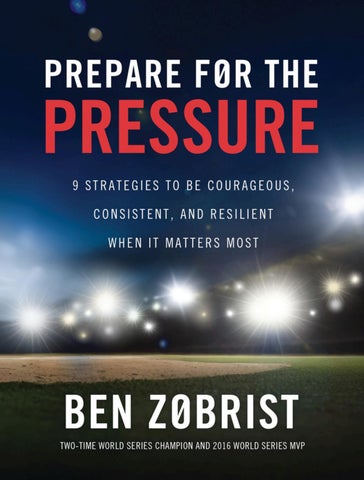
Prepare for the Pressure Sampler

Page 1


Prepare for the Pressure

© 2026 Ben Zobrist

All rights reserved. No portion of this book may be reproduced, stored in a retrieval system, or transmitted in any form or by any means— electronic, mechanical, photocopy, recording, scanning, or other— except for brief quotations in critical reviews or articles, without the prior written permission of the publisher.

Published by Thomas Nelson, 501 Nelson Place, Nashville, TN 37214, USA. Thomas Nelson is a registered trademark of HarperCollins Christian Publishing, Inc.

Published in association with the literary agency of The Fedd Agency, Inc., Austin, Texas, 78734

Thomas Nelson titles may be purchased in bulk for educational, business, fundraising, or sales promotional use. For information, please email SpecialMarkets@ ThomasNelson.com.

Scripture quotations are taken from the Holy Bible, New International Version®, NIV ®. Copyright © 1973, 1978, 1984, 2011 by Biblica, Inc.® Used by permission of Zondervan. All rights reserved worldwide. www.zondervan.com. The “NIV ” and “New International Version” are trademarks registered in the United States Patent and Trademark Office by Biblica, Inc.®

Any internet addresses, phone numbers, or company or product information printed in this book are offered as a resource and are not intended in any way to be or to imply an endorsement by Thomas Nelson, nor does Thomas Nelson vouch for the existence, content, or services of these sites, phone numbers, companies, or products beyond the life of this book.

ISBN 978-1-4002-5696-9 (HC)

ISBN 978-1-4002-5698-3 (audiobook)

ISBN 978-1-4002-5697-6 (eBook)

Without limiting the exclusive rights of any author, contributor, or the publisher of this publication, any unauthorized use of this publication to train generative artificial intelligence (AI) technologies is expressly prohibited. HarperCollins also exercise their rights under Article 4(3) of the Digital Single Market Directive 2019/790 and expressly reserve this publication from the text and data mining exception.

HarperCollins Publishers, Macken House, 39/40 Mayor Street Upper, Dublin 1, D01 C9W8, Ireland (https://www.harpercollins.com)

Art direction and cover design: Patti Evans

Interior design: Kristy Edwards

Photography by Sutterstock, Inc.

Printed in United States of America

26 27 28 29 30 VER 10 9 8 7 6 5 4 3 2 1

1:

SECTION 2:

SECTION 1

BE COURAGEOUS

IT IS OUR NATURE TO AVOID PRESSURE.

Pressure implies that something is building that we’ll eventually have to deal with. Either the pressure forces us to become smaller or avoidant, or we choose to meet pressure head on. And when we try to muster our own strength to meet that pressure, there is the possibility of failure. Even if we don’t fail in the moment, we may not have the energy and endurance to succeed in the long run. And with that continued possibility of failure, comes the ongoing presence of fear.

If we’re honest, fear is an underlying motivation to a lot of our reactions under pressure. Many athletes get uncomfortable when we talk about fear, because in our minds it’s

linked to weakness. We spend a lot of energy trying to protect ourselves. Fear is a natural, primal impulse, but if we want to face pressure well, we will have to sit with this fear rather than run from it.

So what does it mean to be courageous when you feel that pressure? When you choose to be courageous, you act with clarity in the presence of fear and uncertainty. Aware of both the pressure and the fear, you still choose to meet the challenge of the moment.

Sports provide a unique crucible of sorts for us to test our courage and to see what we are made of. They provide an arena in which to grind and to grow. When we courageously show up to compete and give it our all, we still might walk home with a loss in the books. That’s why it takes courage to keep coming back. But if we keep showing up, despite the loss, we will grow.

CHAPTER ONE

PASSION TO PRACTICE

ROY HOBBS.

Benny “The Jet” Rodriguez.

Rudy Ruettiger.

Rocky Balboa.

My passion to compete began by watching these athletes— and those were just the heroes who had Rs in their names! These were the characters in sports movies of the nineties who captured my imagination more than any other stories. The heartbeat of these heroes was their passion to compete for the win, their dedication and practice despite the odds, and the determination they showed in the shadows when no one was watching.

I was the little kid in Eureka, Illinois, watching Sylvester Stallone as Rocky on the screen training hard. What would

make a guy push himself like that? Was he actually having fun? It seemed that the more I watched, the more I understood his inner toil. His opponent wasn’t just Apollo; he was fighting for something bigger. He was fighting for a purpose that went beyond his passion for boxing. I’d study those scenes when the theme music hit—his muscled arms punching at the air, sweating in the silence, getting up early to chase an impossible dream no one can see.

I wanted to feel that kind of passion about something, to be willing to sacrifice when no one else would. It made sense to me that if you wanted to be able to handle the pressure under the brightest lights at night, you’d have to be willing to discipline yourself in the quiet shadows of the morning.

Rocky made me believe that what he was doing onscreen was possible in real life. I saw the passion play out in his training. The internal fire of an athlete’s greatness came through the screen and into my living room. It was as if there were no cameras. No scorecard. No opposition. It was just Rocky striving. It was his will to succeed, to make something of himself—not just for himself but for everyone who supported him as well.

These movie characters—Rocky Balboa, Roy Hobbs, and Rudy Ruettiger— connected the dots for me. Could I find something I love, pursue that passion daily, and possibly

become the best in the world at it? Could it happen for somebody who comes from a small town with humble means? These stories lit me up and made me believe that I could pursue a passion of my own and find more in it than I ever thought possible.

The other connection I made when I watched these stories was that sacrifice was necessary to be prepared to perform under pressure. I recognized that the big-time performances depended on big-time practice. Rocky had the internal drive to practice and train, and he turned that training into precision during the boxing match. I wanted the same, and I was willing to sacrifice to do it.

These stories lit me up and made me believe that I could pursue a passion of my own.

The Passion to Practice

Inspired by these films, I was driven to practice with the same intensity in whatever sport I was playing at the time: baseball in the summer, basketball in the winter, football in the fall. Heck, I even got a pair of boxing gloves as a gift and accidentally punched my older sister Jess a little too hard. (We still have a picture somewhere of her black eye, which

PASSION PREPARES YOU FOR YOUR PURPOSE.

eventually healed.) Then I decided to trade the boxing gloves for batting gloves and started swinging bats instead of fists. Taking swings and competing every chance I got in our small town was all I could think about. My passion to compete and the belief that I could become more led me to practice when everyone else was done.

Although I was still a little guy in junior high, my coach, Craig Gerdes, said that I had the heart of a lion. He could tell I wanted the win more than most! Truly, I hated to lose. I had an internal fire early on, the kind that moves you when nobody’s watching, and it’s really what shaped the competitor I became. Sports were my passion, where I felt most like myself. So it’s no wonder that competition formed the earliest understanding of my identity and purpose. It wasn’t everything to me, but it was certainly an important part of my life. And it gave me the energy I needed to push myself beyond what I was capable of at the time.

Of course, there were plenty of times when I struggled and got distracted. But my desire to experience the success I saw on the screen was my earliest motivation. I simply kept showing up regardless of how many times I failed. I learned that passion prepares you for your purpose.

What have you witnessed—whether it’s an inspiring person, like Rocky, or a pursuit—that has captured your

attention and given you an unusual energy? What triggers your curiosity and your desire to hear or learn more?

For some, it may be the thrill of entrepreneurship. For others, it might be writing or painting or composing or performing.

Maybe you have a passion to find creative ways to support people who are vulnerable.

Or you might have a particular hobby that feels lifegiving for you.

Identifying the interest that’s uniquely yours is the first step toward finding your passion. Follow that rabbit trail. Pay attention to your curiosities, especially what you’re wanting to learn more about. Whatever it is may not demand everything from you immediately, but it will begin to tug on your time and attention. Maybe it starts as an interest, and then it becomes a recreational activity you enjoy. But if it’s more than that—if it’s a passion eventually you’ll be willing to pursue it and put more effort into it.

The Passion That Unlocks the Potential

How do you know if you’ve discovered the passion that’s worth investing in with your time, your energy, and maybe

UNSEEN PRACTICE BUILDS A SENSE OF SUCCESS INSIDE YOU THAT NO TROPHY EVER

COULD.

even your money? This is what will determine whether you’ve identified your real passion or you’ve just found a proclivity or an interest. The answer to this question will be your guide: Would you be willing to pursue this passion to the point of discomfort? Would you train long enough for that passion to unlock a deeper purpose for your life? Are you willing to find your way through the shadows until your passion shows up in the light, in a meaningful way? These are the tough questions that every high achiever eventually faces when pursuing their passion. There’s an equation that has shown up again and again in my life—and in the lives of other champions I’ve met:

Pressure players are willing to persevere in their passion. They have enough passion that they are willing to practice through the pain. Your passion will likely call you into repetition; that’s practice with perseverance. Your practice will require your energy. And this is exactly what will make you stronger than any pressure you face. life? Would you be willing to pursue this passion to the point of discomfort?

Passion + Practice + Perseverance > Pressure

For Those Who Are Rising

If you’re a young person, or someone trying something new, I consider you to be someone who is rising. You’re on your way. The first taste of success isn’t going to be a championship trophy. It’s not the plaque on the wall or the number of likes you get after a performance. The first real win you’ll experience is when you discover something you love enough to practice when nobody’s watching. Most of the world measures success by applause, by comparison, by outside validation. But passion isn’t proven by the spotlight—it’s proven in the shadows.

If you’re still trying to figure out who you are and where you’re going, let me encourage you: Don’t just look for the obvious wins. Look for the moments when you feel that spark of energy, that quiet obsession that fuels your commitment to improve. That’s the trail worth following. Passion doesn’t just show up in talent; it shows up in repetition. It’s not about whether you can do something once in a while—it’s about whether you’ll keep showing up when nobody else is asking you to.

If you practice only when it’s required, you’re missing the real training. But when the gym is empty, when the classroom is quiet, when the field lights are off—that’s when

passion proves itself. That’s when you decide whether you’re just involved in something or invested in it. You don’t have to know if this is your “forever path” yet, but you do need to know if you’re willing to own it now.

Passion doesn’t just show up in talent; it shows up in repetition.

Unseen practice builds a sense of success inside you that no trophy ever could. It teaches you discipline, resilience, and confidence. And yes, it will feel lonely at times. But here’s what I’ve learned: The moments that feel the loneliest often turn out to be the most valuable. Because that’s when the dream moves from being just an idea in your head to becoming a habit in your life. Passion without practice is just hype. But passion with practice? That’s preparation. That’s what equips you to stand under pressure later.

For Those Who Are Rooted

If you have some lived experience behind you, I think of you as someone who is rooted. You’re firmly planted, and you have the capacity to be intentional about investing in others. If you’re a coach, parent, mentor, or leader—someone who’s

guiding the next generation—I want to challenge your narrative. You probably already spend a lot of energy encouraging people to stay focused, disciplined, and motivated. And that’s important. But what matters most is what a rising person sees in you.

People may not always listen to your words in the moment, but I promise you this—they are always watching you. They’re noticing whether your spark is still alive. They see whether you’ve settled into maintenance mode or if you’re still pursuing something that gives you energy. They pick up on whether your life is fueled by passion or just managed by obligation. Even though I’m now retired from baseball, I want my kids to see me being just as passionate about the things I am involved in today as I was when I played the game. I want them to see that passion is something that can grow as you get older.

Sometimes those of us who are investing in others pour so much into mentoring that we forget to model what it looks like to stay passionate ourselves. We exchange curiosity for responsibility. We trade our spark for busyness—even being busy investing in others! But credibility doesn’t just come from giving advice; it comes from living the example. Passion is contagious—but only if it’s visible.

So here’s the challenge: Don’t let your passion fizzle out!

While it might not look the same as it did years ago, that’s okay. The next iteration may be a new version of an old love. Perhaps you’ll pick up a forgotten hobby, commit to a new discipline, or create something fresh. If you’re wanting to inspire passion in those you invest in, they need to see it in you. They need to see you learning, stretching, training, praying, creating—still showing up with fire in your eyes. Passion that is practiced, not just preached, becomes contagious. If you’re an athlete or leader, your unseen preparation is shaping you into the kind of person who can handle pressure when it comes. If you’re a parent, coach, or mentor, your lived-out passion is giving permission for the next generation to do the same.

The Tension

Passion sounds exciting on the surface. But the real test isn’t the highlight—it’s the hidden work. That’s where the tension lives. You feel the pull to be everywhere, say yes to everything, keep up with everyone. You want the trophy, the applause, the proof. Meanwhile, the work that actually builds you happens in silence—early mornings, empty gyms, quiet rooms, no cameras. That’s uncomfortable. It can feel lonely.

It asks for sacrifice when nobody’s watching and there’s nothing immediate to show for it.

When passion mixes with pressure, it’s easy to drift into performance mode—measuring your worth by likes, stats, or who notices. But remember, passion isn’t proven by the spotlight; it’s proven in the shadows. And that’s the rub. Your heart wants the big moment, but your growth needs the small repetitions. You can’t do it all. To say yes to what matters most, you’ll have to say no to some good things. That’s hard— but it’s honest. And it’s the doorway to real preparation.

The Activation

Passion becomes preparation when you give it structure. Keep it simple and sustainable. Move on these three principles:

1. Define the “one thing.” Name the pursuit that keeps tugging on your attention—the one you’d still do if nobody ever noticed. Write it down. If you’re “rising,” this is about focus over FOMO. If you’re “rooted,” this is about renewing your spark so others can see it.

2. Design your shadow practice. Pick a small, daily rep you can sustain (five to fifteen minutes is

enough to start). Choose a time, a place, and a trigger. (Example: “After breakfast, ten dry swings in the backyard” or “Before bed, ten minutes of writing/film study.”) Protect it like an appointment.

3. Decide your trade- offs. Preparation requires a no. Identify one thing you’ll cut this week to make space for the prep (scrolling on your phone, one hangout, an extra episode). Tell someone you trust so the boundary sticks.

Keep this equation in front of you as a mantra and a map:

Passion + Practice + Perseverance > Pressure

You’re not chasing perfect; you’re building endurance. Reps in the shadows create strength in the spotlight.

The Engagement

Passion doesn’t grow by accident—it grows when you give it space, when you put it into practice. Here are three ways you can lean in:

Personal (Attention Check)

Take a few minutes and write down the one thing that keeps tugging on your attention—the thing that sparks extra energy in you. Then ask yourself: Would I still do this if nobody ever noticed? If the answer is yes, record one small way to start practicing it this week. It doesn’t have to be huge. Just a daily rep. Just enough to prove to yourself that the fire is real—and keep it burning.

Relational (Accountability Check)

Think about someone in your life who lives with visible passion. Maybe it’s a teammate who always takes extra reps, a coach who still shows up hungry, or a friend who stays faithful in their craft. Ask them what keeps them going when nobody’s clapping. Let their answer motivate you. And then model that kind of passion for somebody else. The next generation is watching more than they’re listening.

Spiritual (The Ultimate Passion)

Every morning this week, pray one simple line before you get moving: God, give me passion that lasts longer than applause. No long list. No pressure for outcomes. Just that. Because passion without presence will always run dry. But when you connect the fire in your heart to the Source who gave it, your

practice turns into something bigger than preparation—it turns into purpose.

Moving From Training to Trusting

Passion is a gift, but it isn’t just about what lights you up in the moment—it’s about where that fire comes from and who it’s for. When passion is practiced in God’s presence, it doesn’t burn out; it gets refined. Paul wrote in Colossians 3:23–24, “Whatever you do, work at it with all your heart, as working for the Lord, not for human masters, since you know that you will receive an inheritance from the Lord as a reward. It is the Lord Christ you are serving.”

That’s the difference between hype and purpose. Practice in the shadows isn’t wasted when you know God sees it. So don’t just chase your passion for applause. Anchor it in the One who gave it to you. When you practice with Him in mind, the fire in your heart won’t just fuel performance—it will carry you into purpose.

INTENTIONAL WALK

1. What’s one unseen practice you’ve been doing (or could start) that fuels your passion when no one’s watching?

2. Where are you tempted to perform for the spotlight instead of practicing for God’s presence?

3. Who around you might need to see your passion lived out consistently, not just spoken about?

Turn static files into dynamic content formats.

Create a flipbook