

An advice community that punches above its weight!
A new version of the same great business
Stronger together: why mortgage advisers thrive in Newpark
In today’s fast-evolving financial landscape, mortgage advisers face increasing pressure to deliver exceptional service, stay compliant, and grow sustainably. The good news? You don’t have to do it alone.
Newpark isn’t just about access to lenders, it’s about becoming part of a community that empowers you to thrive.
A community that has your back
Imagine being part of a network where collaboration replaces competition. With a culture of support and shared learning. Whether you’re a solo adviser or part of a growing team, you’ll benefit from peer connections, mentorship, and a sense of belonging. Our vision for Newpark is backed by a strong sense of what’s good for our adviser community.
The Newpark academy. Education that elevates
Our Newpark Academy helps you stay ahead with ongoing professional development:
• CPD-accredited workshops throughout the year
• Masterclasses and webinars
• One-on-one mentoring
• On-demand resources
Our programs are designed to sharpen your skills, deepen your knowledge, and keep you compliant in a changing regulatory environment.
Compliance & quality assurance
Navigating regulation can be daunting. Newpark provide built-in compliance tools, audit support, and expert guidance, so you can focus on your clients, not audit preparation. With robust systems and oversight, you’ll
operate with confidence and integrity. Chose to be your own FAP or come under the assurance of the Newpark FAP.
Grow your business with confidence
From our MyDash platform to marketing support, Newpark offers the infrastructure to scale your business. You’ll gain access to:
• A wide panel of lenders
• Seamless application systems
• Strategic business advice
• Commission models that suit your goals
Whether you’re just starting out or ready to expand, the right group helps you grow smarter and faster.
Why advisers choose to join Newpark
By joining Newpark, you’ll not only become part of one of the most successful advice communities in New Zealand, you’ll have full access to:
• Community that connects
• Compliance that protects
• Technology that simplifies
• Education that empowers
Stronger together
Joining Newpark isn’t just a business decision, it’s a strategic move towards excellence. When you’re backed by a network that believes in your success, the possibilities are endless.
Ready to grow with us?
TRUSTED SINCE 1999
We know the challenges that come with running a business, and a licensed FAP is a big one.
Here’s how we help you...
The Newpark Academy is here to get you up and running and to help you thrive and grow. Feeling on your own or alone? At Newpark home loans we believe we’re stronger together.
Community that connects
Be part of a family, not out there on your own. We’re in it together.
Compliance that protects Newpark supports its advisers when they need it. Do right by us and your customer, we’ll do right by you.
Technology
that simplifies
Our MyDash technology is a trail blazer in advice software. Simplify your business with MyDash.
Education that empowers
Contents.


Masterclass Part One: Deeper client relationships strengthen businesses.
The Good and the Not-So-Good.
06 NEWS

The FMA warns mortgage advisers over KiwiSaver; Class action launched against small business lender in Australia.
10 PEOPLE
It’s all about non-bank BDMs this issue. Meet Xceda’s Business Development Managers. Prospa appoints two new BDMs; FMT adds one and CFML adds two.
14
REGULATION
What you need to know about your Scope of Service.
16
PROPERTY NEWS


Sally Lindsay rounds up the latest property news. Auckland lite housing developments; Unfair tax ignores inflation and Property buyers changing tack. 30 SALES AND MARKETING
How AI can help supercharge your business.
Is assumed affordability something that should influence life insurance advice? 34 THE TMM ONLINE TOP 10 Here are the most read stories online recently. 22
THE GOOD AND THE NOT-SO-GOOD
There’s lots to take in at the moment. Some good and some not so good.

Let’s start with the positive. Or potential positive. The merger of Heartland and TSB may well be a good thing for mortgage advisers.
If the combined group really wants to grow its home loan business, then it needs to embrace advisers. Afterall others have walked away.
These are two New Zealand-owned lenders who have struggled to make progress in the home loan space.
Kiwibank is, arguably, a good recent case study. Kiwis do like to support local organisations and this is something the merged group can leverage.
Secondly, with Westpac and ASB (via AIA Home Loans) exiting the trail commission model it presents Heartland TSB with a golden opportunity to take advantage of this opening.
Westpac’s move, which came into effect recently, hasn’t been a winner with advisers from what we are hearing.
Let’s hope Heartland/TSB will fill the void and offer advisers a genuine new alternative.
The removal of trail from the market is a poor decision by the lenders and certainly is about the lenders’ bottom lines rather than making sure customers get good advice.
Interestingly, the Financial Markets Authority told TMM recently it was looking at the removal of trail commission.
It repeated in its recent Financial Conduct Report that upfront commissions may create conflicts of interest. (More on this later).
TMM’s views on this have been made clear before.
What is interesting now is advisers are having to look at their businesses. The change we are seeing is that many are looking at KiwiSaver as replacement income.
It’s a topic we plan to explore and ask whether this is a good or bad decision.
Farewell FAMNZ
The demise of the Financial and Mortgage Advisers of New Zealand (FAMNZ) is no real surprise. The organisation never really had a value proposition.
It’s a classic example of the Aussies
coming over and thinking New Zealand is another state of Australia. (When will they learn?)
One wonders how much of a vanity project it was rather than something which was adding value to advisers in New Zealand. It did though give Financial Advice NZ a bit of a hurry up. It’s a reminder that sometimes a bit of competition isn’t a bad thing. There is still a need for someone to stand up for mortgage advisers –especially to the banks which, we have argued many times before, hold far too much sway over the mortgage advice sector.
Philip Macalister Publisher
Design Michelle Veysey
Publisher Philip Macalister
Staff writer Sally Lindsay, Jenny Ruth
Contributors Paul Watkins, Steve Wright, Steve Burgess
Proposed class action being launched against Bizcap
Moves are being made to launch a class action against non-bank lender Bizcap, which specialises in quickturnaround small business loans.
Bizcap markets itself as Australia and New Zealand’s most open-minded lender to SMEs, offering fast and flexible business loans without upfront credit checks.
It has funds for loans up to $4 million in New Zealand and $7 million in Australia.
Australia-based Unhappy Banking is calling for borrowers in New Zealand and Australia, who have received from Bizcap or its lawyers a letter of demand, a bankruptcy notice, had a statement of claim or complaint filed in court, had receiver action against their bank accounts or a default judgment entered in their absence to register to join the proposed Australia Federal Court class action.
Unhappy Banking says the non-bank lender has pursued small business owners and their personal guarantors for half a decade using factorrate loans, unconditional personal guarantees, hidden fees and threats of bankruptcy.
“What it is actually doing is selling a product that combines triple-digit effective interest, unconditional personal guarantees from naturalperson directors, penal fee architecture, and a willingness to wait years and then call in the guarantee with seven days’ notice of bankruptcy.”
Under the unconditional personal guarantees, Unhappy Banking says the Bizcap’s structure is asset-based lending – it relies on the guarantor’s home and personal assets rather than the borrower’s ability to service the loan and is designed to avoid the protections of the National Credit Code, while the penal fee architecture includes a default fee equal to the greater of A$2,500 or 15% of the loan, a late payment fee of A$10 a day, designated account block fee of A$2,000, a dishonour fee of A$50, payment restructure fee of A$30, bank change fee of A$35 on top of the headline factor cost.
Unhappy Banking says the Australia
High Court has already condemned this kind of lending model, while the Federal Court has just imposed A$7 million in penalties on a similar lender.
“We are building a class action to end it.”
The genesis for the proposed class action came days before the Covid-19 shutdown of the Australian accommodation sector, when a small Queensland accommodation operator drew A$75,201 from a short-term, asset-based loan with Bizcap.
The headline cost: a factor rate of 1.39 on the cash advanced, repayable over 140 days. In plain English, Unhappy Banking says this is an effective annualised cost of credit in excess of 100% per annum.
‘The borrower repaid more than A$56,000. The director, who had signed a personal guarantee, says they are now being sued personally for more than A$88,000 – a figure that includes more than A$14,800 in legal fees capitalised to the loan account between 2021 and 2024 in circumstances when no proceedings were afoot.”
Five years passed between the alleged default and Bizcap’s letter of demand, which gave seven days before threatened bankruptcy proceedings, Unhappy Banking says.
“This is one customer. We believe there are hundreds more.”
The class action will have four classes on an opt-out basis. Once it is filed, everyone who is registered is automatically included if they fit in the class definition.
Unhappy Banking is urging borrowers who have paid sums of money under their guarantee to Bizcap; the non-bank lender has commenced or threatened legal or bankruptcy proceedings; property or other assets have been the subject of enforcement action (receiver appointed, garnishee, sale, account frozen); or a settlement has been entered into with Bizcap, to register for any of the classes. Borrowers can register for more than one.
If the class action goes ahead and is successful, Unhappy Banking is seeking restitution, compensation and a review and recission for unconscionable conduct in connection with any settlement borrowers might have come to with Bizcap.
Unhappy Banking also claims Bizcap at no material time has held an Australian Credit Licence. “By admission of its own solicitors in correspondence dated 27 March 2026, Bizcap ‘does not provide a financial service’ under s 766A of the Corporations Act 2001.”
An Australian PR company contacted TMM saying as background Bizcap strongly disputes the way its conduct has been characterised on the Unhappy Banking website and it appears to be a campaign relating to one disputed customer matter.
“It takes concerns seriously but it won’t engage in pubic commentary that misrepresents individual matters.”
A short Bizcap statement sent to TMM says it operates in full compliance with all applicable lending laws and regulations. “We are committed to supporting small businesses and to treating our customers fairly. We do not comment on individual customer matters.”
The Unhappy Banking campaign in Australia is led and was founded by Geoff Shannon in 2011.
A former commercial property developer, he rallied hundreds business loan victims in the CBA takeover of Bankwest against predatory lending and unconscionable banking practices, when they claimed they were unfairly and aggressively foreclosed on for no apparent reason.
The CBA and Bankwest had to pay hundreds of millions of dollars in refunds and compensation following regulatory investigations, including the 2018 Royal Commission into Misconduct in the Banking, Superannuation and Financial Services industry.
Shannon was bankrupted in 2013 over a failed property development and was later accused by the Australian Securities and Investments Commission (ASIC) of pulling the strings at Business and Personal Solutions while bankrupt.
He walked free in 2023 after a Queensland Magistrate’s Court slammed the door on ASIC’s case under the Corporations Act. The court ruled the prosecution couldn’t prove Shannon intentionally or recklessly meddled in the company’s core decisions.

Where Purpose Meets Success: Building a Future That Matters
The adviser industry is at a crossroads. After a few challenging years marked by regulatory change, economic uncertainty, and shifting client expectations, many advisers are asking themselves one key question: Where can I create a future that matters?
BY DORIS MURPHY, GROUP GM PEOPLE, NZHL GROUP
The answer increasingly comes down to two things: support and purpose.
The days of “Here’s your laptop and phone, off you go” are over. Compliance requirements, technology integration, and client expectations demand robust systems and processes.
Advisers tell us they want to work in businesses that provide structure, mentorship, and pathways for growth. They’re looking for organisations that invest in their success – not just at onboarding, but throughout their careers.
At NZHL Group, we’ve seen this firsthand. Our mentorship programmes and learning pathways are designed to take advisers from entry-level through to business ownership, because sustainability matters. We don’t and shouldn’t be just offering a role, we offer a future.
The industry is also shifting back to its core purpose. During the post-COVID boom, the industry became highly transactional. High demand and high volume meant the focus was often on speed rather than depth. But that’s changing. Advisers are returning to what really matters: making a real difference in clients’ lives through quality advice.
This shift is significant. Advisers want to align with businesses that share their values – organisations that champion financial freedom, client wellbeing, and ethical practice. Throughout NZHL Group, our values of Passionately Kiwi, Freedom Champions, and Excellent Together aren’t just words on a wall. They guide how we
ABOUT NZHL GROUP

support advisers and clients every day.
We’re also seeing a new generation of advisers entering the market—young, ambitious, and ready to build sustainable businesses. Many have weathered tough times and are now looking for ownership opportunities. They want to run their own businesses, but with the backing of strong systems, compliance frameworks, and marketing support.
This is good news for an industry that’s focused on attracting fresh talent and bringing new people into the profession. The challenge now is creating an environment where these advisers can see a clear future—offering career pathways, robust training, and a culture that values collaboration over isolation. We’ve built that environment, and at NZHL Group we’re ready to welcome the next generation.
If there’s one message for anyone hiring or training advisers, it’s this: quality advice comes from confidence and capability. And capability doesn’t happen by accident. It requires investment in systems, processes, and training.
We believe the industry should set higher standards for adviser onboarding and ongoing development. Every adviser deserves access to tools and education that enable them to deliver great outcomes for clients. Without that, we risk eroding trust and trust is the foundation of our industry. Finally, we need to change how we talk about our industry. Too often, headlines focus on the weakest links. The reality is that financial advice is an incredible profession. One that helps Kiwis achieve life-changing goals. Every time we show up, whether at events or in the media, we need to represent ourselves as highly skilled professionals who genuinely care about making a difference.
That’s how we attract talent. That’s how we build confidence. And that’s how we ensure the adviser industry continues to thrive.
At NZHL Group, we’re committed to leading that change – through support, purpose, and a relentless focus on quality advice. Because when advisers succeed, clients succeed. And that’s what really matters.
And, if you’re an adviser (or thinking about becoming one) ready for a fresh start; one where you’ll be supported, valued, and given the tools to grow, talk to us. nzhl.co.nz ✚
NZHL Group is a Kiwi-owned, respected, and trusted brand – a purpose-driven (financial freedom, faster) home loan and insurance network that offers a solution to support advisers and help put Kiwi in a better financial position. Part of Kiwi Group Capital Ltd (KGC) which is 100% Government owned, NZHL Group operates with an Independent Board and local business owners nationwide.
DORIS MURPHY
Link gets new GM
Link Financial Group (LFG) has appointed Tim Larkin as its new General Manager as the business sharpens its focus on supporting adviser performance and sustainable growth.
The appointment comes after former Chief Executive Josh Bronkhorst stepped back due to health issues.
Recently he sold his remaining shareholding to NZ Home Loans. LFG is now fully-owned by NZHL which is ultimately owned by Kiwi Group Capital.
Larkin replaces earlier appointment, Geoff Waller, who did not take up the role due to personal reasons.
NZHL Group Chief Executive Kip Hanna said Larkin brings a combination of commercial leadership and sector insight that will be important as the aggregation landscape continues to evolve.

“Tim has a strong track record of leading teams in complex, fast-moving environments and understands what it takes to support performance at scale,” Hanna said.
“He brings a clear focus on execution, alongside a collaborative leadership style that aligns well with LFG’s
approach. That balance is important as we continue to support advisers to grow their businesses and deliver for clients.”
Larkin has built a career across law, technology start-ups, global telecommunications businesses with multiple subsidiaries, and more than seven years in financial services. He joins from Profsee, where he held dual roles as Managing Director of PIQ and Chief Commercial Officer at Dacreed.
Hanna said the appointment reflects a focus on building on the business’s existing strengths while continuing to evolve.
“LFG has a well-established adviser network and a strong position in market,” he said.
“Our priority is to continue strengthening that – ensuring advisers are well supported, have access to the right tools and capability, and are well positioned to grow in a changing environment.”
Mortgage fraud and advisers’ commissions under the FMA microscope
The Financial Markets Authority (FMA) is going after advisers and FAPs who flout its rules and pose significant risks for borrowers.
The FMA has identified four themes it will prioritise over the next year across the sectors it regulates.
These include managing conflicts from renumeration structures; banks’ and non-bank deposit takers’ design of new and redesigned existing products; the use of complaints to drive improvement; and fraud detection and prevention, specifically in relation to mortgage and insurance fraud, and the fraudulent use of KiwiSaver for firsthome withdrawals.
The themes represent important areas where a phased, multi-year approach is likely to be necessary to
support improved consumer and market outcomes, the FMA says.
Fraud is the most complex area, where both lenders and borrowers can be victims; even borrowers who are apparently complicit may themselves be victims of manipulation or deception, the FMA says.
It involves:
• Mortgage fraud – this involves deceit or misrepresentation during the process of obtaining, funding, or insuring a mortgage loan, such as by using false property valuations, income or employment details, or other financial information.
• Fraudulent use of KiwiSaver first-home withdrawals – this involves deceit or misrepresentation to access KiwiSaver funds for a first-home purchase, for example, claiming
eligibility criteria are met even though they are not, or funds not being used for their intended purpose.
• Insurance fraud – this involves deceit or misrepresentation in the process of obtaining, underwriting, or claiming on an insurance policy. It can include providers taking out insurance policies for dead or fictitious policyholders (tombstoning) or failing to disclose information that is relevant to underwriting assessments, such as preexisting health conditions or family history.
The regulator has ongoing active investigations into alleged mortgage fraud, which it says it will progress with the aim of holding "bad actors" to account and deterring others from such conduct.
TIM LARKIN
FMA warns against sacrificing KiwiSaver contributions to get mortgage application
The Financial Markets Authority has expressed concern about advisers encouraging clients to put KiwiSaver contributions on hold to get a home loan approved.
FMA head of financial advice Romil Ghelani told the Booster conference that advisers played a critical role in helping New Zealanders’ overall prosperity.
But he said there were some areas that the regulator had concerns about. They included mortgage advisers maximising loan amounts or approval at all costs, which could compromise client outcomes.
“We’ve also heard of clients being advised to suspend KiwiSaver contributions in order to influence serviceability calculations [subject to individual bank credit risk policy] and resuming it afterwards, or never at all,” Ghelani said.
“Advisers really need to be careful
– as you’ll know – KiwiSaver is increasingly going to be the critical vehicle for having a dignified and comfortable retirement.”
David Cunningham, chief executive of mortgage advice firm Squirrel, said it was uncommon for advisers to do that.
“In edge cases where it’s to get over the hurdle of servicing calculators, it could make a difference. If you’re going to stop putting in the 3% or 4% or whatever the number is…. But It's impacting your long-term wellbeing.
“It would be an edge case, is how I would describe it. It could be appropriate, if you’re thinking ‘do I get a house and do I put my retirement savings on hold for three years’ or something.”
He said because people had to keep reapplying for a savings suspension every year, there was a natural trigger for them to consider whether it remained appropriate.
“The contribution holiday comes to an end and you have to reapply and

therefore for that reason even if it did occur to help a customer get across the line, [there’s an end point].
“If it means the difference between buying a house and getting over the line, while putting my retirement savings on holiday for a bit… if you think about it, first-home buyers take all their money out, that’s a significant impact on retirement savings. But is owning a home retirement savings?
Absolutely.
“I think the structure of KiwiSaver, where you can take your money out for a first home is exceptionally sound because it forces the saving inherent in home ownership.”
Ana-Marie Lockyer, chief executive of Pie Funds, said she had not seen evidence of it happening.
“It would be concerning, as reducing contributions to meet short-term lending tests could come at the expense of people’s long-term financial wellbeing, and undermine long-term retirement savings and runs counter to the purpose of KiwiSaver.” ✚
People on the move

New Prospa BDMs
Small business lender Prospa adds two new Business Development Managers.
Fletcher Thorburn joins Prospa as a Business Development Manager, bringing a wealth of experience in property and sales across New Zealand and the UK. Having worked closely with customers in dynamic, relationship driven settings, including large scale property development and real estate.
Thorburn understands the challenges and opportunities small businesses face. His focus is on building genuine partnerships and
CFML’s New BDMs
Richard and Ricky join CFML Loans as new Business Development Managers.

Ricky Luo brings extensive experience in banking, mortgage advisory, and property finance across the New Zealand lending market, having previously held lending roles at major banks including ASB and BNZ, as well as working as a mortgage adviser. He has a strong track record in residential and investment property lending, working closely with borrowers, brokers, and professional advisers to structure practical funding solutions.
Richard Clark joins the lender as a Business Development Manager covering the South Island and
empowering business owners to take confident steps forward.
Ryan Dennehy Beals has more than 10 years of business development and account management expertise across New Zealand, Australia and the UK, with recent experience at Upstock. His proven ability in solutions based selling across tech and digital platforms has helped businesses of all sizes, from SMEs to larger enterprises, achieve their goals. Dennehy Beals’s consultative, customer first approach consistently delivers results, supporting business owners as they grow and adapt.

FMT has appointed Haidee Jo as Business Development Manager in Wellington, strengthening its lending team and relationship-led approach to property finance across New Zealand.
Jo joins FMT from Bank of New Zealand, where she held several business and property finance roles, most recently as Associate Director in Corporate & Institutional Banking –Property Finance.

Wellington. Clark brings extensive experience in business banking and SME finance across the New Zealand market. He is known for his strong relationship-focused approach, working closely with business owners to understand how their operations run and what is needed from a financial perspective. Richard collaborates regularly with accountants, solicitors, and other professional advisers to ensure clients have the right support and structure in place.
He has a proven track record of helping businesses strengthen their financial position, refine their structure, and access the right funding solutions. Richard also works alongside advisers to support business owners as they grow, including navigating key transition points and improving overall work-life balance.
She brings strong commercial and corporate lending experience, alongside a proven ability to build relationships and support property finance transactions.
As Business Development Manager, Jo will work with borrowers, advisers and professional partners to help grow FMT’s lending pipeline.
Phil Bennett, Head of Lending at First Mortgage Trust, said her experience and relationship-led approach would be valuable as FMT expands its lending activity.
“Haidee brings strong property finance experience and, just as importantly, she knows how to build lasting relationships.
As FMT celebrates 30 years in business this year and our loan book continues to grow, it’s important we have people who understand what borrowers need and can work with them to achieve practical, well-structured outcomes. We’re really pleased to have her join the team.”
RICKY LUO
RICHARD CLARK
Bruce Smith, Strategic Partnership Manager at Xceda
Xceda is pleased to introduce Bruce Smith as Strategic Partnership Manager, supporting advisers with specialist lending scenarios and strengthening relationships across the adviser market.
Bruce brings more than 35 years’ relationship management experience in banking, along with 10 years in specialist property funding. His role is focused on keeping Xceda front of mind when advisers need a specialist funder to help facilitate a property transaction. For Bruce, the best place to start is often a simple conversation.
“There is no such thing as a vanilla specialist funding transaction, so we really encourage advisers to pick up the phone and workshop a deal,” Bruce says.
Bruce says one of the most valuable things he can provide is a quick, clear indication of whether Xceda has appetite for a transaction. To help assess a scenario quickly, he encourages advisers to provide a clear snapshot upfront: people, property, location, LVR, servicing ability, and exit strategy.
Bruce is currently working with advisers across scenarios including residual stock funding, equity release, residential investment purchases, and property trader finance.
He believes Xceda is a valuable option for advisers to have in their toolkit, particularly as more clients require funding solutions outside standard bank criteria.
“Don’t be scared of specialist funders,” Bruce says. “We are not hard to deal with, and we try to minimise conditions to make the funding process as easy as possible.”
That practical approach is especially important in the current market, which Bruce describes as “a little fickle”. However, he says the environment can also create opportunities for specialist lenders that are able to assess transactions on
Helen Zheng, Business Development Manager at Xceda
Xceda is pleased to introduce Helen Zheng, Business Development Manager, supporting advisers with lending submissions, credit guidance, adviser education, and early stage deal structuring.
Helen brings extensive experience across the New Zealand and international financial services sectors, including residential, investment, business, commercial, construction, and institutional lending. She also previously owned and operated her own financial advisory business in New Zealand, giving her a strong understanding of the adviser perspective.
For Helen, working with advisers is about being practical, responsive, and solutions focused.
“I genuinely value putting in the extra effort to help advisers achieve successful outcomes while building long-term relationships,” Helen says.
When advisers bring a scenario to Xceda, Helen’s first step is to understand the full context of the
transaction, then provide clear and constructive guidance on how the deal may be structured.
“I try to be clear, responsive, and constructive, offering options and workable solutions wherever possible rather than focusing only on limitations,” she says.
Helen most commonly assists advisers with residential investment lending, equity release for business funding, residual stock lending, property flips, and open bridging mortgage finance.
To help assess a scenario efficiently, she encourages advisers to provide clear information upfront, including borrower background, loan purpose, security details, servicing position, and exit strategy.
Helen believes Xceda is valuable to advisers because of its responsiveness, practical approach, and willingness to consider structured or non-standard transactions.
“Advisers appreciate having direct access to decision makers who
their individual merits.
“We have the ability to write credit based on one transaction, as opposed to a one-size-fits-all approach,” he says.
For Bruce, the most rewarding part of the role is working alongside advisers to help get transactions across the line. “It’s hard to beat the satisfaction of settlement day, paying away on the transaction and rewarding the adviser for their work,” he says. “But lending money isn’t just the end of it. The real high five is also when the exit strategy comes to fruition.
That determined approach also shows up outside of work. When he was 30, on the 30th of April, Bruce ran the 30th Fletcher Marathon with a goal of finishing in three hours.
“I succeeded on three of those,” he says.
It is a story that gets a laugh, but it also reflects Bruce’s mindset. Not every target lands exactly as planned, but that does not make the effort any less focused, a mindset that carries through in the way he helps advisers work through specialist lending scenarios and find a practical path forward where Xceda can assist.
understand both credit policy and realworld deal dynamics,” she says.
For Helen, the most rewarding part of the role is working collaboratively with advisers to find practical solutions for their clients.
“I really enjoy the problem-solving aspect of the role, particularly where a tailored or structured approach is needed,” she says. “I also value the face-to-face relationships and personal interaction. In today’s fast-paced, AI-driven world, genuine human connection still makes a real difference.”
That people-focused approach also reflects Helen’s life outside of work. Away from the pace of lending, she enjoys spending time with her children, being involved in their activities, and finding quiet moments to reset.
One of her favourite ways to unwind is on the couch with her cat, Chester, or simply watching the sun go down with a gin and tonic.
It is a small glimpse into the calm, patient and steady approach Helen brings to her role, qualities that help her support advisers as they work through complex scenarios and find practical ways forward for their clients. ✚




What you need to know about your scope of service
Why is the scope so important? Steve Burgess from The Compliance Refinery explains.
Scope refers to the boundaries of the engagement: what the adviser will and will not be including in their advice, what the client is seeking advice on, and the extent to which the adviser will investigate, analyse, and make recommendations.
A scope of service defines the parameters for the advice type, the depth of analysis required, the assumptions that may be relied upon, the research needed to support advice, the disclosures that must be made,
the client’s and adviser’s respective responsibilities, the limitations that exist and the individualised risks and benefits of the advice.
Without a clear scope, neither the client nor the adviser can be confident about what the advice actually covers.
Why are home loans unique?
Home Loans are a unique process. Typically, it involves getting a preapproval, and then arranging the loan for the property purchase. These are very different activities
and can involve a long period of inactivity and sometimes changes from the lender or borrower between the time of the preapproval being issued and the loan drawn down.
Once a property is bought, it can be very chaotic.
Why scope matters for clients
Clients often enter an advice relationship with varied levels of understanding, experience, and expectations.
Some may expect comprehensive advice that includes mortgage structuring, personal lending, banking products and insurance needs, while others may seek guidance on a very narrow issue.
A documented scope ensures the client knows exactly what they will receive and, importantly, what they will not receive.
Clarifying and personalising the scope avoids miscommunication, unmet expectations, and the risk that clients believe they have received full
A documented scope ensures the client knows exactly what they will receive and, importantly, what they will not receive.
financial planning when only a single issue has been addressed. It also protects the adviser in the long term.
Supporting informed decisions
Good advice requires good information.
The scope helps clients understand the level of detail and personal information required to receive appropriate advice.
Protecting client interests
Scope ensures that advice is tailored to the client’s needs, goals, and circumstances. It also helps prevent adviser overreach — providing advice beyond areas of competence — or under-reach — failing to address priorities that the client reasonably expects to be included.
When clients understand the scope, they are empowered participants in the advice process, rather than passive recipients of unexplained recommendations.
What Compliance Refinery observes in the market
Scope of service continually scores low as part of the advice process and low in home loans compared to other products or service lines.
In the home loans space one of the common scopes we see is “obtaining and maintaining a loan”, which is generic and insufficient as it is not specific to the client.
It can often involve KiwiSaver as a deposit, debt consolidation, moving personal loans or bank accounts, investment properties, complexities such as new builds and purchasing land and getting a separate loan for the new build, ownership structure, interest rate structure advice, and the amount of the lending.
Where the boundaries of the financial adviser’s advice start and stop are rarely defined.
Industry file reviews consistently reveal recurring issues relating to

scope. These include the scope being defined poorly or not at all, scope being implied but never explicitly agreed, scope not being revisited when the client changes direction, advice documents that do not reflect the stated scope, limited advice being provided but not identified as such, and missing or incomplete evidence of what the client agreed to.
Where the scope is weak, everything that follows is weakened. Fact finding becomes patchy, analysis becomes incomplete, and the recommendations may appear misaligned or unjustified. Most critically, it becomes difficult to evidence compliance if the FMA or an external auditor reviews the file.
Updating the scope as it changes
The home loan process changes fast and the scope, as well as the potential risks and benefits, has to be updated as that happens. Whether changing lenders, or switching from an existing property to a land and build, these can all change the service level provided.
Things to watch out for:
Is advice simple or complex?
Advice can change quickly, a simple transaction can evolve into a complex transaction. Complex family arrangements, complicated financing arrangements, incorporating other debts into the loan, a client altering the original plan… Be aware when it is changing and realise you have to go back to the start and update the scope, what your advice is going to cover and what the risks and benefits of the change are.
Points of chaos
“Points of chaos” in home loans are when the adviser gets notified the client has purchased a property and the loan has to be finalised. This can often involve a lot of moving lines. Advisers have to be clear what areas the adviser is giving advice on and where the clients is making a choice.
This is often where a lot of phone calls are made and verbal instructions are being taken. It is also when the lender can be dynamic. It is important to communicate clearly and have records evidencing that the risk and benefits and possibly the service level has changed. We often see if go wrong here.
The modern challenge: Technology and multimedia evidence
With the rise of digital advice, video meetings, voice recordings, and automated tools, the way advisers document scope is evolving. While these tools can improve efficiency, they also increase record-keeping complexity.
Regardless of format, the fundamental requirement remains unchanged: the scope must be clear, recorded, and easily retrievable. A 45-minute video call may not satisfy regulators if the scope is buried five minutes into the recording with no summary or timestamp.
Good practice pairs technology with clear written confirmation to ensure the scope is unambiguous, reviewable, and supported by evidence.
The connection between scope and disclosure
The scope of service directly influences what disclosures must be provided. Stage two disclosures, in particular, depend on the nature and extent of the advice engagement.
Without a defined scope, advisers cannot be certain that all relevant disclosures have been provided or that they have been provided at the right time.
Moreover, when the scope is unclear, it becomes extremely difficult to demonstrate “timely” disclosure — a key regulatory requirement. ✚
Steve Burgess is the founder and CEO of The Compliance Refinery.
STEVE BURGESS
Auckland lite housing development
BY SALLY LINDSAY

Aucklanders will get to have their say on two options to make room for at least 1.4 million houses.
Councillors were presented with four options but voted down the two most ambitious that were tipped to deliver billions of dollars more benefit over a decade and decided on two that concentrate future development around the city centre, train stations and bus routes.
These two options most closely align with existing planning rules, meaning there will be no effect on most homeowners.
Last year the Government ordered the council to find room for two million houses, but retreated in two steps,
initially to 1.6 million homes and then to 1.4 million after backlash from suburban homeowners.
While the 1.4 million number is still above the 1.2 million homes allowed under the council’s long drawn out battle to implement a Unitary Plan, the two options are the most cautious of the four drawn up by staff.
Under scenario A there will be room for 1.4 million homes and only 13% of the city’s land area will be subject to the new rules. Under scenario B, there will be room for 1.5 million to 1.7 million homes, concentrating on intensive development around the city centre and more transport routes and hubs.
The main difference between the options is that B allows for more intensification hotspots.
Options C and D by contrast would have allowed for more housing development in more locations, with the latter in particular making it easier to build three-storey townhouses and apartments in the suburbs without council planning consent.
New developments would have been more easily enabled across more parts of the city, rather than being largely restricted to intensification hotspots.
Council staff estimated option D, the most intensive development plan, would deliver $3.9 billion in economic benefit over a decade, while option A was put at $700 million.
The A and B scenarios will be shared with local boards and iwi authorities for feedback before the public has a say later this year.
BY SALLY LINDSAY
Labour’s proposed capital gains tax has a sting in the tail – it doesn’t taken inflation into account.
The New Zealand Property Investors Federation (NZPIF) says that is important, considering house prices rose only 10% from October 2020 to October 2025 but in the same period inflation lifted 25%.
If Labour’s CGT had been in place over that time property investors would have made an effective capital loss of 15% but have been charged tax on a nominal gain of 10%, Matt Ball, NZPIF advocacy manager says.
“Under Australia’s CGT if an investor has owned a property for more than 12 months they are charged CGT on only 50% of the capital gain to allow for inflation. That is fairer.”
If Labour is elected in November its CGT is slated to start from 1 July next
Unfair tax ignores inflation Property buyers change tack in long slump
High fuel prices are changing the property buying habits of homeowners who are four-and-a-half years into what could turn out to be the longest property slump in the country’s history.
The latest Trade Me Property winter survey, which polled about 2,000 New Zealanders, shows that rising commuting costs are directly shaping location priorities for property hunters.
Instead of looking further out for cheaper land and existing properties, buyers are crunching the numbers on driving costs and looking for properties that cut down time behind the wheel.
The data reveals that saving on fuel is top of mind for buyers. When asked how fuel prices impact their property hunt, roughly two in five buyers indicated they are now prioritising location over other factors to keep transit costs down.
About 40% of respondents are

year. All investment property will need to be valued at that date.
Even that is a going to a major logistical hurdle, Debbie Roberts, Property Apprentice financial adviser says.
“New Zealand simply does not have enough registered valuers to value every investment property on a single day in 2027. While “estimates” may be allowed, this creates a significant cost and compliance burden for owners.
Any net gain made on an investment
property after that date will be taxed, at 28%. If an investor makes a loss they can’t claim it against other income. It will be ring-fenced to claim against any other property investment capital gains they might make in the future.
Ball says the tax proposal is unfair because it singles out businesses providing rental accommodation, but no others. “It will likely act as a disincentive over the long term for people to invest in providing rental accommodation.”
BY SALLY LINDSAY
prioritising workplace proximity and homes closer to jobs, and 38% are focusing on properties within easy walking distance to local shops, cafes, and supermarkets. Close to 38% are also looking at houses near bus routes or train stations.
The survey also found buyers cast a moderately wide net as to where they want to buy with just over a third (38%) searching across two to three suburbs, while 30% are considering four to six areas. Only 11% limit themselves to a single suburb, and 16% are searching across seven or more.
When it comes to how that search is structured, Trade Me found buyers are roughly split between those who search a tight local area (43%) and those who spread across a few clusters within a city or region (43%). Just under 13% cast their net more widely to include different regions across the country.
More than 40% of buyers removed at least one suburb from their shortlist during their search, most commonly because of price, safety concerns, or distance. However, once a suburb makes the list, it tends to stay there.
In May, eight of the 10 most searched suburbs sit within Auckland, reflecting city’s dominance as the country's largest property market. Mount Eden and Remuera take the top spots and are almost neck-and-neck, with Remuera trailing by just 0.3%.
The only two outside of Auckland, were Merivale and Cashmere in Christchurch, ranking 7th and 9th respectively. Excluding Auckland, Christchurch sweeps the top 10 spots for the most searched suburbs across May, showing continued strong Canterbury demand.


Life is too short to wear boring clothes
Adviser Leonie Macnamara makes a point of both dressing and speaking with an edge. She won’t use 50 words with clients when five will do – and deliberately has no front-facing staff.
BY SALLY LINDSAY
With her trademark purple hair, direct style and boundless energy, Leonie Macnamara is proof that professionalism doesn’t have to mean beige.
Palmerston North-based Macnamara didn’t plan her banking and mortgage advisory career path, falling into it by default.
She left school intending to become a criminal or prosecution lawyer.
But after buying her first home just before the 1989 stock market crash, and unexpectedly losing her job, a well-timed tip from her boss led her to ANZ – and a whole new career.
After rising up the banking ranks over 20-plus years to become a commercial manager, she segued into the mortgage industry after becoming disillusioned, starting to question the limits of what banks could offer customers.
Eight years on and she has her own business, Stellar Mortgages, which operates out of both Palmerston North and Tauranga.
How did you get started as a mortgage adviser?
That’s an interesting question. I became disheartened with the banks’ one-service-fits all model.
I realised clients needed more choice – and that’s how I ended up as an
adviser, helping clients navigate the mortgage maze.
Initially, I aligned with another mortgage group and in those days all you needed to do was the residential property strand paper.
Once I had finished that, I joined NZFSG and the rest followed.
Did you get enough information to be a good adviser?
I still struggle to see how somebody with no banking background can do this job easily.
I believe my extensive banking background is what gives me an edge. There are numerous nuances in lending you learn from being inside the bank – things that don’t happen every day, so they can’t be learned from a textbook.
For example, if a client’s business overdraft is secured against their home loan, and they refinance their mortgage elsewhere, that overdraft can disappear overnight.
It’s things like that you only know if you’ve lived it.
Do a lot of new advisers not understand the nuances?
For a new adviser, setting up their own business would be tough. You need to be aligned with a company or somebody that's going to
provide you with guidance.
I am passionate about mentoring new advisers, including my sister, who is an accountant by trade. She recently joined the family advice business in Tauranga.
There is constant learning in this industry.
You need people who can guide you. I never had that, but I was lucky I’d been a banker.
It’s actually easy to become an adviser and I think it possibly shouldn't be.
Does there need to be continuing professional development?
As part of our adviser requirements, we are required to do CPD hours. There is always the offer of constant learning. And there are still things I come across in my day-to-day world that I don’t know the answer to.
So, you need a good mentor.
How difficult was it for you to set up your own business?
I initially worked under the umbrella of an insurance adviser, before deciding I wanted full control of my income and destiny.
I realised that I didn't enjoy paying a percentage of my earnings to someone else when I was doing all the work.
‘My clients never speak to anybody else. [They] appreciate knowing they’re dealing directly with me, not being passed around’
‘I’m not fluffy and gushy. It is my entire way of life. I tell people exactly what they need to know’

From Palmerston North.
Family
My husband, and one son - also in finance - based in Auckland.
Outside Work
I like travelling, exercising, walking the dog, riding my bike, swimming and the gym. I also like sitting on the couch watching mindless reality television guilt free. We also own racehorses that have won group and listed races.
TV show
My favourite is Landman – a great story set in the Texas oil fields.
Favourite book
I don’t have a favourite book, but a favourite author: Lee Child.
Favourite music
EDM, electronic dance music - it keeps me moving.
Motto
Life is too short to wear boring clothes.
Now I hunt what I kill – and I keep it. I'm not having to give away anything to somebody else.
Have you been considering employing other advisers?
No. I do everything myself.
I answer the phone, I see clients, I write the deals.
My clients never speak to anybody else. I am it. I don’t have an assistant who answers the phone and goes back to clients.
Behind the scenes, I have people who do the credit checks and other essential tasks, but my clients don’t know that.
My business is deliberately boutique. Clients appreciate knowing they’re dealing directly with me, not being passed around.
It’s personal – and it builds trust. Did you deliberately set up a local business because that was what people wanted?
I did. One of the things I noticed when I was a business banker was that local people in provincial cities want to deal with local people.
Local connections are one of my greatest strengths.
You see your clients at the supermarket, the café, the gym. You can’t hide – and that’s a good thing.
In a provincial city, people want to deal with people they know, like and trust.
You describe yourself on your website as a plain speaker. How does that come across for clients?
I am known for my plain speaking, black and white communication style –something my clients appreciate. Have a look at my Google reviews. I’m not fluffy and gushy. It is my entire way of life.
I tell people exactly what they need to know. If I can say it in five words, I won’t use 50.
In documents, it is probably the opposite. I write too much commentary to the banks.
How does it work having a
business Palmerston North, a small city, and Tauranga, a bigger city?
My sister in Tauranga has only been going since May, so she's still building her business and her brand, which is going well.
Working in the smaller city of Palmerston North is great, because I have an office and it is never far for anybody to come and see me.
Whereas, for my sister based in Papamoa and dealing [across town] with a client in Bethlehem, it is difficult for that client to travel 45 minutes to see her.
Palmerston North has its advantages. Geographically, it’s great.
We’ve got government departments, the hospital, the air force and a stable economy that isn’t as volatile as the big cities.
Is there anything you do differently now compared to when you first started?
How I value my time. When I started out, I’d take on every client, even if I knew the deal probably wouldn’t go ahead.
But you become older and wiser, and sometimes it’s knowing when to walk away because you can’t help a client. It’s better to make this call sooner rather than later, so they can continue exploring other options.
It doesn’t happen often, but it means I’m valuing my expertise.
How did you get the
name Stellar Mortgages?
The name began as a family joke. We were talking about baby names we were glad we weren’t given, and both me and my sister said Stella.
From that day on, me, my sister and mother have all called each other Stella.
I could pick up the phone and call either my mum or sister right now, and they would answer with “Hi Stella”.
So when I started my business, I thought, why not? Stellar means star quality — and that felt right. ✚
Annual Median Price Changes
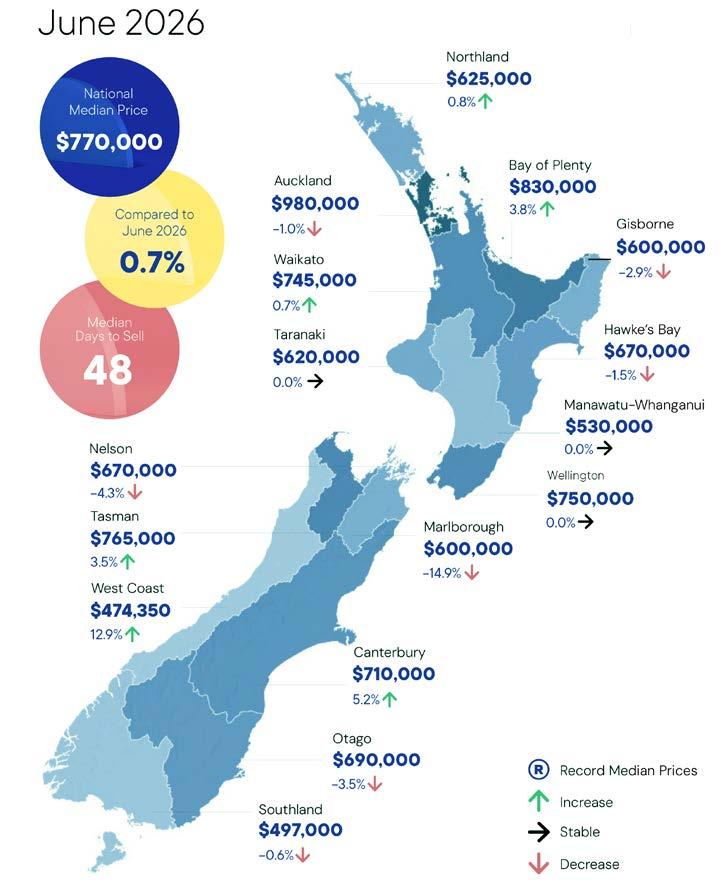
REINZ Monthly Property Report June 2026
June Sales Count
Year-On-Year Month-On-Month
Seasonally Adjusted Sales Count Month-On-Month
Source: REINZ Monthly Property Report June 2026
Home values tread water in Auckland and Wellington
The sluggish property market is showing no clear directional change. Cotality’s May Home Value Index indicates values generally stuck in neutral at the national level with the two biggest markets – Auckland and Wellington – still subdued. Buyers are in no major rush and sellers are not having to capitulate either.
Source:
Extending advice means a more resilient business
Evolving from a transactional adviser into a trusted long-term advice partner is not just about the numbers but the emotional intelligence behind them, Baden Martin says.
BY SALLY LINDSAY
Baden Martin, moderating a session at FANZ’s conference, says when advisers deepen their value, they deepen relationships. When relationships strengthen, their business becomes more resilient, more referrable and ultimately more valuable.
According to Martin, who has recently been appointed general manager of lending at Liberty Finance after a stint as chief executive at NZFSG, clients don’t go to advisers because they simply want their mortgage products.
“A transactional adviser focuses on products, rates and compliance, but pretty limited in scope. The trusted partner that I'm talking about operates differently. They're outcomes-focused.
“A trusted advice partner is not just discussing interest rates, the life goals of clients, future milestones and the long-term impact that they have.
“They come to you because they want certainty, confidence and clarity in some of the biggest decisions in their lives and they want guidance.
“An adviser’s role now is a coach, a decision partner, and someone that can turn complexity into clarity. And once an adviser has laid that foundation, they can broaden the lens into KiwiSaver. And that's one of the most underleveraged opportunities in mortgage advice right now.”
Martin says it's a natural extension of the lending conversation and more importantly, it's one of the
most powerful levers clients have for achieving their long-term financial objectives.
Expert guidance
At a time when the advice profession, especially mortgage advice, is undergoing a significant shift, markets and regulations are more complex than ever.
Clients arrive not only better informed, but with higher expectations of the value advisers provide. “How many customers have turned up with the ChatGPT recommendation already printed out for you to look at?”
They are looking for expert guidance and not just facts, Martin says. They already have the facts from online sources.
What they need from an adviser is the wisdom helping them understand what the facts mean for their personal circumstance.
So what does better advice actually look like? It means moving beyond the product and it's centred on their life outcomes, he says.
“They don't just want a good rate or a quick approval. They want help navigating compliance. The transactional advice alone isn't just what they're looking for.”
Thriving in the future
Martin says the advisers who will thrive in the future are the ones who build trust and go beyond the transaction to become true advice
partners in their clients’ lives. “And that is the direction that mortgage advice is heading.”
Instead of simply delivering information, an adviser becomes a coach, someone who helps clients make better decisions with confidence. And importantly, he says, that relationship becomes an ongoing one, well beyond the transaction of settling the home loan. “The shift from transactional to transformational isn't just a philosophical one. It's a tangible business opportunity for every adviser. Clients stay longer, refer more people and engage across more areas of advice.”
Simple explanations
Expectations have evolved dramatically and clients want clarity, confidence and context, Martin says. They want simple explanations that cut through complexity. And they expect the overall experience to match what they are used to from other service providers.
“They want advice to be fast, to be intuitive, and personalised. Their tolerance for friction or uncertainty is low. And that means long processing times, unclear next steps or unexplained outcomes erode trust quickly.”
A big part of an adviser’s role is to explain things to customers and set expectations around turnaround times. In the mortgage space in particular, that can lead to frustration so

diplomacy becomes important, Martin says.
“Buying a home, building financial security, creating financial freedom, it helps clients make confident decisions by blending technical expertise with emotional intelligence.
“That combination, understanding the numbers and the person, is what clients value the most. And better advice considers a client's long-term financial wellbeing. Not just the mortgage they're applying for but the structure that supports them in the future.”
Industry evolution
The modern adviser mindset is expanding, he says.
An adviser’s role is not only to provide technical guidance, but also to bring clarity in uncertain moments.
“There's more than enough uncertainty around at the moment. Clients often make decisions emotionally. People do that, but they fear making mistakes, they fear missing opportunities, and they fear being taken advantage of.
“Your role is to translate that complexity into simple understandable choices. You empower clients with strategy, showing them not only what to do, but why it matters and how it will support their broader goals. And when you become a decision partner, clients stop seeing you as just a service provider. This is about the evolution of the industry.”
KiwiSaver in the conversation
In a successful transition, clients will start seeing an adviser as someone they can rely on through the biggest financial decisions of their lives, he says.
One powerful opportunity to demonstrate this broader role is through KiwiSaver. First-home outcomes are directly shaped by KiwiSaver contributions, the fund choice and the long term strategy.
He says when an adviser brings KiwiSaver into the conversation, they extend the client relationship well beyond the settlement of the home loan.
It becomes a long-term touch point that supports wealth creation and financial protection. And strategically, it helps build a diversified and futureproof advice business less reliant on the mortgage cycle and more connected to the full financial lives of clients.
When an adviser broadens their offering, client lifetime value increases, meaning more touch points, more relevance and more opportunities to help customers. “The business case for holistic advice is compelling and advisers in this area are simply more resilient, less exposed to market cycles and changes to commission terms.”
Business growth
It also means more control of an adviser’s business growth.
One of the most important or powerful differentiators in this industry is emotional intelligence, Martin says.
“EQ builds trust faster than any technical skill. And when clients feel understood, they share more openly. And when they feel safe, they make better decisions. So high EQ advisers will create environments where clients can articulate their real goals, fears and motivations.”
He says that is where meaningful advice happens and perhaps most importantly, EQ helps advisers turn
‘When advice improves, everything improves. Better advice builds deeper trust. Those deeper relationships create more stable, resilient businesses.’
Baden Martin
complexity into confidence.
“Clients rarely remember the technical details for a home loan settlement, but what they always remember is how you made them feel through that transaction.”
Technology impact
As important as EQ is the positive impact technology is having in the financial service advice sector.
Martin says technology gives advisers the ability to scale this type of high-value service. Automating administrative tasks frees up time to focus on advice and not paperwork.
“Digital tools create consistent, highquality client experiences. When used well, technology allows an adviser to build efficient, scalable service that gives every client a premium experience without increasing their workload.”
However, he says every client needs clarity on what an adviser delivers. It means shifting the focus from the transaction to the long-term relationship.
“You'll be following clients across life stages. The first home, their next home, investment properties, KiwiSaver and financial protection. This creates a lifetime journey rather than a one-off transaction or event. And importantly, it requires systems that support growth without adding stress.
“When your processes are predictable and efficient, your capacity expands, your service improves and your business becomes more sustainable,” he says.
“When advice improves, everything improves. Better advice builds deeper trust. Those deeper relationships create more stable, resilient businesses.” ✚
Why KiwiSaver adds value for clients – and advisers
Delivering more value to clients - and letting them know what that value is - remains a key ingredient missing from the New Zealand adviser industry, says Dave Copson, Booster business development head.
BY SALLY LINDSAY

Dave Copson says advisers need to get better at explaining to New Zealanders what value they can offer.
“We need to be better as an industry to articulate that to New Zealanders,” he says.
“We need to change people's perception of advice to a certain degree – that they are not looking for a product, they're looking for an adviser to be their journey.”
Copson says adding KiwiSaver to the mix can be a helpful part of taking
client conversations in a more holistic direction.
Starting small
He said KiwiSaver would give an adviser increased relevance to a client. The KiwiSaver lifecycle starts off small and grows bigger.
Copson was working at Tower when KiwiSaver first started and had a lot of advisers say: “There's nothing in it for us, we're not interested in this. It’s not big enough, we won't make any money out of it. We'll just stick with
insurance”.
He says many of those advisers over the years have come back and said they should have added KiwiSaver to their business when he told them to.
“Many have jumped on into it now and are realising its benefits to their business, but those who added it at the beginning are doing very well crossselling and upselling opportunities.”
He says the conversation is with clients is usually about what they are going to do with their KiwiSaver, what they are trying to achieve with

it and helping them get to that goal by changing what it looks like. “It’s only going to help an adviser’s business.”
He says the beauty of KiwiSaver is it gives mortgage advisers an alternate revenue stream and diversifies their business. “It takes an adviser away from being a one-trick pony and adds a lot of value of a business.”
Books escalating in value
KiwiSaver books are selling for anywhere between four and five times revenue.
“There is value in that and KiwiSaver just grows and pays itself off pretty quickly. It does add a lot of value to an adviser’s business in that respect,” Copson says.
Copson says advice can be lifechanging for clients if advisers get it right. “The average unadvised Kiwi thinks they can do it themselves. It’s not true.”
As an example, a 35-year-old unadvised Kiwi with a first home and $35,000 in a KiwiSaver balanced fund will have $819,000 at 65 and another Kiwi the same age with a first home and also with $35,000 in a growth fund will have more than $1 million.
“That is just an adviser listening and dealing with moving a client from a balanced to growth fund when they were 35.”
Copson says it is ridiculous how many people sit in either conservative or balanced funds after they have bought their first home because that is where they have put themselves after filling out an online questionnaire telling them they are a balanced investor.
Why does it tell them they're a balanced investor? Because they don't understand what they're doing. “It's not going to do them any good at 65 with present value.
“After 65 their KiwiSaver investment in a balanced fund gives them $26,000 a year over and above whatever they may get from the government [but they would get] $34,000 a year from a growth fund.”

How does KiwiSaver grow an adviser’s business?
Copson says mortgage advisers just latching on to KiwiSaver might get five clients a month to start who are investing 4% a month and have an average of $40,000 in a balanced fund. Booster pays 0.5% trail for each client an adviser signs up to its KiwiSaver product.
After five years the adviser’s business will have income of $120,000, after 10 years $418,000 and a book value $1.67 million.
If an adviser has 25 KiwiSaver clients, the business will have income of $603,000 after five years, $2.1 million after 10 years and a book value of $8.36 million.
Income from mortgages over that time will be dropping and be at zero after 30 years because they will be paid off.
KiwiSaver has the opposite trajectory. “It starts off fairly slow, but it takes off through that 25, 30 years but it doesn't stop there at all. It goes until a client 90 years old, not just 65,” Copson says.
“In 10 years’ time, balances are not going to be $50,000, $60,000 or $70,000. They are going to be $$500,000, up to $1 million to $2 million. That's going to be the norm.”
He says the example of the KiwiSaver book value is conservative and not bad growth, but signing up five clients a month is slow going and the adviser is probably not having the right conversations.
“At 25 clients and income of more than $600,000 a month that changes a mortgage adviser’s business significantly and gives them room to pay somebody else so they can concentrate on getting more clients on board.”
Copson says Booster’s view is it values the value advisers offer their clients. “No one can be as close to them as advisers can. That is why we pay a good trail so advisers can support their clients long-term.” ✚
‘We need to change people's perception of advice to a certain degree – that they are not looking for a product, they're looking for an adviser to be their journey.’
Dave Copson

Finding the gaps to build a relevant and durable adviser business
Maintaining relevance in a moving market may be your superpower.
BY SALLY LINDSAY
In the mortgage market, relevance is the new asset, Camilla Tumai, Bizcap general manager, told advisers at a recent FANZ modern adviser masterclass.
She says it is not volume, not activity, not even growth but relevance, in an industry that continues to evolve.
At the same time, Tumai says the lending environment is shifting.
“Credit appetite is constantly changing, commission structures are also evolving and lending volumes, rates and finance cycles are fluctuating.”
And in that kind of environment, she says growth alone is no longer enough.
“Durability really does matter. If nothing changed in your business for the next five years, would your income become stronger or more exposed?”
She says that question actually matters more today than it did 10 years ago because when industries change, the advisers and businesses who thrive are the ones who actually recognise those shifts early.
That idea shaped how she built and grew her last adviser business in a career spanning 20 years in the industry. Tumai has been a oneperson adviser building a client base, contracted her services to a larger business and has also been a business owner responsible for building and leading a team.
When she started her business 10 years ago she didn’t buy a client base but built the firm from the ground up to a team of 18 advisers and support staff.
During that time, the business educated more than 8000 New Zealanders about their financial
wellbeing and built one of the biggest KiwiSaver books in the country at the time.
“We didn't grow by chasing activity, we grew by paying attention to the problems that clients were actually struggling with at the time and building solutions around those problems.”
Tumai sold the business in its prime not because she had to, but to give her the opportunity to step back and think about what she wanted to do next.
“What brought me back to the industry was I still cared deeply about helping advisers build more stronger and resilient businesses.”
A clear path
When Tumai looks back at how her business grew, a clear path emerges.
“The biggest opportunities often appeared where clients were confused, uncertain or under-served. And KiwiSaver was just one of those areas at the time. People didn't understand it. They didn't know if they were in the right fund, how to maximise it.
“That confusion created an opportunity for us to help. So we focused on education, not sales. We embedded it into our client conversations, communications and presentations. Over time, that built enormous trust and significant growth for the business. But KiwiSaver wasn't the only gap. There were many areas where people needed guidance but just didn't know where to turn.”
That is when she realised something important. “We actually didn't need to become experts in everything. We
needed to become good at identifying problems early and connecting clients to the right solutions or specialists. Now, when I look back at the pattern, one thing became clear. The biggest growth opportunities rarely come from chasing activity, they come from identifying real problems and helping solve them.”
Tumai says when clients are confused, feel uncertain, when they don't know where to turn, that's where advisers become most valuable.
More products aren’t the answer
Relevance isn't created by offering more products, it is created by solving the problems that clients are actually facing, Tumai says.
And when you consistently solve meaningful problems for your clients, three things actually happen.
She says firstly advisers build trust. By strengthening and deepening the relationships they have with clients, new opportunities emerge.
And that's when something interesting starts to happen in their business. Income stops coming purely from one-off opportunities and starts becoming more durable.
Not all revenue is created equal, however, she says. “At the bottom of the revenue ladder is transactional revenue. It comes from one-off opportunities that are valuable, but once the transaction ends, so does the income.”
Above that sits relationship revenue, which is repeat business or referrals, probably from an adviser’s clients. And
above that again, is recurring revenue income that just continues over time.
Right at the top sits compounding revenue, where systems, relationships and ongoing client growth combine – where an adviser’s income grows through both new and existing clients, and where the business becomes more durable and valuable over time.
“[Revenue] comes from all four transactional opportunities, relationship referrals, reoccurring income, and compounding growth.
“Advisers need to think if they are proactively doing certain things to get to that revenue stage as the next question is where are clients feeling pressure? That is often where opportunity begins,” she says.
“Mortgage advice, for instance, naturally focuses around residential lending, but many adviser clients aren't just borrowers, they're also business owners. They might run construction, retail, hospitality, transport or professional service businesses. And right now, many of those businesses are operating in a very different environment – costs have increased, cash flow has tightened, access to capital has become much slower and complex.
“And at the same time, many businesses across New Zealand need funding to grow, whether or not that's for hiring staff, purchasing equipment or just being able to step into larger contracts or bigger opportunities.
“Who do they turn to for help?”
Missing opportunities
Tumai says often those businesses don't fit into traditional lending models and when they need funding, they don't always call their adviser first. In many cases they go online, respond to advertising, or go directly to lenders.
It’s not because they don't trust advisers, but often they don't realise their adviser can actually help, she says.
“When that happens, two things occur – the client may not be getting the best possible guidance and an adviser misses the opportunity to support their client during a moment that matters.”
From a business perspective, it also means growth and revenue opportunities are potentially missed.
Too much specialisation
Another pattern Tumai is seeing across the industry is many advisers specialising in one core area – either mortgages, insurance, investment or
wealth.
She says that while specialisation is important and clients want confidence that the person that they're working with truly understands that area, it can unintentionally narrow how clients see advisers.
For example, many advice businesses have the word mortgage in their business name or their logo, which sends a message about what they can help with.
“It is worth thinking about how clients perceive the range of ways that advisers are able to support them, because great advisers don't try to become experts at everything but they do become good at consistently identifying with where their clients may need help.
“And when those needs sit outside of an adviser’s expertise, connecting clients with trusted partners becomes incredibly valuable.”
Tumai says this is how she built her last business. When advisers aren't part of these conversations, clients don't stop needing help. They simply just look at elsewhere.
“Every market goes through cycles. New opportunities emerge, clients evolve and new areas of advice begin to gain momentum.”
She says the advisers who benefit most are those that recognise those shifts early.
“The greatest value is often created before the market fully shifts or moves.
“KiwiSaver is a great example of that. When it was introduced many clients didn't understand it, there was confusion and advisers who stepped into that space early built enormous books and long-term client relationships.”
Early positioning
This highlights an important principle, Tumai says. Early positioning creates advantage, and if an adviser enters the market later, differentiation becomes critical.
Tumai says It points to something important. Clients are actively looking for solutions, but advisers are not always part of the conversations.
“Not because advisers don't care, but because the space is still unfamiliar for many. And when that happens, a gap begins to form and it is playing out in real data.”
Bizcap’s data shows only 35% of all its new business comes via the adviser channel. The majority, about 65%. comes from its online digital marketing partners or direct marketing.
“Clients are clearly out there looking for solutions. The question is whether or not they're finding and adviser or someone else. What's getting in the way?”
“For most advisers, it's not lack of intent, it's usually one of three things – lack of exposure, confidence, and how quickly the space has evolved or is continuing to evolve.”
A year ago BizCap's lending was traditional business loans.
That is no longer the case. About 80% of all its lending month-on-month now is line of credit facilities. The reason for that is quite simple. “Businesses don't just want access to funding, they want flexibility, the ability to draw down if and when they need it and only paying for what they're actually using.”
For many businesses, that's something they're not always able to get through their banks.
Either they can't access an overdraft or what they have just simply isn't enough.
For an adviser, getting into this part of the market sometimes starts with a question as simple as this. “Do you currently have access to a flexible funding facility you can use for cash flow, seasonal changes, or growth opportunities?”
She says because many advisers simply haven't spent much time in this part of the market yet, they might not always be sure if the solutions actually fit their client or when they should be considered. And that's completely understandable.
“Again, this isn't about becoming a business lending expert. It's about recognising where these conversations are happening and making sure an adviser is part of them. And the good news is that it definitely doesn't have to be complicated.”
Tumai says for an adviser is it about being more intentional in the conversations they are already having, creating awareness and making it easier for those opportunities to surface.
When she was building her business, Tumai says she didn't just build a client book, but systems that consistently created opportunity.
“Opportunity doesn't always appear by accident, often it's designed into the way that and adviser’s business operates.
“When I look back at that experience, it reinforced something important. The biggest opportunities often appear when an adviser looks at familiar problems differently.” ✚
Are banks going cold on advisers?
Banks in Australia want to drive more home loans through their branches rather than advisers. Will they do the same in New Zealand? Jenny Ruth investigates.
The fact that home loans originated by mortgage advisers are approaching the 80% mark in Australia seems to have rung alarm bells with the major banks this side of the Tasman.
Because all four of them have publicly embraced the idea that they should be originating more of their lending from within their own channels.
Brokers - advisers are still called brokers in Australia - aren’t taking this push lying down: Mortgage & Finance Association of Australia chief executive Anja Pannek says the numbers show Australians have been voting with their feet in favour of the service delivered by brokers.
The value proposition brokers offer is “simple, yet powerful: choice, trust and expertise.”
Without brokers, borrowers would face higher costs and fewer choices, Pannek says.
Finance Brokers Association of Australia managing director Peter White says brokers offer consumers “better rates, more flexibility, and lending solutions tailored to their circumstances.”
He says a mortgage broker doesn’t win a client on price.
“It’s a relationship built on trust and delivering outcomes.
“It remains unclear to me how lenders could deliver the personal connection and guidance that thousands of small broking businesses provide every day.”
Cold winds blowing
However, the focus from the major banks is real, and it’s already extending across the Tasman, even though adviser dominance isn’t as great in New Zealand: in October, Kiwibank chief financial officer Paul Chambers estimated that mortgage advisers’ share of origination in the New Zealand market is approaching 65%.
Advisers here are now starting to feel the cold winds from across the Tasmna blowing against their dominance, with both National Australia Bank (NAB)owned Bank of New Zealand and Westpac signalling a greater focus on proprietary origination.
ANZ Bank New Zealand chief executive Antonia Watson says her bank is more concerned that it has lost market share than that loans originated by advisers fell to 59% of new lending in the year ended September, from 61% the previous year.
ANZ’s market share of New Zealand mortgages eased to 30% at Sept 30, from 30.4% a year earlier.
“It's not surprising in a market that's been highly driven by switching, because we've got the most customers to lose,” says Watson.
“But that doesn't mean it's not disappointing for us, and we're pulling out all stops to reverse that.”
Both, please
Watson referenced group chief executive Nuno Matos’ comments:
that the desire to originate more of its lending itself doesn’t mean ANZ doesn’t value advisers.
“We don't want to not have such a great relationship and such great origination from advisers, but we've got a great proprietary network,” Watson says.
“So that's something we will always invest in and look to grow, as well as our adviser channel.”
Matos outlined ANZ’s plans to lift the number of lenders at its branches by 50% over the next five years, although he acknowledged ANZ’s reliance on brokers to originate two-thirds of its home loans - and the need for his bank to remain attractive to brokers.
“We are not targeting a ratio of brokers versus proprietary origination at all,” Matos said.
“We don’t see one versus the other, or one or the other. We see the need to be good in both of them. We need to do both very well.”
Watson still believes the adviser channel will remain a valuable source of mortgage business.
“Why do people go to brokers? Because it's really complex getting a home loan, and they want someone who they feel like is on their side and can help negotiate for them.
“I think your average Kiwi’s a bit shy about negotiating, and putting negotiation in third-party hands is great,” she says.
“When you're looking to borrow a lot of money, you want someone that's
there to be your advocate, that can help negotiate for you, that can hold your hand and talk you through the process.”
Mortgage brokering in both countries began in the early to mid-1990s, although brokers have always had more traction in Australia, possibly reflecting the greater presence of non-bank mortgage lenders in that market.
However, the market share gains by brokers/advisers in both countries has inexorably risen, indicating that they have been providing something to bank customers that the banks themselves were unable or unwilling to offer.
First alarm bells
Commonwealth Bank of Australia, owner of ASB Bank, arguably heard those alarm bells ringing years before the other banks did.
In late 2021, CBA started to prioritise proprietary mortgage origination, and has been claiming it’s cheaper than using mortgage brokers.
It claims broker-originated mortgages are between 20% and 30% less profitable than proprietary mortgages originated through its branches and digital channels and via mortgage bankers.
Whatever the merits of that argument, and other bankers have their doubts, CBA’s preference for proprietary origination has borne fruit.
The bank’s 2021 annual results show that at June 30 of that year, brokers had originated 46% of its mortgage portfolio and that brokers had accounted for 44% of new mortgages in the six months ended June.
By June 2025, 66% of CBA’s mortgages were proprietary originated and mortgage broker share had dropped to 34%.
Its September quarter release showed the broker share had dropped to 32%, showing CBA’s push to go inhouse hasn’t abated, but, intriguingly, its chief executive, Matt Comyn, complained about a squeeze on margins.
Other
banks following
The other major banks are now following CBA’s lead, with NAB claiming 41.4% of new lending came from proprietary channels in the six months ended September, up from 35.4% in the six months ended March 2024.
On this side of the Tasman, CBAowned ASB Bank is the only one of the big four to hide the extent of its reliance on brokers, which is likely substantial given that it used advisers to expand out of Auckland, its home market.
While NAB chief executive Andrew Irvine has claimed his strategy of going inhouse is working, broker-introduced home loans still comprised 54% of NAB’s mortgage book at Sept 30, up from 52.8% a year earlier.
However, NAB has overhauled how it measures lending targets for its inhouse private bankers, who look after the bank’s wealthier customers, by increasing the focus on inhousegenerated home loans, ensuring they receive little credit for loans originated by brokers.
NAB-owned BNZ has never been particularly friendly towards mortgage advisers and its latest results showed advisers accounted for only 41.1% of new lending in the six months ended

‘It remains unclear to me how lenders could deliver the personal connection and guidance that thousands of small broking businesses provide every day’
Peter White
September, down from 47.6% in the six months ended September 2024.
Advisers still accounted for 39.3% of BNZ’s mortgage book at Sept 30, up from 38% a year earlier.
BNZ didn’t deal with advisers at all between 2003 and May 2015, but then resumed because it had been losing market share of the New Zealand mortgage market.
Westpac says about 32.6% of its Australian home loans are selforiginated, so it’s obvious that the other three major banks are far more reliant on brokers than CBA.
Westpac chief executive Anthony Miller is also targeting lending to property investors as well as lessening his bank’s reliance on brokers, claiming that the credit risk is lower than with loans to owner-occupiers.
In presenting Westpac’s latest results - and his first since taking the top job in September last year - Miller brought up the hoary old chestnut of brokers churning home loans to boost their commissions.
Miller said he had hired more frontline bankers and was paying them more.
“There is nothing more dramatic than getting those basics in place, to allow
us to get after it,” he said of the drive to more “proprietary lending” through its website and branches.
In New Zealand, advisers accounted for 56.7% of Westpac’s book at Sept 30, up from 53.8% a year earlier.
Chief executive Catherine McGrath says advisers accounted for 66% of new lending in the six months ended September, up from 64% in the six months ended March.
Proof advice works
Brokers don’t just have customer preferences on their side.
Like Kiwibank in New Zealand, Macquarie Bank has been the challenger bank to the Big Four banks over the last decade, and its market share jumped to 6.5% at Sept 30 from 5.6% a year earlier.
In the six months ended Sept 30, Macquarie’s mortgage book jumped 13% to A$160.3 billion, with mortgage brokers originating more than 95% of those loans.
That makes Macquarie’s mortgage book significantly larger than that of New Zealand’s largest bank, ANZ Bank New Zealand, which reached NZ$112.53 billion at June 30.
Macquarie’s mortgage book is growing at a considerably faster pace than the major banks, too: CBA’s home loan portfolio grew a slower 4% to A$523 billion in the year ended June, making it the largest Australian mortgage provider, with a market share a little above 25%.
Westpac, the next largest home lender with more than 20% of the market, reported 5% growth to A$487 billion in its mortgage book.
Brokers do it better
When Macquarie reported its latest results in early November, chief executive Shemara Wikramanayake attributed his bank’s growth to it being able to deliver “superior customer experience” - and clearly brokers are a large factor in that service.
Investment in systems to make life easier for brokers has also been a factor - and Macquarie has ploughed another A$30 million into IT in the past six months.
ANZ’s Matos acknowledges the pressure on the profitability of the mortgage business in Australia, but, watching from this side of the Tasman, it looks like it’s challenger bank Macquarie which is applying the pressure, rather than anything brokers are doing. ✚
HOW AI CAN HELP SUPERCHARGE YOUR BUSINESS
Most advisers are using AI as a content writer. The smart ones are using it as a research department.
Artificial intelligence has rapidly become the hottest topic in marketing.
For many mortgage advisers and financial advisers, the conversation usually centres on content creation. Ask ChatGPT to write a blog. Generate a LinkedIn post. Create a newsletter article. Draft a client email.
Useful? Of course. But if that’s all you’re using AI for, you may be missing the biggest opportunity of all. The real power of AI isn’t writing content. It’s gathering insights by using AI as a research department.
Stop guessing what clients want. Many adviser marketing campaigns are built on assumptions such as: We think first-home buyers are worried about interest rates. We think investors are sitting on the sidelines and not seeing the opportunity. We think our clients want more educational content.
What do prospects really want?
But rather than anecdotal evidence from client conversations, consumers leave clues everywhere online. They discuss their concerns in Facebook groups, Reddit forums, property websites, news article comments and community pages. AI can help analyse these discussions and identify recurring themes.
For example, you might ask AI: What are the biggest concerns currently being discussed by New Zealand first-home buyers in 2026?
I put that question into AI, and the answers (in summary) it came back with were: Can I actually afford to own a home? What are the hidden costs – rates, insurance, maintenance, legal, moving… Should I buy now or wait until the market bottoms out? Am I stretching myself too far? What if interest rates rise again? What if I lose my job or my partner stops work? What if we have children? Can I still have a life after buying? What if house prices don't go back up?
When you understand what people are genuinely worried about, you can create content and services that directly address those concerns. AI can keep you up-to-date with this.
Use AI to identify market opportunities
Many advisers, and many New Zealand small businesses more generally, fall into the trap of targeting everyone. The result is marketing that resonates strongly with nobody.
AI can help identify opportunities within specific customer groups that may be underserved. Ask AI to analyse
demographic trends, local economic conditions, housing data and workforce patterns.
Questions might include: Which borrower groups are growing fastest in my area (name the area)? What customer segments are underserved by mortgage brokers in my area (name the area)? Which professions face unique lending challenges? What groups in my area most benefit from specialist lending advice?
You may discover opportunities among self-employed tradespeople, healthcare workers, contractors, new migrants, business owners or pre-retirees.
Many successful advisers have built strong businesses around serving specific niches. AI won’t choose your niche for you, but it can help identify opportunities you may never have considered that you can have with little competition.
AI can analyse your competitors?
This is the stealth bit.
Most advisers know who their competitors are, but few know exactly how those competitors position themselves. Traditionally, competitor analysis has been time-consuming. Visiting websites, reviewing social media channels, analysing advertising and comparing services can
take hours.
AI can significantly accelerate the process.
You can ask it: Compare the websites of these five mortgage advisers (put in the website links) and identify their strengths, weaknesses and market positioning. Do so with a view to identifying niches or weaknesses I can exploit as a result.
Within minutes, AI can provide observations that may have taken hours to compile manually.
You may discover that competitors are focusing heavily on first-home buyers, neglecting investors, offering stronger educational resources, using clearer calls to action, and building more trust through testimonials and case studies. Or more likely, they are offering a raft of generic, untargeted information and haven’t updated their website for many months.
If everyone is saying the same thing, there may be an opportunity to say something different.
Differentiation remains one of the most powerful marketing tools available. Turn AI into a
mystery shopper
One of the most practical uses of AI is to evaluate your own marketing. Many advisers look at their websites through the
eyes of an industry professional. Clients don’t.
A nervous first-home buyer sees your website very differently from how you do. Ask AI to review your website from the perspective of a potential client group that you want to target.
Questions about your own website and marketing material could include: What information is missing? What concerns remain unanswered? What might stop someone from making contact? Is the language de-jargonised and easy to understand? Does the site feel trustworthy?
The answers can be surprisingly revealing.
You may discover that your website explains loan structures in great detail but fails to answer basic client questions such as: How much deposit do I need? How does using KiwiSaver work for a home loan? Will I be judged if my situation isn’t perfect? What if my partner has previously owned a house but I haven’t? How much will your service cost?
The best marketing often comes from answering questions before they are asked.
Small improvements to the user experience often yield greater results than producing more content.
Patterns and trends
One of the greatest advantages of AI is its ability to identify patterns.
AI can analyse all of your inquiry forms, email conversations, meeting notes and frequently asked questions to identify recurring themes. You can also load your entire client database into it - it’s secure to do so if you follow some protocols - and ask it to look for patterns and trends. AI can read Word docs and Excel spreadsheets.
Better decisions, not just more content
It’s easy to become obsessed with producing more blogs, more social posts and more newsletters. But more content does not automatically lead to more business. Better decisions do.
The advisers gaining the greatest advantage from AI are using it behind the scenes. They’re using it to understand customers. They’re using it to analyse competitors. They’re using it to identify opportunities. They’re using it to refine strategy.
The competitive advantage is changing
A sole adviser now has access to tools capable of performing many of the same research functions as the large companies with rooms full of marketing analysts.
The more you use paid versions of AI, the more it learns you, and you will be able to

‘The real power of AI isn’t writing content. It’s gathering insights by using AI as a research department. ’
refine the questions as you understand how AI interprets them. There are several tools that can do this for you, the two most notable being ChatGPT and Claude.
A note of warning
Ask any GP how annoying it is for patients to walk into their clinics with printouts from Dr Google about their condition.
Your clients are doing the same and potentially cutting you out. They are asking AI: Here is my situation, which lender will look at me most sympathetically, and can you print out a document for me to take to the lender to achieve the mortgage I need?
Isn’t that what you do for them as a broker??
In a future article, we’ll look at how advisers are using AI to improve lead generation, qualify prospects, and create marketing systems that continue working long after the office lights have been switched off. ✚
Paul Watkins is a marketing adviser to the financial services industry.

Is assumed affordability something that should influence life insurance advice?
Opinion: ‘Budget is always the issue’ a commentator has said. I agree, but does that have anything to do with giving suitable advice?
BY STEVE WRIGHT
For me the question is not primarily ‘how do I get this client to spend the money?’ because I am not selling insurance to clients. I have been an adviser, albeit many years ago, and budget was the issue then too.
Today, the question for me is ‘what should advisers consider doing to ensure their advice is suitable and complies with the various laws, codes and regulations that someone, sometime, might want to judge their advice by?’
When I was an adviser there were no specific laws governing life insurance advisers, no Code of Conduct, no FMA and no mandatory Dispute Resolution Schemes. Giving advice was really making sales, and making recommendations considering the prospective client’s likely budget was seen as a way of improving the chances of making the sale: of ‘not scaring the client off’. We were taught sales techniques that included taking note of what was parked in the garage, how valuable the house might be and so on, even to give the client three quotes, each one higher than the last and ensuring the ‘middle’ quote (seen as most likely to be accepted) was the adviser’s favoured provider.
Don’t get me wrong, sales skills are probably more important now than ever. But things are very different today, there are specific laws, a Code of Conduct, the FMA and Dispute Resolution Schemes. Advisers are expected to give advice, not simply sell insurance products.
So on to the real question! Is it acceptable today to tailor recommendations so that premiums fall within a range likely to be acceptable to the client?
I think the answer is a firm no, if such recommendations don’t appropriately cover client risks, are short on products or sums insured or deficient in some other way, primarily to lower premiums. The answer is no for the following reasons:
• The law requires advisers to act with

the skill, diligence and care of the prudent adviser (what a prudent adviser might be is a topic for another day);
• the Code requires the adviser to give advice that is suitable; and
• the Code requires advisers to take steps to ensure the client understands their advice and has sufficient information to make informed decisions.
Deficient recommendations crafted to meet a perceived premium affordability/ tolerance are likely to fall foul of all of the above.
The way I see it, advisers are duty bound to properly and fully identify and quantify client risks based on the client’s unique circumstances, needs and goals, and, where insurance is the prudent solution, recommend suitable products (and options) to cover all those risks both efficiently and sufficiently.
If suitable advice is given and the resultant premium is not affordable, the client is always free to ask the adviser to make another recommendation. If the client chooses to underinsure after having sufficient information to do so in an informed manner, then that is on the client.
Can advisers still give suitable advice and make sales?
If you ask people to buy insurance products then of course it becomes critical to sell the recommendation.
If you ask people to buy into the need (for protection) and do this well before the recommendation is delivered, ‘selling’ the recommendation should not become critical.
For me a Statement of Advice is not a sales tool (it’s way more important than that – it’s also evidence that the adviser has done their job properly).
I believe an advice process that makes it clear from the beginning that:
• the adviser is duty bound to give suitable advice; and
• that it is totally acceptable (and common) for the client to ask the
adviser to make a supplementary recommendation to achieve a lower premium, is unlikely to ‘scare off’ serious clients, who have bought into the need for insurance protection.
As I see it, advice is one thing, affordability is something else. If affordability is an issue and the full suitable recommendation is not accepted, the adviser has more work to do. That work is to reshape the insurance plan in a way which minimises protection loss acceptable to the client in a way which achieves the necessary premium reduction.
Is it acceptable to tailor recommendations if the client has mandated a maximum premium spend up-front?
As long as this is clear from the terms of engagement/Scope of service, then you should probably comply with the client’s instructions. But this raises a couple of questions.
Firstly, how does the client determine a premium spend that is ‘suitable’? Clients might have a premium figure in mind, but they are not advisers so it’s very unlikely to deliver suitable insurance for them –they still need advice from an adviser (and appropriate warnings of the implications of any resultant underinsurance and overinsurance).
Perhaps the instruction is for execution service only, and I guess that may be fine as long as it’s clear no advice is being given and the dangers and implications of ‘no advice’ are explained. The reality is that most people need advice.
The law expects advisers to be advisers, not simply brokers. This requires ongoing effort. The good news is that excellence in advice builds trust, respect and longterm relationships, delivering professional satisfaction and valuable, resilient businesses in the long term. ✚
‘Today, the question for me is ‘what should advisers consider doing to ensure their advice is suitable and complies with the various laws, codes and regulations that someone, sometime, might want to judge their advice by?’
Steve Wright
Steve Wright has spent 20 years in sales, product, and professional development roles with insurers. He is now independent and helping advisers improve business through training and advice coaching.
The Top 10 stories on tmmonline.nz
A lot has happened in the market since the last edition of the magazine. Here are the most-read industry stories from tmmonline.nz

01 ANZ CEO TO RETIRE
ANZ NZ CEO Antonia Watson to retire; Ben Kelleher to take over.
02 FAMNZ DEAD
Two years after launching the Finance and Mortgage Advisers Association of New Zealand (FAMNZ) is shutting up shop.
03 HEARTLAND TO BUY TSB
Heartland will also sell $56 million of subordinated debt that will be eligible as tier 2 capital.
04 RBNZ PULLS THE TRIGGER
The Reserve Bank has increased the OCR. Here's what it said.
05 KIWISAVER AN OPTION FOR MORTGAGE ADVISERS SEEKING ONGOING INCOME
Mortgage advisers looking for another stream of income as trail commission becomes harder to find are looking at their options in KiwiSaver, one provider says.
06 WHICH BANKS DID THE MOST LENDING IN 1ST QUARTER; AND WHO SLOWED DOWN
Kiwibank appeared to take its foot off the accelerator on mortgage lending in the March quarter after a string of quarters of lending above its market share which reached almost 8% at March 31.
07 MORTGAGE FRAUD AND ADVISERS’ COMMISSIONS UNDER THE FMA MICROSCOPE
The Financial Markets Authority (FMA) is going after advisers and FAPs who flout its rules and pose significant risks for borrowers.
08 ADVOCACY OVER SHOUTING LEADS THE WAY
The demise of the Finance and Mortgage Advisers Association of New Zealand (FAMNZ) is no surprise to Hamish Patel, Financial advice New Zealand (FANZ) mortgage and lending director.
09 SINGLE SET OF EXPECTATIONS FROM NEW CCCFA REGULATOR
The FMA has taken over from the Commerce Commission as regulator of the Credit Contracts and Consumer Finance Act (CCCFA).
10 LENDING EXPANSION AND NEW PRODUCT TO BOLSTER FINBASE
Finbase has launched a new 30-year mortgage product after a $150 million capital partnership deal with ASX-listed Challenger.
To keep up with all the news make sure you check www.tmmonline.nz regularly.
Or you can get the news and rates update sent to you each day.
Sign up to the TMM email newsletter. tmmonline.nz/newsletter-signup
Specialist property lending across New Zealand
• We fund property investors, developers and business owners requiring flexible structuring
• First mortgage security
• Residential, commercial and rural lending
• Terms up to 24 months
• No consumer lending