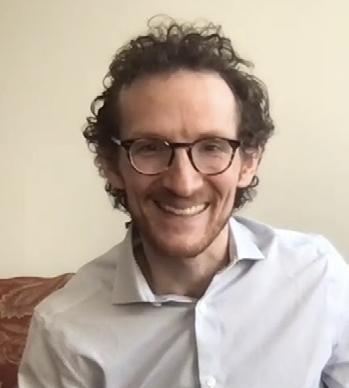
Munazzeel Riasat FINANCE DIRECTOR 437.371.5342 finance@tma149.ca
Jay Boehmer
MUSIC PERFORMANCE TRUST FUND (MPTF) ADMINISTRATOR 437.371.2282 trustfund@tma149.ca
Here at TMA149 we acknowledge the land we are meeting on is the traditional territory of many nations including the Mississaugas of the Credit, the Anishnabeg, the Chippewa, the Haudenosaunee and the Wendat peoples and is now home to many diverse First Nations, Inuit and Métis peoples. We also acknowledge that Toronto is covered by Treaty 13 with the Mississaugas of the Credit.
Canadian Conference of Musicians and Gala images courtesy of: Kris Durlen
President’s Message
President’s Message
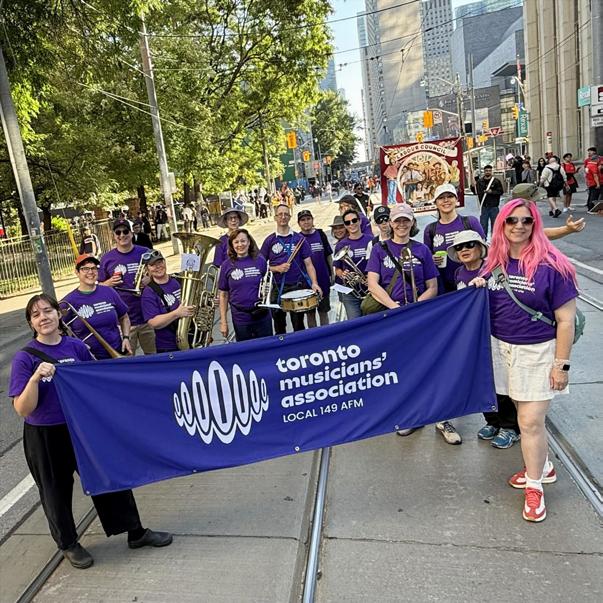
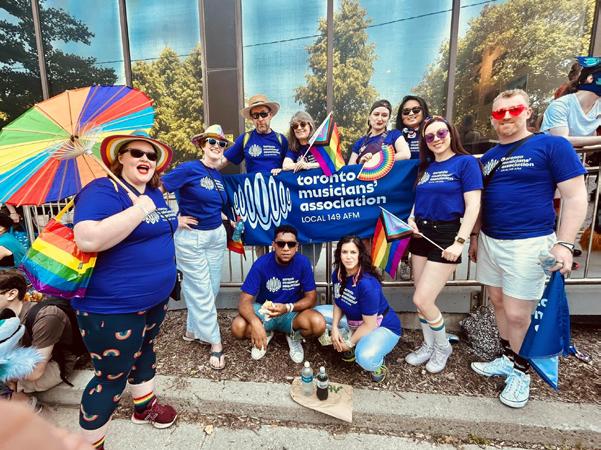
Greetings all, and welcome back from summer break (if you had one). The end of summer is usually marked by Labour Day, and I’d like to thank everyone who came out to march with us in the parade (thanks also to those who showed up at the Pride Parade as well). It’s really gratifying to see the many thousands of people from scores of unionized workplaces who turn up to march, not to mention the enthusiastic onlookers.
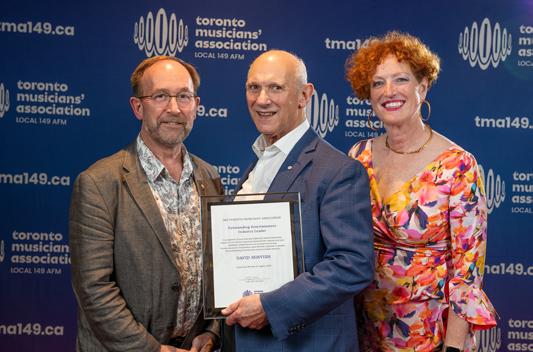
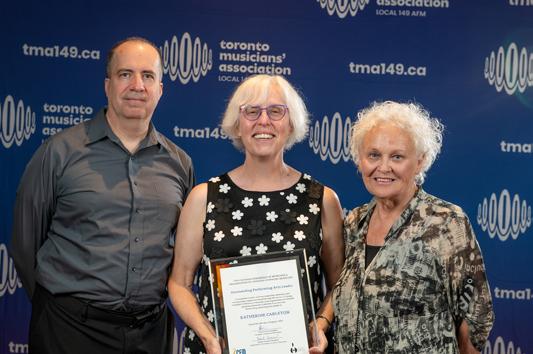
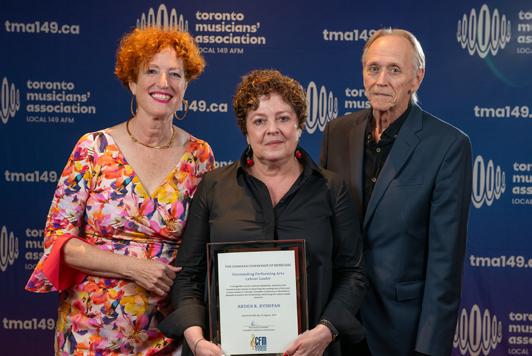
In August, we hosted both the Canadian Conference of Locals and the OCSM Conference at the Hyatt downtown. By all measures they went very well. Many of the International Executive Board were present, and I was most pleased to see that they listened intently, answered questions on Canadian musicians’ concerns in a straight-forward manner, and heard our call for the new Symphonic Services officer to be based in Canada. At the Gala dinner, Local 149 was pleased to present awards honouring David Mirvish (Mirvish Theatres), Arden Ryshpan (Canadian Actor’s Equity Association) and Katherine Carleton (Orchestras Canada) for their years of valuable service and collaboration with our industry. The evening was topped off by a splendid performance from Hilario Duran’s excellent quintet.
Now for a couple of PSA’s:
As a small reminder, if you’re booking gigs, please note that our basic scale fees have gone up as of September; do check the current Tariff of Fees.
We still have over 200 free licences for the Microsoft Business Basic software suite, available through our office. If you think this would be useful to you, please call (416-421-1020) or write to our office manager, Maggie Hopkins: operations@tma149.ca
I hope to see many of you at our next General Meeting. It’s great to feel the engagement of members, and to chat with the attendees afterward. Look for the date in an upcoming e-bulletin.
In solidarity, Les Allt
Les Allt President, TMA
The Grand Parade
TMA proudly participated in the 2nd annual Grand Parade Fundraiser to support seniors’ services at the Performing Arts Lodges (PAL) Toronto.
It was a beautiful sunny day for the fundraiser. TMA’s $500 donation supports PAL’s partnership with Dixon Hall, a charitable organization that provides essential support services directly to PAL residents to ensure they can continue to age in place.
PAL Toronto is a registered charity that helps performing arts professionals and affiliated industry members age-in-place. Recognizing the value these individuals add to Canadian culture and the financial challenges they often face, PAL Toronto offers affordable housing options in close partnership with the City of Toronto. This enables performing artists to continue living in the heart of our beautiful city alongside their creative community.
For information on applying for housing at PAL Toront visit www.paltoronto.org
Post parade, TMA joined member resident musicians’ Martin Loomer (far left) and Alan Cohen on the PAL building rooftop garden, with a spectacular view
TMA Executive Director, Dusty Kelly, Secretary Charlie Gray and President, Les Allt pose for photo
Executive Director’s Report
Dusty Kelly Executive Director, TMA
Dear Members,
And just like that Autumn and the changing fall colours has arrived, ushering in the 25/26 season! Production levels are on par with 2024, however jingle contracts continue to decline. Fortunately, uptake in other areas primarily, live theatre and symphonic has mitigated the potential of a negative impact on TMA’s annual budget.
Our office is busy working on the TMA 2025 Work Plan deliverables that were presented at the Spring General Meeting. The work plan includes the negotiation of new and existing agreements and so this Spring we entered into negotiations for the renewal of our term agreements with the Canadian Opera Company (COC) and the National Ballet of Canada (NBoC)
These negotiations were conducted under an interest-based framework with both management and the union/musicians working collaboratively to improve the terms and conditions of their respective existing agreements.
NBoC led the tandem negotiations; Richard Sandals chaired the NBOC negotiation committee as a member of the bargaining unit and completing the player representation were Dominque Laplante, Maria Pelletier, Emily Eng and Clara Wang.
The COC musicians’ negotiating committee was co-chaired by Bethany Bergman and Liz Johnston, and included Josh Greenlaw, Scott Wevers, and Terri Croft. Richard Sandals, in his capacity as AFM Negotiator was assigned to assist. NBoC negotiations concluded first with agreement on a three-year term, per service fees increases of 4% in year one, 3% in year two and 2% in year three, seniority pay increase, and with pension now applying to vacation pay plus a half per cent increase in year 3, essentially made for a 1% increase in the pension contributions.
COC negotiation concluded in July with agreement on a 3-year term, per service fee increases of 3% in each year of the agreement, a 1% increase in pension in year 3, 20% seniority pay increase, and movement towards establishing Mondays as a regular day free from services amongst other improvements. Importantly these negotiations set the roadmap moving forward for a constructive working relationship between COC management, the orchestra and TMA.
Both negotiation committees sought to improve health benefits: NBoC expanded services covered and increased dollar coverage, and COC increased their ability to accrue more days in their sick day bank. And both negotiations reached agreement on implementing the concepts outlined in the AFM’s Model Standards and Procedures for Probationary Periods developed by Director of Symphonic Services and Special Counsel
Executive Director’s Report
Rochelle Skolnick in collaboration with leaders in the symphonic community including the Black Orchestral Network. The standards provide a template and contractual language to assist orchestras in ensuring equitable and transparent practices free from bias in the evaluation of tenure track musicians. Both orchestras have agreed to develop an orientation package for probationary musicians, articulate clear evaluation criteria, appoint Musician advocates who are to provide informal support and assistance to the probationary musician, undertake anti bias training, and provide structured feedback during trials.
The “Model Standards and Procedures for Probationary Period” document is available in the Symphonic Services Division Resource Center in the Document Library of the AFM website by logging in with your AFM id.
COC and NBoC negotiating team members put in many volunteer hours preparing, analyzing surveys, strategizing, reviewing, caucusing and sitting cross-table; they deserve a resounding round of applause for their dedication to improving their respective collective agreements.
In November, we’ll be entering into negotiations for a successor agreement with the management of the Casa Loma Symphony Orchestra. The agreement is nearing the end of its first three years. This agreement was the result of a TMA organizing campaign which ended up in legal proceedings. Now that both parties have three years of experience under this agreement, we will be looking to a positive renewal, one that improves on the bare bones first agreement. We are seeking input from the musicians who have worked under the agreement, musicians can provide feedback directly to Symphonic Services Business Rep Olivia Esther: oesther@tma149.ca or respond to the survey that is being sent out.
Lastly, I ask that you remain diligent in reporting non-union performing and recording work by reaching out to our business reps: businesreps@tma149.ca Working non-union or ‘dark’ undermines our collective goals in setting standards and achieving improvements in all TMA/AFM agreements. The agreements we negotiate protect you, provide for retirement with dignity, and give you a say in how your musical services are contracted. Working without an TMA/AFM agreement leaves you vulnerable to exploitive practices including the use of generative artificial intelligence technology! By reporting nonunion work, we will be able to research and develop strategies to bring it under the protections of a union agreement.
I am looking forward to attending as many live performances as possible in the upcoming holiday season – so please be sure to invite me to your performance, I’d love to say hello!
In solidarity, Dusty Kelly
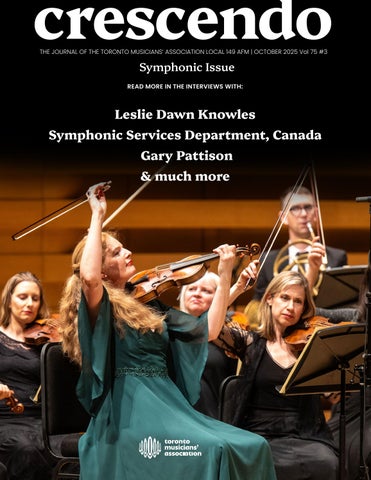
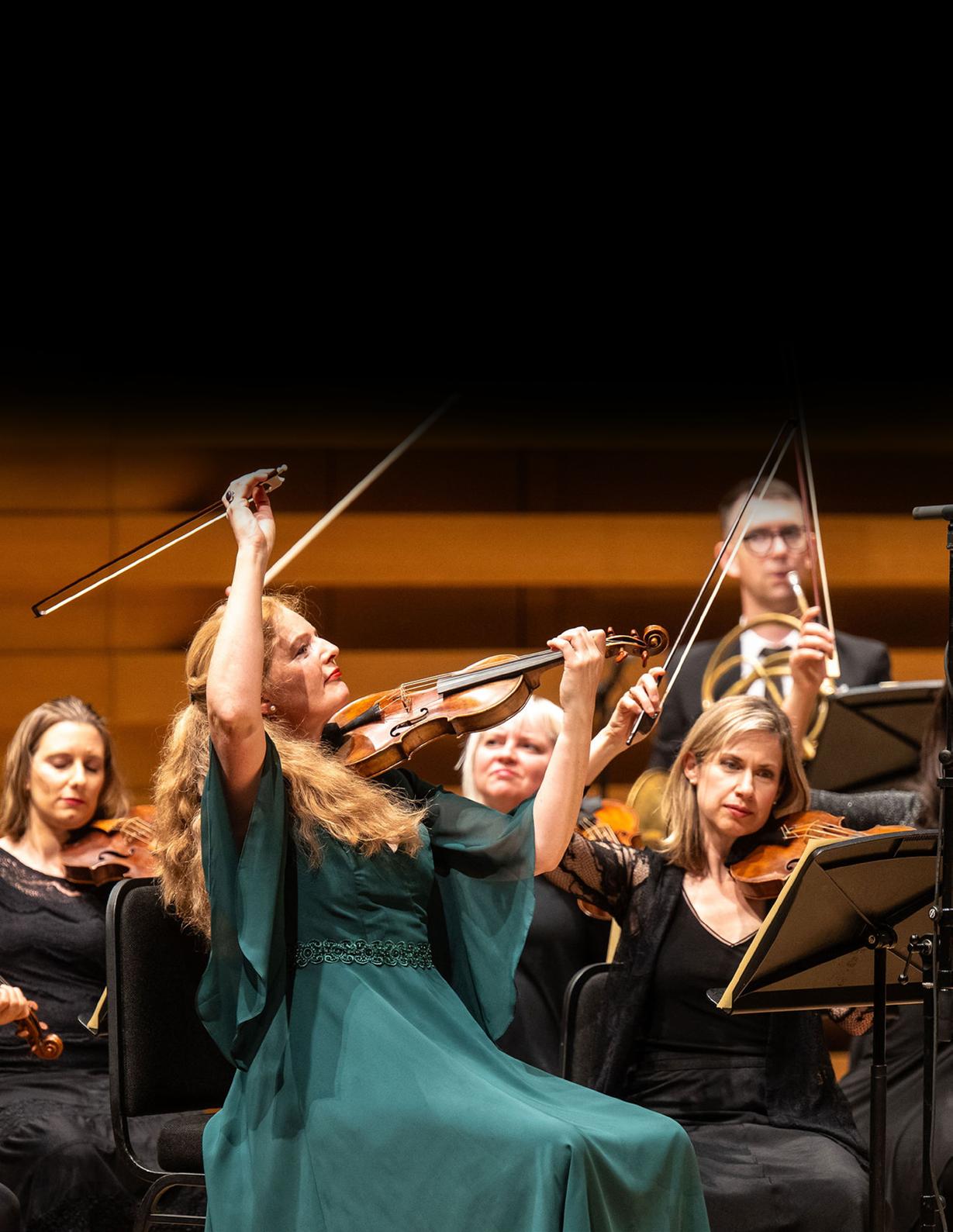
Member Spotlight Leslie Dawn Knowles
In Her Own Words: An intimate portrait of a diverse musical life of violinist Leslie Dawn Knowles, who recently retired from a 50 year career with the Toronto Symphony Orchestra.
Career Journey and Experiences
I was born in Los Angeles, Hollywood to be exact, and grew up in the beautiful San Fernando Valley. Dad was raised in Idaho and studied classical piano growing up. Mom was from North Carolina and was an artistic free spirit, ahead of her time in many ways, who loved and nurtured all living things. A prime example of her free spirit was while pregnant with me, Mom visited a fortune teller who told her that the baby would be a great violinist. As luck would have it, I did end up showing musical talent.
They moved to LA after Dad spent eight (8) years playing in the Navy concert band. Dad made a good living with steady engagements at various Hollywood lounges and popular piano bars. At home, he played classical music almost exclusively: Bach in the morning and then moving on to Chopin and Rachmaninov. There was always some kind of music playing if my dad wasn’t practicing, and I remember falling in love with Rimsky Korsakov’s Scheherazade and the wonderful stories the music depicted. I still remember so many of those works!
I was four when I was given a little violin and taken to my first lesson. I was so young that I barely remember much except that my teacher was a very kind man who taught out of a little storefront in Canoga Park. I continued to practice throughout those early years and was soon playing little recitals with Dad accompanying me on the piano. I was also enrolled in a rather robust music program and received a lot of valuable instruction and performance experience. Additionally, I was offered the opportunity to play with an excellent youth orchestra at the local University which was mentored by some of LA’s top studio musicians. The youth orchestra was geared for high school students, but I was found to be advanced enough to join - I loved it!
Leslie Dawn Knowles
Member Spotlight Leslie Dawn Knowles
A turning point
During this time, I began studying with a new teacher who accepted advanced students. They were well connected and were able to help connect their students with excellent performance opportunities. This change proved to be a major turning point in my life because I joined the American Youth Symphony led by Mehli Mehta. I was eleven and playing with high level musicians, from all across the US. These players were headed for professional careers in music.
I can still remember sitting in my first rehearsal which was Dvorak 8th Symphony. The sound of the cellos and horns drifted through the room transporting me to some magical place I had never been. In an instant I knew this is what I wanted to do and the rest, as they say, is history.
Navigating a career in a Male-dominated field
Thankfully, the industry has evolved since the time I received my first contract after winning the TSO audition. I was thrilled to become a member of the Toronto Symphony, that is until I read the clause in a side letter about pregnancy. It read, “In the event of pregnancy, I agree to take a leave of absence without pay when requested.” What a shock! I promptly phoned the Personnel Manager to ask about it, naively presuming that it had something to do with health insurance. I was informed, however this was because audiences did not want to see pregnant women on stage as they were found to be unattractive. This was in 1975 and even with the union, I found it difficult to navigate. All this to say, I was keen to play in Toronto and hoped that this would be resolved. Turned out I was not the only woman in the orchestra outraged by the inequality. We, the women, managed to get this clause removed, but I remember thinking how sad it was that my female colleagues were so broken down that they would accept this kind of treatment.
I have witnessed and have experienced overt harassment and disrespect for women in our industry. I cannot count the number of times I and my fellow female colleagues were verbally or physically bothered by some conductors, soloists and even colleagues.
As time has gone on things have changed for the better in general. I think we are doing a better job of raising our kids to be respectful and kind. The young men I see entering the orchestra reflect this. Far from the days of being told we are disgusting, there are now policies in place to deal with sexual misconduct and harassment in the workplace. But these struggles are far from over as we have seen with the recent ‘Me Too’ movement. Positions of power are still being used to manipulate women, so the fight is not over.
Speaking on the Musicians’ Union and strong work ethics
My Dad has always been a huge influence and supporter for my musical career. It was Dad who marched me to Local 47 as a teenager to join the Union, instilled a philosophy and work ethic in me that continues to serve me well. I learned that some will not always take musicians seriously because we only “play”; however, we have an important role to play in enriching people’s lives.
Many times, I heard my dad speak of being able to make people happy through music and how important Music and Art were for the well-being of society. He always said, “Never ever just “ phone it in,” every piece you are playing is your very favourite, at least in the moment.
Expand your Horizons
The best advice I received was, “Every time you pick up your instrument you are teaching yourself to play.’ These words of wisdom from one of my teachers as I launched my career have been ones I have tried to follow religiously. Other pieces of wisdom I have picked up are to learn something from everyone, even if it’s what not to do, and never complain.
I love playing bluegrass and jazz which enrich my life as a symphonic musician. I’ve even been given a few fiddle and jazz solos at the TSO because I am not afraid to expand my horizons. I’ve dabbled in acting and find the Stanislavski approach completely fits with being a musician because I feel it all serves to make me a better artist!
Member Spotlight Leslie Dawn Knowles
I am Concertmaster for a few other ensembles and do go out of my way to support and encourage all of my colleagues to love music and work collaboratively. I believe we are all there to make each other sound better and I try to cultivate an atmosphere that makes that possible.
I am Concertmaster for a few other ensembles and do go out of my way to support and encourage all of my colleagues to love music and work collaboratively. I believe we are all there to make each other sound better and I try to cultivate an atmosphere that makes that possible.
Career Highlights
There are so many career highlights it is very hard to just pick a few; however in 2022 the TSO presented a commemorative performance in which all five of TSO’s past and present music directors returned to the podium in one historic concert.This was a definite highlight for me. It was fascinating not only having them all in one place, but seeing them watch each other work and make music with the orchestra was inspiring.
*The Toronto Symphony Orchestra (TSO) performed with four former Music Directors, along with the current Music Director Gustavo Gimeno, in “Celebrate 100:Maestros’ Special Homecoming“, a concert to kick off the TSO’s 100th anniversary in April 2022. The four former directors were Peter Oundjian, Jukka-Pekka Saraste, Günther Herbig, and Conductor Laureate Sir Andrew Davis.
The TSO has had the immense privilege of playing with many great guest conductors and solo artists like Leinsdorf, Sanderling, Tennstedt, Chailly, Rattle, TilsonThomas, Runnicles, and Rilling. Some of my favorite violin soloists have been Isaac Stern, Isaac Perlman, Pinchas Zuckerman - especially when he conducts, Kyung Wha Chung, and Augustyn Haendlich who is just sublime. Many pianists come to mind too. One highlight was performing ‘Nights in the Gardens of Spain’ with the late Alicia de Larrocha. Soloists like Brendel, Bronffman, Gina Bachauer, and Toradze come to mind as well as the great Leon Fleischer who was one of my chamber music coaches at Peabody Conservatory
Beyond the Music
Music and raising my five children have certainly been the main parts of my life! My kids are now grown and turned into wonderful people that I am more than proud of.
I am continuing to play, especially continuing my role as Concertmaster with the Brantford Symphony Orchestra, and working on the Mozart Project this season. I am continuing to write [music], arrange and perform with several bands where I also play mandolin and sing. I have always been interested in visual art, particularly in photography and watercolours. I received a watercolour set for my birthday, and something has clicked for me with watercolours and now I am addicted and am excited to be able to paint at my leisure.
My husband Mark Tetrault is retiring as principal Tuba with the TSO this season which opens more possibilities for us to do more of what we love, together. We have two adorable Boston Terriers who are very happy I can be home more too.
I would also like to do more acting. Getting into acting and taking class with great coaches has shaped my whole attitude towards music and life. Realizing that we could all do things we wouldn’t dream of, given the right circumstance and background, has made me more understanding. Also being right in the moment, allowing the character (which is the music) to take over and learning to get out of my own way is thrilling. You know, I may just write a book about all of this - you [TMA] have given me a good start!
We hope you do, Leslie Dawn! All the best with retirement!
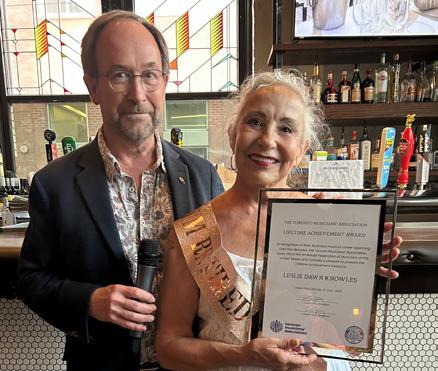
President Les Allt presents TMA Lifetime Achievement Award to Leslie Dawn Knowles
in the Community
Labour Day Parade 2025
Top (left to right): Richard Sandals, Angela Rudden, John Christopher Verrette, Rea Beaumont, Lawrence Barley
Middle (left to right): Megan Hodge, Jennifer Stephen, Anita McAlister, Timothy Francom, Christine Passmore, Malcolm Sandals, Maggie Hopkins
The relationship between locals and orchestra committees has been a subject of debate, discussion, and disagreement for a long time. That’s why the symphonic Player Conferences — ICSOM (formed in 1962), OCSM (1975), and ROPA (1984) — exist in the first place. That’s a big part of why the Symphonic Services Division (SSD) exists. And that’s why there’s an AFM Bylaw on the subject, and an entire page in the International Executive Board Policy Manual clarifying that bylaw. The meat of the IEB policy is this: “Local officers and the orchestra committee shall work in conjunction with each other in the negotiation and administration of the collective bargaining agreement.” As the word “shall” makes clear, this is not a suggestion.
We have come a long way from the days when symphonic musicians sometimes didn’t even get to vote on ratification of their own collective agreements, but there is still work to be done, by all of us. I didn’t write “all of us” because it sounds friendlier than “all of you” — I wrote it because I really do mean first person plural, including me. Most of the things I’m going to suggest that you shouldn’t do are absolutely things I have personally done in my capacity as chair of the orchestra committee at the National Ballet. So what I’m going to try to explain is how my own thinking has changed, and why.
To at last get to the point, here it is: Any time an orchestra committee is dealing with issues related to the collective agreement, the local should be in the loop. Period.
Again: Have I always done this as an orchestra committee member? No. Was I wrong? Yes.
The good news is, in a very high percentage of instances, it’s not a big deal. The decision the committee made alone is exactly the decision the committee would have made after consulting with the local. So… no harm, no foul, right? Well… not really.
One of the complaints I frequently hear talking to musicians across the country is that their locals don’t really understand how their collective agreements really work on a day-today basis. So they deal with these issues on their own and don’t engage with their locals. I hope the problem here is obvious: if the local isn’t engaged on day-to-day issues, they’ll never have an opportunity to understand those issues, and now everyone is stuck in a cycle of ignorance and exclusion. There is exactly one way to break that cycle, and that is: Any time an orchestra committee is dealing with issues related to the collective agreement, the local should be in the loop. Period.
I am not suggesting that if management wants you to wear red socks for one night you need to send a registered letter and meet with the Executive Board. “Hey Sally, here’s an email we just got from management, here’s how the committee is thinking of proceeding, let me know if you have any concerns.” Most of the time, the response will be something like, “Sounds good, keep me posted.” Easy, right? It adds a step, it adds some time, but it will pay dividends down the road.
On pretty much a weekly basis, I have a conversation with somebody — in my own orchestra, from an orchestra committee I’m working with elsewhere, from a Local officer — that goes like this:
“So-and-so asked me about such-and-such.”
“Oh yeah, they asked me about that, too.”
Now, I’m sure you all read my extraordinarily compelling International Musician article on this subject, so you know that this is very much a thing that managers (and members) do. Sometimes it’s because they’re shopping for a particular answer, sometimes it’s because they want an answer fast so they ask everybody who might possibly respond, and sometimes it’s just because the left hand doesn’t know what the right hand is doing. But whatever the reason, there is only one way to ensure that everybody is on the same page, and I’ve already put it in boldface twice and
Richard Sandals, Symphonic Services Department Canada
Symphonic Services Department, Canada
you’re already tired of that gimmick.
This touches on the issue that’s sometimes the real reason that orchestra committees are hesitant to contact the local: What if they don’t do what we want? It’s true; sometimes the local (or the AFM) may have a different perspective on an issue. In my experience, this is most often true when the union needs to consider the impact on people outside of the bargaining unit. Sometimes the members of an orchestra might be okay with making a recording on the cheap or taking on a sold service at below market rates, and I hope it’s obvious why those are problematic. But whatever the situation, if the union has a beef with something, it’s very likely that a member will have a beef with it and bring it to the union themselves. So you might as well get ahead of the issue, because it’s going to come up either way.
In my role at SSD, I’ve sometimes had to say to members, “No, we can’t do that, and no, this isn’t subject to debate.” I absolutely hate doing that, and so does every officer and staff member I know. We all took these jobs to advocate for musicians, not to make them mad. But biting our tongues instead of saying “that’s not allowed” or “that’s a terrible idea” is not advocating for musicians, it’s sabotaging them. Bringing the local into the loop doesn’t mean losing agency, it means gaining allies, resources, and perspectives. The most valuable conversations I have ever had in my life were with people who knew enough — and cared enough — to tell me I was wrong.
There is, of course, a flipside to all of this. If orchestra committees are going to loop in the local, then the local has to reciprocate and loop in the committee when management tries to bypass it. The local has to respond in a timely fashion. The local has to understand the letter and the spirit of the collective agreement. The local has to listen to the committee and take its concerns seriously. But none of that can happen without communication. The only path to a stronger, more effective union is working together to build mutual trust and understanding, and that path starts with talking and listening to one another.
Canadian Conference of Musicians
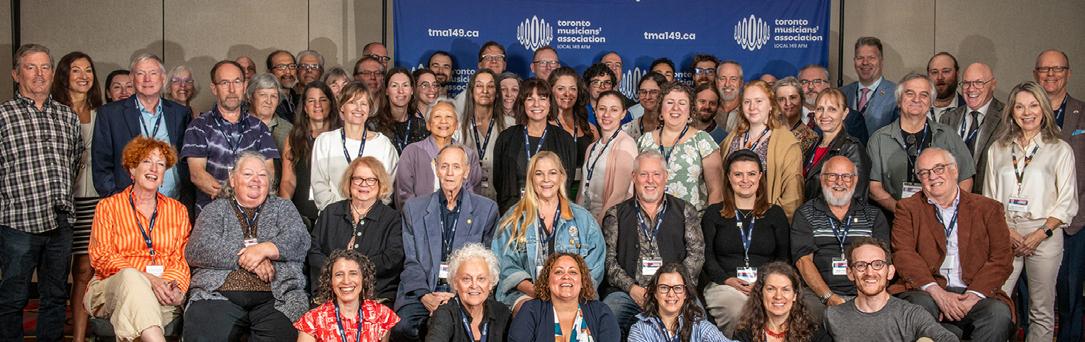
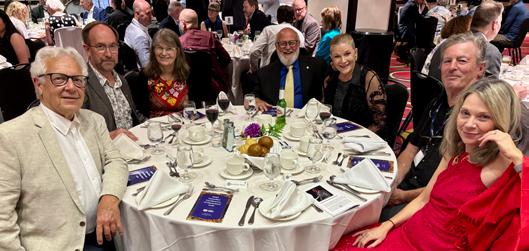
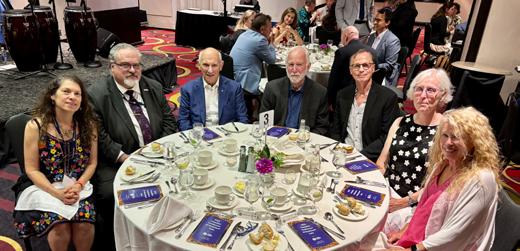
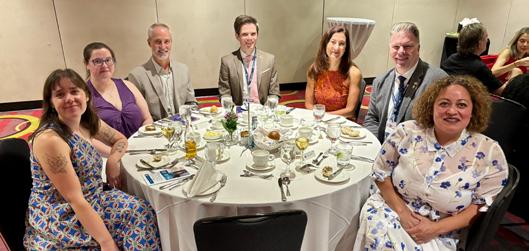
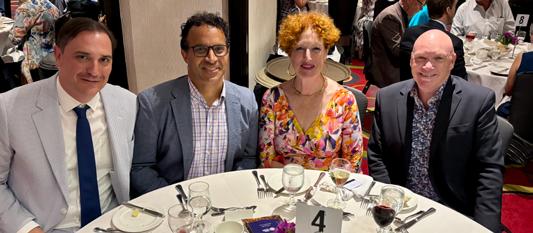
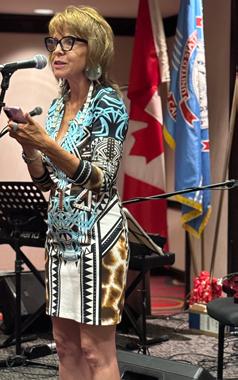
TMA was proud to be the host local for the annual conferences of the Canadian Conference of Musicians and the Organization of Canadian Symphony Musicians (OCSM) held over August 9-12 at the Hyatt Regency on King. Saturday, August 10 was a joint conference day topped off with a Gala Dinner, at which TMA, Canadian Conference, and OCSM honoured David Mirvish, Arden Ryshpan, and Katherine Carleton for their outstanding contributions to our community.
Dusty Kelly, ED TMA, Arden R. Ryshpan, Canadian Actors Equity Association, Paul Leclerc, Canadian Conference President
Bob Fraser, President OCSM, Katherine Carleton, Orchestras Canada, Robin Moir, Canadian Conference Secretary
Les Allt, President TMA, David Mirvish, Producer Mirvish Productions, Dusty Kelly ED TMA
Canadian Conference of Musicians and Organization of Canadian Symphonic Musicians group photo
Canadian Conference of Musicians Gala
Chief Claire Sault of the Mississauga’s of the Credit
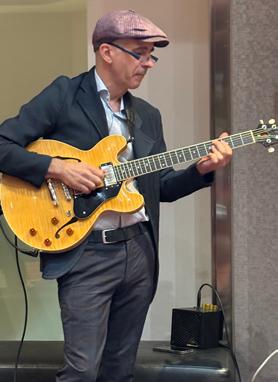
David Occhipinti
Hilario Duran and band
Rochelle Skolnick - AFM Special Counsel and SSD, Tino Gagliardi - AFM President, David Mirvish - Producer, Mark Lavaway - Labour Relations Mirvish, Katherine Carleton - ED Orchestras Canada
Bill Skolnick, Les Allt, Dominique Laplante, John Trembath, Debi Sander Walker, Pat Simmonds, Rea Beaumont
Erika Verhagen, Rebecca Sinnaeve, Bernard Leblanc, John Painting, Antoinette Follett, Wages Argott, Lianna White
Justin Anthenis President IATSE 58, Michael Murray CEO Ontario Arts, Dusty Kelly ED TMA, Allistair Elliott, AFM Vice President Canada
Member Spotlight: Gary Pattison
Interview Questions for Gary Pattison, COC and NBOC french horn
The TMA shines a light on the vibrant and varied musical journey of French hornist, Gary Pattison. There is likely no other horn player in Toronto with the longevity or variation of work with his 50 years of music-making.
Early Training and Background
TMA: What a pleasure it is to shed a spotlight on you, Gary. You are a musician who has spent most of your career under the stage, in orchestra pits and out of the stage light. Can you tell us about your initial training on the French horn?
GP: I started on the horn in grade 9. Way back then when entering high school, my two choices were Latin or music. To get into the single music (band) class, I had to go for an interview. I must have passed, as I was assigned a french horn, an instrument I’d never even heard of. Barbara Bloomer, 4th horn with the TSO lived right next to my high school. As I entered grade 13, she became my first teacher outside of band class.
I studied at the University of Toronto (U of T) taking lessons for a year with John Cahill before transferring to Fred Rizner’s studio for the remaining three years. Both John and Fred were members of the Toronto Symphony Orchestra horn section. After U of T, Miss Bloomer suggested I might continue studies in Sweden with Wilhelm Lanky-Otto. I attended a two-week master class with renowned horn soloist and teacher, Frøydis Ree Wekre. This was quite an extraordinary experience for me which led to pursuing more study with her in Norway later.
TMA: How did your early experiences shape you as a musician and the direction of your career?
GP: I had no background in classical or any style of music until being given the horn in high school at age thirteen. I really enjoyed the experience of making music in an ensemble and looked for opportunities to play outside of the concert band at school. Community orchestras, bands, musicals and chamber music filled up my schedule outside of school hours. This may be what led me to considering myself a free-lancer rather than strictly an orchestral musician.
Garry Pattison
Member Spotlight: Gary Pattison
Influences and Inspirations
TMA: Who have been the biggest influences on your playing style and musical approach?
GP: Frøydis Ree Wekre was a great influence both through her playing and teaching. Of my early free-lance gigs was sight-reading 2nd horn to Miles Hearn, a first-call Toronto free-lancer, while subbing into ‘Disney on Ice’ in Toronto. Imagine…Back in the days, when ‘Disney on Ice’ used real musicians crammed into the audience seats at one end of the arena. Anyway, I was impressed with what Miles was doing as a horn player which was making a living as a performer on a variety of different gigs. I was really interested in pursuing the same kind of career. It was always more about performing and not so much about teaching. I realized then that was what I wanted to do, free-lance.
TMA: Are there particular composers, horn players, or performances that have inspired you throughout your career?
GP: I’ve always thought very highly of the composer, Sergei Prokofiev. Over the many years I have had the pleasure of (consistently!) performing his ballets ‘Romeo & Juliet’, and ‘Cinderella’. Prokofiev’s writing for every instrument is perfection. He knew what each instrument and section could do and wrote to show them all to best effect. He was an expert in orchestration. It was often difficult to play, but so appropriate to the storytelling. Playing beside my teacher Fred Rizner, principal horn with the TSO, was always an excellent learning experience. Listening to Frøydis was amazing for her dedication to the music within the notes. While playing with Principal hornist, Joan Watson at the Canadian Opera Company, there were moments of sheer brilliance. One such memory for me was her horn solo in Handel’s ‘Julius Caesar in Egypt’. Her playing was inspirational at every performance! Finally, I most enjoyed playing with Miles Hearn in a wide variety of musical situations.
Career Arc in Toronto
TMA: That is quite a pedigree of Canadian orchestral horn playing that you have listed, Gary. Looking back over your long and varied freelance career, what aspects of your work and musicianship have remained constant?
GP: The most constant aspect of my career has been its constant change. Beyond the consistency of my work in the ballet orchestra, everything else was a series of new experiences. A week of work might involve ballet performances on most evenings, with recordings during
the day, or rehearsals for concerts or shows filling in any free time. Almost every day would have three or at least two services, sometimes 7 days-a-week. Another constant was the comradery between the horn players, as well as the other musicians. The free-lancers were always the most fun to work with.
TMA: Conversely, what significant changes have you noticed in the music industry, your role as a horn player, or your personal approach over the years?
GP: The changes in the industry are obvious from a free-lance point of view. In the 70s, 80s and 90s, there was a huge range of playing opportunities – one could barely keep up with all the theatre shows, recording sessions like jingle work and classical concerts. As funding cutbacks began in the mid nineties, and various musician replacement technologies were developed, those opportunities started to vanish. When we would record the old ‘Hockey Night in Canada’ theme, something often done for each season, what started out as a 20-piece big band shrunk to a session with only two horn players recording ‘live’ over a synthesized track. I was lucky to have the ballet season as a reliable and constant income source, which included a lot of touring. I was then fortunate to add the Canadian Opera Company position just as free-lance opportunities started to disappear.
*Gary joined the horn section as a full-time member in 1999.
TMA: How have you adapted to those changes while maintaining your artistic identity?
GP: With ballet and opera weeks providing an almost fulltime schedule, it became less important to find other work to fill in my schedule. It also meant that I still did not have to rely on a teaching income, lucrative as that might have been. Also, my interests started to develop beyond the world of music performance. I did not grow up with music and found it quite easy to focus on other activities such as working the land on a 200-acre farm in the Bancroft area in Eastern Ontario. I had purchased in the late eighties. It was a sort of ‘homecoming’ for me because it was the land where my Scottish ancestors had settled and where our family lived when I was young.
Member Spotlight: Gary Pattison
Life as a Freelance French Horn Player in Toronto
TMA: Toronto has a rich musical scene. How has working as a freelance horn player here shaped your career?
GP: I have loved all the different playing situations that have been available to me. It means that I also was able to work with local amazing free-lancers and the famous headliners that we often accompanied. There have been many playing challenges that required a great deal of flexibility in styles and techniques. It was important to have strong sight-reading abilities as often there would be no chance to see the music ahead of time for recordings, or even touring musicals that would first rehearse the same day as opening night.
TMA: You are likely one of the last few musicians of that generation that had the privilege of working in the ‘hay-day’ of Canada’s vibrant music scene. And not only that, but being able to build a career both in the Symphonic and Freelance sectors. Can you provide a picture for us as to what this was like, and how you’ve managed such a diverse career?
GP: There were lots of orchestral opportunities beyond ballet and opera, including over the twenty five (25) years I played as principal horn of the Esprit Orchestra, which features challenging contemporary scores.
There were also many performances when I would join the horn section of the Toronto Symphony. I was also involved with a fair amount of chamber music such as with the Toronto Chamber Winds. One of my favourite places to play was in the pits of major Canadian premier productions of musicals. Cats, Les Misérables, Lion King, The Who’s Tommy, Kiss of the Spider Woman, etc. A lot of high-profile fun. Playing a complete run of a major show in Toronto at the time could mean an investment of years of your career. I was lucky to be able to open the run of a show, stay for a few months, and then find a new opportunity with a different show. Often that meant subbing into other long-running productions. There always seemed to be a new playing opportunity when I needed one.
The Classical recordings I was involved with included, Canadian Opera Company Juno Winner ‘Mozart arie & duetti’; Toronto Symphony ‘Prokofiev Romeo & Juliet Suite’; Toronto Chamber Winds ‘Mozart Serenade for 12 Winds & Double Bass’; and many with the Esprit and National Ballet orchestras. Jazz recordings included two Grammy Winners with the Boss Brass
Of the many other album opportunities that came along, some of the most fun involved a couple of recordings with the iconic Canadian band Blue Rodeo. The needed a single horn player for one song on each of two releases, one being a Juno winner. For those sessions, my experience taught me not to expect sheet music at the studio. As was the case… but I was prepared!”
I played film scoring sessions which included ‘A Christmas Story’, ‘Being Julia’ (Annette Bening); ‘Without A Clue’ (Composed and conducted by Henry Mancini); ‘January Man’ (Composed and Conducted by Marvin Hamlisch); ‘Chloe’ (Liam Neeson, Julianne Moore, Amanda Seyfried, directed by Atom Egoyan); Plus, several IMAX movies, including one narrated by Jennifer Lawrence, and another by Leonardo DiCaprio. There were many, many TV themes and Movies and Series, with one that can still be heard being the nightly CTV News Theme.
Playing in the back-up orchestras for entertainers was a favourite gig of mine. Names from the past that used live Toronto musicians included Bob Hope, The Carpenters, Andy Williams (my first major gig!), Anne Murray, Bernadette Peters, Tony Bennett, Linda Ronstadt, Peggy Lee, Neil Sedaka, Ray Charles, Diana Ross & The Supremes, and many more. Often there would be just the one horn in the orchestration, or if there were two, Miles Hearn would be the other player.
Member Spotlight: Gary Pattison
There were probably hundreds of radio and TV ads over the years, and countless other projects, concerts, and performances of every description.
Performing in the Pits: COC and Ballet Orchestras
TMA: What’s it like to be a horn player in the pit for the National Ballet Orchestra and the Canadian Opera Company?
GP: This will be my 50th season performing with the National Ballet of Canada Orchestra, and I can’t say enough about what a joy that has been. The company has been like a family, and they have taken care of the musicians and maintained the orchestra even when there are many ballet companies that now go with recorded music. We’ve had a tenured contract and health plan for decades now. We’ve travelled to Europe many times, as well as the USA from LA to Florida to NYC. Until 2007 we toured Canada coast to coast, alternating Eastern and Western Canada each year. Though there are the standard Tchaikovsky ballets, as well as lesser-known composers, we’ve also played very challenging repertoire. I’ve been a member of the COC orchestra on and off for about 40 years and fulltime for 20 years until I left the company a few years back. They would also travel, especially to New York, and a memorable and highly acclaimed visit to the Edinburgh Festival There are some issues with pit life, one major one being the sound levels when playing in a space that puts instruments quite close together. Young musicians should pay attention to ear protection.
TMA: How does the experience differ when you play as a section player versus when you are principal horn?
GP: I played principal at the ballet for more than 35 years and now down in the section for more than ten years. Obviously, the pressure of playing the first part, especially famous horn passages, seven or eight shows a week, was constant. Adding to that was the fatigue factor, as for most of my time as principal we used only the standard four horn section, no assistant. Then there were the double show days which were very frequent. I had to learn how to pace myself and figure out when the orchestration would allow me to take a break. This was also before the era when beta blockers seem to have become the norm. The pressure was just a part of the job. Playing 4th now means I can take a break between seasons and still be able to get back in shape for most of the repertoire. I thank Barbara Bloomer for emphasizing the low register as well as the high in her teaching.
TMA: Are there any memorable performances or challenges that stand out from your time in these orchestras?
GP: Prokofiev’s ‘Romeo & Juliet’ always provided challenges, but ones that were always musically rewarding. We did a lot of Mahler song cycles as ballets, and the Stravinsky repertoire was always demanding. ‘The Fairy’s Kiss’ (complete ballet) by Stravinsky was possibly the most technically challenging ballet score. Beethoven’s ‘6th’ as a ballet, Ravel’s ‘Piano Concerto in G’ and the complete ‘Daphnis & Chloé’, as well as Mendelson’s ‘Nocturne’ all were memorable and demanding repertoire. Playing principal with the COC’s ‘Billy Bud’ by Benjamin Britten had a few challenging moments.
Beyond Music: The Old Hastings Mercantile & Gallery
TMA: We understand you have a side interest running a gifts store and gallery in rural Ontario with your wife. How did you get involved in this?
GP: I met my wife in 1992 when she was singing with a vocal trio at a church anniversary service up near Bancroft, about three hours from Toronto. Lillian owned a gift store that featured the work of Canadian artists and artisans, including her own paintings - that was about another 90 minutes north of Bancroft. We found this 1880s general store for sale near my farm and decided it would make a nice location for her business. It opened in 2003 and is now in its 23rd year. It has been very successful despite being in a wee ‘ghost town’ of 20 people. We are open 7 days-a-week from May to December and weekends through the winter. There are 11 rooms on the go with a very wide variety of goods for sale.
TMA: How do you balance this business with your musical career?
GP: Lillian and I live in a beautiful old house in nearby Coe Hill, while I also keep a small apartment in Toronto. We sold our farm when the business began to take up too much time. We also bought and restored a small century church in our ghost town, Ormsby. We’ve restored it with tin walls and ceiling, oil lamps, and a vintage wood stove. Until Covid we would hold special services which would often feature my musician friends from Toronto. People were amazed and very appreciative at the level of music found up there in the middle of nowhere. Lillian would carry on with the daily operation of the business when I disappeared to the city for 6 days at a time.
Eventually we found a young lady to work fulltime with us as the business grew and became too busy. The music
Member Spotlight: Gary Pattison
business began to become secondary to the enormous amount of work taking care of business matters and was one reason I decided to step down as principal horn with the Ballet around 2015.
TMA: Do the worlds of music and antiques ever overlap or inspire one another for you?
GP: We certainly enjoy it when my two worlds collide, usually when we receive a visit from a musical colleague from Toronto or elsewhere. Other than that, the two worlds are quite separate.
Wisdom for the Next Generation
TMA: Having had such a rich and varied career, what is the best advice you can offer to young horn players or aspiring freelance musicians today?
GP: Unfortunately, the era when I started has become a distant memory. By the time I was in university I was already involved in professional work with so many opportunities available back then. By the time I graduated I was making a living free-lancing fulltime. As soon as I graduated, I was offered a job with the National Ballet Orchestra. I never auditioned for any playing position in my career. Back then you were given an opportunity, and if you performed as expected, and were cooperative and easy to work with, you continued to work with more and more opportunities. I was fortunate to love what I was doing and appreciated working with great musicians in many different fields. You have to be ready, enthusiastic and cooperative. At least that was the world I started in. The other thing I can stress is to do as much union work as possible. The [wage] minimums, the protections, and especially the pension is a brilliant bonus when ready to retire.
TMA: You bring up an excellent point about union work. Have fair working conditions, fair wages, and of course the incredible pension plan we have in Canada is a definite bonus. How has your membership to the union effected the outcome of your career as a musician?
GP: As I began to expand my interests beyond the Toronto music scene, I was reaching the age when I could take my musician’s pension early, age 55. This meant taking a reduced pension; however, it has provided the freedom to be less reliant on having to work year-round. Most of the work I did was pensionable because it was on union contract, and what I receive from the Musicians’ Pension
Fund of Canada has made all the difference in my life. Being a member of the Toronto Musicians’ Association has meant a great deal to me beyond the pension as well. From the beginning, I felt like I was a ‘professional musician’!
Looking Ahead
TMA: What projects or goals are you currently focusing on, musically or otherwise?
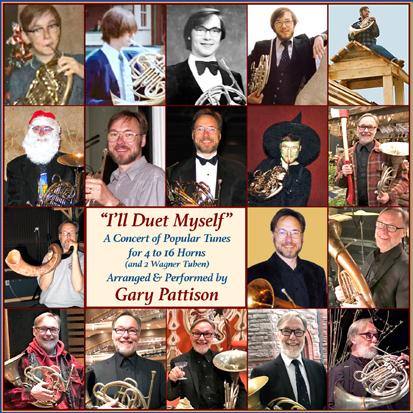
GP: At 70 years of age and counting, my horn career is nearing the end; I do have one project that has been on the go for many years now. I have multi-track recorded many of my own arrangements of music for from 4 to 18 horns. Mostly popular music from my youth. It was recorded years ago, and I just can’t seem to find the time to finish the album notes and paperwork. Coming soon!
TMA: There is no doubt that you hold, and cherish many stories and experiences, Gary. It has been an honour to shine a light on your incredibly vibrant career. Congratulations on fifty (50) years with the National Ballet Orchestra of Canada – such an achievement!
GP: Thank you! I was fortunate to have begun at a prosperous time in the music industry in Toronto. I have enjoyed a varied and very busy career and am grateful that I was able to make the transition to a less prominent and stressful position now, to extend that career. The present union-negotiated contract with the National Ballet has made that even more helpful. Many, many thanks to both organizations.
Conference 2025
The 2025 Conference of the Organization of Canadian Symphony Musicians (OCSM) met from August 9-12 in Toronto. Delegates representing 21 orchestras across Canada gathered for workshops, presentations, and discussions of issues and trends across our sector. More extensive notes are available for almost all of the sessions mentioned below.
The Conference was held in conjunction with the Canadian Conference of Musicians (Can Con), the organization representing Canadian Musicians’ Local Unions. Joint sessions were held on August 9 and 10. OCSM and Can Con Delegates heard from AFM officials (President Tino Gagliardi, SecretaryTreasurer Ken Shirk, Vice President from Canada Allistair Elliott, and Symphonic Services Division Director Rochelle Skolnick) and engaged in spirited discussions. Major topics included:
• P2 Visa processing delays. Locals expressed great concern over the expensive, time-consuming process. Officials outlined steps being taken to support musicians and facilitate faster processing times, and considered other options.
• Organizing efforts. The AFM is investing in organizing, with new staff hires and a newly-launched Player Conference (the Freelance Musicians Association). For several Locals, teaching artists in Sistema programs are an organizing focus. The AFM is hiring a part-time SSD negotiator based in Canada.
• Locals working together with Orchestra Committees. SSD Director Skolnick and Assistant Director Richard Sandals led a presentation and discussion on ways to better coordinate efforts, maximizing trust and transparency.
• Equity and allyship. The AFM now uses the #NotMe app to intake concerns anonymously and guide members towards solutions. The AFM’s Change the Culture Committee has been a strong voice advocating for this and other policy changes to address ongoing concerns. A presentation focused on ways Local officers can strengthen allyship across a diverse membership.
• Musicians Pension Fund of Canada. The Fund recently transitioned to “Target Benefits” designation, though this essentially maintains the status quo. Delegates discussed this and the rules for vesting, ways to help members maintain their contributions and process contracts.
OCSM Delegates shared reports from their own orchestras, and heard from representatives of ICSOM, ROPA, the Theater Musicians Association, and the Recording Musicians Association, our fellow Player Conferences.
Orchestras Canada Executive Director Katherine Carleton presented on advocacy for orchestras at the Federal level, Canada Council changes, and funding models for our sector. The Live Performance Tax Credit concept is an advocacy goal for both the AFM and Orchestras Canada. Their main policy proposal, though, is for Canada to spend 1% of its forthcoming budget on arts and culture. Katherine also addressed (among other topics): immigration changes; research on programming diversity; eco sustainability practices; the evolution of Comparative Reports, data collection and sharing;
Matt Heller, OCSM Secretery
developing a toolkit for municipal advocacy; research into audience dynamics, including the impact of “initiators” who organize their social networks; training and professional support for arts managers.
Arts institutions depend on a Social License to Operate, a concept we explored in a presentation and workshop with Dr. Lee Bynum of the American Composers Forum. Delegates considered how a workplace’s culture can provide psychological safety, and how we can repair and correct from past institutional failures, to create a greater sense of belonging, improve performance, and retain employees.
Human rights and accommodation are very live issues in the law, with relevance to how our employer / employee relationships function. OCSM Legal Counsel Michael Wright and Danielle Stampley explored these issues and recent decisions by Human Rights Tribunals, suggesting that we can head off contentious battles and provide humane and dignified pathways for career transitions through thoughtful contract provisions.
Dr. Caroline Traube of the University of Montreal presented current research on acoustics on hearing health, and what every musician needs to know to maintain their hearing. Hearing loss and damage are prevalent, both among musicians and non-musicians; using hearing protection effectively and proactively is a necessity in our profession.
For several years, Rich Coburn has been studying composer diversity in programming – there are signs of progress, but not surprisingly, equity-seeking composers usually still represent a small fraction of the music we play. Increasingly, orchestras are voicing commitments to diversify our repertoire and better represent our communities. Rich shared research and tools for those looking to measure and advocate for change.
Gwen Klassen and Jemma Jones shared their work on a Safe Music Initiative, modeled on the Canadian Safe Sport Program. The initiative is in a listening and information-gathering phase; Delegates discussed current and potential systems to remedy abuses and harassment in orchestras and music education institutions.
Other areas of extensive Delegate discussion and exchange included:
• Conductor Evaluations, including encouraging participation in OCSM’s program and Data Bank of Conductor Evaluation Results;
• Orchestra staffing challenges; best practices for training and onboarding staff;
• Recruiting Orchestra Committee members, allowing for fresh voices and approaches, and developing shared resources to set them up for success.
The 2025-26 OCSM Executive includes newly elected 2nd Vice President Alex Conway, re-elected President Robert Fraser, and (continuing their terms) 1st VP Ethan Balakrishnan, Treasurer Stephen Kreuger, and Secretary Matt Heller (who compiled this Overview).
*reprinted with permission from Matt Heller
25 Year Pins
Pins & New Life Members
Genevieve Gilardeau
E. Jeanne Wyse
Brian Rose
Jullyann Gordon
Mark Yannetta
Ira Zingraff
N. Lorraine Spragg
Desmond Leahy
Wendy Patel
Michele Jacot
Eric Paetkau
Mark Mazur
Joseph Orlowski
Marco Cera
Gregory Millar
Peter A Seminovs
Seymour Axler
50 Year Pins
Donald Englert
Ernest L. Mee
Bill Beecroft
Aaron Davis
Louis Pomanti
Philip R Poppa
Sarah Davidson
Will M. Jarvis
Henry Heillig
Carlos Lopes
Charlie Gray
Robert J Mcalpine
Pierre Peter Mueller
Life Members
Tom G Wade West
Jeff D Mandell
Amy Sky Jordan
Christina Kennedy
Peter Voisey
David Paul Wildsmith
Allistar Gaskin
Peter Tiefenbach
Joseph (Jody) Matthew Colero
Greg Diakun
Elizabeth Anderson
Valerie Sylvester
Paul I Bennett
Jill A Solomon
Brian C Connelly
Archy Hachey
Robert James Murphy
Sharon S. Smith
Joseph Frederick Bowden
Don Ross
Alan Connelly
Max Christie
Neil Spaulding
James Gardiner
Richard Frederick Whiteman
Alan Frew
Mark E Korven
Steve Eyers
William (Bill) Roy Parsons
In Memoriam
V Candy Chhangur
Admitted: May 12th, 1972
Died: August 25th, 2025
Roy A Penney
Admitted: January 28th, 1962
Died: June 9th, 2025
Norman Marshall Villeneuve
Admitted: March 17th, 1975
Died: July 9th, 2025
H Allan Macmillan
Admitted: October 5th, 1964
Died: June 4th, 2025
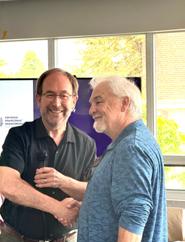
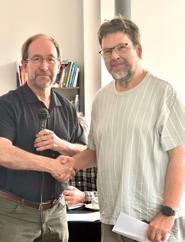
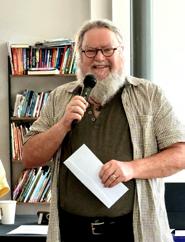
Brent Barkman being presented Life Membership by President Les Allt