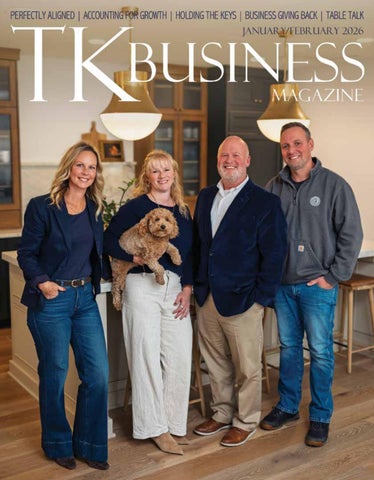
2 JANUARY/FEBRUARY 2026 TK Business Magazine
JANUARY/FEBRUARY 2026
TK Business Magazine
3
8
From working in his dad’s lab as a teenager to running his own practice, Dr. Kevin Cassidy shares how he’s preparing for his “next” while keeping patients smiling.
Accounting for Growth
14
When Topeka’s Mize CPAs joined national firm Aprio, the goal was growth. The acquisition brings advanced technology and plans for more local jobs.
Table Talk: Q&As With Local Caterers
32
Meet two local caterers who grew their businesses through word-of-mouth referrals, long hours and a commitment to making food the least stressful part of any event.
Credit Card Surcharges: Who Pays? Who Wins?
42
Learn how skipping credit card fees can help your business stand out and keep customers coming back.
TK BUSINESS MAGAZINE | JANUARY/FEBRUARY 2026
CONTENTS
Perfectly Aligned
Holding the Keys
46
A-1 Lock & Key is Topeka’s only brick-and-mortar locksmith, proving that time-tested trades still matter in today’s world.
The Heart Under the Hood
50
The Johnson family built Performance Auto Care knowing that computerized or not, cars still need mechanics people can trust.
More Than a Haircut
54
Barbering is one of humanity’s oldest trades. Rashaan Carter’s Topeka barbershop and academy teaches students how to cut hair and run businesses.
Topeka Businesses That Give Back Photo by JOHN BURNS
Pictured: Rachel Everhart, Sara Vincent, Matt Vincent and Noah Vincent. The Golden Rule for Remodeling
20
Golden Rule Design & Build started with home remodels. Now the company offers GoldenHome, a membership service for routine maintenance like filter changes, gutter cleaning and caulking.
Financial Survival Guide for Startups Setting up bookkeeping software and working with a CPA can prevent the financial mistakes that derail new businesses.
4 JANUARY/FEBRUARY 2026 TK Business Magazine
58
Security Benefit, Advisors Excel and Capitol Federal share how they’ve built charity into their company cultures, from employee volunteer days to multimillion-dollar foundations.
How to Build a Corporate Charity Program
74
Why setting up a charitable fund through a community foundation makes giving simpler, cuts your tax bill and reflects what your company cares about.
Inside the Junior Achievement Topeka Business Hall of Fame 28
At the Junior Achievement Topeka Business Hall of Fame, which is celebrating its 24th year, students take center stage to share what they learned and thank their volunteer mentors.
78
JANUARY/FEBRUARY 2026
TK Business Magazine
5
CONTRIBUTORS PUBLISHER Braden Dimick & SALES DIRECTOR braden@tkmagazine.com 785-438-7773 CREATIVE DIRECTOR & DESIGNER EDITOR COVER PHOTOGRAPHER
Janet Faust Lauren Jurgensen John Burns
CONTRIBUTING WRITERS Hope Dimick Kim Gronniger Corinn Guemmer Lauren Jurgensen Jennifer LeClair Lisa Loewen PHOTOGRAPHERS John Burns Brian Peters CONTRIBUTING EXPERT Matt Deutsch Tom Hickman Marsha Pope WEBSITE MANAGER Cordell Dimick
2026 TK Business Magazine is published by E2 Communications, Inc., 7537 SW 26th St., Topeka, KS 66614. 785-438-7773. Reproduction or use of this publication in any manner without written permission of the publisher is prohibited. Every effort was made to ensure accuracy of the information in this publication as of press time. The publisher assumes no responsibility of any part for the content of any advertisement in this publication, including any errors and omissions therein. E2 Communications, Inc. makes no endorsement, representation or warranty regarding any goods or services advertised or listed in this publication. Listings and advertisements are provided by the subject company. E2 Communications, Inc. shall not be responsible or liable for any inaccuracy, omission or infringement of any third party’s right therein, or for personal injury or any other damage or injury whatsoever. By placing an order for an advertisement, the advertiser agrees to indemnify the publisher against any claims relating to the advertisement.
@tk_business_
@TK Business
6 JANUARY/FEBRUARY 2026 TK Business Magazine
@TKBusinessMag
@TK...Topeka's Business Magazine
We’ve Got Your Future Covered! Retirement Planning Brokerage Services Financial Planning
Life/Long-Term Care Insurance
CoreFirst Investment Services CoreFirstInvest.com
785-267-8518 3701 SW Wanamaker Rd. • Topeka, KS • 66610
CoreFirst Investment Services is a marketing name of Cetera Investment Services. *Securities and insurance products are offered through Cetera Investment Services LLC (doing insurance business in CA as CFG STC Insurance Agency LLC), member FIN RA/SI PC. **Advisory services are offered through Cetera Investment Advisers LLC. Cetera is not affiliated with the financial institution where investment services are offered. Individuals affiliated with Cetera firms are either Registered Representatives who offer only brokerage services and receive transaction-based compensation (commissions),Investment Adviser Representatives who offer only investment advisory services and receive fees based on assets, or both Registered Representatives and Investment Adviser Representatives, who can offer both types of services. Investments:• Are not FDIC/NCUSIF insured • May lose value • Are not Financial Institution guaranteed • Are not a deposit• Are not insured by any federal government agency.
JANUARY/FEBRUARY 2026
TK Business Magazine
7
Photo by JOHN BURNS
PERFECTLY ALIGNED
Dr. Kevin Cassidy, owner and founder of Cassidy Orthodontics.
Cassidy Orthodontics By LISA LOEWEN Photos by JOHN BURNS
This year, Dr. Kevin Cassidy will mark 30 years at Cassidy Orthodontics in Topeka. He’s the second generation of orthodontists in his family, with his father having practiced in Topeka for more than 25 years before him. Kevin knew from the time he was 13 that he wanted to be in a profession that helped people feel more confident about themselves and gave them a reason to smile.
}
8 JANUARY/FEBRUARY 2026 TK Business Magazine
BUILDING CUSTOM HOMES FROM CONCEPT TO COMPLETION
TDesignCompany.com
TDesignCompany JANUARY/FEBRUARY 2026
thiessen_designco TK Business Magazine
9
Photo by JOHN BURNS
Cassidy Orthodontics at 600 S.W. Governors View in Topeka. Dr. Kevin Cassidy moved to the new location in 2010, calling it "the best decision I ever made."
“I started working for my dad in the lab as a teenager,” Kevin said. “It was amazing to get to watch people transform over the course of a couple of years and go from crooked teeth to a beautiful smile.” Even though he spread his wings a bit while in school, he always planned on returning to Topeka to go into practice with his father. “It made sense to me,” Kevin said. “My dad and I always had a good working relationship, and my wife’s family was from Topeka. It was home.” BUILDING ON STRONG ROOTS Kevin was born in Philadelphia in 1967. He moved to San Diego a year later when his father, Michael Cassidy, was stationed on an aircraft carrier during the Vietnam War as a staff dentist from 1968 to 1970.
The Cassidy family moved back to Kansas City in 1970 so Michael could complete his orthodontic residency at the University of Missouri-Kansas City. From there, they moved to Topeka where Michael opened his practice. Kevin was only 5 years old at the time — so in his world, Topeka has always been home. After Kevin graduated from Topeka High, he attended the University of Kansas and received an economics degree. He obtained his Doctor of Dental Surgery from the University of Iowa and completed his Master of Science in Orthodontics at the University of Tennessee. Upon completing his orthodontic residency in 1996, he moved back to Topeka and joined his father’s practice as an associate. “We didn’t really have a defined plan in place for what
10 JANUARY/FEBRUARY 2026 TK Business Magazine
our work relationship would look like,” Kevin said. “I just put my head down and did the work. After the first couple months with Dad looking over my shoulder, he gave me the autonomy to handle cases on my own.” Because their treatment philosophies were similar, the father-son orthodontic team shared patients and rarely disagreed on treatment decisions. Kevin worked with his father for four years before buying the practice in 2000. For some father-son partnerships, this role reversal could create a power struggle, but for Kevin and his father, it was a smooth transition. “Dad spent another seven years working in the practice as the employee doctor. Our relationship never really changed because he’d already been slowly handing over the decision-making to me,” he said.
MODERNIZING THE PRACTICE As Kevin shifted from doctor employee to practice owner, he incorporated new treatment methods and digital technology to modernize the practice. Invisalign, introduced in 1999, had made clear aligners popular, but patients initially still needed traditional dental molds that were sent to the company to create treatment plans. Orthodontics adopted digital scanners that could capture tooth images directly, removing the need for uncomfortable molds. The practice also began using 3D digital imaging and intraoral cameras to replace traditional X-rays. “Digital technology has really revolutionized dentistry as a whole,” Kevin said. “It is more efficient, and you can get so much more information from it than you could before.” CREATING A NEW SPACE Cassidy Orthodontics operated out of the same building for 28 years. It got to the point where they either had to gut the old building or build a new one. Choosing to renovate the old building would mean closing the practice down while under construction, so Kevin chose to build something new. They moved into the new location at 600 S.W. Governors View in 2010. “That was the best decision I ever made,” Kevin said. “I now have the ability to be more efficient, I have the number of chairs I want, and I have greater visibility because I’m close to the highway.” In addition to creating a new space, Cassidy Orthodontics also began marketing the practice, something that earlier generations in the field of dentistry had discouraged. “My dad came from a generation where marketing was taboo,” Kevin said. “You couldn’t even put an ad in the yellow pages.” He started doing more business-tobusiness marketing and looked for ways to become more involved in the community. “Having my wife, Marcy, as an elementary school principal and always highly involved in schools was a great thing. She would let us know when school events were coming up that we could sponsor and keep our name front and center for families whose children might need orthodontic care,” Kevin said.
Happy New Year! “ M A K E T H I S T H E Y E A R Y O U L O V E Y O U R S M I L E ”
y rthodontics CassidO
} JANUARY/FEBRUARY 2026
TK Business Magazine
11
Photo by JOHN BURNS
Dr. Kevin Cassidy and a staff member at Cassidy Orthodontics. Kevin starts each day with a morning huddle that includes a dad joke, inspirational quotation and Bible verse.
SECURING THE FUTURE In June 2023, Kevin made a major career decision: he sold his practice to Southern Orthodontics Partners, signing a five-year contract with the option to extend it in twoyear increments after that initial term expires. Kevin hadn’t really put much thought into a succession plan for the practice, but while attending a Mastermind Conference with his wife in 2022, he listened to a presentation from an Orthodontic Service Organization (OSO) that pitched the benefits of turning over the business and administrative duties (like HR, marketing, billing, IT and supplies) to an OSO, so orthodontists could focus on patient care. “They said, ‘If you are looking to sell your practice in the next five years, this is the ideal opportunity for you,’” Kevin said. “I looked at Marcy and said, ‘I think that’s me.’” Kevin returned home from that conference and started researching OSO opportunities. He decided Southern Orthodontics Partners was the best fit for him. “I knew I needed a succession plan, and this gave me one. I wanted to know my patients and my team
would be taken care of when I decide to retire,” he said. Kevin says the decision to partner with the OSO was beneficial not only for the longevity of the practice, but also for his own time management. “I haven’t balanced my business checkbook since that date. I haven’t even opened QuickBooks since then,” he said. “I used to pay all the bills, do payroll, handle all the administrative tasks. Now I have time to work ‘on’ the office rather than ‘in’ the office.” The shift from practice owner back to doctor employee has been relatively easy for Kevin because he maintains autonomy over how he runs the practice. Patient care hasn’t changed. The biggest adjustments have been learning new software systems and adapting to different back-office operations. But even those changes have been painless, he says. “The support we receive from the OSO has been unbelievably good. They don’t really mess with the way we do things unless something is broken,” Kevin said. The change in day-to-day office operations has given Kevin more time to focus on staff. He starts every day at the office with what he calls the “morning huddle,” where he covers
12 JANUARY/FEBRUARY 2026 TK Business Magazine
the daily schedule and sets the tone for the day. “I start the morning huddle with a dad joke. Then I follow up with an inspirational quote for the day and finish with a Bible verse and prayer. That is how we start every day,” Kevin said. FINDING HIS “NEXT” Kevin doesn’t have a set date for when he will walk away from the practice. He is two years into his five-year contract, but he can choose to keep working as long as he wants. “I am in the process of looking for my ‘next,’” Kevin said. Part of what he calls his “next” will likely include more involvement in his church community, Grace Cathedral, where he sings in the choir. “I love being part of the church. My grandparents went to this church, and my parents were married in this church. It is kind of a legacy,” Kevin said. He looks forward to playing golf, reading and spending more time with his wife of 35 years and their two French bulldogs, Fiona and Petunia. TK
A Pillar of Financial Strength... Since 1884
A Fiduciary Advisor
Investments | RetIRement | estate PlannIng
Blake Sutton, ChFC® RICP® Vice President & Trust Officer (785) 276-3232 blakes@centralnational.com
Investment Products are: NOT Deposits • NOT FDIC Insured • NOT guaranteed by the Bank Subject to Possible Loss of Principal • NOT insured by any Federal Government Agency
Jason L. Pickerell, President Commercial Loan Officer (785) 231-1412 jasonp@centralnational.com
Come see us for your commercial and personal financial needs.
Member FDIC Equal Housing Lender
800 SE Quincy Street in Topeka, Kansas www.centralnational.com JANUARY/FEBRUARY 2026
TK Business Magazine
13
Photo by BRIAN PETERS
Bryan Phillips and James Hilbert | Mize CPAs Inc.
R O F G N I T ACCOUN
By HOPE DIMICK Photo by BRIAN PETERS
Mize CPAs Inc. was acquired by Aprio, a national business advisory and accounting firm, in November 2025. The move was a strategic decision for the Topeka-based accounting and payroll services firm, which has been part of the city’s business community since 1956. For James Hilbert, a CPA and tax-andaudit shareholder who has guided Mize’s growth since joining the team in 1989, the decision ultimately came down to two forces reshaping the accounting profession: technology and consolidation.
}
14 JANUARY/FEBRUARY 2026 TK Business Magazine
CALL FOR NOMINATIONS! S
mall businesses are the heart of our city, driving innovation, creating jobs, and fostering a sense of community. They embody resilience, creativity, and the entrepreneurial spirit that makes our local economy thrive. By nominating a small business for the 2026 Small Business Awards, you're recognizing their hard work, dedication, and impact. Whether they've introduced groundbreaking solutions or brought people together through their services, your nomination can help shine a light on their achievements and inspire others. Let's celebrate the businesses that make our city unique and vibrant!
support wires
stem
bright
lead wires
glass filling
durmet wire
cap
glass bulb
tungsten filament
Nominations are open until February 27, 2026!
glass
bright metal
• push JANUARY/FEBRUARY 2026 through TK Business Magazine 15 challenges
Mize employees discuss financial documents at the Topeka office. The firm grew from 125 to more than 300 employees before joining Aprio in 2025.
“The amount of spending on technology, and how that impacts the CPA profession going forward, is significant,” James said. Mize has a long history of investing early in new tools, he says, recalling the firm was “one of the first CPA firms in the United States to have an IBM mainframe.” Today, that same focus is centered on artificial intelligence (AI), automation and data-driven processes. A GROWING NEED FOR SCALE James says industry consolidation and the rising cost of advanced technology led Mize to evaluate whether joining a larger firm could strengthen its ability to serve clients. “After talking to Aprio and learning what they could bring to the table, I think it became a no-brainer,” he said. The benefits, he adds, include both financial resources for technology and expanded expertise that clients increasingly seek.
Mize has experienced substantial growth since James joined. In the beginning, Mize had 125 employees. By the time of the merger, the firm had grown to more than 300 employees. Aprio’s national footprint now includes 39 locations across the United States and two international locations, with Atlanta serving as headquarters. EXPANDING TOPEKA’S WORKFORCE Mize’s payroll department is expected to expand under Aprio’s umbrella. James believes Topeka will play a central role in that expansion, creating new jobs and opportunities right here at home. “We love Topeka and we want to continue to grow here,” he said, adding the firm is committed to deepening its roots while extending its reach nationwide. According to James, Mize has always grown by leaning into innovation and smart partnerships. The firm is one of the go-to accounting
16 JANUARY/FEBRUARY 2026 TK Business Magazine
PHOTO SUBMITTED
PHOTO SUBMITTED
and payroll providers for owners and operators of McDonald’s franchises. Now, as part of Aprio, Mize clients gain access to expanded services and resources, creating a practice that serves thousands of McDonald’s stores nationwide. However, James says that the new business model extends beyond fast food. “We’ve developed a really nice system for servicing clients across industries,” he said. “From traditional audit and tax services, as well as payroll and accounting, to valuation, estate planning and wealth management. The merger with Aprio allows us to broaden that reach.” DRIVING INNOVATION For a profession built on precision and reliability, embracing AI requires a careful balance. James sees technological advances like AI not as a disruption, but as a way to better serve clients and deepen the trust they place
}
PHOTO SUBMITTED
Mize CPA employees enjoy the office golf simulator. The firm cares about making it "a great place to work," said CPA and tax-and-audit shareholder James Hilbert.
Bright & colorful learning
Proud to be the electrical contractor for the Kansas Children’s Discovery Center’s exciting expansion. Now Open for Fun! MCELROYElectric.COM
785.266.7111
JANUARY/FEBRUARY 2026
TK Business Magazine
17
PHOTO SUBMITTED
The reception area at Mize CPAs in Topeka. The firm has served the community since 1956 and plans to expand its local payroll department.
“Technology allows us to provide better feedback and take a deeper dive into the financial information clients have.” — James Hilbert CPA, Tax-and-Audit Shareholder Mize CPAs Inc.
in their accountants. Automated workflows reduce human error, while dashboards and benchmarking tools give clients real-time visibility into their financial health. James points to AI as a major factor in the firm’s future. Advances in automation have already changed everyday work tasks, he says, from tax preparation to payroll processing. On the tax side, software can now interpret client documents such as 1099s and W-2s. “Whenever you’re keying things in by hand, you may miss a digit,” he said. “The technology has gotten to the point that it can read that so accurately, and get it into the tax return so quickly, that the preparation of a tax return should get easier.” In payroll and financial reporting, James says access to client point-of-sale systems allows staff to pull data directly instead of manually entering it. That shift delivers faster and more precise information. The result is faster turnaround and deeper analysis. “We can produce financial statements within 24 hours,” he said. “That ability to deliver on demand builds trust. Technology allows us to provide better feedback and take a deeper dive into the financial information clients have.” BALANCING ACT Despite the emphasis on technology, James insists people remain the firm’s greatest asset. “It’s the culture — treating people with respect, dignity and
18 JANUARY/FEBRUARY 2026 TK Business Magazine
making it a great place to work,” he said. Mize has been recognized as one of the top accounting firms to work for in the Midwest, and Aprio’s culture of mentorship and employee support aligns with that philosophy. Mize’s mentorship program pairs seniors, managers and shareholders with rising professionals, ensuring values of responsiveness, respect and client care are passed down. “You have to give people opportunities to succeed and sometimes fail,” James said. “That’s how growth happens.” Mize’s legacy in Topeka is also defined by its community involvement. Employees are encouraged and given paid time off to volunteer with local nonprofits. Partnerships with organizations like Ronald McDonald House highlight the firm’s commitment to giving back. “Our employees live here, participate here, and we want to support the nonprofits that make Topeka stronger,” James said. As Mize transitions under the Aprio name, James is clear about the legacy of the company: sustainable growth, high-quality jobs and continued community support. “Even though Mize will go away in name, we will continue to grow bigger and better than ever,” he said. “We want to provide more opportunities for people in this community to have great jobs they enjoy, while offering clients the services they need to succeed.” TK
JANUARY/FEBRUARY 2026
TK Business Magazine
19
THE GOLDEN RULE FOR REMODELING By CORRIN GUEMMER Photos by JOHN BURNS In 2002, Matt Vincent had a steady job in commercial construction. He and his wife Sara had security, but they decided to take a risk and start their own residential construction company. “There’s a certain beauty in naivety,” Matt said. “We didn’t know everything we were getting into, but we knew we could work hard and do the right thing.”
}
PHOTO SUBMITTED
20 JANUARY/FEBRUARY 2026 TK Business Magazine
JANUARY/FEBRUARY 2026
TK Business Magazine
21
Matt Vincent and his brother Noah Vincent, who serves as one of Golden Rule’s longtime project managers, discuss remodeling plans.
Photo by JOHN BURNS
Matt had been working for a commercial construction company and had convinced his boss to let him try residential projects on the side. “We’d often turn away residential clients, and for a while, a buddy and I convinced my boss to let us start a residential wing of the business,” he said. Eventually, the company shifted back to commercial work. “After a lot of discussion and prayer, Sara and I felt the time was right to step out on our own,” Matt said. The first few years were long and challenging. Margins were thin, the learning curve was steep and every day presented new obstacles. Sara played a central role, both in the business and at
home, supporting Matt and giving him the freedom to focus on getting the company off the ground. “Her trust in me, expressed not just in words but in actions, gave me the freedom to focus on growing the company,” he said. Their guiding principles, instilled by Matt’s parents, were simple: always do the right thing, keep your word and use what you have to help others. Within a few years, the company had built a client base, and by the fifth or sixth year, Golden Rule had become stable. BUILDING ON THE FOUNDATION Over time, Golden Rule expanded its services. One major addition was
22 JANUARY/FEBRUARY 2026 TK Business Magazine
a full design department led by Rachel Everhart. The team helps clients make decisions about layouts, finishes and materials, providing guidance throughout the project. Matt says that having design and construction under one roof prevents common problems in remodeling. “Their work has not only elevated our projects visually but also eliminated many of the ‘unknowns’ that can derail a remodel,” he said. The construction teams, including longtime project managers such as Noah Vincent, are central to the company’s reputation. “Hearing clients compliment our team’s courtesy, cleanliness and craftsmanship never gets old,” Matt said, adding that whether it’s a kitchen update or a full-home renovation, Golden Rule wants homeowners to feel informed and respected throughout the process. A current project for Dr. Jake Deister and his wife, Melissa, shows this approach. They were remodeling their home for a blended family of ten and wanted a team they could trust to stay on schedule and on budget. Dr. Deister said that choosing Golden Rule was the right decision for several reasons. “First, I appreciate attention to details,” he said. “Whether it be in my world of medicine or in the world of reconstruction, attention to detail matters. The subcontractors he’s chosen to partner with quite clearly are proud of their work, with good reason.” He also praised the communication, noting that the team provides weekly updates and outlines the next week’s work. “Three months into this six-month project and we are a week ahead of schedule. We are more than $10,000 under budget. This is thanks to the team’s careful planning and ability to find better-quality materials at reduced prices.”
}
JANUARY/FEBRUARY 2026
TK Business Magazine
23
A bathroom remodel by Golden Rule. The company’s design department helps clients make decisions about layouts, materials and finishes for each project.
PHOTO SUBMITTED
Even small details, such as cleaning up and organizing tools at the end of each day, make an impression. “The house is literally cleaned at the end of every workday,” Dr. Deister said. WHEN FORM MEETS FUNCTION Matt says projects like the Deisters’ reflect the heart of Golden Rule’s approach. “Ultimately, what stands out most isn’t the space itself, it’s the relationships built along the way.” The company’s design-build model coordinates design and construction
under one roof, guided by their namesake principle: treat others the way you want to be treated. Golden Rule focuses on design that balances beauty and practicality. The team listens closely to what clients love and how they live, focusing not just on how a space should look but on how it needs to function. From there, they bring creative ideas that fit both lifestyle and budget. “It’s easy to design something beautiful,” Matt said. “It’s harder to design something beautiful that functions flawlessly for years.”
24 JANUARY/FEBRUARY 2026 TK Business Magazine
As the company grew, homeowners asked for help with smaller repairs and maintenance. Golden Rule responded by taking on these hourly service projects, everything from drywall repairs and caulking to light fixture changes, gutter cleaning and furniture assembly. This service eventually evolved into GoldenHome, the company’s new membership-based program for ongoing home maintenance. Members receive scheduled visits for routine tasks, including filter changes, gutter cleaning, caulking, battery replacements and seasonal checks. They also get priority scheduling and reduced trip charges. Cheryl Lee, GoldenHome’s general manager, says the program is designed to make maintenance easier and more consistent. “We automate the most critical, seasonal and preventative tasks, guaranteeing homes run smoothly year-round,” Cheryl said, adding that by taking care of routine maintenance, the program helps prevent larger, unexpected problems that can be costly. GoldenHome also brings consistency to the homeowner experience. Each member is assigned a specific technician and supported by an administrative scheduler. The company uses Service Fusion software to manage details about each home, down to air filter sizes. This allows technicians to become familiar with each home, handle tasks efficiently and provide consistent service over time. The program targets busy families, professionals and retirees in Topeka and Lawrence. “Really anyone that needs help around their home and doesn’t have the time or ability to do the work themselves,” Cheryl said. “Anyone who wants things taken care of with the ease of knowing it’s simply handled.”
}
JANUARY/FEBRUARY 2026
TK Business Magazine
25
From L to R: Nick Kaberline, Matt Vincent, Sara Vincent and Cheryl Lee stand beside a work truck for GoldenHome, Golden Rule’s membership-based home maintenance program. BLUEPRINTS FOR TOMORROW Golden Rule plans to keep growing, but carefully. The remodeling division will stay focused on planned, design-driven projects, while GoldenHome expands as a year-round service. “Our remodeling division will continue to focus on high-quality renovations while GoldenHome grows into a major part of our business,” Matt said. “Our goal is to serve more homes year-round, not just through big projects but through lasting care and maintenance. We expect steady growth across both
divisions. But beyond the numbers, our real goal is impact, building stronger teams, deeper relationships and better homes in our community.” The company also prioritizes giving back to the community. Golden Rule organizes Happy Hours: Golden Rule Gives Back, a quarterly volunteer initiative where employees complete small projects for people in need. These tasks have included installing grab bars, building ramps and other accessibility improvements. “It’s a powerful reminder that joy often comes from serving others together,” Matt said.
26 JANUARY/FEBRUARY 2026 TK Business Magazine
Photo by JOHN BURNS
For the Vincents, Golden Rule and GoldenHome are about taking care of people, not just projects. “As we approach our 25th year in business, it’s been rewarding to look back at where we started and see how far we’ve come without losing sight of who we are,” Matt said. “I recently found our very first company brochure, and inside it said: ‘Our philosophy is simple: Treat people the way we would want to be treated. Do quality, professional work. Honor our commitments.’ I’m proud to say those words still define Golden Rule today.” TK
JANUARY/FEBRUARY 2026
TK Business Magazine
27
STARTUP FINANCIAL GUIDE
PHOTO SUBMITTED
Financial Survival Guide for Startups
MATT DEUTSCH CPA and Managing Director SJHL
Starting a business often means jumping straight into serving clients, while also managing every other function behind the scenes. You’re not just doing the work, you’re also the CEO, the bookkeeper, the HR department and everything in between. With so much competing for your time, it’s easy for proper financial management to slip through the cracks. But this is one area you can’t afford to ignore. Without the right foundation and ongoing management, financial blind spots can quietly develop, leading to missed deductions, IRS penalties, cash flow problems or costly tax decisions you didn’t even know you were making. If you’re in the startup phase, the good news is you don’t need a finance department to get started. What you do need is structure and a system. Let’s walk through the essentials for getting started and keeping your financial house in order.
Financial Esse
ntials for Sta rtups Checklist
EIN Business Bank Account Business Cred it Card Bookkeeping S oftware Chart of Accou nts Structured D igital Filing Sy stem A Working Reve n u e /E x pe n se Spread sheet Financial Rem inder Alerts Professional Pa yroll Service CPA Consultati on
28 JANUARY/FEBRUARY 2026 TK Business Magazine
Start with the basics: EIN, legal structure and separate finances The startup period is exceptionally busy, so it’s important to start with the right structure. First, make sure you have an EIN and a basic legal structure that separates the business from your personal finances. For many early-stage businesses, a passthrough entity like a single-member LLC or partnership will suffice. This separation matters for liability protection and for creating a clean, compliant financial framework. Set up a dedicated business bank account and business credit card. This is nonnegotiable. It’s a good idea to use a bank that’s different from your personal bank, because this extra layer of separation can make it even easier to track your business finances and avoid mixing them with your personal spending. And while many banks now offer accounts that don’t charge overdraft fees and simply reject payments if your account balance is too low, setting up overdraft protection on your business account is still smart. It can help you avoid disruptions in payments and maintain good standing with vendors and clients, even if your cash flow hits a temporary snag.
Set up your bookkeeping and document management systems Once your accounts are in place, invest in bookkeeping software. QuickBooks, for example, is a popular platform because it integrates with your bank accounts, tracks income and expenses, and supports reporting that aligns with your tax obligations. Then, start building a chart of accounts that reflects how your business operates. This is the foundation for how you categorize revenue and expenses. Work with your CPA to customize this structure to ensure it’s comprehensive from the start. In parallel, create a structured digital filing system for your corporate records and supporting documentation. At a minimum, consider keeping invoices, receipts, payroll reports and bank statements as a backup for what’s recorded in your bookkeeping software. You’ll want these documents to be easy to find for tax filing, audits or internal decision-making.
}
JANUARY/FEBRUARY 2026
TK Business Magazine
29
STARTUP FINANCIAL GUIDE
Forecast your finances and monitor cash flow Alongside your bookkeeping software, you’ll need a working spreadsheet that includes your income statement, cash flow projection, operating budget and financial forecast. Be sure to structure this spreadsheet so that all categories align with your chart of accounts. That way, everything from reporting to budgeting remains consistent and easy to reconcile. During your monthly financial review, revisit this spreadsheet. See if your revenue and expenses are tracking with your expectations. If not, adjust. Costs fluctuate. Invoices get delayed. That’s normal. But if you’re working with outdated spreadsheets and forecasts, you’re flying blind and potentially exposing your business to risks. Set up reminders for bills, invoices and other recurring financial tasks. If possible, set up alerts to notify you when your balance dips below a certain threshold. And have a backup plan in place, like a line of credit, so that unexpected expenses or temporary setbacks don’t derail your operations.
Use a professional payroll service If you have employees, set up a reliable payroll system as soon as possible. Payroll is one of the biggest and earliest risks for new business owners, and errors can result in penalties and legal issues. Your bookkeeping platform may offer payroll options as an add-on, or you could work with a dedicated payroll provider. But often, it’s more efficient and effective to keep payroll under the same roof as your broader accounting and advisory work. Many accounting firms offer payroll services alongside other functions like bookkeeping and tax planning, so you’re not juggling multiple service providers or risking information gaps.
30 JANUARY/FEBRUARY 2026 TK Business Magazine
Start with a CPA (and know when to call on them again) One of the smartest steps you can take early in your business journey is to meet with a CPA, even if it’s just for an initial consultation. Many new business owners assume they’re too early or too small to need professional guidance, but that first meeting can lay the groundwork for everything that follows. During an initial consult, a CPA will likely walk you through key questions and offer general guidance tailored to your business model. Even more importantly, it establishes a relationship with an advisor you can call on as new challenges emerge: someone who already understands your business and can offer support as you grow. From there, build the habit of keeping a running list of financial questions. As your business evolves, you’ll encounter decisions that aren’t always black and white.
Can you deduct your home office? Should you set up a retirement plan? Is it time to restructure your business for tax efficiency? Don’t rely on memory or guesswork. Instead, log your questions and bring them to your checkins with your advisors. Eventually, you’ll reach a point where an annual tax filing just isn’t enough. If you’re consistently missing deadlines, overwhelmed by recordkeeping or starting to outgrow your current systems, that’s your signal. And if you’re seeking funding or opening a new location, clean and accurate financials are no longer optional; they’re critical. Your CPA will eventually become a long-term partner in structuring, planning and guiding your business forward. The earlier you build that relationship, the more valuable and strategic it becomes.
Don’t Go It Alone You’re not just doing the work, you’re running a business. But running it well doesn’t have to mean doing everything alone. With a few foundational habits and the right advisors, you can turn your business into a sustainable, growth-ready enterprise. Don’t wait until the paperwork becomes a problem. Set up the systems now, and you’ll be in a stronger position
to make informed financial decisions. If you’re not sure where to start, Topeka has many tremendous resources, including Omni Circle’s Topeka Startup Community, GO Topeka and the Washburn Small Business Development Center. All of these resources are invaluable starting points that support the growing Topeka small business community. TK
Serving Topeka smiles for over 40 years. The team at Gage Dental offer comprehensive dental care for adults and children. We use state-of-the-art dental technology to ensure that you always receive the highest quality of care in the most comfortable environment possible.
SERVICES Preventative Care Same Day Crowns Dental Implants Root Canals Cosmetic Dentistry DOCTORS Bruce Banks, DDS Jeffrey Burkett, DDS Kyle Gardner, DDS Michael Gardner, DDS Hanna Hegemann-Berens, DDS Darin Loewen, DDS
Schedule a consultation.
(785) 273-4770 1271 SW Woodhull Topeka, KS 66604 GageDental.com
DREW NMLS #2746638
785.232.0102 | SilverLakeBank.com
PATRICK NMLS #790987
NICK NMLS #1497937
JOHN NMLS #528171
MATTHEW NMLS #790988
KELLI MARK NMLS #1405855 NMLS #580136
SCOTT NMLS #790986
Topeka | Lawrence | Overland Park | Silver Lake
JANUARY/FEBRUARY 2026
TK Business Magazine
31
TABLE TALK Q&As With Local Caterers Behind every great event is a team working hard to make sure everything runs smoothly, and that includes the people who feed us. We spoke with two Topeka caterers about their craft, the unexpected paths that led them here and the moments that make all the long days worthwhile. Zach Stanek of Oleander Catering and Brittney Jones of Brick Road Catering share something important: a deep connection to this community and a commitment to showing up when it matters most. Here’s what they had to say about life behind the scenes of Topeka’s celebrations.
} PHOTO SUBMITTED
32 JANUARY/FEBRUARY 2026 TK Business Magazine
Aspire. Prepare. Enjoy. With you for life. Fee-Only | Fiduciary Independent | Objective
Topeka 716 S. Kansas Ave. | (785) 232-3266 Lawrence 832 Pennsylvania St. | (785) 371-4832
claytonwealthpartners.com
JANUARY/FEBRUARY 2026
TK Business Magazine
33
An Oleander Catering buffet at a recent wedding reception. Owner Zach Stanek describes the company’s approach as “simple, dependable and affordable.”
PHOTO SUBMITTED
34 JANUARY/FEBRUARY 2026 TK Business Magazine
Oleander Catering Zach Stanek | OWNER
What inspired you to get into the catering industry? I’ve approached this whole thing with the attitude that I sure don’t know what I’m going for, but I’m going to go for it. I never really planned to get into catering, but things just sort of came together that way. It all started when I saw an opportunity to start a small café at the Topeka Vendors Market. It was something fun I could do on the side that eventually blossomed into what we do today. I have always believed things come together the way the universe wants them to, and I can’t wait to see what’s next. How would you describe your approach to catering? No frills. Simple, dependable and affordable. We pride ourselves on making connections with our guests and being people they feel confident in.
PHOTO SUBMITTED
What are your most popular dishes? Our grazing tables are very popular. We have so much fun putting them together and tailoring them to special occasions. Taco bars are probably the next most popular offering, because who doesn’t love tacos?
In a TK interview, Owner Zach Stanek shared how he grew into a catering business and what makes it unique.
What has it been like to serve the people of Topeka? We are very fortunate to have a lot of community members who focus on supporting local, and we’re so grateful for that. We enjoy meeting members of the community and making lasting connections. What’s something most people don’t know about the catering business? We work when our clients need us to. There isn’t really a set schedule in this line of work. We have delivered meals 60 miles away in the middle of the night. We’ve had days that start at 3:30 a.m. and don’t end until 9 p.m.
JANUARY/FEBRUARY 2026
}
TK Business Magazine
35
PHOTO SUBMITTED
Hors d’oeuvres prepared by Oleander Catering include bite-size salads, savory pastries and sliders. Their grazing tables are among their most popular offerings.
How do you like to give back to the Topeka community? We are proud sponsors of the Special Olympics and love to donate auction items to local nonprofits, as well as give discounts to educators. Do you have a favorite catering story? I am from a small town called Olean, New York, which is where our business’s name comes from. One time we set up an event out in Perry and while we were there, the client mentioned to me that one of her friends was from a town not far from my hometown. I excitedly told her to pass my phone number along to her so we could catch up sometime, and I was so delighted when she reached out to me! We spent some time talking on the phone and I let her know that I
36 JANUARY/FEBRUARY 2026 TK Business Magazine
was going back to New York soon. I told her I’d bring her back some of the regional snacks we’d talked about. Fast forward a few months and I was able to meet up with her. She was so happy that I brought her some treats back from New York, and we had some laughs and a couple of great hugs. She has since passed away. I think about the experience often because our paths never would have crossed if it wasn’t for this venture. What advice would you give someone who wants to start a catering business? Make a list, check it, check it again and follow through. Be prepared for some long days and always allow yourself plenty of time to set up for events.
}
OUR PAINTING SERVICES INTERIOR/EXTERIOR DECK STAINING CABINET PAINTING
Book A Free Consultation
785-969-0121
JANUARY/FEBRUARY 2026 TK Business Magazine 37 www.GarciaPaintingServices.com
A catered spread from Brick Road Catering with cheese, charcuterie, fresh vegetables and sliders. Owner Brittney Jones says they want food to be “the least stressful part of the day” for clients.
PHOTO SUBMITTED
38 JANUARY/FEBRUARY 2026 TK Business Magazine
Brick Road Catering
TK interviewed Owner Brittney Jones to find out what motivated her to start a catering service and how it’s evolved.
Brittney Jones | OWNER
What inspired you to get into the catering industry? I’ve worked in the food industry for over 15 years, and during that time I always loved the idea of becoming my own boss. When it came time for a career change, catering felt like the natural next step. It combined everything I loved — cooking, serving people and creating meaningful experiences — with the opportunity to build something of my own. Taking that leap was scary, but it’s truly been one of the best decisions I’ve ever made. What began as small events quickly grew into a full-service catering company that serves hundreds of people a week. I never expected Brick Road Catering to become what it is today. How would you describe your approach to catering? I keep things consistent. Good food and reliable service. My menu is built around comfort foods people actually want to eat.
PHOTO SUBMITTED
What are your most popular dishes? Cheesy potatoes and bacon green beans are hands down the fan favorites. People ask for them constantly. Our herb-and-garlic chicken dish and shredded roast beef are also at the top of the list. JANUARY/FEBRUARY 2026
}
TK Business Magazine
39
PHOTO SUBMITTED
“I love when I run into clients later on and they remember me from their events,” said owner Brittney Jones. “Those little moments really stick with me.”
How do you approach catering for different types of events? No matter the event, my goal is always the same: to make the food the least stressful part of their day. I focus on being professional, efficient and on time. I design every setup so guests can get through the line quickly and enjoy their meal without any hassle. What has it been like to serve the people of Topeka? Everything about this business has grown because of Topeka. Wordof-mouth, shared posts, repeat customers, local partnerships. This community has cheered me on from the beginning. Winning Topeka’s Best Caterer was emotional because it came directly from the people who have supported me since day one.
PHOTO SUBMITTED
What’s something most people don’t know about the catering business? It’s not just cooking. It’s timing, logistics, travel, setup, serving and constant cleaning. There’s also a lot of lifting, loading and organizing that happens long before the food ever hits the table. How do you ensure consistency and quality, especially for large events? I believe staying hands on at events makes the biggest difference. I also serve at most larger events to make sure the line moves quickly and items stay fresh. How do you see your business growing or evolving in the next few years? In the next few years, I’d really love to see my business grow by
40 JANUARY/FEBRUARY 2026 TK Business Magazine
connecting with more people and working with other local businesses. Building those relationships feels like the next natural step and I’m excited to see where it leads. What’s the most rewarding part of what you do? One of my favorite parts about catering is hearing how much people enjoy the food afterwards. I love when I run into clients later on and they remember me from their events. Those little moments really stick with me. What advice would you give someone who wants to start a catering business? Start small, stay consistent, be reliable and don’t be afraid of hard work. Build a menu you can execute well every single time and make sure you have someone you trust to give you honest feedback. TK
JANUARY/FEBRUARY 2026
TK Business Magazine
41
FROM THE PROFESSOR
Credit card surcharges are spreading through the service economy. For business owners, surcharges present a classic trade-off between recouping a few percentage points on each credit card transaction now, or risking alienating customers whose lifetime value far exceeds a single purchase. For customers, surcharges simply feel like a gut punch to their budget.
CREDIT CARD SURCHARGES: WHO PAYS, WHO WINS?
PHOTO SUBMITTED
WHY SURCHARGES CAN COST LOYALTY AND AVOIDING THEM CAN PAY OFF
TOM HICKMAN Professor of Marketing Brenneman School of Business Washburn University
42 JANUARY/FEBRUARY 2026 TK Business Magazine
WHY OWNERS ARE TEMPTED Processing fees and razorthin margins are real pressures. For independent restaurants, salons, clinics and other service providers, each percentage point matters. Surcharging promises an immediate, visible offset to those costs. It’s an attractive, defensible move: “We’re just passing the cost of card payments on to customers who use them.” WHY THE DANGER IS REAL Short-term math can mask longerterm economics. Customers don’t react to a surcharge in isolation. They react to their overall experience and to how a business treats the moment of payment. Studies and merchant experience repeatedly show that customers view surcharges negatively. Many customers respond to surcharges by switching to competitors or returning reluctantly, dealing a crushing blow to the allimportant positive word-of-mouth that drives future business.
Acquiring a new customer is expensive and keeping an existing one is far cheaper. Even a small bump in churn or a modest drop in repeat visits can wipe out any processing savings the surcharge creates. To make the tradeoff concrete, run the math for your own business. MATH EXAMPLE • Customer acquisition cost: $200 • Average revenue per customer over time (lifetime value): $2,000 • Surcharge applied: 3% on a $100 credit card transaction = $3
BEFORE YOU SURCHARGE If you’re weighing whether to add or keep a credit card surcharge, be candid about what you want to gain and what you’re willing to risk. ASK YOURSELF
If applying that surcharge drives away 5% of customers who would have otherwise returned, the business may lose customers worth $2,000 each. Losing one customer (or a small handful) quickly overwhelms the $3 saved on a single transaction. The point is that even a tiny surcharge can inflict sizable damage as dissatisfied customers often share their frustration with others, creating a multiplier effect through negative wordof-mouth that occurs outside the business’s control. This hidden, amplified backlash can quickly offset any short-term gains from the surcharge, making it far more costly than it appears.
How price-sensitive are my customers, and how might that translate into lost revenue? What does it cost to replace a lost customer, and how many might I realistically lose? How noticeable will the surcharge be at the point of sale, and how might that influence customer perception? If you can’t answer these questions with reasonable and defensible estimates, any surcharge implementation should be treated as a risky experiment.
JANUARY/FEBRUARY 2026
}
TK Business Magazine
43
FROM THE PROFESSOR
TURN “NO SURCHARGE” INTO A MARKETING TOOL If your choice is to not surcharge (or if you reverse a policy that added fees) you have a clear, underused marketing asset. Promoting surcharge-free credit card acceptance can differentiate your business in a crowded local market. Below are practical and innovative ways to leverage that decision.
First-Level Tactics Where: PROMINENT MESSAGING Place “No credit card surcharge” messages in visible locations such as your homepage, Google Business Profile, menus and storefront windows. Extend the reach with short, localized email and social media campaigns. For example, “Enjoy hassle-free payment with no credit card surcharges.” These placements ensure customers see the policy where they already interact with your business, reinforcing awareness and understanding. How: PRICE FRAMING Communicate the no-surcharge policy in a clear, customer-centered way such as, “We keep prices simple with no surprise credit card surcharges.” Framing the policy explicitly shows that your business has made a deliberate choice, rather than silently absorbing costs. Why: BUILD TRUST This approach demonstrates a customerfirst philosophy, reinforcing transparency in pricing. By showing that pricing decisions are intentional and considerate of the customer’s experience, the business strengthens loyalty, enhances goodwill and differentiates itself in a market where stinging surcharges are increasingly common.
Next-Level Tactics QUANTIFY AND SHARE THE MATH Frame the no-surcharge policy as part of a fair-pricing philosophy. Show customers that instead of adding a 3% credit card fee, the business absorbs the cost to keep prices simple and fair. Make the savings tangible through small in-store displays or social media posts. Clear transparency reinforces fairness and shows that your pricing is intentional and customer-first. This serves as an immediate differentiator in a market full of frustrating surcharges. Over time, this clarity can strengthen loyalty and positive word-of-mouth. LOCAL PARTNERSHIPS AND PROMOTIONS Strengthen the no-fee message by teaming up with nearby businesses to create a “No-Fee Neighborhood” or “Fee-Free Zone” campaign. Joint ads and coordinated social posts can spread the message farther and reinforce a sense of community. For example, a coffee shop, salon and restaurant could cross-promote each other’s no-surcharge policies and offer a small perk for customers who visit multiple participating businesses. A coffee shop might even feature a seasonal drink inside the partner salon or restaurant as part of the collaboration. This turns a pricing policy into a shared neighborhood advantage and gives each business new, creative ways to advertise inside other participating locations. USE THE POLICY FOR TALENT AND PR A fee-free checkout can support both recruiting and public relations. Including the no-surcharge policy in hiring materials or onboarding signals a culture that values fairness and simplicity, which is something many job candidates appreciate. Local media or social posts that feature the policy can also frame the business as
44 JANUARY/FEBRUARY 2026 TK Business Magazine
straightforward and customer-friendly, generating positive attention at little cost. In this way, the policy becomes more than a pricing decision; it serves as a clear, credible proof-point of the brand’s values and commitment to customers. PAY IT FORWARD A no-surcharge policy can also be creatively linked to community giving for businesses that are interested in supporting local causes or other philanthropic endeavors. While the business still pays the full credit card processing fee, that fee can serve as a simple benchmark for donations. For instance, a business could donate 5% of the fee, or 15 cents for every $100. Over time, as revenue accumulates, this approach can result in a controlled yet meaningful contribution, such as $150 for every $100,000 in revenue. Businesses can adjust the percentage to match their existing philanthropic goals or historical giving levels, effectively backing into the amount they advertise as a percentage of revenue donated. This strategy turns a necessary business cost into a valuesdriven marketing opportunity, reinforcing customer goodwill and demonstrating a purposeful approach to pricing and community support, all while keeping transactions simple and transparent. Payment policy is a small operational choice with outsized strategic consequences. Before adding a surcharge, ask whether that revenue is worth the risk to relationships you’ve already paid to build. And if you choose to keep prices simple and fee free, don’t treat it as an invisible accounting decision. Treat it as a deliberate strategy to win and retain loyal customers. TK
JANUARY/FEBRUARY 2026
TK Business Magazine
45
Dana Hall | Owner of A-1 Lock & Key Photo by BRIAN PETERS
HOLDING THE KEYS
A-1 LOCK & KEY By JENNIFER LECLAIR Photos by BRIAN PETERS
46 JANUARY/FEBRUARY 2026 TK Business Magazine
Long before smart homes and biometric scanners, there was Elliot’s Mower & Locks, a Topekabased business founded in the 1930s and better known today as A-1 Lock & Key. Today, A-1 Lock & Key is the city’s only brick-and-mortar locksmith shop. While many trades have been automated or replaced over the last century, the demand for locksmithing services remains steady. Owner Dana Hall and his son, Zach, have kept the business running with nearly 90 years of service to local homes and businesses. When Elliot’s Mower & Locks was sold in the 1970s, the new owners rebranded it A-1 Lock & Key and moved it to its
Keys hang on display at A-1 Lock & Key in Topeka. The shop handles everything from antique house keys to modern car fobs.
Photo by BRIAN PETERS
their key. But I just look at it and say, ‘It’s this one’ because we don’t rely on a machine, we use our eyes and hands.” Local support, he adds, is critical. “It keeps us going and keeps our doors open,” Dana said, adding that he knows local support is a two-way street, so they support the community right back. “We give to local charities, and sometimes if it’s a small nonprofit needing a job done, we’ll just donate the work.”
current location at 313 S.W. 5th St. in 1977. By the time Dana began working there in the late 1980s, A-1 was already a well-established business. “I worked here about 10 years before I bought it,” Dana said. “Honestly, buying it was mostly about keeping a job. But I enjoyed the work. Still do.” Dana became the owner in 1999, and since then he has seen the industry change dramatically. “Even with all the electronics in today’s cars, homes and businesses, almost every lock still has a key,” he said. “That part doesn’t change.”
PICKING THE RIGHT LOCK When you can buy a keypad deadbolt at a warehouse store or order a replacement fob online, it might seem like locksmiths would be fading into history. But across the country, locksmiths remain busy. Where chains rely on automated machines that often misread or can’t identify older keys, A-1 relies on something machines don’t have: skill, knowledge and human eyes. “We get a lot of [big-box] customers sent here,” Dana said. “People come in frustrated because the machine didn’t read
TURN-KEY SERVICE Locksmithing is ancient, thousands of years old, as Dana likes to point out, and yet the trade remains as vital today as it was in Topeka’s early days. “We’re needed now just as we were 100 years ago or 3,000 years ago,” he said. “If something has a lock, sooner or later, somebody’s gonna need help with it.” Despite modern advances, many core services are unchanged from decades past. Many core services are unchanged: cutting keys, rekeying locks, unlocking houses and cars. What’s different is the electronics, especially in cars and smart-home systems. Hall’s son handles the more tech-heavy projects. “He’s young. I’m old,” Dana said. “That’s the new guard and the old guard working together.” The shop handles both modern car fobs and 19th-century house keys, with highsecurity Swedish key blanks sharing space with antique padlocks from estate sales. The variety keeps the work fascinating, Dana says. “I’ve had stuff in here from the 1700s and 1800s,” he said. “The oldest one was from the 1600s. I had to send that one off. I also had a guy bring in 1800s manacles, in search of a key for them.” How exactly does one make a key for 200-year-old handcuffs? “It’s like a puzzle,” Dana said. “You formfit steel to the lock. It’s not blacksmithing, but you’re working with metal, figuring out exactly what the lock needs. That kind of work I’d do more of it if I could.” Of course, most days aren’t filled with antique locks. The bread-and-butter of the
JANUARY/FEBRUARY 2026
}
TK Business Magazine
47
Photo by BRIAN PETERS
Photo by BRIAN PETERS
Photo by BRIAN PETERS
Owner Dana Hall and his son, Zach, (middle photo) use both human skill and machinery to cut keys, rekey locks and solve problems that automated big-box machines often can’t handle.
48 JANUARY/FEBRUARY 2026 TK Business Magazine
business is everyday problems like unlocking cars, making copies and helping businesses rekey after personnel changes. And then there are the calls that carry real urgency: lockouts involving domestic violence situations, sudden breakups, terminated employees, frightened or vulnerable people needing immediate safety. “We see our share of those,” Dana said. “That’s part of the job. You know you’re doing something important.” LOCK, STOCK AND 90 YEARS For all its importance, locksmithing isn’t a booming industry. “There are only about 3,000 locksmith shops in the entire country,” Dana said. “Maybe 10,000 to 15,000 locksmiths total. That’s not a lot.” Finding trained help is tough, and training them is even tougher. On top of that, product costs and tariffs keep rising, squeezing small businesses that rely on specialty materials. “One of my suppliers told me his shipping costs doubled during the pandemic,” Dana said. “And prices don’t often go back down.” A-1 Lock & Key has survived ownership changes, recessions, technological changes and supply chain problems. Dana says being local, and staying personal, helps. When asked whether locksmithing will still be necessary 100 years from now, Dana doesn’t hesitate. “Of course,” he said. “Even the fanciest electronic locks have keys. And somebody has to work on them when they break.” Electronics will continue changing, he predicts, and automation will grow. But craftsmanship, what he describes as the human ability to understand, troubleshoot and solve a physical problem, will always matter. “We’re here,” Dana said. “We’ll answer your questions, try to figure out the problem, and do whatever we can to fix it.” TK
TOPEKA
114 SE Quincy, Topeka, KS 66603 785-233-7411
WICHITA
2825 S. West Street, Wichita, KS 67217 316-944-0100
MANHATTAN
8224 South Port Dr, Manhattan, KS 66502 785-537-6200
YOUR LOCALLY OWNED SOURCE FOR ALL YOUR DEWALT® COMMERCIAL CONSTRUCTION NEEDS
POWER TOOLS • ACCESSORIES ANCHORS & FASTENERS
ADDITIONAL BRANDS AVAILABLE
Together We Thrive!
e/ achin nology trial M ch Indus nance Te te Main
Washburn Shawnee County THRIVES SCHOLARSHIP Providing financial assistance to students and graduates of Shawnee County high schools who enroll in one of Washburn Tech’s 30+ career programs.
Enroll now! WashburnTech.edu 5724 SW Huntoon St. – Topeka, Kansas 78 5.670. 2 2 0 0 JANUARY/FEBRUARY 2026
TK Business Magazine
49
The Performance Auto Care team: Tim Johnson, Mary Johnson, Jacob Johnson and Jon Langley. Photo by BRIAN PETERS
THE
HEART
UNDER THE HOOD
PERFORMANCE AUTO CARE OF TOPEKA By JENNIFER LECLAIR Photos by BRIAN PETERS
50 JANUARY/FEBRUARY 2026 TK Business Magazine
A hundred years ago, Americans were falling in love with the freedom of the road. Cars were simpler then: loud, mechanical and easier for mechanics to work on. Despite all the advancements in automotive technology, one thing hasn’t changed: people still want mechanics they can trust. Performance Auto Care of Topeka’s motto is “quality you can trust.” For owners and operators Tim, Mary and Jacob Johnson, that means building relationships with customers. RUNNING ON FAMILY VALUES Though the business officially opened in April 2016, the Johnson family’s relationship with engines, tools and grease-stained driveways
Jacob Johnson works on a vehicle at Performance Auto Care of Topeka. Jacob, his father Tim and his mother Mary opened the business in April 2016 after Jacob worked at a family-owned shop and wanted to create something to pass down to his own children.
Photo by BRIAN PETERS
began decades earlier. Tim Johnson spent more than 25 years working on autos and aircraft, and his passion became part of the family’s daily life. Along with his wife, Mary, their children learned early that working on cars, bikes and lawnmowers was normal in the Johnson household. Before long, Tim and his son Jacob were spending hours together working on anything with an engine. Jacob’s childhood curiosity grew into a career. During college, he fixed cars for fellow students in the campus parking lot to help pay tuition. After graduation, a short stint delivering parts for NAPA led to a job offer from Danny’s Car Care, a family-owned shop where he began to imagine what owning a business with his father might look like. Seeing a family-run shop succeed planted an idea.
“I saw the dad passing the business on to his sons,” Jacob said. “And I started thinking that I wanted something I could someday pass down to my kids, too.” Jacob’s vision for his family, combined with his desire to work on European imports other shops refused, led to Performance Auto Care. HIGH SERVICE, NOT HIGH VOLUME The team is small: Jacob as a fulltime technician, Tim part time, Mary as office manager and a handful of other technicians. That’s because the Johnsons say they run a low-volume, high-service operation. “We care more about the customer than making a quick dollar,” Jacob said. “We spend hours fighting warranty companies or researching recalls because we want our customers to get
the best value, even if that means a dealer should do something for free.” Their honesty often surprises customers, he says. The Johnsons frequently tell customers, “You could have this done for free under a warranty. Let us show you how.” This means something to customers in an industry where they often feel vulnerable, usually because of concerns around costs and a lack of knowledge. Mary says she tries to change that dynamic. As the first point of contact, she wants to make customers feel comfortable and heard. When a technical explanation becomes too complex, Jacob steps in to break things down so customers understand and can make an informed decision. As vehicle repair prices rise, often exceeding $1,000 even for routine issues, customers want to feel
JANUARY/FEBRUARY 2026
}
TK Business Magazine
51
Photo by BRIAN PETERS
The Johnsons run a low-volume, high-service operation, prioritizing quality over speed.
confident they’re spending their money wisely. “We want people to feel they understood enough to make a good decision,” Jacob said. “Not just that we told them to.” UNDER THE HOOD Despite massive advances in automotive engineering, one constant remains: cars still break down, and they still require expert care. If anything, the need is greater today than in the past. A century ago, many drivers could tinker their way through minor repairs. Engines were mechanical, not electronic. Today’s vehicles rely on dozens of computers, sensors and communications networks. Many failures stem not from mechanical breakdowns, but from miscommunication between onboard systems. While chain stores rely heavily on basic scan tools and quick part replacements, the Johnsons say Performance Auto Care has become the shop other shops call when they can’t diagnose a problem.
“You have to enjoy solving puzzles,” Jacob said. “Diagnostics now is 90% computer work: reading data, analyzing communication, understanding why one module isn’t talking to another.” The tools required are expensive. Jacob’s primary scan tools cost $12,000 each, with software updates of $1,600 every six months. A full set of original equipment manufacturer (OEM) diagnostic tools for all brands exceed $200,000. He weighs each investment carefully to keep the shop current with technology. Customers travel not only from Topeka, but from Wichita, Emporia, Junction City and Kansas City. Even out-of-state RV travelers have been known to reroute vacations to return to Performance Auto Care for service, Jacob says. One couple from Washington passed through Kansas while traveling the country. After their first visit, they changed future road trip plans to return. SHIFTING GEARS Performance Auto Care’s community impact goes beyond car
52 JANUARY/FEBRUARY 2026 TK Business Magazine
repair. The Johnsons say they have visited customers in the hospital, attended graduations and funerals, and mowed yards for elderly clients recovering from surgery. They also maintain friendships long after customers move away. “It’s different working on someone’s car when you know their kids’ names,” Jacob said. Being a small, personable shop is why they hesitate to expand, he adds. More locations might dilute what makes their shop work. “You can’t replicate the exact people who built this culture,” Jacob said. “Success comes from taking care of your customers. The people who walk through your doors today deserve the same care we’ve always given.” In the next five to 10 years, the Johnsons plan to keep doing what they do best: staying current with automotive technology, maintaining relationships and providing quality work. They’ll keep restoring classic muscle cars from the ‘60s and ‘70s. They’ll keep diagnosing problems other shops can’t solve. They’ll keep working on community projects, like the vintage aircraft tug for the Combat Air Museum. And they’ll keep welcoming new generations of Topekans as customers. Every day, Jacob says, he is grateful he turned his childhood hobby into a career. And Mary, despite never intending to work in a repair shop, says what she loves most is simple: “I get to work with my family.” TK
JANUARY/FEBRUARY 2026
TK Business Magazine
53
Photo by BRIAN PETERS
MORE THAN A HAIRCUT Precision Studios Barbershop & Barber Academy By JENNIFER LECLAIR Photos by BRIAN PETERS Barbering is one of the oldest trades in human history, dating back thousands of years. In the United States, barbershops have long served as community gathering places where people not only go to get a haircut, but to share and connect. In Topeka, barbershop and barber academy Precision Studios, founded by entrepreneur Rashaan Carter, is keeping the ancient tradition alive.
Rashaan Carter | Owner and Founder of Precision Studios
54 JANUARY/FEBRUARY 2026 TK Business Magazine
A CUT ABOVE Precision Studios is known for the energy in its bustling barbershop and for being the home of Precision Studios Barber Academy. “The field is necessary,” Rashaan said. “It’s growing, and it’s one of the easiest trades to pick up and actually make a decent living from. You can set your own hours. You can build your clientele. But it takes discipline.” Discipline, he adds, is where many aspiring barbers struggle. Freedom without structure can be a trap. “If you only work when you want to work, then your income will reflect that,” Rashaan said. “It’s the best of both worlds, but it depends on your mindset.”
Photo by BRIAN PETERS
The barbershop at Precision Studios in Topeka. For more than a century, barbershops have served as gathering places where people come to not only get haircuts, but also “breathe [and] let go of whatever they’re carrying,” said Founder Rashaan Carter.
“The goal is ... to help people become entrepreneurs.” — Rashaan Carter Founder Precision Studios
From his perspective, barbering is one of the most accessible paths to owning a business. That’s also why he built the school: to teach students both the technical and business sides of barbering, something he says traditional barber colleges don’t always do well. “When I got out of barber college years ago, I was like a fish out of water,” Rashaan said. “I didn’t understand budgeting, overhead or how to operate as an entrepreneur. And so many people fail because they never learned that practical side.” Precision Studios Barber Academy aims for 100% job placement for its graduates. Rashaan says he not only teaches students, but also hires and mentors them. “The goal is to employ those who want to stay, who have the desire,” he said. “It’s to help people become entrepreneurs.” BUILT BY HAND Starting the academy came with more challenges than Rashaan anticipated.
High costs can often shut people out of barbering and other trade schools. Without immediate access to federal financial aid programs like FAFSA or the GI Bill, Rashaan needed to find creative ways to make barber education more affordable. “Schools around me were charging $20,000 to $40,000 a year,” he said. “I wanted to be different. I wanted people to afford the program. So, I set tuition at $15,000.” But lower tuition had its own hurdles. With a two-year waiting period before federal aid eligibility, the financial burden fell squarely on Rashaan’s shoulders. “My shop kept the doors open,” he said. “I worked from my chair from seven to ten in the morning, taught class until two and then went back to cutting hair until six. It’s been a ride.” Some early students enrolled for whatever they could afford. Others found help through Kansas Vocational Rehabilitation, particularly students with documented mental health challenges. Rashaan calls it
JANUARY/FEBRUARY 2026
}
TK Business Magazine
55
Photo by BRIAN PETERS
Barber Xavier Taylor works with a customer at Precision Studios. The barbershop is home to Precision Studios Barber Academy, which aims for 100% job placement while teaching students both the technical and business sides of the trade.
a blessing that kept the academy alive during its hardest days. Physically building the school was even more intense. “Everything you see, I did with my own two hands,” he said. “Outside of plumbing and electrical, I built it myself. One piece at a time.” His students saw the sweat, dust, trial and error he put into building the school. That, Rashaan says, became one of the most valuable lessons he could teach: how to build something from nothing. FROM THE CHAIR Even a century ago, barbershops were places where people discussed politics, shared wisdom, made friends and passed down life lessons. “Barbering has always been part of culture,” Rashaan said. “People don’t just come in for a haircut. They come
to breathe. They come to let go of whatever they’re carrying.” People arrive quiet, stressed or weighed down by life. They walk out lighter, and not just because of the fresh cut. “I listen,” he said. “Fifteen years of cutting hair has taught me when to speak and when to say nothing. Not everything deserves a response. Sometimes people just need to hear themselves.” In the lobby of the academy sits a whiteboard where Rashaan writes weekly inspirational messages. “People came in looking for it,” he said. “Something on that board might give them exactly what they need that day.” Before he built the academy, Rashaan took ownership of Acapulco Barbershop, a longtime Topeka business.
56 JANUARY/FEBRUARY 2026 TK Business Magazine
He needed to decide whether to keep the name. Older customers who remembered the shop might feel displaced if the name changed suddenly. So Rashaan waited. “We stayed true to Acapulco,” he said. “We kept the name for business purposes, out of respect. People needed to see they could trust us.” Only after he’d established relationships, and made a few renovations, did the Precision Studios rebrand feel right. “We’ve seen all walks of life,” Rashaan said. “Every generation, every culture. And they all find a home here.” Precision Studios serves clients of all generations, he adds, from locals to visitors as far as Hawaii, Albania and Asia. A MISSION AGAINST POVERTY “This is business,” Rashaan said, “but it’s personal, too. It’s a personal attack against poverty.” He sees barbering as a tool for economic mobility, especially for people who didn’t succeed in traditional education or who struggle with mental health, financial hardship or life instability. In addition to teaching students how to cut hair, the academy also teaches budgeting, scheduling, resilience and professional discipline. “Faith,” he said, “is doing the thing without having any evidence it’s going to work.” TK
HOME | AUTO | COMMERCIAL | LIFE
WHERE
CUSTOMER SERVICE IS DONE BY PEOPLE, NOT AUTOMATION.
FAMILY OWNED INDEPENDENT AGENCY SINCE 1932
(785) 422-5303 MRHinsurance.com
5942 SW 29TH ST, SUITE B | TOPEKA, KS 66614
29th & Wanamaker
21st Street
6th & Kansas Ave
Helping Topeka Thrive One Account at a Time Heritage Bank is helping Topekans succeed. When you bank with us, your money stays in our community and helps support Topeka’s families and local businesses. Visit any of our three Topeka locations to open an account or scan the QR code below to learn more. Bank Local. Bank Heritage.
3024 SW Wanamaker Rd. Topeka, KS 785.440.2200
5926 SW 21st St. Topeka, KS 785.228.8440
600 S Kansas Ave. Topeka, KS 785.295.2100
JANUARY/FEBRUARY 2026
TK Business Magazine
57
TOPEKA BUSINESSES
give THAT
By KIM GRONNIGER Corporate giving looks different at every company. Some focus on education, others on economic development or hunger relief. In Topeka, several major employers have made community support the heart of their business. Security Benefit, Advisors Excel and Capitol Federal give annually to local causes while encouraging employees to volunteer their time. These Capital City-based companies show how businesses can contribute to strengthen communities.
}
58 JANUARY/FEBRUARY 2026 TK Business Magazine
THE FUTURE OF
CANCER SCREENING
IS HERE! SCREEN FOR MULTIPLE CANCERS WITH
A SINGLE GALLERI® BLOOD TEST! 6135 SW 17th St., Topeka, KS 66615 785-670-6760
topekahospital.com
Helping our customers on their path To and Through Retirement®.
Talk to your financial professional or visit SecurityBenefit.com.
SB-10042-10 | 2024/01/01
JANUARY/FEBRUARY 2026
TK Business Magazine
59
TOPEKA BUSINESSES
give THAT
Community Over Self
SECURITY BENEFIT’S TRADITION OF COMMUNITY SUPPORT
Eleven men gathered around an ice cream table in December 1891 with $11 between them. After pooling their money, they formed a plan to help Topekans suffering financial hardships. In February 1892, they chartered the Knights & Ladies of Security, the company that would later become Security Benefit and continues giving back to the community today. “Our founders changed the insurance industry and provided coverage for men and women on an equal basis, a rarity at that time,” said Doug Wolff, CEO of Security Benefit. “Their commitment to philanthropy is a key part of our culture.”
From L to R: Pat Colley, Zinnia; Becky Schwant, charitable trust secretary; Carmen Hill; Kim Gronniger, charitable trust chair; Jeanne Slusher; Shelli Marshall, charitable trust treasurer; Cherie Huffman; Mark Carr; and Matt Dinkel.
60 JANUARY/FEBRUARY 2026 TK Business Magazine
PHOTO SUBMITTED
PIONEERING COMMUNITY CARE The company’s founders created a first-of-its-kind community campus on Martin Hill. Knights & Ladies of Security members were asked to contribute extra nickels to create a hospital, hotel, senior citizens home, orphanage, powerhouse and farm where members could receive services. The hospital was housed in a building
modeled after Independence Hall and its clock tower remains one of Topeka’s most recognizable landmarks. In 1976, J.H. Abrahams, former Security Benefit president and chairman of the board, created the Charitable Trust Foundation with $100,000 to give to nonprofits. Today the Charitable Trust gives $900,000 annually to community causes, primarily in Topeka and Lawrence but also in Overland Park and Des Moines, where the company has offices. The Charitable Trust is overseen by 11 employees who represent different divisions of the company and consider requests in five categories: art, children, community, education and health. “One of our five core values is community over self, and I think that’s the one we excel at the most,“ Doug said. “Our Charitable Trust committee members take great pride in their service and make hard decisions on how to best distribute funds to meet growing needs. Many of our employees volunteer in their communities and live this core value with their time, treasure and talent.” The company’s Dollars for Hours program, run through the Charitable Trust, rewards employees for their volunteer service by providing stipends from $150 to $450 for their favorite causes based on hours volunteered. UNITED FOR GOOD The United Way of Kaw Valley is one of the company’s primary funding areas. For 14 years, Security Benefit has been a platinum sponsor for the Nancy Perry Day of Caring and provided books to Shawnee County preschool students.
} JANUARY/FEBRUARY 2026
TK Business Magazine
61
By the Numbers YEAR FOUNDED
EMPLOYEES
ANNUAL NONPROFITS SERVED
ANNUAL VOLUNTEER HOURS
1892
125
637
5,000
ANNUAL CORPORATE GIVING
$900,000
Security Benefit employees present a $5,000 check to the Boys & Girls Club of Topeka. The company gives $900,000 annually through its Charitable Trust to community causes in five categories: art, children, community, education and health.
Security Benefit has been the lead corporate donor for the United Way of Kaw Valley for two years running, with the Charitable Trust giving $110,000 as an employee match to encourage contributions and participation. Doug serves on the board of directors and chairs the agency’s 2025-2026 campaign. He learned about the United Way early in his career when he sought guidance from his parents about which charities to support. “I was overwhelmed by the number of nonprofits needing assistance and my parents, who had been longtime supporters of the United Way, encouraged me to give to the organization,” Doug said. “My dad told me that their oversight would allow my single contribution to benefit multiple agencies and further their work. I’ve continued to support United Way efforts ever since.” The company’s annual campaign features a variety of activities, including a popular airplane toss aimed at prize targets in the company’s atrium. The most popular event is the annual Chopped Challenge, sponsored with Harvesters to educate employees about food insecurity.
Four-person teams have 30 minutes to prepare and plate entrees, desserts and side dishes using typical food pantry ingredients. A panel of judges, including Doug, a Harvesters executive and White Linen chef Adam VanDonge, selects the winners. The company even brings employees together for an annual SB Cares Day to support nonprofit needs. “Coworkers visiting about activities they’re participating in, inside and outside of work, leads to better collaboration and more camaraderie,” Doug said. SUPPORTING QUALITY OF LIFE Doug served on the GO Topeka and chamber boards for several years. He says that corporate investment in local quality-of-life projects has led to a positive shift in Topeka’s business climate. “In the past, the primary focus seemed to be on bringing new businesses to the area with tax incentives, but now there’s a more balanced effort that incorporates attracting the right talent to the area to support businesses that are already here,” he said.
}
PHOTO SUBMITTED
62 JANUARY/FEBRUARY 2026 TK Business Magazine
Do you enjoy playing your cards right at the blackjack table? Or doubling down for a massage together at the Cedar & Sage Spa? Raise the stakes! Come into Three Fires Steakhouse and try a fire-grilled dry-aged steak and seafood from our mouth-watering menu! Make your reservation today!
Discover more ways to play your way SCAN QR CODE TO MAKE A RESERVATION!
Must be 21 years of age or older to enter Sportsbook. Must be 18 years of age or older to gamble. Owned by the Prairie Band Potawatomi Nation. Getting help is your best bet.Call the confidential toll-free Problem Gambling Helpline at 1-800-522-4700.
JANUARY/FEBRUARY 2026
TK Business Magazine
63
Security Benefit partnered with Washburn University to support the Advisors Excel Hall. From L to R: Michael Castino and Matt Dinkel, Security Benefit; Dean David Sollars and President Dr. JuliAnn Mazachek, Washburn University; Doug Wolff and Kim Gronniger, Security Benefit; Sunnee Mickle and Marshall Meek, Washburn University Alumni Association & Foundation; and Jeanne Slusher and Chelsi Turner, Security Benefit.
PHOTO SUBMITTED
Doug also credits the Greater Topeka Partnership’s Momentum 2022 and 2027 plans with bringing people together to make improvements, especially downtown. “The community moved from being its own worst critic to embracing optimism,” he said. “Companies have come together to create opportunities for a better quality of life that will keep our best college graduates in the area.” Security Benefit sponsored a pocket park and recently donated funds to create an ice-skating rink at Evergy Plaza. The company has made major gifts for a new Topeka Zoo exhibit, the Kansas Children’s Discovery Center’s expansion, the Kids Library renovation at the Topeka & Shawnee County Public Library and SENT programs to lift people out of poverty. They’re also a lead sponsor for the American Cancer Society’s Couture for Cancer, an event where cancer survivors walk the runway to celebrate the end of their treatment. “Quality of life in Topeka is definitely on an upward trajectory,” Doug said. “There was a span of years when a lot of young people went off to college and felt they needed to leave
for bigger cities, but now students are thinking that Topeka could be a place where they want to stay and raise families after graduation.” Security Benefit supports Forge, the city’s young professional group and internship program, to promote positive perceptions of the city. “Bringing all the companies together to get interns acquainted with one another, and creating opportunities for them to explore what’s here, is a huge benefit for the participants and for us,” Doug said. “We love it when we can hire an intern into a full-time position.” CHAMPIONING EDUCATORS AND EDUCATION The company helps teachers and school district employees with retirement plans. Security Benefit employees volunteer each spring to introduce students of all ages to business concepts through Junior Achievement of Kansas. The company partners with area universities and has invested $500,000 in the Kansas Teacher of the Year program, honoring more than 3,000 teachers since the program started.
64 JANUARY/FEBRUARY 2026 TK Business Magazine
Security Benefit matches employee gifts to schools and universities up to $3,500 per person per year. LIVING THE CULTURE DAILY He says that Security Benefit’s emphasis on community over self shows up not only in planned company activities, but also in spontaneous acts of generosity. During the government shutdown in November, several departments independently held food drives for Let’s Help and gave extra money to the United Way of Kaw Valley to restock pantries. Employees have given money to the American Red Cross to help individuals affected by natural disasters, donated diapers and adopted families through the Christmas Bureau. “I think our founders would be pleased to see how well our company and our employees have embraced their commitment to helping people facing hardships,” Doug said. “Seeing what’s been made possible with an initial $11 investment more than 130 years ago underscores how gifts of any size at any time can have an incredible, long-lasting impact on individuals when they’re pooled together for the greater good.”
}
JANUARY/FEBRUARY 2026
TK Business Magazine
65
TOPEKA BUSINESSES
give THAT
PHOTOS SUBMITTED
BUILDING COMMUNITY THROUGH SERVICE
ADVISORS EXCEL’S COMMITMENT TO TOPEKA
David Callanan and Cody Foster with Advisors Excel (front) and Dr. JuliAnn Mazachek and Marshall Meek with Washburn University (back) hold the rope that broke glass at Advisors Excel Hall on the Washburn University campus.
66 JANUARY/FEBRUARY 2026 TK Business Magazine
When Cody Foster and David Callanan founded Advisors Excel in 2005, the two friends say they were personally committed to giving back, even when their primary focus was on growing their company. The business, which started with a blueprint sketched on a cocktail napkin, soon took off. Advisors Excel now helps financial professionals across the country market retirement savings services to their clients. Cody says that by 2008, two factors had influenced the company’s decision to commit to corporate giving: discretionary funds to support nonprofits and a need for greater community visibility to attract talent. “We realized during interviews that a lot of candidates didn’t know who we were so we lost potential employees to companies with more name recognition,” Cody said. “We needed to determine what image to convey and what story to tell about our company. We wanted people to know we were locally owned and cared about the community we’re part of and we wanted to attract employees who would bring a personal mindset of giving back to our service-minded business.” “Do the right thing” is the company’s core value, Cody says, extending to the work employees do for both clients and the community.
PHOTOS SUBMITTED
"Our culture of service is inherent in the work we do every day," said Director of Community Engagement Tracy Khounsavanh Killough.
He adds that although they wanted job candidates to know about the company’s charitable work, they worried it might seem like bragging. “I remember a conversation with [Capitol Federal CEO] John Dicus where I shared my reservations about talking widely about what we were doing,” Cody said. “John said that promoting charitable giving can inspire other companies of all sizes to do good and do more, so that helped ease our concerns.” BUILDING CULTURE THROUGH VOLUNTEERING Advisors Excel recognized that nonprofits need volunteers, not just funding. Cody says the company gives employees branded shirts to wear during quarterly volunteer days on company time. In 2025, the company recorded 7,525 hours for local agencies. Volunteer days begin with a company update. Then employees from different departments work together to fulfill their assignments. “We’ve been growing so fast that a lot of people don’t know employees
outside of those they work with every day,” Cody said. “Volunteering together is an awesome way to connect people and it’s a key part of our culture. In interviews, prospective employees often mention they were inspired to apply because they saw our employees volunteering together.” The volunteer work helps local nonprofits meet their goals, Cody says. “The experience keeps life in perspective, reinforces our servicemindset culture and attracts likeminded people who want to help others,” he added. INVESTING IN TOPEKA’S FUTURE The company focuses on projects that will help the community for years to come. Recent projects include building homes for Habitat for Humanity, funding to Impact Avenue for three years to end student homelessness in Shawnee County, supporting Topeka Public Schools programs and mentorship for at-risk kids, upgrading the Stormont Vail Neonatal Intensive Care Unit and supporting Washburn
University through scholarships and renovating Advisors Excel Hall (formerly Henderson Learning Resources Center). “Creating housing opportunities, fixing food insecurity and providing mentors for students can help keep kids in school, which will ultimately pay off in the community,” Cody said. “Stormont Vail sold us on the opportunity to influence infant mortality and health outcomes with our investment in its NICU, which will also have a compounding effect on generations.” Cody, a Stockton native, earned a Washburn University degree because of a scholarship for first-generation students from Rooks County endowed by Duffie Hindman, a 1924 graduate of the Washburn University School of Law. Both Cody and David, the latter of whom grew up in Benton, know how much a scholarship can change someone’s life. They contribute to scholarship programs at Washburn University and Kansas State University to help students graduate with little or no debt.
JANUARY/FEBRUARY 2026
}
TK Business Magazine
67
that often didn’t materialize,” he said. “Local business leaders stepped up to support Momentum 2022 because they were inspired by Matt’s confidence.” Cody believes Washburn University is a key part of Topeka’s comeback. “Our success is intertwined,” Cody said. “If you come here to attend Washburn ORA for four years, you start thinking about the city differently.” Cody met his wife, Jennifer, at Washburn University. The couple decided to stay in Topeka, as did David and his wife, Karlun. “David and I get asked all the time about why we didn’t move our business,” Cody said. “We love Topeka and we love Washburn. Kids going to Washburn now have an even better experience than we did and those graduates who stay help cultivate hometown pride and investment in individuals and infrastructure.”
nmunity
Advisors Excel employees shop with a student at Kohl’s. The company partners with Topeka Public Schools to provide students with clothing and toys during the holidays.
KO H
LS PHOTO SUBMITTED
“David and I view a lot of things from the same lens as we look at ways to leverage our business to support the community,” Cody said. BUILDING MOMENTUM, BLOCK BY BLOCK That commitment includes investing in the capital city’s infrastructure. Advisors Excel turned the former Ed Marling’s furniture store into its headquarters and later bought buildings in Gage Center for a satellite campus as the company grew. “Since we implemented improvements at Gage Center, several other companies have renovated their spaces too,” Cody said. “Across the street, Sonic built a new restaurant and the strip mall got a facelift. It’s a great example of how investment can build
momentum. It’s what we hoped would happen.” Cody owns AIM Strategies, which operates The Pennant, Ta Co and the Iron Rail Brewing Co. “A few people sparked fires for developing Topeka and others have added more wood to the effort,” he said. “It’s been great to see companies like FHLBank Topeka invest in new buildings and to see Stormont Vail take over the former Hill’s Pet Nutrition building downtown.” Cody credits Matt Pivarnik, former president of the Greater Topeka Partnership, and the Momentum 2022 initiative with getting business leaders excited about the city’s future. “In the past, a lot of people thought change could only come from Hail Mary opportunities outside of the community
68 JANUARY/FEBRUARY 2026 TK Business Magazine
CONNECTING THROUGH SERVICE Like Cody and David, Tracy Khounsavanh Killough, director of community engagement at Advisors Excel, is a first-generation college graduate, Washburn alum and Topeka advocate. “I just knew when I moved here to go to school that I would stay,” Tracy said. A native of Marion, the communications major’s love of helping others started when she was young. “My dad immigrated as a refugee from Laos after the Vietnam War, and I saw the financial struggles he and my mother faced,” Tracy said. “I remember people who helped our family and I was so inspired by them and their kindness because their efforts made such a difference for us.” Tracy said the company’s mission to connect, serve and impact is part of the company culture and strengthened through volunteer work. “Our culture of service is inherent in the work we do every day to help our financial professional clients, which lends itself to our philanthropic commitment,” she said. “Our community engagement program is visible in the community and
prospective employees often mention that it’s one reason why they’re interested in applying for a position.” Before their first day, new employees receive a package in the mail that includes a volunteer T-shirt and a postcard about the volunteer program. The importance of volunteering is emphasized during their first week of training. “Everyone in that onboarding class volunteers together the first time, and after that we communicate monthly volunteer opportunities that they can participate in,” she said. In her role, Tracy works with nonprofits and schools to find ways to solve issues related to the company’s five focus areas: hunger, poverty, kids and education, mental health, and financial literacy. The company partners with Topeka Public Schools, which identifies students who need essential items like clothes, shoes
and coats. Advisors Excel volunteers are matched with students who have similar interests and personalities, and then they shop together at Kohl’s. Tracy said each student returns to school with a bag full of new clothing, toys, hygiene products and more to take home and enjoy. In addition to volunteering for Topeka Public Schools and nonprofits like Project Topeka, Let’s Help, and Doorstep, employees can participate in the Season of Sharing program, which allows them to personally adopt a family for the holidays or do so with their office team. “The thread throughout our company is connection — connection with the community and connection with coworkers,” she said. “Face-to-face interaction is important. When employees are cooking and serving meals to
people in need or helping kids in the classroom, deeper conversations and relationships come from that shared experience.”
By the Numbers YEAR FOUNDED
EMPLOYEES
ANNUAL NONPROFITS SERVED
ANNUAL VOLUNTEER HOURS
2005
175
1,012
7,525
ANNUAL CORPORATE GIVING
Support for core pillars to drive meaningful impact to further nonprofit missions.
}
YEAR
ANNIVERSARY 1951
2026
MCELROYS.COM
JANUARY/FEBRUARY 2026
785.266.4870
TK Business Magazine
69
TOPEKA BUSINESSES
give THAT
Investing in Tomorrow
CAPITOL FEDERAL'S IMPACT ON KANSAS COMMUNITIES
PHOTO SUBMITTED
From L to R: Rick Jackson, executive vice president and chief lending officer at Capitol Federal; Tammy Dishman, president of the Capitol Federal Foundation; John B. Dicus, chief executive officer of Capitol Federal; and Anya Chambers Leonard, vice president of the Capitol Federal Foundation.
70 JANUARY/FEBRUARY 2026 TK Business Magazine
In 1999, Capitol Federal made a decision that changed how it gives back to the region. The Topeka-based bank, founded in 1893, transitioned from a mutual savings bank owned by its customers to a stock savings bank, creating an opportunity to start a nonprofit foundation. The Capitol Federal Foundation was started in April 1999 with $30 million—half in company stock, half in cash. The foundation committed to giving 5% of its total assets annually to community needs in regions where the bank operated. Capitol Federal added another $40 million in 2010, and as of September 2025, the foundation was valued at $93 million. Over the past 26 years, the foundation has given $101 million to Kansas communities. Today, it gives about $4 million annually to nonprofits, compared to $330,000 under its previous charter. “The $93 million in our foundation today will give us about $4.6 million in a rolling 13-month period to contribute to the communities we serve,” said CEO John B. Dicus. “We’re doing about 14 times more than we did before and it’s been a lot of fun to watch the evolution and the results.” The company focuses on higher education, affordable housing, supporting the United Way and contributing to quality-of-life community projects like zoos and public libraries.
A LEGACY OF GENEROSITY Employee involvement in charitable giving started when Henry Bubb and Jack Dicus, John’s grandfather and father, respectively, led the business. John, a third-generation graduate of the University of Kansas School of Business, said, “I picked up on their generosity at an early age and saw how doing things for people who are less fortunate can really make a difference in their lives. They both had a hand in creating our company culture, always involved in chairing committees and giving back to the community as a whole.” The foundation, led by President Tammy Dishman, has a board of trustees and a volunteer employee committee that selects four causes to
support each year in addition to the company’s other commitments. “United Way is always on their list,” said John. “Whatever organizations the committee picks, there are fun activities, food and jeans days to bring everyone together and raise money. Our employees are great at that.” “Henry and Jack’s legacy continues because our employees love being involved,” Tammy said. DECADES OF PARTNERSHIP Capitol Federal’s support of the United Way goes back decades. John served as the Shawnee County campaign chair in 1997. “Back then, the United Way had citizen review panels that would interview the agencies to determine
how funds would be allocated. Our employees were involved in that process,” he said. “We knew then and still know now that the dollars given to the United Way will be looked after like we would want them to be.” INVESTING IN THE NEXT GENERATION In March 2020, John and Tammy discussed how they could help people during the pandemic and made a $700,000 gift to the Boys & Girls Clubs of Topeka. “The schools were closed and kids relied on the meals they provided,” John said. “Our gift gave them three meals a day, learning materials so they wouldn’t fall behind in school, and a food pantry for their families.”
JANUARY/FEBRUARY 2026
}
TK Business Magazine
71
PHOTOS SUBMITTED
Capitol Federal employees participate in a food drive (top) and present a $7,500 check to the YWCA of Northeast Kansas (bottom). The Capitol Federal Foundation gives about $4 million annually to Kansas nonprofits.
Education is a priority for John. Employees have helped first- and second-grade students at Highland Park Central Elementary School with reading and math skills for almost three decades. “Three years ago, one of our scholarship recipients at Emporia State University was also one of the students our team mentored at Highland Park Central,” John said. “You never know when something will come full circle.” Those full-circle moments, he adds, benefit the business as much as they do the people.
“Prospective employees and customers see what we’re doing in the community and want to be part of it,” John said. “The foundation gets recognized for giving back to the community and that, in turn, drives business to us, which further enhances the foundation’s value so we can do even more.” The foundation has provided approximately 1,300 scholarships to students attending Washburn University, the University of Kansas, Kansas State University, Wichita State
72 JANUARY/FEBRUARY 2026 TK Business Magazine
University, Emporia State University and Johnson County Community College. “Once each school year, Tammy and I meet the students for a breakfast, lunch or drop-in coffee opportunity so they can join us at their convenience,” John said. “They’re always so grateful and fun to talk to. It’s a highlight for us and our commitment has generational impact for Kansas students and potentially our own workforce.” Capitol Federal has also invested in university buildings and programs, including Washburn University’s Lee Arena and Capitol Federal Hall at the University of Kansas School of Business. Having a large foundation could discourage other organizations from giving to the same causes, but John says there are plenty of opportunities for involvement. “It takes all of us to make things happen, but sometimes it takes a lead gift to inspire others to take a project over the finish line,” he said, using Capitol Federal Hall as an example. “Investing $20 million in the KU School of Business and endowing professorships goes back to our commitment to focusing on the next generation. Renovating the school had been under discussion for years and after we made our gift in 2012, we heard from several people, including faculty, alumni and supporters, that for the first time they really believed the project would happen. When others are encouraged to step up, a project can succeed.” The facility opened in 2016. BUILDING DOWNTOWN TOGETHER In 2010, Capitol Federal gave its downtown headquarters a $20 million upgrade, which sparked a conversation about downtown Topeka’s future. “A vibrant downtown is important to every city, and we struggled with ours for several years,” John said. “There were a lot of different ideas about what to do and how to do it. Changing up our building reinforced that our downtown was worth investing in, and that private and public partnerships could move us forward.” He pointed to Evergy Plaza’s creation, including the CapFed on 7th
Stage, and pocket parks as examples of businesses working together with Downtown Topeka Inc. and Greater Topeka Partnership’s Momentum 2022 and Momentum 2027 efforts. “Evergy Plaza has provided a great place for people to gather,” John said. He praised Advisors Excel cofounder Cody Foster for personally investing in additional downtown ventures like the Cyrus Hotel, The Pennant and the Iron Rail Brewing Co. to boost momentum and hometown pride. Native Topekans and friends since fourth grade, John and Tammy share a love for the capital city, with fond memories of shopping downtown at Crosby Place, Pelletier’s and Macy’s. They also remember enjoying meals at Myron Green’s Cafeteria and Po’re Richards, a back-in-the-day mainstay for business lunches, family dinners and late-night college-student socializing. “It was really sad to see it all change,” Tammy said. “Now it’s fun to watch the revival.”
MAKING A LASTING IMPACT Capitol Federal is a major supporter of Washburn University, including its athletic programs and facilities. “It’s a crown jewel,” John said. “We’re lucky to have a highly regarded anchor like Washburn in a city our size.” The company’s donations range from modest sums to millions of dollars. Regardless of the size, John says the impact the donations have on people is what motivates the company to keep giving back. Every year on the Wednesday before Thanksgiving, Capitol Federal employees deliver meals to families recommended to the company by nonprofits. This year, home office employees delivered meals to 40 households through the Boys & Girls Clubs of Topeka. One recipient left a grateful voicemail that was shared with the volunteers.
“The voicemail made our day,” John said. “Creating joy not just at the holidays but throughout the year for people who need it the most is gratifying and reinforces why we established the foundation in the first place. We’re making a lasting impact.” TK
By the Numbers YEAR FOUNDED
EMPLOYEES
ANNUAL NONPROFITS SERVED
ANNUAL VOLUNTEER HOURS
1893
200-250
680
4,300
Average CORPORATE GIVING
JANUARY/FEBRUARY 2026
$4 million
TK Business Magazine
73
CORPORATE GIVING
GIVE WITH PURPOSE
How to Build a Corporate Charity Program
BUSINESS ADVANTAGES STRUCTURED, LONG-TERM GIVING A charitable fund transforms giving from a reactive process to a strategic asset, providing a framework for corporate philanthropy. Businesses can design a giving program with continuity and focus. Advantages include:
• • •
PHOTO SUBMITTED
•
MARSHA POPE President & CEO Topeka Community Foundation
Social responsibility is a growing priority. As a result, more businesses of all sizes are exploring structured ways to make philanthropy part of their long-term strategy. One of the most effective, flexible and tax-efficient pathways for doing this is establishing a charitable fund at the Topeka Community Foundation, or any community foundation. A charitable fund allows a company to plan, organize, measure and elevate its philanthropic impact.
74 JANUARY/FEBRUARY 2026 TK Business Magazine
Consistent support for causes, year after year. Ability to quickly respond to community needs. Better-engaged employees through matching programs or grantmaking committees. Alignment of charitable giving with corporate mission and values.
STRONGER BRAND REPUTATION A charitable fund positions businesses as a reliable, engaged community partner. The visibility of an ongoing philanthropic program enhances brand perception and gains the positive attention of the community. SIMPLER ADMIN TASKS Managing charitable giving can burden companies with administrative complexities: vetting nonprofits, verifying charitable status, processing grants, keeping records and staying compliant with IRS regulations. A fund offloads all of this to the foundation while allowing the business to remain meaningfully involved in decisions about where grant dollars go and how impact is achieved. EMPLOYEE ENGAGEMENT Charitable funds can become the centerpiece of corporate culture initiatives. Businesses can involve employees in volunteering, shaping grant priorities or reviewing grant applications. This strengthens morale and retention, especially among younger team members who place high value on purpose-driven employers.
HOW TO CREATE A FUND IN FIVE STEPS STEP
1
What causes matter most to the company, leadership or employees? What geographic area is the company hoping to impact? What level of involvement does the business want in decision-making? Are there tax or timing considerations affecting the first gift?
• • •
STEP
2
STEP
5
MAKE YOUR FIRST CONTRIBUTION The business contributes assets to activate the fund. The Topeka Community Foundation invests the assets to grow philanthropic capital over time.
BEGIN GRANTMAKING Once funded, the business can begin recommending grants or working with the Topeka Community Foundation to identify opportunities. Grants can be made on a schedule, through employee nomination programs or in response to urgent community needs.
}
SELECT YOUR FUND TYPE The Topeka Community Foundation helps businesses match their objectives with the fund type that best meets the goals of their strategic focus. Options include:
•
• •
•
3
4
IDENTIFY YOUR GOALS The Topeka Community Foundation can assist in clarifying:
•
STEP
STEP
Donor-Advised Fund (DAF): Provides maximum flexibility. The business recommends grants over time while the foundation manages administration and compliance. Designated Fund: Supports a specific nonprofit or set of nonprofits chosen by the business. Field-of-Interest Fund: Targets a specific cause (e.g., STEM education, environmental sustainability), allowing the foundation to direct grants within that area. Scholarship Fund: Helps students pursue education and can be branded in the company’s name.
ESTABLISH A FUND AGREEMENT Next, the business and the Topeka Community Foundation formalize a fund agreement. This document outlines:
• • • • •
The fund’s name. The purpose of the fund. Roles and responsibilities. Investment options. Administrative procedures.
This agreement ensures IRS requirements are met and all gifts to the fund are tax deductible.
JANUARY/FEBRUARY 2026
TK Business Magazine
75
TAX BENEFITS Creating a charitable fund through a foundation offers several significant tax advantages for businesses. IMMEDIATE TAX DEDUCTION Businesses receive a deduction in the year assets are contributed to the fund, not when grants are made. This is especially valuable in years with unexpected profits or capital gains. NO CAPITAL GAINS TAX When appreciated securities or certain other assets are donated, the business avoids capital gains tax. BETTER ACCOUNTING AND COMPLIANCE Because the foundation manages all grantmaking and reporting, the business avoids the administrative costs and risk associated with running its own corporate foundation. While tax advantages aren’t the sole motivation for giving, they make a compelling case for structuring philanthropy smartly.
BEST USES Once a fund is established, businesses can use it in flexible ways. COMMUNITY GRANTMAKING The business recommends grants to nonprofit organizations aligned with its strategic philanthropic goals. This can occur on a rolling basis or through an annual giving cycle. MATCHING EMPLOYEE DONATIONS Companies can use their fund to match employee gifts. This encourages employee involvement and amplifies their generosity. DISASTER OR CRISIS RESPONSE Because assets are already in place, the company can respond quickly to emergencies, locally or globally, without budget reallocations.
WHY PARTNER WITH THE TOPEKA COMMUNITY FOUNDATION Partnering with the Topeka Community Foundation, or any community foundation, offers benefits beyond administrative convenience. LOCAL EXPERTISE AND COMMUNITY INSIGHT The team at the Topeka Community Foundation is deeply connected to nonprofits, leaders and needs across the community and can help businesses understand where their dollars will be most effective. DUE DILIGENCE AND COMPLIANCE Vetting nonprofits, ensuring IRS compliance, processing grants and maintaining records become the responsibility of the community foundation, not the company.
STRATEGIC GUIDANCE The community foundation team can help businesses clarify priorities, create impact frameworks, measure outcomes and build long-term giving strategies. INVESTMENT MANAGEMENT The community foundation invests charitable assets, giving them potential to grow tax free and increasing the pool of funds available for grants. REPUTATION AND TRANSPARENCY Fund management through a respected community foundation lends credibility and provides reporting tools that support transparency with employees, customers and stakeholders.
76 JANUARY/FEBRUARY 2026 TK Business Magazine
Philanthropy can be a strategic pathway to turn goodwill into lasting results. It brings structure to generosity, ensuring that contributions are managed responsibly, deployed efficiently and aligned with a company’s values and long-term vision. Corporate philanthropy is about strengthening the community, deepening employee pride and leveraging leadership to build a legacy that can grow, adapt and continue creating impact well into the future. TK
JANUARY/FEBRUARY 2026
TK Business Magazine
77
INSIDE THE JUNIOR ACHIEVEMENT
TOPEKA BUSINESS
HALL OF FAME By TK EDITORIAL TEAM
“The [Topeka Business Hall of Fame] event celebrates not just what [the laureates] have done, but who they are and the lasting impact they’ve made on our community.” — Sarah Dunekack President & CEO Junior Achievement of Kansas
78 JANUARY/FEBRUARY 2026 TK Business Magazine
The Junior Achievement Topeka Business Hall of Fame connects business leaders with young people learning about entrepreneurship and leadership. As the event prepares for its 24th year in 2026, it honors business leaders whose integrity, entrepreneurial spirit and commitment to community involvement align with Junior Achievement’s mission: developing young people into tomorrow’s leaders by teaching entrepreneurial skills, encouraging ethical leadership and inspiring civic engagement. WHAT MAKES A LAUREATE The Topeka Business Hall of Fame began as an idea for Junior Achievement of Kansas, modeled after successful events at other chapters across the country. Linda Smith, who was president at the time, brought the concept to the board. “It connects the stories and leadership of those who have shaped our community with the students who are just beginning to imagine what’s possible for their own futures,” said Sarah Dunekack, CEO of Junior Achievement of Kansas. The event honors legacy, not just achievement. The laureates are often quiet leaders who give back without seeking recognition. “The event celebrates not just what they’ve done, but who they are and the lasting impact they’ve made on our community,” Dunekack said. Past laureates exemplify generosity and a passion for service. Every honoree shares a belief in the mission and dedication to empowering the next generation. “Besides being all-around amazing humans, they have an unwavering generosity and passion for giving back,” Dunekack said. “Their accomplishments could wrap around
the world, yet they are far more interested in how they can continue to serve than in receiving praise.” Junior Achievement doesn’t choose the honorees, past laureates do. They form a committee, review rigorous criteria and nominate individuals who they feel embody the spirit of Junior Achievement. A MEANINGFUL EVENING The black-tie event includes a tradition where past laureates usher in the newest honorees, setting the tone with excitement and respect. While the laureates are the honorees, the students are the stars of the show. Each year, Junior Achievement works with teachers to identify students who have participated in programs and embraced the experience. These young people share what they learned and what their volunteers meant to them. “It’s one of the most powerful moments of the evening,” Dunekack said. “Our supporters don’t just hear about Junior Achievement, they see and feel the impact through the voices of the young people we serve.” Throughout the evening, heartfelt videos from friends, coworkers and loved ones offer a softer look at who the honorees are beyond their accomplishments. They share personal stories that reveal the honorees’ character and values. The laureates’ speeches thank supporters and share the “why” behind what they do. “Those moments are deeply moving and perfectly reflect the spirit of Junior Achievement,” Dunekack said. “Our programs are volunteer led because students learn best from real stories and real experiences. The Hall of Fame mirrors that same approach.” Past honorees return year after year, making the event a reunion of some of the community’s most committed supporters.
}
JANUARY/FEBRUARY 2026
TK Business Magazine
79
LOOKING FORWARD This year’s event includes expanded involvement by high school students. Dunekack hopes it continues to represent a high standard for the business community and show what’s possible when leadership is rooted in service. “For our local students, I hope the Hall of Fame continues to be a source of inspiration and possibility,” she said. “I want them to see that leadership takes many forms and that meaningful impact is built over time through integrity, perseverance and care for others.” Dunekack’s message to the next generation of leaders: Be willing to pivot when your path changes, let service and purpose guide you and remember there’s no such thing as a mistake if you’re willing to learn from it. She adds that the Hall of Fame represents everything Junior Achievement stands for: connecting the best in business to the next in business, and showing young people they are supported by a community that genuinely cares about their future. TK
ALL PHOTOS SUBMITTED
80 JANUARY/FEBRUARY 2026 TK Business Magazine
YOUR BRAND BELONGS WHERE INNOVATION BEGINS Opening Q1 2026, Link Innovation Labs offers flexible spaces designed for teams ready to build what’s next. From labs and private offices to coworking and event facilities, Link gives businesses the tools to innovate, collaborate, and scale. Be a sponsor. Become a tenant. Join the movement.
LINK Connect with the people and resources that move ideas forward.
BUILD
Develop, test, and strengthen your products, business, and team.
LEARN MORE
LAUNCH Scale your success and take your innovation to market. JANUARY/FEBRUARY 2026
TK Business Magazine
81
Get expert business advice and up-to-date information on business in Topeka at
TKmagazine.com Send your news releases to news@tkmagazine.com.
BUSINESS NEWS ALL PHOTOS SUBMITTED
GO Topeka VP Graduates From OU Economic Development Institute Ashley Lehman, GO Topeka’s vice president of business development, graduated from the University of Oklahoma Economic Development Institute in October 2025. The 117-hour certificate program is a world leader in economic development training, covering business attraction, retention, entrepreneurship and community revitalization strategies.
KU Health System Welcomes Cardiothoracic Surgeon The University of Kansas Health System St. Francis Campus welcomed Dr. Juan Carlos Geronimo to its Heart and Vascular Center. The board-certified general and thoracic surgeon completed fellowships at Albany Medical Center and Yale New Haven Hospital. He specializes in minimally invasive lung surgery, coronary bypass procedures and transcatheter valve replacements.
Central National Bank Announces Topeka Market President Central National Bank hired Jason Pickerell as its next Topeka market president. Pickerell brings more than 35 years of banking experience and will focus on commercial lending for Topeka and surrounding rural communities. He graduated from Washburn University in 1993 and the Graduate School of Banking in 2009. He serves on the board of the Jayhawk Area Association of Aging. Dr. Jenica Harwood Joins Stormont Vail Health Express Care Stormont Vail Health welcomed Dr. Jenica Harwood, a board-certified family medicine physician, to its Express Care team. Dr. Harwood brings experience in primary care, emergency medicine and urgent care, earned her medical degree from the University of Kansas School of Medicine, and will treat a wide range of conditions at Express Care locations in Topeka.
82 JANUARY/FEBRUARY 2026 TK Business Magazine
Steven Goodell Joins Endeavor Private Wealth Endeavor Private Wealth welcomed Steven Goodell, CFP, to its advisory team. Goodell brings more than $170 million in assets under management and more than a decade of experience helping families build their financial confidence. He will launch and lead Endeavor’s third location in Boulder, Colorado. C. Patrick Woods Named President of ITC Great Plains C. Patrick Woods has been promoted to vice president of ITC Holdings Corp. and president of ITC Great Plains, effective January 1, 2026. Woods joined ITC in 2018 and will oversee government affairs, regulatory strategy, community relations and project development. He holds leadership positions with Kansas Health Foundation, Kansas Chamber of Commerce and other organizations.
When you struggle with your mental health, it can feel dark as night. But even on the darkest night, the stars are there.
Valeo Behavioral Health Care and Family Service & Guidance Center have united to serve our community as Astra Mental Health & Recovery. We can help you or someone you care about overcome challenges ranging from anxiety, depression and ADHD to trauma and substance use.
Better access. Same locations. Same exceptional care.
Call us today at 785.215.8888 or visit AstraKS.org. JANUARY/FEBRUARY 2026 TK Business Magazine 83
84 JANUARY/FEBRUARY 2026 TK Business Magazine