The independent news provider for the global tissue business
THE UNITED STATES
Tissue’s new frontier Facing the challenges of success
MARKETISSUES
At a crossroads: investment logic and technology rapidly changing industry
TECHNICAL THEME: PAPER MACHINE
Answers to the BANI era
EXITISSUES
Australia’s tissue battleground
CONSUMERSPEAK
The Second Scroll of the Apocalypse on 250m of paper
TW MIAMI
Advanced TAD launch
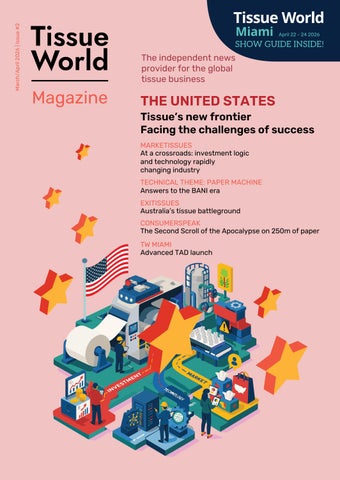
Cover image: State-of-thenation: America’s world leading tissue market faces a new frontier of competition.
Image by Stefano Vuga, Founder, PurplePrint Creative, Spain/ Italy, www.purpleprint.eu
IN THIS ISSUE...
03 FRONTISSUES
America’s world leading tissue market faces a generational transition – a new frontier of competition and hard-line market realities.
04 MARKETISSUES
North American tissue manufacturing at a crossroads: investment logic, technology and regional priorities in a rapidly changing industry. In a three-way analysis by AFRY Management Consulting’s top personnel, Senior Principal Sanna Sosa reports for TWM as the industry swings back towards hard-line market realities.
09 NEWS IN BRIEF
13
A roundup of news from across the global toilet paper and kitchen towel markets. To get the very latest news go to: www.tissueworldmagazine.com
AMERICA: COUNTRY REPORT
America leads in per capita tissue use, but technology has likely limited further tonnage growth. Report by ResourceWise Senior Consultant Bruce Janda.
19 AMERICA: COUNTRY REPORT
Companies searching for marginal gains across multichannel strategies. As the retail experience continues to expand across increasing outlets, companies look to key sectors as dramatic M&A activity continues. Report by Ashley Mandel, Research Associate, Euromonitor International.
25
ST PAPER: OPERATIONS REPORT
How taking over an idle Barnwell, South Carolina-based converting mill became a success making tissue. “Simply changing the sign on the building would not guarantee success,” says Senior Vice President and COO Ron Thiry.
30 TISSUE WORLD MIAMI 2026: SHOW GUIDE
A warm welcome to the ultimate platform for progress and collaboration – Tissue World Miami!
32 TISSUE WORLD MIAMI - FLOORPLAN 34
SOUTH FLORIDA TISSUE PAPER CO.: OPERATIONS REPORT
South Florida Tissue Paper Co. meets supply issues in the Middle East with its familiar resilience. Juan Enrique Corzo Snr III recalls the various crises his family company has faced since setting up in Miami in 1997. It is, he says, going to be very interesting to see where the industry is going to go.
40 CONSUMERSPEAK
250 metres of Koehler Eco Black Greenium recycled paper completed … now for the next 750m. Italian artist Enrico Mazzone sharpens his many pencils for the Second Scroll of the Apocalypse.
42 PROJECTS SURVEY: SPECIAL FEATURE
48
TWM’s annual Projects Survey charts all new capacity being added, ordered, or in final planning stages during 2025-2026, as well as noting any projects already planned for 2027 and 2028.
PAPER MACHINE: TECHNICAL THEME
Anticipation and informed responses key to meeting challenges of volatile markets in the BANI era. As the global tissue industry undergoes structural transformation, leading tissue paper machinery suppliers outline their strategies to TWM.
56 EXITISSUES
Inside Australia’s tissue wars: capacity, competition and the quiet rise of imports. How a once predictable industry became one of Australia’s most strategically contested consumer goods battlegrounds. By 2024-25 the manufacturing landscape crystallised into a contest between three dominant producers. Report for TWM by Tim Woods, Managing Director, IndustryEdge. 60 AD INDEX
ATAD, THE ENERGYEFFICIENT FUTURE FOR PREMIUM TISSUE GRADES
SOFTER ON THE ENVIRONMENT, LIGHTER ON ENERGY, AND STRONGER IN PERFORMANCE.
ATAD – Advanced Through-Air Drying by ANDRITZ combines premium product quality with significant energy savings, enabling tissue producers to deliver top performance while reducing operating costs and
environmental impact:
• Premium softness & bulk –now with lower energy use
• Innovative air & heat management for maximum efficiency
• Compact, flexible design –tailored to your production line
• Reduced carbon footprint without compromising quality
With ATAD, ANDRITZ sets a new benchmark for sustainable, high-performance tissue production. The gold standard just became greener. Ready to take your TAD production to the next level? Contact us at tissue@andritz.com
YOUR SINGLE SOURCE FOR TISSUE
The Power of Leadership
Since 1976, Convermat has been the leading global supplier of parent rolls of tissue to more than 80 countries worldwide. Our unparalleled market intel and strong network of strategic alliances, resources, and insider knowledge can further grow and strengthen your business to achieve higher profits.
There When You Need Us
We consistently maintain capacity balance for many of the leading global tissue players. Our extensive network of global suppliers and customers enables us to deliver a continuous flow of tissue at the most competitive prices in any market condition and to any destination with speed, reliability, and integrity.
At Your Service
Our experienced team of seasoned professionals is equipped to handle all of your needs including inland and ocean transportation, import/export protocol, technical specifications, testing lab facilities, proprietary product development, foreign currency management, credit risk, and all relevant sales services.
More Than Tissue
In addition to our complete line of tissue, towel, napkins, and specialty paper we supply a comprehensive line of nonwoven substrates for medical, wipes, automotive, filtration, hygiene applications, and more.
Tissue
America’s world leading tissue market faces a generational transition – a new frontier of competition and hard-line market realities
Helen Morris, Senior Editor, Tissue World Magazine
EDITORIAL HEADQUARTERS
Informa
240 Blackfriars Road, London, SE1 8BF, UK
Tel: +44 (0)20 7017 5000
Senior Editor
Helen Morris: helen.morris@informa.com
Events Director – Tissue World Portfolio
Natalie Diaz-Martin: Natalie.diaz@informa.com
Portfolio Director & Special Projects
Ryan O'Donnell
Campaign Director
Roxanna Kashfi: oxanna.kashfi@infoma.com
ADVERTISING ENQUIRIES
Europe & North America
Silvio Arati
T: +39 02 4851 7853 sarati@studioarati.it
South and Central America
Selma Ugolini
T: +55(11)99904 5350 selma@gova.com.br
China, Hong Kong & Macau
Doris Kong
T: +86 020 3895 1611
Doris.Kong@informa.com
TISSUE
WORLD MAGAZINE
is published bi-monthly. The subscription price is US$400 per year for 6 issues. Subscription is free for qualified subscribers in the tissue industr. Please send address corrections to: Informa
240 Blackfriars Road, London, SE1 8BF, UK
Tel: +44 (0)20 7017 5000 info@tissueworld.com
Subscription online at www.tissueworldmagazine.com
In Tissue World all measures are metric and all dollars ($) are US dollars, unless otherwise stated. Copyright 2026 by Informa Connect. All rights reserved. All materials printed in Tissue World Magazine is owned by Informa and protected under the copyright act. No material may be reproduced in part or in whole without the prior written consent of Informa.
TWM’s Country Reports – allied with the industry-leading Tissue World Miami conference and tradeshow 22-24 April – present a comprehensive analysis of the state-of-the-nation’s present and future challenges.
The new imperatives are clear: driven by the harsher economics of rising costs - one estimate puts new tissue machine investments 50% higher than six years ago; smarter mills, faster decisions, relentless focus on efficienc, ageing machinery swept away, a more digital, flexible futue, and data-driven manufacturing projected to be fully integrated by mid-2030. Producers with modern assets are consistently outperforming those relying on older machines.
This dynamic is driving targeted, high-impact investments, reflecting a moe pragmatic investment environment with M&A activity set to increase.
Key issues for the US are slowing growth, a significant decline in populatio growth, technology limiting tonnage growth, and import volumes far outstripping exports. Volume growth is not the rich seam it was. Value growth contains the inherent danger of turning off consumers when times are harder. Private label is a major driver shaking up traditional manufacturing. There are examples of ever-more efficient poducts proving to be so efficient that eturn sales are less frequent. Increasing costs and labour-reducing digitalisation is behind the move towards smaller more localised manufacturing.
Volume and quality demand remains high, but underlying this steady progress TWM’s reports examine old and new structural challenges growing in significance: “The logic behind capital investment, manufacturig technology choices and sustainability priorities is evolving.”
THE NEW BATTLEGROUND IN AUSTRALIA’S EMERGING TISSUE WARS
Given Australia’s highly developed mixed economy, world ranked 15th by GDP, it is perhaps surprising that only now has its tissue industry become … to use the description in ExitIssues … a battleground. Once a predictable and tidy contest between two main players, now three dominant manufacturers are engaged in a “fiece tri-cornered contest shaped by global players, nimble local disruptors, sharp-edged import economics and relentless capacity reshuffling.
The stakes are higher than ever, with local capacity standing at 252,000tpy.
TECHNOLOGY TAKES ON THE BANI CHALLENGES
It’s fitting in the US edition that American Jamais Cascios theory should be met head-on … in Paper Machine: Technical Theme. Leading tissue company executives set out their responses to the idea that we are in a world of chaos … Brittle, Anxious, Nonlinear or Incomprehensible. As Cascio puts it: “It isn’t simple instability, it’s a reality that seems to actively resist efforts to understand what is going on.”
There’s little resistance in the tissue industry, as the contributors emphasise the importance of trust, long-term partnerships, and the transformation to ‘more flexible, esilient, and insight-driven operations.’
NORTH AMERICAN TISSUE MANUFACTURING AT A CROSSROADS: INVESTMENT
LOGIC, TECHNOLOGY AND REGIONAL PRIORITIES IN A RAPIDLY CHANGING INDUSTRY
AFRY Management Consulting’s Senior Principal Sanna Sosa, left, reports for TWM with colleagues Soile Kilpi, Director, Management Consulting, and Martin Pereira, Vice President, Sales & Innovation, as the industry swings back towards hard-line market realities.
The North American tissue sector has entered a period of sharper strategic focus. Demand remains resilient, private label continues to gain share, and premium product expectations show no signs of easing. Yet beneath this steady surface, the logic behind capital investment, manufacturing technology choices and sustainability priorities is evolving - shaped by inflationary pessures, regional policy shifts and the growing role of digitalisation.
In a wide-ranging conversation, Martin Pereira offers a candid and experience-based view of how
tissue producers are thinking today - about capital allocation, technology choices and the long-term resilience of their assets. Complemented by reflections fom Soile Kilpi, discussion provides a 360-degree perspective on a sector balancing short term economics with long term structural shifts.
FROM SUSTAINABILITY-LED GROWTH TO COST DRIVEN DECISIONS
Over the past decade, sustainability and energy efficiency wee central pillars of tissue industry investment strategies. In North America, that
emphasis has not disappeared - but it has clearly softened.
“In the US, the focus on energy efficiency and sustainability hasn’t been shelved,” Pereira says, “but it is not as prioritised as it was.” Instead, manufacturers are placing greater weight on manufacturing efficienc, cost reduction and margin protection. The more transformative decarbonisation solutions such as biomass gasification have slowed. “Whee I thought we would see more demand on gasification… I’m not seeing that right now,” he adds.
This shift reflects a moe pragmatic investment environment. While environmental performance remains important, today’s capital decisions are increasingly driven by economics, customer demand and competitive positioning. Pereira is careful to note that this trend is not universal: “That focus is somewhat different depending on the region today.”
Europe, for example, continues to prioritise sustainability, fibe optimisation and energy efficienc, while North America has become more selective - allowing market realities to take the lead. Cost competitiveness now sits squarely at the centre of decision-making. Energy efficiency measues such as improved hoods, heat recovery and vacuum system optimisation are pursued primarily because they reduce operating expense, not solely to meet decarbonisation targets.
PRIVATE LABEL: THE ENGINE BEHIND NORTH AMERICAN GROWTH
Few factors have reshaped the North American tissue landscape as profoundly as the rise of private label. Once positioned as a lower quality alternative, private label tissue has evolved into a growth engine that is driving both capacity additions and technology choices.
“The private label sector in America is driving growth,” says Pereira. “Based on our estimates, it already represents around 37% of the market today and continues to grow.”
This demand is translating directly into investment decisions. Rather than incremental upgrades, many producers are pursuing new, high-efficiency machine that are often dedicated to private label production.
Figure 1: North American branded versus private label tissue market share
“We’re seeing projects with one machine and three or four converting lines going in now,” Pereira says. “But the plan is to have at least another machine - if not two - added.” In other words, mills are being designed as expandable platforms. The footprint often anticipates a five-year plus gowth horizon, even if market conditions ultimately dictate the pace. Kilpi highlights how far private label has come: “In the old days, private label was relatively low quality. Over the past 10 - 15 years, that has completely changed.” Today, private label products often match or even exceed branded offerings in softness, performance and consistency.
NEW MACHINES OVER LEGACY ASSETS
Despite continued investment, North American producers are increasingly selective about where capital is deployed. Large, established players are focused less on expansion and more on asset optimisation and protecting their existing market positions.
“Some of the largest players are trying to protect their markets and margins,” Pereira says. “We are helping them decide whether it’s best to upgrade those assets or build one new machine to replace old assets.”
This approach reflects rising capital costs and a desire to avoid spreading investment too thinly across ageing infrastructure. The profitability gap between modern, energy-optimised machines and older assets continues to widen. For producers operating outside the top cost quartile, strategic decisions cannot be postponed indefinitel.
FASTER PROJECTS, SHARPER HIGHER COSTS
One of the most notable changes is the speed at which projects can now be executed. For greenfiel developments, a new tissue machine can be designed, built and started up in as little as 20–21 months.
“It is definitely quicke,” says Pereira. “Today, engineering and construction are done in parallel.”
However, the critical path has shifted: “The largest time component is no longer the machine itself, but the electrical aspects of the project,” he adds, pointing to energy availability and infrastructure as emerging bottlenecks.
Capital expenditure has escalated dramatically since the pre-pandemic period. Inflation, supply chain volatility and especially labour costs have fundamentally reset project economics. In North America, Pereira estimates that new tissue machine investments can be roughly 50% more expensive than they were six years ago. As a result, modularisation strategies and design efficiencies ae becoming central to feasibility studies.
By contrast, China has experienced a far more moderate cost increase at around 20% over the same period, largely due to the use of domestic technology and lower construction costs. The gap highlights a growing competitiveness challenge for Western producers.
While core machine concepts remain stable, incremental innovations are meaningful. Shoe press technologies, improved hoods and enhanced heat recovery systems can significantly educe steam consumption.
“As soon as you increase the dryness of the sheet going to the Yankee, you save energy,” Pereira says. Even small percentage-point improvements translate into substantial efficiency gains
Producers are also focused on achieving “higher bulk and lower basis weight,” reducing fibe usage, energy demand and emissions simultaneously.
“I don’t see major disruption in the actual machine technology,” Pereira adds. “The most disruptive potential is in how mills are using digital integration across the manufacturing process.”
Advanced process control, data analytics and digital optimisation are increasingly viewed as the next frontier of competitiveness. These tools allow mills to improve uptime, reduce variability and optimise energy and water consumption, often delivering faster returns than large mechanical upgrades.
Looking ahead, Pereira is unequivocal: “By 2035, fully integrated, data driven manufacturing will be standard.”
ENERGY, WATER AND A REGIONAL SUSTAINABILITY DIVIDE
Energy intensity remains a defining issue, particularly in North America where TAD technology dominates. While TAD is inherently energy intensive, Pereira does not see it losing relevance: “I don’t see TAD becoming less popular,” he says. “Demand for TAD products is still high, and growth remains significant.
However, sustainability priorities differ sharply by region. In Europe, decarbonisation and water efficiency continue to shape investment decisions. North American producers, by contrast, tend to weigh sustainability investments against local energy prices and availability.
Canada presents a distinct case. In provinces where hydroelectricity dominates, mills already operate on low-carbon grids. “If most of the energy produced by the utilities is coming from hydro, it’s already green energy,” Pereira says. This reduces the urgency for additional decarbonisation
Efficiency by design
PUT THE FUTURE OF PACKAGING IN YOUR LINE OF SIGHT
Our new wrapper features a reciprocating design with fast, small-pack production and change-overs.
Innovatively designed with shorter mechanical movements and a telescoping unwind, the new Vision G3 wrapper is revolutionizing the industry with faster speeds on small formats, while also being able to produce large packs. Our Infinity engineers re-imagined the G3 from the ground up, setting the global stage with a new standard in tissue packing production. Every detail has been meticulously designed for increased production, accessibility, maintainability, and fast set-up. Take a virtual tour at visionG3.com
investments, though water usage and operational efficiency emain focal points.
European mills can operate at water consumption levels as low as five cubic meters per ton, compaed with closer to nine cubic meters per ton in North America. As Kilpi notes, “That’s a big difference and it shows how strongly regulation and cost pressures influence technology choices.
At the same time, Chinese producers are increasingly attentive to sustainability optics. Biomass boilers and energy-efficiency upgrades eflect bot regulatory and reputational considerations.
FIBRE FLEXIBILITY AND STRATEGIC RESILIENCE
Fibre strategy has become another critical lever in future proofing tissue mills. Most new pojects are designed with flexibility in mind, allowing poducers to adjust fibe mixes in response to market demand, regulation or cost volatility.
“Almost all the mills we study want to have fibe flexibilit,” says Pereira. “They want to be able to use recycled fibe if it becomes cost competitive, or alternative fibes if sustainability requirements increase.” Flexibility is insurance against regulatory change, fibe price volatility and shifting consumer expectations.
Non-wood fibes such as bamboo, straw and bagasse are attracting growing interest, particularly as tools to reduce carbon footprint. Bamboo, Pereira notes, offers fibe properties comparable to softwood, although it is not necessarily cheaper.
Despite experimentation, eucalyptus pulp remains central to tissue quality, especially for softness: “Eucalyptus is used widely because of the softness it delivers,” Pereira says, sometimes accounting for 60–70% of the furnish.
SCALE, INTEGRATION AND COMPETITIVE ADVANTAGE
Across North America, scale continues to matter. Integrated operations that combine tissue machines and converting lines are increasingly dominant, particularly in Canada, where independent converters have largely disappeared. “When profit margins are measured in pennies per case, scale, and high-speed efficient machines make a eal difference,” Pereira says.
Producers with modern assets are consistently outperforming those relying on older machines, even when the latter have larger installed capacity. This dynamic is driving targeted, high-impact investments.
OUTLOOK: TOWARD A MORE DIGITAL, FLEXIBLE FUTURE
Asked for bold predictions, Martin Pereira strikes a hopeful but pragmatic tone. His central expectation is that sustainability and decarbonisation will regain momentum and be supported, rather than replaced, by digitalisation.
“My hope is that the focus on sustainability and decarbonisation comes back and becomes the norm,” he says. “Combined with integrated, digital operations, that’s what will define futue-ready tissue manufacturing.”
For Kilpi, adaptability is equally critical, balancing performance, aesthetics and efficiency acoss regions. While regional differences will persist, the direction is clear: smarter mills, faster decisions and a relentless focus on efficienc. As the North American tissue sector moves forward, the winners will be those who can navigate rising costs, leverage digital tools, and align investment decisions with both market realities and long-term resilience.
Figure
Figure 2: North American at-home and away from home tissue machine mill viability
NEWS IN BRIEF
GLOBAL
TISSUE WORLD MIAMI EXCLUSIVE: ANDRITZ LAUNCHES ENERGY-SAVING TECHNOLOGY ATAD
Andritz has announced the official launch of its latest breakthrough innovation for premium tissue production – Advanced TAD Technology (ATAD).
Exclusively launched at Tissue World Miami 2026, the machinery addresses the global tissue industry’s challenge of reducing the high energy demand of Through-Air Drying (TAD) systems.
Andritz said that ATAD is a new approach to structured tissue production that “significantly reduces energy consumption while maintaining the premium softness, bulk, and absorbency associated with TAD tissue.”
Paul Richards, Senior Technology Manager Tissue and Grade Owner for TAD & Hybrid Technologies at Andritz, said: “Energy consumption and availability remain fundamental barriers for many companies considering the production of structured tissue. With ATAD, we are removing these barriers. The technology combines simple, robust machine design with meaningful energy savings. This makes premium tissue grades more accessible not only in North America – where TAD is standard – but increasingly in Europe and other high-energy-cost regions as well.”
The innovation has undergone several years of development at the company’s PrimeLineTIAC tissue pilot plant in Graz, Austria. Since 2022, R&D teams have been dedicated to exploring ways to reduce the thermal load of TAD, one of the most energy intensive processes in the entire paper industry.
Their breakthrough came in the form of a new pre dewatering concept installed ahead of the first TAD drum – a previously untapped opportunity for efficiency impovement.
Richards said: “During pilot work at the tissue pilot plant PrimeLineTIAC, the team demonstrated that the technology developed allowed us to raise the sheet dryness by 5-6% points ahead of thermal drying in the TAD section, leading to significant energy savings, smaller drying systems, and even production increases due to reduced load on downstream drying components.”
With a patented pre-dewatering module installed before the first AD drum, Richards says ATAD has changed this paradigm.
ATAD achieves a “significantly higher” dryness level (+5-6% proven, with higher values possible) at TAD entry.
Andritz said the enhanced dryness results in:
• Lower energy consumption and a corresponding reduction in CO2 emissions
• Improved operating cost efficienc
• Higher production potential due to reduced thermal load
• Higher capacity potential due to a decreased thermal load in the TAD drying section
• Greater machine stability thanks to improved sheet conditioning
• Flexible installation options, including hybrid configurations combining TAD with conventional or shoe press concepts
ATAD will be presented publicly for the first time at Tissue World Miami 2026, with a dedicated conference speech and follow-up technical discussions for customers at the Andritz booth (B20).
AMERICA
SOFIDEL ANNOUNCES $775M INVESTMENT FINALISED FOR INOLA
Italian tissue giant Sofidel has confirmed tha construction of a building to house its previously announced 75,000tpy Valmet-supplied TAD tissue machine will take place at its integrated facility in Inola, Oklahoma.
The machine start-up is scheduled for the second quarter of 2028 and once up and running it will further strengthen the company’s presence in the United States.
The total investment amounts to $775m, and the Inola site will also house converting lines with matching capacity for the production of finished goods
Expansion of the pulp and parent reel warehouse is also included in the project, as is the construction of a fully automated finished goods waehouse –developed using E80 technology – with 100,000 pallet positions.
The new buildings will cover a total area of approximately 1,000,000 square feet (90,000 square metres).
Luigi Lazzareschi, Sofidel Goup Chief Executive, said: “The new TAD machine we will install at our Inola, Oklahoma facility will further strengthen our production footprint and expand the availability of premium tissue products in the United States, enhancing our ability to meet growing customer demand, particularly in the South.
“Once again in Inola, thanks to the collaboration of our stakeholders, we have found the right conditions to invest and continue to grow.
“This is a significant investment, an important way to ‘open’ the year of our 60th anniversary with a determined industrial outlook toward the future.”
The new facility will also feature state of the art internal logistics. An automatic system using LGVs will transport parent reels from the paper machine to the warehouse, and an automated loading system will be connected directly to the finished goods automated warehouse.
Sofidel said the choice of AD technology “directly addresses” the growing demand in the North American market that is increasingly oriented – also in the private label segment – toward premium products.
VIETNAM
XUAN MAI PAPER BOOSTS HIGHQUALITY RECYCLED TISSUE PRODUCTION WITH DIP INVESTMENT
Tissue producer Xuan Mai Paper has started up its second Andritz-supplied deinking pulp (DIP) line at its mill in Ho Chi Minh City.
Designed for 75tpd and processing 100% mixed office waste, the line comprises a complete stock preparation system engineered for stable operation, consistent pulp quality, and improved resource utilisation.
The Chairman of Xuan Mai Paper said: “The successful start-up of our second DIP line marks an important step in expanding our recycled fibe capacity and meeting the growing market demand for high-quality tissue.”
KORO
VIET NAM DIVERSIFIES INTO TISSUE WITH TM INVESTMENTS
Koro Viet Nam Tissue Paper has officially enteed the tissue market after investing in two Andritzsupplied PrimeLineCOMPACT M 1600 tissue machines for its mill in Thanh Hoa Province.
Start-up of TM5 and TM6 is planned for the first half of 2027, and the scope of supply includes complete stock preparation with a PrimeRefine HC T high-consistency refining system, appoach flo , fibe recovery, and broke systems.
The lines are designed for efficient, high-speed production of premium toilet, napkin, handkerchief, and facial tissue, and both will have a paper width of 3.6m and a maximum operating speed of 1,650m/ min, with a daily design capacity of 104.2tpd each.
Ngo Huu Phuong, Chairman of Koro Viet Nam Tissue Paper, said: “This project marks our first step into tissue production, a milestone in our company’s development.
“Andritz’s excellent support during our previous projects, coupled with its proven know-how and advanced technologies, has given us full confidence to choose Andritz as our partner for this venture.
“We are convinced these solutions will lay a solid foundation for our long-term success in the tissue market.”
Viet Nam Koro Paper Joint Stock Company has previously specialised solely in the production of core paper.
GREECE
INTERTRADE HELLAS BOOSTS CAPACITY BY 80,000TPY WITH TM START-UP
Hellas has start-up a Toscotec-supplied AHEAD 2.2L turnkey project at its plant in Oinofyta. PM2 features a net sheet width of 5.6m, a maximum operating speed of 2,200m/min, and a production capacity of up to 80,000tpy over a range of facial, toilet, napkin and towel products. Toscotec said the project is designed to “maximise energy efficiency acoss the entire production line.”
The machine features a hydraulic TT HeadboxML-T and the innovative TT NextPress shoe press technology, which ensures superior water removal
Tissue World
by Istanbul
Connect with your future customers
Unprecedented Growth. Unmissable Opportunity.
Showcase your innovations, explore the latest advancements, and gain valuable insights from industry leaders. Connect with the perfect partners to drive your business forward.
Take advantage of exhibition and sponsorship opportunities, including cost-effective booths, private meeting spaces, access to senior-level visitors, exclusive networking events, and a customized conference program.
Book your exhibition booth today!
while maintaining the premium bulk of the tissue. At the heart of the drying process is a third-generation TT SYD Steel Yankee Dryer integrated with cogeneration system managed by Toscotec DCS, TT Brain, for intuitive, high-precision control of the electrificatio and automation systems, and the QCS to gain control over product quality. The plant is also equipped with an integrated solution for stock preparation. In a move toward green transition the line features the TT Hydrogen Burner, designed to work with up to 100% hydrogen fuel and TT Hoods are engineered for future 100% electric operation.
The project includes OPTIMA 2600 slitter rewinder with an automatic shaft puller. John Delidimos, Chief Executive of Intertrade Hellas, said: “With the installation of the Toscotec machine, we are eliminating a long-standing multi-year trade deficit in tissue products in Greece, helping restore our country’s self-sufficiency and independence in tissue production.”
PORTUGAL
NAVIGATOR BOOSTS EUROPEAN TISSUE CAPACITY WITH AVEIRO INVESTMENT
The Navigator Company has invested €115m in a 70,000tpy tissue machine that will be installed at its plant in Aveiro. Expected to be in operation in March 2028, the line will supply the company’s Blackburn, UK-based converting operation, which currently does not produce its own reels and has the capacity to process around 130,000tpy. The project is expected to create a more vertically integrated operation, balancing reel production with converting needs. Navigator said it plans to continue to “grow profitably and sustainably though organic expansion” with increased capacity and new product development, as well as through merger and acquisitions.
The Aveiro industrial complex will the house two tissue machines, along with the integrated pulp production on site.
CHINA
YUSEN GROUP BOOSTS HIGHQUALITY TISSUE CAPACITY WITH TM INVESTMENTS
Yusen Group has invested in three Valmet-supplied IntelliTissue 1600 tissue machines to be installed at its plants in Tai’an, Liaoning Province, and Chongxin, Gansu Province. The 3.5m IntelliTissue machines have a design speed of 1,650m/min and an annual production capacity of 30,000 tonnes per machine. Start-up is scheduled for the end of 2026 and beginning of 2027. With the investment, Yusen aims
to increase production capacity while delivering high-quality facial and toilet tissue to the Chinese domestic market. Zhao Zhancheng, Production General Manager, Yusen Group, said: “Looking ahead, we look forward to continuing our close collaboration with Valmet as we pursue high-quality development and sustainable manufacturing.
“Together, we aim to grow through innovation and build modern and efficient tissue poduction bases.”
UNITED KINGDOM
ICT UK STARTS TISSUE PRODUCTION: “A KEY STEP” IN THE GROUP’S GROWTH
Italian tissue manufacturer Industrie Cartarie Tronchetti (ICT Group) has announced the official start-up of tissue production in the United Kingdom after starting up its New Greenfield site in Deeside, north ales. Production was ramped up during the last few months, with the converting lines and the new automated warehouse starting operations. The start-up of the paper machine (PM41) completed the integration of the production cycle, from tissue paper production to converting, through to finished poduct logistics. ICT said the milestone marks “a key step” in its growth and strengthens its presence in the UK market. ICT is headquartered in Lucca, Italy, and has a production capacity of approximately 620,000tpy, operating from plants in Italy, Poland, Spain, and France and the UK.
TÜRKIYE
ERUSLU DIVERSIFIES INTO TISSUE PRODUCTION: ANNOUNCES CONVERTING INVESTMENT
Eruslu Hygienic Products has moved into tissue production after investing in six Futura and Pluslinesupplied Andromeda Tissue converting lines, to be installed at its site in Bursa. The greenfield poject includes a whole tissue machine, logistics, and warehouse for jumbo rolls and finished poducts.
This represents a forward-looking investment, with the latest Futura and Plusline technology delivering “a fully integrated and highly automated converting process,” according to the supplier.
It said: “The project is designed to achieve top performance and operational excellence, helping to shape the future of the tissue industry.”
Eruslu Hygienic Products has been producing baby diapers and wet wipes as well as components for hygienic product manufacturers since 2004.
The company operates one of the world’s most advanced fully integrated hygienic products manufacturing facilities, supplying its products to over 150 countries worldwide.
AMERICA LEADS IN PER CAPITA TISSUE USE, BUT TECHNOLOGY HAS LIKELY LIMITED FURTHER TONNAGE GROWTH
While per capita consumption is high, growth is slowing. An ageing population, imports three times higher than exports, and superior products so efficient they curb sales. Report by ResourceWise Senior Consultant Bruce Janda.
The United States was a pioneer in tissue technology and mass marketing, beginning with the first tissue patent in 1857 and subsequen patents on packaged tissue in 1983. Scott Paper Company introduced rolled tissues with perforations for convenient dispensing during the 1890s, coinciding with the invention of the Yankee dryer. Kimberly-Clark (K-C) developed creped wadding for World War I bandages, which later evolved into the Kleenex brand facial tissue originally intended for makeup removal. The 1930s saw the introduction of two-ply tissue, and in the early 1960s, two engineers from Appleton, Wisconsin, invented the TAD process at a small Green Bay Tissue Mill. Around the same time, K-C created the Crescent Former in Neenah, Wisconsin, which became industry standard after its patent expired in 1989. Beloit Corporation launched the Twin Wire Former in circa 1970, alongside Stratified Forming European equipment manufacturers entered the market around this period, so tissue technology is now a global enterprise, with machines no longer produced in America. Despite these changes, America still has the highest rate of tissue consumption per capita among major populations. While equipment innovation moved to Europe and Asia, American tissue converting equipment and product development continue to impact the worldwide business. Advertising campaigns from the 1950s and 60s have shaped consumer preferences for ultra-soft (but comparatively weak) tissues and highly absorbent paper towels. Today, there are two or three prominent tissue brands, and although national TV advertising continues,
it airs less frequently. Private label brands have grown but remain about half as prevalent as in Europe. Figure 8 illustrates grocery store tissue options. Technologies like TAD and structured advancements strongly influenc American production, as shown in Figure 11. Improved products with reduced basis weight may have lowered overall consumption rates by replacing outdated designs. Finally, commercial or “away-from-home” tissue products account for approximately 35% of the total US market, whereas most developed nations typically see only a 20% share. Further details about product quantities can be found in Figures 9, 10, and 11.
Figure 1 shows a map of the continental United States highlighting tissue mill locations, with mills grouped by their fibe integration status. Figure 9 provides additional details about fibe integration for different product types. Across the country, there are about 65 tissue mills and 162 tissue machines in operation.
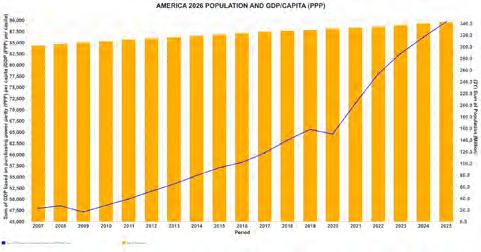
America’s tissue market faces slowing growth and an aging population, as reflected by the 0.64% CAGR i population over 19 years (yellow bars, Figure 2). However, GDP per capita (PPP, blue line) grew at a 3.3% CAGR, outperforming most developed countries and supporting continued tissue consumption.
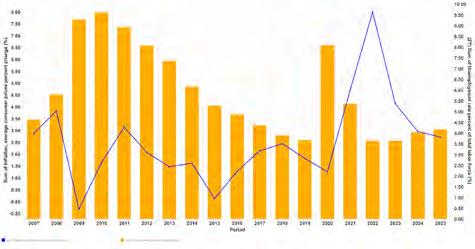
Figure 3 shows the trends in inflation (blue line) an unemployment (yellow bars) in America. Aside from disruptions caused by the “Great Recession” and Covid-19, both indicators show generally positive trends: unemployment hovers around 4% and inflation abou 3%. Compared to many other developed countries,
these results are quite favourable for continued tissue consumption.
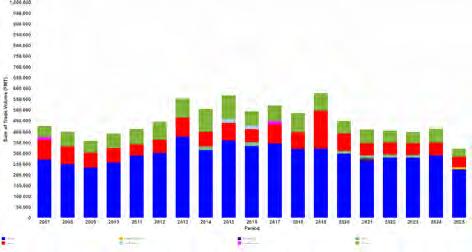
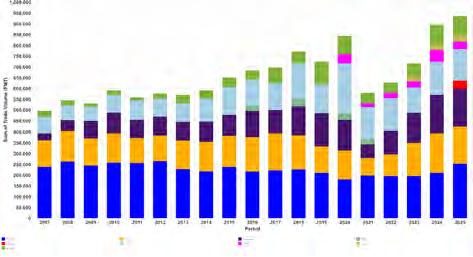
The United States tissue market comprises both imports, as illustrated in Figure 4, and exports, depicted in Figure 5. These figues employ consistent axes to enable straightforward visual comparison between import and export trends. Data from 2024 and 2025 indicate that import volumes are approximately three times greater than export volumes – a marked departure from earlier years when trade was more evenly balanced.
Over the period analysed imports have doubled while exports have remained relatively stable. At present, import volumes represent about 5.8% of domestic production capacity, with exports accounting for only around 2%. While future trade dynamics remain uncertain, these findings suggest that US tissue poduction capacity is appropriately aligned with current market demands.
Trade with Canada constitutes the largest segment in both imports and exports, represented by blue bars in the respective charts. China serves as the second largest
source of America tissue imports, while Mexico ranks as the second largest importer of American tissue products. Both Canada and Mexico possess significant advance tissue technology sectors compared to other countries and continue to benefitfrom favourable and expedited trilateral trade agreements.
Parent rolls and products manufactured using TAD or other advanced tissue technologies – characterised by their softness, low density, and low strength, as favoured by most American consumers – present significant challenge in shipping, as they are prone to damage and create excessive tissue waste. Consequently, these logistics constraints act as a de facto trade barrier for ultra-premium products imported from regions outside Mexico or Canada.
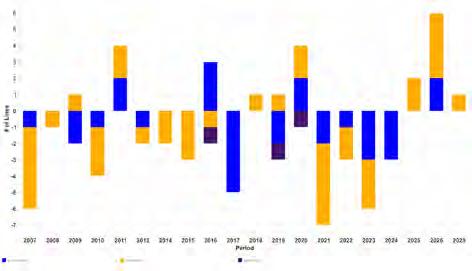
Figure 6 shows yearly changes in America’s tissue machine fleet, boken down by tissue grade. The number of consumer machines has stayed about the same, while commercial and specialty machine counts have seen small decreases. Most newly added machines provide higher capacity than those taken out of service. Upgrades to existing machines that increase capacity are not included here but will be shown in later charts focused on technical age and total capacity. CAGR for overall American tissue capacity is 0.56%, which is just under the population growth CAGR of 0.64%. Even so, since the population growth rate has been declining over this period, America’s tissue capacity appears to be keeping pace with demand.
The structure of American tissue production has shifted in company names and ownership, though market composition remains largely unchanged over 25 years.
Currently, 23 companies operate in the US, with six accounting for 83% of total capacity; two of these are
Figure 1: America Tissue Producer Map
Figure 3: America Inflation and Unemployment rend
Figure 4: America Tissue Imports Trend
Figure 5: America Tissue Exports Trend
Figure 2: America Population and GDP (PPP) per Capita Trend
European based. Of the remaining 17, four Canadian producers hold about 10% of capacity, and 13 other USA based companies make up roughly 7%. America is a competitive market for tissue.
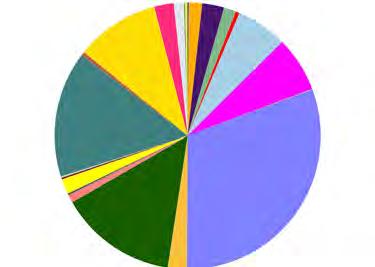
The US grocery market has consolidated, with major players like Walmart, Kroger, Costco, and others each holding over 1% share and collectively accounting for more than half of sales (Figure 8). This shift has increased negotiation power and boosted private label brands, especially through club stores like Sam’s Club, Costco, and BJ’s, which offer ultra-premium private labels often produced by specialised non-branded manufacturers using TAD technology. These private labels are positioned beside national brands to highlight value, while large packages of branded goods remain available. In the past 25 years, European chains like Ahold (Netherlands) and Aldi (Germany) have entered the market, with Trader Joe’s (owned by Aldi North) gaining a cult following; though smaller in market share, these brands emphasise private label offerings.
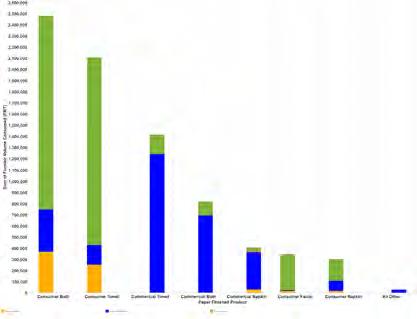
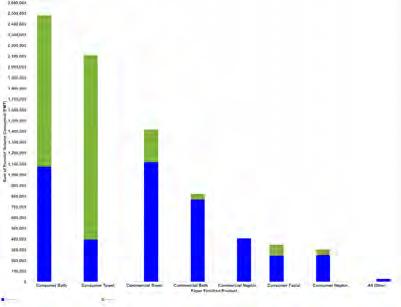
Figure 9 shows the different types and quantities of tissue products produced by mills in the United States. The colour of each bar segment indicates how the mill integrates with fibe production. Blue segments denote mills that process recycled paper on site, which is common for producing commercial tissue products. Orange segments indicate integration with virgin fibe produced at the mill itself, typically found in consumer tissue production. Green bars represent mills using mainly imported virgin baled pulp, such as Canadian softwood or Eucalyptus.
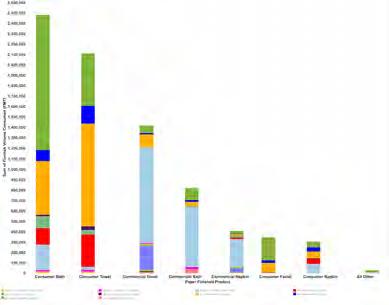
Figure 10 shows that consumer bath uses 52% eucalyptus fibe, consumer towel 24%, and consumer facial 65%. Most commercial tissue products rely heavily on recycled fibe.
Advanced manufacturing processes are prevalent in American tissue production, with TAD technology accounting for the majority of advanced capacity. Within consumer products, 81% of towels and 57% of bath tissue utilise advanced technologies. The application of these methods in kitchen towels provides notable advantages: consumers benefit fom improved absorbency and potentially lower costs per use, while producers can reduce fibe requirements by 20-30% or deliver enhanced performance at premium prices.
In comparison, consumer bath tissue exhibits a distinct market dynamic, primarily influenced by North America preferences for exceptional softness at the expense of strength. This regional demand alters product design economics, and evidence suggests consumers may use less paper per occasion when such softness is prioritised. More recently, advanced technology has been integrated into 21% of commercial folded and roll towel production. These products are increasingly found in upscale restaurants and high-traffic locations such as truck stops contributing to higher consumer satisfaction, efficient han drying, and decreased waste. It has been demonstrated that two sheets of towelling are sufficient for thoough hand drying.
Canada, Mexico, Brazil, Argentina, Columbia, and Indonesia were selected to compare tissue production within the Americas and spotlight potential low cost
Figure 7: America Tissue Producers Capacity Comparison
Figure 6: America Tissue Machine Count Changes by Grade Trend
Figure 8: America Grocery Market Share by Total Sales
Figure 9: America Tissue Capacity by Product and Site Type
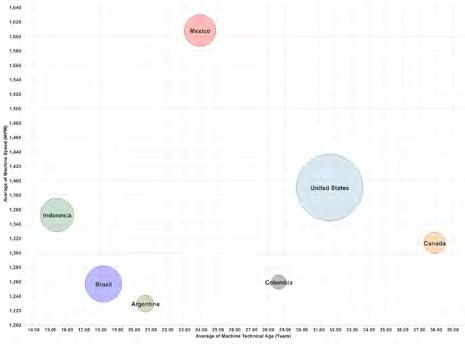
producers like Indonesia and Brazil, who might seek to expand their market share in the United States. Figure 12 presents a bubble chart illustrating each nation’s tissue machine quality, where the bubble size represents production capacity. The X-axis measures the average technical age, while the Y-axis reflects the average machin speed. Notably, Mexico’s machines operate at the highest average speed, whereas Indonesia and Brazil have the youngest machines in this group. Still, these factors alone do not fully represent the complexities of tissue production in the Americas.
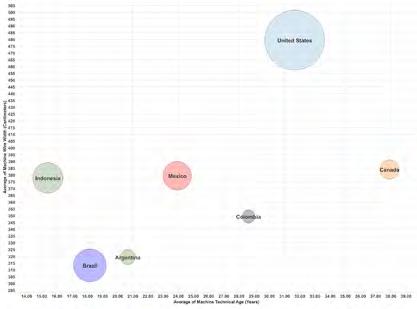
In machine quality charts, we typically use either machine speed or wire width produced as the Y axis, but there is little distinction made between these measures. Figure 13 illustrates that the rankings of American machines change notably when average trim width is used instead of speed. On average, American machines are about 28% wider than those in Mexico or Indonesia. The United States has the world’s widest tissue machines, with a cluster measuring seven metres and several approaching widths of nearly eight metres. This greater width allows for much higher production rates at the same operating speed.
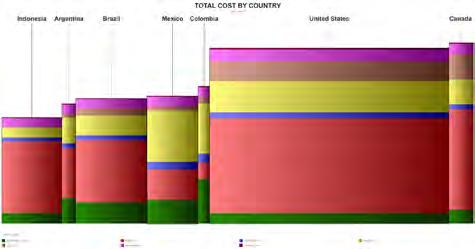
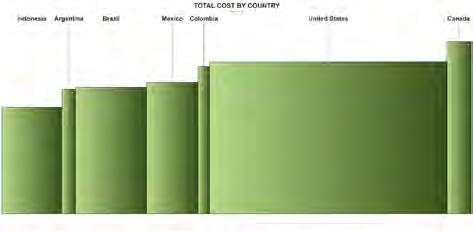
Figure 14 illustrates the average tissue production costs by country, indicating cash cost per ton by bar height and production capacity by bar width. Indonesia records the lowest cash costs followed by Argentina, Brazil, and Mexico, while Canada and the United States exhibit the highest costs. Energy expenses significantl influence these cost Indonesia, Agentina, and Brazil
benefit fom comparatively lower energy prices. Although Mexico and Colombia have lower average energy costs than the United States or Canada, these costs constitute a disproportionately high share relative to other countries with similar overall costs. Fibre and pulp expenses (represented by red and green bar segments) also show considerable variation across the countries. Additionally, labour costs in the United States and Canada are substantially higher than those in the other countries analysed.
The US produces tissue with 45% advanced technology, compared to 29% in Canada and 16% in Mexico. Figure 15 shows that advanced technology notably reduces average costs in the US, while cost reductions in Canada and Mexico are minor when accounting for fibe savings. This is evident when comparing bar heights to Figure 14.
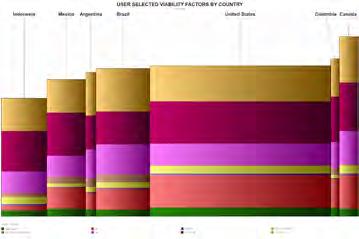
Figure 16 illustrates the comparative average viability of tissue machines across various countries. The FisherSolve algorithm evaluates multiple factors, including estimated capital requirements, cash production costs, machine size, technical age, local economic risk by grade, internal company risk, manufacturing competitiveness, tons produced per unit trim, and export fees. By incorporating these criteria, the assessment extends beyond current cash costs to provide a comprehensive outlook on overall viability over the next five years
The viability of the United States tissue fleet i comparable to that of lower-cost regions such as Brazil and Argentina. Meanwhile, Mexico and Indonesia demonstrate
Figure 11: America Tissue Capacity by Technology
Figure 10: America Tissue Capacity by Furnish Description
Figure 12: America Tissue Machine Average Quality Comparison by Machine Speed
Figure 13: America Tissue Machine Average Quality Comparison by Machine Speed
the strongest positions in terms of viability. The wider machines utilised in the United States contribute favourably to this analysis, whereas Canada faces challenges due to its smaller machine sizes.
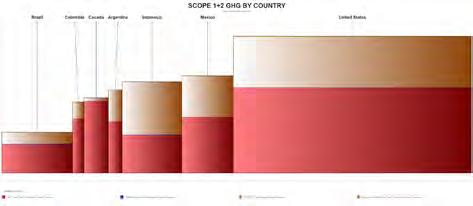
Figure 17 shows Scope 1 (red bar segment for on-site fuel) and Scope 2 (tan bar segments for electricity grid) carbon emissions per ton of finished tissue. The type emissions are partly dependent on the carbon footprint of the local or regional electrical power grid.
Canada leads the tissue world with low carbon electrical power from its extensive hydropower electric grid. Columbia and Brazil also feature relatively clean electric grids. Indonesia’s tissue making uses a lot of coal power resulting in high emissions.
The Scope 1 emissions from power produced onsite for drying and other processes shows the effect of integrated virgin pulp production on site, allowing the use of renewable waste heat from the pulping process. Some of the American tissue mill sites are also integrated and they also show this advantage, but the overall average is impacted by the many non-integrated American mills. The American mills also have high energy input on site for extra drying required for advanced tissue processes.
SUMMARY
• This view of tissue production in the United States and select other countries looks at cash costs, technology, machine efficienc, and carbon emissions. The US market stands out due to its exceptionally high per capita consumption and significant commecial tissue output. In addition, major chains and buyers’ clubs have gained greater bargaining power, paving the way for the growth of ultra-premium store brand tissues.
• Energy, fibe, and labour costs vary widely; Indonesia and Brazil have the lowest production costs, while Canada is highest and the U.S. ranks second.
• In the United States, advanced tissue manufacturing methods result in significantly better poduct performance than Canada and Mexico. Although the drying processes used require more energy, an analysis of scope 3 emissions for fibe entering the mill may reveal benefits fom reduced fibe content.
• Machine viability and carbon footprint are influenced by factors such as machine size and integration with pulp production. American tissue machines are exceptionally wide on average providing efficiency and viability advantages.
• Significant American investments in advanced tissue machinery may be contributing to a decrease in apparent per capita consumption, as tissue sheets are produced with lower grammage but deliver superior performance during use.
A detailed understanding of tissue producers and their individual machines is crucial for analysing the competitive landscape. This article presents an overview of the current tissue industry in America. Fluctuations in fibe prices, exchange rates, and environmental regulations create both opportunities and challenges for industry participants. Moreover, changes in ownership and consolidations are expected to persist among tissue mills in the United States, while investments in tissue-making capacity from neighbouring countries may impact imports and exports.
Figure 14: America Average Cash Cost Comparison
Figure 15: America Average Cash Cost Comparison by Case Cost (Technology)
Figure 17: America Comparison Average Carbon Footprint
Figure 16: America Comparison Average Machine Viability Rank
AMERICA: COMPANIES SEARCHING FOR MARGINAL GAINS ACROSS MULTICHANNEL STRATEGIES
As the retail experience continues to expand across increasing outlets, companies look to key sectors including hygiene, sustainability, e-commerce and aesthetics, as dramatic M&A activity continues. And “to re-introduce excitement to a very established space.”
Report by Ashley Mandel, Research Associate,
Euromonitor International.
Retail tissue in the US in 2025 underwent overall consistent value growth compared to 2024. Unit price growth remained soft as inflation loweed and companies pulled back on steep price increases in 2025 as they are absorbing cost increases associated with materials, supply chain, and tariffs.
Overall, the category witnessed softer volume gains, higher quality and more absorbent private label offerings. Equally, consumers remained pricesensitive and pulled-back on household spending across the board. In regards to modest unit price growth in 2025, private label brands continued to take up more of a share of purchases in the tissue and hygiene space. Additionally, consumers made more purchases through club stores offering bulk discounts on tissue products.
Demand for premium tissue products in the US continues to rise, driven by consumer preference for softer, stronger, and higher-quality options. In 2025, companies invested in TAD paper machines, which, despite longer production times, deliver superior softness. Today’s consumers expect ultra-soft, strong, and highly absorbent tissue products from both private labels and national brands.
Another significant tend in tissue market is sustainability, with consumers demanding ecofriendly products, biodegradable packaging and pushing innovation towards recycled/
alternative fibes such as recycled pulp, bamboo. It has been seen that tissue products with added natural elements like aloe vera or almond oil for soothing properties are more popular among consumers. Sustainability as a trend is particularly more important in paper towels, in which the focus on reusability and recycled content is growing, given that paper towels are often used for quick, everyday tasks, which can sometimes result in excessive waste.
EXECUTIVE SUMMARY:
AMERICAN TISSUE IN 2024 AND 2025
Tissue and hygiene in the US has witnessed continued current value growth in 2024 and 2025, although this was slower than in previous years due to the easing of the strain on price growth and inflation. While unit price gowth was comparatively lower in 2024 than in the previous year, there remained a complicated relationship regarding labour shortages, costs of pulp, and spending. In terms of retail tissue, a softer current value increase and stronger volume performance was seen due to slower unit price increases, which encouraged some consumers to re-engage with household brands and sustainable premium options; albeit this was also alongside the growth of private label offerings. Although private label had already been winning in retail tissue for a couple of years due to price rises and cost concerns when it came to
Demand for premium tissue products in the US continues to rise, driven by consumer preference for softer, stronger, and higher-quality options.
On the AfH tissue side, volume and current value growth were seen as return-to-office policies continued to normalise tissue consumption levels post-pandemic. This was also driven by a return to travel.
branded products, it continued to see retail value sales and share growth, through price guarantees and quality improvements. Such actions have solidified private label poducts as a go-to choice amongst US consumers, continuing to outperform many brands, and driving growth within retail tissue, especially in toilet paper, paper towels, and boxed facial tissues.
MARKET SIZE / HISTORICAL FORECAST
All content relates to the USA, units are in USD millions and all constants are current prices.
In 2024-2025, retail toilet paper remained the largest category within tissue and hygiene and continued to grow in both volume and current value terms, winning consumer dollars through quality improvements and private label costbenefit deliver. Private label once again outperformed legacy brands due to the consumer proclivity for buying on promotion or buying in bundles. For the past couple of years private label has innovated in improving private label pulp quality, attracting consumers’ attention due to comparable quality to branded products. Aside from private label wins, premium Direct-to-Consumer (DTC) brands also underwent exciting transformation, as the sustainable toilet paper brand Who Gives A Crap? entered into offline retail at US Whole Foods locations, confirming consumers’ interest in premium, sustainable toilet paper products at premium retailers.
To meet changing consumer demands a host of new product launches have been recorded which emphasised skin-nourishing ingredients such as vitamin E and almond oil, and featured citrus aromas, and plant-based organic fibes such as bamboo. Elevated product compositions and functionalities continued to cater to consumers who prioritise skin concerns, such as preventing infections and maintaining skin pH. The pervasiveness of sustainable fibe-tissue products
such as bamboo, organic cotton, and recycled pulp continued to lead innovative product launches across toilet tissue and hygiene.
Another significant tend influencing tissue and hygiene has been the heightened focus on sustainability, which involves utilising plant-based materials and minimising the environmental impact post-consumption. Companies have been enhancing their sustainable credentials by partnering with environmental organisations to reduce landfill waste and support purpose-driven initiatives. This commitment to community engagement and carbon footprint reduction positively influences brands’ eputation and public perception. However, whether these initiatives directly affect a company’s profitability remains a key strategic consideration.
RETAIL DEVELOPMENTS
Hypermarkets remained the largest distribution channel for retail tissue and hygiene in the US, as many people purchase these products along with their weekly grocery shop for convenience reasons. Hypermarkets also offer a wide product range in terms of brands and pack sizes, and prices are reasonable, especially when buying in bulk. However, retail e-commerce saw the strongest value share growth, with this channel especially popular for hygiene products.
Categories have benefited fom the continued expansion of retail e-commerce, where consumers can research and compare products with ease. Similarly, DTC brand entrants, particularly those offering premium, female-focused and natural-
For the past couple of years private label has innovated in improving private label pulp quality, attracting consumers’ attention due to comparable quality to branded products.
positioned products, have quickly garnered traction on social media. Purchasing large packs of relatively lightweight fibe-based products without the hassle of cumbersome transportation is a prime benefit of online etail channels. The appeal of buying in bundles at warehouse clubs or buying online with the ease of at-home delivery or autodelivery subscription from online market spaces also rings true in retail tissue categories, most notably impacting toilet paper and paper towels. Amidst economic uncertainty, consumers have been seeking ways to maximise their spending. Discounters and warehouse clubs offer household goods at budget prices, and therefore maintained solid sales growth in 2024, with discounters performing particularly well. Their private label and bulk offerings, paired with a stripped-down in-store environment, enable such discount retailers to undercut supermarkets. Warehouse clubs allow shoppers to purchase essentials in one trip, providing convenience and fuelling the pre-emptive price hike and bulk-buying mentality. Transformations in retail distribution over the forecast period are expected to be shaped by cost, convenience, and customer loyalty.
WHAT NEXT FOR TISSUE AND HYGIENE
Tissue and hygiene in the US is set to see stable current value growth rates in the forecast period, with increases for both retail tissue and hygiene and AfH tissue and hygiene. Within retail tissue, although growth is expected to continue, paper towels could witness headwinds from the reusables sector, as reusable paper towels are slowly gaining favour due to waste reduction and sustainability
efforts in the US. Meanwhile, facial tissues are expected to see growth, as the intensifying effects of global warming blur seasonality and elongate allergy seasons, which will extend the use of facial tissues.
In terms of distribution, as retail e-ecommerce further integrates itself as a key channel for all retail tissue and hygiene categories over the forecast period in the US, it will be crucial for brands to adopt a multichannel strategy and include all of their brand offerings in both online and offline retail spaces. While online marketplaces may be top-of-mind for many consumers, other retailers will need to strengthen ways of funnelling sales to their e-commerce platforms and establish mutually beneficial partnerships with marketplace collaborators. At the same time, bricks-and-mortar stores will have to focus on enhancing in-store experiences and expanding their sustainable product offerings to meet the growing consumer demand for eco-friendly options and aesthetically packaged paper products to re-introduce excitement to a very established space.
Products incorporating plant-based fibes are expected to continue to gain shelf space as consumers become more informed about their natural skin benefits. Challenges such as raw materials sourcing and the higher cost of plantbased alternatives compared with conventional materials may slow growth. Despite this, in the
FORECAST / YOY GROWTH (%)
All
premium retail hygiene segment plant-based fibes represent the future of product development. Massmarket brands, while less likely to fully transition to plant-based materials, may still position themselves as more skin-friendly by highlighting the removal of parabens and potential irritants such as fragrances on their packaging.
AFH TISSUE AND HYGIENE IN AMERICA: MAY 2025
Key finding
• Value sales msp rise by 3% in current terms in 2024 to $12.1bn
• AfH hygiene is the best performing category in 2024, with value sales msp rising by 4% in current terms to $1.5bn
• Sales msp are set to grow at a current value CAGR of 3% (2024 constant value CAGR of 1%) over the forecast period to $14.0bn.
GROWTH IN AFH TISSUE DRIVEN BY QUALITY EXPECTATIONS AND POLICY CHANGES
AfH tissue in the US posted positive current value and volume growth, although the rates of increase were slower than in the previous few years. Sales continued to climb towards their pre-pandemic baseline, with return-to-work policies implemented by companies and the return to socialising and travel contributing to growth.
AfH paper tableware remained the largest category within AfH tissue. However, it should be noted that despite seeing slight current value growth, it saw volume decline, and sales remained
lower than the pre-pandemic (2019) level. This was due to the decline for AfH tablecloths, because more businesses ceased to use paper tablecloths, either removing these completely, or turning to cloth variants. Nevertheless, the decline for AfH tablecloths was offset to some extent by the growth for AfH napkins, which was seen due to the rise in quick and easy drive-through offerings, which are handed over with napkins already in the bag.
Meanwhile, AfH boxed facial tissues saw the strongest volume and current value growth in AfH tissue in 2024, due to global warming extending and exacerbating the symptoms of seasonal ailments such as allergies, colds and flu, leading to inceased usage of such products. A rise in demand for sustainable and eco-friendly AfH tissue products was seen, as more businesses and consumers prioritised environmental responsibility. Innovations in product quality and packaging mainly circulated around companies focusing on enhancing durability, softness, and hygiene, while reducing waste.
PROSPECTS AND OPPORTUNITIES
Growth and recovery in AfH tissue in the US is expected to continue to be determined by returnto-work policies implemented by companies, while return-to-work and global warming will drive growth for AfH boxed facial tissues. AfH tissue and hygiene is expected to maintain slow and stable retail current value growth throughout the forecast period, with increases anticipated for both AfH tissue and AfH hygiene.
Manufacturers within North America have experienced a dramatic number of changes within the past five years in terms of mergers and acquisitions
Increased hybrid or returning-to-work practices are likely to contribute to healthy performances for AfH toilet paper and AfH paper towels in the US. Nevertheless, although rising from a low base, AfH boxed facial tissues is expected to see the strongest increases within AfH tissue due to global warming and the resultant higher number of allergies, colds and flu
AFH TISSUE AND HYGIENE EXPECTED TO WITNESS INCREASED MERGERS AND ACQUISITIONS ACTIVITY
Manufacturers within AfH tissue and hygiene in North America have experienced a dramatic number of changes within the past five years in terms of mergers and acquisitions, and many established players choosing to forego the AfH channel to focus on the retail or private label side of production. AfH tissue in the US market is poised to see more mergers and acquisitions in the coming years, due to several driving factors. First, increasing consumer demand for sustainable products is pushing companies to strengthen their eco-friendly offerings, prompting larger players to acquire smaller firms with innovative, sustainable technologies, or niche product lines. Second, the rising costs of wood pulp and labour, and the need for efficient poduction systems are encouraging consolidation, as merging allows companies to streamline operations, reduce costs, and achieve economies of scale. Due to the above factors, AfH is expected to see consolidation of business operations at a higher rate than retail due to increasing incentives for companies to realign their strategic priorities and focus on more profitable segments
HOW TAKING OVER A BARNWELL, SOUTH CAROLINA MILL THAT HAD BEEN IDLE FOR TWO YEARS BECAME A GROWTH OPPORTUNITY FOR
ST
“Simply changing the sign on the building would not guarantee success,” says ST Paper’s Senior Vice President and Chief Operating Officer Ron Thir. He spoke with TWM Senior Editor Helen Morris about the company plans to navigate a tissue market shaped by shifting fibe dynamics, rising energy costs, and the growing influence o emerging technologies.
ST Paper Oconto Falls, Wisconsin-based mill: the location where the company was founded in 2007
When the sale of a newly installed tissue machine at its Duluth, Minnesota mill to Sofidel in early 2024 changed the expected growth path, many may have asked what direction the company would take next. The ST leadership team quickly regrouped. Pressing forward with resolve, it acquired a former Cascades mill in Barnwell, South Carolina, and bringing its total tissue capacity to 220,000 tonnes per year across three facilities.
TWM last interviewed Ron Thiry, ST Paper’s Senior Vice President and Chief Operating Office, in August 2023, when the conversation was related to the new PrimeLineTM W 2000 tissue machine that had started-up in January of that year at the
North American AfH manufacturer’s Duluth mill in Minnesota. The company was primed for further expansion, and then ultimately, that mill was sold to Sofidel in early 2024
Speaking now in April 2026, Thiry says: “That outcome was not something we had planned for or anticipated in any way. Our business approach is to ‘help our customers grow’. The Duluth mill has been part of Sofidels impressive growth, but not in a way that we would have predicted.”
After the sale of the Duluth mill, the company quickly returned to investigating various growth options: “We felt that we had an obligation to find a way to support the customers that had supported us in the early days of the Duluth start up. I suspect that some people were questioning whether
ST Paper’s Barnwell County-based plant: the acquisition included a 30,000tpy Valmet-supplied hybrid QRT/DCT TM
LUCCA ITALY | GREEN BAY USA
that step was the beginning of the end of ST. It certainly wasn’t.”
Along with exploring various mill candidates for a repurposing project similar to what was completed in Franklin, Virginia, or Duluth, Minnesota, the Cascades Barnwell, South Carolina mill was also on Thiry’s radar: “We evaluated that mill with a critical eye since the previous owners had not been successful there. It was important to identify what we would need to do differently. Simply changing the sign on the building would not guarantee success.”
In June of 2025, ST Group completed the transaction to purchase the former Cascades recycled paper mill in Barnwell County, and the first reel of tissue was produced at the end of August.
The plant included a Valmet-supplied hybrid QRT/ DCT tissue machine which was installed in 2016 and has an annual capacity of 30,000tpy. While converting assets were previously installed at the mill, Thiry says that equipment has since been removed to allow all attention to be focused on tissue making.
“Despite some challenges related to the mill being idle for two years, production is ramping up well. We’ve been impressed with the team that has been assembled which is comprised of some people who returned to the mill and others that are new to tissue making,” he adds.
The move was ST Group’s third tissue facility, joining sites in Oconto Falls, Wisconsin, and Franklin, Virginia, and brings the company’s total capacity to 220,000tpy.
The initial plan was to concentrate on parent roll production at the Barnwell mill, bringing the existing assets online. “However, as we studied the Barnwell site, we did evaluate the potential of further expansion down the road,” Thiry says.
Growth plans for the next few years include continuing to look for opportunities for stepwise growth: “This includes adding capacity at an existing site, repurposing a closed facility, and/or acquisitions. We have the financial wheewithal and internal capability to keep all options on the table.”
While exploring alternatives the business will continue to invest in its existing facilities to improve
Start-up team: production started in August 2025, just two months after ST Group completed the transaction to purchase the former Cascades recycled paper mill
quality, reliability and reduce cost. “Some of those projects may also provide incremental capacity. We believe the tissue market has returned to historical growth rates of 1-3% and a significant amount of that demand is being satisfied by imported paent rolls. Given that environment we will continue our disciplined growth trajectory.”
Most of the company’s products are currently directed into the AfH sector of the tissue market and made with recycled fibe, and the business’ strategy is to continue to follow the direction of its customers’ requirements. “We have the flexibility to pivot toward At-Home (AH) products made with virgin or virgin/recycled blends. However, given our asset base, our preferred scenario is to utilise our internal fibe recycling capability.”
America’s AfH market continues to be slanted toward recycled fibe, he adds, with many customers requiring various sustainability certifications. “Howeve, we are starting to see more customers that appear to be “fibe agnostic” with a stronger bias toward price sensitivity. Recent virgin fibe prices and aggressive import prices have likely attracted more virgin fibe products into the AfH market.”
He adds that TAD products have become “more prevalent” in the AH sector of the tissue market:
“It will be interesting to monitor if that preference migrates into the AfH arena.”
A further part of the company’s continuous improvement and capital plans prioritise opportunities to improve energy conservation. These projects carry a “dual benefit” of sustainability and cost savings, he says. “Water conservation and applying technology to optimise energy consumption are key themes of our agenda at the moment.”
In the foreseeable future, Thiry anticipates that mitigating energy prices along, navigating the decreasing supply of white wastepaper grades, and taking advantage of emerging technologies will be key to thriving in the current climate.
“We expect that energy prices will escalate at a faster rate than over the past 10 years. Electricity and natural gas are critical input cost variables in tissue making, and electricity demand is increasing rapidly, and natural gas generation will likely be needed to support the demand.
“The decreasing supply of white wastepaper grades to support recycled tissue production together with an abundant availability of virgin fibe may also change demand balance. Effectively taking advantage of emerging technologies such as AI to support operator decision making and troubleshooting will be crucial.”
ST Tissue Franklin, Virginia: the company’s towel/napkin machine started production in 2013
Tissue World
by Miami
Welcome to Miami
Get the NEW event app for a live view of everything going on
To access, enter the app code: EVENTS2026 and request a PIN using the same email address you registered, then enter the and select the event.
Welcome!
We’re excited to welcome you to Tissue World’s premier edition; a gathering of the industry’s brightest minds, united to drive the future of tissue forward.
This year s event features an exceptional lineup of speakers and sessions, addressing the most pressing challenges and opportunities in the sector. rom tackling supply chain complexities to advancing sustainability and exploring groundbreaking innovations, this is the ultimate platform for progress and collaboration.
e sure to take advantage of the networking events and social opportunities, where meaningful connections and partnerships are forged. We look forward to seeing you there!
Natalie Diaz, vent irector
Don’t miss...
Tech Talks
ite-sized sessions open to all badge types on the show oor Day 1, 2 & 3
Miami Beach Party
xclusive to conference pass holders, kick off your Tissue orld experience with the best party on Miami Beach Day 0
E80 Group Inc. Sponsored Happy Hour
Kick back and catch up with your colleagues and peers after a busy and productive day Day 1 & 2
Conference
Covering the theme rom isruption to irection: Charting a esilient and nnovative ath for Tissue Day 1, 2 & 3
Record Breaking Exhibition exhibitors, world-leading suppliers and game-changing solutions Day 1, 2 & 3
Event App
Stay connected and network with your colleagues and peers through the event app Day 1, 2 & 3
OCEAN ASSOCIATE CO., LTD. ........................................................................................... A30 OK SCIENCE AND TECHNOLOGY CO.,LTD .................................................................... G20
SOUTH FLORIDA TISSUE PAPER CO. MEETS
SUPPLY ISSUES IN THE MIDDLE EAST WITH ITS FAMILIAR RESILIENCE
Juan Enrique Corzo Snr III recalls the various crises his family company has faced since setting up in Miami in 1997. It is, he says, going to be very interesting to see where the industry is going to go. TWM report by Senior Editor Helen Morris.
“S
ince we last spoke, a lot of changes have happened,” Juan Corzo Jr III says from his office in Miami Gadens, northcentral Miami, Florida. It’s the middle of March 2026, and in a wide-ranging interview Corzo will go on to discuss how changing trends across
America have led the business to diversify from its strong AfH niche into the retail market, leading to its investing in a series of converting lines and site and capacity expansion, all the while dealing with lingering trends following Covid, a lack of
“We’re grandfathered into the market”: South Florida Tissue Paper Co.’s Miami Gardens, Florida-based site
With a fully holistic approach—spanning stock preparation, tissue machines, rewinders, converting and packaging systems, and palletizing—we deliver a comprehensive portfolio of technologies, automation solutions, and services that support the entire tissue mill.
Explore our wide range of tissue making and converting solutions and services at valmet.com/tissue
paper availability, “stock market” pulp prices, and uncertainty from the impact of world events.
“The world is changing, and the tissue market is changing with it,” he says. “Yet we’re still ambitious for growth. We’re growing strongly in the state of Florida and have the infrastructure in place to navigate the changing market demands.”
The family-owned company began life in Guatemala, when Juan Corzo Snr established the first operating facility in 1975 befoe starting his own tissue and towel manufacturing company, Papelera Internacional ‘Painsa’. In 1997, Juan Enrique Corzo Snr II, the second generation in the family business, expanded the business to Miami, creating South Florida Tissue Paper. Production began with jumbo roll tissue and centre pull towels, which over the years has expanded into a variety of converting tissue and towel products for the AfH market.
Now as the third generation of the family, President Juan Corzo Jr III is working alongside his father to lead the business.
In the last year, South Florida Tissue Paper Co. has announced a key diversification away from its traditional AfH sector into the growing retail market: “We’ve always been known as a
part of the AfH industry,” Corzo says from his office. “In the past year we’ve made some very interesting investments to position us in the retail industry, and
“We’re growing strongly in the state of Florida and have the infrastructure in place to navigate the changing market demands.”
Family business: the expansion of the company’s building by 30,000sq ft will allow for two additional converting lines
we are now fully integrated into the retail market for kitchen towel and bath tissue. It’s a very exciting time for us. We currently have nine converting lines and a production capacity of 24,000 short tons per year and have recently purchased a Perini MyLine – 600 metres a minute for bath tissue and kitchen towel. As of early March, we purchased another 600 metres per minute line for the same sectors, for bath tissue and kitchen towel. It will likely be up and running in around four months, and it will make us even more competitive on the retail industry as we venture into it.”
The reason for diversifying is largely due to the position the company found itself in following the Covid pandemic: “After Covid, Florida became very expensive. Inflation hit had. It became very expensive to rent a building or own a building here, and the people like us that were here before Covid were better off as we own the building. It put us in a really blessed position where it’s hard for anyone to come in, as it’s not worth it for them considering how expensive it is to rent or buy a building to manufacture paper products. This has given us a very nice opportunity, we’re grandfathered into the market and it’s not allowing competition to come. That’s a big blessing; we’re not seeing any competition here any time soon. This has allowed us to grow and diversify our offering.”
That growth has also seen the business invest in a facial tissue line to make flat facial tissue: “I dont
believe anyone else in the south-east of America is making these types of products, and this definitely puts us in a very interesting place because it’s not something that people make in the area.”
Another investment has been the expansion of the company’s building: “The mayor of our city came over personally and toured our plant, he met my father and I and approved for us to build another building at our plant. We can now add an extra 30,000sq ft. This will allow us to bring in another two more converting lines, one is the one that is about to arrive, and then we’ll have space for an additional line in the future. This will give capacity for an extra 8,000tpy.”
At the time of our interview, the world’s headlines are full of news from the Middle East, and Corzo says the company is bracing “as best it can” to prepare for the repercussions: “Now we have the Iran war, that’s going to be very interesting to see where the industry is going to go. It could either help us or break us. There are so many ways the Iran war could either help or challenge us – one, it can make all the imports coming in from Asia that we compete with more expensive, so that will give us an opportunity. Or it can disrupt the supply chain and cost convertors like us that have had a hard time sourcing raw materials, which has happened in the past few years.”
Three years ago, he says people couldn’t find paper: “There was a real shortage in paper. Pulp
Product diversification: the business currently has nine converting lines, with further investments on the horizon
prices have been a rollercoaster; it’s become like a stock market. It’s been a very challenging five years since Covid, for everybody. There’s a lot of paper, there’s no paper, paper is expensive, paper is cheap… every month there’s a crisis. And the Iran war could possibly cause that all over again.
“It’s very difficult for anyone to pepare for the unknown”, he adds. “I could get ahead and purchase thousands of tons, but no one has space for hundreds or thousands of tons, or the capitol to spend on it. We will likely have to play it by ear, and as challenges come, with experience we will tackle each.”
In the coming months, the company will continue to rely on the strong niche it has carved for itself in the Florida tissue market: “We have a very specific business model, a very strong niche. And we are now diversifying it into the retail side of the market. It will be interesting to see how we grow in retail in the next year or two, I’m still bringing in new products that I haven’t even started yet.”
America, and particularly the southeast of America, will remain the largest market for the business: “Here in the southeast, the customers really value quality, that’s the most important aspect of the products for them. We will continue to invest in the latest technologies to assist with that.”
Export will also remain key: “Miami is a gateway to Latin America,” he says. “A lot of countries in the Caribbean and central America source out of Miami, it’s the nearest port for them coming into the United States for countries that don’t manufacture. That’s always been a strong market for us.”
However, he cautions that as there is so much uncertainty going on over Iran, it may be more economical for the time being for companies in Latin America to source nearby, as they’re not going through what the American companies are currently experiencing: “The world is changing, and the paper industry is changing with it. It’s hard to know where we are going to go in the next year. Within Florida’s tissue market, Florida is constantly growing, it has seen tremendous growth coming in. As far as the growth of the tissue market across the whole of America, I believe retail is growing a bit more than AfH.
“There are a lot of new trends happening, such as more people are working from home, and that’s changing the tissue market. E-commerce is also changing the way people buy and growing the retail industry and we believe that because of that retail will continue to grow. Whatever is the case, we have invested and progressed so that we as a business are in a strong position to respond to that.”
A gateway to Latin America”: export from Miami will remain key for the business
250 METRES OF KOEHLER ECO BLACK GREENIUM RECYCLED PAPER COMPLETED … NOW FOR THE NEXT 750M
Italian artist Enrico Mazzone sharpens his many pencils for the Second Scroll of the Apocalypse.
Enrico Mazzone has hit a milestone in his art project: the first 250 metes of his onekilometre-long Book of Revelation drawing is now complete. And now in April 2026, work has started on the project’s second 250m installation – the Second Scroll of the Apocalypse. “It is one of the most ambitious drawing projects in the world,” says Mazzone, who has been working on the large-scale artwork for several years. “I am depicting the Book of Revelation on paper with a total length of one kilometre. But that is not the only thing that is unique: whilst again I’m using a unique style to create the artwork, here for the Apocalypse project I am using red pencils (instead of graphite crayons) on black surface paper, drawing lines instead of dots so as to not repeat
the previous tapping technique used for the Divine Comedy. The pictures will only be seen close-up. Both the complexity of this technique and the artwork’s colossal size means that I’m completing the whole artwork in four different sections, four x 250 metres.”
Each of the four sections will use premium Koehler Eco Black Greenium recycled paper from Germanheadquartered speciality paper manufacturer Koehler Paper. Mazzone explains the appeal of the paper: “The matt jet black surface of Koehler Eco Black has deep and rich black colours, it is made in a carbon-neutral manner, is lightfast, and is resistant to bleeding, colour migration and rubbing. It serves as a foundation for large-scale renderings that arise from a combination of fine engraving an white drawings, creating a one-of-a-kind three-dimensional effect.”
Udo Hollbach, Managing Director of the Koehler Paper Greiz mill, adds:
“We’re delighted to once again be able to help Enrico Mazzone with his extraordinary art project. With Koehler Eco Black, we’re providing paper that is not only made of 100% secondary fibes and has been awarded the “Blue Angel” eco-label, but also provides artists with completely new possibilities for expressing their creativity. In fact, Mazzone’s work is a striking example of how a material and an artistic vision can meld into each other and become inseparable.”
A section of the Apocalypse project: Mazzone (pictured) is using red pencils to draw lines on Koehler’s Eco Black Greenium recycled paper that can only be seen close-up
Mazzone, who has also drawn artistic inspiration from Dante’s Divine Comedy and the Ossian Saga, believes the paper ideally enables him to capture the vivid and emotionally rich imagery of the Book of Revelations.
His first vision arrived at the Staglieno Cemetery i Genoa, where he discovered the Pizzorno Monument, created by sculptor Antonio Lavezzari. “This site represented the mystical genesis of the artist’s conceptual journey, fuelling my exploration of themes such as mortality, spirituality, and artistic legacy,” he says.
In November 2023, Koehler Paper agreed to be a supporter and sponsor of the project, agreeing to provide a 250-metre reel of its premium paper, each 2.80 metres long. The second part of the Apocalypse project introduces a style introduces a style reminiscent of the Benedictine artistic tradition, which is rooted in Ora et Labora (prayer and work) and is a centuriesold dedication to “creating sacred beauty that reflects divine glory.” After visiting the Sanctuary of the Sacro Speco, Mazzone was inspired to adopt this expressive narrative style, emphasising spiritual depth and contemplative symbolism. This stylistic choice, he says, aims to evoke a sense of sacred reverence and historical continuity within the work.
The project will be carried out between Finland and Italy (Cogoleto and Priocca) and is expected to last at least two years: “Once the work is completed, the ultimate goal is to present it at the Venice Biennale,” he says. “The installation will feature a liminal space in which all four scrolls will be displayed. The space will be entirely lined with paper modules, creating an immerasive environment designed to evoke a sense of disorienting enchantment and unease, challenging perceptions and evoking a liminal and transformative experience for viewers.”
Section two, part of the Apocalypse project: the whole 1km artwork is being completed in four different sections
PROJECTS SURVEY 2026
TWM’s annual Projects Survey charts all new capacity being added, ordered or in final planning stages during 2025-2026, as well as notingany projects already planned for 2027 and 2028.
China Asia Symbol Group Rizhao, Shandong 11New 2026 -
China Asia Symbol Group Rizhao, Shandong 12New 2026 -
China Asia Symbol Group Rizhao, Shandong 13New 2026 -
China Asia Symbol Group Rizhao, Shandong 14New 2026 -
China Asia Symbol Group Rizhao, Shandong 15New 2026 -
China Asia Symbol Group Rizhao, Shandong 16New 2026 -
China Asia Symbol Group (Hubei Weida Nursing Products) Xiaogan, Hubei 17New 2026 -
China Asia Symbol Group (Hubei Weida Nursing Products) Xiaogan, Hubei 18New 2026 -
China Asia Symbol Group (Hubei Weida Nursing Products) Xiaogan, Hubei 19New 2026 -
China Asia Symbol Group (Hubei Weida Nursing Products) Xiaogan, Hubei 20New 2026 -
China Asia Symbol Group (Hubei Weida Nursing Products) Xiaogan, Hubei 21New 2026 -
China Asia Symbol Group (Hubei Weida Nursing Products) Xiaogan, Hubei 22New 2026 -
ChinaC&S Paper Jiangsu 1
ChinaC&S Paper Jiangsu 2
2026 -
2026 -
China Fujian Fenfang Paper IndustryFuqing, Fujian 2 New 2026 -
China Guangxi Zhihu Yuanchuang PaperNanning, Guangxi 5 New 2026 -
China Guangxi Zhihu Yuanchuang PaperNanning, Guangxi 6 New 2026 -
China Guangxi Zhihu Yuanchuang PaperGuigang, Guangxi 5 New 2026 -
China Guangxi Zhihu Yuanchuang PaperGuigang, Guangxi 6 New 2026 -
China Guangxi Zhihu Yuanchuang PaperGuigang, Guangxi 7 New 2026 -
China Guangxi Zhihu Yuanchuang PaperGuigang, Guangxi 8 New 2026 -
China Guangxi Zhihu Yuanchuang PaperGuigang, Guangxi 9 New 2026 -
China Guangxi Zhihu Yuanchuang PaperGuigang, Guangxi 10New 2026 -
China Guangxi Zhihu Yuanchuang PaperGuigang, Guangxi 11New 2026 -
5.62,200ValmetAdvantage DCT 200TS
2.851,800Toscotec AHEAD 1.8
2.71,300ToscotecMODULO-PLUS
3.41,600BaosuoCrescent Former 2.82,200Toscotec AHEAD 2.2
2.81,900Hergen EVO 16
2.81,800BaosuoCrescent Former
2.81,800BaosuoCrescent Former
2.81,800BaosuoCrescent Former
2.81,800BaosuoCrescent Former
2.8900 Baosuo Fourdrinier Machine
2.8900 Baosuo Fourdrinier Machine
3.41,800BaosuoCrescent Former
3.41,800BaosuoCrescent Former
3.41,800BaosuoCrescent Former
3.41,800BaosuoCrescent Former
3.41,800BaosuoCrescent Former
3.41,800BaosuoCrescent Former
3.51,650AndritzPrimeLineCOMPACT M 1600
3.51,650AndritzPrimeLineCOMPACT M 1600
2.81,600BaosuoCrescent Former 2.81,600BaosuoCrescent Former 2.81,600BaosuoCrescent Former 2.81,600BaosuoCrescent Former 2.81,600BaosuoCrescent Former 2.81,600BaosuoCrescent Former 2.81,600BaosuoCrescent Former 2.81,600BaosuoCrescent Former 2.81,600BaosuoCrescent Former 2.81,600BaosuoCrescent Former
An impressive 109 new projects are listed in this year’s annual Projects Survey, which charts the accumulation of tissue capacity data collected across the global industry during 2025, and the projects expected to start-up in 2026 and 2027.
A further four projects are also already noted for start-up in 2028, totalling 98 project start-ups between 2026-2028.
This compares with the 132 projects listed in last year’s survey, which charted all new capacity being added, ordered or in final planning stages during 2024-2025, and projected for 2026 and 2027, the 108 projects listed in 2024’s survey, 102 tissue projects listed in 2023’s survey, 157 in 2022’s, and the 146 tissue machine projects that were listed in 2021’s.
TWM’s annual Projects Survey gains significant intel fom the magazine’s six annual Country and Regional Reports, which in 2025 included in-depth interviews with tissue mill executives in Germany, Italy, Vietnam, Portugal, Mexico, and Japan.
Wide ranging news coverage throughout 2025 and into 2026 has also reported on the latest tissue machinery investments from across every continent. In many cases, information and investment strategy have come from the leading executives themselves.
While the survey represents a detailed snapshot of production strategies in all the major tissue regions, as always caution must be considered with the survey’s findings due in large part to its sheer scope. The figues included here are based on the
China Guangxi Zhihu Yuanchuang PaperGuigang, Guangxi
China Guangxi Zhihu Yuanchuang
China Guangxi Zhihu Yuanchuang PaperGuigang, Guangxi
China Hengan Group
China
China
2.81,600BaosuoCrescent Former 2.81,600BaosuoCrescent Former 2.81,600BaosuoCrescent Former
3.61,800BaosuoCrescent Former
3.61,800BaosuoCrescent Former 3.61,800BaosuoCrescent Former
3.61,800BaosuoCrescent Former 2.81,500AndritzPrimeLineHyTAD
3.5600 Baosuo Twin Dryer Towel TM
2.81,800BaosuoCrescent Former 2.81,800BaosuoCrescent Former
2.81,800BaosuoCrescent Former 2.81,800BaosuoCrescent Former 2.81,800BaosuoCrescent Former 2.81,800BaosuoCrescent Former
3.51,650Valmet IntelliTissue 1600
3.51,650Valmet IntelliTissue 1600
3.51,650Valmet IntelliTissue 1600
3.51,650Valmet IntelliTissue 1600
3.51,650Valmet IntelliTissue 1600
3.62,200Toscotec AHEAD 2.2
2.81,600Andritz Forged Yankee and shoe press
2.81,500AndritzPrimeLineTM
2.71,500Toscotec AHEAD 1.6
- - Toscotec Yankee + TT Reel-L
- - Toscotec Double Wire TM + TT Reel-L
2.82,100Toscotec AHEAD 2.2
5.6 - Valmet Advantage ThruAir
5.6 - Valmet Advantage ThruAir
- - ValmetAdvantage DCT 200TS
2.82,000ValmetAdvantage DCT 100
5.62,000ValmetAdvantage DCT 200
5.62,000ValmetAdvantage DCT 200
2.851,900Toscotec AHEAD 1.8
5.62,200ValmetAdvantage DCT 200TS
2.72,200Toscotec AHEAD 2.0
2.72,200Andritz PrimeLineTM S 2200 with shoe press
2.751,600Valmet IntelliTissue 1600
5.62,200Toscotec AHEAD 2.2L
best information provided, and this has included extensive research into the global tissue industry over the past few years, as well as a reliance on reliable responses from the many companies contacted to detail their present and future developments.
As is often the case, many of last years predicted start-ups have been delayed and are now planned for 2026, and some of the ‘new’ capacity announced this year includes some of last year’s estimate.
Additionally, some companies declined to comment on their projects at this time. There are also a substantial number of confidential pojects, about which companies preferred not to disclose details.*
Notable points to include China again leads the way with capacity expansion, reporting 45 startups expected and started-up in 2025, 2026 or 2027. This compares with the 62 projects – including TAD machines – that either came on stream in 2024, 2025 or early 2026.
Vietnam also reported substantial investment, with 10 machines due to come on stream in 2026, and one Andritz-supplied confidential PrimeLineCOMPACT line due to startup in 2027.
In America, Valmet’s Advantage ThruAir line is due to come on stream in 2027 at Irving Consumer Products’ Macon plant, while Sofidels 75,000tpy Inola, Oklahoma-based Valmet-supplied Advantage ThruAir is due to start-up in 2028.
Two lines are due to start-up in India in 2026 at Jani Sales’ plant and Tamil Nadu Newsprint & Paper’s Tamil Nadu-based site.
Algeria’s Faderco Group / Warak is expected to start up a Valmet-supplied Advantage DCT 200TS at its site in Mostaganem in 2028, while Sarl WAFA Doux is due to start-up its Toscotecsupplied AHEAD 1.8 in 2026. The two start-ups will add 95,000tpy of capacity to the Algerian tissue market.
A total of 12 confidential start-ups ae expected to have started up in 2025, or will be started-up in 2026, 2027, or 2028 by machinery suppliers Toscotec, Valmet, and Andritz.
5.72,000Toscotec AHEAD 2.2L
2.81,300BaosuoCrescent Former
3.61,600BaosuoCrescent Former
2.81,800BaosuoCrescent Former
2.82,000Andritz PrimeLineTM S 2200 with shoe press
2.71,600Valmet IntelliTissue 1600
2.81,800BaosuoCrescent Former
5.52,200Toscotec AHEAD 2.2L
2.82,200ValmetAdvantage DCT 100TS
- 2,200Toscotec AHEAD 2.2
2.81,800BaosuoCrescent Former
3.61,800BaosuoCrescent Former
2.81,900Hergen EVO 16
2.81,600Valmet IntelliTissue 1600
2.71,300HergenSMART ECO 14
2.91,900Hergen EVO 18 Hybrid
2.71,800Andritz PrimeLineTM with shoe press
2.81,100BaosuoCrescent Former
5.62,200ValmetAdvantage DCT 200TS
5.42,200Andritz PrimeLineTM W 2200 with shoe press
5.62,200Toscotec AHEAD 2.2L
3.51,300BaosuoCrescent Former
5.62,000ValmetAdvantage DCT 200TS
- - Toscotec AHEAD 2.2L
4.72,200Toscotec AHEAD 2.2L
2.652,000AndritzPrimeLineTM
- - Valmet Advantage ThruAir
5.6 - Valmet Advantage ThruAir
3.51,800BaosuoCrescent Former
3.51,800BaosuoCrescent Former
- - AndritzPrimeLineCOMPACT
3.51,400BaosuoCrescent Former
3.61,400BaosuoCrescent Former
3.61,400BaosuoCrescent Former
3.61,800BaosuoCrescent Former
3.61,800BaosuoCrescent Former
3.51,400BaosuoCrescent Former 2.81,600BaosuoCrescent Former 2.81,600BaosuoCrescent Former
2.81,300BaosuoCrescent Former
109
New projects listed in this year’s survey
98 Projects expected to start-up between 2026-2028
12
Confidential startups expected to have started production between 2025-28
CAUTION
*All aggregates taken from the survey should be treated with some caution. While all care has been taken to publish comprehensive data, it is inevitable that projects will be missing or details incomplete. Many projects have also been delayed, so start-up data used in last year’s Project Survey has had to be repeated. We welcome your help to ensure as comprehensive a survey as possible for 2027.
ANTICIPATION AND INFORMED RESPONSES KEY TO MEETING CHALLENGES OF VOLATILE MARKETS IN THE BANI ERA
As the global tissue industry undergoes structural transformation, leading tissue paper machinery suppliers outline their strategies to TWM.
TWM/1WHATOPPORTUNITIES
AND CHALLENGES DO THE CURRENT “BANI ERA” (BRITTLE, ANXIOUS, NON-LINEAR, AND INCOMPREHENSIBLE) OFFER FOR YOU AND THE TISSUE MARKET, AND HOW IS YOUR BUSINESS RESPONDING?
Joseph Guadagno, Vice President Tissue and Air Systems, Andritz Paper & Tissue: “If we consider the BANI framework, the tissue industry must strengthen its ability to anticipate volatility, increase flexibilit, accelerate innovation, and remain agile.
“The opportunities in the tissue market are clear: stable demand driven by global hygiene trends; rising expectations for sustainable and energy efficient solutions; a gowing need for automation
and digitalization; and increasing adoption of tissue products in emerging markets.
“At the same time, the industry faces several challenges: fluctuations in wood pulp and fie availability and pricing, volatility in material and energy costs, environmental pressures related to emissions and evolving regulations, and the unpredictable trade policies we have recently experienced – all of which require a robust and adaptable supply chain.
“To address these opportunities and challenges, we must take a strategic approach and set clear priorities, beginning with innovation.
Through our state-of-the-art pilot tissue machine (PrimeLineTIAC), for example, we collaborate closely with customers and industry suppliers to develop new concepts that create competitive advantages for all stakeholders. We are advancing energy efficient solutions, such as a new AD drying concept – called ATAD (Advanced TAD) – that significantly educes energy consumption compared to conventional TAD.
“In parallel, we are strengthening our global supply chain capabilities to reduce risks related to sourcing, logistics, and shifting trade environments. And we are investing in and delivering comprehensive AI based digitalisation and automation solutions to enable mill wide, data driven decision making and faster, more agile responses, helping customers adapt their operations to dynamic market demands.”
Shinji Goda, Director and Head of Design, Kawanoe Zoki Co.: “While the BANI era presents complexity, it also reinforces the importance of trust, engineering expertise, and long-term partnerships.
“By combining Japanese craftsmanship with a flexible and forwad-looking approach, Kawanoe Zoki aims to continue supporting the sustainable growth of the global tissue industry.”
Gabriele Romanini, Sales Manager, Toscotec Tissue Division: “The BANI framework describes a world of fragility and non-linearity, but at Toscotec, we see this as a call to apply the experience-driven flexibility that has been characterising our appoach from day one. Our roots are in an Italian industrial system that has historically navigated uncertainty by staying adaptable. For us, this is not a new strategy; it is a long-standing business model built on a social and industrial network that prioritises rapid responses and integrated collaborations with our partners.
“Especially in the tissue industry the “standard solution” is increasingly becoming a “limitation”. We believe that the only effective way to address a non-linear market is through tailor-made technology. In fact, our flexible appoach is translated into our ability of adapting solutions to the needs of clients, ensuring that every project is uniquely customised to the specific context and goals. This is how we can help our partners find stability and new opportunities in an ever-changing landscape.”
Arvid Johansson, Director Tissue Mills Technology, Valmet: “In the BANI era, the tissue industry is undergoing transformation, shifting from rigid, traditional approaches to more flexible, resilient, and insight-driven operations. To meet these changing demands, we are designing adaptable machine concepts that can switch grades, adjust parameters, and operate within broader performance windows. Our design also takes a life-cycle perspective, allowing for modular machine concepts that enable increases in capacity, rebuilds, or product flexibility without lengthy shutdowns
“Digital tools and services must become more integrated, offering advanced analytics, process insights, and user-friendly automation platforms and interfaces. The goal is to move beyond overwhelming data volumes and instead convert raw data into practical operational guides and controls.
“Recent market fluctuations have highlighted how energy costs can change dramatically and rapidly. This creates a need for technical solutions that allow quick adaptation, such as Yankee hoods capable of operating with both gas and electricity. Additionally, machine configurations should optimise fie use –both through hardware/software combinations and by generally reducing basis weight.”
TWM/2WHAT ARE THE LATEST TECHNICAL INNOVATIONS YOU HAVE MADE FOR THE GLOBAL TOILET PAPER AND KITCHEN TOWEL MARKETS, AND WHAT CUSTOMER TRENDS HAVE LED TO THESE DEVELOPMENTS?
Guadagno: “In 2025-2026, Andritz has accelerated R&D and technical innovation for the global tissue markets – both toilet paper and kitchen towel – driven by clear customer trends: demand for higher softness and quality, sustainability and equipment-lifetime expectations, reduced fibe and energy consumption, and the need for flexible production technologies.
• Fields of research and technical innovations focused on:
• Alternative furnishes (including hardwood/ softwood blends and regional pulp variations)
• Energy options (gas, steam, electricity) – not only focusing on single machine sections but on the entire production process from stock preparation up to the winder. This includes innovative forming fabrics, roll covers, and calculation models to map how water behaves inside the press.*
• Steam and condensate system upgrades for capacity improvements
• Water, chemical, emission-related performance
• New tissue machine configurations for premium quality
• Idle time and downtime reduction, longer lifetime wear parts bringing longer intervals between shuts.
“For premium tissue producers, we put a strong focus on technologies and services for high bulk, high absorbency towels, and soft but strong toilet tissue in premium segments. We have further developed our TAD technology and will present –right at Tissue World Miami – for the first time ever our brand-new ATAD concept. An Advanced TAD solution that enables structured tissue production with remarkably less energy input.
“Not surprisingly, we also recognise that the industry is moving toward data-driven efficienc, with a strong focus on stable quality, fewer operators, and minimised variability. Across our installations, we therefore implement solutions such as predictive quality control, energy and water optimisation modules, and automated process monitoring.
“Customers are looking for single-source fullline suppliers and demand high automation and packaging flexibilit. With the acquisition of A.Celli Paper in 2025, Andritz strengthened its ability to deliver full-line tissue concepts from stock preparation to packaging including winder.
“One could conclude core customer trends in brief:
• Premiumisation: Higher softness, more absorbency, stronger sheets (toilet paper + towels).
• Fibre efficiency: High pulp price volatility pushes manufacturers toward machines like PrimeLineTEX that use less fib e.
• Regional quality variations: e.g., North America’s TAD focus vs. Europe’s strength and eco-label requirements.
• Automation and digitalisation: Higher level of autonomy and more reproducibility
• One-supplier solutions: Andritz’s acquisition of A.Celli Paper supports this trend.
*Details on fabrics and rolls:
“Fabrics and rolls are often underestimated in terms of their potential for resource savings. While traditional models calculate nip forces, Rezolve goes deeper –mapping how water behaves inside the press. That’s the real driver of press efficienc, and it’s where most opportunities are missed. The production of press felts for tissue machines generates considerable amounts of high-grade plastic as waste material. Valuable material that we can now recycle and return to the production of new felts and forming fabrics. This improves the sustainability of our product – an advantage not only for the environment, but also for tissue producers interested in sustainability. With our Paper Machine Clothing recycling projects, we are closing the loop a little further and thus helping to reduce the CO2 emissions generated in the production of new plastics.
“We developed a Forming Fabric design enhancing initial dewatering important for fast operating tissue formers. Our latest generation of press felt designs in combination with innovative roll cover solutions or shoe press belts, are contributing to energy savings on tissue machines. The next generation of our Impulse shoe press belts is in development with the target to further enhance dewatering efficiency and to contribute to machine uptime savings.”
Goda: “At Kawanoe Zoki, we have been working to improve the quality of toilet paper by pursuing smoothness, absorbency, and softness, utilising the calendar and embossing equipment of our pilot converting machines. Similarly, for kitchen paper, research and prototyping on bulkiness and embossing patterns are actively underway to enhance absorbency beyond conventional products, with prototyping conducted using our pilot converting machines.
Data obtained from these pilot facilities is incorporated into the introduction or modification of calendar and embossing equipment for both new and existing winders, which is well received by our customers.”
Romanini: “The R&D centres at Toscotec and Voith look beyond short-term market trends or individual product categories. Our focus is on the entire tissue ecosystem, prioritising energy and resource saving. We believe true innovation must foresee needs long before they turn into a necessity for the mill.
“Our journey toward sustainability began long before and has always been part of our DNA. For example, we pioneered the Steel Yankee Dryer (TT SYD) over 25 years ago, anticipating the global shift toward drying efficiency well befoe it became the industry standard.
“Today, we continue to pave the way with tangible solutions like our 100% hydrogen burner. Although green hydrogen is not yet commercially available in most mills, we have already developed the
technology to ensure our clients are “future-proof” and ready for the energy transition.
In addition, through Voith’s MillOne, the innovative ecosystem that empowers paper mills worldwide by integrating advanced automation and AI, human expertise and production processes are enhanced.
“Ultimately, our developments are driven by the global trend toward decarbonisation, by providing tailor-made technology – from induction drying to water-saving systems.”
Johansson: “As demonstrated in the first question, a substantial amount of information is collected throughout various processes; however, it is not yet presented in a manner that allows customers to effectively utilise this data via system interfaces and machine settings.
“In response, Valmet has introduced the Digital JumboRoll, which enhances communication between the tissue machine and converting lines, leading to improved coordination, reduced disturbances, and increased overall efficienc
“As production speeds continue to increase in TAD machines, we have identified the ankee transfer as a key area to focus on. To address this, we developed the Advantage ViscoTransfer technology to significantly impove runnability. Our earlier work with Advantage ViscoNip technology gave us a completely new understanding of sheet transfer dynamics – insights that were not possible with previous available technologies. This knowledge has now enabled what is potentially the most important breakthrough in structured machine technology in the past 20 years.”
TWM/3WHATDEVELOPMENTS
HAVE YOU MADE IN TERMS OF ENERGY / SUSTAINABILITY?
Guadagno: “The developments fall into several key areas:
• Fossil-free energy solutions using sources of electricity and available steam as alternatives for the tissue drying process, thereof for example
• Bio-syngas drying – delivery of the industry’s first bio-syngas-powered drying system to operate 100% on bio-syngas
• Hybrid electric air heating system for Yankee hoods enabling mills to flexibly switch between electricity and natural gas
• High-temperature drying with gas-heated hoods for optimised energy use (temperatures of up to 530°C possible)
• Solutions that minimise energy, fibe, water, and chemical usage
• Digital optimisation for real-time efficiency impovements
• Energy-efficient ecycling processes
• A strong ESG framework driving sustainable innovation.”
Goda: “In the field of esearch and development, we are advancing research on the dehydration and sheet formation of Cellulose Nano Fibres (CNF) as part of our technological development for sustainable materials.
“Using pilot equipment installed at our Technical Centre, we have successfully produced transparent CNF sheets using chemically defibrated CNF raw materials, in addition to the already established continuous sheet formation using 100% CNF raw materials.
“Furthermore, these studies have yielded results in the dehydration and concentration enhancement of other difficult-to-dehydrate materials. e are working to establish the mechanical technology necessary for mass-producing CNF materials and difficult-to-dehydrate materials, which ae highly valued as materials for a circular society.”
Romanini: “First, we maximise energy recovery through the latest innovations in Toscotec’s Energy Pack, including TT TurboDryer – developed to increase post-press dryness by using the available energy in hood exhaust; TT Swing – the hood management solution for flexible drying capacity control; TT DryingEquilibrium – a dedicated hood balancing solution to maintain well-balanced operating conditions; and TT SteamBooster – the heat recovery component for steam generation and thermal efficienc. These systems enable a multi-stage heat recovery chain, ensuring complete thermal optimisation.
“Furthermore, together with Voith, we are working on the future full-autonomous mill. With such components as MillOne, sustainability is driven forward: it helps reducing waste and lowering energy consumption, enhancing predictive maintenance and ensuring a more sustainable and cost-effective production process.
“Building on these efficient technologies, we are actively designing the paper mill of the future – by pursuing the complete electrification of the papermaking process to eliminate fossil fuels. This is a proven reality: we already have three electric paper mill references in Europe operating for almost two years.
“Finally, our breakthrough TT Induction SYD, a fully electrified ankee dryer, provides the final step, replacing steam with renewable electricity for carbon-free production.”
Johansson: “Sustainability remains a priority in our operations, and we continuously strive to optimise energy consumption per ton for highproduction machines. Our efforts focus on reducing energy levels through advanced technologies such as ViscoNip. We also emphasise flexibility in enegy sources – options such as hydrogen, electricity, and green steam can be utilised for hood and Yankee drying to support sustainable tissue production. For us the full mill design is very important and how we
Dust Removal Systems for
Tissue Converting Facilities
Efficient Filtration
The CCM® OCT Filter excels in energy-efficient filtration of large volumes of dust-laden air, ensuring the highest quality standards for your tissue products.
Compact Footprint
Our filters require a significantly smaller footprint compared to alternative technologies, making them ideal for the space constraints often found in tissue and paper converting facilities.
Environmental Sustainability
ERS’ CCM® OCT filters do not rely on compressed air or water, contributing to both cost savings and environmental sustainability.
Your Partner in Dust Control and Trim Removal Systems
In the tissue industry, dust poses significant challenges, impacting safety, machine performance, product quality, cleaning, and the health of your workforce. ERS understands the unique demands of the tissue sector and offers a state-of-the-art solution to revolutionize your dust control strategies. We also provide cost-effective, industrial trim removal systems designed to streamline waste removal in any manufacturing application, enhancing efficiency and productivity across the board.
design the mill is of outmost importance both to create an energy and water efficient systems
“We see that when we apply our latest technology on our full range of machine concept offerings. We can design tissue mills that have the lowest water consumption on the market independently on machine concept. We also view efficiency as essential to sustainability, and the integration of technologies such as ViscoTransfer allows customers to achieve higher operational efficienc, resulting in significant enegy and raw material savings.”
TWM/4WHAT TECHNICAL TRENDS
WILL BE KEY FOR THE INDUSTRY IN 2026, AND WHAT ROLE WILL AI PLAY HERE?
Guadagno: “New drying technologies for premium, soft, high-absorbency grades, high-speed machines, expanding recycled fibe utilisation (increasing demand for resource-efficient, cicular production models).
“The rise of AI/machine Learning (ML), digital twins, and autonomous control systems is clearly identified as a transformational foce for the industry.
“Andritz is actively developing autonomous operations via AI and digital twin technology, with the aim to enable significant gains in operational autonomy by 2027, driven by digitalisation and advanced control solutions.”
Goda: “In paper machines and converting equipment, unexpected failures cause prolonged machine downtime and pose the greatest risk. The situation where sufficient maintenance personnel cannot be secured persists.
“As a solution to this, we have developed an equipment diagnostic system. While various products are sold by sensor manufacturers, they are not specialised for paper machinery. Consequently, some customers find it difficult to utilize them ful.
“Therefore, Kawanoe Zoki has developed a more user-friendly product based on its accumulated experience in paper machinery. By integrating AI with these diagnostic systems, it becomes possible to detect equipment-specific abnormalities. This helps prevent sudden failures and serves as a tool supporting effective preventive maintenance activities, regardless of the user’s experience level.”
Romanini: “In the coming year, the industry will focus on the dual journey of decarbonisation and digitalisation. We will continue reducing energy consumption and our environmental footprint through advanced recovery and alternative technologies and energy sources.
“For what concerns the role of AI, it will become increasingly vital as we move toward the concept of the autonomous mill.
“That being said, while AI is a key driver for process optimisation, we believe it cannot replace
the human value of experience. We see AI as a tool for human empowerment, not replacement. We are actively working on these integrations to enhance control and safety, as AI tools provide operators with the means to better handle complex processes, minimise risks, and optimise efficienc.”
Johansson: “In the near-term, one of the most important technological trends will be increased data sharing – both between different parts of a single mill and across multiple mills within a group. When enhanced connectivity is combined with deeper data analytics, supported by AI, it enables entirely new possibilities for performance optimization.
“AI is becoming an essential part of manufacturing, helping companies improve industrial processes, product quality, and decision-making. It can further accelerate moving towards more autonomous operations. Analytical AI and machine learning are established technologies focusing on data processing and real-time analysis for tasks like process optimisation and quality control.
“The generative AI, on the other hand, helps to create new content and insights by learning from past and present data. Both types of AI will be relevant in the future – sometimes the best results require combining their capabilities. At Valmet, we use AI to improve our products and solutions while streamlining our operations for better service.
“Many of our existing technologies utilise analytical AI, from analysers and measurements to quality management. Take Valmet IQ Web Inspection and Machine Vision, for example, where our neural-based classification detects defects before they become problems.
“We also use intelligent mathematical models to improve mill-wide performance. While the focus here is on mathematical optimisation, these systems are powered by built-in intelligence, and we continue to develop them. While generative AI can help solve previously impossible challenges, it’s not a catch-all solution. Our first step is always to understand the specific needs and challenges when approaching a development.”
TWM/5WHATGEOGRAPHICAL REGIONS
ARE SEEING THE MOST INCREASES IN TISSUE DEMAND, AND WHY IS THIS HAPPENING?
Guadagno: “From a commercial and market development perspective, the strongest growth in tissue demand continues to come from the Asia Pacific egion, which today represents the fastest expanding market globally. Demand is being driven by rapid urbanisation, rising disposable incomes, and the expansion of modern retail infrastructure –factors that significantly accelerate consumption of
hygiene and convenience products, as highlighted in recent market analyses.
“We also see solid growth in Latin America, where similar socio-economic trends are driving increased adoption of tissue products across both household and commercial segments. In the Middle East and Africa, growth is starting from a smaller base but is steadily increasing due to the modernisation of retail, population expansion, and a consistently rising focus on hygiene products in recent years.
“Meanwhile, North America remains the largest mature market, characterised by exceptionally high per capita usage and a strong AfH sector. Although growth is more moderate, it is supported by sustainability trends and ongoing product premiumisation.
“Overall, these dynamics reflect a global shift toward higher hygiene standards and stronger consumption fundamentals. They also present clear opportunities for us to partner with customers through targeted, region-specific strategies – leveraging our comprehensive one supplier solutions and the strength of the global Andritz network.”
Goda: “The Indian market. With the world’s largest population of 1.4bn, a large youth demographic, and per capita tissue paper consumption of just 0.5 to 1 kilogram – extremely low – it possesses significant gowth potential.
“Furthermore, alongside the recent expansion of the middle class, lifestyle changes driven by the penetration of the Clean India (Swachh Bharat Mission) policy are occurring rapidly. We believe tissue paper will integrate into the daily lives of ordinary citizens relatively quickly.”
Romanini: “We are seeing a dynamic landscape where different regions offer unique opportunities for high-efficiency tissue poduction.
“The North American market holds immense innovation potential. While the region has a long-standing history in tissue, there is a significant opportunity to modernise established assets. We are seeing a positive trend toward machine rebuilds, where we optimise existing lines to meet today’s increasingly important sustainability and efficiency goals
“As for the LATAM region, it remains a key area for strategic expansion. Being a vibrant market, it continues to grow consistently, offering opportunities for new installations and industrial regional demand.
“The Indian market is currently experiencing extraordinary growth in tissue demand, making it one of the most exciting global regions for new industrial development and high-capacity installations.”
Johansson: “Tissue paper demand is growing fastest in China, Latin America, and AsiaPacific
(about 2.5-5%) due to a combination of structural and behavioural factors. From a capacity point of view China is by far the region/country with the highest growth 0.9m tpy partly due to its population size.
“Many countries or regions in these areas have a low percapita tissue consumption but very large populations, meaning small increases in usage generate significant volume gowth. Rapid urbanisation is shifting households toward modern sanitation and disposable hygiene products, while rising disposable incomes are turning tissue from an occasional purchase into a daily necessity.
Postpandemic hygiene awareness has become structural rather than temporary, reinforcing higher usage across households and institutions. At the same time, strong expansion in AfH sectors –such as healthcare, hospitality industry, offices, and foodservice – is accelerating commercial tissue demand.
“Finally, the growth of modern retail and ecommerce is improving product accessibility and affordability, enabling faster market penetration than in mature Western markets.”
“The rise of AI/machine learning, digital twins and autonomous control systems is clearly identified as a transformational force for the industry.”
Andritz’s Joseph Guadagno
INSIDE AUSTRALIA’S TISSUE WARS: CAPACITY, COMPETITION AND THE QUIET RISE OF IMPORTS
How a once predictable industry became one of Australia’s most strategically contested consumer goods battlegrounds. By 2024-25 the manufacturing landscape crystallised into a contest between three dominant producers. Report for TWM by Tim Woods, Managing Director, IndustryEdge.
Walk down any supermarket aisle and the tissue section looks like a sea of softness – Quilton’s purple packs, Kleenex’s pastel tones, Sorbent’s crisp whites. But behind the branding lies one of Australia’s most quietly intense manufacturing rivalries. Over the last six decades, the Australian tissue market has transformed from a tidy, duopoly style landscape into a fiece tri-cornered contest shaped by global players, nimble local disruptors, sharp-edged import economics and relentless capacity reshuffling
Today, the stakes are higher than ever. Local manufacturing capacity sits at 252,000tpy, utilisation remains high, and imports – both of tissue stock and fully converted products – continue to redefine competitive strategy.
This is the story of how Australia got to this point and where its tissue wars are heading next.
THE EARLY YEARS: FOUNDATIONS OF A DOMESTIC INDUSTRY
The Australian tissue industry began on steady, traditional footing: a joint venture between APM (later Amcor) and American giant Kimberly-Clark. Kimberly-Clark Australia (KCA) ultimately took full ownership of the Millicent mill in South Australia, a site that still anchors its Australian production today.
• Improved dewatering: hot air increases web temperature and reduces viscosity, enhancing water removal
• Dryness gain: up to 2.5% increase in dryness, resulting in production or energy savings
• Airfow control: automatically adjusts to avert air spillage
By the late 1960s, a second major node emerged – the Box Hill mill in Victoria, created by Bowater Scott. This site later became part of Carter Holt Harvey, forming a Trans-Tasman tissue operation that Essity (then SCA) acquired in 2004.
• Dust protection: a flter blocks dust accumulation
But it wasn’t the majors who would shake things up next – it was the small players.
• Temperature regulation: prevents overheating and ensures stable operation
THE RISE OF THE DISRUPTORS
• Maintenance-friendly: retraction system for easy inspection
In 1984, Cosco opened a Brisbane tissue mill, followed by the Paper Converting Company (later Merino). Their presence laid the groundwork for what would become the most significant competitive disruption in the industry’s modern history: ABC Tissue.
Initially a converter, ABC purchased Cosco and embarked on an aggressive expansion strategy, including a 30,000tpy machine at Wetherill Park in Sydney. The company quickly grew market share by offering premium quality at lower prices – a one-two punch that reshaped consumer expectations and retail negotiations alike.
By the mid-2000s, ABC Tissue was no longer a challenger brand. It was a genuine heavyweight, aggressively investing in capacity while nimbly leveraging imports of pulp, tissue stock and finished poducts.
TT TurboDryer.
Recovered energy for maximum efciency.
AUSTRALIAN APPARENT CONSUMPTION OF TISSUE STOCK:
2015 – 2025 (KTPY)
Source: ABS & IndustryEdge research and estimates
*In the above table of apparent consumption of tissue stock, export figues include stock that has been manufactured in Australia and in some cases converted to tissue products before shipment.
THE BIG THREE EMERGE AS CORPORATE CHESS MOVES DOMINATE
By 2024-25, the Australian tissue manufacturing landscape had crystallised into a contest between three dominant producers:
• ABC Tissue – 100,000tpy (40%)
• Kimberly-Clark Australia – 90,000tpy (36%)
• The Sorbent Paper Company – 32,000tpy (13%)
Encore Tissue rounds out local capacity with around 30,000tpy.
The competitive tension between ABC, KCA and Sorbent has shaped every strategic decision over the past decade – from machine closures to capacity expansions to import strategies. The last 10 years have been a seesaw of change.
ABC Tissue launched multiple new machines between 2014 and 2020, including replacing the original Brisbane machine and planning another at an undisclosed site. In 2022 it boosted capacity by another 10,000tpy.
KCA retired PM1 and PM3 in 2011–12 and shut the Tantanoola Pulp Mill, reducing capacity by 35,000tpy and focusing on running PM5 – its modern 50,000tpy machine – at close to full utilisation year-round.
Essity divested a 50% stake to Pacific Equity Partners in 2010 to create Asaleo Care. In 2018, APP (Asia Pulp & Paper) acquired its Australian consumer tissue business, rebranding it as the Sorbent Paper Company and injecting new strategic options, especially via its massive Asian manufacturing footprint. By 2021, Essity reacquired the remainder of Asaleo Care, folding it back into global operations. Then in 2023, Sorbent shut its PM3 machine at Box Hill, tightening domestic supply and increasing import reliance.
Tissue World by Lisbon
Tissue World is heading to Lisbon in 2027!
The next European edition of Tissue World will take place in Lisbon, Portugal! A brand-new destination for the world-leading event series.
Host your business in Lisbon, a well-connected European hub with excellent transport links, affordable premium hotels, and world-class venues. Enjoy unrivaled networking opportunities in a city celebrated for its hospitality, vibrant culinary scene, and exceptional settings to connect with clients.
Showcase your innovations in Portugal, a rising leader in the tissue industry with a strong manufacturing base and a focus on sustainable forestry and paper production. Align with the industry’s drive for efficiency and eco-conscious practices in a country leading the way in circular economy initiatives.
Register your interest by scanning the QR code!
CAPACITY UTILISATION: THE NEW CEILING
For most of the past five years, utilisation has hovered between 87–88% – historically a trigger point for capacity expansion.
But not anymore.
Imports have broken that old relationship. The economics now make new local machines difficult to justify unless they beat Asia’s enormous cost advantages – an unlikely outcome for a high labour and high energy cost market like Australia.
Recent moves illustrate this perfectly: ABC’s 10,000tpy expansion was immediately soaked up, keeping utilisation steady; Sorbent’s PM3 closure similarly left utilisation unchanged, as imports rose to compensate.
PRODUCTION AND CONSUMPTION TRENDS: A MARKET REDRAWN
Domestic production fell to 220,000 tons in 2024 25 – its lowest in years. Apparent consumption also dropped 4.8% to 319,000 tons, the weakest in nine years.
For the first time since the early 2010s, imports of fully converted products – not tissue stock – are driving shifts in supply. ABC, Encore, and KCA remain at or near full capacity, with Sorbent’s remaining TAD machine also running heavily after the PM3 closure.
THE IMPORT WAVE: FROM SUPPORTING ROLE TO MARKET ENGINE
The biggest transformation of the last decade has been the rise of imports – not just of tissue stock, but of fully converted products.
TISSUE STOCK IMPORTS
In 2024-25, tissue stock imports fell to 99,000 tons, their lowest level in 18 years. China remains dominant with a 67% volume share, followed by Indonesia at 27%.
Import prices softened by 3.1%, reinforcing the logic of a flexible “manufactue locally / convert locally / import at will” model used by ABC and Sorbent.
CONVERTED TISSUE IMPORTS
In 2024-25, the value of fully converted imports hit AUD423m, a record. Total tissue related imports reached AUD1.165bn. Growth is strongest in:
• Toilet paper
• Facial tissues
• Sanitary and baby-related categories
Imported product is increasingly shaping retail price points and pressuring domestic utilisation.
CONVERSION MARKET SHARES: ABC LEADS THE PACK
When looking specifically at conversion of locally produced tissue stock, IndustryEdge estimates the market is divided as follows:
• ABC Tissue – 41%
• Kimberly-Clark – 32.5%
• Sorbent – 15.5%
• Encore – 11%
ABC’s leadership in both converting and importing gives it unmatched supply flexibilit.
STRATEGIC DYNAMICS: THE THREEWAY CHESS MATCH
The current market is best understood as a strategic triangle.
ABC excels at cost competitive manufacturing while also being the biggest importer of tissue stock – allowing rapid volume scaling.
Kleenex and Cottonelle give KCA category strength, but its manufacturing strategy is less flexible than the others
Backed by APP, Sorbent has unmatched access to low-cost Asian capacity and can shift between domestic manufacture, conversion and direct imports depending on market conditions.
THE ROAD AHEAD: STABILITY THROUGH CHANGE
With high utilisation, tightening capacity, rising imports and no expansions planned, the next decade of the Australian tissue market will be shaped not by who builds the next machine – but by who best manages flexibilit, cost exposure, brand power and supply chains.
Tissue may be soft, but the market competition in Australia has never been harder.