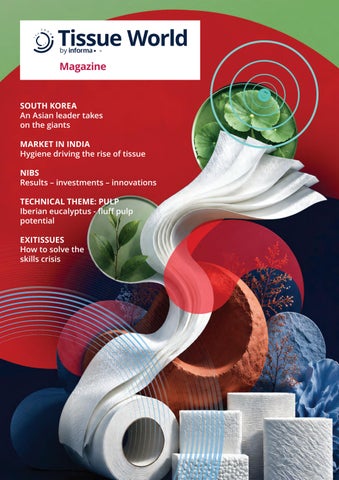
SOUTH KOREA An Asian leader takes on the giants MARKET IN INDIA Hygiene driving the rise of tissue NIBS Results – investments – innovations TECHNICAL THEME: PULP Iberian eucalyptus - fluff pulp potential EXITISSUES How to solve the skills crisis
TW26-SO-FrontCover_v004.indd TW26-JulAug.indb 1 1
11/09/2026 8/9/26 13:07 11:10
YOUR SINGLE SOURCE FOR TISSUE Bath Tissue | Facial Tissue | Napkins | Kitchen Towel | Industrial Towel | Center Pull Towel | TAD Bath and Towel | NTT Bath and Towel | Carrier and Specialty Tissue | Airlaid | Nonwovens | and more
THE GLOBAL LEADER IN T I S S U E The Power of Leadership Since 1976, Convermat has been the leading global supplier of parent rolls of tissue to more than 80 countries worldwide. Our unparalleled market intel and strong network of strategic alliances, resources, and insider knowledge can further grow and strengthen your business to achieve higher profits.
There When You Need Us We consistently maintain capacity balance for many of the leading global tissue players. Our extensive network of global suppliers and customers enables us to deliver a continuous flow of tissue at the most competitive prices in any market condition and to any destination with speed, reliability, and integrity.
At Your Service Our experienced team of seasoned professionals is equipped to handle all of your needs including inland and ocean transportation, import/export protocol, technical specifications, testing lab facilities, proprietary product development, foreign currency management, credit risk, and all relevant sales services.
More Than Tissue In addition to our complete line of tissue, towel, napkins, and specialty paper we supply a comprehensive line of nonwoven substrates for medical, wipes, automotive, filtration, hygiene applications, and more.
TW26-JulAug.indb 2
D 50
Vi
si
t u TW sa M t o iam ur i bo o
th
www.convermat.com T: 516.487.7100 F: 516.487.7170
11/09/2026 11:10
Tissue World Magazine | Contents
Cover image: South Korean tissue is creating skin-wellness innovations such as tissue with red clay, green tea, and tissue infused with red camellia extracts to provide softness and skin-care benefits. Image by Stefano Vuga, Founder, PurplePrint Creative, Spain/ Italy,www.purpleprint.eu
IN THIS ISSUE...
03
04 06 08 16 22 25 30 37 40
FRONTISSUES
South Korea: A tissue industry forging its own way in the shadow of regional giants and a demanding public.
MARKETISSUES
Tissue in India: demand and structured production growth signal the long-expected upturn. Strong cultural and economic changes are underpinning a volume-driven growth cycle in the world’s largest potential market. Here Sumit Khanna, Director of the New-Delhi based Beeta Machines looks to the short- and long-term prospects.
TISSUE WORLD AWARDS
The Tissue World Awards are back! Held as part of Tissue World Lisbon 2027, the Awards ceremony will be held on Tuesday 6 April 2027 just before the Day Zero drinks to kick off the world’s biggest tissue event.
NEWS IN BRIEF
A roundup of news from across the global toilet paper and kitchen towel markets. To get the very latest news go to: www.tissueworldmagazine.com
SOUTH KOREA: COUNTRY REPORT
South Korea: economy strong enough to support tissue demand in fiercely competitive region. With no new tissue capacity added since 2014 and a tissue trade balance heavily dependent on imports, the heavy reliance on recovered fibre will require a structural realignment if the consumer swing towards “pure and clean” products continues.
SOUTH KOREA: COUNTRY REPORT
Consumers swing towards practical tissue solutions for modern households and busy travel and working lifestyles. Premium products key by combing convenience, versatility and value delivered in a highly developed e-commerce infrastructure.
APP: OPERATIONS REPORT
Staying ahead in the rapidly evolving South Korean tissue market. Nishant Grover, APP Group CoChair of Investments, and Chairman of South Korea’s MSS Group, explains its rapidly diversifying portfolio of premium and functional products.
PULP: TECHNICAL THEME
Iberian eucalyptus potential in fluff pulp for absorbent products. By European-headquartered eucalyptus pulp production company Ence’s Vitor Batistela, Fluff Product Development Expert, Clara Orozco, Fluff Product Development Technician, Juan Luna, Fluff Product Development Manager, and María Peón, Technical Director of Commercial Area.
EXITISSUES
Tissue’s skills crisis: funded, integrated and agile training systems key to meeting growing challenge from entry level to management. Shortages of advanced level personnel is a recurring problem for the future of manufacturing worldwide. An Industrial Strategy introduced by the UK government aims to provide an integrated multi-level solution. Bethany Windsor, Head of Multimodal and Skills Policy at UK-based trade association Logistics UK assesses its aims.
AD INDEX
www.tissueworldmagazine.com
TW26-JulAug.indb 1
Jul/Aug | 1
11/09/2026 11:10
toscotec.com
TT TurboDryer. Recovered energy for maximum efficiency.
TW26-JulAug.indb 2
11/09/2026 11:10
Tissue World Magazine | FrontIssues
South Korea: A tissue industry forging its own way in the shadow of regional giants and a demanding public Helen Morris, Senior Editor, Tissue World Magazine Few if any tissue markets are more challenging than that across the wider Asian landmass in which South Korea does business, where nearregional neighbours China, Japan and Indonesia operate at diverse levels of dominance. The national economy is strong enough, despite domestic issues such as demographic decline and
Beeta Machines reports that tissue is now “one of the fastest-growing segments within the paper and hygiene industry.”
an ageing population, to support low but continued
Key enablers are increased awareness of the
tissue demand – current value growth of 1% to reach
importance of hygiene following the Covid pandemic,
KRW1.7tn – even against this fierce competition.
structural changes within the industry to increase
But the tech giant’s performance nevertheless faces
capacity, significant government investment in
systemic challenges: no new tissue capacity added
infrastructure across the country, and increased
since 2014, a tissue trade balance heavily dependent
foreign direct investment. The commercial sector has
on imports, and a heavy reliance on recovered fibre.
seen rapid development with formalised RTO policies,
Consumers used to sophisticated products know what
quick-service restaurants and HoReCa, and the rapid
they want of tissue. While bamboo and recycled fibre
growth of cloud kitchens – delivery-only commercial
currently dominates manufacturing, consumers are
cooking spaces that operate without a physical
trending towards “pure and clean” products. As the pace
storefront, dining room, or dine-in seating.
of lifestyles undergo fundamental changes – smaller or solo households, long working hours, hectic transport
The tissue market is opening up.
combine premium, versatile products, convenience,
Skills crisis: funded, integrated and agile training systems the answer
value-for-money, sustainability, and delivery via a highly
Apprenticeships need to be taken seriously. Much
developed e-commerce infrastructure.
has been said about the skills shortages facings
systems – they want practical tissue solutions which
companies as tissue manufacturing technology
Is tissue nearing a breakthrough in India?
becomes ever more advanced. That was before large language and numerical models loomed. Shortages
Tissue use in India has long been a story of extreme
of advanced level personnel is a recurring problem
contrasts. Sumit Khanna, Director of the New Delhi-
for the future of manufacturing worldwide. An
based Beeta Machines, sums it up well in TWM’s
Industrial Strategy introduced by the UK government
MarketIssues: historically a “relatively low-priority
aims to provide an integrated multi-level solution. In
niche” product operating against the yawning
ExitIssues, Bethany Windsor, Head of Multimodal and
potential of the largest number of consumers in the
Skills Policy at UK-based trade association Logistics
world at 1.4bn. All that growth, long out-of-reach. Yet
UK assesses its aims.
EDITORIAL HEADQUARTERS
ADVERTISING ENQUIRIES
TISSUE WORLD MAGAZINE
Informa, 240 Blackfriars Road, London, SE1 8BF, UK
Europe & North America
is published bi-monthly. The subscription price is US$400 per year for 6
Tel: +44 (0)20 7017 5000
Silvio Arati
issues. Subscription is free for qualified subscribers in the tissue industry.
Senior Editor
T: +39 02 4851 7853 / sarati@studioarati.it
Helen Morris: helen.morris@informa.com
South and Central America
Events Director – Tissue World Portfolio
Selma Ugolini
Natalie Diaz-Martin: Natalie.diaz@informa.com
Portfolio Director & Special Projects Ryan O'Donnell
Campaign Director
T: +55(11)99904 5350 / selma@gova.com.br
China, Hong Kong & Macau Rolle He T:+86-20-3895 1670 / Rolle.He@informa.com
Informa, 240 Blackfriars Road, London, SE1 8BF, UK Tel: +44 (0)20 7017 5000 / info@tissueworld.com
Subscription online at www.tissueworldmagazine.com In Tissue World all measures are metric and all dollars ($) are US dollars, unless otherwise stated. Copyright 2026 by Informa Connect. All rights reserved. All materials printed in Tissue World Magazine is owned by Informa and protected under the copyright act. No material may be reproduced in
Roxanna Kashfi: roxanna.kashfi@informa.com
part or in whole without the prior written consent of Informa.
www.tissueworldmagazine.com
TW26-JulAug.indb 3
Please send address corrections to:
Jul/Aug | 3
11/09/2026 11:10
Tissue World Magazine | MarketIssues
Tissue in India: demand and structured production growth signal the long-expected upturn Strong cultural and economic changes are underpinning a volume-driven growth cycle in the world’s largest potential market. Here Sumit Khanna, Director of the New-Delhi based Beeta Machines looks to the short- and long-term prospects. A TWM report.
T
he Indian tissue market has transformed
and hygiene awareness, the rapid expansion of
from a relatively low-priority niche into one
the commercial sector, and significant government
of the fastest-growing segments within the
investment in infrastructure across the country. At
paper and hygiene industry.
the same time, we have seen a substantial increase in tissue-making capacity and overall volumes over the
In April 2023, the country surpassed China as the
world’s most populous, according to estimates from the United Nations. At that time, India’s population reached approximately 1.425bn people, and now in September 2026 it has risen to 1.48bn compared to China’s 1.41bn.
past few years, which is helping the industry respond to this growing demand. The consumption mix in the AfH segment has evolved rapidly over the last couple of years. The key growth drivers have been QSRs (quickservice restaurants), technology and corporate
Over the last three years, the tissue market has
offices, and, of course, the wider HoReCa sector.
moved beyond the post-pandemic recovery phase
Increasing investment in India, including foreign direct
and entered a more structural, volume-driven growth
investment (FDI), is also contributing significantly to
cycle. This growth is being driven by rising health
the formalisation and expansion of these markets. Online food delivery and the rapid growth of cloud
Increasing investment in India, including foreign direct investment, is contributing signi cantly to the formalisation and expansion of these markets. 4 | Jul/Aug
TW26-JulAug.indb 4
kitchens - delivery-only commercial cooking spaces that operate without a physical storefront, dining room, or dine-in seating - have been particularly important growth engines, driving increased consumption of napkins and other tissue products. At the same time, the return-to-office trend and formalised office attendance policies implemented by technology companies and multinational corporations have reshaped corporate AfH consumption. FDI has also played an important role in institutionalising and expanding the backend infrastructure of the food-
www.tissueworldmagazine.com
11/09/2026 11:10
Tissue World Magazine | MarketIssues
As modern retail and organised retail continue to expand in India, I expect private-label tissue products to become increasingly relevant. service industry. Given these structural changes, I
2023
India surpassed China as the world’s most populous country
believe the AfH segment has considerable room for further growth over the coming years. In the private-label AfH category, these products currently have relatively limited significance. The segment is largely dominated by plain, non-branded products, particularly in institutional and commercial applications. Private label is likely to be more significant in the retail segment, where consumers are more directly exposed to brands and where retailers have greater opportunities to develop their own product ranges. As modern retail and organised retail continue to expand in India, I expect privatelabel tissue products to become increasingly relevant. Over the next five years, I see three major opportunities for the Indian tissue industry; bamboobased products, the continued expansion of the AfH segment, and international export markets.
1.48bn
India’s population in 2026
These areas have the potential to accelerate India’s development as a major global tissue manufacturing and supply hub. In particular, India’s growing manufacturing capabilities, expanding domestic consumption and increasing focus on sustainable fibre alternatives could create significant opportunities for both domestic and international markets. Additionally, one of the biggest challenges facing the Indian tissue industry is the continued dominance of the unorganised sector, the sectors that are part of the economy which aren’t regulated, registered or strictly monitored. This creates challenges in terms of standardisation, quality consistency, and the overall development of a more structured market. Another challenge is the influx of low-cost imported tissue paper and finished tissue products. While imports can provide consumers with more choice,
1.41bn.
China’s population in 2026
very low-priced imports can put pressure on domestic manufacturers and make it more difficult for organised Indian producers to compete purely on price. The industry therefore needs to focus on quality, efficiency, innovation and scale in order to build a more competitive and sustainable tissue market. www.tissueworldmagazine.com
TW26-JulAug.indb 5
Jul/Aug | 5
11/09/2026 11:10
The Tissue World Awards are back! The world’s biggest tissue event starts with the industry’s biggest night
C
tissue manufacturing with 12 categories
Tissue World Awards timeline: Tuesday 6 April 2027
including Tissue Mill of the Year,
Arrival & Networking:
Transformational Leadership, and Energy
Arrive at our stunning heritage site gazebo for our
Efficiency and Net Zero Achievement Awards up for
welcome reception. Enjoy local wines and artisan
grabs, the Tissue World Awards are officially back.
canapés while live Portuguese music sets the perfect
Held as part of Tissue World Lisbon 2027, the
ambiance. Network with fellow guests in our dedicated
Awards ceremony will be held on Tuesday 6 April
reception area, all designed to immerse you in authentic
2027 just before the Day Zero drinks to kick off the
Portuguese hospitality from the moment you arrive.
elebrating excellence across European
world’s biggest tissue event. The Awards will honour the companies and individuals driving progress
Dinner & Awards Ceremony:
across the European tissue industry and will be held
Settle in for an elegant dining experience featuring a
at a stunning Portuguese heritage site – the location
carefully crafted menu, live music, and entertainment.
of which will be announced very soon!
After dinner, the awards ceremony kicks off with a welcome speech, followed by the presentation
This exclusive evening brings together industry leaders for a formal ceremony and gala dinner
of awards across 12 distinguished categories,
recognising excellence across 12 categories. Following
celebrating excellence throughout the evening.
the awards presentation, guests will be welcomed to the Day Zero networking drinks at the same venue,
Post-Ceremony & Transition:
creating the perfect start to Tissue World Lisbon.
After the ceremony, celebrate and engage with award winners. Professional photos will be taken, and certificates will be presented to the runners up. Then gradually transition to the Day Zero drinks area to continue the evening’s connections in a more relaxed setting.
6 | Jul/Aug
TW26-JulAug.indb 6
www.tissueworldmagazine.com
11/09/2026 11:10
Tissue World Magazine | TissueWorld Awards
Day Zero Drinks Reception:
Holistic Environmental Leadership Award
Move to the Day Zero reception area in the same
Comprehensive commitment that raises the bar.
venue, open to all Tissue World Lisbon attendees. It’s
Recognise mills demonstrating environmental
the perfect opportunity to continue networking with
excellence across all dimensions, establishing
the broader tissue community.
benchmarks that inspire the entire industry.
Why Submit an Award Entry • Gain industry recognition • Showcase your achievements to the sector’s most influential audience • Benchmark performance • See how your initiatives compare with the best in the business • Amplify your story and inspire your team
Operational Excellence Award
Winners receive promotion across Tissue World’s
organisational culture, performance, and future
channels including Tissue World Magazine, website,
trajectory through visionary direction.
World-class performance, measurable results. Honour mills achieving outstanding manufacturing metrics that define what excellence looks like in tissue production.
Transformational Leadership Award Leadership that changes everything. Celebrate executives who have fundamentally reshaped
and social media.
Workforce Development & Future of Work Award
2027 Award Categories:
Building tomorrow’s capabilities today. Recognise
Energy Efficiency & Net Zero Achievement Awa
mills proactively preparing their teams for Industry
Leading the charge towards a low-carbon future.
4.0, creating workplaces where human talent and
Celebrate mills that have achieved exceptional results
technology amplify each other.
in energy management and decarbonisation, proving that sustainability and operational excellence go hand
Product & Market Innovation Award
in hand.
Innovation that meets the market where it matters. Honour breakthrough tissue products that
Digital Transformation Leader Award
successfully address diverse customer segments and
Where technology meets tissue production. Honour
evolving consumer needs.
mills that harness digital innovation to transform operations, elevate decision-making, and empower
Community & Regional Development Award
their workforce for the future.
Impact that extends beyond the mill gates. Celebrate exceptional contributions to community prosperity
Fibre & Product Innovation Award
and regional development, especially in rural or
Breakthrough thinking that reshapes what’s possible.
economically challenged areas.
Recognise pioneering advances in fibre sourcing, processing, or product development that push the
Tissue Mill of the Year Award
boundaries of both sustainability and performance.
The pinnacle of industry recognition. This honour celebrates all-around excellence, visionary leadership,
Workplace Safety Excellence Award
and transformative impact across every dimension
Acknowledge mills where employee health and safety
of mill operations. With over 30 years as the world’s
are woven into every aspect of operations, creating
leading tissue industry event series, the Tissue World
environments where people thrive and protection is
– Europe edition – will be held for the first time in
fundamental to success.
Lisbon, Portugal, between 6-9 April 2027.
Packaging Innovation Award Smart packaging that delivers on every front. Celebrate solutions that masterfully balance sustainability, functionality, and customer appeal in ways that set new standards.
www.tissueworldmagazine.com
TW26-JulAug.indb 7
Submit your awards entries today: https://tissue.awardsplatform.com https://www.tissueworld.com/lisbon/aboutthe-awards/
Jul/Aug | 7
11/09/2026 11:10
Tissue World Magazine | News in Brief
NEWS IN BRIEF A roundup of news from across the global tissue industry. To get the very latest news go to www.tissueworldmagazine.com
tissue and professional categories was partially offset by price-related investments to drive consumer trial of new products. Chairman and Chief Executive Mike Hsu said: “Our achievements in the first half of the year show that Kimberly-Clark’s durable operating model is enabling us to accelerate our transformation while sustaining the momentum of our brands and businesses. “Our team is executing with agility and addressing discrete headwinds that will moderate our growth and earnings potential in 2026. “We continue to invest in our innovation-led growth agenda and superior brand propositions that win with consumers across the value spectrum. “Combined with industry-leading gross productivity savings, we’re ensuring that our base business is well positioned to drive sustainable growth in 2027 and beyond.” The company launched Arbex – its strategic joint venture with Suzano – in July. Hsu added: “We entered the next phase of
GLOBAL
development of our next-generation, sustainable
K-C reports “significant strides” in Q2 results; enters next phase of development following Arbex launch Kimberly-Clark Corporation (K-C) has announced it is “accelerating its transformation” while sustaining the momentum of its brands and businesses.
materials innovation platform by announcing the construction of an alternative natural fibres pilot plant in the Southwest of the United States. “Our pending acquisition of Kenvue remains on track to close by the end of this year. “In sum, our vision for a new kind of health and wellness company, reimagined care for billions
Its latest results report that the company’s
of people around the world, and lasting value for
“durable operating model” has resulted in sustained, innovation-driven volume-plus gains, as net sales
shareholders is becoming clearer by the day.” The company also noted that its second quarter
increase by 0.6% to of $4.2bn.
results were “negatively impacted by a discrete
Gross margin was 38.3% compared to 35.0 percent
disruption stemming from false allegations
in the prior year, while second quarter operating
regarding the quality of certain diaper brands in the
profit was $633m compared to $592m year-on-year.
China market.”
For the first half of the year, net sales of $8.4bn
It said: “Independent testing conducted by a
increased 1.6%m and gross margin was 37.6%
government-certified third party confirmed the
compared to 36.1% year-on-year.
quality and safety of the company’s products, refuting
Year-to-date organic sales increased 0.5%, as
the false allegations.
volume growth of 0.8%, led by gains in consumer 8 | Jul/Aug
TW26-JulAug.indb 8
www.tissueworldmagazine.com
11/09/2026 11:10
18 - 19 November 2026
Hilton Istanbul Bosphorus
The sector’s most influential event
Join us in Istanbul
Tissue World Magazine | News in Brief
“While the company is effectively navigating the
AI played a role in the launches, for example by
situation, the impact from the spread of false claims across social media significantly impacted the
shortening product development lead times. Kolsrud said: “AI is increasingly being adopted
company’s diaper sales in China in the second quarter
to drive sales and improve efficiency across the
and is expected to further impact sales and profits in
value chain.
the near term.”
“One example of this is an agentic Group-wide
Essity reports higher volumes and resilient profitability in latest result Essity has reported a net sales increase of 2.6% to
AI solution for procurement deployed during the quarter that is helping to increase efficiency and improve data quality.” During the first half of 2026, she added that the
SEK35,061m (34,185) in its Interim Report Q2, as sales
company took key steps to strengthen the conditions
for its Consumer Tissue division decline due to lower
for profitable growth: “Our new organisational
prices and volumes.
structure has made us more agile and customer-
EBITA for the group was SEK4,105m (4,628), while profit for the period was SEK2,693m (3,053).
focused, while actions taken under our cost savings programme is unlocking resources for investments in
Organic sales increased during the quarter, which the company said was driven by volume growth and positive development of the product mix.
our strong brands. “We have also taken important steps to optimise our portfolio and strengthen value creation through
Three of the four business areas – Health &
the acquisition in Feminine Care and the strategic
Medical, Personal Care and Professional Hygiene –
review of Consumer Tissue.”
contributed positively, while growth remained strong
In the second half of the year, she said the
in Incontinence Products Retail, Feminine Care and
company expects to see positive effects from the
Medical Solutions.
new organisational structure and the implemented
Professional Hygiene grew because of higher
efficiency improvements.
volumes and a favourable product mix.
“Our aim is to continue strengthening our
Sales for Consumer Tissue declined due to lower prices and volumes. The company said the business
market positions and expand in our most attractive categories and segments,” she said.
area is currently working intensively to secure profitable volumes and increase prices to address the cost headwinds that emerged during the quarter. Ulrika Kolsrud, President and Chief Executive, said: “Higher volumes and an improved product mix resulted in sales growth for the quarter. “Our focus on growth by developing our offerings, investing in marketing and selective price adjustments continued, and we reported good growth in Health & Medical, Personal Care as well as Professional Hygiene. “Profitability was healthy even though the geopolitical situation causes higher cost inflation.” Essity reported higher margins for Health & Medical and Professional Hygiene, while margins in Consumer Tissue and Personal Care declined. Consumer Tissue was negatively impacted by higher cost inflation, which Essity said it has not yet offset with price increases.
Innovation remains a key driver of competitiveness and growth During the quarter, Essity launched new products across all business areas. 10 | Jul/Aug
TW26-JulAug.indb 10
Essity has reported a net sales increase of 2.6% to SEK35,061m (34,185) in its Interim Report Q2, as sales for its Consumer Tissue division decline due to lower prices and volumes. EBITA for the group was SEK4,105m (4,628), while pro t for the period was SEK2,693m (3,053).
www.tissueworldmagazine.com
11/09/2026 11:10
Tissue World Magazine | News in Brief
Navigator reports net profit up 85% in Q2 results; tissue segment shows “growth trajectory at a global level”
Tissue strengthens its international presence and focuses on premium products
The Navigator Company has reported a turnover of
as a strategic pillar of growth and international
€442m – up 4% on the previous quarter – and EBITDA
diversification, already accounting for around a
rising by 21% to €79m in its second quarter results.
quarter of turnover. Against a backdrop of increasing
Net profit increased by 85% to €32m, which the
The tissue business continues to establish itself
competitive pressure, tissue has shown a growth
company said reflects the recovery in volumes and
trajectory at a global level, demonstrating resilience in a
prices across the core businesses and the growing
more challenging economic and market environment.
contribution from the packaging and tissue divisions
Tissue sales volume in tonnes was in line with the first
which accounted for over 30% of turnover.
quarter, with average prices rising by 2%. However,
For the first half of the year, turnover totalled €869m,
the company said this was constrained by increased
with EBITDA of €143m and a net profit of €49m. The
competition in the UK and a focus on margin
improvement in results was against a backdrop the
management, at a time when a project to transform
company described as “strongly characterised by
the industrial footprint in that country is underway.
economic and geopolitical volatility, exacerbated by
The project is aimed at enhancing operational
tensions in the Middle East and the resulting rise in the
efficiency through asset locations and costs, and is
costs of raw materials, energy and logistics.”
expected to be completed during the first half of next
In response to rising operating costs, the company
year. Sales outside Portugal by the tissue business
has launched a new programme to reduce variable
accounted for 80% of sales volume in the first half
costs, with the initiatives expected to offset almost
of 2026 (compared with 54% in 2022, prior to the
half of this impact over the course of 2026.
integration of Tissue Ejea and Tissue UK), with the most
This programme is expected to generate an estimated positive contribution of around €28m
significant markets being Spain (32% of total sales), the UK (31% of total sales), and France (15% of sales).
in 2027 and in subsequent years, strengthening
The company said the At Home channel has been
Navigator’s competitiveness and ability to create
“gaining increasing importance”, currently accounting
value. The company is also in the final phase of a
for around 84% of sales, whilst the AfH segment
major strategic investment cycle: in the first half of
accounts for the remaining 16%.
the year, total investment amounted to €127m, of which around €72m was allocated to environmental
Recovery in international pulp prices
or sustainability initiatives.
The company added that following “a year of strong
The integration of new technologies and state-
pressure on international prices”, the pulp market
of-the-art industrial projects entailed a period of
entered a recovery cycle during the second half of
operational adjustment, with a temporary impact on
2025, which consolidated in the first half of 2026.
available volumes of pulp and paper.
In response to rising operating costs, the Navigator Company has launched a new programme to reduce variable costs, with the initiatives expected to o set almost half of this impact over the course of 2026.
This, it said, reflected a gradual improvement in the balance between supply and demand and increasing discipline on the production side. The benchmark index for short-fibre pulp – PIX BHKP in US dollars – closed the half-year at $1,409 tons in Europe, representing an increase of approximately 27%. In China, the benchmark price closed the half-year at $605 tons, a rise of around 7%. Navigator’s pulp sales totalled 111,000 tonnes this half-year.
€127m invested in the modernisation and decarbonisation of operations In the first half of 2026, Navigator invested €127m (compared with €94m in the same period last year), of which around €72m related to value-creating investments in environmental or sustainability initiatives.
www.tissueworldmagazine.com
TW26-JulAug.indb 11
Jul/Aug | 11
11/09/2026 11:10
Tissue World Magazine | News in Brief
Resilience and recovery for the second half of the year
WWF’s international Climate Savers programme,
Navigator said the outlook for the second half of 2026
becoming the first Italian manufacturing company
continues to be influenced by a challenging and highly
and the first tissue company worldwide to do so.
The partnership began in 2008 when Sofidel joined
volatile international environment, characterised by
Luigi Lazzareschi, Chief Executive Officer of
growing economic and geopolitical uncertainty, trade
Sofidel, said: “Our partnership with WWF has been a
tensions and pressure on value chains. Following the
driving force from the very beginning. It has helped
recovery seen in the first half of the year, the pulp
us build internal awareness, develop responsible
market began to show signs of adjustment in China
energy and sourcing policies, and measure our
during July, reflecting more moderate demand and
progress rigorously. We believe this long-standing
greater availability of domestic production. Despite
collaboration has been a valuable catalyst for cultural
short-term adjustments, the overall outlook for 2026
growth, helping Sofidel advance its sustainable
remains one of average prices higher than those
growth journey on solid foundations.”
recorded in 2025, particularly for short-fibre pulp in
Alessandra Prampolini, Director General of WWF
Europe and China. In the Tissue segment, the outlook
Italy, added: “Over time, this partnership has shown
for 2026 “remains favourable overall”, with demand
how open, constructive, and rigorous dialogue
expected to grow by around 0.8% in Europe and
can help strengthen corporate strategies and
1.6% globally.
turn commitments into tangible, positive results.
Navigator continues to consolidate its
Renewing this partnership today reaffirms our shared
competitiveness and reinforce a resilient, integrated
commitment to tackling environmental challenges
and forward-looking strategy.
with ambition and responsibility, contributing to a more sustainable and resilient future, together.”
Sofidel and WWF Italy renew partnership on climate and energy
The three areas of collaboration for 2026–2028:
Sofidel and WWF Italy have renewed their partnership
On climate and energy, the partnership will support
on climate and energy transition, responsible forest
Sofidel in maintaining its commitments under the
sourcing, and stakeholder awareness.
Science Based Targets initiative (SBTi). Regarding
Eighteen years after signing their first agreement,
forest sourcing, Sofidel and WWF will continue their
Sofidel said the collaboration has “delivered positive
transformative collaboration, whose scope extends
and measurable results, supporting and giving
across Europe and the United States with the support
concrete expression to Sofidel’s decision to make
of WWF International. Activities will include support
sustainability a strategic driver of growth.”
in defining and updating responsible sourcing criteria, monitoring supply chains, and conducting an annual analysis of raw material origins to ensure traceability throughout the value chain.
The outlook for the second This work builds on an ongoing effort that has already enabled Sofidel to source 100% of its virgin half of 2026 continues pulp from FSC® – and PEFC-certified sources. to be in uenced by a The third focus area, awareness-raising, includes environmental education initiatives aimed at Sofidel’s challenging and highly stakeholders, with WWF leveraging its expertise and volatile international experience to promote best practices and strengthen a culture of sustainability throughout the value chain. environment, Sofidel’s commitment is recognized by leading characterised by growing international ESG rating platforms: in 2025, CDP the Group an A – rating for Climate Change economic and geopolitical awarded and Forests, with the highest score of A for Timber, as uncertainty, trade well as for Supplier Engagement on Climate Change. Finally, EcoVadis awarded Sofidel the Platinum tensions and pressure on Medal, placing the company among the top 1% of value chains. companies worldwide with the highest scores. 12 | Jul/Aug
TW26-JulAug.indb 12
www.tissueworldmagazine.com
11/09/2026 11:10
Tissue World Magazine | News in Brief
BW Packaging announces strategic partnership with Crown Packaging BW Packaging has strengthened its integrated packaging capabilities after forming a strategic partnership with Crown Packaging Corp. The partnership brings together BW Packaging’s portfolio of packaging machinery, automation technologies and integrated systems with Crown Packaging Corp.’s packaging automation, integrated packaging capabilities and distribution network of over 50 branches across the United States, Mexico and Canada. The company said the partnership will provide customers with solutions designed to improve operational efficiency, reduce downtime, enhance sustainability initiatives and streamline end-of-line packaging processes.
Matt Venezia, Chief Commercial O cer, BW Packaging, said: “Our collaboration with Crown Packaging represents a shared commitment to helping customers solve complex packaging challenges through innovative technology and exceptional service.“
Matt Venezia, Chief Commercial Officer, BW Packaging, said: “Our collaboration with Crown
Toscotec’s scope of supply covered the complete
Packaging represents a shared commitment
rebuild of the thermal power system. This upgrade
to helping customers solve complex packaging
enables the full recovery of the gas turbine’s exhaust
challenges through innovative technology and
gas to supply heat to the air systems for both hoods,
exceptional service.
as well as to generate both high – and low-pressure
“Combining Crown’s customer relationships, service footprint and broad selection of packaging supplies
steam for PM4 and PM5. The two paper machines have a combined capacity
with BW Packaging’s integrated machinery solutions
of 46,000tpy and manufacture high-quality tissue
creates new opportunities to support our customers
products including facial tissue, toilet paper, tissues,
with scalable, future-ready packaging systems.”
and kitchen towel.
Rich Benkelman, Executive Vice President, Crown
Giovanni Pomari, Plant Director at Cartiera del
Packaging Corp., added: “Customers today are looking
Vignaletto, said: “Completing this project required
for more than individual products or standalone
strong cooperation between Toscotec and our
machines; they want integrated solutions and
technical team at Cartiera del Vignaletto, supported
trusted partners who can help optimise their entire
by the long-term vision of our ownership. “The result gives our mill a more efficient,
packaging operation. “By partnering with BW Packaging, we’re strengthening our ability to deliver world-class packaging machinery, technical expertise and long-
reliable, and sustainable energy platform for its future development.” The site is equipped with a 5.5 MW gas turbine capable of supplying electrical power to
term value to our customers.”
both machines.
ITALY
Founded in 1966, Cartiera del Vignaletto produces
Cartiera del Vignaletto boosts production capacity with plant upgrade
jumbo and rewound rolls of different grades ranging from 15 to 40 gsm, covering the complete range of tissue products.
Italy’s Cartiera del Vignaletto has increased its production capacity after investing in a Toscotecsupplied complete cogeneration plant upgrade at its facility in Zevio. The aim of the rebuild was to increase the mill’s energy efficiency, with the project featuring a complete upgrade of the cogeneration plant and air systems of PM4 and PM5. www.tissueworldmagazine.com
TW26-JulAug.indb 13
Jul/Aug | 13
11/09/2026 11:10
Tissue World Magazine | News in Brief
Velvet CARE has launched a commercial company in Germany to strengthen its direct presence in German, Austrian and Swss markets. Velvet CARE Germany will take responsibility for the products in the region and will be headquartered in Freiburg.
The establishment of Velvet Care Germany is another step in the implementation of the company’s international expansion strategy and confirms the key role of Germany as one of the most important markets for the group’s further growth. In the coming months and years, the company plans to expand sales in Austria and Switzerland. Paweł Bajorek, President of Velvet Care, said: “We plan to triple Velvet CARE product sales in the German market by 2028… and then maintain an equally rapid growth rate. “This is a very ambitious goal, but one made possible by our ability to offer the highest quality products—tailored to the needs of discerning consumers—as well as efficient logistics and full control over the sales process.”
GERMANY
CANADA
Velvet CARE boosts private label presence with new branch launch
Canfor announces closure of Northwood Pulp Mill
Polish tissue manufacturer Velvet CARE has launched
Canfor Corporation has announced the permanent
a commercial company in Germany to strengthen
closure of its Northwood pulp mill in Prince George,
its direct presence in DACH (Germany, Austria,
British Columbia. The closure results in an annual
Switzerland) markets. Velvet CARE Germany will take
reduction of 300,000 tonnes of Northern Bleached
responsibility for the sale of the group’s products in
Softwood Kraft (NBSK) from Northwood. Approximately
the region and will be headquartered in Freiburg.
300 employees in Prince George are directly impacted.
Its operations focus on providing the highest quality tissue products, particularly under private labels.
The company said: “The pulp and paper sector continues to face significant challenges, including a
Velvet CARE products have been sold in the German market for over a decade under the “Veltie” brand
structural shift in global pulp markets. “Substantial additional pulp production capacity has
and private labels manufactured for individual
come online globally, creating an oversupply in the
retail chains. This is due to the specific nature of the
market and downward pressure on global pulp prices.
German market, where private labels account for
“Combined with the persistent challenges accessing
over 85% of paper hygiene product sales.
fibre, these factors have resulted in a prolonged
Until now, Velvet CARE products have been
period of unsustainable financial losses for Canfor
distributed through an external partner. The company’s
Pulp. With no foreseeable improvement in the
operating model is based on close cooperation with
outlook, Canfor has made the difficult decision to
Velvet Care’s production facilities in Poland.
close its Northwood facility.
Deliveries will be made primarily from the Sulęcin
Susan Yurkovich, President and Chief Executive,
plant (Velvet WEST), located near the German border,
said: “The team at Northwood has worked tirelessly
due to optimized logistics costs and increased
to improve performance, navigating challenging
operational flexibility.
conditions to support their operation and we are
Velvet CARE Germany will be led by Stephan Knapp,
grateful for their efforts. In the weeks ahead, we are
who has previously worked at companies include
committed to supporting our employees through
Unilever, Reckitt, and the Dr. Beckmann Group.
this transition, including providing severance, and
He said: “Our goals in these demanding markets
exploring opportunities to redeploy impacted
are very ambitious, but realistic – we are able to offer
employees to our other operating locations
excellent quality Velvet Care products at competitive
where possible.”
prices”– emphasizes Stephan Knapp, DACH Country Manager, who assumed his position on 1 July.” 14 | Jul/Aug
TW26-JulAug.indb 14
Northwood will be following an orderly wind-down process and is expected to close in late Q4 2026.
www.tissueworldmagazine.com
11/09/2026 11:10
Tissue World Magazine | News in Brief
NORTH AMERICA
into the United States and we are conducting
Cascades 2Q results exceed expectations; tissue sector benefits from improved productivity and sales volumes Cascades has reported second quarter results that “exceeded expectations”, as its tissue sector results are reported ahead of expected range. The corporation’s second quarter sales of $1,219m
an assessment of the potential impact on our operations. “Based on information currently available, certain tissue and packaging products exported to the United States could be subject to the announced 50% tariffs. “While this represents a notable development, we believe the potential impact is manageable. “We are actively pursuing several tactical initiatives that we expect will materially mitigate the potential
increased by $32m compared with the same period
financial impact of these tariffs over the coming
last year, a result of consolidated net benefits of
months. In addition to the direct effects of this
$13m from higher average selling prices and a
announcement, some customers whose products
favourable sales mix of $21m.
are subject to these tariffs may experience weaker
However, these factors were partially offset
demand or reduce production levels, which could
by a $2m impact from lower volumes, mainly in
negatively affect volumes in certain segments.
the packaging products segment, reflecting the
“Based on our current assessment and the
impact of business closures and dispositions in
mitigation actions underway, we remain confident in
previous quarters.
our ability to successfully manage these challenges.
Second quarter operating income was $58m,
“Looking ahead, this situation does not change our
compared with $81m in Q1 2026 and $36m in Q2
confidence in the earnings trajectory of the business.
2025, while second quarter EBITDA (A)1 totalled
“Supported by our ongoing profitability
$140m, an increase of 2%, from the $137m generated
improvement initiatives and the momentum we
in the same period last year.
continue to see across our operations, and excluding
Cascades said this was driven by higher volumes,
the potential impact of the announced tariffs, we now
higher average selling prices and cost reduction
expect annual run-rate Adjusted EBITDA to exceed
initiatives across the corporation’s businesses.
$600m during the second half of 2026, surpassing our
Hugues Simon, President and Chief Executive, said: “Our second quarter results exceeded
original objective. “The implementation of previously announced
expectations, driven by a stronger performance in
selling price increases in both packaging and tissue is
packaging, reflecting continued solid production
progressing as planned.”
and demand levels across our paper mill network,
In packaging, the recent $50 per ton price increase
meaningful progress in onboarding new customers
announced in June is expected to further strengthen
and a more favourable economic environment than
earnings momentum.
initially anticipated.
He said: “This confidence reflects the
“Packaging volumes tracked ahead of our
significant work completed over the past several
forecasted assumptions, contributing to stronger
quarters to make Cascades a more resilient and
profitability in the quarter.
agile organisation.
“In tissue, the results came in slightly ahead of
‘Through operational excellence initiatives,
our expected range. Performance benefited from
cost optimisation efforts and disciplined capital
improved productivity and sales volumes and the
allocation, we have strengthened our ability
positive impact of ongoing cost reduction initiatives.
to respond effectively to changing market
The operational improvements achieved over the past several quarters are translating into greater efficiency and a stronger cost structure across the business.
conditions and navigate a period of heightened geopolitical uncertainty. “We are also closely monitoring developments in the Middle East. Continued instability has increased
“Overall, our leverage ratio remained stable during
volatility in energy markets, and sustained increases
the quarter, while net debt decreased modestly
in oil prices could create additional inflationary
despite unfavourable exchange rate movements.
pressures on transportation, manufacturing and
“On 20 July 2026, the US administration announced
other operating costs.”
new tariffs on a number of products imported www.tissueworldmagazine.com
TW26-JulAug.indb 15
Jul/Aug | 15
11/09/2026 11:10
Tissue World Magazine | ResourceWise
South Korea: economy strong enough to support tissue demand in fiercely competitive region With no new tissue capacity added since 2014 and a tissue trade balance heavily dependent on imports, the heavy reliance on recovered fibre will require a structural realignment if the consumer swing towards “pure and clean” products continues. Report by ResourceWise Senior Consultant Bruce Janda.
W
hen this column last examined South
difficult to distinguish on the regional map. Those
Korea in 2023, it traced the country’s
sites are controlled by 10 producers: two publicly
long recorded history, dating to about
traded companies and eight privately held firms.
2300 B.C., and noted an economy built largely on
Among the private operators is Yuhan-Kimberly, a
manufacturing and trade after its separation from
Kimberly-Clark joint venture. Yuhan-Kimberly enjoys
North Korea. At the time, South Korea was emerging
the largest market share at about 29%. Like Kimberly-
from the Covid-19 pandemic while contending
Clark’s partnerships in Mexico and Bahrain, however,
with higher energy costs tied to Russia’s invasion
Yuhan-Kimberly is not included in the new venture
of Ukraine. Those pressures have since intensified,
between Suzano and Kimberly-Clark.
as continued attacks on Russian oil refining and
The expanded map underscores South Korea’s
distribution linked to the war in Ukraine, along with
strategic position between Japan and China, while
the closure of the Strait of Hormuz, have pushed
several other regional tissue-producers - including
energy costs higher. Meanwhile, new US tariff
Indonesia, Thailand, Vietnam, and Malaysia - sit just
regimes have disrupted global trade. Although tissue
beyond the frame.
production has never been a major pillar of South
South Korea appears to have the economic base
Korea’s economy, the sector is now facing mounting
to support continued tissue demand, as Figure 2’s
headwinds from an ageing population, rising pulp
population and GDP (PPP) trends suggest. But the
import costs, and higher energy expenses.
headline indicators do not fully reflect the strain of a rapidly ageing population or the fiscal pressure
South Korea’s tissue production footprint remains
that demographic shift is placing on the country.
relatively concentrated, as shown in Figure 1. The
Consumer behaviour is also diverging: higher-income
country has 15 tissue-producing locations, several
households are increasingly turning to online,
of them clustered within the same cities, and are
warehouse-style bulk purchases, while lower-income
16 | Jul/Aug
TW26-JulAug.indb 16
www.tissueworldmagazine.com
11/09/2026 11:10
Tissue World Magazine | ResourceWise
Figure 1: South Korea Tissue Sites on Regional Map
Figure 2: South Korea Population and GDP (PPP) Trend
Figure 3: South Korea Inflation and Unemployment
Figure 4: South Korea Tissue Import Trend
Figure 6: South Korea Tissue Machine Count Trend
Figure 5: South Korea Tissue Export Trend
shoppers are relying more on smaller purchases through convenience stores. Private-label tissue, led by Yuhan-Kimberly, has gained traction in that shifting market. GDP (PPP) is forecast to expand by roughly 2% annually in the near term, with much of the growth expected to come from high-tech exports. Inflation has begun to move higher, as Figure 3 shows, and the pressure could persist as energy and raw material imports absorb shocks from strained global supply chains. Unemployment remains low, partly because South Korea’s ageing population
South Korea appears to have the economic base to support continued tissue demand, but the headline indicators do not fully re ect the strain of a rapidly ageing population or the scal pressure that demographic shift is placing on the country.
www.tissueworldmagazine.com
TW26-JulAug.indb 17
Jul/Aug | 17
11/09/2026 11:10
Tissue World Magazine | ResourceWise
Figure 7: South Korea Tissue Production by Product Type and Fibre Source
Figure 8A: South Korea Tissue Machine Quality Comparison by Machine Speed
Figure 8B: South Korea Tissue Machine Quality Comparison by Machine Width
Figure 9: Average Cash Cost Comparison
is shrinking the workforce. For domestic tissue
between the two. Today, tissue imports are roughly
makers, that combination is accelerating investment
nine times the level of exports. Indonesia and China
in manufacturing and packaging automation, along
are the two leading sources of tissue imports.
with projects aimed at reducing energy use. Even
New tissue-machine investment has been limited
so, rising cost pressures could leave South Korean
over the past two decades compared with other
producers less competitive than regional rivals such
developed markets, as Figure 6 shows. Commercial
as Indonesia.
and specialty tissue each recorded one machine
South Korea’s tissue trade balance has shifted
shutdown during the period. Consumer tissue added
sharply over the nearly two-decade study period.
one machine in 2007, 2011 and 2014, while 2013
Imports have climbed almost twentyfold, while
marked a larger replacement cycle with five new
exports reached their high point in 2019. Figures
consumer-tissue machines. The segment also lost one
4 and 5 show the import and export trends on the
machine in 2008 and two more in 2015. No additional
same Y-axis scale, underscoring the widening gap
machines have been announced, and South Korea
South Korea’s tissue trade balance has shifted sharply over the nearly two-decade study period. Imports have climbed almost twentyfold, while exports reached their high point in 2019. 18 | Jul/Aug
TW26-JulAug.indb 18
has not added new tissue capacity since 2014. Figure 7 breaks down South Korea’s tissue output by finished product and fibre source, revealing an industry that relies heavily on recovered fibre across nearly every product category. The red bar segments underscore that dependence. The approach could become a vulnerability as consumers place greater emphasis on “pure and clean” products and scrutinise chemical additives more closely. If South Korean buyers were to adopt concerns similar to those seen in China over recycled fibre in products used in direct human contact, producers could face pressure to shift their furnish mix. With limited
www.tissueworldmagazine.com
11/09/2026 11:10
Tissue World Magazine | ResourceWise
domestic forest resources, however, South Korea must import virgin baled pulp, raising the possibility that mills will look to domestic non-wood fibre sources to offset some of those costs. Consumer bath tissue dominates the country’s tissue output, with volume far exceeding all other formats combined. That segment also uses eucalyptus fibre, along with smaller amounts of northern softwood and bleached non-wood short fibre—an indication that these furnishes are likely used in premium, higher-softness grades. Consumer facial tissue contains higher levels of eucalyptus fibre and some recovered fibre, while commercial napkins, commercial bath tissue and consumer towels are produced largely from recovered fibre. Commercial tissue remains a relatively small part of South Korea’s production base compared with
Consumer bath tissue dominates the country’s tissue output, with volume far exceeding all other formats combined. That segment also uses eucalyptus fi re, along with smaller amounts of northern softwood and bleached non-wood short bre
markets in North America and Western Europe. Commercial napkins are the notable exception,
Japan occupy the highest-cost positions, while South
standing out as the strongest segment within the
Korea sits slightly below China’s average. Indonesia
country’s away-from-home tissue mix.
stands out as the region’s clear low-cost producer.
A comparison group of Australia, China, India,
Energy, shown in the yellow bars, is already exerting
Indonesia and Japan was selected to benchmark
an outsized influence on the cost picture, even
South Korea’s tissue-production base against current
though the underlying estimates were developed
trade partners and potential lower-cost competitors.
before the Iran war.
Figures 8A and 8B use bubble charts to compare
Figure 10 shifts the comparison from immediate
tissue-machine quality, with bubble size indicating
cash costs to a broader test of long-term
production capacity. In both charts, the X-axis shows
competitiveness, measuring the average viability
average technical age. The Y-axis differs: Figure 8A
of tissue machines across several countries. The
plots average machine speed, while Figure 8B plots
FisherSolve model factors in estimated capital
average machine width. Although analysts typically
requirements, production costs, machine size,
use one measure or the other to illustrate machine
technical age, local economic risk by grade, internal
capability, this review includes both because speed
company risk, manufacturing competitiveness, tons
and width together reveal wide differences in
produced per unit of trim and export fees. Taken
productivity across the group. Those same factors are
together, those indicators offer a five-year view of
also reflected in the average tissue-machine viability
which tissue fleets are best positioned to compete.
analysis shown in Figure 10.
By that yardstick, South Korea’s tissue fleet ranks
China operates the newest tissue machines in
as the second weakest in the group, ahead of only
the comparison set, with India and Indonesia close
Japan; higher scores signal lower viability or greater
behind. South Korea, Thailand and Japan have the
risk. The country is weighed down by higher capital
oldest fleets on average. Indonesia and Australia also
requirements and production costs than most
benefit from faster and wider machines, creating
regional competitors, while Indonesia benefits
a productivity advantage that spreads labour and
from a lower-cost base and lighter capital needs.
overhead costs across more tons of output. That
Figure 12 adds an emissions dimension to the same
advantage could become increasingly important as
competitiveness story.
South Korea and Japan contend with shrinking, ageing populations and tighter cost pressures. Figure 9 shows how sharply tissue-production costs
Figure 11 shows a focus on energy costs per ton of the comparison set. This chart breaks energy costs into steam, electric power and direct fuel. The
vary across South Korea’s regional peer group, with
figures were measured in early 2026, before the
each bar measuring average cash cost per ton and
Gulf war, and could shift significantly as regional
its width reflecting production capacity. Australia and
energy markets respond. Indonesia holds the lowest
www.tissueworldmagazine.com
TW26-JulAug.indb 19
Jul/Aug | 19
11/09/2026 11:10
Tissue World Magazine | ResourceWise
Figure 10: Average Tissue Machine Viability Comparison
Figure 11: Average Energy Cost/Ton of Tissue Produced
Figure 12: Average Carbon Emissions/Ton as Scopes 1 & 2
energy-cost position per ton, while South Korea
benefits from a relatively low-carbon grid and lower
and Japan sit at the high end. That spread provides
fuel-related emissions, helped by a larger share of
important context for the viability comparison shown
tissue machines located at integrated pulp sites
in Figure 10.
where heat and electricity can be generated from
Figure 12 adds an emissions lens to the regional comparison, showing Scope 1 emissions from on-
carbon-neutral biomass. China remains the region’s largest source of tissue-
site fuel use in red and Scope 2 emissions from
production emissions, both in total carbon released
grid electricity in tan, each measured per ton of
and in emissions per ton of tissue produced. Much
finished tissue. Scope 2 results depend heavily on the
of that output is tied to the electricity grid supplying
carbon intensity of the local power grid. Indonesia
production sites. Thailand, India, Australia and South
China remains the region’s largest source of tissue-production emissions, both in total carbon released and in emissions per ton of tissue produced. Much of that output is tied to the electricity grid supplying production sites. 20 | Jul/Aug
TW26-JulAug.indb 20
Korea also sit near China’s carbon-intensity level, underscoring how power and fuel supply can shape the environmental profile of tissue manufacturing.
www.tissueworldmagazine.com
11/09/2026 11:10
Tissue World Magazine | ResourceWise
Summary
South Korea’s tissue sector is facing mounting
Further consolidation or ownership changes among
pressure from higher energy costs, rising pulp import
South Korean tissue producers are likely as regional
costs, an ageing population, and shifting global trade
competition intensifies and new capacity develops in
conditions. The country’s tissue-production base
neighbouring countries.
is relatively concentrated, with 15 production sites
South Korea’s tissue industry is moving into
controlled by 10 producers; Yuhan-Kimberly remains
a tougher competitive cycle, with its prospects
the leading player with about 29% market share.
increasingly shaped by regional rivals and the
Domestic demand appears supported by South
quality of the machines they operate. Indonesia
Korea’s strong economic base, but demographic
is well placed to emerge as the region’s leading
ageing and changing shopping patterns are reshaping
tissue exporter, backed by lower costs and stronger
consumer tissue purchases.
production economics. In South Korea, domestic
Tissue imports have grown sharply, rising almost
output appears to be narrowing as capacity growth
twentyfold over the study period, while exports
stalls and imports gain share. The divide reflects a
peaked in 2019; imports are now roughly nine times
broader split in the economy: high-tech industries
higher than exports.
and their workers continue to advance, while lower-
Indonesia and China are South Korea’s leading
technology manufacturing and workers face rising
sources of tissue imports, underscoring the
pressure. Tissue producers are also wrestling with
importance of regional low-cost competitors.
higher energy and fibre costs as consumer demand
New tissue-machine investment has been limited, and South Korea has not added new tissue capacity since 2014.
fragments by income level and purchasing channel. Global volatility is intensifying those pressures. Shifts in fibre prices, exchange rates, energy markets
South Korea’s tissue production relies heavily on
and environmental regulation are reshaping the
recovered fibre, a potential vulnerability if consumers
economics of tissue production across the region.
increasingly favour “pure and clean” products made
South Korean mills are likely to see further ownership
with virgin fibre.
changes and consolidation, while new tissue making
Consumer bath tissue dominates domestic output, while commercial tissue remains a relatively small
investment in neighbouring countries could alter the country’s import and export flows in the years ahead.
part of the country’s production base. Compared with regional peers, South Korea operates an older tissue-machine fleet, while
South Korea’s tissue machines that support stronger productivity. industry is moving into South Korea’s average cash costs are higher than a tougher competitive Indonesia’s and sit near China’s level, with energy costs playing an increasingly important role. cycle, with its prospects In long-term machine viability, South Korea ranks as increasingly shaped by the second weakest in the comparison group, ahead of only Japan. regional rivals and the Indonesia stands out as the region’s strongest quality of the machines low-cost competitor, benefiting from lower production costs, lower energy costs, and lighter they operate. Indonesia capital requirements. is well placed to emerge Energy-cost volatility, exchange-rate swings, fibreprice changes, and environmental regulation are as the region’s leading likely to shape South Korea’s tissue competitiveness tissue exporter, backed by in the years ahead. Carbon emissions add another competitive lower costs and stronger dimension, with South Korea near the higher-intensity production economics. group alongside China, India, Thailand, and Australia. Indonesia and Australia benefit from faster and wider
www.tissueworldmagazine.com
TW26-JulAug.indb 21
Jul/Aug | 21
11/09/2026 11:10
Tissue World Magazine | EuroMonitor
Consumers swing towards practical tissue solutions for modern households and busy travel and working lifestyles Premium products key by combining convenience, versatility and value delivered in a highly developed e-commerce infrastructure. Report by Euromonitor International Consultant Per Brandberg.
S
outh Korea’s retail tissue market continued
Toilet paper emerged as the strongest-performing
to demonstrate resilience, recording current
category in 2025, growing by 2% to reach KRW915bn.
value growth of 1% to reach KRW1.7tn. While
Its success reflects both its status as an everyday
growth remained modest, the category
necessity and changing consumer shopping habits.
benefited from the essential nature of tissue
South Koreans are increasingly looking for purchases
products, the continued dominance of e-commerce,
around products that offer greater convenience
and rising consumer demand for premium and
and versatility, such as premium toilet tissues and
sustainable offerings. However, brands are operating
interleaf kitchen towels. This trend is particularly
in an increasingly challenging environment shaped
evident among urban consumers living in smaller
by demographic decline, population ageing, and
households and managing busy lifestyles.
intensifying competition from private label and
The second largest retail tissue category, paper
value-oriented alternatives.
towels, continued to struggle in 2025, however the pace of decline moderated significantly. Current value
Premiumisation offsets pricing pressures and natural materials drive innovation
sales fell by just 0.2% to KRW384bn, compared with a 2% decline in 2024. Within the category, however, interleaf or pull-out formats are gaining momentum.
The market’s performance was largely driven by
These products offer hygienic single-sheet dispensing,
ongoing premiumisation efforts from leading
ease of use and improved space efficiency, attributes
manufacturers. At the same time, the growing
that increasingly resonate with consumers seeking
presence of private label products and competitively
practical solutions for modern households. Consumer
priced online offerings continued to place downward
interest is clearly reflected in sales performance.
pressure on unit prices and reshape consumer
According to Daiso Mall’s year-end report, its Living
perceptions of value.
Pull-Out Kitchen Towel achieved a 30% reorder
22 | Jul/Aug
TW26-JulAug.indb 22
www.tissueworldmagazine.com
11/09/2026 11:10
Tissue World Magazine | EuroMonitor
Value growth across Retail tissue categories, 2025 2%
₩1,000
1%
Billion
₩750
1% ₩500 0% ₩250
₩0
0%
Toilet Paper
Paper Towels
Facial Tissues
-0%
Paper Tableware
Source: Euromonitor International Tissue and Hygiene 2026 research edition, published February 2026
rate, highlighting strong demand for products that combine convenience, versatility and value.
Market leaders face growing competitive pressure 1
One of the most notable developments in 2025
Retail tissue remained moderately concentrated in
was the growing use of natural materials in premium
2025, although the market is moving toward being
tissue products. Bamboo pulp especially has gained
more fragmented than in previous years. Yuhan
traction as brands seek to appeal to increasingly
Kimberly retained the leading position with a 29%
health-conscious and environmentally aware
value share, supported largely by its Kleenex brand,
consumers. KleanNara’s partnership with Vastley led
which accounted for 28% of total brand sales.
to the expansion of its Better range, which includes
However, the company has experienced a notable
bamboo-based facial tissues, reusable kitchen cloths
decline in market share over the review period, falling
and compressed towels. The line targets ingredient-
from 35% in 2020. In contrast, KleanNara increased
conscious consumers through features such as unbleached bamboo pulp and lotion-infused tissues. The bamboo lotion tissue, containing 25% lotion, received an “excellent” rating from Germany’s Dermatest, reinforcing its premium positioning. The products’ ecofriendly, hypoallergenic and sustainable credentials enable brands to justify higher price points in an increasingly competitive market. Looking at the market, other manufacturers are following a similar path. Monalisa, for example, has expanded its bamboo-based portfolio with natural, unbleached and fragrance-free pull-out kitchen towels. These innovations align closely with South Korea’s changing demographic profile, as a growing proportion of older consumers seek products that emphasise health, safety and convenience.
One of the most notable developments in 2025 was the growing use of natural materials in premium tissue products. Bamboo pulp especially has gained traction as brands seek to appeal to increasingly health-conscious and environmentally aware consumers.
www.tissueworldmagazine.com
TW26-JulAug.indb 23
Jul/Aug | 23
11/09/2026 11:10
Tissue World Magazine | EuroMonitor
Value brand share, NBO, Retail tissue, 2025
e-commerce by far the dominant distribution channel. Consumers continue to embrace the convenience of next-day delivery and the ability to purchase bulky tissue products without transporting them from stores. The extensive availability of competitively priced
Yuhan Kimberly KleanNara SsangYong C&B Mirae Well Life Monalisa E-Mart Other Private Label Others
private label offerings on platforms such as Coupang and E-Mart further reinforces the attractiveness of online shopping. Although offline channels remain relevant, their role has diminished significantly. Offline retail accounted for just 22% of retail tissue sales in 2025, down from 46% in 2020. Hypermarkets and warehouse clubs continue to attract family
Source: Euromonitor International Tissue and Hygiene 2026 research edition, published February 2026
shoppers and consumers purchasing in bulk, together representing 19% of category value sales. Nevertheless,
2
its share from 12% to 15% over the same period.
these channels continue to lose share as e-commerce
The erosion of Yuhan Kimberly’s position highlights
strengthens its hold on consumer purchasing habits.
the growing influence of private label products and visible in toilet paper, where low brand loyalty and
Outlook: slow growth, stronger premiumisation
the product’s essential nature encourage consumers
Looking ahead, South Korea’s retail tissue market is
to prioritise price over brand names.
expected to maintain low but positive growth in the
smaller value-focused brands. This trend is especially
Private label continues to gain importance across
forecast period. Category value is forecast to reach
the category. E-Mart accounted for 4% of retail
KRW1.8 trillion by 2030, representing a CAGR of 1%.
tissue sales in 2025, while other private label brands
Growth will be constrained by the country’s declining
collectively represented 10%. Smaller independent
population, which is expected to fall from 52m in 2025
brands captured a significant 18% share of the market.
to 51m by 2030, alongside ongoing population ageing.
Together, these players are steadily cannibalising share
As a result, manufacturers are increasingly prioritising
from category leaders and intensifying competition
value creation rather than volume expansion. Functional premiumisation is expected to continue
across all retail tissue segments.
to be the key growth strategy. Brands are likely
E-commerce continues to reshape the market
to focus on fluorescent-free, fragrance-free and colour-free formulations, environmentally conscious
South Korea’s highly developed e-commerce
positioning, lotion-infused products and formats
infrastructure remains one of the defining
designed specifically for smaller households. These
characteristics of the retail tissue market. In 2025, online
features help reduce direct price comparisons
sales accounted for 78% of total category value, making
and create meaningful differentiation from private label alternatives.
South Korea’s retail tissue market is expected to maintain low but positive growth in the forecast period. Category value is forecast to reach KRW1.8 trillion by 2030, representing a CAGR of 1%. 24 | Jul/Aug
TW26-JulAug.indb 24
Toilet paper is projected to remain the category’s primary growth engine, achieving a current value CAGR of 2% and reaching KRW993.5bn by 2030. Growth will be supported by the products role as an everyday necessity, as well as ongoing consumer interest in premium and multifunctional products, with improvements in softness, absorption and functionality increasingly blurring the boundaries between tissue categories. In an environment characterised by demographic headwinds, heightened price sensitivity and expanding private label competition, success will depend on brands’ ability to deliver innovation, convenience and tangible product benefits that justify premium positioning.
www.tissueworldmagazine.com
11/09/2026 11:10
Tissue World Magazine | Operations Report
APP Group acquired MSS Group in October 2024: the purchase included Ssangyong C&B Sejong factory, formerly the company’s Jochiwon factory
Staying ahead in the rapidly evolving South Korean tissue market Nishant Grover, APP Group Co-Chair of Investments, and Chairman of South Korea’s MSS Group, explains its rapidly diversifying portfolio of premium, functional and ecofriendly products. He spoke to Tissue World Magazine Senior Editor Helen Morris.
N
ishant Grover is a busy man. Our
Korean-headquartered MSS Group and its tissue
interviews to discuss the company’s
manufacturing subsidiaries Monalisa and Ssangyong
presence in the South Korea tissue
C&B since December 2024.
market following its entrance there in
APP Group signed a contract to acquire MSS Group
2024 takes place from his travels across various
from Morgan Stanley Private Equity in October 2024,
countries and finally back at Grover’s home base in
a move Grover says was to increase APP’s presence in
Bangkok, Thailand.
the region’s consumer business market: “MSS group is the market leader in South Korea, and one of the
Currently the Co-Chair of Investments at
best in the world in terms of product quality and
Indonesian-headquartered APP Group, his role
innovation. It is a great addition to our portfolio.”
entails overseeing investments for the company
The acquisition included three manufacturing
- one of the world’s largest integrated paper
plants that produce Ssangyong and Monalisa’s
businesses - and he has also been Chairman of South
brands: a 132,0002 plant in Jochiwon, a 33,2432 plant
www.tissueworldmagazine.com
TW26-JulAug.indb 25
Jul/Aug | 25
11/09/2026 11:10
Tissue World Magazine | Operations Report
in Jeonju and a 64,6292 plant in Nonsan. Seven paper machines are located at the facilities along with several converting lines for tissues, diapers, wet wipes and face masks. The company has targeted the premium products market following the purchase, with APP launching its PASEO premium tissue and hygiene product brand in South Korea in July, expanding its premium lineup with 4-ply premium bath tissue, 4-ply lotion facial tissue and other upgraded products. Diverse IP product launches have also been key for the three Korean plants: Catch! Teenieping facial tissue and pocket-format wet tissue were launched in February for the back-to-school season, followed by Codi Art and JOGUMAN Mini Bidet wet tissue in April featuring the JOGUMAN green, sauropod dinosaur character. Premium-quality product launches
Premium product launch: APP’s PASEO 4-ply premium brand was introduced into the South Korean market in July
through retailer collaboration have also included the
PEFC certification at our Korean sites. We are aiming
launch of Codi Red Camellia Soft wet tissue in July
to expand the responsible use of forest resources.
in collaboration with E-Mart, with Camellia Vaseline
MSS Group obtained PEFC-certification (after obtaining
bathroom tissue and facial tissue planned for launch
Chain of Custody (CoC) via domestic forest certification
later in September.
system Korea Forest Certification Council (KFCC), which
Investments have also been key: MSS Group has
operates under a mutual recognition system with the
continued to invest in high-efficiency equipment,
PEFC) for all tissue products and diapers produced by
waste heat recovery systems and process
the group, with certified products to be supplied starting
optimisation in a bid to improve energy efficiency and
with fourth-quarter shipments.”
reduce CO₂ emissions, he says.
Growth in the South Korean market in the next
Beyond energy, Grover says that MSS Group is
few years will include expanding investment in eco-
improving waste and water management efficiency to
friendly production infrastructure: “In line with the
optimise resource use and reduce the environmental
Korean government’s carbon-neutrality and circular-
impact of production: “MSS Group is the first in
economy policy direction and global ESG trends,
the tissue industry to achieve ESG Grade A for two
MSS Group has set energy-efficiency improvements
consecutive years after earning Grade A in the 2024 and
and carbon-emission reduction as key investment
2025 ESG assessments, gaining external recognition
priorities,” he says. “We plan to continue expanding
for its ESG management standards. We also obtained
the use of renewable energy such as solar power,
Investments have been key: MSS Group has continued to invest in high-e ciency equipment, waste heat recovery systems and process optimisation in a bid to improve energy e ciency and reduce CO2 emissions. 26 | Jul/Aug
TW26-JulAug.indb 26
whilst also reviewing and introducing energy-saving facilities to progressively reduce the environmental impact of its production processes.” The company will also be expanding investment to raise resource efficiency across the entire production process, which he says includes “greater use of recycled materials, waste recycling, water reuse and adoption of eco-friendly packaging”. “The technology research institute continues R&D on equipment efficiency and on sustainable products and innovative materials and eco-friendly packaging. This means that going forward, growth will focus not just on expanding sales volume but on value growth through an expanded, differentiated product portfolio of premium, functional and eco-friendly products.”
www.tissueworldmagazine.com
11/09/2026 11:10
GOL
TW26-JulAug.indb 27 GOLD_MillDuty_TissueWorldMagazine_220x307mm_031626.indd 1
11/09/2026 11:10 3/16/26 9:31 AM
Expanding sales volume and value growth: the company’s Monalisa Jeonju factory
Across the South Korean tissue market, Grover is
he says. “While the focus used to be solely on
seeing that the “polarisation of Korean consumer
softness and thickness, consumers now also weigh
demand is becoming more pronounced”. He says:
factors such as raw materials, manufacturing method,
“The domestic tissue market shows a polarising trend,
real benefits, texture and absorbency, design,
with demand expanding simultaneously for premium
and eco-friendliness.”
products and for value-focused products where price matters most.”
He adds that “high-spec” products such as 4-ply, aesthetic tissues or those with skin care elements are
In the premium segment, products differentiated
also drawing attention as elements that can define
by quality and feel are diversifying, while in the value
new premium products: “For kitchen towels as well,
segment interest is growing in private brand and
options are expanding toward products that enhance
reasonably priced products: “Minimum standards are
not only absorbency but also thickness, strength, ease
diversifying beyond simple ‘softness and thickness’,”
of use and use-specific functionality. Generally, we’re
“ The domestic tissue market shows a polarising trend, with demand expanding simultaneously for premium products and for value-focused products where price matters most.” 28 | Jul/Aug
TW26-JulAug.indb 28
seeing the diversification of product specifications and packaging driven by changes in household composition and lifestyle. In the past, a 30-roll pack of bathroom tissue was the typical purchase format, but recently, as household size and purchase channels diversify, the pack sizes and product formats consumers want are also becoming more segmented. Single-person households already account for more than a third of all households in Korea and are expected to keep growing over the long term, which should expand market opportunities for small, easy-to-store, easy-to-carry packs and products with varied roll counts.” Design and content are expanding as differentiation factors: “As products evolve to reflect consumer taste www.tissueworldmagazine.com
11/09/2026 11:10
Tissue World Magazine | Operations Report
CODI Red Camellia Soft: formulated with camellia extract, the product provides softness and skin-care benefits
and lifestyle, emotional elements such as package
CODI Cica lotion tissue: a facial tissue infused with cica lotion, which is known for its soothing properties
Key challenges meanwhile are that Korean
design and character and IP collaborations are also
consumers expect a high standard not only in product
growing in importance.
quality but also in functionality, materials, design and
“MSS Group is continuously diversifying its product
other aspects: “Our endeavour is to keep introducing
portfolio in response to these changes. We’re
new, differentiated, high-quality products that match
strengthening our product portfolio that spans from
evolving consumer needs. MSS Group will continue
premium offerings like PASEO 4-ply and lotionised
to build on its strong R&D and manufacturing
facial tissue to tissues with CICA and Green Tea. We
capabilities and long-standing, trusted relationships
were the pioneers with Gochang Red Clay Toilet
with major retailers, aiming to stay ahead of evolving
tissue rolls and have several other variants of tissue
market needs by continuously bringing new,
rolls with aesthetic benefits under our Codi and
differentiated and reliable products to market.
Monalisa brands.”
“The challenge is to maintain product quality and
Over the next few years, growth of premium and
price competitiveness while responding to external
high-value-added products remains key, he says.
cost volatility, and continuing to invest in R&D and
“Rather than simple volume expansion, the greater
new product development.”
opportunity lies in value growth through premium
Rising cost burdens from combined raw material,
products that differentiate on quality and feel.
exchange rate and logistics pressures mean the
Interest is also growing in new premium elements
market remains volatile: “Ongoing global volatility,
such as natural and eco-friendly raw materials.”
including tensions in the Middle East, has increased
Innovations will also include the expansion of
cost pressures across key raw materials such as
products with enhanced functionality and convenience:
pulp, energy and international logistics, particularly
“Products with clear functional differentiation –
freight rates,” he says. “Because South Korea’s paper
aesthetic benefits, texture, absorbency, ease of use
and tissue industry sources most key raw materials
and more - are expected to address evolving consumer
overseas, exchange-rate movements have a direct
needs and create new demand. As single-person
impact on raw-material procurement costs.”
households increase, small packs such as 1-roll and
The company is mitigating these impacts by
6-roll formats and channel-tailored products are also a
strengthening its response through production and
new growth opportunity.
operational efficiency: “To minimise the impact to
“Expanding IP collaborations combined with
consumer, MSS Group is working to partially offset
character and cultural content such as JOGUMAN and
cost pressures through improvements in plant
Teenieping will give consumers new reasons to buy
efficiency, reduced energy consumption, optimised
an everyday necessity like tissue. Quickly developing
equipment operation and stronger supply-chain
private brand and differentiated products tailored
management. Likewise, we are continuing to improve
to each channel’s consumer characteristics through
energy efficiency and optimise our production
retailer collaboration is also an important growth
processes to strengthen our resilience to external
opportunity,” he says.
cost swings.” www.tissueworldmagazine.com
TW26-JulAug.indb 29
Jul/Aug | 29
11/09/2026 11:10
Production boost: the Ence Navia production complex in Spain has capacity for 125,000tpy of eucalyptus fluff
Iberian eucalyptus pote ti l i p lp or or e t pro ct By European-headquartered eucalyptus pulp production company nce s lu roduct Development expert Vitor Batistela, Development Technician Clara Orozco, Technical Director of Commercial rea ar a e n and evelopment Manager Juan Luna.
T
he global fluff pulp market continues to
fluff still represents a minority share, it is clearly
expand, mainly driven by growing demand
transitioning from niche or pilot-scale developments
in adult incontinence products, feminine
into industrial-scale production.
hygiene, airlaid substrates, medical
In this context, new capacity additions are shaping
absorbents and pet-care applications. Historically, this
the segment, including Ence’s entry into the market
market has been dominated by long-fibre softwood
with a 125,000tpy eucalyptus fluff pulp line at its
kraft fluff pulp, particularly from North America.
Navia biofactory in Spain, focused on supplying
However, eucalyptus-based fluff pulp is increasingly
the European absorbent hygiene market. Based on
emerging as a technically and commercially
publicly announced projects, total eucalyptus fluff
relevant segment.
capacity could reach around 565,000tpy from 2026
Publicly available data indicate that global fluff
onwards, representing roughly 6–7% of the global
pulp capacity reached around 7.8m air-dried tons
market. This evolution opens a strategic opportunity,
per year in 2024, including swing capacity. Under a
particularly in Europe, to partially substitute imported
central demand scenario, consumption is expected
long-fibre fluff while benefiting from advantages in
to grow from approximately 7.5m tons in 2025 to
softness, compression, rewet performance and overall
nearly 8.9m tons by 2030. Although eucalyptus
product design flexibility.
30 | Jul/Aug
TW26-JulAug.indb 30
www.tissueworldmagazine.com
11/09/2026 11:10
Tissue World Magazine | Technical Theme
Chemical composition of E. globulus (Iberian) and other hardwoods (%, w/w) E. globulus
E. urograndis
E. grandis
Klason Lignin
20.5
26.7
25.7
Cellulose
50.0
48.6
46.6
Pentosans
14.1
11.3
13.5
Extractives
1.7
1.9
2.1
Ashes
0.17
0.53
0.25
Adapted from Evtuguin, 2007
In parallel, eucalyptus fluff pulp has gained
Leaff is an Iberian eucalyptus-based fluff pulp
increasing relevance in absorbent applications,
developed by Ence after years of research and
supported by the development of different species
innovation. Traditionally recognised for its broad
and production approaches. Among them, Iberian
portfolio of specialised eucalyptus grades for
Eucalyptus, stands out due to its unique chemical
papermaking, Ence has leveraged its deep expertise
composition and fibre morphology. These intrinsic
in raw material selection and process optimisation
characteristics enable new approaches to improving
to create a high-quality fluff pulp tailored for
performance in hygiene and absorbent products.
absorbent applications. By combining selected Iberian
Building on a strong background in sustainable
Eucalyptus resources with advanced processing
forest management and pulp production, Ence has
know-how, Leaff delivers consistent performance
developed extensive expertise in the cultivation
and is suitable for a wide range of conventional and
and processing of Iberian Eucalyptus. The species,
emerging uses.
widely recognised for its favorable chemical and
In general, eucalyptus pulps are known for
morphological profile, allow the production of a fluff
contributing valuable properties to paper and fibre-
pulp that combines good core integrity, softness and
based products, including good drainability, high
reliable liquid management properties. As a result,
porosity, elevated bulk, and stiffness, as well as
it is particularly well suited for applications such
distinct opacity. They also enable superior formation,
as feminine care, baby diapers, adult incontinence
smoothness, and printability, offering a well-balanced
products, absorbent pads, airlaid and other innovative absorbent solutions. By combining high-quality raw material, optimised process conditions, product development and dedicated technical support, traditional limitations often associated with hardwood fibres in absorbent products can be effectively addressed. This positioning allows Iberian Eucalyptus based fluff pulp to act as a competitive and sustainable alternative, capable of delivering performance aligned with the requirements of modern absorbent product designs. This article explores the key elements behind this evolution, including wood chemistry, fibre morphology and application-driven development, highlighting how customer-focused solutions are enabling the expansion of eucalyptus-based fluff across hygiene, specialty and next-generation absorbent products.
By combining high-quality raw material, optimised process conditions, product development and dedicated technical support, traditional limitations often associated with hardwood bres in absorbent products can be e ectively addressed.
www.tissueworldmagazine.com
TW26-JulAug.indb 31
Jul/Aug | 31
11/09/2026 11:10
Tissue World Magazine | Technical Theme
When comparing Iberian Eucalyptus with species such as E. urograndis and E. grandis, which are widely planted in South America, important di erences emerge from a chemical perspective.
attributes ultimately define the performance of the pulp in both paper and absorbent applications. When comparing Iberian Eucalyptus with species such as E. urograndis and E. grandis, which are widely planted in South America, important differences emerge from a chemical perspective. The higher pentosan content, representing a significant portion of hemicelluloses, plays a key role in enhancing mechanical properties. This contributes to stronger interfibrillar bonding, resulting in greater core integrity, and promotes increased water retention within the fibre, reducing fluid return to the surface (lower rewet), which helps minimize leak occurrence
combination of strength and structural properties
and improve skin dryness, lowering the likelihood of
alongside bulk and optical performance.
dermatitis for the end user.
However, not all bleached eucalyptus kraft pulps
At the same time, the naturally lower content of
(BEKP) are the same. Important differences arise
lignin and extractives in Iberian Eucalyptus supports
depending on wood-related factors, such as species,
better brightness stability and helps prevent
clone, age, and growing conditions, as well as on
hydrophobic effects that can negatively impact
processing parameters. These variations are primarily
liquid absorption. From a chemical standpoint, these
reflected in fibre characteristics, including length and
characteristics make Iberian Eucalyptus particularly
distribution, coarseness, wall thickness, fines content,
well suited to meet the demanding requirements of
vessel presence, and hemicellulose levels. Such
absorbent product applications. From a morphological perspective, Iberian
Higher Coarseness
Eucalyptus fibres tend to present slightly greater
Lower coarseness
length, along with higher cell wall thickness and coarseness. These features make the fibres stiffer, which enhances fibre entanglement and contributes further to mechanical strength. Additionally, this structural configuration promotes the formation of more resilient and open void spaces within the fibre network, improving both absorption capacity and liquid acquisition speed. Launched in August 2025, Leaff has already been tested and regularly used in a broad range of absorbent applications, often requiring only minor, or in some cases no, adjustments to producers’ converting lines to achieve premium end products within expected quality requirements. Its application
Milanez, 2007 and Photos from Eucalyptus Online Book and Newsletter, ABTCP
potential has been demonstrated across different segments, including feminine hygiene products,
Comparative image between fibres with high and low coarseness
Iberian Eucalyptus
South American Eucalyptus
Fibre Length (mm)
0.87
0.80
Cell Wall Thickness (µm)
3.00
2.78
Coarseness (mg/100m)
6.93
6.57
Ence, 2026 32 | Jul/Aug
TW26-JulAug.indb 32
www.tissueworldmagazine.com
11/09/2026 11:10
TW26-JulAug.indb 33
11/09/2026 11:10
Tissue World Magazine | Technical Theme
Ence fluff pulp production line
underpads, adult incontinence diapers, baby diapers
production technology allows the product to reach
and airlaid structures.
a sheet structure that is comparable to the main
As an Iberian eucalyptus-based fluff pulp,
market references. Its higher sheet thickness,
Leaff brings a different fibre concept to a market
associated with low density and suitable fibre
traditionally dominated by softwood fluff. This
morphology, results in lower Mullen values when
difference naturally raises technical questions
compared with long fibre references. This reduced
among producers looking for alternatives to long-
burst resistance is particularly relevant because
fibre supply, particularly regarding sheet density,
it favors easier defibration, while maintaining the
defibration behavior and absorption performance.
capillary properties required for efficient fluid
A frequent concern is whether eucalyptus fibres
management in absorbent products.
necessarily lead to denser fluff sheets, making them
This balance between sheet structure and
more difficult to process or less efficient in absorbent
mechanical resistance has a direct impact on
cores. In practice, the answer depends not only on
fibreisation quality and energy consumption during
fibre morphology, but also on pulp sheet design,
processing, whether in sawmill or hammermill
production technology, defibration conditions, and
systems. A sheet that is easier to open tends to reduce
the overall absorbent product architecture.
the mechanical effort required during defibration,
In the case of Leaff, the combination of selected
supporting more stable operation and potentially
Iberian eucalyptus raw material and dedicated
lower energy demand. At the same time, proper fibre
Density vs. thickness for different fluff products available in the market
Mullen and capillarity for different fluff products available on the market
34 | Jul/Aug
TW26-JulAug.indb 34
www.tissueworldmagazine.com
11/09/2026 11:10
Tissue World Magazine | Technical Theme
Energy consumption comparison between Leaff and softwood fluff
Comparison of fibreisation quality between Leaff and softwood fluff
Bulk comparison between Leaff in the original mill settings and in the optimised settings
Comparison of absorption capacity between Leaff in the original mill settings and in the optimised settings
opening is essential to ensure homogeneous pad
long fibre fluff, especially in terms of total absorption
formation, good fibre distribution, and consistent
capacity and acquisition time. The shorter fibre
performance in the final absorbent core.
length and different network structure can influence
At laboratory defibration scale, Leaff has shown
liquid intake dynamics and the volume of open
comparable fibreisation quality, indicating that
voids available in the absorbent matrix. Therefore,
eucalyptus-based fluff can be effectively opened
if evaluated in isolation, eucalyptus fluff may show
under controlled conditions. However, laboratory
lower absorption capacity or slower acquisition
results should be understood as a useful comparative
speed than softwood-based references. However,
reference, rather than a complete representation
absorbent product performance is not determined
of industrial performance. In real production
by fluff pulp alone. It is the result of a complete
environments, the operational setup of the defibrator
system, where fibre properties interact with the
has a direct influence on fibreisation efficiency and,
design of the core and with other materials such as
consequently, on absorption behavior, pad strength,
nonwovens, acquisition and distribution layers, SAP
and core stability.
type and dosage, embossing pattern, core channels,
Key parameters such as rotor speed, breaking
tissue layers, and overall pad geometry. When these
bar gap, screen opening (when applicable) and
elements are correctly selected and combined with
feeding conditions can significantly affect the final
well-adjusted process parameters, the potential
fibre network. When these parameters are properly
differences in absorption capacity and time can be
adjusted, they can improve fibre separation,
significantly reduced, or even fully compensated.
reduce fibre bundles, enhance pad uniformity, and
This has been demonstrated in underpad testing,
increase the effective use of the fibre’s intrinsic
where Leaff-based structures achieved absorption
properties. This was observed in a real case where
capacity equivalent to long fibre references when
the original defibration condition was optimized,
incorporated into an optimized product design. The
leading to substantial improvements in several
result confirms that, with the right combination of
performance indicators.
raw materials and converting parameters, eucalyptus
From an absorption standpoint, it is important to recognise that eucalyptus fibres may present some
fluff can deliver the required performance for demanding absorbent applications.
limitations when directly compared with traditional www.tissueworldmagazine.com
TW26-JulAug.indb 35
Jul/Aug | 35
11/09/2026 11:10
Tissue World Magazine | Technical Theme
Underpad industrial trial under controlled industrial conditions. No SAP addition
Comparative ISO absorption capacity in the same underpad product with Leaff and softwood fluff
Comparative rewet in the same underpad product with Leaff and softwood fluff
Another relevant advantage of Leaff is its positive
products when supported by the right technology
contribution to rewet performance. Due to the chemical
and process know-how. While some absorption
and morphological characteristics of Iberian Eucalyptus,
parameters may naturally differ from long fibre
particularly its hemicellulose profile and water retention
fluff, these differences can be managed through
behavior, the fibre can help reduce liquid return to the
formulation, design, and operational optimisation.
surface after absorption. Lower rewet means improved
At the same time, its favourable defibration
skin dryness, which is especially important in hygiene
behaviour, good pad integrity contribution, and
applications where comfort, leakage prevention,
rewet advantages position Leaff as a competitive and
and skin health are critical quality attributes. In this
sustainable alternative for the next generation of
sense, Leaff can provide a meaningful benefit in liquid
absorbent products.
retention and surface dryness. The improved defibration study further reinforces
This article was written for TWM by Ence’s Vitor Batistela,
this point. By adjusting the operating conditions of
Fluff Product Development Expert, Clara Orozco, Fluff
the defibrator, it was possible not only to improve
Product Development Technician, Juan Luna, Fluff
fibreisation quality, but also to enhance several end-
Product Development Manager, and María Peón,
product properties. Better fibre opening contributed
Technical Director of Commercial Area.
to more uniform pad formation, improved mechanical stability, and more efficient liquid handling.
Leaff as shown comparable breisation equipment setup, and product design are quality, indicating treated as an integrated system rather than as independent variables. that eucalyptus-based For this reason, specialised technical assistance plays uff an be e ectively an important role in accelerating the implementation of Leaff at customer sites. Each production line has opened under controlled its own configuration, limitations, and opportunities conditions. However, for optimisation. By supporting customers in the adjustment of defibration parameters, material laboratory results should combinations, and product design, Ence can help be understood as a useful maximise operational performance and final product quality. This approach improves absorbent product comparative reference, performance and also contributes to higher process rather than a complete efficiency, better raw material utilisation, and potential financial advantages. representation of Overall, Leaff demonstrates that eucalyptus-based industrial performance. fluff pulp can be successfully applied in absorbent These results highlight that the full potential
of Leaff is achieved when pulp characteristics,
36 | Jul/Aug
TW26-JulAug.indb 36
www.tissueworldmagazine.com
11/09/2026 11:10
Tissue World Magazine | ExitIssues
Flexible skills system key for driving growth The tissue sector depends on a steady pipeline of skilled workers, while employers often experience skills, employment and industrial policies as separate systems. A more integrated approach should include greater transparency. By Bethany Windsor, Head of Multimodal and Skills Policy at UK-based trade association Logistics UK. A TWM report.
A
s the UK government seeks to reform
The government’s Industrial Strategy acknowledges
skills and training provision, it is important
the vital contribution logistics makes to the UK
that skills policy should be treated as an
economy: while focusing on the strategy’s delivery,
investment in national productivity with
government needs to ensure it does not overlook the
stronger alignment between skills funding, Industrial
needs of the industries that enable the growth sectors
Strategy objectives, labour market participation
to succeed and provide them the support they need
and productivity growth. The tissue industries face
to deliver. Manufacturing, clean energy, life sciences,
many of the same challenges as the logistics sector,
digital and defence supply chains all depend on the
including an ageing workforce, skills and capability
movement of goods, materials and components and it
shortages and a more responsive approach to skills
is essential that the government recognises how critical
and training is key to addressing these challenges.
efficient logistics is to these sectors’ competitiveness. It is therefore essential that any skills reform allows the
The All-Party Parliamentary Group on
logistics sector to grow and develop its workforce in a
Apprenticeships recently completed a “call for
way that will enable the wider economy to thrive. Like
evidence” looking at how to optimise the role of
logistics, the tissue sector depends on a steady pipeline
apprenticeships in supporting the economic growth
of skilled workers to maintain productivity, support
ambitions outlined in the Industrial Strategy. It
innovation and remain internationally competitive.
provided an opportunity to not only outline our
At present, employers often experience skills,
members’ experiences highlighting the value of
employment and industrial policies as separate
apprenticeships for both employers and employees,
systems, despite their close interdependence. A
but also to stress how they should form part of a
more integrated approach should include greater
broader, more flexible skills system.
transparency around funding priorities, stronger
Employers need greater access to shorter, modular
employer input into decision-making and a longer-
and accredited training alongside apprenticeships
term approach to workforce planning. This is
to support upskilling and reskilling of the existing
particularly important for sectors where workforce
workforce. SMEs in particular need simpler processes,
needs are influenced by technological change,
stronger brokerage support and better access
decarbonisation, infrastructure investment and
to training provision to participate fully in the
changing patterns of trade.
apprenticeship system.
It is also essential that the apprenticeship system keeps pace with these changes: increasingly across www.tissueworldmagazine.com
TW26-JulAug.indb 37
Jul/Aug | 37
11/09/2026 11:10
Tissue World Magazine | ExitIssues
logistics and supply chains, employers require skills in AI, automation, telematics, low carbon technologies, electrification, digital compliance and advanced data analytics. These requirements mirror those emerging in the paper industry, where modern production facilities also increasingly rely on automation, data analytics and advanced engineering skills. To ensure that the right workforce is available when needed, skills systems need to become more agile in responding to these emerging workforce needs, delivering the career progression and development opportunities that new entrants increasingly expect. In the UK, the withdrawal of funding for the widelyused Team Leader Level 3 and Operations Manager Level 5 has been raised as a concern by Logistics UK members as leadership and management skills remain one of the most significant capability gaps
In the UK, the withdrawal of funding for the widelyused Team Leader Level 3 and Operations Manager Level 5 has been raised as a concern by Logistics UK members as leadership and management skills remain one of the most signi cant capability gaps across the sector.
across the sector. Employers, in every industry,
recruitment, technology adoption, decarbonisation
need competent and confident supervisors and
and workforce development. Whether in tissue
managers to support new entrants, while young
manufacturing, logistics, or other enabling industries,
people are more likely to be attracted to and remain
employers need a skills system that recognises
in a sector where clear progression routes are visible.
the pace of technological change and supports
Apprenticeships should therefore support career
continuous workforce development throughout
advancement as well as entry-level roles.
employees’ careers.
The key objective should be creating a stable,
Logistics UK is a specialist training provider
joined-up system that allows employers to
offering an expanding portfolio of industry-focused
invest confidently in workforce development
apprenticeship programmes. Developed by logistics
while ensuring public funding supports growth,
professionals, these programmes support new
productivity and labour market participation.
entrants to the sector while helping employers build
This would also help provide greater certainty
a strong pipeline of future supervisors, planners,
for employers making long-term investments in
technicians and leaders.
38 | Jul/Aug
TW26-JulAug.indb 38
www.tissueworldmagazine.com
11/09/2026 11:10
Efficiency by design
PUT THE FUTURE OF PACKAGING IN YOUR LINE OF SIGHT
Our new wrapper features a reciprocating design with fast, small-pack production and change-overs. Innovatively designed with shorter mechanical movements and a telescoping unwind, the new Vision G3 wrapper is revolutionizing the industry with faster speeds on small formats, while also being able to produce large packs. Our Infinity engineers re-imagined the G3 from the ground up, setting the global stage with a new standard in tissue packing production. Every detail has been meticulously designed for increased production, accessibility, maintainability, and fast set-up. Take a virtual tour at visionG3.com.
TW26-JulAug.indb 39
11/09/2026 11:10
ADVERTISER'S INDEX Baosuo
www.baosuo.com
IBC
Tissue World Awards www.tissueworld.com
33
Convermat
www.convermat.com
IFC
Tissue World Istanbul www.tissueworld.com
9
Goldenrod
www.goldenrodcorp.com
27
Tissue World Lisbon
www.tissueworld.com
Infinity
www.infinitymec.com
39
Toscotec
www.toscotec.com
SUBSCRIPTION Tissue World Magazine is free to qualified members of the tissue industry. Please visit the following link to subscribe to the printed magazines: www.tissueworldmagazine.com/ print-subscription/
40 | Jul/Aug
TW26-JulAug.indb 40
OBC 2
Sign up to the bi-monthly Tissue World Newsletter and six annual Digital Magazines here: www.tissueworldmagazine.com/ newsletter/
www.tissueworldmagazine.com
11/09/2026 11:10
MJN-PL Bottom Pulling N-fold Kitchen Towel Production Line
BaoSuo Enterprise Provide You The Turnkey Solution For Tissue Production
Tissue Machine
Converting Machine
Packing Machine
Baosuo Paper Machinery Manufacture Co., Ltd. Tel:+86-757-86777529 E-mail:master@baosuo.com YouTube channel:Baosuo Group
TW26-JulAug.indb 42
giottotechnologies.com
www.baosuo.com
11/09/2026 11:10
TW26-JulAug.indb 43
11/09/2026 11:10