Educator.
Eastern Cape
Telephone: 041-504-7257
E-mail: mullers@tisoblackstar.co.za
Website: www.mandela.ac.za
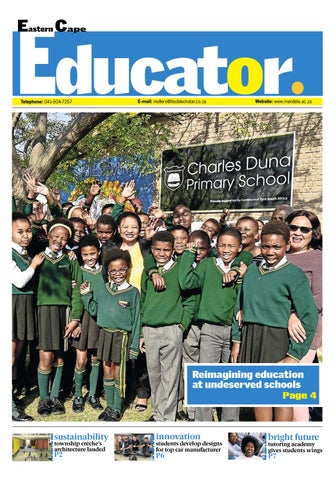
Reimagining education at undeserved schools Page 4
sustainability
innovation
P2
P6
township crèche’s architecture lauded
students develop designs for top car manufacturer
bright future
tutoring academy gives students wings
P7
2
NELSON MANDELA UNIVERSITY
Wednesday July 31 2019
Social Enterprise Architecture
FOR THE CHILDREN: The Crèche13 project team at the current crèche in Airport Valley Pictures: Clayton_Johnson-Gossard
WE CARE: Crèche caretakers Tombeka Mbada and Nombolelo Zweni at the site
Giving Airport Valley wings Heather Dugmore A portable, multifunctional, beautifully designed crèche, constructed mainly from recycled and foraged materials, is to be built in the economically impoverished, informal settlement of Airport Valley, in Walmer township. It is a fine example of sustainable, social enterprise architecture. Called Crèche13, it was conceived and designed by second-year students at Nelson Mandela University’s School of Architecture as part of their academic curriculum, in collaboration with the Airport Valley community, ward councillors and Walmer Angel Projects – a non-profit organisation that has worked with creche-going children and the Walmer township community for many years. The Airport Valley community identified an existing creche that looks after about 40 preschool children in a shack construction in dire need of attention in Airport Valley. The children and crèche caretakers Tembeka Mbada and Nombulelo Zweni will move into Crèche13, to be constructed at a site nearby. The innovative project draws on a pre-manufactured “kit-of-parts” strategy, using low-tech construction techniques, shipping containers and cost-efficient and recycled materials foraged from demolition sites. The only new materials are the roof trusses and main structural girders. “The architecture reinterprets the use of industrial materials to create a low-cost, dignified, habitable building that also contributes delight for the children in the informal settlement of Airport Valley, which is typified by dire living conditions,” said architect and Nelson Mandela University lecturer in architecture John Andrews, who is leading the project. Andrews explained that an essential process was to engage the Airport Valley and Walmer community representatives in the project throughout the design develop-
LUCKY NUMBER 13: Crèche13 models designed by second-year students at Nelson Mandela University’s School of Architecture as part of their academic curriculum
Crèche13 fine example of sustainable, social enterprise architecture Project Process to date: https://www.youtube.com/watch?v=B-BpL6zD1t8
Project website and donation site: https://architecture.mandela.ac.za /Project-Engagement-Initiatives/STUDIO-MAKE/Creche-X3
ment, all the way to completion. Together with his second-year students, they costed the construction of Crèche13 at an incredibly economical R280,000, with the added commitment of raising the funds to build it. “Funds and contributions have come in from the university, the private sector and individuals, with construction companies having donated materials from demolition sites. We have raised R200,000 to date. “This is an important project in the Walmer township and Airport Valley’s overarching goal to alleviate crime in our community by improving the living conditions and dignity of the area,” said Walmer township ward councillor Ayanda
Tyokwana. “Crèche13 is a quality construction that contributes to a conducive environment for our preschool children to flourish. What the university has done is great and we are very grateful for the partnership.” “It’s a godsend; the timing is perfect, and it will be such a stimulating place for the children who are currently confined to a very small space,” Walmer Angel Projects founder Glenda Brunette said. “We’ve been working with the Walmer township community since 2005, mainly assisting women who run daycare centres with funds for materials for the children or adding jungle gyms and toilets. “Now Crèche13 will be establishing this beautiful building. I
love the design and the use of recycled and foraged material.” The final Creche13 design is the conclusion of a rigorous process which has emerged through various stages. During the first stage, the students were asked to develop individual ideas for the design of the crèche. The students then elected 11 of the 57 individual proposals to develop further. Of these 11, the students then elected four projects to develop to completion. From these four proposals a hybrid design was produced to develop the final one, which has to comply with quantity surveying and structural engineering regulations, and Nelson Mandela Metropolitan Municipality’s land-planning and building inspectorate. The design process concluded in an exhibition in Richmond Hill’s Stanley Street. Crèche13 exemplifies social enterprise architecture and innovative design thinking, and includes: ● A structure which can be entirely pre-manufactured; ● A tarpaulin curtain and movable
division contributes to the discourse of multi-functional architecture and allows the spaces to alter its spatial configuration in size and its relationship between inside and outside. This allows the building function to be altered to suit a number of different uses. The flexibility of the design allows the building to be used as a crèche, but also for additional purposes – as a community centre, church, soup kitchen or public stage. ● An innovative ventilation and lighting system (air drums) which uses low-tech design to enable control of air flow and light into the internal spaces. The building is also sensitively aligned with the local climate, and harvests rainwater. If the second-year student group manages to raise the construction amount, then Crèche13 will be premanufactured on campus in August and built as a piece of performance architecture behind the architecture building, then driven to site. The concept is that if there are changes in Airport Valley, then the portable creche can be driven to the next informal area that needs it.
3
NELSON MANDELA UNIVERSITY
Wednesday July 31 2019
In the community
VW opens three Literacy Centres to benefit KwaNobuhle learners
Strategy continues to eradicate illiteracy Reaffirming its commitment to eradicating illiteracy at primary school level, Volkswagen Group South Africa (VWSA) opened three new Literacy Centres at schools across KwaNobuhle in Uitenhage. The official opening recently, which was attended by provincial department of education superintendent-general Themba Kojana and Nelson Mandela district director Ernest Gorgonzola, took place at the Noninzi Luzipho Primary School, where one of the centres is housed. The other two centres are housed at the James Ntungwana Primary School and Vuba Primary School. The new centres – along with the existing centres at Ntlemeza Primary and Mngcunube Primary schools – are aimed at achieving a unified goal: ensuring functional literacy for every learner under the age of 10 years. VWSA has invested R2m to date in these centres, to fund the building of the centres and the books needed in daily operations. “It is a known fact that education is one of the main challenges facing our country,” said Thomas Schaefer, Volkswagen Group South Africa chair and managing director. “A research study conducted by Dr Nic Spaull found that more than 60% of South African children cannot read for meaning by the end of grade 3.
“Nearly 3,300 learners will benefit from the various interventions of the Legacy Literacy programme”
IMPORTANT EVENT: Volkswagen Group South Africa opens three new Literacy Centres at schools in KwaNobuhle, Uitenhage
“As a caring and responsible corporate citizen that always puts its people first, VWSA decided to establish a programme that will ensure all learners in Uitenhage are functionally literate by the time they reach grade 3.” To support this goal, Old Mutual
has also donated books to the value of R180,000 to date for the five centres. Speaking at the launch, Kojana praised VWSA for its work in improving education in the province. “Reading is a culture and you’ve planted a seed that we as the de-
partment must nourish,” said Kojana. “We are looking into the model of these centres and will work closely with you going forward. We are here to nurture our partnership. To us, this is a fundamental project, because you are investing in the human mind and the future
of our children.” The new Literacy Centres are in line with the focus areas of Volkswagen’s corporate social responsibility initiatives, which include education and youth development. Volkswagen established its first Legacy Literacy Centre at Ntlemeza Primary in 2017, followed by the Mngcunube Primary Literacy Centre in 2018. The company also supports Funda Wande, a non-profit organisation aimed at training educators to teach primary school learners to read with understanding. “Nearly 3, 300 learners will benefit from the various interventions of the Legacy Literacy programme. “Today’s opening of these three Legacy Literacy Centres exemplifies Volkswagen’s commitment to establishing corporate social responsibility programmes that have impact and meaning on the lives of our people,” Schaefer said.
Makhanda School sings its way to national choral recognition An Eastern Cape school that has made its mark in various cultural activities and competitions is gaining national recognition, having recently wowed judges at the annual ABC Motsepe South African Schools Choral Eidsteddfod in Johannesburg. The velvety voices of Nombulelo Secondary School pupils Liyabona Qutywa and Oyama Vena earned their school a win at the national choral competition, which is an initiative of the Department of Basic Education in conjunction with the Motsepe Foundation. The duo won first prize with their duet rendition of the Setswana love song Mohau Mogale, with Qutywa also coming second place in the mezzo soprano category. Qutywa, who “grew up in a completely non-musical family”, says she first came across choral singing in primary school and is
sometimes surprised by how far she has come musically. “It was in primary that I decided to give the choir a chance. I started out singing alto and then switched between alto and soprano. That has now become soprano and it has been an interesting journey,” she says. Qutywa honed her choral talents when she arrived at Nombulelo Secondary, under the leadership of the school’s deputy principal and choir master, Xolani Jonono. “I remember how scared I was to perform solo pieces in front of crowds, especially foreign language pieces, but through the years have gained some confidence,” she says. Singing in the choir has opened the grade 11 pupil up to opportunities she never thought she would have. “I would like to pursue music studies in university and am very excited that I have already been of-
TOP VOCALISTS: Deputy principal and choir master, Xolani Jonono, with the winning duo Oyama Vena,left, and Liyabona Mqutywa with the some of the trophies from their choral accomplishments
fered a full bursary,” she says. Qutywa and Vena may soon headline their first big concert, if the school’s plan to rally resources
to stage a big showcase event at the Monument bears fruit. “We would really like to expose the Makhanda community to this
home-grown talent and we are exploring partnering with neighbouring institutions to have an orchestra and make it a big spectacular,” says Jonono. The Nombulelo Secondary choir has made it to the national SASCE competition for at least three years, a success Jonono attributes to the immense support, in cash and in kind, that the choir is getting from the school, community and parents. “The support we get is what spurs us on. We are your typical struggling township school, but have instilled in our pupils the notion that they can use their Godgiven talents to get themselves out of poverty,” says Jonono. “As a result, when I spot talent, I exploit it to the max – get the pupil out of their comfort zone and into a world stage mentality. “I do my best to link them up with industry players and academic institutions to go into post-matric.”
NELSON MANDELA UNIVERSITY
4
NELSON MANDELA UNIVERSITY
Wednesday July 31 2019
5
Maths & Science upliftment
Mining great potential, roots and all Collective effort sees school succeed Zamandulo Malonde
PASSIONATE APPROACH: Charles Duna Primary teacher Jarren Gangiah joined the school through Nelson Mandela University’s Centre for the Community School programme
CCS reimagines education at underserved schools Zamandulo Malonde The bell rings at Charles Duna primary school in New Brighton. It’s 1.30pm on a Wednesday. Right on cue, dozens of pupils run to the sports fields. Dressed comfortably – some in jeans, tights or tracksuits, their excitement is palpable. Inside a classroom metres away, is Jarren Gangiah, the new maths, science and tech teacher. “These kids have so much potential already, roots and all, but what we as teachers are doing is fertilising the soil,” Gangiah, who is a student at Nelson Mandela University, said. He joined the school in January through the university’s Centre for the Community School (CCS), after obtaining his BEd in 2018. The programme is one the university’s outreach initiatives aimed at developing alternative approaches to school improvement that are relevant and responsive to the contextual realities of underserved schools and communities in SA. Charles Duna Primary is one of various schools adopted by the CCS programme in Nelson Mandela Bay. Nelson Mandela University media manager Zandile Mbabela said: “The CCS is an engagement entity of the faculty of education. It works with communities to reimagine the schooling system. It is an open secret that the challenges facing schools go beyond pure academics and require a consolidated and collaborative approach.
“The CCS takes into account all factors affecting the adequate provision of quality education – the social, political and economic contexts in which the schools find themselves. “Key to this approach is the involvement of parents, educators, the community and pupils themselves in crafting and co-creating suitable and sustainable solutions in a manner that also fosters a sense of ownership,” Mbabela said. As one of Nelson Mandela Bay’s underserved schools, Charles Duna Primary’s functionality rides on the back of teachers, actively involved community members and volunteers who collectively form the school’s leadership body. “When I first visited the school, I was expecting to see people who come in to perhaps tend to the garden or do some maintenance work and go, but I came here and found a family of teachers, pupils, parents and community members who are all interested in not just providing quality education, but forming genuine quality relationships,” Gangiah said. On occasions where certain pupils display a change in behaviour, carefully and mindfully investigating the cause while considering the pupil’s background and family dynamics, is a responsibility the staff share,” Gangiah said. “I know that some people say there will always be that one or two pupils in a class who won’t listen and take it as proof that all they want is to be a distraction in class, but this is not always the case.
“At times, they do not intend to be a distraction, but their behaviour is influenced or affected by their circumstances at home. “There are hundreds of pupils with different backgrounds – some come to school hungry and cannot concentrate and some are from abusive homes that leave school as the only safe space for them to
“Charles Duna Primary is one of various schools adopted by the CCS programme in Nelson Mandela Bay” honestly express their emotions. “That’s where those personal relationships with each pupil help, because we as teachers are then able to listen to their problems and help where we can. “The school’s leaders all share the passion to raise citizens who face the world with confidence and acknowledge humanity above all else,” Gangiah said. “Beyond what’s in a textbook, these pupils are consciously and subconsciously learning about life and the world. “I cannot stress enough how important it is for us to value that these pupils are human beings who matter and have the potential to create a world better than the one we live in today.”
In-between fist bumps and chuckles at inside jokes with his pupils, Gangiah tells of the eyeopening experience of living in Summerstrand and travelling to work in the completely different world of New Brighton. The education psychology student who grew up in rural KwaZulu-Natal, said understanding different backgrounds and cultural dynamics is one of several ways to experience pupils on a personal level beyond merely teaching to get paid at the end of the month. “While underserved schools are not these horrible spaces where nothing good happens, it is important for us to acknowledge and be able to adjust to events, such as crime, that impact our day-to-day learning.” As a result of crime in New Brighton, one of the school’s foundation phase teachers could not make it to school after an attempted break-in at her house. “While we don’t sweep such unfortunate realities under the carpet, we continue to encourage our pupils to envision a safer and better world and work towards creating it,” Gangiah said. The team’s efforts are evidently not in vain as a number of Gangiah’s pupils dream of becoming prominent members of society – ranging from pilots, social workers and engineers to lawyers, psychologists and fashion designers. “We are not just looking at helping a child to get a job one day, we want them to be happy people who can adapt and move,” he said.
When Charles Duna Primary School principal Nombulelo Sume joined the school 21 years ago, she had a vision to transform it into a place of excellence. Her vision, jotted down on paper on a wish list, hangs on the wall of her office alongside an array of certificates as evidence of the school’s achievements over the years. It is a clear and bold list of accomplished tasks, with emphasis on crediting the effective role played by dedicated staff and a hands-on community. “If you ask any of my staff members what our motto is at Charles Duna, they will confidently tell you that the learner must always be at the centre. “Working with a team who know that the common goal is the learner, means I never have to worry about things not getting done when I’m not here,” Sume says. Mornings at Charles Duna are characterised by a buzz of pupils making their way to class, women preparing to cook the day’s lunch, while some parents get on with the gardening and maintenance business of the day. This morning buzz – the collec-
MAKING IT HAPPEN: Charles Duna Primary School principal Nombulelo Sume
tive efforts of community members and teachers – is what makes the school what it is, Sume says. Equally crediting her staff’s dedication and that of the community, Sume says a lack of resources is an obstacle they never let get in the way of creating an efficient and competent environment for their 1,063 pupils to learn. “The department gives us an annual budget and it’s only useful to an extent but does not suffice, how-
ever with the help of the community, we are able to source private funding to achieve our goals. “I’m aware that there are schools with worse conditions in the rural Eastern Cape which need the government’s assistance more than we do, so when funds go where there’s a bigger need, we won’t wallow and blame the department, we must be proactive to supplement, ” she says. Through partnerships with vari-
ous private organisations, the school was able to install new water pipes, renovate the library, renovate the principal’s old office and transform it into a new kitchen, install water tanks and lay groundwork for a science lab, among other goals on Sume’s list. Sume’s vision for the school is for its pupils to excel to the best of their abilities by sourcing assistance from social services officials and international volunteers who provide physical education for the pupils, sports trainers and science tutors. “We have 24 community members who assist with the day-to-day running of the school, from cleaning, assisting teachers to gardening and more. “We have psychologists and social workers who come in to assist us with the mental and emotional wellbeing of our learners,” Sume says. “I am proud of how far this school has come and, to this day, I still get excited by the ideas our young teachers are always bringing to the fore. “While we are doing our best as a school, I believe our kids would achieve and become so much more if our communities functioned better.”
Parents must guide and teach kids too Zamandulo Malonde The key to achieving a better world is for parents to be fully present in their kids’ lives, Charles Duna Primary School foundation phase teacher Koleka Ndzuta says. Ndzuta, who used to believe her child’s academic performance was solely the teacher’s responsibility and not hers, joined the school in 2003 after a life-changing call from a teacher regarding her child’s performance. “I came in with such a negative attitude towards the teacher because I was of the belief that the only role I needed to play was to bath, clothe, feed and send my child to school for the teacher to take over,” Ndzuta says. “I wondered why she was interfering with how I play my part instead of doing her job.” Since meeting with the school in 2003 and becoming pro-active in her daughter’s education, her life and her daughter’s changed for the better. “My child immediately broke out of her shell, became confident and got involved in extra-curricular activities.” Ndzuta initially joined the school to assist on a voluntary basis
FOOD FOR THOUGHT: Charles Duna Primary School foundation phase teacher Koleka Ndzuta, right, is both a parent and a teacher at the school and encourages other parents to be pro-active in their children’s academics
but would later pursue Early Childhood Development studies and obtain a Bachelor of Education in foundation phase. Presently, Ndzuta mediates between the school and parents to form healthy relationships and encourage collaboration for the good of the pupils. “Besides teaching in class, I do home visits to parents who are not able to make it to school whenever
I notice a behavioural issue with a child who has the potential to do better. “Having been the absent parent before, I’m able to relate to and reason with parents who are in that position now. “Those visits and conversations go a long way because I get to find out more about a child’s background, understand them better and that makes it easier for me to
help,” she says. Her daughter is now a Logistics student at NMU, while her two younger children are pupils at Charles Duna Primary. She believes parents need to show genuine interest in their children’s lives in order for them to feel loved and important, instead of trying to do so with material things. “Our kids today base their worth on material things because we make the mistake of thinking if we buy them things and spoil them with outings, it fulfills them, but what we say in conversation during those outings sticks and whatever they see us invest in is what they deem important,” she says. “Some of the crime issues we face today are perpetuated by what kids learn to value at home.” The topic of crime rubs salt on a fresh wound for Ndzuta, after an attempted break-in at her New Brighton home recently. “My recent experience triggered a lot of thoughts about how the world has changed and become accommodative of crime, because when I was younger, communities united against anything that affected people negatively but we don’t take action against things that destroy our kids. It is doable if we all work together,” Ndzuta said.
APP-SOLUTELY GREAT: Pupils use an innovative app called TouchTutor to learn maths and science during an Incubator School Programme (ISP) run by Nelson Mandela University’s Govan Mbeki Mathematics Development Centre (GMMDC)
Maths and science programme lifts grade 12 results Out of the 330 grade 12 pupils who in 2018 completed technologyblended maths and science incubation programmes run by Nelson Mandela University’s Govan Mbeki Mathematics Development Centre (GMMDC), 70 improved by more than 10% in both subjects. About 80% of the participants achieved bachelor passes, enabling them to access university studies, despite the resource challenges facing their schools in the rural areas, where the programmes were run. The top-achieving pupils received results in the 90s and one pupil Mvuyisi Njenje, 17, from Mthatha, achieved 100% for maths. The most-improved pupil was Komani’s Yamkela Sondlo, 17, whose maths and science results shot up from 32% and 31% respectively at the end of grade 11, to 64% and 78% at the end of grade 12. While she is taking a gap year, many of her peers from GMMDC’s programme are attending university, including King William’s Town teenager Luphelo Tshemese, 17, who passed matric with 80% for maths and is now studying civil engineering at Nelson Mandela University. Just two years earlier, he failed grade 10. “I learnt that maths is not hard,” said Tshemese. “You just need to understand it and practise it.” GMMDC’s selection criteria for its programmes is that pupils attend disadvantaged schools and that they show potential. GMMDC’s two core programmes for pupils include an intensive 17-week Incubator School Programme (ISP), run at a central venue on Saturdays for pupils selected from a number of schools in a particular district. In 2018, ISPs were run in Port Elizabeth, King William’s Town, Komani, Mthatha and East London. At each ISP, trained facilitators provide lessons, tutorials, weekly tests and exam revision, all linked with an offline interactive teaching and learning app, called TouchTutor, installed onto tablets. Their second core programme is the Technology-assisted Afterschool Peer Support (TAPS) programme, a more informal approach where teachers provide after-school
METEORIC RISE: Luphelo Tshemese obtained 80% for maths in his matric finals in 2018
tutoring to groups of pupils at their own schools using TouchTutor. Developed over the past 10 years, TouchTutor is an extensive digital maths and science resource that includes narrated video lessons, PowerPoint presentations, past exams, self-tests with scoring and feedback, science experiments, calculator support, a glossary of terms supported by graphics in multiple languages in one innovative e-learning space. All ISP and TAPS pupils receive a tablet with the app, on loan to them from February to November. “Each year, we allow those who have improved by 10% in a year in both maths and science, or achieved distinctions, to keep their tablets,” said GMMDC director Prof Werner Olivier. “We’ve seen a trend of success over the past five years. About 50% of all those in our programmes go to university, while others enter studies at TVET colleges. Olivier would like to see the model scaled up across SA and has recently set up strategic partnerships with the department of basic education in different provinces. TouchTutor also includes elements of STEAM education, where art is added to the traditional science, technology, engineering and maths (STEM) model, preparing pupils for the creative solutions they will need to make in future careers in the rapidly evolving Fourth Industrial Revolution.
6
NELSON MANDELA UNIVERSITY
Wednesday July 31 2019
Innovation is key
Students develop innovative designs for Isuzu
Powering young minds Finding innovative solutions in the manufacturing environment is one of the key objectives of Isuzu Motors South Africa’s sponsorship of the Nelson Mandela University Chair in Mechatronics. The Chair in Mechatronics, headed by Professor Igor Gorlach, facilitates engineering projects between the Mandela University Mechatronics Department and Isuzu. Gorlach said it is important to expose Mechatronics students to the real industrial world, so that they can be better prepared for the final-year project. The students are tasked to find real solutions that improve the manufacturing processes. One such example is the universal trolleys which are used in the new truck assembly line at Isuzu’s Struandale plant in Port Elizabeth, which were conceptually designed by senior Mechatronics students. The universal trolley is one of six innovative projects that the Mechatronics students developed for Isuzu, over the past two years. Isuzu Corporate Communications Manager, Gishma Johnson, said the company supports the Chair to ensure an enhanced skills base: “As a solutions-driven company, we are conscious about giving young people the opportunity to invent, create and innovate.” At the beginning of each academic year, new projects are identified in consultation with the engineering and production departments of Isuzu. Projects are aligned to the work covered in the various subjects at undergraduate level and assigned in groups to third-year and final-year
implemented for all types of truck cabins on the new line at the Struandale plant in 2019, said Gorlach. Other student projects included the design of a device for loading fuel tanks at the Isuzu truck assembly line, the design of a torqueing station for automatic transmissions for Isuzu bakkies, as well as developing a method to handle truck chassis. Some of these projects are being tested at the plant for future consideration. Furthermore, the Isuzu Merit Awards Ceremony takes place every year where the best project, best assignment and top students
“The students are tasked to find real solutions that improve the manufacturing processes”
FINDING SOLUTIONS: Mechatronics students working on one of the projects are, from left, Johannes Ormos, Johannes Keil and Philipp Duffner
students. In the final-year the projects are perfected over the period of a year, whereas the third-year students do a half-year project. Gorlach said the programme offers students valuable practical experience by exposing them to reallife industry problems and professional expertise.
“We are grateful to Isuzu for continuing to support our programme as it is in the best interest of our students to collaborate with industry. Interaction with industry is also required for our accreditation by the Engineering Council,” he said. “The collaboration between the Mechatronics Engineering students
and Isuzu often result in the implementation of these projects in the factory, sometimes in a redesigned, modified or adapted format,” Gorlach said. In 2018 the students designed a reconfigurable platform to reduce the number of trolleys at the Isuzu production facility. The design was
in each academic year receive cash prizes and trophies. The Isuzu Merit Awards are also a valuable accolade to place on their curriculum vitae. “Our students are in high demand in the workplace - locally and overseas. The practical component of solving challenges in a production or engineering environment, really adds to the level of students who graduate,” Gorlach said. The Mechatronics programme at Mandela University is the first and only university type engineering degree (BEng) offered in the Eastern Cape.
Waste bike gives township entrepreneur wings Zizonke May An environmentalist from Walmer Township will soon be zipping around on a set of wheels that will help him boost his little business – which puts food on his table and helps a local school. Khululekile Moko turned to recycling and trading in goods that others had thrown away after losing his job of 17 years in 2014. He collects plastic bottles, tins, card, white paper and mixed paper and trades them for food. The paper waste Moko collects goes towards the building of an eco-brick preschool in Walmer Township. Now, thanks to an architect and a motor company, Moko will soon be using a uniquely designed “waste-bike” to ply his trade. The new contraption was designed for and built from waste material donated by Isuzu Motors SA and by social entrepreneur, innova-
tor and architect Kevin Kimwelle, who is also building the eco-brick preschool. Moko said having a bike meant that he could collect more waste to trade in a shorter period of time. “I am very excited about my new bike, it will really make things easier for me in terms of taking the waste I collected to the Re-Trade shop [a community-based recycling and social empowerment project in Port Elizabeth]. “Retrading is the only thing that puts food in my mouth. It ensures that I don’t sleep with an empty stomach,” Moko said. “This is my way of living – going to the store and trading for food or hiring my cart to the community when they need help.” For more than five years, Moko had been using a cart which he pulled to the Re-Trade depot on Fridays, taking as much as he could in three trips, to get as much food and essentials as he could from the Re-
PACKS A PUNCH: Khululekile Moko, 76, left, with his uniquely designed, functional waste-bike
Trade swap shop, where recyclables are exchanged for food and cleaning projects. Kimwelle said he had heard about Moko from a friend who had helped Moko rebuild his cart after a passing car crashed into it.
“A friend of mine told me about how Khululekile ’s cart fell apart when he got bullied by vehicles passing him and [it was] crushed,” he said. Kimwelle said Moko’s new bike would be visible to all road users,
adding that he had attached head and rear lights that were donated by Isuzu. “The bike’s chassis, front and back lights are all recycled from Isuzu courtesy of Isuzu’s environmental manager, Ncedisa Mzuzu, who heard about our ambitious project. “Social innovation on a community-based level can enable us to empower the less fortunate in our community and uplift them to a better life. “It is possibly South Africa’s future in dealing with job creation in a world of diminishing employment,” Kimwelle said. As a social entrepreneur, Kimwelle’s main focus is community-based projects. In 2018, Kimwelle’s Joe Slovo Community Project won The South African Property Owners’ Association’s Overall Transformational Award as the most transformative project in the country.
7
NELSON MANDELA UNIVERSITY
Wednesday July 31 2019
One step towards a future Naziziphiwo Buso Combining the need for student employment and a lack of high school learners’ tutors Rhodes University statistics lecturer, Thina Maqubela, has come up with a plan to kill two birds with one stone using just her passion. Maqubela started Maqubs Academy of Excellence in the academic hub of Makhanda where she assists learners with academic tutoring services, accommodation and employment for undergraduates who battle to get employment. Maqubela, 29, from Port Elizabeth, says her passion for youth empowerment through tutoring started when she was doing her undergrad at the University of Cape Town (UCT). At UCT she immersed herself in voluntary tutoring before she became a lecturer at Rhodes at the age of 23. “This idea of tutoring came from seeing a need in the Makhanda community for tutors for high scholars especially in mathematics. “Makhanda is known for good schools so parents from all over the continent send their kids to the town for schooling. “With the company I can cater for the needs of students who are in need of a stipend, but also cater for the needs of the community by improving the academics of students around Makhanda.” Maqubela also launched a girls’ hostel in 2018 for high school girls. This project, in its second year, houses eight girls at a time. The idea was born from seeing a gap in the market as the town is in need of an academic hostel with programmes solely focused on assisting learners to maintain and improve their marks. Although her initial plan wasn’t to run a tutoring business, Maqubela has seen Maqhubs go from tutoring one student to 200 students in a year with 20 to 30 tutors depending on the time period. “During the year break we host winter camps for children from all over the Eastern Cape and do intense preparation for grade 12 exams.” She says the academy can now subsidise students from township
Academic’s academy sets gold standard
STUDENT NEEDS: Go-getter Thina Maqubela owns Maqubs Academy of Excellence in Makhanda
schools who cannot afford their services. With a Master’s degree in Statistics from West Virginia University in the US, Maqubela could be pursuing a career in the corporate world but she says she felt that she had to answer a calling. “I think I have always had a calling for education and teaching and there is something that happens to me. It’s healing when I am mentoring and teaching young people, whether it is in high school or at university level,” she said. A parent of a student at Diocesan School for Girl’s in Makhanda, Zingiswa Jaba, says although she lives in the same town as her daughter she is happy Khazimla lives at Maqubs Academy. “I have peace of mind my daughter is at the best hostel in town and that she is happy and getting the best tutoring to develop because she took academically challenging subjects.” Jaba says her daughter’s academic performance has improved drastically since she began staying at Maqubs. “Khazimla’s marks have improved very much; even when she is at home my daughter has picked up a culture of studying without being coerced,” she said. Meanwhile, 17-year- old Victoria Girls’ High school Nthabiseng Mohapi from Lesotho says she found school more challenging for her before moving to Maqubs. “My marks have improved since I moved into Maqubs and I have managed to keep my marks consistent. “I doubt I would have been able to do that because I did not have a strong work ethic before I moved here,” she says. “The tutors here give me the space to ask questions that I would be shy to ask if I was in a class setting,” she added. The academy has begun branching beyond Makhanda also offering tutoring classes on WhatsApp to students in Johannesburg. Maqubela says that she is hoping to expand her services to Port Elizabeth as early as January 2020 as well as provide tutoring services for university students.
IT graduate opening ‘Windows’ for children Naziziphiwo Buso
CHANGING LIVES: Afikile Sikwebu
It was a memory of his sister, laughing mockingly at him in 1995, that sparked a curiosity and passion in Afikile Sikwebu to help others. Just 13-years-old at the time, Sikwebu replied “it opens windows”, when asked by his older sister what a Windows ’95 stiffy disk was used for. Twenty four years later and Sikwebu is no longer a stranger to the world of information technology and spends most of his days teaching children from Port Elizabeth impoverished communities how to code. Sikwebu, of the Nelson Mandela University Centre for Community Technologies (CCT), says he owes it to this generation to make sure they are at the centre of the fourth industrial revolution by equipping
others with knowledge. “That memory for me, has always stuck with me and so I always think about how many other kids don’t know. “They are basically surrounded by technology, but they don’t know how to use it,” he said. The centre aims to promote development of the human potential of disadvantaged communities using technologies. It promotes policy interventions aimed at lowering market costs of technologies which holds significant prospects for social and economic empowerment of poor communities. The centre focuses on a variety of topics including health, education, rural development and social innovation. Through the CCT Sikwebu teaches children to be active partic-
ipants in the development of technology, using the fundamentals of computer programming to train them to think using algorithms, sequences and logic. “When we teach kids to think logically it helps them to think about life. If I do this, what will be the result of my actions? With a BTech in Software Development he says that his intention was never to learn programming for the corporate world. “For me learning or doing programming was a means for me to learn so that I could teach others.” Not all was fun and games for CCT as the programme did not have much of a response in 2017. But a change of location and approach changed the game for the team. They went from teaching 20 children to 600 per week by 2018. “We started with 20 kids, be-
cause of a limitation in computers, at GJ Louw Primary School in Schauderville where they gave us 20 kids from grade 6 and 7.” Last year they moved on to a neighbouring school St Teresa’s RC Primary to teach 200 grade 6 and 7 learners. This year the CCT has formed a partnership with an NGO called Masifunde Change Makers which has seen the company branching off into new ways of incorporating coding into the extra co-curricular programme of 400 grade three learners from Walmer Township. “We have a program with [Masifunde] where we train their volunteers and teach the children how to code.” CCT also has a partnership with the Helenvale Poets where he is teaching them how to digitise their poets by recording their poems.
8
NELSON MANDELA UNIVERSITY
Wednesday July 31 2019
art for the future WINNING PIECES
TOP ENTRIES: The first-placed artworks in the ‘maths in nature’ category included ‘Pale Face’ (grade 8 and 9 category) by Luke Ferreira from Redhill High in Johannesburg, and ‘Infinity’ (grade 10 to 12 category) by Lauren Damstra from Eunice Girls’ High in Bloemfontein. In the ‘maths in manmade designs’ category, the artworks placed first were ‘Heritage Mandala’ (grade 8 and 9 category) by Fish Hoek High’s Caitlin Wilde, and ‘Hidden Mathematics’ (grade 10 to 12 category) by Morgan Durrheim from Beaconhurst High in East London
High standard for work in maths-art exhibition High school pupils from across SA won accolades for depicting the links between maths and art in unique and vibrant artworks in the first nationally run mathematical art competition, held in May. The top 40 entries in the competition, run by Nelson Mandela University’s Govan Mbeki Mathematics Development Centre (GMMDC), were exhibited in July at the annual conference of the Bridges Organisation, a leading organisation globally which promotes research and interest in the connections between mathematics and art. The Bridges Organisation is also spearheading a new global shift in education called STEAM, the acronym standing for Science, Technology, Engineering, Art and Mathematics, which GMMDC is promoting in SA classrooms. “We were thrilled at the high calibre of the 600 entries we received, although it was a tremendous battle to choose the 12 overall winners,” said GMMDC competition coordinator Carine Steyn. The top-placed winners in the competition drew their inspiration from the repeated mathematical patterns evident in ancient Khoi and San cave paintings and traditional Zulu beadwork, the mathematical make-up of well-known manmade landmarks, and even the mathematical mysteries of outer space. Others looked for the mathsart connection in majestic animals,
ARTISTIC PUPILS: Winners in the national mathematical art competition, back, from left, Paarl Gymnasium’s Hano Nieuwoudt, Redhill High in Johannesburg’s Kiara Knopfmacher and Luke Ferreira, Diocesan School for Girls in Makhanda’s Erin Powers, Framesby High in Port Elizabeth’s Kara van Heerden, Eden College in Durban’s Dorina Cherneva, Sibangani Matsa from the University of Johannesburg’s Metropolitan Academy, Beaconhurst High in East London’s Morgan Durrheim and, front, from left, Fish Hoek High’s Caitlin Wilde, Sir Pierre van Ryneveld High in Johannesburg’s Busisiwe Mbonani and Eunice Girls’ High in Bloemfontein’s Lauren Damstra. Inset: Kara van Heerden of Framesby High’s ‘The functions of a zebra’
including rhinos and cheetahs. The competition was open to all high school pupils, who could enter artworks in two categories: “maths in nature” or “maths in manmade designs”. They were adjudicated not only on artistic merit, but on how they represented the links between mathematics and the arts.
All the winners received cash vouchers and book prizes, and Eunice High School in Bloemfontein was recognized for submitting the most entries. “The competition project adds an innovative educational layer to our centre’s technology-blended approach to the teaching and lear-
ning of maths and science,” said GMMDC director Prof Werner Olivier. “It aims to develop creative young minds and also build awareness around the skills challenges they will face in their future careers in the Fourth Industrial Revolution.”
Maths Centre’s artworks displayed at Austrian exhibit Mathematical patterns found in nature provided the inspiration for three unique artworks – created by staff at Nelson Mandela Univerity’s Govan Mbeki Mathematics Development Centre (GMMDC) – that were selected for an international exhibition. The pieces were showcased in Linz, Austria, from July 16 to 20, at the annual conference of the leading global Bridges Organisation, which promotes research and interest in the connections between mathematics and art. The conference brought together artists, mathematicians, scientists, computer scientists and educators to explore and develop the maths-art connections in their own work. “Finding the links between maths and art is becoming a central
paradigm in education. “It aligns with the Fourth Industrial Revolution, which is shaping the world today,” said GMMDC director prof Werner Olivier, who created one of the selected pieces with his colleagues Flora Olivier and Arnold Gwaze. Their piece – which uses Shweshwe fabric, cowrie shells and seed-beads to create a fractal pattern (a never-ending pattern) of the African continent in an ancient Roman-Greek mosaic style – was “inspired by the desire to create an original African statement about the historic connections between mathematics and art”. Flora Olivier created the second artwork, which depicts the shape of a fish, constructed using only a ruler and compass. “It was fun finding creative ways
NUMBER ART: These three mathsinspired artworks created by staff at Nelson Mandela University’s Govan Mbeki Mathematics Development Centre, seated, from left, prof Werner Olivier, Flora Olivier, Arnold Gwaze and, back, Victoria Shezi, were showcased at a mathematical art exhibition in Austria in July
to deal with the limited degrees of freedom afforded by the two basic construction tools,” she said.
The third piece, created by another GMMDC staff member, Victoria Shezi, is a collage of natural
and manmade objects, arranged in the shape of Africa. Titled Perfection under threat, the piece depicts the beauty, history and resilience of the continent, as well as the destruction of its natural environment. The Bridges Organisation is spearheading the new global shift towards Steam education, the acronym for Science, Technology, Engineering, Art and Mathematics, and a variation on the betterknown Stem education. GMMDC is working with the department of basic education and schools across the Eastern Cape, to promote Steam in South African classrooms. Each year, GMMDC runs its own math-art competition, open to school pupils across the country. More than 600 entries were received for the 2019 competition, which closed in May.
“Nelson Mandela University's Faculty of Education remains steadfast in its commitment to making a difference in the communities it serves, using education as a weapon to change the world. Visit http: //education.mandela.ac.za”