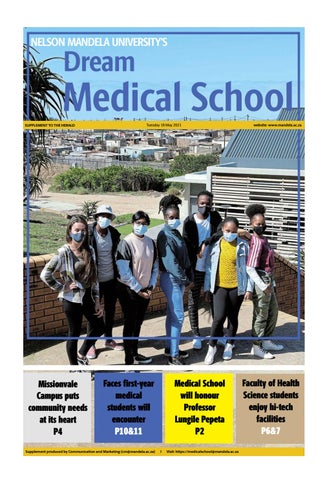
NELSON MANDELA UNIVERSITY’S
Dream
Medical School
SUPPLEMENT TO THE HERALD
Missionvale Campus puts community needs at its heart P4
Tuesday 18 May 2021
Medical School will honour Professor Lungile Pepeta P2
Faces first-year medical students will encounter P10&11
Supplement produced by Communication and Marketing (cm@mandela.ac.za)
I
Visit: https://medicalschool@mandela.ac.za
website: www.mandela.ac.za
Faculty of Health Science students enjoy hi-tech facilities P6&7
2
SUPPLEMENT TO THE HERALD
Tuesday 18 May 2021
Message from Vice-Chancellor Professor Sibongile Muthwa
Nelson Mandela University stays true to its purpose PROF SIBONGILE MUTHWA
PROF LUNGILE PEPETA
Medical School will honour Professor Pepeta
T
here is so much more we can do to improve the health, quality of life and lifespan of everyone in South Africa, and, at the same time, achieve a better return from the public health spend. We are confident that Nelson Mandela University’s new medical school will help us achieve this and that, once it is up and running, the health services platform throughout the Eastern Cape will improve. We thank our country’s other medical schools, their researchers and practitioners for their collaboration, which contributed greatly to our curriculum design. We hope to continue to work together in finding solutions and innovations. It has been intense to fulfil the requirements of launching a medical school on our Missionvale Campus. The infrastructure includes lecture halls, laboratories for physics, chemistry, physiology and anatomy and over 60 offices for medical school staff members. We are also partnering with several provincial and district hospitals like the nearby Dora Nginza Regional Hospital and associated clinics. Our first intake of first year MBChB students has largely been Eastern Cape matricu-
lants with strong pass rates in maths, physical science, life science and English. In 2022 our intake will increase to 80 first-years. In terms of staffing we have received and continue to receive CVs from all over South Africa and internationally from doctors, specialists and professionals wanting to be part of the medical school. A significant number have moved to Gqeberha, with many more in the pipeline. One of the first appointments in 2019 was the Director of the Medical Programme, Professor Mfanufikile Nomvete: a gastroenterologist from Livingstone Hospital and former head of its Internal Medicine Department. While the human and capital investment for the new medical school is significant, so will the returns be for public health and research. Our University pursues transdisciplinary scholarship and research, and one of the alignments is a partnership between our Faculty of Health Sciences and our Faculty of Engineering, the Built Environment and Technology (EBET) in the
medical device and biomedical engineering field. EBET’s Advanced Engineering Design Group is involved in the development of intelligent prosthetics to assist people with limited mobility, while the virtual reality (VR) domain presents another great local opportunity. In line with our holistic approach, we are strongly pursuing community engagement. We believe that the best approach to medical education, the practice of medicine and healthcare service delivery is one that engages the agency of our served communities. We will partner with these communities to build on their efforts to be informed about the drivers of disease, and to pursue preventative approaches to health and wellness. We are encouraged by, and fully embrace, the suggestion and advice of the Health Professions Council of South Africa that we constitute an outward facing Advisory Board to guide and enable our medical programme delivery, and to ensure that it stays true to its promise.
Nelson Mandela University has suffered the loss of several staff members to COVID-19, including the Health Sciences faculty executive dean Professor Lungile Pepeta. Prof Pepeta led the university’s COVID-19 offensive from the start and worked on systems and strategies in the province and nationally to combat the spread of the virus. Ultimately, being on the frontline of the fight, his exposure to the virus was too great and tragically he passed away on August 7, 2020. What an incredibly sad loss his untimely passing was for us and the nation. Prof Pepeta tirelessly drove the creation of our new medical school. It was his vision that guided us to develop a curriculum and medical degree that he knew would better serve all South Africans, particularly those who are marginalised and vulnerable, about whom he cared greatly. We will deliver on our commitment to honour Prof Pepeta by ensuring that Nelson Mandela University’s Medical School makes a considerable contribution to accessible healthcare in South Africa. His legacy will live on through our staff, students and the communities he served in his home province of the Eastern Cape and beyond. As we welcome our first intake of medical students, we know that Prof Pepeta would have been overjoyed to witness his dream becoming a reality.
3
SUPPLEMENT TO THE HERALD
Tuesday 18 May 2021
New medical school becomes reality Long wait for new facility finally at an end
N
elson Mandela University’s innovative new medical school is a dream come true not only for the university and the metro but also for the province. The first students walked onto campus in Missionvale in March to start classes in a game-changing healthcare development for the Eastern Cape. Until now, Walter Sisulu University in Mthatha has been the only medical school in the province but now there are two, with Mandela University’s new programme also breaking ground as the 10th medical school in SA. More than 5000 applications flooded in for 50 places after the South African Qualifications Authority (SAQA) gave its approval and registration in December 2020 for the sixyear Bachelor of Medicine and Bachelor of Surgery (MBChB) qualification. The new school has been long in the making, as noted by the late Professor Lungile Pepeta, executive dean of the faculty of health sciences and a key driver in building the school. Tragically, Prof Pepeta passed away in August 2020 after contracting COVID-19. “People have been waiting for a medical school in Port Elizabeth since 1946. “It’s a giant boost for public health and the local economy. Our medical school will be the first in South Africa to use leading global technology for interactive anatomical education, radiology, surgery and research,” Prof Pepeta had said with pride. “Our medical school programme is also unique in South Africa as it is a comprehensive approach to medicine that will focus equally on the four pillars of medicine: disease prevention, health promotion, treatment and rehabilitative medicine.” Prof Pepeta may not have lived to see this dream fulfilled, but a strong
●
Deputy Vice-Chancellor: learning and teaching, Professor Cheryl Foxcroft, said partnerships were key. “The collaborative engagements with our colleagues at Walter Sisulu University (WSU) and the support we have had from all the other medical schools across the country enabled us to be ready to launch the new, unique medical programme successfully,” Prof Foxcroft said. “We look forward to collaborating with all our partner institutions, provincially and nationally, in producing fit-for-purpose, service-orientated and civic-minded medical professionals committed to making a difference in the lives of the disadvantaged.”
Catalyst for urban renewal
team has been continuing his work to ensure that the vision of which he spoke is now becoming reality.
In service to society Mandela University Vice-Chancellor Professor Sibongile Muthwa said the SAQA approval in December was a welcome step in the lengthy accreditation process. “We are a university in the service of society, particularly as it relates to equality and social justice; inclusive of access for good healthcare,” said Prof Muthwa. “I wish to extend a hearty word of gratitude and appreciation to everybody in the university community, and beyond, who has played a crucial role in making our dream for a medical school a reality.” Prof Muthwa said the final accreditation came at a significant time as SA was grappling with the ongoing coronavirus pandemic
placing even greater pressure on the health system, at the cost of losing the lives of colleagues in the health sector. Prof Muthwa in turn is building on the actions of former vice-chancellor Professor Derrick Swartz, her predecessor, whose vision had dovetailed with that of the late Prof Pepeta.
Extensive funding The new programme has called for extensive funding: R127million from the government’s Infrastructure and Efficiency Fund has been invested in the establishment of the medical school to date. Further funding will be invested as part of the university’s safety and security implementation plan, and to improve the water and electricity challenges, which will in turn
PROF DALENA VAN ROOYEN
also benefit the surrounding community. To manage costs, the university will depend heavily on the Eastern Cape department of health for joint appointments of senior and specialist medical doctors.
The new medical programme is more than a dream come true, it also is a story of hope — thanks, in part, to the urban renewal opportunities triggered by its intentional positioning in Missionvale. The late Nelson Mandela said: “Health cannot be a question of income; it is a fundamental human right.” There is the added opportunity for the medical school to be a catalyst for change in the surrounding townships. Within the university, the medical school joins the faculty of health sciences to become its twelfth department. Faculty of health sciences acting dean Professor Dalena van Rooyen was one of many who were thrilled when the official SAQA confirmation came through in late December. “This is an amazing initiative, especially in a country that needs good news, and hope,” Prof Van Rooyen said. “We also have had phenomenal institutional support which is part of the success, and this works out of the Nelson Mandela philosophy that ‘together we are stronger’.”
Professor Cheryl Foxcroft outlines what the university is learning, and how it is teaching, over the pandemic
Learning and teaching in the COVID-19 era The global coronavirus pandemic has led to changes in multiple facets of life and this includes how universities position their learning and teaching. Here at Nelson Mandela University we continue to: ● Remain flexible and adaptable through uncharted territory ● Adopt a human-centred pedagogical approach ● Prioritise the health of students and staff ● Reaffirm the core values of our university ● Commit to excellence, social justice and equality, and integrity. To this end we are taking key learnings from our experience of the pandemic in 2020 forward in our ever-growing Faculty of Health Sciences as 2021 unfolds. Due to the ongoing lockdown restrictions across South Africa, our medical students have had a very different orientation compared to past first years starting out on their university career. A critical factor to foster their academic success is that students can transition from
PROF CHERYL FOXCROFT
school to university studies, and we have had to be agile and innovative to ensure they can do so in safety. Thankfully, the medical school is not a new entity on its own but part of a strong Faculty of Health Sciences which has helped to smooth their path. The Interprofessional Education and Collaborative Practice (IPECP) model is embedded in this faculty, and our medical students will be exposed to the same clinical training platforms as their peers in other healthcare disciplines. There are other complex realities to learning and teaching over a pandemic. The online environment has shown us that students need clear communication about where to find the information they need, what is expected of them in a task and, in turn, what they can expect from their lecturers. It also has led to lecturers becoming increasingly flexible and creative, displaying “without-a-box” thinking as they adjust texts and activities to ensure they are relevant to the COVID-19 environment.
Support for student learning and wellness is embedded in a variety of platforms at Mandela University. Though much of the theoretical work in the new medical curriculum will be covered online, it will be augmented with virtual lectures and flipped-class discussions. We also sought to find ways to make the workload – for students and lecturers – more manageable. Contact mask-to-mask sessions that adhere to physical distancing and health requirements will be limited to lab work, experiential and work-integrated learning, and possibly revision sessions and tutorials, tests and exams, depending on the level of lockdown. It’s about finding the balance: keeping our students and staff safe over COVID-19 while ensuring the highest possible standards of learning and teaching. Given our human-centred, flexible, hybrid approach, and the grit shown by academics as well as professional and administrative support staff to persist and adapt as needed, we are confident that our new medical school is prepared for the academic year.
4
SUPPLEMENT TO THE HERALD
Tuesday 18 May 2021
University’s Missionvale Campus puts community needs at its heart Campus located near Dora Nginza Hospital, one of the state facilities where students will train
T
he University had a very clear goal in mind when it decided to place its new medical school in the heart of one of the poorest areas in Nelson Mandela Bay. This intentional location of the campus in Missionvale, says medical school director Professor Fikile Nomvete, is in line with the school’s vision to train general medical practitioners who also have a deep understanding of primary health care. “Our school must be community-orientated and responsive to that community’s needs, and our geographical location speaks to that vision,” Prof Nomvete said. He hopes a primary healthcare orientation will become so deeply ingrained in the students that when they graduate “they’ll always remember that the greater population of SA requires primary care”. “They will understand what it means to be working in an African context, and know how to offer a service to that population.” In addition to its placement in an under-resourced area, the campus is near Dora Nginza Hospital, one of the state facilities where students will train. The city’s northern areas lie slightly to the west, with New Brighton, KwaDwesi, KwaMagxaki and other major townships close by to the east. It is also positioned on a key arterial road, halfway between Gqeberha and Uitenhage, with its proximity allowing for academic development partnerships and engagement with the FET colleges, schools and civil society. For example, notes Prof Nomvete, “there are two big NPOs around the centre”, referring to the Missionvale Care Centre, whose church tower is visible from campus, and Ubuntu Pathways in Zwide. “This means we are really well positioned for primary healthcare and community-orientated training,” Prof
MEDICAL SCHOOL DIRECTOR PROF FIKILE NOMVETE
Our school must be community oriented and responsive to that community’s needs, and our geographical location speaks to that vision. - PROF FIKILE NOMVETE
Nomvete said. In their first three years, students will spend most of their time in on campus in Missionvale and in the surrounding communities. Here they will learn first-hand about SA’s health care needs, as Missionvale faces the same triple blight of unemployment, poverty and injustice seen in many other parts of the country. They also will learn about associated health challenges such as TB and HIV/Aids. In response to why the university chose Missionvale and not another large
township such as Motherwell or Gqeberha (Walmer) for the school, Prof Nomvete states the obvious: “It is more practical to use a resource that already exists. “If you put it elsewhere that would have meant starting from the foundation, putting brick and mortar together.” Various lecture halls and laboratory facilities have been refurbished at the Missionvale campus and, so far, no building has had to be erected from scratch. The Missionvale campus was originally Vista University. Traditionally, South African tertiary in-
stitutions were placed far from the people they trained their students to work with, and this needed to change. Today’s Nelson Mandela University is radically different, as it has overturned the apartheid-era way of thinking and replaced it with an approach that has universal respect for individual dignity and human rights. In short, the country’s 10th medical school is ideally situated at the Missionvale Campus to meet its mandate of being in the service of society, among those with the greatest need for the provision of good healthcare.
5
SUPPLEMENT TO THE HERALD
Tuesday 18 May 2021
Engaging with our communities J
ust as Nelson Mandela University’s new medical school had been looking forward to joining the Missionvale Campus family and getting to know its neighbours, so too, it seems, that the Missionvale community is looking forward to meeting students and staff. Metro Ward 31 councillor Luyolo Nombola, for one, could not wait until the medical school opened and his constituency — in Missionvale and Algoa Park — started to feel the impact of its presence. “We are welcoming it with hot hands,” he said. “Knowing that this is the poorest area, in a disadvantaged community, having a medical school here is historical. “Our residents welcome the university and we have engaged around how it will work, not just in my role of councillor but also as a resident of this ward. “People understand the importance of this medical school.” Once it is fully up and running, Nombola hopes “the whole community will benefit”. And these benefits, he believes, will extend further than Ward 31, citing the councillors in Ward 25 which includes Zwide and part of Algoa Park, and Ward 33 which includes Govan Mbeki, also known as Zinyoka, and Bethelsdorp. “We are all positive; we couldn’t wait to see it launch,” Nombola said, referring not only to 2021, but also to ongoing infrastructure being developed. “We will work with them [the university] so that they can deliver on time. “This must be the flagship of urban renewal in Ward 31, because it is situated among informal settlements. “It is named after an icon in the late Nelson Mandela and it is only the second medical school in the province, so we are very privileged to have it here. “It sends a clear message that there is nothing that cannot be done in a township that is of a high standard.” University community liaison and marketing manager Khanyi Manzini said community engagement was a multidimensional process. “It seeks to include the diverse voices of communities so they can fully contribute and participate as agents of change in shaping a better society for all,” she said. “The medical school and its location in the Missionvale area are envisioned to strengthen, deepen and complement the community engagement efforts of the university.” There are several key NGOs nearby, such as the non-profit trust Missionvale Care Centre, and Ubuntu Pathways in Zwide. Missionvale Care Centre’s founder and director, Sister Ethel Normoyle, is another community figure who has welcomed the new school. “Our partnership goes back a long way — we’re practically first cousins,” said the tiny Irish nun who was awarded an honorary doctorate in the Faculty of Health Sciences by Nelson Mandela University (then UPE) in 2001 for her humanitarian work here.
KHANYI MANZINI
It sends a clear message that there is nothing that cannot be done in a township that is of a high standard. - COUNCILLOR LUYOLO NOMBOLA
SISTER ETHEL NORMOYLE
“We have a long connection with the university. We have a memorandum of understanding with it and the former vice-chancellor Derrick Swartz, who was so passionate about this subject, is on our board. “The late Professor Pepeta used to come around here. “He was so full of enthusiasm and he would always follow through on what he said he would do,” Normoyle said. Missionvale Care Centre’s values
resonate with those of the university as both believe that education is a powerful avenue to build resilience, and rise above poverty, unemployment and inequality. Normoyle described their partnership as a “marriage” in as much as “we have a lot to offer and they have a lot to offer”. “We are also right across the road from the new medical school. “That’s the great thing about having them so close by, as the students
will be able to come here for their fieldwork.” Medical students will gain experience not only in the centre’s medical, nutrition and wellness units, but also in other areas of its extensive outreach, including home visits. “They will be visiting people in their home, and standing there, with them where they are, will give them an experience that no book can give,” Normoyle said. Nombola also appreciated this
validation of what each party could contribute. “The university has not taken just the academic way, the helicopter view, but they have invested in deeper way that goes to the roots, where we work as a unit,” Nombola said. “When we talk about legacy, we can achieve so much more with a community dialogue. “I can’t wait, because the university can play a big role.”
6
SUPPLEMENT TO THE HERALD
Tuesday 18 May 2021
Tuesday 18 May 2021
7
Faculty of health science students enjoy hi-tech facilities There is a new clinical skills unit, human biology laboratory, a human anatomy and medical physiology laboratory, multipurpose teaching venues, computer laboratories and lecture halls
T
he Faculty of Health Sciences’ new medical school facilities include a clinical skills unit, human biology laboratory, a human anatomy and medical physiology laboratory, multipurpose teaching venues, computer laboratories and lecture halls. All newly refurbished venues on the Missionvale Campus were in use during the latter part of 2020, which allowed for ongoing snagging and procuring outstanding furniture and equipment. The University has refurbished the following laboratory facilities specifically for the medical school on the Missionvale Campus:
ogy museum. The anatomy laboratory is equipped with adequate lighting, ventilation, air conditioning, WiFi connectivity, locker space and security measures. It is a flexible teaching space.
Skills laboratories The skills laboratory is divided into five areas: ● A peer physical examination area with nine cubicles
The physiology laboratory is primarily centred on the requirements of the BioPac student laboratory system where students record and analyse data generated from their own bodies. Provision has been made for 12 stations as well as a wash-up area and store.
and a central teaching space ● A part-task trainer area for practising clinical procedures. This can also be configured to serve as a simulation room ● A simulation room with a built-in control room and exterior access ● Two debriefing rooms which can also be opened up into one area ● A teaching venue for student teaching, group work and discussions. There are plans for adequate and suitable storage areas for task trainers, manikins and stock as well as high-speed WiFi connectivity. Attention has been paid to ensure spaces are flexible so they can be reconfigured to suit changing needs. Additionally, an interactive body interact table will be available for clinical skills training.
Gross and digital anatomy
Lecture halls
A human anatomy laboratory that can be used for anatomical teaching using cadavers, prosected specimens, as well as models and electronic resources such as Anatomage tables, has been designed to seat a minimum of 56 students. There is a receiving and storage area for cadavers and wet specimens, as well as a teaching area where specimens can be displayed. Students can work in groups either around Anatomage tables or with models, or digital programmes such as Primal Pictures and Complete Anatomy. An adjacent venue that can serve as a teaching area is being developed into an integrated anatomy and pathol-
There are five existing lecture halls seating 68, 124 or 282 students in Block 508. These have been refurbished to ensure adequate audiovisual facilities, access, lighting, seating and temperature control.
Common basic science laboratory This will accommodate practical classes for chemistry, biochemistry, cell biology and physics, as well for physiology practicals needing a wet laboratory. It is designed to seat 51 students.
Physiology laboratory
Multipurpose teaching venue There are two multipurpose teaching venues that can seat at least 100 students, offering a space which can be configured for both formal lectures and facilitated group work. The desks and audiovisual facilities can be set up in various formations based on the lecturer’s requirements.
State-of-the art equipment A high-tech medical school calls for extremely specialised laboratories and training, including state-of-theart equipment such as the University’s three-dimensional Anatomage table, Body Interact simulators for clinical skills and BioPac machines to help teach physiology. Senior anatomy lecturer Dr Zithulele Tshabalala, for example, has been keenly awaiting the chance to teach his students the inner workings of the human body using the Anatomage table. The first of its kind in South Africa, this fully segmented, threedimensional (3D) human anatomy system allows the user to visualise organs and tissue exactly as they would on a cadaver. For Dr Tshabalala, a former University of Pretoria lecturer who joined Mandela Uni in August 2020, it is a revolutionary teaching aid. “Anatomy is one of the basic sciences they need to know as a foundation to their clinical studies,” Dr Tshabalala said.
Anatomage Individual structures are reconstructed in 3D with an amazing level of accuracy on the Anatomage table, and students will use the Anatomage to “dissect” body parts in 3D as well. This will help to make
and to their patients,” he explained. “The reason we are mixing the two is that both methods are invaluable on their own, but are a powerhouse of opportunity when used together. The technology brings the aspect of repeatability for the students and cadaver dissection brings in realism.” It’s an example of how technology can enhance traditional teaching methods in powerful ways, and is echoed with similarly high-tech equipment in other medical school subjects such as clinical skills and physiology.
Body Interact
the subject of anatomy a fully interactive, life-sized touch-screen experience. “The best thing about the table is that a student can remove layers of tissue and then put it all back, allowing their fellow students to start over with the same cadaver and have the same experience,” said Dr Tshabalala. In real life cadavers, this “rewind” facility is not an option as, once a layer has been removed, the next student is not able to work on the same area.
Body Interact is a clinical simulator based on 3D virtual patients where each patient mimics reality. The clinical skills staff will use it in an integrative learning process, allowing students to make connections among concepts and experiences. Students will learn how to apply information and skills to novel and complex issues or challenges through real-life situations. As the Body Interact encourages a culture of open communication and collaboration it is also excellent for teamwork.
“You also can go as deep as you want and then build up again from scratch. Nobody gets to miss out on because all you need to do is just reset.” Dr Tshabalala points out that the equipment does not replace traditional dissection and students will still have access to cadavers and prosected specimens. “It can never take that physical touch away, manipulating an organ to get to another is invaluable experience that students will be able to Biopac machines take through to their clinical years BioPac machines will be used to
teach physiology. This system features research-grade, four-channel, data acquisition platforms with built-in universal amplifiers. These amplifiers can record and condition electrical signals from the heart, muscle, nerve, brain, eye, respiratory system, and tissue preparation. The first cohort of 50 medical students will therefore benefit from a range of technology-enhanced learning and high-end equipment. Then, in addition to using 3G laptops, students also can enjoy WiFi connectivity across the campus. Information and communication technology (ICT) have been involved throughout, says ICT senior engineer for blended learning Shaun Meyer. The ICT team also has been hard at work equipping laboratories with facilities for audiovisual presentations and recordings. The high-end training apparatus and new ways of teaching medicine using technologies are aligned with the best undergraduate medical programmes around the country. The University has spared no effort in its quest for the best equipment which, along with an extensive ICT support strategy, is set to propel its new medical school into the future.
Campus actions to keep surrounding community safe With crime a national challenge across SA, Missionvale Campus has a comprehensive security plan in place to safeguard not only people but also equipment and property — and this has already made an impact on community safety. Drawn up in consultation with key stakeholders, the security improvements aim to benefit both Nelson Mandela University and the surrounding community. “On completion of all the upgrades, that campus will be the safest campus of all the campuses we have, in Port Elizabeth or George,” protection services director Simphiwe Nkosa said. Positioned as the campus is in the heart of Missionvale, Nkosa said it had been vital to consider internal and external safety. “We’ve putting up state-of-theart technologies, we’ve installed fencing all around and we also have a service provide doing the patrols outside campus in addition to our guards inside,” he said. And it’s paying off — since the introduction of armed response pa-
Security officer Kholina Mdingi at new guardhouse on campus
trols near the busy intersection of Johnson and the old Uitenhage roads, Nkosa noted that the incidence of smash-and-grab crimes nearby had all but vanished. “We have not heard of robberies here in the past seven months,
which makes us confident that our efforts are working on the outside as well as inside,” he said. “Whatever direction you are travelling, within the campus as well as outside, there will be safety measures.”
A campus security audit honed in on specific focus areas and the university has been making ongoing investments in surveillance, access control, intruder alarm and Business Management Systems (BMS). Nkosa’s team has also been
working on a cellphone-based panic button app to be linked to major security establishments, including SAPS, a private security firm and the university’s control room. The proposed installation of additional panic buttons will add to safety and security, while alarms in all the medical school buildings will ensure total shutdown of the facility after hours. The University has forged good working relations with the Metro’s mayoral committee on safety and security, as well as councillors in Ward 31 and the surrounding community, and the Algoa Park SAPS. “The department is confident that the completion of the security upgrades now under way will bring a sense of security to staff, students and our visitors on this campus,” Nkosa said. “It’s good to let not only current but also prospective students know what we are doing in our drive to become an institution of choice, because we are taking security very seriously.”
8
SUPPLEMENT TO THE HERALD
Tuesday 18 May 2021
Information and communications technology as an enabler Using ICT to enhance learning and teaching programmes
A
s an innovative and entrepreneurial university, Nelson Mandela University is coming up with solutions that are relevant to South Africa’s healthcare needs. In particular, the new medical school is embracing information and communications technology (ICT) to enhance its learning and teaching programmes. This includes exposing its first intake of 50 medical students to stateof-the-art equipment and making extensive use of online learning resources The University’s senior engineer for blended learning Shaun Meyer spelt out three key areas: ● Medical technology ● ICT devices, for example, laptops with 3G connectivity, and the audiovisual and recording equipment used in the classrooms ● Wifi connectivity. “There is a strong electronic presence in any medical school today, both on the ICT side as well as the actual medical components of the course,” said Meyer. The supporting ICT strategy stretches beyond the Missionvale Campus into hospitals, community health care centres and clinics in the metro. Later it will extend further afield to parts of the Eastern Cape and beyond.
High-speed connectivity Senior unified communications engineer Cheslin Bagley has been responsible for the networking infrastructure which includes the highspeed connectivity between buildings and between the University’s five campuses. “Missionvale Campus is already connected to Dora Nginza hospital by a 10-gig fibre link,” said Bagley. The goal is to connect to all the training hospitals such as Livingstone, PE Provincial and Uitenhage, as well as to the Community Health Care Centres, for the benefit of the medical students. Bagley said that eduroam, a secure international roaming service developed for the international research and education, would be available in identified spaces within Dora Nginza. It will provide students with easy and secure network access while they are at the hospital. Students will receive extensive orientation and training on the use of information technology in areas specific to their MBChB programme. They will need these skills from the outset as they will be using various technology-based platforms in the basic sciences, which include primal pictures, complete anatomy and anatomage. Computer studies, referred to as digital literacy, form an integral part of a supportive first-year module called academic literacy and reasoning. Here students will develop both academic and digital skills, essential
for success in their studies. This includes training on Moodle, the University’s learning management system that supports blended learning. There is further back-up from a dedicated Missionvale Campus computer centre for medical students, supported by an ICT technician, as well as the general computer facilities and support services on campus.
Synergy on and off campus The medical school ICT project has synergies with the Off-Campus Connectivity project which began in November 2019. This is aimed at improving the connectivity to students living in accredited off-campus residences across Nelson Man-
dela Bay. “We want to give the students staying off campus the same experience as those students staying on campus with regards to internet connectivity,” Bagley said. Hence students will not only benefit from WiFi connectivity when they are on campus or attending practicals, they also will have access when they go “home” to their residences. With 3G connectivity enabled, students will be able to access some resources when not in an eduroam space, for example at clinics in rural areas. They can also access all online course content on their laptops as the prescribed textbooks are based in the cloud.
The idea is that that each student will be issued a device at the start of their studies to access their learning materials. ClinicalKey software will be used to provide all prescribed books on an e-platform. The system provides textbooks, high resolution images, interactive learning tools, information sharing via Office 365 and ability to install the software on up to four mobile devices. ClinicalKey also integrates with Moodle. Meyer and Bagley admit that COVID-19 did bring its own headaches in 2020. “We were extremely busy during lockdown,” Meyer said, referring to the growth in online use over the pandemic. “We had to make sure that all our systems were up and running because everything was dependent
on it.” Power-cuts are another additional complication in South Africa, particularly at off-campus venues. “On campus we do have backup because our main data centre has a generator back-up power supply and the medical school has its own supply of power,” Meyer said. He sees ICT as playing a vital enabling role, not only for the new medical school but across all the University’s sites. It is essential that all the new infrastructure is compatible with existing platforms. “We have to ensure that we can provide support and training across all our campuses, equally well,” Meyer said. Bagley agreed. “ICT is a critical element in the smooth functioning of the medical school,” he added.
ICT is a critical element in the smooth functioning of the medical school. - CHESLIN BAGLEY
Tuesday 18 May 2021
9
SUPPLEMENT TO THE HERALD
Healthy partnerships in service of society
The curriculum
C
omprehensive primary healthcare is the foundation on which the curriculum has been designed for Nelson Mandela University’s medical school. Students will be based at Missionvale Campus for their first three years. In their final three years of study, students will be placed at hospitals, health centres and clinics in Nelson Mandela Bay, rotating through different medical disciplines and being taught by clinicians and healthcare workers at the different facilities. As the programme develops, and especially in their final year of study, students also will be taught in district hospitals in the western region of Eastern Cape which includes Humansdorp, Cradock, GraaffReinet and Makhanda (Grahamstown).
● Longitudinal District Hospital Clinical Placement ● Specialist Rotations in fields such as Surgery, Paediatrics, Obstetrics
In line with the University’s belief in working together for the greater good, it partners with many other stakeholders to be in the service of society. The Faculty of Health Sciences has partnerships with, among others, the departments of Health and Higher Education and Training and these stretch across national, regional and local levels. Medical School director Professor Fikile Nomvete outlines how the National Health Act impacts the medical school activities. “All medical schools must be approved by the Department of Health to exist — without their blessing no medical school would exist,” he said. In addition, a relationship with the department of higher education and training also was essential for an academic institution such as a Nelson Mandela University, which is a comprehensive university. “Medical schools therefore generally pride themselves on saying they are managed by two departments, Health and Higher Education,” Prof Nomvete said. These national government departments ask the University relevant health and academic questions, such as if the medical training facilities are suitable, or if the relevant staffing is in place. The provincial department of health manages the hospitals and clinics where Mandela Uni students will be deployed. “All faculties of health sciences — Rhodes University, Fort Hare, Walter Sisulu University and us — have a vertex in the provincial department of health,” Prof Nomvete said, adding that inter-institutional agreements took these partnerships further.
and Gynaecology ● Internal Medicine and Psychiatry
Holistic primary healthcare
The curriculum will consist of: Year 1: ● Academic Literacy and Reasoning ● Basic Medical Science ● Theory and Practice of Medicine I
Year 2 ● ● ● ● ● ● ●
Structure, Functioning and Development of the Body Basic Principles of Pharmacology Theory and Practice of Medicine II Year 3 Integrated Pathology Medical Pharmacology Clinical Reasoning and Methods
Students will spend most of their time within the Gqeberha hospital complex for their clinical training years from Year 4 to 6. This includes Dora Nginza Regional Hospital, Livingstone Tertiary Hospital and Port Elizabeth Provincial Hospital. They also will train at Uitenhage Provincial Hospital.
Year 4 ● ● ● ● ●
Integrated Learning I Paediatrics Obstetrics and Gynaecology Internal Medicine General Surgery and Urology
Year 5 ● ● ● ● ●
Integrated Learning II Family Medicine and Primary Care Psychiatry Additional clinical specialities I Additional clinical specialities II
Year 6
After graduation After students have successfully completed their MBChB training, they also need to complete their internship and community service. This is as prescribed by the Health Professions Council of South Africa to be registered as an independent medical practitioner.
The University’s interprofessional education model also has implicit partnerships within and across disciplines relevant to holistic primary healthcare. This was brought into focus in
It’s really important that we pay attention to the Nelson Mandela Bay Metro - PROF FIKILE NOMVETE
2020 when University representatives became part of the Provincial Coronavirus Command Council, and this is an ongoing relationship. “We have seen this partnership in action during the COVID-19 outbreak, where we serve on the advisory committee of the PCCC of the premier,” Prof Nomvete said. There also are partnerships with the provincial government for students to train at Dora Nginza, Livingstone and PE Provincial hospitals. As the programme develops, students also will train farther afield, in Uitenhage Provincial and at Settlers in Makhanda. “Those are key hospitals which our students will penetrate.” As a partner to other health professionals, the school also will work with the National Health Laboratory Service (NHLS) for lab work and other treatments.
Good working relationships On a local government level, the University has a good working relationship with the Nelson Mandela Bay Metro. “It’s really important that we pay attention to the Nelson Mandela Bay Metro, and we’ve had meetings with the mayor and mayoral committee members,” said Prof Nomvete. “We do appreciate the solid relationship we have with them; the metro will always take its rightful position in terms of being a part-
ner.” He said the municipality was not only key in identifying clinics where medical students could be of service and receive optimal training but also assisted in other areas such as infrastructure, economic development, and safety and security. “The Metro helps us to reinforce the issues of safety and security,” Prof Nomvete said. “Because that is a real situation: we have seen it with emergency medical services and ambulances that sometimes are hijacked or robbed.” As an engaged institution, Mandela University in addition has ongoing partnerships with ward councillors from the Missionvale community and its surrounds. “The community needs a degree of ownership,” Prof Nomvete said, hence the University has set up a community Advisory Board, as recommended by the HPCSA. Related to this, the University’s Missionvale Consultative Committee meets to keep its neighbours up to speed. It also shares information so that local SMMEs can benefit from opportunities generated by its Missionvale projects. Partnerships also mobilise funding support to enable urban renewal and regeneration. As an entrepreneurial and innovative university, Mandela University plans to come up with solutions that are novel and relevant to SA’s healthcare needs.
10
SUPPLEMENT TO THE HERALD
Tuesday 18 May 2021
Let’s get to know the staff E
stablishing a new medical programme requires extensive human resources, which in part calls for joint appointments for clinicians employed by the Eastern Cape department of health. Medical programme director Professor Fikile Nomvete was appointed from October 2019, with further appointments made in 2020. The staff complement includes administrative, academic and support staff, as well as a dedicated admissions officer. Here are a few of the faces firstyear medical students will encounter.
Prof Fikile Nomvete, medical programme director Prof Nomvete is a qualified and registered gastroenterologist and internist physician who joined Nelson Mandela University on October 1, 2019 as director of the medical programme. Born in a rural village in Flagstaff, in the Eastern Cape, he trained as a medical doctor (MBChB) at the then University of Natal (Durban) and with the Colleges of Medicine of SA in internal medicine and, subsequently, gastroenterology. He has previously held the positions of head of gastroenterology at Livingstone Tertiary Hospital (Gqeberha), head of gastroenterology at Dr George Mukhari Academic Hospital and University of Limpopo (GaRankuwa, Pretoria), and head of internal medicine in Livingstone Tertiary Hospital. Prof Nomvete’s aim is to train medical doctors of exceptional competence and integrity.
Sherwin King, assistant to the medical programme director Sherwin King joined Mandela University in 2008 as a programme administrator in the faculty of education for the department of science, mathematics and technology education (Smate). He worked on ACE, NPDE and BEd Upgrading programmes offered by the off-campus unit of the education faculty in the Eastern Cape, KwaZuluNatal, Mpumalanga and Limpopo, as well as in Gqeberha at the Missionvale Campus until 2015. He then became the administrator for the full-time BEd (FET) programme. In January 2017, King joined the faculty of health sciences as an administrative assistant in the dean’s office under the late Prof Lungile Pepeta. In 2018, he completed his NDip (cost and management) at Mandela
University. He became the assistant to the director of the medical programme in October 2019, and is now enrolled for his Adv Dip (financial accounting).
Dr Elizabeth du Toit, curriculum co-ordinator Dr Du Toit graduated with an MBBCh from the University of the Witwatersrand in 2000. She has worked in SA, the UK, New Zealand and Australia, and completed a diploma in emergency care and a diploma in anaesthetics through the Colleges of Medicine of SA. She left clinical medicine in 2009 to work in public health and completed a master’s degree in public health in 2011. Dr Du Toit joined Mandela University’s Faculty of Health Sciences in 2014, lecturing in the department of emergency medical care (EMS) until becoming involved with the development of the medical programme. Over the past few years Dr Du Toit has been co-ordinating overall aspects of the medical programme, with particular focus on curriculum development for the MBChB qualification. She is enrolled in a postgraduate diploma in health professions education.
Zoleka Mpompa, programme administrator: medical programme
University as an administrative assistant in the law department in 2006, and moved to the centre for extended studies in 2007, where she later became international admissions administrator. Her enthusiasm in this role helped her grow within the international higher education sector, where she often presented and facilitated workshops at international conferences. Connelly completed her national diploma in management in 2017, followed by another graduation in 2019 for her advanced diploma in business studies (management practice).
Dr Savania Nagiah, senior lecturer: medical biochemistry Dr Nagiah is a senior lecturer in medical biochemistry in the human biology department of the Mandela University medical programme. She has a PhD in medical biochemistry from the University of KwaZulu-Natal (2016), specialising in molecular and epigenetic mechanisms of antiretroviral toxicity. Dr Nagiah’s research interests include epigenetic mechanisms of metabolic disorders associated with HIV and anti-HIV drugs, and particularly interdisciplinary research drawing links between molecular biology and clinical outcomes. She has ongoing collaborations with UKZN in projects involving molecular mechanisms of toxicity by food contaminants and HIV-associated gallstone disease. Nagiah has served the NRF Innovation Postdoctoral Fellowship (2016-2019) and was a postdoctoral fellow in the HIV/TB treatment unit at the Centre for Aids Programme of Research in SA (Caprisa) before joining the medical programme.
Zoleka Mpompa was born in Gqeberha and obtained her BA degree at the then Vista University in 2000, followed by a BA Honours degree (social behaviour studies HIV/Aids) at Unisa in 2007, and a postgraduate diploma in health and welfare management at Mandela University in 2013. She started working at the institution in 2008 as an administrative Dr Yoshna Kooverjee, coordinator: theory and practice assistant at student counselling. In 2012, she moved to the nurs- of medicine Dr ing science department as an adKooverjee ministrator and is now is prois a medigramme administrator for the medcal doctor ical school. with an inPassionate about administration, terest in Mpompa loves working with stubioethics dents and her desire is to see the and in adfirst batch of medical students graddiction uate as medical doctors. medicine. Laa’iqah Connelly, senior Her academic administrator qualificaBorn and raised in the Eastern tions are MBBCh (Wits), diploma in Cape, Connelly enrolled at the then mental health (CMSA), postgraduate University of Port Elizabeth for an diploma in general practice (FPD) advancement programme in psy- and master’s in applied ethics (Stelchology in 2003. lenbosch). She started working at Mandela She is completing year one of the
postgraduate diploma in addiction care (Stellenbosch). Kooverjee is a senior lecturer (co-ordinator) in theory and practice of medicine 1 & 2 for MBChB. She also works with patients at two private addiction treatment centres in Gqeberha. She provides bioethics education for clinical professionals in the form of case presentations and seminars for various clinical groups, including GP conferences, special interest group symposia and hospital medical CPD programmes.
Dr Francois Fourie, Nelson Mandela Fidel Castro (NMFC) medical collaboration co-ordinator Dr Fourie qualified in 2000 from Stellenbosch University with a MBChB and went on to complete an advanced health management programme (cum laude) from Yale School of Public Health and the Foundation for Professional Development Business School. Thereafter he completed a MPhil (applied ethics/biomedical ethics) from Stellenbosch University and, fuelled by his passion for management, embarked on an MBA at Stellenbosch. He has a passion for biomedical ethics and healthcare management and previously was senior clinical manager of the Nelson Mandela Bay Health District. He is the co-ordinator of the NMFC medical collaboration.
medicine (physiology) at Wits, with research on premature vascular events in young people of African descent. His research interests include the investigation of premature vascular events in young South Africans, beyond conventional risk factors, as well as male sexual health, particularly erectile dysfunction. Mabena is associate lecturer in human biology in the medical programme.
Marie Williams, community platform co-ordinator
Williams is a registered nurse with 22 years of experience, 20 of them at community level. She holds honours and master’s degrees in primary healthcare. Her area of interest is tuberculosis and she has been a TB programme manager for more than seven years at subdistrict as well as district level. This has enabled her to establish strong working relations with global, national and Pepfar-funded NGOs that specifically support the TB and HIV programme in the Nelson Mandela Bay health district. Her other interest is clinical platform training. Ntomboxolo Ndima, NMFC As a community platform co-ormedical collaboration dinator, Williams will be responsible programme administrative for allocating students to all disassistant tributive platforms such as clinics, Ndima community health centres, hospiwas born tals and the Zanempilo mobile clinand raised ic, as well as assisting in the clinical in Gqeber- skills laboratory. ha and obtained her Dr Zithulele Tshabalala, senior lecturer: human anatomy national Dr Tshabalala is originally from diploma in the Free State, but studied in Gautpublic eng. He holds a PhD in anatomy managefrom the ment (deUniversity velopment option) from the then of Pretoria PE Technikon in 2002. (UP), She worked as a data capturer at where he the Nelson Mandela municipality was a lecfor two years and now is proturer in the gramme administrator for the NMFC departprogramme. ment of Her major role is to liaise beanatomy. tween lecturers and students and all Dr Tshaadministrative duties for the NMFC balala has programme in the faculty of health a keen sciences. She is passionate about solving interest in translational anatomy in problems in her work environment. orthopaedics, anaesthesiology and vascular surgery, and his focus is on Philanathi Mabena, associate using cadaveric dissection lecturer: human biology and imaging for application in Born and bred in Lusikisiki, surgical and clinical procedures. Mabena holds a BSc honours (physiHe is collaborating with UP, ology) degree from Walter Sisulu and plans to collaborate further University, with research work fo- with clinicians and surgeons in cused on male erectile dysfunction. He recently completed an MSc in REPORT CONTINUES: P11
REPORT FROM: P10
the Eastern Cape.
Joastin Naidoo – Associate Lecturer: Human Anatomy Born and raised in Chatsworth, Durban, KwaZulu-Natal. He completed his Bachelor of Medical Science: Anatomy (Honours) (cum laude) in 2018 and recently completed his Master of Medical Science: Anatomy. His research interests lie in endovascular neuroanatomy, anatomical variations and medical education.
Dr Simo Zulu – Senior Lecturer: Human Physiology Dr Simo Zulu holds a PhD in Human Physiology from the University of KwaZulu-Natal. He completed his Postdoctoral Fellowship at the University of Cape Town. He is an International Brain Research Organization (IBRO) Alumnus and currently an executive member of the Southern African Neuroscience Society (SANS). His research interests are mainly in translational neuroscience and aimed toward under-
11
SUPPLEMENT TO THE HERALD
Tuesday 18 May 2021
from the University of Zululand (2019); a postgraduate diploma in higher education (Rhodes University); master’s degree in education Dr Paul Caiger, curriculum (University of KwaZulu-Natal); bachdeveloper elor of education honours (UKZN) A medical doctor who qualified and advanced certificate in educaat Wits in 1985, Dr Caiger also holds tion a diploma in mental health and in (Unisa). tropical medicine and hygiene. Her iniHe has vast experience as a medtial teachical officer in the mining industry ing diploand government services as well as ma was in occupational health. obtained His interests are in trauma, orfrom thopaedics, Edgewood tropical College medicine, (now occupaUKZN tional School of Education) and she brings health 13 years of high-school teaching exand med- perience. ical eduIn 2013, she joined Mangosuthu cation. University of Technology as an acaCaiger demic literacy lecturer. In 2017, she is part of joined UKZN School of Education as the team an English lecturer and became an developEnglish discipline head in 2020. ing the medical curriculum and is inShe has supervised and graduatvolved with all aspects, especially: ed postgraduate students in the ● The scenario-based core clinical field of language education, and her curriculum in conjunction with Gqe- research areas are academic literacy, berha specialists second-language writing and trans● The development of the virtual languaging. families project ● The clinical methods and skills Michelle Butler - Operations Co-ordinator curriculum Butler worked as a physiotherapy ● Theory and practice of medicine lecturer at manuals. the UniverHe has also been involved in resity of the viewing the curriculum for the basic Free State medical sciences. (UFS) for Dr Nomalungelo Ngubane, eight years senior lecturer: academic before literacy moving to Ngubane is a senior academic litGqeberha eracy lecturer. to work in She holds a PhD in education interprostanding the pathophysiology of Neuroinfectious diseases, particularly HIV neuropathogenesis.
fessional education at Mandela University in 2017. She joined the medical programme in August 2019. She holds a BSc (physiotherapy) and MSc (physiotherapy) degree from UFS. Her master’s degree focused on interprofessional education, in which she has a particular interest.
Dr Maria Phillips - Clinical Skills Lab Co-ordinator Dr Phillips’s role is to improve student learning through innovative learning strategies and to advance the use of technology in the Faculty of Health Sciences. She also is directing the academic integrity of the Nelson Mandela Fidel Castro programme. Phillips obtained her certification from Drexel University in the US and over the last 10 years has focused on simulation as a learning strategy. She specialises in the design and use of simulation as a learning strategy and she uses her experience to develop and present interprofessional simulation workshops. Dr Phillips also has helped universities and colleges to establish their own simulation laboratories. Her goals and aspirations are to create innovative, quality and significant learning opportunities for students to ensure committed and caring healthcare professionals. Dr Phillips would like to leave footprints behind that create an easier life for those who follow.
Mark Domingo e-Technologist He is a technologist at the medical school and endeavours to focus on Medical Technology. He seeks to understand the learning relationship between students and technology. He is passionate about IoT (Internet of Things) and cloud technology within his field as he has obtained my CCNA & CCNP certifications while currently studying for a MIT.
Rolihlahla Pityana - Senior ICT Technician Rolihlahla Pityana graduated with his NDip IT (Software Development) at Nelson Mandela University in 2011. He started working for the University’s ICT services soon after as a Technician where his knowledge of computers (software& hardware) grew. His interests include global /national economy, cyber and information security, artificial intelligence and keeping up to date with the latest technologies.
Students benefit from education model Teamwork the golden strand that runs through Faculty of Health Services operations
F
rom the moment the first medical students stepped into their lecture rooms, the class of 2021 has been experiencing the Interprofessional Education (IPE) model that is embedded in its faculty’s educational ethos. The Medical School is part of the university’s Faculty of Health Sciences, which takes a from-the-ground-up approach to the existing, established clinical training platforms currently used by other health care profession students. As such, says Faculty of Health Sciences acting executive dean Prof Dalena van Rooyen, the new school is very much part of the Interprofessional Education and Collaborative Practice (IPECP) initiative. “You cannot tell the story of Interprofessional Education without understanding that it all hinges on teamwork,” she said. “The golden strands that run through this faculty is that it is a full interprofessional team that will take hands with others in changing lives and making care accessible and visible to the under-resourced and under-served in society.
Faculty of Health Sciences gives a strong foundation
“The Medical School is a critical development but it does not stand alone as it is built on a strong existing Faculty of Health Sciences as its foundation.” Van Rooyen notes that the faculty’s 11 health-care disciplines — with medicine now forming the 12th — make it unique in what it
can offer in fulfilling its mandate of being in the service of society. “This team will change and strengthen healthcare delivery in the Eastern Cape, which is a very under-resourced province,” Van Rooyen said. Nelson Mandela University will be using an innovative, distributive teaching model that will see students come together to study across and within the health sciences disciplines and also leverage the benefits of technology-enhanced learning. This transformative IPE model sees medi cal students work and study alongside nurses, radiographers, psychologists, environmental health practitioners, pharmacists, dietitians and emergency medical care students. At Mandela University, this also includes the fields of social development, human movement science and biokinetics.
These students learn together during their training with the implication that collaborative practice is ingrained in their DNA.
Respect for collaborative care Evidence-informed research suggests that once health care professionals work together, collaboratively, patient care improves significantly. Furthermore, healthcare professionals learn to respect each other’s roles and acknowledge each role as equally important, irrespective of whether they are novice graduates or super-specialists. As the late Nelson Mandela once cautioned: “The important thing to remember is that no single person can do everything.” The Faculty of Health Sciences has already successfully introduced this model as a force for good, with students and the communities
they serve benefiting from ongoing partnerships. It is important to note that, although the curriculum has a primary health care orientation, Mandela University medical school graduates will be professionally qualified to serve in the public or private health system, able to practise in a holistic, culturally sensitive and comprehensive manner. In training to become doctors who are fitfor-purpose, students learn in the setting where they are most needed, which is the primary health care environment in Africa. Programmes, thus, have a clear community-led learning approach. This primary health-care orientation will incorporate health promotion and disease prevention, curative medicine, rehabilitation and protection from harm, which underpins the medical curriculum design. This ethos is vital given the dire shortage of qualified healthcare professionals in South Africa. The most recent statistics show that more than a third of all doctors’ posts are vacant and there is only one doctor to every 4230 people in the Eastern Cape. Furthermore, only 14814 of the 27641 qualified doctors work in the South African public sector and 79% serve private paying patients. The Faculty of Health Sciences has seen significant growth in both existing and new programmes across various health professions and will continue to grow with the launch of the medical school.
12
SUPPLEMENT TO THE HERALD
Tuesday 18 May 2021
The kind of doctors the University wants to develop New medical programme puts communication and community at the centre of care
N
elson Mandela University’s Medical School graduates will carry on the legacy of the late, great man after whom the institution is named. This is why the University has paid particular attention to the kind of doctor it would like to develop through its new medical programme. Dr Yoshna Kooverjee, who teaches Theory and Practice of Medicine to the first-year students, is clear about who this will be. “We want community-orientated, fit-forpurpose doctors who are skilled to practise medicine that meets the needs of our communities,” Dr Kooverjee said. This graduate profile is based on the seven core competencies listed by the Health Professions Council of SA for undergraduate students in medical teaching and learning programmes. Though first and foremost a healthcare practitioner, every graduate will also be a: ● Professional ● Communicator; ● Collaborator ● Leader and manager ● Health advocate ● Scholar. “These HPCSA competencies are the qualities we need our graduate doctors to have,” Dr Kooverjee said. Nelson Mandela University also has an underlying philosophy of delivering graduates who are attuned for primary healthcare orientated practice.
The doctor as communicator
“Everything that we teach spirals up through the six years, but the emphasis from year one is to teach the students how to communicate effectively and what it means to be a professional,” she said. “Around the world, medical educators have realised one of the biggest problems patients face, and a main cause of unhappiness with medical doctors, is not in their scientific knowledge or clinical skills, but in their communication skills. “It’s also about what makes a good communicator: How do we listen? How do we elicit the information that we need?
year one by getting students to see the realworld setting healthcare is practised in and how these competencies are applied at primary healthcare level. “We introduce our medical students to collaboration with other health professions from year one. “Students are also introduced to what it means to be a health advocate. “We as doctors need to be able to speak up for patients when necessary.”
Focus on primary healthcare
DR YOSHNA KOOVERJEE
“How do we communicate information to patients without too much jargon so they understand what we’re trying to say to them? “How do we enable good communication with other people such as family members or other professionals?”
Multilingual focus Graduates must also be able to reach across the language groups of the Eastern Cape, which are predominantly English, Afrikaans and isiXhosa. Cultural awareness is another facet. “We don’t focus purely on just delivering the information,” Dr Kooverjee said. “We also try to gather from the patient what it means to them in their cultural context to have a certain illness, and what they want from the doctor in terms of treatment.” “Students will also focus on professionalism in the first year. “This carries through in everything that they do — students are expected to demonstrate professionalism in the way they dress,
their behaviour, their communication with patients and with other professionals — anybody they come into contact with,” Dr Kooverjee said. “Being a professional has certain ethical obligations and requirements. “We’re moving away from this idea that the doctor is just a scientist imparting knowledge, who tells you what needs to be done. “It’s about putting the patient at the centre of care.”
Strong community orientation Students will learn medical humanities, which includes an introduction to psychology, sociology, medical anthropology, ethics and more. “We draw in perspectives from different healthcare fields because there’s a very strong community orientation to our course. “Competencies include leadership and management, and we introduce those in
Our class of 2021 Though applications for the six-year MBChB programme only opened in January 2021 after the official go-ahead from the SA Qualifications Authority (SAQA) in December 2020, more than 5000 applications flooded in soon after this date. With the first year of the new Medical School programme in full swing, applications are now open for 2022 and MBChB applications close on June 30, with NBT results to be submitted by no later than July 31. There were clear selection guidelines for the class of 2021 — the university was looking for high-performing students, in particular pupils from quintile 1 to 3, or non fee-paying schools in the Eastern Cape. Medical School co-ordinator Dr Elizabeth du Toit said the idea was to have students who were not only representative of the country’s population, but who also reflected the demographics of this province. “One of our philosophies is to enable access so we were hoping to enrol at least 60% of students from non-fee-paying schools,” Dr Du Toit said. “Transformation in education, and specifically in medical education, has been very pertinent for a long time.”
In line with the selection guidelines, most of the successful applicants have just completed their matric year, while a few were already studying, or completed studies, in the field of health sciences or science. And, along with transformation imperatives, academic excellence remained — and would remain — a bedrock for selection: “They have to achieve well academically but it is also about showing resilience,” Dr Du Toit said. “Our overall goal is to train fit-for-purpose, primary healthcare orientated graduates.” Medical School director Professor Fikile Nomvete outlined how an admissions officer dealt with applications, in addition to the oversight of a review committee. National matric results were released on February 22, which gave the committee ample time to assess effectively before the course started in late March.
More than 5000 applicants for 50 places Looking at other universities in SA, Prof Nomvete said he was thrilled with the number of applications received. “Medical programmes are generally oversubscribed,” he said, “but I had
thought we were going to get between 1000 and 1500 applications!” He reassured prospective applicants that a sophisticated system to filter admissions, both physical and online, was in place to ensure worthy applicants were not denied a place. “For example, we may find someone who comes from a village in Transkei who may not be able to upload his birth certificate or ID for an online application. “The selection committee would then look into that kind of case, and go through it with a fine-tooth comb.” There were measures to ensure the process remained confidential and ethical. “It will not matter if it is my children, your children or Jacob Zuma’s children applying. “They just have to meet the minimum requirements: they all have the same chance to enter the Medical School in Mandela University.” Priority will also initially be given to SA citizens. This means that, at least to start, foreign students will only be considered for acceptance under certain conditions, such as if a medical school does not exist in their country.
In the past, medical school students would only go out for clinical practice to clinics or in hospitals in year three or four. “However, our students will be going out and making contact with families and clinics from year one,” Dr Kooverjee. “Traditionally, you would learn about psychosocial development, or social determinants of health or primary healthcare, but only see it in a clinical setting in later years of training. “We want to take it out of the textbook and say, when we talk about TB and HIV, this is how you see it; when we talk about poverty or malnutrition affecting health, this is how you see it. “We are in the heart of the township and we want to develop this relationship with the community so that in the beginning the community almost ‘mentors’ the students. “Around the world there has been this recognition that you cannot just produce the scientist, because we are predominantly dealing with people. “This is very much the way medical curricula are orientated internationally,” she said, and here is where she had found her MPhil in Applied Ethics (Bioethics) from Stellenbosch University helpful: “That links into this course because these are ethical competencies we’re talking about, and we need to develop these skills very early on, and especially so in our setting in SA. “We fall far short of the World Health Organisation’s recommendation for the number of doctors to population, so our doctors must really be able to meet the needs of the people.”
How to join Nelson Mandela University There are only 80 places for the MBChB class of 2022 at Nelson Mandela University and applications close on June 30 2021. So, if you are keen to be part of the second trailblazing group of doctors in training, submit your online application and all supporting documents as soon as possible. You can take a virtual tour around the new campus, view a photo gallery and more at the website: https://medicalschool.mandela.ac.za/ For further information, e-mail: medicalschool@mandela.ac.za. With school contact, exhibitions and face-to-
face initiatives being limited, the student recruitment team are still supporting prospective students via online platforms. They will help to answer all queries online. For an online form, find out more by e-mailing Myfuture@mandela.ac.za or visiting the website https://myfuture.mandela.ac.za/ Before completing an online application form, undergraduate applicants should note the Applicant Score (AS) and minimum pass ‘percentage % per subject requirements, or refer to the A-Z career webpage, faculty website or faculty guides for additional information.