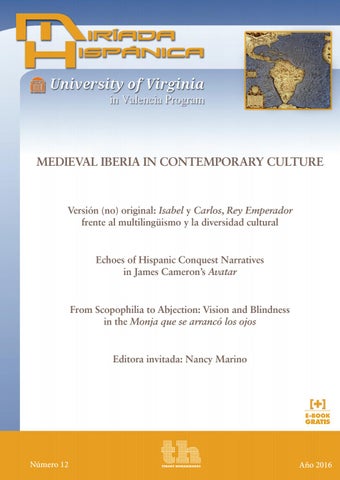
MEDIEVAL IBERIA IN CONTEMPORARY CULTURE
Versión (no) original: Isabel y Carlos, Rey Emperador frente al multilingüismo y la diversidad cultural
Echoes of Hispanic Conquest Narratives in James Cameron’s Avatar
From Scopophilia to Abjection: Vision and Blindness in the Monja que se arrancó los ojos
Editora invitada: Nancy Marino
Número 12
Año 2016
Información
PVP 20€ WEB www.miriadahispanica.com EDITORES Agustín Reyes-Torres University of Virginia-Hispanic Studies Program Calle Ramón Gordillo 4. 46010 Valencia, España. EDITORIAL Tirant lo Blanch libros Artes gráficas 14, Bajo dcha. Tels. 0034-963610048/50 Fax. 0034-963694151 46010 Valencia ISSN 2171-5718 DEPÓSITO LEGAL S. 533-2010 LUGAR DE EDICIÓN Valencia PERIODICIDAD Semestral DISEÑO DE CUBIERTA Ignacio Fito sobre el mapa de Ámerica de Diego Gutierrez de 1562 PRODUCCIÓN Y Enrique Celma Marín. Servicio de programa univer ADMINISTRACIÓN sitarios AVISO LEGAL Se permite la reproducción parcial de los contenidos para uso didáctico siempre que se cite la procedencia de los mismos.
DIRECTOR Agustín Reyes-Torres Universitat de València SUBDIRECTOR José Enrique Peláez Malagón Universitat de València SECRETARIO EDITORIAL Sergio Arlandis Hispanic Studies Program University of Virginia
Créditos COLABORADORES Antonio Aguilar Hispanic Studies Program University of Virginia María del Puig Andrés Universidad Católica de Valencia
CONSEJERO EDITORIAL José Eliseo Valle Universitat de València
Luis Llorens Hispanic Studies Program University of Virginia
SECRETARIA DE COMUNICACIÓN Sonia Valiente Alber Hispanic Studies Program University of Virginia
Mª Pilar Guitart Universidad Católica de Valencia
EDICIÓN DIGITAL/WEBMASTER David Celma Hispanic Studies Program University of Virginia
Jesús Peris Hispanic Studies Program University of Virginia Mabel Richart Universitat de València
COMITÉ EDITORIAL Carlos Cabrera Universidad de Salamanca Toni Cella University of Virginia Julia Cuervo Hewit Penn State University Daniel Chornet-Roses University of Saint Louis (Madrid) Andres Fisher Appalachian State University Aurora Hermida-Ruiz University of Richmond
Maria Mabrey University of South Carolina Matthew Marr Penn State University Ignacio Ramos Gay Universitat de Valencia Esperanza Roman-Mendoza George Mason University Fernando Tejedo-Herrero University of Wisconsin-Madison Susan Walter University of Denver
COMITÉ EVALUADOR Y CIENTÍFICO Juan Carlos Abril Universidad de Granada Marta Albelda Universitat de València Juan Antonio Ardila University of Edinburgh Andrew Anderson University of Virginia Joaquín Azagra Ros Universitat de València Rafael Beltrán Universitat de València Teresa Bordón Universidad Autónoma de Madrid Herbert Tico Braun University of Virginia Susan Carvalho University of Kentucky Daniel Chavez University of Virginia Luis Correa-Diaz University of Georgia Mark P. Del Mastro College of Charleston Gianfranco Depretris Universidad de Turin Francisco Javier Diez de Revenga Universidad de Murcia Irma Emiliozzi Universidad de Lomas de Zamora, Buenos Aires. Edward Friedman Vanderbilt University Jesús G. Maestro Universidad de Vigo Miguel Ángel García Universidad de Granada David Gies University of Virginia
Manel Lacorte University of Maryland Blanca Lopez de Mariscal Tecnológico de Monterrey Ángel López García Universitat de València Nancy Marino Michigan State University Enric Mateu Universitat de València Francoise Morcillo Université d’Orléans Sylvia Nagy-Zekmi Villanova University Rafael Núñez-Cedeño University of Illinois, Chicago Fernando Operé University of Virginia Ana Ortega Universidad Católica de Valencia Brian Owensby University of Virginia Patrocinio Ríos Sánchez Middlebury College (Madrid) Domingo Ródenas Universitat Pompeu Fabra José Rafael Saborit Viguer Universitat Politècnica de València Laura Scarano Universidad Nacional del Mar de Plata y CONICET Jacobo Sefami University of California, Irvine Andrea Smith Shenandoah University Eduardo Urbina Texas A&M University Mary Vasquez Davidson College
Los vestigios de la Edad Media en la Península Ibérica, con su amplitud a lo largo del tiempo y su complejidad, continúan estando presentes en la cultura contemporánea española del Siglo XXI. Esa es una de las ideas centrales que subraya la Dra Nancy Marino en este nuevo monográfico de Miríada Hispánica que ella misma introduce en las próximas páginas. La profesora Marino enseña literatura y cultura medieval en Michigan State University, donde recibió el título de “Distinguished Professor” en reconocimiento de su larga trayectoria como investigadora y como docente. Su línea de investigación principal se centra en el Cancionero y en la cultura de palacio comprendida entre mediados del siglo XV y mediados del siglo XVI. Es la autora de numerosos artículos y de ocho libros, entre los que se incluye Jorge Manrique’s “Coplas por la muerte de su padre”: A History of the Poem and its Reception (2011).
Prólogo
Quisieramos expresar nuestro agradecimiento tanto a ella como a los profesores que han colaborado en esta décima segunda edición de nuestra revista. Tenemos el honor de contar con las contribuciones de Michael Harney de la University of Texas; Núria Silleras-Fernández, de la University of Colorado; Cristina Guardiola- Griffiths, de la University of Delaware; Taiko Haessler, de la University of Colorado; David Arbesú, de la University of South Florida; y por último, con Andrew Beresford, de Durham University. Gracias por aportar nuevos conocimientos a nuestra miríada. Agustín Reyes Torres Director de Miríada Hispánica
Introducción MEDIEVAL IBERIA IN CONTEMPORARY CULTURE (EVERYTHING OLD IS NEW AGAIN) Cualquiera tiempo pasado/ fue mejor Jorge Manrique
What is it about the Middle Ages that continues to fascinate us? Whether factual or fictional, long-gone people and their historical circumstances keep speaking to us across the centuries: the Catholic Monarchs Isabel and Fernando, King Arthur and his Round Table, the first hero of the Christian Reconquest, Pelayo, or Robin Hood, these stories represent something that remains meaningful today, stories to be not only remembered, but retold or reenacted. Our nostalgia for times of a remote past relies in great part on our idealization of the events and the players, of their society and their beliefs. The medieval past seems somehow better than the contemporary world, a simpler, purer time when a superior morality reigned, when courtly values of chivalric service prevailed, when national identities were formed. Never mind that brutal tactics were often used to attain these ideals: although contemporary uses of medieval histories often do depict bloody warfare, it tends toward the simplified “good guys vs. bad guys” format in which where the ideal ideological outcome takes precedent over the ruthless maneuvers carried out to achieve it. Novels, films, and historical enactments of battles and other significant events generally respond to this
uncomplicated view of the past. Some of these, like the annual 2 January celebration of the Toma de Granada, are controversial events for their one-sided glorification of an episode whose historical consequences are far more complex than the parameters of this celebration allow. In other words, (and as the modern proverb states), “The past is not what it used to be.” It has been subjected to a process of selective memory (or selective amnesia) in which authors, artists, film directors, or even politicians, choose which aspects of the historical past to utilize for the purposes of their creation, and which to set aside as being not relevant to their intentions, or even contrary to their desired objective. These objectives can range from entertainment (such as novels, films, or television programs), to political campaigns, to propaganda. But it is not only creative artists or politicians (perhaps the ultimate creators of revisionist history), who engage in the methods to carry out their aims; over the centuries historians have also used and sometimes abused the historical method in order to produce works intended to favor one side or another of an important event, or to color the biography of a significant person. These acts of revisionism usually intend to sway public opinion from the previous or received notions of history. Most recreations of the medieval past are products of romantic notions about what those societies were like, especially the lives of monarchs and courtiers. Indeed, the word “romantic” itself derives from the old French romanz, the novel of chivalry. It entered the English language by the mid-seventeenth century as a word to describe the characteristics of the chivalric tales (OED); nevertheless, it is not documented in Spanish until 1836, in Mariano Larra’s play Margarita de Borgoña, in which he refers to “un escritor romántico” (RAE). Before that time in Spain, romance was generally used only to refer to chivalric texts and to ballads. In the English-speaking world the word became the denomination of the Romantic movement, itself motivated by the values espoused in those medieval stories of valiant knights and their moral codes, and the ladies who inspired their feats as well as their amorous devotion. We tend to associate the term “medievalism” with the nineteenth-century Romantics and their continued influence not only in literature, but in the Gothic revival in architecture, the pre-Raphaelite painters, and eventually the arts and crafts movement. Nevertheless the fascination with things medieval existed well before that time, centuries before the word came into the lexicon to describe it. In Spain, a nostalgia for the idealized past seems to have begun as early as the fifteenth century. In his book The Troubadour Revival, Roger Boase sees the resurgence of this culture as an aristocratic response to the decline of medieval values. He writes that they intended to counter this loss by archaizing their world, cultivating ideas of an earlier
era about love and court society through poetic expression. Their preferred form of court entertainment was the creation and recitation of poems that often reflected these themes, and which were collected into the cancionero anthologies that remain to us a window onto the literary and social tastes of the period (5). Perhaps the most famous expression of nostalgia for a particular courtly milieu is Jorge Manrique’s Coplas por la muerte de su padre, whose verse “¿Qué se hizo el rey don Juan?” is the preamble to a series of stanzas that evoke in detail a bygone era of a gentile court of dance, music, beauty, love, and scents. This is the best example of what he had written in the first part of the poem, that “cualquiera tiempo pasado/ fue mejor.” The Coplas still arouse in the contemporary reader a lost, if idealized, world. The poem, which beautifully expresses nostalgia, loss, the inevitability of death and the certainty of a better life beyond this one, is composed with extraordinary sensibility that has affected readers throughout the five centuries since its composition. Swayed by the Coplas, the reader extends the poem’s emotive qualities to Manrique himself. In our unconscious revisionism, we are either not aware or prefer to forget that he was, first and foremost, a warrior, son of the formidable Master of Santiago Rodrigo Manrique; his father arranged don Jorge’s marriage to a women who, after the poet’s death, complained to the Catholic Monarchs of her husband’s treatment: “D. Jorge, su marido, a quien no le convenía en cosa contradecir sin que ella recibiera gran peligro de su persona e causa a le dar mala vida continuo,” referring also to the “fuerza et miedo” that she suffered with him (Marino 6). But it was the emperor Carlos V who engaged in a wholesale appropriation of the medieval chivalric model for his reign. Raised in the court of his grandfather, Maximilian I, Carlos was imbued with the chivalric spirit that his grandfather embraced. Maximilian fancied himself and his courtiers as a continuation of King Arthur’s court. Some of his preferred reading included libros de caballerías. Inspired by what he saw around him and what he read, the young Carlos created a selfimage in the same vein, and he carried this myth of self as chivalric hero into his reign as emperor. The battles against the Protestant princes for the preeminence of Catholicism was to Carlos a kind of medieval crusade. Like Amadís de Gaula, the emperor was struggling against infidels; like his grandparents the Catholic Monarchs, Carlos saw himself fighting a reconquest. Authors and artists were commissioned to produce works that depicted him as this kind of hero: many ballads about his exploits in Italy, Africa, and Europe were written and published in pliegos sueltos; he was the subject of several epic poems; he was immortalized in armor, mostly famously by Titian on the event of Carlos’s victory at the Battle of Mühlberg in 1547. But his self-fashioning on the Burgundian model of knighthood was a fantasy that in the end bore no fruit. His son and successor Felipe II had no interest at all in libros de caballerías and even banned their publication. His was not a reign of anachronism.
Even if Carlos V’s embracing of medieval ideals failed him, the public’s taste for things medieval did not wane with his abdication and death. This is most evident in the ongoing popularity of traditional poetic forms and for romances of chivalry throughout the sixteenth century. It began with the first publication of the Cancionero General in 1511, which was reedited and augmented eight more times until 1573. Probably following this model of poetic anthology, and in the wake of the success of the hundreds or even thousands of pliegos sueltos that contained ballads both old and newly composed, the romancero was born in the mid-1550s and remained a mainstay of erudite and popular reading publics well into the seventeenth century. The best-selling books on the Iberian Peninsula and in the New World in the 1500s were Celestina, in prose, and in poetry, Manrique’s Coplas, followed by the Marqués de Santillana’s Proverbios and Juan de Mena’s Trescientas. The works of Garcilaso de la Vega, published for the first time in 1543, were not on the list. In many ways, and for reasons that still need to be completely explored, the sixteenth century was a medieval century both culturally and literarily. As Dámaso Alonso once wrote about poetry in the sixteenth century, “La Edad Media no quería morir” (Alonso 165). I would take that statement further: The Middle Ages not only did not want to die, it went through a series of rebirths well into the 1600s, culminating artistically in the works of the young Lope de Vega and Góngora. The six articles in this volume demonstrate the various manners in which the Iberian Middle Ages continue to be present in contemporary culture. They illustrate ways in which the medieval past is depicted in or continues to inform novels, television programs, films, the political realm, or how medieval texts can be newly interpreted under the lens of contemporary literary theory. These essays give us insight into how medieval stories have undergone re-definition, reappropriation, or the process of selective memory. In all of them, we are able to understand how recreations of the past, or new ways of reading it, inform our contemporary consumption of the history of the Iberian peninsula in the Middle Ages. Each of them reflects in some way on the ways that Medieval Iberia is understood, misunderstood (either by ignorance or design), how it has been romanticized, idealized, and even sanitized. The overall effect of this collection is the realization of how much and how little has changed since this time, how human emotions, reactions, and desires have informed our engagement with Iberia in the Middle Ages. In “Echoes of Hispanic Conquest in James Cameron’s Avatar,” Michael Harney takes on an important example of a cinematic appropriation of a historical narrative. Many film re-visionings of medieval stories base their screenplays on facts gleaned from narratives such as chronicles or history books, choosing episodes that best illustrate their intended focus, dramatizing for effect, adding thoughts and emotions not really accessible in the sources, and creating a dialogue that attempts to bring to
life the psychology of the protagonists. But Harney sees that Cameron’s purpose was not to re-tell the narrative of the colonization of the New World. Avatar is a fantasy film about another, imagined conquest, a conquest with evident parallels to the Spanish domination of the indigenous peoples they encountered. Harney’s detailed essay walks us through the many echoes of this historical event and the narrative of the film, where the protagonist Jake is a clear counterpart to Hernán Cortés and Neytiri is Malinche’s counterpart. In addition to parsing the parallels of the Spanish colonization that appear throughout the film, Harney takes us back to pre-conquest times, to the world of romances of chivalry, which he sees as having provided the model of knight-errant behaviors for Spaniards in the New World, as well as for its extraterrestrial version in Avatar. This essay is a fascinating analysis of the ways in which Bernal Díaz de Castillo’s and Bartolomé de las Casa’s chronicles informed James Cameron’s vision and re-vision of the theme of the “conquest, domination, and exploitation of indigenous people.” From film we pass to the related medium of television depictions of historical personages and events. Núria Silleras-Fernández considers two recent and very popular Spanish television series in her “Versión (no) original: Isabel y Carlos, Rey Emperador frente al multilingüismo y la diversidad cultural.” Her main focus in this insightful essay is the decision of the series’ creators to present a Spain where only Castilian was spoken, despite the fact that this monolingual representation was far from the reality of these time periods. Silleras-Fernández considers this one-language approach a missed opportunity to remind viewers of the many languages spoken on the Iberian peninsula during the fifteenth-century: Castilian, Catalan, and Portuguese chief among them, but also Hebrew and Arabic. She also points out the almost incomprehensible omission of the fact that, when he arrived in Spain in 1517, Carlos V spoke no Spanish at all. The series makes much of his “foreignness” but does not address the language issue, which was one of the important reasons for his lack of acceptance. It was a significant enough factor for the Cortes de Castilla to include his learning Castilian in their demands to him. Instead of presenting Carlos’s ability to speak French and Flemish, the character is allowed to express himself in perfect Castilian, even with his grandfather’s widow, Germaine de Foix. French was also apparently the language in which he generally communicated with his brother Fernando, as there exists correspondence between them in this language throughout the emperor’s lifetime. Silleras-Fernández also discusses an important consequence of the monolingual representation of these historical events depicted in both series: the national and international success of Isabel and Carlos V, Rey y Emperador, unfortunately reinforces the erroneous notion that Castile and its language were the center stage of the events of the Spanish Middle Ages and Renaissance. As such, these two series, perhaps unwittingly, present an alternative history of Spain in the fifteenth and sixteenth centuries.
Two of the essays in this collection concern the image of medieval queens that are presented in contemporary retelling of their stories. The first, written by Cristina Guardiola-Griffiths, focuses on Urraca I de León y Castilla, who reigned in the first quarter in the twelfth century. In “Urraca: Female Sovereignty Forgotten and Imagined,” she addresses the fact that Urraca’s story has been passed over in recent works of historical fiction because it does not respond to the current social and political image of the characteristics of female sovereignty. The queen seems to continue to suffer from her historical reputation: in contemporary chronicles, early historians placed emphasis on the transgressive nature of her queenship. Urraca did not conform to the virtuous queenly ideal, not only because she fought her husband and son for power over her own domains, but especially because of her sexual transgressions, having had at least one lover and two illegitimate children. Since the beginning of this century only one novel about Urraca has been published, an account whose objective is to present a more historically real account of her life, and to reestablish her reputation. Guardiola-Griffiths leads the reader through a kind of history of the reception of the Urraca story, which also has the ability to help us understand the history of attitudes towards women in power over the centuries. Urraca was apparently at the mercy of chroniclers who defined her legacy by denigrating her character. In “Saint of the Silver Screen: Queen Isabel of Aragon’s Legacy in the Twentieth Century,” Taiko Haessler demonstrates how Isabel de Aragón, queen consort of Portugal (1282-1336), participated in the creation of her own narrative, a self-fashioning that would have been difficult for a women to achieve in this era. During her lifetime Queen Isabel, who was considered a saint even before her death and later canonized by the Catholic Church, dedicated herself to pilgrimages, prayer, alms, and the founding of a convent, where she requested her burial instead of alongside the tomb of her husband, Dionisio I. A hagiographic account of her life written in this era became the basis for many of the works about her throughout the centuries. Haessler provides the reader with an account of the numerous ways in which Isabel de Aragón’s story has been recounted over the centuries (through literature, painting, festivals, and film), and how depictions of her have changed since the nineteenth century, when this queen became the object of scholarly inquiry as well. In the twentieth century, Isabel became the protagonist of a Franco-era film (Reina Santa, 1947) which, like most of the films produced during the dictatorship, served the propagandistic purpose of glorifying Spain’s past. Haessler concludes with a discussion of recent historical fiction about the queen, which provide more nuanced interpretations of her life that attempt to delve more deeply into what her life might have been like.
The medieval legacy in current Spanish politics is the theme of David Arbesú’s “Usos políticos del Éxodo: del rey Pelayo al siglo XXI.” In the essay, the reader is made to clearly understand the power of revisionist history, a process in which historians seem to have always indulged. Arbesú takes us back to the late ninth century and the court of Alfonso III, whose chroniclers refashioned the history of Pelayo, identifying him as descended from ancient and noble lineages, and creating parallels between the hero of Covadonga and the biblical story of Moses. This alternative history of Pelayo as divine agent lasted through the fifteenth century as the dominant narrative and defining image of Pelayo. In the centuries that followed this vision of events both changed and remained the same: the Habsburg universal monarchy, for example, found it convenient to perpetuate this mythology in order to legitimize itself. Arbesú presents an intriguing update of the use of the Moses narrative in contemporary Spanish politics, explaining how Artur Mas appropriated the image of the Biblical patriarch in his 2012 campaign. Mas depicted himself on a publicity poster with open arms before a wave of Catalan flags. The media did not hesitate commenting on Mas’s fashioning of self as Moses, parting the Red Sea, leading his people to the promised land. Nevertheless, as Arbesú wonders at the end of his essay, it is not clear whether contemporary citizens are able to “read” this kind of Messianic message that was very clear to people who lived centuries ago; whether they know enough about history to understand the parallels that are being drawn. The final essay of this volume moves in another direction, that of current modes of interpretation of medieval texts. In “From Scopophilia to Abjection: Vision and Blindness in the Monja que se arrancó los ojos,” Andrew Beresford applies contemporary literary theory that sheds new light on what has been traditionally been seen as a simple exemplum, in which the nun blinds herself as a means to avoid the lechery of a king, who has been gazing upon her with lust. Beresford evokes a series of theoretical models –– from Freud to Lacan, Kristeva to Homi Bhabha, along with other relevant interpretive frameworks –– to arrive at new understanding of the exemplum’s broader, more universal meaning. Through careful explanation of the Christian symbolism of sight and blindness, light and dark, Beresford leads the reader to his conclusion about the real nature of the deceptively simple tale. Through her self-mutilation the nun not only rejects the sexual advances of the king, she essentially reaffirms her loyalty to Christ, her heavenly lover, who miraculously restores her sight. Beresford understands the tale as a metaphor for the Church’s central image, the healing of the blind, leading the faithful from the darkness to the light, from death to eternal life. Nancy F. Marino Michigan State University
Bibliography Alonso, Dámaso. “Juan Fernández de Heredia en la tradición penisular.” De los siglos oscuros al de Oro. Madrid: Gredos, 1958. 165-77. Boase, Roger. The Troubadour Revival: A Study of Social Change and Traditionalism in Late Medieval Spain. London: Routledge and Kegan Paul, 1978. Marino, Nancy F. Jorge Manrique’s “Coplas por la muerte de su padre”: A History of the Poem and its Reception. Woodbridge: Tamesis, 2011. Oxford English Dictionary Online. Oxford University Press, December 2015. “romantic, adj. and n.” 4 January 2016. Real Academia Española: Banco de datos (CORDE). Corpus diacrónico del español. http:// www.rae.es. 4 January 2016.
ARTÍCULOS
Michael Harney1
University of Texas-Austin - mpharney@xanteum.net Artículo recibido: 15/11/2015 - aceptado: 25/11/2015
Abstract: One of the more intriguing aspects of James Cameron’s 2009 science-fiction adventure film, Avatar, is a storyline that strongly resembles certain episodes from the early history of New World exploration and conquest. Cameron seemingly plunders a distinctly Hispanic terrain in his re-confection of a cluster of narrative motifs centered on such themes as going native; the role-reversing White renegade; the native princess; the advocacy of native peoples and indigenous cultures. Inspired by Bernal Díaz del Castillo’s True History and other Hispanic accounts, Avatar shows a protagonist reminiscent of the gone-native Spaniard Guerrero in Díaz’s history; the alien tribal princess is a Malinche who resists the outsider; there are secular missionaries who personify a pro-native advocacy similar to that of Bartolomé de las Casas; the ruthless bad guy is a sci-fi version of Cortés; the corporate entity despoiling the pristine pastoral wilderness of Pandora is a latter day version of Habsburg colonialism. Key words: Avatar film; Hernán Cortés; Bartolomé de las Casas; Conquest narratives; Colonialism. Resumen: Uno de los aspectos más interesantes de Avatar, la película de ciencia ficción y aventuras que James Cameron dirigió en 2009, es un guión que se parece a ciertos episodios de la historia temprana de la exploración y conquista del Nuevo Mundo. Cameron parece basarse en un Michael Harney is Associate Professor of Spanish at the University of Texas-Austin, where he teaches medieval and renaissance Spanish literature. He is the author numerous articles and four books: the recently published Race, Caste, and Indigineity in Medieval Spanish of Travel Literature (2015); The Epic of the Cid, Translation and Edition (2011); Kinship and Marriage in Medieval Hispanic Chivalric Romance (2001); and Kinship and Polity in the “Poema de mío Cid.” Professor Harney holds a Ph.D. from the University of California, Berkeley. 1
«Echoes of Hispanic Conquest Narrative in James Cameron’s Avatar»
Miríada Hispánica, 12
Echoes of Hispanic Conquest Narrative in James Cameron’s Avatar
terreno netamente hispánico para su re-imaginación de una serie de motivos narrativos que se centran en los temas como la imitación de los indígenas; el renegado blanco; la princesa indígena; y el apoyo a los indígenas y su cultura. Inspirado en la Historia verdadera de Bernal Díaz del Castillo y otras narraciones hispánicas, Avatar presenta un protagonista que recuerda al español vuelto indígena, Guerrero, que aparece en la obra de Díaz del Castillo; el malo de la película es una versión ciencia-ficción de Cortés; la empresa que destruye el paisaje puro y bucólico de Pandora es una versión tardía del colonialismo de la Casa de Austria.
Miríada Hispánica, 12
Palabras claves: Película Avatar; Hernán Cortés; Bartolomé de las Casas; narrativas de conquista; colonialismo.
James Cameron’s 2009 science-fiction adventure film, Avatar, is one of the biggest box office hits in the history of cinema. One of the more intriguing aspects of this megahit is the scope of its reception outside the Anglo-American sphere. The Canadian auteur, in effect, crafted a Hollywood product that entertained and appealed to audiences on every continent where movies are exhibited, with North American ticket sales of $749,766,139, representing 27.3% of its total sales, and a foreign box performance of $2,027,457,462, representing 72.7% of its total worldwide box office of $2,787,965,087 (Box Office Mojo). Avatar is a typical Hollywood blockbuster, financed by an enormous budget, graced with spectacular special effects, and supported by the usual massive advertising campaign. This Hollywood film’s strangely international appeal is especially puzzling in light of its box office success in many countries which repudiate the United States’s supposed exertion of hegemonic influence in Latin America and other regions. At the same time, this quintessentially Hollywood product was also extremely popular in the United States, despite the story’s clear implication that the narrative’s bad guys allegorize all that the United States is perceived to stand for in terms of exploitative, industrialized modernity and interventionist geopolitics. To put it simply: if there is an identifiable present-day polity embodied by the invaders and exploiters of Avatar’s futuristic narrative, it is the United States. While this domestic and international market success may be difficult to explain (as is the similarly broad appeal of the same director’s seemingly Anglocentric Titanic), one may nonetheless note certain features of the script that seem particularly calculated to involve a broad range of audiences in the present-day globalized world. These audiences would include the inhabitants of both developed and under-developed countries. Many viewers among such audiences might well perceive analogies between the events and characters of Avatar’s tale of invasion and
Michael Harney
resistance, and the reality of present-day life in many rural and urban environments variously threatened and intruded upon by globalization in its many guises.
The significance of this possibly apocryphal episode for the present essay resides not in its historical authenticity or plausibility, but rather in its protean appeal to subsequent generations of storytellers and their audiences. Recent reworkings of the basic story include the 1995 Disney film Pocahontas, and the 2005 live-action film The New World. Whether, as in the Disney film, a given version of the story portrays Pocahontas as a native girl falling in love with a European outsider, or whether, as in the 2005 film, the two characters’ relationship is portrayed in more ambiguous terms, all versions convey, more or less, the same minimal narrative involving a young Amerindian girl who made friends with the Jamestown colonists in the early seventeenth century, and who may or may not have been enamored of one colonist in particular. Cameron, however, although determined to tell a tale of miscegenetic involvement between a male outsider and an indigenous female, avoids analogizing the obvious Anglophonic precedent. Instead, Cameron plunders a distinctly different terrain in his re-confection of a cluster of narrative motifs centered on such themes as, in addition to miscegenation: the advocacy of native peoples by anti-colonialist dissenters among the colonizers; going native by a heroic outsider; cultural rolereversal in the form of this outsider’s transformation into his adopted people’s messianic protector. Hollywood has provided examples that somewhat resemble Cameron’s cluster of motifs, such as 1950’s Broken Arrow and the 1970 adaptation of the novel Little Big Man. The first dramatized the possibility of peaceful coexistence of Indians and Whites, while portraying Apache culture in sympathetic terms (and, incidentally, flirting with the notion of miscegenation). The second tells the tale of an orphaned «Echoes of Hispanic Conquest Narrative in James Cameron’s Avatar»
Miríada Hispánica, 12
Among the factors suggestive of such parallels is a storyline that strongly resembles certain episodes from the early history of New World exploration and conquest. The essential element of Avatar’s plot is a love story between an alien male and an indigenous female. The narrative basis one might expect as the inspiration of such a story, coming from a North American writer-director, is the semi-legendary and often romanticized account of the encounter between the Englishman John Smith and a young indigenous woman named Pocahontas. The young Amerindian girl’s timely intervention at the moment of Smith’s imminent execution has fueled voluminous speculation as to the veracity of the story; the girl’s perspective on events and her motives in interceding for the outsider; the mutual perceptions of natives and colonists; the cultural and political implications of the encounter (Price 67-69).
white boy raised by the Cheyenne who grows up to be an adult torn between the two worlds, but distinctly favoring the indigenous perspective. Cameron, however, retells a narrative of conquest and colonization that distinctly differs from these two examples and from many other North American novels and films on similar themes.
Miríada Hispánica, 12
Rather than base his story on examples from North American imperial and colonial history, Cameron creates a protagonist who strongly resembles the gonenative Spaniard Guerrero in Bernal Díaz del Castillo’s Historia verdadera de la conquista de la Nueva España. Díaz’s chronicle depicts two Spaniards captured by Indians. One, Jerónimo de Aguilar, resists assimilation into the indigenous culture and eagerly responds to the news that Spaniards are nearby, looking for him. The other, Gonzalo Guerrero, has fully assimilated into the indigenous community. Thoroughly adapting to their ways, he has married a native woman and founded a family with her; he has become a respected captain in war. Reminding his fellow Spaniard that he has married into the tribe and now has three children by his native wife, Guerrero declares that among the Indians he is regarded as a “cacique y capitán cuando hay guerras.” Moreover, he has “labrada la cara y horadadas las orejas.” He demands of Aguilar: “¡Qué dirán de mí desde que me vean esos españoles ir de esta manera!,” while observing how beautiful his little children are (“mis hijitos cuan bonicos son”). Guerro’s native wife then berates Aguilar: “Mirá con qué viene este esclavo a llamar a mi marido; íos vos y no curéis de más pláticas.” Ignoring the native woman’s rebuke, Aguilar again urges Guerrero to abandon the natives, reminding him that, having been born a Christian, he should not risk losing his immortal soul for the sake of an Indian woman. Despite Aguilar’s remonstrations, Guerrero insists on remaining with his adoptive people (Díaz del Castillo 100). Regarding Díaz del Castillo’s account of these personages and events, presumably grounded in a real-life situation, Inga Clendinnen emphasizes the psychological enigma posed by individual motivation and behavior in the context of cultural assimilation. All we can do, as we contemplate the two Spaniards’ diametrically opposed reactions to similar circumstances, is to recognize that one man, determined to retain “his Spanish and Christian sense of self,” withstands the pressure to assimilate, while the other just as determinedly commits to his “remaking as a Maya” (Ambivalent Conquests 18) We can only speculate, affirms Clendinnen, regarding the character’s assimilative predisposition. Contributing factors might have included despondency induced by isolation, followed by recuperation and adaptation to an alien environment; a talent for learning foreign languages; an exceptional receptivity to exotic ways of life. What
Michael Harney
Guerrero is an obvious precursor, if not the consciously imitated model, of Cameron’s Jake Sully. There are, to be sure, numerous differences between the two characters (e.g., Jake undergoes an epiphanic change of heart with regard to the natives, while Guerrero does not; Jake is a paraplegic, while Guerrero has no physical handicap; Guerrero has children by his native wife, while Jake does not; Jake works for a mega-corporation, while Guerrero is a shipwrecked sailor, etc.). The two story arcs likewise differ in many ways. Díaz del Castillo’s minimal and anecdotal account occupies barely two pages, while Cameron’s screenplay is much more complex, generating a film over two and a half hours long; Guerrero’s experiences occur in a pre-conquest phase, while Jake’s story begins in medias res, with the invaders’ exploitative campaign well under way. Perhaps the chief difference between the two narratives is the reversal of moral perspective. Díaz del Castillo, recounting the episode from the viewpoint of the invaders, portrays Guerrero as a traitor and renegade, while Cameron shows a protagonist who turns against his own kind because it is the right thing to do. The Historia verdadera, in other words, is frankly ethnocentric: it is us vs them. Avatar, by contrast, narrates from a multiethnic perspective that unapologetically conforms to the multicultural liberalism of the present-day: all races and cultures have a right to exist. Despite these and other differences, the film clearly retells a tale whose essential elements resemble those conveyed by Díaz del Castillo’s account of the shipwrecked Spaniard gone native among his former captors. Avatar, in other words, builds on a basic minimal story line in the same way that adapters of the Pocahontas legend, working from a primordially anecdotal source, have constructed their own variations. Cameron’s elaboration rewrites and expands the core narrative, showing an earthling intruder who starts out as the agent and informant of the invading forces. In furtherance of his covert mission, this interloper undergoes a rite of «Echoes of Hispanic Conquest Narrative in James Cameron’s Avatar»
Miríada Hispánica, 12
is certain, if we take Díaz del Castillo at his word, is the fact of Guerrero’s assimilation, and his tenacious resolve in siding with his adoptive people in their conflict with “his erstwhile countrymen.” Whatever the underlying causality and motivation of his going-native, Guerrero does more than merely engage in expedient role-playing to get by in a hostile environment. In his conversation with Aguilar, he implies that back among the Spaniards he would be at best an ordinary sailor, and at worst a grotesque freak and a heretic. Among his fellow tribesmen, by contrast, he is a man of importance, respected as a warrior and leader. Utterly committed to his new identity and new way of life, this obstinate assimilator has figuratively burnt his ships. For him, there is no going back. Later, observes Clendinnen, he will warn his own and other tribes of the true nature of the Spaniards and their intentions, and fight alongside the indigenous folk of the region against the outsiders (Clendinnen 18).
Miríada Hispánica, 12
passage in order to authenticate his native persona. His mission and his ethical sense of self are, however, undermined by his growing relationship with Neytiri, a female warrior. In the course of the story, he falls in love with this daughter of an alien clan, eventually becoming a fervent advocate and militant defender of the native cause and risking his life in defending them against his fellow terrestrials. Cameron’s depiction of the alien warrior princess confirms his deliberate folkloric revisionism. The daughter of a tribal chieftain, Neytiri can be seen as a Doña Marina who, rather than collaborate with the outsiders, personifies native resistance to their aggression and influence. Examining Avatar’s plot from the broader perspective of the over-all program of conquest and colonization represented in Díaz del Castillo’s history, we may detect other elements borrowed by Cameron from the historical Spanish context, then tweaked to accommodate his reworked version of the invasion scenario. The churchmen of the Spanish epic of overseas conquest become, in Cameron’s revised world, the anthropologists, led by Sigourney Weaver’s head researcher, who work to acculturate the film’s native people, the Na’vis, in order to prevent a war between the natives and the outsiders. These well-meaning ethnographers, implementers of the Avatar program that allows earthlings to inhabit native bodies, can be seen as secular missionaries whose pro-native advocacy is pointedly suggestive of Spanish clerical opposition to the materialist intentions and violent methods of the historical conquistadors. At the same time, the film’s most ruthless bad guy, the military officer in charge of a band of mercenaries, is a sci-fi version of Hernán Cortés, while the corporate entity pitilessly bent on despoiling the pristine jungle wilderness of Pandora represents an updated version of Habsburg colonialism of the sixteenth and seventeenth centuries. Reworking the basic situation of the gone-native outsider, Cameron’s screenplay reverses the assimilative role-playing and gender orientation of ancient and medieval adventure fiction. In that earlier tradition, the native princess, or her analogues (e.g., Ariadne and Medea in the mythic accounts of Theseus and Jason; the Quijote’s Zoraida in the captive’s tale), falls in love with the heroic outsider, collaborates with him against her people, and thoroughly assimilates to her lover’s culture. The stereotype implies not merely love between an irresistible male outlander and a high-status native female, but, as F. M. Warren long ago demonstrated (345-347), resourceful collusion and whole-hearted conversion by the indigenous woman—a “willing apostate,” as Warren aptly characterizes her (358). A prominent early-modern example of this motif is the warrior queen Calafia, in Las sergas de Esplandián, the continuation of Amadís de Gaula. Leading her female horde, a black race similar to the ancient Amazons whose home is an island nation
Michael Harney