
Elijah Pierce: Private Masterworks 2026

Page 1


Elijah Pierce:Private

April 17 - May

The Elijah Pierce: Private Masterworks exhibition has been carefully chosen from several excellent private collections in New York, Washington, Memphis, Columbus and throughout the country. A number of these exceptional carvings are available as well.

Numerous stellar carvings that were included in the outstanding Elijah Pierce's America exhibition at the Barnes Foundation's handsome special exhibition gallery in 2020-2021 will be included. Our exhibition will hopefully enable many Elijah Pierce collectors, scholars, and enthusiasts to view over forty extraordinary examples of his carvings which represent the entire range of his oeuvre. His series of subjects, which include religious, allegorical, cultural, political and fauna themes in varied carving styles from the early 1930's to the later 1970's will be on view. Many of these works of art have not been seen in Columbus since his important one person exhibition at the Columbus Museum of Art in 1993. At least ten of these carvings were in African American collections in Columbus and in one case in Mississippi and in remote collections elsewhere that the curators were not aware of at that time.

Pierce:Private Masterworks

May 15, 2026

Elijah Pierce was an exemplary humanitarian and a singular artist. He was an empa thetic yet resolute, incisive yet witty spokesman for his community and society as a whole. His passionate sermons and vital expressive carved narratives are as relevant today as they were over 90 years ago.

I have included excerpts throughout our virtual catalogue by museum directors, curators, scholars, artists, and critics regarding the cultural authenticity and aesthetic quality of Elijah Pierce’s finest carvings. These statements have been written over fifty years. Jim and I hope they provide insightful “windows” into the artist’s compassionate spirituality, deep bond with his community, and the unique clarity and ingenuity of his art.

Dr. John Moe, a nationally and internationally recognized scholar of African Amer ican culture and a good friend of Elijah later in his life, will give a talk at 7:30 at our opening. He interviewed the artist numerous times at his home, which was a special honor. We have included a compendium of Dr. Moe’s cogent, meaningful essay, Amazing Grace, ‘I was Lost but now I’m Found’: The Art in the Narrative of Elijah Pierce .

Tim Keny

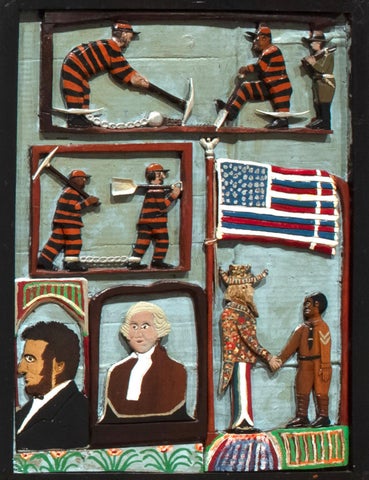
Front Cover: Presidents and Convicts, 1941, Painted bas relief woodcarving, 33 ½” x 24 7/�”

Page: Roses, 1934, painted bas relief woodcarving, 6 ¼” x 9 ½”

Pierce’s ethics were already evident in works that include Presidents and Convicts (1941) . . . Other works from the early 1940s extol the virtues of service to country. In Girl Scou t, which Pierce made for his niece in 1942, the double ‘V’ beneath the eagle signals the Pittsburgh Courier’s ‘Double V Campaign,’ which aligned victory against fascism abroad with triumph over racial discrimination at home.”

Dr. Nancy Ireson

“’Your Life Is a Book, and Every Day Is a Page’: Elijah Pierce’s Storytelling” Elijah Pierce’s America, The Barnes Foundation,Philadelphia September 27, 2020 – January 10, 2021

Opposite Page: Girl Scout, 1942

Painted bas relief woodcarving

13 x 10 inches

Price on Request

“. . . his aim is always to appeal to the broadest human experience, depicted in cycles redemption. That experience is vividly conveyed in his religious narratives – a Garden plump, affectionate Adam and Eve. . . “

“Homilies

The New

cycles of struggle and Garden of Eden with a

Holland Cotter

“Homilies and Home Life in Wood”

New York Times, August 13, 1993

“According to the Book of Genesis (1:26-31), God made Adam and Eve and all the plants and animals on the sixth day of creation. He prepared a garden for them, called Eden, and it is in this lush paradise that Pierce chose to depict them. Basking in innocent nakedness, the couple is surrounded by a multitude of colorful animals, birds, fish, and reptiles. All are affectionately portrayed with lively personalities – the signature of Pierce’s animal carvings. . .”

E. Jane Connnell, Nannette V. Maciejunes Elijah Pierce, Woodcarver Columbus Museum of Art, 1992

Opposite Page: Adam and Eve, 1971, painted bas relief woodcarving with glitter, 21 ¾” x 31 ½” (Collection of Josh Feldstein, Courtesy of Keny Galleries)

“Pierce’s representations of biblical incidents are among the most beautiful folk carvings being executed today.”

Robert Bishop (Director, Museum of American Folk Art, New York)

“The Religious Object”, p. 198

American Folk Sculpture Bonanza Books, New York, 1974

Opposite Page: Christ with Angel, 1968 Carved and polychromed wood with glitter 24 ¾” x 16 ¾” (Private collection, Courtesy of Keny Galleries)

Peter’s Denial (And the Cock Did Crow), c. early-mid 1930’s
Painted bas relief woodcarving with glitter mounted on cardboard, 34 ¾” x 24 ½”
(Sacred Art Pilgrim Collection, Courtesy of Keny Galleries)
Christ’s Charge to Peter: Feed My Sheep, 1932 Painted bas relief woodcarving mounted on painted board, 33 3/16” x 24 ¼”
(Private collection, Courtesy of Keny Galleries)
“.

. . These include vividly imagined Bible stories . . . . And ‘Nativity’ (late panel, the other packed with white-robed flying angels neatly stacked camels alternating with yellow flowers. . . “

Nativity, circa 1940’s, painted bas relief woodcarving, 15” x 30” (Private collection, Courtesy of Keny Galleries)

(late 1930s-early 1940s), with the Holy Family filli ng one side of the sheep, and the three Magi riding across the bottom, the l egs of their Karen Wilkin

“Elijah Pierce’s America’ Review: Working Against the Grain”, The Wall Street Journal, October 3, 2020 Elijah Pierce’s America, Barnes Foundation,Philadelphia

Angel, c. late 1960’s-early 1970’s

Painted freestanding woodcarving 12” x 7”

(Private collection, Courtesy of Keny Galleries)

Christ Praying in the Garden of Gethsemane, c. 1940

Painted bas relief woodcarving mounted on cardboard 14 ½” x 13 ½”

(Private collection, Courtesy of Keny Galleries)

“. . . Elijah was well-known in his community for bestowing an art piece on a member of his own church. This art piece was carved for a mother in the church as a gift that emphasized the comfort offered to a mother and son by an angel, while also hinting at potential for lifelong peace and salvation. Pierce often carved special pieces for people in his church. As the “lay minister,” Elijah would sit in the front of the congregation with a paper bag that contained a special treat for someone. The “church pieces” were sometimes a carved saying or a narrative scene envisioned to sustain the recipient through a difficult period. . . “

Dr. John Moe

The Ohio State University “Amazing Grace,’I was lost, but now I’m found’: The Art in the Narrative of Elijah Pierce” Canton Museum of Art, Elijah Pierce: An American Journey November 23, 2017-March 4, 2018

Opposite Page:

Angel with Mother and Child in the Garden, 1966

Painted bas relief woodcarving

25 ¾” x 15 ½”

(Private collection, Courtesy of Keny Galleries)

Above: Mary at the Cross, freestanding woodcarving, paint and glitter, 15 ¼” x 3 ½” x 3 ¼” (Private collection)
Opposite Page: Avenging Angel (The Archangel of Justice), 1934, enamel on carved wood in artist made frame
¾” x 9 ¾” (Private collection, Courtesy of Keny Galleries)

“The project (Preaching Stick), . . . ‘combines family history, biblical references, and life cycle events and images from everyday life-the tools of his trade (a comb, a barber’s chair, a cross and bible) . . . all rescued from miscellany and uniquely combined into a statement that stands for his life.’ Pierce called upon this focused essence of a lifetime for knowledge, eloquence, and inspiration: ‘Sometimes when I was asked to say something in church, I would turn this cane over and over until I found a story or message I wanted to use.’ Thus, he named it his ‘preaching stick.’ What made Elijah Pierce an innovator within the tradition was not the carving of a walking stick. . . . What was original was his utilization of a traditional medium and symbols to review his own life and arrive at its significance. In doing this, he extended the staff/walking-stick tradition and deepened its inherent meaning, as a symbol of power and authority. Unique yet traditional, specific but accessible to others, articulate and interpretable-Pierce's ‘preaching stick’ materializes an artistic code.”

American Folk Masters: The National Heritage Fellows in Association with the Museum of International Folk Art, Santa Fe, 1992

“This preaching stick is perhaps the most memorable example of its kind by Pierce. It is carved with secular, religious, and Masonic motifs found throughout Pierce’s oeuvre. Seen here are the sun, moon, stars, figures, animals, dice, cards, a handgun, and a cross. Those motifs represent elements of everyday life that would have been topics of conversation in the barbershop. Near the top of the preaching stick a man, a barber chair, and a comb are depicted. Above these, the inscription ‘1924/Col. Ohio/ E.P’ records Pierce’s establishment in the barber’s trade in Columbus.”

Preaching Stick, c. 1930s-40s

Carved and painted wood with rhinestones

36” x 1 ³/8”

Elijah Pierce, Woodcarver Columbus Museum of Art, Ohio, 1992

E. Jane Connell and Nannette V. Maciejunes
Judas Betraying Christ, 1966
Painted bas relief woodcarving with glitter 24” x 17”
(Collection of John Jerit, Courtesy of Keny Galleries)

Jesus before Pilate

Painted bas relief woodcarving with glitter 13” x 27 ½”

(Collection of John Jerit)

The Coming of Christ
Carved wood relief, paint and glitter
27” x 18 ½”

Holy Family, 1931

Painted bas relief woodcarving

6 ½” x 12”

(Sacred Art Pilgrim Collection, Courtesy of Keny Galleries)

(Private Collection, Courtesy of

The Angel of Faith (Angel Appears to Joseph), c. 1932 Painted and carved wood relief 23” x 14 ½”
Keny Galleries)
Elijah (Faith), 1953
Painted bas relief woodcarving 13 ½” x 27 ¼”
(Collection of John Jerit)

Untitled (Christ Walking on the Water), c. 1970

Painted bas relief woodcarving with glitter 16 ½” x 18 ½”

(Collection of John Jerit, Courtesy of Keny Galleries)

“Amazing Grace,’I was lost, but now I’m found’: The Art in the Narrative of Elijah Pierce”

Dr. John Moe

The Ohio State University

(Canton Museum of Art, Elijah Pierce: An American Journey November 23, 2017-March 4, 2018)

“. . . He was a father, a lay preacher and a member of the senior choir in his church, a respected business man who had a barber shop for decades, and a philanthropist in his community. The grace with which he synthesized these multiple roles is testament to the ways in which he became important in the community and an artist of no small recognition.

In many ways, his fame as an artist overshadowed his role in the community. He was, in the end, a normal human being who dealt with a range of issues far beyond religious considerations, though, religious orientation was a central concern for Elijah Pierce. Elijah transcended borders: religious, social, and racial borders. He believed deeply in the sacred. Elijah made significant commentary in his art on a range of related themes in American life: the religious and sacred, allegorical lessons for life, social historical issues, heroic figures especially, but not restricted to, the African American community, and moral teachings and lessons for his church and community. In (numerous) carved pieces, Elijah was sometimes a reporter, carving the stories he witnessed in everyday life. At other times, Elijah carved reflections about what he saw in his African American community and the wider American culture. . . .

During his lifetime, Pierce played a central role in his own Black community; he was an articulate and thoughtful interpreter of his surroundings. The narrative in his art reflected on and told the story about the experience of the Black community during his time. As the proprietor of a popular barber shop in the Black community of Columbus, Ohio, he saw and heard the range of discussion and problems going on in the community. In part, the story was that of the African American experience and the quest for African-American social citizenship in the United States, but it was also the story of the whole country. Yet Pierce’s personal history and experience, formed in the context of African American and American culture, were the primary influences on his art and his development as an artist. The body of his work illustrates a textured examination of African American life and United States cultural and political history from the 1920s to the 1980s. Pierce attempted to give us some temporal understanding of this perplex of existence. His art work transcended traditional borders and touched on topics, white and Black, throughout the history in which he lived.

His art contained no excess, no luxuriance . . . His carved images spoke truth to the world in which African Americans live. Elijah’s art was dominated by everyday images selected from Bible storybooks, newspapers, and magazines. For color, Elijah used ordinary paint purchased from the hardware store. Pierce daily distilled the information that came to him through the church or the barber shop conversations, and he made wood carvings that articulated what he thought was important to record for posterity and for his customers and other visitors who came into the barber shop world of Elijah Pierce. . . .

Deeply embedded in the relationship of African Americans and Euro-Americans is the historic aspect of violence, and, the trauma that results from the constant threat of violence. The art piece, Elijah Escapes the Mob , was a significant piece for him because it contained some great truth that he had made a strong effort to tell. The carving involved a baseball game. One day, I asked Elijah about the piece and I took it down from the wall in his barber shop. Elijah told me that the game was scheduled for July 4th and it was to be played in Tupelo. We had a game between two Negro teams,’ Pierce said, ‘It was part of the July 4th celebration in Tupelo. [Mississippi]’

Elijah remembered, ‘A colored boy in Tupelo had killed a white man… Looking for a Negro who looked like me.’ The narrative of Elijah Pierce, contained in the art piece, reveals a number of salient motifs that are consistent both with the narrative of the immigrant to the Americas, and the narrative of southern Black people living in a repressive society. The larger narrative Elijah carved in this piece of art was how African Americans might escape the prejudice and violence of American society.

Like a singer of tales, Elijah had finished his story. His art piece was his instrument, his musical accompaniment.. . . Amidst his seriousness, Elijah was not without a sense of humor. One day, while looking at a piece that illustrated a boy on a bicycle and a woman talking on a phone, he looked sheepishly and said, ‘You know there are three ways to get the news around town, you could telegraph, or, you could telephone, but the best way to get the news out is to tell a woman!’ With that, and a little chuckle, Pierce twinkled and gave a little smile at his own joke.”

Father Time with Clock, c. early 1930s

Carved and painted wood, clock mechanism

7 ½” x 6 7/8”

Private collection, Courtesy of Keny Galleries

ALLEGORICAL

(Collection of Josh Feldstein)

Picking Wild Berries, c. 1940s
Painted bas relief woodcarving, 37 ½” x 17 5/8”

Straining at a Gnat, Swallowing a Camel, c. 1941 Painted bas relief woodcarving, 16”

(Collection of Josh Feldstein, Courtesy of Keny Galleries)

x 15”

Buzzard, 1948

Carved and painted wood relief mounted on painted corrugated cardboard, 16” x 12 7/8”

(Private collection, Courtesy of Keny Galleries)

Safari, 1940

Carved and painted wood relief 13” x 22”

(Private collection, Courtesy of Keny Galleries)

FAUNA

In his role as a preacher and community elder, Pierce was a gifted storyteller. . . . The moral issues and concerns expressed in these animal tales parallel those addressed directly in a number of the artist’s narrative reliefs. It is possible, therefore, to consider many of Pierce’s individual animals in the larger context of meaning which they held for Pierce and his original audience.

The carvings emphasize the alligator’s rough scales and call to mind the African American folktale about the way the alligator got his unusual hide. . . . Tricked by a wily Br’er Rabbit and his foolhardiness, the Alligator gets his skin scorched by fire until it is ‘just as black and crinkly as a burned log of wood, and as rough as a live oak bark. . . “

Elijah Pierce: Woodcarver Columbus Museum of Art, 1992

The origin story is that, in 1923, Pierce carved a small elephant-on viewas a present for his wife. She liked it so much, we learn, that she put a ribbon around its neck and set it on the mantelpiece. ‘If you like that ugly thing,’ Pierce is supposed to have said, ‘I’ll make you a whole zoo.’ Certainly there are plenty of lively animals throughout the exhibition, both free-standing and in complex narrative relief.

“’Elijah Pierce’s America’ Review: Working Against the Grain” Wall Street Journal , October 3, 2020

Elijah Pierce’s America, Barnes Foundation, Philadelphia, The Crocodile, 1975 Painted woodcarving

26” x 6” x 2 ½”

(Private collection, Courtesy of Keny Galleries)

Goat, c.1972

Painted freestanding woodcarving

5 ½” x 6 x 1 ¾”

(Private collection, Courtesy of Keny Galleries)

Lion, 1976

Woodcarving, glitter, rhinestones

6” x 5 ¼” x 8”

(Private collection, Courtesy of Keny Galleries)

Gator, 1976

Carved wood, paint, stones

3” x 18 ½” x 2”

Price on request

Snake Chasing Man, 1975

Free standing woodcarving

3 ½” x 27” x 3”

(Private collection, Courtesy of Keny Galleries)

Tiger, 1977

Free standing painted wood carving

5 ½” x 11” x 3 ½”

(Private collection, Courtesy of Keny Galleries)

CULTURAL / POLITICAL

(Private collection, Courtesy of Keny Galleries)

Picking Cotton, c. 1970
Painted bas relief woodcarving
22 ½” x 27 ½”

Chandra Noyes

“Elijah Pierce: Barber, Virtuoso Woodcarver, Preacher” Art & Object October 28, 2020

“Others of the works are autobiographical. Pierce was born on a farm in northeastern Mississippi; his father was an ex-slave who was nearly sixty when Pierce was born. The experiences of his father's life were depicted in the works titled Slavery Time ; Picking Cotton in this exhibition is a variation on a theme. Pierce disliked farming, as revealed by the unhappy figures in Picking Cotton , and early in life sought alternative employment. It was this that led to barbering."

Jane Livingston and John Beardsley, Black Folk Art in America (1930-1980) , Corcoran Gallery of Art catalogue, 1982, p. 120 Pierce’s works reflect the massive changes the country and world underwent during his lifetime. Born the child of a formerly enslaved man, Pierce witnessed and documented major cultural shifts, including the Civil Rights Movement, and his body of work tells those stories in vibrant colors and carefully crafted vignettes.

Baseball Player with Umpire, c. 1940s

Umpire (standing)

Freestanding painted woodcarving

7 ½” x 3” x 1 ¾”

Baseball Player (with mitt)

Freestanding painted woodcarving

6 ½” x 2 ½” x 1 5/8”

Price on request

Painted freestanding woodcarving

4” x 7” x 2”

(Private collection, Courtesy of Keny Galleries)

Archie Griffin, 1975

Black Beauty (Lena Horne), c. 1940

Painted bas relief woodcarving on panel

10 ½” x 8 ½”

(Collection of Christopher and Bonnie Duckworth, Courtesy of Keny Galleries)

Popeye, c. 1933

Carved and painted woodcarving plaque

13” x 9 ¼” x ½”

(Private collection, Courtesy of Keny Galleries)

(Private collection, Courtesy of

The Prisoner and the Warden, 1972 Painted bas relief woodcarving 14” x 9”
Keny Galleries)

collection,

Nixon being Driven from the White House, 1975 Painted bas relief woodcarving 14 ½” x 29 ¼”
(Private
Courtesy of Keny Galleries)

Masonic Staff, (2 of 4 sides)c. 1960s

Carved and painted wooden staff

33 1/3” x 1 ½”

Price on request

Anniversary Flowers (Birthday Flowers), 1970 Painted bas relief woodcarving 18” x 19 ¼”

(Collection of Josh Feldstein, Courtesy of Keny Galleries)

Elijah Pierce's America is a magnificent and much-needed testimonial to a great African-American artist and a great American.

Ed Voves

“Elijah Pierce’s America at the Barnes Foundation” Art Eyewitness October 7, 2020

Summary of Excerpts

“A convergence occurs in Elijah Pierce’s wood carvings – between the personal and the political, his local community and the wider world, the quotidian and the transcendent – because he carved both for personal edification and to demonstrate interpersonal connectedness. Pierce was born on March 5, 1892. His father had been enslaved and was sold away from his own parents at the age of four. By the time of Elijah Pierce’s passing in 1984, he’d borne witness to nearly the whole of twentieth-century America: its stinging divisions of segregation, its triumphant moments of national cohesion, and the infectious appeal of its popular culture.”

Dr. Zoe Whitley

“One Nation under a Groove: The USA in Elijah Pierce’s Hands” The Barnes Foundation , Philadelphia September 27, 2020 – January 10, 2021

“. . .Whether a pastoral scene packed with detail or a figure of Christ that fills the whole frame, Pierce’s work shows his intuitive sense of composition and balance. Although his adeptly hewn graphic shapes are simple, the artist achieved a sense of depth and perspective, as well as of movement and life. . .”

Margaret Day Allen

“Obeying and Living: Barber, preacher, husband, artist – Elijah Pierce led a life built on faith, love and a prodigious talent for woodcarving” Raw Vision, Spring, 2020

In the exhibition’s catalog, Thom Collins, the executive director of the Barnes, said the Philadelphia museum sought ‘not to repaint Pierce as an activist, a term he would likely reject, but to present his aesthetic themes and philosophical concerns as ones that were, and are, vital and relevant. Like that of any great artist, Pierce’s body of work invites deep reflection. His wood carvings compel us to consider the complexities of what it means to be alive and to bear witness to our present moment. ’

Carolyn Allport, a Los Angeles-based teaching artist in theater and performance, was introduced to Mr. Pierce’s work as a graduate student at The Ohio State University in Columbus in 1971.

She joined the education department of the Columbus Gallery of Fine Arts (forerunner of the Columbus Museum of Art) in 1972 and convinced the museum’s leadership to let her curate what became the first major exhibition of Mr. Pierce’s work, in 1973. She later made two films about the artist, whom she describes as her ‘mentor, inspiration and friend’ as well as being the godfather of one of her sons, in 1974 and 1980.

Noting that Mr. Pierce’s authenticity appealed to her, Ms. Allport commended him for persisting through so may challenges. ‘He took the carving he loved doing and made his pastime into something more,’ she said. ‘His carving was a testament to his faith.’

‘The older I get, the more I realize how incredible he was,’ Ms. Allport said . . . .

Jane L. Levere

“Elijah Pierce, Outsider Artist, Finds a Spotlight at the Right Time” The New York Times , October 22, 2020

Elijah Pierce’s America , Barnes Foundation, Philadelphia September 27, 2020 – January 10, 2021

“Pierce gave visual form to the bitter truths of slavery, as well as to his own experience growing up in the Jim Crow South. . . Pierce’s art did not gain a national audience until 20 years after Barnes died. However, the collector did acquire work by Horace Pippin (1888-1946), who, like Pierce, was a self-taught African American artist. After you see the Pierce show, cross the courtyard to visit the Foundation’s world-famous collection, which never travels. Walk through the enfilade of galleries to find the Pippins and discover points of tangency with Pierce’s work. Both artists sometimes pictured the same subject, such as Christ and the Woman of Samaria, and both could transform unpainted wooden grounds into skin or wood objects. Their distinct bodies of work notwithstanding, the two described their creative process similarly. ‘A picture would form in my mind,’ said Pierce, and for Pippin, ‘pictures just come to my mind.’ Pierce’s vital, joyous, and important work is at the Barnes through January 10.”

Dr. Judith E. Stein (Ph.D., University of Pennsylvania, Philadelphia) Art Historian and Curator

“Elijah Pierce’s Sermons in Wood”, Hyperallergic, December 12, 2020 (p.7)

Elijah Pierce’s America Barnes Foundation, Philadelphia, September 27, 2020 – January 10, 2021

Elijah Pierce was truly an artist of genius. Yet, it is important to place him within the ranks of remarkable African-American artists who were his contemporaries. These included entirely self-taught artists like Bill Traylor or self-directed ones like Augusta Savage, who received formal training after clearly demonstrating her talents. Together with stone carver William Edmundson, painter Minnie Evans and others, these African-American artists brought traditional skills, religious convictions and social values to the dialog which reshaped American society for the better during the twentieth century.

Ed Voves, “Elijah Pierce’s America at the Barnes Foundation” Art Eyewitness October 7, 2020

“By illustrating slave life as his father recalled it, Pierce perpetuated his own family’s history and connected it to that of many other African-Americans. Prominent among the scenes, most of which depict the tribulations of life under slavery, is the one in which a slave and his family demand of Uncle Sam the forty acres and a mule’ that they had been led to believe the government would give them after emancipation. Pierce carved these figures larger than the others and placed them in the center of the composition to emphasize the importance the promise held for the slaves’ dream of independence.”

Nannette V. Maciejunes and E. Jane Connell

“Secular Sermons, Elijah Pierce, Woodcarver” Timeline, May, June 1993

The subject of slavery had special meaning for Pierce in his role as family member and community historian. The two versions presented here were created relatively close in time and show subtle variations in content, style, and composition. Most notable is the addition of the words ‘slavery time’,’ flanked by the sun and crescent moon, suggesting the universal suffering of all enslaved peoples.”

Elijah Pierce, Woodcarver Columbus Museum of Art, Ohio, 1992

300 East Beck Street Columbus, Ohio 43206

Price on request

Slavery Time, 1973
Carved and painted wood relief with glitter 23 9/16” x 25 9/16”

Turn static files into dynamic content formats.
Create a flipbook
Elijah Pierce: Private Masterworks 2026 by Keny Galleries - Issuu