October 2026 - Vol 52 - No 10
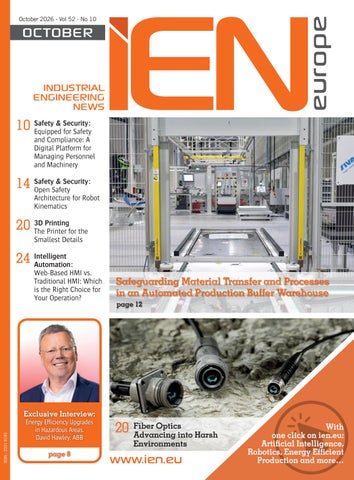
OCTOBER INDUSTRIAL ENGINEERING NEWS & Security: 10 Safety Equipped for Safety and Compliance: A Digital Platform for Managing Personnel and Machinery & Security: 14 Safety Open Safety Architecture for Robot Kinematics Printing 20 3D The Printer for the Smallest Details
24 Intelligent Automation: Web-Based HMI vs. Traditional HMI: Which is the Right Choice for Your Operation?
ISSN : 2031-9193
Exclusive Interview: Energy Efficiency Upgrades in Hazardous Areas. David Hawley, ABB page 8
001_IEN Europe_October 2026.indd 1
Safeguarding Material Transfer and Processes in an Automated Production Buffer Warehouse page 12
Optics 20 Fiber Advancing into Harsh Environments
www.ien.eu
With one click on ien.eu: Artificial Intelligence, Robotics, Energy Efficient Production and more…
22/09/26 09:30
October 15, 2026 - Hi! Site! Brussels / Grimbergen
REGISTER NOW https://industrial-cybersec.com/
THE BELGIAN INDUSTRIAL CYBER EVENT YOU CANNOT AFFORD TO MISS.
67046 at www.ien.eu
N° 10 - OCTOBER 2026
002_017_IEN Europe_October 2026.indd 2
22/09/26 09:32
3
Editorial Director:
Orhan Erenberk o.erenberk@tim-europe.com
Editor:
Kay Petermann k.petermann@tim-europe.com
Editorial Support Energy Efficiency:
Flavio Steinbach f.steinbach@tim-europe.com
Production & Francesca Lorini Order Administration: f.lorini@tim-europe.com Website & Newsletter:
Marco Prinari m.prinari@tim-europe.com
Marketing Manager: Marco Prinari m.prinari@tim-europe.com President:
Orhan Erenberk o.erenberk@tim-europe.com
ADVERTISING SALES OFFICES EUROPE AUSTRIA/SWITZERLAND Monika Ailinger Tel.: +41 41 850 44 24 m.ailinger@marcomedia.ch BENELUX, SCANDINAVIA Nadia Liefsoens Tel.: +32-(0)11-224397 Fax: +32-(0)11-224397 n.liefsoens@tim-europe.com FRANCE Roxanne Akbulut Tel: + 33 06 52 31 41 56 r.akbulut@tim-europe.com Raphael Erenberk +32 494 652 741 r.erenberk@tim-europe.com GERMANY Simone Ciolek Tel: +49-(0)9771-1779007 s.ciolek@tim-europe.com ITALY, SLOVENIA Andrea Rancati Tel: +39-02-7030 0088 arancati@rancatinet.it
UNITED KINGDOM, IRELAND Aodhan Dunican +44 (0)7594 239182 a.dunican@tim-europe.com NORTH AMERICA Hamilton-Murphy Global, LLC John Murphy Tel: +1 616 682 4790 Fax: +1 616 682 4791 john@hamiltonmurphymedia.com JAPAN Ichiro Suzuki Incom Co. Ltd. Tel: +81-(0)3-3260-7871 Fax: +81-(0)3-3260-7833 isuzuki@INCOM.co.jp OTHER COUNTRIES
editorial
TIM Global Media BV Chaussée de la Hulpe 177 - Ground Floor 1170 Watermael Boitsfort (Brussels), Belgium o.erenberk@tim-europe.com - www.ien.eu
Kay Petermann k.petermann@tim-europe.com
Dear Readers, The topics of safety and security are currently everywhere, and in this issue we also take a multifaceted look at them. In the interview with David Hawley, we discuss the newly introduced ABB motors, which allow for a significant increase in energy efficiency in potentially explosive production areas. Read more on page 8. Combining the safety of people and machines has always been a complex issue in industry, involving requirements from many different areas. The regulatory requirements of CRA and the Machinery Regulation will not reduce complexities. But hopefully the digital platform introduced on page 10 can do this for production managers and safety officers. In industrial production environments, copper still plays a key role in the transmission of data and signals. Wireless solutions cannot be used everywhere and fibre optics were not previously considered to be a viable option in environments with dust, dirt and vibrations. However, the article on page 20 shows why this could change, as it deals with the space- and weight-saving technology. I hope you enjoy reading this issue!
Kay Petermann Editor IEN Europe
Cristian Son c.son@tim-europe.com
TURKEY Onur Dil Tel: +90 212 366 02 76 Fax: +90 212 366 58 02 E-mail: o.dil@tim-europe.com
Digital File Requirements available at: www.ien.eu/technical-guidelines/ © 2026 TIM Global Media BV Production by design3, Milano, Italy Printing by Logo Srl - Padova, Italy
FREE Digital Subscription
POSTMASTER Send address changes to: Industrial Engineering News Europe Marco Prinari - m.prinari@tim-europe.com
FREE DIGITAL SUBSCRIPTION
002_017_IEN Europe_October 2026.indd 3
N° 10 - OCTOBER 2026
22/09/26 09:32
N° 10 - OCTOBER 2026
contents
4 In the next issue: Intelligent & Flexible Automation Electronics for Sustainability and the All Electric Society SPS Special
6
5 Industry News 6 New Products Safety and Security 8 Exclusive Interview: Energy Efficiency Upgrades in Hazardous Areas An interview with David Hawley, ABB’s Global Head of Sales IEC LV Motors about the new IE6 HyperEfficiency motor technology for hazardous areas.
8
10 Equipped for Safety and Compliance: A Digital Platform for Managing Personnel and Machinery 12 Safeguarding Material Transfer and Processes in an Automated Production Buffer Warehouse
15
14 Open Safety Architecture for Robot Kinematics 15 New Products 16 3D Printing: The Printer for the Smallest Details 18 Vision & Identification: Enhanced AI-Based Label Recognition for Reliable Goods-In Processes
20
20 Intelligent Automation: Fiber Optics Advancing into Harsh Environments Equipped with robust connectors, this fast, lightweight technology can now demonstrate its advantages in extreme environments without compromising the safety or reliability of connections. 22 Intelligent Automation: Web-Based HMI vs. Traditional HMI: Which is the Right Choice for Your Operation?
27
24 Intelligent Automation: Cyber Resilience Act and Digitalization: New Challenges and Opportunities for the Process Industry 26 New Products
29
30 Index & Events N° 10 - OCTOBER 2026
002_017_IEN Europe_October 2026.indd 4
FREE DIGITAL SUBSCRIPTION
22/09/26 09:32
5 At the IMTS in Chicago, with the joint announcement that Single Pair Ethernet System Alliance and SPE Industrial Partner Network have merged to create a new unified entity – Single Pair Ethernet Association (SPE Association) – representing members from more than 130 leading manufacturing and technology companies worldwide. With this bold decision, approved unanimously by the leadership of both networks, the two previously independent organizations are consolidating their expertise, activities and memberships under the SPE Association identity in order to build momentum and accelerate the development, standardization and global market adoption and implementation of Single Pair Ethernet (SPE) technology. “This exciting merger to create Single Pair Ethernet Association marks the beginning of a new chapter in strong industry collaboration. Working together as one entity with an agile and global approach and a collective voice, we can help manufacturers unlock simpler architectures for greater interoperability and a more connected future,” said Nick Sandoval, President of SPE Association’s North American Marketing Council. You can meet the Single Pair Ethernet Association at the sps in Nuremberg, Germany November 24 to 26.
Christian Strahberger Appointed as Division President for ABB’s Machine Automation Division
ELGi Compressors Europe Appoints Nils Blanchard to Accelerate Industrial Efficiency Across Europe
ABB’s Machine Automation Division (B&R) announced the appointment of its new Division President. Christian Strahberger succeeds Florian Schneeberger, who tragically passed away in an accident in April. Christian Strahberger holds a PhD in Semiconductor Physics from the Technical University Munich and brings 25 years of experience in senior leadership roles across mechanical engineering, drive technology, motion control, and power electronics sectors. He joins the Austrian automation specialist from Danfoss, where he most recently served as Chief Technology Officer and Head of Semiconductor Manufacturing at Semikron Danfoss. “I am very excited about this new challenge at ABB and the opportunity to actively shape the next era of the Machine Automation Division. My focus is on driving innovation with purpose and successfully translating future technologies into market-relevant solutions. Together with our teams, I want to help ensure that B&R continues to enable sustainable competitive advantages for our customers as a trusted partner in a dynamic market environment,” says Christian Strahberger.
Blanchard succeeds Chris Ringlstetter, who is retiring after serving as the company's first President in Europe since ELGi established its operations in the region. During his tenure, Ringlstetter played a pivotal role in building ELGi's European business. On this strong foundation, ELGi is sharpening its focus on helping European manufacturers improve energy efficiency, optimise compressed air systems and lower total cost of ownership. Under Blanchard's leadership, the company will continue investing in engineering innovation, digital technologies and intelligent compressed air solutions that improve productivity while supporting Europe's transition towards a more sustainable industrial future. Central to this strategy is ELGi's patented Demand=Match technology, which continuously aligns compressor output with real-time plant air demand by intelligently managing compressed air production. The technology delivers energy savings comparable to variable speed drive compressors while retaining the simplicity, robustness and reliability of a fixed-speed machine, helping manufacturers reduce energy consumption without compromising operational performance.
industrynews
Industry Networks Merge into Single Pair Ethernet Association
A Consistent Innovation Strategy and Fast Implementation Are the Keys to Success. A recent market analysis by the renowned market research firm Omdia once again confirms PROFINET’s leading position in the field of industrial Ethernet protocols. PROFINET thus impressively maintains its top position in a dynamic market environment. This continued market leadership is the result of consistent technological advancement and a high pace of innovation within the PI Community. The latest PROFINET V2.5 specification specifically integrates key future technologies—security, Time-Sensitive Networking (TSN), and extensions for Ethernet-APL and Single Pair Ethernet (SPE). These developments strengthen PROFINET as a seamless communication foundation from the field to the cloud. Another key success factor is the close integration with complementary technologies. Particularly noteworthy is the leading integration of IO-Link, which enables efficient and end-to-end sensor-actuator communication and contributes significantly to joint market success. PROFINET also plays a central role in the implementation of Ethernet-APL: the first real-world process plants are already successfully in operation with PROFINET over APL. In parallel, PI is actively driving the use of SPE and is also playing a key role in shaping technological development in this area. FREE DIGITAL SUBSCRIPTION
002_017_IEN Europe_October 2026.indd 5
N° 10 - OCTOBER 2026
22/09/26 09:32
6 COMPACT TORQUE MOTOR SERIES
INDUSTRIAL 3D-TOF-CAMERA
Motor elements with integrated cooling channels
For flexible integration with longer operating distances
Hiwin's TM-5 Torque motors combine high torque density, dynamics and positioning accuracy in a compact design, offering machine manufacturers new possibilities for powerful rotary tables, swivel units and other rotary axes. The integrated cooling channels enable efficient liquid cooling and support the use of the TM-5 even under high performance requirements. The integrated cooling channels significantly reduce heat development, ensuring stable operating conditions and consistent processing results in the machines they are installed in. Thanks to the minimal holding torque, the Torque motor runs particularly smooth, a clear advantage for precise movement sequences and reproducible positioning accuracy. The high mechanical compatibility and the well-thought-out design allow for use in almost any machine concept, whether for modernisation or new construction. The elimination of mechanical transmission elements means users benefit from high efficiency, reduced maintenance and maximum precision. Currently, the range comprises 70 variants with peak torques between 45 and 7,200 Nm, with continuous torques of 25 to 3,400 Nm. The motors of the TM-5 Torque series are available in seven sizes with outer diameters between 160 and 565 mm.
Teledyne e2v announced Perciva™ ToF, its new industrial grade 3D Time-of-Flight (ToF) camera. Designed for reliable operation in demanding environments, Perciva ToF combines high-performance depth sensing, on-camera processing, and flexible integration for a wide range of applications, including logistics, robotics, inspection, and surveillance. Powered by Teledyne e2v's Hydra3D™+ CMOS image sensor, Perciva ToF combines 832 x 600 pixel resolution with patented HiRho technology, which increases sensitivity at near-infrared wavelengths while maintaining excellent MTF and modulation contrast. Its 10 µm three-tap pixel architecture captures more light, enabling longer operating distances, reliable detection of low-reflectivity materials, and motion-artifact-free imaging of fast-moving objects. This enables accurate, dependable 3D measurements, even in high-speed industrial applications. Perciva ToF has been engineered to deliver robust performance in challenging conditions, including varying outdoor illumination and interference caused by other systems, without requiring interconnecting cameras. Factory calibration and embedded processing simplify system integration by providing depth maps and point cloud data directly through the camera's GigE interface. 67089 at www.ien.eu
67042 at www.ien.eu
ROBUST IMAGE-BASED CODE READER
CLAMP-ON ULTRASONIC FLOW METER
Reliable and simple 1D and 2D code reading
For contactless measurement of demanding liquids
The SICK sensingCam SEC200 image-based code reader brings ease of use to logistics and industrial environments, identifying 1D and 2D codes reliably, keep processes running smoothly and reduce avoidable delays. Designed to make code reading straightforward from setup to operation, the code reader combines reliable identification, robust construction and user-friendly guidance in one compact device. An integrated web server, industrial connectivity and clear visual and acoustic feedback all help to simplify config- uration, speed up commissioning and support dependable opera- tion on the shop floor. The 1.3-megapixel camera module reliably captures 1D and 2D codes at reading distances of 100 to 300 mm, regardless of alignment or rotation. For operators, this means fast, intuitive scanning with clear confirmation from feedback LED and acoustic signal. The robust industrial housing with IP65 enclosure rating also protects the device against dust, water spray and mechanical stress, helping to maintain reliable performance in demanding environments. Standardised mounting accessories, an LED alignment aid and an integrated web server allow users to configure the code reader directly in a browser, without additional software.
The new WIKA FLC-CS4 from the ClampSonicTM instrument series features a contactless clamp-on design. When mounted on the outside of a pipe, the instrument can measure flow non-invasively in both directions. The transducers use the properties of sound waves to safely and efficiently monitor corrosive, abrasive and highly viscous liquids. Ultrasonic techno- logy ensures high accuracy over a wide measuring range. Additional measurement parameters that can be recorded include temperature, density, concentration and calorific value. The FLC-CS4 can be easily configured via an intuitive user interface - thanks to integrated Wi-Fi from a remote location as well as directly in the field. The user interface clearly displays selected parameters for two streams together with detailed measurement information. Real-time diagnostics displaying waveform data and installation parameters ensure seamless process monitoring. Instead of physical keys, the instrument is operated with touch and gesture control. The flow meter is available in two versions: a wireless version and a field version. Both versions include an electronic unit and two transducers. The field version also comes with a power supply and communication box, enabling seamless integration into PLC ecosystems.
67076 at www.ien.eu
67081 at www.ien.eu N° 10 - OCTOBER 2026
002_017_IEN Europe_October 2026.indd 6
FREE DIGITAL SUBSCRIPTION
22/09/26 09:32
7 ALL-IN ONE ROTARY ACTUATORS
ETHERNET APL SWITCH
Motor-/encoder packages for changeover automation
For continuous physical layer monitoring & diagnostics
Lika Electronic's RD rotary actuators are designed to automate changeover and adjustment operations in auxiliary axes. They enhance production processes by increasing flexibility and efficiency, reducing changeover times, cutting costs, minimising downtime, and lowering the risk of errors and waste of material. They are also ideal for replacing handwheels and knobs in older manual adjustment systems without requiring any mechanical modifications. These actuators integrate a brushless motor, a real multi-turn absolute encoder with a resolution of up to 20 bits, a position and torque closed-loop controller, and an Ethernet/fieldbus interface within a single compact package. Their "all-in-one" configuration simplifies installation, integration, and set-up. RD actuators are available in four models, with rating torques ranging from 0.5 to 15 Nm, and can offer specific features for unique applications, such as holding brake and oil-bath gears. Communication is supported via Ethernet-based interfaces, including Profinet, EtherNet/IP, EtherCAT, and POWERLINK, as well as conventional fieldbus interfaces CANopen, Profibus, and MODBUS RTU.
The FieldConnex Ethernet-APL field switch from Pepperl+Fuchs, showcased at Hannover Messe, turns the physical layer into a continuous source of maintenance intelligence and always up-to-date asset documentation. Installed in the field, it permanently monitors itself, all instrument connections, and the uplink, while generating reports that reflect the real, as-built condition of the infrastructure. A significant key feature demonstrated at the tradeshow is the comprehensive physical layer measurement capability, including voltage, current, signal level, noise, jitter, and signal-to-noise ratio (SNR). Each change is captured and documented, so the actual state of every connection is reflected accurately in the system over time. Second, device identification on every port ensures that the correct field device, with its unique ID and properties, is linked to the right connection point. When instruments are replaced or added, the documentation updates automatically. Manual revision is no longer necessary. Third, repeating snapshots for long-term monitoring feed asset management and historian systems with up-to-date data. This creates a living, automatically maintained as-built record of the field instrumentation and installation, reducing manual effort, avoiding inconsistencies, and supporting reliable maintenance and audit-ready documentation.
67075 at www.ien.eu
67082 at www.ien.eu
SECURE PLUG-IN COMMUNICATION MODULE
DEW POINT SENSOR WITH AUTO-CALIBRATION
Compact embedded module for easy device integration
Continuous dew point measurement down to −70 °C Td
Hilscher has released the new netRAPID 90IC embedded module for secure industrial communication. Based on the proven netX 90 communication controller, the compact plug-in module enables device manufacturers to integrate industrial communication into field devices without soldering. Using a standard SMT socket instead of a fixed soldered design reduces integration effort, lowers production risks, and simplifies servicing. Measuring only 18 x 45 mm, netRAPID 90IC fits into compact applications such as drives, welding and laser systems, weighing technology, and measurement devices. The module supports all major Industrial Ethernet and fieldbus protocols on a single hardware platform, including PROFINET, EtherCAT, EtherNet/IP, CC-Link IE Field Basic, CANopen, PROFIBUS, and Modbus. Integrated OPC UA and MQTT functionality also enables direct IIoT connectivity from the field level to cloud and IT systems without additional hardware or gateways. Security functions are integrated directly into the module's architecture. netRAPID 90IC includes hardware-supported encryption via CryptoCore, Secure Boot, signed firmware, and key and certificate management. These mechanisms help manufacturers prepare devices for future cybersecurity requirements such as the European Cyber Resilience Act (CRA).
With the TDS501, E+E Elektronik introduces a next-generation dew point sensor for demanding industrial applications. Industrial drying processes, especially in battery manufacturing, place the highest demands on dew point measurement. At very low moisture levels, even the smallest deviations can affect product quality, yield and safety. This makes a stable, continuous measurement signal essential. With the TDS501, E+E Elektronik presents its latest development for dew point measurement: continuous measurement thanks to auto-calibration based on a new four-element measuring method, dew point monitoring down to −70 °C Td, and smart protection concepts. Typical process events such as opening doors and airlocks or load changes require a stable measurement signal. A frozen or heavily averaged signal during auto-calibration can create blind spots in the process in such environments. The TDS501 was therefore developed around a key requirement in the control of very low dew points: auto-calibration must not interrupt the measurement signal. In highly dynamic applications, control decisions are made continuously. A signal that freezes during calibration can conceal real process deviations precisely when they matter most. To address this, the TDS501 uses an innovative technology based on a four-element measuring method with robust capacitive sensing elements.
67074 at www.ien.eu FREE DIGITAL SUBSCRIPTION
002_017_IEN Europe_October 2026.indd 7
66840 at www.ien.eu N° 10 - OCTOBER 2026
22/09/26 09:32
8
exclusive interview
Energy Efficiency Upgrades in Hazardous Areas An interview with David Hawley, ABB’s Global Head of Sales IEC LV Motors about the new IE6 Hyper-Efficiency motor technology for hazardous areas. IEN Europe: The new ABB IE6 motors provide an opportunity to upgrade zone 1 and zone 2 applications. In which industry and for which applications will they be used? And what are the power ratings the new motors cover? Hawley: The application scope for these high-efficiency motors using synchronous reluctance motor technology (SynRM) is very broad. We see strong relevance across many industry segments, particularly those where hazardous areas such as Zone 1 and Zone 2 are common. In hazardous areas, safety and reliability are non-negotiable. Protecting people and ensuring safe, continuous operation is a key priority. This is especially true when it comes to specifying hazardous areas motors that must operate safely in environments where flammable gases, dust, or vapours can be present - so they are critical for industries like oil & gas, chemicals, marine, pharmaceuticals, and food & beverage. For example, the oil and gas sector – across upstream extraction, pipeline transport, and downstream refining – relies on a substantial installed base of motors operating in hazardous areas. The chemical industry is another major user, as many processes involve gases, vapors, or powders that create hazardous environments. We are also seeing increasing demand in the marine sector, particularly for gas transportation. The growing movement of liquefied gases globally has driven the need for reliable explosion proof motor solutions onboard vessels. Industries such as pharmaceuticals and food
David Hawley, ABB’s Global Head of Sales IEC LV Motors
and beverage might also demand hazardous area solutions – for example in applications involving combustible dusts such as in milling processes for sugar or grain. In terms of applications, these motors can power pumps, fans, compressors, and mixers across these industries – essentially where continuous operation and high reliability and safety are critical. In terms of power ratings, ABB’s SynRM hazardous area motors portfolio spans a wide range – from 0.75 kW up to 400 kW – though the efficiency gains are most pronounced at higher ratings, a natural consequence of motor design. This is reflected in the portfolio itself: the new IE6 motor covers 110 kW to 400 kW, while IE5 versions are available up to 90 kW. IEN Europe: Okay, thank you. How significant are the potential energy savings? What other benefits can users expect in terms of the total cost of ownership? Hawley: This is the world’s first IE6 magnet- and rare earth- free motor fully compliant for Zones 1 and 2 and certified to ATEX and IECEx requirements. Certified for use with variable speed drives (VSDs), it offers accurate control and high efficiency throughout the whole speed range even at partial loads. With up to 60% lower energy losses than the IE3 induction motors in common use, operators switching to IE6 can
N° 10 - OCTOBER 2026
002_017_IEN Europe_October 2026.indd 8
FREE DIGITAL SUBSCRIPTION
22/09/26 09:32
9
achieve a major boost in energy efficiency and avoid carbon emissions. Regarding the TCO, it is important to note that the initial purchase price of a motor represents only a small fraction of its total cost of ownership (TCO) throughout its operating life. Around 97% of the motor’s lifecycle cost stems from the energy it uses – meaning that operators that significantly reduce their energy use by adopting high efficiency solutions, like the IE6 SynRM, can boost their productivity with payback often achieved in a matter of months. To give a concrete example – over a typical 20-year service life, the energy savings from switching just one 110 kW IE3 induction motor up to IE6 would be €87,520, resulting in an eight-month payback period with 157,540 kg CO2 avoided. That’s the equivalent of 37 gasoline powered passenger cars driven for a year. Note that this calculation is based on the motor operating 8,760 hours/year at 75% average load, with an assumed energy cost of €0.20/kWh. These figures show the impact of upgrading just one motor to higher efficiency. But many hazardous areas installations use hundreds or even thousands of motors, so the global energy saving potential is huge. SynRM benefits extend beyond energy efficiency. As well as increased reliability and reduced maintenance, SynRM technology enables a more cost-effective installation. In Zone 1, cooler running can allow the use of a SynRM Increased safety motor where a Flameproof motor with a special enclosure would be the traditional choice. In Zone 2, the improved loadability of SynRM motors allows more power to be delivered from the same size as an equivalent induction motor. This could enable a smaller, lower-cost motor to fulfil the same duty. Flexibility is also key. We have adopted a flexible approach to developing our hazardous areas motors portfolio to combine robust construction, high energy efficiency, and reliable operation to deliver trusted performance and certified safety in the most demanding environments. This covers a wide range of protection types, temperature classes, and enclosure options. In addition to SynRM hazardous area motors, ABB’s portfolio also includes induction alternatives up to IE4 efficiency level, such as Flameproof motors, Increased safety induction motors and Dust Ignition proof motors. But motor technology is only part of our approach. We have an expert team with decades of experience who work with our customers to create customized solutions for even the most challenging environments. IEN Europe: Thank you. So you already answered what I wanted to ask next, about these benefits. You also can say, with the synchronous reluctance technology you mentioned, another benefit is that the customers have motors without magnets and rare earth metals in it. So given the supply chain challenges of last year's, that is definitely another benefit. Hawley: Definitely, that is an important aspect. As manufacturers, we are aware of the challenges associated with permanent magnet materials, including supply chain constraints and broader sustainability considerations. SynRM motors achieve high efficiency without the use of permanent magnets, a significant advantage when navigating these challenges. At FREE DIGITAL SUBSCRIPTION
002_017_IEN Europe_October 2026.indd 9
the same time, permanent magnet motor technology remains an important part of the overall portfolio and is used where it is most appropriate. Selecting the right technology for the specific application is the key. IEN Europe: What would be your recommendation on modernization of motors? How fast should companies think about changing the motor technology in their applications, even if they don't have obvious operational problems? Hawley: Traditionally, many users consider upgrading motor systems only when equipment reaches end of life or requires major maintenance, such as rewinding or refurbishment. But there is a significant installed base of older motors that are still operational yet do not meet the efficiency levels achievable with modern designs. In high-duty applications, these motors can open up a real opportunity for energy savings. Through energy assessments and system evaluations, we can pinpoint where upgrades, whether motor-only or motor-drive combinations, can deliver tangible benefits. Not all motors are suitable candidates; for example, motors that operate only intermittently will typically have longer payback periods. However, for continuously operating systems, upgrading to high-efficiency motor technologies can result in relatively short payback periods – often in months – depending on operating conditions. Beyond energy savings, modern motors also offer improved reliability, longer service intervals, and reduced maintenance requirements, supporting more sustainable and cost-effective operations. IEN Europe: So the message is at the end, you not only have the right hardware, you also have the service to support potential customers to make the right decision. That sounds really interesting and good news for customers. Thank you, David! 67091 at www.ien.eu
N° 10 - OCTOBER 2026
22/09/26 09:32
10 focus Safety & Security Equipped for Safety and Compliance: A Digital Platform for Managing Personnel and Machinery The complexity of the technical and regulatory requirements for Safety and Security is increasing. One example is the Machinery Regulation, which comes into force in 2027. In order to meet the increased demands in matters of safety, security and compliance, production managers and safety officers are turning their focus to full digital documentation. Author: Marcus Fritzmann, Product Manager, Software & Digital Services, Pilz GmbH & Co. KG
Production managers, safety officers or management – those responsible for production and safety are faced with the daily task of keeping track of machinery and personnel. This includes issues relating to liability protection, employee protection, data protection and productivity. One of the ways in which operators protect these four core values is by ensuring that their machinery is always state-of-the-art and meets statutory requirements. The fact that the standards and legislative landscape is currently evolving and imposing new safety requirements not only makes the work more complex, but also increases the need for structured management of documents and permissions. Because: The EU Machinery
Regulation 2023/1230 will apply from 20 January 2027. It sets out the safety requirements for machinery within the EU in more detail and provides greater clarity on issues that have previously been contentious. It also contains new aspects such as artificial intelligence or the growing importance of Industrial Security and digitisation. Verifying safety at all times – throughout the life of the machine For operators and manufacturers, therefore, it is no longer just a matter of one-off CE marking, but of verifying that the lifecycle is under control from design and operation through to maintenance and decommissioning – includ-
ing the handling of software and updates. The focus is therefore shifting from one-off certification to continuous compliance. This applies equally to organisation, processes, qualifications and IT Security. Platform support is becoming a condition: without integrated asset, document and rights management, it is virtually impossible to put “Secure by Design” and verifiable safety compliance into practice on a day-to-day basis. The solution in factories: those responsible must provide full documentation of qualifications, inspections, maintenance intervals, revision histories, evidence and access rights – across all sites and systems. Excel lists and paper files are no longer up to the task; they are error-prone, audit-critical and slow things down in the event of an incident. Connected future on the shop floor As an expert in safe automation, Pilz addresses these increased requirements with the MYZEL Lifecycle Platform – one platform for human and machine, which turns a regulatory obligation into an operational standard, combining safety and productivity in the process: MYZEL consolidates personnel and machine data in a single system, assigns the relevant artefacts (instructions, validations, declarations of conformity, maintenance schedules, training records) and makes the compliance status visible in real time.
The MYZEL Lifecycle Platform from Pilz helps production managers and safety officers to operate their machinery safely, securely, efficiently and in compliance with the standards, throughout the entire lifecycle. Picture: Pilz GmbH & Co. KG N° 10 - OCTOBER 2026
002_017_IEN Europe_October 2026.indd 10
Clear connection between human and machine Production managers and safety officers can manage all documents centrally on the platFREE DIGITAL SUBSCRIPTION
22/09/26 09:32
11
On the dashboard users can view the status of assets such as data, people or machinery in real time. The platform combines the management of personnel and machinery. Picture: iStock.com/Farknot_Architect, Pilz GmbH & Co. KG form. They get a comprehensive, up-to-date overview of the machinery and employees. This is also what makes it special, as other asset management systems only record the machines and not the people who work with them. The four core values named above show that it makes sense to consider human and machine together when it comes to safety issues. Even a machine that is operated in accordance with the current state of the art and in compliance with the law can be (unknowingly) manipulated if personnel do not have the appropriate qualifications or permission. Safety and productivity can only be harmonised if they are viewed as a unit.
Dashboards are customisable to users' needs. All documents can be managed centrally, for an up-to-date overview of machinery and workforce. Picture: iStock.com/Thapana Onphalai, © Pilz GmbH & Co. KG
machinery), so they can immediately identify where action is required – if deadlines are approaching or evidence is missing, for example. This dashboard can be customised to your own needs. This provides production or safety managers, in particular, with an overview of the current status and any action that may be required.
Knowledge base at the heart At the heart of the offer is myCore, the central starting point. Users create their machines in myCore and upload all relevant documents and information, such as operating instructions, certificates, logs or employee data, to the MYZEL Lifecycle Platform. If another asset management system is already in use, it is possible to import the data into MYZEL. A dashboard gives users a clear, simple overview of the status of their assets (data, people,
Easier management of Safety and Security Pre-defined workflows support machine builders or operators in their day-to-day work. Behind the respective workflows are digital implementation checklists and templates, to keep track of inspection requirements on a daily basis, carry out a risk analysis or actively manage entry and access permissions, for example. AI-supported functions, such as the analysis of machine images to assess a safety risk, enable particularly efficient implementation. The Machinery Regulation requires systematic risk assessments, clear technical documentation and the consideration of digital risks. MYZEL provides support by storing documents, test reports and certificates on the machine and ensuring that changes are versioned in a way that's traceable – an important basis
FREE DIGITAL SUBSCRIPTION
N° 10 - OCTOBER 2026
002_017_IEN Europe_October 2026.indd 11
for conformity assessments and CE marking. MYZEL also helps to structure lifecycle documentation, control access rights in accordance with the need-to-know principle and thereby verify organisational safety measures. Cloud security plays a key role, particularly when personal qualification data is combined with sensitive machine documents. MYZEL relies on an EU-based infrastructure and is certified to ISO/IEC 27017 and ISO/IEC 27018 – a key advantage during audits in which Security and data protection aspects are increasingly being assessed alongside Safety. Sustainable, safe and standard-compliant production requires a transparent foundation. Anyone who is still struggling to extract data from distributed silos in 2026 is wasting time – and the risk is growing. Solutions such as the MYZEL Lifecycle Platform bundle processes, supporting documentation and responsibilities inside a single system and translate legal texts into practical routines. That way the factory will not only comply with regulations, but will also be more robust and more efficient. 67070 at www.ien.eu
22/09/26 09:32
12 focus Safety & Security Safeguarding Material Transfer and Processes in an Automated Production Buffer Warehouse SEW-EURODRIVE products power applications from airport baggage handling and e-commerce parcel sorting to connected production systems. In late 2024, the company opened a smart factory for shafts and gear parts in Graben-Neudorf, near its Bruchsal headquarters. A key element is the fully automated buffer warehouse in the North Hall, developed with SIVAplan’s intralogistics expertise and Leuze’s sensor technology. The logistics module, a fully automated single-aisle high-bay warehouse, acts as a production buffer between machining and hardening processes. Built from 70 tons of steel, it features two 9 m-high racks spanning 76 m and provides 2,300 storage locations. Two automated stacker cranes transport hardening racks between production, furnaces and storage. With a total conveying distance of 152 m, each crane handles loads of up to 510 kg per rack. A clear run for mobile robots As a specialist in automated storage systems, SIVAplan implemented the logistics module and higher-level control system as general contractor together with PROCAM Steuerungstechnik GmbH. The system coordinates machines, vehicles and warehouse processes while interfacing with the SAP ERP system,
helping ensure efficient, autonomous production. A key element is Leuze sensor technology. “SIVAplan’s solutions and Leuze’s sensor expertise complement each other perfectly,” says Christian Langsdorf. The long-standing partnership is based on confidence in the reliability and quality of Leuze products, which help ensure safe and efficient rack loading and unloading. This starts when SEW-EURODRIVE mobile robots automatically transport finished components to the high-bay warehouse. Guided by the master controller, the robots access the system through material transfer stations secured by two Leuze RSL 400 safety laser scanners. The scanners generate a vertical protective field that opens only after successful robot identification and closes again once the vehicle has passed. After picking up materials from production, the robots transport and transfer
SEW-EURODRIVE relied on Leuze sensor expertise and SIVAplan’s intralogistics expertise for its fully automated production buffer warehouse in Graben-Neudorf, Germany.
In-process contour check After AGV transfer, racks are conveyed to a contour inspection station. Leuze HT25C diffuse sensors detect the racks and control conveyor movements. CML 720i measuring light curtains capture outer contours during passage and transmit inspection data via PROFINET. Additional Leuze sensors monitor rack presence and control the light curtains. A practical feature is the sensors’ ability to ignore highvisibility clothing, preventing false detections caused by personnel near the transfer stations. Industrial Leuze IP cameras mounted beside and above the inspection area provide additional rack images.
Mobile robots at four material transfer stations deliver the gears and shafts produced on the production line. These are temporarily stored in the logistics module and then hardened in special furnaces. Picture: Leuze
N° 10 - OCTOBER 2026
002_017_IEN Europe_October 2026.indd 12
them via four storage and retrieval bays. The integrated PROFIsafe/PROFINET interface enables straightforward integration of the RSL 400 into the safety control system.
FREE DIGITAL SUBSCRIPTION
22/09/26 09:32
13
RSL 400 safety laser scanners and other Leuze sensor solutions help safeguard material transfer, monitor processes and enable precise positioning.
at Leuze. This solution is compact and spacesaving and allows the stacker cranes to be positioned precisely and safely in accordance with Performance Level e / SIL 3. In addition, the extremely short error response time of just 10 milliseconds allows short braking distances and, consequently, faster speeds. In this way, the FBPS 600i plays a decisive role in maximizing the high-bay warehouse’s performance – with minimal installation effort and a high level of safety.
Reliable routing via barcode After the goods destined for the hardening shop have been measured, one of the stacker cranes picks up the rack. Here, too, precise processes are essential to ensure that the goods reach their designated storage location safely and reliably. The stacker cranes are therefore positioned using Leuze FBPS 600i safety barcode positioning systems, which ensure safeguarded velocity monitoring in conjunction with the latest generation of MOVI-C® inverters from SEW-EURODRIVE. The FBPS 600i enable safe position detection.
The stacker cranes’ position and velocity are continuously monitored based on the system status. This is particularly important because the two stacker cranes operate on the same rail. Accurate position detection is also required to reliably safeguard two pedestrian walkways in the high-bay warehouse. To do this, the system switches the travel range’s safety envelopes. If people cross the aisle, the stacker cranes are “held” in defined segments and monitored to allow a safe crossing. The 600i safety bar code positioning system only requires one sensor for safe position detection. This greatly simplifies integration and makes the system much easier to set up. Two FBPS 600i are installed on each stacker crane: One for positioning the lifting axis and the other for the travel axis. The FBPS 600i safety barcode positioning systems can be used flexibly thanks to their reading distances of 50 to 170 millimeters from the bar code tape. Multiple codes are read with each scan; these are processed redundantly internally and then again with millimeter precision in the SEW inverter’s safe connection unit via the dual SSI interface. “The scanning beam is intentionally positioned at an angle. The device’s movement along this angled path ensures each code is scanned at different points. This prevents reading errors caused by local dirt or damage,” says Oliver Gortner, Key Account Manager Intralogistics
FREE DIGITAL SUBSCRIPTION
N° 10 - OCTOBER 2026
Safe loading and unloading Each transfer station includes a manual workstation for rack unloading and inspection. MLC 530-SPG safety light curtains ensure safe loading and unloading while reducing space requirements through patented sensorless Smart Process Gating (SPG). The gating function is activated via a PLC signal and interruption of the protective field by transported goods, eliminating the need for additional muting sensors. The compact type 4 light curtains meet EN IEC 61496 requirements and achieve PL e and SIL 3 safety levels. Because racks are repeatedly exposed to extreme furnace temperatures, they can deform over time. For this reason, racks are automatically routed to the workstation for remeasurement after a defined number of furnace cycles.
002_017_IEN Europe_October 2026.indd 13
Camera-based precision compartment placement Leuze sensors also support the stacker cranes and storage areas. Diffuse sensors detect rack presence, while barcode positioning guides the stacker crane to the correct storage location. For precise compartment positioning, each crane is equipped with a Leuze IPS 200i camera-based sensor with integrated PROFINET interface. The compact sensor focuses on a reflector mounted on the shelf support and transmits absolute position values to the SEW controller. This enables accurate rack placement in the designated compartment while eliminating the need for multiple diffuse sensors. Summary With the fully automated high-bay warehouse, SIVAplan has implemented a highly advanced logistics system that integrates seamlessly into SEW-EURODRIVE’s production processes in Graben-Neudorf. Leuze sensor technology is used throughout the system to ensure safe, reliable and automated operation. It secures material transfers, detects and measures racks, and enables precise stacker crane positioning. The resulting production buffer warehouse supports flexible production, absorbs peak loads and can be expanded easily thanks to its modular design. 67071 at www.ien.eu
22/09/26 09:32
14 focus Safety & Security Open Safety Architecture for Robot Kinematics Robotics manufacturers, system integrators, and users face the challenge of incorporating the updated requirements of ISO 10218:2025 into future robotics projects. Kendrion's Safety Architecture for Robotics provides an open solution featuring a SIL3/ PLe certified Safety PLC paired with a robotics library for kinematic safety functions. The safety controller combines motion, force, and zone monitoring into a single platform, enabling targeted support for future safety requirements. The updated ISO 10218:2025 standard expands the scope of robotics safety to include the secure integration into applications and robotic cell environments. In addition to position and speed, force monitoring, dynamic safety zones, and safety functions for collaborative and partially collaborative applications are receiving greater focus. The Kendrion Safety Architecture for Robotics combines a SIL3/PLe certified Safety PLC with a robotics library for kinematic safety functions. The Safety PLC performs kinematic safety monitoring of the entire robot's movement and processes safety-relevant data from all connected axes and drives in real time. The system tracks the position and speed of industrial robots and cobots, along with forces, torques, and customizable safety zones. Kinematic safety functions are processed with a minimum cycle time of 2 ms. With suitable FSoE drives (Fail Safe over
EtherCAT), safety functions such as STO and SS1, as well as application-specific speed and zone monitoring, can be implemented. Scalable for different robotics applications Kendrion provides its safety architecture in the versions: Motion, Force, and Zone. The Motion version covers position and speed monitoring for traditional industrial robot applications. The Force version broadens its capabilities by including model-based and optional sensor-based monitoring of force and torque, making it particularly suitable for human-robot collaboration (HRC). The Zone version supports monitoring of up to 20 safety zones, allowing flexible protection of work areas and efficient implementation of modern HRC applications. The architecture accommodates serial robotic structures with two to nine axes, which can be either linear or rotary.
Image: Kendrion, iStock (Zapp2Photo)
66948 at www.ien.eu N° 10 - OCTOBER 2026
002_017_IEN Europe_October 2026.indd 14
Compatible with existing robotics platforms The EtherCAT master communicates directly with safe FSoE servo drives through the Kendrion Safety PLC, enabling continuous safety communication for robot systems with up to nine axes. The Kendrion safety architecture can be incorporated into existing EtherCAT-based robotics systems and works with standard FSoE drives. There is no requirement to rely on proprietary robot controllers. Manufacturers have the flexibility to incorporate their own functions, kinematics, and additional I/O systems. This facilitates the easy integration of laser scanners, encoders, and other safety-relevant sensors into the safety architecture. The open system architecture creates a high degree of flexibility for future robotics platforms and supports the implementation of new safety requirements.
FREE DIGITAL SUBSCRIPTION
22/09/26 09:32
15 DIGITAL SAFETY HMI SOLUTION
SAFE ALL-IN-ONE MOTION CONTROLLER
Offering SIL 3 for Safety-Critical Processes
With integrated anti-vibration toolbox
The certification of the Deuta IconTrust® HMI confirms that the system can display safety-related data up to SIL 3 and process safety-related touch inputs up to SIL 2. The digital IconTrust® HMI is designed for safety-related display and control tasks. This globally unique SIL3 solution is certified to EN 61508 and offers 'Security by Design'. The solution is particularly relevant for applications where functional safety, traceable process versioning and efficient adaptability to changes throughout a plant's lifecycle come together. In many plants within the process industry, illuminated panels, switches and individually wired signals are still in use. Although they have long proven their worth, they quickly reach their limits when changes, maintenance or retrofitting are required. This requires individual signal wiring, manual message assignment and frequent reference to manuals. IconTrust® HMI transfers these tasks to a digital interface. Safetyrelated display and control elements can be created there via a web-based configuration and adapted to specific projects. Useful information for day-to-day operations can be made available digitally, without any loss of time. The system is designed as a PROFINET/PROFIsafe field unit and is used as a fixed-location safety control unit. The PLC remains in control: the safety controller determines which information is displayed in defined areas.
The new Wieland Electric samos® PRO MOTION is a new all-in-one safety controller with integrated motion functionality. A total of six TÜV-certified motion function blocks ensure that up to 60 percent fewer modules are required, thus providing more space in the control cabinet than comparable providers. Among other things, the compact, programmable controller enables safe standstill monitoring even with slow-moving axes and also features an anti-vibration toolbox for macro and micro vibrations. Whether in mechanical engineering or intralogistics - wherever reliable standstill, speed, direction and position monitoring is required, the compact safety controller from Wieland Electric with fast motion inputs (up to 70KHz) on the base module is the ideal solution. The integrated motion function blocks include safe standstill monitoring (SSM), which can be implemented with both a speed window and a position window. Intuitive configuration options make it very easy to define the limits and thus reliably and continuously monitor even slowly moving axes, for example in construction cranes, lifting platforms, high-bay warehouses or presses. The samos® PRO MOTION also features an anti-vibration toolbox that can be used to professionally solve any vibration problems that arise.
66989 at www.ien.eu
67087 at www.ien.eu
IO-LINK SAFETY SOLENOID INTERLOCK
FLEXIBLE SAFETY LIMITER
Upgrading safety solutions for the Smart Factory
For maximum safety and availability
IO-Link Safety is establishing a new standard for functional safety in industrial automation. The technology transfers the principles of proven IO-Link communication to safety-related components and enables standardised, bidirectional communication right down to field level for the first time. Schmersal is one of the pioneers of this development and is presenting the AZM42 solenoid interlock and the RSS362 safety sensor The new interface meets the highest safety requirements in accordance with PL e (EN ISO 13849-1) and SIL 3 (IEC 61508/62061) and has been standardised in the international standard IEC 61139-2. This means that safety components from different manufacturers can work together interoperably - a milestone for Industry 4.0. In addition to its compact design and high safety performance, the AZM42 solenoid interlock now also offers comprehensive diagnostic data in real time, for example on the supply voltage, temperature and RFID signal quality. The RSS362 non-contact safety sensor supplements these functions with intelligent diagnostic options and also supports secure bidirectional communication. Both devices enable simple integration via standard three-wire cables with M12 connectors, thus reducing installation effort and costs. Thanks to the data storage function and offline configuration, maintenance and series production can be organised more efficiently.
JUMO's multifunctional safety limiter safetyM TA offers certified safety in accordance with SIL 2/SIL 3 (IEC 61 508) and PL c/PL d(ISO 13849). With its universal input for pressure, flow, temperature, and level, the JUMO safetyM TA can be easily configured to a wide range of process requirements. The user configurable voting function enables safe operation even in degraded plant condition (1oo2D voting principle), thereby effectively reducing non-critical machine downtime and scrap production. In addition, the device offers min. and max. monitoring as well as an adjustable time for degraded operation, which further maximizes plant availability. The temperature range for operation is between -10 and 55 °C, and the limiter can use DC 24 to 240 V, −15/+10 %; AC 110 to 240 V, −15/+10 % as power supply. The flexible configuration of various SIF scenarios, such as 1oo2D voting, 2oo2, and STB/STW, makes the JUMO safetyM TA a valuable addition to the JUMO Safety Performance family. Thanks to its easy integration into existing systems and high compatibility with different applications, customers benefit from a sustainable and efficient security solution. It's the ideal solution for demanding applications in thermoprocess technology, the process industry, the pharmaceutical industry, the food and beverage industry, and in dairies as well as breweries.
67086 at www.ien.eu FREE DIGITAL SUBSCRIPTION
002_017_IEN Europe_October 2026.indd 15
67084 at www.ien.eu N° 10 - OCTOBER 2026
22/09/26 09:32
16 3D printing
The Printer for the Smallest Details Three compact, high-performance motors from FAULHABER ensure the correct position in a 3D printer for miniature components. They help align the substrate with the utmost precision for the production of the finest details. Although the ancient Greek "nano" means "dwarf", in the nano sector the dwarf would be a giant. In the technical realm, "nano" means ten to the power of negative nine, or one billionth. In addition, parts even smaller than this are possible - for example, the intricate shapes that come out of the NanoOne 3D printer from UpNano. To produce these, light particles are fired at the starting material. This is a process that plays out over a range of thousandths of a millimeter. The structures that UpNano produces in the 3D printer are so small that they are recognizable neither with the naked eye nor with a strong optical microscope. Only under a scanning electron microscope do the smallest printed structures become visible. They are a sort of "tiny sphere" or dust particle with a total diameter of just a fraction of a millimeter. The bars that make up the construct are 100 times thinner than a human hair. These structures are used, for example, in medical experi-
The castle, measuring just 6 millimeters in height on the tip of a pencil and printed on a NanoOne print system, impresses with extremely fine details © UpNano GmbH
ments as, among other things, a framework for living cells, or as microfilters, microneedles or microlenses. A castle on the tip of a pencil UpNano is a spin-off of the Vienna University of Technology. Before the founders switched to free economy more than five years ago, they conducted research at the university in the field of 3D printing with high resolution. To demonstrate what is possible, they printed the model of a castle complete with multiple levels, oriels, ledges, archways, two spires and elegant columns - on the tip of a pencil. The columns were just 950 nanometers thick. The printer, which UpNano has since developed to market readiness and sells worldwide, goes even a step further: structures smaller than 200 nanometers can be realized horizontally and smaller than 550 nanometers vertically. The production of such miniaturized objects is possible thanks to socalled 2-photon lithography, which is based on a quantum effect between two light particles. They thereby trigger the solidification of the material, resulting in the formation of stable chains in the plastic molecules. "To get the decisive photon pairs across the finish line, we need to fire a massive number of light particles," explains Peter Gruber, cofounder and CTO of UpNano. "This is because we need an enormous photon density with respect to both time and space to bring about the controlled polymerization." An accurate laser makes it possible The laser that supplies the photons operates with extremely short, highintensity pulses. Moreover, the method allows for high accuracy, as Peter Gruber explains: "With other light-based 3D-printing methods, polymerization is triggered along the entire beam path. As a result, production can only be performed in layers. With 2-photon lithography, we can focus them on a tiny point. This point can be moved freely through the material by our printer's high-performance optics. This allows us to produce nearly any geometric structure." In addition to channels and other elements for microfluidics, such structures can also be used to create lenses that are printed on the end of individual glass fibers. Printing can even take place in existing microfluidic chips to add additional structures there. A special additional module also enables printing with biomaterial, which contains living cells. Polymerization of the three-dimensional structures transpires only at the in-
N° 10 - OCTOBER 2026
002_017_IEN Europe_October 2026.indd 16
FREE DIGITAL SUBSCRIPTION
22/09/26 09:32
17 Fully functional, 3D-printed roller bearing, printed on a NanoOne print system © UpNano GmbH
housing. As a result, the printer can simply stand on any stable table." The mechanical force for the precise positioning of the support is supplied by three precious metal commutated DC-gearmotors with integrated encoder of the 1512 ... SR IE2-8 series from Faulhaber. The uniquely flat winding technology with three flat, self-supporting copper windings enables an extremely compact design with a diameter of 15 millimeters and a length of just 14.3 millimeters. Thanks to the high-performance rare earth magnets, the motor delivers an especially high drive torque. In addition to the gearhead, an optical encoder is also integrated in the drive. "We selected the gearmotors as the optimum solution for our needs," recalls Peter Gruber. "The suggestion to select the version with encoder came from FAULHABER. Alignment thereby functions even more precisely and more smoothly. In relation to its small dimensions, the drive delivers enormous power. With its high precision, it contributes to the quality of the printing process of our NanoOne devices at a key point." tended locations; the cells in the spaces in between remain intact. The constructs can be formed like a cell cluster in human tissue. In such an arrangement, they are used today for pharmaceutical tests without animal experiments.
66975 at www.ien.eu
Micro-endoscopes and artificial insemination The customers of UpNano are, however, generally reticent to answer the question of exactly what they are producing with the devices. Many use them under strict secrecy. "We are aware of only a few concrete applications, such as in in-vitro fertilization, where work is performed with individual egg cells, or for lenses in micro-endoscopes," reports Peter Gruber." Our customers are mainly in medical technology, the pharmaceutical industry and in telecommunication. There are also more and more industries that are discovering the possibilities of miniaturized 3D printing for their own uses." The size scale of the objects that can be produced with a NanoOne printer spans from less than 150 nanometers to more than 40 millimeters. Four lenses with different resolution ensure maximum flexibility. The throughput of more than 450 cubic millimeters per hour is the basis for high productivity. Precision of the printing process is ensured not only by the high-quality laser optics but also by the precise alignment of the substrate. This is secured on a moveable support. FAULHABER drives in the NanoOne devices The name "Automatic Tilt Correction Insert" describes the function of this support: It corrects the tipping that is nearly impossible to avoid when inserting the print substrate in the printer. The alignment of the substrate can be changed on three axes (x, y and z) and thereby optimally positioned." We achieve a flatness in the sub-micrometer range," emphasizes Peter Gruber. "This ensures that the precision of the laser optics actually finds its way into the print material. Furthermore, the relevant components are decoupled from the surrounding technology and the FREE DIGITAL SUBSCRIPTION
002_017_IEN Europe_October 2026.indd 17
66392 at www.ien.eu
N° 10 - OCTOBER 2026
22/09/26 09:32
18 vision & identification Enhanced AI-Based Label Recognition for Reliable Goods-In Processes Goods-in operations in the electronics industry are under increasing pressure. Countless components from a wide range of manufacturers arrive with constantly changing label layouts, multilingual markings and ever shorter throughput times. What could once be managed manually has now become a bottleneck. Damaged barcodes or reflective packaging further increase effort and make processes more error-prone. The Vision AI Label Reader from collective mind GmbH (COMI) demonstrates how this complexity can be managed. The AI-based image processing system automates the capture and interpretation of item information in goods-in and logistics – regardless of layout, language or code type. Designed for industrial use, the solution improves process reliability, enhances data quality and streamlines workflows. A uEye CP industrial camera from IDS Imaging Development Systems GmbH provides the image data required for analysis. Fully automated capture instead of manual inspection The Vision AI Label Reader is designed for applications where a wide variety of items, labels and packaging are processed on a daily basis. This makes it particularly suitable for electronics manufacturing service providers as well as companies with complex logistics processes and extensive invento-
ries. One concrete example is Rutronik Elektronische Bauelemente GmbH, a globally leading broad-line distributor of electronic components, where the system is already in successful operation. The goal is to automatically capture all relevant item information and make it available in a structured format. To achieve this, the system recognises all labels on an object, reads printed text as well as 1D and 2D codes, and then interprets the content using artificial intelligence. Handwritten entries can also be processed if required. Crucially, recognition does not rely on predefined label standards. New layouts, languages or code formats can be handled without retraining – a key factor for scalability and longterm viability. Camera and AI working together A central component of the solution is the industrial camera from the uEye CP family by IDS. It captures labels and packaging surfaces
at high resolution and supplies the image data for AI analysis, reliably detecting fine details even under challenging conditions. In practice, reflective packaging such as dry packs, damaged codes or fluctuating lighting conditions place high demands on image acquisition. In combination with a coordinated lighting concept, however, the system achieves consistently stable recognition performance. The use of a standard vision interface (USB3 Vision) also simplifies connection to industrial PCs and ensures easy integration into existing systems. The compact magnesium housing of the uEye CP (29 × 29 × 29 mm) is both lightweight and robust, weighing around 50 g. COMI uses a model equipped with the light-sensitive IMX183 rolling shutter CMOS sensor from Sony’s STARVIS series. Thanks to back-side illumination (BSI) technology, it delivers reliable image quality even in low-light conditions. “With a resolution of 20.44 megapix-
Once the label has been analysed, the results are forwarded directly to connected ERP systems. Picture: #collective mind GmbH N° 10 - OCTOBER 2026
018_029_IEN Europe_October 2026.indd 18
FREE DIGITAL SUBSCRIPTION
22/09/26 09:34
19
The Vision AI Label Reader automatically captures all relevant product information and presents it in a structured format. Picture: #collective mind GmbH
connected ERP systems such as SAP or proALPHA, including real-time comparison and validation. For users, this means a significant reduction in manual inspection steps and sources of error. At the same time, data quality improves and complete documentation of all item movements is created. The resulting 100 per cent traceability is increasingly becoming a decisive differentiator, particularly in view of stricter regulatory requirements in downstream industries such as medical technology.
els and a frame rate of almost 20 frames per second, the camera provides exactly the level of detail we need to reliably capture even very small label information,” explains Tobias Husemann, Senior Consultant at COMI.
Improved efficiency in goods receipt Compared with conventional multi-label readers, practical use shows an efficiency gain of around 30 per cent in item capture. Processes can be accelerated, personnel resources deployed more effectively and bottlenecks in goods-in reduced. Automated plausibility checks of label content also increase process reliability and help identify errors at an early stage.
Improved data quality and end-to-end traceability Following image acquisition, the AI analyses the data in several stages: Labels are localised, contents extracted and then semantically interpreted, for example to clearly assign part numbers, batches or manufacturer information. The results are transferred directly to
Outlook: From tabletop scanner to fully automated system The market is clearly moving towards highly automated item capture. In future, the Vision AI Label Reader is set to move beyond use as a tabletop scanner and become fully integrated into automated warehouse and material flow solutions. This is already being planned in collaboration with system integrators. According to Husemann, this also increases the demands placed on camera technology: “It
FREE DIGITAL SUBSCRIPTION
N° 10 - OCTOBER 2026
018_029_IEN Europe_October 2026.indd 19
uEye CP Camera. Picture: IDS Imaging Development
has to cope with changing and sometimes unfavourable lighting conditions and work reliably on reflective surfaces. At the same time, a large depth of field is required, as labels and packaging are presented at different heights and distances and still need to be captured reliably.” In addition, the functional scope of the ‘Label Reader’ is to be expanded gradually. Alongside pure item capture, topics such as anomaly and defect detection are coming into focus – for example identifying damaged labels, adhesive residues or defective items. This transforms AI-based image processing from a capture system into a central quality and inspection tool in goods-in. After all, tidiness is half the battle... 66968 at www.ien.eu
22/09/26 09:34
20 intelligent automation Fiber Optics Advancing into Harsh Environments Dirt, moisture, and vibrations were once considered the natural enemies of fiber optics. Despite their undeniable added value, many applications in the manufacturing industries were reserved for copper cabling. However, equipped with robust connectors, this fast, lightweight technology can now demonstrate its advantages in extreme environments without compromising the safety or reliability of the connections. Author: Harry Jacob, freelance journalist
The growth of data transmission continues to accelerate rapidly. This is due to the increased use of image and video data, the growing use of AI applications and cloud services, and ongoing digitalization. The annual statistics from DE-CIX, a German internet exchange point with globally distributed data exchange points, are a key indicator of international data exchange development. In 2024, DE-CIX recorded 68 exabytes of global data traffic, a 15 percent increase from 2023's 59 exabytes. The daily record increased from 22.36 to 24.92 terabits per second (an 11.4 percent increase). Fiber optics: yes, but...? This enormous growth is only possible thanks to the increasing use of fiber-optic connec-
Rugged optical connectivity for demanding industrial environments (EBM® MIL 13 & S-RMC). Picture: Rosenberger
Collimation lens for widening the light beam and reducing particle effects. Picture: Rosenberger N° 10 - OCTOBER 2026
018_029_IEN Europe_October 2026.indd 20
tions, which provide high bandwidths with low latency. Advances in transmission standards and connectors enable the more efficient use of individual fibers and easier bundling in limited spaces. Fiber optics are already standard in data centers, and households and businesses are increasingly switching from copper to fiber optics. However, there are still areas where this lightweight, fast technology has not been adopted because it is considered difficult to handle in some situations. Transitions from one fiber to the next are sensitive to dirt and moisture. Mechanical stress and vibrations can also impair or interrupt data transmission. High temperatures and frequent plugging cycles are also considered arguments against using fiber optic cables. Therefore, in harsh environments, users often FREE DIGITAL SUBSCRIPTION
22/09/26 09:34
21 connectors' plug-and-play design and compact form factors (S-RMC, MIL13) simplify installation, minimize maintenance, and reduce system downtime. Their space-saving design, which accommodates 2 to 16 single-mode or multimode fibers in a single connector, takes into account the confined conditions in control cabinets and on switchboards.
EBO technology for reliable multi-fiber performance. Picture: Rosenberger
rely on established copper cabling. This is the case in heavily contaminated environments, which occur in some areas of the manufacturing industries.
with current industry standards. They combine robust EBO signal transmission with stable and insensitive housings. Inside, ferrules can accommodate between two and 16 singlemode or multimode fibers depending on the application. These connectors eliminate many concerns about using fiber optics in harsh environments.
...of course! The principle of beam expansion was a first step towards more robust fiber optic connectors. This principle was further optimized with the EBO (Expanded Beam Optical) ferrule concept. The EBO (Expanded Beam Optical) plug concept is a significant advancement. The expanded beam connection widens the light beam during the transition from one fiber to another, then refocuses it. This is not done along the axis of the glass fiber, however, but rather via lenses with an elliptical cut. These lenses act like collimating deflection mirrors, thus increasing the tolerance range. This ensures the light beams are correctly aligned even when the glass fibers are not precisely aligned due to vibrations or mechanical stress. Interference from particles is also minimized because pollen or dirt that enters the system only blocks a small part of the enlarged light area. The light beam is no longer completely blocked, but rather slightly attenuated. Therefore, the ability to transmit data is fully retained. Next came the robust EBM (Expanded Beam Multifiber) series of connector systems. The S-RMC and MIL13 connectors are ruggedized connectors developed in-house by Rosenberger Hochfrequenztechnik in accordance
Challenges in manufacturing industry Network components in production face various challenges, including extreme or highly fluctuating temperatures, dust, dirt, liquids, chemicals, vibrations, and mechanical stress. At the same time, reliability is highly demanded. Unplanned failures or downtime result in excessive costs, so reliability is essential. EBM
FREE DIGITAL SUBSCRIPTION
N° 10 - OCTOBER 2026
018_029_IEN Europe_October 2026.indd 21
• High resistance: The robust EBM connectors are designed for harsh conditions and can withstand up to 5,000 mating cycles. • Stable connection: They provide reliable, low-loss connectivity with standardized formats (SC footprint). • Plug-and-play: They enable quick, intuitive installation without extensive training. • Lightweight and compact: The connector design is optimized for high performance with minimal space and weight requirements. • Low maintenance: EBM connectors are easy to clean and do not require special tools.
Another challenge is the growing demand for bandwidth in factories. On the one hand, the growing digitalization of factories means that more sensors and actuators need to be connected. Additionally, the use of images and video recordings in the production process is rising sharply. This requires transmitting and processing increasingly large amounts of data, sometimes in real time. This goes hand in hand with growing automation, including partially autonomous systems. These systems require additional efforts to maintain safety and security. The resulting data volumes are best transmitted via fiber optics, which also minimize latency. Conclusion Fiber optics have several advantages, including high bandwidth, low weight, and insensitivity to electromagnetic interference (EMI). For a long time, handling was a weak point, especially in harsh environments. However, these limitations are now a thing of the past. Fiber optic connections can now be used without restriction, even in harsh environments, thanks to robust connectors that use expanded beam optical technology for resistant signal transmission and can combine up to 12 fibers in a space-saving manner. These connectors are also available in standardized form factors. The combination of fiber optics and robust connectors from Rosenberger meets the specific requirements of the manufacturing industries. This offers a future-proof alternative for expanding the performance of data networks while providing mission-critical reliability. The connectors' resilience, durability, and ease of handling also offer efficiency advantages. These advantages result from reduced unplanned downtime and follow-up costs, as well as lower maintenance costs due to fewer maintenance cases and faster service case resolution. 67009 at www.ien.eu
22/09/26 09:34
22 intelligent automation Web-Based HMI vs. Traditional HMI: Which is the Right Choice for Your Operation? Choosing the architecture that fits for your company. By Dante Augello, Inductive Automation, adapted by the IEN Europe editorial team.
Visibility and control are two of the most important considerations when you are installing new SCADA software or upgrading to a modern HMI. Making the right choice between improving a traditional proprietary HMI or switching to a newer web-based HMI can take a lot of research and trial and error. With organizations increasingly looking for scalability, remote plant-floor visibility, and longterm compatibility, many have turned to webbased architectures, yet many others feel that their system requires the responsiveness and reliability of a local client. What is the actual difference between webbased HMI vs. traditional HMI, and how can you decide which one is right for your operation? What Is a Traditional HMI? A traditional HMI, sometimes called a thick client, refers to a dedicated hardware panel or software installed directly on a workstation that communicates with PLCs and other field devices. The interface runs locally on the device, meaning everything the operator sees and interacts with is processed and rendered on that machine. Traditional panel-based HMIs are well-understood by OT teams, easy to integrate with legacy equipment, and well-suited to environments where you need air-gapping from unsecured systems. Traditional HMIs have powered industrial operations for decades, partly because they don't depend on a network connection to function. The trade-off is that traditional HMI systems are often difficult to modify. If you want to add new clients, you need to install software on each new machine, and you need to manually update each machine for software installations and security patching. This can be a
018_029_IEN Europe_October 2026.indd 22
Web-Based HMI vs. Traditional HMI: Which is the Right Choice for Your Operation? Created with AI support very tedious process when scaling across multiple sites, increasing complexity and licensing costs. Historically, a traditional HMI has been a better choice when: • The environment requires strict air-gapping with no network connectivity, • Legacy systems are in operation, • The application demands sub-millisecond response times or, • An IT infrastructure isn't mature enough. What Is a Web-Based HMI? Web-based HMI, also referred to as browserbased HMI or HTML5 industrial HMI, runs software from a central server that engineers
access through a standard web browser. Any device with a browser and network access, like a desktop, tablet, phone, or industrial panel, can display the interface without any client installation. When you update your web-based HMI, it runs once on the server and instantly reflects on every screen in your system. Also, the interface runs on web standards like HTML5, so it's inherently mobile-responsive, adapting automatically to whatever screen is displaying it. For organizations managing multiple sites, remote operations, or mobile workforces, web-based HMI opens up possibilities that traditional systems simply can't match. Also, web-based HMIs fit naturally into the IT data layer as edge computing matures, IIoT adop-
N° 10 - OCTOBER 2026
FREE DIGITAL SUBSCRIPTION
22/09/26 09:34
23 tion accelerates, and organizations build out Unified Namespace (UNS) architectures using tools like OPC UA, MQTT, and Sparkplug B. Web-based HMIs will be a better fit for your system if: • Operations across multiple sites should be managed. • Operators and maintenance teams need mobile access to data. • IT/OT convergence is the goal. • Building a greenfield system with a modern, scalable architecture. • It is necessary to onboard new engineers quickly using web-standard tools. • Remote access to HMI data is needed. Traditional HMI vs. Web-Based HMI Here's how traditional and web-based HMIs stack up across the dimensions that matter most: Accessibility, Scalability, and Security Traditional HMIs are local by nature, so operators interact with it directly at the machine or workstation. Usually these configurations need per-device or per-seat licensing, meaning every new client adds cost. This system makes traditional local HMIs naturally air-gap-friendly, which helps secure environments with strict network isolation requirements. Web-based HMIs are accessible from anywhere on the network, including remotely, providing maintenance and management teams with visibility they've never had before. This built-in connectivity also makes it easier to scale with web-based HMIs because you can add as many clients as your operation needs directly through the central system. Additionally, web-based HMIs can be very secure with modern security practices like role-based access control, encrypted communications, and centralized authentication, but they require thoughtful network architecture. Maintenance and Updates With a traditional HMI, every update needs to be applied to every device individually, which is time-consuming and creates version inconsistencies across the fleet. A web-based HMI updates from the server once, and every client sees the change immediately.
dency, but development often requires vendorspecific expertise. Web-based HMI performance depends on network quality, which can make them slower than traditional HMIs, but modern implementations have closed this gap significantly for the vast majority of applications. For example, web-based edge panels enable you to use a centralized system for updates, backups, and configuration with built-in store-and-forward capabilities, so they will still work locally while the network is down. Furthermore, web-based HMI development tools are closer to modern software practices, which makes it easier to find engineers who can work with them.
mobile-responsive HMIs built on HTML5 that run in any browser on any device without individual client installation. Also, Ignition HMIs are server-centric, so updates deploy instantly across every client. Ignition enables gradual transition rather than forcing users to rip-and-replace a system. Companies can start by connecting legacy equipment to Ignition, build out Perspective screens alongside existing systems, and migrate at their own pace without retraining engineers on an entirely new toolset. Additionally, Ignition's unlimited licensing allows to add more clients, screens, and users expand without increasing licensing cost in a transformation project.
Mobile Support Traditional HMIs run locally on client-centric SCADA systems, so they’re fixed to the device they’re installed on. For mobile support, web-based HMI is the clear choice because it’s inherently responsive. The same web-based interface works on a desktop, tablet, or phone without any additional development work.
Stepping Into the Future of HMI The direction of HMI development is clear. OT/IT convergence, remote operations, mobile-first design, and the growing adoption of Digital Transformation strategies are all pushing organizations toward web-based architectures. The question for most organizations isn't whether to make the move, but when and how. When it comes to web-based HMI vs. traditional HMI, the right choice depends on the individual operation. Web-based HMI has matured to the point where it's a better fit for most modern industrial control systems, but what matters most is choosing a platform that can meet you where you are today and grow with you tomorrow.
Performance and Development Speed Traditional HMIs use local processing, which means lower latency and no network depen-
Why the Choice Is Not Always Binary Most new organizations are already switching to web-based HMIs because the benefits outweigh the drawbacks for greenfield builds. However, if you're already using a traditional or legacy HMI, there is a simple way to unlock the future of HMI technology. With Inductive Automation's Ignition platform and Perspective Module, you can build fully web-based,
FREE DIGITAL SUBSCRIPTION
N° 10 - OCTOBER 2026
018_029_IEN Europe_October 2026.indd 23
67088 at www.ien.eu
22/09/26 09:34
24 intelligent automation Cyber Resilience Act and Digitalization: New Challenges and Opportunities for the Process Industry For the process industry the CRA presents a particular challenge. In hardly any other industrial sector are plants as long-lived. Field devices, measuring points, Ex components, and bus infrastructures often remain in operation for 10, 20, or more years. Many of these systems are still based on proven and robust fieldbus technologies such as PROFIBUS PA and PROFIBUS DP, which were not developed according to modern security-by-design principles. PROFIBUS DP is mainly used at the control level, connecting distributed control systems, PLCs, drives, and fast I/O. Through DP/ PA links or segment couplers, it connects to PROFIBUS PA segments hosting field devices, often spread across large plants or located in hazardous areas. This established communication architecture now requires enhanced security measures to address modern cyber threats. Alongside cybersecurity demands, expectations for digital integration continue to grow. Data must be reliably integrated into control systems, asset management platforms, and IIoT analytics solutions, requiring secure and uninterrupted access to operational, diagnostic, and configuration data. Consequently, demand is rising for modern, secure, and cost-effective solutions that support digital integration while enabling efficient plant operation. Declining Support for DP/PA Couplers and Strategic Shift Toward PROFINET The DP/PA couplers still used in many plants today serve as the link between the control level (DP) and the field level (PA). Their primary function is to convert the electrical and communication characteristics between the RS-485-based DP network and the MBP (Manchester Bus Powered) technology used in PA segments. Traditional DP/PA couplers were not designed for modern automation and safety requirements. As a result, capabilities such as cybersecurity, redundancy, flexible parameterization, centralized diagnostics, and digital integration are only partially supported, if at all.
In addition, many traditional couplers are reaching their technological and regulatory limits. Further development is often uneconomical, and long-term availability cannot be assured. Consequently, migration from PROFIBUS DP to PROFINET is accelerating as an effective way to address increasing security and digitalization demands. As an Ethernet-based architecture, PROFINET offers clear advantages. These include higher bandwidth, modern redundancy mechanisms such as MRP and system redundancy (S2), and networkbased security concepts. In addition, PROFINET enables seamless integration across all levels and simplifies lifecycle management through standardized update and maintenance processes. As a result, PROFINET effectively meets the requirements placed on modern automation architectures by the CRA and ongoing digital transformation. Modernizing Step by Step with a PA Gateway – Securely and Without Intervening at the Field Level For many operators, however, one thing is clear: a complete replacement of existing PA field devices is not realistic. What is needed is a solution that preserves existing PROFIBUS PA segments while enabling a modern PROFINET-based control architecture. The pnGate PA from Softing Industrial can provide a solution here. The gateway enables the direct integration of PROFIBUS PA into PROFINET controllers and provides PA master functionality without additional intermediate layers. Multiple PA segments can be connected in parallel, while both existing N° 10 - OCTOBER 2026
018_029_IEN Europe_October 2026.indd 24
pnGate PA in the control cabinet: Integration of PROFIBUS PA into a PROFINET environment with direct Ethernet connectivity. (Source: Softing Industrial)
field devices and existing power conditioners are still available for use. pnGate PA supports modern redundancy concepts to improve plant availability and, with Configuration-in-Run, enables flexible changes during operation. Integration with engineering and asset management tools simplifies parameterization, diagnostics, and maintenance while enhancing field-level transparency. The key benefit is that the existing PA infraFREE DIGITAL SUBSCRIPTION
22/09/26 09:34
25
pnGate PA integrates PROFIBUS PA directly into PROFINET. (Source: Softing Industrial)
structure remains unchanged, with modernization focused on the communication and control level. This enables a gradual migration to PROFINET without major field-level modifications. Use Case: Step-by-Step Modernization of a Production Plant A practical example comes from a chemical plant operator with many installed PA field devices. The company must modernize its communication infrastructure because the long-term availability of existing DP/ PA couplers is uncertain. At the same time, security requirements are increasing, and the operator wants to use process data more effectively for condition monitoring, system integration, and energy efficiency.
Network-based access concepts and modern security mechanisms are lacking. The number of field devices per segment is also technically limited, making expansions more difficult. Parameterization and maintenance involve a high level of manual effort, while redundancy and performance options are available to a limited extent. Overall, the existing DP/PA structure only partially meets today’s requirements for transparency, security, and data availability.
Challenges in the existing installation: The existing communication architecture has evolved and is designed for high availability, but offers only limited capabilities for diagnostics, scalability, and security.
Modernization objectives: The operator aims to introduce PROFINET as the standard control and communication architecture while retaining existing PA field devices and cabling to minimize costs and downtime. At the same time, centralized engineering, parameterization, and asset management are required, along with network segmentation, secure remote access, and compliance with regulations such as the Cyber Resilience Act (CRA) to ensure long-term future viability.
FREE DIGITAL SUBSCRIPTION
N° 10 - OCTOBER 2026
018_029_IEN Europe_October 2026.indd 25
Implemented solution approach: The implementation is carried out step by step to avoid impacting ongoing plant operations. Initially, the existing DP/PA couplers are gradually replaced with modern PA gateways. These enable the direct integration of PA segments into a PROFINET topology, making the field level more transparent and more closely integrated with higher-level automation and engineering tools. At the same time, the PA segments are integrated into existing asset management and engineering systems, enabling centralized parameterization, diagnostics, and maintenance. For critical plant areas, redundant communication structures are implemented to further increase availability. In addition, this approach opens up new possibilities for detailed diagnostics, continuous monitoring, and the scalable expansion of future plant sections. Achieved added value: The modernization delivers multiple benefits for the operator. The new architecture meets key requirements of modern regulations such as the CRA, particularly in terms of secure access, updatability, and transparency. At the same time, the availability of process and diagnostic data improves significantly—for both day-to-day operations and maintenance, monitoring, and optimization tasks. Redundant structures and enhanced diagnostics increase plant availability, while standardized engineering tools reduce engineering and maintenance effort. In addition, retaining existing PA field devices and cabling helps to achieve significant cost savings. Overall, the operator gains a modern, scalable, and cyber-resilient communication structure without the need for major interventions at the field level. The transition remains manageable and can be implemented largely without specialized IT expertise. 67090 at www.ien.eu
22/09/26 09:34
26 new products
Vertical Axis Wind Turbine Efficient wind energy generation for industrial sites at ground level The wind energy industry has a blind spot. Conventional horizontal axis turbines are optimised for one thing: steady, high-altitude wind flows far above the ground. They are also irrelevant to the vast majority of operations that need power most: the factory, the remote outpost, the industrial site, the rooftop. At ground level, wind is turbulent, variable, and directionless. Every attempt to harvest it with conventional technology has produced disappointing results. novventos was founded with a single purpose: to solve that problem. The answer took three years. At the company’s facility in Neukirchen, the engineering team put the naca.boost rotor through hundreds of test cycles, refining the aerodynamic geometry iteration after iteration. The challenge was not incremental improvement. It was a complete rethink of how a rotor captures energy in turbulent air. Beyond aerodynamic performance, nearground deployment eliminates costs that make large-scale wind infrastructure prohibitive for most operators. naca.boost does not require resource-intensive infrastructure – no underground cabling, no substations. It avoids the land lease commitments and extensive site engineering that conventional installations demand. The result is compelling economics: no grid infrastructure, no site engineering delays, and a system that is generating power within days of delivery. A new class of wind turbine Development of naca.boost started with a fundamental engineering question: What would a wind turbine look like if designed specifically for near-ground conditions, rath-
018_029_IEN Europe_October 2026.indd 26
er than adapted from technology built for something else entirely? Hybrid lift-and-drag rotor design. Unlike conventional vertical-axis turbines that rely solely on drag, naca.boost uses airfoilshaped blades in a proprietary geometry to generate both lift and drag. Because lift is much stronger than drag, the rotor captures significantly more energy from the same wind flow. Wind-guiding housing. An asymmetric housing improves performance in two ways: it shields the returning blade from opposing airflow and accelerates wind toward the advancing blade. As wind power rises with the cube of wind speed, even small increases in veloc-
ity can substantially boost energy output. Turbulence tolerance. The vertical-axis design accepts wind from any direction without mechanical adjustment. Optimized for turbulent, multi-directional airflow, the rotor maintains strong performance in conditions that challenge conventional turbines. Integrated solar panels. Six 510 Wp photovoltaic panels are built into the housing, adding solar generation without increasing footprint. Producing up to 10 MWh annually and operating at just 10 dB at 10 metres, naca.boost combines wind and solar in a compact, near-silent hybrid energy system.
N° 10 - OCTOBER 2026
FREE DIGITAL SUBSCRIPTION
67041 at www.ien.eu
22/09/26 09:34
27 ACOUSTIC IMAGING CAMERA
F/J APPLIANCE OUTLET COMBINES PLUG TYPES
Continuous, fixed-mount partial discharge monitoring
Flexible Outlet for Intelligent Power Distribution
The Flir Si2a PD fixed-mount acoustic imaging camera is designed to deliver continuous, always-on monitoring of partial discharge (PD) in medium to high-voltage utility and industrial environments. It is the company's first permanently installed acoustic solution that continuously monitors critical assets such as substations, switchgear, transformers, and gas-insulated systems (GIS). By capturing intermittent and transient events that traditional inspections often miss, the Si2a PD helps utilities detect faults earlier and take action before they lead to failures or outages. The Si2a PD is designed to support proactive maintenance strategies by providing uninterrupted monitoring of electrical anomalies, including partial discharge, corona, and arcing, and ensuring that no critical event goes undetected, even during peak load conditions or outside scheduled inspections. With the camera faults can be detected in distances up to 200 m. The device is built for harsh conditions, with IP66-rated protection. It combines acoustic imaging with AI-driven detection and classification, providing clear visualization and actionable insights into asset condition. This enables maintenance teams to prioritize interventions, reduce manual inspection effort, and improve overall operational efficiency.
The new SCHURTER 4763 Type F/J appliance outlet offers a flexible solution for modern power distribution systems. By combining Type F and Type J in a single appliance outlet, different current ratings can be supported with one product. This simplifies the development of intelligent Power Distribution Units (PDUs) while reducing the number of required variants. A key advantage is its full mechanical compatibility with existing Type J outlets such as the SCHURTER 4797-5. Identical cut-out dimensions allow existing designs to be reused without modifications to front panels or PCB layouts, reducing development effort and simplifying retrofits. For optimum adaptation to different device concepts, the 4763 is available with optional light guides for status indication. Various versions are offered to accommodate different panel thicknesses, providing additional design flexibility. The appliance outlet is designed for PCB mounting, operates reliably over a temperature range of -25 °C to +70 °C, and complies with the relevant TÜV requirements. The 4763 supports proven cable retention systems such as V-Lock, P-Lock and TwyLock. These solutions reliably prevent accidental disconnection of the power cord, providing an important safety advantage for applications with high availability requirements.
67036 at www.ien.eu
67060 at www.ien.eu
PORTABLE ULTRASONIC FLOW METERS
LOW POWER FIELD-MOUNTED POWER SUPPLY
For quick, temporary measurement of liquid, gas & steam
Decentralised supplies with IP65 and IP67 protection
Emerson released the new Flexim™ FLUXUS 631 series of portable non-intrusive clamp-on ultrasonic flow meters. This enables users in industries including oil and gas, chemical, power, food and beverage, water and wastewater, metals and mining, and life sciences to increase maintenance and energy efficiency and improve plant performance. By eliminating measurement blind spots and avoiding unplanned downtime, this helps maintain operational continuity. Users can also independently verify existing flow installations and assess the performance of pumps, compressors and other equipment under operating conditions. By making it easy to deploy temporary, on-demand measurements, the 631 series also strengthens condition monitoring, leak detection and energy efficiency analysis for plant-wide transparency. A refined human-machine interface includes a large integrated display with installation graphics, live values and trend visualisation, simplifying set-up and operation in the field. Various models are available to measure the flow of liquids, gases, low- and high-temperature steam, and thermal energy. The 631 series offers dual measurement channels and ultra-fast update rates of up to 20 milliseconds.
PULS announced the expansion of its FIEPOS (FIEld POwer Supply) product family with new Low Power Class field-mounted power supplies designed for decentralised industrial automation and intralogistics. They provide reliable 24 V DC directly in the field while reducing the need for centralized control cabinets and extensive wiring infrastructure. Built for harsh environments with IP65 and IP67 protection, the compact units support installation close to loads in industrial environments, helping manufacturers lower installation costs, simplify machine design and improve overall operational efficiency. Available in 100 W and 200 W, the new units are engineered for powering sensors, actuators, distributed I/O devices and smaller control systems. The portfolio includes versions with NEC Class 2 compliant outputs, dual NEC Class 2 outputs, and 200 W output for additional flexibility in machine and system design. The devices achieve efficiency ratings up to 95.1%, minimizing energy losses and heat generation while supporting long-term system reliability. With a lifetime exceeding 200,000 hours and industrial-grade construction, the units are designed to maximize uptime in demanding operating conditions. A selected model with IO-Link also enables enhanced diagnostics.
67079 at www.ien.eu FREE DIGITAL SUBSCRIPTION
018_029_IEN Europe_October 2026.indd 27
67068 at www.ien.eu N° 10 - OCTOBER 2026
22/09/26 09:34
28 new products ODVA specifies ix Industrial® as a new Ethernet/IP interface The ODVA (Open DeviceNet Vendor Association) has now officially specified the compact and industrial-grade ix Industrial® mating face for Ethernet/ IP network applications. This completes the picture of standardization and referencing for the much smaller alternative to the classic RJ45 connector. In addition to Ethernet/IP, the ix Industrial® is already an integral part of leading industry standards, including PROFINET, CC-Link IE TSN, FL-net and GigE Vision. Consistent miniaturization combined with significantly increased robustness and performance for reliable data transmission take into account the paradigm shift in industry. ix Industrial® is the standardized miniature Ethernet connector of the next generation and replaces the ubiquitous RJ45. As an official IEC standard (IEC 61076-3-124), ix Industrial® is offered by three independent manufacturers – Hirose, HARTING and Amphenol. This guarantees users free market access, price diversity and long-term supply security without manufacturer dependency.
The need for smaller, more robust interfaces is undisputed: RJ45, the previous standard in the industrial Ethernet market, is large, mechanically vulnerable and reaches its limits in modern compact devices. ix Industrial® solves this problem consistently. With an assembly pitch of only 10 mm and a volume reduced by around 75 % compared to RJ45, the connector enables a significantly higher port density in a confined space – a decisive advantage for manufacturers of industrial PCs, robot controllers, servo drives and FA cameras.
Mechanically, ix Industrial® sets new standards: A robust double-row contact system, two metal locks and a high-strength PCB connection through THR shield pins ensure reliable operation even under harsh industrial conditions. Tested 5,000 mating/disconnection cycles at operating temperatures from −40 °C to +85 °C prove the durability. A pull-tab variant makes unlocking easier even in confined installation situations. Electrically, ix Industrial® offers Cat. 6A performance with 360° full shielding and is designed for data rates of up to 10 Gbit/s (10GBASE-T). In addition, it supports IEEE802.3bt PoE++ with 1.5 A current carrying capacity per pair – ideal for directly powering field devices via the Ethernet cable. The product range is broadly based: in addition to standard sockets and angle variants, connectors with IDC or solder connection, IP65/67 versions with HARTING push-pull locking and variants with integrated magnetics (ix MAG) are available. Field-assembleable designs allow on-site assembly without the need for special tools. Cable assemblies – also known as ix-to-RJ45 transition cables – are available worldwide through distributors. Development teams that are now entering their next product developments should integrate ix Industrial® into upcoming devices as a robust, industrial-grade and significantly smaller alternative to the RJ45 to make devices more compact, robust and future-proof. 67073 at www.ien.eu
N° 10 - OCTOBER 2026
018_029_IEN Europe_October 2026.indd 28
FREE DIGITAL SUBSCRIPTION
22/09/26 09:34
29 INDUCTIVE IO-LINK RING SENSORS
ELASTOMERIC HIGH-TEMPERATURE COUPLING
Flexibly configurable sensors for feeding & counting
Low-maintenance design for temperatures up to 177 °C
TURCK's new inductive IO-Link ring sensors reliably detect small metal parts. The highly configurable BIxR-W20 sensors address typical tasks in feeding systems, conveyor systems, and machining centers, replacing conventional variants with fixed functionality with a standardized, IO-Link-capable device concept. Users benefit from a reduction in the number of variants as well as additional diagnostic and process data, which is available directly via IO-Link. A key feature of the sensors which are available in eight ring diameters ranging from 6 to 50 mm, is their flexible configurability: sensitivity, switching logic, output type, and static or dynamic operating mode can be set via both IO-Link and a teach adapter. In addition to process data, the devices provide comprehensive diagnostic data - such as operating hours, switching cycles, and temperatures - that supports condition monitoring and predictive maintenance. Typical applications include feeding systems for automatic screwdriving machines, part counting and sorting in conveyor systems, as well as wire breakage and jam detection. In dynamic mode, the ring sensors detect even very small and fast-moving parts with an adjustable pulse length and h igh repeatability.
The R+L Hydraulics Quick Flex HighTemp coupling extends the advantages of elastomeric couplings into demanding environments with operating temperatures up to 177 °C. The design combines opposing, non-interlocking teeth with a central elastomer insert. This avoids metal-to-metal contact between the coupling components and the associated wear on the hubs. Because the coupling requires neither oil nor grease lubrication, routine oil checks and relubrication are not needed. This low-maintenance design is particularly valuable in high-temperature applications, where access for maintenance can require extended cooling periods. The elastomer insert can be replaced quickly, helping operators reduce maintenance time and restore machine availability sooner. The HighTemp configuration uses a white, heat-resistant elastomer insert that provides high damping while accommodating shaft misalignment. Depending on the coupling configuration, nominal torque ratings range from 93 Nm to 601.5 kNm, with momentary torque peaks of up to 1,200 kNm. Across the Quick Flex range, bore diameters from 10 mm to 500 mm are available. Spacer configurations accommodate shaft separations from 25 mm to 3,000 mm, while shortened hubs support applications where installation space is limited.
66969 at www.ien.eu
67083 at www.ien.eu
LOG RANGE LASER DISTANCE SENSORS
RADAR LEVEL METER WITH HIGH ACCURACY
Precise measurements for distances up to 150 m
Measurement for liquids & solids with up to 120 m range
Micro-Epsilon has enhanced its non-contact laser distance sensor portfolio with a new version of the optoNCDT ILR3800-100 with IO-Link. Developed in-house by MicroEpsilon, the optoNCDT ILR 3800-100 has a very high signal stability on various surfaces. The sensor measures accurately on difficult surfaces such as dark, structured or weakly reflecting objects. Without any special adaptations to the target, the sensor has an impressive range up to 100m. Adding a reflector to the target extends the range to 150m. In terms of its technical performance, the optoNCDT ILR3800 is unsurpassed in its field, providing excellent repeatability (<300µm), resolution (0.1mm) and linearity (< ± 1mm), resulting in extremely stable measurements and excellent signal stability. The sensor's small footprint (102 x 53 x 50mm) and weight (254g) allows it to be easily installed in narrow or restricted spaces in production lines and machines. The new optoNCDT ILR 3800-100-IO is equipped with an IO-Link interface that enables bi-directional communication between sensors and actuators down to the lowest field level. The optoNCDT ILR series is suitable for a wide range of applications, from transport, logistics and conveyor systems, to automation, metal processing, production monitoring and unmanned drones or vehicles.
HIKMICRO's introduces the LRG10 radar level meter series. The highperformance instruments deliver accurate, stable level measurements for demanding sectors, including water management, food and beverage, petrochemical, life sciences and the chemical industry. At the core of the LRG10 is advanced 80 GHz FMCW (Frequency Modulated Continuous Wave) radar technology, delivering high-resolution level measurements with a small 3° beam angle and accuracy up to ±2 mm. With a maximum range of 120 m, the device supports the continuous level monitoring of liquids, slurries, and granular (bulk solid) materials across applications from individual storage tanks to largescale warehouses and reservoirs. A combination of AI-based false echo suppression and intelligent interference shielding enables stable performance in environments featuring dust, steam, agitation, or volatile gases. Multiple antenna configurations and mounting options enable deployment across a broad range of vessels and process conditions, including high-temperature and high-pressure environments. A self-learning algorithm continuously optimizes performance based on real-time data, improving adaptability without manual recalibration.
66995 at www.ien.eu FREE DIGITAL SUBSCRIPTION
018_029_IEN Europe_October 2026.indd 29
67080 at www.ien.eu N° 10 - OCTOBER 2026
22/09/26 09:34
30 ORANGE FOR COMPANIES ADVERTISING IN THIS ISSUE
A
ABB
8
D
DEUTA-Werke
15
Dr. Fritz Faulhaber
16
E
E+E Elektronik
7
F
FLEXIM
27
H
Hans Turck
Lika Electronic
7
MARKCOM
2
Micro-Epsilon
29
N
Novventos
26
P
Pepperl + Fuchs
7
29
Pilz
10
HARTING
28
PULS
27
HIKMICRO
29
R+L Hydraulics
29
Hilscher
7
Rosenberger
20
Hiwin
6
Santest
17
IDS Imaging Development Systems
18
SCHURTER
27
Inductive Automation
22
SICK
6
Innomotics
32
Softing Industrial Automation
24
J
JUMO
15
T
Teledyne Flir
K
K.A. Schmersal
15
W
Wieland Electric
15
Kendrion
14
WIKA
6
LEUZE electronic
12
I
L
M
R S
OCTOBER
NOVEMBER
Automa 05 – 06 Amsterdam www.automacongress.com
ADIPEC 02 – 05 Abu Dhabi www.adipec.com
Motek 06 – 08 Stuttgart www.motek-messe.de
electronica 10 – 13 Munich www.electronica.de
6, 27
SPS 24 – 26 Nuremberg www.sps.mesago.com N° 10 - OCTOBER 2026
030_032_IEN Europe_October 2026.indd 30
FREE DIGITAL SUBSCRIPTION
22/09/26 09:35
WWW.IEN.EU Fast loading time Responsive design Relevant contents On-demand Webinars & Podcasts Clear request form Integration of X live feed
030_032_IEN Europe_October 2026.indd 31
22/09/26 09:35
Replace the turbine. Upgrade the performance.
Higher efficiency. Faster starts. Lower emissions. And the flexibility to meet actual power demand. With Innomotics electric drive systems. up to
system efficiency across the entire drive train
94%
CO₂ emission reduction
66998 at www.ien.eu
95%
Talk to our experts. innomotics.com
030_032_IEN Europe_October 2026.indd 32
22/09/26 09:35