IEN Europe April 2026

Page 1


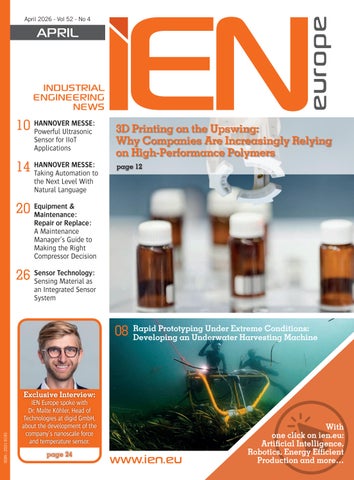
HANNOVER MESSE: Taking Automation to the Next Level With Natural Language

Equipment & Maintenance: Repair or Replace: A Maintenance Manager’s Guide to Making the Right Compressor Decision

Sensor Technology: Sensing Material as an Integrated Sensor System

TIM Global Media BV

Chaussée de la Hulpe 177 - Ground Floor 1170 Watermael Boitsfort (Brussels), Belgium o.erenberk@tim-europe.com - www.ien.eu

Editorial Director: Orhan Erenberk o.erenberk@tim-europe.com

Editor: Kay Petermann k.petermann@tim-europe.com

Editorial Support Flavio Steinbach

Energy Efficiency: f.steinbach@tim-europe.com

Associate Publisher: Marco Marangoni m.marangoni@tim-europe.com

Production & Francesca Lorini

Order Administration: f.lorini@tim-europe.com

Website & Marco Prinari

Newsletter: m.prinari@tim-europe.com

Marketing Manager: Marco Prinari m.prinari@tim-europe.com

President: Orhan Erenberk o.erenberk@tim-europe.com

ADVERTISING

SALES

OFFICES

EUROPE

AUSTRIA/SWITZERLAND

Monika Ailinger

Tel.: +41 41 850 44 24 m.ailinger@marcomedia.ch

BENELUX, SCANDINAVIA

Nadia Liefsoens

Tel.: +32-(0)11-224397

Fax: +32-(0)11-224397 n.liefsoens@tim-europe.com

FRANCE

Roxanne Akbulut

Tel: + 33 06 52 31 41 56 r.akbulut@tim-europe.com

Raphael Erenberk +32 494 652 741 r.erenberk@tim-europe.com

GERMANY

Simone Ciolek

Tel: +49-(0)9771-1779007 s.ciolek@tim-europe.com

ITALY, SLOVENIA

Andrea Rancati

Tel: +39-02-7030 0088 arancati@rancatinet.it

TURKEY

Onur Dil

Tel: +90 212 366 02 76

Fax: +90 212 366 58 02

E-mail: o.dil@tim-europe.com

UNITED KINGDOM, IRELAND Aodhan Dunican

+44 (0)7594 239182 a.dunican@tim-europe.com

NORTH AMERICA

Hamilton-Murphy Global, LLC

John Murphy

Tel: +1 616 682 4790 Fax: +1 616 682 4791 john@hamiltonmurphymedia.com

JAPAN

Ichiro Suzuki Incom Co. Ltd. Tel: +81-(0)3-3260-7871 Fax: +81-(0)3-3260-7833 isuzuki@INCOM.co.jp

OTHER COUNTRIES

Cristian Son c.son@tim-europe.com

Dear Readers,

Are you already making plans for your visit to the trade fair in Hannover at the end of April? If so, we hope that our special feature starting on page 8 offers just what you’re looking for: a preview of some of the upcoming highlights and interesting articles to help pass the time until the fair – whether you’re on the lookout for hardware, software or the latest trends in physical AI. This year’s trade fair will feature a number of new developments in response to changes in industry and modern production. One example is the ever-closer convergence of hardware and software topics in the field of factory automation. The new layout is designed to reflect this. Visitors wishing to find out more about automation will no longer find what they are looking for in Hall 9, but in Hall 27, where the topic is presented in all its facets. From there, it is also not far to the newly created Centre Stage in Hall 26 – a location that is certainly worth a visit. Speakers from industry, business and research will be giving presentations there. I hope to be able to take away a few insights from there as well.

In this issue, we also look at other interesting topics relating to sensor technology. For example, the article on page 26 shows how integrated sensor systems with different measurement parameters can be embedded. I would particularly like to recommend the interview on page 24, in which we spoke to Dr Malte Köhler from digid about the possibilities of the versatile nanosensors developed by digid.

I hope you enjoy reading this issue!

P.S.: If you would like to meet me at Hannover Messe, please send me an email.

Digital File Requirements available at: www.ien.eu/technical-guidelines/

© 2026 TIM Global Media BV Production by design3, Milano, Italy Printing by Logo Srl - Padova, Italy

POSTMASTER

Send address changes to: Industrial Engineering News Europe

Marco Prinari - m.prinari@tim-europe.com

Industry News

New Products

HANNOVER MESSE Special

Rapid Prototyping Under Extreme Conditions: Developing an Underwater Harvesting Machine

Powerful Ultrasonic Sensor for IIoT Applications

3D Printing on the Upswing: Why Companies Increasingly Rely on High-Performance Polymers

Taking Automation to the Next Level With Natural Language

Merging artificial intelligence and classic machine control as the basis for physical AI is a key topic for Beckhoff at Hannover Messe 2026.

Processing & Control News Europe Supplement:

Retrofitting existing water treatment plants to enable transfer of measurement and sensor data to the cloud can be as simple as plugging in an expansion card.

New Products

Equipment & Maintenance: Repair or Replace: A Maintenance Manager’s Guide to Making the Right Compressor

Sensor Technology:

Reducing Maintenance by Removing Mechanical Motion

How an easy-to-use sensor module can bring flow intelligence to consumer and industrial equipment.

Exclusive

Joining Forces on the Future of Direct Current

Current/OS and the Open Direct Current Alliance (ODCA) announce the signing of a strategic partnership aimed at accelerating the emergence of a coherent and interoperable ecosystem for direct current (DC). A Memorandum of Understanding (MoU) was signed by both organizations. The partners will combine their efforts to map and harmonize terminology, system architectures, voltage levels and interfaces, application requirements, and work towards presenting aligned positions to relevant standardization committees. As the deployment of direct current becomes a key aspect of the energy transition, ensuring compatibility between installations and equipment is becoming increasingly important. This partnership aims to enable the adoption of DC power distribution solutions through a common global specification. The MoU reflects the shared vision of both entities. Both Current/OS and ODCA are international alliances, bringing together over 200 manufacturers, suppliers, research experts, end users and other stakeholders around the development of direct current technology.

Eleven women honored as they are shaping the future of robotics

Global industrial robotics installations are forecast to surpass 700,000 units in 2028 – representing a compound annual growth rate of about 7% (CAGR, 2025-2028). On their way to strengthen competitiveness, companies actively set up strategies to benefit from female participation. Success stories from the Americas, Asia and Europe show how women contribute to the development of next-generation robotic systems. To give women in the industry more visibility and acknowledgment, the International Federation of Robotics awarded 11 women shaping the future of robotics in 2026. Ensuring women contribute to the development of robotics is key to building futureready industries: This is demonstrated by the success stories of

this year's awardees: Younseal Eum – AeiROBOT, South Korea | Stefania Ferrero – Comau, Italy | Christina Jørgensen – Universal Robots, Denmark | Allison Krumpe – HealthTech Partners Global, USA | Henrike Neulen – Intrinsic, Germany | Asami Sasao – Kawasaki Heavy Industries, Japan | Kristina Schunk – Schunk, Germany | Mikell Taylor – General Motors, USA | Susanne Timsjö – ABB Robotics, Sweden | Prof. Rong Xiong – IPLUSMOBOT/ Zhejiang University, China | Dana Whalls – Association for Advancing Automation (A3), USA.

Out of theory. Into application.

Global competition, increasing cost pressure, and the rapid pace of technological innovation are confronting the manufacturing industry with the greatest transformation challenge in its history. In this phase of change, companies need a platform that presents technological innovation and translates it into real-world applications. HANNOVER MESSE 2026, 20–24 April, fulfills exactly this role by showing how AI, automation, digitalization, energy systems, and research interact to ensure sustainable competitiveness. Industrial AI is becoming a central driver of innovation and growth. It analyzes production data in real time, optimizes processes, and enables intelligent, adaptive control of production workflows. This results in measurable efficiency gains, higher productivity, and more conscious use of resources – while also opening up new data-driven business models and additional value-creation potential. At HANNOVER MESSE 2026, the topic of Physical AI will also play a central role for the first time. This refers to AI systems that directly interact with the physical world – for example in machines, plants, or robots. AI thus becomes a productive force in the factory—especially in industrial and humanoid robots. Visitors will experience this impressively at the booths of robotics exhibitors at HANNOVER MESSE.

Machine Safety Specialist Appoints new Chief Sales Officer

Effective March 1, 2026, Jens Delliehausen assumed the position of Chief Sales Officer (CSO) at K.A. Schmersal GmbH & Co. KG, thereby taking on global responsibility for sales. In this role, he will strategically develop the international sales organisation and provide new impetus for growth. Delliehausen will report directly to Managing Partner Philip Schmersal and Managing Director Michael Ambros and will be responsible for global sales at both strategic and operational levels. He joins the Schmersal Group from automation specialist Lenze. The 54-year-old has extensive leadership experience in sales and specialises in the transformation and further development of sales organisations, successful change management and the sustainable strengthening of market position and sales performance, both nationally and internationally. His key responsibilities will include managing and continuous optimisation of all global sales activities, the further development of structures and processes, and identification of new markets and growth potential. “With Jens Delliehausen, we are gaining an experienced leader who will systematically advance our international sales organisation and provide new impetus for sustainable growth,” said the Schmersal management.

Picture: Deutsche Messe

COMPACTLINUX-BASEDINDUSTRIALPC Powerfordemandingindustrialapplications

TheKKontron ALPi-TronCM5 is apowerful,Linux-based industrialPCdesignedforDIN railmounting.Basedonthe provenBLPi-TronCM5single boardcomputerwithanintegratedComputeModule5 fromRaspberryPi,thedevicefeaturesawiderangeofindustrialgradecommunicationinterfacesandnon-volatilememory(FRAM). Itsrobuststainless-steelhousingisdesignedformountingona35 mmDINrail,enablingeasyintegrationintoexistingcontrolsystems.Inadditiontoitscompactdesign,theALPi-TronCM5offers awiderangeofindustrial-gradecommunicationinterfaces.Ethernet,USBandserialinterfaces,includingRS232,RS485,andCAN FD,areavailableasstandard.UserscanoptforWLANandBluetoothconnectivitytoadapttotheirspecificneeds. Akeyfeatureis theintegratedFRAMmemory,whichretainsstoreddataevenwhen thereisnopower.FRAMenableswritingtimesoflessthan100ns andsupportshighwrite/readcyclesfor virtuallyunlimitedservice life.WhenusedwithCODESYScontrolapplications,FRAMactsas remanentmemory,thatreliablybacksupimportantprocessdata duringpowerfailuresandrestoresitafterthecontrollerisrestarted.TheCM5canbeflexiblyexpandedwithoptionalmultifunction I/Omodulesthatprovidedigitalandanaloginputs/outputs,temperaturechannels,fastcounters,andPWMchannels.

66272atwww.ien.eu

WIRELESSACCESSPOINTWITHWI-FI6

Offeringsecureconnectionsforindustrialautomation

Phoenix Contact isextendingits industrialwirelessportfoliowith newaccesspointsfromtheWLAN 2300series,whichsupportWi-Fi6 functionsinaccordancewithIEEE 802.11ax.Thedevicescanbeused tocreateefficientandpowerful WLANnetworkswithupto100 devicespervirtualaccesspoint interface. ByusingmoderntechnologiessuchasOFDMA(orthogonalfrequency-divisionmultiple access),theaccesspointcancommunicatewithmultipleWLAN devicessimultaneously.Thisensureshighefficiencyanddatarates aswellasreliablereal-timetransmission,eveninheavilyused WLANenvironments.Incombinationwiththenewclientmodules fromtheWLAN1000productfamily,thesystemofferssignificantly improvedperformanceforapplicationssuchasautomatedguided vehiclesystemsandautonomousmobilerobotsusedinproduction andlogistics.ThefullytransparentbridgeandVxLAN(VirtualExtensibleLAN)enabletransparentProfinetandProfisafecommunication,whichisimportantinautomationnetworks.Accesssecurity iscruciallyimportantinfuture-orientednetworks.Thisiswhythe accesspointwasdesignedtobesecurefromtheoutset,following aprocesscertifiedinaccordancewithIEC62443-4-1andmeeting therequirementsoftheIEC624434-2standard.

HIGHCURRENTCIRCULARCONNECTOR Assembly,installation&unlockingwithoutspecialtools Whetherforlargeevents,in industryorinmobilepower supply,anyonewhowantsto transmithighcurrentssafelyand reliablyneedsrobustconnectors thatcanbereliedonatalltimes. WiththeEPIC®POWERLOCK, L LAPP offersapowerfulsolutionfor applicationswithextremelyhigh currentsupto660A-developed formaximumsafetyanduncompromisingreliability.Thenew connectorsnowmakeiteasiertoconnectcablewiresandcontacts.Andthankstothereleasemechanismwithafullyintegrated slide,nospecialtoolsarerequired. Tomaketheconnectorseven moreuser-friendly,ateamofexpertsatLAPPhasredesignedthe existingEPIC®POWERLOCKsystemandsimplifiedtheconnector's assemblyandreleasemechanism.Incurrentversions,adaptiveor separatereleasetoolsarerequired.Ifthesearenotavailable,installersoftenhavetouseauxiliarytools.AfullyintegratedmechanismonthenewEPIC®POWERLOCKconnectornowmakestools completelyunnecessary:aslideontheoutsideoftheconnector allowseasyunlockingbyhand.Thepatent-pendingsystemremainspluggablewithallmarketstandardsandcompatiblewith thePowerlockBox,acommonlyusedpanelmountingunitforeven greatersafetyinuse.

66735atwww.ien.eu

COMPREHENSIVEMESSOFTWARE

Advancedreal-timeproductionmonitoring&optimization

SmartFactoryfrom S Smartes Teknoloji isacomprehensive ManufacturingExecutionSystem(MES)designedtoprovide fulltransparency,control,and optimizationofmanufacturing operations.Thesystemcollects real-timedatadirectlyfromCNCmachines,roboticcells,PLCs,and operatorterminals,enablingmanufacturerstomonitorproduction status,machineutilization,andoperationalperformancefroma centralizedanduser-friendlyinterface.Itsflexibleandmodulararchitectureallowsseamlessintegrationwithexistingmachineryand enterprisesystemswithoutrequiringmajorinfrastructurechanges. Bycontinuouslymonitoringproductionparameters,SmartFactory helpsidentifydowntimecauses,performancelosses,andinefficiencies.Built-inanalyticstoolscalculatekeyperformanceindicatorssuchasOEE(OverallEquipmentEffectiveness),availability, performance,andqualityrates,allowingmanufacturerstomake data-drivendecisions.Theplatformalsoprovidesdetailedproductionreports,downtimeanalysis,andtraceabilityfeatures,ensuring completevisibilityofmanufacturingprocesses. SmartFactorysupportsintegrationwithERP,qualitymanagement,andmaintenance systems,enablingsynchronizeddataflowacrosstheentireorganization.Itsscalablesoftwarearchitecturemakesitsuitablefrom smallworkshop tolarge,multi-sitemanufacturingfacilities.  66729atwww.ien.eu

66656atwww.ien.eu

11KWIE5+SYNCHRONOUSMOTOR

Drivesforreduceenergyandresourceconsumption

NORD's high-efficiencyIE5+ permanentmagnetsynchronousmotors(PMSM)arecharacterisedbyaconstantlyhigh efficiencyofupto95%overa widetorquerange.Theythereforeachieveanoptimumenergyconsumptionperformancein partialloadandspeedranges.Themotorsarenowavailablein threesizesandcoverawiderangeofapplicationswiththeirextendedpowerrangefrom0.35kWto11kWandcontinuoustorque from1.6Nmto43.9Nm.Thehighoverloadcapacity,thelargeadjustmentrangeandtheconstanttorqueoftheIE5+motorsovera widespeedrangeofupto2.400rpmenablevariantreductionin therespectiveapplication,significantlystreamliningadministrativeeffortaswellasmanufacturing,logistics,storageandservice processes. TheefficienciesofourIE5+motorssignificantlyexceed thehighestdefinedenergyefficiencyclass,whichconsiderably reducestheirenergyconsumptionandCO2eemissions.The permanentmagnetsynchronousmotorsfeature8polesinan innovativeIPMdesign.Thisallowedareductioninthesizeof activemotorparts,resultinginmaterialsavingsinthesheetmetal packageandwithregardtothemagnets.Thestatorcanalsobe manufacturedwiththeso-calledsingle-toothwinding,which reducestheuseofcopperinthewindinghead.

66680atwww.ien.eu

MICROMETERFOR360°INSPECTION

Measuringshapeandtolerancesofrotatingcomponents

WiththeV012.000firmwareupdate,the optoCONTROL2700 from M Micro Epsilon nowoffersthe optionofafull360°inspectionof rotatingcomponents.Insteadof onlydetectingameasurement valueatasinglepoint,thetarget isrotatedandevaluatedoveritsentirecircumference.Thesystem detectsvariousshapeandpositionaltolerancessuchasrunout, roundness,concentricityandovality.Theresultsareclearlydisplayedinapiechartandcanbecalledupdirectlyviathesensor's webinterface. Therunoutisthemeasureofhowmucharotating targetdeviatesfromitsidealaxisofrotation.Itisgivenbythedifferencebetweenthemaximumandminimumdistanceofthecircumferencefromthereferencepointandprovidesgeneralindicationsofdeviationsfromacircularshape.Roundnessdescribeshow muchthecross-sectionofaroundtargetdeviatesfromanideal circle.Theconcentricityisgivenbythedifferencebetweenthe maximumandminimumcenteraxisoftheobject.Itindicateshow fartheaxisdeviatesfromtheoptimumcenteraxis.Ovalityisa specialshapedeviationinwhichthecross-sectionisnotcircular butelliptical.Itisdefinedbythedifferencebetweenthemaximum andminimumouterdiameterinrelationtothemeanouterdiameter. Thenewsensorfeaturescanbeutilizedintheproductionof mechanicalshaftsorrotatingcomponents,amongotherthings.

COMPACT&SAFEDRIVECONTROLLER

Integratedmoduleofferscomprehensivesafetyfunctions WiththeSX6safetymodule, S STÖBER addsmodernsafety technologytoits6thgeneration drivecontrollers.Developedin collaborationwithPilzGmbH& Co.KG,theSX6combineshigh safetystandardswithpractical handling.TheSB6offerscontrol ofupto4axesinlinearorrotary applications.Theseriesisavailableinthreesizesforlowtomediumpowerranges.Itcancontrol bothlinearandrotarysynchronousservomotors,asynchronous motors,andalsoleanmotors.BecausetheSB6isespecially compact,itfitsintocontrolcabinetswithinstallationdepthsas lowas210millimeters. EquippedwiththeSX6,theSB6issuitable forsafety-relevantapplicationsuptoSIL3,PLe(category4)in accordancewithDIN61800-5-2orDINENISO13849-1.Thesafety moduleenablestheconventionalSafeTorqueOff(STO),SafeStop1 (SS1)andSafeStop2(SS2)stopfunctionsand alsofeatures Safely-LimitedSpeed(SLS),SafeSpeedRange(SSR),SafeDirection (SDI),Safely-LimitedIncrement(SLI)andSafeOperatingStop(SOS). Throughposition-basedlimitvaluemonitoringandtargetedsuppressionofinterferencesignals,theintendedlimitvaluescanbe approachedwithaminimalinterferencedistance.TheSX6continuouslyrunssystemtestsduringoperation.

66730atwww.ien.eu

LOGICCONTROLLERWITHTOUCH-DISPLAY Forhigher-levelbuildingandindustrialautomation Siemens ispresentingLOGO! 9,thelatestgenerationofits provenintelligentlogiccontroller.Theyenablesimple implementationofsmallautomationprojects-from switchingandcontroltasksin buildingservicestomechanicalandapparatusengineering.WithLOGO!9,Siemensmarksacomprehensivegenerational changeafter11years,significantlyenhancingperformancecombinedwithmodernoperatingcomfort,flexibleengineering,and forward-lookingsecurity. Theextendedexpansionlevelwithupto 64digitalinputs,60digitaloutputs,and16analoginputsandoutputseachcreatesscopeforlargerandmoredemandingprojects. Thenewanalogexpansionmodule(AM4)withselectableanalog resolution,alongwithnewcalculationfunctionsandfloating-point numbersupport,enablesprecisecontrolandmeasuredvalueprocessingatthehighestleveldirectlyinthecontroller.Theseperformanceenhancementsmeangreaterapplicationflexibility,fewer additionalcomponents,andthereforelowereffortacrosstheentire lifecycle-withoutunnecessarilycomplicatingthearchitecture. The newtouchcolordisplay(resolution320×240px)withtheenlargedareadirectlyonthebasemoduledisplaysmoreinformationata glance,ensuringclearoperationandfastdiagnostics.

66711atwww.ien.eu

Rapid Prototyping Under Extreme Conditions: Developing an Underwater Harvesting Machine

The conservation organization Project Seagrass and Tandem Ventures have joined forces to design, develop, build, and test an underwater harvesting machine. Onshape enables the team to collaborate in real time, even from a boat.

Seagrass in the world’s oceans is a vital part of the ecosystem: it captures carbon faster than rainforests, protects coastlines from erosion, and provides habitat for countless species. In the United Kingdom, however, up to 90% of these underwater meadows have already disappeared. Project Seagrass aims to restore seagrass populations. Initially, divers manually cut and collected seed pods one by one. As this process was labor-intensive, costly, and difficult to scale, the idea emerged to develop a tool that could make harvesting safer and faster.

To achieve this, Project Seagrass partnered with Tandem Ventures, a company specializing in developing purpose-driven inventions funded through brand partnerships.

In this case, the goal was to design and build an underwater harvesting machine: a sled towed behind a boat that cuts the tips of the seagrass where the seed pods grow and brings them to the surface.

The device needed to operate gently enough to avoid damaging the seabed or marine life, yet robust enough to function in harsh ocean conditions. In addition, the team had only a few months before the seagrass season ended. The first prototype consisted of a trash pump, two sealed plastic barrels, and several flexible hoses. Regular soaked “land grass” cuttings were used to simulate seagrass. The result: a “grass smoothie” and a blocked pump. The barrels collapsed under suction.

Next, the cutting blades were tested. With permission from a local farmer, the team used a hydraulically powered trimmer blade from the trunk of a car, and later on by foot, to determine the optimal cutting speed of about one knot. The tests also revealed that the separation system would require more intelli-

SeaGrass Harvester, collaboratively developed in Onshape, a cloud-native CAD and PDM (Product Data Management) platform. Picture: Tandem Ventures

gent filtration, reinforced barrels, and a safety guard for the blades.

Highly Efficient Team Collaboration

The entire harvesting machine was developed collaboratively in Onshape, a cloud-native CAD and PDM (Product Data Management) platform. This enabled all team members to work together in real time from anywhere, on laptops while traveling, in the workshop, or on boats. Real-time version control, commenting features, and simultaneous editing allowed Tandem Ventures’ design team to iterate quickly and securely. This proved crucial in a fast-paced, experimental setup where the design evolved daily between testing phases. At the heart of the harvesting machine is a compact underwater data logger featuring an orientation sensor (EVAL-ADXL366Z) from

Analog Devices, an ESP32 microcontroller, and numerous additional components from Mouser Electronics. The system records depth, orientation, pressure, turbidity, and temperature, providing researchers with critical feedback. For custom components such as hinges, leg joints, cable guides, fins, and protective covers, the team collaborated with Bambu Lab. Its H2D printer is capable of producing large, industrial-grade components from durable TPU and PLA materials. The entire sled structure was assembled using a wide range of marinegrade stainless steel fasteners from Accu Components, specifically selected to withstand harsh saltwater conditions.

Field Test in a Welsh Bay

The prototype was deployed from a boat into Porthdinllaen Bay in North Wales, one of the

UK’s most valuable remaining seagrass meadows. An experienced member of the seagrass team assessed the test environment to ensure safe and suitable operating conditions. Testing was limited to a few short harvesting runs to validate the concept while minimizing environmental impact. A small number of seed

pods were successfully collected using the team’s new harvest pump filtration system. Based on the test results, further improvements were made: robust, extendable legs for precise cutting-height adjustment and emergency zip-access panels to allow divers safe access away from the blade to remove

The first prototype version shows the need for further developments.

accumulated grass, debris, or blockages. A blade guard, 3D-printed in flexible and durable TPU using Bambu Lab technology, ensures that only seagrass comes into contact with the sharp blade while keeping larger objects away. Tandem Ventures is also developing a completely new pump system to increase reliability and simplify operation.

The harvesting machine prototypes have the potential to enable Project Seagrass to collect seeds up to 100 times faster. Onshape will continue working with Tandem Ventures and Project Seagrass to further refine the prototype and develop a faster, more efficient solution to help preserve and restore seagrass meadows.

66716 at www.ien.eu

Hall 17, F36
Picture: Tandem Ventures

Powerful Ultrasonic Sensor for IIoT Applications

High machine availability is enabled by the integrated IO-Link interface, which provides access to sensor parameters, diagnostics and process data.

In many applications, harsh ambient conditions present a significant challenge for sensor technology. In such cases, ultrasonic sensors that are largely unaffected by physical influences become especially valuable. They operate equally reliably in dusty storage bunkers and weather-tested outdoor areas as they do in demanding industrial facilities. The UB*-F42 sensor series from Pepperl+Fuchs combines this inherent durability with IIoT communication through an integrated IO-Link interface. In addition to delivering precise measurement and switching signals, these sensors provide detailed process and status data – supporting diagnostic, system optimization, and condition-based maintenance strategies.

The metrological core of the ultrasonic sensor is a piezoceramic transducer that generates short sound pulses using a membrane. The same membrane detects the echo that is reflected back from the target area. The integrated electronics calculate the distance value from the time span between transmission and reception.

Objects with changing colors, as well as reflective or transparent surfaces that can often interfere with optical sensors, have no impact on the measurement results. The technology

is equally resistant to dust, fog, moisture, and buildup from adhering dirt. In addition, the sound waves propagate in a cone-shaped beam, covering a broader area rather than a single point. This allows irregular, perforated, or broken contours to be detected reliably. Because the measurement principle is noncontact, there is no mechanical wear.

Additional benefits on a proven basis

The UB*-F42 series builds on a technical basis that has been established and continuously developed over many years. The housing with IP67 degree of protection is resistant to dust and moisture, making it suitable for outdoor applications and areas with frequent cleaning. Compared to previous versions, the con-

UB*-F42 series ultrasonic sensors with IO-Link in various versions. Picture: Pepperl+Fuchs
Reliable vehicle detection in the car wash, even in wet conditions. Picture: Pepperl+Fuchs

nectors feature a metal housing designed for maximum strength. The dimensions and installation devices remain unchanged so that the devices can be integrated into existing installation concepts; adapter plates are available for replacing concept-identical K0 devices.

A key strength of the new generation of devices is their communication capability. Their IO-Link interface enables remote access to all sensor parameters. In addition to the measured values, it provides additional information such as operating hours, temperature, or device status. Such data increases transparency at the field level and can be specifically evaluated by higher-level systems. For example, significant temperature trends or status changes can be detected early and incorporated into maintenance plans. The sensor technology supports condition-based maintenance and helps reduce unplanned downtime.

Switching outputs and IO-Link combined

Process data and status information can be seamlessly integrated into the automation architecture. From sensor configuration via IO-Link tools to visualization in HMI/SCADA systems, measured value, status, and key operating figures can be consolidated. This makes sensor technology not only the source of a signal, but also a building block for traceable operational maintenance decisions – for example, when maintenance is planned based on solid data or limit values are adapted to changing products.

The combination of the IO-Link interface with

two push-pull outputs is a unique feature of the UB*-F42 series. This means that two switch points can be used in parallel while IOLink communication is available at the same time. In practice, a single sensor technology can perform two tasks, for example by reporting the "empty" and "full" limit levels in a fill level application and providing additional information at the same time. This not only reduces the number of components required, but also reduces the installation effort and wiring. At the same time, configuration remains flexible so that switch points and other settings can be adapted to the application. A teach-in input is also available for commissioning, which enables teach-in without push buttons; operation is therefore also possible without IO-Link.

Customized for specific applications

The devices in the series are available with measuring ranges from 500 mm to 6000 mm. For short detection ranges, there are sidelooker variants in which the ultrasonic transducer in the housing is rotated by 90 degrees. This lateral arrangement of the sound membrane allows installation in confined spaces. As the dead band of the devices is especially short compared to other devices on the market, the usable measuring range in such compact structures is significantly increased. The shape of the sound beam can also be configured to adapt to the environment. A wider beam is suitable for area monitoring or irregular structures; a narrower alignment of the sound waves minimizes the interference

Material monitoring on a metal coil is used to track material consumption status.

Picture: Pepperl+Fuchs

echo in narrow containers or with complex geometry. If several sensor technologies are operated in close proximity, a synchronization function supports interference-free parallel operation. After connecting the synchronization inputs, up to ten devices can work side by side without their sound pulses influencing each other.

From the building material

bin to the material roll

The combination of robust principle of measurement, high degree of protection, and digital communication opens up a wide range of applications. In silos and tanks, UB*-F42 sensors detect the fill level of liquids just as reliably as that of granulates or bulk materials. Dust formation and vapors do not impair measurement. For bulk solids, the surface-wide detection of the material cone can be used to establish a stable average value. In open storage areas, the weather-independent measuring principle together with the IP67 housing ensures consistently reliable detection. For access and exit control at gates and entrances, the sensor technology detects vehicles regardless of their color, contour, or reflective surfaces. Even wet or dirty environments, such as in car washes or on construction sites, are tolerated without any problems. In production systems that process roll material such as paper, film, or sheet metal, the device measures the decreasing roll diameter and therefore the material consumption. When a defined limit value is reached, replenishment can be requested automatically. Here too, harsh conditions such as dust formation, oily build-up, vibration, or high temperatures play virtually no role in measuring stability. As the same sensor type can cover different tasks, integration costs and spare parts stocks are significantly reduced.

Hall 27, D38

66717 at www.ien.eu

3D Printing on the Upswing: Why Companies Increasingly Rely on High-Performance Polymers

3D printing in companies is booming. Design engineers are printing special components and wear-resistant parts themselves without further ado. However, the projects stand or fall on the quality of the printing material, warns Jonas Burk, Head of Additive

Manufacturing at igus. The fact that 3D printing with high-performance polymers from igus is worthwhile is not only proven by the service life tests. Customers can also manufacture their products more economically and faster than injection moulding.

Time and again, design engineers faced the challenge of manufacturing special components as quickly and cost-effectively as possible. Traditional manufacturing processes such as turning, milling and injection moulding often reach the limits of economic efficiency. One example: Brinkmann Technology GmbH, which specializes in the manufacture of conveyor technology. The closed conveyor systems are used to transport products such as coffee and sugar for the food industry. A lot of these systems need to be custom-made to meet specific customer requirements. This means that a lot of components, including plastic parts that come into contact with the product, aren't available as catalogue items. The individual production of plastic parts using injection molding is expensive, as separate tools are required for each dimension. This drives up unit costs, especially for smaller systems with short conveyor distances and smaller quanti-

ties. Brinkmann therefore decided to invest in 31 3D printers, which produced a total of 5,000 plastic parts for two projects.

Brinkmann Technology is no exception with this strategy. "More and more companies are buying their own 3D printers to quickly produce special components and wear-resistant parts themselves, including a wide range of gears, plain bearings and guides," says Jonas Burk, Head of Additive Manufacturing at the Cologne-based company igus. The advantages are obvious: companies enjoy freedom of design as they are no longer limited by the three- or five-axis machining of CNC machines. They also save time and money as

With tribofilaments, laser sintering powders and resins, igus offers a wide range for the fast and economical production of wear-resistant special parts - from a single part to high-volume production. Picture: igus SE & Co. KG
The iglidur i4000 resin has been specifically designed for producing wear-resistant and precise gears. Picture: igus SE & Co. KG

no additional tools such as injection moulds are required for production. However, such projects stand and fall with the choice of print material. "Many conventional plastics are simply not suitable for printing industrial components. They wear out too quickly, especially when the parts move in machines, systems or vehicles," says Burk.

"3D printing in your own company is booming"

To expand the industrial application area of 3D printing, igus is developing its own printing materials that are suitable for industry and tribologically optimised. "Our filaments, powders and synthetic resins are the only printing materials on the market that specifically counteract friction and wear," says Burk. They are therefore used in numerous industries where printed components move and need to be particularly durable to reduce downtimes and make applications maintenance-free. They can be found everywhere, from medical technology to vehicle construction to mechanical engineering. "3D printing in industrial companies is booming. We also notice this in our material sales, which have increased by around 200% in the last two years", explains Burk. igus now produces printing materials for all common 3D printing processes: fused deposition modelling (FDM), selective laser sintering (SLS), and digital light processing (DLP). The basic formulation of these materials is always similar: base polymers ensure wear resistance, fibres and fillers ensure resistance to high forces and edge loads and microscopic solid lubricants ensure low-friction dry operation without external lubricants. The latter is one of the most important brand characteristics of igus and can be found throughout the entire product range of plain bearings for which the company has been known around the world for over 60 years. These self-lubricating specifications make the printing materials ideal for producing gears or sliding elements in almost all industrial sectors. According to Jonas Burk, high-performance plastics are almost always one step ahead of standard printing materials: "Compared to standard materials, our SLS materials can last up to 30 times longer, our FDM products up to 50 times longer and the DLP solutions even achieve a service life that is up to 60 times longer." Other ingredients can also be added to the formulation to give the printing materials further specifications, such as resistance to

When manufacturing grippers, high-performance plastics can be a cost-effective alternative to aluminium. They are printed in no time, are six times more durable and, in the case of Staußberg & Vosding, are almost 95% more cost-effective. Picture: igus SE & Co. KG

high temperatures or electrical conductivity.

Increased replacement of classic polyoxymethylene igus tests the wear resistance of the printing materials in its own 5,500m2 test laboratory in Cologne. For example, the so-called pinon-disk tribometer is used to measure friction and wear. The results speak for themselves. One pin, made of POM-H, achieved a wear rate of 77.58µ/km. Test specimens from igus, on the other hand, achieved significantly better values: 1.08µ/km for iglidur i190 (FDM), 2.05µ/km for iglidur i4000 (DLP) and 1.19µ/ km for iglidur i230 (SLS). It is also worth noting that the wear on the POM samples increases with higher speed. This is not the case with the self-lubricating iglidur materials. Friction and wear remain at a constantly low level. According to Burk, it is therefore understandable that many users are replacing the established material polyoxymethylene (POM) in moving applications, such as gears, bearings, guides and drive nuts. Admittedly, POM, a highly crystalline plastic with good mechanical strength and dimensional stability, has been a standard for wear-resistant and mechanically resilient components

for decades. However, the material tends to wear comparatively quickly when in motion with friction. This is also proven by tests in which plastic gears rotate on a steel mating gear. A gear that had been printed with the SLS material iglidur i230 withstood the test for 166 hours. A gear that had been machined via CNC from POM-C lasted for only 20 hours, and an SLS-printed specimen made from PA12 for just under 2 hours.

"It is also important to us that users achieve professional results immediately with the print materials without having to spend hours experimenting with printer settings beforehand," concludes Burk. "That's why you can download material profiles from our website. With their help, you can automatically adjust parameters such as temperature and flow rate." Interested parties who do not wish to invest directly in their own 3D printers can use the 3D printing service from igus. It allows the production of customised, complex components in just three days, from one piece to series of 70,000 parts.

Hall 13, C60

66719 at www.ien.eu

Taking Automation to the Next Level With Natural Language

The integration of physical AI marks a paradigm shift in the manufacturing industry. It directly links AI models with deterministic control technology.

Merging artificial intelligence and classic machine control as the basis for physical AI is a key topic for Beckhoff at Hannover Messe 2026. The automation specialist will be demonstrating how large language models (LLMs) directly influence real motion sequences via standardized interfaces. The accompanying exhibit will showcase this technology's potential in a fun, entertaining way.

The integration of physical AI marks a paradigm shift in the manufacturing industry. Establishing a direct link between AI models and deterministic control technology allows machines to do more than just process static commands – it helps them create context-specific, autonomous responses to sophisticated requirements.

At the Hannover Messe Press Preview, Beckhoff presented an initial tangible insight into this technology using a compact demo cell, combining the XPlanar planar motor system with the TwinCAT CoAgent AI tool and an audio interface for voice commands. Visitors experienced a physical AI application in which floating movers can be controlled using natural language and initiate the next motion sequence on command. This fun demonstration is designed to illustrate how simple and intuitive collaboration between humans and machines will be in the future, allowing users who are not programming specialists to perform complex automation tasks.

Agentic Control

Beckhoff will be scaling this scenario to a fully integrated industrial application at Hannover Messe 2026. The ATRO modular industrial robot system, which is programmed and controlled using TwinCAT CoAgent for Operations using

voice commands, will take center stage here. Based on the Model Context Protocol (MCP), the control system acts as an intelligent agent that translates human speech into machine commands, orchestrates path planning, and performs diagnostic tasks. The physical AI application will be showcased using a fun approach: the exhibit will play chess against visitors. With tools such as TwinCAT CoAgent and TwinCAT Machine Learning Creator, Beckhoff already offers an ecosystem that facilitates this new era of automation. The tools support machine builders throughout the entire life cycle – from code generation in engineering through to error analysis during operation.

“We are moving AI away from chat windows and directly into machines and enabling lan-

guage models to access the real world of controls through new standards such as MCP,” says Hans Beckhoff, Managing Director and owner of Beckhoff, describing this new development.

“Technical inventions have always influenced the way that society as a whole evolves. Artificial intelligence and physical AI have significant implications, on the same level as the steam engine and electricity.”

Visitors to Hannover Messe are invited to the Beckhoff stand to see how physical AI is pushing the boundaries of classic automation and securing new competitive advantages.

Hall 27, G56

66718 at www.ien.eu

Picture: Beckhoff Automation

Instant Connectivity:

Retrofitting existing water treatment plants.

Page 18

17 Stop the Steam: Flow Control System Reduces Energy Costs at Aerospace Plant.

INSTRUMENTATION

19 MEASUREMENT

Long-Term Stable Pressure Transmitter

19

High-Accuracy Turbine Flow Meter

energy efficiency

Stop the Steam: Flow Control System Reduces Energy Costs at Aerospace Plant

At a specialist aerospace equipment manufacturer in Portsmouth, an initiative to reduce energy costs identified steam energy usage that could be optimised. Dart Aerospace involved Bürkert’s engineering team to develop a system that could automatically close steam flow during non-operational periods. This custom-developed flow control system was set live in January 2025 and achieved return on investment in a matter of months.

Dart Aerospace designs and manufacturers mission-critical equipment, primarily for helicopters, as well as fixed-wing aircraft. The global organisation’s UK operation is based in Portsmouth, and the plant manufactures systems including flotation devices that achieve buoyancy for emergency landings on water, as well as auxiliary fuel cells.

Machinery crucial to its manufacturing process includes presses that form rubber and polymers into the required shape, as well as spreaders that apply a sealant and bond over an additional layer of material such as Kevlar®. Various machine types and sizes are required according to the part in production, including 21 presses and spreaders. All the machines are steam-driven from a central boiler that powers the large press room via a series of ¾” and 1” steam lines.

Steam shut off

Manufacture of Dart Aerospace’s products is specialised, rather than mass produced, and normally involves day-time operation rather than round-the-clock production. Each press produces between 8 and 20 moulds per day, and the machines aren’t all in simultaneous use. In fact, some of the most specialised machines can be on stand-by for more than a day at a time. However, steam flow to the machines was, in many cases, continual, even when the machines weren’t in operation. Although each press and spreader had its own valve to regulate flow, the steam to each machine wasn’t regularly shut off at the end of each day. Operating the hand wheels that closed the valves could be physically demanding, and some of the valves were in difficult to reach positions, requiring working at height ac-

The centralised control panel includes an HMI touchscreen to enable individual machine management.

cess, which meant a time-consuming process. To remove these barriers, Dart Aerospace’s Maintenance & Engineering Team wanted an automated system to control steam shut off that would reduce unnecessary usage and minimise costs.

To develop the control system, the on-site engineering team engaged with flow specialist Bürkert. The remit was to design a system that could automatically turn off the steam supply at the close of each day, while still allowing individual machines to be turned back on as required during the following work shift.

This would allow the operation of any press or spreader as required, while ensuring the steam supply remained closed to any machine not in operation.

Flow system design

With all but one of the machines fed by a single ¾” or 1” steam line, Bürkert’s engineers specified a Type 2000 angle seat valve for installation on each machine to provide on/ off steam control. While high flow rates are achieved with a virtually straight flow path, the angle seat design ensures a compact footprint.

When closed, the self-adjusting packing gland provides high sealing integrity, and the stainless steel, maintenance-free design provides long life.

Each of the on/off angle seat valves would be controlled by a Bürkert Type 6524 pneumatic valve to allow reliable, high-pressure switching. The pneumatic valves would be centrally located on a Bürkert Type 8652 valve island and switched with a 24V supply. This centralised system using pneumatic hoses was selected to provide a significant cost reduction and simplifying future maintenance compared to installing a control head for each angle seat

valve. Meanwhile, the Type 8652 valve island enabled simple integration to the wider system’s Ethernet network.

To operate the system, the valve island integrated with an HMI control panel installed alongside, running a programme that was custom-authored by Bürkert’s UK engineering team. The HMI touch-screen display could open or close the steam supply to the individual machines, while the control system was also programmed to close all steam lines at 6pm each day. Each machine could then be manually switched on by an operator at the start of the following shift.

The Type 8652 valve island is housed in a protective cabinet and controls the Type 6524 pneumatic shut-off valves.

Rapid ROI

The initial on-site discussion at the Portsmouth plant took place in September 2024. With Dart Aerospace’s usual contractor unable to complete the installation of the angle seat valves on each machine, the company’s M&E team, led by Tony Foster, completed the project during the Christmas shut down of 2024. During this period, the custom valve island was built at Bürkert’s Germany headquarters and delivered to Bürkert UK for programming, with an interface developed to optimise ease of use. System commissioning and staff training at Dart Aerospace took place on the same day, and the system was set live in the following January.

Now in January 2026, 12 full months on from commissioning, the Bürkert system is returning an energy saving of approximately 25% on a month-by-month basis. This reduction is compared to the three previous years of operation, which had an equivalent level of operational productivity. As a result, the energy savings in the first half of 2025 alone demonstrated a rapid return on investment.

66721 at www.pcne.eu

digizalization

Instant Connectivity

Sometimes, digitalization is really straightforward. For example, retrofitting existing water treatment plants to enable transfer of measurement and sensor data to the cloud is now as simple as plugging in an expansion card.

Water treatment is governed by strict regulations. Which is a good thing, because clean drinking water is something we all rely on. But for treatment plant operators, this entails labour-intensive quality assurance. To prevent failures, the measuring points for liquid analysis need regular maintenance. That calls for personnel with specialist knowledge – not to mention staying power and physical agility if the measuring points are in hard-to-reach places. This is where cloud connectivity can really simplify matters, giving operators easy access to measurements and status data from any location, at any time.

Until now, digitalization of existing systems has been difficult. “Getting brownfield infra-

structure online meant operators having to expand existing fieldbus systems with edge infrastructure, or retrofit entire systems,” says Daniela Haider, a product manager at Endress+Hauser Liquid Analysis. A team here has developed a connectivity solution that does things differently. Now, instead of extensive upgrades or new infrastructure, it takes only a module – roughly the size of a desktop PC expansion card – that slots into the existing transmitter on the measuring point. This solution, the Liquiline Edge Module CYY7, allows plant operators to quickly and easily retrofit existing liquid analysis installations and connect them to the Industrial Internet of Things (IIoT).

More data, greater benefits

With the module plugged in, it takes just a few minutes to connect the measuring point to the Endress+Hauser Netilion Cloud. Communication runs over a secure channel, independent of the fieldbus. Haider explains: “The Edge Module picks up the data from the transmitter and sends it to the cloud either independently over the cellular network or through existing wired Ethernet infrastructure. Neither variant makes a difference to the system’s functioning or processes.” It’s not just measurement values that are sent to the cloud – other sensor data is transmitted as well. “Thanks to that cloud platform, operators can use the sensor data to optimize maintenance intervals or even plan repairs,” says Haider. With the digital system, operators can meet legal requirements more efficiently – as well as offset the shortage of skilled workers.

This user-friendly plug-in digitalization solution is the result of several years’ work at Endress+Hauser. “Great teamwork across three product centers was an important part of the effort,” Haider says. “The sophisticated security system was a particular challenge for the teams, as was the energy-saving data transfer technology. More than 100 people inside and outside the company were involved in the development.” Data transmission by the Liquiline Edge Module meets strict cybersecurity requirements. The security measures comply with the IEC 62443 series of international standards and are achieved using Secure Boot and an https connection via the mTLS security protocol.

66720 at www.pcne.eu

SUBMERSIBLEPRESSURESENSOR

Forhydrostaticlevelmeasurementinhazardousareas

TheLS-1000submersible pressuresensorfromWWIKA is nowcertifiedinaccordance withtheEuropeanATEXand internationalIECExdirectives. Thesensorcontinuouslymeasuresthelevelofliquidmedia inindustrialenvironments. Thankstothenewapprovals, companiescannowalsouseitinhazardousareasofATEXzone0 and1aswellasIECExzone0,1and2.TheLS-1000measures levelshydrostaticallyfrom1...10m[3.28...32.81ft].Optimal long-termstabilityof0.2%ensuresprecisemeasureddataand minimalsignaldrift.Thankstoitsrobustdesign,thestainless-steel submersiblepressuresensorispermanentlysealedinaccordance withingressprotectionIP68.Aspeciallydevelopedcableprovides effectivestrainrelief,andpottingofthecableinletprovidesadditionalprotection.Eachindividualdeviceundergoesaheliumleak testduringthefinalinspection.Eventhesmallestleaksandhairlinecracksaredetectedhere.Thesubmersiblepressuresensoris maintenance-free,minimisingfailures,downtimesandtotalcostof ownership.Itcanbeoperatedwitha5Vbattery,astheenergysavingratiometric0.5...4.5Voutputsignalconsumeslessthan5 mA.Thisplacessuchalowloadonthebatterythatitdoesnot needtobereplacedforyears.

66725atwww.pcne.eu

LONG-TERMSTABLEPRESSURETRANSMITTER

Extendedfunctionalitiesforimprovedmaintenance

Yokogawa Electric announcesthe OpreX™PressureTransmitterEJXS Seriesasthesuccessortoitscore EJXAlineup.Buildingontheproven siliconresonantsensortechnology theEJXSSeriesoffersenhancementsinaccuracy,long-termstability,anddurabilitythatensurestable plantoperationsandimprovemaintenanceefficiency. Theaccuracyof thetransmittersisinarangeof ±0.025%,withoptionalspecification code/HAC.Theseriesoffersahigh long-termstability(±0.1%per20years)andrangeabilityofupto 400:1.HARTandPROFINETcommunicationprotocolsaresupported.WithanIP68dustproofandwaterproofrating,compliancewith SIL2requirements,andenhancednoiseimmunity,theEJXSSeries isevenmorereliableandrobust.Inaddition,anewcolorbacklit graphicdisplaysignificantlyimprovesvisibilityofprocessvariables anddevicestatusinformation. Compliancewithavarietyofexplosion-proofstandards,supportfordualpowerconnections,and advanceddiagnosticfunctionsareallprovidedasstandardfeatures withtheEJXSSeries,allowingthesedevicestocoverawider rangeofapplicationsandreducingtheneedfortheorderingof productswithspecificmodelandsuffixcodes.

HIGH-ACCURACYTURBINEFLOWMETER

Stainless-steelbodyforhighpressures

AW-Lake announcesthelaunchof itsTHSeriesHighAccuracyTurbine FlowMeter.Itisaprecisionliquid flowmeasurementsolutionfor demandingindustrialapplications whereeveryfractionofapercentin accuracymatters.Precisionmachining,tightinternaltolerances,andstainless-steelconstruction providestable,long-termperformanceincontinuousoperation. Designedforlow-viscosityliquidssuchasoils,water,andmany processchemicals,theTHTurbinemeterdeliverslaboratory-grade performanceinarugged,field-readypackage. Themeasuring accuracyisspecifiedto±0.5%undercontrolledconditionswith linearization.Therepeatabilityoffers±0.1%forhigh-confidence flowcontrol.Thissupportscriticaloperationssuchasbatching, dosing,blending,andteststandswhereevensmalldeviationscan createscraporoff-specproduct. Theseriesoffersaall-welded stainless-steelconstruction,hardenedrotorsupport,andprecision bearingsdeliverdurabilityinharsh,high-duty-cyclesystems.The designsupportshighoperatingpressuresandbroadfluidtemperaturerangesforoilfield,process,andindustrialservice.Withmultiplelinesizesandflowrangestheflowmeterscoverapplications fromlow-flowtestloopstohigh-flowtransferlines.Theturbine canbepairedwithelectronicdisplays,transmitters,orwireless totalizersforintegrationwithPLCs,DCS,andplanthistorians.

66595atwww.pcne.eu

VARIABLEAREAFLOWMETER

SIL2certifiedforlimitswitchesand4...20mAoutput

TheKKrohne H250M40variable areaflowmeterreceivesnewSIL 2certifications,settinganew benchmarkforfunctionalsafety ofvariableareaflowmeters:certificationbodyexidahasawardedSIL2certificationtothedevice'slimitswitchesand,forthe firsttime,tothedevice's4...20mAanalogueoutput. Thecertificationdoesnotonlyincludetherandomfailureratesofthehardware,whichweredeterminedbyanFMEDAandconfirmedwith fielddata,butalsoproofofthesystematiccapabilityofthesoftwareandhardwareduetosuitabledevelopmentandmanufacturingprocessesinaccordancewithIEC61508:2010Part1-3.The H250M40isthestandardvariableareaflowmeterforapplications intheprocessindustriesandOEMsector.Itcombinesreliable measure-mentofliquidsandgaseswithmoderncommunication anddiagnosticfunctions.Additionalelectronicmodulescanbe addedorreplacedatanytimewithoutinterruptingtheprocess, allowingthedevice'sfunctionalitytobeadaptedtonewrequirements-fromanalogueflowmeasurementwithoutauxiliarypower tofulldigitalintegrationintofieldbussystems. Therobustallmetalflowmeterisavailableinawiderangeofmaterialsandconfigurationsandissuitablefordemandingconditions,includinghigh pressures,extremetemperaturesandaggressivemedia.

Repair or Replace: A Maintenance Manager’s Guide to Making the Right Compressor Decision

Every maintenance manager eventually faces the critical decision of whether to repair an existing air compressor or to invest in a new unit. This choice impacts not only immediate operational capabilities but also long-term financial performance. Making the right decision requires careful analysis of multiple factors, from immediate costs to future operational needs.

A hasty decision based solely on upfront expenses often leads to greater costs over time, while a comprehensive evaluation ensures optimal long-term value. This article explores the key considerations when facing the repair-or-replace dilemma and provides guidance for selecting the right new equipment when replacement becomes the preferred option.

Critical Factors in the Repair-or-Replace Decision

The Financial Impact of Breakdown Events

When evaluating repair costs against replacement, looking beyond the immediate invoice is quintessential. Consider the frequency of breakdowns and their cumulative cost over time. A compressor requiring frequent repairs may seem economical in the short term, but can quickly become a financial drain through both direct repair expenses and production losses.

Calculate the cost of parts, labour, and most importantly, downtime associated with each breakdown. Equipment with escalating repair frequencies or increasingly expensive components often signals diminishing returns on repair investments. When annual maintenance costs exceed 30% of the replacement value, it's typically a strong indicator that replacement deserves serious consideration.

The Lifecycle Reality Check

Every compressor has a designed service life, after which reliability naturally decreases while maintenance costs increase. Most industrial air compressors have an expected operational lifespan of 10-15 years, though this varies by type, usage patterns, and maintenance quality. As your compressor approaches this threshold, evaluate whether continued repairs represent sound investment. Units operating beyond their design life typically experience accelerated deterioration of major components, resulting in more frequent and costly repairs. Compare the remaining serviceable life against the anticipated ownership period of a new unit to determine the most cost-effective path forward.

Efficiency Economics: Power and Flow

Older compressors invariably consume more energy for the same output compared to modern counterparts. This efficiency gap often

represents the single most compelling reason to replace rather than repair. A comprehensive analysis should include a comparison of the specific power consumption (kW per m³/min) between your existing unit and potential replacements.

Energy typically accounts for 70-80% of a compressor's lifetime cost, making even modest efficiency improvements significant over time. Calculate potential energy savings by comparing the current unit's power consumption with newer models, factoring in your operational hours and electricity costs. In many cases, the energy savings alone

can justify replacement within 2-3 years, particularly for compressors operating at high duty cycles.

Technological Advancement Assessment

Compressor technology has evolved significantly, particularly in areas of control systems, energy recovery, and connectivity. Modern units offer variable speed drives, advanced controllers, remote monitoring capabilities, and improved cooling systems that older models simply cannot match, regardless of repair quality.

Consider whether technological limitations are affecting your operations. Can your current system integrate with plant management software? Does it offer precise pressure control to match demand fluctuations? Does it provide diagnostic data for predictive maintenance? If technological limitations are hampering operational efficiency, repairs—no matter how thorough—cannot bridge this fundamental capability gap.

Utilisation Analysis: Matching Capacity to Need

The percentage of time your compressor operates at full load versus idle or unloaded conditions significantly impacts efficiency. If your current system is substantially oversized or undersized for your present needs, repairs perpetuate this mismatch. Analyse your actual compressed air requirements and compare them to your existing system's capacity.

A properly sized compressor operating near its optimal efficiency point will deliver better economy than an oversized unit that cycles frequently or an undersized unit that struggles to meet demand. If your operational requirements have changed significantly since the original installation, replacement offers an opportunity to right-size your compressed air system.

Future-Proofing: Anticipating Expansion

Any repair-or-replace decision should account for planned facility expansions or production increases. Repairing a compressor that will soon be insufficient for your needs represents poor resource allocation. Conversely, replacing with a system that cannot accommodate

growth necessitates another replacement cycle prematurely. Evaluate your organisation's strategic plans for the next 3-5 years. Will production volumes increase? Are new air-consuming processes being considered? Will operational hours extend? Factor this anticipated growth into your capacity calculations when considering replacement options, potentially selecting modular systems that can be expanded incrementally.

The Service Horizon: Parts and Support Availability

Older compressors eventually face parts obsolescence challenges. Manufacturers typically support models for 7-10 years after production ceases, after which components become increasingly difficult to source. Repairs become not only more expensive but potentially impossible as critical parts become unavailable.

Before investing in major repairs, investigate the long-term parts availability for your model. Contact the manufacturer directly regarding their support commitment for your specific unit. If spare parts are already becoming difficult to source or lead times are extending, this trend will likely accelerate, eventually forcing replacement regardless of the compressor's mechanical condition.

The second part, focusing on the factors to choose the right replacement compressor, you can find online: https://www.ien.eu./ bingo/66727.

66726 at www.ien.eu

sensor technology

Reducing Maintenance by Removing Mechanical Motion

How an easy-to-use sensor module can bring flow intelligence to consumer and industrial equipment.

For the coffee shop, the task is to draw the exact dose of water required to produce the full richness of a perfect cup of espresso. For the pub or bierkeller, it is serving exactly a halfliter of weissbier so that the customer gets no more and no less than they paid for. And for the industrial process control engineer, the requirement is to know exactly when a filter has cleaned its rated volume of water and is due for replacement.

Pure electronic sensing using ultrasonic technology eliminates the moving parts from a flow sensor assembly, and provides an escape route from the problems with traditional flow sensors. When first introduced, ultrasonic sensor ICs posed a considerable integration challenge which generally restricted their use to

the manufacturers of specialist measurement equipment. But that changed and modules for accurate, reliable ultrasonic flow sensing are now a valid option for non-specialist designers.

Stuck with traditional turbine-based flow sensors

Traditional flow sensing uses an inline tube with a rotating turbine whose speed indicates flow rate; integrating this signal provides total volume and offers a simple interface for controllers like microcontrollers or PLCs. However, turbine sensors suffer from mechanical limitations: friction and inertia make them inaccurate at low or leakage flows, and their moving parts are prone to wear, corrosion, and failure, reducing long-term reliability.

Eliminating moving parts

If mechanical parts in the flow path are the problem, the solution is non-contact measurement—typically ultrasonic sensing. Ultrasonic flow sensors use two transducers mounted diagonally on a pipe to send pulses upstream and downstream; differences in transit time, caused by the fluid speeding or slowing the pulses, indicate flow velocity.

This non-intrusive method works for clean liquids and gases, affects neither medium nor pressure, and scales to many pipe sizes. With no moving parts, ultrasonic sensors avoid wear, corrosion, and low-flow issues, enabling long life and detection of very slow flows. Because they must resolve extremely small transit-time differences—often in the picosecond range— precise signal processing is required.

A ScioSense ultrasonic flow converter IC can perform this processing, triggering both transducers, measuring differential transit time, and converting the results into flow rate and total volume for a given pipe diameter.

Key design considerations in ultrasonic flow metering

To integrate an ultrasonic flow converter (UFC) into a flow sensor system, the designer has to take account of various considerations. These include:

• The transducer mounting geometry

• The acoustic properties of the pipe material - metals, plastics, and composite pipes each have different acoustic impedances and attenuation characteristics. Wall thickness, surface finish, and coatings can reflect or absorb acoustic energy. The acoustic path

Block diagram of the UFM-02 ultrasonic flow sensor module. (Picture: ScioSense)

must also account for refraction at material boundaries.

• Temperature variation - sound velocity in fluids varies significantly with temperature. For instance, the speed of sound in water varies by approximately 0.6%/°C.

Off-the-shelf modules provide ready-made solution

Specialists in flow measurement system integration, such as water utility meter manufacturers, maintain internal design expertise to enable the integration of a UFC into a custom flow sensor assembly, taking account of the factors listed above.

But the wider application of flow sensing has value in a broad range of other types of equipment. Examples include:

• Water purifiers,

• Water heaters, boilers and heat pumps,

• Cooling machines,

• Industrial process control systems and filters.

In these applications, flow sensing is a secondary function, so OEMs often prefer ready-made ultrasonic flow-sensing modules that reduce design effort and speed time to market. ScioSense meets this need with its UFM-01 and the upcoming UFM-02, offering easy in-

Tthe UFM-02 module is available with a four-wire pulse interface or ten-wire SPI. (Image source: ScioSense) 66745 at www.ien.eu

tegration into end-equipment designs. The UFM-02 comes in two thread sizes—0.5” and 1”—each available in BSPP or NPS formats, with 3/8” and 1.5” versions coming soon. Depending on size, the modules handle flow rates from 20 l/min up to 450 l/min.

The module is highly sensitive to slow liquid flows, allowing the sensor to accurately detect leakage. In its smallest, 3/8” thread size, the UFM-02 can measure flows as slow as 0.03l per minute.

The UFM-02 is also easy to interface to any microcontroller or PLC. The module is available with a choice of two cable connections.

A four-wire pulse interface cable provides a simple output signal with up to 450 pulses per liter and a 10-wire SPI cable which provides digital data including total volume of liquid flow in cubic meters, filtered flow rate in liters/hour, and a measurement of the liquid’s temperature.

An important development in the secondgeneration UFM-02 module is its power consumption, which is substantially lower than in the UFM-01. Average operating current has been reduced to 50µA, low enough to enable applications to run for years on a standard primary battery.

66591 at www.ien.eu

Let's Make the Sensor Disappear

IEN Europe spoke with Dr. Malte Köhler, Head of Technologies at digid GmbH, about the development of the company’s nanoscale force and temperature sensor.

IEN Europe: Could you please describe the main characteristics of your new sensor and give a general description of the production process to our readers?

Dr. Malte Köhler: The sensor is small (e.g. 1 µm edge length or even less, which is likely the smallest sensor in the world) and can solve manifold problems. One is that conventional sensors typically come with requirements that might hinder or even prohibit the integration like sensor size, thermal reaction time for temperature sensors or creeping effects for strain gauges with unmatched material parameters. Our technology has low requirements as the sensor is additively manufactured and directly printed to the surface. This means that the integration of our sensors will (in most cases) not hinder the original use case of the product: Hence we call our technology malleable. We can produce two different types of sensors:

Temperature: We can measure absolute temperatures, heat fluxes and even temperature fields (with sensor arrays).

Forces: Our sensor is strain sensitive and reacts naturally to mechanical loadings of the substrate. By carefully deciding on the sensor position on the part and potentially redefining the geometrical configuration of the part (minor geometrical adjustments that do not reduce the part’s mechanical stability) virtually all forces can be measured. For robots we can measure normal and tangential forces (with respect to

the surface), we can measure torque, compressive and tensile forces and with a small MEMS chip even absolute pressures.)

The production process is fully automated and features quality control as well as traceability per sensor (or per part). It involves three process steps:

Surface Preparation with thin film electrodes: Thin film electrodes are applied to the surface. Here we use standard processes found in the industry like PVD (physical vapor deposition), sputtering etc. The electrodes are defined in their geometrical configuration by means of microstamping/micro imprint, lithography or by means or direct structuring methods (e.g. laser ablation).

Fabrication of our Sensor: With the electrodes in place, digid applies its nanosensor. This is a lithography process that provides a sensor element. The specific process is a trade secret. However, the process

Dr. Malte Köhler, Head of Technologies at digid GmbH
A typical grain of salt has a diameter of about 0,63 mm, that is 630 times the size of a digid nanosensor. All Pictures: digid GmbH

does not alter the substrate and can be even applied on polymers. Established materials are: Metals, Ceramics, Glass, Polymers and Semiconductor materials.

Contacting the sensor with wires: The sensor now sitting in between the electrodes and be wired with the following processes: wire bonding, pogo pins, ultra sonic wire welding, soldering or gluing (conductive epoxy). The method for contacting must not be precise as the base resistance of the sensor can be tuned to high values (Megaohms). The production process is patented and industrialized so that mass production is available to our customers.

The Nanosensors are developed under the medical device QMS ISO 13485 and can be also used in medical products after certification. At the same time not every product digid is developing is a medical product. The nanosensors can be applied also outside the norms of ISO 13485.

IEN Europe: What are the main application fields at the moment?

Which industrial applications could benefit from integrating your sensors and is there an inherent technical limit?

Dr. Malte Köhler: We have customers in automotive, medical and the preventive maintenance (aerospace) industries at the moment.

Virtually no technical limits exist, since the sensor is usually smaller than the device. For too large applications we usually use sub-assemblies as this increases production speed. The size limit for the sensor usually arises from the structuring method used to fabricate the two separated electrodes and not from the sensor printing itself. We can use lithography or stepper lithography as well as laser structuring, micro imprint or nano imprint lithography for complex substate geometries. Our sensor is ultra-localized (e.g. for force measurements) and relies on homogenous materials (that are typically used for force sensing applications).

We cannot produce our sensors on liquid or gel-like materials. So, the sensor always requires a substrate.

IEN Europe: From the perspective of a potential user: How could a company integrate such a small component, and which interfaces would be used?

Dr. Malte Köhler: We always recommend our customers to print the sensor directly on the surface of their product, or on a suitable subas-

sembly. This circumvents possible problems arising from packaging, like the need for glueing the sensor on the product as this in cooperates additional materials with different material properties like thermal expansion coefficients. The subassembly can be welded or clamped to keep the matched material properties. In addition, the directly printed sensor features best coupling to the surface and therefore minimizes thermal reaction time or mechanical dampening. In either way, the printed or glued sensor is contacted via thin film electrodes or bond wires and can be measured with readout electronics featuring an electrical resistance or voltage measurement.

IEN Europe: Can you see any possibility of making the sensor units even smaller in the near future, and to what extent?

Dr. Malte Köhler: Yes, we can certainly go smaller than the current sensors with 1 µm edge length. The way to go is to use more advanced structuring methods (nano-imprint-lithography or stepper lithography) for electrode definition which are currently more expensive than regular technologies (UV lithography, laser structuring). However, all these structuring methods are industrially approved, mature and readily available to use. If we see the need we can easily switch. The lowest we think we can go is so several 10th of nanometers.

IEN Europe: Thank you for sharing these interesting insights with us. 66491 at www.ien.eu

sensor technology

Sensing Material as an Integrated Sensor System

Force measurement with vibration and gyroscope detection using vulcanised sensor technology.

In modern industrial applications, there is a growing need to measure mechanical and dynamic state variables directly in the component or material rather than deriving them using discrete, retrofitted sensors. Traditional sensor concepts often require additional housings, mechanical couplings or protective measures, which increases system complexity and interfaces. The sensing materials presented therefore take an integrative approach: the sensor technology is functionally embedded in an elastomer and the material itself takes on the role of the sensor.

Force measurement is carried out via a measuring cell that is completely vulcanised into the elastomeric base material. The underlying operating principle is based on the change in an electrical field parameter as a result of mechanical deformation. The sensor element uses an integrated multi-layer architecture in which mechanically induced structural changes are converted into a proportional change in an electrical output signal.

When the material is loaded, the elastic deformation leads to a geometric change in the internal structure. This causes a proportional change in the electrical parameter, which is evaluated as a measurement signal.

The measuring principle is particularly suitable for flat and distributed loads, as the force is not applied at a single point but is distributed evenly across the entire sensor element. The low height of the integrated measuring structure allows a high degree of freedom in

the design of the sensing material in terms of geometry, dimensions and measurable load range.

In addition to force measurement, the sensing material is equipped with inertial sensor technology. An integrated acceleration sensor detects linear accelerations and enables the detection of vibrations, oscillations and shock events. The signals obtained from this provide valuable information about dynamic loads, operating conditions or unwanted vibration excitation.

Optionally, a gyroscope sensor can also be integrated to measure angular velocities and thus provide information about the inclination, rotation and spatial orientation of the sensing material. The combination of acceleration and rotation rate sensors enables a comprehensive description of the inertial state. This allows both static and dynamic movements to be recorded, such as tilts, rotational movements or high-frequency vibrations.

Vulcanised sensor integration in elastomer

A key technical feature of the sensing material is the complete vulcanisation of the sensor technology into the elastomer. The measuring cell, the acceleration sensor, the gyroscope sensor and the associated electronics are permanently embedded in the elastomeric matrix. This creates a monolithic, closed structure without open sensor

Ultra-thin force sensor
Damper with integrated position and vibration sensor.

elements or exposed conductor tracks. The electrical connection to the customer's evaluation electronics can be made either via an integrated plug or an integrated cable. An integrated cable allows a high IP protection class to be achieved.

This design ensures a defined and reproducible mechanical coupling between the material and the sensor technology. At the same time, the elastomer acts as a damping element and reliably protects the sensors from moisture, dirt and mechanical overload. This makes the sensing material waterproof, insensitive to environmental influences and easy to clean. Vulcanised sensors offer significant advantages over discrete sensor elements. Complete encapsulation ensures high long-term stability, as corrosion, contamination or mechanical wear are eliminated.

In addition, the elastomer-based embed-

ding allows targeted damping of vibrations and shock loads, which improves both the service life of the sensor technology and the quality of the measurement signals. Maintenance and cleaning costs are significantly reduced, which is particularly relevant for applications with high hygienic or environmental requirements.

Measurement data from force, acceleration, and gyroscope sensors are processed internally and provided via a digital interface. This standardized interface simplifies integration into existing control and evaluation systems and enables the synchronous acquisition of multiple measured variables.

Examples of applications for sensing materials

The sensing material is suitable for a wide range of industrial applications. One example is load measurement in commercial

vehicles such as lorries or tractors. Here, the elastomer can be used as a load-bearing element that detects the applied load. At the same time, the elastomer acts as a mechanical damper that reduces vibrations from driving and protects the sensor technology from water, dirt and mechanical damage.

Another example of its use is in a tamper mat for espresso preparation. In this application, the sensing material ensures that the coffee powder is always pressed with the same force. Regardless of the operator, this achieves uniform compression, resulting in consistent extraction and reproducible taste. A third example is a damping element that measures vibrations in addition to its primary mechanical function. The combination of damping and sensor technology allows vibration conditions to be detected directly in the component without the need to install additional sensors.

Customised design and expandability

The sensing material can be highly customised. Geometry, elastomer hardness, force measurement range, sensor configuration and additional features can be adapted to the respective application. This allows tailormade solutions to be realised that combine mechanical function and sensor technology in a single component.

The sensing material presented here demonstrates how the consistent integration of force sensors, acceleration sensors and gyroscope sensors into an elastomer can result in robust, long-term stable and cleanable sensor systems. The vulcanised design enables close coupling of material and sensor technology and opens up new possibilities for customer-specific, integrated measurement solutions in industrial sensor and measurement technology.

66736 at www.ien.eu

Tamper mat with integrated force sensor and LED display when optimum tamper pressure is reached.

COST-EFFECTIVEINCLINATIONSWITCH

Easy-to-mountsingleaxissensorforsimpleswitching

ThenewB1N180V-QR20inclinationswitchexpands T TURCK's QR20portfoliowithacost-effectivesolutionforsimpleswitching applications.Thesingle-axis sensorusesMEMSacceleration measurementandoffersafixed switchingwindowover180 degrees.Thisallowsittoreplace mercury,liquid,andballswitches inmanyapplications.Theinclinationswitchcombinesrobust mechanics,quickinstallation,andmaintenance-freeoperation. Sincenoactuatorsorteachprocessesarerequired,thesensorcan beputintooperationquickly. TheB1N180V-QR20hasaPNP switchingoutputthatswitchesat180degreesalongthesensor axis.TheMAGKIT-QR20magneticmountingkitenablesquick installationwithoutdrillingandmakesitmucheasiertoadjustthe switchingangle.Thankstoitsmaintenance-freemeasurement methodandsealedhousing,thesensorisalsosuitablefor demandingenvironmentsorchangingpositioningconditions. Typicalareasofapplicationforinclinationswitchesincludemobile machines,industrialplants,andinfrastructureapplications. For morecomplexapplications,theQR20measuringinclination sensorswithIO-Link,analog,orCANopeninterfacesareavailable, aswellasversionswithparameterizableswitchingwindows.

66728atwww.ien.eu

IO-LINKCOLOURSENSOR

Highswitchingfrequencyforpreciseresults

WiththeP1PFcoloursensor, w wenglor presentsapowerfulsolutionforreliablecolourdetection inindustrialapplications.Itcombinestwoviewsofcolour:technicalevaluationintheRGBcolour spaceandavisuallycomprehensiblesettingintheHSLcolourspace.ThismakestheP1PFsensor suitableforbothhighlyautomatedprocessesandintuitiveusein dailyoperation.Thankstowhitelightilluminationincombination withanRGBreceiver,theP1PFsensordetectscoloursrealistically andreproducibly-regardlessofmaterial,surfaceorchanging ambientlightconditions.Evenathighspeeds,thesensordelivers reliableresults:Withaswitchingfrequencyof7kHz,itdetects precisecolourchangesevenwithmovingobjectsanddynamic applications. Twocolourscanbelearneddirectlyonthedevicequicklyandeasily,withoutanysoftware.ThismakestheP1PF sensortheidealsolutionforstand-aloneapplicationsorservice workdirectlyonthemachine.Sixadditionaldigitaloutputsare availableviaIO-Link,sothatuptoeightcolourscanbedistinguishedwithjustonesensor.Thissavesspace,reduceshardware requirementsandconservesresources.Colourtolerancescanbe convenientlyadjustedviaIO-Link. TheP1PFcoloursensoroffers thechoicebetweenatechnicalevaluationintheRGBcolourspace andavisuallyintuitivesettingintheHSLcolourspace.

COMPACTINDUSTRIALPYROMETERS

Fast&reliablemeasurementofhightemperatures Optris announcestheexpansion ofitssuccessfulCTipyrometer portfoliowiththeintroduction ofthenewCTi1MandCTi2M models.Designedfordemandingindustrialenvironments, bothinfraredsensorsprovide highlyaccuratenon-contact temperaturemeasurementfor metalsandhigh-temperature applicationswhilemaintainingthecompactandmodularCTiplatformdesign.TheCTi1Moperatesatashortwavelengthof1.0µm andcoverstemperaturerangesfrom350°Cupto2200°C,making itparticularlysuitableforsteel,tungsten,iron,andsemiconductor processes.Itsfastexposuretimeof110µsandresponsetimeof only320µsenablereliablemonitoringofrapidthermalprocesses, whileanopticalresolutionofupto75:1ensuresprecisemeasurementsevenatlongerdistances.Complementingthismodel,the CTi2Mfeaturesa1.6µmspectralrangeoptimizedforlowermetal temperaturesbetween150°Cand2000°C.Theshort-wavelength designminimizesmeasurementdeviationscausedbyemissivity changesandreflections,providingstablereadingsinproduction environments.AllnewCTimodelsfollowOptris'proventwo-piece designwithseparatedelectronics,integrateddisplay,andeasily accessibleprogrammingkeys.

66733atwww.ien.eu

HUMIDITYANDTEMPERATURETRANSMITTER

Forstablemeasurementsabove100°C

Devicesof JJUMO's hydroTRANS seriesaredependablehumidity andtemperaturetransmitters withanoptionalCO2 module. Thedeviceseriesisavailable withvariousinterfaces.Moreover,itischaracterizedbyeasy installation,robustness,and reliablesensortechnology. ThenewhydroTRANSH50isasolution eveninareaswithhighlevelsofmoistureorchemicalcontaminationthankstohighlyaccurateaswellasstabletemperatureand humiditymeasurements.Itsbroadapplicationareaof-80to+180 °Canditsabilitytomeasurepressuresofupto300barnotonly allowsittohandleawiderangeofmeasurementtasks,butalso reducesequipmentcostsduetoanintegrateddatalogger.The transmitterisabletocoverawideapplicationalrangethatneeda highdegreeofprocessreliabilityasthefollowingexamplesdemonstrate:Dryprocessesforgraincanbemonitoredveryclosely andalsoaccelerated,thankstotheJUMOhydroTRANSH50robustnessandprecisiondespitetheextremelyhightemperatures. PEM fuelcellsareanotherapplicationarea.TheretheJUMOhydroTRANSH50isusedtomeasurethehumidityinthesupplylinesfor hydrogenandoxygen.Thisensuresthatthemembraneisalways properlymoistenedand,asaresult,theoperatinglifeandeffectivenessofthefuelcellaremaximized.

66209atwww.ien.eu

MINIATUREABSOLUTEENCODERS

Batterylessopticalandmagneticencoders

Lika Electronic'sEHO36, EHM36,andEHO37Crotary absoluteencodersarebuiltina verycompactandrugged 36-mmhousingandfeature 6-mmsolidandblindhollow shafts.Theirsmallfootprintand sturdydesignwithuptoIP67 ingressprotectionagainstdust andwaterenableeasyintegrationinconfinedspacesand harsh,challengingindustrialenvironments.Theseencoderscanbe equippedwitheitherhigh-accuracyopticalsensingtechnology (EHO36,EHO37C)orrobustmagneticsensingtechnology(EHM36). Themulti-turnversionsincorporatetheEHG(EnergyHarvesting Generator)technologyplatform.Themulti-turncounteris battery-freeandgearless,allowingtheencoderstobelighterand morecompact,whilereducingtheriskofmechanicalfailure. Furthermore,theoperatingtemperaturerangecanbeextended from-40°Cto+100°C,makingthemsuitablefordemanding industrialapplications.TheEHO36,EHM36,andEHO37Cencoders areequippedwiththeSSIorBiSSinterfacesandofferveryhigh single-turn(upto24bits)andmulti-turnresolutions(upto32bits). Themaximumshaftrotationalspeedtheycanusedwithis6000 rpm. TheyareavailablewithcableorM12inlineplug.

66709atwww.ien.eu

HIGH-TEMPERATUREPOSITIONSENSORS

Forreliableoperationinenvironmentsupto200°C

NewTek manufacturescustom linearpositionsensingunitsin variousstrokes,sizesand materials,engineeredtooperate reliablyinhostileenvironments wheretemperaturecanreachup to200°C.Unlikemagnetostrictivepositionsensorsandotherelectronicsensingtechnologies, whichdependonintegratedelectronicsthatcandegradeorfail underprolongedheat,NewTekAC-operatedLVDTscontainno internalmicroelectronicsatthesensingelement.Thisdesignreducesthermaldrift,eliminatestheneedforextensiveshielding andcooling,providessuperiorsurvivabilityundersustainedhigh temperaturesandallowssimplifiedmechanicalinstallation.NTC LVDTSignalConditionerspowerandprocesssignalsfromthese AC-LVDTsthatoperatedirectlyinthehotzone.Theexternalsignal conditionerdemodulatesthelow-amplitudeACoutputandconvertsitintoDCvoltage,current,ordigitaloutputformeters,PLCs, andothercontrolsystems.Bykeepingsensitiveelectronicsaway fromtheheat,thesystemensureslong-termreliabilityandperformance. Notwoapplicationsarethesame.That'swhyNewTek offerscustomconfigurationsofitshigh-temperatureposition sensorswithcustommountingconfigurations,compacthousings, aswellasmultiplestrokelengthsandsizes,andhigh-temperature-resistantmaterialsandconstruction.

66687atwww.ien.eu

PHOTOELECTRICDISTANCESENSOR

Reliableobjectdetectionupto3mdistance

Photoelectricdistancesensorsare usedinapplicationswherethe presenceofanddistancetoanobject mustbereliablydetected.Thenew O6Dsfrom i ifm usePMDsensorsthat workwithtime-of-flighttechnology (TOF).Thesensoremitsalightpulse andmeasuresthelightreflectedby theobject.Thesensorthencalculates thedistancefromthetimedifference.Thisenablesrobustand reliabledetectionthatisindependentoftheangleorcolourofthe surface.TheO6Dhasadetectionrangeofuptothreemetres. Eitherareflectancevalueorthedistancevaluecanbeoutput.The usercanchoosebetweenthreeoperatingmodes:Fine,Standard, Fast.TheHEG(HighExcessGain)featureensureshighlyreliable detectionevenonjet-blackorreflectivesurfaces.Configuration andset-uparecarriedouteitherviathetwoteachbuttonsonthe deviceorviaIO-Link.AnM8socketisprovidedfortheelectrical connection. TheO6Disenclosedinasmallrectangularhousing, makingitveryeasytointegrateintotheapplication.Sincethe maximumrangeisthreemetres,thesensorcanbeinstalledata correspondingdistancefromtheapplication.TheO6Distypically usedinconveyortechnology,assemblyautomationandpresence verification.Duetoitslargeoperatingdistance,thedistance sensorisalsowellsuitedforuseinweldingapplications.

66734atwww.ien.eu

TIMEDELAYINTEGRATIONIMAGESENSORS

Forhigh-speedmachinevisionandinspection

TheTimeDelayIntegration(TDI) methodsignificantlyimprovesimage sensitivity,makingithighlyeffective inlow-lightconditionsandwhen capturingfast-movingobjects.By synchronisingchargetransferonthe imagesensorwithmotion,TDI increasessensitivity,reducesblur, andproducessharp,high-resolution images,eveninchallengingenvironments.CustomTDIimage sensorsofferfastlinescanrates,enhancedsensitivityandaccurate detectionacrossthefullspectrum,fromUVtonear-IR. SI Sensors' solutionscombinethesensitivityofTDI-CCDwiththehigh-speed digitaloutputandsystem-on-chipfunctionalityofCMOStechnology,drawingonconsiderableexperiencewithCCD-CMOSprocessesacrossmultiplefoundries.SISensorsoffersarangeofcustomisationoptions,includingtailoredpixelarchitecturesforoptimised sensitivity,column-parallelreadoutsforfasteroperation,and application-specificfeaturessuchasfibre-coupledinterfacesor specialisedcoatingsforlow-light,wavelength-specificorX-ray imaging. Extensivein-houseIPanddesignexperiencetogether withthelatestsoftwaretoolsisusedtodesignnovelimagesensors,employingthemostappropriateglobalfoundrytechnologies, achievingthebestbalancebetweenimagesensorperformanceand costforeverycustomer.

66703atwww.ien.eu

Expand your connectivity

Do you want to start using OPC UA today?

Now you can seamlessly connect your current system to OPC UA with Cogent DataHub OPC Gateway, and convert real-time, streaming OPC DA data to UA or vice-versa. Using the OPC Gateway feature, you can connect any OPC DA server or client to any OPC UA server or client, locally or over the plant network.

Learn more at CogentDataHub.com

Turn static files into dynamic content formats.

Create a flipbook
IEN Europe April 2026 by timglobal-europe - Issuu