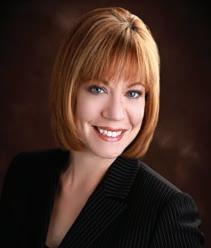
Colleen JenningsRoggensack runs an arts machine. 18
LIL’ GARDENERS
Grants benefit kids who garden at two Ahwatukee schools. 22
PRIDE ROMPS AGAIN
Mountain Pointe High’s football team stages another rout. 46
Ahwatukee Foothills News
The Ahwatukee resident feels strongly that it should not be
Ahwatukee lawyer fights freeway and ‘bureaucracy run amok’
BY PAUL MARYNIAK AHWATUKEE FOOTHILLS NEWS EDITOR
The lawyer for Ahwatukee opponents of the South Mountain Freeway hasn’t made a dime on the case for 10 months.
But Howard Shanker isn’t in it for the money.
For him, the legal fight with state and federal highway agencies is personal, driven by his
outrage over what he calls “bureaucracy run amok” – and his passion for the children and Native Americans he believes the freeway would hurt the most.
And, as he tries to stop the clock from ticking down to the time when bulldozers start carving the freeway’s 22-mile path, he confesses to being cynical about the system he has turned
>> See SHANKER on page 12
BY JIM WALSH AHWATUKEE FOOTHILLS NEWS WRITER
True Life Companies says that more than 1,000 Ahwatukee homeowners—about 38 percent of the number needed —already have agreed to its proposal to build the urban-agriculture development Ahwatukee Farms on the defunct Ahwatukee Lakes Golf Club site.
David N. Sabow, managing director of True Life Companies Arizona operations, declined to comment on the status of his firm’s effort to amend deed restrictions to allow the project to be built, but in an advertisement in today’s Ahwatukee Foothills News, the company cites that figure as it urges homeowners to take “the first step toward making this property an asset for the whole community.”
“Ahwatukee Farms will lift property values for the entire community, revitalize our neighborhoods, and become the newest cornerstone for the Ahwatukee community,” the ad states.
True Life needs a majority of the 5,200 homeowners governed
>> See LAKES on page 10
STORY
(Cheryl Haselhorst/AFN Staff Photographer) Attorney Howard Shanker doesn’t mind that he hasn’t been paid since November for his legal work to stop the South Mountain Freeway.
built.
The Ahwatukee Foothills News is published every Wednesday and distributed free of charge to homes and in single-copy locations throughout Ahwatukee Foothills.
1620 W. Fountainhead Parkway, Suite 219, Tempe, AZ, 85282
CONTACT INFORMATION
Main number: 480-898-7900
Circulation service: 480-898-7900
PUBLISHER:
Steve T. Strickbine
ADVERTISING STAFF
Sales Director: Scott Stowers, 480-898-5624, scott@timespublications.com
National Advertising Director Zac Reynolds 480-898-5603 zac@ahwatukee,com
National Account Coordinator: Patty Dixie 480-898-5940, pdixie@ahwatukee.com
To submit a letter, please include your full name. Our policy is not to run anonymous letters. Please keep the length to 300 words. Letters will be run on a space-available basis. Please send your contributions to pmaryniak@ ahwatukee.com.
Editorial content
The Ahwatukee Foothills News expresses its opinion. Opinions expressed in guest commentaries, perspectives, cartoons or letters to the editor are those of the author.
Advertising content
The content and claims of any advertisement are the sole responsibility of the advertiser. The Ahwatukee Foothills News assumes no responsibility for the claims or content of any advertisement.
Clint“Flash” Santoro likes to be called by his nickname, and there’s little doubt he has earned it.
The Ahwatukee trainer-coach just picked up his first gold medal in an international steeplechase competition.
A 27-year veteran steeplechaser, Santoro, 41, competed against 12 other athletes in the 5,000-meter race at the Masters Games in Vancouver, Canada.
More than 5,000 athletes between the ages of 30 and 100 participated in the competition, but Santoro’s race drew only a dozen—a typical turnout, he said.
“The steeplechase is usually not as highly populated an event due to the difficulty and level of craziness you have to possess in order to continuously hurdle 28 regular barriers and propel yourself into a water pit seven times over nearly two miles,” explained Santoro.
“It’s an achievement to be able to finish this event at age 40-plus,” he added. “Watching the men’s 60-plus is quite the site.”
Even though he collided with a Canadian runner in mid-air, he not only won that event but also finished second with a time of 10:29.20 in all steeplechase races this year for men 40-59 years old in North and South America.
Santoro thrives on these kinds of meets, powered by his twin loves—competing and traveling.
“The Masters Games are a competitive event for men and women from around the world aged 30100 years old that are still deeply involved in their sport, but aren’t necessarily current Olympic caliber
AHWATUKEE FOOTHILLS NEWS STAFF
(Rob Jerome/Special to AFN)
Clint “Flash” Santoro makes one of nearly two dozen jumps during a steeplechase race that he won recently.
LD 18 candidates for Senate, House debate education funding
BY PAUL MARYNIAK
AHWATUKEE FOOTHILLS NEWS EDITOR
School funding for K-12 and higher education, state prisons, jobs and Arizona’s income tax dominated the debate among Legislative District 18 candidates for the Senate and House on Friday.
Sponsored by the Arizona Citizens Clean Elections Commission, the 90-minute debate was marred by the unintentional absence of incumbent Republican state Rep. Jill Norgaard, whom the panel didn’t notify until less than four hours before the event began. The commission took full responsibility for the mix-up. Norgaard was out of town and couldn’t make it, but incumbent Republic Rep. Bob Robson got there even though he also was notified a few hours before it started.
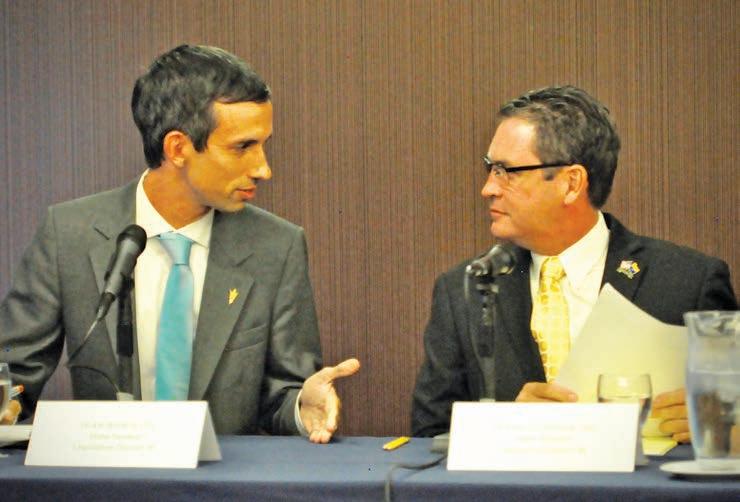
Besides Robson, the debate included Democrat Mitzi Epstein and Green Party candidate Linda Macias, both House candidates, and Democrat Sean Bowie and Republican Frank Schmuck, both state Senate candidates. The district includes Ahwatukee and parts of Mesa,
Tempe and Chandler.
The debate was divided into two segments that were bookended by statements from each candidate. The first segment involved questions that all five candidates answered while the second involved questions addressed to specific candidates.
Among the specific questions, Bowie, an Ahwatukee resident, was asked whether he opposed the South Mountain Freeway.
“I do not support the current route,” he replied, adding, “But if this is something we’re going to have to live with, we have to make it livable. Ideally, the state should go back to the drawing board. I have a lot of concern about the current route.”
Schmuck was asked about whether he supported the ballot proposition that would raise the minimum wage.
“I don’t think our founding fathers intended to have propositions forced on us by people from other states,” he replied, stating that both the minimum wage and the recreational marijuana propositions were pushed here by California-based groups.
But Schmuck’s main point throughout
the debate was his bid to abolish the state income tax and replace it with a consumption tax. His proposal would exempt clothing, food and gas to protect vulnerable populations.
Returning to the issue repeatedly, Schmuck asserted that a consumption tax would generate more revenue than the income tax because tourists would also be paying the levy. He also said it would generate more funding for basic and post-
secondary education.
Here’s a look at some of the main issues addressed in the debate:
Education funding
All five candidates voiced support for more money for both K-12 and higher education.
Robson noted that he voted against two
(Cheryl Haselhorst/AFN Staff Photographer)
LD 18 candidates at the Arizona Citizens Clean Election Commission debate last Friday included, from left, Democratic Senate candidate Sean Bowie, Republican Senate candidate Frank Schmuck, Democratic House candidate Mitzi Epstein, Green Party House candidate Linda Macias, and Republican incumbent Rep. Bob Robson.
FUNDING
state budgets favored by his Republican colleagues in the Legislature because they did not provide enough money for schools or because they cut funding to the state’s three universities.
Epstein cited her four years on the Kyrene School Board and a long-time involvement in education-related causes.
“Restoring education funding is the most important issue in the state,” Epstein declared, calling Proposition 123 only a good first step toward achieving that goal.
Epstein also said she would push for “socialemotional learning for Arizona,” stating it would help children and adults learn to communicate better and reduce violence.
she said, adding that companies would be more willing to locate in Arizona if executives had a higher opinion of the state’s education system.
Bowie noted that he entered the campaign because he wanted to see education funding restored. An analyst for the provost’s office at Arizona State University who tries to find tuition aid for students, Bowie was particularly critical of state cuts that he said were making college tuition at the state universities unaffordable for the middle class.
MORE ON THE DEBATE
“I do not want to raise taxes,” Bowie said, calling for an audit of the state budget and its contracts with forprofit vendors to find more money for education.
The Arizona Citizens Clean Election Commission posts video of legislative debates at azcleanelections. gov/debates.
For another report on the LD 18 debate, see page 34.
One of the questions addressed to Macias was what she would do to create more jobs in the state.
“The basis of creating more jobs is having a wonderful education system,”
Schmuck said that while he believes K-12 schools need more funding, he wants to make sure “more money goes to the front lines, to the teachers and in the classrooms.”
Private prisons in Arizona
Both Macias and Epstein repeatedly
hit the state’s expensive contracts for privately run prisons as a big target in the fight to find more funding.
Macias said the average taxpayer cost of housing an inmate was $25,000 a year and that it costs the state about $800 to monitor someone on probation.
Macias and Epstein said too many people convicted of nonviolent crimes, particularly those involving drugs, are being sent to prison, costing taxpayers close to $1 billion in unnecessary spending.
Fighting hunger, helping the poor
Schmuck was asked for his plans to relieve hunger in Arizona, and most of the candidates ended up chiming in on the topic.
“We have charities for a reason,” Schmuck said. “Whether government should do more, I don’t know.” Later he added, “I really believe government is not the solution.”
Epstein countered, “Charity is no way near enough.”
“Children who are hungry cannot learn,” she said, stating that hunger destabilized families.
Robson said, “If we abandon the private sector and turn to government, we’ll be in a lot of trouble. Government
OTHER LD18 CANDIDATE DEBATES COMING UP
The following forums and debates have been scheduled for candidates in Legislative District 18, which includes Ahwatukee: Kiwanis Club of Tempe Senate Forum Noon, Sept. 29.
Shalimar Country Club, 2032 E. Golf Ave., Tempe.
Friendship Village Democratic Candidate Forum 9:30 a.m. Sept. 30.
Friendship Village Retirement Community, 2645 E. Southern Ave., Tempe.
Valley Interfaith Project Forum 5:30 p.m. Oct. 6.
Dayspring United Methodist Church, 1365 E. Elliot Road, Tempe.
is not the answer to solving all these problems.”
Bowie also said “a lot should be done on the private level” to fight hunger, noting the state Department of Economic Security should be adequately funded “to help people who truly need it.”
NEIGHBORS
athletes,” he said.
He no longer enters extremely long races like the half marathon.
“I like to pretend that I’m still fast,” he said.
His training regimen, however, would make many a younger man blanche.
“I run 30-45 miles per week and train yearround,” he said. “I practice jumping over naturally occurring and man-made objects like walls, fences, parked cars, garbage cans, rocks and of course, normal hurdles and anything about 36 inches in height.”
His work schedule is just as rigorous.
At his Ahwatukee business, Flash Santoro Training Systems, he is a trainer, running coach “and inspiration to new runners.”
“I have a women’s running group in Ahwatukee called the Distance Mamas, as well as a track group called Tuesday Night Hurt. I work full-time at Sole
Sports Running Zone in Tempe on top of that, along with coaching cross country and track at Mesa Community College and volunteering at the local middle schools.”
And, of coruse, there are the competitions, both locally and afar.
He’s got the Phoenix 5K Nov. 6, then gets a break until February when he competes in the USATF Masters Indoor National Championship in Albuquerque, New Mexico.
April takes him to the World Masters Games in New Zealand and in July he’s bound for the Masters Outdoor
Nationals in Baton Rouge, Louisiana.
Desert Vista High grad becomes a doctor
Adrienne Azurdia of Ahwatukee, a 2005 Desert Vista High School graduate, has completed her three-year residency in emergency medicine at Maricopa County Hospital and will be starting
page 3 >> See NEIGHBORS on page 9
mike@azms.net
Adrienne Azurdia
BACK TO HOME
Mofford helped save baseball in East Valley
Former governor died Sept. 15 in Phoenix
BY GARY NELSON AFN CONTRIBUTING WRITER
Rose Mofford, former governor, beehived baseball fan and Cactus League savior, died Sept. 15 in Phoenix at age 94.
She ascended to the governorship in 1988 as the state reeled from the ordeal of Evan Mecham’s impeachment and removal from office. Her tenure lasted less than three years, during which she is widely credited with an amiable, steady governance that soothed much of the angst that had roiled Arizona during Mecham’s tempestuous term.
Back about 1940, Mofford was Rose Perica, a young high school valedictorian and softball star. She made her way from the mining town of Globe, through Mesa and Tempe and into Phoenix, where she had landed a job in state government.
The route most likely would have taken her along old U.S. 60, which is now known as Main Street and Apache Boulevard. She would have passed the neon-lit hotels that wooed road-weary travelers in the early automotive age— among them Buckhorn Baths, a classic motor lodge in what was still the boonies east of Mesa.
She couldn’t know then—nobody did—that in a few years the Buckhorn’s
hot mineral springs would lure aching baseball players and play a seminal role in establishing the East Valley as a mecca for spring-training baseball. Nor could she dream that, many years later, she would emerge as a savior of the Cactus League.
When she took over as Arizona’s first female governor, Mofford faced challenges. Seven state lawmakers were indicted in a nasty bribery scandal. The state still hadn’t resolved its bitter controversy over a holiday to honor Martin Luther King Jr. And, most dear to the heart of the East Valley, the Cactus League was dying.
Arizona’s spring-training industry at that time hosted only eight teams. Florida interests who wanted to expand the Grapefruit League had made a pitch to every one of the Arizona teams, and it was widely believed that if one or two left, they all would.
The situation was so tenuous that Baseball Commissioner Bart Giamatti said in 1988, “If something isn’t done, and something isn’t done fast, they’ll be writing the Cactus League’s obituary within a year.”
That hit particularly hard in Mesa, which had hosted the Chicago Cubs since 1952 and had built the first
(Capitol Media Services)
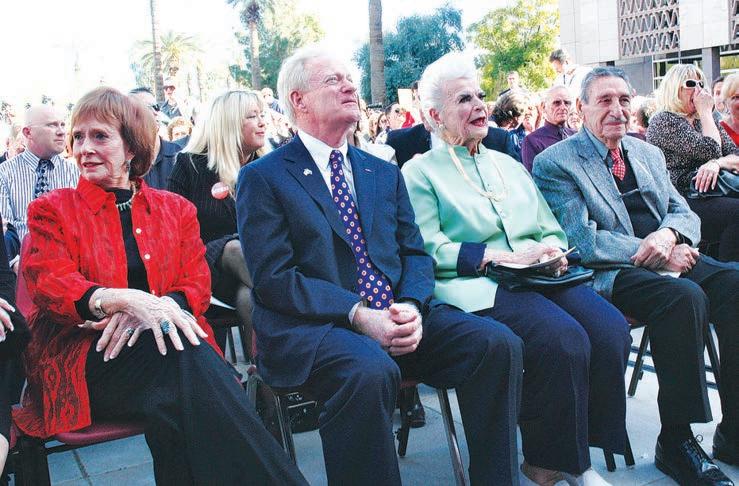
Rose Mofford attends the 2009 inauguration of Jan Brewer with former governors Jane Hull, Fife Symington and Raul Castro.
MOFFORD
Hohokam Stadium in 1977.
Mofford, who in high school had flashed pro-caliber softball talent, made saving the Cactus League one of her priorities. She schmoozed team owners, appointed a commission to develop retention strategies and helped find money to keep the league alive.
Within a year, it became apparent the league would remain a big part of Arizona’s springtime landscape.
The East Valley now hosts three teams—the Cubs and Oakland Athletics in Mesa and the Los Angeles Angels of Anaheim at Diablo Stadium in Tempe. The Milwaukee Brewers played spring games in Chandler until 1997. The league has grown to 15 teams.
Mesa faced a new crisis in 2009 when the Cubs made noise about moving to Florida. Mesa appealed to the state Legislature for funding to keep the team in town, and Mofford appeared at the Capitol in 2010 to back a tax package for a new Cubs stadium.
Mofford joked at a House committee hearing about her long love affair with baseball.
That Arizona could hold on to the Cactus League helped convince Major League Baseball that a big-league franchise here would be viable. The Arizona Diamondbacks, as a result, have been a Valley fixture for 19 seasons.
In 2014, Mofford’s role in saving Arizona baseball won her a spot among the first inductees into the Cactus League Hall of Fame, a project of the Mesa Historical Society. Her induction was announced at the new Cubs park in northwest Mesa.
The setting for that announcement was fitting, because Mofford’s role as a Cactus League champion had not ended when the 1988 crisis passed.
NEIGHBORS
from page 7
with Scottsdale Emergency Associates as an emergency room physician in three different hospitals this month, according to her father, Maurice Azurdia, also of Ahwatukee.
Adrienne graduated from Arizona State University summa cum laude with a 4.0 grade point average and a degree in biology, then attended Pritzker School of Medicine at the University of Chicago,
“Babe Ruth taught me how to hit a curve ball. Ty Cobb showed me how to slide into second base. And,” she said, “I used to go steady with Abner Doubleday.”
Mofford’s pleas notwithstanding, the Cubs funding package died that spring in the Legislature. Mesa found other money and Cubs Park, now called Sloan Park, opened to record crowds in 2014.
Mofford also played a role in the Martin Luther King holiday controversy, which bled into the world of sports when the NFL made approval of the observance a condition before Arizona could be awarded a Super Bowl.
Mofford signed a bill approving the holiday in early 1990, but squabbling over the issue continued another two years.
Only after voters approved the holiday in 1992 did the NFL agree to stage the 1996 Super Bowl at Sun Devil Stadium in Tempe.
Mofford’s body will be cremated. A memorial mass will be celebrated at a later date at St. Francis Xavier Parish in Phoenix.
where she graduated with her medical degree in 2013.
“She was admitted to nine medical schools, among the top in the country. She was offered full-ride scholarships at Washington University in St. Louis and Pritzker,” he said.
“As you can imagine, we are profoundly proud of her,” he added. “And Desert Vista provided her the foundation for all these wonderful accomplishments.”
(Cronkite News)
Rose Mofford once joked, “I used to go steady with Abner Doubleday.”
Camelot Ridge
LISTED
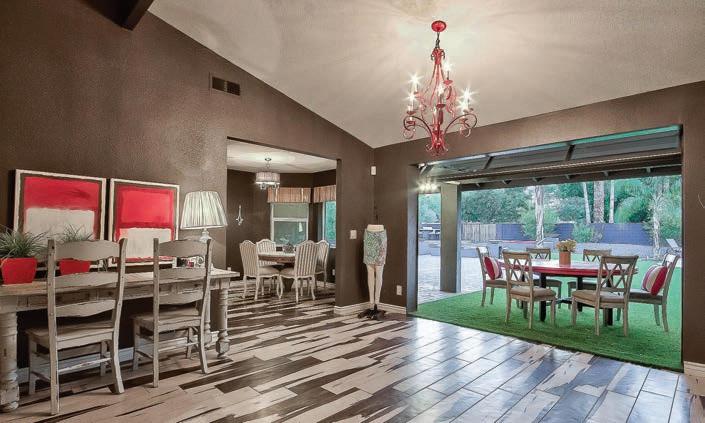
3 bathroom, 2,850 sf home with one bedroom downstairs. New roof! Mountain views! Kitchen upgraded with pecan colored cabinetry and copper-finish hardware, granite slab counters, stainless steel appliances, island, pantry and eat-in kitchen nook. Fireplace in family room. Master suite has his & hers vanities with granite counter tops, refinished cabinets, separate shower/Roman tub and his/hers closets. Enormous backyard has sparkling pool and artificial turf. New exterior paint. Sun screens. New garage door opener. New skylight.
Foothills Club West
LAKES
by Ahwatukee Board of Management to agree to its proposed change in the HOA’s Considerations, Covenants and Restrictions (CC&Rs), which restrict the property’s use to golf course only.
The development would include no more than 300 single-family homes, two lakes, a private Montessori school, a café and a community farm on the 101-acre golf course site.
“We are honored and humbled to see so many community supporters support the vision of Ahwatukee Farms,” True Life ad states.
The consent form has generated a fierce battle between True Life and Save the Lakes, homeowners who want the site turned back into a golf course.
Save the Lakes has been conducting meetings in the community and staged letter-writing campaigns. True Life has sent mailers of its own to residents and gone door to door in an effort to win approval.
Harbor Island - Lakewood
LISTED FOR $439,900
Meticulously cared-for single level 2,550 sf home that backs to a plush greenbelt! 4 bedrooms, 2.5 bathrooms, split master floor plan. Open kitchen-family room concept. Kitchen boasts granite slab counters, Blanco extra deep sink, custom painted cabinetry with trendy hardware and island/breakfast bar. Gorgeous travertine flooring. Backyard has sparkling pebble tec pool, grass area, built in gas BBQ, citrus trees and covered patio. Extensive landscape lighting in front and back. Three car garage with built-in garage cabinets. Gas fireplace, central vac, soft water system, drinking water filtration, security system. Newer AC units.
Ahwatukee Retirement
LISTED FOR $195,000
Upgraded home on spectacular golf course lot! Incredible view of the golf course! 2 bedroom, 2 bathroom, 1,526 sf home. Kitchen boasts granite-look counter tops and trendy white kitchen cabinetry with upgraded hardware. Newer carpet and wood burning fireplace. No popcorn ceilings! Master bedroom has large closets and master bathroom has step-in shower. Situated in a quiet cul-de-sac.
Finesterra at Valencia
LISTED FOR $615,000
5 bedroom, 3.5 bathroom 4,663 sf highly upgraded basement home. Finished basement is currently set up as a media room. Gated community. 1/3 acre lot! Elaborate, custom swim-up Gazebo! Pebble tec pool with grand water feature and slide. Built in BBQ, outdoor bar, and extensive hardscape with Cantera stone pavers.
Ironically, the CC&Rs that must be changed in order to build Ahwatukee Farms also are being touted by True Life in its appeal of a $1.3-million tax penalty imposed by the Maricopa County Assessor.
The site was reclassified as vacant land, which is taxed at a higher rate than a golf course, in 2013 after previous owner Wilson Gee closed the golf course.
An amended complaint filed in June by True Life argues in part that the course should be assessed at the lower rate charged to golf courses because at this point the deed restrictions have not changed and still limit the land’s use to a golf course, reducing the property’s value.
“A covenant restricting the use of the Lakes Golf Course to golf course use, was in effect at all material times herein, and it remains in effect, restricting the use of the Lakes Golf Course to golf course use,’’ True Life’s amended complaint in the tax case states.
While the original complaint, filed in December after the tax penalty was imposed, made a similar argument, it did not allude to the deed restrictions.
While using those restrictions as a tool against the tax penalty, True Life in an unrelated court case is fighting a lawsuit by two neighbors who want those restrictions enforced.
A judge two months ago affirmed that the restrictions require golf course use of the property, and has set a trial next June on residents’ request that True Life be forced to revive the course.
When it unveiled Ahwatukee Farms last month, True Life said the site would never again be a golf course, citing a decline in the sport’s popularity and profitability.
Course called residential True Life’s amended complaint and appeal of property valuation cites a Feb. 13, 1998, declaration of restrictions for use as a golf course, which is attached as an exhibit.
“The premises shall be used solely as a golf course,’’ it reads.
The tax appeal said that the Maricopa County Assessor’s Office did a “field canvass’’ of the course and concluded it was no longer playable and had become “vacant residential,’’ which is taxed at a higher rate.
But the Assessor’s Office did not impose the penalty to the tax bill, dating to 2005, until July 29, 2015. True Life Companies bought the property in June 2015 for $8.25 million.
Sabow said there is no connection between the tax case, the civil case and the company’s ongoing campaign to convince Ahwatukee residents to authorize a change in deed restrictions in order to build Ahwatukee Farms.
“We have three different situations we are dealing with in relation to the property,’’ Sabow said.
Sabow noted that True Life’s amended tax complaint was filed prior to Maricopa County Superior Court Judge John Hannah’s interim ruling in July.
Hannah has set a trial for next June on the golf course.
(Will Powers/AFN Staff Photographer)
True Life Companies Executive David Sabow said his company’s fight over a tax levy has nothing to do with the effort to change the use of the old golf course at Ahwatukee Lakes Golf Club.
to for help.
“We have a system that’s really not geared toward providing justice for people without money – or even a forum for them,” he said.
He has history with that system that would seem to justify his cynicism. At one point, he was on the hook for more than $300,000, a fine levied by a threejudge panel in the U.S. Ninth Circuit Court of Appeals.
And that’s the same appellate court that will decide the freeway fight.
Nevertheless, Shanker is ready to continue this fight, saying, “There are huge issues here.”
For one thing, he said, he believes the South Mountain Freeway “involves the desecration of sacred sites that impacts thousands of people’s deeply held religious beliefs.”
Moreover, Shanker says, the freeway jeopardizes the health of thousands of children attending the 17 schools near its path.
“I would have taken it anyway,” Shanker said of the case, in which he represents Protect Arizona’s Resources and Children.
Cat-and-mouse fight
That’s because he not only has a long history of fighting government agencies and companies for environmental and Native American causes, but he and his law partner-and-wife, Tamera, have lived in Club West for the past eight or so years.
The cat-and-mouse freeway fight gained momentum last month when U.S. District Judge Diane Humetewa rejected all arguments that PARC and the Gila River Indian Community filed. Opponents claimed the Federal Highway Administration and Arizona Department of Transportation failed to safeguard the mountain, which the Gila Tribe considers sacred, and performed an inadequate environmental assessment of the bypass’s impact on air and water quality along its path.
temporarily stop freeway construction pending the appeal’s outcome.
Although they sought an expedited decision so they could seek an injunction from the appellate court if she refuses the request, Humetewa has taken no action.
Meanwhile, ADOT has begun preconstruction work, as it races to complete a final design by the end of the year so that construction can began.
If that happens and an injunction is not granted, opponents’ lawyers argue, “the very damage that the appeal seeks to prevent will be done.”
‘A bridge to nowhere’
Although Shanker and Gila attorney David Rosenbaum have maintained that the highway agencies have already waited 30 years to start the freeway and that an appeal delay isn’t fatal, Shanker said he is not surprised that ADOT is pushing ahead fast as it eyes a late 2019 or early 2020 opening.
“I see that all the time in all these large, government-type projects,” Shanker said. “It’s bureaucracy run amok.”
“In 1983, ADOT or the Maricopa Association of Governments picked this freeway that was to adequately solve the region’s transportation problems. It is beyond comprehension that a right-of-way selected in 1983, to serve transportation the needs of 1983, is going to be the right choice 30 years later,” he added.
did that environmental impact study, the design of the freeway was only 15 percent complete,” Shanker countered, noting that federal law requires that all possible planning be complete to assess environmental impact.
PARC seeks donations
Protect Arizona’s Children and Resources says it needs money to help defray some of attorney Howard Shanker’s costs in fighting the South Mountain Freeway.
“It’s a remarkable bridge to nowhere,” Shanker said. “Our traffic studies show this won’t alleviate traffic in rush hour. The Native Americans’ environmental impact study shows that, at buildout, if you were commuting from Ahwatukee to Downtown Phoenix, it would save you one minute.”
The non-profit PARC said taxdeductible donations can be sent to P.O. Box 50455, Phoenix AZ 85076-0455 or at PARCtheSMF. org.
ADOT says the freeway will provide a speedy diversion around Downtown Phoenix for I-10 traffic, and some state and city officials say it also will open up new economic opportunities.
Shanker admits he has a reputation for tilting at windmills—a claim that nowDemocratic U.S. Senate candidate Anne Kirkpatrick leveled against him when he ran against her in the 2008 primary election in Arizona’s First Congressional District.
“She told people that’s not what they want in Congress,” he recalled. “I said that’s exactly the kind of person you want. You want someone who’s willing to fight for what they think is right even if it’s a difficult issue.”
Long-time enviornment fighter
A native of the New York City borough of the Bronx who grew up in northern New Jersey, Shanker developed a passion for environmental cases soon after he graduated from Georgetown University in Washington D.C.
represent the federal government in environmental fights. After a while, he went to work for the law firm founded by Thomas Dewey, the man that Harry S. Truman defeated in his run for President.
“Most lawyers who do environmental work start out with a real passion for the environment, and then eventually they figure out that the only way to get paid is to work for polluters,” he said with a chuckle. “Some industries want to do the right thing, don’t get me wrong. But I never had a passion to work for them.”
Be believes environmental cases are very important, he said. “It’s an area of the law that seems to be trodden upon by the government,” Shanker added. And it’s an area of law where he was almost trodden on, as well, by the appellate court that now holds the freeway’s future in its hands.
In appealing her ruling to the Ninth Circuit, Shanker and the Gila Tribe’s lawyer also asked Humetewa to
In court, state and federal attorneys also argued that the agencies had taken great steps to assess the freeway’s impact on nearby water wells and air quality, and that extensive studies showed the path could not be relocated.
“One of our issues is that when they
He was already married to Tamera, who has been described as a “pit bull” in legal circles for her work on behalf of children’s interests in the foster care system, representing hundreds of abused and neglected children.”
Shanker worked for the U.S. Justice Department and was assigned to
Shanker had been representing, pro bono, 12 Native American tribes in northern Arizona, as well as several environmental groups, in a protracted fight against the U.S. Forest Service’s decision to let Snowbowl Resort use reclaimed water to make snow.
The Native Americans contended that the San Francisco Peaks are sacred and that sewage water would desecrate the mountain. The environmental groups,
(Cheryl Haselhorst/AFN Staff Photographer)
Ahwatukee attorneys Howard and Tamara Shanker have both been on the legal front lines of public service litigation, he against the South Mountain Freeway and she in issues involving child abuse.
SHANKER
Autumn Retreat Special
“I don’t know how, I don’t know why” the panel ruled that way, he said. “It was a perfectly good suit.”
for their part, said the government had not determined the health effects on nearby potable water systems.
The Snowbowl punishment
Though a three-judge panel of the Ninth Circuit ruled in 2007 favor of Shanker, the government and resort company sought a re-hearing from the entire 11-member court. Such a rehearing “is rarely granted, but the court granted it” in this case, he said.
He then filed a complaint “of judicial misconduct against these guys, which went nowhere,” he said.
But consumer advocate Ralph Nader, Arizona State University law professors, the tribes, and several major environmental groups were outraged by the ruling. They asked the entire 11-member circuit to hear the appeal of the punishment.
Then, before the entire court could decide that request, the three-judge panel dropped the levy.
The court ultimately reversed the panel’s decision. But, in the process, issued a ruling that Shanker saw as an opening to start a new fight in federal district court in Flagstaff.
Though he lost that fight in the lower court and before a three-judge panel, the three appellate judges went one step further.
Before it was dropped, however, the Arizona State Bar investigated Shanker. As a result, he spent thousands of dollars on a lawyer to represent him in the proceedings.
It all left an indelible impact on Shanker.
They determined in 2012 that, by waging the second legal fight, Shanker “has acted in bad faith, vexatiously, wantonly, or for oppressive reasons, delaying or disrupting litigation, or has taken actions in the litigation for an improper purpose.”
“I’m pretty cynical about the credibility of the American judicial process,” he said, stressing that he does not mean he is making any inferences about how the freeway case will be handled.
They ordered him to pay $300,000.
Shanker was stunned.
As an adjunct law professor at ASU, however, he said the experience has led him to ask those in his class one question: “Are you sure you guys want to be lawyers?”
As ADOT prepares for freeway meeting, its nursery plan upsets homeowners
BY PAUL MARYNIAK AHWATUKEE FOOTHILLS NEWS EDITOR
several staging areas where people can talk directly with project representatives, an ADOT spokesman said.
As Arizona Department of Transportation officials prepare to unveil next Tuesday more design details for the South Mountain Freeway, work crews this week continued to lay the groundwork for its construction — partly to nearby residents’ consternation.
The first of three community meetings scheduled by ADOT will be 6-8 p.m. Tuesday at Desert Vista High School’s multipurpose room, 16440 S. 32nd St., Ahwatukee. Two others at 6-8 p.m. will be held Sept. 28 at Betty Fairfax High School, 8225 S. 59th Ave, Laveen; and Oct. 6 at Fowler Elementary School, 6707 W. Van Buren St., Phoenix.
The meetings will feature a questionand-answer session but it will not include “open microphone” questions, only ones written on cards by audience members.
It will include a one-hour presentation at 6:30 p.m. by the developer and feature
During an appearance at the Ahwatukee Foothills Village Planning Committee last month, an ADOT spokesman deflected a number of questions about the freeway’s design, promising the audience that officials would have more details at next Tuesday’s meeting.
Residents’ chief concern is whether the freeway will be elevated. They demanded that ADOT depress the freeway so that cross streets would be built at grade.
The 22-mile freeway would provide a bypass around Downtown Phoenix for I-10 traffic by linking Ahwatukee and West Phoenix. It has been planned for more than 30 years, although opponents are still seeking federal court action to stop its construction.
At the same time, the city managing
(Cheryl Haselhorst/AFN Staff Photographer) )
The first phase of construction for the South Mountain Freeway began Monday evening as crews installed temporary concrete barriers on Pecos Road just west of the I-10/Loop 202 interchange.
NURSERY
from page 14
director’s office has protested to ADOT the agency’s plans to elevate three cross streets in Ahwatukee over the freeway and four others in South Phoenix. Both ADOT and the city have declined to discuss the status of their negotiations on that protest.
Meanwhile, as ADOT continued making more traffic adjustments, some Ahwatukee residents were jolted Friday by a notice they received about the state’s plans for a nursery for plants transplanted out of the freeway path.
ADOT said it would be building the plant salvage nursery on the southeast corner of the Foothills Reserve Master community along the south side of Cedar Lane between Chandler Boulevard and South 27th Street.
Grading on the nursery site is scheduled for Thursday and completion of that task was expected the next day. “The grading will be performed with all applicable noise and dust ordinances,” ADOT said.
The notice also said freeway developer Connect 202 Partners would be installing a new water service, which an ADOT spokesman said would be Phoenix potable water for which the developer will pay.
A chain-link fence with a fabric screen will be installed next week around the nursery, ADOT said, adding that landscape crews will start hauling plants
between 8 a.m. and 5 p.m. weekdays and on some weekends for use in the future along the Pecos Road segment of the freeway.
The prospects of the nursery and related truck traffic had some residents complaining on Facebook over the weekend on the page maintained by Protect Arizona’s Resources and Children, the Ahwatukee opponents of the freeway.
“Now I will have trucks driving in front of my house every day, and there will be a nursery across the street from me,” complained Joe Rao.
Contacted by phone, Rao, who’s lived in his home for nearly 12 years, said he had no inkling that a nursery would be put up across from his house. “The first I heard about it was when they put a notice on my door,” he said.
Shannon Schupbach wrote, “My house got torn down for the location of a plant nursery,” while Patricia Gearhart said, “I believe that the ‘ADiOTS’ have tons of surprises in store for the Foothills residents.”
ADOT spokesman Dustin Kunkel said the temporary nursery is near, but not in, the freeway path. But he added that it will be on land ADOT already owns.
Meanwhile, crews on Monday night installed concrete barriers blocking one lane of the eastbound Loop 202 Santan Freeway at Pecos Road to begin lane work in anticipation of more construction work on the actual interchange between the South Mountain Freeway and I-10.
Arizona ranks high in students’ knowledge of political process, study finds
BY CLAIRE CAULFIELD CRONKITE NEWS
Arizona got high marks last week in a national study of how well states educate students on voting, parties and the political process, early training that analysts say leads to greater voter participation later on.
The report by the Center for Information and Research on Civic Learning and Engagement, or CIRCLE, said Arizona is one of only eight states with standards requiring public schools to teach about political parties, political ideologies, issues and platforms.
The report also said Arizona was one of the few states whose teachers delve into ideologies behind the major political parties.
“This is particularly important because with news media being so confusing and complex, young people need to understand the platform underneath,” said CIRCLE Director Kei KawashimaGinsberg. “Otherwise politics becomes all about personalities saying their
personal opinions or voters blindly following partisan lines.”
Kawashima-Ginsberg and one of the report’s co-authors said that while true civics education requires blunt conversation on sometimes-touchy subjects, it is possible for teachers to encourage political debate that is not partisan.
“The role of public education has always been to prepare American citizens to participate in the democracy they’re inheriting,” said co-author Paula McAvoy. “So we need to monitor whether states are preparing their students for this task.”
The report did not take into account the new Arizona law that will require high school seniors, beginning with this school year, to pass a civics test based on the U.S. Immigration and Naturalization exam in order to graduate.
When asked about the citizenship test requirement, McAvoy said she hopes it does not get in the way of deep and meaningful classroom discussions about political parties and ideologies.
Agencies take steps to wipe out stigmas of addiction and mental illness
BY SRIANTHI PERERA AHWATUKEE FOOTHILLS NEWS WRITER
The Chandler Center for the Arts, usually the venue for arts and entertainment, will likely sport a somber mood on Saturday.
Addiction treatment facility Valley Hope of Chandler is organizing a march starting at 7 a.m. from its premises on Arizona Avenue north of Chandler Boulevard to the arts center about 1.5 miles away. “Voices of Hope” participants will walk to help end the stigma of addiction, celebrate those in recovery and make an impact in the community.
From 9 a.m. to 1 p.m. on the same day and at the same venue, the Chandler Police Department is presenting a community event titled “A Focus on Understanding & Hope” to also emphasize creating awareness, removing stigma and finding resources for mental, health, physical or mental disabilities and addiction.
“We are in the middle of an epidemic,” said Mariah Hile, a spokeswoman from Valley Hope. “The march is a rallying point for the community to come together to know that recovery is possible.”
Hile has seen hundreds of people come through the doors at Valley Hope with a cry for help. In the same manner, Chandler Police Officers Loranda Tibble and Melissa Lotz have seen the effects of mental health illness on families.
As of July 8, Chandler PD answered 179 calls for mentally disturbed persons, about 242 calls for suicide attempts and received 179 orders from doctors to transport mental health patients to a facility. During the same time frame, the department serviced 1,741 welfare check calls, although it is unknown how many of these were related to mental health issues.
Last year, Tibble and Lotz brought together agencies and resources at a similar event, also at the arts center, and about 125 attended.
“I wanted to learn more about how to help more family members and friends,” Tibble said. “Numerous times a day, we would go to calls where people were having a crisis because of a mental illness. I wanted to be able to give resources and help families because
every time we’d go to these calls, they would say they felt helpless.”
The two officers subsequently underwent the 40-hour Crisis Intervention Training provided by the Police Department, which was helpful and inspiring, they said.
This year’s event reaches even farther with more than 50 agencies offering education and information, 11 presentations on topics ranging from PTSD to what a substance abuse problem looks like and free crisis intervention training for police officers and security guards.
“We’re trying to bring the community together with the Police Department and educate everybody, not just somebody who may have one or another issue,” Lotz said. ‘We want to erase the stigma, we want to educate people, we want to enable people, we want to provide resources and have everybody network.”
Lotz noted that the one common goal of service organizations is to help people.
Asked to describe what the two officers encounter on an almost daily basis during the course of their work, Lotz said “struggle” best fit.
“People are struggling, families and friends struggle and co-workers struggle because they don’t know how to help people. That’s one of the reasons we’re trying to do this,” she said.
Registration for the “Voices of Hope” march takes place online at tinyurl. com/jy9chur. Details: valleyhope.org. The Chandler Police Department program is free. Information: 480782-4800.
(Special to AFN)
Chandler Police Officers Loranda Tibble, left, and Melissa Lotz have paired to organize a community event to help those with addictions and mental health issues.
State of the arts
East Valley venues emulate Gammage in competitive entertainment market
BY LEE SHAPPELL AFN MANAGING EDITOR
As the curtain rises on another East Valley performing-arts season, ASU Gammage is reprising its role as the 800-Pound Gorilla.
The cast of supporting players also is essentially unchanged for 2016-17, which in itself is worth a hearty “Bravo” in a performing-arts community that is crowded and competitive, where not all companies survive.
“Since we opened (27 years ago), we’ve added 11,000 seats in our region, so it’s an incredible market, among the top five most-competitive in the country,” said Michelle Mac Lennan, general manager of the Chandler Center for the Arts.
“I wouldn’t say it’s difficult—we had our most successful season last year in attendance and gross sales—but what is difficult is securing artists, especially when you’re next door to so many other presenting organizations. It’s challenging when you’re curating a season.”
Not all in the industry in the Valley have fared as well.
The Arizona Theatre Company came within days of losing its season before lastditch fundraising saved it in July. Ballet Arizona announced that it would part ways with the Phoenix Symphony for its “Nutcracker” this year, a costsaving move that will bring in canned music. Broadway Palm Dinner Theatre in Mesa closed last year.
executive director of iconic Frank Lloyd Wright-designed Gammage, has built a machine that lands big-name traveling Broadway acts that are well received.
Gammage had an estimated $100 million economic impact on the Valley last season and $1 billion in her 24 years, according to industry analyst the Broadway League.
Directors of other performing-arts venues in the region have taken notice of Jennings-Roggensack’s outreach efforts that have yielded 400,000 patrons and nearly 15,000 subscriptions.
“We spend a lot of time in the communities in addition to the work that happens on the stage,” said JenningsRoggensack, who lives in Ahwatukee. “It’s no secret that our Broadway season is one of the top seasons in the country, and we have amazing patrons and fans.”
The Broadway League, whose membership includes 700 theater owners and operators, producers, presenters and general managers across the country, calculated the economic impact of Gammage, which staged “Cabaret” in its season debut last week.
own, the Mesa Arts Center not only has performing arts but also visual arts, a museum and classes that combine to bring nearly a half-million people to downtown Mesa each year.
As the largest multi-disciplinary organization in the Southwest, according to Executive Director Cindy Ornstein, MAC is different from other municipal venues in the East Valley.
(Tim
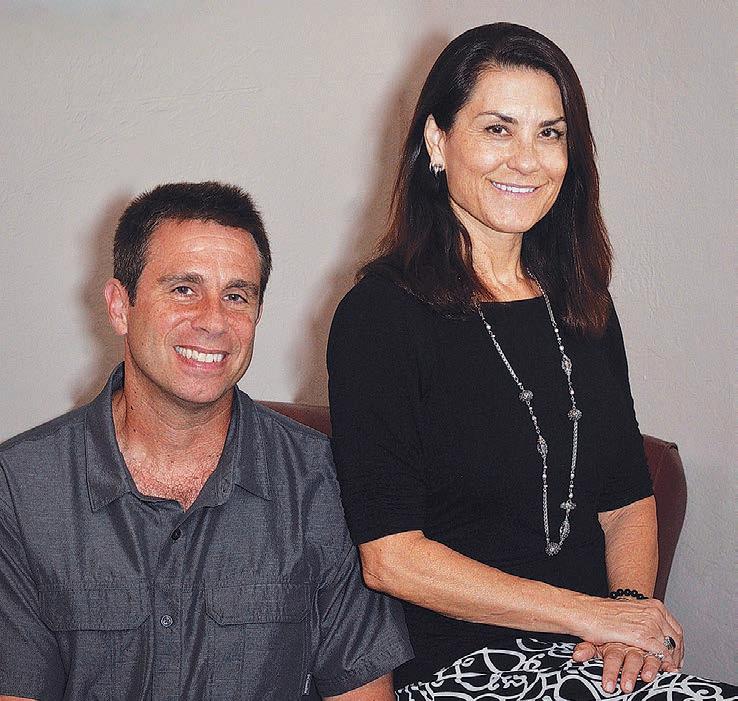
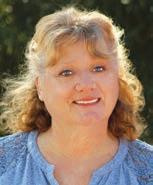
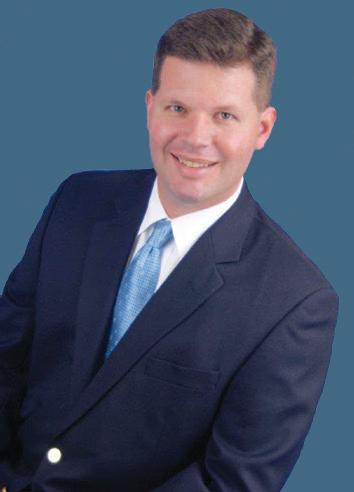
Colleen Jennings-Roggensack, of Ahwatukee, is executive director of Gammage, and has spearheaded outreach efforts that have yielded 400,000 patrons.
But successful East Valley theaters from Mesa to Chandler to Gilbert, all presenting venues with different funding models, have one common thread that they borrowed from Gammage: Public outreach.
Colleen Jennings-Roggensack,
“They look at not only ticket sales but impact of a show in the community, and that is everything from: I got my dress out of the cleaners, I put gas in the car, I paid for my parking downtown and my stop to eat in one of the many fabulous restaurants, I bought a souvenir program, I had cookies during intermission, I paid my babysitter for the evening, I went ahead and got my nails done, I’m having a toast to Broadway inside Gammage,” Jennings-Roggensack said. “We have a saying that the longest road in America is Broadway, and it stretches from 42nd Street to Mill Avenue.”
While Gammage is in a league of its
“Whereas a place that is purely a performing-arts center has to focus on only the revenue from performing arts, we have revenue from space rentals and classes, as well as miscellaneous revenue from vendors and festivals,” said Ornstein, in her sixth year in Mesa. “So we actually feel pretty good about where we are financially.
“That allows us to do educational and engagement programs in the schools and the community. We do a lot of things that create community ownership.”
It is far costlier and more challenging to be a producing organization than a presenter like MAC, Ornstein said.
“So when I look at local theater companies, like Arizona Theatre Company, Arizona Opera or Ballet Arizona, they have a substantial portion of their expenses going into the production costs of putting on a show, which can be quite high,” she said.
“When you hire touring artists, like we do, they’ve taken on that cost themselves and put it into their fee structure, amortized over many, many performances as they travel around the country.”
Billy Russo, managing director of Arizona Theatre Company, knows all about costs that producing companies incur. The curtain will rise on ATC’s
50th anniversary season only because a $2 million fundraising effort in July was successful.
“That $2 million is not everything we need for this season, it’s not like we’re free and clear,” Russo said. “We still have to raise another $1.5 million, but that’s what we raise normally in a year.
“There was a model for a really long time where the big base of regional theater support came from the corporate world. It used to be that it was 50 percent contributed income, 50 percent earned income. That balance has switched. This company is trying to find that right balance.”
In Chandler, the Center for the Arts, on the campus of Chandler High School, is operated by the city in partnership with Chandler Unified School District. The district funds upkeep and operation of the building, and the city funds staffing. Mondays through Thursdays, it is used by the school for classes in the performing arts. A nonprofit foundation supports the programming and fundraising.
“It’s an unusual governance structure,” Mac Lennan said. “It’s the only one that we’ve found in the U.S. with that model.”
The model at Higley Center for the Performing Arts, on the campus of Higley High School in Gilbert, is more austere. The district maintains the building but does not contribute to operating budget. Despite that, manager Robert Zucker, the theater’s only full-time employee, has put together lineups that operate in the black.
“We don’t have a foundation, although we’re in the process of creating one because it makes sense, but we do have
(Tim Trumble/Special to AFN)
The iconic ASU Gammage had an estimated $100 million economic impact on the Valley last season.
Trumble/Special to AFN)
East Valley man attends canonization of Mother Teresa, ‘completes the circle’
BY RALPH ZUBIATE AFN MANAGING EDITOR
JoeReynolds remembers meeting Mother Teresa when she visited the Valley in 1989. He said she radiated “a presence of peace.”
“She to me was the type of person who didn’t have to say anything,” Reynolds said.
The tiny nun struck everybody she met the same way, and along the way was a beacon of hope to Catholics everywhere.
Now, Mother Teresa has been canonized as St. Teresa of Calcutta— but even Pope Francis agrees that she’ll always be known by another name.
“With great spontaneity, I think we will continue to call her Mother Teresa,” he said, according to CNN.
Mother Teresa was born Agnes Gonxha Bojaxhiu in Albania in 1910. She set up her Missionaries of Charity in the slums of Calcutta—now known as Kolkata— in 1950 and made her headquarters there for nearly half a century.
She died in Kolkata in 1997 at age 87. Reynolds, of Mesa, went to Rome for Mother Teresa’s Canonization Mass on Sept. 4, taking along his 15-year-old son Matthew. Reynolds felt that being there “completed the circle” for him.
In 1989, Mother Teresa visited Phoenix, and Reynolds spent four days with her as he filmed a documentary for the Diocese of Phoenix. Reynolds is now owner of Skyline Productions in Phoenix.
IF YOU GO
What: Exhibit on the Life of Mother Teresa.
When: 8:30 a.m. - 7 p.m. until Sunday.
Where: Our Lady of Fatima, 1418 S. 17th Ave., Phoenix.
Information: 602-354-2472, phxconsecratedlife.com or email sr.anthonymary@ diocesephoenix.org.
“What I took away from those four days was that the simple things matter,” Reynolds said.
While she was in Phoenix, she shared
a small home with sisters from her order, the Missionaries of Charity. Reynolds was there, too, documenting the scene.
“It was a small house with 20 people inside. People crowding outside looking into the windows,” he said. “Even with all that, there was a sense of peace.
He said Mother Teresa was never about grandiose things, just small gestures.
One day, she made a small gesture that Reynolds will never forget.
“She handed three medals from her hand to my hand,” he said. “It was simple generosity.”
They had her picture on the front and her admonition, “Pray for us,” on the back.
He eventually gave two away himself, repeating the simple gesture.
With his company, Reynolds has been
producing a film series called “Footprints of God,” tracing the history of faith from Abraham to Augustine. He’s produced eight films so far for Ignatius Press of San Francisco, and two more will be coming in 2017 and 2018.
For the Canonization Mass, Reynolds went to Rome with a group of 44 pilgrims. They and about 200,000 others were there for the ceremony. Even though this wasn’t his first trip there, he found himself taken with the moment.
He and the group got to visit the house in Rome that Pope John Paul II gave to Mother Teresa for the use of her order.
“I was struck how the sisters emulated the life she lived,” he said.
On the second to last day in Italy, he visited the Archbasilica of St. John Lateran. He joined a long line of people
streaming in to the church.
“They had a relic of her, a small vial of blood, and people would touch things to the relic. They had prayer cards, medals, things she was known for,” he said.
The Missionaries of Charities sisters gave him six more medals that were touched to the vial. So, after giving away medals from her, he “completed the circle” and had more medals blessed by Mother Teresa.
“The takeaway from all this was that the simplest things can make all the difference in the world. Simple acts of kindness can go a long way.”
(Joe Reynolds/Special to AFN)
Joe Reynolds and 44 pilgrims, including his son Matthew, went to Rome to take part in the Canonization Mass of Mother Teresa in Rome.
(Joe Reynolds/Special to AFN) Sisters of the Missionaries of Charity, the order led by Mother Teresa, walk in the streets of Rome down to the Canonization Mass for Mother Teresa.
a couple of generous local sponsors,” Zucker said. “We make our money on rentals. The community and national groups use our facility for meetings, dance competitions, graduations for other schools that don’t have a facility.”
Zucker must be judicious in his booking selections.
“In Higley, country music sells, legacy rock and roll sells,” he said. “Original groups or tribute shows are sold to adult communities and snowbirds.”
Woody Wilson, president and executive producer of Lakeshore Music, is a licensed partner at Tempe Center for the Arts, which is attempting to reinvent itself but is limited by smallish rooms. The largest is 600 seats. Wilson presents jazz shows in the building, competing with the Musical Instrument Museum.
“We have all these centers, and there’s one in every town now,” Wilson said. “Tempe Center for the Arts was built for homegrown arts programs, but the theater companies that were here are gone.
“It takes time to build a program. But we’re able to pay people and able bring the best jazz artists in the world here, and people are starting to figure it out.”
Contrast that with nearby ASU Gammage, where Jennings-Roggensack has international connections. She has shows calling her to get on the schedule.
“One of the things ASU Gammage prides itself on is its relationship with producers and creators in New York,” she said. “Then we have a community that wants to be engaged culturally.”
To enhance the patron experience, a new sound system was installed at Gammage in the spring. An “Elevate and Alleviate” remodeling is under way
that will add 110 women’s restrooms and two elevators to take patrons who are accessibility challenged to all five levels. Those are to be finished in March. A closed-captioning system is being tested. Next spring, new carpeting is planned. And anybody who wants a ticket to record-setting “Hamilton” in 2017-18 at Gammage better have at least a partial season package this year. Those holders get first shot and likely will sell out the run, Jennings-Roggensack said. Gammage can flex that muscle. Others in the industry across the East Valley
believe that it only helps them.
“There are studies that show that interest in the arts is quite high,” Mesa’s Ornstein said. “But we in Arizona don’t have nearly as many big corporate headquarters and big national foundations as a lot of other cities our size. It is important that we all continue to increase the awareness in our business community and potential patrons in the quality and diversity of our arts offerings.”
– Reach Lee Shappell at 480-898-5614 or at lshappell@ timespublications.com.
(Will Powers/AFN Staff Photographer)
Ann and Kate Finnegan enjoy a glass of wine before the “Cabaret” performance at Gammage.
(Will Powers/AFN Staff Photographer)
Lynette Matthews and Andrea Lauri have a glass of wine before the performace of “Cabaret” at Gammage in Tempe.
Community
Young Ahwatukee green thumbs, community garden benefit from 2 grants
AHWATUKEE FOOTHILLS NEWS STAFF
The little green thumbs at Children of Hope Preschool/ Child Development Center and Kyrene de los Cerritos Elementary in Ahwatukee reaped grants for their gardens last week.
Both schools received a $500 grant from Jamba Juice and KidsGardening. org to help them with their projects.
Additionally, the Garden of Eatin,’on which the Children of Hope does the growing, has received an unrelated $1,500 grant from the National Association of Realtors through the Southeast Valley Regional Association of Realtors.
The nonprofit community garden is a project of Esperanza Lutheran Church on Thunderhill Place, Ahwatukee. The church also runs the pre-school.
Children of Hope Director Lynn Hockenberger said the grant is a welcome help for her and her students.
“As a small non-profit school, we do not have a large budget,” she said. “One of our volunteer parents, Dale Howell, who helps the children each month with the gardening activities, found this grant opportunity for us and we had to give it a shot.”
KidsGardening.org has been a resource for school and youth gardening since 1982 and provides garden grants, research and curriculum.
“We create opportunities for kids to learn through the garden, engaging their natural curiosity and wonder by providing inspiration, knowhow, networking opportunities, and additional educational resources,” a release explained, adding:
“We believe that learning through gardening should be an indispensable part of children’s education and personal development. Learning through gardening creates generations of kids connected to their food and community and engaged in nurturing a healthy planet.”
The Jamba Juice-KidsGardening. org campaign, called “Team Up for Healthy School Gardens in Phoenix,” has provided close to 250 grants totaling
$130,000 for schools and youth gardens.
At Cerritos, Kyrene School District spokeswoman Nancy Dudenhoefer said, Jeanette Sandoval and her husband helped get the garden ready for planting last year.
“They helped us put in the irrigation and soil,” Dudenhoefer said. “She sent me the email about the garden so we would have more resources for our garden. I wrote the grant and was thrilled that we got it.”
“We get $100 for soil and planting,” Dudenhoefer added. “That's a generous amount to begin growing vegetables and fruit. We have a hurdle to get over first.
Every summer we have huge overgrowth of grass and weeds. We are reaching out to our community to see if someone is able to till the garden in order of us to get it ready for students to use. “
Dudenhoefer said some students belong to a group called Leaders of Gardening and that the garden harvest is donated to the Kyrene Resource Center, which helps impoverished students and their families.
“We are also hoping to collaborate with our lunch providers to begin
composting as a way for students to understand the importance of recycling to help the earth,” Dudenhoefer added. Hockenberger said her students, all 2 to 5 years old, “will use the money from the grant to rent our garden bed from the Garden of Eatin’ community garden on our campus and to purchase seeds and soil and other gardening materials.”
When they start planting this month, they’ll keep doing it until April. “This
(Special to AFN)
Above: Volunteer parent Dale Howell helps the little gardeners at Children of Hope Preschool/ Child Development Center in Ahwatukee. They include, from left: Alex Schlue, Savannah Rankin, Reagan Green, Eamonn Will, Hunter Dancer, Haleigh Shepherd, Daniel Martin, James Perlmutter and Charlotte Ballard.
Right: Children of Hope pupils grow their green thumbs early, as demonstrated by, from left, Eamonn Will, Hunter Dancer, Haleigh Shepherd and Bennett Mangieri.
Will cursive remain in the loop?
State
educators hoping to require cursive writing and reading instruction
BY ADRIANA BECERRA AHWATUKEE FOOTHILLS NEWS WRITER
In an age of texts and emails, cursive handwriting is becoming a dying skill.
But Arizona education officials are trying to buck that trend and join the few states in the country that require cursive to be taught.
A proposed new standard would mandate that third graders be required to: “Read and write cursive letters” and “transcribe ideas legibly in cursive and manuscript.”
The requirement is part of the state Department of Education’s and Board of Education’s 2016 Arizona draft standards and came as a response to public comments made about the 2010 English Language Arts standards.
The cursive proposal follows Gov. Doug Ducey’s veto last year of a bill requiring students to learn how to read and write cursive by the fifth grade.
In the veto, Ducey directed the board “to review, revise and replace the state’s academic standards with input by Arizona parents, teachers, principals and content experts.”
The governor also said he disagrees with people who contend that handwriting is a “lost art” or a relic of a bygone era.
Bernadette Kadel, executive director of instructional excellence for the Tempe Elementary School District, said she doesn’t know why the state would require cursive instruction.
“We get that question a lot,” she said.
According to a study conducted by USA Today, cursive reading and writing is not required in 41 states. Common Core failed to include any standard for teaching cursive in curriculum.
But Kadel said teachers and parents share Ducey’s feelings about cursive.
“Many of our teachers have a passion for it,” Kadel said, explaining that in the Tempe Elementary School District, cursive instruction begins in the third grade.
Rachel Stafford, a Gilbert teacher and member of the Arizona Education Association board, also thinks the proposed cursive standard would be welcome.
“Many people seem thrilled that there is a concentration on this now. So many people, educators included, voice concern at the poor penmanship of
society,” Stafford said, “There is a reason terms such as ‘chicken scratch’ and ‘scribble’ exist.”
In the past, conservative radio personality Glenn Beck said cursive is more than just a matter of legibility.
He has stated that people must be able to at least read cursive if they want to appreciate the Declaration of Independence and other handwritten historical documents.
“Why are they no longer teaching cursive writing?” he asked in one broadcast. “The easiest way to make someone a slave is to dumb them down. They don’t teach them how to read and write.”
Arizona might believe that cursive is still a core principle, but others have argued that, much like quill and ink, cursive is outdated.
With computers as prolific as ever, most occupations do not require cursive. Bills, documents and paperwork are written in print. If anything, signatures are the only time when most Americans use cursive, and even then, “scribbles” suffice, they say.
Stafford has seen students struggle with cursive firsthand.
“As a high school English teacher, very few students have mastered this skill, thus disallowing them the skill of reading script as well,” Stafford said.
Though Kadel agrees that cursive is “pretty archaic,” she said the district keeps it around because teachers, parents and students all seem to love it.
Kadel said that her school district attempts to keep a balance between traditional schooling, like penmanship, and more progressive skills, like keyboarding.
Schools spend more time in computer labs than working on cursive. In most schools, handwriting only has a focus until the first grade, and then the emphasis shifts to computer skills, according to a recent New York Times report.
James Verrill, the director of curriculum and learning for Kyrene School District, said administrators struggle balancing handwriting and keyboarding instruction.
“It has been a challenge finding classroom time to ensure that students learn handwriting and are familiar with the keyboarding, as the state requires
that skill be proficient,” Verrill said.
Dr. Troy Melendez, a Tempe psychologist, sees “too much emphasis placed on the consequences of technology” and that computer skills are just one tool in a child’s toolbox.
He said children “can lose some of that self-sufficiency” when relying solely on computers to communicate verbally. He contends that both keyboarding and cursive writing are important for the
growth and success of adolescents.
A 2012 study by Hanover Research said, “Handwriting instruction benefits students’ cognitive development as well as motor functioning.”
Stafford said that’s yet another reason why cursive instruction should not be allowed to die.
“We take for granted our ability to form letters on paper, but it is a skill to possess,” she said.
Matt Tobias General Manager
Roadside memorials hold their ground, are allowed to remain
BY JIM WALSH AHWATUKEE FOOTHILS NEWS WRITER
Hundreds if not thousands of people drive past a touching roadside memorial to “Kathy” near Baseline and Kyrene roads in Tempe, and probably very few even notice it.
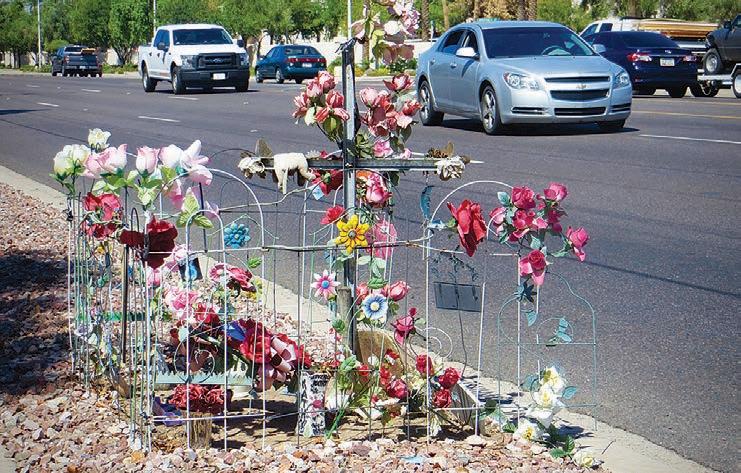
Kathy Price’s memorial doesn’t appear to bother anyone. With artificial flowers and a small “slow” sign decorating a wire fence, the memorial resembles a bush from the blur created by someone driving by at 40 mph.
But upon closer inspection, it is clear that a grieving man named Robert loved Price very much, even though a plaque written on a flat rock does not list either of their last names or how Kathy died. It does say she died on May 24, 2014.
“God Bless, in Loving Memory. I will forever miss you. And never forget,” Robert wrote on the rock, which sits at the base of metal cross. A stuffed animal, a little dust-
covered bear, hangs from the cross.
Det. Lily Duran, a Tempe police spokeswoman, said that Kathy Price, 54, died after she was stuck by a car while crossing Baseline.
Memorials like Price’s are a frequent reaction by family and friends after deaths caused by traffic accidents or slayings. They recently gained more attention because of a flap in Pinal County.
The Arizona Department of Transportation recently announced a more sensitive policy after angering family members by removing memorials along State Road 177 and U.S. 60.
Pete Rios, a Pinal County supervisor and a longtime legislator, lodged complaints with Arizona Gov. Doug Ducey’s office after the memorials disappeared. One of them honored the memory of Carmen Rios, Pete Rios’ sister, who was killed by a drunk driver in 2000.
Rios said he was appalled when he started getting calls from people from all
over the state after ADOT crews swept away crosses that honored the memory of their loved ones in Pinal County, sometimes for decades.
But he praised ADOT for working with him on the new policy, which attempts to protect grieving families while maintaining public safety.
Rios said the memorials are important to remember loved ones and also remind
drivers to slow down, stop texting and observe traffic rules.
“We would always say a silent prayer,” Rios said when he passed his sister’s memorial. “It would remind me of things we did as kids. It was a pleasant thing as well to remember your loved ones in a different light.”
But ADOT’s view of memorials has
(Jim Walsh/AFN Staff)
A memorial to Kathy sits along Baseline Road near Kyrene in Tempe. The memorial resembles a bush from a distance.
changed since meeting with Rios. The agency now wants to strike a delicate balance between honoring accident victims and maintaining the safety of state roads. Details of the new policy are listed at azdot.gov/memorials.
“Our policy once was to remove everything” from ADOT right-of-way along state roads, said Steve Elliott, an ADOT spokesman.
Under the new approach, “we want to honor the families’ need to express their grief,” he said. “We want to have a conversation.”
But the new policy has several restrictions. It requires grieving family members to obtain permission from a district engineer before placing a memorial and also puts limits on the size, design and location. Some of those rules would prevent family members from going too far by mounting memorials with a concrete base, creating a hazard.
The Ahwatukee memorials include a broken white cross with a broken picture frame near 17th Avenue and Pecos.
Artificial flowers attached to a chain-link fence near the 40th Street Park and Ride station appear to be remnants of another memorial.
The ADOT policy, however, is still more restrictive than any of the cities in the East Valley and more restrictive than Phoenix, as well.
“We are very sensitive to this issue,” said Monica Hernandez, a spokeswoman for the Phoenix Department of Transportation, adding that a memorial normally would not be moved unless it blocks a sidewalk or blocks the view of a street sign. Amanda Nelson, a spokeswoman for Tempe’s Transportation Department, said Tempe’s policy gives the city the right to remove a memorial after 90 days. She said that doesn’t happen unless there is a safety issue.
Here’s a roundup of news from some Ahwatukee-based schools.
Horizon Honors Elementary
Horizon Honors Elementary Teachers recently met during their professional growth time to develop a vision for what they believed No Place for Hate should encompass at their grade level.
The session was facilitated by Principal Laura Wanstreet, who helped guide the teachers through a common understanding of No Place for Hate.
Next quarter teachers and support staff will explore more ways to incorporate the program into their classrooms and daily teachable moments.
“No Place for Hate is designed to rally the entire school around the goal of creating a welcoming community committed to stopping all forms of bias and bullying,” spokeswoman Melissa Hartley said. “The initiative celebrates diversity and offers a unique opportunity to prepare young people to succeed in a rapidly changing world.”
Mountain Pointe High
Noting that it is often difficult to identify the person being honored, ADOT also is asking those who have put up the memorials to notify the district engineer. That way, ADOT workers can save a memorial for family members if they determine it has to be moved because of safety or maintenance issues.
It would appear ADOT’s new policy would have little impact on developed state highways in the East Valley, but officials all say they are trying to strike the same delicate balance between respecting a grieving family’s wishes and public safety.
Elliott said it is highly unlikely that memorials would be allowed along freeways, for fear of creating a distraction for drivers or a reason for drivers to stop, posing another hazard.
Other state highways, such as Arizona 87 through Mesa and Chandler, fall under the jurisdiction of cities. One notable exception might be Pecos Road, which now falls under state jurisdiction. But eventually, Pecos Road is scheduled to become the South Mountain Freeway, if it surmounts legal hurdles. At least two lonely memorials sit along Pecos in Ahwatukee.
In the rare instance when a memorial needs to be removed, Tempe will preserve the memorial and attempt to return it to a traffic accident victim’s family.
“It hasn’t been a problem,” Nelson said. “It respects the families and ensures safety.”
Amy McConnell, a Mesa transportation spokeswoman, said Mesa has a policy that does not allow permanent memorials in city rights-of-way. She said temporary memorials are allowed for two weeks “out of respect for family and friends.”
Mesa allows an 18-inch white cross decorated with flowers, according to the policy.
But in practice, a memorial could remain indefinitely if there are no complaints and it causes no problems, McConnell said.
“We have the policy in place, but we don’t go out actively searching,” she said. Chandler, Gilbert and Phoenix have no formal policy on roadside memorials, removing them only if they create problems. Those cities also will move memorials a slight distance if they block a sign or a sidewalk.
“We do everything we can to respect this as part of the grieving process,” said Matt Burdick, a Chandler spokesman.
“If it’s not causing a safety problem, we leave it alone.”
and junior varsity spirit teams as well as head coach Clare Taylor and assistant coach Natalia Skinner for earning top ratings in their divisions at this summer’s USA Cheer Camp.
Two seniors earned individual honors: Captain Maddy Deitchman was one of seven cheerleaders chosen by camp staff to audition for a leadership position in the organization and Jahnay Finklea scored an invitation to perform in a New Year’s Day parade in London, England.
The varsity cheer team includes: Briana Benson, Aniya Littlejohn, Madison Vaughn, Keri Loh, Sam Ardon, Lauren Crane, Kyndall Hoston, Victoria Alvarez, Maddy Deitchman, Lola Fox, Jahnay Finklea, Lennessa Fair, Kayla Bantz, Hailey Ward, Jayda Kimbrough, Elizabeth McCarthy, Ava Trimble, Payton Mackey, Amya Smith and Kelsey Galvis.
Desert Vista High
Mountain Pointe High School’s academic accomplishments and future plans will be the subject of a special “Celebration of Learning” presentation to the Tempe Union High School District governing board at its meeting tonight.
The presentation, at 5:15 p.m. at the district offices, 500 W. Guadalupe Road, Tempe, will examine topics such as on how data is used to adjust the curriculum, a demographic profile of the student body, and goals for the current school year.
One goal calls for a uniform, systematic process that focuses on providing each freshman “an identified adult or student mentor who can advocate for the social, emotional and academic needs of the student.”
The board also will salute the varsity
are currently seeking caring and compassionate individuals, that want to make a difference in their community.
The Tempe Union High governing board also will recognize Desert Vista High’s speech and debate team. Coach Victor Silva “led his team to impressive performances at nationals. The Thunder finished in the Top 25 and earned the National Speech School of Honor Award,” the district said.
Two 2016 graduates finished in the Top 6 and Top 9 in the nation. Eleven Desert Vista students finished in the Top 100. Six of the students on last summer’s team are still at the high school: Ethan Fiber, Alex Wakefield, Dylan Ketcham, Erica Lane, Johanna Crowl and Aashney Shah.
Tempe Union High District
Prior to today’s board meeting, Mountain Pointe’s culinary students will serve hors d’oeurves during the Business Partner Recognition Reception while Desert Vista engineering students will show off their solar car.
See SCHOOL NEWS on page 26
(Jim Walsh/AFN Staff)
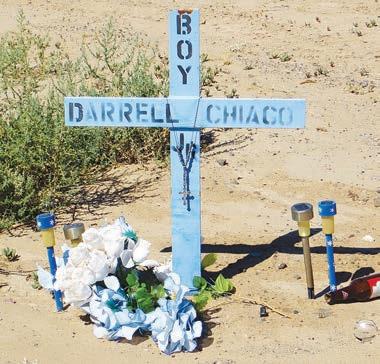
A memorial with solar lights sits along Arizona 587, just south of Chandler.
Youth choir concert aims to bring people together
BY SUSIE STECKNER AFN CONTRIBUTING WRITER
Building community. Strengthening connections. Finding common ground.
Can the power of young singers help reach these goals? That’s the aim of Chandler Children’s Choir with its Fall concert “There’s a Place for Us.”
The performance is built around the theme of unity and, in that spirit, the choir is collaborating with Archway Lincoln Music Masters for the first time. The choir includes children from Ahwatukee.
The inspiration for the concert comes from the “West Side Story” song “Somewhere” and its message of hope, said Aimee Stewart, co-founder and artistic director for Chandler Children’s Choir.
“The world is an interesting place, and this summer, I got to see some of it,” Stewart said. “I heard an opera in France, saw a marionette show in
Austria, a symphony in San Francisco, and came home to see a friend perform in ‘West Side Story.’ When I heard the song ‘Somewhere,’ it really hit home.
“Instead of getting down about the problems of the world, I want to remind myself and us all that ‘There's a Place for Us’ when we connect together and remember that what we have in common is stronger than our differences,” she said.
Chandler Children’s Choir serves more than 140 singers through its three choirs. CCC performs at venues and events throughout the East Valley. Lincoln Music Masters is the after-school music club for students in third through fifth grades at Archway Classical Academy, Lincoln campus, in Chandler.
“We are thrilled to have the opportunity to get to partner with the prestigious Chandler Children’s Choir,” said Archway Lincoln music teacher Lisa Blasi.
Chandler Children’s Choir, in its ninth season, strives to connect with neighboring arts organizations like the Lincoln Music
Masters. The collaborations inspire young people through music and engage them in new experiences, Stewart said. CCC’s Cantus choir will perform with Symphony of the Southwest Dec. 10 at the Mesa Arts Center.
“When we join forces, we are able to see new ideas, new perspectives, meet new directors and friends, and recognize that we’re all here for the same reasons,” Stewart said.
CCC member Brisbynne Arp, 13, loves collaborating with new groups, whether singing with an African youth choir or performing with a modern strings trio.
“I’ve had so many amazing opportunities at CCC,” said Arp, a seventh grader at Lincoln Preparatory Academy in Chandler. “We all learn from each other and have a lot of fun at
the same time.”
Stewart said the Sept. 29 performance, “There’s a Place for Us,” offers a new experience for singers and also sets the tone for the new season.
“My mantra this season is to bring people together, build strong community, deepen our connection and strengthen what makes us great as a choir, as families and as a community,” she said. “Singing in a choir is a great way to do that.”
student art is for sale and can be seen in the district office during normal business hours; part of the sale proceeds go to a scholarship fund.
On the arts side, the McClintock High ensemble will perform and guests will have an opportunity to check out art work made through the TUHSD (IN) nspiring Our Students” program. The
All high school freshmen, sophomores and juniors will have a chance to take free PSAT testing Oct. 19 thanks to money from Prop 123. For an informational video: youtu.be/L_f3DnAShe8
(Special to AFN)
Ahwatukee children are among the members of the Chandler Children's Choir.
COMMUNITY CALENDAR
TUESDAY, SEPT. 27
Kids’ emotions explored
The Kyrene Early Education Resource Center is holding a workshop that enables parents and caregivers to understand the five critical emotional needs of all human beings; to feel accepted, included, respected, important, and secure. The workshop covers social and emotional development of children from birth to teens.
DETAILS>> 9-11 a.m., Kyrene de las Lomas, 11820 S. Warner-Elliot Loop, Ahwatukee. Registration required: kyrene.org/earlyed.
WEDNESDAY, SEPT. 28
Learn infant communication
Baby sign language is a way to communicate by using hand gestures, and Kyrene Early Education Resource Center, in conjunction with Desert Valley Pediatric, is offering a workshop to provide a glimpse into a baby’s world by helping parents communicate with their pre-verbal infant.
DETAILS>> 9:30-10:30 a.m., Kyrene de las Lomas, 11820 S. Warner-Elliot Loop, Ahwatukee. Register: kyrene.org/earlyed.
Medicare explained
Ahwatukee insurance expert Greg Geryak will discuss a variety of issues involving Medicare, from enrolling to benefits and rights. A question-and-answer session on Social Security will follow.
DETAILS>> 1-2 p.m., Ironwood Library, 4333 E. Chandler Blvd., Ahwatukee. Reservations required: 480-797-5615. Another session is 5-6 p.m. Oct. 6 at Ironwood Library.
SUNDAY, OCT. 16
Evening of music planned
“A Night on Broadway,” with selections from Cole Porter and George Gershwin to Andrew Lloyd Weber and Rogers and Hammerstein, will feature the gifted musicians of St. James Episcopal Church. The evening includes wine, cheese, fruit and assorted beverages, plus a silent auction of art, jewelry, desserts, tickets and other exceptional items.
DETAILS>> 6:30-9 p.m., 975 E. Warner Road, Tempe. A $10 donation benefits St. James and includes two beverages. Tickets: at the door or by calling 480-345-2686.
MONDAYS
Open play for kids offered
Open Playday is held through Dec. 19 by the Kyrene Early Education Resource Center to help children explore and make sense of the world around them.
DETAILS>> 9-11 a.m. Kyrene de las Lomas, 11820 S. Warner-Elliot Loop, Ahwatukee. Register: kyrene.org/earlyed.
Chamber offers networking
The Ahwatukee Foothills Chamber of Commerce networking and leads group is open to chamber members.
DETAILS>> Noon, Native Grill and Wings, 5030 E. Ray Road, Ahwatukee. Devida Lewis, 480-753-7676.
Group aids MS sufferers
This group addresses the informational, emotional and social support needs of the MS community. People with MS, care partners and spouses are welcome. The group mobilizes people and resources to drive research for a cure and to address the challenges people affected by MS.
DETAILS>> 10 a.m.-noon, third Monday of each month, Dignity Health Urgent Care Ahwatukee, conference room, 4545 E. Chandler Blvd. Free. Information: Lynn Grant at lgrant3567@yahoo.com or 480414-7172.
TUESDAYS
Toastmasters sharpen skills
Improve your speaking skills and meet interesting people at Ahwatukee Toastmasters meetings.
DETAILS>> 6:45-8 a.m at the Dignity Health Community Room, 4545 E. Chandler Blvd., Ahwatukee.
Power Partners available
The Ahwatukee Foothills Chamber of Commerce networking and leads group is open to chamber members.
DETAILS>> 8-9 a.m., Four Points by Sheraton, 10831 S. 51st St., Ahwatukee. Devida Lewis, 480-753-7676.
WEDNESDAYS
Montessori holds open house
Ahwatukee Foothills Montessori is holds an open house weekly. It includes a short talk about Montessori education, followed by a tour of its campus.
Hospice of the Valley offers a free ongoing grief support group for adults and is open to any adult who has experienced a loss through death. No registration required.
DETAILS>> 6-7 p.m. 1st and 3rd Wednesdays, Pecos Community Center, 17010 S. 48th St. 602-636-5390 or HOV.org.
— Email calendar items to pmaryniak@ahwatukees.com
Helping young children to ‘name, tame and claim’ their feelings
BY TINA CHARNEY AFN GUEST WRITER
What’s the difference between a toddler having a temper tantrum in the grocery store because she didn’t get a candy bar, and the office manager screaming that if his staff doesn’t quit jamming the copy machine, he’ll take the next repair job out of their paychecks? Not much.
Except the toddler has an excuse: She’s only a child. Unfortunately, we all know people like the office manager, who have never learned appropriate and more effective ways to deal with their emotions.
One of our most important tasks as preschool teachers—and yours as a parent—is to help children begin to learn how to manage their own feelings. With our help, over time, the toddler who screeches with rage or bites the child who takes her toy will become a child who calmly says, “I was still using that. You can have it when I’m done.”
The first step is helping your child to identify and describe what he or she is feeling, whether it is “sad,” “angry,” “sorry,” “proud,” “frustrated,” “worried,” “scared,” “happy,” or “excited!”
Naming your child’s feelings also validates their feelings. “George, I see that you’re frustrated that you can’t get your shoe on.” “Amy, you look really proud that you made your bed yourself.”
It also helps if you describe your own feelings. Tell them, “I am so frustrated that I can’t get this vacuum unclogged!”
When you get a good job review, share it with your family. Let them hear you say, “I’m really proud of myself for the good job I did.” Not only will you increase your emotional connection with your child as you share your feelings, it is
also important for children to know that adults feel the same emotions they do.
Along with naming those strong feelings, the young child often needs our help to express them in an appropriate and safe way.
At school, teachers use songs, puppets modeling their own behaviors, books and pictures, teaching appropriate words and phrases, coaching, and practice to help the children in this process. And you can do the same.
When we ask the children in our class what helps them feel better when they feel sad, at the top of everyone’s list is you. Mommy and Daddy, holding, snuggling, and rocking them.
Most likely, your child will display far more intense feelings at home than she does at school. But just because children feel safe expressing intense emotions at home, that doesn’t mean they want to. It doesn’t really feel good to be in a rage. It doesn’t feel good to melt down crying. It doesn’t feel good to whine about everything you want, and be met with annoyance for it. So, both we as teachers and you as parents will be doing our children a great service by helping them learn how to manage those feelings.
The next step, after being able to name (or recognize) their emotions and claim (or express) their emotions, is learning to tame (or manage) their emotions.
Of course, learning to manage emotions is a difficult task that takes well more than the preschool years. (Are you thinking of teenagers now?) Fortunately, preschoolers don’t have to handle their feelings on their own.
Adults provide a protection zone for them, buffering them from their own most intense feelings, and helping them to deal with those feelings.
There are no magic bullets here. You can’t always make your child go from
crying or enraged to smiling and happy with a quick trick. Nor would you necessarily want to. These negative feelings that children have, as do we all, are legitimate.
It’s OK, and necessary, for these emotions to be expressed and acknowledged. But eventually a person, whether child or adult, wants to return to a more benign state.
Teachers use many techniques, depending on the child’s age and the emotions they’re feeling. You can use these, too.
One example is to set up a “Bear Cave” where a child can safely retreat while they are feeling angry or out of control.
(Special to AFN)
Summit School of Ahwatukee early childhood educator Tina Charney has just published a new book, titled “Your Amazing Preschooler."
fears in another light.
Another is to establish brief, and consistent, comforting routines for leave-taking if your child has difficulty separating from you or from an activity.
Allowing him or her to hold a photo of you or another comforting object can also be effective. When a child is fearful or anxious, after acknowledging the feelings, we can use the child’s imagination and sense of humor to defuse the emotion and help her see her
Or read a book about a child in a similar predicament, and let your child help figure out a solution for the character in the story.
If you are looking for guidance, ask your child’s preschool teacher.
-Tina Charney is an early childhood educator at Summit School of Ahwatukee, and the coauthor of the recently published book: “Your Amazing Preschooler: How you can have the same capable, confident, and cooperative child at home that teachers have at school.” Information: summitschoolaz.org; YourAmazingPreschooler.com
Ahwatukee photographer one of only a handful to win certification
There aren’t many professional photographers like Babe Sarver of Ahwatukee.
Actually, only about 2,500 are certified as professional photographers by the Professional Photographers of America.
Sarver recently completed requirements necessary to retain his status, which he first earned in 1999.
“When people hire a photographer, it is important to know that the person behind the lens is professionally accredited.”
Sarver said. “It is our job to determine how to appropriately utilize the tools at hand to make the best possible image for our customer’s needs."
Professional Photographers of America says its certification “affirms a knowledge and experience base for practitioners in a particular field, their employers, and the public at large.”
The PPA gives photographers a 100-question test and requires them to submit 15 unique photographs that are then judged by a panel of experts for technique and various photo standards.
The judges look for consistency in results; a knowledge of art, lighting, posing, fashion and interior design; “unique artistry to create customized works of art;” and “customer service that exceeds expectations.”
To determine customer service, the experts also interview photographers’ clients.
Getting certified is no cake-walk.
Sarver and his wife Arlene own Babe’s Photos in Ahwatukee. She is the production manager at the studio, while he shoots portraits and provides commercial photography of facilities and products.
Sarver, who has lived with his wife in Ahwatukee since 1992 and opened his studio in 1997, has a fine arts degree in photography and ceramics from Arizona State University.
He also attended the General Motors Institute at Kettering University, and said his engineering studies have helped him professionally.
But he’s no fan of using computers to do what he thinks a camera should have done in the first place.
“We have found that we achieve the greatest results when we ‘get it right… in the camera’ versus creating something in the computer,” Sarver said. “The ‘computer dark room’ allows us to fine tune an image, but it doesn’t replace good lighting and camera techniques.”
“Time has proven that photography is not a static industry as new techniques
and technologies appear constantly,” he added. “However, even with new technologies, what has remained constant for the professional photographer are the knowledge and skills required to capture quality images in the camera with consideration given to composition, lighting and customer needs.”
Sarver said that when “film converted to digital technology and the computer became the new dark room,” he found it necessary to focus his work on a few select areas, so he opted for commercial work and taking wall portraits of people and pets “to preserve important family memories for generations to come.”
Longtime Ahwatukee instructor helps out pupils stranded by closed martial arts center
Longtime Ahwatukee businessman and martial arts instructor Rick Savagian has come to the rescue of students who were left out in the cold when another local martial arts center abruptly closed.
Desert Foothills Martial Arts closed its doors at the end of August after its head instructor gave a one-day notice to students and their families.
“Approximately 12 to 14 families have contacted me and we are aggressively giving the children from their program free introductory lessons,” said Savagian, owner of Mountainside Martial Arts, which has been in Ahwatukee more than 35 years.
Desert Foothills Martial Arts owners could not be reached for comment, but Savagian said he guessed “their
enrollment was extremely low.”
“I drive by the school daily and rarely see many students training,” he said.
He said his center will offer special classes “to accommodate and acclimate the new students at no charge during September to see if our school is a good
fit for these families.”
Savagian also was meeting with the families that contacted him.
“If those families feel comfortable and feel that our school is where they would like to continue, then we’ll give them a special rate for their first month and a
free uniform,” he said. “I want to take this negative and make it into a positive. We want to offer the extension of courtesy to all the children and have the parents feel like we have done everything on our part to make them feel welcome.
“I know how difficult this is on the children and I want to make it work so everyone can move forward,” he added.
Savagian said “A number of students and parents in our school have already come to me and want to make them feel that they are a part of our family.”
He already had about 125 students and 14 volunteer instructors.
Savagian set up shop in 1979 shortly after he came to Ahwatukee after finishing a masters’ program at the University of Wisconsin-La Crosse. Located at 3173 E. Chandler Blvd., he can be reached at 480-759-4540 or mmacaz.net.
AHWATUKEE FOOTHILLS NEWS STAFF
(Will Powers/AFN Staff Photographer)
Mountainside Martial Arts Center owner Rick Savagian is helping out students who were left in the cold when another martial arts center in Ahwatukee closed.
(Special to AFN)
Babe Sarver of Ahwatukee is one of only about 2,500 photographers certified by the Professional Photographers of America.
(Babe Sarver/Special to AFN)
Landscape and facilities pictures are part of Ahwatukee photographer Babe Sarver's commercial portfolio.
consent form to make Ahwatukee Farms a reality!
JOIN THE MORE THAN 1,000 ABM RESIDENTSwho signed the consent form and took the first step toward making this property an asset for the entire community. Ahwatukee Farms will lift property values for the entire community, revitalize our neighborhoods and become the newest cornerstone for the Ahwatukee Foothills community.
We are honored and humbled to see so many community supporters support the vision of Ahwatukee Farms and we want you to join us through this process. Please be on the lookout for more information about the project coming soon!
Trails master plan is subject of city workshop here tonight
The South Mountain Park and Preserve Trails Master Plan is the subject of a public workshop 6-8 p.m. today at Pecos Community Center, 17010 S. 48th St., Ahwatukee.
City staffers will discuss feedback they have received and how this information was used to help identify planning zones and conceptual trail alignments on South Mountain.
Staffers hope to finalize the plan by the end of the year and present it to the city Parks and Recreation Board in February.
Tukee Fest will rock for ninth year at Ahwatukee Park
The ninth annual Tukee Fest, called “Rocking in the Park,” will be 5-9 p.m. Oct. 1 at Ahwatukee Park, 4700 E. Warner Road.
Along with live music throughout the evening, it will offer a pie-eating contest, bungee jump, bounce houses, food and beer and wine.
People should bring a blanket and chairs. The admission of $5 can be paid at the event.
Children 12 and under are free.
Books sought for annual YOPAS November sale
The Ahwatukee Foothills Family YMCA Outreach Program for Ahwatukee Seniors (Y OPAS) needs book donations as it prepares for its ninth annual fundraising book sale 7:30 a.,.-4 p.m. Nov. 5.
Books can be dropped off at the YMCA, 1030 E. Liberty Lane, Ahwatukee.
There are also book donation drop off points around Ahwatukee. Information: Jill at 602-212-6088.
Tukee Sisters to hold business expo with holiday ideas
Tukee Sisters in Business, a grassroots group of more than 100 women who own businesses, will hold an expo 9 a.m.-4 p.m. Oct. 1 at Be…An Artist, 40th Street and Chandler Boulevard, Ahwatukee. More than 45 businesses will be on hand with holiday items for sale.
Ahwatukee resident Heidi Winquist organized the group, saying its purpose is “to support one another as we grow our businesses,
Scholls Helping Hands will be collecting
donations for the homeless and people who bring donations will be entered in a raffle. Information: facebook.com/ events/210871012641614.
Photographer to discuss tips at Desert Pointe Garden Club meet
Art Holeman, an Ahwatukee photographer, will discuss how to take pictures in backyards at the 9 a.m. Oct. 3 meeting of the Desert Pointe Garden Club at the Ahwatukee Recreation Center, 5001 E. Cheyenne Drive, Ahwatukee. The center hosts but does not sponsor the club.
In addition to maintaining several gardens at the center, club members maintain Ahwatukee’s Blue Star Memorial on Warner Road and create gardens at group homes for disabled adults. They also undertake projects for area children.
Women interested in joining the club can call 480-759-4407. Information: dpgc.org.
No Ahwatukee planning committee meeting this month
The Ahwatukee Foothills Village Planning Committee has canceled its meeting for next Monday.
Last month’s meeting was the panel’s first
session in four months. Meetings typically are not held when there are no zoning or other development-related issues pending with the city.
Phoenix wins $9-million federal grant to hire 50 firefighters
“The City of Phoenix has won a $9 million federal grant to hire 50 more firefighters over the next two years. With the Staffing for Adequate Fire and Emergency Response (SAFER) Grant, Phoenix has garnered more than $36 million in federal funds in the past five years to support the city fire and police departments’ capabilities to prepare for and respond to a host of threats, officials said.
Another $28 million in regional homeland security grants has gone to the city and surrounding municipalities in the same time period.
Last month, the city received an Assistance to Firefighters Grant totaling $591,726 to provide regional Incident Safety Officer System (ISOS) training for 100 company and command officers from Phoenix Fire and officers from fire departments in Buckeye, Glendale, Scottsdale and Tempe.
year we plan to plant a giant pumpkin, sunflowers, carrots, lettuce, peas, beets, Brussel sprouts, cauliflower,” Hockenberger said.
The Realtors’ grant was made through its Placemaking program, which the association describes as an effort “to help make local communities better places to live and work by transforming unused public spaces into vibrant community places.”
Garden of Eatin’ President Pam Yount said her group “will use the money to enhance our existing garden site.
“We’ll be constructing a new storage facility for our equipment and we hope to build a pergola that will provide shade for outdoor meetings,” she said.
“Realtors live, work and volunteer in their communities and take immense
pride in working to improve them,” said Craig Peck, president-elect of the Southeast Valley Regional Association of Realtors and a member of the Garden of Eatin’ group.
“Placemaking can help foster healthier, more social and economically viable communities,” he said. “It creates places where people feel a strong stake in their neighborhoods and are committed to making things better. This grant will allow us to address an area in Ahwatukee that can benefit from enhancement and create a place where friends and neighbors can come together.”
“As the Ahwatukee area becomes more attractive and welcoming, local properties are likely to increase in value,” he added.
One Mountain Pointe High School senior and 15 Desert Vista High seniors have been named semifinalists for National Merit Scholarships.
They’ll now join about 16,000 other seniors across the country in a competition for some $33 million in scholarship money, according to a National Merit Scholarship Corp. release.
The 16 Ahwatukee seniors were among about 1.6 million juniors last year who took a qualifying test to get to the second round. To become finalists, they’ll be judged on their academic record, extracurricular and outside-of-school activities, leadership, employment and awards.
The corporation warned against comparing schools based on the number of semifinalists there are.
“Using numbers of semifinalists to compare high schools, educational systems, or states will result in erroneous conclusions,” it said, noting the scholarship program “honors individual students who show exceptional academic
ability and potential for success in rigorous college studies.
“The program does not measure the quality or effectiveness of education within a school, system, or state,” it added.
The program is funded by about 420 companies and distributes three different kinds of scholarships, ranging from $2,500 to unspecified amounts from colleges and universities and from companies to children of employees or residents of communities where the firms are located.
Desert Visa semifinalists are: Mya G. Carrizosa, Jocelyn Y. Chen, Kyle R. Corrette, Hannah Fuchs, Brandon Jiang, Matthew D. Jobe, Bobae C. Johnson, Dylan L. Ketcham, Jaeyoung Kim, Neha Parvathala, Tyle Ruan, Kendall M. Schwartz, Alice L. Wong, Kai Yin and Sang Bo Yoon. Mica A. Stewart is the Mountain Pointe semifinalist.
A reception for the semifinalists will be held sometime in November at Desert Vista with Arizona State University President Michael Crown delivering an address.
Clean Elections Commission fumbles handling of LD 18 candidates' debate
BY PAUL MARYNIAK AHWATUKEE FOOTHILLS NEWS EDITOR
I’m a little ashamed to admit this, but my first impulse is annoyance when I make a phone call and the message on the other end tells me the mailbox is full and I can’t leave a voice mail.
Uncharitable thoughts creep up. I start thinking that person or business or organization is incompetent. Or at least woefully unconcerned about who calls them.
I try to exorcise such uncharitable thoughts.
I’m glad I didn’t when I got that message after calling the Arizona Citizens Clean Elections Commission Friday morning.
Because what happened less than 12 hours later during the commission’s Legislative District 18 candidates’ debate suggested my initial thoughts may have been pretty close to the mark. Let’s start with timing. I don’t know about you, but I’m not thinking about democracy much on a Friday night. At 6 p.m. no less. It doesn’t seem like the most considerate scheduling decision for such an event.
It wasn’t good for the people who wanted to go but got tied up in heavy rush-hour traffic. Or for the parents who wanted to attend their kids’ high school football games. Not to mention those who just wanted to crash after a rough week at work.
Then there was the location.
If you don’t own a GPS or routinely rely on Siri or a similar virtual assistant, it may be easier finding Waldo than locating the Courtyard Marriott in Chandler. Better hidden than an ISIS bunker, it’s tucked behind a restaurant in a strip mall off Ray near 54th Street, with minimal signage to guide people who don’t have much reason to frequent a hotel in the area where they live.
OK, that one was my problem. But it wasn’t my problem that the room the commission picked for the debate was smaller than rooms used for
Scrabble tournaments. It could only accommodate about two thirds of the approximately 75 or 80 people who showed up. The rest were forced to stand in the corridor or just outside in the courtyard in the hopes of catching maybe every fifth word that was said during the 90-minute debate.
For a moment, I wondered if this was the first debate the commission ever handled.
But no, the commission has been around for more than a decade, so it seems they’d be accustomed to reserving rooms large enough to accommodate those who might want to attend. Or that someone would have had the foresight to reserve an overflow room with adequate sound so no one would have trouble making out what the candidates were saying.
My peevishness melted into downright surprise when one of the moderators announced that incumbent Republican Rep. Jill Norgaard wouldn’t be there. In fact, incumbent Republican Bob Robson almost wasn’t there either.
Commission staffers forgot to invite them until fairly close to the debate, the
moderator explained. Or rather, that’s when they remembered they hadn’t invited them.
How close?
A little less than four hours before the debate began.
Somehow, Robson managed to free himself from whatever he had planned for Friday evening and get there on very short notice. Norgaard was out of town.
In an email Norgaard shared with me, a commission staffer apologized “for the confusion and for not connecting with you sooner,” though she assured the representative, “We are going to make an announcement at the beginning of the debate about the mishap on our end and that you would have otherwise attended.”
Norgaard graciously told me in an email, “It was unfortunate we did not have notice until 2:37 (p.m.). I would have liked to participate.”
Then there was the debate itself.
It was broken into two distinct parts.
One involved questions from the audience written on cards that each of the five candidates present took turns answering. The second part had
questions from the audience directed at specific candidates, also written on cards.
A few audience members tried what in my business is called “gotcha journalism” by asking questions about specific bills — by their numbers.
One question to the entire panel rattled off two bill numbers, and only Mitzi Epstein, Democratic candidate for the House, knew they referred to a pair of bills that would have let municipalities in rural areas relax the state requirement for a 100-year water supply and approve housing developments.
The other candidates were stumped.
“I don’t know what they are, and I’m in the Legislature,” Robson said before Epstein explained their content.
The two Senate candidates, Democrat Sean Bowie and Republican Frank Schmuck, were cautious about saying much, noting they like to read a bill before commenting on it.
Another question mentioned another number, prompting Robson to complain that the same numbers are re-used each year for new bills. So, he wondered, how were any of the candidates to know what year the question referred to, let alone the nature of the bill?
Having moderated a number of political candidate debates where written questions were submitted, I can tell you that it’s the moderator’s job to make sure the questions are fairly presented.
A moderator is not a mirror. Or a robot.
People attending a debate are there for different reasons. Many in the audience come to be informed. But a few malcontents and overly aggressive partisans are there to get a piece of a candidate just for sport.
Somehow I expect the Clean Elections Commission would have learned that after all the debates it has handled over the years.
But then, if you can’t keep your voice mailbox ready for the next message, it’s not entirely surprising that running a debate might be a challenge.
-Reach Paul Maryniak at pmaryniak@ ahwatukee.com
(Cheryl Haselhorst/AFN Staff Photographer)
Just before the Clean Elections Commission debate for Legislative District 18 candidates began last Friday, Senate Democratic candidate Sean Bowie, left, and Republican Senate candidate Frank Schmuck shared some friendly words.
Dark money prevalent among LD 18 lawmakers
Our current three representatives in Arizona Legislative District 18—Jill Norgaard, Bob Robson and Jeff Dial—are listed among the top 10 recipients of dark money among all 90 Arizona legislators. That’s right, our representatives have accepted more dark money than 80 of their colleagues in the Arizona legislature. The real question to be asked is: does the acceptance of “donations” influence voting? Our above three LD 18 representatives would almost certainly say “No Way! Are you kidding?”
Perhaps we can never know for sure, but can we draw some inferences?
Let’s begin with Rep. Jill Norgaard. She voted in support of eight bills favoring guns in our district and state. They all passed. For example, she voted in support of HB 2320, which authorizes individuals to carry concealed weapons in public buildings. It passed. She voted for HB 2338, which authorizes carrying concealed weapons near schools. It passed. She also received an 86 percent approval rating from the National Rifle Association. Thanks, Jill.
Oh, and she also voted YEA on SB 1516, which repealed certain campaign finance reforms, making it easier to get more dark money to our representatives. Want to think about voting on Nov 8 for someone who might represent you? Just askin’.
-Gary Anderson
Just say no to Ahwatukee Farms sales pitch
Stop the scavenging! Just say no to True Life Companies.
Don’t believe the sales pitch and don’t let them make millions at your expense. Remember, former owner Wilson Gee ruined the golf course so that he
could convince you that it needed to be developed so he could sell it to the likes of True Life or Pulte for a huge profit.
But it is a golf course and can be a golf course if True Life finally realizes that the people (you and your neighbor) are not going to give in to their sales pitch. It can and should be redeveloped as a golf course.
True Life wants to pave over the Ahwatukee Lakes Golf Course with 300 houses, a private school, a cafe and a farm because they claim golf is dead.
Indeed, on Sept. 1, True Life project manager Quentin Thornton told an Ahwatukee Chamber of Commerce group:
“Like most people, ever since the crash, I don’t play golf anymore. And I know a lot of people don’t play golf anymore. The numbers are just earth-shattering, where we went from this… complete boom in golf course development and now we’re going through just the opposite in golf course use. And so as those two things collide, reality happens.”
Now, you have to forgive Quentin Thornton. He’s worked for True Life only about a year, and may not have gotten the message.
But what True Life and Quentin Thornton call “reality” seems to change, depending on what they’re trying to sell.
In Flagstaff, (see pinecanyon.net ) True Life is promoting its Pine Canyon venture as “Golf among the mountains and clouds.” Take a good luck at the opening visual on that web page. Then, check out the first 45 seconds of True Life’s video at bottom of the same page
In Prescott, True Life is advertising “year-round golf” at its Talking Rock development, where it is partnering with a Canadian company that specializes in “exclusive golf course communities on thousands of acres…” Click on: talkingrockranch.com/golf/ or talkingrockranch.com/about-us/thedevelopers
In Oro Valley, True Life advertises its Rancho Vistoso property as offering ”stunning views of the Stone Canyon golf course, and…. homeowners also have the opportunity to obtain membership to the prestigious Stone Canyon Club, including its world-class golf course...” (ranchovistoso.com/our-areas/ranchovistoso/stone-canyon/for-sale)
In Tucson, True Life describes its Dove Mountain development as being “Located in an elegant golf resort community…. The master planned community is… the site of the World Golf ChampionshipsAccenture Match Play Championship…” (thetruelifecompanies.com/projectsDove-Mountain-27.cfm)
In other words, True Life and Quentin Thornton say golf is dead in Ahwatukee, but thriving around Arizona where they have land for sale. No wonder: to launch the $100-million project the Lakes golf course represents, True Life needs 51 percent of our neighbors to believe golf is dead in the city that’s built on golf.
Simultaneously, Wilson Gee, as he did with the Lakes, is trying to sell the Ahwatukee Country Club and Club West; the Foothills course looks to be close behind.
When a judge has already ruled in favor of the existing CC&Rs, why would we give away that strong negotiating position to a developer that’s not even building the development?
That’s True Life’s business strategy: packaging the Lakes golf course for a different builder; who’ll do who knows what? See: prlog.org/12545075-thetrue-life-companies-forward-thinkingstrategy-provides-land-to-fuel-homebuilding-industry.html
As a developer myself, I urge you: Don’t consent to letting them pick the bones of Ahwatukee and remove the open space that makes your property and our community valuable.
A trial date for a preliminary injunction
to stop development of The Lakes Golf Course has been set June 12-15, 2017, before Judge John Hannah in Maricopa County Superior Court.
Please: Let the legal process work. Once the court rules, the residents of Ahwatukee Lakes can negotiate from a position of strength.
-Marvin Galts
Ahwatukee Farms proposal is not a good idea
Ahwatukee Farms is a bad idea. Here’s why:
• Three houses per acre is too small.
• It would increase the number of automobiles in that area.
• We already have a large high school within one block of this area. We don’t need the Montessori school.
• A school bus plus the current traffic would be too much for the area.
• A roundabout would make 44th Street impossible for everyone. Trucks would make it even more dangerous for everyone, including the kids who walk on Knox Road and 44th Street.
True Life cannot be trusted.
-Donald Maynard
Trump most dangerous presidential candidate
Donald Trump’s recent visit to Arizona and his recent appearance on NBC’s commander-in-chief forum have only solidified my opinion that we are looking at a candidate whose sole purpose is to incite. His incendiary rhetoric leaves no one unscathed and only serves to attempt to inflate an out of control ego. Referring to the U.S. Military: “Our generals have been reduced to rubble.” This is complete disrespect for our military.
Referring to anyone that is outside his understanding of an American: “It’s our right as a sovereign nation to choose immigrants that we think are the likeliest to thrive and flourish and love us.”
Mr. Trump’s vision of who is “acceptable” is frightening. I personally would not even ask him to make up a list of party guests for me, let alone a list of who should be part of this melting pot of amazing citizens that have contributed so much to this country.
His take on the war in Iraq: “And if you really look at the aftermath of Iraq, Iran is going to be taking over Iraq. They’ve been doing it. And it’s not a pretty picture.”
This makes absolutely no sense. Iran is working with the U.S. military against ISIS. Trump’s grasp of international relations is terrifying.
So, either Trump is really ignorant or he is only interested in inciting uneducated voters. But that shouldn’t surprise us. This is another Trumpism: “I love the poorly educated.”
Of course he does. He is threatened by people who actually know what they are talking about. His cabinet will be made up of cronies who are used to kowtowing to a
dictator. And I can’t even imagine what his supreme court nominations will be.
Wake up America! This candidate does not care about making America great again. He cares about inflating his personal brand. Our next president should not be someone who knows so little about diplomacy or constitutional law.
-Lisa
Roger
We don’t need a Clinton to make America great
What made America great?
We the people did it! The descendants of the people who sought religious freedom for their Puritan faith. Christians, all.
Once the church had been established, the people tried a communist economy to sustain its citizens. When it didn’t work, they tried free enterprise capitalism. That worked. It still works if only we’ll allow it.
When you fiddle with the fundamentals, the chaotic result is disastrous.
Our founding fathers believed in Nature’s God and the Laws of Nature’s God. They believed in life, liberty and the pursuit of happiness. Our leaders pledged their lives, their fortunes, and their sacred honor to build a free nation. A nation free from government control.
The people fought the Revolutionary
War to gain their freedom from the English monarchy. After eight years, they won their freedom. Freedom from government control.
That freedom is slipping away today because of those who no longer believe in Natures’ God and the Laws of Nature’s God, which are the foundation of our national character and the principles upon which it was built.
When you think of our national soul as that of unity, justice, domestic tranquility, a strong military for defense, the promotion of the general welfare and the securing of the “Blessings of Liberty” for the people, you have the basics upon which any free society is established.
In the beginning, justice was defined by the English Common Law. Today, it includes “social justice.”
In its original meaning, the “general welfare” referred to the business world. Today, it includes the socialist welfare state, a far cry from the original intent.
The welfare state gained strength during the Great Depression because our President, Franklin D. Roosevelt, was so
enamored of Keynesian economics he used deficit spending and inflation to try to solve our economic problems. It wasn’t working, but, then, WW II came along and the war magically improved the economy, Funny, how wars do that. Today, we are still using deficit spending and inflation to solve our economic problems, and they still aren’t working. When the fiscal dam bursts, we’ll have global economic confusion the likes of which we haven’t seen in history. If history teaches us one thing, it’s that we don’t learn from history. Let’s take it upon ourselves to change that old axiom. We must eschew the siren call of socialism and go back to our founding precepts and concepts. They were conceived by men who knew and understood the history of the ancient world and the pitfalls of monarchy, anarchy, and everything in between.
As Bill Clinton and Donald Trump have said: “Let’s make America great again!” We the people can do it without a Clinton this time.
-Don Kennedy
Ahwatukee Farms another example of growing trend in ‘agrihoods’
BY PAUL MARYNIAK AFN EDITOR
The proposal to convert the closed golf course at Ahwatukee Lakes Golf Club into a multi-use development with homes, a community farm and other features is part of an accelerating global trend in the development of what the Urban Land Institute calls “agrihoods.”
ULI, a nonprofit
education and research institute that focuses on the use of land to enhance the total environment, said the decline of interest in golf and the increase in abandoned farmland are driving the trend toward communities that are built around a community farm.
True Life has proposed Ahwatukee Farms, which includes single-family homes, a 5-acre farm, a Montessori school, farmers’ market and a café.
There are about 200 agrihoods in the U.S., ranging from communities like Agritopia in Gilbert to an exotic 1,500-unit in the Hawaiian island of Kauai built by Scottsdale-based DMB Associates, whose portfolio in the Valley includes Verrado in the West Valley, Eastmark in east Mesa and DC Ranch in Scottsdale.
Called Kukuui’la, the
Ahwatukee averaging 400 active listings a month
BY CHRISTIE ELLIS AFN GUEST WRITER
Lots of activity going on in Ahwatukee real estate with some topics dividing communities, creating passionate conversations on Ahwatukee411, and sparking promises by some people to move to Canada if the wrong candidate is elected president. Over the past few months I have paid a lot of attention as to what is going on in our community and I have learned a lot. For the basics in Ahwatukee real estate: For the past year, Ahwatukee has hovered around 400 active listings with another 175-200 under contract at a given time. This means we put on about as many new listings a month as we sell. Currently average days on market is about 3.5 months. What does that mean for the buyer and seller in Ahwatukee?
I have been noticing buyers really want little to do upon moving in. Often they just spent a good bit of time, money and energy getting their own house ready for the market, so they expect the same in return.
The situation is the exact opposite if the property needs to be renovated and the house is priced accordingly.
For sellers of a home that is priced right—and hopefully they are doing that within the first two weeks of the listing—we are seeing a list-to-sold-price ratio of 98.2 percent in Ahwatukee. A few years ago we, had an almost 20 percent discrepancy in list-to-sold price. That is a significant change and reflects smarter pricing decisions by sellers.
Over the past few weeks we had the court rule that South Mountain Freeway can move forward. I know this topic still divides the community.
I attended the Ahwatukee Village Planning Committee meeting to learn more about the freeway and hear the discussions. To say it was a lively meeting is an understatement.
The obvious vibe in the room was it isn’t desired. But some said if it is coming, the state should give us the best freeway possible with as little noise and the best aesthetics.
As a Club West resident since 1998, I hear the phrase “all the way out there” all the time.
Now I hear, “If the freeway comes, you won’t be all the way out there.”
People who believe strongly that the freeway is coming are tending to buy west of I-10 because they see good deals and appreciate the difference in travel time the freeway will make.
None of us has a crystal ball, so the freeway’s impact on home values remains to be seen. But it is something to keep in mind when considering buying or selling.
Another topic hotly debated is The Lakes.
True Life currently holds title to the golf course property and is looking to create new homes, a school campus and agricultural space. I am on the Ahwatukee Foothills Chamber of Commerce board of directors and we did have a meeting with True Life’s executives to get a better understanding of the space.
Here is what I learned at the meeting. The average home lot size is going to be 7,250 square feet. Currently many homes in that area have lots of approximately 4,000-6,000 square feet.
There will only be single-family
homes on the property. Some of those will probably be townhouses with one attached wall, but it is still a single family house.
True Life has not yet chosen an HOA or a builder so no designs have yet been created, no home prices are available and we don’t know what the HOA fees will be.
True Life has had a number of public meetings and has been open to community members. I recommend if you have any questions, give True Life a call or attend a meeting and make an informed decision.
There are a number of resources available to help you make informed decisions. Seek those out, gather your data, and ask questions.
We are a strong community. we support each other, disagree with each other and we always help each other out when needed. This is why I love Ahwatukee. Even with all this “stuff,” I am grateful for being here.
‒Realtor/Associate Broker Christie Ellis of United Brokers Group is a longtime Ahwatukee resident and can be reached at 480-201-3575, christie@ christieellishomes, or christieellishomes.com.
(Special to AFN)
This rendering shows how Ahwatukee Farms would occupy the old golf course at Ahwatukee Lakes Golf Club.
BY AARON ELY AFN GUEST WRITER
Mortgage rates remained at their nearstandstill this week after a so-so employment report. And home values in many areas are consistently increasing.
It’s also good news for homebuyers because interest rates on home loans continue to hover just above the modernday record low. The lower the rate, the more homebuyers can afford to borrow which means more home.
It’s also good for the shrinking number of homeowners who would save by refinancing their mortgages but haven’t done so yet. Two weeks ago, 64 percent of mortgage applications were from homeowners who wanted to refinance, according to the Mortgage Bankers Association.
Of all the economic reports that come out each month, the one that is most influential on mortgage rates is the jobs report.
The August employment report, which came out Sept. 2, was in-between. It can’t be categorized as positive overall or negative overall.
The unemployment rate remained unchanged at 4.9 percent, although job creation was weaker than in the previous two months. The economy only added a net 151,000 jobs in August, according to the report. That was much less than the job creation numbers for June (271,000) and July (275,000).
If you look hard enough, you can find economic data that isn’t terrible.
The Labor Department delivered the promising news that there were 5.9 million job openings nationally on the last day of July. That’s the highest number of job openings since the department began tracking the number in 2000. Clearly, businesses would like to hire more employees. But with wages up 2.4 percent in August compared with a year earlier, perhaps would-be employees are holding out for more money.
The benchmark 30-year fixed-rate mortgage fell recently to 3.56 percent from 3.57 percent; a year ago, it was 4.05 percent. And, four weeks ago the rate was 3.56 percent.
In fact, for six weeks in a row, the rate has averaged either 3.56 percent or 3.57 percent. Also, the lowest level for the 30-year fixed was 3.5 percent, set in December 2012. Today’s rates are barely above that record low.
Over the past 52 weeks, the 30-year fixed has averaged 3.84 percent. This week’s rate is 0.28 percentage points lower than the 52-week average.
The benchmark 15-year fixed-rate mortgage rose to 2.87 percent from 2.86 percent. The benchmark 5/1 adjustablerate mortgage fell to 3.07 percent from 3.09 percent. The benchmark 30-year fixed-rate jumbo mortgage fell to 3.54 percent from 3.5 percent.
• What does all this mean? Rates are low and home values are up in Ahwatukee and many other areas.
• If you haven’t already refinanced into a better situation, you may want to consider it.
DMB development’s “gardens offer vacation-home owners a chance to get their hands dirty while picking fresh decorative flowers and tropical produce that’s also used at local restaurants,” ULI said.
It isn’t cheap. The bungalows at Kukuui’la start at $1.6 million and, ironically, the resort includes a Tom Weiskopf-designed golf course.
“We spent a fraction of our amenities budget on the farm, but it was clear to us very early on that we had hit a nerve,” says Brent Herrington, DMB’s executive vice president.
Kukuui’la is an exception in terms of golf course-equipped agrihoods.
ULI magazine reported last year, “The idea of building residential developments in the United States around golf courses is being rethought as demand for golf facilities continues to fade.”
It quoted the National Golf Foundation as stating that “ 2013 was the eighthconsecutive year that golf course closures outpaced openings, with 158 closures and 14 openings.”
“And if they’re trying to accumulate money for retirement, they probably won’t have the money to play golf.”
Ed McMahon, a ULI senior fellow, said, “When developers figured out that golf courses helped them sell houses at premium prices, the rush to develop golf course communities was on. They could get 10 to 25 percent more for a house than (for) an exact house not next to a golf course.”
But now, “developers are looking for amenity options other than building golf courses,” said Florida golf course architect Bobby Weed.
“Developers drove the industry to the heights it achieved by building 400-plus golf courses a year. Now, we’re closing more than we’re opening.”
Pennsylvania-based Toll Brothers, a major home builder throughout the Valley of the Sun, is sticking with a golf strategy, but updating it to appeal to the whole family, ULI said.
The institute quotes David Richey, president of Toll Brothers’ Golf and Country Club Division, explaining why his company is actually buying golf course communities that fell into bankruptcy before most planned homes were even built.
“Today, golf events are important, but you’ve got to have events for all the other people in the family. Food and beverage, fitness, and wellness programs are all part of the mix. There is no lack of people who want to live on a golf course fairway where you have a million-dollar view and you don’t have to maintain it.”
Bobby Weed Golf Design repurposes clubs by reducing courses from 18 to 9 holes.
to $2 million” on a site that devotes 160 acres—about 75 percent of the entire planned community—to farmland. The Ahwatukee Lakes golf course is 104 acres.
Serosun Farms homes are selling three to six times the $235,000 median price of houses in the surrounding community of Hampshire, Illinois.
“All of a sudden, agrihoods have become a hot commodity in residential development,” McMahon said, noting that “for both flavor and health reasons, more people are seeking out locally grown food.”
People are also drawn to the authenticity these communities can provide, McMahon said. Activities based around the farm can build a greater sense of community, which some new developments lack.
not necessarily because they planned on golfing a lot, McMahon said. Farms offer plenty of open views as well, yet come with a vastly different business model than a golf course.
The Cannery in Davis, California, calls itself that state’s “first farm-to-table new home community.”
Homes being built on that 100-acre site sell from $545,000 to more than $1 million. Its website pitches the community this way:
“The total decline in golfers since 2006 has been roughly 4 million. Following a 40 percent growth in golf in the United States from 1986 through 2005, a period when more than 4,500 courses opened, 643 18-hole courses have closed since 2006, according to the NGF,” the Institute said.
One reason is generational.
ULI quotes Matt Powell, an analyst for SportsOneSource: “Millennials do not appear to be [taking up] the game. It takes too much time and expense to play and to buy the equipment … Older people are going to continue to play, but there will be fewer of them.
“With the recession, a lot of people saw their retirements, their nest eggs, diminish, so they will have to work longer. If they’re working longer, they don’t have the time to play golf.
“There is often tremendous political and emotional resistance to removing a golf course completely. A partial conversion circumvents that resistance,” Bobby Weed executive Chris Monti told ULI.
But not all agrihoods are replacing golf courses. Many also are springing up on deserted farmland.
McMahon tracks about 200 agrihoods, where residential development coexists with farmland.
“Twenty years ago, there were maybe five or 10, and they were often called ‘conservation communities,’ developments where green space wasn’t an afterthought,” McMahon said.
Many of those developments are far larger than Ahwatukee Farms.
About 50 miles from downtown Chicago, Serosun Farms will offer 114 single-family homes costing $700,000
“There’s a harkening back to the way we used to live, or how neighborhoods used to be,” said Monica Olsen, spokeswoman for Serenbe, an established agrihood in Chattahoochee Hills, Georgia.
“We’ve forgotten how to have community,” she said. “People are looking to be reconnected.”
Many farmers also like the trend, ULI states.
“They can sell land for profit, yet are spared from watching former farmland completely covered by single-family homes and cul-de-sacs,” the institute reported.
Developers like agrihoods, too, because they can be less expensive to build, and a farm is a feature that sets the community apart, ULI said, adding, “A farm or a garden may be a better amenity than a golf course.”
In their heyday, people bought homes in golf course communities because they liked the open views of the fairway—
“Chat with neighbors on the porch. Make meals with vegetables you picked today. Solar power your home. Walk to the store that sells fruits grown locally. Picnic in the park. Bike to town. Watch the kids grow up healthy. Wake up where the sun smiles over a wide, green landscape. Nourish your life.”
Jeff Cohn, president/CEO of a development company bearing his name, said agrihoods demonstrate that “sometimes, the best way to move forward is to take a page from the past.”
“If you look at the field 10 or 15 years ago, the focus was very much on sustainability from a ‘planet’ perspective,” he added.
“Now, from our perspective, the focus has shifted to making a more tangible impact, specifically on human health. It started through a more pragmatic look at new construction, with regards to air quality and the materials we used, to now really focusing on creating a healthy community with a high quality of life, not just physically, but also emotionally.
“We now have a clearer understanding of what contributes to being happy and healthy where you live.”
(Special to AFN)
Gilbert businessman Joe Johnson launched Agritopia more than a decade ago.
(Special to AFN)
This ritzy agrihood in Hawaii offers lush gardens to the homeowners who can afford homes that sell for more than $1.5 million.
New homes are larger these days, but those in Phoenix are smaller than national average
It may feel like you’re short on space at home. After all, you had to rent a storage unit to keep all the items that don’t fit in your place.
But a new study indicates people have little to complain about in terms of how much space homes actually have.
Phoenix residents certainly have less to complain about than the pioneers who settled in the Valley, the study found.
“U.S. homes have shown a steady and quite remarkable rate of growth in size over the past 100 years,” according to the study, conducted by real estate information site PropertyShark.com.
“The average new home in America, be it condo or house, now spreads over 2,430 square feet.”
Reviewing data for 32 cities, PropertyShark that newly-built houses
and condos in Phoenix have expanded by 99 percent between the 1910s and today. In contrast, homes in Tucson only grew by 51 percent over the same period, and are now 400 square feet smaller on average than in Phoenix.
However, homes being built in the Valley of the Sun are 2,157 square feet, slightly below the national average. When looking at the average home size in the entire nation’s housing stock, PropertyShark found that Phoenix ranks 14th on the list for home size.
People have a lot more personal space now, the study asserts, because the average household has decreased from 4.5 to 2.5 people. That gives each person 211 percent more living space in those new homes.
The cities bucking the trend and building even larger homes are San Antonio, Texas; Orlando, Florida; and
Nashville, Tennessee.
“All of these can boast a median home that spreads over more than 2,600 square feet, a generous space by any account,” according to the study.
Homes built in San Antonio and Dallas are virtually mansions compared to a century ago—about twice as large, the study reports.
Boston is the city with the smallest new homes, only spanning an average of 909 square feet. The next smallest cities were San Francisco, at an average of 1150 square feet, and Miami, at 1,179 square feet.
To establish this list, PropertyShark looked at the square footage for all singlefamily homes, condos and co-ops built in each of the 32 cities during each decade.
This was limited to the city limits and was gathered from public sources, except in Chicago and Austin, where researchers
used square footage found in for sale listings. All information represents the median value and national averages used all 50 states.
Despite what this study shows, you may still feel like you need a bigger home. If that’s the case, it’s a good idea to save as much cash as you can for a down payment so you’re not nagged by a high monthly mortgage for longer than necessary.
It’s also prudent to get your credit score into great shape before applying for a mortgage, because doing so may help you land a lower interest rate.
To get an idea of where your credit currently stands, you can see two of your credit scores for free, updated every two weeks, on Credit.com. As you search for a new home, you can use this tool to help you determine how much home you can afford.
$94,000
$118,000
$149,000
$219,000
$250,000
$255,000
$260,000
$270,000
$318,500 1626 W. Nighthawk Way
$325,000 1738 W. Lacewood Place
$330,000 1715 W. Lacewood Place
$365,000 1635 W. Windsong Drive
$365,000 1306 W. underhill Drive
$138,000 3830 E. Lakewood Pkwy.
$178,000 16620 S. 48th St.
$222,500 15854 S. 11th Place
$223,500 4608 E.
$240,000
$240,000
$245,000
$246,500
$253,000
$259,999 15841
$264,500 3310
$275,000 15454
$286,000
$287,000
$290,000
$299,000 218
$315,000 3902
$319,000 1332
$385,500 14823 S. 9th St.
$512,000 15245 S. 26th St.
$527,000 14028
$667,000
$385,000 727 W. Mountain Sky Ave. 85048
Family of Christ Early Education Center 3501
E. Chandler Blvd., Ahwatukee
Family of Christ Early Education Center has been part of the Ahwatukee community for 23 years, keeping students its focal point.
“It is an intimate school, home to nine classrooms ranging from classes for 2-yearold children through kindergarten,” said school director Sue Nelson, adding that it “is outreach ministry of Family of Christ Lutheran Church.”
“ e school’s passion is to instill an early love for learning in their students,” she said, through half-day, extended-day, and full-day programs as well as hours before and after class.
“ e longevity of the teaching staff also speaks volumes for the school, as well as our low teacher-to-student ratio,” Nelson said. Currently there are 21 teachers working at the school.
e school’s website notes, “throughout the year we hold fundraising events to keep costs down. Since our parents play an important part in planning, fundraisers are fun and engaging. For our kindergarten
students, we offer scholarships through the Association Christian Schools Tuition Organization.”
“Our kindergarten curriculum follows the current state standards, which call for higher cognitive demand, explanation and analysis,” it adds. Enrichment programs include Spanish, dance and sports fitness. Information: focaz.org or 480-7599004.
AHWATUKEE FOOTHILLS NEWS STAFF
(Special to AFN)
Kindergarten teacher Karly Vega gives Ethan Hunt a hug at Family of Christ Early Education Center in Ahwatukee.
Move-in-ready homes offer more than fast occupancy
BY ANDY WARREN AFN GUEST WRITER
By now, you’ve probably heard the term “movein-ready home” and maybe even wondered if purchasing one is right for you and your family.
Move-in ready homes–also known as designer homes or inventory homes–are newly constructed homes that are already completed or nearing completion.
The name is derived from the fact that the homes occupy a spot in the builder or developer’s inventory, have
had the options and finishes selected by the builder’s interior designer, and are available to move into with little to no waiting.
So, how do you know if buying a move-in ready home is the right move for you? Here are five benefits to help you decide:
Enjoy it today. Whether you’ve had a recent job change, your existing home sold much faster than you anticipated, or you simply don’t have the patience to wait, a move-in-ready home is ready when you are.
Instead of waiting about six months or more for construction, you can back up the moving truck, unload
Before you sell, go ‘Judge Judy’ when looking for dirt, clutter
Admit it: It’s easy to get a little “Judge Judy” inside someone else’s home. We notice gunk on the floor, cobwebs in the corners, and dust on the overhead fan. But guess what?
Unless you’re Adrian Monk, you’ve probably got some gunky places that your friends notice, but you don’t. This is why we tracked down the seven spots you’re likely to miss— and the best ways to make them presentable.
• Light fixtures. Look up. Your light fixtures are loaded with dust and dead bugs. Take them down, spritz with a cleaning solution, and wipe clean.
Recommendation: A solution of five parts water and one part Krud Kutter, a non-toxic odorless all-purpose product. Handy tip: When making the Krud Kutter solution, put the water in first to avoid bubbling over.
• Toilet body. You probably clean your tank fairly often, but what about all the bits and pieces that surround the tank, and the floor itself?
your belongings and begin settling in right away.
Attractive upgrades. Typically, movein ready homes come with a number of upgrades that have been selected by a professional interior designer, making them appealing for newhome buyers.
From granite countertops and high-end flooring to energy-efficient, stainless steel appliances, the extras can be plentiful.
Energy efficiency. Today’s new homes are much more energy efficient than those constructed even just 10 years ago.
An energy-efficient home not
only saves the owner thousands of dollars in utility costs over the home’s lifespan. Energy efficiency also increases the home’s comfort with features like high-perfomance insulation and HVAC systems. Appealing incentives. In addition to having modern design elements that match current lifestyle demands, inventory homes might come with extra incentives. You never know if you don’t ask.
Recommendation: Soft Scrub with bleach to clean the minuscule cracks that form in the glaze over time.
• Dust collectors. The TV mount, picture frames, computer printer, keyboards, and remotes are great dust collectors.
Recommendation: Use a microfiber rag that you’ve sprayed lightly with vinegar to banish it all. Vinegar isn’t electrostatically charged, so dust will take longer to return to that spot.
• Drawer organizers. Crumbs and dirt love those little compartments.
Recommendation: Suck them up with a handy vac, or spray with vinegar and wipe away with a rag.
• Ice maker. Old ice absorbs food odors, so it’s a good idea to clean and sanitize the whole system every once in a while. Stop the machine from making more ice, pull out the ice bin, and dump the ice.
Recommendation: Wash the bin and ice maker with vinegar, or put the bin in the dishwasher if your manual says it’s safe to do so. Wipe the ice maker with a dry rag to remove moisture.
• Appliance handles. You touch them
so many times every day. And you never think about it.
Recommendation: Spray them all down with the Krud Kutter mix and then wipe.
• Glass and mirrors. Don’t forget about those fingerprints!
Recommendation: Wash dull, smudged glass and mirrors with
vinegar to remove all wax and smudges.
Follow these quick fix remedies and rest assured your guests won’t see anything you don’t intend them to.
‒Andy Warren is president of Arizona homebuilder Maracay Homes, serves on the board of the Greater Phoenix Economic Council and is a past board member of the Home Builders Association of Central Arizona. Information: maracayhomes.com.
The future has arrived as tech-savvy homeowners smarten up houses
Remote-controlled window shades, voice-activated TVs, and door bells with high-quality video were once limited to sci-fi novels, Hollywood movies, and TV shows like “The Jetsons.”
But the future has arrived, and more tech-savvy homeowners are installing smart home technology.
Nearly half of homeowners renovating their pads are adding new technology while they’re at it, according to a recent report from Houzz, a home remodeling and design website.
About 45 percent of homeowners are putting in at least one new system or device that can be remotely controlled or monitored on a smartphone, tablet, or computer.
Houzz conducted its inaugural survey in August of almost 1,000 homeowners who completed a home renovation project in the past 12 months or are planning a home renovation project in the next 12 months. It partnered with home technology trade association CEDIA for the research.
Folks in the middle of a renovation are more likely to invest in smart home technology because they’ve already set aside the time and money to make improvements on their residences, said Nino Sitchinava, principal economist at Houzz.
Renovators are “thinking about what would make their home comfortable, more convenient,” she says. “And some of them are thinking about the resale values of their homes.”
But homeowners are still reluctant to drop too much money on these new technologies. About three-quarters of homeowners spent—or planned to shell out—$1,500 or less on these modernday gizmos. Only 5 percent were dropping $5,000 or more.
Still, more than half of the home renovators are passing on the glitzy new technology.
They aren’t interested, think it’s too expensive, or are worried about being spied on by their own home.
Those who get on the smart-tech bandwagon tend to purchase safety and security systems, such as fire and gas alarms and tricked-out cameras,
according to the survey. They make up 25 percent of the installations, and these buyers are the most likely to hire a professional to set them up.
That’s because owners said they worried about safeguarding their castles against intruders while they’re both home and away, according to the survey.
Smart entertainment systems, such
as smart TVs, speakers, and streaming devices, are the second most popular installations. They make up about 18 percent of purchases.
That was followed by climate control, at 14 percent, so homeowners can finetune the heating and cooling of their homes and save big on their energy bills.
House flipping approaches pre-crash levels in housing market
As we’ve watched homeowners buy, remodel, and cash out over the years on shows like “Flip This House,” house flipping has come to seem like just another variation on the American dream of homeownership and financial stability.
But rampant home flipping was one of the red flags that led up to the housing market crash in 2007. And the number of flippers has just hit its highest level since before the crash.
Taking advantage of low-interest-rate mortgages and high returns, nearly 40,000 people flipped properties in the second quarter of this year—the most since the second quarter of 2007, according to a recent report from ATTOM Data Solutions, an Irvine, CA–based real estate information company formerly known as RealtyTrac. The company analyzed public sales deeds of more than 950 counties, representing 80 percent of the U.S. population, on homes that were bought and then sold within a 12-month period. So is it time to start pulling money
out of the stock market and stuffing it under your mattress lest the economy go back into the toilet? Not yet, say experts.
The total number of properties flipped, nearly 51,500, hit a six-year high in the second quarter—up 14 percent from the previous quarter and 3 percent from the same time a year earlier, according to the report.
“We are seeing a flipping boom,” said Daren Blomquist, senior vice president at ATTOM. “But it pales in comparison to what we were seeing 10 years ago.”
The number of flips in the second quarter were down nearly 46.3 percent from the pre-bubble high of almost 96,000 homes flipped during the same period in 2005. And the percentage of these sales make up just 5.5 percent of overall sales—compared with 9 percent in the first quarter of 2006, at the height of the boom.
This time around, more investors are paying with cash. So those two-thirds of flippers don’t have loans to default on if another recession hits.
“Flipping alone is not going to cause a market crash,” Blomquist said. But
“it’s dangerous when it becomes too prevalent.”
In fact, a moderate number of folks buying up homes, rehabbing them, and then selling them shortly afterward for a profit is a sign of a healthy housing market, Blomquist says. It becomes risky only when too many wannabe investors flood the market, driving up prices to the point where the average buyer can’t afford to become a homeowner.
“We’re not quite in the red zone, but we’re right on the line,” Blomquist said of the rise in flippers.
Memphis, Tennessee, led the nation’s metros with the highest rate of flips in the second quarter, at 11.1 percent, according to the report.
The median home price in the city is $144,000, according to realtor.com. The metro was followed by Visalia-Porterville, California, at 10.1 percent; Tampa, Florida, at 10 percent; York-Hanover, Pennsylvania, at 9.7 percent; and Mobile, Alabama, at 9.6 percent.
Those looking to make a quick buck are lured in by super-low-interest mortgages as well as the high returns they get when they resell the residences, Blomquist said.
High real-estate appreciation in recent years makes property a particularly attractive investment. Buyers pocketed an average $62,000 more than what they spent on the homes—the most in any quarter since the first quarter of 2000, according to the report.
California flippers made the most, with those in Silicon Valley’s pricey metro of San Jose raking in the biggest profits in the nation at $161,000, according to the report. But buyers there aren’t exactly scoring bargains either, as the median home price in the city is $770,000, according to realtor.com.
Those looking to make a quick buck also did quite well in nearby San Francisco, earning an average $146,000, and Los Angeles, at $125,000. Buyers in New York City made an average $124,160 while those in San Diego profited by about $111,250, according to the report. As long as interest rates remain low, more flippers are expected to enter the market, Blomquist said.
“There [are] profits to be had, and there [are] not a lot of other places for people who have cash to park their money,” he added.
(Special to AFN)
More homebuyers are looking for houses equipped with remote home control systems on a digital tablet or phone that can adjust everything from lighting and air conditioning to televisions.
SPOTLIGHT TLIGHT
Before buying, check out a house at different times of day
Different times of day change the reality of a home.
The neighborhood might feel charming and laid-back during a warm Saturday morning open house, but what is it like when you’re driving to work? Or waiting for Sunday church traffic to clear out?
That’s why David Feldberg, broker/ owner of Coastal Real Estate Group in Newport Beach, California, advises his clients to spend some time at their wouldbe house at all hours of the day and night to find out what it would really be like to live in the neighborhood.
8 a.m. Track the actual time it takes to commute from your driveway to your office to determine how long those red lights are and how bad the backup is on the on ramp—and if you can stand it. If you’re planning to take public transportation, give that a try, too.
10 a.m. Sussing out crazy noise from construction, traffic, or barking dogs isn’t the only reason to visit your home midday.
For safety’s sake, it’s nice to know that neighbors might be keeping an eye on your house if you’re at work all day, and maybe even accepting your UPS shipments.
3 p.m. Is the home near a school? If so, you might want to hang out and see if the schoolchildren are going to be cutting through your yard and trampling your flowers.
5:30 p.m. Now’s the time to check for traffic returning home—yours and everyone else’s. Another lesslikely eventuality might concern your neighbors’ cooking habits—if dinnertime brings odors you find unpleasant, you might want to stay away.
9 p.m. It’s a good idea to find out if your neighbors like to live it up. Feldman recommends that his clients park their car in front of the house and roll down the windows to check the noise level. A night visit can also give you an idea of how safe the streets feel after dark. If you can go in the house, do. Check for light that may shine into the house.
Lawsuit might be a bonanza for Merritt, but it’ll hit the public in the wallet
BY DAVID LEIBOWITZ AFN GUEST WRITER
Reading the lawsuit makes your head throb. You don’t ache for the plaintiff, known forevermore as “falsely accused I-10 Freeway Shooter Leslie Merritt Jr.” Instead, you hurt for us, the taxpayers. That’s because someday soon the human wallets who comprise Arizona and Maricopa County’s taxpaying citizenry surely will pay Merritt and his cartel of fancy ambulance chasers a massive jackpot.
Legal documents filed on behalf of this 22-year-old landscaper and father of two mention a $10 million tab in return for Merritt’s trouble. That totals $46,728.97 for each of the 214 days Merritt spent in Fourth Avenue Jail. If that sounds steep, keep in mind Merritt wants compensation for “severe physical pain, mental anguish, and emotional distress, medical expenses, and lost wages.”
Plus, there’s the indignity cited in Paragraph 71 of the lawsuit: That investigators “placed him in a small room” before Merritt was questioned about the freeway shootings. Cha-ching! This legal cloud does come with one silver lining. Hours after Merritt’s arrest last September, Gov. Doug Ducey famously tweeted, “We got him!” Despite those three words—and an exclamation point!—Ducey was skipped as a defendant. Why?
“Millions of dollars, taxpayer dollars, have been spent on the botched investigation, the wrongful arrest and the malicious prosecution,” one of Merritt’s lawyers thundered forth on the courthouse steps. “We just don’t think it’s appropriate for the taxpayers to have to foot the bill for basically what amounts to a split-second error in judgment.”
Gosh, such nobility. I’m not sure who Team Merritt thinks will foot the bill on behalf of the defendants they did sue, but here’s a news flash: Since every dollar the government has come from taxpayers, it’s us.
Which brings me to the irksome assumption at the root of lawsuits like
this one and the parade of legal filings against Sheriff Joe Arpaio. While I have no penetrating insight into the freeway investigation, whether it was faulty, as Merritt’s mouthpieces claim, or whether police and prosecutors were negligent, here’s what I do know: We live in a culture that requires us to attach a dollar figure to every error, every moment of emotional distress and every unfortunate event.
Civil courtrooms today function like a marathon episode of “Who Wants To Be A Millionaire?” It’s big business for lawyers who “volunteer” to take cases like Merritt’s in return for a percentage of the payday. Meanwhile, the sue-earlyand-often mentality creates big hits for beleaguered taxpayers forced to pay off claimants with funds that could instead go to schools, roads and, yes, endowing crime labs with better technology and better-trained personnel.
Again, I’m not offering a verdict on the actions of Merritt or the cops and prosecutors involved in this investigation. That’s what trials are for, a fact lost on Merritt’s lawyers, who for a year have done most of their lawyering in the media. What I’m saying is, even if every allegation in this lawsuit is true, I don’t believe the outcome should be multiple millions paid by Merritt’s neighbors—6 million people who have done zero to afflict the plaintiff.
In the end, say Merritt takes home a cool $10 million. That’s $1.67 for every man, woman and child in Arizona. Siphoning that sum from the public coffers will make the criminal justice system worse, not better.
Imagine instead if we used Merritt’s payday to build a new crime lab: The Leslie Merritt Jr. Institute of Investigative Science. Then he could feel honored in perpetuity while we taxpayers would get better public safety in a building with no “small rooms.”
You know, so no one ever again has to suffer even the slightest bit of claustrophobia.
– David Leibowitz has called the Valley home since 1995. Reach him at david@ leibowitzsolo.com.
This event is brought to you by Pharmacyclics LLC and Janssen Biotech, Inc. Join us for a live event, where you can:
• Understand approaches to treatment and the importance of taking an active role in your care
Peggy Geisler of Ahwatukee is a neatnik and proud of it.
So proud that she has made a business out of her passion.
The business, Do Over Home Organization, specializes in bringing organization to those rooms, homes or estates plagued by a mess that seems impossible to straighten out.
“I have always been a list-maker and a bit of a neatnik,” the mother of three and grandmother of two said.
“My family has always been supportive of my choices, for which I’m grateful,” she added. “I left the corporate world making a decent living to practically minimum wage at the time, but it gave me a truer sense of purpose knowing my services were needed and appreciated by a very vulnerable and fragile community.”
A Chicago native who moved to Ahwatukee in 1974, Geisler had been a volunteer coordinator and community liaison for several different hospice companies after working her way up from a volunteer in 1989.
She had spent the last five years helping friends get organized when she decided four months ago to put her skills to work making money.
“I offer to help in any room whether it is a home office in a bedroom, closet, garage, kitchen, entire home,” she said. Her idea for the business grew out of her work at hospices.
“I have been in countless homes over
the years and have seen many families focused on the sick person and not paying attention to things that were piling up,” she explained.
“When the patient passes, quite often the family is left to sort out possessions or they leave things unattended as they are paralyzed not knowing where to begin. It was not my place at that time to offer help but I could see the frustration.”
“My heart ached for them,” she added.
She decided to bill herself as a consultant because “our insurance representative didn’t know just exactly what category I fit into as I wasn’t a contractor or a cleaning lady.”
She also has lined up estate sales auctioneers, dumpster companies and donation agencies that she recommends to clients if they need to unload some of the clutter.
Naturally, after tending to other matters involving the setting up of her business, “it all seemed to fall into place logically—just like straightening up a room.”
Her first step at any job is to offer a free consultation. Then she lines up a donation agency or dumpster or whatever else might be needed to get rid of some stuff.
“I work by the hour and it can be all day or two or three hours a day as it sometimes can be overwhelming for the client,” Geisler said.
“During the consultation, I can offer the services mentioned or it can be just me helping to sort, toss, donate, shred,”
she said. “I am working with a company that can also pack and ship belongings either across town or across the country. I am not the container store but can suggest clear covered containers so the client can purchase what they like and can see what’s inside.”
To market her business, she makes the rounds at groups such as the Ahwatukee Foothills Chamber of Commerce, Ahwatukee Realtors, group homes and assisted living facilities.
But she also goes to hospices and funeral homes and hands out bags of mints. Her website, dooverhome.org, also carries testimonials from clients who rave about her work.
“What I do is gratifying for me, but usually embarrassing for the client,” she said. “I don’t take before or after pictures as I want them to know it won’t go on my website or shared on any other media. It’s hard to let someone in and
show them a not-so-perfect situation.
“Clearing out years of possessions is a journey, just like hospice,” she added. “The stories about their lives or their treasures should be shared. I learn from everyone, which is pretty sweet.”
Indeed, her biggest challenges aren’t with people at all.
“I do have challenges with pets who want to lay in the middle of the floor of the room, demonstrating their dominance reminding me who the real boss is in the home—both dogs and cats, which I find funny.”
Do Over Home Organization
Information: dooverhome.com
Contact: peggeisler@dooverhome.com, 602-377-0198
(Special to AFN)
Peggy Geisler said her work often takes her to home offices that are in such a shambles that only a professional organizer can get it in shape.
(Special to AFN)
Peggy Geisler of Ahwatukee helps people out of their messy rooms.
Tiny charity caught in blizzard of ADA lawsuits
BY JIM WALSH AFN STAFF WRITER
In the back of his mind, Jim Cook knew from personal experience that he needed to install a handicapped parking space at Help Services, his small east Mesa charity, to comply with the Americans With Disabilities Act.
“I should have realized we didn’t have a parking space. None of us thought about it,’’ Cook said. “It was just an oversight.’’ Cook said he would have appreciated a courteous letter, a simple heads-up to remind him the parking space was required at his tiny, non-profit social service agency. Instead, Advocates for Individuals with Disabilities (AID) filed an ADA lawsuit against his charity.
The landmark ADA law, passed in 1990 and signed by President George H.W. Bush, is not exactly something new, but it suddenly became controversial this year. AID has filed more than 1,300 serial lawsuits against businesses, predominantly in Mesa, accusing them of violating ADA requirements.
The foundation has said it filed the suits after the Attorney General’s Office failed in its duty to enforce the ADA, creating an air of complacency in which most Arizona businesses violate the law.
The Attorney General’s Office’s policy is to mediate complaints received about ADA violations, seeking voluntary compliance as an alternative to prosecution.
The law requires parking spaces, ramps and other accommodations that would make it possible for disabled people to enter buildings open to the public, including restaurants, motels, apartment complexes and municipal buildings.
The suits have cited lack of parking facilities, lack of van parking spaces, and either a lack of signage or signs that are not tall enough.
“Plaintiff brings this civil rights action against the Defendant for failing to design, construct, and/or operate facilities that are fully accessible to, and independently usable by, disabled individuals,’’ according to the suit against Help Services filed on May 10 by attorney Peter Strojnik.
The plaintiffs are identified as Advocates for Individuals with Disabilities and David Ritzenthaler of Scottsdale, whom the suit says is “legally disabled.’’
“Specifically, Defendant’s Public Accommodation has barriers of access to disabled individuals by virtue of
(Will Powers/AFN Staff Photographer) “I should have realized we didn’t have a (handicapped) parking space. None of us thought about it,’’ Jim Cook said. “It was just an oversight.’’
inadequacy of handicapped parking spacing, insufficient designation or signage and or insufficient disbursement of such parking spaces, notwithstanding that such modifications are readily achievable,’’ the suit says.
Cook, 82, said his agency was an easy target. He regrets not getting a handicapped space installed sooner but said the foundation’s tactics make him angry.
Low Back Pain Research Study
This study is to see if the Erchonia® MLS, a non-invasive, investigational device that uses low-level laser light, which will be compared with placebo, can help to relieve minor low back pain that has been ongoing for at least 3 months.
The study involves nine visits to a test site and recording some information at home.
Compensation up to $250 For qualified participants.
Please contact Dr. Trevor Berry, DC at South Mountain Chiropractic Center at 480-756-2600 for details.
(Will Powers/AFN Staff Photographer) Jim Cook's Help Services agency is being sued over lack of handicapped parking spaces. He provides walkers
ADA LAWSUIT
Cook worked for much of his life as an administrator of medical facilities in Syracuse, New York. He was in charge of construction management at one point, building satellite medical facilities that needed to comply with ADA requirements.
Now, an ADA lawsuit has cost his volunteer agency, which loans medical equipment such as wheelchairs, walkers and hospital beds to senior citizens, about $1,500 in legal fees with no end in sight.
The legal fees are a burden on a small agency with an annual budget of $20,000 to $25,000, Cook said. Founded in 1973, the volunteer agency represents a longstanding tradition of neighbors helping neighbors.
“I would have rather spent $200 and accomplished it, rather than spend $1,500,’’ Cook said.
“You give people a chance. You don’t come down with a hammer and hit them in the head,’’ he said. “If they had been polite, I bet they would have had a high compliance rate.’’
He said AID also demanded a piece of medical equipment for use by one of its members. Help Services offered exercise equipment used by paraplegics, but there has not been a settlement.
“That’s when I got the idea that they were fattening their pockets,’’ Cook said. It’s not as if Cook is opposed to the ADA, but he said there have always been more parking spaces than needed at Help Services, and there are no obstructions to entering the building.
In practice, a caregiver will pick up a
piece of medical equipment, or one of the volunteers at the agency will deliver it.
Help Services works entirely with volunteer help and is limited to helping residents of Dreamland Villa and Velda Rose Estates, which have about 6,000 residents combined. Cook said residents are mainly from blue collar backgrounds and are used to being left alone.
The self-contained nature of the community, built between 1958 and 1972, may have led to some complacency, he said.
“It was just a natural thing that occurred,’’ Cook said, about the handicapped parking space oversight. “It wasn’t anyone having purposeful intent to avoid the ADA.’’
Cook has plans to reseal his small parking lot at his inconspicuous building near Higley Road and University Drive and to install an ADA-approved parking space.
Cook praised the Attorney General’s Office for intervening in an ADA case. A judge has approved the office as a limited defendant in one case. A motion to consolidate more than 1,200 cases is pending.
If the cases are consolidated, it is possible they might eventually be dismissed as a group in further legal action.
While the legal process grinds forward, Cook is planning on filing a complaint against AID with the Attorney General’s Office.
“I’m pissed that this entire thing occurred. It didn’t need to occur,’’ Cook said. “This whole thing could have been handled in a gentlemanly fashion.’’
– Reach Jim Walsh at 480-898-5639 or at jwalsh@ timespublications.com.
Couple takes over CN Nailspa in the Foothills
Ahusband-and-wife team from Portland, Oregon, has bought CN Nailspa in the Foothills.
James Chau Le and Crystal Tran, parents of two kids, live in Mesa but decided they wanted a business in Ahwatukee.
“Ahwatukee is a good neighborhood with friendly people,” Tran, 34, said.
This is the couple’s first business, which they bought a month ago.
“This is a very competitive business,” she said, adding that she and her husband hope to get an edge by keeping their goal at the forefront.
“Own goal is to provide excellent
BY JIM WALSH AHWATUKEE FOOTHILLS NEWS WRITER
AMaricopa County Superior Court judge approved a bid by the Attorney General’s Office to intervene a case filed by a foundation in an attempt to enforce the Americans With Disabilities Act through civil litigation.
Judge David Talamante’s ruling makes it possible for the court to rule on whether 1,222 cases filed against mostly Mesa businesses by the Advocates for American Disabled Individuals eventually should be dismissed.
The Attorney’s General’s Office has argued in prior filings that the controversial cases are without merit on a variety of legal grounds, including that they fail to allege that any violations prevented a disabled person from gaining access to a building.
The law requires parking spaces marked and dedicated for use by the disabled, and other accommodations, such as wheelchair ramps, to make it possible for a disabled person to enter a business or a municipal building open to the public.
But an attorney for the foundation accuses the Attorney General’s Office of creating the problem through its failure to prosecute businesses for violating the landmark civil rights law. The lax enforcement resulted in a complacent attitude among businesses toward the ADA as the result of decades of indifference, he argues.
services, high quality products, strict sanitation and provide a relaxing and comfortable atmosphere at an excellent value,” she said.
Both Tran and her husband do nails.
One of their featured services is express pedicures for $15.
“It’s a quick pedicure,” she said. “We trim and shape the nail, do cuticle care, and provide basic foot scrub and polish.”
Located at 1442 E. Chandler Blvd., Suite 103, the salon is open 9 a.m.-6:30 p.m. Tuesday-Friday, 9 a.m.-6 p.m. Saturday and 10 a.m.-5 p.m. Sunday.
Manicure prices range from $14 to $27 while pedicures cost $15 to $40.
Information: 480-283-9999.
“In an exercise of discretion, the Court finds that the State has an interest in the issues and the subjects raised in the consolidated cases which may be impaired if the intervention is not allowed,” Talamante ruled in a minute entry on Thursday.
Talamante is yet to rule, however, on a second motion by the Attorney General’s Office to consolidate the more than 1,200 cases.
The Attorney General’s Office took the unusual step of taking action in support of businesses accused of violating the ADA after the
foundation filed a blizzard of suits against Valley businesses. The suits initially targeted Scottsdale businesses but later primarily targeted Mesa businesses.
The businesses owners and the Mesa Chamber of Commerce have accused the foundation of using predatory tactics by filing the suits to make money through out-of-court settlements, rather than protecting the disabled.
They said the business owners have no objection to the ADA and would have gladly complied with the requirements if they have received an opportunity to so.
Attorney John D. Wilenchik, who is representing the foundation, wrote in motions that the lack of state enforcement of the ADA motivated the foundation to enforce the law through civil suits.
“The Attorney General’s Office has shown little or no regard for enforcing ADA compliance for decades. Further, businesses have taken a ‘wait and see if anybody sues’ approach to ADA compliance, which wrongfully places the burden on the disable community to ensure compliance with the law, and to bring grievances to the court.
“Because of these attitudes toward ADA enforcement—and the Attorney General’s failure to enforce it—nearly every single business in the entire State of Arizona is currently non-compliant with ADA regulations in some respect, and have been for between six and 26 years,” Wilenchik wrote.
Peter Strojnik, the attorney who filed the suits against business owners, has said previously that he worked without payment to help his clients enforce the ADA. Strojnik said his organization mailed out 42,000 letters to businesses informing them that they were in violation of the ADA.
– Reach Jim Walsh at 480-898-5639 or at jwalsh@timespublications.com.
– Comment on this article and like the East Valley Tribune on Facebook and follow EVTNow on Twitter.
Judge allows state to intervene in ADA cases Please
To retire early, you need to start getting ready now
BY JOSEPH ORTIZ AFN GUEST WRITER
The average American retires at about age 63, according to data from the U.S. Census Bureau. If you enjoy your work, of course, you may want to go well beyond that age. But what if you don’t want to wait until 63 or so? Can you afford to retire early?
Possibly—if you follow these suggestions:
Research the costs involved
What will you do during your retirement years? Will you travel the world or stay close to home, pursuing your hobbies? Will you downsize from your current home? How will you pay for health care until you’re old enough for Medicare?
You will need to answer these and other questions to determine how much you will need to sustain a comfortable lifestyle as an early retiree.
Invest more And invest for growth. One big advantage in retiring at the usual age, or even later, is that it gives you more time to invest.
But if you’re determined to retire early, you will almost certainly need to accelerate your investment rate.
That means, in practical terms, you’ll likely have to contribute more each year to your IRA and 401(k) or similar employersponsored retirement plan than if you were going to retire later on. Plus, you may have to “ratchet up” the growth potential of your investment portfolio.
taking on more risk. If you are truly uncomfortable with this risk level, you may need to reevaluate your plans for retiring early.
However, because growth-oriented investments typically are more volatile than other investments, you will be
Cut debt
It’s always a good idea to enter retirement with as few debts as possible. If you want to retire early, you may need to be even more diligent in controlling
Know the rules
You need to know the rules governing retirement plan withdrawals. If you want to retire before age 59½ and begin taking distributions from your IRA or 401(k) plan, you will generally be subject to a 10 percent early distribution penalty, plus normal income taxes. To withdraw your earnings from a
Roth IRA tax and penalty free, you generally must have owned the account for at least five years and have reached age 59½. You can withdraw your contributions at any time tax-andpenalty-free. However, you may be able to avoid the 10 percent penalty if you take “substantially equal periodic payments,” which are calculated based upon your age and other factors. Other rules apply to these distributions, so before taking any, you will want to consult with your tax and financial professionals. And keep in mind that if your withdrawal rate is too high, you risk seriously depleting your retirement accounts, especially if your investments decline in value during the years you’re taking these payments.
Most importantly, do everything early. Plan early, invest early (and don’t stop), and lower your debt load early. Getting a jump on all these activities can go a long way toward turning your early retirement dreams into reality.
-Ahwatukee Foothills Edward Jones Financial Advisor Joseph B. Ortiz, AAMS, CRPS, can be reached at 480-753-7664 or joseph.ortiz@ edwardjones.com.
SPIRITUAL SIDE
Church needs to be more involved in helping persecuted Christians
BY DAVID M. MARZ AFN GUEST WRITER
Here is an uncomfortable and often unwelcome truth. In the years since the end of the Cold War, Christians— Protestant, Catholic and Orthodox— have been the object of violence, state-sponsored persecution and discrimination world-wide.
Most Americans are vaguely aware that in areas controlled by ISIS, Christians have been martyred, subjected to forced conversion to Islam and sex-slavery. Those Christian who have fled ISIS suffer the universal plight of refugees. They have no choice but to rely on strangers for food, shelter and medical care.
While there are many Muslims who are also fleeing the violence of the intraIslamic civil war in Iraq and Syria, few Americans appreciate that Syrian and Iraqi Christians are fleeing to Muslimdominated areas, where they suffer the double indignity of being second-class refugees.
It is a core principle of Sharia Law that Christians and Jews living within Dar al-Islam (the world of Islam) are “Dhimmi”—third-class citizens lower in legal standing than Muslim women.
Not only are Christian refugees competing for access to scarce resources; but, they are competing with other Muslim refugees, in alien Muslim communities, both of which feel justified in anti-Christian discrimination.
Outside of the war zones in Syria, Iraq, Yemen and Libya, Christians living in less war-torn areas of Asia and Africa are subject to various forms of governmental persecution, sectarian violence and often, severe economic and social discrimination.
On Aug. 23, the Christian Post reported that police beat thousands of Vietnamese Christians participating in antipollution protests. On Aug. 18, World Watch Monitor reported that in Nepal, Christians had been arrested and beaten for engaging in the crime of evangelism.
On Aug. 24, the Evangelical Fellowship of India released a report documenting 134 cases of anti-Christian violence and persecution. In almost all cases
this was community-level violence and discrimination perpetrated by Hindus.
All of these actions violate Indian law. However, the current Hindu nationalist government shows no interest in arresting their co-religionists.
Within Muslim states not suffering from civil war, numerous Christians— both clergy and lay people—have been arrested for violating blasphemy laws.
While reports of contemporary Christian persecution are not really all that hard to find, surprisingly, Christian churches, as a collective, are largely ignoring them.
I have spent time searching many denominational websites looking for ways to connect with the persecuted church and there is little to no voice being given.
As a proud Lutheran, I must confess that even my own denomination is silent. The Evangelical Lutheran Church of America’s website shows no awareness or concern for the plight of the persecuted church. The Knights of Columbus’ website represents a rare and sharp exception, describing and documenting abuses of Christians in the
Middle East and mobilizing Catholics to help.
Therefore, through the prompting of the Holy Spirit, it falls to individual church members, lay leaders and pastors to inform themselves and then inform and educate their local cell in the “Body of Christ.”
I encourage my readers to cross over the bridge between Western Christendom and the Non-Western church in search of the truth regarding the suffering and hardship of their brothers and sisters in Christ.
To our surprise, we may find more than victims of violence and persecution in need of our prayers and our help. We may also discover real-time, real-life stories of faith, courage and Christian witness, which could change our lives. Be prepared to be surprised. Although our persecuted brothers and sisters need our awareness, prayer and charity, we may need their witness to the real-time works of the Spirit just as urgently.
-Dr. David M. Marz is pastor at Shepherd of the Valley Lutheran Church, Phoenix. Reach him at Facebook- David Michael Marz or Pastordavid@sov.us
THURSDAY SEPT.
22
LEARN TO BAKE CHALLA
The Chabad Jewish Women’s Circle joins other Jewish women from the East Valley to learn the ancient art of challah baking.
DETAILS>> 7 p.m., Pollack Chabad Center for Jewish Life, 875 N. McClintock Drive, Chandler. Cost: $18 per person, $15 for students. Information: info@ chabadcenter.com or call 480-855-4333.
SATURDAY SEPT. 24
CHABAD LISTS SELICHOT SERVICES
The Pollock Chabad Center for Jewish Life in Chandler will the High Holiday season with a spiritual journey through the Selichot service. It will include the recital of the traditional Selichot and light refreshments.
DETAILS>> 1 a.m. and continuing throughout the day into Sunday morning. 875 N. McClintock Drive, Chandler. Information: Rabbi Mendy Deitsch at 480855-4333 or chabadcenter.com.
SUNDAY SEPT. 25
KIDS WELCOME IN KITCHEN
Chabad of the East Valley will begin a new series called “Kids in the Kitchen: Master Chef Junior Edition” for children in grades 1-6. Besides cooking and baking, they also will have a chance to create
their own cookbook and get lessons from chefs and caterers in the Valley.
DETAILS>> noon-2 p.m., Pollack Chabad Center for Jewish Life, 875 N. McClintock Drive, Chandler; Cost: $12; Information: Mirele Deitsch at youth@ chabadcenter.com or call 480-855-4333.
TUESDAY SEPT. 27
AGING IS SERIES’ FOCUS
Mountain Park Community Church in Ahwatukee is hosting a 8-week series called Senior Focus, designed to “enhance the Christian journey and quality of life for seniors, their families and those coping with aging through education, support, information and referral,” according to a release. Facilitated by Katy Gilbert, Steve Gilbert and David Johnson, the group “will address the physical, emotional, social, spiritual and financial needs of seniors and their loved ones,” the release said.
The Covenant Hot Rod Association Southeast Valley, whose motto is “Fully Restored Serving the Lord,” will hold its inaugural Desert Harvest Car Show to help veterans at Valor Christian Center in Gilbert.
Early registration fee is $25. Sponsors are being sought and owners of the following kinds of vehicles can enter $25: street rods, sports and custom cars, rat rods, muscle cars, classics and competition cars and trucks.
DETAILS>> $25 registration fee for vehicle owners; 10 a.m.-4 p.m., 3015 E. Warner Road. Information: Don Webb at 480-205-7925 or chra2001@msn.com.
MONDAY OCT. 24
CHURCH STARTING BOOK CLUB
Turning Pages is the name of a new monthly Christian book discussion at Desert Foothills United Methodist Church. The first book will be “The Daughter’s Walk” by Jane Kirkpatrick. Set in the 1890’s, it invites readers to consider their own journeys and family separations to help determine what exile and forgiveness are truly about. It is available on Amazon. Participants can bring recommendations for future books.
DETAILS>> 7 p.m., 2156 E. Liberty Lane, Ahwatukee. Information: 480-460-1025 or office@desertfoothills. org.
SATURDAY OCT. 29
TRUNK OF TREAT SLATED
Pilgrim Lutheran Church & School will host its annual Trunk of Treat event. Church members will decorate their car trunks and fill them with treats. Members of
the community are invited to bring their children to tour the “trunk of treats” for candy. Appropriate costumes are encouraged. A bounce house will be offered as well.
DETAILS>> 5:30-7 p.m., Pilgrim Lutheran Church and School, 3257 E. University Drive, Mesa. Information: 480-830-1724 or email office@pilgrimmesa.com.
SUNDAYS
VALOR CHRISTIAN OUTLINES MISSION
Valor Christian Center in Gilbert offers “great praise and worship and great messages for today’s living,” according to Pastor Thor Strandholt, associate pastor. “Our mission is evangelize, healing and discipleship through the word of God.”
DETAILS>> 10 a.m. Sundays and 7 p.m. Thursdays. 3015 E. Warner Road. Information: valorcc.com.
HORIZON SEEKS YOUNG PEOPLE
High school and middle school students meet to worship and do life together.
DETAILS>> 5 p.m. at Horizon Presbyterian Church, 1401 E. Liberty Lane. 480-460-1480 or email joel@ horizonchurch.com.
BEREAVED CAN SHARE GRIEF
A support group designed to assist people through the grieving process. One-time book fee $15.
FAITH CALENDAR
DETAILS>> 2-4 p.m. at Arizona Community Church, 9325 S. Rural Road, Room G3, Tempe. 480-491-2210.
UNITY OFFERS INSPIRATION
Inspirational messages and music are offered, along with classes and special events.
DETAILS>> 10 a.m. at Unity of Tempe, 1222 E. Baseline Road, Suite 103, Tempe. 480-792-1800 or unityoftempe.com.
KIDS CAN LEARN JEWISH LIFE
Children can learn and experience Jewish life. Chabad Hebrew School focuses on Jewish heritage, culture and holidays.
DETAILS>> 9:30 a.m. to noon, for children ages 5-13 at Pollack Chabad Center for Jewish Life, 875 N. McClintock Drive, Chandler. 480-855-4333, info@ chabadcenter.com, or chabadcenter.com.
RABBINIC LIT COURSE OFFERED
Ongoing morning study of two classics of rabbinic literature by medieval philosopher Moses Maimonides (the “Rambam”). At 10 a.m., Prof. Norbert Samuelson, Grossman chair of Jewish Philosophy at ASU and TBS member, teaches “Maimonides’ Guide of the Perplexed: What Jews Ought to Believe.” At 11:15 a.m., TBS member Isaac Levy teaches “Maimonides’ Mishneh Torah: How Jews Ought to Behave.” Readings in both Hebrew and English.
DETAILS>> Community Room of the administration building at Temple Beth Sholom of the East Valley, 3400 N. Dobson Road, Chandler. 480-897-3636.
UNITY OFFERS A PATH
Unity of Mesa says its Sunday service offers “a positive path for spiritual living” through “transformational lessons, empowering music and various spiritual practices with an open-minded and welcoming community.”
DETAILS>> 9 a.m. Spiritual discussion group and meditation practices group. 10:15 a.m. service. 2700 E. Southern Ave., Mesa. Child care available at 9 a.m. Nursery for infants through kindergarten at 10:15 a.m. 480-892-2700, unityofmesa.org, joanne@ unityofmesa.org.
MONDAYS
JOIN CHRIST-CENTERED YOGA
This Flow 1-2 class (intermediate) is free and open to the community.
DETAILS>> 6-7 p.m., Mountain Park Community Church, 2408 E. Pecos Road. Greg Battle at 480-7596200 or gbattle@moutainpark.org.
Support group for those struggling with how to deal with a loss in life.
DETAILS>> 7 p.m., 1825 S. Alma School Road, Room C201, Chandler. Pastor Larry Daily, 480-963-3997, ext. 141, larrydaily@chandlercc.org or chandlercc.org.
TUESDAYS
DIVORCED CAN FIND COMFORT
People suffering through a divorce or separation can find understanding and caring support to face these challenges.
DETAILS>> 6:30-8 p.m., Mountain Park Community Church, 2408 E Pecos Road, Room 117, Ahwatukee, 480-759-6200 or mountainpark.org.
FINDING HEALING FOR PAIN
HOPE, an acronym for “Help Overcome Painful Experiences,” offers support for men and women who seek God’s grace and healing.
DETAILS>> 6:30 to 8 p.m. Mountain Park Community Church, 2408 E. Pecos Road. mountainpark.org.
SENIORS ENJOY ‘TERRIFIC TUESDAYS’
The program is free and includes bagels and coffee and a different speaker or theme each week.
Registration not needed.
DETAILS>> 10:30 a.m. to noon, Barness Family East Valley Jewish Community Center, 908 N. Alma School Road, Chandler. evjcc.org or 480-897-0588.
HOLY TRINITY HAS GRIEFSHARE
DETAILS>> 2 and 6:30 p.m., 739 W. Erie St., Chandler. 480-963-4127.
READ BIBLE FOR PLEASURE
Bring a Bible, or Bibles are available at these free sessions.
DETAILS>> 7-8 p.m., Chandler Seventh-day Adventist Church, 1188 W. Galveston St. Lori, 480-917-3593.
WEDNESDAYS
CHILDREN MEET AT BRIDGEWAY
AWANA Children’s Clubs for kids 3 years old through sixth grade meet weekly at Bridgeway Community Church.
DETAILS>> 6-7:30 p.m. Wednesdays. 2420 E. Liberty Lane. 85048. Register at bridgewaycc.org.
CELEBRATE RECOVERY MEETS
Celebrate Recovery says it “brings your relationship with the Lord closer to your heart as it heals your hurts, habits and hang-ups.” Participants can discuss issues ranging from feeling left out to addictions. “Nothing is too small or too large.”
DETAILS>> 6:20 p.m. at Mountain View Lutheran Church, 11002 S. 48th St., Ahwatukee. mvlutheran.org/ celebraterecovery or email cr@alphamvlc.com.
WOMEN’S BIBLE STUDY OFFERED
Living Word Ahwatukee women’s Bible study and fellowship that offers “a short, low-key time of praise and worship in music and message.” It’s also an opportunity to meet other Christian women in Ahwatukee.
DETAILS>> 10-11:30 a.m., Living Word Ahwatukee, 14647 W. 50th St., Suite 165, Ahwatukee. Free child care.
TAKE A COFFEE BREAK
Corpus Christi offers a coffee break with scripture study, prayer and fellowship.
DETAILS>> 9:15-11:30 a.m. Corpus Christi Catholic Church, 3550 E. Knox Road, Ahwatukee. Loraine 480893-1160 or CoffeebreakMin@aol.com.
GET A ‘SPIRITUAL SHOWER’
A release calls this “a 15-minute energetic tune up each week” and says the Twin Hearts Meditation
“is like taking a spiritual shower: when your aura is clean, you experience a higher level of awareness. You see through things more clearly and good luck increases.”
DETAILS>>7-9 p.m. at Unity of Tempe, 1222 E. Baseline Road, Suite 103, Tempe. 480-792-1800 or unityoftempe.com.
DIVORCED CAN FIND COMFORT
People suffering through a separation or divorce can find understanding and caring support to face these challenges and move forward.
DETAILS>>6:30-8:15 p.m. Arizona Community Church, 9325 S. Rural Road, Room G5, Tempe. One-time book fee of $15. 480-491-2210. DivorceCare 4 Kids (DC4K) will also be offered in Room G7.
CHABAD HAS TORAH FOR TEENS
The Teens and Torah program offered by Chabad of the East Valley is for teens ages 13 to 17, and combines education and social interaction with videos followed by discussion, trips, games, community service projects and thought-provoking discussions.
DETAILS>> 7:30-8:30 p.m., Chabad Center for Jewish Life, 3855 W. Ray Road, Suite 6, Chandler. Shternie Deitsch, 480-753-5366 or chabadcenter.com.
THURSDAYS
MAN CHURCH IN CHANDLER
“Man Church offers coffee, doughnuts and straight talk for men in a language they understand in just 15 minutes. No women, no singing, no organ and no long sermons,” a release states.
DETAILS>>Doors open 6 a.m., message at 6:30 a.m. 1595 S. Alma School Road, Chandler. Bob, 480-7268000 or cschandler.com/manchurch.
KIDS CAN FIND SUPPORT
Support group for children ages 6 to 12 coping with a separation or divorce in the family. One-time $10 fee includes snacks and workbook.
DETAILS>> 6:30-8:30 p.m., 1825 S. Alma School Road, Room C202, Chandler. Pastor Larry Daily, 480-963-3997, ext. 141, larrydaily@chandlercc.org or chandlercc.org.
ULPAN INSTRUCTION AVAILABLE
Class is based on Israel’s successful Ulpan instruction. Taught by Ilan Berko, born in Israel, schooled in the U.S.
DETAILS>> 7 p.m. Chabad of the East Valley, 3875 W. Ray Road, Suite 6, Chandler. chabadcenter.com or 480-855-4333.
LEARN ABOUT MIRACLES
Experience a spiritual transformation with Michelle Lee, who will teach like-minded people and spark lively discussions as participants explore daily applications of miracles.
DETAILS>> 7 p.m. at Unity of Tempe, 1222 E. Baseline Road, Suite 103, Tempe. 480-792-1800 or unityoftempe.com.
FRIDAYS
NEFESHSOUL HOLDS SERVICES
Congregation NefeshSoul holds Shabbat services the second Friday of every month on the campus of the Valley Unitarian Universalist Congregation. DETAILS>> 6:15 p.m., 6400 W. Del Rio St., Chandler. Information: nefeshsoul.org.
TODDLERS CAN MARK SHABBAT
Celebrate Shabbat with a service, music, and a craft project designed for children up to 5 years old and their parents or other adult.
DETAILS>> 9:30 a.m., Temple Emanuel, 5801 S. Rural Road. 480-838-1414 or emanueloftempe.org.
TOTS TAUGHT TORAH
Hosted by Chabad of the East Valley for children ages 2 to 5. Features hands-on activities about the Shabbat, songs, stories and crafts. Children will make and braid their own challah.
DETAILS>> 10:15-11 a.m., members’ homes. 480-7855831.
YOU CAN NOSH BEFORE SERVICE
“Nosh” and then enjoy the Shir Shabbat service led by the Shabba-Tones, the Shabbat musical group.
See CALENDAR on page 44
Taking account of the ways we’ve missed (and hit) the mark
BY RABBI DEAN SHAPIRO AFN GUEST WRITER
“Iwant to make a confession, to give an accounting to myself, and to God. In other words, to measure my life and actions against the lofty ideals I’ve set for myself. To compare that which should have been with that which was…”
Hannah Senesh, a poet and a partisan, wrote those words on Yom Kippur during the Holocaust and the Second World War. I believe she expresses brilliantly the Jewish approach to sin and confession.
First, I detect a profound longing in her words. She seems compelled to purge herself, to reconnect with her ideals. This is no perfunctory action, but deep soul work. She takes it seriously.
Third, she makes her confession first to herself. In so doing, she takes responsibility for her own life and actions, the course her life will take. Only thereafter does she make an accounting to God.
Fourth, her “failures” are not transgressions. She’s not concerned about breaking rules. Rather, she’s focused on times when she’s missed the mark. In Hebrew, this word for sin is cheyt—derived from archery when you shoot but don’t hit the target. There’s nothing wrong with failing to hit the target, but it isn’t ideal, either. Hannah knew that she was capable of better. The failure for which she needed forgiveness wasn’t breaking someone else’s rules. It was the failure to be true to her own highest self.
Second, she uses the term “accounting,” derived from the Hebrew action of Heshbon HaNefesh, an “accounting of the soul.” This implies a thoroughness to the enterprise, and a desire to overlook no imperfection. Each personal failure, no matter how small, is worth consideration.
CALENDAR
from page 43
DETAILS>> 6:30 p.m. first Friday of the month, Temple Emanuel, 5801 S. Rural Road, Tempe. 480-8381414 or emanueloftempe.org.
DINNER FOLLOWS SERVICE
The service is followed by a congregational dinner (by reservation only). Optional Israeli dancing after dinner. DETAILS>> 6 p.m. on third Friday of the month, 5801 S. Rural Road, Tempe. 480-838-1414 or emanueloftempe.org.
YOUNG FAMILIES HOLD SHABBAT
Temple Beth Sholom of the East Valley invites young families to its services.
DETAILS>> >Regular services at 6 p.m. except on the third Friday of each month, when a 6 p.m. Young Family Shabbat Service is held for children and adults of all ages. Temple Beth Sholom of the East Valley, 3400 N. Dobson Road, Chandler. Shabbat Morning
and Torah Service weekly at 9 a.m. 480-897-3636 or tbsev.org. or info@tbsev.org.
SERVICE INCLUDES KIDS
Designed for children up to 5 years old and their parents or other adult. Following the service is an Oneg Shabbat, a time for a snack and to meet other families with young children.
DETAILS>> 6:30 p.m. second Fridays, Temple Emanuel, 5801 S. Rural Road. 480-838-1414 or emanueloftempe.org.
EITZ CHAIM INVITES NEWCOMERS
Congregation Eitz Chaim is traditional and egalitarian. Newcomers welcome.
DETAILS>> 7 p.m., 908 N. Alma School Road, Chandler. eitzchaimphoenix.org.
TEMPLE EMANUEL LISTS SERVICES
Traditional service followed by an Oneg Shabbat. DETAILS>> 7:30 p.m. second and fourth Fridays, 5801 S. Rural Road, Tempe. 480-838-1414 or emanueloftempe.org.
During the Jewish High Holy Season (from Rosh Hashanah, the Jewish new year, to Yom Kippur, the Day of Atonement), which begins Oct. 2, we practice tshuvah—the act of taking stock of our lives and relationships, accessing how we may have harmed others, and asking for forgiveness.
Tshuvah is Hebrew for “turning,” and through tshuvah we seek to turn our back on harmful behaviors and get back on the right path. We seek to heal.
But tshuvah is not merely external. The people we harm are not always someone else. We harm ourselves when we let ourselves down by failing to live up to our aspirations. Disappointment hurts. Loss hurts. They require the balm of tshuvah—the chance to comfort ourselves for our shortcomings and forgive ourselves for our humanity.
Then, once we’ve dusted ourselves off, we can take aim once more at our ideals, and set about becoming our highest selves.
SATURDAYS
STUDY THE PRAYER BOOK
These special study sessions at the beginning of Shabbat morning services teach the structure of Shabbat services and how to follow in the Siddur (prayer book). Taught by Rabbi Leitner. Introduction to Judaism, Introductory Hebrew Reading for Adults, and Adult Bar/Bat Mitzvah Preparation are cumulative, so no new students can be accepted mid-year.
DETAILS>> 9-9:30 a.m. fourth Saturday each month, Pre-register for fall by contacting Amy Shevitz at vped@tbsev.org.
WEEKLY SERVICES SCHEDULED
International, nondenominational church offers weekly Sabbath services. Congregational meeting in the morning and Bible study in the afternoon. DETAILS>> 10:30 a.m.-noon; 1:30-2:45 p.m. at True Jesus Church, 2640 N. Dobson Road, Chandler. 480899-1488 or tjcphoenix@tjc.org.
Hannah Senesh was tough on herself. I think that’s healthy for everyone. But I hope that her diary went on to list the actions and qualities she was proud of— the ways she hit the mark, the ways she lived her truth.
After all, she was not only a poet, but also a paratrooper who parachuted behind Nazi lines to save Jews from Auschwitz. Caught and executed, Senesh embodies bravery and defiance. I hope that Hannah gave herself a pat on the back for all she was doing right.
And I hope that you will, too. Without becoming complacent, let’s recognize the times we’ve helped and created and gotten something right. May those achievements and their celebrations inspire us to new heights of goodness.
Shanah tovah [for a good year, in Hebrew]. May the year 5777 be good to you, your family and our community.
‒Rabbi Dean Shapiro is the spiritual leader of Temple Emanuel of Tempe. Contact him at rshapiro@emanueloftempe.org and visit his “Rabbi Dean Shapiro” page on Facebook.
JEWISH KIDS PROGRAM AVAILABLE
Shabbat Yeladim is a free Shabbat program for Jewish children ages 3-7 sponsored by Ahwatukee’s NefeshSoul Jewish Community. Shabbat Yeladim is on the second Saturday of the month. Songs, stories and art project each month.
DETAILS>> 10-11 a.m. on the Valley Unitarian Universalist Campus, 6400 W. Del Rio, Chandler. Contact Rabbi Susan Schanerman at rabbi@ nefeshsoul.org or nefeshsoul.org.
ONGOING
HIGH HOLY DAYS IN AHWATUKEE Ahwatukee Congregation NefeshSoul has scheduled High Holy Day services and creative programs. DETAILS>> Located near Kyrene and Ray roads. Information: www.nefeshsoul.com or contact Rabbi Susan Schanerman at rabbi@nefeshsould.org.
SportsRec
GameNight: Mountain Pointe High blows out another previously undefeated team
BY JASON P. SKODA
AFN PREP SPORTS DIRECTOR
Mike Fell has maintained since he was hired at Mountain View High School that the Toros were determined to lined up with Arizona’s top varsity football programs.
It became quite clear Friday night that Mountain View has a lot more ground to cover after being humbled 56-0 by No. 1 Mountain Pointe as the Pride manhandled another previously undefeated team. Two weeks ago, Chandler High fell to Mountain Pointe. The one thing the Toros can take solace in is that fact that everyone might be on the chase when it comes to matching up with the Pride this season.
Mountain Pointe dominated all four opponents thus far, and dispatched previously undefeated Mountain View before the first quarter was over at Karl Kiefer Stadium.
Scoring
First
SCORE
MP - Brooks 76 punt return (Abercrombie kick), 9:26
MP - Bragg 8 run ( Abercrombie kick), 4:28
MP - Bragg 17 run (Abercrombie kick), 0:00.4
Second
MP- Stephens 2 run (Abercrombie kick), 5:59
MP - Brooks 16 pass from Grover (Abercrombie kick), 2:17
Third
MP - Pola-Mao 3 pass from Grover (Abercrombie kick), 6:07
Fourth
MP - Hodge 18 pass from Grover (Abercrombie kick), 9:38
MP - Brooks 36 run (Abercrombie kick)
“They are an outstanding football team,” Fell said. “There wasn’t one battle we won. We got out-coached, outplayed, out-hit. We got everything we deserved.
“We stayed in there. The guys were still
trying hard. It’s a long year. We know we have a few things we have to do. We’ve talked about being in the chase all year long when it comes to those teams at the top. This shows us tonight how far we have to go.”
Get in line, Coach.
Mountain Pointe has outscored opponents 200-35 through four games and it now ranks 10th in two national polls.
The Pride scored on three of its first four offensive drives, and on seven of 11 drives with one ending in a punt. Another drive ran out the final clock. The Pride also had two interceptions in the end zone.
Senior wide receiver Jaydon Brooks led the way, scoring three different ways in his breakout game of the year.
He opened the game with a 76-yard punt return when Mountain View went
to just one touchdown in each of the first three quarters and forced Broncos quarterback Matthew Ryan to throw two interceptions.
“We put ourselves in bad field position a lot tonight, and it could’ve been a lot worse. The defense hung in there against a high-octane offense,” said Hinds.
The turnovers helped keep the Thunder in the game.
“I just try to be where I can be, and definitely where I’m supposed to be at the right time,” safety Jake White said. White intercepted Ryan both times and caught a 46-yard pass that set
47
(Cheryl Haselhorst/AFN Staff Photographer)
Brophy Prep’s Nico Nicholson looks for running room around Desert Vista High defenders Bryce Thuemier, 36, and Joe Money.
See DESERT VISTA on page
(Cheryl Haselhorst/AFN Staff Photographer) Desert Vista High’s Jake White pulls down a pass over the top of Brophy’s Noah Pittenger in the second quarter.
Removing the unknown
BY JASON P. SKODA AFN PREP SPORTS DIRECTOR
Over the years, Mountain Pointe High School linebackers have been the cornerstone of the team’s defensive success.
Players have earned all-state honors, been selected as the top linebacker in the state and earned scholarships to Pac-12 college programs.
Izzy Marshall, Jordan Leal, Austin Cronen, Wesley Payne and Daulton Rittenhouse have all roamed sideline to sideline when they weren’t in the backfield blowing up a play.
“We’ve had some really good ones
lone touchdown his team would score.
“It was too bad I couldn’t get the touchdown on that play,” he said. “The adrenaline got to me and I should’ve stiff armed the guy to my left, but it led to our touchdown and that’s what matters.”
White said the team is talented enough to bounce back from the loss, provided they can clean up the penalty issues.
Both teams have home games Friday. The Thunder will host Dobson and the Broncos take on Mountain View.
come through Mountain Pointe,” Pride defensive coordinator Zach Griffin said.
“It’s been a premium position.”
Although there were very few questions about Mountain Pointe heading into the season, the linebacker unit has one of the unknowns.
Senior outside linebacker Rashie Hodge was the known commodity, but the other three starters in the Mountain Pointe 3-4 base package had minimal varsity exposure.
Four games in, those questions have been minimized as the Pride (4-0) prepares to travel to north Phoenix to
two interceptions.
three-and-out on its first drive, caught an 18-yard pass for a score for a 35-0 lead and then finished off the scoring at quarterback with a 36-yard touchdown run.
“The coaches put me in position to do something and I took advantage of it,” said Brooks, who had had another punt return of about 40 yards for a total 193 yards. “Each week we can have someone different have a big game. I guess it was my turn.”
He had help as Gary Bragg had three touchdowns and 128 yards rushing, Isaiah Pola-Mao had three catches for 67 yards, including a 3-yard touchdown. And quarterback Noah Grover was 12 of 19 for 175 yards, three touchdowns and
The defense was stellar as well in getting its first shutout, slowing down the Toros offense that came in averaging 448 yards and 35 points a game in Fell’s spread offense.
Mountain View’s two-quarterback system and pass-heavy offense struggled to do anything, punting six times.
“We are playing at high level and every week we have to progress,” Mountain Pointe defensive lineman Daniel Pena said. “We never let up and play to a high expectation.”
The Toros got a dose of reality and have Brophy and Skyline, both undefeated, the next two weeks, so moving past this and refocusing this week is vital.
“This is put us back to square one,” senior wide receiver Curtis Hodges said. “We still know what we are capable of. We laid an egg. We are going to come
back next week, and have some sharp practices to get it going again.”
-Contact write at 480-898-7915 or jskoda@ ahwatukee.com. Follow him on Twitter @ JasonPSkoda.
(Bill Hardiman/Special to AFN)
Mountain View High’s Drew Howard misses the tackle of Toros wide receiver Jaydon Brooks in the second half of the Pride’s game against Mountain View High.
Purple for White
Desert Vista remembers fallen teammate
BY JASON P. SKODA
AFN PREP SPORTS DIRECTOR
The impact Chase White had at Desert Vista High School was partly reflected by the time he spent wearing a Thunder football jersey and serrving as president of his class.
The news of his death on March 25 rocked the school and he is still being honored and remembered: the Desert Vista student section’s weekly theme at the football game this Friday is to wear purple clothing, White’s favorite color.
The student section for this week’s opponent, Dobson, agreed to wear purple as well And Thunder rival, Mountain Pointe, will also show respect by having its student section wear purple.
“That is so great, and a special thing they are doing,” Thunder coach Dan Hinds said. “We are going to do everything we can to remember Chase.”
White, 14, had flu-like symptoms come and go for a few months before his mother, Carolyn, found him in his bedroom unresponsive and cold to the touch.
“It’s just an unbearable pain,” Carolynn White told ABC 15 of her son’s death at the time. “You feel like a part of your heart’s been taken.”
Carolyn White’s commitment to the Thunder football program continues after she accepted an invitation to attend Desert Vista’s preseason camp, and share some wisdom with her son’s former teammates, the coaching staff and the incoming freshmen class.
“His mother is a wonderful woman and came up to camp this year,” Hinds said. “When we kicked off our Big Brother program, she helped us explain to the new kids how powerful that program is because Chase had a chance to see first hand how great that program can be.”
Hinds started the Big Brother program prior to the 2011 season when he recognized the several members of that senior class were not only great players on their way to a state title, but had great character and work ethic as well.
So he figured he’d align each of the upperclassmen, especially the seniors, with the incoming freshmen so they can automatically have someone to look up, ask questions of and learn as much as they could about what it means to pull that Desert Vista jersey over the shoulder pads and buckle up the golden helmet.
It’s how Thunder senior Joe Money met White prior to the 2015 season; they were partnered up in the fall of 2015.
“Usually it is the Big Brothers who are the ones who have to get to things going, but Chase White is someone who came to me more,” Money said. “He really showed his love for me and I then did it for him. It’s amazing the effect he had on people in a short period of time.”
The program has continued to progress and flourish as each freshmen class rolls through the program to become seniors trying to repay the guidance, support and positive vibe they hopefully felt as freshmen.
“It’s a really good thing for Desert Vista,” Money said. “It allows us to get to know the younger kinds because we are probably not going to play with
them. It’s a great way to learn about the program and each other.”
The kinship that develops between the older and younger classes can help in tough times as the Thunder (1-3) deal with the struggles that have plagued them to start the season.
“Everybody sees our record and thinks we are down on ourselves, but that’s when family comes together,” senior two-way lineman Myles Wilson said.
“When times are good, everyone is happy. Everyone is good. When times are hard that’s when you find out about yourself and who is going to stick it out with you.”
White would have been one of those players standing next to and up for his Thunder teammates.
“We talked in the hallways, and he’d even get me out of class sometimes,” Money said. “We’d talk about football, girls or school. He was a funny kid, and I always remember those moments.”
The whole team showed up for the funeral and proved to be another sign of the impact he, and the Big Brother program, has had at Desert Vista.
“When he passed away, and going to his funeral, it was amazing to see everyone was there,” Money said. “The whole team showed the love we have for him and the impact one person can have on so many people.
“The Little Brother/Big Brother program works and I’ll never forget Chase White and what he was able to do in his few months at DV and what he meant to me.”
– Contact Jason Skoda at 480-898-7915 or jskoda@ahwatukee.com. Follow him on Twitter @ JasonPSkoda.
(Special to AFN)
Both Desert Vista High and Dobson High on Friday will pay tribute to the late Thunder player Chase White, who died March 25 from an illness.
(Special to AFN)
Both Dobson and Desert Vista high schools will honor the late Thunder player Chase White by wearing purple both on and off the field at Friday’s football game.
take on Pinnacle (1-4) this week.
Senior Xavier Cota, senior Michael Washington and junior Jacob Olsen have combined with Hodge to form a solid unit.
“We talked about stepping up because it was our time,” Washington said. “They may not know who we are, but we had great players around us so we knew we had to be ready to play at that same level.”
It has worked out well so far with Washington and Hodge on the outside with Olsen and Cota inside.
“They’ve been really good,” Pride coach Norris Vaughan said. “We knew they had the ability, but until they get out there, you never know.”
The 5-foot-9, 200-pound Washington is the most versatile of the three as he drops to defensive end in some packages.
“It opens things up so we don’t have to change personnel,” Griffin said. “We knew with Michael Washington we going to get someone who is technically sound, makes the right read and picks up on things the first time we show it to him.”
The inside backers are blessed by having a defensive line that garners a lot of attention from all five offensive
linemen.
“Our linemen are the best in the state and it just frees us up,” Cota said. “We have good looks at the running backs or quarterback because those guys are creating a lot of problems for the line.”
The 5-10, 187-pound Cota moved to linebacker his junior year after mostly playing running back and Griffin feels like the two positions are similar in reading and reacting.
“Xavier is a very instinctual player and makes plays based on what he sees,” Griffin said. “He has a feel for the ball, a lot like players who played running back do. They have that knack for where the space is and how to get through it.”
The coaching staff had a feel for what Washington and Cota could do from their time on the scout team as juniors and the time they saw during games.
The 5-11, 190-pound Olsen spent the entire 2015 season on junior varsity and an injury ended his season early, so there was little direct contact with him to get a true idea as to what he could do within the system.
“He was the wild card,” Griffin said. “He had shown ability and flashes on JV, but you never know if a kid is ready until you see it happen. By the end off fall camp, it was clear he was going to see significant playing time.”
Olsen, who is the team’s top fullback, said he wasn’t going to let the opportunity pass once it became clear he was going to step on the field for the season opener.
“I didn’t expect to start as a junior, but once I found out I was ready to go,” he said. “I never really got first team reps until we got close to the season. Then I just knew I had to keep working harder because that’s only way you keep it.”
So far, the unit has kept up with the lineage of Mountain Pointe linebackers, but there are more physical and competitive games ahead as the season
nears its half-way point.
“We are working through some kinks still,” Griffin said. “We are trying to get the guys to talk and communicate the way we’d expect them to at this point into the season. With some of the teams we’ve played these guys would make plays regardless of what I tell them to do. Some things will not show up until we play teams that can match up with us.
“Then we will see where we are at that point and how they react.”
– Contact Jason Skoda at 480-898-7915 or jskoda@ahwatukee.com. Follow him on Twitter @ JasonPSkoda.
Get Out
Go German with Oktoberfest celebrations in the East Valley
BY JUSTIN FERRIS GETOUT/AFN WRITER
For a little over two weeks in September and the start of October, the city of Munich—the one in Bavaria, Germany—sees a flood of 6 million visitors who want to celebrate beer, bratwurst, pretzels, polka and lederhosen (or dirndl for the ladies). Yes, we just described the famous Oktoberfest festival.
If you can’t make it to Munich, however, don’t despair. The East Valley hosts plenty of Oktoberfest festivals that include all of the above and more. While they typically only last a few days, they take place from mid-September to early November, which means you can enjoy Oktoberfest for almost two months, if you’re so inclined. Here are some of the celebrations taking place in the East Valley:
San Tan 9th Annual Oktoberfest
Contrary to the name, this Oktoberfest doesn’t actually take place in San Tan; San Tan Brewing company sponsors it. As such, you can expect plenty of beer. Plus, enjoy beer games like Beer Pong and Pretzel Toss, the Von Hanson’s brat-eating contest, a family zone and live music from Roger Clyne & the Peacemakers, Reel Big Fish and more.
Times: Oct. 1, 3-11 p.m.
Location: AJ Chandler Park, 3 S. Arizona Ave. Chandler. Cost: $10 at Bashas’, $12 online or at San Tan Brewing Company, $15 at the gate.
Website: santanoktoberfest.com
The 2016 Four Peaks Oktoberfest
The biggest Oktoberfest bash takes place right in Tempe. This three-day extravaganza features a number of food vendor tents serving authentic German cuisine and less German fare like tacos and general fair food. You can drink a wide range of beers from Four Peaks Brewery, along with international and domestic selections—also wine.
There will be bands galore that range from traditional polka to local bands to rapper Lil John. For fun, there will be several carnival rides and midway games. There will also be an area for kids called the Landings CU Kinderfest.
Make the most of your off time
>> Find us online at GetOutAZ.com
>> Follow us on Twitter @getoutaz
>>Like us at facebook.com/ getoutaz
Times: Oct. 7 from 5 p.m. to midnight; Oct. 8 from noon to midnight; Oct. 9 from noon to 6 p.m.
Location: Tempe Beach Park, 80 W. Rio Salado Parkway, Tempe.
Cost: $7.57 single day (pre-sale), $12.97 three-day (pre-sale); $10 single day (at gate); Children 12 and under free with paid adult.
Website: tempeoktoberfest.com
ASH Oktoberfest
If you want to talk beer, show up at the Oktoberfest put on by the Arizona Society of Homebrewers. You can sample home brews from around Valley or try drinks from participating breweries. Or, you can bring your own brew to share.
There will be a potluck, as well as food provided. It will also feature a raffle and prize wheel, the award ceremony for the Fall Classic Homebrew Competition and the Junior Soda Competition.
Times: Nov. 6 from noon to 6 p.m.
Location: Tempe Kiwanis Park (Ruben Romero Ramada), 6111 S. All America Way, Tempe.
Cost: Free for 2016 ASH members; ASH memberships cost $35 to $60.
If you’re hoping to head out of town to find an Oktoberfest celebration, go to everfest.com/seasonal/oktoberfest for a list of celebrations across the nation.
(Special to AFN)
The San Tan Oktoberfest in Chandler features beer games, a brat-eating contest, a family zone and live music.
Gulliver wants to travel to a new home
Gulliver isn’t worrying about being tied up by little people; he’s more worried about whether people will find him a home.
Billed by AZ Rescue spokeswoman Jenny Medlock as “one of the sweetest, happiest dogs we have ever encountered,” the 3-year-old Papillion Mix “loves to meet and interact with new people.”
“Gulliver is an affectionate guy who adores giving kisses, being held, occupying laps, and cuddling beside you on the sofa or in bed,” she said. “Gulliver’s not shy about asking for affection in return. He’ll roll over on his back with his paws stretched skyward asking for belly rubs and if you stop petting him, he’ll nose your hand if he feels you’ve finished too soon.”
Medlock said he’s a “great walker and avid explorer” and has boundless energy. He “is happy soaking up the sun and loves rolling around in the grass,” but also “rides like a champ in the car, either settling in his bed, on his blanket, or looking out the window.”
And he likes playing fetch, to the point where he “enjoys chasing balls and also finds other objects, such as pens, pencils, and socks amusing.”
“All of this is so gratifying considering Gulliver had a dislocated hip when we rescued him and had been suffering for quite a long time. With a successful surgery behind him, a fully functional leg, and a new lease on life, Gulliver is eager to start the next chapter of his life,” Medlock said. Interested people can apply for Gulliver at azrescue.org.
(Special to AFN)
Gulliver needs a home.
From Brazil to ballet, food to home decor, weekend offers vary
BY JUSTIN FERRIS GETOUT/AFN WRITER
Get a deal at restaurants
Foodies rejoice! Once again, you can enjoy some of the finest cuisine in Phoenix for reasonable prices during Restaurant Week. Visit any of 200 participating restaurants in Phoenix or Tucson for a delectable threecourse fixed-price meal.
specials, cooking demos, games, and more family fun. Just don’t expect us to kiss you afterward.
DETAILS>> 8 a.m.-9 p.m., Saturday-Sunday. Queen Creek Olive Mill, 25062 S. Meridian Road Queen Creek. Cost: Free. queencreekolivemill.com.
Get in free at area museums
DETAILS>> rough Sunday. Locations vary. Cost: $33 or $44. arizonarestaurantweek.
Champion gymnasts put on show
ey dominated in 2012 and 2016, and now it’s your chance to see members of current and past U.S. Gymnastics teams perform their award-winning routines live in the 2016 Kellogg’s Tour of Gymnastics Champions. at includes All-Around Champions Gabrielle Douglas and Nastia Liukin.
DETAILS>> 7 p.m. ursday. Gila River Arena, 9400 W. Maryland Ave., Glendale. Tickets: $35-$299. gilariverarena.com.
See the ballet for free
e ballet season doesn’t start until the end of October, but you can get a free sneak peak during the 19th annual Ballet Under the Stars. It features a wide range of selections from the ballet repertoire along with full production values from costumes to lighting.
Get great ideas for your next home project, or see how that catalog item looks in real life during the Maricopa County Home and Garden Show. Walk hundreds of exhibits that showcase everything you could imagine, including flooring, furniture, landscape and garden items, and much more.
DETAILS>> 10 a.m.-6 p.m., Friday-Sunday. Arizona State Fairgrounds, 1826 W McDowell Road, Phoenix. Tickets: $8 adult, $3 children; Free Friday from 4 p.m.6 p.m. maricopacountyhomeshows.com.
Garlic Festival offers specials
Garlic aficionados at the third annual Garlic Festival can buy garlic grown organically on-site—while supplies last— plus enjoy live music, food trucks, garlic
Smithsonian Museum Day Live gives people free access to museums in the Valley that are affiliated with the Smithsonian. is year there are more than 12 museums participating, from the Arizona Museum of Natural History to Pueblo Grande Museum.
e seventh Annual Brazilian Day Festival gives you a chance to celebrate Brazilian Independence Day and experience live Brazilian bands, dancers, performers, martial arts demonstrations, food and drinks. Booths teach you more about Brazilian culture.
DETAILS>> 2 p.m.-10 p.m., Saturday. Scottsdale Center for the Performing Arts, 7380 E. Second St., Scottsdale. Tickets: $15 (12+), $7 (3-11). braziliandayarizona. com.
Get your fill of sriracha
If you love Sriracha sauce, the Phoenix Sriracha Festival is just for you. A collection of Valley chefs will come together to serve Sriracha-based dishes with unlimited tastings. Plus, watch a Srirachabased mixology contest, and enjoy live entertainment and a game area.
DETAILS>> 6-11 p.m., Saturday. Heritage Square, 115 N. 6th St., Phoenix. Tickets: $50 pre-sale, $70 at the gate. srirachafestival.net.
Spunky kindergartener featured
“Junie B. Jones is Not a Crook” is the latest Child’s Play production. Spunky kindergartner Junie B. learns a valuable lesson about keeping lost items. She also deals with a new boy who thinks she’s a nut ball. is play is geared toward kids ages 5 and older.
Details>> Times vary, Saturday-Sunday. Tempe Center for the Arts, 700 W. Rio Salado Pkwy., Tempe. Tickets: $12-$26. childsplayaz.org.
Classifieds Employ
Receptionist Position PT - Animal Hospital Committed to the human-animal bond?
Employment
General
KYRENE is now hiring School BUS DRIVERS FT 30 hrs/wk. Benefits offered. Paid training and CDL testing onsite. Flexible work schedule with split shifts. Starting Salary $14.49 - $18.00 For additional info go to www kyrene org/hr
CAREGIVERS for Special Needs in East Valley. COMPETITIVE WAGES. Positions in Day Programs, RSP, HAB, ATC. Flex hrs. PT/FT. Fingerprint Clearance card & AZ Driver’s License
REQ’D. Hiring immediately. Call Emily at 480-940-7915 or email resume hcbs@transitionsaz.org
If you have customer service experience, this is the place for you! For more information please call Lori 480-759-9494
Merch andise
Pets/Services
Announce ments
Lessons/ Tutoring
PIANO LESSONS - Ahw. teacher w/ yrs of exp. Has few openings for new students. All ages beg-adv. Very reasonable rates. Avail M-Sat. (480)496-9154
General
CAREGIVERS
Starting
9 Basset/Beagle mix 8 week old puppies available for adoptionfrom Arizona Bassett Rescue Applications are available on the website at www.azbassetrescue.or g and/or you can contact Carolyn Emson @ (480) 235-1706 for further details.
FRIEND OF MINE Your in-home
and plant care service. For all your pet needs, domestic and exotics.
fee-no
costs. Serving Ahwatukee since 2003. Member of PSI. Bond/Ins'd. 602-617-0993 Please visit us at afriend ofminepetsitting.com
Real Estate For Rent
Homes For Rent
Newly remodeled home near 48th and Piedmont. 1200 sq ft. 2 bedroom +den, 2 bathrooms, 2car garage, grassy back yard with mature citrus. $1500/mo. Utilities paid by landlord. First/last/ refundable security deposit/references. Call Dave or Fran at 480-893-8048
The Ahwatukee Republican Women's Club (ARW) General meetings are held on the 4th Tuesday of the month (unless otherwise noted) at the Four Points by Sheraton South Mountain, 10831 S 51st St Phoenix, 85044. Social Networking begins at 6:30 PM and the meeting (program) begins at 7:00 PM. Additional info contact: ARWomen@aol.com. Visit our website at www.ahwatukee republican women.com
Meetings/Events
AHWATUKEE/CHANDLER Bosom Buddies We meet the 2nd Saturday of the month, 10:00 AM-12:00 noon in the Conference Room at Dignity Health Urgent CareAhwatukee 4545 E. Chandler Blvd Phoenix, AZ Please contact Deb Sidman: 602.460.9893 or Devon Pollard: 602.318.8462 See more at: http://www.bosombuddies-az.org/ At Bosom Buddies of AZ we support women of all ages and in all stages of breast cancer.
Meetings/Events
Legislative District 18
Democrats
Monthly meetings are held on the second Monday of each month from 7-8:30 p For location and details, visit www.ld18 democrats.org/meetings. The public is welcome.
Meetings/Events
Open your Heart and Home, Host an International Student! Please contact Pascale Dunton 602-980-4388 west@iseusa.org west.iseusa.org
Widowed-to-Widowed Grief Support Group every Monday at 6pm, Pyle Adult Recreation Center, Tempe (SW corner of Rural & Southern). Call Kay at 480.861.8031 for more information.
8:30p.m.6400W.
MontessoriSchool
tions.480-532-2460
Garage/Doors
AFSA (AHWATUKEE
FOOTHILLS SENIOR ASSOCIATION
Come join us on THUR., OCT 6, for an Oktoberfest lunch and entertainment at Sheraton Four Points Hotel located at 51st St/Elliot Road. Doors open at 11am and lunch is at noon.
Cost is $13. Deadline for reservations is Sat, Oct 1. For additional information, please call Sue McCann at (480) 469-9388.
Book Step Study Mtg Every Tuesday 7:00pm. Closed meeting. Child care provided. Mtn View Lutheran Church,
Meetings/Events Meetings/Events
Crops of Luv
We make Scrapbooks for critically-ill children who have had their "WISH" trip come true! Scrapbook with us, make embellishments for us, donate your time, or your commercial space, donate funds to ship albums, etc! Does your teen need community service hours? We could use their help! Copsofluv.com
480.634.7763 Ahwatukee based non-profit.
Meetings/Events
Aegis Hospice Grief/Loss Support Group
We meet 6 pm on the 2nd and 4th Wednesday of each month. Legacy Funeral Home: 1722 N. Banning St. Mesa, Refreshments provided. Contact: Rick Wesley 480-219-4790 rick@ aegishospice.com
In-Ahwatukee Toastmasters Club meets from 6:45-8am every Tuesday at Dignity Health Urgent Care Ahwatukee - Community Room (1st floor), 4545 E. Chandler Blvd., Phoenix, AZ 85048. Guests welcome anytime! http://4873.toast mastersclubs.org/
TOPS (Take Off Pounds Sensibly) is a weight loss organization that is over 60 years old. We meet at Ahwatukee Rec Center on Cheyenne between S. 48th St. and S. 51st St. on Wed. eve's from 67:30 p.m. For more information: Terri at 480-893-6742.
Place Your Meeting/Event Ad email ad copy to ecota@times publications.com
UP TO $5,925 IN REBATES OR 0% APR FOR 48 OR 60 MO.*
10-Year Parts and Labor Limited Warranty* *On Selected Systems ($1,295 Value - No Charge)
Up to $800 in Utility Rebates*
*Up to a $2,825 Brewer’s Dealer Rebate, up to $800 Utility Rebate, up to $300 Federal Tax Credit & up to $2,000 Trane Trade In Allowance. See your independent Trane Dealer for complete program eligibility, dates, details and restrictions. Special financing offers OR trade-in allowances from $75 up to $2,000 valid on qualifying equipment only. Offers vary by equipment. All sales must be to homeowners in the United States. Void where prohibited. *The Home Projects and Home Projects Visa® credit cards are issued by Wells Fargo Financial National Bank, an Equal Housing Lender. Special terms apply to qualifying purchases charged with approved credit. The special terms APR will continue to apply until all qualifying purchases are paid in full. The monthly payment for this purchase will be the amount that will pay for the purchase in full in equal payments during the promotional (special terms) period. The APR for Purchases will apply to certain fees such as a late payment fee or if you use the card for other transactions. For new accounts, the APR for Purchases is 28.99%. If you are charged interest in any billing cycle, the minimum interest charge will be $1.00. If you have a Visa card and you use it for cash advances, the cash advance fee is 5.00% of the amount of the cash advance, but not less than $10.00. This information is accurate as of 07/01/2016 and is subject to change. For current information, call us at 1-800-431-5921. Offer expires 12/15/2016.