Hearing health matters: Protect your ears for the future
BY MICHELE MICHAELS
Think about the sounds that make up your day: cars honking, phones ringing, birds chirping or kids laughing. These are the ordinary sounds that can be heard each day. But imagine having a hearing loss and not being able to hear those sounds.
May is Better Hearing and Speech Month, and in honor of the annual month of awareness, the Arizona Commission for the Deaf and the Hard of Hearing (ACDHH) wants to remind people of the importance of hearing health.
In Arizona there are more than 700,000 people who are deaf or hard of hearing, a surprising number of whom go undiagnosed.
Oftentimes people dismiss signs of hearing loss as “no big deal.” In reality, hearing loss is a very big deal. Hearing loss can affect anyone at any time and impacts all the areas of your life, including your relationships, your health and your safety.
How? If hearing loss goes undiagnosed, one might encounter more misunderstandings in their relationships; earn less money at work and experience other health issues, such as dementia. Making phone calls becomes more challenging and isolation and depression are common, especially in the senior population.
Educate yourself to ensure your hearing lasts by learning to identify the signs of hearing loss.
According to the Better Hearing Institute (BHI), the primary causes of hearing loss are aging and previous exposure to loud noise or noise-induced hearing loss. This can be due to different types of occupational and recreational noise exposure: military service, construction workers, bartenders, dentists, landscapers or even things like attending concerts, riding motorcycles and/or listening to MP3 players.
So, how do you know if you have a hearing loss? Do you:
• Frequently ask people to repeat themselves;
• Often turn your ear toward a sound to hear it better;
• Understand people better when you wear your glasses or look directly at their faces;
• Have trouble following group conversations;
• Keep the volume on your radio or TV at a level that others say is too loud;
• Have pain or ringing in your ears.
For some, hearing loss may be inevitable. But for most, it’s completely preventable. Here are some tips from the Arizona Commission for the Deaf and the Hard of Hearing on how to protect your ears and keep hearing loss at bay:
• Keep the volume on televisions, music, radios and cell phones turned down to a moderate level.
• Smoking toxins can negatively affect a person’s hearing ability. Don’t smoke.
• Get your hearing and your child’s hearing checked routinely.
• Wear ear plugs and other protective gear when operating noisy equipment.
• Take regular breaks from loud noise—at least a 10-minute break every hour.
• Avoid unhealthy eating. A poor diet increases the chances of being diagnosed with diabetes and thus puts an individual at a greater risk of developing hearing loss.
For more information on the Arizona Commission for the Deaf and the Hard of Hearing, visit www.acdhh.org.
Michele Michaels, B.A., CPM, is the hard of hearing specialist at the Arizona Commission for the Deaf and the Hard of Hearing. Michaels provides outreach, education, training, resources, information and referrals to Arizonans. A hard of hearing person herself and the daughter of a parent who progressively lost her hearing, she understands the challenges and opportunities inherent in hearing loss. She began working in the field of hearing loss in 1993.

MAILING ADDRESS: PO Box 23 Chandler, AZ
85244-0023
TELEPHONE: (480) 732-0250
FAX: (480) 883-8714
©2014 SanTan Sun News
For News Tips, Editorial Articles, Opinion or Classifieds, email is preferred.
NEWS EMAIL ADDRESS: news@santansun.com
ADS EMAIL ADDRESS: ads@santansun.com
WEBSITE ADDRESS: www.santansun.com

‘What does a county supervisor actually do?’
BY DENNY BARNEY
When I first told my wife Nichole that I was thinking about running for elected office and asked what she thought of the idea, she was her usual supportive self.
“That’s great, Denny. You will be a great county supervisor.”
And then added: “And what exactly does a county supervisor do?”
It’s a fair question. County government seems to get overlooked in civics classes. Text books focus on national, state and municipal governments. We at the counties get the chapter at the end of the semester.
But ours is the largest local government in Arizona, with primary duties in criminal justice, budget, taxation, elections, public health and transportation. We supply direct, citylike services to unincorporated areas of this sprawling county (the size of Switzerland).
You can find 66 specific duties for the supervisor listed in a single section of Arizona Revised Statutes. Others are sprinkled throughout the statutes and the state constitution. It’s a lot. But most everything we do just follows direct mandates from federal or state lawmakers. Counties are an administrative arm of the state. We do what our legislators require us to do.
We operate under the philosophy: What we do, we want to do well. But we’re not out looking for new ways to spend the public’s money.
The budget. That is the real “power” we have as elected supervisors. We adopt the budget for all the 50-plus departments and lines of service the county provides as well as the budget for the other elected county
Deadline
officials. And it is our responsibility to determine the property tax levy needed to generate revenue to pay for it all.
Right now, we’re in the midst of developing the budget for the upcoming fiscal year that starts July 1. We’ll tentatively adopt our budget in May and app rove the tax levy and rate three months later. Each penny of the tax will generate about $3.4 million in revenue.
Lately, I’ve spent a lot of time meeting with budget staff, department heads and the independently elected county officials, including Sheriff Joe Arpaio, County Attorney Bill Montgomery and Presiding Superior Court Judge Norm Davis.
Now, the supervisors don’t micromanage the jails, the courts or prosecuting attorneys. But when it comes to spending the taxpayer’s money, we want to get our money’s worth. I actually like digging into the minutia. Maricopa County is lucky to have a terrific budget staff, led by Sandi Wilson, but the elected officials like to know their priorities are being heard, so I am trying to be available, knowledgeable and engaged on budget issues.
In contrast, our formal board meetings tend to be perfunctory affairs, kind of dull, really, because so much of the administrative work is done beforehand. We app rove liquor licenses, enter into intergovernmental agreements, apply for grants and adopt certain contracts. It’s in statute that the board and no one else can do these things.
The board also has important appointive powers, filling vacancies when they arise. Just during the first 15 months of my first term, we’ve had to appoint a new justice of the peace, a new assessor, a new county supervisor and a state lawmaker. Several additional
Have a story idea or news tip? Know of an interesting photo opportunity? How about positive feedback or constructive comments? We’d like to hear from you. Email us at News@SanTanSun.com.
EDITORIAL AND ADVERTISING:
5 P.M. WEDNESDAY, APRIL 23 FOR THE MAY 3, 2014, ISSUE
35,000
Total Circulation 27,250+ Driveways
Fifty square
PUBLISHER
Steve T. Strickbine
PUBLISHER EMERITUS
Laurie Fagen
ACCOUNT EXECUTIVES
Jane Meyer
Debbie Jennings
WEBSITE MAINTAINED BY
Susan Kovacs, n-ergizing
WRITERS
Ana Anguiano
Lynette Carrington
Tamara Kraus
Beth Lucas
Alison Stanton
AD
Christine Bryner, Studio 509
ART
Eric Jelinek
Lora
Tanya
Proud member of the
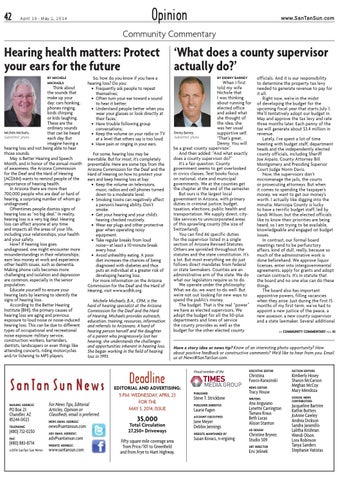
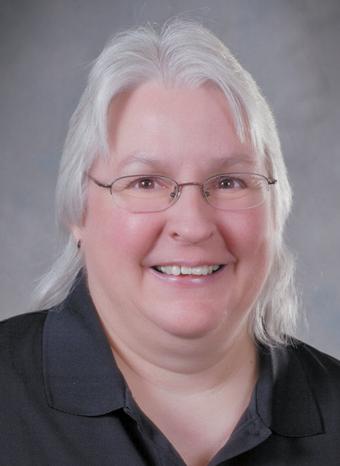
Michele Michaels. Submitted photo
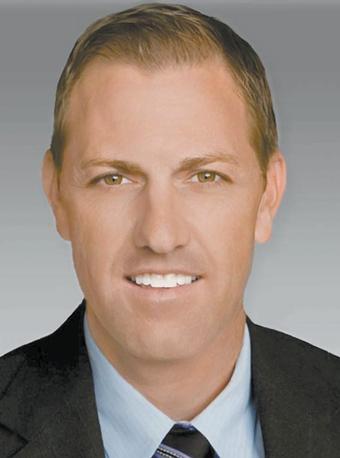
Denny Barney. Submitted photo
vacancies are bound to come up in the next few months. These are invariably difficult choices. Many times, several candidates are equally qualified. But these appointments, along with those to county boards and commissions, help set public policy and keep the government close to the people.
Frankly, I didn’t know what I was getting into. Something new comes up every day. I can’t do everything. But I take comfort and inspiration from the words of the great philosopher Edmund Burke: “No one could make a greater mistake than he who did nothing because he could do only a little.”
In the grand scheme, we may do only a little. But it takes a lot of work.
Denny Barney is a Gilbert resident and chairman of the Maricopa County Board of Supervisors.
Share with youth dangers of alcohol abuse
BY BECKY JACKSON
April is Alcohol Awareness Month and ICAN is partnering with two East Valley organizations to help spread the word about alcohol and its dangers. Alcohol use by youth is directly associated with traffic fatalities, violence, suicide, educational failure, alcohol overdose, unsafe sex and other problem behaviors. Annually, more than 6,500 people younger than the age of 21 die from alcoholrelated accidents and thousands more are injured.
ICAN founded the Chandler Coalition on Youth Substance Abuse (CCYSA) in 2006 and continues to grow this critical program. CCYSA addresses the issue of youth alcohol abuse through programs that include peer leadership, social marketing, community outreach and political advocacy. Teens also
Share your opinion with SanTan Sun News!
participate in programs such as “party patrol” where CCYSA youth provide Chandler Police with information about upcoming parties where they suspect alcohol and drug use will be present.
During the timeframe of April through June, there is a rise in alcohol-related traffic fatalities and incidents due to prom and graduation season. ICAN and CCYSA are partnering with Tempe Coalition and Mesa Prevention Alliance to combine resources to be more effective and far-reaching with their messages and prevention efforts.
The National Council on Alcoholism and Drug Dependence released some frightening statistics for Alcohol Awareness Month:
• Each day, 7,000 kids in the United States under the age of 16 take their first drink.
• Those who begin drinking before age 15 are four times more likely to develop alcoholism than those who begin at age 21.
• More than 1,700 college students in the U.S. are killed each year—about 4.65 a day—as a result of alcoholrelated injuries.
• 25 percent of U.S. children are exposed to alcohol-use disorders in their family.
• Underage alcohol use costs the nation an estimated $62 billion annually.
The promise of a healthy future for the youth in the East Valley and across the world requires reducing underage drinking through cooperative efforts from parents, schools, community organizations, business leaders and government agencies. Chandler’s CCYSA, Tempe Coalition and Mesa Prevention Alliance are taking the first step to work in tandem to address this social issue. Please help us spread the word about the staggering statistics of alcohol abuse among our youth and talk to your kids about the serious implications of alcohol use. Learn more at www.ccysachandler.org and www. ncadd.org.
Becky Jackson is the president and CEO of ICAN Chandler—Positive Programs for Youth, which operates the Chandler Coalition on Youth Substance Abuse.
We know you have an opinion! Share it with the SanTan Sun News. Unless you’re the mayor, however, please keep your Letters to the editor around 200-300 words, or they may be edited for length. Include your first and last name, community or development name in Southern Chandler (Cooper Commons, Ocotillo, Sun Groves, etc.) or ZIP code and daytime phone number for verification. Anonymous letters are not typically accepted. Email is the preferred submission method, to Letters@SanTanSun.com. All submitted Letters to the Editor and Community Commentaries become the property of the SanTan Sun News and may be reprinted in part, quoting the letters’ authors, or in their entirety. Your submission to the SanTan Sun News is considered your permission to print your written opinion. Opinions expressed in Community Commentaries, Letters to the Editor or cartoons are those of the author, and not that of the SanTan Sun News.

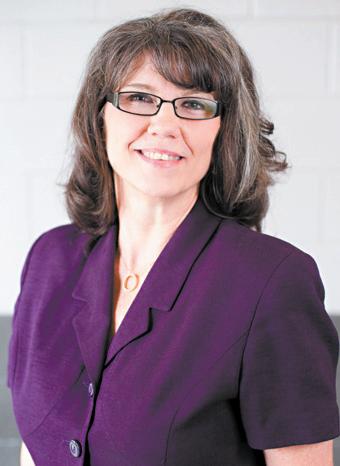
Becky Jackson. Submitted photo