Chandler budget process a thoughtful one Financing County is a real challenge
BY MAYOR JAY TIBSHRAENY
On June 11, the City Council is scheduled to vote on the final adoption of the 2015/2016 Fiscal Year Budget and Capital Improvement Plan. While this plan contains no increases in City property or sales tax rates, we remain guarded in our forecast. At the same time, I am optimistic that our community continues to move in a positive direction. Chandler is, as this year’s theme so aptly projects, the place to be!
Chandler’s solid financial foundation is the product of more than two decades of sound financial planning. Policies that have been strictly adhered to by those you have entrusted with your hard-earned tax dollars.
annual Neighborhood Excellence award winners and I launched my Teen Leadership Academy in March.
We welcomed many new businesses to Chandler including the General Motors Innovation Center on the Price Corridor. Others expanded their presence like Garmin and Intel, both opening new research and development centers in West Chandler. The business community continues to find Chandler as an attractive place to locate and grow.
The 2015-2016 budget shows a slight increase from the prior year, and we again are able to fund road projects, build parks, and maintain basic services and infrastructure. I remain confident that we continue to move in a positive direction in terms of our fiscal sustainability and economic growth.
We celebrated many successes over the past year. We opened Valencia and Centennial parks, and constructed a new fire station to help us more quickly respond in times of emergency. We continue to construct and widen roads in South Chandler, aggressively maintain and improve others, and have undertaken some critical new utility projects.
We continued to focus on neighborhoods and celebrate residents. My Listening Tour continues, and seems to grow in popularity with each stop. In February we announced our second
Thanks to our management team and budget staff for their dedicated work to prepare a prudent, sensible plan. This financial roadmap is the product of a long and transparent process—and many hours of work on the part of our City staff, the City Council, and you, the residents of Chandler. Through public meetings, surveys and our popular Budget Connect online forum, we have developed a comprehensive fiscal blueprint that this community can take great pride in. All reasons why we have been able to maintain AAA bond ratings from all three rating agencies.
Thanks to my fellow city councilmembers. They remain, as do I, committed to an unparalleled quality of life for our City and residents. We live in a tremendous community. One we confidently call the “Place to Be!”
Mayor Jay Tibshraeny can be reached at jay.tibshraeny@chandleraz.gov or via Twitter at www.twitter.com/ jaytibshraeny.
Share your opinion with SanTan Sun News!
We know you have an opinion! Share it with the SanTan Sun News. Please keep your Letters to the Editor around 200-300 words, or they may be edited for length. Include your first and last name, community or development
name in Southern Chandler (Cooper Commons, Ocotillo, Sun Groves, etc.) or ZIP code and daytime phone number for verification. Anonymous letters are not typically accepted. Email is the preferred submission method, to Letters@
BY DENNY BARNEY
You might have heard the Board of Supervisors recently passed a $2.2 billion budget for the new fiscal year. It was a unanimous vote. But it was not easy.
As an administrative arm of the state, the county implements state laws and provides mandated services. As such, much of the county’s fortune is tied directly to the states. And Arizona’s budget was in a crisis earlier this year. Facing a $1 billion budget deficit, Gov. Ducey and state legislators fashioned a budget that required many groups, including the county, to share in the pain. In fact, the lawmakers approved a state budget that shifted some $32.2 million in state costs to Maricopa County alone. Coupled with year-overyear state-imposed transfers and cost shifts totaling over $269 million since 2008, this is a difficult challenge. And it’s getting harder.
In addition, several judgment orders at the Maricopa County sheriff office have proven costly. The Melendres judgment alone will cost an estimated $23.8 million in the 2016 budget on top of $28 million already spent. And the Durango Jail is in such disrepair, we must replace it. We have no other option.

When you factor in rising criminal justice costs, increasing caseloads and public demands, then mix in sluggish revenue growth in both sales and property taxes, our county administrators and elected officials are being asked to perform minor miracles.
You may have read about child dependency cases arising from parental abuse and neglect. In fact, Maricopa County Superior Court is facing dependency caseloads almost three times what they were in 2007. Additionally, Superior Court has an increasing percentage of active cases pending trial and a lower percentage of completed trials. Capital trials as well are on a steady incline. And when the courts are backed up, defendants spend more time in jail—at $85.49 a day. It would be cheaper to put them up in a hotel. Another growing cost: Health service for the inmates, specifically, pharmaceutical costs.
SanTanSun.com.
All submitted Letters to the Editor and Community Commentaries become the property of the SanTan Sun News and may be reprinted in part, quoting the letters’ authors, or in their entirety. Your submission to the SanTan Sun News is considered your permission to print your
And yet, we approved a $2.2 billion total budget, barely $12.4 million over last year’s. Only seven county departments saw increases over last year, and all the significant increases were public safety related—adult probation, juvenile probation, sheriff’s office, county attorney and superior court. In contrast, 40 department budgets remained flat or reduced their overall spending. We also made technology investments, which will ultimately save on personnel costs and increase efficiency.
Ten departments submitted zero-based budgets this year, an initiative I started last year as chairman, following the good results ZBB had produced in Gilbert. This is fiscally prudent and allows us to keep a pulse on incremental increases in spending. It is said that a budget, any budget, public or private, is the ultimate policy tool. The county budget, like your family budget, reflects priorities. At Maricopa County, our priorities are clear: Public safety joined with fiscal prudence driven by mandates. Also key is bringing business principles to government, improving efficiency and reducing regulation where possible while increasing customer service. I don’t expect future budget years to get easier. However, I do feel confident that as a county we are making many of the tough decisions today that will prove wise in the future.
Denny Barney is Maricopa County supervisor for District One.
written opinion. Opinions expressed in Community Commentaries, Letters to the Editor or cartoons are those of the author, and not that of the SanTan Sun News.
Have a story idea or news tip? Know of an interesting photo opportunity? How about positive feedback or constructive comments? We’d like to hear from you. Email us at News@SanTanSun.com.
Deadline

website address: www.santansun.com

Editorial and Advertising
5 p.m. Thursday, June 11, 2015 for the Saturday, June 20, 2015, issue 35,000
Total Circulation 27,250+ Driveways
Fifty square mile coverage area from Price/101 to Greenfield and from Frye to Hunt Highway.
executive editor Christina Fuoco-Karasinski
associate editors
Ken Abramczyk
Michele Sonkin
writers Sydney Bowen
Lynette Carrington
Tracy House
Alison Stanton
section editor
school contributors
JoAnne Cawley
Amy Fricke
ad
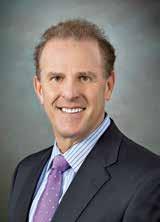
Denny Barney. Submitted photo
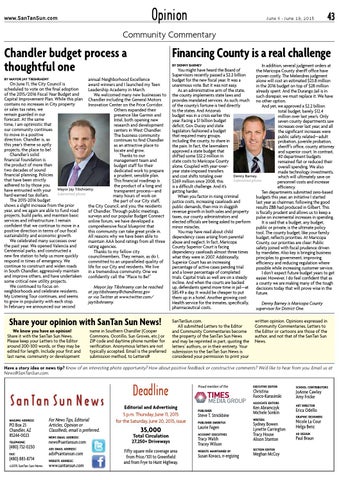
Mayor Jay Tibshraeny. Submitted photo
Community Commentary Letter to the Editor
Real skills for real jobs
Here at ICAN, we have been focusing on youth for over 25 years. We provide a safe, free place for youth to come after school and provide them with real life skills and decision-making tools.
We work passionately to ensure that they all graduate from high school. But what happens after that? Off they go into “real life” and we hope for the best. This will not be the case anymore. ICAN is entering into a partnership with the Chandler Compadres to create the ICAN Start Working program.
Does this mean more college scholarships? Not necessarily. College is a wonderful option for many youth and we are so happy for those who choose to go that route. But for even more youth that we work with, college is not a viable option. They would be on their own financially; facing mounting student loan debt just to make it through. So often we see that middle-skill jobs are quickly overlooked as a viable option for many.
According to a recent series by USA Today, an estimated 2.5 million new, middle-skill jobs are expected to be added to the workforce by 2017—accounting for nearly 40 percent of all job growth. These jobs require some training, but far less schooling than a bachelor’s degree. These middle-skill jobs include radiation therapists, elevator installers and repairers, and dental hygienists, all with a median wage of more than $70,000 per year.
The abundance of these jobs is great—but nearly 80 percent of the new blue-collar jobs require some training, typically less than a year. That is where ICAN’s new program comes along. Our program will identify students for the program (starting as early as junior high school) and work with them on what it is they want to do—whether it be learning a trade or attending community college or university. We will then sponsor that student to be trained through partners such as TechShop Chandler, or attend a Maricopa Community College. The students will then be placed in internships and apprenticeships that will hopefully lead to full-time work. If ICAN invests $800 for a student to be trained as an apprentice welder, they have the opportunity to make $48,000 when they work full time—that’s a pretty good return on investment.
So what can you do to help? Maybe you or someone you know has a business that employs skilled workers. We hope that you would consider working with ICAN to provide opportunities for interns or apprentices at your place of business. Maybe you know a high school student or recent graduate who would be a great fit in this program. We are kicking things off this upcoming school year and look to the community for support and encouragement with this exciting program that will surely impact us all.
Voucher system is the answer to investing in schools
I read both the opinion pieces on spending and education, on May 2 and May 16. The two writers agree with each other that the answer to everything that is wrong with the world is giving more money to government. That includes taxes which go to public schools, regardless of what the taxpayers think of said schools.
I have always thought of investing my money in anything as a voluntary action. Government confiscating it and doing with it as it will does not constitute an investment, nor is there any measurable return on that money from my perspective. The fact that charter schools, religious schools, private schools and homeschooling are all becoming wildly more popular by the year tells me there are some people out there who agree with me.
paths and occupations. Many women go into fields that do not pay as well as the fields many men go into. Shocker! Also, women with children tend to not wish to work 80 hours per week and never see those children, but men are often willing to work longer and harder and sacrifice more of a home life than women are. It’s generally more of a function of the differences between men and women than any intentional squashing of women’s wages. Yes, I know that people are taught in college now that there aren’t any, and that Larry Summers got fired from Harvard for admitting there are. I still don’t get why this has anything to do with giving government more money to waste.
Arizona has one of the top 10 metro areas expected to create the most middleskill jobs by 2017. Between 2010 and 2020, 52 percent of the job openings in Arizona will be middle-skill. According to the National Skills Coalition, middle-skill jobs account for 53 percent of Arizona’s labor market, but only 47 percent of the state’s workers are trained for these jobs. The gap is widening as more and more baby boomers, who make up about 20 percent of this workforce, retire. Our society’s push to get all young people into four-year colleges (also known as the “one road to heaven” approach) contributes to a nationwide shortage of skilled workers.
If you would like to participate in some way with ICAN Start Working, please contact Melissa Jimro, chief programs officer at (480) 874-7591 or melissa@icanaz. org for more information.
I am very encouraged by the response from our community, donors and academia to make ICAN Start Working a fundamental program to assist our youth in being responsible members of our community, no matter what path they decide to take.
For more information, visit www.icanaz. org, read the full article from USA Today or visit the National Skills Coalition.
Becky Jackson is president and CEO of ICAN: Positive Programs for Youth.

Arizona is fortunate to have either the largest number or nearly the largest number of charter schools. I know that really rubs the public school apologists the wrong way, but it is a good start to taking back some of our power when it comes to using taxes for education. If the writers of the pieces had their way, there would be no choice but public/government schools. As it is, because we don’t have a voucher system, we also don’t have the ability to take our tax dollars with us to the school of our choosing. It is a step in the right direction to fund charter schools along with government schools, and parents can decide which suits their children better. I won’t be happy though, until the tax dollars go with the student to whatever school his or her parents choose—and that includes religious schools. And don’t bother with the “separation of church and state” nonsense. It does not apply here. The fact that parents would take their own hard-earned money and put it into their children’s education in any school they wish does not mean the state is establishing a religion. It would be allowing parents the freedom to practice theirs.
I can’t quite make the connection that Ms. Bivins makes, that somehow men and women making different wages are connected to not throwing more money at public schools. First of all, if you delve into the details of the so-called “wage inequality,” you will find that men and women tend to choose different career
As for the classroom in a double-wide trailer, I’m not sure why that is such a disaster. My daughter went to Catholic school with no air conditioning for several years until the school raised enough to put it in. It was certainly uncomfortable but the reality is that schools do have budgets and have to live within them. Have you seen the Taj Mahals they build these days? Hamilton High School, for instance? Is all that really necessary for students to learn to read, write, do math, and learn history and science? The problem, as I have said, is that the schools can do whatever they like with the tax money they get because they are going to get it no matter what. For public school advocates there is never any other issue but money. Give them more and they will do better at educating students. Trouble is, that equation doesn’t seem to hold true. Spending more does not necessarily equal better education. And it doesn’t allow the marketplace to impact the outcomes. Charter schools are a good start, but vouchers would be the real solution. The fact that public schools advocates hate that idea should tell you all you need to know. This is my third letter on this topic and I don’t believe, from the responses I saw, that anyone who supports public schools regardless of their performance read any of them. One last time: Giving more money to government with no control as to how it is disbursed is never a good idea. Never.
Jan Pfahl Chandler

SARA KOEHN
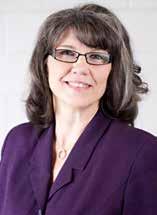
Becky Jackson. Submitted photo