
Smart justice is in county’s future
BY DENNY BARNEY
Policymakers across the nation are reexamining criminal justice, searching for a more effective—and cost effective—way to improve what has been a revolving door of crime, incarceration, recidivism and despair.
I was pleased to hear the Town of Gilbert and City of Chandler opened a united holding facility last December. Having their officers drive misdemeanor suspects down to the county intake facility to then turn around and transport them back to court in Chandler or Gilbert the next day didn’t make sense. Prisoners who need to be held for more than 24 hours are still booked in one of our county jails, but having the short-term holding facility keeps police officers in their community and reduces costs to citizens. This innovative solution by public safety employees is to be commended.
So, too, is the reform effort underway in Maricopa County. Public safety comprises more than 50 percent of the county’s budget, about $1 billion in all.
less overcrowded. And the overall burden on the county budget and our taxpayers will be much smaller.
We recently completed a six-month evaluation of “Thinking for a Change” (T4C), a 25-lesson plan, developed by the National Institute of Corrections, designed to change the patterns of thinking that get these repeat offenders into so much trouble. The theory is simple. The way you think leads to the way you act. Actions become behavior. If you change the thinking, you change the behavior. We are using T4C in our jails and for our probationers. But we are targeting high risk, repeat offenders. Why? They are the most likely to reoffend and commit more crimes. Improve their behavior, you make a larger dent in crime. Simple.
The Maricopa County Sheriff’s Office, superior court, adult and juvenile probation, the county attorney, public defender and Correctional Health are each heavily invested. Our departments, along with our county Justice System Planning and Information (JSPI) group, have partnered with Mercy Maricopa Integrated Care and several nonprofit providers on several promising research and evidence-based initiatives.
I am a stickler for data. I want to know how many individuals are in our jails on an average day (7,900). And what is the average length of stay (27.8 days). And how much does it cost to book an inmate ($286). And what it costs to keep an inmate in jail each day ($85.49).
If we can reduce recidivism among the higher-risk offenders, turn them toward more productive lives, then our communities will be that much safer, our jails and prisons
Our study found that T4C participants are significantly less likely to recidivate in a six-month time frame. And those who do reoffend, take longer to return to jail than non-participants who also recidivate. T4C participants also have fewer jail disciplinary incidents. Researchers estimate that just in the first wave of T4C participants, some 423 jail bed days have been saved.
Other interesting initiatives include the use of “Peer Navigators” to assist recently released seriously mentally ill inmates get acclimated back in their communities and connect with health services. Preliminary evaluations show greatly reduced recidivism among the mentally ill who received a referral to this program. Other programs include promising new policies in classifying inmates inside the jail system, which could reduce jail incidents and focus programming to the higher risk inmates.
The results are tentative but clearly positive. We’re headed in the right direction.
Denny Barney is a Gilbert resident and a member of the Maricopa County Board of Supervisors.
Share your opinion with SanTan Sun News!
We know you have an opinion! Share it with the SanTan Sun News. Please keep your Letters to the Editor around 200-300 words, or they may be edited for length. Include your first and last name, community or development
name in Southern Chandler (Cooper Commons, Ocotillo, Sun Groves, etc.) or ZIP code and daytime phone number for verification. Anonymous letters are not typically accepted. Email is the preferred submission method, to Letters@
State, local economy depends on strong transportation system
BY COUNCILMAN JACK SELLERS
Our state’s economy relies heavily on a safe and efficient transportation system. Without it, Arizona would not be able to attract many of the high-quality employers that call us home. A reliable system allows communities and businesses to compete, create jobs and prosper through the movement of people and goods in a timely, cost-effective manner.
As the chairman of the Maricopa Association of Governments’ (MAG) Transportation Policy Committee, I am involved in the 20-year Regional Transportation Plan, along with providing guidance in the region’s transportation planning. This committee regularly reviews the transportation plan and identifies recommendations related to programs and funding sources.
and connecting us to destinations. It’s important that the state highways and freeways are maintained and developed according to the increase of population and workforce.
The 20-year Regional Transportation Plan includes improvements to freeways and highways, regional transit, streets and other programs such as bicycle projects and pedestrian facilities. It outlines transportation investments, including safeguards to ensure projects are completed on time and within budget. Through this plan, an estimated 10,600 jobs are being created and benefit industries in construction, transportation, communications and public utilities. Businesses are attracted, retained or expand along transportation corridors, leading to further job growth in our communities.
Transportation programs are important factors in the success of everyone’s daily lives, ranging from a safe commute to supporting commerce
SanTanSun.com.
Locally, Chandler residents are served by the Maricopa Freeway, Superstition, Price Freeway and Santan freeways, and State Route 87 (Arizona Avenue). The travel demands between the East Valley and Central Phoenix are increasing. Due to this rise, the design and construction of the South Mountain Freeway, the final leg of the Loop 202, is being bid. This would assist with traffic flow on other freeways and decrease travel time across the region. It’s equally important that our city streets and transportation programs are also properly maintained, while meeting our economic needs. Staff uses socioeconomic data to determine existing and future travel demands. This information assists in structuring the transportation system to serve and promote land use patterns identified in Chandler’s General Plan.
Bus rapid transit and light rail programs are available to commuters. Valley Metro operates 365 days a year and offers several bus routes throughout the Valley as well as connections to the light rail system. Although light rail isn’t available in Chandler, there is discussion to extend light rail south on Arizona Avenue from the City of Mesa’s current expansion project. The Fiesta-Downtown Chandler Transit Study began in early 2015 and will be complete by late 2016. This
All submitted Letters to the Editor and Community Commentaries become the property of the SanTan Sun News and may be reprinted in part, quoting the letters’ authors, or in their entirety. Your submission to the SanTan Sun News is considered your permission to print your written opinion. Opinions expressed in Community Commentaries, Letters to the Editor or cartoons are those of the author, and not that of the SanTan Sun News.
Have a story idea or news tip? Know of an interesting photo opportunity? How about positive feedback or constructive comments? We’d like to hear from you. Email us at News@SanTanSun.com.
Deadline

www.santansun.com

EDITORIAL & ADVERTISING:
5 P.M. THURSDAY, MAY 28, FOR THE SATURDAY, JUNE 6, ISSUE
35,000
Total Circulation 27,250+ Driveways
Fifty square mile coverage area from Price/101 to Greenfield and from Frye to Hunt Highway.
Proud member of the
PUBLISHER
Steve T. Strickbine
PUBLISHER EMERITUS
Laurie Fagen
ACCOUNT EXECUTIVES
Tracy Walsh
Tracey Wilson
WEBSITE MAINTAINED BY Susan Kovacs, n-ergizing
Abramczyk Curt Blakeney
WRITERS
Sydney Bowen
Lynette Carrington
Alison Stanton
SECTION EDITOR
Meghan McCoy
Denny Barney. Submitted photo
Jack Sellers. Submitted photo
Community Commentary
Price Road Corridor Project: Power, politics and profit
BY JANE AND AL ANDERSEN
Why is it that power, politics and profit always seem to be linked together? Well, what a difference a day makes with the Price Road Corridor 230kV Project, a plan created to supposedly meet the “anticipated” growth in the electric demand in the area of Chandler known as the Price Road Corridor (PRC).
In the past two and a half years, we’ve heard that the power need for the Price Road Corridor (a 5-square-mile area in South Chandler) is anticipated to triple during the next 20 years. We’ve heard that the PRC is exploding with growth and these large employers, like Intel, need the power, immediately. We’ve heard that Schrader Substation “must” be connected to RS-28 (yet to be built) because of the need in redundancy in the system.
So how much power does Price Road Corridor need to manage all this growth, reliability and redundancy?
The amount of power SRP claims Price Road Corridor needs is 1,100 megawatts or 1.1 billion watts. Enough power to run more than 150 million square feet of office building space or provide power to every single household in Maricopa County. Now that’s a lot of power, SRP!
the purpose of which is to consolidate ownership of fractionated lands.
According to Mendoza, “Our reservation is one of the most fractionated in the country, but is uniquely positioned to use the program to advance tribal energy and economic development opportunities that will benefit our entire Community.
The Gila River Indian Community (GRIC) is looking forward to participating in the Land Buyback Program.”
The Community will have access to $60 million in program funds to purchase fractionated interests. Under the Memorandum of Agreement, the Community will dedicate a portion of this funding toward the purchase of allottee interests in lands affected by SRP’s proposed utility corridor in District 4. (PRC/SRP’s 230kB Project). Program funds will also be used to purchase lands from Community members in other districts who have applied to sell their interest under the Community’s land consolidation.
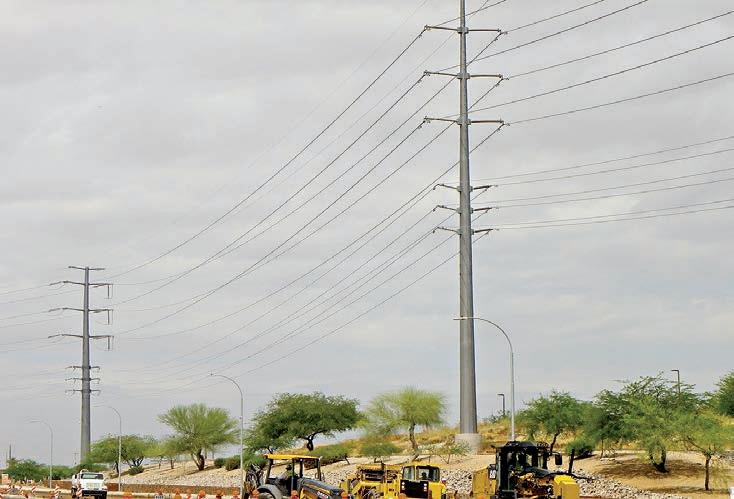
Fast forward to May 8. Just hours before SRP was supposed to seek approval from the Arizona Corporation Commission (ACC) for its Price Road Corridor 230kV Transmission Line Project, the project was temporarily suspended. This temporary suspension was due to a vote from the Gila River Indian Community Council (GRIC) that rejected the right-of-way consent its lands, according to John Coggins, SRP’s senior director of system operations.
So what does all this mean? What are the residents of South Chandler and Sun Lakes to think about all this? What is the City of Chandler and Maricopa County and their residents to think? Will SRP continue to try to work with the GRIC, GRICUA, BIA, District 4 Council and the allottees? Or will SRP just decide to do a reversal and put the 230kV lines and 160foot poles on private land—and go back to their alternative routes? Keep your eyes wide open on this one!
What we do know is that on May 29, 2014, Gov. Gregory Mendoza and the Deputy Secretary for the U.S. Department of the Interior, Michael Connor, announced a memorandum of agreement between the Community and the Department of the Interior to facilitate the purchase of individual interests in fractionated trust lands located within the reservation. The agreement was a part of the nationwide Land Buy-Back Program for Tribal Nations,
to provide the above benefits at a far less cost than if GRICUA were to build these electrical connections on its own.
According to GRIC records, the Government and Management Standing committee of GRIC (G&MSC) motioned to Community Council for discussion and possible action regarding a request to remove the section regarding districts 6 and 7 on page 11 of the resolution approving and authorizing the negotiation of a final agreement based on the term sheet between the Gila River Indian Community and the Salt River Agricultural Improvement and Power District for a 100-year term as well as approve the easement between the community and SRP for the Price Road Corridor Transmission Line. Is this a “fly in the ointment?” Could this have something to do with why SRP temporarily suspended the project?
According to Gov. Mendoza, “This federal money will help address the problem of fractionated lands on our reservation but it is only a start and $60 million is not enough to buy all these interests. Council has decided to dedicate much of these federal funds to facilitate the Price Road utility corridor.”
The benefits to the Gila River Indian Community Utility Authority (GRICUA), the Community, and members are numerous:
• The 230kV structures could be built to accommodate additional GRICUA lower voltage lines that could serve substations in District 4 and the Community.
• The ability to underbuild GRICUA lines on the SRP towers could allow GRICUA to increase its reliability, reduce blackouts and expand service on the Reservation.
• Partnering with SRP will allow GRICUA
• An expanded GRICUA system could also provide the power infrastructure to allow the Community and allottees to expand commercial development in the future along Route 101, Route 202 and at the Memorial Airfield Site.
• Allotted landowners would receive monetary compensation either from the program (if they decided to sell their interests) or the right of way across their land (if they decided to retain ownership of their interests).
• Allows for a potential GRIC-owned solar generating plant on community lands.
According to this article submitted by the executive office (GRIC), on May 6, 2014, power demand is anticipated to triple in the Price Road corridor within the next 20 years due to economic growth. They are saying the same thing that SRP is saying! Does our mayor and his economic development office know this?
Triple growth in the next 20 years? In a 5-square-mile area? I guess everything will be going up.
Gov. Mendoza goes on to say, “I will continue to work with council to seek additional federal funding as well as find Community funds to add to our own land consolidated program. Because one third of our reservation is allotted, $60 million is a great start but it does not come close to addressing all the fractionated lands in the Community.”
Power, politics, profits! Follow the money
Is money the reason for the temporary suspension of the Price Road Corridor Project? Does GRIC want more money for the right of way, a better deal, more concessions? The stakes could get higher for SRP and the City of Chandler.
So, let’s ask what it would cost SRP to bury approximately 3 miles of highvoltage transmission lines and poles along the railroad track easement, going south from Schrader Substation to the GRIC boundary below Hunt Highway. The new technology out there now is impressive, especially using XLPE cables. Because the railroad stretch from Schrader south to the GRIC boundary already has an
easement, the costs associated with burying this stretch could be minimized. According to previous feasibility studies, the estimated cost for constructing underground transmission lines ranges from four to 14 times more expensive than overhead lines of the same voltage and same distance. These costs are typically absorbed by the utilities. The costs are included in the utilities’ rate base. But, regulatory agencies, (ACC) are modifying their approach on this...as they are looking at who would benefit from the power. SRP has said that it would not be fair to have their over 1 million customers pay for burying the transmission lines as the power would only benefit a small group of residents and businesses. (We’re talking less than $40 per customer, or $3.33 per month per customer for one year...total.) If PRC is supposed to triple in size in the next 20 years, and the GRIC community is going to receive all these special benefits from giving a right of way on their lands, then how is this considered a small group of residents? How many people truly will benefit?
What does the City of Chandler have to gain from allowing SRP to construct 230kV high-voltage lines and poles through a residential community above ground? It seems unconscionable to allow SRP to put these monolithic poles emitting harmful EMFs, not to mention a devastating loss in property values, next to new home communities, beautiful residential custom home communities and small businesses trying to thrive. Why would the mayor, the City Council, and local leadership not speak up to change the design and engineering standards set forth when Fulton Homes (Reserve at Fulton Ranch) asked for an area plan amendment to rezone Southshore Area Plan from mixed-use project to single-family residential/ medium density in May 2011?
It looks like not only the residents and businesses of the Price Road Corridor stand to benefit from the additional generated power, but, also South Chandler, parts of Maricopa and Pinal counties, and the entire GRIC community. If SRP doesn’t want to absorb the cost of burying the lines on this 3-mile stretch
Jane and Al Andersen. Submitted photo
of railroad tracks, then perhaps the City of Chandler should simply change the ordinance in the City plan, making it illegal to construct above-ground highvoltage transmission lines—anything over 69kV in its urban, residential and suburban areas. We’re not sure how difficult it is to change a planning and zoning ordinance, but, it couldn’t be as problematic and costly as fighting SRP. Our City leaders were elected to protect and serve our community. Now is the time to stand up and protect our community from high-voltage power lines and poles, Mr. Mayor. What’s the cost associated with our health, our property values, our children’s future, our community lifestyle, and our ability to attract more businesses because of Chandler’s aesthetic beauty? Priceless! Our City leaders, our mayor, our local and state representatives have all known
about the SRP/PRC 230kV Project since 2011. What have they done to stop the above-ground transmission lines from invading our city? They wrote a few letters to five people on the ACC in the 11th hour, last week. That’s not what we call “leadership!” Leadership involves standing up for what is right and showing the way! Leadership involves breaking down barriers, overcoming obstacles, speaking truth so that people want to follow and join together on purpose! Come on Chandler...we can do better. The time is now...let’s pull our community together, fill the leadership void and get to work! Bury the lines!
Jane and Al Andersen have been residents of Chandler since 2004. They can be reached at (602) 684-9300 or info@thegolfrealtynetwork.com.
Letter to the Editor

Save money; Eliminate some extracurricular activities
Investing in public education in Arizona or any other state isn’t just throwing more dollars at it and see if it sticks is the inference of the article.
(SanTan Sun News, May 2)
I, as a taxpayer, expect my elected representatives and school administrations to perpetually monitor cost of education dollars with academics the priority over extracurricular activities offered. If budgetary constraints are ongoing issues, extracurricular activities offered
in the curriculum should be the first to be eliminated (or deciding which ones on a cost basis). Public school teacher tenure is another issue I expect my elected representatives to monitor for results of the children’s academic achievements along with parental and child responsibility. I am not in favor of just throwing more dollars at education and everything will be rosy forever.
Dennis Riswold Chandler

ECONOMY FROM PAGE 39
study will review future high-capacity transit along Arizona Avenue.
Transportation improvements are funded by Prop 400, which is a half-cent sales tax creating revenue that must be used on projects and programs identified in the Regional Transportation Plan, adopted by the MAG. Funds from Prop 400 will soon come to an end. There has been discussion in Congress about possibly raising the federal fuel tax by 10 cents, which could cost the average commuter approximately $5 a month. Without
future funding, transportation programs will not be able to meet the demands of economic growth. And that would not bode well for Chandler or the region.
For information on the City’s ongoing transportation efforts, visit www. chanderaz.gov/transportation; and visit www.mag.gov for information on our regional transportation efforts.
Jack Sellers can be reached at jack. sellers@chandleraz.gov. Tweet him at @ jacksellers.
Letter to the Editor
Compliments to contributor on opinion piece
This letter is to thank wholeheartedly one of your recent contributors, Elicia Bivins (SanTan Sun News, May 2). Her opinion piece, titled “Invest in education and brighten Arizona’s future, was insightful and well-written”. She has obviously done her homework in citing the facts about Gov. Ducey’s budget and how his and the Republican Legislature’s actions are working against our students and our state’s better interests.
As a parent to two children attending school in Chandler, I was gravely concerned with how aggressively the funds for schools were being attacked. My son’s classroom is housed inside a double-wide trailer, and there is little money for improvements for the schools, much less educational field trips or materials for individual teachers. To think that the public school system can be used as a piggy bank from which to steal tax breaks for multimillion dollar earning companies like Intel and Apple is saddening.
For those who feel deceived by Ducey’s actions, Bivins points out truthfully that this should come as no surprise. Ducey is a businessman. He is not working for the people, the
taxpayers or the students; he works on behalf of the corporations. Many thanks, Ms. Bivins, for your insight and your strong fact-based argument outlining the problems our state faces in light of these cutbacks. I encourage your readers to review Bivins’ piece and to use this as a base by which to become more informed and involved in our community and our educational system. It is our job as Chandler and Arizona taxpayers to contribute—give back— to our children for the purpose of their education and preparation for life. Thank you Ms. Bivins, and thank you SanTan Sun for publishing this informative and powerful article.
As my own personal statement, I suggest that in future elections, remember Gov. Ducey and what he is doing to our schools. Consider a vote against CEOs and those candidates who claim they are going to “reform” our educational system; this reform rarely works to benefit the students.
Sheila Myers Carino Estates Chandler