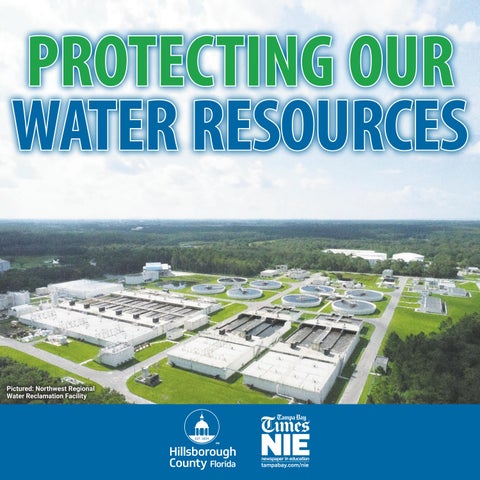
PROTECTING OUR WATER RESOURCES


Pictured: Northwest Regional Water Reclamation Facility
Hillsborough County Water Resources by the Numbers
Monitors and repairs 6,500+ miles of pipeline

Over 73 million gallons of drinking water delivered to 725,360 people
5 major wastewater treatment plants
1
1 biosolids facility environmental laboratory
4 major water plants
880 sewage lift stations
24.16 million gallons of reclaimed water delivered to 29,016 residential and commercial customers each day
47 million gallons of wastewater treated every day

Hillsborough County Water Resources provides more than 73 million gallons per day of drinking water to more than 725,000 people and treats about 47 million gallons of wastewater per day. In addition, approximately 28 million gallons per day of reclaimed water are delivered to more than 29,000 residential and commercial customers. Reclaimed water also is used in the Hillsborough Aquifer Recharge Program (HARP). HARP is a Hillsborough County initiative designed to strengthen and protect our groundwater. It works by injecting highly treated reclaimed water into underground aquifers. This creates a freshwater “barrier” that helps stop saltwater from creeping inland — a problem caused when too much water is pumped out of the aquifer.
The water cycle
The world’s water moves between lakes, rivers, oceans, the atmosphere and the land in an ongoing cycle called the water cycle. The water cycle describes how water evaporates from the surface of the Earth, rises into the atmosphere, cools and condenses into clouds, and falls again to the surface as precipitation.
Visit gpm.nasa.gov/education/ videos/water-cycle-animation to watch an animation of Earth’s water cycle.
What is potable water?
Potable water is water that is safe to drink. In Florida, our drinking water comes from the state’s systems of rivers, streams, wetlands, lakes, springs, aquifers and estuaries.
In the United States, the Environmental Protection Agency (EPA) sets national standards for drinking water quality. In Hillsborough County, you can find your water quality report by visiting HCFL.gov/ Water and clicking Water Quality.

What is wastewater?
Wastewater is water that has been used in a home or business, including water from sinks, showers, bathtubs, toilets, washing machines and dishwashers. Wastewater also is produced by industries such as agriculture, manufacturing and mining.
Wastewater contains pollutants such as human and animal waste, food scraps, oils, soaps and chemicals.
If wastewater is not properly treated, these pollutants can find their way into waterways and the aquifer, which can harm the environment, wildlife and human health.
What is reclaimed water?
Reclaimed water is highly treated wastewater that can be used for industrial processes and the irrigation of lawns, landscapes and golf courses.

Hillsborough County Water Resources offers educational presentations at no charge to schools, businesses, community groups and HOAs on the Don’t Flush It Program, Cooking Oil Recycling Effort (CORE) and more. Presentations can be adjusted depending on your group’s needs. Most presentations are 15-20 minutes in length.
Visit HCFL.gov/Core and click on Request a CORE presentation to schedule.


GOING BEYOND THE TEXT:
A day in the life of a water drop
The world’s water moves among lakes, rivers, oceans, the atmosphere and the land in an ongoing cycle called the water cycle. The sun rises, begins to heat the oceans, lakes and rivers. This heat provides energy for plants to give off water vapor through a process known as transpiration. That vapor rises into the atmosphere to form clouds, which can be moved by the wind over long distances. This eventually results in rain or snow. That precipitation infiltrates into the ground or runs off the land to return to the ocean.
Visit https://gpm.nasa.gov/education/videos/earths-watercycle to watch an animation of Earth’s water cycle. As a class, list the steps of the water cycle using this video and the graphic of the water cycle on this page. On a piece of paper, write down the steps of the water cycle. Describe each scientific term in the process. Next, using the cartoons in the Tampa Bay Times as models, create a cartoon strip depicting each step in the water cycle. This can be created on paper or digitally. Share your cartoon with your class.
Florida Standards: SC.68.N.1.1; SC.68.N.1.2; SC.68.N.1.3; SC.68.N.1.4; SC.68.N.3.1; SC.712.E.6.6; ELA.68.C.1.3; ELA.68.C.1.4; ELA.68.C.2.1; ELA.68.C.3.1; ELA.68.C.4.1; ELA.68.R.2.2; ELA.68.R.2.3; ELA.68.R.2.4; ELA.68.V.1.1; ELA.68.V.1.3; ELA.68.F.2.1; ELA.68.F.2.2; ELA.68.F.2.3; ELA.68.F.2.4
Throw it in the trash; don’t flush it!

The problem with ‘flushable’ wipes
Hillsborough County’s wastewater system plays a vital role in protecting public health and preserving the quality of life we enjoy. The system safeguards our streets, parks, lakes, rivers and streams from harmful pollutants and environmental hazards.
Many wipes are marketed as “flushable,” but the truth is they don’t break down like toilet paper. Most are made from synthetic fibers, man-made material often created using chemicals and petroleum byproducts. Microplastics are ultra-fine synthetic fibers. These materials do not disintegrate, or fall apart, in water. Instead,
they remain whole and, when combined with grease, can clog pipes and damage pumps.
These blockages can lead to severe backups and spills, which are not only messy but also pose serious risks to public health and the environment. These materials can bring your home plumbing system and county equipment to a halt, resulting in costly repairs. The solution is simple: never flush wipes; dispose of them in the trash.
Sewers and wastewater treatment systems are designed to handle human biological waste and toilet paper only. The only things that should be flushed down your toilet are the Three Ps: Pee, Poop and toilet Paper.
Microbes: the unsung heroes of wastewater treatment
Wastewater treatment is a process that cleans dirty water, known as wastewater, by removing harmful contaminants or impurities. Microorganisms, such as bacteria, algae, fungi and protozoa, play a crucial role in this process by breaking down human organic waste into harmless substances.
The wastewater treatment process
Primary treatment: Screening out large objects, sand and grit and settle-out solids. Wipes, grease and other items cause issues in the treatment process so they have to be removed first before the microorganisms can do their work.

Secondary treatment:
Where the magic happens. Microorganisms “eat” or break down the human waste or “food” in aeration tanks where air is added to help the bacteria grow.
Advanced treatment:
This is where filtering and disinfection remove nutrients and harmful bacteria.
Biosolids:
The leftover solids are treated and can be used as a nutrient-rich fertilizer.
Effluent:
Clear water that leaves the wastewater plant after treatment can be used as reclaimed water to water lawns, be returned to surface waters, or injected through underground wells to protect the aquifer and prevent saltwater intrusion.
Hillsborough County Recycle Guide: HCFL.gov/Recycling
Hillsborough County Household Hazardous Waste webpage: HCFL.gov/HHW
U.S. Food and Drug Administration Medication Disposal: FDA.gov/drugs/safe-disposal-medicines/disposal-unused-medicines-what-you-should-know
Resources for further learning...

Microbiology of wastewater treatment: EPA.gov/compliance/microbiology-wastewater-treatment
Wastewater treatment: EPA.gov/npdes/municipal-wastewater
Sanitary Sewer Overflows (SSOs): EPA.gov/npdes/sanitary-sewer-overflows-ssos
Domestic wastewater program: FloridaDep.gov/water/domestic-wastewater
Wastewater microorganisms in action: AWWA.org/ww-Micro-Online/
Above, An overview of Hillsborough County’s wastewater treatment plant. Right, a close-up of microbes hard at work treating wastewater.


Where to recycle your used cooking oil
Recycle your used cooking oil, fat and grease 24 hours a day, seven days a week at CORE collection stations throughout the county. Look for the freestanding cabinets with the Cooking Oil Recycling Effort identification.


• Visit HCFL.gov/CORE
• Email GotGrease@HCFL.gov

Residential Cooking Oil Recycling Effort (CORE)

Used cooking oil, fat and grease are a serious problem for home plumbing and Hillsborough County’s wastewater collection system. Cooking oil, fat and grease that is poured down the drain gels and solidifies inside pipes, sewage lines and sewage lift stations, constricting water flow. That can back up home plumbing and cause equipment to malfunction, leading to sewage spills, overflows onto streets, and foul odors in homes and neighborhoods.
Cooking oil DOs and DON’Ts
• DON’T put cooking oil or grease down the drain, even if you follow it with hot water or soap.
• DON’T flush cooking oil or grease down the toilet.
• DON’T put greasy foods down the garbage disposal.
• DO scrape leftover food into the trash before washing pots, pans and dishes.
• DO use a fine-mesh strainer in your sink to prevent debris from going down the drain.
• DO recycle used cooking oil, fat and grease! CORE knowledge
• DO clean out leftover foods from your sink and put it in the trash.
• Scan the QR code at left

• DON’T place used cooking oil in your blue recycle cart.
Help us protect the environment by recycling your used cooking oil!
All cooking oil, including frying oil and bacon and hamburger drippings, can cause problems in home plumbing and the sewage collection system. Here’s what to do:
1. Carefully pour cooled cooking oil into a large, sturdy plastic or glass food-grade container with a lid. Do not use containers that held petroleum products (such as motor oil).
2. Close the container and store in a cool, safe location.
3. D on’t mix the oil with any other liquids or products.
4. Once the container is full, bring it to a CORE station or to a Household Hazardous Waste Collection Center.
HCFL.gov/CORE
Quality control
Utilities Plant Supervisor Earl Lee talks
Embarking on a career with Hillsborough County Water Resources takes training, attention to detail and diligence. The professionals who work for the Water Resources department provide water quality control, maintenance, management, and engineering for water, wastewater and reclaimed water infrastructure.

Utilities Plant Supervisor Earl Lee has worked for the water resources department for the past 10 years. He knows a lot about water, and he loves his job. Lee says he learns something new every day, and he encourages others to pursue a career in water management.
“This is a field that’s not very known by a lot of people,” Lee says. He describes the job as being “recession proof.” He says this is a job a person can practice anywhere in the world with high salary potential.
about the process that makes our water free of impurities.
Lee and his team work at the Falkenburg Advanced Wastewater Treatment Plant in Tampa, which operates 24 hours a day. Each day, approximately 15 million gallons of wastewater are treated there.
“Water is an essential thing that we all need,” Lee says. In order to maintain the quality of water, there is a great deal of water testing that happens “from the beginning to the end,” he says. Every three hours, water samples are taken and tested for nitrogen, ammonia and phosphorus. Depending on the ratio, adjustments are made, often on an hourly basis.
Water quality changes throughout the wastewater treatment process and operators must be diligent to ensure that the plant is operating correctly. The microbes are sensitive to the materials/ water quality coming into the plant and there has to be a balance in the plant to
keep the microbes happy and doing their job properly.

Lee’s career path has taken some interesting turns. After high school graduation, Lee pursued a degree in culinary arts from Johnson & Wales University in Charlotte, North Carolina. After working at several different restaurants in South Carolina, Lee headed to Alaska to work for Princess Cruise Lines.
“Then I got bored,” Lee says. So, he decided to join the Marine Corps.
Reflecting on his stint in the Marines, Lee says he appreciates the structure of

the military and his experiences. While in the Marines, Lee was stationed in Japan; Washington, D.C.; Tampa and North Carolina. In addition to working in kitchens, he did a myriad of jobs in the military.
After nine years in the Marines, Lee started looking for a new job. Wanting to move to Florida to be closer to his family, Lee saw an online advertisement to be a wastewater operator trainee in Hillsborough County and thought his skills would be a good fit.
Having started his career processing food for people and now working with the already processed food has been an interesting journey. “Now I am on the back end of the process,” Lee laughs.
“The joke that I tell everyone is that I went from the beginning to the end now. Now I’m processing it after you’ve already processed it to make it usable water again.”
GOING BEYOND THE TEXT:
Water use at home
Complete this survey to estimate how much water is used in your home daily.
Average Use: Write the number of times you and your family members do each activity in one day. Then multiply the number for Water Used by the Number of Times the activity is done. This will give you the number for the Gallons Used column.
Calculated Use: Record the number of total minutes used for each activity. Then multiply the number for Water Used by the number of Total Minutes to find the number for the Gallons Used column. For an activity you didn’t do, place a 0 under Gallons Used. Add all the numbers under Gallons Used to find the Total Gallons.
Using the information you have calculated, create an advertorial
explaining to others why water conservation is important. Include tips for conserving water at home in the advertorial. Use examples of advertorials and advertisements in the Tampa Bay Times as models.
Source: Southwest Florida Water Management District
Florida Standards: SC.7.E.6.6; SC.68.N.1.1; SC.68.N.1.4; MA.6.AR.2.2; MA.6.NSO.4.2; MA.7.NSO.2.2; MA.8.NSO.1.5; ELA.68.C.1.3; ELA.68.C.1.4; ELA.68.C.2.1; ELA.68.C.3.1; ELA.68.C.4.1; ELA.68.R.2.2; ELA.68.R.2.3; ELA.68.R.2.4; ELA.68.V.1.1; ELA.68.V.1.3; ELA.68.F.2.1; ELA.68.F.2.2; ELA.68.F.2.3; ELA.68.F.2.4

Information about PFAS and Hillsborough County’s drinking water
PFAS is an acronym for per- and polyfluoroalkyl substances. According to the United States Environmental Protection Agency, PFAS are widely used, long-lasting chemicals, components of which break down very slowly over time. Also known as forever chemicals, PFAS are found in water, air, fish and soil across the world.
PFAS do not originate in drinking water, but it is not uncommon to find low levels of them in drinking water sources, as PFAS are slow to break down in the environment and can move far from their original use areas.
Hillsborough County Utilities participated in a nationwide study of PFAS in drinking water during 2023-2024 under the U.S. Environmental Protection Agency’s (EPA) 5th Unregulated Contaminant Monitoring Rule. This study included monitoring for 29 PFAS chemicals at multiple Hillsborough County drinking water systems. A summary of this monitoring and copies of the results are available at HCFL.gov/UCMR
In April 2024, the EPA issued regulations to limit some PFAS in drinking water. The regulation sets limits of 4 parts per trillion (ppt) for PFOA and PFOS. While the current timeline for EPA to implement this rule is 2029, EPA has indicated its intention to extend that compliance deadline to 2031.
More information on PFAS and Hillsborough County drinking water is available at HCFL.gov/PFAS.
Water quality on tap Water quality report
Through the Quality on Tap campaign, Hillsborough County is proud to spotlight the science, expertise, and commitment behind every drop of water from your faucet. Drinking tap water is one of the easiest and most costeffective ways to stay hydrated. At just $4.10 for 1,000 gallons, it’s a fraction of the cost of bottled water and better for your wallet and the environment.
Behind the scenes, a team of trained water professionals works 24 hours a day, 7 days a week to protect public health and preserve the region’s water resources. Each day, Hillsborough County Water Resources delivers more than 73 million gallons of clean, safe drinking water to more than 725,000 residents.
Hillsborough County’s water is quality you can trust — right from the tap. Take the Pledge: HCFL.gov/QualityOnTap

Want to know more about the quality of drinking water Hillsborough County provides? Every year, Hillsborough County publishes a Water Quality Report that provides important information about the drinking water that the county produces:
• The source and quality of your drinking water.
• Our water treatment process and drinking water contaminant testing.
• How the county is complying with federal and state drinking water standards.

See the online water quality report for your address, or request a mailed copy of your report at HCFL.gov/WaterQualityReport
Newspaper in Education
The Tampa Bay Times Newspaper in Education program (NIE) is a cooperative effort between schools and the Times Publishing Co. to encourage the use of newspapers in print and electronic form as educational resources — a living textbook.
Our educational resources fall into the category of informational text, a type of nonfiction text. The primary purpose of informational text is to convey information about the natural or social world.

NIE serves educators, students and families by providing schools with class sets of the Pulitzer Prize-winning Tampa Bay Times plus awardwinning original educational publications, teacher guides, lesson plans, educator workshops and many more resources — all at no cost to schools, teachers or families.
For more information about NIE, visit tampabay.com/ nie, call 727-893-8138 or email ordernie@tampabay.com Find us on Facebook at facebook.com/TBTNIE
© Tampa Bay Times 2026
Credits
Written by Hillsborough County Water Resources staff
Curriculum activities by Jodi Pushkin, Tampa Bay Times Newspaper in Education manager Designed by Sally Moe, Times staff
Florida Standards
This publication and the activities focus on the following Florida Standards: SC.68.N.1.1; SC.68.N.1.4; SC.68.N.1.5; SC.68.N.3.1; SC.68.CS-CP.3.2; SC.68.CS-CS.2.2; SC.68.CS-PC.2.8; SC.68.CS-PC.3.1; SC.68.CS-PC.3.3; SC.68.CS-PC.3.5; SC.7.E.6.6; SC.7.L.17.1; SC.7.L.17.3; SC.7.N.1.1; SC.7.N.1.2; SC.7.N.1.4; SC.7.N.1.5; SC.7.P.11.1; SC.7.P.11.2; SC.8.N.4.1; ELA.68.C.1.3; ELA.68.C.1.4; ELA.68.C.2.1; ELA.68.C.3.1; ELA.68.C.4.1; ELA.68.R.2.2; ELA.68.R.2.3; ELA.68.R.2.4; ELA.68.V.1.1; ELA.68.V.1.3; ELA.612.F.2.1; ELA.612.F.2.2; ELA.612.F.2.3; ELA.612.F.2.4
Careers in water resources
Are you interested in exploring career paths that have to do with researching, conserving or working with water? A career in water offers the opportunity to deliver, clean and renew our world’s most essential resource.
Some of the careers in water resources include:
Water utility workers keep our water supply clean and safe by operating, maintaining and managing critical infrastructure.
Environmental engineers use the principles of engineering, soil

science, biology and chemistry to develop solutions to environmental problems.
Environmental scientists and specialists investigate sources of pollution and contamination, develop solutions by gathering and analyzing data and monitoring environmental conditions, and enforce federal statutes, state rules and county codes to protect the environment.
Plumbers, pipefitters and steamfitters install and repair piping fixtures and systems.


Industrial machinery mechanics, machinery maintenance workers, and millwrights install, maintain and repair industrial machinery.
Water and wastewater treatment plant and system operators manage a collection and transmission system and treatment plant to treat drinking water or wastewater.
Wastewater collections operators prevent sewage overflows and blockages by performing skilled construction, repair and maintenance of wastewater system facilities.
To learn more about careers in water, visit these online resources:
American Water Works Association: AWWA Career Center Jobs
Hillsborough County Water Resources: HCFL.gov/Jobs
U.S. Department of Labor Occupational Outlook Handbook: Home: Occupational Outlook Handbook: U.S. Bureau of Labor Statistics


Water Environment Federation: Careers in Water and Work for Water wef.org