
![]()


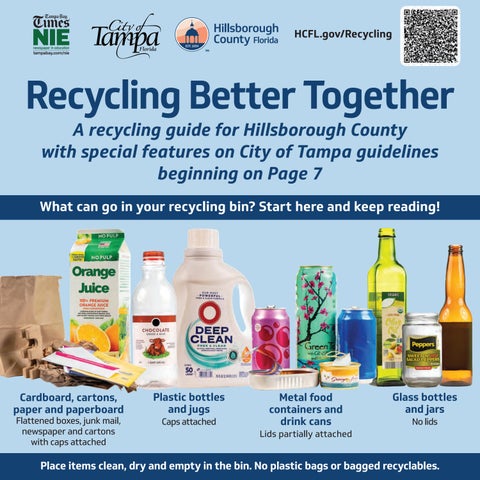
A recycling guide for Hillsborough County with special features on City of Tampa guidelines beginning on Page 7 HCFL.gov/Recycling
What can go in your recycling bin? Start here and keep reading!


paper and paperboard
Flattened boxes, junk mail, newspaper and cartons with caps attached


Place items clean, dry and empty in


Hillsborough


River is an environmental explorer on a mission to recycle. Binny is a bright recycling bin, friendly and full of knowledge. Together they make learning what to recycle easy and fun!
Q: Are plastic bags recyclable? Did you know aluminum cans are infinitely recyclable?
Cans are recycled, and back on the shelf in as little as 2 months!

Recycle me, please!
No. These items are not recyclable curbside. Take these items to select retail stores for drop-off recycling. Tip: switch to reusable bags! No need to
Q: What about excess tape on cardboard or plastic windows in mail or pasta boxes?

GOING BEYOND THE TEXT:
A good way to build reading and learning skills is to create a Know, Wonder and Learn (KWL) chart. While you are reading or learning new things, ask yourself questions. First, ask what you already Know about the subject. Then, ask what you Wonder or want to know about the subject. Then you read and ask what you have Learned about the subject. Practice this KWL technique about recycling in your neighborhood. Before you start
Q: How clean must items be for recycling?
accepted items a quick rinse. If it’s too dirty, it’s okay to place in the
reading the pages of this publication, focus on the K and W sections of the chart. With your classmates or family members, make a list of all the things you know about recycling. Next, list all of the things you wonder about and want to know. The next step is to read through this publication, jotting down notes in the final section of the chart. Share what you have learned with your classmates. Discuss if anything was surprising to you or different than you expected.


Open Monday-Saturday 7:30 a.m. – 5 p.m.
Hillsborough County operates five Community Collection Centers (CCCs) located across the county that serve as one-stop shops for Solid Waste Service Area household customers. Select services are also available to city household residents.
Use the chart below for a full list of services available to you.
Open Mon. - Sat.
-

Recycling drop-off is free at Community Collection Centers and available to all Hillsborough County households, including multifamily, manufactured homes and seasonal residents. See drop-off locations on the map on page 4.

Recycling tip
Recyclables should be clean, dry and empty. No plastic bags, please! HCFL.gov/CCC


GOING BEYOND THE TEXT:
While organic materials, such as food scraps, yard trimmings, wood and manure cannot be put in your recycle bin, these items can be composted. Composting redirects organic materials that would otherwise be disposed of in landfills or trash incinerators and recycles them into compost, according to the United States Environmental Protection Agency. Go to epa.gov/sustainable-management-food/composting to learn more about composting. Next, go to the City of Tampa’s website to learn about composting in the City of Tampa: tampa.gov/solid-waste/compost. Read the information on the website and examine the chart. On a piece of paper, write down the main ideas about this topic. Be sure to include
responses to the essential journalism questions: who, what, where, why, when and how.
Once you have compiled your notes, use those notes to write a blog post explaining the importance of as well as methods of composting. Using the puzzles in the Interactive Puzzles section of the e-Newspaper edition of the Tampa Bay Times, create your own puzzle to go along with your blog post. Choose one of the puzzle styles from the Times. Exchange your puzzle with a classmate and then share what you have learned with your class.
Florida Standards: SC.412.N.1.2; SC.4122.N.1.3; SC.412.N.1.4; SC.412.N.1.6; SC.412.N.1.7; SC.912.L.17.14; ELA.412.EE.1.1; ELA.412.EE.2.1; ELA.412.EE.3.1; ELA.412.EE.4.1; ELA.412.EE.5.1; ELA.412. EE.6.1; ELA.342.C.1.3; ELA.412.C.1.4; ELA.412.C.1.5; ELA.412.C.3.1; ELA.412.C.4.1; ELA.412.C.5.1; ELA.412.F.1.3; ELA.412.F.1.4; ELA.412.R.2.2; ELA.412.R.2.3; ELA.412.R.2.4; ELA.412.V.1.1; ELA.412.V.1.3

Hillsborough County partnered with the City of Tampa for a first-of-its-kind feature on the Recycling Guide.
Hillsborough County (BLUE recycling bin) and the City of Tampa (GREEN recycling bin) have slightly different recycling program rules.
There are services highlighted in this guide for every county and city resident.


Cardboard, paper and paperboard

Place items that are clean, dry and empty in your green recycling bin.

bottles and jugs
About 17% of Tampa’s neighborhood waste is yard waste, and it all gets composted!
You can help by setting out your yard waste correctly in:
• A reusable personal container (32 gal max)
• Paper yard waste bags
• Bundled with jute twine
Learn more at tampa.gov/YardWaste


• Think about the waste you create! You can’t reduce your waste unless you know what you’re throwing away.
• Say, no thank you! Politely refuse items you know you won’t use long-term or don’t want.
• Wasting less food minimizes environmental impacts and saves money. Learn more at tampa.gov/FoodWaste.
• Focus on reusable items instead of disposable ones.
• Reuse and get crafty! Find a new life for items you already own or repair them.


See where your garbage and recycling go by taking a virtual tour of Hillsborough County’s Waste-to-Energy facility and watching the Recycle Life-Cycle video at HCFL.gov/RecyclingEducation.
Take the waste-to-energy virtual tour

• Who? Hillsborough students in grades 3-12.
• When? Submissions accepted until Nov. 30.
• How? Create original art and submit online.
• Why? All participants celebrated, winners receive countywide recognition.
Questions? Email Recycling@HCFL.gov
GOING BEYOND THE TEXT:
Watch the Recycle Life-Cycle video


Times. Compile all the information to create an advertising campaign encouraging students and adults to reduce waste. Use the advertisements in the Times as models for a print advertisement in support of your campaign.
Waste reduction and reuse are the most effective ways you can save natural resources, protect the environment and save money. Watch this video to learn about the recycling waste cycle: youtube.com/watch?v=LXsFph2swsU.
The best way to reduce waste is by not creating it in the first place. Making new products requires a lot of materials and energy. Use the information on the following three websites to learn about helpful ways to reduce waste:
• U.S. Environmental Protection Agency: epa.gov/recycle/reducing-and-reusing-basics
• Hillsborough County: hcfl.gov/residents/sustainability-and-green/reduce-your-waste
• City of Tampa: tampa.gov/solid-waste/WasteReduction
With your class, make a list of the top 10 methods to reduce waste at home, at school or at work. Next, look for images or articles focusing on waste reduction in the Tampa Bay
The next part of your campaign should include a short video, 30-120 seconds in length. Present your campaign to your class. The final step of your campaign is to create a poster focused on waste reduction as either a drawing or a collage. Students in grades 3-12 may submit their posters to the Hillsborough County Waste Reduction and Recycling Art contest. Go to hcfl.gov/residents/property-owners-and-renters/trash-and-recycling/summerrecycling-art-contest for details.
Florida Standards: SC.412.N.1.1; ELA.412.EE.6.1; ELA.412.V.1.1; ELA.412.C.1.3; ELA.412.C.1.4; ELA.412.C.2.1; ELA.412.C.3.1; ELA.412.F.1.3; ELA.412.F.1.4; ELA.412.R.2.4; ELA.412. EE.4.1; ELA.412.EE.6.1; VA.4.C.2.2; VA.4.C.2.3; VA.4.C.3.3; VA.4.S.1.2; VA.4.S.1.3;; VA.5.C.2.1; VA.5.C.2.2; VA.5.F.3.2; VA.5.F.3.4; VA.5.O.1.1; VA.68.F.2.5; VA.68.F.3.4; VA.68.H.3.3; VA.68.O.2.4; VA.912.C.2.1; VA.912.F.3.10; VA.912.O.3.1; VA.912.O.3.2; VA.412.F.3.1; VA.412.F.3.4; VA.412.O.3.1


The United States Environmental Protection Agency defines its four rules of waste reduction:
1. Reduce by purchasing, consuming and throwing away less trash. The best way to reduce waste is by source reduction. This includes creation of the product as well as packaging.
2. Reuse by repairing, donating or selling unneeded or unwanted items. Reuse is a great option because items do not have to be reprocessed before they can be used again.
3. Recycle, which consists of a series of activities that includes collecting recyclable materials that would otherwise be considered waste. Sorting and processing recyclables into raw materials and manufacturing the raw materials into new products.
4. Buy items that are made of recycled materials.


Now that you have learned these four rules, it is important to encourage others to follow them as well. Students, adults and businesses can be part of waste reduction to protect Earth and the environment. You can do this by writing a letter to the editor of the Tampa Bay Times. A letter to the editor is a way for people to share their opinions on current events and issues with the editorial staff and the readership of the paper. These letters are often focused on using a persuasive writing style. In your letter, explain the issue and its importance. Use plain language that most people will understand and keep it brief. A letter to the editor should be 300 words or less.
Florida Standards: ELA.412.EE.1.1; ELA.412.EE.4.1; ELA.412.EE.5.1; ELA.412. EE.6.1; ELA.412.F.2.1; ELA.412.C.1.3; ELA.412.C.1.4; ELA.412.C.1.5; ELA.412.C.2.1; ELA.412.C.3.1; ELA.412.C.4.1; ELA.412.C.5.1; ELA.412.C.1.5; ELA.412.R.2.2; ELA.412.R.2.3; ELA.412.V.1.1 Tampa

GOING BEYOND THE TEXT:
According to the Hillsborough County Solid Waste Master Plan, 80% of our waste can be kept out of landfills with current (40%) or future (40%) programs. You can help protect the environment and save landfill space by reducing, reusing and recycling responsibly. Read the information about reducing waste in Hillsborough County at hcfl.gov/residents/sustainability-and-green/ reduce-your-waste. Next, look for articles in the Tampa Bay Times focused on waste in your community. What can students do to help reduce waste? Using the articles in the Times as models, write a newspaper article for your school newspaper focused on reducing waste. Be sure to include helpful tips from the website and from the articles you read. Florida Standards:


Reduce Your Use Tampa Bay has received more than 2,200 pledges to reduce the use of single-use plastic. Take the pledge at ReduceYourUseTampaBay.org. Hillsborough County partners with Goodwill to offer three donation sites for household goods. Since becoming a donation partner in 2022, Goodwill has saved over 200 tons from disposal.
In 2025, more than 64,000 tons of recyclables, equal to the weight of a 1,500-passenger cruise ship, was collected in the county’s curbside program.
Just as firewood in a campfire is reduced to ash, the Resource Recovery Facility burns garbage, reducing its size into ash, sending less waste to the landfill and saving space.
Because Southeast County Landfill is the county’s only active landfill, it’s important to keep recyclable items out of the landfill.


The number of batteries in our waste stream is increasing and so are the number of batteryrelated fires recorded across the country. Batteries come in various types and sizes to fit different products including toys, laptops, smartphones and watches, e-bikes and scooters. If damaged or improperly charged, stored, disposed of or recycled, batteries can harm you and others. Proper disposal of batteries helps keep you and waste and recycling workers safe while benefiting the environment.
Billions of batteries are sold each year in the United States, notes the Florida Department of Environmental Protection (FDEP). While some battery types can safely be thrown into the trash, “other types can disperse significant amounts of heavy metals and other toxic substances.” In addition to emitting hazardous waste, improper disposal of batteries can cause fires. Learn more about many different types of batteries on the FDEP website: floridadep.gov/TakeChargeFlorida
The next time your battery runs out, don’t throw it in the trash! Drop your batteries off for
proper, safe disposal to prevent pollution and conserve energy and natural resources. Find a battery disposal location near you. Do some research about lithium-ion batteries on the Internet, including reading the information posted on the Hillsborough County Solid Waste website, hcfl.gov/residents/property-owners-and-renters/trash-and-recycling/fire-prevention-andbattery-recovery; reading this publication and the information about Take C.H.A.R.G.E. of Battery Safety, batteryfiresafety.org/#section-1
Next, look for articles and images of items containing lithium-ion batteries in the Tampa Bay Times. See if you can find articles focusing on fire safety and battery safety as well.
Using the Take C.H.A.R.G.E. of Battery Safety infographic located at admin.batteryfiresafety. org/sites/default/files/2025-08/Infographic_UL.pdf, create your own infographic showing the importance of proper battery disposal. Share your infographic and what you have learned with your class.
Florida
All Hillsborough County residents can participate in collection events to drop off unwanted household chemicals. A state-issued photo ID with a Hillsborough County residential address is required.

Automotive products:
Antifreeze, gasoline, diesel, motor oil, car cleaners

Lawn and garden chemicals:
Fertilizer, herbicides, pesticides, poisons


Batteries:

Lead-acid (car, boat, golf cart and lawn mower)
Power tool batteries
Single-use and rechargeable batteries (smaller than 12”x12”)

Paint products:
Paint, stain, solvents
Limit: ten 1-gallon or five 5-gallon containers
Flares and ammunition: Marine and road flares, ammunition

Pool chemicals:
Chlorine, muriatic acid, cleaners, clarifiers

Household chemicals:
Adhesives, aerosols, cleaners, nail polish, peroxide, rubbing alcohol

Propane and
Helium tanks:
Limit: 30 pounds or less

Mercury-containing devices: Fluorescent bulbs, mercury thermostats and thermometers. Limit: Ten bulbs 4-feet and longer
First Saturday of the month
Sheldon Road Household
Hazardous Waste Center
9805 Sheldon Road Tampa, FL 33635
Second Saturday of the month
South County Solid Waste Facility
13000 U.S. 41 Gibsonton, FL 33534
Third Saturday of the month
Hillsborough Heights
Solid Waste Facility 6209 County Road 579 Seffner, FL 33584


The Tampa Bay Times Newspaper in Education program (NIE) is a cooperative effort between schools and the Times Publishing Co. to encourage the use of newspapers in print and electronic form as educational resources — a “living textbook.” Our educational resources fall into the category of informational text, a type of nonfiction text. The primary purpose of informational text is to convey information about the natural or social world. NIE serves educators, students and families by providing schools with class sets of the Pulitzer Prize-winning Tampa Bay Times plus awardwinning original educational publications, teacher guides, lesson plans, educator workshops and many more resources – all at no cost to schools, teachers or families.
In 2024-2025, NIE provided almost 10 million e-Newspaper licenses and 200,000 print newspapers to Tampa Bay classrooms. For more information about NIE, visit tampabay.com/nie, call 727-893-8138 or email ordernie@tampabay.com. Follow us on Facebook at facebook.com/TBTNIE
Written by: Hillsborough County Solid Waste and City of Tampa staff
Activities by: Jodi Pushkin, Tampa Bay Times Newspaper in Education manager
Designed by: Stacy Rector, Fluid Graphic Design, fluidgraphicdesign.com
© Tampa Bay Times 2026
This publication and its activities incorporate the following Florida Standards for elementary, middle and high school students. SC.412.N.1.2; SC.412.N.1.3; SC.412.N.1.4; SC.412.N.1.6; SC.412.N.1.7; SC.912.L.17.14; SC.4..17.4; SC.7.L.17.1; SS.8.FL.2.1; SS.912.FL.3.7; SS.912. FL.3.3; ELA.412.EE.1.1; ELA.412. EE.2.1; ELA.412. EE.3.1; ELA.412.EE.4.1; ELA.412. EE.5.1; ELA.412. EE.6.1; ELA.412.C.1.3; ELA.412.C.1.4; ELA.412.C.1.5; ELA.412.C.3.1; ELA.412.C.4.1; ELA.412.C.5.1; ELA.412.F.1.3; ELA.412.F.1.4; ELA.412.R.2.2; ELA.412.R.2.3; ELA.412.R.2.4; ELA.412.V.1.1; ELA.412.V.1.3; ELA.412.C.2.1; VA.5.C.2.2; VA.5.F.3.2; VA.5.F.3.4; VA.5.O.1.1; VA.68.F.2.5; VA.68.F.3.4; VA.68.H.3.3; VA.68.O.2.4; VA.912.C.2.1; VA.912.F.3.10; VA.912.O.3.1; VA.912.O.3.2; VA.412.F.3.1; VA.412.F.3.4; VA.412.O.3.1