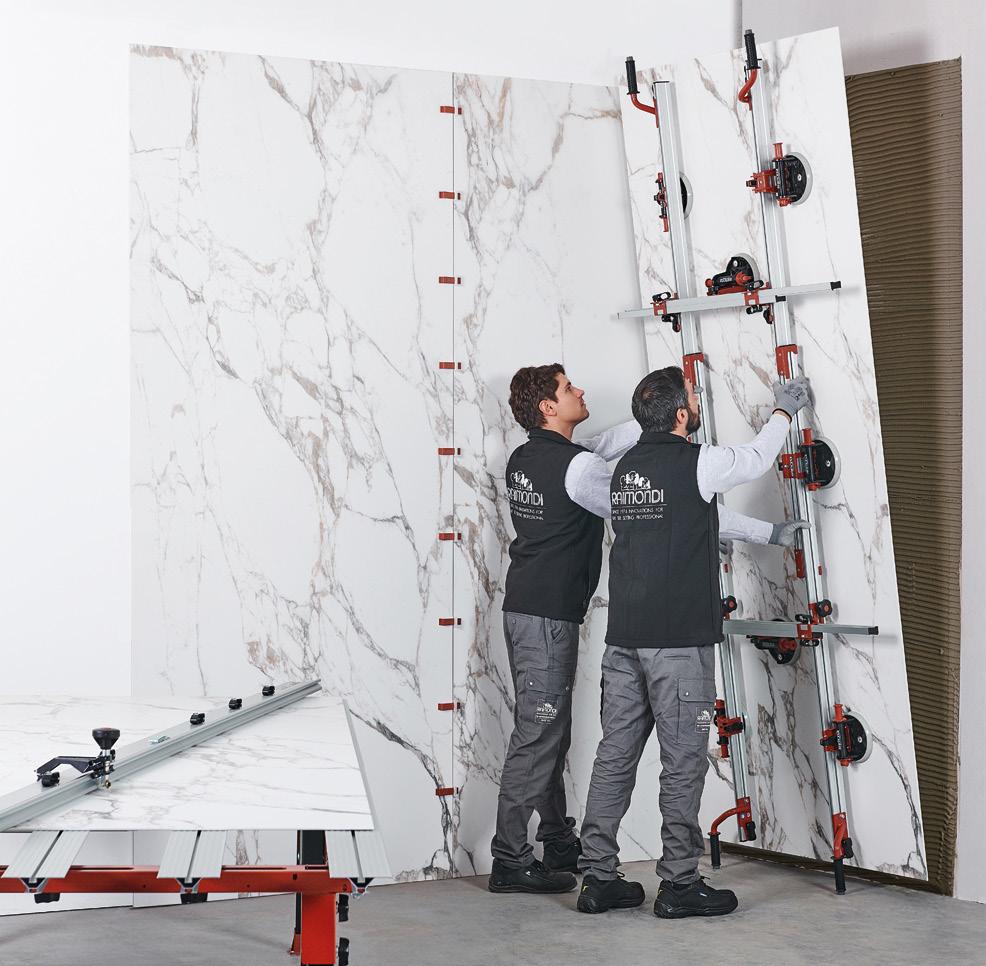
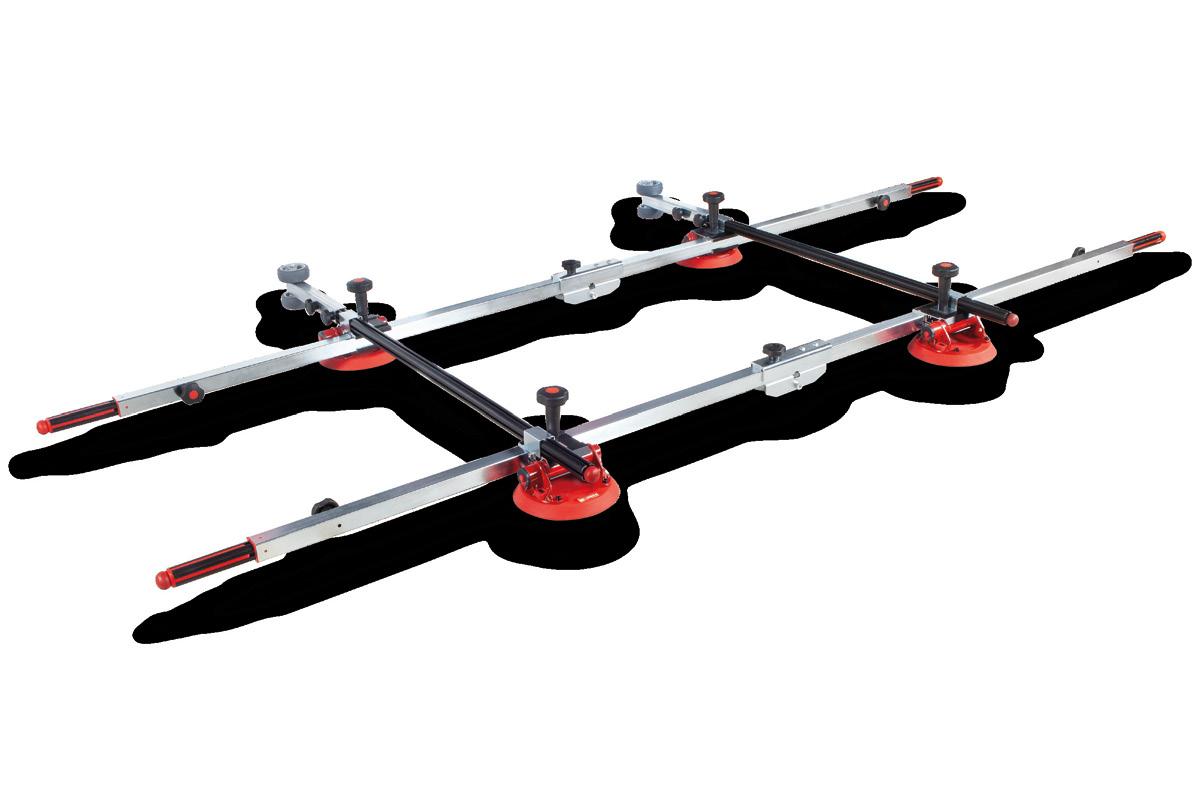
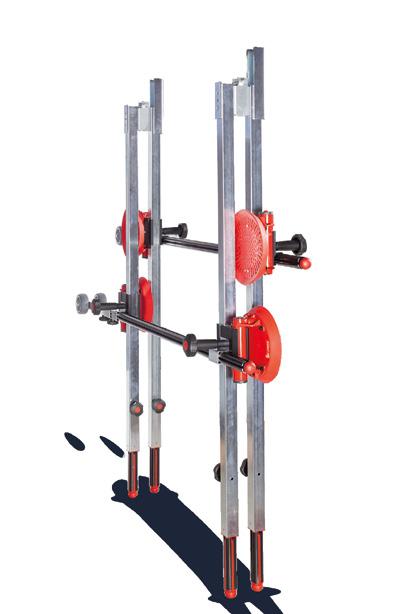
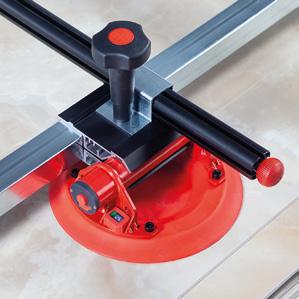
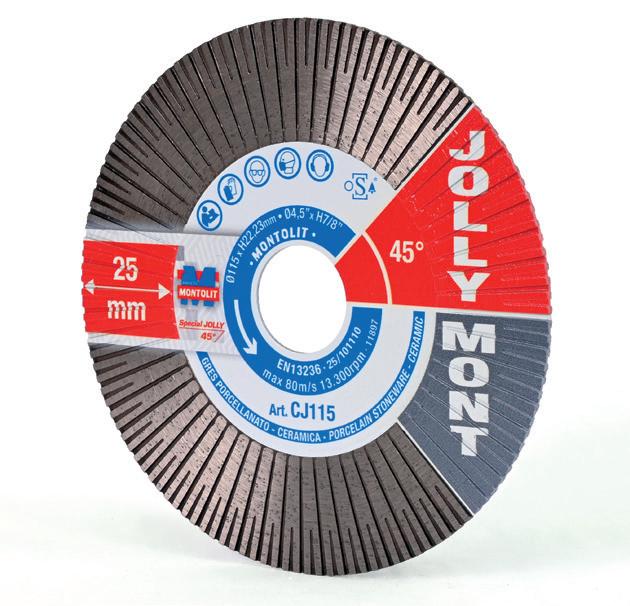
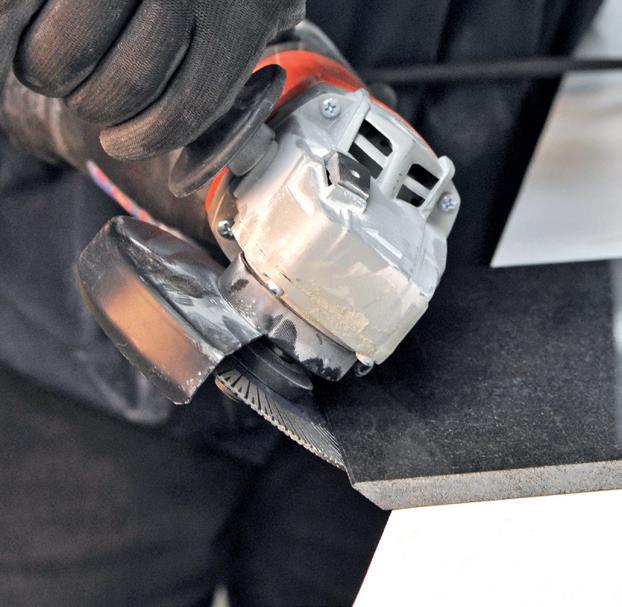
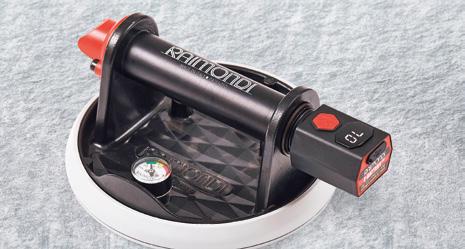
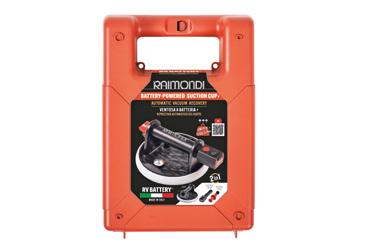
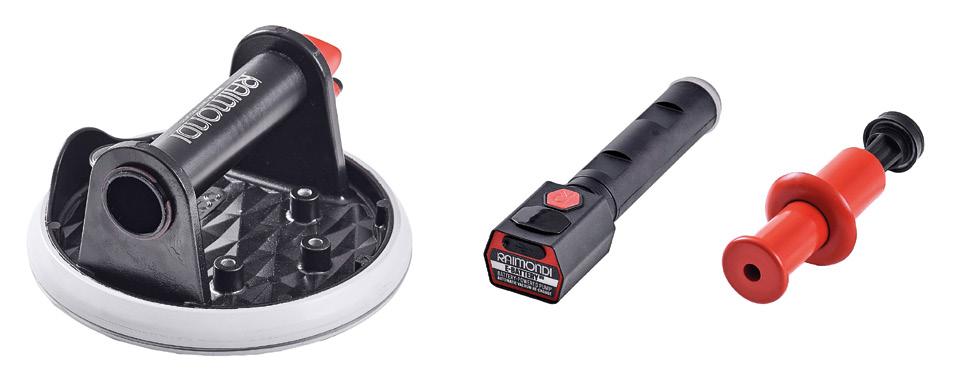
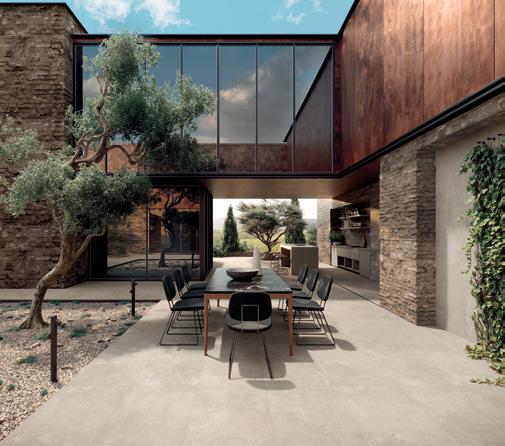
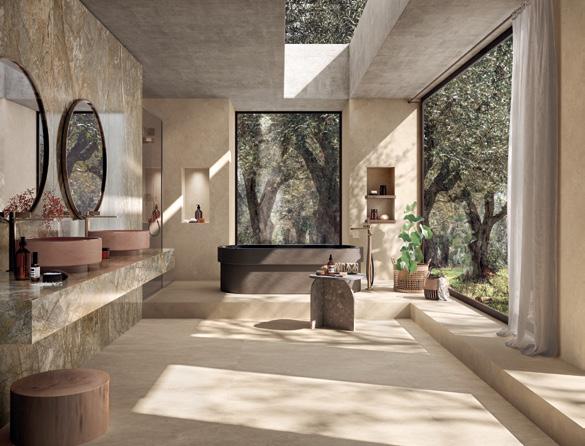
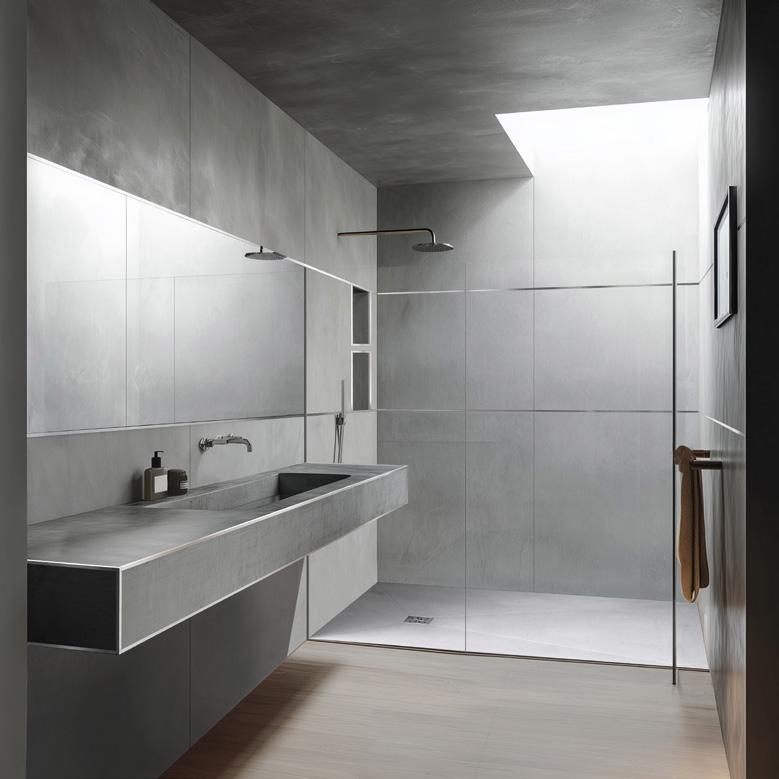
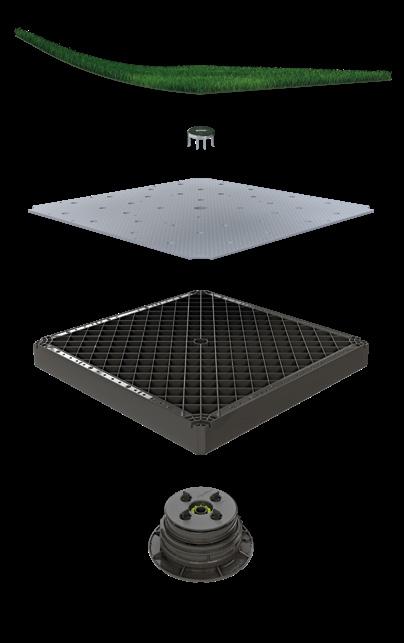
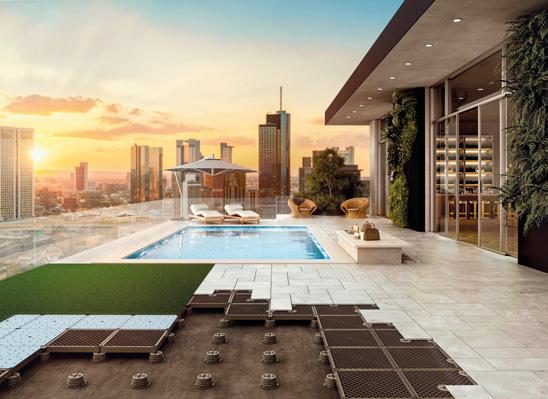
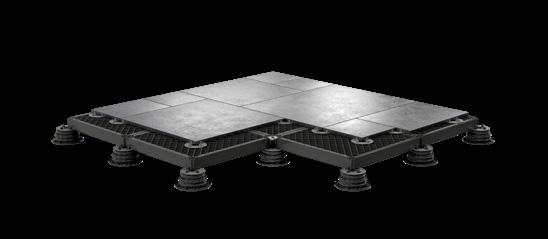
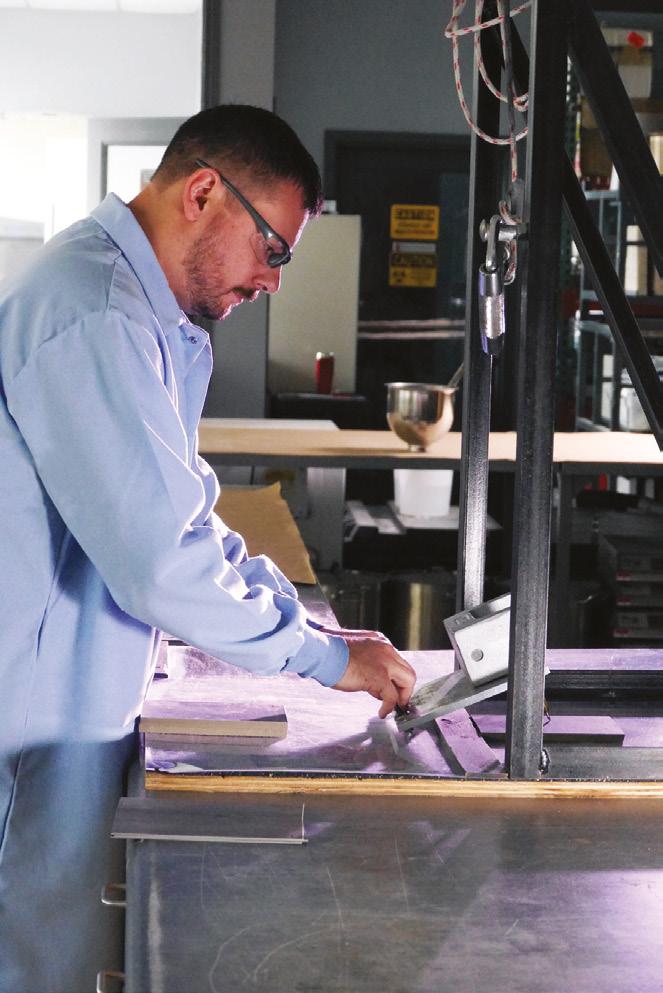
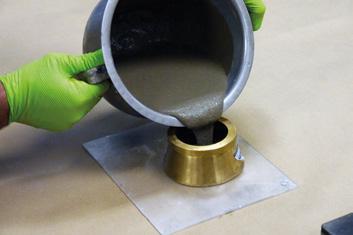
Since day one, our mission has been clear: to support professional tile installers with innovative, reliable tools designed to increase productivity while reducing fatigue.
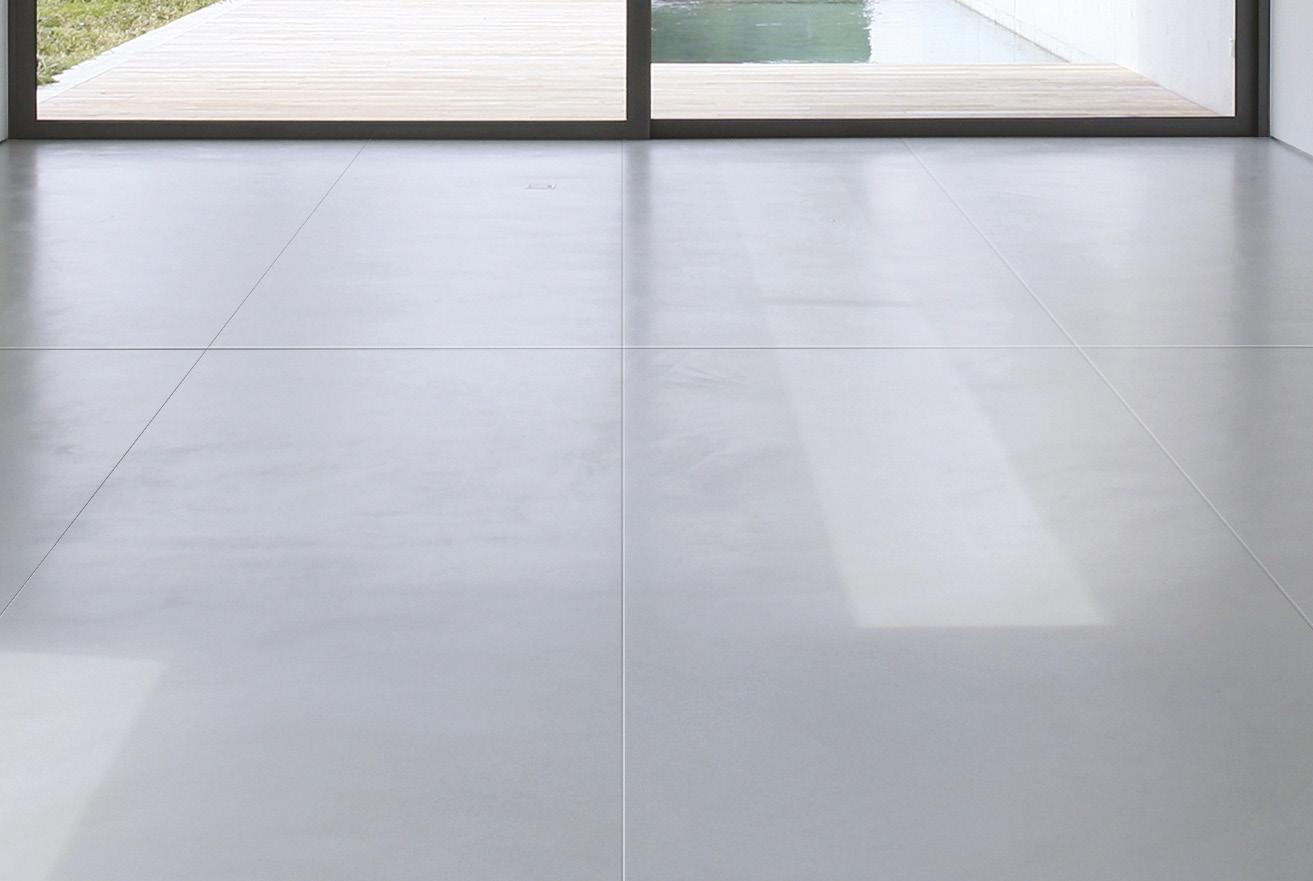
We were the first in the world to introduce many installation solutions specifically engineered for Large Format Tiles.
Today, these solutions are considered market benchmarks and are now in their third and fourth generations — continuously redefining industry standards.
Discover more at Coverings, Las Vegas | March 30 - April 2, 2026
Slightly earlier in the year than usual, the latest edition of Coverings is now just around the corner, prompting us to consider what might happen to the global ceramic market in 2026.
Needless to say, this is no easy task: while existing tariffs and wars had already complicated the picture immensely, the new conflict now under way in the Middle East muddies the waters still further.
As usual, we have tried to provide a few pointers to help you navigate this new landscape. One comes in the form of an interview with Eric Astrachan, Executive Director of TCNA, who analyses the past year and reflects on mortgages, interest rates and competition, as a basis for predicting possible future developments.
for many years, and talk us through their recipes for success. As we expected, one of the key ingredients of these recipes – and the one that, anecdotally at least, makes all the difference in this artificial age – is a close relationship with customers.
We need the contact, dialogue and exchanges of views that took shape millennia ago, around the first rudimentary hearth, and that have enabled us, ever since, to buy, sell, develop our tastes and refine our needs.
Are you interested in interior and surface trends? Scan and discover the virtual pages of Tile International!
Are you interested in interior and surface trends?
Scan and discover the virtual pages of Tile International!
Alberdi expands porcelain range with new large format at Coverings
At Coverings, Cerámica Alberdi S.A., together with its brand Vite Porcellanato, introduces to the market a new 120x240cm (48x96 inches) porcelain tile format with a thickness of 7mm, marking a significant step in the company’s product development and international growth strategy. The new format is manufactured at the company’s stateof-the-art plant — awarded the TecnAward 2024 as the “Best New Factory in South America” during TECNA 2024 in Rimini, Italy — underscoring Alberdi’s ongoing investment in advanced production technologies.
The launch expands an already extensive porcelain tile portfolio that includes formats such as 60x60, 30x60, 60x120, 20x120, 80x80, 40x80, 20x80, 80x160, 20x160 and 40x160cm, all produced with a 6mm thickness. The reduced thickness across the range plays a key role in improving logistics effi-
ciency and cost optimisation, allowing more square metres to be loaded per container. With the addition of the 120x240cm size, the company further broadens its design and application possibilities, strengthening its positioning within a highly competitive market segment and enhancing its appeal thanks to the diversity of solutions offered — a feature increasingly valued by customers worldwide.
The expanded format range also supports Cerámica Alberdi’s export strategy, with the company currently shipping to more than 20 countries. By increasing the versatility and scope of its porcelain tile collections, Alberdi aims to provide greater flexibility to architects, designers and distributors, while addressing the evolving needs of an increasingly demanding global ceramic market.
Across all formats, the company offers a wide variety of finishes - including polished, natural and textured surfacesdeveloped through advanced production technologies such as digital relief systems, which enable increasingly re-
alistic aesthetic effects. The introduction of new large formats entails high technological and human resource demands, reinforcing Alberdi’s commitment to continuous investment in innovation, equipment and workforce training to remain at the forefront of the industry.
As one of Argentina’s leading ceramic producers, Cerámica Alberdi S.A. serves a network of more than 500 clients through its commercial brands Allpa, Alberdi and Vite Porcellanato. Looking ahead to the US market in particular, the company aims to expand its buyer network by supplying products from its two manufacturing plants in Argentina, which together have a production capacity of approximately 3 million m² per month.
An additional competitive advantage is the country of origin: products manufactured in Argentina benefit from an import tariff of only 10% in the United States, supporting the company’s ambitions for further growth in North America.
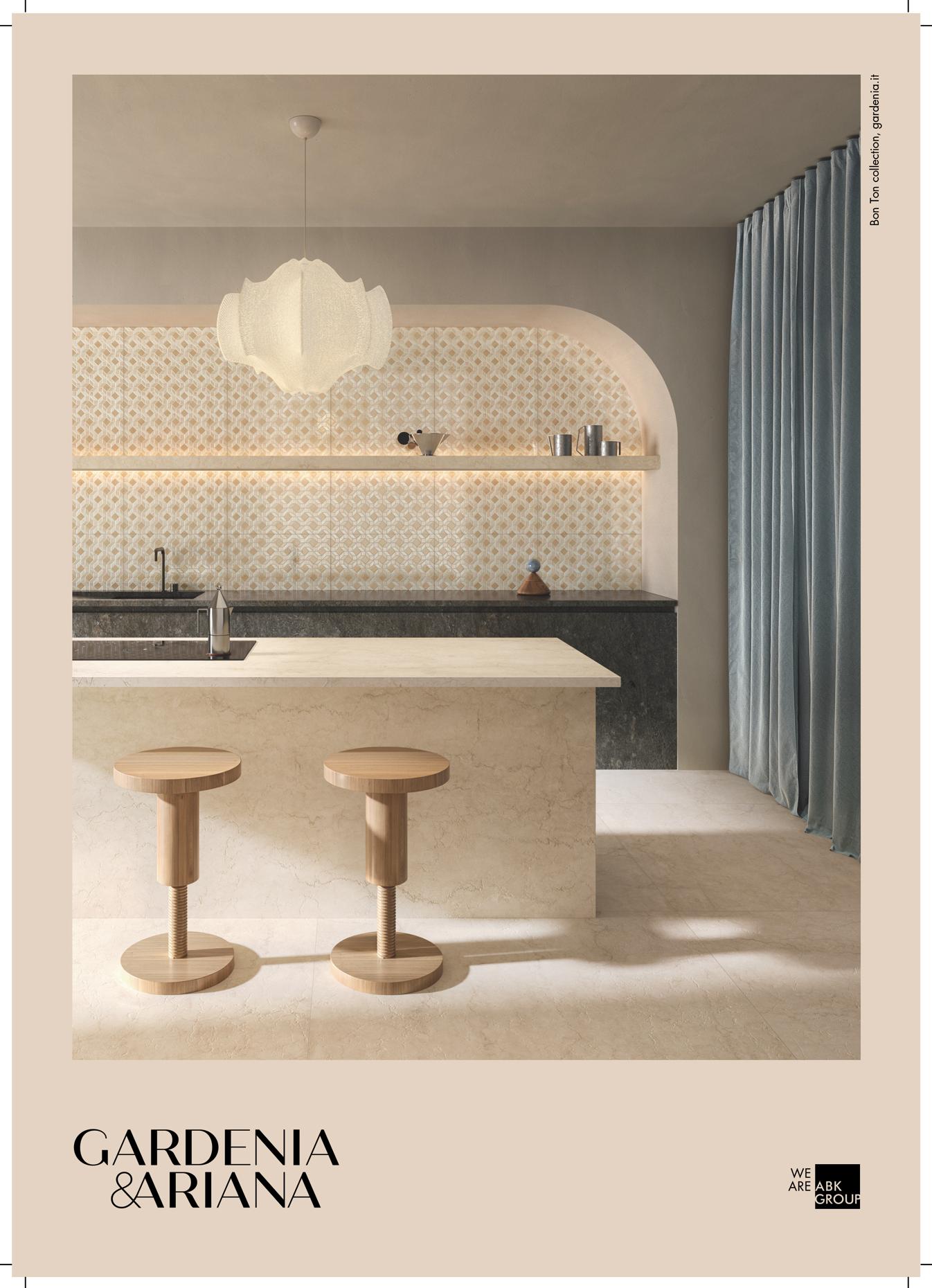
Gardenia&Ariana, a new ABK Group brand
Gardenia&Ariana is a new ABK Group spawned by the merger of two historic players from Italy’s ceramic cluster, Gardenia Orchidea and Ariana.
The brand’s launch is part of the Group’s strategy to leverage its brand portfolio, with a view to offering a comprehensive and distinctive range of porcelain surfaces.
The brand’s positioning is based on a concept defined as “Italian Timeless”, which captures the balance between the aesthetic tradition of Gardenia Orchidea, a company historically associated with classic elegance, and the appetite for materials research and technological experimentation that has long been the hallmark of Ariana.
This approach interprets the present and looks to the future of design, by responding to the evolutionary needs of contemporary dwelling.
Gardenia&Ariana’s first catalogue clearly expresses the brand’s founding values – elegance, quality, balance and harmony – through a broad, cross-cutting range designed to interact with
various architectural and design styles.
The brand’s main target market is the mid-to-high-end residential segment, with a particular focus on the bathroom environment, as a place of well-being, comfort and aesthetic identity. The new Gardenia&Ariana website also expresses the potential of this range.
As an integral part of ABK Group, Gardenia&Ariana benefits from the Group’s industrial know-how and continuous investment in technological innovation.
The merger came as a natural strategic evolution, in the wake of the two acquisitions. In 2020, ABK Group acquired 100% of the share capital of Ceramiche Gardenia Orchidea S.p.A., a historic company founded in Italy’s ceramic cluster in 1961, thus enhancing its portfolio through the Versace Ceramics license, too.
The Ariana brand, which joined ABK Group in 2000, started life as a wall coverings specialist, before gradually evolving and eventually merging, in 2022, with Desvres, a French company that also belongs to the Group, to generate a new identity around research relating to outdoor spaces.
Tailored ceramic surfaces for the Dolce&Gabbana fashion show
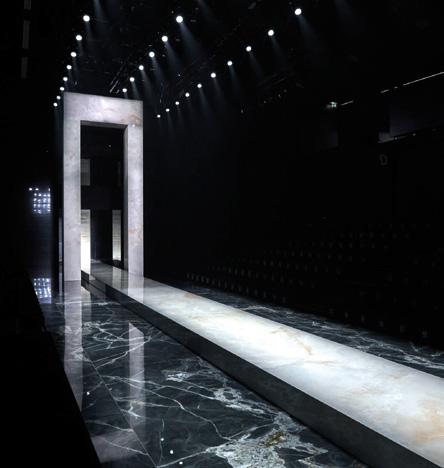
The ceramic surfaces of Iris Ceramica Group were chosen to adorn key parts of the set design for Dolce&Gabbana’s Autumn/Winter 2026 men’s fashion show, where they defined the geometry, plays of light and depth of the runway.
The set design, under the technical curation of Granitech – a business unit of Iris Ceramica Group – saw the application of 300x150cm ceramic slabs on the runway, perimeter walls, backdrop and imposing central portal. The use of large-format panels generated an effect of visual continuity that underscored the monumental character of the set.
The colour scheme was based on the intensity of UniPepper absolute black, the smoky shades of Majestic Onyx –both by Fiandre – and the golden vein patterns of Onice Grigio by Ariostea.
The polished finish amplified the dynamism of the reflections, lights and movements, creating an elegantly dramatic framework that showcased the
tailoring of the menswear.
Dolce&Gabbana’s use of coverings by Iris Ceramica Group testifies to their expressive power and their ductility from a design point of view. The set clearly illustrated how these materials transcend their basic function as a covering, to punctuate the volume of spaces, speak the language of fashion and interpret creativity with technical precision and cutting-edge design.
Francesco Sommariva is appointed as new Chief Marketing & Growth Officer at SICIS
In early 2026, Francesco Sommariva was appointed as the new Chief Marketing & Growth Officer at SICIS – a Ravenna-based company that is a global benchmark in artistic mosaic, interior design and Italian manufacturing excellence.
“We are pleased to welcome Francesco aboard,” announced Maurizio Leo Placuzzi, President and CEO.“His experience and vision will make a vital strategic contribution to the next phase of growth for SICIS,” added Placuzzi, referring to Sommariva’s long global experience in international growth and development strategies.
With a degree in marketing from the Bocconi University in Milan and a career spanning the world’s leading players in the technology and innovation sector –including Google, Meta, Pinterest and, most recently, TikTok – Sommariva will guide the evolution of the SICIS brand’s positioning on the global market. He will be responsible for marketing, communication, digital strategy and expansion on international markets, and will help strengthen the company’s global presence by taking an approach geared towards innovation and the customer experience.
In an increasingly digital and intercon-
nected market, highly qualified professionals such as Sommariva are especially valuable for companies like SICIS, which is embarking on a strategic development pathway aimed at enhancing, spreading and strengthening its brand on a global scale, as well as the artisanal excellence that has always been its hallmark.
“A space for architectural design”: the poster for Cersaie 2026
Cersaie is proud to present the poster for the 43rd edition of the International Exhibition of Ceramic Tile and Bathroom Furnishings, to be held in Bologna from 21 to 25 September 2026.
The poster for the 2026 edition renews and expands the concept of architectural space, putting a central focus on an open, inclusive and constantly evolving design vision.
The image shows an abstract architectural landscape: an ideal city composed of vertical volumes, arches and vibrant, colourful surfaces intermingled with natural elements. These structures
evoke fluid, multifunctional spaces capable of adapting to contemporary lifestyles, while the presence of trees among the architectures underscores the increasingly central role of nature, as a source of well-being and quality of life, and an integral part of the built environment, .This visual narrative reflects the event’s status as the global benchmark for the design world: architects, interior designers, specifiers, contractors and distributors from all over the world converge on Cersaie because it provides an unrivalled forum for exchange, professional development and the cultivation of new business opportunities. Within this ecosystem, materials, surfaces and solutions for architecture and interior design become practical tools for interpreting the needs of the present and anticipating future changes in the sector. The poster’s natural palette, ranging from warm shades to cooler tones, serves as a metaphor for the plurality of identities, cultures and sensitivities that coexist and intertwine to shape a shared, inclusive and contemporary aesthetic language. Conceived by Interpromex Comunicazione, the image for Cersaie 2026 depicts a place that is open to dialogue, where architecture and nature regenerate each other.
Are you interested in interior and surface trends?
Scan and discover the virtual pages of Tile International!
Coverings 2026 unveils an extensive educational programme
Attendees will gain impactful insights to strengthen professional skills, deepen market intelligence and support leadership growth across the tile, stone, design and construction industries. The conference programme for Coverings 2026 will blend multiple modes of instruction, from technical presentations and partner-led sessions to dialogue-driven Q&A sessions and live demos
“Building Hope: A Conversation with Gary Sinise, NTCA, and NSI on Serving Veterans Through Skilled Craftsmanship,” sponsored by MAPEI Corporation and PROFLEX® Products, Inc., is scheduled for 1 April, 8:30–9:15 a.m. PDT and will bring acclaimed actor Gary Sinise and leaders from the National Tile Contractors Association (NTCA) and the Natural Stone Institute (NSI) together.
Registered professionals for Coverings 2026 will also have full access to nearly two dozen other targeted sessions organised within three core learning tracks: Installation & Fabrication, Materials & Trends and Workforce & Profits.
“The Most Directional Color and Design Trends,” taking place 30 March, 9:30–10:30 a.m., is the title of Leatrice (Lee) Eiseman’s conference. The executive director of the Pantone Color Institute will present her latest colour and design trend programme, “Sense-Abilities,” which examines the lifestyle cues and emotional triggers shaping consumer design choices.
Another must-attend education session slated for the first day of Coverings is “Get Inspired and Turbocharge Your Business,” taking place from 8–9 a.m. The program will spotlight standout selections from the Tile Heritage Foundation’s (THF) archive of more than 44,000 digital images, demonstrating how historical context can enrich storytelling,
reinforce project authenticity, and inspire new concepts that resonate within today’s design landscape.
A dedicated Architecture & Design (A&D) Day, on 31 March, will expand Coverings 2026’s educational offerings with six American Institute of Architects (AIA)–accredited courses.
These sessions are designed to equip architects and designers with practical knowledge and specification tools that strengthen project outcomes across residential and commercial work.
The A&D Day schedule will include CTDA’s “Why Tile” and “Health and Environmental Benefits of Ceramic Tile”. NSI will present “The Art of Specifying Natural Stone” and “Natural Stone and Green Design”. NTCA will round out the program with “Introduction to Tile Industry Standards, Methods and Best Practices” followed by “Specifying & Installing Gauged Porcelain Tile Panels/Slabs”. Day 2 at Coverings 2026 will also highlight “Inspire, Lead, Grow: Opportunities for Emerging Professionals in Tile and Stone”. This interactive program is designed for emerging professionals and future leaders who want to define meaningful career paths, strengthen critical skill sets, attract and mentor new talent, and gain a deeper understanding of how leadership at all levels drives innovation and progress.
Those attending the Day 3 panel discussion, “Inside the Industry: Leaders on Tile Today” will glean perspectives from leaders across all tile and stone sectors as they examine current market dynamics, supply chain considerations, evolving customer expectations and emerging business opportunities.
Roca Group inaugurates the Roca Delhi Gallery
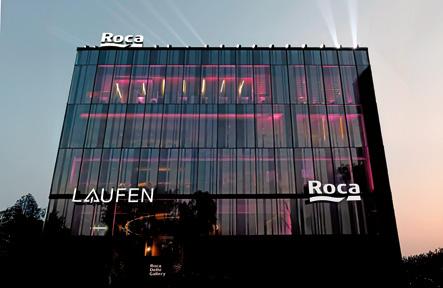
Roca Group has announced the opening of the Roca Delhi Gallery, the Spanish group’s first flagship space in India. It joins the seven existing Roca Galleries in Barcelona, Madrid, Lisbon, London, Shanghai, Beijing and São Paulo.
Designed by interior design firm Ultraconfidentiel, the new location uses clean lines, refined surfaces and choreographed lighting to create a vibrant, immersive environment. The gallery showcases Roca’s most advanced bathroom solutions, displayed in spaces designed to accentuate their aesthetics, technology and innovative features. An entire floor is dedicated to the LAUFEN Space Delhi, where a darker, more intimate colour palette enhances the sculptural character of the brand’s premium collections. Together, the two brands create a harmonious yet distinct visitor experience, reinforcing their shared vision of design excellence. The opening of the Gallery represents a strategic step for Roca Group in India, a key market within the Group’s global strategy. Roca has been operating in the country since 2006 through a joint venture with Parryware, which was subsequently acquired in 2011. Today, Chennai-based Roca Group India is the largest manufacturer of bathroom solutions in the country, with seven production facilities and an extensive distribu-
tion network.
Alongside its role as a showroom, the Roca Delhi Gallery is also conceived as a cultural platform that will host events, conferences and meetings dedicated to architecture, design and sustainability, expanding the international dialogue promoted by the Group across its spaces in Europe, Asia and America.
wienerberger takes stake in Italcer Group
The Italcer Group, one of the largest Italian groups in the ceramic tile industry, is changing hands. On 24 February, at the presentation of its figures for 2025, the Austrian group wienerberger – the world’s largest brick manufacturer – announced the agreement to acquire the Italian ceramic group, which is controlled by Mindful Capital Partners and Miura Partners and led by Graziano Verdi (pictured). The transaction is due for completion in the second quarter of 2026 (probably as early as April), subject to the approval of the anti-trust authorities. Initially, wienerberger will acquire 50% plus one share of the Italcer Group from MCP, Miura and their co-shareholders, while retaining the option to purchase the remaining shares by the end of the first half of 2027. The acquisition will be financed by a combination of cash and bank loans. Italcer’s valuation, which was not disclosed by the parties, could be around 560-600 million euros. Graziano Verdi, who has been the Italcer Group’s CEO since it was formed in 2017, will remain at the head of the company and continue to develop its business. Over the course of its first eight years in business, Italcer has achieved the goal of establishing an Italian ceramic hub on the back of a solid buy & build strategy, which has brought together highend brands and historic companies in the sector, and increased their value by means of efficient integration processes
and substantial, growth-driven technological investments.
The first companies to join the Group were La Fabbrica-AVA, Elios Ceramica and Devon&Devon in 2017. These were followed by Ceramica Rondine (2018), Cedir (2020), Equipe Cerámicas, a Spanish specialist in small-format tiles (2021), Fondovalle (2022) and Terratinta (2023).
These are all premium brands with which Italcer covers the entire range of ceramic surfaces, from small formats to large-format porcelain panels for architecture, furniture and outdoor applications, as well as luxury bathroom furnishings (Devon&Devon). The Group now has 12 plants in Italy and Spain, production capacity of around 24 million square metres per year, around 1,200 employees and 15,000 customers worldwide. Italcer closed 2025 with revenues of over 350 million euros, about 75% of which was generated by exports, mainly to Europe and North America. EBITDA, of 75 million euros, equates to a margin of over 20%.
The rapid growth of the Italcer Group was not achieved by acquisitions alone. The Group has made substantial investments in industrial assets and applied research in recent years, aimed at innovating both products and processes. It has also focused very closely on sustainability and decarbonisation, as evidenced by its launch of Advance anti-bacterial and anti-pollutant surfaces, and its installation of the first electric kiln in the Equipe Ceramicas plant in 2024 (the first in Europe in the ceramic tile industry). The same year saw the presentation of a patented, state-of-the-art plant for the capture of CO2 and other organic and inorganic pollutants emitted by the production facilities, and their transformation into a new high-value-added raw material, used in various manufacturing sectors. Investments of 50 million euros over the next five years have been earmarked for upscaling the project from a pilot system to an industrial-scale plant. The fact that the Group won the Sustain-
ability Award 2024, ranking first out of the 100 Italian companies with revenues exceeding 250 million, is further testimony to its commitment to decarbonisation. wienerberger’s acquisition of the Italcer Group will enable both enterprises to boost the growth they have achieved so far, partly because of the various points of contact between the two. This was emphasised by Graziano Verdi himself: “Italcer has consistently outperformed the market thanks to a successful strategy focused on innovative, cutting-edge solutions and a very high level of service. By diversifying our portfolio and adhering to the highest quality standards, we have always found demand in a wide variety of export markets, and achieved sustainable growth in the various segments. This proactive approach has given us resilience in a complex global economic environment, and this is something we have in common with wienerberger. We also share the goal of promoting a sustainable transformation of the construction sector, and our portfolios complement each other, enabling the development of new integrated building solutions.”
Joining a 4.6 billion euro colossus clearly gives rise to synergies and new opportunities. “wienerberger’s acquisition of a controlling stake in the Group,” continues Verdi , “strengthens Italcer’s position and puts it on track for five years of strong growth, as it steps up its presence in key markets such as the United States.”
In recent years, moreover, Verdi has repeatedly expressed an interest in setting up a production plant in the United States.
ABK Group presents its first Sustainability Report
The report details the Group’s commitments, results and goals across the three pillars of ESG (Environmental, Social and Governance), underscoring a transformation plan that fully integrates a sustainable vision into the corporate strategy.
This inaugural Sustainability Report published by ABK Group highlights a growth strategy built on responsible innovation, environmental stewardship and a commitment to people. The Group’s production model is increasingly geared towards resource circularity, minimising the environmental impact of its production processes and ensuring the highest standards of workplace safety.
This sustainability journey has led to significant milestones, including the recovery of 100% of process water and 20% of production waste, the use of 30% certified renewable electricity, and a cogeneration plant that meets 95% of the power requirements of the facility in Solignano (MO).
Since 2014, Eco-Body compounds have been introduced across select product lines. Containing at least 40% post-industrial recycled content, these Bureau Veritas-certified solutions contribute to LEED credits and reinforce the Group’s commitment to sustainable construction.
In 2022, the Group embarked on a process of research and innovation aimed at reducing emissions. This involved introducing a system that channels kiln exhaust gases at temperatures of more than 600°C to the spray dryer, resulting in a reduction in odour emissions of over 70%. To complement these efforts, all solvent-based adhesives have been replaced with water-based alternatives. As for its social commitment, the Group continues to invest in the safety and professional development of its work-
force, fostering a safe and inclusive working environment. In 2024 alone, 2,165 hours of training were provided to employees across the organisation. Significant strides have also been made in governance, with the adoption of a Code of Ethics and the launch of a whistleblowing platform, both of which are key tools for ensuring transparency, integrity and accountability in corporate management.
The 2024 Sustainability Report marks the launch of a structured, long-term roadmap aligned with the 2030 Agenda and the UN Sustainable Development Goals. Looking ahead, ABK Group has already set itself new objectives for the future, including boosting renewable energy self-generation, expanding employee welfare policies and establishing a single headquarters, thereby confirming its role as a responsible, innovative leader in the ceramic industry.
Tortona Lab integrated design hub opens in Milan
Tortona Lab, a new centre hosting four Italian companies with proven expertise in bathroom design, has opened in Milan. The initiative stems from a desire to meet the needs of today’s architecture
and construction market, which has a growing preference for working with partners who can offer complete solutions, from design to installation.
Tortona Lab brings together Gruppo Bardelli – with its Ceramica Bardelli, Ceramica Vogue and Appiani brands – Magistro Lab, Spring Box and Ex.t by Giulio Tanini, on the basis of a collaborative model aimed at generating bespoke, made-to-measure designs. Bathrooms are the focus of the new Lab’s attention, because they are one of the most complex environments in interior design, where functional, technical, aesthetic and logistical needs all come together. This collaboration between different companies makes it possible to coordinate materials, technical systems, furniture and finishes, with a view to reducing critical issues at the work site, simplifying processes and ensuring homogeneous results in both residential and contract projects, where time schedules and design coherence are essential.
This structure has also spawned the “Bathroom Team”, a permanent working group that pools the skills of the partner companies to provide an integrated service. Each team member brings their own specific know-how: Ex.t specialises in design and bespoke bathroom furni-
ture; Spring Box majors in the technical precision of shower systems; Gruppo Bardelli focuses on materials research and the decorative power of ceramics; and Magistro Lab is the expert in designer taps and water technology.
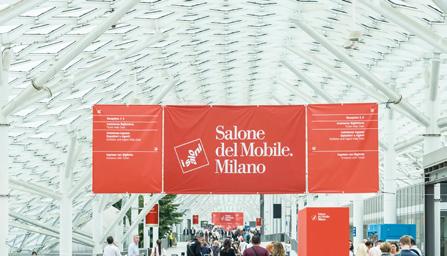
Countdown to Salone del Mobile.Milano 2026: news and highlights
The countdown has started to the 64th edition of the Salone del Mobile.Milano (21-26 April, Fiera Milano, Italy), which will involve over 1,900 exhibitors (36.6% from abroad) and 227 brands, some making their début, others returning, in over 169,000m2 of fully sold-out exhibition space. A central feature of the event will be the return of two Biennials: EuroCucina with FTK – Technology for the Kitchen, with 106 brands from 17 countries, and the International Bathroom Exhibition, with 163 brands from 14 countries.
Rounding out the picture is the SaloneSatellite, with 700 designers under the age of 35 and 23 international schools and universities.
The architecture of contents and an increasingly integrated exhibition pathway will form the common thread of the
2026 edition. The Salone will also open up a new direction, leading, in 2027, to the début of Salone Contract - for which the master-plan will be developed by Rem Koolhaas and David Gianotten (OMA) - to explore the major themes of this changing ecosystem, from interpreting contexts to the visitor experience, and from integrated supplies to strengthening B2B networking. The event will also mark the début of Salone Raritas. Curated icons, unique objects and outsider pieces (Halls 9-11): 25 exhibitors will establish a new platform, bridging the gap between special production and the design market, curated by Annalisa Rosso, Editorial Director and Cultural Events Advisor to Salone del Mobile.Milano, and designed by Formafantasma.
The exhibition entitled A Luxury Way (halls 13-15) will host an immersive installation conceived by Maison Numéro 20, called Aurea, an Architectural Fiction, which takes the form of an imaginary hotel that transforms interior design into a narrative and a stage set, by working on the emotive and sensory dimension of dwelling. This narrative will be held together and amplified by a communication campaign called “A matter of Salone”, a coordinated project that directs the spotlight back onto material as the origin and meaning of design, by translating into images the transition from gesture to form, meaning and a new visitor experience: a clearer, and more intuitive way-finding system will help visitors find their way around the show more easily, making the most of opportunities for discovery and encounters and making the complexity of the event easier to read.
Once again this year, the Salone will embrace Milan within the framework of Milano Design Week, and re-establish its link with Fondazione Teatro alla Scala for the sixth year running.
The official opening night of the Salone will take place at the Teatro alla Scala,
with a concert by the Filarmonica della Scala conducted by Michele Mariotti, and with Giuseppe Albanese on piano.
The Design Kiosk will also be staged for the third year running. This landmark event of the Salone, in Piazza della Scala as usual, will be accompanied by the three-dimensional written message “Salone del Mobile.Milano”.
In addition to this, there will be a special project produced in partnership with K-Way, in the form of a news-stand in Piazza del Duomo curated by Salone. As well as providing magazines in the normal way, this news-stand will mark the starting point of an urban itinerary created by Bianca Felicori, the founder of Forgotten Architecture, for Salone. The itinerary comprises five staging-posts, selected to provide a fresh interpretation of significant buildings in Milan through light textile installations, and to catalyse an interaction between architecture, design and urban mobility. The news-stand will also host a limited-edition capsule collection – developed with K-Way and linked with the 2026 Salone del Mobile campaign – together with a booklet documenting the project, both of which are also available in the brand’s flagship stores in Milan. Lastly, this year’s Salone, even more than last year’s, will make its presence felt across the city: over 200 showrooms of the brands exhibiting at the annual EuroCucina and International Bathroom Exhibition events will join the great design festival by opening their doors to design lovers.
EUROPEAN CONSTRUCTION SECTOR
SET FOR MODERATE RECOVERY IN 2025
After two consecutive years of contraction, Europe’s construction sector is entering a phase of cautious stabilisation. According to the latest November 2025 forecast from the Euroconstruct network, total
construction output across the 19 member countries declined by 0.5% in 2023 and by 1.7% in 2024, marking the weakest two-year performance since the pandemic. Yet the outlook is shifting: modest growth of +0.3% is
Residential sector continues to slow overall growth
Residential construction remains the primary drag on overall growth. New residential output dropped in 2023
Source: Euroconstruct November 2025
expected in 2025, followed by a more noticeable expansion of +2.4% in 2026 as financing conditions ease and civil engineering becomes the main engine of recovery. Economic fundamentals remain
and in 2024. A genuine rebound will materialise only in 2027. Residential renovation, also softened in 2024, is expected to decline again in 2025 before returning to modest growth in the following years.
This confirms a structural pattern: renovation remains
100th Euroconstruct Conference
mixed. While interest rates have retreated from their 2023 peaks and inflation has moderated across Europe, construction activity continues to face strong headwinds: high building costs,
resilient but no longer delivers the strong counter-cyclical support seen during the energy-efficiency boom of earlier years.
Rising demand in the non-residential sector
The non-residential sector is performing somewhat better. After a small contraction in 2024, growth will return in 2025, accelerating in 2026.
The composition of demand, however, is changing. New non-residential construction is revised downward in 2025, reflecting cooling demand in commercial, industrial and logistics facilities amid slower economic momentum. Renovation for non-residential buildings remains the foundation of the sector, rising in 2025 and in 2026, supported by energy-performance requirements and the upgrading of ageing public and private facilities.
Civil Engineering remains the strongest segment
By contrast, civil engineering remains the strongest and most stable component of the European construction cycle. After growing in 2023 and in 2024, the sector is forecast to expand in 2026, with both new infrastructure and renovation contributing.
New civil engineering work is projected to grow, while renovation
affordability constraints, subdued private investment and persistent macroeconomic uncertainty. These pressures weigh most heavily on building construction, particularly the residential segment.
records a solid growth through 2028. The sector is set to stand really above 2023 levels by 2026, driven by transport investment, energy-transition infrastructure, climate adaptation and EU-funded programmes.
Divergent trends across countries
National trajectories remain highly heterogeneous. Only four countries – Ireland, Poland, Sweden, and the United Kingdom – will exceed 4% annualised growth between 2026 and 2028.
Among major economies, Spain shows solid prospects with 3.0% annualised growth, while France and Germany remain subdued at 1.7% and 1.1%. Italy grows only 0.6%, despite a significant upward revision from earlier expectations. At the lower end, Belgium (0.5%) continues to face stagnation. Ireland stands out as the fastest-growing market through 2028, supported by strong public investment and resilient demand. Poland also posts strong medium-term growth despite downward revisions, while Spain and Portugal benefit from broadbased expansion in both building and civil engineering.
In contrast, Germany, Austria, France and Italy face continued headwinds due to weak residential demand, high costs and constrained financing.
Growth dynamics
One of the clearest outcomes of the November 2025 forecast is a shift in the composition of growth: new construction and civil engineering will increasingly drive the cycle from 2025 onwards, while renovation –still stable – enters a phase of lower expansion as fiscal constraints tighten and major subsidy programmes are scaled back. Total construction output will exceed 2023 levels by 2027, although the recovery remains uneven and sensitive to ongoing economic uncertainty. Overall, the Euroconstruct network forecasts a gradual recovery. The combination of improving financial conditions, long-term infrastructure programmes and sustained renovation demand should help stabilise the sector in 2025 and support broader growth from 2026 onward.
A PLAYFUL BATHROOM WITH TOPCER TILES
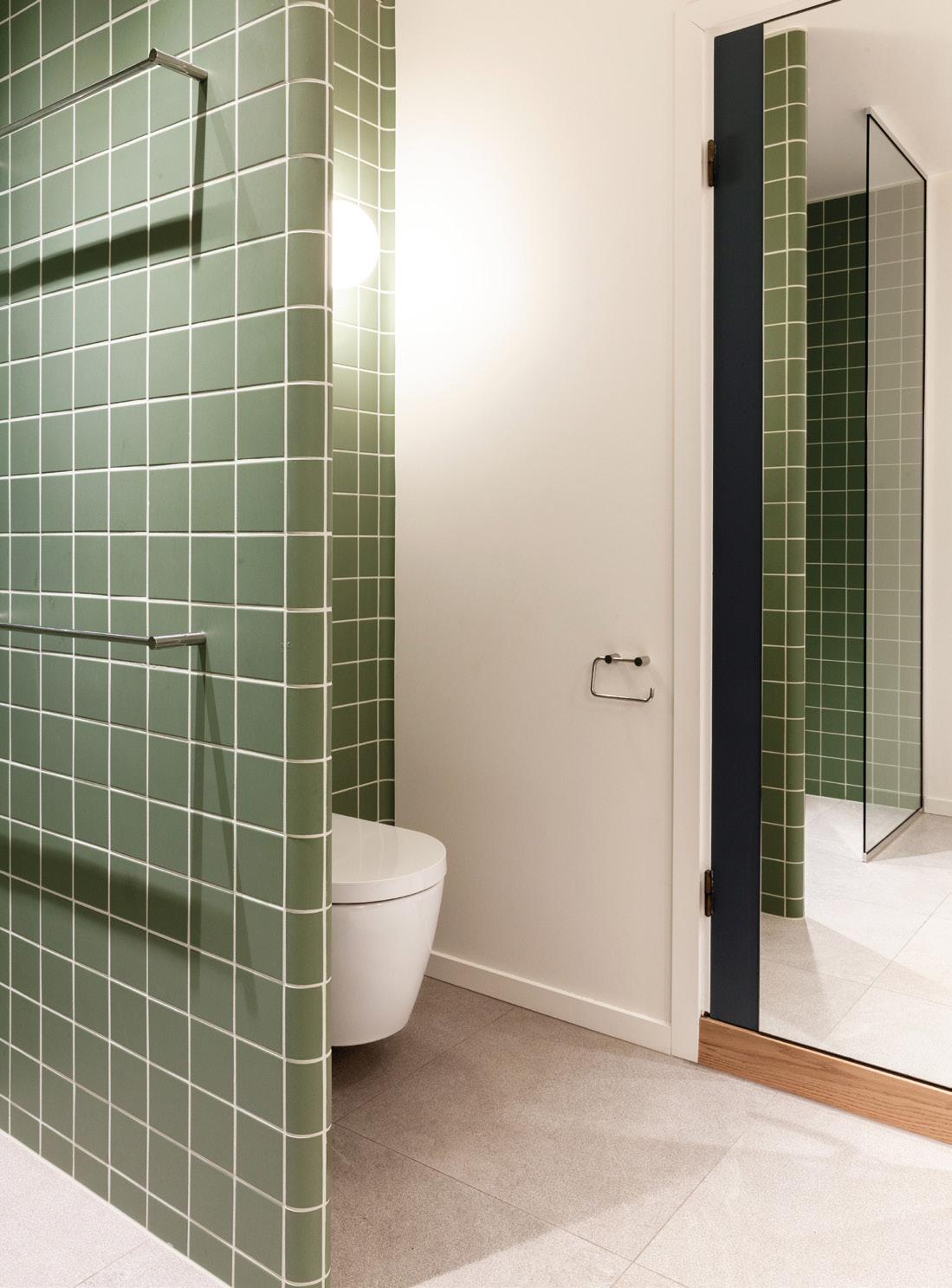
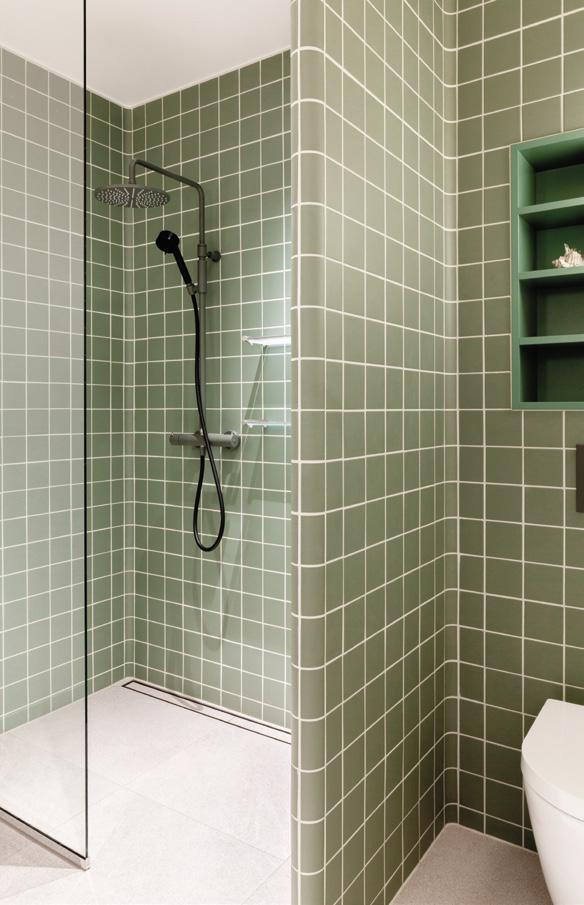
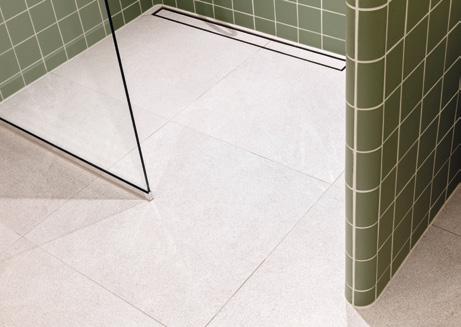
A clear conceptual approach and a carefully controlled palette are able to transform a functional space into a bold and expressive composition, where material consistency and attention to detail define a strong visual identity. This is the case of a detached house in Nordstrand, Norway, where the interior architects at InPlace have designed a children’s bathroom that feels playful yet grounded in strong architectural logic. Green 10×10cm tiles from TopCer are the defining feature of the room. Used generously, the tiles wrap the entire shower and toilet area, extending seamlessly onto a partition wall that subtly divides the space. Rather than acting as a decorative accent, the colour becomes a structural element: shaping zones, guiding movement, and giving the bathroom a strong visual identity.
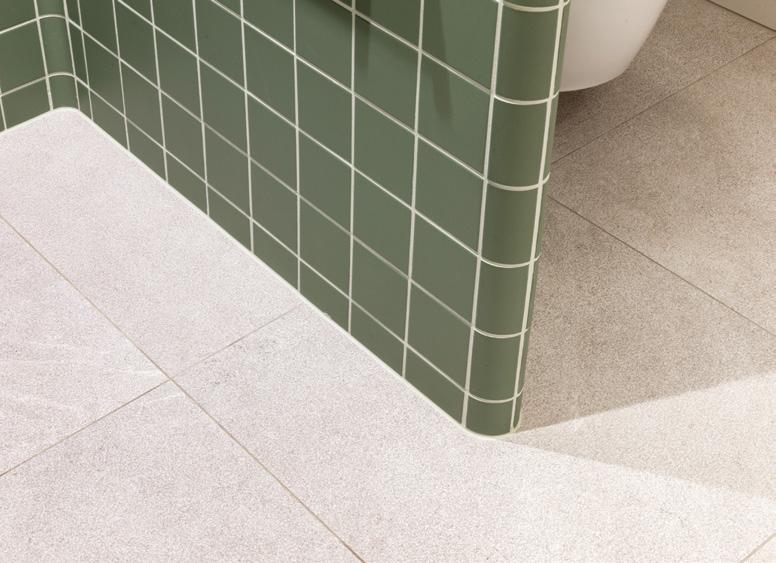
Attention to detail is central to the design. Both internal and external corners are finished with matching green corner tiles, allowing the tiled surfaces to read as a continuous volume. This precision elevates the overall expression, reinforcing TopCer’s focus on durability, technical coherence, and architectural clarity.
The project highlights how a carefully selected ceramic system can support spatial coherence and technical precision, reinforcing the overall design through colour continuity, proportion, and craft. ✕
FOCUS ON
• TOPCER TRIM PIECE QUARTER ROUND: 24QR
• DIMENSIONS: 96X39X8MM (ALSO AVAILABLE IN 146X39X8 MM)
• MATERIAL: UNGLAZED PORCELAIN TILE WITH VERY LOW WATER ABSORPTION AND HIGH RESISTANCE TO BREAKAGE.
• DETAILING: MATCHING INTERNAL AND EXTERNAL CERAMIC CORNER TILES
construction industry.
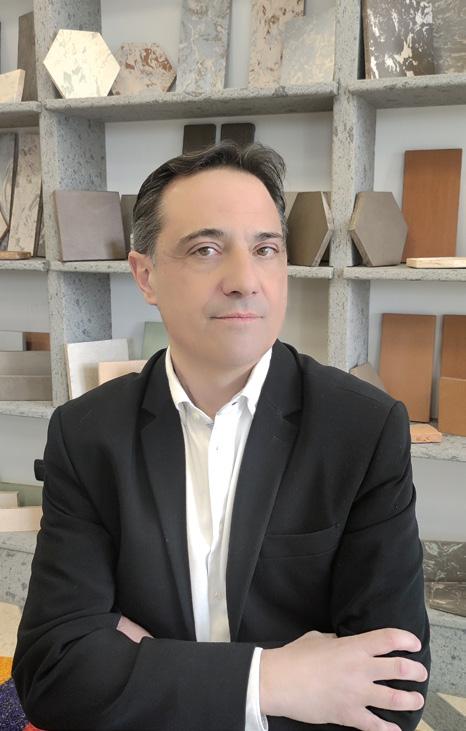
We discussed the company’s vision, positioning and development prospects with Walter Ocule, Head of Strategy and Marketing at Ardogres®
Rallar Arkitekter AS, Norvey - ph. Tobias Kaser
Rallar Arkitekter AS, Norvey - ph. Tobias Kaser
range, sizes and finishes – partly by means of the ARDOLOCK® project – while continuing to place a firm emphasis on sustainability.
TILE INTERNATIONAL: To what extent is sustainability a factor in design choices today?
WALTER OCULE: It is an increasingly important consideration for the construction industry, which is facing challenges linked with climate change. Long-lasting solutions with low maintenance requirements can help reduce the overall, long-term environmental im-
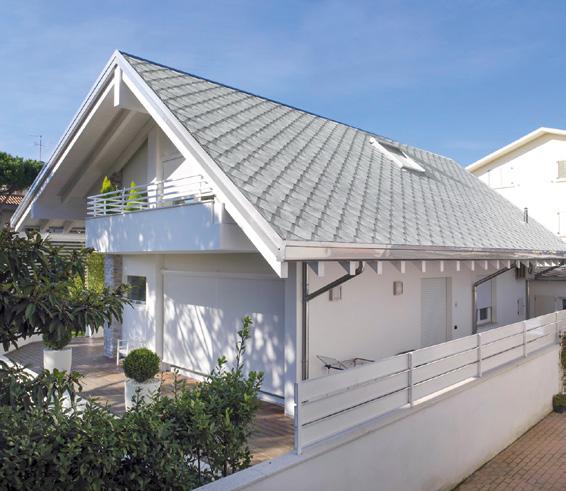
pact of buildings. Ardogres® roof tiles meet these criteria because they are designed for long service-life and made from environmentally friendly materials.�One of our most recent releases is a white tile (Bianco Ostuni) designed to reflect solar radiation more effectively, thus reducing the heat-island effect in urban areas and enhancing the energy efficiency of buildings. Designers and private clients alike are taking a growing interest in aspects like this.
TILE INTERNATIONAL: What developments are in
ardogres Bianco Ostuni roof tiles cm 40x40
the pipeline for the years ahead?
WALTER OCULE: The company is working on several developments, including digital technologies to increase the availability of bespoke surfaces and to further enhance textural effects. At the same time, research is continuing on roofing systems that combine
architectural performance with power generation, such as ARDOSOLAR®, our recently unveiled range of photovoltaic tiles.�The aim is to contribute to the evolution of roofing, which is increasingly viewed as an active component of building performance.
✕
Red Cedar aravis cm 25x40
DANILO RAMAZZOTTI ITALIANHOUSEFLOOR
MATERIAL, TERROIR AND INNOVATION
Founded in the 1950s, Danilo Ramazzotti ItalianHouseFloor is a company that has sailed through time without ever losing its character.
Its history is made up of changes of hands, intuitions and comebacks: a journey, underpinned by a focus on the needs of contemporary
The clays of Monte Rosa, the development of “CottoZero” and the Dynamic Design system for majolica tiles are reflections of a company that has never stopped questioning itself about materials and how to make them evolve. To explore how this heritage has become a current language that speaks to architects, dealers and projects all over the world, we met Glauco Ramazzotti, who heads up the brand and is the voice of the new generation. Together, we discussed the company’s roots and the vision that is now transforming tradition into a fully contemporary project.
architecture, that has now brought it back centre stage with a creation that combines exquisite majolica with handcrafted terracotta.
TILE INTERNATIONAL: Danilo Ramazzotti ItalianHouseFloor is a benchmark in the world of hand-crafted tiles. Just recently, you were selected as an exhibitor at the Statale during the last Fuorisalone, in Milan, and we spotted you at Cersaie, where we got another chance to appreciate your materials…
GLAUCO RAMAZZOTTI: It has been a natural growth process. Our focus is to create hand-crafted terracotta and majolica tiles that represent the material in the most architectural sense of the word: materials that meet both the technical and aesthetic needs of ideal habitats, whether residential or public.
The evolution that has taken place in recent years has been driven by a commitment to listening to the market, which needed a warm, natural material, like terracotta, but with the ability to meet multiple stylistic and design needs… from rustic to contemporary and innovative. Terracotta needed to stop being associated with just one colour - red - and just one style - rustic - and reinvent its persona. From a technical point of view, it needed to overcome its susceptibility to staining and its high degree of porosity, without sacrificing its extremely authentic appearance. Our local clays, combined with our Research & Development work, made this possible, and led to the creation of “CottoZero”.
By taking the same close focus on the needs of contemporary architecture and applying it to our majolica tiles, we created a programme in which all the collections interact with each other in terms of formats and colours. This approach has made us the partner of choice for dealers and distributors who care about offering their customers materials that combine quality, tradition and innovation. And the market is rewarding us for this choice.
TILE INTERNATIONAL: Your work stems from a profound knowledge of the clays and soils of Monte Rosa. How does this connection with your home turf affect your research and your identity as a producer?
G. RAMAZZOTTI: Our business is inextricably linked
Glauco Ramazzotti
with the local area, with its unique geological history: in ancient times there was a supervolcano in our area, and it was the largest in Europe. This volcano collapsed, and as the African plate thrust up against the European plate, forming Monte Rosa, its fault-lines turned through 90 degrees. This unusual situation gave rise to vertical banks of clay, which yield uniquely pure earths that differ widely from one another. In this area, at the foot of Monte Rosa, within the Sesia Val Grande UNESCO Park - where the quarries are located - clays of different colours and with different technical characteristics are to be found just a few kilometres apart.
We decided to study these, to get a better understanding of their characteristics, and then to start mixing them, to produce materials with ever higher performance. These studies, which started with the research conducted by my father, who produced the first terracotta in 1979, gave rise, in 2010, to “CottoZero”: a new concept of hand-crafted terracotta.
TILE INTERNATIONAL: Let’s talk about your “hand-crafted terracotta, like they didn’t use to make it.” What principles form the basis of this project?
G. RAMAZZOTTI: Terracotta is a wonderful material for designers: it’s natural, warm, healthy and deeply connected with our roots, but, like everything around us, it needed to evolve. That’s why we decided to create a new, high-performance terracotta capable
CottoZero Argille Nobili - Orta
CottoZero Argille Nobili - Verbania
of meeting the needs and styles of contemporary living.
“CottoZero” is a new form of terracotta, which retains its hand-crafted feel but revolutionises the material and its technical features: strong, highly compact, sparsely absorbent, stain-resistant and easy to maintain, its performance is so high that it only needs one simple treatment after installation, after which it can be treated just like a normal floor covering. But we didn’t confine ourselves to technical performance, because we felt that the aesthetic side needed updating, too. Taking advantage of the different colours of our clays, we created a palette of original tones ranging from whites to dark greys, powder pink to shades of rosé, and green to sky blue (the only colour made with a pigment). These new materials were then split into different collections, each characterised by differ-
ent surfaces and finishes: “Argille Nobili”, with its mottled appearance and natural texture; “Terre Pure”, with its softer look and more heavily textured finish; and “CottoZero Ventilato”, with its sober, velvety character. We have also released two very distinctive ranges, which have met with wide acclaim: these are “Variegato”, in a style that is typical of our local area, featuring unusual colours and juxtapositions, and “Pietrame”, a terracotta dotted with small aggregates that harmonise with its tones.
We have respected the classic character of the material too, of course, so the range also includes more traditional reds and browns, and natural and antique finishes, for dedicated projects and historic renovations.
TILE INTERNATIONAL: You often describe the material as being “alive” and capable of breathing. What is
CottoZero Variegato - Fumo variegato Perla
the real value of this feature for the people who install these materials and use them on a daily basis?
G. RAMAZZOTTI: “CottoZero” is sparsely absorbent: to be precise, it absorbs 70% less than traditional terracotta. Having achieved this, we don’t need to use wax on the surfaces, so the material retains its most important feature: breathability. Breathable materials balance out the moisture found in indoor spaces, thus preventing condensation on walls, expansion and contraction of nearby sensitive materials, such as wood, and the onset of rising damp. And these are all major benefits for the architectural habitat and its occupants.
TILE INTERNATIONAL: As well as terracotta, you make majolica. What kind of research have you done on colours, surfaces and formats in relation to majolica?
G. RAMAZZOTTI: As far as majolica is concerned, we have focused on simplicity and flexibility, and given full emphasis to the main feature of hand-craftsmanship: bespoke styling. Our majolica collections are designed to maximise opportunities for pairings with other material, and that’s why we have channelled so much effort into creating a wide range of contemporary colours, a high density of glaze and formats designed to add value and facilitate the work of showroom staff. With our Dynamic Design project,
furthermore, we enable our customers to choose a format from one collection and a glaze from another, thus giving rise to over 3,500 product options, with all the combinations already formalised in the price list.
TILE INTERNATIONAL: How important is product customisation these days - for example when working with architects or interior designers?
G. RAMAZZOTTI: When it comes to design, product flexibility and customization are key, which is why we came up with the idea of Dynamic Design.
To meet project needs, we have also developed a series of trim pieces – now a real rarity in the ceramic industry – which have glazed ribs on the sides or midlines of each format, so that they can be arranged (and installed) in a clean, contemporary fashion, without any need to insert profiles.
In line with this bespoke approach, we have completed our offering with an artisanal basin, available in the full range of Ramazzotti colours.
As part of our vision of offering a comprehensive, allround design system, with a total look to ensure harmonious, refined colour pairings, we have also finalized a collaboration with Laticrete with the creation of the “Permacolor Select by Danilo Ramazzotti” collection of grouts coordinated with our products.
3D Maiolica - Amo Blu mix
TILE INTERNATIONAL:
The question of affordable artisanal goods is one that is close to your heart. How do you maintain a balance between quality craftsmanship and market competitiveness?
We have focused on simplicity and flexibility, and given full emphasis to the main feature of handcraftsmanship: bespoke styling. Our majolica collections are designed to maximise opportunities for pairings with other material, and that’s why we have channelled so much effort into creating a wide range of contemporary colours, a high density of glaze and formats designed to add value and facilitate the work of showroom staff.
G. RAMAZZOTTI: Talk of artisanal goods or hand-crafted products automatically triggers thoughts of the costs involved. But, in fact, we have managed to find some attractive solutions. As far as our majolica is concerned, we have provided access to such an incredible array of products that they are tantamount to custom pieces, without a huge price difference compared with the standard range. As for “CottoZero”, plenty of aspects come into play, first and foremost their ease of maintenance: as we said, they only need to be treated once, after installation, and do not require any further costly maintenance operations to restore damaged wax or remove stains. On top of that, their breathability balances the humidity in the environment, and therefore eliminates the need or reduces the frequency of painting and redecoration work. Another advantage is that this is a throughbody product, so if someone drops a heavy object on the floor and chips it, there is no change in colour and the damage can be easily remedied with sandpaper, without the need for a specialist to replace the tile. It’s also worth remembering that interiors made with natural, high-quality materials never age, which adds a lot to the value of the home
TILE INTERNATIONAL: Why do dealers choose Danilo Ramazzotti?
G. RAMAZZOTTI: The dealers who choose Danilo Ramazzotti have an eye for product quality, love their work, are design-driven and are looking for contemporary materials with a distinctive aesthetic that meets their customers’ needs and adapts to any design identity. They choose our majolica because it is easy to pair and comes in a wide range; they opt for “CottoZero” because it is technically innovative and a unique material to offer customers and designers.
TILE INTERNATIONAL: How do you select your dealers? And what role does technical training play for you?
G. RAMAZZOTTI: Our dealers share our passion for design: being passionate about your work is the only way to do it effectively. Technical training is essential. Professionalism is the one tool that really makes a difference, especially in today’s market.For customers, choosing a showroom means putting themselves in the hands of a trusted partner who can give them technical advice and guidance on creating a unique, personalised environment; and none of that can happen without thorough, ongoing training.
TILE INTERNATIONAL: The market is showing renewed interest in natural and authentic materials. Is this a trend that you are noticing, too?
period we spent locked down at home taught us that being surrounded by natural, high-quality materials enhances our enjoyment of life. Natural materials really do connect us with a state of well-being, so they are not just a passing trend or fashion. Investing in natural, premium surfaces helps us live better and add real, timeless value to our homes.
TILE INTERNATIONAL: Looking forward, what are the next challenges you are working on – in terms of target markets, products or materials?
G. RAMAZZOTTI: Danilo Ramazzotti ItalianHouseFloor is now rapidly expanding. Through our network of partner dealers, our brand has a presence in the Italian market, many European markets and from North America to the Caribbean. We have also recently opened up in Eastern Europe on a structured footing, and in response to various requests, we are currently considering exploring new markets. For us, open-
ing up to new partners and new markets is always a rewarding challenge because it gives us the opportunity to establish new relationships and connect with new worlds: for us, every customer is a value and a stimulus. Our passion for what we do prompts us to make continuous improvements to our production and to the opportunities our customers have to express themselves through our materials. That’s why design work is under way on new products, aimed at emphasising substantial and three-dimensional textures, while adhering to the key concept of easy pairing. As my father Danilo taught me, and as he regularly reminds us: “Man does not create; he observes, composes and shapes.”
Our local area and Monte Rosa are a treasure trove of stimuli and unique raw materials, an inspiration and a continuous voyage of discovery that prompt us to constantly seek out new materials and feelings that recount our history and interpret out future.
Maioliche, code di pavone
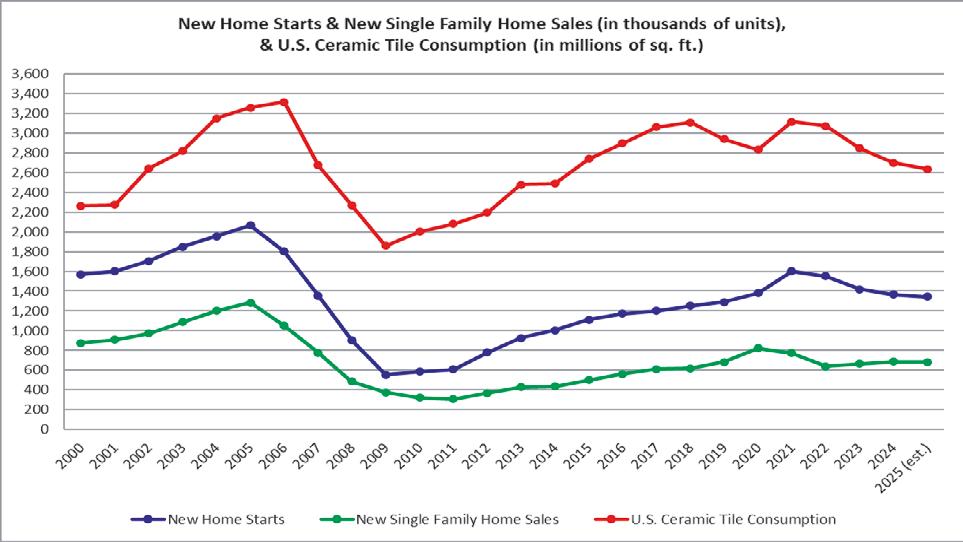
U.S. RESIDENTIAL CONSTRUCTION DECLINE IS SLOWING
Throughout 2025, ongoing affordability constraints in the housing market, elevated interest rates, and uneven construction activity continued to weigh
on ceramic tile demand in the United States, though improving macroeconomic indicators and a strengthening remodeling sector provided some relief.
New residential construction confirmed the negative trend that began in 2021, although with a milder decline than in previous years. Total U.S. housing starts were estimated by the National Association of Homebuilders (NAHB) at 1.34 million units, a 1.7% decrease compared to 2024 and the lowest level since 2019. NAHB estimated single-family housing starts were at 941,000 units in 2025, a 7.1% decline from 2024. In contrast, multifamily starts showed solid gains from the previous year, rising 14% to 404,000 units. Single-family housing starts comprised 70.0% of total home starts in 2025, down from 74.1% the prior year.
According to U.S. Census Bureau and NAHB, new single-family home sales in 2025 were at an estimated 682,000 units, a 0.6% year-over-year decline. Despite the median new home sales price falling to a fouryear low ($392,300 as of October 2025) - partly due to homebuilders cutting prices and offering incentives to prospective buyers - affordability remains a major hindrance to growth. Existing home sales showed modest improvement in 2025, reaching an annualized rate of 3.69 million units, up 0.5% from the prior year. Despite this increase, the 2025 total was the fourth lowest this century, with transaction volumes remaining historically subdued.
Without a doubt, the residential market remained a significant constraint for the tile industry.
Mortgage rates stayed elevated, with
According to National Association of Realtors, a key factor limiting sales was that many existing homeowners were locked into low mortgage rates, reducing their incentive to move. In addition, the median price of existing single-family homes rose again in 2025, reaching a record high of $419,500 (+1.7% compared to the previous year).
As mentioned, the remodeling sector showed positive momentum and experienced growth in 2025. NAHB’s Remodeling Market Index rose to a four-quarter high in 4Q 2025, and Harvard’s Leading Indicator of Remodeling Activity estimated 2.7% annual growth as of 4Q 2025.
From a broader economic perspective, real GDP growth strengthened in the second half of 2025, increasing at an annual rate of 4.4% in the third quarter (source: U.S. Bureau of Economic Analysis).
Total U.S. construction spending (including private and public residential and non-residential construction), which had increased for thirteen year in a row up to 2024, appears headed for a modest decline in 2025 (U.S. Census Bureau estimates -1.4% vs. 2024 based on annualized data), reflecting slower residential activity ✕
the 30-year fixed rate averaging 6.60%. Although this was modestly lower than the rate of 6.72% in 2024, it was high by
FIG. 1 - USA: NEW SINGLE FAMILY HOME SALE
FIG. 2 -
2025 U.S. CERAMIC TILE MARKET UPDATE
The U.S. ceramic tile market continued to face challenging conditions in 2025, though signs of stabilization began to emerge as the year progressed.
While total tile consumption remained below prior-year levels through November, the decline was slightly lower than the steeper yearover-year downturns seen in 2023
U.S. PRODUCTION AND SALES THROUGH NOVEMBER
Through November 2025, U.S. ceramic tile production was 64.1 million m2 (689.7 million sq.ft) and domestic shipments were 60.6 million m2 (652.6 million sq. ft.), down 8.6% from the same timeframe the previous year. At the current pace, domestic shipments for the full year will be at their lowest annual level since 2012. Despite lower volumes, domestically produced tile continued to command a substantial share of total U.S. consumption. Through November 2025, U.S. shipments’ share of total U.S. consumption by volume was 27.5%, down from 28.5% in 2024. The next highest market shares by volume were held by Spain (15.5%), Italy (12.8%), and India (12.2%).
By value, U.S. FOB factory sales totaled $1.22 billion through November 2025, down 4.5% vs. November 2024 YTD. U.S. shipments made up 35.1% of total U.S. tile consumption by value, down from 36.2% in 2024.
TCNA data show that the average per-unit value of domestic shipments through November 2025 YTD was $20.08/m2 ($1.87/sq. ft.), up from $19.23/m2 ($1.79/ sq. ft.) during the same period in 2024.
Through November 2025 U.S. ceramic tile exports were 3.4 million m2 (37.1 million sq. ft.), down 1.6% from November 2024 YTD. Based on figures from the U.S. Dept. of Commerce, the primary recipients of U.S. exports were Canada (63.7%), Italy (13.0%), and Mexico (12.1%). The value of U.S. exports increased 7.1% to $46.0 million over the same timeframe. TCNA is checking with the government to provide an explanation of the rather unusual figure relating to Italy: In fact, in the month of October 2025, an unusually large amount of tile was exported to Italy, which accounted for nearly all U.S. exports to Italy for the year.
U.S. IMPORTS
Based on figures from U.S. Dept. of Commerce, through
and 2024. Based on available data from U.S. Dept. of Commerce and Tile Council of North America, U.S. ceramic tile consumption in 2025 was an estimated 240.3 million m2
November 2025, U.S. ceramic tile imports were at 159.7 million m2 (1.72 billion sq. ft.), down 2.4% compared to the same timeframe in 2024.
Spain once again became the largest exporter to the U.S. by volume, accounting for 21.4% of total imports (November 2025 YTD) and supplanting India, which held the top spot the last two years. Import volume from Spain rose 16.4% (November 2025 YTD vs. November 2024 YTD) to 34.1 million m2, reversing a modest 2.6% decline experienced in 2024.
With 28.3 million m2 exported through November 2025, Italy was the second largest exporter to the U.S. by volume, its highest position since 2022. Italian tile comprised 17.7% of U.S. imports by volume and was up 8.6% compared to the same timeframe in 2024.
Due in large part to tariffs, imports from India through November 2025 declined sharply to 26.9 million m2. The 20.9% volume decrease (vs. November 2024 YTD) caused India to fall to the third position with a 16.8% share of U.S. imports. This marked the second consecutive year of contraction for Indian exports to the U.S. after more than a decade of consecutive annual growth, although the decline recorded in 2024 had been decidedly more moderate (-2.4%).
Mexico remained the fourth-largest supplier to the U.S. by volume with a 13.1% share despite its U.S. exports’ declining 16.1% vs. November 2024 YTD.
Brazil (-0.6% vs November 2024 YTD) maintained its position as the fifth-largest exporter to the U.S., while its nearest competitors, Türkije (-25.4%) and Vietnam (-8.4%), each posted sharper declines over the same timeframe.
As shown in table 3, the total value of U.S. tile imports in the first 11 months of 2025 increased by 1.7% compared to the same period in 2024, reaching $2.25 billion (CIF + duty). Italy continued to be the largest exporter to the U.S. on a dollar basis, comprising 31.5% of total imports ($709.8 million; +10.4% vs November 2024 YTD), followed by Spain with a 28.0% share ($631.1 million; +12.8%) and Mexico with an 8.5% share ($191.8 million; -22.9%).
Andrew Whitmire, TCNA (USA) AWhitmire@tileusa.com
(2.6 billion sq. ft.), down 4.2% from the previous year, with an estimated value of $3.8 billion , down 0.5% from the prior year.
Source: U.S. Dept. of Commerce & Tile Council of North America (TCNA)
Table 4 shows the average values of tile (including CIF + duty) from the ten countries that exported the most tiles to the U.S. based on volume, through November 2025. These values are significantly affected by the mix of tiles imported and by the differences in pricing for the same types of tile.
Once again, Italian tiles had the highest average price of 25.11 $/m2, up 1.7% from 24.69 $/m2 in 2024.
Spanish average value was 18.50 $/m2, down 2.8% from 19.03 $/m2 in 2024.
The average value of Indian tiles decreased for the third straight year, from 6.64 $/m2 in 2024 to 6.53 $/
Are you interested in interior and surface trends?
Scan and discover the virtual pages of Tile International!
Source: U.S. Dept. of Commerce & Tile Council of North America (TCNA)
TAB. 3 - US CERAMIC TILE IMPORTS BY COUNTRY OF
m2 in 2025 (-1.7%), the second lowest price among the ten largest exporting countries.
CANADIAN MARKET UPDATE
Based on October YTD data from Statistics Canada, we estimate 2025 Canadian ceramic tile consumption was 31.5 million m2 (339.0 million sq. ft.), down 1.1% from 2024. As there is no significant ceramic tile production in Canada, imports approximately equal consumption. The five countries from which the most tiles were imported into Canada through October 2025 YTD based
on volume were: China (8 million m2; +4.7% vs. October 2024 YTD); Italy (5.3 million m2; -18.4%); India (3.7 million m2; +43%); Spain (3.4 million m2; +0.4%); and Türkiye (2.7 million m2; -3.2%). Considering the value of imports (FOB) through October 2025, Italy remains the main supplier of tiles in Canada, with sales amounting to 137.9 million Canadian dollars (+0.8% vs October 2024 YTD) and a market share of 38%. Italy is followed by China (CAD 63.8 million; +6.3%), Spain (CAD 58.4 million; +18.6%), USA (CAD 28.6 million; -5.9%), and Türkiye (CAD 25.1 million; -4.8%).
TAB. 4 - AVERAGE VALUE OF IMPORTED TILES ($/SQ.M )
COVERINGS UNVEILS 10 TILE TRENDS FOR 2026
The annual trend forecast is curated by the show’s three main sponsors and international trade bodiesCeramics of Italy/Confindustria
Ceramica, the Ceramic Tile Manufacturers Association of Spain (ASCER)/Tile of Spain, and the Tile Council of North America (TCNA).
Working with them this year was designer Alena Capra, owner of Alena Capra Designs and a Certified Master Kitchen and Bath Designer.
ARTICULATED ACC ENTS
The Articulated Accents tile trend celebrates the synchronized harmony of graphic precision and outward design articulation, crafting tiles that engage the senses. Advanced glazing and contour-detailing techniques create surfaces that evoke the feel of anything from soft leather to textured sandstone, complete with stitching-like details or pitted striations. The result is a layered, immersive experience that responds dynamically to light and touch, bringing warmth, visual depth and subtle sophistication to interiors.
Anatolia - Aeterna Sintered Slab (Calacatta Oro)
Landmark Ceramics- Mood Urban
GILDED AGE
Metallic details have resurfaced, becoming a quintessential design element among contemporary tile collections. These iridescent details transform ceramics from purely functional surfaces into sophisticated focal points. Gold, bronze, copper and silver ornamentation takes shape among both large- and small-format pieces, creating shimmering contrasts against matte, textured or neutral backgrounds. These accents are designed to interact with light, to emphasize architectural features and enhance spatial depth, all while adding quiet luxury to projects.
HAPTIC EXPERIENCE
Ceramic surfaces are evolving beyond visual appeal into interactive, multi-sensory experiences that respond and engage with the senses. Textures now range from subtle ridges and embossed patterns to deeply undulating surfaces, inviting touch and creating a human connection with materials. Advances in glazing chemistry and digital production add reactive qualities, allowing finishes to subtly shift with light, perspective or angle, lending to walls and floors with a dynamic almost living quality. These tiles not only enhance aesthetical range, but also elevate interiors to immersive, tactile environments.
Cerámicas Aparici- Illusion
Baldocer- Lux
Natucer- Kahn
JADE TERRAIN
Inspired by the precious stone, this trend captures the serenity, sophistication and luxury of jade green as it translates into ceramic and porcelain tile. Jade green, positioned near the center of the green color family, showcases a wide array of hues in jade-inspired tiles, ranging from soft pastel greens and vibrant turquoises to deep, earth-toned mossy shades and saturated tones with subtle shadows of black. With product selections such as monochromatic subway tiles, two-toned mosaics, large-format tiles with shades of jade veining and much more, this trend offers designers and installers remarkable versatility and lends itself equally to calming interiors and bold architectural statements.
Realonda- Bari
Cerasarda- Porto Rotondo
Harmony- JOIA
MICRO-ILLUSIONS
Small-format tiles have reached their mighty peak, achieving immense design effects by mimicking large-scale surfaces or intricate mosaics. Techniques such as precision scoring, digital printing and colormatched grout allow these tiles to replicate expansive mosaic murals, create optical illusions or produce layered dimensional effects. The result is high-impact design that is both cost-effective and installation-friendly, perfect for feature walls, accent areas and floors that demand detailed artistry without complexity.
OR GANIC MINIMALISM
Evolving to a cooler, more minimal aesthetic, this season manufacturers are emphasizing tranquility, texture and lasting stone effects. This trend represents a collective return to structured, quiet spaces, desaturated tones and the integrity of durable materials. This approach elevates raw elemental surfaces, such as concrete and ivory stone looks, into refined, tactile expressions of calm, sophisticated design.
Gayafores- Altea
Decocer- Senda
Ceramiche Supergres- Kave
SU RFACE TECHNOLOGIES
Manufacturers continue to pioneer new surface technologies, redefining the experience of space through touch, texture, light and function. Sculptural reliefs, bas-relief textures and glossy-matte contrasts create richly tactile walls, while advanced technologies add dimensional depth, slip resistance and silky touch-effects. From new integrated induction cooktops to engineered shower trays and backlit-effect surfaces, tile is redefining the relationship between material and technology.
CIR Ceramiche- Forever Color
Naxos Ceramica- Petraluna
Casalgrande Padana- Ghost
TAILORED CRAFT
Function meets nostalgia in a way that is as playful as it is practical. Tailored Craft draws inspiration from fashion’s enduring motifs, blending tailored elegance with skilled craftmanship. These looks imbue a quietly luxurious aesthetic that feels curated, tactile and timeless-perfect for designers who value character, and considered design over fleeting trends.
MILE®stone - Shapes (Chevron)
Wonder Porcelain- Silvanus
Florida Tile- Threadscape
TILE AS ART
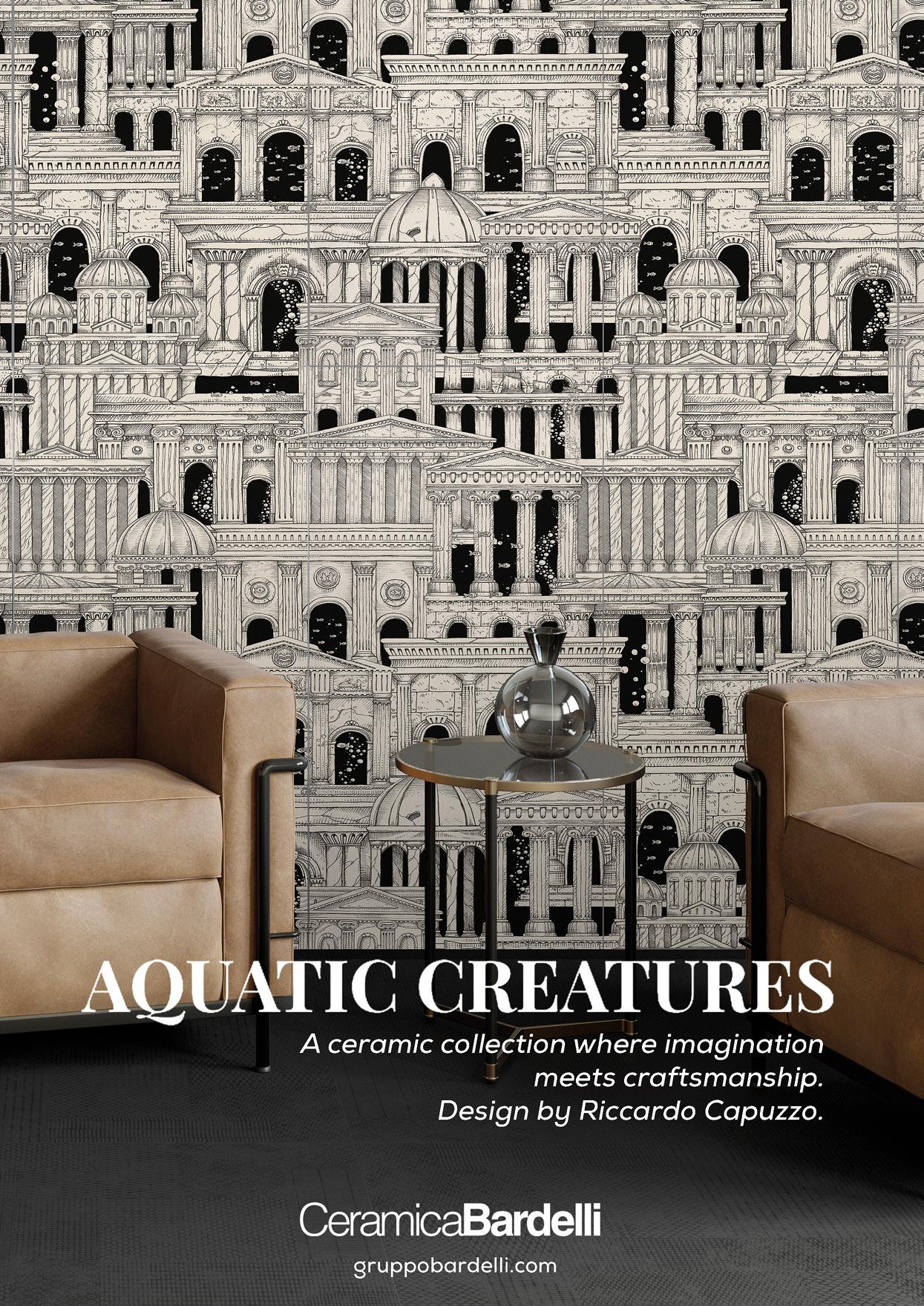
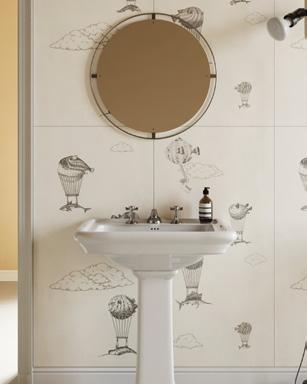
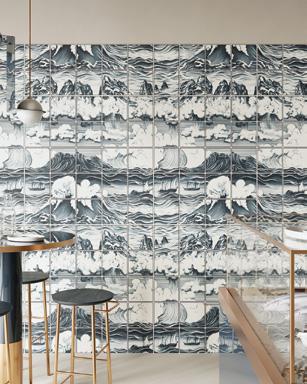
Tile is shifting from simple cladding to an immersive design statement, with manufacturers positioning it as a sophisticated alternative to wallpaper or art. This season’s collections introduce bold graphics, optical illusions and continuous murals that create decorative storytelling, ranging from geometric and metallic identities to refined scenographic patterns and hand-drawn, narrative-driven scenes.
Serenissima Ceramica- Showall
ABK x Moooi- Nesting Room
Ceramica Bardelli- Aquatic Creatures
Decoratori BassanesiQuadrille by Clara von Zweigbergk
PURE PRIMARY:
THE COLOURS OF ORIGINS,
THE FUTURE OF CERAMIC TRENDS
“New look, same eye for design” is the slogan chosen by Tosilab to announce its recent rebrand, featuring a new logo in the red and white colours of its parent company, the Coesia Group.
More than just a change in visual
identity, the rebrand reinforces Tosilab’s position within a larger family united by a shared vision of innovation and evolution.
It also strengthens the brand’s role within System Ceramics, another Coesia Group company, opening
a new chapter that maintains Tosilab’s extensive expertise in ceramic design and trend forecasting. At the same time, the switch to vibrant red reflects a broader shift that is redefining the landscape of contemporary ceramic surfaces.
PURE PRIMARY: CHOOSING STABILITY THROUGH PRIMARY COLOURS
In today’s architectural world, colour is a clear declaration of intent. We live in a fast-moving, complex pe-
riod in which political, economic and social uncertainty fuels a collective need for clear reference points and stability.
The world of design and architecture has sought these values as part of a return to its origins, a reference to nat-
ural elements and the pure essence of primary colours.
Primary colours are the roots from which everything else originates, universal natural elements that speak a direct common language and convey a sense of reassurance and authenticity.
Through collaboration with the innovation company D.O.S. – Design Open Spaces, Tosilab has identified the Pure Primary trend as a set of authentic and essential colours that restore expressive depth and personality to both spaces and individuals, a grounded response in a constantly changing world.
A PALETTE OF ENERGY AND CLARITY
The Pure Primary collection consists of a palette of vibrant, direct colours that bring energy, clarity and dynamism to any setting. The visual impact is clear and immediate, ideal for projects with strong personalities where colour takes
centre stage. With its contrast-enhancing neutral tones, the Pure Primary palette provides a visual balance that emphasises forms, volumes and details, creating spaces that convey freshness and confidence.
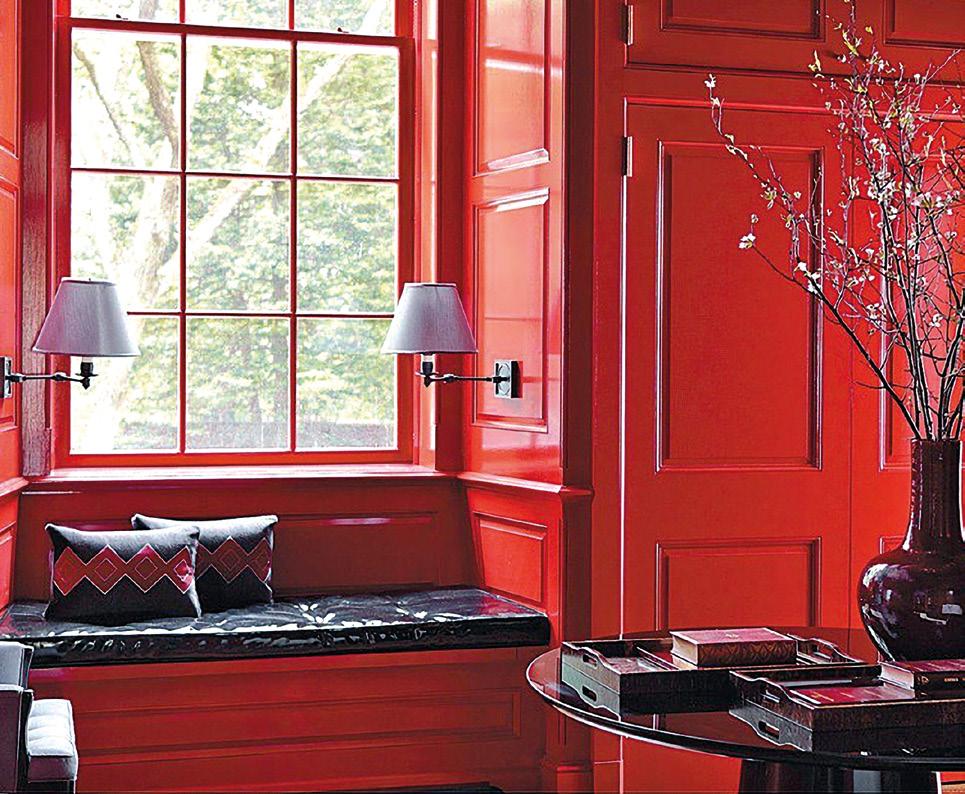
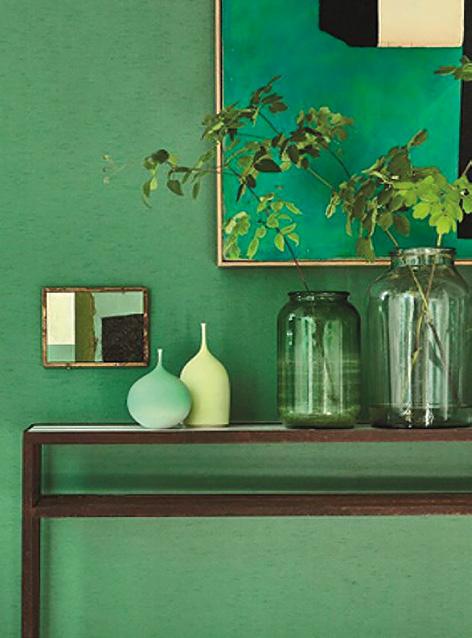
Absolute Red pulses with pure energy, expressing the power and vitality of red in its most authentic form. Ideal for projects with a powerful visual impact, it conveys strength, personality and an unmistakable chromatic identity.
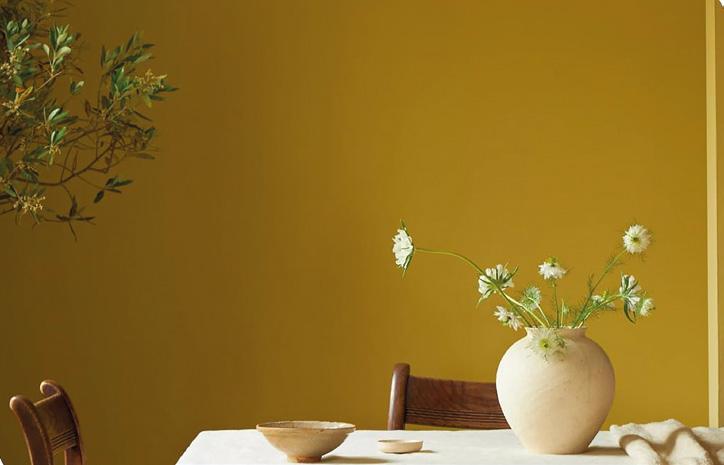
Pulse Yellow radiates energy, warmth and positivity, illuminating spaces with a touch of freshness that instils optimism and creativity. It integrates easily with neutrals or complementary colours to create vivid, eye-catching contrasts.
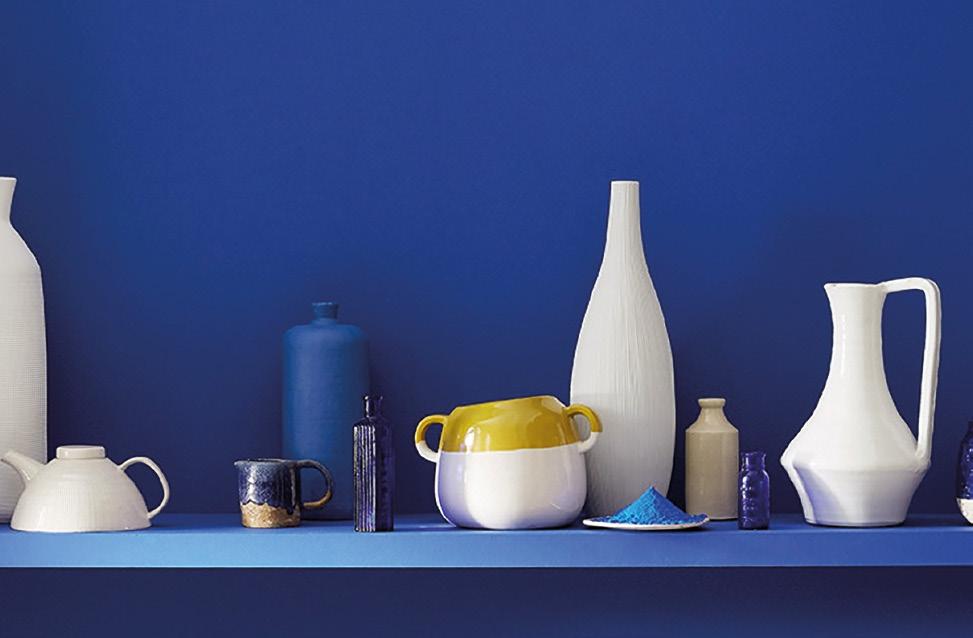
True Blue instils a sense of stability, balance and clarity, the most authentic essence of blue. It brings visual depth and integrates perfectly with other primary or neutral shades, enhancing architectural details, volumes
by Tosilab, a Coesia brand (Fiorano Modenese, Italy)
and shapes.
Balancing Green evokes the harmony and vitality of nature, combining intensity and softness in perfect equilibrium. It is the ideal colour for those who want a reassuring environment, where every element finds its natural place.
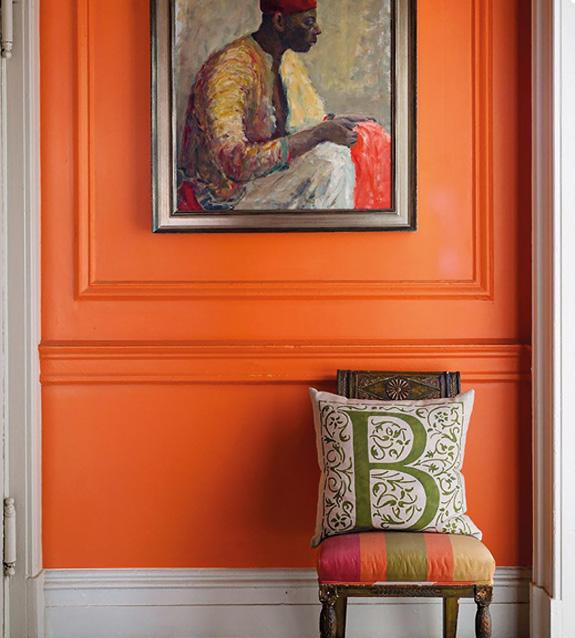
Vital Orange exudes an intense, immersive warmth, ideal for injecting energy and dynamism into contemporary spaces. Imbued with energy, it captures the gaze and pairs effectively with other bright colours to create bold, striking juxtapositions.
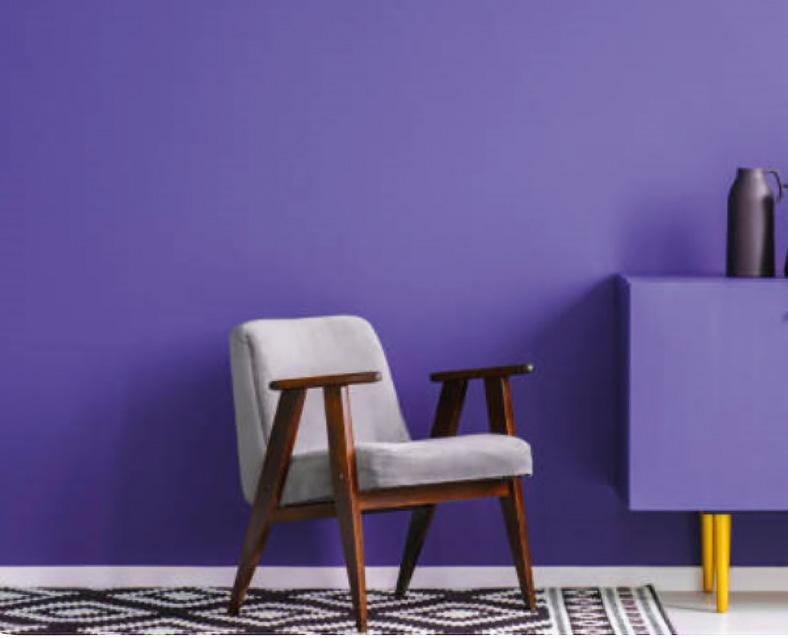
Pure Purple distils the depth and refinement of purple into a clear and unmistakable shade. It conveys creativity and mystery, bringing a touch of extraordinary elegance to any space.
THE ESSENTIALS: BLACK AND WHITE FOR VISUAL BALANCE
The palette also features two fundamental colours.
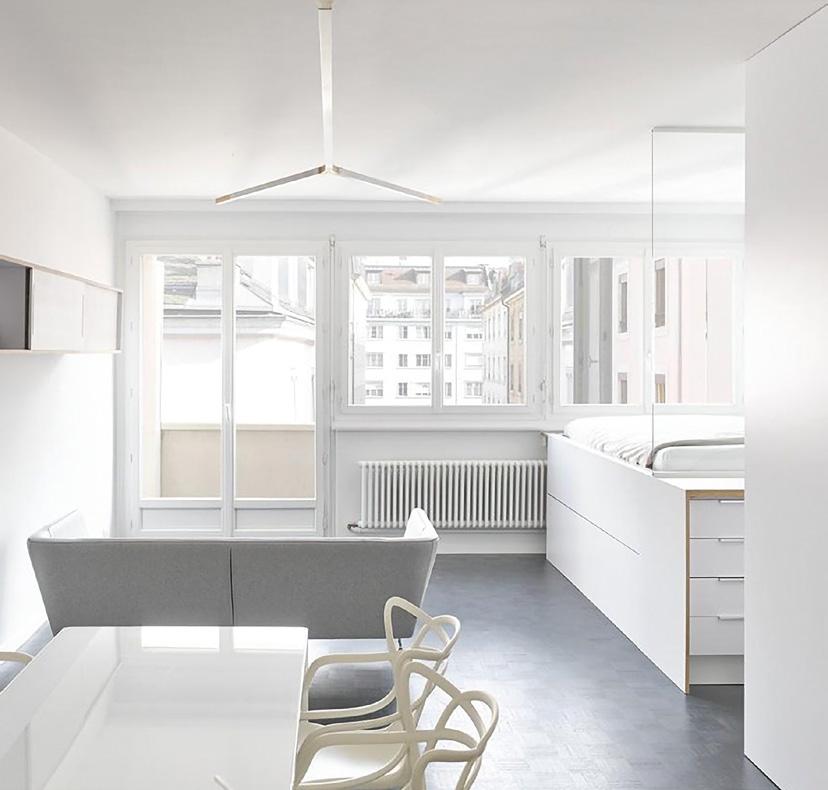
Abstract White gently reflects light, creating a sense of visual purity that opens up endless spatial opportunities. It serves as an ideal base for more vibrant colours or for enhancing architectural details with discretion and elegance.
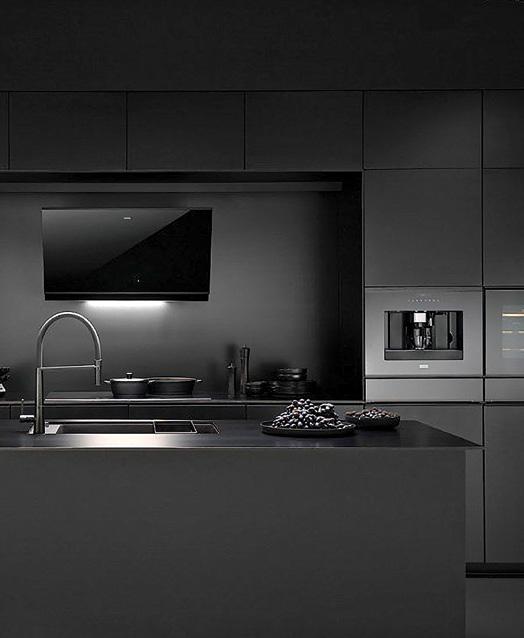
Prime Black stands out for its character and rigour. It is synonymous with depth and clearly defines the contours of a room, lending it timeless elegance. This essential colour brings a sense of refined simplicity,
ideal for projects that focus on style, power and minimalism.
COLOUR AS AN EMOTIONAL CONNECTION
Pure Primary is a design solution for those seeking authenticity without compromising on impact, and stability without sacrificing creativity. It represents a return to the origins of colour while looking firmly to the future, where every hue tells a story of purity and expressive power. Primary colours reaffirm their role as emotional connectors capable of forging immediate bonds with the people who live and work in the spaces. In an age in which we are searching for solid roots, these essential colours offer the psychological stability we need, transforming ceramic surfaces into elements of design and well-being.
TARIFFS, COMPETITION, AND DOMESTIC DEMAND: WHERE IS THE U.S. CERAMIC MARKET HEADED?
On the sidelines of the presentation of the 2025 data on the U.S. ceramic tile industry and market by the Tile Council of North America, we asked TCNA Executive
Director Eric Astrachan for his comments on the outlook for the current year and the main issues of interest at present.
TILE INTERNATIONAL: 2025 was another year of declining tile production and consumption in the United States. What were the main challenges faced by local manufacturers, whose market share continues to be eroded by imported materials?
ERIC ASTRACHAN: In addition to the difficult economic environment mentioned in the U.S. market article by A. Whitmire, another key challenge came from unfairly traded imports from India. While the 50% tariff the Trump administration imposed last year on Indian goods negatively impacted Indian tile imports to a degree, it did not address the fundamental issue with India’s ongoing unfair trade practices of selling dumped and subsidized tile in the U.S.
market. The trade action U.S. manufacturers brought in 2024 seeks relief from these unjust practices that harm the American tile industry. The vitality of the U.S. industry and the livelihoods of thousands of employees and their families depend on it.
TILE INTERNATIONAL: Do you foresee a recovery in tile consumption in 2026?
ERIC ASTRACHAN: If new housing starts and new home sales remain flat in 2026 as NAHB projects, it would be difficult to expect a significant year-over-year improvement in the tile market. However, falling interest rates should help spur existing home sales (+10.8% vs. 2025 per NAHB estimates), which in turn would boost the remodeling segment. This is a positive for our industry, as the rooms most frequently remodeled, kitchens and bathrooms, are the rooms in which tile is most often used.
TILE INTERNATIONAL: Last year, Spain and Italy strengthened their market position in the U.S., significantly increasing their exports as well. How do you interpret the shift in market shares among the main foreign suppliers, largely driven by the 20% drop in imports from India?
ERIC ASTRACHAN: Certainly, some of the gains Spanish and Italian imports achieved last year were due to the U.S. tariffs applied to Indian imports, as well as the potential for additional antidumping and countervailing duties to be levied against India depending on the current litigation in the Court of International Trade.
The decline in imports from other major suppliers (i.e., Mexico and Turkey) can be partially attributed to dumped and subsidized tiles from India.
TILE INTERNATIONAL: Competition from non-ceramic materials in the flooring market has always been a major challenge for the ceramic sector in the United States. What are the latest figures on this?
ERIC ASTRACHAN: According to Floor Covering Weekly’s annual market report, tile’s share of the flooring market decreased from a peak of 13.8% by volume
Eric Astrachan
in 2019 to 11.4% in 2024 (the most recent data available). However, tile’s market share has remained virtually unchanged over the last four years (11.6% in 2021 vs. 11.4% in 2024). This would suggest some stabilization in market share.
Carpet & area rugs (40.1% share in 2024) remained the largest flooring category, followed by LVT (30.3%).
TILE INTERNATIONAL: What initiatives are you undertaking as TCNA to support the sector?
ERIC ASTRACHAN: TCNA’s is working with the State of Tennessee to develop a plan to attract, train, and retain more tile factory workers and promote tile as a great industry in which to work. We are coordinating with members in Tennessee and the Tennessee Colleges of Applied Technology (TCAT) to develop a curriculum certified at the state and federal level. TCNA is also spearheading an effort to develop a replacement ISO method for wear resistance, as the current method does not fully address the industry’s needs.
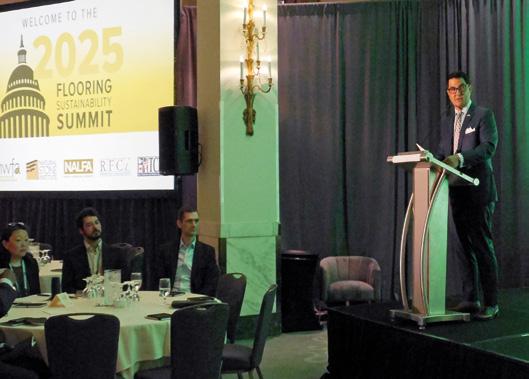
Additionally, through TCNA’s creation of the Flooring Sustainability Summit, TCNA is leading the way in advancing sustainability dialogue. This event will bring together sustainability leaders within the flooring industry, architects and designers, policymakers, and advocacy groups, to address environmental challeng-
es head-on. The third-annual edition of the summit will be held July 15-16, 2026 in Washington, DC.
We are also very engaged with the Tile Heritage Foundation to further promote and celebrate the use of ceramic tile, developing design content from its massive archives and promoting current and future installations through a national tile heritage registry.
TILE INTERNATIONAL:
In just a few days, we will be at Coverings 2026. What are your expectations?
ERIC ASTRACHAN: We expect another well-attended event that will connect more than one thousand exhibitors from around the world with those looking for the latest in tile and stone products. TCNA’s Pavilion is the largest national pavilion at the show with more than 60,000 sq. ft. (5600 m2) of exhibits. In addition to company booths, it hosts a variety of popular show features such as the Coverings Lounge, the Installation Innovation Stage, and the Artisan Showcase. At the center of the area is the TCNA’s booth (#4238), the traditional meeting point for exhibitors and visitors. We encourage attendees to stop by TCNA’s booth and discuss with our staff our numerous offerings in support of the tile industry, including product testing, the Flooring Sustainability Summit, the latest industry standards and much more)
Flooring Sustainability Summit opening remarks: Bill Griese, TCNA deputy executive director and Summit chairperson
International Product Assurance Laboratories (IPA Labs) Ceramic Tile Forensic Testinga
MOHAWK INDUSTRIES
PREPARES FOR RECOVERY
Mohawk Industries has concluded another challenging year for the global flooring industry, successfully navigating a complex market environment to close 2025 with net sales essentially stable with respect to
2024. This performance was supported by a strong fourth quarter, which saw net sales of $2.7 billion, up 2.4% as reported versus the prior year Consequently, the American multinational ended the fiscal year
Commenting on the fourth quarter and full year performance, Chairman and CEO Jeff Lorberbaum stated that the results for the quarter were in line with expectations. “Across our markets, commercial demand remained stable, while the residential segment showed continued weakness, particularly in the US, where sluggish new home construction impacted our volume. We responded to increased input costs – including the impact of US tariffs, covering the cost as planned – with a series of actions, including productivity gains, restructuring initiatives and an improved product mix.”
with consolidated net sales of $10.8 billion (a decrease of 0.5% as reported, or 1.3% on an adjusted basis, compared to 2024).
Approximately 55% of 2025 sales were in the US, 30% were in Europe and
Overall, Lorberbaum noted that, “the fourth quarter reflected a continuation of macroeconomic factors our industry has faced since the second half of 2022.
With weak consumer confidence, many large discretionary investments such as home renovations continued to be postponed.
Furthermore, housing turnover in our major regions remains at historical lows due to affordability challenges and economic uncertainty.
On a positive note, US existing home sales in December increased, supported by mortgage rates at their lowest levels since autumn 2022.
We anticipate that these lower rates combined with potential government actions will benefit housing turnover.”
THE GLOBAL CERAMIC SEGMENT
At the end of 2025, the Global Ceramic Segment reported net sales of $4.3 billion (+1.5% versus 2024), accounting for 39.8% of the Group’s total net sales.
This confirms its position as the world’s largest manufacturer of ceramic tile, with facilities in the USA, Mexico, Brazil, Italy, Spain, Bulgaria, Poland and Russia, and a brand portfolio including American Olean, Daltile, Marazzi, Ragno, Emilgroup, Eliane, Elizabeth, Vitromex, Kai and Kerama Marazzi.
The segment’s EBIT also improved, rising from $249.5 million in 2024 to $266.7 million in 2025 (+6.9%).
The full-year results were bolstered by a positive trend in the fourth quarter, during which the segment generated net sales of $1.07 billion (+6.1%) and an operating margin of 6.1%. Productivity gains and an improved price mix partially offset headwinds from higher input costs and lower sales volume.
2026 OUTLOOK
As signalled by the Chairman of Mohawk Industries, market conditions in the early months of 2026 ha-
Jeffrey Lorberbaum
Milena Bernardi
15% were in other geographies . Profitability was impacted by market pricing pressures and increased input costs.
For 2025, adjusted net earnings were $559 million (a 9.4% decrease
ve remained similar to the fourth quarter of 2025. Although home renovation remains soft in the United States, the NAHB Remodeling Market Index has shown improvement in the last two quarters. In this scenario, the Group confirms it is proceeding with its strategy based on productivity, cost reductions, innovative premium product introductions and price increases to strengthen competitiveness and drive sales and profitability. “However, the extent of our growth this year will depend on economic conditions, interest rates, geopolitical events and, most importantly, the degree to which residential remodeling recovers,” concluded Lorberbaum
from the previous year), while the operating result fell to $489.8 million compared to $693.5 million in 2024.
The Group generated free cash flow of approximately $621 million and repurchased approximately 1.3 million shares as part of its stock buyback programme. In response to market weakness, capital spending was reduced to $435 million.
Ragno
MATERIALS AND DESIGN: STONE SOURCE CELEBRATES BEAUTY
Stone Source, founded in 1988, is now a benchmark in the American surface materials market.
Part of the Paramount Global
Surfaces group, the company represents a successful blend of natural stone, the creative potential of ceramic techniques, and the technological innovation of porcelain, mosaics, and other materials.
Design-driven by philosophy,
TILE INTERNATIONAL: How did your journey begin, and what have been the most significant milestones in your growth over the years?
DEDE DUNN: Founded in 1988, Stone Source launched as a specialty distributor of premium natural stone and decorative surface materials, focused on serving architects, designers, contractors, developers, and high-end clients rather than the broader commodity market. From the outset, the company distinguished itself from traditional stone wholesalers by cultivating strong global supplier relationships and building a design-oriented sales team that partnered with architects and clients early in the specification process. At the
time, this forward-thinking, design-centric approach set Stone Source apart from suppliers who typically entered projects later in the construction cycle.
While remaining true to this original business model, the company has expanded its reach and capabilities through strategic acquisitions that have strengthened and diversified its product portfolio.
Today, as part of Paramount Global Surfaces - formed through the acquisition of Happy Floors (article in the next pages), Ceramic Technics, and Stone Source - we offer broader access to materials and solutions across multiple market segments, positioning us to better serve a wide range of commercial and residential applications.
TILE INTERNATIONAL: With showrooms spanning both established East Coast hubs like New York and Washington, DC, and fast-growing markets such as Atlanta and Nashville, what key differences do you observe in design trends, material preferences, and client expectations?
DEDE DUNN: Across our showrooms, we see a strong desire for authentic, high-quality materials, but regional nuances definitely shape how that vision comes to life. In established East Coast markets like New York and Washington, DC, there’s a continued appreciation for refined, timeless palettes - natural stones with subtle movement, honed finishes, and materials that convey permanence and architectural integrity. These clients are often highly design-driven and expect deep product knowledge, specification support, and early collaboration in the design process. In fast-growing markets such as Atlanta and Nashville, we’re seeing more experimentation with bolder veining, warmer tones, and statement surfaces that create impact in hospitality, mixed-use, and luxury residential projects. Across all regions, however, client expectations have evolved significantly - designers want a consultative partner, not simply a supplier. They expect transparency around sourcing and sustainability, access to large-format and distinctive materials, digi-
DeDe Dunn
the company is committed to delivering solutions with the highest aesthetic quality and craftsmanship.
Clients are supported with expertise and attention throughout the entire process, from design to final execution.
tal tools to support visualization and specification, and seamless coordination from selection through delivery. Ultimately, while aesthetics may vary by market, the demand for expertise, responsiveness, and curated solutions is consistent nationwide
TILE INTERNATIONAL: Within your portfolio you include brands - such as Mutina -, known for highly architectural and design-driven ceramic systems: what kind of feedback are you seeing on these more expressive, high value-added surfaces?
DEDE DUNN: Within our portfolio, brands like Mutina resonate strongly with architects and designers who are looking for surfaces that go beyond utility and be-
DeDe Dunn, Vice President of Product and Marketing at Paramount Global Surfaces, tells us the story behind this success.
come part of the architectural language of a space. The feedback we’re seeing is overwhelmingly positive - particularly from design-driven firms that value material innovation, dimensionality, and collaboration with globally recognized designers. These more expressive, high value–added surfaces are being specified in projects where the material itself plays a defining role, whether in hospitality, cultural spaces, luxury residential, or forward-thinking commercial environments.
Chiara Bruzzichelli
c.bruzzichelli@tiledizioni.it
At the same time, what makes this especially meaningful for us is how it reflects Stone Source’s broader commitment to curation. Mutina aligns naturally with our approach - we don’t simply distribute products; we
thoughtfully assemble collections that elevate design intent. In addition to representing distinctive global brands, we have the capability in developing and refining our own high-end offerings, carefully curating materials that meet both aesthetic and performance expectations. Clients are responding not just to the individual product, but to the confidence that comes from working with a partner who understands how to shape cohesive, architectural surface solutions. Ultimately, the demand for expressive materials continues to grow, and we see it as validation of our strategy to lead with design, innovation, and intentional curation.
TILE INTERNATIONAL: How do you manage relationships with your clients? Which services do you offer?
DEDE DUNN: Our relationships with clients are built around partnership rather than transactions. From the outset, we position ourselves as a consultative resource - engaging early in the design process to understand project goals, performance requirements, budget parameters, and timelines. That early collaboration allows us to guide material selection in a way that supports both the creative vision and the technical realities of the build.
In terms of services, we provide comprehensive specification support, material consultations, sampling programs, and mockups to help teams evaluate options with confidence. We also offer technical guidance around performance, installation considerations, and maintenance, ensuring the materials selected will succeed long-term in their intended environments. On the operational side, we support logistics coordination, inventory planning, and clear communication throughout the order and delivery process - particularly important for large-scale or multi-phase projects. Ultimately, our goal is to simplify complexity. Whether working with global design firms in major metropolitan
markets or emerging studios in fast-growing regions, we strive to provide responsiveness, transparency, and curated solutions that make us an extension of our clients’ teams rather than simply a supplier.
TILE INTERNATIONAL: Italy is a recurring reference within the surface collections you propose, often echoing its strong material and craft traditions. As a distributor, what criteria guide your selection process, and beyond Italian heritage, what other geographies, cultures or design influences shape the surfaces you choose to represent?
DEDE DUNN: Italy has long set the global benchmark for material innovation, craftsmanship, and design leadership, so it naturally plays a significant role in the collections we curate. As part of Paramount Global Surfaces (PGS), we are currently the largest U S importer of porcelain tile from Italy based on recorded statistics, and among the top three importers from Spain. That level of engagement gives us not only access, but deep relationships and insight into emerging design and manufacturing advancements coming out of those regions.
That said, our selection criteria go far beyond geography. We evaluate materials through the lens of design relevance, architectural integrity, performance, and the ability to bring something distinctive to the market. While Italian and Spanish producers continue to lead in many areas, we ultimately go where the material - and the project need - takes us. For example, we offer a particular natural stone that is indigenous to select quarries in England, a material that is both unique and closely associated with Stone Source. It represents the type of product we often refer to as a “Rare Find”materials with a sense of origin, character, and limited availability that cannot be easily replicated Across all geographies, our guiding principle is intentional curation. Whether sourcing from Italy, Spain,
England, or elsewhere, we seek out surfaces that embody craft, innovation, and authenticity. The goal is not simply to follow tradition, but to assemble a portfolio that supports architectural storytelling and gives designers access to materials that elevate their work.
TILE INTERNATIONAL: Stone Source also has a dedicated Hospitality Division. What is the philosophy behind your hospitality offering? When and why did you decide to focus on this specialization?
DEDE DUNN: Our hospitality division is rooted in the belief that this sector demands a highly specialized approach - one that balances design ambition, brand storytelling, durability, and operational performance. Long before Stone Source became part of Paramount Global Surfaces, Ceramic Technics had established deep relationships within the hospitality industry and built a reputation for understanding the unique pace and complexity of hotel and resort projects. When PGS acquired Stone Source, the pairing created a powerful synergy: Ceramic Technics’ hospitality expertise combined with Stone Source’s design-driven curation and global sourcing capabilities, especially in natural stone. In 2023, the company was unified under the Stone Source name, while maintaining the hospitality division as a focused, specialized team within the organization. That division has been, and continues to be, a backbone of the business. We made the decision to formalize and invest in this specialization because hospitality projects require more than product supply - they demand coordinated logistics, brand alignment, performance testing, prototype development, and the ability to execute consistently across multiple properties and timelines. Our team understands the operational realities of the sector, from ownership groups to procurement firms to design studios.
The philosophy behind our hospitality offering is simple: be a strategic partner who understands both the
creative and commercial sides of the industry. By combining strong manufacturing relationships, curated high-design collections, and one of the most experienced hospitality-focused teams in the market, we’re able to deliver solutions that are not only visually impactful but scalable and dependable.
TILE INTERNATIONAL: How has technology become part of your day-to-day work, and what new opportunities has it enabled you to seize?
DEDE DUNN: Technology has become an integral part of our day-to-day operations, particularly as we continue to grow nationally. At PGS, we’ve invested in expanded operational systems that allow us to manage inventory, logistics, and project coordination more efficiently across multiple markets. With 45 sales representatives across the country, having strong digital infrastructure ensures consistency, responsiveness, and clear communication - whether we’re supporting a single boutique project or a multi-property rollout. We’re also paying close attention to the evolving role of AI and automation. While we see tremendous opportunity in using these tools to enhance efficiencyfrom streamlining internal workflows to improving data insights - we approach technology as an enabler not a replacement. The goal is to free our teams to focus on what truly differentiates us: thoughtful curation, consultative guidance, and meaningful client relationships. Ultimately, technology allows us to operate smarter and scale responsibly, but we remain committed to preserving the personal touch that makes working with us more than a transaction. Our clients value accessibility, expertise, and partnership - and our investment in technology is designed to strengthen, not dilute, that experience.
TILE INTERNATIONAL: How do you see the American real estate and interior finishes market evolv-
ing in the near future? Are there any significant challenges or opportunities that you foresee?
DEDE DUNN: The American real estate and interior finishes market is clearly in a period of recalibration. We’re seeing more thoughtful development cycles, greater scrutiny around budgets, and longer decision-making timelines compared to the pace of the past few years. Higher interest rates and construction costs have created pressure, particularly in certain commercial segments. That said, we don’t see this as contraction - we see it as refinement. One major shift is the increased demand for long-term value. Developers, ownership groups, and designers are prioritizing durability, lifecycle performance, and materials that contribute to wellness and sustainability. There is also a continued emphasis on differentiated design - particularly in hospitality, mixed-use, and luxury residential - where finishes play a critical role in defining experience and brand identity. In that sense, the opportunity lies in providing materials that are both expressive and practical. Another significant opportunity is regional growth. Markets in the Southeast and other expanding metro areas continue to see strong development activity, while established urban centers are focusing more on renovation, repositioning, and adaptive reuse projects. Those repositioning efforts often require elevated finishes to help assets remain competitive.
The challenges ahead will likely revolve around cost management, supply chain stability, and navigating evolving sustainability standards. However, companies that are agile, well-capitalized, and deeply connected to both global manufacturing and local design communities are well positioned. We believe that thoughtful curation, strong relationships, and operational discipline will continue to differentiate leaders in this market.
TILE INTERNATIONAL: Moreover, what are the most significant challenges facing the ceramic and tile distribution industry in the coming years? How is
Stone Source preparing to address them?
DEDE DUNN
: The ceramic and tile distribution industry is entering a period that will require greater agility than ever before. Margin compression, global supply chain volatility, and fluctuating freight and energy costs remain ongoing concerns, particularly given the international nature of our sourcing. At the same time, increasing competition - including direct-to-consumer models and overseas manufacturers seeking to shorten distribution channels - is reshaping traditional market dynamics. Another significant challenge is the growing expectation around sustainability, transparency, and compliance. Designers and developers are asking deeper questions about embodied carbon, sourcing practices, and environmental certifications. Distributors must be prepared not only to supply beautiful materials, but to provide credible documentation and guidance. Additionally, the pace of digital transformation is accelerating. Clients now expect real-time inventory visibility, faster sampling programs, and seamless coordination across regions. Companies that fail to modernize operationally risk falling behind.
Stone Source is preparing by focusing on three key areas: operational strength, intentional curation, and relationship-driven service. As part of Paramount Global Surfaces, we benefit from scale and strong global manufacturing partnerships - including being the largest importer of porcelain tile from Italy and among the top three from Spain - which provides stability and leverage. At the same time, we continue to refine our portfolio with differentiated, high-value materials, including proprietary and “Rare Find” offerings that cannot be easily commoditized. Finally, we are investing in systems, technology, and our people. With a national sales force and specialized divisions such as hospitality, we remain committed to consultative service and long-term partnerships. In a market where products can increasingly look similar, expertise, reliability, and trust will be the true differentiators - and that is where we intend to lead. ✕
DISPLAY
SHOWROOM STAND
HAPPY FLOORS: EUROPEAN INSPIRATION FOR CONTEMPORARY INTERIORS
Happy Floors offers a refined collection of porcelain and ceramic tiles for floors and walls, inspired by European
aesthetics and designed to enhance contemporary interiors. Each product combines distinctive design, durability, and quality,
TILE INTERNATIONAL: You started as a regional distributor in Miami, Florida, and today you are a leading designer of porcelain and ceramic products across the United States. Can you describe your growth journey?
DEDE DUNN: Happy Floors was founded in 1987 in Miami, Florida, at a pivotal moment when the U.S. tile market was evolving to embrace more design-driven and internationally influenced products. From the beginning, the company focused on importing and distributing high-quality porcelain and ceramic tile, building strong partnerships with leading European manufacturers - particularly in Italy and Spain. Miami’s role as a global gateway naturally supported those international relationships and helped shape the company’s sourcing strategy. What truly distinguished Happy Floors, however, was
providing solutions for every space in the home, from warm woodlook finishes to modern concreteeffect surfaces. For over 30 years,
its commitment to a dealer-based business model
From its inception - and continuing today - the company has remained deeply focused on supporting independent dealers and distribution partners rather than bypassing them. The philosophy has always centered on empowering those partners with curated collections, dependable inventory, and responsive service so they can successfully serve their own markets. That disciplined channel strategy has been a defining characteristic of the brand.
Rather than operating purely as a volume-driven importer, Happy Floors built its reputation on thoughtful product selection, operational reliability, and strong dealer relationships. That foundation of trust, consistency, and channel integrity enabled the company to grow steadily and ultimately become a key pillar in the formation of Paramount Global Surfaces,
the company has been a trusted name in the hard surface industry, thanks to innovative products and high-level customer service.
where its sourcing strength and dealer-focused model continue to play a central role in the organization’s success.
TILE INTERNATIONAL: As a player operating throughout the United States, you have a broad view of the market. What are the main differences from state to state, and what are the key distinctions between the residential and commercial sectors?
DEDE DUNn: Operating across the United States gives us a unique vantage point on how regional dynamics influence both design and business conditions. From state to state, we see meaningful differences driven by climate, lifestyle, development cycles, and local architectural identity. For example, markets in the Southeast and Southwest often lean toward lighter palettes, indoor-outdoor continuity, and
materials suited to warmer climates, while Northeast and West Coast markets may favor more architectural tones, textured finishes, and urban-driven aesthetics. Fast-growing states also tend to prioritize speed to market and inventory availability, whereas more established metropolitan areas often place greater emphasis on specification depth and differentiated design. The distinction between residential and commercial sectors is equally important. Residential projects, particularly in the dealer channel, are often influenced by consumer trends, pricing sensitivity, and rapid style shifts. Dealers need dependable inventory, curated but accessible collections, and strong logistical support to meet homeowner expectations. Commercial projects, by contrast - especially in hospitality, healthcare, and mixed-use - demand long-term performance, technical expertise, scalability, and close coordination with
Chiara Bruzzichelli
c.bruzzichelli@tiledizioni.it
Are you interested in interior and surface trends?
Scan and discover the virtual pages of Tile International!
architects and ownership groups. Specification cycles are longer, and materials must meet rigorous durability and compliance standards.
One of the strengths of the PGS group is that we are structurally designed to serve both sectors effectively. Happy Floors operates with a disciplined dealer-based model that is highly focused on supporting the residential market through trusted distribution partners. Stone Source, on the other hand, is deeply rooted in the specification and commercial environment, working closely with architects and designers on complex, large-scale projects. Together, this creates a built-in synergy within the organization - allowing us to understand and support the full spectrum of the market while maintaining clarity and focus within each business unit.
TILE INTERNATIONAL: Quality and customization are core pillars of your business. As a distributor, what key investments have you made in terms of product selection, services, and support for clients to strengthen these values?
DEDE DUNN: Quality and customization are central to the Happy Floors philosophy, though we define customization through thoughtful curation and exclusive development rather than one-off fabrication. Our primary investment has been in building deep, long-term partnerships with leading manufacturers - particularly in Italy and Spain - where we collaborate closely on product development. In many cases, the collections we bring to market are exclusive to Happy Floors or developed specifically for our dealer network. We work alongside our manufacturing partners on color direction, formats, surface finishes, and merchandising strategies to ensure each line aligns with
the needs of the U.S. residential market. This collaborative approach allows us to offer differentiated, design-forward collections while maintaining the consistency, scale, and inventory depth that our dealer partners rely on. We are disciplined in our product selection process, focusing on performance, aesthetic longevity, and market relevance rather than chasing short-term trends.
Beyond product development, we’ve made significant investments in operational systems, inventory management, and national sales support to strengthen service reliability. With a dealer-based business model at our core, our goal is to empower our partners with curated, exclusive offerings backed by dependable supply and responsive service. For us, quality is not only reflected in the material itself, but in the strength of our partnerships, the integrity of our channel strategy, and the confidence our dealers have in representing our collections.
TILE INTERNATIONAL: How do you expect the U.S. real estate and interior finishes market to develop in the short term? What major risks or growth opportunities do you anticipate?
DEDE DUNN: In the short term, we expect the U.S. real estate and interior finishes market to remain steady but more measured. Higher interest rates and tighter lending conditions have moderated certain segments of new construction, and we’re seeing more deliberate purchasing decisions across the residential sector. However, demand continues - particularly in renovation and remodeling, where homeowners are investing in kitchens, baths, and long-term upgrades that enhance both value and livability.
One of the defining characteristics of our dealer-based
model is that our partners rely on us to hold inventory and ensure availability. Because many independent dealers do not carry stock, our role as a well-capitalized importer with strong inventory depth becomes even more critical in uncertain market conditions. Dealers are looking for reliability, quick access to product, and confidence that supply will be there when their customers are ready to move forward. The primary risks we anticipate include continued interest rate volatility and shifts in consumer confidence, both of which can impact housing starts and large discretionary projects. At the same time, these conditions create opportunity for companies with disciplined inventory management, strong global sourcing relationships, and exclusive, differentiated collections. We believe the ability to provide stability, dependable supply, and curated design solutions will continue to position us well - particularly in a market where efficiency and trust matter more than ever.
TILE INTERNATIONAL: Your collections are distributed through multiple retail partners. How do you balance physical relationships and in-person experiences with the growing role of digital platforms, and how is this mix shaping your current strategy?
DEDE DUNN: Our industry remains deeply relationship-driven, and that continues to be the foundation of our strategy. With more than 50 Happy Floors sales representatives servicing partners coast to coast, in-person engagement is a critical part of how we support our retail network. Our reps work closely with dealers on product training, merchandising, market feedback, and overall business development. That physical presence - understanding local markets and maintaining consistent, face-to-face relationships - is something
we believe remains essential in our category. At the same time, we recognize the growing role of digital platforms in supporting efficiency and accessibility. We’ve strengthened our online tools such as our dealer portal, product resources, and marketing materials to make it easier for dealers and their customers to explore collections and access technical information. Digital capabilities enhance the experience, but they complement - rather than replace - the trust built through personal relationships.
To further elevate our service model, we’ve expanded beyond traditional customer service by adding a dedicated inside sales department. This team works in close coordination with our field sales force to provide faster response times, proactive communication, and additional day-to-day support. In addition, we are introducing a more elevated, concierge-style service model for select elite partners - designed to provide tailored support, priority coordination, and a more customized level of attention. Ultimately, our strategy is about balance: combining strong personal relationships, expanded internal support, and smart digital tools to ensure our retail partners feel fully supported in every aspect of doing business with us.
TILE INTERNATIONAL: Based on your long-standing experience in the U.S. market, what key recommendations would you offer to international ceramic manufacturers aiming to work with American distributors and align their products with local design preferences and consumer expectations?
DEDE DUNN: The most important recommendation we would offer international ceramic manufacturers is to approach the U.S. market with a long-term partnership mindset rather than a transactional one
The American distribution landscape is relationship-driven, operationally complex, and highly competitive. Success here requires alignment, transparency, and a shared commitment to market development. Today, distributors are placing greater emphasis on focus and efficiency. Like many businesses, we are actively evaluating our vendor relationships to ensure they reflect true strategic partnerships. That includes SKU rationalization, portfolio alignment, and a disciplined approach to product development. In an environment where logistics, inventory carrying costs, and service expectations continue to evolve, having too broad or redundant a product offering can dilute effectiveness. Manufacturers who collaborate with distributors to streamline assortments, maintain consistent supply, and co-invest in market strategy will be better positioned for long-term success.
It is also critical that international producers understand regional design nuances within the U.S. market. While global trends influence American preferences, local factors - climate, lifestyle, price sensitivity, and channel structure - all play a role. Manufacturers that listen, adapt formats and colorways where necessary, and support merchandising and marketing efforts create stronger alignment with their distribution partners. Ultimately, loyalty must be mutual. Distributors value manufacturers who demonstrate reliability, responsiveness, and a willingness to build together over time. As market dynamics continue to shift, efficiency, clarity of positioning, and shared strategic focus will define the strongest and most enduring partnerships.
TILE INTERNATIONAL: You emphasize sustainability through aspects such as VOC-free ceramic
and porcelain surfaces, recycled content, and products that can contribute to LEED-certified projects. How central is sustainability within your distribution strategy today, and are you seeing growing demand from clients for environmentally conscious surface solutions?
DEDE DUNN: Sustainability is an increasingly important component of our distribution strategy, and it continues to gain relevance across both residential and commercial segments. As a company servicing diverse markets nationwide, we recognize the responsibility to offer products that contribute to safer, healthier environments. Ceramic and porcelain surfaces inherently provide advantages - such as being VOCfree and highly durable - and we work closely with our manufacturing partners to ensure our collections incorporate recycled content and meet recognized environmental standards where applicable. We are seeing growing demand for transparency and documentation, particularly in projects pursuing LEED certification or other sustainability benchmarks. Even in the residential sector, consumers are becoming more informed and more conscious of the materials being installed in their homes. Dealers and design professionals are asking more detailed questions about sourcing, environmental impact, and long-term performance.
For us, sustainability is not a single initiative but an ongoing commitment. As customer expectations evolve, we continuously evaluate our portfolio to ensure we are aligned with responsible manufacturing practices, product longevity, and environmental stewardship. Our goal is to provide solutions that meet design and performance standards while supporting healthier spaces - both today and in the future. ✕
Are you interested in interior and surface trends?
Scan and discover the virtual pages of Tile International!
ABK
Elegant and minimalist, ABK’s CLIFF collection combines the technical performance of porcelain stoneware with the discreet charm of natural stone. Inspired by European limestone, the collection’s aesthetics move beyond purely graphic effects towards three-dimensionality, with surfaces enhanced by subtle micro-bush-hammering and fine decorative engravings.
The three colours Ivory, Sand and Ash form a palette of neutral and light tones on a textured background with a slightly veined and directional pattern. The range of sizes stands out for its completeness and functionality and includes 120x280 cm slabs and 120x120 cm, 60x120 cm, 60x60 cm and 80x80 cm size tiles for interiors, as well as non-slip outdoor versions available in both standard and 20 mm thicknesses.
Cliff Chevron, produced using exclusive 3Dtech technology in a 60x120 cm size, is the most decorative surface in the collection while still retaining a highly tactile quality. It comes in all three colours of the series, transforming the natural look of stone with sensations reminiscent of a herringbone fabric.
ECO DESIGN SRL
ECO Design srl, a world-renowned company specializing in high-quality display systems, is celebrating 35 years in business and has recently opened a new showroom and production plant adjacent to its headquarters.
As markets evolve, they demand efficient
and impressive presentations capable of offering the end customer immersive experiences. This is why ECO Design srl meets every request by sharing its expertise with customers; projects are developed by combining deep knowledge, long-term experience, the latest tech-
nology, and skilled craftsmanship. The product range is comprehensive, with all items designed for maximum functionality, safety, and durability. ECO Design srl offers turnkey services for the design and construction of showrooms, retail stores, and exhibition stands.
GRUPPO BARDELLI
Ceramica Bardelli introduces Aquatic Creatures, a collection created in collaboration with designer Riccardo Capuzzo, known for his creative imagery linked to the marine and underwater world. This new decorative line represents an important technological and communicative milestone: luxury ceramic slabs capable of telling deep stories, going beyond mere aesthetic value. The decorations, inspired by early 20th-century Milanese motifs, celebrate the charm of the sea through a fantastical and eccentric lens, populated by aquatic creatures and dreamlike visions. The collection is available in the 60x120 cm format, on a Colorama base, with cold-printed embossed decorations that offer an engaging tactile experience. Four design lines are featured: Atlantis City, Mongolfiere, Seaweed, and Sea Majolica.
Ceramica Vogue presents Flautini, the new 2.5x20 cm size of the iconic Flauti collection. A glazed stoneware strip that expands compositional possibilities, maintaining concave, convex, and flat surfaces mounted on mesh backing. The collection stands out for its high degree of customization, offering fully bespoke design solutions.
Appiani unveils Pastelli, a full-body porcelain stoneware mosaic that combines materiality, color, and hygiene. Strong yet delicate in appearance, Pastelli reinterprets the mosaic tradition in a contemporary key, thanks to a special body with antibacterial, antifungal, and stain-resistant properties guaranteed by Bioshield+ technology.
Atlantide
Pastelli
Flautini
MAROCCHI
Marocchi was formed in 1821 in Casalfiumanese, near Imola (Italy). Its founder began life as a blacksmith, but later focused on artistic wrought iron work. Over the years, activities changed to suit the needs of the market.
Today Marocchi supplies ceramic tile displays and revolving and rotating metal displays to tile and hardwood pro¬ducers, distributors and showrooms all over the world. In the U.S.A. the company operates through Marocchi USA, which was created to provide a better and faster service to the American customers. The company disposes in fact of a U.S.-based stocking facility located in Tennessee, Lebanon 37090. This local warehouse includes a showroom, where customers can not only see first-hand the products, but also pick up their orders ready for shipment, reducing wait time associated with international shipping.
Are you interested in interior and surface trends? Scan and discover the virtual pages of Tile International!
Self Style and Keradom are set to be protagonists once again at Coverings 2026, as they confirm their place among the exhibitors at North America’s leading trade show for ceramics and surfaces. Both brands will be unveiling major new releases at the event, expressing their shared and continuously evolving design vision. One of the products on display will be Incanto (pictured), which is extending its formal language with the introduction of a new 12.5×12.5cm format. This compact square mul-tiplies the available options for composition and enhances the modularity of the series, for maximum design freedom.
The collection has also evolved on the chromatic front, with the arrival of four new col-ours – Blue Poppy, Green tea, Juniper and Agave – cooler, more contemporary shades, designed to complement the other tones in the range, while remaining faithful to the distinctive character of Incanto.
The Grani accent continues to play a central role in defining the identity of the series. It features a multi-coloured shower of granules that makes each piece unique and show-cases the craftsmanship of the ceramic tile.
MONTOLIT
In professional tile installation, every detail counts. Being able to make clean and precise 45° jolly cuts directly onsite using a standard angle grinder is a big advantage.
Montolit created the CJ Jollymont blade, available in 115 mm and 125 mm sizes, to meet this need. It’s a high-quality diamond blade made for bevel cuts at 45°, even on very hard and dense porcelain tiles.
Designed for dry cutting (but also usable with water), the CJ blade features a continuous diamond rim with alternating 25 mm segments and a reinforced steel core. This design gives the blade excellent stability and reliability, even in tough working conditions.
The CJ blade can be used with any standard angle grinder to make on-site jolly cuts, without the need for a wet
saw. This means faster work and more flexibility, especially in locations with limited equipment. Cuts are smooth and controlled, with a clean finish that reduces the need for extra polishing.
The blade has long working life and can be refreshed using the Montolit dress ing stone (art. 395-2U) to keep top per formance over time.
The CJ Jollymont blade is perfect for:
Porcelain stoneware (including thick and high-density types); Hard ceramic, single-fired tiles; Terracotta, klinker; Granite, hard stone, porphyry.
Whether you’re finishing a wall or adding a clean detail, the CJ Jollymont offers a professional solution for bevel cutting right at the job site. It’s the ideal tool for those who want precision and freedom without compromising on cutting quality.
As modern surfaces evolve such as kitchen countertops, bathroom furnishings, and wall coverings tilers must adapt their tools to match today’s high-performance materials. Sintered porcelain, for example, demands blades that can handle precise and fast dry cuts on hard, compact, and thick slabs.To meet this need, Montolit developed the TCHD Turbo Bisturya continuous turbo rim diamond blade designed for use with angle grinders. It’s ideal for cutting high-density porcelain, thick tiles, ceramic granite, natural granite, and synthetic hard stone. Equipped with a 10 mm turbo diamond rim and a thin 1.6 mm thickness, the TCHD delivers clean, sharp cuts without chipping or breaking the material. The reinforced steel core provides excellent stability and control, even on the most demanding jobs.
A major advantage is the ability to work dry, directly onsite, without needing water-based equipment. This saves time, simplifies setup, and increas-
es flexibility during installation.
Turbo Bistury stands out for: High cutting speed; Excellent finish quality; Long-lasting performance, which can be restored using Montolit’s dressing stone (art. 395-2U). This blade is the ideal tool for cutting technical slabs, thick modern surfaces, and nextgen synthetic materials, ensuring reliable, top-quality results.
TCHD is not just another blade. It’s a specialist tool, made for those who work every day with extreme materials and expect precision with no compromises.
Whether you’re renovating luxury interiors or installing large, ultra-hard tiles, the Turbo Bistury is your perfect partner for clean, precise, and professional cuts.
CJ 115
TCHD Turbo Bistury
TCHD Turbo Bistury
ENERGIEKER
Morphic turns surfaces into a sensory landscape, meant to be both seen and touched.
The collection was created from the desire to reinterpret stone in a contemporary way, translating its essence into porcelain stoneware.
The series comes in four color variations, balancing warm and cool tones designed to interact naturally with light and enhance any space, from minimal architecture to more refined interiors.
Its real strength lies in the expressive richness of its surfaces.
Core represents the purest soul: smooth, balanced, with a light and refined graphic.
Veil introduces small pebbles that gently emerge, adding depth and movement.
Bold takes materiality further, with larger pebbles and a remarkably realistic texture that brings a strong sense of authenticity and presence.
With Morphic, stone becomes an experience — a balance between aesthetics and feeling.
RAIMONDI
RV BATTERY+ is the brand-new battery suction cup spoiling features no other suction cup in the market does.
RV BATTERY + features: automatic vacuum recovery, replaceable triple-lip rubber pad (for rough tiles), dual valve for maximum safety, dual vacuum gauge (digital and analog), instant release, marks-free light-grey rubber, replaceable analog gauge, sturdy die-cast aluminium body, narrowed-than-usual Ø 175 mm so to fit even small tiles, more than 1.500 on/off cycles with just one charge, dust - and dirt - proof valve and filters. Not to mention it comes equipped with extra piston to operate it even in manual mode in case of need. Of course it comes supplied in its dedicated hard case; usb-c charging cable and extra protection for rubber pad come as standard.
Last but not least, it is Made In Italy.
Just push the button and the battery pump creates the vacuum; it stops once the vacuum is reached. In case of vacuum loss, it automatically re-starts and recreates the vacuum, ensuring continuous grip and so maximum safety. When it’s time to release the tile, just push the mechanical dedicated button for instant disengagement.
Durability and sustainability are ensured by the replaceable
rubber pad and analog vacuum gauge, allowing worn components to be replaced in case of need without disposing of the entire tool.
The dual vacuum gauge, combined with the integrated digital display, provides continuous real-time monitoring, while the marks-free rubber prevents stains on tiles.
Built with sturdy die-cast aluminium body, dust - and dirtproof valve and filters, RV BATTERY+ delivers reliability professionals deserve. The Ø 6 7/8” (175 mm) pad fits even small tiles. It can be used also in manual mode thanks to the supplied extra piston.
Up to 1,500 activations per charge and a maximum tested load capacity of 440 lbs (200 kg) make this Made in Italy solution a benchmark in performance, reliability, durability.
Alongside it, e-BATTERY RV is a battery-powered pump designed to convert manual RV175 suction cups into battery suction cups with automatic vacuum recovery. Quick installation without tools, instant vacuum generation, automatic recovery, integrated digital display and USB-C charging make it a smart upgrade for professionals seeking efficiency and control.
Are you interested in interior and surface trends?
Scan and discover the virtual pages of Tile International!
COTTO D’ESTE
Appearing alongside Legend, will be the collections that have shaped Cotto d’Este’s international reputation.
Solaris captures the warmth and radiance of Mediterranean stone; the award-winning Arketipo offers an original combination of elegance and rich textures; Geos expands its range of colours with new mineral-inspired shades. Alongside them are the iconic Lithos and Secret Stone collections, hallmarks of Cotto d’Este’s rigorous and contemporary take on natural stone, now enhanced with new formats and thicknesses, thus further expanding the creative possibilities.
These precious collections are available in the brand’s signature thicknesses, from the bold 14MM, a symbol of solidity and visual impact, to the ultra-thin oversized Kerlite slabs, as well as solutions in traditional thicknesses. Together, these form a cohesive and integrated system, designed to ensure creative freedom and seamless continuity to any project of any scale.
PROGRESS PROFILES
To transform showers into havens of relaxation, even when faced with design limitations, the company offers a comprehensive solution, PROSHOWER SYSTEM, which includes coordinated technical and aesthetic solutions allowing for professional installations where no detail is overlooked.
One of the standout solutions is the PROSHOWER PANEL: a waterproofed shower tray in high-density XPS with a 2% slope which has already been met with great acclaim in the American market. Available in different formats, it adapts to any configuration and can be used as a base for tiling.
When there are different slopes between the shower tray and the floor, the SHOWER CURB is installed to contain the water correctly and create a barrier. Also made of high-density XPS and coated with polyethylene film with spunbond, it can easily be cut to the desired length on site, which makes instal-
lation quick. Once installed, the curb can be tiled to create a coherent look with the other elements of the bathroom. The panel can be combined with PROSHOWER SQUARE DRAIN 1010, a 10x10 cm square drain that integrates perfectly with the shower tray.
The integrated connection flange guarantees a watertight connection to the panel, while the versatility of the system allows it to be easily connected to existing standard drains. Two exclusive grates finish off the drain: PROSHOWER SQUARE GRATE DESIGN, suitable for a modern and minimalist style, and PROSHOWER SQUARE GRATE FLOWER, elegantly decorative. The PROSHELF shelves complete the range: they can be installed during or after installation, offering maximum design flexibility and optimising space without any compromise to aesthetics
PROFILITEC
SUPATRAY ZeroFlex is Profilitec’s ultimate safety tray for outdoor raised floors, to be used in combination with UPTEC pedestal system.
The SUPATRAYZeroFlex grid redefines raised outdoor flooring, offering a solid modular substructure free from design constraints. Made from high-quality polypropylene and measuring 23-⅝” x 23-⅝” (60 x 60 cm), it connects precisely using dedicated locking discs to create a solid, stable, and perfectly integrated surface. Its structural rigidity ensures absolute stability and safety over time, even under the most extreme conditions of use.
Its main advantages are:
• High load resistance: it can withstand extremely heavy loads;
Zero flex: absolute stability and safety over tim;
No central pedestal required: the high structural strength eliminates the need for additional reinforcement pedestals, simplifying installation and reducing costs and installation times; Maximum security: protects against injuries in the event of tile breakage; Maximum design freedom: it allows for the installation of tiles of any size or the combination of different types of coverings;
• Quick and intuitive installation: it guarantees fast, accurate, and smooth assembly, optimizing the installation phases.
• Easy maintenance: removable and can be inspected at any time, allowing immediate access to the surface
below;
Sustainable and durable: made from recycled polypropylene and 100% recyclable, resistant to atmospheric agents and wear.
The combination of the SUPATRAYZeroFlex grid and the SUPATURF panel creates surfaces that are draining, stable, and perfectly flat, making it ideal for terraces, rooftops, and hanging gardens.
The SUPATURF panel guarantees a smooth and comfortable walking surface. It includes dedicated openings to ensure rapid and effective water outflow. For easy and secure installation, each panel is supplied with dedicated screws for fastening to the ZeroFlex grid, ensuring both structural strength and long-lasting durability.
Get expert guidance to ensure your products meet U.S. and global industry performance speci cations
Strengthen your market position with third-party certi cations like PTCA and Green Squared
Enhance your brand value with test results speci ers rely on for project success
Largo da Estação, 8 - 2º Fte - 2750-340 Cascais • Portugal
Tel. +351 214 844 788 • Email:
Rua do Monte Grande, 10 Zona Industrial de Oiã - 3770-068 Oiã • Portugal