Empowering students to think critically and creatively since 1913
VOLUME 113, ISSUE 1 SEPTEMBER 16, 2026
IN THIS ISSUE
SOUTH PASADENA HIGH SCHOOL 1401 FREMONT AVE, SOUTH PASADENA, CA 91030
OPINION
FEATURE
SPORTS
Tiger examines the controversial practices of Mosaic and megachurches as a whole. Page 7
Tiger reflects on what makes Obsession hauntingly effective for its genre. Page 12
Tiger reports on South Pasadena’s new flag football team and where their season is heading. Page 16
SPHS welcomes new staff for 2026–27 school year
OPINION
Mosaic and megachurches
SPHS has several new staff members this year, including teachers and administrators . STORY MAXINE MESSINEO PHOTOS MAXIMO BENITEZ
community, and I have a lot of tiger pride” Olivarez said.
S
Alduenda is the new attendance technician for SPHS. She has 10 years of experience in working at schools, starting in LAUSD for seven years. She worked in the front office at a high school and did everything the front office handled. After that, she was an office manager for an elementary school in Rancho Cucamonga for three years before coming to SPHS.
outh Pasadena High School has welcomed several new teachers this school year including Vanessa Suarez, Diana Olivarez, Laura Alduenda, and Jessica Zavala in several different departments and roles across the school. Suarez, or Maestra Suarez, is the newest addition to the World Languages Department, teaching Spanish 1/2 as well as Spanish 3/4. Suarez is from Baldwin Park in San Gabriel Valley, and went to California State University (CSU) Los Angeles and Cal State Poly Pomona for her teaching credentials. Before coming to SPHS, Suarez worked at California School of the Arts as a teacher, and she also worked as a substitute teacher in the Los Angeles area.
“I love helping the students. I started at the high school level, [and then] worked with elementary students. And now I’m back at high school. So I just love helping [students], seeing them graduate, [and] just making sure to get them to that finish line,” Alduenda said.
“I feel like everyone is really friendly [and] has welcomed me with open arms. I like that the students are really motivated [and] really care about their grades, and that motivates me too. Like if you’re trying, I’m going to keep trying too, right? So it’s a positive thing between both of us,” Suarez said.
Zavala is the new assistant principal at SPHS who is in charge of students’ with last names from A through L. Zavala was born in Bronx, New York, and came to California when she was five. She grew up in Glendale, and has lived in Eagle Rock for the past 20 years. She went to California State University and California State University, Northridge for her master’s degree. After graduation, she was the principal at Monterey Hills Elementary School after being assistant principal at the same school in South Pasadena for four years. Prior to that, she was a principal in another district. As assistant principal, Zavala handles the students doing online courses, making sure that their courses are up and ready to go. She also handles discipline as well as meetings with counselors, teachers, parents, and students, to make sure that the students are getting the support that they need. She also helps staff whenever they need support. Before her time working in the school district, she had three kids, and she had also gone down the business route before pursuing an education in teaching.
Olivarez, who previously worked at South Pasadena Middle School as a counselor, is the newest academic counselor at SPHS. She went to both SPMS and SPHS. She was also a member of Tiger and ASB during her time at SPHS. She grew up in South Texas, later moved to South Pasadena, and graduated from SPHS in 1997.
Zavala chose to work in education partly because she did not have the greatest experience in high school, and she needed a lot of support and guidance that she never received from her school. “I had become a mother and a wife, and one of my friends said, ‘Why don’t you go into becoming a teacher’s assistant? Just to go part time and go back to school.’ … And I did, and within the first week of being a kindergarten instructional aid is when it clicked, where I said, this is where I want to be. This is where I want to pursue my career,” Zavala said.
Olivarez received her bachelor’s degree from the University of Southern California and her teaching credentials, master’s degree, and counseling credentials all from California State University in Los Angeles. “I think the reason why I chose to come back to where I came to school was for the same reasons a lot of alumni come back. We had such a positive experience here and I wanted that experience, not only to give back to my community, but also for my own children, to come through the district. So it’s cool to see a full circle, how the school has progressed and changed, but also how there’s fundamentally the traditional roots, and how much people care about South Pas and the
SPHS has welcomed several new staff members this year who have either just begun their journey as educators, counselors or administrators, or have had years of prior experience. They are all excited to see what the school year will bring and are ready to help students learn, be on time, and excel during this school year.
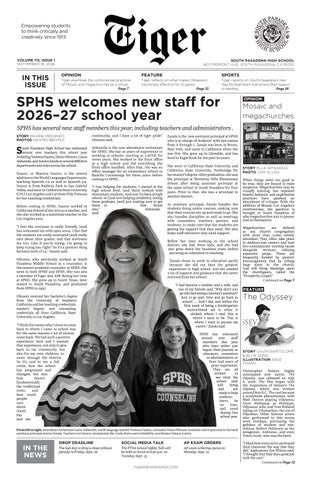
From left to right, attendance technician Laura Alduenda, world language teacher Vanessa Suarez, counselor Diana Olivarez Assistant and in pictured in the back assistant principal Jessica Zavala. Teachers not shown: receptionist Ms. Linda Perea and workability coordinator Zakary Garcia.
IN THE NEWS
DROP DEADLINE
SOCIAL MEDIA TALK
AP EXAM ORDERS
The last day to drop a class without penalty is Friday, Sept. 18.
The PTSA School Safety Talk will be held on Zoom at 6:30 p.m. on Tuesday, Sept. 15.
AP exam ordering opens on Monday, Sept. 21.
TIGERNEWSPAPER.COM
STORY ELLA APISAKKUL PHOTO SAM ALLEN When things seem too good to be true, they are bound to raise suspicion. Megachurches may be visually enticing, but repeated hateful behavior and exploitative practices have sparked an abundance of critique. With the addition of Mosaic Los Angeles’s controversies, the question is brought to South Pasadena of who megachurches aim to please: God or themselves. Megachurches are defined as any church congregation with more than 2,000 weekly attendees. They often take place in stadium-size centers and host live contemporary worship bands alongside sermons utilizing expensive props. These are frequently funded by pastors’ encouragement that by tithing large sums to the church, God will bring blessings upon the churchgoers, called the “Prosperity Gospel.” Continued on Page 7
FEATURE
The Odyssey
STORY GAVIN BARTOLOME & ELLIE SONG ILLUSTRATION SAGE CHANG Christopher Nolan’s highly anticipated new movie, The Odyssey, was released on July 6, 2026. The film began with the inspiration of Homer’s The Odyssey, which was written around 800 B.C. The cast became a worldwide phenomenon, with Matt Damon playing Odysseus, Anne Hathaway as Penelope, Odysseus’ wife, and Tom Holland taking on Telemachus, the son of Odysseus. Other famous actors who performed in this movie were Zendaya, portraying the goddess of wisdom and war, Athena, Robert Pattinson as the antagonist, Antinous, and even Travis Scott, who was the bard. “I liked how every actor portrayed their character the way that they did,” sophomore Zoe Wilson said. “I thought that they did a great job with the cast.” Continued on Page 12
2
TIGER SEPTEMBER 16, 2026
NEWS
Goats in South Pasadena prevent local fires Monterey Hills welcomes new helpers, well fed on wildfire fuel.
Clubs gather for the 2026–27 school year G
STORY ELLA APISAKKUL PHOTOS PHILIP KWAK
oats have been recently introduced to South Pasadena by the South Pasadena Fire Department, eating vegetation to decrease local fire risk. The goats, funded through the South Pasadena Public Works Department, began work last Monday, Aug. 31, and are projected to finish by Sunday, Sep. 13, grazing on wildfire fuel around three project areas in Monterey Hills.
Students fill the SPHS gym during Club Rush.
STORY MAXWELL GARDOCE PHOTOS PHILIP KWAK
and delve into new interests, and for staff to view what students this year have to offer.
As the crowd poured into the gym—hordes of students tightly bottlenecked at the building’s cramped entrance. They then quickly dispersed among huddled yet intricately decorated booths.
Senior Sebastian Davis, vice president of the SPHS Black Student Union, reiterated that “[o]ne of the main goals of our club is to educate people about the history of African Americans in America,” and BSU officers have been “...going around and recruiting people instead of just letting people come to us.”
Each booth was fit for clubs trying to achieve differing purposes and goals, some based on common interests, hobbies, cultural identities, and various organizations and programs meant to pique the interest of academically determined peers. However, all clubs have a common objective among the masses: utilizing marketing tactics to boost exposure, charm attendees, and allure incoming students. The school’s 2026-27 annual Club Rush was held Thursday and Friday, Sep. 9-10 during lunchtime. It is a major event taking place in the fall semester and is an opportunity for attendees to explore what their peers’ efforts pour into, reflect,
As the chaos of the first day of Club Rush came to an end, Freshman Bernice Garduce, event coordinator of Filipino Cultural Club, said, “Club Rush was super fun for me. It was really cool getting to know clubs that I wanted to join… it was amazing seeing grades bond and how people had so much pride in their clubs.” With Club Rush being the school year’s primary introduction for students to encounter clubs, the next major SPHS event focused on clubs will be Homecoming Picnic on Friday, Oct. 16.
Goats were chosen for their ability to traverse steep terrain and their indiscriminate eating habits, which proves helpful to clear out diverse kinds of wildfire fuel from hillside areas. However, they cannot eat all types of potential fuel, which is why Fire Chief Lloyd refers to this project as a “hybrid program … if there are areas that they can’t get to or that are not correct, then we will follow up with a mechanical type of vegetation management, as well.” The goats are urgently needed in South Pasadena because of its history with wildfire risk. “In 2025 the State Fire Marshal released the new maps for the
A herd of firefighting goats graze on brush in Monterey Hills.
fire hazard severity zones, and the western and southwestern edge of the city [South Pasadena] are considered very high now,” Fire Chief Lloyd said. Since the goats may not understand where they are allowed to graze, local residents have voiced concerns about them leaving boundaries and eating plants vital to the local habitat. The fire chief assures that it is a “very passionate minority of people that tend to speak loud in those things,” and though “it’s [the fire department’s] responsibility … to be responsive to that, [they] also have to filter through what is accurate and true and … more extreme [opinions].”
A firefighting goat grazes a patch of brush.
The fire chief shares that the goats do not pose a threat to native plants. “Specifically with the toyon (a California native shrub) and trees, and the goats stripping away bark on some of the branches … would not affect the health of the tree, and [will not] affect the growth of the tree.” Though the goats’ work is already nearly at a close, some SPHS students reported being unaware of the goats having begu service, or even that they were going to arrive. Despite this, they are supportive of their help and look forward to their effects on the community. “That sounds very exciting!” freshman Rose Xia said. “I am glad that South Pasadena is using such a creative solution to avoid wildfires; the goats will be a public spectacle. They’ll be very loved, very watched, and hopefully not very scary.” “It may be the fact that the goats do such a great job that we don’t need to bring them every year, that we could bring them every other year,” Fire Chief Lloyd said. But for now, “they are fenced, they’re monitored, and so we’re always keeping an eye on them, getting regular updates, and then we’ll look at the efficacy of the project when it’s done.”
Hello Kitty and Friends blood drive STORY KAMILLAH MORALES The American Red Cross announced their partnership with Hello Kitty and Friends for a national blood drive from Tuesday, Sept. 1 to Sunday, Sept. 20. The goal of the collaboration was to boost local blood supplies in order to avoid future shortages and to encourage more people to donate routinely. SPHS Clubs pitch their ideas to students.
Students check out a variety of clubs at Club Rush.
Many locations across the United States, including in South Pasadena, were fully booked. Despite many donors at blood drives having experience with donations in the past, it is heavily encouraged that inexperienced volunteers donate as well. The Hello Kitty and Friends collaboration with the Red Cross brought awareness of blood donating to new donors. Statistics from the American Red Cross showed that more than 17,000 new potential donors signed up to learn more about the partnership, and nearly 3,000 appointments were booked within a week of the exclusive plush mascot clip and surprise sticker pack being announced. PAGE DESIGN CAELYN LEWIS
“I had a very good experience with it,” a donor, said. “It’s something that’s quick and easy. It’s something that I’m very comfortable [with doing], especially knowing the outcome [of] it.” The venue for the blood drive in South Pasadena was hosted at the South Pasadena Library’s community room. Inside the dimly lit room, donors laid back while their blood was being drawn. Three blood-drawing stations were set up in the back of the expansive room, and donors were individually taken care of by the phlebotomists, trained health workers who specialize in drawing blood. The donors then received exclusive Hello Kitty merch in return for their donation. “I feel really good for doing something good for this country,” Jake, a donor said. Every two seconds, someone in the U.S. needs blood, and because blood and platelets cannot be manufactured, they must come from donors. The blood that donors give is used to save many lives through blood transfusions
and cancer treatment. In fact, one blood donation can save more than one life. Blood transfusions are used to replace the blood lost in injuries or blood that has nonfunctioning components. About 6.8 million people donate blood in the United States, and the Red Cross provides 40 percent of those donations. “I find [blood drives are] really great for everybody, and it’s also wonderful for whoever is able to participate if they’re able to,” a donor at the event said, “It’s fantastic, especially if it’s their first time. I would highly recommend it.” The Red Cross and Hello Kitty collaboration succeeded in fully booking many blood drives in different cities. The event increased blood donation awareness, and the American Red Cross has been working on its LifeBlood Fund, a five-year, $300 million national effort to strengthen and modernize the nation’s blood supply. As a main provider of the United States’ blood supply, blood drives and future projects serve to prevent blood supply crises and keep us with the blood supply demand.
TIGER SEPTEMBER 16, 2026
NEWS
3
Memory Arts benefits the elderly through art In their new business, two South Pasadena moms teach art to those with memory loss. Ferri is a clinical psychologist, who specializes in rheumatology, working especially with older adults. She has been working as a psychologist for a long time, and eventually wanted to really connect with people with dementia.
STORY ELLIE SONG PHOTO CONTRIBUTOR
S
outh Pasadena moms of SPHS students, Caitlin Reller and Christine Ferri started their non-profit organization called Memory Arts, or MA for short.
When finalizing their business, the two moms questioned what their business would be called.
Their first session was in April of 2026, in a memory care facility workshop in Altadena. MA provides a safe space for individuals with dementia and their caretakers.
“We’d have the text right back and forth,” Ferri said, “We were all over the place, and then finally, that’s when we thought of MA.”
During their workshops, Reller and Ferri provide art materials and daily lessons. Lesson topics have included specific artists or styles of art. “Memory Arts, or MA, is an artistic concept that refers to the space around objects, the silence between notes, [or] an openness that allows room for possibility. We embrace this idea as a poetic reframe of the possibilities for connecting and finding meaning, even when memory is limited,” Reller said. Ferri and Reller created this business due to the abundant amount of individuals who age into memory loss, and are neglected due to their health issues. Together, the two of them realized that MA was a space to offer workshops for people who have dementia, which is really needed in our society. “[MA] was an opportunity to look at dementia, and the potential of somebody who has a brain disease in a different way, by working with them through art,” Ferri said.
Not only did this name make sense, but it had a connection between the two moms and their customers.
A member of the Memory Arts group sketches an abstract art piece.
Reller and Ferri explain how they want caretakers who come to the program, whether it be with their patient or by themselves, to be able to connect with each other and with other caretakers.
Small Hands Workshop in Brooklyn, New York, which was a low cost and donation-based community art program for stay-at-home parents and their young children.
“I just find art to be fun [and] exciting,” Reller said. “I like the art making process. There are no rules, you can experiment and just play. That’s what I like about seniors too, is that when they’re making a painting, it doesn’t have to look like a photorealistic painting. You can have work from a three year old [painting], and a 99 year old, and everybody can have a wonderful experience.”
“Basically, [Small Hands Workshop] had that same model, but instead of stayat-home parents and young children, it’s now caregivers and aging adults,” Reller said, “We want this to be free or very low cost. We really just want to create workshops that offer a place for people to connect with each other and be present.”
Before Memory Arts was in the process of making, Reller began a smaller workshop, called
Later on, Reller worked at the Laguna Art Museum. There, Reller started developing a program for people with
dementia. However, she was never able to have her first workshop due to the COVID pandemic in March 2020. A visitor from Alzheimer’s Orange County came in and did some workshops. It was through these workshops and training that Reller had learned about people with Alzheimer’s, as well as the disease itself. “There’s so many people who age into this place sadly, and they’re really neglected,” Reller said. “I think realizing that there’s this space for offering workshops for people that have dementia and Alzheimer’s, [is] really exciting. It made me realize [that] there’s a space unfulfilled, but there’s really a need there.”
“[MA] is definitely a loving word, in the sense that your mom would love you even if you had dementia. There’s just so much loss of connection,” Ferri said. MA hopes that they are able to reach an abundant amount of people, especially those who are isolated at home. Memory Art’s first two workshops will be in October 2026 at the Pasadena Public Library. They also want caretakers who have come to the program to be able to connect with one another, because they are also isolated, and possibly feeling overwhelmed. “So much of caregiving is work, and so much of dementia is the disease. The quality or the accuracy [of their art] really isn’t the point. It’s that something didn’t exist and now it does, and that two people did that together,” Ferri said.
SPHS hosts the annual Back to School Night
Cotton candy, tea, and brownies were offered to parents as they navigated the campus during Back to School Night. STORY MAYA BENNETT PHOTOS MAC SHROPSHIRE SPHS hosted the annual Back to School Night on Thursday, Sept. 10 for parents to meet their children’s teachers. Parents were given the chance to familiarize themselves with the classes’ curriculum for the 2026–27 year. The night began with a welcome performance from the SPHS drumline and SPHS pep squad around 6:10 p.m. The parents gathered in a big crowd at the Tiger Patio to watch the show. SPHS principal John Eldred gave his speech about the new assistant principal, Jessica Zavala, and junior Cassie Yao sang the Star Spangled Banner to the crowd. Parents rushed between their children’s periods zero to seven from 6:20 p.m. to 8:10 p.m. They started off the night in their children’s period one before transitioning to their next class in the odd day schedule. After, parents began walking through their typical even day schedule, before ending the evening with seventh period. Parents transitioned between each of their child’s odd day schedules, later on walking through their typical even day schedule, ending with seventh period. Parents had the opportunity to learn about each individual class and teacher throughout the evening. Parents were given 10 minutes for each class to
Eldred gives a speech to start off the 2026 Back to School Night.
learn about curriculum and familiarize themselves with the class teacher. Teachers introduced their class to the parents with slideshows providing information of the class curriculum and structure as well as the grading process. A five minute passing period was provided in between each class, ensuring enough time to navigate throughout the school. Various clubs and organizations were seen occupying tables across the school to raise money and spread awareness regarding their club. A variety of assorted goods were available for purchase during Back to School Night. Concession items such as cotton candy,
Parents walk to classes during passing period.
crepes, brownies, and cookies were sold for prices of $1 and $2. HOSA, a medical club, was selling iced tea, water, Yakult, and cookies and Biomed club was selling brownies, crepes, and giant and normal sized cookies. Math teacher Eric Ketchum noticed some differences across students’ behaviors across the years. Ketchum found a difference across the years that he has been teaching. “They don’t have to be on top of their kids, but there are ways that they can if they want to,” Ketchum said. The night ended as the final bell rang, marking the end of the the back to school night event. PAGE DESIGN CAELYN LEWIS
Fuente presents to parents in her classroom.
4
TIGER SEPTEMBER 16, 2026
NEWS
New Renovations at SPHS Over the course of summer break, bathrooms, HVAC systems and controls, and concrete around SPHS’s campus were renovated for around $3.2 million to meet Americans with Disabilities regulations and to improve campus for students. Classroom temperature can now be better controlled and wheelchair users gain greater accessability throughout the school. STORY HUNG GWAN LAU & MAXINE MESSINEO
ILLUSTRATION SHYLA DRAKE
Heating, ventilation, and air conditioning replacements
S
PHS underwent several renovations after the class of 2026 graduation. Renovations included replacing the HVAC, or the heating, ventilation, and air conditioning system, fixing the bathrooms to meet Americans with Disabilities (ADA) requirements, and redoing the concrete from around the middle of the quad to the 500s building. The construction company mainly used by the school is Southland Industries. They handle renovations such as the HVAC system, but for smaller renovations such as replacing the turf or doors on campus, the district hires smaller, more specialized companies. These renovations were made to fix issues around campus and to meet ADA requirements, which protect people with disabilities from discrimination and, in this case, require several changes to be made to the school. Some changes included creating bigger handicapped stalls in the bathrooms and concrete walkways that meet classroom entryways precisely. The new concrete around the 500s building was installed due to a half-inch gap between the walkway and entryway of the classroom, where there was a little metal strip closing the
gap. That metal strip was not allowed, so the renovations were made to raise the walkway to be perfectly flat with the classroom, in order to be compliant with ADA regulations. The school also had to take out one of the stalls in the boys’ bathroom to make room for a bigger stall for wheelchair users. “Part of the huge bond measure from 2016 was replacing the most of [the school’s] HVAC units, which are around 30 years old. When they get about that old, they start to go out. They’re unrepairable. And sometimes you can’t get parts. So a big part of our bond project was actually replacing the HVAC district wide. So a big part of our bond project was actually replacing the HVAC district wide. But you can’t do it all at once. You have to do project by project,” Assistant Superintendent Dave Lubs said. Another bond project was passed this year by the community, and there was still some money left over from the old bond. This money was used to renovate four buildings around the campus such as the cafeteria, the SAC room, the little theater, and the dance room during spring break due to concerns of not having enough time over summer break.
Before doing any renovations on campus, the school has to get an engineer to create architectural plans for each building. This is necessary since the Department of State Architects (DSA) has laws and rules that dictate that employees, such as the principal or superintendent, are not allowed to decide on certain larger renovations.
either replaced or cleaned, if they were harder to replace entirely. The controls for the systems were also updated, due to them being 50 to 90 years old. The campus now has an automatic system with an implemented graphics system that alerts staff when a unit breaks down, if a fuse blows, or if another issue occurs.
There are also a set of laws and rules surrounding when you reconstruct a school campus. Even if the school was already to code when it was built, the school still has to meet the new codes if the codes change.
The total cost of renovations this summer is around $3.2 million of the $9 million bond. The cost includes paying inspectors to inspect the construction process, paying for the labor to make the
“So we’re basically taking a building that is almost one hundred years old and has not been upgraded in a really long time … So, imagine you take a one hundred year old building that was built before there was an Americans with Disabilities Act, decades before that law even existed. There’s a lot that needs to be done,” SPHS principal John Eldred said. Those plans are submitted to the state, and reviewed by the DSA before either being approved or denied. Schools and the DSA typically have to go back and forth ahead of time, before they hire companies to do the renovations. Along with the HVAC units being replaced, the ducts were also
500s bathroom renovations Several summer renovations have occurred around campus, bringing noticeable changes to the school’s most used spaces. One of the biggest changes is the bathroom update around the 500s buildings. These changes have sparked various perspectives among the student body. The renovations have been a major improvement for some students. Junior Harry Ward stated that these changes, in the bathrooms for instance, were noticeable enough to where it feels completely different. “It doesn’t feel minor; it feels like a whole new bathroom,” Ward said. The installation most notable to some students is the new urinal spacers and dividers, which provide more separation and privacy compared to the previous setup. “I think the urinal spacers [are the biggest improvement]. It’s a little bit cleaner... It’s just better to go to this bathroom,” Ward said. Junior David Ishaak also noticed the differences in the bathrooms. He noted how the updated floors, walls, and stalls are cleaner and more modern. “I think the one thing that improved is the floor. [The] wall looks a lot more clean, and the stalls are better,” Ishaak said. Other students have different views. While some changes
were received well by the students, other changes were not taken as positively. One feature that was removed has been a common complaint by students: the mirrors of the bathrooms. Prior to this year, both bathrooms had multiple large mirrors. “I think it’s a little bit cleaner, but I think they should have kept the mirrors,” Ishaak said. Junior Max Mobley had a critical reception of the renovations. Mobley strongly believes the changes have made the bathrooms much less convenient, despite agreeing with the fact that the bathrooms are cleaner. “Cleanliness improved a ton, but other than that, there’s not enough space. And I also think about the mirrors, right? I need mirrors,” Mobley said. Mobley critiqued the renovations for the lack of mirrors, deeming it to be an unnecessary change to one of the most used applications in any bathroom. The common issue struck everyone differently, depending on how often they used the mirrors. “Overall, I would have preferred just keeping it the same,” Mobley said. The girls’ bathroom has received several controversial changes to its appearance as well. From removing the mirrors to painting over the murals, the new appearance has brought a fresh look and polarizing opinions.
One of the most noticeable changes has been the bathrooms’ appearance. According to juniors Karley Hevgold and Kaitlyn Bromley, the previous bathrooms had more artwork and creative shine. Students say the previous bathrooms included colorful designs, including rainbows, paintings, and inspirational messages put all over the walls. Bromley added how lively the old artwork had made the bathroom. “They took all the color off of it, and took a lot of the mirrors out … [now] it seems very boring, plain, and sad,” Hevgold said. The renovations also introduced new paper towel dispensers. Previously, the bathrooms had hand dryers and paper towel dispensers that were frequently broken. The new dispenser has been working since the beginning of the year, something students across campus have appreciated. The students also said they did not notice a significant difference in cleanliness between the previous bathrooms and the renovated bathrooms. The summer renovations have changed the bathroom experience of many students at SPHS, in numerous ways from big to small. While not all students hold the same opinion, thoughts continue to change as the year progresses. PAGE DESIGN PAISLEY PARK
construction happen, and paying for individual HVAC units. Lubs is proud of how the SPHS campus has been upgraded and become better for students over the past 10 years. “I will put our campuses up against any K through 12 district in the state of California as far as the quality of our buildings, our grounds, our grass, and our bushes. I’m just super proud of this district and how we create an atmosphere for kids that is conducive to learning,” Lubs said.
TIGER SEPTEMBER 16, 2026
THEESTABLISHED TIGER 1913 NSPA FIRST CLASS 2025 NSPA FIRST CLASS 2024 CSPA GOLD MEDALIST 2023 CSPA SILVER CROWN 2022 CSPA SILVER CROWN 2021 CSPA GOLD MEDALIST 2019 CSPA SILVER CROWN 2018 CSPA GOLD MEDALIST 2017 CSPA CROWN AWARD 2016 CSPA GOLD MEDALIST 2015
5
OPINION
STAFF EDITORIAL
EDITOR-IN-CHIEF ZOE CHEN MANAGING EDITORS RUBY FOUDY, Print CLAIRE MAO, Online NEWS OWEN HOU, Editor OPINION RAFA ESTOLANO-SRIDHARAN, Editor FEATURE UMA CHAKRABORTY, Editor SPORTS GAVIN BARTOLOME, Editor DESIGN LANAH KIM, Editor PAISLEY PARK, Editor PHOTOGRAPHY MAC SHROPSHIRE, Editor COPY JULIA GILDERSLEEVE, Editor KHLOE YUEN, Editor STAFF WRITERS ELLA APISAKKUL MAYA BENNETT MAXWELL GARDOCE LEIGHTON KWOK HUNG GWAN LAU KAMILLAH MORALES MAXINE MESSINEO ELLIE SONG STAFF PHOTOGRAPHERS SAM ALLEN MAXIMO BENITEZ-CORNELIO PHILIP KWAK ADRIAN LOPEZ THEODORE THOMPSON STAFF ILLUSTRATORS SAGE CHANG SHYLA DRAKE YUMIN KIM HELENA MILLAR HARPER RENTMEESTER ZOIE WONG PAGE DESIGNERS SHYLA DRAKE CAELYN LEWIS KAMILLAH MORALES BUSINESS AND ADS MANAGERS LUCINDA ERNST DANNY LOWSTUTER FACULTY ADVISOR KAREN HAMES VOL. 113 NO. 1 DISTRIBUTED ON SEPTEMBER 16, 2026.
Gen Z’s voting era has just begun America was founded on free speech, now Gen Z must pick up the torch.
T
he United States of America was built on the idea that life, liberty, and the pursuit of happiness would be easier for generations to come. The Founding Fathers established the complex US voting system so the country’s people would have a say in how their nation operated, with the voting age beginning at 21. But when President Franklin D. Roosevelt dropped the minimum military draft age from 21 to 18 in Nov. of 1942, people were outraged. Young activists believed that if they were old enough to be drafted, why were they stopped short of the ballot box? It wasn’t until 1971 that Congress created the 26th Amendment to the Constitution, granting U.S. citizens ages 18 and up the privilege to vote in all federal, state, and local elections. Today, young voters have neglected their right to vote when their vote is most needed. The Generation Z voting bloc, those born between 1997 and 2012, grows larger and larger each year, with the final group of Gen Z voters
becoming eligible to vote in 2030. According to Tufts University, over 40 million Gen Z Americans were eligible to vote in the 2024 United States presidential election. But more than 21 million of them did not cast their ballot, which is more than 50 percent. The country’s youth went from fighting for the ability to vote to not using it when politics are overwhelming and the most heated. Gen Z and Gen Alpha are the youngest age groups, meaning long-term issues presented in Congress today will affect them most in the future. Currently, Gen Z is directly affected by federal educational scholarships like FAFSA being cut through President Donald Trump’s One Big Beautiful Bill Act. For a generation already dealing with record tuition costs, tightening the exact aid programs that make college possible does not just make school harder to afford; it prevents students from being able to go to college at all. Legislation decided now also affects the future job market. With Artificial Intelligence
(AI) being implemented into the workforce, entry-level hiring is changing, including the exact tasks of research, drafting, and basic analysis that used to be how young workers proved themselves. Talks of regulation on AI in the workforce and how it will be used in daily life are beginning to reach the House of Representatives. Interacting and voting on propositions on these issues is how Generation Z can be involved. Housing costs have outpaced wage growth for years, pushing homeownership further out of reach for people just starting careers. None of these are abstract, someday problems. They are the terms Gen Z is inheriting right now. Wanting different outcomes in daily life — cheaper tuition, a livable planet, an affordable place to live — starts with showing up to the one process designed to let ordinary people influence those outcomes. A common excuse for not going to the ballot box is not having the time or the background knowledge to
sort through every candidate and issue. But that is part of what political parties exist to do — they group candidates by shared priorities so voters aren’t starting from zero every election cycle. This isn’t an argument that people should vote on a party line without thinking. It’s a reminder that voting, in whatever form it takes, is a signal that someone is paying attention to the direction of their country and wants a hand in shaping it, instead of handing that responsibility to everyone else. Voting in elections and promoting civic engagement among Generation Z is crucial, as the future that they will live in is being decided right now. Civic engagement means being informed about current legislation and calling their representatives to fight for what the current population is actually struggling with. Low turnout among young voters is not just a missed opportunity — it directly translates into the issues Gen Z cares about, from student debt to housing, getting less attention from the people writing the laws.
DISTRIBUTION: 1460 STUDENTS; 70 COMMUNITY. 1200 COPIES PRINTED. DISTRIBUTED BY TIGER STAFF FREE OF CHARGE.
TIGER IS PRODUCED BY THE ADVANCED JOURNALISM NEWSPAPER CLASS AT SOUTH PASADENA HIGH SCHOOL, 1401 FREMONT AVE, SOUTH PASADENA, CA 91030. LAYOUT AND PHOTO IMAGING ARE COMPLETED ON-SITE. SIGNED ARTICLES APPEARING IN TIGER REPRESENT THE WRITER’S OPINIONS AND DO NOT NECESSARILY REFLECT THE VIEWS OF THE STAFF, STUDENT BODY, FACULTY OR ADMINISTRATION OF SPHS. ORIGINAL STORIES WILL CARRY BYLINES, ALTHOUGH STORIES REWRITTEN BY ANYONE OTHER THAN THE ORIGINAL WRITER WILL NOT RECEIVE ONE. CONTRIBUTING WRITERS WILL ALSO RECEIVE ONE. CONTACT THE PUBLICATIONS OFFICE AT (626) 441-5820 EXT. 2615 BETWEEN 8 A.M. AND 4 P.M. FOR ADVERTISING RATES AND SUBSCRIPTIONS. TIGER WELCOMES ARTICLES, LETTERS OR REBUTTALS FOR PUBLICATION IN THE PRINT AND ONLINE EDITIONS. ALL LETTERS MUST BE SIGNED AND VERIFIABLE, BUT NAMES WILL BE WITHHELD UPON REQUEST.
TIGER’S MISSION IS TO PROVIDE A RELIABLE NEWS OUTLET FOR SPHS AND THE LOCAL COMMUNITY. THROUGH A VARIETY OF COVERAGE, TIGER EMPOWERS/ ENABLES STUDENTS TO THINK CRITICALLY AND CREATIVELY, COMMUNICATE EFFECTIVELY, SOLVE PROBLEMS, SET AND REACH GOALS, AND WORK COOPERATIVELY AND INDEPENDENTLY AS RESPONSIBLE CITIZENS. TIGER IS A FORUM FOR STUDENT FREE SPEECH, IN ACCORDANCE WITH CALIFORNIA ED CODE 48907. ALL REMAINING CURRENT TIGER NEWSPAPER POLICIES ARE ONLINE AT TIGERNEWSPAPER.COM INCLUDING: CONFLICT OF INTEREST, LETTERS TO THE EDITOR, CORRECTIONS, AND SOCIAL MEDIA.
Boos & Bravos Tiger’s cheers and jeers for the month of September BOOS
BRAVOS
BOO to heavy backpacks. Had me walking at a 150 degree angle.
BRAVO to the flip-flops movement. My dawgs needed to breathe.
BOO to tests. It’s still summer, but nobody believes me.
BRAVO to college apps. Nothing builds more character than breaking down for the 4th time this week while filling out the Common App!
BOO to the weather. Is this Florida or LA? BOO to slow walkers. I have places to be. BOO to Aeries. I can always count on you to shut down. BOO to the new bathrooms. I didn’t know shrinkflation affected the urinals. BOO to the sporks. Now who asked for those?
PAGE DESIGN YUMIN KIM
BRAVO to my glasses. They’re looking clearer than my future. BRAVO to Mr. Valcorza. You slay those loafers, I did not slay that quiz. BRAVO to Club Rush. I can’t wait to receive a million emails about meetings I will never attend.
6
TIGER SEPTEMBER 16, 2026
OPINION
Karen Bass’s campaign releases fraudulent data Bass and Median Strategies spread false poll data online as a social experiment.
However, there is no exception regarding the fact that voters, in all elections, are expected to have some level of media literacy in order to tell real news from misleading and deceptive data. Karen Bass not only took advantage of the situation and attempted to benefit from it, but also highlighted the lack of accountability from her campaign.
STORY MAXWELL GARDOCE ILLUSTRATION HELENA MILLAR
O
n Friday, Aug. 14, Karen Bass, current mayor of Los Angeles, attached an image on X displaying in bold text, “New poll: Karen Bass widens lead in L.A. mayoral race,” accredited to a source named Median Strategies. The post is one of numerous online meant to promote her reelection campaign. In this election, her conservative campaign is pitted against that of a more progressive L.A. City Council member, Nithya Raman.
Median Strategies is an unknown company that has declined interviews from all news outlets besides the L.A. Times. According to Median Strategies, the only purpose behind the poll was to review audience reaction to the data rather than actually gathering real data themselves.
As L.A. enters a new mayoral election season, residents of the city should expect reliability from major news outlets, and especially from candidates’ campaigns. Voters depend upon trustworthy data and campaign objectives in order to determine who their votes will go towards. Nevertheless, even as campaigns are expected to promote valid data, with a myriad of checks and balances, sometimes fraudulent information can make its way through the cracks.
This situation serves as a warning regarding politicians intentionally covering up questionable situations such as the integrity of elections. The fraudulent data had already done its damage, being circulated across major news outlets, swaying the people’s perspective and opinion.
The poll found that Bass’s approval rating among L.A. voters exceeded Raman’s by 12 points, and was amplified across social media platforms as well as news outlets like the California Post.
In response to continuous outreach from the L.A. Times, Median Strategies finally gave a public statement following the complete erasure of the company’s website shortly after the scandal.
Yet just three days after the Bass campaign endorsed the poll, the data released from perpetrator Median Strategies was revealed to be completely fabricated.
“Median Strategies was created as a short-term social experiment to examine how purported polling information could enter and spread through the political
information ecosystem without independent verification,” they said in an email to the Times. Bass’ campaign account on X swiftly took down the post after the news broke. The poll also referenced how the newly wide margin of approval between Raman and Bass was fueled by supporters of Spencer Pratt, a previous Republican candidate in the primary election.
His campaign appealed to supporters of Donald Trump — using AI-generated parody videos to promote his position in the running. Median Strategies’ poll reported that “[f]aced with a choice between the incumbent and a Democratic Socialists of Americaaligned challenger, most Pratt voters appear to be treating Bass as the more familiar, more moderate option rather than sitting out the race,” according to PBS.
Poll distribution and data require more checks and balances regarding the accuracy and honesty of data being released. In order for campaigns and news outlets in the future to avoid situations such as these, there must be accountability and verification of information and sources being released. This is the only manner in which campaigns can directly build trust between the public and candidates.
The pros and cons of AI in the education system STORY MAYA BENNETT ILLUSTRATION HARPER RENTMEESTER As society shifts to a technologybased world, the use of AI is becoming more frequent and more accessible. Although AI can be used in helpful ways, it is also becoming more negatively used in educational settings, such as the use of AI to cheat, give answers to assignments, and write essays. Even with these drawbacks, studies have shown that AI has been and is currently being widely adopted into school settings. There are two sides to this, as teachers can find AI helpful for grading, but it can also harm students in more ways than it helps them. One way that AI is able to help students is by adapting to a student’s speed on test-taking platforms, so that they can learn at the speed that works for them. For instance, if a student is slower at reading comprehension, the testing platform may give them more time to complete that specific task. Another example includes speech recognition softwares that help provide an effective learning environment, as they can read out the text for hearing-impaired students. AI can also help students by providing them with immediate feedback and turning complex content into an easier read for the individual. Although AI can be helpful, there have been more cases of it harming students rather than helping them.
One of the main reasons is the fact that AI reduces human interactions, such as asking a teacher or peer to explain a difficult concept. Therefore, it hinders students’ social skills and possibly prevents them from actually learning. AI also gives students an excuse to not have to think critically on assignments by simply providing the answer. By not taking the time to solve the problem, students are not able to properly learn and understand the concept. This hinders their growth and prevents them from achieving academic sucess. Additionally, when students put a lot of time and effort into their work, they can sometimes end up getting the same grade as a student who cheated by asking AI to write their paper. This is extremely unfair for all of the students who are actually trying in the class and creates an environment where the final product and grade matters more than the actual work behind it. On the other hand, AI is generally more beneficial for teachers than it is for students. Some common tasks teachers are able to give an AI bot include handling administrative tasks like grading, scheduling, communicating, lesson planning, and managing students’ records. Since teachers end up using AI for all of their time-consuming work, they are able to have more hands-on time with students. They then have more time to build relationships with different classes and individual students because they are not spending all
of their time grading students’ work by hand. With these student-teacher interactions, students’ emotional and social health can thrive.
Students could also be encouraged to have study groups and collaboration times to do their homework and discuss with one another in order to limit help from AI.
Some alternatives to AI that SPHS teachers do utilize include sharing lesson plans or worksheets so that each teacher has less work to do and can share each other’s perspectives on different things.
Finally, a push that teachers could make to motivate their students is for them to participate during class and have moments for partner and group assignments.
PAGE DESIGN HARPER RENTMEESTER
They can do this by trying a collaborative technique called “Think-Pair-Share,” where students can think of the idea themselves, discuss it with a partner, and then share it with the class. Randomly selecting students to participate in class is also another way to get students to share in class, as they are then more obliged to participate.
TIGER SEPTEMBER 16, 2026
OPINION
The danger of recording everything People must stop giving up too much information for the sake of convenience.
Esoteric Nonsense
STORY HUNG GWAN LAU ILLUSTRATION HELENA MILLAR
RAFA ESTOLANOSRIDHARAN
D
On Connection
aily life is becoming more monitored and more recorded. At the same time, this is becoming increasingly normalized. Modern technology has made it possible for information and surveillance on people to be present in almost everything done. Smartphones actively track and store online information, schoolissued Chromebooks are notorious for monitoring students, and social media encourages people to voluntarily share personal information for the world to view. Chromebooks have been embroiled in controversy ever since the ability to track students’ online activity without the option to opt out. Schools do have legitimate reasons for this, such as protecting the students from profanity or inappropriate content and keeping them focused. However, the line is blurred when their focus goes from protecting students simply watching their every move. Students grow accustomed to knowing that their activity is constantly being watched by someone else, and may begin to see constant surveillance as a part of everyday life, which makes people complacent with a lack of privacy. People rarely stop to think about how much information they willingly give in exchange for convenience. Newer technology is taking “recorded life” to an extreme, bringing more breaches of privacy into everyday life. Devices such as the Meta glasses allow users to record and photograph with little effort, whereas traditional cameras usually require much more input. With smart glasses, the ease of recording comes with just looking in a general direction and recording. Benefits of this technology include convenience, providing a hands-free experience because the glasses are worn on one’s head. It is much easier to document experiences, navigate information, and communicate without having to look down at your phone. The problem with
I spend a lot of my time making pottery. Throwing clay, trimming it, glazing it, whatever. And the thing I enjoy most about it is its physicality. When I’m working with clay, I am completely in the moment. I am focused entirely on how the clay flows through my hands, the warmth of the water I am splashing on it, and the buzzing of the wheel. It is a very meditative process. When I am throwing, I feel connected to the earth and the world around me. I think that this is an incredibly important part of the human experience, and that it’s something we are losing as a people.
these devices is the fact that someone might not know they are being recorded. With traditional devices, it is easy to tell when someone is pointing a camera at your face. Smart glasses completely remove the noticeability and can change recording from a deliberate action to something anyone can do at any moment. Social media bridges the gap from nonconsensual surveillance to voluntary sharing. Someone posting a photo of themselves is not the same thing as a company secretly collecting information through their camera roll. But when people become accustomed to daily surveillance through our devices, it may start to turn the thought of privacy into a looser term. Younger generations being raised with these devices may feel completely indifferent to their information being
stored digitally. Being comfortable with sharing personal information should not be normalized, but is actively being pushed upon students. There are genuine reasons why being recorded and monitored might be a benefit. Location tracking, monitoring, and cameras can all be used to help protect our society when humans cannot. However, recognizing these benefits does not mean it should be accepted. The solution is not as easy as completely eliminating technology or surveillance. Society should be more aware of the information they are willingly giving away and how it is being used. People should also have more control over their own information. Technology can make life easier and safer, but privacy should not be the price to pay for it.
Mosaic and the infamy of megachurches Continued from Page 1 However, megachurches are characterized by scandals repeatedly involving preaching against the LGBTQ+ community and abortion rights, as well as pushing attendees to donate money to the church that is later used for the pastors’ own desires. Mosaic is a megachurch with a location in South Pasadena’s Rialto Theatre, that has become the subject of controversy for its teachings that queerness is sinful, for forcing queer church members to out themselves, and for its persistent efforts to keep queer people out of church leadership. They have also been associated with the Southern Baptist Convention, or SBC, a group of churches opposing gay marriage and transgender identities. The South Pasadena location is listed as a member on the SBC website.
7
“We believe the church exists to … build a place called home for the many who do not have one,” Mosaic’s website says under “What We Believe.” Despite this, some former churchgoers “found that the rhetoric of ‘don’t ask, don’t tell’ (referring to a policy shaming queer members of an organization if they are out, but ignoring their sexualities when closeted) and ‘pray the gay away’ (referring to the idea that homosexuality is a sin, and through religion, queer people will be “freed” of it) were their true beliefs and that I could never move forward within the church … if I was unashamedly myself.” “I am sick and saddened by cultures like this — which … are the complete opposite of the ‘Jesus’ they claim to serve. That is the point of the ‘good news,’ (referring to the idea that God loves humanity and sent
Mosaic churchgoers congregate outside for coffee and refreshments after Sunday service.
Jesus to save us) that we have always been enough,” shares an anonymous former member of Mosaic Hollywood. Megachurch pastors often use the Prosperity Gospel to justify their wealth and expensive possessions. As they grow richer off of listening ears sending “10 percent of [their] income” into their pockets, speaking of how God loves everyone while excluding from that “everyone” as they see fit, the line is blurred as to who these pastors serve. Some argue that megachurches sustain religion, funding groups within the church and hosting engaging events that motivate people to attend service. This includes younger generations, who may view religion as intolerant, and seek something relaxed. Though this could be true, megachurches still attempt to have their cake and eat it too. They draw in diverse and young attendees by seeming welcoming, yet only use them for public perception and shut them down within the church. Not all megachurches take money and promote hate, yet to change that perception, they must rethink their values. Appealing to newer generations goes with preaching true religion — both should promote a culture of kindness, inside and out. Wanting to keep religion alive is not bad, but that means that it must start from a willingness to support groups that they might not fully understand, as well as using their budgets not to fund the pastors’ desires but towards programs that would grow the church and its positive influence. When megachurches set their sights on faith and kindness, and not on spectacle, greed, or exclusion, they can bring religion to more people on a wider scale.
PAGE DESIGN HELENA MILLAR
We live on a planet that is breathtaking. I am constantly blown away by its majesty, its beauty which is found even in the little things — the way a bird flaps its wings, or dust settling on a table. When I make pottery, I feel that I am a part of this natural beauty. I am taking something that has existed in the earth for millions of years — clay — and finding beauty in it. It is because I feel connected to the earth in this way that I feel compelled to protect it. Now, I’m not going to lie and say I’m some kind of devoted environmentalist, but I do feel some duty of stewardship to the earth. I feel that as a people we have a duty to move towards a more sustainable way of living, a system of production and consumption that is not predicated on infinite growth in the bounds of a finite planet, which, as cliche as that sounds, is true. I would like to think most people feel this way, that most people feel this sense of stewardship and duty. Most people have some way of feeling connected to the earth, whether that be making something, or just spending time out in nature. The problem is that “most people” rarely includes the people at the top; the people who control our systems of production and consumption. The Elon Musks and Sam Altmans of the world are completely absorbed in technology; AI and Cryptocurrency rule their worlds. And as they are absorbed in technology, they are completely disconnected from the world around them. Yes, they are the top 0.1 percent; they are out of touch. But it is not just that. These men are completely disconnected from nature, and thus have no stake in protecting the natural world. They are destroying the world in the pursuit of profit. AI Data centers account for as much as 1 percent of global greenhouse emissions, Elon Musk’s SpaceX wastes billions on a pointless quest for Mars, and the mining of cryptocurrency uses massive amounts of energy while producing massive carbon emissions. And, as they bulldoze the earth while running on the treadmill of production, they have no qualms and do not care, because they have no connection to the natural world. In fact, they have contempt; they resent the connections others have, and they seek to destroy them. The status quo is untenable. If we continue this way, the earth will reach a point where it is no longer habitable. We must become a more conscious connected world, and to do that we need a fundamental restructuring of power, production, and consumption. In order to build a thriving world, the current world order must crumble.
8
TIGER SEPTEMBER 16, 2026
South Pasadena’s Perspective on
The LAUSD technology policy, which is not currently implemented in SPHS, restricts screen time usage in schools throughout the district, including a student survey with a sample size of 146 responses, on South Pasadena’s curre
— SENIOR
I think that we are high school students and should be treated as such. If it becomes a problem, it’s valid to have the phone or device taken away, but if it isn’t, I don’t think there should be a rule about not having them. — SENIOR
We are entering into an age where technology is even more prevalent. Taking away students’ electronics wouldn’t make sense if you want to prep them for the future. — SENIOR
South Pasadena organization advocates for In conversations concerning personal technology usage among students in SPUSD schools, the parent-led organization Touch Grass South Pas plays a major role. The group advocates for a developmental learning environment, believing that a personal technology ban during school hours would be beneficial for all district students. The coalition, formed in spring 2025, grew out of a shared concern from parents who regularly attended board meetings regarding mindful usage of technology. The organization remains South Pasadena’s default local chapter of the Schools Beyond Screens (SBS) non-profit, created in part by writer Lila Byock. SBS started as a grassroots coalition of parents and teachers based in LAUSD, their central purpose being a total district-wide ban of personal cell phones. Their efforts eventually led the district to hold a national record by Feb. 18, 2025, as the single largest school district to implement a full smartphone and social media restriction in schools. Touch Grass means to heavily base the SPUSD cell phone policy off of preexisting LAUSD policies advocated for by SBS, including a prohibition of student usage of YouTube on campus, as well as a “bell-to-bell” policy on cell phones — no phones during passing periods, brunch, and lunch. The organization promotes its intended plans through extensive
advocacy, from online petitions and Instagram and Facebook posts to significant lobbying at SPUSD board meetings. As stated on a Touch Grass online petition, “we use technology with intention, not by default. We follow the data on developing brains, attention, and well-being. Schools should be our models. Phone-free where it matters.” Jesse Fisher, a neuropsychologist affiliated with Touch Grass, stated in the Sept. 8 SPUSD board meeting, “rigorous, large-scale studies show that one-on-one school devices are not advancing learning outcomes in the ways that we had hoped post-COVID, and social media acts as an amplifier for at-risk youth,” his words exemplifying the concern of 301 signatures on the Touch Grass petition. However, it is important to note the distinction between Touch Grass South Pas and the SPUSD Technology Committee. The SPUSD Educational Technology Committee, founded in 2024, “has engaged in extensive research, regional benchmarking, and community outreach to help guide district technology policies,” as mentioned on the district’s website.
implemented. Ellesberg mentioned the coalition’s co for data privacy of stude SPUSD schools: “Please kno not our teachers, administr or yourselves that we don’t It is the $4 billion-plus for EdTech companies whose aim is not to educate our chi but to create lifetime cons out of them by analyzing the … What’s happening to that
The group is similar to Touch Grass, as its members are primarily volunteering SPUSD parents, yet the committee is a sector of the district’s technology department and has the final say as to what policies are actually
Though the organization m like an attack on SPHS stu opposed to the device Ellesberg reassured on her
SHOULD THE LAUSD “BELL TO BELL” PHONE POLICY BE IMPLEMENTED AT SPHS? Highschoolers are able to understand when to prioritize their academic work. Taking away devices during brunch and lunch will only cause controversy. — SOPHOMORE
“
“
“
“
“
“
“
“
This policy would take away the little freedom we feel we have. Students are much more inclined to follow directions when they feel it is their choice to do so…resent would build against the administration.
YES NO NOT SURE YES
NO
NOT SURE HOW IMPORTANT IS IT TO YOU THAT YOU HAVE ACCESS TO YOUR CELL PHONE THROUGHOUT THE SCHOOL DAY? 1 - Not important 5 - Very important
1 5
2 3
4
TIGER SEPTEMBER 16, 2026
n Student Technology Policies
s, and completely bans cell phones throughout the entirety of the school day. Tiger collected different perspectives ent device policy, and the possibility of adopting LAUSD’s. STORY RUBY FOUDY, MAXWELL GARDOCE, MAXINE MESSINEO, & ELLIE SONG PAGE DESIGN & GRAPHICS LANAH KIM
r tech restrictions
ILLUSTRATION YUMIN KIM
SPHS deals with ruling out personal devices In the past, South Pasadena High School, similar to the middle school to this day, restricted phones and personal devices on campus grounds. Students were required to keep their phones out of sight, otherwise they would be confiscated if not followed. SPHS’s new and current policy allows students to bring their phones on campus and use them during lunch and brunch, but they must be put away once the bell has rung. However, the policy is not always adhered to by students.
also oncern ents in ow it is trators, t trust. r-profit e sole hildren, sumers eir data data?”
may feel udents policy, behalf
that, “I’m not just doing this for my first grader … you are the future, and we need you. You know? We need you at your full magical capacity. You know the people who are selling us this stuff do not have our best interests at heart.” Although district policy on personal technology still remains unchanged for now, Touch Grass South Pas’ rapid progress towards their goal may soon turn the tide. SPUSD’s official stance has yet to shift — an eventual response from the district is uncertain.
“On occasion,” said Principal John Eldred, “we do have students that do pull out cell phones during class when they’re not supposed to.” This rule is mostly broken by ninth and 10th graders, whether it be them not knowing what to do, or not completely focused on their studies. According to Eldred, the number of cell phone violations have dropped significantly from the previous year at SPHS. Eldred believes a potential ban on personal devices, including phones, MacBooks, and iPads,
would not be beneficial for the students and staff members.
should take it away in the morning before kids walk out the door.”
“I don’t think it [would] be good for all the work we’ve done as far as relationship building between adults and students on campus…I can’t see how it works without people getting really upset.”
During brunch and lunch, Eldred is often in the sophomore and junior quad, making sure that the students are following the rules.
However, Spanish teacher Ms. Baca provides the different perspective that if personal devices were banned on school grounds, students would be forced to socialize with one another, build new friendships, and engage in conversations. “They would use social media less, at least during school hours, and realize there is more to do on campus than being on their phone day after day.” In some classrooms, teachers will not allow MacBooks and phones to be used, while other teachers are more lenient to allow their students to use their devices, as long as they are using it for a good cause. “The bottom line is,” said Eldred, “parents are buying [the devices]. They’re providing them to the kids, and if parents see an issue, they
Tiger’s Take: a ban is not the solution The LAUSD “Using Technology with Intention” resolution includes an all-day restriction of cell phones, smartwatches, camera glasses, or earbuds during the entire school day, including lunch and passing periods. Each campus affected by the policy chooses its own method of enforcing it, including using class storage holders or magnetically sealed pouches. This policy, though implemented across LAUSD for a reason, will not address issues across the district directly. Instead, it significantly reduces the amount of freedom students have during the school day, and it should not be implemented. Along with the LAUSD policy, there is also a local push for phones and other personal devices to be banned from school entirely. Touch Grass South Pas, a parentled organization that supports the LAUSD “Using Technology with Intention” resolution, pushes for paper and pencils to be the primary classroom resources, and additional technology limitations across the middle and high school. A new technology policy, if enacted, should not entail such strict policing. Personal devices play an important role in schools and can benefit students’ education. If an emergency occurs
during school, students are able to contact parents or guardians easily for assistance or information. Beyond communication, phones and personal computers are beneficial as quick research tools and calculators. They also provide students with access to schoolrelated apps, such as Slack, Google Classroom, and College Board, when school-issued devices are not available, or personal accounts must be used. The use of personal devices is also crucial for students to learn how to use technology safely and efficiently, which is an essential skill. Technology, an important part of both the future and present, is constantly being integrated into schools across the world. Policing it so heavily sets the schools in the district affected by the policy back. While there are benefits to using technology in the classroom, there are also drawbacks, and valid reasons as to why the policy has been put in place across LAUSD. Distractions such as notifications, games, and social media can pull students’ attention away from learning, which can harm their grades. Cyberbullying, which can cause mental health issues, has also
been on the rise with more young people having unrestricted access to the internet and social media platforms. Social skills and attention spans have taken a hit due to constant phone use, such as “doomscrolling,” which is a habit of spending excessive amounts of time reading or scrolling through social media content. While issues pertaining to social media use and excessive time online are pressing, they will not be fully resolved with a strict ban on phones at school. The ban may decrease the amount of time spent online, but it will not change screen habits or address real problems in schools, such as offline bullying or low grades. The current policy at SPHS states that, during instructional time, personal devices must be turned off and stored in the designated phone storage holders, but may be used during brunch, lunch, and passing periods. Despite the issues that may arise due to immoderate screen time, such as cyberbullying or lowered attention spans, the current policy for phones at SPHS should be kept in place. Its balance of removing distractions in the classroom still allows students some freedom outside of the classroom.
“I’m outside every day multiple times, even when [our students] are in class, and I don’t see a lot of kids on their phones around here, like our [students] are super engaged.” When students are caught with a phone or personal device when they are not supposed to, the assistant principals have to take matters into their own hands. Eldred goes on to explain that taking phones creates a boundary and tension between students and admin, when they really just care about helping the students while still fulfilling their jobs. Though there are important issues concerning phone usage, such as reduced attention spans or distractions, some believe that it is not the school’s job to enforce the usage of phones, but rather the individual and parents. “In the end,” said Baca, “the use of personal devices is a balance we all need to learn to live with.”
9
10
TIGER SEPTEMBER 16, 2026
FEATURE
Riddle Me Ruby RUBY FOUDY
Aiden Lee pursues orchestral studies 0s and 1s Lee will spend his senior year at a music school in Michigan.
Lee’s love for music has always been deeply rooted in him, making the opportunity of attending Interlochen for his final year of high school extremely special. Before committing to the viola, he experimented with a few different instruments. “My mom started teaching me piano when I was in elementary school, and I later switched to the violin … As years went by … I switched to the viola in middle school. I found myself enjoying the viola a lot more than violin, and after I joined the high school here, I joined the orchestra sophomore year. I met incredible friends and conductors who inspired me to become a musician.” Lee said. Lee points out the significance of the members he has met along the way during his musical path. Yusei, a treasured friend who played the viola alongside Lee, graduated from SPHS last year to pursue music at UCLA. Jorge Padron is the current conductor for both the middle and high school orchestras, along with his own youth orchestra. For Lee, both were large inspirations who helped shape his passions. Additionally, Lee says he was also moved by “ ... youth orchestra conductors [he has] been with, and [his] parents.”
Senior Aiden Lee practices his viola in the SPHS band room.
STORY ZOIE WONG PHOTO MAC SHROPSHIRE
W
hen senior Aiden Lee brings his viola up to his shoulder and bows to the instrument, he feels nothing but fulfillment. During his three-year attendance at SPHS, Lee was an accomplished student, musician, and even a conductor for select music events throughout. Now, he makes his way to Michigan to attend the No. 1 arts high school in America. The Interlochen Arts Academy encompasses areas ranging from music, visual arts, dance, film and news media, and more. The school offers a prestigious education alongside world-renowned staff, giving it the top ranking in the country. Surrounded by a vibrant community, students are immersed in their passions and celebrate imagination and creativity daily.
While talking about the significant shift from his hometown of South Pasadena, Lee said, “I felt thrilled to be accepted, but I also felt nervous because this is going to be my first time going to such a music-heavy school.” When asked about the journey to get into the school, Lee mentioned his unique application process. It involved attending the Interlochen summer camp program for seven weeks, the first week being a viola intensive course while the remainder focused deeply on full ensemble orchestra work. “After performing and showing what I brought to the camp for the first week, the teacher said that she would want me to study there for my senior year. We [then] filled out the basics for the registration and application,” Lee said.
Ever since middle school, Lee has been following music wherever it takes him, from SPMS Orchestra to Colburn String and String Ensemble, Pasadena Youth Symphony Orchestra (PYSO), and most recently SPHS Advanced Orchestra. Lee also won the Director’s Choice Award shortly after the high school orchestra wrapped up their 2025 to 2026 performance season. After countless hours spent with these ensembles, Lee hasn’t seen himself pursuing anything but music since the end of his sophomore year. He voices the impact it has made on his entire life. “[Music] means a lot, it means almost everything to me ... It’s been a huge part of [my] family, it’s part of [my] family’s identity. I think of music everywhere I go, and everything I look at makes me think about music,” Lee said. As he transitions from South Pasadena Tiger to Interlochen Fighting Blueberry, he leaves with these words of farewell addressed to those who surrounded him. “Thank you so much for all you’ve done for the past three years of my life. I’m definitely going to miss the community a lot,” Lee said. Lee’s contributions to his environment have been incredibly appreciated and will be sincerely missed once he departs for his final year of high school.
Editorial Cartoon by Lanah Kim
PAGE DESIGN KAMILLAH MORALES
I took a clinical psychology course over the summer with some of the most irritating people I have ever met. They were the kind of people trying to prove that they were the smartest in the room, but many of their contributions were not as groundbreaking as hoped. When we were discussing the diagnostic strategies used by clinicians, the girl who sat across from me (one of the worst offenders) shared, “I just don’t think you can reduce people to numbers. Like, we aren’t statistics.” My original response was something along the line of Yeah, no duh, but the more I thought about it, the less I agreed. While the conversation shifted away from statistics to Cluster B disorders, my thoughts were stuck on the former. We all may very well be walking statistics. This doesn’t mean I’m particularly happy about it, or that I think people should be viewed as numbers, but rather that they already are. From the moment you exit the womb to the moment your last breath exits your body, you are measured: grouped into trends, graphs, pie charts. Your very existence is part of a percentage that can be easily found in a Google AI overview. (“How many women live in the U.S.?” “Birth statistics in Indonesia” “Depression rates in men” “Death rates in 2026”) Every and any way we can be categorised already exists. Are we all just 0s and 1s? Everything seems to be determined in numbers. Pain is categorized on a scale from one to 10 at the doctor’s, and physical attractiveness of men is rated on the same scale with my friends at lunch. To be diagnosed with anxiety, you must meet five out of eight symptoms in the DSM. I inhale for four seconds, hold for seven, and exhale for eight. Counting breaths, counting experiences, counting people: numbers used to measure numbers. Maybe everyone is just lines of numerical code. I like to think that I am somehow an exception to this rule. I tell myself that I am an anomaly; I am too large to be contained in a series of numbers or a single data point. I must acknowledge that this train of thought does not make me an outlier. Maybe being a statistic isn’t so awful. Sure, it’s nice to believe that my experiences are entirely unique and cannot be measured or compared to those of others, but I have a hard time buying that. If anything, it can be comforting to know that I’m not alone, that my experiences are shared enough for there to even be a statistical category or measurement for them in the first place.
TIGER SEPTEMBER 16, 2026
NEWS FEATURE
11 3
What do people find appealing about horror? The horror genre allows audiences to face their fears and experience shock without the risk of being in danger. STORY MAXINE MESSINEO ILLUSTRATION LANAH KIM
H
orror is a genre of media that is designed to evoke feelings of fear, dread, shock, disgust, and more by playing on human anxieties, such as the fear of death, the unknown, or loss of control. Despite the often negative themes and feelings that the genre elicits, it is one of the most popular genres in modern media, found in movies, books, video games, and podcasts. Most fans of horror media do not enjoy the gore or disgust-based horror that is often depicted in films, books, video games, and podcasts, according to Dr. Coltan Scrivner in an interview with Speaking of Psychology. “I watch [horror movies] with my brother, and he’s younger than me, he’s 13. And he loves to watch really gory stuff, and a lot of the time, I have to look away and hide.” said senior Claire Heyler-Erickson. It is more about the limitations of the body and the consequences of interacting with something dangerous or harmful, which feeds the audience’s morbid curiosity. “I really hate gore and violence, but I love paranormal horror movies, like The Conjuring, because they’re really enticing to me. I’m more locked in when I watch horror movies than any other movie,” said Heyler-Erickson. Morbid curiosity developed as a defense mechanism that helps people reduce uncertainty by learning about potential threats
in a fictional, nonthreatening way, and is an interest in things that are potentially dangerous and involve death, violence, or bodily harm.
Most horror movies don’t bore you. There’s always something to keep you interested in [it].” said Fox, whose favorite horror movie is Obsession.
The word morbid is specifically used to describe the object of interest and not a personal characteristic.
True crime is another genre that is often an outlet for audiences’ morbid curiosity. While this genre is less blunt with gore, violence, and shock, it still utilizes human fears, such as death, bodily harm, or unknown dangers.
Some people who consume horror media feel a sense of empathy for the characters in the story, and seeing themselves in their place is one way they understand the media. “I don’t know what word this would be, but the feeling of ‘I would hate to be in that position’. It’s just feeling almost empathy for characters in the [fictional] world,” said sophomore Gavin Fox. People who seek out scary or dangerous activities to feel a strong rush of energy and excitement are known as adrenaline junkies and often use the genre of horror to gain that rush of adrenaline. When people experience intense situations or experience intense emotions, epinephrine, or adrenaline, is released, causing an elevated heart rate, blood pressure, and breathing. This sensation provides someone with a feeling of being fully alive and can be achieved through watching intense, shocking horror movies. “I think there’s just a certain thrill to [watching horror movies]. It gives you a little bit of anxiety in a good way, a little bit of a dopamine hit, and it’s enticing, you know?
Horror gives people a more rushed adrenaline spike or sense of fear through jump scares or shock value, as opposed to true crime, which gives a more prolonged effect; those who read, watch, or listen to it often feel scared when in similar situations, such as home alone or at night. True crime also allows for a learning experience for the brain, which is inherently rewarding for humans. The consumer’s brain catalogs things such as: “What did the police miss in the case?” “What is the family’s or friends’ involvement?”, and other things, which stimulates and rewards the brain. Horror media often focuses its theme on real fears and anxieties that humans face day to day. Not only extremes, such as death or violence, but also everyday experiences such as high school, relationships, and fear of the unknown. Consumers of horror media may find comfort or relatability in the
genre of horror, especially when it touches on taboo or hard topics such as abusive relationships or the loss of a loved one. “Sometimes I feel really sad when I watch horror movies, but it’s like a deep kind of sadness where I can appreciate the movie, you know? Especially if it was well written. But then at the same time, [I feel] excitement,
and I just can’t look away,” said Heyler-Erickson. Horror media is often used to scare audiences just as much as it is used to examine audiences’ deepest fears, anxieties, and curiosities. Audiences enjoy books, podcasts, games, and movies that do this because it can make them feel seen or understood as well as frightened in a safe, controlled environment.
Students express individuality through fashion
STORY KAMILLAH MORALES ILLUSTRATION ZOIE WONG
do… it’s a way to be like, I’m okay with who I am now, and this is who I am.”
The clothing a person wears can say a lot about who they are and what they like. Fashion is not just the clothes people wear or the latest trends. Through fashion, students are able to express themselves and their values. Fashion can be an art and a sanctuary.
Trends have also made a huge difference in the way society currently dresses and shops. Brands like Hollister, American Eagle, Pacsun, Brandy Melville, and many more stores with a similar “Y2K” vibe have reshaped the fashion industry with closet staples like henley tops, baggy jeans, sweatpants, and tank tops. Many individuals express themselves through the outfits that are trending and can be found shopping at the same stores.
“I think through fashion it helps me develop a sense of self because the way that you dress reflects your inner values and personality and your character,” says senior Isabella (Zabe) Lee. “I think by dressing the way that I
“I like keeping up with the trends, but also if you fall too much into
the trends, then you stop becoming your own person,” says Kash. Students should be able to express themselves through trends if it is what makes them the most comfortable. “True fashion should be about reflecting. Reflecting who you are on the inside, and you feeling good and happy,” says Lee. All around campus, there are many individuals who wear and experiment with different styles. For some students, fashion plays a big role in their daily lives. Just the daily routine of putting on an outfit and getting ready can make a huge difference for them.
“[Fashion] helped me become a lot more confident in myself,” says freshman Lola Kash. “I feel more open and ready to talk to people when I am in a cute outfit, you know?” On the other hand, some students may feel like fashion has become something more naturally incorporated into their lifestyle, but they still take pride in expressing individuality through it. “I just [dress up]. I think it’s fun,” says freshman class president Benjamin Beteta. “ I think it’s cool to learn about the history of the clothes that I wear, their stories, and how they came to be.”
PAGE DESIGN KAMILLAH MORALES
Sophomores Briseis Diaz and Quinn Ebs are also people who express individuality through fashion by starting the Fashion Media Club, which is a community for students who have an interest in arts and fashion. Both individuals are extremely dedicated to pursuing a future in fashion and expressed how they had always known they would want to start the Fashion Media Club. “I want to have the impression that we all are a community, and that everyone has their own sense of style,” says Diaz. “Everyone can express themselves and show and explore their individual style, and they get to know each other,” adds Ebs.
12
TIGER SEPTEMBER 16, 2026
FEATURE
Blockbuster hits of the summer Christopher Nolan’s new movie The Odyssey stars in IMAX Nolan’s flawless film brings the age-old story of triumph and consequences to life. STORY GAVIN BARTOLOME & ELLIE SONG ILLUSTRATION SAGE CHANG Continued from Page 1 On top of a strong cast, the film’s artistic liberties spoke volumes for its story and individuality among countless retellings of Odysseus’ adventure. Notably, Nolan’s film was the first fulllength movie to ever be filmed completely in IMAX cameras. Much like how The Wizard of Oz marked the beginning of true color film, The Odyssey could herald an era of filmmaking dominated by crisp recordings made possible on IMAX. The film continued to push the envelope beyond impressive filming equipment. Using Homer’s story as an outline, Nolan decided to shoot each scene at real locations, taking pride in not using traditional green screen at all during filming.
By the end of production, the cast and crew had traveled across six different countries: Greece, Morocco, Italy, Scotland, Iceland, and Malta.
composed Oppenheimer’s score, the music perfectly captures not only Nolan’s vision but also the monumental weight that Homer burdened Odysseus with.
“It felt in a lot of ways more like an expedition than a movie because of the locations we were at,” Damon said in an interview with CBS. “... we’d have to hike up the mountain to shoot and that part of it ended up being really fun because it was challenging, for everybody there.”
In part, what makes Göransson’s pieces so entwined with Odysseus is their lack of a traditional orchestra, digging its roots into traditional Greek instruments like the lyre and the aulos.
Nolan’s mindset of realism extended to the monsters themselves. The cyclops was, in fact, a 60-foot-tall puppet filmed in a cave in Greece, only blended with actor Bill Irwin’s movements afterward. Meanwhile, the vortex Charybdis was made in real life using jet skis that were erased post-shooting. At the helm of the project, tying all of Nolan’s complex shots together, was the score. Composed by Ludwig Göransson, who previously
“It’s not like the orchestra existed back then,” Nolan said in an interview with TIME Magazine. “It was a challenge and also an opening to try to make something unique.” However, Nolan’s grand film did take some liberties in the story to create his masterpiece, starting with Odysseus. Overall, his character resembles more of a tried-and-true hero who yearns to reconnect with his family rather than the more arrogant and deceitful version written in Homer’s story.
Moreover, the amount of divine interference was mostly removed from the story to match Nolan’s goal to make the story more relatable and believable. “I thought it was a generally good movie, [but] I think that Christopher Nolan could have
portrayed the women [such as Penelope, Athena, and Calypso] better,” Wilson explained. However, none of these changes detracts from the impact of Odysseus’ travels, having the audience silently hope for the scarred hero to make it home at last.
It’s a Brand-New Day for New York’s Spider-Man Sometimes Spider-Man has to do the hard thing, even if it breaks Peter Parker’s heart. STORY GAVIN BARTOLOME & ELLIE SONG ILLUSTRATIONS SHYLA DRAKE & ZOIE WONG Spider-Man: Brand New Day, directed by Destin Daniel Cretton, reached $2 billion in ticket sales 18 days after its release, becoming the second fastest movie to do so, just under Avengers: Endgame. The cast was filled to the brim with a talented cast including Tom Holland as Spider-Man, Jon Bernthal returning as the Punisher, Zendaya as Michelle Jones-Watson (MJ), and even Sadie Sink, who plays a mysterious character kept hidden throughout the premiere. Spider-Man is a phenomenal character, and Brand New Day proves it. It has been four years for Peter Parker, who is now 22 years old, since the events of Spider-Man: No Way Home. Now grown up, the movie feels much more mature, contrasting Holland’s previous three installments of the Spider-Man franchise which
read as more of a copy-and-paste from other Marvel movies. Due to Cretton’s influence in directing, Brand New Day often leaned towards more grounded storytelling that focuses on character development and common human struggles like isolation, friendship, and selfdoubt. Through the somber music score and dramatic shots, Cretton clearly sets the film’s message: maturity should not summate to lonely independence. “This is the first time we see Peter trying to live his life outside of his community of friends and family, and his isolation has some unexpected consequences that will complicate everything in his life,” Cretton said in an interview with ScreenRant. Where previous movies would place SpiderMan in the middle of the day with help from his friends, Brand New Day’s Spider-Man faces numerous villains
alone and often during the night or in dark, gloomy settings. This portrays the darker side of being New York’s Friendly Neighborhood Spider-Man and the risks Parker must take to keep his loved ones safe. “We are exploring a time in Peter Parker’s life that I find incredibly relatable, where he is learning to step into kind of a new phase in life,” Cretton said in an interview with IGN. Brand New Day had many new cast members, such as Sadie Sink. Sink intrigued the public’s attention and rumors spread almost immediately based on who fans believed and hoped she would be portraying. Soon the comments on social media pages went ballistic, eager to hear how Sink would be introduced to the Marvel world. Once the movie was released to the United States on July 31, 2026, the rumors had finally ended, and the wait was over. Sadie Sink plays antagonist Jean Grey, who is one of the main characters in Marvel’s X-Men universe.
Towards the end of the movie, Jean Grey challenges Peter Parker mentally by sending all forces his way when Parker was at his lowest points. Later in the movie, when Peter finally understands what Grey was trying to achieve, he must make an important decision. Not only does Parker struggle socially, but Spider-Man struggles with newfound powers that make him stronger but also more aggressive, driven by prolonged isolation. He is challenged to discover whether becoming a superhero really means handling everything by himself and whether he can keep up the act without crumbling. Notably, Cretton chooses to reward Parker with only a few happy moments in the movie, and even more so, they are all with MJ and Ned. In the end, Peter faces many challenges that force him to confront his current approach to dealing with trauma. The movie reaches an uplifting conclusion, watching the sun rise again on a beautiful, brand-new day.
Viewers obsess over horror phenomenon: Obsession Blumhouse’s new indie film brings a new meaning to the horror industry. On May 15, 2026, Focus Features released an indie horror movie directed by Curry Barker to theaters. Unlike traditional horror movies with anticipated jump scares, Obsession focuses on the lingering horror and unsettling atmosphere throughout the entire story rather than fully frightening viewers with quick scares.
STORY KAMILLAH MORALES ILLUSTRATION YUMIN KIM
The movie follows the story of Bear, who falls hopelessly in love with his childhood friend Nikki. Even with the help and encouragement of his best friend, Ian, he cannot muster the courage to confess to her in fear of being rejected and ruining their friendship. While shopping at a crystal shop, the One Wish Willow catches Bear’s eye. Bear wishes for Nikki to love him more than
anyone in the world. However, his wish takes a dark turn as Nikki’s “love” for him becomes psychotic and obsessive. Obsession had a different approach to horror, using the unpredictability of her actions and painting the image of Nikki as a young woman to convey its horror as opposed to visual terror. Many viewers were left on the edge of their seats and lost all sense of security from the moment Bear broke the One Wish Willow. These cinematic strategies are precisely why Obsession was able to exceed expectations and become a multimillion dollar movie. Obsession started as independently produced
an film
with a budget of only $750,000. However, as of September 2026, the movie has made over $500 million worldwide. What once was a normal horror movie planned to stream in theaters for only three weeks rapidly grew to a mustsee phenomenon that stayed in theaters for over two months. “It was the first time I actually fully watched a new horror movie,” says Girdhar. Many people were drawn into the movie because of rising actress Inde Navarrette, the actress for Nikki. Navarrette’s astounding performance was something that was unanimously agreed upon by critics and viewers across social media platforms to be a big part of the reason behind
PAGE DESIGN KAMILLAH MORALES
Obsession’s success. Her delivery and interpretation of the character gave the movie its uncanny vibe that gave chills to many viewers. “The girl who plays Nikki— she’s very, very, very talented. Especially considering she’s only really done minor acting roles, and it’s really impressive because that is not an easy character to pull off in any way,” says sophomore Luna Burg. Burg summarizes the movie’s message that “[Obsession is] a societal reflection, basically, of how we treat people and how we respect people and the ways that our own power can be abused towards other people for our own gain and how terrible, terrible things can happen when people abuse that power.”
TIGER SEPTEMBER 16, 2026
FEATURE
13
TAAGLAA: Santa Monica Pier TIGER’S AWESOME ADVENTURES IN THE GREATER LOS ANGELES AREA
2
3
1 STORY HUNG GWAN LAU PHOTOS ADRIAN LOPEZ
T
he Santa Monica Pier, although not part of our original plan, was a destination that we spontaneously landed on after mere seconds of decision-making. The pier is a beachside boardwalk with attractions including restaurants, a theme park, and vendors everywhere. Originally, Adrian Lopez, Owen Hou in spirit, and I were planning on seeing the Los Angeles County Museum of Art to check out the new area they made recently. We set our sights on Downtown LA over the course of three different days, tossing around halfbaked ideas on transportation with thoughts of hitchhiking, Ubering, and potentially flying or levitating. We eventually decided to take the Metro. On a Wednesday afternoon, Adrian and I packed our bags, tied our shoes, and kissed our moms goodbye as we set off on our treacherous, gruelling hiatus to the station.
We arrived at the Metro and entered the train, which was surprisingly empty and clean. The ride was smooth sailing; spirits were high, especially for our first article that we were entrusted with. Adrian had the bright idea to check our directions when he saw the opening times of the museum. Of course, the only day that the museum would be closed was the day we wanted to go. Entering our first stage of grief, we called the museum with the slim hope that someone would be there waiting for us to answer the phone, but no response came. Questions immediately arose: “Why are they closed on a random Wednesday?” and “Why didn’t we check if it was closed before?” Thankfully, I had the brilliant idea to pivot and head to the Santa Monica Pier, since we were already on the way. So, we switched courses and entered the E-line to Santa Monica. The pier entrance had us secondguessing on whether it was closed or not, since cranes were visible in the distance. We entered the pier on a sketchy, descending
wooden platform that had two lines of people entering and exiting. Walking down the pier, we got completely sidetracked by a McDonald’s that looked to either be in construction, getting demolished, or renovated. As we turned the corner, however, it turned out to be a normal, furnished McDonald’s that just so happened to have an uninviting exterior. Our first glimpse of the pier from the deck was pretty overwhelming, with crowds of people walking around the giant restaurants and vendors. Adrian’s first thought was, “This looks like GTA,” gazing at the convenient helicopter overhead to help justify his thought. The smell of seawater mixed with marijuana was definitely repulsive but, in a way, added to the “Wow, we really are at Santa Monica.” We passed by endless rows of vendors selling photos, caricatures, keychains, and anything remotely touristy. The restaurants felt exactly like the kind of food you would see at your average amusement park, consisting of burgers and fries, but came at triple the cost of the average meal. Alongside the boardwalk, we got to the miniature theme park the pier had, with its signature roller coaster and Ferris wheel. The walk was generally uneventful until we came across a golden opportunity. An older lady with a stroller-like cart and a spotted cat on top of it, whom we had seen earlier, got into a full-blown insult battle with a middleaged black male, and they were trading obscene words at each other. Intrigued, along with the handful of couples discreetly standing around, we gazed unsuspectingly at the horizon while eavesdropping on their notso-subtle remarks.
5 1. Santa Monica Pier sign 2. A burger from Pier Burger 3. The beach below the Santa Monica Pier 4. A group of brain dancers performs on the pier 5. A man holds himself on the rail as he flips headfirst
Without missing a beat, I pulled out my phone to record this gem of an exchange for future reference. The two seemed to be performers of some sort since the lady had a microphone, which we assumed to be used for a vocalist, and the guy seemed to be a painter with a canvas. We made out their conflict through the occasional coherent words such as, “I was here,” “You’re late,” “Get out of here,” and more hurtful words, with
4 the lady attempting to forcibly remove the man. After they eventually settled down and left, we wanted the full picture, so we approached people who were generally in the area. We landed on two young men who helped clarify the situation. Apparently, the man was just leaving the area when the lady entered his space and tried to help put away his equipment, which eventually led to some kind of territorial dispute. After our lovely encounter, we headed back to the other end of the pier to get another look at the theme park, where one man and his three kids rolled up to the middle of the boardwalk with a giant speaker blasting music. This gathered a big crowd, us included, and we were all intrigued by what was going on. They went down the line with every kid performing some form of breakdancing paired with the hype music from the giant speaker. After each person went, they introduced themselves with their age and name.
PAGE DESIGN KAMILLAH MORALES
They started their show, continuing with the hype music blasting the crowd. They got down fast, breakdancing with fast-paced flipping along with spinning on their backs and all sorts of moves with impressive control. Throughout their performance, they repeatedly asked for money and donations, explaining how they get paid through said donations. Before ending their show, they proceeded to hit us with three minutes of panhandling for donations, with big trash bags. This unfortunately backfired on them, with about half the crowd leaving as the energy turned very awkward and almost felt like we were being guilt-tripped. I can’t complain though; no one can. It was a free show on the side of the pier. Overall, we went into this experience with zero expectations, and ultimately had those expectations exceeded. Our hiatus had although been unexpected and scary, being turned on our backs was just the offset we needed to explore new territory. We rate the pier a solid 5.5/10.
14
TIGER SEPTEMBER 16, 2026
SPORTS
New coaches for boys’ basketball and baseball join staff Among others, Delvon Roe will coach boys’ basketball and Doyle Kane will coach baseball. Both played at the collegiate level. STORY MAYA BENNETT PHOTO ADRIAN LOPEZ
S
ome new coaches who have joined the athletics department for the 2026–27 school year include Delvon Roe for boys’ basketball and Doyle Kane for baseball. Roe’s basketball career thrived in high school, where he ranked within the top five basketball players in the country. His journey then continued on to Michigan State University, where he started in two Final Fours, the NCAA Division I semifinal round, and one national championship under renowned Hall-of-Fame coach Tom Izzo. Besides playing basketball, Roe’s skill set expands to acting as well. Starting after his time in college, he has been a part of some commercials, TV shows, and movies. Though basketball won out in terms of his profession, he still acts to this day.
Coach Roe joins the SPHS Basketball program for the 2026 Season.
Despite his success playing basketball, Roe suffered careerending knee injuries. He has
channeled his passion for the sport into coaching the next generation of players. Currently, Roe has coached at schools in Los Angeles like Northridge Academy, St. Genevieve High School, and now SPHS. He aims to support future basketball players at achieving their goals using the lessons that he learned over the years. “[The] best lesson I learned at Michigan State was about looking yourself in the mirror, being honest with yourself, and really trying to figure out what the areas [are] that you need to improve as a player,” Roe said. “A lot of times players think that they’re really good at everything.” Kane is excited to bring his lessons from his career as a baseball player to the SPHS team. Kane has been passionate about baseball his entire life. Prior to coaching, Kane played baseball for two seasons at UC San Diego and one at the University of Portland. While at UC San Diego, Kane played an entire season without an error
at first base, winning him a Gold Glove that would lead his team to win a Big West Championship. He sees coaching the sport as the obvious choice when considering a profession. “[Coaching] let me stay close to the game instead of walking away from it,” Kane said. Both of his parents have been involved with coaching as well, exposing him to the values of the job from a young age. Kane enjoys coaching high school because he wants to be involved in the process of self-discovery that the athletes undergo at this age. “This isn’t just about teaching baseball. It’s about helping these players grow from boys into young men as they navigate their future,” Kane said. Along with the coaches featured, SPHS has hired coaches for girls’ basketball, softball, girls’ flag football, girls’ volleyball, and boys’ soccer.
The Tigers blaze past the heat to kick off the fall season PHOTOS MAC SHROPSHIRE
2 1
1.Senior Ethan Cheng attempts a shot on goal against Los Altos High School 2.Senior Grayson Ebner stiff arm’s an opponent on the San Gabriel High School team. 3.Sophomore Caitlin Watson spikes the ball at the season opener against Polytechnic
3 PAGE DESIGN SHYLA DRAKE
TIGER SEPTEMBER 16, 2026
SPORTS
15
Angus McDonnell takes biking tour of Europe McDonnell spent five weeks of his summer racing in France, Belgium, the Netherlands, Germany, and Spain. STORY ELLIE SONG PHOTOS THEO THOMPSON & CONTRIBUTOR
McDonnell trained 12 to 16 hours a week and conditioned with his dad using their complex’s sauna.
enior Angus McDonnell In Europe, McDonnell competed S traveled from the small in various races, including the El town of South Pasadena to the big countries of Europe, including France, Belgium, the Netherlands, Germany, and Spain, during this past summer. McDonnell began his career in cycling when he was 10 years old, during the COVID pandemic.
Dorado Park (ELDO) Race Series at which he received fourth place out of 31 competitors. Additionally, McDonnell made fifth place out of 83 competitors at the 2026 USA Cycling Pro Road National Championships.
“A lot of people think that someone like Angus, who is really fast uphill, wouldn’t be that fast on technical downhill trails. That’s just not the case,” Barkan said, “He is crazy skilled and fast on both uphill and downhill, because in cross country [bicycle] racing, you have to be great at both to win medals.” Because McDonnell was living in France for three weeks
“I found out about cycling through my dad. He has always been a big fan of it. We have been watching the Tour de France and other bike races since I was born,” McDonnell said.
during the spring and five in the summer, he had to pick up the French language quickly. His teammates supported him during this time, helping him learn words in French. McDonnell eventually hopes to join a 23U team in France later in his cycling career.
in elementary school, and then eventually ran cross country at the middle school. McDonnell also spent a lot of his time skateboarding in parks near South Pasadena. To this day, McDonnell still skates when he has an off day or is on a break from cycling.
In France, he also cliff jumped for the first time with his teammates.
McDonnell will return to France this upcoming spring to continue his cycling competitions with his teammates.
“The most memorable moment for my trip was when I was racing the Alps,” McDonnell said. “It was so beautiful, and the mountains were amazing. I also loved hanging out and racing with my teammates.” Before McDonnell discovered cycling, he played in South Pasadena’s baseball Little League
McDonnell’s parents wanted him to get outside and be active during the pandemic, especially due to the isolation from his friends and school. McDonnell was drawn to cycling and began mountain biking with the San Gabriel Mountain Bike Team, which his dad helped coach.
“Part of the reason Angus is so good is that he is always training,” Barkan said. “He was the fastest at team practices, and on the days we didn’t have practice, he was on an indoor trainer or doing a road ride. His nonstop commitment to biking is the reason for his success.”
“Angus has impacted my biking journey by giving me a goal of how fast I want to be,” Rafael Barkan, a teammate of McDonnell’s Angus’ old teammate from the San Gabriel Mountain Bike team, said. “He was always the fastest athlete on the team, and someone to look up to.” Training heavily in South Pasadena eventually left McDonnell desiring a more invigorating challenge, leading him to the races across Europe. However, to meet the higher demands of competitions in Europe, his training had to grow as well. Before his trip to Europe,
Angus McDonnell raced in Europe against some of the top youth cyclists in the world. He will return to France this spring to continue competing.
UPCOMING GAMES WEDNESDAY, SEPT. 16TH @ 6:00 PM, GIRLS VOLLEYBALL VS. CRESCENTA VALLEY AT HOME
WEDNESDAY, SEPT. 23TH @ 5:00 PM, FLAG FOOTBALL VS. LA CAÑADA AT HOME THURSDAY, SEPT. 17TH @ 4:00 PM, BOYS’ WATER POLO @ ALHAMBRA
Football charges into first Boulder League season STORY HUNG GWAN LAU PHOTO MAC SHROPSHIRE
last year. We just need them to come back, that’s all.”
After years of competing in the Rio Hondo league, the football team is entering a new season with the Boulder League. This change will introduce SPHS to more opponents and challenges such as adjusting for the loss of important players.
Following a difficult loss, Head Coach Jeff Chi said the size difference between the Maple Mountain players made the especially challenging. The Maple Mountain outweighed the Tigers by around 40 pounds. “I was very proud of the way our guys never quit, and they kept fighting till the end,” Chi said.
For senior captain Grayson Ebner, the move is a major change for the program after South Pasadena has played in the Rio Hondo League for 64 years.
This game was a chance for the team to learn before entering the league. Chi believes these challenges will set the team up for the rest of the season.
“I think that it’s a big jump,” Ebner said. “We’ve been in the Rio Hondo League for years, so it’s definitely different. But with the league we were placed in, I think we can perform really well.” The difference in competition is the biggest change that Ebner expects to see. With a new league comes new opponents, but after largely dominating in the Rio Hondo, the Tigers are filled to the brim with confidence for their season. “I think the new league is easier for us and I think we have a really good chance to perform this year,” Ebner said. The team is expecting to be one of the stronger programs this year as players enter with high
“Our ultimate goal right here is to get ready for the league,” Chi said. “All these mistakes and failures for us [we can] learn from and get better from.”
from fundamentals, saying, “I think it was more discipline.”
According to Chi, the team’s biggest adjustment will be facing new opponents while still trying to bring their rising players up to speed.
The team has also had to deal with some injuries that have made it harder to acclimate new players into the team.
“Trying to get used to their style and their stuff and their players, that’s going to take a little bit more extra time to scout and then get ready for,” Chi said.
“We’re not staying healthy,” Matsuda said. “We have guys that can do better than what we had
Now in an unfamiliar position, what will ultimately carry the Tigers through their first season
Football practices before their game against San Gabriel High School.
expectations. Even as the team has lost some offensive players to graduation, the Tigers are bouncing back thanks to the younger players who have already been stepping up to the challenge. “We definitely did lose some blocking linemen who were very helpful. But as a team, we have great younger guys stepping up
who are filling those roles well,” Ebner said. “It’s always sad but it always gives younger guys a chance to bond with whoever was already on the team.” Senior captain Rick Matsuda agreed that the team is still undergoing important changes in their roster. Matsuda believes that their team’s loss mostly stemmed
PAGE DESIGN SAGE CHANG & PAISLEY PARK
16
TIGER SEPTEMBER 16, 2026
SPORTS
Sidewalk Chalk
The team received equipment kit donations from the LA Rams.
Part of my summer included a half-hour interaction with a very conspicuous flat Earther.
ZOE CHEN
SPHS debuts flag football team
Flat Earth Adventures
I spent July at a UC Davis summer program, and on Saturday mornings I biked with friends to the Davis farmers market. We had heard of the flat Earther, and we made it our quest to see him ourselves at his weekly farmers market booth. The market is a seemingly endless walkway lined on either side with tents, and we treated it as a yellow brick road with an emerald city at the end. We walked the stretch like Dorothy and friends, pausing o!en to smell a soap or try a nectarine sample but never forgetting our destination. It was not shiny green but a white tent like all the others we had passed, and from afar it could have sold tomatoes or peaches or niche vegetables, but instead of a bread bakery or farmstand, its banner said in all capital letters “Earth is flat.” Pro-flat Earth memes hung from the tent’s ra!ers, and the table set up in front of the booth had maybe a hundred different postcard-sized printouts with flat Earth stock images captioned with phrases like “Gravity is fake!” and “They lied to you!” Posters explained the Antarctic ice wall, and shirts for sale read “Once you go Flat, you never Globe back!” Smaller flags and signs became increasingly off-topic and bewildering the longer I studied them. My personal favorite was a backgroundless image of Donald Trump giving two thumbs up captioned “Time Traveler.”
Quarterback and founder of the SPHS flag football team Kelsey West passes the ball to a teammate during practice.
STORY KAMILLAH MORALES PHOTO MAC SHROPSHIRE
S
chools across the country, including SPHS, have football teams which hundreds of thousands of boys join every year. However, for girls also interested in playing football for their school, their opportunities were much more slim. For that reason, the idea of an SPHS girls’ flag football team was born by senior team captain Kelsey West. A flag football team for the high school was not something that West had just decided to establish. In fact, she spent years as a high schooler building the club, gathering funding and donations, and even having to face repeated rejection and delays from athletic faculty. In her freshman year, West met coach CB Richards, who, in addition to coaching track and field at SPHS, coached flag football in La Cañada. Richards noticed her talent in football. He encouraged her to join his flag football team and club, and she did. Being a part of the flag football team there during her freshman year inspired West with the idea of starting a flag football team at SPHS. In West’s sophomore year, she started a flag football club to show the school
athletics board there was a lot of interest in it. She dedicated her time to teaching students about the rules of the sport every month. But when West tried to establish the o%cial flag football team again, the issue of money remained. She kept her club going in her junior year, where 75 girls signed up to show interest in flag football. Additionally, she reached out to the South Pasadena Chinese American Club to get a $250 grant to get started. West also contacted the LA Rams with Richards’ help; the team is now donating equipment kits to the team. “I initially wanted to just start the sport straight up, but I was told that we didn’t have funding, and then also interest was a big deal,” West said. A!er many years of hard work and determination, SPHS established its flag football team and joined several other schools including La Cañada, San Marino, and Monrovia within the Arroyo League for the 2026 season. “When I first heard that we’re gonna have this team, I got really excited because throughout middle school, I always wanted to try the flag football team, but I felt that
BUT WAIT! BUT WAIT! There’s more... There’s more...
there wasn’t enough support for the girls,” freshman Marisol Barba, a flag football player, said. “I’m really excited that we actually have an o%cial team.” Despite the excitement of the new team, the segregation between male and female sports has been expressed. Football is technically a co-ed sport, but has always been traditionally male dominated. “In my opinion, [girls] never should have been le! out of football, even if it’s flag versus tackle,” Jade Richard-Craven, the SPHS flag football coach, said. Even still with the girls flag football team being o%cial, there is still a clear priority difference between the attention the teams get. “We don’t get the o%cial field because they prioritize the boys first, and all our events are around boys’ football and not girls’,” Barba said. The new flag football team has shown to be very promising. The team, despite having a year less than other schools in the league to practice as an o%cial team, are already showing great offensive and defensive potential. “The girls on the team are so competitive, so great, really excited about playing, and they really work hard and play well together,” Richard-Craven said.
CHECK OUT MORE COVERAGE CHECK OUTON MORE COVERAGE ON
The gentleman behind the booth was on the older side but otherwise defied my mental image of what a flat Earther should look like. He did not wear a tin foil hat or a camo vest, he did not have unkempt hair or disheveled clothes, and he did not have a long beard or a permanent frown. A small crowd surrounded his stall, and he smiled good-naturedly at those who approached him and politely bade them good day as they departed. It was interesting to watch people try and fail to successfully explain gravity or not know what to say when asked how they knew that photos from the International Space Station were not fabricated. The man engaged in civil conversation with anyone who tried to disprove his flat Earth claims and provided comical lines like “Yes, the Earth is round. Round like a pizza.” I tell people the story of my flat Earth adventures as a humorous anecdote of my summer, but the more I tell the story, the more my perception of the experience changes. It is hard for me not to be dismissive of someone whose beliefs seem so fundamentally wrong, but still I am developing a respect for the fact that this person set up a booth in a liberal college town and tried to explain his worldview in a mature manner without a$gression, even as people cursed at him and heckled. Ignorance of science is not something to be commended, but civility is, and I truly think there is something to be learned from interacting with people of widely varying beliefs, no matter how much one disagrees with them.
X
YOUTUBE
X
YOUTUBE
@SPHStiger @SPHStiger
@SPHSTigerNewspaper @SPHSTigerNewspaper
ONLINE
ONLINE
tigernewspaper.com tigernewspaper.com
PAGE DESIGN ZOIE WONG
tiger.newspaper tiger.newspaper
@tigernewspaper @tigernewspaper