Empowering students to think critically and creatively since 1913
VOLUME 112, ISSUE 7
MARCH 27, 2026
IN THIS ISSUE
OPINION
Tiger examines the American-Israeli war with Iran and the public relations strategy that underlies it.
Page 7
FEATURE
SPORTS
Page 10
Tiger explores the celebration of Holi, a Hindu festival in which participants are covered with colored powder.
Tiger addresses the ongoing challenges female athletes face in sports with tackling unequal representation.
Page 14
Assistant Principal Chad Bryant will leave SPUSD this year
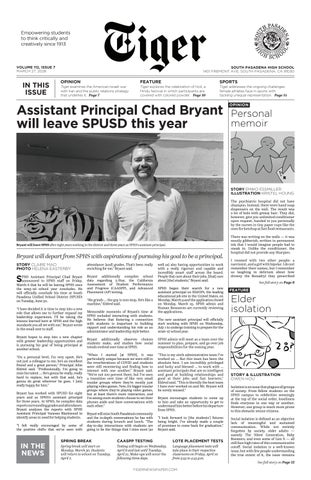
Bryant will leave SPHS after eight years working in the district and three years as SPHS’s assistant principal.
Bryant will depart from SPHS with aspirations of pursuing his goal to be a principal.
STORY CLAIRE MAO
PHOTO HELENA EASTERBY
SPHS Assistant Principal Chad Bryant announced to SPHS staff on Friday, March 6 that he will be leaving SPHS once the 2025–26 school year concludes. He will officially conclude his time at South Pasadena Unified School District (SPUSD) on Tuesday, June 30.
“I have decided it is time to step into a new role that allows me to further expand my leadership experience. I’ll be taking the lessons learned here at SPHS and the high standards you all set with me,” Bryant wrote in the email sent to staff.
Bryant hopes to step into a new chapter with greater leadership opportunities and is pursuing his goal of being principal at another school.
“On a personal level, I’m very upset. He’s not just a colleague to me, he’s an excellent friend and a great person,” Principal John Eldred said. “Professionally, I’m going to miss his talent … He’s gonna be really, really hard to replace, but with that said, he’s gonna do great wherever he goes. I [am] really happy for him.”
Bryant has worked with SPUSD for eight years and as SPHS’s assistant principal for three years. At SPHS, he compiles data reports surrounding grades and attendance. Bryant analyzes the reports with SPHS Assistant Principal Vanessa Blackwood to identify areas in need for helping students.
“I felt really encouraged by some of the positive shifts that we’ve seen with
attendance [and] grades. That’s been really enriching for me,” Bryant said.
Bryant additionally compiles school data regarding 5-Star, the California Assessment of Student Performance and Progress (CAASPP), and Advanced Placement (AP) testing.
“He grinds … the guy is non-stop. He’s like a machine,” Eldred said.
Memorable moments of Bryant’s time at SPHS included interacting with students. He believes that fostering a connection with students is important to building rapport and understanding his role as an administrator and leadership style better.
Bryant additionally observes choices students make, and studies how social trends evolved over time at SPHS.
“When I started [at SPHS], it was particularly unique because we were still in the reverberations of COVID and students were still recentering and finding how to interact with one another,” Bryant said. “We’re not 100 percent there, but I’ve seen a transition over time of like very small insular groups where they’re mostly just playing video games. Now, it’s bigger insular groups where they’re playing video games, but at least there’s more interaction, and I’m seeing more students choose to set their phones aside and have conversations with each other.”
Bryant will miss South Pasadena’s community and the in-depth conversations he has with students during brunch and lunch. “The day-to-day interactions with students are going to be the things that I miss most [as
SPRING BREAK
Spring break will start on Monday, March 30. Students will return to school on Tuesday, April 7.
well as] also having opportunities to work with a really rigorous and capable and incredibly smart staff across the board. People that care about their jobs, [that] care about [the] students,” Bryant said.
SPHS began their search for a new assistant principal on EDJOIN, the leading educational job site in the United States, on Monday, March 9 and the application closed on Monday, March 23. SPHS admin and Human Resources are currently reviewing the applications.
The new assistant principal will officially start working with SPHS on Wednesday, July 1 to undergo training to prepare for the 2026–27 school year.
SPHS admin will meet as a team over the summer to plan, prepare, and go over job responsibilities for the coming year.
“This is my sixth administrative team I’ve worked on … But this team has been the absolute best. I am incredibly privileged and lucky and blessed … to work with … assistant principals that are so intelligent and good at building relationships and good at their jobs and fast learners,” Eldred said. “This is literally the best team I have ever worked on and Mr. Bryant will be sorely missed.”
Bryant encourages students to come up to him and take an opportunity to get to understand him better before his departure from SPHS.
“I look forward to [the students’] futures being bright. I’ve already made a couple of promises to come back for graduation,” Bryant said.
OPINION
Personal memoir
STORY EMIKO ESSMILLER ILLUSTRATION KRISTEL HOUNG
The psychiatric hospital did not have shampoo. Instead, there were hand soap dispensers on the wall. The result was a lot of kids with greasy hair. They did, however, give you unlimited conditioner upon request, handed to you personally by the nurses in tiny paper cups like the ones for ketchup at fast food restaurants. There was writing on the walls — it was mostly gibberish, written in permanent ink that I would imagine people had to sneak in. Unlike the conditioner, the hospital did not provide any Sharpies. I roomed with two other people: a narcissist, and a girl with bipolar. I do not remember their names, but I remember us laughing in delirium about how drowsy the Benadryl they prescribed
See full story on Page 6
FEATURE
Elder isolation
STORY & ILLUSTRATION
OWEN HOU
Isolation is an issue that plagues all groups of society. From fellow students on the SPHS campus to celebrities seemingly at the top of the social order, loneliness finds everyone in one way or another. However, one group is much more prone to this obstacle: senior citizens.
CAASPP TESTING
Testing will begin on Wednesday, April 8 and last until Tuesday, April 21. Make-ups will occur the following three days.
LOTE PLACEMENT TESTS
Language placement tests will take place in their respective classrooms on Friday, April 10 from 3:45 to 4:45 p.m.
Social isolation is defined as an objective lack of meaningful and sustained communication. While not entirely forgotten by society, older adults — namely The Silent Generation, Baby Boomers, and even some of Gen X — all still face high rates of this communicative cutoff. Social isolation is a well-known issue, but with few people understanding the true extent of it, the issue remains
See full story on Page 12
STORY ELLIE SONG
PHOTO LUCINDA ERNST
V
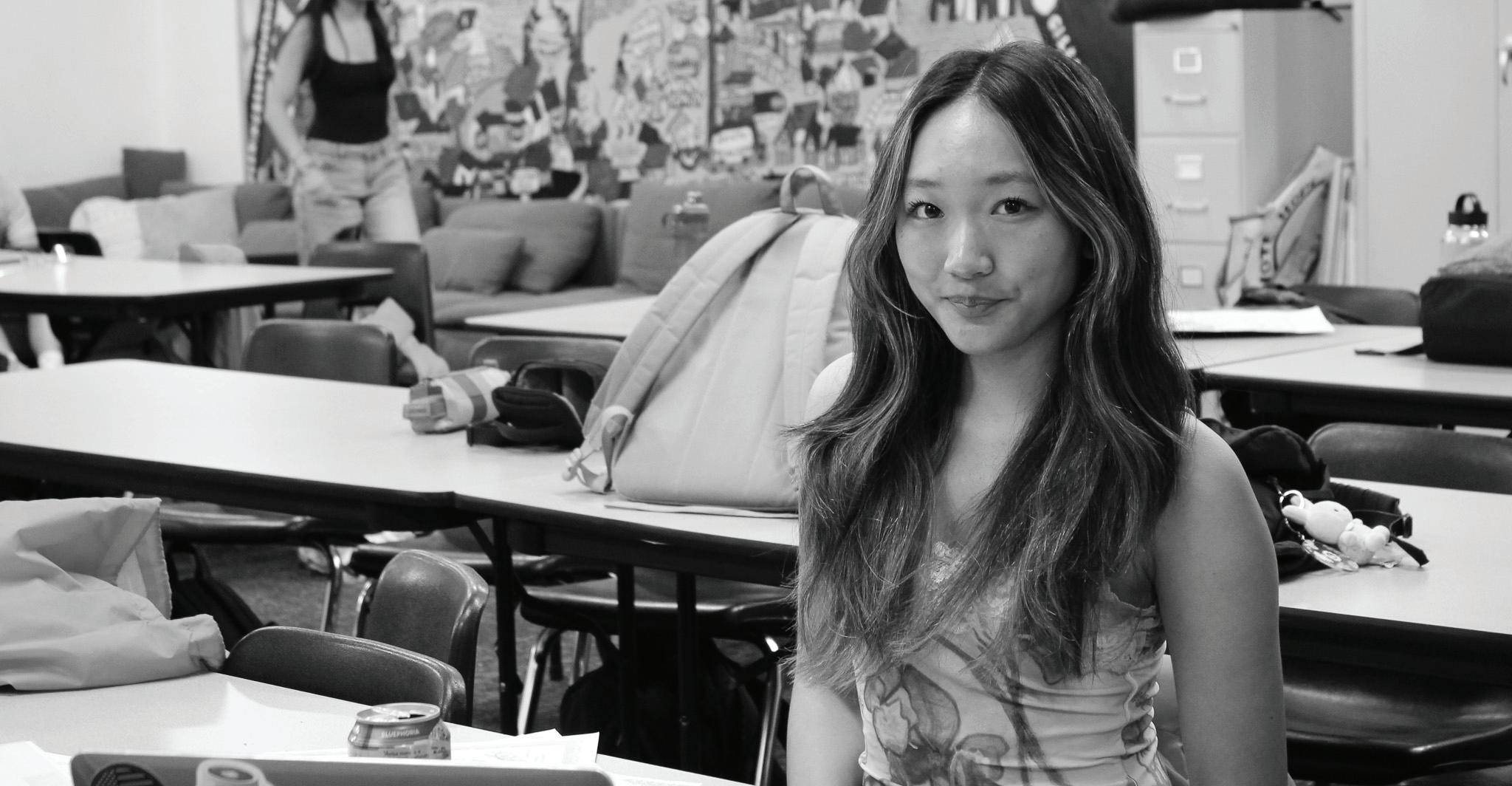
arious SPHS students were highlighted in the annual Spotlight on Excellence (SPEX) assembly on Thursday, March 26. The assembly aims to celebrate student achievement over the course of the school year.
Senior Commissioner of Academics Belle Huang assembles a committee with a few other students in the Associated Student Body (ASB) to determine award recipients.
Early stages of preparation in determining award recipients include Huang reading through the form responses for nominations of student awards. The committee then reviews the nominations together and considers the strongest candidates to be awarded.
The SPEX assembly showcases Grade Point Average (GPA), Principal’s, Pep, Renaissance, School Spirit, Athletic, Music, Heart of Gold, and Department awards. Department awards include Math, History, LOTE, English, Science, Career Technical Education (CTE) and Special Education. Around 1000 total awards are given out while 49 miscellaneous awards (not GPA awards) are given.
The Principal’s Award is granted to two students of SPHS principal John Eldred’s choice. The award shows excellence and outstanding behavior and personality to their peers and teachers.
The GPA awards are picked by the committee that Huang had chosen, by looking at every student’s GPA. The awards are not only for those who have had a consistent 4.0, but as well as for students with 0.5 plus, which can show the improvement the students made, and 3.5-3.9.
The awards are not only to showcase those who have worked for their A’s, but as well as those who have improved with their grades and perseverance for better grades. For example, the Renaissance Award is given
The selection process for SPEX student awards
Admin, teachers, and ASB work together to highlight student achievement.
to students based on their participation in a variety of academic and non-academic activities. The Renaissance Award has been historically given to three students.
“Recipients of this award exhibit outstanding participation and effort in a variety of activities and extracurriculars, both inside and outside of school, and leave a positive impact on others, whether it’s through leadership, team spirit, community building, or being a role model,” Huang said.
Various teachers along with committee members are included in the process to help pick students who are best fit for the Department award.
The 2025-26 school year features a new award that the ASB committee and teachers brought together: the school spirit award. The award will highlight two to three students who support and participate in a majority of the school events, such as clubs, dances, and fundraisers.
It additionally recognizes outstanding contributions on campus, those who display a positive attitude to their peers, and those constantly looking for ways to uplift other students.
“There’s definitely a lot of really strong candidates for a majority of the awards,” Huang said.
SPHS clubs participate in the DEI Multicultural Fair
STORY MAXINE MESSINEO
PHOTOS MAC SHROPSHIRE
South Pasadena High School’s Diversity, Equity, and Inclusion (DEI) Multicultural Fair took place on Thursday, March 19. The fair was held at the Tiger Patio during lunch with eight different clubs and organizations including games and snacks at their tables.
Club members involved in the fair left their fourth-period classes 15 minutes early to go to the Tiger patio and get their tables ready.
The Origami Club had a brief class on how to construct an origami crane out of paper. The club teaches students origami and other forms of paper folding.
The Middle Eastern Club had free Persian candy called Lavashak, or fruit leather, and bookmark making. The club aims to spread awareness throughout campus about Middle Eastern culture and the events that are taking place in the Middle East.
Several clubs additionally sold snacks during the event. The Basketball Association, an organization on campus dedicated to the basketball teams, sold furikake onigiri for $3. OMID, or hope in Dari, for Girls sold salt bread,
$1 for four, $2 for six, and passion fruit green tea for $2.
The OMID for Girls club tutors girls in Afghanistan in English and Math in order to further their studies. Due to Taliban rule, girls in Afghanistan are prohibited from attending school. The club conducts live tutoring sessions for the young girls living in Afghanistan and helps to educate them.
The Asian Pacific Islanders Student Union (APISU) sold spam musubi for $4 and did free henna designs, a temporary body and hair dye, on students’ hands. The club aims to unite the student body through the celebration of all Asian and Pacific Islander cultures.
A few clubs had games for students set up at their booths.
The Latinx Club, which educates students on Latin culture, had Mexican candy and a Mexican board game called Lotería, similar to bingo, but played with a deck of cards instead of numbered balls.
“I loved seeing how even non-Spanish speakers could enjoy playing a game entirely in Spanish. It was really special to be surrounded by booths from many different cultures. I’m really appreciative of the opportunity to represent the Latin and Hispanic community on campus
at this fair,” Latinx Club President Viviana Williams said.
The TEDxSouthPasadenaHigh club gave out bags with pencils, notebooks, and candy.
The club members announced they are looking for student speakers for the upcoming TEDx event in 2027. The title of the event is “More than meets the eye,” and additional information can be found on the SPHS bulletin.
The Rock Climbing Club had a grip strength tester where one would use their foot to hold down a string and pull on a wooden block with only their fingertips to test their strength, as well as free candy. The club aims to create an organized and connected group of students who all share a similar interest in all forms of rock climbing.
The top three winners for the grip strength contest were senior Diego Pizarro with 146 pounds, junior Talon Ebbert with 131 pounds, and junior Logan Burmood with 121 pounds.
“[Rock Climbing Club] decided on what to do by thinking about what fun things we could do that still relate to our club. That’s why we decided on doing a grip strength challenge with the winner getting a chalk bag filled with candy,” Ebbert, a member of the Rock Climbing Club, said.
Senior Commissioner of Academics Belle Huang works with admin, teachers, and other students to determine SPEX award recipients.
Explaining the SPHS grading process
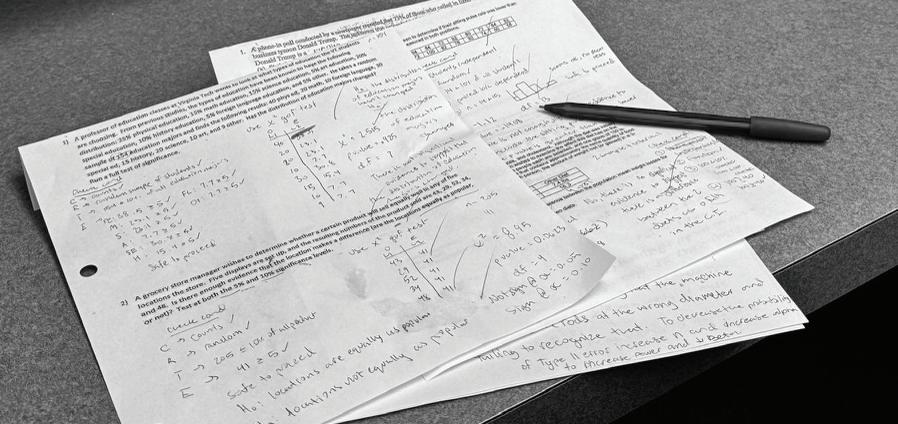
Aeries closes for progress checks to allow teachers to test class curves without students being able to see.
STORY JULIA GILDERSLEEVE
PHOTO SEBASTIAN GUTIERREZ
S PUSD utilizes Aeries as the grading platform throughout the district to input grades for students.
The platform allows parents and students to check grades, gradebook details, attendance, and other profile information. Throughout the district’s time of using Aeries, the overall grading process has changed from completing required grade verification sheets to simply inputting grades on Aeries.
Grade verification sheets were paper forms that teachers were required to sign to verify that their grades were correct. However, over several years, Aeries has become automated and refined for the convenience of teachers, and the grade verifications were dropped.
The weighted categories and grading policies are created by each individual teacher at SPHS.
“Some departments have a grading standard that everyone uses, like the percentages per grading category. They have their own policy that everybody goes by. This isn’t true for the entire campus, and it isn’t typical for teachers to have a set policy,” SPHS principal John Eldred said.
Administration only steps in at the beginning of the school year when they ask all of the teachers to turn in their syllabi.
“[T]eachers’ grading policies are dialed in, effective, and [they follow] them to the letter so that there’s no confusion or wiggle room or misunderstanding to why a grade was issued,” Eldred said.
SPHS admin has a record of each teacher’s grading policy; thus, if an issue arises due to a grade, both admin and the teacher can refer to the syllabus to resolve the issue.
“Administrators don’t guide grading policies; it is the sole purview of teachers. They are the only people who can issue grades; I can’t change or issue grades,” Eldred said.
Aeries closes each quarter so that teachers can test overall class curves without students being able to see the effects in real time.
At the end of each quarter, Aeries will close to give teachers time to input all of their students’ grades. Essentially, teachers are allowed to test curves and the effect of assignments without students being able to see what is happening in real time.
“I don’t generally curve exams, but on the rare occasion I do, I might look at the effect of a particular curve on the grades of the students in my class. If I don’t like it, then I’ll change it to something else. That’s more or less the rationale for why it’s down so that we can change kids’ grades without them being able to see live changes as they happen,” Math III+ and AP Computer Science teacher Jared Guiou said.
Aeries gives teachers specific deadlines at the end of each quarter that inform them when they need to have their grades in before. Students can not see these deadlines through the student portal, because they are only visible to teachers. Teachers have about five days to input grades before the portal reopens for parents and kids to check grades.
Potential all day Mondays
STORY MAXINE MESSINEO
PHOTO
SEBASTIAN GUTIERREZ
SPUSD is potentially going to be aligning the schedules for South Pasadena Middle School (SPMS) and South Pasadena High School (SPHS). The change would make Monday’s schedule feature all class periods at the high school rather than only the odd or even ones.
“Some teachers travel back and forth [between SPMS and SPHS], and [the schedule] doesn’t always line up, especially on our late start days. They get out earlier, we get out later, they start earlier, we start later … This is where this idea has come from,” SPHS Principal John Eldred said.
At the middle school, students are released from class at 2:20 p.m. on Mondays instead of 2:40 p.m., the regular release time at SPMS. SPHS will not be adopting the change of making school days 20 minutes shorter, as the school is required by law to have a certain number of minutes in a school day.
The school does, however, have more minutes per year than needed in case of emergency and to ensure students have enough time to be properly educated. One concern that Eldred expressed regarding the potential change was about the master schedule.
“It might be a little more difficult to put the master schedule together … But Ms. Blackwood, who makes our master schedule, seems pretty confident that if there is a schedule change to an all-period Monday … we can make it happen,” Eldred said.
The master schedule is the schedule of all the classes offered at SPHS.
One advantage to the possible change is that students will always know what classes to expect on Monday after the weekend.
“You’ll always know that Tuesday and Thursday are odd and Wednesday and Friday are even. [Students are] not always guessing where [they’re] supposed to be,” Eldred said.
The process to organize this possible schedule alignment started with two meetings. The first was held in early February and another was held in early March. Teachers and administrators from both the high school and the middle school attended.
The bell schedule committee analyzed the potential schedules and how they could work in the meetings. First, the committee spent a full day looking at different schedules, and then spent another day trying to find problems with the possible schedules to fix.
SPUSD’s next step is to hand the proposed schedule to the teachers’ union so that they can review the proposed schedule. Once the schedule is reviewed, a SPUSD Board of Education meeting will be held. The new schedule could potentially take effect as early as August of 2026.
The change will affect both the teachers and students of SPHS. One student voices their concerns.
“I think it would be difficult to manage because of how much shorter the classes would be, and it might be a hassle to get from class to class. For example, during late start days, I’m constantly asking or being asked when each class ends because people don’t get used to the schedule very easily,” SPHS freshman Victoria MacRae-Serpa said.
Students often find themselves confused about the schedule even without a day of all class periods and there is a risk for students to be less productive.
“I think if they decided to make every Monday have all periods, it would end up being fine, but I don’t think the classes would be more efficient for it, mainly just because [the classes] would be a lot shorter,” MacRae-Serpa said.
“Time management for [teachers] grading is similar to time management for students getting their homework done,” Guiou said. “If I was very behind in grading my students’ homework, it might seem like a lot. But if I do it as it’s going, and I stay on top of things, it’s not so bad.”
There is no strict timeline for teachers to grade. In general, they are supposed to be caught up when the grading period ends, which is when Aeries goes down.
The same process occurs when Aeries closes for each quarter and the end of the semester for teachers.
Teachers transfer their students’ grades from the Aeries gradebook into the Aeries grade section seen in students’ progress reports. Finally, the grades are uploaded, transferred, and double-checked for accuracy. For students who are not doing well, teachers are required to put a comment explaining why they are struggling; reasons may include the student not performing well on homework.
The SPUSD district headquarter building on El Centro Street.
Senior Assasssin season is here
SSenior assassin is an annual senior class-wide game that encompasses water and water guns to eliminate one another until there is only one left standing. In this issue, unique methods used within senior assassin.
KHLOE YUEN
enior assassin is an off-campus game seniors can participate in during the second semester of their last year in high school. Those who wish to enter must pay a fee of $10.
The game is organized through the app Splashin. Seniors must turn on their location in the app for the entire duration of senior assassin, and every participant is secretly assigned a target they must eliminate by shooting them with a water gun or by splashing water on them.
The goal of senior assassin is to eliminate one's target before they are eliminated themselves. For immunity, swim goggles are worn. If an individual shoots their target on camera without their gear on, the target will be eliminated.
Footage is uploaded to Splashin, and updates are posted on the senior assassin Instagram account. Assassinations without video proof are void.
Senior assassin includes periods every week that last between 6 and 11 hours called purges, during which no one is protected by their swim gear.
The game master for the 2026 senior assassin game at SPHS is senior Beatrix Aboud. Aboud is responsible for ensuring participants follow the rules and deciding whether or not eliminations count.
Those who successfully eliminate someone receive a new target; players receive new targets each week as the game continues. However, if an assassin fails to eliminate their target at the
ssinate and escape ame rules
end of the week, they are placed on a bounty the following week. If one is placed on a bounty, anyone in senior assassin can eliminate them.
Various rules are put in place to keep the game safe and fair.
The assassin is not allowed to shoot someone on the school campus, since the school is a safe zone. Additionally, assassins cannot shoot before or after a target’s job or an SPHS sports event within a certain time frame.
Other rules prohibit eliminating someone in a moving car or at a place of worship, and players are not allowed to turn off their locations. Also, if an assassin seeks to enter their target’s home to eliminate them, the assassin must film video permission of the target’s parents or guardians allowing them to enter.
A violation of the rules while attempting to eliminate their target will disqualify the assassination attempt, and the player will be reminded to follow the rules by Aboud.
“I try to resolve issues by being fair, and if there are two sides to an elimination, I just use my judgment, and whether or not they have proof of it being valid,” Aboud said.
The 2026 senior assassin consists of 140 students, and 27 were eliminated in the first two weeks.
The winner of senior assassin will receive the total contributions made by the players. The total comes to around $1,400 for the 2026 SPHS senior
STORY ANNA MCDONNELL & HARRIET GODSON
T he 2026 senior assassin Instagram account, which monitors and oversees gameplay, was officially created on Sunday, March 1. Typically played every year by the senior class, senior assassin has become an unofficial rite of passage for the graduating class, and the class of 2026 is honoring the tradition.
Students are striving to emerge victorious with a prize pool of around $1,400 on the line. Both on the SPHS campus and in the broader South Pasadena area, seniors are commonly seen sporting swimming goggles around their neck or a pool floatie on their arms — items that serve as “protection” against possible attempts of elimination.
Elimination attempts, which are all filmed and posted to the senior assassin Instagram account and the app Splashin, are unpredictable.
“I think the videos of everyone getting out are really fun to watch, and it’s really nice seeing the grade sort of come together in this game,” senior Adelaide Bertolina said.
One popular method of elimination that many students rely on is called “camping.” Students wait outside of their target’s house in hopes of catching them leaving their home without protection. Other methods of elimination rely more on ingenuity. Senior Zoe Rusch and a friend staged a fake promposal in an attempt to eliminate
their unaware target. Another senior, Joie Chen, used a yearbook fashion photoshoot, and got their target to take their goggles off while posing for a picture.
Attempts at dodging eliminations can get similarly creative.
Senior Gopal Amissah, for example, found himself without protection after a purge — a period where swimwear no longer serves as protection — was launched while he was at the gym.
“I wasn’t safe with my goggles anymore. My friend and I periodically checked the front [of the gym] to see if my assassin, Liam, was coming. We saw him talking to the front desk, so I ran out of the back door and got on my bike,” Amissah said. “I used my immunity powerup, and went back to the gym safely. He checked every room for me and couldn’t find me, and he was mad to find out I used my immunity.”
The senior assassin game has also created inconveniences for students. One senior crashed their car during the events of the game, and another participant had the police called on them while camping out in front of their target’s home. Despite these events, seniors have still reported having a fun time.
“My favorite part about senior assassin is that it creates community, especially considering how divided our class is,” senior Ella Jones said.
THE TIGER
NSPA FIRST CLASS 2025
NSPA FIRST CLASS 2024
CSPA GOLD MEDALIST 2023
CSPA SILVER CROWN 2022
CSPA SILVER CROWN 2021
CSPA GOLD MEDALIST 2019
CSPA SILVER CROWN 2018
CSPA GOLD MEDALIST 2017
CSPA CROWN AWARD 2016
CSPA GOLD MEDALIST 2015
EDITOR-IN-CHIEF
SONYA SHIMPOCK
MANAGING EDITORS
ZOE CHEN, Print
EMIKO ESSMILLER, Online
RUBY FOUDY, Associate
NEWS
CLAIRE MAO, Editor
OPINION
RAFA ESTOLANO-SRIDHARAN, Editor
FEATURE
RUBY FOUDY, Editor
SPORTS GAVIN BARTOLOME, Editor
DESIGN
OLIVIA CHIN, Editor
LANAH KIM, Editor
PHOTOGRAPHY
HELENA EASTERBY, Editor
COPY
OWEN HOU, Editor
SOLANA SINGER, Editor
STAFF WRITERS
UMA CHAKRABORTY EVELYN DIAZ
MIRIAM ELGHEFARI
JULIA GILDERSLEEVE
HARRIET GODSON ETHAN KWAK
LEIGHTON KWOK
ANNA MCDONNELL
MAXINE MESSINEO ELLIE SONG
KHLOE YUEN
STAFF PHOTOGRAPHERS
LUCINDA ERNST
SEBASTIAN GUTIERREZ
MAC SHROPSHIRE
STAFF ILLUSTRATORS
KRISTEL HOUNG
DIANA LOPEZ
JAYDEN ZUMBA
PAGE DESIGNERS
GABBY FERRI PAISLEY PARK
ALISON SCHRADER
VIDEOGRAPHER
THEO THOMPSON
BUSINESS AND ADS MANAGER
PASCALE WILLIAMS
SOCIAL MEDIA SPECIALIST
ISABELLA JONASEN
FACULTY ADVISOR KAREN HAMES
VOL. 112 NO. 7 DISTRIBUTED ON MARCH 27, 2026
DISTRIBUTION: 1460 STUDENTS; 70 COMMUNITY. 1200 COPIES PRINTED. DISTRIBUTED BY TIGER STAFF FREE OF CHARGE.
TIGER IS PRODUCED BY THE ADVANCED JOURNALISM NEWSPAPER CLASS AT SOUTH PASADENA HIGH SCHOOL, 1401 FREMONT AVE, SOUTH PASADENA, CA 91030. LAYOUT AND PHOTO IMAGING ARE COMPLETED
SIGNED ARTICLES APPEARING IN TIGER REPRESENT THE WRITER’S OPINIONS AND DO NOT NECESSARILY
REFLECT THE VIEWS OF THE STAFF, STUDENT BODY, FACULTY OR ADMINISTRATION OF SPHS. ORIGINAL
STORIES WILL CARRY BYLINES, ALTHOUGH STORIES
REWRITTEN BY ANYONE OTHER THAN THE ORIGINAL
CONTACT THE PUBLICATIONS OFFICE AT (626) 4415820 EXT. 2615 BETWEEN 8:00 A.M. AND 4:00 P.M. FOR ADVERTISING RATES AND SUBSCRIPTIONS. TIGER WELREBUTTALS FOR PUBLICATION IN THE PRINT AND ONLINE EDITIONS. ALL LETTERS MUST BE SIGNED AND VERIFIABLE, BUT NAMES WILL BE WITHHELD UPON TIGER’S MISSION IS TO PROVIDE A RELIABLE NEWS OUTLET FOR SPHS AND THE LOCAL COMMUNITY. THROUGH A VARIETY OF COVERAGE, TIGER EMPOWERS/ENABLES STUDENTS TO THINK CRITICALLY AND CREATIVELY, COMMUNICATE EFFECTIVELY, SOLVE PROBAND INDEPENDENTLY AS RESPONSIBLE CITIZENS. TIGER IS A FORUM FOR STUDENT FREE SPEECH, IN ACCORDANCE WITH CALIFORNIA ED CODE 48907. ALL REMAINING CURRENT TIGER NEWSPAPER POLICIES ARE ONLINE AT TIGERNEWSPAPER.COM INCLUDING: CONFLICT OF INTEREST, LETTERS TO THE EDITOR, CORRECTIONS, AND SOCIAL MEDIA.
STAFF EDITORIAL
College influencers fearmonger students
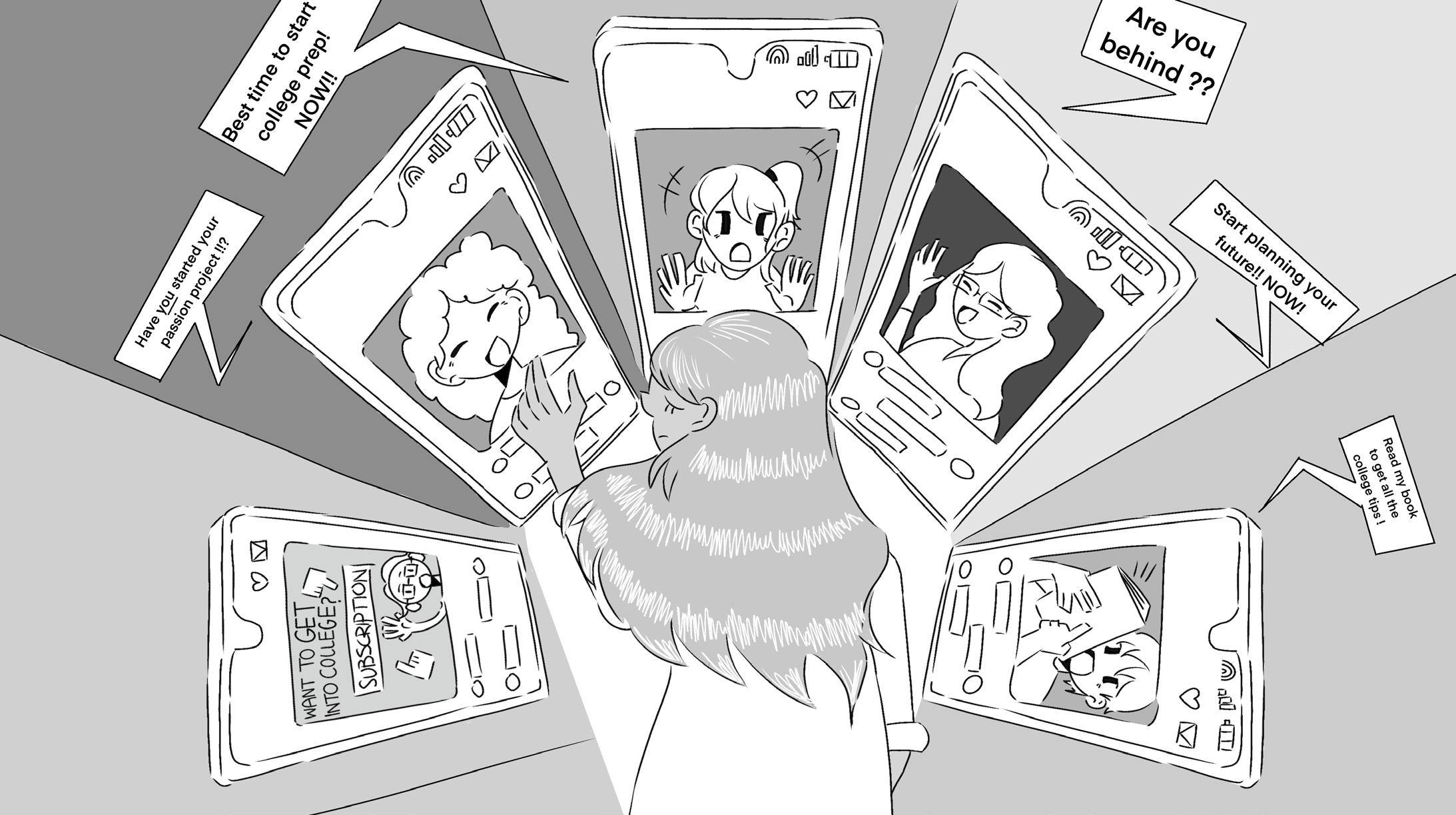
Influencers claim they are the key to getting into students’ dream college.
The
Ultimate Ivy League Guide Instagram, created by Harvard student Elise Pham, states in one of her recent videos that receiving straight A’s in high school is just not enough to earn acceptance at a highly competitive institution, as threefourths of enrolled students have a perfect GPA. What gets most students with 4.0s rejected, she claims, is their inability to show “intellectual curiosity” in their application.
“That means no matter what your GPA is, here’s what you need to do to avoid falling into the trap that’s causing most students to sabotage their chances at college,” Pham said, guiding her viewers to Pham’s own college preparation company.
Since the growth of short-form content, social media has served as a way for the public to ask a variety of questions, but high schoolers often use it to access advice on the college admissions process. With the height of college decision season arriving, many high school juniors are thinking about their college applications and whether or not their grades, activities, and personality are good enough to earn them admission to a well-known college.
The college admissions influencer niche is a competitive community, with most videos aiming to be helpful and make students feel more comfortable about their applications. However, some influencers take advantage of the nervousness of these high school students by using the fear of not getting into college to sell their own college admissions guide that is “guaranteed to get you into the college of your dreams.”
These misleading tactics destroy the college admissions advice space and create a toxic environment around applications that ultimately hurt the students they are trying to “help.”
These videos use quick tips to draw students in, with headlines like “secrets college admission officers don’t want you to know” and “relatable” content. Then, they tell the viewer to comment a word or phrase to receive their complete, free guide on the subject. But, ultimately, the individual ends up with a pasted-in link that goes straight to a paid membership-only website instead of the promised guide. Students’ and parents’ stress is preyed upon with purposefully insightful quotes like “If you don’t start this now, it is going to be too late” or “I have limited spots, so book quickly,” which present private admissions counselors as the only path to acceptance.
“For me, when it comes to online platforms, it makes me feel like I am behind, and I have not done enough to get into a good college,” junior Casey Gould said.
These influencers brand themselves as the ultimate experts on the college admissions space and claim to have an inside ear on the enrollment counselor’s board. While some may be telling the truth, the majority use it as an upper hand to make exaggerated statements. This social media pressure is not only for students, but it also reaches parents.
“It’s her SAT, Cheryl, a 1360 SAT won’t get you into flagship schools,” Andreas Stamatakis, author of the Ivy League Roadmap, stated, referring to a mother’s disappointment with her daughter’s rejection from the University of Florida.
This creates ever more anxiety around college admissions, exacerbating the feeling of falling behind one’s peers. Focusing on a parent’s desire to do everything “correctly” is how intimidating college advisors profit and discredit the real, hardworking, and informative consultants. This also creates a lack of transparency in the admissions process, as false claims are left unrefuted by admissions officers. This puts financial strain and pressure on purchasing these items to fulfill unrealistic expectations, and hides the fact that families can get into a fine college without them.
Real guidance looks like clear, honest information that respects the student’s mental health and reassures them that their goals may be achievable with the right amount of work. Being a true admissions counselor is about giving them a sense of hope from the start, not shooting them down to build them back up on an advisor’s terms. Encouraging realistic goals and giving students the comfort of always finding a way to pivot is what these influencers should strive for.
Instead of making clickbait videos, these influencers should tell students and parents that they are going to be okay and offer them real, non-exaggerated advice that makes them feel more confident, not defeated.
Families should not need to look for red flags to protect themselves from fear-mongering college advice pages, and instead feel at ease when looking for credible and enlightening advice.
Tiger’s cheers and jeers for the month of March
BOO to Marty Supreme. The most insufferable person you know has a new favorite movie.
BOO to AI fruit Love Island. We are regressing as a society.
BOO to Love is Blind. After seven seasons, I think we’ve realized it’s not.
BRAVO to pasta day. I yearn. BRAVO to 11:59 deadlines. Just keep enabling me. BRAVO to the Chappell Roan apology. At least there wasn’t a ukelele. BRAVO to Mr. Lewis. The only bright spot in Middle school was the shine of his bald head.
BOOS BRAVOS
A promise to myself from March of 2024
I plan to continue living for myself, my friends, my family, and the strangers I meet along the way.
STORY EMIKO ESSMILLER ILLUSTRATION KRISTEL HOUNG
The psychiatric hospital did not have shampoo. Instead, there were hand soap dispensers on the wall. The result was a lot of kids with greasy hair. They did, however, give you unlimited conditioner upon request, handed to you personally by the nurses in tiny paper cups like the ones for ketchup at fast food restaurants. There was writing on the walls — it was mostly gibberish, written in permanent ink that I would imagine people had to sneak in. Unlike the conditioner, the hospital did not provide any Sharpies.
I roomed with two other people: a narcissist, and a girl with bipolar. I do not remember their names, but I remember us laughing in delirium about how drowsy the Benadryl they prescribed to help us sleep made us. Our beds and side cabinets were bolted to the floor. Room rearrangements at 3 a.m. were — unfortunately — not possible (not that I could have been awake through the Benadryl for them).
All of the doors had keycodes that were only accessible to the nursing staff, including the one to the “Day Room,” where we would spend most of our time. My first time in the Day Room — the living area we spent most of our time in — was, ironically, at night. The far wall was lined with nearly opaque frosted glass windows. The only thing visible through them were the red brake lights of passing cars; watching them dance across the glass was soothing, but it also created an out-of-body experience — you felt like you were detached from outside society. Past at least four metal doors, this was basically the closest you were ever going to get to the outside, and even then, nothing was truly visible.
On the last night sitting at the main table in the Day Room, with my head buried in a stack of cards and surrounded by a few friends I had made, I learned something new about the girl next to me: This was her ninth time in a psychiatric hospital. I remember pausing my thought process, temporarily ignoring the game of Go Fish, and feeling an overwhelming sense of disappointment.
I was disappointed I was losing, disappointed that I could not be playing Go Fish with my family, and most of all, disappointed that this hospital had become a commonplace part of someone’s life.
The tan walls with white trim, the garlic-scented cafeteria, the Day Room with its frosted glass windows and the handsoap-dispensers-turned-makeshift-shampoo-dispensers on the walls of the bathroom: This was reality for her. This was meant to be safer and more stabilizing than whatever her life was outside of the hospital’s walls, and that realization was the most depressing for me. Because those kinds of living conditions may not be normal for all youth, but for the 37,787 in California in 2020 that were hospitalized at a mental institution, they very well might be.
I made friends there. Short, ephemeral friendships with girls I no longer remember the names of. They exist in my head, however, as architects of my character. I believe in giving people the benefit of the doubt. I believe in offering extra support or time or effort to family or friends or peers or strangers because I believe that it matters to
them, that behind closed doors we do not truly know what is happening to anyone.
We do not know if their recent absence was due to their ninth stay at the psychiatric hospital. For that reason, I think the girls I met there might be some of the most influential people in my life. But the more important part, the thing that really matters, is that their stories saved my life.
I do not know how or where they are now, but that experience gave me the courage to make a promise to myself. Whether spoken aloud or not, I made a promise to myself, my family and my friends, to every single person I have ever met, that I will wake up every day and try my absolute hardest to continue doing so. That every time my feet touch the floor as I get out of bed in the mornings, or I wash my hair with real shampoo, I am living for myself and my friends in the hospital.
That on their behalf, I will try my best to live a life I can be proud of.
Art is inherently political; music is a tool for social change
STORY ISABELLA JONASEN ILLUSTRATION DIANA LOPEZ
Within every work of art, the artist behind the work inevitably has a narrative they are trying to craft. No matter the theme, it reflects how the artist engages with the world around them. Because of this, art is inherently political, as it holds the power to influence how others view society.
When an artist chooses to create, they are actively engaging in protest. Creating for oneself is a radical act of resistance against conformity because it is choosing to express one’s own truth rather than conforming to any societal expectations of what makes an artist.
Furthermore, music has forever served as a fundamental tool to introduce social change. By allowing voices to be heard, art has the ability to unite people. It has long been evident that music reflects the social climate of its time and amplifies voices that might otherwise go unheard.
In the 1960s and 1970s, for example, as the Vietnam War continued to escalate, music became more connected to the anti-war movement. Pivotal figures such as Bob Dylan and John Lennon assisted in defining the era with classics like Blowin’ in the Wind and Give Peace a
Everything by Ethan ETHAN KWAK
My Days of 58
Bill Callahan’s 24th studio album, My Days of 58, marks a turning point in his discography. Released on Feb. 27, it is a playful departure from 2023’s Ytilaer, which was a conceptually-minded commentary on the hypnagogia of American society following the end of the pandemic. This playfulness is best encapsulated by the final seconds of The Man I’m Supposed to Be, in which Callahan literally laughs at death. Callahan succeeds most when his music is urgent and commands attention. Accordingly, the most compelling tracks of the record are Pathol O.G., Empathy, West Texas, and Computer
Chance. This music would quickly become synonymous with what many would refer to as traditional protest music.
This does not mean that politics in music is specific to a single genre or time period; songs of protest can not be confined to a singular form. All forms of art exist as a response to the world and the issues within it.
Art is not one-dimensional, and its existence goes beyond merely entertaining. It is about giving meaning to one’s life through expression. Every artistic choice reflects the artist’s influences, which are shaped by their worldview and lived experiences, making all art intertwined with all social and political contexts. No genre is ever adopted by an artist for its aesthetic alone; it is always an extension of their identity. By this, art can never be separated from the world of politics.
If creation stems from identity, one will inevitably carry every influence and bias from their lives into their work.
Meaning will also naturally shift over time and be interpreted in unique ways depending on the individual. It is not that every creative sets out with the intention to present an audience with an agenda.
Pathol O.G. is a play on “pathology.” From seeking to connect with other people to turning inward to his guitar in times of distress, Callahan muses on the evolution of his ethos as a songwriter. He asks himself: “Is this creativity or pathology?”
In other words: Is creativity a sickness? The line “It’s important to not/treat your lifeboat like a yacht” is the musing of an older man looking back on his life. Instead of a static temple, the human body treads endlessly forward towards the uncertain horizon.
He asks: “Am I the Pathol O.G? Always one foot on the ladder to heaven?” The latter half of the song focuses on “Jacob’s ladder,” which, in Genesis, spans the distance between Earth and heaven. In the context of the song, “Jacob’s ladder” could be the distance between reality and personal ambition.
Callahan reframes “Jacob’s ladder” by suggesting that one could lay the ladder down to get across, rather than continuing this Sisyphean pursuit.
In Empathy, Callahan addresses his father: “You said you got by without a father/ So you figured why should I have one/ Okay, okay it made me wonder though/ Can you get by
Artists have never been reluctant to express their beliefs; they express their views through every aspect of their work, whether it is obvious or subtle.
without a son?” He wonders what his own kids will think of him when they’re fully grown. Once guarded, Callahan sings about not being able to make it to the father-daughter dance, or “always screeching” at his son to “do this or that.” This is some of the realest stuff he’s done since Sycamore from Woke on a Whaleheart (2007).
The narrative of West Texas is reminiscent of the 1984 film Paris, Texas in which Travis (Harry Dean Stanton) emerges from the desert after disappearing for four years. In his final monologue, Travis speaks of himself in the third person: “He ran until the sun came up and he couldn’t run any further. And when the sun went down, he ran again. For five days he ran like this until every sign of man had disappeared.” Similarly, Callahan sings: “I returned from the desert with a souvenir/ A head that was oh so clear/ And the road back was straight and flat/ and didn’t interfere.” Computer feels like two songs in one. It’s the most apocalyptic track on the album. From sound effects and muddy chords emerges the bright, insistent coda: “I’m not a robot and I never will be.”
And, on AI: “Just because something is doesn’t mean it should be.”
The Trump administration’s chaotic world and the strategy behind it
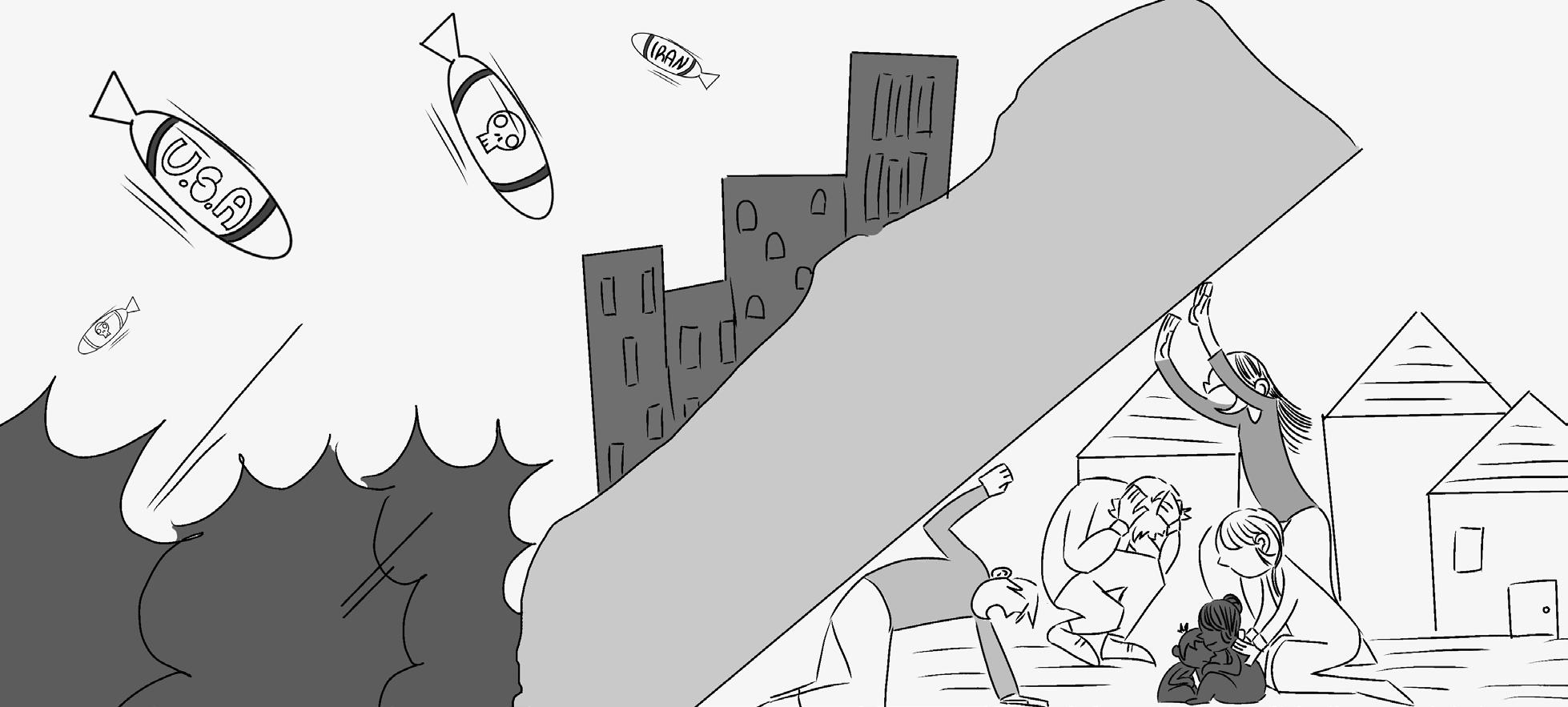
For the past year, the Trump administration has been making headlines as outrageous as they are horrifying. Tiger examines how the war in Iran has been used to obfuscate the countless controversies currently miring the Trump administration.
An overview of the U.S.-Israeli war against Iran
STORY HARRIET GODSON ILLUSTRATION JAYDEN ZUMBA
On Feb. 28, 2026, a girls school in Iran was struck by a Tomahawk missile. The bombing killed 175 people, most of them under the age of 10. While President Trump has denied that the United States had any involvement, it’s important to note that the United States is the only country that uses Tomahawk missiles.
The United States and Israel’s joint mission that day also targeted Iranian leadership, nuclear sites, and military infrastructure, but left a trail of other casualties, including thousands of innocent civilians and the supreme leader of Iran. Iran launched several waves of drones and ballistic missiles within hours of the U.S.-Israel attacks. Strikes targeted U.S. facilities in the Middle East, such as Saudi Arabia, Turkey, and Qatar, as well as military infrastructure and heavily populated areas in Israel.
Iran has closed the Strait to any allies of the United States or Israel. The Strait of Hormuz is a waterway predominantly used to transport cargo ships carrying oil and gas. This waterway is the only way for major oil and gas producers such as Saudi Arabia, UAE, and Kuwait to reach the rest of the world. Due to this restriction, global oil prices have skyrocketed, causing a global economic crisis. Iran is using this power as leverage against the United States and its Western allies. When oil prices increase, overall inflation tends to do the same.
Iran hopes to use their control over the strait and its effect on the global economy to force the United States to end their military campaign. Since the country was founded, Israel has been in conflict with several countries in the Middle East. Currently, this includes the country of Iran and militia groups such as Hamas in Gaza, Hezbollah in Lebanon, and others.The conflict has expanded to Lebanon, displacing over half a million people as the conflict between Israel and
Hezbollah has resumed. Hezbollah is an Iran-backed militia in Lebanon. Lebanon was pulled into war after Hezbollah fired missiles at Israel in response to the airstrikes in Iran. The state of Lebanon has maintained neutrality with the main goal of creating peace for its country and bridging the divide within its government. Israel has been accused of violating international law as they continue to raid Lebanon in an attempt to dismantle Hezbollah, an ally of Iran. Human Rights Watch accused the Israeli government of using white phosphorus shells in a residential area. The dangerous substance can be used to burn entire buildings and leave humans with lasting health effects or death.
Israel sent a large wave of airstrikes and troops captured several new posts in Lebanon, following Hezbollah’s retaliation to the United States and Israel’s joint mission on Feb. 28. The Lebanese government declared
Hezbollah’s military activities illegal, ordering the arrest of those behind the strikes on Israel. The government is effectively in survival mode. A primary example of this is how they have extended parliament’s term by two years, an action that Hezbollah’s 13-member bloc in parliament voted in favor of. The conflict has been brewing since the late 1970s during the Islamic Revolution. Many conservative Iranians felt that the Shah was a puppet of the United States and erasing their culture in favor of westoxification. Westoxification describes the loss of native cultural identity through the adoption of modern Western culture, specifically American values and customs. During the Islamic Revolution, the pro-Western government was overthrown by a fundamentalist Islamic theocracy that governs Iran today. The war in the Middle East has grown increasingly complex and nuanced, entangling many countries in the messy conflict.
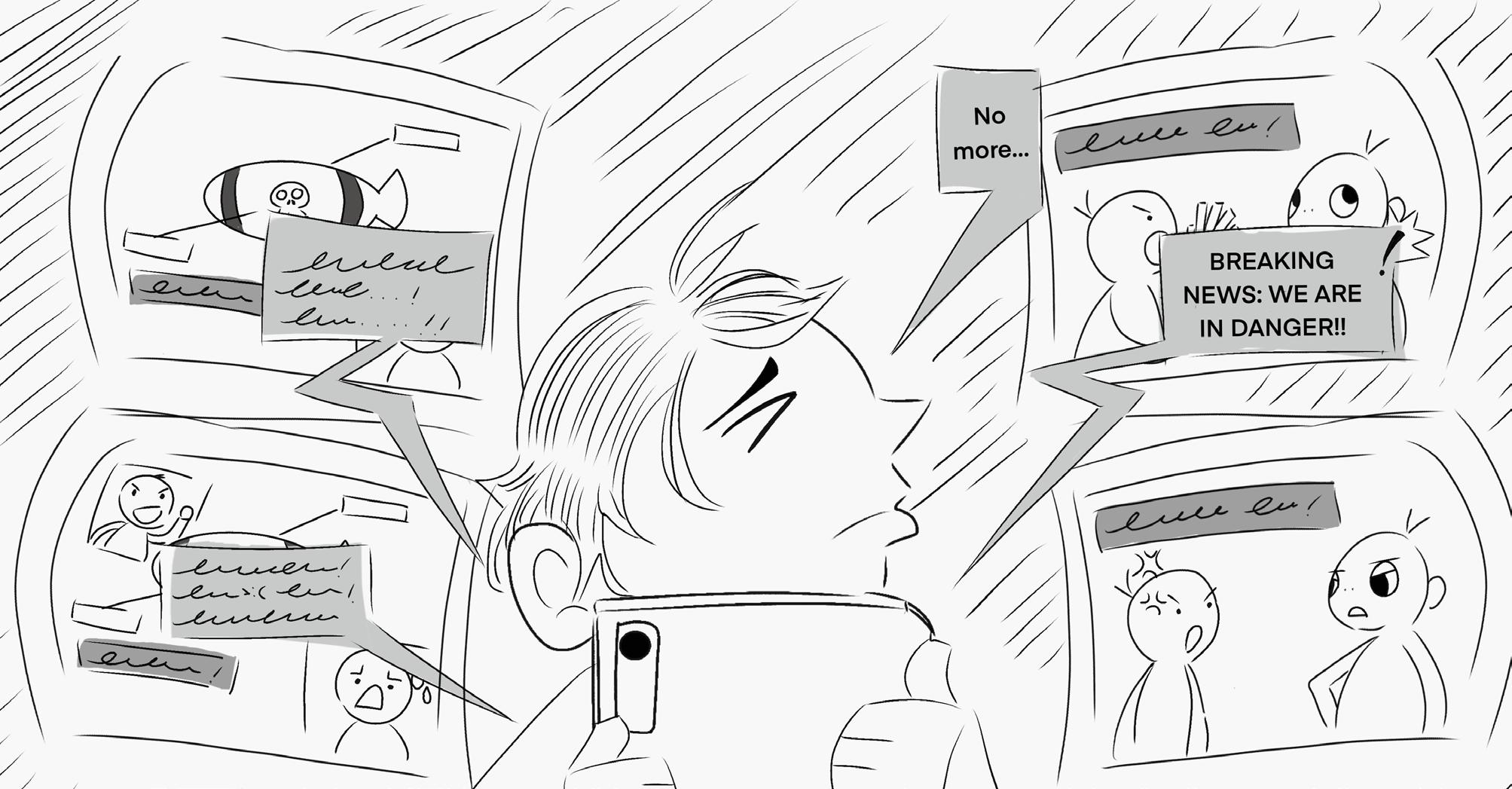
In a now-infamous 2018 interview, former White House Chief Strategist Steven Bannon told writer Michael Lewis that “the Democrats don’t matter. The real opposition is the media. And the way to deal with them is to flood the zone with s- -t.”
“Flood the zone” refers to distracting from current events with statements or policies that attract media attention and disorient political opponents and the public. Zsolt Kapelner of the University of Oslo notes that the zone is “often flooded by fake news, disinformation, [and] outrageous and unjust policies.”
President Trump floods the zone by enacting agendas with intentional speed. In the beginning months of his second term, Trump signed over 200 executive orders that accomplished different aspects of his MAGA agenda: he fired inspector generals, pardoned Jan. 6 defendants, began investigations into political opponents, moved to end birthright citizenship, and stripped DEI programs of federal funding.
Trump is not the only one who employs this strategy, but his administration deliberately wields this idea. Representative Jamie Raskin, the top-ranking
Democrat on the House Judiciary Committee, has described Trump’s movements as an “overwhelming sensory overload.”
“One moment I’m on the phone with someone who does cancer drug clinical medical trials for the government, who has been slated for removal because one small part of her job is outreach to the minority community,” Raskin said to The New York Times. “The next moment, I’m talking to lawyers at the Department of Justice, and they’ve been slated to be involuntarily reassigned. It just doesn’t stop.”
Kapelner describes two main issues with the strategy of flooding the zone: “the content of the flooding” and the nature of the action itself. Kapelner writes that as the zone is often flooded with “objectionable content,” it becomes increasingly corrupted through an “aggregation of the badness of inputs.” This aggregation arises through a continual introduction of false news, which Trump accomplishes primarily through the social media platform Truth Social. Trump excels at using Truth Social to incite public outrage and perpetuate hateful content that contributes to a toxic environment of vitriol, hate, lies, and racism. For example, immediately after ICE agent Jonathan Ross shot and killed Renée Nicole Good in Minneapolis,
Trump took to Truth Social and falsely declared Good to be “very disorderly, obstructing and resisting, [and] violently, willfully, and viciously ran over the ICE Officer.” Trump also recently posted a racially motivated AI-generated video of former President Barack Obama and Michelle Obama as apes, and Trump refused to apologize when the racist content sparked outrage.
However, Kapelner also notes that flooding the zone is objectionable independently of the “badness” of its inputs, as it aims to overwhelm democratic discussion and civic engagement. When Trump posted blatantly incorrect information about Good on social media, mass public outrage muffled coverage on the Department of Homeland Security ceasing a policy allowing members of Congress to conduct unannounced visits to ICE facilities the following day. B. Obama also highlighted this phenomenon in his response to Trump’s racist video, which he identified as part of a “clown show that’s happening in social media and on television” that contributes to a “distraction.” The effect of flooding the zone is especially clear on a less political level — citizens frequently opt to disengage instead of weathering the zone. This response has been coined as the “ostrich effect,” a cognitive bias where individuals consciously avoid upsetting or negative news. When exposure to this news is constant, frequent, and seemingly unbeatable, the ostrich effect is magnified, and disengagement spreads. As a broader phenomenon, news avoidance is a developing trait. In a 2025 study, the University of Chicago found that while five and six year olds actively sought information, children aged seven to 10 were much more likely to avoid learning or seeking out information if it triggered a negative emotion. While the ostrich effect is an entirely valid cognitive bias, it must be actively fought to combat the strategy of flooding the zone, which seeks to push citizens out of politics.
“It’s a fairly natural reaction for people to turn away from the news, whether it’s to protect their mental health or simply wanting to get on with the rest of their lives,” Nic Newman, the lead author on a 2024 Reuters report covering news avoidance, said. Ultimately, flooding the zone is both morally condemnable and undemocratic. It seeks to establish a frame of power maintained through force and falsehoods, but crumbles upon a rejection of its intentions. As high schoolers, it is not too late to actively fight information avoidance and the ostrich effect by ensuring an active hand in local, state, and national politics.
Food service behind-the-scenes
The cafeteria feeds hundreds of students each day. The kitchen features a 40-gallon kettle that can cook 20 pounds solutions; the treatment of student food service workers;
STORY MAXINE MESSINEO, ELLIE SONG, & KHLOE YUEN
ILLUSTRATIONS & PAGE DESIGN LANAH KIM
Cafeteria line dangers and new line debut
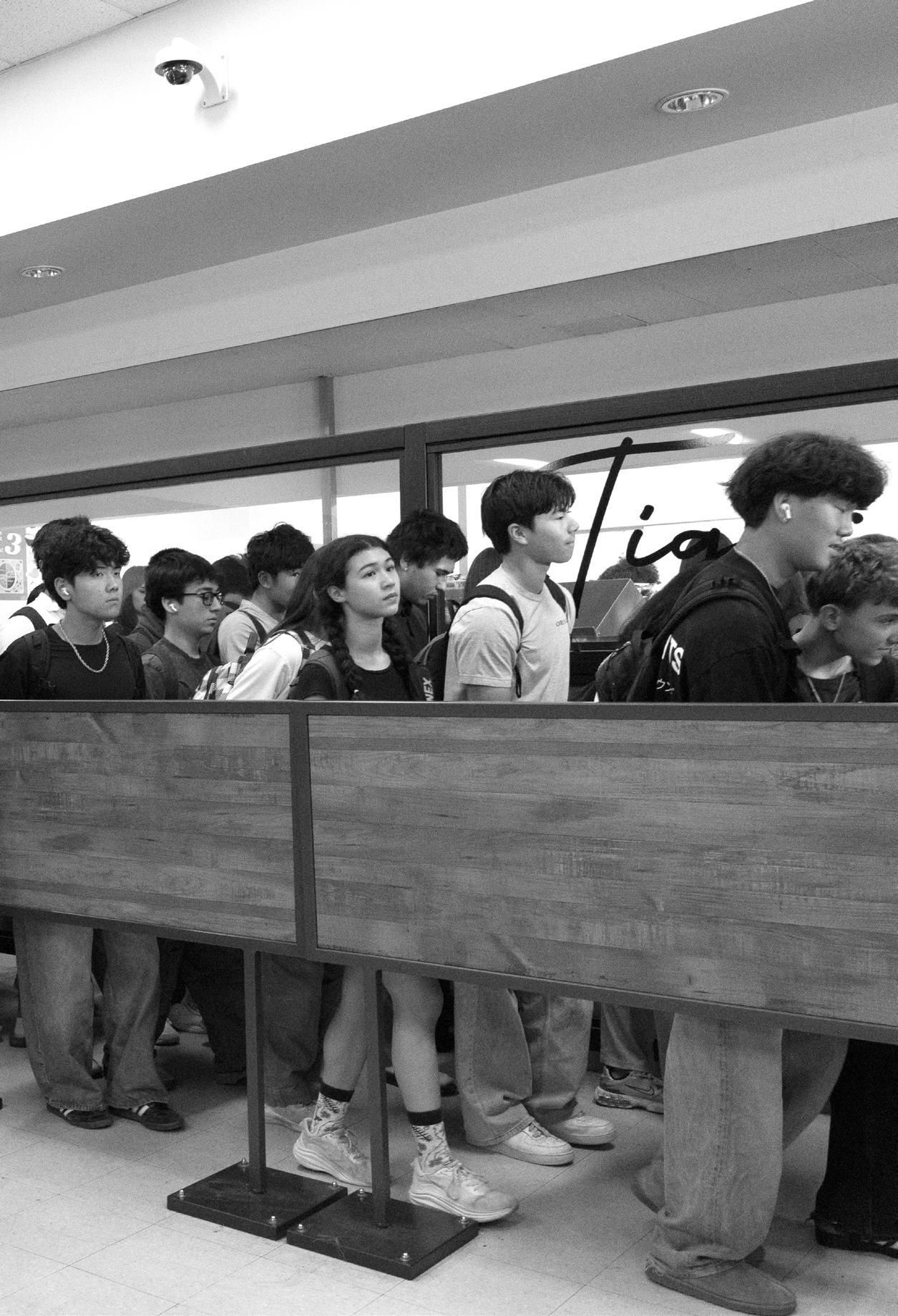
The SPHS cafeteria is a popular facility on campus used by hundreds of students every day. Consisting of five lines, the cafeteria offers several ways to provide the student body their noontime meal.
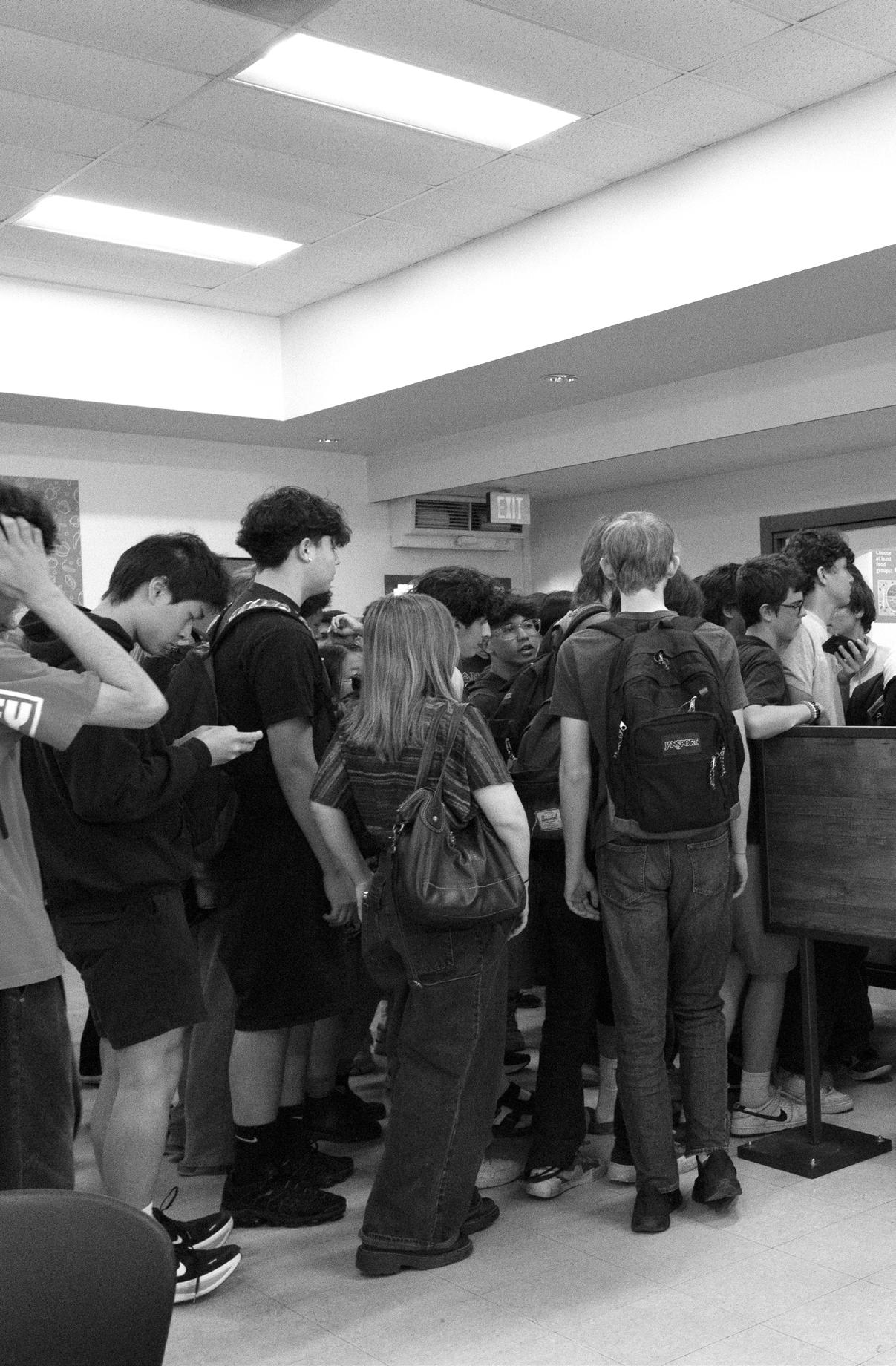
Despite the many lines, overcrowding in the cafeteria is a frequent occurrence.
The cafeteria has two narrow doors, one entrance and one exit, that are often overcrowded to a stifling extent by students angling to get in and out as quickly as possible. This issue is often exacerbated on days with popular meals, such as orange chicken and rice.
Sophomore Denis Blekhman, who works in the cafeteria, says that he gets lunch from the cafeteria daily, and that he feels “extremely safe” and has never been injured, such as kicked or trampled, in the cafeteria. Because Blekhman works in the cafeteria, he gets his lunch before the rest of the school is released from class. While relatively neutral about the overcrowding issue, Blekhman proposed an idea to improve it.
“I think that if we impose slightly better rules on how people should stay in lines and maybe make people walk in a straighter line, we can avoid this, but students like to cramp each other,” Blekhman said.
Other students noted issues in the cafeteria with the cramming and shoving in the lunch lines.
“I only go about once a month, but I always get crushed trying to get in through the door,” freshman Sara Rodriguez said. Freshman Victoria MacRae-Serpa echoed Rodriguez’s statement.
“Sometimes I just go with my friends and I don’t actually get anything, but I’m in the line pretty much everyday,” MacRae-Serpa said.
Frequent occurrences in the cafeteria include students cutting each other and bumping into each other in the lines, causing minor injuries or discomfort among students.
“People have just touched my arms, or my waist to move at all, which doesn’t feel that great,” MacRaeSerpa said.
“When you’re stuffed in a small space, you get shoved around, and especially when you go through the door, because the amount of times I have been trampled while trying to get through the door is crazy.”
MacRae-Serpa’s idea for making the cafeteria a safer place for students to get lunch is for the cafeteria to include double doors to enter and exit the cafeteria as well as widen the lunch lines so students are less likely to be trampled in the cramped space.
Adding double doors to the cafeteria, however, would likely be a costly and time-consuming project for the school.
On Tuesday, March 23, the cafeteria debuted a new outdoor line, the Tiger Bistro line. The line serves quick, grab-and-go meals and is intended to route foot traffic out of the cafeteria to reduce indoor overcrowding.
“At the end of the day, I haven’t gotten genuinely hurt; it’s just uncomfortable to be in [the cafeteria] for about five minutes, and then you’re back to being in your own space,” MacRae-Serpa said.
In the lunch and brunch lines of all grades are able to participate workers, where they get paid $16 an
The students characterized their as having both positive and negative
Sophomore Denis Blekhman has food service community since the first year at SPHS. Blekhman does been treated with disrespect while cafeteria lines, but he has noted rude remarks from students.
“Maybe if I got them [a student] right? Instead of just, ‘You got me please could you get the other one?’ a little ruder,” Blekhman said. “They’ll it, but it’s never been too bad.”
Junior Isabelle Whiting works brunch line. She explained how she similar treatment.
“Sometimes, when I try to stop something, they don’t listen and irritated quickly. They can also
Treatment
PHOTOS SEBASTIAN GUTIERREZ
and menu curation at SPHS
pounds of pasta and other large appliances. In this spread, Tiger explores the cafeteria’s crammed interior and workers; and how new meals are added to the menu.
student food service workers
of SPHS, students participate as food service an hour.
their work experience negative aspects.
been a part of the the beginning of his does not believe he has while working in the a few instances of
student] the wrong chip, me the wrong chip, one?’ Maybe they’ll be “They’ll attack me for in the Tiger Cafe she has experienced stop people to fix and rush past or get get very annoyed
when I ask them to take a fruit or vegetable so that I don’t have to charge them for their entree.”
An example of this was when Whiting had asked for a student to take a fruit in order to keep their brunch free.
“He asked if he could get a Capri-Sun instead [of fruit]. I said no, and handed him a pack of raisins [instead]. It was all normal until he reached in front of my face and tossed the raisins back into the bin,” Whiting said.
Sophomore Pei-Chen Ng describes her working experience differently, saying, “I feel students treat me well. Almost all students say thank you after they receive their food. Especially when there’s any trouble or delays [with the food], they are very understanding.”
Whiting echoed Ng’s message, citing a welcoming working environment.
“The staff, both students and adults, are all so kind and welcoming and understanding. It’s always a pleasure to come into work every day. Everyone always greets each other with smiles and nice words,” Whiting said.
Menu curation and food prep at SPHS
Students only see the cafeteria during brunch and lunch for a short period of time, but a lot happens behind the scenes to prepare meals each day for the school.
Local farms from California and Arizona have food, like fruits and vegetables, delivered to the school. SPUSD is in a co-op with 30 other districts that share the same vendors. South Pasadena uses the vendor Gold Star for lunch because it provides the most products. For brunch, SPHS uses a local vendor called Buena Vista Foods.
Large batches of food, such as pasta, are made in a 40-gallon kettle that can cook about 20 pounds of noodles. When cooking meat, such as chili, a tilt skillet is used. A tilt skillet is an appliance with a flat bottom and tilting mechanism used to braise, simmer, steam, sauté, grill, and fry large batches of food. Speed racks are also helpful in the kitchen because they hold many trays of food.
California’s Senate Bill 1383 requires that food that is still edible be donated, so twice a week, SPHS donates leftover food to churches in Los Angeles and the unhoused to ensure that it does not go to waste. Before spring break and summer break, SPHS also gives leftover food to Holy Family.
Communication is important in the kitchen. The staff needs to let others know the timing for using different appliances so they can plan when to make what food and which tools to use.
Especially during lunch, when the kitchen is the busiest, the cafeteria staff needs to let each other know when utensils are available to ensure that the food gets to the students on time.
“It’s a dance between the stations, like how much we decide to make … There’s food being made all over the place. It’s crazy town, and [food service workers] all fight over the ovens … So the timing of trying to get all that food made is a dance to try to figure out who’s using the oven and for how long,” Jenifer Smith, the director of food and nutrition services at SPUSD, said.
Mediterranean bowl with garlic, herb sauce, yellow rice, and roasted tomatoes, and also a Southwest salad that we just made that’ll go on the new kiosk that we have out there … we’re working on a bánh mì sandwich, which I think will be really good with a spicy sweet chili aioli.”
Items on the menus come not only from Smith’s ideas but also from the students’ suggestions.
“I’m definitely listening to them and trying to get their feedback on what they want to eat, and paying attention to the trends of what’s popular out in the world, where the kids are going to eat. A lot of them will give me that feedback too, so that’s where my new choices come from,” Smith said.
Two years ago, the cafeteria served Mediterranean food, but students reported not enjoying it as much, so the cafeteria swapped Mediterranean food for fried chicken.
They also served ramen at the start of the year, but because of the negative feedback received from students, the cafeteria brought back burritos towards the end of the third quarter.
One challenge that comes with preparing school lunches for students is balancing what the students enjoy eating with federal nutrition guidelines.
“It’s hard, because if you get a piece of pizza, everybody is like, ‘Mamma Mia’s pizza is so good.’ I’m like, ‘I know, but I’ve got to have a wheat crust. I have to use reduced-fat cheese. We have to have a certain amount of sauce on it to meet the guidelines.’ I’ll go and make something, and I’m like, ‘I really want to put salt in that,’ but I can’t because then we’ll be over the sodium limit. Or I’m like, ‘That would be really good with some butter,’ but if I put butter in it, then it’ll be over the saturated fat limit. So trying to balance those things is tough,” Smith said.
Smith is in charge of making sure that SPHS follows all nutrition and food regulations and guidelines, as well as staffing and procuring food, and fulfilling state requirements. Additionally, she is in charge of operations, regulating the pace of lines and managing each kiosk. Smith also decides what goes on the menus.
“We try to be innovative, but also stay within the standards,” she said. “We’re working on a
Preparing meals requires planning, communication, and careful attention to the nutrition guidelines. From having ingredients delivered to the school to coordinating the use of kitchen equipment, the staff works constantly to ensure that students are being fed, and continues to listen to their feedback to develop new menu items that students will actually enjoy.
“I think the love that we have for the kids really comes out in the food, and we really have highquality standards for what we want to serve because we care about you guys and what you guys want and what you guys think,” Smith said.
The lost art of Holi celebration
Holi in South Pasadena has been stopped for many years, but it may be time to change.
STORY UMA CHAKRABORTY
PHOTO SEBASTIAN GUTIERREZ
H oli, also known as “the color festival,” has been celebrated for hundreds of years. It originates in India, and usually occurs during the first week of March. This year, Holi took place on March 4, 2026. Holi is a celebration in which people throw colorful powder, known as gulal, at each other. It represents honoring good intentions, as well as celebrating the transition from winter to spring.
Holi originates from a Hindu myth about a king, Hiranyakashipu, and his son Prahlad. Hiranyakashipu was all-powerful, and demanded that everyone should worship him as their god. However, his son disobeyed him, and instead worshipped a different god, Vishnu. Hiranyakashipu was furious and started threatening Prahlad. He would constantly ask his son, “If something terrible were to happen, would Vishnu save you?” Instead of being turned away by him, Prahlad stayed loyal to Vishnu, confident that he would come to the rescue. Vishnu did; he saved Prahlad from every attempt the king tried to murder him.
Out of desperation, Hiranyakashipu turned to his sister Holika, a demonic being with a special garment allowing her to withstand fire. She asked Prahlad to sit in her lap, and then proceeded to engulf him in flames. Vishnu protected him, and Holika’s plan backfired as she erupted into flames.
Even with the special garment, the fire reached her since her intentions were not pure. The moral of the story was that, because of Holika’s evil intentions, she was defeated. Holi represents the purity of one’s intentions and morals. The night before Holi, the Holika bonfire gathers people around to sing, dance, and offer prayers around the fire, in remembrance of the story.
Typically, people gather around to throw colorful powder at each other with music playing, creating a
fun and playful environment. In India, Holi is a national holiday, meaning students get the day off from school. Stepping out onto the street is considered fair game for anyone who wishes to color someone. Adding water to the mix is common, especially on a hot spring day. Skin could be stained for days following the event, as the gulal used to be more resilient and tough to rid. At the end of the day, pride was measured by how unrecognizable you looked covered in color. However, gulal has evolved to become more environmentally friendly and skin safe.
In the U.S, Holi tends to be drier, and more small, community-based instead of one large crowd. It still follows the key traditions of throwing gulal, but can be smaller in scale and energy. The actual day of Holi is more popular than the Holika bonfire that happens the night before. While it is still acceptable, if not encouraged, to throw gulal on anyone around you, people tend to keep closer to the people they’re familiar with.
South Pasadena used to also have a community celebration, with SPEF hosting their own “color festival” every year until 2019, when they stopped. Neighboring communities, like Pasadena, still host Holi every year in a nearby park where anyone can join, free of cost. While there was never an official reason as to why South Pasadena stopped hosting Holi, in 2020, the Coronavirus disease (COVID-19) forced a halt to Holi celebrations. COVID-19 played a huge role in restricting people from gathering. It was never started up again, even when life started to return to normal. Now that COVID-19 has died down and is not a risk factor, individuals are able to have large celebrations and events. This opens up a great opportunity to bring Holi back into the community.
While still seen as a simple festival in which people throw color at others, Holi symbolizes good intentions and spirits, and the outcast of the bad ones. The fun and excitement that comes with Holi does not have to only be for those who grew up celebrating it, it should be shared with everyone.
Alison’s Anecdotes
ALISON SCHRADER
The Girl in the Iceberg
Throughout my younger years, I have always felt like a pop culture outsider constantly unaware of the references to music, television, and most media. I knew who Luke Skywalker was, and that his father was Darth Vader (spoiler alert), but I had no other knowledge about Star Wars besides that there was some war in the stars. In eighth grade, this began to change when my friend off-handedly mentioned that I should watch some Nickelodeon show. That series was Avatar: The Last Air Bender
One fateful night I decided to give it a watch. Rather than a childish kid show about some bald boy running around, it was a sprawling story about redemption. I fell in love with the humor, the world building, and of course, Appa. Everything was excellently paced. Beach episodes were perfectly balanced with invasions, each character’s unique humor playing off each other, and different, larger themes like imperialism and government conspiracy were woven in with the Fire Nation, giving the show an air of complexity. It was an excellent show (I highly recommend that you watch it if you haven’t already!), and it inspired me to take more recommendations and begin my foray into pop culture.
Since then, I’ve become the premier authority on pop culture for my friends, usually pertaining to pop divas, celebrity drama, or something Star Wars related (How the tables have turned!). Eighth grade came and went, and my interests slowly took a backseat to my collegiate prospects that for the most part only resulted in an overwhelming feeling of tiredness. In the midst of college applications, things felt really scary, and as I felt myself go back into my shell, all I wanted to do was return to a little show about the elements.
Rewatching the show felt like a breath of fresh air. It was so lovely to take a walk down memory lane and enjoy the same characters and plot lines that inspired me to “join society.” There was one major difference during this rewatch. Advice is a major aspect of the show, with Uncle Iroh taking center stage with many quotable moments. When I first watched the show, I was at a time where advice from upperclassmen was very important to me, and now I’m the one giving advice. That change in perspective was pretty emotional for me. This show reminded me about how much I’ve changed since eighth grade, and how I’m on the precipice of change with college starting this year. One of Uncle Iroh’s quotes still resonates with me, and I think is important for everyone to hear: “Is it your destiny or a destiny someone else has tried to force on you?” We live in a day and age where everyone’s opinions are so loud, so we must try to keep our minds on things we can control. It’s your life, not theirs.
I recommend that everyone should rewatch or reread that show or series from their childhood to reconnect with their younger self. High school left me dazzled and dazed. Whether it came from the bright lights on the football field, the sparkly glitter on my costumes, or the overwhelming warmth under the stage, I was able to find joy in all of it. I’m incredibly overwhelmed with the thought of planning the rest of my life, but as I look to the future, taking one look into the past can’t hurt. Can it?
Crowd gathers at Garfield Park for the Holi color festival, on March 4, 2026.
Lily Shaffer and a her journey with art
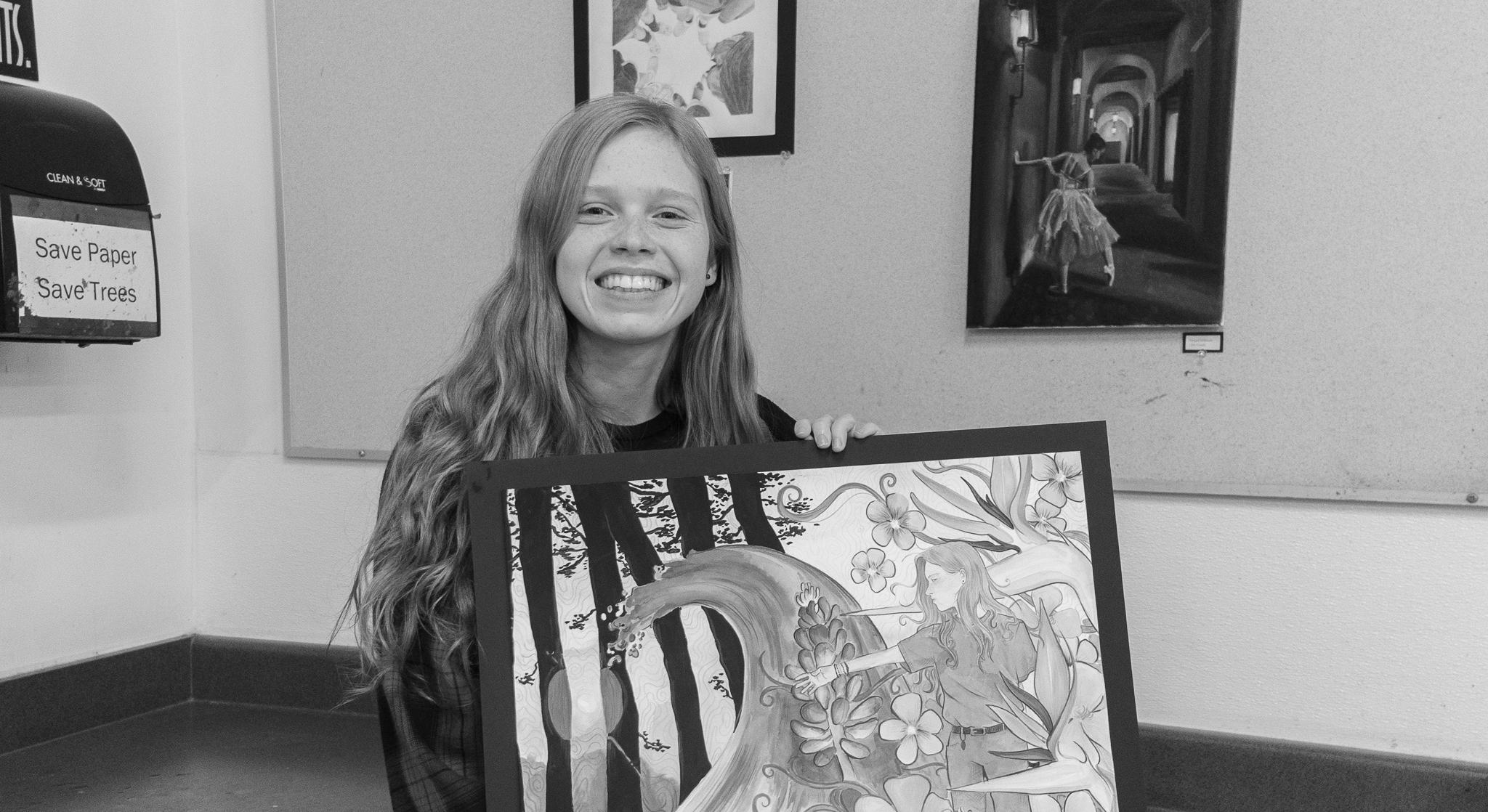
Shaffer has spent years honing her art ability. She aspires to become a storyboard artist.
STORY ANNA MCDONNELL
PHOTO HELENA EASTERBY
Creating stories has always been a passion for senior Lily Shaffer. When she was young, she loved to write, making up characters and plot lines. Shaffer wanted to visualize her ideas by adding pictures to bring her stories to life, and learning how to draw. About six years ago, when she was 12 years old, she started to take art more seriously.
Shaffer started small and eventually progressed to be a well-versed artist, mainly in watercolor and cartooning. That is how she discovered her favorite art form, comics.
For years now, Shaffer has loved cartooning, creating original ideas, and turning them into stories in hopes of publishing graphic novels one day.
Now, as a senior in high school, Shaffer is a staff illustrator on Copa de Oro, where she has learned how to handle deadlines, work and collaborate with others, and design art in a team rather than coming up with ideas on her own. Her main collaborator is senior Aislinn Meza, with whom she has made countless pieces, including last year’s yearbook cover, which featured a family of Tigers in a camper van heading off on an “uncharted” excursion.
The cover includes many small details and easter eggs, like the license plate saying “SPHS 25.” Shaffer has been on Copa for the past two years, and she has mainly used Procreate digital art to create illustrations and bring the yearbook to life.
On top of that, throughout her high school career, she completed the entire SPHS art program, and she is now in AP art. She is also in her final semester at the Ryman Arts
program, which is an art school in Los Angeles. Shaffer’s favorite aspect of the creative process is the sketch. She loves to color as well, but in the sketch, she gets to map out her ideas.“I enjoy the freedom and looseness of it. I like being able to just draw and not think about the colors and stuff yet,” Shaffer said.
Shaffer’s main inspiration comes from other artists, specifically Conrad Roset, the lead artist and director for the video game GRIS. Roset’s art style includes colorful watercolor portraits with beautiful pops of color. His main median is watercolor, which reflects one of Shaffer’s favorite medians. She also takes inspiration from the painting “Lady Hamilton as Medea” at the Norton Simon Museum in Pasadena.
“My favorite thing to draw is people, in any kind of medium. I have characters that I created that I love making comics about, but I also love going places and drawing people who aren’t looking or posing for me. It’s definitely a fun challenge,” Shaffer said.
In her free time, when not drawing and making art, Shaffer loves to play video games. Some of her favorite games are Legend of Zelda: Breath of the Wild, The Last of Us, Silk Song, Celeste, and Deltarune. They all have whimsical and interactive graphics that reflect her personality. She also loves TV shows, books like Project Hail Mary, and movies like Fried Green Tomatoes
Shaffer is now continuing her passion for art in college, and she has been accepted to multiple schools for animation. Currently, one of her top choices for colleges is Chapman’s film school, Dodge, where she would major in animation and special effects.
Shaffer was also accepted to ArtCenter. These schools are ranked highly in their fields. After college, Shaffer hopes to become a storyboard artist, and work for people who want to add art to their stories.
Art brings light to Shaffer’s life through the ability to voice her ideas and opinions through drawing. Art programs she has taken throughout her high school career have driven her passion to continue to create art when she begins her college life.
Lo-Fi Americana and the fractured modern American life
STORY ETHAN KWAK ILLUSTRATION KRISTEL HOUNG
There is something distinctly American about how David Berman, Jason Molina, Will Oldham, and Bill Callahan write and sing about the relationship between the American landscape and introspective identities. They wrote of the American landscape as both a tangible anchor closing the distance between disparate subjects and a metaphorical horizon defining the fluidity of American identity.
Molina, Berman, Oldham, and Callahan first emerged from the lo-fi movement of the 90s. As pioneers of lo-fi Americana, they were a loose association of artists tied together by a mutual appreciation for the music they were putting out quite prolifically. In their exploration of American culture, they themselves became American myths, and their discographies are a contemporary American folklore for anyone who connects to their
work. Berman (Silver Jews) grounded his lyrics in cities like Dallas and Nashville.
He wrote songs in solidarity with the downtrodden, and the subjects of his work reflected an innately fractured post-digital American life: abandoned drive-ins with ivy growing over the screen, a tattoo of a boarded-up house, and the next house in New Orleans that didn’t make the cut in House of the Rising Sun. For those unfamiliar, listen to Natural Bridge, Bright Flight, or American Water. Berman died by suicide in 2019; he was 52.
Molina (Songs: Ohia, Magnolia Electric Co) released 16 studio albums in 15 years. Fixated on themes of industrial decay and the loneliness of rural landscapes, his songwriting was influenced by his upbringing in Lorain, Ohio, an industrial town. The image of the moon as both a welcoming and an oppressive light resurfaces again and again. The idea of trying to be simple again (Just Be Simple), or trying to sing the blues (Old Black Hen), or
trying again (Everything Should Try Again) is a regular, recurring motif.
In Farewell Transmission, Molina sings: “We will try/And know whatever we try/We will be gone/but not forever.” What he was specifically trying to say was an ambiguous, atmospheric struggle. His work struck a chord with those who struggle with addiction. Molina passed from kidney failure due to alcoholism in 2013 at 39. Songs like Lioness or All Pass demonstrate that Molina’s poetry was not contained in the lyrics, but rather in the way that they were delivered.
Oldham (Bonnie “Prince” Billy, Palace Music, Palace Brothers, Palace) invented his current persona, Bonnie “Prince” Billy, in acting school. The name references Billy the Kid, Nat King Cole, and Bonnie Prince Charlie. The title track of I See A Darkness (1999), his gothic weave of murder ballads and sea shanties, was covered a year later by Johnny Cash. In 2012, Oldham re-recorded the song, this time upbeat. As he strolled the streets of Glasgow, eyeballs sliding off his cheeks, the darkness Oldham perceived was somehow no longer a disconnected, individual doom. In the most optimistic light, the song is perhaps a reason to rejoice and hold hope in the notion that the “darkness” may not be so isolating after all.
Callahan (first known as Smog) released his 24th studio album, My Days of 58, in Feb. 2026. His music of the last decade concerns landscapes in a confessional light; it often teems with flora and fauna. Although he has written optimistically of the American dream, he has never hesitated to criticize it.
On America! from Apocalypse (2011), Callahan explained in a 2016 TEDx Talk: “I wrote it in about 2006. I was used to hearing anti-American sentiment around the world from travelling around, playing music for 25 years … but when I got back to America, and heard it from within … I needed to write a love letter to America.”
“It’s called America! — with an exclamation point.”
The fractured nature of American culture as it was during the heyday of Berman, Molina, Oldham, and Callahan has only progressed since. Regardless of the echo-chamber, invisible ivy overcomes all. In the same sense as the avant-garde, the role of lo-fi as an enduring record of the American identity has become nothing more than a figure in the distance, even to its own eye.
Senior Lily Shaffer expresses her voice through art. She enjoys drawing people in any medium.
TAAGLAA: LA psychics
TIGER’S AWESOME ADVENTURES IN THE GREATER LOS ANGELES AREA
Tiger ventures into the depths of the Los Angeles psychic scene in search of the pursuit of happiness.
STORY ISABELLA JONASEN
PHOTOS LEIGHTON KWOK
The endlessly unfolding tarot readers have plagued thousands of innocent scrollers on their TikTok algorithms, manipulating them into believing they truly have a shot with their eye-contact-ship. But no more. Leighton, Ruby, Diana, Sam Allen, and I have taken it upon ourselves to investigate the whimsical world of witchcraft and wizardry by visiting a world-class psychic to perform marvelous acts of sorcery.
Beginning our journey in the magical city of Highland Park, we arrived at the given location, and were dumbfounded to learn that the clairvoyant in question had relocated due to construction. Ruby reluctantly called the business and was mysteriously texted a new address. After a 20-minute scamper in the blazing Los Angeles heat, we stumbled upon a small gray house. We were all deeply disturbed. The home left us with many questions and few answers: Why have we arrived at a house? Why is there someone playing the Roblox game Grow a Garden on their Xbox in the room over? Walking up the steps was a journey in itself; all of us retreated and forced Sam to enter first, with Diana, Ruby, Leighton, and I following behind.
We were then met by an older woman and her daughter, and possibly a grandmother cooking in the kitchen in the room over. The living room was decorated tastefully with Disney figurines that were scattered across the mantel and side tables. After taking our seats, we were told we were in the presence of the “greatest psychic in the world,” a woman who has been providing her clairvoyant services to the unfortunate for 38 years. However, due to our incredible misfortune, the $5 to $10 services promised were somehow raised to $50. Reluctantly, Ruby, Diana, and I accepted the service strictly with the intent to provide incredibly raw and hard-hitting journalism to the masses.
I received my tarot reading first, and to our surprise, photography is a no-go in the zone of the spirits. The clairvoyant lady abruptly stopped her shuffling, instantly calling for Leighton to shift the camera away from her and her powerful team of spirits, and to delete them swiftly before she could continue her procedure. Ms. Clairvoyant was beyond aggressive in her speech, almost as though she was attacking me through her words — or shall I say, the spirit’s words. She then blatantly called out my suspicion of her powers, stating that she was again, “the greatest spell caster in the world.” The exploration of personal topics, such as my dating life, throughout the
reading made it impossibly difficult to remain straightfaced. The experience was incredibly distressing, particularly because of her unsolicited comments about my “nonexistent” work ethic and her disturbing accuracy in my personal life. She went on to vividly describe my dreams and make a comment regarding old and new romantic endeavors. According to the greatest spell caster and clairvoyant in the world, it seems as though my future holds incredible wealth. She spoke heavily about the need for a “cleansing,” a service that she herself could provide to me with a “small donation of $50,” where she would remove all negative energy and realign my chakras. According to the lady of clairvoyance, I tend to pack on different energetic frequencies from those around me, which allegedly kills my whimsical, mystical, and magical vibe. Unfortunately, I did not, in fact, give in to an extra $50 charge.
Ruby went second, and she was told that she was very perceptive to good and bad energy, and that she had the qualities of “a helper,” supposedly a gift similar to the lady of clairvoyance herself. She also shared her prediction that Ruby would be very wealthy and famous as a therapist. She spoke about how Ruby is going on a trip to Italy in the summer, and how she, and I quote, “saw sauce in the cards.” The lady of clairvoyance then questioned Ruby about her romantic pursuits, asking whether her vision of Ruby fighting over a young gentleman with a fellow
peer was true. This was, in fact, false, as Ruby later stated, “There is no man I fear.”
The lady of clairvoyance tended to tell us, “You know what it is, I know what it is, but I’m not going to say it,” when touching a sensitive topic. However, neither Ruby nor I knew what she was referring to. She then told Ruby her third eye was closed, which deeply offended Ruby, as she is quite a spiritual and whimsical being, and this was, quite frankly, just not true. Ms. Clairvoyant then recommended that Ruby should also take part in a $50 cleansing ritual to open it.
Afterward, Diana was taken away for her reading by Ms. Clairvoyant’s mysterious daughter. During her divination session, she was also told that romantic endeavors would soon be making their way towards her. Unfortunately, it seems as though Diana’s soulmate is damned by cold feet, and Diana will be forced to take up this endeavor on her own. This mysterious individual is allegedly brunette with hazel eyes. This magical daughter told Diana that she had a fulfilling career in nursing in the near future. How Diana would suddenly feel possessed to leave her dream job of teaching to pursue nursing, I do not know. Diana let out an awkward laugh, trying not to flat-out tell her no.
As our delightful group began to make our way outside the Disney figurine-infested house, we were held back to fill out five-star reviews of our services on Google Maps. In enforcing this, it became evident to all of us that this practice seemed to be a trend due to her alarmingly consistent five-star ratings.
Although Leighton and Sam did not give in to the lady of clairvoyance’s outrageous $50 service, she did provide Sam with a sample reading in an attempt to persuade him into it. She prophesied that he would soon be faced with two options and should choose the first one. What these options happened to be unknown to both Sam and the lady of clairvoyance herself. Two days after this reading, Sam received a frightening fortune cookie stating, “It is wise to follow your first choice.”
Unfortunately, Leighton received no supernatural service; instead, the clairvoyant somehow concluded that Leighton had visited her before for a reading. This was not true, and was unfortunately a case of racial profiling that Leighton played along with throughout the entirety of the reading.
The experience in itself was beyond terrifying; I continue to remain hesitant about the magical lady’s abilities to this day. We all left this unique encounter frightened, concerned, and reborn.
ALISON SCHRADER
Women push for respect on and off the court
Female athletes are fighting for equal respect when they should not have to in the first place.
STORY LEIGHTON KWOK ILLUSTRATION LANAH KIM
In the 2026 Winter Olympics in Milan, both the U.S. men’s and women’s hockey teams came home from the Olympics with gold medals after beating Canada in overtime and making history. But the way that they were treated after the games was completely different.
After the men’s team won, President Trump, with FBI Director Kash Patel, called into the locker room to personally congratulate and invite them to the White House for a celebration meal. After the offer, Trump continued, stating that he would be forced to also give an invitation to the women’s team, joking he would be “impeached” if he did not also invite them, prompting laughter from the players.
This conversation was leaked to the public, and sparked national controversy over whether or not the statement was sexist and inconsiderate. However, it should not have taken a viral clip to get people talking about women’s sports. The U.S. women’s hockey team has won three Olympic gold medals, and is one of the most successful teams in American sports history. Yet time and time again, their achievements are treated as an afterthought. Women are still fighting for the respect they have already earned on the ice, field, court, and pool.
Media coverage is how fans can connect with their favorite players on a deeper level. However, the way that questions are framed toward certain athletes is one of the first signs of inequality, most of the time going unnoticed to the public eye. Female Olympic athletes have often been objectified over the years by media personnel, often highlighted for their appearance, family life, and other gender stereotypes rather than their actual athletic achievements. Meanwhile, men are often depicted as exponentially stronger and more muscular, with media coverage focusing on their actual talent, rather than their personal lives.
“I think a lot of stereotypes that women face in the media include not being as strong as men, not being as fast as men, and not being seen as athletic as men, which is completely not true as seen through many different competitions,” SPHS junior softball and track athlete Olivia Mendez said.
Women’s sports are significantly less watched than men’s. A study created by The Associated Press-NORC
Center for Public Affairs Research found that six in 10 adults follow men’s professional or college sports, while three in 10 adults follow women’s professional or college sports. With lower viewership on the women’s side, the number of sports broadcasters willing to promote and stream women’s games is smaller, not allowing them to reach the same size audience that men’s sports have.
“Media coverage is really the only way that any sport is valued,” SPHS junior basketball athlete Kelsey West said. “Everyone finds out everything through the internet. When there is a lack of exposure, specifically for women, it doesn’t influence anyone to watch. It makes young girls feel a disconnect from the sports world and feel unsupported.”
The wage gap in sports is the most noticeable difference between men and women. In fact, in Forbes Magazine’s 2024 “100 highest-paid athletes in the world” article, there were no women listed at all. The Women’s National
Basketball Association (WNBA) salary versus the National Basketball Association (NBA) salary is another example of the large pay disparities. Players in the WNBA receive an average wage of $120 to $130 thousand per year, while NBA players receive an average salary of $11.9 million, which is over 100 times higher than that of players in the WNBA.
Although the sports world is less progressive than it may seem, strides are constantly being made, fighting for a new era of change. On March 20, 2026, the WNBA announced a new seven-year Collective Bargaining Agreement (CBA). This agreement doubles the amount of league and team revenue that the athletes receive. Going from the original 9–10 percent received to 20 percent, the average salaries are expected to be around $600,000. Additionally, the large support for other 2026 Winter Olympic athletes, like figure skaters Alyssa Liu and Amber Glenn and decorated freeskier Eileen Gu, is one way women are breaking through the media.
SPHS students put the madness in this year’s March
STORY JULIA GILDERSLEEVE
PHOTO LUCINDA ERNST
March Madness is the NCAA Division I college basketball single-elimination tournament organized by the National Collegiate Athletic Association. Sixty-eight teams compete over three weeks in order to crown a national champion through March and early April. The winners of each game advance, and the losers are eliminated in each matchup until two teams reach the championship game. Last year, March Madness averaged over 10 million viewers per game and 18 million viewers for the championship. At SPHS, students enjoy March Madness through talking to friends, watching game highlights, and with their families at home.
“I’m doing it in the first place because the rest of my friend group is,” sophomore Mateo Salas said. “[And]
because I don’t want to lose … my friend group will give the loser a terrifying punishment.”
But some student-athletes have a much deeper connection to March Madness, such as freshman Violet Langhaar. She has been following March Madness with her family, and she feels like it inspires her to continue to grow with basketball.
Langhaar has been playing basketball since she was in kindergarten. When COVID-19 broke out, Langhaar used her free time to constantly practice. She has previously played on the SPMS basketball team and the SPHS JV basketball team during the winter season. Even though her school season is over, Langhaar’s goal is to eventually make it on the varsity basketball team and improve as a player so she can feel comfortable in different positions.
“My dad motivated me to start playing by competing with me in [practice] games. My coach, Coach Melody, is really inspiring for me too, and she helped me build a lot of my skills,” Langhaar said.
For Langhaar, playing basketball also serves as mental health support despite the difficulty of finding time to do schoolwork.
“Even when things are really stressful, basketball is a way to relieve stress and help me not think about anything else,” Langhaar said.
Langhaar and her family watch March Madness, as well as other professional basketball games, to stay excited about basketball even during Langhaar’s off season.
“March Madness gives a lot of excitement about basketball and it motivates people to try and play their best,” Langhaar said.
Langhaar and her family are strong supporters of the University of Illinois basketball team because her dad’s family has attended the school for generations. Last year, Langhaar made an organized bracket for both the men’s and women’s tournaments.
“I’m a very passive supporter of the University of Illinois because my dad has always supported the basketball team there,” Langhaar said.
Currently, for the 2025–26 Big Ten standings, Michigan holds the number one spot with an overall record of 33–3. Nebraska is close behind with a record of 28–6. Illinois, Langhaar’s favorite team, is currently in fourth place with an overall record of 26–8. Illinois has appeared in the NCAA Division I men’s basketball tournament 35 times.
The Big Ten tournament is an elite athletic conference and currently consists of 18 member universities. It is the oldest Division I collegiate conference in the United States, and is known for high-level athletics. The winner of the Big Ten tournament gets an “automatic bid” to the NCAA tournament and selects 68 teams to compete in the national bracket after the conference tournament ends.
Whether they are a die-hard sports fan, a student-athlete, or just someone playing in a bracket challenge, March Madness creates these chances for shared experiences that bring the community together.
Freshman Violet Langhaar is inspired by watching the college basketball tournament, March Madness.
Olive Van Gogh climbs to new heights
Olive Van Gogh, rock climber, continues to advance in her sport after placing eighth in the nation.
STORY UMA CHAKRABORTY
PHOTO THEO THOMPSON
Sophomore Olive Van Gogh has been rock climbing, indoors and outdoors, for almost half her life. Now, she alternates between bouldering, short climbing routes without ropes, and lead climbing, although she prefers bouldering.
“I like figuring out problems and how every time I go to the gym, everything is different. I really like the problem solving aspect of it,” Van Gogh said.
She found her love for rock climbing when trying it for the first time with her Girls Scouts troop at nine years old. Soon after, she joined the Stronghold Recreational Team, which creates a community for people learning to rock climb, before moving up to the club team a year later.
“At first, I was really scared to go and meet new people,” Van Gogh said. “But the community is so great and practically everyone will give you beta advice if you ask for it.”
Beta advice refers to specific how-to pointers that are distinct from broader and more common advice.
Bouldering levels are categorized by “V” grades, with VB being the lowest level, beginner, and the difficulty increasing alongside its title, going from V1, to V2, to V3, and so on. Van Gogh has climbed an outdoor climb with the equivalent of a V10 indoors, but mainly climbs V8s.
UPCOMING GAMES
Her biggest accomplishment is also her most notable competition, when she made finals in a youth USA Climbing (USAC) Nationals bouldering competition, with USAC being the largest sport climbing organization in the United States. In bouldering competitions, climbers are often given four to five minutes to complete a climb they have never seen before, and different amounts of points are awarded based on how
FRIDAY, MAR. 27TH @ 3:30 PM, BASEBALL @ WEST COVINA
FRIDAY, MAR. 27TH @ 3:30 PM, SOFTBALL @ TEMPLE CITY
much of the climb is completed. She placed eighth in the nation in her age bracket.
A typical week for Van Gogh includes practice four times, not including the one to two times she goes climbing for fun. During the majority of their practices, Van Gogh’s team garners experience across several categories of climbs, including limit bouldering, power endurance, ropes endurance, and competition simulations. Notably, the team also strengthens themselves physically through stretching and conditioning.
“[When] I used to do gymnastics before … It was just practicing the same things over and over again. And I think what I like about rock climbing is that it’s just different every time,” Van Gogh said.
While Van Gogh has not felt pressure from balancing athletics and school yet, she tries to stay organized and keep up with her work the best she can, especially with junior year around the corner.
“I haven’t had too many problems balancing [school and climbing] because sophomore year hasn’t been too overwhelming … but both school and climbing take a lot of time, so it can definitely be challenging,” Van Gogh said.
Despite the numerous responsibilities and hours Van Gogh must commit to her sport, she has devoted herself to maintaining an organized life, balancing work and athletics as she prepares to enter her junior year.
“I think that rock climbing is just always going to be a part of my life as I get older now,” Van Gogh said.
The role of parental influence on high school athletes
STORY MAXINE MESSINEO
PHOTO MAC SHROPSHIRE
Parents are one of the main factors that shape a young athlete’s experience and participation in sports. Positive parental involvement in a teenager’s commitment to sports, such as prioritizing effort and enjoyment over winning and benefits, can be beneficial, but excessive pressure on them to participate in sports can lead to burnout and feelings of anxiety.
About eight million students are currently participating in high school athletics in the United States. However, only about 530,000 will compete at the collegiate level, and even fewer will reach the professional level.
While the rate of high school athletes that continue to compete in sports beyond high school is low, the majority of parents with specialized high school athletes, or athletes who train in a certain sport, expect their children to play at the collegiate or professional level.
Parents may encourage their children to pursue sports for several reasons. Seriously pursuing sports can open up opportunities such as scholarships, a frequent driving force behind the pressure on high school athletes to pursue a sport. However, too much pressure from parents on teenage athletes can lead to higher risk of athletic injuries, such as strains, fractures, or concussions, as well as increased risk of burnout, which includes feelings of exhaustion and being overwhelmed.
This is not to say that athletic enrichment is not beneficial to teenagers, as it helps them socialize with peers, develop skills such as teamwork, and improve mental and physical health. Rather, it is the parent’s approach that changes an athlete’s outcome. Positive encouragement significantly decreases the risk of sports-related injuries when a parent, rather than a coach, instructs an athlete. This only applies when the parent has reasonable expectations of what their high schooler is athletically capable of.
There are different ways to encourage teenagers to engage in athletics. A supportive environment where a kid’s feelings and perspective are heard and respected can foster a passion for sports in a healthy relationship. Overall, high school athletes can develop self-confidence, determination, and perseverance with their parents’ helpful and moderate involvement through positive motivation and emotional support.
Teenage athletes who have parents with highly toxic expectations, however, are likely to overwork themselves and participate in more leagues than those who do not face the same pressure, contributing to an increased injury risk.
SPHS freshman Alex Malnev, a swimmer, was told by his mom to pursue swimming, and says that without his mom’s influence, he would probably not be doing the sport. He also shared his thoughts on parents who influence their children to do sports, saying that he is against it.
Kyler MacRae-Serpa, a senior at California State University, Los Angeles, was taught by his dad, a Canadian hockey player and avid hockey watcher, to play ice hockey.
“My dad influenced me [to play ice hockey] by teaching me to skate at a very young age, one and a half years, [and] learning to play hockey continued from there,” MacRaeSerpa said.
MacRae-Serpa said that when he was younger, he enjoyed playing soccer and baseball, so he thinks that, without his dad’s influence, he would have pursued one of those sports. Now that he is older, however, he enjoys playing ice hockey after years of experience.
SPHS freshman and cross country runner Sara Rodriguez was introduced to the sport by her dad. She chose to pursue the sport at SPHS to make her dad happy about her experience in high school.
While a significant number of high school athletes are influenced by their parents to participate in sports, countless others pursue their sport independently for personal reasons. For freshman volleyball and basketball player Olivia Regalado, she pursues her sport without parental influence, for fun and as an outlet for her emotions.
“Ever since I was a kid I’ve wanted to do something that made me feel like I had a purpose. I wanted to make people proud,” Regalado said. “I grew up thinking I wasn’t attractive and I was weird, so I decided that if I was good at sports, people wouldn’t see the bad things. I’ve also had a passion for games and fun activities and connections with teammates.”
While parents play a pivotal role in the motivation of high school athletes, their involvement, parenting styles, and values are key factors that clearly make or break the outcome of young athletes.
SPHS Parents cheer after Varsity Girls Volleyball scores a point.
Sophomore Olive Van Gogh has been rock-climbing since age nine.
Mimi’s Musings
MIRIAM ELGHEFARI
The Opening Night ceremony also provides an opportunity for high school players of baseball and softball to interact with the Little League kids, furthering opportunities for community and connections.
My journey to achieving wellness
As a high school senior, I’ve gone through many phases.
In 2020, I was an avid fan of the typical YouTube “Glow Up Guides.” In 2022, I discovered Pinterest and was able to visualize my goals, but I still fell short. To be fair, I was 12, so there wasn’t much to commit to, but it was the feeling of being “unhealthy” that would follow me around, simply because I couldn’t achieve the standards that were pushed on social media.
Pinterest was overwhelming and hard to navigate, with much of the content I was consuming pushing the idea of spending money in order to be in good health. As a 12-year-old, I had no money to spend, and could only make do with what I had on hand in my single-parent household. I used bathroom products and oils we would use for cooking (yikes) to make hair masks in an attempt to fix my alreadyhealthy hair. I would overexert myself trying to follow difficult YouTube workouts on an old yoga mat in my room whenever I found the motivation — usually this would be whenever I periodically fell back into the habit of consuming “wellness” content on social media.
Established in 1952, the South Pasadena Little League (SPPL) is the oldest Little League in California. The SPPL serves children aged four to 13 who are interested in baseball and softball, and is split into a majors league (children around 10 to 12 years old) and a juniors league (children around 11 to 13) that organizes skill levels.
However, the SPPL declares on their website that their main goal has always been to “foster a love for baseball and softball in the hearts of children and their families for generations.”
To continue to further this aim, the SPPL hosts an annual “Opening Night” celebration that has occurred for over 70 years.
“I think it’s more about the community coming together to … be a part of the Little League experience. So it’s really important, our opening night ceremonies that we have,” SPPL Fall Softball Coordinator, Baseball & Softball Uniforms Co-Chair, and head of Softball Scheduling & Umpires John Ramos said.
Ramos also is the assistant coach for varsity softball at SPHS.
SPLL’s 2026 Opening Night celebration occurred on Friday, March 6 from 5–9 p.m. at the Arroyo Seco Baseball fields. The event hosted three games: a juniors and a majors game for baseball, and a majors game for softball.
Coaches for Little League teams are commonly fathers of players, which lends to the air of bonding that Opening Night hopes to achieve. Also available to younger children who may not have been playing were snack bars, face painting, and inflatable obstacle courses.
“This is all about what the league should be. It’s all about community,” Ramos said. “It builds this foundation for high school baseball and softball.”
Typically, younger players in the Little League will join the South Pasadena High School baseball and softball teams when they reach high school, both of which have attended California Interscholastic Federation (CIF).
“The majority of the boys that are playing in the baseball program, they … are gonna come here and play [at] the high school level. And we hope that’s the same for the girls in softball,” Ramos said.
In order to organize the Opening Day ceremony, the Little League creates subcommittees to divide work on different aspects of the ceremony.
For this year’s ceremony, the SPPL divided into subcommittees that covered merchandise selling, merchandise dispersal, and different provided amenities. SPPL consists of a Board of Directors that helps direct the organization process.
Around 48 official positions are listed on the SPPL’s website, ranging from “Softball Scheduling & Umpires” to a “Field Maintenance Chair.”
For this event, the president of the Little League Alberto Ocon and the commissioner of softball Karissa Adams helped to oversee these committees. During weekly meetings, Ramos shares that Ocon will begin to overview the Opening Day operations in the month leading up to the ceremony.
“[Ocon] talks about, ‘Hey, we got Opening Day coming up in a month and a half from now. We need to get situated,’” Ramos said.
Work on the event is distributed early.
“We put out a sign up sheet for all of the board members to sign up to do certain things, whether it’s selling popcorn, selling hot dogs, selling merchandise, working at the face painting, working the bouncer, barbecuing, doing grills, working the snackbar … all things that we try to cover for the parents, so that on Opening [Night], they can just watch the games [and their] children,” Ramos said.
Aside from the merchandise, all other provided amenities during the Opening Day ceremony are free.
“The board and the league puts in money to bring out the community, to have a good time,” Ramos said. “It’s all about having a good time.”
This kind of content pushed the idea of personal health being part of an “aesthetic,” and I felt like I couldn’t relate to it for a variety of reasons. The aesthetic demanded that I buy the newest trending water bottle every few months or purchase expensive workout clothing — things I couldn’t afford — all in the hopes of being included. The most notable reason of all was that I felt excluded from such things because I am a person of color. Many of the videos I would watch on YouTube and TikTok, which were inescapable for teenage girls during the COVID-19 pandemic, were dominated by white teenage girls and older women. These communities on social media were very whitecentric, and the beauty standards were based on characteristics that were unattainable if you weren’t built a certain way.
I was a hairy, awkward, and somewhat grubby Middle Eastern teenage girl, and I felt as though I could not achieve the standards of “health” because my body was naturally different from that of the people I was watching on social media. Now, nearly six years later, I feel differently.
I have worked hard to achieve a standard of personal wellness that suits me. I consistently exercise, of course, but I remind myself that progress isn’t linear and that I can achieve my physical goals on my own time. I try to be minimalistic with self-care products (only using one of each type of product), and I instead focus on eating whole foods with nutrients that support my body from the inside out. That being said, I have found mental health to be the most important factor in achieving personal wellness. I focus on my mental health by spending quality time with friends and family, and by building hobbies, such as reading and cooking. Prioritizing my mental health has brought me more wellness than the content I used to watch ever could have. Now, I am able to confidently say that I feel truly healthy, and I am proud of how far I’ve come.
South Pasadena Little League, established over 70 years ago, is the oldest little league in California.