Empowering students to think critically and creatively since 1913
VOLUME 112, ISSUE 4 DECEMBER 12, 2025
IN THIS ISSUE
SOUTH PASADENA HIGH SCHOOL 1401 FREMONT AVE, SOUTH PASADENA, CA 91030
OPINION
Tiger critiques carryout culture, examining how the shift to delivery is harming restaurants and consumers. Page 7
FEATURE
Tiger examines the U.S.’s longest government shutdown, and what it means for the future Page 12
SPORTS
Tiger uncovers the growing chasm that is the wealth gap between sports teams, and how it impacts the game. Page 15
SPMS and SPHS Choir Concert Unsustainable shopping celebrates the holiday spirit OPINION
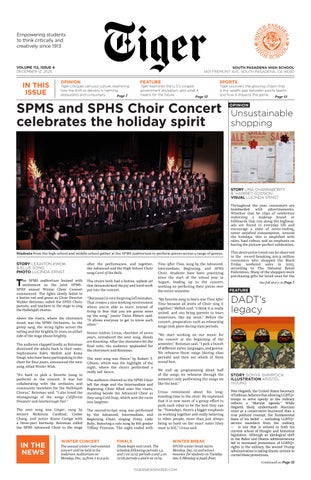
STORY UMA CHAKRABORTY & HARRIET GODSON VISUAL LUCINDA ERNST Throughout the year, consumers are bombarded with advertisements. Whether that be clips of celebrities endorsing a makeup brand or billboards that run along the highway, ads are found in everyday life and encourage a state of never-ending, never satisfied consumption. Around the holidays, this is amplified with sales, haul videos, and an emphasis on having the picture-perfect celebration. Students from the high school and middle school gather at the SPMS auditorium to perform pieces across a range of genres.
STORY LEIGHTON KWOK & ELLIE SONG PHOTO LUCINDA ERNST
T
he SPMS auditorium buzzed with excitement as the joint SPMS– SPHS annual Winter Choir Concert commenced. The lights slowly faded to a festive red and green as Choir Director Wylder Reinman called the SPHS Choir, parents, and teachers to the stage to sing the Hallelujah chorus. Above the risers, where the choristers stood, was the SPMS Orchestra. As the group sang, the string lights across the railing and the brightly lit trees on either side of the stage shone brightly. The audience clapped loudly as Reinman dismissed the adults back to their seats. Sophomores Eden Melloh and Esme Osugi, who have been participating in the choir for four years, announced the next song, titled Winter Wish. “It’s hard to pick a favorite [song to perform] in the concert. It was fun collaborating with the orchestra and community members for the Hallelujah Chorus,” Reinman said. “I also loved the reimaginings of the songs California Dreamin’ and Scarborough Fair.” The next song was Linger, sung by seniors McKenna Cardinal, Cinbie Chang, and junior Kiana Caniga with a three-part harmony. Reinman called the SPHS Advanced Choir to the stage
IN THE NEWS
after the performance, and together, the Advanced and the High School Choir sang Carol of the Bells. The choirs both had a festive, upbeat air that demonstrated the joy and hard work put into the concert. “[Reinman] is very forgiving [of] mistakes. That creates a nice working environment where you’re able to learn instead of living in fear that you are gonna mess up the song,” junior Talon Ebbert said. “It allows everyone to get to know each other.” Senior Andres Urzua, chorister of seven years, introduced the next song, Hands are Knocking. After the choristers hit the final note, the audience applauded for the choristers and Reinman. The next song was Dance! by Robert T. Gibson, which was the highlight of the night, where the choirs performed a really sad dance. The audience cheered as the SPHS Choir left the stage and the Intermediate and Beginning Choir filled onto the risers, standing beside the Advanced Choir as they sang Cold Snap, which sent the room into laughter. The second-to-last song was performed by the Advanced, Intermediate, and Beginning Choir, singing Pretty Little Baby, featuring a solo sung by 8th grader Tiffany Frierson. The night ended with
WINTER CONCERT
The annual winter instrumental concert well be held in the Anderson Auditorium on Monday, Dec. 15 from 7 to 9 p.m.
FINALS
Time After Time, sung by the Advanced, Intermediate, Beginning, and SPHS Choir. Students have been practicing since the start of the school year in August, leading up to the concert, working on perfecting their pieces over the entire semester. “My favorite song to learn was Time After Time because all levels of Choir sing it together,” Melloh said. “I think it is really united, and can bring parents to tears sometimes, like my mom.” Before the concert, preparation such as rehearsing songs took place during class periods.
This destructive trend can be observed in the record-breaking 202.9 million consumers who shopped the Black Friday weekend sales in 2025, according to The National Retail Federation. Many of the shoppers were purchasing gifts for loved ones for the See full story on Page 7
FEATURE
DADT’s legacy
“We start working on our music for the concert at the beginning of the semester,” Reinman said. “I pick a bunch of different styles, languages, and genres. We rehearse those songs [during class periods] and then see which of them sound best. We end up programming about half of the songs we rehearse through the semester; only performing the songs we like the best.” Urzua reminisced about his longstanding time in the choir. He explained that it is now more of a group effort to push each other to be the best they can be. “Nowadays, there’s a bigger emphasis on working together and really believing in other people, more than just always being so hard on the exact notes [they want to hit],” Urzua said.
Finals begin next week. The schedule following: periods 1,3, and 7 on 12/17; periods 2 and 4 on 12/18; periods 5 and 6 on 12/19.
WINTER BREAK
SPUSD winter break starts Monday, Dec. 22 and school resumes for students on Tuesday Jan. 6 (Monday is pupil-free).
TIGERNEWSPAPER.COM
STORY SONYA SHIMPOCK ILLUSTRATION KRISTEL HOUNG Pete Hegseth, the United States Secretary of Defense, believes that allowing LGBTQ+ troops to serve openly in the military reflects a “Marxist agenda.” While Hegseth likely understands Marxism more as a conservative buzzword than a true political concept, the fundamental basis of his belief — excluding LGBTQ+ service members from the military — is one that is echoed in both his current school of thought and historical legislation. Although an ideological shift in the Biden and Obama administrations led to increased protections of LGBTQ+ rights in the military, the second Trump administration is taking drastic actions to curtail these protections. Continued on Page 12
2
TIGER DECEMBER 12, 2025
NEWS
STORY OWEN HOU PHOTOS ZOE CHEN & MAC SHROPSHIRE
T
he SPHS Dance program held its annual Winter Concert on Friday, Dec. 5 and Saturday, Dec. 6 in the Anderson Auditorium. Led by Courtney Cheyne, the director of the Dance program, 78 dancers from Dance I, II, and III showcased 26 performances over the two hours of the concert.
Winter Dance Concert showcases 26 performances with 78 participants
The annual Winter Concert was Dance’s first event of the year and featured a wide variety of genres. Sophomore duo Hannah Chan and Kambria Owens brought an upbeat vibe to the auditorium during their performance to 24K Magic by Bruno Mars. Throughout the concert, cultural pieces were also consistently featured, from the K-pop dance to senior Solandra Sandoval’s Folklórico solo. These diverse performances offered a unique experience separate
from the other acts of the night, putting the spotlight on different aspects of cultural dance. The Winter Concert was a strong debut for this year’s Dance program with its original performances, diverse music, and lively atmosphere. Moving forward, Dance’s next event will be the annual Spring Dance Concert, set to take place on Friday, May 22 and Saturday,May 23, 2026.
The dancers prepared for months in advance, both during the school day and in after-school classes. Hiphop, ballet, tap, jazz, and contemporary dance are offered after-school classes and have coordinating performances in the showcase. Some students choreographed their own dances, choosing songs and creating performances themselves. Student-choreographed pieces accompanied those choreographed by Cheyne and the after-school dance instructors, whose genre specialties include hip-hop, ballet, tap, jazz, and contemporary. One of the first pieces was a K-pop performance by juniors Eden Finenza, Onyu Kim, and Molly Ouyand. The three danced to a compilation of K-pop songs such as Whiplash by Aespa and GO! by Cortis. The choreography was a mix of dances performed by the featured K-pop groups.
Dance III closes out the show with an upbeat piece, featuring music from Teen Beach Movie.
Junior Angela Wang, ballet solo
Senior Solandra Sandoval, Folklórico solo
(From left) Junior Briana Jacob and senior Daphne Salinas
Senior Dina Zangwill, intermediate jazz
Emergency test letter spreads throughout LA STORY JULIA GILDERSLEEVE
An emergency test letter scheduled to be sent only to South Pasadena was accidentally sent out to residents across Los Angeles County, alerting phones from South Pasadena to Long Beach at 5:50 p.m. on Tuesday, Nov. 11. The SMS alert originating South Pasadena read, “This is a test of the South Pasadena WEA system. There is no emergency.”
was accidentally sent out to the entire county. Some recipients of the alert were at Universal Studios when the alert was sent out.
The phones of everybody in line lit up with the South Pasadena alert. People not from South Pasadena were confused why they received it, but they did not panic. “[Once] I knew it was a test, it wasn’t scary or anything. I’m glad that the district has a good emergency system in place,” an SPHS freshman said.
alerts include Amber, Silver, and Blue alerts. The missing persons alerts are used to find missing or endangered people, and locate potential dangerous suspects. An Amber Alert is sent out to help find an abducted child under the age of 17 who is in imminent danger. It usually includes information about the child, abductor, and sometimes the vehicle used.
The alert was an example of a challenge that government officials experience with wireless emergency alert systems.
Silver Alert is used to locate a missing person 65 years or older, or a vulnerable adult with a cognitive or developmental disability.
The alerts can be broadcasted from cell towers to any WEA-enabled mobile device in a local area.
Wireless emergency alerts are sent out through a partnership between government agencies, like the Federal Emergency Management Agency.
City spokesperson Jennifer Colby addressed on Tuesday, Nov. 11 that the public safety staff and the City of South Pasadena were performing an internal test of the WEA system. However, the message
Government officials geographically code the alerts to pop up on phones in certain areas. Some alerts include emergency alerts for threats like natural disasters, severe weather, or public safety issues. Missing persons
Finally, a Blue Alert is sent out to apprehend a violent criminal who has killed or seriously injured a law enforcement officer and poses a threat to the public or other officers.
Wireless Emergency Alerts (WEAs) are emergency messages from authorized federal, state, local, and territorial public alerting authorities.
PAGE DESIGN ALISON SCHRADER
The alert was determined to be a result of human error instead of a malfunction on Finalsite, the platform the city uses to send out alerts.
TIGER DECEMBER 12, 2025
NEWS
3
Chevron advertises kratom; what is it?
Kratom is an addictive substance that is comparable to opioids in high doses, and is found in local gas stations. STORY MAXINE MESSINEO PHOTO THEO THOMPSON
A
tonic produced by Botanic Tonics called Feel Free sits behind the counter of the Chevron gasoline station on 1200 Fair Oaks Ave. An advertisement for the drink, containing harmful substances, is displayed outside the door of the station. Feel Free contains two plant-based substances called kratom and kava. Kratom is a plant found in Southeast Asia, belonging to the coffee family. It is used for a variety of reasons. The plant can be orally ingested through teas, capsules, and tonics or ground up into a powder. Around 15 minutes after consumption, symptoms ranging from increased alertness to nausea and sweating set in. Kratom has been reported to be effective in easing chronic pain, boosting one’s mood, and assisting with anxiety. While these claims have been popularized, there is little evidence that it actually provides any of the health benefits that have been reported. The drug acts as a sedative in high doses and a stimulant in low doses. No matter the dosage, however, it is still dangerously addictive. Kratom has been compared to opioids in higher doses, which are often used as pain relievers and are also highly addictive. Opioids produce feelings of relaxation and euphoria, similar to those induced by kratom. Additionally, kratom may cause hallucination, delusions, and confusion, as well as weight loss and insomnia when used for prolonged periods of time. The substance has also been linked to eating disorders and, in severe cases of addiction, can lead to seizures and death. Abuse of the drug has increased in recent years, with a major spike occurring in 2015. As it is incredibly addictive, kratom use will likely only continue to rise in years to come. It is often mixed with other highly addictive substances such as heroin or alcohol in order to increase the euphoric effects of the drug.
Kratom products such as Feel Free can be purchased at gas stations and liquor stores.
Kava root, the other substance found in Feel Free, is a plant native to the islands of the South Pacific and has
PAGE DESIGN ALISON SCHRADER
been traditionally used for anxiety treatment. It is a part of the pepper family, and while consuming it brings a lower risk of addiction than kratom, it is still possible to become addicted. It can be consumed as a tea, powder, tablet, or concentrated extract to be added to beverages or directly consumed. Kava root is often marketed as beneficial for anxiety, insomnia, stress relief, and memory problems. The drug has garnered attention through some research that has proposed the possibility of benefits such as lowered blood pressure and anti-cancer properties. Its effects are similar to those of kratom, with the addition of fatal liver conditions when consumed in high doses. Other effects include yellowing hair, nails, and skin due to liver problems as well as flaky skin and digestive issues. The short-term effects of kava are comparable to those of alcohol, with symptoms such as slurred speech and balance or coordination issues. Neither substance is approved by the Food and Drug Administration (FDA). The withdrawals that come with consuming kratom and kava can be severe. The symptoms have been compared to suffering from opioid withdrawal and often require medical intervention. Jasmine Adeoye, a woman from Austin, Texas, reported being addicted to the Feel Free tonic containing these substances. Adeoye said that she was unaware Feel Free contained kratom. She had been drinking around 10 bottles, each about two ounces, of the tonic daily, spending over $100 every day. Adeoye reported that her life revolved around the tonic to the point where upon waking up, she immediately craved kava in order to “feel better.” She said that she could not live without it, but eventually sought medical care for her withdrawal symptoms. Feel Free is sold in a local gas station on the same street as SPMS. Botanic Tonics requires buyers to be 21 years of age to purchase Feel Free. However, there is no official law surrounding the requirement, and kratom purchase does not have an age requirement.
4
TIGER DECEMBER 12, 2025
NEWS
South Pasadena’s annual South Pasadena’s Annual
TIGER RUN Tiger Run
The South Pasadena 2025 Tiger Run brought students and the community together.
STORY ZOE CHEN, EMIKO ESSMILLER, HARRIET GODSON, LEIGHTON KWOK, ANNA MCDONNELL, SONYA SHIMPOCK & JAYDEN ZUMBA PHOTOS SEBASTIAN GUTIERREZ PAGE DESIGN EMIKO ESSMILLER
The preparation for the Tiger Run The annual Tiger Run is a 5K or a 10K community walk and run that attracts runners and walkers from South Pasadena and the greater Los Angeles area.
For the 2025 year, the run took place on Saturday, Dec. 6, with the race beginning at 8 a.m. Senior Andrés Urzua performed the national anthem before the run started. Students from ASB helped set up everything from tents to cones around the courses on Friday afternoon and Saturday morning before the race. Then, on the Saturday of the race, they cheered on participants. Students gathered at different points on the course to keep runners’ spirits high. A Tiger mascot was at the finish line, congratulating runners and walkers as they finished their event. The event was hosted by Aztlan Athletics and the SPHS Booster Club. Aztlan Athletics is an organization that organizes 5K and 10K races around the L.A. area. For over 40 years, the Tiger Run
has been a time-honored South Pasadena tradition that consisentenly draws hundreds of particpants from both the local and bordering communities. While California weather patterns may shift, the event is constant, held each December. The Tiger Run serves as a fundraiser for the SPHS Booster Club, a nonprofit that primarily raises money for the high school’s athletics.
In recent years, SkillsUSA has been volunteering at the Tiger Run as well. SkillsUSA volunteers passed out drinks at water stations throughout the run and cheer on the participants. This year, SkillsUSA also offered a pancake breakfast for runners and walkers to eat when they finish their event. Other clubs, including the Track and Field team and members of the Dance program, helped pass out water. Each organization recieved $150 in profit from their sales.
Runners begin their race on Diamond Avenue.
Running down the Tiger Run timeline Making its first appearance in 1981, the South Pasadena Tiger Run is organized by the SPHS Booster Club.
serving as a fun event that builds connections among South Pasadena residents.
This community event is a citywide effort, as businesses with community locations, like Mama’s and Pavilions, sponsor the tradition each year.
Some come with teammates and treat the run like a mini competition, while others show up purely for chaos and fun.
Starting as a simple fundraiser, the Tiger Run has grown into a true community tradition. The morning was packed with loud crowds, bright costumes, and groups of friends lifting each other up. Students return year after year because the run feels less like a race and more like a celebration they get to take part of. The Tiger Run donates all proceeds received from athletes’ entry fees and sponsors toward SPHS’s 50plus clubs and sports teams around campus, on top of
Costumes take over the whole event, from matching necklaces to light-up headbands, and groups often plan their themes as if it were Halloween at the end of the fall semester. From serious runners to casual joggers, the event has a chaotic, warm feel that is distinctly reminiscent of South Pasadena. All these moments demonstrate how the Tiger Run has evolved into something more than just a fundraiser, capturing the spirit and creativity that make SPHS feel like a genuine community.
SPHS seniors cross finish line together South Pasadena seniors Kai Tilley and Dylan Shugg tied for first place in the men’s 5K. They ran a 17:04 race, crossing the finish line together. “Dylan and I run together every day,” Tilley said. “We signed up [for the Tiger Run] together. We also run similar times in cross country. We had other teammates in the race as well.” Tilley has been participating in the Tiger Run since he was eight years old and finds the run to be a vastly different experience from his competitions in cross country. “I run in a lot more high-pressure environments, so this was more fun and chill to run in the community, in an environment where there’s not as many expectations,” Tilley said. During the cross country season, Shugg ran a 14:50.1 5K, with Tilley following shortly with a 14:53.7 time. Shugg and Tilley placed 16 and 18 respectively in the Division III three-mile race at the CIF Southern Section Championships. Similar to Tilley, Shugg resolved to treat the race as any other workout. He had experience on the course, having raced in the Tiger Run for three consecutive years.
Children line up to race in the Cub Run.
“It’s just a fun way to end off the year, getting to the last stretch of a semester, and coming right out of the actual cross country season,” Shugg said. “The whole race was just fun.”
(From left) Seniors Kai Tilley and Dylan Shugg celebrate together after their 5K win.
TIGER DECEMBER 12, 2025
THEESTABLISHED TIGER 1913 NSPA FIRST CLASS 2024 CSPA GOLD MEDALIST 2023 CSPA SILVER CROWN 2022 CSPA SILVER CROWN 2021 CSPA GOLD MEDALIST 2019 CSPA SILVER CROWN 2018 CSPA GOLD MEDALIST 2017 CSPA CROWN AWARD 2016 CSPA GOLD MEDALIST 2015
5
OPINION
STAFF EDITORIAL
EDITOR-IN-CHIEF SONYA SHIMPOCK MANAGING EDITORS ZOE CHEN, Print EMIKO ESSMILLER, Online NEWS CLAIRE MAO, Editor OPINION RAFA ESTOLANO-SRIDHARAN, Editor FEATURE RUBY FOUDY, Editor SPORTS GAVIN BARTOLOME, Editor DESIGN OLIVIA CHIN, Editor LANAH KIM, Editor PHOTOGRAPHY HELENA EASTERBY, Editor COPY OWEN HOU, Editor SOLANA SINGER, Editor STAFF WRITERS UMA CHAKRABORTY EVELYN DIAZ MIRIAM ELGHEFARI JULIA GILDERSLEEVE HARRIET GODSON LEIGHTON KWOK ANNA MCDONNELL MAXINE MESSINEO ELLIE SONG KHLOE YUEN STAFF PHOTOGRAPHERS LUCINDA ERNST SEBASTIAN GUTIERREZ MAC SHROPSHIRE STAFF ILLUSTRATORS KRISTEL HOUNG DIANA LOPEZ JAYDEN ZUMBA PAGE DESIGNERS GABBY FERRI PAISLEY PARK ALISON SCHRADER VIDEOGRAPHER THEO THOMPSON BUSINESS AND ADS MANAGER PASCALE WILLIAMS SOCIAL MEDIA SPECIALIST ISABELLA JONASEN FACULTY ADVISOR KAREN HAMES VOL. 112 NO. 4 DISTRIBUTED ON DECEMBER 12, 2025. D IST R I B U T I O N: 1460 STUD E N T S; 70 COMMUNITY. 1200 COPIES PRINTED. DISTRIBUTED BY TIGER STAFF FREE OF CHARGE.
TIGER IS PRODUCED BY THE ADVANCED JOURNALISM NEWSPAPER CLASS AT SOUTH PASADENA HIGH SCHOOL, 1401 FREMONT AVE, SOUTH PASADENA, CA 91030. LAYOUT AND PHOTO IMAGING ARE COMPLETED ON-SITE. SIGNED ARTICLES APPEARING IN TIGER REPRESENT THE WRITER’S OPINIONS AND DO NOT NECESSARILY REFLECT THE VIEWS OF THE STAFF, STUDENT BODY, FACULTY OR ADMINISTRATION OF SPHS. ORIGINAL STORIES WILL CARRY BYLINES, ALTHOUGH STORIES REWRITTEN BY ANYONE OTHER THAN THE ORIGINAL WRITER WILL NOT RECEIVE ONE. CONTRIBUTING WRITERS WILL ALSO RECEIVE ONE. CONTACT THE PUBLICATIONS OFFICE AT (626) 441-5820 EXT. 2615 BETWEEN 8:00 A.M. AND 4:00 P.M. FOR ADVERTISING RATES AND SUBSCRIPTIONS. TIGER WELCOMES ARTICLES, LETTERS OR REBUTTALS FOR PUBLICATION IN THE PRINT AND ONLINE EDITIONS. ALL LETTERS MUST BE SIGNED AND VERIFIABLE, BUT NAMES WILL BE WITHHELD UPON REQUEST.
TIGER’S MISSION IS TO PROVIDE A RELIABLE NEWS OUTLET FOR SPHS AND THE LOCAL COMMUNITY. THROUGH A VARIETY OF COVERAGE, TIGER EMPOWERS/ENABLES STUDENTS TO THINK CRITICALLY AND CREATIVELY, COMMUNICATE EFFECTIVELY, SOLVE PROBLEMS, SET AND REACH GOALS, AND WORK COOPERATIVELY AND INDEPENDENTLY AS RESPONSIBLE CITIZENS. TIGER IS A FORUM FOR STUDENT FREE SPEECH, IN ACCORDANCE WITH CALIFORNIA ED CODE 48907. ALL REMAINING CURRENT TIGER NEWSPAPER POLICIES ARE ONLINE AT TIGERNEWSPAPER.COM INCLUDING: CONFLICT OF INTEREST, LETTERS TO THE EDITOR, CORRECTIONS, AND SOCIAL MEDIA.
SPHS needs to emphasize history History is a vital class, yet SPHS fails to prioritize it in required curriculum.
W
hile admittedly cliche, the phrase “those who do not learn history are doomed to repeat it” holds incredible weight. A thorough and comprehensive education in history builds students’ knowledge of the fundamentals of society and government today, as well as how to interact with these systems. History is undoubtedly important, yet it is underemphasized at SPHS for underclassmen. SPHS currently does not offer a history class for freshmen, opting for a study hall in place of the empty period. Though there is no freshman history class, there are still Californiamandated educational requirements to fill by graduation. In order to meet these standards, SPHS combines aspects of social studies into freshman English classes, often seen in reading material. This appears to be a practical solution, but it undermines the importance of both English and social studies as separate courses. Because they are combined, students’ understanding of the subjects may feel half baked, as some teachers compromise going into depth on specific topics for the sake of fully covering both subjects. “At least in my experience, I felt like diversity and social studies were not a key point of the class. The subject was very underrepresented, and I wish I could have learned more about it,” a sophomore said. Teachers do not have the bandwidth to effectively and comprehensively communicate the full scope of these courses to students. When they are forced to compromise curriculum, students suffer. Often, this can result in students feeling unprepared for social studies courses later in their high school career, putting them at a disadvantage to students who took an in-person class. “I didn’t feel super prepared going into history last year, [as] I had gone a whole year without an actual history class, so it took time to readjust,” the sophomore continued. This quantity-over-quality approach is apparent in the offered option of taking a condensed history class, a possibility for sophomores to take over the summer. The class can be completed in person or online on Edgenuity, but both have the same fast pacing. An entire year’s worth of content, roughly 90–100 hours,
must be condensed into a period of three to four weeks. While this approach satisfies the history credit needed, many students are left with a lack of understanding in the subject. Many feel the summer class did not give them enough time to gain lasting knowledge of the material covered. “It was way too short of a time to [learn] a whole year’s worth of history,” junior Camilla Montebrant said. “I did not learn a single thing.” Montebrant believes that because the summer curriculum is so rushed, students are left with a lack of retention and understanding. As a result, they feel unprepared for their current history class, failing to recognize names and events covered in previous years and the Edgenuity platform. Montebrant’s experience highlights the inadequacy of the summer history program. “I’m basically screwed over for U.S. History right now, because I just feel way behind … whenever the teacher mentioned something from … last year … not once have I … recognized any of the names and years,” Montebrant said. Despite these drawbacks, the summer history course is still taken by many students, often to free up time in their schedules during the school year. Because the benefits of an in-person class are not properly emphasized, many students see it as a waste of time or something to get over with. However, as stated by Montebrant, the condensed history class leaves consequences for students when taking history junior year. Students and administration alike must acknowledge that history is absolutely vital to a student’s educational development. SPHS must mandate in-person history classes for at least one year, whether that be freshman or sophomore year. Even just two semesters of the course has the potential to lay the groundwork for how and why much of the world they will face after graduation exists the way it does. Until SPHS accepts the benefits teenagers gain from studying history — and really learning it, not just rushing online — students must make the absolutely imperative decision to take history for themselves.
Boos & Bravos
Tiger’s cheers and jeers for the month of December BOOS
BRAVOS
BOO to rejection therapy. Just say yes, hello?
BRAVO to broke skunks. Poor things only have one scent.
BOO to finals being right next to Christmas. I feel neither holly nor jolly.
BRAVO to RogerHub for telling me the only way I can pass math is to get 120 percent on the final. At least someone believes in me.
BOO to Scantron tests. I’m playing mind games with myself… BOO to talking stages. Free me.
BRAVO to quarter zips. So convenient to throw on before my feminist literature class.
BOO to Mariah Carey using AI. Keep it up and you’ll be defrosting by October.
BRAVO to Will at the end of Stranger Things Volume 1. Mike might not want him, but I sure do.
PAGE DESIGN SOLANA SINGER
6
TIGER DECEMBER 12, 2025
OPINION
Food delivery service hinders dining culture Carryout harms the restaurant industry, reducing human interaction, cutting profits, and altering jobs. STORY EVELYN DIAZ & MAC SHROPSHIRE PHOTO THEO THOMPSON
C
orner Bakery Cafe, a Panera Bread-esque chain on Lake Avenue in Pasadena, has lost the energy it used to hold. Currently, walking into the storefront yields this typical image: a limited number of people stand by as their food is cooked, and an often-unreasonable number of delivery drivers wait for their orders to come in. With the boom in the delivery business, drivers often appear exhausted or disillusioned — perhaps a reflection that a restaurant business that once was interesting and pleasing has been translated into a money-driven pursuit. The increased number of food delivery drivers in the workforce are also creating a decline in the restaurant industry. The decrease of interaction between delivery workers and restaurant staff causes common incidents of mistaken orders. South Pasadena is not immune to this. In many instances, delivery workers blame mistaken orders on the restaurant and their staff, but in reality the restaurant is not equipped for the order. As a result, the once inviting and positive energy of restaurants is interrupted by argument and frustration. DoorDash, Grubhub, and Uber Eats were introduced to bring convenience to people who wanted food fast. DoorDash’s website encourages consumers to “get a slice of pizza or the whole pie delivered, or pick up house lo mein from the Chinese takeout spot [they have] been meaning to try.” DoorDash claims that the delivered food will give consumers joy, but consumers can often have an even better experience if they actually went to that “Chinese takeout spot” or the pizza parlor in the city. The contrary can be argued, as DoorDash can be beneficial for small businesses by expanding their business far beyond their usual customer base. By using
The popularization of DoorDash and other food delivery apps is greatly contributing to a lower dine-in rate at many restaurants.
DoorDash, a business gains extra visibility, marketing, and access to customers who might not have discovered them otherwise. This increase in their exposure can boost sales, especially for newer or smaller shops. However, these benefits come with major drawbacks. DoorDash charges high commission fees, which can cut deeply into small business profits, ensuring that they earn a steeply decreased amount per order. Delivery mistakes can also harm a business’ profits. The prevalence of these delivery services also harms waiters, who depend on tips from in-person guests at their restaurants. When delivery services force restaurants to adapt to meet competition from other restaurants, waiters are one of the first to be affected. Waiters’ jobs are transformed from jobs interacting with real, in-person customers, to interactions of handing a bag of food to a delivery driver, thus making their job less necessary to
restaurant function and lowering their salaries. This affects the in-person charm of restaurants. Instead of the connection of classic human interaction with the consumer, in an increasing number of restaurants, food is bagged up by waiters and left to sit at a dedicated food delivery table to be passed on to the delivery driver. In the past 30 years, delivery services have changed not only the restaurant industry, but other parts of society as well. Order-in culture has surged; COVID-19 was one of the major tipping points for less interaction in restaurants. If delivery services keep capitalizing on consumers’ unwillingness to support restaurants, specifically the ones who value human interaction, classic South Pasadena establishments will be forced to appeal to the new market of take out, causing the decrease of valued jobs, and the loss of charm they once were known for.
Vague marketing of addictive products must be clarified STORY SONYA SHIMPOCK & PASCALE WILLIAMS ILLUSTRATION OWEN HOU For more information about kratom, refer to the News article “Chevron advertises kratom; what is it?” on page three. This article serves as an Opinion accompaniment; the majority of necessary background information for this topic may be found in “Chevron advertises kratom; what is it?”
The South Pasadena Chevron gasoline station, located on Fair Oaks Avenue across from Pavilions, sells a potent replacement for opium when consumed in high enough quantities. It is packaged as an energy drink called Feel Free, which claims to help consumers alleviate nerves and refine focus. To achieve these results, Feel Free relies on kratom, a South Asian plant that has been at the center of multiple wrongful death lawsuits over the past five years. Kratom is being sold in gas stations and drugstores across the country in the Feel Free drink — even in South Pasadena, where it is being marketed at the Chevron station. Feel Free was created by Botanic Tonics, who have labeled it an “original feel-good tonic [that] features kava root and other plant ingredients known to help with relaxation, productivity and focus.”
21 has been referred to the California Senate Committee on Health, but has not yet been passed. However, until that bill passes, kratom does not have an age restriction, meaning vendors are not legally obligated to check IDs. While this may enable minors who understand kratom’s effects to consume it without legal repercussions, this lack of an age restriction and vague marketing surrounding Feel Free may cause an unwitting student to consume a dangerous and addictive substance. Without the context that consuming more than 30 mL of Feel Free within 24 hours can lead to seriously adverse health effects, sleep-deprived and anxious teenagers may feel encouraged to cross the line — a decision that may be fatal. “When you take something that is essentially a drug, and you essentially don’t study that drug, and you don’t advertise anything except, ‘Oh it’s a plant product, therefore it’s safe,’ you create all sorts of problems,” Dr. Rif El-Mallakh, director of the Mood Disorders Research Program at the University of Louisville School of Medicine, said.
“Iced kratom tea” is marketed as a plant product that serves as a social aid and not an addictive drug. In this case, the lack of clarity surrounding the messaging exploits those who are trying to restore their health, essentially enabling another addiction.
Proposed by State Assemblymember Jasmeet Bains, a law regulating the distribution of kratom for individuals under
Furthermore, policymakers must recognize shifting trends concerning illicit substances. It is essential that policy
EMIKO ESSMILLER
Victimized fox I watched Zootopia 2 exactly three days ago (MINOR SPOILERS AHEAD) at the time I’m writing this. In short: it was fire. In long (?): I think it was a successful portrayal of gentrification, racial segregation, and romantic tension. Talk about a mouthful. Speaking of romance, let’s discuss that fox. You know, the one that’s less of a hear-me-out and more of a holdme-back. Zootopia 2’s Nick Wilde was a different breed. He really went through some character development after the abortion comic arc.
Businesses that profit off of selling products containing harmful ingredients have a responsibility in marketing them clearly to customers. When companies use vague or misleading language in their product descriptions, customers are left with a distorted sense of what is actually being marketed to them, putting their safety at risk. For this reason, transparent and accessible marketing needs to become the standard for businesses rather than their last priority.
Kratom is present in other products as well. At Kavasutra, a non-alcoholic bar in Florida that caters to individuals recovering from substance abuse, it is a hit product.
At the very bottom of their website, in comparably small text, is a warning: “This product contains leaf kratom which, like caffeine and alcohol, can become habit-forming and harmful to your health if consumed irresponsibly.”
SEMICOLON
protects underage citizens and attempts to limit drug consumption. While Bains’ attempts to pass legislation to limit kratom products is admirable, legislation around kratom must be the focus of larger, national efforts. While the FDA has publicly discouraged consumers from consuming kratom, official action at the governmental level has been delayed.
That being said, Nick Wilde still isn’t without his faults. He canonically discusses how his unresolved childhood trauma gets in the way of his interpersonal relationships as an adult. It makes me sad that people are somehow blaming Judy for “neglecting” him the entire movie when he’s unable to take anything she says seriously to begin with. People saying that Judy was in the wrong for their temporary falling out lack empathy, and they are allowing their lust for a fox to obscure their ability to view characters as complex. This is a common theme I see in many romantic dynamics, but specifically in straight relationships. The female main characters are blamed by the fandom for pushing the male love interest away or standing up for themselves. Meanwhile, the love interest is perceived as victimized and receives empathy from fans. In many romance plots, especially when the main character (MC) is female and the love interest is male (ML), there’s a conflict that leads to a romantic falling out. Oftentimes, I’ll see comments from a predominantly female audience condemn the female MC for prioritizing herself over the ML. I fear a lot of this comes from their indirect interest in
PAGE DESIGN SOLANA SINGER
the ML. They live vicariously through the MC, and thus see any action from the MC, whether that’s pushing the ML away or even going as far as to break up with him (gasp!), as a threat to their idealized attraction to the ML. This may very well just be me defending female characters with my life (as Sonya would do). It just bothers me so much when I see other girls hating on a female character and babying a male one just because of their crush on the guy. I’ve seen many comments echoing this sentiment in response to Nick and Judy’s dynamic in Zootopia 2, but also in so many other fandoms. It feels almost like an attack on feminism when a girl chooses to support an attractive boy over a strong, outspoken woman. All in all, I thoroughly enjoyed Zootopia 2 (minus the comments about Judy becoming evil). I really do recommend watching it. Again, it is a surprisingly good metaphor for some of our ongoing societal issues, and plus, I’m 90 percent certain that there’s a gay relationship between a snake and a lynx. Nick was fine as always. 10/10, would recommend.
TIGER DECEMBER 12, 2025
OPINION
7
The creation of a conservative Court The Supreme Court’s conservative majority undermines America’s ideals of freedom and democracy. STORY RAFA ESTOLANO-SRIDHARAN ILLUSTRATION JAYDEN ZUMBA
which the document is interpreted based on the exact wording rather than the intended meaning.
I
The society claims to be non-ideological, only wanting to objectively interpret the Constitution and apply it to American society, but their actions speak differently. They have built connections with every Republican administration and are part of a large network of conservative think tanks such as the Heritage Foundation and Family Research Council. The society also receives most of its funding from large Republican donors.
n 2015, the Supreme Court of the United States made a landmark ruling in the case of Obergefell v. Hodges that legalized same-sex marriage nationwide. In the wake of the 2022 overturning of Roe v. Wade, this ruling has been called into question. With the right to choose gone, many felt that the right to choose who one loves would be the next to go. Furthermore, with the elimination of such a strong precedent struck down, it has become clear that other precedents could be struck down too. Just a few weeks ago, former Kentucky County Clerk Kim Davis, who gained infamy nationwide after refusing to grant marriage licenses to same-sex couples, petitioned the Court to overturn the Obergefell ruling. The Court declined to hear the case, but the fact that it was even a possibility reflects a strong ideological shift in the Court that is cause for alarm. For the past 11 months, the Supreme Court, which in theory is supposed to serve as a non-ideological check on the power of the executive and legislative branches, has played a key role in implementing the Trump administration’s authoritarian agenda. The Court has expanded presidential immunity, weakened the protections guaranteed by the First Amendment, and eroded the rights of marginalized Americans, helping the administration to impose a rigidly conservative, patriarchal vision of life on the American people. While the state of the Court is unfortunate, it is not an accident. A shadowy dark-money organization known as the Federalist Society has been campaigning for decades to install an ultra-conservative court and, in their own words, “crush liberal dominance.” The organization started as a group of conservative law students in the 1980s but soon grew into an influential legal organization. The group’s beliefs are based on an originalist interpretation of the Constitution, in
Over the past three decades, the Federalist Society has played a key role in the confirmations of all six conservative justices appointed across that time period. Leonard Leo, the leader of the society, personally drafted a list of candidates for all three of Trump’s Supreme Court appointments. It was these three justices, Neil Gorsuch, Brett Kavanaugh, and Amy Coney Barrett, that have been instrumental in eroding the rights of the American people. In the past year alone, the Supreme Court has upheld a ban on life-saving gender-affirming care for minors, an internet age-verification law in Texas that could be used to prevent minors from accessing sexual health and LGBTQ+ resources, and let parents opt-out of more inclusive curricula. The Court has also disapproved of universal injunctions, whereby judges can issue restraints on executive orders that are being legally challenged, allowed for the hasty deportations under the Alien Enemies Act of 1798, and frequently sided with the Trump administration's emergency applications. This formation of the Supreme Court has become a threat to American democracy and civil liberties. The Court, despite not being democratically elected and serving life terms, is using its outsized power to rule against the interests of the majority of Americans to instead side with a much smaller, but more powerful group of the most wealthy, most conservative Americans.
In order for the United States to live up to its promise of democracy and freedom, the Court must move away from its current ideological bend. This necessitates immediate reforms such as term limits for justices, and stronger congressional oversight. Without these reforms, the Court will continue to slide into the control of an ever more powerful oligarchy.
American overconsumption is ruining the environment STORY UMA CHAKRABORTY & HARRIET GODSON VISUAL LUCINDA ERNST Throughout the year, consumers are bombarded with advertisements. Whether that be clips of celebrities endorsing a makeup brand or billboards that run along the highway, ads are found in everyday life and encourage a state of never-ending, never-satisfied consumption. Around the holidays, this is amplified with sales, haul videos, and an emphasis on having the picture-perfect celebration. This destructive trend can be observed in the recordbreaking 202.9 million consumers who shopped the Black Friday weekend sales in 2025, according to The National Retail Federation. Many of the shoppers were purchasing gifts for loved ones for the holidays. The practice of gift-giving has long been associated with the holidays as a way to show appreciation and care towards loved ones. Gift-giving is not inherently harmful, and it can be a thoughtful way to express
affection towards a friend or partner. However, with the growth of social media, unrealistic standards for how one should commemorate the holidays has escalated drastically. To satisfy higher expectations, many stores line the checkout aisles with holiday-themed plastic trinkets. While they may appear as cheap and harmless additions to a Christmas gift, in reality they are pieces of plastic that serve little purpose beyond fitting along nicely with the other items. Piles of these plastic presents are replacing practical, thoughtful gifts. Everything from clothes and toys to household goods are most commonly made out of materials containing plastics. Of the millions of gifts that children across the world unbox throughout the holiday season, an estimated 90 percent of toys are made of plastic. To compound on this, UNEP reports that over 60 percent of material made into clothing is plastic. The winter clothing hauls that pervade the internet contain articles of clothing most likely made out of polyester, nylon or acrylic materials — materials fall under the umbrella of plastic. Consumers are encouraged and pressured to revamp their wardrobes according to the newest trends,
restock their vanities with popular beauty products, and overflow their children's rooms with piles of toys. Plastic is not a biodegradable material. This means that the single-use plastics, clothes and other items that are used everyday, all over the world, end up in landfills for centuries or accumulate in oceans, leaving devastating effects on marine life. Beyond the serious environmental concerns, the working conditions in the factories that produce these goods often have inhumane labor practices. Many of these factories are located overseas, a trend that began to affect American production in the 1970s due to looser and cheaper labor laws. For example, large corporations like Apple, Nike, and infamously low-quality brands Shein and Temu manufacture goods in factories in Asia. The nonprofit organization Sustain Your Style notes that the “basic wages [of the workers in these factories] are so low that they cannot refuse overtime, aside from the fact that many would be fired if they refused to work overtime. In some cases, overtime is not even paid at all.” These companies are able to import their goods from overseas, pay cheap labor costs and sell them in the U.S for large profit margins. The accessibility of cheap goods entices people to purchase goods they otherwise would not feel the need for. Popular sale events like Black Friday and Cyber Monday market the idea of “buy, buy, buy” before the deal runs out, further contributing to the craze. These products are made without keeping quality or durability in mind. The quick turnover of goods that follow trends and substandard production leads to poor construction and cheap shortcuts. Consumers then turn to the next fad for their next shopping spree. The offshore factories and cheap labor allow more people to afford this lifestyle, indirectly perpetuating the harm that the environment and workers are suffering.
The massive market that relies on exponentially increasing rates of consumption is actively contributing to the planet's demise.
PAGE DESIGN SOLANA SINGER
During the holidays, it is easy to be blindsided by the pressure of finding the perfect gift or adhering to the latest trend. However, it is important to find the magic in spending time with loved ones, rather than in environmentally-damaging material gifts often derived from inhumane labor practices. The joy from succumbing to external pressures by following the latest trends, or having the most extravagant holiday, lasts only a short period of time, but the effect that this rampant consumerism has on the planet is irreparable.
8 8
TIGER DECEMBER 12, 2025
Spreading cheer Students’ unique traditions STORY ANNA MCDONNELL
T
he winter season is full of holidays for family and friends to celebrate together. SPHS is a diverse campus with every family practicing different customs and traditions. With all the holiday cheer just around the corner, Tiger is exploring different family celebrations throughout SPHS. Senior Lily Shaffer’s grandmother grew up in Altadena, and when her family moved to South Pasadena, they made it their tradition every Christmas Eve to drive through Christmas Tree Lane in Altadena and admire the Christmas lights. Christmas Tree Lane is a mile-long stretch of houses that have gone all-out with Christmas decorations for over 100 years. In response to the Eaton Fire last January, Disney has swept in to fund materials, provide volunteers, and toy characters to make this year magical as ever. Junior Talon Ebbert’s family makes latkes during the holiday season. Latkes are traditional Jewish potato pancakes traditionally eaten around Hanukkah. They are pan-fried in oil, symbolizing the miracle of oil in the Hanukkah story. Latkes are typically served with either a sweet applesauce or sour cream. Blending holiday traditions is a common practice. “[We] eat Jewish food through the days of Hanukkah, and always decorate the Christmas tree with my entire family with music playing in the background,” one freshman said. Another student’s family celebrates Christmas Eve with Yorkshire pudding and a Yule log. Yorkshire pudding is a savory, buttery pastry similar to an American popover; a Yule log is a large log chosen to be ceremoniously burned in the hearth. “Burning a Yule log” is a tradition that dates back to medieval times and has been used to create good luck during the holiday season. Another unique tradition is called “pickle in the Christmas tree,” where a pickle-shaped
ornament is hidden in the Christmas tree on Christmas Eve. The first person to find it the next morning gets good luck for the year and to open a present one day early. On Christmas morning, one student’s family makes green pancakes and stacks one on top of another to resemble a Christmas tree. One senior commented that they make Swedish meatballs on Christmas and have quiche and mimosas, or brunch cocktails, for Christmas brunch and for dinner they end the night by going to a German Deli with their grandparents. On Dec. 31, as 2025 nears its close, another student will be sitting under a table, waiting for the clock to strike 12 a.m., and will eat 12 grapes when the hour arrives to ensure that their 12 wishes come true next year.
Ice at San ta Monic Emiko Ess a | Photo by miller
Another sophomore will spend New Year’s Eve in Little Tokyo eating Toshikoshi soba, a traditional Japanese noodle dish eaten on New Year’s Eve, and osechi ryōri, a traditional Japanese New Year’s feast of small dishes, at 12 a.m. To cap off the holiday spirit, one sophomore said that on the days surrounding New Year’s Day, their family re-watches the entire Harry Potter movie franchise, which, with eight movies, is close to 20 hours of television. In preparation for the Rose Parade on New Year’s Day, floats begin lining up down Orange Grove Boulevard the night of Dec. 31. Sophomore Thomas Shanley and senior Madeline Cherkis-Bray watch the floats park and position themselves for the Rose Parade the night before New Year’s Day on Orange Grove Boulevard before their grand debut the following morning. The holidays are a time to celebrate, spend time with loved ones, and spread joy. Everyone celebrates in their own unique and special way, and there are countless traditions that were not highlighted. However you celebrate, Tiger wishes you a happy holiday.
Altadena | Christmas Tree Lane in tmas Tree ris Ch of Photo courtesy Lane Association
Spaghetti con sugo di carne (spaghetti with meat sauce)
Recipe from Theo Thompson
Sugo di carne is a traditional Italian slow-cooked meat sauce. This recipe has been passed down generations for over 100 years. Ingredients
Directions
Sauce 42 oz canned tomato sauce 12 oz canned tomato paste 56 oz water 1/2 lb pork neck bones (or any pork bones) 1 oz chopped basil (or 1 tsp dry basil) 1/2 tsp red pepper flakes 4 cloves finely chopped garlic 1/2 tsp fennel seeds 1/2 tsp cinnamon 1/2 cup sugar
For sauce: Brown pork bones on stovetop. Combine pork bones in a pot with all ingredients save for cinnamon and sugar. Bring to a boil, then reduce heat to simmering. Add cinnamon and sugar. Simmer for two hours. For meatballs: Preheat oven to 450. Beat eggs completely. Slowly add sausage. Then add remaining ingredients. Mix well. On a baking sheet, spread a thin layer of olive oil. With a teaspoon, form meatballs. The mixture should be very gooey and barely able to form. If need be, add another egg. Should make 18 meatballs. Put in thefor 15 minutes. Once finished, put meatballs in the sauce for at least one hour.
LA Zoo Lights | Photo co urtesy of LA Zoo
Meatballs 1 lb mild Italian sausage 6 eggs 3/4 cup bread crumbs (seasoned) 1/2 cup pecorino romano cheese 1 oz chopped flat leaf parsley (use stripped leaves, not stalk) 3 cloves finely chopped garlic 1/2 tsp crushed red pepper 1/2 tsp fennel seeds
ILLUSTRATIONS KRISTEL HOUNG
ht at Enchanted Forest of Lig by oto Ph | Descanso Gardens Emiko Essmiller
TIGER DECEMBER 12, 2025
9
r for the holidays Local winter attractions STORY ZOE CHEN & KHLOE YUEN
Smorgasburg LA Smorgasburg is a weekly, open-air food market in Downtown LA located near the arts district. The event occurs year round, but each Sunday during the month of December, Smorgasburg adopts a holiday theme, from Thick Thrift to Festival of Tea to Caribbean Christmas. Smorgasburg LA is a great place to find lastminute holiday gifts while enjoying uniquely local food.
Christmas Tree Lane, Altadena Since 1920, Christmas Tree Lane in Altadena has been a mile-long stretch of over 100 pine trees strung with multicolored lights. Viewers can walk or drive through the canopy of lights, which are hung yearly by volunteers. The tradition garners tens of thousands of visitors each year.
Ice at Santa Monica The holiday-themed popup ice skating rink in Downtown Santa Monica is open afternoons and evenings every day of the week. Sunday skating sessions are themed from Disney+ and Hulu entertainment, including Gilmore Girls and The
Nightmare Before Christmas. The rink features live music on Sunday afternoons, periodically drops fake snow, and is completed by strings of lights and wintery light projections. Admission is $22.
LA Zoo Lights The zoo’s annual event is an illuminated lantern festival featuring larger-than-life animal sculptures that light up the zoo. The event includes interactive displays, a walk-in kaleidoscope, seasonal treats, and many photo opportunities throughout the park. Lights cover half of the zoo; no live zoo animals are featured in the festival. Ticket prices hover around $30 for non-members, and themes include Sensory-Inclusive Zoo Lights and LA Pride Night. Descanso Gardens, the Arboretum, and Griffith Park host similar light festivals.
Enchant at Santa Anita Enchant, which calls itself the “World’s Largest Christmas Light Maze,” uniquely combines ice skating, a snow sled, a ferris wheel, and an award-winning walkthrough light maze into one holiday experience. Some weekday nights are themed; “Paws and Claus,” for example, invites visitors to bring their dogs to the attraction. Tickets into Enchant range from $30 to $50 based on the date.
Taiwanese rice cooker cake
Recipe from Zoe Chen
A simple chocolate cake made in the rice cooker. Using a rice cooker, as opposed to an oven as cakes are commonly cooked, results in a springy and moist cake texture. Ingredients
Directions
1 cup sugar 1 3/4 cup flour 1 egg 1 tsp baking soda 1 tbsp vinegar 1/2 tsp salt 1 tsp vanilla 5 tbsp cocoa powder 5 tbsp oil 1 cup milk
Combine ingredients in a mixing bowl. Transfer to inner rice cooker bowl. Start rice cooker. Cake is finished when rice cooker timer goes off.
Tiger’s holiday gift guide
.....................................................................................
CASH RECEIPT
..................................................................................... Weighted stuffed animal......................................$25 Filled with small beads, these plushes are heavier than normal stuffed animals and provide extra comfort. NYT Puzzle Mania...........................................$7/$38 The perfect choice for someone who has missed the Mini Crossword since it went behind the Times’s paywall in August. Get the book full of New York Times games and new variations, or opt for the cheaper Puzzle Mania print newspaper edition. Desserts cookbook................................................$20 Consider a cookbook for a friend who loves to bake. Include a box of homemade cookies to get them started. Tortilla blanket........................................................$15 The perfect gag gift: A warm blanket that makes someone instantly transform into a burrito. Canva digital photo album.................................Free A thoughtful way to encapsulate family memories from the year. Knitted, crocheted, or origami creature..........Free A personal and unique gift. Crafts represent the giver’s time, effort, and thoughtfulness toward the gift recipient. Custom playlist....................................................Free Fill a playlist with the recipient’s favorite songs or with a concept in mind for a meaningful, budgetfriendly gift.
TOTAL XXXX X 12/12/25 2:35 #Tx ID :
Ponche crema (Venezuelan eggnog)
2652762362
THANK YOU
Recipe from Solana Singer crema, usually a cold, A non-alcoholic family take on Venezuela’s response to eggnog. Ponche 2 liters. Makes as. Christm around served ally tradition is liqueur, ed rum-bas creamy, Ingredients
Directions
1 L milk (plus 1/2 cup to dissolve pudding) 1 can sweetened condensed milk 3/4 cup sugar 1 box Royal vanilla pudding (or any non-instant pudding) 3/4 cup water 1 tbsp vanilla extract 1/2 tsp nutmeg
Heat 1 L milk on stove with condensed milk and sugar. Let boil for 10 minutes, then add pudding dissolved in 1/2 cup milk. Let this boil on low heat for another 10 minutes. Turn off heat and add water, vanilla, and nutmeg. Let cool.
PAGE DESIGN OLIVIA CHIN
10
TIGER DECEMBER 12, 2025
FEATURE
SPHS’s break policy gives students much-needed rest and time off The current SPHS break policy is effective in giving students the rest they need, but some argue for a different approach: shorter, evenly dispersed breaks.
B-sides by Bella ISABELLA JONASEN
Contradictions All opinions are valid, and particularly the misguided ones — especially when they involve music. Ahead of forming my opinion on whether or not I found it morally correct to insult a work of art simply because it didn’t meet my expectations, it occurred to me that I, for one, and many others are ungrateful. While yes, on the opposing end of things, it is incredibly irritating to listen to someone degrade a piece of music that you happen to respect. This is primarily because the unsolicited critiques stem from unwarranted assumptions that an artist has to constantly excel. At the beginning of this ponder, I found that to expect some sort of perpetual greatness from musicians simply because they have achieved excellence before is incredibly naive and unfair. It has become wildly apparent that musicians cannot make art that excites them without being ridiculed for it. Sound evolution was traditionally something that was nurtured and appreciated. Listeners and critics wanted to see artists experiment, as that is when new barriers can be broken. Rather, today, it feels like any ounce of creativity releases hordes of negativity from fans. I suppose this whole thing upsets me because I, for one, feel stagnant constantly — so having art that is freely able to evolve is necessary for my sanity.
STORY UMA CHAKRABORTY & ELLIE SONG ILLUSTRATION JAYDEN ZUMBA
I
n the midst of the academic course load, there are much-needed breaks that allow students to enjoy school-free days after rigorous months of studying and work. The phrase “no school November” is a title given to the month by teachers and parents alike. It lives up to its name: November has the most pupil-free days out of any other month of the school year. Three weeks after Thanksgiving break ends, winter break concludes the year, lasting a total of two weeks. Most can agree that breaks from school are important, but the question arises of how much break is truly necessary. The placement of breaks throughout November and December can be especially rewarding to seniors, as on top of their normal coursework, they also have to manage a multitude of college applications. Time off is meant to relieve stress from school, which is why SPHS has a no homework policy in place to ensure students are not given work over breaks. However, even with the policy, some students still feel pressure from tests being assigned as soon as they return and call for a stricter policy regarding tests after breaks. Students also say that evenly dispersed break periods would benefit their productivity, along with reducing any other stress. “I would definitely add another one [break] during the beginning of the second semester because there is nothing really to look forward to during that time period,” freshman Ella Engstrom said. While longer and more frequent breaks seem like the ideal solution, the National Institute of Health introduces the issue of students losing the knowledge they gained during the school year during longer breaks. The institute claims that by keeping this policy, academics will continue to remain high if breaks are kept reduced and summer classes are required.
Though reduced break time may keep students’ memory sharp, longer breaks are essential to balancing high schoolers’ lives outside of academics. “I think that it’s important to catch up on sleep,” senior Eva Stephenson said. “I think it’s a really big issue that a lot of students are facing. Also, [finding the time] to do stuff that’s not homework, like enjoying your hobbies and spending time with family.” The recommended amount of sleep a high schooler should get is roughly eight to 10 hours daily. Many students do not meet this requirement, as the academic pressures posed on them are high. “Students don’t get enough sleep due to the sheer amount of work load we have. Along with all of our extracurriculars, it gets hard to manage it all sometimes, and sleep is just the easiest thing to cut,” freshman Zoie Wong said. Students often have to sacrifice sleep for the sake of finishing work, juggling academics and extracurriculars, which negatively impacts their attention and ability to learn. When time off from school is given, it allows students to catch up on sleep and feel well-rested. While some may argue that school breaks provide a disruption to a student’s learning, many students rely on them to relieve the workload and stress that school can bring. Choir teacher Wylder Reinman said that finding a balance between home life and school life is essential. “I think that people need time to pursue hobbies and interests. I don’t think that learning only happens in the classroom,” Reinman said. “So much of our life is measured by grades or performance, and I don’t think that that’s necessarily a healthy thing.” While the SPHS break policy allows students a much needed break from their rigorous academic course load, students debate whether the break periods should be more evenly dispersed throughout the school year.
PAGE DESIGN PAISLEY PARK
The fundamentals of music are simple. If it lacks thoughtfulness, is not world-building, nor creative, then it simply is not good. That said, I am not trying to push supporting musicians when they make objectively bad music. If the literal quality of the work has significantly declined over time, then yes, not having respect for the art is completely valid. However, if there is true artistry behind the art, then, despite your opinion on it, it deserves respect regardless. There is also importance held in which you critique art; simply stating you don’t like it is not a strong enough reason to dislike it in its entirety. Having specific examples of why you believe a piece of music fell short is essential when discussing it across the board — otherwise, you just sound silly. Additionally, there is something so frustrating about people disliking an artist whom they once loved strictly over an artistic shift. How is it that one’s devotion to a musician can simply vanish once the artist releases music that is experimental? I find the whole concept in itself to be incredibly closed-minded. This limits artists from being comfortable with their artistic expression, which is counterproductive. Their job is to create art; art, by definition, is human expression without regulations. Who are we to tell artists what is defined as art and what is not, especially when they are creating music that truly fulfills and excites them? If you happen to be enraged that an artist has recently begun to shift their sound and influences, you may be entitled to feel that way, but I still think you’re shallow. If you continue to listen to new records with the impression of the exact same sound or a similar feeling you may have felt listening to an artist’s previous work, you are setting yourself up for disappointment. I just worry we may be limiting the only thing that traditionally has no limits or rules, because that wouldn’t be fun, now, would it?
TIGER DECEMBER 12, 2025
FEATURE
11
December 8, a grim day in Jewish history
Remembering the opening of the killing center Chełmno during the Holocaust. Preventing its repetition.
false welcome speech, told that they were at a transit camp and awaiting passage to work “in the east.” After waiting and being forced to undress, all men, women, and children were, in groups, led into the back of a large van. The Sonderwagen, or “special vans” used at Chełmno, had been altered, however, so that the chamber filled with poisonous carbon monoxide gas from the van’s exhaust. Specially sealed off, the 80 to 100 people inside asphyxiated and slowly died. They were then taken to the nearby Rzuchów Forest to be disposed of in a mass grave. As incredibly horrifying as it is to learn about, it is absolutely critical that the victims of Chełmno are not forgotten. They stand as a testimony to the “Final Solution,” Hitler’s approach to “dealing” with the “problem” of Jewish people. In 1941, he decided that forced labor and starvation were not enough; Hitler called for the complete eradication of the Jewish people. Hitler scapegoated the Jews as responsible for the woes of the Germans and other “Aryan” people.
Content warning: This article contains descriptions of genocide and murder. Please read at your own discretion.
politician Edmund Burke stated, “Those who don’t know history are doomed to repeat it.”
STORY LUCINDA ERNST ILLUSTRATION LANAH KIM
On its very first day, an estimated 700 Jewish men, women, and children were taken from the nearby town of Koło and transported to Chełmno. By the afternoon of Dec. 8, all were dead. These early victims were among the 152,000 Jews and 4,300 Roma people to be gassed to death at the killing center. An unknown number of Poles and Soviet prisoners of war were also murdered, and only seven people are known to have escaped Chełmno in its history.
D
ec. 8 marks the anniversary of the opening of Chełmno (Kulmhof in German), the first of five killing centers during the Holocaust as part of the Nazi’s “Final Solution” agenda to eradicate the entirety of Europe’s Jewish population. Between Dec. 1941 and April 1943, a majority of the 152,000-plus victims of Chełmno were systematically murdered. It opened again at the end of WWII, from June 1944 to Jan. 1945. Chełmno serves as a reminder of the violence and brutality inflicted upon the Jewish people by Adolf Hitler and the Nazis. It is critical that the past is not forgotten; as writer, philosopher, and
The methodology of systematic murder by the Nazis at Chełmno is the reason it is so infamous. It was the first stationary facility for gassing people to death. When victims stepped into Chełmno, they were first given a
Some argue that the Nazis sought lebensraum, or “living space,” and that is why they decimated entire communities in Europe. It is true that Jews were forced into overcrowded areas of cities, known as ghettos, such as the Łódź ghetto of the Warthegau region of occupied Poland, where many of Chełmno’s victims first lived. But it cannot be misunderstood: Jewish people were murdered because of extreme antisemitism. Shot, starved, tortured, and gassed, at least 6 million Jews fell victim to Hitler, his Nazis, and their enablers. Dec. 8 is a devastating and critical day in modern history. It marked the beginning of the Final Solution, a genocide of all those Hitler called for the death of simply because of their identity. There are people who not only forget that this happened, but actively deny the Holocaust occurred. It is a mindset we must not fall victim to. Do not forget the 152,000 victims of Chełmno. Do not forget the Jews.
The concessions that ended the shutdown STORY RAFA ESTOLANO-SRIDHARAN ILLUSTRATION KRISTEL HOUNG
but the number of staff was slashed, leaving the parks unattended and unprotected.
On Oct. 1 of this year, the United States government entered into a record-breaking, 43-day-long shutdown. During a government shutdown, important government services are temporarily paused until a new spending bill can be agreed upon. The shutdown began after Senate Democrats voted against a spending bill that would end a healthcare subsidy that makes healthcare more affordable for millions of Americans. During the shutdown, key government services such as financial aid and food inspections were paused. The shutdown ended when moderate democrats crossed party lines to vote on the spending bill, leaving Americans to wonder what came out of the shutdown and how it will impact their lives in the months and years to come.
The shutdown ended on Nov. 12 when eight moderate Senate Democrats broke with their party, which up to that point had stood resolutely against the Republican spending bill, and voted for the bill. After the longest shutdown in American history, it is not immediately clear what was gained.
The shutdown began on Oct. 1 when a spending bill failed to gather the necessary 60 votes to pass through the Senate. Republicans currently hold 53 seats in the Senate, requiring at least seven Democratic senators to break with their party and vote with the Republican majority. Senate democrats refused to vote for the bill mainly because it did not guarantee the renewal of key healthcare subsidies that provide healthcare to millions, especially those in rural areas.
Democrats failed to secure the healthcare subsidies they were fighting for, meaning that they will likely expire at the end of the year. This will leave millions of Americans without access to healthcare and will cause many to see their healthcare premiums rise. Aviation, which was majorly disrupted by the shutdown, will likely take weeks to return to normal, and government benefits such as SNAP face an uncertain future as they are currently under attack by the Trump administration. Additionally, snuck into the spending bill is a small provision that allows for senators to sue
Because government services are paused during a shutdown, federal employees are temporarily out of work. Key government employees, such as air traffic controllers, are generally required to stay, but do not receive pay until the shutdown ends. However, as the shutdown dragged on, many air traffic controllers left their jobs, requiring the federal government to impose flight restrictions on major airports. Since the shutdown ended, air traffic controllers and other federal workers have returned to work, but it is not yet clear when or if they will get the back pay they are entitled to; in the beginning of the shutdown, the Trump administration hinted that they were not to give back pay but have since backpeddled, leaving many to wonder what course of action they will ultimately decide on. On Nov. 1, the government also paused Supplemental Nutrition Assistance Program (SNAP) benefits. The program, which provides food assistance to nearly 42 million Americans, has since resumed, but it is not yet clear when payments will return to normal, and in its absence, many were left to struggle for weeks. National parks were also affected by the shutdown. During the shutdown, parks were left partially open,
PAGE DESIGN PAISLEY PARK
the Justice Department for up to $500,000 if they were subpoenaed or had their phone records accessed in the Jan. 6 investigations. The shutdown will also negatively impact the country’s gross domestic product (GDP), an important measure of economic growth and productivity. According to financial giant J.P. Morgan, for every week the shutdown went on, America’s GDP dropped by about 0.1 percent. This is because government shutdowns cause economic uncertainty and reduce economic activity. As the effects of the shutdown linger, countless Americans are asking what the point was. For over a month, many Americans were forced to live without crucial government benefits and services for an outcome that is not all that different from the original spending bill. For many, this brings up the feeling that the American government has become inadequate, leaving them to wonder if America is equipped to handle the coming challenges of the 21st century.
12
TIGER DECEMBER 12, 2025
FEATURE
DADT’s legacy serves as a warning today As Pete Hegseth continues to guide the military into conservative principles, it’s imperative to remember DADT. Continued from Page 1. Notably, Hegseth believes that the “social justice tinkering” that allows women to serve in combat roles and transgender members to serve openly is undermining the U.S. military. The time when gay, lesbian, and bisexual individuals were forbidden from enlisting in the military is not a distant past. From 1980 to 1990, around 17,000 military personnel were discharged for their sexuality. LGBTQ+ individuals were only permitted to serve after former President Bill Clinton’s administration passed the “Don’t Ask, Don’t Tell” (DADT) policy in 1994 to remove the full ban. DADT outlined a dangerous compromise: as long as LGBTQ+ servicemembers were not open about their sexuality, they would be permitted to serve in the United States military. The “Don’t Ask” clause prohibited superiors in the military from directly questioning any servicemember’s sexuality without evidence of a violation of DADT. The “Don’t Tell” clause mandated discharge in almost every case for servicemembers who committed a violation of DADT. A violation was considered as one of three actions: engaging in, attempting to engage in, or soliciting “homosexual” conduct; stating that one is “homosexual”
or bisexual; or attempting to marry someone of the same sex. Homosexual conduct was broadly described to be “any bodily contact ... between members of the same sex for the purpose of satisfying sexual desires.” A report of these actions, whether it stemmed directly from the servicemember or any outside source (including, controversially, religious confidants or medical professionals) triggered a mandatory investigation. Burden of proof, unlike in criminal trials, did not fall on the military: instead, servicemembers were required to prove that they did not have a “propensity to engage in homosexual acts” or that any statement alluding to their queer identity was made for the express purpose of “avoiding or terminating military service.” Both stipulations were intentionally vague and difficult to prove. Under DADT, around 14,000 military personnel were discharged. Of these discharges, around 2,000 resulted in “less than honorable” discharges. Without an honorable discharge, servicemembers are unable to access any veteran benefits. Additionally, each discharge form indicated the exact reason for the action — usually “homosexual conduct” or even just “homosexual” — informing possible future employers who reviewed the forms as a step in employment outside of the military. For many of the servicemembers discharged, being forcibly
removed from the military solely due to their sexuality led to feelings of internalized guilt and helplessness. Danny Evarts, who was trained as an Arabic linguist, was discharged due to his sexuality shortly before he would be deployed to the Persian Gulf region. “So while my friends headed to the Gulf, I was starting a completely different life. My Army family — my brothers and sisters who I’d trained with, cried with, laughed with, argued with, done stupid things with — were being sent to danger and I wasn’t there. I couldn’t have their backs.” Evarts described his discharge in an article published by Team Rubicon, a veteran-led, non-profit organization that provides disaster relief. “When my closest cousin, an Army Reserve combat engineer, died in the sand, I couldn’t be there, only seeing him again at his funeral. I felt helpless, alone, and ashamed. Even though I had no control over the situation, I felt guilty for not being there with them.” Title 10, Section 654 of the National Defense Authorization Act for Fiscal Year 1994 argued that DADT regulations were necessary to preserve the “high standards of morale, good order and discipline, and unit cohesion which are the essence of military capability,” of which the presence of queer service members “would create an unacceptable risk to.” There is zero evidence to suggest that this would be the case. Under the Obama administration, DADT was repealed. At the signing ceremony for the repeal act in December 2010, former President Barack Obama announced that “no longer will tens of thousands of Americans in uniform be asked to live a lie, or look over their shoulder in order to serve the country that they love.” In October of 2024, the United States government finished their formal review of “less than honorable” discharges under DADT, changing around 800 to officially honorable. However, the legacy DADT created — one of fear, paranoia, and repression — remains fully in force in the military today. As Hegseth continues to take formal steps to remove women and LGBTQ+ individuals from the military, the historical legacy of DADT looms as a reminder of the way the United States has treated the people who have dedicated their lives to the service and protection of this country. History must not be repeated.
Wicked: For Good, the highly anticipated sequel STORY KHLOE YUEN ILLUSTRATION DIANA LOPEZ Jon M. Chu’s long awaited Wicked: For Good was released on Nov. 21 as a sequel to the 2024 movie Wicked starring Ariana Grande as Glinda and Cynthia Erivo as Elphaba. The two movies are based on the Tony-winning Broadway musical that tells the story of the witches of Oz before Dorothy’s arrival, focusing on the friendship between Glinda and Elphaba. Wicked: For Good, though not as impactful as the first movie, is still a worthy watch. The first movie, Wicked, had a large influence on pop culture. The cast’s publicity work, involving Saturday Night Live skits and Vanity Fair lie detector tests, went viral across social media platforms. The movie also had over 60 brand collaborations, drawing even more attention to it. The movie was a hit, grossing $760 million world wide. However, the success of Wicked resulted in high expectations for the sequel, not all of which were met. The first movie, released on Nov. 22, 2024, begins with the people of Oz rejoicing in the death of the Wicked Witch of the West, Elphaba, with the song, No one Mourns the Wicked. Glinda leads the celebration against Elphaba, but it is soon revealed that Elphaba and Glinda’s story is not as it seems. Elphaba and Glinda attended Shiz University together as students, but did not get along. The two become rivals and roommates, and were opposites: Elphaba was an outcast, while Glinda was popular and beloved. Despite being enemies at the beginning of the movie, they eventually develop a friendship.
In this movie, the audience is introduced to Dorothy Gale, the classic main character from The Wizard of Oz, who lands in the magical land of Oz. The events of the well-known story still unfold, but with a new light as the audience now understands Elphaba’s backstory and the truth behind the wizard.
Later in the movie, due to her magical powers, Elphaba is invited to the Emerald City to meet the wizard, and invites Glinda along. Contrary to The Wizard of Oz, it is revealed that the wizard is a fraud and is corrupt. Upon learning this, Elphaba seizes the Grimmerie, the wizard’s spellbook that he cannot read, and flees.
The main conflict follows the citizens of Oz’s campaign against Elphaba, which continues and only strengthens after the arrival of Dorothy. Even though Glinda is a public figure and an inspiration for the deceitful intentions of the Wizard, which conflict with Elphaba’s beliefs, she still maintains her friendship with Elphaba. They are separated for most of the movie, but their friendship remains strong.
Elphaba is denounced to all of Oz, and prepares to flee the city, but Glinda does not follow. They exchange a heartfelt goodbye before Elphaba flies West, ending the first movie with the famous song Defying Gravity. Wicked: For Good begins with Elphaba being denounced as the “Wicked Witch of the West” while “Glinda the Good” becomes manipulated by Madam Morrible and the Wizard.
Wicked: For Good, though enjoyable, was still somewhat disappointing, considering the extensive publicity and advertising it received. Many of the songs in the second movie were not as good as those in the first movie, making the soundtrack feel less memorable. However, Wicked: For Good explores darker and more mature themes, like corruption and identity, giving the film a more powerful, emotional impact.
PAGE DESIGN PAISLEY PARK
Throughout both movies, the audience notices extreme character development from Elphaba. She initially dreams of fitting in and working with her hero, the wizard, but eventually directs her objective to protecting the animals of Oz, following her discovery of the fraudulent Wizard of Oz. On the other hand, Glinda receives little character development, with most of it being shown at the end. In both movies, Glinda has always enjoyed the praise for her goodness, climbing up the social ladder, whether at Shiz or as the “Good Witch” in the Emerald City. Even after finding out about the truth behind the wizard and Madame Morrible, she continues to be manipulated by them, staying submissive to save her reputation for most of Wicked: For Good. Overall, Wicked: For Good was a good movie, featuring many emotional and significant scenes that effectively moved the story along. Although it does not have the same positive ratings and reactions as the first movie, Wicked: For Good is still a movie worth watching.
TIGER DECEMBER 12, 2025
FEATURE
13
TAAGLAA: The Grove TIGER’S AWESOME ADVENTURES IN THE GREATER LOS ANGELES AREA A not-so-merry Christmas — Tiger’s disappointing visit to The Grove.
STORY MIRIAM ELGHEFARI PHOTOS MAC SHROPSHIRE
T
he Grove is a high-end shopping center located in Los Angeles. Alongside luxury retailers, it also features trending stores such as Brandy Melville, Edikted, and more. Ruby, Isabella, Mac, and I were initially drawn to The Grove by promises of a “winter wonderland,” ice skating (not sure where we got that from), pop-up shops, and good food. Instead of a whimsical winter experience, we were gifted a lack of patience to wait in several hourlong lines for the meager Christmas offerings around The Grove. The journey to The Grove was an excellent use of the Metro. I was always aware that public transportation is used by thousands of people every day, yet on this day it became quite clear to me how truly accessible it is. With the use of maps and a prepaid Tap card on my phone, we were able to navigate the bus system and determine which Metro trains to take. Much to our delight, we were serenaded by a Metro train passenger singing a beautiful rendition of Feliz Navidad. His tunes carried us on our journey as we departed Union Station and continued down the Metro line. Upon our arrival at The Grove, we stopped by the Erewhon on Beverly Boulevard on our walk. In contrast to the Pasadena location, the Erewhon had a smaller assortment of food and drink. We later learned that the Beverly Boulevard location was the first one to be opened in the Los Angeles area. The employees were very kind and helpful, yet nothing excuses a $15 salad, especially
one that is practically the size of my palm. Despite learning about the magic of Erewhon’s chocolate cakeby-the-slice, arguably the best offering we found was a can of strawberry vanilla OliPop that Ruby purchased for around $3. Erewhon proves people will pay money for anything, really, a lesson that would soon be reinstilled in us by the many attractions at The Grove. The first Christmas disappointment of the day was the Jellycat Ski Club pop-up. Jellycat is a British company that makes plush toys and stuffed animals. While cute, the stuffed creatures did not warrant the hype of the pop-up. The pop-up building itself was about the size of a studio-apartment living room, and around the side of it was a several-hour-long waiting line. Upon entering, we saw that there were little to no plush toys in stock. Soaring prices accompanied the low stock, ranging from $40 to $115. After the disappointment of the Jellycat pop-up, we made our way toward the center of the mall. The Grove offers a Santa Workshop in which people can take photos with Santa Claus inside of a beautifully decorated building. Sadly, the event was pay-to-enter and the prices were somehow even more baffling than the lack of an accurate Santa, ranging from $8 for a wallet photo to well over $100 for a package. We attempted to make our way inside, but we were stopped on our way and told we had to make a purchase in order to enter. Following the Santa’s Workshop disaster, Tiger retreated into the Farmer’s Market for some refreshments. The Farmer’s Market was the highlight of the day and far surpassed expectations with stalls
PAGE DESIGN PAISLEY PARK
such as a build-your-own pickle bar and homemade ice cream. Another stall offered a wide arrangement of freshly made pasta with different toppings such as burrata and different protein options. Ruby and I experienced rejection therapy when we asked a passerby for an oyster after a request from Isabella. Much to our dismay, the passerby was disgruntled and did not end up giving us an oyster. After the oyster fiasco, Mac did us writers a favor by accompanying us to the infamous two-story Brandy Melville. Having opened on Nov. 24, the new Brandy Melville followed Santa’s Workshop and the Jellycat pop-up in being a letdown. There were no fitting rooms and the crowds were worse inside the store than outside. We ended up trying on clothes in a quiet corner, hoping the spiteful employees would not viciously attack us for making the best out of the situation. Without fitting rooms and countless repeated items around the store, the Brandy Melville left us overstimulated and in need of more refreshments. We ended the night with an ice cream stop at Bennett’s and left as “snow” began to fall. The snow, presumably made of some sort of soap, garnered a large throng of people. Jazzy renditions of Christmas music played around the square and the crowds were afloat with festive cheer. Overall, Tiger ended the night much disappointed by The Grove and all it had to offer. On the bright side, the decorations around the center were beautiful and brought much-needed cheer. After our evening at The Grove, I can confidently say that a much better Christmas-esque experience can be found in spending time with loved ones and taking care of oneself.
14
TIGER DECEMBER 12, 2025
SPORTS
The sports industry’s massive wealth gap
The biggest sports teams get wealthier while smaller teams are overpowered on an unfair playing field.
STORY MAXINE MESSINEO ILLUSTRATION DIANA LOPEZ
T
he modern sports industry is worth an estimated $2.65 trillion globally due to fan engagement, sports products, and sports participation. The biggest, most well-known teams in the industry have budgets of hundreds of millions of dollars, while smaller teams have significantly smaller budgets that cannot rival those of their larger competitors. Major League Baseball’s (MLB) biggest teams, the Dodgers, Red Sox, and Yankees, collectively spend over $300 million on their players’ salaries. As of 2024, the Dodgers have an annual budget of nearly $6 billion. These funds are directed towards salaries, bonuses, training, and other functions for their players. Their superior finances allow their team to remain one of the biggest and best-known teams in MLB.
can be exceeded, but incurs various financial penalties. The NBA’s salary cap as of 2025 is $154 million, which means that no NBA team can spend over that amount on players’ salaries. One of the penalties that can occur when the limit is exceeded is something called the luxury tax, which is a per-dollar tax rate that is imposed on teams that exceed the total payroll threshold. The amount the team is taxed grows as the team surpasses the limit. More severe penalties, known as “apron” penalties, can hinder a team’s ability to trade and sign players. The National Football League (NFL) and the National Hockey League (NHL) both have hard salary caps, which are strict limits on players’ salaries that teams cannot exceed. The NFL’s base salary cap for 2025 was $279.2 million, which means that no one team can spend more
than that amount on players’ salaries. Similarly, the NHL’s base salary cap was $95.5 million for 2025. A hard salary cap has securely prevented wealthier teams from outspending smaller teams for top talent. The big-market teams no longer dominate the league for prolonged periods of time by purchasing all the best players. Team managers are forced to make hard choices about talents. Instead of overpaying for average players, they focus on buying good players. The growing wealth gap has grown to pit major clubs in certain leagues against lesser-known clubs to maximize profits and fuel the bigger-is-better ideology when it comes to signing players. Without any hint of sports changing their spending rules, the sports wealth gap seems to be here to stay.
Meanwhile, MLB’s smaller teams, such as the Rays, the Pirates, and the Royals, have a notably lower average payroll, collectively spending less than $161 million. The Oakland A’s, one of the smaller MLB teams, have a budget of only $105 million with a payroll budget of around $83 million, drastically limiting the extent their players can train. With such a suffocating clutch on the league, major teams, such as the Dodgers, so often have the marketing, merchandising, and TV deals that smaller teams do not. They generate more revenue than smaller teams, worsening the already unfair playing field for smaller-market teams, and gaining more leverage with the leagues that they belong to. To balance each team, a sport will usually implement a salary cap, which limits the amount of money that a single team can spend on players’ salaries. Its implementation prevents the wealthier teams from signing all the top players, creating a fairer playing field where all teams have an evenly distributed chance at the top talent. MLB does not have one. Thanks to the freedom without a salary cap, MLB has amassed the biggest growing wealth disparity between individual teams in the sports industry. The National Basketball Association (NBA), however, has what is referred to as a soft salary cap, which has a limit that
The unwritten rules of stereotyping in sports STORY MAXINE MESSINEO & KHLOE YUEN ILLUSTRATION LANAH KIM A sport is defined as an activity involving physical exertion and skill in which an individual or team competes against another. Also serving as a form of entertainment, sports highlight the dedication, strategy, and talent of the athletes. However, continuous media exposure has led to sports and their players being stereotyped. Stereotyping in the modern sports industry has been a problem since its inception in the mid-19th century, and it harms both sports and athletes. Through word of mouth and public media, people assume what embodies a sport without playing and decide if it is worthwhile.
may obstruct many aspirational students who wish to play football and do not meet these misleading social expectations. Meanwhile, many people who do not play golf view the sport as boring due to the assumption that it is slow, dull, and lacks physical movement.
many people underestimate the work and energy that go into their routines behind the stage. People often assume it all comes naturally simply because it looks graceful, when really the beauty on stage is the product of careful practice and intense dedication.
However, many golfers would strongly disagree, pointing out the skill, patience, and strategy required in every shot.
“I think people tend to underestimate the athletic aspect of cheerleading because, from an outside perspective, it looks easy,” freshman Gianna Mow, who participates on Pep JV Song, said. “I wish more people understood that behind one single performance are so many tiny, meticulous details that have to be fixed to make the dance look perfect on stage, and all the planning that goes into a routine.”
Beyond physical appearances, gender is also a criticized element. Like golf, women’s sports can be seen as boring. Women’s sports are rarely talked about in comparison to men’s sports. An average of around 1.53 million people watch NBA games across networks. However, WNBA games garner about 969,000 viewers per game across various networks.
More often than not, these depictions are false, which categorizes players based on ethnicity or appearances. On top of that, players have been stereotyped due to aspects such as gender.
The difference in viewership is not due to the players’ skills or the game’s watchability, but rather the stereotype that women are bad at sports or even that women’s sports are boring, since the start of women’s sports.
Many sports are portrayed in the media and in movies through stereotypes that do not accurately cover what it feels to play a sport. They often overlook the intense training and mental health impacts on players, and focus more on how to convey the sport’s traditional stereotypes.
When a sport is labeled “boring,” individuals who might have been genuinely interested may feel discouraged from trying it. Although the excitement of a sport is not entirely subjective, these concepts can continue to affect participation.
In many high school movies, football players are depicted as rude and aggressive jocks. This changes what society expects athletes to be when it comes to football and
Many sports, such as dancing and cheerleading, are often viewed as “not real sports” because of their strong emphasis on performance and artistry over the direct competition of games and athletics. However, by discrediting its values,
PAGE DESIGN GABBY FERRI
These stereotypes can impact a sport’s success, diversity, and the mental health of the players, while also being difficult to change due to their reinforcement for generations through media portrayals and social expectations. This reduces diversity because athletes with potential who are interested in joining a sport may feel judged, unwelcome, and discouraged, while those already in the sport may feel pressured to fit into those stereotypes. Sports help people develop socially, manage health conditions, and boost mood, but when people discover the stereotypes surrounding sports, they may lose interest altogether. Stereotypes surrounding players’ identity create prejudice around race and gender in sports, creating an unhealthy view of certain sports, online or offline.
TIGER DECEMBER 12, 2025
SPORTS
15
Track runner and tennis duo find strength in their friendship and shared passion Seniors Anna Kowal, Cayna Ghaly, and Nicole Weng excel in their sports with the push of friendship. STORY JULIA GILDERSLEEVE PHOTOS SEBASTIAN GUTIERREZ
S
eniors Anna Kowal, Cayna Ghaly, and Nicole Weng, three outstanding SPHS athletes, have been friends since third grade. As part of the graduating class of 2026, they have come exceptionally far with support from each other. “Because I have friends who are also in sports, it has created a sense of support amongst ourselves,” Weng said. “We are always checking in with each other through the ups and downs and I know I can always talk to them about anything.” After meeting in third grade, the trio has grown up together and have created a strong bond with each other. From staying on top of their academics to attending practice every day, these girls excel at managing their extracurriculars, understanding that both fields require care and dedication. All three of the athletes gave up some of their social life for school and sport events. When their lives became more rigorous, they turned to each other for support and guidance when facing demanding mental loads. Kowal started running club track at eight after playing club soccer for a few years. “I had a lot of energy as a little kid and I needed an activity.” Kowal said. “I started running and I was fast, so I just kept doing it.” She travels all over Southern California for meets, running wherever her passion takes her. Kowal has committed to John Hopkins University for track. After years of hard work she has set a strong foundation for her future through track and her academics. “I think my goal is [to give] it my all with little stuff not getting in the way and interfering,” Kowal said. Ghaly, a senior SPHS tennis player with an overall record of 20 wins and 17 losses, did not play competitively until she was around 12 years old.
(Clockwise from top left) Seniors Nicole Weng, Cayna Ghaly, and Anna Kowal.
“My dad played tennis, so I think that’s how I got into it in the first place. He’s been my role model for a really long time,” Ghaly said. Ghaly has committed to play tennis at Amherst College, a top liberal arts college in Amherst, Maine. Her main goal for tennis is not to hyperfixate on a problem, and make sure her mental and physical game is as good as it can be instead. Weng, another standout senior tennis player, began her career when she was seven years old after her father, who was deeply passionate about tennis, began encouraging her to try out the sport. She has traveled as far as Singapore for tennis and all around the U.S. Her overall record for her tennis career stands at 42 wins and 14 losses, which she attributes to her speed, endurance, and mental strength.
Weng competed in the J300 Junior Indian Wells, J500 Fort Lauderdale Orange Bowl, and USTA Girls’ 18s National Clay Court Championships where she won number one in the USA girls’ 18s. In the future, Nicole wants to play in pro tournaments and win the NCAAs (National Collegiate Athletic Association) with her tennis team. She is set to play tennis for Vanderbilt University in Nashville, Tennessee after high school. Between her love for the people there, especially her team and coaches, its beautiful campus and location, and its academically-aligned facilities, Weng knew it was the college for her. “I don’t have a total end goal, but my goal has always been to be the best that I can, and … just take it [as far as I want],” Weng said.
UPCOMING GAMES
SATURDAY, DEC. 13TH @ 10 AM, GIRLS’ WATER POLO VS. MARYMOUNT AT HOME WEDNESDAY, JAN. 7TH @ 5:30 PM, GIRLS’ BASKETBALL VS. SAN MARINO AT HOME WEDNESDAY, JAN. 7TH @ 7 PM, BOYS’ BASKETBALL VS. SAN MARINO AT HOME
Do academics and athletics mesh or clash?
STORY LEIGHTON KWOK PHOTO MAC SHROPSHIRE
With the first semester of the 2025–26 school year coming to a close, many students are rushing to improve their final grades before the end of December. Being an academically driven school, SPHS’s student-athletes are tasked with two major responsibilities: to uphold their grades to meet the high standard, and to perform their sport to the best of their ability. South Pasadena’s official academic plan for athletes is vigorous and time-consuming. Sports like tennis, cross country, football, and volleyball have practices every day, ranging from 1.5–2 hours, and games for 2–5 hours multiple times a week. By the end of the day, most of these students are ready to go to bed. “There are a few disadvantages to being in a sport, but the main one is not having the same amount of time as everyone else has,” junior football player Lorcan Swift said. “After practice, I’m more tired when I’m doing my homework, which makes it take a lot longer, and often I end up doing worse.” While the value of a sport is fulfilling, understanding the educational material given to students is vital. When athletes have less time, the quality of their homework and their ability to grasp the concept go down, making academic-support programs and communication with teachers essential. However, resources like Veritas tutoring, and SPHS’s studentrun tutoring service, often overlap with practice and game times, forcing students to find their own outside-of-school resources or study independently. With SPHS offering 23 sports for students to participate in, it is called into question if the sport is actually doing something for their futures. According to Forbes Magazine, one out of 50 students goes on to become a professional athlete. “There are nearly half a million NCAA student-athletes, and most of them will go pro in something other than sports,” the NCAA stated in an article on their website.
With that, the reasons for joining a sport slowly dwindle. But, when looked at by the skills gained, most would believe it is a good trade. From going to practice, coming home, eating dinner, doing homework, and getting to bed at a reasonable time, that plan is doomed to fail without planning out the amount of time for each activity. Doing homework during late nights is inevitable, making students learn to manage time.
event happens. With harder classes from SPHS’s rigorous academic program, it entails more reliance on the students’ independence, student athletes must learn to balance it all finely. High school sports require students to consider how much time they will need for each class, leading them to often choose their schedules more carefully.
“Although it is hard to balance the two, time management teaches me I can’t just procrastinate,” junior basketball player Emi Nakamura said. “It drives me to be productive in my academics and my sport while not burning out.”
By utilizing the discipline they learn from their sport in their academics, the athletes can recognize when a course may be too demanding. This not only helps the students build healthy habits for their high school careers, but also for their lifelong careers and everyday lives after high school.
While teachers are usually accommodating to students, allowing them to turn in assignments with an extension or take a test before their game, it is vital to learn to communicate clearly and concisely when asking for extra time before the
“Now knowing that I can figure out how to manage my time better, I will be able to take an AP next year, and I feel like it also motivates me to want to do better for myself, for my future,” sophomore volleyball player Kayla Yau said.
PAGE DESIGN GABBY FERRI
16
TIGER DECEMBER 12, 2025
SPORTS
Mimi’s Muses
The many complexities of CIF
MIRIAM ELGHEFARI
An extensive rating of the best and worst parking spots at SPHS. Last week, I was several minutes late to my second period. Nothing out of the ordinary — I stopped to get myself coffee, so I was expecting to be in a time crunch. What surprised me was the lack of parking near campus. The lack of parking anywhere, really. Once I accepted my fate, I spent some time thinking about where I would’ve loved to park (had I been on time, of course). My opinion-based ranking (with reasons why) are as follows: In last place, we have curbside parking on both Lyndon and Oak Street, with Oak being far worse than Lyndon. Good grief. The time it takes to get to class if you’re parked on either one of those streets is atrocious. As you walk into school, the envy of seeing others in far better parking spaces consumes your entire being. At that point, you might as well walk from your house.
Junior Toshio Matsuoka makes a running play in the first round of CIF playoffs against San Marcos.
STORY HARRIET GODSON & ANNA MCDONNELL PHOTO HELENA EASTERBY
T
he California Interscholastic Federation, better known as CIF, organizes competition and championship rounds for the high schools in California. The federation was founded in May of 1914 by principals in the Los Angeles area, with the intention of governing high school sports in California by standardizing rules and creating tiers with similarlevel teams to ensure quality of play. Being in California, one of the highest-ranked states for high school athletics and the third largest state in the U.S., CIF boasts a selection of school sizes and talent. To ensure fair play, there are over 10 sections within CIF, and each sport has varying numbers of divisions created based on factors such as enrollment size, skill level, and standings in previous years. SPHS has 22 varsitylevel sports that compete in CIF-SS — the Southern Section of CIF’s 10 regional sections. During the school year, there are three seasons for all high school athletics within CIF: fall, winter, and spring. This ensures that all sports have adequate time to make use of their school’s resources. SPHS supports its athletics with facilities that are shared amongs the athletic programs, including a weight room, media room, and an on-campus athletic trainer. CIF competition begins after league finals. To qualify for CIF, a team must do well in league finals or be ranked in CIF’s list of top teams. The qualifying teams go on to compete at the first round of CIF. However, team or individual qualifications for CIF vary by sport. Only varsity teams have the opportunity to compete in these championships, while frosh-soph and junior varsity athletes are able to move up to a higher team during these competitions. This focuses attention on top talent, maintains structure among the team, and is a
BUT WAIT! There’s more...
preventative measure against possible injuries or players being unable to compete. For certain sports, there are higher-level, CIF-organized competitions after league finals. In the fall of 2024, the girls’ cross country team won a state title; boys’ water polo and girls’ volleyball also went on to win the state champion title for their division in the same year. While this is usually the end of the season for most athletes, occasionally teams or individuals may earn a spot at nationals. In recent years, track and cross country stars Mia Holden and Abigail Errington have reached this level of competition. Both went on to run for Division I schools; Holden is currently a UCLA Bruin, and Errington remains a Tiger, this time at Princeton University. There are close to 300,000 student-athletes competing in the CIF-Southern Section alone, according to the official CIF website. CIF is an ever-changing organization, constantly adapting rules and guidelines to ensure fair play and good sportsmanship. To ensure that athletes are balancing school and their sport, CIF also has rules regarding GPA to help student-athletes find balance between their athletics and grades. The foundation has openly emphasized its mission throughout its operation to promote integrity and sportsmanship.
Next, the residential curbside parking on Ramona Avenue comes in fourth place. It’s still rough, but more secluded and somewhat close to the side entrances of the school next to the language building. Plus, there’s lots of space to perfect your parking to ensure you aren’t clipped and sent to the SPHS Bad Parking account on Instagram. Not that bad, just not recommended if you’re in a rush. For the third place spot, we have the curbside parking along Diamond Avenue after you cross the stop sign going down towards the pool. It’s sort of far from the back gate, but it just feels right. It’s especially helpful if you’re running late and need to find a parking spot in a pinch. The only downside is trying to reverse into a spot when there’s a line of traffic down the block behind you. It’s so nerve-wracking, not to mention how most of the people in the line of traffic are your classmates. Ugh. Coming in at number two, we have the small strips of space along Diamond (either adjacent to the 900s buildings or alongside that house with the mintcondition older Porsche 911). Close to the gate, not too disrupted by traffic; it’s an overall good option. It’s the perfect spot if you’re there a bit early. And, of course, in first place we have the staffassigned pool parking lot. Sorry, Mr. Bryant.
Notably, South Pasadena is moving from its traditional Rio Hondo league to a larger Pacific/Rio Hondo Conference for the 2026–27 school year. The plan is to merge the Pacific and Rio Hondo leagues to create a more competitive, fair athletic environment for athletes and teams. This may affect traditional cross-town rivalries and create a more competitive environment for athletes and fans, stirring up CIF.
CHECK OUT MORE COVERAGE ON ONLINE
tigernewspaper.com
PAGE DESIGN GABBY FERRI
X
YOUTUBE
@SPHStiger
tiger.newspaper
@SPHSTigerNewspaper
@tigernewspaper