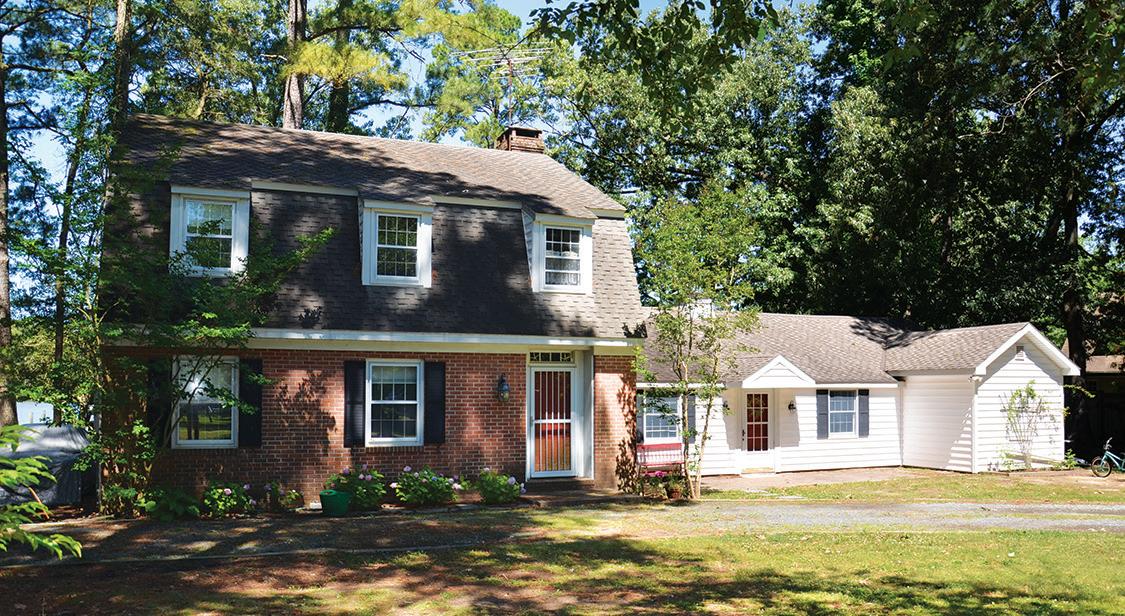
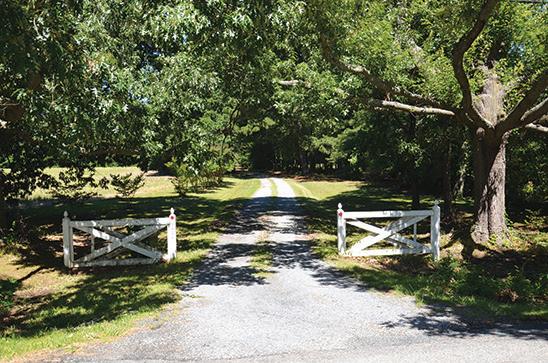
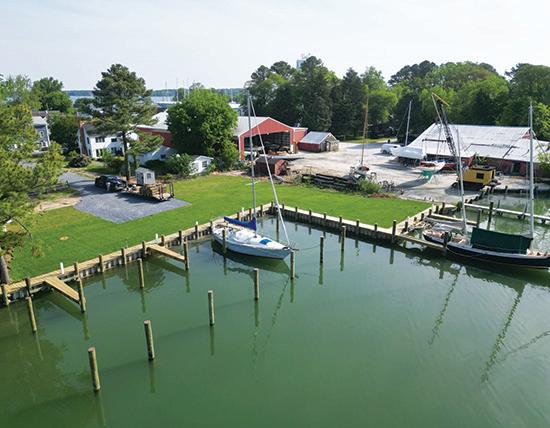
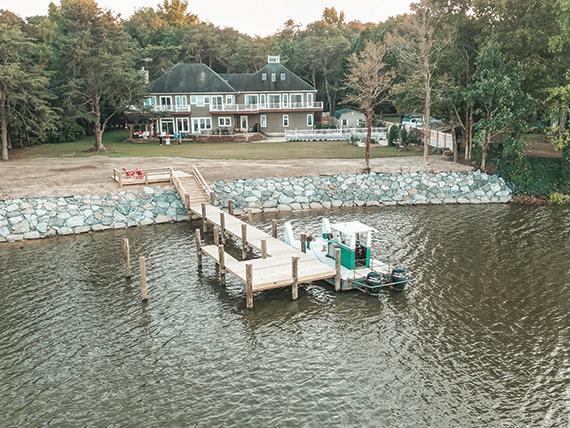
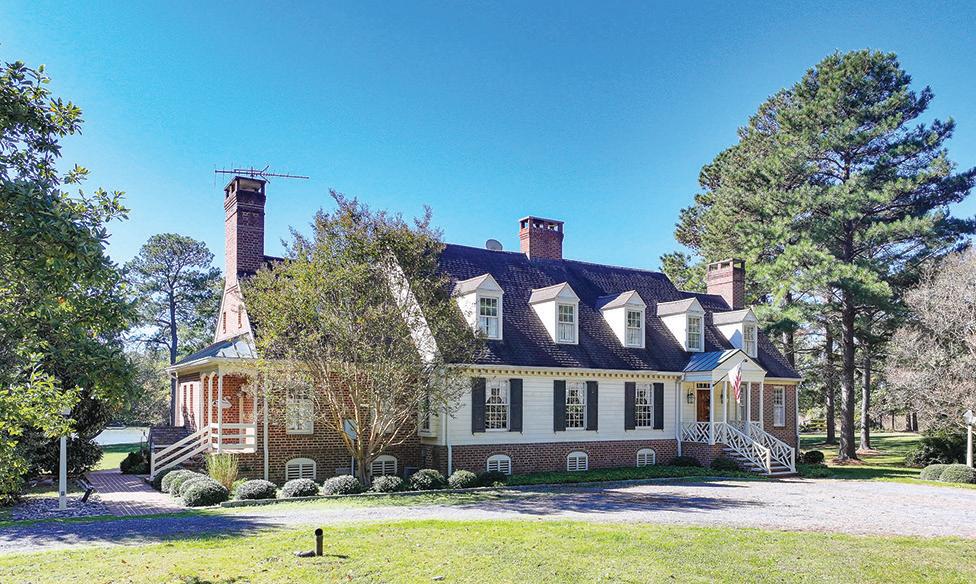
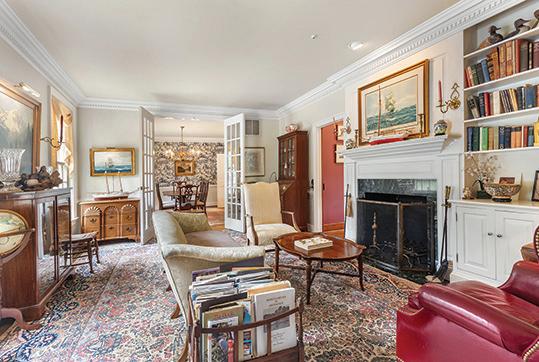
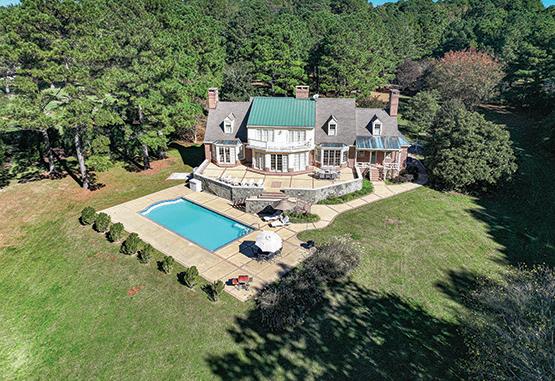
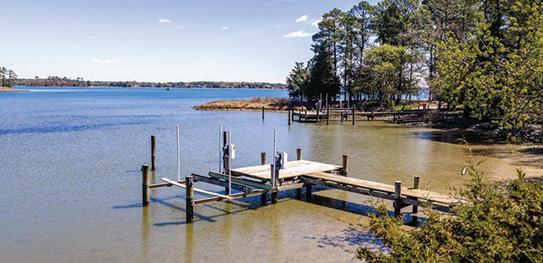
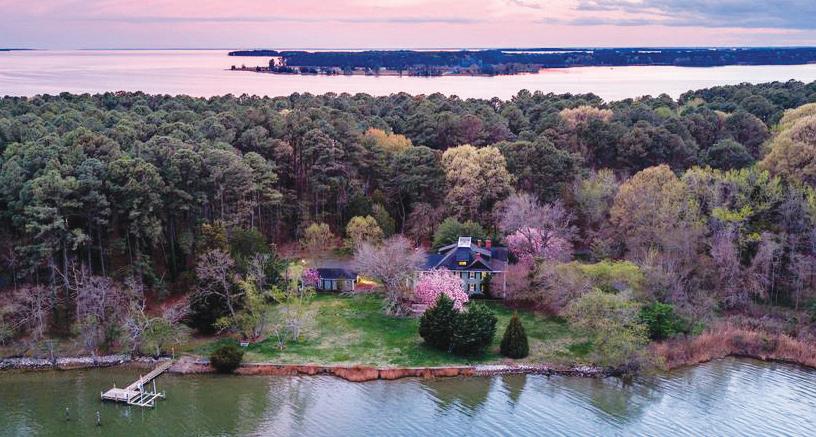
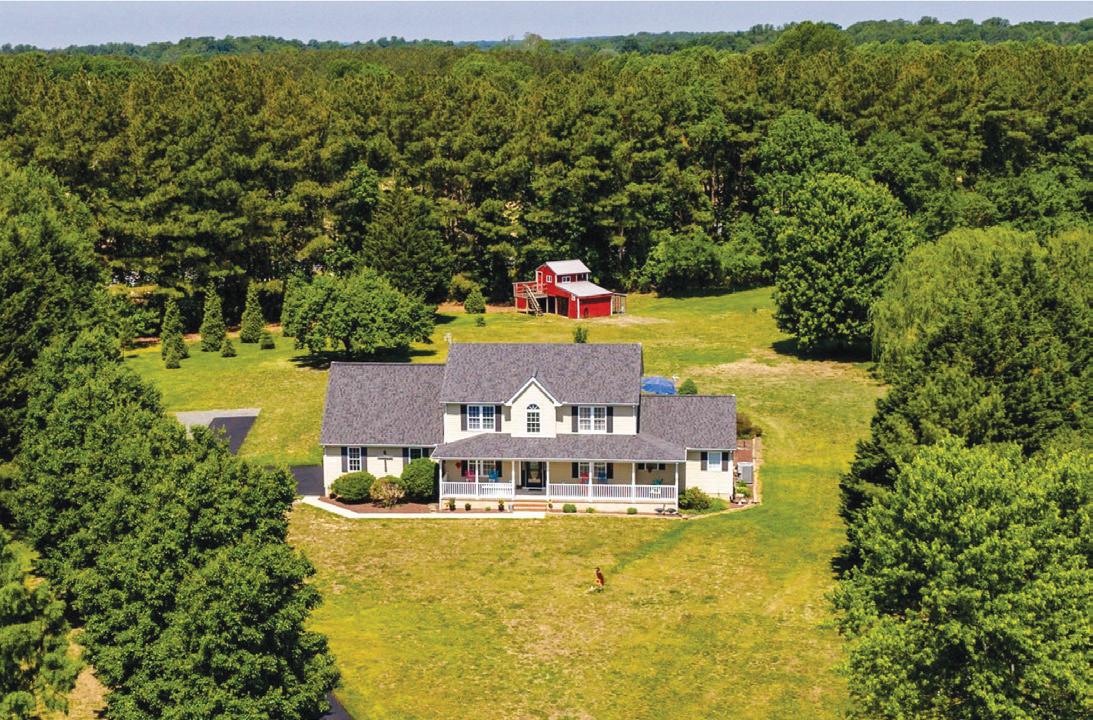
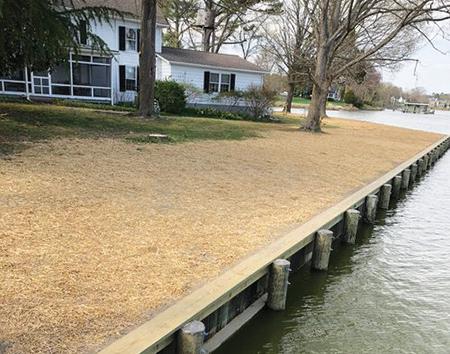
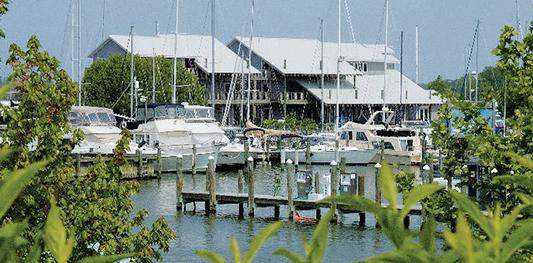
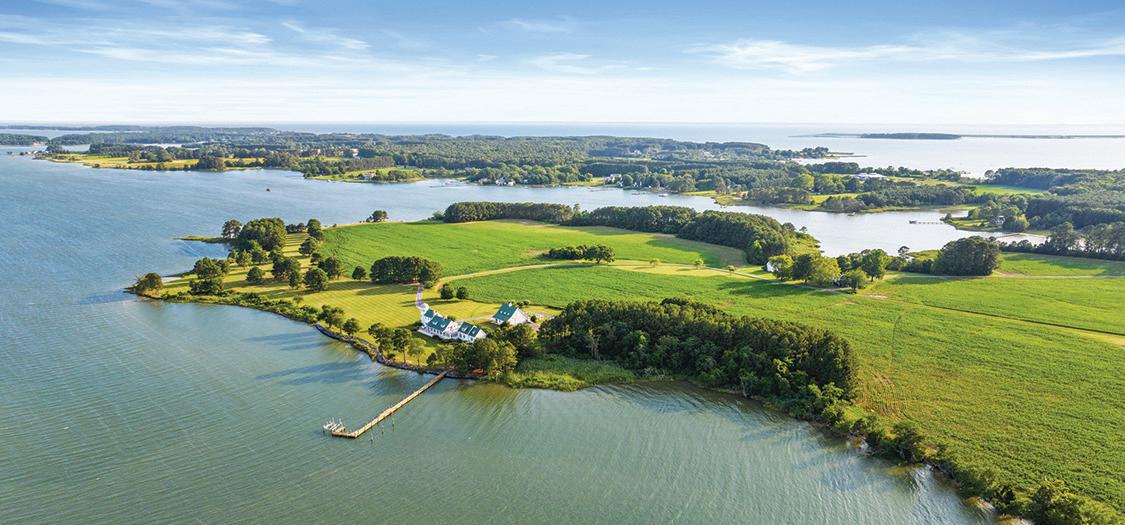
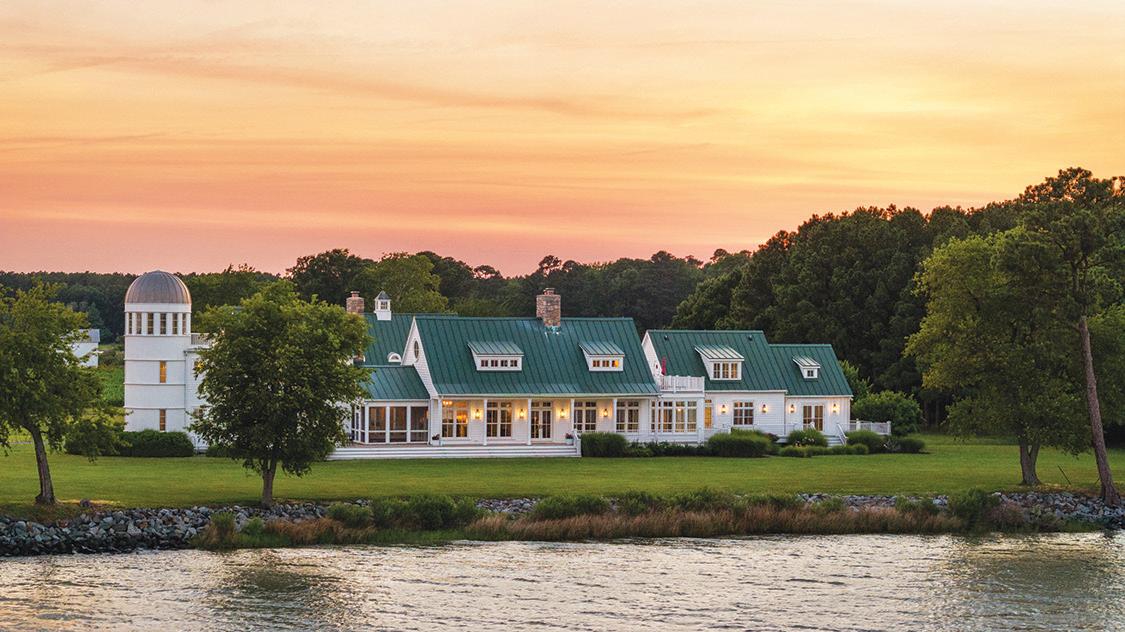
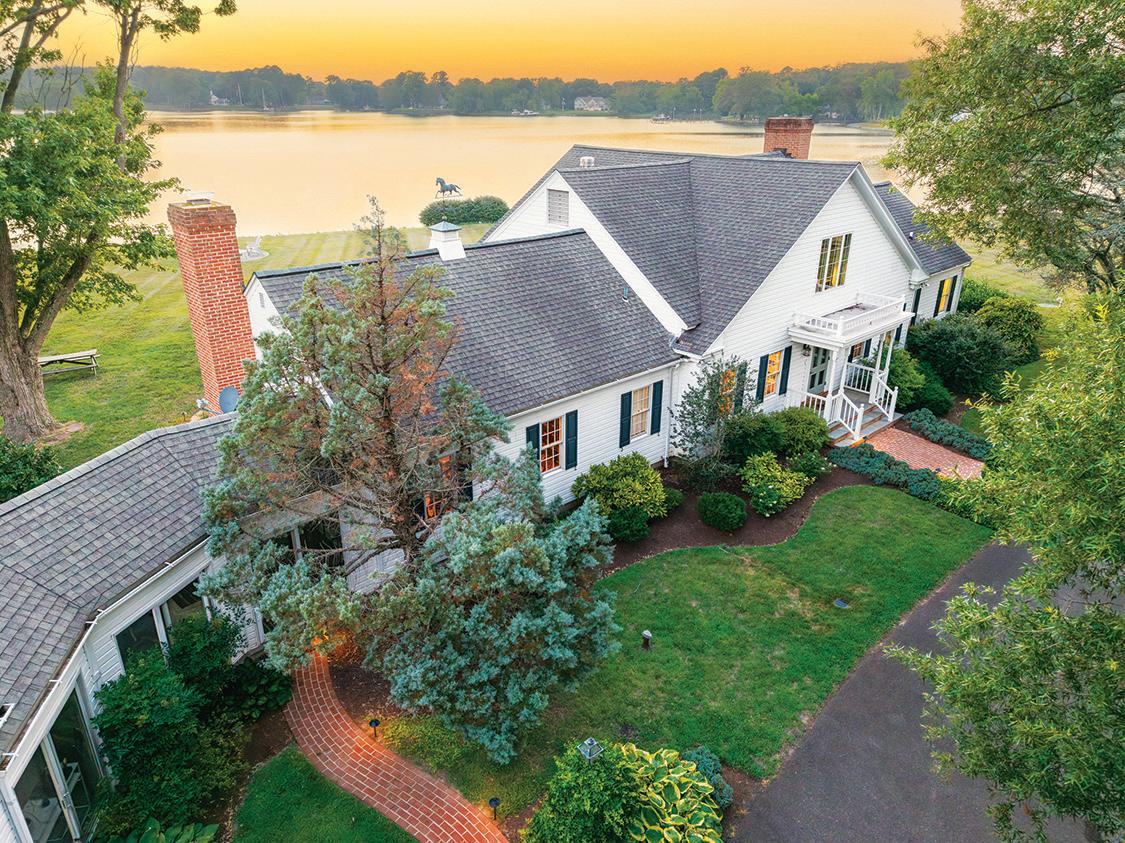
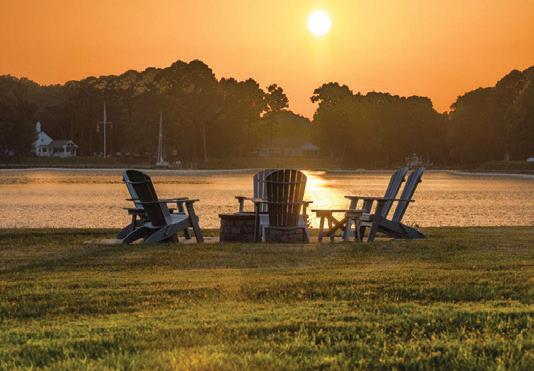
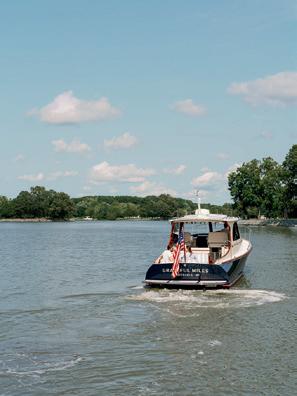
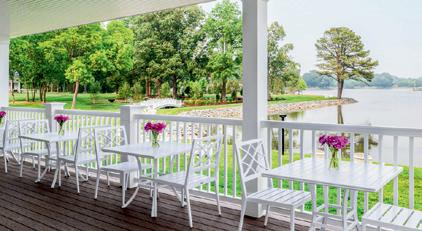
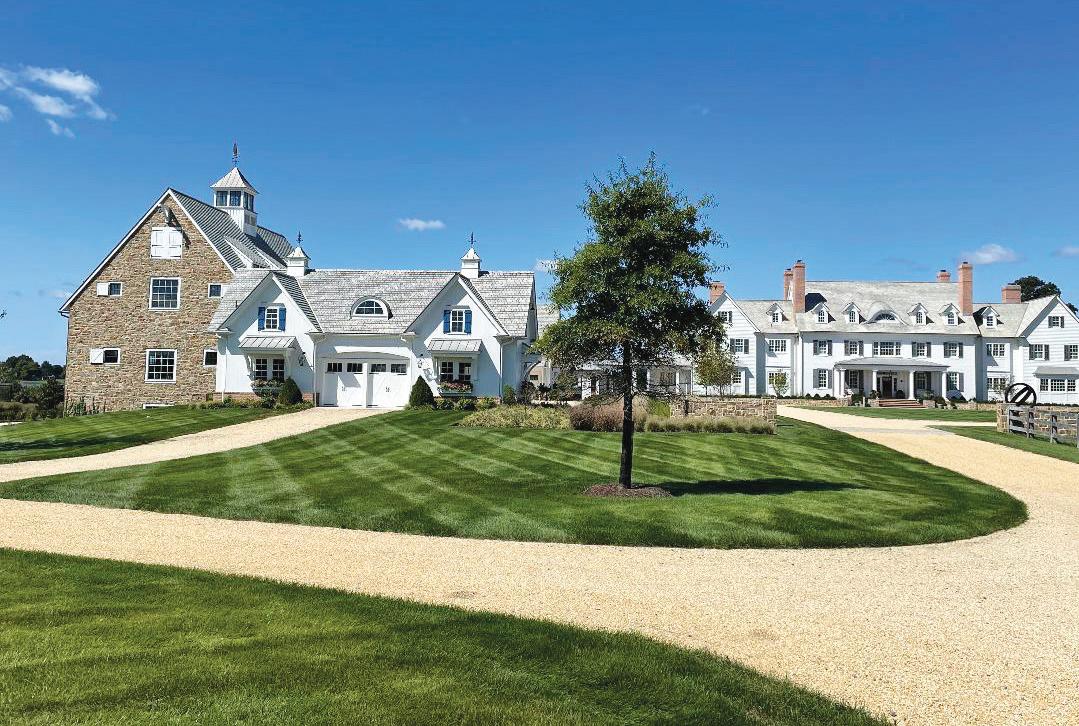
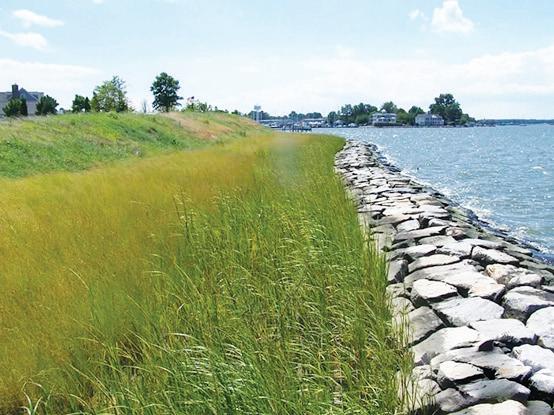
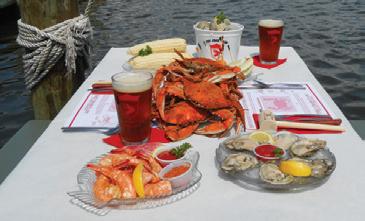
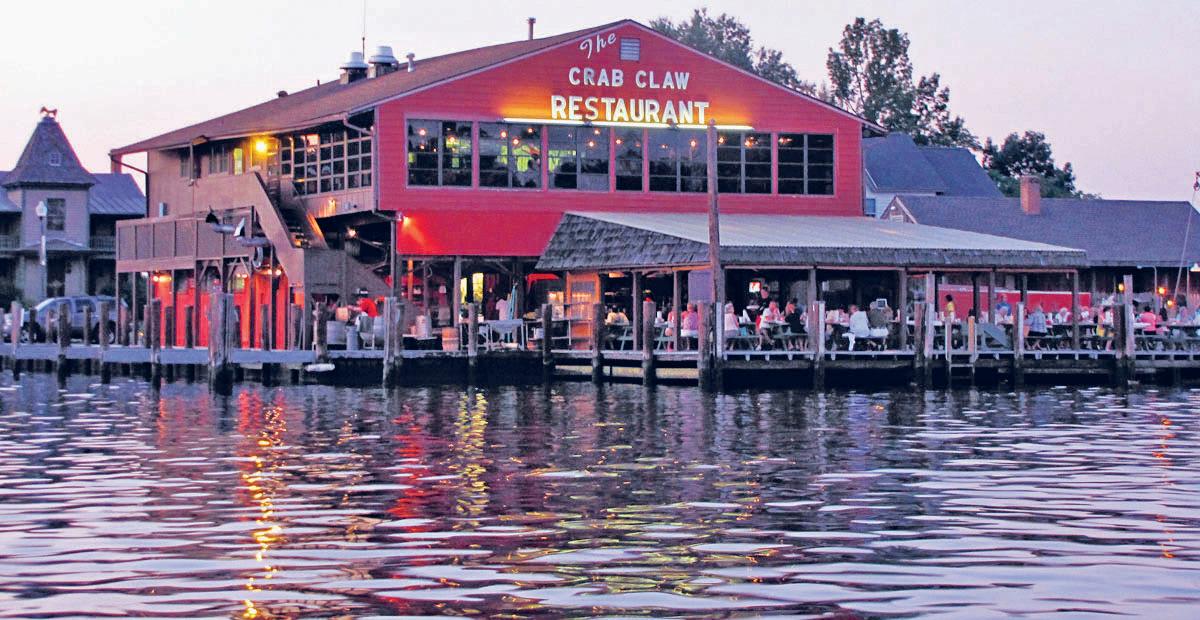
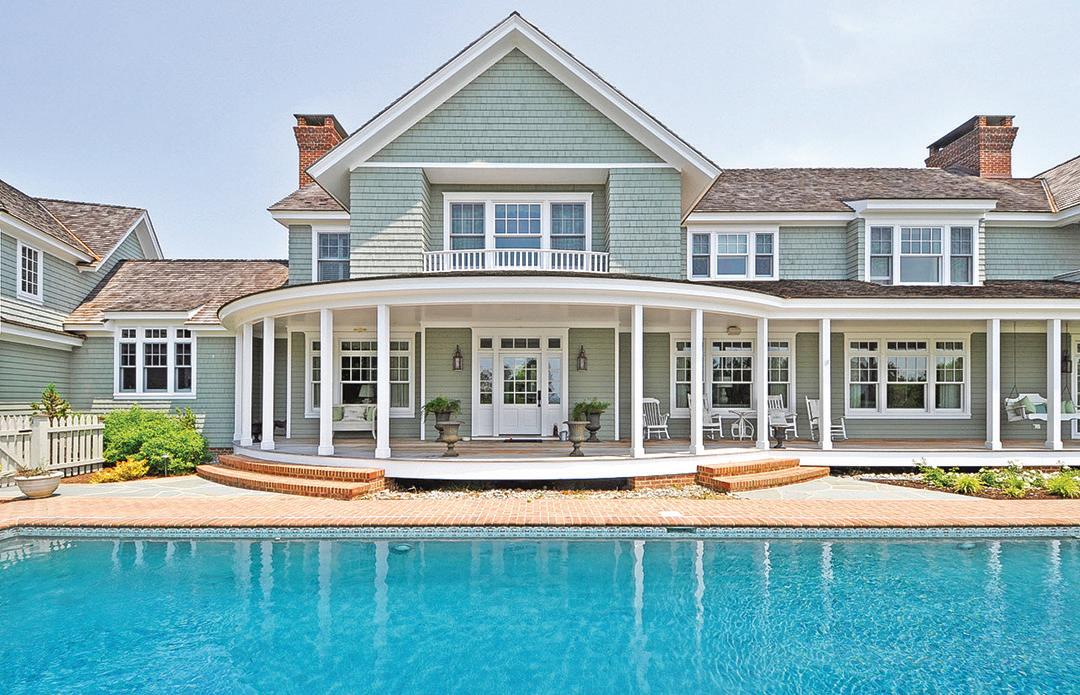
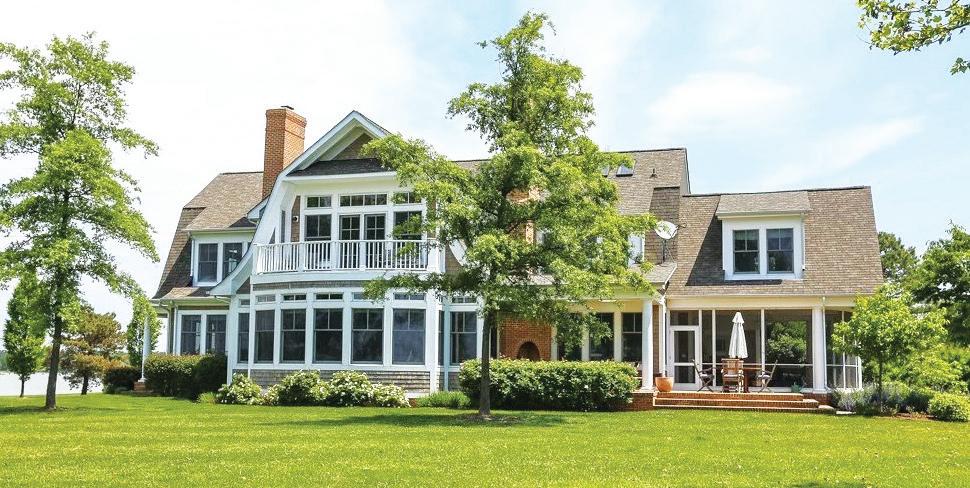
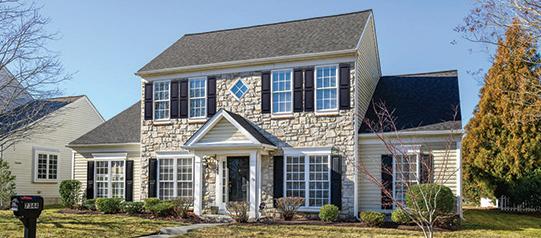
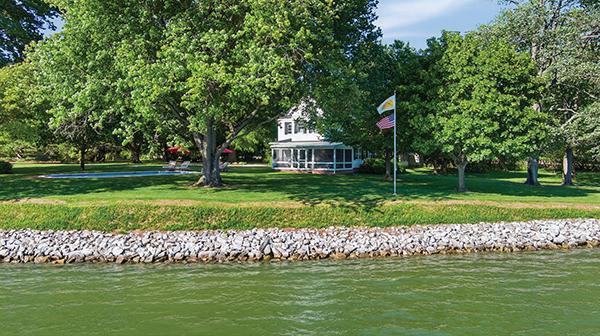
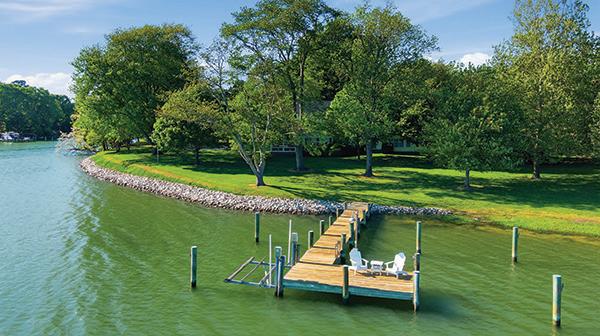
Just 4 miles outside St. Michaels, this 4-bedroom home faces west across the sparkling waters of Harris Creek. Big sunset views! Located in an area of large waterfront estates, the 15-acre property features a long driveway passing tilled fields and century-old trees. A beautiful approach! Private 120’ dock provides over 4’ MLW.
Just Listed for $1,995,000
Tidewater Gardening - Dog Days and Zucchini: K. Marc Teffeau
The Incomparable Ms. Helen Chappell
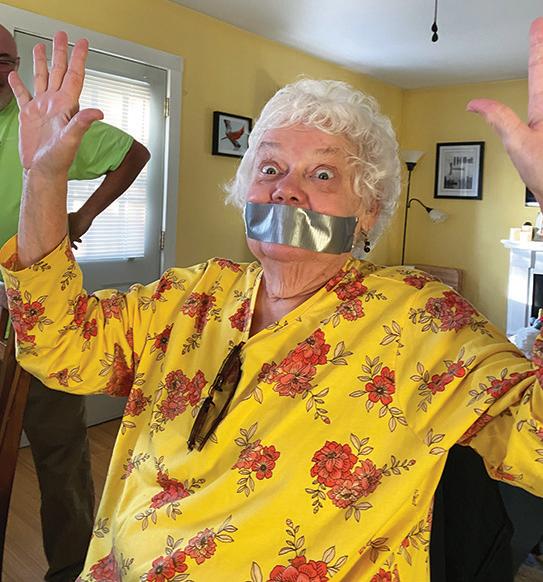
There have been times in my life when I wish I were a wordsmith. Today is one of those days. Today it falls to me to tell you that our dear, wonderful, funny Helen Chappell has passed away.
I vividly remember the first time I met Helen. I was pregnant at the time and I remember her encouraging me to “name him Elvis if it’s a boy.”
When Helen walked into a room, her personality filled all the cracks. Most often irreverent – always hilarious. She became known around our house (very affectionately) as Auntie Bad Influence. She would pop by at Thanksgiving or Christmas, bottle of wine in hand, and keep us all entertained for hours.
Her time as a court reporter was especially influential in her life and her art. She learned all the ins and outs of our Mid-Shore community. She considered the Shore the most interesting place she could live, and was passionately interested in the culture, history and social anthropology of the region, which she often used in her work.
She made friends wherever she went. She knew how to talk to people and get them to talk to her, but most importantly she really listened. When you were loved by Helen, you knew it.
Helen was a private person, but I think most comic geniuses are. She observed life and put her own unique spin on it.
Helen was a once in a lifetime talent and we were so blessed to be even a small part of that life. Her family here at Tidewater Times will truly miss her light and her humor, but most of all, her friendship.
Please join us and raise a glass to the incomparable Ms. Helen Chappell!
With much Love and Admiration John and Anne Farwell
Tidewater Times will do a special tribute article in the September issue.
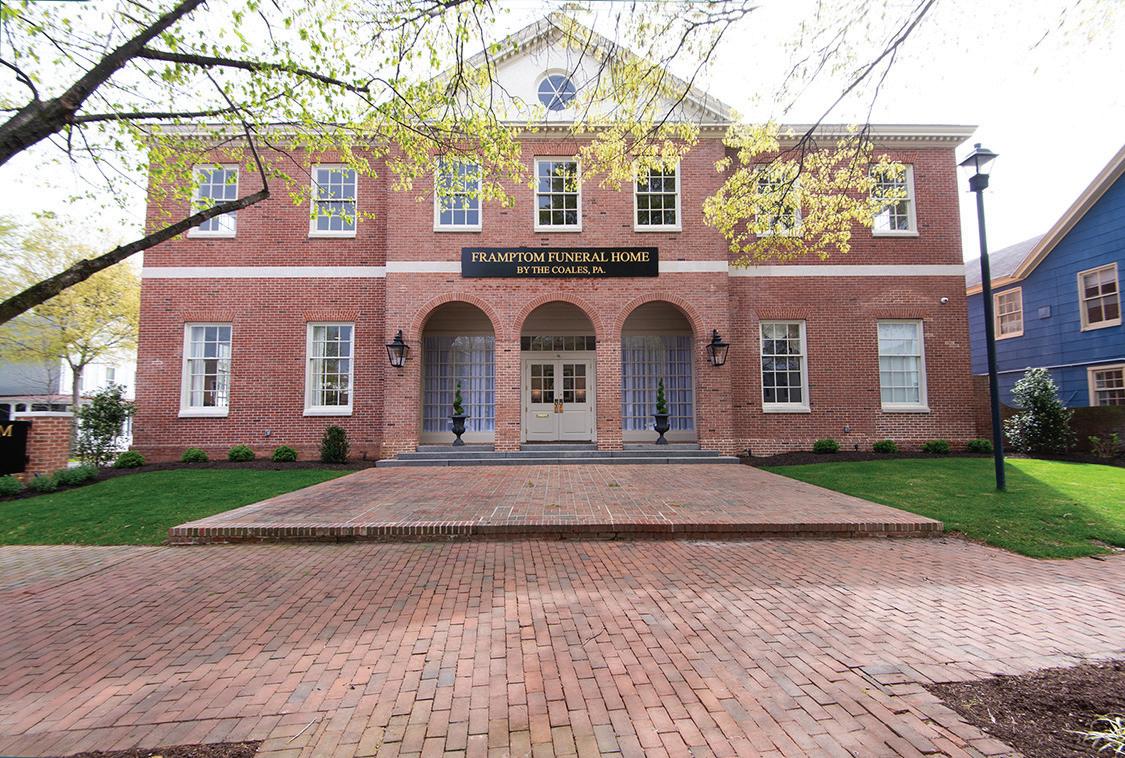
FRAMPTON FUNERAL HOME
EASTON, MARYLAND
About the Cover Artist Linda Farwell
Claude Monet spent the last 30 years of his life captivated by the ever-changing beauty of his garden. I’ve always been inspired by that— how the rhythms of nature can offer endless wonder when we slow down and truly observe. After many years in New York City, I finally had the chance to follow in his footsteps and plant a wildflower meadow right outside my back door.
This meadow has become both a sanctuary and a studio. I spent the summer watching it come alive— blooms emerging, bees dancing, butterflies drifting, and later, the quiet grace of decay. I used a 19thcentury photographic process called Cyanotype—one that would’ve been contemporary to Monet’s time—to capture these fleeting moments. Watercolor paint, sunlight, and the delicate impressions of flowers all came together in layered, organic compositions. The sun would develop each piece, and like alchemy, water would wash away the cyan blue where it had been shielded— revealing wildflower forms glowing beneath in watercolor hues.
These works are part documentation, part dreamscape. They reflect both the chaos and calm of nature and the surprises that come with creative experimentation. I hope they do more than just please the
eye—I hope they inspire a connection. A longing to nurture a patch of wildness, however small. To plant a few native seeds. To watch the bees return. Because even a little meadow can change everything.
Linda Farwell is a photographer and visual artist based in Centreville, Maryland. Her series The Meadow will be on view September 1 through October 30 at Adkins Arboretum, 12610 Eveland Road, Ridgely, Maryland, with an opening reception on September 5 from 2–4 p.m.
Leading With Compassion: Patty Crankshaw-Quimby’s
15 Years
Transforming Talbot Humane and Animal Welfare on Maryland’s Mid-Shore
by Tracey F. Johns
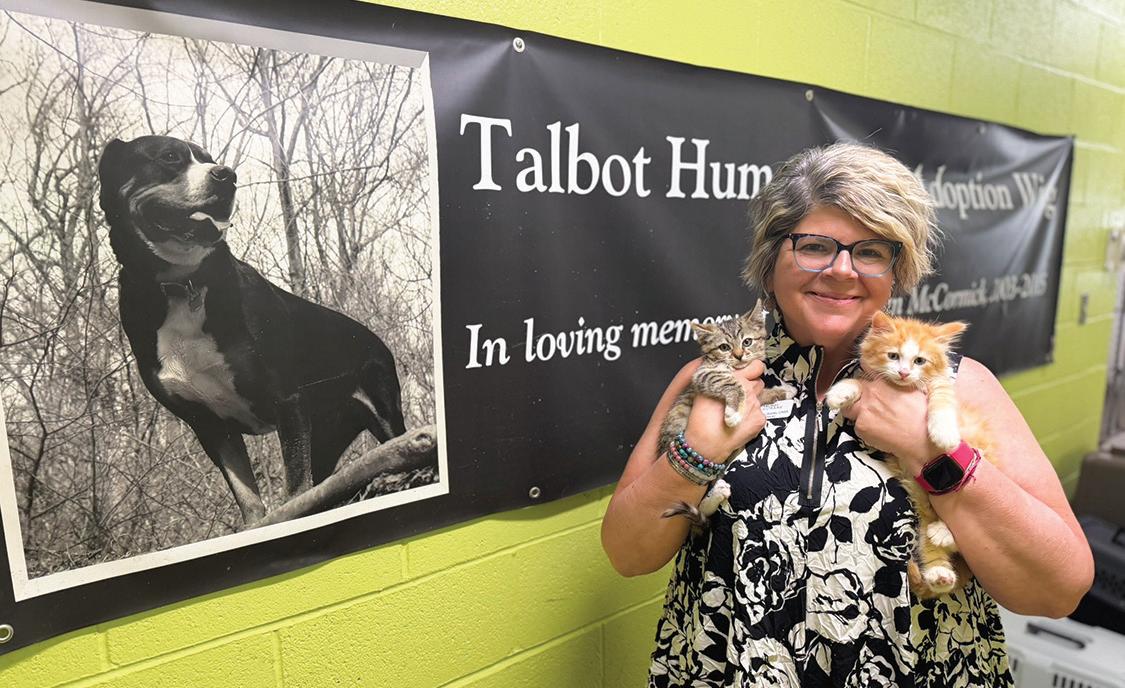
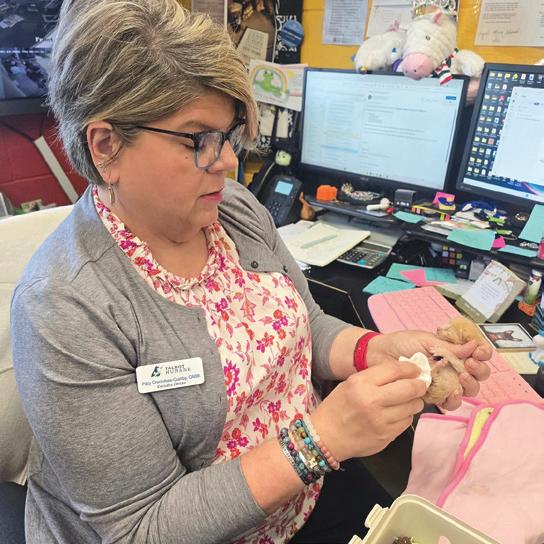
When Patty Crankshaw-Quimby talks about animals, it becomes clear that her work leading Talbot Humane is not simply a career. It is a calling that has shaped her life since childhood.
“I can’t remember a time when animals weren’t what I gravitated to,” she says.
That lifelong connection has guided Crankshaw-Quimby through
nearly three decades at Talbot Humane and 15 years as executive director. Under her leadership, the organization has evolved from a traditional animal shelter into a sophisticated community resource that serves both animals and the people who love them.
Today, Talbot Humane is recognized throughout Maryland’s Eastern Shore for its professional
Leading with Compassion
staff, extensive volunteer network, innovative programs and growing impact on both animals and the people who care for them.
From Animal Caretaker to Executive Director
Crankshaw-Quimby’s path to leadership was anything but conventional.
A graduate of Salisbury University with a degree in microbiology, she originally planned to pursue graduate studies. Life took a different turn after the unexpected death of her father. She spent several years working at Mason’s Restaurant in Easton before learning about an opening at Talbot Humane in 1999.
“I thought this was a good opportunity for a full-time job with benefits,” she recalls.
She accepted the position as an animal caretaker. Twenty-seven
Beautiful
Women’s Clothing, Accessories and More!
Leading with Compassion
years later, she’s still there.
“I like to joke that I’m still trying to figure out what I want to be when I grow up,” she says with a laugh.
Over the years, Crankshaw-Quimby served as an animal caretaker, animal control officer, humane officer, shelter coordinator and interim director before becoming executive director in 2011.
Those early experiences shaped her leadership philosophy.
“I definitely didn’t start as a leader. I started as a boss,” she says. “I quickly learned that being the boss doesn’t bring about change. You have to lead people to change.” Since then, she has focused on building a culture of education, accountability, and professional excellence.
Building a Team of Experts
When Crankshaw-Quimby arrived at Talbot Humane, the orga-
Leading with Compassion
nization employed fewer than eight people. Today, it has grown to a staff of 20 professionals supported by an extensive volunteer corps.
She believes that excellent animal welfare begins with investing in the people doing the work.
“If you want to be the standard of excellence in animal welfare, you have to build a team that is the standard of excellence in animal welfare,” she says.
Crankshaw-Quimby has worked to change a profession where continuing education and career development were often limited.
“I feel it’s really important that when people have a passion for something, you support it,” she says.
Employees receive benefits, retirement opportunities, paid leave and professional development, helping to create a highly trained
team equipped to address increasingly complex animal welfare challenges.
“I tell everybody when they start here, especially my animal care people, ‘I started in your position,’” she says. “You can go anywhere.”
Crankshaw-Quimby holds a Certificate in Organizational Leadership and is a Certified Animal Welfare Administrator, a credential held by fewer than 400 professionals nationwide.
A Leader Beyond Talbot County
While her primary focus remains on Talbot Humane, Crankshaw-Quimby’s influence extends throughout Maryland. She serves as vice president of the Maryland Board of Veterinary Examiners, an appointment made by the governor. She also serves on Maryland’s Spay and Neuter Advisory Board, which helps allocate approximately $1 million annually in grant funding to animal welfare organizations throughout the state.
Since 2015, she has served as president of the Professional Animal Workers of Maryland, the statewide organization representing shelters and animal control agencies. Her colleagues across the state view her as a trusted voice, a practical problem-solver and an advocate for professional standards.
She regularly works with law-
Leading with Compassion
makers, testifies before the Maryland General Assembly and advocates for policies that improve outcomes for both animals and communities.
“I’m very proud to say Maryland has moved up in our ranking of humane treatment of animals in our laws,” she says.
How Animal Welfare Has Changed
Perhaps the most significant change during Crankshaw-Quimby’s career has been the transformation of animal welfare itself. When she began working at Talbot Humane in 1999, the organization
took in nearly 2,000 animals annually. Sheltering practices looked very different from what they do today.
“We were what people referred to as ‘the pound,’” she says.
Today, Talbot Humane admits roughly 1,000 animals each year while maintaining a live release
rate of approximately 93 percent. Yet Crankshaw-Quimby believes those numbers tell only part of the story.
“The number of animals coming in continues to go down, but the number of people and animals we serve in the community keeps increasing,” she says.
That shift reflects a profession increasingly focused on prevention rather than intervention. Instead
of simply caring for animals after they enter a shelter, organizations work to keep pets safely in their homes whenever possible.
“We’re dedicated to keeping as many pets as possible with their people at home,” Crankshaw-Quimby says.
Animal welfare and human welfare are often deeply connected. Families facing hardship frequently need support, not surrender. Crankshaw-Quimby believes helping people often helps animals. The goal is not simply finding homes for pets but preserving the bond between animals and the families who love them.
Programs That Changed Lives
Under Crankshaw-Quimby’s leadership, Talbot Humane has expanded programs designed to support both pets and their owners. The organization’s volunteer program has grown from approximately 15 volunteers to more than 100.
Its foster network now cares for roughly 500 animals annually, providing lifesaving support for
Classic Tidewater Architecture Inspired by the timeless elegance of traditional Tidewater estates, this exceptional waterfront home on Maxmore Creek showcases craftsmanship rarely found today. Designed and built by its owner, the residence features handmade oversized brick in the classic Flemish Bond pattern, custom cabinetry, and exquisite millwork throughout. Offering approximately 4,000± square feet, the home includes 6 bedrooms, 7 fireplaces, a gracious great room, library, chef’s kitchen, and first-floor primary suite. Five beautifully landscaped waterfront acres, an inground pool, expansive patio, and private pier complete this extraordinary Eastern Shore retreat. $2,850,000
Leading with Compassion
vulnerable kittens, puppies and animals recovering from illness or injury. Today, trained foster volunteers provide lifesaving care for neonatal kittens and other vulnerable animals.
Talbot Humane has also strengthened partnerships with local food pantries, community organizations, and service agencies to ensure families can access pet food and supplies during difficult times.
The organization’s spay-andneuter initiatives, educational outreach, animal control services, and pet retention efforts have all expanded significantly during Crankshaw-Quimby’s tenure.
“Caring for animals in the building is probably the least expensive part of what we do,” she says. “It’s investing in ensuring our community knows how to take care of their animals properly and knows that we’re here to provide services.”
Those investments have helped reduce shelter admissions while increasing the number of people and animals receiving assistance.
Growth With Purpose
When Crankshaw-Quimby became executive director, Talbot Humane operated with an annual budget of approximately $600,000 to $700,000. Today, that budget exceeds $1.5 million.
The growth reflects far more
Leading with Compassion
than organizational expansion. It has enabled Talbot Humane to invest in professional staffing, community outreach, education, foster
care, pet retention programs and critical services that help families remain together with their animals.
The organization’s relationship with Talbot County government remains strong, but community support has made much of that growth possible.
For Crankshaw-Quimby, every investment ultimately comes back to serving the community more effectively.
What keeps her awake at night is not shelter capacity or organizational growth.
It’s people.
“I’ve definitely been in positions where I needed help and, like others, felt ashamed or embarrassed
Leading with Compassion
to ask for help,” she says. “I never want somebody to feel that way when they have to come to us.”
That perspective helps explain why Talbot Humane has become known not only for caring for animals but also for treating people with dignity and compassion.
As Talbot Humane celebrates Crankshaw-Quimby’s 15 years as executive director, her legacy is evident in stronger families, healthier pets, and a more compassionate Mid-Shore community. Under her leadership, the organization has evolved from a traditional shelter into a regional leader in animal welfare, preven-
Hair by Elana
tion, education and community support.
“The best community is a humane community,” she says.
Fifteen years into her tenure, that belief continues to guide both her work and Talbot Humane’s future.
Tracey Johns has worked in communications, marketing and business management for more than 30 years, including non-profit leadership. Tracey’s work is focused on public and constituent relations, along with communication strategies, positioning and brand development and project management.
Helen Chappell: 1947-2026
Helen Chappell, writer and artist, died June 20, 2026, in Easton, MD. She was 79 years old. She was the daughter of Helen B. and Dr. Leslie E. Chappell and the stepdaughter of the late Blanche C. Chappell.
Over the course of a career that spanned several decades, Chappell produced more than 40 novels, collections and works of non-fiction. From 1989-1997, she wrote the award-winning column Oysterback Tales for the Opinion Commentary page of the Baltimore Sun, becoming one of the few journalists to produce a column of fiction for a major urban daily. She also wrote for the Washington Post and other newspapers. For many years, she wrote columns and articles for the Easton, Maryland Tidewater Times.
Although she was best known as a regional writer who made the Eastern Shore of Maryland her territory in fiction and non-fiction, her work included the successful Sam and Hollis mystery series, A Whole World of Trouble. Oysterback Tales, Oysterback Spoken Here, Chesapeake Bay Book of the Dead and many others. She wrote a series of historical romances under the noms-de-plume Rebecca Baldwin and Caroline Brooks. Her output was recognized with a number of awards, grants and prizes. She also illustrated several of her
own books and continued an interest in the visual arts throughout her life, producing drawings, paintings and sculpture. Her writing and art were often characterized by a strong sense of place, dialogue, magical realism and a biting sense of humor. She also worked as a teacher and editor, as well as mentor to many aspiring writers.
Chappell was a collector of art and antiques, and was working on a sculptural project, The Travelling Elvis Shrine, at the time of her death.
Born May 1, 1947, in Kennett Square, PA, Chappell drew her inspiration from a childhood spent partially on her father’s Hereford farm near Cambridge, as well as the family gunning club in Hooper’s Island. “I grew up listening to watermen and farmers sitting around John Lewis’ store in Cornersville telling bigger and better lies,” she once remarked.
Helen Chappell
“And I often think that’s where it all started.”
Chappell graduated from Franconia College and attended the School of Visual Arts. She began her writing career as an assistant to Phoebe Larmore Literary Agency in New York, where she published her first books.
After a peripatetic career in which she lived in Boston, New York, London and Los Angeles, she returned to the Eastern Shore in 1978 to work on a novel. She intended to stay for a year but ended up spending most of her life in Talbot County. She considered the Shore the most interesting place she could live and was passionately interested in the culture, history and social
anthropology of the region, which she often used in her work.
“Oysterback is the pearl in the Oyster of the Eastern Shore,” John Barth wrote of her work, a statement that Chappell frequently said validated her career parking ticket, since she considered Barth a seminal influence on her life.
Chappell is survived by a brother, Ed Chappell of Ormond Beach, FL; two nieces, Christy Hughes of Islamorada, FL and Kimberly Chappell of Wilmington, DE and seven godchildren, Kate Sager of York, PA; Eve Merriman of San Diego, CA; Amelia Brown of Rising Sun, MD; Anna Basile White of Salisbury, MD; Matthew Basile of Nanticoke, MD; Andrew Sindermann of Rochester, NY and Laura Sindermann of Charlotte, NC; and a namesake, Helen Russell of Portland, OR. “Always a godmother, never a god,” was her motto she often said.
She served on the boards of Friends of the Library, the Talbot County Arts Council and Stola Women Writers. She volunteered for the Talbot County Free Library, Talbot County Hospice and other local and national organizations.
Burial will be private; family and friends will be invited to attend a celebration of Helen’s life at a later date. Donations may be made to the Talbot County Free Library, Talbot County Hospice and the Susan G. Komen Breast Cancer Foundation.
Chuck Mangold Jr. - Associate Broker
BENSON & MANGOLD REAL ESTATE
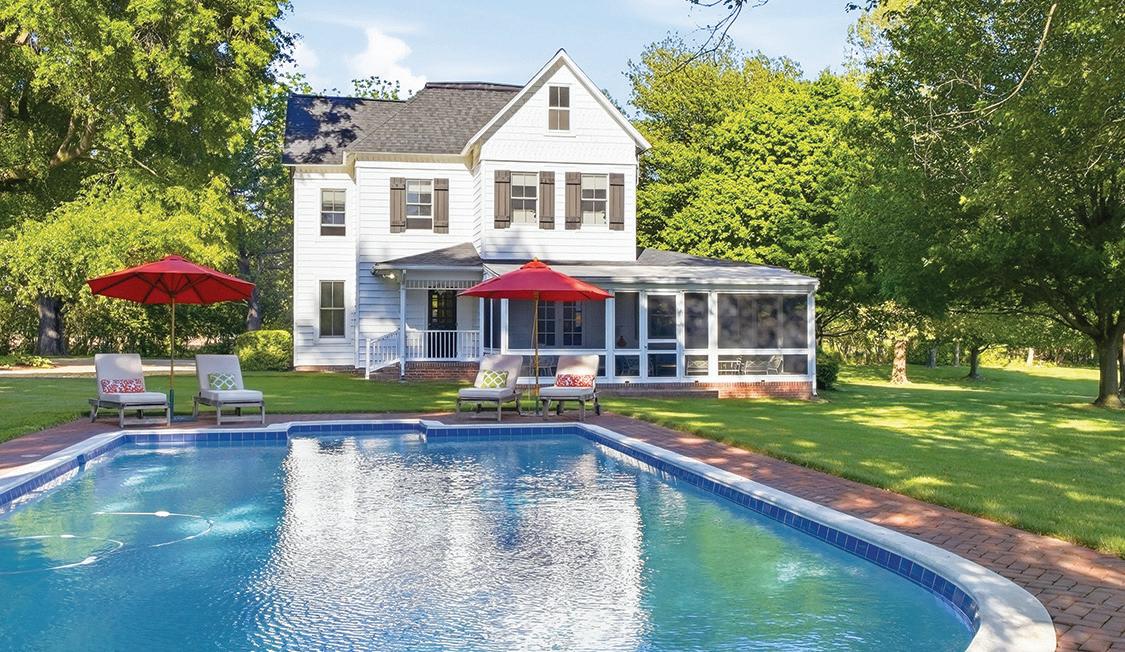
Offered for the first time in over 50 years, this 13+/- acre waterfront property on Broad Creek presents a rare opportunity to own an expansive estate with exceptional shoreline frontage. With more than 960+/- feet of waterfront, the setting provides unobstructed water views and a private pier, offering direct access to the creek and surrounding natural landscape. A tree-lined private driveway leads to the residence, positioned to take full advantage of its waterfront location. The home features 6 bedrooms and 4 full/1 half baths. The main level includes a screened-in porch entry, welcoming foyer, spacious living room with fireplace, formal dining room with a second fireplace, and a flexible study or office with built-in shelving and water views. The updated eat-in kitchen is equipped with granite countertops, a large breakfast bar, gas cooktop, stainless steel appliances, and a spacious pantry. Both a primary staircase and a secondary staircase provide access to the upper levels. All six bedrooms are located on the second floor. The owner’s suite includes a fireplace, ensuite bath, and access to a front-facing balcony. Front-facing secondary bedrooms also have balcony access. The third level offers additional living space, including a large bonus room, entertainment room, three additional rooms, and a full bath with shower. Additional property features include a detached garage with parking and storage, an externally accessed basement for storage, a wide exterior pad suitable for boat or RV storage, hardwood floors, a waterside deck, and a private pier. This property combines acreage, extensive waterfront frontage, and a spacious residence ready for its next owner.
$1,995,000 | 7421QuakerNeckRoad.com
BENSON & MANGOLD REAL ESTATE
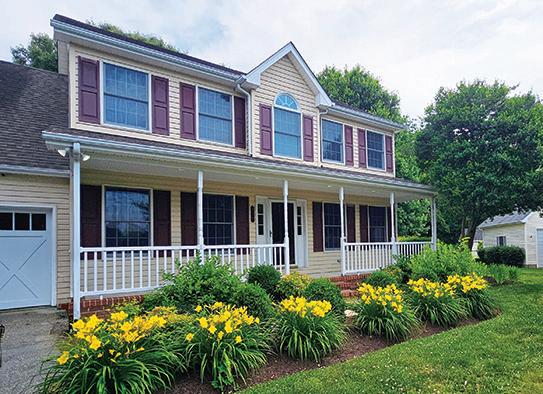
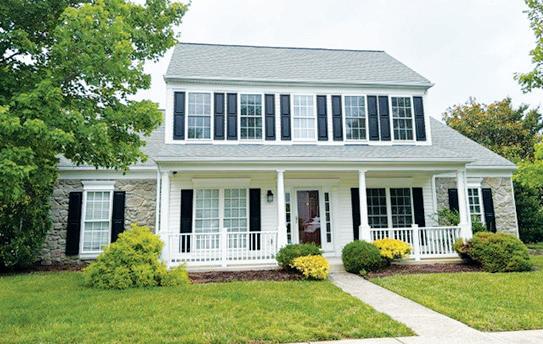
Situated at the end of a cul-de-sac in Cordova, this well-maintained home offers 3.7± acres surrounded by mature trees with convenient access to Route 50, Easton, Wye Mills, and nearby amenities. A covered front porch welcomes you inside to a thoughtfully designed layout featuring hardwood flooring throughout most of the home, four bedrooms, and two-and-a-half bathrooms.
The main level includes a desirable primary suite formal dining room, and a flexible room off the foyer currently used as a gym that could easily serve as a home office. The kitchen is centered around a large island and opens to the living spaces, creating an ideal setup for both everyday living and entertaining. Pride of ownership shines through with substantial recent updates to the home’s interior, appliances, mechanical systems, and outdoor features.
Upstairs, two bonus rooms provide additional versatility for office, study, hobby, or guest space. Outdoor features include a deck with pergola overlooking the inground pool, a two-car garage, storage shed, and additional stall barn, offering plenty of room for equipment, hobbies, or animals. This property combines space, functionality, and a convenient Eastern Shore location.
Bethany Beach Beginnings
Celebrating Its 125th on America’s 250th by
Bonna L. Nelson
Long before beach towels dotted the sand and the scent of saltwater taffy drifted through boardwalk breezes, the Delaware coastline was a rugged frontier—shaped by wind, water, and centuries of human endeavor...
…the Delaware Shore tells a story of transformation—where past and present walk hand-in-hand along the tide.
~ Discover the Delaware Shore
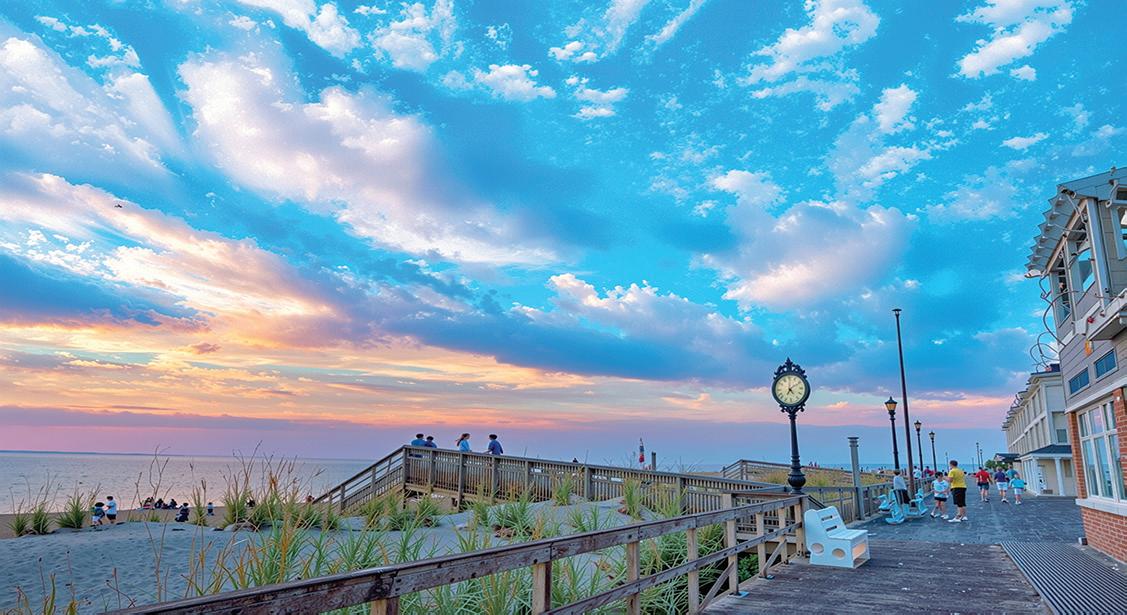
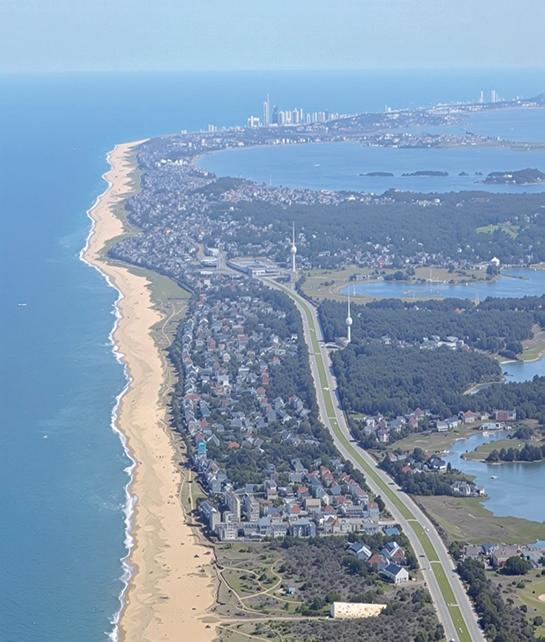
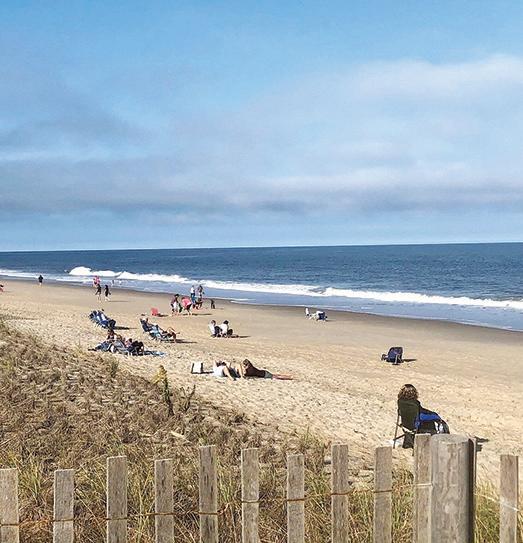
Local folks know Bethany Beach, Delaware (DE), as one of the “Quiet Resorts” along with the beach towns of South Bethany and Fenwick as well as nearby inland towns on bays and creeks. The popular, family-oriented beachfront towns align along the southern Delaware Atlantic coast. With sparkling water,
wide beaches, pleasant boardwalks, beachy and boutique shops and quiet restaurants, they offer an attractive contrast to the hustle and bustle of the busier hotspots of Rehoboth Beach, DE and Ocean City (OC), MD to the north and south. Coastal Highway (Route 1) parallels the Atlantic Ocean and connects the beach towns
Bethany Beach
all through Delaware and Maryland. Growing up in Maryland, my younger years were spent on summer vacations in Ocean City. We usually rented a house in north OC somewhat away from the hustle and bustle but always drove into downtown OC for our favorite adventures on the boardwalk. We loved to play games in the arcade, play the claw machine for prizes, ride the carousel, bang into each other in the bumper cars and buy a T-shirt or hoodie.
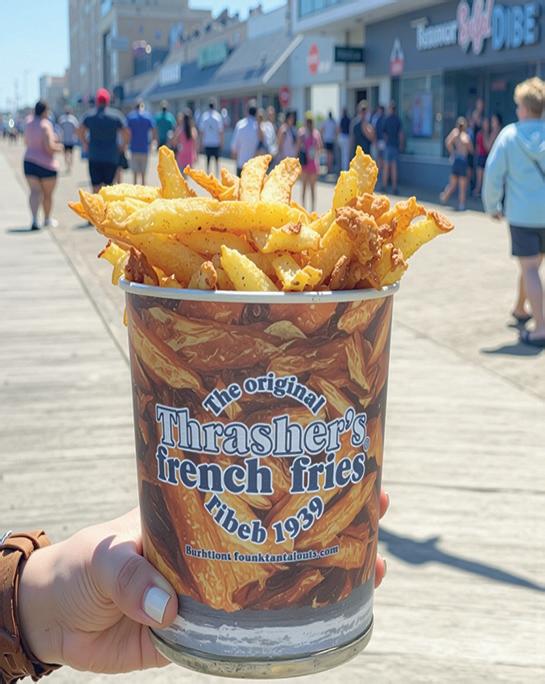
Food was the highlight of the boardwalk excursion and still is today when we take a drive from our summer rental, now in Bethany Beach, to the popular OC boardwalk. Who can resist Thrasher’s French fries smothered in vinegar and doused with Old Bay season-
ing? Hold onto your teeth when you munch on another fave: Fisher’s or Dolle’s caramel popcorn. And my favorite teeth and diet wrecker would be Candy Kitchen’s saltwater taffy, chocolate with peanut butter filling. All these treats, followed by a Dumser’s ice cream sundae, are eaten while sitting on a bench on the boardwalk and people watching, a favorite entertainment. Nothing like it!
In the 1980s my parents retired and moved from Baltimore, MD, to Bethany Beach. Lower taxes and housing costs in Delaware vs Maryland were a factor. My brother and his family bought a place nearby. Since then, we have vacationed in Bethany Beach every summer. My family loves it there and so do friends. We have gatherings at the
Bethany Beach
beach. That was our Bethany Beach beginning and it continues.
On our most recent Bethany vacation, after several days on the beautiful, white sand beach or at the refreshing pool, I needed a break from the sun. I decided to learn more about Bethany Beach. Google searches revealed websites for Bethany’s history and museums, historical sites, a heritage trail, nature center and other noteworthy landmarks to visit.
Our first stop was the Bethany Beach History Museum in the lobby of the Town Hall downtown on Garfield Parkway, the main town street. The exhibit features memorabilia and photographs from key moments in Bethany Beach history. I learned from the displays and from various sources that Bethany Beach was founded in 1901 by the Disciples of
Christ as a religious retreat, similar in origin to Rehoboth.
Founders built small-scale cottages and inns and a tabernacle and committed to preserving family values. Development was slow, occurring over decades. Even today, the town bans boardwalk amusements like rollercoasters or arcades to maintain and preserve its peaceful character. Efforts are also in place on the Delaware Shore to protect its fragile wetlands and to celebrate Indigenous and colonial history while supporting small businesses and maintaining a cultural balance.
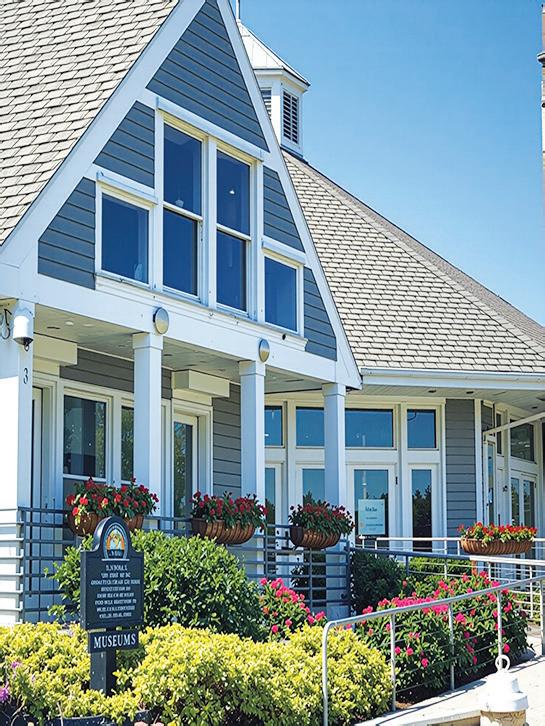
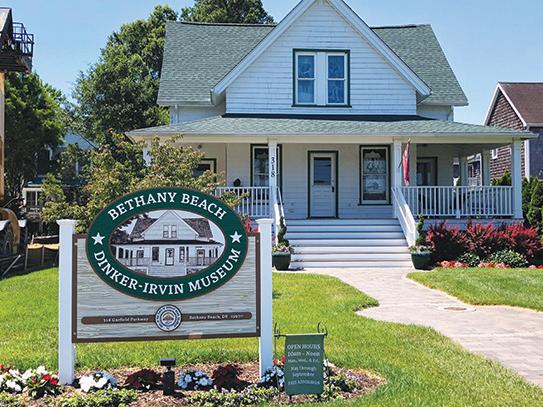
The folks in the Town Hall encouraged me to visit the Bethany Beach Dinkler-Irvin Cottage Museum across the highway on Garfield Parkway. There, two charming docents,
Bethany Beach
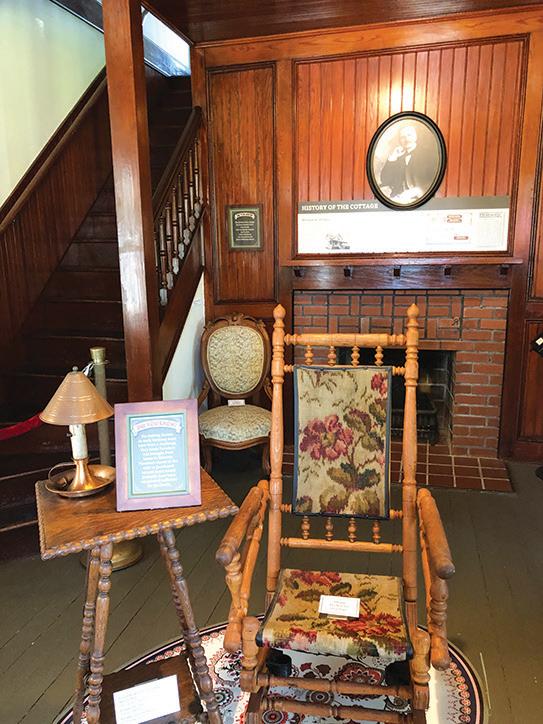
Paula Holloway and Nancy Dewlin, shared their knowledge of Bethany Beach and the Dinkler-Irwin House history and literature. On a selfguided tour of the well-preserved cottage, I enjoyed browsing the exhibits, admired the original wood floors and trims and took many photos.
The house was built in 1903 and is one of the few remaining original cottages in Bethany Beach. Having also served as an early post office, it is the oldest public building in town. The period furnishings, linens and clothing provide insight into what life was like in the beginning years of Bethany Beach in the 1900s.
The Dinkler family was one of the
six founding families of the early religious community. The docents mentioned that the Cultural & Historical Affairs Committee of Bethany Beach, an official committee of the town, assist in maintaining the property and history of the area. Throughout the year, events are held at the house, reenactors participate and a remaining local descendant of the early families attends and shares her memories and stories.
The story of Bethany is beautifully told in the booklet, Bethany Beach, Delaware: A Walk Through History, prepared by local landowners in 1976, and shared with me by the museum docents:
As our country celebrates its 200th Glorious Fourth, Bethany Beach, Delaware, marks its 75th birthday as a religious summer retreat, a resort town and a state of mind.
The founding of this little town by the sea is an often ignored accomplishment of members of the Christian Church, also known as
the Disciples of Christ, of the Washington, D.C. area and Pennsylvania. They settled here in an era when the popular summer camp meetings sometimes led to permanent towns with religious names along the Atlantic…Today Bethany may not be exactly as its founders dreamed in 1901 as they sought a gathering place on the Atlantic…
Yet in many ways Bethany reflects the character stamped on it by those early settlers…in the words of the founding father, Dr. F. D. Power, minister, were looking for “a haven of rest for quiet people,” presenting a safe and rational way of spending the heated term.”
Today sea and sand lovers of many persuasions are still searching for serenity and solace and
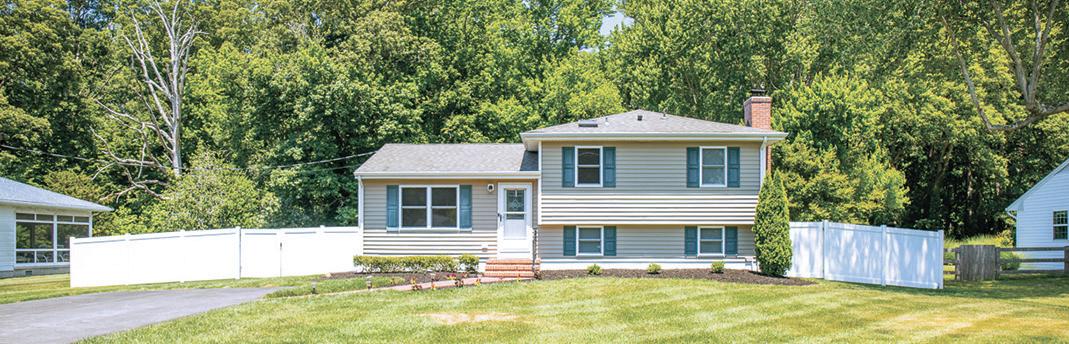
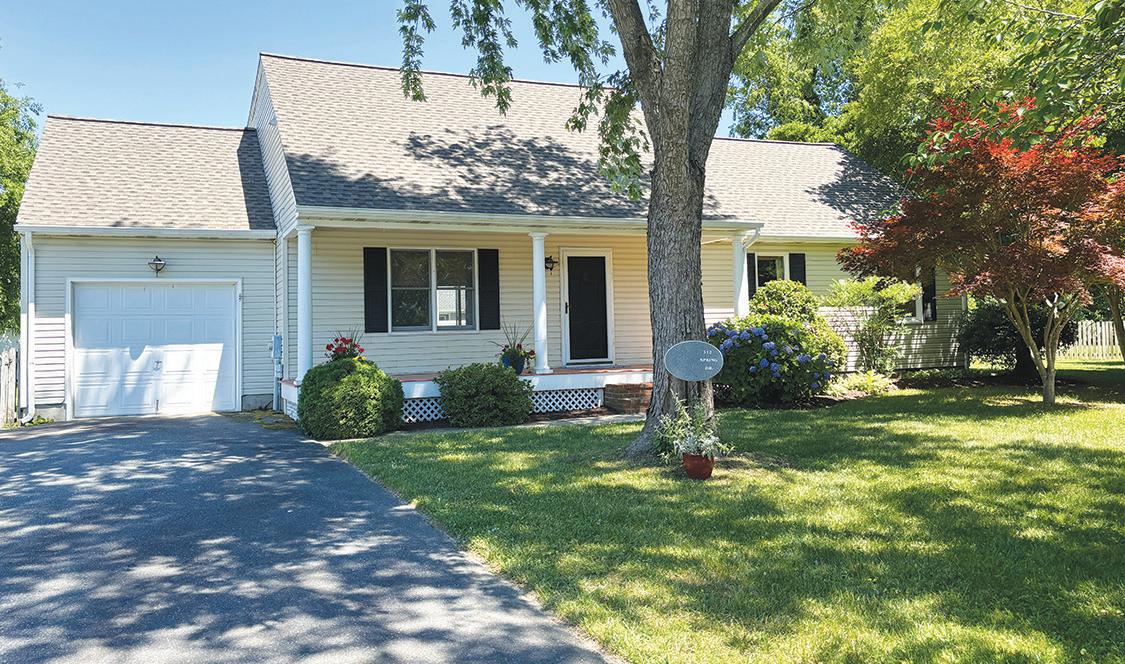
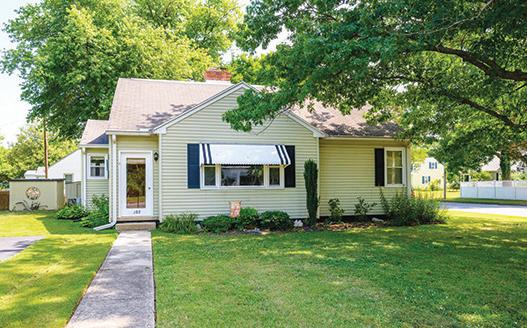
NEW PRICE! Welcome to 27990 Woods Road - Situated on approximately 1/2 acre lot, this home and property has much to offer. A new fully fenced backyard offers privacy to the large back yard with a generous sized deck making it perfect for entertaining, enjoying relaxing time in the hot tub or tinkering in the shed. This split-level style home has 3 bedrooms and 2.5 bathrooms, a primary bedroom with an en-suite bath. The main level includes a kitchen with stainless A new paved drive makes for easy parking your cars or boat. Located just minutes from downtown Easton. Priced at $399,500
Bethany Beach
rationality for the “heated term.”
Note: As the nation now celebrates its 250th anniversary, Bethany Beach is celebrating its 125th
The Bethany Beach Heritage Trail map/brochure includes sixteen historic homes and landmarks on its driving tour, including the DinklerIrvin Cottage Museum. Some of the homes date to the early 1900s and the fi rst religious founders. Several have been moved multiple times away from the ocean’s constant encroachment. A house built in 1927 was used by the U.S. Army Signal Corpsmen during WWII when they manned the nearby iconic concrete Atlantic Ocean observation towers aligned along the beach. Historical markers identify several homes and hotels swept away by the ocean. We hope to take the Heritage Trail tour on our next visit.
Today Bethany offers calm, charm and family-friendly appeal. The boardwalk along the ocean and the main street are quaint and lined with mom-and-pop eateries and shops. Our favorites include DB Fries, a match for OC’s Thrasher’s but with delicious fresh seafood, including fried clams and fish, crab cakes and lobster rolls.
Maureen’s ice cream and frozen yogurt shop is always a must-stop. Bonkey’s snowballs with my favorite flavor of chocolate with gooey marsh-
mallow poured into the middle and on top is another family go-to.
We always enjoy dining in or carry out food at the Cottage Café on Route 1. Their crab cakes are special. The Bethany Beach Diner on Route 26 tops our list for breakfast. Abundant platters of waffles, pancakes, omelets, sausage and bacon are offered at reasonable prices. And browsing in the bookshop and jewelry stores, miniature golf competitions and long beach runs or walks round out the list of to-dos.
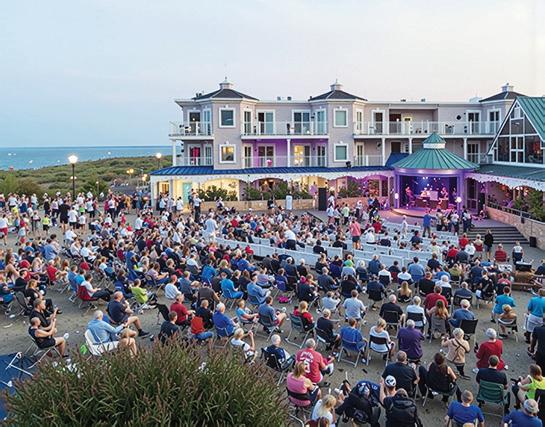
The Bethany Beach Bandstand at the boardwalk hosts free live music all summer and draws a crowd but doesn’t feel crowded. We like to re-
Bethany Beach
serve dinner just before the concert at Mango’s restaurant, sitting on the balcony just opposite the bandstand and overlooking the ocean. They offer a variety of music, including rock, country, blues and tribute bands.
On Bethany’s main street, Garfield Parkway, an iconic wooden totem sculpture by Peter Wolf Toth stands guard. Chief Little Owl is a gift from the Nanticoke Native American tribe, which honors the land’s fi rst inhabitants. The 24-foot statue at the entrance to Bethany has been a landmark since 1976. The statue standing today is the third version and was dedicated in 2012.
Bethany Beach plans events yearround, including boardwalk craft shows, a spring pirate and mermaid celebration, July 4th fi reworks and parade, movies on the beach, walks/
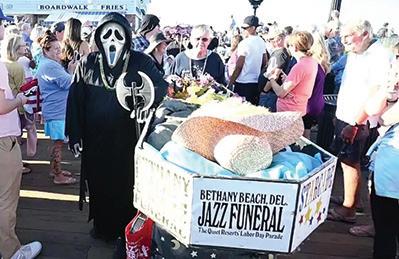
runs, exercise classes, Thanksgiving and Christmas events, etc. The Bethany Beach Jazz Funeral marks the end of summer. The unique way to mourn the end of summer takes place on the boardwalk. On Labor Day Monday, a crowd gathers carrying the skeleton of summer in a casket. They process along the boardwalk New Orleans-style, accompanied by a brass band and mourners clad in black. They parade to the bandstand and officially lay summer to rest. We might join the parade this year!
For more information about Bethany Beach events and history, visit the town’s website at townofbethanybeach.com.
Sources: Google Gemini; Discover The Delaware Shore, The Quiet Resorts Guide 2026; Delaware Beach Life; Bethany Beach Delaware: A Walk Through History; Bethany Beach Heritage Trail
Bonna L. Nelson is a Bay-area writer, columnist, photographer and world traveler. She resides in Easton with her husband, John.
by Tracy Wagner of
Mid-Atlantic Symphony Orchestra
New Worlds, Timeless Wonders
The Mid-Atlantic Symphony Orchestra (MSO) is pleased to announce its 2026–2027 season, New Worlds, Timeless Wonders, an inspiring celebration of beloved masterworks, remarkable discoveries, internationally acclaimed guest artists and cherished audience traditions. The season, led by Music Director Michael Repper, offers a compelling musical journey that spans centuries while showcasing the enduring power of orchestral music.
The Masterworks Series opens in September with From London to America, featuring Dvořák’s Serenade for Strings, Haydn’s triumphant Symphony No. 104 “London”
and Florence Price’s moving Adoration. In November, the Orchestra shines a spotlight on one of Maryland’s most significant musical voices with Mary Howe Rediscovered, pairing three of Howe’s orchestral works with Schubert’s Symphony No. 5 and Beethoven’s Symphony No. 8.
Returning favorites include the orchestra’s beloved Holiday Joy concerts, the festive New Year’s Eve celebration featuring internationally acclaimed soprano Laquita Mitchell and the Elizabeth Loker International Concerto Competition, where audiences experience both a world-class concert and an exciting live competition as exceptional
young musicians perform with the orchestra before a distinguished panel of judges.
Spring programming continues with Canyons, Constellations & Classics , featuring music by Jessie Montgomery and Tanner Porter, Aaron Copland’s Clarinet Concerto with YaoGuang Zhai, Principal Clarinet of the Baltimore Symphony Orchestra and Mozart’s Symphony No. 29. The season concludes with Discoveries, Reflections & Healing, featuring Samuel Coleridge-Taylor’s Noveletten , Ralph Vaughan Williams’ Oboe Concerto performed by Dwight Parry, Principal Oboe of the Cin-
Let’s wash off all those fresh vegetables from the garden.
410-822-7716 · 7 S. Washington St., Easton visit us online at www.crackerjackstoys.com
cinnati Symphony Orchestra and Louise Farrenc’s Symphony No. 3.
The orchestra’s popular Ensembles Series also returns with four intimate chamber music programs performed by members of the MSO. Audiences will enjoy Romantic masterpieces inspired by Robert and Clara Schumann and Johannes Brahms, a festive Holiday Brass program, a special celebration of Beethoven’s legacy marking the 200th anniversary of his death and a season-ending exploration of Italian chamber music featuring Puccini, Donizetti and Verdi.
“This season reflects everything we love about making music,” said Repper. “From timeless classics to remarkable rediscoveries, from internationally recognized guest artists to intimate chamber performances, each concert invites audiences to explore new musical landscapes while celebrating works that continue to inspire us today.”
Season subscriptions and single tickets are now available. Subscribers enjoy significant savings, priority seating and the opportunity to experience the entire season of performances across Maryland’s Eastern Shore and southern Delaware.
For tickets, subscriptions and additional information, visit www. midatlanticsymphony.org or call 410-289-8446. Mid-Atlantic
Why I Hate Chickens
by William S. Dial
I do...I hate chickens. I know about half of you count on those nasty little poop factories to put beans on the table, and that’s fine. I think that’s peachy. I love the critters fried or maybe grilled and don’t mind them in a nice salad, either, but…I will elucidate.
About 30 years ago, maybe a little less, I parked at the Acme here in Easton, got out of the flivver and
was smacked in the face by fumes I hadn’t smelled in a while. Back then, there was a big farm where the Target store is today. I stood there, face to the wind, reminding myself how much I hated the smell of chicken manure when a lady pulled up in an F-150. Big lady, not overlarge, just big. She wore rubber Wellington boots. As my friend used to say, she was big enough
I Hate Chickens
to whup a bear with a switch. She figured out what I was smelling and said, “Son, that’s the smell of agriculture.” Now, I think we were about the same age, fifties, but since she addressed me as “son,” I addressed her as “ma’am.” I said, “Ma’am, I was shoveling chicken shizzle when you were no bigger’n a biddie.” A biddie is a baby chicken if you are not among the cognoscenti. She sort of harumphed and went on her way. I can understand how she might have been a bit sensitive. That farm across the way had “dressed” the field with “chicken litter.” When you are so sensitive you can’t say you spread chicken shizzle—can’t use that other word: family publication—on the fields,
I guess you make excuses, “The smell of agriculture.”
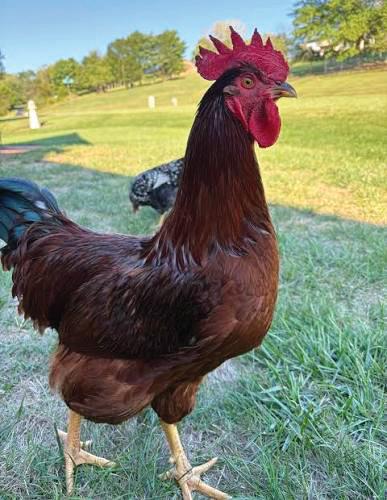
My grandparents raised chickens. Those little Rhode Island Red numbers were popular at the time. They sold fertilized eggs to the local hatchery. That right there raises two issues that might invite disfavor: “set’n hens” and roosters. A setting hen, a “broody,” for you picky types, is nasty. Setting hens are guarding a “clutch” of eggs. For you city types, that’s simply a pile of eggs she has laid. Set’n hens are evil. They have a look in their eyes. I’m not kidding. She is daring you to snatch her eggs. And, of course, that’s exactly what your grandmother has told you to do: “Go to the henhouse and gather the eggs.” Nobody suggested in those days it might be wise to wear those leather gloves welders use or perhaps employ a drone: nope, just stick your hand right under there. And get pecked by a psychopathic chicken who thinks her eggs are more important than your grandmother’s direction. Which brings us to the second thing: roosters.
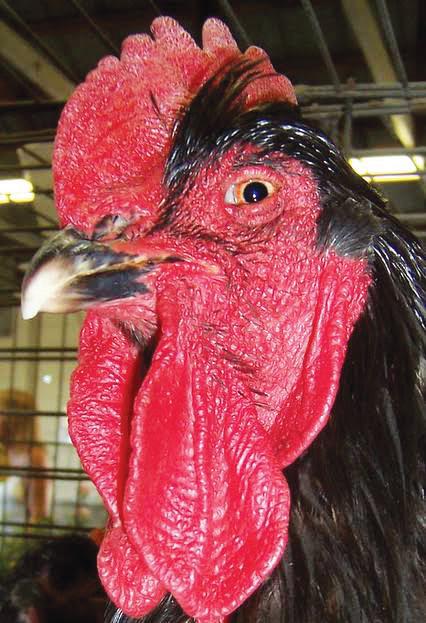
I believe that, at any given time, there were two of the devils strutting about the chicken yard: excuse me, the “free range.” Handsome little buggers they were: meaner than my first mother-in-law, yes’m. They hated each other. The fact is, they hated everybody. Now, in those days, I didn’t know much about chicken social order. The
NEW TALBOT COUNTY WATERFRONT on Island Creek off the Choptank River. 6ft + deep water dock, 3+ acres on a point with year-round sunset views! Gorgeous 3500+ sf home, first floor primary suite with full bath and library, 3 additional bedrooms including guest apartment with kitchenette and full bath, 2-car garage. Backyard concrete pool, 650+ ft of fully riprapped shoreline.
$2,895,000
I Hate Chickens
chicken yard was capacious, and the hens were plentiful, so that part of it seemed fine. That notwithstanding, one of the roosters was always the bossman. The poor little second man stayed clear, which showed great chicken-wisdom. Get near either one of them… or their hens, and it was game on. I’ve been chased by roosters, fearing for my life. When you get two after you, well, it’s over. If they are guarding the henhouse door, forget it. They can be bribed; however, a handful of chicken feed would distract them long enough to sneak into the henhouse.
That brings us to the “free range,” otherwise known as the chicken yard. We used to call freerange chickens “scratching chickens.” What do they eat? Mostly worms and bugs. They scratch around all day, clucking miser -
ably as they hunt for them. Sure, someone tosses out a little scratch feed—ground corn and soybeans— but worms and bugs are what they really prefer. Think about that the next time you buy free-range chicken.
My grandparents, as you might have deduced, were farmers. My happiest childhood memories are rooted in the farm. My grandfather was a taciturn man. If it didn’t need to be said, he didn’t say it. He loved his eight grandchildren and showed his affection by including them. I rode the tractor to the fields, slopped the hogs, milked the cows and shucked the corn. He was there, showing me how, and I’m grateful to him for that. He raised mostly peanuts and corn, along with a few truck crops for the pantry. He treated his cows like ladies: they produced more milk that way. His hogs were fat, and when it came time for a community “hogkilling,” his hams excelled. But the chickens? Those were my grandmother’s.
My grandmother was, perhaps, the most intelligent person I’ve ever known. She was Southern. She was country. She was kind. Six of her eight grandchildren were boys. She had raised two daughters, one of whom was my mother. You might think rambunctious boys might have challenged her: wrong! She could not be fooled. And yet she was never overly strict. Didn’t
I Hate Chickens
have to be. We grandchildren loved her so much that we wouldn’t do anything that displeased her. But she expected us to do what she directed, like gathering eggs from psychopathic chickens.
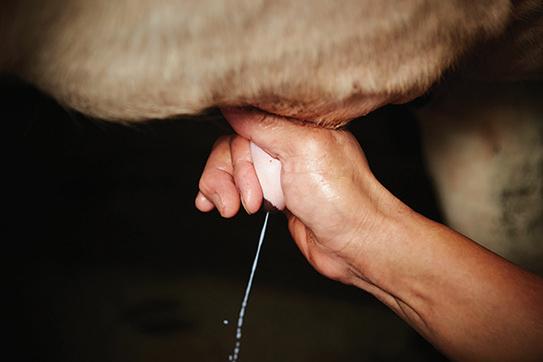
My grandmother, Nanny, hated cows. (See my grandfather’s position on how cows should be treated above.) She hated cows so much that she wouldn’t eat beef. One of her responsibilities was the dairy side of the farm. She milked the cows, strained the milk, made the butter and baked the best buttermilk biscuits ever. Milking, however, was part of the chore she hated. I assisted often. I was amazed at how quickly she could fill a milk bucket. The barn gate was a lattice. The barn cats would climb the lattice when she was milking. Nanny could shoot a stream of milk right into a barn cat’s mouth from ten feet away. But there was the flatulence. Cow farts are famous. Some have suggested cow farts contribute to global warming.
Don’t know about that, but I can tell you, cow farts in a confined place, like the barn, will make you hate cows, and my grandmother did. As kind as she was, when a cow let one, she punched the cow with a roundhouse right to the rump. Don’t think it impressed the cow very much, but it made my grandmother feel better. Occasionally, the cow took a dump in the middle of a milking session. Did I mention that my grandmother knew words unlike any I had ever heard in my thirty-one years in the Navy?
A little more about Nanny, and then I’ll get back to chickens. I’m eighty. My childhood was in a gentler time. Folks enjoyed conversation. Southern farmhouses almost always had big porches. My grandparents’ home was one such. Among her other attributes, my grandmother was a really good gardener. The flower beds in front of the porch were beautiful and full of color. The flowers attracted but-
Quaker Neck, Bozman | 3 Waterfront Lots | Offered at $800,00 each 17.84 acres, 10.31 acres, 7.31 acres, Approved Plat, Perc and SDA
1318 Bell Lane, Woolford
Offered at $849,500
Waterfront Home, 3 Bed, 2 bath
4414 Tranquil Trail, Hurlock
Offered at $379,000 3 Bed, 2 Bath, 1500 sq. ft.
I Hate Chickens
terflies, dragonflies and all kinds of buzzing critters. Now, remember, I told you our venue was in the South. And my grandmother was a southern lady. She enjoyed snuff. Sweet-Peach brand, as I recall. Sitting on the porch in the cool of the evening and enjoying a dip of snuff was the definition of pleasant for both grandparents. For the squeamish, you might want to jump ahead. Snuff makes juice. Juice has to be expelled. My grandmother could knock a dragonfly off the bloom of a four-o’clock flower from eight feet away. That’s accuracy, yes, it is.
Now, back to chickens. When one of the old feathered ladies stopped laying, her days were numbered. I want to go into how a chicken was dispatched. It didn’t involve a hatchet and was reminiscent of the crank used to start a Model T Ford. Oh well, it worked. But the dispatching part was just the beginning of the process. You don’t just grab a chicken off the nest and thrust her into a pot: there are all those feathers. It is a process. Messy process. Smelly process. Maybe better if you like chicken, don’t watch the process of turning an old cluck into something swimming in the pot. But once in the pot: now we’re talking. Chicken and dumplings, my grandmother’s style, would make the folks at
Cracker Barrel blush. Mind you, old lay’n hens were tough old birds, so the pot was the only choice. Chicken and dumplings for Sunday dinner: yes!
If you’re wondering about where the fry’n chickens came from, they were the pullets: adolescent chickens. They lived in another part of the chicken yard. When the old lady went skinny dipping in the dumpling pot, one of the pullets assumed her perch in the henhouse: assuming, of course, that she was “ready.” Some of the pullets were diverted to the frying pan.
My mother, bless her heart, did not share my antipathy for chickens. We had a coop in the backyard. Back then, you could go to the feed and fertilizer emporium and buy biddies for about a buck a piece. There were your Rhode Island Reds, your leghorns, your barred
I Hate Chickens
rocks and those detestable guinea fowl. But… you could get free chickens at the dump! Bear with me: no shizzle here. The hatchery… remember the sale of fertilized eggs to the same…would take eggs that didn’t hatch within a certain window and dump them. In many cases, the warm sunlight would do what the incubator didn’t. There were often little chickens running all over the place. My momma and her chicken-raising buddies went to the dump when stock was needed. We’re not talking about the quality biddies from the farm store here. There were chickens running around the dump that na -
ture had not intended to survive: handicapped chickens. Some had withered wings, some had cleft beaks…misalignment of the upper and lower halves…and some were missing toes. I think all the chickens in my mother’s coop had deformities.
I think I’ve made my case. I mucked out the henhouse every spring. That alone was enough to make my objections to the feathered psychopaths clear. So, raise your chickens, you urban impostors, in your cute little coops, spread your chicken shizzle all over your fields if that makes you happy, but me, I like the rotisserie kind.
Do you know why a chicken
coop has two doors? Well, if it had four doors, it would be a sedan! I’ll close the door on my way out.
William Stephen Dial achieved Masters Degrees in International Affairs and National Security Studies. Bill’s 31 years in the navy started as a Seaman Recruit and finished in June 1994 as a Captain. Bill has been a certified SCUBA Instructor, a Accredited Marine Surveyor, a Certified Emergency Manager and an Emergency Medical Technician. Bill is married to Susie and has 11 grandchildren.
Sunshine, Rain, Time and Love
by Michael Valliant
“Joy…and
pain… Sunshine…and rain…”
“Sunshine and Rain” by Rob Base is one of the songs that gets stuck in my head fairly frequently. Because the keywords—joy, pain, sunshine, rain—are used often, I can hear any one of those words, and Rob Base’s voice adds the rest in my head. In this case, I was standing on the steps in front of our house and there was a steady rain while the sun was also breaking through the clouds. Sunshine and rain.
Music and song lyrics help me
understand that time is fluid. It doesn’t just move forward. I can be transported in time from a word, a guitar riff, a drumbeat, a color, or a smell. In a lecture, author, pastor and teacher of preaching Dr. Tom Long described the way time moves in the Gospel of John by saying, “Time moves forward and then folds back on itself like pulling a blanket over itself.” With the folding of time, what you end up with is the “eternal now.” Everything is always happening.
The idea of an eternal now helps me when I sit down next to the water at Doc’s Sunset Grill in Oxford and see and remember Pier
Street Restaurant and Marina when it was run by the Siachos family—from birthday dinners, to our Oxford Little League team having a crab feast at the end of baseball season, to eating soft-shelled clams with friends after skimboarding on Boone Creek. All the memories are there. When I drive by the Oxford Bellevue Ferry Dock, I can see all of us teenagers jumping off the docks and pilings as the ferry shifted into neutral and sent us flying into the river.
I haven’t lost my bearings, I know where and when I am, but those memories are present. I can feel them. Or walking into a meeting in our library at Christ Church Easton, I remember the first time
Sunshine and Rain
I set in that room, when it was a study in the house of Fr. Harry Bainbridge and family, as we waited for his daughter Liz to come downstairs to go with my friend Tom to Easton High School’s homecoming dance.
Our memories have a presence in the places we revisit, especially those places that were or are dear to us. The longer you live somewhere, the more likely you are to experience this presence. When I walk around the empty lot where my parents’ house, the house my sister and I grew up in, used to be, I can get overwhelmed with…well, joy and pain (Thank you again, Rob Base).
We have likely all experienced something of time feeling fluid.
When we are doing something we love—gardening, crafting, fly-fishing, painting—time seems to move differently than it does than when there is five minutes to go until the alarm clock is supposed to wake us up. When we are with people we love, at a meal, or in a conversation, we can lose all sense of time passing.
Love transcends time. Love has a power that runs deeper than time. We know this by virtue of continuing to love people who are no longer with us and places we haven’t been for some time. Love still connects us to them.
We can put love into the things we do. The novel “Theo of Golden”
Sunshine and Rain of those who know and love the artist.
by Allen Levi is a story about creative generosity. In a discussion about art, love is said to be the key:
“for anything to be good, truly good, there must be love in it. I’m not even sure I know fully what that means, but the older I get, the more I believe it. There must be love for the gift itself, love for the subject being depicted or the story being told, and love for the audience. Whether the art is sculpture, farming, teaching, lawmaking, medicine, music, or raising a child, if love is not in it—at the very heart of it—it might be skillful, marketable, or popular but I doubt it is truly good. Nothing is what it’s supposed to be if love is not at the core.”
If love transcends time and we can put love into the things we do—from cooking a meal, to writing a letter, to painting a picture, to spending time in conversation— than the things we do with love can also live outside of time. A decoy carved and painted by my fatherin-law, given to his daughter, is timeless, and when she looks at it she can see all the years he has been carving, all the memories their family shares of him making and showing his art. The shorebirds may be sitting on a bookshelf, but they carry with them the eternal now of moving through time and memories
Time, love, art, eternal—these are words that can leave us light-headed. So let’s ground them a bit. Let’s put them into things we do every day.
I’ve been reading a daybook by a favorite writer of mine, Henri Nouwen, called “Bread for the Journey.” He writes about Small Steps of Love:
“We choose love by taking small steps of love every time there is an opportunity. A smile, a handshake, a word of encouragement, a phone call, an embrace, a kind greeting, a gesture of support, a moment of attention, a helping hand, a present, a financial contribution, a visit—all
these are little steps toward love.
“Each step is like a candle burning in the night. It does not take the darkness away, but it guides us through the darkness. When we look back after many small steps of love, we will discover that we have made a long and beautiful journey.”
We have a chance, each day, to offer love to the people around us, both those we know and love and those who we meet for the first time. Some of those small, simple acts of love, from holding a door, to walking some to their car, to paying someone an unexpected compliment, could end up being a timeless memory, something that someone calls up
in their mind with a smile, just by walking by a park, or a house, or looking at something on a shelf or a wall.
Joy and pain, sunshine and rain. We get them all. When we add love to them, they become something more. If we act with love, our small steps can take us somewhere beautiful and timeless.
Michael Valliant is the Assistant for Adult Education and Newcomers Ministry at Christ Church Easton. He has worked for non-profit organizations throughout Talbot County, including the Oxford Community Center, Chesapeake Bay Maritime Museum and Academy Art Museum.
Caroline County – A Perspective
Caroline County is the very definition of a rural community. For more than 300 years, the county’s economy has been based on “market” agriculture.
Caroline County was created in 1773 from Dorchester and Queen Anne’s counties. The county was named for Lady Caroline Eden, the wife of Maryland’s last colonial governor, Robert Eden (1741-1784).
Denton, the county seat, was situated on a point between two ferry boat landings. Much of the business district in Denton was wiped out by the fire of 1863.
Following the Civil War, Denton’s location about fifty miles up the Choptank River from the Chesapeake Bay enabled it to become an important shipping point for agricultural products. Denton became a regular port-ofcall for Baltimore-based steamer lines in the latter half of the 19th century.
Preston was the site of three Underground Railroad stations during the 1840s and 1850s. One of those stations was operated by Harriet Tubman’s parents, Benjamin and Harriet Ross. When Tubman’s parents were exposed by a traitor, she smuggled them to safety in Wilmington, Delaware.
Linchester Mill, just east of Preston, can be traced back to 1681, and possibly as early as 1670. The mill is the last of 26 water-powered mills to operate in Caroline County and is currently being restored. The long-term goals include rebuilding the millpond, rehabilitating the mill equipment, restoring the miller’s dwelling, and opening the historic mill on a scheduled basis.
Federalsburg is located on Marshyhope Creek in the southern-most part of Caroline County. Agriculture is still a major portion of the industry in the area; however, Federalsburg is rapidly being discovered and there is a noticeable influx of people, expansion and development. Ridgely has found a niche as the “Strawberry Capital of the World.” The present streetscape, lined with stately Victorian homes, reflects the transient prosperity during the countywide canning boom (1895-1919). Hanover Foods, formerly an enterprise of Saulsbury Bros. Inc., for more than 100 years, is the last of more than 250 food processors that once operated in the Caroline County region.
Points of interest in Caroline County include the Museum of Rural Life in Denton, Adkins Arboretum near Ridgely, and the Mason-Dixon Crown Stone in Marydel. To contact the Caroline County Office of Tourism, call 410-479-0655 or visit their website at www.tourcaroline.com .
Easton
Map and History
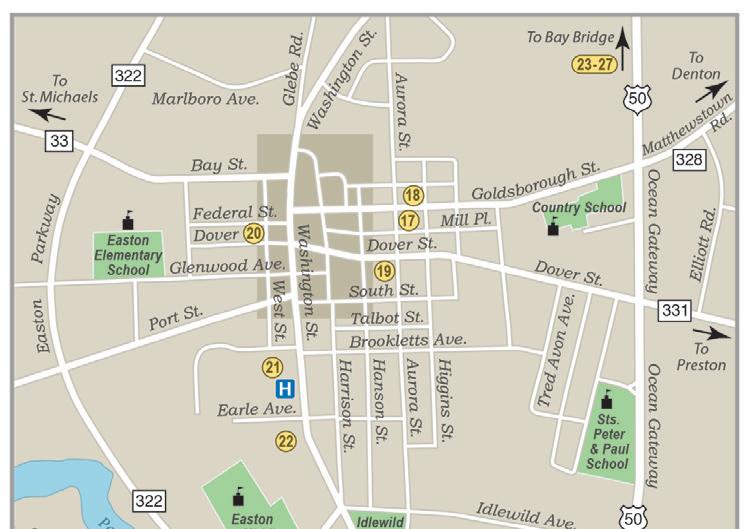
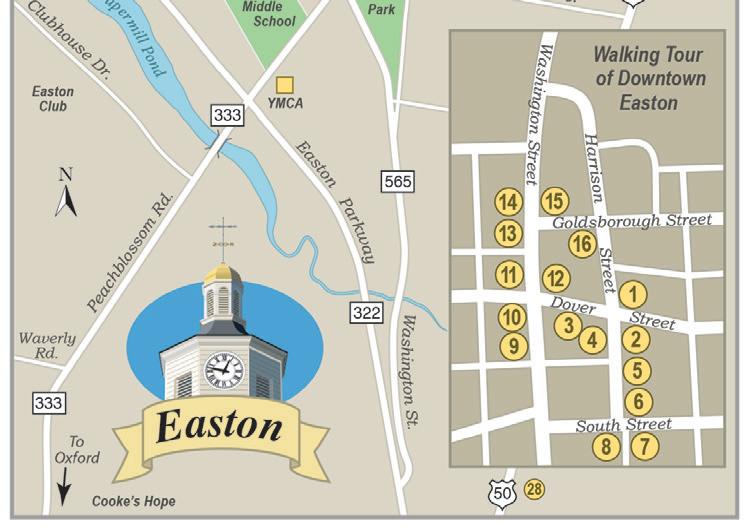
The County Seat of Talbot County. Established around early religious settlements and a court of law, Historic Downtown Easton is today a centerpiece of fine specialty shops, business and cultural activities, unique restaurants, and architectural fascination. Treelined streets are graced with various period structures and remarkable homes, carefully preserved or restored. Because of its historical significance, historic Easton has earned distinction as the “Colonial Capitol of the Eastern Shore” and was honored as number eight in the book “The 100 Best Small Towns in America.” With a population of over 16,500, Easton offers the best of many worlds including access to large metropolitan areas like Baltimore, Annapolis, Washington, and Wilmington. For a walking tour and more history visit https:// tidewatertimes.com/travel-tourism/easton-maryland/.
Dorchester Map and History
Dorchester County is known as the Heart of the Chesapeake. It is rich in Chesapeake Bay history, folklore and tradition. With 1,700 miles of shoreline (more than any other Maryland county), marshlands, working boats, quaint waterfront towns and villages among fertile farm fields – much still exists of what is the authentic Eastern Shore landscape and traditional way of life along the Chesapeake.
For more information about Dorchester County visit https://tidewatertimes.com/travel-tourism/dorchester/.
TIDEWATER GARDENING
by K. Marc Teffeau, Ph.D.
Dog Days and Climbing Zucchini
In August, summer reaches its peak—the “dog days” of the season. According to the Old Farmer’s Almanac, this period traditionally runs from July 3 to August 11 in the Northern Hemisphere and is associated with the rising of Sirius, the Dog Star. In ancient Greece, Hellenistic astrology linked these days to heat, drought, sudden thunderstorms, lethargy, fever, mad dogs and bad luck.
The heat often discourages garden work, while the days grow shorter and the sun sits lower in the sky. Across the landscape, activity slows as gardeners focus on basic maintenance, including weeding, deadheading annuals and harvesting vegetables. Aside from thunderstorms, August usually brings little rain. Combined with high temperatures, this dry weather often pushes cool-season
Gardening turf, such as tall fescue and bluegrass, into semi-dormancy, reducing the need for mowing.
August is a good time to prepare for fall planting. In the vegetable garden, start transplants of broccoli, cabbage, cauliflower and Brussels sprouts for early September planting. Pick produce daily to keep plants productive into fall. Make one more planting of an early-maturing green bean varieties in early August. Root crops like beets and turnips can be seeded now for a fall crop. Plant a crop of Sugar Snap or Sugar Ann edible-pod peas for a harvest this fall as well.
Consider seeding a fall salad garden. I have planted mesclun mixes before and enjoyed the cutand-come-again greens in salads, including leaf lettuce, arugula, mustard and similar crops. For about the cost of two weeks’ worth of store-bought salad greens for a family of four, you can buy enough seed to supply salads through fall and well into winter. Choose greens normally planted in spring before the last frost, especially va -
rieties that tolerate some cold. If you sow zucchini and yel-
low squash in early August, you may still harvest a small late crop. Choose quick-maturing varieties, ideally those ready in about 45 days. With a mild fall, you may pick occasional squash in late September.
Because my backyard is small and my vegetables are in raised beds this year, I grew some zucchini on trellises, which worked well. As of early July, I have not seen squash vine borer damage on the stems. I recommend Renee’s Garden’s Incredible Escalator Organic climbing zucchini (reneesgarden. com/collections/summer-squash/ products/incredible-escalator). It has produced well for me so far. Renee’s Garden lists its average
Tidewater Gardening
maturity at 58 days, so August is too late to plant it this year. If you are interested, make a note to order seeds next spring.
If you want a yellow squash for trellising, consider Burpee’s Rise and Shine Summer Squash (burpee.com/squash-summer-riseand-shine-prod600100.html). It has an average maturity of 55 days. Since summer squashes are, by nature, vining plants, you can grow a wide variety on stakes or trellises. One advantage of growing summer squash is that the fruit does not touch the soil, eliminating the risk of rot.
August is not the time to be
putting mulch down. In fact, you should examine any mulched
Tidewater Gardening
shrubs where the mulch is touching the stems. Mulched shrubs may not develop mature stem tissue where they touch the mulch. To harden stems so they can withstand early frost damage, remove about 2 to 3 inches of mulch from the base of the stems in mid-August.
In addition, during hot, dry August days, avoid deep cultivation in your flower beds. Loosening the soil under these conditions reduces water uptake by increasing soil water loss and damaging surface roots. Plants often look much worse after cultivation than before.
A general cleanup of annual flower beds is recommended in August. The heat has taken a toll on our flower beds, leaving them ragged looking. Remove and replace diseased or dead plants. Renovate the flower bed by cleaning up spent blossoms and seed heads, and put a hold on any fertilization until next spring. Some summer annuals don’t need replacing, just a cutting back to get them out of
the bush and start blooming again. Good plants for this pruning treatment include begonia, coleus, annual vinca and petunia. Many annuals will bounce back with cooler fall weather.
If your marigolds have been wiped out by spider mites and powdery mildew has taken out the zinnias, replace them with coolseason annuals like salvia, coleus and petunias. If the local garden center is not carrying any fall annual transplants, start your own from seed now. If we have a mild fall, you can have flowers right through November. Remember to water landscape plants, especially those that bloom next spring.
During August, water shrubs deeply once a week. Azaleas, rhododendrons, camellias, lilacs and many other plants are setting next spring’s flower buds now—water early in the morning, directing water to the base of the plants rather than the foliage. Wet leaves waste
water and can encourage foliar diseases such as powdery mildew. Avoid fertilizing or pruning these plants at this time.
Plant in August for fall blooms and early spring flowers next year. Order peony roots now for Septem-
ber planting, about a month before your area’s average first frost. Finish planting before the first killing frost. Autumn-flowering crocus, Sternbergia, Colchicum and other fall-blooming bulbs are available at garden centers and online. Crocus and sternbergia need full sun, while colchicum tolerates light shade.
Hardy amaryllis, also called magic lily, can be planted in August. In spring, the bulbs produce foliage that dies back by late summer, followed in August by clusters of six to nine lily-like pink flowers on 3-foot stalks. They can live for many years and bloom best when left undisturbed. August is also a good time to sow perennial seeds,
Tidewater Gardening
especially lupine and delphinium. Pansies, forget-me-nots and English daisies can also be sown this month.
Now is the time to start looking for fall-flowering perennials to add fresh color as the summer annuals and perennials start to decline. Reliable choices for ’Shore gardens include asters, black-eyed Susans, stonecrop, wax bells, chrysanthemums and Mexican bush sage. These long-blooming plants thrive in cooler weather, provide nice fall color and support late-season pollinators by being a nectar source. Several fall-blooming asters do well in ’Shore gardens. Fall-blooming asters (Symphyotrichum spp.) display deep blue-purple or pink flowers from September to October and are excellent for sunny border plantings. As a native species,
they attract bees, butterflies and migrating monarchs, which thrive in cooler fall weather. Taller forms may need support, but compact cultivars stay tidy in borders. It grows well in full sun to part shade locations.
There are several cultivars of the New England Aster (Symphyotrichum novae - angliae) that grow well on the ’Shore. Recommended New England aster cultivars include compact ‘Purple Dome,’ which grows about 18 inches tall and forms a dense mound of deep purple flowers; ‘Alma Pötschke,’ a 3- to 4-foot cultivar with vivid pink blooms that provides a strong vertical accent; and ‘Harrington’s Pink,’ a 4- to 5-foot cultivar with softer pink flowers that works well in naturalistic borders.
The New York Aster (Symphyotrichum novi-belgii ) is a compact, bushy plant with a wide range of
Tidewater Gardening
colors from white to deep purple. Heath Asters (Symphyotrichum ericoides) are early fall bloomers with a low-growing habit covered with small white flowers. Frikart’s Asters ( A. x frikartii ) are longblooming, disease-resistant asters that do well in well-drained soil. ‘Violet Queen’ ( A. amellus) exhibits violet-purple flowers with a yellow center.
Goldenrod (Solidago spp.) is another fall-blooming perennial that pairs beautifully with asters in landscape borders. Unlike ragweed, which is a common allergy trigger, native goldenrods produce showy golden plumes in late summer and fall, making them an excellent companion for asters and a
classic source of fall color contrast. Maryland species thrive in average soils and support a wide range of native pollinators. They are keystone plants that support more than 100 species of Lepidoptera.
Multi-year goldenrod trials at Mt. Cuba Center in Hockessin, Delaware, identified several strong performers for the Mid-Atlantic region, giving ’Shore gardeners excellent native options. Recommended selections include Solidago rugosa ‘Fireworks,’ Solidago sphacelata ‘Golden Fleece,’ Solidago nemoralis (gray goldenrod) and Solidago juncea (early goldenrod). And let us not forget the Sedums. Sedums are one of the most
reliable, low-maintenance succulents for ’Shore landscapes, thriving in full sun, lean soil and excellent drainage. Several sedums do well in our area, including Showy Stonecrop (Hylotelephium spectabile ‘Autumn Fire’ ). Its brick-red flower heads are drought-tolerant and have a long bloom season. A hardy, sun-loving stonecrop that forms dense mats and shifts to pink-red tones in drought or cold, its tiny white flowers attract native bees and it excels in gravel beds, rock gardens and dry slopes. And let us not forget Autumn Joy stonecrop sedum, probably the most popular of the sedums.
Sedum spurium (Dragon’s Blood’ and cultivars). Colorful foliage and durable edging; rugged, spreading sedum with red-to-burgundy foliage that intensifies in full sun. Produces pink star-shaped blooms in summer that support pollinators. Excellent for edging, pathways and spots with reflected heat.
Sedum reflexum (Blue Spruce Sedum). Named for its blue, needle-like foliage, this sedum adds texture and contrast to native plantings. Fast-growing, droughttolerant and reliable in poor soils. Yellow summer flowers attract small pollinators. Great for slopes, rock walls and hot, dry microclimates.
Stay cool and hydrated this month, and Happy Gardening!
Marc Teffeau retired as Director of Research and Regulatory Affairs at the American Nursery and Landscape Association in Washington, D.C. He now lives in Georgia with his wife, Linda.
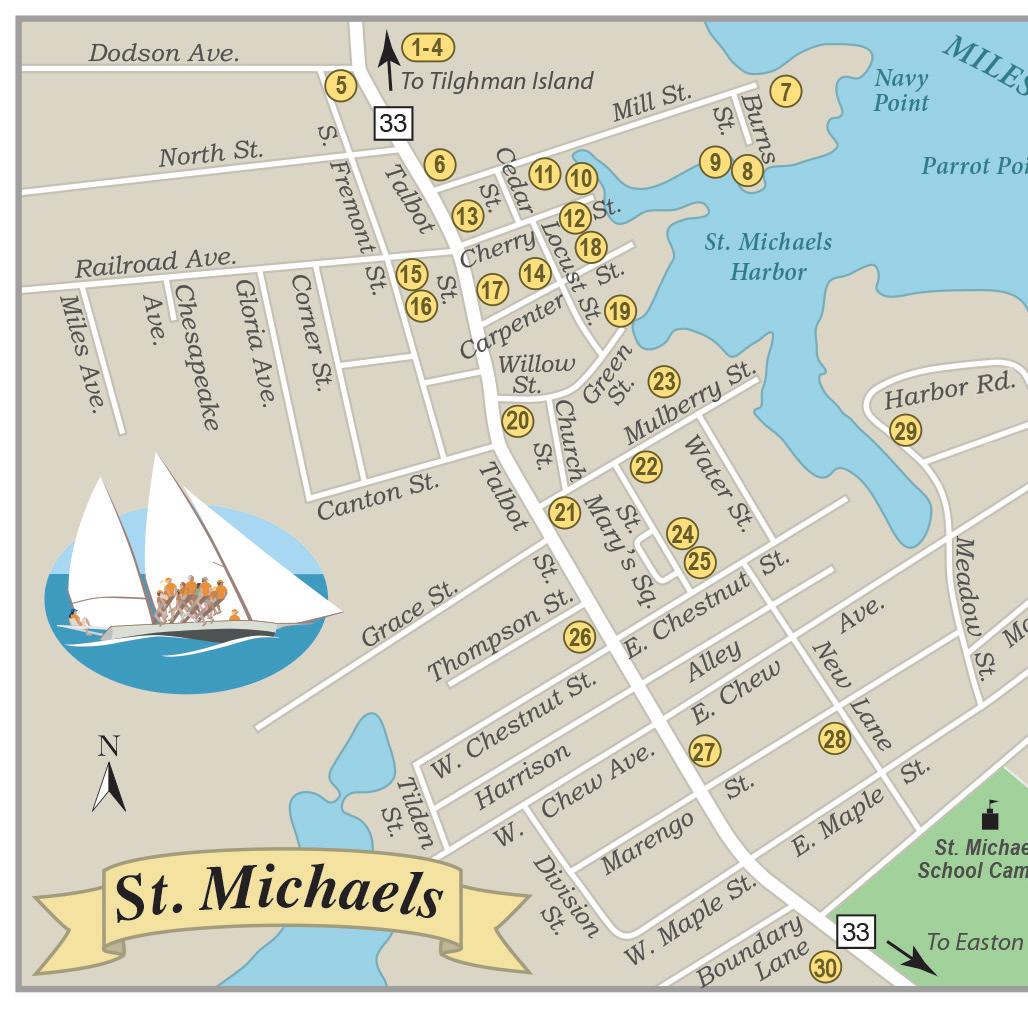
St. Michaels Map and History
On the broad Miles River, with its picturesque tree-lined streets and beautiful harbor, St. Michaels has been a haven for boats plying the Chesapeake and its inlets since the earliest days. Here, some of the handsomest models of the Bay craft, such as canoes, bugeyes, pungys and some famous Baltimore Clippers, were designed and built. The Church, named “St. Michael’s,” was the first building erected (about 1677) and around it clustered the town that took its name.
For a walking tour and more history of the St. Michaels area visit https://tidewatertimes.com/travel-tourism/st-michaels-maryland/.
Molding the Essential Man (Part 2) by
A.M. Foley
The volley fired by a young Virginian in the backwoods of America set the world on fire. ~Horace Walpole, British politician
In July’s Tidewater Times, we touched on repercussions from a brief skirmish in 1754 between George Washington’s Virginia militia and a French detachment.
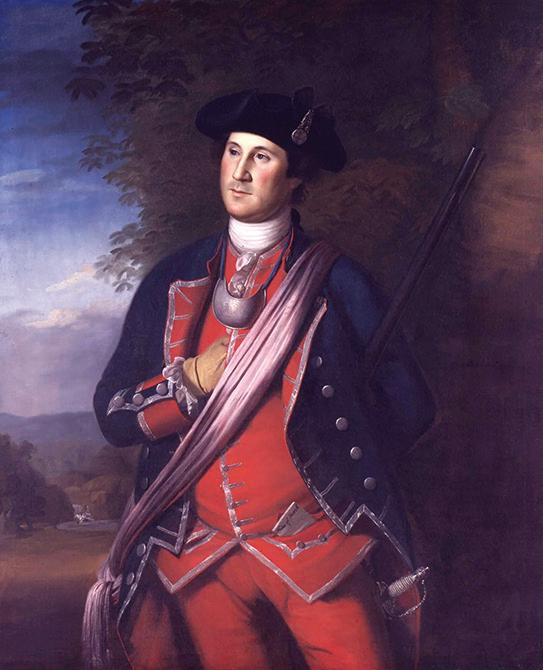
Twenty-two-year-old Washington bore the rank of lieutenant colonel, largely because of British disdain for colonial militia. An officer of any
rank in Britain’s regular army automatically took command over a militia officer, however lofty his title. Washington had been promoted by Virginia governor Dinwiddie after a successful reconnaissance and diplomatic mission to Fort Le Boeuf near Lake Erie.
Washington received the French
Painted by renowned American artist Chas Fagan, "Flash Point" is on display in the museum’s George Washington Gallery. Photo courtesy of the Fort Ligonier Museum.
The Essential Man
commandant’s firm but courteous rejection of Dinwiddie’s ultimatum that they leave Ohio Country to the English. More blunt officers told Washington “that it was their absolute design to take possession of Ohio, and by God they would do it.” Hearing this, Dinwiddie created two militia companies, with Washington as adjutant for northern Virginia and the Eastern Shore. Joshua Fry, a middle-aged Britishborn colonel, would command, under orders to prevent interference with Virginians fortifying the Forks of the Ohio River (presentday Pittsburgh). After marching raw recruits westward under urgent orders, Washington camped at Great Meadow, Pennsylvania. News reached him that the French had
Closed Tuesdays
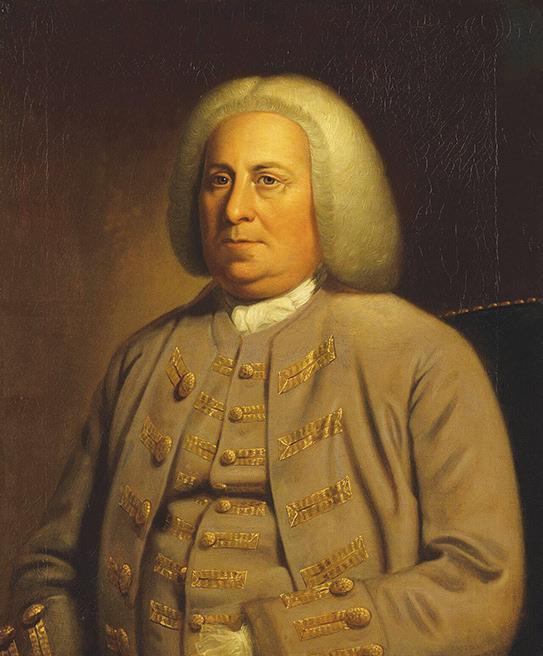
Gov. Robert Dinwiddie
ousted Dinwiddie’s construction crew from the Forks and were enlarging the site into Fort Duquesne.
Colonel Fry, coming with a second Virginia company, suffered a fatal fall from his horse, leaving Washington in command. If he felt overwhelmed, his demeanor would never betray him. Describing Washington, a contemporary said, “His movements and gestures are graceful, his walk majestic and he is a splendid horseman.” He had no hesitation in leading forty militiamen and a dozen Wicon allies on foot at night through a rainy forest to encircle and capture a suspicious French force encamped nearby. Nearly every aspect of the ensuing skirmish is disputed. Who fired first? Was the fatal head wound to
commanding officer Jumonville from a musket ball or tomahawk? Was he attacked while reading a diplomatic letter, such as Washington took to Le Boeuf? Bludgeoned and scalped by Washington’s ally, Tanacharison?
No official state of war had been declared, but an inevitable confrontation between the two nations had already occurred at the Forks. Anticipating retaliation for the May 28th “Jumonville Incident,” Washington took it upon himself to write to the governors of Pennsylvania and Maryland, as well as Virginia, asking for rapid reinforcement. He ordered trenches around a makeshift stockade at Great Meadow, which he aptly named Fort Necessity. Reinforcements arrived under a Captain Mackay, who refused to acknowledge Washington’s superior rank. A French force twice their size descended on the hastily constructed “fort” on July 3. Entrenched defenders fell to snipers concealed in the surrounding woods. Then a deluge of afternoon
Oxford Map and History
Oxford is one of the oldest towns in Maryland. Although already settled for perhaps 20 years, Oxford marks the year 1683 as its official founding, for in that year Oxford was first named by the Maryland General Assembly as a seaport and was laid out as a town. In 1694, Oxford and a new town called Anne Arundel (now Annapolis) were selected the only ports of entry for the entire Maryland province. Until the American Revolution, Oxford enjoyed prominence as an international shipping center surrounded by wealthy tobacco plantations. Today, Oxford is a charming tree-lined and waterbound village with a population of just over 700 and is still important in boat building and yachting. It has a protected harbor for watermen who harvest oysters, crabs, clams and fish, and for sailors from all over the Bay. For a walking tour and more history visit https://tidewatertimes. com/travel-tourism/oxford-maryland/.
The Essential Man
rain flooded trenches and turned the meadow into a bog. Dispirited men, their gunpowder wet and useless, suffered 100 casualties, a third of their force.
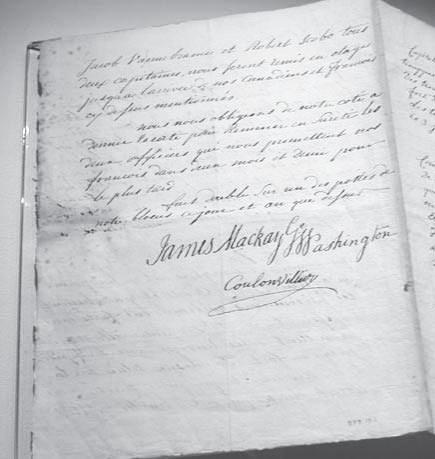
As daylight faded, the French commander, Villiers, half-brother of Jumonville, signaled willingness to cease fire. Washington’s interpreter, Jacob Van Braam, a Dutchman familiar with French, conveyed proposed terms back and forth among Villiers, Washington, and Mackay. The terms seemed reasonable, as far as Washington understood them, translated from French into English by a Dutch. He signed the damp surrender docu-
ment, which allowed Virginians to return to their colony. Dinwiddie and the public deemed Washington’s first and last surrender no dishonor. Only later, when French
Tidewater Residential Designs since 1989
propaganda claimed Washington signed admission to Jumonville’s “assassination,” did the import of the document come into dispute. Ever after, Washington denied knowingly agreeing to that incriminating term. He held that Jumonville’s detachment was not diplomatic, but threatening his Virginians and their supplies and established British settlers.
Before repercussions of the incident spread from the American wilderness to European capitals, Washington had already decided to resign his military position. Remarriage of his brother Lawrence’s widow had given him a chance to lease his beloved Mount Vernon. Washington was home making plans for
his first planting when Major General Edward Braddock landed two regiments of redcoats on the lower Chesapeake. Though still undeclared, Britain was launching the French and Indian War in earnest. Ex-colonel Washington balked at being demoted to a brevet colonial captain. To save his pride, he agreed to volunteer as an aide to the general, provided he could tend Mount Vernon farm affairs until westward movement progressed.
Benjamin Franklin had once tried to prepare Braddock for unorthodox French and Indian tactics, but the general reputedly said, “These savages may be formidable to your raw American militia, but upon the king’s regular and disci-
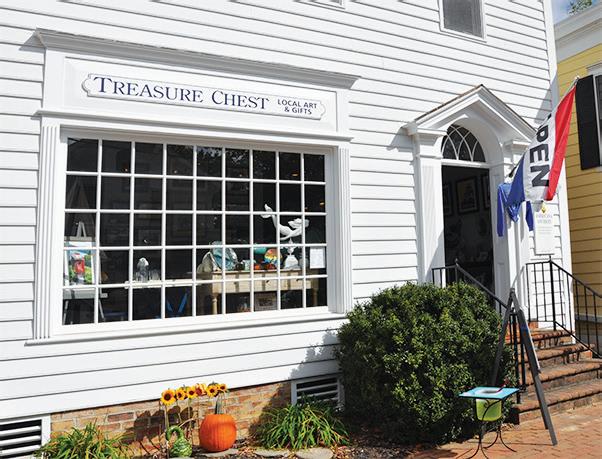
The Treasure Chest
Open 7 Days a Week for the Summer 6/10-9/7/26
S. Morris St., Oxford MD 410-924-8817 Wed. ~ Mon. 10 AM to 5 PM, closed Tues. · treasurechestofoxford@gmail.com
The Essential Man
plined troops it is impossible they would make any impression.” The general’s attitude hadn’t changed when Washington joined him in Frederick, Maryland, in May of 1755. Braddock ignored his aide’s polite suggestion of adapting accustomed procedures to conditions. Rather than taking pack animals into the mountains, nearly 3,000 men struggled to move siege guns, provisions and baggage by cart— road or no road. Men and animals progressed at a crawl, dropping from exhaustion, before the general relented somewhat, detaching a division to march ahead. All the while, French defenses around Fort Duquesne hardened.
Washington became stricken with dysentery so severe he had to dismount and lie in a covered wag-
on. He’d hardly recovered strength by July 9, when the vanguard began crossing the Monongahela. War whoops resounded from the forest and unseen enemy opened fire. Redcoats became, as Washington described, “disconcerted and confused.” Many fell from closely packed formations. Washington volunteered to “head the Provincials and engage the enemy in their own way,” but the general deemed that inappropriate. An estimated 900 concealed enemy routed 1,400 of Britain’s finest into “irretrievable disorder.” Militiamen, familiar with forest-covered terrain and agile Native American combat, adopted Indian methods, but many Virginians fell to panicky friendly fire.
A fatally wounded Braddock conceded that “nothing could equal the bad behavior of the men.” Gallant officers had tried to rally them. Of
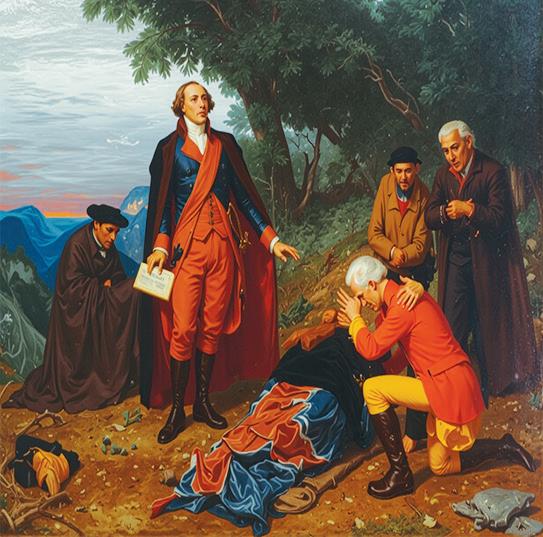
three aides-de-camp, only Washington escaped disabling wounds. It fell to him to arrange Braddock’s burial and read Anglican graveside prayers. Braddock, wrapped in a blanket, was lowered into a trench
dug in the roadway. Carts were driven back and forth to disguise freshly turned dirt, lest the general’s body be found and mutilated. A week later, Washington described his survival in a letter to his brother Jack as “beyond all human expectation.” He recalled a ball through his hat and four through his coat, one horse killed and two wounded under him.
A month later, reacting to raids against western settlements, the colonial government voted to reconstitute Virginia’s Regiment to 1,500 men, with 24-year-old Washington a full colonel in command. In midAugust, word reached Washington’s headquarters in Winchester that Britain had officially declared a
The Essential Man
state of war against France. Thereafter, the war that started in America morphed into Europe’s Seven Years’ War, eventually engaging global empires of Britain, France, and Spain.
Washington was on leave at a friend’s plantation in March 1758 when he met a petite, dark-haired widow, Martha Dandridge Custis. Though only 26, Martha’s 10-year marriage to the late Daniel Custis (20 years her senior), had left her wealthy. She and two surviving children inherited 17,779 acres spread over five counties. Martha, a skilled horsewoman barely five feet tall, had the self-possession to person-
ally assume managing vast estates. Nevertheless, the young mother must have welcomed attention from a famous officer—nearly one year younger than she, a foot taller and unrivaled as a dancer and horseman. Within weeks, Martha was having clothes redyed from black to “fashionable colors” inappropriate for mourning. Washington, who’d had past fl irtations, began ordering London fabrics and accessories suitable for a bridegroom.
Washington had already built additions to his leased manor at Mount Vernon and purchased additional acreage. He held a seat in the House of Burgesses and planned to resign from the military—until learning that Britain had dispatched 7,000 men to mount another attack against Fort Duquesne. According to Ron Chernow’s deeply researched Washington: A Life, Brigadier General John Forbes pro-
nounced provincial officers a “bad collection of broken innkeepers, horse jockeys and Indian traders.”
But Forbes knew of Washington and judged him “a good and knowing officer in the back countries.” He planned a three-pronged assault against the fort, with one prong led by Virginians under Washington, promoted to a temporary rank of brigadier general.
To history’s loss, Martha burned personal letters from George, a request he often made. He surely wrote her of this pending honor and of how it became foiled. When France’s Native American allies saw the size of the army advancing toward the undermanned fort, they calculated it unwise to stay. With their departure, the French opted to blow up Fort Duquesne and retreat. Forbes took unopposed possession and ordered Fort Pitt built on the ashes. Subsequently, Washington would retire from five years of military service to wed Martha, adopt Jacky and Patsy Custis, and settle into domestic life as a gentleman planter and member of the House of Burgesses. But before that, he seemingly couldn’t leave west country without one last instance of military controversy, heroism and miraculous survival.
In advance of attacking Duquesne, Forbes had encamped at Fort Ligonier, Pennsylvania, a newly built staging area. Scouts reported an enemy raiding force threaten-
ing their livestock, so he sent the Second Virginia under Lieutenant Colonel Mercer to engage them. A sound of brisk fi ring reached camp, perceived as being their men in retreat. With Forbes’s permission, Washington led volunteers to reinforce Mercer. When sounds of fi ring ceased, Washington sent scouts to investigate and to alert Mercer of their approach, but word wasn’t thoroughly disseminated. With visibility obscured by forest, falling dusk and musket smoke, some of Mercer’s men mistakenly opened fi re on their reinforcements. Washington’s volunteers returned fi re. He realized in horror that Virginians were exchanging lethal fi re. Reflecting decades later from beyond the Revolution, he wrote of November 12, 1758, that he “never was in more imminent danger by being between two fi res, knocking up with sword the presented pieces.” He’d spurred his horse between the two Virginia units, shouting and deflecting their muskets with his saber. Fourteen men lay dead and 26 wounded, but Washington again emerged unscathed, crediting Providence for his survival.
Forty-some years ago, A.M. Foley swapped the Washington, D.C. business scene for a writing life on Elliott Island, Maryland. Tidewater Times kindly publishes Foley’s musings on regional history and life in general.
The August Kitchen Reset: 5 Simple Habits for a Healthier Fall
August has always held a special place in my heart. It is my birthday month—a time for reflection, gratitude and noticing the simple gifts in everyday life.
This summer, I find myself back on the Shore reconnecting with precious friends, sharing meals, teaching, praying, loving and re -
turning to the roots that shaped me. This is where many of my dreams first took hold, and where my passion for helping others in the kitchen began to grow into what is now Kitchen Coach by Pamela.
It is also where I first began writing for the Tidewater Times ,
Tidewater Kitchen
a publication that feels like family to me. I am grateful to continue sharing here in a place where food, community, and story naturally belong together.
There is a rhythm here that reminds me food is never just food. It is care. It is memory. It is how we show up for one another in ordinary, meaningful ways.
As summer begins to wind down, August offers a natural pause before fall routines return. It is the perfect time to reset the kitchen and return to a few simple habits that make healthy eating easier and more sustainable.
Here are five simple ways to reset your kitchen this August.
Clear the Clutter
Begin with a simple refrigerator and pantry refresh.
Check expiration dates, use what
Tidewater Kitchen
you already have, and let go of what no longer serves you. Most of us are surprised by how many usable ingredients are already on our shelves.
Ask yourself:
What do we actually eat?
What makes us feel our best?
What has been sitting untouched?
A cleared space often brings a clearer mind—and a more intentional kitchen.
Stock a Simple Kitchen Tool Kit
Think of your kitchen like a toolbox. When the basics are in place, healthy meals become far easier to prepare.
These simple staples create the foundation for quick, nourishing meals.
Prep Ingredients, Not Perfection
Meal prep does not need to be overwhelming.
Instead of cooking full meals, focus on small steps: wash fruit, chop vegetables, cook grains, grill chicken or prepare a simple dressing. These small preparations allow flexibility during the week and
reduce stress at mealtime.
Use a Simple Meal Formula
When you are unsure what to make, return to this simple guide: Protein + Vegetable + Healthy Fat + Smart Carbohydrate + Fruit
For example: Breakfast might include an egg casserole with tomatoes and avocado, paired with fresh berries. Lunch could be chicken salad over greens with olive oil vinaigrette, whole grain bread and peaches. Dinner might be grilled salmon, roasted vegetables, brown rice and a side salad. This structure removes guesswork and helps create balanced meals with ease.
Revitalize Leftovers
One of my favorite kitchen habits is learning how to reinvent leftovers. This idea holds a special place in
Tidewater Kitchen
my heart. My son, Keillan, helped me deepen this concept through what we now call Revitalizing Leftovers. He is one of my greatest supporters—encouraging my work, sharing ideas, and creating his own recipes while living a full life working in the ER.
Cooking, in many ways, is a book that tells the story of who we are. People may not always remember the exact recipe, but they remember how they felt sharing a meal with you. Leftover chicken becomes tacos with homemade taco seasoning. Leftover rice becomes a breakfast bowl with egg, avocado and greens. Roasted vegetables be -
come a blended soup finished with olive oil and herbs. A refreshing appetizer might be cucumber slices topped with hummus and herbs. For dessert, baked cinnamon apples with walnuts offer a warm, simple finish.
Revitalized Leftover Recipes
Chicken Tacos with Homemade Taco Seasoning
A simple way to transform leftover chicken into a family favorite.
Homemade Taco Seasoning:
1 tsp. chili powder
1 tsp. cumin
½ tsp. smoked paprika
½ tsp. garlic powder
½ tsp. onion powder
Tidewater Kitchen
Pinch sea salt
Optional: pinch oregano or cayenne
Warm shredded leftover chicken in a skillet with a splash of olive oil or broth. Stir in taco seasoning and a small splash of water until coated and fragrant.
To Serve:
Warm corn or whole grain tortillas
Avocado slices
Shredded lettuce or cabbage
Diced tomatoes
Fresh cilantro
Lime squeeze
A simple meal that feels fresh, colorful, and completely new.
Breakfast Rice Bowl with Egg and Avocado
A nourishing way to repurpose leftover rice into a protein-rich
morning meal.
Ingredients: Cooked leftover rice
1 egg (fried or soft scrambled)
1/2 avocado, sliced
Handful of spinach or arugula
Olive oil drizzle
Salt and pepper
Optional: salsa or hot sauce
Warm rice in a skillet or bowl. Top with cooked egg, avocado and greens. Finish with olive oil, salt and pepper. This is simple, grounding and energizing for busy mornings or quick lunches.
Roasted Vegetable Blended Soup
Comforting, flexible and perfect for using up whatever is in the fridge.
Ingredients: Leftover roasted vegetables (any
Tidewater Kitchen
mix: carrots, zucchini, peppers, onions, squash)
2–3 cups vegetable or chicken broth
1–2 cloves garlic (optional)
Olive oil
Salt and pepper
Optional: herbs like thyme or basil
Warm roasted vegetables with broth in a pot. Simmer 5–10 minutes to soften. Blend until smooth using an immersion blender or standard blender. Finish with a drizzle of olive oil and fresh herbs. Creamy, nourishing and deeply satisfying without cream.
Warm Cinnamon Apple
Dessert with Walnuts
A simple, naturally sweet dessert that feels comforting without being heavy.
Ingredients:
2 apples or fruit that is in season, sliced 1–2 tsp. cinnamon
1 Tbsp. honey or maple syrup
¼ cup chopped walnuts, or your favorite nut
Optional: pinch of nutmeg
Place apples in a baking dish. Sprinkle with cinnamon and drizzle lightly with honey or maple syrup. Bake at 350°F for 20–25 minutes until soft. Top with walnuts before serving.
Warm, fragrant and perfect for ending a meal with something simple and real.
Health is rarely found in perfection. It is found in small habits repeated with care—choosing simple meals, using what we have and coming back to the table often.
Whether your August reset begins with a cleared refrigerator shelf, a few ingredients prepared for the week or a new way of turning leftovers into something meaningful, it all matters.
Sometimes the simplest meals are the ones that stay with us the longest. Here’s to a season of nourishment, simplicity and coming back to the kitchen with joy.
Pamela Meredith, formerly Denver’s NBC Channel 9 Children’s Chef, has taught both adult and children’s cooking classes.
For more of Pam’s recipes, visit the Story Archive tab at tidewatertimes.com.
3 Generation Family Run Auto Service Shop with over 31 years experience. Offering a wide variety of services to include but not limited to: Brakes, Diagnostics, Tire Rotation, Rv & Trailer Repair, Heating, and Basic Services. Specializing in Transmissions. Reasonable Rates!
Mullins & Sons, Inc. Automotive Repair Shop
Queen Anne’s County
The history of Queen Anne’s County dates back to the earliest Colonial settlements in Maryland. Small hamlets began appearing in the northern portion of the county in the 1600s. Early communities grew up around transportation routes, the rivers and streams, and then roads and eventually railroads. Small towns were centers of economic and social activity and evolved over the years from thriving centers of tobacco trade to communities boosted by the railroad boom. The county is named for Queen Anne of Great Britain, who reigned when the county was established in 1706.
Queenstown was the original county seat when Queen Anne’s County was created, but that designation was passed on to Centreville in 1782. It’s location was important during the 18th century, because it is near a creek that, during that time, could be navigated by tradesmen. A hub for shipping and receiving, Queenstown was attacked by English troops during the War of 1812.
Construction of the Federal-style courthouse in Centreville began in 1791 and is the oldest courthouse in continuous use in the state of Maryland. Today, Centreville is the largest town in Queen Anne’s County. With its relaxed lifestyle and tree-lined streets, it is a classic example of small town America.
The Stevensville Historic District, also known as Historic Stevensville, is a national historic district in downtown Stevensville, Queen Anne’s County. It contains roughly 100 historic structures, and is listed on the National Register of Historic Places. It is located primarily along East Main Street, a portion of Love Point Road, and a former section of Cockey Lane.
The Chesapeake Heritage and Visitor Center in Chester at Kent Narrows provides and overview of the Chesapeake region’s heritage, resources and culture. The Chesapeake Heritage and Visitor Center serves as Queen Anne’s County’s official welcome center.
Queen Anne’s County is also home to the Chesapeake Bay Environmental Center (formerly Horsehead Wetland Center), located in Grasonville. The CBEC is a 500-acre preserve just 15 minutes from the Chesapeake Bay Bridge. Over 200 species of birds have been recorded in the area.
Embraced by miles of scenic Chesapeake Bay waterways and graced with acres of pastoral rural landscape, Queen Anne’s County offers a relaxing environment for visitors and locals alike.
For more information about Queen Anne’s County, visit www.qac.org .
Kent County and Chestertown at a Glance
Kent County is a treasury of early American history. Its principal towns and back roads abound with beautiful old homes and historic landmarks.
The area was first explored by Captain John Smith in 1608. Kent County was founded in 1642 and named for the shire in England that was the home of many of Kent’s earliest colonists. When the first legislature assembled in 1649, Kent County was one of two counties in the colony, thus making it the oldest on the Eastern Shore. It extended from Kent Island to the present boundary.
The first settlement, New Yarmouth, thrived for a time and, until the founding of Chestertown, was the area’s economic, social and religious center.
Chestertown, the county seat, was founded in 1706 and served as a port of entry during colonial times. A town rich in history, its attractions include a blend of past and present. Its brick sidewalks and attractive antiques stores, restaurants and inns beckon all to wander through the historic district and enjoy homes and places with architecture ranging from the Georgian mansions of wealthy colonial merchants to the elaborate style of the Victorian era.
Second largest district of restored 18th-century homes in Maryland, Chestertown is also home to Washington College, the nation’s tenth oldest liberal arts college, founded in 1782. Washington College was also the only college that was given permission by George Washington for the use of his name, as well as given a personal donation of money.
The beauty of the Eastern Shore and its waterways, the opportunity for boating and recreation, the tranquility of a rural setting and the ambiance of living history offer both visitors and residents a variety of pleasing experiences. A wealth of events and local entertainment make a visit to Chestertown special at any time of the year.
For more information about events and attractions in Kent County, contact the Kent County Visitor Center at 410-778-0416, visit www. kentcounty.com or e-mail tourism@kentcounty.com . For information about the Historical Society of Kent County, call 410-778-3499 or visit www.kentcountyhistory.org/geddes.php . For information specific to Chestertown visit www.chestertown.com .
Talbot Yesterday by Dickson J. Preston
Reprinted from Tidewater Times, February 1977
Recollections of a St. Michaels Train Wreck
Alfred (Fritz) Wallach of Claiborne is a man of many parts.
At 82 he’s still an active waterman, although by his own account he’s doing no more than “a little nipperin’” this year. He’s also a poet, husband to wife Marge, a charter member of the St. Michaels Yacht Club and a survivor of the 1918 flu epidemic, a fact he credits to liberal use of whiskey and chewing tobacco.
Small, spry and energetic, he loves to sit in the living room of his little house on old Claiborne Road and tell tales of an earlier Talbot County, when life was simpler and the St. Michaels Bank where he worked was decorated with an assortment of large and gleaming brass spittoons.
One of his favorites is the story of the 1918 wreck on the B.C. & A. Railroad, a line better known as the “Before Christ & After,” which carried excursionists from the ferry landing at Claiborne to the straggling little resort town of Ocean City, Md.
In fact, Fritz Wallach may be the only person still around who was a witness to what happened on the
railroad track just outside St. Michaels on the blistering hot morning of August 3, 1918.
“I was in the Navy then,” he recalls. “Home on furlough. My brother, George, and I were out in a field near the track plowin’ for wheat when we heard the Ocean City Flyer comin’ down the line.
Alfred “Fritz” Wallach
She was headed for Claiborne to meet the morning boat from Baltimore.”
There was a little strip of woods between the two young men and the track, so that they couldn’t see the train. But they could hear her; from the clackety-clack of her wheels they could tell she was moving fast.
‘“She’s makin’ time this morning’ I said to my brother,” Fritz recalls. “She was really rattlin’ along. Then, all of a sudden, there was the darndest noise I ever heard.
‘“She’s jumped the track!’ I yelled.” And sure enough, she had.
The Wallachs lived on Church
Neck, not far from the scene of the accident. After a quick look, George, who was a camera enthusiast, ran home to get his Kodak Brownie and took the photos reproduced with this article.
“He was always takin’ pictures,” Fritz recalls of his younger brother, now deceased. “I didn’t care
that much. I was interested in the war (World War I) and girls, but not in that order.”
The Star-Democrat of August 10 carried a complete account of the wreck, along with a story
Train Wreck
about another misfortune which had befallen the B.C. & A. Company that same day.
Hearstian journalism and its scare headlines had not yet invaded Talbot County. So the story of the accident appeared under a modest one-column head set in tiny 8-point type.
“Wreck on B. C. & A. R.R.,” it stated. A subhead in even smaller type added the other pertinent facts:
“Train from Ocean City Jumps the Track Near St. Michaels. No One Hurt.”
“Last Saturday was a day of misfortune for the B. C. & A. Railroad line,” the newspaper reported.
“Not only did the steamer Talbot (also owned by the B. C. & A.) go aground, but the passenger train from Ocean City to Claiborne was wrecked near St. Michaels, due to the rails spreading.
“The train was made up of a Pullman car, three day coaches, and baggage car, and when the cars jumped the track, three were completely turned over on their sides, while the Pullman remained upright. The engine alone remained on the rails, the tender being turned completely over.
“The engineer, Purnell McBriety, stuck to his post, and it is said that the passengers raised over $100 as a gift to this man for re -
C. ALBERT MATTHEWS
Where Integrity Meets Innovation
Train Wreck
maining at his post. W. J. Laws was the conductor. No one was hurt.
“Immediately following the wreck, the company had a gang of men trying to lay a siding around the cars. This took considerable time before the normal traffic could be resumed. Some of the passengers from Baltimore were carried as far as St. Michaels, where they were motored to Easton and other points.”
The article, undoubtedly written by long-time Star-Democrat editor Sam Shannahan, smoothly shifted gears from reporting to editorial comment at this point.
“Improvements are greatly needed along this railroad, or else many more such accidents may be
looked for,” it said.
“The road bed is in a horrible condition, spikes being seen here and there working loose from the wooden beams… Unless extensive repairs are made soon, other accidents may be looked for with probably far greater damage to life and property.”
(Whether the repairs were made is not a matter of record. But luckily Editor Shannahan’s gloomy forecast didn’t come true. As far as is known, this was the only wreck the B. C. & A. ever had in Talbot County).
In later years, the legend grew in St. Michaels that a man had died as an immediate though indirect result of the August 3 wreck.
Wallach recalls being told when he came home after the war that
Homer Steele, the young and wellliked assistant station agent at St. Michaels, had a heart attack and died from the excitement.
“The way I heard it, he got so excited he ran all the way from the depot down to the scene of the wreck,” Wallach says. “There he keeled over dead.”
As with many St. Michaels legends, recorded facts don’t bear out this dramatic tale. Among St. Michaels items in the August 10 Star-Democrat was this:
“The entire community was shocked at the sudden demise of J. Homer Steele, the assistant agent at the B. C. & A. depot, on last Friday at Emergency Hospital, Easton. Scarcely has a death
caused such universal regret as this one. Mr. Steele had been living here for nearly 3 years…and had won for himself a host of warm friends.”
So the young agent died on Friday, the day before the accident, and at the hospital in Easton, not along the railroad trade.
Meanwhile, the steamer Talbot was still stuck in the mud off Ratcliffe Manor below Easton Point as the August 10 issue of the newspaper went to press. Her plight was reported in a separate story, which said she had run aground at almost exactly the same time as the train derailment. Passengers were taken back to Easton Point in small boats.
Come Fly With Us!
Incidentally, the Talbot was the queen of the B.C. & A.’s Chesapeake Bay fleet. Launched in 1912, she was the most luxurious steamer ever built for overnight bay service, with steam heat, running water, electric lights and 85 firstclass staterooms which even had flush toilets.
None of this helped get her freed from the Tred Avon River mud bank. In fact, because she had gone aground at high tide, her big paddle wheels were so high out of the water that they only touched it when the tide was near flood. So she couldn’t do much to help herself.
“The steamer Tred Avon , sent from Baltimore, tried to get her off at high tide Monday, but failed,” the Star-Democrat reported. “The large tug Seminole , also from Baltimore, tried unsuccessfully Tuesday afternoon and at 4 a.m. Wednesday.”
The Talbot finally was refloated on August 20, more than two weeks after she got stuck, when a wrecking crew from Baltimore dug her out with a huge mud scoop. Nothing was damaged except her pride – and the reputation of her captain, who had succeeded in running her aground at high tide on a clear calm summer morning in familiar waters.
As for Fritz Wallach, he knew
EASTERN SHORE
Melissa Grimes-Guy Photography
nothing of all this. He was back in the Navy, assigned to the engine room of a submarine chaser which was powered by a gasoline engine. His bunk was right beside the engine, and he was stricken by carbon monoxide poisoning because of the close quarters of the engine room. He was in the Naval Academy hospital at Annapolis when the flu epidemic broke out.
“Old Doc Smith, the superintendent of the hospital, had a theory about the flu,” according to Fritz. “He told me and another fellow he’d give us all the whiskey we could drink and all the chewin’ tobacco we wanted. Then he put 18 flu patients in our ward.
“They died on both sides of us. But we never got it.”
That was 58 (107) years ago.
Fritz Wallach has been applying the doctor’s prescription, liberal doses of whiskey and chewing tobacco, ever since. He’s never even had a bad cold, he reports.
It’s something for the advocates of swine flu vaccine to think about.
Publisher’s Note: Fritz Wallach was my grandfather, and I can attest to his liberal use of whiskey and chewing tobacco (and the occasional cigar) … I had my introduction to said “vaccine” at the age of about four. I would sit atop his shucking table and keep him company while my Mom and Grandmom had coffee. Suffice it to say, Child Protective Services would have a field day with that nowadays, and my mother wasn’t told until after his death.
Events for AUGUST 2026
SAT. 8/1 - US Naval Academy Band Electric Brigade - Outdoors - 7 p.m.
WED. 8/5 - Spy Nights with William Ehrhart, PhD - Stoltz - 6 p.m.
SAT.8/8 - US Air Force Singing Sergeants - Outdoors - 7 p.m.
FRI. 8/14 - Blue Water Highway - Stoltz - 7 p.m.
SAT. 8/15 - UA Army Field Band - Outdoors - 7 p.m.
SAT. 8/15 - Jon Lovitz - Avalon - 8 p.m.
THURS. 8/20 - Andy Thomas - Avalon - 7 p.m.
FRI. 8/21 - Rachael Sage - Stoltz - 7 p.m.
SAT. 8/22 - US Navy Band Cruisers - Outdoors - 7 p.m.
Every Saturday from 8-12 - 114-126 N. Harrison St.
Extra! Extra! Tell Me All About It
by B. P. Gallagher
It’s surprisingly easy to stroll onto the lot of a Hollywood film studio carrying a lasso and wearing leather chaps with frills. Add a five-gallon hat and voila: you’re el bandido de incógnito. No one bats an eye at the anachronistic get-up. They figure you for an extra or a stuntman and thus, invisible. Part of the scenery.
So you cut between the tables of refreshments populated like minor Galápagos by vibrant multitudes of zombies and doughboys and space
cadets and you blend right in, like you always knew you would. You skirt the trailers where the purebred stars are stabled and turn towards the ill-used Porta-Johns lined up behind the massive corrugated metal shoeboxes that divide the studio lot into a gridwork of beige monoliths.
You give the security guard a knowing look like ‘see how they bigleague us, we gotta take this shitty back route,’ and he nods—likewise knowingly—and lets you in through
Extra! Extra!
the gray-painted back door.
“Thanks man,” you say, tipping the wide brim of your hat in passing. “Can’t risk the porta-potty in this get-up. I’d hate to get backsplash on my chaps.”
As you pass through the portal, slate gray gives way to a patchwork of technicolor. From the moment you step inside movie magic engulfs you, bewilders and confounds your senses. In a space the size of an airplane hangar a half dozen distinct biomes are recreated in painstaking detail. A desert oasis replete with heaps of golden sand faces off in one corner with the façade of an office building. A cratered lunar surface extends to a towering backdrop painted like the starstrewn void of outer space. Opposite it, a monster twister looms over a faux prairie and a ramshackle farmhouse. The dimensions of each set defy perceptual logic in ways cleverly devised to grant the illusion of scope.
The mind boggles. For a minute you can do no more than stand and gawk. You have to remind yourself that you belong here. You’re Charlie in the Chocolate Factory, dammit— they just don’t know it yet. No time to dawdle, either: you have an appointment to keep.
So you weave through the shards of unreality and the vagrant souls who people this queer plane and you don’t let yourself get sucked in,
don’t let yourself linger for longer than a quick dip in the quicksand.
The receptionist whose desk monitors the hallway is nowhere to be seen, possibly taking an early lunch with the menagerie of other small potatoes and little-leaguers who mill about noshing on sliced oranges and apples and topping off Styrofoam cups of translucent coffee from carafes of dubious tenure. Already you feel yourself detach from that low orbit, exit the Earth’s gravitational field and head for the outer reaches of space.
You march right up to the door with the placard reading ‘Vincent P. Andrews, Talent Agent’ and let yourself in. The office is empty, as you knew it would be. As, in fact, you waited for it to be. Timing is everything, in acting as in life.
This isn’t his permanent office, of course. His actual office is back on the main drag in LA. But it’s not unusual for managers to set up camp on set when one or more of their biggest clients has a longstanding engagement with a studio. And it’s a lot easier to secure a meeting mano e mano amid the pell-mell of production, minus the red tape
and bureaucratic noise of an office building.
When the esteemed Mr. Andrews returns from the restroom you greet him with a winning smile and give your rehearsed answer—the only appropriate answer—to the obvious question, which is Who the Hell are You.
“Good morning, Mr. Andrews. I’m your next big star.”
Mr. Andrews, consummate professional, doesn’t bat an eye. He makes his way around to his desk, giving you a wide berth. A slight, sprightly man with coiffed sandcolored hair, his semi-casual manner of dress—rolled-up shirtsleeves and tartan sweater vest—belies opulence. That shirt is Egyptian cotton, the maroon and gold tartan premium Highlands cashmere. Those smart tan loafers and matching belt are supple Italian leather, and on his slender wrist, a leatherbanded Patek Philippe that well exceeds your net worth.
“You and every other bloodsucker in this town,” he says. “Listen, who let you in here? I’ve got a business lunch to get to.”
“That’s where you’re wrong, sir.”
This arrests his attention. “Oh? About?”
“I’m not from here.”
“I see. My apologies, then. Be on your way now.” He waves his fingers in a dismissive fashion, as if to con-
jure you away.
“And I took the liberty of cancelling your lunch meeting.”
A look of puzzlement flits across his narrow features, chased off by dawning alarm. “Is that so.” Mr. Andrews settles into his chair, busies his manicured hands under his desk.
“You’ll find that panic button malfunctioning, I’m afraid. I took the liberty of testing it.” This seems as good a lead-in as any for your pitch. “See? I’m a real go-getter, very versatile. Up for any role at all, really.”
“I’m sure you are,” says Mr. Andrews in a slightly strangled voice, “but my client list is full at the moment. Perhaps if you’d called ahead—”
“But you’re always on the lookout for new talent, right? A guy like you, you don’t want to pass up on the next big thing. How could you sleep at night?”
“I suppose I’ll just have to increase my thread count. That, and chamomile tea.” The dolt is so certain of himself that he’s blind to his peril—erm, the opportunity before him. This is good news. Just the kind of pluck a budding actor needs in his corner. Now you’ve got him backing up, though. He rolls his desk chair back until it butts against the wall. His pale eyes dart for the door. “Listen. Do I know you?”
“You should. I sent you my tapes. I know you got them too, ‘cuz I pa-
ART INSPIRED BY NATURE
2026 Featured Artists
Ray Brown, Southern California
Randy Conner, ew ork
Paul Rhymer, Maryland
Mark your calendars for the the event of the year! Since 1971, the festival has supported our mission.
Each art work sold supports wetland restoration, youth environmental programs, and local nonprofits.
In this way, art becomes action: visitors leave with nature-inspired treasures while helping protect wildlife and habitats for generations to come.
Nov. 13-15, 2026
Paul Rhymer “Blackwater Eagle”
tickets and info: waterfowlfestival.org
Extra!
pered the envelope in stamps.”
“Gee kid,” says Vincent P. Andrews, agent extraordinaire, as he inches towards the door. “I get sent a lot of tapes. It’s entirely possible it ended up on my assistant’s desk, or with one of our summer interns.”
“Mine was the one with the sardines.”
“Oh.” His nose wrinkles in distaste. “That was you?”
“I heard you were partial to them. I know all about your…proclivities.”
His angular features pinch further.
“So I take it you weren’t impressed with the film. That’s okay. I got a lot more material to show you.” As you say this, you pay out a couple feet of lasso and start swinging it in languid whirls at your hip.
“No.” Mr. Andrews shakes his head, half rises from his chair. “No need to show me a lasso trick, thank you. Listen, I’m pretty sure you want the central casting rep. Next building over.”
You grit your teeth. “No. I’m done with central casting.” Truth is they wouldn’t have you. Said you got crazy eyes, said come back when we need, I don’t know, barbarians or something. But who’s counting.
You pay out a bit more of the lasso, start to whirl it faster.
“Listen, I don’t know—”
“You say listen a lot. You should take your own advice.”
Next thing you know you’re hiking the wriggling sack over your shoulder and heading for the back door.
It’s astonishingly simple to stroll off the lot of a Hollywood film studio with a bound and gagged hostage slung over your shoulder when you move with purpose and smile at passerby like ‘I can’t believe we get to do this stuff for a living, right? Dreams do come true.’
The little twerp fits in the trunk of your Ford Sierra easy enough. As you pull from the parking lot you half expect a fleet of squad cars to converge on you, but none do. You take this for a good sign and step on the gas. From Hollywood you head north, taking the freeway up through the foothills. Switchbacks like stitches suture the rippling topography of the heights, each thread terminating in a home of astronomical worth. An aspirational locale in every sense. One to which, in your wildest dreams, you will soon belong.
The ride back to your rental on the outskirts of Bakersfield is
Pilates
Cadillacs, chairs, barrels, reformer/ towers and fuse ladders
5 Private rooms for individual or classes avail. Gift Cert.
tense. But that’s to be expected. You’re still working out the kinks of this professional arrangement. Except for the occasional thump, your agent keeps mum in the trunk. Passed out? No, you decide. Credit where credit is due. Mr. Andrews is a tough nut to crack. This unflappable quality is another mark in his favor. Once you get to know each other better, he’ll see that he is in the company of a fellow go-getter. Once you get to know each other, you’ll get on just swimmingly. This episode will fade like a fever dream. Like it never happened. And you’ll have your dream agent.
It’s all very convincing with the twinkling brilliance of LA receding in the rearview. Somewhere out beyond the light pollution a horde of stars await discovery.
You pull into the garage and draw down the door with a rattling crash that shakes cobwebs and dust from the frame. The neighbor’s house is dark: away on business maybe, or gone fishing. You’re not close. Just close enough to note that the culde-sac is down a pair of eyes for the weekend. The rear porch light of the house up the hill effervesces in the hazy dusklight like a rheumy eye. A precaution. Mr. Sanchez works nights and will have left for his shift by now.
You pop the trunk full of apologies and with a can of pepper spray
in hand should Mr. Andrews try to pull a fast one. That’s the sort of gumption you want in an agent but still, you can’t have him getting away without a signed contract. Then this would all be for nothing.
But the trunk swings open to reveal Vincent P. Andrews mute and trussed and terrified. The composure you so admired earlier has fled. Oh well. We can’t be perfect all the time.
You shuttle your esteemed colleague into the house and sit him down at the kitchen table. Don’t forget your manners. Plop a glass of water and a can of Budweiser in front of him, let him pick. You’ve got milk too and you think of pouring up a glass of that as well but it’s gone sour. Shove it in the back of the fridge with the other expired dairy.
Mr. Andrews picks up the can of beer with his bound hands and raises it shakily to his lips. As he does so he gives what he thinks is a surreptitious wiggle, testing the knots that secure his ankles to the chair legs. The bindings are snug. The whites of his eyes betray his terror, yet he does not blubber, does not threaten or beg. He takes a long swig of the beer and slumps down in the chair with a drawn-out, shuddering sigh of resignation.
“Okay,” he says finally. “What’s the game here?”
“I’m glad you asked. Be right back.”
The TV cabinet is on wheels,
which makes it easy to roll from the den into the kitchen parlor.
When he sees what you’ve brought, Mr. Andrews says, “Holy shit. You are crazy.”
You glare at him. “Luckily for you I’m not, or you might upset me talking like that.”
“You’re right, of course.” How quickly a caged bird changes its tune!
“Now sit back and watch.”
For the next hour you play your best material for the man. You lurk in the kitchen and steal odd glances at your agent’s face as he absorbs your nascent catalogue. The comedic elements don’t land with as much punch as you’d like, but the dramatic bits have their intended impact. After a short while, Mr. Andrews begins to cry.
The tape whirs to completion. You step back into the room and take the seat opposite your guest. “So. You see the potential.”
“I see…something.”
“Talent. The word is talent.”
“Oh. Yes, of course. Talent.”
“What else?”
“Erm. Generational. Utterly unique. Once in a lifetime?” His voice squeaks on the last, rendering it quizzical, but it’ll do.
You swell with pride. “I knew you’d come around to my work.”
“It’s certainly broadened my horizons.”
“Yes. Yes!” In your excitement, you slap the table with both palms. Mr. Andrews jumps as much as his restraints will allow. “That’s exactly what I’m going for.”
“Right.”
“See? You and me are going to go far together. We just need to set the parameters of our working relationship. That’s what this is for.”
You head into the spare bedroom and return with an old Royal typewriter rummaged well-used from the bargain bin (read: dumpster) of an office building in El Paso, Texas, where you lived before you caught the acting bug. You set the typewriter down on the table facing Mr. Andrews. Then, remembering that his wrists are bound, you spin the typewriter around and poise your fingers over the keys. “You dictate, I’ll type. You’re more familiar with the language in these contracts anyhow.”
Vincent P. Andrews glances once more around the room as if expecting his salvation to stroll in at any moment. When it doesn’t, he sighs and starts speaking fluent legalese, a steady stream of legitimizing language that promises to give your wildest dreams the stamp of authenticity. The terms mollify you even as your fingers race to get them down on paper. Feature films, network television, exclusivity, bona fide, rules and regulations, binding and valid…
A train of approaching headlights
stream through the seams in the curtains and dance over the walls and do not pass on. All aimed at you. Understanding bubbles to the fore. Realization does battle with delusion in your frazzled mind. Mr. Andrews’ eye twitches almost imperceptibly.
“Keep talking,” you tell him.
Sirens bleat and lights fl ash outside. The house is basked in a brilliant white glow as spotlights fi x on every exit and entrance. Scales of red and blue sashay up and down the bare drywall behind you in jigging patterns, declaring themselves. Your hands sweat, fi ngers tremble at their approach. You mistype one word, then another.
“Just a few more details of my contract to hammer out.”
Mr. Andrews eyes you with the barest hint of sympathy. It’s a look you know well. Your heart sinks. Stardom, which seemed for one fleeting gasp a signature away, slips through your sweatslicked fi ngers.
“This contract we’re writing
probably isn’t gonna hold up in a court of law, is it?”
Mr. Andrews shakes his head.
Outside, patrol car doors swing open and jackbooted feet stomp up the front walk. A few seconds later they boot down the door and haul you away while your newfound agent denies you thrice and again. They handcuff you and stuff you in the back of a police cruiser that reeks of cigarette smoke and the stale sweat of the last perp they picked up.
You land a starring role in a Los Angeles psych ward. Inpatient #7634. You get a decade, give or take, to hone your craft. For the full run of Cheers you’re a regular in a rotating cast of basket cases stuck on one wing of a psychiatric hospital where you could lose yourself forever. A labyrinth of monochrome walls and squeaky wax floors you wander in dreams years later. You still have the socks with the grip pads on the soles.
But wouldn’t you know it, the treatment helps. By subtle shades you get better, break the mold you’ve been typecast in since high school, when you got your fi rst diagnosis.
And they fi nally teach you to quit thinking in second person.
Three decades pass before I get the acting bug again.
In 2024, it brings me no pleasure to say, it’s practically impossible to
mosey onto a film studio campus without the proper identification. The gate guard takes one look at me and my lack of credentials and sends me packing.
I circle the fenced-in perimeter in search of a back entrance. I don’t bother with a disguise. Disguises are passe this day and age. Besides, there’s no way they could recognize me all these years later. How many security guards must have come and gone in that time? And thirty years have changed me, made me all but unrecognizable. Hardcore psych meds, lately lapsed, are not kind to one’s figure. It’s all too easy to blend in with the ragamuffin denizens of the Los Angeles streets.
So I skirt the panhandlers and drug zombies who strew the sidewalks like human husks shucked and discarded. A couple derelicts paw at my shoes in passing and I give them the look like, ‘Listen bud, we can go toe-to-toe on crazy if you want, but I win that battle eleven times out of ten.’ It’s sad, but that’s how it is out west these days. LA belongs to the junkies now. Hence the fence and other heightened security measures around the film studio lot.
As far as I can tell from the outside looking in, not much else has changed. The beige monoliths stand in stoic rows, their nondescript exteriors hiding the wonders within.
Somewhere among that honeycomb of sets and blankfaced greenscreens, my would-be agent still maintains a temporary office. Not in the same building, perhaps. I imagine they’ve shuffled offices around in the intervening years to accommodate the new security measures and the advent of greenscreens, both travesties. The nameplate will have changed as well. Because Vincent is Vanessa now. Vanessa Andrade. So I guess he turned Brazilian too. Bit of a miscast if you ask me, but whatever. They made a big fuss over it in the gossip rags I could get my hands on in the clink—sorry, the psych ward—and I’m like, big deal.
I locate a blind spot along the perimeter, as close to an unguarded back entrance as I’m likely to find. I make a running start, scale the fence, and clear it with my heart in my throat. A couple of the junkies sprawled on the sidewalk, those clear-minded enough to notice, raise ragged cheers. As I sail through the air I feel on top of the world.
Hollywood belongs to the crazies now. But then it always did.
I hit the ground running with no plan beyond what the next stride places before me. That’s show business, baby. You’ve got to seize these opportunities as they come. This time, I make it to the door of the closest stage before security catches up.
SLOT DOCK
Perfect for Kayaks and Paddleboards
• Kayak Docks
• Re-Decking
• Pressure Wash & Seal
• Boat Lifts, PWC Lifts
• Gangways
• Solar Dock Lighting
• Floating Piers
• Rowing Docks
• Kayak Racks
• Ladders
• Dock Boxes
• Piling Caps
As the guards tackle me I think, Stunts! Stunts has always been my calling. Knock me down seven times, I’ll get up eight. And as they haul me off again I think, minor setback. Dust yourself off. Because if Hollywood’s taught me anything,
it’s that there are diamonds in the rough, and the brightest stars need but one spark to blaze forth. Each rejection a minor combustion along the way to nuclear fusion. I truly believe that, even now.
What can I say? That’s movie magic.
B. P. Gallagher’s fi ction has appeared in Roi Faineant Press, Flash Fiction Magazine, Meniscus Literary Journal, and elsewhere. He is a 2013 graduate of Easton High School, holds a Ph.D. in Social/ Personality Psychology and is currently Assistant Professor of Psychology and Culture at Nazareth University.
CHESAPEAKE BY DEL WEBB - 2-story Wittman model. Great room with gas fireplace, dining room, eat-in kitchen with center island and breakfast nook, sunroom, office, 1st floor primary suite, guest bedroom and full bath. 2nd floor features a loft, bedroom and bath. 2 car garage, patio and lawn irrigation. Improvements include newer roof, water heater and HVAC. 55+ agerestricted section. Close to downtown Easton. $475,000
Easton Cape. This 4 bedroom, 2 bath home offers a living room with wood burning brick fireplace, spacious eat-in kitchen, porch/ sunroom. Hot water baseboard oil heat, central air on 1st floor, 2 sheds, corner lot with mature plantings. Flooring is carpeted, but wood flooring under carpet. Ready for immediate occupancy. First-time offered in 42 years. Close to downtown Easton and amenities. $325,000
CHESAPEAKE BY DEL WEBB. Popular 2-story Wittman model. Great room with gas fireplace, office, kitchen with center island and breakfast nook. Sunroom, enclosed porch overlooking your own private fenced in-ground pool. Primary bedroom suite, guest bedroom and hall bath. 2nd floor features a loft, guest bedroom and bath. Central air (2025) and newer roof. Attached 2-car garage, patio and irrigation system. 55+ agerestricted section. Community amenities. $480,000
Meticulously renovated and featured in Coastal Living, this Tidewater Colonial-inspired waterfront estate is set on 3.5+ private acres with 870+ feet of shoreline and panoramic water views. The four-bedroom residence features a custom kitchen, updated baths, three fireplaces, water views from nearly every room, complemented by a magnificent screened porch, waterside pool, and private pier. Timeless architecture, exceptional privacy, and breathtaking views define this remarkable Eastern Shore retreat.