TÉCNICO INVESTMENT CLUB


TÉCNICO INVESTMENT CLUB
Bridging Engineering and Finance: A Semester of Risk Innovation at TIC p. 3
By Tiago Antunes
Deal by Deal: How M&A Is Rewriting the U.S. Health System
By Maria do Mar Vieira & Francisco Falcão
Lantheus in 2025: Chasing Growth, Facing Doubt
By Carolina Nunes
From ideas to reality - our road to Strategy Application
By João Pedro Afonso & Tomás Juhos
p 4
p 6
p 7
By

ReadingtheRapidsBeforeWeLeap
Imagine hikers facing a fast-moving river One route hops from rock to rock, the other wades straight through Knowing each stone’s slipperiness and every ford’s depthturnsagambleintoadecision
Until this semester, TIC’s Asset Management team relied almost entirely on macroeconomic forecasts, our “weather report”, to guide portfolio choices. We saw gathering clouds but couldn’t measure how slick each step might be. To close that gap, we split into Macro (scanning the skies) and Risk (testingthestones) Thisarticlereflectson what the newly formed Risk team built, why it matters, and how it shifted our culture
Building the Compass – From SpreadsheetChaostoStructuredCode
A reliable compass must work in any conditions. For us, that meant replacing ad-hoc spreadsheets with an objectoriented Python framework that answers threequestionsinrealtime:
1 Whatdoweown?
2.Howmuchcashdowehave?
3. If a position tanks overnight, how bad coulditget?
Outofthissprangthreecoreclasses:
Stock: Wraps Yahoo Finance: fetches price history, computes daily returns, and outputs Sharpe, Sortino, beta, and other ratios
Portfolio: Marks positions to market, tracks residual cash, aggregates to portfolio-level metrics, and runs Monte Carlosimulations
tostress-testthousandsofscenarios.
Transactions:Replayseverybuyandsell, day by day, reconciling cash balances and offering an Excel importer so non-coders canlogtradesseamlessly
Together, these modules form a plug-andplay engine Any member can fork the repo, point it at their transaction file, and instantly regenerate TIC’s risk picture on theirownlaptop.
Early on, checking risk felt like lifting a bucket lid every few hours Now, our scriptsactassensors:
• Each morning a scheduled job pulls the latestmarketdata
• Metrics get recomputed and stored as tidyCSVs.
• A monitor scans for breached stop-loss or take-profit thresholds and autogeneratessellordersbeforebreakfast
By shifting from manual polling to automated updating, the Risk team spends meetings interpreting signals instead of gathering them, because risk unfolds on markettime,notmeetingtime
Numbers convince analysts; visuals convinceeveryoneelse Onceourbackend was stable, we focused on storytelling in Power BI Dashboards now greet membersinstantly:
Portfolio Overview: A “heartbeat” chart of total value, drawdowns, and Monte Carlopricepaths
Stock Analysis: Interactive tabs for each holding, showing price history alongside marginalriskcontributions
Advanced Risk Metrics: Heat maps of Sharpe, Sortino, and volatility impacts, withcolorflagsforoutliers
Asset Allocation & Exposure: Donut charts and treemaps by sector, region, and market cap and a side-by-side performanceversusETFbenchmarks
Thanks to automatic CSV refreshes, what used to take a lifetime now takes one click WhenMacroproposesanew
position, Risk can instantly visualize its effect on drawdown or VaR Dialogue replacesguesswork
Engineering students love to tinker We designed our platform to invite contributions: new risk metrics can be added via pull requests; custom visualizations drop straight into Power BI by dumping a CSV; documentation with clear docstrings and pervasive type hints lowers the barrier for newcomers This volunteer-driven club depends on handovers each semester By embedding good engineering practices, we ensure each cohort builds on the last, creating a virtuous cycle where today’s beginners becometomorrow’smaintainers
Splitting Asset Management into Macro and Risk wasn’t about creating silos it was about sharpening focus The Macro team surveys global interest-rate trends, geopolitical shifts, and sector rotations. The Risk team operates the microscope, checking that every decision aligns with our risk appetite When these perspectives converge, we make choices that balance vision with terrain Every enhancement brings us closer to a self-aware portfolio Next steps include: expanding metrics (eg, conditional VaR, drawdown attribution); integrating alternative data for stress-scenarios; onboarding scripts to help new members spin up the environmentinminutes
Uncertainty is inevitable, rivers will always flow But by measuring depth and current, we turn blind jumps into calculated strides This semester, TIC’s Risk team built: a reusable codebase that codifies every position and trade; automated sensors that update metrics overnight; interactive dashboards that translate data into actionable stories; a culture that rewards curiosity, documentation, and continuous refinement
This milestone is just the beginning As future cohorts encounter new currents, they’llhavebothasturdycompassandthe habit of checking it We’ll keep listening to the data, learning from surprises, and improving our framework as engineers, as investors, and as a community united by thoughtfulrisk-taking
By

Mergers and acquisitions are reshaping the US healthcare landscape From national hospital systems downsizing, to regional providers and academic medical centers expanding their reach, the new dynamics raise pressing questions: will patients gain better access and care, or willconsolidationreduceaffordabilityand competition?
As strategic and financial pressures collide, stakeholders must reassess what healthcare delivery will look like in 2025 andbeyond.
For investors, they represent both opportunity and risk: acquiring facilities at a discount while navigating potential regulatoryandoperationalchallenges
By

Unlike many European nations with centralized, publicly funded health systems, the US healthcare system is a complex mix of public and private providers, insurers, and investors Hospitals operate under diverse ownership models (nonprofit, for-profit, academic, religious) and rely heavily on reimbursements from private insurers and government programs like Medicare and Medicaid
This fragmented landscape makes the system highly susceptible to economic pressures and policy shifts, making mergers and acquisitions a powerful tool forstrategicrepositioning
Since the COVID-19 pandemic, many US hospital systems have experienced a perfect storm of financial distress Declining revenues, staff shortages, and rising wage demands have destabilized operations Besides, the potential for cuts in Medicaid reimbursements, due to ongoing Congressional budget negotiations, has made the outlook more precarious.
In response, large national systems are streamlining operations by divesting underperforming assets For instance, Ascension significantly reduced its presence in Michigan by selling several hospitals to regional players like Beacon Health and MyMichigan Health CommonSpirit Health also exited San Francisco, selling two hospitals to UCSF Health.
These divestitures aim to sharpen focus on core markets and preserve profitability However, for patients, they raise concerns about service continuity, especially in vulnerableregions
While national players pull back, many regional systems are doubling down By acquiring divested hospitals, these providers are scaling their networks and strengthening geographic footprints Florida-based BayCare Health, for example, ended a joint venture to assume full operational control and secured $13 billioninfunding.
Similarly, Orlando Health expanded aggressivelyin2024,purchasinghospitals across Florida and Alabama These moves, backed by nearly $2 billion in bridge loans and long-term financing, signal confidence in the benefits of regionalconsolidation
This strategy could translate into more consistent service quality and improved care integration But it also introduces risks: less competition in certain areas may lead to higher costs, and integration failures could disrupt patient care For investors, understanding these dynamics is key to evaluating long-term value creation.
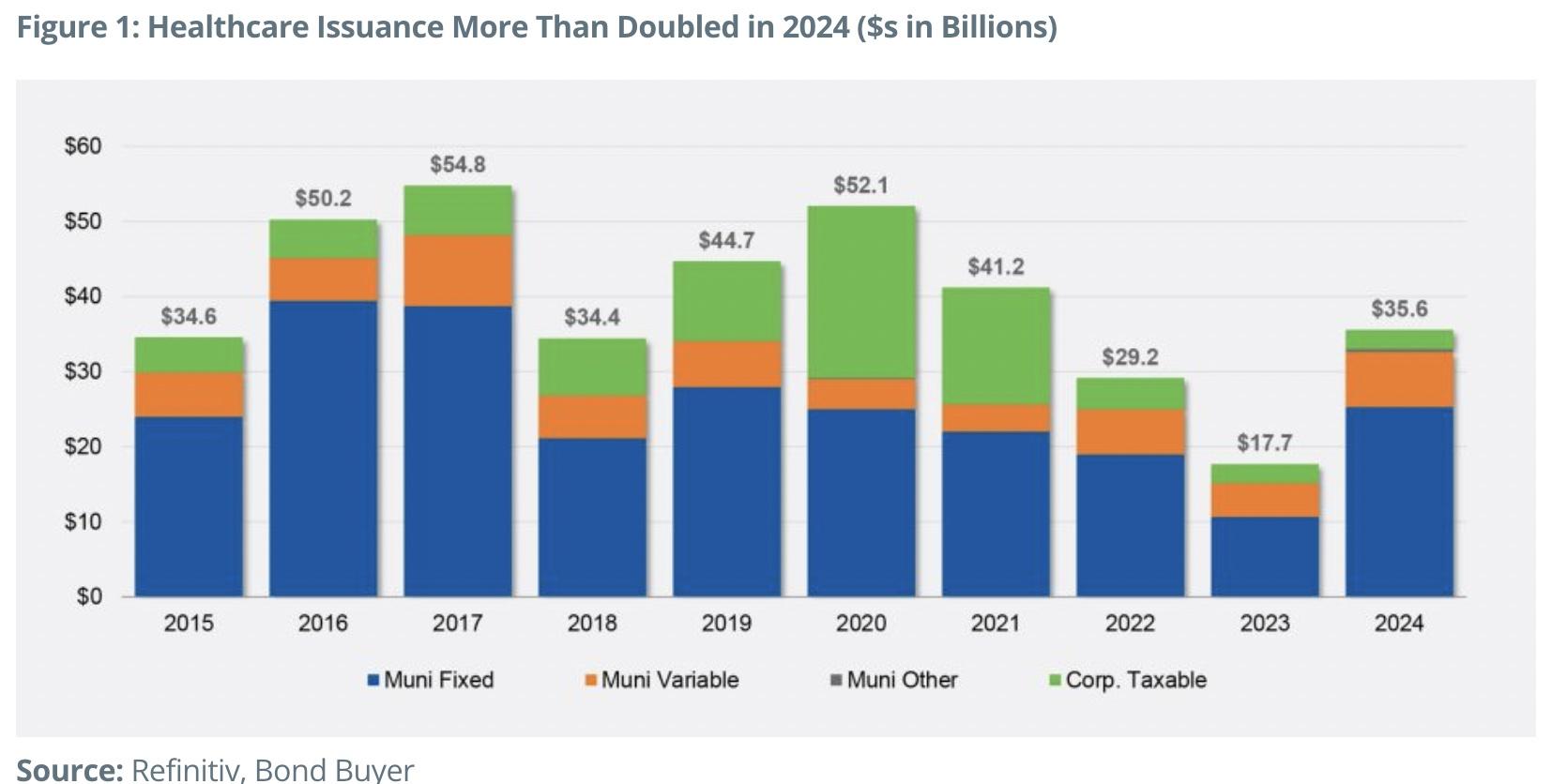
This chart illustrates the evolution of healthcare bond issuance in the US from 2015 to 2024 After years of fluctuations, affected by macroeconomic uncertainty, regulatory shifts, and COVID-19 pressures, issuance reached a low point in 2023,withjust$177billion
In 2024, however, issuance rebounded sharply to $35.6 billion, more than doubling year-over-year This surge was driven by renewed expansion strategies among regional systems and academic medical centers, which leveraged debt markets to fund hospital acquisitions, infrastructure upgrades, and clinical networkdevelopment
The breakdown includes tax-exempt municipal bonds both fixed and variable rate as well as taxable corporate debt, each reflecting different financing strategies and risk profiles For investors, thisreboundindicatesgrowingconfidence in the sector’s long-term viability, despite ongoing operational risks and regulatory challenges The financing boom is a central enabler of current M&A dynamics inUS healthcare
Academic medical centers (AMCs) are increasingly becoming key players in the healthcare M&A landscape These institutions are strategically acquiring community hospitals to relieve overcrowding at their main campuses while expanding care accessibility across broadergeographies.
For example, in 2025, UMass Memorial Health acquired Milford Regional Medical Center using proceeds from a $342millionbondissuance Likewise,the University of Maryland Medical System secured over $500 million in financing to build a new medical facility serving Maryland’s eastern shore These expansions are not just about infrastructure, they are about shifting car models
By offloading low-acuity care to satellite hospitals, AMCs are reserving their core facilities for high-complexity treatments andresearch,creatingamoreefficientand specialized system However, this shift comes with challenges, including maintaining quality standards across diverse sites and managing the high costs ofexpansion
The wave of M&A activity across the US healthcare sector presents a doubleedged sword For investors, it opens up new avenues for strategic positioning whether through acquisition of undervalued assets, partnerships with expanding systems, or financing major transitions.
Yet it also demands caution: integration risks, regulatory scrutiny, and potential political backlash could all affect valuationsandreturns
Patients stand at the heart of this transformation In ideal scenarios, consolidation leads to streamlined operations, expanded service offerings, and better outcomes. But if mergers reduce competition or result in closures, communities may face fewer options and highercosts
As 2025 unfolds, healthcare M&A will continuetoredefinethedeliveryofcarein the United States Stakeholders must weigh efficiency against equity, growth against access and, ultimately, financial strategyagainsthumanimpact
By

In recent years, Lantheus Holdings has undergone a remarkable transformation from a mid-sized, relatively unknown radiopharmaceutical company into a prominent player in diagnostic imaging Headquartered in Massachusetts, the company has seen significant revenue growth,primarily driven by the success of its flagship product, Pylarify. However, despite these achievements, investor confidence has remained cautious. The company’s share price has shown notable volatility, and recent performance updates have only added to the uncertainty As Lantheus embarks on a new phase characterised by acquisitions and pipeline expansion, the central question becomes whether its current strategy will sustain long-termgrowth
Radiopharmaceuticals are playing a growing role in medical imaging, driven by better diagnostic accuracy and the move toward personalised care Despite strong potential, the sector is complex high costs, rigid regulations, and short product shelf-life present ongoing challenges
In this context, Lantheus, established in 1956, is positioned within this complex landscape as a specialist in oncology and cardiology imaging solutions Additionally, the company has also pursued strategic partnerships to support innovation and product development, reinforcing its focus on precision medicine. Although its sales operations are currently confined to the US market, Lantheus extends its reach through licensing agreements with international distributors
Lantheus' portfolio is dominated by two key products: Pylarify, a PET imaging agentforrecurrentprostatecancer
thataccountsforover65%ofrevenue,and Definity, with more than 20% While the company also markets several other diagnostic agents, their impact is more limited Lantheus competes in a crowded field, facing companies such as Telix Pharmaceuticals, Bracco’s Blue Earth Diagnostics,andGEHealthcare
The Pylarify Breakthrough and Its Impact
As recently as 2019, Lantheus generated approximately $350 million in annual revenue, with Definity as its primary contributor The company’s trajectory shifted significantly in 2020driven by better diagnostic accuracy and the move toward personalised care Despite strong potential, the sector is complex high costs, rigid regulations, and short product shelf-lifepresentongoingchallenges
In this context, Lantheus, established in 1956, is positioned within this complex landscape as a specialist in oncology and cardiology imaging solutions Additionally, the company has also pursued strategic partnerships to support innovation and product development, reinforcing its focus on precision medicine Although its sales operations are currently confined to the US market, Lantheus extends its reach through licensing agreements with international distributors
Lantheus' portfolio is dominated by two key products: Pylarify, a PET imaging agent for recurrent prostate cancer that accounts for over 65% of revenue, and Definity, with more than 20%. While the company also markets several other diagnostic agents, their impact is more limited Lantheus competes in a crowded field, facing companies such as Telix Pharmaceuticals, Bracco’s Blue Earth Diagnostics,andGEHealthcare
The Pylarify Breakthrough and Its Impact
As recently as 2019, Lantheus generated approximately $350 million in annual revenue, with Definity as its primary contributor The company’s trajectory shifted significantly in 2020 with the acquisition of Progenics, setting the stage for the launch of Pylarify in 2021 This new product catalysed a phase of rapid expansion, pushing revenues beyond the $1 billion mark and delivering triple-digit year-over-yeargrowthatitspeak
Pylarify’s success stemmed from its PSMA-targeting mechanism, which enabled precise detection of recurrent prostate cancer Its clinical value, combined with CMS reimbursement approval, led to rapid adoption and significant revenue acceleration As the product gained traction, it became the backboneofLantheus’commercialstrategy allowing the company to reinvest in its pipeline and consider expansion into adjacentfields
The narrative changed in 2025 In Q1 2025, Pylarify sales had a 05% decline and overall revenue remained flat. Following the results, the management also announced a guidance downgrade, triggering a 23% drop in the share price While management cited pricing and reimbursement pressures, their emphasis on acquisitions and future strategy left investors with limited clarity on near-term performance
During 2025, Lantheus completed two strategic acquisitions: Evergreen Theragnostics and Life Molecular Imaging These moves aim to strengthen the company’s position in oncology and broaden its footprint into Alzheimer’s diagnostics These acquisitions added manufacturing capabilities and a new Alzheimer’s pipeline,including MK-6240, expected to file for NDA in 2025 While they broaden Lantheus’ market potential, their success depends on regulatory progress and effective integration. The expiry of Pylarify’s exclusivity on May 25, 2025, introduces another layer of complexity While patent protections remain valid through 2037, generic competitors can now file for approval Their options include waiting for expiration, negotiating a license, or initiating legal action to challenge the patents an increasingly common path in this sector Lantheus also depends on third-party manufacturers for key components, which could affect productionifdisruptionsoccur
Lantheus showed strong growth with Pylarify’s success, but momentum is slowing With key assets nearing regulatory review and acquisitions being integrated,thesecondhalfof2025willbe pivotal. Future performance hinges on scientificresultsandthecompany’sability tomanagerisingoperationalchallenges
By
and Monitoring and Publishing the results on our Website. The whole pipeline is Python-based, leveraging Postgres for data storage and management Currently our strategies are deployed on Alpaca’s paper trading accounts, which should provide a very close proxy to real trading, by charging real transaction fees and exposing the strategies to slippage just like in real markets.
Based on this classification, for MeanReverting assets, the RSI indicator is used to generate buy signals, while the MACD is the foundation for the signals in Trending assets These signals are generated daily using close prices, and target portfolio weights are assigned uniformly among the assets with buy signals
By
Throu t the

Quantitative Trading Department, we have studied and developed several methods to create systematic and algorithmic strategies, either based on Portfolio Optimization techniques or Machine Learning methods. It was a period of great growth and learning, but every time we shared our excitement and progress, people would always ask the same questions: So, how did it go? Did you get it up and running? Did it work? And most importantly Is it making money?
These questions were the motivation to create a new team: the Strategy Application team. During the past semester, this team developed the missing piece our department needed: a structured pipeline that enables our teams to turn their ideas into real, live investment strategies - up and running, delivering results (and yes, making money! Althoughonlypapertradingfornow)
This automated process is built around four main stages: Data ETL, Signal Generation,OrderOrchestration,
The first main component is the Data Extract-Transform-Load (ETL) projects These projects connect to brokers, such as Alpaca and Binance, and keep our database up to speed with the most recent market data to allow our strategies to make decisions on the freshestdata.
The second main component is the Strategy Execution Pipeline. Each strategy has one instance of three microservices: signal generation, order orchestration and monitoring Signal generation is the component where the strategy application team collaborates with other teams (Portfolio Optimization and Machine Learning) to adapt and integrate their code into a production environment turning these strategies from static to live. The order orchestration componentfetchesfreshsignalsassoonas they are produced and connects with the broker to manage positions accordingly Lastly, we have the monitoring component, a crucial step in storing the performance and positions of our strategies to allow further analysis and to expose the historic results that would be lost otherwise. To achieve this, it takes periodic snapshots of the state of the portfolio and positions in the brokerage accountandstorestheminourdatabase
The third main component is our website, which picks up on the monitoring results and allows us to expose to the world our strategy’s performance It was developed in collaboration with the Marketing Department,whichbuiltthefront-endthat displays key metrics and the evolution of ourstrategy
In order to test and to debut this structure, we have deployed our first strategy: PO Hurst – Crypto. This is a Long-Only strategy that uses the Hurst Exponent to classify Cryptocurrencies into two behavioral regimes: Mean-Reverting and Trending.
Furthermore, we have developed mechanisms to avoid unnecessary turnover and minimize transaction costs. Before each rebalance, the strategy computes the Normalized Euclidean Distance between the current portfolio weightsandthenewtargetweights Ifthis distance falls within a predefined notrade zone, determined by an optimal threshold δ, the strategy retains the current weights thereby avoiding unnecessary turnover. When rebalancing is triggered, it is executed through a weighted average between the current and target weights, allowing for gradual adjustments rather than full reallocation As a result, the strategy never performs a complete portfolio turnover, effectively reducing both transaction costs and slippageovertime
This strategy was deployed on May 6th, and its performance has been publicly trackableonourwebsiteeversince And–unsurprisingly-it’sbeendoingquitewell! While it's important to take into account thatourentrywasquiteexceptionaldueto the market conditions at the time, our strategy has consistently delivered positive cumulative returns from almost dayone,currentlystandingataround20%
With the pipeline built, we are now equipped with a tool that enables us to easily create and integrate different strategies and track their live performances More specifically, until the end of the semester we plan to deploy the firstMachineLearningbasedStrategythat will trade Bitcoin, as well as a new Portfolio Optimization Strategy that also uses the Hurst Exponent, but this time applied to equity rather than cryptocurrency
We close the semester with a strong sense of accomplishment and pride, not only in finally showcasing the success and the quality of the work that we have been quietly developing over the last years, but also in leaving behind a tool for TIC that willallowthemtokeepthriving.
DearTICMembersandISTCommunity,
As we bring another academic year to a close, we want to take a moment to thank each and every oneofyouforyourdedication,hardwork,support,andbeliefinwhatwe’rebuildingtogether
2024/25 was an exciting and fulfilling chapter for the Técnico Investment Club. From workshops andvisitswithindustryprofessionalstoparticipatingandwinningcompetitions Thisyearreminded usofthevalueofcuriosity,collaborationandconsistency.Ithasbeenaprivilegetogrowalongside suchmotivatedandengagedcommunity
We’d like to extend special thanks to our department heads: Carolina Albuquerque (Human Capital), Inês Perry (Marketing), João Afonso (Quantitative Trading), João Filipe (Asset Management), and Tiago Portugal (Investment Banking) Your outstanding leadership and teamwork helped steer this ship forward and left a meaningful mark on your departments and the memberswithinthem
We’re also proud to share a major milestone: our live strategy tracking is now available on our website This project reflects the way we think thoughtful, analytical, and grounded in turning knowledge into real-world insight. It represents another step toward bridging the gap not only betweentheoryandpractice,butalsobetweenengineeringandfinance
Now entering our third year since founding in 2021/22, we’re beginning to see more and more alumni pursue careers at leading firms and top business schools across Europe Their continued connectiontoTIC andhowtheycarryits lessons forwardmakes us incrediblyproud Itreminds us of the purpose behind this club and why we’re committed to building something meaningful for thosewhofollow
To everyone who contributed this year whether by leading an initiative, joining an event, challenging ideas,or quietly supporting in the background thank you Your involvement made a realdifference.
Thereismoretocome,andwecan’twaittosharethenextchapterwithyou
Wishingyouawell-deservedbreakandcontinuedsuccess, BestRegards,
JoãoLeCoroller,President
JoãoFilipe,VicePresident