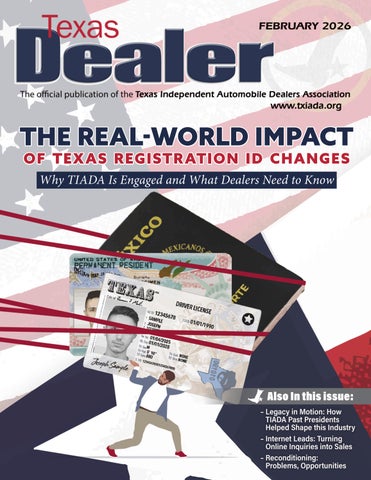
– Legacy in Motion: How TIADA Past Presidents Helped Shape this Industry – Internet Leads: Turning Online Inquiries into Sales – Reconditioning: Problems, Opportunities
TIADA Board of Directors
PRESIDENT
Greg Phea/Austin Rising Fast 8024 IH 35 North Austin, TX 78753
PRESIDENT ELECT
Russell Moore/Top Notch Used Cars 900 East Davis Conroe, TX 77301
CHAIRMAN OF THE BOARD
Greg Reine/Auto Liquidators
39670 LBJ Freeway Dallas, TX 75237
SECRETARY
Cesar Stark/S&S Motors 7699 Alameda Ave. El Paso, TX 79915
TREASURER
Lowell Rogers/11th Street Motors 1355 N. 11th St. Beaumont, TX 77702
VICE PRESIDENT, WEST TEXAS (REGION 1)
Jose “Pepe” Muñoz/Gael Auto Sales 7661 Alameda Ave. El Paso, TX 79915
VICE PRESIDENT, FORT WORTH (REGION 2)
Matt King/Matt King Motor Company. 2715 W. Pioneer Pkwy. Arlington, TX 76013
VICE PRESIDENT, DALLAS (REGION 3)
Lucas Ponder/Auto Smart 4545 N. Stateline Ave. Texarkana, TX 75503
VICE PRESIDENT, HOUSTON (REGION 4)
Christina Sabillón/Mi Tierra Auto Sales 4545 Spencer Hwy. Pasadena, TX 77504
VICE PRESIDENT, CENTRAL TEXAS (REGION 5)
Harry Buchelly/Discovery Auto Sales 8140 North Lamar Blvd. Austin, TX 78753
VICE PRESIDENT, SOUTH TEXAS (REGION 6)
Chad Lancaster/Chacon Autos 1400 SE. Military Dr. San Antonio, TX 78214
VICE PRESIDENT AT LARGE
Cesar Torres/Lofi Motors 4634 Ayers St. Corpus Christi, TX 78415
VICE PRESIDENT AT LARGE
Tyler Simmons/Abilene Used Car Sales, Inc. 2150 N. 1st Street Abilene, TX 79603
TIADA EXECUTIVE DIRECTOR
Trevor Jennings 9951 Anderson
Austin, TX 78750
inside TexasDealer
officers’ message
Understanding the New Legislative Changes and Standing United
Recent legislative and regulatory developments in Texas will have direct and lasting implications for independent automobile dealers. It is important that our members clearly understand what these changes mean in practical, day-to-day terms.
Two measures in particular demand our attention.
First, the proposed changes to Identification requirements under Rule 217 would modify how dealers verify and document customer identification during transactions. In straightforward terms, the rule seeks to tighten standards for acceptable forms of identification and documentation. While the intent is to enhance security and reduce fraud, the practical impact on dealerships could be significant. These changes may alter established sales workflows, increase compliance burdens, and create additional administrative steps during already time-sensitive transactions.
Second, House Bill 718, addressing Vehicle Title and Registration procedures, was implemented in July of 2025 and adjusts how. adjustments to how title
by Greg Phea
processing and registration activities are handled. In layman’s terms, this legislation modifies the framework governing how vehicles are transferred, titled, and registered through dealers. Even incremental changes in this process can have substantial ripple effects. Delays, new documentation requirements, or procedural revisions can disrupt cash flow cycles, affect lender relationships, and complicate customer service.
Although the degree of impact may vary by dealership size or business model, no dealer will be entirely unaffected. TIADA exists to represent the interests of every member without exception. That means we must carefully evaluate how these measures affect operations across the board and respond in a coordinated, proactive manner.
Clear and consistent communication with lawmakers is essential. These policies do not operate in isolation. Their effects extend beyond dealership walls to banks, credit unions, finance companies, insurance and
(cont’d on pg. 6)
Active membership in TIADA and participation in our Annual Conference provide opportunities to exchange strategies, share best practices, and strengthen our collective advocacy efforts.
Austin Rising Fast (Austin)
TIADA PRESIDENT
warranty providers, service facilities, and other business partners who rely on predictable transaction processes. When regulatory changes complicate dealership operations, the broader automotive ecosystem feels the consequences.
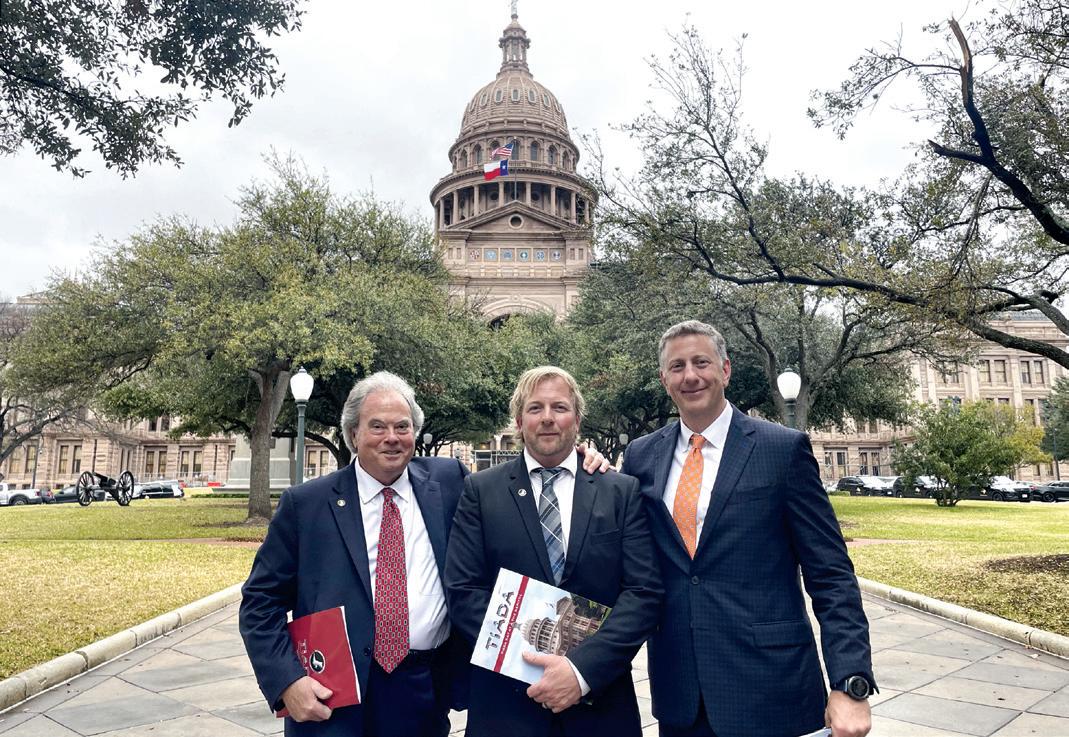
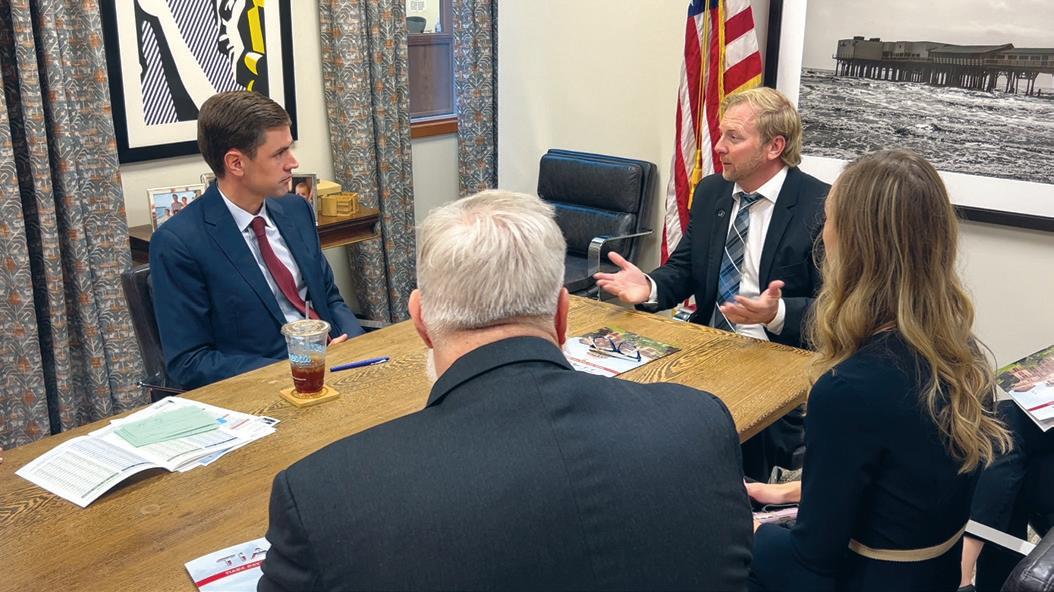
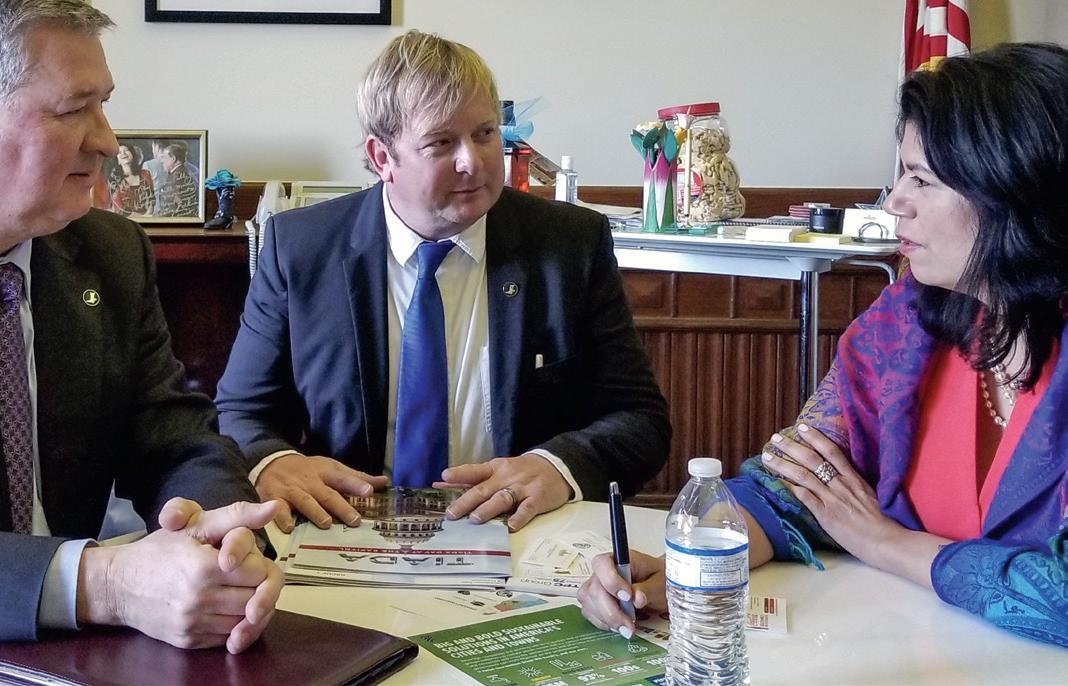
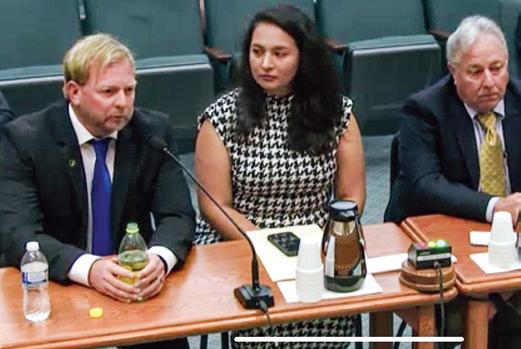
TIADA has been actively engaged in these discussions. Our association was represented at the State Capitol in January and again at the February 12 meeting of the Texas Department of Motor Vehicles Board. Many members and leaders attended in person, offering testimony and sharing real-world operational concerns. During my remarks, I referenced “SOS” as both an acronym for “Save Our Stores” and as a call for legislators to recognize the strain these policies may place on independent dealers.
While it can be frustrating when legislation advances despite our concerns, unity remains our greatest strength. Now more than ever, collaboration is critical. Active membership in TIADA and participation in our Annual Conference provide opportunities to exchange strategies, share best practices, and strengthen our collective advocacy efforts.
If our mission is to promote the education, growth, and success of independent dealers, we cannot avoid confronting policies that threaten that success. Your engagement matters. Your voice matters.
Now more than ever, we are better together.
resource guide
The TIADA Website: www.txiada.org
Members can log in with their username/password and access our Dealer Member Directory, Legislative Action Center, Compliance Consultation Service and much more. Register for all upcoming TIADA events online through the Calendar of Events, access our online membership application, find contact information for all our Local Chapters, and access many additional resources through our Knowledge Base.
GM: Scott Stalder Tuesday, 9:30 a.m./ Friday 10:00 a.m.
$AVE : $200
El Paso
AMERICA’S AUTO AUCTION EL PASO www.americasaa.com
7930 Artcraft Rd., El Paso, TX 79932
915.587.6700
GM: Judith Ayub Wednesday, 9:30 a.m. MST
$AVE : $200
IAA EL PASO*
www.iaai.com
14751 Marina Ave., El Paso, TX 79938
915.852.2489
GM: Hector Escobar
Wednesday, 9:30 a.m. MST
$AVE : up to $200 Sell Fee
MANHEIM EL PASO** www.manheim.com
485 Coates Drive, El Paso, TX 79932
915.833.9333
GM: JD Guerrero
Thursday, 10:00 a.m. MST
$AVE : $100
Harlingen/McAllen
IAA M c ALLEN*
www.iaai.com
900 N. Hutto Road, Donna, TX 78537
956.464.8393
GM: Ydalia Sandoval
Tuesday, 9:30 a.m.
$AVE : up to $200 Sell Fee
BIG VALLEY AUTO AUCTION**
www.bigvalleyaa.com
4315 N. Hutto Road, Donna, TX 78537
956.461.9000
GM: Lisa Franz
Thursday, 9:30 a.m.
$AVE : $200
Houston
ADESA HOUSTON**
www.adesa.com
4526 N. Sam Houston, Houston, TX 77086
281.580.1800
GM: Keyvan Nayeri
Wednesday, 9:30 a.m.
$AVE : $200
AMERICA’S AUTO AUCTION
CENTRAL HOUSTON**
www.americasaa.com
2000 Cavalcade Street, Houston, TX 77009
713.644.5566
GM: Joshua Gardner
Wednesday, 12:00 p.m.
$AVE : $200
AMERICA’S AA HOUSTON**
www.americasaa.com
1826 Almeda Genoa Rd., Houston, TX 77047
281.819.3600
GM: Kyle Drake
Thursday, 1:00 p.m.
$AVE : $200
AMERICA’S AA NORTH HOUSTON** www.americasaa.com
1440 FM 3083, Conroe, TX 77301
936.441.2882
GM: Buddy Cheney
Tuesday, 1:00 p.m.
$AVE : $200
AUTONATION AUTO AUCTION - HOUSTON**
www.autonationautoauction.com
608 W. Mitchell Road, Houston, TX 77037
218.506.3220
GM: Davis Cosmi
Friday, 9:15 a.m.
$AVE : $200
IAA HOUSTON*
www.iaai.com
2535 West. Mt. Houston, Houston, TX 77038
281.847.4700
GM: Alvin Banks
Wednesday, 9:30 a.m.
$AVE : up to $200 Sell Fee
IAA HOUSTON NORTH*
www.iaai.com
16602 East Hardy Rd., Houston-North, TX 77032
281.443.1300
GM: Aracelia Palacios
Thursday, 9:30 a.m.
$AVE : up to $200 Sell Fee
IAA HOUSTON SOUTH*
www.iaai.com
2839 E. FM 1462, Rosharon, TX 77583
281.369.1010
GM: Patricia Rich
Friday, 9:30 a.m.
$AVE : up to $200 Sell Fee
MANHEIM HOUSTON**
www.manheim.com
14450 West Road, Houston, TX 77041
281.890.4300
GM: Nick Hanson
Tuesday, 9:30 a.m.
$AVE : $100
MANHEIM TEXAS HOBBY**
www.manheim.com
8215 Kopman Road, Houston, TX 77061
713.649.8233
GM: Darren Slack
Thursday, 9:00 a.m.
$AVE : $100
Longview
ALLIANCE AUTO AUCTION LONGVIEW**
www.allianceautoauction.com
6000 SE Loop 281, Longview, TX 75602
903.212.2955
GM: Rocky Campbell Friday, 9:30 a.m.
$AVE : $200
IAA LONGVIEW*
www.iaai.com
5577 Highway 80 East, Longview, TX 75605
903.553.9248
GM: Ulysses Else Thursday, 9:30 a.m.
$AVE : up to $200 Sell Fee
Lubbock
AMERICAS AA LONE STAR LUBBOCK**
www.americasaa.com
2706 E. Slaton Road., Lubbock, TX 79404
806.745.6606
GM: Dale Martin
Wednesday, 9:00 a.m
$AVE : $75/Quarterly
IAA LUBBOCK*
www.iaai.com
5311 N. CR 2000, Lubbock, TX 79415
806.747.5458
GM: Chris Foster
Tuesday, 9:30 a.m.
$AVE : up to $200 Sell Fee Lufkin
GREATER LUFKIN AUTO AUCTION
www.greaterlufkinaa.com
2109 N. John Reddit Dr., Lufkin, TX 75904
936.632.4299
GM: Mitchell Connor Thursday, 5:30 p.m.
$AVE : $200
Midland
Odessa
IAA PERMIAN BASIN*
www.iaai.com
701 W. 81st Street, Odessa, TX 79764
432.550.7277
GM: Luther Young Thursday, 9:30 a.m.
$AVE : up to $200 Sell Fee
San Antonio
AMERICA’S AUTO AUCTION
SAN ANTONIO**
www.americasaa.com
13510 Toepperwein Rd., San Antonio, TX
78233
210.298.5477
GM: Brandon Walston Tuesday, 9:00 a.m
$AVE : $200
ADESA SAN ANTONIO** www.adesa.com
200 S. Callaghan Rd., San Antonio, TX 78227
210.434.4999
GM: Tom Ausdenmoore Thursday, 9:00 a.m.
$AVE : $200
IAA SAN ANTONIO SOUTH* www.iaai.com
11275 S. Zarzamora, San Antonio, TX 78224
210.628.6770
GM: Dawn Threatt Monday, 9:30 a.m.
$AVE : up to $200 Sell Fee
MANHEIM SAN ANTONIO** www.manheim.com
2042 Ackerman Road, San Antonio, TX 78219
210.661.4200
GM: Sandra Santas Wednesday, 9:00 a.m.
$AVE : $100
Tyler
GREATER TYLER AUTO AUCTION**
www.greatertyleraa.com
11654 Hwy 64W, Tyler, TX 75704
903.597.2800
GM: Daylon Waynick Thursday, 2:30 p.m.
$AVE : $200
Victoria
VICTORIA AUTO AUCTION**
www.victoriaautoauction.com
835 Industrial Park Drive, Victoria, TX 77905
361.576.0058
GM: Shelly Griffin Thursday, 11:30 a.m.
$AVE : $100
Waco
ALLIANCE AUTO AUCTION WACO**
www.allianceautoauction.com
15735 I-35 Frontage Road, Elm Mott, TX 76640
254.829.0123
GM: Christina Thomas Friday, 9:45 a.m.
$AVE : $200
Wichita Falls
DAX of WICHITA FALLS**
www.daxofwichitafalls.com
2206 Sheppard Access Rd., Wichita Falls, TX 76306
940.720.0435
GM: Lisa Shelton
Every Other Wednesday, 5:00 p.m.
$AVE : $200
legal corner
What To Do When Peaceable Repossession is Not Possible
Dealer Question: I know that as a car creditor with a lien on a vehicle, I can peaceably repossess the vehicle when the contract is in default. Occasionally, a debtor will hide the vehicle or lock it up in a garage where I can’t repossess it. I’ve contacted our local police department for help, but they tell me they can’t get involved without a court order. Why won’t the police help me and what are my next steps when a peaceable repossession is not possible?
Answer: The Uniform Commercial Code (the Texas version is known as the Texas Business and Commerce Code) provides that the holder of a security interest in collateral can upon default peaceably repossess the collateral without any type of legal process. The key word here is “peaceably.”
Court cases have held that the refusal of a debtor to relinquish possession of collateral takes the situation out of the realm of peaceable. If a repossession can’t be accomplished peaceably (that is, with the permission of the debtor, or without the knowledge of the debtor and without breaching the peace), then it will be necessary to obtain an order (or “writ”) from an appropriate court.
Law enforcement officers have generally been trained that they can’t order a debtor to turn over collateral to the creditor without a court order. A creditor, being a private citizen, can peaceably repossess collateral
by Michael W. Dunagan
TIADA COUNSEL
If a repossession can’t be accomplished peaceably (that is, with the permission of the debtor, or without the knowledge of the debtor and without breaching the peace), then it will be necessary to obtain an order (or “writ”) from an appropriate court.
without a court order. A law enforcement officer, by virtue of his or her position, is, in the eyes of the law, a government official. The U.S. Constitution forbids governments or government officials (except in a few emergency situations) from taking property from a citizen without due process of law. Due process of law is accomplished in this situation by applying for relief from a court.
On those occasions when selfhelp repossession is not available to the vehicle lien holder, such as when the collateral is hidden or locked up and the debtor refuses to return it or when repossession cannot be accomplished without breaking and entering or other breach of the peace, the creditor may have no alternative but to turn to the court system to enforce his or her rights to the collateral. The most appropriate remedy for a secured creditor seeking court-ordered return
of collateral is referred to in Texas as sequestration (in some states the process is referred to as replevin).
Sequestration is a process by which a court, upon suit being filed and upon being presented with evidence of certain required conditions, can order the collateral to be seized by a constable or sheriff and held pending final judicial determination of the ownership rights to the collateral.
Recourse to sequestration involves the use of the officers empowered by the state (as opposed to self-help repossession), so constitutional due process considerations arise, and strict compliance with legal procedures is required.
To obtain a writ of sequestration, the secured creditor must show that he or she is legally entitled to possession of the property and that the party in possession will “conceal, dispose of, ill-treat, waste, or destroy
the property or remove it from the county during the suit.” A bond must also be posted, in an amount set by the court, before a writ will issue.
Once a judge is satisfied that the creditor is entitled to an order of possession, he or she will sign an order for the clerk of the court to issue the writ of sequestration. The order will also specify the amount of bond that is to be posted by the creditor. Court rules require bonds to be at least the amount of the value of the property plus costs. Some courts will allow local individuals with non-exempt real property to post signature bonds. Others may require a corporate surety bond or a cash bond. Some surety companies that specialize in litigation-type bonds provide sequestration bonds to lien holders.
After the bond is received and approved by the court clerk, the writ is issued and sent to the sheriff or
constable instructing the officer to take possession of the property. Sequestration is only a temporary taking process, so the secured creditor must go forward with obtaining
a final judgment awarding ultimate possession. However, once property is taken by an officer with a writ, many defaulting debtors don’t respond to the suit. If the debtor
doesn’t respond, the creditor is entitled to take a default judgment. Once the officer takes possession of the property, the creditor can ask the court to grant it possession after ten days, absent the filing of a counterbond by the debtor. While it is rare for a debtor to file a counter-bond, the court could award possession to the debtor pending a final determination of the legal rights of the parties.
Because of the technical procedural due process requirements of sequestration, it will usually be necessary to hire an attorney to prepare the appropriate pleadings and affidavits. Justice-of-the-Peace courts have the authority to issue emergency orders, including writs of sequestration, but most J.P.s will not undertake to handle a sequestration. Some will allow individuals without attorneys to file suits seeking sequestration writs in their courts. Some even provide forms for creditors to fill out. Justice courts have jurisdiction in cases where the value of the collateral does not exceed $20,000.00.
It has been our experience that most J.P.s, choose not to get involved in issuing writs. To determine whether your local J.P. will process a sequestration action and whether the lien holder can file without an attorney, call the justice court and ask the judge or civil clerk. Because of the legal technicalities involved in the process, we recommend having an attorney involved.
If the value of the vehicle exceeds $20,000, it will be necessary to file the action in a county or district court. Generally, representation of an attorney will be required at that level.
We occasionally run into situations where debtors simply refuse to honor the officer’s demand for possession under the writ. It is then necessary to file an action in the court seeking to have the debtor held in contempt of court. This process requires additional procedural steps and thus adds to the expense of the process.
Upcoming Events
TIADA DEALER ACADEMY
For online registration and information, see www.txiada.org
ON-DEMAND OFFERINGS
For a complete list of available on-demand education offerings, go to www.txiada.org/on_demand
Complying with the Safeguards Rule Offered in English and Spanish Repossession 101: What You Need to Know Video Course
The Basics of Transferring Titles Offered in English and Spanish
The Deal Jacket Offered in English and Spanish
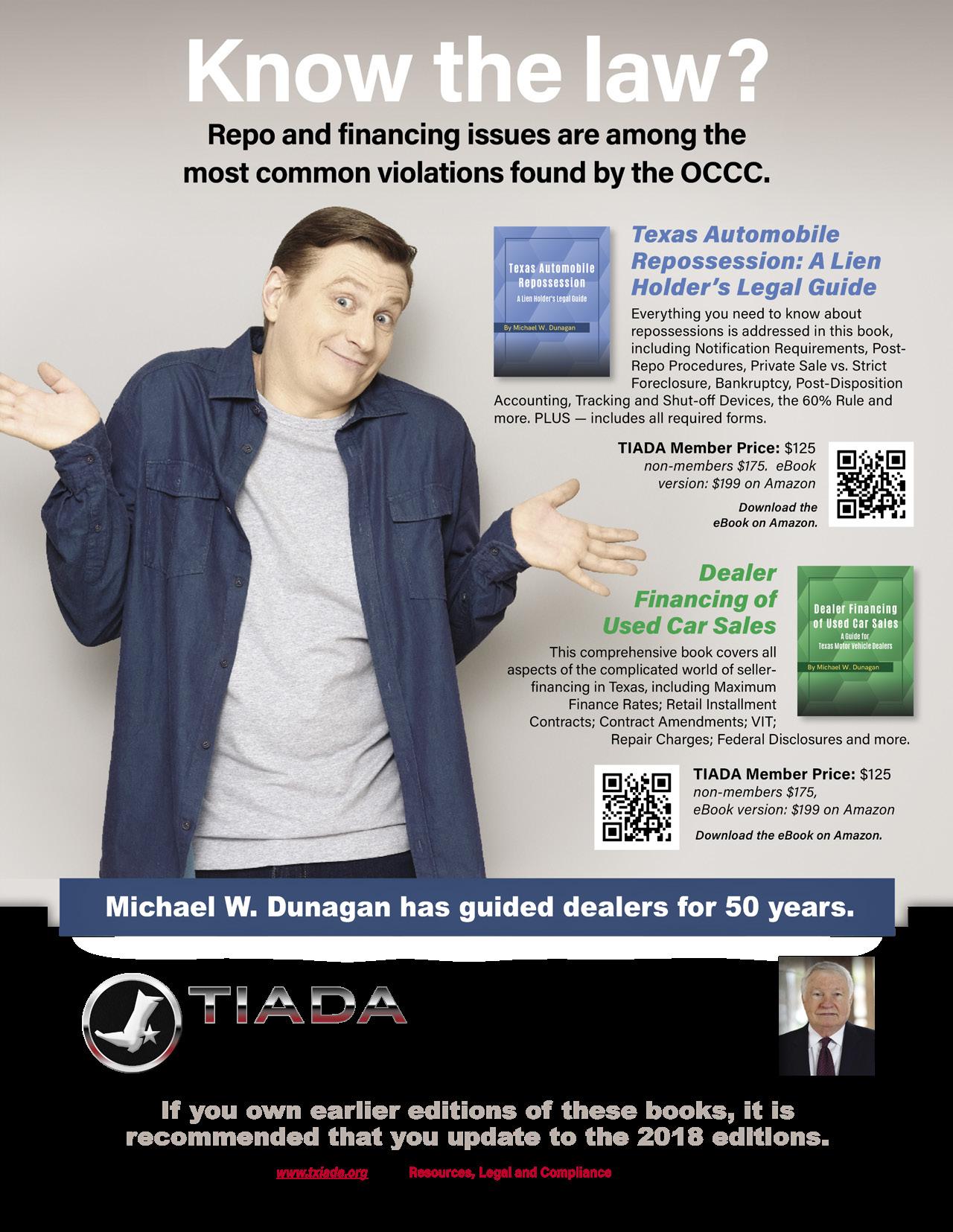
Legal Reference Books
Attorney Mike Dunagan’s must-have repossession and financing books for BHPH dealers.
March 2 Keeping BHPH Dealerships Legal & Compliant for 50 Years: Arlington/DFW Workshop Dallas/DFW, TX
July 19 – 21 2026 TIADA Conference & Expo
JW Marriott San Antonio Hill Country Resort and Spa San Antonio, TX
DMV REQUIRED COURSES
Texas Pre-licensing Education Course
TxDMV approved course to satisfy all training requirements for completing your application to obtain an independent dealer license or General Distinguishing Number (GDN).*
*For more information see Frequently Asked Questions Access Dealer Education Course Resources
Curso de Educacion Pre-Licencia de Texas Curso aprobado por el Departamento de Vehículos de Motor de Texas (TxDMV) y que cumple con todos los requisitos para completar la aplicación para obtener una licencia de dealer independiente, también conocida como el GDN (General Distinguishing Number).**
**Para mas información ver la sección de Preguntas Frecuentes.
Acceso a los Recursos del curso educativo para los dealers.
Texas License Renewal Education Course
TxDMV approved license renewal education course (For renewal applicants licensed on or after September 1, 2009 whose ownership and management structure of the dealership has changed since the last renewal and the person who previously took the course is no longer with the dealership)
While our discussion up to now has involved lien holders obtaining possession from debtors after default, the sequestration process can be used whenever a third party is wrongfully in possession of collateral and refuses to return it. Examples would include someone who has “bought” the vehicle from the debtor without clearing the lien; a third party holding a vehicle to secure some type of obligation owed by the debtor that is not superior to the vehicle lien; and a person claiming a wrongful mechanic’s or storage lien (see the article Fraudulent Mechanic’s Lien Claims Still Concern
If the value of the vehicle exceeds $20,000, it will be necessary to file the action in a county or district court. Generally, representation of an attorney will be required at that level.
Car Creditors in the March, 2022 issue of Texas Dealer for more about steps to take when confronted with a questionable lien claim).
Finally, a practical consideration about sequestration: When neither the debtor nor the vehicle can be found, this remedy is of little value. The writ must be served upon the debtor (or a person in illegal possession of the property). The sheriff or constable attempting to serve the writ will typically not provide skip-tracing services, and will rely on the creditor to supply a valid address.
Conclusion: Given the cost and time restraints of the sequestration process, self-help repossession is still the most desirable way to retake collateral. But when peaceable repossession is unavailable, or forced resistance or violence is threatened, sequestration is the safest and best remedy for a car creditor.
Editor’s Note: This article is taken from Texas Automobile Repossession: A Lien Holder’s Legal Guide. The book is available from TIADA.
Michael W. Dunagan is an attorney in Dallas, Texas who has represented the Texas Independent Automobile Dealers Association for over 45 years. He has written a number of books and hundreds of articles for trade journals and law reviews. His clientele includes dealers, banks, finance companies, auto auctions and credit unions.
feature Legacy in Motion: How TIADA Past
Presidents Helped Shape the Independent Dealer Industry
by TIADA Staff
Leadership inside the Texas Independent Automobile Dealers Association has never been about titles. It has always been about stewardship. Each president inherits an industry that is already in motion: regulatory pressures, market shifts, capital cycles, and technology changes all moving at once. What defines each era is how leaders respond to those forces while protecting the dealers who rely on the association to help
Across generations, TIADA presidents have carried forward three constants: advocacy, education, and community. The tactics have changed. The stakes have grown. But the mission has stayed remarkably consistent.
them stay viable.
Across generations, TIADA presidents have carried forward three constants: advocacy, education, and community. The tactics have changed. The stakes have grown. But the mission has stayed remarkably consistent. What began as a relatively small network of independent dealers working to share information and protect their businesses has matured into a sophisticated
advocacy and education organization that plays a direct role in shaping policy, compliance standards, and business practices across Texas.
Looking back through the experiences of recent and past presidents, a clear narrative emerges. Each leader faced a different version of the same challenge: how to make sure independent dealers still have a seat at the table tomorrow. Some focused on stabilizing the association during moments of uncertainty. Others expanded its influence in legislative and regulatory environments. Still others helped modernize how the association supports dealers entering and operating in an increasingly complex business environment. Together, their leadership reflects the evolution of both TIADA and the independent dealer industry itself.
Ryan Winkelmann (2023): Leading an Industry He Grew Up Inside
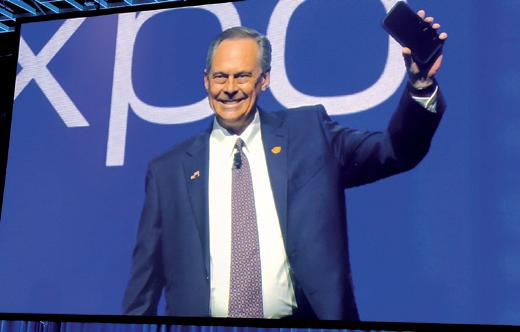
For Ryan Winkelmann, TIADA leadership was not something he stepped into late in his career. It was part of his environment from childhood. Long before he owned BJ’s Autohaus or testified before legislative committees, he was attending conventions, watching deals get discussed in hallways, and learning how relationships shaped the independent dealer community.
“My work with TIADA started with my mom being president,” he said. “I had been going to conventions since I was a kid. I basically grew up in the industry, and I grew up intertwined with TIADA.”
That generational exposure shaped both his leadership style and his understanding of what the association
represents. For Ryan, TIADA has always been about protecting dealers by giving them access to knowledge, professional networks, and representation in rooms where business decisions are made.
Ryan did not initially plan to stay in the dealership business. Music was his first passion, and he pursued it seriously. But like many secondgeneration dealers, he ultimately chose to stay and build on what his family created. He started at the ground level and worked through nearly every operational role before purchasing BJ’s Autohaus from his parents in 2012. That experience gave him a practical understanding of dealership operations from collections and sales to management and ownership decision-making.
During his presidency, several major policy and regulatory issues moved forward, including legislative work tied to lien enforcement, insurance recovery processes, and ongoing implementation discussions tied to the transition from paper temporary tags to metal plate systems. His focus remained on making sure dealer voices were included in how those changes were implemented.
For Ryan, the most important value TIADA delivers is still rooted in fundamentals.
“Being a voice at the Texas Legislature is critical,” he said. “But education is probably the biggest one. The pre-license and renewal courses
help dealers stay in business. There’s a lot you need to know before you even get started.”
He also emphasizes something less visible but equally important: professional community and shared standards.
“You’re networking with people who actually understand the industry,” he said. “You’re always in good company.”
Outside the dealership, Ryan balances business ownership with family life, rental property management, travel, church involvement, competitive barbecue, and music performance. That mix reflects something common across the independent dealer community. Entrepreneurship rarely stops at one business or one interest. For Ryan, TIADA
is not just an association. It is part of his personal and professional identity, and that continuity is part of what makes generational leadership so powerful in the independent dealer industry.
Mark Jones (2022): Putting Industry Needs Ahead of Personal Interests
Mark Jones represents a different pathway into leadership, one built on operational discipline and longterm industry immersion rather than generational entry. His story begins with early exposure to dealership operations as a teenager, working in entry-level roles and gradually learning every part of the business.
“There’s not any position in our company that at some time in my life I haven’t had to do,” he said.
That experience shaped how he later led teams and scaled dealership operations. It also shaped how he approached leadership within TIADA. By the time he became president, Mark had spent decades building dealership operations, expanding locations, and developing management systems that balanced growth with compliance and operational efficiency.
His presidency came during a period when regulatory complexity and operational compliance expectations were rising quickly across Texas. The independent dealer model was evolving alongside new technology, increased regulatory scrutiny, and shifting consumer expectations. Mark’s leadership focused on making sure dealers understood not just what rules existed, but why they existed and how they affected real-world operations.
think beyond their own business model and consider how policies affect dealerships of different sizes, structures, and resources.
Mark also sees advocacy as a practical necessity. Legislators and regulators cannot fully understand the downstream impact of policies without input from dealers who operate on the front lines of the industry.
“I think it’s very central,” he said. “We’re explaining
Mark consistently emphasizes one principle above all others: board service is about the industry, not individual dealerships.
“There were multiple times we voted on something, and I knew it wasn’t best for us,” he said. “But it was best for dealers across Texas. You have to put the industry needs above your own.”
That philosophy is central to how TIADA has historically operated. Leaders are expected to
from a street level what these laws actually do to operations.”
Today, Mark continues balancing business leadership with industry service roles that connect dealership realities directly to regulatory and policy decision-making environments. His career reflects TIADA’s evolution into a highly engaged policy voice within Texas government structures and highlights the importance of having experienced operators involved in industry representation.
Scott Allen (2012): Building Advocacy and Compliance into the DNA of the Industry
Scott Allen’s presidency came during a period when TIADA was expanding its reputation as both a compliance authority and a policy voice. His pathway into leadership was shaped by mentorship, personal loss, and a desire to build stronger professional networks after losing his father, who had been both a business partner and sounding board.
Through local association involvement and mentorship from established industry leaders, Scott became increasingly engaged in state-level leadership and eventually national-level industry representation. That perspective helped shape his view of what TIADA should be for its members.
Scott consistently points to two core responsibilities: compliance leadership and advocacy strength.
“They have to be the absolute expert at compliance,” he said. “And they have to be the voice for the dealer in Austin.”
For Scott, compliance is not just about avoiding penalties. It is about protecting the long-term viability of dealerships. In an industry where regulatory missteps can shut down operations quickly, access to accurate information and compliance support can mean the difference between survival and closure.
He also emphasizes the importance of dealer participation in advocacy. Association leadership can open doors, but long-term influence requires participation from members across the state.
“It’s not the voice of one,” he said. “It’s the voice of many that counts.”
Scott’s leadership also reflected something unique about TIADA’s position within the broader industry ecosystem. Texas dealers often play an outsized role in shaping national industry conversations. His involvement helped strengthen connections between state-level advocacy and national policy engagement, reinforcing the idea that strong state associations influence the broader independent dealer industry.
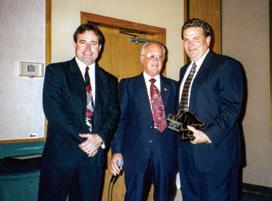
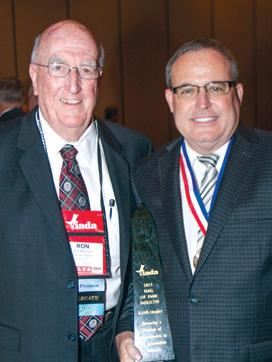
Keith Hagler (1999):
Building Relationships Before the Industry Had a Seat at the Table
Keith Hagler’s presidency represents an earlier phase of TIADA’s evolution, when formal relationships with regulators and agencies were still developing and the association was still building consistent channels into legislative and regulatory conversations.
Looking back, he describes an industry environment that felt fundamentally different from today.
“We didn’t have the relationships we have today,” he said. “Now they ask us questions. They invite us to the table.”
That shift reflects decades of work by association leadership to demonstrate that independent dealers are critical stakeholders in Texas transportation, finance, and consumer markets. Keith’s era helped build the credibility and trust that later allowed TIADA to become a regular participant in policy conversations.
Keith also emphasizes TIADA’s historic role as a protective force for the entire independent dealer ecosystem, not just members.
“We’ve always been the protector of independent dealers,” he said. “Whether they’re members or not, we still represent them.”
His career reflects the entrepreneurial diversity common among independent dealers, spanning real estate investment, multi-business ownership, and agricultural ventures alongside dealership operations. That diversification reflects a long-standing reality of the independent dealer community: adaptability is often necessary for long-term success.
Keith’s era helped establish something later leaders would build on: the expectation that independent dealers deserved formal representation in regulatory and legislative environments and that industry voices should be included in policy discussions before rules are finalized.
Janette Winkelmann (1997):
The Year That Could Have Changed Everything
Janette Winkelmann’s presidency came during one of the most fragile periods in TIADA history. She joined the association before even receiving her dealer license because she believed industry participation was essential to survival.
“I knew TIADA was extremely important for survival as a new business,” she said.
During her presidency, TIADA lost most of its staff and its executive director, forcing leadership to step directly into operational survival mode. Janette personally drove repeatedly between Houston and Austin, working through financials and helping rebuild organizational structure during a period when the association’s future was uncertain.
“It was one of the roughest years of my life,” she said. “But I just wanted to see TIADA survive.”
From that crisis came one of the most important strategic pivots in TIADA history: the shift toward mandatory dealer education.
“If we were ever going to grow, we had to do it with education,” she said. “That’s when that seed was planted.”
That decision still shapes the association today. Education programs became central to dealer survival, compliance readiness, and long-term business sustainability across Texas.
Her presidency also carried historic significance as one of the first women to hold top leadership roles within Texas independent dealer associations, a milestone she still considers one of the greatest honors of her career.
Looking back on that period, she frames it simply.
“It could have gone down,” she said. “Or it could have risen. And it rose.”
Different Eras, Same Mission
Across decades of leadership, TIADA presidents have faced different versions of the same core challenge: protecting the viability of independent dealers in a constantly shifting regulatory and economic environment.
Janette helped stabilize the organization and establish education as a survival tool.
Keith helped push the industry toward formal government engagement.
Scott strengthened the compliance and advocacy identity of the association.
Mark reinforced the principle that industry leadership requires selfless decision-making.
Ryan represents generational continuity and modern policy engagement in an increasingly complex operating environment.
What connects them is not just service. It is perspective. Each understood that independent dealers succeed when they operate inside a strong professional community with shared standards, shared knowledge, and shared representation.
If history is any indicator, that model will continue to carry TIADA forward, one generation of leadership at a time.
Local Chapters
TIADA has active local chapters in the following areas: https://www. txiada.org/local_chapters
CORPUS CHRISTI
G.R. Moore
The Car Shack
(dates and times can be found at txiada.org/Calendar_List.asp, when scheduled)
EL PASO
Cesar Stark
S & S Motors
Meetings are held every third Tuesday of each month at 8:00 am at Palenque Grill, Cielo Vista Mall, 8401 Gateway Blvd W. Suite C-118, El Paso, TX 79925. Contact Cesar Stark at (915) 857-5777 for more information.
FORT WORTH
Jerry Smith
H J Smith Automobiles
(dates and times can be found at txiada.org/Calendar_List.asp, when scheduled)
HOUSTON
Chris Donnelly
Your Car Store
Meeting – 2nd Tuesday (Monthly)
SAN ANTONIO
Nory Pakravan
210 Auto Credit
(dates and times can be found at txiada.org/Calendar_List.asp, when scheduled)
by TIADA Staff
Over the past several months, changes to Texas Department of Motor Vehicles identification requirements for vehicle registration have moved from policy discussion to day-to-day operational reality for independent dealers across the state. For many dealers, the effects are already measurable: delayed deliveries, failed registrations, renewal breakdowns, and increased loan risk.
TIADA’s involvement in this issue is grounded in one principle: protecting the ability of licensed dealers to complete lawful transactions, maintain compliant portfolios, and serve Texas consumers without being forced into roles that fall outside dealer expertise.
This is not about politics. It is about execution, operational clarity, and unintended downstream consequences when regulatory implementation moves faster than infrastructure and guidance.
Where the Issue Started and Why It Matters
The proposed and implemented identification rule changes are intended to standardize identification verification for vehicle registration and renewal. In concept, consistent statewide standards can reduce fraud risk and improve predictability.
What Dealers Are Reporting Right Now
Dealer feedback submitted through the public comment process and directly to TIADA shows consistent themes across markets and business models.
Transaction Disruption
Dealers report:
This is not about politics. It is about execution, operational clarity, and unintended downstream consequences when regulatory implementation moves faster than infrastructure and guidance.
However, the speed and structure of implementation have created significant friction inside a system that depends on timing, coordination, and uniform application across 254 counties, lenders, tax offices, and dealers.
Independent dealers operate at the intersection of sales, compliance, finance, and customer service. When any one component of the title and registration process becomes unstable, the impact ripples across:
Deal funding timelines
Lien perfection
Customer delivery schedules
Renewal performances
Loan default risk
Dealer cash flow
TIADA has consistently emphasized that these rules cannot be evaluated solely on documentation standards. They must be evaluated on operational system impact.
As outlined in TIADA’s formal rule comments, predictable title and registration processing is essential to lawful vehicle operation and loan performance across dealer-finance and third-party lending models.
Deals failing after delivery due to registration denial
Customers unable to renew registrations on previously compliant vehicles
Increased inventory holding costs tied to delayed titling
These are not theoretical risks. They are already showing up in real transactions.
Portfolio and Loan Performance Risk
Registration failure is not just a paperwork issue. It can destabilize secured lending.
If customers cannot maintain legal vehicle operation:
Payment disruption risk increases
Repossession risk rises
Collateral value can decline faster
Insurance and liability complications increase
Multiple lenders and dealers noted that renewal failures could immediately change performing loans into risk assets simply because the vehicle cannot be legally operated.
County-Level Inconsistency
Dealers continue reporting inconsistent interpretation and enforcement between counties. Without standardized verification tools or guidance, similar customers can receive different outcomes depending on location.
That uncertainty forces dealers to make conservative decisions that can slow or stop otherwise lawful transactions.
Why Transition Policy Matters
One of TIADA’s most consistent recommendations has been transition protection for existing loans and registrations. Many active dealer-financed and indirect loans were originated under prior federal fair-lending interpretations that discouraged using immigration status as a categorical credit factor. Those loans are secured by vehicles that were legally registered under prior standards.
Customers may lose legal use of vehicles they are still paying for
Transition relief is not about weakening standards. It is about preventing retroactive collateral impairment.
The Mail-In Renewal & Verification Problem
Another major concern centers on verification expectations tied to renewal channels, especially mail-based renewals.
Public comment submissions and TIADA’s analysis highlight three operational risks:
1. Processing Bottlenecks
Mail renewals are high-volume, time-sensitive transactions.Added documentation requirements predictably increase rejection rates and rework.
2. Fraud Detection Reality
Photocopied IDs are not a reliable fraud detection mechanism. Without standardized verification tools, manual review increases workload without delivering meaningful fraud reduction.
3. Identity Theft Risk
Mailing copies of identification increases exposure to data theft risks, especially at scale.
These risks shift operational burden to county tax offices and dealers without necessarily achieving the policy’s stated goals.
REAL ID and Cross-State Effects
Conditioning registration eligibility on REAL ID–aligned credentials may also create unintended crossstate consequences.
If legitimate applicants cannot meet documentation requirements quickly:
Titling activity can shift to other states
Registration compliance can decline
Texas risks losing tax and registration revenue
The goal should be increasing lawful registration participation, not creating barriers that push activity outside formal systems.
Dealers Are Not Immigration Adjudicators
One of the clearest messages from dealers, lenders, and TIADA is this:
Dealers are compliance professionals. They are not immigration document experts.
Several public comments emphasized that requiring dealers or private businesses to interpret federal immigration documentation creates legal risk and operational uncertainty.
Dealers need:
Clear rule language
Standardized verification tools
Safe harbor guidance
Consistent county execution
Without those elements, compliance risk shifts onto small businesses that do not control the underlying systems.
TIADA’s Role and Ongoing Advocacy
TIADA has been engaged across multiple channels: Formal written rule comments supported by operational data
Public hearing testimony documenting dealer impact
Direct engagement with TxDMV leadership
Coordination with lenders, tax offices, and national partners
Member education and compliance updates
TIADA’s position is consistent:
Support workable standards.
Oppose implementation that creates systemic disruption.
As reflected in TIADA’s formal submission, the association has urged TxDMV to either withdraw the proposal for additional study or incorporate transition safeguards, standardized verification processes, and clear statewide implementation guidance.
What Comes Next
The situation is still evolving. Dealers should expect continued clarification, potential adjustments, and ongoing stakeholder engagement.
TIADA will continue advocating for solutions that: Preserve compliance without retroactive harm
Protect lienholder rights and loan stability
Provide uniform statewide enforcement standards
Reduce administrative burden on dealers and counties
Maintain high participation in lawful registration systems
Independent dealers are essential to transportation access, workforce mobility, and local economic activity across Texas. Policy changes must account for how the real system functions, not just how it is written.
The Bottom Line for Dealers
The core issue is not documentation standards alone. It is whether implementation: Preserves transaction certainty
Protects secured lending
Supports uniform statewide execution
Keeps dealers focused on selling and financing vehicles, not interpreting federal documentation
TIADA will remain actively engaged because when registration systems break down, independent dealers feel it first.
And when dealers feel it first, Texas consumers and communities feel it next.
Thank you for your continued support of the independent dealer community in the Lone Star State.
*Total Contributions through December 31, 2025
Thank you to all who contributed to in 2025!
Tim Adams
Jeff Atchison
Jerry Baker
Stephen Barrett
Jeremy Beck
Mark Brown
Juston Browning
Harry Buchelly
AJ Clark
Brad Davis
Vicki Davis
Anonymous
Mike Downey
Cesar Duarte
Brickton Flammer
Felix Alday Gomez
Jason Goodman
Tommy Gregory
Keith & Marcia Hagler
Eddie Hale
April Hanson
James Hobson
Rich Jackson
Mark Jones Selcuk Kaya
Leonel Loera
Gary McMahan
Russell Moore
Jose Munoz
Bill Murphy
Jesus Olivas
Luis Perez
Shaun Peterson
Lucas Ponder
Greg Reine
Edgar Rodriguez
Lowell Rogers
Hugo Sanchez
Kazem Shamshiri
Tyler Simmons
Cesar Stark
Cal Sumrall
Ken Terkel
Maury Torres
Gregory Zak
The Power of Membership.
Since 1944, TIADA has been and continues to be the only statewide organization for independent automobile dealers. You are connected with more than one thousand independent automobile dealers across Texas, who are all committed to creating a better image for the industry, while protecting our rights as business owners and increasing our bottom line. Individually, you are strong, but together, as an association, we are powerful .
Get involved with the association’s advocacy efforts, find out what policies may be affecting used car dealers. Have a say, make a difference.
Join other successful dealers. Membership dues include full membership to TIADA and the national association, NIADA.
Connect with industry leaders. Attend the annual TIADA Conference & Expo, access the member-only online directory.
Education offerings designed with you in mind, your personal copy of the Texas Dealer magazine, twice monthly industry updates, exclusive access to industry articles—a wealth of knowledge at your fingertips.
The perks are many, starting with over $10,000 in auction and vendor savings through TIADA’s mobile app. Redeem just a few auction discounts and you’ve basically covered the cost of membership for the year.
Get quick answers on industry, regulatory or compliance issues.
www.txiada.org/dealer_benefits
Avoid expensive fines and penalties
The Texas License Renewal Education Course provides the ins and outs of being a dealer in Texas in a self-guided online course, available 24/7. This is the same course required by the TxDMV to renew a GDN license, so it covers all the important subjects including:
• Staying compliant with TxDMV regarding premises requirements
• Acquiring Inventory
• Temp Tags and Metal Dealer Plates
• Buyer’s Guide
• Deal Jacket Documents
• Transferring Titles
• Record Keeping
• Special Inventory Tax (VIT)
• Federal Requirements
• The OCCC
• Enforcement and Investigation
• Advertising Rules
This course is perfect for managers that need an overall refresher or for the new employee that needs to be brought up to speed on all aspects of this industry in a fast, convenient and reliable way.
In addition to TxDMV’s approval, this course has been reviewed by the Tax-Assessor Collectors Association of Texas for accuracy so you’ll never have your title transfer paperwork rejected again.
To register visit TexasDealerEducation.com and select the Texas License Renewal Education Course.
What People Are Saying:
“Great refresher course, helped me remember a lot of items that I need to be in tune with.”
“The course provides all the necessary information, links, and rules where I can find useful tools for my business.”
“If you want to learn more about a specific topic this course includes a direct link to the source you are trying to find out more information on.”
“Overall, this program was great and I am happy that eLICENSING implemented this to ensure we know the basic stuff of running our dealers and running a clean ship without having to face violations or risk your license, this is awesome!”
“This is a good training course for all new dealers. It can also be recommended for old dealers as a refresher training course.”
Calling an Internet Lead: How to Turn Online Inquiries into Showroom Appointments feature
by Maggie Pugesek Owner/Trainer, C&M Associates
In today’s automotive world, internet leads are often the first point of contact between a customer and your dealership. A staggering 95% of car buyers begin their purchase journey online, meaning internet leads are essentially a given, but the way you manage that very first interaction can determine whether the customer shows up excited and confident or disappears entirely. While many dealerships rely heavily on emails and text automation, the phone call remains the most powerful tool for building trust and setting appointments when it is done correctly.
Calling an internet lead is not about rushing to “sell a car.” It is about providing timely, helpful service, showing the customer that you respect their time, and making the next step easy and comfortable. Let’s break down what an effective internet lead call really looks like, and how small improvements can dramatically increase your appointment show rate.
Call First, and Call Fast
When an internet lead comes in, time matters more than most salespeople realize. Customers are often submitting inquiries to multiple dealerships within minutes. If you wait too long to respond, you risk becoming just another unread email in their inbox.
The best practice is to call the customer within 5 to 15 minutes of receiving the lead. This window significantly increases your chances of actually reaching them while their interest is still high. In fact, between 70-80% of customers will answer if you call within 5 minutes, on average. At this point, they are still thinking about the vehicle, still comparing options, and still open to conversation. Dealers who reply within minutes, rather than hours, can see 8× higher conversion rates compared with slower responses.
Before you ever dial the phone, preparation is key. Know exactly which vehicle the customer inquired about, confirm
Dealer Academy Repossession 101: What You Need to Know
This is a video course with
Michael W. Dunagan
TIADA General Counsel, author of Dealer Financing of Used Car Sales and Texas Automobile Repossession: A Lien Holder’s Legal Guide.
In this two-part video course TIADA counsel Michael Dunagan answers repossession related questions for both the dealer starting out and those dealers who want a refresher. Dunagan goes through the basics of selfhelp repossession, repossession when a client has filed bankruptcy, and using the courts to regain collateral through sequestration. The course also covers all the repossession letters and includes a downloadable deck of slides to follow along with the course.
• Preliminary Considerations Before Repossession
• When is a Customer Considered in Default
• Avoiding Liability from Repossession
• Types of Disposition
• Required Notices to the Debtors
• Handling Personal Property
• Using the Courts to Get Your Car Back Registration $98 for two 1-hour videos
Visit txiada.org/on demand for more information.
whether it is available, and be ready with a comparable backup option just in case. Preparation prevents awkward pauses and builds confidence, both yours and the customers.
Start Strong: Introduce Yourself with Purpose
Once the customer answers, the opening moments of the call matter. This is where many calls either gain momentum or fall flat.
Always start by clearly introducing yourself and your dealership. Then, state the reason for your call and thank the customer for reaching out. This does two important things: it establishes transparency, and it shows appreciation.
A strong introduction helps the customer immediately understand who you are and why you’re calling, without feeling pressured or confused. Remember, customers are far more receptive when they feel respected rather than “sold to.”
Build Rapport Before You Build an Appointment
Rapport is not about making small talk for the sake of it. It’s about showing genuine interest and understanding what the customer is actually looking for.
Start by confirming the vehicle they inquired about. Then, gently expand the conversation by asking a few choice-based questions. If the customer was browsing multiple vehicles or submitted a general inquiry, this step becomes even more important.
Instead of overwhelming them with inventory details, focus on helping them clarify their needs. Questions about usage, budget range, or must-have features allow the customer to feel heard, and position you as a helpful guide rather than a pushy salesperson.
Customers don’t expect you to have every answer instantly. What they do expect is that you listen.
Transition Smoothly into Selling the Appointment
Once the customer feels confident that you understand what they’re looking for, and that you may have something that fits, it’s time to move toward the appointment.
Selling the appointment doesn’t mean demanding a visit. It means making the appointment feel like the natural next step.
Use choices instead of open-ended questions. This reduces decision fatigue and keeps the conversation moving forward. For example, offer two days instead of asking “When would you like to
come in?” Then narrow it down to AM or PM and finally provide two specific time options.
This gradual narrowing helps the customer feel in control while still guiding them toward a commitment.
Close With Clarity, Not Pressure
Because this is often your first real interaction with the customer, clarity is essential.
Before ending the call, provide your contact information and confirm theirs. Double-check the spelling of their email address, typos happen more often than you’d think, and a missed confirmation email can undo all your hard work.
Repeat the appointment date and time, explain where to go when they arrive, and let them know who to ask for. Clear directions and expectations reduce anxiety and increase the likelihood that the customer actually shows up.
Recap the Appointment Before You Hang Up
A quick recap at the end of the call reinforces the commitment and reassures the customer that everything is handled.
Restate the day, time, and purpose of the appointment, and confirm who they’ll be meeting with. This final review helps the customer feel organized and confident and minimizes misunderstandings later.
Think of this recap as a service step, not a sales step. You’re helping the customer feel prepared, not pressured.
After the Call: Follow Up with Intention
Once the call ends, your job isn’t over. A timely, personalized follow-up email is a critical part of the process. Send an appointment confirmation email that references your conversation and includes a link to the dealership’s location. Thank the customer for their time, restate the appointment details, and include a link to the vehicle they originally
inquired about if possible. This reinforces continuity and keeps their interest focused.
The goal of this email isn’t to “sell harder.” It’s to support the experience you have already created on the phone and show that you’re organized, professional, and dependable.
According to common dealership benchmarks, for every 100 internet leads, about 60% are contacted, 30% get appointments, and around 20% show up, eventually yielding roughly 10 sales, illustrating the funnel impact of good follow-up.
Why This Process Works
At its core, this approach works
because it prioritizes customer experience over pressure. The phone call and follow-up email aren’t about scripts, they’re about service.
When customers feel listened to, respected, and guided instead of pushed, they’re far more likely to show up ready to buy. Consistency, preparation, and empathy are what turn internet leads into real opportunities.
Mastering this process doesn’t require talent, it requires intention and repetition. When done consistently, it not only increases appointment rates but also improves customer satisfaction and trust from the very first interaction.
Welcome toTIADA
New Members Who Joined December 2025
DEALER MEMBERS
500 Down Dallas
Billy Alford
Baltazars Auto Sales LLC
Adriana Garcia Baltazar
Campos Trucks & SUVs INC
Adrian A. Campos
Car Factory Texas
Nicholas Mendizabal
Encore Motors LBK
Matthew Bradley
Grand Motori Auto Sales, LLC
TX 77017
I-35E, Lancaster, TX 75146
N 4th St, Tahoka, TX 79373
Cesar Velez 10803 Perrin Beitel Rd., Ste 102, San Antonio, TX 78217
Hermanos Sanchez Auto Sales LLC
Luis M. Sanchez 5959 W Jefferson Blvd, Dallas, TX 75211
J Cars Auto Sales LLC
Juan Tellez
M5 Motor Company LLC
Matthew Jones
Tio Chuy’s Auto Sales, LLC
Vanessa Barnard
Ven Con Alex LLC
Alex Rosette
ASSOCIATE MEMBERS
TxPOD
Aater Suleman
Hwy, Fort Worth, TX 76114
Bandera Rd, San Antonio, TX 78238
feature Two Reconditioning Problems and Their Opportunity Potential
by Patrick Janes
Depending on who you talk to, reconditioning vehicles is either a must-do or a necessary evil for many independent dealers.
My perspective sits squarely in the middle of these two poles — where reconditioning can be a value-add for independent dealers’ customers and bottom lines, but only if you turn two common reconditioning problems into positive opportunities.
The Flaw of Averages
The first common reconditioning problem for independent (and franchise) dealers relates to the accuracy of the recon work estimates they incorporate into their appraisals. Note: This problem is less profound or pronounced for independent dealers who typically acquire vehicles that don’t require more recon than a detailing or paintless dent repair (PDR) to put them on the front line and make some money.
But for other dealers, I suspect it wasn’t all that long ago when you appraised a vehicle, applied a catch-all or default estimate for reconditioning work to your cost, and faced an unwanted and unwelcome surprise when you the shop bill arrived.
We see evidence of this trend from the independent and franchise dealers who use vAuto solutions. We examined more than 120,000 appraisals to better understand how dealers account for reconditioning work during appraisals, and how accurate the recon estimates compared to the actual recon work. Here are some key findings:
54% of dealers use default estimates , often around $1,000.
70% of the estimates did not include lineitem detail for reconditioning work.
>50% of the appraisal estimates were off by an average of $700.
My take-away from the analysis is simple: The money’s all over the place and, too often, it isn’t right. It’s a classic case of the flaw of reconditioning averages.
The fix for this reconditioning problem rests on two fronts.
The first front relates to the individual(s) who appraise vehicles. In today’s market, where margins are tight and inventory’s difficult to acquire, you’ve got to check out each vehicle’s condition thoroughly. This is an area where new technologies and tools can help.
For example, a growing number of dealers now incorporate OBII scans into their appraisal process. The scanners themselves are not a huge investment but, if you use them, it’s important for the information they produce flows directly into your appraisal system — an efficiencyminded connection that minimizes hand-writing notes.
(A quick aside: Across independent and franchise dealers who have made OBII scans a part of their appraisal process, many report an unexpected benefit: 25 percent of the scans show a recently
cleared code, an insight that can make a big difference when you’re looking to know a vehicle’s condition.)
The need for more accurate reconditioning estimates extends beyond trade-ins or street purchases to auction purchases, too. The good news? Today’s auction acquisition tools help you calibrate recon estimates based on CR scores, so you’re more efficient in your pre-sale work and pencil-sharp with your maximum bids.
In addition, some inventory management systems enable AI to help appraisers know current and potential future problems a vehicle might possess. For example, vAuto appraisals use AI to show “common problems” associated with a particular make, model and year, and reveal past service visits. In each instance, the information helps an appraiser do a better job of capturing a vehicle’s condition, especially when you’re considering a vehicle that’s older and you have less familiarity/history in selling.
For independent dealers keen to acquire more inventory directly from customers through trade-ins or other channels, this level of condition detail is critical to making deals. That’s because today’s consumers effectively demand that you show them how you arrive at your offer
amount. If you’re sharing third-party diagnostic reports and itemized recon issues to justify your number, consumers are more likely to say “yes,” or at least recognize their perception of the vehicle’s value isn’t as good as they thought.
Shining Light on Your Reconditioning Work
The second common reconditioning problem relates to how independent dealers inform potential customers about the reconditioning work you’ve done to a vehicle.
This problem has only grown as the preferences of today’s vehicle buyers — most of whom start their research and shopping online — have changed. These days, if your online vehicle listings don’t relay or show your reconditioning work, it’s more than likely they won’t know about it. Worse yet, they won’t know that your reconditioning work is the primary reason your asking price is higher than comparable, competing cars.
I’m not suggesting that your online vehicle listings offer a then/now view of the vehicle. Such disclosure and transparency may appeal to some buyers, especially if a vehicle requires substantial cosmetic or mechanical work. Today, most used vehicle buyers primarily want to know the vehicle’s condition and if it will be a reliable ride if they purchase it.
But I am suggesting an opportunity to do a better job telling your buyers how you’ve improved the vehicle, and its value, through your reconditioning work.
For today’s customers, many of whom scan vehicle listings rather than read them word by word, the photo carousel in your online listings typically offers the best place to showcase your reconditioning work. If you replaced brakes and/or tires, offer a photo that shows the new set of tires, or include an image of your reconditioning RO to bring attention to your work.
You may be thinking: “That sounds like a lot of work.”
My response: It WAS a lot of work not so long ago. But today’s merchandising solutions now make it much easier and far more efficient to bring your reconditioning work to life in each listing.
For example, today’s solutions allow you to overlay a list of completed reconditioning items in a vehicle photo with a single click. Or, you can use Gen-AI-driven tools to make sure each vehicle’s description highlights the reconditioning items that will make a difference for potential buyers. Such solutions help you automate your vehicle merchandising, freeing up time many dealers
When I meet with independent dealers to talk about these common reconditioning problems and potential opportunities, many question whether it’s worth the effort and time to change the way they do things today.
It’s a legitimate consideration the reflects an important reality: It’s your business, and it’s your choice to operate the way you deem best.
But I also find some surprise when I point out Cox Automotive research that underscores how much today’s used vehicle buyers care about the reconditioning work you do to vehicles, and their willingness to pay for it. Here are two nuggets from the study:
94% of consumers want to know the nature of reconditioning work that’s been completed.
75% of consumers say they would pay more for a vehicle when they know it’s got new brakes or tires, or some level of certification that includes a warranty.
To me, these findings suggest there’s merit for every independent dealer to revisit how “right” they appraise vehicles, capture a vehicle’s condition and calculate related costs, and to do a better job of telling potential customers about your reconditioning work and why it adds value to the vehicle you’re looking to sell.
Featured Courses
TIADA designed and implemented some important on-demand courses to give dealers quality educational programs they can access throughout the year. These programs are essential for dealers to stay compliant. They offer flexibility, so you can complete them according to your schedule. These courses are designed for any dealers with questions related to various regulations that affect their businesses.
Repossession 101: What You Need to Know
In this two-part video course TIADA counsel Michael Dunagan answers repossession related questions for both the dealer starting out and those dealers who want a refresher. Dunagan goes through the basics of self-help repossession, repossession when a client has filed bankruptcy, and using the courts to regain collateral through sequestration. The course also covers all the repossession letters and includes a downloadable deck of slides to follow along with the course.
$ 98 for two 1-hour videos
The Basics of Transferring Titles *
Want to avoid having your title transfer paperwork rejected at the tax office? This online course is designed to walk you through the title transfer process and is best suited for people new to transferring titles or those who want to brush up on the basics. This course has been reviewed for accuracy by the Tax Assessor-Collectors Association of Texas.
$ 48 for the course * Also available in Spanish
behind the wheel
Consistency, Communication, and Commitment
One of the responsibilities TIADA takes seriously is helping bring clarity to an environment that can sometimes feel anything but clear. Independent dealers operate at the intersection of regulation, consumer needs, and real-time business decisions. TIADA’s role is to help make sense of that complexity and provide practical, reliable guidance.
Over the past several months, many of you have been closely following developments related to the proposed Texas ID requirement changes. During that time, TIADA has remained actively engaged in the formal rulemaking process by submitting written comments, participating in the public hearing, and working with regulators and other state offices to ensure dealer operations and real-world transaction impacts are clearly understood. While the process is still ongoing, our focus has been on representing how these proposals affect day-to-day dealership activity and keeping members informed as developments continue.
Situations like this highlight why clarity matters to independent dealers. Regulatory issues do not always unfold neatly. When guidance, proposals, and timelines shift, it can create uncertainty for businesses
by Trevor Jennings
TIADA EXECUTIVE DIRECTOR
that still have to operate in real time. TIADA’s role in those moments is to help put information in context: what is known, what is still under review, and what dealers should reasonably expect as the process moves forward.
Education remains a core part of that effort. Whether through webinars, written updates, or direct engagement, our goal is to provide information that is practical and usable, not just theoretical. Advocacy and education are most effective when they are grounded in how dealerships actually function day to day.
Looking ahead, my priority is making sure TIADA continues to show up consistently for members by communicating clearly, providing practical education, and staying engaged on issues that affect how dealers do business every day. That work is not tied to any single issue or outcome. It is about maintaining a steady presence and ensuring independent dealers have a reliable voice and resource.
Thank you for the work you do every day and for your continued involvement with TIADA. We will remain engaged, communicate clearly, and keep you informed as developments occur.
TIADA continues to show up consistently for members by communicating clearly, providing practical education, and staying engaged on issues that affect dealers.