A deep dive into the collection acquisitions of 2025.
TIA COLLECTION COLLECTS
From Lubaina Himid to Godfried Donkor, new acquisitions of Tia Collection.
THE 9-5 WITH RITA MAWUENA BENISSAN
A day in the life in the artist’s studio.
COLLECTION LENDING PROGRAM
News on our latest contributions and lendings.
CONCLUSION
Mission statement and image credits.
Collector’s Notes: A Look Back at 2025
2025 marked a year of dualities. Colour and structure, body and sculpture. Our acquisitions expanded into new territories of media, from fashion and video installations to enveloping canvases by artists such as Frank Bowling and Megan Rooney, whose chromatic fields command reflective introspection and pulsate with energy. Collectively, these works explore gesture, devotion, and form as a kind of emotional language, guiding us toward sensory and spiritual materiality rather than purely visual impact.
The growing dialogue between art and couture has continued to shape the collection’s trajectory, reading couture not as something that governs or adorns the body, but as an artistic practice to be preserved for its craftsmanship and valued for its conceptual depth. Moving from a first- to second-generation vision has, in turn, opened a more dynamic and multi-voiced narrative for the collection, one that reflects both inheritanceandevolution.
MeganRooney,“Youcamedown(earth)I,”2025
In Megan Rooney’s large-scale abstraction “You came down (earth) I (2025),” the artist works nose-to-nose with the canvas, so closely, in fact, that she only saw thepaintinginitsentiretyonceitwasinstalledinthe gallery space. Within the confines of her studio, chance, movement, and gesture took precedence over structureandform.Theresultingsurfacevibrateswith energy, colour, and motion seemingly suspended midbreath.
Megan Rooney,You came down (earth) I, 2025
Acrylic, oil, pastel and oil stick on canvas 107.08 by 269.68 inches (272 x 685 cm)
Worked and reworked through cycles of scraping and layering, Rooney builds a dense skin of oil stick and pigment: deep blues and greens punctuated by bursts of acidic yellow that oscillate between turbulence and calm.Broad,sweepingstrokesdissolveintotranslucent veils and delicate drips, evoking both interior and landscape space, a psychic terrain that feels at once immersiveandalive.
Rooney paints through the body, her gestures register movement, translating energy into pigment. This is painting as vibration, a look into her inner world, whererhythmbecomesformandsoundfindsitsvisual equivalent. Her work extends a lineage from Helen Frankenthaler and Joan Mitchell, reimagined through an embodied female subjectivity: fluid, intuitive, and instinctivelyemotional.Whatdrewustothispainting was its ability to hold the residue of feeling, paint not asanimage,butaslivedenergysuspendedintime.
RavenChacon,“ThreeSongs,”2021
Pulitzer Prize-winning artist Raven Chacon transforms sound into embodied memory. In “Three Songs (2021),” Chacon constructs a deeply affecting meditation on loss, resilience, and Indigenous resistance. Projected across three channels in an unending loop, the work features Indigenous women Sage Bond (Diné), Jehnean Washington (Yuchi), and Mary Ann Emarthle (Seminole), each returning to and performing at sites scarred by histories of displacement, forced removal, and erasure. Their voices,sungintheirmothertonguesandaccompanied only by a snare drum, reverberate through the landscapewithbothmourninganddefiance.
NOUR JAOUDA
Raven Chacon, Three Songs, 2021
Three-channel video and sound
The songs evoke episodes such as the Navajo Long Walk, the Trail of Tears, and the separations of the Seminole people, transforming these geographies of pain into spaces of reclamation. Chacon’s work does more than memorialise, it re-occupies. Through sound and presence, these performances reassert Indigenous agency,reactivatinglandasawitnessandlanguageasa vessel of endurance. “Three Songs” becomes both elegy and invocation, where the act of singing heals as much asitremembers.
In its resonance, Chacon’s piece parallels Rooney’s gestural abstraction: each artist channels invisible energy, one through pigment and motion, the other through vibration and voice, to reveal the deep, unseen frequenciesofhumanexpression.
LubainaHimid,“PredictingPositions,”2023
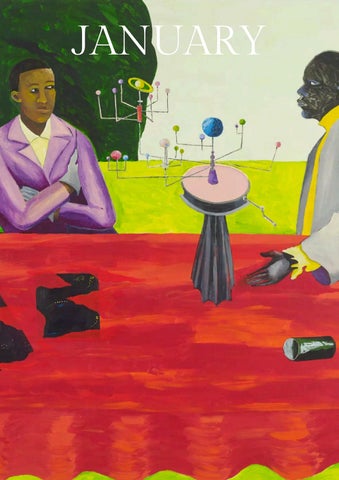
In Lubaina Himid’s “Predicting Positions” (2023), two figures sit across a scarlet table, locked in a moment of concentrated negotiation. Their gestures are carefully composed, an arm folded, a hand extended, a glance weighed, suggesting a meeting where thought and strategy unfold quietly rather than through candid theatrics.Atthecentresitsadelicatemaquetteofasolar system, perched on a pedestal like a proposition or a threat. This planetary model becomes a sly stand-in for contemporary oligarchic ambitions: the fantasy of expanding dominion beyond Earth, of treating celestial bodiesasyetanotherarenaforextractionandcontrol.
Scattered black forms lie across the table like documents, fragments, or evidence, material to be handled, interpreted, perhaps contested. Himid stages the scene with her signature painterly language: fields of saturated colour, crisp silhouettes, and a tension betweeninteriordramaandtheopenlandscapebehind theprotagonists.
Lubaina Himid, Predicting Positions, 2023
94.125 by 156.25 by 1.875 inches (239 x 397 x 4.8 cm)
Oil on linen
The painting captures a moment “between a question and an answer,” a suspended interval where political, personal,andimaginativefuturesarebeingshaped.
Born in Zanzibar in 1954 and a pivotal force in the BlackBritishartsmovement,Himidhasbuiltadecadeslong practice dedicated to placing Black subjects at the centre of narrative, cultural, and historical space. She approaches painting as a stage on which characters think, feel, wait, and act. Her figures claim their own agencynotthroughspectaclebutthroughpresence:they are decision-makers, protagonists, architects of possibility rather than adjuncts to someone else’s story. Thetablebecomesbothaliteralandsymbolicplatform, an arena for assessment, negotiation, and accountability. Yet Himid also asks what is lost when power is mediated through narrow administrative structures, when humanity is flattened into resources andmetrics.
When fashion transcends its function, it becomes an object, a sculptural expression of the human form as plinth. The collection’s introduction of couture marks a new chapter: garments preserved not as attire but as artefactsofcraftsmanshipandconceptualdesign.
Stéphane Rolland’s “Bridal Dress,” an ivory column entwined with sweeping plumes, embodies this ethos. Its feathers erupt from the body like kinetic brushstrokes, freezing motion in air, a study in balance between restraint and exuberance, between body and sculpture. Devotion becomes visible through material: the precision of tailoring, the fragility of featherwork, thearchitecturalpurityofsilhouette.
Stephane Rolland, Look 32 -The Bride, 2025
White crepe and white gazar waves embroidered with feathers
RobertWun,“SnowGown,”AW23.
Alongside Rolland, Robert Wun’s “Snow Gown” extends this dialogue between fashion, form, and philosophy, garmentsthatappearcarvedratherthansewn,merging futurism with ritual. Intricately embroidered with crystals and pearlescent beadwork, “Snow Gown” mirrors snow-capped mountains, where frost clings to thesummitanddissolvesasitdescends.
Wun’s vision meditates on impermanence: the transience of life, the cyclical nature of creation and decay. His work invites an interpretation that looks beyond the visual, toward the philosophical, the very questionsthatdrivedesignerstomakeastheydo.
Bothdesignersregardcoutureasalanguageofemotion translated through craftsmanship, where the act of making borders on reverence. Their works stand not beside paintings or sculpture as adornment, but as conceptualvesselsoffeeling,embodimentsoftheliving and the divine, where fabric, structure, and spirit converge.
FrankBowling,“Orangecentered,”2023.
Frank Bowling, pioneering Guyanese-born British painter, bridges abstraction and autobiography. After movingtoLondoninthe1950s,hestudiedattheRoyal College of Art alongside David Hockney and R.B. Kitaj, laterestablishingstudiosinbothLondonandNewYork. Merging the formal concerns of Color Field painting with the lived realities of migration and identity, Bowling transforms pigment into a language of geography and memory. Over his six-decade career, he hasexpandedthepossibilitiesofabstraction,grounding itinpersonalandpostcolonialexperience.
Robert Wun, Snow Gown, AW23
Tulle, satin fabric, beads and sequins
Frank Bowling, Orangecentered, 2023
Acrylic, acrylic gel, and found objects on collaged canvas with marouflage. 163 by 85 by 3.125 inches (414 x 216 x 7.9 cm)
“Orangecentered” unfolds as a meditation in colour, memory,andgeography.Thecompositionisdividedinto two luminous panels, bisected by a narrow horizontal band of maroon and green, a subtle yet deliberate division. Above, a radiant field of orange and rose gradients suggests light and elevation, while the lower register descends into earthy greens, ochres, and muted reds, evoking a sense of groundedness and terrain. This vertical structure mirrors the tension between ascent and descent, migration and settlement, a recurring themeinBowling’swork.
The painted surface bears the traces of both accident andcontrol.Layersofpigmenthavebeenpoured,tilted, and reabsorbed, creating translucent washes that recall water currents or drifting clouds. Embedded textures and small eruptions of impasto punctuate the smooth planes, suggesting geological processes, sedimentation, erosion, and renewal. The horizontal strip between the two zones reads almost as a shoreline or fault line, markingthemeetingpointbetweenskyandearth,spirit andmatter.
His manipulation of colour creates an emotional temperature that oscillates between heat and calm, longing and release. The painting resists pure formalism; it vibrates with memory, geography, and belonging.
Thisyear,thecollectionkeptcirclingbacktothreeideas: the unseen gesture as spiritual expression; the stage of identity and history performed through image and dress;andthesculpturalimpulse,formedasalanguage ofdevotionandintimacy.
More than anything, 2025 taught us that collecting is not merely about accumulation. It is about listening to what materials hold, what bodies remember, and what stories sit just beneath the surface. Each piece blurred the lines between art and couture in a way that felt deeplynatural.
TIA COLLECTION COLLECTS
Lucio Fontana, Concetto spaziale, Attese, 1961
Waterpaint on canvas
23.6 by 19.7 inches (60 x 50 cm)
Jannis Kounellis, Untitled, 2008
Iron panel, coats, Murano glass, lead, iron wire
Godfried Donkor, St Ike Quartey, 2023
Oil, acrylic and gold leaf on canvas
78.75 by 63 inches (200 x 160 cm)
The9-5withRita MawuenaBenissan
This month, we turn our focus to Rita Mawuena Benissan, whose practice treats history not as a fixed inheritance, but as a living material to be reworked and reactivated. Through monumental textiles that bring together coronation cloth traditions, archival photography, and diasporic narratives, Benissan creates works that feelatonceceremonial,sculptural,anddistinctlycontemporary.Her practice moves fluidly between the studio, the archive, and the palaces and communities she engages with, particularly chiefs and queen mothers, foregrounding histories that have long remained underrepresentedwithininstitutionalframeworks.
At the core of Benissan’s work is a reimagining of cloth as a vessel for lineage, authority, and memory. Her textiles operate architecturally, holding space with the presence of monuments while remaining deeply photographic in their relationship to image and surface. In doing so, they quietly but powerfully reframe questions of visibility and scale, asking who is granted monumentalityandonwhatterms.Forthismonth’s9to5,wespent timewithBenissantracingtherhythmsofherpractice,exploringthe role of tradition, collaboration, and diaspora, and considering how images and materials carry histories forward while remaining open totransformation.
9:02AM
Thestudioopensquietlyintotheday.
TC: What is the first thing you do when you arrive, a cup of tea or coffee, a playlist, a candle? Your practice bridges contemporary art and cultural heritage work; are there any morning rituals that help you ground yourself in that dualroleofartistandcustodian?
RMB: My mornings always start with music. It doesn’t matter if I’m working from home, heading to my studio at Gallery 1957, or visiting the umbrella makers in Kumasi, putting on a playlist is the firstthingthathelpsmebreatheintotheday. Therightsongletsme ease into myself before the emails, the deadlines, and the responsibilitiesstartcalling.
Rita Mawena Bennison, The Passing of a Kingdom, 2025
Oil, Oil Stick, Oil Pastel, Gesso on Wooden Panel 61 by 36 by 2.62 inches (155 x 91.44 x 6.7 cm)
IfI’minAccra,mymorningsarequieterandmoreresearch-focused. I open my laptop and begin pinning printouts and images on the walls, books, archival photographs, and fabrics, so everything sits around me. It feels like building a visual landscape I can move through.
I spend time navigating institutional databases, especially since many archives related to Ghana are not physically accessible locally and instead reside within Western universities, museums, and digital collections. Kumasi feels different; it grounds me in a deeper way. Being there brings me closer to the artisans, palace histories, traditional makers, and environments that shape the core of my practice. In Kumasi, I feel connected to something much larger than myself. It reminds me why the work matters, why the research matters,andwhytraditionisessential.
That space holds an energy that gently places me in the role of a custodian, not just an artist. It is also where I encounter contemporary repetitions of historical images, seeing how gestures, compositions, and traditions captured in archival photographs continuetoexistandbeperformedtoday.
My morning ritual isn’t a single habit, but a combination of things: music,momentsofquiet,imagesonthewall,researchtabsopen,and movement between Accra and Kumasi. These rhythms help me balanceapracticeshapedbyhistoryanddrivenbyreimagination.
9:45AM
Alongtableisscatteredwitharchivalphotographs,chiefs, queen mothers, family portraits, diaspora ceremonies, somefaded,othersnewlyprinted.
RMB: At first, I listen. I sit with the image and let it guide me. If the photographisincolor,I’mdrawntohowthecolorsbreakdowninto abstract forms, how they shift, overlap, and carry emotion beyond the figure itself. If the image is black and white, I begin by wondering about its life beyond the frame: the emotions present in that moment, the fabrics they were wearing, and the life they lived outside the photograph. In both cases, I think about what came beforeandwhatfollowedthatfrozenmoment.
Those questions guide how I move into material, abstraction, and fabrication, allowing the work to return warmth, movement, and presencetowhatwasoncefixed.
TC: Photography becomes a form of lineage in your textiles,anactiveparticipantratherthandocumentation. How do you choose which images to elevate within the cloth, and what responsibility do you feel when recontextualisingthem?
RMB: I don't have a set approach for selecting photographs. It's often natural; some photos speak to me more strongly depending on the work's context, the occasion it's being made for, and how I want the audience to see it. For my solo exhibition: “The Ones Before Her Were Covered in Gold,” for instance, it was important that the figures carry a presence larger than the viewer. I chose images where the individuals could be rendered monumental, positioned to look down at or directly meet the viewer’s gaze. In that recontextualization, the photograph shifts from documentation to lineage. With that comes a responsibility, to handle these images with care, to restore dignity and agency, and toallowthesubjectstoexistnotashistoricalartifacts,butasactive, commandingpresenceswithinthefabrication.
11:15AM
Rolls of cloth lie waiting, some marked with symbolic patternsreminiscentofcoronationbanners,othersblank andfullofpossibility.
TC: The Asante coronation cloth is such a charged, historically embedded form. How do you navigate honouring that tradition while expanding it for contemporaryanddiasporicnarratives?
RMB: The Asante coronation cloth including Kente already carries deepauthority,memory,andsymbolism,somyfirstresponsibilityis to approach it with respect. I think of it not as a fixed historical object, but as a living form, one that has always evolved through materials, technique, and political moments. Similar to the techniques used for royal umbrellas, aspects of Asante coronation fabrics have historically incorporated embroidery as a way for symbols, Adinkra motifs, and stories to live within the cloth itself. That lineage gives me permission to work from within the tradition ratherthanoutsideofit.
By expanding these embroidered languages through photographic abstraction and contemporary narratives shaped by migration and diaspora, the cloth becomes a meeting point between past and present, honouring royal history while allowing it to hold evolving identitiesandlivedexperience.
RMB: During quieter moments in the studio, I often return to questions of visibility, who is seen, who is remembered, and under whatconditions.There’sapersistenttensionbetweenbelongingand distance,especiallyassomeonewhoisGhanaianbutgrewuplargely in the United States. That in-between space has shaped how I understand diaspora, not only as geographic movement, but as somethingcarriedinthebody,memory,andritual.
This reflective time has also pushed me to think more critically about how my work operates within museums, how it might shift the ways African and Ghanaian histories are encountered and how we see ourselves on the main stage of historical institutions. The umbrellas and my broader practice have become a way of reconnecting to lineage while reimagining presence, authority, and visibilitywithinthesespaces.Throughmaking,Itraceapathbackto history, and I hope the work opens moments of recognition and discovery for others, both in the diaspora and in Ghana, around historiesthathavelongbeenoverlookedorremainunknown.
1:30PM
Awork-in-progressisdrapedacrosstwotables,itslayers of cloth, thread, and printed imagery forming a tactile archive.
TC: Cloth, thread, ornamentation, and photographic surfaces each carry their own history and emotional charge. How do you think about materiality as a form of memoryworkinyourpractice?
RMB: Historically, across many communities, fabric and its techniques hold deep records of migration, lineage, and family history. Cloth carries the traces of movement—how people traveled, settled, adapted, and held onto identity across generations. The techniques used to make and adorn fabric are often passed down, becomingaformofknowledgetransmissionandremembrance.
?
:In my practice, I draw on that understanding, treating material as a living archive. Through cloth, thread, and surface, memory is not onlypreservedbutactivated,allowingstoriesofpeople,families,and movementtoremainvisible,tactile,andalive.
2:45PM
A large textile work is suspended mid-process, its surface revealing careful layers of imagery and pattern rather than spectacle, the scale itself doing the quiet work of holdingspace.
TC:Yourtapestriesreadalmostarchitecturally;theyshape how viewers move and look. What does working at this scale allow you to articulate about sovereignty, presence, andhistoricalvisibility?
RMB:Workingatthisscaleallowsthebodytoentertheworkbefore the intellect does. I want viewers to move around, beneath, and alongside the tapestries, rather than simply look at them. For me, scale is directly tied to sovereignty and presence. The body that was once compressed into a photograph or a page now expands into a structure that commands the room. You cannot simply glance at it, you must encounter it. Historically, visibility has meant being seen through someone else’s lens. My tapestries allow me to rebuild visibility on my own terms, through material, color, texture, and spatial dominance. Their architectural and sculptural quality shifts the viewer from observer to participant. You don’t just look at history, you move through it. And in that movement, sovereignty is nolongersymbolic;itbecomessomethingyouphysicallyfeel.
4:15PM
Notes from community elders and collaborators sit beside sketches and archival images, a reminder that your practice often unfolds through dialogue, protocol, and sharedculturalknowledge.
TC: Your work with chiefs, queen mothers, and traditional leadership involves its own protocols and forms of accountability. How do you navigate these cultural responsibilities while engaging with museums, biennials, andothercontemporaryartcontexts?
RMB: When you work with chiefs, queen mothers, and traditional leaders, there are defined rules and obligations based on respect, permission, and heritage. I’m accountable not only as an artist, but as a custodian of cultural memory. Moving between traditional authority and contemporary art institutions requires a kind of dual fluency, honouring cultural hierarchies and lived traditions while navigating museums and biennials shaped by Western frameworks. My role becomes one of translation and re-centering, ensuring Ghanaianhistoriesaretreatedwithdignityandplacedatthecenter rather than the margins. Collaboration with traditional makers is essential to this process; their techniques carry ancestral knowledge thatkeepstheworkgroundedinlivingtradition.Together,wecreate space for these histories to remain active, visible, and powerful withincontemporarycontexts.
5:00PM
TC: One of the works we’ve recently acquired for Tia Collection, “The Passing of a Kingdom,” feels deeply emblematic of your engagement with lineage and transition. Could you share more about the genesis of this piece, the histories it draws from, and how you see it withinthelargerarcofyourpractice?
RMB: “The Passing of a Kingdom” is significant for me because it marks a shift in how I work with historical images. Unlike much of my recent practice, which begins with photography, this piece started from a 19th-century engraving: “Rites at the Funeral of an Ashanti Chief” by A. Thom, produced through a European, colonial gaze.Engravingscarryadifferentkindofdistance;they’reshapedby interpretation and assumption rather than direct encounter. Through digital recoloring and embroidery, the work reclaims that image, restoring warmth, depth, and presence. The embroidery becomes an act of care and authorship, transforming a scene once renderedasdistantintoalivinghistory.Withinthelargerarcofmy practice, the work expands how I engage the archive, questioning how our histories were first recorded and how they can be reimaginedwithdignityandagency.
Rita Mawuena Benissan is a multidisciplinary artist working with textiles, photography, and collaborative processes. Her practice draws on West African coronation traditions and archival imagery, engaging closely with chiefs and queen mothers to bring forward historiesrootedinceremony,lineage,andcommunity.
Known for her large-scale textile works, Benissan combines cloth, image, and regalia to create pieces that feel both ceremonial and contemporary. Her works operate like monuments made of fabric, holding memory and authority while remaining open to reinterpretation. Through collaboration and careful research, her practice explores how history lives on through material, and how textilescancarrystoriesacrosstimeandplace.
Theaster Gates, Alls my life I has to fight, 2019
Metal, bronze, Cerulean granite and carpet
94.5 by 50 by 50 inches (240 x 127 x 127 cm)
Project a Black Planet: The Art and Culture of Panafrica
Allen Memorial Art Museum, Oberlin, OH
1/27/2026 - 5/24/2026
Curated by MACBA director Elvira Dyangani Ose, along with Antawan Byrd, Adom Getachew and Matthew S. Witkovsky, Project a Black Planet: The Art and Culture of Panafrica is the first major international exhibition to examine the cultural manifestations of Pan-Africanism from the 1920s to the present.
It is a project developed jointly with the Art Institute of Chicago, the Barbican Centre in London and the KANAL–Centre Pompidou in Brussels. This collaboration has made the magnitude of the exhibition possible, with nearly 500 pieces by 100 artists touring the four institutions until spring 2027.
Although Pan-Africanism has been widely recognised as a major force in twentieth-century global history, until now there has been no major exhibition surveying this movement’s cultural manifestations. Project a Black Planet: The Art and Culture of Panafrica takes as its starting point the date of the first Pan-African Congress (1919) and revisits PanAfricanism as a set of galvanizing ideas: projections of another vision of a world that have yet to be elucidated artistically or considered sufficiently relevant in political terms.
June Leaf, Movie Camera, 2003
18.25 by 13 by 19.5 inches (46.355 x 33.02 x 49.53 cm)
Wood, tin, egg beater
June Leaf: Shooting from the Heart
Allen Memorial Art Museum, Oberlin, OH
1/27/2026 - 5/24/2026
This major exhibition devoted to the artist June Leaf, whose enigmatic, beguiling, and often irreverent work is both endlessly experimental and uncategorizable, will draw from the artist’s vast archive along with loans from select private and institutional collections. The Addison Gallery of American Art and the Allen Memorial Art Museum at Oberlin College are co-organizing a major exhibition devoted to the artist June Leaf (1929–2024), whose enigmatic, beguiling, and often irreverent work is both endlessly experimental and uncategorizable.
Drawing from the artist’s vast archive along with loans from select private and institutional collections, June Leaf: Shooting from the Heart will consider the breadth of Leaf’s 75-year career. Arranged thematically, it will be the most comprehensive exhibition of the artist’s work in more than three decades. Leaf’s enchanting and provocative sculptures, both kinetic and stationary, paintings, and works on paper will be intermingled and placed in dynamic conversations across media, revealing the artist’s sustained engagement with such motifs and themes as theater and performance, the human drama, dance, gender, motion, urban life, mythology, and interpersonal relationships.
Kay WalkingStick, Late Summer on the Ramapo, c. 1987-1991.
Acrylic and saponified wax on canvas
48 by 96 inches (121.9 x 243.8 cm)
Kay WalkingStick / Hudson River School
Heard Museum, Phoenix, AZ
1/29/2026 - 5/25/2026
Kay WalkingStick / Hudson River School is the first exhibition to explore the renowned Cherokee artist’s landscapes in relation to the nineteenth-century Hudson River School tradition. WalkingStick’s recent landscape paintings will be interwoven with selections from New York Historical’s nationally renowned collection of works by such artists as Thomas Cole, Asher B. Durand, and Albert Bierstadt. This dialogue will highlight a shared reverence for the natural world while also exploring WalkingStick’s critical engagement with the Hudson River School’s depiction of Indigenous land as pristine and unpopulated wilderness. Kay WalkingStick / Hudson River School will be one of few solo shows of a contemporary Native American artist at a major American art museum. As such, it will add to ongoing and important museological debates about the divide between “American” and “Native American” art history.
The exhibition was organized by Wendy Nalani E. Ikemoto (Native Hawaiian), PhD, Senior Curator of American Art at the New York Historical Society, in close consultation with the artist and her gallerist. The show will include approximately 40 works, drawn primarily from the collections of the New-York Historical Society, with select loans from public and private collections, including that of the artist, as well as WalkingStick’s Late Summer on the Ramapo (1987-1991) from Tia Collection. This latter painting will be placed in conversation with two of WalkingStick’s natureinspired abstractions, Satyr ’s Garden (1982) and Montauk I (1983). This group will trace WalkingStick’s path from pure abstraction to abstraction/landscape diptychs. In other words, Late Summer on the Ramapo will provide the crucial link between the artist’s early abstractions and her recent landscapes, and was recommended by the artist herself for inclusion.
About Tia Collection
Founded in 2007, Tia Collection is a global art collection with a mission to support artists and institutions by acquiring and loaning works of art. Tia fosters dialogue, stewardship and scholarship of art through its lending program, partner exhibitions and publications.
For more information, contact us at info@tiacollection.com