The magazine of the Motor Neurone Disease Association
Summer 2019
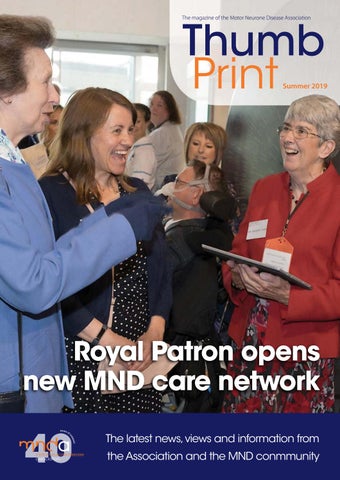
Royal Patron opens new MND care network The latest news, views and information from the Association and the MND conmmunity
For mND
GAZE COMPATIBLE
2
www.mndassociation.org
, part of the
family
4
Going for gold! Association garden wins top award at Chelsea
5
Volunteers celebrate award success Group wins Queen’s Award
6-7
Learning about MND through stories How we are supporting children and young people affected by MND
10-11
MND artists mark Association’s 40th anniversary Looking ahead to our special event
12-13
Your stories People living with MND share their stories
14-15
Care Centre Network officially opens More pictures as our Royal Patron, HRH The Princess Royal opens the North Midlands Care Network
36-37
Thank You More fundraising feats from across England, Wales and Northern Ireland
Thumb Print is the quarterly magazine of the Motor Neurone Disease (MND) Association, David Niven House, 10-15 Notre Dame Mews, Northampton, NN1 2BG Reg. charity number 294354. On the cover: The Association’s Royal Patron, HRH The Princess Royal meets Margaret Cross, who is living with MND, at the opening of the North Midlands MND Care Network. Full story: Pages 14 and 15
Editorial and advertising enquiries: Clare Brennan, Editor, 01604 250505 editor@mndassociation.org If you have comments or feedback about the magazine and its content, please do not hesitate to get in touch. The views expressed in Thumb Print are not necessarily those of the Association. The advertisement of third party products or services does not in any way imply endorsement by the MND Association nor that those products or services will be provided, funded or available via the Association. All content © MND Association 2018.
Thumb Print is available to read online and as a downloadable pdf at www.mndassociation.org/thumbprint
welcome… Wherever you live, however you came to be a part of our Association, the need to do everything possible to help people living with MND is something which unites us all. It’s the motivation behind every fundraising event and every gruelling step for those runners who took part in the Brighton Marathon in March and the London Marathon in April. It’s the passion which drives every volunteer, encouraging them to give up their time freely to help people living with MND who rely on them for friendship, help and support. It’s the inspiration for clinicians, doctors and nurses who provide the very best care they can to help those affected by this terrible disease and it’s the ultimate goal for our researchers who work tirelessly in pursuit of new treatments and the promise of a cure. It’s a strong community spirit which brings out the best in us all, something I see time and time again within the MND community. From success at the RHS Chelsea Flower Show to the opening of our 22nd Care Network, which was attended by our Royal Patron HRH The Princess Royal in June, there has been much to be proud of over the past few months. I was also delighted to hear that the North Wiltshire Group had been awarded the prestigious Queen’s Award for Voluntary Service in recognition of its support for people living with MND across the region for the past 30 years. As we mark our 40th anniversary this year, this strong and enduring commitment to people living with MND, and to our Association, is more important now than ever. People living with MND will always be at the heart of everything we do and I hope the stories you find within this edition of Thumb Print will continue to inspire you.
Sally Light Chief Executive
www.mndassociation.org
3
Pictured at the MND Association garden are Sarah Ezekiel, who is living with MND, Lucy Hawking and Association patrons, Charlotte Hawkins and Chris Broad.
Top honour for MND garden at Chelsea
A
GARDEN, designed to pay tribute to all those living with MND, has won a prestigious Gold medal at this year’s RHS Chelsea Flower Show.
“The whole process of getting here is very stressful and it takes hours and hours of work but when people with MND come and see you and say they like this garden or ‘my husband would have liked this garden’, it makes it all worthwhile.”
Inspired by MND Association founder member Martin Anderson MBE and designed by Sue Haywood from Sue Hayward Garden Design Ltd, The High Maintenance Garden was created to show a garden being gradually reclaimed by nature after the owner has been diagnosed with MND. The garden also featured an iconic hand-built 1938 Morgan three-wheeled car, now garaged indefinitely, with the owner
4
www.mndassociation.org
no longer able to drive. Martin, who first made his debut as an exhibitor at the RHS Chelsea Flower Show 20 years ago, said he was delighted to have received the award alongside Sue. He said: “The whole process of getting here is very stressful and it takes hours and hours of work but when people with MND come and see you and say they like this garden or ‘my husband would have liked this garden’, it makes it all worthwhile.” Martin and Sue were allocated a few passes to invite guests to the event, which was held in June. They welcomed Sarah Ezekiel, who is living with MND, and Jane and Dr Lucy Hawking, who have been involved with previous MND Association gardens at Chelsea. Association patrons Charlotte Hawkins and Chris Broad also visited, as well as the owners of the Morgan sports car, Liz and Peter Elgar.
Queen’s Award recognises 30 years of support Volunteers from the North Wiltshire Group celebrate their achievement
V
OLUNTEERS from the MND Association’s North Wiltshire Group have been celebrating after being awarded the prestigious Queen’s Award for Voluntary Service – the highest award of its kind in the UK. The group received the award in recognition of 30 years of supporting people living with MND, providing emotional support, practical help and information. Group leader, Alison Aviss said: “It is such an honour to receive this award and on behalf of the group I feel immensely proud and humbled in equal measure. It is a privilege to work with families affected by MND and represent the Association in our area. Our team is an amazing group of people who share a passion to provide support, understanding and practical help wherever we can.” As a result of the group’s efforts, Swindon Borough Council, Wiltshire County Council and the North East Wiltshire Clinical Commissioning Group adopted the MND Charter which helps positively influence the lives of people living with MND and their carers in their community. The group also successfully led on the creation of a specialist physiotherapy post to provide a co-ordinated approach to complex care needs, after supporting someone through repeated delays in accessing essential equipment. Following positive patient feedback, the post has been made permanent and is now fully-funded by the NHS. Dr Graham Lennox, a consultant neurologist in Swindon and Oxford, who supported the group’s nomination for the award, said: “I am delighted the fantastic work of the local MND Association group has been recognised in this way. They are exceptional in every respect. Together they provide regular visits for people with MND and their families, providing information, emotional support and practical help. All of this is of enormous day-to-day benefit to local patients, who often comment to me that they do not think they could have coped with their illness without this support.” In honour of the award, Alison Aviss and the group’s secretary, Barbara Crook, were also invited to attend a garden party at Buckingham Palace on 21 May. Chris Wade, the MND Association’s Director of Engagement said: “We are all extremely proud of the North Wiltshire Group
and the recognition they have received for the vital work they do. Having this support in the community means that those living with and affected by MND have somewhere they can go to for help and support, whether it be a more complex care need or just a chat over a cup of tea. Knowing someone is there to listen makes a huge difference to their quality of life.” For more news from the Association’s branches and groups, turn to pages 34 and 35.
Wheelchaircars.co.uk
FREE NO OBLIGATION HOME DEMONSTRATIONS USED VEHICLES FROM £2995
Tel: 0161 793 5934 Full details on our website, www.wheelchaircars.co.uk
www.mndassociation.org
5
Learning about MND th New storybook
I
N REPONSE to requests for more family-based support, the Association is developing new resources for young children who are close to someone with MND – with the aim of helping children relax and learn more about MND at the same time. Our new storybook, Why are things changing? will be available soon, with three family stories for children aged four to 10. The stories help to explain how MND can impact on daily life and will also be available online in our new activity hub, with a voiceover. Early feedback from families has been extremely positive. Children have enjoyed the stories, and found them empowering. The comments we have received include: “Even though we’re children, we can still help too.” Parents and carers were also delighted – they felt the content was helpful, but, “Not too scary for children.”
Our resources for young children already include a workbook, When someone close has MND. This printed resource offers drawing activities and loose-leaf information pages, with ageappropriate wording. A trusted adult can share these pages at the pace they feel is appropriate for each child. For older children and young people up to 18, our guide So what is MND, anyway? is available in print or as a web app. You
6
can find out more at: www.mndassociation.org/cyp You can order any of the above printed resources through our MND Connect helpline: 0808 802 6262 or email mndconnect@mndassociation.org For guidance and to ask questions about MND, young people can contact our Young Connect team on 0808 802 6262 or email youngconnect@mndassociation.org
What children liked:
What adults liked:
“It shows that there is always someone to talk to and help you through the hard times.”
“The book explains in simple terms that things are going to change… but there will be someone to help, or a way of doing things that you can all join in with.”
“My favourite bit was when Enzo made a model plane for Uncle Joe.”
“Each story is different, so highlights there are many ways it could affect his grandad.”
“I liked all the surprises that they made, the things that they did for adults.”
“I think children will be comforted and even quite excited to see someone that looks like them or does similar things to them.”
www.mndassociation.org
hrough stories and play
New activity hub
C
HILDREN whose lives have been affected by MND will soon have a safe space online to learn more about the disease, with our new activity hub for children and young people. The hub, which is in the final stages of development, will be available on our website this summer. Five fun animated characters will be featured –
Max the Monkey, Rini the Rabbit, Eric the Elephant, Carly the Cat and Ali the Alligator, who provide a gentle overview of MND in an age appropriate way. Children will be able to ask the characters questions through a contact page, which needs the email of a trusted adult for the reply. The hub also features a range of simple games, artwork galleries and things to do. Rini the Rabbit also introduces the three family stories from our new storybook, which she can read aloud if a child prefers to listen. The families and children involved
Ali the Alligator
Carly the Cat Eric the Elephant
in the development will be choosing a name for the hub and a group name for the hub characters. Watch out for updates about the launch on our web pages for children and young people at: www.mndassociation.org/cyp Our thanks to The Mountbatten Memorial Trust and Anton Jurgens Charitable Trust for their support to help develop this hub and the storybook. Other service pilots for children and young people are underway - watch out for news in future editions of Thumb Print.
Max the Monkey
Rini the Rabbit
www.mndassociation.org
7
Remembering Janis
T
RUSTEE Janis Parks, who was a founder member of the West London and Middlesex Branch of the Association and a volunteer for more than 20 years, sadly died in April after a short illness. “Janis was an inspirational person to work alongside. I was so glad I got the chance to tell her that I didn’t know anybody who had devoted so much of their life to helping other people.”
Janis, who became involved with the Association after losing both her father and uncle to MND within months of each other, was determined to do everything she could to support people living with, and affected by, MND. In 1995, Janis co-founded the branch serving in a number of roles including more than ten years as Branch chair. In a tribute to Janis, Nick Edwards a co-founder of the West London and Middlesex Branch said: “Janis was an inspirational person to work alongside. I was so glad I got the chance to tell her that I didn’t know anybody who had devoted so much of their life to helping other people.” In 2014, Janis was co-opted on to the Board of Trustees and became involved in a wide range of activities. She joined a number of committees and in 2015 became chair of the Engagement Committee, where she applied her experience, professionalism and passion to help the Association improve the lives of people affected by MND. In 2016, Janis shared her story in Thumb Print to encourage members to consider putting themselves forward in the trustee elections. Richard Coleman, Chair of the Board of Trustees, said: “Janis’s death is a great loss to the Board and the whole Association. She was a very engaged and active trustee and was also a warm and thoughtful person. She will be sorely missed.”
Help us to shape our volunteer support
H
ELPING people living with MND is at the heart of everything we do and making sure we provide them with the best volunteer support possible is of the utmost importance. Over the past few months, the Association has been taking a closer look at where we can make improvements and our report Options for Support sets out our proposals. In it, we explain more about how we could further refine our highly valued
8
www.mndassociation.org
Association visitor service and improve volunteer recruitment. But we also look at a wide range of other possibilities, often based on existing best practice from across the country. These include: • Expanding our peer-to-peer and online support • Working with partners in the community • Increasing our focus on carers, former carers and MND clinics. Trials of some of these ideas have
already begun to help us decide if they have the potential to transform our approach to MND support. We’d really like to know what you think of our proposals. You can find out more and tell us whether we’re on the right track at www.mndassociation.org/ supportvolproject. You can also request a written copy of Options for Support by contacting us on svproject@mndassociation.org or by calling 01604 611681.
A moment to reflect and to say thank you
I
n June, I had the great privilege of attending a special garden party to thank our volunteers for the extraordinary contribution they make to our work. Organised to coincide with the Association’s 40th anniversary and held at Boughton House in Northamptonshire, the event was attended by volunteers from across England and Wales together with former members of staff and trustees. I was also delighted to meet the founders who joined us on the day – without their efforts and determination our Association would not have been established. As well as giving the Association the chance to say a heartfelt thank you to all those who have given – and continue to give - so much to our cause, it was also a moment to reflect on our past achievements and to make plans for the future. In 40 years, our Association has come a long way, but there is still a long way to go and much more we need to do to improve the lives of people living with MND, while the search for new treatments and a cure continues. Thanks to your efforts, however you choose to support our Association, I remain optimistic about our future and confident that one day, by continuing to work together, we will achieve our vision of a world free from MND.
Richard Coleman, chair of the Board of Trustees
Working together to raise awareness of MND
G
LOBAL MND Awareness Day was marked across the world on Friday 21 June by thousands of people with a connection to MND. On the day, the Association focused on encouraging people to sign the Scrap 6 Months petition, in its final week, urging the Government to make it easier for people with a terminal illness to access benefits through the special rules process. The front page of the website was ‘taken over’ by the campaign, social media channels pointed followers to the petition page and the Association worked with regional and national media. The 40th anniversary garden party at Boughton House, hosted by The Duke of Buccleuch, was attended by around 250 invited guests, and gave the Association the chance to say thank you for their invaluable ongoing support. Targeted awareness raising will continue with the now familiar #TakeOverMND used where appropriate. The hashtag was first used as part of the awareness campaign which started with the film The Ride, depicting the rollercoaster effect a diagnosis of MND has on a person and their family. The Ride and associated awareness campaign were a collaboration between award-winning agency Don’t Panic and an MND Association interest group including people affected by MND, volunteers and staff. One of the key
messages from the interest group was that we should adopt a ‘bolder’ message and The Ride reflected this, depicting vividly the brutality of the disease. In response to the discussion within the community concerning TV advertising, the interest group shared detailed industry evidence looking at the pros and cons of using a version of The Ride as a television placement with a direct fundraising ask. A detailed investigation into the costs, potential outcomes and return on investment was undertaken. This included engaging with industry experts, media agencies with experience of working with medical charities, and other charities to glean their experience of TV advertising. The Association’s directors, supported by the Board of Trustees, concluded that current fundraising activity, provides a higher return on investment – that’s income compared to expenditure – than TV advertising would and that using television for fundraising was not guaranteed to generate enough money or to recruit enough new supporters to justify the investment at this time. Additional opportunities for promoting The Ride are still being sought and the film is available for branches, groups, volunteers and supporters to showcase at events, meetings and conferences.
www.mndassociation.org
9
Artists help to mark Association’s 40th anniversary
Simon Adams
Sarah Ezekiel
Miles Pilling
Lucy Pittaway
Peter Scott-Morgan
David Shaw
Ron Wheeler
One of Ron Wheeler’s paintings
10
www.mndassociation.org
Some examples of the artists’ work
A
N exhibition featuring the work of people living with, and affected by, MND is being held later this year to celebrate the Association’s 40th anniversary. Being held at the gallery@oxo located below the iconic Oxo Tower in London in October, the event, called Art Beyond Limits, will feature more than 60 works which will be available to purchase, with a percentage of all proceeds being donated to the MND Association. Among the exhibitors will be Simon Adams, who has been a photographer for more than 30 years. Simon is living with MND and is paralysed from the neck down, but he continues to enjoy his passion of photography with the support of digital technology. He said: “Having a positive mental attitude helps me to deal with my illness.” Sarah Ezekiel is one of the world’s leading eyegaze artists. She studied art and the history of art but when she lost the use of her hands after being diagnosed with MND, she feared she would never create anything again. Thanks to Tobii Dynavox eyegaze technology, she started painting using her eyes, some art software and a Tobii PCEye in 2012. She has exhibited in the UK, including at the Royal Academy School, and abroad. Sarah will present Women’s Day, which is dedicated to the late Janis Parks, former Association trustee and Chair of the West London and Middlesex Branch, who sadly died in April. Former BBC editor, director and cameraman, Miles Pilling, was just 46 when he was diagnosed with MND. After being forced to retire early, Miles found himself using a mobility scooter to get around.
He said: “Having studied at art college I loved photography, so I went out and took photos while using my mobility scooter. I wanted to show people what the world looks like from my point of view. I came up with the name Scooter Shooter and put my photographs on my website.” Yorkshire artist Lucy Pittaway has been named the UK’s Most Popular Published Artist for the last two years by the Fine Art Trade Guild. Lucy’s art is inspired by her daily life in Yorkshire, family, feelings and experiences, very much shaped by losing her father, Middlesbrough Football Club legend, Willie Maddren, to MND in 2000 aged just 49. Lucy said: “I am honoured to be part of this exhibition. We all need to continue the fight against this terrible illness, which was too late for my father as he knew when raising funds himself, but one day hoped we would reach the stage where no-one else needed to suffer from MND. This art exhibition is a great way to raise awareness, funds, and hopefully spread a little joy.” It may seem like science fiction, but the first ever artwork created by a full cyborg will be called Metamorphosis. This unique piece of art, to be generated in September 2019, will be impossible for any human to produce alone, but also impossible for any Artificial Intelligence
(AI) to produce alone either. It will encapsulate how the artist, Dr Peter Scott-Morgan, unexpectedly found himself living the classic Hollywood script of a scientist diagnosed with MND, given just two years to live, but rebelling, fighting against time to use cutting-edge hi-tech not just to survive, but to thrive. It will be signed PETER 2.0. The late David Shaw was born in London and became an accomplished artist in his youth. He was all set to hold his first exhibition when his entire portfolio of drawings was lost in the early 1960s when he was in his 20s. Diagnosed with MND in 2014, and encouraged by his children and grandchildren, David rediscovered his art, not just as a form of therapy, but also as a medium of communication. Using art to make a difference is hugely important to Ron Wheeler, who was diagnosed with MND in 2017. Ron has always enjoyed painting and has developed his own style, a mixture of fantasy and seascapes which he finds calming and helps him maintain a positive attitude. Ron sells his work to raise money and in the early part of 2018 he decided to raise further awareness by launching Art for MND with the hashtag #artforMND. The exhibition will also feature work by former Daily Mail cartoonist Stanley McMurtry MBE, who lost his wife to MND and Wayne O’ Leary who died from MND in May. The event is being held at gallery@ oxo, Oxo Tower Wharf, Bargehouse Street, Southbank, London SE1, from 2 to 6 October. The exhibition will be open to the public between 11am and 6pm and admission is free.
www.mndassociation.org
11
yourstories
“M
Y dad, Tony, was diagnosed with MND in 2016 at the age of 85. It was a huge shock to my family as we knew next to nothing about the disease. “The only person I knew with MND was Stephen Hawking. I had this image of my dad in a wheelchair unable to move or speak, well, that was not the case. Dad lost the ability to speak and eat but he did not lose any physical ability, in fact, right up until he died he did everything for himself. He was very independent and was still looking after my mum, Helen, reminding her to eat and not wanting us to feel bad about eating in front of him. I found that particularly difficult. “The MND Association is made up of an incredible body of people who work so hard, everything my dad needed throughout his illness was provided. We couldn’t have got through this awful time without them.”
“Dad had served in the merchant navy, had trained as a silver service waiter and was a pub landlord of a public house for four years during the 1970s. He was married to Mum for 65 years and had three children – me, Sharon, Sue and Gary, as well as six grandchildren and nine great-grandchildren. He retired at the age of 73 and enjoyed lots of holidays with Mum in their caravan and then some coach holidays. “After he was diagnosed with MND, Mum became their voice and took on the tasks which Dad would normally have done. She became his carer and had the most difficult time watching the man she had been married to for 65 years get taken over by this cruel disease. “There were a few times when it was necessary to get Dad to hospital when the feeding tube in his stomach came out and times when Mum had to phone an out of hours helpline because the feeding pump wouldn’t work in the middle of the night - frightening times for them both. “At the beginning, I think there was fear, anger and frustration for Dad, but then, as the disease progressed, acceptance. “All the medical staff that had anything to do with him said he was a model patient, he never made a fuss, just got on with it and did what was asked of him. I want to pay tribute to my dad’s bravery in the face of this cruel disease that took so much away from him. I know how much he appreciated the care he received from us as a family as well as the amazing team at Addenbrookes Hospital who looked after him. He could not have had better care from them or the doctors and nurses at Papworth Hospital. “The MND Association is made up of an incredible body of people who work so hard, everything my dad needed throughout his illness was provided. We couldn’t have got through this awful time without them. “When Dad died, Mum received a lot of cards saying what a gentleman he was and that he was a family man who loved us all very much. His life ended in such a cruel way, but we will always remember Dad as the man he was before MND.”
12
www.mndassociation.org
‘Remembering Dad who faced MND with such bravery’ Thumb Print reader, Sharon Esposito, shares her family’s experience of MND and pays a loving tribute to her Dad, Tony, who sadly died from the disease in 2018.
yourstories
‘MND is the hardest battle I have ever faced’ Sherrie McNicoll explains what it’s like to live with MND and how the love of her family helps her to stay positive
“I
N 2017, I noticed some things becoming a problem, like struggling to raise my arms, struggling to carry things with my left hand. Writing was also becoming tricky, when writing had always been a deep passion of mine. But the biggest problem of all was I kept falling, forwards, sidewards, there were so many falls over the following 22 months, 17 in total. With every fall came a new injury, and an instant rising fear of falling again. “I thought to myself, ‘I can deal with this,’ so I immediately went home at the end of that day and began putting essential things in place. I typed every decision, pages and pages, as writing by now was even more of a struggle.”
“After numerous visits and tests at the doctor’s surgery the hospital tests followed. The tests were routine and sometimes intrusive but wholly necessary. In September 2018, after 22
months of asking, ‘Why?’, I finally got to see my neurologist, who said the words that I really didn’t think I was going to hear, ‘I’m very sorry to say its motor neurone disease.’ Every jaw dropped on that day, but my response was, ‘Oh well, at least I have an answer now.’ “I thought to myself, ‘I can deal with this,’ so I immediately went home at the end of that day and began putting essential things in place. I typed every decision, pages and pages, as writing by now was even more of a struggle. I thought that if I did lose my voice at
least all my wishes would then be on paper. I then progressed to making identical wills with my husband, I was going to leave no stone unturned. I also told my close family about my wishes, just so they were aware. I didn’t want any member of my family to have problems, or unanswered questions. “Considering I had always been a strong-willed and independent lady, I now had to face each day with that loss, as most simple tasks have to be done for me. Four months down the line I have had many dark days when I have thought, ‘Why has this happened to me, why is life being so cruel to me?’, but of course no-one can answer that question, so I just try to be thankful I can still eat, drink, speak and type, and see my children and grandchildren. It is the latter, my four children and grandchildren who help me stay positive, even though it is the hardest battle I have ever faced. I just do each day what I’m capable of, as well as trying to stay safe.”
Taking you behind the scenes of an MND laboratory
A
n exclusive virtual reality tour of a laboratory is being used to demonstrate the impact that gifts in wills have on funding research into MND. The Association has created the 360 degree film to give the public a fully immersive experience as it follows a donated skin sample from arrival at the lab to drug screening for potential new treatments. The charity collaborated with creative agency Flix Films to produce the eightminute video which was unveiled to invited guests at an MND Association legacy event. Filming took place at the Sheffield Institute of Translational Neuroscience (SITraN), one of the world’s
leading centres for research into MND and home to seven MND Association funded research projects. Previously the Association has hosted events at the Institute giving donors a behind the scenes glimpse into MND research. The film, introduced by Professor Dame Pam Shaw, director of SITraN, and narrated by researchers, scientists and MND Association staff, will replicate the experience for others further afield. When watched through a virtual reality headset the film gives viewers a full guided tour of the lab, including ‘through the microsope’ images and close ups of the researchers at work. The Association’s legacy marketing manager Emma Fellows said: “We are
delighted we can bring more people closer to our work with this virtual lab tour. Our legacy events help demonstrate the importance of gifts in wills to MND research but with only a few labs we can visit we are limited on the number of supporters we can invite. Now we can take MND research to more of our supporters around the country and raise awareness of legacies and how they could give future generations hope of a world free from MND.” A behind the scenes film including interviews with the team and researchers involved in the project can be viewed at www.mndassociation.org/labtour Latest news from MND research: Pages 16 and 17
www.mndassociation.org
13
Royal Patron attends the opening of new Care and Research Network The Association’s Royal Patron, HRH The Princess Royal meets patients and staff and top right Chair of the Board of Trustees, Richard Coleman
P
EOPLE living with MND, supporters, volunteers and clinical staff came together alongside our Royal Patron, HRH The Princess Royal to celebrate the launch of the North Midlands MND Care and Research Network in June. The North Midlands MND Care and Research Network – the Association’s 22nd MND Care Network – has been created to improve the lives of people living with MND, from the onset of symptoms to end-of-life, making sure they, and their families have access to the right care, treatment, symptom management and support whenever they need it. The network is funded by the MND Association and the University
14
www.mndassociation.org
Hospitals of North Midlands NHS Trust and is already making a very real difference to the lives of people across Staffordshire, parts of Cheshire and surrounding counties. It is also furthering understanding of the disease and offering patients the opportunity to take part in research projects. One of those patients Margaret Cross, attended the launch at World of Wedgwood near Stoke-on-Trent and was introduced to The Princess Royal, who has been the Association’s Royal Patron for 11 years. She also made a speech to the assembled guests, using her communication aid. Speaking after the event, Mrs Cross said: “What struck me about the Princess was her obvious knowledge
about MND, the charity and the fact that she took a lot of time talking to everyone. “My blog began to educate people, both in the medical profession and those not, about MND as it affects me. I wanted to show that not all of us are immediately rendered immobile! I also wanted it to be amusing so that people wouldn’t find it tedious.
“We talked, through my communication aid, about the problems of having lost my speech. Unlike many people, she waited for my typed responses without showing
impatience. The Association is lucky to have her as its Royal Patron.” Mrs Cross explained that she had also started writing a blog to educate people about MND, which is now being read by people in several countries. She said: “My blog began to educate people, both in the medical profession and others, about MND as it affects me. I wanted to show that not all of us are immediately rendered immobile! I also wanted it to be amusing so that people wouldn’t find it tedious. “I have tried to show there can be a funny side to a serious condition while also showing the problems as they arise. Two speech and language therapists, in different parts of the country, use my blog to educate
colleagues and to show to other patients, as does my MND nurse to show others there are ways of dealing with problems. “Friends have spread the word, and I also post it on the Life with MND Facebook page where it receives many comments. It also helps me keep my condition in perspective and is being read in several countries.” During the event, Her Royal Highness spoke about the importance of the network and thanked all those who volunteer and support the Association. In particular, Her Royal Highness spoke about the vision and commitment of Dr Naveed Mustfa, one of Royal Stoke Hospital’s respiratory consultants, who has worked for a
number of years to bring the Network together, alongside his co-directors Dr Sarah Kelt and Dr Johnathan Partridge. The network, and its Co-ordinator Louise Wilsdon, are based at the Royal Stoke University Hospital. However regular clinics at County Hospital in Stafford, which started in February, already ensure that staff from the Network can more easily offer their expertise to many more people living with MND across the region. For more information about Margaret Cross’s blog, please visit www.mymnd.video.blog In the next edition of Thumb Print we will take a behind-the-scenes look at the North Midlands MND Care and Research Network. www.mndassociation.org
15
Investing in the future of
Dr Rickie Patani
T
WO outstanding young clinicians have been awarded Clinical Fellowships to help them develop their work in MND research. Dr Rickie Patani and Dr Pietro Fratta, both from University College London, were each awarded a Clinical Scientist Fellowship by the Lady Edith Wolfson Fellowship programme, which is funded by the Association, in partnership with the Medical Research Council (MRC). The Fellowships are awarded to attract and develop outstanding young clinicians in order to create future scientific leaders in this field, something which is central to the Association’s research strategy. Dr Patani, who also received the prestigious Paulo Gontijo Award at the Association’s International Symposium on ALS/MND in December said: “I am truly honoured to be awarded an MRC/MND Association Lady Edith Wolfson Senior Clinical Fellowship. I am grateful to fantastic collaborators and
16
www.mndassociation.org
colleagues across UCL Queen Square Institute of Neurology and the Francis Crick Institute. I’m also very grateful of course to the Association, the MRC and the Lady Edith Wolfson Scheme for their confidence in my research vision.” “I’m also very grateful of course to the Association, the MRC and the Lady Edith Wolfson Scheme for their confidence in my research vision.”
Dr Patani’s laboratory uses human induced pluripotent stem cells (iPSCs) to generate neuronal and glial cells from people with MND and healthy volunteers, to understand more about how MND develops. These stem cells are special in that they use people’s skin cells that are then reprogrammed into motor neurones. The MRC also offered a second Fellowship to Dr Pietro Fratta, making this his third Fellowship overall. He has completed all three levels of the scheme
– the Clinical Training Fellowship in 2010, Clinical Scientist Fellowship in 2015 and from this year, he will be a Senior Clinical Fellow. In this Fellowship, Dr Fratta will test how TDP-43, a crucial protein implicated in the development of MND, impacts on the response of motor neurones
Dr Pietro Fratta
MND research A meeting of minds
T
HE Lady Edith Wolfson Clinical Fellowship Programme was established in 2007, following a meeting between the MND Association and the Medical Research Council (MRC). Here, two of the meeting participants share their recollections. “The Association had been making noises in Parliament about the need for more research into MND and this led us to the office of Professor Sir Colin Blakemore, Chief Executive of the MRC,” recalls Dr Brian Dickie, the Association’s Director of Research. “It didn’t take long to find areas of common interest. The MRC had a long-standing record of supporting the scientific careers of outstanding young
clinicians, which was something we had never been able to do ourselves, due to the cost. “By happy coincidence, we had been contacted earlier in the week with an incredibly generous offer to help kickstart new research activities, so when Prof Blakemore suggested we consider jointly-funding Fellowships, we were able to reach an agreement very quickly.” “The MRC was keen to find ways to work more closely with patient organisations, so the visit by the MND Association was very timely,” adds Prof Blakemore. “It was clear that the Association had done its homework. They knew where the gaps existed in MND research and
to damage in the axons and the relevance of this response pathway in MND. To do so, he will combine novel mouse models of the disease and patient cell lines with state-of-theart biological tools that will allow the investigation of these very specific functions. He said: “The award of this Senior Clinical Fellowship, by the MRC and the MND Association jointly, offers a really transformative opportunity for my lab and research. We have been focussing to date on how MND mutations cause changes in motor neurons. We will now take this work a step forward and study how, in the presence of MND mutations, motor neurons are more susceptible to other toxic insults. This will allow us to better understand what happens in patients, where not just a genetic mutation, but the convergence of genetic and external causes likely triggers disease.” The MND Association currently funds five clinicians, Dr Emily Feneberg (University of Oxford), Dr James Bashford (King’s College London), Dr Arpan Mehta (University of Edinburgh), with two latest additions Dr Rickie Patani (UCL) and Dr Pietro Fratta (UCL). The awards to Dr Patani and Dr Fratta bring the total number of Lady Edith Wolfson Clinical Fellowships awarded to 14, at a total cost of £10.4 million, with the MRC contributing £3.75 for every £1 from the Association. The Association is the only organisation to partner with the MRC at all three career stages from Clinical Research Training Fellowships, supporting young clinicians to embark on a PhD – through to Senior Clinical Fellowships where experienced clinicians are leading their own research teams and programmes.
Professor Sir Colin Blakemore Dr Brian Dickie
where the opportunities lay. “This included the fundamental principle that you need the best scientists to carry out the best science. As a neuroscientist myself, I was all too aware of the challenges in persuading young clinicians to embark on a research career in this field, particularly with the rarer diseases such as MND. “It is rewarding to see the exciting progress that is being made.”
Diagnosed with MND?
Join the MND Register to help leading researchers learn more about this disease
The MND Register of England, Wales and Northern Ireland will be the first comprehensive source of information collected by experts about people living with MND and you can play a vital role in its development. Pioneered by MND specialists Professor Ammar Al-Chalabi of King’s College London and Professor Kevin Talbot of University of Oxford, the MND Register aims to: • Collect information about people with MND, to understand more about why certain people are vulnerable to the disease • Find out precisely how many people currently have the disease and how this is changing over time • Establish where people with MND live, to help improve care in those areas • Collect detailed information about the disease to detect patterns of change in incidence and outcomes. How to join the MND Register
You can apply online at www.mndregister.ac.uk or ask about joining when attending your next clinic appointment. If you have any questions please visit the website www.mndregister.ac.uk alternatively you can email mndregister@kcl.ac.uk or call Oxford 01865 227 714 or KCL 0207 848 5258
The MND Register is funded by the MND Association and supported by the Betty Messenger Foundation and an anonymous family trust. V1 30.11.18 IRAS Number 173389
www.mndassociation.org
17
Helping you to make the most of summer
18
www.mndassociation.org
It’s the time of year when thoughts turn to holidays and days out in the sun. Here we share some of our top tips to help people living with MND make the most of summer.
S
UMMER’S finally here and it’s the perfect opportunity for getting out and about with friends and family. With some careful planning it is still possible for people living with MND to enjoy day trips as well as holidays to remember in both the UK and beyond. To help plan the perfect break for you, the MND Association’s information sheets on Planning a Holiday and Travel and Transport are the ideal place to start. Both sheets are available from www.mndassociation.org and will help you answer important questions such as, ‘What should I think about when booking a holiday?’, ‘How can carers take a break?’, and ‘Can I get financial help towards a holiday?’ You’ll also find helpful tips on planning your journey. It is also really important for people living with MND to think carefully about travel insurance when arranging a holiday. It can be difficult to buy reasonably priced travel insurance for people living with MND and many insurance companies have limited understanding of the disease. For the very latest information contact MND Connect on 0808 802 6262. If you’re looking for information about accessible places to
visit, websites such as Euan’s Guide (www.euansguide.com) can be helpful. Euan’s Guide was created by Euan MacDonald MBE, who was diagnosed with MND in 2003. Together with his sister Kiki, the website gives people the chance to share information about where to go. Euan explained: “MND is a progressive condition, so each year it has thrown up different physical challenges. I have gone from being ambulant disabled to a manual chair user and now a powerchair user. I had to adapt to the physical environment around me. I couldn’t have faced and overcome these challenges without family and friends - and it was experiences gained with them that inspired me, Kiki and my dad, Donald to set up Euan’s Guide.” You can also download a copy of The Rough Guide to Accessible Britain by visiting www.accessibleguide.co.uk while www.changingplaces.org provides information about accessible toilets near you. Heading away on holiday? Don’t forget to send Thumb Print a postcard! Send them to the address on page 3 or email clare.brennan@mndassociation.org and you could appear in the next edition.
‘Organisation and planning is key’ Peter Moore is living with MND and wrote to Thumb Print to share his advice for enjoying some time away from home.
“I
’ve always enjoyed getting away for a break, even more since my mobility and independence has been limited by MND. “When certain pieces of equipment became essential, the choice of holiday destination was limited. Things I took for granted at home, such as a ceiling hoist and electric profiling bed, were scarcely available in holiday accommodation. “For a couple of years I didn’t go away, then I became aware of the Calvert Trust Exmoor. It seemed a huge undertaking to consider uprooting to be in another place, but the thought of a change of routine and location was enough to make my wife and I take the plunge. Over the last few years we
have been back several times and have had successful holidays. It is good to go somewhere that works well for me. “Organisation is the key. You need long and accurate lists of what needs to be packed and you need to think about medication and equipment. It’s important to book the appropriate accommodation and make sure the right carers are free to accompany you. “You must plan your journey carefully. To fit me and all my equipment I take a taxi, a car, and my wheelchair adapted vehicle – we’ve got packing and unpacking down to a fine art! “Once we’re settled in it’s all worth it. It’s a stunning location, which is well-designed for the disabled. To
find somewhere to stay when you’re severely disabled is like gold dust.” For more information about the Calvert Trust visit www.calvert-trust. org.uk.
www.mndassociation.org
19
Fundraisers’ in
Helen Griffiths
A
N incredible £350,000 has been raised for the MND Association thanks to the efforts of our amazing #TeamMND runners who took part in the London Marathon in April. A team of 157 runners took part in the iconic 26.2-mile event around the streets of London, many of them dressed in the Association’s distinctive orange and blue colours. Among those taking part was Glenn Bourne who is living with MND, who was running the London Marathon for the second time. He said: “I’ve been running for a while now, but to begin with I never really enjoyed it, I just did it to try to keep fit. We went on holiday to California and my wife Manda was getting up and going for a run every morning and I would go with her. Bit by bit, I started getting into it and enjoying it. “In 2017, I had just been diagnosed with MND and I wasn’t in a very good place mentally. “Manda was taking part in the London Marathon and I managed to get seats in the grandstand at the finish line. By then, I had been running 5-10km regularly – nowhere near 26 miles. But I could see how elated she was when she finished – she signed up for the next one on the finish line – and I agreed to do it with her. “This year the crowd was immense, I don’t think I went longer than 30 seconds without someone shouting my name. Manda has been a fantastic trainer – it was just amazing.” Helen Griffiths was running in memory of her husband, Steven, who died from MND in 2015. Helen signed up for the
20
www.mndassociation.org
race on her 50th birthday and has since raised more than £5,550. The mum-of-two said: “The MND Association supported us as a family and helped towards funding to enable Steven to live independently. The Association part-funded a communication device which also enabled Steven to use the internet, as well as a stair lift and a riser recliner chair, something he could not have lived without and ensured his comfort while he was sitting for long periods.” 42-year-old Khiem Tong set himself an even bigger challenge by taking on two marathons in two weeks. As well as joining the team in London, Khiem also took part in the Brighton Marathon, raising more than £4,080. He said: “A few years ago I wouldn’t have been able to run one marathon in ten years so anything’s possible. My sponsors have all been very generous over the past few years so for me to keep asking for their support I felt I had to go above and beyond to earn their sponsorship. The only thing harder than one marathon is two!” The father-of-two, who runs in memory of two friends who died from MND, added: “The best moment is always running alongside fellow runners who are running for a cause they believe in. There’s so much love given during any marathon and it’s always extra special to run alongside someone wearing an MND Association shirt. My fondest memory of this year’s marathon was the reception afterwards. The simple pleasure of being provided with a warm cup of tea and meeting the other runners, their families - and of course the MND Association staff -
ncredible feet! Glenn Bourne
Khiem Tong
Sian Price
Cheryl Scott
makes it all worth it.” Sian Price raised more than £5,680 when she completed the marathon in memory of her dad who died from MND. She said: “I love running and have always wanted to run the London Marathon since I was a spectator years ago and experienced the massive buzz associated with it. It is such a special event and the support around the course is second to none.” The 38-year-old mum-of-two added: “I think my Dad would have been so proud, but as a non-runner himself he probably would have been slightly bemused as to why I would want to run 26.2 miles!” “As a runner myself, I know what a huge challenge the London Marathon is, not only from a physical point of view but mentally too, particularly for those running in memory of loved ones. It was such a privilege to be able to be there to show my support for all those taking part.”
Tom Pye ran in memory of his Nan who died from MND and had a huge cheer squad on the day made up of 19 members of his family. The 28-year-old said: “The last few months of my Nan’s life were incredibly hard for her - torture at times. MND doesn’t get the recognition it deserves, it’s one of the most horrible diseases out there and not many people know that much about it. I will always support this charity.”
Tom Pye
Tom has so far raised more than £3,400 and added: “Nan would be so proud. She would have told me not to bother doing it because she wanted for nothing but gave everyone else all she had. She was a true inspiration.” 42-year-old Cheryl Scott joined the 42,000 runners on the start line for her first marathon after gaining a place in the public ballot. The mum-of-two has raised more than £3,000 in memory of her brother-in-law Darren, who died from MND, over three years. She said: “He thought I was totally mad for running but he was also proud. He lost his battle in March 2017. Darren was with me every step and I know he would have been proud. My aim was to just capture every single moment and finish.” The Association’s Chief Executive, Sally Light, was among those welcoming our runners home. She said: “It was an incredible day and I would like to thank everybody who took part and helped to raise such an amazing amount of money for the Association – we are so grateful. “As a runner myself, I know what a huge challenge the London Marathon is, not only from a physical point of view but mentally too, particularly for those running in memory of loved ones. It was such a privilege to be able to be there to show my support for all those taking part.” If you have been inspired by our amazing runners, join #TeamMND and sign up for one of our events. For more information visit www.mndassociation.org/running. Turn the page for more stories from the Brighton Marathon. www.mndassociation.org
21
Team MND runners I
T has been a busy few weeks for MND Association fundraiser Vicky Paeschel who celebrated her birthday while taking part in the Brighton Marathon. After completing the event, Vicky celebrated her special day with a welldeserved piece of birthday cake on the finish line.
Vicky taking part in the Brighton Marathon
She said: “Taking part in the Brighton Marathon is always a great experience, but my preparations for Brighton didn’t go to plan this year, and lack of training and injuries really made it tough. But I was determined to finish, on behalf of everyone facing even tougher challenges every single day, and to raise greater awareness of MND, knowing that our amazing #TeamMND would be waiting at the finish line with hugs, big smiles and, of course, birthday cake!” Vicky has been inspired to support the Association’s work after her mum, Annina, sadly died from MND in 2008 aged just 39. This year, on what would have been her mum’s 50th birthday, Vicky is planning to mark the occasion by organising her biggest fundraising event yet. She said: “My mum would have been 50 on 25 August so I wanted to do something to pay tribute to her and celebrate her life, as well as doing something a bit different. “Big Steps of Hope is a 5k family-friendly tribute walk which will be taking place in Graves Park, Sheffield, but people can also take part virtually, wherever they are. We are hoping people will organise their own walks on the day, in memory of loved ones.”
22
www.mndassociation.org
“So far 24,000 steps have been taken to d’feet MND as part of Big Steps of Hope. Our first virtual walk entrants – Jonathan and Amanda – conquered Snowdon on a very rainy and stormy day. It was Jonathan’s birthday on the day they completed their virtual walk and he walked in memory of his grandad, John. “We’ve currently got registrations from the Netherlands and Switzerland. I’m hoping that over the coming months more people from around the world will sign up and take part.” The Big Steps of Hope website – www. bigstepsofhope.co.uk – also features a tribute wall which people can use to share stories and remember family members. She said: “Everyone taking part in the event will be there to remember someone special and it’s important they are not forgotten. I hope that the tribute wall will be full of pictures and stories which will help us to remember why we are there. “Fundraising for the MND Association in memory of my wonderful mum has given us the opportunity to support others affected by MND and help to fund vital research into a cure. By raising awareness and funds, we are making a difference and hope that one day soon, we will see a world free from MND.” You can register for Big Steps of Hope at www.bigstepsofhope.co.uk and all entrants will receive a Walk to d’feet MND T-shirt and bespoke finishers’ medal.
Vicky pictured with her mum Annina and her sister Vanessa
T
HE Brighton Marathon was a truly family affair for Cathy Albon, who took part in the event alongside her daughter Olivia and her father John, who was diagnosed with MND last year. John had always been a keen runner and in 2003 he took part in his first marathon alongside Cathy. Despite being diagnosed with MND in August last year, this year’s Brighton Marathon proved to be no different, with John determined to accompany Cathy and his granddaughter, Olivia as they crossed the finish line.
Cathy, John and Olivia Albon crossing the finish line at Brighton
Cathy said: “Dad was only diagnosed with MND last year and is now really struggling to get around. He uses a mobility scooter. I really felt as though I was running for my dad. It was incredibly emotional.” The family has done an incredible amount to raise money for the Association this year, running numerous events and hosting a golf day at Worthing Golf Club which was organised by Cathy’s mum, Barbara, which raised £4,500 alone. In May, Cathy’s daughter Frankie Cary, also helped raise money for the Association by taking part in a concert in Worthing alongside the Gruffs Male Voice Choir. She said: “It was a huge success, with more than 200 people attending. Frankie sang On My Own from Les Misérables and many others. She was inspired by her grandparents to sing as her grandad, John, has a huge love of Les Misérables. She is currently studying drama and wants to sing in the West End.”
make Brighton rock M
ARY Simpson took part in the Brighton Marathon in memory of her sister, Sarah, who died from MND in 2013. It was her first marathon, having started running to improve her fitness just two-and-a-half years ago. “I wouldn’t say it was a breeze, but the support from the crowd and the other MND Association runners was absolutely phenomenal.
“Sarah was diagnosed with MND in 2010 when she was just 47. She had been a nurse with Médecins Sans Frontières and had worked all over the world, in places like Sudan, Ethiopia and Somalia – places which you only usually see on the news. “I decided that I wanted to take up running to get fitter and in March I took part in the London Landmarks Half Marathon followed by the Brighton Marathon in April.
Mary Simpson pictured right, at the London Landmarks Half Marathon and, above, at Brighton with her son, Charlie and daughter-in-law, Claire
“I wouldn’t say it was a breeze, but the support from the crowd and the other MND Association runners was absolutely phenomenal. “The staff from the Association were wonderful. At the end, I was freezing but I had a lovely welcome in the tent where they made me a cup of tea and it was the best cup of tea I have ever had!” www.mndassociation.org
23
15,000 people urge Government to Scrap 6 Months
M
ORE than 15,000 people have signed a petition in support of the MND Association’s campaign Scrap 6 Months. At present, to access the Special Rules for Terminal Illness (SRTI) fast-track process when claiming benefits, there needs to be ‘a reasonable expectation of death within six months’ something which is incredibly difficult to predict in people living with MND. As a result, the Association is calling on the Government to scrap the six-month time limit so everyone affected by MND can access the fast-track process, ensuring they receive the benefits they are entitled to in a timely manner. Since the Association launched Scrap 6 Months, the Department for Work and Pensions (DWP) has recognised this is an issue and has published new guidance for clinicians supporting welfare benefits claims through the SRTI fast-track process. The Association contributed to the guidance review and it contains some important improvements, but
crucially, the six months rule still applies. The Association believes this approach is outdated and inappropriate and is continuing to campaign for a change in the law. The Scrap 6 Months petition will be handed into 10 Downing Street during the summer by a small group representing both the MND Association
Celebrating the work of our volunteers
C
ELEBRATING the work of our amazing volunteers was the aim of this year’s Volunteers’ Week which was held in June. During the week, our volunteers from across England, Wales and Northern Ireland marked the occasion by sharing their stories of how they became involved with the Association and more about the work they do. One of them, Arooba, has been raising awareness of MND and the work of the Association by holding stalls in Newcastle.
24
www.mndassociation.org
She said: “I joined the MND Association to learn more about the situation and to have an insight [into the disease]. Reading about the condition and how it affects people left me baffled and confused; I wanted to do and learn more. After digging deeper into it I have learnt more and the MND Association has opened my eyes to question things around me.” You can find out more about how to become a volunteer and read more stories from our volunteers by visiting: www.mndassociation.org/volunteering
and Marie Curie, who have been working alongside us on this campaign. On 3 July, the Association jointly hosted an event in Parliament with Marie Curie and the All-Party Parliamentary Group (APPG) on Terminal Illness, to give MPs the chance to meet people with MND, their carers and Association volunteers and to show their support for our campaign. There was also a chance for them to learn more about a new report which is being published by the group about SRTI. If you would like to be kept informed on all the latest campaign news and how you can help, join our Campaign Network at www.mndassociation.org/ campaignnetwork If you need advice to help you identify the benefits you may be able to claim and work out the best way of claiming them, contact our Benefits Advice Service on 0808 801 0620, or visit www.mndassociation.org/benefitsadvice.
Welsh health boards back the MND Charter
T
HE Aneurin Bevan University Health Board has become the latest Welsh health board to adopt the MND Charter. At an event held on 23 April, Peter Carr, the board’s executive director, signed the Charter – a document which sets out what care for people living with MND should look like - watched by South East Wales Campaigns Contact Judith Rice and Branch Chair Giles Davies. Aneurin Bevan University Health Board, along with the other health boards in South Wales, already provides funding towards the South Wales MND Care Network. Mr Carr said: “The board is pleased to adopt the MND Charter, which confirms our endeavours to always put people first in all that we do, including those in our community who are living with MND, and their carers.”
The Aneurin Bevan University Health Board signs the MND Charter
David Bebb from Abergavenny, who is living with MND said: “I am delighted that Aneurin Bevan University Health Board has signed the MND Charter. Raising awareness among health professionals helps to ensure that all those with MND and their carers receive the best possible care and support.” Two health boards – the Cardiff and
Vale University Health Board and the Betsi Cadwaladr University Health Board – had previously adopted the Charter and two more are in discussions with the Association about adopting it in the near future. Betsi Cadwaladr UHB are funding an MND Care Co-ordination service in North Wales to build on their commitment to the Charter.
Working together to support people with MND
A
SERIES of workshops which aim to raise awareness of MND and understanding of the disease among those responsible for organising housing adaptations, have been held in Surrey. Attended by eleven occupational therapy teams, eleven district and borough councils and seven home improvement agencies, the workshops were organised by Regional Care Development Adviser Jane Giles after Surrey County Council voted unanimously to adopt the MND Charter in 2016. During the sessions, Jane explained what MND is, talked about the needs of those who have it and described what improvements could be made to the housing assessments and adaptations process to support those affected. A video made by East Surrey Branch Campaigns Contact, David Setters, who is living with MND, was also played to help those teams involved in housing adaptations understand more about the complex needs of those who are living with MND, particularly when it comes to accessibility.
MND Association Regional Care Development Adviser, Jane Giles, is pictured at one of the workshops
He said: “A very good occupational therapist gave us advice about what we should be looking for in terms of widened doorways, the type of flooring in the wet room and the amount of space around the bed. We had the adaptations made and really it is a good job we did. Despite the fact I have slowly progressing MND, everything is now in place; I need to really be on a single storey and that is what I am doing. “Fast-tracking Disabled Facilities Grants (DFG) applications is important because a lot of people living with MND do progress quite quickly. I’ve heard some horror stories about people getting their grants sometimes after they have passed away or they have moved on to
the next phase and are needing another type of adaptation. People living with MND really need to get our applications in quickly but also impress on the local authorities that they do need to be dealt with quickly.” Jane said: “We had really good attendance from the social care occupational therapists, the district and borough councils and the local care and repair agencies. There have been good levels of engagement looking at their current practices, and what might be causing issues for people with MND going through the housing adaptation process. I asked attendees to think about what works well and how we can share best practice across the County, but also what changes could be made within the different processes to make people’s experiences even better. It’s great to see so much involvement and commitment to supporting people with MND. Of course, the proof will be in how we take this forward after the workshops finish, but we already have engagement from adult social care to take the common themes forward and implement the suggested improvements.” www.mndassociation.org
25
Working together to improve ac In 2013, a group of people living with MND decided to work alongside the MND Association to help improve access to communication aids. Here, a member of that group, Ron Stevenson, shares their story alongside details about how you can get access to the help you need.
I
t was August 2013 when Liam Dwyer and Steve Evans, both living with MND, first decided that they wanted to achieve better outcomes for people living with motor neurone disease, many of whom were unable to communicate with their loved ones, due to difficulties in accessing vital high tech communication aids from the NHS or finding that they could not be provided in a timely manner. The solution was to engage the help of the MND Association’s campaigns team, and work together to lobby the NHS to alert the provisioning organisers that prompt delivery was essential and an equitable service should be available across England. There were simply too many reports of people with MND dying ‘without a voice’. The All-Party Parliamentary Group (APPG) on MND had already been formed in 2002 to increase awareness and understanding of MND among parliamentarians and to campaign for better access to high quality services for people affected by MND. In 2015, the group presented a detailed evidence based report called Condemned to Silence, describing the ‘post code lottery’ situation that faced people with MND with complex communication needs. By now, Liam had been in touch with Ian Lawson and myself to be part of the advocacy team, and we were working alongside the MND Association and the most senior NHS England managers in regular meetings to discover what was preventing the developing new service meeting the needs of people with MND. Liam, Ian and I had all already experienced the pathway to
communication aid provision and our various tales of battling unresponsive systems mired in red tape and hamstrung by a lack of funding, together with many other even more heartrending cases, gave us the power of personal testimony to bring to the table to validate our advocacy. It was agreed by the responsible people at NHS England that the necessary changes must and would be made and, having commissioned a tendering process to set up a network of specialist centres, also known as hubs, the systems were in place to assess and supply patients with complex needs devices which were appropriate to their communication requirements.
Data would be collected in order to enable us to identify specifically where the problems lay in achieving timely provision for people with MND. Relevant information gathered on the ground from the MND Association care and campaigns teams added further evidence as we tried to grasp the bigger picture before we began attempting to unpick the finer detail. At the same time Liam and I initiated regional meetings, with representatives of our two hubs in the South East hosted by our regional NHS England provisioning lead at the time, Stephanie Newman. We finally began to see the progress that we were all working towards.
While specialist centres in England are now working well, there is still work to do at a local level and other regions of the country. If you do not meet the criteria of the specialist centres and are struggling to be provided with a communication aid through the NHS please let us know by emailing communicationaids@mndassociation.org or calling MND Connect on 0808 802 6262.
26
www.mndassociation.org
access to communication aids 9
16
15
Jumping forward to today, the MND Association now receives monthly data sets from all 14 hubs showing the average waiting times for assessment for, and provision of, communication aid equipment for people living with MND in every region of England. In addition, every October, NHS England commissions an MND audit, giving a snapshot of every (anonymised) MND patient’s detailed time lines and pathways as they have moved towards receiving their devices in that month. We are now able to chart the development of the service throughout all the properly staffed hubs which are, on the whole now well-established, funded and equipped. The monthly data sets and annual audits have allowed NHS England to identify, in our regular meetings together with MND Association staff, particular difficulties along the way and seek to put in place additional help and resources in response to specific local issues to ensure that the service can meet, and ideally exceed, target times everywhere. That NHS England responded so positively to our original request to join with us in searching out ways to resolve problems in providing this vital equipment in a timely manner does it great credit. It demonstrates the patient centred approach that is at the heart of this amazing organisation that is always there for us, and that we must always cherish. Our gratitude and appreciation go to Cathy Edwards, NHS England Operational Delivery Director for Specialised Commissioning and to Carolyn Young, NHS England Programme of Care Manager - Trauma. Without their ongoing help, hard work and perseverance the service would not be demonstrably achieving and developing for its service users as it is today.
For more information about Alternative Augmentative Communication (AAC) contact the following hubs:
10
1
1. East Midlands (including Milton Keynes) Electronic Assistive Technology Service (EATS) Tel: 01522 697 282 Email: eats.lincoln@nhs.net 2. East of England Communication Aid Service East of England (CASEE) Tel: 01223 349401 Email: enquiries.casee@nhs.net 3. Kent and Medway - adult service Kent and Medway Communication and Assistive Technology Service (KM CAT) - Adults Tel: 01227 864 083 Email: acat.service@nhs.net 4. Kent and Medway children service Kent and Medway Communication and Assistive Technology Service (KM CAT) Children & Young People Tel: 01233 629 859 Email: kentcatadmin@kent.gov.uk or kcht.cat-admin@nhs.net 5. London - children service Wolfson Neuro-Disability Team Communication Service Tel: 020 7405 9200 ext 1144 Email: acsadmin@gosh.nhs.uk 6. London - Central and North Assistive Communication Service (ACS) Tel: 020 8102 4067 Email: nikky.steiner@clch.nhs.uk 7. London - North East and South East Guy’s and St Thomas’ Assistive Communication Service (GSTT ACS) Tel: 020 3049 7751 Email: gst-tr.acs-hub@nhs.net 8. London - North West and South West Compass Augmentative and Alternative Communication Service Tel: 020 8780 4500 Email: compass@rhn.org.uk 9. North East Regional Communication Aid Service Tel: 0191 287 5240 Email: rcas@ntw.nhs.uk
15
14 2
17
13 11
5
6
8
7
3
4
12
10. North West ACE Centre (North) Tel: 0800 080 3115 Email: enquiries@acecentre.org.uk 11. South West Bristol Communication Aid Service (BCAS) Tel: 0300 3000110 Email: cacadmin@nbt.nhs.uk 12. Sussex and Surrey Chailey Communication Aid Service (CCAS) Tel: 01825 721506 Email: SC-TR.ChaileyAACservice@nhs.net 13. Wessex and Thames Valley ACE Centre (South) Tel: 0800 080 3115 Email: enquiries@acecentre.org.uk 14. West Midlands ACT (Access to Communication and Technology) Tel: 0121 466 3050 Email: bchnt.accesstocommunicationand technology@nhs.net 15. Yorkshire and Humber Barnsley Assistive Technology Service Tel: 01226 432 159 Email: Barnsley.AT@nhs.net 16. Northern Ireland Communication Advice Centre Tel: 028 950 46866 Email: bronagh.blaney@belfasttrust.hscni.net 17. Wales Communication Aid Centre, ALAS Tel: 02920 313930 Email: CAV_Alas@wales.nhs.uk
www.mndassociation.org
27
Care information updates Information sheet 2B – Kennedy’s disease: this sheet has been revised and provides information on this rare condition. Information sheet 8A – Support for breathing problems: this sheet has been revised. It explains how MND can affect breathing and the range of support on offer. Information sheet 8B – Ventilation for motor neurone disease: this sheet has been redeveloped to include more information on tracheostomy ventilation (invasive ventilation), as well as non-invasive ventilation (NIV). Our content about maintenance of ventilation equipment is now included here. Information sheets 8D – Air travel and ventilation with motor neurone disease: this sheet has been revised. It explains what to do if you need to travel with assisted ventilation or other equipment. The sheet used to be numbered 8E, but has changed as content for our breathing sheets has been condensed.
Information sheet 11C – Equipment and wheelchairs: this sheet has been revised and explores the type of equipment to consider with MND, including information on wheelchair provision.
Information
for people living with and affected by MND, or Kennedy’s disease
All our information is evidence based, user tested and reviewed by experts. Download resources at:
www.mndassociation.org/careinfo
Care information flyer: this summary about our information provision may be useful for raising awareness at MND events, or to share with anyone who needs to access our resources.
Care information vlog: our latest vlog looks at the importance of reader feedback and includes updates about our resources. See the video on our website at www.mndassociation.org/careinfo
Would you like to help with our information? We’re looking for people with MND or Kennedy’s disease, and their carers, to help with our information provision. We have opportunities to get involved with content on a range of resources and different formats, including animations. You can pick and choose which tasks you want to work on and make a difference in the comfort of your own home. To find out how to join our User Review Group, contact: volunteering@ mndassociation.org See our resources at: www.mndassociation. org/publications or order printed copies from our MND Connect helpline: 0808 802 6262, mndconnect@ mndassociation.org
A kit that is handy to have – just in case
S
OMETIMES people living with MND can experience sudden changes in their symptoms which can cause anxiety and panic. To help at these times, the Association has developed a Just in Case kit, which is available to order through your GP. The kit comes in a box with two sections. In an emergency, a carer can offer immediate relief by giving the person with MND the medication in the ‘medication for carer use’ section. The other section, ‘medication for professional use,’ is for a doctor or nurse
28
www.mndassociation.org
who is called to the home to use to take immediate action without having to source the appropriate medications. The kit also includes practical information for carers and health and social care professionals on how to handle these situations. Although most people will never need to use the MND Just in Case kit, its presence in the home will bring confidence and reassurance to many people with MND and their carers. If you would like a Just in Case kit, please discuss this with your GP. The GP
should order the kit by calling MND Connect on 0808 802 6262. The GP will then prescribe the appropriate medications and give the filled kit to you. The district/ community nurse may be involved in advising/training the carer in how to administer the medication. If you have any questions please contact MND Connect.
Have you joined the MND register? Get in touch!
I
F you have recently joined the MND Register, the Association would love to hear from you about your experience. The MND Register is an important research project run jointly by King’s College London and the University of Oxford. People living with MND are able to sign the register either online, via a self-registration website, or through participating MND care centres and neurology clinics.
Oxford and Professor Ammar Al-Chalabi from King’s College London is available on our YouTube channel along with an animation about the self-registration website.
The countdown to Christmas starts here!
S The register is an important tool as the information which is collected and held securely will be used to help researchers learn more about the disease and plan care services for people living with MND. The MND Association is interested in hearing from anyone who has already the joined the register, via the self-registration website or face-to-face in clinic, and who would be willing to share their experience in a new video which will be used to promote it. If you are interested in taking part, please contact Kirsten at the Association at kirsten.kelly@mndassociation.org. A video which explains more about the register, which features Professor Kevin Talbot from the University of
Philip Brindle, who is living with MND and has signed the MND Register
We are grateful for the generous support of the Betty Messenger Charitable Foundation and a family trust that wishes to remain anonymous in funding this project. To find out more about the project, or to register, visit www.mndregister.ac.uk
UMMER is here but why not take some time to plan your Christmas shopping! Inside this edition of Thumb Print you’ll find an early Christmas gift – the Association’s Christmas catalogue – which features a wide range of cards, wrapping paper and gifts for the whole family. Shopping for your special festive treats couldn’t be easier, simply browse now and then order from our online shop from 5 August. Every order will help support our work on behalf of people living with MND as every penny of profit, together with additional donations will go straight into Association funds. A gift of £10 can help to provide an information resource for someone who is newly-diagnosed, while £25 will run the MND Connect helpline for an hour. Our online shop is available now at shop.mndassociation.org
Managing pain in MND
T
WO new publications, which explain more about how to manage pain, have been launched. With MND, muscle weakness or problems with mobility can cause discomfort. People with MND may experience cramps, stiff muscles, and problems from changes to posture or difficulty moving around. Pain can happen at any stage, including early on and while some people feel more severe pain than others, it does not affect everyone. Pain can be tiring and may affect your mood if it persists. It can affect general activity, relationships and your enjoyment of life. However, your GP and other members of your healthcare team can support you. Leaflet 6C Managing pain for people with MND and P11 Pain in motor neurone disease, which is aimed at health and social care professionals, are available to download at www.mndassociation.org/publications or from the MND Connect helpline on 0808 802 6262 or via email at mndconnect@mndassociation.org
www.mndassociation.org
29
I
N A test of fitness, courage and sheer determination, two women have set off in a bid to become the fastest women to cycle around the world on a tandem. Rachael Marsden and Catherine Dixon will pedal through 25 countries on five continents, averaging between 80 and 100 miles a day and travelling 18,000 miles as they aim to circumnavigate the globe in less than 320 days. They are aiming to raise £18,000 – a pound for each mile – for the MND Association and Oxfam, causes which are close to both of their hearts. Catherine, who is married to the Association’s chief executive Sally Light, first met Rachael when she and Sally rode their tandem from London to Paris in 2017 as part of a fundraising event for the Association. “We feel really passionate about both the charities we are supporting. I have learned much about MND and it is a truly awful disease. I hope our ride will help raise vital funds to care for people with this terrible disease.”
‘WoW! We’re taking on the world!’ 30
www.mndassociation.org
She said: “I have always wanted to cycle around the world – it’s always been my dream. Rachael and I talked about it and it morphed into, ‘Shall we ride together?,’ ‘Maybe on a tandem?,’ ‘Shall we go for a world record?,’ ‘Let’s ride for charity,’ - and TandemWoW was born.” The women waved goodbye to their day to day lives at the end of June, climbing onto the saddles of their pink tandem outside the Beeline bike shop on Cowley Road in Oxford. Rachael, an MND nurse consultant, said: “Our families have been very understanding and I’ve managed to secure a sabbatical from my job.” Catherine, who has left her job to take part in the ride, said: “I have had amazing support from my family. We are so lucky to be able to step away from our lives and take on this challenge.” Speaking before they set off, Catherine, a CEO and solicitor said: “I’m sure the ride will be life-changing. I can’t wait for the adventure and the simplicity of just getting on a bike every day and riding. It really is the
opportunity of a lifetime and we are so grateful to have the chance to do it.” The pair will ride across France to the French Riviera into Italy and down the Croatian coast into Turkey – then across Turkey to Georgia. They’ll then head to India and on into Myanmar (Burma), Thailand and Malaysia to Singapore where they’ll get a flight to Australia. They’ll ride across Australia, New Zealand and the United States before returning to Europe via Morocco, crossing Spain and France to return to Oxford sometime next spring. Rachael said: “Catherine has set such an amazing route and what an incredible way to see the world – not like from a car or a plane. I’m looking forward to seeing so many different countries and the contrast in each – we’re both very keen to enjoy every moment.”
Catherine and Rachael, who have set off on their world record attempt.
TandemWoW are carrying all their own equipment and to lighten the load, they have pared down their kit to the absolute minimum while allowing themselves just one luxury item each. Catherine will be carrying a mini coffee maker while Rachael will be providing the en-route entertainment through her handlebar-mounted music speaker. The ride is likely to test their two-year friendship but they believe they have the right formula to remain on good terms throughout the 10 months they’ll be on the road. Rachael said: “I will be navigating and fortunately Catherine is very skilled at steering us through towns and cities so will be on the front of the tandem most
Association chief executive, Sally Light pictured with her wife Catherine Dixon when they took part in the London to Paris cycle event in 2017.
of the time but I will be taking a turn on the long straight roads. We’ll be biking along the longest straight road in the world in Australia – that’ll be my turn at the front.” The biggest navigational challenge Rachael faces is Catherine’s difficulty with telling left from right. Rachael said: “In training we’ve found the best thing is for me to tap Catherine’s shoulder to indicate which way to turn!” Training for an 18,000-mile challenge is not easy. The pair have spent weekends tackling back to back 100-mile bike rides but the first few weeks of the ride will provide the training for the rest of the journey. The pair will be camping most nights and have scheduled just one day off a week. Catherine said: “Our bodies will hopefully get used to the day after day routine. Managing fatigue and nutrition will be key for us.” As part of the world record attempt the pair must complete a minimum of 18,000 miles on the same bike so they have chosen a steel framed tandem, which although heavy, can be welded should it be damaged. It can also be dismantled for the three flights they are taking. Catherine said: “To meet the Guinness world record rules it can only be the two of us biking and we have to use the same bike. We are unsupported which means that we have to be self-sufficient, fending for ourselves!” Rachael has worked with the Association for 17 years, delivering
the care people with MND which the Association co-ordinates. She said: “I see first-hand the difference the Association makes to people with this brutal disease. We see a patient from diagnosis and are still seeing their family postbereavement. That consistency makes so much difference.” Catherine said: “We feel really passionate about both the charities we are supporting. I have learned so much about MND and it is a truly awful disease. I hope our ride will help raise vital funds to care for people with this terrible disease and enable research which I hope one day will lead to a cure.” To sponsor Catherine and Rachael’s fundraising efforts visit www. uk.virginmoneygiving.com/tandemwow
WoW Tandem in numbers: 80 - 100 miles the women will be riding for six days every week 3000 - 4000 calories burnt each day 5 spare inner tubes (with repairs taking place as necessary) 2 spare tyres 164,000 metres of climbing during the trip (equivalent to 18.5 times the height of Everest) 25 countries 5 continents 2 changes of clothes each 6 months of planning Follow the WoW Tandem around the world on social media and on their website: www.tandemwow.com www.followmychallenge.com/ tandemwow Twitter @TandemWoW Facebook – TandemWoW Instagram TandemWoW And please donate if you can to uk.virginmoneygiving.com/ tandemwow
www.mndassociation.org
31
‘Writing helps me to escape from MND’ 32
www.mndassociation.org
F
OR Suzanne Maguire, writing is much more than just a hobby – it’s a way of life. A keen writer for as long as she can remember, Suzanne, who is living with MND, is currently writing the third book in her Spellbound Chronicles Trilogy, a series of fantasy stories for children. After being diagnosed with MND in July 2002, Suzanne vowed to continue writing as a legacy to her sons, Lance and Aron and to help raise money for the MND Association. So far, she has written two books, Bloodline and Witch’s Revenge with the third one expected to be published in the autumn. Suzanne said: “Writing offers me escapism. I lose myself in the stories and for a little while I can go into another world, away from MND. “I write them with my mum, Eve, who lives next door. I write a draft and then she reads it. We share lots of ideas and develop the stories together. We work together really well, although we can both be very stubborn! “I wanted to write for my own gratification, but I also wanted to leave something personal as a legacy for my two sons who were just nine and seven when I was diagnosed. It was also incredibly important for me to raise money for the MND Association, in particular MND research.” Suzanne’s sons, Lance and Aron have
also provided inspiration for two of the trilogy’s main characters, Larna and Aron. She explained: “One of the editors suggested that I change one of the characters to a girl so Lance’s character became Larna – I’m still not sure he has forgiven me!” “Writing offers me escapism. I lose myself in the stories and for a little while I can go into another world, away from MND.”
As well as writing books, Suzanne has also been in contact with a host of celebrities who have agreed to read passages of her stories online. So far, her stories have been read by musician, Chesney Hawkes, actors Neil Dudgen and Nigel Planer and Sophie Corbett, daughter of comedian Ronnie Corbett who died from MND in 2016. In the meantime, Suzanne has also become patron of the Association’s South Yorkshire Branch, a role she says she was ‘humbled’ to take on. She said: “Everyone there is like a second family to me. It is a huge privilege. I am determined to do everything I can support them and to use my writing to raise as much money as I possibly can.” For more information about Suzanne’s books visit her website semaguireonline. co.uk or Amazon. Audio versions are available to listen to on YouTube.
Suzanne Maguire pictured left, and, above with her sons Lance and Aron
V
ERONICA Lamb was diagnosed with MND last December and has turned to writing poetry to help her express her innermost feelings. She explained: “I had my MND diagnosis finally confirmed in December. “It has been a long and very lonely journey going from one consultant to another, always wondering if this one had the answer I was hoping for and not the one I dreaded. “Of course, I already knew, I had done for a few years, as I went through the process of elimination. “All that time I searched everywhere, not to check the symptoms – I had most of them already – but to hear someone’s story, something to give me hope or to let me know that I wasn’t alone. “I’ve suffered from severe depression since childhood. I am now aged 73 and I live with my 46-year-old daughter, who is autistic. “I have always written poetry and I wrote my autobiography many years ago. I find that writing is very cathartic for me and now, having been diagnosed with MND, I’m hopeful that I may be able to help other people in my position.” Veronica has written a number of poems which explain more about her journey with MND, from her frustration at not being able to speak to her determination to fight back. “Having been diagnosed with MND, I’m hopeful that I may be able to help other people in my position.”
She said: “When I discovered I could write it opened up a whole new world for me. So that’s what I’m doing now, writing about all of my thoughts and feelings and hoping that I can do something to help other people, patients, their carers, friends and families. “I want to speak for all those who can’t, for people who know how it feels to be trapped, unable to communicate and to encourage others to take a little extra time to understand what we are trying to say.” To read one of Veronica’s poems turn to pages 38 and 39.
www.mndassociation.org
33
Stepping out to mark 40th anniversary Runners raise more than £65,000 to honour Debbie
S
UPPORTERS of the Reading and West Berkshire Branch took part in a Walk to d’feet MND to mark the Association’s 40th anniversary. About 30 supporters and their fourlegged friends stepped out from the iconic Greenham Common Control Tower near Newbury to take part in the special event on 12 May. The walkers chose various routes from five to eight miles which were organised for various charities by Newbury Rotary Club. It was a wonderful sunny day and the group’s members stood out in their MND Association T-shirts raising awareness as well as funds for the Reading and West Berkshire Branch. Artists prepare to take part in 40th anniversary exhibition – see pages 10 and 11.
Quiz night raises £750
A
QUIZ Night was held in Bishop Norton in Lincolnshire in May to raise money for the MND Association. Organised by Brian and Imelda McDonnell, the event was a resounding success with 83 people taking part and filling Bishop Norton Village Hall to near capacity. A total of £750 was raised.
34
www.mndassociation.org
M
ORE than £65,000 has been raised for the MND Association after a group of runners took part in a relay covering the entire length of the Bedfordshire county border. Seven teams took part in the event, called Bashing the Beds Boundary, which took place over the Easter weekend, covering a total of 150 miles. The race was dreamt up by Bedfordbased marathon runner Rob Burrells whose sister Debbie had been raising money to fight motor neurone disease since being diagnosed with the condition in 2018. Rob also teamed up with Nick Kier, co-founder of the St George’s Day Charity Fund, which had already raised a fantastic £565,000 for local charities since it was founded in 1992, and Martyn Pearson, in order to turn his dream into reality. The event was also given tremendous support by HM Lord Lieutenant of Bedfordshire, Helen Nellis, and the Rotary Club of Bedford Park. Sadly, Debbie died on 23 May, but not before she had presented a cheque to the MND Association on the same day.
In a statement on their website, the organisers of the event said: “Debbie fought the bravest battle against the cruellest of diseases and did so
with amazing dignity, never once complaining about her condition and only ever worrying about her family and friends who would be left behind.
Debbie Burrells and runners
“Debbie will be sorely missed by everyone who knew her. She has left behind her the most amazing legacy, having raised both awareness and a considerable amount of money. A truly inspirational lady.” If you would like to donate to Bashing the Beds Boundary in Debbie’s memory, please visit www.bedsboundarybash.co.uk
Choir’s moving concert raises £7,500
A
sell-out audience of more than 500 people filled St Mary’s Church in Horsham to hear the world-famous London Welsh Male Voice Choir perform a very special concert in aid of the MND Association. During the concert, which was held on 23 March, the choir performed a wide variety of traditional Welsh songs, including Rhys and Myfanwy, as well as some classic musical numbers, including There Is Nothin’ Like A Dame and Bring Him Home. One of choir members, Bob Mountney, was diagnosed with MND in 2018, but was still determined to take part. Other special guests included violinist, Matthew Jones, his wife, pianist Annabel Thwaite, and soprano, Sarah Coulam, who lost her own father to MND in 2004. Simon Edmands, chairman of the Association’s East Surrey Branch who helped organise the event, said: “We are especially grateful to all the individuals
and companies who made such generous donations to help cover the costs of the event, and also the local Waitrose store in Horsham for very kindly donating all the sandwiches and cakes for the choir’s tea before the concert.”
Almost £7,500 was raised from the event, including more than £2,300 from the retiring collection at the end of the evening, every penny of which will be used to support local people living with MND and their families.
Gifts in Wills
hope A gift in your Will could give
of a world free from MND
Please help us create a world free from MND for future generations with a gift in your Will To request an information pack please contact Emma Fellows, Legacy Manager on 01604 611898 or email emma.fellows@mndassociation.org www.mndassociation.org/wills
www.mndassociation.org
35
thankyou
Share your pictures at www.facebook.com/mndassociation If you are sending in photographs to feature on these pages please ensure you have full permission to use the images before sending.
Reaching for the skies: Four members of staff from Combe Down Surgery in Bath took steps to Walk to d’feet MND when they climbed three Welsh peaks in less than 24 hours. They conquered Snowdon, Cadair Idris and then Pen y Fan – a total of 17 miles and 2,300 metres of ascent. Staff from the practice usually complete an annual sponsored walk for charity and this year decided to support the Association after a number of their patients were diagnosed with MND.
Remembering Dad: Jonathan Milton completed the undulating 40-mile Oldham Way Ultra in a fantastic time of eight hours 10 mins finishing fifth and raising more than £1,100 in memory of his father, who died in 2012. Jonathan said: “I developed my love of the outdoors from my dad and began to appreciate the wonderful area in which we live.” After the race, Jonathan and his family held a small gathering to thank everyone who had donated and added: “It was great to thank them all personally.”
Making every step count: Caroline Chapman, together with her sister Jo, husband Garry and friend Stuart all took part in the Cambridge half marathon, in honour of Jon Chapman and Anthony Crisp, who are living with MND, raising an incredible £3,280. More recently Caroline and Tracy Knightley, whose sister is living with MND, organised a local charity evening with a live band and hog roast and raised nearly £7,000.
First class: When her grandmother was diagnosed with MND, Willow Barnes decided she wanted to do something to show her support. Along with her friends, Megan and Caitlin, she took part in Silence Speaks and stayed silent for 24 hours. The trio also did a presentation about the fundraiser to their teachers and Year Five pupils at Dorchester Middle School which resulted in the school holding a non-uniform day and cake sale to raise extra funds. Together they have raised an amazing £2,192.
36
www.mndassociation.org
thankyou
A friend in need: A team of ten colleagues signed up to do a Tough Mudder to show their support for a friend whose family are affected by MND. Jessica Riddy and her colleagues, Harriet, Jon, Mark, Elena, Dan, Ben, Anna and Mikey took part in the event, raising £1,222.
For Mum: When Joe Gilbert’s mum was diagnosed in 2018, he decided he wanted to take on a big challenge and took part in a 53-mile ultra marathon in the Highlands of Scotland. Joe said: “I dug deep and took inspiration from my mum fighting a much tougher battle and all of the generous people who had sponsored me. It was by far the hardest thing I have done in my life but I managed to finish in 11 hours and 20 minutes and raised nearly £2,000.”
Pedal power: Claire Bloom and husband Ray took part in the Majorca 312 Sportif, cycling 167km. Claire said: “The ride from the start to 98km is all uphill, but the views en route are spectacular! The remaining 69km included some fast descents and undulating sections into a headwind.” They completed the route in a fantastic time of six hours 15 mins and raised more than £2,300 in memory of Claire’s younger brother, Russell, who died from MND aged 38, leaving a wife and two young children. Since his death in 2012, family and friends have raised more than £41,000 for the Russell Shafier Tribute Fund.
Sisters join forces: It was very quiet at St Ives School in Haslemere on a sunny Friday in May, when lots of pupils took part in Silence Speaks. 11-year-old Imogen and her sister Anya, eight, organised the fundraiser after their grandpa was diagnosed with MND. Imogen said: “The worst thing about it is there being no treatment. I want to do anything I can to change this.” She decided to take on the silent challenge, even presenting in the school assembly to encourage others to join too. The school raised more than £3,000 to help fund vital research. Imogen and Anya are pictured with their headteacher.
Another reason to celebrate: Margaret, who is known as Bobby to her friends, was overwhelmed by the generosity of loved ones who helped her celebrate her 75th birthday by making donations to the MND Association. Margaret made the trip to David Niven House with her husband and daughter to personally present the £800 raised.
www.mndassociation.org
37
yourletters If you have something you would like to share with other members of our MND family, we would love to hear from you. Letters, which must include your full address, can be sent to Your letters, Thumb Print, PO Box 246, Northampton, NN1 2PR or via email to editor@mndassociation.org Please note that letters may be edited. If you are including photographs please ensure you have full permission before sending.
‘My journey with MND’
V
eronica Lamb, who is living with MND, wrote to Thumb Print to explain more about her love of writing and how it helps her to cope. You can read more about her story on page 32, but here she shares her poem, My Journey, in full, which explains her feelings about being diagnosed with MND.
I found myself on this train, wasn’t sure where it was going, I didn’t have a ticket and there was no way of knowing where it would end.
I started to feel more expectant, surely this next town would be more to my taste, less of a waste of the time I had given for free.
I was on a journey of discovery, circumstances have taken me there, this train was the first to arrive, it said, ‘Board me if you dare.’
The journey was peaceful, I rested my brain, felt sure that soon I would find the reason to make my journey worthwhile, and then I could settle my mind.
I had no fellow passengers, this was a solo ride, I climbed aboard and took my seat not sure of what I would find.
The train slowed down as it approached the next stop along the line, this felt much more promising was sure it would be benign.
The first stop took me by surprise, wasn’t sure if I belonged there, but I stepped on to the platform and sat in a waiting chair.
This time the guard was different he knew where I had been last. ‘Come and sit down and we’ll take a look at all the events in your past.’
A guard was sitting opposite, with a large book in his hands, ‘Here’s all the jobs on offer, not sure if they meet your demands.’
He took his time to ponder my lists, studied everything that he saw there. I sat and nervously shifted in the comfort of the padded chair.
We studied the book and saw what was there but nothing seemed right for me, ‘I think the next stop would best suit your needs go along and you will see.’
He turned to me and explained carefully that I needed to continue my quest, on that train which waited in the station with only me, its invited guest.
So back on the train I clambered feeling hopeful for what lay ahead, I thought about what had just happened mulling it over in my head.
His explanation that my needs were specific filled me with hope and dread, my future would only be catered for in the place that I saw in my head.
This time the train took a different path down tracks I’d not seen before, but I remembered what I’d been told at the start, I’d be given the key to that door. I looked back at the memories I had of the stations I’d already been through, each time I’d been prepared for some hope, but each time, deep down, I knew. I knew that my future lay further ahead in some unknown place far away, I hoped and I prayed that this place would be somewhere I could stay. As we approached the next place on the line, the fear and dread took its hold. Which guard would be waiting this time and what dreadful truth would be told. I stepped down from the train, sank into the seat and faced a new guard with a book, this time it seemed so different, I knew from the kindly look. ‘There are things that I want to look into, things that I need to do,’ said the friendly new guard with the smile on his face, I understood, at once, that he knew.
diarydates • MND Association annual conference and AGM,13 July 2019 • Big Steps of Hope: Graves Park, Sheffield and at locations around the UK – visit www.bigstepsofhope.co.uk: 25 August, 2019 • South Regional Conference, Exeter: 21 September • East Regional Conference, London: 12 October • Walk to d’feet MND: Walks throughout the year 38
www.mndassociation.org
aboutus The Motor Neurone Disease (MND) Association We improve care and support for people with MND, their families and carers, and fund and promote research that leads to new understanding and treatments. We also campaign and raise awareness so the needs of people with MND and everyone who cares for them are recognised and addressed by wider society. As a charity we rely on voluntary donations. Our vision is a world free from MND.
Social media Online forum A place for people affected by MND to share experiences and support each other. http://forum. mndassociation.org Facebook www.facebook.com/ mndassociation Twitter @mndassoc
MND Connect He knew but didn’t want to tell me, knew where I needed to go, knew what the future held for me and knew he had to let go.
He explained that this was as far as I’d go on the train that no longer waited, It had finished its journey, gone back home, leaving me so isolated.
‘I know you’ve had a long journey, that you’ve travelled this far alone, but there’s one more station you need to visit, the one where you’ll be at home.’
This was the end of my journey so far, the road ahead was unstable, but still I’d have to walk it alone with help when I felt unable.
So tears in my eyes, I climbed back on board knowing what must lie ahead, knowing that next time I stepped off the train I would have reached that place in my head. I sat there silently shaking, wishing I’d never ventured on this train with no name, the one filled with pain which took me to a place rarely entered. Finally I got to the place in my head, the place where answers were clear, I sat for a while, in a room filled with chairs and tried not to see or hear. Eventually the guard called out my name and took me to a room and sat down, he talked to me about where I had been and where I’d probably go.
Unable to do what I’d always done where everything would be a chore, gradually I’d lose all sense of myself, I had finally reached that door. The door that I always knew was there, for which I now held the key, but I’d never wanted to use it, But I knew in my heart I could never go back to what was familiar ground, I couldn’t stand still, I had to go through the door to the foreign land. So here I stand, already aware of what could happen, not when I know without doubt I’ve already moved on to the place that’s surely the end...
Our MND Connect helpline offers advice, practical and emotional support and signposting to other organisations. Open Monday to Friday 9am to 5pm and 7pm to 10.30pm.
0808 802 6262 mndconnect@mndassociation.org Membership To receive a regular copy of Thumb Print, call 01604 611855 or email membership@ mndassociation.org If you would prefer to receive your copy of Thumb Print under plain cover please let our membership officer know. Call 01604 611855 or email membership@ mndassociation.org
Get involved Telephone: 01604 250505 Email: enquiries@ mndassociation.org www.mndassociation.org
www.mndassociation.org
39
Now w
it
Messa h g banki e ng
Quickly generate messages in the moment Grid 3 is our complete solution for communicating, controlling your home, and connecting with the world - packed with innovative features for natural and efficient conversation.
• • • • • • • •
Get in touch to arrange a free home visit with a member of our team
Increase your rate of communication with powerful prediction tools and Chat History Quickly speak pre-stored phrases for common situations Prepare for conversations in advance Switch between conversations with ease and save messages for later Capture and recall personal phrases in your own voice with our new message banking tools Use accessible apps to keep in touch with friends and family, or connect on social media Control devices around your home using radio and infrared technology Works with touch, switch, pointer or eye gaze access
40
www.mndassociation.org
thinksmartbox.com