The magazine of the Motor Neurone Disease Association
Spring 2019
Grant helps to make Sophia’s dream come true
For mND
GAZE COMPATIBLE
2
www.mndassociation.org
, part of the
family
7
‘The MND Register gives me hope for the future’ Philip Brindle, who is living with MND, explains how easy it is to take part in this important project
10-11
Clinical trials and how you can get involved The very latest news from MND Research
12-13
‘Dad was our hero’ In Your Stories, Katie Barnes describes her father’s journey with MND.
14-15
A loving gesture of friendship Remembering the life of ballerina Annette Page who sadly died from MND in 2017
17
Your chance to become an Association trustee Find out more abut this important role and how you could join us
18-19
Marking 40 years of support Looking back over the Association’s milestones
23-24
Sign on the dotted line! Your chance to join the Association’s Scrap 6 months campaign
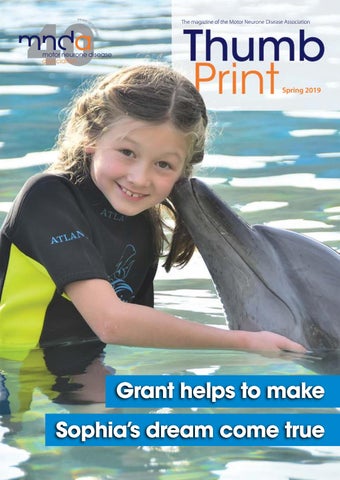
Thumb Print is the quarterly magazine of the Motor Neurone Disease (MND) Association, David Niven House, 10-15 Notre Dame Mews, Northampton, NN1 2BG Reg. charity number 294354. On the cover: Sophia Towart who got to swim with dolphins thanks to an MND Association grant. Turn the page for the full story. Editorial and advertising enquiries: Clare Brennan, Editor, 01604 250505 editor@mndassociation.org If you have comments or feedback about the magazine and its content, please do not hesitate to get in touch. The views expressed in Thumb Print are not necessarily those of the Association. The advertisement of third party products or services does not in any way imply endorsement by the MND Association nor that those products or services will be provided, funded or available via the Association. All content © MND Association 2018.
welcome… In February I had the great pleasure of attending the Association’s first regional conference of the year in Bromsgrove. Over the years, our regional conferences have become increasingly popular as they provide a unique opportunity for people living with MND to come along and learn more about the Association and the ways we are able to support them, in a relaxed and friendly atmosphere. As the first regional conference in this, our 40th anniversary year, the event gave us the chance to look back over some of the key milestones in our history as well as showcasing the work the Association is doing now to support all those affected by this devastating disease. We celebrated the extraordinary efforts of our branches and groups and our volunteers who work tirelessly to support people living with MND and their families in communities across England, Wales and Northern Ireland. We learned more about the work of our campaigners who do so much to raise awareness of MND and ensure those affected have access to the services they need. The previous evening we also met representatives from Bromsgrove District Council, one of the most recent councils to have signed the MND Charter – an important document which sets out what care for people living with MND should look like. We heard about the important advances which are being made in MND Research, in particular clinical trials which provide real hope for the future, and met fundraisers who go to extraordinary lengths to raise vital funds in any way that they can. I would like to thank the Worcestershire Branch for hosting this wonderful event and all those who attended for coming along - it was a truly inspiring and uplifting day and a wonderful way to start our 40th anniversary year.
Thumb Print is available to read online and as a downloadable pdf at www.mndassociation.org/thumbprint
Sally Light Chief Executive
www.mndassociation.org
3
‘Our memories will
4
www.mndassociation.org
be with us forever’ A
LITTLE girl from Cumbria has thanked the Association for helping to make one of her dreams come true. Eight-year-old Sophia Towart wrote to the Association to say thank you for a grant which allowed her to swim with dolphins alongside her mum, Dawn and her dad Alan, who is living with MND. The family travelled to Oman just before Christmas and while they were there they visited Dubai. The Association grant was used to fund the family’s swim with the dolphins – helping them make memories to last forever. In a letter, Sophia said: “Daddy wanted to take us to Oman because he used to work there and the Association gave me a grant so I could swim with a dolphin with my mummy and daddy. “Doing this special thing with my daddy was very fun and I will remember it forever. We have lots of photographs and when I look at them they make me feel happy. “The grant helped to cheer me and my daddy up because MND is tough for me to understand. Thank you very much for helping me.” Sophia was just six when Alan was diagnosed with MND and witnessed his early symptoms. Dawn explained: “She was there at dinner when Alan started to struggle with his cutlery and she quickly picked up that things were not quite the same at home. “He admitted he was struggling a bit at work, but we all assumed it was repetitive strain injury or something similar. He had an initial doctor’s appointment in January and he was
advised to review things at Easter, but by the end of February the muscles in his right arm were constantly twitching and he returned to the doctor. In April, he was diagnosed with MND. “We try to be honest with Sophia but we don’t want to burden her with uncertainties about the future. She seems to accept the answers we give her. MND is difficult for us all because our family dynamic has changed, she feels sad that she can’t jump on her daddy or that he can’t swing her around. “Alan and I both feel that we have been fast forwarded into old age, talking about things we shouldn’t have been thinking about for at least another 30 years. But having Sophia helps to keep us honest and we live life to the full and stay as positive as we can.” Dawn and Alan have also talked to Sophia about the work of the MND Association, taking her along to the Global MND Awareness Day event at Blackpool Tower last June. She has even raised money for the Association herself, by taking part in a sponsored floss – a type of dance. Dawn said: “It was great because we all got to talk to the other people there and we learned more about the grants available from the Association for children like Sophia. It’s so important that our little people are supported too and we are so grateful to the Association for everything it has done to support us. “Sophia loved the dolphins and she very quickly realised that if she held on to a hoop the dolphin would stay with her. She loved it and the memories we have now will be with us forever.”
For more information about support grants visit www.mndassociation.org/ supportgrants. The Association offers a wide range of information for families, children and young people, including our workbook for children aged between four and 10, When someone close has MND. Information sheets and guides are available to download at www.mndassociation.org/informationresources. You can also order copies by calling MND Connect on 0808 808 6262.
www.mndassociation.org
5
A
HARDY group of runners will be taking on a gruelling challenge over the Easter weekend in an effort to tackle MND. The Bashing the Beds Boundary event will see relay teams covering the entire 150-mile length of the Bedfordshire county border to raise money for the MND Association. The ‘bash’ will take place over the course of just 24 hours, with runners setting out on Good Friday and running through the night to finish on the morning of Easter Saturday. As well as the 150-mile course, runners of all abilities will be raising additional funds by taking part in a five-mile ‘final leg’ race in the stunning setting of the Picts Hill House estate in Turvey – which will also provide the start and finish lines for the main event. The race was dreamt up by Bedford-based marathon runner Rob Burrells whose sister Debbie has been raising money to fight MND since being diagnosed with the condition herself in 2018. Rob has teamed up with Nick Kier, co-founder of the St George’s Day Charity Fund, which has raised £565,000 for local charities since it was founded in 1992, in order to turn his dream into reality. The event organisers are working entirely for free, meaning that every single penny you donate goes directly to the MND Association. To find out more about the Boundary Bash, please visit www.bedsboundarybash.co.uk.
6
www.mndassociation.org
Coin released to celebrate an extraordinary life
A
COMMEMORATIVE 50p coin has been released by The Royal Mint to celebrate the life of the Association’s late patron Professor Stephen Hawking. The coin, which features an intricate ‘black hole’ design, was released to coincide with British Science Week and to mark the first anniversary of Prof Hawking’s death. Prof Hawking lived with motor neurone disease for 55 years having been diagnosed at the age of 21 while at
university. He became involved with the Association shortly after it was founded in 1979 helping to raise awareness around the world. He became patron in 2008 and his incredible story was told in the Oscar-winning film The Theory of Everything, which was released in 2014. His legacy continues, thanks to the generosity of The Stephen Hawking Foundation which continues to fundraise and raise awareness, helping to improve the lives of people living with MND.
By kind permission of The Royal Mint
Runners prepare to Bash the Beds Boundary!
‘The MND Register gives me hope for the future’ S IGNING the MND Register is quick, easy and ‘a must for people living with MND.’ That’s according to Philip Brindle, who decided to sign the register to support research into MND. Philip, who was diagnosed four years ago, explained: “I am interested in research generally and if I can help in some small way then that is what I want to do. My view has always been that we can all play a part in helping the research community. It gives me hope for the future.” “It is important for my well-being to know I have done something to help and I would encourage anyone living with MND to do the same.”
The MND Register is a joint research project between King’s College and the University of Oxford. People living with MND are able to join either via their clinic or by registering themselves online. The information held securely within the register helps researchers understand more about the disease and helps plan care services for people living with MND. “It is important for my well-being to know I have done something to help and I would encourage anyone living with MND to do the same.”
Philip said: “Signing up was very easy – I chose to do it online. “There are a series of straightforward questions to answer – about your age, gender and so on – as well as questions about MND, including when you were diagnosed. In a very short time, it was done.” A new animation is also now available on the MND Association’s website www.mndassociation.org/mndregister A video featuring Professor Kevin Talbot from the University of Oxford and Professor Ammar Al-Chalabi from King’s College, London is due to be released soon. We are grateful for the generous support of the Betty Messenger Charitable Foundation and a family trust that wishes to remain anonymous in funding this project. For more information visit www.mndregister.ac.uk For the latest news about MND research turn to pages 10,11 and 16.
Wheelchaircars.co.uk
FREE NO OBLIGATION HOME DEMONSTRATIONS USED VEHICLES FROM £2995
Tel: 0161 793 5934 Philip Brindle, who is living with MND and has signed the MND Register
Full details on our website, www.wheelchaircars.co.uk
www.mndassociation.org
7
“T
‘You can continue to play a key part in the Association’s work by getting involved in our trustee elections’ Richard Coleman, chair of the Board of Trustees
he Association is always looking for new ways to engage with its members, to make sure you are all fully informed about our progress and the work we are doing to support those affected by MND. “One of the ways I hope to do this is by sharing information about the work of the Board of Trustees in the form of an online vlog. My first vlog went live in March and if you haven’t seen it yet I would encourage you to take a moment to do so. “In it, I explain more about some of our latest developments, including an update on the proposed move from our current office in Northampton to new premises. “The move to a new office will bring the Association’s staff, who are currently based in two separate offices, back together under one roof and give us the chance to work more closely with our members and most importantly, alongside more people living with MND. “While there is still some way to go before we can secure the new premises, we remain hopeful that we will be able to share more information with you in due course. “In the meantime, you can continue to play a key part in the Association’s work by getting involved in our trustee elections, either by voting or by putting yourself forward. “The deadline for nominations is 18 April with elections taking place in June. To read more about this important role and how you could get involved please turn to page 17 of this edition of Thumb Print.” To view Richard’s vlog please visit www.mndassociation.org/boardreport
Help us to help more people living with MND
E
VERY ticket sold in our summer raffle offers you the chance of winning an amazing first prize of £5,000, as well as supporting people living with MND, their carers and families. Last year, our members’ fantastic efforts helped to raise over £100,000 through our Christmas raffle and you could help us make our summer raffle even more successful! Each ticket costs just £1 – to be in with a chance of winning, please either return the stubs with your payment and completed reply slip in the freepost envelope provided.
8
www.mndassociation.org
Or, you can enter online at www.raffleentry.org.uk/mnda. Raffle entry closes on Tuesday 2 July, and the winner will be drawn on Tuesday 9 July. If you would like more tickets to sell to your friends and family, please email raffle@ mndassociation.org or call our raffle hotline on 0330 002 0342 Thank you to all those who played last year’s Christmas Raffle and congratulations to our winners. Regulations mean that you must be over 16 years of age to play. Entry is open to all UK residents excluding those in Northern Ireland, Guernsey and the Isle of Man.
Branch volunteers take to the airwaves
Coming soon: Association prepares to launch new website
T
HE Association’s website is being relaunched in April, with fresh content and a brand new look. The site, which will be found at its usual address, www.mndassociation. org, will be simple to use and easy to navigate, making it easier for visitors to access the wide range of information the Association provides. It has been reviewed and tested by a number people using a variety of platforms and technology – and has been optimised for use on Eyegaze and mobile phones. Digital Media Manager, Adam Belson, said: “A website is a bit like an iceberg: the part we can see, page designs and layout, tends to receive the most feedback. What’s below the
surface, such as the speed of the site, accessibility and ‘coding’ isn’t seen by users but certainly takes up the most time to manage. We’ve made sure all aspects have been covered to deliver a much-improved website.” Other features include a drop-down menu, which will make it easier for visitors to go straight to the information they’re looking for, and pages which have been redesigned to be cleaner and simpler. The new system that supports the website will make it easier for users to search for what they need. The site also has improved security and enhanced speed and performance. For the latest news on the launch of the new website, stay tuned to our updates on Twitter and Facebook.
Plans to move Association offices take important step forward
P
lans to move the MND Association’s central office have taken another step forward with the legal process to rent space in Moulton Park, Northampton, now underway. With leases due to expire on the two central office buildings in Northampton and an appetite for a longer-term, viable location, the Association has been searching for new office space for some time. Key considerations include securing a cost-effective flexible space
allowing the Association to capitalise on new ways of working and improvements in digital technology, so helping teams be more responsive to the needs of people affected by MND. Following an extensive process of due diligence on three properties, the office space on a business park in Northampton was identified as the preferred option. Work is now continuing towards securing the premises and updates will be provided as they are available.
V
OLUNTEERS from the Association’s Northern Ireland Branch took to the airwaves to make a plea for more volunteers to join their ranks, after securing a coveted slot on BBC Radio Ulster. Following a detailed application process, the branch was offered two five-minute slots on the radio and space on BBC Northern Ireland’s website as part of Community Life Appeals. They chose to highlight the role of Association visitors, who support people with MND, their families and carers. The branch currently has eight dedicated volunteers but there are geographic gaps they’re unable to cover. The appeal included coverage of a support meeting, interviews with people with MND and their families, interviews with Association visitors Marie Holmes and Siobhan Rooney and a voice over by branch chairman Stephen Thompson. Siobhan said: “The appeal provided a fantastic opportunity for us to raise awareness of MND across Northern Ireland and to ask for more Association visitor volunteers to join us so we can support more people with MND. Thanks to moving interviews with Willie Annett, and Billy and Anne Thompson the appeal also captured the devastation the disease causes, helping to raise awareness.” The appeal was broadcast in January. The appeal and associated films are available on the BBC Northern Ireland website www.bbc.co.uk/niappeals
www.mndassociation.org
9
10
www.mndassociation.org
The importance of clinical trials and how you can get involved
A
ROUND the world, MND researchers are working hard to understand more about the disease, bringing us ever closer to effective treatments and the promise of a cure. But before a treatment can be approved it needs to go through rigorous clinical trials. In this feature, we explain more about why these tests are so important and how people living with MND can get involved. What are clinical trials? Clinical trials are studies in which scientists test new drugs for their safety and effectiveness. Each drug targeted to a specific disease typically has to go through a number of phases often taking many years and costing millions of pounds. It is extremely important to establish whether any side effects are more threatening than the disease the drug is designed to treat. It is also necessary to prove beyond reasonable doubt that the drug is beneficial. The most efficient way of doing this is by monitoring the effects of the drug in a group of patients and comparing progress of these patients to the progress of a similar group who are not taking the drug. Clinical trials are traditionally split into four subsequent phases. At any time, the trial could be abandoned if results are not as expected, or too many adverse side effects are noted. Upon successful completion of Phase 3, the drug may be licensed for use, but is subject to the rules of individual countries. What each clinical trial phase can reveal Pre-clinical studies are necessary to investigate whether a drug is ready to be tested in a clinical trial. It involves extensive studies that give preliminary information about its effectiveness, toxicity, how the body deals with the drug and how safe the drug is. These tests are carried out in cells in lab dishes (in vitro) or in animal models (in vivo). This phase only gives an estimation about the safety of the drug in humans but this needs to be confirmed in Phase 1 of a clinical trial. Phase 1 examines the safety of the potential new treatment, often in just a few people. In many cases, this phase involves healthy volunteers rather than people with the disease, although this is not always the case. Participants are monitored for adverse reactions or side effects. If any appear that are judged to be too dangerous the drug will not advance any further through the process. Although any positive effects are looked at, these cannot be taken as definite due to the very small sample of participants. It is possible, for example, that those experiencing a positive effect happen to have slower progression, an effect which
would be diluted in a much bigger sample of participants. Furthermore, the placebo effect can play a role in the outcomes of the trial. Although Phase 2 starts looking at the drug’s effectiveness, its main aims are to determine the optimal dose amount, timing of doses and how the drug is delivered. Providing the drug is still considered to be safe and if positive effects are observed, the researchers are likely to feel confident about putting the drug through to the next phase. Occasionally, Phases 2 and 3 can be combined to increase the sample size and shorten the duration of the overall clinical trial. Phase 3 is usually the one everyone is waiting for, as its main aim is to show whether the tested drug has a beneficial effect on people with MND. This stage usually involves hundreds of participants, which is enough to give a reliable assessment of the drug’s effectiveness. This phase determines whether a drug is approved for use to treat the disease. Often, a Phase 4 trial is conducted after the drug has been approved for marketing and involves studying further data on its effects on the wider population. This follow-up trial
may also be requested by the licensing authority after approval if the authority think more data is needed.
The dangers of getting excited too soon We are always on the lookout for any good news surrounding new treatments and the Association is keen to promote trial results that have the potential to be authorised as a treatment. However, we are cautious about over-interpreting findings from clinical trials, especially from the early phases. In the past few months, we have witnessed a wave of media reports regarding the success of the Copper ATSM drug which is currently being tested in Australia. These reports suggested substantial decrease in the speed of disease progression. However, the data showed the positive effect was taken from less than 10 people in a Phase 1 clinical trial, reducing our confidence in the reports. You can read more about Copper ATSM on our blog at www.mndresearch.blog or by turning to page 16. Are there any trials I can take part in? There are trials you can take part in if you live in the UK. Find out more about these opportunities on our website: www. mndassociation.org/treatment-trials To find out more about clinical trials, read our Research Information Sheet D. This can be downloaded from our website at www.mndassociation.org/publications or ordered via MND Connect. www.mndassociation.org
11
yourstories
“Dad had many roles in life, but most of all he was our hero” When Katie Barnes’ dad Donald was diagnosed with MND he was determined to make every day count. Here, Katie shares her memories of her beloved dad and explains how poetry helped him cope.
12
www.mndassociation.org
yourstories
“I
n 1988 my dad Donald was diagnosed with MND. Working in construction, he had a number of falls and colleagues would mention that when he spoke he sounded drunk. “Neither myself, my mum, Faith, or sister Debbie had heard of this illness and the medical profession was not as advanced as it is today. With a prognosis of two-and-a-half years and at just 45 years of age, Dad was told to go home and make the most of his time with his family. We were all devastated. I had to have counselling as I was so shocked and upset. “Dad rarely spoke about MND and from the off he was going to, ‘Go down fighting,’ as he put it. And he sure did! Once a racing cyclist and a very fit man, he kept himself as active as possible making his vegan diet even more strict. On the negative side, he hardly ever left the house and refused to use a wheelchair or any aids that would help him. He would later admit this was a bad decision as if he had known how long he was going to live and how much the aids would have helped him, he could have enjoyed holidays and outings with mum and us. “Mum was Dad’s full-time carer and her life stopped almost overnight. In time, we all began to adjust to the changes that MND brought to our lives. We treated every Christmas as if it was his last. We visited him regularly and so did his five grandchildren and later, one great grandchild – experiences that dad thought he would never see. “My mum was dad’s full-time carer and her life stopped almost overnight. In time, we all began to adjust to the changes that MND had brought to our lives. We treated every Christmas as if it was his last.”
“As the years past, Dad kept himself busy doing things. As it was his voice that was most affected, he expressed himself by writing poetry and painting portraits of his grandchildren. To keep his motor skills working he made aeroplanes out of Airfix kits, he even taught himself to play the guitar. Sometimes, when Dad was able to, he would drive to the cycling club races and photograph the cyclists. This made him feel happy and in touch with his old life. Sadly, MND eventually put a stop to all this, but not the love and support of his family. To us, he was the patriarch giving us advice and supporting us when we had problems – advice we will never forget. “Thirty years on and using a walking frame, Dad was becoming weaker. The fight was getting harder and on 23 June 2018, Dad fell down some stairs, breaking his collarbone. While in hospital, he said to me, ‘This is the beginning of the end,’ and sadly it was. My darling warrior dad passed peacefully away in August last year, cared for by mum at the local hospice, watching his favourite soap, Emmerdale. “Dad never wanted to be defined by MND and as a family we are realising more and more that Dad had so many roles in life, a racing cyclist, carpenter, poet, painter, photographer, musician and, of course a family man, but most of all our hero. “His legacy to us all is that he was, and still is, in our hearts.”
Donald, surrounded by his family and left, on his racing bike
My Faith My Faith keeps me strong As through life I go along My Faith is always close at hand When my dreams turn to dust and sand My Faith is there no matter what I do And keeps me strong when I am blue My Faith is with me night and day With me at work or play My Faith is everything I am And makes me glad I am a man My Faith has been with me nearly all my life For Faith is the name of my wife
Once he could Once he could talk but now he can only mumble Once he could walk but now he can only stumble Once the world was his to roam but now he is imprisoned within his home Once his body was strong, athletic and fit, but now it is weak as all day he has to sit His mind is still intelligent, alert and bright Spurring him through unwilling to carry on a losing fight One day by his condition he will be overcome, but all will know for its trouble he gave it a good run
www.mndassociation.org
13
A loving gesture of friendship which offers hope for the future
T
HE extraordinary life of one of the Royal Ballet’s best-loved ballerinas was celebrated at a special event held in London in March. Annette Page, who was a Principal with The Royal Ballet from 1958 to 1967, was one of the most celebrated ballerinas of her generation, dancing all the great classical and romantic roles including The Sleeping Beauty, Swan Lake and La Bayadere alongside Rudolf Nureyev. In 2017, Annette sadly died from motor neurone disease and on 12 March a special event was held at The Linbury Theatre in London’s Covent Garden to help raise awareness of MND, the work of the Association and The Linbury Trust, which generously pledged £200,000 to the MND Association in December. The evening also featured archive film, interviews and many wonderful memories shared by Annette’s husband and former dance partner, Ronald and their daughter Lulu. Speaking after the event, Lulu and Ronald said: “We are very proud that 400 people now know considerably more about MND than they did before. We hope this will inspire them to give generously and that a cure will be found soon.” Annette was diagnosed with MND in 2017 and sadly died just three weeks later on 4 December with Ronald and Lulu by her side. Lulu explained: “We were only too aware of MND as in the late 1970s one of my mother’s close friends was diagnosed with it aged just 48. She had also heard about the actor David Niven. “Looking back, she had lots of symptoms. She had no strength left and was struggling to open jam jars. Then one day she fell and hit her head. She was seen at Addenbrooke’s Hospital and had lots and lots of tests. As they examined her I looked at the screen and I could see there was absolutely no response to the muscle stimulus tests. I heard the doctor sigh, it was awful. Then they told her she had MND. “The next three weeks were extraordinary really, totally overwhelming. The house was full of people, occupational therapists, nurses, furniture providers, palliative care nurses, people showing her how to communicate via computer… ”The NHS was absolutely amazing – but to be honest, I think
14
www.mndassociation.org
she had decided that she didn’t want to live like that.” In the days that followed, Ronald and Lulu took care of Annette together at home, as they had promised to do, and the three of them enjoyed special times together. “She said: “There were times that were truly terrifying, like when she was eating and started to choke but there were also some lovely moments and lots of laughs. She was always immaculate, with perfectly applied make-up. When she became helpless, I applied her make-up for her and there was always a lot of hilarity about that, even though it was heart-breaking at the same time. “We said everything that needed to be said and in the end we were all at peace. I am so grateful we had that time.” A year after Annette’s death, The Linbury Trust pledged to support the Association’s work by donating £200,000 to MND research. The Linbury Trust was established in 1973 by John Sainsbury, Lord Sainsbury of Preston Candover KG, and his wife Lady Anya Sainsbury CBE, who had been one of Annette’s closest friends during their time at the Sadler’s Wells School, now The Royal Ballet School. Their loving friendship latest for more than 70 years and led to the trust’s generous donation. Lady Sainsbury said: “The Linbury Trustees were greatly saddened by the death of my very dear friend and colleague, Annette. The Trustees hope their grant to the Association will assist in the fight towards better understanding, and eventual eradication, of this dreadful disease.” The money will be donated over a four-year period and will help fund Project AMBRoSIA, the Association’s biggest research project to date. The project will help researchers to understand more about the causes of the disease by identifying biomarkers. Lulu said: “We hope this will help to end this dreadful disease, which was a particularly cruel fate for my mother, who was once such a wonderful dancer. “We were extremely moved and very grateful for this most loving and generous gesture in my mother’s memory.” To find out more about the work of The Linbury Trust visit www.linburytrust.org.uk
“We are very proud that 400 people now know considerably more about MND than they did before. We hope this will inspire them to give generously and that a cure will be found soon.�
Annette Page
www.mndassociation.org
15
Behind the headlines of the CuATSM drug trial
A
PHASE 2 drug trial is set to take place in Australia later this year on Copper ATSM (CuATSM) – a small, man-made compound that could provide the basis of a new treatment for MND. The results of the Phase 1 clinical trial were first reported at the Association’s International Symposium on ALS/MND in Glasgow last December. In a recent blog, the MND Association’s Head of Research, Dr Nick Cole has said that although the early signs looked promising, it is important to not ‘over-interpret’ the data. He explained: “MND is a terrible disease and anyone affected by it is looking for good news. We really hope that CuATSM will provide a new treatment for MND that is going to have a positive effect on people’s disease progression. “However, CuATSM is not yet at a stage where a clinician can prescribe it as a treatment. Drug development is a long journey, where any drug has to pass important rigorous checks before approval as a medicine. This trial is an important ‘first’ in the drug development process. “The reported Phase 1 trial was only
designed to test the safety and dosage of the compound CuATSM and the researchers have demonstrated that this drug is safe to consume. Historically, many promising drugs have failed at this stage, and so to get to this stage and pass is vital for its success and further development. The next and important stage is to perform the trial on a larger number of people and really see if it can alter the disease progression. “We have a duty to people with MND, their families and carers to be as accurate and factual about these stories as possible. We must be realistic and not over-interpret promising early data. “What is needed now is to test CuATSM in a follow-up trial with a large number of people. The great news is that this is going to happen. Further work is needed and is planned in a randomised, placebo-controlled Phase 2 clinical trial. This will begin later this year in Melbourne and Sydney, Australia.” For more information about MND research visit www.mndresearch.blog To read more about clinical trials and how they work, turn to pages 10 and 11.
“We have a duty to people with MND, their families and carers to be as accurate and factual on these stories as possible. We must be realistic and not over-interpret promising early data.”
16
www.mndassociation.org
Join us and have your say on the Association’s future I F you think you have what it takes to become an MND Association trustee now is the time to apply. The Association’s Board of Trustees plays a key role in driving the work of the Association forward as well as being
responsible for its governance and making sure it continues to represent the needs of all those living with and affected by MND. The Association welcomes applications from all of its members – including those who are living with MND or other disabilities. Every effort will be made to accomodate individual requirements. No formal qualifications are required – all that matters is that you are keen to make a difference. To become a trustee you must already be a member of the Association and be nominated and seconded by existing members. You can apply by visiting www.mndassociation.org/ trustees2019, where you will be asked to give some information about your knowledge and experience of MND. The closing date for nominations is 18 April, the election will then be held and successful candidates informed of the result prior to the AGM which will once again be held at the East Midlands Radisson Blu Hotel at East Midlands Airport on 13 July.
Diagnosed with MND?
Join the MND Register to help leading researchers learn more about this disease
The MND Register of England Wales and Northern Ireland will be the first comprehensive source of information collected by experts about people living with MND and you can play a vital role in its development. Pioneered by MND Specialists Professor Ammar Al-Chalabi of King’s College London and Professor Kevin Talbot of Oxford University, the MND Register aims to:
Changes to AGM live screening
A
FTER an extended trial, The MND Association has decided it will no longer provide live-streaming of its Annual Conference and AGM. This decision has been taken due to limited numbers of people using the service and rising costs. After much discussion, it has been agreed that the money will be better spent elsewhere. The keynote speech, which will this year be presented by leading MND researcher Professor Christopher Shaw, will still be filmed and available to view at www.mndassociation.org/videos after the event. Updates from the conference and AGM, which will be held on 13 July, will also be available during the day on social media, using the hashtag #AGM19.
• Collect information about people with MND, to understand more about why certain people are vulnerable to the disease • Find out precisely how many people currently have the disease and how this is changing over time • Establish where people with MND live, to help improve care in those areas • Collect detailed information about the disease to detect patterns of change in incidence and outcomes. How to join the MND Register
You can apply online at www.mndregister.ac.uk or ask about joining when attending your next clinic appointment. If you have any questions please visit the website www.mndregister.ac.uk alternatively you can email mndregister@kcl.ac.uk or call Oxford 01865 227 714 or KCL 0207 848 5258
The MND Register is funded by the MND Association and supported by the Betty Messenger Foundation and an anonymous family trust. V1 30.11.18 IRAS Number 173389
www.mndassociation.org
17
18
www.mndassociation.org
Marking 40 years of care, research and campaigning This year, the MND Association is marking 40 years of care, research and support for people affected by MND. In this feature we take a look at our achievements over the past 40 years and the difference we continue to make thanks to your support.
W
HEN the MND Association was formed 40 years ago, little was known about the disease and information was scarce. A group of volunteers, all with their own very personal experience of MND founded the MND Association with a determination to put that right by providing information and a helping hand when it was needed most. In November 1979, just a few weeks after receiving charity status, the Association had three volunteer-led support groups in London, Nottingham and Humberside – a figure that grew substantially to 89 by the end of 2018. The work of the Association’s branches and groups remains as important today as it was then, providing an important first point of contact for those who are newly-diagnosed, and an ever-present source of support. Improving care Making sure people living with MND have access to the right care at the right time remains a key priority for the Association, just as it was in 1979. In 1993, the Association was able to open its first MND care centre at King’s College in London to give people living with MND the chance to access the care they needed more easily. Over the years, it has become clear that this type of care improves the life expectancy of those living with MND. In 2018, the Association opened the North Midlands MND Care Network in Stoke-on-Trent in partnership with the NHS. By 2018 the number of people living with MND with access to a care centre network had risen to 3,828. We also work hard to drive up standards of care and a big part of this came following the publication of the NICE guideline on MND in 2016. On the back of this important breakthrough, the Association was able to develop an audit tool enabling health and social care professionals to measure the care they offer against the standard set in the guideline. To date, 59 audits have been carried out, greatly improving the quality of care people living with MND can expect to receive. Investing in research Of course, much of the Association’s work centres around MND research – important work which we hope will lead to the discovery of new treatments and a cure.
This investment began in 1980 when the Association’s first research project got underway at Charing Cross Hospital in London, under the leadership of one of the Association’s first patrons, Dr Frank Clifford Rose. This important research into the risk factors associated with MND paved the way for much of the research we fund today. At the end of 2018, the Association had a research portfolio worth £16 million and was funding 90 grants. The fight against MND is a global one and we work with partners all over the world to further our understanding of MND and what causes it. At the heart of this collaboration is the Association’s International Symposium on ALS/MND which was first held in Birmingham in 1990. Our most recent event, held in Glasgow, Scotland last December, brought together 1,247 of the world’s leading MND experts representing 40 countries. Campaigning and raising awareness Meanwhile, we continue to raise awareness of MND and fight for the rights of all those affected. In 1987, the MND Association’s first MND Awareness Week was held focusing on improving care for people living with MND, important work which continues to this day. In 2018, our most recent activity included the launch of The Ride, a short-film which tells the story of one man’s journey with MND. So far, the film has received a million views on social media. In 2002, The All-Party Parliamentary Group on MND (APPG) was formed to increase awareness and understanding of MND in Westminster. This cross-party group is made up of MPs and Peers with an interest in MND and helps us to fight for better access to high quality services for all those affected. Over the years, the group has published reports on many important subjects including Personal Independence Payments (PIP) and the difficulties people living with MND face trying to access benefits. In communities across England, Wales and Northern Ireland, our campaigners are also working hard to encourage local councils to sign the MND Charter – a document which sets out what good care should look like. By the end of 2018, 79 councils had signed the Charter and many of those are now working closely with us to improve the services offered to people living with MND and all those who care for them. www.mndassociation.org
19
40 YEARS OF CARE, RES
for people affected by m
1979 The Association holds its first AGM, funds its first research project and begins lending equipment to people with MND.
1980
The MND Patients' Association held its inaugural meeting before becoming a registered charity, the MND Association with Professor Stephen Hawking as Patients' Patron.
HRH The Princess Royal becomes Royal Patron of the MND Association and Professor Colin Blakemore becomes the Association's President. An international team of scientists identify the TDP-43 gene as a cause of familial MND, co-funded by the Association.
Around 40 specialists attend the first MND Association research conference in London.
1982
Our MND Garden at Chelsea Flower Show wins a Gold Medal.
20
1984 A celebrity launch of the David Niven Appeal at BAFTA raises over £170,000, the year after the actor's death.
1986 1987
Founder member and author of ‘A plain man's guide to MND’, Jim Tew is awarded an MBE. Annual income exceeds £1 million for the first time.
The Association takes a central role in founding the International Alliance of ALS/MND Associations. Membership magazine ‘Thumb Print’ is launched.
A year after launching a new branch structure, 40 local branches of the Association are now meeting regularly.
20
Income tops £11 million with over £2 million raised by our branch and group network alone. Association-funded clinical trial reports beneficial effects of non-invasive ventilation (NIV) in MND.
The Association organises its first national MND Awareness Week.
2006
2002
1988 mndassociation.org launches providing information and support to people affected by MND and a global window on the Association's work.
1990
2003
1999
The All P Group (A offering represen
1998
PhD studentship sche
1992
1993
1996
Riluzole (marketed as Rilutek) is licenced for the treatment of MND
MND Connect - the Association's helpline is launched. The first International Symposium of ALS/MND societies is held in Birmingham attracting scientists, clinicians and charity representatives from across the world.
The first MND Care and Research Centre opens at Maudesley/King’s College Hospital, London shortly followed by the Royal Victoria Infirmary, Newcastle. SOD 1 gene discovered, the first ever identified cause of MND. The number of Association branches and groups reaches 100.
20
www.mndassociation.org
SEARCH AND SUPPORT
motor neurone disease An international team of scientists collaborate to find the FUS gene, co-funded by the Association.
The Association's care information achieves accreditation to the Department of Health's Information Standard.
2010
008
007
The Association launches our online forum giving people affected by MND a safe place to support each other.
2009
A donation in memory of Lady Edith Wolfson who died from MND, funds Clinical Research Fellowships in her name.
£500,000 of Government funding is secured to improve wheelchair services for people with MND.
2011
2012
The global Ice Bucket Challenge raises more than £7 million for the Association. This funds our involvement in Project MiNE the international gene-hunting initiative, which leads to the discovery of several new MND genes.
2014
40
The Association announces the creation of non-clinical research fellowships.
2015 The national MND DNA Bank and Clinical Database is launched.
The MND Charter is launched. Over 33,000 individuals and organisations sign the Charter leading to councils across the country adopting it to help improve the lives of people with MND.
2016
Our ‘End of life guide’ is awarded 'Patient Information Resource of the Year' by the British Medical Association.
2017
2019
2018
Patron Professor Sir Stephen Hawking dies but his legacy lives on through the Stephen Hawking Foundation and one of his iconic wheelchairs provides a surprise cash donation after selling for £296,750 at auction.
Party Parliamentary APPG) for MND cross-party MP ntation is formed.
eme launched.
D.
The ‘NICE guideline on MND’ is published after sustained campaigning by the Association and supporters. First patient recruited into the MIROCALS drug trial, co-funded by the Association.
We mark our 40th anniversary with a relentless commitment to people living with MND, underpinned by a fresh optimism that together we will deliver our vision of a world free from MND.
We are awarded our largest corporate fundraising partnership to date by Credit Suisse UK, raising £770,000 by the end of the year.
The Association's 22nd Care Centre opens in Stoke-on-Trent.
Our 28th International Symposium in Boston, USA is attended by a record 1,200 research delegates. fighting
m nd
ther toge
www.mndassociation.org
21
Championing the needs of people with MND at the highest level
W
HEN Madeleine Moon MP was asked to sign the paperwork committing to stand again in the 2010 general election, she hesitated. Her husband had just been diagnosed with MND and she knew there would be tough times ahead. But with the support of her family, she signed on the dotted line and vowed to champion the rights of people with MND in Parliament if she was re-elected. In 2014 the opportunity arose to chair the All-Party Parliamentary Group (APPG) on MND, and Madeleine jumped at the chance. The APPG brings together MPs and peers with an interest in MND, and campaigns for better access to services for people with the disease and their families. At the time she said: “I have a very personal reason for championing the rights of people with MND in Parliament and I believe change is achievable.” One of the issues that quickly became obvious was access to communication support. The APPG launched an urgent inquiry to gather evidence on the extent of the problem, taking submissions from people with MND, their families, speech and language therapists and commissioners. The report from the inquiry Condemned to Silence and our campaign Don’t Let Me Die Without A Voice were instrumental in improving access to communication support for people with MND. “I have a very personal reason for championing the rights of people with MND in Parliament and I believe change is achievable.”
Another issue which Madeleine has championed in Parliament is access to welfare benefits. Under Madeleine’s leadership, the APPG has met regularly with the Minister for Disabled People, Health and Work and in 2017 launched
22
www.mndassociation.org
12,000 people sign Scrap 6 Months petition
T Madeleine Moon MP
an inquiry into Personal Independence Payment (PIP). The report PIP and MND: Is the Benefits System failing people with MND? was published at a joint parliamentary reception with the Association in October 2017. Last year, Madeleine was so incensed at how a young man with MND, James Douglas, had been treated by the benefits system she demanded action from the Government and was granted time to introduce a Private Members’ Bill – the Access to Welfare (Terminal Illness Definition) Bill. The Bill would remove the six-month restriction on the definition of a terminal illness and allow a health professional to determine whether someone is terminally ill. At the same time, the Association launched its campaign Scrap 6 Months, which you can read more about on the next page. Sadly, Madeleine’s husband, Steve, died in 2015 but she remains a passionate political advocate for people with MND in Parliament.
hanks to the support of Association campaigners, members and readers of Thumb Print, our Scrap 6 Months petition has now reached more than 12,000 signatures. Currently, to access the Special Rules for Terminal Illness (SRTI) fast-track process when claiming benefits, there needs to be ‘a reasonable expectation of death within six months’, something which is incredibly difficult to predict in people living with MND. We need to demonstrate to the Government that there is strong support for a change in the law to scrap the six-month time limit, so that all people with MND can access the fasttrack process. The campaign isn’t over and there is still time to sign the petition. Please complete the form on the next page which can also be used to collect signatures from family and friends. You can also sign online at www.mndassociation. org/petition. Thank you for your continued support.
PETITION
Change the law so that everyone with a terminal illness can access welfare benefits quickly and sensitively The Special Rules for Terminal Illness fast-track process for claiming benefits helps people living with a terminal illness to access the benefits they need quickly and sensitively. However, to access the Special Rules fast-track a doctor or nurse needs to sign a form stating their patient has a ‘reasonable expectation of death within six months’. This unfairly excludes many people coping with an unpredictable terminal illness like motor neurone disease (MND). We call on the UK Government to remove the requirement of a ‘reasonable expectation of death within six months’, and instead allow clinicians to use their judgment of whether a person is terminally ill without reference to an arbitrary time limit. This would ensure that everyone coping with a terminal illness can access the support they need as quickly as possible.
Data protection guidance for petition signature collectors Thank you for helping to promote the Scrap 6 Months petition. IMPORTANT: Please follow this guidance before you begin collecting signatures of support, and provide your contact details below. • Explain to potential signer what the petition is intended to do so they are clear why they are signing. • Make sure all petition signers are UK residents. There is no age restriction to signing a petition. • Make sure the signer’s details are legible with the full information required. • Do not leave the petition sheets unattended and lying around, they should always be kept in a secure location. If you accidentally lose a petition sheet with personal details on it, please report this immediately to campaigns@mndassociation.org so we can advise on next steps. • When petition sheets are completed, please collect them in and return (as soon as possible): · By email – Please send to tina.downs@mndassociation.org, please ensure all scanned copies are legible before emailing. We will acknowledge receipt of the petition sheets after which you must delete the files from your computer or device, and securely destroy all paper versions too (ideally by shredding). · By post – Please send to Tina Downs, MND Association, David Niven House, 10-15 Notre Dame Mews, Northampton, NN1 2BG. We recommend that you send this securely by Royal Mail ‘Signed For’ 2nd Class delivery.
Contact details of petition signature collector Name Telephone Address Postcode Registered charity No 294354
Please turn over
www.mndassociation.org
23
The details you provide will be held by the MND Association for the purposes of the Scrap 6 Months petition. By selecting ‘yes’ to becoming a member of the Campaign Network, you consent to us contacting you via email on a regular basis with information about our campaigning, volunteering and financial appeals and events and how you can help. You can withdraw your consent at any time, by contacting us on 020 7250 8447 or by emailing campaigns@mndassociation.org Full details on how we use your information can be found at www.mndassociation.org/privacy-policy Are Would you Please tell us about you like to your connection PLEASE COMPLETE IN BLOCK CAPITALS over receive emails to MND 16? about our Such as family member, campaigning? Please friend, GP, Neurologist, First name Please circle tick Politician etc Last name Postcode Email address
Yes No
Yes No
Yes No
Yes No
Yes No
Yes No
Yes No
Yes No
Yes No
Yes No
Yes No
Yes No
Yes No
Yes No
Yes No
Yes No
Yes No
Yes No
Yes No
Yes No
Yes No
Yes No
Yes No
Yes No
Yes No
Yes No Please photocopy this sheet if required or continue on another form
24
www.mndassociation.org
Make a date to share your diary
P Pictured from left to right are Ashley Morgan, Shaan Devnani and Jessica Devnani
MPs hear from people with MND about the importance of social care
P
EOPLE with MND and other health conditions gathered in Parliament recently to talk to MPs about the importance of social care to them and their families. The meeting, jointly hosted by the All-Party Parliamentary Group (APPG) on MND and eight other APPGs, called on the Government to urgently publish its Green Paper on social care, a set of proposals published by the government for consultation, which has been repeatedly delayed. A packed room of volunteers and service users from a wide range of organisations were in attendance, along with representatives of 18 MPs and four peers. The meeting was opened by Mark Harper MP, Chair of the APPG on Learning Disability, followed by Mark
Lever, Chair of the CSA and Chief Executive of the National Autistic Society and Jonny Mercer MP, Chair of the APPG on mental health and then opened to questions from the floor. Shaan Devnani, who is living with MND, and his wife Jessica attended the event and asked a question to the panel about young families like theirs, and how they will be impacted by any reforms of social care provision. The APPGs are writing to Matt Hancock, Secretary of State for Health and Social Care to request a meeting to discuss the issues raised. As Thumb Print went to press, we are expecting the Green Paper to be published and will be responding to the proposals put forward by the Government.
eople affected by MND are being invited to leave a written legacy for future generations by recording details of a day in their life as part of a long-standing social history project. The Mass Observation Archive has been capturing the everyday lives of people from across the UK each 12 May since 1937 – the day of George VI’s Coronation. The resulting diaries, stored in the University of Sussex’s archive in Brighton have become an invaluable historic resource and a fascinating glimpse into life across generations of Britons. With the Association marking its 40th anniversary people affected by the disease have been invited to record their experiences for capturing in the archive, providing an insight for our ancestors into life in 2019. Submitted diaries, which can be typed or handwritten, are retained anonymously with no personal details requested or recorded. For more information about how to share your diary from 12 May – which this year falls on a Sunday – please visit www.massobs.org.uk/write-forus/12th-may You can also get involved on social media by tweeting details of your day #12May19
MNDonlineforum
“It put my dad’s mind at ease with some of his worries. It also helped me when I was struggling and someone always replied, day or night, for which I am very grateful.” Since 2012, the MND online forum has provided a safe, anonymous and supportive place for people affected by MND to come together and discuss topics or issues only those close to the disease can understand. There are always a variety of discussion threads to join in with, from benefits to medication and from wheelchairs to family keepsakes.
It’s simple to register, just visit forum.mndassociation.org/forum.php www.mndassociation.org
25
How we made a difference in 201 for people affected by MND or Kennedy’s disesase, We enabled people with MND or Kennedy’s disease to access support and find ways to adapt.
We listened to your feedback and used this to plan, develop and improve our resources.
We reached more people than ever before with our resources in a range of formats.
We educated to improve care practice through events, masterclasses and professional bursaries.
26
www.mndassociation.org
Across the year: • we sent out 23,000 printed resources • our publications were downloaded 40,000 times • in feedback, 96% found our publications useful. “Sheet 7B on tube feeding provided all the necessary information for discussions with the consultant about possibly having a tube fitted.” - Person affected by MND
Following your feedback: • a new animation and sheet on What is social care? are now in development • more copies of our refreshed guide Finding your way with bereavement were ordered in its first two months than in the previous three years for the information sheet •p rofessionals wanted masterclasses on respiratory management with MND, which were oversubscribed in 2018. “Knowledge of where to go, whom to see. What you need. How to access? What is the cost? Not all is free? That’s what individuals and families are going to want to know. Equipment, Motability and social services, etc.” - Person affected by MND
• Our What is MND? animation had 20,000+ views in its first 12 months and What is Kennedy’s disease? had nearly 2000 views in first six months. • Unique web page views increased and subscribers rose to 2200 for our professionals’ online newsletter. • Our translated resources were accessed more than 200 times in 2018. “Until diagnosed, I had never heard of Kennedy’s disease, and neither had my consultant, which shows how little information was available until now.” - Steve Harris, who is living with Kennedy’s disease
s a result of 37 bursaries and our education events, professionals told us A they introduced: • new pathways and improved speed of access • respiratory managemsent techniques • strategies for difficult conversations • screening for cognitive change. “We hadn’t been aware of guidelines on cough. It had given us a much clearer pathway, we’re able to be more systematic and treat people the same way.” - Physiotherapy and masterclass attendee
18, with education and information and professionals who provide support. We collaborated
We engaged with: • users on 10 resources, through our User Review Group and beyond
with people affected by MND or Kennedy’s disease, experts and organisations.
• expert facilitators to lead at all our masterclasses
We learnt
• Professionals asked for education closer to home, so we’re focusing on regional rather than national events.
by exploring evidence, external expertise and your feedback.
• partnerships and professional bodies to gain four new endorsements on resources. “We’re delighted to endorse the Voice Banking video. It provides a clear introduction to innovative technology which enables people with speech difficulties to capture their own voice.” - Kamini Gadhok MBE, CEO of The Royal College of Speech and Language Therapists
• We are asking better feedback questions to understand how our work makes a difference and where it can improve. • We’re working with cross-charity bodies such as the Patient Information Forum to learn from other approaches and best practice and attend events such as the International Symposium on MND. “At the 2018 International Symposium on MND, it was positive to see the number of studies about the psychological and emotional impact of MND…with a key message for professionals to monitor psychological and emotional wellbeing from diagnosis onwards.” - Rachel Boothman, Head of Education and Information, MND Association
How to help us make a difference in 2019
Y
OU can help make a difference to our information by sharing your knowledge of MND or Kennedy’s disease. We have opportunities to support new formats, like our animations, and review draft content on a range of resources. You can choose tasks you want to work on in the comfort of your own home. We’d love to hear from you if you have MND or Kennedy’s disease. We’d also like you to get in touch if you currently support someone with either condition, or if you’ve previously been a carer.
To find out how to join our User Review Group, contact: volunteering@mndassociation.org See our resources at: www.mndassociation.org/publications or order printed copies from our MND Connect helpline: 0808 802 6262, mndconnect@mndassociation.org www.mndassociation.org
27
Communication aids and environmental controls – where are we now? With advancements in technology and changes in services it can be difficult to know where to begin when it comes to getting help with communication and environmental aids. In this feature, we aim to explain more about what’s available and how the Association can help.
I
N December, the Association launched a Christmas Appeal which focussed on the provision of communications aids for people living with MND and the rapidly-emerging technology of voice banking. Thanks to your support the Association has been able to support the work of NHS England and the wider NHS across the country by helping people with MND access the equipment they need. This work has also been further bolstered by the hard work of a group of people who are living with MND, who have worked alongside NHS England to help improve provision. For communication aids, also known as Augmentative and Alternative Communication (AAC), referral to a speech and language therapist (SALT) is key in obtaining a device. A local or community SALT should be able to carry out an assessment and then either: • Provide a device • Seek funding for a device from statutory services (such as Clinical Commissioning Groups (CCGS) in England, Health Boards in Wales or Health and Social Care Trusts in Northern Ireland). In many instances this is not available or not timely, in which case the MND Association will try to support the assessed need • Refer on to a specialist AAC service, who may carry out a specialist assessment and provide appropriate equipment In England, there are currently 14 specialist AAC centres, funded by NHS England, which assess and provide communication aids for ‘complex cases.’ At its basic level this translates as someone who has loss of voice and loss of limb function. If someone with MND is still able to access a device with their hands then the local SALT would need to offer support. Those people with a rapidly progressive disease, such as MND, can be referred up to 18 weeks before the criteria is met and will be prioritised based on clinical need. In Wales, a similar arrangement is in place with the specialist centre located at the Rookwood Hospital in Cardiff. This is an ‘all Wales’ service and like the services in England will prioritise based on clinical need. In Northern Ireland, health and social care trusts are expected to fund communication aid provision but there is also a specialist service at the Communication Advice Centre in Belfast which can support and advise appropriately. For environmental controls (EC) the situation is slightly
28
www.mndassociation.org
different, but anyone with a significant physical disability, predominately with upper limb impairments that result in them being unable to use standard controls, is eligible for support. Referral to an occupational therapist (OT) is usually required to obtain a device. The types of devices that are classed as environmental controls may include call alarms, heating or lighting controls, or equipment that helps someone access a TV - anything that may contribute to helping someone control their environment in their own home. In England specialist EC services exist in much the same way as the AAC specialist services, and are funded by NHS England. Many of these EC services are shared with the AAC specialist services, which can help with joint working between the two different components. The same organisation in Wales (ALAS – Artificial Limb and Appliance Service) that covers the specialist AAC provision, based at the Rookwood Hospital in Cardiff, also covers environmental control provision for the whole of Wales. In Northern Ireland the situation is not quite so clear cut, with the vast majority of EC provision being dealt with by community occupational therapist services, who would seek individual funding for the relevant Health and Social Care Trust. The following information sheets are available for people living with MND or professionals who require more information: For people living with MND: 7C – Speech and Communication Support information sheet 7D – Voice Banking Both available from MND Connect or by visiting www.mndassociation.org/publications Online information is available at www.mndassociation.org/speech and www.mndassociation.org/communicationaids For professionals visit: www.mndassociation.org/aac www.mndassociation.org/voicebanking For any advice about AAC or EC provision, and to find out where your nearest service is, please contact MND Connect on 0808 802 6262 or email the Communication Aids Coordinator at communicationaids@mndassociation.org
www.mndassociation.org
29
Turning walking into talking
Speech and Language Therapists supporting people living with MND
M
AKING sure that people living with MND can have access to voice-banking as soon as possible is one of the main aims of a project which has been launched
in Dorset. Thanks to the support of fundraisers including Dawn Goodson, whose husband, Brigadier H John Goodson sadly died from MND in 2015, speech and language therapists (SALTs) based in the Dorset Health Care Community Trust have been able to learn more about voice-banking from specialist SALT Richard Cave and the Association’s first voicebanking volunteer, Kim Archer, improving the service they are able to offer. “An unforeseen benefit has been to see how keen people are to download their voices and start introducing them to their friends and family even before they actually need to, so they can get used to how they are going to sound later on.”
86-year-old Dawn helped to raise £8,000 for the Association by taking part in a sponsored wing-walk and by abseiling The Spinnaker Tower in Portsmouth in 2017 and the money raised has helped to make the voice-banking project possible. Project lead, Sharon Owens said: “We have been running the project now for nearly 12 months and it is going really well. Twenty people with MND have participated in the project and we are learning so much about the time, and technology needed to establish a long-term service plus the
30
www.mndassociation.org
Fundraiser Dawn Goodson, who lost her husband to MND, took part in two events to raise money for the Association
on-going support from Richard Cave at the MND Association has been invaluable. Of course, there are still people for whom a changed voice is the first indication of MND and by the time the diagnosis has been made, banking is not possible. But where we are getting early enough referrals it is overwhelmingly well received. We really hope to ensure that when this project finishes, voice-banking in Dorset will continue. “An unforeseen benefit has been to see how keen people are to download their voices and start introducing them to their friends and family even before they actually need to, so they can get used to how they are going to sound later on.” Professor Holger Schutkowski from Bournemouth was one of those who took the opportunity to bank their voice. He said: “I didn’t think it would be possible, but I jumped on it straight away - this was part of the appeal. I’m not only recording my voice as a mechanical rendition, I’m recording me.” Michele Hardy, Chair of the East Dorset and New Forest branch said: “We are delighted to be able to support the SALTs. My husband Mike would have loved to have kept his voice, and his Dorset accent, but the technology came too late for him. It is amazing that we can now help to do this for so many other people.” For more information about voice-banking download our information sheet 7d from our website at www.mndassociation.org
Association team comes face to face with MPs in charity match The teams line-up alongside former professional footballer Len Johnrose at the match held to help raise awareness of MND. Len is pictured on the front row far right
F
ormer professional footballer Len Johnrose returned to the touchline to offer his expertise to a team of amateurs who faced MPs in a charity match organised by campaigns contact Mark Gately to raise awareness of MND. Len, who made more than 400 Football League appearances for six clubs including Bury, Blackburn Rovers,
Swansea and Burnley, was diagnosed with MND in 2017 and since then has supported the Association by raising awareness and funds. The charity match was held in the grounds of the Royal Hospital Chelsea in London on 12 March and featured players from the MND Association, including staff, volunteers and media contacts who
were managed by Len. An early morning kick-off enabled four MPs to join a team from across Parliament, while the Football Association were able to organise former Premier League official Dermot Gallagher to referee the match. Sadly, the MND Association team was beaten 9-1 but we hope for a rematch next season.
Rugby legend pledges support for families living with motor neurone disease
T
HE foundation set up by former Scotland rugby player Doddie Weir has doubled its donation to the Association to improve the lives of even more people affected by MND Last July, a year after announcing he was living with MND, the former British and Irish Lion and Scottish international donated £100,000 raised through his My Name’5 Doddie Foundation to the MND Association. Doddie has now announced a further £100,000 contribution to the Association’s grant scheme. This helps people living with MND to pay for adaptations to their homes and funds respite activities for carers. Doddie said: “One of our main aims is to help people with MND and their families, therefore we are delighted to be able to increase our funding to deliver that support. We recognise that the MND
Association is best placed to distribute funds on our behalf and the grants have already made a difference to the lives of a great many people. We are only able to do this with the incredible support we receive from our fundraisers and we are all hugely grateful for their ongoing and committed efforts on our behalf.” The MND Association’s Care Grants programme totals more than £1 million annually. In 2018, the Association awarded grants to more than 1,800 people with MND, carers and young people affected by the disease. MND Association’s Chief Executive Sally Light said: “We are so grateful for Doddie’s continuing support of the MND Association and his determination to make life better for people affected by MND like himself. This generous donation will make a real difference to
Doddie Weir
people we support through our grant programme. For some people these grants are essential to allow them to make necessary changes to their homes so they can continue to live as independently as possible. For others, the grant means a day out for the family or a treat for their carer. Whatever it is, it means so much.” For more information about the grants visit www.mndassociation.org/grants
www.mndassociation.org
31
Events being held to mark Association’s 40th anniversary
T
HE MND Association will be marking its 40th anniversary by hosting two special events during 2019. The Association’s volunteer ‘Thank You’ day is shaping up nicely with 250 invited guests expected to attend a day of talks and tours at Boughton House, one of Britain’s grandest and best-preserved stately homes. Guests will begin the day with tours of the house and the18th Century landscaped gardens and a morning of research sessions with Professor Ammar Al-Chalabi. There will be talks with the Association’s founder members, its trustees and directors’ team and a session with Chair, Richard Coleman, Vice-Chair, Jan Warren, Chief Executive Sally Light and Director of Research Development Dr Brian Dickie. On 2-6 October a free exhibition will be at the gallery@oxo in London showing the works of artists living with MND. The gallery will be open to the public from 11am to 6pm and will feature work by Simon Adams, Sarah Ezekiel, Miles Pilling and Ron Wheeler. The family of the late David Shaw have also agreed to his inclusion in the exhibition and The Daily Mail cartoonist, Stanley McMurtry MBE, who lost his wife of 37 years to MND, has also agreed to contribute a cartoon to the exhibition. The gallery will also be an ‘information hub’ for anyone wanting to know more about motor neurone disease and the work of the Association. If you are interested in volunteering at the exhibition, please contact Sue Dorrington at susan.dorrington@ mndassociation.org For more information about the Association’s 40th anniversary turn to pages 18 and 19.
32
www.mndassociation.org
Family comes tog money in memor C
LIMBING mountains, taking part in marathons and organising countless events such as music evenings and cake sales are just some of the ways one family has been raising money for the MND Association in memory of their beloved mum and sister. Marie McDonagh was diagnosed with MND in 2001 just months after returning from a trip to Goa to celebrate her 47th birthday. During the trip, she had noticed that the grip in her left hand was becoming weaker and after months of tests discovered that she had MND. Her daughter Nicola explained: “Being the strong lady she was she decided to keep the news between herself and my step-dad Ken over the Christmas period until January when she came to visit me in London to break the news. “Later that month, I found myself back at home wanting to help out and spend as much time with my mum as possible. Everyone in the family, including Mum and my brother, Michael, continued to work. It gave us a sense of routine and normality. I was able to secure work up north and was on hand give Mum a hand to dry her hair, put her make-up on, all the essentials to keep up appearances. “As time went on, Mum had a series of trips and falls and in 2005 made the heart-breaking decision to give up work. I too gave up my job as a youth engagement worker to care for her full time, with my brother and step-dad helping out in the evenings after work. “Life became very scary as we entered an unknown world of unemployment, form-filling and adaptations.” Nicola explained that while there were many difficult times there were happy times too, with the family relying on black humour to help them through. She said: “Many times Mike would take one of Mum’s arms and me the other to take her to the bathroom and we’d all end up in fits of laughter. Although
Pictured from left to right are Nicola’s husband Andy, Marie’s sister Rosalie, Rosalie’s partner David, Marie’s daughter Nicola and her daughters Cora-Marie and Lois
tragic in one sense, it was also very bonding. Mum’s diagnosis brought us closer together and we’d often have latenight chats after helping Mum to bed. It was on one of these occasions that Mike said he was going to take part in the Great North Run.” But the family was dealt yet another tragic blow when Michael sadly died in a car accident on 13 January 2016. “It was a time of terrible shock and pain,’ Nicola said. “We couldn’t have got through it without the support of our extended family in Scotland. They held an event to raise money for mum to buy an adapted vehicle, a communication aid and a break in Scotland to give her a change of scenery. “During that break, I decided to take part in the Great North Run for Michael and roped my partner Andy in too. We raised more than £3,000 and even got engaged at the finish line!” It was the start of a huge fundraising
ogether to raise ory of Marie The family has also set up a tribute fund in Marie’s memory which has raised a staggering £24,930. Marie’s sister Rosalie, who took part in the Great North Run with her partner David in September said: “This was David’s 10th Great North Run for the Association and my sixth. We started raising money in 2001 and David has taken part in 12 half marathons, three London Marathons and six ultra marathons. In 2010, we both managed to summit Kilimanjaro, again raising money for the charity.
effort, involving Rosalie and David who have since taken part in countless marathons and half-marathons as well as climbing Mount Kilimanjaro. After getting married in June 2008, Nicola and Andy were delighted to find out they were expecting their first baby. Nicola said: “It was a joy to share my pregnancy with my mum. As we watched TV together I would place her hand on my bump and her eyes would grow wide as her grandchild gave her a boot! Our little girl Cora-Marie was born on 9 November and Mum said she was the most beautiful baby she had ever seen. Two days later, Mum passed away peacefully at home in her sleep.” Cora-Marie is now almost eight and has been joined by a sister, Lois. Nicola said: “Although they didn’t get the chance to spend time with their amazing granny or Uncle Michael, they know lots about them and love looking at photos. They know all about MND and have become the next generation of fundraisers!”
Look out for innovation in volunteer support
T
HE Association is currently looking at how it can provide even better volunteer support for people affected by MND. Over the past year, the Association has been listening to your views and thinking about what it could do, making sure to build on the success of its Association visitor network. We’re now ready to start sharing and testing our ideas. Thanks to your feedback, we have identified support for carers and former carers as a high priority and are trialling a volunteer role focussing on this – the Carers’ Champion. Later this Spring, we will make available our full proposals for updating our volunteer support service – what we are doing, what we should do and could do. Please visit www.mndassociation.org/ supportvolproject for the latest information or telephone 01543 415121. For information about the Carers’ Champion role please visit www.mndassociation.org/ carerschampions or telephone 01604 611681.
New Volunteer Portal
Marie McDonagh
“Later this month David will take part in The Highland Fling – a 53-mile ultra marathon and then in June he will be taking part in the West Highland Way, a 96-mile race, followed by the Glenmore race which is held over 24 hours. We intend to build on the amount we have raised so far because Marie was not only my sister, she was my best friend and we miss her every day.” To find out more about Tribute Funds please visit www.mndassociation.org/ tributefunds or call 01604 611898.
The MND Association has a new database which includes a portal for our volunteers. It allows all of our volunteers to: • update and manage their personal details and preferences online, • communicate with other volunteers via a forum • access useful information and news. In addition, selected branch and group representatives can now view information about their members, upload meeting documents and view financial support or equipment loans given to people in the area. Please contact volunteering@ mndassociation.org for further information or to request an invitation if you are a volunteer and have not already received one.
www.mndassociation.org
33
Proud son pays ultimate tribute to ‘the kindest man you could meet’
A
PROUD son took part in a Tough Mudder challenge in memory of his dad Mike, described as ‘the kindest man you could meet.’ Jeremy Hoare from Levenshulme and nine of his closest friends took part in the challenge in the grounds of Chomondeley Castle in Cheshire to raise money for the MND Association in memory of his dad, Mike who died from MND last year. Mike, from Wilmslow, had been living with symptoms for several months before finally being diagnosed with MND and dementia the day after Jeremy and his wife Kate found out they were expecting their son Alf. Jeremy said: “It was completely devastating as the doctor told us straight away he would probably have less than two years to live. “MND is cruel as it takes away the person you know in front of your eyes. It’s a slow deterioration of the person you love. The doctors warned us that the dementia might take away Dad’s kindness too. Thankfully Dad never lost that part of himself, he remained as he always was - kind, generous and supportive.” 40-year-old Jeremy said the arrival of Alf had been a great source of hope and pride through an incredibly difficult time. He said: “Dad was so looking forward to
Jeremy and Mike pictured at Alf’s first football match
34
www.mndassociation.org
Jeremy pictured with his dad, Mike
being a Grandad and insisted on being called ‘Gramps.’ The pride he had when Alf was born just poured out of him. He even managed to take Alf to his first football match, nothing could have made him more proud. “Although MND attempts to take every bit of dignity away from you, Dad held his head as high as he could. He never complained once, and he remained the kindest of men even when his mind was slipping away from him.”
The team’s Tough Mudder challenge raised an incredible £5,140 to support the Cheshire Branch’s work for others facing the condition, with some of the some of the money raised also going towards research. “MND is cruel as it takes away the person you know in front of your eyes. It’s a slow deterioration of the person you love.”
Jeremy said: “We were all dreading it - but on the day it was actually really good fun! “It was unbelievably tough but great to have the support of my mates and there is no way any of us could have made it round without dragging, pushing and pulling each other over the obstacles. It felt like we had done our families and all the people who had donated to the MND Association proud. “It also felt a fitting tribute to my dad who was always the loudest to cheer in support of anyone who deserved it.” If you would like to sponsor Jeremy and his friends, please visit www. justgiving.com/fundraising/tom-sweaty.
Gamers take part in global gaming marathon
T
HREE friends from Reading raised £2,565 for the MND Association by completing a week-long global gaming marathon. Chris Warbey and friends Ryan Cox and Ben Franks, all aged 21, from Woodley, near Reading, took on the massive online challenge in memory of Chris’ Dad, Richard, who died in April 2017 from MND, aged 56. For seven long days it was game on non-stop as Team MND played the new Call of Duty game from its official release until they reached the final Master Prestige Level with the aim of being one of the top 10 in the world. They ended up in first place in UK and Europe and third in the world! Chris’ mum Jacqui said: “I am really proud of them. I was sceptical when Christopher first mentioned it, but he proved me wrong.” A lot of effort and planning went into the event. Chris set up his Playstation and computer in the study and moved the router to ensure the best internet connection. They used a second PlayStation box to avoid overheating due to continuous use. The trio booked time off work and planned a shift rota which fitted around Ryan’s day release from college.
Pictured from left to right are Chris, Ben playing the game and Ryan
They also had live streaming via Twitch TV so their followers could watch the game and see them playing it. Jacqui added: “The best part of all this was that they were reaching out to raise awareness of MND and to get donations from a different generation of supporters.” To boost their total visit: https://www.justgiving.com/ fundraising/chriswarbey
Gifts in Wills
hope A gift in your Will could give
of a world free from MND
Please help us create a world free from MND for future generations with a gift in your Will To request an information pack please contact Emma Fellows, Legacy Manager on 01604 611898 or email emma.fellows@mndassociation.org www.mndassociation.org/wills
www.mndassociation.org
35
thankyou
Share your pictures at www.facebook.com/mndassociation If you are sending in photographs to feature on these pages please ensure you have full permission to use the images before sending. Fighting back: Garry and Jan Smith, who is living with MND, organised a charity night at the Block and Tackle pub in Ashington, Northumberland and raised £5,019 for Jan’s Fightback Fund. They sent hundreds of requests for raffle and auction prizes and were delighted to be inundated with support. Speaking after the event, Garry said: “It wasn’t just fundraising but getting Jan out to see our favourite band and spending time with our family and friends all together, so it was a great success on all fronts.”
There’s no place like home: Justine Starling and her family regularly don fancy dress to raise money for the Association and each time their efforts get bigger and better. Their most recent fundraising event saw them dressing up as characters from The Wizard of Oz. Pictured are Justine’s husband Paul as the Wizard, Justine as the Good Witch, their son Ben as the Lion, Ben’s partner Leah as Dorothy, their other son Brandon as the Tin Man, nephew Kai as the Scarecrow and niece Shannon as the Wicked Witch. They sold homemade cakes, pastries and sweets as well as handmade crafts and raised £953 in memory of Justine’s father who died from MND. The total amount raised by the family stands at £7,000.
A very special gift: Seven-year-old Teddy Davy ran every day of December clocking up 107km in total, including 2.6km on Christmas morning before he opened any presents. Teddy raised £1,038 in memory of David Bowers who died from MND.
36
www.mndassociation.org
A class act: Pupils from Carre’s Grammar School and Sleaford Joint Sixth Form in Lincolnshire have been fundraising for the Association to show their support for teacher Theresa Angus, who lost her father and brother to MND. They have been holding weekly bakeit! events and have raised an amazing £3,660 since Easter 2018. The money they have raised has been donated to the Nottinghamshire Branch, to benefit people living with MND in the local area. They have pledged their continued support and hope to raise £5,000 every year.
Pedal power: 10-year-old Thomas Street chose to fundraise after his uncle James died from MND. Thomas decided to take part in a bike ride to Bath and back and planned the whole thing telling his dad, Danny, pictured with Thomas, when it was taking place. Thomas smashed his target and has raised an amazing £360.
thankyou Fringe benefits: After Hannah’s Grandad was diagnosed with MND she decided she wanted to do something to raise money for the MND Association. Straightaway she decided to cut off her hair. A year later and Hannah had her waist-length hair cut off and donated it to the Little Princess Trust, a charity which provides wigs made from real hair to children and young people going through cancer treatment. Hannah smashed through her original target of £200 and has now raised a fantastic £454.
On the right road: When driving instructor Martin Mayston was diagnosed with MND he was determined to do something positive. He decided to Walk to d’feet MND and walked eight miles around the driving test route in Bedford with his partner Lesley and colleagues, family and friends who joined them for the last leg. Martin said: “We have raised almost £5,500 now and it’s still going up. I feel so humble and grateful for the support everyone has shown me; both the money they’ve donated and all the kind messages. It really makes you feel loved. It’s good to know the money raised will help people like me with the challenges we face on a daily basis and help fund research to find a cure for this cruel disease.”
New year, new look!: New Year’s Day in Sheffield got a bit chilly for Emma Coley as she had all her lovely long locks shaved off! Emma’s dad was diagnosed with MND in 2018 and she raised more than £1,400 for the Association in his honour.
Baring all for charity climb: Michaela Needham got some extra use from her bikini this year by climbing Moel Famau, Wales with friends to raise funds in honour of her grandfather. She also plans to bare all when she climbs Mount Snowdon later this year.
Setting sail: Debbie Burrells, who is living with MND, pictured above right, has set-up the Daisy Chain Fightback Fund to help her raise funds for the MND Association. In the past year she has organised a number of fundraising events with the help of her friends, including a cruise ship-themed charity dinner which was attended by dozens of supporters. There were lots of fun activities to enjoy during the evening, including dancing to an Abba tribute band, a casino, tombola, auction and raffle and everyone was encouraged to dress up in their finest cruise wear.
‘In memory of Dad’: 13-year-old Conall Graham organised a special fundraising day in memory of his dad, Martin who sadly died from MND in 2017. Conall bravely paid tribute to his dad during an assembly at his school, Edwinstree Middle School in Buntingford, Hertfordshire and showed a short awareness film. The whole school supported a non-uniform day along with a cake sale and took part in lessons centred around coping with MND. As a result, the school has helped Conall raise £605.47 for the MND Association.
www.mndassociation.org
37
yourletters If you have something you would like to share with other members of our MND family, we would love to hear from you. Letters, which must include your full address, can be sent to Your letters, Thumb Print, PO Box 246, Northampton, NN1 2PR or via email to editor@mndassociation.org Please note that letters may be edited. If you are including photographs please ensure you have full permission before sending.
‘Our lives will never be the same without him’ Samuel Cole was diagnosed with MND in 2012 and sadly died in February. Both Samuel and his wife, Dena, supported the Association in many ways and also featured in Thumb Print. Here, Dena pays a moving tribute to Samuel and his journey with MND.
S
am left us suddenly on 7 February. We had been married for 30 years and were blessed with three lovely children, Natasha, Ashley and Jamaen. My life - our lives - will never be the same without him. He protected us all. Even during his journey with MND he made sure his family was kept safe and was loved. He taught us so much, to be resilient, remain blameless, love ourselves, to have a ‘can-do’ attitude, to reach for the skies, to spend quality time with each other always - to be loved. His big brown eyes, his smile so deep, he knew how to make me smile.
holiday, creating memories we will never forget. We will continue as a family, holding on to all Sam’s memories, continuing our faith in God, he wouldn’t expect any less from us. We ask for your support as we walk through the next few weeks, months and years ahead, as we continue Sam’s legacy.
“The MND Association and the MND community went above and beyond, making it possible for us to achieve so much.”
Walking around the house, I still expect to see him in his chair, when each door opens, I expect him to be there. Sam was a Pastor, husband, father, soulmate, son, brother, cousin, uncle, leader, teacher, mentor, counsellor, mediator, friend, companion, organiser and a DJ. He was patient, kind, understanding, never judgmental, hospitable, he would have given you his last penny. We would like to say thank you to everyone who stood by him on his nine-year journey with MND. All those who took the time to sit and talk with him, make him laugh, reminisce about the past, for all the many comments and shares on Facebook, social media accounts, and for taking his story to places he would never see. The MND Association and the MND community went above and beyond, making it possible for us to achieve so much. The MND Association made it possible for us to go on
Samuel Cole, his wife Dena and their three children, Natasha, Ashley and Jamaen
diarydates • Brighton Marathon: 14 April 2019 • London Marathon: 28 April 2019 • Nightrider 2019: London 8-9 June 2019 • North Regional Conference, Manchester: 22 June • MND Association Annual Conference and AGM: 13 July 2019 • South Regional Conference, Exeter: 21 September • East Regional Conference, London: 12 October • Walk to d’feet MND: Walks throughout the year 38
www.mndassociation.org
aboutus
‘Can we be honest?’
I
enjoy reading Thumb Print and I’m sure it gives hope to many people living with MND that there are still joys in life and things to live for. The fundraising, information and support is brilliant. My husband Steve was involved in a fundraising event more than 25 years ago, not ever thinking it would affect his life. Unfortunately my husband was diagnosed with MND at the age of 55 after experiencing muscle-related problems and it has progressed quickly. Within 18 months he has lost the use of all four limbs and can only stand for a few seconds with the help of two people. He cannot hold his head up unaided for very long and is losing his speech. Every day is a huge struggle for him, with the added element of pain and anxiety. This once strong confident man has been reduced to a shell and I think many of your readers will be able to identify with my poem, Can we be honest. He is too poorly to go out and participate in activities but is helping a local hospital research project. Sonja Castle, Via email He’s just a shell who’s vulnerable So weak he can hardly stand He cannot even scratch an itch Or gently hold my hand
The autopilot switches on The moment I hear a sound I’m up and attentive, full of love My feet hardly touch the ground
He sleeps with a mask On a hospital bed Lifted with hoists And meals being fed
My love is unconditional Unquestionable for sure But sometimes when I’ve given it all I’m being asked for more
I shave him, I wash him I clean out his ears I tell him nice stories And calm some of his fears
I look into the mirror Is that old face really mine It’s etched with lines of sadness The voice repeats ‘I’m fine’.
I’m fed up taking phone calls Repeating all our woes “We’re here if you need us” Only in theory – and it shows
Sometimes glances make us cry We reminisce a lot Didn’t choose this hand of ours Just have to work with what we’ve got
The nights can be so long And yet can be too short I want to close my eyes and sleep Without giving it a thought
The moods that come with tiredness and pain Can be something of a trial Yet forgotten in an instant With just a knowing look, a smile
So tired of this routine It’s like being in a play It can’t be real, we must be dreaming Please can we have a rest from it today
I hate the words of MND This senseless curse to bear To have to watch this torture daily His pain I have to share I want it to end and very soon That’s not an easy thing to say But to watch this strong man wither Gets harder everyday
We improve care and support for people with MND, their families and carers, and fund and promote research that leads to new understanding and treatments. We also campaign and raise awareness so the needs of people with MND and everyone who cares for them are recognised and addressed by wider society. As a charity we rely on voluntary donations. Our vision is a world free from MND.
Social media
Can we be honest here Although it’s hard to say We’re really starting to struggle now Living day by day
I hear the words- I can’t do this I don’t want to be alive But something deep inside of him Holds the instinct to survive
The Motor Neurone Disease (MND) Association
No rest, respite, except when sleeping We both feel normal then But reality hits on waking up Please can we sleep again This rollercoaster keeps on going To end, it needs to crash To stop the pain, the devastation And my love be turned to ash
Online forum A place for people affected by MND to share experiences and support each other. http://forum. mndassociation.org Facebook www.facebook.com/ mndassociation Twitter @mndassoc
MND Connect Our MND Connect helpline offers advice, practical and emotional support and signposting to other organisations. Open Monday to Friday 9am to 5pm and 7pm to 10.30pm.
0808 802 6262 mndconnect@mndassociation.org Membership To receive a regular copy of Thumb Print, call 01604 611855 or email membership@ mndassociation.org If you would prefer to receive your copy of Thumb Print under plain cover please let our membership officer know. Call 01604 611855 or email membership@ mndassociation.org
Get involved Telephone: 01604 250505 Email: enquiries@ mndassociation.org www.mndassociation.org
www.mndassociation.org
39
Now w
it
Messa h g banki e ng
Quickly generate messages in the moment Grid 3 is our complete solution for communicating, controlling your home, and connecting with the world - packed with innovative features for natural and efficient conversation.
• • • • • • • •
Get in touch to arrange a free home visit with a member of our team
Increase your rate of communication with powerful prediction tools and Chat History Quickly speak pre-stored phrases for common situations Prepare for conversations in advance Switch between conversations with ease and save messages for later Capture and recall personal phrases in your own voice with our new message banking tools Use accessible apps to keep in touch with friends and family, or connect on social media Control devices around your home using radio and infrared technology Works with touch, switch, pointer or eye gaze access
40
www.mndassociation.org
thinksmartbox.com