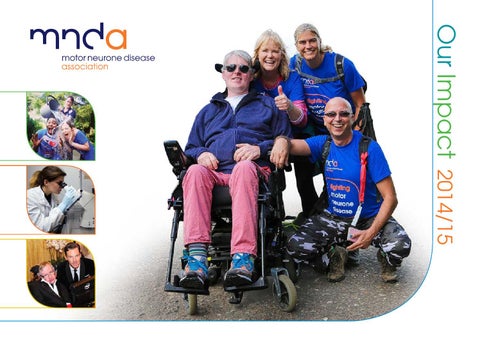
Our Impact 2014/15
Introduction
Thanks to you – and thousands of loyal supporters just like you - the past 18 months has been a truly incredible period in the Motor Neurone Disease Association’s history. Aside from the phenomenal success of last summer’s Ice Bucket Challenge, 201415 was a record year for income into the Association. In addition, the global success of the Oscarwinning film The Theory of Everything, which followed so closely behind the Ice Bucket Challenge, has continued raising awareness and educating worldwide audiences about the devastating effects of MND.
2
“Your generosity has enabled us to go even further in our fight against MND – by expanding existing programmes, bringing forward planned projects and engaging in new endeavours.” Alun Owen, Chair, Board of Trustees.
However you have shown support, you can take great pride in what you have achieved and what it has enabled us to do across our three priorities of care, research and campaigning.
On behalf of the MND Association and all those we support, thank you.
“This Impact Report provides an overview of how your support is strengthening our fight against MND. But there is still no cure.
Alun Owen Chair, Board of Trustees
Sally Light Chief Executive
To continue our work, and to help us achieve our vision of a world free from MND, we rely on your on-going support and generosity.” 3
Improving care and support
4
19
As MND is a complex disease which often progresses rapidly, access to the right information, care and support at the right time, is crucial.
care centres provide a single point of contact
To meet this need, we provide front line support to people with MND, their families and carers. To avoid the need for multiple visits to different clinics, our network of 19 care centres provides a single point of contact giving over 3,200 people with MND access to all the MND specialists they need in one place, under one roof. Thanks to your continuing dedication and support, we plan to open a further three care centres over the next two years to give more people with MND access to the specialist care they need.
“When my wife and I drive into the car park at King’s MND Care Centre, we feel the stress melting away. We know we’re not alone; we’ve got the best care team on our side. And when you’ve got MND that really is life-changing.” Simon, who is living with MND. 5
Improving care and support Information and support for people with MND, their families and carers Our MND Connect Helpline offers expert information and support on all aspects of MND to help people come to terms with their diagnosis, feel better informed and in control. In the past year our helpline team responded to more than 7,000 requests for help by phone and email. We also published a range of information factsheets and publications which provide advice and support to people living with MND, their carers and families. This year, we launched a ground-breaking new guide which talks openly and honestly about everything to do with end of life. This publication was recognised by the British Medical Association when it won the BMA Award for Patient Information of the Year.
“I have read your brilliant material on this devastating illness. I just want to thank you very much as it helped me to understand so much that worried me… so well written and with humanity.” Linda McCabe, affected by MND. 6
6,000
publications downloaded through our website
Over
32,000
information factsheets and publications distributed
Association Visitors Our dedicated team of 300 Association Visitors (AVs) are specially trained volunteers who offer information and practical and emotional support to families coping with MND. As well as being someone to talk to, they are also on hand to help those living with MND navigate the health and social care system to get the care they need. Over the last year AVs supported over 1,000 people with MND, their families and carers through home visits, telephone, email and text support and at regular meetings.
As a result of AV support:
92%
of people with MND feel more supported
90%
of people with MND feel less isolated
97%
of Association Visitors feel being an AV gives them a sense of purpose 7
Improving care and support
e launched a new specialised powered wheelchair W suitable for 80% of people living with MND 8
Equipment Loan, Financial Support Grants and Wheelchair Services Walking upstairs, getting in and out of bed, feeding ourselves, having a conversation – these are just a few of the many daily activities we take for granted that are often lost to those living with MND. We provide specialist equipment and funding towards home adaptations to allow people with MND to remain in their own homes and stay independent for as long as possible.
In 2014/15, we were delighted to be able to launch two new wheelchair services in Leeds and Surrey, giving more people with MND access to customised wheelchairs. • S ince 2007, our specialist team has supported 300 people to access a wheelchair which meets their specific needs. • We loaned specialist equipment to 1,439 people with MND. • W e supported over 800 people with grants worth £662,000 for specialist equipment and home adaptations.
“Physically I am unable to walk or talk and have no power in my hands to do much – but my mind is as active as ever and I still have a zest for living. The most devastating thing has been losing my voice, as I was, and still am, a chatterbox! The best gadget I could ever have is my Lightwriter, my way of communicating with the outside world.” Sue Bingham, who is living with MND. 9
Funding And Promoting Research Everyone at the MND Association and the wider MND family shares the same vision – a world free from MND.
• T he overall value of our research portfolio on 31 January 2015 was £8 million.
By investing in, and promoting, the highest quality research, we aim to work towards breakthroughs that will lead to new understandings of the disease, new treatments, and ultimately, a cure.
• W e are funding 19 PhD Studentships, nurturing the talent of MND researchers of the future.
The Association is at the forefront of global research activity and thanks to the on-going support of our generous donors and fundraisers, this year we have been able to achieve even more.
• We are supporting 65 research projects worth more than £2 million.
• O ver 900 leading scientists and clinicians from across the world attended our 25th International Research Symposium on MND in Brussels in 2014.
New Gene Discoveries • A n international team of researchers, led by MND Association-funded researchers based at King’s College London, have identified the TUBA4A gene as a new cause of the rare inherited form of MND. • A nother research group has identified mutations in the Matrin 3 (MATR3) gene as a cause of the rare inherited form of MND. By finding out more about the genes linked to MND, we are moving closer to finding out what goes wrong in MND. Discoveries like these will help lead to the development of new treatments.
10
“The MND Association understands that genetic research transcends national boundaries. Their support for international genehunting programmes has been invaluable.” Ammar Al-Chalabi, Professor of Neurology and Complex Disease Genetics, King’s College London.
11
Funding And Promoting Research Project MinE Your generosity has also enabled us to accelerate a major new genetic research programme, Project MinE, the biggest MND gene hunt of all time. By combing through the genetic code of thousands of DNA samples, we aim to understand more about the subtle genetic factors that contribute to MND. Longer term this will help us to develop effective treatments.
The MND Register Thanks to wide-ranging support, we are establishing the MND Register. The register aims to aid understanding of the distribution of MND, the ‘natural history’ of the disease (how the disease manifests and progresses in different individuals) and the impact of the care and support offered. Finally, it will allow us to select people with similar disease types for clinical drug trials, thereby improving trial effectiveness.
12
Biomarker Research Researchers have identified something called neurofilament light chain as a potential biomarker for MND. Biomarkers are the changes that happen in the body as a result of disease. By finding biomarkers for MND, this could pave the way for the development of a blood test to confirm a diagnosis of MND as well as providing a much needed tool to track the effectiveness of drug trials.
“By bringing the key players together under one roof, the International Symposium fosters closer collaboration between the leading labs and undoubtedly accelerates our understanding of MND.� Dr Catherine Moody MRC. 13
Raising Awareness about MND
“I believe in love and hope and the impact the Ice Bucket Challenge has had on every family touched by this wicked disease is brilliant. Last summer I could still take Isabella to the beach on holiday and go for a walk and take her to the park but now I am in the chair full time and I can hardly walk at all. But I am also doing so much more to raise awareness.� Ailsa, who is living with MND.
14
Ice Bucket Challenge The summer of 2014 will always be remembered for the extraordinary success of the Ice Bucket Challenge. In just a few short weeks our amazing supporters raised a staggering £7.2 million to help the Association continue its vital work in improving the lives of those living with MND. Thanks to the outstanding support of our fundraisers, the Association was able to commit an additional £1.3 million to the amount raised, bringing the total investment pot to £8.5 million. By the start of 2015, the Association had spoken with its members and listened carefully to their thoughts about how the money should be spent. It was decided £5.1 million should be spent on research, £1.5 million on care, £770,000 on awareness, £120,000 on volunteering, while £1 million will provide immediate funding for emerging new projects over the next two years. As a result of the Ice Bucket Challenge, awareness of MND is now higher than ever bringing hope, and optimism, to even more people living with MND, their carers and families.
£770,000 on awareness
£7.2 million raised
£120,000
on volunteering
£1
million on emerging new projects
£1.5 million on care
£8.5
£5.1
million total investment
million to be spent on research
However, the fact remains that MND is still not cured and there is much that we still need to do to improve care and support for people living with MND. To ensure we are able to capitalise on the legacy of this extraordinary event and continue our vital work, we rely on the continuing support and generosity of our fundraisers and donors. 15
CAMPAIGNING AND RAISING AWARENESS Because MND is such a progressive and debilitating disease, all too often those living with MND can feel isolated, struggling to make sense of their diagnosis and to access the care and support they need.
The majority of speech and language therapists who responded to the consultation believe that there are too few speech and language therapists to meet the needs of people with MND
To improve care and support for people with MND, we campaign and raise awareness so the needs of those with MND and everyone who cares for them are recognised and addressed. Approximately 85% of people living with MND will lose the ability to communicate and will need specialist communication aids to stay in touch with family and friends. However, access to communication aids is often difficult. During the year, we campaigned for better access to communication aids culminating in the launch of the All-Party Parliamentary Group on MND report Condemned to Silence at Speaker’s House in the Palace of Westminster. With evidence from over 1600 people with MND, speech and language therapists and other healthcare professionals, this shocking report showed that: • T he NHS funds communication aids for fewer than half the people with MND who need them. • 3 9% of people wait more than six weeks for the equipment they need, some as long as 14 weeks. • 1 in 4 people with MND wait more than six weeks for a specialist assessment with a speech and language therapist.
16
Approximately
85%
of people living with MND will lose the ability to speak and communicate
1 in 4 people with MND wait more than six weeks for a specialist assessment with a speech and language therapist 17
CAMPAIGNING AND RAISING AWARENESS
18
Our #SelfieAgainstSilence campaign on social media, prompted the then Minister of Care and Support, Norman Lamb MP to meet with MND Association representatives. In a subsequent meeting, NHS England promised to improve access to communication aids for people with MND.
By the time the Charter was presented at 10 Downing Street in June, we had smashed our original target and collected 33,630 signatures.
Throughout 2014, we also encouraged as many people as possible to sign the MND Charter, which sets out what good care for people living with MND and their carers looks like.
• W e highlighted the need for access to communication aids on 665 posters at 135 trains stations, reaching an estimated 10.7 million people. We were extremely grateful for the media space provided free of charge.
“Losing my voice has been the most difficult part of my journey with MND. I used to be very talkative and I miss easy conversation. I feel that I’ve lost part of my identity forever. I struggled to get funding for communication aids/technology from day one. Being able to communicate again gave me my life back and made living with MND much easier.” Sarah Ezekiel, who is living with MND.
Since then, David Cameron has responded to the Charter, explaining that he recognises the need for services to respond quickly to the needs of those with MND. • O ur Football v MND awareness campaign reached over 1.5 million football fans.
• W e launched a mass participation event Silence Speaks to raise funds and awareness about the difficulties of communication associated with MND.
33,630
people signed the MND Charter 19
FINANCIAL OVERVIEW
Income in 2014/15: £1.7m
Thanks to you – our amazing supporters - last year was a phenomenal year for the Association.
£8.4m £5.5m
Total £18.1m*
From fundraising activities and gifts left in wills we received over £16 million – yet another record year.
£2.5m
How we spent your donations in 2014/15: £2.1m
£6.5m Care and support
£3.1m
Total £16.3m
Research Campaigning and raising awareness Fundraising Support Costs*
£1.2m 20
Legacies
* Excluding the £7.2 million Ice Bucket Challenge
For every £1 we received this year, 68p went immediately and directly to fund research, care and campaigning and awareness raising, 13p went to support costs and 19p went towards fundraising.
However, the fact remains that there is still no cure for MND and only limited treatments. We need your help more than ever to help us fund vital research, care and support for people living with MND, their families and carers.
Branches and groups Earned income
On top of that, the global phenomenon of the Ice Bucket Challenge raised a further £7.2 million.
For every £1 spent on fundraising, £3.60 was raised in return. This means that more than the total value of each donation goes directly to the programme.
Central fundraising
*Finance, IT, HR, building rental
£3.4m
21
A FEW FUNDRAISING HIGHLIGHTS We’d like to say a huge thank you to all our donors, funders and supporters for your support over the past year. You helped us to raise more money than ever before and every donation we received is helping to make a difference to people living with MND, their families and carers.
“My father-in-law, Noel, was diagnosed with MND in April 2013 and died a year later. The MND Association was brilliant in the support it offered our family. Noel was an avid supporter of Norwich City Football Club and so was the chairman of our local branch of the Association. The two of them would sit for ages watching football on TV.” “The Association also helped us to get hold of an electric wheelchair for him.” “We raised £2,000 at a family fun day last year and we hope to do the same this year.” Amie Godfrey, fundraiser. 22
414 runners ran the London Marathon or the Great North Run, raising over £400,000. Our Christmas Appeal raised over £111,000 – almost double its target. Our thanks to the Charles Wolfson Charitable Trust, the Childwick Trust and the Masonic Samaritan Fund for generous donations towards our research programmes. We are grateful to the Betty Messenger Charitable Foundation and to our branches and groups for their help in funding the MND Register of England, Wales and Northern Ireland. The on-going support of so many fantastic companies is vital. Staff from Towers Watson climbed Mount Kilimanjaro in February raising over £90,000. Three of our supporters pledged to each cycle and run 2014 miles during 2014 – and raised a phenomenal £55,000.
23
OUR FUTURE PLANS
Every pound that has been donated, every mile that has been cycled, run or swum in the past year has taken us a step closer to achieving our vision of a world free from MND.
Research: In 2016, we will be investing in some major international research programmes. • T he MIROCALS Drug Trial will investigate whether existing drug Interleukin-2 has potential as a new treatment for MND. • P roject MinE - we will continue to invest in this international gene hunting project which aims to identify the genetic makeup of 15,000 DNA samples from people with MND. • We will continue to invest in research studies to identify biomarkers for MND which could help to speed up diagnosis and show more quickly whether drugs are effective.
Campaigning and Awareness: We will continue to build our network of local campaigning volunteers to secure improvements to the services people with MND and their carers rely on. This includes using the MND Charter to raise awareness in councils across England, Wales and Northern Ireland. 24
We will continue to campaign for the delivery of high quality services for people with MND and their carers in a rapidly changing health and social care landscape, and seek to influence the content of the NICE guideline on MND. We will also publish our own Outcome Standards and specialist research on MND models of care. We will campaign to raise awareness of MND, and gather the personal stories of people living with MND to make them central to our work.
Care: We are ensuring more people can access appropriate care when they need it, by expanding our network of specialist care centres and by increasing community based care. We are developing new services to support the needs of children and young people including new publications and a grants scheme. We are expanding our network of volunteers to ensure we can provide more locally based support for people with MND, their families and carers. We are increasing our training programmes for health and social care professionals including new online resources for nurses, GPs and other healthcare professionals. Our 20th Care Centre is due to be opened in Brighton in 2016. 25
OUR FUTURE PLANS Every penny raised at cake sales, tombolas and fairs has combined with donations from companies, trusts and individuals to ensure we can go even further in our fight against this devastating disease. But still there is no cure. Together, in the past year, we have achieved more than we could ever have imagined, but with your continued support we hope to get even closer to delivering our vision of a world without MND.
26
We want a world free from MND. If you would like to learn more about our work and plans, or if you would like to support us please contact us on 01604 611860 or email us at fundraising@mndassociation.org
www.mndassociation.org 27
MND Association PO Box 246 Northampton NN1 2PR Telephone: 01604 250505 Email: enquiries@mndassociation.org www.mndassociation.org @mndassoc
/mndassociation
Reg. Charity No. 294354 Š MND Association 2015