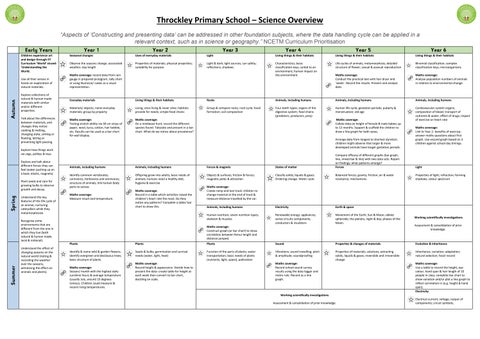
Throckley Primary School – Science Overview “Aspects of ‘Constructing and presenting data’ can be addressed in other foundation subjects, where the data handling cycle can be applied in a relevant context, such as in science or geography.” NCETM Curriculum Prioritisation Early Years Children experience art and design through EY Curriculum ‘World’ strand: ‘Understanding the World.
Autumn
Use all their senses in hands-on exploration of natural materials. Explore collections of natural & human-made materials with similar and/or different properties. Talk about the differences between materials, and changes they notice: cooking & melting, changing state, sinking or floating, letting or preventing light passing.
Year 1
Year 2
Year 3
Year 4
Spring
Plant seeds and care for growing bulbs to observe growth and decay. Understand the key features of the life cycle of an animal, nurturing caterpillars while they metamorphosise.
Light
Living things & their habitats
Living things & their habitats
Living things & their habitats
Observe the seasons change; associated weather; day length
Properties of materials; physical properties; suitability for purpose
Light & dark; light sources; sun safety; reflections; shadows
Characteristics; basic classification keys; suited to an environment; human impact on the environment
Life cycles of animals; metamorphosis; detailed structure of flower; sexual & asexual reproduction
Binomial classification; complex classification keys; microorganisms
Maths coverage: Conduct the practical test with hair dryer and ‘seeds’. Record the results. Present and analyse data.
Maths coverage: Analyse population numbers of animals in relation to environmental change.
Maths coverage: record data from rain gauge in prepared pictogram, tally chart or using Numicon/ cubes as a visual representation.
Everyday materials
Living things & their habitats
Rocks
Animals, including humans
Animals, including humans
Animals, including humans
Materials/ objects; name everyday materials; group by property
Living, once living & never alive; habitats provide for needs; simple food chains
Group & compare rocks; rock cycle; fossil formation; soil composition
Four teeth types; organs of the digestive system; food chains (predators, producers, prey)
Human life cycle; gestation periods; puberty & menstruation; old age
Maths coverage: Testing stretch ability via 30 cm strips of paper, wool, lycra, cotton, hair bobble, etc. Results can be used as a bar chart for wall display.
Maths coverage: On a minibeast hunt, record the different species found. Tabulate and present in a bar chart. What do we notice about prevalence?
Cardiovascular system organs; composition of blood; transport of nutrients & water; effect of drugs; impact of exercise on heart rate
Maths coverage: Collate data on height of female & male babies up to 12 months. Support & scaffold the children to draw a line graph for both sexes. Arrange data from longest to shortest duration; children might observe that larger & more developed animals have longer gestation periods.
Summer
Maths coverage: Link to Year 2- benefits of exercise; answer maths questions about first graph. Use second graph based on 3 children against school day timings.
Animals, including humans
Animals, including humans
Forces & magnets
States of matter
Compare efficacy of different graphs (bar graph, line, mixed bar & line) with two data sets. Report on findings; what patterns emerge? Forces
Identify common vertebrates; carnivores, herbivores and omnivores; structure of animals; link human body parts to senses
Offspring grow into adults; basic needs of animals; humans need a healthy diet, hygiene & exercise
Objects & surfaces; friction & forces; magnetic poles & attraction
Classify solids, liquids & gases. Ordering change. Water cycle.
Balanced forces; gravity; friction; air & water resistance; mechanisms
Animals, including humans
Electricity
Earth & space
Human nutrition; seven nutrition types; skeleton & muscles
Renewable energy; appliances; series circuits components; conductors & insulators
Movement of the Earth, Sun & Moon; oblate spheroids; the planets; night & day; phases of the Moon.
Working scientifically investigations
Maths coverage: Measure result and temperature.
Maths coverage: Record in a table which activities raised the children’s heart rate the most. Do they notice any patterns? Complete a table/ bar chart to show this.
Recognise some environments that are different from the one in which they live (both natural & human made, local & national). Understand the effect of changing seasons on the natural world (noting & recording the weather over the seasons, witnessing the effect on animals and plants).
Year 6
Uses of everyday materials
Explore how things work via cogs, pulleys & toys. Explore and talk about different forces they can feel (water pushing up on a boat, elastic, magnets).
Year 5
Seasonal changes
Light Properties of light; refraction; forming shadows; colour spectrum
Maths coverage: Create ramp and test track: children to change material at the end of track & measure distance travelled by the car:
Maths coverage: Construct graph (or bar chart) to show correlation between femur length and distance jumped.
Assessment & consolidation of prior knowledge.
Plants
Plants
Plants
Sound
Properties & changes of materials
Evolution & inheritance
Identify & name wild & garden flowers; identify evergreen and deciduous trees; basic structure of plants
Seeds & bulbs; germination and survival needs (water, light, heat)
Function of the parts of plants; water transportation; basic needs of plants (nutrients, light, space); pollination
Vibrations; sound travelling; pitch & amplitude; soundproofing
Properties of materials; solutions; extracting solids, liquids & gases; reversible and irreversible change
Inheritance; variation; adaptation; natural selection; fossil record
Maths coverage: Season/ month with the highest daily sunshine hours & average temperature (usually July, around 19 degrees Celsius). Children could measure & record rising temperatures.
Maths coverage: Record height & appearance. Decide how to present the data: create table for height at each week then convert to bar chart, deciding on scale.
Maths coverage: Record school sound survey results using the data logger and metre rule. Record as a line graph.
Maths coverage: Use a table to record the height, eye colour, hand span & hair length of 10 people in class; complete bar chart to show variation and/or plot a line graph to reflect correlation in (e.g. height & hand span). Electricity
Working scientifically investigations Assessment & consolidation of prior knowledge.
Electrical current; voltage; output of components; circuit symbols;