VOLUME 110, ISSUE NO. 22 | STUDENT-RUN SINCE 1916 | RICETHRESHER.ORG | WEDNESDAY, MARCH 25, 2026
Chief Justice Roberts visits Rice, addresses Supreme Court criticism at Baker Institute event LILY NGUYEN
THRESHER STAFF Chief Justice John Roberts spoke at Rice’s campus about public criticism of the Supreme Court’s decisions just days after President Trump lashed out over a recent decision on social media. Roberts was appointed by President George W. Bush and has served as Chief Justice of the United States since 2005. During the conversation hosted by the Baker Institute for Public Policy on March 17, Roberts said he condemned personal attacks on Supreme Court justices.
Judges around the country work very hard to get it right, and if they don’t, their opinions are subject to criticism. But personally directed hostility is dangerous and has got to stop. John Roberts CHIEF JUSTICE OF THE UNITED STATES
“Criticism comes with the territory. The problem, sometimes, is that the criticism can move from a focus on legal analysis to personality,” Roberts said. “Judges around the country work very hard to get it right, and if they don’t, their opinions are subject to criticism. But personally directed hostility is dangerous and has got to stop.” After Roberts authored a late February
decision that struck down Trump’s tariffs, the president was quick to denounce the opinion. In a Truth Social post on March 15, he praised the justices who had dissented in the tariff case while criticizing the rest of the court. “This completely inept and embarrassing Court was not what the Supreme Court of the United States was set up by our wonderful Founders to be,” Trump wrote. In his remarks, Roberts did not name Trump. The hourlong conversation, which was Roberts’ second visit to Rice, was moderated by U.S. District Judge Lee H. Rosenthal. Rosenthal is a district judge in Houston and a former Rice University Board of Trustees member. Roberts criticized the misconception that political agendas are carried out by Supreme Court justices to create biased decisions. “President George W. Bush appointed me 20 years ago,” Roberts said. “The idea that I’m carrying out his agenda somehow is absurd. Certainly I’ll always be grateful for President Bush … but the idea that justices are carrying out other agendas is really fallacious.” In his opening remarks at the event, Baker Institute director David Satterfield said the current tensions between the Supreme Court and the executive branch make the judiciary more important now than ever before. “Criticisms of judicial decisions are not unknown in our history. The current president has not withheld his views on judicial decisions and judges with whose actions he doesn’t agree,” Satterfield said. “It makes the role of the judiciary and the Supreme Court all the more critical, and all the more challenging.” Satterfield also commented on Roberts’
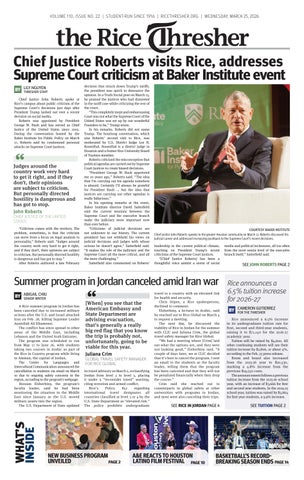
COURTESY BAKER INSTITUTE Chief Justice John Roberts speaks to the greater Houston community on March 17. Roberts discussed his judicial career and addressed increasing pushback to the Supreme Court’s recent decisions. leadership in the current political climate, touching on President Trump’s recent criticisms of the Supreme Court justices. “[Chief Justice Roberts] has been a thoughtful voice amidst a storm of social
Summer program in Jordan canceled amid Iran war ABIGAIL CHIU
SENIOR WRITER
WHAT’S INSIDE
A Rice summer program in Jordan has been canceled due to increased military actions after the U.S. and Israel attacked Iran on Feb. 28, killing Supreme Leader Ayatollah Ali Khamenei. The conflict has since spread to other areas of the Middle East, including Lebanon and the United Arab Emirates. The program was scheduled to run from May 17 to June 26, with students taking two courses in Arabic as part of the Rice in Country program while living in Amman, the capital of Jordan. The Center for Languages and Intercultural Communication announced the cancellation to students via email on March 10 due to ongoing safety concerns in the region, according to the program’s webpage. Hossam Elsherbiny, the program’s faculty leader, said he had been monitoring the situation in the Middle East since January as the U.S. moved military assets into the region. The U.S. Department of State updated
[When] you see that the American Embassy and State Department are advising evacuation, that’s generally a really big red flag that you know the trip is probably not, unfortunately, going to be viable for this year. Juliana Crim GLOBAL TRAVEL SAFETY MANAGER FOR RICE GLOBAL
its travel advisory on March 2, reclassifying Jordan from level 2 to level 3, placing it under a “reconsider travel” warning, citing terrorism and armed conflict. Rice’s Policy 852 regarding international travel designates all countries classified at level 3 or 4 by the U.S. State Department as “elevated risk.” The policy prohibits undergraduate
NEW BUSINESS PROGRAM UNVEILED PAGE 2
media and political incitement, all too often from the most senior level of the executive branch itself,” Satterfield said.
SEE JOHN ROBERTS PAGE 2
Rice announces a 6.5% tuition increase for 2026-27
travel to a country with an elevated risk for health and security. Chris Stipes, a Rice spokesperson, declined to comment. Elsherbiny, a lecturer in Arabic, said he reached out to Rice Global on March 4 to request a meeting. The next day, he discussed the viability of Rice in Jordan for the summer with CLIC and Juliana Crim, the global travel safety manager for Rice Global. “We had a meeting where [Crim] laid out what the options are, and they were not looking good,” Elsherbiny said. “A couple of days later, we at CLIC decided that it’s best to cancel the program. I sent an email to the students as the faculty leader, telling them that the program has been canceled and that they will not be penalized financially when they drop the course.” Crim said she reached out to counterparts in global safety at other universities with programs in Jordan, and most were also canceling their trips.
Rice announced a 6.5% increase in its undergraduate tuition rate for first, second and third-year students, raising it to $71,140 for the 2026-27 academic year. Tuition will be raised by $4,600. All other continuing students will see their tuition increase by $2,806, or about 4%, according to the Feb. 23 press release. Room and board also increased from the 2025-26 year to $20,530, marking a 4.8% increase from the previous $19,550 costs. The announcement follows a previous tuition increase from the 2025-26 school year, with an increase of $3,666 for first and second year students. In the 2024-25 school year, tuition was raised by $5,664 for first year students, a 9.9% increase.
SEE RICE IN JORDAN PAGE 4
SEE TUITION PAGE 2
A&E REACTS TO HOUSTON LATINO FILM FESTIVAL PAGE 10
CAMERON GUTIERREZ
FOR THE THRESHER
BASKETBALL’S RECORDBREAKING SEASON ENDS PAGE 14