Asibbey succeeds Tobey as president a er packed race
TOBY CHOU SENIOR WRITER
In one of the most crowded races in the Rice Student Association’s history, Chelsea Asibbey has been elected RSA president for the 2026-27 school year.
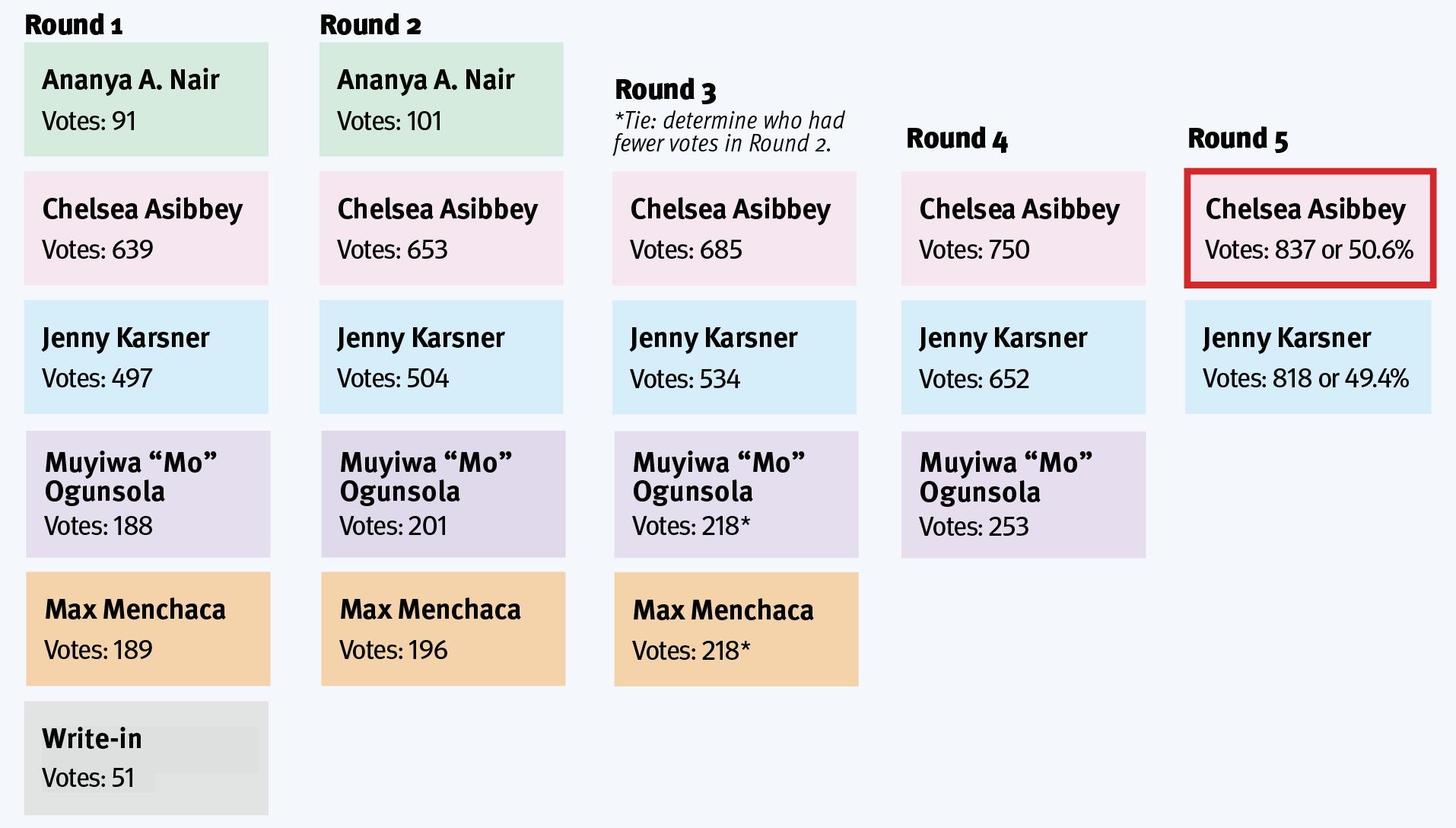
A er ve rounds of ranked choice voting, she received 50.6% of the vote. Asibbey beat second-place candidate Jenny Karsner by only 19 votes in an instant runo
A Baker College junior and current director of communications for the RSA, Asibbey ran on a platform focused on “action, a ordability and accessibility.”
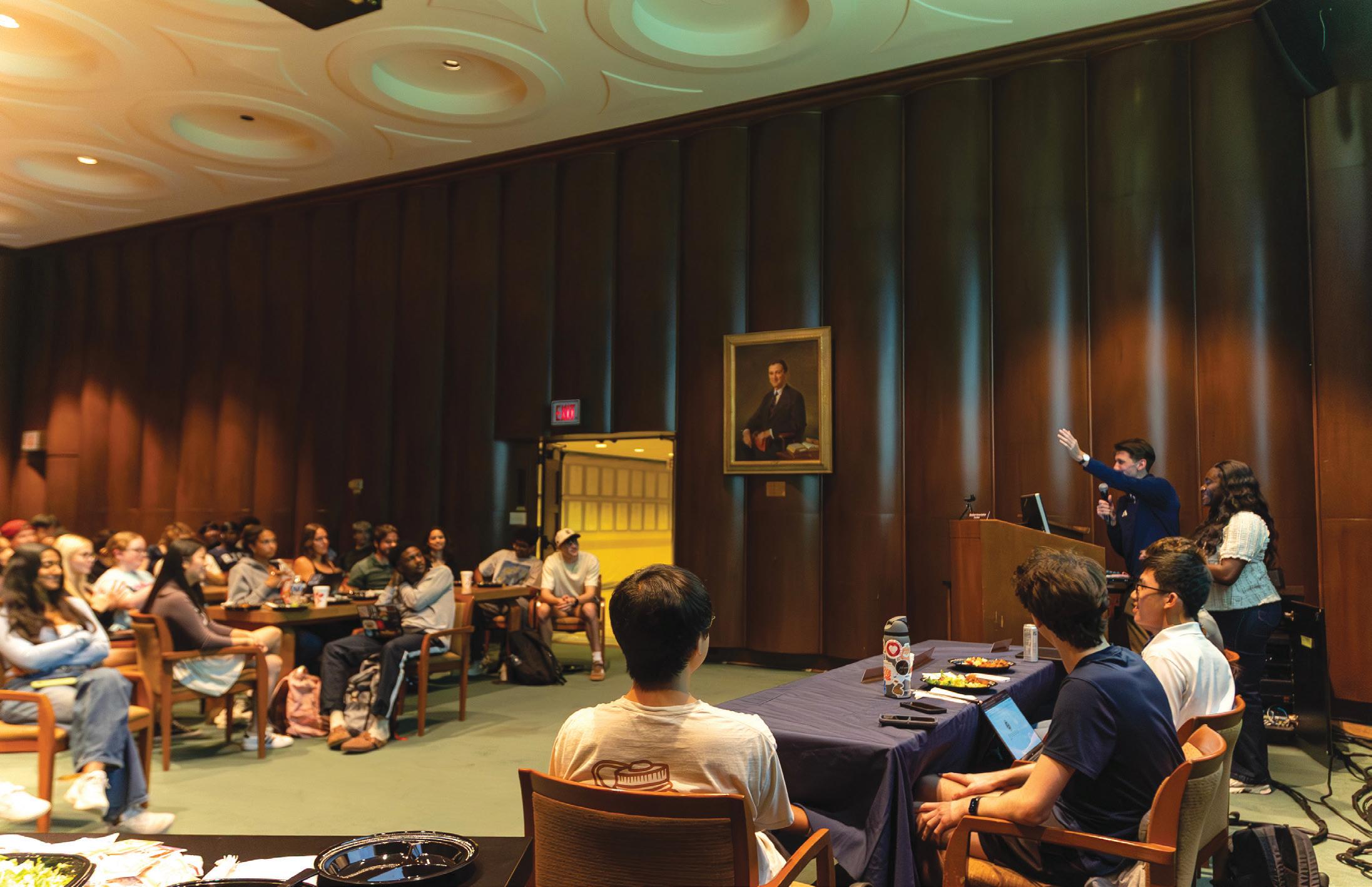
During the ceremonial changeover at Monday’s Senate, Asibbey said she is honored to serve as the next RSA president.
“I believe in this institution,” Asibbey said. “I think with good change and progress, that we can make this campus better, and I am so excited and committed to work with this new set of senators and presidents.”
Asibbey said her goals include preserving traditions through a season of change, improving late-night dining and making the Rice Student Association more connected with the student body.
With ve candidates and numerous write-ins, the Election Committee used the instant runo voting method. The candidate with the fewest votes is eliminated, and their votes are redistributed to the remaining candidates according to the next-ranked preference on each ballot.
This process continues until a candidate holds a majority of the votes. If there is a tie between the candidates, the “countback” method is used. Between two
tied candidates, the candidate who had fewer votes in the previous elimination round is eliminated.
Write-in candidate Murphy Li was eliminated in the rst round.
Ananya A. Nair was eliminated in the second round, receiving 101 votes. In the
third round, Max Menchaca was eliminated, tying with Muyiwa Ogunsola. In the fourth round, Ogunsola was eliminated.
The election also saw an increase from last year’s turnout. 1,713 students voted in a turnout of 35.8% compared to last year’s 29.02%.
Rohan Dharia was elected external vice president, beating out Da’Taeveyon Daniels. Dharia. Dharia, a McMurtry College sophomore, received 59.6% of the vote, while Daniels received 38.5% of the vote.
Rain moves ktru’s Outdoor Show indoors for second year
MUNA NNAMANI THRESHER STAFF
ktru held its 34th annual Outdoor Show in Willy’s Pub Saturday a er shi ing the event indoors due to concerns about rainy weather. Despite the change in venue — which also happened last year due to forecasted rain — attendees, organizers and performers said the event remained a festive celebration of local music.
Azahir Lebron-Torres, an ODS director, said their decision to host the show in a smaller, more decorated venue like Pub, rather than Founder’s Court, contributed to its aesthetics.
It feels great. There’s so many different artists on the lineup, and I feel like it’s such a testament to how unique and diverse Houston is, so I’m glad to be a part of that.
“I think the venue was much better,” said Lebron-Torres, a McMurtry College junior. “It’s also a bit smaller, so you feel like there are more people around. It’s
much more intimate.”
The team announced they would shift the show indoors the day before, but had been aware of potential bad weather weeks in advance. ODS director Ashley Chun said handling logistics was easier this year because she watched how last year’s team adapted.
“We typically activate our rain plan the day before,” said Chun, a McMurtry
junior. “So we plan for it to be outdoors, but we really make that switch last minute. Just in case there might be a change in the forecast.”
However, ODS volunteer Christian Dominguez said two indoor shows in a row may impact ktru’s presence on campus.
“We’re a pretty small campus,” said Dominguez, a Lovett College sophomore. “There’s always people passing [the
concert] either from Fondy or from other areas. I think it’s more accessible for people outside of Rice if it’s outdoors.”
But attendees said the event retained its excitement. The musical lineup continued as planned, featuring R&Bpop headliner Peyton alongside local artists El Mantis and Rentboy.
The rst band to take the stage was Resco — the winners of ktru’s Battle of the Bands in February. Resco enjoyed the largest crowd of the day, with students cheering during crowdwork between songs.
The band played some original songs (including one about a friend who was exposed on the Tea dating safety app), but introduced covers of Wheatus’ “Teenage Dirtbag” and Jeff Buckley’s “Lover, You Should’ve Come Over.”
Trans Parent, a local experimental rock band, also performed. The band is fronted by An Elisa, with Ramelle on the electric violin and Beverly (Rocket) on the keyboard. Their black lipstick and fishnets gleamed under the glow of the Pub lights while An Elisa crooned lyrics about her best friend.
“I come more from the noise scene here, so experimentation has really influenced the way that I make music,” An Elisa said. “I kind of brought the rawness of experimental stuff and tried to make something more structured.”
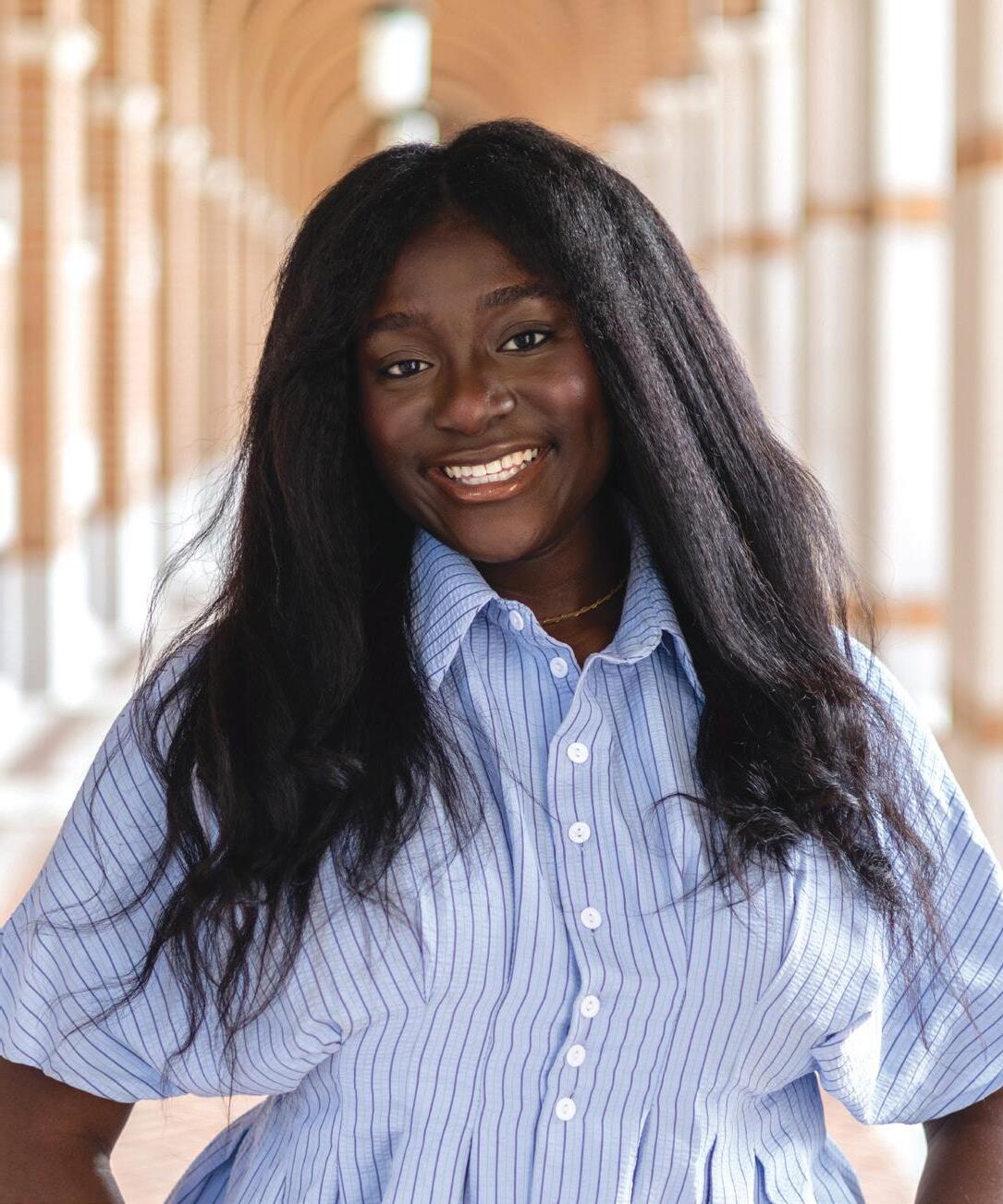
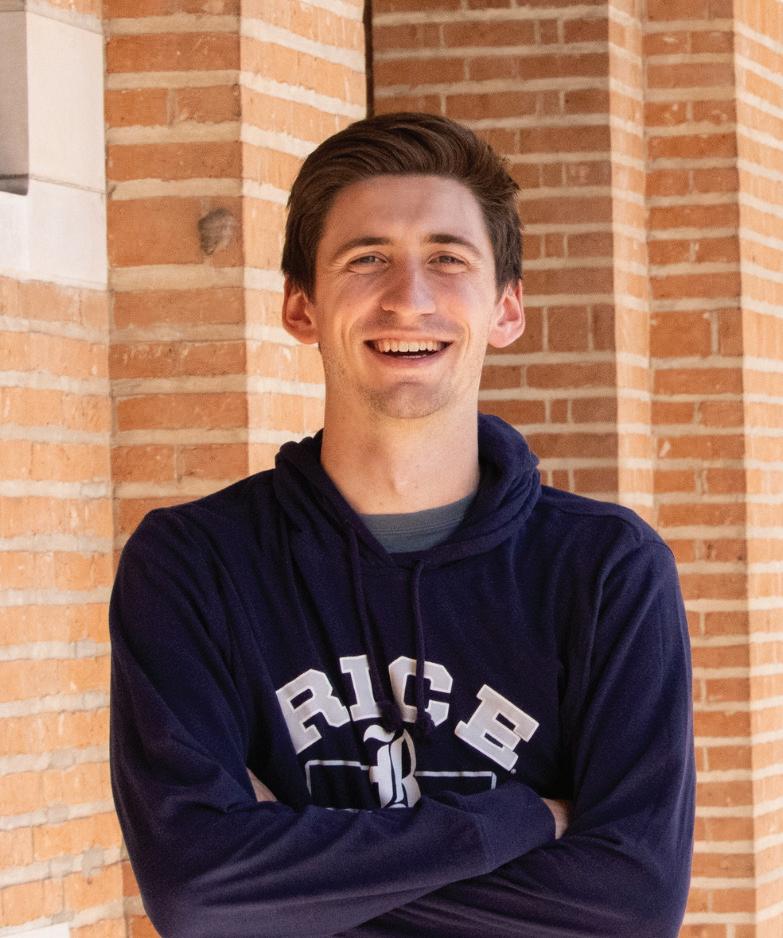
FRANCESA NEMATI, AMELIA DAVIS / THRESHER
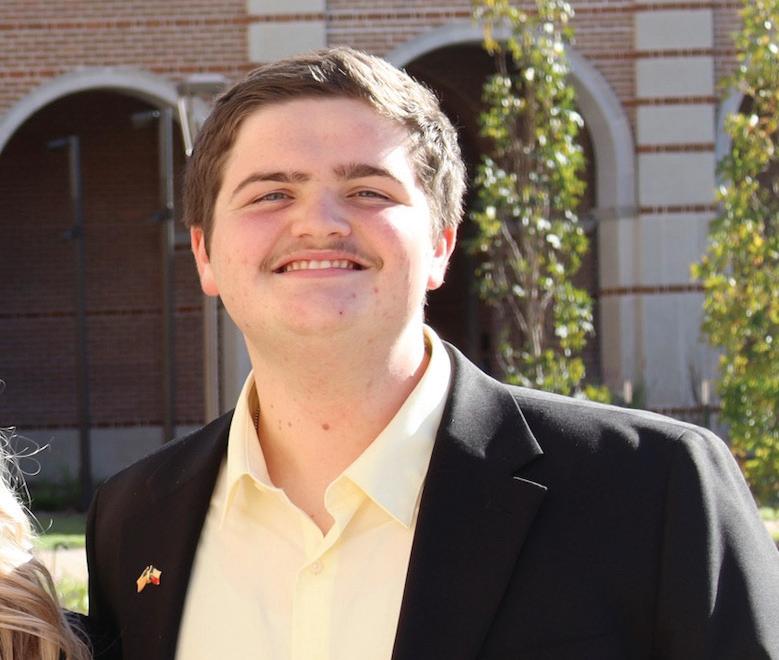
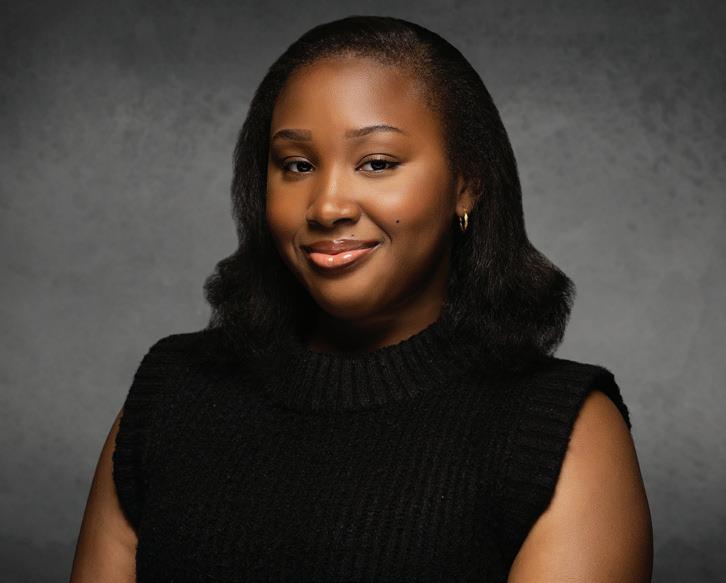
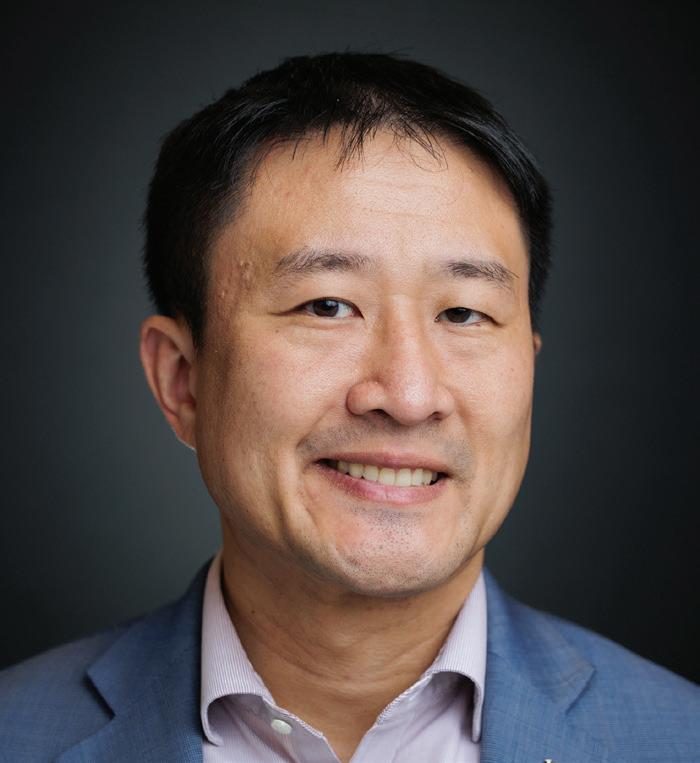
Chelsea Asibbey (left) is the new president of the Rice Student Association. She will take on the role for the 2026-27 year as Trevor Tobey’s (right) successor.
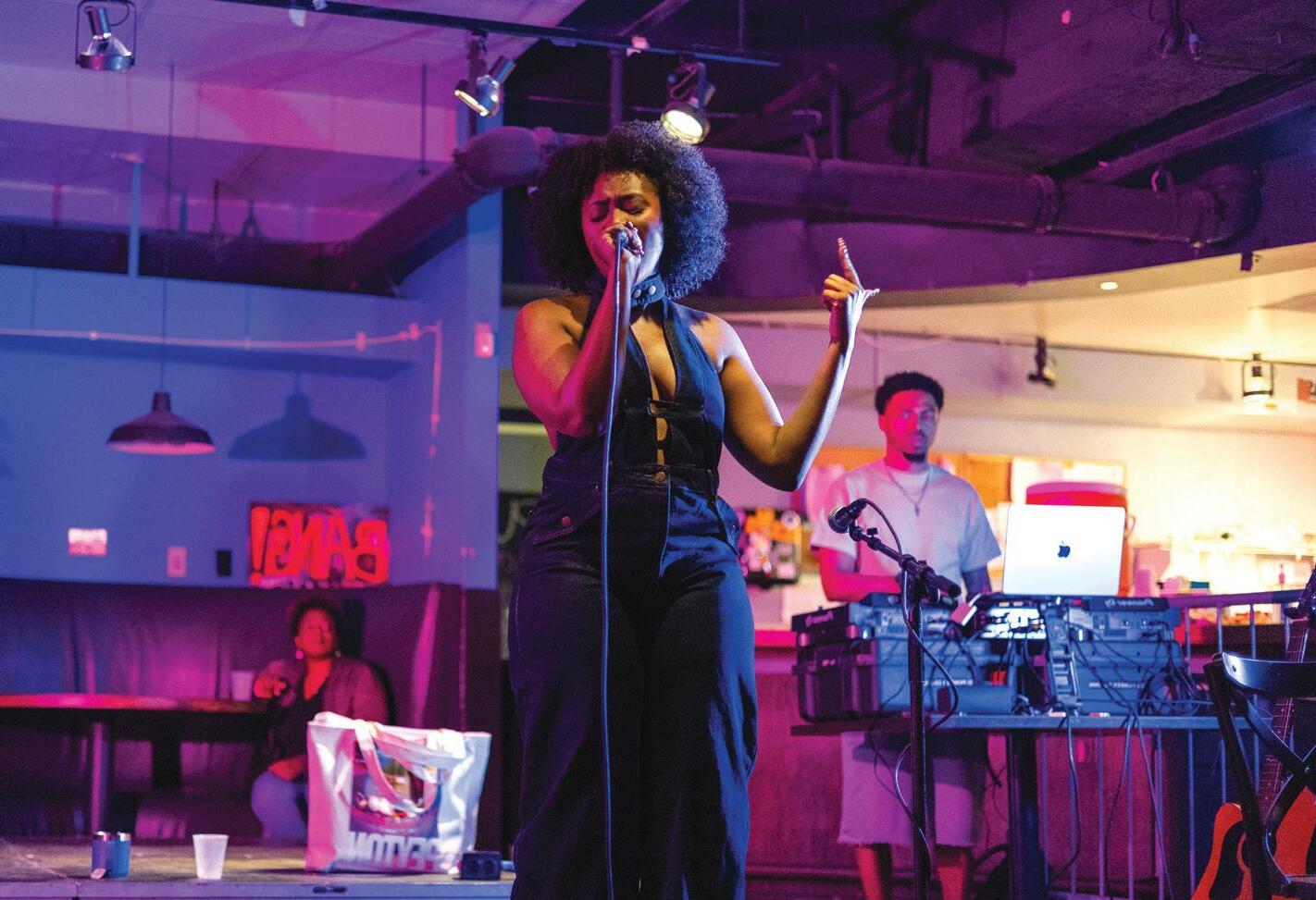
BENJAMIN SADOWSKI / THRESHER
Peyton performs at ktru’s Outdoor Show on Saturday. The event was moved to Willy’s Pub after rain was forecasted.
Kinder Institute for Urban Research receives $55 million grant
On March 5, the Kinder Foundation announced $55 million in funding towards the Kinder Institute for Urban Research. Of the total, $50 million will go to the institute’s endowment for long-term investment, while $5 million is designated for current research e orts, said Ruth López Turley, director of the Kinder Institute.
Turley said the endowment will secure the institute’s work for years to come.
“This is about future generations, and that’s what’s amazing about it,” Turley said. “We’re super excited that this is going to make sure that we can continue doing what we’re doing now, but well into the future. It secures the institute’s future, because this is all about preserving the longevity of the institute.”
The Kinder Institute was founded in 2010 and focuses on researching urban challenges in Houston in areas of housing, education, economic mobility, health and population studies.
Recent studies from the institute have explored topics including perspectives from the Houston area’s Asian American community, housing quality registry, intersection of food insecurity and health, and the safety climate within the Houston
Suri Yang secured the position of treasurer over Ronak Kothari. Yang, a Will Rice College freshman, received 62.8% of the vote, while Kothari received 34.8% of the vote.
Mahtab Dastur, a Duncan College sophomore, will serve as the next internal vice president and Robert Fischer, a Baker freshman, will serve as the next secretary. Both candidates ran uncontested.
The ballot also included five constitutional amendments, all of which passed. This is the third time the first four amendments appeared on election
LUCY LI / THRESHER
The Kinder Institute for Urban Research is housed in Kraft Hall. The institute recently received a $55 million grant from the Kinder Foundation.
Fire Department.
“We view our research as a public good,” Turley said. “We don’t charge for it because it informs e orts to provide services e ciently and to eliminate social needs over time.”
Since the Kinder Institute’s founding, the Kinder Foundation has contributed over $135 million to the institute. The foundation was established by Houston philanthropists Rich Kinder and Nancy Kinder.
Rich Kinder is the co-founder and former executive chairman of Kinder Morgan, one of
ballots after failing to meet the 20% voter turnout requirement in March 2025 and Oct. 2025.
Amendment 1 passed with 92.3% of the vote in favor. This amendment changes the RSA constitution to improve grammar, remove typos and clarify jargon, as well as make future clarificatory changes to the constitution easier.
With 77.5% of votes in favor, Amendment 2 gives the power of setting the agenda to the executive committee, rather than the sole discretion of the president. The amendment introduces a presidential veto with the possibility of an override from the Senate with a two-
the largest energy infrastructure companies in North America, and the couple has donated extensively to education, parks and urban research initiatives in Houston.
“They see the impact of our research and trust us to use resources wisely,” Turley said.
“This gi is a vote of con$dence in our work and in Houston’s future.”
Rich Kinder, chairman of the Kinder Foundation, said the goal of the Kinder Institute is to combat urban challenges.
“Houston is a diverse and complicated
thirds vote.
The amendment also gives the Senate “final authority” over the RSA budget, the Blanket Tax and Blanket Tax Organizations. The amendment redefines the roles of external vice president and internal vice president.
Amendment 3 received 80.1% of the vote in favor. This amendment reforms the Blanket Tax process as well as changes the structure of the Blanket Tax Committee. It changes the Blanket Tax review of initiative fund applications from a biannual basis to a continuous — and at minimum, biennial — basis.
This amendment also changes the Blanket Tax Committee structure by
metropolitan area and all of us, and especially our political and business leadership, need to understand the issues that confront us and workable solutions to our problems,” Kinder wrote in an email to the Thresher. “We thought the institute o ered a platform to address important urban issues that impact Houston and other large metro areas across America.”
Kinder said the institute provides a platform to address these challenges and contribute to solutions for Houston and other large metropolitan areas.
“Our hope for Houston would be that we can reach reasonable consensus on controversial issues with less extremism and animosity,” Kinder wrote. “That is the only way we will be able to solve our problems and that we can $nd a path to get our city’s $nances on a more certain trajectory so that we can service the needs of all our citizens.”
Turley said the grant will fund initiatives such as the $rst ever Economic Mobility Report, which examines how easily individuals can improve their economic status.
“I’m delighted and honored to have these kinds of resources to do work that I think is really important and meaningful, but at the same time, it’s a huge responsibility,” Turley said. “We want to make sure every penny is well spent and has an impact not only in the near future, but in the long run.”
removing the two officers of BTOs and adding three RSA members who do not hold executive authority in BTOs. Amendment 4 received 90.0% of the vote in favor. This amendment removes the ability for the Election Committee to remove candidates from the race at its discretion. Instead, University Court approval will be required.
The amendment also standardizes the procedures for initiatives and referenda to be the same.
Amendment 5 received 80.9% of the vote in favor. This amendment changes the name of the Student Association, abbreviated as SA, to the Rice Student Association, abbreviated as RSA.
LINA KANG THRESHER STAFF
JESSICA XU / THRESHER
FROM FRONT PAGE ELECTION
New report examines Rice’s ties to federal and defense nding
RISHI ANARKAT THRESHER STAFF
A recently circulated report by the nonprofit organization The Anti-War Initiative examines Rice’s research funding and partnerships, focusing in particular on grants and collaborations from defense or government spending and investments from foreign nations such as Israel.
It is important for universities to be transparent about who funds its research projects because this determines its social impact.
Vivian Lu ANTHROPOLOGY PROFESSOR
The report, “Engineering Violence & Normalizing Militarism at Rice University,” alleges that Rice has received over $335.64 million in research funding from the Department of War — formerly the Department of Defense — over the past 25 years.
The report highlights several specific
research initiatives, most notably a $9.8 million project funded by the NextGeneration Nonsurgical Neurotechnology program, which aims to “connect the brains of warfighters to computers” to allow for hands-free interaction with military systems, such as unmanned aerial vehicles.
The document also identifies various corporate partnerships, stating that Rice has received at least $4.5 million from Lockheed Martin and over $2.5 million from Raytheon Technologies, two of the world’s largest aerospace and defense contractors, since 2021.
Chris Stipes, a spokesperson for Rice University, did not provide an official comment on the specific allegations within the report.
Anthropology professor Vivian Lu said she emphasizes the importance of public awareness concerning these financial ties.
“It is important for universities to be transparent about who funds its research projects because this determines its social impact,” Lu said. “If it is funded by and owned by entities that intend to use it for unethical purposes, such as warfare, authoritarian weaponry and genocide, we should also be aware and informed of that ownership and usage.”
Beyond research, the report
scrutinizes the university’s institutional and symbolic connections. It points to the Gibborim endowment in the Jones School of Business, which grants preference to those with “advanced knowledge of the mission and fundamental values” of the Israeli Defense Force.
The report also says Rice is a signatory to the United Nations Principles for Responsible Investment but argues the university violates these principles by refusing to disclose its specific endowment holdings.
“Students can easily end up working with faculty that have direct ties to war, genocide and environmental destruction unknowingly,” said Erica Augenstein, a board member of the Students for Justice in Palestine. “Additionally, students are often pipelined into specific jobs and industries — often defense and fossil fuels — because of this larger system.”
Augenstein said the sources of funding for the university may ultimately affect where they spend their careers.
“Many Rice students come to Rice with the ambition of working for NASA however, in 2024 and 2025 Rice received $2.4 million for research funding from NASA compared to $17.2 million from the Department of War,” Augenstein said. “This type of discrepancy naturally pushes students into the weapons and
war industries.”
The Anti-War Initiative presents these findings not as a final conclusion, but as an invitation for the Rice community to critically evaluate how its institutional partnerships and funding sources shape the ethical landscape of higher education.
Meaningful change would mean transparency about research funding and the creation of a shared conversation about what research should be for and what the ethical boundaries of pursuing research should be.
Erica Augenstein BOARD MEMBER FOR STUDENTS FOR JUSTICE IN PALESTINE
“Meaningful change would mean transparency about research funding and the creation of a shared conversation about what research should be for and what the ethical boundaries of pursuing research should be,” Augenstein said.
Rice Pride Week 2026 highlights the LGBTQ+ community
YILIAN JIANG THRESHER STAFF
Themed “Pride, Not Prejudice,” Rice Pride Week 2026 was a weeklong series of events that included panel discussions on being LGBTQ+ in the workplace and a pride parade highlighting the various identities within the community.
The week was organized by Rice Pride and the O ce of Access and Institutional Excellence from March 2-7.
Since Pride Month falls in June, when classes are not in session, Rice Pride Week has traditionally been held during the spring semester.
According to the Pride Week 2026 website, this year’s theme is a callback to the $rst LGBTQ+ organization at Rice, founded in 1979: the Rice Gay/Lesbian Support Group. Their motto, “A Part Of – Not Apart From,” held particular relevance and meaning for this year’s planning committee, said Elizabeth Chen, co-president of Rice PRIDE.
“Especially in the current kind of social and political climate [under] the current administration, we were thinking of something that represents that pushback against a lot of that hatred and misinformation that we see rising and that we’ve seen rise in the past, both in Rice and in Houston,” said Chen, a Sid Richardson College junior.
Several departments and organizations on campus contributed to the programming, such as a book display curated by the Woodson Research Center and an LGBTQ+ research panel hosted by the O ce of Undergraduate Research and Inquiry.
Changes in this year’s iteration of Pride Week center around the expansion of the Rice Pride Week Parade to include keynote speakers, as well as the increased accessibility of events to the student population.
“We’re really trying to bring our events this year to the students and make it fun for them,” Chen said. “We’re having Drag Night in a college commons, so it’ll be in Sid Richardson, and we’re also hosting Pride Trivia and Pride Pub.”
Maia Figueroa, a Will Rice College junior who attended Drag Night, said she was drawn to the authenticity of drag as a performance art.
“It’s an exaggerated persona to an extent, but it’s also about $nding an artistic way to express something that you haven’t expressed yet, or something that you want to express,” Figueroa said. “I can’t stop
smiling every time I go to a drag show, and I think that joy comes from authenticity and just a fearlessness of expressing your true self, which I think is very admirable and something that I try to carry with myself every day.”
Being ourselves and being present and out there is a form of resistance, and it can be very powerful.
Akiem Gough
BOARD MEMBER
OF THE QUEER
GRADUATE
STUDENT ALLIANCE
Having followed the drag scene since watching “RuPaul’s Drag Race” in high school, Figueroa said she appreciated the opportunity to introduce drag culture to her peers.
“I just remember looking over and seeing them all clapping, giving their [tips], it made me really happy to see them enjoying it so much,” Figueroa said. “A lot of the friends that I did bring are straight, so it was also really nice to see them appreciating such a
beautiful queer space.”
Anya Tsang, the assistant director for LGBTQ+ Thriving in the O ce of Access and Institutional Excellence, said the most popular event was the March 2 Pride Week Kicko Event. The kicko involved participation from organizations such as Out in Science, Technology, Engineering, and Mathematics (oSTEM), the Wellbeing and Counseling Center and the Houston LGBTQ+ Political Caucus.
“Students, faculty and sta were all able to learn more about community resources and social opportunities at Rice and beyond,” Tsang wrote in an email to the Thresher. “We also had ‘passport cards’ that folks could stamp to incentivize discussions with the tabling organizations.”
Akiem Gough, a board member of the Queer Graduate Student Alliance and participant in the Pride Parade, said Pride Week serves as a way to create a sense of community, especially for students who are not on campus during Pride Month. To Gough, getting involved and actively seeking opportunities to connect with other queer students is a shared responsibility.
“I feel like a lot of systems and structures set in place share this commonality of, they want us to be less and less of ourselves.
LIU / THRESHER
But I think we should lead with what we care about,” Gough said. “Sometimes that takes sacri$cing some time out of your day, from studying or working, to celebrate your community. Being ourselves and being present and out there is a form of resistance, and it can be very powerful.”
Coming to Rice from a conservative school district and city, Chen said Pride Week helped rea rm an aspect of her identity she had not previously explored.
“I was able to enjoy all of these events and meet a bunch of new people who were part of my community, but who had di erent interests, and had di erent levels of involvement,” Chen said. “I think that was something that was really important to me in order to feel secure, not only as a queer person at Rice, but as someone who could lead the queer community here.”
Chen said if there’s anything participants take away from Pride Week 2026, it’s that “being queer is cool.”
“We’re such an expansive and diverse community with so many experiences and so many interests that it’s hard not to $nd someone in our community who at least someone would think is cool,” Chen said. “There’s a lot of us out here. We exist. We’re all kind of di erent.”
JENNIFER
Mold concerns grow in Lovett College ahead of Main Street Residence conversion
CAMERON GUTIERREZ
THE THRESHER
FOR
Students at Will Rice College and Lovett College say they have encountered mold in several areas of their residential buildings, raising concerns about health and safety amid a transitional period for both colleges.
In the fall, Lovett College will transition into a new building. Extensive renovations have also been announced for Will Rice in the coming years.
Last month, the Dean of Undergraduates Bridget Gorman announced that Old Lovett would become Main Street Residence, functioning as overflow housing for students who did not get a room in their home college and for most rising Lovett sophomores under the college’s updated jacking process.
During Will Rice’s renovation period, Old Lovett is slated to serve as “swing” housing, Kelly Fox, executive vice president of operations, finance and support, said in the announcement regarding Will Rice’s transformation.
Lovett freshman Elaina Song said she had concerns about the condition of the building.
“I remember suddenly looking up and realizing that we had water droplets on our ceiling and a lot of mold,” Song said. “One of the vents in my room was blowing hot air, which caused condensation to form.”
I remember suddenly looking up and realizing that we had water droplets on our ceiling and a lot of
Elaina Song
LOVETT COLLEGE FRESHMAN
Anthony Roa, a Duncan College freshman who did not receive housing for next year, said he was hesitant about potentially living in Old Lovett.
“We’ve heard rumors of bed bugs and
mold in the rooms, and we didn’t really want to deal with that,” Roa said.
Thomas Roger Independence James, another Duncan freshman, said he had also heard concerns about how mold issues were addressed.
“I heard that one time, all they did was paint over the mold,” James said. “If I found mold in my room and [Housing and Dining’s] response was to simply paint over it, I would be furious, especially since I would be paying the same as others living in newer, nicer dorms.”
Chris Stipes, a spokesperson for Rice
University, said H&D is prepared to address mold when necessary.
“The health and safety of students living in Rice’s residential colleges is a top priority,” Stipes wrote. “Rice has well-established procedures in place to address any report of mold quickly and thoroughly.”
However, Song said she does not believe H&D’s response to the situation has been adequate.
“The university doesn’t seem to treat it as the health concern that it is,” she said.
Song said she reported the mold to H&D
and workers would come to her room, but did not resolve the underlying issue.
“They would come in and wipe the mold and leave, but the hot air was still a problem, so the mold would just grow back,” she said. “My roommate and I just kind of gave up. The mold and hot air went away during the winter, but it has returned, unfortunately.”
In its statement, Stipes urged students to report mold concerns to facilities staff.
“Students can easily report concerns through Rice’s maintenance request system,” Stipes wrote.
Seibel Servery pilots food scanner to track dining waste
MARJORIE WANG FOR THE THRESHER
Seibel Servery recently introduced a food scanning system in Sid Richardson College Commons that allows students to weigh leftover food and rate their meals after dining.
The pilot program aims to collect data on post-consumer food waste and student satisfaction to help Rice Dining better align food preparation with what students actually eat.
After finishing their meal, students can place their plate on the scanner, where the device captures an image of the remaining food, records its weight and prompts diners to rate their meal. The process takes only a few seconds and does not collect personal information.
The scanner, called Metron, is part of a food technology platform that uses artificial intelligence to help dining teams track what food is left uneaten after meals. The scanner was developed by Metafoodx an AI company designed to reduce food waste.
Metafoodx marketing director Charlotte Anthony said the system is designed to capture information that kitchens typically lose once a meal service ends.
“Metafoodx’s AI scanner helps dining teams capture what usually gets lost after a meal,” Anthony said. “[It is] designed to
bring real-time decision intelligence into commercial kitchens.”
Adriana Jimenez, procurement and contracts manager for Housing and Dining at Rice, said the initiative began with a simple operational question about how closely food preparation matches student consumption.
“Are we preparing food as closely as possible to what students actually eat?”
Jimenez said. “In benchmarking with peer institutions, we saw how better visibility into leftovers helped inform planning and reduce overproduction.”
Jimenez said the goal of the pilot is not to introduce technology for its own sake, but to support more informed decision-making.
“Sustainability for us isn’t one big project; it’s steady operational work,” Jimenez said. “If better data helps us align production more closely with real demand, that supports both environmental responsibility and financial stewardship.”
One key advantage of systems like Metron, Anthony said, is the ability to generate real-time data, allowing dining teams to see which dishes are most frequently left uneaten and adjust production accordingly.
“Real-time, menu-item-level data matters because it helps teams identify where and why overproduction occurs,” Anthony said. “It shows which dishes
were well-liked and supports better menu planning.”
As part of the pilot program, Rice Dining will use several metrics to determine whether the system is effective, Jimenez said. These include the total amount of post-consumer food waste, waste per guest and patterns in leftovers associated with specific menu items.
Sustainability for us isn’t just one big project; it’s steady operational work. If better data helps us align production more closely with real demand, that supports both environmental responsibility and financial stewardship.
Adriana Jimenez PROCUREMENT
AND CONTRACTS
MANAGER
FOR HOUSING AND DINING
“Because this is a pilot, we’re looking at practical signals, not big promises,” Jimenez said. “Part of this process is understanding if the tool fits Rice’s
workflow and culture. Technology only creates value if people adopt it.”
Anthony said early improvements at other universities using the system often occur once kitchen staff gain clearer visibility into how much food is actually consumed.
“Once tracking is in place, chefs have clearer signals around demand by item and time of day, which supports more reliable planning,” Anthony said.
The scanner is one part of a broader set of sustainability initiatives within Rice Dining, Jimenez said. These efforts include composting programs, expanded plant-forward menu options, partnerships with campus sustainability teams and sourcing ingredients from the Rice Holistic Garden when possible.
The department is also working toward implementing an all-electric kitchen model in the newest servery, tentatively named East Servery, that will connect to new Lovett College and Chao College.
For now, the food scanning system remains a pilot program at Seibel Servery. Jimenez said Rice Dining will only consider expanding the technology to other serveries if the system demonstrates sustained impact and fits smoothly within dining operations.
“The purpose of the pilot is to learn, assess fit and determine whether broader implementation truly makes sense for Rice,” Jimenez said.
FRANCESCA NEMATI / THRESHER
Mold on a Lovett College dorm room ceiling. The movement of Lovett’s students to a new building and the reopening of Old Lovett as Main Street Residence has some students concerned about mold exposure in the old rooms.
mold.
Rice Student Association passes on leadership to incoming Senate
LINA KANG & RISHI ANARKAT THRESHER STAFF
The 2025-26 Senate met for the last time to introduce new members for the next school year Monday. This was also the $rst session under the name Rice Student Association a er the passing of Constitutional Amendment No. 5.
In his $nal remarks as RSA president, Trevor Tobey said this year was not without controversy.
“From the beginning, we made decisions that were not always easy because we believed they were right,” Tobey said. “When you challenge a broken status quo, change can become uncomfortable, but leadership requires a willingness to pursue what is right even when it invites criticism.”
From the beginning, we made decisions that were not always easy because we believed they were right. When you challenge a broken status quo, the change can become uncomfortable, but leadership requires a willingness to pursue what is right even when it invites criticism.
Trevor Tobey
OUTGOING RSA PRESIDENT
The Senate introduced Chelsea Asibbey as the new RSA president, who won in the most contested presidential election since 2003. Asibbey said she was honored to take on the role and re%ected on how
unexpected the opportunity felt.
“I always lead with the saying of leave it better than you found it,” Assibey said.
“I feel like the best way to honor our presidents and our senators that came before us … I hope that we will be the best senators, the best presidents, that the people that come a er us will talk about what we do and do it tenfold.”
Tobey said this Senate passed the largest Initiative Fund in RSA history, with $140,000 allocated to new and innovative events.
Student assaulted near campus, suspect detained
RUBY GAO SENIOR WRITER
A Rice student was assaulted on the outer loop by a male suspect on Saturday, according to a campuswide alert sent at 11:43 a.m.
The Rice University Police Department responded to a call at 10:04 a.m. regarding a touch-and-run incident involving a Rice student that occurred at about 9:45 a.m.
The assault occurred in the 6400 block of Main Street between Rice University entrances No. 4 and No. 5, across the street from the Bioscience Research Collaborative.
“Two students were walking on the so track during the daytime when an unknown man approached from behind and touched one student’s buttocks,” wrote Frank Fernandez, lieutenant of patrol operations, in an email to the Thresher. “The suspect %ed the area a er the students turned around. The student immediately called and reported the incident to RUPD.”
Fernandez wrote that RUPD o cers quickly circulated the suspect’s information a er the incident.
“The o cers gathered a detailed description of the suspect and immediately shared it with neighboring law enforcement partners,” Fernandez wrote. “The o cers also shared the information with campus partners via a Timely Warning.”
RUPD conducted increased patrols around the perimeter of campus where the incident occurred, according to the alert.
Fernandez and a second campuswide alert sent at 5:42 p.m. Saturday con$rmed that o cers detained a male suspect matching the description at about 12:37 p.m. while conducting patrols in the area of the original incident.
Police later determined that the suspect was wanted on open warrants from a neighboring county.
The suspect will be booked into the Harris County Jail on the warrants as RUPD continues to investigate the case, according to the alert.
Two students were walking on the soft track during the daytime when an unknown man approached from behind and touched one student’s buttocks. The suspect fled the area after the students turned around.
Frank Fernandez RUPD LIEUTENANT
Fernandez said crime alerts are issued based on federal requirements.
“All crime alerts are determined by and mandated by the Clery Act,” Fernandez wrote. “All crimes listed by the Clery Act that meet the requirements listed in Clery are then shared with campus via a crime alert.”
The Clery Act requires colleges and universities to report campus crime data and support victims of violence.
Fernandez said students should take precautions when walking around campus, including being aware of their surroundings at all times and staying in well-lit areas when walking at night.
In addition, Fernandez recommended walking or running with a partner when possible, keeping keys ready and a cellphone close and avoiding listening to headphones at a volume that prevents students from hearing their surroundings.
This Senate also passed $ve resolutions intended to streamline RSA operations, organized more than 10 town halls to gather student feedback and helped secure late-night dining and 30% discounts at the campus student store.
“At the end of the day, I would hope that we judge this term as the results that we delivered for students,” Tobey said.
Monday’s Senate also voted to pass two joke amendments. This included Resolution 69, which impeached Trevor Tobey, and Resolution 67, which voted to
dissolve the RSA.
In an email sent out following the meeting, Tobey highlighted some of the actions of the Senate, including 24-hour Fondren Library during $nals and the name change from SA to RSA.
“Rice has always been shaped by students who refuse to accept complacency and instead choose to build something better,” Tobey wrote. “While there is always more work ahead, the foundation for an even stronger Rice Student Association has been laid.”
COLE BUTTON / THRESHER
Trevor Tobey adresses Senate during his last meeting as Rice Student Association president. The changeover handed the position over to Chelsea Asibbey.
EDITORIAL
What we’d like to see from the Asibbey administration
Last week, the student body elected Chelsea Asibbey as the Rice Student Association president for the 2026-27 academic year. While this editorial board did not endorse Asibbey, we remain optimistic about the future of Rice under her leadership.
We urge Asibbey to go beyond her promise of increasing printing credits and expanding late-night dining. These are good starting points, but in an era where students continue to question what the RSA does, we believe that Asibbey should take an ambitious approach in representing the student body.
This year’s historic ballot, which featured the most presidential candidates since 2003,
is a sign that students desire change and want more from an RSA that is supposed to represent them at all levels. The same can be said about this year’s voter turnout, which saw a highly contested race that ended with Asibbey beating Jenny Karsner by only 19 votes in an instant runo
We hope Asibbey will pursue changes students deeply care about, like taking a hard-line approach with administration, improving how the Initiative Fund is allocated and ghting to preserve Rice culture and traditions.
Asibbey has an opportunity to build on the positives from outgoing president Trevor Tobey’s administration, like expanding
late-night dining and starting to raise more awareness about the RSA’s role on campus. At the same time, we’d like to see Asibbey abandon some of Tobey’s unpopular actions, like using the RSA platform to broadcast partisan political beliefs.
We are also encouraged by Asibbey’s background as the RSA’s director of communications and former secretary, which should allow her to seamlessly continue to grow the association’s online presence and increase student awareness of the RSA.
She should work to make Senate meetings accessible by moving them from the Kyle Morrow Room in Fondren Library to more convenient locations on the north or south
sides of campus, an idea recommended by some of the other candidates in this year’s election. In that vein, we would encourage Asibbey to keep an open mind — show a willingness to buck the trends of last year’s administration and do not hesitate to implement some of the ideas suggested by the other presidential candidates in this year’s election.
The introduction of a new RSA administration should be a welcome opportunity on campus, ushering in a new era of leadership and ideas. We hope Asibbey will ful ll the promises of her campaign, openly listen to student input and leave the RSA in a better place than she found it.
Admin and RSA should approve a Black studies major
ELI RISINGER, BRANDON ROBERTS & KEMI TYTLER
WIESS COLLEGE SENATOR, WIESS COLLEGE SOPHOMORE & HANSZEN COLLEGE SOPHOMORE
Rice prides itself on academic excellence, growth and global aspirations. However, there is one glaring omission in the university’s curriculum: the lack of a Black studies major. Rice has a minor in African and African American studies. This is a rst step, but it is not nearly enough.
What Rice chooses to elevate to the status of a major is not neutral. It is an intellectual statement about what Rice thinks is important. What Rice chooses to make into a minor is also not neutral. It is an intellectual statement about what Rice thinks is secondary. By making Black studies a minor, Rice is sending a message, even if unintentionally, about the status of Black intellectual traditions.
This is particularly relevant given the history of Rice, which only began admitting Black undergraduates in 1965. Rice’s delayed integration is not ancient history. Rice has grown its student body, its new colleges and its reputation. However, its commitment to Black studies has not kept pace.
The development of Black studies as a discipline has its origins in the activism of the 1960s and 1970s, when students across the nation demanded that universities engage with the racial hierarchy built into their curricula.
Rice should not wait for the next moment of crisis or protest. It should lead.
The development of a Black studies major at Rice University should be more than a duplication of existing courses. The major should be informed by the intellectual scope and complexity that the discipline has achieved. The major should include courses in African studies, African American studies, Afro-Caribbean studies, Afro-Latin studies and more, because Black history cannot be contained within a national narrative. It might be argued that a minor should be enough. It is not. A minor does not hold the same signi cance as a major. It does not convey the same sense of commitment. For students who might be interested in attending Rice, they do not just look at the university’s rankings or its facilities. They look at its intellectual priorities.
A university that wants to be at the forefront of academia needs to prove to the world that it takes the study of race, diaspora
and inequality seriously. These issues de ne our politics, cultures and social structures.
The development of a Black studies major would not only bene t potential Black studies majors but also other students who need to engage with race and power in their elds of study.
Engineering majors who want to specialize in ethical designs, prelaw majors who want to specialize in constitutional history and business majors who want to specialize in global markets all need to contend with race and power. Black studies o ers an analytical perspective that enhances all elds of study. This is not niche knowledge — it is vital.
The way forward is simple. First, students must engage in a dialogue across campus about the need for a Black studies major.
Second, faculty within the Center for African and African American Studies, the dean of the School of Humanities and Arts and the
A tribute to Lovett: Ugly building, beautiful times
LEONARD N. CHAN
An Urban Dictionary entry from 2009 states that Lovett College “is commonly known as the ugliest of the residential colleges.” Many Lovett alumni, including myself, would not dispute that.
Taking prospective students through Lovett was a means to deter rather than attract applicants during my undergraduate years in the mid-2000s. The ugliness of the building, however, could not mask the beautiful times spent within those walls.
People are what make a place special. Lovett College is no exception. My first experience at Lovett was visiting my cousin Michele Chan-Thomson ’92 in the early 1990s. Her experience helped make Rice my first choice for college from an early age.
The building’s quirks formed a core memory for me. The dorm also featured modular furniture, which was configured to maximize the limited space available.
I would not walk through Lovett again until I matriculated a decade later.
Lovett Commons lived up to its name by default. During my freshman year, I envied other colleges that had common spaces for each floor that allowed socializing at a more limited scale. The building design instead facilitated a more communal experience beyond mealtimes, but thankfully that experience did not extend to bathrooms and showers.
Watching mind-numbing television, such as episodes of “Maury” after lunch, became a ritual as an escape from the intellectual rigor of our coursework.
Subsequent editions of Super Smash Bros. continue to drain time and GPAs across multiple decades, but the simple act of picking up a controller may have sparked lifelong friendships. Commons was also a venue where I could share the surplus Blue Bell and tiramisu from the servery I had stashed in my dorm freezer.
Meaningful moments formed the strongest bonds at Lovett. During my
junior year, Hurricane Rita threatened Houston. The memory of Hurricane Katrina a month before remained fresh. We were one of the few colleges that planned to keep students in their dorms.
Out of an abundance of caution, Lovetteers housed residents of the first, second and sixth floors in rooms that had the extra sense of protection behind the grating on the outside of the building. Hurricane Rita ultimately spared Houston by turning east, but the experience cemented the bonds of my generation of Lovetteers.
Lovett served as a hub for giving back to the community. The commons acted as a rendezvous point for service projects with the Houston Food Bank and Habitat for Humanity.
As an alumni associate since 2018, I have been fortunate to witness the legacy of Lovetteers continue. Although the technical skills of students today completely eclipse my qualifications, what impresses me even more is their willingness to dedicate those talents to
dean of the School of Social Sciences must develop a proposal outlining the major. Third, the Rice Student Association must consider passing a resolution urging the administration to implement the major. Fourth, the administration must establish a process with benchmarks and timelines to review the major.
Rice has the intellectual resources. It has the faculty expertise. What it needs now is institutional will to recognize Black studies as central to understanding history, society and the modern world.
Editor’s Note: This is a guest opinion that has been submitted by members of the Rice community. The views expressed in this opinion are those of the authors and do not necessarily represent or re ect the views of the Thresher or its editorial board. All guest opinions are factchecked to the best of our ability and edited for clarity and conciseness by Thresher editors.
the public good. The new Lovett building may top off at 11 floors, but there is no upper limit for its next chapter.
Editor’s Note: This is a letter to the editor that has been submitted by a member of the Rice community. The views expressed in this opinion are those of the author and do not necessarily represent or re ect the views of the Thresher or its editorial board. Letters to the editor are fact-checked to the best of our ability and edited for grammar and spelling by Thresher editors.
LETTER TO THE EDITOR
LOVETT COLLEGE CLASS OF ’07
ELI RISINGER
BRANDON ROBERTS
KEMI TYLER
An urbanist’s guide to Houston: Addressing Rice’s seclusion from the city
JACOB JORDAN & NICOLAS COOKER THRESHER STAFF
Remember how it felt when you rst visited Rice University. Maybe you were a young child or an admitted student. Maybe you came in by plane, car or bicycle. Maybe you had an o cial tour or ambled around aimlessly. Whatever the case may have been, did you ever really feel like you were in a city?
The Thresher readership likely doesn’t need a reminder that Rice is just three miles away from downtown in a city that could soon be the third largest in the country. We are across the street from the Texas Medical Center, the largest medical center in the world, which alone has a higher gross domestic product than the entirety of Galveston County.
So why doesn’t it feel more urban?
Phrases like the “Rice bubble” or “beyond the hedges” clearly articulate the feeling of seclusion we have from the city around us. And while many elements of Rice’s exclusionary design are invisible, the physical separation is one of the design choices we can all recognize.
Think of the formal pathway of entry to the university at the intersection of Sunset Boulevard and Main Street. A brick and ivy wall and a thicket of live oaks shield any real view of the campus, and a series of massive iron gates o en block the path.
After entering, a quarter-mile path leads to Lovett Hall, a beautiful, imposing administrative building. By a combination of Rice tradition and the lack of a clear central path across Founder’s Court, pedestrian movements are directed away from the Sallyport, which otherwise provides a clear path to activity and interaction.
Alternative entrances most o en require walking past parking lots and intramural elds before getting to academic buildings, and the most peripheral buildings tend to be oriented away from the outside and toward Rice’s core campus. In this way, even besides the physical hedges, Rice is surrounded by a moat of interstitial space.
Additionally, Rice’s internal road network interacts very weakly with the street network of surrounding University Place. Major collector streets, like Hazard Street and Sunset Boulevard, end abruptly at Rice Boulevard, while Cambridge Street
turns sharply and Shepherd Drive turns into a minor access road.
At the same time, Alumni Drive terminates at Main Street to the south and connects to quiet, residential Kent Street to the north. Intentionally or not, this results in a campus that is confusing to navigate for people outside our community.
Finally, one of the few pieces of infrastructure on Rice campus that regularly attracts members of the local community is the running trail. But this typically serves to direct people along a pleasant, well-shaded course around the campus periphery while o ering them few opportunities to come deeper into the premises.
But this seclusion may be changing, for better or for worse. Throughout the last decade, Rice has made substantial progress in connecting the university with the city.
Phrases like the “Rice bubble” or “beyond the hedges” clearly articulate the feeling of seclusion we have from the city around us. And while many elements of Rice’s exclusionary design are invisible, the physical separation is one of the design choices we can all recognize.
The poster child for this transformation is undoubtedly the aptly named Gateway Project, aimed at connecting the west side of campus and its athletic facilities to Rice Village and beyond, which is, according to Kelly Fox, executive vice president for operations, nance and support, “a deliberate e ort to remove the boundary” between Rice and the city, particularly Rice Village.
But signs of this transformation are all around campus, not just tucked away behind West Lot, and it started over 10 years before the Gateway Project was even conceived. In April 2010, Rice celebrated the opening of the BioScience Research Collaborative.
In addition to representing the school’s
commitment to biomedical research, the BRC is an important bridge between Rice and Houston, and particularly the TMC. Built primarily to facilitate collaboration between Rice and the TMC, it’s the only Rice building oriented toward a major road and surrounded by welcoming doors, steps to the street and a major bus stop.
Since 2020, the university has continued to move in this direction through projects like Saro m Hall, built right on the edge of University Boulevard and described by its architects as a “gateway into campus.”
In a similar vein, the administration announced the renaming of old Lovett to the Main Street Residence, further re ecting a desire to link Rice more to the outside world.
Moving forward, it looks like this trend will become more of the rule than the exception, as re ected in multiple future land use plans for the university.
In 2014, architecture rm Michael Graves assembled a 50-year plan for Rice campus that suggested the construction of a second focal axis of construction oriented south from the Business Quad to the intersection of University Boulevard and Main Street.
If constructed according to plan, this pathway would feature buildings all the way to the intersection and provide a more open route of entry to the city.
Another plan by Michael Vergason articulates the formal pathway of entry to campus, the gate at Sunset Boulevard and Main Street, while also introducing new “social” and “ecological” pathways on the campus’s West and South sides, respectively.
Even as we seem to be moving toward a more open campus, the question of exactly whom we will be open to remains. The directions Rice has oriented itself in so far tend to be suburban and upper-middle class, and we wouldn’t be surprised to see this trend continue. But if the goal is to create a more open campus, it should be open to all, not just select demographic groups.
This is a tough challenge — especially given Rice’s pre-existing surroundings — but not an impossible one. Luckily, these changes are still taking place, and the process of integrating the university with the city will certainly take time and many incremental steps. As this happens, we hope to see Rice shed its seclusion and truly become a campus open to all.
a minor in environmental studies. They believe
built environment and have the knowledge necessary to advocate for
Thresher’s latest online poll results
How would you rate your experience living in Houston?
Total number of responses: 404
Next week’s question: Did you travel over spring break?
Follow @ricethresher on Instagram to answer weekly polls.
CORRECTIONS
In “Senate approves Initiative Fund requests, debates over BSA and appliance storage,” the request for
Soul Night was tabled pending further clari cation.
EDITORIAL STAFF
* Indicates Editorial Board member
Kathleen Ortiz* Editor-in-Chief
Sarah Knowlton* Editor-in-Chief
Juliana Lightsey* Managing Editor
NEWS
James Cancelarich* Editor
Belinda Zhu Asst. Editor
Hongtao Hu Asst. Editor
Hope Yang Asst. Editor
OPINION
Jenna Perrone* Editor
Andrew Rynsburger Asst. Editor
FEATURES
Amelia Davis Features Editor
ARTS & ENTERTAINMENT
Arman Saxena* Editor
Chi Pham Asst. Editor
SPORTS Andersen Pickard* Editor
Evie Vu* Editor
Keya Patel Asst. Editor
Patrick Shukis Asst. Editor
BACKPAGE
Charlie Maxson Editor
Max Scholl Editor
Will Howley Editor
Rykelle Sandidge Senior Writer
COPY
Shruti Patankar Editor
Julianne Ma Editor
PHOTO, VIDEO, & WEB
Ayaan Riaz Director of Digital Media
Francesca Nemati Photo Editor
Konstantin Savvon Asst. Photo Editor
Steven Burgess Video Editor
Fiona Guo Social Media Manager
Megan Zhang Web Editor
Fiona Sik Web Editor
Varshini Loganathan Web Editor
DESIGN
Jessica Xu Art & Design Director
Magnolia Hickey-Zamora News
Sydney Chang Opinion
Lisa Wang Features
Alexa Bu Arts & Entertainment
Kirstie Qian Sports
Brandon Nguyen Backpage
Richard Li Design Consultant
ABOUT
The Rice Thresher, the official student newspaper of Rice University since 1916, is published each Wednesday during the school year, except during examination periods and holidays, by the students of Rice University.
Letters to the Editor must be received by 5 p.m. on the Friday prior to publication and must be signed, including college and year if the writer is a Rice student. The Thresher reserves the right to edit letters for content and length and to place letters on its website.
Editorial and business offices are located on the second floor of the Ley Student Center: 6100 Main St., MS-524 Houston, TX 77005-1892
Phone: (713) 348 - 4801
Email: thresher@rice.edu
Website: www.ricethresher.org
The Thresher is a member of the ACP, TIPA, CMA and CMBAM.
Jacob Jordan is a Baker College junior studying civil and environmental engineering with a minor in environmental studies. Nicolas Cooker is a Martel College sophomore studying computer science with
that every Rice student should be well-informed about their
their interests in and beyond Houston.
Students use lm to shine light on wrongful convictions
interview somebody.”
Armed with cameras and research, students in Rice’s new SOCI 433: Making an Exoneree course are investigating potential wrongful convictions and turning their findings into documentaries designed to bring new attention to people still behind bars.
The course is part of a national program founded at Georgetown University by professor and attorney Marc Howard and criminal defense attorney Marty Tankleff.
Tankleff spent nearly two decades in prison before being exonerated of a crime he did not commit, an experience that helped inspire the initiative.
Today, the program operates at five universities across the country, where students collaborate with Georgetown Law students to reexamine contested cases and bring renewed public attention to them.
For sociology lecturer Kavya Padmanabhan, who teaches the course at Rice, the program reflects her broader approach to connecting research, teaching and advocacy.
Padmanabhan, who earned her Ph.D. in criminology from the University of Cambridge, describes herself as a scholar-activist who sees academic work and community engagement as deeply intertwined.
“The goal isn’t just to study these cases,” Padmanabhan said. “It’s to bring attention to them and help connect people in prison with the resources they need, whether that’s legal representation or support for parole.”
Padmanabhan said the course also allows students to develop practical storytelling and media skills.
“You learn journalism skills,” Padmanabhan said. “You learn how to use a camera, create a documentary and
At the same time, she said working directly with real cases challenges many students’ assumptions about the criminal justice system.
“A lot of students come in with assumptions about how the justice system works, but once they start working on real cases, they quickly see how complicated and challenging the process can be,” Padmanabhan said.
Producing the documentaries requires students to navigate a complex process to communicate with incarcerated individuals. Interviews often involve careful coordination with prison officials and legal teams.
“We’re doing legal visits or media visits, so it’s not just a regular visit,” Padmanabhan said. “It’s about making sure what we say is protected and can’t be used by prosecutors.”
The goal isn’t just to study these cases. It’s to bring attention to them and help connect people in prison with the resources they need, whether that’s legal representation or support for parole.
Kavya Padmanabhan PROFESSOR OF MAKING AN EXONEREE
The process can take weeks. In one case, Padmanabhan said, a group of students has been trying to schedule an in-person visit with the incarcerated individual they are documenting for more than a month.
“A lot of the initial work is behind
the scenes, reviewing case files and transcripts,” wrote Easton Peters, a Sid Richardson College freshman, in an email to the Thresher. “Once we’ve done our due diligence to research the overall case, we then move on to contacting our program participant and working alongside their vision for the project.”
For many students, the experience has made the cases feel far more personal than reading about them in a textbook.
Ariana Gauba, a Sid Rich freshman, said the course has given her a deeper understanding of the human impact behind the cases students are investigating.
“I’ve always been really interested in social justice, and I feel like my purpose in life is to help other people and make their lives better,” Gauba said.
Earlier this semester, Gauba and her classmates traveled to Fort Worth to begin filming interviews for their documentary on Jacob Cobb. Cobb was convicted of murder at age 16 for allegedly staging his grandmother’s suicide.
“There are just so many inconsistencies within the case and so much corruption,” Gauba said. “We really believe that he’s innocent.”
For Gauba, one of the most powerful moments came during an interview with Cobb’s mother.
“He has been incarcerated now for over 20 years, and the impact that it’s had on his mother is just huge,” Gauba said. “Being able to interview her was such an emotional experience.”
Gauba said the encounter also made her reflect on the broader effects of incarceration on families.
“There are lots of people who are unfortunately affected by parents being incarcerated or family members being incarcerated,” Gauba said.
Gauba said she and her team hope their documentary can help bring renewed attention to Cobb’s case and
support his upcoming parole review by highlighting issues that were overlooked during his original trial.
For Padmanabhan, drawing attention to these stories is exactly the purpose of the project.
There are just so many inconsistencies within the case and so much corruption. We really believe that he’s innocent. Ariana Gauba
SID RICHARDSON COLLEGE FRESHMAN
While students may not have the legal training to reopen cases themselves, Padmanabhan said their work can still play an important role in raising awareness.
“If people know about a case, you’re more likely to get the resources you need, like a lawyer, to help get someone out,” Padmanabhan said.
She said documentary storytelling can be a powerful form of advocacy because it helps audiences connect with the people behind the cases.
“It’s about telling someone’s story in a way that people will listen,” Padmanabhan said.
Padmanabhan said she hopes the course ultimately leaves students with a deeper understanding of the people whose stories they are telling.
“Being able to devote time and attention to understanding and empathizing with someone’s experience in prison is important,” Padmanabhan said. “And hopefully students take that with them and continue to pursue the case even after the course is over.”
SYDNEY AN / THRESHER
AISHA KHEMANI SENIOR WRITER
America’s Best Idea
AVA MCCLUNG CROSSWORD EDITOR
“Four score and seven years ___”
Andersen fairy tale “The Princess and the ___”
Reindeer from “Frozen”
Assessment, abbr.
“Pardon me, are you Aaron ____, sir?”
River in the Congo
Rome’s home
Acid that can cause gout
Many charitable groups, briefly
Where Katniss lives
Indie rock band Florence + The _______
Clock setting in Puerto Rico, abbr.
What high schools o en try to rally
Revised
Slowing, in sheet mus.
Test taken by British teens, abbr.
Central Asian river ___ Darya
Framework
Ann _____, Michigan
Frog’s buddy “Sing _ ____ of sixpence, a pocket ll of rye”
Opposite of baja
South American mountain range
Like many conifers
Outdoor gear retailer
Stroll in the shallows
University of Mississippi moniker “___ Miss”
Devastating
Upbeat music genre from Jamaica
CPR expert
Alternative to enchiladas
Desert caravan animal
Injure
Letter opener?
Ancient Peruvians
Molecule part Cruci x inscription Steinbeck novel “East of ____” Wrestler “you can’t see” Language used by deaf people in the U.S. Salinger novel “The Catcher in the ___”
Viral coffee rave-inspired party hosted at Brochstein
An eclectic mix of house, R&B and U.K. garage beats spilled out of the doors of Brochstein Pavilion on Friday afternoon for the inaugural Brochstein Sunset Coffee Party.
A line of people waiting to order drinks stretched down the walkway to Fondren Library, and curious students trickling back to their dorms stopped to tune into the excitement.
“I guess Brochstein has DJs now,” a passing Owl Guide commented to a tour group.
Playfully dubbed the “Brochstein public” by the organizers, the event invited attendees to enjoy free drinks, listen to live DJ music and hang out with friends in a lowkey setting.
Instead of alcohol, attendees opted for lattes and oat milk matchas — drinks from the “Pull Up to Broch” menu, which was complimentary for the rst 150 orders.
The event was hosted by seniors Jason Chen, Chris Han and Maher Tharakan, respectively known as Pocketjiggs, HanJ and DJ T. The three of them, who have become staple DJs at Rice public parties over the years, said they came up with the idea on a phone call over winter break.
“We were like, ‘imagine a Fondy crawl, where every oor there’s a di erent drink, and imagine a McNair public, and then imagine a Brochstein public,’” said Tharakan, a Will Rice College senior. “Then we were like, ‘wait, Brochstein’s had private events in the past, it seems like it’s not too unreasonable to try and plan out something like that.’”
The event was modeled a$er the viral co ee raves popping up in co ee shops across the country, Tharakan said.
“There’s this weird, maybe better, shi$ from late-night partying with alcohol to daytime partying without alcohol,” Tharakan said.
Chen said he was also inspired by the 100 Days senior event, a celebration marking
100 days until commencement, that he attended at Little Woodrow’s. He described the gathering as a casual “at a bar, get a drink and talk” situation — a relaxed social atmosphere he wanted to emulate at the Brochstein party.
“We wanted to get that similar vibe during the day just to test something out, because I feel like people are pretty tired of the publics situation,” said Chen, a Will Rice senior. “[They’re] really late, [it’s] hard to get tickets and then it gets shut down all the time.”
To execute their vision, they collaborated with the Local Foods management team to secure the venue and obtained $900 from the Rice Student Association Initiative Fund to sponsor the rst 150 drinks.
They mainly advertised the event through word-of-mouth and an Instagram account called @pulluptobroch, Tharakan
said. Beyond that, the most far-reaching promotion may have been the music, which drowned out even Radio Free Sid.
The Will Rice Keg in the Quad was also relocated to the Central Quad between Brochstein Pavilion and Herring Hall to support the event; both Chen and Tharakan are from Will Rice.
“We want this to be a chill space for people to relax, socialize, catch up with each other, and cherish the time we have at Rice,” read the event description in an email sent by Will Rice Chief Justice Emmie Casey.
Milan Cohen, a Baker College freshman who was studying outside Brochstein Pavilion, said she was not aware of the event beforehand but enjoyed the experience nevertheless.
“The music is good, there’s a lot of people here — I feel like it’s a good last Friday before spring break,” Cohen said.
Nathan Zhao, a Wiess College junior, said he preferred the music to Brochstein Pavilion’s typical playlist, which he described as “alternative, but the most niche form of alternative.”
“I’ve been having fun, I like their DJing,” Zhao said. “I think it’s extra cool that they opened some of the doors. It makes it feel more open.”
Han said he hopes the event sparks interest in the growing DJ community at Rice to continue the tradition in the future a$er the trio graduates.
“I think the DJ community at Rice is growing pretty rapidly, like [Tharakan] is teaching a DJ course right now,” Han said. “A lot of new students, especially freshmen, are wanting to get into it. If this could continue in the future, I think this opens up a lot of opportunities for them to try as well.”
YILIAN JIANG THRESHER STAFF
AMELIA DAVIS / THRESHER
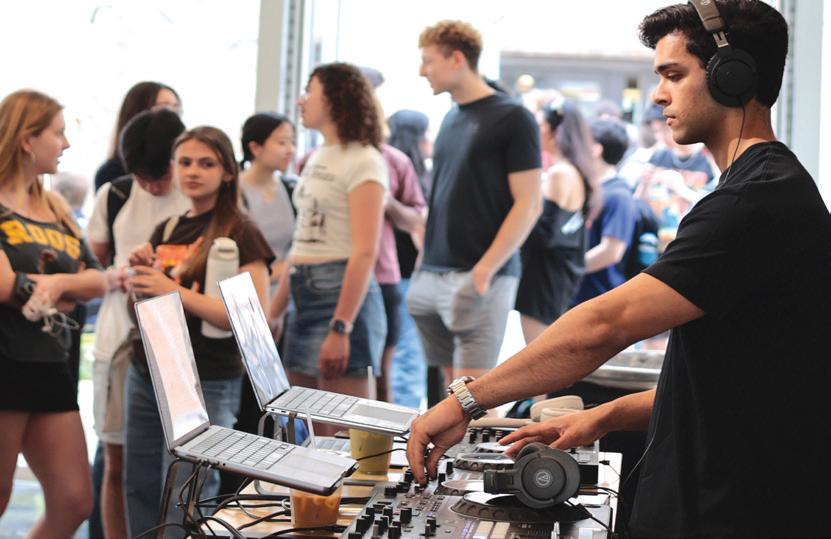
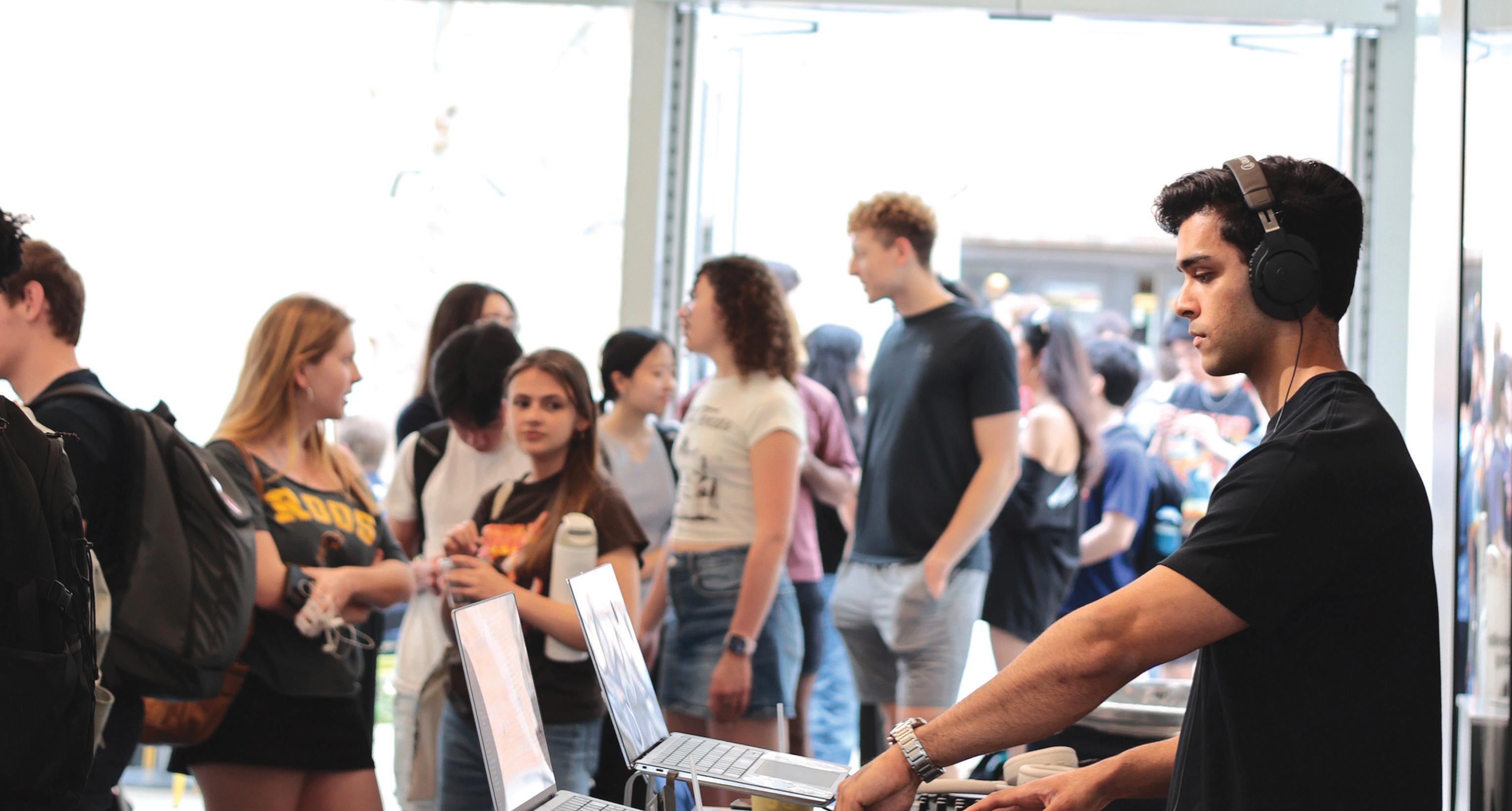
Maher Tharakan, also known as DJ T, provides the soundtrack to the Brochstein Sunset Co ee Party. The event was hosted by Tharakan and two other DJs on Friday.
Explore 100+ years of The Campanile Complete for a spot on the crossword leaderboard a here!
Near the end of the set, she le the platform to dance around the venue. Rocket’s synth on the keyboard added ice cream truck avors to haunting melodies, and Ramelle’s electric violin provided an extra dimension to the music.
“I think we represent a lot of di erent parts of the music scene, but also di erent identities, like nonbinary, transness, queerness, femininity,” Ramelle said, “And we also have a really unique sound. We have the violin component. I feel like violin is becoming more popular, but it’s still not a common instrument you nd in bands.”
Duncan College senior Adam McFarland said attending the show was a good introduction to Houston artists.
“This is my rst time really hearing a local artist,” McFarland said. “I didn’t know that ktru hosted things like this.”
Peyton rounded o the lineup as the nal performer and headliner. The R&B singer said she has been interacting with ktru since she was 18 through artist interviews. She is classically trained in voice, violin and piano, but attributes much of her musical knowledge to growing up in Houston.
ktru has a strong presence on campus, not just for supporting the local community and being a presence in Houston, but also, it’s major Rice tradition.
Christian Dominguez LOVETT COLLEGE SOPHOMORE
“[I was] just exposed to a lot of great music, arts, great programs,” Peyton said. “I had great exposure and great teaching. I’ve been doing it for a while.”
Peyton described her songwriting process as drawing inspiration from music that she already likes.
“Before I was putting music out myself, I was just adding on to things I like, and I just wanted to combine all those things,”
Peyton said.
At the end of her set, she invited the crowd to get out of their chairs and dance with her.
“It feels great,” Peyton said. “There’s so many di erent artists on the lineup, and I feel like it’s such a testament to how unique and diverse Houston is, so I’m glad to be a part of that.”
The musical performances weren’t the only entertainment offered at ODS. Vendors included a jewelry maker
and tarot card reader, and activities included shirt customizations and a tin embossing workshop.
Dominguez spent the festival preparing the activities and setting up the venue for each artist.
“I also liked talking with the di erent bands,” Dominguez said. “They’re very friendly. Since I was able to help the group under Peyton … overall a great process.”
Attendees could watch acts in Pub and walk to the Miner Lounge to participate in the activities.
“I thought it was really cool,” McFarland said. “I like how it was a small space, and it was enough people. And the vibe was really cool as well, so I felt like it was very casual.”
ODS occurred just days a er Dean of Undergraduates Bridget Gorman announced that there will be no headliner at this year’s Moody Fest, previously known as Moody X-Fest.
“I think it’s a little sad, of course, because it was going to become an integral part of Rice culture, waiting for the end of classes so you can see Moody X-Fest,” Lebron-Torres said. “But I mean, it’s out of our control.”
Dominguez said ODS is contributing to Rice’s culture of live music on campus.
“ktru has a strong presence on campus,” Dominguez said. “Not just for supporting the local community and being a presence in Houston, but also, it’s major Rice tradition.”
ktru’s specialty shows broadcast passion and niche tastes
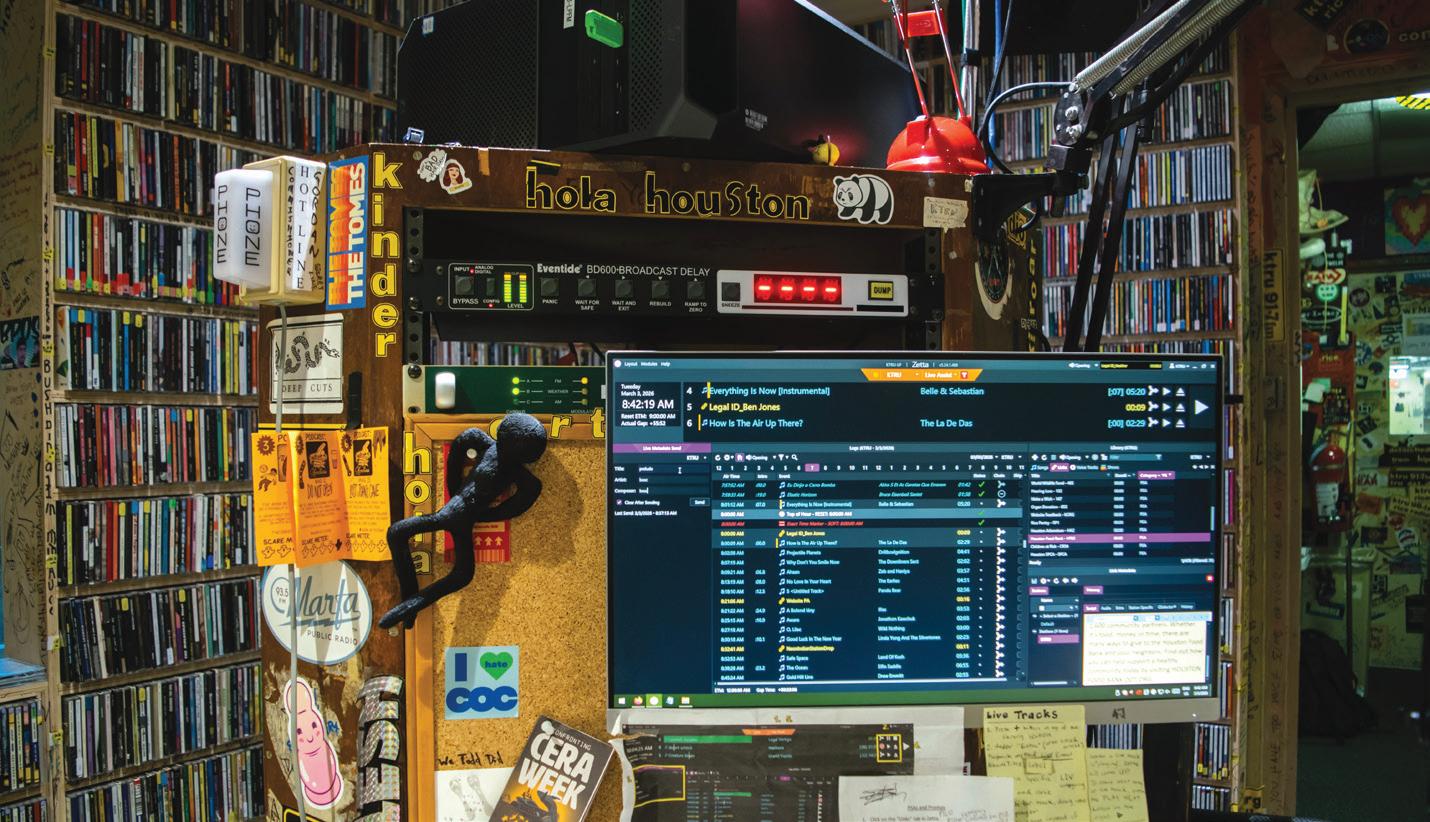
ktru, Rice’s student-run radio, has been broadcasting its eclectic collection of albums from both lesser-known and prominent artists, since 1967. With a fondness for experimental and local acts, ktru often spotlights a variety of different genres within the Houston music scene.
Today, you can find the station tucked at the end of a second-floor hall of the Rice Memorial Center. The door is covered in stickers, and at most hours, a DJ is manning the station.
While most pull from ktru’s floor-to-
ceiling ‘stacks’ of more than 27,000 CDs — and thousands more vinyls — some experienced volunteers host weekly specialty shows following a set theme.
Ranging from reading old DJ reviews to playing music from a single region, decade or genre, ktru’s specialty shows encourage listeners to dive into the many niches of today’s crowded music economy.
For Desiree Duron, a Will Rice College junior, hosting a specialty show allows her to dive into the unique nature of emotions and how music can communicate them.
Armed with a Pinterest board cataloguing obscure emotions and a broad range of music, Duron hosts “Heartbeatz” every
Sunday from 11 a.m. to noon.
“Choosing an emotion is like picking a jewel from a treasure trove,” Duron said. “From there, I try to break it into bitesized pieces and tell a story. For example, ‘adronitis’ is frustration with how long it takes to know someone, so I can start with a song about longing, then a song about patience, following it with a song about acceptance and finally tie it back up with a song about waiting for that special person.”
Some specialty shows are headed by community DJs, locals who aren’t students at Rice but are members of ktru’s DJ coalition. Community DJ Jason Dibley gets to explore his favorite genre, jazz, and its adjacent genres every Tuesday on his show “Smoking in the Sun” from 8-9 a.m. Dibley said he plays a combination of music both within and outside of ktru’s stacks.
“I spend far too much time planning a one-hour show that ends up sounding as disjointed as it does,” Dibley said. “A little under half of the show is jazz or jazz-adjacent, or maybe things that push away from what the definition of jazz actually is. The other half of the show ends up being a roller coaster of bummer folk, noise … fake punks, gospel, songs to cry to.”
Other shows highlight music from specific eras and regions, especially those with vibrant yet less prominent music landscapes. Duncan College senior Ahmad Alrabiah hosts “Khaleeji Soundscapes” every Thursday from 4-5 p.m., broadcasting music from the
Arabian Peninsula, from folk music to modern pop.
“I wanted to host a specialty show to introduce Houston and the ktru community to Khaleeji music, which does not get much airtime in the U.S.,” Alrabiah said. “Given that there are extremely few Arab Gulf students at Rice, let alone ones who are interested in music, I took it upon myself to try to make the show.”
The novelty for some shows comes from a motivation to bring listeners to new sounds. Community DJ Robert Way hosts “N0_F0rm4t” every Wednesday at 9 p.m., featuring an exploratory curated playlist peppered with commentary to introduce his audience to music they’d otherwise be unlikely to encounter.
“Within a typical show you can hear jazz, alternative, classical, metal, world, opera, ska and many others, presented in a way that has an ebb and a flow for a better listening experience,” Way said. “I also never repeat songs, which is fun as it pushes me to expand my own audio palate as well as the listeners.’”
For many DJs, specialty shows are driven by pure passion, often requiring hours of work outside the station to prepare a unique playlist and bits for every show.
“Planning my show is a convoluted, time-consuming labor of love,” Way said. “No two shows are the same, so one of my favorite things that is really rewarding is when people tell me I turned on a new favorite artist they discovered while listening.”
BENJAMIN SADOWSKI / THRESHER
Houston R&B artist Peyton and her supporting band took the stage at 8:30 p.m. at the ktru Outdoor Show in Willy’s Pub on Saturday.
YUMN TESHOME / THRESHER
The ktru o ce, located on the second floor of the Rice Memorial Center, is lled with thousands of vinyls and CDs.
ANGELICA HERNANDEZ THRESHER STAFF
FROM FRONT PAGE OUTDOOR SHOW
And the Oscar goes to...
A&E EDITOR & FOR THE THRESHER
The 98th Academy Awards will be presented on March 15 at the Dolby Theatre in Hollywood, California. This year’s awards season is not without controversy, see the British Academy of Film and Television Arts Awards and “Marty Supreme.” Luckily, the Thresher is here to help you navigate the awards restorm and give recommendations for your Kalshi account or Oscar party.
PICTURE
It’s undeniable that “One Battle A er Another” has been in the lead for Best Picture contention for months, especially a er picking up big wins from the Critics’ Choice Awards, Directors’ Guild of America Awards and BAFTAs. However, there are two factors that have started to swing the pendulum in favor of “Sinners.”
First, the recent controversy at the BAFTA ceremony may have swayed Academy voters who were previously on the fence. And second, the fact that it won big at not just Screen Actors Guild awards but also the Writers Guild of America awards this past weekend.
The last two lms to win just these two awards and then Best Picture were “Moonlight” and “Parasite,” both competing against “classic” Hollywood picks (“La La Land” and “1917,” respectively), and both representing an injection of new life into the industry.
Hollywood needs to celebrate and upli mold-breakers as streaming and AI pose existential risks to its traditional ways of lmmaking — and that’s why I think “Sinners” may narrowly edge out “One Battle A er Another” in this hotly contested race for Best Picture.
— Albert Zhu, for the Thresher
Prediction: “Sinners”
Upset: “One Battle A er Another” Should Win: “No Other Choice”
DIRECTOR
Even if “Sinners” wins Best Picture, this category is Paul Thomas Anderson’s to lose. A er a career of making some of the most in uential and critically acclaimed
BRANDON NGUYEN / THRESHER
lms of the last 30 years, like “Boogie Nights,” “Magnolia,” “There Will Be Blood” and “Phantom Thread,” Anderson will nally get his due from the Academy.
Nominated a whopping 11 times without ever receiving a win, “One Battle A er Another” is Anderson’s ticket to retire his title as a long-time Oscar bridesmaid.
— Arman Saxena, A&E Editor
Prediction: Paul Thomas Anderson, “One Battle A er Another”
Upset: Ryan Coogler, “Sinners”
Should Win: Paul Thomas Anderson, “One Battle A er Another”
ACTOR
For months, it seemed that Timothée Chalamet’s Oscar was all but guaranteed. A er a marketing campaign that saw Chalamet enter di erent realms of pop culture, from streaming to music, the “Marty Supreme” star seemed like he was the most talked-about guy in Hollywood.
On Jan. 26, Page Six Hollywood published a blistering piece on Josh Safdie, the creative engine behind “Marty Supreme,” alleging misconduct on the set of Safdie’s previous lm “Good Time.”
As a result, Michael B. Jordan’s stock has risen. “Sinners” has been growing and growing in industry traction, and now it’s a possible contender for Best Picture. On March 1, Jordan took the win over Chalamet at the Actor Awards, an industry event that has some crossover in membership to the Academy.
Jordan and his co-star Delroy Lindo have also received praise for the way they handled the incident at the BAFTAs, where a Tourette syndrome activist shouted out a racial slur while Jordan and Lindo were presenting an award.
Both Jordan’s and Chalamet’s performances are the type of work that gets recognized in this category; the Academy loves both actors who play dual roles and actors who play abrasive, larger-than-life characters.
I am going with Jordan here due to my suspicion that Academy members might like Chalamet’s work less than other award groups do, and that they are bigger fans of “Sinners” and Jordan than many are projecting.
— Arman Saxena, A&E Editor
Prediction: Michael B. Jordan, “Sinners” Upset: Timothée Chalamet, “Marty Supreme” Should Win: Michael B. Jordan, “Sinners”
ACTRESS
To be frank, Jessie Buckley is a lock for Best Actress. She’s taken home the top prize from the Golden Globes, Critics’ Choice Awards, BAFTA
and SAG, and at this point it’s a tall order to name a single big-name ceremony she hasn’t won at.
It’s hard to see any reason why the Academy might put an end to Buckley’s sweep, as “Hamnet” has managed to stay completely drama-free this awards season, unlike some contenders in other categories, so this should be a pretty sure re pick.
— Albert Zhu, for the Thresher
Prediction: Jessie Buckley, “Hamnet” Upset: Rose Byrne, “If I Had Legs I’d Kick You” Should Win: Renate Reinsve, “Sentimental Value”
SUPPORTING ACTOR
Sean Penn and Stellan Skarsgård. Both are proli c actors who have been in countless classic lms (see: “Mystic River,” “Good Will Hunting” and “The Thin Red Line”). Penn has won two Oscars, for “Mystic River” and “Milk,” while Skarsgård is on his rst nomination of his career.
As a result, don’t be surprised if there’s a push to award the Swedish actor, but with Penn having won both at the BAFTAs and at the SAG awards, it’s hard to predict anyone else.
— Arman Saxena, A&E Editor
Prediction: Sean Penn, “One Battle A er Another”
Upset: Stellan Skarsgård, “Sentimental Value” Should Win: Benicio del Toro, “One Battle A er Another”
SUPPORTING ACTRESS
This is a three-way race between Amy Madigan, Teyana Taylor and Wunmi Mosaku. Taylor and Mosaku are the biggest contenders of the year as part of “One Battle A er Another” and “Sinners” respectively.
However, both actors have things going against them. Taylor is only in her movie’s rst 20-30 minutes and Mosaku doesn’t have as much screen time as costars Michael B. Jordan and Miles Caton. Madigan, on the other hand, is possibly the most unforgettable force in her lm, and while she is the only actor nominated from “Weapons,” I think her immense signi cance within the lm’s narrative will take her to victory in this category.
— Arman Saxena, A&E Editor
Prediction: Amy Madigan, “Weapons” Upset: Teyana Taylor, “One Battle A er Another” Should Win: Inga Ibsdotter Lilleaas, “Sentimental Value”
This article has been cut for print. Read the full piece on ricethresher.org.
Revamped cafe offers new drink options, gathering space
the cafe will be a place where people stop by and spend time.
The hum of co ee machines and quiet conversation lls the Moody Center for the Arts as students stop by Moody Cafe for co ee, studying and quick breaks between classes.
Moody Cafe, located on the second oor inside the Moody Center, recently relaunched. Susana Cabrera, assistant dining director of retail and catering, said the new cafe will be integrated into the continuation of Moody’s creative and collaborative energy.
“The relaunch of the Moody Cafe is focused on serving a mix of customers and considering how people use the Moody Center,” Cabrera said. “As one of the biggest changes since its reopening, the café is now operated directly by Rice Dining. This in-house operation allows the cafe to stay closely connected to the needs and preferences of the Rice community and adapt the concept in ways that better serve students, faculty and visitors.”
The cafe was previously managed by Rice alumna-owned Lemond Kitchen by Merinda Watkins-Martin ’91 and her husband, Reggie Martin. The cafe was initially run by Salento.
The menu includes specialty options such as strawberry matcha and passion fruit green tea. In the long run, Cabrera said she hopes
“[My goal is] for Moody Cafe to become a regular stop for people spending time at the Moody Center, as well as people in surrounding buildings such as Glasscock and Saro m Hall, whether they’re coming to see an exhibition, attend a talk or just enjoy a co ee in a creative space,” Cabrera said.
Joel Thompson, the Moody Center’s deputy director, said the cafe is envisioned not just as part of the center itself, but also for students and general public visitors, serving as a connection point between all of them.
“I am really pleased with how enthusiastic the Rice hospitality crew has been … in being creative with their menu,” Thompson said. “They talked about using drawing inspiration from the arts that are in our exhibition. You see, as you walk around the building, you got works of public art in the building, so trying to get use of those works as inspirations for their menu is really good.”
A er their rst visit, Samantha Washecka and Cirdan Vonnahme, both students at the Shepherd School of Music, said the cafe’s location was convenient for their co ee needs during the day.
“It is a very nice one-minute walk over here [from Shepherd],” said Vonnahme, a Will Rice
College sophomore. “We are in the middle of the day, a bit sleep deprived and just need some ca eine.”
Compared to other co ee spots around campus, Washecka said she appreciated its ambiance.
“The vibes are nice, and I think it is di erent from Chaus in a sense, like I feel like every co ee place on campus just has a di erent vibe,” said Washecka, a Will Rice junior.
Thompson said it’s too early to tell about
the outcome of the cafe opening, but that he hopes the space will be appealing to students.
“So even if you are a student who doesn’t take class in the building, still come down to Moody, come to the cafe, use our study spaces,” Thompson said. “Feel welcome, hang out, study, be with friends, be among art, get the creative juices owing, because in a building like ours, I think that really allows it to [be] a more welcoming space to students. The cafe is part of that.”
CAELYN WANG THRESHER STAFF
KONSTANTIN SAVVON / THRESHER Moody Cafe, located on the second floor of the Moody Center for the Arts, recently relaunched on Feb. 24.
ARMAN SAXENA & ALBERT ZHU
A&E chooses the best movies of the decade so far
The best movies of the decade so far resonated with audiences, especially considering the biggest themes of the last few years. Arti cial intelligence (“The Beast”), genocide (“The Zone of Interest”) and changing gender roles (“Anatomy of a Fall”) — among others — have been at the forefront of cultural discourse, and the best lms of the 2020s re ect that.
However, if this list is evidence of anything, it’s that the best lms don’t have to capture the trends of modern life to resonate. The best stories traverse background, generations and knowledge. These are the Thresher’s best lms of the decade so far.
1.“A ersun” (2022) dir. Charlotte Wells “A ersun” nds devastating emotional weight in the seemingly uneventful. Charlotte Wells transforms a simple father-daughter vacation into something quietly shattering, capturing the strange way we remember people we love — through fragments, gestures, glances and things le unsaid.
Paul Mescal’s performance is a masterclass in restraint, at once tender and unknowable, while Frankie Corio gives the lm its aching sincerity. It is a coming-of-age story, a portrait of a parent and a meditation on time itself: understated, deeply human
and impossible to shake.
— Arman Saxena, A&E Editor
2. “Drive My Car” (2021) dir. Ryûsuke Hamaguchi
Grief, communication and interpersonal relationships are at the heart of Ryûsuke Hamaguchi’s “Drive My Car.” The film doesn’t rush its drama, it allows its audience to feel the textures of its environment, its characters and their interactions with each other.
Featuring some of the best performances of the decade from Hidetoshi Nishijima and Tôko Muira, “Drive My Car” is a gorgeous and emotionally devastating journey of subtle power, and its catharsis lingers long after the credits roll.
— Arman Saxena, A&E Editor
3. “The Zone of Interest” (2023) dir. Jonathan Glazer
When faced with the fact of war, genocide and oppression in their countries and abroad, many repeat the old adage that these realities are not their problem. “The Zone of Interest” depicts the lives of a family that has the privilege of indi erence. The patriarch is an o cer in the Nazi’s
Schutzsta el, or SS, but his family continues with business as usual.
Gunshots, screams and the distant hum of machinery dri through the air, but these sounds blend seamlessly with birds chirping and children laughing. The lm illustrates what political theorist Hannah Arendt famously called the “banality of evil,” the unsettling reality that unimaginable crimes can coexist with ordinary domestic life when people choose not to confront them.
— Arman Saxena, A&E Editor
4. “Anatomy of a Fall” (2023) dir. Justine Triet
“Anat’my of a Fall” is a story about stories. Sandra Voyter’s (Sandra Hüller) novel sits at the center of her murder trial as evidence against her, but the lm operates on multiple levels of storytelling: the case, the trial as a mechanism for constructing rather than uncovering truth and the lm itself.
— Chi Pham, Assistant A&E Editor
This article has been cut for print. Read the full piece at ricethresher.org
The audience watches from the point of view of Daniel (Milo Machado-Graner), Sandra’s son who is blind, forced to choose which account to believe. Physical evidence disappoints. Truth remains unreachable. One family’s private life is violently exposed, and with it comes an admission that in most stories, ctional or otherwise, truth is beside the point.
‘Wuthering Heights’ is beautiful but fundamentally vapid
At this point in her career, “Promising Young Woman” and “Saltburn” director Emerald Fennell has established herself as a master of the artfully scandalous film — but her latest proves that immaculate craftsmanship can’t mask a hollow core.
“Wuthering Heights” is a highly flawed yet still watchable film: gorgeous to look at, intermittently thrilling but ultimately devoid of emotional or thematic depth.
The film opens with a black screen and sounds whose source is not immediately clear — are they moans of ecstasy or agony?
It’s soon revealed that they’re coming from a man in the midst of being hanged, whose rigor erectus proceeds to whip the observing crowd into an animalistic frenzy. This sets the tone for the rest of the movie — we, the audience, are about to witness a saga of pain and pleasure that will surely have us frothing at the mouth.
We’re then introduced to the estate of Wuthering Heights, including its patriarch, Mr. Earnshaw (Martin Clunes), his pampered daughter Catherine (Charlotte Mellington) and her companion and maid Nelly Dean (Vy Nguyen). The household has also recently gained a
new member: a street urchin, played by Owen Cooper, whom Mr. Earnshaw took pity on and has now been assigned as Catherine’s “pet.”
Over the course of their childhoods, a bond between Catherine and the boy, whom she’s christened Heathcliff, gradually blossoms in spite of their differences in status. It’s genuinely sweet watching Catherine try repeatedly to get Heathcliff to open up to her, and this sequence effectively lays the groundwork for their love, which becomes the center
of everything that follows.
The film hits its peak once the adult cast takes over. By the time Margot Robbie, Jacob Elordi and Hong Chau step in as Catherine, Heathcliff and Nelly, the glory days of the estate have long since passed, due in large part to Mr. Earnshaw’s worsening vices. However, a golden opportunity suddenly arises — wealthy neighbors have just moved in next door at Thrushcross Grange, and the head of the household, Edgar Linton (Shazad Laif), is single.
Catherine is then faced with a difficult choice: pursuing upward social mobility through marriage to Edgar or acting upon her deepening feelings for Heathcliff. This act is “Wuthering Heights” at its finest — slight undertones of class and gender critique are present, Catherine and Heathcliff’s will-theywon’t-they dynamic is genuinely gripping and a series of charged moments had the entire theater shrieking with equal parts mortification and glee.
It’s after Catherine makes her decision that the film begins to unravel. Deeper thematics are abandoned in favor of meandering drama, and as the characters inflict upon each other a procession of cruelties that feel more arbitrary than inevitable, they begin to curdle into unsympathetic, cartoonishly
privileged scumbags.
At some point, the yearning and volatility that powered earlier scenes drain away entirely, and without any emotional stakes to anything happening on screen, the film ultimately degrades to monotony.
By the two-hour mark, I was feeling every minute of the runtime and already questioning what the point of it all was before the credits even rolled.
Although “Wuthering Heights” may stumble when it comes to substance, it never falters in craft. Cinematographer Linus Sandgren (returning from “Saltburn”) delivers a number of wallpaper-worthy shots of the Yorkshire Dales, the sumptuous setpieces of Thrushcross Grange are undeniably breathtaking and Charli xcx’s soundtrack contributions add considerable texture to the film’s Gothic atmosphere.
“Wuthering Heights” looks and sounds wonderful — but peer beneath the oorboards, and you’ll nd nothing there.
SYDNEY AN / THRESHER
ALBERT ZHU FOR THE THRESHER
COURTESY WARNER BROS. PICTURES
Rice hosts Houston legends to kick off FIFA World Cup
ARMAN SAXENA A&E EDITOR
Hakeem Olajuwon catches the basketball in the low block and his feet begin to dance. Olajuwon pivots toward the baseline, his feet gliding along the block before he suddenly reverses direction with another quick pivot that sends the defender leaning the wrong way.
This is Olajuwon’s Dream Shake, a move that became legendary for its precise footwork and success on the NBA court. Olajuwon, the Houston Rockets star behind the rst two league championships in Houston sports history, credits his time playing soccer in his youth as the foundation for this maneuver.
“Growing up in Nigeria, everybody plays soccer,” Olajuwon said. “The coordination, the competitiveness, the body movement … that was the foundation for me.”
Olajuwon talked about his experience with soccer during a live recording of the Men in Blazers soccer podcast in the Brockman Hall for Opera at Rice University March 4. The event marked 99 days until the start of the 2026 FIFA World Cup, which will bring matches to Houston this summer.
I wasn’t expecting each of the guests to talk about Houston so much during the event. I thought that was really special for Houston to come together and celebrate the World Cup that’s coming.
Molly Vance
HANSZEN COLLEGE FRESHMAN
Soccer has long been part of Houston’s sports culture — from its in uence on Olajuwon’s play to professional teams like the Houston Dynamo and Houston Dash to the city hosting matches as part of the Copa América, Concacaf and International Champions Cup tournaments.
With the World Cup approaching, Houston sports leaders say the city is preparing to showcase that culture to a global audience.
The live podcast recording at Brockman Hall for Opera featured Olajuwon, Houston Dash players Jane Campbell and Yasmeen Ryan, former Houston Texans star J.J. Watt, astronaut Shane Kimbrough and podcast host Roger Bennett discussing Houston’s
sports culture and the city’s role in hosting the tournament.
David Brady, chief of sta for the FIFA World Cup 2026 Houston Host Committee, said the event was chosen to be at Rice because of the university’s collaboration with FIFA.
“Rice is a partner of the World Cup,” Brady said. “When we were looking for venues … the Rice opera house here on campus was mentioned as a potential place. This is such a beautiful venue. It’s the perfect setting for this event.”
Houston has a long history of hosting major sporting events, from NCAA Final Fours to a Super Bowl. Brady said the World Cup represents the next step in that legacy.
“Housing the World Cup just becomes that sort of bucket-list check mark that Houston needed to say, ‘Yeah, we’ve done it all now,’” Brady said.
Brady said events like the podcast recording are meant to build excitement before the tournament begins.
“Most importantly, [the event] is to connect the community to the World Cup and say, ‘Hey, it’s close. Are you ready?’” Brady said. “Bringing the Rice community, students, faculty and sta closer to their partnership with the World Cup makes it even sweeter for us.”
Sean McGarry, a Jones College senior, said he attended to hear from prominent Houston sports gures.
“The opportunity to hear from Houston legends, especially Hakeem Olajuwon and J.J. Watt … was very interesting,” McGarry said.
For Rice students, McGarry said the event also demonstrated how the university ts into Houston’s preparations for the World Cup.
“The World Cup is probably the biggest event Houston will have this decade,” McGarry said. “[This event] is a good way for us to involve ourselves with that.”
Hanszen College freshman Molly Vance heard about the event through a sport management class and spent the day with production sta
“I was mostly shadowing the director of the show as he was making his decisions and running the show,” Vance said.
Vance said the event highlighted Houston’s pride in hosting the World Cup.
“I wasn’t expecting each of the guests to talk about Houston so much during the event,” Vance said. “I thought that was really special for Houston to come together and celebrate the World Cup that’s coming.”
As a Houston native, Vance said the tournament will be unlike anything the
city has hosted before.
“I don’t even think anyone really knows just how crazy it’s going to be once it’s here,” Vance said.
She said she hopes visitors experience Houston’s welcoming culture.
“I hope they take away our Southern hospitality and how welcoming we are,” Vance said. “Everyone here is just so friendly and welcoming to everyone.”
Speakers throughout the event emphasized that same message: the World Cup will bring the world to Houston, but also showcase the city’s culture.
Watt highlighted the city’s diversity and food culture as some of the best
aspects of Houston. He also mentioned the city’s close-knit, inviting community as something he hopes newcomers will take away from their experience in Houston.
“This is the biggest small city in the world,” Watt said. “We may have to drive an hour and a half to get across town, but we all know each other and know what each other likes and love each other. It’s a great place.”
With seven World Cup matches scheduled in Houston, Olajuwon said the city is prepared for what the tournament will bring.
“Houston has hosted a lot of big events,” Olajuwon said. “I think we are ready for it.”
ARMAN SAXENA / THRESHER
Men in Blazers podcast host Roger Bennett introduces NBA champion Hakeem Olajuwon (top) and threetime NFL Defensive Player of the Year J.J. Watt (bottom) during a live recording in the Brockman Hall for Opera at Rice University March 4.
WBB breaks win streak, dominates American awards
EVIE VU SPORTS EDITOR
Rice womens basketball’s programrecord 22-game win streak was snapped Saturday when they fell 61-52 to the University of Texas at San Antonio in the nal game of the regular season. Two days later, the Owls dominated the American Conference Postseason Awards, bringing home ve out of the eight individual awards.
They entered the UTSA contest undefeated in conference play a er a narrow win against the University of North Carolina at Charlotte, which pushed head coach Lindsay Edmonds to a career 100 wins with the team.
“Every game that I coach I feel like I
learn something about myself,” Edmonds said. “These players challenge me. They make me want to be better for them.”
Before play commenced at Tudor Fieldhouse, the Owls and their fans celebrated Senior Day, honoring seniors Hailey Adams, Kennedy Cli on, Dominique Ennis and Shelby Hayes.
The seniors started, along with junior guard Victoria Flores, but during the rst quarter, the Owls’ o ense lagged behind the Roadrunners’. Rice shot just 23.5% from inside the arc and went 1-for-7 on threepoint attempts.
Beginning the second quarter down 19-15, Rice continued to struggle on both sides of the ball. Their defense gave up a 14-0 run to UTSA, while their o ense shot
just 20% from the eld. By hal ime, Rice trailed 41-21.
In the third quarter, sophomore guard Aniah Alexis led the comeback attempt with a jumper to put Rice back on the board a er a scoreless two and a half minutes. Alexis tallied seven points in the period, but it wasn’t enough as Rice closed out the quarter down 51-33.
Alexis continued the o ensive push with two threes in the nal quarter to tack on to the team’s nal e ort.
Fending o the Owls’ attempt at a late fourth-quarter rally, the Roadrunners forced Rice’s rst loss since November.
Rice ended the regular season at 27-4 overall and 17-1 in the American, their best nish since joining the conference in 2023.
On Monday, the American Conference released the winners of the postseason awards, which are determined by polling the conference’s 14 head coaches, with the caveat that coaches cannot vote for their own teams.
Flores was crowned Player of the Year, the highest honor awarded. She averaged 14.1 points in conference play.
Hayes was awarded Most Improved Player, which recognized her marked
growth this season. She improved to an average 12.6 points per game, up from 3.9 last season.
Junior guard Louann Battiston received the award for Sixth Player of the Year, which honors the player with the highest impact o the bench.
Adams took home the Ambassador Award, an acknowledgement of “sportsmanship, ethical behavior, fair play, integrity and community service.” The recognition mirrors the Kay Yow Servant Leader Award she won earlier this year.
Edmonds was unanimously selected for Coach of the Year a er leading the Owls to their rst American Conference regularseason championship.
Flores and Ennis were also named to the First Team All-Conference, while Hayes quali ed for the Third Team. Battiston made the All-Newcomer Team, and Adams rounded out Rice’s team honors with a selection to the All-Defensive Team.
The Owls nished at No. 1 in the American and will enter the American Conference Championship as the top seed. Rice received byes into the semi nal round and will rst play on March 13 in Birmingham, Alabama.
Sports Notebook: March 4-10
EDITOR
Men’s golf nishes third in Cabo Rice men’s golf nished in third place with a total of -10 at last week’s Cabo Collegiate in Cabo San Lucas, Mexico. The Owls went 8-2 against the top 40 teams in the country, 5-2 against the top 25 and 2-1 against the top 10.
In the nal leaderboard, Rice was edged out by the event champion, Oklahoma State University (-22), and the runner-up, University of Arkansas (-21).
Redshirt senior Henry Daly led the way for Rice, nishing in a tie for eighth place with -5. Senior Lukas Boandl also had a strong showing in Cabo with a nish of one-under 70 to tie for 11th place at -3.
Sophomore Daniel Zou nished at +2 a er shooting his h sub-70 round of the season. Junior Reggie Zhu shot a +7, while freshman Raines Watson nished at +8.
“I’m really proud of our ght this week,” said head coach Justin Emil. “We got into the nal group for the last round, and the guys handled the weight of that pressure. We de nitely created some momentum this week in Cabo. Now, it’s back to work to prepare for the All-American.”
The Owls return to the links Monday, March 16, to kick o the All-American Intercollegiate in Humble.
MBB misses tournament bid, wins on
Senior Night
LIN TSAI / THRESHER
A 62-58 loss to the University of North Texas last Wednesday eliminated Rice men’s basketball from American Conference championship contention.
The top 10 programs in the American Conference (out of 13) qualify for the tournament, and Rice missed the cut at No. 11.
A er taking down the University of Texas at San Antonio during Senior Night on Sunday, the Owls nished 13-18 overall and 7-11 in conference play. They were one win away from forcing a fourway tie for the nal three tournament spots, but the loss to UNT delivered the nal blow to their playo hopes.
Rice edged out UTSA 80-71 at home during Senior Night. It was the Owls’ second 80-point showing over their last three games. Redshirt senior guard Jalen Smith led the way with 25 points across
a team-leading 32 minutes, while senior guard Nick Anderson added another 20 points o the bench.
Redshirt senior center Stephen Giwa secured 10 rebounds, and graduate guard Trae Broadnax nished with 12 points and ve assists.
“The last couple of days leading up to today was phenomenal,” said head coach Rob Lanier. “I think it speaks to the group of seniors that we have that the rest of the guys wanted to win today for them.”
Lanier’s sta will now set its sights on next season, with the impending transfer portal window representing the most urgent matter. Players can transfer into — and from — Rice starting April 7.
With ve seniors and two graduate student-athletes, Rice will have plenty of holes to ll on its roster ahead of its quest to return to the conference tournament next season.
Tennis sees mixed results over weekend
Men’s tennis found success at home this past weekend, defeating the University of Alabama at Birmingham 4-0 to sweep the 67th Ralph O’Connor Rice Invitational. The Owls won the event for the 25th time and are now 6-6 this season.
The doubles point came down to the wire before junior Petro Kuzmenok and sophomore Joshua Mandelbaum broke a 1-1 tie with a 7-6 win over their UAB opponents.
Rice won all three singles matches that went nal, o cially clinching the event title. The remaining three singles matches were halted since the outcome of the event was already determined, but Rice held the lead on two of those three courts, too.
The women’s tennis program went toe-to-toe with a ranked opponent this past weekend but ultimately couldn’t eke out the victory. A 4-3 loss to No. 36 Wichita State University on Saturday dropped the Owls to 7-4 this season, including 4-1 at home.
Wichita State won each of the rst two doubles matches, securing the doubles point. Rice fought back with a trio of singles wins, but junior Nithesa Selvaraj’s loss on Court 5 swung the pendulum in Wichita State’s favor with no matches remaining.
HONG
ANDERSEN PICKARD SPORTS
KAIRI MANO / THRESHER
Junior guard Victoria Flores dribbles near a fallen defender during Rice’s 65-56 win over Temple University Jan. 28. Flores was named the American Conference Player of the Year.
The Backpage is the satire section of the Thresher, written this week by Will Howley, Charlie Maxson, Rykelle Sandidge, and Max Scholl, and designed by Brandon Nguyen. For comments or questions, please email realricethreshero cial@rice.edu.
CLASSIFIEDS
Seeking dependable a ernoon helper Monday–Thursday, 2:30–5:30 PM. School pickup for two children and nearby activities (3–5 miles). Reliable car, clean driving record, references required. Contact Mona at 352-246-3332.
ADVERTISING
The Thresher accepts display and classified advertisements and reserves the right to refuse any advertising for any reason. Additionally, the Thresher does not take responsibility for the factual content of any advertisement. Printing an advertisement does not consititute an endorsement by the Thresher.
Display advertisements must be received by 5 p.m. on the Friday prior to publication; see ricethresher.org for pricing. Classified advertisements must be received with cash, check or credit card payment by 12 p.m. on the Friday prior to publication; see ricethresher.org for pricing.