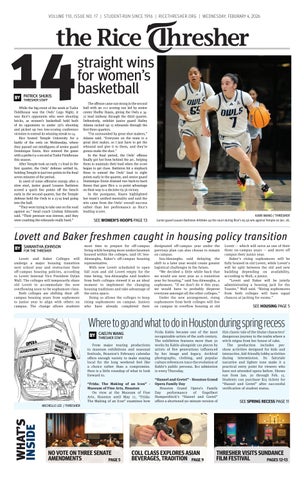
While the big event of the week at Tudor Fieldhouse was the Owls’ Lego Night, it was Rice’s opponents who were shooting bricks, as women’s basketball held both of its opponents to under 35% shooting and picked up two low-scoring conference victories to extend its winning streak to 14.
Rice hosted Temple University for a battle of the owls on Wednesday, where they passed out mini gures of senior guard Dominique Ennis. Rice entered the game with a perfect 9-0 record at Tudor Fieldhouse this season.
A er Temple took an early 7-2 lead in the rst quarter, the Owls’ defense settled in, holding Temple to just two points in the nal seven minutes of the period.
In need of some o ensive energy a er a slow start, junior guard Louann Battiston scored a quick ve points o the bench early in the second quarter, but the Temple defense held the Owls to a 23-19 lead going into the half.
“They were trying to take one on the road against us,” head coach Lindsay Edmonds said. “Their pressure was intense, and they were crashing the rebounds really hard.”
The o ense came out strong in the second half with an 11-2 scoring run led by senior center Shelby Hayes, giving the Owls a 3422 lead midway through the third quarter. Defensively, redshirt junior guard Hailey Adams racked up 13 rebounds through the rst three quarters.
“I’m surrounded by great shot makers,” Adams said. “Everyone on the team is a great shot maker, so I just have to get the rebound and give it to them, and they’re gonna make the shot.”
In the nal period, the Owls’ o ense nally got hot from behind the arc, helping them to maintain their lead when the score began to get close. Battiston hit a stepback three to extend the Owls’ lead to eight points early in the quarter, and senior guard Dominique Ennis drained two back-to-back threes that gave Rice a 10-point advantage on their way to a decisive 65-56 victory.
In the postgame, Hayes highlighted her team’s uni ed mentality and said the win came from the Owls’ overall success rather than her performance as Rice’s leading scorer.
Lovett and Baker freshmen caught in housing policy transition
SAMANTHA JOHNSON FOR THE THRESHER
Lovett and Baker Colleges will undergo a major housing transition next school year and restructure their off-campus housing policies, according to Lovett Internal Vice President Dylan Wall. The colleges will temporarily share old Lovett to accommodate the now overflowing soon-to-be sophomore class. Both colleges are shifting their offcampus housing years from sophomore to junior year to align with others on campus. The change allows students
LEE / THRESHER
WHAT’S INSIDE
more time to prepare for off-campus living while keeping more underclassmen housed within the colleges, said OC SeaAkwaegbu, Baker’s off-campus housing representative.
With new Lovett scheduled to open fall 2026 and old Lovett empty for the time being, Sea-Akwaegbu said leaders from both colleges viewed it as an ideal moment to implement the changing housing traditions and take advantage of the extra space.
Doing so allows the colleges to keep rising sophomores on campus. Juniors who have already completed their
designated off-campus year under the previous plan can also choose to remain on campus.
Sea-Akwaegbu said delaying the shift to a later year would create greater logistical challenges in the future.
“We decided a little while back that we would use next year as a transition year for housing,” said Sea-Akwaegbu, a sophomore. “If we don’t do it this year, we would have to probably disperse everyone amongst all the other colleges.”
Under the new arrangement, rising sophomores from both colleges will live on campus in overflow housing at old
Lovett — which will serve as one of their three on-campus years — and move off campus their junior year.
Baker’s rising sophomores will be fully housed in old Lovett, while Lovett’s will be split between the old and new building depending on availability, according to Wall, a junior.
“Lovett and Baker will be jointly administrating a housing jack for the Toaster,” Wall said. “Rising sophomores from both colleges will have equal chances at jacking for rooms.”
SEE HOUSING PAGE 5
Where to go and what to do in Houston during spring recess
CAELYN WANG THRESHER STAFF
From major touring productions to museum exhibitions and seasonal festivals, Houston’s February calendar offers enough variety to make staying local for the long weekend feel like a choice rather than a compromise. Here is a little roundup of what to look forward to.
“Frida: The Making of an Icon”Museum of Fine Arts, Houston
On view at the Museum of Fine Arts, Houston until May 17, “Frida: The Making of an Icon” examines how
Frida Kahlo became one of the most recognizable artists of the 20th century.
The exhibition features more than 30 works by Kahlo alongside 120 pieces by artists of five generations influenced by her image and legacy. Archival photographs, clothing, and popular culture references trace the evolution of Kahlo’s public persona. $10 admission is every Thursday.
“Hansel and Gretel” - Houston Grand Opera Family Day Houston Grand Opera’s Family Day performance of Engelbert Humperdinck’s “Hansel and Gretel” offers a shortened 90-minute version of
this classic tale of the titular characters’ dangerous journey to the realm where a witch reigns from her house of cake. The production includes preshow activities designed for kids and interactive, kid-friendly lobby activities during intermission. Its fairytale narrative and lighter tone make it a practical entry point for viewers who have not attended opera before. Shows run from Jan. 30 through Feb. 15. Students can purchase $25 tickets for “Hansel and Gretel” after successful verification of student status.
MICHELLE
KAIRI MANO / THRESHER
Junior guard Louann Battiston dribbles up the court during Rice’s 65-56 win against Temple on Jan. 28.
Rice to be ‘Host City Supporter’ for 2026 FIFA World Cup
Rice will be the exclusive higher education institution serving as an Official Houston World Cup 2026 Host City Supporter. As a Host City Supporter, President Reggie DesRoches said the university has committed to helping the city prepare and execute this summer’s games.
We know that when these 500,000-plus people from around the world come to Houston, they will get to come to this campus and feel the energy.
Chris Canetti
PRESIDENT OF 2026 FIFA WORLD CUP HOUSTON HOST COMMITTEE
“This partnership reflects who we are: a university rooted in Houston with a mission that extends around the world,” DesRoches said in a press conference on Friday.
Houston, along with 15 other cities in the U.S., Canada and Mexico, will host seven games at NRG Stadium this summer. Currently, Rice is the only university that will o cially support a host city.
Chris Canetti, president of the 2026 FIFA World Cup Houston Host Committee, said he anticipates more than 500,000 visitors and believes Rice will play a big role in welcoming the world to Houston.
“It’s very exciting to be here. Every time you come to this campus, you can feel the energy,” Canetti said. “We know that when these 500,000-plus people from around the world come to Houston, they will get to come to this campus and feel the energy.”
Through academic symposiums, lectures and research related to the games, DesRoches said Rice hopes to investigate the economic, cultural and social impact of sports.
They will collaborate closely with Rice’s
department of sport management. Faculty have lent their expertise to the volunteer program, and three sport management students are already working with Canetti in the Host Committee o ce.
“Being part of the World Cup allows us to help welcome the world to Houston, to showcase the city’s culture and hospitality and to give our students meaningful hands-on experiences tied to one of the largest and most-watched events in the world,” DesRoches said.
Vice President and Director of Athletics Tommy McClelland said the World Cup is an opportunity to celebrate culture, community and connection.
“Houston is one of the most diverse cities in the world, and soccer reflects that diversity in a powerful way,” McClelland said.
Apart from educational programming, Rice will also host soccer clinics and community engagement events for young people, along with watch parties at Tudor Fieldhouse and Ion District. Its collaboration with POST Houston will create generative art installations across the city that promote sustainability and resilience.
On March 4, 99 days before the beginning of the tournament, Rice’s Brockman Hall for Opera will host a live
broadcast of the “Men in Blazers” podcast, a show that talks about the history and impact of soccer globally. The special “99 Days Out” episode will feature former Houston Texan J.J. Watt and other Houston celebrities, according to a press release. Over the summer, Rice will welcome visitors to campus by o ering FIFA-themed campus tours.
“I want to recognize the global reach aligns perfectly with who we are at Rice and with what we aspire to be as an athletics department: an institution that thinks globally, serves locally and creates impact that extends far beyond our campus,” McClelland said.
With the shift to the unlimited meal plan, the meal swipe donation program changed to the dining access swipes model. For the spring cycle, 238 out of the 549 applicants received meal swipes, according to Taylor Breashears, the associate director of Student Success Initiatives.
The selection criteria were need-based, according to Breashears.
“We prioritize students who are on the most need-based aid,” Breshears wrote in an email to the Thresher. “It’s not a random selection. We spend hours assessing the student’s needs with information given to us from our collaborating o ces, Housing & Dining and the O ce of Financial Aid.”
Eliana Yared said last semester, she did not receive swipes because of a miscommunication but eventually received them. This semester, she said she did not receive any swipes.
“This confused me because I met all of the criteria and I got swipes last semester, so I didn’t understand what changed from last to this semester,” wrote Yared, a Lovett senior, in a message to the Thresher.
Yared said that based on what she
was hearing, she did not believe the SSI’s messaging that they had received too many applicants with not enough food assistance.
“All and all I’m obviously frustrated but also would love for them to be more transparent about how they allocated swipes because they claim to do it based on which students have higher nancial need but from what I’m hearing that’s not really the case,” Yared wrote. “And for something as important as food, clarity is de nitely necessary.”
Breashears added that the need for meal swipes has grown over the years.
“For example, fall 2023, we received 295 applications, but these past two semesters, we saw 611 applications in the fall and 549 in the spring semester,” Breashears wrote. “I believe this is due to the knowledge of the program; I believe the need has always been there, but now students are more aware than ever.”
Beth Leaver, interim assistant vice president for housing, dining and hospitality, said with this new program, there has been a 25% increase in meals supported.
The SSI did not comment on how many swipes in total were distributed.
Under the previous system, where the swipes
BELINDA ZHU ASST. NEWS EDITOR
EVIE VU SPORTS EDITOR
JAMES CANCELARICH / THRESHER
President Reggie DesRoches poses with the Rice women’s soccer team. Rice will be the exclusive higher education institution serving as an O cial Houston World Cup 2026 Host City Supporter and will host watch parties, cultural events and soccer clinics.
What Texas’s H1-B visa hault could mean for international students
When Texas paused all the H-1B visa applications across public universities on Tuesday, Luz Garcini’s rst thoughts were about the international scholars she mentors and what this decision could mean for their future.
Garcini, the director of community and public health at the Kinder Institute for Public Research, said the H-1B visa pause could have broader social e ects.
“What we are doing with the message is we are rejecting diversity, closing doors to inclusion equity, and fostering otherness,” Garcini said.
Gov. Greg Abbott ordered all state agencies and public universities to stop sponsoring specialty H-1B visas for skilled foreign workers in specialty occupations until the end of the next legislative session on May 31, 2027.
H-1B visas are the nation’s largest temporary employment program with an annual cap set by Congress at 85,000 visas. They are used to hire highly skilled specialized foreign workers with a college degree. The visa usually lasts for three years but can be extended to six years. In public universities, H-1B holders usually include post-doctoral fellows and scholars, professors and clinical faculty.
Abbott said the H-1B program has “too often been used to fill jobs that otherwise could — and should — have been filled by Texans.”
“I don’t see any reason why we need
any H-1B visa employees in our public schools in the state of Texas,” Abbott said Monday. “But we’re going to nd out if there’s some unique skill set or whatever the case may be.”
The Texas Medical Center, which includes higher education institutions and hospital systems that use temporary work authorization programs extensively, might experience the biggest impact from the order, according to the Houston Business Journal.
I don’t see any reason why we need any H-1B visa employees in our public schools in the state of Texas. But we’re going to find out if there’s some unique skill set or whatever the case may be.
Greg Abbott
GOVERNOR
OF TEXAS
Yanhan Deng, an international premedical student, said he thinks Texas needs talented foreign scholars and researchers to address shortages in medical elds.
“In the Texas Medical Center, there are a bunch of state universities like UT Health and a lot of international researchers there,” said Deng, a Martel College junior.
“I don’t think Texas has enough talent in very niche or very speci c elds. They de nitely need international talents [from] around the world.”
From 2025 to 2026, there was a 17% decline in new international student enrollment across the U.S., which led to around $1.1 billion of lost revenue and nearly 23,000 fewer jobs; speci cally, this decline led to an estimated loss of $64.6 million for Texas. One of the main driving forces is the fall in graduate enrollment and non-degree students.
Deng said Texas’ medical schools are losing international students because of their exclusive admission policies.
“Most international [premedical] students will not view Texas as a destination where they will find opportunities because among all Texas medical schools, there’s only one single program, the M.D./Ph.D. program at Baylor College of Medicine, that actually considered international students,” Deng said. “They’re just keeping me out of the door.”
Deng said H-1B visas are an inevitable route for every international student to stay and work in the U.S.
“It’s an unavoidable pathway for most, also for me, as international students or as foreign nationals, to stay here, not necessarily to get citizenship, just to stay here in the work to nd a job that matched my interest in it,” Deng said.
Garcini said the a ected industries will expand far beyond medicine.
“I think we need to think broader
across the field that this impacts so many different areas, particularly if we’re talking about Houston, where we also have oil and gas companies,” Garcini said. “Imagine all the chemical engineers who will be losing one of the cities that sustain a large part of that economy, which is biomedical finances. But I think it translates to other fields.”
I don’t think Texas has enough talent in very niche or very specific fields. They definitely need international talents [from] around the world.
Yanhan Deng MARTEL COLLEGE JUNIOR
Garcini said studying, conducting research and moving to another country require a great deal of commitment from international students she mentors.
“They’re some of the most hardworking students,” Garcini said. “They understand because there is a price in having to leave your things behind and having to leave family and social networks. It is really hard to migrate to another country in search of opportunities. O entimes, these students are here not only for themselves, but to make their generations back home even better. It’s very unfortunate that this is happening.”
Larry McIntire, founding chair of Rice bioengineering, dies at 85
Larry McIntire, founder of the Rice department of bioengineering, died on Jan. 23. Through decades of leadership, he helped make the bioengineering program into what it is today and is remembered as a great mentor.
He joined Rice in 1970 and worked across several academic departments. In addition to his work as chair in the bioengineering department, he led the Rice Institute of Bioscience and Bioengineering and was an E.D Butcher Professor of Bioengineering and Chemical Engineering.
Dr. McIntire had a profound effect on my whole career as a bioengineer ... A wonderful colleague, we will miss him greatly.
Michael King
PROFESSOR OF BIOENGINEERING
A er his departure from Rice, he served as the second chair of the Coulter School of Biomedical Engineering at the Georgia Institute of Technology. Current chair Alyssa Panitch said he was a great mentor who was central to cultivating interdisciplinary relationships.
Despite his numerous professional accomplishments, he said at the department’s 25th anniversary celebration that he was “most proud of” the success of his students through their careers.
Michael King, a professor of Bioengineering, re ected on his leadership and believes that through his work as chair, he helped develop the foundations of the department through his training and hiring practices.
“As founding chair, he hired an outstanding faculty, many of whom are still here today. Even before our department was founded, Dr. McIntire trained a generation of bioengineers who graduated with degrees in chemical
engineering but have become leaders in the bioengineering eld,” King said. “These Rice alumni maintain a strong connection to our campus and we were delighted to see many of them return to Rice for our 25th anniversary celebration.”
King said. McIntire had a personal impact on him and his professional development.
“Dr. McIntire had a profound e ect on my whole career as a bioengineer,” King said.. “On the research side, we
have extensively used parallel-plate ow chambers to study the adhesion of blood cells, a technology that the McIntire Lab pioneered. A wonderful colleague, we will miss him greatly.”
King said there were potential plans to commemorate McIntire within the department.
“I do believe that we will commemorate Dr. McIntire’s legacy in some way, such as a fellowship or named lecture,” King said.
“Those discussions are ongoing. “
Cynthia Reinhart-King, the current John W. Cox Chair of Bioengineering, said McIntire had played a very influential role in many people’s careers, including her own.
“He was incredibly supportive of everyone in the eld, and he truly was a pioneer,” Reinhart-King said in a Rice News article. “While he le Houston several years ago, my sense was that he had a deep love for Rice and was cheering us from Georgia. This is a huge loss for our eld.”
RUBY GAO SENIOR WRITER
AYHAM AL-GHOUL THRESHER STAFF
COURTESY WOODSON RESERACH CENTER
Larry McIntire in a photo taken in 1990. McIntire, who founded the Rice department of bioengineering, died on Jan. 23.
Listings for Border Patrol positions face resistance from students
HONGTAO HU ASST. NEWS EDITOR
Students members of the Young Democratic Socialists of America are calling for Rice to remove multiple U.S. Customs and Border Protection job postings on 12twenty, a job and internship database under Rice’s Center for Career Development. The time that the postings were listed on 12twenty range from four months to a year ago.
Some postings, such as the Border Patrol Agent and Marine Interdiction Agent, have been recommended to students online. According to the 12twenty website, recommendations are based on a student’s “degree, job preferences, recent activity and more.”
“Neither Rice nor the Center for Career Development is standing up to protect our international students from the attacks happening on University campuses across the nation,” Conner Schultz, the co-chair of Rice’s chapter of the YDSA, wrote in a message to the Thresher.
Schultz, a Will Rice College sophomore, said removing these job postings was part of one of last year’s sanctuary campus petitions. He told the Thresher that he has emailed the CCD to remove such posts. The push for Rice to become a sanctuary campus was renewed in January.
“The fact that the CCD is endorsing the DHS on 12twenty shows how out of touch it is with the current political environment and the concerns of the student body,” Schultz wrote.
According to their website, all job postings on 12twenty are reviewed by the CCD. Ivette Mekdessi, the director of Career Development, said that the organization adheres to the Professional Standards for College and University Career Services in evaluating job postings.
According to the PSCUCS website, “Career services must have protocols and procedures in place, including consultation with the institutional legal counsel, and, if applicable, with diversity, equity, and inclusion o ces, to respond to concerns about discrimination, inequity, and fraudulent or unscrupulous activities by employers using the services.”
Career services sta must inform faculty members about legal and ethical issues related to referring or recommending students or
other designated clients to employers.
Ruby Bixby, the co-chair of Rice Immigrant Support and Advocacy, believes that such postings could make international or undocumented students feel “unsafe.” RISA, previously named the Undocumented Students Task Force, focuses on clarifying immigration information and providing outside legal resources to Rice students.
“I think that the idea of the Department of Homeland Security being able to advertise on a Rice website for students seems harmful and unnecessary,” said Bixby, a Duncan College junior. “Given the fact that the role doesn’t even require a bachelor’s degree, it doesn’t seem well suited for Rice students.”
In her work as the co-chair of RISA, changing these smaller things is a step towards a more inclusive Rice.
“I think that those community-based initiatives and smaller level things are more productive at this point,” Bixby said. “We should prove that the students at Rice care and the faculty and sta care and want to listen to students’ voices about what feels wrong.”
CBP handles jurisdictions other than the Immigration and Customs Enforcement division of the Department of Homeland Security. ICE is responsible for enforcing
immigration law in the U.S. interior more than 100 air miles away from the U.S. border, while CBP focuses on immigration law within 100 miles of the border.
From the 2020 U.S. census, nearly twothirds of the U.S. population lives within this border zone, which encompasses entire states such as Florida, along with most of the largest cities in the U.S, such as New York City, Los Angeles, Chicago and Houston.
Given the fact that the role doesn’t even require a bachelor’s degree, it doesn’t seem well suited for Rice Students.
Ruby Bixby
CO - CHAIR OF RICE IMMIGRANT SUPPORT AND ADVOCACY
Of the three Border Patrol job descriptions, recruitment incentives range up to $20,000 — funded in part under the One Big Beautiful Bill Act, which provided $4.1 billion for CBP to hire 3,000 new border patrol o cers over the next four years.
“U.S. Customs and Border Protection (CBP) o ers those interested in a career in law enforcement an exceptional opportunity to work with an elite team of highly trained professionals whose camaraderie, pride, and purpose are hallmarks of their daily mission of protecting America,” the description for the Customs and Border Protection O cer job reads..
The agency forms the bulk of the near3,000 agents deployed to Minnesota, where a Border Patrol agent and Customs and Border Protection o cer were responsible for the killing of Alex Pretti.
Across colleges in the U.S., postings of ICE and CBP virtual events have encountered student and faculty resistance. At Georgetown University, students called upon the Law Center to exclude ICE from a virtual career fair.
ICE withdrew its attendance at the Villanova University career fair following student protests. At Indiana University, students and faculty have criticized IU’s campus calendar featuring CBP virtual career expos on Handshake, a third-party platform. The same virtual event is also featured on the Cornell University, University of Pittsburgh, Wake Forest University and Ursinus College calendars.
Senior published in Harvard Law Undergraduate Review, examines NCAA antitrust
CARLOS MENDOZA THRESHER STAFF
Nationally-ranked powerli er and founder of Rice Sport Law Society Maya Moise had a paper published in the Harvard Undergraduate Law Review in October.
Covering topics ranging from arti cial intelligence to foreign policy, the Harvard Undergraduate Law Review, a student-run organization at Harvard College, provides a platform for undergraduate students to publish their legal writing.
[This issue] directly reflects my lived experience as an athlete ... watching how much value athletes generate while having very little to say.
Maya Moise
JONES COLLEGE SENIOR
Moise’s article, “Leveling the Playing Field or Limiting It? Antitrust Challenges to NCAA’s Proposed Revenue Sharing Cap,” discusses the issues with the now- nalized House v. NCAA settlement in 2025.
“I saw unresolved legal tension and unanswered questions about power,” said Moise, a Jones College senior. “I wanted to [see] whether the framework truly centers athletes or simply rebrands long-standing restrictions.”
The lawsuits centered on studentathletes’ limited right to receive compensation because of the NCAA’s name, image, and likeness policies. The lawsuits alleged that such restrictions violated antitrust laws, which prohibit monopolistic business practices.
The House settlement required the NCAA to “back pay” $2.8 billion to student-athletes who could not monetize their NIL under the previous rules. Additionally, it allowed NCAA Division I members, which include Rice, to pay student-athletes up to 22% of a school’s average annual athletic revenue.
In her article, Moise wrote that the new revenue-sharing framework functions as a “de facto salary cap, without collective bargaining or union representation.”
Ultimately, she concluded that the House settlement is an “unreasonable restraint of trade” with anticompetitive e ects outweighing procompetitive ones.
“[This issue] directly re ects my lived experience as an athlete . . . watching how much value athletes generate while having very little say,” said Moise, who is preparing for USA Powerli ing Nationals this May.
Because the case was unfolding in real time, Moise said the writing required not only legal analysis but also constant engagement with lings, hearings and emerging commentary.
The paper originated as an assignment for SMGT 464: Advanced Sport Law, a class that enables students to analyze complex legal topics and dra their rst legal paper. However, professor Stephanie Wilka said it
became a passion project for Moise.
A er many revisions and meetings with Wilka, Moise submitted her article — unchanged from its original class version — to the HULR at the end of 2024. In October, she received con rmation that her work would be published in the 2026 spring issue.
Maya didn’t do this for recognition, but out of a genuine love for the law and a desire to understand its impact.
Stephanie Wilka
SPORTS MANAGEMENT PROFESSOR
“Maya didn’t do this for recognition, but out of a genuine love for the law and a desire to understand its impact,” Wilka wrote in an email to the Thresher. “[This] is a testament to what is possible when students work hard, embrace challenge, and follow a career path that genuinely excites them.”
Although Moise entered Rice to study kinesiology and exercise physiology, she said her interests have shi ed. Last year, she co-founded the Rice Sport Law Society with Kai Cowin ’25 to bridge the gap between undergraduates and sport law opportunities typically reserved for law students.
Recently, RSLS competed in the Tulane International Baseball Arbitration Competition, placing in the top third as
the first undergraduate team ever to compete against law school and MBA teams, said Moise.
Before graduation, Moise said she intends to continue building and unifying the undergraduate pre-law community at Rice.
Additionally, she said she plans to apply for law school in the next application cycle and aims to increase the number of black female attorneys in America, speci cally in sport law.
“Everything I’ve learned in that paper, I learned in a Rice classroom,” said Moise. “Challenge yourself and trust in your knowledge.”
COURTESY MAYA MOISE
BRANDON NGUYEN / THRESHER
Senate discusses three constitutional amendments and name change, no vote
HONGTAO HU ASST. NEWS EDITOR
The Student Association Senate reviewed three constitutional amendments that have been under discussion for the past year Feb. 2. The meeting ended without a vote.
The first constitutional amendment was the renewed Amendment No. 2, which introduces a presidential veto and gives the Senate the final say over Blanket Tax Organization budgets. This amendment, which failed last fall due to low voter turnout, also lowers the threshold for passing resolutions from a two-thirds to simple majority. The content of the amendment has not changed from last year.
Maybe
by making
a
constitutional amendment, people can actually make their decision based on what actually will happen.
Arjun Surya
SID RICHARDSON
COLLEGE
PRESIDENT
SA President Trevor Tobey clari ed a potential loophole in the constitutional amendment, raised by Max Menchaca, the Brown College senator.
“If they don’t waive their veto power, once they waive their veto power, the legislation will go into effect,” said Menchaca, a sophomore. “Does this give a way for a president to not waive
their veto power and then remain in this pending state because they haven’t exercised their veto?”
Tobey said the president will have 48 hours to decide whether or not to veto legislation. If they do not make a decision, the legislation will pass.
Amendment No. 3 was also discussed, which failed to pass last year due to low voter turnout. This amendment restructures the Blanket Tax Committee by adding SA Senators as voting members, along with changing the review of Blanket Tax Organization budgets to an annual rather than biennial process.
Tobey said the current interpretation of the Senate entirely approving or rejecting the Blanket Tax Committee’s funding decisions raised concerns among Senate members.
“A lot of you guys disagreed with that, and so we didn’t really know what the right decision was, ” Tobey said. “I think we could get a consensus today, or at least discuss for at least a little bit whether or not there’s di erent types of ideas.”
He raised a few ideas, such as the Blanket Tax Committee sending recommendations and down-the-list approval or the ability of the Senate to amend budget requests. No questions were raised for this amendment by the Senate.
The last item on the agenda was Senate Amendment No. 5, which aims to rename the Student Association. This amendment changes the current name of the SA to the Rice Student Association, abbreviated to RSA. SA in online contexts can commonly refer to sexual assault.
“In the Survey of all Students, over 60% of students supported the name change, and over 45% — so a plurality — supported the name change to the RSA,”
said Da’Taeveyon Daniels, a Martel College new student representative.
“Would this be considered a substantive change to the constitution, or could we just make this change by passing a resolution?” Martel president Nathan Calzat asked.
Parliamentarian Zach Weinbrum said he believed that either a resolution or an amendment was possible.
“Maybe by making a constitutional amendment, people can actually make their decision based on what actually will happen,” said Arjun Surya, Sid Richardson
FROM FRONT PAGE HOUSING
Despite this arrangement being different from traditional residential college-style living, Wall and SeaAkwaegbu both said student belonging and college unity remain a priority throughout the transition.
Sea-Akwaegbu said Baker students living at old Lovett are still fully part of their college community.
“Baker is obviously their home, and they are always welcome,” SeaAkweagbu said. “We’ve kept them in all of our decisions.”
Among students, however, the transition has elicited mixed responses. Baker freshman Carly Alin said she was concerned about living outside her residential college.
College president.
The Senate is also making e orts to improve accessibility for the upcoming March 25 election.
“There’s a last page that someone may notice, where it’s like, click the submit button, but it submits only a er the button submits twice,” Weinbrum said. “We’re going to delete that page and on the nal page, which has voting stu on it, if you click submit, it’ll submit everything for you. That should increase voter turnout by 7 trillion percent.”
“It will feel a little isolating, and I will also have to be off campus my junior year,” Alin said. “Living in old Lovett could be really fun as it would just be a space for our class, but also kind of an inconvenience because it’s farther from Baker.”
Despite these concerns, she said she remains optimistic.
“I’m hoping that we can all embrace living in old Lovett and make the best of the year,” Alin said.
Wall said physical distance does not have to weaken students’ sense of connection to their college.
“Where someone lives should not determine how connected they feel to their college,” Wall said. Next year gives us a unique opportunity to strengthen that connection rather than lose it.”
LUCY LI / THRESHER Student Association President Trevor Tobey speaks to Senate at Monday’s meeting. With election season about to begin, the Senate discussed three amendments but did not come to a vote.
MUYIWA OGUNSOLA / THRESHER Students dine in the Baker College Commons. Baker will now house some students from Lovett College as the two transition their housing policies.
EDITORIAL
Residential colleges need universal housing rules
The current housing rules at Rice are a bit of a mess. Depending on what residential college you’re in, you could be forced o campus as early as sophomore year. If not, then an expensive o -campus apartment and a long walk to campus await you junior year.
If you’re unlucky enough to be at Duncan College, which kicks a mix of sophomores and juniors, you might not even know which year you’re getting kicked o campus until well a er all the best apartment complexes have already lled up.
Students deserve better than this current system, which causes a fair deal of stress and confusion. It’s a tall order to
ask an 18-year-old, still trying to make it through freshman spring, to start thinking about signing a lease and having awkward conversations with friends they’ve known for six months about what apartments they can all a ord.
With Baker and Lovett Colleges both undergoing the process of shi ing their ocampus housing year to junior year, now seems like the perfect time to universalize some of the housing rules among residential colleges. Speci cally, all colleges should kick juniors rather than sophomores o campus.
Logistically, it makes the most sense to kick juniors. They’ve had more time to adjust to their residential college and
college life in general, better preparing them for the o -campus housing process.
Students deserve better than this current system, which causes a fair deal of stress and confusion.
Moreover, if residential colleges want to retain the most people possible, it seems to make sense that they should kick juniors. Having had more time to be charmed by the residential college system, juniors would
presumably be less likely to be seduced by a full kitchen and the other trappings of ocampus life.
Universal rules about who gets kicked o campus would also help to stave o some of the inevitable loneliness that comes with living o campus. Right now, it can feel incredibly isolating to be the only sophomore or junior out of a group of friends to not be living on campus.
At the end of the day, living o campus is always going to be an isolating experience, but universalizing who gets kicked could help alleviate some of these emotions and leave students better prepared for the ocampus housing process.
The hungry owl: Healthy eating shouldn’t be this hard
ANDREW RYNSBURGER THRESHER STAFF
Healthy eating is a critical part of maintaining our physical and mental wellbeing. Luckily for students, Housing and Dining boasts that 95% of servery food is made from scratch and “with student-health in mind.” There is more to healthy eating, though — much of which our serveries lack.
The labeling is rarely clear. When it comes to yogurts, the labels Greek or coconut identify the type, but not the contents, like milk fat percentage or added sugar. That discernment can only be made by tasting. Personally, I don’t want my breakfast routine made into roulette.
The lack of transparency doesn’t end there. Some food items that might otherwise seem healthy, like what are labeled simply as plantains, are deep-fried and drenched in oil.
The Caesar salad, another “healthy” option, drowns in dressing. Salad should be tasty and nutritious, not a cholesterol bath.
Offering healthy options doesn’t just mean adding them to the menu; it means making sure they are consistently wellprepared and tasty.
While some proteins are healthy, they follow the same greasy pattern. The chicken and ground beef o en come submerged in oil. The servery’s take on chicken shawarma, for example, was nothing more than chicken pieces sitting in a vat of unspeci ed, cloudy
liquid — quite a departure from what is traditionally slow-roasted on a spit.
Besides, the pork is never trimmed, and the grilled chicken — the only meat not doused in oil — was so tough it broke my plastic knife.
With that said, we already have some healthy options. Greek yogurt and oatmeal appear every morning, and fresh bananas, grapes, melon and vegetables come at every meal. But with the ever-rotating lunch and dinner selections, relying on healthy options becomes more di cult.
Even the staples are inconsistently prepared. Steamed broccoli comes routinely raw, and the scrambled eggs are spongy and overcooked. O ering healthy options doesn’t just mean adding them to the menu; it means making sure they are consistently wellprepared and tasty.
There are some things students can do.
Focusing on whole, unprocessed foods, which are unimpeded by oil dousing, sugar addition or ultra-processing, allows us to take more control of our diets. Adding more fruits and vegetables means more predictability. But the onus should not fall on the students alone. Small changes from H&D would go a long way, like trimming meats, moderating oil and clearly labeling foods. Consistently o ering and labeling sugar-free items would do more than just help conscientious students: For those with diabetes, hidden sugar can pose a health hazard if unmonitored. Ultimately, healthy eating shouldn’t be a science experiment — tasting, hypothesizing and discerning what foods contain what. We need clearer language and more consistency. Students rely on the quality of servery food for their well-being. Getting it right isn’t trivial. It’s essential for our health.
Andrew Rynsburger is a Duncan College freshman majoring in political science. Hailing from Michigan, he brings a breadth of experience from cooking, recipe creation and his passion for culinary literature. When he’s not writing, you can find him reading in Fondren Library, playing the piano or on his bike.
An urbanist’s guide to Houston: Let Ben Taub Hospital expand
JACOB JORDAN & NICOLAS COOKER THRESHER STAFF
The Harris County commissioners voted unanimously on Thursday to schedule a hearing to decide whether or not to condemn nine acres of Hermann Park parkland to expand Harris Health Ben Taub Hospital. This is the latest step in a prolonged legal process that appears likely to succeed.
In public statements, the Hermann Park Conservancy has consistently projected this as an attack on the most clearly identi able areas of the park by posting images of The Mount, Miller Outdoor Theater and its red gravel walkways, all located in the northwest side of the park.
But this is misleading. The tract that Ben Taub has proposed for condemnation is across Cambridge, isolated from the rest of the park. Hermann Park Conservancy’s long term plan for that corner was to build a parking garage.
Ben Taub’s unique role within the Texas Medical Center presents a compelling argument for its cause. It’s not like most other hospitals within the TMC, or even in Houston. As the agship hospital for Harris Health, Harris County’s public healthcare system, it provides needed emergency care to all residents, regardless of whether or not they have health insurance.
Houston is unfortunately the most uninsured city in the U.S., with over 1 million residents under the age of 65 lacking health insurance. This context makes Ben Taub’s work essential as a life-saving resource for the many Houstonians who nd themselves turned away by private hospitals, and it helps explain why the facility has operated at 98% capacity on average over the last 5 years.
While this is a nuanced issue with important considerations on both sides, public health is just as essential to a city as its public parks, though often not as glamorous or tangible.
Harris Health considered building the hospital elsewhere but estimated that this would cost six times the $410 million projected for the Medical Center expansion. This funding is limited by public support and is drawn from a voter-approved $2.5 billion bond, which supports numerous healthcare initiatives. Controversially, this bond did not mention an expansion.
There are, of course, valid concerns about
this project. While the Texas Medical Center was largely ood-proofed a er Tropical Storm Allison in 2001, it still faces a lot of pressure during major storms due to its low-lying location near Brays Bayou. But Ben Taub is in the highest location in the Medical Center, and it didn’t lose power during Allison.
The issue is also complicated by opposition from the descendants of the original donors of the land, known as the Warnecke Tract. A reverter clause in the original deed states that if this land is to be used for anything other than a park, it must be transferred back to the family.
But the family maintains that they don’t want to be bought out; they want the tract to remain as green space, as originally intended. In the city of Houston, severely lacking in public parks, this argument does hold a lot of weight.
Houston is park-poor and already spends less on parks than any other major city in the U.S., according to a report from Rice’s Kinder Institute for Urban Research. Many parks rely substantially on private funding, exempli ed by programs such as the 50/50 Park Partners program. Public money o en follows private money, including to the least needy parks, such as Levy Park in Upper Kirby.
It’s understandable to consider the importance of lost parkland, especially in a city with these issues surrounding green space, but we must consider the full tradeo
here between parkland and hospital beds. Which one, in the end, will serve the most Houstonians the best?
It’s a di cult question to answer, but for their part, Harris Health and the Hermann Park Conservancy seem to be headed towards a compromise.
Chapter 26 of the Texas Parks and Wildlife Code requires a stringent process, including multiple notices and a public hearing, for any proposed reuse of public parkland.
In advance of this hearing, which is scheduled for March 19, the Hermann Park Conservancy has won key concessions from Ben Taub, which has committed to designing the hospital’s grounds in a way that “seamlessly blends with the surrounding parkland.” The Conservancy has also decided to address its parking needs by working to build a parking structure on Fannin Street instead.
Ultimately, we believe the hospital should be allowed to expand. While this is a nuanced issue with important considerations on both sides, public health is just as essential to a city as its public parks, though o en not as glamorous or tangible.
Ben Taub, as the largest component of Houston’s strained safety-net health system, is in desperate need of more space: space which, if built, would serve more Houstonians more equitably than the existing nine acres of Hermann Park.
Jacob Jordan is a Baker College junior studying civil and environmental engineering with a minor in environmental studies. Nicolas Cooker is a Martel College sophomore studying computer science with a minor in environmental studies. They believe that every Rice student should be well-informed about their built environment and have the knowledge necessary to advocate for their interests in and beyond Houston.
COLUMN
On politics: Nurturing our democracy through voting
MATEO DEVRIES FOR THE THRESHER
Voting is hard. It is confusing and o en inconvenient. Likely, the only recognizable names exist in the top of the ballot races: the presidential and the senatorial candidates.
An invested voter might know the names of their congressional candidates, even as the outcome of most of these races have already been virtually decided. According to the Cook Political Report, in the 2026 election cycle, 375 of the 435 U.S. House of Representatives seats have a “Solid” rating for either Democrats or Republicans, meaning the favored party has a nearly guaranteed chance at victory.
The decline in competitive races has coincided with voters feeling increasingly hopeless about their ability to meaningfully impact the outcomes of elections. Over half of college students felt like their vote made little di erence a er the 2024 election, according to a poll conducted by Inside Higher Ed.
American democracy was built on the phrase “We the People,” and it can die, should we the people forget to nurture it.
It is election season once again in America —a time that evokes feelings of anxiety for some and disinterest for others. During the last midterms, in 2022, just 22% of young adults aged 18-24 voted in Texas. In that same year, people aged 65 or up voted at a 70.2% clip.
This outcome is incredibly frustrating. But it paints quite a picture: The frustration that led 57% of national college students to feel their vote does not in uence elections has created a system where young people do not vote at all.
Politicians know older voters will more reliably cast their vote and can more reliably afford to make meaningful donations, leading them to focus more on issues like Medicare that matter to older voters.
The ages of our politicians also re ect this general trend of young voter disinterest. Currently, the average U.S. senator is nearly 64 years old and the average U.S. House representative is
roughly 58.
Our recent presidents have been even worse: With the exception of President Barack Obama, not a single president was born more recently than 1946. It feels like our leaders are three generations behind and as if every other week, the country is half laughing and half cringing from embarrassment at the latest age-related ga e committed by one of our most prominent politicians.
Generation Z has largely neglected the political system, and in turn the political system has neglected us. So now it’s time to turn the narrative around.
As a young voter, it can be easy to bemoan the current state of politics, claiming that our leaders have let us down and are not looking out for our best interests. This may be true, but it does not acknowledge the fact that young adults must share the responsibility for the lack of representation.
Generation Z has largely neglected the political system, and in turn, the political system has neglected us. So now it’s time to turn the narrative around.
Voting might be hard, but it works, and I implore any reader to pay attention to the next few pieces of information. Voting is all about information and attention. Yet even I, someone who genuinely nds politics (at times) enjoyable to follow, cannot always keep track of what I can vote on and when.
While I have noted that House races are largely uncompetitive, made even more so by Texas’s prominent role in the recent redistricting arms race, the 2026 Senate race in Texas currently looks to be an incredibly competitive race. Texas has not elected a Democrat statewide since 1994.
This Republican grip on Texas statewide politics is driven by the same trend that
has led to the gerontocracy in Washington: young voters not participating in politics. The most recent Senate race in which a Democrat came within three points of victory was Beto O’Rourke’s campaign against Ted Cruz in 2018.
In that election, also during a midterm year, O’Rourke won a remarkable 71% of voters aged 18-29, according to exit polls from CNN. Yet only 27% of eligible voters in that age bracket turned out to vote.
Texas is not a Republican state; it is a state entirely determined by narrative and voter turnout. In fact, Texas is actually home to nearly 1.5 million more registered Democrats than Republicans.
This year poses an opportunity to change the narrative. 73-year-old Sen. John Cornyn is the Republican incumbent facing a tough primary challenge in a three-way race between him, Attorney General Ken Paxton and Rep. Wesley Hunt. On the Democratic side, two exciting candidates, Rep. Jasmine Crockett and state Senator James Talarico, are also locked in a close race.
In many cases, including in this election, the primary has the potential to be more in uential and crucial than the general election. Still, about 80% of eligible voters did not participate in Texas’s primary elections in 2022.
Texas is not a Republican state; it is a state entirely determined by narrative and voter turnout. In fact, Texas is actually home to nearly 1.5 million more registered Democrats than Republicans.
Early voting for the 2026 primary in Texas begins on Feb. 17 and election day is March 3. I invite any reader to do a little research on the candidates of your preferred political party and, armed with that knowledge, go do your civic duty to nurture our democracy.
latest online poll results
Next week’s question: Do you plan to vote in the 2026 primary election?
EDITORIAL STAFF
* Indicates Editorial Board member
Kathleen Ortiz* Editor-in-Chief
Sarah Knowlton* Editor-in-Chief
Juliana Lightsey* Managing Editor
NEWS
James Cancelarich* Editor
Belinda Zhu Asst. Editor
Hongtao Hu Asst. Editor
Hope Yang Asst. Editor
OPINION
Jenna Perrone* Editor
FEATURES
Emily Nguyen Asst. Editor
ARTS & ENTERTAINMENT
Arman Saxena* Editor
Chi Pham Asst. Editor
SPORTS Andersen Pickard* Editor
Evie Vu* Editor
BACKPAGE
Charlie Maxson Editor
Max Scholl Editor
Will Howley Editor
Rykelle Sandidge Senior Writer
COPY
Shruti Patankar Editor Julianne Ma Editor
PHOTO,
DESIGN
ABOUT
The Rice Thresher, the official student newspaper of Rice University since 1916, is published each Wednesday during the school year, except during examination periods and holidays, by the students of Rice University.
Letters to the Editor must be received by 5 p.m. on the Friday prior to publication and must be signed, including college and year if the writer is a Rice student. The Thresher reserves the right to edit letters for content and length and to place letters on its website.
Editorial and business offices are located on the second floor of the Ley Student Center:
6100 Main St., MS-524 Houston, TX 77005-1892
Phone: (713) 348 - 4801
Email: thresher@rice.edu
Website: www.ricethresher.org
The Thresher is a member of the ACP, TIPA, CMA and CMBAM.
In “Shepherd to host inaugural Cliburn Competition for Conductors,” Shepherd o ers the rst orchestral undergraduate conducting program. “Winter freezes, robberies, protests: Inside campus security” was written by Yilian Jiang. In “By April 4, Rice students need to replace their Metro Qcards,” members of RideSponsor
o ers yet.
Laughs and lore behind Rice’s tenured stand-up comedy class, eight years later
YILIAN JIANG THRESHER STAFF
For years, COLL 140: Become a Standup Comedian has taught Rice students how to be funnier. Instructed this year by Martel College senior Miles Gantcher, the course’s syllabus promises to “mine your past for its juiciest morsels of comedy” and “turn tragedy into entertainment.”
The idea is to get a sampler of every different aspect of stand-up, but also an emphasis on learning to write standup comedy that speaks to you.
Miles Gantcher COLL 140 INSTRUCTOR
Every week, the class discusses a new aspect of comedy, from theories of humor to performance styles and subgenres. The course blends interactive and instructive elements: students listen to lectures, present jokes they’ve written in class and watch stand-up comedy clips for homework.
“Most of it’s based off of different aspects of stand-up with an emphasis on building a stand-up persona: a palette and a taste and a way that you
want to think about how you do your comedy,” Gantcher said. “The idea is to get a sampler of every different aspect of stand-up, but also an emphasis on learning to write stand-up comedy that speaks to you.”
The course culminates in a final performance where students deliver a five-minute comedy routine in front of a live audience. Gantcher said this year the performance will likely take place in Pub at Rice and be open to the student body.
“It’s really just open-ended, with the goal of everyone presenting material that feels very personal to them,” Gantcher said.
Although this is Gantcher’s first time teaching the course, stand-up comedy has had a long history at Rice: different versions of the class have been traditionally passed down from instructor to student every year.
Former class instructor Keshav Wagle ’22, who co-taught the class with Vikram Aggarwal ’21, said the class was started in 2018 by Akash Dhawan ’19, who was Wagle’s Orientation Week advisorer. According to that year’s ESTHER course listing, it was called Introduction to Stand Up Comedy.
“It makes me super happy to see that this class is still going on,” Wagle wrote in a message to the Thresher. Most COLL classes tend to collapse after they are created, so it makes me super happy to see how successful this class still is.”
In 2023, Matthew Broussard ’10, a stand-up comedian and internet
personality who was crowned Houston’s Funniest Person in 2012, visited the course as a special guest, Wagle said.
Connor Taylor ’25 took the class in spring 2022 with Jacob Kasner ’25 before taking over the class the following year.
“All three of us were in Spontaneous Combustion that year, and Keshav asked us to take over the class since he was a graduating senior,” Taylor wrote in a message to the Thresher.
Gantcher inherited the course in a similar way, having taken the class under Kasner and Taylor in 2023. He said his interest in comedy began long before arriving at Rice.
“I listened to a lot of stand-up comedy growing up, you know — Jerry Seinfeld, Chris Rock, Jim Gaffigan,” Gantcher said.
[It’s] really fun as a spectator, and I thought it would be kind of a cool challenge to go and do a stand-up set, even if it’s kind of scary.
Kile Stenoien COLL 140 STUDENT
Although the class has only been in session for a few weeks, Gantcher said students are already beginning to feel more comfortable opening up and
Comedy seems like a useful skill to have in your back pocket.
Benjamin Gomez COLL 140 STUDENT
sharing jokes in class.
“Stand-up is very nerve-wracking; it’s a very unnatural and scary thing to do, to get up and be like, ‘I’m going to be funny now, please laugh,’” Gantcher said. “I’m trying my best to make an environment where people feel comfortable doing this very strange thing.”
Stand-up student Kile Stenoien said he initially took the class both because of his friendship with Gantcher and because of his attendance at the course’s comedy performances from previous years.
“[It’s] really fun as a spectator, and I thought it would be kind of a cool challenge to go and do a stand-up set, even if it’s kind of scary,” said Stenoien, a McMurtry College senior.
For Benjamin Gomez, a Duncan College senior, enrolling in COLL 140 was a fun way to spend his senior spring.
“I went to one of the shows freshman year and just figured, why not senior year?” Gomez said. “Comedy seems like a useful skill to have in your back pocket.”
Stenoien said he appreciates the course’s lighthearted nature and “choose-your-adventure” structure.
2026 O-Week themes revealed
LISA
WANG FOR THE THRESHER
Things are heating up once again, and it’s not just Houston’s weather following the snowless freeze; themes for the 2026 Orientation Week have been revealed, marking a spirited look into the future as January comes to an end.
Baker College: 5 Nights at O-Week
The stakes are high. Murderous animatronics are on the loose. The main objective? Survive. A play on the famous “Five Nights at Freddy’s” franchise, Baker is bringing the indie horror game turned movie to campus. Keep eyes glued to the screens, the doors and the monitors — and maybe this O-Week will be a success.
Will Rice College: Universal StudiO-Week
Lights, cameras, action! Will Rice is about to create the latest summer blockbuster. The red carpet is out as they introduce worlds filled with butterbeer, singing Trolls, yellow Minions, Italian plumbers and Transformers.
Instead of stealing the moon, they’ll be stealing hearts with thrills and childhood favorites. Don’t forget to butter the popcorn, because this will be a universal journey to remember.
Hanszen College: EspressOWeek
That’s that me espresso! But instead of vibing out to Sabrina Carpenter, Hanzen is focusing on unleashing their beasts, finding their wings and getting their BANG on.
With amounts of caffeine that could induce a heart attack, Hanzen’s incoming premedical freshmen will have their work cut out for them.
Wiess College: Team Wiess
In true Wiess fashion, they are once again claiming their tradition: Team Family Wiess. Nothing much else to say here.
Jones College: DinO-Week
Put on some safari hats — Jones is going exploring. There’s no saying which feathered reptile they’ll encounter and live to tell the story.
Why is Jones so committed to DinOWeek? Because with their questionable hot water, current Jonesians know how exactly the dinosaurs felt after the asteroid hit: cold, shocked and wondering when the steam would come back.
Brown College: AutO-Week
Stay off the roads, because Brown is going to be racing in their newest automobile collection. Keep those seatbelts fastened; it’s full-throttle spin from here on out. From vintage
convertibles to top-of-the-line Bugattis, everyone is sure to find a ride that suits them.
Lovett College: ClassicOWeek
Togas are back in season; Lovett is reviving the Roman Empire. Bringing ancient charm to the new Lovett building, be sure to have plenty of offerings for the Roman gods. Between the tea trike, candlelight and the mandatory constitution quiz it’s probably better to have a few gods on your side.
Sid Richardson College: IncognitO-Week
There’s mystery in the air, so new students better find some alibis. Sid Rich is unleashing the best of their spies. Grab a spyglass and a proper disguise: It’s time to go undercover. Keeping a watchful eye from their tower, no secret will be safe.
Martel College: MementOWeek
Bring some cameras and lots of cash, as Martel is creating a week full of memories. As the journey throughout the week goes on, there’s sure to be plenty of little collectibles and keepsakes to keep an eye out for. Be sure to have an extra suitcase for souvenirs.
McMurtry College: Let It
GrO-Week
Be careful when cutting down any live oaks on campus; he who speaks for the trees will be lurking around. McMurtry is resurrecting the livelihood of The Lorax.
Get some pairs of gardening gloves, stock up on marshmallows and expect to find the incoming Murts to be kneedeep in some dirt.
Duncan College: HasbrOWeek
Santa is coming early this year. With their theme of a classic childhood toy brand, Duncan’s O-Week is delivering a hint of nostalgia as they prepare for a week of My Little Pony, Monopoly, Mr. Potato Head and Play-Doh. Stay out of Trouble and maybe you’ll dodge the Twister.
It’s sure to be an eventful week that keeps on giving, though watch out for the spare Nerf guns.
Chao College: DragO-Week
Find some ight leathers — Chao’s inaugural O-Week is taking ight with their college mascot. With an artillery of options, be careful when choosing a ride. Whether it be Toothless; Dragonite; Spyro; or Pu , the Magic Dragon, this air voyage is bound to be interesting. Remember the basics of dragon keeping and hopefully everyone will survive the week without becoming a human shish kebab.
“State” of the Art
cer
Doc. for a chemical’s stats, or multiple of the state found below ND
Play pretend
Cause to become ill
Foldable place to sleep
Briefly sweeps, in a st ght
Citation format, abbr.
Yellowhammer State
Awoke, a er passing out
Appear to be
Put to sleep
Collection of songs
Hold up
Shuts
Threshold, or su x for scandalous events
Background characters, sometimes elds, mythical paradise for the virtuous
Baby goat
Casual shirt
Secretive government agency, abbr.
Citrusy drink, for short
Bro’s sibling
Places for patient procedures, or multiple of the state found above CA
This very moment
Recorder, shortly
Crude resource
Fake medication
Fake medication can also be this
Distributes
Said
Transition between names, abbr.
URL ender, a er .
Airport security, abbr.
Grocery store, sometimes
Makes someone laugh
Pouch
Building extension shaped like the letter before “em”
Like many cruise lines
Tit for ___
Perceiving organ
Country with states such as Hidalgo, Yucatán, and Chihuahua
Step
Single-stranded molecules that come in messenger, transport and other varieties
Aliens, briefly
Flowery necklace
When culture becomes craze: New student-taught course rethinks traditional Asian beverages
Students whisk matcha, steep tea and sip Vietnamese co ee once a week, comparing avors and turning Will Rice College Commons into part café and part classroom for COLL 161: Brewing Eastern Asia.
With cafés rationing matcha and boba pearls becoming harder to find, these familiar favorites dominate menus and Instagram feeds. This time, they come with a syllabus and a grade.
Brought to life by Will Rice senior Joseph Pham, the course centers on ve iconic beverages: Chinese oolong tea, Japanese matcha, Taiwanese bubble tea, Thai iced tea and Vietnamese iced co ee.
Each class blends hands-on tasting labs with conversations about globalization, commercialization and Asian American identity.
“People see these drinks as trends,” Pham said. “They don’t always realize the history and culture behind them, especially how colonialism and globalization shaped what we drink today.”
Pham said his Vietnamese American background led him to notice two patterns in how these drinks are usually consumed in cafés and shops. First, they are increasingly standardized, ordered off menus with fixed recipes and little attention paid to taste or process. Second, their traditional roots often fade as their popularity grows.
“I wanted students to learn the history behind these drinks, not just the science of making them,” Pham said. “That’s why I designed the course to be half science and half culture.”
That history came into focus during the first tasting lab, when the class made oolong tea. Pham said China once monopolized the tea before European powers sought to break that control, even fueling wars to gain access.
“A lot of my students just thought oolong tea was oolong tea,” Pham said. “They didn’t realize there was that kind of history behind something they drink every day.”
Turning the idea into reality required more than a creative syllabus. The
course relies on hands-on tasting labs, and funding quickly became one of Pham’s biggest challenges. With limited institutional resources, he had to get creative, looking beyond traditional channels to keep the kettles boiling.
In addition to Rice’s department of transnational Asian studies, one of the organizations that funded the class was Organization of Chinese Americans, a Washington, D.C.-based Asian American cultural and civic organization that encouraged Pham to center Asian American identity in the course.
When Pham first imagined the class, it looked very different. In its earliest form, the course was envisioned as a historical deep dive.
“Originally, I wanted to focus more on the back-then history, when the world was still colonized, and how these drinks came about, like myths and tales, like Chinese myths and Japanese tales,” Pham said.
As the course developed, that vision expanded. In line with OCA’s priorities, the class moved beyond history to examine how these drinks function in the present. The result, Pham said, is a course that looks not only at where these beverages come from, but also what they represent today.
“It’s teaching how these drinks, even though they’ve become popularized, fit Asian Americans and shape identity, including expectations for how they’re supposed to act,” Pham said.
The way the class is taught mirrors that shift. Instead of sitting through long lectures, students spend much of their time observing, tasting and discussing.
“They learn more from visuals and videos than just words,” Pham said.
That hands-on approach carries into the assignments. “My students would have to walk into a random boba shop, coffee café or anything like that and basically analyze how the shop makes the drink and how they interact with customers,” Pham said.
Beyond the menu, students are asked to read the room itself, paying attention to how the space is designed and what kind of story it tells about Asian culture.
Pham said the exercise opens the door to broader conversations about “how Asian culture is fetishized” and how aesthetics shape consumer behavior in Western contexts.
One of Pham’s biggest concerns heading into the semester was whether students would actually connect with one another. Because the course was designed to be collaborative and handson, he said if students didn’t get along, the class simply wouldn’t work.
That anxiety eased quickly once the class moved beyond introductions and into its first tasting lab.
“For the second class, we had our first tasting lab,” Pham said. “That’s when I really saw the students mingle with each other.”
With limited funding, students worked in groups and shared ingredients and materials, a setup Pham initially worried might fall apart.
“I thought it would fail in some way,” he said. “But it actually became very successful in a way I didn’t expect.”
Pham said the tasting labs help
students move beyond standardized recipes and start thinking about drinks as something personal and flexible.
“It’s made for them, and they don’t really understand the process of making it,” he said. “So they’re actually understanding how to make the tea based on their taste palette.”
As he walked around the room during one lab, he watched students in the same group make different choices.
“One person wanted the tea to be stronger, so they left it in the hot water longer,” Pham said. “Another person left it in the water for less time, and they didn’t realize before that they could even do that.”
That experimentation feeds directly into the course’s final project.
Students design a drink of their own, present it to the class and invite their peers to taste it.
“They explain how it fits their taste,” he said. “That’s how I make sure they’re actually learning the knowledge and showing their own taste palette and how they prefer to make a drink.”
AISHA KHEMANI THRESHER STAFF
COURTESY JOSEPH PHAM
COLL 161 students brew oolong tea in class. The course explores a variety of traditional Asian beverages.
“Hadestown” - The Hobby Center for the Performing Arts
The national tour of “Hadestown” brings the Tony Award-winning musical to Houston from Feb. 10-15. The show retells the myths of Orpheus and Eurydice and Hades and Persephone through a folk and jazz-inspired score. Known for its minimalist staging and atmospheric lighting, Hadestown balances spectacle with political subtext, making it one of the more critically discussed Broadway shows in recent years.
Lunar New Year celebrations - Asia Society Texas Center
Asia Society Texas Center will host its annual Lunar New Year celebration for the year of the horse, which features live performances, traditional music, crafts, and food vendors. On-site, The House of Pikachu: Art, Anime, and Pop Culture exhibition will be open to the public. The celebration is designed for all ages and is happening on Feb. 14. Free general admission.
Lunar New Year at the Zoo - Houston Zoo
This is the Houston Zoo’s rst public Lunar New Year event, which includes
spirited dragon dancer performances, a dragon and cherry blossom tree photo opportunity and sharing your wishes for the year ahead at a wishing tree. The twoday Meet the Keeper Chats also focus on Lunar New Year, including the Malaysian tiger and the Masai gira e. The events take place on Feb. 14 and 15.
Radiant Romance - Houston Botanic Garden
Radiant Romance is a Valentine’s Day event for couples and small groups aged 21+at the Houston Botanic Garden. The evening includes light refreshments, specialty drinks served in a commemorative cup and a DJ. Attendees
can create a small keepsake at a cra station and take photos at a love-themed backdrop. The event concludes with access to Radiant Nature, a nighttime walk featuring more than 50 large-scale Chinese lantern installations.
Mardi Gras! Galveston - Galveston Texas’s largest Mardi Gras celebration features parades, live music, family events and food across Galveston Island. More than 3 million beads will be thrown during the parades, which will include oats from the Mystic Krewe of Aquarius, Krewe Gambrinus and the Knights of Momus Grand Night Parade. General admission is $24.
The Thresher’s favorite albums of the decade so far
It’s 2026, and that means we are squarely in the second half of the 2020s. With the COVID-19 pandemic, the rise of music discovery through short-form platforms like TikTok, accelerated streaming consumption and the increased use of arti cial intelligence in production, the music industry has transformed over the past decade. Here are the albums that have stuck with us through it all, and will probably remain among the best of the decade as we look forward.
Honorable Mentions:
“RENAISSANCE” - Beyoncé
“LP!” - JPEGMAFIA
“SOS” - SZA
“folklore” - Taylor Swi
“Nurture” - Porter Robinson
“Giving The World Away” - Hatchie
“For Cryin’ Out Loud” - FINNEAS
1. “BRAT” - Charli xcx
If it’s not evident by her two inclusions on this list, no one had a 2020s quite like Charli xcx. Coming o the mainstream overtures of 2022’s “CRASH,” Charli returned to the existentialism of 2020’s “how i’m feeling now” while continuing to evolve her pop sound.
Out of that evolution comes “BRAT,” an album that is better described as a cultural phenomenon than anything else. When even a presidential hopeful jumps on an album’s hype train, it’s easy to question whether it holds up under the microscope. “BRAT” does so and then some by bringing EDM-pop forward with experimentation and through introspective lyrics that tackle self-loathing, insecurity and anxiety in the internet era. It’s truly an album for our
age. - Arman Saxena, A&E Editor
2. “Imaginal Disk” - Magdalena Bay
Coming o the brilliant “Mercurial World” in 2021, it was hard to imagine Magdalena Bay topping themselves with their next album. “Imaginal Disk” somehow does that by bringing a surreal, almost Lynchian sensibility to pop music.
The project is psychedelic, quirky, eclectic and o en really weird, but all of it works, creating some of the greatest and most unique pop anthems of the decade so far (see: “Death & Romance,” “Image” and “Cry for Me”). Magdalena Bay have broken the barriers of what pop music can do. New singles “Second Sleep” and “Human Happens” bring their signature of pop, rock and psychedelia in new directions, showing that they may have a third contender for best project of the decade coming soon.
- Arman Saxena, A&E Editor
3. “Ants From Up There” - Black Country, New Road
The last album released before former frontman Isaac Wood le the British band for personal reasons in 2022, “Ants from Up There” o en feels like a nal statement. It’s an epic piece of longing as Wood passionately recounts everything from past lovers to his childhood.
The lyrics are at their poetic best, and the band takes everything from Arcade Fire to Su an Stevens and synthesizes it into something wholly unique and a ecting. The band backs the lyrics with precision, bringing many tracks into a heartbreaking emotional rock crescendo. - Arman Saxena,
A&E Editor
4. “how I’m feeling now” - Charli XCX
When the global pandemic started, it was clear there would be at least one musical album that would serve as a time capsule for that time, perfectly capturing everyone’s anxieties and struggles. Charli xcx’s “how i’m feeling now” ended up being that album.
The album shows how the pandemic a ected Charli, with her singing about not being able to hang out with her friends in “c2.0,” her not seeing loved ones in the gutwrenching and masterful “forever” and her new daily routine in “anthems.” Not only is the album a lyrical evolution, it’s also a musical one. The production throughout continues her streak of music that e ortlessly blends experimental, PC music with memorable melodic songwriting.
The musical and lyrical strengths of this album culminate in a must-listen album from a time period when even the most worldwide, international musicians had to stay inside. - Kosi Onwuamaegbu, Thresher Sta
5. “Mr. Morale and the Big Steppers”Kendrick Lamar
Mr. Morale & The Big Steppers is the best hip-hop album of the 2020s. Kendrick Lamar’s h studio album is an experience, an 18-track stage play in two acts that makes you sit with generational trauma, shame and the habits you inherit and pass on. Through two discs, Kendrick creates something closer to a therapy session than an album; every scene is engineered to make you confront what you’d rather keep buried.
The album tackles addiction, in delity, misogyny and self-deception through cynical self-re ection, yet remains hopeful to the very end. The album is uncomfortable by design, forcing you to re ect on your own complicity in the cycles Kendrick describes. It doesn’t ask for sympathy; instead, it forces the rebirth of empathy and self-forgiveness.
I’m con dent that in the years to come, “Mr. Morale & The Big Steppers” will be seen as a landmark album that rede ned hip-hop and its potential for emotional depth and social commentary. - Charlie Cruz, Thresher Sta
6. “The Forever Story” - J.I.D.
This album is an unapologetically messy tapestry of JID’s life experiences and what led him to this point. Rather than being a completely linear story, the album is composed of vignettes showing di erent aspects of his life, like growing up poor, his relationship with his siblings, his faith and his rise in the music industry.
Despite not following a linear structure, the album still manages to be cohesive because of the consistent beat switchups and the varied instrumentals, which
add even more depth to what are already excellent songs. When combining these qualities with his top notch rapping and consistently excellent features, you get the album that seems to be a culmination of JID’s career. - Kosi Onwuamaegbu, Thresher Sta
7. “An Evening with Silk Sonic” - Silk Sonic
Although Bruno Mars has always excelled in bringing old music to a new audience, this collaboration with Anderson .Paak marks a milestone in his musical mission. This album is a mesmerizing kaleidoscope of ’70s R&B mixed with incredible production that could only be executed in 2021.
The drums on “Skate” and “Leave The Door Open” are crisper than a freshly opened bag of kettle chips. The bridge of “Put On A Smile,” with all of its horns and bombastic nature beats, puts any other sappy song bridge to shame. The outro on “Blast O ” is as celestial as it is smooth. This production — in addition to the concise length that leaves no room for ller and humorous, cheeky lyrics — makes “An Evening With Silk Sonic” one of the essential R&B albums of the decade, in a decade where that genre is seemingly nding new peaks every year. - Kosi Onwuamaegbu, Thresher Sta
8. “The Loveliest Time” - Carly Rae Jepsen
This album is not only one of Carly Rae Jepsen’s most ambitious albums, but it’s also one of the most forward-looking dancepop albums of the decade. Ever since her 2012 album “Kiss” (featuring her breakout hit “Call Me Maybe”), Carly Rae Jepsen has been consistently releasing hard-hitting, well-produced dance-pop albums, even as her audience shi ed from radio listeners to music nerds.
However, “The Loveliest Time” noticeably takes more risks than her previous work. There are many more in uences in play here than on her previous albums. “A er Last Night” has a frenetic drum and bass instrumental, “Kollage” is a gorgeous downtempo song and “Stadium Love” is a brilliant rock/synth-pop fusion harkening back to the ’80s. At the same time, the album retains the romantic and melodic core that makes those albums great in the rst place. All of its creative ideas are not only wellexecuted but are also in service of an incredibly consistent, catchy album about being in love. At the end of the day, that’s all anybody could ask for from a Carly Rae Jepsen album. - Kosi Onwuamaegbu, Thresher Sta
SKYLAR WANG / THRESHER
FROM FRONT PAGE SPRING RECESS
The best lms at this year’s Sundance Film Festival
ARMAN SAXENA & STEVEN BURGESS
A&E EDITOR & VIDEO EDITOR
Sundance Film Festival celebrated its final year in Park City, Utah with humanist documentaries, future indie darlings and other films that are bound to be some of the most critically acclaimed of the year. The Thresher’s Arts and Entertainment Editor and Video Editor had the opportunity to attend the festival, and here are our favorites from this year’s lineup.
“Burn” dir. Makoto Nagahisa
Lying somewhere between Gregg Araki’s “Mysterious Skin,” Sion Sono’s “Love Exposure” and Lukas Moodysson’s “Lilya 4-ever,” Makoto Nagahisa’s “Burn” is vivid, brutal and deeply affecting. Following Ju-Ju, a runaway teen who joins a ragtag group of child outcasts in the Shinjuku district of Tokyo, Japan, “Burn” depicts Ju-Ju’s loss of innocence as she tries to make her way in a world of abuse, deceit and desperation. It’s an intense film that will linger long after the credits roll. — Arman Saxena, A&E Editor
“Ha-Chan, Shake Your Booty!” dir. Josef Kubota Wladyka
“Ha-Chan, Shake Your Booty!” is an explosion of color, dance and comedy. A tribute to his 81-year-old competitive ballroom dancing mother, the movie is bold in its approach to exploring themes of grief, love and self-identity.
In an interview with the Thresher, Wladyka cited “All That Jazz”, “PunchDrunk Love” and “Shall We Dance?” (1996) as inspiration for the film. “HaChan, Shake Your Booty!” effectively
uses magical realism to amplify the comedy and tragedy in many of the film’s most crucial points, leaving room for symbolism and replay value. This trilingual (Japanese, Spanish and English) rollercoaster of a film is one you won’t want to miss. - Steven Burgess, Video Editor
“Once Upon a Time in Harlem” dir. David Greaves
A possible masterpiece, “Once Upon a Time in Harlem” is David Greaves’ ode to the trailblazers of the Harlem Renaissance, artists in general and Greaves’s own father, the legendary documentarian William Greaves.
“Once Upon a Time in Harlem” was born out of a dinner William Greaves held at Duke Ellington’s house in 1972, when he invited all the living luminaries of the Harlem Renaissance to discuss the legacy of this revolutionary moment in American history. What results is a documentary filled with incredible insight, a look into the history of the Harlem Renaissance and moments of storytelling told with deep humanity.Arman Saxena, A&E Editor
“The Screener” dir. Jim Cummings and PJ McCabe
“The Screener” is a bold and scathing miniseries that exposes the dark secrets of the film industry. With three out of five episodes screening at Sundance this year, this fictional series shows the inner workings of a talent agency that leaks an unreleased film directed by independent filmmaker Minhal Akhman (Shereen Lani Younes).
Cummings and McCabe do a great job
‘Sundance
During her Golden Globes acceptance speech for “Hamnet,” director Chloé Zhao paused to single out a fellow nominee, “Sinners” director Ryan Coogler.
“I’m looking at you, Ryan Coogler,” Zhao said. “[At] Sundance Labs, I taught you how to make a re because it was cold in your room.”
The remark, tossed o as a moment of levity in a sincere speech, pointed to an important backstory: Before the awards and studio deals, many of today’s most prominent lmmakers were once very young and underfunded. Some used the Sundance Labs to get their lms made, critiqued and seen.
Zhao and Coogler are far from the only major directors to emerge from Sundance Institute’s lmmaker development programs. Paul Thomas Anderson, nominated this year for “One Battle A er Another,” made his rst feature, “Hard Eight,” as part of the 1993 Sundance Directors and Screenwriters Labs when he was just 23.
That legacy was the focus of “Cinema Café: The Indie 90s,” a panel held at this year’s Sundance Film Festival featuring lmmakers Gregg Araki, Nicole Holofcener and Richard Linklater.
Moderated by producer and author John Pierson, the panel traced how Sundance functioned as a site of discovery, mentorship and persistence for independent lmmakers in the 1990s, many of whom returned to the festival repeatedly over the course of their careers. Pierson noted that among the three lmmakers on stage, roughly 30 feature lms have screened at Sundance since 1991.
“You would have a much easier time naming their lms that weren’t here at
of combining aspects of the thriller genre, citing inspiration from David Fincher’s “Zodiac” and “The Social Network,” with humor grounded in reality (most of the time). “The Screener” is a poignant satire that comes at a time of uncertainty in the film industry, one filled with strikes and the looming presence of artificial intelligence. The engaging performances and dynamic camerawork make me certain that distribution will soon allow for the last two episodes to be released to the public. - Steven Burgess, Video Editor
“TheyDream” dir. William David
Caballero
Touching, heartfelt and intimate, “TheyDream” sees filmmaker William David Caballero take a mirror to his family, analyzing grief, love and connection by meshing the mediums of documentary and animation. He charts the lives of his close family members and the impact of their loss, bringing his mother with him every step of the way as they grieve, cope and reconnect with their loved ones through reenactment. - Arman Saxena, A&E Editor
This article has been cut for print. Read the full story at ricethresher.org.
kids’: Filmmakers on growing up in cinema
Sundance than the ones that were,” Pierson said.
Holofcener’s relationship with the festival began in 1991, when her ve-minute short lm screened at Sundance. She said the experience was transformative.
“I knew enough to know that when my short got in, I was on cloud nine,” Holofcener said. “It was just really thrilling.”
The screening led her to the Sundance Labs, where she developed her debut feature “Walking and Talking,” which premiered at Sundance in 1996.
“It gave me hope to get into the Labs, which I did,” Holofcener said. “I made ‘Walking and Talking’ ve years later — ve quick years.”
Holofcener said Sundance’s support extended beyond a single festival appearance.
“When I got into the Labs, that was the biggest deal,” she said. “Because you hope that if you do well in the Labs, you really will get into the festival.”
Araki described a more circuitous path to Sundance recognition. He said he recalled submitting his lm “The Living End” to the festival under its former name, the U.S. Film Festival.
“I submitted it to the U.S. Film Festival and it got rejected in 1990,” Araki said. “Then I submitted to the Sundance Festival in ’91.”
Despite eventually premiering “The Living End” at Sundance in 1992, Araki said he learned early not to xate on audience reactions.
“You just don’t know,” he said. “For me as a lmmaker, you can’t think about it.”
Araki noted that many of his lms have inspired sharply divided responses, something he has come to expect.
“All of my movies have been so divisive,” Araki said. “It more surprises me
when one of my movies, like ‘Mysterious Skin,’ was one that everybody loved.”
Linklater said he also experienced that unpredictability at the premiere of “Slacker” at Sundance in 1991. The screening coincided with the onset of the Gulf War, which a ected the audience’s response.
“What used to get laughs weren’t getting laughs,” Linklater said. “I remember a er the screening, [Pierson] came up to me and looked at me like, ‘That wasn’t a good screening.’”
Still, Linklater said the festival environment allowed lms to grow into their audiences.
“At the end [of that year’s festival], I thought we had met our audience,” he said.
Beyond individual screenings, Linklater said what de ned Sundance in the early ’90s was its culture.
“I was here the entire festival,” he said. “I really miss those days of you go to a festival, it’s not like a junket. You just saw movies and got to meet all the lmmakers, becoming friends, friends for life.”
The panel also addressed how Sundance evolved as independent lms gained cultural prominence. In the early ’90s, recognizable actors were largely absent from the festival. As Sundance grew, actors and producers became more interested in participating.
Toward the end of the panel, the conversation shi ed to advice for emerging lmmakers. Holofcener warned against the pressure to achieve early success.
“It took me six years to make my rst feature,” she said. “Ignore that stu . Just ignore it and go your own path, no matter how long it takes.”
Araki said he stressed the importance of artistic urgency.
“You have to have something unique to add to the conversation,” he said. “That’s kind of the key.”
Looking back on the festival’s role in shaping their careers, Pierson said Sundance creates the conditions that allow distinct voices to develop, o en before anyone is watching.
“We’re all like Sundance kids, you know,” he said. “We all are indebted.”
ARMAN SAXENA A&E EDITOR
STEVEN BURGESS / THRESHER
Jim Cummings, co-director of “The Screener,” poses for a picture before presenting an award at the Sundance Film Festival in Park City, Utah.
STEVEN BURGESS / THRESHER Filmmakers Gregg Araki, Nicole Holofcener and Richard Linklater joined moderator John Pierson as part of “Cinema Cafe: The Indie 90s” at the Sundance Film Festival in Park City, Utah.
‘Once Upon a Time in Harlem’ is a living archive
ARMAN SAXENA A&E EDITOR
Conceived by William Greaves in 1972 and completed more than 50 years later by his son David Greaves, “Once Upon a Time in Harlem” is not simply a record of history. It is history thinking aloud.
The lm opens with a handwritten note from William Greaves that functions as the lm’s thesis.
“In an e ort of co-creation, I propose to create a series of great lms on great people, all of whom are metaphors, creations of the Godhead,” the note reads.
That thesis animates every frame of “Once Upon a Time in Harlem,” which documents a dinner Greaves hosted in 1972 at Duke Ellington’s former home, gathering the living legends of the Harlem Renaissance to re ect on the movement they helped build.
What results is indeed a great lm on great people, not least of all Greaves himself. But what distinguishes the documentary from other reverent portraits of cultural giants is its refusal to abstract them into myth.
Instead, Greaves allows their humanity to take center stage. These figures joke, interrupt each other, argue, demand credit for forgotten spouses and collaborators, reminisce and trade knowing smiles across the room. Richard Bruce Nugent calls himself a dilettante. Ida Mae Cullen
insists that her husband Countee Cullen not be erased. Leigh Whipper, then 96 years old, recites a poem from memory with incredible clarity.
This is what interview-based documentaries should be like. “Once Upon a Time in Harlem” is relentlessly fascinating because it allows personalities to emerge organically — even, and especially, when those personalities clash.
One of the lm’s greatest choices is that it does not endorse a single interpretation of the Harlem Renaissance. Instead, it presents competing philosophies with equal regard. Was the Renaissance primarily political or aesthetic? Was it uni ed or fragmented? Did it succeed, or merely open the door for progress and work still un nished?
These questions are debated openly and passionately, and the lm never answers them for the audience.
In doing so, “Once Upon a Time in Harlem” rejects the idea of the Black cultural experience as monolithic, a statement that remains relevant. The Harlem Renaissance emerges not as a single movement with a clear thesis, but as an ecosystem of artists, thinkers, librarians and organizers traveling di erent roads toward the same horizon of social progress for African Americans.
The lm is also clear-eyed rather than nostalgic. Though it is undoubtedly a celebration, it does not sanitize con ict or atten disagreement. Shot in 1972, post-Civil Rights Movement and amid the Black Arts Movement, the conversations carry an awareness that forward progress has been made — but not nearly enough.
Formally, the lm’s cinema vérité approach heightens its immediacy.
Multiple cameras dri through overlapping conversations, split screens capture reactions across the room and voices bleed into one another like a living salon.
The result is not the feeling of eavesdropping, but of being invited as a guest at a party where history is unfolding in real time. As Nugent observes early on, “While you’re living it, it is the now.”
The final moments of the film are some of its most powerful. As the camera moves through the streets of Harlem, William Greaves’ poetry
plays over images of everyday life. The effect is a profound reminder that artistic expression is an essential force capable of shaping worlds, movements and futures.
“Once Upon a Time in Harlem” is a time capsule, a family collaboration, a love letter to self-expression and a challenge to the present. It asks what we are creating now, and whether we recognize the moment we are living in while it is still happening. Few lms feel this alive to the stakes of memory, and more should trust humanity enough to let people speak for themselves.
‘The Incomer’ is funny, but ultimately beholden to tropes
At first glance, the conceit of writerdirector Louis Paxton’s “The Incomer” is something that isn’t alien to many indie film fans. It plays like Yorgos Lanthimos’ “Dogtooth” filtered through the quirky indie sensibility of Taika Waititi.
Like “Dogtooth,” it centers on an isolated family cut off from the outside world, raised on invented myths and strange rules that warp their understanding of reality. Like early Waititi, think “Boy” or “Hunt for the Wilderpeople,” it leans hard into eccentric humor and visual quirk.
The comedy often works. The problem with “The Incomer” is what the film asks us to laugh at, and how often it does so.
Off the coast of Scotland, two siblings live on an abandoned isle, isolated from the modern world and suspicious of all outsiders. Sandy (Grant O’Rourke) and Isla (Gayle Rankin) believe themselves to be descended from gulls that circle the island’s cliffs; at times, they behave as though they, too, are gulls, flapping, squawking and cawing across the rocky terrain.
The premise is immediately aggressive in its whimsy, asking for a high conceptual buy-in from the audience from its opening moments, which include the siblings gleefully beating sacks labeled “incomer” with clubs.
creatures who demand human sacrifice, illustrated through animated pencil sketches. With no human contact since their parents’ deaths, the siblings exist in a space between folklore and reality, entertaining themselves with stories that explain their isolation as necessity and duty.
What strains is how insistently the film infantilizes Sandy and Isla. Though they are adults who have supposedly survived alone for years on a remote island, they behave more like unruly children. They’re blunt, socially stunted and often oblivious in ways that are played for comedy and often feel disrespectful. Their ignorance of even the most basic aspects of modern life becomes the film’s primary punchline, repeated so frequently that it dulls any initial charm.
That dynamic intensifies with the arrival of Daniel (Domhnall Gleeson), a local counselor sent to evict them on behalf of his transparently manipulative superior (Michelle Gomez). Daniel’s “wizard powers,” including a smartphone and the internet, initially terrify Sandy and Isla before slowly winning their trust.
O’Rourke, tasked with the film’s most absurd physical gags, keeps Sandy oddly endearing, while Rankin finds fleeting moments of vulnerability beneath Isla’s cartoonish defenses. Cinematographer Patrick Golan captures the island with patience and beauty, grounding the film’s oddness in a tangible sense of place.
Still, “The Incomer” returns again and again to the same joke of the islanders’ ignorance. Some may suggest that their bewilderment at electric toothbrushes and smartphones is meant to expose the emptiness and disconnection of modern life. But whatever insight exists is buried under a sense of humor that, whether
intentionally or not, parrots demeaning and infantilizing tropes.
The film’s last third is washed in a flood of self-satisfied quirk, culminating in a cringey, self-aware monologue that gestures at depth without hitting on anything affecting.
In leaning so heavily on
COURTESY WILLIAM GREAVES PRODUCTIONS
Paxton commits fully to this fairy tale register. Isla narrates myths of their gull ancestors and of selkie-like
tropes of childlike isolation and noble simplicity, “The Incomer” undercuts its own empathy. There’s a better film hiding beneath the feathers, one less enchanted by its own cleverness and more respectful towards the people at its center.
COURTESY PILEA PICTURES
ARMAN SAXENA A&E EDITOR
FROM FRONT PAGE WOMEN’S HOOPS
“I’m surrounded by great shot makers,” Adams said. “Everyone on the team is a great shot maker, so I just have to get the rebound and give it to them, and they’re gonna make the shot.”
In the nal period, the Owls’ o ense nally got hot from behind the arc, helping them to maintain their lead over Temple when the score began to get close.
Battiston hit a stepback three to extend the Owls’ lead to eight points early in the quarter, and senior guard Dominique Ennis drained two back-to-back threes that gave Rice a 10-point advantage on their way to a decisive 65-56 victory.
In the post-game, Hayes highlighted her team’s uni ed mentality and said the win came from the Owls’ overall success rather than her performance as Rice’s leading scorer.
“It’s a team win,” Hayes said. “We need every single person out there on the oor to come in and play their part and do their role. Everyone does that consistently, and it’s just amazing.”
Edmonds said her team’s o ensive depth has been a huge part of their success this season.
It’s a balanced attack. We had four players in double figures. That’s how deep we are, and that’s how balanced we are. So it just goes to show that our opponents have a lot to deal with from this group.
Lindsay Edmonds
WOMEN’S BASKETBALL HEAD COACH
“It’s a balanced attack,” Edmonds said. “We had four players in double gures. That’s how deep we are, and that’s how balanced we are. So it just goes to show that our opponents have a lot to deal with from this group.”
A er extending their home record to 10-0
a er the game against Temple, the Owls traveled to the University of Texas at San Antonio on Saturday to extend their win streak even further.
While Wednesday’s game was all about depth, Saturday’s matchup was all about the starters. In total, all but ve points in Rice’s 65-55 win over the Roadrunners came from the starting ve, who averaged 35 minutes on the oor.
Our motto this year is TNT: today not tomorrow. We gotta focus on what’s in front of us and what’s next.
Shelby Hayes SENIOR CENTER
Hayes put up double gures again with 13 points and six rebounds, and Adams racked up 15 rebounds in the contest. However, the real story of the game was the 33-point performance from junior guard Victoria Flores. Flores shot 8-for-10 from the eld, 4-for-6 from three and 13-for-14 from the free-throw line. Her scoring total fell just three points shy of the all-time school record set by Lauren Neaves in 2006.
With their win over UTSA, the Owls extended their win streak to 14 games, improving to 19-3 overall. The Owls still have the chance to go undefeated at home and in conference play, which hasn’t been accomplished since the historic 2018-19 squad under former head coach Tina Langley.
“Our motto this year is TNT: today not tomorrow,” said Hayes. “We gotta focus on what’s in front of us and what’s next.”
Despite its dominant season so far, Rice has not received any votes in the AP Poll for a spot in the Top 25. Edmonds said her team doesn’t need the ranking to know they are in the midst of a special season.
“I couldn’t care less about whether or not we’re getting votes at this time,” Edmonds said. “If we were to receive votes, then it’d be great that people are recognizing us. But we recognize us. We recognize the hard work that we’re doing, and that’s really all that matters to me right now.”
The right match: Inside Rice football’s transfer portal
PRASANNA BENDALAM THRESHER STAFF
Vetting players in the football transfer portal is like speed dating, general manager Steven Jackson said. In a matter of weeks, former coaches are called, players are evaluated and decisions are made.
Rice football now has that process down to a science, Jackson said, defining its long term vision after a full season in the American Conference.
Jackson said the strategy is rooted in a multidimensional evaluation of athletic, cultural and academic fit, all while maintaining a foundation built on high school recruiting.
“When you’re recruiting through the portal, one of the biggest things we look at is t,” Jackson said. “That’s physical, schematically, culturally, all of it. Do they t our locker room? Do they value the same things that are important to our program?”
At a university where academic rigor is central to the campus identity, Jackson said football evaluations cannot be separated from the broader Rice experience.
Portal targets are assessed on more than just their highlight reels, he said; they are vetted on their ability to embrace the university’s holistic o erings.
“The academic piece matters,” Jackson said. “Are they the type of
students who see the value in what Rice brings? The degree, the city of Houston, playing in the American, those are all things that are part of our evaluation.”
The academic piece matters. Are they the type of students who see the value in what Rice brings? The degree, the city of Houston, playing in the American, those are all things that are part of our evaluation.
Steven Jackson
FOOTBALL GENERAL MANAGER
The portal process moves at a pace that stands in stark contrast to traditional recruiting. While the high school trail can cover years, portal recruitment o en spans a matter of days.
Jackson said the condensed window is fundamentally di erent.
“You’re trying to get to know these kids quickly, talking to former coaches, high school coaches, doing background research,
then getting them to campus to meet them and their families,” Jackson said.
Because the timeline is so limited, inperson visits and personal interactions carry more weight. Jackson said the goal is to determine if a signing is mutually bene cial for the program and the athlete.
Rice’s current portal class is the byproduct of lessons learned during the program seasons in the American. Jackson said the coaching staff now has a more defined sense of the depth, production and veteran presence required to compete in the league.
While the portal addresses immediate needs at positions requiring experience, Rice remains committed to the “long game” of internal development.
Jackson said the portal is a complement to the roster, not its replacement.
“We’re going to hang our hat on high school recruiting,” Jackson said. “Last year, we signed between 26 and 28 high school kids, and it’ll be about the same this year.”
That balance using the portal to fill specific gaps while investing in young talent — has become a pillar of the program. Jackson said the staff evaluates the roster daily to determine where immediate help is required and where patience is more appropriate.
“Sometimes, you need help now,”
Jackson said. “Sometimes, you need veteran leadership, and sometimes, you need to grow young talent.”
As the strategy has evolved, Jackson said the staff has become better at identifying the types of players most likely to succeed at Rice.
“We like guys who have played football,” Jackson said. “Guys who have production, who have reps under their belt and who are looking to elevate that here at Rice.”
Sometimes, you need help now. Sometimes, you need veteran leadership, and sometimes, you need to grow young talent.
Steven Jackson FOOTBALL GENERAL MANAGER
Beyond the stats, Jackson again pointed to the importance of families understanding the full scope of the university.
“For us, it’s families that see the holistic value of Rice,” he said. “That’s really important.”
KAIRI MANO / THRESHER
Junior guards Victoria Flores and Louann Battiston talk during Rice’s 65-56 win over Temple University on Jan. 28. Flores and Battiston both nished with 13 points.
Servant-athlete: Women’s basketball player wins leadership award
Redshirt junior guard Hailey Adams dribbles against a defender during the Owls’ home game versus Temple University on Jan. 28 at Tudor Fieldhouse. Adams received the Kay Yow Servant Leader Award and wears a patch on her jersey to recognize the honor.
KEYA PATEL THRESHER STAFF
When Hailey Adams rst learned she had received the Kay Yow Servant Leader Award, her reaction was not celebration but confusion.
“When I rst got it, I thought, ‘Why me?’” said Adams, a redshirt junior guard. “This is more, to me, a program award.”
Adams said the moment itself was characteristically communal. She found out in a team circle at practice, surrounded by the people she said deserve the recognition just as much as she does. A few days later, the Rice women’s basketball team released a prerecorded Instagram video in which Adams’ teammates and coaches explained what Adams herself would not: why her leadership stands out.
“Hailey was the rst one to greet me on my visit,” sophomore center Myah Hazelton said in the video. “She’s just a very bright person, very outgoing. She li s me up in ways I never knew I could be upli ed.”
The award, presented annually by the Kay Yow Cancer Fund, honors studentathletes who exemplify leadership through service, compassion and sel essness. Adams said those values are inseparable from the culture Rice women’s basketball has built.
“With our program, it starts from top down,” Adams said. “The coaching sta does a great job of showing up to events and trying to get all of us to be servant leaders in our own way.”
As a team, Rice women’s basketball
Abell
partners annually with B.I.G. Love Cancer Care, an organization that supports families of children with pediatric cancer. The players host the children for basketball, arts and cra s and themed game days.
A bioengineering major, Adams is also currently working with the Make-A-Wish Foundation to develop a prosthetic “biotic hand” for a young boy.
“It’s my senior design project, but I chose the project because of Make-AWish,” Adams said. “It’s a lot of fun and very rewarding.”
Still, Adams’ teammates described her leadership as the kind that is just as obvious in everyday moments as in organized service.
Hailey is just an incredible leader. She has a servant heart. She thoughtfully puts others before herself. She finds ways to show up.
Lindsay Edmonds WOMEN’S BASKETBALL HEAD COACH
“I truly believe that’s just who Hailey was born to be,” junior guard Victoria Flores said in the Instagram video. “She’s very sel ess. Never a sel sh moment with Hailey. When you think of a servant leader, the rst person you think of is Hailey Adams.”
Adams said her instinct to put others rst was not always easy to practice. Her
appoints
EVIE VU SPORTS EDITOR
coach Scott
announced the
“We’re
in a press release. Rasheed joins the Rice football
freshman year was marked by setbacks: a broken rib just before the season began and weeks sidelined without conditioning, followed by illness and surgery. Ultimately, Adams redshirted the season.
“I was very quiet,” Adams said. “I didn’t have anything going for me. I was struggling mentally with all the injuries.”
Now a team captain during a recordbreaking season, Adams said she traces her growth directly back to the people around her.
“I was only able to make that kind of growth step because of the coaching staff and my teammates,” she said. “That’s why this award feels like it reflects the whole program.”
That experience has shaped the way Adams leads, particularly when it comes to welcoming new players. She said she makes it a point to ensure no freshman or transfer feels lost or alone.
“I’m texting them constantly,” Adams said, laughing. “Did you get your parking pass? Do you know how to do this? Have you gotten your key?”
She said she schedules one-on-one meals or co ee dates with teammates every few weeks, checks in a er games and tries to make herself available for honest conversations.
“I think this year, everyone’s friends on the team,” Adams said. “I feel like I can go check on anyone.”
Senior guard Dominique Ennis said that she sees that consistency as Adams’ de ning trait.
“She enjoys doing the hard things and enjoys doing the things no one enjoys
doing, both on and o the court,” Ennis said in the video. “Everyone needs a Hailey in their life.”
Adams said she prides herself on showing teammates that it is possible to balance demanding academics with Division I athletics.
It was just nice. I felt loved.
Hailey Adams REDSHIRT JUNIOR GUARD
“I try my best to go hard every rep, go to class every day, do all the things,” Adams said. “Hopefully they follow.”
In the video, head coach Lindsay Edmonds summed up what the award represents for Adams and the standards she sets.
“Hailey is just an incredible leader,” Edmonds said. “She has a servant heart. She thoughtfully puts others before herself. She nds ways to show up.”
For Adams, the recognition has brought gratitude and maintained responsibility.
“It kind of forced me to elevate even more,” she said. “Now that they’ve done that for me, I need to do even more for the program.”
Adams said there isn’t a lot of individual recognition in team sports, and she still thinks the award re ects the entire program and its culture.
“It was just nice,” she said. “I felt loved.”
Rasheed as new defensive line coach
staff after 10 seasons at Iowa State University.
During his time in Ames, he qualified for eight bowl games and led his linemen to 26 All-Big 12 honors. His defensive efforts were highly ranked in the Big 12 over that period.
Before coaching at Iowa State, he spent seven seasons at the University of Toledo as their defensive line coach.
In his final season at Toledo, he coached the Rockets to first in the Mid-American Conference in scoring defense and second in rushing defense.
Rasheed grew up in Indianapolis and played defensive line at Indiana University from 1991 through 1995, competing in three bowl games.
Following his college playing career, he coached at Venice High School and
Booker High School, both in Florida. Rasheed fills the Rice coaching slot after the departure of Ty Warren. Warren, a two-time Super Bowl Champion and Texas A&M University Hall of Famer, spent the 2025 season at Rice as the defensive run game coordinator and defensive line coach. In December, he announced his lateral move to Mississippi State University.
Head
Abell
addition of Eli Rasheed as the Owls’ new defensive line coach Friday.
so excited to welcome Eli and his family to the Rice Football Family,” Abell said
KAIRI MANO / THRESHER
The Thresher’s Super Bowl Predictions
PREDICTED WINNER
Seahawks Patriots
27 24
STAFF PREDICTIONS
“Bad Bunny will bring out Cardi B to sing ‘I Like It,’ Green Day will perform ‘American Idiot’ and replace the words with ‘MAGA agenda’ and Trump will be furious.”
Evie Vu / Sports Editor
“Sam Darnold will be seeing ghosts in this Patriots’ defense yet again.
Meanwhile, Drake ‘Drake Maye’ Maye will dismantle an elite defense for the fourth week in a row.”
Andersen Pickard / Sports Editor
“Jaxon Smith-Njigba breaks the Super Bowl receiving yards record (215) and scores 2 touchdowns, giving him MVP honors in the Seahawks’ win.”
Patrick Shukis / Sports Sta
“The hal ime show will probably be the best thing we have all ever laid our eyes on. Bad Bunny is going to make history.”
Zaid Rashid / Sports Sta
“Patriots start strong, but then pulls a C.J. Stroud and cause like 3 turnovers in a row.”
Konstantin Savvon / Assistant Photo Editor
“Sam Darnold is out inde nitely with mononucleosis.”
Kathleen Ortiz / Editor-in-Chief
“Tom Brady will come out of retirement.”
James Cancelarich / News Editor
EDITORIAL CARTOON
“Who cares about the Super Bowl? Give me the Benito Bowl!”
“They show the Malcolm Butler play around 2-3 times.”
Oliver Stern / Sports Sta
“The hal ime show will be boycotted by MAGAs. Tom Brady will be mentioned (glazed) many times and Bill Belichick will be mentioned (negatively, see girlfriend) fewer times and with more laughs.”
Abigail Chiu / News and Senior Writer
Super Bowl MVP
“Green Day will call out Trump and ICE.”
Sarah Bradley / Sports Photographer
“Texans will win.”
Steven Burgess / Head Video Editor
“Trump live hate tweets about Bad Bunny.”
Abigail Zimmerman / Distribution Manager
Orange (+225)
Yellow/Green (+260)
Blue (+260)
Purple (+750)
Clear (+1100)
Red (+1100)
Stefon Diggs (+4500)
Rhamondre Stevenson (+3000)
Kenneth Walker III (+850)
Jaxon Smith-Njigba (+600)
Drake Maye (+230)
Sam Darnold (+110)
National Anthem length
Number of songs in Bad Bunny’s hal ime show
Turnover on downs or safety (+1600)
Punt (+110) Less
Fumble (+1800)
Interception (+1100)
Field goal attempt (+340)
Touchdown (+260)
The Backpage is the satire section of the Thresher, written this week by Will Howley, Charlie Maxson, Rykelle Sandidge and Max Scholl, and designed by Brandon Nguyen. For comments or questions, please email realricethreshero cial@rice.edu.
CLASSIFIEDS
ADVERTISING
The Thresher accepts display and classified advertisements and reserves the right to refuse any advertising for any reason. Additionally, the Thresher does not take responsibility for the factual content of any advertisement. Printing an advertisement does not consititute an endorsement by the Thresher.
Display advertisements must be received by 5 p.m. on the Friday prior to publication; see ricethresher.org for pricing. Classified advertisements must be received with cash, check or credit card payment by 12 p.m. on the Friday prior to publication; see ricethresher.org for pricing.