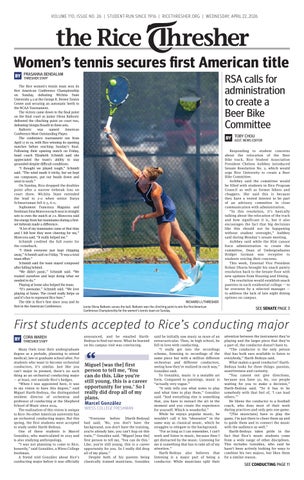
The Rice women’s tennis team won its rst American Conference Championship on Sunday, defeating Wichita State University 4-2 at the George R. Brown Tennis Center and securing an automatic berth to the NCAA Tournament.
The victory came down to the nal point on the nal court as junior Divna Ratkovic delivered the clinching point on court two, defeating Giorgia Roselli in three sets.
Ratkovic was named American Conference Most Outstanding Player.
The conference tournament ran from April 17 to 19, with Rice winning its opening matches before reaching Sunday’s nal. Following their opening match on Friday, head coach Elizabeth Schmidt said she appreciated the team’s ability to stay grounded despite di cult conditions.
“I thought we played tough,” Schmidt said. “The wind made it tricky, but we kept our composure, put our heads down and went to work.”
On Sunday, Rice dropped the doubles point after a narrow tiebreak loss on court three. Wichita State extended the lead to 2-0 when senior Darya Schwartzman fell 6-3, 6-0.
Sophomore Francesca Maguina and freshman Ema Mravcova each won in straight sets to even the match at 2-2. Mravcova said the energy from her teammates during a rstset tiebreak made a di erence.
“A lot of my teammates came at that time and I felt how they were cheering for me,” Mravcova said. “It really helped me.” Schmidt credited the full roster for the comeback.
“I think everyone just kept chipping away,” Schmidt said on Friday. “It was a total team e ort.”
Schmidt said the team stayed composed a er falling behind.
“We didn’t panic,” Schmidt said. “We trusted ourselves and kept doing what we needed to do.”
Playing at home also helped the team.
“It’s awesome,” Schmidt said. “We love playing at home. The crowd really helps us and it’s fun to represent Rice here.”
The title is Rice’s rst since 2019 and its rst in the American Conference.
RSA calls for administration to create a Beer Bike Committee
Responding to student concerns about the relocation of the Beer Bike track, Rice Student Association President Chelsea Asibbey introduced Senate Resolution No. 2, which would urge Rice University to create a Beer Bike Committee.
Asibbey said the committee would be filled with students in Rice Program Council as well as former bikers and chuggers. She said this is because they have a vested interest to be part of an advisory committee in close communication with administration.
“In this resolution, it’s basically talking about the relocation of the track and how significant it is, but it also encourages the fact that big decisions like this should not be happening without student oversight,” Asibbey said during Monday’s senate meeting.
Asibbey said while the RSA cannot force administration to create the committee, Dean of Undergraduates Bridget Gorman was receptive to students voicing their concerns.
This week, External Vice President Rohan Dharia brought his snack pantry resolution back to the Senate floor with new updates from Housing and Dining. The resolution would establish snack pantries in each residential college to be overseen by a selected manager to address the lack of late night dining options on campus.
First students accepted to Rice’s conducting major
CORA WAREH THRESHER STAFF
Many Owls treat their undergraduate degree as a prelude, planning to attend medical, law or graduate school after. For students who want to become orchestral conductors, it’s similar. Just like you can’t major in premed, there’s no such thing as an orchestral conducting major — at least, not outside Rice’s hedges.
“When I was appointed here, it was in my vision to have this degree,” said Miguel Harth-Bedoya, the distinguished resident director of orchestras and professor of conducting at the Shepherd School of Music since 2024.
The realization of this vision is unique to Rice: No other American university has an orchestral conducting major. But this spring, the first students were accepted to study under Harth-Bedoya.
One of these students is Marcel González, who matriculated in 2025 and is also studying anthropology.
“I was not planning to come to Rice, honestly,” said González, a Wiess College freshman.
A friend told González about Rice’s conducting major before it was officially
announced, and he emailed HarthBedoya to find out more. What he learned on his campus visit was convincing.
Miguel [was the] first person to tell me, ‘You can do this. Like you’re still young, this is a career opportunity for you.’ So I really did drop all of my plans.
Marcel González WIESS COLLEGE
FRESHMAN
“Everyone before [Harth-Bedoya] had said, ‘No, you don’t have the background, you don’t have the training, you’re already late, you can’t hop on this train,’” González said. “Miguel [was the] first person to tell me, ‘You can do this.’ Like, you’re still young, this is a career opportunity for you. So I really did drop all of my plans.”
Despite both of his parents being classically trained musicians, González
said he initially saw music as more of an extracurricular. Then, in high school, he fell in love with conducting.
“I really got into the recordings scheme, listening to recordings of the same piece but with a million different orchestras and different conductors, seeing how they’re realized in each way,” González said.
To González, music is a mutable art form. Compared to paintings, music is “actually very vague.”
“It only tells you what notes to play and what time to play them,” González said. “And everything else is something that, you have to reenact the art in the moment and you create the experience for yourself. Which is wonderful.”
While he enjoys popular music, he wouldn’t call it his “obsession” in the same way as classical music, which he struggles to relegate to the background.
“For as long as I can remember, I can’t work and listen to music, because then I get distracted by the music. Listening for me is something that has to take all of my attention.”
Harth-Bedoya also believes that listening is a major part of being a conductor: While musicians split their
attention between the instrument they’re playing and the larger piece that they’re a part of, the conductor doesn’t have to.
“The conductor is the only person that has both ears available to listen to everybody,” Harth-Bedoya said.
What makes a good conductor? HarthBedoya looks for three things: passion, assertiveness and curiosity.
“You cannot not give directions, because you have 50, 80, 100 people waiting for you to make a decision,” Harth-Bedoya said. “So it has to be somebody with that feel of, ‘I can lead others.’”
He likens the conductor to a football coach, who does most of their work during practices and only gets one game.
“[The musicians] have to play the game. I’m just there to cheer them up and to guide them and to connect the music with the audience as well.”
Harth-Bedoya takes pride in the fact that Rice’s music students come from a wide range of other disciplines. This includes González, who said he hasn’t been actively looking for ways to combine his two majors, but likes them for a similar reason.
RICHARD LI /THRESHER
Junior Divna Ratkovic serves the ball. Ratkovic won the clinching point to win the rst American Conference Championship for the women’s tennis team on Sunday.
TOBY CHOU ASST. NEWS EDITOR
H&D and students reflect on a year of meal plan changes
LINA KANG ASST. NEWS EDITOR
Under Beth Leaver’s tenure as the interim assistant vice president for housing, dining and hospitality, she has implemented many changes — including the transition to the unpopular unlimited meal plan.
Taylor Schultz, former Duncan College president, said while administrators framed the new system as a bene t, the reality felt more restrictive in practice. Students who previously used swipes exibly for quick visits or to share meals reported frustration with stricter entry policies and limitations on guest access.
“I don’t think Beth Leaver is a villain,” said Schultz, a senior. “I think the biggest frustration that I had as president in the fall with all the meal plan changes was that they were presented to students as a bene t.”
I don’t think Beth Leaver is a villain. I think the biggest frustration that I had as president in the fall with all the meal plan changes was that they were presented to students as a benefit.
Taylor Schultz FORMER DUNCAN COLLEGE PRESIDENT
Schultz said factors that might have led to the unlimited dining plan were increases in food costs and operational challenges tied to sta ng and extended service hours.
“So there’s a lot of logistics behind the scenes of, if you want more food available … at more times throughout the day, then you are going to end up needing more money to operate,” Schultz said. “And then you have to raise the price of the meal plan, which I wish that they would have just transparently been like, ‘Look, our operating costs are increasing. We need to increase the cost of the meal plan.’”
With the concern of emphasis on pro t decreasing food quality, Leaver said the dining program is not operated for pro t.
“Every dollar generated through the program is reinvested back into dining operations to support food quality, providing a livable wage to sta , facilities, and program improvements,” Leaver wrote in an email to the Thresher. “As a self-funded operation, we do have a responsibility to manage costs carefully so the program remains sustainable long term. At the same time, our goal is never to compromise quality.”
Leaver wrote that when she hears concerns, the Housing and Dining team reviews and makes adjustments as needed.
“Our team takes a great deal of pride in the food we serve and the experience we provide,” Leaver wrote. “We continue to encourage students who have concerns to reach out to their food ambassador representative in their college, which helps us understand these perceptions and respond to them in moment.”
Food ambassadors are in charge of gathering feedback from residential colleges and reporting back to chefs.
Amarachi Moghalu, a Baker College food ambassador, said Leaver is approachable but o en misunderstood by students due to limited direct interaction.
“I think that she’s more of an abstract idea to a lot of students,” Moghalu said. “Because of that, they’re not going out of their way to ask her, ‘Why are these decisions happening?’ Her main concern, really, is student happiness.”
Berny Guerra Arthur, food ambassador and former McMurtry College president, said food quality is ultimately subjective.
“Everybody has di erent tastes, di erent preferences, everywhere from the actual foods people might want to eat on a given day to when people are actually getting their meals,” said Guerra Arthur, a senior.
Suri Yang, a Will Rice College freshman, said she felt Rice’s dining and food quality were among the top compared to other universities.
“I think they put a lot of e ort into bringing a lot of di erent cultural foods into the serveries and having themed lunches and dinners,” Yang said.
Cindy Yan, a Lovett College sophomore, said H&D does a good job of including di erent diets, including options for vegan desserts.
“I do personally feel that sometimes the execution could be a lot better, especially with the healthy dining options,” Yan said. “There’s a lot of oil in there.”
Chioma Igollo-Ogele, a Baker freshman, said there could be improvements in the dining quality.
“I think all around, there are things that they do well and they don’t do well, but sometimes the problem is there is a lack of consistency in the things that they do well,” Igollo-Ogele said. “So then there’s a general sense of uncertainty regarding what there is at serveries. Speci cally, Taco Tuesdays at Baker this semester was quite good, but sometimes the wraps are either very good or not so good.”
With the introduction of Munch in prior years and late-night dining hours added to the schedule this school year, former Sid Richardson College president Arjun Surya said the dining experience has improved since his freshman year.
“I really do think that they’re expanding the hours in which you can get access to food,” Surya said. “I also think there have been other positive changes, like the addition to the allergy-free stations, which are helpful for me, because I have a lot of food allergies too.”
Schultz said stricter Rice ID checks at the beginning of fall 2025 raised concerns among the presidential cohort, particularly for students whose appearance or name may not match their ID.
“For a myriad of reasons, people don’t look like their pictures,” Schultz said. “The idea of having an H&D employee scrutinize your ID was very upsetting to us.”
Surya said concerns about enforcement arose early in the semester, including
I really do think that they’re expanding the hours in which you can get access to food. I also think there have been other positive changes, like the addition to the allergy-free stations, which are helpful for me, because I have a lot of food allergies too.
Arjun Surya FORMER SID RICHARDSON COLLEGE PRESIDENT
reports of students having IDs temporarily con scated.
“So earlier this semester, when the new dining plan was announced, we as college presidents had a conversation with Beth as well as Dean Gorman about some speci c concerns that we had,” Surya said. “However, very soon a er that Beth told all the H&D workers that they shouldn’t be so scrutinizing. Initially people weren’t allowed to reenter for a drink, but now I feel like they’ve been more accommodating
with it.”With the new dining system, questions also emerged around how the previous meal donation swipe system would operate. Schultz said student frustrations should be framed carefully when engaging with administration.
“Obviously, H&D does not want people bumming swipes o of other people,” Schultz said. “So our argument cannot be like, ‘Oh, we hate the new meal plan because we can’t steal food anymore.’ I think that there’s something to be said for like you have to recognize what their motives are and try to align them with yours. That’s never going to align.”
In response to food quality, the Student Food Ambassador program has expanded, according to Moghalu and Guerra Arthur.
“I think the food ambassador program has actually been really big this year because the chefs are getting constant feedback,” Moghalu said.
Moghalu also described broader engagement e orts led by Leaver.
“I worked under the person who was in her position before,” Moghalu said. “One thing that’s really di erent is that [Leaver] is really concerned about student happiness. She literally spends the summer testing out di erent foods, talking to the chefs, asking what students want to see.”
Leaver wrote that there are improvements being made directly from student feedback, including expanding late-night dining, extending hours and implementing digital technologies for South Main Servery.
“We are also implementing new tools that will improve transparency and the dining experience, including a digital recipe management platform that will provide clearer nutrition information and enhanced digital menu displays,” Leaver wrote.
/ THRESHER
A student swipes in to enter West Servery. The on-campus meal plan changed to follow an unlimited swipe system during fall 2025 with 15 allocated guest swipes.
DesRoches makes strides with Run with Reggie
ABIGAIL CHIU NEWS EDITOR
President Reggie DesRoches hosted his third iteration of Run with Reggie this year, an open-invite group that runs the three-mile outer loop. The Saturday event saw a turnout of around 40 people, who gathered at 9 a.m. to stretch by the Sallyport. The crowd included a mixture of students, faculty, sta and community members, including magisters and resident associates.
DesRoches, along with his wife Paula
Gilmer DesRoches, quickly set the pace and led the pack around campus, dodging through puddles and crosswalks in the morning sun. A er nishing the outer loop, DesRoches went on to run additional miles around the inner loop.
DesRoches said the tradition started in his early years as president.
“It started, my rst, maybe my second year as president. We started nding this as a way to connect with students,” DesRoches said. “The rst time we did it was a big mistake, because we did it at 8 o’clock on a Saturday, and it was just us. You realize
8 o’clock is not good for students, so we’ve changed it.”
Brad Burke, executive director of the Rice Alliance for Technology and Entrepreneurship, said he came to Run with Reggie because he is a former triathlete.
“Nine years ago, I started to run the halfmarathon every year,” Burke said. “I’ve run it nine years, and this year I’m going to try to train for it and run my 10th in January.”
Anthony Potoczniak, the assistant dean of undergraduates, said he came because DesRoches was the original inspiration for him to run several years ago.
“We were at an event, and I asked the president what keeps him going? And I asked him what his time was, and he said he runs 3 to 6 miles regularly at the time, and he had a nine-minute pace,” Potoczniak said.
“And I said, ‘I’m going to start doing that too.’ So about three years ago, I resumed my running because he inspired me.”
DesRoches con rmed at the event he could run a nine-minute mile.
“I’m a strong believer in the importance of moving and the connection between physical health and mental health,” DesRoches said.
KONSTANTIN SAVVON
Colleges adopt opt-in system for Beer Bike wake-up
CHRISTINE XU THRESHER STAFF
Some colleges required students to put two lines of tapes on their doors this year to indicate if they wanted to be woken up, rather than using the traditional system in which students who did not want to be awoken taped their doors.
Where this was mentioned, we shared with student leaders that an ‘opt-in’ practice is a more inclusive approach than an ‘opt-out’ one, as it respects the diverse needs, jobs, and commitments of all our community members.
Bridget Gorman DEAN OF UNDERGRADUATES
submit a Beer Bike morning strategy with plans to address student safety and the alcohol policy to Rice administrators. Bridget
FROM FRONT PAGE SENATE
“I’ve been in conversations with H&D, and they’ve agreed to contribute $500 per college per semester to this program,” Dharia said. “We also have a grant that’s going to provide an infrastructure for the pantries, so that’ll provide whatever we need. We can also use initiative funding for a pilot of the program if there isn’t additional money that can be committed.”
Lovett College President Bruce Hurley, the founder of Lovett’s own snack pantry, said his college spends around $2,400 on the snack pantry for the entire academic year, restocking monthly.
“That money was allocated to us with specific Lovett funds that were allocated
Gorman, the dean of undergraduates, said some of these plans included strategies to wake students in the early morning of Beer Bike Saturday.
“Where this was mentioned, we shared with student leaders that an ‘optin’ practice is a more inclusive approach than an ‘opt-out’ one, as it respects the diverse needs, jobs, and commitments of all our community members,” Gorman wrote in an email to the Thresher. “We know that not all students participate in Beer Bike, and it is important for us to be inclusive of all community members in our planning process.”
The Dean’s office has been conducting an ongoing hazing prevention review this semester. The Dean’s office was auditing Orientation Week activities under the Stop Campus Hazing Act, a 2024 federal law that requires universities to evaluate activities that could constitute hazing under its “above the reasonable risk” standard.
In Gorman’s email to the Thresher, she did not address whether the opt-in recommendation was part of the hazing review.
At Martel College, which adopted the opt-in approach, students were required to place two lines of tape on their doors to be woken up, according to Andrea Nguyen, a Martel Beer Bike coordinator. Nguyen, a sophomore, said Martel received notice of the change through
for student initiative projects, and then recently we have used the Ambiance Fund,” Hurley said.
Will Rice College President Raye Osayimwese-Sisson asked Hurley what safeguards were in place at the Lovett pantry in order to deter individuals from taking advantage of it.
Hurley said while that has been an issue in the past, Lovett is currently changing the distribution of snacks to a slow drop rather than depositing all the snacks at once, which has led to them being taken in only a few days.
Dharia’s snack pantry resolution will be discussed next week, but it will likely not be passed until next semester.
Martel Chief Justice London Frey about four days before Beer Bike Saturday, and she was not sure if all colleges received the same guidance.
“From what I heard from the CJ was that they were trying to reinforce this for all the colleges, but I think it might not have been informed in time for all colleges to follow this,” Nguyen said. “So it might just have been some colleges that followed through with this.”
For some students, the old strategy had its downsides.
I don’t have any problem with people being loud at all, but I guess if people want to sleep soundly during that day, it’s a bit hard. But on the other hand, it’s tradition, and I think it doesn’t take more than five minutes.
Jonathan Avecilla HANSZEN COLLEGE SENIOR
As McMurtry College is one of the colleges that still uses it, Amelia Wigder, a McMurtry freshman, said the door-
The RSA also gave updates on the results of Tetra Week.
Internal Vice President Mahtab Dastur said around 70 students received Tetra points with at least two recipients from each residential college. Recipients will receive emails on how to collect their points soon.
Finally, Treasurer Suri Yang introduced the Blanket Tax Committee Spring Allocation Report, which determines the budgets for the Blanket Tax Organizations for next fiscal year. The Blanket Tax Committee’s allocations must be approved by a vote in Senate in order to take effect.
According to the report, five
tape system did not prevent the wake-up tradition from reaching those who had opted out.
“I don’t think that it helped the people that taped their door because there were still people screaming in the hallways and with air horns and banging on other people’s doors,” Wigder said. “So I don’t think that that was an effective way to opt out.”
Gorman said the Division of Student Life and Undergraduate Education is open to discussion about future strategies.
“If some students have expressed that the door-tape system has not been effective in practice, we would welcome college leadership teams to discuss an optimal implementation plan for next year that can be shared as a best practice,” Gorman wrote.
Jonathan Avecilla, a Hanszen College senior, said he had concerns about the system’s effectiveness but said he valued the wake-up as a tradition.
“I don’t think that works very well, especially in Old Hanszen. You can hear what everyone says in the corridor, especially if they’re screaming,” Avecilla said. “I don’t have any problem with people being loud at all, but I guess if people want to sleep soundly during that day, it’s a bit hard. But on the other hand, it’s tradition, and I think it doesn’t take more than five minutes.”
organizations, including the Rice Women’s Resource Center, were approved by the committee for full funding. The remaining six organizations received partial funding, with the largest total amount allocated to the Rice Program Council.
While no discussion centered the budget at Monday’s meeting, Asibbey said their next meeting would be critical in ensuring that BTOs have functioning budgets over the summer.
“We have to make this go through, or else every single organization is without funds until the fall semester, which would essentially cause a government shutdown,” Asibbey said.
Fiscal Year 27: Requested Fiscal Year 27: Approved
80,000
100,000 60,000 40,000
Residential college Beer Bike coordinators were required to
HACER and Staff Council express gratitude for staff as the spring semester winds down
RACHEL JEONG THRESHER STAFF
In addition to expressing gratitude, staff appreciation events from Hispanic Association for Cultural Enrichment at Rice and the Staff Council aim to foster connection among Rice staff.
On Thursday afternoon, a Housing and Dining appreciation event took place in the Sid Richardson College Quad. Organized by HACER, the event featured catered pupusas and conchas, a performance from the student group Los Búhos del Norte and remarks from campus leadership.
HACER Community Outreach CoChair Zachary Rubio mentioned the student organization’s connection with staff appreciation at Rice.
HACER has a unique link with H&D, since a lot of the staff are Spanishspeaking, and a lot of them come from Latin American countries or backgrounds. We wanted to appreciate them, since we had less of a communication barrier with them.
Zachary Rubio HACER COMMUNITY OUTREACH COCHAIR
“HACER has a unique link with H&D, since a lot of the staff are Spanishspeaking, and a lot of them come from Latin American countries or backgrounds,” Rubio said. “We wanted to appreciate them, since we had less of a communication barrier with them.”
Rubio said HACER wanted to replicate but slightly modify its appreciation event from last year, inviting H&D staff across campus to share music and food with guest speakers, and share community with students.
Ely Zambrano, a cashier at Seibel Servery, said the event emulated a feeling of home.
“The event was completely amazing. I like it, the music, [and] also the food. I was feeling at home whenever I was over there,” Zambrano said.
Zambrano hopes efforts like HACER’s will continue.
“I would like to see this [event] every year,” Zambrano said. “It looks amazing, like everyone’s family. Whenever they make events like this, [they] feel like a reunion.”
In addition to the event, Rubio mentioned that this year, HACER wanted to streamline other appreciation efforts to better accommodate H&D staff’s schedules, trying out a grab-and-go option.
”We made 200 goodie bags with snacks and H&D merchandise, which was distributed to each of the serveries [so] that H&D staff could grab-and-go throughout the week,” Rubio said.
Rosalinda Rivera, a H&D staff member at Baker Kitchen, said she appreciated HACER’s efforts with the goodie bags.
“We were excited to receive a[n] appreciation bag. Whatever comes from you guys means a lot to us,” Rivera said.
When members of HACER went to the colleges to collect any leftover bags, Rubio said, there were none.
“I think it’s good to recognize the staff at Rice that are not just faculty, like people that they see in the classrooms, but also the other staff that do a lot of hard work that don’t often get recognized, like H&D,” Rubio said.
After HACER’s H&D appreciation event, Rice campus saw another staff appreciation event — this time, not in the open air of a quad, but in the shaded groves of the Valhalla patio.
On Thursday evening, the Staff Council, a volunteer-based representative body for Rice staff, hosted the Staff Council Social Hour. According to Vice Chair for Staff Council Caitlin Lindsay, the event was one out of a broader series of programming, staff-recognition efforts and professional development offerings by the Staff Council.
“We make recognition a yearlong kind of experience,” Lindsay said.
For Lindsay, it is easy for staff members to feel disconnected in their disparate parts of campus, especially as Rice continues to expand. As a result, in addition to emphasizing staff recognition,
she hopes Staff Council programming can provide the opportunity for staff to come together.
“Yes, there can be a recognition corner within that, but it’s more so focused on the community, the connection,” Lindsay said. “How can we help to break down some of those silos and build more of those connections?”
These staff appreciation events come during the same time that President Reggie DesRoches aims to elevate Rice’s standing in workplace rankings, according to Lindsay.
“I know President DesRoches has had goals for years for us to get back on the ‘Best places to work’ list, and so [we’re] looking at what role we can play in helping everyone to know how staff are truly feeling [and] ways that we can support staff,” Lindsay said.
On Thursday, DesRoches will host the Staff Appreciation Celebration at Tudor Fieldhouse through the Staff
Council, featuring guest speakers and staff-recognition awards from the Staff Council and from Human Resources.
I know President DesRoches has had goals for years for us to get back on the ‘Best places to work’ list, and so [we’re] looking at what role we can play in helping everyone to know how staff are truly feeling [and] ways that we can support staff.
Caitlin
Lindsay
STAFF COUNCIL VICE CHAIR
RSA expands late-night study options with O’Connor building
CAMERON
GUTIERREZ THRESHER STAFF
In an e ort to expand studying options during nals season, Rice is transforming the Ralph S. O’Connor Building for Engineering and Science into an a erhours campus study space.
The Rice Student Association Senate introduced the program on March 30.
The O’Connor building, which previously closed at 10 p.m., is now accessible via Rice ID until 2 a.m. on Monday through Thursday, Saturday and Sunday. On Fridays, the building will be accessible until 12 a.m.
The designated study space spans both the basement level and rst oor of the O’Connor building.
Rohan Dharia, external vice president, said a lack of accessible late-night study spaces prompted the decision in an email to the Thresher.
“Previously, Fondren Library –which closes at 2 AM –was essentially the only option, and students o en want di erent environments in which to study,” wrote Dharia. “We also heard concerns from ocampus students about the lack of places to work on weekends.”
The program is not the rst time the RSA has attempted to expand late-night
study options to undergraduate students.
During fall 2025, the RSA introduced, in conjunction with Fondren Library, 24-hour pilot program during nals week. The move was a large part of the RSA’s expanded e orts to provide more accessible campus resources to students.
However, according to data from Fondren, the 24-hour pilot was not as popular as both organizations had anticipated.
“Based on the Survey of All Students data we collected, we anticipated a large demand for use during nals season,” wrote Lau, RSA chief of sta , in an email to the Thresher. “However, headcounts during the Fondren Night Owls pilot showed a peak attendance of 40 people in a single night — less than 0.7% of the projected use rate (even during nals season!).”
Susan Garrison, director of access services at Fondren, said late-night study spaces should be expanded, but costs should be proportional to the students who use said spaces. Garrison said there is a need for alternative, more economical late-night study spaces for students.
Garrison said rather than keeping the entire library open, the data suggests utilizing smaller campus hubs like Rayzor Hall, the O’Connor building, Kra Hall or
McNair Hall to better accommodate this niche group.
Mia Patrick, a Duncan College freshman, said she was excited about the
I think it’s a good start, but Rice could definitely do more. There are so many great study spaces on campus, and having only one main late-night option can be limiting — especially for students who live farther away. Expanding to multiple late-night spaces would make studying more accessible.
Saran Tugsjargal SID RICHARDSON COLLEGE
FRESHMAN
move to turn the O’Connor building into a dedicated late-night study space.
“I wish it had happened sooner, but I’m glad we’re nally getting more options
for late-night study spaces on campus,” Patrick said.
However, not all students feel the changes go far enough. Saran Tugsjargal, a Sid Richardson College freshman, said while she is glad more spaces are being added, she wishes they were more evenly spread across campus.
“I think it’s a good start, but Rice could de nitely do more,” Tugsjargal said. “There are so many great study spaces on campus, and having only one main latenight option can be limiting — especially for students who live farther away. Expanding to multiple late-night spaces would make studying more accessible.”
Dharia said while the O’Connor building is the only late-night study location currently open, the RSA intends to expand this program to the south side of Rice’s campus.
“The goal of this pilot is to gather data on both usage and how the space is treated,” Dharia said. “If the pilot is successful, we fully intend to expand the program.”
In an infographic shared with the Rice community through Instagram, the RSA said building access can be “expanded or removed” based on the student body’s response to and treatment of the new study space.
Women’s sports win. Why aren’t fan incentives better?
This year has been nothing short of historic for Rice women’s sports. Soccer was ranked No. 25 in the nation, volleyball had a 17-game win streak, basketball had a 22game win streak and swim and dive won the American Conference Championships, as did the tennis team on Sunday.
In fact, six out of seven women’s teams that have competed in conference tournaments have nished as either the winner or the runner-up. The only exception is track & eld, which took third place at the American Conference Indoor Championships, headlined by Mckyla van Der Westhuizen, who boasts the second-longest javelin throw in the nation so far this season.
Women’s sports success stories have been constant throughout the past year, but so have the lackluster incentives provided to students for their attendance.
When Rice made national news for giving students free beer at the November football game against the University of North Texas, we had high hopes for the future of student attendance. Instead, we found that this level of fan excitement exists only for men’s sports,
and usually only through the rst half of games before the score gets out of hand.
Rice Rally and Rice Athletics have long worked to incentivize students to come to games. And to their credit, this year has seen some of the more popular promotions in recent Rice history.
Along with free beer at both football and men’s tennis, the “Rice of the North” T-shirts for baseball’s Harvard series brought lines down the Reckling Park stairs over an hour before game time, and their 713 Nights bring in regular tra c on weekday evenings — not to mention the $1,000 HEB gi card promotion that was a highlight of the men’s basketball season.
And what do these promotions have in common? They all happened at men’s sporting events.
For women’s sports, their promotions have been much worse. The season highlight is likely women’s basketball’s “Today Not Tomorrow” T-shirts that make semi-frequent appearances around campus or the Sammy the Owl sailor hats, most of which saw women’s basketball’s nail-biting 70-68 win
over North Texas on Feb. 10 followed by the inside of a dark closet for the next two months.
This disparity in incentives sends the message to students, and student-athletes, that Rice cares about men’s sports more than women’s. Yet Rice women are consistently winning.
And we can’t forget the tantalizing women’s tennis promotion of one singular free taco at the American Conference Championship last weekend or basketball’s LEGO Night at Tudor Fieldhouse, where students received a Dominique Ennis LEGO gurine which can best be described as small in both size and signi cance.
This disparity in incentives sends the
message to students — and student-athletes — that Rice cares about men’s sports more than women’s. Yet Rice women are consistently winning. So why don’t they merit the same level of fan experience investment when they are clearly capable of achieving a higher level of athletic excellence?
If you enjoyed baseball’s craw sh boil at Reckling Park and one of the 500 “Boil the Cougs” T-shirts, just imagine how successful a promotion like that would be for one of our women’s teams as they extend a doubledigit win streak or chase an American Conference title. Women’s sports have seen consistent success at Rice this year, and their achievements deserve the same recognition as men’s.
Editor’s Note: Thresher editorials are collectively written by the members of the Thresher’s editorial board. Current members include James Cancelarich, Evie Vu, Abigail Chiu, Hongtao Hu, Andrew Rynsburger, Chi Pham, Andersen Pickard and Patrick Shukis. Sports editor Andersen Pickard recused himself from this editorial due to involvement with Rice Baseball.
Rice curriculum disincentivizes foreign language acquisition. That must change.
ANDREW RYNSBURGER OPINION EDITOR
Rice sits just 300 miles from the Mexican border in a city where 46% of residents speak a language other than English at home. But many students aren’t learning foreign languages, and Rice has no one to blame but itself.
Rice’s curriculum used to include a foreign language requirement. Not only has that requirement been removed, but the university has rewritten a system of distribution credits in a way that structurally disincentivizes students from taking rst-year language courses.
Under the spring 2026 university graduation requirements, students must take nine classes across three distribution groups, divided into the humanities and arts, social sciences, and math and science. While foreign language classes are typically eligible for group one distribution credit, a change in policy effective in 2019 rescinded distribution credit for first-year foreign language classes.
This change is particularly galling given the university’s stated commitments to “extend the global reach and reputation of Rice.” If students do
not speak foreign languages, how will they expect to interact with a global community? Rice cannot credibly position itself as a global university if it disincentivizes language acquisition.
Behind the hedges, student enrollment in foreign languages has plummeted.
According to course registration data, enrollment in rst-semester Spanish dropped from 106 to 27 students from the fall of 2015 to the fall of 2025, a 75% decline. Introductory German enrollment fell from 30 to 10, and introductory Chinese from 40 to 18. Meanwhile, Rice enrollment grew from 6,623 to 8,978 students over the same period.
Even while opening an international campus in Paris in 2023, Rice’s enrollment in introductory French has stagnated over the past ten years, from 50 students to 46 students. The university is sending an incongruous message: We welcome students to study in Paris, but would prefer not to incentivize the study of French itself. In fact, Rice Global states that “it is not necessary to speak French while visiting or studying in Paris.”
The mismatch does not end there. While Rice teaches just nine languages, comparable institutions like the University of Chicago teach over 50.
Harvard University teaches about 45 languages. And in fall 2023, Rice quietly discontinued all of its Russian courses. This came just over a year a er Putin’s full-scale invasion of Ukraine.
But this low foreign language enrollment should come as no surprise. Why would students take classes that don’t help them ful ll graduation requirements? Especially for students studying engineering or those with in exible schedules, it can make the di erence between pursuing an interest and nixing it.
While some may argue that students start language acquisition long before college and thus need not take introductory courses, this is far from the truth in many American schools. In Texas, only 19% of K-12 students were enrolled in a foreign language class during the 2014-15 school year. This figure is not atypical; it is nearly identical to the national average.
All the while, research from Rice’s Kinder Institute for Urban Research has found that children who receive bilingual education o en become more pro cient in English than their monolingual counterparts. The cognitive and neurological bene ts of bilingualism
are well documented and extend even to those who learn a second language later in life.
Taken together, the evidence is di cult to ignore.
If Rice seeks to compete on the global stage and prepare students for life beyond the con nes of American borders, it has an obligation to act. Solely o ering language classes does not make them accessible. They must be embedded as a core part of the curriculum. Restoring distribution credit for introductory language courses is a necessary rst step.
Eye on accessibility: Testing accommodations pose difficulties
COLETTE MINTON FOR THE THRESHER
For many students, midterm season is a precarious balancing act of assignments, studying and other commitments. For students with testing accommodations, that balance becomes even more precarious.
There is no uniform exam administration process, and demanding student schedules pose difficult logistical challenges.
The current hours of the O ce of Academic Support for Undergraduate Students Testing Center, excluding nals season, are insu cient. It is exceptionally di cult to nd a two- to three-hour window between 8:30 a.m. and 5:30 p.m. on weekdays that does not con ict with class times. Since the Testing Center is closed on weekends, exams can get pushed into the following week, further complicating a student’s schedule and workload.
Some weekdays are more logistically challenging than others. Recently, I could not arrange an exam that was originally
scheduled for Friday evening, despite being available nearly all of Thursday, because some departments do not allow early testing. The earliest I could start the exam on Friday would have run past closing time. Due to these obstacles, the Testing Center was inaccessible to me.
Scheduling con icts are not the only issue I have encountered while preparing for midterms. Currently, there is no standard procedure professors follow to administer testing accommodations. Some professors place most, if not all, of the responsibility for making exam arrangements on me. Others choose to schedule and facilitate assessments on my behalf.
Placing the responsibility on the student is not an issue by itself; it is the fact that there is no clear protocol for who is expected to make testing arrangements. It can take multiple business days for an exam in the Testing Center to be arranged, so students are expected to plan well in advance.
In one class I took last semester, I did not realize that it was my responsibility
to schedule midterms with the Testing Center. This resulted in heightened stress as I learned only days before the test whether arrangements had been nalized. While I have tried to be more proactive this semester, this obstacle still remains.
The general need for a more structured, standardized procedure for exam administration is evident. This, along with expanded hours of operation for the Testing Center, is critical to give all students the opportunity to accurately demonstrate their comprehension of the material. Reducing the ambiguity in the accommodation administration process and making it easier to schedule exams will provide predictability for both students and faculty.
Editor’s Note: This is a column that has been submitted by a contributor to the Thresher. The views expressed in this opinion are those of the author and do not necessarily represent or re ect the views of the Thresher or its editorial board. All columns are fact-checked to the best of our ability and edited for clarity and conciseness by Thresher editors.
Colette Minton is a Martel College freshman studying mechanical engineering. Her experiences with physical and invisible disabilities give her unique insight into the shortcomings of Rice’s infrastructure. Through this column, she aims to spread awareness and improve accessibility at Rice.
Student governance isn’t killed in a single dramatic blow; it’s dismantled one minor procedural adjustment at a time.
While most students don’t spend their time reading through the bylaws of the Rice Student Association, buried within pages of dense procedural language are policies that quietly shape how student life functions.
One of these is Bylaw 2202, which governs the recognition of student organizations. Currently, the RSA is considering a proposal that would cede authority to the administration we are meant to check and balance.
Under the current system, the process is relatively straightforward. Each club must submit its required documents, including a constitution, to the O ce of Student Activities every year for renewal. A er the administrative sta reviews these documents, the RSA parliamentarian conducts a nal review. This system allows the process, at least in part, to remain in student hands.
The RSA is currently considering a change to Bylaw 2202 that would alter how clubs are renewed each year. The amendment would remove the requirement for student parliamentarian approval of club constitutions during the renewal process, allowing the O ce of Student Activities to handle renewals independently. What is currently a required student checkpoint, however routine it may be, would be replaced by full-time administrative sta . The justi cation is largely practical.
With hundreds of clubs to renew, the parliamentarian’s role becomes repetitive, especially when administrative sta have already reviewed the materials. However, the signi cance of this proposed change is not in how clubs are reviewed. It is in the precedent set by ceding power. When the RSA relinquishes even a small piece of its authority, it signals that student oversight is optional and that administrative control is an acceptable substitute.
Universities are, by design, highly administrative institutions. Decisions about academics and campus operations
are already largely out of students’ hands. The RSA exists to carve out a space where students retain control over their own community.
It is easy to justify giving up power when the stakes seem low.
But power, once given up, is rarely reclaimed, and each small concession makes the next one easier. To be clear, the current process for club approval is not perfect. If the parliamentarian’s review process is ine cient, the RSA should reform it. Streamline it. Make it work. But not at the expense of student control, because the moment we stop being responsible for our own rules, we stop being a government and start being a department.
Editor’s Note: This is a column that has been submitted by a contributor to the Thresher. The views expressed in this opinion are those of the author and do not necessarily represent or re ect the views of the Thresher or its editorial board. All columns are fact-checked to the best of our ability and edited for clarity and conciseness by Thresher editors.
Max Menchaca is a Brown College sophomore studying political science and statistics. Eli Risinger is a Wiess College sophomore studying political science and social policy analysis. Both are former Rice Student Association senators and believe every Rice student should be well informed to advocate for their interests in student government.
Last Week’s Online Poll Results
What are your summer plans?
290
EDITORIAL STAFF
* Indicates Editorial Board member
James Cancelarich* Editor-in-Chief Evie Vu* Managing Editor
NEWS
Abigail Chiu* Editor Hongtao Hu* Asst. Editor
Toby Chou Asst. Editor
Ruby Gao Asst. Editor
Lina Kang Asst. Editor
OPINION
Andrew Rynsburger* Editor
FEATURES
Amelia Davis Editor
ARTS & ENTERTAINMENT
Chi Pham* Editor
SPORTS Andersen Pickard* Editor
Patrick Shukis* Editor
Keya Patel Asst. Editor
BACKPAGE
Charlie Maxson Editor
Max Scholl Editor
Will Howley Editor
Rykelle Sandidge Senior Writer
COPY
Shruti Patankar Editor
Julianne Ma Editor
PHOTO, VIDEO, & WEB
Ayaan Riaz Director of Digital Media
Francesca Nemati Photo Editor
Konstantin Savvon Asst. Photo Editor
Steven Burgess Video Editor
Fiona Guo Social Media Manager
Megan Zhang Web Editor Fiona Sik Web Editor
Varshini Loganathan Web Editor
DESIGN
Jessica Xu Art & Design Director
Magnolia Hickey-Zamora News
Sydney Chang Opinion
Lisa Wang Features
Alexa Bu Arts & Entertainment
Kirstie Qian Sports
Brandon Nguyen Backpage
Richard Li Design Consultant
BUSINESS
Sivani Vasireddy Manager
Alina Zhong Advertisement
Rahul Santhanam Advertisement
ABOUT
The Rice Thresher, the official student newspaper of Rice University since 1916, is published each Wednesday during the school year, except during examination periods and holidays, by the students of Rice University.
Letters to the Editor must be received by 5 p.m. on the Friday prior to publication and must be signed, including college and year if the writer is a Rice student. The Thresher reserves the right to edit letters for content and length and to place letters on its website.
Editorial and business offices are located on the second floor of the Ley Student Center: 6100 Main St., MS-524 Houston, TX 77005-1892
Phone: (713) 348 - 4801
Email: thresher@rice.edu
Website: www.ricethresher.org
The Thresher is a member of the ACP, TIPA, CMA and CMBAM.
Over the moon: Rice experts discuss impacts of Artemis II
With finals rounding the corner and students wrapping up Beer Bike, the Artemis II spacecraft has come and gone, and students still might not know what went on over the course of their 10-day mission.
Professors with classes at the frontier of scientific inquiry and personal experience with NASA can fill students in on the newest mission in space exploration.
As people were getting ready for Beer Bike last Friday, the Artemis II Orion spacecraft was splashing down in the Pacific Ocean, a safe return from their trip to the moon. The Artemis II crew was composed of four astronauts: commander Reid Wiseman, pilot Victor Glover and mission specialists Christina Koch and Jeremy Hansen. Despite being a part of the second Artemis mission, they are the first flight crew, since the first flight was unmanned.
Kirsten L. Siebach, an assistant professor for Earth, environmental and planetary sciences and leading researcher on planetary surfaces, said though the astronauts never stepped foot on the moon’s surface, they still gained plenty of information.
“It’s something that brings people together and gives planetary exploration
When people are involved and you’re both worried about them and excited for them, it makes the moon more real, even to planetary scientists.
Kirsten L. Siebach
PROFESSOR FOR EARTH, ENVIRONMENTAL AND PLANETARY SCIENCES
a different feel,” Siebach said. “When people are involved and you’re both worried about them and excited for them, it makes the moon more real, even to planetary scientists.”
The Artemis II program not only set a new record for the longest distance a human has ever traveled — 252,756 miles from Earth — but also revealed new geological information about the moon’s surface.
“They saw specific active events, so they saw impacts where things were actually hitting the moon on the dark side, and they saw flashes of the impacts,” Siebach said. “That’s not the kind of data quality we can typically have for planetary surfaces.”
The information gained by sending a manned crew can be essential for scientific discovery. Despite having access to advanced satellite imagery, human observation is irreplaceable.
A related question that NASA commonly receives is, “Why do we need humans to observe the moon when we have satellites to do it for us?”
“You can see a sunset and know that it’s like different than what you can capture in a picture, but in terms of planetary surfaces, some of the things the astronauts were describing were colors, shades of color that they could see on the moon that we don’t really capture with greens and browns, that we don’t really capture with the images,” Siebach said.
When the astronauts weren’t making detailed observations of the Moon’s
geology, testing life support or playing with the moon mascot named Rise, they were conducting an abundance of experiments.
One of these experiments, A Virtual Astronaut Tissue Analog Response, studied and tested the effects of space on the astronauts by utilizing organ-on-achip devices. =John DeWitt, director of applied sports science at Rice, spent two decades working at the NASA Johnson Space Center on the health of astronauts. He said the AVATAR experiment will allow scientists to study the human body in extreme conditions, which has direct applications for patients on Earth.
“When a person goes to space, your body adapts. Some of these adaptations you can measure from pre- to post-flight, but it’s very difficult to measure the adaptation while it’s actually occurring,” DeWitt said. “The AVATAR experiment is allowing scientists to actually measure these changes as they occur. This is really important because it’s helping us better understand the effects of radiation and microgravity on human health.”
The most ubiquitous question regarding Artemis II, DeWitt said, seems to be “Why are we going back?”
“The greatest misconception is that the objective of the mission was solely to go to the moon. The mission was much more than that,” DeWitt said. “It was a dry run with humans to test the technology and systems necessary to allow for exploration beyond low Earth orbit.”
A lunar mission not only advances
space travel, but also aids the development of technology and medicine, DeWitt said. The new conditions astronauts face in space have led to many creations that would not have otherwise come to be.
DeWitt said one thing that stuck with him the most from his time at NASA was how many specialized solutions for space become practical, everyday innovations on Earth. Styrofoam, cellular phone technology, cordless tools and general communication science are all inventions that were necessary to enable space flight that are now essential commodities on Earth.
“NASA accelerates the development of new technologies to help keep people safe in extreme environments. You may not think, ‘Well, this has a NASA origin,’ but it probably did, because there was a need for whatever this technology was,” DeWitt said.
Andrea Isella, an assistant professor in physics and astronomy and the director of research at the Rice Space Institute, said that unlike the Apollo missions, Artemis is not a race. Instead, it is one step toward the goal of building a permanent station on the moon that could serve as a launching point to Mars.
“These are phases … and each phase involves, you know, 20 to 30 missions to the moon. So you’re talking between at least one, phase two, phase three, you’re probably talking about 90 or 100 missions,” Isella said.
The difficulty of these missions doesn’t come from the lunar journey itself, but from the inability to survive
on the lunar surface for long periods of time. Andrea Isella said colleagues in the engineering department of the Rice Space Institute are currently working on programs to develop the technology that astronauts will need to make use of the moon’s natural resources, like using lunar soil to build a permanent station.
“You cannot bring from Earth all the material that you need on the moon. So
The greatest misconception is that the objective of the mission was solely to go to the moon. The mission was much more than that.
John DeWitt
DIRECTOR OF APPLIED SPORTS SCIENCE
you need to find a way to use the market resources to, for example, extract water,” Isella said.
The hurdles of establishing a lunar base that will arise throughout the Artemis missions will continue to progress technology in new ways.
“The geographical location [of Rice], very close to Johnson Space Center, and also that we have … the Space Institute and collaboration with NASA, there is a real possibility to work in that field,” Isella said.
ELÍAS MARTÍ CASTRO THRESHER STAFF
COURTESY NASA
They’re Putting Me Out to Pasture
Bad guy from “Oklahoma!”
Joke
“The Incredibles” fashion designer Mode
Affordable alternative Classic dog name
Chinese city known for its Terracotta
Army
Dutch flower
Actor Baldwin
The ____ Bitsy Spider “___ __ evil, hear...”
“Please go ahead, I ______!”
Energy storage molecule, abbr.
Knight’s title
Disinfectant brand
“___ the season!”
“____ there, done that”
“We Are Young” and “Some Nights” band
Chest pain, sometimes
Small group of experts
Group whose heritage month is May
“Check, Please!” author Ukazu
____ Raton, Florida
Stone fruit
Classic children’s book “_________
Moon”
Reply or solution, abbr.
Mission
Type of alternative milk
Snowboarder White
Pork and veg. sandwich
Texter’s “tsk, tsk”
Serenade
Subsequently Give up
Pub beverages
Slow-moving tree dweller
Beatles song “Back In The ____”
Zero, in tennis
Spotlight hogs
Diez menos dos Namibia until 1990, abbr.
Yours truly :)
Senior Spotlight:
Mint _____ (bar order) __ __ arms (indignant)
Opposite of withdrawal
Pottery oven
“Beware the ____ of March!”
Teachable
Leaves
Morse code sound
Rapper Lil ___ X “___ questions?”
Composition for two Umpire’s call
Bag-checking org.
In ____ (coordinated)
Book’s ID
Common yard sign “Beware __ ___”
The Addams’ butler Voyage
Water that might be described as “babbling”
Car developer Ferrari
Tidy
Mary ___ _ little lamb
Makes, as money
HS class about the American past Fuzzy boots popular in the mid 2010s _ ___ much (excessive)
Kpop star
Decorative needle case
“But I’m
Avalon Hogans uses her art to “reclaim lost truths” — stories buried in overlooked neighborhoods and forgotten histories.
Hogans, a Sid Richardson College senior majoring in English, served as Houston’s sixth Youth Poet Laureate, performed at the 60th anniversary of the John F. Kennedy Moonshot Speech mere weeks into her freshman year and was commissioned by Rice to write and perform “Rice Fight Inspires” for a university commercial. This spring, Hogans received the Fondren Literary Citizenship Award, given by the English and creative writing faculty to a graduating senior who uses their writing for change.
When I asked Hogans where it all started, she took me back to a neighborhood in Houston’s Fourth Ward.
Hogans grew up in Freedmen’s Town, one of Houston’s oldest and most historically signi cant Black neighborhoods built in the 1860s by formerly enslaved people. As a child, her father would point to the red brick roads and tell her they were laid by freed people.
Avalon Hogans makes poetry a tool for change
But it wasn’t until she arrived at Rice that she started digging deeper.
During her freshman year, she applied for a student research position with the Houston Action Research Teams.
“It said ‘in need of student researchers for Freedmen’s Town, Houston’s rst Black historic district’ and I was like, oh my gosh, wait, that’s my home,” Hogans said.
Working alongside Nicole WaligoraDavis, a professor of English, on a digital archival map of Black Houston, Hogans spent hours in archives she had never visited before.
“I didn’t realize how big and thriving and bustling Freedmen’s Town was,” she said. “It was really cool uncovering that history.”
That research didn’t stay in the archive. It became the backbone of her artistic practice at Rice, and ultimately, her senior project, “The Akonting’s Daughter: Poems of Freedmen’s Town, Heritage, and Home.”
“It is a poetry collection that talks about personal and historical anecdotes that relate back to either Freedmen’s Town, Black Southern American heritage
or the idea of home,” Hogans said. Kiese Laymon, professor of creative writing and English, rst encountered Hogans’ work in his class.
“The stunning work Avalon did on the page was made possible by the textured way she engaged with her classmates during discussion,” Laymon said.
What he sees in her writing is hard to name, but he found the words, Laymon said.
“Avalon is a tender person but she is so persistent with the ideas and the cra ,” Laymon said. “That persistent tenderness allows her to explore emotional and historical frequencies that might evade most young writers.”
Hogans’ range extends well beyond the page. The summer a er her sophomore year, she traveled to Nairobi, Kenya as a Loewenstern Fellow, working with Azadi, a survivor-led counter-tra cking nongovernmental organization. Her work with Azadi was featured in the UN’s World Day Against Persons in Tra cking.
She led poetry workshops with the women there, co-writing poems with those who did not speak English.
“Some of the women, even if they didn’t know how to write in English, we would just sit down and I’d say, ‘tell me what you want to say,’ and then I would write it out,” Hogans said. “Then we all shared the poems together. That was a really special moment.”
Imajé Harvey traveled to Kenya with Hogans and has seen her bring that same presence everywhere she goes.
“Avalon brings such a light and energy to a room when she performs,” said Harvey, a Sid Richardson senior. “There is no way to focus your attention on anything but her. Not only the beauty of her poetry, but the way she is able to speak it invites you to really think about what she is saying and internalize the messages.”
Vice Provost Alexander Byrd, who rst met Hogans before she even matriculated
Some of the women, even if they didn’t know how to write in English, we would just sit down and I’d say, ‘tell me what you want to say,’ and then I would write it out. Then we all shared the poems together.
Avalon Hogans SID RICHARDSON COLLEGE SENIOR
at Rice through the Responsibility, Inclusion and Student Empowerment program, has watched her grow into that presence over four years.
Byrd said he still uses Hogan’s “Poetic Justice” project, which she created during the RISE program, as a model for new students each year.
“She is part of a group of students, dedicated to the arts and dedicated to the sharing of the arts in community, to articulate questions around Black culture and society that I think are really going to de ne these last ve years at the university,” Byrd said.
This fall, Hogans will leave Houston for Cape Town, South Africa on the Wagoner Foreign Study Scholarship, a Rice University award that funds graduate students and alumni to conduct research abroad. She will be researching District 6 — a historical neighborhood in Cape Town with many parallels to Freedmen’s Town. When she returns, she hopes to apply to doctoral programs in English or Black studies and possibly a Master’s of Fine Arts in creative writing.
“I’m excited to go to other places and see other things, but Rice will always have a very special place in my heart,” Hogans said. “Rice has done an excellent job of shaping the person I am.” WEDNESDAY,
KAMILA EL MOSELHY THRESHER STAFF
LUCY LI / THRESHER
Over 30 years on the net: The history of ricethresher.org
Rice University is tied for registering the oldest .edu domain in history, with rice. edu going online on April 24, 1985. Exactly 10 years later, on April 24, 1995, The Rice Thresher published its rst online edition, making it older than the website of The New York Times, as well as eBay.com, Google. com and Wikipedia.
The Thresher has been around in analog form since 1916 — painfully so, former editorin-chief David Hale explains. In the early ’90s, writers would o en submit articles via oppy disk, and editors would print out individual columns, hand-glue them onto cardstock and rush the nished pages to the printer at Harris County’s The Daily Court Review.
Before Hale’s editorship, this was e ectively the end of the road for most articles. A er content was imported into Adobe PageMaker, a page design program, it was edited directly on the page — in other words, once the disk was ejected, the nal text was preserved only in ink.
Hale began to change that. Anticipating the need for a lasting archive, he started organizing articles into a structured system.
“Instead of doing that, you’re going to copy all the articles into … a master folder de ned by the week … and then … news and opinion and sports and entertainment,” Hale said.
It was a simple yet important idea, the rst step toward treating articles as something more than disposable print output.
That groundwork paid o almost immediately. In 1995, shortly a er Hale graduated, the Thresher’s rst online editor, George Hatoun, built and launched the paper’s rst website, hosted at http:// riceinfo.rice.edu/projects/thresher.
At the time, running an independent website was prohibitively expensive, so the Thresher operated within Rice’s own infrastructure, alongside listings for other student organizations.
“I just asked nicely, and they said yes,” Hatoun said.
The limitations of mid-1990s technology
shaped everything about the site. Internet connections were slow, o en dial-up, so Hatoun designed the site using static HTML pages and GIFs. Behind the scenes, however, the process was far more involved.
Each week, once editors nalized their PageMaker layouts, Hatoun would extract their text and images, processing the photos in Photoshop. A custom Perl computer program would then reconstruct the issue as a series of linked HTML pages; Hatoun then uploaded the entire issue via the File Transfer Protocol, shipping articles from Thresher’s o ce to the World Wide Web.
“September 22, 1995 is likely the rst complete issue I put online in ‘real time’ — i.e., shortly a er the paper version was published. It was article text only, no photos,” Hatoun said.
The site evolved quickly. Later that year, Hatoun added images and thumbnails of the printed front page. Over time, his original scripts were replaced with newer systems.
“The scripts I wrote were deprecated and replaced with newer and better work ows and tools,” Hatoun said.
Subsequent online editor Jace Frey redesigned the site, introducing more visual structure and a navigation system complete with the Rice shield and hints of blue and gray throughout.
In the years that followed, the Thresher continued to improve its online presence, with several redesigns in the early 2000s, including a move to a standalone domain and the eventual adoption of third-party publishing systems.
The site persisted, but not always as a central focus.
By the early 2010s, the website had faded from priority and had been largely untouched since 2008. When former editorin-chief Andrew Ta joined the Thresher in 2012, he described the paper’s web presence as “pretty minimal,” with little emphasis on publishing content online.
Articles were occasionally shared on Facebook, but print remained dominant, with roughly 3,000 copies distributed each week.
“There was really no web presence for my rst three years,” Ta said.
Between 2012 and 2014, even the role of online editor disappeared from the masthead.
That changed during Ta’s tenure as editor-in-chief. The Thresher reinstated the position, now known as web editor, and began overhauling its digital infrastructure.
The transition to SNworks’s Gryphon content management system marked a turning point.
According to SNworks Principal So ware Engineer Mike Joseph, these kinds of shi s are rarely about a single feature. Instead, they re ect a combination of cost, ease of use and long-term exibility.
An extension of Michigan State University’s The State News, SNworks’s many draws include its relationship to revenue.
“Because we’re a nonpro t … we’re able to give unlimited bandwidth, unlimited storage,” Joseph said. “We’re not trying to make money necessarily. We’re just trying to continue the operation.”
More importantly, alongside SNworks’s tooling, the Thresher’s digital architecture evolved to separate article data from its publication’s website, known as a “headless” model that made it easier to
redesign the site, improve performance and adapt to new technologies over time.
Today, the Thresher still uses SNworks’ technology for our website. In 2025, Joseph and I — the current web editor — took ricethresher.org through another redesign, emphasizing accessibility, faster search and instant content updates.
The Thresher has also expanded beyond the web. A er nearly a year of development, I built an iOS app that brings together content from the Thresher and its sister organizations ktru and the Campanile into a single platform, one of the most rewarding projects of my time at Rice.
The app allows students to read both current and historical Thresher and Campanile issues, listen live to Rice’s student-run radio station ktru and compete with their peers in a new mini crossword game.
Thirty years a er its rst online issue in 1995, the Thresher’s digital presence has drastically changed since its inception.
In re ecting on how his original conception of Thresher digital has changed since his departure, Hatoun said, “Of course, I’m glad. The online edition today is much more engaging than it was 30 years ago.”
AYAAN RIAZ DIRECTOR OF DIGITAL MEDIA
When the website rst launched, it was primarily text- and hyperlink-based.
The 2004 and 2006 web pages of the Rice Thresher.
By the 2010s, the website was largely neglected. However, in 2012, the website was rebranded.
The 1998 and 2002 webpages of the Thresher.
“[Anthropology and music] both get at trying to understand and recreate the human experience. They’re both very empathetic arts and they’re both very context dependent in that you cannot execute music without understanding the cultural, historical, sociopolitical atmosphere in which it was written,” González said. “Because all art is reacting to something that is happening in the world.”
As for conducting, González describes it as a “tug-of-war.”
“It’s all an act of convincing,” González said. “Wrangling this group of musicians to do the thing that you want, and they won’t automatically react to what you do. There’s a feeling of push and pull that is not apparent to the audience.”
While playing the organ, for example, could o er a feeling of authority, according to González, conducting is di erent.
“Stepping in front of an orchestra is not a power trip, it’s a humbling experience,” González said.
Jackson Taylor, who will join González in the conducting major’s class of 2030, compared conducting to playing the
[The musicians] have to play the game. I’m just there to cheer them up and to guide them and to connect the music with the audience as well.
Miguel Harth-Bedoya PROFESSOR OF CONDUCTING
saxophone in an email to the Thresher. “To me, conducting is much more challenging because you must communicate artistic ideas to others, whereas when playing myself, I can implement those ideas independently,” Taylor wrote.
Taylor anticipates the environment at Rice, which he will enter this fall when he matriculates, to change him.
“Having the opportunity to study at a high level and learn from peers who are also studying at a high level is very exciting to me, and I believe will transform me both musically and as a person,” Taylor wrote.
Under the Kanopy: On women’s health, ‘Dead Ringers’ still rings loud
“Surely you’ve heard of inner beauty.”
David Cronenberg’s 1988 masterpiece has always been a tough sit, but watching it in 2026 has given the film a particularly skin-crawling discomfort. This April marks a heavy month for reproductive justice — between the International Day for Maternal Health and Rights and the anniversary of Colorado’s 1967 move to liberalize abortion — and “Dead Ringers” rings louder than ever.
The Mantle twins — both played by Jeremy Irons in a performance of eerie, oscillating control — are world-renowned fertility specialists in Toronto, Canada who share everything: their apartment, their reputation, their patients and even their women. Elliot seduces the women who come to their clinic; when he grows bored, he hands them off to the meek, neurotic Beverly — with the women none the wiser.
While the film is often tagged as “body
horror,” the real terror isn’t in the bloodred surgical theater or the drug-induced spiral of the final act, but in the system of power surrounding the Mantles. The Mantles are grotesque, but they operate inside institutions that hand them the very authority they use to exploit women. They are celebrated, awarded and insulated by the prestige of the medical establishment. When Beverly begins to unravel and commissions “instruments for operating on mutant women” — jagged, nightmarish tools designed to “correct” any female body deemed abnormal — the film moves from psychological thriller to a brutal, raw critique of who gets to define a woman’s body as broken, and who profits from that definition.
Cronenberg traces the direct logic that produces the Mantles: Medical expertise somehow implies ownership, and a woman in stirrups is a problem to be solved rather than a person to be heard. The twins specialize in fertility, literally holding women’s reproductive futures in
their hands, yet they are fundamentally incapable of seeing those women as full people. This disconnect sits at the core of the reproductive justice movement, going beyond access to demand dignity, agency and the right to be treated as more than just a body on a table.
In the context of our current national landscape, being treated as a body on a table is hardly figurative. We are living through an era in which medical authority is frequently weaponized to restrict bodily autonomy rather than protect it, and where legislative decisions routinely override patients’ own understanding of their bodies and circumstances.
Irons is extraordinary in ways that are easy to understate. He doesn’t play the twins as opposites who happen to share a face, but as two halves of a monstrous whole. Their eventual breakdown is almost sympathetic, and yet Cronenberg refuses to let you settle into simple, clean revulsion. These men are not movie villains with obvious tells. They are respected professionals, decorated by
their field and trusted without question. Men with the ability to hold a woman’s body in their hands and manipulate it how they please, all to the applause of society.
The film is a reminder that medical authority is not inherently benign, a white coat isn’t a guarantee of safety and a medical degree isn’t a certificate of morality. “Dead Ringers” is cold, airless and deeply uncomfortable by design. You could argue that things are different now, 37 years later; you could argue oversight exists and that medicine has changed. The film leaves us in the dark for a reason: for many, the exam room door is still closing, and the person holding the scalpel still thinks they are God of the body underneath it.
“Under the Kanopy” is a new column reviewing a film available to Rice students through Fondren Library’s Kanopy streaming service, with timely commentary on current developments in society and culture.
COURTESY MARCEL GONZÁLEZ
Wiess College freshman Marcel González is among the rst students in the nation to be admitted to the inaugural class of the Shepherd School of Music’s orchestral conducting program. He will be studying under professor of conducting Miguel Harth-Bedoya as well as majoring in anthropology.
FROM FRONT PAGE CONDUCTING
Yōkai to parade through Moody Center in summer show
In a legend dating to medieval Japan, the household objects people throw away rise up and march through the streets at night, demanding to be acknowledged by the world that discarded them.
The creatures processing in the Hyakki Yagyō, or “The Night Parade of a Hundred Demons,” belong to the tradition of yō kai, supernatural figures in Japanese folklore that can inhabit the form of animals, people or everyday items.
This summer, sculptor Masako Miki will bring a parade of her own mythological creations to the Moody Center for the Arts. “Masako Miki: Shapeshifters, Sprites, and Spirits,” the Osaka-born artist’s first solo show in Texas, will fill the gallery with largescale felt sculptures — changelings and ordinary objects animated with strange life.
Associate curator Claudia Mattos said the artist’s installations are immediately inviting, populated by figures she described as playful and whimsical. But the work is rooted in a more fraught history, Mattos said.
“We have to think about the context out of which kawaii culture emerged in Japan — responding to the atrocities of war that were faced by Japan, very violently and very directly,” Mattos said.
Scholars have linked the broader kawaii movement — and the rise of icons like Hello Kitty — to the aftermath of World War II and the U.S. occupation, Mattos said, a period in which Japanese national identity was being actively questioned. It is also the cultural moment from which one of Miki’s formative influences emerged.
As a child, Miki watched the 1985 version of “GeGeGe no Kitarō,” an animated series adapted from a manga by Shigeru Mizuki, an artist, folklorist and World War II veteran whose work helped bring yō kai into mainstream Japanese popular culture. Mattos said Mizuki turned to manga as both an escape from the war and a reckoning with what came after.
“[He was] retreating to the imagination, to the fantastical, as a way
Rapper
of escaping the atrocities of war … but also as a way of really thinking about national formation, thinking about how a country thinks of itself,” Mattos said.
Mizuki’s work, Mattos said, posed fundamental questions about what it meant to be Japanese in the wake of occupation — questions Miki has inherited but broadened.
“[She’s] not focused so much on Japan itself,” Mattos said. “She’s looking at this idea of mythology and folklore in a more open way, asking ... what do these kinds of stories say about us as people?”
The question Miki probes of “what a mythology tells about the people that invented it,” Mattos said, takes on a particularly resonant dimension this summer, as the U.S. marks its 250th anniversary amid its own contested reckoning with national identity.
Many of Miki’s figures refer directly to the Night Parade. The legend draws on Shinto animism — the belief that all things contain a life essence — and becomes, in Miki’s hands, a narrative against the devastation of when this essence goes unrecognized. Mattos said the show’s core concern is one of “autonomy and value.”
“[It’s] this question of personhood and dignity — how someone or something that might be different from us, how we might be able to acknowledge their dignity, their personhood, their identity,” Mattos said. “These objects, in being discarded,
She’s looking at this idea of mythology and folklore in a more open way, asking ... what do these kinds of stories say about us as people?
Claudia Mattos ASSOCIATE CURATOR
felt that they were not being valued. And so they become animate and begin to terrorize the place. We all want to belong somewhere, and if we’re being cast out, passed aside, that’s not a good feeling.”
Mattos describes Miki’s work as ultimately “utopian” — a meditation,
she said, on “coming together and seeing each other and acknowledging each other’s humanity.”
In an interview with The Silo last week, Miki addressed the political stakes of her show.
“[These] mythologies have the potential to counter past narratives such as the legacy of World War II in Japan and the history of slavery in the United States,” Miki said. “My characters are ordinary but have extraordinary powers … As a collective, they advocate for both individual and collective agency, and the importance of stories as unifying systems in today’s complex world.”
Alison Weaver, co-curator and executive director of the Moody Center, said in a statement to The Silo that the exhibition speaks to a moment of widening cultural division. “Masako Miki” marks Weaver’s final show at the Moody Center before she departs to direct New York University’s Grey Art Museum.
“Amid global conflict and widening
COURTESY FRANCIS BAKER
cultural divides, in the year following the eightieth anniversary of the bombing of Hiroshima and Nagasaki, this exhibition offers a bridge across time and tradition,” Weaver said.
Inside the gallery, the sculptures are arranged as a single installation rather than as individual works. Mattos said Miki treats each figure as a character — some loners, some friends, some she calls “troublemakers” — and places them according to a loose narrative logic. Visitors can walk among the sculptures, which stand at roughly human height.
“In many ways, we as spectators become part of the installation when we go into it,” Mattos said. “Our presence itself becomes part of this relation — this series of relations between the work, the space, the visitor.”
The opening reception for “Masako Miki: Shapeshifters, Sprites, and Spirits” is May 29 from 6 to 8 p.m. at the Moody Center for the Arts. The show will be on view through Aug. 15.
Freshie brings energy and conviction to Rice stages
Freshie does not talk about rap as a hobby, a side pursuit or even a career choice. He talks about it as something closer to identity.
“My mentality is people just don’t get on it as much as I do,” Freshie said. “I was born into this shit.”
That commitment carried through two consecutive live performances at Rice University last weekend: a Thursday
night concert in the Rice Memorial Center Grand Hall and a second set the following day at Brown College’s Bacchanalia public party.
“[Performing live] is the most important,” Freshie said. “Because I feel like that’s how you really can tell if [artists] really take this shit serious.”
Freshie, raised and based in Cleveland, Ohio, has been a fixture of the underground trap scene since the mid2010s. He’s known for tracks like “Double Back” and “Never Stressin,” which would sound at home on a playlist with “Die Lit”-era Playboi Carti and Slimesito. The rapper has released multiple projects but nothing new since 2023’s “Some People Lit All The Time!”
Freshie was brought to Rice through Rice Rap Club, whose president Felix Hasson said the club wanted to build on the success of its fall concert with Uno the Activist and bring in an artist whose stage presence could carry a room.
“He is a great performer,” said Hasson, a Lovett College senior. “He has a lot of great energy.”
Freshie’s origin story begins with family. Long before he was building toward his own career, he was watching his mother’s.
“My mama, she used to rap before I was born,” Freshie said. “She performed for Michael Jackson. She got a picture with him.”
That image stayed with him.
“When I saw that, Michael Jackson was my favorite artist at the time,” he said. “I was like, ‘I gotta meet Michael Jackson too.’ So I just wanted to be a rapper, straight up.”
What began as childhood aspiration hardened into something more permanent. Freshie said the difference between then and now is that he has grown to better understand how to access the feelings that produce his strongest work.
“I think now I just realized how I make my best music,” he said. “Now I got older, I realized, like, channel your energy. So instead of arguing or doing this or doing that, I’m gonna put that in the music.”
Creating a song, he said, is only part of the process. The cathartic release comes later, in front of people.
“Music always been that outlet,” Freshie said. “Making a song is one thing. That’s when you talking to your therapist, but then releasing it is another thing. I love shows just to do that [and] get everything out that I’m going through.”
Hasson said that sense of putting it all out there onstage came through clearly.
“Above all else, he just really wants to perform, he likes doing it,” Hasson said. “You can tell.”
While Rice Rap Club initially only planned to have Freshie perform at Grand Hall, Hasson said they asked Freshie that day whether he would want to perform at Bacchanalia the day after. He agreed.
At Bacchanalia, he worked the crowd directly, asking students questions like “what’s your major” and folding calland-response bits into his set. Hasson said one moment in particular stood out.
“There was this one song where everyone [was] putting up their phones with the flashlights and waving side to side,” Hasson said. “It was really cool to see that.”
Freshie resists easy definitions of who he is and said he wants the audience to make up their own minds about him.
“I want people to know I’m versatile,” Freshie said. “But I don’t really care how they perceive it, to be honest with you. It’s really up to them.”
That mindset of versatility extends beyond music. Freshie has begun building out a wider creative and business ecosystem around his work, including his own label.
“I started my own label,” he said. “I’m being creative more than just rap, more than just music.”
That emphasis on self-reliance runs through how he talks about his team, his city and the community around him.
“We ain’t got no damn label behind this, no machine behind this, no extra investor behind nothing — like, it’s us,” Freshie said. “We is the community.”
Freshie’s advice for aspiring artists is less encouraging than it is directive. Commitment, in his view, is nonnegotiable.
CHI PHAM A&E EDITOR
ARMAN SAXENA SENIOR WRITER
COURTESY ISRAEL LERMA
Frisbee trades Beer Bike for regionals, advances to nationals
SAVAN PATEL THRESHER STAFF
For most students at Rice, Beer Bike is nonnegotiable. For the women’s club ultimate frisbee team, this year was di erent.
Torque traveled to Spring eld, Missouri, competing in their regionals tournament for a chance to advance to nationals. The tournament spanned over April 11 and 12, con icting with Beer Bike.
Dori Olson, the team captain, said choosing between Beer Bike and regionals was a di cult decision.
“It was a really sad day when we found out that those were going to be on the same weekend,” said Olson, a Wiess College senior.
The team needed enough players to compete safely to avoid excess exertion and fatigue, setting a minimum attendance threshold.
A big thing about frisbee is the sideline and having energy, and that’s really hard to do when there’s six people on your sideline and 20 on the other team’s.
Dori Olson
WIESS COLLEGE SENIOR
“If there’s fewer than 12 people willing to go, then that wouldn’t be safe for us to play,” Olson said.
In the end, 13 players made the trip. Many of them had been slated to compete on their college’s Beer Bike teams as bikers, chuggers or pit crew.
“To miss Beer Bike … is really hard,” Olson said. “I’m super impressed by all of the people being so committed and willing to sacri ce this weekend.”
Torque nished the regular season with an 11-1 record in sanctioned tournament play, landing them the No. 9 spot on the end-of-season USA Ultimate rankings.
Torque continued their regular-season momentum into the regional tournament.
The Owls opened the tournament with four pool play games and won all of them to secure a spot in the nals. Early on, they faced Colorado College, one of their toughest competitors, in a matchup that set the tone for the weekend. Torque was ranked No. 1 in the region, and their opponents were right behind them at No. 2.
“Right o the bat … we were very competitive, very in it and aggressive,” Olson said. “Energy was really high.”
By Sunday, the stakes had only grown. The nals brought a rematch against Colorado College.
“It was very, very close for the majority of the game, going back and forth,” Olson said. “It started raining. It was very dramatic.”
Despite having a much smaller roster than its opponent, Torque leaned on endurance and sideline energy to stay in the game.
“A big thing about frisbee is the sideline and having energy, and that’s really hard to do when there’s six people on your sideline and 20 on the other team’s,”
Olson said.
Still, the team never caved.
“Everyone was really, really tired … but still brought the energy up until the last point,” Olson said.
A late-game momentum shi helped seal the 13-8 win, sending Torque to
nationals.
The result was the culmination of months of preparation. Olson said the team’s rigorous practice and tournament schedules were both major factors in Torque’s success.
“We practice three times a week,” Olson said. “Seeing teams earlier in the season helped us understand their playing styles and adjust.”
That preparation paid o , and so did the team’s culture, Olson said. She praised her players’ commitment to three twohour practices per week.
“I’m really, really proud of them all,”
Olson said. “People are willing to put in the work because we have good vibes and energy, and people want to be there.”
Now, Torque is headed to nationals in Waukegan, Illinois, for the second time in two years.
“Nationals is really, really fun. It’s so exciting,” Olson said. “Lots of energy, lots of competitiveness, lots of spirit.”
A er a weekend de ned by sacri ce, determination and persistence, Olson said the team is embracing the road ahead.
“I’m super, super proud of people’s endurance and commitment,” Olson said. “It has paid o .”
EDITORIAL CARTOON
HONG LIN TSAI / THRESHER
RICHARD LI / THRESHER
Duncan College junior Radhiya Bharmal prepares to throw a frisbee during practice Sunday. Torque, Rice’s women’s ultimate frisbee team, is headed to the national tournament for the second year in a row.
Rice adopts data-driven approach to reshaping athletics
mean you should,” Parida said. “If it’s not actually helping inform decisions, then it’s just noise.”
Inside the athletics o ces at Rice, decisions that once took hours of lm review and guesswork have become instantaneous.
Part of this process involves Anwesha Parida, a Wiess College junior working as an applied sports science intern for the Rice soccer team.
“My role is to take all the di erent data we collect, like GPS, hydration and performance metrics, and build a dashboard that brings everything into one place so coaches can actually use it,” Parida said.
Parida is part of a growing e ort to integrate analytics directly into daily training and coaching. Her work focuses on transforming raw athlete data into clear, usable insights.
The data come from wearable GPS trackers, strength tests and other monitoring tools that measure how athletes move and how their bodies respond to training and recovery sessions.
But collecting information is only the rst step.
“Just because you can collect data doesn’t
That philosophy shapes the work of John DeWitt, director of applied sports science, who oversees the program. DeWitt arrived at Rice in 2023 a er two decades working at NASA in astronaut health and performance. At Rice, his focus is not just on gathering data, but also on turning it into something meaningful for coaches and athletes.
“We’re taking in a massive amount of information from practices and training,” DeWitt said. “Our job is to make that data usable for decision-making.”
One of the most immediate applications is managing players’ physical workload during training. Using the raw player movement data, Parida created a dashboard that tracks various aggregated metrics and o ers a detailed picture of each player’s activity.
“We’re tracking things like total distance, sprint distance, di erent speed zones, accelerations and decelerations,” Parida said. “All of that helps coaches understand what players are actually experiencing.”
These insights can in uence various coaching decisions, ranging from daily
practice plans to long-term injury prevention strategies. In one instance, Parida built a feature that indicates whether players reach at least 90% of their maximum speed each week of training.
“There’s research showing that if they don’t hit that level, they’re more prone to injury,” Parida said.
Even with that level of detail, both Parida and DeWitt said their data analysis is meant to guide, not dictate.
Just because you can collect data doesn’t mean you should. If it’s not actually helping inform decisions, then it’s just noise.
Anwesha Parida WIESS COLLEGE JUNIOR
“It’s never like a prescription,” Parida said. “It’s mostly a suggestion. We’re not here to replace coaches’ decisions, but to sort of
give them more evidence.”
Parida said the experience has been a valuable opportunity for her to learn outside the classroom.
“In class, you’re usually working with clean datasets that are ready to go, but that’s not how it works in real life,” Parida said. “You have to pull data from di erent systems, clean it, build pipelines and then actually make it usable.”
That kind of hands-on work is intentional, according to DeWitt, who said he structures the program around real-world projects rather than simulations.
“Students here aren’t just learning concepts,” DeWitt said. “They’re working on real problems that actually a ect how our teams train and compete.”
DeWitt and Parida’s impact extends beyond individual teams. As sports science becomes more embedded in college athletics, both see a growing need for investment and expansion.
“Right now, one of the biggest needs is just more support,” Parida said. “There’s so much value in this work, but I don’t think it’s fully recognized yet. I think we’re just scratching the surface of what this kind of work can do.”
Hanszen upsets Brown for rst IM so ball title since 2023
round, advancing to the championship against Brown.
even beat Hanszen 28-7 in their rst game of the season.
With an 18-7 win over Brown College, h-seeded Hanszen College claimed the intramural so ball title Saturday, capping o a dominant playo run.
The victory marked Hanszen’s rst IM so ball championship since the 2022-23 academic year.
It’s cool to come out of nowhere and do something like this. Even a few days before, we didn’t think we were going to win this thing, but it’s really special because it brings people together.
Alex Sansom
HANSZEN COLLEGE SENIOR
Despite being the lowest-seeded team heading into the playo s, Hanszen won all three of their playo games by 10 or more runs. They opened the playo s by shutting out Baker College 10-0. Then, they upset topseeded Wiess College 14-4 in the semi nal
“It’s cool to come out of nowhere and do something like this,” said Alex Sansom, a Hanszen senior. “Even a few days before, we didn’t think we were going to win this thing, but it’s really special because it brings people together.”
Brown represented a tough matchup for Hanszen a er winning all three regularseason games by a combined 35 runs. Brown
Sansom said his team has improved since that initial loss to Brown. Hanszen added several recruits heading into the playo s, including senior Kendrick Lounsbury, who hit a three-run home run in the championship.
Hanszen got o to a quick start against Brown, taking an early 4-0 lead in the rst inning. Brown pulled ahead with four runs of its own in the third inning. However, the lead
was short-lived as Hanszen broke the game open with an 11-run third inning, highlighted by Lounsbury’s home run. Hanszen scored most of its runs with two outs, pulling ahead by 10 runs and never looking back.
Pitching is definitely the most important position in IM softball. It’s way harder than it looks.
Andy Corliss
HANSZEN COLLEGE SENIOR
“I think we started being more patient, and it made us confident when we were actually swinging,” said Andy Corliss, a Hanszen senior. The championship ended due to mercy rule after five innings. Hanszen players credited a low-walk effort from its pitching staff as the key to victory.
“Pitching is definitely the most important position in IM softball,” Corliss said. “It’s way harder than it looks.” Hanszen strengthened its secondplace ranking in the President’s Cup standings, adding an important four points. However, they still trail Wiess by 11 points.
CALEB CARROLL THRESHER STAFF
SAVAN PATEL THRESHER STAFF
SYDNEY AN / THRESHER
SARAH BRADLEY / THRESHER
Hanszen College’s intramural softball team poses with the scoreboard after an 18-7 win by mercy rule over Brown College on Saturday. This was Hanszen’s rst IM softball title since the 2022-23 academic year.
Sweep snaps streak: Baseball loses 3 straight at home
CALEB CARROLL THRESHER STAFF
Rice baseball lost all three games of last week’s series to the University of Memphis, capped o by a 6-5 loss in extra innings.
“They outplayed us all weekend,” said head coach David Pierce.
Rice went into the series having won their previous ve games, but they weren’t able to maintain their momentum against the Tigers, falling 4-1 in the rst game on Friday night.
[The players] gotta clear their minds, enjoy baseball, understand and assess their own performances and if they brought any value to the weekend.
David Pierce BASEBALL HEAD COACH
The series’s second game was suspended a er seven innings due to poor weather Saturday. The last two innings of the game were played on Sunday, with Memphis emerging victorious 10-6.
The nal game of the series was played shortly a er on Sunday.
In the series nale, Memphis took control early in the game, as a fourth-inning home run helped them take a 2-0 lead.
However, Rice’s o ense nally got going in the bottom of the h, scoring four runs. The Owls added another insurance run to make it 5-2 in the sixth inning, but they were unable to hold on to the lead.
Memphis got a run back on another homer
in the eighth inning. The Tigers then scored two runs in the ninth to send the game into extra innings, before scoring the go-ahead run on a sacri ce y in the 10th. Memphis would go on to win 6-5.
Pierce attributed the Owls’ late-inning collapse to poor pitching command. Freshman relief pitcher Ty Thames gave up a walk and a hit-by-pitch to start the ninth inning, kickstarting Memphis’ two-run rally.
“Their timely hitting and execution was better than ours,” Pierce said.
Despite the loss, junior starting pitcher Ryland Urbanczyk gave up only two runs in six innings and struck out seven batters. Pierce said Urbanczyk was the one silver lining from an otherwise demoralizing weekend for his team.
“Ryland was good,” Pierce said. “Ryland did his job like he’s been doing. We didn’t pick him up in the bullpen, and he deserves better.”
Even with the three consecutive defeats, the Owls still sit at 24-17 as their season approaches the nal stretch. Pierce said he believes the team must do some selfre ection if they want to ensure a successful end to the year.
“[The players] gotta clear their minds, enjoy baseball, understand and assess their own performances and if they brought any value to the weekend,” Pierce said.
Ryland did his job like he’s been doing. We didn’t pick him up in the bullpen, and he deserves better.
David Pierce BASEBALL HEAD COACH
Men’s tennis falls short in conference title match
PRASANNA BENDALAM THRESHER STAFF
The Rice men’s tennis team fell short of repeating as American Conference champions, as the top-seeded Owls fell 4-1 to No. 6 seed University of Tulsa in the conference championship Sunday. Rice, ranked No. 49 nationally, closed the season with a 15-8 record.
Tulsa took the lead early by claiming the doubles point, marking Rice’s rst doubles loss since March 2 to Baylor University. Tulsa defeated junior Tommy Czaplinski and freshman Rafael Botran 6-3 on court three and topped seniors Yair Sarouk and Kabeer Kapasi 6-4 on court two. On court one, junior Petro Kuzmenok and senior Santiago Navarro held a 5-4 lead when play was stopped with the
point already decided.
“Doubles point is something we have done very well in winning all season, and it was shaky in the semis and unfortunately not our friend in the nals,” head coach Efe Ustundag said. “Credit to Tulsa in the nals for playing better than we did.”
Kapasi kept Rice in contention with a 6-1, 6-1 victory on court four, leveling the match at 1-1. However, Tulsa answered with three straight singles wins to clinch the title.
Freshman Noey Do fell 6-1, 6-2 to Tulsa on court six, and Navarro dropped a 6-3, 6-4 decision on court two. Kuzmenok rallied from a 5-2 de cit in the second set to force a tiebreak, before ultimately falling 6-3, 7-6.
When play was stopped with the match decided, Botran was tied 4-4 in the
third set on court three a er splitting the opening two sets 6-2, 1-6. On court ve, Gabriel Porras trailed 6-0, 3-6, 4-1 in the third.
Ustundag credited both freshman
This wasn’t new to us. However, today we just ran into a hot team that played better than we did.
Efe Ustundag
MEN’S TENNIS HEAD COACH
contributors for their performances throughout the conference tournament.
“Both freshmen had a great
tournament,” he said. “I am proud of the entire team — not just the guys on the court but the guys on the bench — with their support.”
Despite playing away from home, Ustundag said travel was not a factor.
“We have been a great road team all season, especially in the conference,” Ustundag said. “This wasn’t new to us. However, today we just ran into a hot team that played better than we did.”
Ustundag thanked the team’s three departing seniors Kapasi, Navarro and Sarouk for their impact on the program.
“They have all elevated this program into the elite one in this conference,” Ustundag said. “Now it is up to the returners and the incoming freshmen to continue this upward trend and win another championship.”
HONG LIN TSAI / THRESHER
tennis huddles at the American Conference Championship in Tulsa, Oklahoma. The Owls lost the title game to the Unversity of Tulsa but remain in contention for an at-large bid to the NCAA Tournament.
CAYDEN CHEN / THRESHER
Redshirt sophomore starting pitcher Tanner Wiggins throws a pitch against the University of Memphis during Rice’s 4-1 loss Friday. Wiggins allowed one run, ve hits and two walks over six innings.
The Backpage is the satire section of the Thresher, written this week by Will Howley, Charlie Maxson, Rykelle Sandidge, and Max Scholl, and designed by Brandon Nguyen. For comments or questions, please email realricethreshero cial@rice.edu.