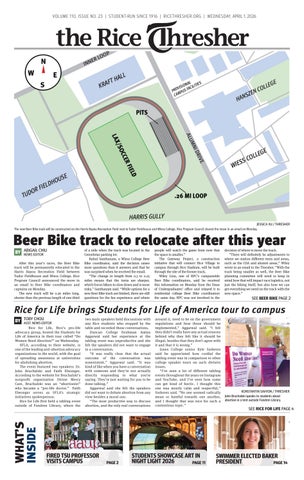

Beer Bike track to relocate after this year
A er this year’s races, the Beer Bike track will be permanently relocated to the Harris Bayou Recreation Field between Tudor Fieldhouse and Wiess College. Rice Program Council announced the move in an email to Beer Bike coordinators and captains on Monday.
The new track will be 0.26 miles long, shorter than the previous length of one-third
of a mile when the track was located in the Greenbriar parking lot.
Rahul Santhanam, a Wiess College Beer Bike coordinator, said the decision raises more questions than it answers and that he was surprised when he received the email.
“The change in length from 0.3 to 0.25 miles means that the turns are sharper, which forces bikers to slow down and is more risky,” Santhanam said. “While options for a new Beer Bike track are limited, there are still questions for the fan experience and where
people will watch the game from now that the space is smaller.”
The Gateway Project, a construction initiative that will connect Rice Village to campus through Rice Stadium, will be built through the site of the former track.
Wiley Liou, one of RPC’s campuswide Beer Bike coordinators, said he received this information on Monday from the Dean of Undergraduates’ o ce and relayed it to residential college Beer Bike coordinators the same day. RPC was not involved in the
decision of where to move the track.
“There will de nitely be adjustments to where we station di erent tents and areas, such as the GSA and alumni areas,” Wiley wrote in an email to the Thresher. “With the track being smaller as well, the Beer Bike planning committee will need to keep in mind how that will impact race logistics, not just the biking itself, but also how we can get everything we need on the track with the new space.”
Rice for Life brings Students for Life of America tour to campus
Rice for Life, Rice’s pro-life advocacy group, hosted the Students for Life of America in their tour called “Do Women Need Abortion?” on Wednesday.
SFLA, according to their website, is one of the leading anti-abortion advocacy organizations in the world, with the goal of spreading awareness at universities for abolishing abortion.
The event featured two speakers: Dr. John Bruchalski and Faith Elwonger. According to the website for Bruchalski’s nonprofit organization Divine Mercy Care, Bruchalski was an “abortionist” who became a “pro-life doctor.” Faith Elwonger serves as SFLA’s strategic initiatives spokesperson.
Rice for Life first held a tabling event outside of Fondren Library, where the
two main speakers held discussions with any Rice students who stopped by the table and recorded these conversations.
Duncan College freshman Amiya Aggarwal said her experience at the tabling event was unproductive and she felt the speakers did not want to engage in a conversation.
“It was really clear that the actual outcome of the conversation was nonexistent,” Aggarwal said. “It was kind of like when you have a conversation with someone and they’re not actually directly responding to what you’re saying. They’re just waiting for you to be done talking.”
Aggarwal said she felt the speakers did not want to debate abortion from any view besides a moral one.
“The most productive way to discuss abortion, and the only real conversations

around it, need to be on the government regulations and how those should be implemented,” Aggarwal said. “I felt they didn’t really have any actual reasons behind why they felt like it should be illegal, besides that they don’t agree with it and that it is wrong.”
Jones College senior Kyle Szekeres said he appreciated how cordial the tabling event was in comparison to other college speaker tours on such divisive issues.
“I’ve seen a lot of different tabling events throughout the years on Instagram and YouTube, and I’ve seen how some can get kind of hectic. I thought this one was mostly calm and respectful,” Szekeres said. “No one seemed radically mean or hateful towards one another, and I thought that was nice for such a contentious topic.”


JESSICA XU / THRESHER
The new Beer Bike track will be constructed on the Harris Bayou Recreation Field next to Tudor Fieldhouse and Wiess College. Rice Program Council shared the move in an email on Monday.
ABIGAIL CHIU NEWS EDITOR
TOBY CHOU ASST. NEWS EDITOR
KONSTANTIN SAVVON / THRESHER John Bruchalski speaks to students about abortion in a tent outside Fondren Library.
Fired Texas State University professor talks free speech
RACHEL JEONG FOR THE THRESHER
Former history professor turned academic freedom activist Tom Alter spoke in the Academic Quad on Wednesday. Organizers of the event say administrators nearly barred outside guests and moved the event to a second oor room in an academic building.
Alter was red by Texas State University administration last September from a tenured job a er a far-right activist circulated remarks on social media that Alter made while speaking in private capacity in an online socialist conference. During the conference, Alter discussed insurrectional anarchists, praising some of their political action but critiquing their inability to form a revolutionary political party.
“Without organization, how can anyone expect to overthrow the most bloodthirsty, pro t-driven, mad organization in the history of the world — that of the United States government?” Alter asks in the widely circulated social media post.
TSU administration said his remarks amounted to “advocat[ing] for inciting violence,” according to a statement from TSU president Kelly Damphouse.
Alter sued and was reinstated with a court injunction. He was not allowed to teach classes but was brought back with pay. However, Alter was terminated again Sept. 22.
It didn’t start with me. It doesn’t end with me. What we are seeing right now is just the broad, wholesale attack on academic freedoms on university campuses, and also democratic rights in general, within a broader society.
Tom Alter
ACADEMIC FREEDOM ACTIVIST
His stop at Rice is one of many across the country, as he continues his “Defend Free Speech” tour, stopping at universities from California to New York.
“It didn’t start with me. It doesn’t end with me,” Alter said in an interview with the Thresher. “What we are seeing right now is just the broad, wholesale attack on academic freedoms on university campuses, and also democratic rights in general, within a broader society.”
The event was organized by the Rice Young Democratic Socialists of America, Rice

Students for Justice in Palestine, the Center for Civic Leadership and the Rice chapter of the American Association of University Professors, a union advocacy organization.
Conner Schultz, the co-president of YDSA, was one of the main organizers of the panel.
“It’s important to hold this event because freedom of speech is being attacked on every single college campus, regardless if we’re public or private,” said Schultz, a Will Rice College sophomore. “We’re already seeing what’s happening with universities all across Texas, with classes, entire departments being cut, classes being censored.”
Schultz claimed that despite lling out the proper paperwork, the panel was almost moved to the second oor of Herzstein Hall with no outside guests or ampli ed sound allowed.
Schultz also claimed the reason the event was almost relocated was due the administration’s desire to avoid public attention.
“Basically, they were afraid of the attention this event was getting and decided to censor it to a random classroom,” Schultz said.
Chris Stipes, a spokesperson for Rice University, did not comment on Schultz’s allegations.
It’s important to hold this event because freedom of speech is being attacked on every single college campus, regardless if we’re public or private. We’re already seeing what’s happening with universities all across Texas, with classes, entire departments being cut, classes being censored.
Conner Schultz
CO - PRESIDENT OF YDSA
“Rice University supports the free exchange of ideas and is committed to upholding the principles of academic freedom and freedom of expression,”
Stipes wrote in an email to the Thresher.
“The event proceeded as planned in the Academic Quadrangle, and we’re pleased
that members of our community were able to engage openly and respectfully.”
Niki Clements, an associate professor of religion and president of Rice’s chapter of AAUP, said building community at Rice was a way to practice the university’s stated values.
“How as undergraduates here, can you all recognize the power that you have, both as consumers as well as members and participants of this community?” Clements asked. “How can we think about what it is that we can build as a community across faculty, graduate students, undergraduate staff, workers of all kinds around this university in order to get it to live up to its stated values and put into practice this culture of care?”
Alter said the event is more about the chance for people to come together to learn more about the assault on free speech, rather than just his story.
“Besides learning about what’s happened to me personally, it also gives a chance for people to come together, to meet each other and see who also cares about democratic rights and pushing back this assault that we’re experiencing from free speech and also the free press,” Alter said.
Student organizations found cheating in 24-Hour Challenge
CAMERON GUTIERREZ FOR THE THRESHER
A number of Rice organizations are facing disquali cation a er allegedly manufacturing donor counts in the 24-Hour Challenge, the university’s annual event that brings together alumni and community members to provide nancial support to Rice organizations and residential colleges.
In an email sent to organization leadership, the O ce of Development and Alumni Relations announced that the 24-Hour Challenge results would be recalculated.
“Unfortunately, we have found signi cant evidence that some student organizations arti cially in ated their donor counts for the 24-Hour Challenge,” the email reads. “In light of this, we will be recalculating the winners for
timebound challenges, the student donor count competition, and the student vote, disqualifying student organizations from receiving the challenge prize if found to have engaged in dishonest behavior from receiving bonus funds.”
The Thresher attempted to contact numerous on-campus organizations who participated in the challenge, including Rice Figure Skating Club, Chao College, the Hispanic Association for Cultural Enrichment at Rice, and Rice Formula SAE — the highest performers in the challenge — all of which declined to comment.
During the 24-hour giving period, many donors sponsor challenges designed to boost participation. For example, one of these challenges reward the organization that secures the highest number of donors with additional funding.
Christina Woods, director of reunion
I was motivated to give, as I always am, because of the tremendous impact that Rice had on my family and me; including my husband and now my daughter. I made many life-long friendships in my time inside the hedges.
Alexis Collins CLASS OF 1999
and volunteer giving, said that while irregularities were identi ed, the majority of organizations acted within the rules.
“We did identify a small number of
irregularities involving a few organizations attempting to in ate donor count,” Woods said. “We are addressing these directly with the groups involved. The vast majority of participants followed the guidelines, and we remain grateful for the enthusiasm and integrity that made this year’s challenge so impactful.”
For some community stakeholders and alumni, the challenge represents a chance to give back to their alma mater. Alexis Collins ’99 said her motivations for donating in the challenge lie in the impact Rice has brought to her family.
“I was motivated to give, as I always am, because of the tremendous impact that Rice had on my family and me; including my husband and now my daughter,” Collins wrote in an email to the Thresher. “I made many life-long friendships in my time inside the hedges.”
RACHEL JEONG / THRESHER
Tom Alter addresses the crowd in the Academic Quad at a Rice Young Democratic Socialists of America event.
Rice Student Association establishes fantasy football league, discusses Tetra ra le and releases new late-night study hours
HONGTAO HU ASST. NEWS EDITOR
The Rice Student Association, helmed by president Chelsea Asibbey, passed their first bill creating the Rice University Fantasy Football League.
The RUFFL, proposed by Chao College Senator Jake Pessin, establishes 12 teams — one for each residential college — that would compete against each other each football season. The last-place college will suffer a collectively determined “forfeiture” instead of the traditional fantasy football “punishment,” which aims to “reinforce the league’s tradition of friendly competition.”
The RSA Senate discussed and ultimately removed a “dynasty” format, in which colleges maintain their football team from year to year, drafting rookies instead of veterans. Some members of Senate said this could disincentivize participation among colleges that have to maintain worse teams.
“If Sid Richardson drafts a really bad [football] player this year, does that mean that we’re cooked for 10
generations?” said RSA Parliamentarian Zach Weinbrum.
If Sid Richardson drafts a really bad [football] player this year, does that mean that we’re cooked for 10 generations?
Zachary Weinbrum RSA PARLIAMENTARIAN
The bill creates a college-wide League Commissioner position, who will organize scoring systems and the yearly football draft event. Residential colleges will select one to two general managers to draft and maintain a football team through a method of their choosing. The bill also bans gambling in connection with the RUFFL.
Normally, a prior notice, a one-week holding period, is established for bills. However, Senate waived the prior notice, and with a unanimous voice vote, the
RUFFL was born.
The first proposed Senate resolution is a system for graduating seniors to donate their unused Tetra to nongraduating students via a raffle.
Senate Resolution 1 — proposed by Martel College Senior Class Representative Vamsi Makineni — would create a “Tetra Week,” where students can obtain coupons from Rice Housing and Dining for locations such as Rice Coffeehouse, Dandelion Cafe and Local Foods Market.
Some details appeared more concrete than others: coupons will be given out and valid for a single week in a year, raffle logistics will be handled by residential colleges alongside H&D and students cannot win the raffle multiple times.
However, opinions varied on the dollar amount of coupons.
“For a lot of places where you have meals and things like that, Dandelion and all the places, this makes sense for it to be something 15 or 20 [dollars],” said Sid Richardson College Senator Laylee Taghizadeh. “What about places like
Chaus? Does it have to be $20 spent once, or you can split it up?”
Cedric Lau, Senate chief of staff, announced the Late-Night Study Space program, which will tentatively extend the Ralph S. O’Connor Building for Engineering and Science’s weekday hours to 2 a.m. and have it open on weekends until midnight.
In addition, Senate passed the fiscal year 2026-27 allocation for the RSA, which increases the general marketing budget from $2,500 to $3,500 and the $12,000 total internal budget by $1,000. This increase in the marketing budget, Asibbey said, will fund events promoting the RSA name change.
“We’re partnering with the Rice Undergraduate Marketing Association to create a rebrand task force to hopefully be more relatable to students,” Asibbey said.
Senate also consolidated and approved 12 appointed positions, including former presidential candidate Muyiwa Ogunsola to the Blanket Tax Committee and chairs for the new Free Speech Commission and Publics and Traditions Commission.
Liou, a Baker College senior, also said RPC does not currently have detailed information on where the student bleachers will be placed.
“As a student-centered event, we want to prioritize the experience not just for race participants but also for spectators,” Liou wrote. “Knowing that the student body will continue to grow, our team will need to be strategic about where students can view and enjoy the race.”
Lola Cantillon, a Sid Richardson College Beer Bike coordinator, said she was excited for the track to be closer to the residential colleges, but was unsure of how the smaller space would work logistically. Cantillon is also a member of the Rice women’s lacrosse team, which uses the field for practice.
“I think it’ll definitely be a new adjustment, given that we’ve been doing it around the bubble track for so long,” said Cantillon, a junior. “But I’m curious to see how it’ll actually look like.”
Over the years, Beer Bike has changed locations. It was originally held in the inner loop before being moved to its current location at the Greenbriar Lot.
“Our goal as the Beer Bike planning committee is to establish a foundation that preserves tradition while building a version of Beer Bike that can thrive in this new space,” Liou wrote.

Process announced for new RideMETRO Fare Cards
HONGTAO
HU ASST. NEWS EDITOR
Students with the METRO Q Fare Card will need to replace their fare card by Saturday, a er which it will expire. According to an email sent out to previous METRO card holders, students will need to go to the Bursar’s o ce to pick up a new fare card.
Currently, only students who possess or have lost their orange Q Fare Card will be able to replace their Fare Card. Students will need to bring their Rice ID and return their old Fare Card to receive a waiver on the $25 card replacement fee. For students who’ve never had a Fare Card, the application form for the new RideMETRO Fare Card is temporarily unavailable on the Bursar’s O ce website. A representative for
the Bursar’s o ce said in an interview with the Thresher that they are not able to provide details on when the form would open.
In the interim, students who don’t currently have a Fare Card will need to obtain a personal physical or digital RideMETRO Fare Card to pay their fares, which range from $1.25 to $4.50, depending on transit method. Alternatively, Apple Pay and Google Pay are newly accepted forms of payment, along with cash.
Houston’s RideMETRO Fare Card switch expands its ticketing system, allowing for virtual fare cards and expanded payment options. The RiceMETRO mobile app’s mobile fare card feature is still in development and currently unavailable to students. For now, students will need to use the physical card provided by Rice to ride across Houston.

Fondren Library unveils new strategic plan
RUBY GAO ASST. NEWS EDITOR
Fondren Library is changing its spaces, with ADA-accessible bathrooms on the third floor, new furniture, and a planned artificial intelligence research data hub.
In November 2025, Fondren announced a strategic plan for the next three to five years aiming to give undergraduate and graduate students better learning experiences, expanded training programs and improved spaces and tools.
The plan responds to the Momentous strategic plan, released in fall 2024, which outlines investments in research and teaching for the coming decades.
The Fondren plan lays out five goals: empower students to explore, produce and share ideas; enhance research support and infrastructure; improve library spaces to support learning, research and collaboration; leverage transformative technologies; and empower library staff.
In the first stage of the plan, the discovery stage, library student ambassadors from various majors and residential colleges serve as a focus group.
Sara Lowman, vice provost and university librarian, said that based on students’ feedback and analysis of the committee, Fondren will expand study spaces to accommodate more students. This expansion is in line with the Momentous plan’s goal of increasing enrollment.
“The library is recarpeting the North
Reading Room on the first floor in the area that faces the new architecture building this summer. As part of that process, many of the older print reference materials will be moved to our storage facility, located on South Main Street,” Lowman said. “By moving these little-
In the North Reading Room, there used to be a lot of print indexes, encyclopedias, and directories. Now people don’t look up directory information in print. It’s always out of date. That’s the kind of thing you would Google now. The carpet in that space hasn’t been replaced in probably 30 years. It’s time to tweak that area and make it work better for students.
Sara Lowman VICE PROVOST AND UNIVERSITY LIBRARIAN
used print reference materials, space will be freed up in the North Reading Room to add additional tables and study carrels for students to use for study.”
Lowman added that the North Reading Room will be renovated next after previous updates to the South Reading
Room, where the DVD and newspaper area was renovated five years ago.
Lowman said the North Reading Room once held many print reference materials that are now largely obsolete as students turn to online searches. She said the space, including the 30-year-old carpet, needs updating.
Justin Nguyen, a Martel College freshman, said the space usage on the first floor of the library could be more efficient.
“I noticed on the rst oor there are a lot of small square tables with four chairs, but no one seems to sit there,” Nguyen said. “Most people prefer larger tables, so it might make sense to move these smaller tables to areas where more people would use them.”
In addition to physical updates, the plan includes technology improvements. Following the launch of a new AI major in fall 2025, Fondren now o ers research data and AI o ce hours through the spring, covering AI, machine learning, research computing, high-performance computing, data management and digital scholarship.
Fondren has also introduced the role of an AI and patent librarian within the past year.
Lisa Spiro, assistant university librarian for digital scholarship and organizational development, wrote in an email to the Thresher that Fondren’s AI and patent librarian Hannah Edlund works with colleagues across the university to support responsible use of generative AI in research, teach workshops, and serve on committees that guide the library’s deployment of AI tools.
Lowman said the library faced several challenges while implementing
the strategic plan, particularly, limited financial resources.
Lowman said the library does not have enough funding to fully renovate or rebuild the building and will instead
There’s not a bottomless upply of money. So in a perfect world, we would like to renovate the whole building or build a new building. We’ll just keep doing what we can to get new furniture and try to raise money and do as much as we can from what people have suggested.
Sara Lowman VICE PROVOST AND UNIVERSITY LIBRARIAN
continue making gradual improvements, such as adding new furniture and raising funds for future updates.
Lowman said data on usage frequencies play a central role in evaluating the success of the strategic plan: building traffic, the use of wireless systems, furniture popularity and journal checkouts are all tracked.
“We’re always looking at data,” Lowman said. “That metric is really important to us to look at: Are people using things that we’re spending money on?”
Later that day, Rice for Life hosted an evening lecture by the two speakers followed by a Q&A session.
Only about ve students attended the evening lecture, held at the AndersonClarke Center.
At the lecture, Bruchalski shared his background as a former abortionist. What he described as the brutality and violence of the procedure caused him to change his opinion about abortion.
“During the rst two years of my residency, I did rst, second and third trimester abortions. It wasn’t just abortion, it was abortion on demand at any time for any reason,” Dr. Bruchalski said. “This was beginning to wear because our whole answer was, abortion can be done for any reason at any time.”
Since changing his views on abortion, Bruchalski has run his practice, Tepeyac OB/GYN, as a fully pro-life OB-GYN.
“For the last 34 years, I’ve been practicing life-a rming medicine where I haven’t had to use abortion once to save or care for the woman in front of me,”
Bruchalski said.
Life-a rming medicine, according to the American Association of ProLife Obstetricians and Gynecologists, is healthcare that protects and promotes the health and dignity of both pregnant women and their preborn children.
Elwonger also shared her background and said her views were mainly formed by her college experience with a friend who was coerced into having an abortion.
“Once I got to college, I came across the undercover footage exposing that Planned Parenthood was selling baby body parts,” Elwonger said. “I was morti ed. Two years later, my pro-choice friend found herself in an unplanned pregnancy and actually wanted to keep her baby. She asked me to be her baby’s godmother, but was coerced into an abortion by her boyfriend and by her mom.”
While Elwonger cites the Center for Medical Progress footage of Planned Parenthood selling baby body parts as fact, no investigation has found any other evidence of this. In 2016, a grand jury in

Harris County involved in the investigation of Planned Parenthood voted to indict the two Center for Medical Progress activists who shared the footage on charges of creating and using false government IDs and attempting to purchase fetal tissue.
A er introductions, Bruchalski and Elwonger presented 10 myths they believe people hold about abortion. These ranged from “abortion is safer than childbirth” to “abortion and miscarriage care are the same,” with their most discussed topic being “women need abortion to be successful/to reach their goals.”
“[Mothers] may not look for strength or encouragement in the right places, and the abortion industry sells us death wrapped in self-con dence or self-love. They feed o of any small slivers of doubt we have,” Elwanger said.
A er the presentation, students who attended said they appreciated the perspective both speakers gave on abortion but wished there was more debate.
“I was hoping a few people would
disagree adamantly, but respectfully. Unfortunately, there wasn’t a ton of that, which sort of le me a bit disappointed,” Szekeres said. “But besides that, I thought it was a great event.”
During the first two years of my residency, I did first, second and third trimester abortions. It wasn’t just abortion, it was abortion on demand at any time for any reason. This was beginning to wear because our whole answer was, abortion can be done for any reason at any time.
John Bruchalski
PRO - LIFE OB - GYN

FROM FRONT PAGE RICE FOR LIFE
KONSTANTIN SAVVON / THRESHER Students for Life of America hosted a tabling session between Fondren Library and Brochstein Pavilion on Wednesday with their two guest speakers, Faith Elwonger and John Bruchalski.
Debate emerges over Ben Taub expansion into Hermann Park
RUBY GAO ASST. NEWS EDITOR
Rice professor Jim Blackburn is leading Protect Hermann Park, a group opposing Ben Taub Hospital’s plan to acquire land from Hermann Park. Blackburn, a professor of environmental law, came to Houston in 1972 to begin his career as an environmental lawyer. For more than half a century, he has advocated for parks and green space.
Harris Health, the public healthcare
They were not addressing this issue about feasible and prudent alternatives. And the Commissioner should have said, ‘Can you address the issue that he’s hearing? Does Harris help? Is there a feasible alternative?’ They never said that. They just let everyone talk about how fabulous that talk is, but that’s not what the purpose of the public hearing is.
Anne Furse SUPPORTER OF PROTECT HERMANN PARK
safety net provider for Harris County residents, has proposed an expansion project to increase Ben Taub’s capacity for patients. The plan would allow the hospital, located across from Rice at the southwest corner of Hermann Park, to acquire about 8.9 acres of parkland.
The Metropolitan Organization, one of the project’s proponents, described
the expansion as a “win-win” decision for both Hermann Park and Ben Taub. In a call published on Feb. 3, TMO said the project would address the urgent need for more hospital beds at Ben Taub while also improving access to green space at Hermann Park.
Texas Organizing Project, another supporter of the Ben Taub expansion project, said in an Instagram post that the expansion is necessary to ensure Houstonians’ access to health care.
“This expansion will alleviate wait times and overcrowding at Ben Taub, providing the hospital with more rooms to better serve community members and help save lives,” the group wrote. “Health care is a human right, and access to care makes our communities stronger.”
On March 19, the Harris County Commissioners Court unanimously approved the Ben Taub expansion project to move forward after a vote.
Precinct 1 Commissioner Rodney Ellis, whose district includes Ben Taub and much of the Texas Medical Center, said in the public hearing that he grew up without access to healthcare and remains committed to expanding the safety-net hospital “even if there’s some heat I get.”
The Hermann Park Conservancy had originally planned the Warnecke Tract for a new parking garage. Its president, Cara Lambright, said she supports the expansion as long as another location is provided for additional parking.
Anne Furse, a supporter of Protect Hermann Park, said the public hearing did not address alternatives to the park expansion, which she said was the real debate question.
“There were dozens and dozens of people speaking at the hearing, and the vast majority of them did not address that issue. They were not addressing this issue about feasible and prudent alternatives. And the Commissioner
should have said, ‘Can you address the issue that he’s hearing? Does Harris help? Is there a feasible alternative?’” Furse said. “They never said that. They just let everyone talk about how fabulous that talk is, but that’s not what the purpose of the public hearing is.”
We’re not opposed to Ben Taub. We’re not opposed to the provision of health care services for those that otherwise can’t afford them elsewhere. We think it’s incredibly important. But we think that if the conversation has been misleading, it hasn’t been taught.
Jim Blackburn PROFESSOR OF ENVIRONMENTAL LAW
Blackburn said his group supports Ben Taub’s healthcare mission, but they believe the proposal fails to seriously consider alternatives. These said alternatives are also presented in a series of letters that Blackburn and environmental activist Ann Hamilton sent to Harris Health and Harris County.
“We’re not opposed to Ben Taub. We’re not opposed to the provision of health care services for those that otherwise can’t afford them elsewhere. We think it’s incredibly important,” Blackburn said. “But we think that if the conversation has been misleading, it hasn’t been taught. It’s never addressed directly the issue of alternatives.”
Blackburn said the hospital’s current layout does not adequately reflect the needs of many of its patients, which
leads to poor use of the space inside the hospital.
“ We don’t think the space is being very well used within Ben Taub,” Blackburn said.
Blackburn said there is space within the existing Ben Taub campus where additional facilities could be built, such as a 100-bed facility could fit within the hospital’s current footprint.
Expanding Ben Taub Hospital onto a floodplain would be a serious mistake, Blackburn said, particularly in Houston, where flooding is the most likely natural disaster.
“I think it is absolutely wrong for Harris County, which is our floodplain administrator, to essentially grant itself permission to develop in the floodplain when we should be moving out of floodplains, not into them,” Blackburn said. “We have a huge flooding problem in this community, and this is a level one trauma center. It just strikes me that that is just so wrong, almost like this decision-making process has defied logic.”
Hamilton, the first executive director of Houston Parks Board since 1986, said she felt uncertain about Harris County’s approval of the expansion project and some students’ support for the proposal.
“I feel like we lost. We’ve lost our plan, and it sets a terrible precedent for getting more parkland.” Hamilton said.
Reflecting on the process, Blackburn said it left him more concerned about long-term health care planning in Harris County.
“As a result of this experience, I’m probably more concerned about our health care planning in Harris County than I was to start off with. There are some real serious questions about that that came out of this process. So I came away more concerned about long-term health care delivery than I thought I would,” Blackburn said. “It’s frustrating, but it’s also educational.”

JESSICA XU / THRESHER
Rice can’t pick and choose which free speech to protect
This week, Rice for Life hosted the duo John Bruchalski, abortion provider turned “pro-life OB/GYN,” and Faith Elwonger, a Students for Life in America organizer. Set up outside Brochstein Pavillion with video and audio recording gear in tow, the pair debated students about abortion access.
As a college campus, we ought to celebrate open debate and campus dialogue. College is a time to be challenged in beliefs, viewpoints and political opinions. The ability to engage productively with di erent — perhaps antithetical — viewpoints is the mark of a successful liberal arts education.
We applaud the students who organized the event for being able to center debate and activism, although Rice for Life’s misleading claims about women’s health give us pause — as well as the students who organized in opposition to the platform.
President Reggie DesRoches and Executive Vice President Amy Dittmar celebrated this fundamental aspect of campus culture just a year prior in a statement on academic freedom.
“The University likewise affirms the freedom of faculty, students, and all members of the Rice community, including invited guests, to engage respectfully in conversation and debate without fear of censorship or retaliation, including of difficult or controversial ideas,” they wrote.
However, Rice for Life does not give us the full picture. On the same Wednesday, just on the other side of Fondren Library, the Rice chapter of the American Association of University Professors hosted former Texas State University professor Tom Alter.
We nd the organizers’ claims that the event with Alter was almost e ectively
shut down by administration by being relegated to the second oor of an academic building without outside guests to be deeply disturbing. Seeing the chilling e ect and intentional sti ing on certain forms of protest and speech — especially le -leaning political speech — we cannot help but feel that Rice is failing its very own stated mission.
Alter, a history professor, was removed from a tenured position for “inciting violence” a er a self-described “fascist” streamer took Alter’s comments at a virtual conference organized by a socialist group out of context. A court reinstated him, but he was red yet again.
His o ense: discussing — as a hypothetical — the potential revolutionary overthrow of the U.S. government. The full video of Alter’s remarks feels more like an mid-morning academic keynote speech
rather than a violent revolutionary screed. He was discussing some of the political action of insurrectional anarchists, while critiquing their inability to form political organizations.
Regardless of what Alter said, we believe that he has a right to speech as much as anybody else. It would seem that Rice would agree with that sentiment too.
Is this respectful conversation and debate without fear of censorship? It certainly does not feel that way.
If Rice wants to champion free speech, it must be willing to defend it even when it’s controversial.
Editor’s Note: Thresher editorials are collectively written by the members of the Thresher’s editorial board. Current members include James Cancelarich, Evie Vu, Abigail Chiu, Jenna Perrone, Arman Saxena and Andersen Pickard.
While Rice builds upward, birds fall down
ANDY LIU, SANJAY SONI, AKSHAJ SUNKARA, ALIVIA YANG & MEGHAN PARAL
Every spring and fall, something extraordinary happens above Houston. Between one and two billion birds surge across the Gulf of Mexico on the ancient central migratory route, landing exhausted in the green spaces of our city to rest and
Without intervention, injuries and deaths of migratory birds at Rice will grow.
refuel before continuing to their breeding and wintering grounds. Rice, with our countless live oaks and tree canopy, is one of the rare urban sanctuaries where these birds have long found refuge.
But whether these birds survive their journey depends, in part, on you.
As our campus grows, so does one of its least visible hazards: glass windows. To birds across the world, glass is incredibly di cult to see. Birds perceive windows as an extension of their environment and y into them at full speed with results that are o en fatal. These bird-building collisions kill over one billion birds in the U.S. each year.
At Rice, tall glass buildings like the Ralph S. O’Connor Building for Engineering and Science, the Gibbs Recreation and Wellness Center and Saro m Hall are especially hazardous, killing dozens of birds each migration season.
Our data estimates that up to 2,800 collisions have occurred on our campus in the past three years alone. With the new student center and the expanded McNair Hall on the way, new construction has introduced a signi cant risk for birds along this corridor.
Without intervention, injuries and deaths of migratory birds at Rice will grow.
For three years, students and faculty on our campus have been trying to understand how to prevent these fatalities. We started with data collection: understanding when and where birds hit our windows. We learned that a facade of Anderson Biological Laboratories was highly lethal for birds.
Then, we tried a solution: We added a UVre ective lm designed to let birds recognize glass as a solid surface, without changing how it looks to humans. The next year, window collisions on that face of ABL dropped to zero.
This initiative became known as the Rice Student Birding Club Bird Collision Initiative, started by alumna Kayla Yao and Dr. Rafael Marcondes in 2023. It is now under the direction of Dr. Cassidy Johnson and me, Andy Liu, of the Rice Student Birding Club.
Our e orts are working, but we need your help. We know that the lm works. It’s commercially available and a ordable. Rice has already installed bird-friendly window lm or glass on New Lovett College, Chao College and the Anderson Biological Laboratories. Next, we must retro t the dozens of other buildings on campus whose windows are still lethal to birds, starting with the ones that hurt the most.
To do that, we need your help collecting data.
If you see a dead or injured bird, open your phone, go to ricebirding.org and upload a photo. Once you send us a report, a volunteer from our team will come and collect the specimen for research. We’ll log the data and use it to advocate for speci c buildings and windows to be treated next.
The birds that stop here do not choose to do so. They land because they are exhausted, because this patch of green in a sea of concrete is one of the last places le in Houston to rest. We have the power to make sure it stays that way.
The birds that stop here do not choose to do so. They land because they are exhausted, because this patch of green in a sea of concrete is one of the last places left in Houston to rest. We have the power to make sure it stays that way.


Last Week’s Online Poll Results
Where do you primarily get advice for course selection?
Total number of responses: 267 Next week’s question: Do you think Fizz adds to the college experience?


Meghan Paral, Hanszen College senior
Sanjay Soni, Duncan College senior
Alivia Yang, Hanszen College freshman
Andy Liu, Duncan College junior
Akshaj Sunkara, Brown College freshman
A response to anti-abortion misinformation
DR.
CARLY THOMSEN
ALONG WITH THE STUDENTS IN ENGL
378: POLITICS OF REPRODUCTION: SEX, ABORTION, AND MOTHERHOOD
On Wednesday, Rice for Life — an antiabortion student group with a history of unfortunate tactics and goals — brought to campus a traveling duo from Students for Life of America. They set up outside of Brochstein Pavilion, where they circulated inaccurate information about abortion.
My class, Politics of Reproduction: Sex, Abortion, and Motherhood, taught through the English and creative writing department and the medical humanities department, collectively wrote this opinion piece to counter the event’s abortion negativity.
Here, we state the so-called abortion “myths” that Rice for Life claimed to debunk, along with facts. Spoiler alert: All of the points Rice for Life claimed are myths are actually true.
Supposed myth: “Abortion is necessary health care.”
Fact: Pregnant individuals living in states that ban abortion are about twice as likely to die during pregnancy or childbirth. In Texas, maternal mortality increased by 56% following the state’s abortion ban, whereas it decreased by 21% in states with legal abortion. In 2020, the World Health Organization listed rights to reproductive health care as part of essential health care.
Supposed myth: “Chemical Abortion Pills are as safe as Tylenol.”
Fact: Abortion is remarkably safe. The reported mortality rate is 0.7 per 100,000 cases. Mifepristone, an abortion medication, has a reported death rate of just 0.48 per 100,000. Abortion is safer than many lowrisk prescription and over-the-counter drugs. Acetaminophen, also sold under the brand Tylenol, is the leading cause of acute liver failure in the United States.
Supposed myth: “Abortion is safer than childbirth for Black women.”
Fact: Research indicates that the risk of death is 14 times higher for childbirth compared to that with abortion. A study found that on average, 1.1 Black women
died per 100,000 legal induced abortions in the U.S. In another study from 2014-16, researchers found that an average of 41.7 Black women died per 100,000 pregnancies. Clearly, childbirth is far more dangerous than abortion, something that is true across racial groups. Black women experience signi cant health disparities — including a maternal mortality rate 243% higher than that of white women — but these disparities result from structural racism, not the safety of abortion.
Anti-abortion activists aren’t telling you that, according to the Turnaway Study from the University of California, San Francisco, 95% of abortion patients believe it was the right decision ve years post-procedure. They also aren’t making it clear that anti-abortion activists are trying to outlaw or severely restrict access to birth control. One of their strategies is to circulate misinformation about birth control — just as they do about abortion. A recent study showed that about one in seven young women has changed or thought about changing their birth control due to misinformation they’ve seen on social media.
The speakers Rice for Life brought to campus are part of this system. Dr. John Bruchalski, a speaker on the Students for Life of America circuit, o en discusses his decision to move away from being an OBGYN who provided abortions, contraception and sterilization.
Today, he is a practicing OB-GYN who preaches faith-based medicine and says things like “IVF is embedded with eugenics.” He also references studies that state abortion is linked to breast cancer and mental illness, claims that have repeatedly been disproven.
This isn’t women-centered health care.
And despite the group’s signs on campus encouraging passersby to “join the conversation,” they weren’t here to have earnest conversations about abortion or women’s health care. We know this because earnest conversations require engaging with facts rather than perpetuating lies.

Earnest conversations also require trust from all parties. If you passed by their booth on campus, you may have been intimidated by their professional cameras and videographers. For a movement rooted in lies, we should not assume best intent. We should be concerned about what they’ll do with their footage, and we should be wary of approaching.
But we cannot allow these lies to go unchecked.
We need to increase our capacities to recognize the misinformation that antiabortion activists circulate and to push back against it. We need better close reading and research skills. We need more tools for talking across lines of di erence.
Luckily, there are many ways to acquire these skills at Rice, both within and beyond the classroom. Take classes in English and creative writing and the Center for the Study of Women, Gender and Sexuality, where you’ll gain these skills and practice implementing them. Join a feminist student club, work on a faculty research team and participate in the robust programming o ered by the Center for Civic Leadership. And then tell everyone around you what you’ve learned.
Editor’s Note: This is a guest opinion that has been submitted by a member of the Rice community. The views expressed in this opinion are those of the author and do not necessarily represent or re ect the views of the Thresher or its editorial board. All guest opinions are fact-checked to the best of our ability and edited for clarity and conciseness by Thresher editors.
Senate scoop: What we hope to see from the Blanket Tax Committee
In one of the first actions taken by the new Rice Student Association administration, Jackson Darr was appointed to serve on the Blanket Tax Committee. Darr previously held significant influence over this body as the former RSA treasurer and the former chair of the BTC, where he played a leading role in overseeing the allocation of approximately $150,000 in student initiative funding to campus organizations.
The BTC faced sustained scrutiny last year for controversial decisions and procedural concerns. Most notably, the committee allocated $6,000 to the Rice Women’s Resource Center when they requested $14,000, a decision that drew criticism from students who questioned both its impact and justification. Additionally, the committee was criticized for a lack of communication transparency, leaving many organizations uncertain about how and why decisions were made.
Another point of concern lies in specific budgetary choices, particularly a $5,624 request tied to Rice ReUse, a new sustainability-focused organization. While the group’s mission was broadly
supported, closer examination of its full proposed budget is suspect. Within this broader budget, $3,165 was categorized as “miscellaneous” expenses.
This category included items such as $200 for sticky notes, $100 for general office supplies, $770 for dollies/carts and $1,445 for branded T-shirts. While some of these items may be justifiable in isolation, their inclusion under a loosely defined “miscellaneous” category raises concerns about transparency and fiscal discipline, especially given the scale of funding requested from student resources.
Looking to this year, we are optimistic about what Suri Yang will accomplish as treasurer. However, that optimism must be paired with a willingness to critically reassess past decisions. In particular, the BTC should be more intentional in supporting Blanket Tax Organizations, especially in cases where growth is clearly justified.
The RWRC provides a clear example. In 2025, the organization requested $7,300 and received $7,000. The following year, RWRC requested $14,000 to expand programming and increase its impact on campus. Despite this justification, its allocation was reduced to $6,000, creating significant tension between the RWRC, Senate and the BTC.
* Indicates Editorial Board member
James Cancelarich* Editor-in-Chief
Evie Vu* Managing Editor
NEWS
Abigail Chiu* Editor
Hongtao Hu Asst. Editor
Toby Chou Asst. Editor
Ruby Gao Asst. Editor Lina Kang Asst. Editor
OPINION
Jenna Perrone* Editor
Andrew Rynsburger Asst. Editor
FEATURES Amelia Davis Editor
ARTS & ENTERTAINMENT
Arman Saxena* Editor
Chi Pham Asst. Editor
SPORTS Andersen Pickard* Editor
Patrick Shukis Editor
Keya Patel Asst. Editor
BACKPAGE
Charlie Maxson Editor
Max Scholl Editor
Will Howley Editor
Rykelle Sandidge Senior Writer
COPY
Shruti
Although a one-time $2,500 increase was later granted as a compromise, this highlighted a disconnect between demonstrated need and final allocation. If the BTC is serious about supporting student life, it must be willing to invest in organizations whose missions and demands are expanding.
As the student body grows and diversifies, the organizations that directly serve students should see proportional investment, not stagnation or cuts. With the passage of Constitutional Amendment 3, the BTC now has both the opportunity and the responsibility to reevaluate how it defines community impact to more actively support cultural programming that reflects the diversity of the student body.
It is our hope that this year’s BTC will be transparent, aligned with the student body and disciplined in its decisions. This will require a thoughtful approach to how past practices are evaluated and improved upon. Given Darr’s central role in many of the decisions that drew criticism last year, his return to the BTC places a heightened responsibility on both him and the committee to demonstrate meaningful change. How the BTC approaches its work this year will ultimately determine whether that change is realized.
ABOUT
The Rice Thresher, the official student newspaper of Rice University since 1916, is published each Wednesday during the school year, except during examination periods and holidays, by the students of Rice University.
Letters to the Editor must be received by 5 p.m. on the Friday prior to publication and must be signed, including college and year if the writer is a Rice student. The Thresher reserves the right to edit letters for content and length and to place letters on its website.
Editorial and business offices are located on the second floor of the Ley Student Center: 6100 Main St., MS-524 Houston, TX 77005-1892
Phone: (713) 348 - 4801
Email: thresher@rice.edu
Website: www.ricethresher.org
The Thresher is a member of the ACP, TIPA, CMA and CMBAM.
© Copyright 2025
ricethresher.org
COLUMN MAX MENCHACA & ELI RISINGER FOR THE THRESHER
Max Menchaca is a Brown College Max Menchaca is a Brown College sophomore studying political science and statistics. Eli Risinger is a Wiess College sophomore studying political science and social policy analysis. Both are former RSA senators and believe every Rice student should be well informed to advocate for their interests in student government.
‘All
that I dreamed of’: Marcia Oliveira blends sports and stories
SHYLA JOGI THRESHER STAFF
Silence took over SoFi Stadium in Inglewood, California as the ball hit the back of the net.
A friendly 2025 soccer match between the U.S. women’s national team and the Brazilian women’s national team ended in a 2-1 victory for Brazil.
Marcia Oliveira, a Lifetime Physical Activity Program instructor, said the match brought her to tears.
“In Brazil, soccer is not just a game,” Oliveira said. “It is culture, identity, joy and survival all at once.”
She said she was in awe of the journey the team has taken to get to where it is.
“Everybody started running into the eld,” Oliveira said. “But I stayed there just overjoyed, just watching this movie play out in my head. I was just thinking, ‘I worked my whole life to see this, to be right here, right now.’”
Oliveira has held many positions throughout her career, including serving in the United States Army Medical Corps, becoming the head women’s soccer coach for the University of Mary HardinBaylor and launching Sam Houston State University’s NCAA Division I women’s soccer program.
Currently, aside from instructing four LPAPs on Rice’s campus, Oliveira serves as the assessment coordinator for Houston City College and as the U.S. Soccer Federation’s liaison with the Brazilian WNT.
As I was growing up, my dad didn’t want me to play sports. I grew up really trying to find opportunities to play sports because I was so athletic. Sports are the reason why I’m here right now.
Marcia Oliveira LPAP INSTRUCTOR
Oliveira said women’s sports have always played a crucial role in her life. If not for a basketball scholarship, Oliveira wouldn’t have been able to a ord moving to the U.S. to pursue a psychology major and exercise and sport science minor at UMHB.
“As I was growing up, my dad didn’t want me to play sports,” Oliveira said. “I grew up really trying to nd opportunities to play sports because I was so athletic. Sports are the reason why I’m here right now.”
In 2004, Brazil lacked a professional women’s soccer league, and opportunities to compete against other women’s national teams were limited. The Brazil WNT would usually scrimmage against the Youth Under-14 boys team, Oliveira said.
Oliveira played a key role in organizing one of the Brazil WNT’s rst international training experiences, which included scrimmages against collegiate women’s teams in the U.S. before their international friendly against the USWNT. These were among the rst times the Brazil WNT played against another women’s team for training.
Oliveira said the Brazil WNT is preparing to host its rst FIFA Women’s World Cup in 2027, which will be the rst time the tournament is hosted in South America.
“I have embraced this journey of being one more person who can be of support

for women’s sports, like soccer in Brazil,” Oliveira said.
This philosophy of paying it forward led Oliveira to seek a teaching position at a university, which is why she applied for her current position at Rice. She currently teaches four LPAPs: Personal Fitness, Discovering Personal Wellness, Mental Training for Performance Enhancement and Walk, Jog, Run.
Oliveira attributes the driving force behind her personality and teaching to
One of my favorite moments was sharing our different experiences with sports, because we have a lot of athletes in the class. It’s such a close-knit class, and I think that’s something where we can grow and build off of each other.
Paul Gregory
LOVETT COLLEGE SENIOR
her perspectives from both Brazil and the U.S.
“At Rice, when I walk into a classroom, I bring both,” Oliveira said. “I bring the Brazilian belief that every human being has something extraordinary inside them. And I bring the American discipline that says, ‘now let’s build the system to bring it out.’”
Anatolia Vick, senior assistant director for health, tness and well-being, said she values Oliveira’s perspective as a longstanding member of the LPAP team.
“Marcia has contributed to LPAP’s growth through her sustained commitment to teaching and student engagement,” Vick wrote in an email to the Thresher. “What stands out most about Marcia is her deep care for her students. She brings consistency and a student-centered mindset to her role.”
Oliveira said she hopes students leave her courses having created or further developed a path to remain as active and healthy as possible. However, she said she doesn’t view teaching as a oneway street, a philosophy she’s embraced from Paulo Freire, a Brazilian educator and philosopher whom Oliveira nds inspiring.
“I come to the classroom not just to deliver the best that I can deliver,” Oliveira said. “I learn from them as well. It’s a back-and-forth process.”
Lovett College senior Paul Gregory, who is currently in Oliveira’s Mental Training for Performance Enhancement class, said Oliveira has succeeded in creating a collaborative and dynamic classroom environment where he feels close to the entire class and the instructor as well.
“One of my favorite moments was sharing our di erent experiences with sports, because we have a lot of athletes in the class,” Gregory said. “It’s such a closeknit class, and I think that’s something where we can grow and build o of each other.”
Oliveira’s values come through not
just in the classroom, but also in how she interacts with her family. Oliveira’s nephew, business owner Thiago Oliveira,
She taught me the value of hard work and consistency. Watching how dedicated she is made me realize that success is achievable and requires planning. She is a mother figure and my role model who helped to shape the person that I am today.
Thiago Oliveira
MARCIA OLIVEIRA’S NEPHEW
said she inspires him to follow in her footsteps.
“She taught me the value of hard work and consistency,” Thiago wrote. “Watching how dedicated she is made me realize that success is achievable and requires planning. She is a mother gure and my role model who helped to shape the person that I am today.”
Oliveira teared up as she considered the path she had taken to get to where she is now.
“This is all that I dreamed of,” Marcia said. “I saw myself becoming a di erence maker in people’s lives. If I could talk to my younger self, I would say, ‘Right on. You became what you dreamed of.’”
KONSTANTIN SAVVON / THRESHER
Marcia Oliveira, a Lifetime Physical Activity Program instructor, also serves as the U.S. Soccer Federation’s liaision with the Brazilian national women’s team.
Worth Playing For?
AINSLEY GANTI
ASSISTANT CROSSWORD EDITOR

Fact: Only 1 out of 13,000 people in the U.S. get salmonella after consuming raw fish. That said, sushi purchased on a college campus may leave any diner wary. Nothing says confidence like eating sushi within commuting distance from Galveston, where the water is nutrient rich in the same way a puddle is technically a mineral bath. If you are brave enough to test the odds — and your immune system — here is a curated ranking of the sushi you can find on campus.
#6: Philadelphia Roll - Imitation Crab
Rating: 2.5/10
Perceived risk: Not high, but not worth it
Retailer: Rice Bookstore
Widely regarded amongst sushi connoisseurs and haters alike to be a relatively safe bet, one might be tempted to opt for the Philadelphia roll when browsing the Rice Bookstore’s selection. However, this cooked roll makes for a not-so-fine-dining experience, featuring cream cheese with a consistency best described as suspiciously dense. While $6.99 doesn’t seem unreasonable (especially on Tetra), you’re better off choosing a riskier roll from further down the list.
#5: Sashimi
Rating: 4.5/10
Perceived risk: Vibes-based
Retailer: Rice Bookstore
There’s something about eating only raw fish in a campus setting that feels a little too ambitious, even for a Rice student. At $12.99, sashimi is one of the most expensive options — and also the most dependent on blind trust. Without rice to buffer the experience, you are left fully exposed to both the flavor and the gamble. High risk, medium reward: entirely dealers’ choice.

#4: Cucumber and Avocado Roll
Ranking: 5/10
Perceived risk: Low
Retailer: Rice Bookstore
At $5.99, the cucumber and avocado roll is the cheapest option the Bookstore has to o er, though it is also the least lling. The pieces are so small they function more as a snack than a meal. You could easily nd something similar in the servery, so if you’re going out of your way for sushi, this one ends up feeling underwhelming.
#3: Tuna Roll
Rating: 6.5/10
Perceived risk: Low-medium (depends heavily on timing)
Retailer: Rice Bookstore
Seemingly contradictory after sashimi’s placement, the tuna roll redeems itself with rice and seaweed — offering at least a psychological layer
of protection against the raw fish. But not all tuna rolls are created equal. There are two criteria for the tuna roll to be worthy of its high ranking: the expiration date (the later the better) and the color (if it’s pink, don’t overthink, but if it’s gray, stay away). For $6.99, it’s a relatively solid option, so long as you choose wisely.
#2: Caterpillar Roll Rating: 7/10
Perceived risk: Surprisingly low
Retailer: Rice Bookstore
Surpassing most expectations of a Bookstore roll, this cooked sushi does just that: cook. Fully cooked and generously portioned, it avoids the uncertainty that plagues the raw options while still feeling like a real meal. It’s reliable without requiring a leap of faith.
#1: Spicy Salmon Roll Rating: 9/10
Perceived risk: Low
Retailer: Brochstein Pavilion
Made fresh daily from the Local Foods in Rice Village then delivered to Brochstein, this roll is priced at $8.00 and features six sizable pieces of sushi. With umami from the rice, spicy aioli and Faroe Islands salmon, it is the undisputed best in terms of avor and price point.
Conclusion
So, if the servery is too far — or too boring — for a bite and your Tetra is burning a hole in your pocket, choose your ghter wisely. Bet on the salmon or fold on the Philly, and just because it’s technically ‘free’ on Tetra doesn’t mean your stomach won’t pay the price later. May the odds — and your gut health — be ever in your favor.
SOPHIE GARLICK THRESHER STAFF
LUCY LI / THRESHER
Students can purchase a variety of sushi at the Rice Bookstore or at Local Foods in Brochstein Pavilion.
Study abroad showcases student photos in annual contest

This summer, Sid Richardson College junior Sophia Lannie woke up in the Phobjikha Valley of Bhutan in the homestay she was lodging in with other Rice Abroad students. They enjoyed a breakfast of milk tea, buckwheat pancakes and ema datshi, a stew of chili peppers and cheese. Their cohort bus was loaded, and they headed out to the Black Necked Crane Center. Though they were there in the summer and missed the migration season. Upon walking into the center, they still saw cranes — 1,000 of them, hand-folded by local schoolchildren — hanging in a stunning aerial display in the atrium of the circular building.
Lannie’s photo of the paper cranes won bronze in The Global Campus category of the annual Study Abroad photography competition. Displayed among her fellow winners, her photo allowed Rice students a glimpse into the experience of traveling the world, all from a familiar place: outside the Rice Co eehouse.
The annual photography contest hosted by the O ce of Study Abroad showcased the photographs of their rst, second and thirdplace winners in ve categories and took votes among those winners for the People’s Choice award.
Though the winning photos used to be framed and displayed in Rayzor Hall, that budget now goes towards o ering more attractive prizes for the winners.
All the placing photographers get a framed version of their photograph, and the rst- and second-place winners in each category also get an Amazon gi card. The People’s Choice winner is awarded a co ee table book called “The Travel Book,” which features photographs and descriptions of every country in the world.
Though voting for the People’s Choice Award has closed, the opportunity to view the photographs has not expired: They will remain on display in the hallway outside Chaus until May. The winner of the award will be announced shortly.
Beata Loch, director of the O ce of Study Abroad, said the department judges not only
on the beauty of the picture but also places importance on the story behind the picture and how meaningfully it represents the student’s experience abroad.
“One year we had actually a very cute picture of a cat in a door, and it was very cute, but you wouldn’t know why this is so cute. And then the student explained that on their way to school everyday they would meet this cat, and — especially at the beginning, because she felt kind of foreign in that environment — it was special to make friends with the cat. You never know what’s behind the picture,” Loch said.
Yvonne Zheng, program administrator for the O ce of Study Abroad, arranges much of the logistics for the contest. She said the emotional context of the photo is a component of the judging, based on a personal statement the student writes to accompany the photo.
“I think it’s de nitely a factor, but [the photographs] are judged by three external judges that we invited. They’re sta members from across the campus. So we do try to tell them that both the caption and the picture are an organic, holistic part of the whole judging process,” Zheng said.
For some, the contest is not all about winning — it is also a chance to share photographs they loved taking and help others see the beauty they found in the countries they traveled to.
Jahnavi Mahajan, a Lovett College senior, was one of the een winners selected to compete in the People’s Choice contest. She won the Postcard Perfect category for a photograph of the West ords taken in Ísa örður, Iceland on the School for International Training’s Iceland: Climate Change and the Arctic trip.
“With the photo that I took, it just brings into perspective how small our civilization is and how small our houses are as compared to these big giants of nature,” Mahajan said. “So I really like that picture because usually we see pictures and it’s like people are kind of big and everything else is in the background. [My picture] kind of ips it for me where it’s like the ord’s big and you’re all kind of small on the base of it, which is why I like it.”
Other winners refuse to rest on their laurels and insist on continuing and expanding their participation in the O ce
of Study Abroad, even a er returning from their trips.
Maddie Je ery, a Baker College senior, won rst place in the Culture and Tradition section of the 2025 photography contest with a photo from her fall 2024 experience abroad in Madagascar on the Biodiversity and Natural Resource Management trip.
“I wanted to show, as part of the cultures and traditions photo contest, basically how culture in Malagasy is represented with the animals, as that was a large part of our program in biodiversity and natural resource management,” Je ery said. “The way that people are interacting with the world around them is also very critical to ecology.”
Je ery said her experience abroad was so valuable to her that, once back at Rice, she continued her involvement by becoming an O ce of Study Abroad student ambassador.
“I really wanted to help other students who maybe are struggling with, like, ‘oh, I’m like pre-med’ or ‘I’ve got all these classes, I’m a dual degree’ to nd a way to fuse their interests,” Je ery said.
[The photographs] can really help students who are prospectively studying abroad to figure out what they’re interested in, where they want to go and be inspired to take the next steps.
Maddie Je ery
BAKER COLLEGE SENIOR
Je ery said she believes the photo contest helps students see themselves in these programs.
“I think the pictures capture really well what people are able to experience abroad, see and feel,” Je ery said. “And a lot of the captions will kind of explain di erent programs and what you got to do there. So it can really help students who are prospectively studying abroad to gure out what they’re interested in, where they want to go and be inspired to take the next steps.”
To sleep or not to sleep, that is the question
Your class schedule says a lot about you. The 8 a.m. warrior, the lunch-block su erer, the person somehow okay with a Friday 3 p.m. I’ve spent way too long staring at my color-coded schedule on ESTHER trying to make it work, and every semester it’s the same debate: Do I take the 8 a.m. and get it over with, or do I risk the 7 p.m. and eat dinner at 10 p.m.? Here’s a breakdown of Rice’s most notorious time slots and what surviving them actually looks like.
The Early Bird (8 a.m.)
Believe it or not, some people choose the 8 a.m. willingly.
“I picked to take an 8 a.m. because I am done with the majority of my classes by nine in the morning,” said Annie Villa, a Lovett College freshman.
Unhinged, but respect. It’s not a lifestyle for everyone — the 8 a.m. warrior is a di erent breed. Alarm set for 6:30 a.m. (or earlier!), the warrior is at their desk before the sun has fully risen while the rest of us are still horizontal.
The Night Shift (7 p.m.)
For some, an evening class is almost peaceful. You have a natural study break, classes done by the day and the morning totally free.
“It’s kind of nice to have classes in the evening away from everything else,” said Abu Balogun, a Duncan College freshman.
But ask someone else and you’ll hear an entirely different story. Dinner at what time? Sleep when?

The Lunch Thief (12 p.m.)
You can imagine your friends laughing over stir fry at West Servery while you are stuck in a lecture hall, stomach growling loud enough for the professor to hear. There’s something uniquely cruel about a class scheduled directly over the one hour everyone agreed was sacred. Whoever approved this time slot has never felt true hunger, or simply doesn’t care. Pack a snack if the professor will take mercy and let you eat in a seminar.
“We miss out on a lot of social life, and [it] makes for a terrible eating and
sleeping schedule,” said Leela Weisser, a Martel College freshman. The 12 p.m. class is a lifestyle — just not always the one you want.
The Weekend Killer (any Friday class past 2 p.m.)
We all know that one person with no Friday classes, casually texting the group chat for plans at 1 p.m. while you’re trapped in a class required for your major that the registrar decided to make available only on Friday a ernoons. Sure, people complain about early Friday classes cutting their Pub
at Rice nights short, but at least they’re done by noon. You’re still sitting in lecture watching the weekend slip away.
The Goldilocks Slot (11 a.m.)
Not too early, not too late. You woke up at a reasonable hour, had time for breakfast, maybe even went to the gym. You are out around noon, lunch is waiting and your whole a ernoon is untouched. No one is complaining about this class time. While the rest of us are either half asleep at an 8 a.m. or forced to eat dinner in a lecture hall, you’ve got it all gured out.
AMELIA DAVIS FEATURES EDITOR
KAMILA EL MOSELHY FOR THE THRESHER
AMELIA DAVIS / THRESHER
The Study Abroad booth outside Rice Co eehouse during the People’s Choice voting. The study abroad photo contest featured student photography from around the world.
ASHLEY ZHANG / THRESHER
Now in its fifth iteration, NIGHT LIGHT has become a fixture in the city’s public art calendar since its first presentation in 2022. The program activates the bayou’s engineered drainage structures as screens for audiovisual work, illuminating its bridges and tunnels for one night each spring.
While the event is typically hosted along trails in the East End, Caitlin Ferrell, Buffalo Bayou Partnership’s director of marketing and communications, said this year marked the first time NIGHT LIGHT was held in Allen’s Landing.
“This location is unique as the Buffalo Bayou trail network in downtown winds beneath and through existing infrastructure, including interstate overpasses … providing an unexpected maze of structures for artists to activate,” Ferrell wrote in an email to the Thresher.
“As Allen’s Landing is considered the birthplace of Houston and sits in the heart of the city, this location also provides a wealth of thematic material from which artists draw inspiration.”
When Aurora Picture Show approached Tam about participating, he said he saw an “exciting” opportunity for his students. Tam is one of three instructors teaching Senior Studio, the capstone course for art majors that focuses on developing artistic practice alongside professional skills.
“I thought the APS invitation would be the perfect opportunity for my students to experience both simultaneously: working collaboratively to generate an idea for Night Light, while also understanding how work goes from ideation to public display,” Tam wrote in an email to the Thresher.
The student collaboration was Tam’s proposal. Sarah Stauder, executive director and curator of Aurora Picture Show, said it was the first time students were involved in a NIGHT LIGHT
commission.
“I was impressed by the students’ thoughtfulness when considering how to respond to that particular, physical site,” Stauder wrote in an email to the Thresher.
The entirely student-produced installation referenced the history of development in downtown Houston and the prison labor involved in building the city’s infrastructure.
Of course, knowing the sheer scale of this project certainly amped up a lot of pressure for me. You’re not just dealing with like 20-or-so eyes, you’re dealing with thousands!
Elbread Roh BAKER COLLEGE
SENIOR
Mascardo, a McMurtry College senior, said their four-person team all had experience with moving images and “drew on each other’s strengths” while noting the significance of their site’s context.
“It felt extremely meaningful to collaborate and create a site-specific work that addresses the labor of those who built it,” Mascardo wrote in an email to the Thresher. “Moreover, our group agreed it was important to address the Harris County Jail (which was directly across the bayou from our video installation) directly, even if it meant raising some uncomfortable questions for the viewer.”
Displayed on the San Jacinto Street Bridge, the structure itself became part of the installation’s argument about Houston’s built environment. Roh, a Baker College senior, created the accompanying footage of bubbles projected on a bridge column. Roh said it was the first time he “had ever done

video and audio installation
3D animation” with “collage” elements.
“In terms of production, it was mostly another Sunday in the park,” Roh wrote in an email to the Thresher.
“Of course, knowing the sheer scale of this project certainly amped up a lot of pressure for me. You’re not just dealing with like 20-or-so eyes, you’re dealing with thousands!”
Both Roh and Mascardo said browsing the Woodson Research Center’s archival collections on Buffalo Bayou’s renovation and engaging infrastructural history were highlights of their process.
“I think they created something that was visually engaging, while also asking larger questions that required audiences to reflect on the built environment of this city, particularly its carceral infrastructure,” Tam wrote. “As their instructor, I’m really proud of what the students accomplished on their own.”
Tam is an interdisciplinary artist whose widely-exhibited works encompass mediums of video, sculpture, installation, movement and performance. His work will be included in the upcoming Greater New York 2026 exhibition at MoMA PS1.
Stauder described Aurora Picture Show’s goals for NIGHT LIGHT as twofold: expanding the practices of local artists by building their capacity to execute large-scale, site-specific public art and creating meaningful engagement between attendees and contemporary moving image art through a free event in an accessible public space.
“[We’re] providing them with exposure to larger audiences beyond those of traditional art spaces, and, with the help of Buffalo Bayou Partnership, giving them access to unique structures in natural settings,” Stauder wrote.
Courses to spruce up your schedule this fall

SAXENA A&E EDITOR
Another course registration period has come upon us, and to help you consider your options, the Thresher has compiled a list of new and notable art and art adjacent courses offered this fall semester.
THEA 102: Introduction to Acting with Kyle Clark
Ever dreamed of being onstage? This class introduces students to the fundamentals of acting through performance exercises and scene work. From voice and movement to character development, the course o ers a practical foundation for both aspiring actors and anyone looking to build con dence in performance and communication.
THEA 102 will be o ered from 10:50 a.m. to 12:05 p.m. on Tuesdays and Thursdays.
HART 306: Radical Black Thought in the Studio with Olivia Young
HART 306 asks a central question: Who and what are Black contemporary artists citing, and why does it matter? Through key readings in Black studies, from Frantz Fanon to Saidiya Hartman, students will dive into how theory informs visual and performance art. The course emphasizes both critical analysis and creative practice and will ultimately end in an original analytical project grounded in students’ own perspectives.
HART 306 will be o ered from 4 to 6:30 p.m. on Thursdays.
HART 332: Contemporary Film Directors with Hayley O’Malley
From the 1990s to today, HART 332, a new course that’s crosslisted as MDIA 332, dives into the work of in uential contemporary lmmakers. Students will explore a range of genres and styles while considering how directors a ect and are a ected by the contemporary cultural and political moment. The course provides a closer look at the creative voices behind modern cinema and the worlds they build on screen.
HART 332 will be o ered from 12 to 2:30 p.m. on Mondays.
ARTS 238: Zines and Artist Publications with Christopher Sperandio and Patrick Masterson
Taught by professional printmaker
Patrick Masterson and proli c comics artist Christopher Sperandio, ARTS 238 is sure to be a fascinating exploration of the artform of zines and artistic publications. Both instructors are undeniable experts in this eld, making this class a must-take for anyone interested in creating artistic publications.
ARTS 238 will be o ered from 9 to 11:50 a.m. on Thursdays.
ENGL 203: Art Writing with Rosa Boshier
Want to learn art writing from someone whose work has appeared in Artforum, The New York Times and The Guardian? Rosa Boshier’s art criticism has reached audiences far and wide, making her an incredible resource for anyone interested in writing about art, from reviews to essays and beyond.
ENGL 203 will be o ered from 12 to 2:30 p.m. on Fridays.
ENGL 109: J.R.R. Tolkien with Andrew Kraebel
Has fate chosen you to take ENGL 109? Dedicated to the epic tales and fantasy worlds of J.R.R. Tolkien, author of “The Hobbit” and “The Lord of the Rings,” this introductory course is taught by a specialist of the literature of the Middle Ages. This class, crosslisted as MDEM 109, takes a deep dive into the lore of the classic novels, discussing medieval manuscripts, elves, dragons and other pieces of medieval English literature that le an indelible impact on Tolkien’s work.
ENGL 109 will be o ered from 10 to 10:50 a.m. on Mondays, Wednesdays and Fridays.
FROM FRONT PAGE NIGHT LIGHT
CHI PHAM / THRESHER
Student-produced
projected onto the San Jacinto Street Bridge references Houston’s development history and the prison labor behind it.
RANI SOODA / THRESHER
ARMAN
Weekly screens and scenes: April 1, 2026
ARMAN SAXENA A&E EDITOR
Houston is full of cinematic curiosities this week, from Palestinian epics to Japanese horror classics to Oscar winners. Here are some of the highlights of what H-Town has to offer in the next few days.
“Palestine ’36” (dir. Annemarie Jacir)
With screenings at the River Oaks Theatre until Friday and from Monday to Wednesday of next week, Houston audiences will have many opportunities to see “Palestine ’36.” And for a film that’s been banned from screening in Jerusalem and struggled to find distribution in the United States, that’s significant.
The historical epic tells the story of the Palestinian revolution that sought independence from British colonial rule during the late 1930s. Critically acclaimed with a 98% on Rotten Tomatoes, the film has also won awards at multiple film festivals around the world.
“The Drama” (dir. Kristoffer Borgli)
Starring Zendaya and Robert Pattinson, “The Drama” follows the two A-listers as they prepare for their upcoming wedding. However, the road to matrimony gets rocky when one of them reveals a shocking confession. Directed by Kristoffer Borgli, the man behind “Dream Scenario,” “The Drama” will likely feature scathing black

comedy, absurdism and psychological exploration. The film is playing in multiplexes across the city starting Friday.
“Cure” (dir. Kiyoshi Kurosawa)
A horror classic that lingers far beyond when the credits roll, “Cure” is one of the scariest films ever made. Starring Koji Yakusho of “Perfect Days” and “Eureka,” the film follows a detective investigating
a series of horrific murders ravaging Tokyo.
Disturbing, terrifying and indelible, watch “Cure” at River Oaks Theatre on Sunday at 3:30 p.m. And if that isn’t enough Kurosawa, check out the double feature of “Chime” and “Serpent’s Path” that’s playing later that day at 6:30 p.m.
“Mr. Nobody Against Putin” (dir. David Borenstein and Pavel Talankin)
Pasha Talankin was a small-town schoolteacher when Russia’s invasion of Ukraine turned his school into a war recruitment center. “Mr. Nobody Against Putin,” the winner of the award for best documentary feature film at the most recent Oscars, follows Talankin as he secretly films the happenings at his own school. “Mr. Nobody Against Putin” is playing at the Museum of Fine Arts, Houston Friday through Sunday.
“Poetic Justice” (dir. John Singleton)
Janet Jackson and Tupac Shakur join forces in this beautiful romantic drama and ’90s classic from “Boyz n the Hood” director John Singleton. Jackson and Shakur may be best known for their respective musical contributions, but don’t discount their acting chops — their romantic chemistry is palpable through the screen.
Shakur is especially a revelation, delivering a ridiculously charismatic turn throughout the course of the film. “Poetic Justice” is playing at Rooftop Cinema Club Uptown on Wednesday at 7 p.m.
McMurtry’s ‘She Kills Monsters’ centers innovation, community
McMurtry Arts Committee’s spring play “She Kills Monsters,” debuting in early April, features student-made monsters, armor and fight choreography.
Written by Qui Nguyen, the play explores themes of grief, friendship and coming of age through the medium of the popular role-playing board game Dungeons & Dragons.
Director Carolina Balboa said she and Jonathan Goldfeder, a McMurtry College sophomore, pitched the show because they saw potential to innovate the residential college theater scene.
“What draws me to the show is that it has a lot of heart and really speaks to how we need each other,” said Balboa, a Baker College sophomore.“We as a society need each other, and we need to be true to ourselves because you really have to love the true person that you’re speaking from to in order to fully be content with yourself.”
Everything has so much love, care and effort put into it, and I’m really excited to let people see what happens when you really let students take control of what they want to produce for others.
Carolina Balboa SHOW DIRECTOR
The play centers Agnes Evans, who grieves the death of her sister by playing Dungeons & Dragons, encountering unexpected companions during the journey.
“Some people will treat it as a story about grief, but I treat this as more or less a story about the friends we made along the way. What matters to this story and to the crux of it is that these are people who are, are lost with themselves, and can find ways to find community again,”

Balboa said.
Costumes, sets, and monster-making took the forefront in the development of the show, said Sophia Findley, a Martel College sophomore. Working with unfamiliar materials and a limited amount of time, the students constructed multiple foam weapons as well as Dungeons & Dragons-inspired monsters.
“It’s been a lot of learning how to work with new materials. I’ve enjoyed it a lot. I’m really excited for people to see what we’ve put together, and how we’ve incorporated the fun symbols and shiny paint,” Findley said.
Alongside the need for monsters and weapons, the show required a new element for many of the performers: fight choreography.
Miranda Schwab took on double duty, playing the lead role of Agnes and working as the show’s fight choreographer.
“Originally, doing it was just me standing alone in my room, being like, ‘If I did this movement, then the other person could do this movement to counter it.’ I was doing five versus one fights all on my own,” Schwab said.
Costuming was also a challenge, said Celeste Uribe, the show’s costume designer. It required a mix of relatively modern and fantasy-style outfits, depending on the scene. Uribe used a creative mix of thrifted, borrowed and crafted clothing and armor to create unique and identifiable characters.
“I think you can see the elements of the character’s fantasy selves in their real-world costumes, but it’s still different enough that you’ll be able to see that they’re different characters,” said Uribe, a Baker senior.
Beyond the technical elements, Schwab said she was drawn to the
play for its strong story and dynamic characters that convey a sense of growth over the course of the show.
“ Agnes isn’t perfect. She has a lot of flaws, especially at the beginning of the show, because she’s going through a lot of strong emotions,” Schwab said. “She’s just going through a really human time, which makes her very relatable as she processes her grief and learns to accept people for who they truly are.”
The show will take place in McMurtry Commons Thursday through Saturday, with a special “Tavern Run” show encouraging the audience to dress up in fantasy-inspired outfits.
“Everything has so much love, care and effort put into it, and I’m really excited to let people see what happens when you really let students take control of what they want to produce for others.” Balboa said.
NHU CHU / THRESHER
ANGELICA HERNANDEZ THRESHER STAFF
FRANCESCA NEMATI /THRESHER
Performers prepare for their showing of “She Kills Monsters,” playing in McMurtry Commons Thursday through Saturday.
Review: MFAH’s ‘Louvre Couture’ makes a statement
Andy Warhol once remarked that “fashion is more art than art is,” a provocative idea from someone whose life was devoted to visual culture. At first glance, it feels counterintuitive — what could a pair of shoes or a tailored jacket possibly share with Renaissance painting or ancient sculpture?
In 2025, the Louvre Museum set out to answer that very question with its first-ever fashion exhibition, curated by Olivier Gabet. Titled “Art and Fashion: Statement Pieces,” the show paired fashion ensembles with historical art. It later traveled overseas to the Museum of Fine Arts, Houston, where it was reimagined for a new audience.
At the MFAH, the exhibition unfolds as a journey through time. Visitors move from ancient worlds into the contemporary, guided by a subtle dialogue between fabric and form, silhouette and sculpture. Each piece is surrounded by complimentary items on loan from the Louvre, often from the historical period that the designer was inspired by.
The opening galleries immerse viewers in antiquity bronzes, Egyptian textiles, Greek ceramics and Roman marble figures, establishing a visual
language rooted in mythology, ritual and the human body. One striking Chanel ensemble — a beaded dress in rich reds and blues — echoes Egyptian iconography, weaving in motifs like the Eye of Horus and evoking both protection and divinity.
In particular, gold emerges as a recurring motif, linking centuries of artistic production. One standout piece, a Versace minidress constructed entirely of Swarovski crystals, hugs the body with structured folds that display a mastery of classical drapery and divine iconography.
One of the most compelling objects is a dramatic reinterpretation of the Venetian chopine, a platform shoe historically worn as both a status symbol and to elevate women above the damp streets of Venice, Italy. This modern version, designed by Christian Louboutin, transforms the practical into the fantastical. Elongated to an almost impossible height and adorned with velvet and gold detailing, the shoe draws connections between Renaissance opulence and contemporary couture.
In the second half of the exhibition, geometric silhouettes and futuristic materials begin to dominate. Equally captivating are works by designers like Iris van Herpen, whose pieces push the boundaries of material and form. Known for integrating technology such as 3D printing into her designs, van Herpen’s work represents the exhibition’s forward-looking ethos. Van Herpen utilizes innovative techniques, weaving in borosilicate glass, mylar

film and glass organza into the designs.
In another gallery, a hyperrealistic pigeon-shaped clutch by JW Anderson sits beside a 13th-century enameled dove on loan from the Louvre. The juxtaposition is both playful and profound: one object is mass-produced using modern techniques while the
other is painstakingly handcrafted for religious ritual.
Throughout the exhibition, these pairings invite reflection on why fashion matters. Beyond aesthetics, clothing operates as a psychological and cultural tool. In this space, fashion does not just imitate art, it becomes it.
underscores swaps out narrative for accessible sound on ‘U’

A er the hyperpop hit album shmonger” put underscores on the map in 2021, underscores erased all doubt of her artistic versatility with the narrativedriven, rural folk-inspired soundscapes of 2023’s “Wallsocket.” Three years later, underscores has returned with “U,” yet another departure from her previous records, but in the direction of accessibility rather than further interiority. underscores pulls back from grand narrative architecture in favor of tightly coiled pop songwriting, returning to the Skrillex-in uenced EDM and electropop
of her SoundCloud roots while applying the re ned production sensibility she’s developed across three records. The result is her most immediately gratifying work — and occasionally her most frustrating.
underscores has spoken about “U” being shaped by the luxurious disorientation of life on tour, of existing in airports and green rooms and nowhere-places between destinations. That liminality is felt throughout, not just thematically but structurally: These songs are built for transit, for movement, for spaces where you’re between one thing and another.
Compared to the intricately layered lore in “Wallsocket,” the lyricism here is deliberately broad — bubblegum bass pop
bangers capable of playing anywhere, yet still laced with the creative restlessness that has always de ned her.
Opener “Tell Me (U Want It)” establishes the album’s central preoccupation with relationships immediately. A thumping, gradually distorting chorus cycles through variations on itself, its repetition functioning less like a hook and more like an obsessive thought — the push-and-pull dynamics of desire rendered in sonic form.
“Music” sustains the euphoric momentum, with the Skrillex debt paid in full via dubstep wobbles and cathedralsized EDM drops. If the relationship charted by the album has a honeymoon phase, it’s here, as underscores compares the highs of a relationship to listening to “pop, rock, electronic, rap, rock ’n’ roll” music.
But the cracks appear early: “Hollywood Forever” nds underscores tangled in the glittering trappings of fame, its grandiosity slowly hollowing out into a loop of “You don’t believe in me” before bleeding into “The Peace,” a standout track from the album. Spare Imogen Heap-esque vocal harmonizations anchor a beautiful, heartbreaking meditation on self-erasure — staying quiet, changing for a partner, sharing Peace-branded cigarettes to preserve the peace.
“Innuendo (I Get U)” functions almost as “Hollywood Forever”’s darker twin, returning to the hypnotic chorus and glitchy synth drops but inverting the emotional register. Whereas that track’s production characterized the gaudy exhilaration of feeling larger than life, here, the same architecture frames the claustrophobia of suspecting — but not wanting to con rm — that you’re unwanted.
“Love eld” strips things back further, its mournful loops recalling “Fishmonger”era restraint before crescendoing into an outro that evokes the bittersweet atmospherics of Jane Remover’s “Frailty.” It’s an elegy to a relationship that just can’t seem to work out, and underscores’ standout songwriting is perfectly in sync with its melancholic sonic backdrop.
As “U” winds toward its close, it begins
to lose its footing. “Do It” and “Bodyfeeling” are its poppiest moments by a wide margin, distinguished by classic four-on-the- oor beats and thumping guitar tones that nod to early Justin Timberlake, and perhaps even Tame Impala’s “Currents.”
These in uences are worn earnestly, but both tracks feel somewhat lacking in the imagination that the rest of underscores’ discography is replete with. The Yves remix of “Do It” is worth seeking out — it pushes the track into futuristic territory that the original only gestures at — which inadvertently highlights how close underscores came to something more indelible.
“Wish U Well” closes the record with the kind of quiet devastation that underscores’ songwriting excels at capturing: a reluctant farewell to someone who has already moved on, its restraint doing more emotional work than many of the album’s bigger sonic moments.
“U”’s thematic scope is broader than it might rst appear. It’s possible to read into “U”’s relationship troubles as underscores grappling with her own evolving relationship with industry, fame and music itself. However, these threads tend to operate in the metatextual margins rather than the foreground, partly by design and partly as a consequence of the more mainstream production pulling focus.
“U” is, without question, underscores’ most accessible record — polished, propulsive and without a single production misstep. But in prioritizing sound over story, it trades away some of the narrative brilliance that made her earlier work so distinctive. What remains is still frequently excellent, but whether it’s the fullest expression of what underscores can do is a question the album itself seems to be wrestling with.
SOFIA KALOFONOS THRESHER STAFF
LAURA LI / THRESHER
Featuring a variety of fashion ensembles, “Louvre Couture” was on view at the Museum of Fine Arts, Houston from Nov. 19. 2025 to Mar. 29. 2026.
Top Track: ‘THE PEACE’
ALBERT ZHU FOR THE THRESHER
COURTESY MOM + POP MUSIC
Junior swimmer takes on Baker College presidency
PRASANNA BENDALAM THRESHER STAFF
Balancing athletics, academic and leadership responsibilities, junior swimmer Sami Johnson has been elected as Baker College’s new president.
Johnson, a member of the Rice women’s swimming and diving team, has been involved in multiple leadership roles at Baker and around Rice over the past three years, including serving as the college’s internal vice president, advising at Orientation Week and bartending for Pub at Rice.
Classes and swimming go in the Google Calendar first. Then I work in the president’s meetings, and I really wanted to make sure I set aside time for myself.
Sami Johnson BAKER PRESIDENT
“I give 100% to everything that I do,” Johnson said. “When I’m at swim practice, I’m solely focused on swim practice. If I’m in my president meetings, I’m all into that.”
Johnson said organization and time management have been key. She said she structures her schedule by prioritizing classes and swim practice before adding meetings and other commitments.
“Classes and swimming go in the Google Calendar rst,” Johnson said. “Then I work in the president’s meetings, and I really wanted to make sure I set aside time for myself.”
Johnson said her experience as a student-athlete has shaped her approach to leadership, particularly in how she supports others.
“First things rst is taking care of yourself,” Johnson said. “If you don’t take care of yourself, you’re not able to take care of Baker.”
A er serving on the Baker cabinet in previous years, Johnson said she wants to foster a more relaxed and relationshipdriven environment among members.
“I want my cabinet to throw some jokes in there, have fun with this position,” Johnson said. “Not just come to meetings
to tell me what you’ve been working on, but really grow your relationships with the people you’ll be working with.”
Johnson said the friendships she built through the years in cabinet are something she hopes her members will experience too.
“The people that I’ve worked with, having been on cabinet for so many years, are some of my best friends,” Johnson said. “Some of your best friends are gonna be in [cabinet], so just enjoy your time.”
One of her plans as president is to engage all of Baker — not just its athletes — by drawing on her involvement across the college through committees, social chair and her two years as an O-Week adviser.
“Just because I am an athlete doesn’t mean I only want to associate myself with athletes,” Johnson said. “I love the athlete community, but I also see myself as a student, as a Baker [student], as a Pub worker.”
She said those perspectives come from her involvement in multiple roles across Baker.
“I love swimming. It’s my pride and joy, but that’s not my only identity,” Johnson said.
She also said she hopes to increase participation in intramural sports by improving communication and outreach.
Just because I am an athlete doesn’t mean I only want to associate myself with athletes. I love the athlete community, but I also see myself as a student, as a Baker [student], as a Pub worker.
Sami Johnson BAKER PRESIDENT
“I want to boost engagement in IM sports,” Johnson said. “I’m working with my sports committee to increase communication with the college on whatever IM games are going on and when they can participate.”
Johnson began her term about a month ago and said she is looking forward to the year ahead.
“I think this next year is going to be great,” Johnson said.


Women’s tennis splits matches in San Diego
Ratkovic and Chica held a match point but were unable to convert, eventually falling 7-6 to give San Diego a 1-0 lead.
The No. 54 Rice women’s tennis team opened its spring campaign at the inaugural Intercollegiate Tennis Association College Tennis Weekend in San Diego, California, splitting a pair of matches with a 4-0 win over the University of California, San Diego and a narrow 4-3 loss to No. 46 University of San Diego.
The Owls entered the weekend 10-5 overall, having won three straight matches against Tulane University, the University of Tulsa and Louisiana Tech University.
Rice carried that form into its opening match against UCSD, where it secured a 4-0 sweep behind strong performances in both doubles and singles.
The pairing of junior Uma Bakaityte and senior Darya Schwartzman earned a 6-2 win, while junior Divna Ratkovic and freshman Daniela Chica dominated 6-0 to clinch the doubles point.
In singles, Schwartzman won 6-1, 6-3, Ratkovic won 7-5, 6-1 and freshman Ema Mravcova won 6-1, 6-1, with all three securing straight-set victories to clinch the necessary fourth point. The remaining courts of junior Nethesa Selvaraj, sophomore Francesca Maguina, and Chica went un nished.
Rice could not repeat its success the next day, falling 4-3 to San Diego in a tightly contested match that came down to the nal court.
In doubles, the pairing of Schwartzman and Bakaityte earned a 6-1 win on Court 1, but San Diego responded with a 6-2 victory over Maguina and Mravcova on Court 2. The deciding match on Court 3 went to a tiebreak, where
In singles, Rice earned three victories to keep the match within reach. Bakaityte secured a straight-set win, 7-5, 7-5, while Maguina cruised to a 6-3, 6-0 victory. Mravcova continued her strong play with a 6-2, 7-6 win, closing out the match by winning seven consecutive points in the second-set tiebreak. The victory marked Mravcova’s 10th singles win of the season and her eighth in straight sets.
Ratkovic fell in straight sets to an opponent ranked No. 109, snapping her nine-match singles winning streak, while sophomore Fernanda Martinez also lost in straight sets.
The match ultimately came down to Court 1, where Darya Schwartzman rallied from a rst-set defeat to take the second set 6-3 and force a decisive third set. However, San Diego closed out the match by winning the third-set tiebreak 7-2 to secure the nal point and the 4-3 victory. Rice’s results against UCSD and San Diego re ect a broader trend, as the Owls hold a 10-0 record against unranked opponents compared to 1-6 against ITA-ranked teams.
Rice returns home for the nal stretch of the regular season, beginning with a Senior Day matchup against the University of South Florida on Friday at the George R. Brown Tennis Center. The Owls have won 10 of their last 11 matches against USF dating back to 2011, including seven 4-0 sweeps.
Rice will remain at home for its nal regular-season matches against Florida International University and the University of Alabama at Birmingham before hosting the American Conference Championship from April 16-19.
OLIVER STERN THRESHER STAFF
comes rst in Rice
HONG LIN TSAI / THRESHER
LUCY LI / THRESHER
Baker College junior Sami Johnson is a student-athlete on the swimming and diving team, the Baker College president and a bartender for Pub at Rice.


