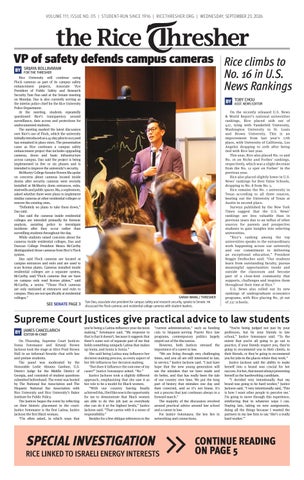
VOLUME 111, ISSUE NO. 05 | STUDENT-RUN SINCE 1916 | RICETHRESHER.ORG | WEDNESDAY, SEPTEMBER 23, 2026
VP of safety defends campus cameras Rice climbs to No. 16 in U.S. News Rankings SRIJAYA BOLLAVARAM
FOR THE THRESHER Rice University will continue using Flock cameras as part of its campus safety enhancement projects, Associate Vice President of Public Safety and Research Security Tam Dao said at the Senate meeting on Monday. Dao is also currently serving as the interim police chief for the Rice University Police Department. At the meeting, students repeatedly questioned Rice’s transparency around surveillance, data access and protections for undocumented students. The meeting marked the latest discussion over Rice’s use of Flock, which the university initially introduced as a 45-day pilot in 2023 and has remained in place since. The presentation came as Rice continues a campus safety enhancement project that includes upgrading cameras, doors and basic infrastructure across campus. Dao said the project is being implemented in five or six phases and is intended to improve the university’s security. McMurtry College Senator Bowen Ma spoke on concerns about cameras located inside dorms after security cameras were recently installed at McMurtry dorm entrances, exits, stairwells and public spaces. Ma, a sophomore, asked whether there were plans to implement similar cameras at other residential colleges or remove the existing ones. “Definitely no plans to take them down,” Dao said. Dao said the cameras inside residential colleges are intended primarily for forensic analysis, assisting police to investigate incidents after they occur rather than surveilling students throughout the day. While students raised concerns about the cameras inside residential colleges, Dao and Duncan College President Meara McCarthy distinguished those cameras from Rice’s Flock system. Dao said Flock cameras are located at campus entrances and exits and are used to scan license plates. Cameras installed inside residential colleges are a separate system, McCarthy said.“Flock cameras that we have on campus only read license plates,” said McCarthy, a senior. “Those Flock cameras are only stationed at entrances and exits to campus. They are not specifically at residential colleges.”
SEE SENATE PAGE 3
TOBY CHOU
ASST. NEWS EDITOR
SARAH WANG / THRESHER Tam Dao, associate vice president for campus safety and research security, speaks to Senate. He discussed the Flock cameras and residential college cameras with student leaders.
On the recently released U.S. News & World Report’s national universities rankings, Rice placed 16th out of 427, tying with Vanderbilt University, Washington University in St. Louis and Brown University. This is an improvement from last year’s 17th place, with University of California, Los Angeles dropping to 20th after being tied with Rice last year. This year, Rice also placed No. 10 and No. 16 on Niche and Forbes’ rankings, respectively, which was a slight decrease from the No. 12 spot on Forbes’ in the previous year. Rice also placed slightly lower in U.S. News’ rankings for Best Value Schools, dropping to No. 8 from No. 5. Rice remains the No. 1 university in Texas according to all three sources, beating out the University of Texas at Austin in second place. Surveys published by the New York Times suggest that the U.S. News’ rankings are less valuable than in previous years due to an influx of other sources for parents and prospective students to gain insights into selecting universities. “Rice’s ranking among the top universities speaks to the extraordinary work happening across our university and our commitment to delivering an exceptional education,” President Reggie DesRoches said. “Our students learn from outstanding faculty, pursue meaningful opportunities inside and outside the classroom and become part of a close-knit community that supports, challenges and inspires them throughout their time at Rice.” U.S. News also rolled out its new rankings of undergraduate economics programs, with Rice placing No. 36 out of 237 schools.
Supreme Court Justices give practical advice to law students JAMES CANCELARICH
EDITOR-IN-CHIEF
On Thursday, Supreme Court Justices Sonia Sotomayor and Ketanji Brown Jackson took the stage at Alice Pratt Brown Hall in an informal fireside chat with law and prelaw students. The panel was moderated by the Honorable Leslie Abrams Gardner, U.S. District Judge for the Middle District of Georgia, and consisted of student questions submitted beforehand. The event was hosted by The National Bar Association and The Hispanic National Bar Association with Rice University and Rice University’s Baker Institute for Public Policy. The Justices began the event by reflecting on their historic placement in the court: Justice Sotomayor is the first Latina, Justice Jackson the first Black woman. “I’m often asked, in which ways that
you’re being a Latina influence your decision making,” Sotomayor said. “My response to that is that it doesn’t, because it suggests that there’s some sort of separate part of me that holds something uniquely Latina that makes up Sonia, and Sonia is Sonia.” She said being Latina may influence her decision making process, as every aspect of her life influences her decision making. “But does it influence the outcome of my cases?” Justice Sotomayor asked. “No.” Justice Jackson took a slightly different approach, emphasizing that she saw it as her role to be a model for Black women. “With our country having finally achieved this, I feel like now is the opportunity for me to demonstrate that Black women are able to do this job just as everybody else can do it at the highest levels,” Justice Jackson said. “That carries with it a sense of responsibility.” Besides for a few oblique references to the
“current administration,” such as funding cuts to hispanic-serving Puerto Rico law programs, contemporary politics largely stayed out of the discussion. However, both Justices stressed the importance of a career in law. “We are living through very challenging times, and you all are still interested in law, in service,” Justice Jackson said. “I just have hope that the new young generation will see the mistakes that we have made and do better, and that has really been the tale of our country over time. We put the long part of history that mistakes one day and then corrected, and so it’s not linear. It’s not a process that just continues always in a forward march.” The majority of the discussion revolved around practical advice around law school and a career in law. For Justice Sotomayor, the key lies in networking and connections.
SPECIAL INVESTIGATION
RICE LINKED TO ISRAELI ENERGY INTERESTS
“You’re being judged not just by your professors, but by your friends in law school,” Justice Sotomayor said. “To the extent that you’re all going to go out to practice, if your friends respect you, they’re going to recommend you to their clients, to their friends, or they’re going to recommend you for jobs in the places where they work.” Justice Jackson said the ability to make herself into a brand was crucial for her success. For her, that meant always presenting herself as the hardworking candidate. “I decided very intentionally that my brand was going to be hard worker,” Justice Jackson said. “I very intentionally said, ‘This is how I want other people to perceive me.’ I’m going to move through this experience, reinforcing that in whatever ways I can. Staying late, taking on new assignments, doing all the things because I wanted the partners in my law firm to say ‘She’s a really hard worker.’”
CONTINUE READING ON PAGE 5
2 • WEDNESDAY, SEPTEMBER 23, 2026
THE RICE THRESHER
Custodial staff lose meal swipes, base pay raised RACHEL JEONG
THRESHER STAFF
In previous years, Rice maintenance and custodial staff had once-per-day meal swipes included in their compensation. At the beginning of this semester, staff were told they would no longer receive this benefit. Facilities leadership says the cut came as part of the Total Rewards Initiative, a movement within Human Resources to raise base hourly pay and to enhance employee benefits. The decision to remove meal swipe access was made by the operations, finance & support leadership team this past summer,
Managing a legacy perk for a team that is now triple its original size prompted OF&S leadership to reevaluate how divisional resources could deliver the greatest long-term impact while remaining operationally sustainable. Brian Lindoerfer ASSOCIATE VICE PRESIDENT OF FACILITIES, PLANNING & CAPITAL CONSTRUCTION
according to Brian Lindoerfer, associate vice president of facilities, planning & capital construction. For decades, the one-meal-per-day program existed originally for a subset of custodial staff within Housing, Dining & Hospitality. However, the Facilities Reimagined program announced in September 2025 merged custodial and maintenance teams from H&D; following the merge, the meal swipe program temporarily applied to the now larger team. The program’s current size warranted reconsideration for Lindoerfer and leadership. “Managing a legacy perk for a team that is now triple its original size prompted OF&S leadership to re-evaluate how divisional resources could deliver the greatest longterm impact while remaining operationally sustainable,” Lindoerfer wrote in an email to the Thresher. One custodian, Custodian A, said there was speculation among custodial staff members that the meal program was cut due to increasing numbers of students eating in the serveries or due to some custodians grabbing larger portions of food. The
custodian was granted anonymity out of concern for their job security. “We heard that they were complaining about all these custodians coming and grabbing a lot of food, not just the portion that you were gonna eat here. They were taking more than that, and so it was like they punished all of us because some people did that,” she said. When asked about how she felt about the change, Custodian A was ambivalent. “I ate just a little, so it was like, ‘Oh well.’ But we keep seeing that a lot of food goes to the trash, so it’s like, ‘huh?’” she said. “We just don’t know.” But for Custodian B, a second custodian who was also granted anonymity, the change in meal swipe access seemed reasonable to him due to visible increases in staff size. “I feel it’s fair because there are now so many employees involved in the merger,” he said in reference to the Facilities Reimagined initiative. Meanwhile, for Custodian A, a point of frustration was the lack of communication to custodial staff. “But they never tell us why. They just said, ‘No more food,’” she said. According to Lindoerfer, the decision was finalized and announced to impacted staff via “written official notice” before the start of the semester, though how long before the semester’s start is unclear. “To ensure staff were supported and had an opportunity to ask questions, supervisors received advance notice, resources, and encouragement to hold in-person conversations with their team members,” Lindoerfer wrote. Custodian A said she was still on vacation
during the time an in-person announcement was made and did not hear the news until later. Lindoerfer said the decision to remove swipe access was made in order to support the Total Rewards Initiative. The latter is a recent effort that focuses investment towards staff compensation and benefits, including raising the minimum hourly rate for all hourly regular and temporary staff positions from $15 to $18. In addition to the elevated base pay,
Why are the new ones getting paid the $18, and we’re not? That was an unanswered question. They never said anything, so we’re just waiting until this next paycheck to start getting those $18. Anonymous Custodian Lindoerfer said other benefits include lower health insurance premiums and expanded professional development opportunities, including English as a Second Language courses that will launch this fall. The initiative is reportedly under Rice’s HR Excellence Portfolio, which says it seeks to strategically position Rice as a premier employer. “By raising the minimum hourly base rate and continuing to refine our compensation strategies, we are excited
to advance a culture where employees feel valued, recognized, and supported in their contributions to Rice’s mission,” states a section of the website’s frequently asked questions. Custodian A said although leadership announced the base pay change at an H&D event in May, continuing staff still have not received increased hourly pay. Meanwhile, she said new custodians hired at the start of the semester have received $18 an hour since their onboarding. “Why are the new ones getting paid the $18, and we’re not? That was an unanswered question,” she said. “They never said anything, so we’re just waiting until this next paycheck to start getting those $18.” However, Custodian B said he received the raise this September. “My salary has increased, and I’m happy about that,” he said. Custodian A said she appreciated the concept of a raise, but in combination with expenses like monthly parking fees, Medicaid, taxes and other payments, said she feels not much as changed. “Yeah, it’s just a little for a lot of work,” she said. “But the food was so helpful for us because we didn’t have to either cook at home or buy anything outside. But I guess it’s okay.” When asked if she knew what the Total Rewards Initiative was, Custodian A said no. Ultimately, Custodian A said regardless of any changes in pay, the position is necessary for her. “I mean, we need the job,” she said. Editor’s note: Custodian B’s interview was conducted using a translation service.
JUNE LI / THRESHER A Housing, Dining & Hospitality worker swipes a student’s ID. Custodial staff no longer receive daily meal swipes after a department restructuring and pay raise.
Inside Rice’s phased retirement program for faculty SAMANTHA JAMESON
FOR THE THRESHER
Rice’s Faculty Phased Retirement Program offers a three year wind-down retirement strategy to help guide faculty through the difficult process of leaving their careers a$er years of service. The program is open to tenured faculty between the ages of 62 and 70 years old who have at least 10 years of continuous service at Rice. Fred Higgs, vice provost for academic affairs, oversees the program. Since faculty work varies from one field to the next, the program tailors each retirement plan to the individual. “The dean and department chair in consultation with the faculty member determine the duties associated with 50% effort based on the faculty member’s
existing teaching, research, administrative and service responsibilities,” wrote Higgs in an email to the Thresher. Participants work at 50% class and administrative load for three years, with salary decreasing each year: from 80% in year one to 70% in year two and 50% in year three. They remain eligible for pay raises in each of the three years. The program is a voluntary alternative to traditional retirement for those looking to reduce their workload gradually before leaving Rice. According to the program’s website, participants keep their benefits eligibility until they fully retire. They cannot draw on their Rice 401(a) — employer-controlled retirement — funds while they are still active and paid faculty. They can, however, join the Association of Retired Rice University Faculty as associate members, a program
I really enjoyed teaching, but I did it for 50 years. I live on my retirement income and I’m still reading and writing … I feel very privileged to be able to do that. John Boles FORMER PROFESSOR OF HISTORY
that advocates for retiree benefits and provides a community for retired faculty members. Once they fully retire, they can access their 401(a) funds and become full ARRUF members. A$er teaching history at Rice for 38 years, John Boles retired in 2019.
“I really enjoyed teaching, but I did it for 50 years,” Boles said. “I live on my retirement income and I’m still reading and writing … I feel very privileged to be able to do that.” According to the vice provost for academic affairs’s website, the vice provost’s office emails eligible faculty with details on the program and how to proceed each November, giving them time to plan the transition with their chairs and deans. Higgs said the goal is to make that process as smooth as possible. “Our goal is to make retirement planning thoughtful, voluntary, and dignified,” Higgs wrote. “Phased retirement gives faculty who are ready to consider that transition an opportunity to reduce their responsibilities gradually while allowing departments and schools to plan thoughtfully for the future.” Eligible faculty can sign up between Nov. 1 and April 30 each year.
WEDNESDAY, SEPTEMBER 23, 2026 • 3
NEWS FROM FRONT PAGE
during a meeting the previous month, but students still lacked clear information about how they could support undocumented Dao said Flock’s main use is to identify students. people who may pose a threat to campus. Dao said he did not know which university “The goal of Flock cameras for Rice office was responsible, suggesting the issue University is when we know there’s an could fall under mental health or offices that individual who has a potential issue to cause work with international students. He said his harm to the university, we will put it in our role in the police department is focused on Flock to make sure when they come on protecting students from external threats. campus, we know and we can intervene,” “If law enforcement, such as [Customs Dao said. and Border Protection], become an external There are currently 17 Flock cameras threat, we will address them,” Dao said. “But installed and in use at Rice University. Dao the mission to make sure our students feel said there are no current plans to add more safe in a psychological [sense], I don’t have in the future. the expertise to really address them.” Questions about Flock’s broader data Hurley’s concerns about communication access also raised concerns about the safety were echoed by Brown College President of undocumented students, particularly over Matthew King, who, in an interview who can access the information collected by a$erwards, said students had been frustrated the system and how it could be shared with by a lack of clarity about how security outside law enforcement agencies. changes were being implemented and who Max Menchaca, Brown College social they could turn to with questions. vice president, asked how Rice is proactively King said he appreciated Dao attending protecting undocumented students given the meeting and taking questions, but he felt concerns about other law enforcement that many of the concerns raised by students agencies’ access to Flock data and the were not directly addressed. potential sharing of information with federal King said students had asked why immigration authorities. Rice implemented new security measures Dao said he did not know what the without informing the colleges and whether university was doing generally to protect the university planned to assess the changes undocumented students and said that before continuing to implement them. “You implement these things and it breaks campus security and ruins things at Brown for our gates and our tap readers,” King said. “It doesn’t really seem like that’s a priority.” King said Brown College’s concerns extended beyond the immediate problems with access systems to how the university would communicate with colleges about future security changes. He said this was the first time Brown College had been able to have a direct conversation with an administrator about the issue, in part because students and college leadership were unsure who their point of contact was. Brown College Senator Neya Gupta said the lack of communication was particularly frustrating because students SARAH WANG / THRESHER saw the university implementing new security systems while struggling to College presidents and senators listen to Rice Student Association President Chelsea Asibbey go over the agenda at Senate. Senate hosted Tam Dao, associate vice president of public safety and research security, address existing problems. to discuss Flock cameras.
SENATE
responsibility does not fall under his role. “It’s definitely not my job to go a$er [undocumented students],” Dao said. “That’s not in my mission to protect undocumented students. That’s not in my goal.” In terms of sharing information, Dao said Rice does not provide records simply because an outside organization requests them. If Rice receives a court order requiring records, he said the university would defer to General Counsel to determine what information it is legally required to provide. Questions about the safety of undocumented students also raised discussion about who at Rice is responsible for supporting them when their concerns involve campus safety. Lovett College President Bruce Hurley questioned Dao on what students should do if they approach residential college leadership with concerns about immigrationrelated threats and are told the issue does not fall under Public Safety. “If students come to me and they’re concerned, and I tell them that the interim chief of police doesn’t know where we’re supposed to support these people, then what am I supposed to do?” Hurley asked. Hurley also cited concerns about communication from Public Safety, saying they had discussed increasing communication with residential colleges
“They seem to be able to easily implement these new cameras without telling any students, but then are unable to communicate them to the students, the magisters and the government,” Gupta said. The questions about transparency also extended to Rice’s original rollout of Flock. The Thresher asked why Rice announced Flock as a 45-day pilot in 2023 but did not provide subsequent public updates about its continued use and expansion. Dao said he was not involved in the original rollout and was unsure how the university’s messaging had been handled at the time. Dao was not working for Rice when the Flock cameras were installed in Jan. 2023. He said Rice is now developing a communications strategy and putting together a communications team for its campus safety projects. Dao acknowledged that Flock has drawbacks, but said his responsibility is to present security practices to university leadership, which ultimately decides whether the technology is worth using, stating that Rice must also consider the consequences of not having the technology in the event of a serious threat. “Flock cameras have some cons, also have some pros,” Dao said. “If something bad were to happen because we don’t have Flock cameras, who’s going to raise their hand here and talk to that parent?” Rice Student Association President Chelsea Asibbey said the ambiguity surrounding some of the university’s answers demonstrated the need for greater transparency, particularly on decisions that directly affect students. “I think maybe the ambiguity in the answers shows that there needs to be more transparency for students, especially in topics that directly affect them,” Asibbey said. Asibbey said the questions raised at the meeting re%ected students’ desire for both safety and transparency. “Senate’s supposed to be an open forum where we can share our concerns with people who can do something about it,” Asibbey said. “Every student at Rice deserves to feel safe and also have clear expectations for and advance notice for things that directly affect them.”
4 • WEDNESDAY, SEPTEMBER 23, 2026
THE RICE THRESHER
Swipe access restrictions create new barriers to student life EESHA SURAPANENI
FOR THE THRESHER
At the start of this semester, students found that access to residential colleges’ facilities, such as elevators, stairwells or private dining rooms, are now restricted by swipe access to only members of that college. While the residential college system does foster connections between students within their college, many find themselves also making friends from other colleges through their classes and extracurriculars. With new access restrictions to college spaces, some students said they face additional barriers to engage in student life. Duncan College sophomore Ananya Chandra said the restricted swipe access between colleges limits her ability to access campus resources. Chandra said she wanted to attend a teaching assistant session happening in Lovett College’s PDR, planning on asking questions before her upcoming organic chemistry exam. She instead found herself stuck outside, waiting on someone to open the door due to her lack of swipe access to the space. Apart from academic activities, others find the restricted access prevents them from meeting friends a$er classes. “I think it affects the Culture of Care,
or just the whole of having friends across different colleges,” said Shreya Raj, a Duncan sophomore. “Sometimes we just wanna come over or be there for our friends, which is hard to do [with the swipe restrictions].” Raj said someone asked her to help them get up to a birthday party happening at Duncan, which made her realize that some college spaces were only accessible by that college’s students. She found herself in a similar position later when wanting to surprise her own friend at McMurtry College for her birthday, but realized that she did not have access to the elevator to get there and needed extra assistance. “I like the security, but, I mean, the security shouldn’t be against other students,” Raj said. “The security should be against outsiders of Rice.” Others find themselves not as affected by the swipe access restrictions due to the constant presence of people in the spaces they go to anyway. Lovett sophomore Joshua Cheng said although sometimes his own access to Lovett spaces %uctuated, there are o$en people already at his usual spaces who would easily open the door for him if needed due to commons culture. He said he believes the lack of swipe access for other colleges’ students to Lovett is an oversight.
New students face difficulty enrolling in mandatory course RAMISHA HASAN
FOR THE THRESHER
Over 80 students were unable to register for a mandatory course this fall. According to Alexander X. Byrd, vice provost of the office of access and institutional excellence, around 80 students were unable to register in any section of the UNIV 195: Dialogues on Communities at Rice workshop. The workshop is a mandatory six-week course meant to be taken by incoming students in their first semester, intended to follow the UNIV 194: Critical Thinking in Sexuality workshop that takes place in the first six weeks. Throughout Orientation Week, peer academic advisors consistently remind new students that these zero credit hour courses must be added to their fall schedules. However, after the initial course request period, many found that not only was the class section they requested for DCR closed, but also that every other section of that class was also at capacity. Lyna Dao, a Duncan College senior serving as this year’s student director of peer academic advising, said she first learned of the issue during the beginning of the add/drop period. “I became aware during add/drop when the new students weren’t able to get into those classes, and they informed me that all of the sections were full,” Dao wrote in an email to the Thresher. In the meantime, the PAA team tried to reassure students that the problem would be resolved, even though they had not faced such a situation before. “Since the students were concerned about not getting into those mandatory classes, the OWPAAs informed the students that a solution was coming soon, but that there was not much that they knew of at the moment,” Dao wrote. The number of incoming students — freshmen and transfer students — topped 1,400 this semester, while the capacity
for the course was 1,350. However, instead of opening more sections of the course this fall, OAIE approached the issue with a different solution. “Most incoming students take the UNIV 195 workshops during their first semester at the university,” Byrd wrote. “We have also come to offer several sections of UNIV 195 during the spring semester for students who did not get seats in the fall, for spring transfer students and for others. This year, for the nearly 80 students who were unable to enroll in the fall workshops, we opened six spring sections.” This contrasts the course capacity for the CTIS course. Janie Guerrero, the SAFE Office director, said they did not experience any course availability issues, and in fact, many sections did not reach maximum capacity. The CTIS section offerings reflect the demands of increasingly larger incoming classes over the last few years, while DCR capacity has remained relatively stable. This capacity issue contributes to concerns on how Rice anticipates course demand as incoming classes continue to grow. A recent Thresher article on the overenrolled STEM courses points to the fact that teaching schedules for the fall are finalized early in the previous spring semester before enrollment numbers for new students are finalized in May. A similar cause could have fueled the issue with DCR course capacity, though Byrd did not cite it as being a factor. Looking ahead, Byrd wrote that the office will evaluate the balance of fall and spring workshop sections and its communication with students to help make the enrollment process smoother. “The office will assess the balance of fall and spring sections and our communications with students in our annual evaluation,” Byrd wrote. “The workshops are an essential part of settling in at Rice, and we want the enrollment process to be as smooth as possible.”
r mp i e pe r here e perie e r premiere
Fri,
Sep 25
Shepherd School Chamber Orchestra
ee
7:30pm
i
e 5
e
Milhaud: Le Bœuf sur le toit Jeremy Gill: Soft as the Massacre of Suns, fantasies for oboe and orchestra, on poems by Emily Dickinson* (Erin Hannigan, oboe) Beethoven: Symphony No. 5
S ,
Sep 2
7:30pm
Shepherd School Symphony Orchestra
S mp i r rm i
avel: Alborada del gracioso trau : Death and Transfiguration Ja e Berran (MM ’26): Probabolophony* indemith: Symphonic Metamorphosis of Themes by Carl Maria von Weber Conducted by Miguel Harth-Bedoya
All performances in Stude Concert Hall
* World Premiere
Get Your Tickets
THE RICE THRESHER
SPECIAL INVESTIGATIONS
WEDNESDAY, SEPTEMBER 23, 2026 • 5
Baker Institute’s Eastern Mediterranean Energy Center links Rice to Israeli energy interests Israel’s control of liquid natural gas off the coast of the Gaza Strip was faltering. The country turned to Cyprus and Greece for support — and Rice is now their advisor. 2015
SPECIAL INVESTIGATIONS The Baker Institute for Public Policy’s new Eastern Mediterranean Energy Center formally connects Rice to Israel’s efforts to secure energy sources in the Middle East, including those off the coast of the Gaza Strip. Officially launched June 11, the EMEC draws from the Eastern Mediterranean Security and Energy Partnership Act of 2019, which authorized the U.S. Department of Energy to establish the center as a partnership with Cyprus, Greece and Israel, colloquially termed the “3+1” alliance. The 3+1 alliance was originally a triangular framework between Israel, Greece and Cyprus. It was built upon the discovery of the natural gas fields off the coast of Israel’s maritime territory in 2011, and since its founding in 2016, it has evolved into a military alliance to address regional con$ict and improve Israel-EU relations. “The Israeli-Palestinian con$ict has become a major stumbling block to cooperation with Israel in the formal EU frameworks,” a 2020 policy analysis article on the Israel-Greece-Cyprus framework states. “This … has led Israel to concentrate on bilateral relations with partners in the European theater, among them Greece and Cyprus, in part in order to improve Israel’s stand in the EU framework.” The Baker Institute is the “+1” of the American portion of this alliance, said Gilead Sher, a nonresident fellow at the Baker Institute. “The Baker Institute’s role in the EMEC, in my opinion, is really quite practical,” Sher said. “It’s not hypothetical, because it [is] explicitly framed as institutionalizing the 3+1 energy track.” A%er the outset of the war in Gaza in October 2023, Israel bid off maritime territory previously claimed by Palestine to private corporations to explore for natural gas. As the war with Iran has threatened energy stability in the region, the EMEC has stepped in.
The Baker Institute’s role in the EMEC, in my opinion, is really quite practical ... it [is] explicitly framed as institutionalizing the 3+1 energy track.
Gilead Sher
BAKER INSTITUTE NONRESIDENT FELLOW
“The recent events demonstrated the field’s vulnerability to local con$icts,” Ted Loch-Temzelides, a scholar in energy studies at Baker Institute, wrote in an email to the Thresher. “Backed by U.S. institutional investments and regulatory transparency, this shared infrastructure creates structural resilience against both seasonal demand spikes and transit disputes.” What is liquid natural gas? Why is it important to Israel? Liquid natural gas, or natural gas cooled to a liquid state, forms a critical part of global energy production and supply. It is vital to electricity, heating, industrial processes and
TIMELINE January 2 Established territorial waters for Palestine and Israel. Palestine approved UNCLOS establishing their territorial waters
2016 January 28 Israel-Greece-Cyprus trilateral framework inaugurated
2019 July 10 Eastern Mediterranean Security and Energy Partnership Act of 2019 3+1 alliance framework formed
2023 October 7 War in Gaza begins October 29 Oil corporations win Israeli bids for LNG exploration off of Palestinian waters
MAGNOLIA HICKEY-ZAMORA / THRESHER A map of maritime zones and natural gas fields. In 2023 Israel authorized companies to explore Zone G, 62% sits in Palestine’s claim.
2025 October 10 Ceasefire in Gaza goes into effect
2026 February 28 The U.S. and Israel launch their first military strikes on Iran
LNG field facts: BRANDON NGUYEN / THRESHER A rendering of a liquid natural gas tanker. farming and fertilizer production across the globe. The Middle East plays a critical role in the transportation of LNG, and the Strait of Hormuz and the Suez Canal are two key waterways that provide access between the production of LNG and transport across the globe. LNG generates large profits for Israel. The Leviathan gas field, which sits upon the oceanic Levant Basin located off Israel’s coast, is a major source of Israeli natural gas. The basin contains an estimated 122 trillion cubic feet of natural gas and produced a net value of $453 billion in 2017 prices, according to a United Nations Trade and Development report. Wartime expansion and challenges to LNG control A%er the Oct. 7, 2023 attacks in Israel and the subsequent war, Israel began securing oil fields within the maritime area of Zone G, 62% of which falls within Palestinian maritime boundaries under the 1982 U.N. Convention on the Law of the Sea. Currently, Palestinians are prohibited from using any LNG reserves within Zone G by Israel, according to a U.N. Trade and Development report. This zone was declared to the U.N. in 2019 by the Minister of Foreign Affairs and Expatriates of the State of Palestine. However, Israel said in a statement that Palestine fails to satisfy the criteria for statehood and therefore has no claim to these boundaries.
•
An estimated 1 trillion ft³ of gas reserves lie in the Gaza Marine gas field.
•
An estimated 122 trillion ft³ of natural gas lies within the Levant Basin.
•
It produced a net value of 453 billion dollars for Israel in 2017.
•
In 2023, the Dana Petroleum (Korean), British Petroleum and Eni Energy (Italian) natural gas companies began exploration of Zone G.
•
62% of Zone G lies within Palestine’s declared maritime boundaries.
On Oct. 29, 2023, the Israeli Ministry of Energy awarded six licenses to Israeli and international companies for natural gas exploration in Zone G for an initial period of three years. As only a small corner of the Leviathan gas field sits in the zone, these companies aim to discover new LNG fields — and sources of revenue. “The winning companies have committed to unprecedented investment in natural gas exploration over the next three years,” said Israel Katz, the minister of energy and infrastructure and member of the Knesset, in a media statement. “That in turn will solidify Israel’s energy security.” As the war in Gaza continued, tensions between Israel and Iran began to increase. Israeli con$icts with Hamas, Hezbollah and the Houthis — all Iran-backed groups — became a focal point for the antagonistic
March 18 Iranian strikes Bazan oil refinery in Israel June 11 Baker Institute launches EMEC
behavior of Iran, the New York Times wrote. Iran originally operated through proxies, using Hezbollah and Houthi rebels as a means to attack Israel, increasing tensions between the two countries. Now, as the Iran war nears its seventh month, energy has become a strategic target on both sides. The Strait of Hormuz, where 20% of the world’s natural gas and oil used to pass through, is currently blocked by Iran. Israel has conducted airstrikes on Iranian oil refineries and depots in Tehran, and Iran has retaliated by launching missiles on Israel’s Bazan oil refinery, located in Haifa. As the Iran war has drawn other countries into the con$ict’s sphere of in$uence, Sher said the creation of Baker’s EMEC was meant to counteract increasing tensions within the region. “[Turkey’s] actively building a counteralliance,” Sher said. “Turkey has been drawing closer to Pakistan, purchasing its own claims.” As the 3+1 alliance aims to strengthen Western control over energy, LochTemzelides said the EMEC, through commercial infrastructure solutions, can position “Israel as a strategic energy exporter.” “Building this infrastructure creates shared economic interests that use commerce to suppress con$ict and physically bring nations together,” LochTemzelides wrote. “Ultimately, this collaborative energy system strengthens the Western strategic alliance and integrates the Eastern Mediterranean into a unified platform for lasting peace and prosperity.”
WEDNESDAY, SEPTEMBER 23, 2026 • 6
THE RICE THRESHER
AN URBANIST’S GUIDE TO HOUSTON
Bring Rice the cycling infrastructure we deserve NICOLAS COOKER & JACOB JORDAN
THRESHER STAFF
Despite being in Houston, a city famously (and increasingly) hostile toward cyclists, Rice prides itself on being a bike-friendly university. Rice Bikes and Beer Bike are some of our most prominent institutions, and our campus already has bike shares, commuter showers and ample bike parking. This November, Rice’s “Bicycle Friendly University” award from the League of American Bicyclists will come up for renewal. It’s a good opportunity for the university to improve its cycling infrastructure to try and move up from its current silver award toward gold or platinum. Unfortunately, Rice has backslid in the four years since it was last certified. Rice’s heightened enforcement of Policy 854, originally in response to an uptick in scooter accidents, has also made life more difficult for cyclists, who weren’t the issue to begin with. Starting in January, the Rice University Police Department has often been stationed at central intersections like Alumni Drive and Laboratory Road, waiting for riders — cyclists and scooterists alike — to run a stop sign in order to ticket them. This enforcement forces bikes and cars into one unified line, slowing cyclists down to the speed of cars and defeating the main benefit that cycling offers over cars: consistent speed. While scooterists and drivers can easily accelerate out of a stop sign with the touch of a pedal, frequent stops place a larger burden on cyclists, who have to exert more physical effort to get back up to speed. Rice could recognize this difference by following the lead of the 14 states that have now adopted “Idaho stop” or “stop-as-yield” laws, allowing cyclists to treat stop signs as yield signs, preserving their momentum and increasing safety. When similar laws were implemented in Delaware and Idaho, those states saw a 23% and 14.5% reduction in crashes involving bicyclists at stop sign intersections, respectively. But the largest room for improvement is infrastructural. Since cyclists are forbidden from using sidewalks, the Inner Loop has become the most important piece of infrastructure for bike traffic.
KONSTANTIN SAVVON / THRESHER
One student cycles the Inner Loop. Unfortunately, it’s also become the most congested with deliveries, student and faculty commuters, campus visitors, shuttles and now Waymos. How can we manage and slow down motorized vehicles on what should really be a living street? Thankfully, this is not a new question, and there are a number of stock solutions that we could bring to Rice today. Raised crosswalks, especially in series, are simultaneously effective at reducing vehicle speeds and improving pedestrian safety. Speed bumps are a classic yet effective way to reduce vehicle speeds and are easily traversed by low to medium speed cyclists. Chicanes, or small S-shaped curves, force cars to make slight turns to stay in the roadway and are also useful for increasing the amount of public space available on the corridor. These solutions would help turn an untamed road like the Inner Loop into a shared living space. At the very least, we should consider
JESSICA XU / THRESHER An alternate shuttle route with sections of the Inner Loop closed to vehicular traffic.
adding a bidirectional bike lane to allow easier bike mobility. The Inner Loop’s one-way design makes it more frustrating than ever to get from one side of campus to the other unless you happen to be traveling in the same direction as the Inner Loop. A bidirectional cycleway — even if just using paint markings — is an incredibly easy solution that would both increase mobility and keep cyclists off the sidewalks, satisfying pedestrians. While this is a good start, it’s worthwhile to question the role of cars on the Inner Loop to begin with. While adding bike lanes may be a necessary short-term fix, they do not constitute a long-term solution. Bike lanes are a type of car infrastructure, since they protect cyclists from cars. Without vehicular traffic, there would be no need for bike lanes. Yet the most obvious problem with banning vehicular traffic is the unique parking lot entrances that can only be accessed from the Inner Loop, such as the parking garage at McNair Hall and the back garages of the magister houses at Hanszen, Will Rice and Baker Colleges. Looking into it further, however, there are no driveways on the Inner Loop between Baker College and the Rice Memorial Center, as well as between the Moody Center for the Arts and the intersection at College Way and Alumni Drive. Without driveways or unique parking access points along these sections, cars have no functional reason to drive here. If traffic were cut on these sections, we estimate around 55.6% of the Inner Loop could be opened to exclusively nonmotorized travel. Other sections could be improved with traffic calming treatments or even gated to restrict unnecessary traffic. None of this would be unprecedented. In gold-awarded Washington University at St. Louis, which is of a very similar
size and structure to Rice, there is no inner loop, and the innermost Brookings Quad is surrounded by buildings with no delivery access. Gold-awarded Harvard University, while built more conventionally into an existing street network, also has numerous vehicleinaccessible buildings and gated living streets. This could have serious implications for other elements of Rice’s infrastructure, such as our shuttles. If vehicle traffic is still permitted on some sections of the Inner Loop, it’s possible to imagine retaining an Inner Loop shuttle route with altered service.
We shouldn’t accept ‘better than Houston’ as an implicit glass ceiling for nonmotorized transportation at Rice. In addition, Rice is beholden to its own accessibility policy, Section 402, which requires it to make individual alternative accommodations that might be more difficult with the road closure. By ADA requirements, Rice must also ensure pathways from the new stops to existing buildings are preserved. Many of these accessibility requirements are mitigable with good planning and design, such as the implementation of point-to-point golf cart microtransit and collaboration with the Student Disability Resource Center. We shouldn’t accept ‘better than Houston’ as an implicit glass ceiling for nonmotorized transportation at Rice. It’s about time for a serious, campuswide discussion of our pedestrian and cyclist infrastructure and for the administration to demonstrate to Rice students that major improvements to our built environment are not only possible, but achievable.
Jacob Jordan is a senior from Baker College studying Civil and Environmental Engineering with a minor in Environmental Studies. Nicolas Cooker is a junior from Martel College studying Computer Science with a minor in Environmental Studies. They believe that every Rice student should be well-informed about their built environment and have the knowledge necessary to advocate for their interests in and beyond Houston.
WEDNESDAY, SEPTEMBER 23, 2026 • 7
OPINIONS EDITORIAL
We deserve answers on Flock from RUPD Tam Dao, the associate vice president of public safety and research security and interim Rice University Police Department chief, took the stage at the Rice Student Association Senate this week to talk about campus security. The questions on everyone’s minds were security cameras and Flock cameras. One moment stood out to us. Lovett College President Bruce Hurley asked how campus safety and RUPD were protecting undocumented students when Flock cameras have been known to aid in the Department of Homeland Security and Immigration and Customs Enforcement raids. His question had the earnest tone of a college president who’s had too many students come to him with concerns. Concerns about violent raids, concerns about deportations. Maybe even concerns about disappearances and killings. Dao’s response: Undocumented students were not under his purview, and it was not his goal to protect them. Dao then proceeded to recommend that the students seek mental health counseling to make themselves feel better.
This statement constituted a callous and utter disregard for the most vulnerable students on our campus. We are concerned that the head of security and RUPD do not have answers to these pressing questions. More than that, we are revolted by the lack of humanity that Dao displayed. If anyone should be working to protect undocumented students, it’s Dao and the RUPD. Since when did these students become of such little concern to them? But there is more that Dao purports not to know: how Flock connects with other camera networks and who is able to access the data. He didn’t know what department undocumented students fell under. He couldn’t decide whether we had 12 or 17 Flock cameras on campus. (We checked: It’s 17). He also wouldn’t say how much they cost. Even amid the onslaught of questions, we barely began to scratch the surface of these issues. What about data privacy? Our civil liberties? Misuse by RUPD? Your own editor-in-chief got in a question about the lack of transparency regarding Flock’s adoption, and Dao simply de%ected. (Flock’s rollout was buried in a 2023 press
release about a 45-day trial period. No subsequent public announcements followed its permanent adoption and expansion.) In defense of the cameras, Dao gave a few anecdotes of Flock cameras being used to protect students. His argument is that we have to accept the cameras because of this. As he said, there’s a trade-off with every campus security measure. The problem is that Dao can’t articulate — or doesn’t even seem to know — what the negative trade-offs are. Unfortunately, we will be left to deal with the consequences. Our position on Flock remains the same: full removal from campus. We demand full transparency around Flock. Rice should release a public statement detailing the real answers to all the pertinent questions raised Monday night. It’s the very least they could do. Editor’s Note: Thresher editorials are collectively written by the members of the Thresher’s editorial board. Current members include James Cancelarich, Evie Vu, Abigail Chiu, Hongtao Hu, Andrew Rynsburger, Chi Pham, Andersen Pickard and Patrick Shukis. Chiu and Hu recused themselves from this editorial due to corresponding coverage.
SENATE SCOOP
RSA should complete RUPD’s unfinished job MAX MENCHACA & ELI RISINGER
THRESHER STAFF
Undocumented students are not my job. That was the sentiment espoused by Rice’s Associate Vice President of Public Safety and Interim Chief of Police Tam Dao when asked about Flock cameras and their implications for undocumented students. I keep coming back to that line because it raises a question that should never need answering: What does Rice’s top campus safety official believe his office owes to students who cannot rely on police in the same way their classmates can? Apparently, not much. Yet, the same indifference runs underneath a debate the Rice Student Association had last year over how to support undocumented students. Last fall, the RSA debated the future of the Undocumented Task Force. Former President Trevor Tobey pushed to make it a club instead of a task force. That would have meant publishing a membership list, which task force members said was incompatible with protecting students who did not want their immigration status identifiable. On top of that, club status would have brought administrative requirements a small group of students said they weren’t equipped to take on. After considerable internal discussion, Senate renewed the group under a new name, the Rice Immigrant Support and Advocacy Task Force. To some of us in Senate, myself included, that outcome felt less like a solution and more like the RSA finding the easiest way to stop talking
about the problem. One undocumented Rice student wrote anonymously in the Thresher about living with such a severe fear of police that the sight of an officer made their stomach turn. They recounted an instance of panic when they learned Rice students had dressed as Immigration and Customs Enforcement agents on campus, demanding “papers” from their peers on Halloween. While that account is one student’s, it is a real example and a reminder that undocumented students at Rice are a constituency that the RSA represents. Nor is the broader climate hypothetical. Rice confirmed in April that federal authorities had revoked visas belonging to three current students and two recent graduates, part of a wave that hit more than 1,100 students nationwide. That case involved a different legal status than undocumented students, but it showed how immigration enforcement at American universities is no longer a distant concern. It’s against this backdrop that Rice installed Flock Safety’s license plate readers at campus entrances. Reporting elsewhere has raised questions about whether Flock’s camera networks can be searched by the Department of Homeland Security outside the jurisdiction that installed them. Rice has signaled that risk does not apply here, but it has left unanswered who can access what the cameras collect or under what circumstances that data could leave campus. Installing a surveillance system first and addressing those questions later, if at all, is
not a responsible way to treat students. This is exactly why the RSA needs to take a more proactive and responsible approach. While the RISA task force already runs Know Your Rights sessions and UndocuAlly Week, RISA is only a handful of students carrying that weight largely by themselves. The RSA needs to back them up. That could mean asking college governments to integrate a version of RISA’s work into Orientation Week. For example, they could help make students aware of the resources that exist for them and how to use them. They could address student concerns over ICE activity in Houston. Before the RSA pushes for anything more, though, it needs to know what it’s actually dealing with. To our knowledge, nobody in student government has sat down with RUPD and Campus Safety and asked, on the record, what the Flock system collects, who can access it, whether it’s ever shared outside RUPD, and what would have to occur legally before that data left campus. Right now, the RSA is arguing about a surveillance system it doesn’t fully understand. This change has to come before any proposal to tighten the policy. Once that conversation starts, the RSA has to make sure it doesn’t end it quietly. Put “Flock/ICE disclosure status” on the Senate agenda every meeting, logged as open until it’s answered. Keep this question from disappearing the way that others do, buried under a new semester of work until everyone forgets what has happened.
Max Menchaca is a Brown College junior studying political science and statistics. Eli Risinger is a Wiess College junior studying political science and social policy analysis. Both are former RSA senators and believe every Rice student should be well informed to advocate for their interests in student government.
EDITORIAL STAFF * Indicates Editorial Board member James Cancelarich* Editor-in-Chief Evie Vu* Managing Editor NEWS Abigail Chiu* Editor Toby Chou Asst. Editor Ruby Gao Asst. Editor Lina Kang Asst. Editor OPINION Andrew Rynsburger* Editor FEATURES Amelia Davis Editor London Frey Crossword Editor ARTS & ENTERTAINMENT Chi Pham* Editor Cora Wareh Asst. Editor SPORTS Andersen Pickard* Editor Patrick Shukis* Editor Keya Patel Asst. Editor SPECIAL INVESTIGATIONS Hongtao Hu* Editor BACKPAGE Max Scholl Editor Will Howley Editor Rykelle Sandidge Editor Kyle Chen Senior Writer Caleb Song Senior Writer COPY Shruti Patankar Editor Julianne Ma Editor PHOTO, VIDEO, & WEB Konstantin Savvon Photo Editor Sarah Bradley Asst. Photo Editor Andrew Gingerich Video Editor Rachel Jeong Asst. Video Editor Megan Zhang Web Editor Fiona Sik Web Editor Varshini Loganathan Web Editor DESIGN Jessica Xu Art & Design Director Magnolia Hickey-Zamora News Sydney Chang Opinion Lisa Wang Features Alexa Bu Arts & Entertainment Kirstie Qian Sports Brandon Nguyen Backpage Richard Li Design Consultant BUSINESS Sivani Vasireddy Manager Alina Zhong Advertisement Rahul Santhanam Advertisement Makeen Shafer Distribution Manager
ABOUT The Rice Thresher, the official student newspaper of Rice University since 1916, is published each Wednesday during the school year, except during examination periods and holidays, by the students of Rice University. Letters to the Editor must be received by 5 p.m. on the Friday prior to publication and must be signed, including college and year if the writer is a Rice student. The Thresher reserves the right to edit letters for content and length and to place letters on its website.
Last Week’s Online Poll Results
Editorial and business offices are located on the second floor of the Ley Student Center: 6100 Main St., MS-524 Houston, TX 77005-1892
Total number of responses: 585
Phone: (713) 348 - 4801 Email: thresher@rice.edu Website: www.ricethresher.org
Should Rice end its partnership with Flock Safety? Next week’s poll question: Did you like Duncan After Dark?
9.5% Yes
21% 10.5%
Maybe
10%
The Thresher is a member of the ACP, TIPA and CMA. © Copyright 2026
No
80% Follow @ricethresher on Instagram to answer weekly polls.
ricethresher.org
8 • WEDNESDAY, SEPTEMBER 23, 2026
THE RICE THRESHER
Over a century of noise: Inside Rice’s Marching Owl Band
PHOTO COURTESY OF THE WOODSON RESEARCH CENTER Marching Owl Band members wearing pajamas and fedoras in 1982 for “Operation Sleeping Bag,” a musical performance in a halftime show while playing against Southern Methodist University.
KAMILA EL MOSELHY
THRESHER STAFF
In November 1973, the Marching Owl Band found itself trapped. After a halftime show mocking Texas A&M University, the MOB was blockaded in the stadium tunnel by a crowd of angry Aggies. “There were a couple of thousand angry enemies outside of the tunnel,” said John “Grungy” Gladu, a trumpet player who joined the band that year and stuck with it for 53 years. Unlike most college marching bands, the MOB has never been limited to current students. Alumni and community members can, and do, join and stay involved, which is how Gladu, who first came to the band as a music major at Houston Christian University, has been playing trumpet on the field for more than five decades. Stadium staff eventually smuggled the band out. They stood in the back of food service trucks “like sardines,” Gladu said. The fallout lasted for years. “They found the band director’s phone number, they called it all the time,” Gladu said. “I think he went through three phone numbers before they finally couldn’t keep track of him.” The band long predates that incident. Rice’s first band formed in 1916 with 16 members and no director, no budget and, according to a history Gladu compiled from university records, no clear funding source for decades. A series of student and part-time directors led the band through the following decades, and it grew to roughly 240 members by the mid-1980s under director Ken Dye. The band’s current signature identity traces to the end of the 1970 season, when three trumpet players who had studied
what Ivy League schools and Stanford University were doing pushed for a looser, comedic “scatter” approach. The shift began at the final game of the season against Texas Christian University, when the band broke formation and ran off the field instead of marching. By the next season, the scatter style had become MOB’s identity. Gladu’s decades with the band produced no shortage of legendary, and occasionally chaotic, moments. In 1975, Roy Hofheinz, who financed and developed the Astrodome, was so enraged by the MOB’s joke about the Astrodome that he sent a staffer to physically confiscate the script from the freshman reading it on the field. But the gags didn’t stop there; if anything, they only got bolder. In 1980, after Baylor University’s administration threatened to punish any student who appeared in a Playboy photo feature on “Girls of the Southwest Conference,” the MOB built a halftime show mocking the controversy. They then called Playboy’s headquarters directly to offer them photos. Playboy printed one. Two shows stand out most in Gladu’s memory. The first, in 1982, he still calls the best halftime show in MOB history. It took aim at the University of Texas at Austin, turning the school’s initials into a science fiction parody — “UT” flipped to “ET.” The second came years later, when the band traveled to a bowl game against the University of Southern Mississippi. The MOB used the halftime show to needle Brett Favre, a Southern Miss alumnus and longtime Green Bay Packers quarterback, over a welfare fraud scandal that had dogged him in retirement. The crowd turned on them immediately, which Gladu counts as a win. “We had hit the nerve we were aiming for,” Gladu said.
Much of that history survives because people like Gladu carry it. Membership has fallen from 305 in 1975, roughly one in eight undergraduates at the time, to about 35 today. Gladu attributes some of the decline to a broader culture shift, noting that Rice’s band size and structure — unpaid, noncredit and open to any student — actually places it closer to the Ivy League peer bands than to its current American Conference rivals, most of which offer scholarships, course credit or both. That smaller, closely knit version of the band is the one Jace Liu, the band’s events coordinator, knows today. The MOB has a phrase for how its history moves from one class to the next: “pass[ing] down the tribal knowledge.” In fact, many iconic traditions and details about shows and music are not written down anywhere. “We just pass them down verbally to the next generation of the MOB,” said Liu, a Duncan College junior. The one fixed piece of the band’s identity, Liu said, is the movie “The Blues Brothers,” from which the band draws its uniform and some of its songs. Beyond that, the band takes on the composite identity of its current members. In a game week, they spend at least 15 hours total on MOB activities: about 11 on a game day and four and a half in rehearsal, on top of coursework and extracurriculars. “We’re all here on our own volition with no greater incentive than the community, and we love it here,” Liu said. Elena Alvarado, a Martel College senior, has moved through several roles in MOB’s student-run structure, from section leader to drum major. She described it as having a student-run structure with very little involvement from a traditional band director. Instead, an executive producer and
a small team of “game producers” write scripts each week, drawing on ideas submitted by the entire band through open meetings and an active Discord channel. “We don’t want too many cooks in the kitchen,” Alvarado said. “That’s why we keep it to just the game producers and the executive producer for the hardcore writing.” John Israel ’26, a Hanszen College alumnus and the MOB’s former executive producer, explained how that process works in practice: pitching ideas, drafting jokes and presenting them to director Chuck Throckmorton for revisions, then adjusting live during Thursday’s field rehearsal. “Nothing’s predictable,” Israel said. “Sometimes you’ll have six minutes on the field, sometimes you have five, and that could be decided right before you go on.” Meanwhile, deciding what’s fair game is its own skill. “You can’t directly make fun of somebody,” Israel said. “You’ve gotta weave it in.” He pointed to a show mocking Mike Miles, the state-appointed superintendent who took over Houston ISD, built around an Austin Powers parody with Miles cast as Dr. Evil. “This was the first show where, when we turned, the opposing audience was clapping and cheering,” Israel said. “I’ve never seen that happen.” More than five decades after the Aggies trapped his band in the stadium tunnel, Gladu is still on the field, trumpet in hand — one of the handful of old-timers who never left. The students around him turn over every four years, the shows change every week, but the band’s history stays alive through the people who carry it forward. Israel called Gladu the band’s uno&cial keeper of its own history. “He has more stories than anybody can tell,” Israel said.
WEDNESDAY, SEPTEMBER 23, 2026 • 9
FEATURES LEO TSAI
Hold Up... Let Me Cook 1
2
4
4
10
14
11
14
15
20 21
3
31 34
71
9
10
11
27
17
24
28
35
29
33 37
36
39
45
45
40
46 50 54
57
55
52
55
56
42
41
47
53
51
52
64
38 42
48
58 61
12
13
23
35
53
68
8
20
32
49
64
7 12
25
44
7
ACROSS
19
26
44
6
16
22
30
43
6
18
25
41
5
FOR THE THRESHER
59
62
70
63
65
66
66
60
1 Peanut butter container 4 Place for a massage 7 Groovy 10 Poem that might be dedicated to a Grecian urn, the Mets, or the concept of joy 11 Chop 12 Decorates with frosting 14 Incredibly good 16 Wool jacket lining 18 European pastry with a black swirl pattern 21 Savoriness 23 Tennis divider 24 Meh 25 Jack-Jack, to Elastigirl 26 Large brass instruments 29 Remove from an Instagram post 30 “No ifs, ___, or buts” 32 ___ Lanka 33 Genetic material 34 Snack that, when topped with raisins, looks devastatingly similar to the vastly superior chocolate chip version 39 Sound heard on International Talk Like a Pirate Day 40 Guys 41 Give o! 43 Sits heavily 46 Actor McLaughlin 48 “Is that a yes __ _ no?” 49 Noble rank 50 65-Across, in French 51 Stream of water 53 Taiwanese pastry made with a tropical fruit 57 Rapscallions 58 Rice tradition that barely happens twice a month? … or a hint to the meaning and length of each shaded entry 61 Rotate 62 Grow older 63 Birth control option 64 Lil ___ X 65 Answer to the question, “Does this crossword contain numbers?” 66 Covers a house in rolls on Halloween, for short
DOWN
1 Light run around the Inner Loop, for example 2 Fuss 3 Animal that inspired the name for the Firefox browser 4 “Code looks good to go!” 5 Little chicken sound 6 Wrong 7 Cut of fish 8 Excelled at 9 Long, winding stack of cups formed at sports games 13 Make room on a bench 15 YouTuber ___ Scott 16 Charges 17 Character who flexes her vocal range throughout the “Frozen” movies 19 Slow, physical way to deliver a message 20 Paper in a geocache 21 2028 Olympics host 22 Prefix meaning “one” 27 Consumer 28 Bikini part 29 Game with “Reverse” and “Wild” cards 31 Tool you have to stick with? 33 Finished 35 “___ Dalloway” (Woolf novel) 36 Hand-drawn animation component 37 “That no longer bothers me.” 38 Irish name for Ireland 42 Road material 43 ___ rally 44 Villain’s home 45 “...but I could be wrong.” 46 They’re stacked near servery soda machines 47 Comes to a stop during Beer Bike 50 Unlocks 52 Mike and ___ (candy brand) 54 Vibe 55 Online bidding site 56 Pet bird habitat 59 Mushroom that gives an extra life in Mario games 60 Nintendo ___ (handheld console released in 2011)
Will Rice Piano Room plays its last symphony RUTHVI TADAKAMALLA
FOR THE THRESHER
Four flights up in Will Rice College’s Old Dorm, past a mural of a snake named Esmerelda, is a room that most Rice students have never seen before. However, for generations of Will Rice freshmen, the suite was home to countless weekend hangouts and parties. Next year, 115 years after it was built, Old Dorm will be renovated, completely changing the Piano Room. Year to year, the room’s residents have had vastly different experiences with managing the four roommates’ different lifestyles, hosting people in their room and balancing school and work. This year, freshman Max Joa, nicknamed a “Piano Boy,” is one of the four current residents of the room. After filling out Rice’s roommate form in the summer, Joa was selected to live in the quad, named for the real-life piano inside. “It’s such a unique experience. While there are a lot of cons — like the [fact that the] room is not the best to live in day to day — the pros outweigh them heavily,” Joa said. “There’s just so much culture, and being able to foster connections, especially within Will Rice and other colleges, being able to host and also being able to bond with three other students, is such an amazing experience. I would rather not be in any other room.” Last year, sophomore James Ter Poorten was a Piano Boy. Ter Poorten’s experience living in and hosting in the room differed from Joa’s — especially considering that this year, Joa was already threatened with administrative consequences before planned Piano Room parties on two separate occasions. In caution, Joa and his roommates canceled plans to host. “Admin has to let the college keep its culture,” Ter Poorten said. “They’re changing or getting rid of a lot of the stuff that I chose Rice for. And so, again,
more of them didn’t want to host a party. “One of my roommates really did not want to host. They had never drunk alcohol before coming to Rice, which is a very common experience. They were very against alcoholic beverages being in the room,” Lucas said. “But little by little, they opened up a lot. I think that their college experience and freshman year experience were very much impacted by the fact that they lived in Piano.” To honor their time and welcome new students, outgoing residents leave Easter eggs around the room for freshmen to find. They also sign their names on a water pipe before they leave the room. The space has been meaningful to the last three generations of Piano Boys, but the legacy stretches decades. As the Piano Room era comes to a close next year, the conversation about hosting culture and party spaces on campus remains relevant. With the Piano Room’s closure, the number of dorm suites continues to decline — in line with a campuswide trend in newer JUNE LI / THRESHER residential colleges. The piano inside Will Rice’s Piano Room quad. The room is a popular party spot at Will Rice College. Senior Grant Xu was recently if they get rid of the culture, it ruins the that endanger students must be rethought.” elected as Will Rice’s Chief Justice. experience.” Despite administrative involvement, While Xu notes that Piano Room’s closure Will Rice Magister Ken Whitmire frames the room has long served as a place for will improve less-than-ideal conditions his own role as distinct from involvement in freshmen to meet other freshmen on for some students, he’s also saddened the cancellations. He describes his position campus. Although the room was initially an that many of Will Rice’s defining features, as primarily academic and administrative, attic and storage space, it has evolved over such as its common spaces and aspects with limited say over the college’s culture. generations into a social gathering area of its culture, will cease to exist. “Hosting culture, however it is for students and a dorm room. “Spaces such as Piano go a long way perceived, must conform to Rice University “‘Having a space like that is really not just in making Will Rice, Will Rice, guidelines, primarily as outlined in nice,” Ter Poorten said. “The freshmen but they’re an outlet for students to the Alcohol Policy. As long as events will meet each other at a place like a gather, meet, and party,” Xu wrote to the occurring in college spaces fall within public or [Pub at Rice], but having a Thresher. “Without them, I doubt that those guidelines, students are free to freshman-specific place is really nice and students will simply want to ‘party less’ host as they will,” Whitmire wrote in an people feel more comfortable going.” and I worry how that will manifest itself email to the Thresher. “The purpose of all Junior Hayden Lucas was a resident now that they have fewer places to do so. University policies is to keep students safe two years ago. Lucas, like Joa and Ter The ‘hosting culture’ at Will Rice tends to and to promote their academic growth and Poorten, enjoyed hosting in the room. be strong, but it stays safe when properly physical/mental well-being. Student safety However, he and his roommates often managed and registered with the CJ by and well-being come first. Any traditions had to work out solutions when one or making it much easier to keep tabs on.”
10 • WEDNESDAY, SEPTEMBER 23, 2026
THE RICE THRESHER
Steam tunneling: An inside look at Rice’s hidden infrastructure MCKAY HATCH
FOR THE THRESHER Down below the surface, the air is sweltering. Dim light and rattling pipes make the steam tunnels feel like something out of a horror movie — the crudely gra&tied figure accompanying the message “Stumpy will find you” certainly doesn’t help. After wandering the tunnels for over an hour, I am beginning to lose a sense of direction. Fortunately, I am not alone: With me are Harvey Willis and Ken Hill, maintenance workers taking me on a guided tour of Rice’s steam tunnels. Just a few feet below the surface of campus lies the hidden world of Rice’s steam tunnels — a system of more than two miles of subterranean passageways that connect almost all buildings on campus. While most students walk above the tunnels every day without knowing what goes on beneath their feet, stories about adventures in the tunnels are deeply embedded in Rice’s collective memory. However, the tunnels are not a mere relic of Rice’s past or setting for student mischief; they play an important ongoing role in campus infrastructure. To get a closer look at the tunnels and better understand their modern significance, I took a guided tour of the tunnels courtesy of Aziz Qureshi, senior director of energy and plant operations. The tour begins at Rice’s North Plant. The plant, located at the back of Maxwell Hall, was built in 1912, along with Rice’s first steam tunnels; both the tunnels and the plant were among the first structures built on campus. The plant’s campanile — a tall bell tower — is a landmark of Rice’s campus and disguises the smokestack for the plant. As we enter, we pass through the control room and into a large room filled with pipes and machinery. The room houses the North Plant’s four 2,000-ton chiller units, which chill the water that gets pumped throughout campus through the tunnel system. As well as steam, the tunnels carry chilled water, electrical power, data cables and fire water across campus. These utilities together form an essential backbone of Rice’s infrastructure. On the wall, a large numerical readout shows a temperature of 99 degrees in the space. Qureshi tells me the facility’s temperature can reach 108 degrees in the summer. Within the aboveground
While Rice purchases electricity via Shell Energy Solutions, it has its own distinct power system, including electrical energy generation through natural gas turbines in the North Plant as well as several solar arrays. These systems have allowed Rice to maintain power on campus during disasters like Hurricane Harvey, protecting valuable research and helping ensure student safety on campus. The plants also control the steam and chilled water systems that regulate the temperature of most buildings across the campus. The machinery here makes an overpowering high-pitched whirring noise. It is here in the back of this room where we find stairs leading downward into the tunnels. After going through a locked gate, we enter the steam tunnels. On each side of
Handprint graffiti.
Art of the steam tunnel folktale, Stumpy.
Willis, a tunnel maintenence worker, inspects a leaking pipe.
Banksy imitation portrait with an added poll.
to bring a truck tire, a trophy from an interdorm competition, to the top of the 140 foot tower. The first student died from the smoke fumes and the second fell to his death trying to rescue the first. Making our way through the tunnels, there are several tight squeezes to get around pipes. While most of the tunnels have room to stand, there are several junctions where we have to duck beneath, crawl under or slide across pipes to get past. At one point, Willis points out a small leak in a section of pipe, and notes to himself the need to change out the section of pipe later. Small fixes to the pipes take place on a continual basis as components inevitably fail with time — the system itself has exceeded the end of its natural lifespan. However, by housing the pipes in tunnels instead of burying them, repairs and modifications can be made much more easily, and the lifespan of the pipes
Two rented chillers hooked up to piping outside the North Plant. facilities as in the tunnels, hydration and temperature regulation are important safety concerns. Before I can enter the steam tunnels, I must don boots, gloves and coveralls as protection against uninsulated lengths of pipe. It isn’t uncommon to accidentally get hurt in the tunnels, Hill later tells me, showing me a small burn on his arm he got just last week. I am also given a flashlight for the portions of the tunnels with scarce lighting. Now ready to enter the tunnels, I head to the South Plant where I meet my tour guides, Willis and Hill. Here in the South Plant, power from outside of Rice’s grid is run through a transformer and stepped down to lower voltages for usage around campus.
the wall, pipes of different sizes extend down the passageway into the distance. The section nearest the plant has ample headroom and clear lighting, but the passageways get dimmer, smaller and more cramped as we progress. While Rice does occasionally provide tours of the tunnels for engineers, as well as interested students and faculty, it is important to note that unauthorized access to Rice energy facilities, including the tunnels, is strictly prohibited and can lead to harsh disciplinary action or more serious consequences. In a little-known incident, two students died trespassing in the campanile. The accident happened in 1956, before the establishment of the residential college system, when the two students tried
Pipe with a mock map direction to elsewhere.
are significantly increased. As we approach the Wiess College tunnel entrance, we see more and more gra&ti covering much of the walls, signs of past students leaving their mark. In the past, it was an Orientation Week tradition to go exploring the tunnels (an activity known as “steam tunneling”) as an O-Week group, and there are instances of whole groups leaving their names together. The gra&ti is extensive throughout the tunnels, and we see a whole range of student expression through their messages. There are many pop culture references, including a quote from “Harry Potter and the Chamber of Secrets” and several Banksy imitations. There are also lines of poetry, political messages and gripes with the administration. In some places, students have covered entire walls with murals. As we walk by it, Willis points out the “Stumpy” gra&ti as one of the oldest designs in this part of the tunnels, which he says was here before he started the job in 1992. In the variety of gra&ti, I catch a glimpse of the different lives of the students across the years while also feeling a certain sense of timelessness about the tunnels and the traditions in them. Entering the steam tunnels has always been illegal with serious potential punishment, but enforcement has varied over the years. Today, steam tunneling is not widely practiced by students and the entrances to the tunnels are almost always locked. Near the end of our tour we find ourselves in a large room where the tunnels intersect. Inside, one large wall is covered with spray paint stenciled images of different faces, which our guides tell us belonged to students from years ago. Seeing the faces, I wonder at the experiences of those students long since graduated, and I get a sense that I am participating, in a way, in a deep Rice tradition by walking through these tunnels. Even though today’s students cannot explore the tunnels as freely as before, their legend continues to captivate the minds of students. For students who choose to enter, the tunnels offer an enticing opportunity to have their memories held in the heart of the school for years to come. Yet for all the meaning ascribed to the tunnels by those students who explored them, the tunnels have their own important practical significance in the ongoing functioning of campus. As classes of students come and go, the tunnels remain just below the surface, pumping steam and keeping Rice running.
A group of portraits. AMELIA DAVIS / THRESHER
WEDNESDAY, SEPTEMBER 23, 2026 • 11
ARTS & ENTERTAINMENT
Houston Cinema Arts Festival returns for 14th year with an eye on AI manipulating vinyl records and slowing their playback.
LAKSHMI ARAVINDAN / THRESHER
JULIA BEECH
FOR THE THRESHER The Houston Cinema Arts Society is hosting its 14th annual Houston Cinema Arts Festival Oct. 1-11. The 2026 festival theme is “My Eyes Are Playing Tricks on Me,” and the films selected this year form a conversation about how we respond to artificial intelligence. Michael Robinson ’17, the festival’s lead programmer and a McMurtry College alumnus, spoke with the Thresher about this year’s highlighted films and his vision for the event. “The ethos of this is, I want to reflect Houston to the globe, and the globe back to Houston,” Robinson said. “So I want
people to be curious about global cinema … We know what’s up.” “Soldiers United for Cash” Directed by Houston filmmaker Ariel Santschi, “Soldiers United for Cash” turns 25 this year. The 2001 documentary profiles the prolific Houston artist DJ Screw and offers a look at his creative process and cultural impact through footage shot weeks before his death in 2000. Robinson said this was one of the most rewarding and difficult films to source for the festival. This Oct. 3 screening at the DeLUXE Theater will be followed by a showcase of Screw’s chopped and screwed music, made by physically
“Fatherland” This black-and-white film by Paweł Pawlikowski follows the Nobel Prizewinning author Thomas Mann on his 1949 return to Germany following World War II. The film grapples with the voyage back to a country where Mann had faced persecution and an attempted assassination attempt with the aftermath of a fascist state. Robinson said he finds this film particularly relevant today, as it speaks to a “contemporary time in which there are a lot of precarious moments and a lot of surveillance of individuals and changing political leanings.” Audiences will have the opportunity to see the Texas premiere of the film that won best director at the 2026 Cannes Film Festival on Oct. 9 at the Museum of Fine Arts, Houston. “Mickey” “Mickey” makes its Houston premiere on Oct. 10 at Rice Cinema. A reflection on the relationship between director Dano Garcia and “Miss Mickey,” the film follows Mickey’s venture into the world of internet influence and stardom. The resulting work is an exploration of gender identity undertaken by both Garcia and Mickey within conservative spaces. Robinson called the film as a work that “understands that we are in a surveillance state” that “positions content creation as a way of owning your
own image when the state is already trying to own it for you.” “I think it is very hopeful,” Robinson said. He said the film may be particularly relevant for younger audiences for touching on the nuances of social media and the influencer lifestyle in a way many filmmakers have yet to. “Report to Mother” Robinson worked to procure this 1986 film that showcases the evolving political and social climate of Kerala, India. Its protagonist encounters the body of a revolutionary who died by suicide, and the film follows his journey across the country to deliver the news to the man’s family. Restored for its 40th anniversary and featured in the 2026 Cannes Film Festival, its Oct. 10 screening at the MFAH
I want to reflect Houston to the globe, and the globe back to Houston. Michael Robinson ’17 HCAF LEAD PROGRAMMER
will be the film’s Texas premiere and, following the New York Film Festival, one of two showings in the U.S. “We’re gonna show you really great films,” Robinson said. “But I also want people to understand these amazing connections that Houston has that often get written out of stories.”
Shepherd School’s fall concerts feature student craft, folk influence MAX SCHOLL
THRESHER STAFF The Shepherd School of Music’s 2026-27 season begins with two world premieres of orchestral works on Friday and Saturday. Other performances include 20th-century works and an eccentric opera. From multiple world premieres to an opera-within-an-opera, this semester’s Shepherd School of Music concerts balance new pieces and perennial favorites. Yet for the uninitiated, classical music can seem intimidating. Whether you’re new to it or a regular, the Thresher has you covered. “Beethoven’s 5th & Hannigan’s Debut” and “Symphonic Transformations” The Shepherd School opens its season with a bang: two back-to-back orchestral nights. The Friday program leads with the world premiere of “Soft as the Massacre of Suns,” a fantasy for oboe and orchestra by American composer Jeremy Gill. Inspired by the poetry of Emily Dickinson, the piece was commissioned by Shepherd for professor of oboe Erin Hannigan, the soloist. The night ends with Beethoven’s Symphony No. 5, whose tragic and instantly recognizable opening resolves in triumph and grandeur. Conductor Miguel Harth-Bedoya’s aptitude for rhythmic clarity and orchestral tension perfectly suits Beethoven’s revolutionary masterpiece. Saturday’s concert, “Symphonic Transformations,” features a program of modern works from the 19th, 20th and 21st centuries by the likes of Ravel, Strauss and Hindemith. It also includes the world premiere of “Probabolophony” by Shepherd alumnus Jake Berran M.M. ’26, which won the Paul and Christiane Cooper Prize in Music Composition last year. “Beethoven 5 & Hannigan’s Debut” is on Friday and “Symphonic Transformations” is on Saturday. Both are at 7:30 p.m. in Stude Concert Hall.
“Julia Bullock & Friends in Recital” Grammy Award-winning classical singer Julia Bullock will give a recital of song and spoken poetry celebrating Langston Hughes and the Harlem Renaissance. Bullock won the 2024 Grammy for best classical solo vocal album for her debut solo record “Walking in the Dark,” and she is known for lyricism that ranges across classical, blues and jazz traditions. “Julia Bullock & Friends in Recital” will be performed Oct. 9 at 7:30 p.m. in Brockman Hall for Opera. “Mahler’s Titan” The Oct. 24 concert features a program of pastoral nostalgia with works by two women composers. It begins with a joyous movement from Amy Beach’s “Gaelic” Symphony, influenced by Irish folk songs. Following it is Dame Ethel Smyth’s “On the Cli$s of Cornwall,” the atmospheric prelude to Act II of her opera “The Wreckers,” which conjures a gray shore beneath imposing cli$s. The night closes with Gustav Mahler’s Symphony No. 1. Mahler creates an expansive, dreamy landscape from the clashing sounds of his childhood: military bands and Jewish folk dances, birdsong and funeral marches. Of the semester’s concerts, this one may best showcase the full expressive and emotional range of classical music. “Mahler’s Titan” is Oct. 24 at 7:30 p.m. in Stude Concert Hall. “Strauss’s Ariadne auf Naxos” Shepherd’s only opera of the semester is Richard Strauss’s playful and eccentric opera-within-an-opera “Ariadne auf Naxos.” The story follows a wealthy Viennese man who arranges for a serious opera company to perform at the exact same time as a slapstick comedy troupe. What ensues is a debacle of conflicting artistic visions that strangely works, sung by a diverse cast of voices ranging from the
RICHARD LI / THRESHER The Shepherd School of Music’s 2026-27 season begins with two world premieres of orchestral works on Friday and Saturday. Other performances include 20th-century works and an eccentric opera. powerful Ariadne to the nimble Zerbinetta. Strauss’s unusually light, woodwindforward orchestration suits the opera’s levity. “Ariadne auf Naxos” runs Oct. 30 at 7:30 p.m. and Nov. 1 at 2 p.m. in Brockman Hall for Opera. “Shepherd Spotlight: Bartók 3” At this concert, Jones College senior Max Milian, winner of last year’s Shepherd School Concerto Competition, will perform Béla Bartók’s virtuosic Piano Concerto No. 3. Written only months before Bartók’s death, this 20th-century staple marks a departure from his earlier works but
retains his harmonic intricacy and ethereal atmosphere, notably in the meditative second movement. Also on the program is the world premiere of “OVERDRIVE,” an orchestral composition by Shepherd Masters of Music alumnus Ethan Resnik ’26. “Shepherd Spotlight: Bartók 3” is Nov. 7 at 7:30 p.m. in Stude Concert Hall. All tickets can be purchased online at music.rice.edu for free or starting at $5. Members of the Rice community are eligible for discounted opera tickets. My advice: Even if a concert appears sold out online, many seats remain available at the box office 30 minutes prior to the first note.
12 • WEDNESDAY, SEPTEMBER 23, 2026
THE RICE THRESHER
Dawn and dusk return to Turrell Skyspace after 2-year closure
KONSTANTIN SAVVON / THRESHER Students gather to watch as a light sequence illuminates James Turrell’s “Twilight Epiphany” Skyspace. The installation marked its first public sunset on Sept. 15 since closing in May 2024.
CHI PHAM & SAAYA ACCAPADI
A&E EDITOR, FOR THE THRESHER
Before sunrise, a handful of early risers take their places inside a grass-covered pyramid at Rice. Seated on granite benches beneath a square opening, the onlookers watch as LEDs flood the stark white
chamber overhead, first with an intense red that cross-fades into electric cyan before warming again. The chromatic saturation tricks the eye, flattening the open sky into a hovering, two-dimensional sheet of color seen through the knife-edged aperture. The pavilion is one of James Turrell’s Skyspaces — chambers with ceiling
SAAYA ACCAPADI / THRESHER The ramp to the upper deck of Turrell’s “Twilight Epiphany” Skyspace was previously closed to the public for 28 months.
openings that frame the sky as a living work of art. This one, “Twilight Epiphany,” is a square canopy measuring 72 feet on each side, its thin roof tapered around a 14foot cutout. Twice a day, before sunrise and before sunset, the sequence runs about 40 minutes as the sky’s hues shift behind it. For 28 months, the installation went
dark. The Moody Center for the Arts closed the Skyspace in May 2024 to protect its meditative atmosphere amid the heavy construction on the adjacent business school, using the hiatus to replace the lighting system and resod the hill. It reopened to the public Sept. 15, luring contemplators at dawn and again at dusk.
SAAYA ACCAPADI / THRESHER The Suzanne Deal Booth Centennial Pavilion is located beside Alice Pratt Brown Hall, home of the Shepherd School of Music, whose students perform under the open roof.
SAAYA ACCAPADI / THRESHER First light appears at the horizon. “Twilight Epiphany” marked Turrell’s 73rd Skyspace and remains one of the few featuring two levels.
SAAYA ACCAPADI / THRESHER For a moment, the Skyspace mirrors the rising sun’s golden hues. Designed for sound as well as light, Rice’s Skyspace became the first engineered specifically for acoustics.
WEDNESDAY, SEPTEMBER 23, 2026 • 13
ARTS & ENTERTAINMENT
SAAYA ACCAPADI / THRESHER Nick Riddle, a woodworker from Pueblo, Colorado, with his dog, Hugo. In town to build a kitchen for a Rice alumnus, he was walking past when he came across the reopened Skyspace by chance, unaware of Turrell’s work beforehand.
SAAYA ACCAPADI / THRESHER Hugo, a Bernese mountain dog, caught the first public sunrise. In 1981, critic Robert Hughes wrote that Turrell’s installations created “exquisite poetry out of near emptiness.”
SAAYA ACCAPADI / THRESHER Riddle stayed through the end of the sunrise sequence. “Its simplicity, the sharp lines, the stark sky behind it — it’s amazing,” he said. Then he and Hugo walked back out into the morning.
KONSTANTIN SAVVON / THRESHER By evening, the Skyspace’s atrium attracts onlookers for the sunset sequence.
KONSTANTIN SAVVON / THRESHER Sunset drew the day’s larger crowd, with students and community members filling both levels of the pavilion.
KONSTANTIN SAVVON / THRESHER The sunset sequence begins about 10 minutes before the sun goes down. Art philanthropist Suzanne Deal Booth ’77, who funded the commission, said at the installation’s opening in 2012 that she wanted it to become a part of the student experience, noting that art “rather than being contained, constrained and rarefied, should be about discovering the special and sublime in our everyday lives.”
14 • WEDNESDAY, SEPTEMBER 23, 2026
THE RICE THRESHER
Bold fourth-down call sinks football’s chances at home ANDERSEN PICKARD
SPORTS EDITOR
An aggressive fourth-down decision backfired on Rice football Saturday, leading to a 28-21 loss at home against Western Michigan University. The Owls’ comeback efforts came up short as they fell to 1-2 with one game remaining before conference play begins. The Owls never led at any point during the game, but they kept the score close for nearly the entire contest. Rice never trailed by more than seven points throughout the first 58 minutes of the game. With six minutes and 31 seconds remaining in the fourth quarter, Rice faced 4th and 3 from its own 27-yard line. The Owls were presented with two options. One option was to punt, which would guarantee Western Michigan fell out of field goal range. This choice would put the game in the hands of Rice’s 81st-ranked defense, but would also allow the Broncos to control their own destiny and potentially drain the clock. The alternative choice was to keep the offense on the field. If it worked, Rice would march on to try to tie the score, albeit with another 70 yards to go before reaching the end
EDITORIAL CARTOON
zone. A failure would put Western Michigan in immediate scoring range, setting them up to pull ahead by two possessions. Head coach Scott Abell put his trust in his experienced quarterback and chose the latter. “In my mind, it may be one of the best opportunities for us to get an opportunity to win that football game,” Abell said. Redshirt senior quarterback Jacurri Brown took the snap and rolled out of the pocket left but couldn’t find an opportunity to gain yardage. He then reversed course, ran right and tried to buy time for a receiver to get open. Facing pressure, he attempted a six-yard pass to sophomore running back Tyvonn Byars, but it fell incomplete. Despite the play resulting in a turnover on downs, Abell said he remains confident in the decision to go for it since punting could have given Western Michigan an opportunity to drain the clock. “When you look at the nine-minute drives that both teams put together, you’ve got to make some tough decisions,” Abell said. “I don’t regret that a bit.” The failed fourth down attempt cut Rice’s odds in half. According to ESPN Analytics, Rice’s win probability fell from 5.1% before the snap to 2.5% after the pass fell incomplete.
“Owl-American”
TOBY NGUYEN / THRESHER “Can we get one more second?”
MUYIWA OGUNSOLA / THRESHER Sophomore running back D’Andre Hardeman Jr. tries to break a tackle during a play against Western Michigan University at Rice Stadium on Saturday. The Owls lost 28-21, falling to 1-2 on the season. The Owls got the ball back, but not before Western Michigan scored a touchdown with less than two minutes left, extending their lead to 14. Needing a miracle, Brown led the Owls on an 86-yard drive that took 1 minute and 42 seconds off the clock. During the drive, he went 5-for-5 passing with 57 yards through the air. He finished the series with a 22-yard touchdown pass to redshirt junior wide receiver Barry Jackson Jr. The pass-heavy final drive demonstrated that Rice’s offense, despite being centered around running the ball, has a quarterback and wide receivers who can execute a two-minute drill. “I’m never going to drop back and be holding it because a guy dropped the ball earlier,” Brown said. “I’m going to keep coming to him.” Abell said he wasn’t surprised by how the passing game performed under pressure. Although the public perceives Rice’s offense as run-heavy, he said the Owls practice passing drills just as much as running drills. Because Rice’s offense lets the quarterback choose whether to run, hand off or pass on every play, Abell prepares more passing plays than the quarterback implements. “We throw as much at practice as any team,” Abell said. “We have an opportunity to work on it every day. Every day, we do
routes in the air.” After Rice shrunk the deficit to seven points with nine seconds left, Abell had no choice but to hope for a miracle with an onside kick. As Rice lined up to kick, Western Michigan called a timeout, prompting the Owls to change their
When you look at the nineminute drives that both teams put together, you’ve got to make some tough decisions. I don’t regret that a bit. Scott Abell FOOTBALL HEAD COACH
alignment for the attempt post-timeout. Redshirt senior kicker Enock Gota’s kick was recovered by the Broncos, who ran out the final eight seconds. The Owls lost for the second week in a row, but this time they covered the spread, which DraftKings Sportsbook set at 8.5 points. Rice will play its final non-conference game Saturday at Fresno State University. Kickoff is scheduled for 9 p.m. on The CW Network. The Owls are 13.5-point underdogs, according to DraftKings.
Women’s golf opens season at Lady Paladin Invitational OLIVER STERN
THRESHER STAFF
Over the weekend, the Rice women’s golf program competed in its first tournament at the Lady Paladin Invitational in Greenville, South Carolina. The Owls finished 10th of 12 teams in their inaugural tournament, shooting 25-over across three rounds at Furman University Golf Club. The University of Alabama defended its title, cruising to a 10-stroke win with a score of 22-under. Rice improved each day, cutting 14 strokes off its opening-round score from a 303 on Friday to a 289 on Sunday. Head coach Joanne Berglund believed the historical significance of the opening round may have initially daunted her young lineup, which featured four golfers making their collegiate debuts. “We came into this tournament with a lot of excitement and anticipation, knowing what we were capable of doing,” Berglund said. “Getting through that first round was probably a little bit of a shock. I think they were a bit overwhelmed, not because of playing golf or the conditions, but knowing
that it was the first round, it’s history.” Rice’s opening-round 303 left the team in 10th place at 15-over. “We played very conservative and reserved in Round 1,” Berglund said. “It was like trying to avoid mistakes rather than being willing to attack and see how good we could play.”
Getting through that first round was probably a little bit of a shock. I think they were a bit overwhelmed, not because of playing golf or the conditions, but knowing that it was the first round, it’s history. Joanne Berglund WOMEN’S GOLF HEAD COACH
The Owls began settling in from there. Rice improved by six strokes with a 297 in the second round before shaving another
eight strokes off its score with a one-over 289 in the final round. At one point early in the final round, Rice reached eight-under and led the field for the day before giving strokes back down the stretch. Freshman Ari Boone provided the Owls’ best individual performance, firing a bogey-free four-under 68 in the final round to record the first under-par round in program history. Boone made four birdies, including three in a row on holes 3-5, to finish in a three-way tie for 19th at one-over for the tournament. “Ari had a great round and really settled in,” Berglund said. “She just looked comfortable out there.” Freshman Jessica Jang also improved in each round, following an opening 75 with a 74 before closing with an even-par 72. Jang, who recorded the first birdie in program history on the opening hole Friday, finished 29th at five-over. Junior Justine Bayle, a transfer from Division II program University of Tampa, provided the lone collegiate experience in Rice’s lineup and similarly improved each day, going 77-76-73 to finish in a threeway tie for 43rd. Bayle joined the Owls
after finishing tied for fifth at the stroke play portion of the 2026 NCAA Division II National Championship. “She came in as a very highly decorated Division II player,” Berglund said. “Going from being No. 12 in the nation for Division II to trying to be in the top five on your team at Division I can bring its own stress and anxiety. But in the final round, you could really see the game that Justine plays.” Redshirt freshmen Elisabeth Borsheim and Amelie Phung rounded out Rice’s inaugural lineup, finishing tied for 46th and 56th, respectively. Borsheim shot 77-74-76, while Phung opened with rounds of 76 and 75 before an 80 on Sunday. Despite the 10th-place finish, Berglund was encouraged by the Owls’ steady progress throughout the weekend. “It was great to see the improvement,” Berglund said. “I think getting to the point where we were leading the field in the third round showed us what we’re capable of doing.” Rice returns to competition Oct. 3-5 at the Blessings Collegiate Invitational in Fayetteville, Arkansas.
WEDNESDAY, SEPTEMBER 23, 2026 • 15
SPORTS
Rice Motorsports races onto the collegiate circuit
Lovett College junior Luke Mann stands up against his vehicle. He is the lead driver and director of racing operations for Rice Motorsports.
PRASANNA BENDALAM
THRESHER STAFF
Rice Motorsports is off to a strong start in its debut Collegiate Racing Series season, opening with a third-place finish at Michelin Raceway Road Atlanta. After spending the spring recruiting members and lining up sponsors, the team received its Mazda MX-5 less than two weeks before the race. Team principal and Hanszen College sophomore Molly Vance said the process of building Rice Motorsports began in January when she first learned about the Collegiate Racing Series and started researching how to form a team. “Pretty much from January until May, I was doing all the founding initiatives for the team, like recruiting members like Luke and our other drivers and other team members to help with business and engineering and all aspects of the team,” Vance said. Vance said her role as team principal is similar to serving as the team’s manager or president. She handles many of the team’s logistics and sponsorships while helping coordinate its different sub-teams. The team includes mechanics and engineers who work on the car, students who run sponsorships and finances, and a media group handling marketing, videography and social media.
“Everyone kind of reverts back to me when it comes to issues,” Vance said. “I also did all the original founding initiatives of the team.” One of the drivers Vance recruited was Lovett College junior Luke Mann, who serves as the team’s lead driver and director of racing operations. Mann started racing go-karts at 13 years old and competed across Canada and the United States. At 16, he moved to Formula 4 cars, then up to IndyCar. Mann said his previous experience has mostly been in open-wheel racing, where wheels sit outside the car’s main bodywork. Rice Motorsports required him to adjust to a different type of car. Mann said he previously used sequential transmissions and paddle shifters, which meant he had to learn to drive a manual transmission before the team’s first race. “I even had to learn manual,” Mann said. “So, I had to learn to stick for the first race, which was a lot of fun.” Mann said professional weekends often start with travel on Wednesday, followed by media Thursday, practice Friday, qualifying Saturday and racing Sunday. Since Rice Motorsports is made up of students, the team tries to condense much of that schedule into the weekend. “I think the hardest part really is just making sure you’re getting all your work done,” Mann said. “But thankfully, the faculty
here makes it really easy. They’re all very, very supportive of my goals and also the broader team goals.” Vance said the team has also had to miss classes to travel to races but has received support from professors and other students. “Rice in general has been pretty supportive, and my friends are pretty supportive,” Vance said. “People help me out in classes and send me things that I missed.” After Rice, Vance wants to pursue
KAIRI MANO / THRESHER
leadership roles with a major racing team or series. Mann’s long-term goals include winning the 24 Hours of Le Mans, one of endurance racing’s most prestigious events held annually in France and pursuing a career in medicine. “My goal has always been and always will be to win the 24 Hours of Le Mans,” Mann said. “I’m not sure in what order those things will happen, but hopefully they’ll both happen sometime soon.”
KAIRI MANO / THRESHER Mann operates his vehicle. He said professional weekends often conflict with the academic schedule, but his professors have been supportive of his endeavors.
Men’s golf finishes 3rd in season-opening tournament ZOE WINSTON
FOR THE THRESHER Early last week, Rice men’s golf competed in the Jackson T. Stephens Cup at the Fields Ranch East course at Professional Golfers’ Association Frisco. After 54 holes of stroke play, the Owls finished in third place at 2-under par. Senior Reggie Zhu was the highest ranking Owl, finishing at 3-under par in fifth place. “I definitely felt pretty good going to the first tournament,” Zhu said. “My game feels pretty solid. I hit the ball pretty well going into it, so I was feeling really confident. The boys are playing really well, too, so it’s nice going into a tournament when you know your teammates got your back. Senior Henry Daly finished at 2-under par for the tournament after a third-round 5-under par 67. Senior Davis Byrd and sophomore Raines Watson both ended the tournament at 5-over par. Transfer junior Nolan Kuszyk rounded out the team, posting a score of 7-over par. For the match play portion of the tournament, the team faced off for third place against the University of Utah, who
finished fourth in stroke play at 25-over par. Byrd and Zhu both won their matches with birdies on the 18th hole. Kuszyk struggled early in his match, losing three of his first four holes. He fought back winning the 7th hole but lost the 10th hole. With seven holes left to play, Kuszyk stepped up and birdied the 11th hole, and par on the 12th and the 14th hole to bring the match back to all square. Despite a bogey on the 17th hole to go 1-down going into the 18th hole, Kuszyk’s par on the 18th helped him win the hole and end the match in a tie, clinching rice half a point. Daly and Watson both lost their matches. After being 1-down after the 11th hole, Watson struggled on the back nine and lost his match on the 15th hole 4&3. Daly also struggled in his match and was three down with three to play. A birdie on the 16th hole extended his match but his par on the 17th hole was not enough to send the match to the 18th hole, resulting in a 2&1 loss. Rice ended the tournament in a tie for third as a result of their tie in match play. Fields Ranch East course is set to host the 2027 PGA Championship. Last week’s tournament also aired on Golf Channel,
adding an extra layer of excitement to the event. “We were getting so much support because, like, the guys at home could obviously watch it, and it felt like a real sort of a professional event,” Daly said. “I really enjoyed having the cameras around. There’s something different. I haven’t necessarily had it too much before.”
I really enjoyed having the cameras around. There’s something different. I haven’t necessarily had it too much before. Henry Daly SENIOR GOLFER
The difficulty of the venue resulted in extra preparation from the team. Course management was the main focus with an emphasis on picking good targets off the tee and on the green. “It’s really a difficult golf course, and so
we talked a lot about being disciplined in where you aim and where you’re picking targets,” head coach Justin Emil said. “The guys did a wonderful job of that this week because if you got a little too aggressive out there off the tee and on your approach shot to the green, then you can get in some serious trouble. Our guys just did a fantastic job of just staying with the game plan.” With this tournament being the team’s first of the season, there was additional anticipation and more opportunities to gauge where they stand this year. “It was really fun and lots of positives to take,” Daly said. “It’s a good solid start to the season.” The Owls followed up their performance in Frisco with a victory at their home event, the Bayou City Collegiate Classic, at Westwood Golf Club on Monday and Tuesday. Rice won by a two-stroke margin at 14-under, led by an 8-under 54-hole performance from Byrd who finished tied for third place overall. Rice will seek out their next tournament win in Dallas at the Trinity Forest Invitational hosted by Southern Methodist University Oct. 4-6.
16 • WEDNESDAY, SEPTEMBER 23, 2026
BACKPAGE
All potential students that tour the campus “Beware,” says Virgil (Owl Guide, Baker ‘28) to these unassuming high-schoolers. “This could be you some day…” Weird non-Rice people at the Skyspace People whose “free things to do in Houston” TikToks receive minimal likes… Successful Screw dates Punishment: Your date is wearing green at Stoplight Pub while you’re wearing red. South College O-week advisors Punishment: Title-IX forms have a prefilled slot with your name. Anyone who has purchased a Trill Burger Punishment: Eternally stuck with headphones playing Bun B’s “Icehouse Trill Love” on loop. The recently REMS-ed Punishment: Forced to attend Baker Beach sober. Pre-meds Punishment: Become a part of a roiling mass of flesh with all other pre-meds, straining and screaming for their parents’ love. Consultants and Investment Bankers Punishment: Attend a state school where everyone is on financial aid, unable to join any frats or sororities. Jenny Karsner (jenny4prezzz) Punishment: Never allowed to join the Rice Women’s Boxing Club. The Disenfranchised Middle Class (former Tea Nook and Hoot employees) Punishment: Forced to pay off the odious debts of their respective businesses. People that don’t read the Backpage Punishment: Trapped in burning stone coffins forever, while the laughter of regular Backpage readers keeps you from falling asleep. Linguistics majors with parents who have real jobs Punishment: Dishonoring your ancestors and ruining your lineage for the rest of time. Also must apply to fake Indeed jobs every day. Humanities majors Punishment: Also forced to attend a state school and join a frat or sorority where every other member has more trauma than you do. Anyone who has spoken their mind on campus Punishment: LinkedIn unconnected by Reggie Deroches for F free speech grade. Saul Brauns Punishment: Lana Yepifanova’s start-up jokingly purchases his for 1 trillionth of a bitcoin. A.I. majors Punishment: Made to write their Anthropic application without A.I. and by hand.
[REDACTED] (taking a bench at the Rec for an exercise that doesn’t require a bench) Punishment: Forced to perform a real exercise past the point of mild [REDACTED] (who still fucking discomfort and die by drowning in a owes me money) vat of 0% fat Greek yogurt. Punishment: Burning alive forever. [REDACTED] (for pissing in my Israel x Baker Institute Collab bed while drunk after I had to Punishment: made to choke on care for you for twelve hours crude oil forever. straight) Kyle Judah Punishment: Made to pay Punishment: Placed head-first reparations for ruining my Uber inside Lucifer’s central mouth, score. And made to freeze to death back skinned by the devil’s claws. outside your own garage. Transfers into Chao Punishment: Trip and fall while walking at graduation and it’s captured on the JumboTron.
All former college presidents are made to crawl in a tube forever, flush with all other presidents.
The Backpage is the satire section of the Thresher, written this week by Will Howley, Rykelle Sandidge, Max Scholl, Caleb Song and Kyle Chen, and designed by Brandon Nguyen. For comments or questions, please email realricethresherofficial@rice.edu.