VOLUME 111, ISSUE NO. 04 | STUDENT-RUN SINCE 1916 | RICETHRESHER.ORG | WEDNESDAY, SEPTEMBER 16, 2026
Owls doubt Flock
SPECIAL INVESTIGATIONS
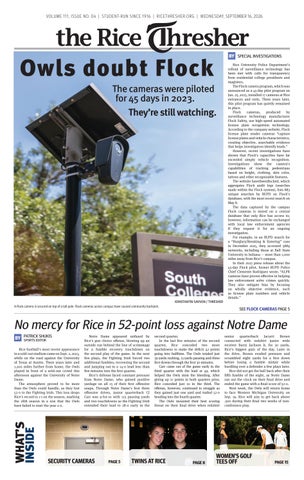
The cameras were piloted for 45 days in 2023. They’re still watching.
A Flock camera is secured on top of a tall pole. Flock cameras across campus have caused community backlash.
KONSTANTIN SAVVON / THRESHER
Rice University Police Department’s rollout of surveillance technology has been met with calls for transparency from residential college presidents and magisters. The Flock camera program, which was announced as a 45-day pilot program on Jan. 25, 2023, installed 17 cameras at Rice entrances and exits. Three years later, this pilot program has quietly remained in place. Flock cameras, produced by surveillance technology manufacturer Flock Safety, use high-speed automated license plate recognition technology. According to the company website, Flock license plate reader cameras “capture license plates and vehicle characteristics, creating objective, searchable evidence that helps investigators identify leads.” However, recent investigations have shown that Flock’s capacities have far exceeded simply vehicle recognition. Investigations show the camera’s capabilities of tracking pedestrians based on height, clothing, skin color, tattoos and other recognizable features. The website haveibeenflocked, which aggregates Flock audit logs (searches made within the Flock system), lists 883 unique searches by RUPD on Flock’s database, with the most recent search on May 8. The data captured by the campus Flock cameras is stored on a central database that only Rice has access to; however, information can be exchanged with local law enforcement agencies if they request it for an ongoing investigation. For example, in an RUPD search for a “Burglary/Breaking & Entering” case in December 2025, they accessed 5889 networks, including those at Ball State University in Indiana — more than 1,000 miles away from Rice’s campus. In their 2023 press release about the 45-day Flock pilot, former RUPD Police Chief Clemente Rodriguez wrote, “ALPR cameras have proven effective in helping law enforcement solve crimes quickly. They also mitigate bias by focusing on wholly objective evidence, such as license plate numbers and vehicle details.”
SEE FLOCK CAMERAS PAGE 5
No mercy for Rice in 52-point loss against Notre Dame PATRICK SHUKIS
SPORTS EDITOR
WHAT’S INSIDE
Rice football’s most recent appearance in a sold-out stadium came on Sept. 2, 2023, while on the road against the University of Texas at Austin. Three years later and 1,200 miles further from home, the Owls played in front of a sold-out crowd this afternoon against the University of Notre Dame. The atmosphere proved to be more than the Owls could handle, as they lost 52-0 to the Fighting Irish. This loss drops Rice’s record to 1-1 on the season, marking the 18th season in a row that the Owls have failed to start the year 2-0.
Notre Dame appeared unfazed by Rice’s gun choice offense, blowing up an outside run behind the line of scrimmage for a fumble recovery touchdown on the second play of the game. In the next five plays, the Fighting Irish forced two additional fumbles, recovering the second and jumping out to a 14-0 lead less than five minutes into the first quarter. Rice’s defense faced constant pressure from Notre Dame, who gained positive yardage on all 15 of their first offensive snaps. Through Notre Dame’s first three offensive drives, junior quarterback CJ Carr was 9-for-10 with 123 passing yards and two touchdowns as the Fighting Irish extended their lead to 28-0 early in the
SECURITY CAMERAS
PAGE 5
second quarter. In the last five minutes of the second quarter, Rice conceded two more touchdowns to make the deficit 42 points going into halftime. The Owls totaled just 39 yards rushing, 13 yards passing and three first downs through the first 30 minutes. Carr came out of the game early in the third quarter with the lead at 49, which helped the Owls stem the bleeding. After giving up 21 points in both quarters prior, Rice conceded just 10 in the third. The offense, however, continued to struggle as they gained just one yard and trailed 52-0 heading into the fourth quarter. The Owls mounted their best scoring threat on their final drive when redshirt
TWINS AT RICE
PAGE 8
senior quarterback Jacurri Brown connected with redshirt junior wide receiver Barry Jackson Jr. for 30 yards, Rice’s biggest gain of the day. Later in the drive, Brown evaded pressure and scrambled eight yards for a first down before losing a fumble midair while hurdling over a defender a few plays later. Rice did not get the ball back after their fifth fumble of the night, as Notre Dame ran out the clock on their final drive and ended the game with a final score of 52-0. Next week, the Owls will return home to face Western Michigan University on Sep. 19. Rice will aim to get back above .500 during their final two weeks of nonconference play.
WOMEN’S GOLF TEES OFF
PAGE 15
2 • WEDNESDAY, SEPTEMBER 16, 2026
THE RICE THRESHER
Rice recieves ‘F’ free speech grade for 2nd year in a row, drops 15 spots in national college rankings ABIGAIL CHIU
NEWS EDITOR
Rice ranked 250 out of 261 universities in the annual College Free Speech Rankings by the Foundation for Individual Rights and Expression. Like last year, it received an F as its overall score. Rice dropped 15 spots from its previous rank of 235. FIRE is a nonprofit organization that says it is committed to defending and promoting the values of free speech on college campuses. Rice also maintained a “red light” for spotlight rating, which the FIRE website says means it has at least one policy that both clearly and substantially restricts freedom of speech. A spotlight rating is an evaluation of how a university’s policies affect freedom of speech. “It should revise its student policies to earn a ‘green light’ Spotlight rating and adopt the pro-free speech Chicago Statement and an official commitment to institutional neutrality,” the website stated. “Rice should respond clearly and forcefully to defend free speech whenever censorship occurs or is demanded. Doing so will demonstrate the university’s commitment to free speech and build community trust that the administration will defend expressive rights.” Rice administration declined to comment on this issue. In the site’s ‘How to Improve Your School’ score calculator, adopting institutional neutrality would have increased Rice’s score from 52.4 to 55.4, moving them from a rank of 250/261 to a rank of 222/261. The Rice Student Association attempted to pass an institutional neutrality bill in October 2025 that would prohibit the RSA from making any statements that support or oppose political parties, public office candidates, legislation and ballots external to the RSA on all official RSA communications. However, after four weeks of discussion with no clear consensus or calls to vote, Senate tabled the bill. This institutional neutrality would have only applied to the RSA, not Rice administration. Wiess College’s then-Senator Eli Risinger and Brown College’s thenSenator Max Menchaca then introduced a new resolution titled ‘The Senators’
MICHELLE XU / THRESHER Resolution on Political Neutrality’ at the Nov. 11, 2025 Senate, which focused on then-RSA President Trevor Tobey’s comments in the wake of Charlie Kirk’s assasination. On Nov. 18, 2025, the original resolution was voted down and the new resolution was tabled indefinitely after five weeks of discussion. Other ‘what-if ’ improvements include adopting the Chicago Statement for free speech, which would increase Rice’s score by three points and to a rank of 222/261, and bettering their spotlight ratings to a yellow or green. A yellow would increase Rice by five points to 192/261 and a green would increase by 15 points to 44/261. These scenarios assume that the survey responses remain the same.
In grades given for specific categories, Rice improved in three areas: scoring a D in ‘Comfort Expressing Ideas,’ a C+ in ‘Openness’ and an F in ‘Administrative Support.’ It decreased to a D in ‘SelfCensorship’ and had no change with a C for ‘Disruptive Conduct’ and an F for ‘Political Tolerance.’ The FIRE ranking also included a “notable incident” of a speech controversy — when fired Texas State University professor Tom Alter came to speak at Rice. Organizers said the administration attempted to move the event to an indoor classroom, restrict outside guests and prohibit amplified sound. A controversy is defined by FIRE as an incident where a speaker, professor,
or student group faced efforts to punish, disinvite or silence them for expressing a controversial view. Tom Alter was a tenured professor of history at TSU before he was fired by TSU administration for remarks he made about insurrectional anarchists. He later successfully sued for his reinstatement, but was later terminated again, then turning to academic freedom activism. The event was organized by the Rice Young Democratic Socialists of America, Rice Students for Justice in Palestine, the Center for Civic Leadership and the Rice chapter of the American Association of University Professors, a union advocacy organization. This incident decreased Rice’s score by one point.
Rice to lead first national survey on foreign influence in university research through grant from NSF LINA KANG
ASST. NEWS EDITOR Rice University was recently awarded a $300,000 grant from the National Science Foundation to conduct the first national study examining the security of universitylevel research. Led by Tam Dao, associate vice president of public safety and research security, and Kenny Evans, fellow in science, technology and innovation policy, the research will conduct a survey to measure the level of foreign influence. “How much foreign influence happens on university campuses is usually just anecdotal,” Evans said. “We’re hoping to build a survey to both get data on the number of research security incidents, set standards for what incidents mean and then also generate some feedback about perceptions
of research security among faculty that are doing research.” The project aims to provide data on an issue that has prompted increased research security requirements at universities but remains difficult to quantify, Dao said. “We currently lack an understanding of the actual depth and breadth of the issue,” Dao said. “The data is going to inform us what’s the nature, scale and scope of the problem.” The research goal is to provide the necessary data to help government policy makers and the Research Security Program at the Baker Institute for Public Policy to make informed decisions and policies. “We want the Baker Institute’s role to help disseminate the findings from this research study to policymakers to help better inform the U.S. … risk posture,” Evans said. The findings could also help universities
determine whether existing research security measures are proportionate to the prevalence of foreign influence, according to Dao. “Our study is going to uncover if the juice is worth the squeeze,” Dao said. “We do all these research security to protect our research here in the U.S. and it’s very burdensome for a university to do it. So, if the problem is not that bad [based on the data collected], we may not have to do all these things.” What sets this survey apart is the use of a statistical model that allows respondents to answer sensitive questions anonymously while still allowing researchers to estimate how prevalent certain experiences are across the larger population. “The biggest challenge is just getting people to tell us the truth on surveys,” Stevenson said. “Even well-meaning
people who are themselves the target of this kind of behavior might have some sort of social desirability concerns, but it’s generally difficult to get people to be honest and reveal information about these kinds of sensitive issues.” Stevenson said the study could reveal that concerns about foreign influence are concentrated in certain fields, or that the issue is more widespread t`han currently understood. “I think it’s easy for people to be alarmist about this sort of thing,” Stevenson said. “It could be that this is something that’s important in science and engineering, but is almost nonexistent in the humanities and social sciences. It could go either way, it could be that people are being a little bit hysterical about it, or it could be that we don’t appreciate that it’s happening enough.”
WEDNESDAY, SEPTEMBER 16, 2026 • 3
NEWS
RSA passes Rec Center task force, debates logo rebrand SANJANA RAMINENI
FOR THE THRESHER
r mp i e pe r here e perie e r premiere
Fri,
Sep 25
Shepherd School Chamber Orchestra
ee
7:30pm
i
e 5
e
Milhaud: Le Bœuf sur le toit Jeremy Gill: Soft as the Massacre of Suns, fantasies for oboe and orchestra, on poems by Emily Dickinson* (Erin Hannigan, oboe) Beethoven: Symphony No. 5
S ,
Sep 2
7:30pm
Shepherd School Symphony Orchestra
S mp i r rm i
avel: Alborada del gracioso trau : Death and Transfiguration Ja e Berran (MM ’26): Probabolophony* indemith: Symphonic Metamorphosis of Themes by Carl Maria von Weber Conducted by Miguel Harth-Bedoya
All performances in Stude Concert Hall
* World Premiere
Get Your Tickets
The Rice Student Association passed its first bill of the year Monday establishing the Rice Rec Center Improvement Task Force before turning most of its meeting over to a discussion of a proposed rebrand of the RSA logo. Senate Bill No. 6, which creates a task force to assess and recommend improvements to the Gibbs Recreation and Wellness Center, passed by voice vote after two weeks on the floor. Before the vote, senators approved a set of wording changes requested by Rice administration, including language specifying that the task force will collaborate with graduate students, who also use the Rec. The task force is charged with gathering student feedback on the Rec’s equipment, hours, cleanliness, programming and accessibility, and with meeting monthly with Rec staff. Its members will be selected by and report to the external vice president through an application process. A Rec representative had been scheduled to speak at Senate but pushed his appearance to next week, when the RSA said a more formal presentation on next steps is expected. The bulk of the meeting was devoted to a proposed redesign of the RSA logo, part of a broader rebrand
Since the Rice rebrand task force has been working this past summer on the basis of rebranding, [it’s] particularly making RSA more approachable. Haruka Araki MARTEL COLLEGE SOPHOMORE
the organization has pursued since changing its name from the Student Association. A rebrand task force worked over the summer on the effort, which the RSA said also included initiatives like its welcome back programming. “Since the Rice rebrand task force has been working this past summer on the basis of rebranding, [it’s] particularly making RSA more approachable,” said Haruka Araki, a McMurtry College sophomore who presented the new design. The proposed logo departs from the current one, which features stars representing the residential colleges, stripes and the university “R,” and was designed roughly five years ago by a former RSA president. The new direction incorporates an owl for marketing purposes — including potential animation for Instagram — and four stripes representing four founding principles: responsibility, integrity, community and excellence. Araki said the task force moved toward a more professional, shieldlike shape and proposed customizing the logo for merchandise tailored to each of the 12 colleges. RSA President Chelsea Asibbey framed the redesign as a lasting decision and urged senators to weigh in. “We don’t want to have this conversation in five years, right?” Asibbey said. “So we’re looking for something that can last the test of time.” Not all senators were convinced the
new design served the rebrand’s stated goal. One senator argued the current rounded crest read as more welcoming than the edged shape of the proposed one, which was at odds with the aim of making the RSA more approachable. Elijah White, Chao College
As the Rice Student Association, we exist to serve the 12 colleges. I think that’s what differentiates us from GSA. RSA doesn’t explicitly state we serve undergraduate or graduate students, but I think it’s a small way to show that we represent the 12 colleges. Elijah White CHAO COLLEGE PRESIDENT
president, defended retaining the stars representing the colleges, pointing to the year he had spent updating campus branding to reflect 12 colleges. “I think I understand the sentiment of not wanting to have to update it every time a new college is added, but I guess, as someone who has spent about a good portion of my year updating campus branding to have 12 colleges, I think it’s worthwhile,” White said. “As the Rice Student Association, we exist to serve the 12 colleges. I think that’s what differentiates us from GSA. ” The uncertain future of Rice’s college count shaped part of the discussion. Araki said the task force had initially considered a design built around 12 stars but moved to the four founding principles after concluding it could not assume Rice would always have 12 colleges. Asibbey said no decision would be made Monday and the conversation would continue next week, with senators encouraged to submit opinions through the form. Earlier in the meeting, Brown College Senator Neya Gupta and Sid Richardson College Senator Laylee Taghizadeh presented a survey gauging student interest in extending the hours of Fondren Library’s east entrance, which faces the Academic Quad. “We’re trying to gauge student interest in need for the east entrance of Fondren, which is the Quad entrance; whether or not they need it to be open past 10 p.m.,” Gupta said. The entrance is currently designated as the visitor’s entrance, and visitors are not permitted in Fondren past 10 p.m., Gupta said. She said students from the North colleges have to walk all the way around the building when it is outside visiting hours, raising both convenience and safety concerns, including inadequate lighting. The senators said Friends of Fondren Library is financing a planned renovation of the Quad-side entrance, and student input is essential to securing funding for extended hours and additional desk staffing. Brown College President Matthew King said the inconvenience was widely felt among students who have to walk around the building to reach the entrance. The senators said they hoped to collect between roughly 200 and 300 responses, noting Fondren would not consider the change without demonstrated student need.
4 • WEDNESDAY, SEPTEMBER 16, 2026
THE RICE THRESHER
Will Rice College students relocated to Main Street Residence after Old Dorm flood ABIGAIL CHIU
NEWS EDITOR
Residents of Will Rice College Old Dorm were temporarily relocated to Main Street Residence after the burst sprinkler pipe and flood that led to intermittent power outages and water damage on Sept. 7. Students were told by Housing and Dining to gather enough clothes and belongings for multiple days, according to messages sent from Will Rice leadership to students. The presidential suite, which is located directly underneath the source of the flood — Will Rice Kitchen, where students doing pull-ups on a sprinkler pipe caused the original flood — has also been damaged, according to Will Rice President Raye Osayimwese-Sisson. “While not all of my things have water damage, there was about an inch of water on my floor and water was coming through the ceiling in several spots for about an hour. The room is virtually uninhabitable because of the water damage to the floors, ceiling, and walls, and it smells pretty bad,” wrote Osayimwese-Sisson in an email to the
Thresher. “Even my things that do not have water damage all smell because I have not been able to fully move out yet, and after the incident my room was not addressed until the morning, so everything just sat in water, and it sunk into the floor.” The 2026-27 housing agreement that all students who live on campus sign states that the university is not responsible for damage to items that results from water or flood. The housing agreement also states that students should act with “mutual respect” and “shared responsibility.” “You are responsible for conducting yourself and maintaining your residence in such a manner so as not to create a hazard or nuisance or to otherwise infringe upon the rights, health, safety or security of others or their property,” it reads. The flood damage was addressed with fans and dehumidifiers, but they were pulling too much power from the electrical system, leading to the second power outage during the afternoon on Sept. 8. Students were told they could expect to return to their dorms no later than
I want people to think about how their actions affect others, and the people who are responsible to be honest about what actually happened. I have not received any apologies, and the least the people could do would be to apologize to the Old dorm community for the massive disruption they have caused. Raye Osayimwese-Sisson WILL RICE COLLEGE PRESIDENT
Friday morning in an email from Kim Richard, senior director of operations for H&D. “Will Rice currently has power and is safe to enter, and you may continue accessing the building and your rooms
as needed,” Richard wrote. “However, because there has been an additional power interruption and the electrical panels are still being dried, we are maintaining your temporary housing accommodations until the work is complete and we are confident there will be no further disruptions.” Osayimwese-Sisson, a senior, said H&D has been responsive to her concerns. “They are helping me with my move, inventorying things that were damaged, and worked closely with me yesterday to ensure all old dormers have a comfortable and safe place to stay for the time being,” Osayimwese-Sisson wrote. Osayimwese-Sisson also said the situation has been an extreme disruption to all Old Dorm residents. “I want people to think about how their actions affect others, and the people who are responsible to be honest about what actually happened. I have not received any apologies, and the least the people could do would be to apologize to the Old dorm community for the massive disruption they have caused,” Osayimwese-Sisson wrote. “We are already going through a period of transition, and this only adds onto it.”
Rice community, Houston NROTC remember 9/11 with annual stair climb RACHEL JEONG
THRESHER STAFF
On Friday, participants met in Rice Stadium for the Naval ROTC Houston Consortium’s annual stair climb in remembrance of the Sept. 11, 2001 terrorist attacks in New York City.
Hearing about some of the stories from that day, and hearing about some people he knew who may have had more perilous journeys or may not have made it out, always just really stuck with me. I felt like I owed it to them and to some of those stories to be able to dedicate some time here, dedicate some blood, sweat, and tears and honor those people. Drew Chichester DUNCAN COLLEGE JUNIOR
At 7 a.m. a moment of silence was followed by the national anthem. Shortly afterward, participants started gathering at the bottom of the stadium bowl to
begin climbing. The NROTC Houston Consortium comprises both the Rice Naval Reserve Officer Trainees Corps — serving Rice, the University of Houston and Texas Southern University — and its sister unit of Prairie View A&M University. Alongside NROTC members, local community members and Rice students participated as well. According to Captain Mike Kinter, commanding officer of the Rice NROTC, the annual Houston NROTC Rice Stadium Stair Climb has been ongoing for roughly five years. Kinter also described the significance of the stair climb itself. “The symbolic stair climb is just remembering the first responders and the firefighters that went into the Twin Towers and started climbing the stairs,” Kinter said. According to Kinter, climbing the south end of the Rice Stadium 55 times roughly equals the total number of stairs in the Twin Towers’ 110 stories. Among the students included Drew Chichester, a Duncan College junior, who said coming to the event hit close to home. Chichester, who is from New Jersey, said his father was working in the city nearby the World Trade Center on 9/11. “Hearing about some of the stories from that day, and hearing about some people he knew who may have had more perilous journeys or may not have made
RACHEL JEONG / THRESHER Participants go down the stadium stairs to represent the flights of stairs first responders climbed in the Twin Towers. Participants climbed 110 stairs. it out, always just really stuck with me,” Chichester said. “I felt like I owed it to them and to some of those stories to be able to dedicate some time here, dedicate some blood, sweat and tears, and honor those people.”
NROTC members gather before the stair climb. The annual event commemorates the anniversary of the 9/11 attacks.
RACHEL JEONG / THRESHER
Another student, Oliver Zhu, said he had several ROTC friends who encouraged him to attend the stair climb. He also noted he was brought up in a community that honored its veterans and fostered the spirit ‘never forget.’ “That [upbringing] contributed to a good attitude of wanting to get out here, never forget and do this in remembrance of those who gave their lives to help save this nation from tragedy,” said Zhu, a Duncan junior. To Kinter, the legacy of 9/11 is a symbol of a nation coming together. “It’s just a day of hope for me as I’ve gotten older,” Kinter said. “People came together and helped each other through that tough time as Americans, regardless of where you were from, what you believed in or whether you were Republican or Democrat.” Chichester said a similar sense of togetherness was fostered at the stair climb. “It’s great to see the unity of the community. It’s great solidarity out here,” Chichester said.
Rice’s covert continuation of Flock partnership leaves faculty, students uncertain FROM FRONT PAGE
SPECIAL INVESTIGATIONS
In an April 24 message, Chris Stipes, a Rice University spokesperson, told the Thresher that Rice would provide a response for data the following Monday, but none was provided. He declined to provide information in a follow-up request. Will Rice College President Raye Osayimwese-Sisson said students have come to her with concerns about Flock’s datasharing practices. “Flock as a company has had instances where vulnerable populations have been put in places of danger and violence,” said Osayimwese-Sisson, a senior. “People are concerned about that, considering there are people in our community that fall into some of these populations, like undocumented people or people who are international.” Although Immigration and Customs Enforcement does not have a formal contract with Flock, local and state police have conducted over 4,000 lookup searches at the request of federal immigration officials, according to data obtained by 404 Media. Lovett College President Bruce Hurley said he was
concerned about the security vulnerabilities associated with Flock cameras, as the data is owned by a private company. “Any breach of security that could happen, that’s applicable to any kind of large security system,” said Hurley, a senior. Hurley said RUPD told residential college presidents and magisters in an Aug. 31 meeting that they do not share data with ICE or federal agencies and that every 30 days, RUPD audits and deletes unneeded footage. In the same meeting, Hurley said RUPD announced they would release a Flock transparency portal once a new chief of police is appointed. In January, current interim chief of police Tam Dao said to the Thresher a replacement would “be
completed within four to six months.” Osayimwese-Sisson said she was told the transparency portal would include a landing page with who has access to Flock cameras, along with a map of Flock cameras around campus. “Keeping us in the loop as soon as they can is all that I ask of them,” Hurley
HONGTAO HU / THRESHER
Rice installed security cameras in residential colleges. They didn’t tell students. SPECIAL INVESTIGATIONS When McMurtry Magister Je$ Fleisher was returning to campus in August, he was surprised to see a RAE Security van parked outside of his college installing security cameras within the dormitories’ exits. “I would expect that the university would talk to the magisters if they’re planning to install cameras in the colleges,” Fleisher said. “I think of dorms as living spaces for the students. I wouldn’t want cameras in my own house.” Security cameras have been installed at McMurtry dorm entrances, exits and stairwells, along with the college’s public spaces. In a September 4 email to McMurtry students, McMurtry College President Yazmine Miles wrote in an email that the security cameras “are accessed solely when investigating a crime or threat.” In a meeting with college presidents and magisters, the Department of Public Safety said they’ve seen a 37% increase in “property related o$enses,” and that their 300-acre campus’s 900+ cameras are on the lower end compared to other universities. The Department of Public Safety is a consolidation of RUPD, Rice Emergency Medical Services and Rice Emergency Management. The camera rollout is a sixphase project spanning ten years involving 10 to 15 buildings per phase. Fleisher said he opposed cameras that look into dorms and commons, stating that he was “trying to protect the public spaces where students congregate.” “My whole push has been I’m not just blatantly anti-camera,” Fleisher said. “I do think it’s if they’re going to put cameras in the dorms, then it’s incumbent on them to explain to … the magisters and the core teams and the students why they feel it’s necessary. “
SARAH BRADLEY / THRESHER A new security camera placed inside a McMurtry College dorm stairwell. McMurtry magister Jeff Fleisher said he was not notified that additional security cameras were being installed in college spaces beforehand.
RAMONA LORD / THRESHER Tape placed in a McMurtry College stairwell indicates where a camera will be installed.
RUBY GAO / THRESHER RAMONA LORD / THRESHER A security camera inside a Lovett College stairwell; cameras have been installed in the Tape placed on the exterior of McMurtry College indicates where a camera will be installed; additional newly constructed Lovett and Chao College. security cameras have started appearing near college entrances, exits, and stairways. In the Sept. 4 email, Miles wrote, “only … the cameras that directly replaced the previous 11 outdoor cameras are currently operational and recording.” Further camera installations inside McMurtry have been paused as the Department of Public Safety is collecting college president and magister feedback, Fleisher said. However, installation of cameras within academic buildings is ongoing, Fleisher said. These cameras are already placed within the stairwells of the new Lovett and Chao College. “This is a universitywide thing,” Fleisher said. “They’re going to see cameras in classrooms, they’re going to see cameras in the hallways.” Fleisher said Bridget Gorman, the dean of undergraduates, is implementing a feedback process for magisters and students.
“I think the admin is responding to us,” Fleisher said. “I think in the process leading up to this,they didn’t take into account some of the people that needed to be talked to, and I think they’re trying to rectify that.” Hurley believes future placement of cameras should be mindful of students’ privacy. “I think [we] just [need] some more intentional placement,” Hurley said. RUBY GAO / THRESHER “Somewhere in the middle between maximum safety and coverage with student A security camera installed inside a Chao College stairway. comfort in mind.” Osayimwese-Sisson’s primary concern is RUPD’s lack of communication, which she says complicates the e$orts of student Thresher that writes in-depth articles on student leaders to advocate for their constituents. life and administration at Rice. It is composed of Hongtao Hu, Yilian Jiang, Zaid Rashid and Ruby Special Investigations is a section of the Gao.
WEDNESDAY, SEPTEMBER 16, 2026 • 6
THE RICE THRESHER
EDITORIAL
Flock cameras have no place on our campus and must be removed Flock cameras continue to watch us, day after day. Although surveillance is perhaps an unfortunate part of modern life, the new innovation of Flock is that the data — our movement — is sent to a cloud and tracked. The most insidious part is that, while we highly doubt the Rice University Police Department and administration are part of some cynical plot, we fear that outside institutions with access to our data may be. We hope Rice was well intentioned when they installed them. We too care about student safety. But safety is not guaranteed by surveillance. Rice’s silence on the cameras speaks volumes. We have no justification, no explanation, no public guidelines. Even before the public attention turned toward Flock, the rollout only received a short notice, as if Rice administration knew that the contract would be unpopular but chose to move forward anyway.
The backlash against Flock is symptomatic of our largest uneasiness with surveillance. At Rice, it means that anyone at RUPD can track where and when you are going places. Obviously, the connotations for protests or political speech are pretty clear. It opens the door for stalking, abuse and control. Cars are falsely marked as being stolen. Flock has led to false arrests. What happens if a Rice student’s car is marked incorrectly and action is taken? What are our protections against that? It also puts our data, from our campus — a space that is supposed to be safe and secure — into the hands of a private company. We ought to know how our data is being licensed, used and sold. We ought to have the right to come and go from campus without our movements being comprehensively recorded. Based on conversations between
It also puts our data, from our campus — a space that is supposed to be safe and secure — into the hands of a private company. We ought to know how our data is being licensed, used and sold. We ought to have the right to come and go from campus without our movements being comprehensively recorded.
administrators and student leaders, it seems that Rice’s response is simply that the cameras are going to stay. But there are success stories. Countless districts are ‘de-Flocking.’ Emory University and the University of Minnesota have recently removed some of their Flock cameras. With renewed focus, activism and dedication, Rice could be next. It would be a victory for the school, for the students and, most of all, a victory for our rights as Americans. Editor’s Note: Thresher editorials are collectively written by the members of the Thresher’s editorial board. Current members include James Cancelarich, Evie Vu, Abigail Chiu, Hongtao Hu, Andrew Rynsburger, Chi Pham, Andersen Pickard and Patrick Shukis. Hu recused himself from this editorial due to corresponding coverage in the special investigations section.
LETTER FROM THE EDITOR’S DESK
Rice must fundamentally rethink its relationship with AI ANDREW RYNSBURGER
OPINION EDITOR
Rice is a breeding ground for innovation, and it has always been. When it comes to artificial intelligence, this is no exception. Rice announced a new AI major last year. All students now receive free Google Gemini Pro. Rice now even offers a freshman writing class titled “Writing with AI,” which encourages students to employ AI throughout the writing process. It seems like the university pushes AI onto its students as much as the students embrace it themselves. Perhaps this would not be an issue if we weren’t enduring a literacy crisis in this country, but American high schoolers’ reading scores have dropped to a 25-year low. With the advent of AI, we can only expect this number to slip further, as more students rely on it to do the reading and writing they never learned to do themselves. I applaud the university for requiring freshman writing intensive seminars. But these classes are infamously undemanding. Inevitably, students use
AI. Students slip through the cracks. Enter any lecture hall on Rice campus and you will see students line each row, peering into their laptop screens, doing anything but taking notes. So, naturally, when it comes to writing an essay or completing an assignment, generating it with AI becomes tempting. It’s much easier to outsource an assignment to AI than to learn the material. Rice should take notes from its peers in Chicago and New York City that have moved to restrict harmful technologies in the classroom. Turns out students pay attention when they don’t have distractions. Yet the most concerning aspect of the AI onslaught is how it affects students’ abilities to write, read and critically think in their own capacity. Students need to learn how to struggle through a reading without resorting to Gemini or edit their paper without a clean-up from ChatGPT. What happened to reading Homer and Aristotle? To laboring over paragraph structure for hours? To study groups devoted to difficult problem sets? If the ascetic student lifestyle from decades ago has not vanished already, it is on its
But the problem is that the university has a lot to gain from coercing its students to use AI. Its endowment is awash in private equity and venture capital funds, constituting roughly 30% of its total portfolio as of 2025. deathbed, and the AI onslaught will put the nail in the coffin. But the problem is that the university has a lot to gain from coercing its students to use AI. Its endowment is awash in private equity and venture capital funds, constituting roughly 30% of its total portfolio as of 2025. Rice’s new investments in the Ion District put AI as the “center pillar of its innovation strategy,” containing a “dedicated AI venture accelerator” to nurture new startups. Of course, when there is money to be made, Rice suddenly gets interested.
Yet we can envision a Rice that does not stake its future on the ability of its students to harness AI. A Rice that cares more about its students’ ability to engage with their fellow citizens, read deeply and reason for themselves. Is this seriously too radical a vision for Rice?
SENATE SCOOP
New student representatives need to represent something MAX MENCHACA & ELI RISINGER
THRESHER STAFF
This fall, 24 new student representatives will show up to their first Rice Student Association Senate meeting ready to do something. By spring, most of them will have learned the RSA’s rules of order and not much else. We’ve both spent time inside the NSR Program, watching cohorts of sharp, motivated freshmen get handed a vague assignment to “develop a project” and then largely left to figure out what that means on their own. The students aren’t the problem. They’ve had real ideas about dining hall hours, accessibility on campus or how residential colleges talk to each other.
But those ideas quietly dissolved because nobody ever asked them to finish what they started. Even when a project does survive, it tends to aim small, and this fixture has been present for at least the past 10 years. In 2016, an NSR project attempted to allow students to bring coffee cups into Fondren. This change is roughly the ceiling of what the program has asked for. That’s what frustrates us. The RSA recruits capable people into this program then asks almost nothing of them. They aren’t even expected to pitch a project to an administrator, let alone implement one. What makes this such a waste is who NSRs actually are. They’re new enough to Rice that they still notice things
upperclassmen have stopped seeing, like the small dysfunctions everyone else has learned to ignore. If we had to point NSRs toward one lane, it would be academics. Most past projects have landed on quality of life fixes, worthwhile but narrow. Academic issues are different. New students hit advising gaps, confusing registration systems and inconsistent syllabus policies before anyone tells them that’s just how Rice works. NSRs are positioned to address that friction. Veronica Paz, the new NSR Director, has a chance to change this system. Previous directors have largely kept the system the way they found it. She’s inheriting a program that hasn’t been producing anywhere near its potential,
and she doesn’t have to leave it that way. A better version of this program isn’t complicated. Have NSRs spend the first few weeks identifying actual problems on campus. Group the cohort around the strongest ideas instead of scattering everyone across dozens of halfformed ones. Pair those teams with the administrators and student leaders who can actually move something forward. Set milestones throughout the year and expect completion. Here’s our ask of Veronica Paz and the RSA: Treat this program like it’s supposed to produce something, not just teach students how student government works. They already recruit NSRs who are capable of more. It’s time the program started expecting it.
Max Menchaca is a Brown College junior studying political science and statistics. Eli Risinger is a Wiess College junior studying political science and social policy analysis. Both are former RSA senators and believe every Rice student should be well informed to advocate for their interests in student government.
WEDNESDAY, SEPTEMBER 16, 2026 • 7
OPINIONS EYE ON ACCESSIBILITY
Students with disabilities face greatest impact EDITORIAL STAFF from the shortcomings of Rice’s shuttle system
* Indicates Editorial Board member James Cancelarich* Editor-in-Chief Evie Vu* Managing Editor
COLETTE MINTON
THRESHER STAFF
NEWS Abigail Chiu* Editor Toby Chou Asst. Editor Ruby Gao Asst. Editor Lina Kang Asst. Editor
It was about 2 p.m. when I walked to the Rice Memorial Center in the oppressive Houston heat, weighed down by the technology-laden backpack tugging on my shoulders. Hoping for an easier return trip to the North colleges, I went to shuttle stop five right outside Kraft Hall.
OPINION Andrew Rynsburger* Editor FEATURES Amelia Davis Editor London Frey Crossword Editor ARTS & ENTERTAINMENT Chi Pham* Editor Cora Wareh Asst. Editor
I was once unexpectedly dropped off by Alice Pratt Brown Hall when a driver needed to clock out, forcing me to either walk or wait for the next bus to resume the trip to my final destination. I opened TransLoc, the bus tracking app Rice uses, and I checked the wait time on the next inner loop shuttle: three minutes. Five minutes later, there was no shuttle in sight, and the app still claimed there was one three minutes away. After a few more minutes of waiting, I realized that a shuttle was not coming. Frustrated, I made the trek back on foot. This was not the first time I’ve dealt with inconsistencies surrounding the shuttles. The absence of an alert system to inform students of route closures or changes can leave students stranded without notice. I was once unexpectedly dropped off by Alice Pratt Brown Hall when a driver needed to clock out, forcing me to either walk or wait for the next bus to resume the trip to my final destination. Recently, our everexpanding undergraduate population has left the shuttles crowded during peak times, making them difficult to use for all students, but especially those with disabilities. The new electric buses with fewer seats are especially limiting to students with disabilities. Getting on a shuttle at noon, there were so many people standing that I could not realistically ask to use one of the folding chairs. Space was so restricted that multiple students had to get off the bus to let people exit and board again. On that ride, I almost lost my balance three or four times. Once I got to my stop, I had difficulty maneuvering through the other students to finally get off. Even for students without disabilities,
SPORTS Andersen Pickard* Editor Patrick Shukis* Editor Keya Patel Asst. Editor SPECIAL INVESTIGATIONS Hongtao Hu* Editor BACKPAGE Max Scholl Editor Will Howley Editor Rykelle Sandidge Editor Kyle Chen Senior Writer Caleb Song Senior Writer COPY Shruti Patankar Editor Julianne Ma Editor
SKYLAR WANG / THRESHER crowded buses create an uncomfortable experience. Students are packed in tightly, often unable to disembark when they arrive at their stop.
Rice needs to reevaluate its routes, see where shuttles are necessary and where public transportation like the Houston METRO can suffice instead. More inner loop shuttles would reduce overcrowding, improving the riding experience for everyone. Since the shuttles do not wait at every single stop, there are going to be inconsistencies in timing. Traffic on the inner loop varies immensely throughout
the day. I have frequently encountered situations when there is an inner loop shuttle three minutes away and another 21 minutes away. Students deserve better frequency than this — especially given that students with disabilities often rely on the buses while other students can opt to walk instead. For me, sometimes the pain and discomfort that I use the shuttles to avoid become unavoidable. Improving accessibility will improve the experience for all students. Rice needs to reevaluate its routes, see where shuttles are necessary and where public transportation like the Houston METRO can suffice instead. More inner loop shuttles would reduce overcrowding, improving the riding experience for everyone. Creating a notification system to alert students of any route changes and delays or opting for an alternative to TransLoc would also make the shuttles more reliable. Ultimately, Rice buses need to work for the students who rely on them most.
Colette Minton is a Martel College sophomore studying mechanical engineering. Her experiences with physical and invisible disabilities give her unique insight into the shortcomings of Rice’s infrastructure. Through this column, she aims to spread awareness and improve accessibility at Rice.
Last Week’s Online Poll Results 7% 6%
54% 33%
Next week’s question: Should Rice end its contract with Flock Safety? Follow @ricethresher on Instagram to answer weekly polls.
DESIGN Jessica Xu Art & Design Director Magnolia Hickey-Zamora News Sydney Chang Opinion Lisa Wang Features Alexa Bu Arts & Entertainment Kirstie Qian Sports Brandon Nguyen Backpage Richard Li Design Consultant BUSINESS Sivani Vasireddy Manager Alina Zhong Advertisement Rahul Santhanam Advertisement Makeen Shafer Distribution Manager
ABOUT The Rice Thresher, the official student newspaper of Rice University since 1916, is published each Wednesday during the school year, except during examination periods and holidays, by the students of Rice University. Letters to the Editor must be received by 5 p.m. on the Friday prior to publication and must be signed, including college and year if the writer is a Rice student. The Thresher reserves the right to edit letters for content and length and to place letters on its website. Editorial and business offices are located on the second floor of the Ley Student Center: 6100 Main St., MS-524 Houston, TX 77005-1892
Where do you like to go out with your friends? Total number of responses: 387
PHOTO, VIDEO, & WEB Konstantin Savvon Photo Editor Sarah Bradley Asst. Photo Editor Andrew Gingerich Video Editor Rachel Jeong Asst. Video Editor Megan Zhang Web Editor Fiona Sik Web Editor Varshini Loganathan Web Editor
Pub at Rice
Phone: (713) 348 - 4801 Email: thresher@rice.edu Website: www.ricethresher.org
Valhalla
The Thresher is a member of the ACP, TIPA and CMA.
Residential colleges
© Copyright 2026
Off campus
ricethresher.org
8 • WEDNESDAY, SEPTEMBER 16, 2026
THE RICE THRESHER
‘Near Magic’: Retiring photography professor reflects on 57 years at Rice
BENAJMIN SADOWSKI / THRESHER
ANDY HE
FOR THE THRESHER Geoff Winningham ’63 has photographed a two-week-long trip down Route 66 and toured Día de los Muertos fiestas in Southern Mexico. Now, he’s working on one last project before leaving Rice: capturing Houston with his final class of students. Raised in Jackson, Tennessee, Winningham came to Rice as an undergraduate in fall 1961, where he answered an advertisement recruiting photographers for Rice’s yearbook, the Campanile. Soon, he became their chief photographer, he said. “I had so much fun … Parties, football games, faculty portraits — whatever happened, I was photographing,” Winningham said. “And it wasn’t like I was making art. I was just connecting
with the world around me.” After finishing his English degree, Winningham said he planned to attend Vanderbilt Law School. His faculty mentor, Professor Gerald O’Grady, questioned his decision. O’Grady asked Winningham why he was not pursuing photography. Winningham responded: “What good is that gonna do anybody?” “And he gave me the answer for the ages,” Winningham said. “He said, ‘It will give people pleasure. And yourself as well.’ So off I went to graduate school.” After completing his Master of Fine Arts, Winningham began teaching photography at the University of St. Thomas, but was quickly offered a chance to return to Rice. He accepted, and is now entering his 58th and final year as a professor at Rice. Winningham’s career has taken him
all across the United States and into Mexico. But he is perhaps best known for his photography of Texas. A Texas Monthly article published in 2025 dubbed Winningham the photographer that “changed how Texans see themselves.” His work within the state has taken him from high school football state championships in Northern Texas to the Houston Livestock Show and Rodeo in the now-defunct Astrodome. Winningham said he hopes these projects, and others like them, have created “artful records” of the places he’s lived and worked. “Leading up to Houston’s 150th anniversary, I photographed virtually every day for three years,” Winningham said. “I think I have a visual record of what life was like in this city at that time.” And through his work, Winningham said, he hopes he has been able to pass on his love for the medium. Dornith Doherty, a photography professor at the University of North Texas and a former student of Winningham, described Winningham’s effect on her career. Winningham was instrumental in the early stages of her career, playing a key role in her acceptance to Yale’s Master of Fine Arts program, Doherty wrote in an email to the Thresher. “Working with an acclaimed artist who was dedicated to his own work, while teaching at the highest level was, and is, inspiring,” Doherty wrote. “His support set the stage for future successes.” Winningham said he believes there’s a benefit in welcoming students from all disciplines in photography classes. “I’ve had mechanical engineers who did remarkable photography,” Winningham said. “I’ve had music majors who come to class and add something incredibly enriching to the class by comparing photography and printmaking to music.” Bill Fisher, now a practicing attorney in San Antonio, detailed how studying with Winningham benefited his life after Rice despite him not pursuing photography as a career. “Photography has become a lifelong interest thanks to taking photography courses at Rice,” Fisher wrote in an email to the Thresher. “It has taught me to be attentive, even when I do not have a camera in hand, to the unexpected scene, gesture, expression, geometry, and even ‘just’ light.” For Fisher, an interest in photography was not the only thing he got from studying with Winningham. While Fisher was studying at Rice, Winningham was in the late stages of a project photographing fiestas in Mexico. Winningham offered
one spot for a student to join him in photographing Día de los Muertos celebrations in Oaxaca, Mexico. “I almost leaped out of my seat and snagged that spot, which led to a simply fabulous travel and photography experience,” Fisher said. To inspire that love of photography, Winningham said, has been one of the central goals of his teaching. “I just hope that the students who’ve taken my course … absorb [a] kind of love of the medium, and a feeling that I have, that it’s about as near magic as anything can be,” Winningham said. However, Winningham’s impact on Rice also extends beyond his students to his fellow faculty members. Mikki Hebl, a psychological sciences professor at Rice who took one of Winningham’s classes this past summer, said she believes Winningham’s work and teaching have inspired other faculty members at Rice. “I think there are some larger than life faculty members that, when I got here 28 years ago, it was like, oh, you should know about these people,” Hebl said. “And I think when you have these wonderful faculty members, of which Geoff Winningham is one … you get excited that you’re on the campus with them.” Hebl said Winningham represents the best of the faculty of Rice, and is one of the people who makes Rice great. “Geoff Winningham is an institution. He is honest to God a legacy at Rice, and he is a prized treasure,” Hebl said. Now in his final year at Rice, Winningham is teaching FOTO 385: Photography Seminar, which aims to help Rice students explore and photograph Houston. Students will travel into the city, choosing to photograph some aspect of the city’s architecture, landscape, culture or social life. The overall effort of the fall and spring courses will be combined to create what Winningham calls a “collective portrait.” At the end of the year, the Museum of Fine Arts, Houston plans to host a program presenting the complete collection of the students’ work to the public. Although Winningham said his retirement will give him more time to work on his personal projects, there are aspects of his job that will be hard to leave behind. “What I will miss is the pleasure and the challenge of sharing my love of photography with this eclectic, bright bunch of students that changes every semester,” Winningham said. “That’s what I’ll really miss. That will be hard not to have.”
Rice’s multiples, inside and beyond the hedges YILIAN JIANG
THRESHER STAFF When Suri Yang matriculated to Rice, she realized that her Orientation Week siblings shared something unusual — four people, including her, were all twins. “We had that realization towards the end of the week, and we were like, ‘This is so crazy,’” said Yang, a Will Rice College sophomore. While Yang’s other half traveled to the University of Southern California, other
pairs of twins have decided to embark on their college journeys together. At Rice, there are an estimated 23 pairs of twins on campus, according to data from the Office of the Registrar. Because the university’s systems do not formally track family relationships, this estimate was calculated by identifying active students who share the same last name, date of birth and address listed on their admission applications, said Chris Stipes, executive director of news and media relations. Despite her close relationship with
her twin brother Jaden, Yang said their split to different universities had always been somewhat inevitable. “I think for the both of us, we were like, maybe it’s better if we go to different colleges and experience self-growth,” Yang said. For Matthew and Jonathan Niu, identical twins and Duncan College sophomores, their choice to both apply early decision to Rice was shaped by the proximity of campus to their home in Pearland. In addition to requesting placement
in the same residential college, the twins also chose to room together during their freshman year. “It’s nice to have someone who has similar living habits to you,” Matthew Niu said. Due to living in the same residential college, Jonathan Niu said the two are in similar friend groups, but their different majors allow them to branch out socially and pursue their academic interests separately. The main downsides, they said, are more mundane.
SEE TWINS PAGE 10
WEDNESDAY, SEPTEMBER 16, 2026 • 9
FEATURES
Compass Rose 1
2
3
13
4
4
14
15
2
18
4
17 20
27 36
18 26
8
1
2
3
3
31
10
40
14 41
21
37 40
47 59
64 68
8
ACROSS
27
29
30
23
39
24 30 50
59 42
25 31
32
35
39
43
45
68 48
35
43
29
50 65
7
17
38
41
71 58
61
12
15
34
44
15
6
22
11
22
28
68
14
5
26
20
27
64
4
18
43
19
36
4
6
9
33
57
1
7
16
44
8
13
37
41
57
7
5 25
31
47
6
21
24
35
5
LONDON FREY
CROSSWORD EDITOR
46
49
66 69 72
51
61
52
62 66
53
69
71
72
54
72
68
69
55
69
71
72
71
DOWN
72
Badge on the sidelines: RUPD’s role in Rice football KAMILA EL MOSELHY
THRESHER STAFF
A Rice University Police Department officer boarded a charter flight out of Houston’s Hobby Airport with the Rice football team, headed for a place he had never been: West Point, New York. By kicko# the next day, he was cheering on the sideline at Michie Stadium, watching the U.S. Military Academy cadets stand in full white uniform for the entire game. West Point’s parachute team landed on the field before the opening whistle. The Hudson River sat behind the stands. It was the kind of thing you don’t expect to see when you’re on the Rice University police force. That officer, Sgt. Juan Alejandro, is RUPD’s sergeant of training and special events coordinator. The September 2024 trip to West Point was only one stop among the many he has made with the football team since joining the department 16 years ago. It is a small, largely unadvertised part of how Rice Athletics operates: Every time the football team travels for an away game, one RUPD officer goes with them. This season, RUPD is joining the team on six trips. When Alejandro joined RUPD in February 2010, the department was already sending officers on the road
with the team. Then, RUPD sent two officers per trip. Today it sends one. By the standards of Division I football, one officer is a modest number. “Some schools bring more, but we feel one officer works for us,” wrote Nick Decker, Rice football chief of sta# and director of football operations, in an email to the Thresher. The officer also works as a liaison with police at the host school or city. Host schools provide their own stadium security and the RUPD officer’s job is to be Rice’s point of contact for whoever has jurisdiction that day. “They may work with certain officers to coordinate bomb checks,” Decker wrote. “When we play at NFL stadiums, that is a requirement. They will also just coordinate on gameday in case there is any issue.” However, the routine has not run uninterrupted. According to Lt. Frank Fernandez, RUPD paused the travel assignment for a few years because of staffing shortages. Alejandro said the hiatus began with the 2020 season, when the team did not travel because of the COVID-19 pandemic. Conversations to bring the practice back started in 2022, after Alejandro reached out to thenchief of sta# for football operations Lee Menefee.
“I kind of brought it back to life after a hiatus,” he said. Alejandro said the travel day starts the day before kicko#. Coach buses leave the Brian Patterson Sports Performance Center with a motorcycle escort to the airport. The team flies a charter jet, and the RUPD officer goes through the same security procedures as everyone else, weapon and all, coordinated in advance by Decker. On arrival, the team is met at the terminal and driven to the opposing stadium for what Alejandro calls a soft walkthrough: locker rooms, the route to the field, anything that might trip someone up on gameday. Then it’s a team dinner at the hotel, which the officer attends alongside the players, coaches and sta#. “We love having a member of RUPD travel with us,” head coach Scott Abell wrote in an email to the Thresher. “It’s a great way to represent Rice and give back for all those officers do for us.” Within RUPD, the trip is something officers compete for. Alejandro said assignments are distributed by a special events ranking, which depends on how many special events the officers work. For Alejandro, who has worked with three di#erent head coaches since 2010, the job has become as
2 ___ of War (chess.com variant where you can only see squares you can move to) 4 Misstep 5 Social movement empowering women and against sexual violence 7 Strongly detest 8 Sandcastle equipment 10 The subject that many consider to be the red folder 13 A whimsically woven story 14 Step, in a sequence of steps 16 ____ out (excludes from conversations) 17 ____ Woods (“Legally Blonde” protagonist) 18 Cuban revolutionary leader __ Castro 20 “Brief” support needed to nurse someone back to health 23 Type of berry 26 Hurts, as an insult 28 Some musketeers, pigs and primary colors 30 Shopping sessions 33 A relevant mnemonic for this puzzle advises you never to eat a soggy one 34 35 Unadulterated-ly dislike 36 Starts to get nervous 38 Plant within 39 Reddish vegetable 40 Attempt that might miss 42 California time, in the winter, abbr. 43 Fork, perhaps 44 Seaweed 46 Firefighter’s downward transport 47 Lock-in long-term 49 Precipitation 50 Include within, and a fitting word for this puzzle 52 Oak, pre-growth spurt 53 Rocket launchers 54 “Leaf,” in Hawaiian 55 Crew sent out after environmental disasters, for short
MARTIN XIE /THRESHER much about relationship-building as security. He tells officers who take the assignment to think of themselves as ambassadors, not just for RUPD but also for the university. “I don’t want that to be the first moment you get to see me, in a negative light,” Alejandro said, describing the alternative: a traffic stop, a scooter citation or some routine interaction that colors how a student sees campus police. Traveling with the team, eating dinner with players and standing on the sideline, he said, gives that relationship a di#erent starting point. “We’re not out to get anybody, because we’re not,” Alejandro said. “We’re here for the students, the faculty and sta#.”
1 Knowing this answer will help you find your way 2 Weak-minded 3 Preps a dog for a dog show 5 Delivers by hand? 6 Deliver by mouth 8 Goes from one side of the room to the other 9 Biblical casualty when 25% of the Earth’s population died 11 13-Across synonym 12 “The _____ are alive with the sound of music.” 13 Just sitting there twiddling your thumbs 15 Location of the largest volcano and mountain, which are both olympic-size 18 Old-timey flutes 19 Relative by marriage 20 Animated film “Lady and the _____” 21 Legs and twigs 22 Shooting star 24 Weather 25 Run back a show 26 Palindromic triangle congruence method, abbr. 27 Wiess acronym 28 ___ Friday’s (restaurant chain) 29 Melancholy 31 Short aliens 32 “Your voice is up here . I need it down here .” 37 Evidence of a snoozer 39 No fighting and no whining 41 Smile ear-to-ear 43 Metatarsal body parts 45 Inventors of the Quipu and builders of Machu Picchu 46 Blueprints 48 Calm and easily convinced 49 Bean shoot 51 Chompers in the back
10 • WEDNESDAY, SEPTEMBER 16, 2026
THE RICE THRESHER
Rice showcases public art around campus JOYA ROY
FOR THE THRESHER Public artworks across campus encourage students to innovate, explore and reflect on what it means to be human. From geometric shapes to LED lights, these works provide students with the opportunity to look at something from a di#erent perspective, learn about something new and be present. They encourage exploration, which leads to a deeper understanding of not only the art but also oneself. “Wall Drawing #1115” (2004) With a dazzling array of over 500 streaks of color, and no two streaks of the same color touching, “Wall Drawing #1115” hangs in the Dean’s Commons in the Anderson-Clarke Center. The piece was created by artist Sol LeWitt, who believed that all the steps required to get a final piece of art — the sketches, mistakes and false starts — were part of the art itself. “Wall Drawing #1115” is Rice University’s first conceptual art piece in the Rice Public Art collection, which is overseen by the Moody Center for the Arts. LeWitt did not actually paint this piece himself, but rather created instructions for its creation in 2004. As a conceptual artist, LeWitt believed that the idea behind what the piece should look like was the art itself. LeWitt said he appreciated the fact that by providing instructions for others to follow, his work would naturally include the unique interpretations of the painters. “Meeting Place/Painting with Changing Parts” (2022) With bands of color, Odili Donald Odita’s “Meeting Place/Painting with Changing Parts” brings Alice Pratt Brown Hall to life. Odita wanted the piece to remind viewers of James Turrell’s Twilight Epiphany Skyspace. The title “Meeting Place” references Quaker communal houses, which were used for contemplation, and reflects Odita’s own faith. The title “Painting with Changing Parts” is inspired by Philip Glass’ 1971 album “Music With Changing Parts,” a minimalist piece that uses repeating melodies to create shifting sonic patterns. Odita reflects this characteristic of Glass’ album by composing the familiar shapes of rectangles and diamonds with uneven shards of color. Odita focuses on creating pieces that inspire civic engagement, and “Meeting Place/Painting with Changing Parts” aims to encourage collaboration and inspiration and remind viewers that “musical compositions rely on solid, structured backbones while they simultaneously change and evolve with each unique performance.” “Power Flower” (2021) Composed of snapshots of flowers, leaves and branches, Natasha Bowdoin’s
FROM PAGE 8
TWINS
“Definitely the name mismatch happens a lot,” Matthew Niu said. “We do also have to share the same snacks, so that does create conflict.” Fraternal twins Izzy and Dylan Balise, both Sid Richardson College seniors, have generally followed convergent trajectories throughout their lives; while their other siblings enrolled in different high schools, the twins chose to attend the same one in Connecticut. However, their lifelong closeness experienced a brief hiatus after high school graduation. “I ended up [applying early decision] to Northeastern [University], and honestly almost immediately regretted
SARAH WANG / THRESHER “Power Flower” by Natasha Bowdoin hangs in Anderson Biological Laboratories. “Power Flower,” installed in 2021, defies the boundaries of one’s perception of nature. Bowdoin, an associate professor of art at Rice, wanted “Power Flower” to avoid the typical classifications given to many works of nature. While “Power Flower” has patterns similar to those of turtle shells, fish scales, snake skin and moth wings, the piece doesn’t directly reflect items in nature but rather takes inspiration from it, showing how our imagination can surpass the boundaries of the natural world. The work’s location in Anderson Biological Laboratories is intended “to reflect the innovative research and learning that takes place in [Anderson’s] classrooms and laboratories.” Furthermore, the piece encourages students to utilize their imaginations to make what seems impossible a reality. “Power Flower” is a part of Rice’s permanent collection. “Radiant Pathway” (2010) Inspired by the Minimalist movement, Leo Villareal’s “Radiant Pathway” in the BioScience Research Collaborative combines the worlds of computation, math and art. Using software, Villareal composed 92 LED light tubes in the formation of a bright sun. At full capacity, the piece showcases 16 million colors. No single ray has the same color sequence as another — the tip of one may start with
it,” Izzy Balise said. “I was starting my transfer applications before I even got to Northeastern my freshman fall.” When Izzy received her transfer decisions, she said her relationship with Dylan was “the deciding factor” behind her choice to enroll in Rice. “I think it definitely was much harder to stay in touch than we thought it would be freshman year,” Izzy Balise said. “And I knew that our relationship would be stronger going to school together in the same ways that it had been throughout our entire lives.” The Balises said busy schedules and different housing situations have taught them to be more intentional about spending time together, such as going grocery shopping together or simply finding ways to share the same space. “I’ll work REMS shifts for Pub [at Rice]
SARAH WANG / THRESHER “Wall Drawing #1115” by Sol LeWitt hangs in the Glassock School. yellow and transition to light purple, while another one shifts to gray. Villareal, who tries to envision code through light, was also inspired by the Light and Space movement, James Turrell
and Sol LeWitt. As a permanent part of Rice’s art collection, “Radiant Pathway” challenges viewers to see how distinct disciplines may be more connected than we think.
when [Izzy’s] working,” Dylan Balise said. With college graduation on the horizon, Dylan said that the two share similar goals — to return to the Northeast for their postgraduate studies and future careers. “I always joke, I say ‘Harvard med, Harvard law,’” Dylan Balise said. To Dylan Balise, the benefits of having his twin sister at Rice have been overwhelmingly positive, and unlike any other relationship he has experienced. “The first thing I thought of is how disadvantaged every single person who doesn’t have a twin that they go to college with is,” Dylan Balise said. “The only way that I can describe having a twin COURTESY IZZY BALISE is like a best friend who knows every single thing about you. You don’t have to Twins Izzy and Dylan Balise pose for a photo explain anything, they just understand.” during Beer Bike. There are an estimated 23 pairs of twins at Rice.
WEDNESDAY, SEPTEMBER 16, 2026 • 11
ARTS & ENTERTAINMENT
Moody’s annual Tent Series engages memory and technology
SADIE CANTER / THRESHER The 2026-27 installment of the Moody Center for the Arts’ Tent Series installed the works of artists Keliy Anderson-Staley, Preston Gaines and Dario Robleto onto the PCF tents on Rice’s campus.
MAHI BHATIA
FOR THE THRESHER When viewed from the side, the Provisional Campus Facility tents across from Herring Hall still look like COVID-19 testing facilities, part of their initial purpose when they opened in 2020. From the front, however, three new murals revitalize their identity as sites for public art.
It is intended to honor the women in my family in a beautiful way. Giving them their flowers, if you will. Preston Gaines FEATURED ARTIST
Last Thursday, the Moody Center for Arts unveiled new installations by Houston artists Keliy Anderson-Staley, Preston Gaines and Dario Robleto at an opening reception. An ensemble of double bass, saxophone and drums scored the evening as each artist shared their account of how
personal, cultural and extraterrestrial archives can be continuously reexplored rather than statically preserved. Gaines organized “Floral Modulo” to follow the PCF tent’s natural paneling. Four sections narrate the artist’s story of grief, love, transmission and progress, while kaleidoscopic !orals mirror the diverse fabric of Houston. Creating the installation became part of his process of navigating his grief after losing his mother, Gaines said. He connects her to the leftmost masked figure, an Iranian woman featured in a National Geographic article. The other figures depicted represent Gaines’ partner, the artist himself and his daughter. “It is intended to honor the women in my family in a beautiful way,” Gaines said. “Giving them their !owers, if you will.” In the two-part installation “Wilderness no longer at the edge of things,” AndersonStaley collages archival documentation and narrates a chronology of her home in rural Maine using printed vinyl, projected video and sound. Anderson-Staley’s mural spans generations and includes letters from her father, her personal photographs and her son’s piano recordings. The artist plops her off-the-grid home onto Rice’s
SADIE CANTER / THRESHER Preston Gaines’ mural honors the women in the artist’s life, including his mother and daughter. inner loop, forcing it into conversation with the campus’s urban landscape. “I thought it would be really ideal to bring the cabin that I grew up in to the space, especially because it’s such an opposite space,” Anderson-Staley said. “The cabin was built in northern Maine, in the middle of the woods, but it has a very similar kind of triangular shape at the top.” Among the attendees was Angel Oloshove, one of Anderson-Staley’s students at the University of Houston, who is pursuing her Master of Fine Arts in sculpture.
Science will get us to the moon, Mars and beyond. But the humanities can answer why we should go at all. Dario Robleto FEATURED ARTIST
SADIE CANTER / THRESHER Dario Robleto’s installation depicts the Golden Record, a time capsule of life on Earth shot into space.
“We’re here to support, but also to engage with the larger Houston arts community, especially for first-year MFA
[students] to understand where different opportunities are in the city,” Oloshove said. Dario Robleto’s “Ancient Beacons Long for Notice” marks a thematic shift from documenting a family’s past to preserving humanity for the future. The subject of his film still, displayed on PCF tent 2, depicts the Golden Record, a gold-plated phonograph disk launched in 1977 aboard Voyager 1 and Voyager 2. Shot into the outer solar system, the Golden Record was intended as a diverse time capsule of Earth’s music, images and sounds of life. The project behind the Golden Record was at once optimistic and uneasy, asserting humanity was worth discovering while assuming the right to leave an interstellar trace. Though scientists curated the records to show our best side, Robleto’s film asks whom and what this idealized portrait omitted. For Robleto, reckoning with those omissions in the Gold Record is where arts and humanities become vital. “Science will get us to the moon, Mars and beyond,” Robleto said. “But the humanities can answer why we should go at all. It is art that enables us to consider which values and ethics and which stories and histories we will carry as a species into entirely new worlds.”
12 • WEDNESDAY, SEPTEMBER 16, 2026
THE RICE THRESHER
Photography celebrating skater girls comes to Chao College ANGELICA HERNANDEZ
THRESHER STAFF
If you happen to visit Chao College this semester, take a walk down the hall leading to the magister’s house and you’ll find remarkable art on display. In collaboration with the Houston Center for Photography, Chao is currently hosting an exhibition of works from the HCP’s spring show by documentary photographer Luisa Dörr, which held its opening reception on Friday.
I want Chao College to be a space open to the arts, a space open to the university and the city. Luis Duno-Gottberg CHAO COLLEGE MAGISTER
This exhibition marks one of the first times the HCP has brought its art beyond the walls of its Montrose gallery. “We’re really excited at the Houston Center for Photography to be bringing work outside of our gallery walls and into a community space, specifically somewhere where people will live with the work and not just go out of their way to visit it,” said Areli Navarro Magallón ’20, the HCP’s exhibitions and programs coordinator. The photographs on display, which line the walls of the Chao magister’s house hallway, were originally part of the “Rebel Girl” exhibition, which explored how contemporary photographers explore the diversity of women’s experiences and their modern perceptions. As part of the show, Dörr’s work represents rebellion among
KONSTANTIN SAVVON / THRESHER youth and celebrates a unique community of women exploring their identities as skaters while retaining their cultural attire and traditions. “Having this body of work, which represented youth in our space, literally come and live with people who are young, but not so young … Luisa specifically was really amenable to that part of the idea,” Magallón said. Student organizer Njwi Achoh, a Chao senior, said she was excited about how the images connected with her own identity both as a skater on Rice’s campus and as a woman who skates overall.
“Just seeing the photos up is so cool,” Achoh said. “It really does embody what it feels like when you’re on a board, when you’re on any kind of wheels, when you have skates on.” Achoh said she views the exhibition as an early step to connect Chao with students and the surrounding community. “With Chao being a new college, we are trying to find a place,” Achoh said. “We are making a culture, and partnerships like this, working with the Houston Center for Photography, are part of our way of staking our claim on campus.” Luis Duno-Gottberg, the Chao magister,
said the collaboration advances his broader vision for the residential college. He plans to help students organize future exhibitions of fine art and photography from around the world. “I want Chao College to be a space open to the arts, a space open to the university and the city,” said Duno-Gottberg, a professor of Latin American studies. “It’s a space for experiences, not only the ones created through daily life, but also aesthetic experiences, intellectual experiences and political experiences. Just by walking through that long hallway, they start to think about those things.”
Weekly screens and scenes: Local cinema picks, Sept. 16-22 Holly Hunter and Anna Paquin as a mute woman and her daughter, who serves as her translator. Sent to 19th-century New Zealand for an arranged marriage, Ada, the mother, must navigate a controlling new husband while developing a forbidden attraction to a rugged frontiersman. A landmark 1990s arthouse film, “The Piano” remains a must-watch for fans of modern gothic romance. It plays at the Museum of Fine Arts, Houston on Friday and Saturday. “Memory of Princess Mumbi” (dir. Damien Hauser) Set in 2093, this 2025 sci-fi mockumentary follows the filmmaker Kuve (Ibrahim Joseph), who travels to the fictional African kingdom of Umata. There, he seeks to document the aftermath of a monumental battle fought between ancient realms that sought to end depression. As Kuve records the postwar society, he realizes beauty can be found in seemingly mundane moments amid the darkest facets of humanity. This award-winning feature made with artificial intelligence has been recognized for its unique approach to depicting themes of technology. “Memory of Princess Mumbi” plays at the River Oaks Theatre on Saturday.
GIGI SUTHERLAND
THRESHER STAFF
Can’t find a good movie to watch with friends? Don’t fret! The Thresher has you covered with all the details for the most captivating screenings in Houston this week. From the beloved modern romance of “Clueless” to the gothic parable of “The Piano,” upcoming film events include award-winning !icks and cinema classics
HAI-VAN HOANG / THRESHER that are sure to cure your motion picture sickness. “Love Jones” (dir. Theodore Witcher) This 1997 romantic drama follows Darius Lovehall (Larenz Tate), a Black poet from Chicago, who begins to date photographer Nina Mosley (Nia Long). While trying to define their relationship, the two spend time with their friends
discussing topics of love, sex, dating and commitment. In an attempt to grow closer, Nina tests Darius’ feelings and sets off a chain of complications in their romance. “Love Jones” plays at Rooftop Cinema Club Uptown Houston on Sunday. “The Piano” (dir. Jane Campion) This period drama stars Oscar winners
“The Long Goodbye” (dir. Robert Altman) This 1970s neo-noir thriller follows laid-back private eye Philip Marlowe (Elliott Gould) as he attempts to unravel a complex Los Angeles murder. An assignment that began as a favor for an old friend spirals into a web of deceit, forcing Marlowe to question where his loyalty lies. The film subverts the conventions of classic detective fiction, preferring cynicism and dark humor over hardboiled grit. “The Long Goodbye” plays at the River Oaks Theatre on Monday.
WEDNESDAY, SEPTEMBER 16, 2026 • 13
ARTS & ENTERTAINMENT
Review: Painting Shadows and noelle cross genres at Room 808 IAN JACKSON
FOR THE THRESHER On Sept. 6, two emerging Houston acts drew a crowded house to Room 808, an amber-lit lounge in the Second Ward. Local multigenre collective Painting Shadows took the stage first, performing songs from their debut, a self-titled album, and blurring the lines between alternative rock, R&B, jazz and hip-hop. Then noelle, an 18-year-old music producer, took over with his own alternative hip-hop beats, rapping over live arrangements performed by the band. Act 1: Painting Shadows Just like the eclectic roster of performers who have headlined shows at Room 808, the venue itself struggles to be defined under traditional labels. A cafe by day and a vinyl listening lounge, cocktail bar and speakeasy by night, the space is tucked inside a historic 1950s office building. After navigating a labyrinth of sage-
green walls, lacquered wood and abstract art, I eventually reached the venue. Through the door, the band jammed at the head of the room in front of a lone sofa placed against the wall, threaded through a maze of XLR and quarter-inch cables. Amber light glowed off the woodpaneled walls, and midcentury furniture curved in an arc facing the performers. I took a seat on the couch positioned right next to the band. UDO!, the band’s lead vocalist, stood at the front. The set opened with the romantic,
lush sound of synth strings, courtesy of keyboardist and vocalist INARI. The rest of the band members joined one by one, forming a rich wall of sound. TEHLEH, the guitarist, played riffs drenched in modulation and wah-wah effects, as if submerged in a psychedelic pool. Spee, the bassist, held tight to the pocket while dancing across the fretboard of his headless bass, his Thundercat-esque riffs blurring the lines between the low hum of a bass and the mellow register of a jazz guitar. Behind them, Stephen, the drummer, transitioned seamlessly from indie-rock buildups to bossa nova grooves and drunken neo-soul rhythms. Above the band’s !uid motion, UDO! layered his own rich, intricate harmonies with fellow artist sandcity. In a smooth, groovy rap style in the vein of GoldLink, UDO! effortlessly delivered rapid-fire, rhythmically complex bars. Act 2: Painting Shadows, with noelle After the intermission, noelle walked up to the mic and introduced himself as a music producer — not a rapper. Every song he and Painting Shadows were about to perform, he said, was entirely produced and arranged by him. The first song sounded like the ghost
COURTESY SANTIEL ATREYU PAÑARES Local acts Painting Shadows and noelle performed at Room 808, a vinyl listening lounge and cafe.
of a long-lost 1970s jazz-funk record brought to life. Its driving rhythm recalled James Brown and ’90s boom bap hiphop, and the band’s performance turned far more minimalist than in the first act — but airtight, almost mechanical in its precision. Apart from the occasional ad-lib
or solo, each member played their part as if triggering a loop on an Akai MPC, locking into a singular groove. noelle watched closely, nodding and eyeing with pride the beats which Painting Shadows brought to colorful life. Then, he began to rap. His performance was confident, precise and focused. Though he told the room that he was no rapper — that the verses were recorded by other artists over his beats — he rapped with passion as if the lyrics were his own, and for those minutes they might
as well have been. The audience swayed as if the woodpaneled room were the cabin of a ship in a hurricane. Just as he conducted the live performance of his beats, noelle conducted the crowd, making the entire room a part of the set with call-and-response chants reminiscent of arm-swinging, early ’90s hip-hop anthems. The second set paired the confidence and looseness of the first act with a relentless, machinelike hip-hop rhythm, achieving even greater effect.
Review: New Bourdain biopic succeeds at being unambitious
Dominic Sessa stars as a 19-year-old Anthony Bourdain in A24 biopic “Tony.”
HONGTAO HU
SPECIAL INVESTIGATIONS EDITOR “Tony” is not quite what it appears to be, a fact discernible from the movie’s earliest moments. The movie opens on Anthony — or just Tony — Bourdain, played by Dominic Sessa, pitching to a writing fellowship panel his plans for the novel he’ll write: a onepage book. The sophomoric Bourdain arrogantly describes it as “a metaphorical conversation between George Orwell and Jack Kerouac,” a “bildungsroman, but not in the sad Salinger, smoking, woman-hating way.” Later on in the film, Bourdain’s mother has to point out to him that “bildungsroman” is one word, not two. Bourdain’s pitch is perhaps the film’s thesis, as naive as Bourdain is when he posits it. Matt Johnson’s 106-minute film is not going to be a cliche, metaphorical account of Bourdain’s life, but also not a one-to-one biography. Instead, as Bourdain says, “it’s hopeful.”
COURTESY A24
There’s nothing wrong with a film limiting itself to avoid biting off more than it can chew. But in doing so, “Tony” hamstrings itself into becoming a digestible, forgettable story. The biopic spans the summer when a 19-year-old Bourdain begins to work in — and falls in love with — the restaurant. After Bourdain is predictably rejected from the fellowship, he furiously takes the bus to where his high school crush Nancy (Emilia Jones) is staying for the summer: Provincetown, Massachusetts. Things sour quickly once Bourdain arrives in town. After discovering that Nancy already has a boyfriend, he winds up getting despondently drunk at a clam shack called The Flagship. There, after crudely hitting on the waitress and losing a fight to one of the kitchen staff, he wakes up the next morning in the head chef’s (Antonio Banderas) hammock. After supplicating himself to the head chef, Bourdain earns the privilege to continue sleeping on the hammock as
his wage for being The Flagship’s new dishwasher. The rest of the film focuses on the main plot of Bourdain realizing and overcoming his inferiority complex through restaurant work, comedically accented by the subplot where Bourdain adopts teenage lies to win Nancy’s affections. Sessa does his best with the boilerplate script he was given. He’s a great pauser, never stuttering between sentences, except in the gaps in conversations, when you can see him thinking up a teenage lie — he’s not in Provincetown as a dishwasher, he tells Nancy. It’s actually a cover for his writing fellowship, where he’s surreptitiously working on a book about the head chef’s life. The comedian Stavros Halkias, playing a cook named Stavros, performs his brand of ribald machismo to great effect. Fellow restaurant worker Sal’s (Leo Woodall) maladaptive mentorship of Bourdain creates a piquant double plot. Bourdain apes Sal’s sexual wiles — ironic given Bourdain’s pattern of insecure mimicry, but there’s a further irony: Sal’s confidence tricks are comparatively more effective than Bourdain’s but are still counterfeit. From this, the plot renders Sal prey to his venereal indulgences. Chief among them: heroin. Bourdain watches Sal shoot up by a pier in a grim, unimpressively directed scene. Sal winds a belt around his arm as the sky darkens to match the fate of Bourdain’s mentor. The next day, Sal picks a fight with the head chef and subsequently loses his job. This simple setup is where the film’s faults first surface: an uninspired commitment to the mundane. Sentiments like ‘don’t take drugs’ or ‘food is life’ are raised, but never with enough conviction to feel noteworthy. Take, for instance, a one-on-one scene with Bourdain and the head chef, in which the camera lingers on a painting of a pudgy cook holding a sword to his chest, moments before impaling himself. This was
François Vatel, the chef explains, a head servant under Louis XIV, who was heading a magnificent, multiday banquet and given only 15 days to prepare. Everything was going perfectly. Then, he learned a seafood delivery would be arriving late. His failure filling him with determination, Vatel ran himself through. Bourdain reacts to the head chef’s account of Vatel’s suicide with derision, directing viewers to think about the servant’s foolish yet noble rationale. It’s an understandable aspiration to be willing to die for your craft. But this idea of a self!agellating passion is dropped after a single scene. The heroics of Bourdain’s bildungsroman are rendered abstractly, dulling the particular vivacity that made him famous. The devotion to let food change — or even consume — your life, to die for it, appears only in brief slivers that fail to cohere. There isn’t much that “Tony” does wrong, per se. The script holds water; the actors are compelling; and the film succeeds by virtue of not being an arrogant, glorifying bildungsroman or a nostalgic sob story in
the wake of Bourdain’s death. This is laudable. But because the film is so timid, too afraid of striking a nerve, what remains is a mundanity that does not transcend itself. A gushing idolization of Bourdain would have been abysmal, but it is an even worse impulse to turn the hero into an everyman, depriving them of any idiosyncrasies. Simple stories can be told well. But in “Tony,” the film turns the audience’s idea of Anthony Bourdain into an icon — one without a myth.
14 • WEDNESDAY, SEPTEMBER 16, 2026
THE RICE THRESHER
Fans flock to South Bend for No. 3 Notre Dame matchup
COURTESY CHRIS POWERS Baker College alumni Chris and Heather Powers ’02 enjoy a tailgate before Rice’s game against the University of Notre Dame in South Bend, Indiana.
PATRICK SHUKIS
SPORTS EDITOR
By the time the scoreboard reached 52-0 on Saturday, the University of Notre Dame student section had hoisted supporters overhead 248 times. The Fighting Irish’s human push-up tradition is an image most Rice fans would prefer to forget, but for the dedicated few who made the journey to South Bend, Indiana, the experience was still worth remembering. With little help from the Owls’ fanbase, the Fighting Irish sold out their 21st home football game in a row, packing 77,622 supporters into Notre Dame Stadium despite an undergraduate population of 8,934. “We were here seven hours before kickoff, and it was already crazy,” Will Rice College alumnus Doug Jones ’93 said. Baker College alumnus Chris Powers ’02 said the gameday experience is difficult to wrap your mind around if you’ve never seen anything like it. “It’s a fabulous tailgating experience here at Notre Dame,” Powers said. “Unless you’ve been to a gameday at a big university, a big SEC university or Big Ten university, you really probably don’t fully understand it. Just tons of people, parking
EDITORIAL CARTOON
lots full, tens of thousands of folks out, you know, barbecuing. From kids, little babies, parents and then up to grandparents.”
Everybody here has been very nice and has come up and talked to us and made sure that we saw all of the amazing sights at Notre Dame. Nobody’s been mean to us, probably because they don’t fear us, but that’s okay. Mike Wilson ’93 WILL RICE COLLEGE ALUMNUS
The Owls’ Week 1 tailgate at Rice Stadium gave traveling fans a direct comparison to the Notre Dame atmosphere. Many students were thoroughly impressed by the culture in South Bend. “There’s not a single empty parking lot or parking spot,” McMurtry College junior
“Owl-American”
TOBY NGUYEN / THRESHER
“You said the lowest score wins, right?”
COURTESY MICAH WERNER McMurtry College juniors Pedro Cardon Unikovski, Chad Federico, Rohan Jagadeesan and Andrew Gingerich and Lovett College junior Micah Werner pose with an Owls flag before Saturday’s game. Rohan Jagadeesan said. “It’s just people showing up for their teams. And it’s also great to see how many Rice people there are. It’s not a lot, obviously, but it’s fun to see that there’s enough people to come all the way out here to support Rice.” Current Owls and alumni were eager to join in the gameday culture. Both Jagadeesan and Jones were a part of the few Rice tailgates in the stadium lots that stood strong among the rowdy but welcoming Notre Dame faithful. “Everybody here has been very nice and has come up and talked to us and made sure that we saw all of the amazing sights at Notre Dame,” Will Rice alumnus Mike Wilson ’93 said. “Nobody’s been mean to us, probably because they don’t fear us, but that’s okay. They’re still nice.” Notre Dame entered Saturday’s matchup as the No. 3 ranked team in the nation. Rice’s students saw the game as an opportunity for the football program to prove itself against stiff competition. “We definitely don’t get our shot at schools in the top 10 or five very often,” Lovett College junior Micah Werner said. “Hopefully coming up here and getting paid for it will help our NIL fund a little bit. I think it’s cool to see Rice in the big stages, challenging our team and our coaches. It’s always good to see how far Rice can go against big-name teams.” McMurtry junior Chad Federico said this matchup is just one step towards moving Rice’s athletic department in the right direction. “We’re already in a very competitive conference, and now playing a team like Notre Dame,” Federico said. “These opportunities getting to be on national TV are just great opportunities to get our name out there, get more tougher opponents on our schedule, and that’s only gonna sharpen how strong we are as a program, not just football, but in all our athletics.” The Owls were 44.5-point underdogs coming into Saturday’s game, but that was not a concern for fans. Many believed that Rice’s unique offense would give them a shot against the Fighting Irish. “I’m the one in the group that is happy that we’re running a more unique offense,” Powers said. “We are able with the new gun choice offense to attract top quality student athletes that can deliver in a unique offense — clock control, running focused, where we can maybe punch above our weight. And I think
we’re going to be more successful than the spread would indicate.” Fans’ optimism quickly evaporated with the Owls trailing 42-0 at halftime. During the break, Hanszen College alumnus Matt Rigney ’06 assured his kids that there are still positive takeaways for their team. “I think there’s something to going out and testing yourself against the best and kind of pushing yourself beyond what you’re going to experience in conference play,” Rigney said. “This is going to make the rest of the season easier, even if it’s not a whole lot of fun right now.”
This is going to make the rest of the season easier, even if it’s not a whole lot of fun right now. Matt Rigney ’06 HANSZEN COLLEGE ALUMNUS
Rigney said he’s also extremely grateful for the opportunity to share the experience with his two sons, who drove all day from Huntsville, Alabama, to see the game. “Part of it is, let’s make some memories as dad and sons,” Rigney said. “We’re sports fans, or more of sports addicts, I’d say. And so it’s shared experiences and shared opportunities that you get to experience with your kids, things that you both enjoy, and say, man, Rice football, we all enjoy that. You know, a big-time college gameday experience — that’s a lot of fun.” The Owls would go on to lose 52-0, gaining just 128 total yards and losing four turnovers. But for Rice’s fans, it was never about just the game itself. Whether it was the opportunity to experience a new gameday environment, the privilege to take on top competition or the chance to spend time with family, every fan came to the game for something different. And even after a 52-point loss, many of these same students and alumni will return home next Saturday to see Rice take on Western Michigan University. Maybe next week the scoreboard will better reflect the unwavering pride that Rice’s fans have for their football team — and their university.
WEDNESDAY, SEPTEMBER 16, 2026 • 15
SPORTS
Taking flight: New student-athletes adapt to life as Owls CALEB CARROLL
THRESHER STAFF
The start of the academic year has brought new faces to campus, including student-athlete transfers and freshman recruits. In recent years, the transfer portal has become a more common way for NCAA programs to add new players. Prior to 2024, undergraduate transfer athletes were forced to sit out for a year before they could play for their new team. Now, they can transfer as many times as they want without the penalty of having to sit out. Men’s basketball graduate guard/ forward Jacob Dar reflects the transfer portal’s effects on NCAA play. Dar has transferred three times in his college career, including twice to Rice. He transferred to Rice before the 2024-25 season, transferred away to Seton Hall University last season and returned to Rice this summer. Dar said he chose to transfer back because of his close relationship with
head coach Rob Lanier. “Once I hit the portal out of Seton Hall, Rice was the first school to hit me up,” Dar said. “I had great conversations with Coach Lanier.” Dar said Rice had everything he was looking for in his final year as a studentathlete. “I wanted to spend my last year somewhere where I know I’m going to be in a good environment and be able to succeed on and off the court,” Dar said. Amalia Simmons, a graduate volleyball transfer from the University of Michigan, said the high-level academics are often a big factor in choosing Rice, as they were for her. The transfer portal also offers the opportunity for students to experience a fresh environment. “I did four years at Michigan and things got kind of repetitive,” Simmons said. “I wanted to be in a new place and especially a new city, so Rice being in the center of Houston was a big attractive pull to me.” However, adjusting to a new
environment can be difficult. Despite having years of experience at the college level, Simmons said she felt the conversations she had with her new teammates and coaches were crucial for helping her transition. “The advice they gave was just take it day by day and really enjoy the process of it,” Simmons said.
When I got here, the seniors really stepped up and were helping me and guiding me through what to do and how to do it correctly. Valentina Labuschagne FRESHMAN SOCCER PLAYER
The transition from high school to college can be even more daunting. Freshman soccer midfielder Valentina Labuschagne said the upperclassmen
on the team helped ease her transition to the higher level. “When I got here, the seniors really stepped up and were helping me and guiding me through what to do and how to do it correctly,” Labuschagne said. One challenge was balancing Orientation Week activities with the responsibilities of a student-athlete. Dar and Simmons didn’t have to participate in a traditional O-Week as graduate students, but Labuschagne went through the same process as the rest of the 2030 matriculating class. “During O-Week, it was very difficult because we still had games and practices,” Labuschagne said. Labuschagne said she still enjoyed her participation in O-Week, as it gave her a chance to build connections with nonstudent-athletes. “I made a lot of good friends out of it,” she said. Both Labuschagne and Simmons said they feel positive about the way their seasons have started, and they aim to maintain their level of play for the remainder of the season.
HARLEY ZHONG / THRESHER Freshman soccer player Valentina Labuschagne takes a corner kick during Rice’s game against Lamar University Aug. 23. Labuschagne credited her senior teammates for making the transition to Rice easier.
Women’s golf to tee off in inaugural tournament Friday ZOE WINSTON
FOR THE THRESHER After two years of preparation, Rice’s women’s golf heads into its first season. They tee off for the first time Friday in Greenville, South Carolina at the Lady Paladin Invitational. In May 2024, Rice announced the addition of a varsity women’s golf team. Coach Joanne Berglund was hired in July of 2024, and by January 2025, the inaugural roster was set.
They have embraced each other, embraced their cultures, embraced the structure of their practicing, and really are feeding off each other in terms of what’s possible for our program. Joanne Berglund WOMEN’S GOLF HEAD COACH
The team consists of two upperclassman transfers, junior Justine Bayle and senior Ragini Navet. Bayle transferred from the University of Tampa, where last year she tied for fifth at the
NCAA Division II Women’s Golf National Championship. Navet transferred to Rice in 2025 after helping the University of Southern Mississippi earn their firstever NCAA Regional bid. Rounding out the roster are freshmen Ana Boone, Jessica Jang and Ally Kim, along with redshirt freshmen Amelie Phung and Elisabeth Borsheim. Since most of the team lacks collegiate golf experience, Berglund said her main goal has been to help her players transition from the individual experience of junior golf to the team aspect of college golf. “Before you were one person, and now we’re one team,” Berglund said. “It’s really important, kind of going into this first tournament, growing together as a team and supporting one another. They have embraced each other, embraced their cultures, embraced the structure of their practicing and really are feeding off each other in terms of what’s possible for our program.” From the players’ perspective, the transition from junior to college golf comes with increased difficulty. Jang said over the past few weeks, the team has been training to help the freshmen adjust. “It’s definitely been a lot more playing on the course,” Jang said. “We are definitely playing to prepare for specific tournaments, like playing longer
KAIRI MANO / THRESHER Head coach Joanne Berglund watches her players practice on the putting green. Women’s golf begins its inaugural season Friday at the Lady Paladin Invitational in South Carolina. courses, longer goals and also qualifying as much as we can to get the best players out there.” Being a new team, the players said they are entering the season with high expectations and look forward to introducing Rice into the world of women’s college golf.
“I think it’s also so fun to be able to have that opportunity to show people what you’re made of, what you’re able to do, and how hard you’ve been working,” Phung said. “We’ve been waiting for some time now to be able to compete, so it’s going to be nice to be able to show up and really show them what we’ve been working on.”
16 • WEDNESDAY, SEPTEMBER 16, 2026
BACKPAGE
hresher Backpage Current Events Quiz Question 1
Why does the RMC smell funny? Trill burgers E. coli outbreak Rice Hackathon – GG friggin’ EZ KTRU community DJs Laxative mix-up with Chaus flavor of the month Question 2
Why did Will Rice Kitchen flood? Freshman used fire sprinkler pipe as stripper pole Edouard Mourned a right-wing podcaster too hard Gatorade container of Jungle Juice spilled from Perch Question 3
What are Flock cameras being used for at Rice? Love Island-style reality show To anger the college presidents Record Baker 13 to send to future employers To bring peace, justice, and security to Rice’s new empire Question 4
On Saturday, Rice engineers unveiled their first foldable phone. What is it called? Rice Duo Mobile Rice Paddy riPhone The Rice Owls Football Team Question 5
What broke at the Rec this week? Good girl/bad girl machines The diving board after your mom used it The Backpage’s funny bone My water Question 6
Why are trees at Rice good? Imagine this campus without them Oxygen Home to our live owl mascot Privacy Question 7
What new tradition are Chao freshmen attempting to start? Chao Chase (Baker 13 knock-off, free of shaving cream) Chao’s Choice (choose one freshman a month to sacrifice to the robot wok) Chao Down (sex cult, and/or South Main Servery Boiled Whale Uvula night) Chao Chao Bow Wow (incredibly awesome silent disco on the level of Sid 80s) Question 8
Guess who’s jealous of Skyspace? Juul Pod Chao Virani Adele 1. Rice Hackathon – GG friggin’ EZ
2. Freshman used fire sprinkler pipe as stripper pole
3. To anger the college presidents
4. The Rice Owls Football Team
5. The Backpage’s funny bone
6. Imagine this campus without them
7. Chao Chase (Baker 13 knock-off, free of shaving cream)
8. Juul Pod
The Backpage is the satire section of the Thresher, written this week by Will Howley, Rykelle Sandidge, Max Scholl, Caleb Song and Kyle Chen, and designed by Brandon Nguyen. For comments or questions, please email realricethresherofficial@rice.edu.