VOLUME 110, ISSUE NO. 19 | STUDENT-RUN SINCE 1916 | RICETHRESHER.ORG | WEDNESDAY, FEBRUARY 25, 2026
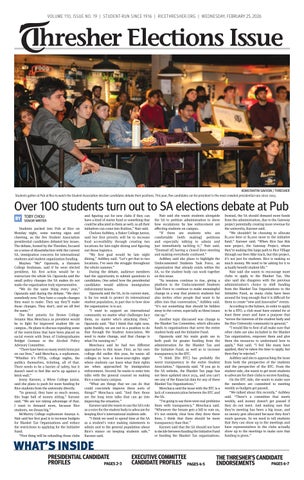
KONSTANTIN SAVVON / THRESHER Students gather at Pub at Rice to watch the Student Association election candidates debate their positions. This year, five candidates ran for president in the most crowded presidential race since 2003.
Over 100 students turn out to SA elections debate at Pub TOBY CHOU
SENIOR WRITER Students packed into Pub at Rice on Monday night, some waving signs and cheering, as the five Student Association presidential candidates debated key issues. The debate, hosted by the Thresher, focused on a sense of dissatisfaction with the current SA, immigration concerns for international students and student organization funding. Muyiwa “Mo” Ogunsola, a Hanszen College freshman, said if he were elected president, his first action would be to restructure the whole SA. Ogunsola said the small policy changes the SA makes do not make the organization truly representative. “We do the same thing every year,” Ogunsola said during the debate. “We elect somebody new. They have a couple changes they want to make. They say they’ll make those changes. They don’t, and we all feel the same.” The first priority for Brown College Senator Max Menchaca as president would be to fight for improved student life on campus.. He plans to discuss repealing some of the restrictions that have been placed on social events with Dean of Undergraduates Bridget Gorman or the Alcohol Policy Advisory Committee. “There have been so many restrictions put on our lives,” said Menchaca, a sophomore. “Whether it’s FITQs, college nights, the publics themselves, ticketing, all of that. There needs to be a barrier of safety, but it doesn’t need to feel like we’re up against a brick wall.” Jenny Karsner, a Wiess College junior, said she plans to push for more funding for Rice students from the university directly. “In general, they have so much money, this huge ball of money sitting,” Karsner said. “We are not taking advantage of that. I want to demand more, because Rice students, we dream big.” McMurtry College sophomore Ananya A. Nair said her first goal is to increase budgets for Blanket Tax Organizations and reduce the restrictions to applying for the Initiative Fund. “First thing will be refunding those clubs
and figuring out for new clubs if they can have a kind of starter fund or something that could be allocated to them as well, so all their initiatives can come into fruition,” Nair said. Chelsea Asibbey, a Baker College junior, said her first priority will be to increase food accessibility through creating two locations for late-night dining and figuring out those logistics. “My first goal would be late night dining,” Asibbey said. “Let’s get that to two locations. I’ve seen the struggle throughout the whole summer.” During the debate, audience members had the opportunity to submit questions to candidates. One asked how the presidential candidates would address immigration enforcement issues. Ogunsola said the SA, in its current state, is far too weak to protect its international student population, in part due to how slow the organization is to act. “I want to support an international community no matter what challenges face them, no matter who’s attacking them,” Ogunsola said. “But I think that right now, quite frankly, we are not in a position to do that through the Student Association. We need to make change, and that change is what I’m running on.” Menchaca said he had two different approaches to this issue. First, as his own college did earlier this year, he wants all colleges to host a know-your-rights night where students can learn what their rights are when approached by immigration enforcement. Second, he wants to enter into talks with the general counsel on making Rice a sanctuary campus. “What are things that we can do that could concretely improve these sorts of things?” Menchaca said. “And then those are the long term talks that can go into improving the situation.” Karsner said she wants to use the SA’s role as a voice for the student body to advocate for keeping Rice’s international students safe. “I think we need to spend time at the SA as a student’s voice making statements to admin and to the general population about Rice’s stance on keeping students safe,” Karsner said.
WHAT’S INSIDE
PRESIDENTIAL CANDIDATE PROFILES PAGES 2-3
Nair said she wants students alongside the SA to petition administration to show how escalations by law enforcement are affecting students on campus. “If there are students who are comfortable [with making] petitions and especially talking to admin and just immediately tackling it,” Nair said. “[Instead of] having a closed door meeting and making everybody confused.” Asibbey said she plans to highlight the Undocumented Students Task Force, an organization that already exists within the SA, so the student body can work together on this issue. “As tensions continue to rise, giving a platform to the Undocumented Students Task Force to continue to make meaningful change in a way that protects students but also invites other people that want to be allies into that conversation,” Asibbey said. “It’s not something that should be hidden away in the corner, especially as these issues rise up.” Another topic discussed was change to the Blanket Tax Committee, which allocates funds to organizations that serve the entire student body and the Initiative Fund. Ogunsola said his main goals are to both push for greater funding from the administration for the Blanket Tax and the Initiative Fund, as well as to increase transparency in the BTC. “I think [the BTC] has probably the worst transparency in the entire Student Association,” Ogunsola said. “If you go to the SA website, the Blanket Tax page has not been updated since 2024, and you can’t see any of the financial data for any of these Blanket Tax Organizations.” Menchaca said the issue with the BTC is a lack of communication between the BTC and the SA. “I’m going to say there were real problems there with transparency,” Menchaca said. “Whenever the Senate gets a bill to vote on, it’s not entirely clear how they drew these lines. I think that there should be more transparency than that.” Karsner said that the SA should not have to decide between funding the Initiative Fund or funding the Blanket Tax organizations.
EXECUTIVE COMMITTEE CANDIDATE PROFILES PAGES 4-5
Instead, the SA should demand more funds from the administration, due to the Gateway project potentially creating more revenue for the university, Karsner said. “We shouldn’t be choosing to allocate $1,000 here or $1,000 more to the initiative fund,” Karsner said. “When Rice has this new project, the Gateway Project, where they’re making this large path to Rice Village through our Beer Bike track, but this project, it’s not just for students. Rice is making so much money. We need to be asking for it to actually benefit student life.” Nair said she wants to encourage more clubs to apply to the Blanket Tax. She also said she disagrees with the previous administration’s choice to shift funding from the Blanket Tax Organizations to the Initiative Fund, as many clubs have been around for long enough that it is difficult for them to create “new and innovative” events. According to the bylaws, in order to apply to be a BTO, a club must have existed for at least three years and have a purpose that “serves the interests of the student body and the Rice University community in general.” “I would like to first of all make sure that other clubs are also included in the Blanket Tax organization, empower them and give them the resources to understand how to apply,” Nair said. “I feel like many have applied, they’ve taken the time to apply, but then they’re rejected.” Asibbey said she is approaching the issue from both the perspective of the students and the perspective of the BTC. From the student side, she wants to get more students to advocate for their clubs to receive funding. On the BTC side, she wants to make sure the members are committed to meeting weekly so budgets get passed. “We talked about this recently,” Asibbey said. “There’s a committee that meets weekly, and money doesn’t get passed if they do not meet. And making sure that they’re meeting has been a big issue, and no money gets allocated because they don’t reach quorum. So we need to tell students that they can show up to the meetings and have representatives in the clubs actually show up to the meetings to make sure that funding is given.”
THE THRESHER’S CANDIDATE ENDORSEMENTS PAGES 6-7