a permanent relocation to the Harris Bayou Recreation Field.
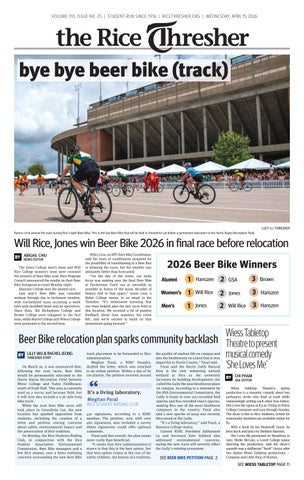
The Jones College men’s team and Will Rice College women’s team were crowned the winners of Beer Bike 2026. Rice Program Council announced the results on their Beer Bike Instagram account Monday night. Hanszen College won the alumni race. Last year’s Beer Bike was canceled midway through due to inclement weather, with rescheduled races occurring a week later with modi ed heats and no spectators. Since then, Sid Richardson College and Brown College were relegated to the rst heat, while Martel College and Wiess College were promoted to the second heat.
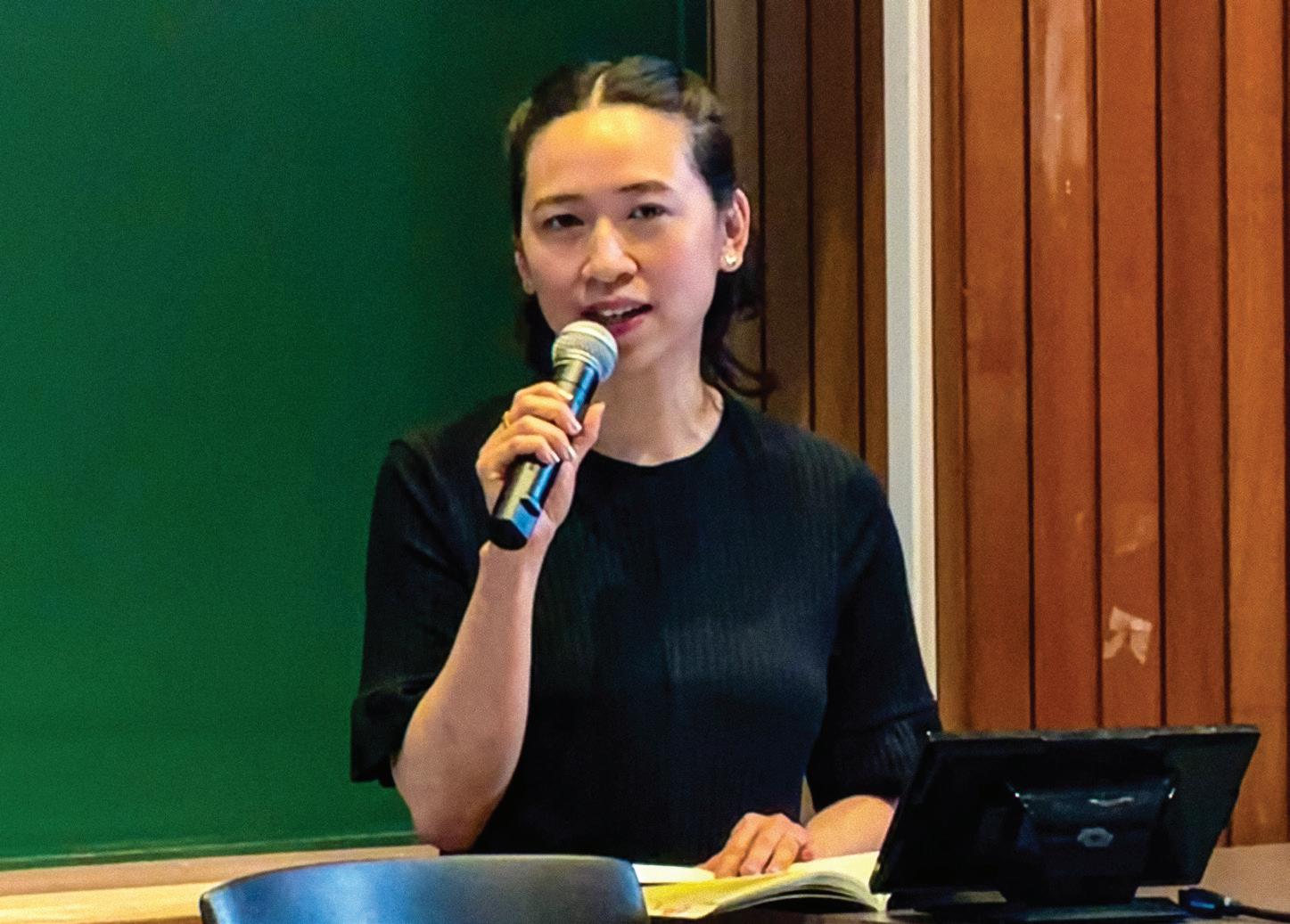
Wiley Liou, an RPC Beer Bike Coordinator, said the team of coordinators prepared for the possibility of transitioning to a Beer Run or delaying the races, but the weather was ultimately better than forecasted.
“On the day of the event, our main focus was making sure the nal Beer Bike at Hackerman Track ran as smoothly as possible in honor of the many decades of history tied to that space,” wrote Liou, a Baker College senior, in an email to the Thresher. “It’s bittersweet knowing that our team helped plan the last races held at this location. We received a lot of positive feedback about how seamless the event felt, and we’re excited to build on that momentum going forward.”
On March 30, it was announced that, following the 2026 races, Beer Bike would be permanently relocated to the Harris Bayou Recreation Field between Wiess College and Tudor Fieldhouse, south of Kraft Hall. This area is currently used as a soccer and lacrosse field, but it will now also include a 0.26 mile-long bike track.
While the 2026 Beer Bike races still took place in Greenbriar Lot, the new location has sparked opposition from students, including the creation of a letter and petition voicing concerns about safety, environmental impact and the preservation of Rice tradition.
On Monday, the Rice Students Birding Club, in conjunction with the Rice Student Association Environmental Commission, Beer Bike managers and a few Rice alumni, sent a letter outlining concerns surrounding the new Beer Bike
track placement to be forwarded to Rice administration.
Meghan Paral, a RSBC founder, drafted the letter, which was attached to an online petition. Within a day of its circulation, the petition received around
450 signatures, according to a RSBC member. The petition, now with over 460 signatures, also included a survey where signatories could offer optional comments.
Paral said that overall, the plan seems more costly than beneficial.
“It seems that Rice [administration’s] stance is that this is the best option, but that best option comes at the cost of the safety of bikers, the history of a tradition,
the quality of student life on campus and also the biodiversity on a land that is very impactful to Harris County,” Paral said.
Paral said the Harris Gully Natural Area is the only remaining natural wetland at Rice as the university increases its building development; she called the Gully the most biodiverse place on campus. According to a statement by the RSA Environmental Commission, the Gully is home to over 200 recorded bird species and 800 recorded insect species, making Rice one of the most biodiverse campuses in the country. Paral also said a new species of wasp was recently discovered at the Gully.
“It’s a living laboratory,” said Paral, a Hanszen College senior.
Current RSBC President Julihannah Lu and Secretary Kate Ashford also addressed environmental concerns, saying the new track will severely affect the Gully’s existing ecosystem.
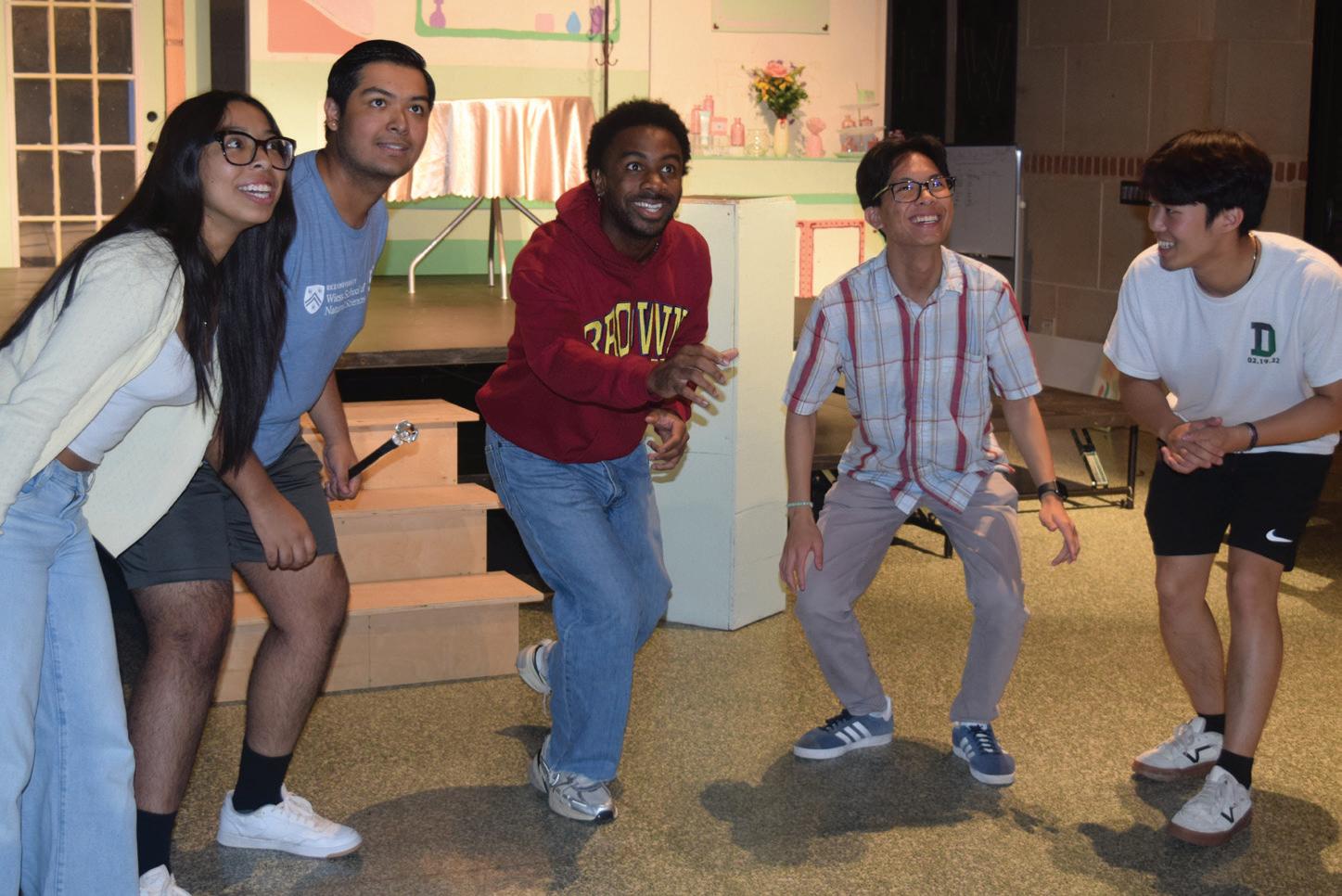
Wiess Tabletop Theatre’s spring production is a romantic comedy about two perfumery clerks who feud at work while unknowingly writing each other love letters. She Loves Me opens at 8 p.m. Friday in Wiess College Commons and runs through Sunday. The show is free to Rice students; tickets for community members are available online for $5. With a book by Joe Mastero , music by Jerry Bock and lyrics by Sheldon Harnick, She Loves Me premiered on Broadway in 1963. Birdie McCain, a Lovett College junior directing the production, said the show’s warmth was a deliberate “fresh” choice a er two darker Wiess Tabletop productions — Company and Little Shop of Horrors.
ABIGAIL CHIU NEWS EDITOR
LILLY WU & RACHEL JEONG THRESHER STAFF
Racers circle around the track during Rice’s 69th Beer Bike. This is the last Beer Bike that wil be held in Greenbriar Lot before
Lu said the paving and future repaving of the new track would cause runo containing heavy metals and other chemicals to in ltrate the drainage system and the Gully’s features. Lu also said the concrete would increase the temperature of the area, creating what is called a heat island e ect, further disrupting the existing ecosystem.
According to RSBC and the RSA Environmental Commission, the Harris Gully restoration project, a community initiative led by biology professor Cassidy Johnson, would also be hindered. Lu said the lack of bu er between the Gully and the planned bike track would lead to increased crowding and trampling of the replanted ecosystem.
“They’ve already invested thousands of dollars in the grasslands, planting new owers, adding new grasses and restoring the pond area,” said Ashford, a Baker College sophomore. “This is already going to be detrimental to all this progress we’ve made.”
Students who are involved in Beer Bike have also expressed concerns about how the new design could a ect the safety of bikers. Wiess College Beer Bike Captain Sergio Karam said his initial reaction to the proposal was centered around the potential risks posed by the track layout.
“The rst rendering we were shown was just four 90-degree turns, which is very dangerous considering the speeds that you go at during Beer Bike,” said Karam, a junior. “Then they put out a second rendering where the curves were a little less sharp, but even so, reducing the distance of the track
We emailed [administration] many times but never got a response. It was a little frustrating that they came up with this proposal without consulting any bikers or captains.
Sergio Karam
WIESS COLLEGE BIKE CAPTAIN
requires the turns to be sharper in some capacity.”
Karam also said he was frustrated by what he perceived as a lack of communication with students during the planning process.
“Initially, when the Gateway Project was announced, we were concerned about what was going to happen to the bike track,” Karam said. “We emailed [administration] many times but never got a response. It was a little frustrating that they came up with this proposal without consulting any bikers or captains.”
Dean of Undergraduates Bridget Gorman said administration had originally planned to present multiple options for potential track sites, but the current site emerged as the only viable option. Gorman also said administration has begun benchmarking against other tracks and collaborating with consultants to evaluate safety features.
“The turns and staging areas are being vetted, and we plan to actively incorporate feedback coming in from the student body to prioritize safety and the community experience,” Gorman wrote in an email to the Thresher.
Lu and Ashford said they hope the letter and petition opens a dialogue between Rice administration and all relevant stakeholders, including students and community members. Gorman said she anticipates that student feedback will in uence the track’s nal design, mentioning the creation of a working group including student representatives.
Gorman said the track relocation is just
one piece of a broader series of planned projects for green spaces on campus, with further plans still in the development phase.
“Moving forward, we welcome the feedback gathered by RPC, that alumni are sending in, and that the Rice Student Association has shared through their letter,” Gorman wrote. “Our goal is to create an experience that is safe for our riders and preserves the things we love about Beer Bike in an intentionally designed space that becomes the new heart of this tradition.”
For decades, Beer Bike has stood out as one of Rice’s most de ning traditions. First held in 1957 in the inner loop, Beer Bike slowly expanded to be held in the East Stadium Parking Lot, now the West Lot. By the late 1980s, a new track was built in the West Stadium Parking Lot, now the Greenbriar Lot, complete with bleachers installed for spectators.
The relocation comes as a part of Rice’s Gateway Project, a $120 million campus development that aims to transform the west side of campus. This project includes renovations to the Rice Stadium and the creation of a pedestrian corridor connecting campus to Rice Village, displacing the current Beer Bike track.
FROM FRONT PAGE BEER BIKE PETITION
LUCY LI / THRESHER
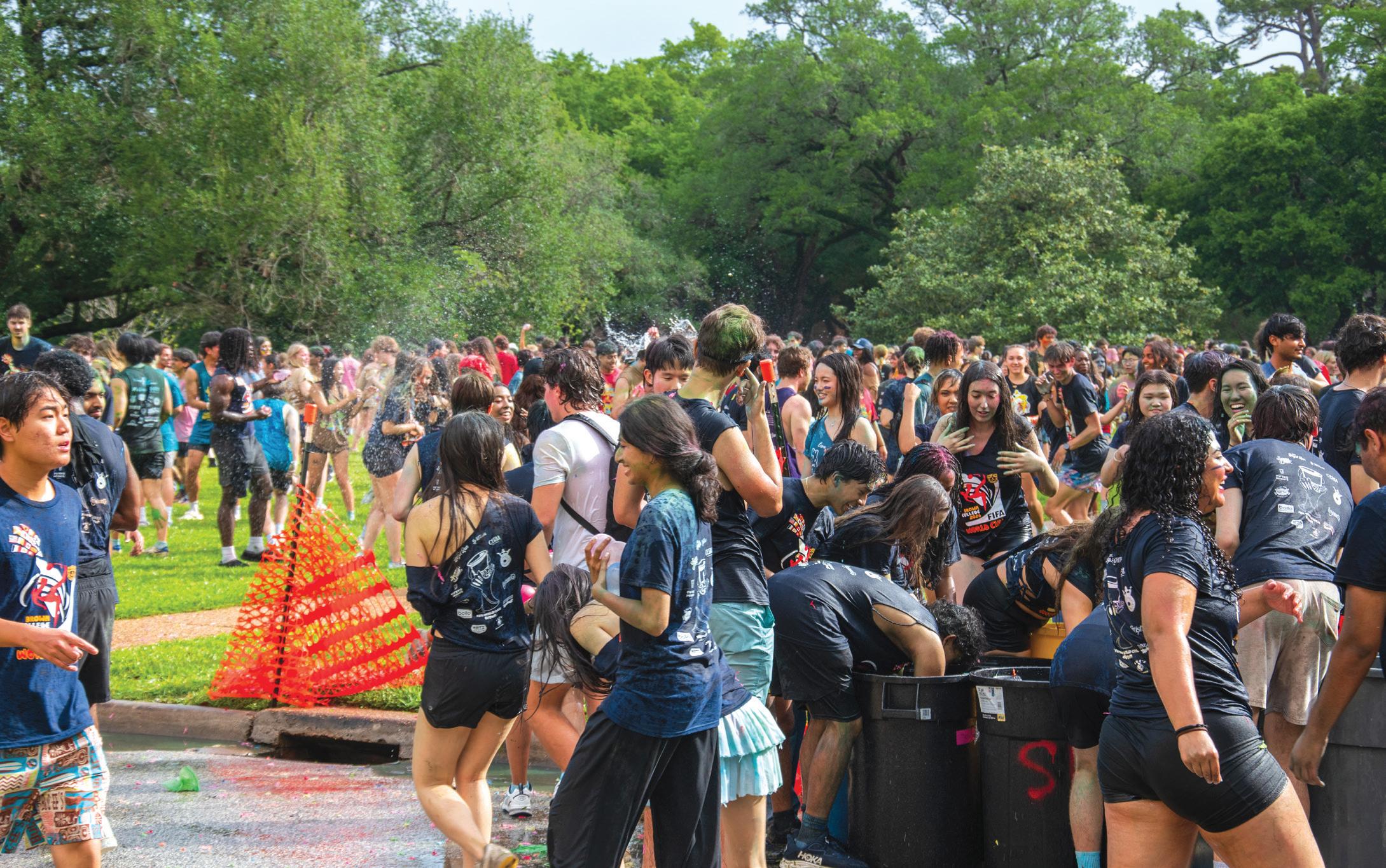
Students from Brown College join the water balloon ght in Founder’s Court. Students across colleges ll water balloons in the weeks preceding Beer Bike in anticipation of the ght.
KONSTANTIN SAVVON / THRESHER
The Jones College men’s team celebrates after nishing their heat. They placed rst overall in the race.
LUCY LI / THRESHER
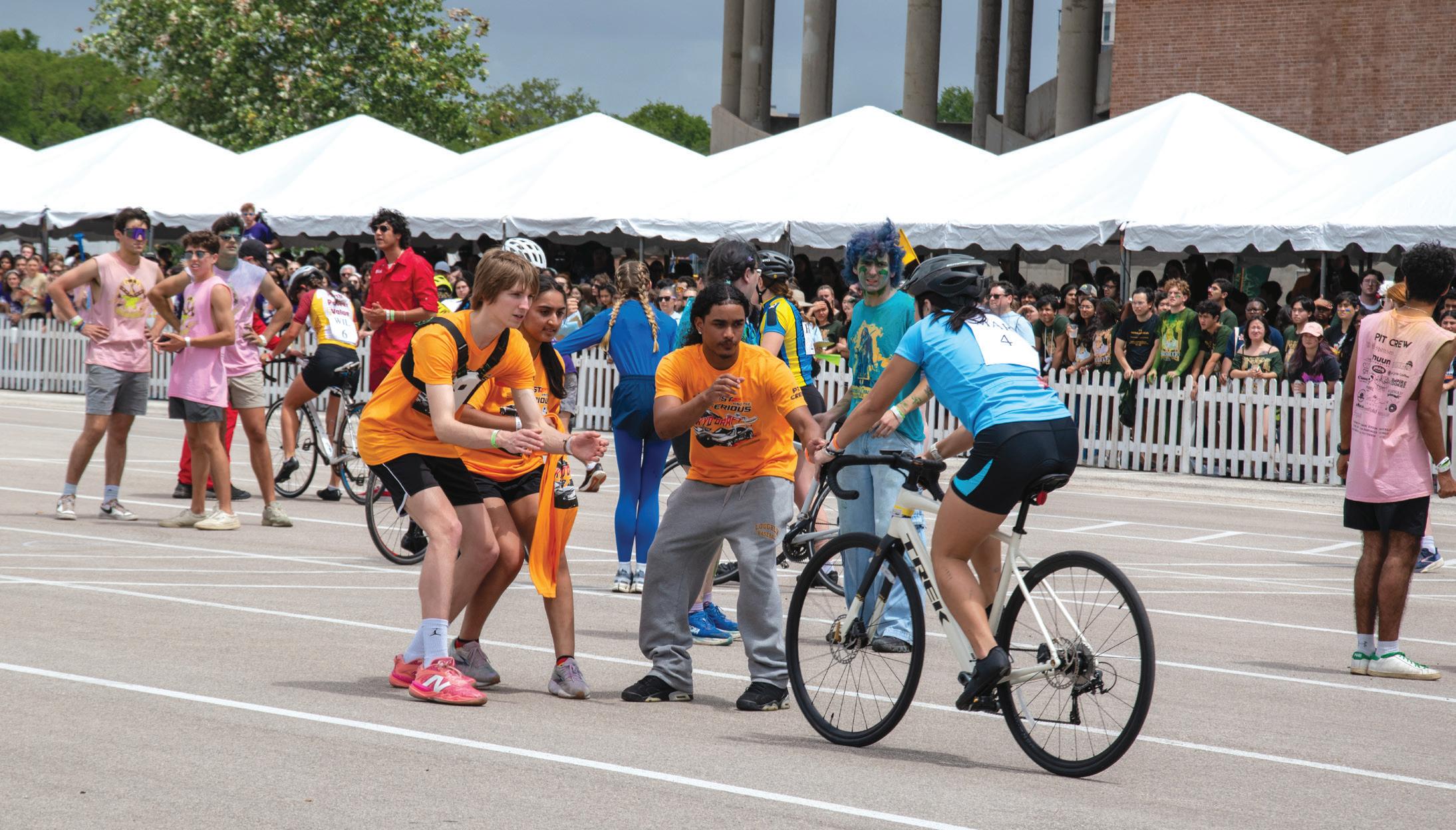
Martel College’s pit crew prepares to catch a female biker as she nishes her laps. Although alumni, men and women compete separately, colleges often keep the same pit crew across races.
In a break from tradition, beer banned for chuggers
ABIGAIL CHIU NEWS EDITOR
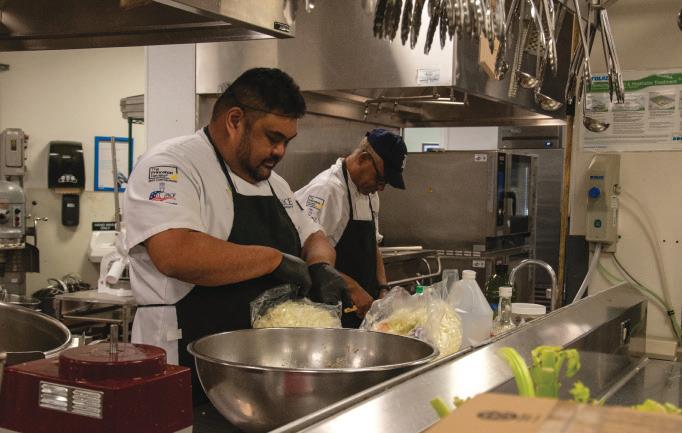
This year, students were not allowed to chug beer even if they were over 21 years of age. Miller Harris, a Will Rice College Beer Bike coordinator and member of the chug team, said he and Will Rice chug captain Will Kinnebrew had planned to chug beer as a way to honor tradition. Harris, a junior, said when he went to the Rice Program Council check-in to receive his wristband to allow him track access, he asked how he could bring the beer across the track safely and was met with confusion.
Rice Program Council’s official rules, which it says were last updated Jan. 21, 2026, state that chuggers of legal drinking age may chug beer or water, while chuggers who are underage must
So many things have been changing for Beer Bike, for everyone’s safety and everyone’s health. We were never told that it was unsafe for us. The only reasoning we were given was it might put some of the bikers or pit crew in a position that can become unsafe with no valid reasoning behind that.
Miller Harris WILL RICE COLLEGE BEER BIKE COORDINATOR
chug non-alcoholic beer or water. The legal drinking age in Texas is 21.
Harris said after this interaction he emailed RPC offering suggestions for safety measures, such as having Will Rice’s Residential Associates keep the beer in their possession until the time of chugging.
“It was a little bit disrespectful to change the rules of Beer Bike the day before the race. People have been practicing, people have been preparing, and are very excited to bring this tradition back,” Harris said. “Rice is
going under a lot of changes … so much is going on and being able to keep some of the core values of Beer Bike and doing it in the safest way possible, which is why we even brought it up in the first place, because we don’t want anyone to get hurt.”
Previous safety-related changes to Beer Bike include separating the races into two heats and breathalyzing bikers and pit crew members before their races.
Kinnebrew, a senior, said although he understands RPC is doing their best, being able to chug beer on the day of represents what Beer Bike is all about.
“Losing beer chugging for legal undergraduate students would really take away from what makes Beer Bike so special,” Kinnebrew wrote in an email to the Thresher. “And again, chugging beer is HARD and we really only do it for the love of the game and for the spirit of Beer Bike. I don’t think Rice needs to worry about a major epidemic of people chugging beer when they shouldn’t because it honestly is such a disadvantage.”
Harris said the reasoning they were given was having alcohol inside the track may put bikers or pit crew in an unsafe position should they consume the beer.
“We’re just trying to keep some of the traditions alive. Everything’s changing. Rice is changing. So many things have been changing for Beer Bike, for everyone’s safety and everyone’s health,” Harris said. “We were never told that it was unsafe for us. The only reasoning we were given was it might put some of the bikers or pit crew in a position that can become unsafe with no valid reasoning behind that. It just is a big question mark in my head.”
Bikers and pit crew are breathalyzed prior to the start of their races and must have a blood alcohol content of .00 in order to participate, according to RPC’s official rules.
A statement from RPC’s campus partners said restricting alcohol for undergraduates was a matter of maintaining the strict risk management protocols required for the scale of the event. The specific campus partners
were not provided.
“The primary concern is the integrity of the .00 BAC requirement for participants. Because the inner track is not a designated monitored zone, introducing alcohol into that space makes it impossible for staff to verify that the .00 standard is being upheld,” the statement reads. “Additionally, because chuggers are not currently subject to the same breathalyzing requirements as riders, we have no mechanism to monitor consumption once alcohol is present in the track area.”
Miller said continued conversations with RPC and campus partners can prepare Beer Bike to have extra volunteers or official identification checks for those of legal drinking age to have the option in the future.
“But for future years, having these systems in place to be able to continue this tradition in the most safe way possible to keep the beer in Beer Bike could be something that we as a campus can move towards,” Harris said.
Senate passes two bills, discusses amendment
TOBY CHOU ASST. NEWS EDITOR
This week, the Rice Student Association wrapped up their conversation on Senate Resolution 1, passing the bill unanimously with amendments. The resolution will implement a Tetra exchange from upperclassmen to lower-classmen.
Vamsi Makineni, Martel College senior representative, said the talks with Housing and Dining advocating for a ra e-style system for the Tetra point exchange fell through, and Housing and Dining would only allow it if the exchange used direct transfers.
Both the forms for seniors donating their Tetra and the forms for underclassmen to receive Tetra will be sent out this week, with the deadline for both being Saturday at 11:59 p.m.
Next, RSA Chief of Sta Cedric Lau introduced Senate Resolution 2, which would establish the RSA Rebrand Task Force.
Lau said the role of the task force would not just be to update the RSA’s merchandise and website but to help shi public perception of the RSA.
“We all know the name of the RSA has changed. We want to make that known to students. We also recognize the need to reposition and reinvent ourselves as an accessible and approachable and fun organization,” Lau said. “Historically, the RSA has not been one that is accessible
and personal and fun. However, that can be changed, and I think this is a perfect time to do it with our new name.”
Lau said the RSA Rebrand Task Force would partner with the Rice Undergraduate Marketing Association in order to help facilitate this rebranding. The founder and president of RUMA, Asianna Junge, said partnering with RUMA would help reduce tensions that might occur during this process. Junge also served as the RSA’s external vice president from 2024-25.
“Something that Cedric and I talked about a lot was that it’s very important for there to just be clean communication, because designers, marketers, even the executive board of the Student Association have a lot of opinions, which is very fair,” said Junge, a Baker College junior. “But it’s very important that we decrease those tensions as much as possible going forward, so that this can clearly nish within the next academic year.”
RSA President Chelsea Asibbey called on the RSA to waive prior notice on this resolution so the task force can start working on the rebrand immediately. RSA waived prior notice and passed this bill unanimously.
RSA Parliamentarian Zachary Weinbrum then introduced an amendment to the bylaws concerning renewing non-Blanket Tax student organizations. This amendment would change the process by which non-BTOs are renewed, removing the
parliamentarian’s oversight and allowing the Student Activities Center to renew clubs on their own.
We all know the name of the RSA has changed. We want to make that known to students. We also recognize the need to reposition and reinvent ourselves as an accessible and approachable and fun organization. Historically, the RSA has not been one that is accessible and personal and fun. However, that can be changed, and I think this is a perfect time to do it with our new name.
Cedric Lau RSA CHIEF OF STAFF
“So the issue with that is I now have to do 400 club renewals, and honestly, I don’t mind doing it,” Weinbrum said. “But I don’t think it’s necessary, because we have full time paid sta members that do this for us.
And right now, no matter what it is, if it is a typo that they’re correcting, I now have to go through the constitution and check everything, even though seven people who are on salary have already checked.”
Weinbrum said this was just an introduction of the amendment and that he was looking for feedback to ensure the language change does not relinquish full control of club renewals to the Student Activities Center.
Asibbey also shared some updates on her campaign promises. She said while she remains dedicated to making them happen, they will likely materialize next year.
“I think because we are still in the process of appointments, we don’t want to jump the gun. Allowing those appointed members the adequate time to phase in is really important,” Asibbey said.
Another campaign promise was to maintain Rice traditions even as the university grows. Asibbey said the RSA’s Publics and Traditions Commission has been collecting data on traditions in order to have productive meetings with administration.
“The commission is meeting with all the presidents this week in order to get more data,” Asibbey said. “They’re also going to be looking forward to doing tabling sometime before the end of the year, to get out to students, to get their feedback on what would make tradition stick and more consistent, or what would make them want to continue to show up for their colleges.”
LUCY LI / THRESHER
A Duncan College women’s chug team member stands on the platform to chug. The Duncan women’s team placed fth.
Students and alumni give a nal toast to the Toaster
LINA KANG ASST. NEWS EDITOR
With just under a month before Lovetteers o cially move out of the Toaster for good, the college community is preparing to close a more than 50-year chapter in its history. To mark the transition, the Lovett Associates Committee hosted “EOLogy: Odell to the Toaster” on Friday, a farewell event designed to bring together current students and alumni for one nal tribute.
Over 300 alumni and students came together for the event, lling the Lovett College Commons and quad throughout the evening. The event featured a guestbook, photobooth and open spaces for conversation, while alumni revisited the building and toured spaces like the basement ahead of its closure.
The night concluded with a collective “Toast the Toaster,” as the building lit up and attendees gathered for nal remarks from current president Bruce Hurley and
You know, everybody hated this building. It was a horrible building, but you get used to it. And I think the great thing about Lovett, [is] the way the students have taken it over. The second floor has one kind of culture, the fifth floor has another.
John Casbarian
FORMER LOVETT MAGISTER
Lovett’s second-ever president Ed Emmett. Hurley said he was grateful to be part of this historic event.
“I’m really excited to share this moment with everyone — let everyone walk through the building again, revisit all the memories and go through that nostalgia has been really heartwarming,” said Hurley, a junior.
Sejal Gupta ’25 said it was important to mark the transition.
“I think it’s good to give it a proper send-o ,” Gupta said. “But I think the new building will be good for Lovett. I think it’ll be nice for people to have good housing. It’s exciting — new traditions, people can start new memories.”
Former magister John Casbarian, who served from 2000 to 2004, re ected on how the building shaped the Lovett experience.
“You know, everybody hated this
building,” said Casbarian, a professor of architecture. “It was a horrible building, but you get used to it. And I think the great thing about Lovett [is] the way the students have taken it over. The second oor has one kind of culture, the h oor has another.”
Eric Heineman ’89, a former Lovetteer and later a resident associate from 1993 to 2004, said the building shaped the community.
“[Lovett] will always be disparaged as the worst building,” Heineman said. “It’s ugly, but tonight, look how many people turned out, because all of the people here are a step above the people who think that a college is a building. Lovett, we are not perfect, but we’re bigger than just the building, and let’s be honest, I think we bond around the building.”
For Chetna Koshy ’95, the event marked both an ending and a transition.
“I’m sad, but excited for the students to come to enjoy the beautiful new building,” Koshi said. “We just nished a sneak peek of the new building, and it was amazing. So I’m very excited for all the future generations of Lovetteers.”
As alumni re ected on their time at Lovett, many pointed to the relationships and experiences that de ned their years in the college. Leonard Chan ’07 emphasized the lasting impact of those connections.
“This is the place where a lot of my lifetime friendships formed,” Chan said. “We did a lot of good work here, not just in the classroom.”
“I think one of my favorites was Fridays with the music coming from [Sid Richardson College], and everybody here out in the quad, just hanging out,” said Natalye Appel, a Lovett magister from 2000 to 2004.
Casbarian said he hopes a new location will provide an opportunity for new
It’s ugly, but tonight, look how many people turned out, because all of the people here are a step above the people who think that a college is a building. Lovett, we are not perfect, but we’re bigger than just the building, and let’s be honest, I think we bond around the building.
Eric Heineman
FORMER LOVETT RESIDENTIAL
ASSOCIATE
opportunities and also for old traditions to carry on.
“Many things evolved over the four years that we were here, and they continue to evolve over time,” Casbarian said. “So
I think that’s the important thing about all the colleges, is, how do they evolve? How do they keep the traditions, but also adapt them to the Lovetteers? I think it’s really an evolution, and there’ll be new things that this building will provide that couldn’t have happened here.”
Emmett ’71 said Lovett will continue to grow.
“I’ve learned a long time ago, every group that comes through is going to be di erent. They’re going to have their own traditions, if you will,” Emmett said. “And every group you know, I think every group comes through is smarter, brighter, more engaged.”
Freshman Riya Kalluvila said she is excited to see that change.
“Of course, when I rst entered Rice, I was very excited to hear we are getting a new building, but I’d have to say I’m a little sad about it, because I adapted to it pretty well so far. The rooms and the connections and bonds I’ve made here have been just amazing,” Kalluvila said.
Hurley is tasked with the job of transitioning Lovetters into the new Lovett building next fall, which he said he is grateful for.
“I wouldn’t be in this position without all of the people that came before me and all the people that are around me, and so all of the work that is done tonight and going forward, that’s not just me. We all work together and all show up for each other,” Hurley said.”
Rice alumna hosts live coding music event at Shepherd
CHRISTINE XU FOR THE THRESHER
Bringing together arts and programming, Shepherd School hosted a rst live coding music event. R. Tyler ’18, a live coding artist based in San Francisco, California, performed and gave a short lecture at the event.
Organized by Wenshi Chen, a Hanszen College junior and Musicology major, the event took place on April 9 at Alice Pratt Brown Hall’s Wortham Theatre, drawing more than 20 attendees.
“Why not, if we have this amazing resource and connection, to have students know about this fascinating aspect of music combining with technology and human-machine interactions as [arti cial intelligence] starts to emerge in our lives,” Chen said.
Having researched live coding music since her freshman year, Chen performed a live coding composition combined with a guzheng, a traditional Chinese instrument, at her electronic music course’s nal concert last semester. Chen said seeing the audience’s reaction inspired her to organize the event this semester.
“I wanted a interdisciplinary opportunity where people from all di erent departments who are fascinated with artistic music,
creativity and the emerging technology come together to have this kind of conversation about what is going to happen when we bridge all of this together,” Chen said.
R. Tyler, now a scientist specializing in oncology genetics at a biotech company, spent nine months as a full-time live coding artist before returning to science. He said his journey toward live coding began when pursuing his doctorate at Rice, where he took a deep learning class and began exploring the intersection of algorithms and music.
“I wanted to make an improviser robot — something where I play piano or drums and then the algorithm would spit out a pattern that would complement what I played,” Tyler said.
Unlike traditional performances where musicians rehearse and play from a xed score, Tyler said live coding allows performers to modify the music in real time on stage.
“It’s like you have the score, the sheet music in front of you and you can modify it, and then it plays it exactly,” Tyler said. “But the way that you modify the score is kind of like your interpretation.”
Beyond entertainment, Tyler said live coding also serves a deeper purpose of demystifying the music creation process.
“It’s important to let people know how
you’re making the music, especially in electronic music — it’s such a black box 99.9% of the time, you have no idea what’s going on,” Tyler said.
Chen said live coding is already gaining wider audiences through social media platforms like TikTok and YouTube, with a new sub-genre called “pop live” emerging
I wanted a interdisciplinary opportunity where people from all different departments who are fascinated with artistic music, creativity and the emerging technology come together to have this kind of conversation about what is going to happen when we bridge all of this together.
Wenshi Chen HANSZEN COLEGE JUNIOR
that bridges familiar pop music with live coding.
“By mixing these two together, we bring a broader perspective to the audience. We can bridge the familiarity and the unfamiliarity and combine them into something we’re all fascinated about,” Chen said.
Maxwell Chen, a Duncan College freshman majoring in chemical engineering, said he heard about the event through a professor and came with an open mind.
“Seeing the process unfold live was a lot di erent than just putting on a YouTube video of a regular DJ performance,” Chen said.
As someone who had previously encountered live coding through YouTube, Luke Ritter, a Sid Richardson College sophomore, said he prefers connecting music to what he has learned from physics and math rather than traditional music theory.
“It’s weird, it’s cool,” Ritter said. “The music was very chaotic, which probably isn’t really my thing, but it’s still really cool just seeing someone up there.”
Chen said she plans to continue bringing live coding to campus following the event’s success.
“When I saw the registration form, I got so excited seeing how many people are
LINA KANG / THRESHER
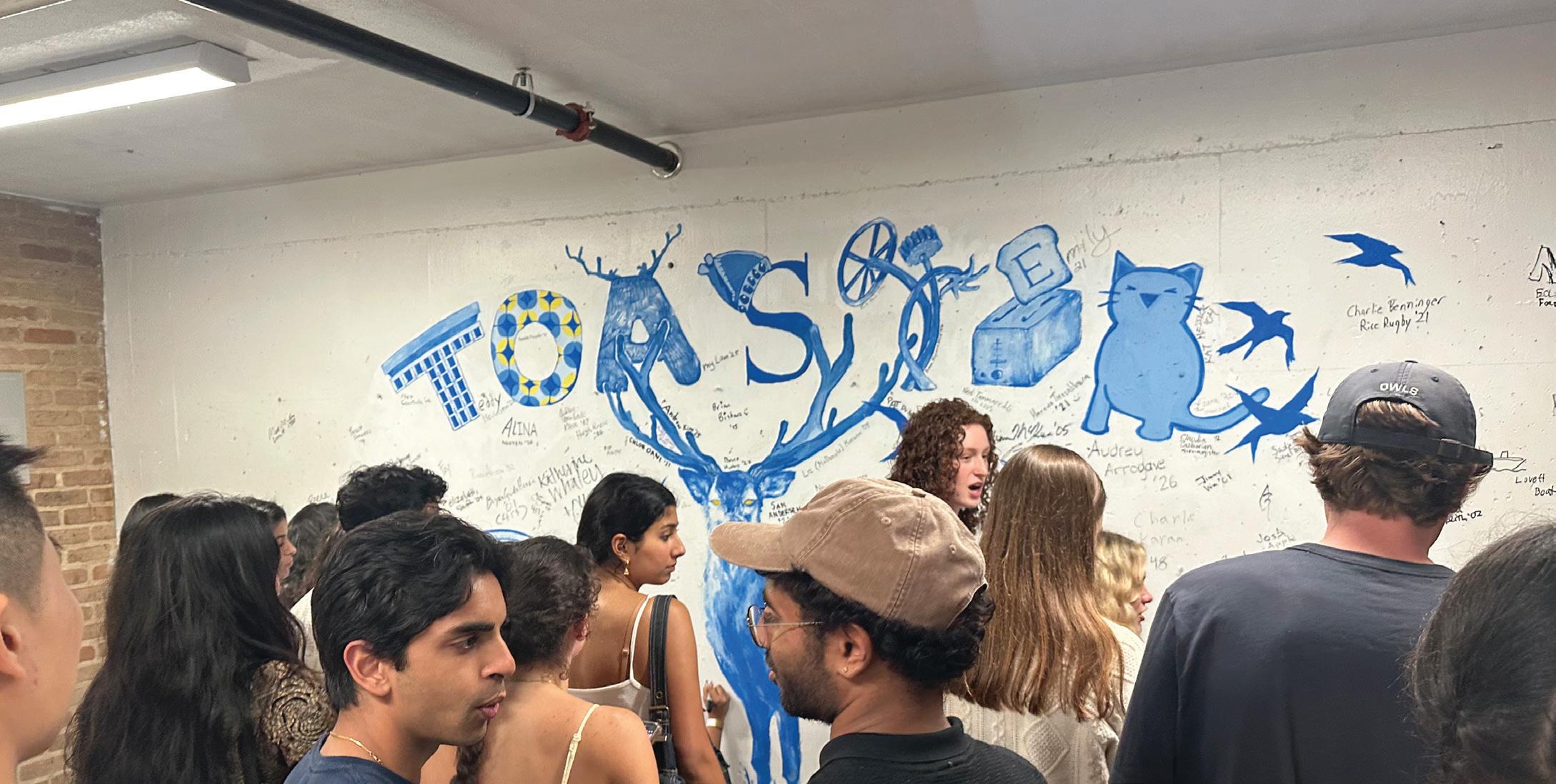
Students and alumni gather in the Old Lovett basement to say goodbye before the building is renamed to Main Street Residence and the basement is converted to facility space for Housing and Dining.
New servery to be named South Main
RUBY GAO ASST. NEWS EDITOR
The new servery shared by Chao College and the new Lovett College building will be named South Main Servery, according to an Instagram story by Housing and Dining. It will be Rice’s rst all-electric servery and will feature a robotic cooking station.
In response to the Momentous strategic plan, South Main Servery is a long-term residential dining project to support the growing student population and provide a better residential dining experience.
In cases where a dining facility does not carry a donor name, our typical approach is to use a geographic reference that reflects its location on campus. ‘South Main Servery’ follows that convention, referencing its location along the South Main corridor, which will provide students a clear and intuitive way to find the space.
Beth Leaver
INTERIM ASSISTANT VICE PRESIDENT OF HOUSING, DINING AND HOSPITALITY
Beth Leaver, interim assistant vice president of housing, dining and hospitality, wrote in an email to the Thresher that South Main Servery will be Rice’s rst fully electric kitchen and will feature next-generation culinary technology, including an Omni AI robotic working station designed to enhance e ciency, consistency and the overall student dining experience.
To use the AI station, a chef will still need to load the ingredients, but the robot will dispense and cook the food.
Kailey Lei, a Hanszen College sophomore and soon-to-be Chao junior, said she is concerned the robotic cooking
station could lead to ine ciency at South Main Servery.
“I was just thinking that the line will be pretty long,” Lei said. “Maybe they’re going to have humans giving you the dishes, like making stir-fry, and then robots on top of that.”
Sruthi Panja, a Lovett College sophomore who will live in New Lovett, said she hopes the new servery will ease pressure on other serveries while incorporating successful elements from other serveries.
“Hopefully, having a new servery will kind of take some of the pressure o of other serveries,” Panja said. “I like [Seibel Servery]. I like the vibe there. It’s nice, open air, very sunny. So I hope it’s that same open concept.”
According to Leaver, H&D is also piloting a new recipe management so ware that will link to digital menu signage to improve real-time communication and nutritional transparency. The system will inform decisions across other servery locations.
Lei said she is glad to see digital menu signage as a way to support healthier eating habits.
“I think having better awareness of that would really help people get to their tness goals and be healthier and just feel less anxious about what they’re eating and putting in their bodies,” Lei said. “I really like that they’re encouraging making healthier choices.”
According to Leaver, the name of a servery typically depends on its geographic location.
“In cases where a dining facility does not carry a donor name, our typical approach is to use a geographic reference that re ects its location on campus,” Leaver wrote. “‘South Main Servery’ follows that convention, referencing its location along the South Main corridor, which will provide students a clear and intuitive way to nd the space.”
Lei said she thinks the name South Main is not an appropriate choice for the new servery.
“I think South Main is really confusing. There’s already a South,” Lei said.
As the sixth servery on campus, South Main Servery is under construction and is scheduled to open in fall 2026 alongside the Chao and new Lovett buildings.
Fri, Apr 17 at 7:30pm Sun, Apr 19 at 2:00pm Tue, Apr 21 at 7:30pm
LUCY LI / THRESHER
Senate rebrand is the right step, but it needs direction
As Chelsea Asibbey settles into her presidency and the semester winds to an end, we would like to re ect on the seeming inaction that has consistently plagued the Rice Student Association Senate for the past few years.
Spending almost an hour discussing a fantasy football league, while possibly a creative way to inspire intercollegiate spirit, does not address the myriad of growing student concerns. Fantasy football is fun, but we want to see the real change we voted for.
Tetra Week, another highly-discussed topic at Senate, was similarly bogged down by ridiculous deliberation given the harmless nature of the proposal. Senate only convenes o cially and publicly for one hour per week. It can not be a place for student concerns to be met when time is wasted exploring
minute details of unimportant plans.
One of the few tangible things Asibbey’s administration has produced so far is making the Ralph S. O’Connor Building for Engineering and Science a late-night study space. However, this seems more of a le over wave of momentum from Trevor Tobey and the 24-hour Fondren Library initiative rather than something Asibbey pushed through all on her own.
Though we acknowledge Asibbey and the executive committee are likely working behind the scenes, a key tenet of her platform was increased communication and transparency. Asibbey would bene t from sharing updates on what conversations are being initiated and when students can expect to feel the change.
The new rebranding task force seems to be a step in the right direction. However,
with the rebranding, we should also see the work being done behind the scenes. For example, if the Senate does have a response to the Beer Bike track change, knowing that they are looking into it would give students a chance to voice their concerns.
We hope to see Senate moved from the inaccessible Kyle Morrow room into places where real debate can occur. For students to really get involved, they need to feel Senate is actually responding to their concerns and focusing on issues that matter to students.
This goes for Senators as well. We have seen relatively straightforward bills get entangled in debate that completely loses the original point. Rather than sparking thoughtful conversation, it seems Senate members are more interested in hearing their own voices.
When a track and eld event was
proposed in Senate, Senators peppered the presenters with endless questions relating to rather inconsequential issues for over a third of the hour. While the RSA athletic commission was involved, it seems like a waste of everyone’s time to interrogate what was essentially a publicity announcement. While debate and discussion is important, the necessity for Senate to work for the students must not be forgotten. We hope that if Asibbey and Senate do nally work to make Senate more accesible to all students, the student body will see something worth investing in.
Editor’s Note: Thresher editorials are collectively written by the members of the Thresher’s editorial board. Current members include James Cancelarich, Evie Vu, Abigail Chiu, Hongtao Hu, Andrew Rynsburger, Chi Pham, Andersen Pickard and Patrick Shukis.
Senate Scoop: The RSA should intervene in Beer Bike track changes
MAX MENCHACA & ELI RISINGER FOR THE THRESHER
It is not uncommon for changes to campus traditions to be announced before students fully understand their implications. The recent decision to relocate the Beer Bike track to the Harris Bayou Recreation Field is one such case. While the move may o er logistical bene ts, it raises serious concerns about safety, accessibility and the long-term preservation of one of Rice’s most de ning traditions. The RSA has an obligation to step in.
At rst glance, the relocation is not without merit. The new site is closer to residential colleges, and bikers will no longer have to contend with vehicle tra c in the Greenbriar Lot. However, the proposed track design introduces risks that cannot be overlooked.
One of the most pressing concerns is the
geometry. The new course would be shorter than the current one by 88 yards. This means riders will spend more time navigating turns rather than straightaways, increasing the likelihood of dri ing, collisions and crashes. For new riders, maintaining control through turns is already one of the most challenging aspects of Beer Bike. Increasing both the degree of the turns and adding an additional lap only compounds that di culty. As Kelly Dahlin, a multi-time indoor world champion and Wiess women’s bike captain, notes, even experienced cyclists occasionally dri at high speeds. Designing a track that ampli es this risk runs counter to the university’s commitment to safety and accessibility.
Equally concerning, there is no clear way for bike practices and intramural games to safely coexist. Even with fencing, stray balls present a real hazard to cyclists. At the
Menchaca is a Brown College sophomore
analysis. Both are former Rice Student Association senators and believe
and
same time, closing the track during games or practices would notably limit training time for cyclists.
This tradeo is signi cant. The most e ective way to improve rider safety is increased practice. Any barrier to consistent access will result in less experienced riders on race day. If access becomes unreliable, cyclists may be pushed to practice elsewhere, such as the inner loop or o -campus roads. Both alternatives introduce additional risks, from pedestrian con icts to vehicle tra c. In attempting to solve one problem, the current proposal risks creating several more.
There is also the broader question of capacity. With undergraduate enrollment expected to grow, it is unclear how a smaller venue will accommodate the crowds, vendors and infrastructure that make Beer Bike a campuswide event. The absence of clear answers only adds to student uncertainty.
None of these concerns suggest that the track must remain exactly as it is today. However, the current proposal appears to prioritize expediency over careful planning.
The RSA should introduce a resolution urging the university to reconsider or signi cantly revise the current track proposal before construction begins. This would not reject progress, but would call for collaboration and reconsideration. It would signal that students expect to be involved in decisions that shape traditions, allowing for our input before it is too late.
Editor’s Note: This is a column that has been submitted by a contributor to the Thresher. The views expressed in this opinion are those of the author and do not necessarily represent or re ect the views of the Thresher or its editorial board. All columns are fact-checked to the best of our ability and edited for clarity and conciseness by Thresher editors.
We should reject the Gateway Project and a more mainstream Rice
HANNAH EDLUND
FONDREN LIBRARIAN & RICE ALUMNA
As a Rice librarian and alumna, I was annoyed to learn that Rice had chosen to spend over $100 million on the Gateway Project for a part of campus infrequently visited by employees and students.
I question a cosmetic project that would bene t such a small portion of us. The decision is particularly galling when Fondren Library has struggled with building integrity for decades. The library has been told there isn’t enough funding for a new building, even though a design was created, proposed and dismissed over 20 years ago.
Meanwhile, Fondren experiences ooding and water leaks during heavy rainfall, leading to the closure of a large section of o ces for over a year. We have brick-wall windows, weird smells permeating study rooms, poor air circulation and a lack of Americans with Disabilities Act compliance. These aren’t new or unknown complaints; the leadership and administration are well aware.
Yet it is the most recent news about the Gateway Project that puts these problems into perspective. Rice will create a new green space just to destroy another. The new venue for Beer Bike will be directly adjacent to the Harris Gully Natural Area. This will compromise much of the new habitat and plantings that have been installed and are not even complete.
Furthermore, the limited space for a Beer Bike track and viewers makes me wonder if they want to end that tradition. In 2026, Beer Bike drew an attendance of approximately 1,000 alumni. It is also the main competitive event between residential colleges that students prepare for throughout the year. It highlights how Rice o ers rigorous academics alongside equally rigorous amusement. It is part of what makes Rice so di erent from its peers.
Perhaps the administration or the board hasn’t thought about what messages they’re sending to the community with this plan, because here’s what I am hearing:
1. Cosmetic improvements to low-usage parts of campus are a priority.
2. Academic support buildings are secondary to parking lots.
3. Sustainability projects are unimportant and may be destroyed without notice or input.
4. Beer Bike should be severely curtailed and potentially discontinued.
The way I see it, someone intends Rice to become more like a mainstream university. We need more football money and attention! We shouldn’t focus so much on unusual traditions no one else has!
If the goal is to look more like Southern Methodist University or the University of Texas at Austin, then I suppose this is a great plan. However, I think most people who choose Rice are here not only because it is
an excellent school with top-tier academics, but also because it is equally fun and quirky.
Those here have rejected the common college experience in favor of Rice.
I chose to keep my criticisms private when they were focused on my frustration with a crumbling, inadequate library that in no way
I question a cosmetic project that would benefit such a small portion of us. The decision is particularly galling when Fondren Library has struggled with building integrity for decades.
measures up to those of our peer institutions.
A er all, other campus buildings have similar complaints and are also relics from the ’40s and ’60s.
But with the announcement that this plan will be destroying or at least compromising a massive sustainability project — all while spouting rhetoric about valuing sustainability in the new Momentous strategic plan — and appearing to attempt to restrain a beloved tradition, we cannot stay silent.
As a Rice librarian, I have chosen to write
in my personal capacity. This decision is about what kind of university Rice intends to be. I urge those who object to make their voices heard. And I urge those responsible to redirect at least some of the enormously awed elements of this project before they cannot be changed.
Editor’s Note: This is a guest opinion that has been submitted by a member of the Rice community. The views expressed in this opinion are those of the author and do not necessarily represent or re ect the views of the Thresher or its editorial board. All guest opinions are factchecked to the best of our ability and edited for clarity and conciseness by Thresher editors.
Max
studying political science
statistics. Eli Risinger is a Wiess College sophomore studying political science and social policy
every Rice student should be well informed to advocate for their interests in student government.
Beyond the ballot: Service never backs down
JENNY KARSNER WIESS COLLEGE JUNIOR
The most important thing one can do after losing an election, whatever the circumstance, is to concede gracefully in the spirit of our democratic traditions. I had the pleasure of meeting with our new Rice Student Association president to congratulate her personally, wishing her the best for a successful year ahead and pledging to be supportive in enhancing the Rice experience that we all treasure. I believe she has a real opportunity to make a difference, and I have high expectations.
Election outcomes matter. But so does everything that led up to it: the civil discourse, candidates’ debate and campus dialogue that contended with the issues shaping undergraduate life.
This was one of the most crowded RSA elections in over two decades with many candidates calling for change. Elevating the voices of our student body, especially the marginalized and dispirited parts of the student population, is an opportunity for incoming leadership to bring us to higher achievement.
Our campaigns got people excited about new ways to make student government effective. We got people to care about the RSA in a way that felt refreshingly new with possibility. That energy should not be constrained to the election season alone.
Too many students still feel disconnected from the RSA. Not because they do not care, but because they do not feel like its agenda relates
The most meaningful parts of this campaign were sitting outside with a sign that said, ‘What would you change at Rice?’ and listening intentionally to the perspectives of my peers. Students shared ideas across academics, campus life, dining, funding and inclusion.
to them. There is an assumption that the RSA is just another extracurricular activity, something that exists to serve the people in it rather than the public. But it does belong to everyone, and it depends on us to engage it and hold our leaders to high expectations.
Titles do not make you a part of this
community. Actions do. I will not be president, but I will not be discouraged or passive about the possibilities that lie ahead. I care deeply about what happens at Rice and I intend to stay involved in making it better.
The most meaningful parts of this campaign were sitting outside with a sign that said, “What would you change at Rice?” and listening intentionally to the perspectives of my peers. Students shared ideas across academics, campus life, dining, funding and inclusion. These are not just my campaign ideas. These are yours. And they are worth working toward.
I also want to acknowledge that, at times, things felt more divided than they needed to be. But I also saw something else in abundance: people showed up, people voted and people cared. Multiple students told me they had never voted in a Rice election before this one.
This election was decided by 19 votes, a 1.2 percentage point margin. To everyone who voted, thank you. Your participation made this one of the most meaningful RSA elections in recent memory. And let the closeness of this race be a reminder: 64.2% of undergraduates did not vote at all. Whether they couldn’t decide or didn’t
care, we do not know. But you are involved, you have power and your voice carries more weight than you may ever believe.
Thank you to everyone who supported me in ways big or small. I am incredibly grateful. This campaign was never just about me.
Congratulations to Chelsea Asibbey and the new administration. I am excited to see where you lead us next, and I am ready to help turn meaningful ideas into something real wherever I can serve our Rice community.
In this election, people did not just vote for a favorite among the five candidates. They voted for something different. And now, they are looking for it. Let’s come together to strengthen the RSA and support our elected leaders. Let’s give them a year that proves it was worth it.
Editor’s Note: This is a guest opinion that has been submitted by a member of the Rice community. The views expressed in this opinion are those of the author and do not necessarily represent or reflect the views of the Thresher or its editorial board. All guest opinions are fact-checked to the best of our ability and edited for clarity and conciseness by Thresher editors.
Last Week’s Online Poll Results
Total number of responses: 412
Follow @ricethresher on Instagram to answer weekly polls.
* Indicates Editorial Board member
James Cancelarich* Editor-in-Chief
Evie Vu* Managing Editor
NEWS
Abigail Chiu* Editor
Hongtao Hu* Asst. Editor
Toby Chou Asst. Editor
Ruby Gao Asst. Editor
Lina Kang Asst. Editor
OPINION
Andrew Rynsburger* Editor
FEATURES
Amelia Davis Editor
ARTS & ENTERTAINMENT
Chi Pham* Editor
SPORTS Andersen Pickard* Editor
Patrick Shukis* Editor
Keya Patel Asst. Editor
BACKPAGE
Charlie Maxson Editor
Max Scholl Editor
Will Howley Editor
Rykelle Sandidge Senior Writer
COPY
Shruti Patankar Editor
Julianne Ma Editor
PHOTO, VIDEO, & WEB
Ayaan Riaz Director of Digital Media
Francesca Nemati Photo Editor
Konstantin Savvon Asst. Photo Editor
Steven Burgess Video Editor
Fiona Guo Social Media Manager
Megan Zhang Web Editor
Fiona Sik Web Editor
Varshini Loganathan Web Editor
DESIGN
Jessica Xu Art & Design Director
Magnolia Hickey-Zamora News
Sydney Chang Opinion
Lisa Wang Features
Alexa Bu Arts & Entertainment
Kirstie Qian Sports
Brandon Nguyen Backpage
Richard Li Design Consultant
BUSINESS
Sivani Vasireddy Manager
Alina Zhong Advertisement
Rahul Santhanam Advertisement
ABOUT
The Rice Thresher, the official student newspaper of Rice University since 1916, is published each Wednesday during the school year, except during examination periods and holidays, by the students of Rice University.
Letters to the Editor must be received by 5 p.m. on the Friday prior to publication and must be signed, including college and year if the writer is a Rice student. The Thresher reserves the right to edit letters for content and length and to place letters on its website.
Editorial and business offices are located on the second floor of the Ley Student Center: 6100 Main St., MS-524 Houston, TX 77005-1892
Phone: (713) 348 - 4801
Email: thresher@rice.edu
Website: www.ricethresher.org
The Thresher is a member of the ACP, TIPA, CMA and CMBAM.
Senior Spotlight: An entrepreneur turns boredom into board game
RISHI ANARKAT THRESHER STAFF
Will Rice College Commons hums with a speci c kind of energy between 5 and 6 p.m., Monday through Thursday. It is a time for shared meals and conversations, but for many, it is also the designated hour for Criminal Rush, a board game that has become a staple of the college’s culture.
Jonathan Cheng, the creator of the game, watches as students weigh risks and communicate with teammates over secret cards. For Cheng, seeing the game in action is the culmination of a journey that began with a simple desire for connection.
“I’ve always been a really big board game person,” Cheng said. “Ever since high school, I think board games have been a great way to keep in touch with people, build community in a non-digital fashion.”
The seeds for Criminal Rush were planted long before Cheng, a Will Rice senior, arrived on campus. The initial concept existed only as a forgotten document in his Google Drive until he decided to revisit it during winter break. However, the rst iteration was far from a success.
“I made a really rough prototype, played it with my high school friends, and realized, ‘This is a terrible game,’” Cheng said.
Cheng spent the rst semester of his senior year completely redesigning the rules with the help of his friend. The game began to gain traction when he noticed his peers were no longer just playing out of politeness; they were actively seeking it out. These friends, such as Edison Won, a junior at Will Rice, were essential for testing and improving the game.
“One thing that makes it so di erent from other board games is that I feel like most board games are either you’re playing as an individual or you’re playing as a team,” Won said. “But with Criminal Rush, you’re kind of playing both sides. You’re playing as an individual, but you’re also helping out with the team as well.”
“I think when I started having people consistently want to play over and over, like texting me, ‘Oh, when’s the next time I can play Criminal Rush?’” Cheng said. “I felt a sense of con dence that I knew this game is not just something that I enjoy, but that other people potentially enjoy as well.”
To see a student with that level of thoughtfulness and maturity for such a unique venture was really interesting and really unique for me.
Tony Cordova HEAD OF EARLY
STAGE VENTURES
AT
LILIE
Alejandro Clavijo, a sophomore at Will Rice, nds Criminal Rush particularly appealing because it involves strategy but doesn’t overwhelm you.
“This is de nitely accessible for people who don’t want to spend hours reading a rulebook, but still want a strategic, fun game they can play with friends. It’s both competitive and cooperative,” Clavijo said.
The con dence gained from testing the game with his friends led Cheng to the Liu Idea Lab for Innovation and Entrepreneurship’s Launchpad program. Initially, he said he was hesitant to pitch a consumer product to a hub known for arti cial intelligence startups and nonpro t organizations.
“I think it’s very helpful to get that support and that investment,” Cheng said. “With that funding, I want to eventually go to a board game convention and formally pitch my board game to publishers, get their feedback and network.”
Tony Cordova, who oversees Launchpad at Lilie, said Cheng’s project stood out immediately because of how much preparation he had already put into
the game’s development.
“The rst thing that stood out to me was how unique it was,” Cordova said. “Not every day you have somebody that wants to build a board game.”
Beyond the technical mechanics of the game, Cordova was particularly struck by Cheng’s professional demeanor and the advanced stage of his market strategy.
“To see a student with that level of thoughtfulness and maturity for such a unique venture was really interesting and really unique for me,” Cordova said.
Cheng’s work on Criminal Rush is inseparable from his broader mission of community building. As a former Will Rice internal vice president and Orientation Week coordinator, he has focused on creating spaces where people feel supported and included.
“The second oor of New Dorm became the ‘board game oor,’ where people
interested in board games could live together,” Cheng said. “That way, they could easily connect with neighbors and plan board game nights.”
He has overseen the installation of a board game locker and cabinet at Will Rice, ensuring the “Culture of Care” he championed continues.
“I never thought that a passion like board games could receive funding or be used to build so much community,” Cheng said. “It doesn’t have to be board games — it could be any hobby.”
Even as Cheng prepares to graduate and begin a career as a data scientist, he remains committed to the culture he helped build.
“I want to continue building board game communities,” Cheng said. “Postgrad life can be isolating, but creating shared spaces for people to connect is important, and I want to use board games to do that.”
Sneezing through the semester: How Houston’s allergy season hits students
Spring at Rice means more than just Beer Bike. It means blooming azaleas and outdoor study sessions in your college quad; for many students, it also means a wave of sneezing, watery eyes and congestion that no amount of DayQuil seems to fix.
Dr. Ashish Asawa, an allergist and immunologist with Houston Methodist Hospital, noted that the city’s warm, humid climate allows for year-round plant growth, leading to more persistent pollen production. For the thousands of students living and studying on campus, there is no easy escape.
“I notice that there’s a lot more allergy complaints such as stuffy noses, itchy eyes and scratchy throats mostly caused by pollen during mid-late February through late March or early April,” said Ramya Viswanathan, a Martel College junior and Rice Health Advisor.
It might be tempting to blame Rice’s campus — which holds official arboretum status — for making things worse, but according to Cin-Ty Lee, a professor of geology, earth, environmental and planetary sciences, the reality is more nuanced. Lee said most campus plants are unlikely to cause allergy issues.
“The only significant tree that may produce pollen is the live oak, but that is
only because we have so many of them,” Lee said. “These are the trees that line the inner loop and give Rice its characteristic and special look.”
According to Dr. Nerissa D’Silva, a board-certified allergist in the Houston area, oak pollen is one of the biggest drivers of spring symptoms. Data from the Houston Health Department’s pollen count for April 14 also shows that oak is the single most prevalent tree pollen in Houston’s air, with its counts almost double that of the next highest tree pollen.
For the students navigating Rice’s oak-
lined inner loop every day, the data hits close to home. Carlos Cruz, a McMurtry College junior who grew up in Houston, said the effects ripple across his whole routine.
“I’ve had bad allergies since I can remember,” Cruz said. “It is more difficult to study, work out and feel motivated to do anything around others.”
Not every student arrives with a clear sense of what they are walking into.
Brynn Danow, a New York native, said she didn’t even realize her symptoms were allergy-related until recently.
“I just thought it was just me getting
sick,” said Danow, a Hanszen College freshman.
For her, the triggers are specific: dusty spaces, old books and areas with a lot of paper. She tries to prepare herself before going into dusty areas or, when possible, avoids them completely.
“I found that it makes me sneeze a lot more and it makes my eyes tear up,” Danow said.
For students who have sought treatment, the results can be significant. Arjun Surya, a Sid Richardson College senior and Houston native, said allergy shots at a nearby clinic transformed his experience.
“It’s definitely gotten better over the year that I started treatment,” Surya said. Cruz said most medications have not worked for him, and he typically waits for symptoms to pass on their own. He thinks Rice could do more to address the issue.
“Creating and disseminating educational flyers can help improve students’ quality of life if they are susceptible to seasonal allergies,” Cruz said.
Seasonal allergies, while common, are rarely discussed as a serious student health issue, Cruz said.
“It affects students’ quality of life to a large extent but may be overlooked in the realm of student health,” Cruz said.
KAMILA EL MOSELHY FOR THE THRESHER
BRANDON NGUYEN / THRESHER
AMELIA DAVIS / THRESHER
Jonathan Cheng, a Will Rice College senior, designed a new board game called Criminal Rush. Cheng is working with Launchpad at Lilie to formally pitch the game to investors in the future.
Shepherd students sweep local music competition
sharing many classes and getting to know each other well over the course of gaining their degrees.
In March, at the Young Texas Artists Music Competition in Conroe, Shepherd students showed out. Out of eight nalists, six were Rice students from the Shepherd School of Music — including the Grand Prize winner.
Applicants to the competition have to be residents of Texas or enrolled in a Texas school, which results in a diverse mix of competitors both from notable music schools in Texas such as Southern Methodist University, Texas Christian University and Baylor University, as well as people from schools with international recognition, like The Juilliard School and the Manhattan School of Music.
Cellist Cirdan Vonnahme, a sophomore from Will Rice College and the winner of the grand prize for YTA 2026, said encouragement from friends inspired him to enter the competition.
Vonnahme played “Schelomo: Rhapsodie Hébraïque” by Ernest Bloch, which he had prepared and used in other competitions. However, he said his experience performing it at YTA was distinct from those other experiences.
“When I walked in on stage, I saw 300 people in the audience,” Vonnahme said. “Most of the time these competitions are just for a panel of juries, which kind of removes the human aspect of getting to play for people. So, I was almost inspired when I saw about every seat was full in the little auditorium. You know, they’re real people and I wanted to connect with them. It kind of made it easier, almost, to play in a human way.”
Vonnahme is from Alaska, so he said winning a competition themed around Texan pride was a little amusing.
“They gave me a giant Texas ag that was signed by state reps,” Vonnahme said. “I was honored — it was pretty funny. There was a certi cate, there was this little triangle box with a mint condition Texas ag that had been own in the Texas State Capitol.”
Winning the grand prize precludes Vonnahme from competing again, while those who won gold and silver medals can apply again next year. However, Shepherd students are very tight-knit,
At YTA, Vonnahme didn’t feel like he was competing against his fellow Rice students but instead sharing the experience.
“There were eight nalists, and there were $40,000 of prizes. So, all eight of us were going to split the 40k in some way. We all knew that. I was happy that everyone there won something,” Vonnahme said. “We all took photos together. We all know each other’s names. It’s just great to be competing with people, and making your school proud.”
Though it was gratifying to win alongside so many other Shepherd students, it was also satisfying a er putting so much e ort into the piece, Vonnahme said.
“In addition to just spending hours and hours in the practice room, I would play in the studio concert hall at night when no one was there,” Vonnahme said. “One night I played until 4:30 a.m., alone in the big concert hall, just hearing how it sounds when it’s in a big space. I think that was really good for me.”
On average, there are about 75 to 95 applicants a year. A er the initial cut, between 10 and 15 people are considered for each division: voice, piano, strings and a catch-all category that encompasses winds, brass, guitar and other instruments.
YTA originated in 1983, following the restoration of a historic vaudeville theatre, the Crighton Theatre, in Conroe.
“When they restored the theater, there was all this passion for the arts,” said Susie Pokorski, president and CEO of YTA. “We had this beautiful little stage, a wonderful audience, enthusiastic arts community. We wanted to give a stage and a live audience performance to a deserving young artist. And so we searched Texas and found one pianist and gave her a lovely performance.”
The search for a young artist to grant the stage to every year quickly became a competition in and of itself.
“The Young Texas Artists brand just seemed to be embraced by the community and eventually by the state.
Our state senator declared us the o cial music competition of the state of Texas. And, you know, the Texas theme just seemed to work for us,” said Pokorski.
Today, though a link to Texas is necessary for musicians to enter the competition, what gives them a shot at the nalist position is an ability to perform and exhibit their showmanship.
“This is a performance competition, not just academic,” Pokorski said. “They are judged from the moment they walk on stage, so they have to have certain skills — performance skills — for an audience. It’s not just the artistic and the technical abilities, it’s how well they can move the audience.”
And this year, though Shepherd students are regularly represented among the nalists of YTA, they represented a full three-quarters of the winners.
Matthew Loden, dean of Shepherd School of Music, said Shepherd’s association with YTA competition has been long — and bolstered by the faculty.
“There’s so many students that
rotate in and out,” Loden said. “And so if we have students that are coming from other parts of the world, they don’t necessarily know about the existence of this competition. And so it’s our faculty who are able to say, ‘You sound really great.’”
Loden said that even though Rice’s success this year at YTA is a triumph, it isn’t by any means a singular experience — instead, it’s a natural outgrowth of the work ethic and opportunities Shepherd offers its students.
“Musicians very naturally want to challenge themselves individually and collectively to keep getting better and better, because we’re pursuing something that we will never perfect,” Loden said. “That lifelong sensibility of always wanting to move to the next level and always being willing to be kind of vulnerable to put yourself in that situation is something that I hope that all of our graduates are able to do, not just at the Shepherd School, but across the Rice campus.”
AMELIA DAVIS FEATURES EDITOR
DAVE CLEMENTS / THRESHER
Cirdan Vonnahme plays the cello. The Shepherd student was recently won a grand prize at the Young Texas Artists Music Competition
From apartment labs to space-ready tech: 3 Rice breakthroughs tackling real-world problems
RISHI ANARKAT THRESHER STAFF
A dialysis sensor built in an apartment. A coating that keeps liquids from sticking — even at near-boiling temperatures. From detecting infections at the molecular level to engineering surfaces that defy physics under extreme conditions, these projects show how Rice researchers are turning overlooked problems into practical, highimpact solutions.
DialySafe: The sensor saving dialysis patients
What started as a senior design project for Ibrahim Al-Akash, a graduate bioengineering student, has evolved into a DialySafe — a startup developing technology to reduce human error and improve safety during dialysis treatments.
Peritoneal dialysis patients often face high risks of infection, which can lead to hospitalization and treatment failure, Al-Akash said. To combat this, the DialySafe team developed a sensor that clips directly onto dialysis tubing to monitor fluid for molecular-level changes before these changes become visible to the human eye.
“DialySafe is different because it uses a fully contactless, zero-disposable physical chemical sensor,” Al-Akash said. “It detects molecular-level changes in the fluid before they become visible, allowing earlier detection.”
As his team lost access to university labs after graduation, they had to get creative. They built a small lab in their apartment and are using yeast cells for testing to keep costs low, Al-Akash said. However, this did not stop them from
garnering recognition — the team was selected to compete in the 2026 Rice Business Plan Competition among 41 other graduate-led startups.
The “never-wet” shield for extreme heat
Traditional water-repellent coatings usually fail when things get hot as steam and condensation clog the tiny textures that trap air.
Researchers at the Rice Advanced Materials Institute — including Daniel Preston, a professor of mechanical engineering — have solved this by adding a thermally insulating layer that prevents heat from reaching the surface — the “never-wet” shield, a heatresistant coating that maintains waterrepellent properties even near boiling temperatures.
The team said it can be used for industrial food processing, protective clothing to prevent hot liquid burns and the maintenance spacecraft systems where biological fluids like urine must be transported without clogging.
Preston, who co-designed the shield, highlights the simplicity of the design.
“Our approach avoids that by using a two-step, multimaterial coating process,” Preston said. “First, we apply a thermally insulating layer, and second, a commercially available superhydrophobic coating.”
The spray-on process the technology uses is also significantly cheaper than previous methods, Preston said.
Keeping cancer-fighting cells alive with better oxygen delivery
Doctoral student Chris Wright has
developed a new gel-based system designed to solve the “oxygen problem” in cell-based drug delivery. By significantly improving oxygen delivery to these engineered cells, the system ensures they survive and function effectively once they are inside the body.
Wright said his innovation could make targeted therapies for diseases like cancer far more reliable and effective, paving the way for the next generation of precision medicine. The challenge
ultimately comes down to a fundamental biological limitation, he said.
“With cells, there are many nutrients they need to survive, right? Oxygen is one of the most important ones because it’s involved in keeping them alive,” Wright said. “Usually, the body provides enough things like glucose and waste management. But when you start putting a lot of cells really close together, oxygen becomes the limiting reagent for keeping them alive.”
The ins and outs of the RA hiring cycle
Chase Alvarado, a current Wiess College junior, will not be a Wiessman for much longer. As he prepares to move to Chao College, he is helping others make the same move as co-chair of the Chao resident associates search committee.
Beginning this semester, he and 11 other members of the committee — including six other students — began the search process. In the third week of classes, the three residential colleges searching for RAs for next year — McMurtry College, Will Rice College and Chao — held a mixer to court interested potential RAs.
With over 40 applicants, Chao’s pool needed a lot of narrowing down. Their first round of paper cuts left them with 12 individuals, and then after the first round of interviews, that list of 12 was shortened to five. Alvarado said making the cuts was difficult, and the decisionmaking process itself involved a great amount of careful consideration.
“[The process] was very communal,” Alvarado said. “I think it was very important because everyone on the committee comes from different backgrounds at Rice — I was the only engineer there. It meant long meetings, but we thought it was important to make sure that everyone who applied at least got their application fully looked at and fully considered.”
In some ways, Chao’s hiring process was unique — and not always in a completely positive sense, Alvarado said.
“I will say one of the difficulties for Chao this year was that we don’t have a building,” Alvarado said. “Every other college did.”
However, Marcela Davis, the Chao college coordinator, offered another perspective. She said Chao’s position as a unique and new college has been a
powerful tool to engage potential RAs’ interest.
“I would probably say that it is an attraction, that it is new,” Davis said. “It’s a time to build a new culture … so I think there is definitely an attraction to joining. You’re going to get a fresh apartment, no one’s lived there.”
One decisive factor in Chao’s selection process was how the potential RAs aspired to help build that new culture and contribute their presence, Davis said.
“The ones that really captured us, they were the ones who said, ‘I want to just come and work in the commons,’” Davis said. “The ones that we narrowed down to had a high emotional intelligence. They were very, ‘if we can tell that a student is just kind of needing space, then they need to have space.’”
Though the specific qualities and qualifications each college looks for in RAs may differ, one point stays the same across most searches: willingness to get to know students and be involved in supporting and supplementing their college’s culture. Potential RAs with a genuine motivation to be involved are extremely strong candidates, the search committee said.
“I think the nicest and coolest thing to see was just how interested some people were in supporting undergrads and getting to know us,” said Bela Jotwani, a McMurtry sophomore. “I found that very flattering, as a student, to hear from adults how much they wanted to be in the trenches with us and get to know us better.”
Jotwani, who served on the McMurtry RA search committee, said the search for an RA is especially important to those involved in student government and leadership, as the active support of an RA can be essential for ensuring the successful function of the student teams.
“[Student leadership] can be really
supported by a really good RA team, and so integrating the candidates honestly made me think, ‘Oh, we’re going to be just fine, there are a lot of people who are going to care about us and support us,’” Jotwani said.
After college committees narrow their selections, the ultimate choice is up to Dean of Undergraduates Bridget Gorman, who chooses from the shortlist of candidates. Some years, there are only one or two colleges going through the RA hiring cycle. Other years, there are as many as eight.
However, even though the final decision is up to Gorman, it is not one she makes independently.
“My Sr. Associate Dean of Undergraduates, Brian Gibson, works very closely with student RA search committee chairs ... making the process a learning opportunity for search committee members and helping identify strong candidates,” Gorman wrote in an email to the Thresher. “I always consult with the magisters of the college because the RAs will report directly to them, and cohesiveness in their Core Team
is so important. I also consult with the Provost and President before making the decision.”
As for this year’s decisions, the results will be announced this week. For students and new RAs, it will be an exciting chance to revamp college culture and enjoy getting to know each other. For some departing RAs, it might be more bittersweet.
Sandra Parsons, a psychology professor, has been a Will Rice RA for seven and half years. While she’s looking forward to seeing what her replacement will make of their experience, she said stepping back from such an involved position with Will Rice is still an emotionally challenging experience.
“It has been one of the joys of my life to be their RA. I mean, top five, and I say five because I can’t think of what the fifth would be, but like having babies, getting married, getting my Ph.D. and being a resident associate. Like, it’s just been a dream come true,” Parsons said. “I’m leaving with a little bit of sadness … I will miss [Will Rice] dearly, but I know that they’re in good hands.”
AMELIA DAVIS & AISHA KHEMANI FEATURES EDITOR & SENIOR WRITER
MARTIN XIE / THRESHER
RANI SOODA / THRESHER
Back for Beer Bike, recent alumni recommend lm favorites
The Friday before Beer Bike, various residential college commons filled with the hum of alumni reconnecting over food, music and traditions that haven’t changed much since their own orientation. Conversations wandered easily between the familiar topics — water balloon fight stories, late nights in commons — and, eventually, the movies.
At this year’s alumni FITQs, several recent graduates shared with the Thresher the films they watched during their undergraduate years and the memories they hold.
Some alumni gravitated toward
FROM FRONT PAGE WIESS TABLETOP
“It’s a celebration of simple joys,” McCain said. “It’s a rom-com, so I think it’s great if you’re wanting something that’s gonna make you smile and laugh, and the music is gorgeous.”
The show’s demanding score, which features more songs than the average musical, presented a challenge for the cast and its music director, Julian Puerto, a Hanszen College senior reprising the role a er leading music for last year’s production.
“For me, this role has always been
This is a show that’s very much about dreams versus reality. How can we make this set look like perfection? That way, whatever happens inside of it will be a surprise.
Birdie McCain
LOVETT COLLEGE JUNIOR
about keeping the standards high and challenging the performers to explore the best versions of themselves as musicians,” Puerto wrote in an email to the Thresher. “It has made my job so much easier working with dedicated performers who have each brought their own unique talents from all corners of campus.”
familiar franchises. Andrew Larsen ’25, a McMurtry College biosciences major headed to medical school, recommended crowd-pleasers: the 2025 “Captain Underpants” spinoff film “Dog Man,” the “Lord of the Rings” trilogy and any Marvel movie.
Bikram Singh ’24, a Jones College environmental science major now working at a sustainability consultancy, shared a similar pick.
“I will always recommend the ‘Lord of the Rings’ trilogy for anybody: [whether they’ve] seen it — they can rewatch it — or have never seen it before,” Singh said.
Margo Gee ’24, a Jones College linguistics and anthropology major now working as an energy consultant,
McCain said she wanted a show that could make use of the company’s vocal talent and that the solo numbers are designed to let each performer shine.
“My actors have put a lot of work into making every solo feel like a spotlight moment,” McCain said. “We’ve really been using the music as a way to show the characters’ emotional states — the music is kind of like an inside look at what they’re feeling.”
Among them is Brown College freshman Sarah Bradley, who plays lead Amalia and previously performed in She Loves Me as an ensemble member in high school.
“Preparing to play Amalia has been so di cult because she’s such a nuanced character, but I’m extremely grateful to Birdie and Julian for trusting me to carry out their vision for her,” Bradley wrote in an email to the Thresher. “Working with the amazing cast, pit and tech crew on this show has been such an unforgettable experience, so I hope that our audiences love this show as much as we do!”
McCain said student theater’s collaborative reach across disciplines is part of what drew her to the form.
“I’m working with art majors who paint our sets, with the instrumentalists and with actors and technicians who are crazy good at lighting and sound,” McCain said. “There’s so many di erent skill sets, and I think it’s really beautiful to get to see all of those come to life.”
That community has extended beyond the company itself. Cast members’ families have helped build the sets, McCain said,
used her time at Rice to explore the more eclectic offerings of cinema.
She said she fondly recalls catching a Rice Cinema screening of “Everything Everywhere All at Once” and recommended the 1977 animated adaptation of “The Hobbit,” a 1979 Hungarian experimental film called “Bubble Bath” and nearly anything distributed by Deaf Crocodile — a film restoration company specializing in Eastern European science-fiction.
Gee pointed toward Béla Tarr’s “Satantango,” a seven-hour Hungarian epic film restored by one of Deaf Crocodile’s founders.
“Marathon that if you dare,” Gee said.
The first time she saw “Everything Everywhere All at Once,” she and her classmates stopped at the Hobbit Cafe on Richmond Avenue beforehand. A couple of years later, she watched the 1977 animated “Hobbit” film.
“The Hobbit in the Hobbit Cafe is kind of related to all of them,” Gee said.
Franklin Dai ’25, a Jones College computer science major now working as a software engineer, said he recommends his favorite film, “Amadeus,” the 1984 biographical drama about Wolfgang Amadeus Mozart and his rivalry with fellow Viennese composer Antonio Salieri, who is determined to sabotage Mozart’s career as an act of revenge against God.
“I think most of it is pretty boring, but you know, I think it was a great time,” Dai said. “Mozart is a little freaky, but it’s about being a hater and really living by that.”
Dai said he also saw “Top Gun: Maverick” five times in theaters during his sophomore year, including in IMAX. But his most vivid movie memory involved watching the 2022
horror film “Talk to Me” with college friends — with one holding onto his arm the entire time “because he was really scared,” Dai said.
Catherine Russell ’24, a Jones College mechanical engineering major and current doctoral student at the University of Texas at Austin, said she celebrated her 21st birthday by screening Joel and Ethan Coen’s 2000 musical satire “O Brother, Where Art Thou?” — her favorite film of all time.
Russell said her community at Rice also broadened her taste in films. Before coming to campus, Russell said she was unfamiliar with anime or international features. She discovered “3 Idiots,” a 2009 Indian satirical comedy, through friends.
“That one I watched here, and it was really fun,” Russell said.
Beyond the movies, Russell spent all four years at Rice involved in Beer Bike — serving in leadership and riding on the bike team. The role was “a little rough sometimes,” she said, but the perk of going on night rides made her “feel like a celebrity.”
“Just enjoying yourself and not take it too seriously was what everyone should do and always should have been [doing],” Russell said.
Not every Beer Bike memory was as gentle. Larsen said he caught a water balloon hard enough to knock him down.
“It can be dangerous out there,” Larsen said.
Regarding the morning festivals, Singh had no such complaints.
“The water balloon fight, the color war — those are always a great time,” Singh said.
The films will keep changing with each incoming class. Beer Bike traditions will, for the most part, look the same when they come back.
and Lovett’s Housing and Dining sta have stopped by rehearsals to pitch in.
“All the Lovett H&D workers will see us building and be like, ‘Hey, do y’all need any help?’” McCain said. “So that’s just really sweet and heartwarming to see community support.”
The set is built largely from paper, origami and painted two-dimensional elements — a design approach McCain said is central to the show’s thematic ambitions.
“I’ve talked a lot with the actors about how this is a show that’s very much about
dreams versus reality,” McCain said. “How can we make this set look like perfection? That way, whatever happens inside of it will be a surprise.”
Puerto said he hopes the show leaves audiences revitalized beyond the theater amid the stress of college life.
“In an environment where lots of us Rice students can feel overwhelmed with academic and professional demands, I hope that the story and talents of our performers can be a happy reminder of the value of love, family, and friendship,” Puerto wrote.
COURTESY JACE LIU
Wiess Tabletop Theatre cast members rehearse the opening number of “She Loves Me,” where the employees of Maraczek’s Parfumerie dream about skipping work on a summer day.
CAELYN WANG & CHI PHAM THESHER STAFF & A&E EDITOR
LAKSHMI ARAVINDAN / THRESHER
Cherry Reading Series brings 3 debut poets to Rice
CHI PHAM A&E EDITOR
Three poets read from their debut collections at the latest installment in the Cherry Reading Series on Thursday at Sewall Hall, including one who published in Rice’s undergraduate literary magazine 17 years ago.
Lisa Low ’09, Willie Lee Kinard III and Sasha Debevec-McKenney presented work from “Replica,” “Orders of Service” and “Joy Is My Middle Name,” respectively. The series is currently organized by professor of creative writing Phillip B. Williams alongside associate professor in creative writing Tomás Q. Morín, who directs the undergraduate program.
Williams said he and Morín selected early-career writers to show students that writing can be both an artistic pursuit and a profession.
“It made sense to us to bring writers who were still early in their careers to visit our students who, if they wished, could be well on their way to graduate writing programs, future books, future professorships, or community writing programs,” Williams wrote in an email to the Thresher. “It also made sense to bring in writers who could speak to the challenges of being a writer and the importance of having other career paths.”
Low, a Brown College alumna, mentioned publishing a poem in the 2009 issue of R2: The Rice Review before reading from her debut collection nearly two decades later. She said her time at Rice, particularly studying with professor emerita Susan Wood, was foundational to her development as a writer.
“Even though Rice wasn’t necessarily where I began thinking of myself as a writer (imposter syndrome!), it was where the seed of that began,” Low wrote in an email to the Thresher. “My debut poetry collection is about the problem of writing — writing about my younger self, about being with a white man, about Asian mom stereotypes, and it was extra meaningful to bring my book to a place that shaped me.”
Her trajectory resonated with Olaoluwapo Oladipo, a Martel College freshman who will be published in R2’s next issue.
“There’s people who were at Rice, and they were published in R2, like I’m going to be next year, and now they’re here with their published book, and that’s so crazy,” Oladipo said a er the event. “Like, I could do that too.”
Low read from “People Who Look Like You,” a long poem on the daily turbulence of being Asian with a white partner, tracing how race and power operate through domestic scenes.
Williams said the three poets represent
My debut poetry collection is about the problem of writing — writing about my younger self, about being with a white man, about Asian mom stereotypes, and it was extra meaningful to bring my book to a place that shaped me.
Lisa Low AUTHOR OF
“REPLICA” & CLASS OF
2009
di erent post-debut trajectories: Low is on tour supporting her book, DebevecMcKenney holds a professorship at Grand Valley State University and Kinard consults as a freelance web designer.
“Three di erent paths. Three di erent minds. Three awesome poetry collections,” Williams wrote.
Kinard read “A Tangle of Gorgons,” which traces a family pattern of turning people to stone, moving from his grandmother’s hostility toward lesbian neighbors to his own queer experiences.
Debevec-McKenney began her reading by taking a deep breath and encouraging
the audience to join her.
“I believe in embarrassing yourself,” Debevec-McKenney said. “So I’ll start with reading my most embarrassing poem.”
She read “NO CONTACT,” about her experience having hemorrhoids following a breakup. She also read “What Am I Afraid Of?,” which meditates on the ways we categorize ourselves and others.
During the Q&A session, the poets discussed cra decisions, pursuing the writing profession and the value of community in sustaining a practice. Low spoke about how she approaches repetition and humor.
“Repeating yourself can be a good thing,” Low said. “It helps you hone in on what you want to say and how you want to say it … I feel like a lot of writing’s about not enjoying, but try to enjoy it too. If you want to laugh, make yourself laugh.”
Debevec-McKenney spoke about nding a voice and pushed back against
narrow ideas about what poets look like.
“You don’t have to nd your voice — it’s here, you just have to trust that,” DebevecMcKenney said. “You have to believe that the things you see, the way you talk, is valuable … The old white guy in the tower drinking bourbon, you think that’s what a poet looks like? You have to kill it.”
When asked about advice for student writers, Kinard spoke about trusting what emerges in solitude.
“Trust your obsessions. Trust the person that you are in a very quiet room,” Kinard said. “Trust what comes out. The page is that quiet room. The page is the stage.”
For Oladipo, who said she wanted to be a poet “for the longest time,” seeing Low’s path and hearing from debut authors about their journey made that future feel tangible.
“I don’t think I’m on their level yet, but I know that I will get there eventually,” Oladipo said.
‘Everything in the world’s a jest’: Shepherd to present ‘Falsta ’
Laughter, deception and a touch of self-reflection come together in Giuseppe Verdi’s final opera “Falstaff,” a comedy both playful and unexpectedly profound. Based on William Shakespeare’s “The Merry Wives of Windsor,” “Henry IV, Part 1” and “Henry IV, Part 2,” the opera follows the misadventures of the boastful Sir John Falstaff, whose schemes unravel in increasingly comic ways.
The Shepherd School of Music will bring the production to Brockman Hall for Opera on Friday, Sunday and Tuesday.
As Verdi’s last operatic composition, “Falstaff” holds a unique place in the canon. Joshua Winograde, professor of opera and director of opera studies at the Shepherd School, said the opera is widely renowned for both its historical significance and stylistic departure.
“What makes it stand out is that while some of his earlier operas had humorous elements, this is really the only one that is definitely a comedy,” Winograde said. “It also marks a pretty significant compositional shift.”
Because “Falstaff” draws from Shakespeare, Winograde said he looked for a director who could engage deeply with the material. He found that in Matt Hune, artistic director of Rec Room Arts.
“These characters are rich and well known, and we needed a stage director who could translate that history of character building through text,” Winograde said. “When I came across
[Matt’s] work … I thought it would be a wonderful opportunity. He has a strong history of theater making in Houston, and he also understands opera.”
Their collaboration led to another milestone for the Shepherd School: For the first time, the production features an entirely local creative team. The director, lighting designer, scenic designer and costume designer all work in Houston.
For Miguel Harth-Bedoya, resident director of orchestras at the Shepherd School, the conductor’s role in a production like “Falstaff” lies less in leading than in connecting, he said.
“The conductor is not the only leader,” Harth-Bedoya said. “I work very closely with the stage director and with the singers, especially when we deal with diction in Italian or with the acting choices that come with it.”
That coordination becomes especially important in an opera with few natural stopping points, Harth-Bedoya said.
“The biggest challenge is that it does not stop,” Harth-Bedoya said. “Once every scene starts, it just continues. It is not an opera with traditional arias where there is a clear beginning and end. I always say it is like a running train. You have to jump in at the right speed and make sure you do not fall.”
The decision to stage “Falstaff” also reflects the program’s approach to repertoire. With a department of around 35 to 40 singers, Winograce said casting decisions are shaped by whoever accepts admission each year.
“If one tenor declines, that might
rule out an entire genre,” Winograce said. “While it is a challenge, it is also our greatest asset because we are able to tailor the repertoire to the students.”
This emphasis on performance readiness is reflected in the program’s recent national recognition. In March, Shepherd alumni claimed three of six top prizes at the Metropolitan Opera Laffont Competition, one of the most prestigious competitions for emerging singers.
“When students arrive, they are on stage singing for each other from the first week,” Winograde said. “By the time they graduate, spaces like major competitions are not intimidating to them. They are comfortable with the scale and the acoustics of a large hall.”
For the performers themselves, “Falstaff” offers both technical demands and room for discovery. Sophia Grace Donelan, a graduate student performing the role of Alice Ford, said the experience has been both challenging and rewarding.
“The role contains a lot of Italian text and fast patter sections that took a lot of work,” Donelan said. “I have really enjoyed bringing this character to life. I love comedic acting, so it has been an exciting shift from some of the more tragic roles I have done.”
Performing his “dream role” as the titular character, graduate student Matan Abraham Gendelman said the opera rewards close attention.
“Falstaff is one of the most profoundly human characters in opera,” Gendelman said. “People often see him as just a grotesque comedic figure, but underneath
that, he is just as vulnerable as anyone else.”
To make the production accessible, the Shepherd School will provide a synopsis in the program, supertitles on screen and a preshow lecture by Harth-Bedoya one hour before each performance.
“We want people to feel that opera is something they can understand
We want people to feel that opera is something they can understand and enjoy, even if it is their first time attending.
Joshua Winograde DIRECTOR OF
OPERA STUDIES
and enjoy, even if it is their first time attending,” Winograde said.
The opera concludes with a fugue that delivers its parting message. The final line, “Tutto nel mondo è burla,” translates as “Everything in the world’s a jest.”
For Harth-Bedoya, the balance between humor and reflection is what defines the work.
“It is a comedy, so it is light, sparkling, electric and upbeat,” Harth-Bedoya said. “But there are also moments of inner stillness where time seems to pause. That contrast is what gives the opera its depth.”
CHI PHAM / THRESHER
Lisa Low ’09 reads from “Replica.” Her debut collection explores tensions of self-representation and existence in white spaces to challenge conventional narratives of Asian American identity.
WENSHI CHEN THRESHER STAFF
Review: ‘The Drama’ on the ctions that make love possible
CHI PHAM A&E EDITOR
Kristo er Borgli’s “The Drama” hinges on a single confession (warning: some spoilers ahead). Just days before their wedding, Emma (Zendaya) is urged to tell her ancé Charlie (Robert Pattinson) and their two closest friends the worst thing she has ever done.
She was 15, and it never went further than a meticulously devised plan. The lm spends the remainder of its time brooding over a query that proves fathomless: What are you supposed to do with such revelatory information?
“The Drama” is disinterested in adjudicating whether Emma is capable of redemption. It asks something more fundamental: Must knowledge of this kind produce a verdict at all? Can the knowledge simply coexist with everything else you know about a person, unresolved and unrepressed? Charlie, it seems, cannot manage this.
make her confession explicable and thus manageable.
He latches onto the death of a neighbor in a car accident during Emma’s adolescence and in ates it into a foundational trauma, a root cause for the violent ideation, even though Emma herself does not believe in this interpretation and was not a direct witness. He relays this version of events to their friends as though it were an established fact.
He repeats, almost to himself, that she has never been to therapy, as if early professional analysis would have metabolized the threat. Rather than genuine understanding, Charlie seeks from psychoanalysis a logic of containment — a framework to convert an unsettling truth back into a narratable one.
Emma’s actual past resists this. The lm’s ashbacks render her adolescent irtation with violence with a banality more unvarnished than most ctional treatments of school shootings. Young Emma (Jordyn Curet) is lonely and bullied at a predominantly white school in Louisiana. She falls into an online community of teenagers who fetishize mass violence with the logic of fandom, more of a social rather than ideological radicalization.
group, where she nally makes friends and, while entirely self-aware, discovers the social utility of activism.
He requires Emma’s confession to reorganize the woman he thought he knew into someone he can again make sense of. He rereads their entire relationship, causing old jokes to suddenly curdle: a novelty co ee mug reading “Co ee or I’ll Shoot” now seems sinister. In pursuit of the ‘real’ Emma, Charlie nds no monster, no explicable fundamental truth — the pursuit itself instead renders him exponentially more bewildered.
At one point, he quotes Freud to Emma: “Unexpressed emotions will never die. They are buried alive and will come forth later in uglier ways.” Charlie seeks a Freudian story of cause and e ect — an original wound that would
The forums provide a depraved peer group and distorted language for her anger. In one of the lm’s more acute scenes, her attempts to produce content for this community are interrupted by a Windows update and the ‘blue screen of death.’ The sheer ordinariness makes American gun violence so illogical and resistant to the narrative sense Charlie craves.
It isn’t a sudden moral reckoning that convinces Emma against mass murder. Another shooting happens rst at a local mall, killing a classmate. She feels beaten to the punch. In the a ermath of collective grief, she is pulled into a student advocacy
Review: ‘Dhurandhar 2’ is
She adopts a fervent stance against gun violence, even gaining a local reputation for her public demonstrations. She even throws her father’s ri e — once her weapon of choice — into a lake, but this feels closer to surrender than conviction: the nal act of a bad dream, not any triumph of conscience.
During his toast at the wedding, Emma’s father describes his daughter as being always passionate about opposing gun violence, a stance he chalks up to teenage rebellion against his military background. He interpreted her throwing away his ri e as rooted in principle. His account is almost entirely wrong, but it’s the only story he has to make sense of her.
Emma’s face tenses as he speaks, and the lm confronts the condition underlying intimacy: The people we love must be narrated into coherence, and the narration is never equal to the person.
Mostly, this doesn’t matter; the person
nothing
ARMAN SAXENA & INDRANI MAITRA SENIOR WRITER & FOR THE THRESHER
For a lm drenched in perennial highoctane sequences of explosive action — bombs, grenades, knives and bodies ying through the air like debris – the most shocking thing about “Dhurandhar 2: The Revenge” was that people around me had not slipped into a comatose state.
2026 is shaping up to be the year of the big-budget propaganda lm. First came “Melania,” a glossy, hagiographic portrait of Melania Trump that was released this January. Now comes “Dhurandhar 2,” which operates on the opposite side of the cinematic spectrum but similarly functions as ideological reinforcement.
Clocking in at an agonizing 3 hours and 55 minutes, “Dhurandhar 2: The Revenge”
resumes with Hamza’s backstory, whose real name was revealed in the rst lm to be Jaskirat Singh Rangi. The lm shows no hesitation in letting you know exactly what it demands from its audience.
In the opening scene, Rangi is rmly established as an avenging angel — a sadomasochistic pilgrim, a ruthless automaton on a bloodthirsty quest for vengeance — when he singlehandedly massacres twelve Members of the Legislative Assembly who had enacted brutal attacks on his family over a violent land dispute.
It’s a gorefest, but it must serve a purpose right? No. It’s all a big nothing.
What makes this worse is the revenge framework itself is oddly imsy. The lm wants the carnage to feel righteous, yet it bungles the moral architecture of revenge
we narrated is the one we actually live with. Emma’s father loves an inaccurate version of his daughter. The love remains real.
Charlie, unlike the father, cannot settle for a working ction. The attempt to master his paranoia, trying every available tool — from Freud to interrogation — to understand another person’s interiority, undoes him more thoroughly than the confession itself.
The ending nds a worn-out Charlie and a drenched Emma in soiled wedding attire at their favorite diner, agreeing through an old inside joke to start over. They cannot unknow what they now know about the other. “The Drama” proposes that the fact that they try anyway — that they are willing to build another story on the ruins of the last — is the enduring process of collaborative ction requisite to human connection.
The viewer may not be le particularly consoled by this recognition, but the lm suggests the ction might still be worth composing.
but cheap propaganda
at the very start. The family tragedy meant to justify Rangi’s rampage arrives a er the rampage has already begun.
So the audience is not responding to grief, violation or loss; it is being trained to cheer violence in its purest form.
That problem extends to the rest of the lm. “Dhurandhar 2” has the texture of a sequel made from le overs. Part 1 was at least stronger, as it didn’t rely so heavily on belabored exposition. This one feels like a heap of undeveloped plot threads stitched together with interminable gratuitous violence, inexplicable needle-drops and political fan ction.
And its politics aren’t subtle. Dhar builds the lm around a collage of realworld events — the 2014 Indian general election, Operation Lyari and the controversial 2016 demonetization policy. Political realities are repackaged as clean moral victories.
slogan-spitting, grievance-fuelled jingoism that now passes for patriotic cinema. Every powerful gure in this world is male. Men su er, men kill, men strategize, men posture and men sacri ce.
Women barely register except as symbols, corpses, hostages or wounds in need of male avenging. The female characters are decorative at best, silent at worst. The sequel doubles down on this hypermasculine jingoism until the whole thing starts to resemble a recruitment poster for Hindu nationalism.
And over all of this looms Modi, less a politician than an implied superhero. The lm repeatedly treats his rise, his rhetoric and his policy decisions as salvation. “Dhurandhar 2” turns the ruling party’s worldview into cinematic legitimization, where every problem is caused by the enemy and every criticism is treachery.
What’s most unsettling is how the lm uses realism. It insists it’s “inspired by true events,” borrowing the language of political history to legitimize what is a fantasy of control, revenge and dominance.
The lm’s worldview is blunt and relentless. It positions the Indian state as righteous, its enemies as monstrous and dissent as something suspicious, even traitorous. Muslims, whether Pakistani or Indian, are collapsed into a single threatening mass, while anyone opposing the ruling establishment is quietly coded as aligned with foreign enemies.
Then, there is the overwrought masculinity of it all, that especially exhausting brand of chest-thumping,
This is what makes “Dhurandhar 2” so harmful. Its failures are not limited to shoddy lmmaking or lazy exposition — the lm is worrying as a pop cultural object. It tells us what audiences around the world are happy to root for: hate packaged as nationalistic pride and patriarchy packaged as entertainment.
A lm this popular cannot be dismissed as entertainment. It is stadium-sized propaganda and the most disturbing thing about it is not even necessarily what it says, but how many people are willing to cheer when it says it.
COURTESY A24
Javelin thrower embraces No. 2 national ranking
KEYA PATEL ASST. SPORTS EDITOR
A short sprint, a sharp release and a spear that cuts through the air before landing meters away. There’s little time to process the precision behind it — or the athlete responsible.
For Mckyla Van der Westhuizen — ranked No. 2 in the NCAA — those seconds are the product of years of technical training and focus.
Now a senior javelin thrower at Rice, Van der Westhuizen has risen in her sport, consistently ranking at the top of the NCAA and opening her previous season with a personal-best throw exceeding 60 meters.
Despite the apparent minimalism of the event, she emphasized its complexity.
“Throwing far sounds simple,” Van der Westhuizen said. “But it’s still super hard. It’s a very technical skill.”
Van der Westhuizen began throwing javelin nearly a decade ago in South Africa, where she said sports played a central role in her upbringing.
“I’ve been doing this for about 10 years,” Van der Westhuizen said. “Sports were a huge thing growing up.”
Over time, that early involvement turned into something more competitive.
“I realized I was really good at it,” Van der Westhuizen said.
That realization has translated into consistent success at the collegiate level,
Men’s
where she has been among the nation’s top competitors since her freshman year.
As one of the top-ranked javelin throwers in the country, Van der Westhuizen said she tries to avoid focusing too heavily on expectations heading into competitions.
“I try not to put a number on my throws before a meet,” Van der Westhuizen said. “I just focus on feeling good.”
That approach has contributed to a strong start this season, including a 59.06 meters throw at the Victor Lopez Classic that fell 1.52 meters short of setting a program record.
Van der Westhuizen said performing at such a high level comes from her dedication to all aspects of training and recovery.
“Not much besides track and eld,” Van der Westhuizen said when asked about life outside the sport. “It takes up a lot of my time. Most people don’t realize how much time goes into it, between practice, conditioning, nutrition and even just getting good sleep.”
Van der Westhuizen credited her teammates and the broader Rice community for their role in her success this season.
“The team and the student body have been amazing,” Van der Westhuizen said. “My friends came out, made signs … it was just a really good feeling.”
She said support in the stands can have a tangible impact on her performance.
“I always say that every extra person that comes is an extra meter thrown,” Van der Westhuizen said.
While her season has been marked by strong performances and national recognition, Van der Westhuizen said she remains focused on continued improvement rather than speci c outcomes.
Despite her current ranking, she
emphasized maintaining a consistent mindset in competition and continuing to re ne the technical aspects of her event.
As the season progresses, Van der Westhuizen will look to build on her early success, one throw at a time.
tennis falls to No. 31 SMU, ends 9-match win streak
OLIVER STERN THRESHER STAFF
A er jumping seven spots to No. 50 in the nation, Rice men’s tennis fell to No. 31 Southern Methodist University in its nal match of the regular season on Wednesday.
The loss snapped Rice’s nine-match win streak, which included an undefeated eight-match run in conference play. The Owls nished the regular season with a 13-7 record.
Rice took the doubles point for just the second time during its current sixmatch skid against SMU. Junior Tommy Czaplinski and freshman Rafael Botran picked up right where they le o a er their win against the University of Memphis, cruising to a 6-1 victory. The No. 57-ranked duo of junior Petro Kuzmenok and senior Santiago Navarro followed with a 6-2 win, extending their streak, dating back to January, to 11 matches.
“I think it’s just a matter of how long we’ve been playing together — about two years now,” Navarro said. “Our connection goes beyond the court. We’re really close, and that plays a big role. When you genuinely get along with your partner, you can feel that chemistry on the court.”
Despite securing the doubles point, Rice could not carry that momentum into singles play as SMU rallied to take four of the ve completed matches.
Sophomore Gabriel Porras was rst to
Our connection goes beyond the court. We’re really close, and that plays a big role. When you genuinely get along with your partner, you can feel that chemistry on the court.
Santiago Navarro SENIOR TENNIS PLAYER
fall, losing 6-4, 6-1 to even the overall score at 1-1. Porras’s defeat put a halt to his ninematch winning streak; from there, SMU began to take control.
Kuzmenok battled against the No. 2-ranked singles player in the nation, but a pair of service breaks midway through the first few games cost him the first set. He responded with a stronger effort in the second, fighting off multiple break points while serving down 4-2. Kuzmenok clawed back to 4-3, but he was unable to recover from the early deficit. Kuzmenok lost the match 6-2, 6-3 as SMU extended its lead to 2-1.
On Court 3, Botran fought o three match points to extend the match a er dropping the rst set. However, SMU ultimately closed it out 6-4, 6-3 to take a 3-1 lead.
On Court 4, senior Kabeer Kapasi dropped the rst set 6-4 before battling
back to take the second set 7-5. He carried that momentum into the third, jumping out to a 2-0 lead before SMU won three straight games to take a 3-2 advantage. A er falling behind 5-3, Kapasi held serve to extend the match but couldn’t break back, ultimately falling 6-4, 5-7, 6-4. The loss clinched the match for the Mustangs, marking the rst time since Feb. 22 that Rice failed to secure a singles point.
Navarro provided a bright spot for the Owls, bouncing back from a tightly contested 7-6 rst-set loss to win the second set 6-2. Navarro continued the charge into the third set, surging ahead 5-0 and holding three match points before his match was abandoned once SMU clinched the overall victory.
“I had two set points and then lost in the tiebreak, so that was de nitely in the back of my mind at the start of the second,” Navarro said. “I just tried to reset and focus
on speci c things in my game. I started attacking his second serve, which helped a lot, and I thought I served well and stayed aggressive when I had the chance.”
Freshman Noey Do was also in a strong position, winning the rst set 6-4 and holding multiple match points at 5-1 in the second. However, SMU mounted a comeback, winning six straight games to take the second set 7-5. Do responded early in the third, jumping out to a 2-0 lead before his match was abandoned following the clinch on Court 4.
“We knew it was going to be a tough match against a really good team,” head coach Efe Ustundag said. “Our goal was to come out strong in doubles and give ourselves a chance, and we did that.”
Ustundag said closing out matches when they had the chance could have led to a di erent result for the Owls.
“We had opportunities across the courts,” Ustundag said. “We were a point away on Court 2 and a point away on Court 6, and Kabeer was up a break in the third. That’s where you want to be in matches like this. We just couldn’t convert some of those chances, and credit to SMU for stepping up and playing well when it mattered.”
With the defeat, Rice falls to 0-6 against higher-ranked opponents this season, including No. 5 Louisiana State University, No. 11 Baylor University and No. 17 Stanford University. Notably, all seven of Rice’s losses have come against ranked opponents, though the Owls have found consistent success in conference play with wins over the University of South Florida, the University of North Carolina at Charlotte, the University of Tulsa and the University of Memphis.
Next, Rice will head to Tulsa, Oklahoma for the American Conference Championships from April 16 to 19. The Owls will look to make the NCAA Tournament for the third consecutive season, which would mark the rst such streak under Ustundag, the conference’s reigning Coach of the Year.
KAIRI MANO / THRESHER
Seniors Yair Sarouk and Kabeer Kapasi strategize between points in their doubles match against the University of Memphis.
COURTESY RICE ATHLETICS
Senior javelin thrower Mckyla Van der Westhuizen is ranked No. 2 in the NCAA.
Inside the madness: How Rice ran the NCAA South Regional
PRASANNA BENDALAM THRESHER STAFF
While the NCAA Division I Men’s Basketball Tournament Regionals were held at the Toyota Center, Rice University served as the host institution, coordinating logistics and operations alongside the Harris County-Houston Sports Authority and arena sta
“It was everything that you would see from the teams getting selected all the way to the time that they le a er the last game,” said Eric George, assistant vice president and deputy athletic director. “We had to block o hotel rooms for them, coordinate their arrivals and departures, practice times, media availability — all of the stu that leads up to the game.”
Rice’s role extended into game operations, including sta ng, coordination and postgame procedures.
“Once the game started, then it’s your true game hosting,” George said. “Making sure the signage and graphics were up, making sure the games ran smoothly, and then postgame — whether teams were going home or moving on — making sure they were taken care of.”
Unlike a typical home game, the event required Rice sta to operate in a professional venue while coordinating across multiple organizations.
“The most challenging part for us was
Volleyball
KEYA PATEL ASST. SPORTS EDITOR
that it wasn’t our facility,” George said. “We didn’t know where some of the nooks and crannies were of the arena, and it wasn’t on campus, so getting our sta over there added a transportation element.”
The coordination also required working across multiple organizations involved in the event.
“There were more cooks in the kitchen,” George said. “Everyone had their own responsibilities, so you were not only overseeing your role, but also coordinating with the other groups to make sure nothing got dropped.”
There were more cooks in the kitchen. Everyone had their own responsibilities, so you were not only overseeing your role, but also coordinating with the other groups to make sure nothing got dropped.
Eric George DEPUTY ATHLETIC DIRECTOR
The event also dwarfed a standard Rice game in both attendance and production.
“At our basketball games, we may have
1,500 to 2,000 people,” George said. “We had 20,000 at [the regional], so everything gets magni ed. You couldn’t just kind of wing it and hope it worked out.”
Because the NCAA oversees tournament operations, the environment di ered from a typical Rice home game.
“A lot of what we had to do was dictated by the NCAA,” George said. “It wasn’t the true feel of a Rice home game. You had to be very neutral between the two teams, and all the signage was neutral.”
Still, the regional o ered a rare
opportunity for both sta and fans.
“There are only a few sites in the country each year,” George said. “For Houston sports fans, this was a great opportunity. It’s not something you get to see very o en.”
Hosting the regional rounds also brought national exposure for Rice and the athletic department.
“It was a great opportunity for Rice as a whole to be front and center in prime time,” George said. “The banner said hosted by Rice University, and it put us on the national scale from an athletic standpoint.”
defeats Houston in spring o season game
Rice volleyball relied on late-set execution to secure a spring win over the University of Houston, using the match as a key opportunity to measure progress during the o season.
In multiple sets, the Owls were pushed into tight situations but consistently found ways to close.
“When it got into the 20s, it got tight, and Houston pressed, and then we found a way to win,” head coach Genny Volpe said. “It says a lot about the resilience of your team.”
Volpe said the team’s ability to compete freely marked a shift from earlier spring performances.
“There were some times where I thought we got in our heads a little bit and just thought too much,” Volpe said. “Today … they just kind of let loose and competed hard.”
The spring o season, which consists largely of training, o ers limited opportunities for outside competition. For Rice, matches like the one with UH provide needed evaluation.
“When you’re just training and training and practicing against each other, you
really can’t quite tell what are our strengths, what are our weaknesses, because we know each other so well,” Volpe said.
Players pointed to improved chemistry as a key factor in the win, particularly as the team adjusts following roster turnover.
“I think we’re really focused on building a lot of chemistry with this team,” junior Kaia Mateo said. “A lot of seniors were obviously [lost] last year, so it’s just about meshing well together and cleaning up communication.”
That chemistry showed most clearly on the defensive end, where the Owls extended rallies and stayed in points.
“This past week we’ve really been focused on defense — just pursuing the ball and trusting each other to do our jobs,” freshman Sydnee Peterson said. “We were rallying, we were being scrappy, we were keeping balls up.”
Offensively, Rice’s setters helped create opportunities for hitters by shifting the defense and opening one-onone situations.
“Our setters move us around a lot, and our middles do a really good job pulling,” Mateo said. “Most of the time I have a oneon-one … so it makes my job pretty easy.”
Peterson said the team has also emphasized distributing the ball across multiple attackers.
“We have a lot of great arms on our team,” Peterson said. “So it’s just getting everyone involved … and just giving them the best situation we can.”
While the result was a positive step, players and coaches said the focus remains on long-term development and consistency heading into the fall season.
“I think just that word ‘consistency’ — it’s hard to maintain,” Volpe said. “We’ve
This past week we’ve really been focused on defense — just pursuing the ball and trusting each other to do our jobs.
Sydnee Peterson FRESHMAN OUTSIDE HITTER
already turned the page. We’re not resting on the laurels of last year.”
The Owls went 21-10 last season, including 15-1 in the American Conference. They were named conference champions and advanced to the NCAA Tournament, where they were swept by the University of Florida.
With a mix of returning players and incoming additions, the team is also working to establish leadership across the roster.
“There’s kind of that gap between really old people or really young, not many in the middle,” Mateo said. “So that’s kind of what we’ve been working on — how can we have that leadership and it spread throughout the whole team?”
That emphasis extends beyond matches and into daily preparation.
“Last week we were talking a lot about mentality,” Mateo said. “How can we create a very intense environment in our practice gym so that it translates into games where we don’t even have to think about trying to be competitive?”
The Owls will continue that work into the summer, when players take on a larger role in organizing training.
“In the summer, we have early morning workouts … and then we have our open gym practice,” Peterson said. “So it’s just being committed to that during the summer, committed to each other and the mission.”
For Volpe, that accountability is central to maintaining the program’s trajectory.
“They know that if they don’t, then we’re not going to maintain our success,” Volpe said.
NHU CHU / THRESHER
SARAH BRADLEY / THRESHER
Freshman outside hitter Aaliyah Smith winds up to spike the ball in Rice’s victory Friday over the University of Houston.
The Backpage is the satire section of the Thresher, written this week by Will Howley, Charlie Maxson, Rykelle Sandidge, and Max Scholl, and designed by Brandon Nguyen. For comments or questions, please email realricethreshero cial@rice.edu.