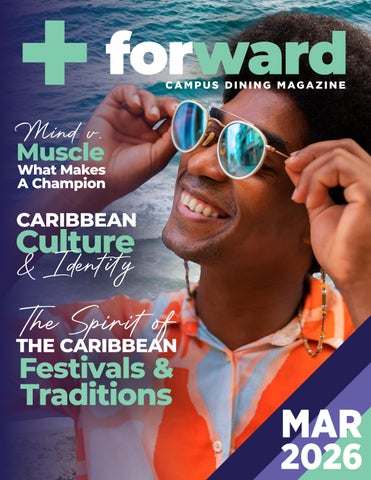
Forward Magazine March 2026

Page 1


forward

Dear Jetsetter,

This March, Luxe Jet Airways invites you to escape to the stunning Windward Islands—Dominica, Saint Lucia, Saint Vincent & the Grenadines, and Grenada— for a rejuvenating mid-semester getaway! Famous for their lush rainforests, volcanic landscapes, and beautiful beaches, these Caribbean treasures provide a rich culinary and cultural experience grounded in wellness, sustainability, and lively traditions. Savor the islands’ fresh, healthy flavors, featuring tropical fruits like soursop and passion fruit, alongside spice-enhanced dishes with nutmeg, cinnamon, and turmeric. Our menu, influenced by African, indigenous Kalinago, Indian, and European cuisines, is designed to deliver the warmth of the Caribbean straight to your table. Dive into the island rhythms and learn about the sustainable practices safeguarding this tropical paradise for countless generations. Buckle up; your first-class ticket to relaxation and renewal awaits!

Nutrition is about balance, not restriction. This month, we focus on creating well-rounded meals that provide the right mix of proteins, healthy fats, and complex carbohydrates. Learn how to build a balanced plate using diverse, nutrient-rich ingredients while still enjoying the foods you love.

Celebrate World Recycling Day by learning the power of proper recycling! This March, we’re focusing on the importance of placing items in the right bin to reduce waste and support a sustainable future. From understanding which materials are recyclable to discovering how the right sorting can help reduce landfill waste, we’ll guide you on how small changes can make a big impact. Join us in taking action to keep our planet clean, one item at a time!

Luxe Leaders

Campus Dining by Thompson Hospitality

The Spirit of the Caribbean Through Festivals and Traditions A Celebration of Unity

Caribbean festivals and traditions are a time for natives to celebrate culture with bliss, pride and vibrant celebrations. At these festivals, you may hear the sounds and beats of cultural music, smell the inviting aroma of spicy, earthy, and subtly sweet Doubles, or see colorful costumes that may be incorporated into parade themes. These festivals are held annually and on many different islands. However, the message is always the same; this is a time for locals and visitors to honor a century of traditions and the resilience and spirit of the Caribbean.

Imagine this: You’ve just touched down from your Luxe Jet journey into the warm, tropical embrace of the Caribbean, your first priority: experiencing The Trinidad and Tobago festival known as “The Greatest show on Earth”. The air vibrates with the infectious rhythm of Soca music, blasting from colossal sound systems as tall as you. As you dance through the crowds, thousands of locals – known as masqueraders – become a living kaleidoscope, decked out in vibrant feathers, sparkling beads, and sequins that shimmer under the tropical sun. The Windward Islands host countless celebrations, packed with fetes (parties), elaborate parades, and unique experiences, all united by a common goal: to joyfully express the uniqueness of their culture. Some Caribbean festivals and traditions for these islands include:

Grenada “Spicemas” Carnival, held every year in St. George, Grenada in August. Spicemas is a celebration of the island’s famous spice production. Each year, Grenada is packed with vibrant colors, exciting activities and a massive celebration. A tradition that is widely known on the island is J’ouvert, an early morning street festival, where participants express their cultural heritage through artistic self-expression, often using black oil, mud or paint.

Moko Jumbie is a common name in the Caribbean household, which is usually associated with traditions or celebrations. This protector or healer over the island’s people is viewed as a prominent feature of Caribbean carnivals or parades. Standing nearly 15-20 feet tall, the Moko Jumbie is usually dressed in long skirts, jackets or hats or wears a mask. They are often seen dancing and towering over crowds on stilts; which further symbolizes their protective role.

The Saint Lucia Carnival is held every year in July, in the city of Castries. This annual event dates back to the late 1940’s and has gotten bigger since then. This event celebrates the island’s heritage through a cultural blend of African, European and Caribbean influences. A popular tradition is the Calypso Monarch Competition, where many Calypso artists showcase their talents in Calypso music. Calypso music often incorporates social commentary and storytelling.

Masks, costumes, and various events are what bring the community together and make up the rich and unique history of the Windward Islands. These vibrant celebrations are far more than mere entertainment; they are the very threads that weave the fabric of Caribbean society. The collaborative effort required to stage these elaborate festivals fosters a sense of unity and shared purpose, as neighbors work side-by-side, passing down ancestral knowledge and traditions to younger generations.

Mind v. Muscle

The Science Behind What Makes a Champion

“Winning takes precedence over all. There’s no gray area. No almosts.” -Kobe Bryant

Think about all the great athletes you have witnessed in your lifetime. Of all those athletes, who would you put on your “Athletic Mount Rushmore”? Could it be Jordan Chiles, the 2024 gold-medalist Olympian. Perhaps Isiah Thomas, the Detroit Pistons’ 12-time all-star selection or A’ja Wilson, the number one overall draft pick for the WNBA Las Vegas Aces? Whoever you choose, one thing is for sure: hard work, resilience and excellence all contribute to a great athlete and make them better in the eye of their competition.

What truly defines an athlete’s success?

For an athlete, there are several key principles necessary for success. Genetics plays a part when it comes to injury, endurance and strength. However, genetics is not the biggest factor of great athleticism and can be improved over time through dedicated training and practice; it also could be said that athlete’s success comes from work ethics, determination and persistence. However, it’s more than just DNA or what you’re born with. While genetics can offer insight in areas like injury resilience, endurance, and strength, they’re not the be-all and end-all. The truth is, these inherent traits are merely a starting point, and with dedicated training and relentless practice, they can be dramatically enhanced. There’s no secret formula, no textbook answer, but rather a potent cocktail of unwavering work ethic, sheer determination, and stubborn persistence. To truly be a champion, an athlete must take that chance, because as they say, chances make champions. Yet, physical skills are only half the battle. Your mentality and community are the unseen muscle that drives you forward. A strong mindset is your shield against setbacks, stress, and dips in motivation. And in those moments, your support system - your community - becomes your greatest ally, offering the encouragement and drive you need to keep pushing past your limits.

The Playbook of Success

While success manifests uniquely for each individual, here is a playbook of essential principes from the Luxe Life Playbook of Success that could be considered when aiming for the “greatest” title.

The first chapter often addresses adaptability and growth. These aren’t merely learned skills, but crucial mindsets forged through life’s unpredictable lessons. Your capacity to pivot, learn, and evolve when circumstances shift is precisely what molds an ordinary journey into an extraordinary one, regardless of your chosen field.

Commitment and work ethic are unwavering principles to your success; and they can only be achieved when a consistent work ethic is applied. True success isn’t a passive aspiration; it demands consistent application of effort. This means showing up daily with a dedication to continuous self-betterment, whether you’re an athlete refining techniques, a student mastering complex material, or a leader inspiring a team. It’s the relentless pursuit of improvement and commitment that fuels your progress and sharpens your craft over time.

The play book also emphasizes the importance of optimal nutrition and restorative sleep. Often overlooked in the relentless drive for achievement; these aren’t luxuries but non-negotiable requirements for peak performance. These factors are crucial for everyone. A well-balanced diet, rich in vitality-boosting proteins, ensures sustained energy. While adequate sleep allows your body and mind to recover, consolidate learning, and reset from daily demands. Neglecting these fundamental elements ultimately compromises your ability to operate at its best.

Finally, recovery and mental-well-being are prioritized by the greatest players. Physical recovery— ensuring muscles and joints are revitalized and resilient to injury—is paramount for sustained engagement in any demanding endeavor. Equally vital is tending to your mental health; the relentless pressure of striving for excellence can be draining. Proactive attention to your mindset, whether through intentional breaks, mindfulness, or a strong support system, isn’t a weakness but a critical component of enduring strength. This continuous physical and mental maintenance fortifies you to face challenges head-on, navigate setbacks with resilience, and consistently maintain your competitive edge.

A Melting Pot of Influences Carribean Culture & Identity

The Caribbean is a diverse blend of ethnicities, religions, and languages which stems from history of colonization and migration. Many civilizations and ethnicities inhabited the Caribbean and many of these cultures were a mix of indigenous people, including those from Africa, Europe, Asia, and the Middle East. These cultures brought their rich traditions, distinct languages, and artistic expressions creating, a myriad of cultures and a dynamic mosaic that actively shapes the region’s unique spirit, evident in its music, festivals, and daily life.

In pre-colonial times, the Caribbean was inhabited by diverse indigenous peoples, primarily originating from South America, who had established complex societies across the islands. Following European arrival, these indigenous populations faced a catastrophic decline over decades due to diseases, brutal forced labor, warfare, and direct violence. As indigenous populations rapidly diminished, Europeans increasingly relied on the forced labor of enslaved Africans to sustain their plantation economies. This reliance profoundly shaped Caribbean societies, leading to the rich uniqueness of Afro-Caribbean people and cultures. After slavery was progressively abolished across the Caribbean, new waves of indentured laborers arrived from Asia and other regions. This immigration further diversified Caribbean populations, leading to complex interactions and mixing with existing European and Afro-Caribbean communities.

Caribbean people have profoundly infused food, pop culture, languages, and countless other elements we enjoy and love in society today. Caribbean music genres such as reggae, calypso, and Soca have gained global recognition and influenced numerous musical styles. Many beloved artists fall into these categories; their compositions styles shape the soundscapes we hear today. These include pioneers like Calypso Rose and Bob Marley, alongside modern icons such as Machel Montano and Rihanna.

Caribbean-born fashion icons like Grace Jones or Brandon Blackwood have also played homage to their Caribbean roots by promoting their cultures and identities in their bold fashion pieces.

The Caribbean’s diverse language also contributes to the uniqueness of the region, and there aren’t just one or two, but six official languages! The six official languages are: English, French, Dutch, Papiamentu, Haitian Creole and Spanish. The diversity in each language reflects its complex history of colonialism, trade, and migration.

Jerk Chicken, Conch Salad and fried plantains are just a few of the many bold and satisfying flavors that have been infused through the Caribbean culture. Rice and peas, chili peppers and salt fish are just some of the staples you’d find in a Caribbean home. The fusion of these flavors represents the blend of traditions from the previous inhabitants and also reflects the variety of tropical components.

Caribbean culture, a testament to resilience, offers a powerful reminder of its vibrant history and enduring spirit. As you carry these insights forward, Campus Dining at Thompson Hospitality encourages you to immerse yourself further. Seek out a new Caribbean culinary delight, explore the captivating discography of a Caribbean artist, or even begin to learn a phrase in one of the region’s six vibrant languages. Your connection to this vibrant world starts now.

“They say that I reign too long Forgetting that me constitution is strong Instead of respecting me long, long reign They making plot to take down me name”

Lyrics from Calypso Queen by Calypso Rose

Build Your Best Plate

How to Stay Healthy Without Giving Up the Food You Love

“Not too much of this, a little of that, more of this. Did I drink enough water today?” and questions that flow through our mind when we are indulging at the City Market, or out with friends or family at Milk & Honey. Building a balanced meal based on diets, restrictions or portion sizes, of factors can seem like a struggle, but there are multiple strategic ways you can have a little more of this and less of that.

Portion control, the practice of managing the amount of food consumed, is a crucial factor when building a balanced diet or plate. This practice can help manage overeating or calorie intake. Consider using smaller plates and bowls to visually reduce the amount of food you consume. Remember, most people eat with their eyes first. You could also consider the mindful eating concept, which is taking the time to savor each bite while also paying attention to your body hunger and fullness cues.

Calorie restriction, on the other hand, refers to “consistent patterns of reduced average daily caloric intake” (nia.nih.gov). When strong urges for sugary drinks or unhealthy snacks arise, consider these restrictive eating concepts. However, it’s crucial to consult with a medical professional before making any significant changes to your dietary habits. They can ensure these approaches are safe and appropriate for your individual health needs.

Time-Restricted Eating: This limits your eating habits to specific hours each day, often consuming meals within a smaller timeframe. A popular method is the 16/8 method, where you fast for 16 hours and eat within an 8-hour window.

Calorie Restriction: This involves intentionally consuming fewer calories than your body needs to maintain its current weight

This popular practice involves making intentional changes to one’s food intake for specific purposes, such as weight loss or health improvement. While widely adopted, it’s important to note that dieting can sometimes have negative side effects on both physical and mental health.

It’s important to mention that these restrictions, along with healthier eating habits, could contribute to a healthier body or a more confident you. However, it is crucial to reach out to a medical professional or dietician that can make a more accurate assesment based on your medical history.

Last year, in the April edition of Forward Magazine, we educated readers on The Power of Balanced Nutrition and what type of food should be on your plate. Check it out to understand further what a balanced diet and plate should look like.

So now your plate is built and ready to be consumed, but you notice there are many items that can be swapped out for healthier alternatives. Picture this: you are in the City Market and the menu is loaded with your favorite carbs, fats, sugars and salts, it all looks so appetizing, and you just know you’re going back up to Turntable for more. Sounds like an ordinary day at the dining hall, right? Well, it could be with healthier alternatives that your body will thank you for in the long run. On your oh-so-appetizing plate, you could have rice and gravy, broccolini, smothered pork chops, mashed potatoes and green beans, or you could swap some items out for healthier alternatives.

Keep in mind that when you swap your plate for a healthier one, it should be colorful, featuring fruits, vegetables, grains, dairy and protein-rich food and contain a variety of vitamins, minerals, antioxidants, carbohydrates, proteins and healthy fats.

Building a healthy plate doesn’t have to be a struggle. By focusing on key nutrients, you empower yourself to maintain optimal health, manage weight, and significantly reduce the risk of disease. Why not start today by exploring healthier food options at your campus city market or local grocery store. Embracing a balanced diet is a powerful step toward creating a lifestyle that consistently nourishes your body and supports your overall well-being.

DON’T FORGET TO CHECK OUT!

THTV

Luxe Lab LIVE

A Culinary Experience Through the Digital Lense

ELEVATED

Luxe Table Talk

Jet Stream: What’s Hot & What’s Next

Booked & Balanced

The Culture Cabin

Windward Wande

The Luxe Lounge

HBCU Journey + Spring Break Stories

Sky High Wellness

The Remix Plate

Dear Luxe Leader

Think Long, Live Free

CLICK FOR ON DEMAND TV FOR COLLEGE DINING

DINING EVENTS + MARCH

Why Plastic-Free Packaging is a Game Changer Unboxing the Future

The rise of eco-friendly packaging is becoming a global trend, that is here to say. Ecofriendly packaging provides a range of environmental and economic benefits for businesses, the environment, and the economy. Did you know that the global sustainable packaging market is experiencing significant growth? It is projected to reach 500 billion dollars by 2032! (Prnewswire.com). This ultimately means that consumers are prioritizing sustainable packaging and are willing to pay for it.

What is the big deal on plastics?

Plastics have harmful impacts on the environment, health and waste management, which contribute to incineration, chemical toxicity, and pollution. These negative factors can potentially harm the Earth’s natural production process due to their persistence in the environment, and their chemical composition. Plastic materials are known for washing up ashore and marine animals becoming entangled or ingesting them, leading to injury, starvation or death. Heath-wise, plastics can come in contact with water sources or food, potentially leading to the ingestion of harmful chemicals and microplastics. In waste management, incineration or the burning of plastic material releases harmful pollutants into the atmosphere that lead to increased risks of birth defects, cancer and other negative health effects.

The Windward Island are making a conscious effort to reduce the use of plastics in their country and for the global marine ecosystem. Plastics, largely originating from land, are a primary polluter of the seas. However, back in 2019, the Caribbean islands started the campaign “Breaking Up With Plastics”” to shed light on marine litter and single-use plastics (unep.org). As a result, the goal was to ban single-use plastics, including plastic bags and/or Styrofoam throughout the region. To date, more than 20 Caribbean territories have definitively banned single-use plastic and/or Styrofoam products (unep.org). This crucial action further protects the Caribbean’s natural beauty and safeguards the ocean’s vital function as a source of food, resources, and livelihoods.

Small changes can make a huge impact on our earth, and it’s as simple as carrying reusable bags when grocery shopping to avoid using plastic. Reusable products, such as metal straws or eco-friendly grocery bags, are always the safest and best option for sustainability. Consider going eco-friendly this holiday for packaging or gifts, this will significantly reduce your carbon footprint and contribute to a sustainable Earth.

The Windward Islands’ commitement to breaking free from plastics paints a powerful vision for the future. Achieving a plastic-free nation is an ambitious yet attainable goal, one that demands collective effort and a commitment to sustainable practices. The benefits extend far beyond aesthetics: we envision healthier communities free from plastic-related toxins, and thriving economies bolstered by innovative, eco-conscious industries. Businesses, in particular, will find significant financial opportunities as consumer demand for sustainable options continues to surge. By embracing biodegradable alternatives and actively reducing plastic waste, we are not just cleaning up our environment; we are forging a legacy of responsible stewardship, ensuring that the natural world remains a vibrant and abundant resource for all who inherit it.

FEATURED RECIPE

Plantain Chips with Mango Salsa

Mango Salsa Ingredients

ب 1 large mango, peeled and diced

ب ¼ cup diced red onion

ب 1 medium avocado, diced

ب 1 tomato, diced

ب ½ jalapeño, seeded and diced

ب 2 tablespoon lime juice, freshly squeezed

Directions

ب 1 tablespoon olive oil

ب Salt and pepper to taste

Plantain Chips Ingredients

ب 2 green (unripe) plantains

ب 1 teaspoon paprika

ب Salt and pepper to taste

1. Peel plantains using a sharp knife, cut both ends off the plantain. Slit a shallow line down the long seam of the plantain and remove the peel.

2. Slice the plantains thinly.

3. Toss the plantain slices with salt, pepper, and paprika.

4. Preheat the oven to 400°F/205℃. Line baking sheets with foil and coat with cooking spray.

5. Place the plantain slices on the baking sheets in a single layer, then lightly spray them with canola oil.

6. Bake for 12-20 minutes, or until golden brown, turning the slices over after about 8 minutes.

7. Dice the mango, red onion, avocado, tomato, and jalapeño.

8. Mix In a medium bowl, mix all the ingredients.

To ensure your plantains cook evenly, use a slicer or mandolin to slice them. That way, they will all be the same thickness and cook at the same pace.

Heat the oil to a hot but not smoking temperature. Smoking oil isn’t good for your kitchen or the chips’ taste.

Marketing Contacts

Daniela-Gabrielle Smallwood, Vice President of Marketing and Programming

daniela.smallwood@thompsonhospitality.com (571) 446–7430

Stacey Gibson, Director of Retail Marketing stacey.gibson@thompsonhospitality.com (571) 524–8566

Editorial Staff

Gina Godwin, Creative Director

Yolanda Waters, Chief Editor

Heaven Smallwood, Editor

Jacquii A. Tilley, Contributing Writer

Tess Mazzucchelli, Graphic Designer

Turn static files into dynamic content formats.

Create a flipbook