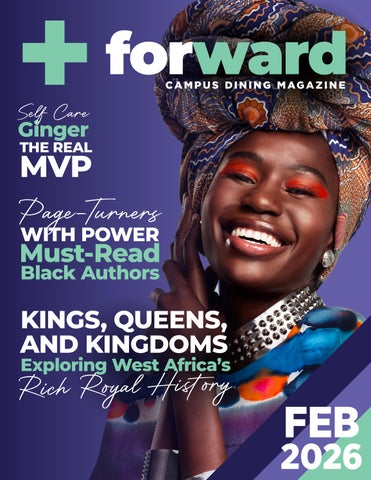
Forward Magazine February 2026

Page 1


Dear Jetsetter,

forward

Dive deep into the rich cultural heritage of West and South Africa, where traditions, stories, and artistry have left an undeniable mark on communities around the world. From the rhythms of daily life to the expressions of celebration and resilience, these regions embody a legacy of strength, creativity, and community.

This month, we honor the ways in which West and South African cultures have shaped global narratives, reminding us that our histories are deeply connected. It’s a time to reflect on the roots that ground us, the innovations that inspire us, and the beauty that emerges when tradition and progress walk hand in hand. Through connection and reflection, we invite you to explore the enduring impact of heritage and how it continues to influence and uplift communities near and far.

Explore the powerful healing properties of ginger, a cornerstone of West African health practices. For centuries, ginger has been revered not only for its bold flavor but also for its medicinal benefits, including its ability to support digestion, reduce inflammation, and boost overall vitality. In this wellness journey, guests will learn how this ancient root has been used across West Africa to promote wellness and vitality. Discover its diverse applications in food, drinks, and natural remedies as we unlock the secrets of ginger’s healing power for a balanced and healthy life.

Luxe Leaders

Campus Dining by Thompson Hospitality

Kings, Queens, and Kingdoms

Exploring West Africa’s Rich Royal History

The three largest empires in West Africa were Ghana, Mali, and Songhai; these empires thrived in the medieval times or Middle Ages, when significant cultural, political, and social changes were on the rise. These empires thrived because of their control of the trans-Saharan trade.

What is an empire?

An empire is a political entity that controls multiple territories, people, and cultures. They are run by a powerful ruler or rulers who use military, political, and economic means to expand their influence and maintain their power. The key differences between our democracy and West Africa’s empires are citizens’ rights, power source, and participation. The largest Empires were located in West Africa. Although they have now declined due to various reasons, their influence on West African history and culture remains impactful, and their legacy continues to be studied and discussed. Let’s explore the largest African empires and what made them significant.

Ghana

Back in the 7th and 13th centuries, Ghana flourished with wealth and luxury because of its powerful trading structure and the myriads of gold it had. The Ghana Empire of Wagadu was founded by the Soninke people; they served as a vital link between North American and West African traders. The Trans-Saharan trade route also contributed to the shape of the empire. This trade route exchanged goods, ideas, and culture primarily through the Sahara Desert. Back then, traders had to travel to and from Ghana with exchange items like gold, salt, ivory, and captured slaves. What made the trade route so wealthy, and dynamic was the taxes that the empire imposed on travelers when coming or going through the land. Ghana’s wealth didn’t only come from the trade route either, the natives developed skills such as carpentry, goldsmithing, and cloth manufacturing, these goods were also traded through the trade from Western Africa and Egypt. The decline of this empire came when the neighboring land declared a holy war against Ghana due to their dedicated belief that the primary religion should be Islam.

Mali

The decline of the Ghana empire paved the way for the birth of Mali, the empire that took over from the 13th century until the 17th century. Mali’s prominence came from taking over Ghana’s trade routes, essentially being in the middle of the routes, and its well-trained army. King Sundiata Keita, also known as “Lion King” served as the king of Mali’s empire. Under King Sundiata’s leadership, he and his men, whom he later referred to as Kings or Mansa, expanded the Mali Empire, which contributed to cultural advancements, particularly agriculture. After the death of King Sundiata Keita, several other Mansa’s ruled over the kingdom until 1312, when Mansa Musa became king. Mansa Musa’s leadership shaped the empire to be an Islamic learning and cultural center with schools, universities, and a library, making the kingdom multilingual and multiethnic. The decline of this empire came after the death of Mansa Musa. Internal conflicts, the death of other successors, economic problems, and the rise of another empire significantly contributed to the decline of the Mali empire.

Songhai

In 1317, following the death of Mansa Musa, the surrounding empire of Songhai conquered Mali, leaving little of the kingdom remaining; it thus became the third-largest empire. In the late 1400s, Sunni Ali took over the empire and became the first king of Songhai. Much like the Mali Empire, Ali expanded the territory, built a larger army, and reigned over Timbuktu and Djenné, two important centers for trade and learning, gaining control over the Trans-Saharan trade. Unfortunately, in 1492, Sunni Ali died, making his son the New King. However, Askia Muhammad, a leading general for Ali, challenged Ali’s son for the kingdom, stating that he was not faithful to the Muslim religion. This disagreement led to the Battle of Anfao, which resulted in Muhammad’s victory. During Muhammad’s reign, he established the Askia dynasty and was king for over 30 years. During the peak of the empire, Muhammad expanded the territory even more, making it larger than the Ghana and Mali empires; he also appointed selected officials to run his government and improved the empire’s tax system. The decline of the empire began in the late 1500s, following the succession of many rulers. Some of the successors were less skilled and found the kingdom too large to run, which, as a result, weakened stability. Invaders saw the weakened Songhai Empire as vulnerable and invaded in 1590; these invaders were the Saadi Sultanate of Morocco. The Battle of Tondibi was the ultimate defining moment for Songhai’s empire. The Moroccan empire invaded the Songhai empire with cannons, ammo, and guns, while Songhai warriors only had swords and spears. Thus, the Saadi Sultanate of Morocco defeated the Songhai warriors.

Despite the eventual fall of Ghana, Mali, and Songhai, each met its distinct end. These empires weren’t just vast territories; they were centers of scholarship, trade, and cultural innovation that profoundly shaped the continent and left an indelible mark on global history, reminding us of Africa’s rich and powerful past. The history serves as a powerful reminder of the complex and influential empires that flourished across the continent and continue to impact African civilization to this day.

Page-Turners with Power

Must-Read Novels by Black Authors

Whether you’re an avid bookworm devouring novels or a slow-but-steady book lover savoring every page, this list of genres offers something for every reader. These recommendations are perfect for enjoying in a luxurious setting, such as the Luxe Jet seating area, or taking along on your next grand adventure. As you dive into these stories, remember to explore new ideas and concepts, elevate your perspective by seeing things culturally, and engage fully with diverse viewpoints. These elements will not only enrich your reading but also enhance your overall journey.

Born a Crime: Stories from a South African Childhood by Trevor Noah

Born a Crime: Stories from a South African Childhood is a memoir of a young boy, turned man, who struggles to exist in a world where his parents are forbidden to be together. This book highlights the upbringing of a young child whose parents did what was necessary, maybe even extreme, to hide him from the government, which could jeopardize his family’s freedom at any time. This book also explores the points of rebellion, fear, and embracing opportunities that have been won through a century of prolonged struggle.

Midnight by Sister Souljah

Midnight is an urban and crime fiction novel with romance elements. Midnight tells the story of a brave, passionate, handsome, but humble man whose family is prominent in the underworld. However, when his family is attacked, his father sends him and his mother off to avoid further attacks. Now in the U.S., Midnight is receiving all the attention, especially from women. He must find a way to use his strong Islamic faith and intelligence to protect his family, reclaim his wealth, and stay true to his beliefs, without risking it all for pleasure and temporary gain.

Can’t Hurt Me: Master Your Mind and Defy the Odds

This self-help book teaches readers how to elevate their lives with selfdiscipline, mental toughness, and hard work. Can’t Hurt Me follows a young, depressed, overweight man who transforms himself into a U.S. Armed Forces icon and one of the world’s top endurance athletes. Goggins shares his incredible story and challenges readers to push past the 40% capability to a life of bravery, joy, and living at your fullest potential.

Honey & Spice by Bolu Babalola

This humorous, passionate novel follows Kiki, a sharp tongued but secretly soft-hearted, woman who passion is to make sure the women of the African-Caribbean Society at Whitewell University don’t fall into temptation of bad company and “situationships” but when she is the victim of bad company and situationships due to reputations, she explores the idea of an electric, undeniable connection that goes against everything she presumed she stood for.

Seven Days in June by Tia Williams

Seven Days in June follows two characters, Shane and Eva, who grew up together and drifted apart but have reconnected, unexpectedly, at a literary event. These two play off the initial meeting as old childhood friends reconnecting. But what most people don’t know is that deep down, there is past trauma because of one crazy week when they were madly in love. They have also been writing to each other through their books. Eva is now figuring out ways to send Shane off again. However, there are a few questions she needs answered.

Girl Gurl Grrrl: On Womanhood and Belonging in the Age of Black Girl Magic by Kenya

Girl Gurl Grrrl brings a collection of stories from black women who are often invisible or celebrated only now. These stories highlight cultural moments while also celebrating the creation of women. Hunt blends popular and personal in a collection of stories that highlight what it means to be a black woman thriving in society.

Black Girls Must Be Exhausted by Jayne Allen

Black Girls Must Die Exhausted is the first novel in a three-part series that follows a woman who thinks she has it all. However, after receiving an unexpected diagnosis from the doctor, her world starts crashing before her eyes, jeopardizing the one factor she took for grantedhaving kids. Now she is forced to choose between her career, her dream home, and a family of her own. This modern book about womanhood, aspirations, and courage explores unexpected setbacks that threaten the most important things in life.

What Your Digital Reputation is Saying Your Digital Shadow

A digital reputation for companies and individuals is sometimes the primary reason a consumer or person will interact with the brand. Whether those reviews are good or bad, your digital reputation is the perception that people have about you or your brand on your online presence. If you or your company are doing great things in the community and sharing them digitally as a consequence, you may impress viewers, which may positively boost the brand. Consequently, if you have bad reviews, horrible products, or post negatively, your reputation could translate to consumers as negative or a place to avoid when doing business.

Posting digitally can have several benefits for the company, but not every detail of the company needs to be shared online. Some companies harm themselves by being too transparent with their consumers, especially when most people’s interest in or liking for the company is based on how it presents itself publicly, how the brand is represented, or what is being said in the media. Posting with an understanding of your target audience, a clear understanding of the brand, the company’s mission or purpose, and a clear goal can help with posting mindfully. Consider the tone, content, and audience when posting and make a conscious choice about what to share, how to share it, and why. Posting digitally can have numerous benefits, and most companies reap these benefits by using simple yet effective social media etiquette that emphasizes their brand and sets them apart from the competition.

In Shaun Morgan’s LinkedIn article, “Should You Post from Your Company Page or Personal Profile? The Answer: Both.” several points are provided for posting on public, personal, and digital platforms. The article outlines three main points:

Highlighting company success, grand openings, or light-hearted stories that could boost the morale of the everyday customer.

Consistent posting and showcasing the brand keeps it at the forefront of the customer’s mind. Falling behind or posting without a set schedule can decrease brand credibility and potentially harm sales due to a lack of consistency.

Posting digitally from a company’s page can help align the company with similar organizations that may be able to assist with specific projects. Posting could also spark conversations with other companies, which could help get insight into what people are saying or what other companies are doing.

Posting digitally is not necessarily a negative thing to do, and most companies are looking for talented individuals who can effectively respond and post online to consumers while maintaining the company brand at the forefront. The most important factor to keep in mind when posting digitally on behalf of a company is the tone, content, and audience. You never

Why Ginger is the Real MVP Set-Up Your Self Care

Close your eyes and imagine this: a smell that’s earthy and bright. This scent also has a touch of citrus and a spicy undertone that hits as soon as your tongue tastes it. What could this be? Imagine a bite of piquant freshness, followed by a burst of heat, then a sweet heat that spreads and lingers. This complex, flavorful root is a powerhouse of natural health.

Ginger is the underground stem of the plant Zingiber officinale, commonly used as a spice or for medicinal purposes. This flavorful root adds a zesty kick to most foods and boasts a range of health benefits that can be enjoyed in various forms. In fact, it is considered a superfood due to its high concentration of vitamins, minerals, and antioxidants. There are many ways this versatile root can support your well-being, some of the ways are:

Immune system support: It can help fight off bacteria and viruses.

Digestive aid: It assists with digestion and stomach emptying.

Antioxidant power: It helps protect cells from damage.

Heart health benefits: It may contribute to lowering cholesterol and improving blood levels.

In the December 2024 edition of Forward Magazine by Thompson Hospitality, we explored different teas from around the world, and of course, Ginger was one of them! Ginger Tea also has health benefits such as: Aiding motion sickness, soothing indigestion, having antimicrobial effects and, reducing the risk of blood clots.

Ginger roots are a staple in West Africa, serving as both culinary items and possessing medicinal properties. In Africa, there is a high demand for ginger roots, with a market size valued at approximately $4.5 billion in 2023, according to the Africa for Investors website. Ginger is not always consumed in Africa; the natives also use it for cosmetic purposes due to its flavor-enhancing qualities. When the natives aren’t using the spice as a medicinal property, they are most likely enjoying the spice inside their food. The significance of ginger to the natives lies in its versatility, which can be added to various dishes, its nutritional benefits that contribute to a healthy diet, and the flavor enhancement it provides, making it a main contender in both savory and sweet dishes.

Most think that ginger is a miracle spice; however, it is all in the nutrients. Ginger is used in multiple ways and is a healthy addition to any diet. Ginger can be consumed fresh, dried, or in supplement form and should always be taken in moderation or under the supervision of a medical professional. Explore the ways that you can enjoy ginger on your campus or at your local market.

DON’T FORGET TO CHECK OUT!

Luxe Lab LIVE

A Culinary Experience Through the Digital Lense

ELEVATED

Luxe Table Talk

Jet Stream: What’s Hot & What’s Next

Rooted & Rising

The Culture Cabin

Fact or Cap?

The Luxe Lounge

Flavor & Family

Sky High Wellness

Ginger Roots

Dear Luxe Leader

Black, Brilliant & Becoming

DINING EVENTS + FEBRUARY

West Africa’s Gift to Global Sustainability The Legacy in The Soil

Sustainability is practiced everywhere, particularly in countries where multiple resources are scarce. A sustainability tradition could look like repurposing items such as holiday gifts or avoiding the plastic or Styrofoam aisle when shopping for holiday utensils. In West Africa, the natives rely heavily on natural resources and agriculture; many view these elements as essential to their livelihoods. However, environmental degradation occurs frequently, posing a threat to resources and making them increasingly scarce. Environmental degradation is defined as the process by which our planet’s natural environment is damaged or deteriorates (Agrieconomist.com). In West Africa, sustainability plays a crucial role in preserving resources and ensuring a steady supply of goods. Some of West Africa’s sustainability traditions are:

Educating the natives about the long-term effects of environmental degradation. Educating people and raising awareness of negative factors can help them be more mindful when shopping for items. Educating natives can also start in schools and community centers. This could involve bringing in a farmer who can speak about the benefits of organic crops, soil maintenance, or the use of fertilizers. The Ghana Organic Cocoa Farmers Association (GOFCA) is becoming more involved in promoting organic practices among local farmers. GOFCA offers training programs that focus on organic pest management, soil fertility enhancement, and sustainable harvesting techniques.

Traditional methods, such as organic farming, are becoming a popular solution to sustainability in the country. Organic farming is the practice of prioritizing sustainable and environmentally responsible agriculture, excluding synthetics such as pesticides and fertilizers. As a result of organic farming, soil health, biodiversity, and environmental pollution are enhanced.

Permaculture is a holistic approach to land management that integrates agriculture, ecology, and community. This traditional method is gaining widespread use in West Africa, particularly in Senegal. In Senegal, organizations like the Permaculture Institute of Senegal collaborated with local farmers to implement permaculture principles. The implementation helps many communities restore degraded lands and improve food security. There are also community gardens in the villages, such as Kehr, that promote permaculture techniques and improve soil fertility. These techniques have shown a significant increase in crop productivity, allowing families to grow diverse vegetables and fruits year-round (recipesandroots.ca).

In Nigeria, Drones and tech platforms are the newest technology adaptations in agriculture. Drones are used for crop monitoring and are gaining popularity among farmers. These drones are equipped with sensors that enable them to assess crop health, identify pests, and optimize irrigation practices. The tech platform FarmCrowdy connects smallholder farmers with investors, providing them with agricultural training, market access, and resources (recipesandroots.ca). These new technologies have improved financial stability for many farmers and the generations to come.

Exploring sustainable past practices, successes, and failures could be the secret to more effective future sustainable practices or even significantly improving sustainability in a country. It’s crucial to learn from history and truly understand how social, economic, and environmental systems intertwine for sustainable development. These factors are all interconnected, and only by grasping their relationships can we build a resilient future.

FEATURED RECIPE Sweet & Spicy Jollof Rice Wrap

Jollof Rice Ingredients

ب 1 tbsp vegetable oil

ب 1/2 red onion, finely chopped

ب 1 clove garlic, minced

ب 1 tsp brown sugar

ب 1/4 tsp curry powder

ب 1/2 inch fresh ginger, grated (optional, but recommended for flavor)

ب 1 (8 oz) can tomato sauce

ب 1/4 cup chicken or vegetable broth

ب 1/4 cup pineapple juice

Wrap Ingredients

ب 2-3 large tortilla wraps

ب 1/2 cup cooked chicken, shredded or diced (or a protein of your choice: black beans, plantains, scrambled egg)

Directions

ب Pinch of cayenne pepper or a tiny sliver of Scotch Bonnet/Habanero (very finely minced, use sparingly for heat!)

ب 1/2 cup uncooked Basmati or long-grain rice, rinsed

ب Salt and black pepper to taste

ب 2 tbsp chopped fresh cilantro (for garnish)

ب 1/4 avocado, sliced or mashed

ب Handful of shredded lettuce or spinach

1. Start the Sauce: Heat the oil in a medium pot or deep skillet over medium heat. Add the chopped red onion and cook until softened, about 3-4 minutes. Stir in the minced garlic and grated ginger (optional) and cook for another minute until fragrant.

2. Build Jollof Flavor: Pour in the tomato sauce, chicken/vegetable broth, pineapple juice, and brown sugar. Stir well. Add the curry powder, cayenne pepper/Scotch Bonnet, salt, and black pepper. Bring to a gentle simmer and let cook for 5 minutes, allowing the flavors to meld.

3. Cook the Rice: Add the rinsed rice to the simmering sauce. Stir well to ensure the rice is completely coated.

4. Simmer: Reduce the heat to very low. Cover the pot tightly with a lid and cook for 1518 minutes, or until the liquid is absorbed and the rice is tender. Avoid lifting the lid!

5. Rest & Fluff: Once cooked, turn off the heat and let the rice sit, still covered, for 5 minutes. Then, gently fluff with a fork and stir in the fresh cilantro.

6. Assemble Wraps: Slightly warm your tortillas (microwave for 10-15 seconds or a dry pan for a few seconds per side). Spoon a generous amount of the warm Jollof rice down the center of each wrap. Top with your cooked chicken (or other protein), avocado slices, and shredded lettuce/spinach.

7. Roll and Serve: Fold in the sides of the tortilla, then roll it up tightly from the bottom. Serve immediately and enjoy your quick, flavorful Jollof wrap!

Marketing Contacts

Daniela-Gabrielle Smallwood, Vice President of Marketing and Programming

daniela.smallwood@thompsonhospitality.com (571) 446–7430

Stacey Gibson, Director of Retail Marketing stacey.gibson@thompsonhospitality.com (571) 524–8566

Editorial Staff

Gina Godwin, Creative Director

Yolanda Waters, Chief Editor

Heaven Smallwood, Editor

Jacquii A. Tilley, Contributing Writer

Tess Mazzucchelli, Graphic Designer

Turn static files into dynamic content formats.

Create a flipbook
Issuu converts static files into: digital portfolios, online yearbooks, online catalogs, digital photo albums and more. Sign up and create your flipbook.