

Thomas’s vision
The vision of Thomas’s London Day Schools is that every pupil leaves with core values and a strong sense of social responsibility; inner strength, outward assurance and positive physical and mental health; academic success and a wide range of skills, interests and attributes; curiosity about the world and a love of learning
The overall goal of a Thomas’s education is to equip all of our pupils with optimism and readiness for the future, to become net contributors to society, and to flourish as successful, conscientious and caring citizens of the world
To achieve this, our aims at Thomas’s College are:
● To provide an exceptional and innovative education to young people aged 11 to 18, founded on breadth of experience and opportunity.
● To enable students to achieve academic excellence through a holistic approach that develops knowledge, skills, character and self-understanding
● To ensure that every member of our school communities learns and lives by a strong set of values, with kindness at the heart.
● To support students to make meaningful choices about their future, fostering a sense of purpose and personal ownership
● To promote a diversity of excellence that encourages different types of intelligence, problem-solving and the ability to make connections.
Approach to curriculum
Our curriculum has four underlying strands, developed with inspiration from the Center for Curriculum Redesign:
● Knowledge
● Skills
● Character
● Understanding of self (meta-learning)
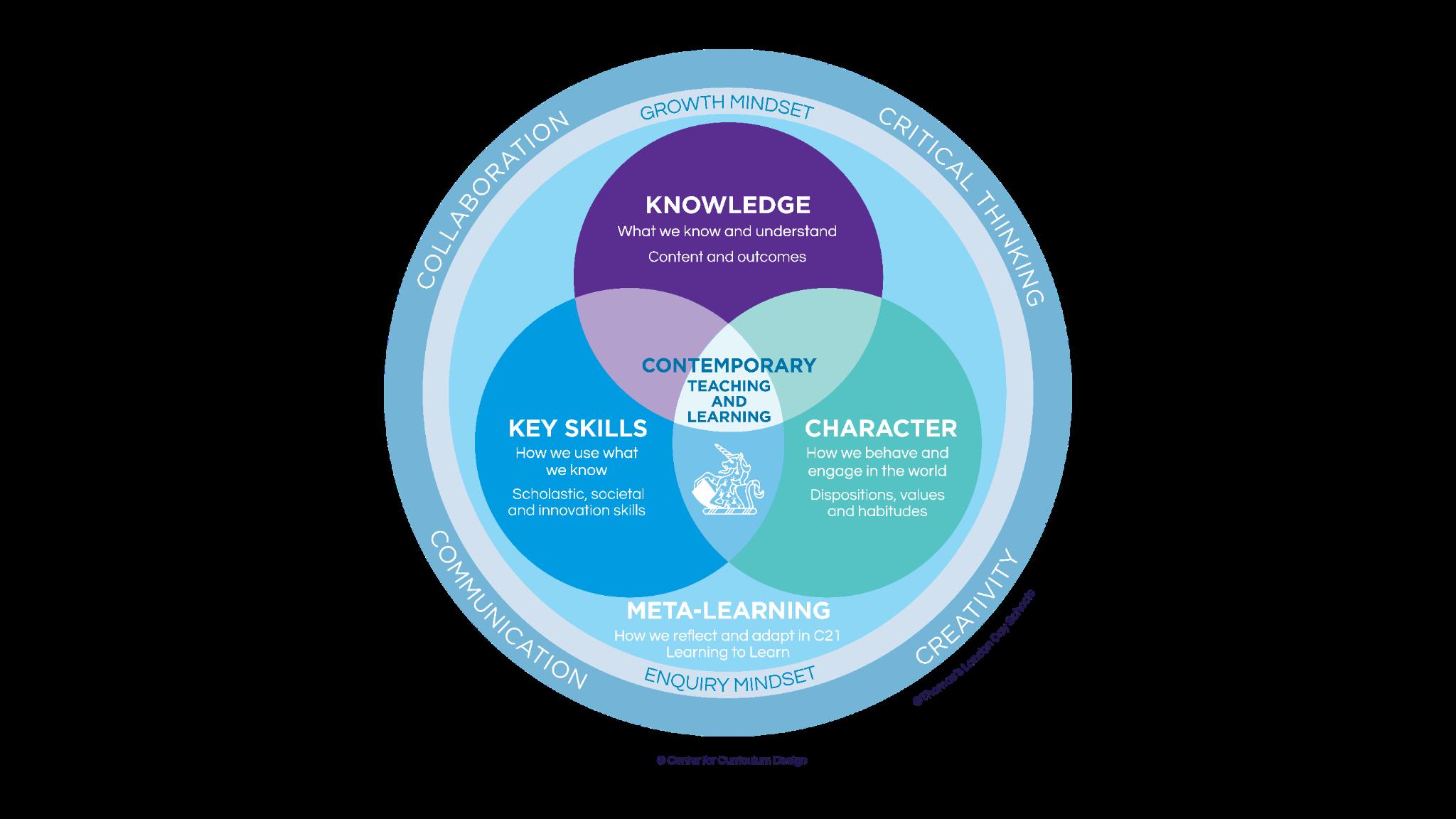
Together, these develop an enquiry and growth mindset, with students excited by challenge, and unafraid to fail in order to unlock success They think, question, collaborate and lead They develop the habits of mind that underpin real-world effectiveness.
Overall our curriculum is intended to allow personal ownership, unlock diversity of talent and achieve the greatest understanding of personal strengths and weaknesses, on which all real-world success is based
Explore, Investigate and Broaden
In the Fourth form, students participate in a broad range of lessons. They study Thomas’s Core, including English, Maths and Science, as well as a broad programme that takes in Outdoor and Physical Education, Volunteering & Community, Psychology & Self-understanding, Life and Society Studies and more
Language and culture Science
Students choose from: French Spanish Mandarin German Latin Biology Chemistry Physics Computing
Understanding the world Create, invent, perform Core
Geography History PPE English Literature Art Design Tech Drama Music
English language Maths Life and Society Studies
PE, Dance & Games Careers & future Outdoor education Projects Cognition Volunteering
Students will choose two languages they wish to take forward from Lower Fourth (Year 7).
The Thomas’s College Baccalaureate is the framework for academic progress and assessment in the Fourth Form (Years 7 and 8) via the Academic Certificate, as well as the mechanism for pupils to develop their activities and volunteering via the Service & Activity Certificate
A similar approach is being adopted at Thomas’s Battersea and Thomas’s Clapham to ensure consistency of experience in Years 7 and 8 for all pupils in the Thomas’s family.
The Thomas’s College Baccalaureate comprises two different strands:
Strand 1: Academic Certificate
● A wide range of curriculum subjects across four faculties of learning
● Five subject-based assessments at the end of Upper Fourth (Year 8)
● Four Thomas’s Qualifications completed during the Lent and Summer of Upper Fourth
Strand 1: Academic Certificate
A breadth of curriculum subjects
Strand 2: Service & Activity Certificate
● At least one service-based activity per term
● At least one substantial activity per term undertaken for an extended period of time
● At least one community event per term
During Years 7 and 8, pupils experience a broad curriculum, learning the following subjects:
Language & Culture
● Two languages from French, Spanish, German and Mandarin
● Classics (Latin, Greek and Classical Civilisation)
● Politics & world studies (part of combined Philosophy, Politics & Economics - PPE)
Science
● Biology
● Chemistry
● Physics
● Computing
● Maths
Understanding the world
● English Language
● English Literature
● History
● Geography
● Theology & Philosophy (part of PPE)
● Economics & Business (part of PPE)
Create, Invent, Perform
● Art
● Design
● Music
● Drama
These studies are complemented by a wide range of activity in the Thomas’s Core, including project-based learning, literacy and cultural awareness, PE, dance & games, outdoor education, volunteering & community, PSHE, assemblies & form time, careers & futures and psychology & self-understanding
Five subject-based assessments
Pupils will experience formative assessment throughout their studies in the Fourth Form: this takes place constantly and is ongoing over the two years Summative assessment opportunities take place less frequently and include in-class quizzes and vocabulary tests Assessment cycles take place twice a year in November and May/June and are the most formal assessments that pupils will take, mirroring the style of GCSE and A Level examinations.
For the two assessment cycles in Lower Fourth and the first one in Upper Fourth, pupils will sit assessments in all subjects For the final assessment cycle at the end of Year 8, pupils sit formal assessments in five areas:
● Maths
● English language
● Science
● Understanding the World
● Language & Culture
These are set assessments We will work with all subject heads and faculty leads to determine the structure and range of each assessment across subjects within each faculty
Thomas’s Qualifications
Thomas’s Qualifications (TQs) are designed and developed to meet the emerging needs of academically able, socially aware and globally minded students and are unique to Thomas’s
There are four types of assessment. In the Fourth Form, pupils are asked to complete one of each of the four types, one for each faculty of learning. There is a recommended match between faculties and assessment type:
● Language & Culture
TQ Communication: a speech plus portfolio
● Science
TQ Critical Thinking: nn informative exhibit (website or poster) plus portfolio
● Understanding the world
TQ Connection: extended writing connecting different subjects with each other or with world issues
● Create, Invent, Perform
TQ Creativity: an artefact in any medium and portfolio
Pupils may request to use different assessment types for each faculty, provided they cover all four types overall. Within each faculty, pupils may choose their subject areas of focus, in discussion with subject teachers and tutors.
Completing the Academic Certificate
Pupils are required to complete the five assessments and four TQs, along with minimum requirements in attendance and attitude to learning, to gain their Academic Certificate.
Strand 2: Service & Activity Certificate
Service
Pupils are required to undertake at least one service-based activity per term during the Fourth Form Service counts as contribution outside the Thomas’s community Examples of a service-based activity include, although are not limited to, the following:
● Litter picking in Richmond Park
● Participation in Thomas’s Thanksgiving
● Raising money for a charity
● Speaking to an audience at an external event
Activity
Pupils are required to participate in at least activity over an extended period of time per term during the Fourth Form
Community event
Pupils are required to contribute to at least one community event per term during the Fourth Form. When we refer to a community event, we mean the Thomas’s College community. Examples of contributions to community events could include, although are not limited to, the following:
● Helping out at a school performance
● Performing in the choir to an external audience
● Representing the school in a competition
● Organising a charity initiative
● Touring visitors around the school
● Presenting in an assembly
● Reading in the Carol Service
Maintaining a record of Service & Activity and completing the Certificate
Pupils should reflect on their participation at the end of each term through completion of the Service & Activity Reflection Form (see Appendix B). Photographic evidence of participation is useful evidence to build towards the Thomas’s College Baccalaureate Portfolio, along with any other information such as commendations and references from external groups and evidence of money raised Forms are reviewed by tutors and any concerns over participation are shared with the Director team.
The Service & Activity Certificate is awarded to pupils who complete the reflection form fully each term during the Fourth Form
Thomas’s College Baccalaureate
At the end of Upper Fourth, students receive graded outcomes in their assessments and TQs, for the Academic Certificate, and a record of completion of their Service & Activity Certificate. Both elements are necessary for the award of the Thomas’s Baccalaureate
While there is no set requirement for pupils to complete the Baccalaureate to progress into the Fifth Form (Years 9 and 10), it is likely that conversations about best fit would be ongoing with families of students who do not engage fully with either element
Please see a brief overview of each subject below.
Art
Lower Fourth (Year 7)
In Lower Fourth Art, students will be introduced to key skills and techniques of drawing, painting and three-dimensional artwork They will explore the formal elements of art through engaging themes such as sweets and natural form' Projects have been inspired by artists such as MC Escher, Sarah Graham and Yayoi Kusama Students will be encouraged to investigate artists' styles and techniques to inform their design ideas. Each project set termly, concludes with a personal and meaningful final outcome. Creativity and experimentation encouraged, the students will have opportunities to work with peers and share ideas in collaboration The curriculum builds confidence, visual literacy and individual artistic voice
Upper Fourth (Year 8)
In Upper Fourth Art, students will build on key skills developed in Year 7, with a growing focus on sculpture and three-dimensional techniques They will continue to refine core drawing skills, progressing into realistic portraiture and proportion Projects encourage personal creativity through themes such as surrealism and imaginative design. Students will explore artists like Yellena James, drawing inspiration from intricate patterns and organic forms. They are challenged to merge objects, animals, and patterns in original and thought-provoking compositions. Confidence will grow as students begin designing more independently and developing their own ideas The curriculum strengthens technical ability, creative thinking, and individual expression
Biology
Lower Fourth
Lower Fourth Biology builds on the knowledge students have acquired in their Prep or Primary Schools Students study different levels of organisation in living organisms, from cells to organ systems, covering the musculo-skeletal, digestive and reproductive systems in some detail, as well as considering the factors affecting ecosystems in the summer term. At the same time students are taught how to ‘work scientifically’, considering factors such as how to ask useful questions, how to work safely, and how to plan investigations.
Upper Fourth
Upper Fourth builds on the themes covered in Lower Fourth and includes topics such as the respiratory system, plant reproduction and unicellular organisms. In addition to these topics students consolidate their practical skills with lots of opportunities for experiments and investigations, all the time refining their ability to ‘work scientifically’, focusing on skills such as how to best record and present data and how to analyse and evaluate the data collected
Lower Fourth
As the students start the Fourth Form, they will be introduced to the world of work by looking at the types of jobs that are done to support the environment they live in. This will include a range of careers that they can tangibly relate to in terms of how these affect their own lives, such as those in emergency services, food and retail, education, entertainment, local services, housing and education With this as a focus they will be able to understand how these professions serve society, linked to the value of being a giver not a taker, and how they themselves may be able to head toward work in these areas.
Upper Fourth
Building on this, students will extend their knowledge of established professions, including Science, Technology, Engineering and Mathematics (STEM) work, and think about their own personal strengths and areas of development in relation to potential career journeys. They will begin to look at the importance of soft skills and how these apply to a range of employment activities.
Lower Fourth
Lower Fourth Chemistry is an exciting dive into a world of atoms and elements, acids and alkalis, mixtures and compounds Developing the knowledge and skills students have brought with them from Key Stage 2, students study the fundamentals of chemistry in a fun and interesting way. Our focus on ‘working scientifically’, helps students to approach practical work in a safe and methodical manner and to improve their practical skills. Students learn to carry out risk assessments in order to identify hazards and to put in place control measures to mitigate against the risks they might pose
Upper Fourth
Upper Fourth picks up on the themes from Year 7 and includes topics such as the combustion, metals and their uses and, of course, the Periodic Table In addition to knowledge, students consolidate their practical skills with lots of opportunities for experiments and investigations, all the time refining their ability to ‘work scientifically’, focusing on skills such as how to best record and present data and how to analyse and evaluate the data collected.
Lower Fourth
Classics in Lower Fourth offers an exploratory journey into the cultures of the ancient Greeks and Romans, whilst laying the foundations for understanding the language of Caesar, Cicero, and Vergil Through lively adventures in myth-history and literature, students will meet Hercules and Hippolyta, Achilles and Agamemnon, and the ancient gods and goddesses of Greek legend. Prepared presentations and group roleplay will introduce students to Roman daily life and customs. We will learn to interpret the scenes on Greek vases, and uncover the secrets of ancient ruins Introductory study of Latin grammar and vocabulary will empower students’ confidence in English and other modern languages, exercise their working memories, and sharpen their critical thinking. By the end of the year, students will have gained a deeper appreciation of the ancient world, and how it continues to shape and influence the present
Upper Fourth
Classics students in the Upper Fourth Form will delve still further into the languages and life of ancient Greece and Rome. Beyond building on our Lower Fourth knowledge of Latin grammar and vocabulary, our focus will be on the historical events that shaped Greek and Roman civilisation from the Minoans and Mycenaeans and the Trojan War through the cultural dominance of Athens; and from the founding of Rome to the decline of the Republic and the rise of empire. Backgrounding characters out of legend, students will instead engage in translation with the great ancient historians – Herodotus and Thucydides, Livy and Tacitus. Making connections between ancient and modern thought and customs, students will strengthen their literacy and critical thinking, whilst opening windows into the roots of European culture, storytelling, politics, and art
Computing
Lower Fourth
Computing is an exciting multifaceted subject that supports so many areas of learning. In the first half of the Michaelmas Term, Lower Fourth students will get used to using their College devices and software by completing a digital skills unit This will be followed by programming, starting off in block based language and quickly moving on to Python later in the year. The Lent Term will continue with programming and students will look more closely at programming constructs such as iteration. In order to support digital skills and learning that is taking place in other subjects, the Lent Term also introduces spreadsheets Using technology safely and understanding the risks is very important and in the summer term students will investigate how to protect themselves against malware.
Upper Fourth
Computing starts off in Upper Fourth with a deep dive into the inner workings of a computer system, from the binary to the processor. Moving further into the Michaelmas term, students will learn how to create webpages using HTML and CSS. Building on the algorithmic thinking in Year 7, in the Lent term students learn how to create an event driven phone application and also coding using Python The summer term introduces students to binary math and logic and how computers use binary to represent sound, images and text
Lower Fourth
Working with timber as our first resistant material, we start by investigating ‘Conflict and peace’ and explore whether technology helps or harms our planet and its inhabitants; along the way students take on the foundations of mechanics as we work with harnessing potential energy and working safely with hand tools During Lent term key cultural British icons and symbols are researched and we look at how we can represent them in graphic products. Later through textiles we explore how we can support the next generation and promote sensory learning. All Fourth form studies incorporate sustainability and the design process, with opportunities for students to enter competitions, design their own products and build awareness and appreciation for the design work and materials that they see and enjoy everywhere in their lives
Upper Fourth
In Upper Fourth, design and technology students move on to explore and create more inventive mechanisms and explore electrical systems, designing their own lamps. A theme for this year is biomimicry and learning from nature. We look at animal habitats and how we can work with the natural world to support it through responsible designing. We also handle metals, explore their properties and try ancient and CAD based metal casting techniquesThroughout the Fourth form students develop their engineering drawing skills, both with traditional pencil, paper and technical instruments and using CAD. They also become more confident with interpreting briefs, including live briefs from industry, producing specifications and employing a variety of techniques to investigate the needs and wants of clients and users
Students embark on an engaging and diverse curriculum that develops their performance skills and creative expression. In the first term, the focus is on core Drama skills and devising, where students learn the fundamentals of voice, movement, characterisation, and teamwork. They explore how to create original scenes through improvisation and collaborative planning, fostering confidence and creativity
During the Lent Term, the curriculum shifts to a study of ‘Macbeth’, introducing students to Shakespearean language, themes, and performance techniques. Through practical exploration and selected scenes, pupils gain an understanding of storytelling, tension, and character motivation within classical theatre
The Summer Term centres on Protest Theatre, encouraging students to use performance as a means of expressing opinions and engaging with real-world issues. They study key examples of political theatre, develop their own ideas, and devise original pieces that reflect their views, culminating in powerful, thought-provoking performances
Students build on their foundational skills through a curriculum that deepens their understanding of theatre history and performance styles In the first term, the focus is on theatre history and devising, where students explore key theatrical periods such as Greek Theatre, Murder Mystery Genre, and Commedia dell'Arte. They examine how theatre has evolved and use these historical contexts as inspiration to devise their own performances, developing research, collaboration, and creative storytelling skills.
In the Lent Term, students are introduced to the influential playwright and theatre practitioner Konstantin Stanislavski. Through practical exercises, they explore his system of naturalistic performance, including techniques like emotion memory, objectives, and the ‘magic if’, helping them to create believable characters and scenes.
In the Summer Term, the focus shifts to mask work and physical theatre, where students learn how to communicate through movement, gesture, and expression while using full or half masks. This unit enhances their non-verbal storytelling abilities and culminates in expressive performances that rely heavily on physicality and ensemble work
Lower Fourth
In Lower Fourth English, students explore how stories have shaped English culture and language over time. The curriculum blends reading and writing skills, giving students the tools to understand how texts work – and to craft their own with purpose and creativity.
The year begins with an exploration of heroes and villains through the epic poem Beowulf Students examine characterisation, plot, and setting, while learning how language choices influence meaning In the Lent Term, they move on to magic and comedy with Shakespeare’s A Midsummer Night’s Dream, building confidence with Shakespearean language and stagecraft.
The summer term focuses on travel writing and poetry, featuring authors like Bill Bryson and Gerald Durrell, as well as a range of contemporary poets. These units allow students to explore voice, perspective, and how writers respond to the world around them.
Upper Fourth
In Upper Fourth English, students explore a range of genres, starting with ‘Ghosts and the Gothic’ They study The Woman in Black alongside gothic extracts and short stories from the 19th century, identifying key tropes and conventions of the genre.
In the Lent term, the theme of ‘Change’ is explored through a poetry unit centred on Shakespeare’s dramatic monologue, The Seven Ages of Man Students then build on this theme by studying rhetoric and speeches, exploring the idea of ‘big ideas that changed the world’. This unit examines how language can persuade, inspire, and influence.
The year concludes with ‘Stories of Conflict’, where students analyse short stories focused on war and conflict. Gaining inspiration from the genres studied in Upper Fourth, they will then become writers themselves, planning, drafting, writing, and editing their own short story within one of the specific genres they have explored.
In Lower Fourth, students review previous knowledge and consolidate their understanding of French by focusing on grammar topics and vocabulary. We cover present, past and future frames and the expectation is that students are able to communicate both orally and in writing in a range of tenses
The topics in Lower Fourth French are varied. Students start the year learning about school and school routines, honing in on differences between schools in France and in England. In the Lent Term, students learn about free time activities, as well as describing their family members’ personalities and physical attributes Towards the end of the year, the Year 7 French curriculum covers activities in town and encompasses all vocabulary learnt since the start of the year This is to ensure that students’ vocabulary retention and understanding of grammar is strong.
The Upper Fourth French curriculum is aimed at diving deeper into the language in different contexts, as well as integrating new vocabulary and tenses The aims of the course are to ensure
that students become confident communicators and use their existing knowledge to convince, interest and inform speakers of the French language.
The Upper Fourth course starts with extended descriptions of holidays in the perfect tense (past), and continues with the importance of French culture and celebrations In the Lent Term, students learn about the media and use three tenses in the same context They then cover descriptions of their local area. At the end of the year, students review the importance of sport in France with a special focus on Paris 2024, the Olympic Games.
Lower Fourth
Students will begin the year delving into the wonders of the physical landscape, studying rock type and the unique landforms they create, before enjoying the classic topic of Rivers and the less classic topic of Caves! Then, students will move onto looking at key geopolitical issues of migration and sustainability at a variety of scales.
Upper Fourth
Whilst Lower Fourth begins with what’s on the surface, Upper Fourth looks under it, with the focus now on tectonics. Then, the students will complete a detailed study of the Californian coastline, with a look at the changing physical and human landscape of the state. Included in addition to this is a comparative study of Japan since the turn of the 20th century and a crime based fieldwork project
German
Lower Fourth
Students explore five key themes: "Ich und meine Welt" (Me and my world), "Freizeit und Hobbys" (Free time and hobbies), "Meine Schule" (My school), "Familie und Freunde" (Family and friends), and "Meine Stadt" (My city) Through these themes, students learn to talk about themselves, describe others, and discuss topics such as daily routines, hobbies, school life, and their local area.Students develop their speaking and writing skills primarily using the present tense and begin to grasp essential grammar concepts, including verb conjugation, word order, accusative and dative cases, alongside various other grammar points. To support steady progress, regular vocabulary tests and assessments are conducted across listening, speaking, reading, and writing activities
Students build on the key skills developed in Lower Fourth while exploring new topics such as travel and holiday, food and drink, going out and media and technology These themes allow students to use language in more practical, real-world contexts In addition to reinforcing core grammar, students broaden their knowledge by learning new structures, including the perfect and imperfect tense (past tenses), the imperative, adjective endings and the use of separable and reflexive verbs. Regular practice across reading, listening, speaking and writing continues to support consistent progress while cultural understanding is enriched through projects such as exploring traditional German food and mealtime customs
Lower Fourth
The Lower Fourth curriculum is aimed at providing depth and detail, and allows students to dive into the connected worlds of the Medieval era. Two big enquiries across the year open up a world of intrigue, plotting, rebellion, disease, and religion. The first of the big enquiries will be looking at why medieval Empires rise and fall. Students will get the opportunity to study the Islamic Empires and how Baghdad rose to be the centre of the world, as well as looking at the Norman empire, followed by the expansion of England into Wales and Scotland The last empire will be the Mali empire, and how it became the richest country in the world. The second enquiry question will look at the impact of the Reformation on both a local and global level,and how it inspired the Tudors to establish the first English Empire.
Upper Fourth
History in the Upper Fourth explores four large substantive concepts: Empire, power and protest, revolution, and conflict. It is a chance to connect the stories of the British Isles to the wider world, as we study the global impact of the English Civil War. Students will get to learn about cultures from across the globe and how they were impacted by the British Empire From Benin, to Jamaica, to Tasmania, and to India, students will get true depth of learning There will also be an opportunity to look at the ‘Age of Revolutions’, starting with the Americas and then France, as well as the uprisings of the Caribbean nations of Haiti and Jamaica. Back home, students will look at the social impact of the agricultural and industrial revolution to find out about industrial worlds from working people’s voices The year will be finished by looking at the causes of the two world wars, and ask the question: could these have been prevented?
Lower Fourth
The Lower Fourth Life & Society Studies curriculum lays a strong foundation for personal, social, emotional, and health development. Students begin by exploring identity, self-awareness, and diversity, including how online behaviour shapes digital identity They learn about managing peer pressure and staying safe online Lessons cover prejudice, discrimination, and the Equality Act, while promoting empathy and assertiveness. Later topics include ambition, stress, healthy choices, and substance awareness. The year ends with relationships, puberty, self-esteem, and consent, supporting a confident, informed transition into adolescence
Upper Fourth
The Upper Fourth Life & Society Studies curriculum offers a broad exploration of identity, relationships, wellbeing, and social awareness. Students begin by reflecting on self-identity and influences like family and culture They examine prejudice, discrimination, and how to challenge inequality while celebrating diversity Later topics include goal-setting, money management, and online safety. Students also explore emotional and physical wellbeing, stress management, and healthy lifestyle choices. The year ends with lessons on relationships, self-image, and respect, promoting resilience, self-efficacy, and informed, ethical decision-making.
Mandarin
Lower Fourth
In Mandarin, we follow the structure of the Jinbu 1 textbook, which is well designed for UK students. In the first half-term of Michaelmas, we will introduce the basics of Mandarin, including the history and culture of the language, radicals, pronunciation, correct character formation, and the use of common classroom expressions. These skills are essential for unlocking the secrets of learning Mandarin and for establishing a strong foundation in the course After half-term, we will cover numbers, additional greetings, and self-introductions In Lent term, we will learn about family, pets, and birthdays with basic verbs, followed by hobbies and free-time activities. In the Summer term, we will focus on sports and days of the week, enabling students to begin forming longer sentences with time phrases
Upper Fourth
The focus of the Upper Fourth course is to equip students with the topics and vocabulary most relevant to school life, which will also be especially useful if they have the chance to visit a school in China In the Michaelmas term, we will cover school subjects, telling the time, describing timetables, and expressing opinions about school and classes Since Mandarin does not use tenses, we will introduce extra time phrases so that students can talk about the past and future. In the Lent term, the focus will be on food and drinks, including an introduction to Chinese dining culture. In the Summer term, we will begin the first chapter of the Jinbu 2 textbook to learn how to talk about the weather, before finishing with a full review of the two years of study
Maths
Lower Fourth
In Michaelmas, students review core skills through the lens of the Global Goals and applying their shape and space skills to real life applications such as estimating land mass and protected land. In the Lent term, students learn about the important role Maths has in Finance with a particular focus on the Stock Market In the Summer term, students learning about circle area, circumference and speed through Space themed journeys
Upper Fourth
In Michaelmas, students apply their number skills to Nrich problem solving tasks and learning about important Mathematicians who changed the face of Maths In the Lent term, students focus on applying their problem solving skills through Algebra followed by in investigation into use of statistics in politics. In the Summer term, students will continue with the theme of problem solving through the lens of coding at Bletchley Park.
Lower Fourth
In Lower Fourth, students will start their musical journey by learning about the musical elementsthe building blocks of every song or piece ever written They will then be taken on a whistlestop tour of the classical music era, seeing how music developed between the Medieval period all the way up to the present. We will then learn about musical patterns and theme & variation, deepening their understanding of how music is constructed. We then take a look at the wonders of world music, stopping off in South America to experience Latin Music, then North America to hear the blues!
Upper Fourth
In Upper Fourth, we start by exploring the evocative world of programme music, listening to pieces which paint vivid stories through sound. We will then take a look at the storied world of folk music, listening to examples from both Britain and America. In the Lent Term, we will research the history and development of dance music. We will then learn how to construct our own pop songs using chords, riffs and lyrics, culminating in a pop song project in Summer
Across Lower Fourth, students study independent modules in Philosophy, Politics and Economics. In the Michaelmas term, students study a foundational unit titled ‘What is Philosophy?’, in which they explore sources of knowledge, diverse approaches to distinguishing right from wrong, and what it means to have free will In the Lent term, students study an introductory unit to Economics and Business, particularly focussing on the nature of needs and wants, goods and services, and supply and demand. In the Summer term, attention focusses to Politics, where students explore how politics functions in the UK and the USA. Students will discuss how the political systems of the UK and the USA differ, with a focus on elections, parliamentary structure, and the party system.
In Upper Fourth, students will begin the year with a Politics module titled ‘What makes a political party?’ Across this term, students will explore how political parties function, the origins of the main parties in the UK and the USA, and the influence political parties have on business and society In the Lent term, students will explore how we can respond to philosophical problems, such as whether we can ever know the truth, when punishment is justified, and if it’s ever OK to break the law. In the Summer term, students will explore some key questions related to Economics, such as how globalisation impacts what we buy, the ethical challenges of running a business, and an assessment of different economic systems
Our overarching aim in Physical Education is to inspire, educate and encourage students to develop a lifelong love of physical activity. We provide a varied curriculum that offers positive social, physical and emotional experiences, helping students to grow in confidence and develop both physical and character skills Through a balance of forward thinking and traditional units, we aim for every student to leave their PE lessons feeling energised and with a smile on their face after engaging in meaningful physical activity.
In Lower Fourth, students begin by establishing key movement and fitness foundations, with a focus on developing understanding around how different fundamental movement skills are the foundation for all physical activity As the year progresses, they apply these skills in a range of individual and team sports, including Gymnastics, Basketball, and Outdoor and Adventurous Activities (OAA). These units encourage communication, independence, and tactical thinking in a fun and inclusive environment. PE lessons in Year 7 are all about building confidence, enjoyment, and fostering a lifelong love of physical activity
Upper Fourth
Students build on the foundations from Lower Fourth by developing a deeper understanding of fitness concepts through Fitness Testing and Methods of Training. Elements of GCSE theory are
introduced early to build key knowledge and understanding that can be applied not only in future academic study, but also in everyday life to support healthy, active lifestyles. This knowledge is then brought to life through a variety of sports, including Futsal, Badminton, and Athletics. Students also explore Disability Sport, promoting empathy, inclusion, and adaptability. The curriculum continues to offer a mix of competitive and cooperative activities, encouraging students to challenge themselves physically while developing maturity, responsibility and teamwork
Physics
Lower Fourth
Lower Fourth Physics covers a range of interesting and engaging topics such as Energy, Electricity, Forces and Sound Waves. Alongside their acquisition of knowledge, students are encouraged ‘think scientifically’ A good example of this would be students evaluating the effectiveness of the different models used to help explain how circuits work
Upper Fourth
Upper Fourth Physics builds on the topics covered in Year 7. Students study Light, Energy Transfers, Forces and Motion. All the time students are encouraged to consider how these topics relate to their real world experiences. The Earth and Space unit provides a great opportunity for students to consider wider themes, such as how scientific ideas have developed over time as different evidence has become available
Spanish
Lower Fourth
In Lower Fourth Spanish at Thomas’s College, students study five key themes: “Mi vida” (My life), “Mi tiempo libre” (My free time), “Mi insti” (My school), “Mi familia y amigos” (My family and friends) and “Mi ciudad” (My city). They learn to introduce themselves, describe people, hobbies, pets, school life, and their local area. Grammar includes key tenses, adjectival agreement, and possessive adjectives. Regular vocabulary tests and assessments in all four skills support progress. Cultural projects like “Navidad” and “Semana Santa” enrich learning and build cultural understanding
Upper Fourth
In Upper Fourth Spanish at Thomas’s College, students explore past holidays, digital life, food, free time, and travel They learn to use three key tenses: present, preterite, and near future, alongside reflexive and modal verbs Topics include music, restaurants, parties, clothes, holiday homes, and global destinations. Students develop skills in reading, writing, speaking, and listening through regular assessments and vocabulary tests. Cultural projects deepen understanding of Spanish-speaking countries, encouraging communication, collaboration, and cultural awareness.