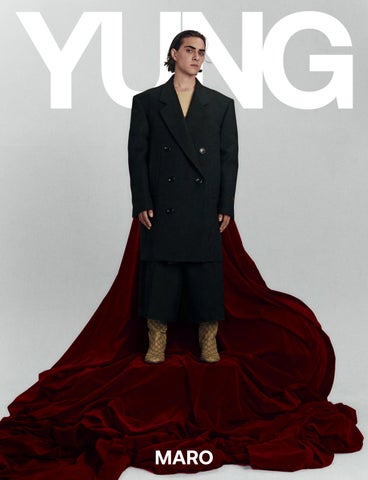
MARO
THIS IS YUNG
04-05
St o r i e s
LETTER FROM THE FOUNDER
of talent, creativity and resilience I write these founders’ letters for every issue, and with each one, I grapple with how to convey and understand the sense of awe I feel for our ever-evolving creative community – from the profound artistry we unearth and the incredible talents we encounter along the way, to the fervent passion emanating from our region. What I have learned is that these creators are not just artists. They’re storytellers, dreamers, and visionaries and their work continues to leave an indelible mark on me. As we usher in our Fall-Winter edition, the October Fashion issue, I want you to dive into the endless possibilities that the YUNG generation is ushering in. Their voice, fresh and fierce, echoes a shift—a gentle goodbye to the stories of yesterday, and a greeting for a tomorrow filled with fresh perspectives and untold narratives. Their newfound lived experiences that are shaping their creative disciplines inspire me – and I hope they do the same for you. This aspect of our journey fills me with the utmost pride. As you flip through the pages of this edition, you’ll find human tales told through art. We present three riveting narratives that epitomise boundless creativity and resilience. Our first cover introduces MC Abdul, a lyrical prodigy hailing from the heart of Gaza. He doesn’t simply rap; he orchestrates verses that stand tall against adversity, and in his artistry, he embodies the indomitable human spirit. I’ve followed MC’s journey for years, and by having him as one of the cover star’s for this issue, I can happily say I’ve ticked something off my bucket-list.
Our second cover is Marwan Daou, also known as Maro, a globetrotting artist whose music tackles complex, challenging subjects. In his melodies, each note becomes a passport stamp unveiling the exploration of his roots, an odyssey that has so far traversed Ukraine, Lebanon, Kuwait, Norway, and now, Los Angeles. Lastly, we introduce you to Haya Khairat, an Egyptian cinematographer whose evolution was ignited by a transformative moment. She shows us that every frame is a universe, a story waiting to be told, understood, and felt. Welcome to our October Fashion Issue! I hope that you find inspiration in the stories of grit, creativity and inventiveness within these pages. Across our issue, we see the power of determination, the beauty of resilience, and the limitless potential of our region. So my wish is that these narratives serve as a source of hope and a reminder that, even in challenging times, our flame remains undimmed and that there can always be a better future. YUNG Love,
illustration SHAMEKH BLUWI jacket, GUCCI. shoes, PRADA
founder and chief content officer SANDRA YEGHIAZARIAN
creative director SAIF HIDAYAH art director ATHINA SYMEONIDOU senior editor LOUIS PARKS fashion assistant NUJOUD OWEIS editorial assistant OMAIA JALLAD editorial producer LANA SHASH digital writer MENNA SHANAB ADVERTISING AND PARTNERSHIPS senior partnership manager NADINE ISMAIL nadine@thisisyung.com SUBMISSIONS AND INQUIRIES hello@thisisyung.com PRINTING AL GHURAIR PRINTING AND PUBLISHING LLC PUBLISHED BY THIS IS YUNG LLC Sharjah Media City hello@thisisyung.com www.thisisyung.com
All rights reserved. No part of this publication may be reproduced in whole or part without permission from the publishers. YUNG Magazine welcomes new contributors but can assume no responsibility for unsolicited photographs or illustrations. Every effort has been made to contact the copyright owners of the images and text in this issue.
MARO photography CALEB SHANE styling MARI SIVAKOVA
HAYA KHAIRAT photography AMINA ZAHER styling SAIF HIDAYAH
MC ABDUL photography CHEB MOHA styling GAËLLE IBRAHIM, RINAD SAAD
THIS IS YUNG
08-09
Letter From The Founder Masthead Contents The Mood On Edge DJ Zeina Maro Haya Khairat MC Abdul A Time of Elegance Prada LDN Calling Dream or Reality? Wingii Seasonal Crisis Gucci Red Sea Global EDIT x YUNG Event
CONTENTS
4-5 6-7 8-9 10-39 40-59 60-63 64-79 80-93 94-109 110-121 122-123 124-139 140-145 146-151 152-165 166-167 170-177 178-179
CONTRIBUTORS
ALEXANDRA HUTCHISON/ ALEXEY BOGDANOV/ AGATA KAROBKA/ AGNIESZKA HOSCILO/ AHMED SOROUR/ AMINA ZAHER/ AMNA EL SHANDAWLELY/ ANASTASIIA ASTRAKHANTSEVA/ ANNA VASILEVA/ CALEB SHANE/ CHEB MOHA/ DIMA BOCHAROV/ FADY NAGEEB/ GAËLLE IBRAHIM/ IRA SHAMBARY/ ISMAIL SABET/ JACK CHIPPER/ JEREMY AQUINO/ JOANNAH KHANJI/ KATERYNA HRUSHKO/ LYDIA MARCY/ LYNN/ LULU REYNOLDS/ MARI SIVAKOVA/ MEHDI ALMOUSSAWI/ MICHEAL MEDHAT/ MOHAMMAD ALNATOUR/ MOHAMMED AWWAL/ MUSTAFA EID/ NADIA YATSURA/ NOAH MORRIS WRIGHT/ OLIVIA COCHRANE/ RINAD SAAD/ RYAN RIVERS/ SARA KOLAGHASSI/ SARAH WHITESIDE/ SVEN BAYERBACH/ TAYA SHALABY/ VERA JIGALOVA/ WINGII/ YANA KAVALERCHIK
THIS IS YUNG
10-11
THE MOOD
words OMAIA JALLAD
THIS IS YUNG
12-13
THE MOOD
CORINE SHAWI Trust, On Film Lebanese film maker Corine Shawi’s documentaries are candid tales of people and of life.
Shawi directed her first long documentary between 2000 and 2006 and has produced a number of pieces which explore themes such as the body, gender and friendship. Shawi has also been a consultant for International Media Support and the National Film School of Denmark and a teacher at Saint Joseph University in Lebanon. What is your earliest memory of filmmaking as a child? I adored nature documentaries as a kid and dreamt of making them while travelling the world. Your journey into documentary filmmaking began with “Les femmes bonnes” and observing the lives of Sri Lankan women. What drew you to this subject? Doulika became an integral part of our family during the decade she stayed and worked with us. I began filming her in 1996, and when the 2005 tsunami struck Sri Lanka, I accompanied her to visit her family. Her life, language and culture fascinated me. I questioned the challenges she and other Sri Lankan women faced, working in unfamiliar places with inadequate pay and conditions. This film taught me to follow my instincts and embrace the unknown.
Documentaries often require a deep connection with the subjects and their stories. Can you recall a specific moment while filming that deeply touched you or changed your perspective on a particular topic? In my film “e muet,” there’s an uncertain moment between me as a filmmaker and the woman I’m filming. The interaction is suggestive, with the seductive game left unresolved, letting viewers imagine what might unfold. Over the years, the character’s story underwent significant change, and I became part of it. I found myself wishing to experience these moments without filming them, leading to a complex question: Am I living or filming? I know by now that I capture life; films are life, and being unprepared for both brings unexpectedly miracles and pain.
How has your experience as an educator and consultant informed your perspective as a filmmaker? My filmmaking journey has significantly impacted my approach to teaching. I started giving courses as a young director , and I’ve been hooked for 12 years now! I love connecting with students, witnessing their growth and inspiration. I also co-created TAABIR, a film language workshop for Lebanese residents from diverse backgrounds and regions, using the camera for self-expression.
photography DAVINA MARIA
How do you balance the responsibility of capturing real lives while maintaining your artistic vision and message? I film life as it happens, keeping it real and raw. My camera’s always ready, capturing those genuine moments, whether with family, friends, or even strangers who connect with my vision. Trust is essential in this process, especially when filming takes years. It is a work in progress leading me to which moments I share and how I construct them together. While editing, I often question how much to reveal, knowing that what’s left unsaid triggers the most curiosity and interest.
14-15
THE MOOD
photography EMALEA JONES
THIS IS YUNG
MAY ELGHETY May’s World As she stands on the cusp of her international debut with the British film ‘Due Dating,’ May graciously invites us into her world.
Born into a family of celebrated writers and TV presenters, May Elghety is no stranger to the power of words and images. Yet, the young actress has ventured beyond her familial legacy to carve out a path of her own— from the historic stages of Cairo’s Opera House to the cutting-edge animation studios of Disney. You started your acting career at a young age. Can you share the story of your first break in the industry? I’ve had roles here and there as a child actor in some of my father’s projects including “Awasef Al Nessaa” and “Bent Men El Zaman Da,” but my true break was in the musical “Badr El Bedour” which I auditioned for in the Cairo Opera House when I was 12 years old. I owe a lot to this play; the experience taught me so much and helped me get my big screen breaks in the TV series “Al Kaserat” and the second sequel to the film “Al Gazeera” From social issues in “Al-Kaserat” to sci-fi in “Kizazi Moto,” you’ve played a variety of roles. How do you go about selecting your roles? I think I have been incredibly lucky to be able to highlight major social issues through my career such as you mentioned “Al Kaserat” and, up until recently, “Mama” and “Kamla”. These were very heavy projects to make, so other times when you get the opportunity to do something fun, like an animation with Disney, you simply can’t say no. Yet, I remember telling my friends right after “Kizazi Moto” was released that this is exactly what I want my kids to watch in the future. I want my future daughter to see on TV that a North African girl with an Arabic name who looks like her can make her own destiny. Can you share some career milestones that you are particularly proud of? I am so grateful; I feel so blessed and lucky because I think I have made so many milestones. From being in the Cannes Film Festival for “Clash” in 2016, to telling the story of “Nada” and meeting her in person; Balancing getting a Master’s degree in London whilst shooting “Awlad Abed” in Egypt; Playing a Disney character, which is a childhood dream come true, then watching it on the screen in the BAFTA headquarters; tapping into the international market is a massive step. For all of this, I am eternally grateful.
How important is it for you to represent African and Egyptian culture on international platforms like Disney for “Kizazi Moto”? It’s incredibly important. I grew up watching women in films and television who didn’t look anything like me and it always made me feel like I lacked something or that someone like me will never have anything interesting happen to them to be represented in a film. I never want a girl with my background to feel like that, so I hope more projects like Kizazi keep getting made and produced. You’ve acted in roles that tackle social issues like child marriages. How important is it for you to use your platform to shed light on such topics? My sense of purpose as an artist depends on it to be honest. It’s really important to me. What are your future goals, both in Egyptian cinema and on the international stage? I’m reading a few projects now in Egypt and I’ve decided that I want to take larger roles in the filmmaking process, so I’m currently developing my first feature film as a screenwriter alongside director Abdelaziz El Naggar and I’m very excited. For the international stage I’m currently working on a project with Al Jazeera alongside Charles Dance. There are a few projects in the works as well, with me being the actor and co-writer. I can’t disclose much information on them at the moment, but I’m very excited for what this journey brings.
Nawar Al Qassimi tells the story of regional art through the Sharjah Art Foundation and is a fierce advocate for creatives.
The Art Of Promotion
NAWAR AL QASSIMI
THIS IS YUNG 16-17 THE MOOD
Nawar Al Qassimi is the Manager, Development at Sharjah Art Foundation. A lover of art and creativity, Al Qassimi is an advocate, facilitator and producer of contemporary art in the Emirate of Sharjah and the region. A fiercely dedicated promoter of regional art and artists, Al Qassimi is charged with the promotion of local art and engagement with the wider world. You’re curating an art-themed dinner party, which three artists, from any time in history, would you invite and why? Right now I would probably choose Daidō Moriyama, and Franz Roh because their works have inspired me and moved me in different ways. Sharjah has been recognized as a hub for arts and culture. What unique opportunities and challenges come with leading audience development and partnerships in such a culturally vibrant environment? Growing audiences takes time, and the social impact that art and culture has on a community cannot be measured tangibly - so see the changes in the long term. It’s also important that cultural spaces remain open and accessible to everyone, and that people feel a sense of ownership in those spaces. We had a concert in 2010 during the Biennial in one of our public spaces, and a kid jumped up on stage and started rapping, I even found the video on his Youtube! Years later we reconnected, and I discovered that he and his friends, who are all adults now, still attend our events and still make music too! With your experience in marketing and communications, how do you approach the challenge of engaging diverse audiences with different levels of familiarity with art? It’s important to make sure that the visual and written language we use when promoting our
photography ARTWORK BY HAJRA WAHEED COURTESY OF SAF; AHMED AL DABBAGH
work speaks to everyone, you need to find a middle ground where people who are familiar with an artist or a body of work will want to come see it, and people who are not will still be intrigued to visit, and won’t feel intimidated. We also make sure that audiences know there are many different things to experience aside from exhibitions, so whether you like art, film, books, music, architecture or cats - there’s something for everyone! What has been your favorite lesson learned from working with Sharjah Art Foundation? That good and meaningful things take time, and to always trust the process! When you are not working, what activities do you love doing to recharge? I spend so much of my time at work and around people, so I need time alone to recharge and decompress. Being away from the city really helps; I love being immersed in nature either hiking, or just discovering different landscapes and hidden spaces. Whether it’s mountains, wadis or beaches, being outdoors really helps me recharge. I also go on excursions by myself with my old cameras. I shoot with film, you have to be really focused and intentional and pay attention to your surroundings so it really helps me disconnect from everything else and find new ways to discover the city. What would you say is the next milestone that you would like to achieve moving forward? I would say the next Biennial, we just had our 30 year edition and it was the most incredible show, we’re already working on the next one! On a personal level I want to focus on my photography, maybe publish something or put together a show.
THIS IS YUNG
18-19
THE MOOD
YASSMIN SALEH The Art of Expression Yassmin Saleh’s stunning creations are stories of art, creation, artisanal skill and dedication.
photography ALY SAAB
Beirut-born, Abu Dhabi raised, Yassmin Saleh’s love of design led her to pursue her education at Milan’s Istituto Marangoni and with Elie Saab and UAL: London College of Fashion where she won the Jury Prize in 2015 and earned the Prize of Excellency in Craftsmanship in 2017 for her collection ‘The Dance of the Psyche.’ In 2018, she launched her brand through the Starch foundation program and teamed up with her sister, Farah, who after working with Christian Dior and Christian Louboutin, came in to run the business side of the operation. What are your earliest memories of fashion, and what inspired you to pursue a career in the industry? Going into my parents’ closet to wear my dad’s suits and my mum’s preppy shoes and bags. I think I always saw fashion as a means to express myself so it felt almost natural to pursue this industry, because it feels like home. Can you discuss the creative process behind designing a collection and how you incorporate your unique vision into wearable art? Every collection has a story and behind each piece there’s a reason for its choice of colour, fabric manipulation or stitching detail. Within the collection, we translate the intangible through fabric manipulation, from creating our own flowers, to eco- printing to embroidery. Given that your designs are often described as ‘wearable art,’ could you pinpoint which art movement serves as the most significant inspiration for your work? It usually depends on the collection story but I would say expressionism, art nouveau, and the arts and crafts movement. What are some cultural influences that have made their way into your collections, and how do you balance global and local elements? Human behaviour influences us. The way people react, adapt and interact to socio/political situations form our cultures. This is the root of every collection and I believe that humans go through different wavelengths, and sometimes they meet, which creates a balance between the global and local human behaviour. This is how we stay relevant. Storytelling is crucial in the fashion industry. What is the story you hope your brand tells and what emotions do you want it to evoke in customers? Growing up, I struggled to express my emotions and saw my closest struggle with mental health issues. Yassmin Saleh is my safe space that I use as an empty canvas in
which I share my stories, experiences and give myself freedom to be vulnerable. Those feelings are then translated into craftsmanship techniques, colours, and textures. We want our stories to resonate with our clientele and make them feel like they are heard. We also would like to invite them to be part of the conversation. Launching Yassmin Saleh is about raising awareness of the importance of mental health. If you could dress a historical figure in your designs, who would it be, and what would they wear? Definitely Fairuz wearing a custom hand embroidered Tattoo Gown. If you were to create a signature scent to represent your brand, what would it smell like, and what would you name it? It would smell like jasmine, gardenia and a subtle hit of sandalwood and palo santo – I would call it “Sukoon”. What is a fashion trend from your childhood that you secretly hope makes a comeback? Jeans and ballerinas.
THIS IS YUNG
20-21
THE MOOD
ZIYAD ALMAAYOUF King In The Ring Ziyad Almaayouf is a professional Saudi boxer who stepped into the amateur ring at the age of 15.
What was it about boxing that drew you in when you were 11? It was the amount of history that is still to be written for Saudi Arabia and the Arab world in boxing that made me pursue it seriously. When I got into boxing, I would try to research and find professional champions from Saudi Arabia to look up to and I would find none. I would then try to research and find world champions from the Arab world and still would find none. I said to myself, “I want to be the one to do that.” You stepped into the ring as an amateur at 15. Tell us what was going through your head before your first fight. I remember my first amateur fight like it was yesterday! The reason being is I actually tried to secretly pack up my stuff and escape the venue without my team noticing so I wouldn’t fight! They ended up finding me as I was making my way to the parking lot and dragged me back [inside] to fight. I felt every single emotion before my first fight, whatever you can think of, name it, I felt it. I ended up losing my first amateur fight, but my coach told me “I brought you here to win a bigger fight, not the fight against your opponent, but the fight against your mind, now you have the experience.”
Which fight stands out the most to you, and why? The fight that stands out the most to me would be my fight against Ramirez on the undercard of Jake Paul vs Tommy Fury in Saudi Arabia. This fight stands out to me because I was knocked down, I got back up, and I had to find a way to win the fight despite being knocked down in the first round. Being knocked down in front of over 20,000 people there and millions watching on TV, I had to fight so much mentally to still get the job done for the rest of the fight and win. I had to fight more against my mental barriers, than my opponent. Fighting and winning in a full stadium with people chanting my name, in my home country, I was living the dream. Can you describe a time when you felt most nervous or anxious before a fight, and how did you manage those emotions? I face fear and push through my comfort zone every single training camp preparing for a fight. I also feel nervous or anxious before every fight! I manage these emotions by welcoming them all, because they are expected to come, so instead of pushing them away or running away from them, I welcome them so I am able to deal with them better. It takes more energy running away and pushing away unwanted emotions, than being able to manage and deal with them. How have you evolved as an individual since you first stepped into the boxing ring? I have become much more patient and calm since I first stepped into the boxing ring. Especially finding that calmness in chaos, composure in stress, where it is easier to handle my emotions and my actions when I am patient. In boxing we throw punches and take punches without being allowed to get angry or lose our cool, because then we would lose the fight. This taught me that it is the same thing for life. If you lose your calmness, you lose yourself in whatever situation you are put in.
photography TAKA G WU/ALAMY LIVE NEWS
Ziyad ‘Zizo’ Almaayouf is a professional boxer from Saudi Arabia, who’s based in Los Angeles. In 2022, Almaayouf made history as the first Saudi to win a pro boxing match when he knocked out Alfredo Alatorre in the first round at King Abdullah Sports City.
22-23
THE MOOD
photography MOHAMED HASAN
THIS IS YUNG
MOHAMED SHERIF People, Clothes and Imagination Photographer Mohamed Sherif weaves tales of Cairo’s streets, her people and much, much more.
Mohamed Sherif loves his home city of Cairo, that much is clear as soon as you lay eyes on his work. Striking images of the city’s streets tell stories of people, the city and the culture in which they live. A coming together of fashion, unique tales and personal style, Sherif’s work is all about capturing moments of authenticity in a fastpaced world.
How did your collaboration with Middle East Archive, centred around the meaning of “love”, influence and shape a new direction for your photography? My collaboration with the Middle East Archive was something very magical. It affected me more emotionally, because it made me realize many feelings and concepts around love.
When was it that you discovered your interest in photography? The beginning of my interest in photography was in late 2018.
If you could photograph an event from any point in history, what would it be and why? For me, anything that happened before the invention of the camera would be amazing. I could choose the event of Cleoperta’s coronation as Queen of Egypt. Imagine an event like that, it is a mythical thing. Imagine seeing it in pictures.
What initially drew you to street photography, and how did you discover the unique intersection between fashion and the authentic narratives of Cairo’s streets? I’m from Old Cairo, so the streets are a part of my life, even before I was a photographer. Clothes are part of our lives and we use them daily. Everyone has their own style. Also, everyone has an original story. I mix stories of people and their clothes with my imagination. Street photography often requires quick thinking. How do you approach fashion-focused shots without disrupting the natural flow of life on Cairo’s streets? Cairo is a city in which nothing can stop, so I rely on balance, focusing on all the events that happen around me and interacting with them. How do you build a connection with the people you photograph, especially in the context of candid shots? I build social relationships a lot in the street. This is my main purpose. I don’t care about photography, at first I love to coexist with people, listen, and be a part of them. Confidence is more important than a photograph. Your lens captures the vibrancy of Cairo’s daily life. Could you share a standout moment where fashion played a pivotal role in the narrative you captured? That was very pivotal in the “Eman’s Journey to the Stars” project. Fashion was a major part in telling her life story from a woman in a certain space, to a woman who breaks all the circles set for her, to see a world in her fantasies in which she chooses the clothes she wants to wear.
Which era of fashion are you most drawn to? I am drawn to the current age because I will not miss anything in the past, and I will be contemporary with the present and the future.
THIS IS YUNG
24-25
MARRWAN ELHUSSEIN A Serial Collaborator Multidisciplinary creative Marrwan Elhussein bends media to his will in the pursuit of expression.
THE MOOD
Sudanese Marrwan Elhussein is a Dubai-based multitalented creative who works across a range of mediums to create his unique pieces. A serial collaborator and creative, Elhussein began his journey working on portrait and fashion photography, but quickly fell in love with video, graphic design, animation and digital art. Take us back to your childhood. When was it that you first grew an interest in the world of art? Ever since I was a little one, I’ve been immersed in my own mini universes. I’d sketch, dream up board games, invent creatures, and weave tales. It wasn’t just play; it was my early canvas.
images SUPPLIED BY TALENT
How do you gather the courage to address topics often left unspoken in your art, how has your audience responded to these discussions? I asked myself that I can’t be the only creative who feels this way. In a way I was reaching out for validation of how I felt. And the response always surprised me, sometimes I feel like artists and creatives are so uniquely the same. How does it feel to share an illustration that reflects your inner thoughts, and how does this cathartic process impact you personally? There’s this raw vulnerability when my inner thoughts become the centrepiece. I’ve always created art where I’m just an observer. With these personal pieces, I feel bare. But the true catharsis? It’s in the creation, in seeing my thoughts take shape visually. That’s pure joy to me.
Nurturing creativity requires a balance of discipline and freedom. How do you manage to strike this balance as you experiment with new artistic directions? As a creative in this climate, you are bound to tilt towards either freedom of creation or discipline and consistency. Sometimes I have to force myself to create and sometimes I am struck by a spark of an idea and I have to chase that spark until I see it through, I don’t think I achieved that balance yet, I hope If I do achieve that balance, art doesn’t feel routine. How do you see your personal universe evolving, and are there particular ideas or themes you’re excited to delve into more deeply? I am, in the most selfish way, involved in growing my personal universe, I played the role of a collaborator for so long that creating my own world feels like a guilty pleasure at this point. I am excited to dive deeper into what makes me laugh, what brings me joy, I forgot that smiling and giggling could be a part of creativity, I am diving into my own happiness within this universe I am creating. Can you tell us about a project or piece that holds a special place in your heart, and what makes it so significant to you? A photography project called Gossamer is something I hold so dearly to myself. Not only is it the first project that I collaborated with my wife on, but it also allowed me to dive into creativity from the perspectives of people I admired, it was a project that I always go back to and think of.
THIS IS YUNG
26-27
THE MOOD
AZIZ MASHAAN Constant Dedication Professional footballer Aziz Mashaan on rituals, house music and focus.
Professional Kuwaiti footballer Aziz Mashaan has represented his country over 40 times and been playing football since the age of six. A lover of deep house, he’s committed to his sport, and grateful for his fans and family. Growing up, did you always want to be a professional footballer? Football has always been my passion since I was a kid. I started my journey by joining the Qadsia Academy in Kuwait when I was 6 years old. From that moment on, becoming a professional footballer was my dream and my goal in life. From the moment I woke up until the time I got to bed, I was only thinking about football. How do you stay focused and make split-second decisions during high-pressure moments on the field? Self-motivation helps me keep my composure and make the right decisions when the pressure is on. Moreover, consistent practice and trust in the experience I gained in Kuwait, Belgium and the Czech Republic help me in the heat of the moment. Are there any pre-match rituals or superstitions that you follow to help you get into the right mindset before a game? I do have some pre-match rituals! I mostly follow a routine that helps me stay focused: taking a cold shower before heading to the match and listening to music. What music do you enjoy listening to when you’re gearing up for a match or simply relaxing? Deep house, especially oriental deep house. One of my favorite DJs is Valeron; whenever I hear the first note of Oud, it brings me back to the best summer memories.
How do you handle moments of adversity and maintain a positive mindset? Injuries were the toughest time of my career, and I was lucky enough to have my fans and family behind me. Once, I got over 20 stitches on my lip, and I had to wear a mask while playing. It was during the peak of my career, and fans created a song for me to help me keep going. Who has been your greatest source of inspiration and support throughout your football journey? I grew up in a sports-oriented family; my brother is a football coach today, and my dad used to play football himself. Since I was a kid, my dad has been my constant source of support. He believed in me and used to travel with me all over Europe to do trials at Manchester United, Sporting Lisbon, Benfica… At the time, traveling involved some sacrifices, which pushed me to give my best on the pitch and influenced my career choices. What sports do you enjoy watching or playing in your free time? I like watching and playing all kinds of sports: tennis - I’m a big fan of Roger Federer, padel… Running 5 to 10K plays a major part in my daily routine, which helps me focus and stay in shape. Moreover, I love to do fitness classes; for instance, for the past year, I’ve been consistent with spinning on Saturday mornings at Motion to start the weekend full of energy with my wife and friends.
photography ABDULLAH AL ZANKI
THIS IS YUNG
28-29
THE MOOD
JUDE SAMMAN Roots and Paint Stories of home and of culture inspire a young Jordanian artist within the diaspora.
Jude Samman is a Jordanian artist with Syrian roots who focuses on the concept of “home” and how it relates to those far from it. Working through oil paintings, Samman works with symbolism and objects to tell stories of her memories. Across all of this, figures within her work represent her ongoing efforts to study the connection between bodies and the earth.
photography FATMA BAGHDADI
What is your earliest memory of a paintbrush and how did you discover your passion for the Arts? My mum was the one who realised my skill and encouraged me to take art classes outside of school. It was the late Aziz Amoura who made me realise my potential. I fell in love with political art, poets, and artists who told stories. It wasn’t Van Gogh or Monet who inspired me, but artists within our region who created images I was able to relate to beyond the parameters of my mind. Your oil paintings often revolve around the concept of “home”. How has your perception of home evolved since moving to Ontario? Leaving home for the first time allowed me to appreciate the power of memory. I saw myself using memory as a tool to connect me back to a place that seemed far away physically but ever so imagined mentally. My senses are awake whenever the thought of home comes to mind, which I try to manifest in my work through surrealism, and by including symbolic objects that tell stories. Moving gave me the desire to capture memories that feel both recognizable and yet strangely unfamiliar in remembrance of home, allowing me to unearth the truths of the land that transcend the boundaries of reality.
How do you see your art contributing to conversations about identity, displacement, and belonging? I find purpose in exploring the concept of home due to its resonance with the challenges of displacement within our region. Arabs in diaspora make me contemplate issues of migration, therefore romanticising the idea of home comes as a form of resistance to longing. Self-reflection taught me that subconsciously I’ve been referencing Arab poets and writers who were exiled from their homes. For example, Nizar Qabbani remembers the jasmine flowers that occupy Syria in his poems, which in my work symbolise the scent of home. I hope to use culture as a tool to inspire hopefulness and to create an evolution of thinking to the way we view everyday objects. If your art studio could magically teleport to anywhere in the world for a week, where would you choose to paint, and how might that change the essence of your work during that time? The desert. Its tranquillity and neutral palette create a blank slate for a different creative flow. I am interested in the way Bedouin culture has its roots in the desert. Once I began painting sand in my work, I was able to better understand the way this element behaves in its environment. Therefore, my image-making would take a more focused exploration of the physicality of the land. What purpose do you find in art making? Art gives me a better understanding of life. I enjoy exploring the way things are connected. Art requires our attention, and is inherently political, which is why I believe it could stimulate change. Although art doesn’t reflect reality, it could paint a reality that could come to be.
THIS IS YUNG
30-31
THE MOOD
AZIZA SBAITY On Track Lebanon’s Aziza Sbaity aims to represent her country at the Olympics and to fight for athletes across the region.
How did you first discover your talent and passion for running? It all started when I moved from Liberia to Lebanon at the age of 10-11 and started school at SABIS in Lebanon. The school had their annual tryouts early in the fall. Little did I know that running fast was something important. I had always been a super competitive child growing up in Liberia. I played kickball, baseball, and tennis and was definitely a sore loser if I ever lost. During the tryouts I won over all the girls and the coaches were very impressed and surprised with my speed. So, they put me up against the boys and I won against them as well. The year I finally decided to take track seriously was my last year of school. I started training with Jamhour Club. And that was when my real running journey began. You’re originally from Monrovia. How did you end up in Lebanon? My mother is Liberian but my father is Lebanese. So I was born and raised in Liberia but I never once didn’t know that I was equally both. Both of my countries suffer from the pains of civil war and civil unrest. During the war in Liberia in the early 2000’s my family and I fled and moved to Lebanon.
What’s the greatest challenge you’ve faced to date? My greatest challenge has been to find a balance in juggling between training, competing, studying, working and making a living. I love track and field and I know that it’s my passion but in Lebanon, it’s quite hard or even impossible to make a living out of it. So trying to find the right balance to give it my all in training while making time to invest in my self-growth, education and work isn’t the easiest thing. What do you see as your greatest achievement? I don’t know if I have achieved what I would call “my greatest achievement”. Maybe athletes in general are perfectionists or overachievers so as much as I am extremely grateful for where I am right now and what I have achieved in the past couple of years (especially this season), I still feel like there is a lot more I’d like to achieve. What are your plans for the future? When it comes to my track career, I look forward to the new season ahead where my main goal will be to represent Lebanon at the Olympic Games in Paris 2024. On the educational level, I’m currently finalising a Masters in Olympic Studies in Germany while also about to start an MBA. I really look forward to mixing my career as an athlete with bigger issues of governance and sports development in Lebanon and the region. Do you have any advice for young people, women in particular, who are interested in pursuing sports? My advice for young people and women in particular would be to first of all follow their instincts and their passion, then to find a group/ community that will support their growth and then to work really hard and smart to reach their goals and dreams. You will have a lot of bumps in the road but never give up on your dreams.
photography LENA BARTHEL
Aziza Sbaity is a Lebanese sprinter and the 100m Lebanese national record holder. She’s represented her country at World Championships and is aiming to represent Lebanon at the Olympic Games in Paris 2024. She’s determined to support athletes from her home country and across the region and she’s currently studying for her MBA in preparation for life after the track.
THIS IS YUNG
32-33
THE MOOD
REEMA AL BANNA Empowering Appeal Reema Al Banna is the creative force behind Reemami, which is fast becoming a regional staple.
Women and empowerment are at the heart of Reemami and are subjects dear to Reema Al Banna. The energetic force behind the local house, Al Banna strives to create authentic designs that speak to a confident, contemporary woman.
photography ZEASHAN ASHRAF
As the founder of Reemami, what daily rituals ignite your creative spark before diving into a new collection? My daily rituals are nothing short of sacred; they involve embracing the thrill of new experiences. I’m what you might call a “serial hobbyist.” Every two years, I immerse myself in a new sport or activity that sets my creative fire ablaze. It all began with boxing, then climbing, followed by wakesurfing, horse riding, and now, it’s the exhilarating world of skate surfing. This two-year ritual acts as a wellspring of inspiration. I treasure the memories created during these pursuits, and they serve as the bedrock for my collections. Designing a collection for me is a journey that spans a considerable amount of time. I begin by crafting prints entirely from scratch. In the subsequent collection, crafting the textiles alone consumed nearly two years of my life. I revisit prints that I may not have used previously, giving them new life and resonance. So, you see, creating prints takes a considerable amount of time. Following this, I embark on the sketching phase, which can span another six to eight months. When it comes to the actual design process, I prefer to let it unfold organically. I don’t rigidly adhere to my initial sketches. When I bring the fabrics to life through printing, they whisper their own unique stories, and these stories often guide my designs in unexpected directions. If there were a song playing in your studio to fuel your creative energies, which song would be your anthem? Music is the soul of my creative sanctuary. I thrive on the repeated rhythms of songs that set the mood and allow me to transcend into the realm of daydreaming, an essential part of my design process. Lately, I’ve found myself captivated by tunes like “Birds” by Coldplay, “From Afar” by Vance Joy, “Mess Is Mine” by Vance Joy, and, occasionally, the enchanting melodies of Arabic classics. Music sets the tone, and I immerse myself fully to harness the power of inspiration. If you could transport Reemami to a different era, which era would you choose and why? If I could wave a creative wand and transport Reemami to another era, I’d opt for the early 90s. It seems like a time when things were more straightforward in terms of production, and it was possibly easier to find passionate artisans. In terms of style, the charm of the 50s holds a special allure for me.
Given that women’s empowerment is the cornerstone of your brand ethos, how do you infuse this ideology into your designs? At the heart of Reemami lies the conviction that a woman is the sovereign of her own life. She possesses the freedom to express herself boldly through her choice of attire. Whether it’s through avant-garde cuts or daring prints, our designs empower her to dress for her own pleasure and comfort. We create artful pieces meant to last a lifetime and be cherished through countless wearings. If you were to define the quintessential Reemami client, what personality traits would define her? The quintessential Reemami client is a woman who embraces life with unbridled enthusiasm. She radiates vitality and curiosity, possessing an artistic vision that propels her to the forefront of fashion. She’s unafraid to express herself through bold and imaginative styles, appreciating the meticulous craftsmanship of well-tailored pieces.
THIS IS YUNG
34-35
THE MOOD
RAWAND ISSA Comical Impact Rawand Issa’s comics might seem like fun, but they tackle serious social and political issues.
What ignited your interest in storytelling as a child? I think for children it’s common to love storytelling and creativity in general. I believe each child, whether they become an artist as an adult or not, is “naturally” into such practices. What made you use comics to tackle socio-economic issues and real stories? I started as a writer before starting to create comics. Starting in media as a journalist, and now writing comics, is still in the same direction of documenting and telling stories that are kept in the shade, or kept as oral history. The combination of text and image in comics made storytelling much more fun for me, also allowed me to add more to the visual imagination when telling a story. When was it that you discovered the impact of your work on Lebanese society? I’m not sure I can say that my work has impact on Lebanese society, this is a big responsibility which I would be very proud to achieve. But I don’t think I am there yet. I think that I am still taking baby steps into the creative fields, although I have been doing this for the past 10 years.
Your stories have a way of making readers feel understood and less alone. What do you think of this? This is a powerful connection indeed and I am happy that you described my work as such. I think it’s simple for me, when you approach the story from a personal perspective, it’s easier for people to connect. For instance, in my book Inside the Giant Fish, rather than researching the effect of privatising beaches on locals living by the sea, I decided to tell the story of a girl who lost her sea, and all her memories and future with the sea. “Inside the Giant Fish” is a captivating narrative. Can you share a personal anecdote or experience that might have indirectly influenced a part of the story or the themes you explore in the graphic novel? The story might not specifically be mine, but it’s personal. I think what influenced the whole story or even pushed me to create this book is the need for grief, and the anger I had in me for dealing with loss. What is your favourite comic book and why? This is a hard question, I don’t have one favourite comic book, I always get inspired by different artists and books, but I can say that non-fiction and memoir-like comics are my favourite genres. Do your personal fashion preferences influence the visual identity of the characters you create in your comics and cartoons? Of course! And this is such a fun thing to do. For example, the colour palette I used for Inside the Giant Fish were the colours of my favourite swimming suit I had when I was a child. Sometimes I even dress the characters in a certain style I like, or that I’m inspired by.
images SUPPLIED BY TALENT
Rawand Issa is a comic artist and writer from Lebanon whose work focuses on socio-economic issues and documenting real stories. She is the author of the graphic memoir “Inside the Giant Fish”, the story of a girl looking for her lost memories on a beach that no longer exists. She has created several short comic books and zines including “The Insubordinate” and “Not From Mars” in addition to contributing political cartoons and comics to various publications.
THIS IS YUNG
36-37
THE MOOD
THERESE RAFFOUL Voices of The Past Therese Raffoul is an up and coming Lebanese designer and creative director based out of London.
Her sculptural designs explore the hidden, or suppressed voices of women from our region’s past and imagine how they might express themselves in today’s world. Her creations delve into concepts of aggression, dark emotion, anger, fury and revenge, feelings that are not always portrayed in classic designs for women.
The collection was cathartic as I built this narrative and these characters that are militantly retaliating against that censorship. That is why there are explicit militant/battle references in the editorial, it’s almost satirical how much one has to fight to not constantly be an object of desire, in peace, amongst other fights.
What first sparked your interest in the fashion design field? I was very young, I started noticing that how people dressed was a big insight into who they were and how they interacted with life, getting dressed is such an intimate ritual.
How has your Lebanese heritage and education in London influenced your design aesthetic and perspective? My design language pulls from observation, it’s like being a kid, putting your ear to the door when older family members are sharing secrets, and suddenly the puritanical world you knew never was. All I’ve observed was in Lebanon for the most part and in the micro social dynamics, in those crevices, that’s where I find my biggest references. My education in London was invaluable as it allowed me to observe so many peers’ way of working, seeing their diverse and dynamic processes and it has pushed me to look for sharper tools, it has by far been my biggest education. Can you tell us about the hidden symbols and words within your designs and how they contribute to your story? I was researching how calligraphy manipulates letters in a structural way. I was intrigued by how one could conceal a word, a message, by making it slightly less easy to read. I wanted to translate that directly into the jewellery for example, and as for the clothes, the way I abstracted maps and turned them into embroidery was a way of hiding a destination in plain sight.
Can you describe a moment or experience that profoundly influenced your creative direction and design philosophy? I’ll never forget what I felt seeing Hussein Chalayan’s wooden table skirts. It solidified my desire to utilise my craft as storytelling and a communication method, and to see fashion outside of a product based context.
photography YASMINA HILAL
How do your designs, which explore emotions like aggression, fury, and revenge, aim to change traditional perceptions of women in fashion? Representation for Arab women in fashion is very narrow and the gap between reality and what is marketed is immense. To solely represent the desirable side, to me, is a form of censorship and perpetuation of restrictive social parameters. I’m interested in the potency of the mundane details of daily life, which are more insightful and curious than the elaborate fairy tales designed to represent women. “Barking and biting back” is a powerful concept. Can you elaborate on the symbolism behind this idea and how it relates to your exploration of an Arab woman’s shadow side? I started looking at images of animals mid bark, and as odd as this might sound, I felt like if I were to unleash my own shadow-side, it would be similar. To release such a primal feeling, as a woman, is subject to scrutiny. Once you become undesirable, society’s behaviour towards you changes because complacency is so pragmatic.
Tell us about your collaboration in jewellery design. What inspired your venture into this field? I approached Eva Wuyang, whose practice consists of making jewellery out of clay in organic shapes, it took jewellery out of the traditional luxury context; and allowed it to be a more subversive language, I asked her to interpret the Arabic sentence “ ” ارني اسنانكand use the shape of the letters as teeth, it was really beautiful to see how she created it as a non-Arabic reader or speaker.
THIS IS YUNG
38-39
THE MOOD
OMAR CHAKIL Tri-Culture Embracing cultural heritage and ancient materials, Omar Chakil’s work is a blend of worlds.
Take us through your creative process. How do you translate your ideas from your mind to tangible objects? With intuition, desire and quick introspection. Your practice involves both honouring tradition and pushing artistic boundaries. How do you navigate the fine line between preserving heritage and innovating with each new creation? I don’t. At least not intentionally. What drew you towards using Egyptian alabaster, particularly Pharaonic alabaster, as the primary material for your designs? The desire to use an endemic material that had been forgotten and under appreciated. Collaboration can be incredibly enriching for a designer. Are there any artists or creators, living or historical, that you’d love to collaborate with if given the chance? I’d like to do set design for Angelin Preljocaj.
Could you share a childhood memory or experience that you believe contributed to your path as a designer? The first time I went to the movies, when I was three years old and saw Walt Disney’s Fantasia. Each design holds a story. Could you tell us about a piece that might have a hidden story or meaning that your audience might not be aware of at first glance? My ENCAPSULATED lamp is inspired by a capsule, obviously, and by avant-garde notions and early Hollywood set designs like Victor Fleming’s Emerald city of Oz NOT, by a phallic shape like Barbarella’s gun, as I’ve often heard.
Designers often have a “eureka” moment that sparks a new idea. Can you recall a time when you were least expecting it, and a creative concept suddenly hit you? Not wanting to boast, but I have come to expect these moments quite often by the grace of God. It’s when they don’t happen that I’m caught off guard. Does your personal fashion style influence the design choices you make for your sculptural objects, and if so, how? Personal style in general naturally does. I’m a Parisian at heart, although I often tend to be too short on my fashion budget, or too permanently fluctuating in size to fully express myself through what I wear on a daily basis.
photography BILLY DOSS
Omar Chakil is a Lebanese-Egyptian living in Paris. These three cultures come together in his Animism-inspired sculptures and works to create stunning designs across tables, lights, plinths and accessories. Using authentic, often ancient, materials such as Pharaonic alabaster, Chakil’s pieces almost seem imbued with a sense of animalistic self, or essence.
THIS IS YUNG
40-41
ON EDGE
ON EDGE Step ‘On Edge’ with our captivating editorial, a harmonious fusion of beauty and fashion. Experience the thrill of striking beauty portraits and fashion that pushes boundaries – from refined tailoring to daring silhouettes and luxurious streetwear. Get ready to be spellbound.
photography RYAN RIVERS styling SAIF HIDAYAH
THIS IS YUNG
42-43
ON EDGE
full look, BALENCIAGA
THIS IS YUNG
top, trousers, shorts DOLCE & GABBANA
44-45
ON EDGE
THIS IS YUNG
46-47
ON EDGE
full look, BOTTEGA VENETA
THIS IS YUNG
48-49
ON EDGE
coat, shirt, shorts, tie, VALENTINO. socks, stylist’s own
THIS IS YUNG
50-51
ON EDGE
jacket, jeans, LOUIS VUITTON. necklace, stylist’s own
THIS IS YUNG
full look, FERRAGAMO
52-53
ON EDGE
THIS IS YUNG
full look, LOUIS VUITTON
54-55
ON EDGE
THIS IS YUNG
blazer, trousers, shoes,BALENCIAGA. earring, stylist’sown
56-57
ON EDGE
full look, LOUIS VUITTON
58-59
makeup SARAH WHITESIDE using BY TERRY; hair SVEN BAYERBACH at CAROL HAYES MANAGEMENT using DRYBAR; styling assistant MEHDI ALMOUSSAWI; production assistant SARA KOLAGHASSI; models LULU REYNOLDS, ALEXANDRA HUTCHISON at SELECT MODEL MANAGEMENT, NOAH MORRIS WRIGHT at MMG MODELS, MOHAMMED AWWAL at MODELS 1; production LANA SHASH
THIS IS YUNG ON EDGE
THIS IS YUNG
60-61
DIGGING DEEPER
DIG GING DEEP ER Egyptian DJ Zeina is possibly the hardest working woman in the business. She’s also one of the country’s most respected audio-creatives.
photography ISMAIL SABET styling AHMED SOROUR words FADY NAGEEB
“I made it because I was myself. People will love and accept you when you are yourself.” Nour Arida is not your average Arab woman, and she doesn’t really want to be. It’s 10:30am, and autumn has officially hit Paris. The last of the morning’s sun pours into Arida’s home office, highlighting her flawless, makeup-free skin. She is perched at a desk in front of her phone camera and dialling in by Zoom. Her hair is loose and naturally tousled and she is wearing an oversized grey hoodie that cloaks her diminutive frame. It’s a look a million miles from her YUNG cover shoot (“I love art, so for me I loved this shoot. It was so out of the box”) but It’s also an effortless chic aesthetic that the 33-year-old has successfully built her brand upon. You see, Arida refuses to conform to social norms, she won’t bow down and she will be 100 per cent, unapologetically herself. It’s a formula many, including her first manager, Middle East. I never thought I could make it internationally. So now, could say was risky, but for Arida it paid off. when I walk in the streets of Paris and European girls come to me and tell me I’m an inspiration, it’s crazy. They can be inspired by so many When Arida first started out her former European or American women, but they are inspired by me – an Arab, manager would tell her what to wear, how to a Lebanese woman.” pose, how to fix her hair and to ‘wear more makeup’. But it wasn’t her. “It’s hard to be Arida is the first to admit that her route to becoming a global accepted in the Middle East if you are not role model was a “random” one. Here’s the how it happened: She the typical Arab woman,” she says, her alstudied economics and mathematics at the American University of mond-shaped eyes wide with conviction. Beirut. However, with a love for fashion burning deep – her mother “But I can’t fake it and be someone I am not.” and grandma also worked in the industry and “always loved to dress nicely” – she got a job as a buyer. After seven years she decided Eventually, Arida gave her manager to take the next step, launching a blog and a social media account, an ultimatum: “I either do it my way, or we showcasing behind the scenes of her glam, but also normal, life. stop.” The outcome? She did it her way. She Unpretentious insights became her USP, rapidly garnering followers changed manager (it’s now her husband, and, with them, viral attention. George) and she became the first Lebanese model to receive international acclaim. It’s When she was 28, Arida and George booked a meeting with Elite an accolade she’s incredibly proud of. “As modelling agency. “I went in with zero expectations,” she explains, Arab women you are raised to feel you are shaking both head and shoulders as if to emphasise the doubt. not good enough or that you will never make “Agencies usually hire models from when they are 14. I was too old it,” she explains of the pressures. “We are led and I was Arab.” Yet, in spite of her reservations the agency signed to believe that we can only be known in the her on the spot. As well as working closely with fashion brands including Givenchy, Balenciaga and Celine, Arida has since been the global face of Sephora and most recently Bocuheron and Make Up Forever. She’s also launched a fashion collection with MOTF, including key wardrobe basics that represent her own style. The career trajectory is unconventional for sure, but by establishing her brand identity – which is essentially just her being genuine – she has tapped into a niche. She portrays her reality, but it’s not a reality show, largely because she sets boundaries.
THIS IS YUNG
62-63
DIGGING DEEPER
I remember first hearing about Zeina only a few weeks after landing my first writing job for a music publication. I’d been put on the list for her Unfamiliar night where she was hosting Julietta of Half Baked records/ BLITZ Club. Fairly fresh-faced and still acquainting myself with Cairo’s scene at the time, Zeina and her club nights were completely off my radar. Come the night of the gig, I remember making my way down a narrow hallway leading to that cramped, smokey dancefloor of the now-defunct nook on Cairo’s short list of clubs called Zigzag (previously VENT). I didn’t realise it at the time, but the faces I saw on the dancefloor, I would soon learn were some of the key DJs, producers, promoters, and even visual artists who would go on to shape and grow Cairo’s underground dance music scene to what it is today. I also clearly remember that feeling of being in the midst of a grass-roots club night for the first time. I hadn’t been to London or Berlin yet, but hearing local and visiting DJs playing side by side in a clanky make-shift club, a minute’s walk away from Tahrir Square in 2017 was something else. Throw in the fact that this remains the sole female-only club night in the city, and the experience becomes even more special looking back. That’s the thing about Zeina, she is this indisputable talent and presence in the industry that everyone unites upon, no matter who you talk to, what their background is, or what their taste might be. She’s got everyone’s support, she’s on every promoter’s lineup, clubbers pay attention to her sets, and she’s often spoken of with this sort of reverence that’s attached with only a handful of names. Between staying busy playing, organising, and working on her music in Cairo, travelling to play and connect with SWANA artists and promoters from Saudi Arabia to Tunisia, or going off on international dates after signing with Interwave, a high-profile booking and management agency out of France, Zeina found time to chat with me about her career, identity, process and what she’d like to see more of on the dancefloor.
When I went, I felt so affirmed. No conversation felt like small talk. And I felt like these are my people. Why are we constantly looking abroad for validation when it’s right here?
FN: So you’ve spent the past year playing in Saudi, Tunisia, Lebanon and all across the region. Tell me more about your experience and the growth you’re witnessing around us. Z: First of all, travelling and connecting with people in the region, to me, has been one of the most heartwarming, affirming experiences in my career. Simply because, for me, human connection fuels creativity. So, when I connected with people from the region, it felt like we saw each other. It’s almost like now we’re waking up and acknowledging each other.
FN: You’ve recently joined the roster of Interwave alongside seasoned veterans and exciting young talents from all over the world. Tell us about this. Z: I started working with them in January of this year, it’s been good!
On my first visit to Saudi, I really didn’t have any expectations.
It’s a misnomer to think that if you get an agent, you sit back and the agent does the work for you. It’s the opposite, you create your momentum, and the agent helps you with their own momentum, their expertise and their professionalism. And together, you build a relationship that pushes you forward.
I think warmth is our currency. When people come to see us from abroad, they’re floored by our hospitality, and it’s for everybody. Arab hospitality isn’t just for show, it’s who we are.
I’ve been organising and building for myself for the last 15 years, so it’s been a happy step forwards and upwards to combine my momentum with theirs, to work with a professional team and be a part of a beautiful roster of artists.
“I have been thinking a lot and trying to figure out what the currency of my life is. And for me, it’s people, warmth, and comfort.” FN: And how has it been keeping up with gigging more consistently, regionally and internationally, post-COVID? Z: There are still some adjustments I need to do about being on the road. It’s understanding how to take care of myself, and that’s a process that starts in Cairo, even before I hop on the first flight. Being mindful of what makes me go in the best shape, starting with small things like sleeping and eating well. And those little elements give me the sense that I can do this in the long run. I’m happy I’m not doing this much travelling in my 20s, because back then I was hungry and I wanted to do it all. Now I think I have so much more intentionality with what I want out of this. And I think, ultimately, apart from sharing music, I want to feel joy, I want to feel comfortable, I want to feel settled in myself. I don’t want to lose myself in the process. FN: I was always really interested to find out why you opted for Cairo as a base when you were living in Canada for years and gigging from there constantly. Z: After being in Canada for seven years, I came to Egypt to play a party (and escape the Canadian winter) and I never left. I have been thinking a lot and trying to figure out what the currency of my life is. And for me, it’s people, warmth, and comfort. All of these I think are Egypt’s most incredible qualities, whether people are annoying and in your face, or kind and generous, you’re getting something real, you know, this is what gives me life. That authentic exchange. Being here is fundamental to my well being because these are the things I value in life.
FN: Now that Egypt’s been your permanent base, and you’ve toured a lot over the past decade. What do you want to see more of in the region, especially now with all the developments that have been happening recently? Z: Egypt always had a long-standing dance music scene from the late ‘90s up until the last 10 years, which brought us some very exciting sounds. I wouldn’t say we’re plateauing now, but I see a lot of people in the scene unsure how to proceed. No one is stepping forward like “Hey, I’m going to open up a space, I’m doing this, or that.” We’re in a difficult spot, financially, as a country. I’ve also been thinking about elevating people’s experience on the dance floor. Because what I’ve been finding is that a lot of people are not connected to their bodies, they don’t understand how to be present, or manage their limits, or be a good vibe at a party. It would be really interesting to go back on an individual level and see what are elements that make people feel connected? How can we help people understand their connection to their physical selves, and how that impacts their enjoyment of a party or a space. I’d love to see some awareness on that. When I’m on dance floors abroad, there’s a bit more awareness on how to take up space, you know? There’s a mindfulness aspect that I think we can insert into our experience. We need more people there to listen. ■
THIS IS YUNG
64-65
AROUND THE WORLD
AROUND THE
WORLD Lebanese-Ukrainian singer-songwriter Maro is rising fast as his simple, clean sounds tackle complex, challenging subjects.
photography CALEB SHANE styling MARI SIVAKOVA words LOUIS PARKS
full look, GUCCI
THIS IS YUNG
full look, GUCCI
66-67
AROUND THE WORLD
“Listening to a good song that you can relate to is like having a friend who gives you their shoulder to cry on, it helps a lot, it has helped me.”
Half Lebanese, half Ukrainian, one-time resident of Kuwait, Lebanon, Norway, and now LA, Marwan Daou, aka Maro, has, both literally and figuratively, been around the world. “May you live in interesting times” is an expression that can cut both ways. It’s certainly true for Lebanese-Ukrainian singer-songwriter Maro. Both his homes have gone through challenging times in recent years, and so has he. From posting YouTube videos of his music from his bedroom to signing with EMPIRE and moving to LA, it’s been a wild ride. Music began early for Maro, at the age of ten his mother signed him to a conservatoire in Saida, Lebanon and he began to learn the piano. “She and my grandmother pushed for me to take it seriously, which I did. This led me to wanting to explore the guitar, and I got my first one from my grandmother on my 14th birthday, when I was in Ukraine. I taught myself how to play it by watching countless YouTube videos and tutorials,” he says. A year later and he’d be playing and singing on the streets of Beirut every weekend. The young Maro was inspired by Justin Bieber, the YouTube parallel being obvious, but his influences are widespread, from Freddie Mercury to Nirvana – whose discovery took place at the same time he got his guitar – he never stops listening. These days “Eminem, XXXTentacion, Lil Peep, Russ, Mac Miller are always on repeat,” he says. Maro’s sound is raw, stripped down, a lead instrument carrying his voice. His Arabic influences are clear, his voice and vocals are inspired by the music of his family, the use of his vibrato an allusion to his heritage. “I feel like the mix of all of these things, in addition to emotionally-packed lyrics and delivery, shape the sound that I’m putting out right now,” he says. This mixed heritage is part of Maro’s strength, “I grew up living in Lebanon and spending most of my summers in Ukraine with my grandparents, so I’ve always embraced both of my cultures. I love the fact that I come from two different worlds, it has given me the ability to be understanding and appreciative of other cultures. When traveling, it’s easier for me to connect with other people, hearing their stories and experiences, and learning something different. I’m a good listener,” he says.
THIS IS YUNG
68-69
AROUND THE WORLD
full look, GUCCI
“Fashion will always be an extension to my art and the way I express myself - and like my music, my sense of style will forever keep evolving, reflecting my growth.”
THIS IS YUNG
full look, GUCCI
70-71
AROUND THE WORLD
“I felt like I had nothing to hold on to. I was young and broke with a following of 2,000 people, which kept my vision alive, but I was feeling hopeless, regardless.” But let’s back up. He was young, he was talented, but he had zero connections. Luckily, he had an iPhone and the Internet. He knew the power of viral music, he felt he had talent, so he started. “I posted my first singing video in 2015, my skills weren’t great so it took me a lot of practice, hard work, and consistency to get to a place I was okay with. Fast forward four years later, my girlfriend at the time had just broken up with me, and I was stuck in a university dorm, majoring in a topic that I did not enjoy at all. In addition to that, all of my friends lived away from me in a different city and my parents were in a different country. My insomnia started getting worse, and all I could do was cry at night - which started to affect my performance at university. I felt like I had nothing to hold on to. I was young and broke with a following of 2,000 people, which kept my vision alive, but I was feeling hopeless, regardless,” he says. In 2018, his life changed. He uploaded an incredible, emotional cover of Lil Peep and XXXTentacion’s Falling Down and it blew up. “This cover changed my life. I had already heard a leak of the song before it was released, so I learned the lyrics and was the first to post a cover of it once it was officially out. I filmed it in that same small dorm room. Witnessing that video reach 100,000 views in just a few weeks, and seeing all the love and positive feedback regarding my voice and ability gave me the push to keep posting more videos regularly,” he says. It currently sits on 1.3 million views.
In 2020, Maro moved to Oslo, Norway, “I had connected with Eirik, my manager at the time, over Instagram, we became best friends and his family very kindly welcomed me into their home for some time before I got my own place,” he says. Eight months ago, he moved to LA to further his career, “It sort of reminds me of Lebanon when it comes to the weather and the vibe, which is comforting. It’s a huge city and there’s still a lot for me to explore so I’m excited for what’s to come…” he says. However, Norway’s capital left an indelible mark on Maro: A love of fashion. “When I first moved to Oslo, I was lucky to be surrounded by creative and extremely fashionable people and friends. They would take me out thrift shopping to find cool vintage pieces and help me explore different styles. With time, I started to understand the fashion world more and what looks best on me, which led to me developing my personal taste. I like experimenting with fashion a lot and I’m always open to trying new things,” he says, “Fashion will always be an extension to my art and the way I express myself - and like my music, my sense of style will forever keep evolving, reflecting my growth.” Now, after reaching out to Ghazi Shami, CEO and founder of San Francisco-based label EMPIRE, Maro is looking to the future. At the time he signed XXXTentacion was also with EMPIRE. Maro went on to release his debut album, ‘Words from My Bedroom’.
THIS IS YUNG
72-73
AROUND THE WORLD
full look, GIVENCHY
jacket, top, PRADA. earrings, talent’s own
THIS IS YUNG 74-75 AROUND THE WORLD
THIS IS YUNG
top, pants, LOEWE. necklace, GUZEMA JEWELRY
76-77
AROUND THE WORLD
“Eminem, XXXTentacion, Lil Peep, Russ, Mac Miller are always on repeat.” His music is full of emotion and is clearly fuelled by personal experiences, relationships, his state of mind. Maro is clearly trying to find his way and his listeners are along for the ride. A little dark, a little nostalgic, Maro’s sound belies his age, and he’s under no illusions about the nature of many of his songs, “Listening to a good song that you can relate to is like having a friend who gives you their shoulder to cry on, it helps a lot, it has helped me,” he says. “I wrote the songs on “Words From My Bedroom” over the course of three years. I wrote all of them in the bedroom I stayed in across multiple cities. Some were written in Kuwait at my family home and others while I was in Lebanon and Norway. The concept of the album’s name is to emphasize that I was writing these songs in my room, expressing how I felt at that very moment,” he says. The song “HELLSTORM” was inspired by the war in Ukraine and came at time when Maro was thinking of his grandmother and the Beirut Port Blast. The vibe is one of raw love, the type that can make you endure anything for those you hold dear. Throughout this conversation there’s something floating in the The perfect example of this depth is his air, it keeps coming up, but obliquely – the issue of mental health, new track, ‘The House’. The song is a tale of or the impact of trauma. It’s a topic that’s often taboo in our part of his grandmother, Souad, his second moththe world, especially for men, but Maro doesn’t shy away from it, far from it. Listen to his music and it’s plain to see, or hear. “I believe a er, who helped raise him while his parents lot of us [men] struggle mentally and emotionally, especially in the were at work. Memories of food, love, laughMENA region. Solely on the example of war and violence, we witter, family stories, holidays and much, much more, all these are rooted around four walls, ness things that we have absolutely no control over, and all of this walls which themselves become memories, gets buried in our subconscious. We accept those things as part of part of who we are. Souad passed away our everyday life. The same thing happens with some of the negaduring the pandemic and Maro was unable tive repressed feelings that we experience throughout our lifetime, to say goodbye. The house was sold, what we’ve seen our fathers do it and the children become a reflection was once a part of the family, now gone. of that. But in our society, talking about mental health is a sign of Memories remain, but tinged with pain. weakness and you’re told that you shouldn’t do that because you’re a man,” he says, going on to say that it’s an incredibly complex issue. Thankfully, the young people, men specifically, are starting to talk about their mental health, according to Maro, either to friends or a therapist. The key to it all is to pause, to reflect and to think about who you are, why you think what you do and what you can do about it. When it comes to getting help, or taking action, it’s down to the individual, according to Maro. Be it a friend, or a therapist, the key is to speak to someone. Whatever you do, it’s up to you, but the path to healing, to improving your situation is to seek help in the first place. It is a stigma, there’s no doubt about it, but it is changing and there’s no shame in admitting you need help and then seeking it. There’s a complexity to Maro’s music, and his take on life. The past years have been hard, there’s no doubt, but it’s clear that a sense of hope runs through it all. Deep, complex, Maro is making music for our times. And what interesting times they are, though sometimes we might wish they weren’t. ■
THIS IS YUNG
78-79
“In our society, talking about mental health is a sign of weakness and you’re told that you shouldn’t do that because you’re a man.”
AROUND THE WORLD
set design VERA JIGALOVA; photography assistant JEREMY AQUINO; styling assistant KATERYNA HRUSHKO; grooming YANA KAVALERCHIK; retouching CALEB SHANE & NADIA YATSURA; location HYPE STUDIOS CYC STAGE SILVER LAKE; production DIMA BOCHAROV
blazer, trousers, shoes, ALEXANDER MCQUEEN. rings, GUZEMA JEWELRY
THIS IS YUNG
80-81
FRAMING HAYA’S WORLD
FRAM ING HAYA’S WORLD How to appreciate a moment.
photography AMINA ZAHER styling SAIF HIDAYAH words MENNA SHANAB
full look, PRADA
THIS IS YUNG
full look, PRADA
82-83
FRAMING HAYA’S WORLD
“I realised that no picture can be taken the same way twice, so it made me appreciate every moment for what is and that carries over into my work today.” It was a seemingly ordinary day when a young Haya Khairat and her father walked into the local Kodak store to develop their day’s work. “It was after one of those many photography tour days with my dad. We passed by the store only to discover that this entire time there was no film in the camera,” recalls Khairat, an Egyptian cinematographer and director whose work has garnered international acclaim. It was a heartbreaking revelation for the blossoming artist. “I was shooting with an empty camera the entire time.” But, what appeared to be a simple mishap actually turned into a profound lesson in the impermanence of moments. “My dad kept trying to cheer me up and told me we can go back and shoot in those places again, but I realised that no picture can be taken the same way twice, so it made me appreciate every moment for what is and that carries over into my work today.” This Kodak store episode was not an isolated incident – it was one chapter in an unfolding formative narrative often shaped by her father’s guiding hand. “When I was younger, my dad used to take me around Cairo to photograph the city,” she shares fondly. These father-daughter outings were beyond just bonding moments. “These tours helped shape my storytelling skills. It made me hone in more on capturing something in its most authentic form.” Her father’s influence extended beyond just the technical aspects of photography. “He always encouraged me to be courageous and go for the shot. He taught me how to observe, analyse and capture people without fear or anxiety,” she says. “He made me feel fully comfortable with the camera.” “These trips made me feel more connected and in tune with the street and the people.” Her words unveil a profound connection to her roots, one that has deeply influenced her cinematic vision. “Until today, I feel like I’m always in sync with the street.” Her relationship with Cairo’s streets is symbiotic. She absorbs the essence of the streets, and they, in turn, find a voice through her lens.
Khairat’s lens is an extension of her gaze: “My storytelling style is raw, simple, relatable and most importantly, human,” she says. “It’s as if I’m still that seven-year-old girl, wide-eyed, taking in the world around me. Not much has changed. I have this innate and overwhelming feeling that I need to channel and capture the real, raw emotions of people in my work. Not just a niche minority but ordinary people and ordinary emotions. There’s something special about that.” As she grew older, her passion for film never waned. “Since I was a child, I was always fascinated by film. I never knew how I wanted to participate in the field but I know I wanted to be a part of it,” she shares. Her journey took unexpected turns, especially when political upheaval disrupted her plans. “I was initially supposed to go study in London and I got accepted to study at a university there, but then the revolution happened and all my plans changed suddenly.” That didn’t deter her. It merely rerouted her path. She applied to study Cinematography at the High Cinema Institute of Cairo, a decision that wasn’t without its challenges. “I took the long way,” she explains.
THIS IS YUNG
84-85
FRAMING HAYA’S WORLD
full look, PRADA
THIS IS YUNG
full look, PRADA
86-87
FRAMING HAYA’S WORLD
Discrimination was not subtle. It was blatant and demeaning, with mentors suggesting she opt for roles better suited for women, like editing in an airconditioned room. “The challenges started on day one,” Haya says, delving into the gender disparities she faced in the largely male-dominated field. “When I was applying 10 years ago, it was a commonly known thing that they only accept one or two women for every 30 to 40 men every year in the cinematography department,” she reveals. Discrimination was not subtle. It was blatant and demeaning, with mentors suggesting she opt for roles better suited for women, like editing in an air-conditioned room. “Another one told me that I was too skinny and small to carry all the equipment,” she exclaims. “They like to think that cinematography is the most masculine job in filmmaking; I think that it’s sexism, pure and simple.” To Khairat, the industry’s gender bias was not just an abstract concept – it was her daily reality. “There were DOPs that did not want women to work with them,” she reveals, highlighting the systemic sexism she faced every day. “There were people on set, who didn’t really empathise with women. So if you were tired on set, you couldn’t show it or else they would say that you’re too soft or unable to handle the difficulties of such a hands-on and often physically demanding job.” The struggle was never about proving her skills. It was about proving her right to be there. Even her appearance was a subject of scrutiny. “I had to change my wardrobe and my hairstyle. I’ve been told to change my shirt because it’s too short and form-fitting.” She had to adapt and try to fit into a world that wasn’t ready to accept her the way she was.” I think if I was a man, I wouldn’t have had to work this hard to prove myself. That’s the facts,” she says unequivocally. “At the time, when I was beginning, there was a maximum of 10 women in the cinematography field,” Haya states. “And today, I don’t think there are even 50 women in the industry.” However, she has a glimmer of hope. “Now they accept around four years a girl out of a maximum of 20. Slow progress is progress. You can’t deny that,” she quips. Her creative process is as unique as her journey. The creative alchemy begins with music. “When I get a brief, I usually sit with myself and listen to a lot of different music that resonates with the vision,” Khairat explains. “Once I find the right track, I begin writing with the music on loop. This can go on for several hours, days even. I fall asleep to it. I wake up to it. Nothing else enters my psyche. I completely isolate myself from the world.” It’s an immersive ritual, a cocoon that allows her to tap into her emotions and channel them into her storytelling. “It’s like I created a bubble, shielded by this music and [I] weave everything together inside there.”
THIS IS YUNG
88-89
“It’s as if I’m still that seven-yearold girl, wide-eyed, taking in the world around me. Not much has changed.”
FRAMING HAYA’S WORLD
full look, PRADA
THIS IS YUNG
full look, PRADA
90-91
FRAMING HAYA’S WORLD
But her inspiration doesn’t come from the obvious places, “I don’t really like to watch other videos or other works. I like to look at static images and paintings to get inspiration for the colour palette,” she says. “It’s not linear. It’s not a 1-2-3 process, but I know I always start with music and images.” Khairat is also conscious of the stories she chooses to tell. “I choose to tell the stories that don’t get told,” she says. “Even if it’s something as simple as the emotions of a young girl, an ordinary girl, nothing special about her, just exploring her very ordinary emotions.” It’s a sentiment that resonates deeply in an industry often obsessed with the grandiose. “I feel that the industry nowadays is prone to be trendy, practical, and fast in every single way that we have forgotten about real things,” she says. Starting as a novice in the industry, Khairat quickly honed her skills across various mediums, from TV and commercials to music videos. By 2015, she had already made her mark as a lighting script and 1st AC, working on popular Egyptian series such as ‘Afrah El Qobba,’ ‘La Totfe’ Al Shams,’ and ‘El Rehla.’ Her efforts did not go unnoticed. In 2019, the Egyptian Ministry of Culture honoured her for her contributions to the future of women in Egypt’s filmmaking industry. That same year, she also took on the role of director of photography for her debut short film, ‘Dark Chocolate,’ directed by Amr Mossa. The film won the Audience’s Best Short Film Award at the Cairo International Film Festival, a pivotal moment in her career. This accolade catalyzed her transition into directing, and she quickly found herself at the helm of a number of TV commercials and digital campaigns, including the ‘Zero Tolerance Ribbon’ FGM campaign, which won her the Silver Lynx at the 2020 Dubai Lynx Awards. Then came Cannes, where Khairatwould etch her name into history as the first Egyptian woman to win the Angénieux Special Encouragement Award. “The prize was an encouragement, [a] reward for me personally, as a filmmaker. It wasn’t for a specific work. It was for me. That made it all the more special—to be personally recognized.” she says, reflecting on the weight of the accolade given in memory of Pierre Angénieux, the late French engineer and creator of the modern zoom lens.
“When I get a brief, I usually sit with myself and listen to a lot of different music that resonates with the vision.”
The award was both a recognition of her work and an affirmation of her unique storytelling style. It was a nod to her talent and a push of encouragement. “It was as if they were telling me, “Hey, we see you. We hear you. Keep going,”” she reflects. Walking the red carpet at Cannes was beyond just a career milestone; it was a personal affirmation for Khairat. “I kept saying to myself, “I’m here. I’m here not because I’m attending. I’m here because I’m being honoured here. They know my name.”” The weight of the moment was both a crown and a cross. “It puts immense pressure on you and a big weight of responsibility on your shoulders. Like now what? How am I going to top that?” With that recognition comes a new set of challenges and a weight of expectation that she now carries. The question isn’t about how she’ll top her past successes, but about how she’ll navigate the complexities that come with this newfound visibility and status. It’s a daunting task. But if her journey so far is any indication, it is definitely one that she is more than equipped to handle. ■
92-93
“[My father] always encouraged me to be courageous and go for the shot. He taught me how to observe, analyse and capture people without fear or anxiety.”
FRAMING HAYA’S WORLD
hair and makeup AGNIESZKA HOSCILO; styling assistant TAYA SHALABY; production assistant MENNA SHANAB, producer LANA SHASH.
THIS IS YUNG
full look, PRADA
THIS IS YUNG
94-95
MC ABDUL UNPLUGGED
MC ABDUL
UNPLUGGED 14-year-old MC Abdul from Gaza is not just killing the game, he’s reinventing it.
photography CHEB MOHA styling GAËLLE IBRAHIM, RINAD SAAD words MENNA SHANAB
shirt xxx, pants xxx, jacket, trousers, DIESEL. shoes own t-shirt,models JEUX DE MAINS. trainers, NIKE at HYPECLUB
THIS IS YUNG
sweatshirt, sweatpants, cap, LACOSTE. trainers, NIKE at HYPECLUB
96-97
MC ABDUL UNPLUGGED
“l feel I have the duty to go out while there is a war going on outside with no cease fire, so I can tell the world about the pain we go through and how we should never ever live like this.” In the heart of Gaza, a young voice rises above the rubble. This voice doesn’t just rap, it roars, it rebels and it reverberates. It belongs to Abdulrahman Al-Shantii, or as the world has come to know him, MC Abdul. Growing up in his home in Gaza, where the walls bear the scars of conflict and time, the 14-year-old lyrical prodigy found solace in the rhythmic cadence of hip-hop – a stark contrast to the cacophony of discordant sounds that filled the air outside his window: the ear-splitting booms and the unsettling silence that follows. Swimming in a sea of intricate lyricism and raw emotional depth, MC Abdul offers a poignant chronicle of Gaza’s collective experience and the often unfathomable challenges of living in Palestine under occupation. Going back to 1948, his family’s story is a complex mosaic of resilience, upheaval and displacement. His grandparents were compelled to seek refuge, their lives forever confined to the borders of Gaza. Born in 2008, decades after his family’s initial plight, Abdul came into a world still marred by systemic injustices and a spectrum of desensitising experiences. By the time he was 13, he had already lived through four separate instances of warfare. His formative years were punctuated by the dissonant sounds of fighting, killing and the grim realities of life in occupied Palestine. Yet, it was against this harsh backdrop that he sharpened his lyrical prowess. Displaying maturity well beyond his years, he turned to the written word as a vehicle to champion harmony, compassion and solidarity, even amidst the relentless violence and loss that coloured his world.
Instead of succumbing to the despair that enveloped his surroundings, he discovered a lifeline in music. “I became obsessed with developing this talent and passion that God blessed me with,” he confides, reflecting a wisdom that belies his years. In a world that often turns a blind eye to the suffering of others, Abdul urges us to listen, not just to his music, but to the cries of a generation yearning for peace. He may be young, but his words are timeless – his message universal. At just 14, he has already established himself as a seasoned lyricist of global significance, serving up verses that resonate deeply with their complexity and emotional weight. Imagine this: an even younger Abdul, eyes wide and ears tuned, hears Eminem’s “Not Afraid” emanating from the speakers for the first time. The experience was, according to him, transformative, almost akin to a spiritual awakening. “At six years of age, I heard my first ever rap song,” Abdul remembers. “My father used to bump a lot of rock music and a little bit of hip-hop, but for me, I liked rap more. Even though I didn’t understand what the songs were talking about, I just loved them,” he candidly admits. His foray into rap was far from a dalliance. It was a calculated pursuit informed by years of in-depth study of artists and lyrics that resonated with him. “I did my first mixtape after years of studying artists I could relate to and meaningful songs I could study and memorise to develop my skills,” he reveals. “When I became fluent in English, I just wanted to try it out for fun, and it turned out to be alright. I was like this isn’t so bad, and ever since then my passion for hip-hop grew.” This wasn’t a fleeting infatuation. It was the genesis of a lifelong passion.
THIS IS YUNG
98-99
MC ABDUL UNPLUGGED
That dedication eventually paid off—big time. At just 12 years old, the young rapper suddenly found himself in the spotlight, going viral on Instagram with his debut Single “Palestine,” a one minute and 30 seconds free verse, released amidst a surge of rising conflict in Sheikh Jarrah. Collaborating with Irish producer GMCBeats, he laid down impassioned verses detailing the atrocities occurring around him over the beat of Eminem’s 2002 classic, ‘Cleanin’ Out My Closet.’ The video racked up millions of views and thousands of comments from people all across the world within days. The viral success caught the eye of US record label Empire, which promptly signed him. His first single under Empire, “Shouting at the Wall,” propelled him into unexpected fame, becoming an overnight sensation and amassing millions of views almost immediately. The video is a haunting walk through the rubble and ruins of Gaza, a backdrop that adds a visceral layer to his already potent and incisive lyrics. With the advent of virality comes an inescapable sense of duty, something Abdul is acutely aware of. Yet, the sudden thrust into the limelight has imbued him with a sense of gravitas. “Ever since I went viral, I felt the responsibility to go out and keep telling the world about the situation and the harsh reality we go through,” he acknowledges. “I feel I have the duty to go out while there is a war going on outside with no cease fire, so I can tell the world about the pain we go through and how we should never ever live like this.” He sees himself as a voice for his people, a conduit for their collective pain and aspirations.
“The video is a haunting walk through the rubble and ruins of Gaza, a backdrop that adds a visceral layer to his already potent and incisive lyrics.”
jacket, trousers, JEUX DE MAINS. hooded vest, ARC’TERYX. gloves, ADIDAS. trainers, NIKE at HYPECLUB
THIS IS YUNG
100-101
sweatshirt, SHABAB. trousers, DIESEL. beanie, C.P. COMPANY
MC ABDUL UNPLUGGED
“Ever since I went viral, I felt the responsibility to go out and keep telling the world about the situation and the harsh reality we go through.” Despite etching out a unique path for himself, Abdul remains deeply rooted in the collective struggle of his people and sees himself as a part of a larger narrative. “I am like any other Palestinian. We all go through hard times. Struggles are big parts of our lives as Palestinians,” his voice tinged with a sombre realism. “But despite the harsh realities we still love life, and we still have hopes for us to live in peace with freedom like the rest of the world.” Abdul’s sonic footprint has already extended beyond the borders of his hometown. His journey took an international turn, when he appeared as part of the FIFA World Cup 2022 festivities. 13 years old at the time, he played his first-ever concert at Doha’s Oxygen Park, with a sharpshooting set featuring some of his most viral tracks. Another pivotal moment was his debut performance in Lebanon earlier this year, a cherished experience that he recounts with gratitude. “First of all, I’m so happy I have experienced Lebanon for the first time,” he says. “Shout out to my Palestinian brother Saint Levant for bringing me out on his show. The stage, the studio, the booth—these are the places I feel like I belong to. The engagement was amazing, and I’m grateful I got on that stage.” But Abdul is not just looking to conquer stages. He’s eyeing a bigger arena. A broader canvas. The next chapter in Abdul’s odyssey is laden with promise and complexity. “Moving to the USA is a really important move and step in my career,” he confides. “It’s all about learning. I’m going to improve my writing and keep talking about the social issues, the struggles, and the pain me and my people go through. But I also want to make music people can vibe to and have fun listening to.”
THIS IS YUNG
102-103
MC ABDUL UNPLUGGED
jacket, DIESEL. trousers, EMERGENCY ROOM BEIRUT. cap, SHABAB. trainers, NIKE at HYPECLUB
THIS IS YUNG
104-105
MC ABDUL UNPLUGGED
“It’s all about learning. I’m going to improve my writing and keep talking about the social issues, the struggles, and the pain me and my people go through.”
vest, trousers, cap, SHABAB. t-shirt, SALIM AZZAM. trainers, NEW BALANCE at HYPECLUB
THIS IS YUNG
hoodie, shorts, AMIRI. cap, AMIRI
106-107
MC ABDUL UNPLUGGED
THIS IS YUNG
108-109
MC ABDUL UNPLUGGED
MC Abdul compels us to not just hear, but to listen— to the nuanced verses, the layered beats, and the silent anguish of generations of Palestinians.
And that’s exactly what he did in his latest track “Killing the Game,” where he flexes not only his lyrical prowess but also his evolving thematic range. According to him, the track not only marks a new direction, but also serves as his personal manifesto. “Killing the Game is an important song to me,” Abdul says. “When I heard that beat, I felt a hype to it, and I felt like I wanted to rap about my skills, and how I’m killing the game, and how I am going to rise all the way, and no one will stop me from following my passion. I am going to shine and rise,” Abdul declares with an unyielding resolve. MC Abdul compels us to not just hear, but to listen— to the nuanced verses, the layered beats, and the silent anguish of generations of Palestinians. His youth belies the profundity of his words, making him not just a rapper but something of a raconteur of his time, his verses echoing the collective heartbeat of a people yearning for liberation. A young sage with a microphone, and a revolutionary in the making, his lyrics are his arsenal, his voice a clarion call, and his story a study of resilience, talent, and an indomitable will to rise above circumstances. MC Abdul may be one voice, but he speaks for many. ■
t-shirt, SALIM AZZAM. cap, DIESEL
THIS IS YUNG
110-111
A TIME
A TIME OF ELEGANCE
OF ELEGA NCE The best examples of fine watchmaking and jewellery never cease to amaze and as the leaves turn orange, yellow and gold, we’ve curated a small collection of the very best for your pleasure.
words LOUIS PARKS
THIS IS YUNG
112-113
A TIME OF ELEGANCE
An Exercise in Precision Richard Mille’s stunning new grey RM 65-01 Automatic Split Seconds Chronograph is simply a wonder.
Richard Mille’s iconic RM 65-01 Automatic Split Seconds Chronograph, initially unveiled in 2020, has undergone a stunning transformation. The latest iteration marks a departure from its classic, all-black carbon TPT armour in favour of a sleek grey quartz TPT finish. The result? A wristwatch that’s lighter and brighter, and a true emblem of sophistication.
Powered by the skeletonized in-house RMAC4 automatic winding movement, this timepiece is as exquisite on the inside as it is on the outside. Richard Mille’s dedication to perfection shines through in every aspect, from the state-of-the-art split-seconds mechanism to the weight-conscious titanium baseplate, optimized for both agility and durability.
Crafted with meticulous attention to detail, the 44 mm case of this chronograph now embraces a symphony of colours. The artful integration of shades offers both form and function. Light blue dances along the hour and minute markers and another tone accentuates the date display. Vibrant orange denotes the chronograph’s sweep seconds hand and its trusty 30-minute and 12-hour totalizers, while yellow takes the reins of the winding mechanism. Adding a final touch of flair, the split-seconds hand boasts a regal shade of purple.
The RM 65-01 chronograph isn’t just a beauty, it’s a powerhouse, too. Rigorously tested for reliability in any scenario, it stands ready to perform. While the power reserve varies based on usage, approximately 60 hours of precision await. As the final stroke of genius, the crown gearbox features a function selector, allowing you to seamlessly switch between winding, adjusting the date, or setting the time.
Every element, down to the smallest detail, contributes to this masterpiece. A satin-finished titanium crown, meticulously micro-blasted and polished, captures attention. Titanium also takes centre stage in the chronograph buttons and engraved plate on the caseband. For a playful twist, a vivid yellow Quartz TPT was selected for the rapid-winding pusher.
Elevate your wristwear game with the RM 65-01 Automatic Split Seconds Chronograph in grey quartz. This horological masterpiece can be found at Richard Mille boutiques worldwide.
“Every element, down to the smallest detail, contributes to this masterpiece.”
THIS IS YUNG
114-115
A TIME OF ELEGANCE
Boucheron - More is More Boucheron embraces pop and pure extravagance in this fun, quirky collection.
Boucheron’s More Is More collection is nothing if not bold. Renowned for their exquisite high jewellery, Boucheron takes an unexpected detour into pop culture territory, rewriting conventions with a dazzling display of innovation. The name itself hints at the allure of lavish, unconventional materials, daring colours, and unique applications. Echoing the vibrancy of pop art, the collection showcases a kaleidoscope of bold hues and captivating geometric forms, breaking free from the familiar nature-inspired motifs that often grace couture jewellery. Here, creativity knows no bounds. One standout piece, a magnificent bow brooch, defies tradition with its use of magnesium and bio acetate. These lightweight materials allow the piece to be both colossal and wearable, adorned with diamonds that dance in the light. Rings and brooches double as hair ornaments, challenging conventional norms. Among the six striking rings, geometric silhouettes take centre stage, adorned with black, white, red, or blue lacquer, as well as titanium and white gold. Murano glass and resin-rock crystal hybrids push the boundaries of traditional craftsmanship. With yellow diamonds, sapphires, tsavorites, and mother-of-pearl, each piece tells a story of individuality.
A bracelet, playfully spherical, is a canvas for green tsavorite garnets, intertwined with titanium and white gold. Another dazzles with its black-and-white onyx and diamond stripes, artfully accentuated by lacquer and set in titanium and white gold. The collection ventures even further into the avant-garde with a pair of hoodie strings that transform into striking long-line earrings. These wearable art pieces fuse citrine, diamonds, onyx, black lacquer, and yellow gold, crafting a visual narrative that defies expectations. The crescendo of the collection arrives in the form of a grand open-linked necklace that elegantly drapes the chest. Meticulously crafted from titanium and infused with the vibrant allure of HyCeram, a hybrid ceramic/polymer fusion, the orange chain links come alive with the sparkle of mandarin garnets and diamonds, juxtaposed against a backdrop of black lacquer. Boucheron’s More Is More collection redefines the essence of luxury, embracing the unconventional, celebrating individuality, and revelling in the spirit of bold artistic expression.
THIS IS YUNG
116-117
A TIME OF ELEGANCE
Lange’s Iconic Elegance The 1815 Rattrapante Perpetual Calendar in white gold.
Lange & Söhne celebrates a decade of horological excellence with the exquisite release of the limited-edition 1815 Rattrapante Perpetual Calendar in 18k white gold. The original, much loved, 1815 Rattrapante launched in 2013 and has been a hit ever since. The sophisticated off-pink, off-salmon tone of the newcomer’s dial is the embodiment of class. The piece features a traditional railway-track minute scale, Arabic numerals and four clean, beautiful subsidiary dials. The cherished L101.1 hand-wound movement is capable of measuring intermediate times and comparative times as well as determining minimum and maximum values in the course of one minute. Since the balance wheel of the manufacture calibre L101.1 beats with six semi-oscillations per second, the stopped times can be recorded with an accuracy of one sixth of a second in an incredible feat of watchmaking. Alongside this, the enchanting moonphase remains impeccably accurate for an astonishing 122.6 years. The pièce de résistance – the rattrapante mechanism – is a visual delight that bears the signature Lange brilliance. All in all, the manually wound movement contains a total of 631 individual parts. The mechanism of the perpetual calendar alone requires 211, and the rattrapante-chronograph mechanism accounts for a further 206. With proportions mirroring previous iterations at 41.9mm by 14.7mm, the 18k white gold case merges with the dial’s entrancing pink-gold complexion. But let’s clarify – this is no salmon, the colour defies simple names. Whatever it is, it’s stunning. A limited edition masterpiece, only 100 fortunate individuals will possess this perfect example of watchmaking artistry and one for the collectors among us. An incredible blend of technical expertise and simply fantastic looks, the 1815 Rattrapante Perpetual Calendar in white gold is something to admire.
THIS IS YUNG
118-119
A TIME OF ELEGANCE
Tiffany & Co.’s Auction Only Bird on a Rock The famed brand will action a stunning one-off in a charity auction.
Tiffany & Co. will join the famed Only Watch auction for the first time this year, presenting an exquisite Bird on a Rock-inspired mechanical pendant watch. This unique creation will go under the gavel on November 5 in Geneva. The proceeds will contribute to research on muscular dystrophy. The Bird on a Rock pendant is a tribute to Jean Schlumberger’s timeless Bird on a Rock brooch, crafted for Tiffany & Co. in 1965 and the pendant watch captures the essence of artistry and sophistication of Schlumberger’s classic. The reimagined design places the iconic bird in a captivating frontal stance, perched majestically atop the case. Crafted meticulously, the pendant watch is a story of exquisite elements. A faceted aquamarine crystal, a true jewel of over 34 carats, takes centre stage, held securely by four 18k yellow gold prongs. This ethereal gem crowns a dial adorned with 461 snow-set diamonds, ex-
uding a total carat weight of over 1. The platinum bird, adorned with over 3 total carats of diamonds, captivates with its intricate details, featuring pink sapphire eyes and 18k yellow gold feet. The pendant watch is powered by a manual winding mechanical movement, embodying the mastery of horological craftsmanship. With a 38-hour power reserve and 21 jewels, this timepiece seamlessly marries beauty with functionality. The Only Watch auction, a testament to innovation and compassion, was initiated in 2005 by Luc Pettavino under the high patronage of HSH Prince Albert II of Monaco. It serves as a beacon of hope, raising crucial funds for research on Duchenne muscular dystrophy. For horologists and collectors, this biennial event has transformed into a pinnacle of anticipation, uniting luxury watchmakers in a shared mission.
THIS IS YUNG
120-121
A TIME OF ELEGANCE
t n B a i e d a a ut R y Jaeger -LeC
ou l
tre
un ve il
sD az
zli n
g
n Re
Vo zde
Jaeger-LeCoultre continues to craft timepieces that celebrate the essence of womanhood. Here are the exquisite Rendez-Vous Dazzling Night & Day, two new iterations of a line that redefines sophistication and opulence.
us
.
A universe of diamonds graces these timepieces in the series’ first fully diamond-set dial. The bezel, adorned with two circles of diamonds, creates an entrancing play of light, while the diamond-studded dial features Arabic hour markers. At 6 o’clock, a half-moon and star aperture adds a celestial touch. These pieces are distinguished by their straps – a vivid red alligator leather strap and a pink gold bracelet, a masterpiece adorned entirely with 436 diamonds and with links inspired by the stunning stones.
The watch’s dial is a canvas that comes alive with the brilliance of diamonds. The gemstones, arranged in concentric circles radiating from the center, are anchored by delicate gold beads, ensuring a mesmerizing symmetry. A total of 590 diamonds grace the dial and case. The bezel holds 108 diamonds within two concentric circles. The outer ring, comprising 36 gemstones, is nestled in a claw setting, evoking an almost celestial feel. The case is finished with a winding crown adorned with an inverted diamond and three diamonds on each of the four lugs. Within the 36mm case beats the Jaeger-LeCoultre Caliber 898, an automatic movement. Through the transparent sapphire caseback, you can witness the intricate embellishments and finishes – blued screws, circular graining, Côtes de Genève, and a pink gold skeletonized rotor. The allure of complication emerges with a day/night indicator mechanism. A rotating mother-of-pearl disc showcases a polished golden sun and crescent moon against a starlit backdrop, narrating the dance between light and shadow. The Rendez-Vous Dazzling Night & Day is an ode to femininity and refinement, an embodiment of Jaeger-LeCoultre’s legacy in crafting masterpieces.
THIS IS YUNG
122-123
A FUNDAMENTAL BEAUTY
A FUNDAMENTAL BEAUTY Prada’s FW23 menswear and womenswear collections reconceptualized the notion of appearance. words LOUIS PARKS
This coming season, Prada would have us re-think how we see, how we consider garments, the very clothes we wear and, more importantly, ourselves. In the world so rightly obsessed with waste, changing styles, fads and styles, the famed Milanese house asks us to stop, to think about how we see beauty and our clothes, to revaluate how we read them. Both collections were created by the duo of Miuccia Prada and Raf Simons, but are subtly different in their approach, in their messaging. The menswear, put simply, takes a step back to the fundamentals of fashion. It proposes a simple assertation, that of the primacy of clothes. Pause there. Yes. Clothes, front and centre. But why? Where’s the need? It’s simple once you consider it – Clothes are important, they have meaning, value. Here, the offerings are pared down. Modernist, reductive – in the pure meaning of the word, simple, they perhaps come up against a contradiction, that of comfort, luxury, elegance. Here, in this balance, they pass on the codes of the House, reductionist tailoring, graphic shards of print and knit, laid on bared skin. Within this simple, pseudo-classic collection we’re invited to think. Clothes are inherently simple and yet empower, convey messages, hide, reveal, tell tales and much, much more. All this was first seen in the show space of the Deposito of the Fondazione Prada, as conceived by architectural firm AMO. The concrete shell, raw and exposed, placed the audience’s full focus on the collection. Stripped down, the interior was a canvas of sorts. The ceiling can rise and fall at the whim of the director, allowing for intimacy and grandeur, depending on the collection and intent. This sense of centrality, and the ability to be reconfigured, for something new to be created echoed the collection itself, with its reconstruction of meaning and import, all done, seemingly, with minimal effort.
If the menswear collection celebrated clothes, the womenswear turned to beauty, or rather our ideas of what constitutes beauty. Simons and Prada’s second collection presented clothes as signs, representations of beauty and love, care and our physical relationship with it. Outfits, looks and styles become physical representations of values. Uniforms come to represent responsibility, duty and care and are transformed by the sartorial elegance of eveningwear. Wedding dresses, those classic representations of love and commitment turn into everyday wear, their skirts presented along with sweaters, entirely altering their associations. As eveningwear and occasion pieces become every day, we’re forced to re-evaluate our connections to them, and our preconceptions of what they are. Is one more important than the other? If we are to reconsider beauty, then what about protection? Clothes, at their most basic level, protect something beautiful, ourselves. As a result, clothes can represent ideas of caregiving, of concern, safekeeping. The woman is cocooned in re-shaped, classically-tailored outerwear borrowed from the male wardrobe, padding and down safeguards and secures. Leather and suede speak to a natural power and protection while flowers, a timeless symbol of affection, suggest care, love and tender affection. For the women’s show, the Deposito again expanded and contracted, as with the men’s, however this time around the process revealed floral decorations that had been concealed within the space’s industrial body. Tenderness, within a protective layer. Entirely unique, and yet a touch alike, the two collections from Prada show us once again the power and limitless possibility of clothes and design. Essential, protective, embracing, beautiful, fundamental, great garments open a door, allowing us to think, to explore and to discover something new, or something as old as time. ■
photography SULEIKA MUELLER
THIS IS YUNG
124-125
LDN CALLING
LDN
dress, scarf, MAGDA BUTRYM. heels, MIU MIU
CALL ING photography JACK CHIPPER styling SAIF HIDAYAH
THIS IS YUNG
dress, heels, PRADA. jewellery, BEA BONGIASCA
126-127
LDN CALLING
jumpsuit, jewellery, ALEXANDER MCQUEEN
THIS IS YUNG
128-129
heels, CHANEL
LDN CALLING
jacket, shorts, jewellery, CHANEL
THIS IS YUNG
130-131
LDN CALLING
dress, sunglasses, boots, CELINE
dress, sunglasses, CELINE
THIS IS YUNG
jacket, skirt, heels, bag, MIU MIU
132-133
LDN CALLING
jacket, skirt, bag, MIU MIU
THIS IS YUNG
134-135
jacket, belt, skirt, MAISON MARGIELA
LDN CALLING
jacket, belt, skirt, shoes, MAISON MARGIELA. scarf, MAGDA BUTRYM
THIS IS YUNG
bag, DOLCE & GABBANA
136-137
LDN CALLING
coat, shirt, skirt, tie, shoes, VALENTINO. jewellery, BEA BONGIASCA
138-139
LDN CALLING
makeup and hair OLIVIA COCHRANE; models LYDIA MARCY, LYNN; producer LANA SHASH
THIS IS YUNG
coat, RABANNE. stockings, ZIYAD BUAINAIN. heels, PRADA. sunglasses, GENTLE MONSTER x MAISON MARGIELA. jewellery, MESSIKA
THIS IS YUNG
140-141
DREAM OR REALITY?
DREAM OR REALITY? photography IRA SHAMBARY styling AGATA KAROBKA
This editorial immerses you in the world of Agata Karobka, a visionary designer known for her daring avant-garde creations. Drawing inspiration from an enigmatic realm where dark creatures exist, somewhere between our reality and dreams, the interplay of light in the photographs evokes the grace of the Alkonost bird, while darker elements channel the intriguing Yokai, subtly emerging from the shadows against the backdrop of Sharjah’s mountains. Photographer Ira Shambray skillfully captures Karobka’s inner strength and passion, offering a glimpse into both her personal essence and the essence of her designs. The result is a mesmerizing fusion of ethereal beauty and enigmatic allure, beckoning you to embark on a journey through the mysterious realms of imagination and fashion.
full look, AGATA KAROBKA
THIS IS YUNG
full look, AGATA KAROBKA
142-143
DREAM OR REALITY?
full look, AGATA KAROBKA
144-145
hair & makeup ANNA VASILEVA; lighting assistant ALEXEY BOGDANOV; creative producer LUIS ORTIZ; producer ANASTASIIA ASTRAKHANTSEVA; production ELTY
THIS IS YUNG DREAM OR REALITY?
full look, AGATA KAROBKA
full look, AGATA KAROBKA
THIS IS YUNG
146-147
FROM MAADI TO MANGESTO
FROM MAADI TO MAN GESTO
photography MICHEAL MEDHAT, MUSTAFA EID styling AMNA EL SHANDAWLELY words MENNA SHANAB
In ‘Mangesto,’ Wingii offers more than just music. He offers a piece of himself.
THIS IS YUNG
148-149
FROM MAADI TO MANGESTO
In the studio at Maadi Town Mafia Records, Wingii leans into the mic. The atmosphere is charged, but it’s a familiar kind of electricity. It’s the same energy that courses through the streets of Maadi and Imbaba – neighbourhoods that have been both his cradle and crucible. This is the lifeblood of his debut album, ‘Mangesto.’ “Growing up in Imbaba, things were tough there, but I never really batted an eye,” Wingii shares. “I had family, uncles, and enough street cred to have my back. That gave me the necessary confidence to tackle life, no matter how scary or challenging things may be. And that translates into my music and identity.” His confidence is palpable, but it’s not showy – the kind that’s earned, not given. It’s this grounded self-assurance that finds its voice in the diverse sounds of ‘Mangesto.’ Named after his uncle, who Wingii considers a towering figure in his life, the 12-track album pays homage to the people and places that have moulded him into who he is today. “My uncle was always there for me and the family,” he says. “As a kid, there are certain family members you view as superheroes,” he reflects. It’s a sentiment that resonates deeply in tracks like “Arga3 el Beet,” a track that Wingii says embodies a continuous conversation he had with his mother throughout the album’s creation. The track features Mahmoud Siam from popular Egyptian rock band Massar Egbari. It’s a genre-bending tune that melds rap with alternative rock. “‘Arga3 el Beet’ is very close to my heart,” Wingii reveals. “It always hits home with me. I’m grateful for my mum and only wish to do anything to make her proud and content,” he says.
“As a kid, there are certain family members you view as superheroes.” Beyond a wholesome familial tribute, ‘Mangesto’ is also something of a sonic playground, one where he plays with an irreverent mix of styles from drill-type beats to Jersey club rhythm, even stepping into orchestral and alternative rock. “At M-town Mafia, we see sub-genres as mediums of expression, so, I wanted to express myself by fully exploring my vocal range and sound.” It’s like Wingii is inviting us into the many rooms of a house that he’s still building, each track a different chamber of his psyche. But what sets ‘Mangesto’ apart is its narrative structure. “It took a while to strike a balance between the musical flow and the storyline we were trying to project,” he says. Each track serves as a chapter in a larger story, culminating in a story of homecoming with “only one outcome in sight, which is success, inshallah.” The album opens with ‘Mangestro (Intro)’, featuring smooth bars over a piano instrumental that sets the tone for what is to come. It’s a departure from the drill and trap that Wingii is known for, signalling to the listener that ‘Mangesto’ is not just another rap album, it’s an exploration of different soundscapes. As you listen more, the album’s sonic diversity unravels with every track. “I took the album as a chance to experiment with myself,” Wingii elaborates, and this is evident from the jump. Adding another layer of complexity to ‘Mangesto’ is the collaborative spirit that permeates the album. Produced by 17 different Maadi Town Mafia producers, the album is a collective endeavour that showcases the depth of talent and skill within the crew. “We have a lot of talented producers on the roster, each with a different and distinct sound,” Wingii notes.
“It’s like Wingii is inviting us into the many rooms of a house that he’s still building, each track a different chamber of his psyche.”
THIS IS YUNG
150-151
FROM MAADI TO MANGESTO
The album also features an array of artists, from Mahmoud Siam of Massar Egbari to Sudanese artist Hleem Taj Alser, and MTM’s own Husayn, FL EX, and Lorenzoo, adding a multi-dimensional aspect to the album. What ties everything together is Wingii’s personal lyricism. Whether he’s talking about his family, his struggles, or his aspirations, his voice is the thread that weaves through the diverse soundscapes of ‘Mangesto.’ “The album is a window into who I am and who we are,” he says. It’s a future that’s not just his own. As a key player in Maadi Town Mafia, a collective known for its raw energy and unfiltered lyrics that been instrumental in shaping the sound of Egypt’s burgeoning hiphop scene, Wingii is part of a larger narrative. “I’m grateful for being with M-town Mafia. We’re family. We saw success together,” capturing the essence of the group’s ethos. It’s a narrative that’s not just shaping the future of Egyptian rap but also challenging the very notion of what rap can be in the MENA region. When Wingii speaks of his collaboration with Sony Music Entertainment Middle East, it’s obvious that it is more than just a record deal. “Hopping on with Sony Music was a huge step and milestone for all of us,” he notes. This partnership signifies a broader shift in the MENA musical landscape, marking a moment where local artists are no longer confined to the peripheries but are taking centre stage. Their tracks like ‘Khamsa,’ ‘Zee3,’ and ‘Dawletna’ have not only dominated charts but resonated on a visceral level with a generation hungry for something real.
As his music gains traction on streaming platforms like Spotify and YouTube, Wingii reflects on his journey and the broader impact he hopes to have. “It feels surreal surpassing many of my favourite artists on streaming platforms,” he admits. But for Wingii, success is not just measured in streams and likes. To him, it’s measured in impact. “I hope I’m shaping hip-hop in the MENA region and providing for the culture that made me what I am today,” he says. Wingii’s rise cannot be understood in isolation; it’s part of a larger cultural movement that is redefining the contours of MENA hiphop. In a region where music has often been a tool for social commentary, artists like Wingii are pushing the boundaries, challenging the status quo. It’s not an album, it’s a statement, a journey, but perhaps most importantly, it’s a beginning, a real introduction. It’s a chapter in Wingii’s unfolding story. As ‘Mangesto’ continues to make a splash, Wingii is already looking to the future, acutely aware of the endless possibilities that stretch out before him. “This experience taught me a lot, and I think I have just started,” he says. “There’s nothing to expect from my music, as I see endless possibilities.” In a world that often seeks to put artists into neat categories, Wingii defies easy classification. He’s a rapper, yes, but he’s also a storyteller, a cultural commentator, and a young man navigating life in modern Egypt. ■
“Wingii’s partnership with Sony signifies a broader shift in the MENA musical landscape, a moment where local artists are no longer confined to the peripheries but are taking centre stage.”
THIS IS YUNG
152-153
As the vibrant days of summer gradually yield to the cosy embrace of autumn, discover our curated edit, “Seasonal Crisis.” Delve into the dynamic world of transitional fashion, unveil a selection of brands and pieces that effortlessly bridge the gap between summer’s vivacity and autumn’s warmth. From innovative layering to colour palettes that evoke the changing leaves, “Seasonal Crisis” captures the essence of this sartorial shift, offering a comprehensive guide to navigate the evolving trends.
SEASONAL CRISIS
curated by NUJOUD OWEIS
THIS IS YUNG
154-155
SEASONAL CRISIS
2
4 5
3
1
6
7
16
8
15 13
9
12
14
10
11
1. wedge thigh-high boots, GENNY 2. tip-top diamond small hoop earrings, MARLI 3. popcorn basket tote bag, JW ANDERSON 4. tulle coat, MAISON MARGIELA 5. 1DR iconic shoulder bag in nappa leather, DIESEL at FABRIC OF SOCIETY 6. rubber flash clog, BOTTEGA VENETA 7. kev spotted 048 blue, LES BENJAMINS 8. antigona bag, GIVENCHY 9. ursina crystal-embellished satin pumps, AMINA MUADDI at THE OUTNET 10. porefessionnal deep retreat, pore-clearing clay mask, BENEFIT COSMETICS 11. + the vanguard strapless denim-jacquard bodysuit, TOLU COKER at NET-A-PORTER 12. cleo diamond slip-on bracelet, MARLI 13. matryoshka bag, CAROLINA HERRERA 14. elle mules 105, GIANVITO ROSSI at THE OUTNET 15. I have a big heart ring, KAMUSHKI STUDIO 16. + ed curtis printed high-rise straight-leg jeans, STELLA MCCARTNEY at THE OUTNET
THIS IS YUNG
156-157
1. 5AC cinema inferno micro, MAISON MARGIELA 2. le cadeau crystal-embellished satin slingback pumps, MACH & MACH 3. keeva faux leather lazer, STAND STUDIO at THE OUTNET 4. flora flower choker necklace, CAROLINA HERRERA 5. loubihorse eau de parfum légère, CHRISTIAN LOUBOUTIN 6. happy ring, KAMUSHKI STUDIO 7. jet candy 025, LES BENJAMINS 8. fan fest fanning volumizing mascara, BENEFIT COSMETICS 9. handmade balaclava, MAISON MARGIELA 10. tiger head small shoulder bag, GUCCI 11. nudies matte + glow core, NUDESTIX 12. peekaboo mini, FENDI 13. I have a big heart ring, KAMUSHKI STUDIO 14. gelato cropped checked cotton-blend top, JACQUEMUS at THE OUTNET 15. umi Bag, CECILIE BAHNSEN 16. satin sock boots, MAGDA BUTRYM
SEASONAL CRISIS
1 3
2
4
5 6
7 8
9
10 11
15
13
12
14
16
THIS IS YUNG
158-159
SEASONAL CRISIS
1 2 3
4
5
7 6
8
9
12 10 11
13
1. pearl detail earrings, CAROLINA HERRERA 2. milano shearling sandal, BIRKENSTOCK 3. mini antonia tote bag, SHRIMPS at COGGLES 4. chain heel pumps, JW ANDERSON 5. èlan top-handle bag, VENCZEL at FABRIC OF SOCIETY 6. the vanguard cropped lace-up cotton-blend shirt, TOLU COKER at NET-A-PORTER 7. punta 115 leather wedge pumps, BOTTEGA VENETA at NET-A-PORTER 8. 24-hr brow setter clear brow gel, BENEFIT COSMETICS 9. hyperbola drop earrings, SWAROVSKI 10. natalia beaded-heel sandals, SOPHIA WEBSTER at COGGLES 11. long semi-sheer gloves, MAISON MARGIELA 12. vita earring, KISMET BY MILKA 13. logo crossbody large In bone leather, BALLY
THIS IS YUNG
160-161
1. magda embellished appliquéd crochet and satin shoulder bag, MAGDA BUTRYM 2. riviere goldtone & crystal drop earring, CAROLINA HERRERA 3. diamond tilda sling back 45, JIMMY CHOO 4. horsebit chain medium shoulder bag, GUCCI 5. rosie 8 patent red, GHIABORGHINI 6. nudies matte + glow core all over face blush color, NUDESTIX 7. cherry print mule, CAROLINA HERRERA 8. 18K chunky heart ring, KAMUSHKI STUDIO 9. empreinte pm amaryllis, LÉTRANGE 10. ruffle high pump, CAROLINA HERRERA 11. abracadabra le duo, CHRISTIAN LOUBOUTIN 12. le cœur bag in calfskin, ALAÏA at NET-A-PORTER 13. oh snap! hoop earring, KISMET BY MILKA 14. ilenia 130 burgundy satin slingbacks, MALONE SOULIERS
SEASONAL CRISIS
1
2
4
3
5
10 9
8
6
7
11
12
13
14
THIS IS YUNG
162-163
SEASONAL CRISIS
4
5
1
2 3
9
6 10
8 7
11
12
13 14
1. palm tree ring, KARMALULU 2. tote 16 in cross grain leather in green, COACH 3. compact rib midi skirt, SIMKHAI at THE OUTNET 4. bengal earrings, BEGÜM KHAN 5. ziggy mini hobo embellished satin bag, STINE GOYA at COGGLES 6. small hop bag, BOTTEGA VENETA 7. chain loafer felt mules, JW ANDERSON 8. les jardins français eau triple andean verbena and ulu basil, OFFICINE UNIVERSELLE BULY at HARVEY NICHOLS 9. flowers from the garden of eden earrings, KARMALULU 10. one-shoulder draped Crepe midi dress, RHEA COSTA at THE OUTNET 11. tuba cropped gingham jersey turtleneck top, JACQUEMUS at THE OUTNET 12. voyou party bag, GIVENCHY 13. refining cleanser, TATA HARPER 14. gema bracelet, SWAROVSKI
THIS IS YUNG
164-165
1. les lunettes pralu oval sunglasses, JACQUEMUS at BLOOMINGDALE’S 2. saturno bag, ETRO 3. recicla bowling bag, MAISON MARGIELA 4. harper woven blazer SANDRO at THE OUTNET 5. lil jet 016 sunglasses, LES BENJAMINS 6. Drop earrings, BOTTEGA VENETA 7. shai bag 002, LES BENJAMINS 8. saeda 100 pumps, JIMMY CHOO 9. curve 35 block sandals, STUART WEITZMAN at THE OUTNET 10. peekaboo iseeu petite leather brown bag, FENDI 11. cora 70 dark brown bootie with deep v cut boots, MALONE SOULIERS 12. a certain nostalgia’ rectangle sunglasses in gold, MAGDA BUTRYM 13. hematoid quartz leop jasp sterling silver bracelet, BOTTEGA VENETA 14. leather clogs with strap, ETRO
SEASONAL CRISIS
1 3
2
7
4
6
8
5
9
11
12 10
13 14
THIS IS YUNG
166-167
A NEW ERA
A NEW ERA Sabato De Sarno’s debut collection for Gucci – celebrating the joy of life. photography GASPAR RUIZ words LOUIS PARKS
In a star-studded evening at Gucci’s Milanese hub, Sabato De Sarno unveiled his first collection for the famed house. As the world watched, he ushered in a new era marked by real, relatable clothes and the celebration of a new colour, Ancora Rosso. The stage was set, the stars were in attendance, and the anticipation was palpable. Sabato De Sarno’s debut for Gucci was nothing short of a grand spectacle, a momentous occasion that signaled the beginning of a new era for the iconic fashion house. As Hollywood luminaries like Julia Roberts, Ryan Gosling, Bad Bunny, Kendall Jenner and Halle Bailey sat in attendance, De Sarno’s vision came to life, blending heritage with modernity and infusing it all with the joy of life.
At the heart of De Sarno’s collection lay a rich, oxblood-inspired hue known as ‘Ancora Rosso’. This color, inspired by the elevator at The Savoy Hotel in London, where Guccio Gucci once worked, served as a nod to the brand’s storied history. The stunning red found its way onto embossed shorts, skirts, platform brogues, handbags, mini lace-trim slip dresses, buttery leather outerwear, tiny tailored shorts, sleek playsuits and accessories, weaving a narrative that connected past and present. ‘Ancora’ isn’t just a word; it’s a mantra that resonated throughout the collection. It symbolized De Sarno’s commitment to reimagining Gucci’s archive pieces for the contemporary world. It also represented the opportunity to fall in love with fashion, ‘Ancora’— ‘here and now’, or perhaps ‘also now’, ‘also then’.
De Sarno’s debut marked a distinct departure from his predecessor, Alessandro Michele, who was known for his theatricality. Instead, the new creative director embraced pragmatism and the allure of wardrobe classics. The collection featured white vests, denim jeans, tailored pieces, knits, and casual grey hoodies, all styled with a sense of casual ease. While the focus may have shifted towards practicality, Gucci’s rich history of craftsmanship remained evident. A yellow coat adorned with glimmering metal tassels and crystal-covered baby doll gowns paid homage to the brand’s legacy. The ‘Marina Chain’ jewelry collection from the 1960s was showcased before the event in a campaign shot by David Sims and appeared throughout the show.
In a manifesto shared with guests before the show, De Sarno described the collection as a celebration of life, passion, humanity, and diversity. De Sarno revealed that he was inspired by the vibrant tapestry of the streets—a fitting choice for a collection that could easily transition from the runway to the dance floor, “It’s a story of fabulous, diverse people... a story of richness and lust... a story of sweat, dancing and singing,” he said. As De Sarno’s tenure at Gucci is just beginning and this is just the beginning. With an impressive background that includes roles at Dolce & Gabbana, Prada, and Valentino, he brings a wealth of experience to the table. The publication of ‘Gucci Prospettive n.1, Milano Ancora’ and collaborations with artists highlight De Sarno’s deep connection with the art world, hinting at exciting possibilities for the Italian house. Sabato De Sarno’s vision is poised to carve a unique path, fusing art, heritage, and the joy of life into the world of Gucci. ■
YUNG
THIS IS YUNG
168-169
YUNG ESCAPES
ESCAPES
THIS IS YUNG
170-171
RED SEA GLOBAL
RED SEA GLOBAL L U X U R Y
The dawn of regenerative tourism at the crossroads of the world. words MENNA SHANAB
R E D E F I N E D
THIS IS YUNG
172-173
In the shimmering expanse of the Red Sea - historically a crucible where diverse cultures and majestic marine life have mingled for centuries - a new era of luxury beckons under the aegis of Red Sea Global (RSG). The world of luxury travel is no stranger to grandeur. But every so often, a project comes along that reshapes the very fabric of the industry. Envision a destination where luxury converges with environmental and cultural sanctity. RSG is breathing life into this dream. A pioneering multi-project developer based in Saudi Arabia, RSG is sculpting two of the globe’s most ambitious regenerative paradises, The Red Sea and Amaala, and is setting the bar high in spearheading a new model of development. In their odyssey to spotlight Saudi Arabia on the global luxury travel map, these destinations, while retaining their natural splendour, are set to house some of the most remarkable resorts in the world, epitomising luxury, wellness, and sustainable indulgence. These include world-class diving centres, where visitors can discover the marine marvels of the Red Sea, sprawling golf courses that promise to become the cynosure for enthusiasts globally and much, much more. “The Red Sea is a truly remarkable corner of the globe, where nature and communities thrive and grow together. It is a unique area and there is so much to explore and unlock,” says Mohammed AlNemer, Manager of Adventure Operations at RSG. The region, dotted with ancient petroglyphs, teeming mangroves, and colourful coral reefs, calls for responsible stewards to protect and nurture its environment and the rich cultural heritage it houses. Cue RSG, a vanguard in sustainable luxury, marrying the grandeur of the Red Sea with a devotion to the safeguarding of its intrinsic value. “As guardians of this wonderful landscape, we are committed to a people and planet philosophy, leveraging the most innovative concepts and technologies to deliver projects that actively enhance the wellbeing of guests, communities and environments,” says AlNemer.
RED SEA GLOBAL
THIS IS YUNG
174-175
RED SEA GLOBAL
RSG isn’t merely constructing luxury destinations, they are fashioning legacies. Their wish for The Red Sea is monumental. With an architectural magnificence that rivals any global luxury hotspot, their vision is for a mammoth hub brimming with world-class amenities. It is an amalgam of holistic experiences - pristine beaches offering solitude, sprawling golf courses sculpted with artistic precision, exquisite villas blending with the rolling dunes and unrivalled diving experiences set among shipwrecks and coral blooms. From ultra-luxurious hotels with cutting-edge facilities to scenes of peace and solitude, the Red Sea Project promises experiences that truly are out of this world. RSG’s second project, Amaala, is aiming to set a new gold standard when it comes to wellness retreats. Picture expansive wellness centres, state-of-the-art sport facilities and world class seaborne adventures set against a canvas of pristine landscapes on both land and sea. Encompassing a vast 4,000 sq. km, Amaala is a year-round ode to luxury and allure, from sun-kissed beaches to immersive sports, arts, and cultural delights. The initial phase, set to launch by mid-2024, will unravel a tapestry of over 1,300 hotel rooms set within eight sophisticated resorts. By 2027, it will expand to include 3,000 rooms nestled in 25 exquisite hotels, accompanied by nearly 900 sumptuous villas, apartments, and estate homes. All this will be coupled with elite retail boutiques, gastronomic pleasures, and the finest wellness and recreational sanctuaries. RSG’s efforts are not just restricted to property development - they extend to preserving archaeological sites and narratives, the history of which spans millennia. From foot-tapping dances to archaeological marvels, RSG aims to showcase every element of Saudi Arabia’s heritage in a truly immersive fashion. “The Red Sea is a big open-air museum that should be enjoyed and appreciated by as many people as possible,” AlNemer muses. “There’s a massive sense of the unknown here — not just for international visitors, but for us Saudis, too. There’s so much to discover and only now are we beginning to unlock many aspects of our cultural history.” As part of their conservation initiatives, RSG are developing experiences that tell the stories of these ancient lands. Projects like the newly unveiled adventure sports brand, Akun, are playing a crucial role in this journey, crafting ecologically considerate experiences from gravel and mountain biking to hiking and climbing that resonate with the local ethos.
“RSG is scripting a fresh narrative for Saudi Arabia, one that speaks of cultural vibrancy and sustainable affluence.”
Akun’s experiences are poetic odes to the land and its legacy. Showcasing the region’s clear night skies, RSG offers a stargazing spectacle - a rare and unobstructed tableau of the cosmos. AlNemer shares, “We’re developing our stargazing experience, which will be made extraordinary thanks to our dark skies ambitions. Further development will include archeology tours, wildlife photography and conservation tours,” he says, “Red Sea Global’s efforts to protect the unique biodiversity and historical riches of the area are truly essential.” RSG’s explorative pursuits and diligent surveys of the area’s wildlife ecosystems and archaeological sites have unveiled fascinating discoveries, including the remains of 80-million-year-old marine reptiles. “In Saudi Arabia, understanding the past is essential for facing the future with confidence. This belief drives people’s efforts to protect and preserve The Red Sea’s unique biodiversity and rich historical value. The knowledge gained from the surveys informs our blueprint for achieving this goal.” AlNemer shares. A liaison with giants like Warner Bros. Discovery furthers their reach, broadcasting Saudi Arabia’s cultural allure and pristine landscapes to a global audience. Nick King, the Group Chief Development Officer, illuminates their collaborative ventures, “We are producing a series of short films designed to showcase our efforts in creating a long-term legacy of regenerative tourism and the vitality of Saudi culture. Our team was also able to present the findings of the surveys conducted on the area and highlight the unique history of this region.”
THIS IS YUNG
176-177
RED SEA GLOBAL
“The Red Sea is a truly remarkable corner of the globe, where nature and communities thrive and grow together. It is a unique area and there is so much to explore and unlock.” - Mohammed AlNemer.
At the very core of RSG’s ethos is sustainability. Every stone laid, every facility constructed, is a nod to their commitment to the environment. As King elaborates, “We are committed to showing how luxury tourism can meet sustainability goals and benefit local communities.” From their massive conservation drives to programs like the ‘WAMA Sailing Club’ in collaboration with RSG’s sportswear brand, and ‘Coral Cadets’, where young people can get involved in a range of activities based around ecological education, RSG is ensuring that luxury doesn’t come at the planet’s expense. “It means knowing that during the entirety of their stay, each activity, resort and experience has been created in a way that is a light touch on the environment and that they enrich our local communities,” shares King. These programs are just two examples of their sustainable initiatives, both allowing guests to experience the Red Sea’s beauty while learning about and contributing to conservation efforts. The experiences, meticulously curated by RSG, from The Red Sea to Amaala, will certainly attract global attention, from nature aficionados and adventure seekers to cultural connoisseurs and wellness enthusiasts. King sums it up perfectly, “We hope that our visitors leave with a sense of wonder, captivated by the beauty, diversity and uniqueness that we can offer, matched with unparalleled luxury in a country that should be seen by all.” Alongside the environmental and touristic elements, RSG aims to stimulate the local economy through the two projects. Combined, they are projected to contribute 33 billion riyals annually, with 70% of the total contract value awarded to date having been granted to KSA-registered vendors.
Mohammed AlNemer with Abdulrahman Alshashai, Adventure OPS Manager and Faisal Alangari, Senior Trail Guide
RSG is scripting a fresh narrative for Saudi Arabia, one that speaks of cultural vibrancy and sustainable experiences. Each undertaking, discovery, and partnership pens a new chapter in this unfolding epic. They’re sculpting a new world—culturally vibrant, ecologically responsible, and luxuriously grand. Their monumental efforts are set to draw eyes, hearts, and minds from across the globe. AlNemer concludes with a warm invitation, “Step into this extraordinary journey, and immerse yourself in the charm of the Red Sea and Amaala destinations. Welcome to the unfolding chronicle of Red Sea Global.” ■
THIS IS YUNG
178-179
EDIT X YUNG EVENT On September 13th, EDIT and YUNG joined forces for a night at The Electric Pawn Shop in H Dubai Hotel to celebrate EDIT’s grand opening. Guests were immersed in a lush green ambiance, as melodies set the stage. The evening featured themed drinks and canapés, with projection art that lent a touch of magic by Bayan Dahdah. A “print your own T-shirt” station brought creativity to life, while watches from the EDIT store added a true sense of sophistication. A fusion of Arabic nostalgia and contemporary beats turned the dance floor into a frenzy played by Cascou and Karrouhat, culminating in a heart-pounding performance by Freek. Dubai’s finest celebrated the birth of EDIT in style, leaving with unforgettable memories.
EDIT X YUNG EVENT
MARO for YUNG photography CALEB SHANE styling MARI SIVAKOVA
HAPPY SPORT