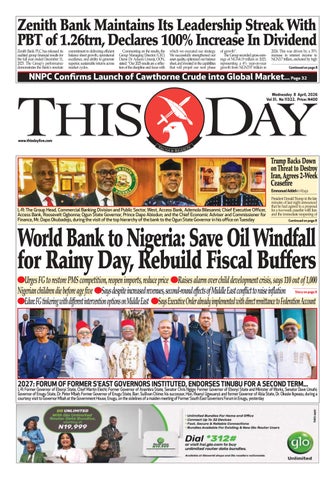
WEDNESDAY 8TH APRIL 2026

Page 1


Zenith Bank Maintains Its Leadership Streak With PBT of 1.26trn, Declares 100% Increase In Dividend

Zenith Bank PLC has released its audited group financial results for the full year ended December 31, 2025. The Group’s performance demonstrates the Bank’s resolute

commitment to delivering efficient balance sheet growth, operational excellence, and ability to generate superior, sustainable returns across market cycles.

Commenting on the results, the Group Managing Director/CEO, Dame Dr. Adaora Umeoji, OON, stated: “Our 2025 results are a reflection of the discipline and focus with

which we executed our strategy. We successfully strengthened our asset quality, optimized our balance sheet, and invested in the capabilities that will propel our next phase of growth”.

The Group recorded gross earnings of NGN4.19 trillion in 2025, representing a 6% year-on-year growth from NGN3.97 trillion in

www.thisdaylive.com

Backs

World Bank to Nigeria: Save Oil Windfall for Rainy Day, Rebuild Fiscal Buffers

Urges FG to restore PMS competition, reopen imports, reduce price Raises alarm over child development crisis, says 110 out of 1,000 Nigerian children die before age five Says despite increased revenues, second-round effects of Middle East conflict to raise inflation

Edun: FG tinkering with different intervention options on Middle East Says Executive Order already implemented with direct remittance to Federation Account

SECOND TERM...

Government House, Enugu, on the sidelines of a maiden meeting of Former South East Governors Forum in Enugu, yesterday

L-R: Former Governor of Ebonyi State, Chief Martin Elechi; Former Governor of Anambra State, Senator Chris Ngige; Former Governor of Ebonyi State and Minister of Works, Senator Dave Umahi; Governor of Enugu State, Dr. Peter Mbah; Former Governor of Enugu State, Barr. Sullivan Chime; his successor, Hon. Ifeanyi Ugwuanyi; and former Governor of Abia State, Dr. Okezie Ikpeazu, during a courtesy visit to Governor Mbah at the
L-R: The Group Head, Commercial Banking Division and Public Sector, West, Access Bank, Ademola Bilesanmi; Chief Executive Officer, Access Bank, Roosevelt Ogbonna; Ogun State Governor, Prince Dapo Abiodun; and the Chief Economic Adviser and Commissioner for Finance, Mr. Dapo Okubadejo, during the visit of the top hierarchy of the bank to the Ogun State Governor in his office on Tuesday

NOTICE OF ANNUAL GENERAL MEETING

NOTICE IS HEREBY GIVEN that the Fifth Annual General Meeting of GUARANTY TRUST HOLDING COMPANY PLC (“the Company”) will hold virtually via https://www.gtcoplc.com/gtco-5th-annual-general-meeting on Tuesday, April 28, 2026, at 10.00 a.m. to transact the following business:

ORDINARY BUSINESS

1. To receive the Audited Financial Statements for the year ended December 31, 2025, and the Reports of the Directors, Auditors and Statutory Audit Committee thereon;

2. To declare a dividend;

3. To elect/re-elect Directors;

4. To authorise Directors to fix the remuneration of the Auditors;

5. To disclose the Remuneration of Managers of the Company;

6. To elect Members of the Statutory Audit Committee.

7. “That in compliance with the Rule of the Nigerian Exchange Limited (NGX) governing transactions with Related Parties or Interested Persons, the Company and its related entities (“The Group”) be and are hereby granted a General Mandate in respect of all recurrent transactions entered into with a related party or interested person provided such transactions are of a revenue or trading nature or are necessary for the Company’s day-to-day operations. This Mandate shall commence on the date on which this resolution is passed and shall continue to operate until the date on which the next Annual General Meeting of the Company is held.”

NOTES

1. Shareholders Attendance at the Meeting

A formal communication containing the necessary access and participation details for the meeting will be sent to shareholders registered email addresses by the Registrar. Shareholders are kindly advised to ensure their details are updated with the Registrar.

2. Dividend

If approved, dividend will be payable on April 28, 2026, at the rate of ₦11.76K per every 50 Kobo ordinary share, to Shareholders whose names appear in the Register of Members at the close of business on April 13, 2026, for holders listed on the NGX and April 7, 2026, for holders listed on the London Stock Exchange (LSE) (bringing total Dividend paid for the 2025 financial year to ₦12.76K). Shareholders listed on the NGX who have completed the e-Dividend Mandate Forms will receive a direct credit of the dividend into their bank accounts on the date of the Annual General Meeting. Note however, that holders of the Company’s Depositary Interest listed on the LSE will receive their dividend payments subsequently.

3. E-Dividend Mandate

Shareholders are kindly requested to update their records and advise Datamax Registrars Limited of their updated records and relevant bank accounts for the payment of their dividends. Forms in respect of mandate for e-dividend payment, unclaimed/stale dividend payment and shareholder data update are included in the Annual Report for convenience. The aforementioned forms can also be downloaded from the Company’s website at www.gtcoplc.com or from Datamax Registrars Limited’s website at www.datamaxregistrars.com.

The duly completed forms should be returned to Datamax Registrars Limited, No. 2c, Gbagada Express Road, Gbagada Phase 1, Lagos State, or to the nearest GTBank branch.

4. Voting by Interested Persons

In line with the provisions of Rule 20.8 (h), Rules governing Related Party transactions of the Nigerian Exchange Limited, Interested Persons have undertaken to ensure that their proxies, representatives or associates shall abstain from voting on resolution 7 above.

5. Unclaimed Dividend

Shareholders are hereby informed that unclaimed dividends remain in the custody of the Registrars. An Unclaimed Dividend booklet containing the list of all unclaimed dividends will be circulated with the Annual Report and Financial Statements. All Shareholders with unclaimed dividends are advised to revalidate their unclaimed dividends through the e-dividend mandate process either by visiting or writing to the Registrar, Datamax Registrars Limited, No. 2c, Gbagada Express Road, Gbagada Phase 1, Lagos State, or via email to tsu@datamaxregistrars.com

6. E-Annual Report

The electronic version of the Annual Report is available at www.gtcoplc.com Shareholders who have provided their email addresses to the Registrars will receive the electronic version of the Annual Report via email. Furthermore, Shareholders who are interested in receiving the electronic version of the Annual Report are kindly required to request via email to annualreports@datamaxregistrars.com

8. “That Non-Executive Directors' remuneration for the financial year ending December 31, 2026, and for succeeding years until reviewed by the Company in its Annual General Meeting, be and is hereby fixed at ₦334,000,000.00 (three hundred and thirty-four million Naira only) annually.”

PROXY

A member entitled to attend and vote at the Annual General Meeting is entitled to appoint a proxy to attend and vote in his/her/its stead. A proxy need not be a member of the Company. For the appointment to be valid, a completed proxy form must be deposited at the office of the Registrar, Datamax Registrars Limited, No. 2c, Gbagada Express Road, Gbagada Phase 1, Lagos State, not less than 48 hours before the time fixed for the meeting. A blank proxy form is attached to the Annual Report. The Company will bear the cost of stamping of all duly completed and signed proxy forms submitted within the stipulated time.

BY THE ORDER OF THE BOARD

ERHI

Group General Counsel/ Company Secretary FRC/2017/PRO/00000016024 Plot 635, Akin Adesola Street Victoria Island, Lagos March 31, 2026

7. Closure of Register

The Register of Members will be closed on April 14, 2026, for Shareholders listed on the NGX and on April 8, 2026, for Shareholders listed on the LSE, to enable the Registrar to prepare for payment of dividend.

8. Statutory Audit Committee

In accordance with section 404(6) of the Companies and Allied Matters Act, 2020, any shareholder may nominate a shareholder for appointment to the Statutory Audit Committee. Such nomination should be in writing and should reach the Company Secretary at least twenty-one (21) days before the Annual General Meeting.

Kindly note that by virtue of the provisions of the Code of Corporate Governance issued by the Securities and Exchange Commission (SEC) and the Companies and Allied Matters Act, 2020, all members of the Statutory Audit Committee should be financially literate and at least one member must be a member of a professional accounting body in Nigeria established by an Act of the National Assembly and be knowledgeable in internal control processes.

In view of the foregoing, nominations to the Statutory Audit Committee should be supported by the Curricula Vitae of the nominees.

9. Election/Re-election of Directors

i. Mr. Babatunde Soyoye is being proposed for election as an Independent Non-Executive Director;

ii. Mrs. Marie Namias is being proposed for election as an Independent Non-Executive Director;

iii. Mr. Suleiman Barau is being proposed for re-election as an Independent Non-Executive Director;

iv. Mrs. Cathy Echeozo is being proposed for re-election as a Non-Executive Director;

The appointment of Mr. Babatunde Soyoye and Mrs. Marie Namias have been approved by the Central Bank of Nigeria and will be presented for Shareholders approval at the Fifth Annual General Meeting.

The profiles of the Directors are available in the Annual Report and also on the Company’s website at www.gtcoplc.com

10. Shareholders’ Right to Ask Questions

Shareholders reserve the right to ask questions at the Annual General Meeting. Shareholders may also submit questions prior to the Meeting in writing to the Company, in line with Rule 19.12(c) of the Listing Rules of The Nigerian Exchange Limited. Such questions should be addressed to the Group Company Secretary and reach the Company at its Head Office or by electronic mail at holdcocommunication@gtcoplc.com not later than seven (7) days to the date of the Meeting.

LAGOS FANTI CARNIVAL 2026...

L-R: Chairman, Lagos State House Assembly Committee on Tourism, Arts and Culture, Hon. Solomon Bonu; Permanent Secretary, Lagos State Ministry of Tourism, Arts and Culture, Mrs Bopo Oyekan-Ismaila; Lagos State Commissioner for Tourism, Arts and Culture, Mrs Toke Benson-Awoyinka; and First Lady, Lagos State, Dr Claudiana Ibijoke Sanwo-Olu, at Lagos Fanti Carnival 2026... recently

Gulf Crisis: Afreximbank Okays $10bn

Buffer for African, Caribbean Nations

exports

The African Export-Import Bank has approved a $10 billion emergency facility aimed at cushioning African and Caribbean economies from the widening economic fallout of the escalating Middle East conflict, as concerns mount over disruptions to global energy, food and financial markets.

The lender in a statement yesterday said its Board signed off on the Gulf Crisis Response Programme (GCRP) as part of efforts to insulate vulnerable economies from sharp external shocks triggered by the crisis.

The conflict which began on February 28, 2026 has since rattled supply chains and commodity markets worldwide, underscoring the strategic importance of the Gulf region to global energy and trade flows, particularly given its dominance in oil and gas exports and the critical shipping route through the Strait of Hormuz.

For many African and Caribbean economies that depend heavily on imports and external inflows, the disruptions have translated into higher inflation, fiscal strain and balance of payments pressures.

According to the bank, the

programme is designed to provide immediate foreign exchange liquidity and trade finance support to member countries grappling with rising import costs and constrained access to critical supplies such as fuel, liquefied natural gas, fertilisers, food and pharmaceuticals.

The intervention, it explained, is also expected to stabilise currencies under pressure from elevated import bills and capital flow volatility.

Afreximbank said the initiative would not only address immediate liquidity challenges but also enable countries and corporate organisations to take advantage of emerging opportunities from shifting global trade patterns.

According to the organisation, this includes supporting energy and mineral exporters with preexport finance, working capital and inventory financing to scale production and benefit from higher commodity prices.

“To counter the severe economic shocks triggered by the escalating conflict in the Middle East, the Board of Directors of African Export-Import Bank (Afreximbank) has approved a US$10 billion Gulf Crisis Response Programme (GCRP) to insulate African and

Caribbean economies, financial institutions and corporates from the impacts of the ongoing Gulf crisis.

“Given the significance of the Gulf region as a primary global source of oil, Liquid Nitrogen Gas (LNG), fertilisers, as well as the critical role of the Strait of Hormuz, the outbreak has triggered wider repercussions at a global scale, including adversely affecting African and CARICOM economies.

“These impacts specifically affect nations that heavily rely on fuel, fertiliser, and food imports, alongside those exposed to Gulf shipping corridors, investment flows, tourism and remittance inflows. GCRP is designed to, among others, sustain essential imports – including fuel, LNG, food, fertiliser, pharmaceuticals – by providing vital short-term Foreign Exchange (FX) and liquidity to support vulnerable member states,” the bank noted.

In addition to trade and liquidity support, the facility, the organisation said, will provide targeted assistance to sectors such as tourism and aviation, which have been adversely affected by reduced travel flows and heightened geopolitical uncertainty.

The bank also indicated that part of the funding would go towards accelerating critical infrastructure projects, particularly in energy, ports and logistics, that have faced delays due to the crisis.

“It further aims to empower African energy and minerals exporters to capitalise on elevated prices and rerouted trade flows, by scaling productive capacity in strategic commodities, through pre-export finance, working capital, and inventory financing.

“Additionally, it provides short term relief to African and Caribbean member states whose tourism and aviation industries have been adversely impacted by the crisis,” Afreximbank added.

Obi Queries FG’s Repeated N3.3tn Power Debt Approvals, Demands Accountability

Former presidential candidate of the Labour Party, LP, Peter Obi, has questioned the federal government’s repeated approval of multi-trillion-naira interventions in the power sector, describing the development as a reflection of deeper structural and governance challenges.

In a detailed post shared on his X handle on Tuesday, Obi expressed concern over what he

Access Bank Applauds Ogun’s InvestorFriendly Policies, Backs Airport Vision

The Chief Executive Officer of Access Bank Plc, Roosevelt Ogbonna, has commended the Ogun State Government for creating a businessfriendly environment that continues to attract investors.

Ogbonna gave the commendation during a visit to Governor Dapo Abiodun, where he led a delegation of senior executives from the bank.

He said Ogun’s policies have gone beyond driving investment inflows, noting that they foster partnerships focused on long-term development and shared vision for the state’s future.

The Access Bank CEO also

lauded the development of the Gateway International Airport, describing it as a landmark project that reflects bold leadership and strategic planning.

“I am extremely proud. Ogun State is making it a habit of showing Nigerians what a working democracy looks like,” he said, adding that the transformation of ideas into tangible infrastructure underscores the government’s commitment to excellence.

Ogbonna expressed satisfaction with the bank’s role in supporting the airport project, noting that Access Bank remains committed

to financing initiatives that drive economic growth and development.

In his remarks, Governor Abiodun described Access Bank as a reliable development partner, praising its willingness to support the state’s vision from conception to execution.

“They saw the vision from the outset and backed it. A vision without funding is merely a hallucination,” the governor said. He added the collaboration highlights the importance of strong public-private partnerships in delivering impactful infrastructure and sustaining economic progress.

described as recurring financial approvals for the same liabilities without visible progress in electricity supply across the country.

“Let us reflect, sincerely and without sentiment,” he began, urging Nigerians to examine the pattern of policy decisions surrounding the power sector.

He noted that in recent days, the president reportedly approved N3.3 trillion as a “full and final” settlement for debts in the sector, pointing out that similar approvals had been made previously without clear evidence of resolution.

“On May 17, 2024, N3.3 trillion was approved for the same purpose. On July 25, 2024, another

N4 trillion bond was approved to settle similar debts. There have also been other approvals in between, all targeted at addressing the same power sector liabilities,” he stated.

Obi questioned whether earlier approvals were effectively implemented, asking, “This raises a fundamental question: were the previous approvals mere announcements without execution?”

Highlighting the continued instability in electricity supply, he referenced campaign-era commitments made by the current administration.

According to him, the worsening state of power generation and distribution contradicts earlier

assurances made to Nigerians. “During the 2023 campaign, President Bola Ahmed Tinubu made a clear promise: that if he failed to deliver stable electricity, Nigerians should not re-elect him,” he said.

Obi added that the situation has deteriorated to the point where discussions have emerged about disconnecting the Presidential Villa from the national grid, describing it as indicative of broader systemic failure.

The Presidential Villa, also known as Aso Rock Presidential Villa, serves as the official residence and workplace of the Nigerian President.

On World Health Day, First Lady Canvasses Global Support for Science and Investment in Health Systems

Wife of the President, Senator Oluremi Tinubu has canvassed global support for science and investment in health systems.

In a message issued on Tuesday to mark this year’s World Health Day, the First Lady emphasised the need “for us continue to support science, invest in health systems, and work together to build a healthier and a more resilient

world for all.”

Mrs Tinubu, in the message stated, inter alia:

“Today, on World Health Day 2026, with the theme, “Together for Health. Stand with Science,” reminds us that progress in health depends on innovation and strong collaboration across nations and sectors. Scientific partnerships have helped humanity overcome many health challenges and continue to guide us toward healthy living.

“This year’s campaign also highlights the importance of the One Health approach, recognizing that the well-being of people, animals, plants, and our environment is deeply interconnected.

“As we mark this important day, as a global community, let us continue to support science, invest in health systems, and work together to build a healthier and a more resilient world for all.

“Happy World Health Day 2026.”

Emmanuel Addeh in Abuja

INVESTITURE OF OBA OGUNSANWO AS 6TH CHANCELLOR OF LASU...

L-R: Registrar, Lagos State University, LASU, Mr. Emmanuel Fanu; Pro Chancellor and Chairman, Governing Council of LASU, Mr. Babatunde Ogala (SAN);

Ogunsanwo; Alara of Ilare, Epe, Oba Olufolarin Ogunsanwo; Governor of Lagos State, Mr. Babajide Sanwo Olu; and the Vice Chancellor of LASU, Prof.

Bello, during the investiture of Oba Ogunsanwo as the 6th Chancellor of LASU, held at the Lagos House, Ikeja, yesterday

UN Pledges Support for Dangote Group to Scale Global Impact on Food Security

Says conglomerate key to tackling Africa’s food security challenges Africa’s richest man confirms NNPC supplied refinery 10 crude cargoes last month

The Deputy Secretary-General of the United Nations, Amina Mohammed, has underscored the strategic importance of Dangote Industries Limited, particularly the Dangote Fertiliser Limited—in addressing Africa’s mounting food security challenges, while calling for stronger global partnerships to scale its impact.

Speaking during a visit to the company’s industrial complex at Ibeju-Lekki, Lagos, Mohammed said

the United Nations would prioritise amplifying scalable solutions capable of mitigating the continent’s food crisis, describing Dangote’s integrated industrial model as a critical pathway.

“I think the UN’s job here is to amplify and to put visibility on the possibilities of mitigating a food security crisis, and this is one of them,” Mohammed was quoted to have said n a statement by Dangote Group.

“I hope that when we go back, we can continue to engage partners and countries that should collaborate

with Dangote Industries,” she added.

Her remarks come at a time of heightened concern over food shortages and supply chain disruptions across Africa, driven by global economic pressures, climate-related shocks and geopolitical tensions, particularly in the Middle East.

In his remarks, President/Chief Executive of Dangote Industries Limited, Aliko Dangote, said the group has ramped up exports of urea and Premium Motor Spirit (PMS) to African markets affected

by supply disruptions arising from the crisis.

Noting the widening impact of the situation across the continent, Dangote said the company has intensified shipments of fertiliser to support agricultural productivity and ease supply constraints.

“The challenges are many. One is of urea, which is fertiliser that we have. I think in the last couple of days we’ve been loading to mostly African countries, which we were not doing before.

“And then now it’s to do with petroleum products, which we are now sending mainly to African countries”, Dangote said.

He added that the refinery has shipped about 17 cargoes of petrol to African countries to cushion the impact of the crisis, leveraging its 650,000 barrels per day capacity to stabilise supply across multiple regions.

“What I can do is assure Nigerians ... and most of West Africa, Central Africa, and East Africa, we have the

Three Cities to Host L’Afrique Fashion Fest 10th

Three cities, including Port Harcourt, Lagos and London are set to host the 10th edition of the L’Afrique Fashion Fest, slated for July, September and November in 2026.

L’Afrique Fashion Fest, is a celebration of creativity, culture and artistry, that has drawn participation from across African countries like Ghana, Cameroun, Benin Republic, amongst others, since its launch nine years ago.

The aim of L’Afrique is to spotlight Africa and its rich fashion diversity and create a platform for indigenous designers to showcase their creativity, and for brands to meet with end users of their products.

At a press briefing to unveil the 10th edition of the Fashion Fest I. Port Harcourt, Rivers State, yesterday, Chief Executive Officer of L’Afrique Fashion Fest, Emmer Schneider, stated that this year’s theme: “Beyond Borders,” is to launch the brand to the international community.

“L’Afrique has been in the city of Port Harcourt for nine consecutive editions and we have been bringing fashion to the city of Port Harcourt. Designers come from different parts of Africa, from Ghana, from Benin Republic, from Cameroon, from different cities, and they have been coming to Port Harcourt to showcase their very outstanding collections

and we’ve worked with a lot of brands for these nine years.

“But for this 10th edition, we are highlighting “Fashion Beyond Borders. We are taking it to three cities. So, we are going to be having the event in Lagos, Port Harcourt, and of course in London. It is a good opportunity for L’Afrique to go international,” he said.

Schneider stressed that for the past nine years L’Afrique has proven to be a very solid brand, pointing out that its uniqueness is in its audience.

“So, for this particular edition we are expecting to go outside the shores of Port Harcourt city and we are making it a global affair,” he said.

The L’Afrique CEO mentioned

Gov Mbah Cracks Down, Abolishes Daily Market Tolls, Police Arraign Two for Illegal Revenue Collection

Governor of Enugu State, Dr. Peter Mbah has made good his threat to wield the big stick on illegal revenue collectors and extortionists making life difficult for Enugu residents.

While Mbah, on Tuesday, announced an immediate and indefinite suspension of daily toll collection from those who have no lockup shops, declaring it as illegal, the Enugu State Police Command on the same day arraigned two before an Enugu Magistrate Court

for stealing and forgery of receipts and illegal revenue collection for the registration of native doctors in the state.

Governor Mbah gave the order on the suspension of daily revenue collection from petty traders at a stakeholders’ meeting on the clarification and harmonisation of revenue collection in markets across the state organised by the Enugu State Internal Revenue Service at the Old Government Lodge, Enugu.

Represented by the Secretary to the State Government, SSG, Prof. Chidiebere Onyia, the governor said the action was in line with the new tax laws meant to support the poor, adding that a taskforce chaired by the SSG had been put in place to ensure maximum compliance, vowing that anyone caught collecting the 100 or 200 Naira daily toll revenue, either for the government or an individual, would face the full weight of the law.

that over the years, the brand has provided opportunities for designers and models, thereby empowering and providing employment for teeming designers.

“We have what we call the Face of L’Afrique competition, and the face of L’Afrique is always used for particular events, special appearances, bill boards, modeling. It’s a way of building your modeling career as a model.

“Secondly, the designers are benefiting greatly from L’Afrique. A lot of them build their clientele from

Edition

L’Afrique. With the on-site and the online audience and the media as well, people who watch L’Afrique always want to identify with these designers,” Schneider said.

He further stated the platform has showcased different arts over the years. “We have been bringing people from Big Brother Nigeria, featuring Big Brother Nigerian stars. It has really helped the creative scene. And of course, it generates some level of employment as well because people are being contracted for the show.

capacity to supply them,” Dangote said.

On feedstock supply, Dangote commended the Nigerian National Petroleum Company Limited (NNPC) for increasing crude deliveries to the refinery in March, noting that volumes rose to 10 cargoes—six supplied in naira and four in dollars—to support domestic fuel availability.

“Last month, they gave us six cargoes for naira and four cargoes for dollars,” he said.

Despite the improvement, the company said the supply remains below the 19 cargoes required for optimal operations, with the refinery continuing to bridge the gap through imports from the United States and other African producers.

Dangote also expressed concern over the unwillingness by international oil companies operating in Nigeria to sell to the refinery, stating that their preference for selling crude to traders forces it to repurchase at higher costs, with broader implications for the economy.

Dangote added that the refinery is seeking increased access to domestically priced crude under local currency arrangements as part of efforts to moderate fuel costs and enhance long-term energy and food security across the continent.

AltBank Plans Nationwide EV Financing Push, Targets Informal Transport Sector

The Alternative Bank is making a major push into electric vehicle (EV) financing, positioning the sector as a key growth opportunity as it seeks to bring Nigeria’s largely informal transport market into the formal financial system.

The Bank says beyond clean energy, EVs are emerging as income-generating assets that can create jobs, reduce operating costs, and open new pathways to financial inclusion for transport operators who have historically been shut out of conventional lending.

Divisional Head, Commercial & Institutional Banking (Core North),

Abdul laid out the case at the Abuja Compact on Electric Mobility Roundtable, where government officials, financiers, and industry players gathered to explore how electric mobility can strengthen Nigeria’s economy and support its energy transition. He pointed to the sector’s growing economic impact, particularly in job creation and income growth, noting that the shift toward EVs is generating higher-paying opportunities and improving livelihoods across the value chain.

“Without transport, you cannot effectively achieve growth in any of the other sectors. Mobility powers everything. If you need to get to

a hospital, you need mobility. If you are moving from home to the farm, you need mobility. Even in renewable energy operations, mobility is essential,” Abdul said. The Bank is already working with partners to expand EV adoption across the country, including exploring retrofitting as a lower-cost entry point for operators looking to transition from petrol-powered vehicles. AltBank’s strategy draws on its roots as a non-interest banking institution. Abdul said the Bank adopts financing structures suited to the realities of Nigeria’s transport sector, where many operators lack formal credit histories and earn irregular incomes.

Olori Bolanle
Ibiyemi Olatunji
Kuni Tyessi in Abuja
Mohammed
Blessing Ibunge in Port Harcourt
Peter Uzoho

MEGA EMPOWERMENT PROGRAMME FOR MBAITOLI/ IKEDURU CONSTITUENCY...

L-R: Former Minister of Youth Development, Dr. Jamila Ibrahim; Imo State APC Chairman, Hon. Austin Onyedebelu; Member of the House of Representatives (APC, Mbaitoli/Ikeduru Federal Constituency), Hon. Engr. Akarachi Amadi; and his wife, Barr. Mrs. Adaobi Amadi, at the mega empowerment programme for Mbaitoli/ Ikeduru Constituency by Hon. Amadi in Eziama, Ikeduru Local Government Area of Imo State on Sunday

Shettima: Nigeria’s Ready to Lead Africa’s AI Pathways For Prosperity

Says nation must shift from consumer of imported technologies to producer of innovation, scalable solutions

Vice President Kashim Shettima has affirmed Nigeria’s preparedness to lead Africa in deploying Artificial Intelligence (AI) to unlocking new pathways for the continent’s prosperity.

According to him, while AI has become humanity’s most powerful general-purpose technology that would define lives and the future of mankind, the technology will continue to serve as a “profound engine of creativity, capable of augmenting human intelligence and expanding the horizons” of human possibilities.

Shettima, who spoke in Lagos during the official launch of the AI University Innovation Pod (UniPod) University of Lagos, explained why “Nigeria must not be passive in the unfolding AI era.”

Represented by Deputy Chief of Staff to the President, Senator Ibrahim Hadejia, the Vice President said the nation must build digital foundations that allow its innovators, governments, and enterprises to create solutions that reflect its realities and address the country’s

unique challenges.

“Whether in agriculture, health, education, or finance, AI has the power to unlock new pathways for prosperity. But it will do so only if we design systems that are inclusive, equitable, and rooted in our values. I believe Nigeria is prepared to lead the whole African continent in this endeavour.

“Our investments in digital public infrastructure, our embrace of innovation ecosystems, and our commitment to responsible AI governance all point to a singular goal: to make Nigeria not a consumer of imported technologies, but a producer of knowledge, innovation, and scalable solutions,” he stated.

Inaugurating the UniPods, Shettima said the national innovation systems reflects a deliberate shift in how universities are being viewed, noting that the citadels of great learning are not only centres of instruction but also “platforms for production, enterprise, and national development.

“Projects like this UniPod are an integral part of that delivery architecture where students, researchers, and industry practitioners collaborate to build solutions that respond directly

to real economic needs,” he added.

The Vice President appreciated development partners, including the United Nations Development Programme (UNDP), Tertiary Education Trust Fund (TETFUND), the University of Lagos, and the Lagos State Government for the nation’s first UniPod.

“More importantly, I want to

emphasise that this is not a one-off intervention. It is part of a system we intend to scale, sustain, and subject to results. What we are doing here, and across similar efforts nationwide, is to build dozens of institutional bases required to compete—patiently, but with clarity, Shettima further said.

Earlier, Resident Representative of the UNDP in Nigeria, Ms.

Elsie G. Attafuah, noted that the UniPod is a system that “ensures that Nigeria’s young population is not only prepared for the future but is actively engaged in shaping it.”

She said, as a system that connects knowledge to opportunity, innovation to enterprise, and talent to national prosperity, the UniPods will position Nigeria, “not merely as

a participant in the global economy, but as a country that is deliberately building the foundations for longterm competitiveness and inclusive growth.

“This is a significant moment. And UNDP is proud to stand with UNILAG, the Government, and people of Nigeria as a partner in this journey,” Attafuah added.

FG Unveils Health Facility Survey 70% Offer Child Delivery Services

Onyebuchi Ezigbo in Abuja

The federal government yesterday launched the National Health Facility Survey - 2025, highlighting the state of affairs regarding maternal reproductive health, family planning, vaccination, child health and nutrition.

It stated that the report of the survey indicated that 70 percent of public health facilities offer child

WHO Highlights Importance of Science in Disease Control

Onyebuchi Ezigbo in Abuja

The World Health Organization (WHO) has emphasized the key role being played by science and research applications in global efforts on disease control and in terms of the providing lifesaving interventions.

It said activities ranging from immunization, to disease prevention and maternal child healthcare require more interventions linked to science.

Speaking during a Road Walk to mark this year’s World Health Day in Abuja, the WHO Country Representative in Nigeria, Dr. Pavel Ursu, said science helps us to have factual information on our health which is authentic.

“It is important for us to stand in science. Science follows research. It follows evidence. It follows digging deep to know the real thing before we disseminate.

“We stand with science, what we see today, what we have today in terms of the disease control, in terms of the lifesaving is due to the science and due to the fact that science can be translated into health saving interventions,” he said.

The programme which started with physical exercise and a Road Walk saw staff of WHO, Federal Ministry of Health and Social and other stakeholders march from the Old Parade Ground in Central Area of Abuja - the Federal Capital

Territory to the Federal Secretariat.

Pavel Ursu also spoke of the importance of engaging in physical exercise as a means of promoting good health.

“The message to everyone the physical exercise they are also contributing to our health. And there is a lot of scientific confirmation of the fact that physical exercise is saving lives, is reducing the risks for health,” he said.

The WHO further said that having the right channel of information and being responsible users of the information is very critical in promoting good health-seeking behaviours among the people in various communities.

delivery services, reflecting broad availability and growth monitoring services for children.

The unveiling of the facility survey came just as the federal government said it was targeting to ensure that at least 30 percent of public health facilities enjoy stable electricity supply.

Speaking at the ceremony marking the World Health Day in Abuja, the Minister of State for Health and Social Welfare, Dr Iziaq Salako, said immunisation services are widely provided in most of the public health facilities, He said the ministry was working to ensure a swift response to any health emergency in the country.

On the current state of health service delivery as of November, Salako said while the survey showed that immunisation services are widely provided, “ approximately 70 percent of public facilities offer delivery services, reflecting broad availability, growth monitoring services for children.”

“While vaccination is widely provided, it was also found that approximately 70 percent of public facilities offer delivery services, reflecting broad availability, growth monitoring services for children are also widely available, supporting child health and nutrition.

“In addition, most vaccines in the National Immunisation programme

are available in about 50 percent of the facilities that were assessed indicating ongoing efforts to sustain it within the organisation,” he said.

Salako said this year’s theme for World Health Day, “Together for Health: Stand with Science,” was both timely and profound as it calls on governments, scientists, health professionals, and communities to ensure that health policies and decisions are guided by evidence, research, and scientific collaboration

The Minister used the occasion to reaffirm the federal government’s commitment to tackling challenges of the health sector through the implementation of reforms under the Renewed Hope Agenda.

He said there was remarkable improvement in budget releases to the ministry and all its agencies and departments.

He also said disbursements through the Basic Healthcare Provision Fund have continued steadily, with about N215 billion disbursed since 2023.

Answering questions on progress being made at local vaccine production, the Minister said there was a progressive movement towards being able to do local vaccine production.

“Well, I think that first you must know that the agency of government, National Agency for Food, Drug Administration and control,

NÀFDAC, which is in charge of the regulatory mechanisms for production of pharmaceuticals, vaccines and consumables, as increasingly meeting global standards, to the extent that, as we speak, we are on maturity level three, one of the five or six Africa countries that is at that level in the continent,” he added.

In the area of health insurance, Salaki said a report showed that more than 21.7 million Nigerians are now covered under various health insurance schemes representing almost 33 percent growth from late 2023.

In his goodwill message, WHO Representative in Nigeria, Dr. Dr. Pavel Ursu, said there are still significant challenges facing the healthcare system in Nigeria. He said while many people still lack access to essential health services, preventable maternal and child deaths persist.

“Emerging health threats, climate-related risks and antimicrobial resistance continue to test the resilience of health systems. At the same time, inequities and declining trust in science risk slowing progress.

“These challenges cannot be addressed in isolation. They require a shared commitment across sectors, disciplines and communities,” he said.

Deji Elumoye in Abuja and Oluchi Chibuzor in Lagos

AfDB Creating Innovative Solutions to Scale Investments for Nigeria’s $2.3trn Infrastructure Needs

Says its portfolio in Nigeria is about $5.2 billion

The African Development Bank (AfDB) has stated it is applying innovative solutions to help Nigeria raise investments for infrastructure estimated to require $2.3 trillion to reach international benchmark of 7.0 per cent infrastructure to GDP ratio.

This was disclosed yesterday in Lagos by the Regional Integration Coordinator, AfDB Nigeria Country Department, Mrs. Omotere Omoluabi-Davies, at the West Africa Infrastructure Expo that was organised by the DMG Events.

Omoluabi-Davies also said the bank is also introducing Naira denominated facilities in order

to counter foreign exchange risks due to fluctuations in the value of local currency.

She said: “We do things a little bit differently, especially how we mobilise and scale investments, how we strengthen project bankability and how we accelerate delivery, which is where we have lesson to learn.

“We are aware of the capitalintensive nature of these projects, so to do that we look for innovative solutions and how to manage risks effectively for the delivery of infrastructure.

“Our goal is not to crowd out private capital. It is to see how we can have compatibility, value addition and attracting private

capital through de-risking and value addition for sustainability.”

She explained the two priorities of AfDB’s country strategy in Nigeria are climate smart infrastructure and to ensure job creation.

She added: “AfDB is creating credit enhancement facilities like Infracredit by joining with other partners like the African Finance Corporation, the Development Bank of Nigeria, Nigeria Sovereign Investment Authority, etc.

The Infracredit is to capacitate infrastructure credit by providing guarantee for local currency bonds issued for financing infrastructure in Nigeria.

“As at September 2025, infracedit has delivered 22 infrastructure

projects and mobilised about N308 billion of long term funding from 21 pension funds institutions and other institutional investors in Nigeria.

“It is also supporting first time bond issuers especially green infrastructure bond and the longest non-sovereign corporate bond of up to 20 years that is unusual in the market,” she said.

Omoluabi-Davies said that 60 per cent of AfDB’s portfolio in Nigeria is for infrastructure, “but a bulk of that 60 per cent is focused on the infrastructure, energy, industrialisation and the digital landscape.

“Now, on the currency issue, this has been a big issue, especially given all the fluctuations and the

currency risks we have seen in Nigeria, and not just Nigeria, but the continent in the last couple of years.

“So, yes, indeed, most of our financing is in foreign currency.

“We have some instruments where we are trying to develop more Naira-denominated loans.

“So, in fact, our portfolio in Nigeria is about $5.2 billion, and I think 60 per cent of it is public and 40%l per cent of it is private, and across all the sectors.”

In her welcome remarks, Senior Vice President, DMG Events, Ms. Josine Heijmans, said that as Africa’s largest economy, Nigeria is at a critical stage in its development journey of advancing its long-term

WORLD BANK TO NIGERIA: SAVE OIL WINDFALL FOR RAINY DAY, REBUILD FISCAL BUFFERS

Ndubuisi Francis in Abuja

The World Bank has prescribed some policy responses for Nigeria in the wake of the ongoing conflict in the Middle East, including fiscal discipline, rebuilding fiscal buffers, and saving from the oil windfall for the rainy day.

The outbreak of the conflict, which pitted Iran against the United States of America and Israel, had seen oil prices shooting above $100 per barrel, higher than Nigeria’s budgeted benchmark price of $64.85.

Presenting the April 2026 edition of Nigeria Development Update (NDU), titled, “Nigeria’s Tomorrow Must Start Today: The Case for Early Childhood Development,” in Abuja, Tuesday, World Bank Lead Economist for Nigeria, Fiseha Haile, stated that the country’s gross revenues had increased due to economic reforms.

Haile added that more revenues were expected from higher oil prices linked to the Middle East conflict.

He said the NDU report recommended a cocktail of policy responses for Nigeria to manage the oil windfall and reduce inflationary pressures stemming from the Middle East conflict.

Such policy responses bordered on fiscal discipline, monetary and foreign exchange (FX) policy, and

what the report described as market functioning.

On fiscal discipline, Haile said World Bank admonished Nigeria to save for the rainy day, rebuild fiscal buffers, and adopt targeted social protection, not blanket subsidies.

Regarding monetary and FX interventions, the bank urged Central Bank of Nigeria (CBN) to keep appropriate monetary policy, anchor inflation expectations, absorb shocks, limit interventions, and ensure FX flexibility, while providing clear, consistent signals to anchor expectations.

The report also called on the Nigerian authorities to restore competition in the supply of premium motor spirit (PMS) or petrol by reopening imports, and reduce pump prices.

World Bank equally called for the easing of supply constraints, and a reduction in tariffs, as well as lifting of import bans on certain items (including on intermediate inputs).

The April NDU, the first for 2026 of the usually comprehensive, twice yearly, thematic reports of the World Bank on the country, acknowledged that Nigeria had made meaningful progress in restoring macroeconomic stability.

But Haile stated, “Inflation is still elevated and under increasing ⁠pressure, and that poses risks to incomes and poverty reduction.”

He equally pointed to the fact that Nigeria’s external buffers had improved, as foreign exchange reserves rose and volatility eased. However, tighter global financing conditions still threatened inflows, borrowing costs, and remittances, the report stated.

Nigeria’s fiscal deficit widened slightly to 3.1 per cent of GDP in 2025, but remained lower than in pre-reform years, Haile said, adding that the debt to GDP ratio fell for the first time in a decade, buoyed by stronger fiscal performance and exchange rate valuation gains. However, he stated that inclusive growth must accelerate substantially to improve livelihoods, adding that this partly depends on how effectively Nigeria invests in its people, creates jobs, and starts in early life.

The report said while recent bold reforms had strengthened macroeconomic fundamentals, enhancing Nigerians’ productive capabilities will be critical to translating these gains into better living standards and jobs.

Nigeria’s economy grew by 4.0 per cent in 2025, the same as in 2024, driven mainly by services, such as ICT, financial services, and real estate, with mild expansion in other sectors, the report said.

World Bank explained that Inflation had eased notably, falling to 15.1 per cent year on year in

TRUMP BACKS DOWN ON THREAT TO DESTROY IRAN, AGREES 2-WEEK CEASEFIRE

the Strait of Hormuz, stepping back from a self-imposed deadline to launch sweeping new strikes he warned could devastate the country.

In a social media post just hours before his deadline, Trump said he would “suspend the bombing and attack of Iran for a period of two weeks” following his conversations with Pakistan’s leadership and what he described as meaningful progress towards a broader agreement with Iran.

“This will be a double sided ceasefire!” Trump wrote on Truth Social. “The reason for doing so is that we have already met and exceeded all military objectives, and are very far along with a definitive agreement concerning long-term peace with Iran, and peace in the Middle East.”

He added that the U.S. has received a 10 point proposal from Iran that he believes “is a workable basis on which to negotiate.”

The announcement marked a sudden de-escalation after a day

of extraordinary threats in which Trump warned that “a whole civilisation will die tonight” if Iran did not agree to his demands.

The tentative ceasefire hinges on Iran’s agreement to immediately and fully reopen the Strait of Hormuz, the narrow waterway through which roughly a fifth of the world’s oil supply passes. Since the early weeks of the war, Iran has effectively choked off traffic through the passage, triggering a global energy shock that has sent fuel prices soaring and rattled financial markets.

Trump had previously suggested the United States could rapidly destroy Iran’s bridges, power plants, and other infrastructure—a campaign that military and legal experts warned could devastate civilian life in a nation of roughly 85 million people and risk violating international law, a TIME report said.

The decision to walk back his threat underscored a familiar pattern in Trump’s presidency: issuing maximalist threats, only to

recalibrate as the risks of carrying them out come into sharper focus. It also reflected the competing pressures bearing down on a White House that has spent weeks edging closer to a wider war while searching for a way out of it.

TIME previously reported that Trump has grown increasingly eager to find an off-ramp. Polling has shown declining public support for the war, while rising fuel prices and market volatility have alarmed Republican lawmakers ahead of the midterm elections. At the same time, the President has been reluctant to end the conflict without being able to claim a decisive victory.

In a post on his social media site, Trump said Iran could agree “to the complete, immediate, and safe opening of the Strait of Hormuz” and said that he’d then “suspend the bombing and attack of Iran for a period of two weeks.”

February 2026, down from 26.3 per cent a year earlier, supported by tight monetary policy, reduced exchange rate volatility, and improved food supply.

Despite those gains, World Bank stated that household incomes were yet to recover fully, as poverty remained high, highlighting the need to lower inflation further and complement stabilisation with investments that expand economic opportunity and jobs.

The Middle East conflict, the report observed, was expected to have mixed but manageable effects on Nigeria. It added that higher oil prices will boost revenues and exports, but higher energy, fertiliser, and shipping costs, alongside second-round effects, will add to inflation.

It also stated that global risk aversion could tighten financial conditions and pressure the exchange rate, which should remain flexible to cushion shocks.

The report further stressed that fiscal policy should leverage the windfall to rebuild buffers and provide targeted support to vulnerable households, avoiding blanket subsidies, while monetary policy should remain tight, supported by lower import barriers on input and food.

But the bank cautioned that macroeconomic stability alone was not sufficient, stating that human

capital development is a key channel through which macroeconomic gains can translate into improved living standards and jobs.

That channel, it pointed out, began early, as investments during pregnancy and early childhood shaped long-term productivity and shared prosperity.

“Yet outcomes in Nigeria remain weak and unequal: about 110 out of every 1,000 children die before age five, 40 per cent are stunted, and more than half are not developmentally on track before entering school,” the bank lamented.

In his remarks at the NDU launch, World Bank Country Director for Nigeria, Mathew Verghis, said, “Nigeria has made efforts to stabilise its economy, but welfare gains are still modest. Moreover, the conflict in the Middle East adds pressures. Sustaining and deepening macroeconomic stabilisation, as well as addressing structural constraints, will be critical to translating reform dividends into faster, more inclusive growth, jobs and improved living standards.

“Investing early in nutrition, health, caregiving, safety and early learning is one of the most powerful ways Nigeria can convert today’s reform gains into higher productivity, better jobs, and lasting poverty reduction.”

Verghis said improving early

which are increasingly central to economic growth and national progress.

childhood outcomes required a more integrated approach—bringing together nutrition, health, responsive caregiving, early learning, and children’s living environments, including access to water and sanitation, into a coherent and continuous package of support.

He said that included defining a basic package of services from pregnancy to age five, improving targeting and delivery, engaging private sector and community providers, and aligning financing and coordination with measurable outcomes.

Nevertheless, on the country’s economic trajectory, the report stated, “The outlook for Nigeria’s economy remains cautiously optimistic. Growth is projected at 4.2 per cent over 2026-2028, supported by continued macroeconomic stabilisation, ongoing structural reforms, and increased investment. Inflation, which is still high, is expected to fall gradually, albeit more slowly than previously expected due to pressures from the Middle East conflict.”

At a panel discussion, Minister of Finance and Coordinating Minister of the Economy, Mr. Wale Edun, disclosed that the federal government had been tinkering with appropriate intervention

BANK MAINTAINS ITS LEADERSHIP STREAK WITH PBT OF 1.26 TRN, DECLARES 100% INCREASE IN DIVIDEND

asset yields, an increase in interest earning assets and effective pricing. Net interest income grew by 53% to NGN2.6 trillion, highlighting the Bank’s ability to maintain a healthy spread between asset yields and funding costs. Despite a 5% drop in Profit Before Tax to NGN1.26 trillion, due to a bold and prudent cleanup of facilities which were under regulatory forbearance, Profit After Tax grew slightly by 1% to close at NGN1.04 trillion, with an Earnings Per Share (EPS) of NGN25.32.

Customer deposits grew by 11% from NGN22 trillion to NGN24 trillion, as a result of a sustained increase in both corporate and retail deposits, affirming the enduring depth of the Bank’s funding base.

Gross loans moderately rose to NGN11 trillion, with the underlying growth offset by the write off of forbearance related exposures, a move that has markedly improved the quality of the Bank’s risk asset portfolio.

Non-Performing Loan (NPL)

ratio improved to 3.8% in December 2025 from 4.7% in December 2024.

The coverage ratio remained robust at 173%, underscoring the Bank’s commitment to prudent provisioning and a culture of strict regulatory compliance.

Return on Average Equity (ROAE) and Return on Average Assets (ROAA) stood at 23.2%, and 3.4% respectively. Our Net Interest Margin (NIM) of 13.7% for the full year reinforces the sustainability of the Group’s core earnings.

The Group’s cost-to-income ratio increased to 45.2%, stemming from an increase in impairment charge and sustained inflationary pressure.

Our Capital Adequacy Ratio (CAR) and Liquidity Ratio stood at 25% and 71% respectively, well above regulatory minimum and reflective of the Group’s robust capital and liquidity position.

In recognition of the Group’s strong full-year performance and our promise to consistently deliver superior shareholder returns, the Board has proposed a final dividend

of NGN8.75 per ordinary share. In addition to the interim dividend of NGN1.25, this brings the total dividend for the 2025 financial year to NGN10.00 per ordinary share. This represents a 100% increase over the total dividend of NGN5.00 paid for the 2024 financial year. In closing, the Group Managing Director/CEO added: “2025 was a year of purposeful execution. We grew our core business and improved the quality of our risk assets. We are investing for the future and delivering value to our customers and shareholders with the consistency that defines the Zenith Bank brand. We entered 2026 as a stronger, more resilient institution that remains dedicated to supporting our customers as they build scale and capture emerging business opportunities. With our strong corporate governance, an expanding global footprint, and above all, our unicorn workforce, we remain confident in our ability to continue to deliver long term value for all our stakeholders”.

ZENITH
infrastructure ambitions, reliable transport networks, resilient power systems, digital connectivity, water infrastructure and sustainable urban development, a
Omotere Omoluabi-Davies

MEDICAL WOMEN ASSOCIATION OF NIGERIA CELEBRATES INTERNATIONAL WOMEN’S DAY...

L-R: The Permanent Secretary, Health District III, Dr. Monsurat Adeleke; Permanent Secretary, Lagos State Ministry of Health, Dr. Ibidunni Lajide; Chairman, Forum of Past President, Prof. Ibironke Akinsete; President of Medical Women Association of Nigeria (MWAN) and Medical Director of Ibeju - Lekki General Hospital, Dr. Imeh Okon; and Permanent Secretary, Health Service Commission, Dr. Cecilia Mabogunje, during the International Women’s Day celebration organised by the Medical Women Association of Nigeria (MWAN) Lagos State Branch to honour the Permanent Secretary, Health District III among others in Lagos ...recently

At Police Day 2026, IGP Pledges to Modernise Operations, Deploy Innovation Against Modern Crime

The Inspector General of Police, Olatunji Disu, has reaffirmed his commitment to strengthening investigative capacity, operations modernisation, and deployment of innovation to combat modern crime across the country. He stressed that under his leadership, the Nigeria Police Force is being repositioned into an intelligence-led, technology-driven, and community-focused institution.

Speaking on Tuesday at the National Police Day Celebration 2026 held at Eagle Square in Abuja, IGP Disu noted the actions of the current management team would be guided not by force alone, but by intelligence, professionalism, and respect for human rights.

He said: “Policing in the 21st century must evolve and we will evolve deliberately. We are already moving. We have launched new mechanisms for internal discipline and public accountability. We are

investing in training, technology, and community engagement. These are not future plans. They are actions in motion today.

“Community partnership will be at the heart of our approach. The truth is simple: The Police cannot succeed without the people. And the people cannot feel safe without the Police. Security is a shared responsibility and together, we will build a safer Nigeria.”

Reflecting on the significance of the occasion, Disu described National

Police Day as a time for honour, reflection, and renewed commitment to the future of policing in Nigeria.

He said: “National Police Day is a moment of truth. A moment to honour sacrifice. A moment to reflect with honesty. A moment to make a clear commitment about the future of policing in Nigeria.

“Today, we bow our heads in honour of our fallen heroes. Men and women who left their homes in uniform and never returned. Men who kissed their children

goodbye, not knowing it would be the last time.

“Women who stood their ground in the face of danger, so others could sleep in peace. They did not die for applause. They did not die for recognition. They died for duty. For country. For all of us.

“Every life lost in service is a debt on our conscience. Every fallen officer is a call to do better. To be better. To serve better. To their families, I say this: Your sacrifice is not invisible. Your pain is not ignored. Under

NCS Seeks Probe of Alleged False Cancer Claims By Blessing CEO

The Nigerian Cancer Society (NCS) has condemned the alleged false claims of all time cancer diagnosis by one Blessing Okoro, popularly known as Blessing CEO, urging security agencies to investigate the matter.

It described the action as deeply unfortunate, unethical, and detrimental to the fight against cancer in Nigeria.

In a statement signed by National Director of Publicity, NCS, Bashir Mohammed Ranccas, the organization said that it would as a matter of urgency, reach out to relevant security agencies to investigate the matter and ensure accountability where necessary.

The statement said: “Nigerian Cancer Society’s attention was

drawn to the circulating news in the public space involving one Blessing Okoro, popularly known as Blessing CEO, over alleged false claims of a cancer diagnosis used to solicit financial donations from members of the public.

“The Nigerian Cancer Society further wishes to inform the public that it will, as a matter of urgency, reach out to relevant security agencies to investigate the matter and ensure accountability where necessary”.

NCS said available reports alleged that the social media personality had appealed for support on the basis of a serious health condition, leading to significant financial contributions from well-meaning Nigerians.

However, it said that subsequent developments have raised concerns

regarding the authenticity of the claims, with allegations suggesting possible misrepresentation and misleading of the public.

According to NCS, “The development has since generated widespread reactions, including calls for accountability, refund of donations, and thorough investigation into the matter, given the sensitive nature of cancer and the implications such actions may have on public trust.

“In response, the Nigerian Cancer Society (NCS) through the office of the director of publicity has strongly condemned the alleged act, describing it as deeply unfortunate, unethical, and detrimental to the fight against cancer in Nigeria.

“The Society emphasized that cancer is a delicate condition that requires sincerity, compassion,

2026 Overseas Scholarship Scheme: PTDF Screens 173 Candidates

The Petroleum Technology Development Fund (PTDF) has commenced screening of 173 candidates shortlisted for its 2026/2027 Overseas Scholarship Scheme (OSS) for MSc and Ph.D. awards.

The five-day screening exercise being held at the University of Nigeria, Nsukka, (UNN) comprises candidates residing across states in the South-East region.

Speaking during the commencement of the screening yesterday, Team Lead for the South-East Centre of the Petroleum Trust Development Fund (PTDF) Overseas Scholarship Scheme (OSS), Afam Ikwuemesi, said the shortlisted candidates cut across individuals from Geology, Engineering, Management and Environmental Sciences.

“These are the fields that we have discovered lack the necessary manpower in the oil and gas sector in Nigeria,” he said adding that

“The candidates are assessed on their suitability and foreseeable impact of their academic research/ work on the oil and gas sector.

He explained that over 900 candidates applied for the scholarship across the Southeast region out of which 173 were shortlisted for interviews.

“The PTDF scholarship scheme is designed to train Nigerians to qualify as professionals in the oil and gas industry at the master’s and Ph.D. levels,” he said.

and responsible handling. Any attempt to exploit such an illness for personal gain not only misleads the public but also undermines the credibility of genuine patients and discourages support for those truly in need.

“The Nigerian Cancer Society further wishes to inform the public that it will, as a matter of urgency, reach out to relevant

security agencies to investigate the matter and ensure accountability where necessary.

“Additionally, NCS calls on all cancer patients and their families across the country to always seek guidance, verification, and support directly from the Nigerian Cancer Society, especially in matters relating to public fundraising and access to care,” it said.

my leadership, your loved ones will not be remembered only in ceremonies, but in the standards we uphold every single day.”

The IGP also appreciated the collaboration between the Police, the Armed Forces, and other security agencies, noting they remain united in defending the nation’s peace, stability, and sovereignty.

He concluded: “This is my commitment to Nigeria, stated clearly and without hesitation: This will be a new era for the Nigeria Police Force. An era where integrity is non-negotiable. Where discipline is enforced.

“Where service is prioritised. And where trust is rebuilt, one action at a time. Let history record that at this moment, we chose courage over complacency. We chose reform over rhetoric. We chose service over self. The Nigeria Police Force will not just be spoken about. It will be felt, in every community, in every interaction, in every life we protect.”

The theme of this year’s celebration is “Community Partnership: Building Trust”.

NCDMB to Host Dakuku Peterside at Quarterly Book Reading Session on April 15

The Nigerian Content Development and Monitoring Board (NCDMB) has concluded plans to host the fourth edition of its Quarterly Book Reading Programme, featuring former Director-General of the Nigerian Maritime Administration and Safety Agency (NIMASA), Dakuku Peterside.

The event is scheduled to take place on April 15, 2026, at the Nigerian Content Tower in Yenagoa, Bayelsa State.

According to a statement issued yesterday by the Board, the programme is part of its ongoing efforts to promote literacy, critical thinking, and knowledge exchange by engaging leading Nigerian authors and thought leaders.

“Since its inception in August 2014, the initiative has provided a platform for intellectual discourse on key thematic issues, while reinforcing

the agency’s commitment to human capital development beyond the oil and gas sector.

“The upcoming edition will centre on Peterside’s book, Leading in a Storm, which examines practical approaches to leadership in periods of uncertainty, crisis, and institutional change.

“The session will feature a book reading, an interactive question-andanswer segment, and a signing session, offering participants direct engagement with the author.

“Peterside, a recognised expert in crisis leadership, public sector reform, and organisational transformation, brings over two decades of leadership experience across both public and private sectors.

“His work has focused on driving institutional reforms and improving performance and accountability. His book was named Book of the Year 2025 by THISDAY newspaper.

“Beyond his professional roles,

Peterside serves as an adjunct lecturer at leading business schools, where he mentors emerging leaders and contributes to leadership development through research, writing, and advisory engagements.”

Speaking on the initiative, the General Manager, Corporate Communications at NCDMB, Obinna Ezeobi, said the programme is designed to encourage learning, innovation, and value-driven leadership.

He noted that the Board views such engagements as critical to building a knowledge-based society and strengthening individuals’ capacity to respond to evolving economic and institutional challenges.

Ezeobi added that the fourth edition is expected to attract a diverse audience, including professionals from the oil and gas industry, academia, government institutions, students, media, and the general public.

Sunday Ehigiator
Onyebuchi Ezigbo in Abuja
Linus Aleke in Abuja

MR. PRESIDENTWelcome

Lagos State Governor, Mr. Babajide Olusola Sanwo-Olu, welcomes His Excellency, President Bola Ahmed Tinubu, GCFR, on his two-day official visit to Lagos for the commissioning of key projects:

• Ojota–Opebi Link Bridge

• Mid-level Agro-produce Hub, Abijo

• Tolu Schools Complex, Ajegunle

• Maracana Stadium, Ajegunle (19 mini-football pitches)

• Lagos Multi-Agency Building, Alausa

• Lagos State Geographic Information Systems, Alausa

LAGOS STATE EXECUTIVE COUNCIL

NOTICE OF THE SIXTY-FIFTH (65th) ANNUAL GENERAL MEETING

NOTICE IS HEREBY GIVEN that the Sixty-Fifth (65th) Annual General Meeting (AGM) of Nigerian Exchange Group Plc (‘the Company’) will hold at the Trading Floor, 8th floor, Nigerian Exchange Group House, 2-4 Customs Street Lagos, on Wednesday, 29 April 2026 at 11:00 a.m. prompt to transact the following businesses:

ORDINARY BUSINESS

To receive the Company’s Audited Financial Statements for the year ended December 31, 2025, and the Reports of the Directors, Auditor, Board Evaluation Consultants and Audit Committee thereon.

To declare a final Dividend.

To re-elect the following Non-Executive directors that are retiring by rotation,

a. Dr. Umaru Kwairanga; b. Mrs. Ojinika Olaghere; and

c. Dr. Okechukwu Itanyi.

To authorise the Board to fix the remuneration of the external auditors.

To disclose the remuneration of Managers of Nigerian Exchange Group Plc.

To elect/re-elect members of the Statutory Audit Committee.

SPECIAL BUSINESS

To consider and if thought fit pass the following sub-joined resolutions as an ordinary resolution:

That, subject to the approval of the relevant regulatory authorities, the Board be and is hereby authorised to allot a bonus issue of 1 (One) new ordinary share for every 3 (Three) existing ordinary shares of 50 kobo each to members whose names appear in the Company’s Register of Members at the close of business on 10 April 2026 (the “Qualification Date”). The Bonus Shares shall be credited as fully paid and shall rank pari passu in all respects with the existing ordinary shares of the Company.

To increase the share capital of the Company by the creation of such sufficient number of ordinary shares of 50 Kobo each representing the total number of Bonus Shares, such shares ranking pari passu in all respects with the existing shares in the capital.

That the Company be and is hereby authorised to increase its share capital from ₦1,102,309,954 to ₦1,469,746,605 (or to otherwise increase its share capital to an amount sufficient to accommodate the Bonus Issue).

The Board be and is hereby authorized to perform all such acts as may be necessary to give effect to the above resolutions, including without limitation, complying with directives of any regulatory authority.

To consider and if thought fit, pass the following as a special resolution:

That Clause 6 of the Company’s Memorandum of Association be amended to reflect the new share capital of ₦1,469,746,605 by the increase and addition of 734,873,302 ordinary shares of ₦0.50 each ranking pari passu with the Company’s existing ordinary shares bringing the Company’s total share capital to ₦1,469,746,605 made up of 2,939,493,210 issued ordinary shares of ₦0.50 each. NOTE:

A shareholder entitled to attend and vote at the AnnualGeneral Meeting is entitled to appoint a proxy to attend and vote instead of himself/herself. A proxy need not be a shareholder.

A blank proxy form is attached to the Notice of AGM and may also be downloaded from the website of Nigerian Exchange Group Plc (NGX Group) at www.ngxgroup.com

All instruments of proxy should be duly stamped at the Stamp Duties Office and deposited at either the registered office of NGX Group’s Registrars, DataMax Registrars, (2C Gbagada -Oworonshoki Expressway, Gbagada, Lagos) or via email to datamax@datamaxregistrars.com or contactcenter@ngxgroup.com at least forty-eight (48) hours before the time of holding the meeting.

PAYMENT OF DIVIDEND

If the proposed Dividend of N2 Naira per every N0.50 Kobo ordinary share is approved, it will be payable on Wednesday 29 April 2026 to shareholders whose names appear in the Register of Members at the close of business on Friday 10 April 2026. Shareholders who have completed the e-dividend mandate forms will receive direct credit of the dividend into their bank accounts on the payment date.

CLOSURE OF REGISTER AND TRANSFER BOOKS

Notice is hereby given that the Register of Members and Transfer Books of the Company will be closed from Monday the 13th day of April 2026 to Tuesday the 14th day of April 2026 both days inclusive for the purpose of preparing an up-to date Register of Members.

LIVE STREAMING OF AGM

The AGM will be streamed live to enable shareholders and other stakeholders who are unable to physically attend to follow the proceedings online. The link for live streaming will be made available on NGX Group’s website at www.ngxgroup.com

STATUTORY AUDIT COMMITTEE

The Audit Committee consists of three (3) Shareholder representatives and two (2) Directors. In accordance with Section 404 of the Companies and Allied Matters Act, 2020, any shareholder may nominate a shareholder for election as a member of the Audit Committee by giving notice in writing of such nomination to the Company Secretary at least 21 days before the Annual General Meeting. Further, CAMA provides that all members of the Audit Committee shall be financially literate, and at least one member shall be a member of a professional accounting body in Nigeria established by an Act of the National Assembly. Consequently, a detailed resume and copies of qualification certificates should be submitted with each nomination.

BIOGRAPHICAL DETAILS OF DIRECTORS FOR RE-ELECTION

Biographical details of Directors submitted for re-election are contained in the Annual Report.

QUESTIONS FROM SHAREHOLDERS

Shareholders reserve the right to ask questions not only at the meeting but also in writing prior to the meeting on any item contained in the Annual Report and Accounts or on any matter. Please send questions, comments or observations to Investors Relations by e-mail to IR@ngxgroup.com not later than 17 April 2026. Questions and answers will be presented at the Annual General Meeting.

Dated this 2nd day of April 2026 By Order of the Board

NGX Group House 2/4, Customs Street Lagos, Nigeria

s

Acting Group Politics Editor DEJI ELUMOYE

Email: deji.elumoye@thisdaylive.com

08033025611 sms only

Ondo: One Kidnap, Too Many

Fidelis David reports that, in the past three months, a disturbing wave of kidnappings, armed attacks, and violent crimes has unsettled communities across the 18 local government councils of Ondo State, leaving residents in a state of anxiety, sleeplessness, and uncertainty.

Ondo, the sunshine State, long regarded as one of the relatively calmer states in Nigeria’s SouthWest geo-political zone, is gradually shedding that reputation.

From Akure North to Owo, the Akoko axis to boundary communities linking Edo State, no place feels entirely safe anymore.

The spate of insecurity began to intensify with a series of coordinated abductions across rural and semi-urban communities. Just three weeks ago, in Ilu-Abo, Akure North Local Government Area, gunmen abducted a council secretary and two others in broad daylight while they were going about their daily activities.

In another incident that deepened public concern, a youth identified as Ben Daniels was killed in Ayede Ogbese, also in Akure North, sparking violent protests as residents blocked the Akure–Owo–Benin highway in outrage over persistent killings and abductions. For many residents, the protest was not merely an expression of anger but a desperate cry for attention in a state where criminal activity appears to be tightening its grip.

Further compounding the situation, worshippers in Uso community in Owo Local Government Area were abducted during a midnight church service, an incident that prompted the police to advise religious centres to reconsider night gatherings. What was once considered a sacred and safe space has now become another point of vulnerability.

Boundary communities have also borne the brunt of these attacks. In Isua Akoko, a young man popularly known as “Obesere” was kidnapped while returning from a neighbouring state and later found dead in a forest in Edo State, raising concerns that the perpetrators exploit jurisdictional gaps between states.

Penultimate Saturday, in Akure metropolis, the audacity of the criminals was further demonstrated when armed men invaded a health facility in Oke Ijebu at about 2:00 a.m, dispossessing workers of valuables and temporarily abducting them before abandoning them in a forest.

Across these incidents, a disturbing pattern emerges: forests serving as hideouts, highways as hunting grounds, and communities as soft targets. The geography of insecurity appears to have shifted, with criminal elements taking advantage of porous forest belts and weak

surveillance in remote areas to execute their operations and retreat undetected.

For residents, the psychological toll is profound. Many now avoid night movements altogether. Traders close earlier than usual. Families have quietly altered routines. Religious activities have been adjusted, with some congregations scaling down or suspending night vigils following advisories from the Nigeria Police Force. Fear has become an uninvited but constant companion, reshaping daily life in subtle yet significant ways.

“How do we sleep with one eye open every night?” Mrs Aina Ikugbonmire l, a resident in Akure North asked. “Even farms are no longer safe. Roads are dangerous. Homes are no longer guaranteed sanctuaries.”

In response to the escalating insecurity, security agencies have intensified coordinated operations across the state.

A Joint Task Force comprising the Nigeria Police Force, Department of State Services (DSS), Nigeria Security and Civil Defence Corps (NSCDC), the military, and the Ondo State Security Network Agency, popularly known as Amotekun, has carried out showof-force exercises and patrols across strategic locations. These efforts are aimed at reassuring residents and disrupting criminal networks operating within the state.

Commissioner of Police in the state, Adebowale Lawal, has repeatedly or-

dered intelligence-driven deployments, while directing tactical units to intensify surveillance and pursue suspects linked to kidnapping and armed robbery.

Similarly, the Amotekun Corps, led by Adetunji Adeleye, has maintained forest patrols and collaborated with local vigilante groups to extend security coverage into rural and hard-to-reach areas.

Governor Lucky Aiyedatiwa has also taken a firm stance on the issue, pledging that his administration will deal decisively with kidnappers and their collaborators. He has emphasized that arrests made by security agencies are being followed up with investigations, and that anyone found culpable regardless of status will face the full weight of the law. The governor has consistently urged traditional rulers, community leaders, and residents to support security agencies with credible intelligence, noting that effective security is a shared responsibility.

However, despite these efforts, the recurrence of attacks continues to raise concerns about the effectiveness and sustainability of the current strategies. This reality gives rise to difficult but necessary questions. Why do kidnappers continue to operate with such boldness despite the visible presence of security personnel?

Are intelligence systems sufficiently proactive, or do they largely respond after incidents have occurred? To what extent are forest belts being monitored and secured, considering that many of the abductors appear to operate from these enclaves? How coordinated are interagency efforts beyond joint appearances and patrols? And critically, are arrested suspects being dismantled as part of larger syndicates,

ondo state’s security challenge is not just a test of force but a test of coordination, intelligence, governance, and community participation. The continued recurrence of kidnappings and violent crimes suggests that while efforts are being made, the impact has yet to translate into lasting safety for residents.

or are enforcement actions merely scratching the surface of deeper criminal networks?

These questions point to the need for a broader, more integrated approach to tackling insecurity in the coastal state. While kinetic responses such as patrols, raids, and arrests remain necessary, they may not be sufficient on their own.

A more technology-driven surveillance system, including the use of drones and realtime tracking mechanisms, could enhance visibility across forested and remote areas where criminals currently operate with relative ease. Strengthening community-based intelligence structures would also help bridge the gap between residents and security agencies, ensuring that suspicious movements are reported promptly and acted upon before escalation.

There is also the need for improved inter-state collaboration, particularly with neighbouring states along forest corridors, to disrupt escape routes and deny criminals safe havens across boundaries. Establishing permanent security outposts in identified hotspots, rather than periodic patrols, may further deter criminal activity. Beyond enforcement, addressing underlying socio-economic factors such as unemployment and poverty could reduce the pool of individuals susceptible to recruitment into criminal gangs.

Equally important is the swift prosecution of arrested suspects. Deterrence is strengthened not only by arrests but by the certainty of justice. When criminal cases are prolonged or fail to result in convictions, it weakens public confidence and emboldens offenders. A more efficient judicial process would therefore complement the efforts of security agencies on the ground. Ultimately, Ondo State’s security challenge is not just a test of force but a test of coordination, intelligence, governance, and community participation. The continued recurrence of kidnappings and violent crimes suggests that while efforts are being made, the impact has yet to translate into lasting safety for residents. For now, the unease persists, and the questions remain. How long can communities endure this climate of fear? How many more incidents will it take before the tide begins to turn decisively? And most importantly, can Ondo reclaim the relative peace that once defined it? Until then, the refrain among residents is likely to remain unchanged: one kidnap, too many.

CP lawal
Aiyedatiwa

FEaturEs

LSSTF’s Strategic Training to Enhance Capacity, Ethical Standards and Inter-agency Collaboration for Security Operatives

In a strategic move to bolster security across Nigeria’s commercial hub, the Lagos State Security Trust Fund (LSSTF) has launched a statewide, two-day training programme for security operatives. The initiative, themed “Enhancing Professional Capacity, Ethical Standards and Inter-Agency Collaboration for Effective Security Operations,” brings together personnel from the police, military, and other agencies, equipping them with modern skills, ethical grounding, and collaborative strategies to tackle the increasingly complex security challenges facing the state. Chiemelie Ezeobi writes

In a bid to strengthen security operations across Lagos State, the Lagos State Security Trust Fund (LSSTF) commenced a two-day training programme for security operatives, bringing together personnel from the Police, military, and other security agencies. Held at The Zone, Gbagada, on Wednesday, 25th March 2026, the event highlighted the critical importance of professional capacity, ethical standards, and inter-agency collaboration in ensuring effective security delivery in the state.

A Strategic Initiative for Modern Security Challenges

The training programme, themed “Enhancing Professional Capacity, Ethical Standards and Inter-Agency Collaboration for Effective Security Operations,” is designed to address the increasing complexity of security management in Lagos, Nigeria’s economic hub. Over the next ten months, LSSTF aims to train a total of 1,000 security personnel across the state.

According to Dr. Ayodele Ogunsan, Executive Secretary and CEO of LSSTF, the programme’s relevance in today’s dynamic security environment is due to the fact that the state’s rapid growth and bustling business environment present increasingly sophisticated and interconnected security challenges.

“Addressing them requires not only adequate equipment and infrastructure but also well-trained personnel who possess the right professional skills, ethicWal orientation, and the capacity to work collaboratively across agencies,” he said.

He outlined the programme’s three pillars: professional capacity, ethical standards, and inter-agency collaboration. On Professional Capacity, he said: “Security personnel today must operate in an environment that requires strategic thinking, situational awareness, intelligence-driven operations, and effective communication. Participants will be exposed to modern approaches to security management, operational efficiency, and problem-solving techniques that will enhance their effectiveness in the field”.

Speaking on Ethical Standards, he noted that “Professional competence must always be guided by strong ethical principles. Public trust is a fundamental requirement for effective policing and security operations. Citizens must see security officers not only as enforcers of the law but also as protectors of rights and partners in community safety.”

On Inter-Agency Collaboration, he opined that “Security challenges rarely fall within the responsibility of a single agency. Effective responses require coordination, information sharing, and

synergy among various security institutions. By bringing together personnel from different agencies in a shared learning environment, this programme aims to foster stronger relationships, mutual understanding, and a culture of collaboration that will translate into more effective operations on the ground.”

Practical Learning for RealWorld Impact

The intellectual depth of the programme was further demonstrated by Dr. Wale Adeagbo, Director of Security Risk Advisory & Consulting at Halogen Group and lead trainer for the LSSTF initiative.

Using a practical psychological approach, Dr. Adeagbo illustrated perception gaps in threat detection through a visual exercise.

“There are actually 16 animals in the image, but the best officers only saw eight, while many others saw fewer. Insecurity is not always obvious. You must use your inner eyes. You cannot afford to see only eight when there are 16 threats,” he explained.

He also encouraged participants to develop situational awareness and critical thinking. “You must discern beyond the obvious and lead within your space. You must be different after this training,” he said, introducing a holistic framework for personal and professional development.

Dr. Adeagbo underscored the ethical dimensions of public service, outlining three core principles: public service, respect and empathy, and courage. “Effective security operations are rooted in public

trust. Everyone in public safety relies on the consent of the public to work effectively,” he noted.

Military Support and Interagency Unity

Brigadier General Ayokunle Owolabi, Commander of the 9 Brigade of the Nigerian Army, served as Special Guest of Honour. His address emphasised collaboration across agencies.

“Coming together is a beginning, staying together is progress, and working together is success,” he quoted Henry Ford, reinforcing the importance of unity in tackling modern security challenges.

He further noted, “The theme of this training rightly underscores the importance of inter-agency collaboration. I encourage all participants here to build lasting professional relationships that will enhance cooperation beyond this training environment.

“You must see yourselves as members of one security family, working towards a common goal, strengthen intelligence sharing, improve communication, and build mutual respect across agencies. When we operate as one, we are stronger, more efficient, and more effective.”

A Call to Excellence and Commitment

Dr. Ogunsan reminded participants that the success of the programme hinges on their engagement and commitment to applying the lessons learned. “The lessons gained here must be translated into practical actions that will improve the quality of security service delivered

to the people of Lagos State,” he said. He reaffirmed LSSTF’s ongoing support for security agencies, highlighting its role in providing logistics, equipment, and capacitybuilding initiatives. “We believe that investment in human capacity is just as critical as investment in security infrastructure. Well-trained, disciplined, and ethically grounded officers are the backbone of any effective security system,” Dr. Ogunsan asserted.

He urged participants to approach the two-day programme with openness, curiosity, and a commitment to learning. “The knowledge you acquire here will not only enhance your professional growth but will also contribute significantly to building a safer and more secure Lagos State,” he said, formally declaring the training programme open.

A Holistic Vision for Lagos Security

The training also brought together other high-ranking officials, including AIG Zone 2, AIG Olorundare Moshood Jimoh; CIS Christopher Uzoma of MMIA Command, and representatives from the NDLEA, NSCDC, Marine Police, and other key agencies. Their participation underscores the holistic and inclusive approach of LSSTF in building security capacity across the state. By fostering collaboration, ethical conduct, and professional competence, Lagos State continues to set a benchmark for security preparedness in Nigeria. The two-day programme underscored a commitment to professionalism and teamwork, leaving participants with Dr. Ogunsan’s guiding words: “Let us collectively strive to build institutions that are not only effective but also ethical and collaborative in their approach to service”.

L-R: Sector Commander, FRSC Lagos State, CC Kehinde Hamzat; Commander, 9 Brigade, Nigerian Army, Brig Gen. Ayokunle Owolabi; AIG Zone 2, AIG Olorundare Jimoh; Executive Secretary/CEO, Lagos State Security Trust Fund, Dr. Ayo Ogunsan; Board Member, LSSTF, DIG Agboola Oshodi-Glover and Comptroller, Nigerian Immigration Service, Lagos Command, CIS Christopher Onajinrin during the Opening Ceremony of the 2026 LSSTF Statewide Inter-Agency Training for Security Operatives in Lagos organised by LSSTF….recently

AN OPTIMAL WORLD FOR AFRICA

It’s a goal worth pursuing by the world, argues OLUSEGUN AYO ADEBANJO

Deaths are numbers in wars, but life is precious, writes RAJENDRA ANEJA

A TERRIFIED WORLD

The soul of mankind is being shredded in all the wars raging across the globe. Iran, Gaza, Lebanon, Ukraine, Sudan are embroiled in bitter battles. Human life is becoming cheap. Deaths are becoming mere numbers. However, every death is a tragedy to a person, his family and country. Life is a gift. Life is precious. It should not be squandered to a bullet or a bomb. It is time to stop this sacrifice of human beings, to achieve short-term, strategic goals of countries.

not know, whether you will wake up alive the next morning. Therefore, you postpone sleeping. I am not in command. The crowds and soldiers on the streets are.” These days, I am often reminded about those dark nights.

UNCERTAINTIES OVER THE FUTURE OF NIGCOMSAT 1R

SONNY ARAGBAAKPORE contends the communication satellite is neck-deep in debts

See page 21 See page 21

The current conflicts are principally in the Middle East. Yet, even in Asian and African countries, it is a frantic situation. There are media reports of fuel surcharges, long queues, supply chain issues, in countries like India, Australia, Indonesia, Sri Lanka, Pakistan, Bangladesh, etc. Small teashops have stopped operating, due to non-supplies of cooking gas. Restaurants are shutting down. Topclass restaurants have compressed their menus to a few dishes. Principally, these items do not require inordinate cooking gas. Bachelors and students depending on restaurants for their meals are suffering. There is a pall of gloom and uncertainty, if the conflict escalates into another World War.

Who knew that all of us are dependent on Qatar for our cooking gas and daily meals? We took our gas for granted. Now, nations are rationing petrol and cooking gas.

We live in an inter-dependent world. The entire world is going through a bleak time due to the war in the Middle-East. Lives and livelihoods are being squandered. Global supply chains are being ruptured, resulting in scarcities of petroleum products and foods.

Role of UN: In these blazing wars, the sovereignty of countries is gradually eroding. What is the role of the United Nations? Is it no longer relevant? Any international dispute is normally supposed to go to the UN before armed action is initiated. This is not happening. There are many wars festering in different parts of the world. We cannot afford another protracted conflagration.

It is disheartening, that leaders in some countries are unable to resolve disputes through dialogue. Eventually, common people pay the price of these errors of judgment. They are rendered homeless and become refugees. Many lose their own lives

or lose the family bread-earners. It takes a lifetime of work, for a refugee to claw his way back to a middle-class level of existence.

The destruction of the oil and gas infrastructures has long term ramifications for the concerned countries and the importing countries. It will exacerbate the inflation in many countries. Unemployment will augment due to closures of many industries. The destitute in developing countries will be the hardest hit. It is tragic, that in this time and age, nations are yet fighting so desperately.

There are frequent announcements that the Iran-Israel war will wind down to a closure. But the missiles do not stop. On the contrary the war theatre keeps widening to include basics like power stations and drinking water. Trillions of dollars will be expended on this war. These could have been spent to find a cure for cancer or to feed the poor in the world. Or, to establish new schools in the villages of Asia or Africa.

Broken homes: Whilst some of us in many countries are merely bothered by fuel shortages, the people of the impacted Middle-East countries are enduring horrendous daily uncertainties in the prevailing war. Their dreams and homes are being pulverized, their livelihoods are being destroyed, their children have no schools. Hospitals are being annihilated. Entire generations are being wiped out in these battles. And there is no end or agreement in sight. It is a dismaying time for mankind.

Many years ago, I lived in a country, when a violent internal revolution was in progress. There was violence everywhere. I maintained a dairy, (later published as a book, “Surviving a Civil War”), in which I wrote, “This is neither being alone, nor being lonely. Every night when you sleep, you do

Neutral countries like Egypt, India, Sri Lanka, Indonesia, Turkey, etc., should forge a team to negotiate with the warring parties to evolve a peaceful solution. There is need for an immediate ceasefire, to care for the wounded and sick and also for time for frayed tempers to cool down. What a miserable mess the world has got into.

President Trump’s advisors should have prepared a short list of about five conditions to end the war. A 15-point list is just too long. Finalising a 15-point list can take months. We need an agreement on a maximum of three key points to ensure a cease-fire. Then, when the guns fall silent, the finer points can be ironed out.

Iran should agree to desist from making nuclear weapons. It should also open the Strait of Hormuz. Israel and its allies should also agree to leave Iran alone. The Gulf countries like the UAE are shining examples of infrastructure achievement. These are models to follow.

The world is on the cusp of revolutionary developments with Artificial Intelligence tools. Now, man has the capability to wipe out hunger and disease from the world. Nations should cooperate to foster economic development, tourism and happiness.

The conscience of people is rattled. We hope that peace will return soon to the region, so that people can live, without being anxious about their lives and daily meals. Then, people will be able to lead normal lives with their loved ones.

Leaders fight, and may continue to do so, over decades and centuries. But ordinary citizens should be able to live their simple lives, with their loved ones, without the fear of death in the middle of a night. Human lives should not be mere pawns on the global chessboard.

Aneja was the Managing Director of Unilever Tanzania. He is an alumnus of Harvard Business School, and the author of book entitled, “Little Thoughts for a Better World.” He is a Management Consultant, and writes from Mumbai, India

OLUSEGUN AYO ADEBANJO

It’s a goal worth pursuing by the world, argues

SONNY ARAGBA-AKPORE contends the communication satellite is neck-deep in debts

AN OPTIMAL WORLD FOR AFRICA UNCERTAINTIES OVER THE FUTURE OF NIGCOMSAT

I have pondered this subject for a long time as a worthy goal for the world to pursue, and wondered if such an agreement could be negotiated between the West and Africans and what it would look like. So I asked Claude AI the following question and got the subsequent answer. It says it all:

Model a world in which the western world gets all the access it needs to the resources of African countries at the price it currently pays, but in which African countries are not undermined politically and economically such that they are free to elect good leaders and provide economic development and welfare meeting the basic needs of food, clothing, shelter, quality education and primary health for all their people.

This is a genuinely interesting thought experiment essentially asking: can resource extraction and African flourishing coexist, and what would that require?

The current system is not accidental. Low commodity prices for African resources are structurally maintained through political instability, debt dependency, currency manipulation, and support for corruptible leaders. You can't simply keep the prices and remove the mechanisms that enforce them so this model imagines a world where the West voluntarily accepts a different bargain, or where African states gain enough collective leverage to demand one without the usual punishment.

In this reimagined world, African states are free from externally sponsored coups, IMF and World Bank conditionality that forces privatization and austerity, and foreign interference in elections. African populations, freed from engineered instability, elect governments oriented toward public welfare as they have repeatedly tried to do when given the chance. Sankara, Lumumba, Nkrumah all removed externally.

On trade, African states retain the right to add value domestically refining oil, processing minerals, manufacturing goods rather than exporting raw materials at low margins. The price the West pays stays similar, but they're buying more processed goods, meaning more value stays in Africa. Royalty and tax regimes are set by African governments at levels that fund public services, without capital flight enabled by Western tax havens. Debt is renegotiated to levels that don't require resource revenues to service loans instead of funding development. Multinationals pay full taxes locally, don't engage in transfer pricing to shift profits offshore, and comply with environmental standards comparable to those in their home countries. In exchange, they get stable, long-term resource access arguably more reliable than today's, which is periodically disrupted by the very instability the current system generates.

With resource revenues actually reaching public budgets, countries like the DRC, Nigeria, Zambia, and Guinea

would have fiscal bases comparable to Gulf states relative to population. Governments invest in universal healthcare, free quality education, social housing, and agricultural infrastructure. The brain drain reverses as domestic opportunities expand. Democratic institutions consolidate because leaders become accountable to tax-paying citizens rather than foreign patrons. The so-called "oil curse" gets broken, the curse was never really about oil; it was always about who the revenues served.

For the West, resource access becomes more stable and uninterrupted than today, since it no longer depends on propping up fragile regimes. Commodity prices remain similar and long-term supply security improves. The political cost is real Western governments lose a tool of foreign policy leverage, corporations lose the ability to externalize costs onto African populations, and tax havens lose significant business. But a prosperous Africa is also an enormous consumer market. The current system extracts short-term rents while foreclosing a much larger long-term economic relationship that would benefit the West as well.

This world is technically coherent. African countries are not poor because they lack resources they are among the most resource-rich regions on earth. The poverty is a governance and distribution problem, and the governance problem has as many external causes as internal ones. What makes this world difficult to reach is purely political: it requires the West to accept a redistribution of the surplus from African resources, surrendering rents that currently flow to Western corporations, financial centers, and governments. The closest real-world analogs already prove the model works Botswana negotiated better diamond terms with De Beers and built a functional state. Norway built a sovereign wealth fund from oil. The components are proven. Only the political will is missing.

“Rex” Ayo Adebanjo is a venture capitalist, Entrepreneur, and a Managing Director of Rearden Capital IMG, an incubator firm that founded and developed some of the leading innovative commercial firms and creative enterprises in Africa such as Starsight Energy, a leading commercial solar energy company

Nigeria’s only communications satellite, NigComSat 1R, is troubled and appears to be in a wheelchair, struggling for survival. Its troubles began on February 14, 2014, immediately after the removal of its pioneer Chief Executive, Timasaniyu Ahmed Rufai, in alleged questionable circumstances. His removal was ordered by the then Communications Minister, Mrs Omobola Johnson, who later appointed a team to carry out a forensic examination of the company’s books since the launch of NigComSat 1R on December 19, 2011. Johnson named Ms Abimbola Alale as Ahmed-Rufai's replacement. Before her appointment, Alale was Executive Director (Marketing). But not much came out of the forensic examination to date, except that the company appears to have seen better days and is swimming against the tide. With a bucket of troubles and an incorrigible wage bill, which is believed to be unsustainable, the Nigerian satellite is now being managed from Kashi, China, contrary to global standards, where communications satellites are usually managed locally by their operators from domestic ground stations. Strangely, the Nigerian satellite has not been a commercial success since its launch. Low patronage, very little confidence by local customers and a lack of investment by its owners, the government, may have accounted for this. But the Chinese who built it say NigComSat 1R has immense capacity for broadcasting and telecommunication services, with special potential for broadband connectivity, but local patronage is very poor. “There is no problem with the market,” because countries like Bolivia, with TKSat-1, the country’s first communications satellite, built at an estimated cost of around $300 million, similar to NIGCOMSAT-1R, generate between $10 million and $20 million yearly. By 2020, it had earned more than $80 million over its first four years, averaging roughly $20 million yearly.

In South Africa, the South African National Space Agency (SANSA) and local partners such as CubeSpace, Simera Sense, and Astrofica generate revenue from satellite-based Earth-observation data, hardware components, and downstream applications. In 2023, these companies were part of Africa’s broader commercial space sector, which included 327 firms collectively earning US$309 million. So, what is the problem with the Nigerian satellite that has not recorded any commercial success since its launch 15 years ago? Despite denials by officials of NigComSat 1R that it was not indebted to its partners, China Great Wall Industry Corporation (CGWIC), there is growing uncertainty that the satellite is swimming in troubled waters. Reports have it that managers of the satellite, Nigerian Communications Satellite Limited, are busy defending an $11.4 million debt owed to CGWIC for services rendered in hosting the satellite in the Kashi ground station in Xichang, China, since

the ground station of NigComsat was damaged in 2019. Although NigComSat Limited denied this debt, CGWIC insists there is indeed a debt, even when no official statement says whether or not a debt was outstanding. Media reports say the debt is real.

Following the damage of the ground station in Abuja in 2019, the Kashi station in China became the main controlling station instead of playing the backup role it was initially designed for CGWIC built and launched the Satellite in Kashi on December 19, 2011 and has been working closely with its Nigerian partner, NigComsat Limited to maintain the satellite from the Karshi ground station to save the satellite from premature collapse. This help came at a cost as the NigComSat Limited entered into a management contract with CGWIC for the primary control of the satellite from Kashi in China. According to the terms of the contract, the Nigerian company was expected to pay CGWIC about $1.6m yearly for maintenance.

But as of December 2025, the Nigerian company allegedly failed to remit any payment and thus accumulated a debt of $11.4m. Several strategies adopted to recover the debt have failed to yield any meaningful results, including a letter of demand for payment and a threat to abort hosting the satellite if the debt was not paid. In a letter signed by the Director, Marketing, Africa at CGWIC, Liu Lan, the Chinese company asked the management of NigComSat Limited to inform its customers of the development because it wouldn’t guarantee the performance of the satellite should it fail to pay up the debt in 30 days. The letter reads, “As of December 31, 2025, the total net outstanding debt owed by NIGCOMSAT to CGWIC stood at USD11,442,335.89. This figure accounts for deductions for services NIGCOMSAT has been provided by us, yet the balance remains substantially unresolved. Regrettably, despite our continuous provision of essential Telemetry, Tracking, and Command (TT&C) services from Kashi China, no payments have been received from NIGCOMSAT Ltd. since 2019.”

Aragba-Akpore is a member of THISDAY Editorial Board

TIME FOR UNIVERSAL HEALTH COVERAGE

There is need to improve on the health insurance scheme

Most of the countries that have made appreciable progress in achieving universal health coverage (UHC) have also implemented some form of comprehensive government-led health financing reforms. Unfortunately, despite a reform of the sector in the country and the law already put in place, most Nigerians are not covered by any health insurance schemes. That is perhaps because the scheme is driven by the executive at the federal level rather than by the three tiers of government and the private sector while many of the states and local governments are yet to come on board. For the health of our people, it is important that critical stakeholders begin to address this challenge, especially since long-term sustainability of the scheme depends on expanding the pool of enrolees.

Even when there can never be a one-size-fits-all model for guaranteeing health insurance for the society, we believe that one of the defining troubles with the National Health Insurance Scheme (NHIS) is the system-wide inequalities in its implementation which has resulted in the lack of financial protection for the health care needs of most citizens. That perhaps accounts for why in Nigeria today, hundreds of thousands of citizens die on account of lack of access to quality healthcare which a functional health insurance scheme could have guaranteed at all levels.

tate fair-financing of healthcare costs through pooling and judicious utilisation of financial resources to provide financial risk protection and cost-burden sharing for people, against high cost of healthcare, through various pre-payment programmes prior to their falling ill.” But, as we have always pointed out, a scheme that is voluntary in practice cannot guarantee proactive protection for the country’s sick population.

Thousands of citizens die on account of lack of access to quality healthcare which a functional health insurance scheme could have guaranteed at all levels

EDITOR SHAKA MOMODU

DEPUTY EDITOR WALE OLALEYE

MANAGING DIRECTOR ENIOLA BELLO

DEPUTY MANAGING DIRECTOR ISRAEL IWEGBU

CHAIRMAN EDITORIAL BOARD OLUSEGUN ADENIYI

EDITOR NATION’S CAPITAL IYOBOSA UWUGIAREN THE OMBUDSMAN KAYODE KOMOLAFE

We commend the current partnership between the NHIA and Roche, a globally renowned biotech company, under an arrangement that would enable both to subsidise costs while patients pay a reduced portion. “Healthcare is a shared responsibility. When the system works, families are protected and the economy benefits,” Roche general manager, Bolarinwa Oyedeji, said last week. “Many Nigerians are just one illness away from financial catastrophe. Access to timely care is critical.”

Ordinarily, the main goal of the NHIS is “to facili-

T H I S D AY N E W S PA P E R S L I M I T E D

EDITOR-IN-CHIEF/CHAIRMAN NDUKA OBAIGBENA

GROUP EXECUTIVE DIRECTORS ENIOLA BELLO, KAYODE KOMOLAFE, ISRAEL IWEGBU

DIVISIONAL DIRECTORS SHAKA MOMODU, PETER IWEGBU, ANTHONY OGEDENGBE

DEPUTY DIVISIONAL DIRECTOR OJOGUN VICTOR DANBOYI

SNR. ASSOCIATE DIRECTOR ERIC OJEH

ASSOCIATE DIRECTOR PATRICK EIMIUHI

CONTROLLERS ABIMBOLA TAIWO, UCHENNA DIBIAGWU, NDUKA MOSERI

DIRECTOR, PRINTING PRODUCTION CHUKS ONWUDINJO

TO SEND EMAIL: first name.surname@thisdaylive.com

Letters to the Editor

In recent years, there have been efforts to strengthen the law governing health insurance in the country. But the challenge goes beyond merely reviewing the Act. The fact that other federating units outside the federal government do not participate in the NHIS is a key issue that needs to be addressed. How to get the 36 states and the 774 local governments, as well as private sector organisations enlisted in the scheme, should therefore be the overriding objective of critical stakeholders. Indeed, as things stand today, only a small proportion of Nigerians have prepaid health care, and this is not right if we must lead or keep a healthy population.

To achieve the UHC which the country has signed on to, we are of the strong view that strengthening and adopting a comprehensive social health insurance scheme would have to happen and quickly too. The effectiveness of a social health insurance in Nigeria would also be strengthened with the inclusion of public and private sectors actors into the scheme and getting them to setup and manage their own insurance schemes in line with the provisions of a reviewed NHIS.

The benefits of a health insurance scheme that works in a country like ours are many. One, the idea of cashless treatment for those insured makes it imperative for them to get immediate treatment during sudden ill-health. Two, the premium paid on health insurance is usually tax deductible. It is therefore important to take into consideration all the factors that militate the implementation of the NHIS Act and work to put them right.

Letters in response to specific publications in THISDAY should be brief (150-300 words) and straight to the point. Interested readers may send such letters along with their contact details to opinion@thisdaylive.com. We also welcome comments and opinions on topical local, national and international issues provided they are well-written and should also not be longer than (750- 1000 words). They should be sent to opinion@thisdaylive. com along with photograph, email address and phone numbers of the writer.

A BROKEN COUNTRY AND ITS HEARTBROKEN CITIZENS

Ten minutes and the president was done. That was all the time it took for the commander-in-chief of Nigeria’s armed forces to offer his condolences, comfort, and assurances to families of the victims of the Palm Sunday attacks in Anguwan Rukuba, which killed about 28 people and left many more injured.

In a poignant diagnosis of one of Nigeria’s many paralyses, the president had noted that there was no light at the airport, backgrounding his brevity.

Even if the president had spent the next month in Plateau State consoling the bereaved families, he would not have been able to breach the boundaries of the land of the dead to return the dead to life, but in a week marked by unfathomable pain and bottomless grief, symbolism was supposed to matter more during the visit.

As security in Nigeria has gone out the window, cast away by terrorism, shocking government incompetence, and a combination of ethno-religious factors,

Plateau State has become a battleground for the forces torn between salvaging what is left of Nigeria and hastening its demise. For more than two decades now, the state has been a theater of bloodshed, with the endless burials of victims bespeaking the interment of the country itself.

It was only in January that Caleb Mutfwang, the Plateau State Governor, who was elected on the platform of the opposition Peoples Democratic Party (PDP) in 2023, defected to the All Progressives Congress. His motive was seemingly to align the state with the center. Yet, if the long-suffering people of the state needed any proof that beyond cheap, self-serving political gains, aligning with the center would in no way make their problems central to their lives and security central to the government’s plan, it was provided in the nauseating nonchalance of the president and the deafening reverberation of his empty words during the condolence

visit.

There is no longer any doubt about it. Nigeria is a broken country full of heartbroken citizens. No part of the country is secure. Every part of the country is prone to the insatiable bloodlust of rampaging terrorists who can spring attacks on any part of the country at any time. Sadly, in the face of what has gradually morphed into an existential crisis, the government appears to have other priorities. With 2027 waiting at the corner and weighing heavily on the national mood, Nigeria’s decision-makers have allowed inanities to compete with securing Nigerian lives and properties.

Nigerians have become a besieged people, and the incompetence of their leaders has become just as deadly to them as the weapons of the many criminals enjoying a field day.

Ike Willie-Nwobu, Ikewilly9@gmail.com

Nume Ekeghe

Nigeria’s cash holdings outside the banking system eased in February 2026, reflecting a moderation in cash demand after the year-end spending surge as currency outside banks declined by 3.66 per cent to N5.21 trillion, while total currency in circulation remained largely unchanged at N5.73 trillion, according to the latest money and credit statistics from the Central Bank of Nigeria (CBN).

Kayode Tokede

The Securities & Exchange Commission ((SEC), NGX Group Plc and other capital market stakeholders in Africa recently convened in Lagos to advance cross-border listings and deepen integration across the continent’s capital markets.

Analysis of the numbers posted on the CBN website show the continued dominance of physical cash in the economy, particularly within the informal sector, even as overall liquidity conditions remained broadly stable.

According to analysts, such seasonal patterns are typical as cash demand rises sharply during festive periods and eases at the start of a new year, as households and businesses return excess

currency to banks.

A review of the past year illustrates this trend. In December 2025, currency outside banks peaked at N5.41 trillion, driven by year-end liquidity build-up, festive spending, increased retail activity, and higher withdrawals by households and businesses. Prior to this, cash outside banks rose steadily from N4.91 trillion in November 2025, up from N4.65 trillion in October, signalling gradual

accumulation ahead of the year-end surge.

During the second half of 2025, currency outside banks exhibited a mixed trajectory. Figures show N4.46 trillion in August, slightly lower than N4.42 trillion in July, while June and May recorded N4.49 trillion and N4.63 trillion respectively, reflecting intermittent adjustments in cash demand amid evolving economic conditions.

In the first quarter of 2025, currency outside banks

remained relatively stable but elevated. February 2025 stood at N4.51 trillion, March at N4.60 trillion, and April at N4.57 trillion, before reaching N4.74 trillion in January. Similarly, at the end of 2024, currency outside banks jumped from N4.65 trillion in November to N5.13 trillion in December, reflecting the traditional surge in cash withdrawals during the festive season.

Total currency in circulation has mirrored these patterns.

February 2026 figures showed N5.73 trillion, unchanged from N5.732 trillion recorded in January 2026, indicating only a marginal moderation in overall liquidity. The trend reflects a cyclical rhythm in cash demand. Liquidity peaks during festive periods before easing in the early months of the year, while households and businesses gradually adjust their cash holdings in line with seasonal consumption and economic activity.

At the center of discussions was the planned listing of the Dangote Petroleum Refinery, positioned as a test case for cross-border capital formation and investor participation across African markets.

The session, which brought together President and CEO of Dangote Group, Aliko Dangote, and the DirectorGeneral of the Securities and Exchange Commission, Dr. Emomotimi Agama, focused on expanding access to capital and developing efficient pathways for issuers

The engagement brought together stakeholders within the African Securities Exchanges Association, including representatives from the Johannesburg Stock Exchange (JSE), Ghana Stock Exchange (GSE), Ethiopian Securities Exchange (ESX), Bourse Régionale des Valeurs Mobilières (BRVM), and Nairobi Securities Exchange (NSE), lead issuing houses and financial advisers, Vetiva Capital Management, Stanbic IBTC Capital and FirstCap (First Capital).

to raise funds across multiple African markets.

Providing regulatory perspective, Director-General of the Securities and Exchange Commission, Emomotimi Agama, underscored the significance of the engagement:

“This moment represents a major step in our ambition to integrate Africa’s capital markets. It is about creating a unified investment landscape where African capital can be mobilized to finance Africa’s development. The Commission remains committed to supporting this process and ensuring its success,” he said.

Speaking on the broader imperative of integration, Kwairanga said, “Africa’s

economic future will depend on how effectively we connect our markets and mobilize our own capital. Strengthening collaboration among exchanges is essential to building resilient financial systems that support long-term growth across the continent.”

Also commenting, Popoola, emphasised the importance of collaboration in unlocking Africa’s capital market potential: “What we are building is not just about facilitating individual transactions, but about creating a sustainable framework that allows African capital to move more efficiently across borders. Deeper collaboration

among our exchanges will be critical to unlocking liquidity and positioning Africa as a competitive global investment destination,” he said.

Dangote emphasised the long-term vision underpinning the planned refinery listing and its broader significance for African investors: “Our objective is to create sustainable wealth for Africa by ensuring that Africans can invest in and benefit from world-class assets built on the continent. We are building businesses with strong foreign currency–earning capacity and will continue to list these assets, giving investors across Africa the

opportunity to participate in their growth,” he said.

Chief Executives and senior representatives of the JSE, GSE, ESX, BRVM, and NSE also spoke, each affirming the importance of greater exchange collaboration: “What is being developed here has the potential to reshape Africa’s capital markets. Addressing fragmentation through stronger alignment among exchanges will be key to unlocking liquidity, expanding access, and positioning Africa for sustained growth,” they said.

L-R - Executive Secretary, Nigerian Shippers’ Council (NSC), Dr. Akutah Pius; Managing Director, Nigerian Ports Authority (NPA), Dr. Abubakar Dantsoho; Minister of Marine and Blue Economy, Adegboyega Oyetola; Permanent Secretary of the Ministry, Mrs Fatima Sugra Mahmood and Director General, Nigerian Maritime Administration and Safety Agency (NIMASA), Dr. Dayo Mobereola during the 2026 Sectoral Performance Retreat and Bond Signing of Agencies under the Ministry in Lagos… recently

AfDB: Nigeria, Others Face Rising Debt Risks as Fiscal Pressures Mount

Nigeria and other major African economies are facing heightened risks of debt distress, as rising borrowing costs and shrinking fiscal buffers continue to weigh on the continent’s economic outlook, the African Development Bank (AfDB), has said.

In its latest report titled, “Africa’s Macroeconomic Performance and Outlook,” the continental lender warned that despite modest fiscal consolidation efforts,

Africa’s debt burden remains significantly elevated, posing a growing threat to economic stability and long-term development.

The report stated: “Africa’s economic outlook faces strong headwinds from persistent debt distress and shrinking fiscal space. Despite some fiscal consolidation, debt levels remain above pre-pandemic levels. As of September 2025, 7 African countries were in debt distress and 13 at high risk—including large economies such as Nigeria, Ghana, and South Africa.

“High debt-service costs continue to erode fiscal space and limit public investment, which is crucial for growth and resilience. The combined effect of heavy debt burden and constrained fiscal space threatens the momentum of Africa’s growth and structural transformation.”

The lender further cautioned that increasing refinancing pressures could push governments into adopting pro-cyclical fiscal tightening or resorting

to expensive short-term borrowing, both of which could undermine fragile economic recoveries.

“Rising refinancing needs may also force governments into pro-cyclical austerity or costly short-term borrowing.

With global financial conditions easing, several African countries returned to the Eurobond market in 2025. Kenya raised $1.5 billion in October, followed by Angola ($1.75 billion) and Nigeria ($2.35 billion).

Firm Launches Blockchain Hybrid Mutual Insurance Model

Ebere Nwoji

Mutual Aid Specialist (MAIDS) Micro-Insurance Limited, has unveiled its ground breaking Blockchain Hybrid Mutual Insurance (BLOHMI) model positioning itself as a leader in Nigeria’s evolving insurance landscape. Speaking to journalists

Experts Urge NHIA to Make Health Insurance Mandatory for Nigerians Banklink Africa Injects

Ebere Nwoji

The National Health Insurance Authority (NHIA) has been urged to enforce mandatory health insurance scheme among Nigerians to ensure that preventive care was included in all health insurance benefit packages. A healthcare consultant

and Managing partner at Insignia Health, Dr. Olumuyiwa Olusanya, made the suggestion at a Webinar session organised by SYNLAB Nigeria.

He faulted the current system for focusing almost entirely on treatment rather than prevention. According to him, delaying care until illness becomes severe significantly increases both costs and health risks.

The transformation of DEAP Capital Management & Trust Plc into Critical Minerals Financing Corporation Plc (CMFC Plc) has entered a decisive new phase, following an additional N2 billion capital injection by Banklink Africa Private Equities Limited. The latest funding increases

at the MAIDS office in Yaba, Divisional Managing Director, Geraldine Ifeoma Umeche, highlighted the transformative timing for the unveiling of the company, noting the Nigerian Insurance Industry Reform Act (NIIRA) 2025) has paved way for good things such as this

total capital injected to N3 billion, with the balance of the N6 billion committed under the parties’ capitalisation agreement expected to be completed this month.

Chairman of the company, Lamon Rutten stated that the additional capital injection reflects growing confidence

to happen in insurance industry.

“The Nigerian insurance industry stands at transformative crossroads, particularly within the year that the Nigerian Insurance Industry Reform Act (NIIRA) 2025 becomes definitive,” she said. Umeche emphasised rising consumer demands

in the company’s ability to become the leading institutional platform for the financing and development of critical minerals in Nigeria and across Africa.

According to him, the accelerated pace of funding underscores growing conviction in CMFC’s

Gov Sule Unveils Nasarawa

Eromosele abiodun

Deputy Business Editor

Chinedu Eze

Comms/e-Business Editor Emma Okonji

Asst. Editor, Energy

Emmanuel addeh

Asst. Editor, Money Market

Nume Ekeghe

Correspondents

KayodeTokede(CapitalMarkets)

James Emejo (Finance)

Ebere Nwoji (Insurance)

Reporter

peter Uzoho (Energy)

He said that Nigeria was financing the end of the story and ignoring the beginning, urging policymakers to integrate preventive screenings and diagnostics into standard insurance packages.

Olusanya called on the National Health Insurance Authority (NHIA) to enforce mandatory health insurance and ensure that preventive care was included in all benefit packages. Health insurance financing experts who participated at the session also called on Nigerians to embrace health insurance schemes observing that less than10 percent of Nigerians have one form of Health Insurance or the other.

The Nasarawa State Governor, Abdullahi Sule, has unveiled the 2026 Nasarawa Investment Summit, announcing plans for a Lafia Declaration aimed at institutionalising reforms and providing a clear development pathway for the state capital, which he noted lacks a comprehensive master plan. Speaking at the Conference

Ebere Nwoji

The National Insurance Commission (NAICOM), has commended the author of a newly-unveiled insurance book, “Trends in Nigeria’s Insurance Industry (2005-2026)

Hall of the Abdullahi Sule Investment Centre, Lafia, during the official unveiling of the summit scheduled for May 6–7, 2026, the governor said the declaration would serve as a binding commitment by key stakeholders to sustain reforms beyond the 2027 political transition.

Sule explained that the summit, themed, “Bold Transitions: Building a Legacy

and Selected Insurance Icons,” launched in Lagos.

NAICOM, in commending the author of the book Nike Popoola, described the publication as a significant contribution to industry knowledge and documentation.

for a Sustainable Future,” would not only consolidate gains recorded over the past seven years but also set the tone for long-term economic planning, particularly for Lafia.

He said, “The Summit incorporates a deliberate political-economy dialogue framework aimed at reinforcing investor confidence. It will also

for transparency, especially from digitally native younger generations seeking to reduce the opacity of insurance to improve its trust quotient. She said the launch followed NAICOM’s approval in October 2025 for Nigeria’s first BLOHMI under a state micro-insurance license.

strategy and in the scale of the opportunity emerging within Nigeria’s critical minerals and metals sector. He noted that CMFC is being built as the institutional platform intended to underpin and accelerate the development of an entire industry.

serve as the platform for launching a Lafia Declaration, a voluntary commitment to build a political consensus for continuity by key stakeholders, including gubernatorial aspirants, the legislature, judiciary, development partners, and investors with a view to sustaining the State’s economic reform trajectory beyond the political cycle.”

Speaking at the event, the Commissioner for Insurance, Olusegun Omosehin, reaffirmed the Federal Government’s commitment to strengthening the insurance sector through sustained reforms and improved regulatory oversight. Represented by NAICOM’s Director of Human Resources and Administration, Rasaaq Salami, Omosehin described the past two decades as a defining period for the industry.

Nume Ekeghe
Igbawase Ukumba in lafia

Education

Ogunwole: Charting Deliberate Course Towards World-class Status for FUOYE

Professor Joshua Ogunwole, who recently assumed office as the fifth Vice-Chancellor of the Federal University Oye Ekiti, shared his vision of transforming the institution into a world-class research university. He told members of the university community that, over the next five years, his administration intends to achieve a repositioned and rebranded FUOyE that rewards character, excellence, and innovation. Uchechukwu Nnaike reports

Professor Joshua Ogunwole, who assumed office in February, expressed his desire to digitalise all FUOYE operations and change its business model from a faculty-based model to a near-collegiate one that will enhance FUOYE’s lightness, agility and responsiveness across all its operations.

He announced that the governing council had approved a 25-year Strategic Plan (2026-2050), structured into five-year cycles, which would guide policy direction, governance alignment, and risk management architecture for sustained institutional growth.

He stated that his administration will pioneer the first five-year cycle from 2026-2030, such that FUOYE develops a future-ready governance architecture anchored in clear council-management role alignment, strong ethical leadership, leadership continuity, and integrated risk governance.

In the next five years, Ogunwole said his administration will focus on achieving a repositioned and rebranded FUOYE that rewards character, excellence, and innovation.

He said the quest demands addressing certain inherent challenges militating against the university’s advancement through transforming FUOYE into a ‘new age’ institution characterised by agility, lightness, responsiveness and cost efficiency: promoting contemporary teaching, learning and ‘cutting edge’ research at the highest level; and keeping funding stable and secure by pursuing endowments and local agricultural business.

As part of his administration’s covenant with FUOYE, Ogunwole said that the university’s next phase of growth requires a deliberate shift in institutional culture.

“Indiscipline must give way to accountability, excellence, and shared responsibility, with mindsets reoriented to ensure that staff possess

the transformative outlook required to drive the university’s mission,” he said.

As vice-chancellor, he said his vision is to transform FUOYE into a Worldclass Research University (WCRU) by leveraging the exceptional talents of faculty and students.

Ogunwole said, “We will enhance institutional rankings, secure targeted research funding, and build capacity for accessing development and competitive research grants.

“Through the expansion of international networks, the cultivation of global collaborations, and the strategic positioning of our scholars for worldwide recognition, FUOYE will attain global visibility, academic excellence, and meaningful socio-economic impact.”

Ogunwole added that in pursuit of this goal, the university will implement technologydriven, experiential, and student-centred pedagogies that prioritise practice-based learning through fieldwork, academic tours, and structured exposure activities.

Within his second year in office, Ogunwole said his administration will establish a Directorate of Community Engagement and Trade Union Affairs (DICETUA) to implement all council-approved policies relating to host communities and to serve as a strategic bridge between university management and staff unions. He said that the directorate will ensure a well-structured corporate social responsibility programme that engages host and affiliated communities throughout the year, including traditional rulers, religious leaders, and other key stakeholders.

“DICETUA will proactively address the root causes of conflicts that affect university operations while fostering enduring and mutually respectful partnerships. A visıble and mutually beneficial relationship between the university and its host communities, anchored on the active involvement of stakeholders in initiatives that improve collective well-being, will constitute a key performance outcome of this policy,” said Ogunwole.

To strengthen FUOYE’s income-generating capacity, the VC plans to implement a Local Economic Development (LED)-driven internally generated revenue strategy, building on the goodwill of host and affiliated communities.

According to him, large-scale agricultural production at Erimope-Ekiti, Ikole, and Ire-Ekiti is projected to generate additional IGR for the university, with expansion into value-chain activities to stimulate employment and local enterprise.

By the third year, he said that the FUOYE

Nutraceuticals Initiative will emerge as a flagship project, translating research outputs into commercially viable products for local and international markets.

“These ventures will be institutionalised as limited liability companies registered with the Corporate Affairs Commission, thereby fostering university-community partnerships, attracting private investment, and promoting sustainable, innovation-led growth,” Ogunwole stated.

He stressed that the employment and entrepreneurial landscapes have evolved, making intentional student engagement essential for the future of FUOYE.

Ogunwole said that the institution will actively involve successful entrepreneurs and business owners in discipline-specific areas to mentor, invest in, and inspire students.

“To harness the energy and potential of FUOYE’s large student population, we will promote sporting activities through the provision of indoor sports complexes and student social centres at Oye-Ekiti and Ikole-Ekiti,” Ogunwole explained. “We will also pursue partnerships with neighbouring institutions for inter-varsity competitions, friendly matches, and exchange programmes, thereby preparing our students for local and international sporting opportunities.”

With a student population exceeding 59,000, he said that the university requires urgent, large-scale infrastructure development, adding that a comprehensive template of FUOYE building standards for hostels, lecture halls, roads, and related facilities will be presented to the council for approval to guide all capital projects.

NOTE: Interested readers should continue in the online edition on www.thisdaylive.com

Nigeria Strengthens Digital Learning Oversight with Blackboard LMS Engagement

As part of efforts to strengthen data-driven governance in higher education, the National Universities Commission (NUC) recently hosted a strategic engagement with the Anthology Blackboard team to explore the capabilities of Blackboard Learn, the Learning Management System (LMS), across Nigerian universities.

The meeting provided a platform for regulatory and institutional stakeholders to understand how Blackboard’s ecosystem supports digital learning while aligning with national objectives for quality assurance, accreditation monitoring and academic performance management.

Mr Michael Ladipo, Country Director and Head of Business, West Africa, at Pole Global Marketing (PGM), the implementing

partner for Anthology Blackboard in Nigeria, presented an overview of the Blackboard Learn platform, highlighting its role as a hybrid digital learning solution that combines physical classroom instruction with online learning.

“Blackboard Learn empowers institutions to maintain flexibility in teaching while delivering structured, scalable and data-informed learning experiences,” he said.

A key highlight was the demonstration of Blackboard Illuminate, the analytics and reporting solution integrated within the platform.

Vice-President, Middle East and

Africa, Anthology Blackboard, Mr Nicolas Albouze, explained how the system enables real-time institutional analytics, learning performance monitoring, and customisable dashboards for data-driven decision-making.

A live demonstration by Lincoln Benson showcased the generation of real-time reports and adaptive filtering tailored to institutional needs.

During the discussion, NUC’s acting Director, Mr Patrick EgbeUkah, raised questions on cost implications and the framework for long-term collaboration. The Anthology team clarified that implementation costs would be minimal relative to the benefits and that the rollout would fully align with NUC policies and regulatory frameworks.

The engagement underscored the importance of continuous faculty training, change management, and knowledge transfer to ensure the successful adoption of digital learning technologies across Nigerian universities.

Speaking on the outcome, Ladipo said, “Our discussions demonstrate that Nigeria is ready to embrace hybrid learning at scale. Blackboard’s solutions provide regulators and institutions with actionable insights that support continuous improvement while preserving academic autonomy.”

The NUC engagement represents a critical milestone in ensuring that digital learning adoption across Nigerian universities is both sustainable and strategically aligned with national education priorities.

Academics Interrogate Tinubu’s Economic Thesis at LASU International Conference

Academics and policy scholars at an international conference jointly organised by the West Africa Academy of Science and the Department of Political Science at Lagos State University (LASU) have commended the intellectual interrogation of a book co-authored by President Bola Tinubu and American scholar Brian Browne.

The conference session focused on the ideological and developmental propositions contained in the book, ‘Financialism: Water from an Empty Well’, which examines pathways for economic transformation in emerging economies, particularly Nigeria.

The session opened with a keynote by Professor Akpan Ekpo, after introductory remarks highlighting the conference’s objectives. Dr Abdul Babatunde provided an overview of the book’s central themes, while the Executive

Secretary of the West Africa Academy of Science, Mr Michael Igaga, spoke on the significance of the academic engagement.

Igaga said that the conference represented an important step in advancing the vision of African scholars and thinkers to develop solutions to the continent’s development challenges from an Afrocentric perspective.

According to him, many African economies have struggled to respond effectively to development narratives imported from outside the continent, largely because such frameworks often fail to align with the philosophical and metaphysical realities of African societies.

He noted that the ideas advanced by Tinubu and Browne in their joint

publication provide a universal ideological framework that situates Nigeria’s development question within a broader global economic context.

Igaga explained that the book outlines what he described as a systematic pathway to development, grounded in a structured growth process that identifies the economic endowments of emerging economies as the foundation for sustained transformation.

According to him, the authors argued that countries classified as “embryonic economies” must leverage their basic economic strengths as stepping stones to development.

In Nigeria’s case, he explained, Tinubu and Browne identify agriculture as the starting point for economic growth, adding that the book emphasises the importance of Nigeria improving agricultural productivity to meet

domestic consumption while simultaneously expanding into export markets.

Igaga further explained that once agricultural exports begin to grow, foreign-exchange inflows would stimulate broader commercial activity across the economy.

He said the authors described this stage as a form of modern mercantilism, in which increased trade drives secondary production and the growth of cottage industries.

These developments, he noted, would extend economic activity to rural areas, stimulate trade networks, and generate broader prosperity across the national economy.

Igaga added that Tinubu and Browne also argued that sustainable development would emerge when countries move beyond exporting raw materials to exporting processed and finished goods.

Ogunwole

Adenuga @ 73: The Man and His Game! TRIBUTE

Lessons in Excellence for Aspiring Entrepreneurs

In a few days’ time, on April 29, Dr. Mike Adenuga, Jr., the quintessential architect of enterprise and trillionaire Chairman of Globacom, will mark his 73rd birthday.

To think that time has dimmed his fire would be profound misjudgement. For the man, fondly called the “Spirit of Africa” by close associates, life, even in the 70s, remains an unrelenting pursuit of accomplishment. Achievement is not an episode in his life’s journey; it is the story itself. Across five remarkable decades, he has not merely participated in the theatre of business; he has defined its tempo, reshaped its contours, and elevated its possibilities.

Dr Adenuga’s extraordinary achievements are such that long before the age of 50, he had already ascended to the summit of one of Africa’s most formidable business empires, spanning oil and gas, telecommunications, aviation, banking, construction, and real estate.

Indeed, so much has been written about his stupendous wealth, and expansive influence across the continent. Equally celebrated is his quiet, yet overwhelming, generosity – an almost mystifying benevolence that has transformed countless lives. However, beyond fortune and philanthropy lies a deeper inquiry: what really drives the man Adenuga?

While he is reputed for his subterranean tenacity, generally credited for his successes, the answer to the question resides more in his business philosophy which he articulated on April 29, 1993, to commemorate his 40th birthday. In the absence of a formal biography, which many of his admirers still hope he will one day commission, the treatise, entitled “Achieving”, stands as a timeless manifesto and compass for those aspiring to conquer the business terrain:

Lesson I: Cultivate the Spirit of “Achieving”

For Dr. Adenuga, Achieving is everything. It is forged in resolve, sustained by persistence, and crowned by consistency. “Achieving is a thing of resolve and persistence. It is the state of attaining success as a goal through sustained consistency. The achiever is a leader, a winner, all the time, not just once. Achieving is an attitude”, he says. This is what defines Adenuga. To conquer the business terrain, you must have the same Achieving attitude. This ethos was vividly demonstrated in his rough ride into telecommunications. After the unjust revocation of his initial license and the loss of a $20 million deposit, he did not retreat as many would have done. Instead, he returned with greater force, winning a bigger licence and ultimately launching Globacom and revolutionising the industry with the “Per Second Billing” model that disrupted the Nigerian market. Such resilience evokes the spirit of Elon Musk, whose perseverance through repeated failures with SpaceX ultimately redefined space exploration. Both men embody a singular truth: tenacity is the mother of greatness.

Lesson II: Aspire Beyond Second

Place

In the books of Dr Adenuga, there is no second place. The Achiever must strive to lead all the time: “Leading the pack is the only worthwhile resolve for the achiever. There is no room for second place. It is often said that it is not the winning that counts, but the participation”. This adage, he contends, does not reflect an achieving attitude. “It is not the mere participant, but the achiever, the winner, the leader who makes the difference that advances the course of humankind in the judgement of history”. For him, to be first is not vanity; it is vision sharpened into obsession. Leading, therefore, is an obsession.

Lesson III: Strategy, Not Luck, Determines Destiny Enterprise, in his view, is akin to a battlefield,

demanding clarity of purpose, precision of strategy, and total engagement of the self. Luck is neither a plan nor a principle. You must get your strategy right from the beginning. He explains this vividly: “High profile corporate game playing is an arena where the pervading zeal is on achieving in every single endeavour: to be the first, and always the first; to be the one who holds the aces that determine the pace of play. You do not enter the arena to depend on luck. You match your wits against others, with your entire constitution springing to action. Every fibre from innermost recesses of your being, to the fore, becomes combative in a synchronised zeal to achieve. He argues that with this strategy, you’re never going to come off the arena a loser.

When Globacom entered a market already occupied by giants such as MTN and Airtel, it did not imitate. It innovated. By democratizing access through bold pricing and disruptive models, it reshaped the competitive landscape.

Similarly, in oil exploration, while others divested, he invested, committing over $100 million to what became a historic breakthrough, as his company emerged the first indigenous producer of oil in commercial quantities.

Lesson IV: Build for the Future You Cannot Yet See Greatness is rooted in foresight. His vision is long term. Like Warren Buffett, he believes that shade exists because someone once planted a tree. Adenuga has consistently invested in tomorrow. His investment in the Glo-1 international submarine fiber optic cable is his way of planting a tree for the digital future of an entire continent. The Glo 1 facility, commissioned in 2010, has become a silent engine powering Nigeria’s digital transformation, enabling innovation across governance, commerce, education, healthcare, banking, entertainment, etc.

Lesson V: Master the Art of Strategic Advantage

An entrepreneur who wants to succeed must aim to outwit the other man. “Essentially, running a business is similar to leading a military operation or orchestrating a political campaign, or performing as a great athlete. The fundamental principles are the same. The overriding objective is to outmanoeuvre the opposing forces; to outsmart the other party; to out-perform the competition; to outwit the other guy - to achieve. This may sound harsh. But that is the way it is”, submits Adenuga. If you want to understand this perspective, look again at the strategy behind the launch of Glo in 2003 and how he altered the balance of power and left established competitors reeling.

Lesson 6: Team wins

No empire rises on solitary strength. To be able to achieve success, entrepreneurs must engage the best hands, those with a competitive spirit and winning attitude. Adenuga pays special attention to recruitment in his companies. According to him, “Success is the goal of every business, and the most successful businesses engage the most competitive men. They are there to compete - to savour the grind and brutal discipline of epic combat - and to achieve”.

In all his businesses, Dr Adenuga spares no cost in attracting and retaining the best hands from across the globe. Despite all his wealth and godlike stature, he personally intervenes to keep exceptional individuals within his fold, a testament to both humility and strategic wisdom. Yet, he is equally unwavering in his intolerance of mediocrity, and will not hesitate to show idlers the exit door.

Lesson 7: Delegate, but never disconnect

Although Dr. Adenuga believes in delegating, he has a hands-on approach to running his businesses. A business, he insists, does not thrive on autopilot. It must be guided, observed, and continuously refined.

“You have to close-mark it because a business doesn’t work very well on its own. You have to close-mark it

very well from one day to the other”, he often says. Adenuga applies this by being deeply involved in the running of his companies. This philosophy finds resonance in Jeff Bezos, whose meticulous attention to detail at Amazon underscores a universal truth: mastery lies in understanding the minutiae.

Lesson VIII: Let Humanity Temper Ambition

Notwithstanding the steel of his business philosophy, Adenuga affirms faith in God, fairness, and the enduring value of goodwill. Achievement, he insists, must never come at the expense of humanity.

“Let my words not be misunderstood. I do not believe that men must be dehumanised or brutalised to acquire an achieving attitude. I am a staunch believer in the Divine Presence of God, and recognise the necessity of human decency and goodwill. But at the same time, I strongly believe that a corporate player’s greatest fulfilment is that critical moment when he engages in that epic corporate combat with all he’s got and emerges as the man of the moment: the achiever.

“In the end, the achiever has a moral obligation to reflect upon the general condition of humanity in the larger field of play. Such a reflection should materialise in a philanthropic attitude – that which is responsible, organised and reasoned – as well as promotion of knowledge…”

So, true success, Dr. Adenuga asserts, carries with it a moral responsibility – to uplift, to give, and to contribute meaningfully to society. In a world such as ours where governance is gridlocked, such a philosophy is not only admirable, it is essential. At 73, his life stands not as a chronicle of wealth, but as a testament to vision, discipline, resilience, and enduring impact – a lesson for all who aspire not just to succeed, but to achieve.

•Arinze Anapugars, a Media and Public Relations Consultant, wrote in from Lagos (anapugars@yahoo. com)

Mike Adenuga

A Mutual fund (Unit Trust) is an investment vehicle managed by a SEC (Securities and Exchange Commission) registered Fund Manager. Investors with similar objectives buy units of the Fund so that the Fund Manager can buy securities that willl generate their desired return.

An ETF (Exchange Traded Fund) is a type of fund which owns the assets (shares of stock, bonds, oil futures, gold bars, foreign currency, etc.) and divides ownership of those assets into shares. Investors can buy these ‘shares’ on the

floor of the Nigerian Stock Exchange. A REIT (Real Estate Investment Trust) is an investment vehicle that allows both small and large investors to part-own real estate ventures (eg. Offices, Houses, Hospitals) in proportion to their investments. The assets are divided into shares that are traded on the Nigerian Stock Exchange.

GUIDE TO DATA:

Date: All fund prices are quoted in Naira as at 2 April 2026, unless otherwise stated. Offer

Stransact, Doftwerks Set Benchmark for Secure NRS e‑Invoicing With ISO/IEC

Stransact, a leading professional services firm and RSM correspondent in Nigeria, together with its technology subsidiary, Doftwerks, has achieved ISO/IEC 27001:2022 certification, the globally recognised standard for information security management systems (ISMS).

The firms in a joint statement said the milestone affirms thier adherence to the highest international standards for data protection, confidentiality, integrity, and availability, and positions Stransact and Doftwerks at the forefront of secure, enterprise‑grade compliance solutions supporting Nigeria’s Nigeria Revenue Service (NRS) e‑invoicing mandate.

ISO/IEC 27001:2022 is regarded as the gold standard for information security governance,

requiring organisations to implement rigorous controls across people, processes, and technology. Certification confirms that Stransact and Doftwerks have established a comprehensive, independently audited framework to identify, manage, and mitigate information security risks across all operations.

“ISO/IEC 27001:2022 certification is not a badge; it is an operating discipline,” said Eben Joels, Managing Partner at Stransact. “For our clients—particularly CFOs, CIOs, and compliance leaders—this provides board‑level assurance that sensitive financial and transactional data is protected in line with the most demanding global standards. It also reinforces our commitment to supporting the NRS e‑invoicing regime with solutions that are not only

compliant, but secure by design.”

As Nigeria advances the implementation of mandatory electronic invoicing, data security and system resilience have become critical concerns for businesses operating at scale. Through Doftwerks, Stransact delivers technology‑enabled compliance solutions that integrate seamlessly with enterprise finance systems while meeting regulatory and security expectations.

“Security is foundational to trust in any digital tax infrastructure,” said Tunde Awopegba, Chief Technology Officer at Doftwerks. “This certification validates the robustness of our platforms and internal controls, and gives clients confidence that their data is handled with the same level of care expected in leading global markets.”

Africa Prudential Grows Revenue by 38% to N7.19bn

Africa Prudential Plc has reported a 38.35 per cent increase in revenue to N7.19 billion for the financial year ended Dec. 31, 2025, compared to N5.19 billion recorded in 2024.

This was disclosed at the company’s 13th Annual General Meeting held virtually.

The company’s Profit After Tax (PAT) rose significantly to N2.72 billion, representing a growth from N1.81 billion posted in the previous year.

Similarly, shareholders’ funds increased to N12.73 billion, up from N10.84 billion in 2024, reflecting improved financial strength and value creation for investors.

The firm also recorded growth in total assets,

which rose by 20.27 per cent to N41.91 billion, compared to N34.85 billion in the corresponding period of 2024.

Speaking at the meeting, the Chairman, Mrs Christabel Onyejekwe, said the company delivered a solid performance in the 2025 financial year, driven by disciplined execution, strong corporate governance, and a commitment to long term value creation.

Onyejekwe noted that in spite of macroeconomic pressures, including inflation, exchange rate volatility, and rising operating costs, the company remained focused on strengthening its operational efficiency and sustaining returns

to shareholders.

According to her, Africa Prudential’s ability to adapt to evolving market conditions reflectes its strong institutional foundation built on innovation, service excellence, and stakeholder trust.

Also addressing shareholders, the Managing Director, Dr Catherine Nwosu highlighted the company’s strategic shift toward digital transformation and service expansion as a key driver of growth during the year under review.

She disclosed that Africa Prudential had concluded plans to launch Sabivest, (a transition from Invearn), a digital investment platform.

ADVAN Names Terra Cube Brand of the Year

Terra Cube has emerged as the biggest winner at the 2026 Advertisers Association of Nigeria (ADVAN) Marketing Excellence Awards, clinching the highly coveted Brand of the Year title, an honour widely regarded as the highest recognition of marketing excellence in Nigeria.

The ADVAN Awards stand as the gold standard for marketing performance, celebrating brands that demonstrate outstanding strategic thinking, creativity, execution, and measurable impact. Winning the top prize is not just an achievement; it is a definitive validation of sustained marketing brilliance at the highest level.

For Terra Cube, this recognition marks the culmination of a remarkable journey powered by consistent marketing excellence. In its debut year, the brand set the tone for its trajectory by

winning Campaign of the Year at the 2023 ADVAN awards, an early signal of its disruptive potential and strategic clarity. Since then, Terra Cube has continued to build momentum, evolving into a category leader through deliberate, insight driven marketing that has shaped its growth curve and strengthened its market position.

Speaking on the recognition, ADVAN’s Chief Executive Officer, Ediri Ose Ediale, noted that “Terra Cube exemplifies the essence of the ADVAN Awards with a strong strategy, bold execution, and measurable impact. From Campaign of the Year in 2023 to Brand of the Year in 2026, the brand reflects sustained marketing excellence. We commend the marketing team behind the brand for consistently delivering impactful campaigns and meaningful consumer

connections at scale.”

Commenting on the recognition, Chief Marketing Officer at TGI Group, Probal Bhattacharya, said: “We are delighted with this achievement, which reflects a clear and consistent brand strategy built on deep consumer understanding, strong execution, and sustained investment across all touchpoints. I commend the entire marketing team for their creativity, discipline, and commitment in bringing this vision to life.”

‘Receiving this accolade for marketing excellence is a profound affirmation of the values we uphold at TGI Group. We accept this honour with immense pride, not just for our organisation, but for the partners and consumers who have championed Terra Cube from the very beginning. Their trust has been the true architect of our success.’ He added

The price of OPEC basket of twelve crudes stood at $63.14 a

The OPEC Reference Basket of Crudes (ORB) is made up of the following: Saharan Blend (Algeria), Djeno (Congo), Zafiro (Equatorial Guinea), Rabi Light (Gabon), Iran Heavy (Islamic Republic of Iran), Basrah Medium (Iraq), Kuwait Export (Kuwait), Es Sider (Libya), Bonny Light (Nigeria), Arab Light (Saudi Arabia), Murban (UAE) and Merey (Venezuela).
OPEC DAILY BASKET PRICE As At

Market Cap Climbs to N130trn on Buy Interest in GTCO

The Nigerian stock market opened the new week on a positive note with a gain of N209 billion as the overall capitalisation again crossed the N130 trillion mark on demand for Guaranty Trust Holding Company Plc (GTCO).

As GTCO advanced by 2.64per cent to close at N125.00

per share, the Nigerian Exchange Limited All Share Index (NGX ASI) gained by 324.21 basis points, or 0.16 per cent to close at 202,023.10 basis points, lifting the year-to-date return to 29.82 per cent.

Also, market capitalisation gained N209 billion to close at N130.015 trillion.

Market breadth was broadly negative, as 37 decliners outpaced 23 advancers. TransNationwide Express recorded

the highest price gain of 9.86 per cent to close at N3.12, per share. Omatek Venture followed with a gain of 9.76 per cent to close at N2.25, while Cadbury Nigeria rose by 9.53 per cent to close at N75.25, per share.

First HoldCo appreciated by 9.10 per cent to close at N54.55, while Fortis Global Insurance up by 6.50 per cent to close at N1.31, per share.

On the other hand, Ellah

Lakes led the losers’ chart by 10 per cent to close at N10.80, per share. DAAR Communications followed with a decline of 9.95 per cent to close at N1.72, while Chams Holding Company declined by 9.87 per cent to close at N3.38, per share.

John Holt depreciated by 9.71 per cent to close at N13.95, while SUNU Assurance declined by 9.68 per cent to close at N4.20,

per share.

Also, the total volume traded increased by 105.85 per cent to 1.153 billion units, valued at N40.281 billion, and exchanged in 78,006 deals. Transactions in the shares of Wema Bank topped the activity chart with 282.584 million shares valued at N7.291 billion.

Access Holdings followed with 125.173 million shares worth N3.250 billion, while

while GTCO sold 56.586 million shares worth N7.054 billion.

On market outlook, Futureview Group noted that “we expect investors to trade cautiously, focusing on fundamentally strong stocks with attractive valuations.”

PRICES FOR SECURITIES TRADED AS OF APRIL 7/26

SOStainability Week ly

WashingandHushing

Great Green Wall, Great Green Gaps

Across Nigeria’s northern belt, where the land steadily yields to desert winds, the promise of the Great Green Wall is simple and powerful: plant trees, restore livelihoods, and hold back the advancement of the Sahara. It is a vision rooted in the hope of greener landscapes, cooler climates, and communities that can thrive again. But somewhere between policy and practice, that promise has thinned out. In many places where forests were meant to rise, there is little to show beyond scattered seedlings, dry soil, and unanswered questions.

Bold vision and a complex reality

Nigeria’s Great Green Wall programme, implemented by the National Agency for the Great Green Wall (NAGGW), is part of a broader African Union initiative to combat desertification and climate change. The agency was formally established under an Act of Parliament in 2015 to drive afforestation, land restoration, and climate resilience across frontline states. And on paper, the mandate is clear. The funding streams are also significant, drawn from ecological funds, federal allocations, and international donor support. The ambition: millions of trees planted, degraded land restored, and livelihoods improved. Yet, the lived reality in many communities suggests a troubling disconnect between what is reported and what is visible.

Global Forest Watch data are equally unsparing. Between 2001 and 2024, Nigeria lost 1.44 million hectares of tree cover, a 14 percent decrease from its 2000 baseline. In 2024 alone, the country lost 253,000 hectares of natural forest, generating carbon emissions equivalent to 114 million metric tonnes of CO2. These are not guesswork. They are satellite-verified measurements of a country whose stated environmental policies are being contradicted, year after year, by events on the ground. The gap is not just between policy and outcome. It is also between what the NAGGW reports and what credible international monitoring systems can verify from space. Nigeria’s afforestation claims have cited millions of trees planted across eleven states. The ground assessments conducted by a parliamentary committee, and the 80 percent tree mortality finding, suggest that the numbers reported to Abuja and passed on to international partners have not been subjected to the independent verification that would distinguish a planted tree from a surviving, thriving one.

The N81 billion question

In 2023, Nigeria’s House of Representatives launched a probe into the agency’s finances, focusing on the utilization of ecological funds from 2015 onward. What emerged from the hearings was a confusing and, at times, contradictory picture. Lawmakers were presented with claims that as much as N81.2 billion had been spent to plant over 21 million trees across 11 states. But scrutiny revealed inconsistencies. Financial records from different government institutions, including the Central Bank of Nigeria (CBN) and the Office of the Accountant General of the Federation (OAGF) did not align. Even more troubling, the committee noted that the agency struggled to substantiate many of its projects, with claims that up to 80 percent of planted trees did not survive. The probe also uncovered questionable expenditures, including large sums spent on office renovations and capacity-building activities that appeared disconnected from the agency’s core mandate. And then there was the issue of missing documentation: the agency acknowledged receiving funds from donor partners but could not provide detailed records of those inflows.

To make matters more unsettling, the committee also found that the financial figures submitted by three separate government bodies, the CBN, the OAGF, and the NAGGW itself, did not match each other. The OAGF reported that N19.37 billion was released from the Derivation and Ecology Accounts to the agency from February 2019, plus an additional N11.02 billion in capital expenditure. The agency’s own numbers told a different story yet. As reported in the media, the lawmakers expressed open displeasure at these conflicting financial reports from three agencies of government that should all be looking at the same money. Eventually, the committee’s final report walked back the N81 billion figure, stating that about N53.4 billion had actually been received since inception. But even this clarification did not resolve the deeper concern: if billions have been spent, where are the forests?

Between claims and reality

Numbers can tell one story. Landscapes often tell another. While official reports highlight millions of trees planted, lawmakers themselves acknowledged “persistent environmental challenges despite funds put into the programme.” In practical terms, this gap shows up in three ways: First, survival rates. Planting trees is only the beginning; maintaining them is the real work. The reported high mortality rate suggests weak post-planting care, poor irrigation, lack of community ownership, or unsuitable species selection. Second, visibility. In several frontline states, the expected transformation, dense green belts, and restored ecosystems are not evident at scale. Instead, interventions appear fragmented and inconsistent. Third, impact. The programme was designed not just to plant trees but to restore livelihoods. Yet, many rural communities continue to face the same pressures: soil degradation, declining agricultural yields, and climate vulnerability. This disconnect raises a difficult but necessary question: is the programme measuring success by outputs (trees planted) rather than outcomes (ecosystems restored)?

Policy Strength, Implementation Weakness

Nigeria does not lack policy frameworks. The Great Green Wall Act provides a legal foundation, and climate commitments at the national level reinforce the importance of land restoration. However, implementation tells a different story. The 2023 parliamentary probe revealed structural issues that go beyond funding: The agency reportedly operated for years without a governing board, weakening oversight and strategic direction. Funding flows have been inconsistent, with ecological

fund allocations reduced from the statutory 15 to 5 percent in recent years. There have also been delays in fund releases and limited access to international financing, slowing down project execution. In essence, while policies exist, the institutional environment needed to deliver them effectively remains fragile.

Climate finance without transparency

At the core of the issue lies climate finance, money meant to secure environmental futures. Nigeria’s Great Green Wall programme sits at the intersection of domestic funding and international climate finance. This makes transparency not just desirable, but essential. Yet, the probe exposed several red flags: Conflicting financial reports across government institutions, unclear accounting of donor contributions, weak auditing practices, including reports that the agency had not conducted comprehensive financial audits since inception, retention of unutilized funds in accounts without timely remittance back to government coffers. These are not minor administrative lapses; they point to systemic weaknesses in the tracking, reporting, and evaluation of climate funds. And in a sector where trust is everything, especially with international partners, such gaps can undermine future funding opportunities.

Even today, long after the headlines of probes and promises have faded, many Nigerians are still asking the same difficult questions: what exactly is the National Agency for the Great Green Wall doing, and where is the visible impact of years of funding and planning?

In frontline communities and among concerned citizens, there is a growing sense that silence has replaced accountability, and that updates are either too vague or too removed from realities on the ground. The issue is no longer just about what went wrong in the past, but about what is

being done differently in the present. Nigerians are not merely looking for new figures or fresh declarations—they are demanding clear evidence of restored land, surviving trees, and improved livelihoods. Until those answers are matched with tangible action, the gap between expectation and reality will continue to widen, and public trust in one of the country’s most critical climate interventions will remain fragile.

Who

Is Accountable?

Accountability in this context cannot rest on one institution alone. The NAGGW, as the implementing agency, carries primary responsibility for execution, reporting, and transparency. The 2023 probe raised the right questions. But it also revealed, with uncomfortable clarity, how many actors share responsibility for this failure and how few have been required to face consequences. The Federal Ministry of Environment, which supervises the NAGGW, must answer for eight years of absent oversight. Where were the ministry’s annual performance reviews? Why were there no flags raised all this time? If the OAGF, the CBN, and the agency itself are giving the House of Representatives three different accounts of the same money, either the record-keeping across government is dangerously inadequate, or the numbers being reported are not reliable.

The National Assembly itself, specifically the committees with direct oversight over the environment and the ecological fund, must also answer for the years it failed to address these discrepancies before it became a scandal.

Bridging the gap

The Great Green Wall initiative, imperfect as it is, remains a viable continental framework for addressing the Sahel’s environmental crisis. Nigeria, as the most populous country in the region and the rotating chair of the initiative, has both the obligation and the opportunity to lead. But leadership requires honesty about failure. It requires effective oversight bodies, independent, external audit of every naira received and spent by the NAGGW from 2015 to date. It requires verification of claimed restoration achievements by satellite data and community-based assessments, not agency self-reporting. And it requires that the House of Representatives’ own committee recommendations, made four months after one of the most embarrassing institutional probes in Nigerian environmental history, be tracked and enforced.

Most of all, it requires treating the communities of northern Nigeria not as passive beneficiaries of distant decisions made in Abuja, but as the central actors in any restoration that is going to last. Senegal plants trees that survive because communities choose them, plant them, own them, and protect them. Nigeria has done the opposite: trees chosen in offices, planted without community buy-in, and abandoned to an 80 percent death rate. That approach has had its chance. It has failed comprehensively.

The desert does not read committee reports. It does not wait for governing boards to be constituted or for ecological fund allocations to be restored. Every planting season that passes without genuine, transparent, community-driven restoration is a season that cannot be recovered. The land does not negotiate. It does not offer extensions.

Nigeria has the frameworks, the resources, and the international attention needed to turn this around. What it needs, urgently, is the will to be honest about what has gone wrong and the courage to hold those responsible to account, not just on paper, but in consequence.

• Saleh Abubakar, NAGGW, DG/CEO
• Balarabe Abbas Lawal, Minister of Environment
• Yemi Cardoso, CBN Governor

Trends and Threads

Nigeria: Waste, Recycling, and the Circular Economy

On the occasion of this year’s International Zero Waste Day on 30 March, global attention was focused on a fundamental rethink of how societies produce, consume, and dispose of materials. This entails a world where waste is designed out of existence, not managed after the fact.

Nigeria is dealing with waste at scale. According to the World Bank, Nigeria currently generates at least 32 million tonnes of solid waste annually. A 2024 study estimated that Nigeria’s urban areas alone generate approximately 27.3 million tonnes annually, of which only 11.2 million tonnes is collected. That means at least 16 million tonnes of solid waste generated in Nigerian cities each year, more than the entire annual waste output of many European nations, is never collected at all. It does not disappear. It accumulates on streets, in waterways, on open land, and in street gutters.

The plastics problem

Of all the waste streams flooding Nigeria’s environment, plastic is the most visible, the most studied, and the most persistently mismanaged. Nigeria generates approximately 2.5 million tonnes of plastic waste every year. This figure, cited by UNEP and reflected in independent reporting from multiple sources, is not declining but growing. Of those 2.5 million tonnes, less than 10 percent is effectively recycled, according to UNEP estimates. The rest clogs drainage channels, floats in the Lagos Lagoon, washes into the Niger Delta, buries farmland under plastic film, and burns in compounds. The data place Nigeria’s situation in stark global context. Nigeria ranks among the world’s top 20 contributors to marine plastic pollution, according to World Bank and UNEP reports. This reflects the current trajectory of a country producing plastic at scale with infrastructure incapable of recovering it. The scale of the specific plastic problem is not difficult to understand. Sachet water — the ubiquitous small plastic pouches that provide drinking water to millions of Nigerians who cannot afford bottled water or lack access to clean taps, is one of the most consumed single-use plastics in the world on a per-capita basis. It is also one of the hardest to recover. Its light weight and low material value make it unattractive to informal recyclers. Billions of these sachets are consumed and discarded in Nigeria every year, and they end up everywhere: in gutters, in the soil, wrapped around the roots of street trees, and in the stomachs of animals.

Styrofoam food containers, single-use plastic bags, polyethylene terephthalate (PET) bottles, and plastic straws fill the landscape of everyday Nigerian commerce. They are cheap to produce, cheaper to discard, and almost nowhere collected with sufficient consistency to be kept out of the environment. The 2024 study estimated that out of the 11.2 million tonnes of municipal solid waste collected in Nigeria’s cities, approximately 1.1 million tonnes is plastic, meaning a substantial volume of plastic waste is collected but only a fraction of that is actually recycled.

The policy response

It would be unfair to say Nigeria has done nothing about its waste crisis on paper. The country has a substantial body of environmental policy that, if fully implemented, would represent a genuine attempt at tackling the problem of waste. The National Policy on Plastic Waste Management (NPPWM), introduced in 2021, sets out clear and ambitious targets: reduce plastic waste in the environment by 50 percent of its 2020 baseline by 2025; phase out single-use plastic bags and Styrofoam by 2028; and ensure all plastic packaging in the market is recyclable or biodegradable by 2030. NESREA - the National Environmental Standards and Regulations Enforcement Agency - the government’s primary enforcement body for environmental standards is currently working with the European Union to develop a National Plastic Waste Regulation and Control framework. Extended Producer Responsibility (EPR) regulations, which would require manufacturers to fund and

manage the end-of-life disposal of their products, are being developed with UNEP support.

In June 2024, the Federal Executive Council approved a ban on single-use plastics, specifically PET bottles, Styrofoam, plastic bags, sachet water, and straws — across all federal ministries, departments, and agencies, as a first step toward a nationwide ban in January 2025.

By August 2024, the government announced that a ban on single-use plastics in government offices, airports, and train stations had entered into force. A committee was inaugurated in late 2024 to develop the enforcement framework.

Some states have also acted. Lagos State’s Waste Management Authority (LAWMA) has been more active than most in pursuing collection contracts and private sector participation. Rivers State, Abuja’s Environmental Protection Board, and several others have enacted environmental regulations and waste management guidelines.

The Circular Nigeria initiative, chaired by the NESREA Director-General, was established to drive a systemic shift toward circular economy principles across government and industry.

Clearly, Nigeria has policies. What is lacking is the enforcement, the infrastructure, and the political will to make them real beyond the press releases.

Health dangers of waste

The health consequences of waste are well-documented. Research found that open dump sites and illegal landfills near residential areas, particularly in Lagos and Abuja, are linked

Spotlight

to spikes in diarrhea, dysentery, malaria, typhoid, and cholera in surrounding communities. Leachate from open dumps contaminates groundwater, the primary drinking source for millions of Nigerians who rely on boreholes. NESREA has the legal mandate to prevent open dumping and open burning. It has regulations — including the National Environmental (Control of Bush/Forest Fire and Open Burning) Regulations, S.I. No. 15, 2011 — that prohibits the burning of waste materials that release hazardous air pollutants.

But enforcement, by NESREA’s own admission in various contexts, is severely undermined by insufficient staffing, inadequate funding, and the sheer scale of the problem relative to institutional capacity.

The recycling gaps

Nigeria’s recycling sector is incipient. There are burgeoning entrepreneurs, waste pickers, aggregators, and processing companies working every day, often informally, often without safety equipment, often without any government support — to recover value from the waste stream. Their work is the closest thing Nigeria currently has to a functional recycling system. And it is nowhere near sufficient. Investigation into Nigeria’s recycling economy, found that the sector is crippled by a combination of inadequate infrastructure, limited public awareness, insufficient funding, weak regulations, and a lack of coordination.

The capital intensity of formal recycling is a genuine barrier. A PET plastic processing facility capable of making a dent in Nigeria’s plastic waste

volume requires significant investment in sorting equipment, cleaning infrastructure, shredding machines, and extrusion lines. Even smaller-scale operations demand capital that most entrepreneurs in the sector cannot access without loans, which the Nigerian banking system has historically not been structured to provide. The result is that the recycling sector is dominated by informal operators who work at the low end of the value chain — collecting and aggregating — without the formal processing capacity that would generate real volume reduction.

The EPR regulations being developed with UNEP support represent the most promising structural intervention available but it requires manufacturers and importers of plastic products to fund the collection and recycling of their packaging at end of life, creating a stable revenue stream for the recycling sector that does not depend on government budgets. But as of the time of reporting, the EPR framework is still in development and has not entered full force. More than 40 food and beverage companies have joined Nigeria’s Food and Beverage Recycling Alliance (FBRA), a producer responsibility organisation but many plastic producers remain unaware of the programme.

The House of Representatives Ad Hoc Committee on Preparedness for the Ban on Single-Use Plastics in Nigeria, chaired by Hon. Terseer Ugbor, has proposed important legislative instruments, including a green tax on polypropylene manufacturers and legislative regulation of polypropylene production to promote recycling. These proposals, made at the committee’s inaugural meeting in October 2025, are steps in the right direction. But the Nigerian legislature has a documented history of proposing, investigating, reporting, and then not following through. The committee’s mandate must be pursued with the urgency that a public health and environmental crisis demand. Every month that the single-use plastic ban exists only in government offices while the rest of the country continues as before is a month of avoidable harm.

Low public awareness

There is a persistent awareness gap in Nigeria around waste reduction, separation at source, and the difference between materials that can be recycled and those that cannot. Most Nigerian households have no consistent access to waste segregation information or equipment. The concept of separating organic waste from plastic from paper at the point of generation, which is the foundational practice that makes recycling economically viable, is not being taught systematically in schools, nor built into the design of any national waste programme, and is not communicated through any sustained public information campaign.

NASENI’s Update on Gora Renewable Energy Park

In January, this page called attention to the state of affairs on the renewable energy park being built in Gora, Nassarawa State. It can be recalled that the project was launched with much fanfare in March 2023 by former Vice President Yemi Osinbajo. Last week, the National Agency for Science and Engineering Infrastructure (NASENI) released a statement to provide an update on the project. The agency said work is ‘gathering momentum.’

“There will be a wind assembly plant, small hydro power equipment production, and solar panel manufacturing; Renewable energy goes beyond just solar, and this park reflects that broader vision,” an official was quoted to have said in the statement, which went on to restate the value proposition of the park: “This initiative will localise the renewable energy value chain. Instead of relying on imports, Nigeria will begin to produce and eventually export these technologies, starting with the West African market and scaling up to the rest of the continent.” The statement explained that ongoing construction is “being handled by about 35 contracting firms, each handling specific components at varying levels of execution such as Multipurpose Halls for

industrial productions, Research and Development (R&D) Centre, Knowledge Park, Energy Centre, Workshops, Researchers Lodge, Studio Apartments, Clinic, Restaurant, Wellness Centre, Solar Farm, Drivers Lounge, Gate House, Internal roads and drainage system and Fencing. The Gora Renewable Energy Industrial Energy Park

is considered a key component of the Federal Government’s Renewed Hope Agenda, aimed at strengthening local manufacturing, enhancing energy security, and positioning Nigeria as a renewable energy hub in Africa.” *This page will keep tabs on the project.

• Hon. Terseer Ugbor, House of Reps Committee Chairman on Single Use Plastics Ban
• Prof. Innocent Barikor, DG, NASREA

NNPC Confirms Launch of Cawthorne Crude into Global Market

Says first 950,000 barrels cargo exported to Netherlands

The Nigerian National Petroleum Company Limited (NNPC) yesterday confirmed that it commenced the export of its new crude grade – Cawthorne, marking a significant milestone in the company’s drive to increase Nigeria’s crude oil production and expand its portfolio of globally competitive export streams.

Cawthorne blend crude, the latest addition to Nigeria’s basket of crude grades, NNPC said, has an American Petroleum Institute (API) gravity of 36.4, placing it firmly within the light, sweet category – comparable to Bonny Light, and highly valued in the global market for its superior petrol and diesel yields.

“NNPC Ltd confirms that on Sunday, 5th April, 2026, the Cawthorne blend crude, which was loaded on an MT Eburones vessel, headed to The

Trump had previously threatened Tuesday that a “whole civilization will die tonight” if Iran fails to meet his latest deadline to strike a deal that includes reopening the strait through which a fifth of the world’s oil is transported during peacetime. But since the war began, Trump has repeatedly backed off of deadlines just before they expire.

The president said in his social media post that Iran has presented “a workable basis on which to negotiate.”

“Almost all of the various points of past contention have been agreed to between the United States and Iran, but a two week period will allow the Agreement to be finalized and consummated,” Trump said.

In its reaction, the Iranian side said it accepted Trump’s peace overture and agreed to safe passage via the Strait of Hormuz for two weeks as well as a pause in military operations.

Iranian Foreign Minister Seyed Abbas Araghchi posted the Islamic Republic’s response on X and said Iran would cease its military operations if it was not attacked.

“On behalf of the Islamic Republic of Iran, I express gratitude and appreciation for my dear brothers HE Prime Minister of Pakistan Sharif and HE Field Marshal Munir for their tireless

Netherlands, and onto the global market,” the national oil company said in a statement signed by its spokesman, Andy Odeh.

The maiden 950,000 barrels cargo, according to the company, was exported via the Cawthorne Floating Storage and Offloading (FSO) vessel. Strategically located offshore Bonny, Rivers State, the FSO, it stressed, enhances crude evacuation from OML 18 and strengthens Nigeria’s export reliability, operational efficiency, and overall energy security.

“The introduction of Cawthorne to the international market underscores NNPC Ltd’s deliberate strategy to unlock value from its asset base, deepen market competitiveness, and support the Presidential mandate of scaling crude oil production to three million barrels per day and gas output to 12 billion cubic feet per day by 2030.

“The launch of the Cawthorne

efforts to end the war in the region.

“In response to the brotherly request of PM Sharif in his tweet, and considering the request by the U.S. for negotiations based on its 15-point proposal as well as announcement by POTUS about acceptance of the general framework of Iran’s 10-point proposal as a basis for negotiations, I hereby declare on behalf of Iran’s Supreme National Security Council: If attacks against Iran are halted, our Powerful Armed Forces will cease their defensive operations.

“For a period of two weeks, safe passage through the Strait of Hormuz will be possible via coordination with Iran’s Armed Forces and with due consideration of technical limitations,” Araghchi wrote.

The two-week pause is likely to lead to further comprehensive negotiations between the US and Iran and a possible peace summit in Islamabad.

Also, Iran’s Supreme National Security Council said yesterday that it has accepted a two-week ceasefire in the war, signaling a conditional pause after Trump pulled back from threats to expand strikes to bridges, power plants and other civilian targets.

The council said Iran would enter negotiations with the United States in Islamabad beginning Friday, while emphasising that the ceasefire “does not signify

grade builds on recent additions such as Nembe and Utapate, reflecting a sustained and struc-

the termination of the war.”

“Our hands remain upon the trigger, and should the slightest error be committed by the enemy, it shall be met with full force,” the statement said.

Earlier, UN Secretary General, António Guterres and Pope Leo XIV condemned US President Donald Trump’s threat that “a whole civilisation will die tonight” unless Iran agreed a deal to end the war and unblock the Strait of Hormuz.

The UN secretary general

tured approach by NNPC Ltd to optimise production, expand market offerings, and reinforce

said he was “deeply troubled by statements suggesting that entire civilian populations or civilisations may be made to bear the consequences of political and military decisions”, his spokesperson told reporters in New York.

“There is no military objective that justifies the wholesale destruction of a society’s infrastructure or the deliberate infliction of suffering on civilian populations,” he added.

Guterres called for steppedup diplomatic efforts to find a

Nigeria’s position in the global crude oil market,” it pointed out.

Commenting on the development, the Group Chief Executive Officer of NNPC, Bayo Ojulari, commended President Bola Tinubu’s policy direction and sector reforms and the tremendous collaboration shown by OML 18 partners, the Nigeria Upstream Petroleum Regulatory Commission (NUPRC) and other stakeholders towards achieving the milestone.

Stressing that NNPC is focused on deepening partnerships, strengthening operational discipline and deploying innovative solutions to ensure sustainable growth and energy security for the nation, Ojulari also reaffirmed the company’s commitment to disciplined execution and value delivery.

“This milestone reflects the direction we have set for NNPC Limited—one anchored

peaceful solution and said his personal envoy, Jean Arnault, was travelling to the region to support them.

The UN human rights chief, Volker Türk, meanwhile said he deplored “the tirade of incendiary rhetoric being used in the Middle East war by all parties”, calling it “sickening”.

“Under international law, deliberately attacking civilians and civilian infrastructure is a war crime,” he warned. “Anyone responsible for international crimes

on execution, partnership, and value creation. We are moving decisively from resource potential to resource monetisation, ensuring that every asset delivers measurable commercial outcomes.

“The successful export of the Cawthorne crude grade is not an isolated achievement; it is part of a broader, deliberate strategy to grow production, deepen market relevance, and strengthen Nigeria’s position as a reliable global energy supplier. We remain firmly focused on delivering sustainable growth in line with national objectives and global market expectations,” Ojulari added.

NNPC noted that it will continue to leverage innovation, strategic partnerships, and operational discipline to unlock the full value of Nigeria’s hydrocarbon resources while ensuring Nigeria’s long-term energy security and economic growth.

must be held to account by a competent court.”

For his part, Pope Leo, the first American leader of the Roman Catholic Church, told journalists outside his residence in Castel Gandolfo: “Today... there was this threat against all the people of Iran, and this is truly unacceptable.”

“There are certainly questions of international law, but much more than that, it is a moral question,” he said. He also called all parties to the conflict to “come back to the table” for negotiations.

PDP Chieftain, Gbenga Hashim, Resigns from Party, as Reconciliation Effort Collapses

A Chieftain of the People’s Democratic Party, PDP, Dr. Gbenga Hashim has written to formally “convey his resignation from the party with immediate effect.”

In a letter dated 4th April, 2026, addressed to the Chairman, People’s Democratic Party (PDP), Usuma Ward, Bwari Area Council, Abuja, FCT, Dr. Hashim reminded him that “the party has been embroiled in persistent and unending crises for over a year, leading to its complete factionaliza-

tion into two dominant groups.

“You are also witness to the numerous reconciliation efforts I undertook, alongside other well-meaning leaders, to bridge these divisions and restore unity within the party. Regrettably, these efforts did not yield the desired results.”

Hashim, one of the Conveners of PDP (1998) and the First Elected Deputy National Publicity Secretary explained that “It has become increasingly evident that

Kebbi Gov Mourns Death of Assembly Speaker, Muhammad Usman Zuru

Onuminya Innocent

Kebbi State is shrouded in grief following the sudden demise of the Speaker of the Kebbi State House of Assembly, Rt. Hon. Muhammad Usman Zuru, who died on Monday, April 6, 2026, in Cairo, Egypt, after a prolonged illness.

The news of Zuru’s demise was confirmed by the Clerk of the Kebbi State House of Assembly, Alhaji Suleiman Shamaki, sending shockwaves across the state and the nation.

Governor Nasir Idris, in a

condolence message, described Zuru’s death as a “tragic and monumental loss” to Kebbi State and the entire nation, praising his devotion to duty, humility, and dedication to public service. According to him, “The late Speaker was born on April 5, 1970, and is survived by his wife and five children. His passing has created a painful vacuum in the leadership of Kebbi State, with Governor Idris noting that his calm disposition, maturity, and commitment to the state’s progress would be deeply missed.”

Idris further said Zuru was a

pillar of legislative stability and democratic governance, and a dependable partner in the collective effort to advance Kebbi State’s development. He added that Zuru’s legacy of selfless public service will remain indelible in the hearts of the people.

The governor prayed for Allah to forgive Zuru’s shortcomings, grant him Aljannatul Firdaus, and give his family, the Kebbi State House of Assembly, and the people of Kebbi State the strength to bear this loss.

Zuru’s death is a loss not only to Kebbi State but also to

the entire nation, with many leaders and citizens mourning his passing. His experience, counsel, and statesmanship were highly valued, and his absence will be deeply felt.

As news of his death spreads, tributes are pouring in from across the state and beyond, praising Zuru’s integrity, loyalty, and commitment to public service.

The Kebbi State House of Assembly, the political class, and all who knew Zuru are mourning his loss, remembering his contributions to the state’s development and his dedication to the people.

the crisis was, in part, orchestrated to weaken the PDP as a viable opposition, potentially preventing it from fielding credible candidates in the 2027 election or, at worst, reducing it to a position of tacit support for the incumbent administration.

“I cannot, in good conscience, be complicit in actions that undermine democratic values. To remain in a system that appears to endorse a leadership record I fundamentally disagree with would be a betrayal of my principles and commitment to the Nigerian people.”

According to him, “today, Nigeria faces severe challenges; widespread insecurity across multiple regions, the tragic and continuous loss of innocent lives, and an economy in distress, with rising poverty among millions. It would be inconsistent with my convictions to remain part of any arrangement that appears to legitimize or sustain these conditions.

“Nigeria today is experiencing terrorist wars in four of our six regions.”

He added that “massacres of innocent people have become a daily occurrence. Over eighteen thousand people have been killed in terrorist violence in the three years of the current administration.

“The economy has crumbled,

and crippling poverty has soared. Only wickedness, greed and lack of integrity would keep any leader in a system that appears to endorse such outcomes or participate in any charade to coronate a pre-determined candidate.”

He added that “It is indeed disheartening that a great party, founded by some of Nigeria’s most committed democrats and patriots has been brought to its knees by internal divisions and individuals whose primary distinction is that they benefited the most from the public offices entrusted to them by the PDP.

“At this juncture, I believe it is necessary for me to step aside and pursue a new path.

“I am compelled by the urgent political realities of our time to collaborate with other patriotic leaders and citizens who are committed to preventing the emergence of a one-party state and to building a new political order that guarantees security, justice, and economic prosperity for all Nigerians.

“The time has come to move forward.”

In his conclusion, Dr. Hashim expressed his sincere appreciation for the support and cooperation he received from the Chairman, members of the Ward Executive Committee and all stakeholders.

Bayo Ojulari

RHEMA CHRISTIAN CHURCH EASTER LOVE CONCERT...

L-R: Director of Media and Publicity, Rhema Christian Church (RCC), Pastor Adeola

and

Outrage as N135bn Election Litigation Budget Sparks Governance Concerns

A storm of criticism has trailed the federal government’s decision to earmark N135.22 billion for post-election litigation ahead of the 2027 general elections, with ActionAid Nigeria warning that the move reflects a dangerous failure of electoral governance and a misplaced national priority.

In a strongly worded statement released on Tuesday, the civil society organisation described the allocation as not only excessive but deeply alarming, arguing that it signals an expectation of widespread electoral disputes rather than a commitment to credible, transparent elections.

The group said the provision amounts to a tacit admission that Nigeria’s electoral system is being

structured to produce conflicts that will inevitably end up in courtrooms. It warned that such an approach undermines democratic integrity and public confidence in the electoral process.

“This is not just a budgetary concern; it is a governance crisis,” the organisation stated, stressing that the scale of the allocation is unprecedented and unjustifiable

when placed against historical spending patterns. According to available data from the Independent National Electoral Commission (INEC), litigation and prosecution costs stood at approximately N2.104 billion in 2022 and N3.087 billion in 2023 following the last general elections. The jump to N135 billion, ActionAid Nigeria argued, raises fundamental questions

about transparency, planning, and accountability.

The organisation cautioned that normalising such huge spending on post-election disputes risks entrenching a cycle where flawed elections are tolerated, only to be contested at enormous public expense.

outcomes.

“The failure to close these gaps has consequences,” Mamedu said. “What we are witnessing now is the cost of ignoring practical, evidence-based reforms that could have prevented disputes in the first place.”

NAICOM Orders Insurers to File Protection Fund Returns by

In a fresh move to protect policyholders against distress and insolvency of insurance firms, the National Insurance Commission (NAICOM) has issued a directive to insurance institutions for the collection, management, and administration of the Insurance Policyholders’ Protection Fund (IPPF).

The commission has also set May 31, 2026, as the deadline for the submission of 2025 assessment returns on the protective fund. The directive was contained in a circular with reference number Ref: NAICOM/DIR/CIR/79/2026) dated April 7, 2026, that was signed by the Deputy Director, Special Risk & Security Analysis, John Falade, on behalf of the Commissioner for Insurance, Olusegun Ayo Omosehin. According to the Commission,

the new guidelines for the collection, management, and administration of the Fund were established in line with the powers conferred by the Nigerian Insurance Industry Reform Act 2025 and other extant laws.

The NAICOM’s Insurance Policyholders Protection Fund (IPPF) is a statutory safety net established by the Nigerian Insurance Industry Reform Act (NIIRA) 2025. It is designed to ensure policyholders are compensated if their insurance or reinsurance company fails.

The fund guarantees that policyholders are not left stranded if an insurance company becomes distressed, has its license revoked, or goes into liquidation. It provides a financial safety net to pay outstanding claims and can help maintain coverage continuity during an insurer’s failure.

The fund is financed through

a 0.25 percent contribution on the gross premium income of all insurers and reinsurers. NAICOM therefore issued a comprehensive guideline that established a clear framework for collecting, managing, and administering the fund to ensure transparency and regulatory compliance.

The guidelines were designed to, among other things, provide clarity and guidance for operators, facilitate seamless regulatory compliance, and strengthen the industry’s safety net for consumers.

The Protection fund serves as a critical statutory cushion intended to protect policyholders in the event of distress or insolvency of licensed insurers or reinsurers. It also includes specific provisions for the reimbursement of loans by these entities.

The circular mandates that all relevant institutions submit their

Athena Observatory Warns of Deepening Structural Risks in Nigeria’s Democracy

Michael Olugbode in Abuja

A new policy report has raised fresh concerns about the stability of Nigeria’s democratic system, warning that growing political fragmentation and institutional strain could undermine the credibility of elections ahead of the 2027 general polls.

The report, released on Tuesday by the Athena Election Observatory (AEO), marks the debut of its Political Landscape Monitor—a policy series designed to track and analyse the country’s evolving electoral environment.

Titled “Nigeria’s Democracy and the Imperative of Competitive Politics,” the inaugural note paints a sobering picture of a political system struggling to keep pace with its own internal dynamics.

According to the Observatory, a pattern is emerging across Nigeria’s major political parties in which leadership disputes, fragile alliances, and factional battles are becoming increasingly common.

While these crises may appear isolated, the report argues they are symptoms of a deeper structural

imbalance.

At the heart of the problem, it said, is a widening gap between political activity and institutional capacity. Political actors, driven by the urgency of coalition-building and power consolidation, are moving faster than the rules and structures meant to regulate them.

“This is not just about party disagreements,” the report noted. “It is about the weakening of the systems that are supposed to organise competition, manage conflict, and ultimately guarantee meaningful choice for voters.”

May 31

IPPF Assessment Returns for the 2025 financial year no later than May 31, 2026.

“Please be informed that the IPPF Assessment Returns in respect of the year 2025 shall be submitted to the Commission not later than 31st May 2026, while subsequent submission shall be in line with Section 4.3 of the Guideline on Insurance Policyholders Protection Fund,” the circular stated,” the commission stated.

The commission further warned that strict compliance was expected from all insurers and reinsurers, insisting that it was committed to maintaining a stable and protected insurance environment for the insured public.

It added that the burden of this approach would extend beyond government finances, potentially overwhelming the judiciary, delaying justice in other cases, and increasing the cost of political participation.

Country Director of ActionAid Nigeria, Andrew Mamedu, said the development reflects a troubling shift toward managing electoral crises instead of preventing them.

He pointed to persistent weaknesses in Nigeria’s electoral legal framework, particularly gaps in the Electoral Act 2022, which became evident during the 2023 elections.

Chief among these, he noted, is the lack of certainty around electronic transmission of results—a reform widely advocated by civil society groups but not fully addressed in subsequent legislative reviews.

According to him, making real-time electronic transmission mandatory would significantly reduce human interference, limit manipulation during collation, and restore public trust in election

Beyond its electoral implications, ActionAid Nigeria described the N135 billion allocation as a stark misalignment of national priorities, especially in the face of mounting socio-economic challenges across the country.

With millions of Nigerians struggling with inadequate healthcare, insecurity, and underfunded education systems, the organisation said the decision raises serious concerns about the government’s responsiveness to citizens’ needs.

ActionAid Nigeria warned that continuing on such a path, risks deepening public disillusionment and eroding trust in democratic institutions.

The group therefore called on President Bola Ahmed Tinubu to decline assent to the budget in its current form and initiate a comprehensive review of the allocation.

While acknowledging that some level of funding for election litigation is necessary in any democracy, it insisted that the proposed amount is grossly disproportionate.

2027: Senator Shehu Buba Reaffirms Intention to Contest Bauchi Guber Seat

As political activities gather momentum ahead of next year’s general elections, the senator representing Bauchi South Senatorial District, Senator Shehu Buba Umar, has reaffirmed his intention to contest the Bauchi governorship seat, within the All Progressives Congress (APC) in the 2027 general election.

Addressing stakeholders, in Yimir Hotel, Bauchi, yesterday, Senator Buba assured his supporters that he is so much ready to contest and win the party primary election, insisting he remains firmly in the race and committed to providing effective leadership for the people

of Bauchi State

He expressed confidence that President Bola Ahmed Tinubu and the APC would ensure a level playing field for all aspirants within the party.

Senator Shehu Buba called for strict adherence to democratic principles, urging the APC leadership to conduct free, fair, and transparent primaries.

He emphasized that party stakeholders should be allowed to choose candidates based on merit and capacity according to the rules of the party

He appealed to party members and supporters to remain calm amid ongoing speculations, assuring them

of his continued commitment to the contest.

Senator Shehu Buba said all major stakeholders and gubernatorial aspirants from the party are united. In his contribution, the Special Adviser Media to the Senator, Comrade Sabo Mohammed, said the aim of the meeting is to congratulate the newly elected state executive, seek for unity and assured supporters that he is still in the race and is fully committed to win the party governorship ticket. Comrade Sabo said the senator has been called by majority of the people of the state to contest for the seat because of his sterling exemplary leadership qualities.

Salako; Pastor General, RCC, Archbishop Dr. Taiwo Akinola; Deputy Pastor General, Bishop Ireti Akinola; and Provost of the Cathedral of RCC
Director of Prayer, Praise and Deliverance, Pastor Tofunmi Opaleye, during the church’s Easter Love Concert in Ota, Ogun State on Monday
Segun Awofadeji in Bauchi
Ebere Nwoji
Michael Olugbode in Abuja

CSOS PRESS CONFERENCE ON THE NIGERIA ECONOMIC AND FISCAL

ENVIRONMENTS...

L-R: Head of Programmes and Policy, ActionAid Nigeria, Mr. Celestine Okwudili; Chief Executive Officer, Centre for Social Justice, Eze Nyekwuere; Executive Director, Civil Society Advocacy Centre, Auwal Musa Rafsanjani; and Chief Executive, Impact Bridge Africa, John Onyeukwu, during the Civil Society Organisations press conference on the Nigeria economic and fiscal environments held in Abuja, yesterday

FG Resumes Prosecution of 500

Alleged Boko Haram, ISWAP Terrorists

Secures conviction of over 200 Bandits kill another six in Bauchi village

The federal government, yesterday, commenced the trial of another batch of suspected terrorists belonging to the Boko Haram and Islamic State West Africa Province (ISWAP) sects.

At the proceedings, 227 defendants were arraigned before 10 judges of the Special Court session, sitting at the Federal High Court, Abuja.

While the Attorney-General of the Federation (AGF) and Minister of Justice, Lateef Fagbemi, and Director of Public Prosecution of the Federation (DPPF), Mr Rotimi Oyedepo, led the side of the federal government, the defendants were represented by lawyers from the Legal Aid Council of Nigeria (LACON), led by its Director-General, Aliu Bagudu Abubakar.

Many of the defendants admitted to the offences which they were being charged with, such as providing logistics, food, clothing and other materials to insurgents, including payment of tax known as “Zakat”.

In most of the cases, the court handed down the minimal sentencing of 20 years’ imprisonment, with some bagging the maximum of life imprisonment.

Speaking to journalists outside the courtroom, Fagbemi disclosed that about 500 of the alleged terrorists detained at military facilities in Kainji, Niger State, and Maiduguri, Borno State, had been profiled and cleared for arraignment at the special court, holding from Tuesday to Friday and, possibly, Saturday.

The AGF thanked the judges for

sacrificing the period of their rest to attend to the crucial need of the country.

“This is phase 9, don’t forget. For phase 9, we have 500 in all, and it will last either Friday or Saturday. It is our hope that of these 500, we will be able to go very, very far,” the AGF said.

While stating that the trial was not a secret one, he disclosed that international organisations, like Amnesty International, civil society organisations, Nigerian Bar Association, international media organisations, as well as local media organisations and some private lawyers, had been invited to witness the proceedings.

The director-general of LACON disclosed that the organisation interfaced with all the defendants in a pre-trial session to help their defence.

Abubakar stated that those newly added to the list were interviewed in Abuja before their arraignment.

He observed that many of the defendants pleaded guilty to the charges thereby making the case less cumbersome for the court.

Reacting to the case of the defendants convicted for paying tax to Boko Haram, Abubakar stated, “When you pay money or when you give farm produce to Boko Haram, by way of appeasing them, it is considered to be part of terrorism financing.”

He disclosed that some of the defendants were not active members of Boko Haram and ISWAP but were convicted for association with insurgents.

He stated, “Some of them are not active participants in Boko Haram activities or ISWAP activities, as the case may be.

“Under the law, association is termed as grievous as committing an offence. Some of them were convicted for association. Happily, I can say one or two people have been discharged and acquitted.

“And you can imagine for somebody who has been in detention for close to four or five years under the military custody to be discharged and acquitted, it shows that the trial has some level of transparency that is going on.”

In one of the proceedings, Justice Binta Nyako sentenced a major foodstuffs supplier to the Boko Haram terrorists in Borno State, Hamatu Modu, to 40 years’ imprisonment for his involvement in terrorism activities.

Modu had pleaded guilty to all four-count charge filed against him by the federal government.

The court subsequently sentenced him to 10 years on each of the four counts, but due to the plea of the

defence counsel, the judge ordered that the 40 years’ imprisonment should run concurrently, giving the convict opportunity to spend only 10 years.

Another food supplier in Borno State, who was also jailed 10 years by Nyako, had his sentencing backdated to three years ago, when he was ar- rested and detained by the federal government.

The judge ordered that the convicts be made to undergo rehabilitation and de-radicalisation at the end of their jail terms.

The Federal Ministry of Interior was ordered to determine where the convicts would serve their jail terms.

In another decision, a father of three, Sheu Buka, was sentenced to 20 years’ imprisonment for selling goats to Boko Haram terrorists in Borno State.

While refusing the plea for leniency made by the convict, the judge held that the issue of terrorism had become worrisome in virtually all parts of

the country.

According to the court, rendering support to terrorists is a serious offense that must not be condoned.

Similarly, a father of six, Hamza Yahuza, was sentenced to seven years’ imprisonment for selling indian hemps and cigarettes to Boko Haram terrorists in Borno State.

Yahuza admitted in court to committing the offence in 2023 and begged the court for forgiveness.

He also admitted supplying various drugs to the terrorists in parts of Monguno Local Government Area of Borno State.

In her judgement, Nyako disagreed that it was poverty that pushed Yahuza into supplying drugs, indian hemp, and cigarettes to Boko Haram members.

Nyako imposed seven years’ imprisonment on him, but ordered that the sentence should start from March 6, 2023 when the convict was

taken into custody.

The trial continues today.

Bandits Kill Another Six in Bauchi Village

Six people were, reportedly, killed while several others were injured by armed bandits during a late night attack at Sabon Garin Pali in Alkaleri Lo-cal Government Area of Bauchi State.

THISDAY checks revealed that the armed bandits attacked the village Sunday night, shooting sporadically as they attacked people from house to house.

A resident of the village narrated that they were fast asleep when the armed bandits attacked at midnight, catching them unawares.

According the villagers, the bandits went from house to house, searching for money and killing people in the process.

PDP Alleges Wike Gifting INEC Officials Lands in FCT Ahead 2027 General Election

Minister orders arrest of owner of collapsed building

Chuks Okocha and Olawale Ajimotokan in Abuja

Peoples Democratic Party (PDP) has accused Minister of the Federal Capital Territory (FCT), Nyesom Wike, of extending land and cash incentives to senior officials of the Independent National

Electoral Commission (INEC) ahead of the upcoming elections.

In a statement by its National Publicity Secretary, Ini Ememobong, PDP described the reports as troubling and warned that they could weaken public trust in Nigeria’s electoral system.

PDP cited claims involving INEC

Obi, Ohakim, Nnamani Absent as Former South-east Governors Form New Forum

Former governors of South-east states, yesterday, established a forum aimed at supporting and advising serving governors on key zonal and national issues.

The new body, known as South-East Forum of Former Governors, was inaugurated at a meeting attended by prominent political figures from the zone. They included former Enugu State

governors, Ifeanyi Ugwuanyi and Sullivan Chime; former Anambra State Governor, Chris Ngige; former Abia State Governor, Okezie Ikpeazu; and former Ebonyi State governors, Dave Umahi and Martin Elechi. However, absent were former Anambra State Governor Peter Obi, former Imo State Governor Ikedi Ohakim, and former Enugu State Governor Chimaroke Nnamani.

Addressing journalists at the end of the meeting, Umahi explained that the

absence of some members was due to medical trips abroad. But he expressed optimism that future meetings would record broader participation.

He said the forum was open to all former governors of the South-east, irrespective of political affiliation.

Umahi stated, “The South-East Forum of Former Governors was formed today, April 7, 2026. The body is to support our serving governors and advise them on key zonal and national matters.”

He added that the group would serve

as a unifying platform to strengthen collaboration across party lines while contributing to governance and development in the zone. The former governors also commended the current South-east governors for what they described as their strides in infrastructure development, security, and empowerment.

They expressed appreciation to President Bola Tinubu for federal appointments given to indigenes of the zone and for ongoing infrastructure projects across the country.

officials, including Mohammed Kudu Haruna, who was reportedly linked to the alleged land allocation. It also called for clarity on whether top officials, including INEC Chairman Joash Amupitan, were beneficiaries.

The party questioned the fairness of such allocations, stating that other essential workers, such as healthcare professionals, teachers, and security personnel, had not received similar attention despite their critical roles.

Describing the situation as one that demanded urgent explanation, PDP urged INEC to come forward and address the allegations transparently, warning that silence can further damage the credibility of the electoral body.

Meanwhile, Wike ordered the arrest of the developer of a building that collapsed at Jikwoyi in Abuja Municipal Development Area Council last Friday.

The minister, during an on-the-spot assessment of the site, also ordered the seizure of the plot of land, where the multi-story hotel building that collapsed with seven persons injured, was being erected.

He said the FCT administration

would take over the land for public use, while those responsible for the illegal construction would face prosecution in accordance with the law.

In a stern warning to developers, Wike said the structure was erected without approval from the FCT Department of Development Control.

He accused the developer of ignoring the “stop-work” notices issued by the Department of Development Control, adding that despite the lack of formal approval, the company proceeded with construction, leading to the eventual structural failure.

“There was no approval for the construction of this building. Development Control had issued stop work notices, but the company ignored the notices and continued regardless,” Wike stated.

The minister said the collapse that recorded no death could have been more severe, although some site workers sustained injury and were taken to the hospital.

He stated that the local community would be consulted to determine a suitable public-purpose project to be built on the reclaimed land.

Segun Awofadeji in Bauchi and Alex Enumah in Abuja
PHOTO: ENOCK REUBEN

JOINT SECURITY OPERATION TO RESTORE ORDER AND SECURE RELEASE OF THE ABDUCTED VICTIMS...

The Deputy Inspector General of Police (Operations), DIG Shehu Umar Nadada (middle), led other operation team members to assess the situation on site and coordinate security efforts to restore order and secure the release of the abducted victims following the recent church attack in Ariko Village near Gurara Dam, on the orders of IGP Olatunji Disu, during the operation carried out in collaboration with the Nigerian Army and the Department of State Services (DSS) in Kaduna State … recently

Tinubu: We’ll Deepen Investment in Police Training, Intelligence Gathering, Others

Says Nigeria must strengthen those protecting the citizenry to make meaningful progress

Deji Elumoye in Abuja

President Bola Tinubu, yesterday, hinted at plans to deepen investment in police training, intelligence gathering, and modern law enforcement systems, as part of a broader plan to transform the Nigeria Police into a world-class institution.

Tinubu said the Nigerian state had a permanent moral duty to empower its security agencies, as the country’s peace was only as secure as the men and women who kept vigil over its citizens.

Speaking at the National Police Day Grand Parade and Procession in Abuja, the president, who was represented by Vice President Kashim

Shettima, maintained that no nation could make meaningful progress without a secure social environment. He declared that the investments in training, intelligence gathering, and modern policing infrastructure were part of his administration’s ongoing reform agenda.

Tinubu stated, “We will continue to support these reforms through sustained investment in training and capacity development, modern equipment and technology, improved intelligence and investigative capabilities, and better welfare and working conditions for police personnel.

“We are determined to build a police force that is well-equipped, well-trained, and well-motivated

to confront the complex security challenges of our time.”

He observed that while history chose to reward certain professions with applause, there were others whose civilisation depended on survival, “even when their labour is too often repaid with silence.”

The president acknowledged the burden of sacrifice being shouldered by the police force, stressing that the country cannot afford to take such a sacrifice for granted because “every nation is only as safe as those who keep vigil while others sleep”.

Underscoring the need to empower the force, Tinubu said, “Nigeria must strengthen those who protect the nation. Security is not simply the

defence of territory or the prevention of crime; it is the first currency of progress.”

He stated that the observance of National Police Day, institutionalised last year, reflected the federal government’s deliberate recognition of the sacrifices made by police officers, adding that the administration remains resolute in strengthening the police through concrete policy actions and sustained investment.

Tinubu paid tribute to officers, who lost their lives in the line of duty, describing their sacrifice as part of the country’s enduring moral inheritance.

According to him, “Their sacrifice is written into the conscience of our country. Their memory must remain a

lamp to those who wear this uniform today and to those who will wear it tomorrow. To their families, I extend the profound gratitude of a grateful nation.”

He commended serving officers for their resilience and dedication in maintaining law and order across the country, often under difficult and dangerous conditions.

The president charged them to uphold the highest standards of professionalism, fairness, and fidelity to the rule of law.

“The uniform you wear is not a licence for arbitrariness; it is a covenant of service. The badge on your chest is not an ornament of power; it is a reminder of duty,” he declared.

ADC: Kwankwaso Fumes as Nafiu Bala Failed to Show Up for Scheduled Meeting

Kaduna chapter condemns El-Rufai’s continuous detention, alleges persecution New faction emerges within opposition, disassociates self from Mark, Nafiu

Chuks Okocha in Abuja and John Shiklam in Kaduna

A chieftain of African Democratic Congress (ADC), Rabiu Musa Kwankwaso, expressed disappointment yesterday after waiting until dawn for Nafiu Bala, who failed to show up for a planned meeting on how to re-solve the crisis plaguing the party.

Kwankwaso described the development as a missed opportunity for “fatherly counsel”.

In an interview with DCL Hausa, Kwankwaso said, “Yesterday, right up until dawn, I was waiting for Nafiu Bala, but he didn’t come. People later told me he would not come. I wasn’t happy about it.”

The former governor used a local metaphor to caution Bala, saying, “I told him that he shouldn’t turn into the lizard at the mouth of the pot.”

Kwankwaso stated that Bala, born in 1990, was still young and had much to learn.

“I googled and saw he was born in 1990. He is still young and has a lot to learn,” he stated,

appealing to those close to Bala, including the Emir of Gombe, to guide him properly.

Kwankwaso warned Bala against creating crisis in ADC, stressing that such actions “will not help him. Whoever sees him should advise him to remove his hand from bringing problems to the ADC.

“People close to him must advise him and call him to order.”

Kaduna ADC Decries ElRufai’s Continuous Detention, Alleges Political Persecution

Kaduna State chapter of ADC condemned the continued detention of former Governor Nasir El-Rufai, alleging that he is a victim of politically motivated persecution.

Addressing a press conference yesterday, the party condemned “the sustained persecution, harassment, and politically motivated actions directed at El-Rufai and other opposition leaders”.

The former governor, who has been in detention since February 17, is being prosecuted by Independent

Corrupt Practices and Other Related Offences Commission (ICPC) over allegations bordering on corruption.

Speaking for the state leadership of ADC, Professor Sani Bello said the issues surrounding El-Rufai’s detention pointed to a deliberate effort to weaken opposition voices.

According to him, “The actions against El-Rufai demonstrate a coordinated attempt to undermine his person, reputation, and political standing.

“This statement follows a critical review of recent developments, which collectively indicate a troubling pattern of abuse of state institutions, disregard for due process, and erosion of democratic norms.”

He cited several actions, which the party considered politically driven, including “the unjustifiable ministerial snub”, and the “Kaduna State House of Assembly’s actions, which appeared to constitute a predetermined and politically driven process, resulting in questionable charges lacking substantive merit.”

ADC also criticised the arrest and

detention of Bashir Saidu, Ja’afar Ibrahim Sani, Jimmy Lawal, and several other close associates and perceived loyalists of the former governor

“These arrests point to a broader strategy of intimidation aimed at weakening political opposition,” Bello said.

New ADC Faction Emerges Amid Crisis

The leadership crisis rocking ADC took a new turn yesterday, with a new faction that claimed it was from the National Executive Committee (NEC) of the party disassociating itself from the David Mark-led executive as well as the Nafiu Gombe faction.

The new group said they were on a rescue mission to ensure that the party participated at next year’s general election.

The new group has Temitope Ogga as chairman from Kogi State, with Odiom Kennedy from Edo State as secretary.

It also has Mohammed Kuala from Borno State as deputy chair-

man. Other members are Kabiru Hussain, assistant secretary, from Jigawa State; national organising secretary, Charles Idowu from Osun State; deputy national organising secretary, Jonny Dereke from Bayelsa State.

The treasurer is Stella Chukwuma from Enugu State and publicity secretary is Norman Obinna from Abia State, while the financial secretary is Samuel Guang from Plateau State.

According to a communique of their meeting read by the publicity secretary, Obinna, “Ignorance is not only a disease, but also a crime. We have watched with amusement how a few Nigerians with no real understanding of issues concerning our party the ADC have jumped in with emotions devoid of reasoning or understanding.

“We therefore wish to correct a lot of misinformation out there in the public domain but before doing this, we want to say we are in total support of INEC’s position on this matter and commend them on their bravery in finally doing what’s right.”

He demanded stronger collabora- tion between citizens and the law enforcement agencies.

Observing that effective policing must be rooted in trust and community partnership, he said, “When citizens and law enforcement stand on opposite sides of suspicion, insecurity thrives. This is why community-centred policing is a democratic necessity.”

Tinubu reaffirmed his administration’s vision of building a police institution that embodied excellence, accountability, courage and service, while restoring public confidence in law enforcement.

Earlier, Inspector General of Police (IGP), Olatunji Disu, said the police force, under his command, was deeply aware of expectations and concerns by the Nigerian people.

Disu stated that the president’s approval of the commemoration of National Police Day was a commitment to the service of fallen and serving officers.

He acknowledged the risks, sacrifices, and commitment of police officers nationwide, urging the police to rise above indiscipline, misconduct, and every action that tarnishes the image and reputation of the force.

Disu pledged that the leadership of the force, under him, would stand firmly with every officer that fol-lowed the rules, serving with dignity. He assured the public of a more disciplined, accountable, and professional police force, standing with the Nigerian people.

The IGP stated that the current management of the police force was building an institution that was not only intelligence-led but also committed to professionalism in all ramifications.

In separate goodwill messages, representatives of Wema Bank and Premium Trust Bank paid glowing tributes to the police for their contributions to safety and security. They pledged their support for the delivery of professional policing services across the country through their platforms and services.

The grand finale of the 2026 National Police Day celebration featured march past, procession, and tactical displays by various police units and cadets of the Police Academy.

PHOTO: FORCE HEADQUARTERS

TRUMP AT A NEWS CONFERENCE ON MONDAY...

Trump during a new conference where again threatened to blow up every bridge and power plant in Iran, an action that would be so far-reaching that some experts in military law said it could constitute a war crime.

ADC Releases INEC Affidavit Confirming Mark, Aregbesola as Party Chair, Secretary

Okocha in Abuja

The African Democratic Congress (ADC), has released an affidavit

from the Independent National Electoral Commission (INEC), dated September 12, 2025, confirming that the party’s National Working

Committee (NWC) led by David Mark was duly recognised.

The document, which the party made public, yesterday, was said

to clearly affirm that the leadership transition within the ADC had been concluded before the date in question.

According to the party, Clauses 14

Bloomberg: OPEC Output Fell Most in 40 Years in March on M’East War

The Organisation of Petroleum Exporting Countries (OPEC) crude oil production plunged by the most in at least four decades in March as conflict in the Middle East throttled exports from key members, according to a Bloomberg survey.

Output from OPEC collapsed by 7.56 million barrels a day or about 25 per cent to 22 million a day, the survey showed. The war between a US-Israeli alliance and OPEC member Iran has shuttered the Strait of Hormuz, forcing Saudi Arabia, the United Arab Emirates and Iraq to slash production.

The March slump is the largest for a single month in data compiled by Bloomberg extending back to 1989, though the organisation did cut more supply over a two-month span in 2020 when global fuel demand collapsed during the Covid-19 pandemic.

Such a drop would, at least in barrel terms, also surpass that of the 1973 Arab oil embargo, the report said.

Markets experienced a “gross loss” of 5 million barrels a day between October and December of that year, according to Daniel Yergin’s history “The Prize: The Epic Quest for Oil, Money & Power,” though this earlier shock took place in a much smaller global market.

The supply losses have roiled crude

prices, which hit a multi-year high of almost $120 a barrel in London last month, while soaring costs for products like jet fuel, diesel and petrol threaten pain for consumers.

Brent futures traded near $110 on Tuesday as the US attacked military targets across Iran’s Kharg Island and President Donald Trump threatened massive new bombardment unless Tehran accepts US terms.

Iraq, the OPEC member most reliant on the Strait of Hormuz, suffered the biggest decline, with production declining by 2.76 million barrels a day to 1.63 million a day, according to the survey.

Iran’s military said over the weekend that “Brotherly Iraq is exempt from any restrictions” on transit via the vital sea corridor. Nonetheless, tanker-tracking shows there’s no indication yet of a rush to test that dispensation. Ship traffic through Hormuz is slowly recovering, but it remains at a trickle compared with prewar numbers.

Saudi Arabia and the UAE experienced the next-largest losses, though these were mitigated by their ability to partially divert exports on alternative oil pipelines that bypass the strait.

Saudi production dropped by 2.07 million barrels a day to 8.36 million a day, while the UAE’s fell by 1.44 million a day to 2.16 million, according to the survey. Even with

the Kingdom’s ability to export via the Red Sea, tanker-tracking shows Saudi exports tumbled by roughly 50 per cent in March. Russia, a leading member of a wider alliance known as OPEC+, has also

measures on the Middle East crisis, while positioning to maximise the gains from increasing oil prices as well as meticulously managing attendant risks.

Edun explained that Nigeria’s position as an oil-producing country placed it in a unique situation where it both gained and lost at the same time. He added that while higher oil prices offered increased government revenue, they also pushed up costs across the economy, especially in energy and food production.

According to him, higher gas prices are increasing the cost of fertiliser, which in turn raising food prices and worsening the burden on households.

Edun admitted that inflation remained a key concern, particularly as global developments continued to create uncertainty. He said higher interest rates in advanced economies could further complicate Nigeria’s economic

experienced disruption following a wave of Ukrainian drone attacks on oil export terminals on the Baltic Sea. The key Baltic port of Ust-Luga resumed crude loadings this week, having stopped at the end of March.

outlook by increasing borrowing costs and raising the country’s debt servicing obligations.

“In this kind of environment, we must be prepared for different outcomes,” he said.

Edun disclosed that the Economic Management Team was actively analysing different global scenarios and advising President Bola Tinubu on appropriate responses. This included assessing how long the current geopolitical tensions might last and how they could affect Nigeria’s economy.

Nevertheless, the minister said despite the challenges, Nigeria was in a stronger position today due to series of economic reforms.

“There is an opportunity to continue in the same direction,” he said, stressing the need for discipline in economic management.

Edun also revealed that Nigeria’s oil production had improved significantly, reaching about 1.84 million barrels per day.

to 19 of the affidavit explicitly state that the process had been finalised and acknowledged by INEC as an internal party matter.

ADC maintained that the affidavit further established that issues relating to party leadership fell outside the scope of judicial interference.

The party argued that this position reinforced the principle that political parties retained autonomy over their internal affairs without undue external influence.

The party, therefore, raised concerns about what it described as attempts to manipulate democratic institutions.

It alleged that the administration

He described this as a positive development that could support government revenue and strengthen the country’s fiscal position if sustained.

But he stated that long-term economic progress will depend largely on investment, especially from the private sector, stressing that government alone cannot drive growth or reduce poverty without strong participation from businesses.

Edun disclosed that Executive Order 9, recently signed by Tinubu, was already being implemented, with direct remittances being made into the Federation Account, as prescribed.

The order mandated all Royalty Oil, Tax Oil, Profit Oil, Profit Gas, and other government entitlements under Production Sharing and related contracts to be paid directly into the Federation Account.

It also scrapped the 30 per cent Frontier Exploration Fund

of Bola Tinubu and the embattled INEC Chairman, Prof. Josh Amupitan, were using the electoral body to push Nigeria towards a one-party system. The party warned that such actions threatened the independence and neutrality of INEC, adding that the credibility of the electoral process was at risk if the commission was seen to be taking sides in internal disputes of political parties. ADC stressed that democracy could only thrive when institutions remained impartial. It noted further that any perceived bias by INEC could weaken public trust and undermine the foundation of fair elections in the country.

under the Petroleum Industry Act (PIA), and stopped the 30 per cent management fee on profit oil and profit gas retained by the Nigerian National Petroleum Company (NNPC) Limited, the state oil company.

Deputy Governor for Economic Policy at Central Bank of Nigeria (CBN), Mohammed Sani Abdullahi, who was also a panel discussant at the NDU launch, said Nigeria could not have been better prepared than now to manage the Middle East crisis.

Abdullahi said the level of FX reserves placed the country in a more stable condition to face the challenges.

He disclosed that the Economic Management Team had developed multiple response scenarios based on how long the global crisis might last, ranging from short-term disruptions of a few weeks to more prolonged conflicts lasting several months.

Chuks

Protests Disrupt Funeral Service as Women, Youths Decry Arrests amid Grief over Jos Killings

Govt further relaxes curfew in Jos North

yemi Kosoko in Jos

Tension escalated yesterday in the Angwan Rukuba community of Jos North Local Government Area, Plateau State, as angry women and youths disrupted the funeral service for victims of the recent Palm Sunday attack, following reports that security operatives had

arrested several young men from the area.

Hundreds of mourners had gathered at the Evangelical Church Winning All (ECWA) for a funeral service organised by the Youth Wing of the Christian Association of Nigeria (CAN), Plateau State chapter, in honour of more than 30 persons killed in the attack. But the solemn

2027: Niger South Stakeholders Want Senator Enagi to Return to Senate

Laleye dipo inMinna

As preparations for the 2027 general election gather momentum, stakeholders and the electorate in the Niger South senatorial district have declared their support for the senatorial re-election bid of Senator Muhammad Bima Enagi.

The position was made known by the Chairman of the stakeholders, Alhaji Mohammed Danjuma Adamu, in a statement issued after an emergency meeting held in Mokwa Local Government Area of the state last weekend.

Alhaji Adamu explained that the endorsement of Senator Bima

Enagi was based on his impressive legislative track record during the ninth Assembly and the need “for more inclusive, unified, and responsive representation in the forthcoming 11th Assembly.”

Danjuma noted that the Niger South senatorial district is richly endowed with economic resources such as shea nuts, waterways, and vast arable land suitable for agricultural production but lamented that “these potential have remained largely untapped due to the inability of the incumbent, Senator, Peter Ndaalikali, to effectively deploy legislative instruments to attract relevant agencies for development within the past three years.”

Pastor Oyekan Reginald Consecrated Bishop in London

Pastor Oyekan Reginald, a respected elder of the Foursquare Church Great Britain and long-serving Senior Pastor of Angelus Temple, London has been consecrated to the office of Bishop.

The consecration ceremony, which took place Sunday, was officiated by Apostle Dr. Osaren Emokpae, who was ordained a Reverend several years ago in Great Britain.

Emokpae is a retired Executive Counsellor of Foursquare Church Nigeria and General Overseer/ President Emeritus of Foursquare church in Trinidad and Tobago, and now A global Elder in the Body of Christ. During the service at Angelus Temple, he also ordained Mrs Lola Oyekan

Reginald as Associate Bishop and Elder Omotayo Aremu as Resident Pastor. Ministering on the theme “The Goodness of God,” Dr. Emokpae led a powerful and memorable service marked by reflection, honour, and spiritual renewal. For over 40 years, Bishop Reginald has faithfully shepherded the Angelus Temple congregation, leaving a lasting imprint through dedicated service, strong leadership, and a heart for raising others.

Together with his wife, now Associate Bishop Mrs. Gloria Lola Reginald, they have nurtured generations of believers, producing missionaries and Christian leaders who continue to impact lives across nations.

atmosphere was shattered when news filtered in that local vigilantes and youths had been picked up by security agencies.

Women carrying leaves and chanting protest songs blocked the church entrance, insisting that the burial service would

not proceed until the arrested youths were released. Some youths joined the demonstration, accusing security operatives,

particularly the Nigerian Army, of indiscriminate arrests at a time when the community was still reeling from the tragedy.

Oyo APC Stakeholders Insist on Zoning to Strengthen Chances of Party

Kemi Olaitan in ibadan

Stakeholders and leaders of the All Progressives Congress (APC) in Ibarapa Central/Ibarapa North federal constituency of Oyo State have resolved to close ranks by adopting a zoning arrangement that will ensure victory for the party in 2027.

The leaders gave their resolve

in a communique issued at the end of a stakeholders’ meeting of the party held in Igboora, headquarters of Ibarapa Central Local Government Area.

The focal point of nearunanimous agreement in the communique signed by Chief Francis Babalola, chairman; Chief T.A. Aderenle, secretary, and over 40 other leaders of the

EFInA Intensifies

Enhancing Financial Inclusion and Advancement (EFInA) has intensified efforts to advance women’s economic empowerment and financial inclusion as it recently brought together women’s associations, financial service providers, regulators, development partners, and ecosystem leaders at its International

Women’s Month Convening in Abuja.

With the theme, “Gather, Gain, Grow,” the gathering brought together diverse stakeholders to explore practical approaches to advancing women’s economic empowerment and financial inclusion through stronger collaboration and more intentional design of financial

party, was that Ibarapa North local government will produce the party’s candidate for the House of Representatives, while Ibarapa Central LGA will produce the candidate for the state House of Assembly.

The stakeholders, while insisting that the zoning structure is non-negotiable, citing widespread grassroots

solutions.

Held in commemoration of International Women’s Day 2026 under the global theme “Give to Gain,” the event created a platform for women’s associations to share their experiences, highlight what is working at the community level, and draw attention to persistent barriers limiting women’s

endorsement and political realities that make any alternative both impractical and risky, stated that the current alignment reflects a delicate balance that has already secured buy-in from critical actors, warning that any attempt to alter it could fracture the unity that is now taking shape.

access to and use of formal financial services. In her welcome address, Chief Executive Officer of EFInA, Foyinsolami Akinjayeju, emphasised that the convening goes beyond celebration, noting that it represents a call to commitment, stronger partnerships, and deliberate action.

Stakeholders Advocate Eco-comedy in Tackling Environmental Crisis

Felix Omoh-asun in Benin Stakeholders have emphasised the place of eco-comedy as a strategic tool to confront Nigeria’s growing ecological crisis. They insisted that traditional advocacy approaches are no longer enough to spur action.

The Health of Mother Earth Foundation (HOMEF) led this shift with a one-day eco-comedy show, where stakeholders emphasised the power of humour to engage the public, simplify complex issues, and sustain advocacy efforts.

The Executive Director of HOMEF, Dr. Nnimmo

Bassey, said in Benin City, Edo State, yesterday that the initiative responded to rising frustration among citizens and environmental campaigners over its slow progress.

“The environmental challenges of Nigeria are so many and so severe that some people are getting

tired of just complaining. Even those campaigning for environmental justice have begun to wonder if any change is possible,” he said. Bassey said HOMEF deliberately introduced eco-comedy to reshape environmental conversations and capture attention in new ways.

FGCKOSA Condemns Planned Concession of Federal Govt College Kano Land

The Federal Government College Kano Old Students Association (FGCKOSA) has condemned the proposed concession of approximately 30 hectares of land within Federal Government College Kano under a Public-Private Partnership(PPP) arrangement, noting that this initiative represents a destruction of a national educational legacy carefully built and handed over to the current generation of leaders.

PPP land concession and protect the sanctity and integrity of unity Schools nationwide.

In a statement signed by President, FGCKOSA, Shoyinka Shodunke, the association called on President Bola Tinubu, to immediately cancel the proposed

The statement also noted that the proposed project is fundamentally a residential and commercial real estate venture, adding that this constitutes a clear diversion of federally designated educational land

into private hands, undermining the original purpose for which the land was acquired.

It explained that the introduction of a mixed-use estate sharing boundaries with the school exposes students to avoidable risks and erodes the controlled, secure environment required for effective learning.

HaPPy MaRRiEd LiFE…
L-R: Mother of the bride, Mrs. Mary Etareri Ajawobu, the groom, Mr. David Nwoye; his wife, Mrs. Winifred Jesumerie Nwoye, and father of the bride, Mr. Aaron Ighofotu Ajawobu, during the wedding ceremony of Mr. and Mrs. Nwoye, in Lagos…recently

Lookman’s Atletico Aiming for ‘Miracles’ at Camp Nou Tonight

Ademola Lookman and his Atletico Madrid teammates will play Barcelona for the fifth time this season this evening in the first leg of the UEFA Champions League quarterfinal fixture at Camp Nou.

The clash promises to be full of fireworks just like in the four previous meetings across La Liga and Copa del Rey this season.

Both teams played two La Liga matches, with Barcelona winning both, and met in the Copa del Rey semifinals, where Atletico advanced on aggregate. Atletico won the first leg 4-0 with Lookman scoring and providing an assist. Though Barca won the reverse second leg fixture 3-0, the slim edge pushed Atlético through to the final.

However, the stakes are bigger with Barcelona aiming to win this Champions League quarterfinal clash tonight. The Catalan giants know that they need good results tonight to keep their restless fans at ease before going to Wanda Metropolitano (Atletico fortress) next week for the decider.

Under Hansi Flick, Barcelona have become strong attacking numbers as reflected in their domestic success in

CHAMPIONS LEAGUE

the league, leading the LaLiga with as much as seven points!

But for Lookman who is playing in his first Champions League quarterfinal, the fixture is one that he’s needs to bring his pace and creativity to bear.

Lookman however yesterday displayed a subdued respect for Barcelona.

When asked ahead of the clash,

Lookman, who joined Atlético from Atalanta in February, was full of respect when asked about Barcelona’s quality.

“About Barcelona’s quality? Of course, massive, massive club, massive team, a lot of quality inside the team,” he said as per In the Calderon.

“We won 4-0 at home (in the Copa del Rey) and the result of the away match was that, and we’re through to the final. There’s a lot to take away

from both games, home and away. We’ve obviously learned from that and we’re still learning from that.”

Atlético may have struggled for consistency in the league, but their ability to knock Barcelona out of the Copa del Rey semi-finals shows they remain dangerous, especially in knockout football.

Elsewhere this evening, the clash between cup holders PSG and Liverpool is another potential high wire clash with anything capable of happening.

Kane on Target as Bayern Gain Slim Edge at Real Madrid

Harry Kane marked his comeback from injury with a superb strike as Bayern Munich took the advantage in their Champions League quarter-final against Real Madrid with an impressive first-leg 2-1 victory at the Bernabeu. Kane, watched by England Head Coach, Thomas Tuchel, was back in action following the minor issue that forced him to miss the international

friendly against Japan and Bayern’s Bundesliga win against Freiburg.

The 32-year-old England captain was subdued in the first half, although he was involved in the build-up when former Liverpool forward Luis Diaz gave Bayern a deserved lead with a composed finish four minutes before half-time.

Kane then showed his class mo-

ments after the restart with a clinical right-foot strike into the bottom corner that gave Real keeper Andriy Lunin no chance.

Bayern’s veteran keeper Manuel Neuer made four fine saves, including three from Kylian Mbappe, but Vincent Kompany’s visiting side could also have scored more in a pulsating encounter.

In Lisbon, Portugal, Kai Havertz scored a stoppage-time winner as Arsenal beat Sporting 1-0 in the first leg of their Champions League quarter-final.

The second-half substitute poked the ball past Rui Silva late on to give the Premier League leaders a narrow advantage going into next week’s second leg at Emirates Stadium.

Rising Star, Otenigbagbe, on the Radar of Top European Clubs

Some of the biggest clubs in Europe are said to be scrambling for 18-year-old British-Nigerian, Christian Otenigbagbe, who has been described as one of the biggest prospects in the game.

According to AFS of Portugal, Otenigbagbe has transitioned from ‘rising prospect’ to ‘tactical inevitability,’ who is currently lighting up the competitive landscape after playing for ADR Vila and Braga SC, a region renowned as the ultimate finishing school for world-class talent.

Oludayo Idowu of Infinite Media

Direct, agrees with the Portuguese club, adding that Otenigbagbe’s profile represents more than just a player, saying that it represents the highest return on investment currently available in the U21 market.

He said that while many young attackers rely on flashes of brilliance, Otenigbagbe’s career was nearly marred by delays in obtaining a work permit. “Yet, he still operates with the cold, calculated efficiency of a veteran. His recent form is not merely a “purple patch”; it is a statement of intent. A two -time

invitation by Nigeria’s Football Federation attests to his artistry at the U-16 and U-17 camps, respectively.” Statistically, the forward’s conversion rate of six goals in 12 matches in his first season in Portugal and a second season wonder of four goals in four matches, despite starting late is phenomenal. According to Oludayo Idowu, in a sport where a 20 per cent conversion rate is considered elite, is testament that the emerging star is currently operating at a level that defies the standard laws of regression.

Among the clubs expected to swoop on the Nigerian in the summer transfer window, he disclosed, include; Arsenal, PSG, Manchester City, Tottenham and AC Milan, adding that top European scouts have described Otenigbagbe as the physical embodiment of the “modern left winger who possesses the raw, explosive power required for the high-pressure intensity of the English Premier League, coupled with the delicate technical “touch” demanded by the tactical maestros of Spain’s Primera División.”

Ikoyi Club to Host 4th Foundation for Cancer

Care Charity Golf

In its continued effort to reduce the burden of cancer and alleviate the suffering of cancer patients through treatment support, screening, and awareness campaigns, the Foundation for Cancer Care (FCC), a non-governmental organization, is set to host a golf tournament at the Golf Section of Ikoyi Club 1938 on Friday, April 17th, 2026.

The 18-hole golf competition is aimed at raising funds for cancer patients and is one of the many initiatives organised annually by the Foundation.

Tagged the “Swing Against Cancer Charity Golf Day,”the event will bring together survivors, corporate organizations, supporters, and advocates who share a commitment to fighting cancer through this unique platform.

Beyond being a friendly competition, the tournament also plays a significant role in supporting the Foundation’s screening and treatment programmes across the country. The Foundation’s goal is to purchase a mobile screening unit that will increase access to cancer screening—particularly for breast, cervical, and prostate cancers—at the community level to ensure early detection.

Led by Dr. Chukwumere Nwogu,

the Foundation is leveraging the 18-hole competition as a lifeline for patients by raising funds for radiotherapy treatment and outreach, while also spreading awareness to encourage early detection across Nigeria.

Since its establishment in 2008, the FCC has been a key player in bridging the gap for individuals who cannot afford the high cost of cancer care. This year’s event, scheduled for April 17th, is particularly focused on mobilizing corporate and individual support to sustain these critical programs amid challenging economic conditions.

Presidential Aide, Adeboye, Leads Peace March, Supports IDPs in Abuja

Abuja witnessed a powerful display of unity and compassion as thousands joined the 2026 International Day of Sport for Development and Peace, blending fitness with impactful humanitarian outreach.

Led by the Senior Special Assistant to the President on Grassroots Sports Development, Hon. Adeyinka Anthony Adeboye, the event began with a Presidential Peace Walk from Unity Fountain to Eagles Square, drawing participants from across society and promoting national cohesion.

Top sports stakeholders, including Chairman of the National Sports Commission, Mallam Shehu Dikko; NOC President, Engr. Habu Ahmed Gumel; and General Secretary of the NFF, Dr. Mohammed Sanusi,

were in attendance, alongside key partners.

At Eagles Square, participants engaged in an energetic aerobics session, before the outreach moved to the IDP Camp in Apo, where sporting activities brought joy to residents.

The initiative also delivered relief materials and cash support to families, reinforcing the day’s impact. Adeboye commended President Bola Ahmed Tinubu for his support for grassroots sports, noting that the initiative goes beyond celebration to restore hope and uplift lives.

The event reflected the global theme, “Building Bridges, Breaking Barriers,” showcasing sport as a tool for unity, inclusion, and national development.

Ademola Lookman (left) .....tough mountain to climb at Camp Nou tonight
L-R: NFF General Secretary, Dr Mohammed Sanusi; Senior Special Assistant to the President on Grassroots Sports, Hon. Adeyinka Anthony Adeboye and other guests during the Peace Walk in Abuja...recently
Farooq Oreagba,.... a Cancer Survivor will feature in the charity golf

APC and INEC: Engineered Disorder, Subverted Democracy

Olufemi Aduwo

The historical episode involving Arthur Nzeribe and the Association for Better Nigeria (ABN) is well documented and offers a stark precedent for the political manipulation now unfolding in Nigeria. In the lead-up to the 12 June 1993 presidential election widely regarded as the freest and fairest in the country’s history Nzeribe, a former senator with close ties to General Ibrahim Babangida’s regime, established the ABN as a supposedly independent pressure group.Just forty-eight hours before polling, on 10 June 1993, the ABN secured a midnight injunction from Justice Bassey Ikpeme of the Abuja High Court, ostensibly to halt the election over alleged irregularities. Although voting went ahead and Basorun Moshood Abiola of the Social Democratic Party won convincingly, the military regime exploited the resulting legal confusion including a further injunction on 15 June to justify the annulment of the results on 23 June. Nzeribe later boasted openly that he had achieved his objective.He was no lone actor but a convenient instrument deployed by entrenched interests determined to prevent the emergence of a civilian government that might challenge the status quo. The consequences were devastating: prolonged instability, brutal dictatorship,

Abiola’s imprisonment and death, and a deep scar on Nigeria’s democratic psyche.

Fast forward to April 2026 and the parallels under civilian rule are both striking and deeply troubling.The All Progressives Congress (APC) is pursuing a strikingly similar strategy, only with greater subtlety. It is deliberately identifying and elevating individuals within opposition parties to foment division, provoke litigation and ultimately render those parties incapable of fielding valid candidates for the 2027 general elections. This is not political happenstance, it is a calculated project aimed at engineering a de facto one-party state.

The African Democratic Congress (ADC) offers the clearest example.Having positioned itself as a potential umbrella for opposition forces, including Senator David Mark and Rauf Aregbesola, the party has been plunged into crisis through factional leadership claims and judicial entanglements. At the heart of this storm lies the Independent National Electoral Commission (INEC). By removing the names of a recognised National Working Committee from its official portal, INEC has effectively rendered the ADC leaderless.

This cannot credibly be described as compliance with a court order.If a court directs parties to maintain the status quo, that means preserving the existing state of affairs, not annihilating it.The ADC was not leaderless before the litigation began. To interpret “status quo” as justification

for administrative erasure is to pervert both logic and language.It is the judicial equivalent of burning down the house in the name of protecting it.

INEC’s actions betray neither neutrality nor passivity. Whether by design or willing acquiescence, the electoral umpire has stepped onto the pitch and tilted it decisively in favour of the ruling party. This pattern extends beyond the ADC to other opposition platforms, where manufactured crises, selective litigation and convenient defections consistently benefit the APC.There is no honest refuge in claims of mere “internal party problems.” What Nigeria is witnessing is coordinated disruption, systematically amplified and weaponised by those who stand to gain most from it.

Democracy rarely dies through dramatic coups alone, it can be quietly suffocated through institutional capture and procedural sabotage.What happened in 1993 was crude and immediate.What is happening now is more insidious a slow, deliberate erosion of the structures that guarantee genuine electoral choice.

The strategy being pursued by the APC, aided and abetted by INEC, constitutes a reckless and dangerous assault on Nigeria’s democratic foundations.By manufacturing leaderlessness in opposition parties, the ruling party risks turning the 2027 elections into a mere coronation rather than a contest.

Such a path is not only anti-democratic, it is profoundly perilous.Nigerians have

repeatedly shown, from the June 12 struggle onwards, that they will not quietly surrender their political rights. Any attempt to impose a one-party reality through subterfuge will provoke resistance. A government that wins by crippling its opponents rather than persuading the electorate will govern without legitimacy, presiding over a resentful nation where stability is fragile and trust in institutions lies in ruins.

This is a dangerous and self defeating game.History has been merciless to those who manipulate democratic institutions for raw power retention.The forces that once used Nzeribe eventually lost control of the very chaos they created and Nigeria paid a terrible price.Today’s Nigerians are more informed, more connected and far less tolerant of such elite machinations. The world, too, is watching.

APC,the course you are charting leads to a dead end.Reverse it now, restore institutional integrity and compete on policy and performance or risk backlash, isolation and lasting historical condemnation.The choice is yours, but the consequences will belong to all of Nigeria.

•Olufemi Aduwo

Permanent Representative of CCDI to ECOSOC/United Nations.

NB: Centre for Convention on Democratic Integrity, a non-profit organisation with Consultative Status of United Nations. Email: olufemi.aduwof@ccdiltd.org

INEC Chairman, Professor Joash Amupitan
APC National Chairman, Professor Nentawe Yilwatda

NATIONAL POLICE DAY GRAND PARADE...

The Only State Worth Creating is…

Although the argument against the creation of more states is a solid one, it is only fair to create just one state in the southeast. It is, of course, true that the proposal for the creation of just one state, which should be in the southeast of Nigeria, cannot be made in a political vacuum. The proposal must be framed within the context of the strong and legitimate advocacy for a pause on state creation.

For clarity, the merit in the no-more state creation position is too obvious to be denied in the present circumstance of the political economy The viability of some of the existing 36 states has been brought into question in many informed quarters. Only a handful of states could depend on only their internally generated revenues to run credible administrations. For instance, the current solvency in the states has been unarguably traced to increased allocations from the federation account. This trend is a net effect of one of the signature policies of President Bola Tinubu - the stoppage of fuel subsidies.

Besides, at a time of public outcry against unsustainable cost of governance, state creation may not be a logical thing to do for indisputable reasons. When a state is carved out of an existing one, the cost of governance is automatically replicated with a new set of elected and appointed officials along with an-other bureaucracy.

In fact, during the debate on the future of the Nigerian brand of federalism, the argument has also been made that instead of state creation there should be mergers of some of the existing states.

Now, the federalist cause is served better with strong and viable federating states leveraging their size and other implicit strengths in interacting with the centre. On the contrary, the atomisation of states could weaken them inadvertently as federating units. The bigger the number of the federating units, the weaker they become relative to the centre. Continuous negotiation is the soul of federalism. So larg-er federating units are more likely to be more effective negotiators.

This debate has lasted for decades. In the view of proponents of merger of states, the outcome of the exercise could range from six to 15 regions. The restructuring debate has indeed yielded a harvest of ideas. For instance, more than 30 years ago, a notable nationalist, Chief Anthony Enahoro, came up with a formula of geo-political engineering in which 36 states would be restructured into 14 regions. Enahoro’s position is in some respects coterminous with that of Edwin Madunagu, a Marxist, who in a series of writings has advocated a “popular democratic restructuring.” The proposed structure would have the following tiers of government: federal, zonal, state, local government

area and communities. Madunagu puts it as follows: “Nigeria will remain a federal republic; the current principles of citizenship, fundamental human rights and principles of state policy will be enhanced; the federal government will give up a substantial fraction of its current appropriation to the states and local governments. The states, in turn, will finance the zones and the local governments will finance the communities. Finally—and this is the “magic” of popular democracy—the ‘cost of governance’, both in relative and absolute terms, will be much less than what it is at present.”

The formulae of both Enahoro and Madunagu are samples of the ideas generated in the restructuring debate.

Since 1999, the subject of state creation has been a feature of constitution review efforts. The topic also surfaces episodically during the electoral seasons. The pitch of the debate has varied from one period to the other since the colonial days. Meanwhile, various administrations have embarked on tweaking the structure of the Nigerian federation since the creation of the Mid -Western Region out of the old Western Region in 1963. That has been the only state creation done as a constitutional exercise. A referendum was conducted and the region was created in a parliamentary

process. By that act, Nigeria became a federation of four regions namely the northern region, western region, eastern region and mid-western region. Subsequent exercises of state creation were by means of military decrees.

At the onset of the tragic civil war in 1967, General Yakubu Gowon redrew the geo-political map of Ni-geria by creating 12 states – six in the north and six in the south. The six states carved from the old northern region were the North-Western State, North-Eastern State, North -Central State, Kano State, Benue-Plateau State and Kwara State. From the old western region Western State and Lagos States emerged while three states were carved from the eastern region-East-Central State, South-Eastern State and Rivers State. The MidWestern region became Mid-Western State.

Further splitting of states happened in 1976 when General Murtala Mohammed created seven more states, thereby redrawing the map of Nigeria into a 19-state structure. The old North-Western State was split into Sokoto and Niger States. The North -Central State became Kaduna State. From the old North-Eastern State emerged Borno State, Bauchi State and Gongola State. Out of the old Western State, Oyo, Ogun and Ondo States were carved while Imo and Anambra came out of the East-Central State. The old

South-Eastern State was renamed Cross River State while Rivers State retained its name.

General Ibrahim Babangida created states twice during his eight years in power. The first time was in 1987 when Akwa Ibom was carved out of old Cross Rivers State and Katsina was created out of the old Kaduna State. This turned the federation into a 21-state structure.

The second state creation by Babangida was in in 1991 when nine states were created. They are Abia created from the old Imo State; Enugu from the old Anambra; Jigawa from the old Kano State; Kebbi from the old Sokoto State; Osun from the old Oyo State and Kogi from the old Kwara State. Gongola State was split into Adamawa and Taraba States while Edo and States were created from Bendel State. So, the Babangida regime left behind a 30 -state structure in 1993

The last state creation exercise was carried by General Sani Abacha with the creation of six additional in 1996. The states are Bayelsa, created from the old Rivers State; Ebonyi from old Enugu State and Abia State; Ekiti from the old Ondo State; Gombe from the old Bauchi State; Nasarawa from the Plateau State and Zamfara from the old Sokoto State.

Since 1996, the only semblance of structural tweaking of the federation has been the idea of zones-northwest, north-central; northeast, southwest, southeast and south-south. Former Vice President Alex Ekwueme proposed it at the constitutional conference convened by Abacha in 1995. Even though this geo-political categorisation has not been constitutionalised, it has become conventional when geo-political considerations come into play. Zoning is now part of the political language of Nigeria.

One indubitable fact that has emerged from the foregoing acts of restructuring by other means is that the Nigerian state has been unfair to the southeast zone. With all the splitting of states and renaming of some, southeast is the only zone with five states. Four of the zones - southwest, south-south, north-central, and northeast- have each six states. The northwest even has seven states in the 36-state struc-ture. In the interest of geo-political equity, it is important to create one more state. That one state should be in the southeast of Nigeria. It would promote national integration.

This should be done despite the weighty argument against state creation. Redrawing the map of the southeast should be done with the input of the socio-political leadership of the zone.

The only state that is worth creating is the one that should make the southeast have six states like other zones in the south.

Senate President Godswill Akpabio
House of Representatives Speaker, Tajudeen Abbas
Vice President Kashim Shettima (R) with Inspector General of Police Olatunji Disu at the National Police Day Grand Parade and Procession in Abuja... yesterday

Turn static files into dynamic content formats.

Create a flipbook