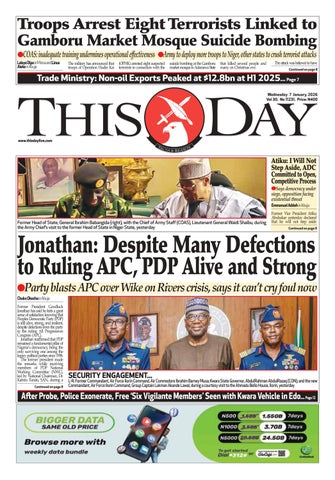
Troops Arrest Eight Terrorists Linked to Gamboru Market Mosque Suicide Bombing COAS: inadequate training undermines operational effectiveness Army to deploy more troops to Niger, other states to crush terrorist attacks
Laleye Dipo in Minna and Linus Aleke in Abuja
The military has announced that troops of Operation Hadin Kai
(OPHK) arrested eight suspected terrorists in connection with the
suicide bombing at the Gamboru market mosque in Adamawa State
that killed several people and many on Christmas eve.
The attack was believed to have Continued on page 8
Trade Ministry: Non-oil Exports Peaked at $12.8bn at H1 2025... Page 7 Wednesday 7 January, 2026 Vol 30. No 11231. Price: N400
www.thisdaylive.com TR
UT H
& RE A S O
N
Atiku: I Will Not Step Aside, ADC Committed to Open, Competitive Process Says democracy under siege, opposition facing existential threat Emmanuel Addeh in Abuja
Former Head of State, General Ibrahim Babangida (right), with the Chief of Army Staff (COAS), Lieutenant General Waidi Shaibu, during the Army Chief’s visit to the former Head of State in Niger State, yesterday
Former Vice President Atiku Abubakar yesterday declared that he will not step aside Continued on page 8
Jonathan: Despite Many Defections to Ruling APC, PDP Alive and Strong
Party blasts APC over Wike on Rivers crisis, says it can’t cry foul now
Chuks Okocha in Abuja Former President Goodluck Jonathan has said he feels a great sense of satisfaction knowing that Peoples Democratic Party (PDP) is still alive, strong, and resilient, despite defections from the party to the ruling All Progressives Congress (APC). Jonathan reaffirmed that PDP remained a fundamental pillar of Nigeria’s democracy, being the only surviving one among the legacy political parties since 1998. The former president made the remarks while receiving members of PDP National Working Committee (NWC), led by National Chairman, Dr. Kabiru Turaki, SAN, during a Continued on page 8
SECURITY ENGAGEMENT...
L-R: Former Commandant, Air Force Ilorin Command, Air Commodore Ibrahim Barney Musa; Kwara State Governor, AbdulRahman AbdulRazaq (CON); and the new Commandant, Air Force Ilorin Command, Group Captain Lukman Akande Lawal, during a courtesy visit to the Ahmadu Bello House, Ilorin, yesterday
After Probe, Police Exonerate, Free ‘Six Vigilante Members’ Seen with Kwara Vehicle in Edo... Page 12
2
WEDNESDAY, JANUARY 7, 2026 • T H I S D AY
WEDNESDAY, JANUARY 7, 2026 • T H I S D AY
3
4
WEDNESDAY, JANUARY 7, 2026 • T H I S D AY
5
THISDAY • WEDNESDAY, JANUARY 7, 2026
Group News Editor: Goddy Egene Email: Goddy.egene@thisdaylive.com, 0803 350 6821, 0807 401 0580
NEWS
BAYELSA APC SPECIAL STAKEHOLDERS MEETING...
L-R: Minister of State for Petroleum Resources (Oil), Senator Heineken Lokpobiri; Bayelsa State Governor, Senator Douye Diri; Chairman, State Caretaker Committee, All Progressives Congress (APC), Dr. Dennis Otiotio; Speaker, Bayelsa State House of Assembly, Abraham Ingobere; Secretary to the State Government, Prof. Nimibofa Ayawei; and former Bayelsa State Deputy Governor, Peremobowei Ebebi, during the Bayelsa APC special stakeholders meeting at the Diepreye Alamieyeseigha Banquet Hall, Yenagoa, yesterday
NERC: FG Paid N458.75 billion Electricity Subsidy in Three Months Discos record N570.2bn revenue, bill customers N706.6bn International customers offset $7.1m out of $18.69m invoice
Emmanuel Addeh in Abuja Despite implementing the band ‘A’ tariff system, the federal government paid N458.75 billion in subsidies to operators in the electricity value chain in the third quarter of 2024, fresh data from the Nigerian Electricity Regulatory Commission (NERC) has shown. Also, the information contained in the apex electricity regulatory body’s quarterly report indicated that Distribution Companies (Discos) collected N570.21 billion out of the total of N706.61 billion billed to customers during the period covering July, August and September last year. The subsidy arose from the continued freezing of certain end-use customer tariffs at the rates payable in July 2024, despite rising generation costs, the report added, with the Discos showing marginal improvements in billing and collection efficiencies. The report showed that during the period under review, the naira value of total energy offtake by all Discos was N854.53 billion. Also, a billing efficiency of 82.69 per cent was posted, representing an
improvement of 1.08 percentage points over the 81.61 per cent recorded in Q2 of 2025. Besides, the report stated that Discos recorded a cumulative billing losses of N147.92 billion during the period, with a collection efficiency of 80.70 per cent, which was up by 4.63 per cent from the 76.07 per cent in the previous quarter. “Prompt payment of upstream invoices is critical for securing the availability of generation and transmission capacities. The waterfall regime pushes Discos to boost their collections because most of their allowed revenues rank below the payment of market obligations in the waterfall. “In the absence of cost-reflective tariffs, the government undertakes to cover the resultant gap between the cost-reflective and allowed tariff in the form of tariff subsidies. For ease of administration, the subsidy is only applied to the generation cost payable by Discos to NBET at source in the form of a Disco’s Remittance Obligation (DRO). “...It is important to note that due to the absence of cost-reflective tariffs across all Discos, the
government incurred a subsidy obligation of N458.75 billion. This represents a N55.59 billion (10.81 per cent) reduction in FGN subsidy compared to 2025/Q2 (N514.35 billion). “The subsidy obligation of the government decreased in naira terms (N55.59 billion), and accounted for 58.63 per cent of the total Gencos’ invoice, which is a 0.97 per cent decrease compared to
The Nigeria Police Force, Airport Police Command, has arrested what it described as a notorious celebrity scam and romance fraud suspect responsible for defrauding multiple victims in the United States of America of over N1 billion. This was disclosed in a statement issued by the Airport Police Command and made available to THISDAY. The statement identified the suspect as Essien Emmanuel Akpama, male, aged 20, who was arrested on January 5, 2026, by operatives of the Anti-Fraud
Unit of the Airport Police Command while attempting to board a flight out of Lagos State. According to the Command, his arrest followed months of intensive intelligence-led surveillance and monitoring based on credible information. “Preliminary investigations revealed that the suspect, who previously resided in Calabar, Cross River State, relocated to Lagos State on 23rd February, 2024, from where he coordinated and executed several fraudulent schemes. “In one instance in 2024, the suspect, through a celebrity scam modus operandi deceived a 47-year-old female
Besides, during the period under consideration, international bilateral customers paid only $7.125 million out of the $18.69 million invoiced by the Market Operator (MO) for services rendered in the quarter, representing a remittance rate of 38.09 per cent. Similarly, domestic bilateral customers paid N3.19 billion out of N3.64bn invoiced, achieving a stronger remittance rate of 87.61
per cent. The report revealed that although the total energy received by all Discos in 2025/Q3 was 7,348.95GWh, the energy billed to end-use customers was only 6,158.54GWh. This translated to an overall energy accounting efficiency of 83.80 per cent and represented a 1.37 per cent increase compared to 2025/Q2 of 82.43 per cent.
NRS, NITDA Okay Pillarcraft as System Integrator to Boost Tax Compliance James Emejo in Abuja
The Nigeria Revenue Service (NRS) in collaboration with the National Information Technology Development Agency (NITDA), has accredited Pillarcraft Cloud Solutions as a system integrator for the country’s e-Invoicing framework. According to the NRS e-invoicing (Merchant Buyer) framework introduced by the service, a system
Airport Police Arrest International Romance Fraud Suspect Involved in N1bn Scam Chinedu Eze
2025/Q2 when subsidy accounted for 59.60 per cent of the total Genco invoice. “This is because while the allowed end-user tariffs remained unchanged across the quarters, there was a 6.08 per cent decrease in energy offtake by the Discos during the quarter, as well as a reduction in actual generation cost (N/kWh) by 0.98 per cent,” the Q3 report stated.
victim in the United States into transferring one million US dollars under the pretext of purchasing property in Florida for an orphanage. “The funds were fraudulently solicited through a cryptocurrency scheme identified as “BullRun 2.0,” formerly known as “4 Way Mirror Money,” the statement said. The Command also stated that further investigations revealed that, in addition, the suspect defrauded another 70-year-old female victim in the United States of a total sum of N25,709,400, equivalent to $18,000.
integrator is a licensed service provider responsible for connecting taxpayers’ business systems—such as ERP, accounting, or invoicing software—to the NRS e-invoicing platform. Essentially, the system integrator ensures that invoices generated within a taxpayer’s system are converted into the prescribed NRS e-invoice format with all required data fields, securely transmitted through licensed Access Point Providers to the NRS platform, and returned as validated e-invoices to the taxpayer’s system for compliance, reporting, and audit purposes. To perform this role efficiently,
Pillarcraft developed a dedicated middleware that acts as the technical bridge between business systems and NRS—much like a decoder converts broadcast signals into a format a television can display—ensuring seamless, accurate, and scalable e-invoicing compliance. Pillarcraft is a subsidiary of Agbi Bayode and Co., a firm of Chartered Accountants and Chartered Tax Practitioners, and focuses on cloud systems integration, compliance-driven technology solutions, and digital transformation for businesses operating in Nigeria. The accreditation positions the
firm among a select group of firms authorised to support businesses in implementing and integrating e-invoicing solutions that align with the country’s national digital tax infrastructure, and further affirms its technical capability, governance standards, and domain expertise required to operate within the NRS e-invoicing framework. With this accreditation, Pillarcraft is now authorised to act as a trusted integration partner, helping businesses transmit compliant electronic invoices, maintain audit-ready records, and align their internal systems with national e-invoicing requirements.
FG Inaugurates C’ttee to Oversee Resolutions on Digital Literacy, Emerging Skills Conference Olawale Ajimotokan in Abuja The federal government has inaugurated a joint implementation committee of the national conference on digital literacy and emerging skills to drive the execution of resolutions and outcomes of the national conference on digital literacy and youth empowerment. The committee was inaugurated yesterday in Abuja by the Secretary to the Government of
the Federation (SGF) Senator George Akume. The SGF, represented by the Permanent Secretary, General Services Office, Dr Ibrahim Kana, said that the initiative was a collaboration between the office of the SGF and Clergywealth Multi-purpose Cooperative Society Limited (CWMSCL). He noted that the initiative aligned with the federal government’s digital transformation agenda and the national digital
economy policy and strategy to achieve not less than 95 per cent of digital literacy by the year 2030. The committee is to be chaired by Kana. Other members of the committee include: The representatives from the Ministry of Communications, Innovation and Digital Economy; Ministry of Education and Ministry of Information and National Orientation as well as the Tertiary Education Trust Fund (TETFund).
6
WEDNESDAY, JANUARY 7, 2026 • THISDAY
NEWS
LENS FOR GOOD STORYTELLERS’ CONFERENCE...
L-R: Chairman, Nigerian Communications Commission (NCC), Mr. Idris Olorunnimbe; Governor of Lagos State, Mr. Babajide Sanwo-Olu; Director General, National Theatre, Tola Akerele and the Olu of Warri, Ogiame Atuwatse III, during the Lens for Good Storytellers’ Conference themed ‘Story That Moves Us’, at the National Theatre, Iganmu in Lagos, ... yesterday
FG Explains Dispute With Resident Doctors, Says Allegation of Neglect False N90bn approved for health workers, Salako reveals NARD: Our strike threat not politically motivated
Onyebuchi Ezigbo in Abuja
The federal government said yesterday that the ongoing standoff with the National Association of Resident Doctors (NARD) was due to structural and policy issues rather than neglect. A statement signed by the Director, Information and Public Relations, Alaba Balogun, quoted the Minister of State for Health and Social Welfare, Dr. Iziaq Adekunle Salako, to have said
this during a programme on AIT yesterday. In reaction, NARD dismissed any insinuation that its strike threat was politically motivated and that it was being tele-guided by opposition elements. Salako said some of the outstanding demands of doctors were constrained by existing civil service rules and approved schemes of service. He also revealed that, as a mark of its concern for the plight of the
workers, the federal government had approved a N90 billion annual increase in health workers’ allowances. Resident doctors recently threatened to withdraw their services at hospitals nationwide by midnight, January 12, 2026, if their outstanding demands are not met In a statement released last weekend by the President of NARD, Dr. Mohammed Suleiman, the association had stated:
“Following the E-NEC meeting, the NEC resolved to resume total indefinite, comprehensive strike–tagged, ‘No Implementation, No Going Back,’ with effect from 12th January 2026 by 12:00 am.” However, in response, Salako said the federal government has addressed a substantial number of the doctors’ demands and was on the verge of resolving all outstanding issues. The Minister outlined the federal government’s actions aimed
Obi: Nigeria Not Poor, But Poorly Governed Chuks Okocha in Abuja
Former Governor of Anambra State, Mr. Peter Obi, has said Nigeria has sufficient resources to provide basic necessities for its citizens. He, however, pointed out that poor governance and misplaced priorities continue to undermine national development. Obi made the remarks while narrating an encounter with a young Nigerian nurse who was born and trained in the United States but recently visited Nigeria for the first time. In a statement posted on his X handle yesterday, the former Anambra State Governor said the tragic road accident involving international boxer, Anthony Joshua’s friends in
Ogun State during the yuletide period highlighted the country’s weak emergency response system. He noted that the victims could have been rushed to hospital immediately if functional ambulances were available. According to Obi, a standard ambulance costs about N150 million (approximately $100,000), yet Nigeria spent N39 billion to refurbish the National Conference Centre in Abuja and N21 billion on the Vice President’s residence. “Those two projects alone, N60 billion could have provided about 400 brand-new ambulances, roughly 11 per state, including the FCT,” he wrote. “Had 11 functional ambulances existed in Ogun State, one might
have been available for Joshua,” Obi added. The former Anambra State Governor stressed that Nigeria’s problem was not a lack of funds but poor leadership and mismanagement of resources. “The country is not poor, but it is poorly governed. Nigeria can afford basic necessities, especially critical and necessary ones, but they are often not considered priorities due to incompetent leadership,” he noted. He further stated that building a primary healthcare centre in a community costs about N75 million, yet the country reportedly spent N300 billion (about $200 million) on an additional presidential jet. “That amount could have built
206 Die of Lassa Fever in Nigeria Last Year, Says NCDC Onyebuchi Ezigbo in Abuja
The Nigeria Centre for Disease Control and Prevention (NCDC) has said Lassa Fever claimed a total of 206 lives in 2025, explaining that a total of 1119 confirmed cases, and 206 deaths were recorded in Nigeria out of the 9,270 suspected cases nationwide in 2025. The report showed that the Case Fatality Rate (CFR) in 2025
was higher than same period in 2024 (18.4 percent higher than 16.4 percent same period in 2024). According to its Lassa Fever Situation Report for Week 51 (15 - 21st December, 2025), published yesterday, NCDC said that 88 percent of the confirmed cases were from Ondo, Bauchi, Taraba and Edo State. Key highlights of the NCDC report showed that the total number of confirmed cases
decreased from 28 in Epi week 50 to 21 in Epi week 52. The cases were reported in Edo, Bauchi, Kogi, Ebonyi, Plateau, Ondo and Taraba states while 21 states have recorded at least one confirmed case across 105 LGAs. The report showed that 88 percent of all confirmed cases were concentrated in just four states - Ondo (35 percent), Bauchi (25 percent), Edo (16 percent), and Taraba (12 percent).
over 4,000 primary healthcare centres, about 110 per state,” Obi said. He added that the only visible value of the jet was the ability of President Bola Tinubu “to occasionally disappear without the public knowing where he is.” Obi also referenced the young nurse’s intention to organise a GoFundMe campaign to support healthcare in Nigeria, noting that the idea was discouraged by relatives who feared the funds could be misappropriated.
at addressing resident doctors’ demands and preventing recurring strikes in the health sector. According to the statement, Salako had affirmed the commitment of the Federal Ministry of Health and Social Welfare to maintaining industrial peace and ensuring uninterrupted healthcare delivery. Salako noted that while the government would be pleased to significantly raise health workers’ pay, it must balance such demands with obligations to other sectors, including education, security, and national infrastructure, within the limits of available revenue. The minister said Tinubu’s administration demonstrated its commitment in November 2025 by approving an upward review of professional allowances for health workers by adding nearly N90 billion to government expenditure annually. According to Salako, the increment covers call duty, shift duty, non-clinical duty, and rural posting allowances and was reached through joint negotiations involving all health worker groups. He explained that past nego-
tiations were often fragmented, with different health professional groups engaging the government separately, leading to conflicting agreements on pay parity and relativity and triggering repeated industrial actions. To address this, Salako said the Ministry initiated and adopted a collective bargaining approach, ensuring that doctors, nurses, laboratory scientists, and other health workers negotiated together. On NARD’s demands, the Minister said the association’s requests have reduced from 19 to nine, indicating progress in talks. On the demand for specialist allowance for resident doctors, Salako said resident doctors are specialists-in-training and that current regulations reserve specialist allowances for consultants. The Minister added that the National Salaries, Incomes and Wages Commission had advised against extending the allowance to residents, warning it could create similar claims from other health workers undergoing specialist training. Continues online
NCDMB, Innovius Empower Lagos Youths with AI and Data Science Skills
Michael Olugbode in Abuja
The Nigerian Content Development and Monitoring Board (NCDMB) has launched a youth-focused digital capacity programme aimed at equipping young people in Lagos State with cutting-edge skills in Artificial Intelligence (AI), Data Analytics and Machine Learning. The initiative fully sponsored by NCDMB and implemented by Innovius Nigeria is designed to strengthen Nigeria’s digital talent pipeline and position participants for opportunities in the evolving global workforce.
Beneficiaries were selected from all 57 local governments areas and Local Council Development Areas (LCDAs) across Lagos State. The programme was formally inaugurated on Monday in Lagos, with the Commissioner for Youths and Social Development, Mr. Mobolaji Ogunlende, in attendance, alongside representatives of the Executive Secretary of NCDMB, senior government officials, partners, facilitators and trainees. Speaking at the flag-off ceremony, Martins Olajide of Innovius Nigeria described the training as a strategic
investment in the future of Nigerian youths. He explained that participants would be exposed to practical applications of AI for automation and problem-solving, Data Analytics for informed decision-making, and Machine Learning for predictive analysis and innovation. Olajide commended NCDMB for its consistent focus on human capital development, noting that the Board’s approach to local content now places strong emphasis on skills acquisition and intellectual capacity development, in addition to physical infrastructure.
7
THISDAY • WEDNESDAY, JANUARY 7, 2026
NEWS
PRESENTATION OF MANCAP CERTIFICATION TO MAJEURS HOLDINGS...
L-R: Brand and Creative Strategy Lead, Majeurs Holdings Limited, Adejumoke Adefila; Director, Lagos Region, Standards Organisation of Nigeria (SON), Mrs. Theresa Ojomo; Chief Executive Officer, Majeurs Holdings Limited, Demi Samande; Deputy Director, MANCAP Directorate, Standards Organisation of Nigeria (SON), Engr. Ayodele Akinware; and State Coordinator, Lagos Office I, Standards Organisation of Nigeria (SON), Mrs. Bolanle Orekoya, during the presentation of the MANCAP certification to Majeurs Holdings Limited by SON in Lagos… recently
Trade Ministry: Non-oil Exports Peaked at $12.8bn at H1 2025 Special economic zones generated over $500 million in export revenues, 20,000 direct jobs Deals worth $50.8 billion signed, $5 billion investment pipeline de-risked across priority sectors New national industrial policy to be operationalised nationwide
James Emejo in Abuja The country’s non-oil exports grew by 21 per cent to $12.8 billion in the first half of last year (H1 2025), Federal Ministry of Industry, Trade and Investment (FMITI) has disclosed. The figure represented a remarkable improvement over the $6.5 billion target, contributing to a N12 trillion trade surplus during the first six months of 2025, the ministry stated. Overall trade value expanded by 14 per cent, with further gains expected as trade facilitation reforms and logistics infrastructure continued to mature, FMITI said in a statement showcasing its milestone for 2025 under the leadership of Minister of Industry, Trade and Investment, Dr. Jumoke Oduwole. The ministry said the review year was marked by a defining phase in the country’s economic repositioning under President Bola Tinubu’s Renewed Hope Agenda, with the ministry delivering critical reforms and results that deepened industrial capacity, expanded exports, and restored investor
confidence. It stated that the newly released National Industrial Policy will be effectively operationalised nationwide, translating strategy into measurable industrial outcomes. Guided by the national vision, FMITI executed a coordinated reform programme across investment attraction, trade expansion, export diversification, and institutional strengthening. Progress recorded in 2025 reflected strong collaboration across government agencies, the private sector, and development partners, translating policy intent into tangible and measurable economic outcomes. In the review year, the ministry stated that the country’s Special Economic Zones (SEZs) generated over $500 million in export revenues and created more than 20,000 direct jobs, reinforcing their role as engines of export-led growth, industrialisation, and employment generation through the Nigerian Export Processing Zones Authority (NEPZA) and the Oil and Gas Free Zones Authority (OGFZA). According to the ministry, “Under the leadership of President Bola Ahmed Tinubu, the Ministry has
recorded a decisive turnaround in investment attraction, responding strategically, rather than reactively, to global economic headwinds and clearly signaling that Nigeria is open for business. “In 2025, Nigeria significantly strengthened its investment facilitation architecture, transitioning from passive promotion to an active, systems-driven model that reduces
The Katsina State Command of the National Drug Law Enforcement Agency (NDLEA) has seized a total of 2,473.755 kilograms of illicit drugs and arrested 1,018 suspects across the state in the past year. The State NDLEA Commander, CN Samaila Danmallam, disclosed this on Tuesday during the command’s 2025 end-of-year press conference and promotion ceremony of 61 officers held in Katsina. Danmallam said the seized drugs comprised 1,667.747 kilogrammes of cannabis, 12.348
kilogrammes of codeine, and 793.66 kilogrammes of psychotropic substances intercepted in various operations across the state. According to him, a total of 1,018 suspects were arrested in connection with the seizures, including 992 males and 26 females. He added that within the period under review, the command successfully secured the conviction of 87 drug peddlers and users, while 451 clients were counselled and 58 rehabilitated as part of its intensified campaign against drug abuse. The NDLEA commander
built a de-risked pipeline exceeding $5 billion across priority sectors. “This execution-driven approach integrates narrative shaping, deal origination, curated deal rooms, and targeted roadshows, supporting investors from first engagement to firm commitment and converting opportunities into bankable projects.” Among other achievements,
the ministry stressed that investor confidence was reinforced in June 2025, when Tinubu hosted several West African presidents at the West Africa Economic Summit, where the Deal Room generated over $400 million in originated and showcased vetted investment deals, signalling renewed regional and global confidence in the economy.
Tinubu Names Gbemisola Odusote First Female DG of Nigerian Law School Deji Elumoye in Abuja President Bola Tinubu has approved the appointment of Dr Olugbemisola Titilayo Odusote as the director-general of the Nigerian Law School. According to a release issued on Tuesday by presidential spokesperson, the appointment takes effect on January 10, 2026, for a four-year term. Odusote, 54, is currently the Deputy Director-General and
NDLEA Seizes 2.4kgs of Illicit Drugs, Nabs 1,018 Suspects in Katsina Francis Sardauna in Katsina
information asymmetries, improves project visibility, and enhances the bankability of investment pipelines. “As a result, four priority projects valued at $13.7 billion have progressed, representing a conversion rate of over 25 per cent from the $50.8 billion in signed Memoranda of Understanding (MoUs). Through structured deal origination, FMITI has proactively
further disclosed the command carried out 203 sensitisation programmes in schools and other social gatherings, reaching no fewer than 75,135 beneficiaries across the state. Danmallam attributed the achievements recorded to intelligence-led raid operations and sustained patrols by NDLEA operatives across the nooks and crannies of Katsina State. However, he appealed to the Katsina State Government to support the command with operational vehicles and accommodation for officers to address its logistics and housing challenges.
Head of the Lagos Campus and will become the first woman to lead the institution since its establishment in 1962. As Director-General, Odusote will be responsible for the institution’s overall academic leadership, administrative management, and strategic direction across all campuses. She will also serve as the primary liaison between the school, the Council of Legal Education, the Body of Benchers, and the Nigerian Bar Association. Odusote will succeed the current Director-General, Professor
Isa Hayatu Chiroma, whose tenure expires on January 9, 2026, after eight years of service. She obtained her LL.B. degree from Obafemi Awolowo University and was called to the Nigerian Bar in 1988. She holds an LL.M from the same university, specialising in company and commercial law. She later obtained a PhD in Law from the University of Surrey, in the United Kingdom, with research interests in Public Law and the administration of justice. Odusote joined the law school in 2001 as a lecturer. Since then,
she has served in various capacities, including as head of the academic department, director of academics, and head of campus. During her career at the law school, she was a visiting scholar at Nottingham Trent University in the UK for a short time. Odusote has published extensively in reputable local and international law journals and has presented papers at numerous legal education conferences. She also served on committees of the Council of Legal Education and the Nigerian Bar Association.
Police Arrest 12 Suspects for Violent Attack on Residents of Estate in Rivers
Blessing Ibunge in Port Harcourt
The Rivers State Police Command said it has arrested 12 suspects over alleged attack and indiscriminate gun shooting at Unity Estate in Mbodo-Aluu, Obio/Akpor Local Government Area of the state. In a signed statement by the spokesperson of the State Police Command, CSP Grace Iringe-Koko, yesterday, disclosed the suspects through
the alleged support of some vigilante members in the area committed the crime on Monday afternoon. Iringe-Koko stated “The Rivers State Police Command, in its sustained efforts to combat crime and criminality in the State, has arrested 12 suspects in connection with a violent attack on Unity Estate, located at Mbodo-Aluu, Airport Road, Port Harcourt. The incident according to the Police Public Relations Officer
(PPRO) “occurred on January 5, 2025, at about 13:15hrs, when suspected members of the OSPAC vigilante group drawn from various communities in Obio/Akpor Local Government Area, alongside hired thugs armed with pump-action guns, cutlasses, and other dangerous weapons, invaded the estate”. She disclosed the suspected assailants allegedly attacked and fired shot indiscriminately causing panic and apprehension in the area.
8
WEDNESDAY, JANUARY 7, 2026 • THISDAY
EIGHT
Sanctioned Oil Tankers Leave Venezuela in Defiance of US Blockade Disguise true locations, turn off transmission signals
Emmanuel Addeh in Abuja
At least 16 oil tankers hit by U.S. sanctions have made an attempt to evade a major American naval blockade on Venezuela’s energy exports over the last few days, in part by disguising their true locations or turning off their transmission signals. For weeks, the ships had been spotted on satellite imagery docked in Venezuelan ports, according to an analysis by The New York Times. But by Saturday, in the wake of President Nicolás Maduro’s capture by U.S. forces, all were gone from those locations, the NYT report added. Four have been tracked by
satellite sailing east 30 miles from shore, using fake ship names and misrepresenting their positions, a deceptive tactic known as “spoofing.” These four have left port without the interim government’s authorisation, according to internal communications from Venezuela’s state-owned oil company and two people in the Venezuelan oil industry, who spoke on condition of anonymity out of fear of retribution. The departures could be seen as an early act of defiance of interim President Delcy Rodríguez’s control. The other 12 are not broadcasting any signals and have not been located in new imagery, it said. President Donald Trump
unilaterally imposed a “complete blockade” on sanctioned Venezuelan oil tankers on December 16, an effort that Secretary of State Marco Rubio said on Sunday was one of the largest “quarantines” in modern history, and was successfully “paralysing” the regime’s ability to generate revenue. The blockade has notably exempted oil shipped by American company Chevron to the U.S. Gulf Coast. So far, U.S. forces have confronted three tankers trying to trade Venezuelan oil. One, called Skipper, was halted and seized by the Coast Guard on December 10, on its way to China. A second, the Centuries, was halted and boarded, but not seized, on December 20, and a
third, then called the Bella 1, now Marinera, is still being pursued by U.S. forces. In response to questions from The Times, a U.S. official said that “the quarantine is in effect focusing on sanctioned shadow vessels transporting sanctioned” Venezuelan oil. The tankers’ evasion strategies as part of this latest exodus appear to be relying on deception, but also saturation. At least three of the ships were in proximity as they left Venezuelan waters in the same direction, suggesting at least some coordination. “The only real way for oilladen tankers to break through a naval blockade is to overwhelm
it with outbound vessels,” said Samir Madani, the co-founder of TankerTrackers.com, a website that monitors shipping and identified several of the vessels in satellite imagery. The location and intent of the 12 tankers that have stopped broadcasting signals and left port since Saturday are open questions. But Venezuela is under pressure to move its crude. Since the blockade, storage facilities have been nearing capacity, and shutting down production risks damaging oil reservoirs and infrastructure. The ships that have left without authorisation were contracted by the oil traders Alex Saab and Ramón Carretero, according to
JONATHAN: DESPITE MANY DEFECTIONS TO RULING APC, PDP ALIVE AND STRONG
high-level consultative meeting held at his private office in Abuja, yesterday. The meeting focused on the party’s reconciliation process and strategic repositioning ahead of the 2027 general election. Jonathan stated that PDP possessed the historical resilience and institutional strength required to overcome its current internal challenges, describing the party
as more than a political platform, but a national institution. He stated, “The PDP, being the only surviving original political party since 1998, has been a critical contributor to our democracy since 1999. I have been a beneficiary of this party, which gave me the opportunity to serve as Deputy Governor, Governor, Vice President, and President. “I am grateful to the party
and will continue to contribute my quota because I feel deeply indebted to it.” Jonathan urged the party’s leadership to place national interest and institutional development above personal considerations, stressing that strong political parties are essential to democratic stability. Earlier, Turaki thanked Jonathan for his fatherly counsel and
unwavering loyalty to PDP. He assured the former Nigerian leader that the current leadership of PDP was committed to a comprehensive “Rebirth Agenda” aimed at rebuilding and strengthening the party. Turaki said, “We came to seek your guidance and to brief you on the prospects and challenges before the party. Our goal is to return power to the people and
reposition the PDP as the party of the majority of Nigerians. “We are reaching out to aggrieved members because a united PDP remains the most viable platform for a balanced and prosperous Nigeria.” Members of the delegation included Dr. Mu’azu Aliyu, Professor Jerry Gana, Gen. Ishaya Bamaiyi, Hajiya Zainab Maina, Chief Mike Oghiadome,
TROOPS ARREST EIGHT TERRORISTS LINKED TO GAMBORU MARKET MOSQUE SUICIDE BOMBING
been carried by Boko Haram terrorists suicide who detonated an improvised explosive device. Among those apprehended, the military said, were two key suspects believed to be major facilitators within the network that planned and executed the attack. Defence Headquarters said the arrest sfollowed weeks of sustained intelligence gathering and surveillance on identified locations linked to the terror cell. In a statement, yesterday, Media Information Officer of the Joint Task Force, North East, Operation Hadin Kai, Lieutenant Colonel Sani Uba, disclosed that the suspects were captured during a coordinated cordon-and-search operation carried out in the Yan Lemo area of Mubi South Local Government Area in the early hours of January 5, 2026. According to Uba, a search of the suspects’ residence led to the recovery of several items, including cash, mobile phones, identification documents, ATM cards, jewellery, and other personal belongings. He stated that the recovered items were currently undergoing forensic examination to aid ongoing investigations. Uba further revealed that during identification procedures, a suspect already in custody positively identified the two principal suspects as the individuals, who supplied materials used in the construction of the Improvised Explosive Device (IED) deployed in the mosque attack. Other occupants of the residence were also found to have direct links to the terrorist network. “All the suspects are presently in military custody, where they are undergoing detailed interrogation to enable further intelligence extraction before being handed over for continued investigation,” the statement said. In a related operation, OPHK troops intercepted a large number of suspected terrorist logistics in Mayo Nguli, Maiha Local Govern-
ment Area of Adamawa State. During the operation, troops seized 45 jerry cans of Premium Motor Spirit (PMS), amounting to about 1,125 litres, believed to have been illegally transported for terrorist activities. The statement added that the suspected suppliers fled the scene on sighting the troops, abandoning the petroleum products, which have since been secured and taken into military custody. No casualties were recorded during the operation. The military said the successful operations under-scored OPHK’s continued determination to dismantle terrorist networks, disrupt their logistics and supply chains, and prevent future attacks in the North-east. It called on members of the public to remain vigilant and continue to cooperate with security agencies, stressing that public support is vital to sustaining peace and security across the region.
COAS: Inadequate Training Undermines Operational Effectiveness
Chief of Army Staff (COAS), Lieutenant-General Waidi Shaibu, warned that failure to adequately and realistically train officers and soldiers for their assigned missions would inevitably undermine operational effectiveness. Shaibu stressed that the evolving and increasingly complex security environment demanded an army that was professional, adaptable, combat-ready, and resilient. Declaring open the Training and Doctrine Command (TRADOC) Conference 2026, the army chief reiterated that realistic and mission-oriented training were critical to achieving superior operational outcomes across all theatres of operation. Acting Director of Army Public Relations, Colonel Appolonia Anele, said the conference was
designed to foster robust and forward-looking deliberations on aligning training, doctrine and operational concepts in response to contemporary and emerging security challenges. The COAS stated that Army Headquar-ters also remained focused on sound policy formulation and mission-specific, holistic training in line with his Command Philosophy. He charged commandants and leaders of training institutions to internalise the philosophy and translate it into practical outcomes by producing combat-ready, resilient and adaptable troops capable of operating effectively within joint and multi-agency environments. He further observed that the theme of the conference, “Enhancing Nigerian Army Operational Outcomes Through Effective Training and Doctrine Implementation,” was both apt and timely, stressing that doctrine must continue to guide training, planning and the execution of operations across all formations. Shaibu urged participants to
relate conference presentations to real operational experiences, with a view to improving the army’s capacity to counter terrorism, insurgency and other contemporary security threats. The army chief placed particular emphasis on Exercise MUGUN BUGU, describing it as the hallmark of Nigerian Army training activities. He stated that the exercise was central to validating doctrinal principles and assessing operational readiness, while calling for greater realism in training scenarios. This, he added, included the integration of IED threats, EOD procedures and the expanded use of simulators to enhance proficiency and cost-effectiveness. While acknowledging the sacrifices of Nigerian Army personnel in safeguarding national security, the COAS reaffirmed his commitment to strengthening fighting power, improving welfare and administration, and providing purposeful leadership to confront all threats to the peace and security of the nation. He also commended past
Commanders of the Training and Doctrine Command, retired senior officers, and the incumbent TRADOC leadership for their contributions to the development of the Nigerian Army. Commander, Training and Doctrine Command (TRADOC), Nigerian Army, Major-General Peter Malla, described the conference as a critical intellectual platform for setting the tone for Nigerian Army training activities in 2026. Malla stated that the conference underscored the army’s unwavering commitment to doctrine-driven, realistic and mission-focused training as the foundation for operational effectiveness, particularly in an increasingly complex and adaptive security environment. Malla emphasised that Nigeria’s prolonged engagements in counter-terrorism, counter-insurgency and other internal security operations had consistently highlighted the vital link between sound doctrine, effective training and operational success.
US President Donald Trump internal data for the state-owned oil company, and to the two oil-industry sources. Both of the traders are under U.S. sanctions for being business partners of Maduro’s family. Mr. Saab was jailed in the United States in 2021, but was traded in 2023 by the Biden administration for Americans detained in Venezuela. Mohammed Bello Adoke, SAN, and other members of the NWC. Explaining why the party leaders visited Jonathan, during a media briefing, Turaki said, “We came this evening to visit one of our very important leaders, former President of Nigeria, President Ebele Jonathan, GCFR PhD. “First, to introduce members of the newly elected National Working Committee to him, and then to tell him what we’ve been doing since our election in the National Convention that was held last November in Ibadan. “We’ve briefed him on the state of the party, the challenges, the prospects, and in this visit, we are accompanied by former governors, members of the Board of Trustees, founding fathers and founding mothers, Forum of State Chairmen, in addition to other leaders of the party that also includes former ministers of the Federal Republic of Nigeria. “We have solicited, as usual, for his support, for his guidance, for his advice, as always. And we have his assurance that he’s still a card-carrying member of the Peoples Democratic Party, he’s still active, and will even be more active these days in the activities and affairs of the Peoples Democratic Party. “And he has assured us that PDP has done everything for him that can be done to an individual, and that he still feels that he remains obligated to PDP. “And his remarks and statements are not only reassuring, but, indeed, they are very, very Continued on page 36
ATIKU: I WILL NOT STEP ASIDE, ADC COMMITTED TO OPEN, COMPETITIVE PROCESS He further alleged that agents affirmed its commitment to emphasised. for any contender within the African Democratic Congress of President Bola Tinubu were an open, transparent, and If anyone should step aside, (ADC), insisting that all qualified bent on destabilising the ADC competitive process for selecting Atiku maintained that it is aspirants will be subjected to an through internal interference its flagbearer. APC proxies and President Bola Tinubu, whose open, transparent and competitive and manipulation, a move he external meddlers have no stand- leadership, he argued, has become process as the party prepares for said was designed to distract the ing to intimidate, blackmail, or a national liability. the 2027 presidential election. party and undermine its cohesion sabotage this democratic resolve. For nearly three years, he stated Atiku also warned that ahead of the electoral contest. “At present, the ADC is that Nigerians have endured Aside from the former vice focused on building strong one of the harshest periods in Nigeria’s democracy was under severe strain, arguing president, others who have ward, local government, and state recent history—an era defined that the opposition was facing indicated interest in the ADC’s structures nationwide. Disruptors by punishing economic policies an existential threat amid what he presidential ticket include the and infiltrators must allow the and shrinking democratic space described as deliberate attempts presidential candidate of the party to do this essential work under Tinubu. to weaken alternative political Labour Party (LP) in the 2023 without interference. “True to form, this adminpolls, Peter Obi and former platforms. “The party remains open istration has not only inflicted The former vice president Minister of Transportation, and welcoming to all genuine widespread hardship but has made the declarations in a Rotimi Amaechi. opposition figures. This inclusive- pursued a calculated effort to “Any call—overt or covert—for ness—not coercion—is the soul eliminate political alternatives. statement by his spokesman, Paul Ibe, insisting that a cred- Atiku to ‘step aside’ is a gift to of democracy. When the time The objective is clear: a creeping, ible democratic system cannot authoritarian ambition and a comes, all qualified aspirants de facto one-party state. survive without strong and viable betrayal of the Nigerian people. will present themselves freely. Continued on page 36 The ADC has consistently No one is stepping down,” he opposition parties.
wednesDAY, JANUARY 7, 2026 • T H I S D AY
9
10
WEDNESDAY, JANUARY 7, 2026 • T H I S D AY
WEDNESDAY, JANUARY 7, 2026 • T H I S D AY
11
12
WEDNESDAY, JANUARY 7, 2026 • THISDAY
NEWS
CONFERMENT OF TRADITIONAL TITLE...
L-R: Ononandochukwu Enugwu-Ukwu na Umunri, Chief Henry Okolie-Aboh; Igwe Enugwu-Ukwu na Umunri, His Majesty, Igwe Sir Ralph Obumnemeh Ekpeh; Ife-Igbo-ji-ka-mba Enugwu-Ukwu na Umunri and Chairman of Cubana Group, Chief (Dr.) Obinna Iyiegbu (Obi Cubana); and Chief Ikenna Obumneme Iyiegbu, at the traditional title conferment ceremony of Chief Obinna Iyiegbu as the Ife-Igbo-ji-ka-mba of Enugwu-Ukwu na Umunri by the Enugwu-Ukwu Traditional Council, led by Igwe Ralph Obumnemeh Ekpeh, over the weekend
Governor Mbah Sets N870bn IGR Target in 2026 Budget Sunday Ehigiator Enugu State Governor, Dr. Peter Mbah, has set an ambitious N870 billion Internally Generated Revenue (IGR) target
for the state in the 2026 fiscal year, charging Ministries, Departments and Agencies (MDAs) to intensify revenue mobilisation efforts amid global economic uncertainties.
The governor gave the directive while addressing political appointees and civil servants during a New Year service recently held at Government House Chapel, Enugu, to mark
the commencement of official activities for the year. Mbah explained that the revenue target formed a major pillar of the state’s N1.62 trillion 2026 budget, stating that
After Probe, Police Exonerate, Free ‘Six Vigilante Members’ Seen with Kwara Vehicle in Edo Kwara State Police Command has set free six vigilante members arrested in Auchi, Edo State, with a security van belonging to Ifelodun Local Government Area. In a statement yesterday, Police Public Relations Officer for Kwara State Command, SP Adetoun Ejire-Adeyemi, said the Nigerian Army had released the vigilante members to the police for further investigation. Ejire-Adeyemi said a probe of the individuals showed that they were legitimate members of a vigilante group that worked with the security forces in different
parts of the country. The statement read, “The Kwara State Police Command wishes to confirm that on Wednesday, 31st December, 2025, it received six (6) vigilante members who were earlier arrested by personnel of the Nigerian Army along the Auchi–Ikpeshi Road in AkokoEdo Local Government Area of Edo State. “The vigilante, travelling in a vehicle belonging to Ifelodun Local Government Area of Kwara State, was formally handed over to the Kwara State Police Command by the Brigade Commander, 22
Armoured Brigade, Sobi Barracks, Ilorin, Brigadier General N. N. Rume, for the purpose of investigation and profiling. “Following a thorough investigation, it was established the individuals are legitimate members of vigilante groups operating in collaboration with recognised security agencies in the ongoing efforts to combat banditry and other forms of criminality. “Consequently, having been exonerated of any criminal wrongdoing, the vigilante members were released to their respective leaders. “The Commissioner of Police,
Police Deploy DIG, 17 Commissioners Linus Aleke in Abuja
The Nigerian Police Force has approved the deployment of the newly promoted Deputy Inspector-General of Police (DIG), Mohammed Usaini Gumel, alongside 17 Commissioners of Police, to key departments, commands and formations across the country. The deployment, according to the Force, is aimed at strengthening operational capacity, enhancing leadership effectiveness, improving public safety and boosting overall service delivery nationwide. In a statement issued on Tuesday, the Force Public Relations Officer, CSP Benjamin Hundeyin, said the Inspector-General of Police (IGP), Kayode Egbetokun, authorised the postings as part
of ongoing efforts to reposition the Force for greater efficiency. Under the new arrangement, DIG Gumel has been deployed to head the Force Intelligence Department (FID). Similarly, CP Aina Adesola has been posted to the Delta State Police Command, CP Umar Mohammed Hajedia to the Kebbi State Police Command, and CP Iyamah Daniel Edobor to the Bayelsa State Police Command. Other deployments include CP Osagie John Agans-Irabor as Commissioner of Police, Anti-Human Trafficking Unit, FCID Annex, Lagos; CP Johnson Ayodeji Babalola as Commissioner of Police, Special Enquiries Bureau, FCID, Abuja; and CP Adepegba K. Adetoye as Commissioner of Police, Marine Unit, Force Headquarters, Abuja. Also redeployed are CP Tabitha
Bako as Deputy Commandant, Police College, Kaduna; CP Umar Ali Fagge as Deputy Commandant, Police College, Ikeja; CP Audu Garba Bosso as Commissioner of Police, General Investigation, FCID Annex, Kaduna; and CP Edwin Esiunnoh Ogbeghagha as Commissioner of Police, Community Policing, Force Headquarters, Abuja. Others include CP Arikpo Ofem Ikpi as Commissioner of Police, Investment Office, Department of Logistics and Supply, Force Headquarters, Abuja; CP Cyril Uchenna Obiozo as Commissioner of Police, Maritime Command, Lagos; CP Samuel Yerima as Coordinator of Courses, Police Staff College, Jos; and CP Alhaji Mohammed Danlandi as Commissioner of Police, X-Squad, FCID Annex, Kaduna.
Kwara State Command, CP Ojo Adekimi, psc, mnips, reiterates the command’s commitment to synergy among security agencies and community-based security outfits, while urging all groups to continually operate within the confines of the law. “Members of the public are assured that the command remains steadfast in its resolve to ensure the safety and security of all residents of Kwara State.”
fluctuating global conditions and uncertainties surrounding external revenue sources, particularly federal allocations, made it imperative for the state to deepen its reliance on internally generated funds. According to him, out of the total budget size, N870 billion is projected to come from IGR, while N387 billion is expected from the Federation Account Allocation Committee (FAAC), and N329 billion from capital receipts. Mbah urged MDAs to improve efficiency, transparency and service delivery, stressing that revenue growth is directly linked to the quality and speed of services provided to citizens and investors. He said, “Given the geopolitical tensions across the globe, revenue projections have become more uncertain. We must
therefore work harder, improve our systems and ensure that every agency delivers optimal value to justify the confidence of the people.” The governor called for discipline, innovation and collaboration across government institutions, adding that the administration would continue to support reforms aimed at expanding the state’s economic base and improving ease of doing business. The governor also appreciated Enugu residents for their continued support, reaffirming his administration’s commitment to accountability, inclusive growth and sustainable development. The service was attended by top government functionaries, including the deputy governor, members of the State Executive Council, lawmakers, judicial officers and traditional rulers.
MBF President: Middle Belt Forum is Not a Separatist Group, Nor Seeking to Divide North Region seeks recognition, equity and freedom from imposed Arewa identity
Chuks Okocha in Abuja
The Middle Belt Forum (MBF) has rejected claims the forum is a recent political invention aimed at destabilising Northern Nigeria. The group rather said that Middle Belt movement is not separatist that seeks recognition, equity and freedom from what he described as an imposed “Arewa identity”. President of the forum, Dr. Pogu Bitrus, described such assertions as historically inaccurate and designed to undermine the Middle Belt’s growing political consciousness. A statement issued by the forum’s spokesman, Luka Binniyat, on Tuesday said that, in a detailed response to a widely circulated article titled “The
Manufactured Middle Belt: The Untold History, Foreign Backing and the Agenda to Fracture Northern Nigeria”, authored under the pseudonym Safyan Umar Yahaya, Bitrus stated that the narrative misrepresents both history and colonial records. Bitrus explained the Middle Belt refers to indigenous ethnic nationalities of Northern Nigeria that existed outside the authority of the Sokoto Caliphate and the Kanem-Borno Empire prior to British colonisation, noting these groups now span 14 northern states and the Federal Capital Territory. He added that the Middle Belt consists of indigenous peoples who were never conquered or ruled by the Islamic caliphates of Sokoto and Borno before colonial rule, stressing that
this position is supported by historical scholarship rather than political sentiment. He said: “Pre-colonial polities such as the Kwararafa Confederacy and the Jukun states; the Igala Kingdom, Borgu Kingdom, the Nupe Kingdom, Zuru (Lelna) Kingdom in today’s Southern Kebbi, as well as Tiv, Idoma, Gbagyi, Birom, Angas and Eggon societies, among others, possessed distinct political systems and resisted slave raids and forced Islamisation.” He argued that British colonial conquest further shaped Middle Belt political consciousness, noting that colonial administrators documented prolonged resistance by Middle Belt communities to colonialism, compared with the relatively swift subjugation of emirate enclaves.
WEDNESDAY, JANUARY 7, 2026 • T H I S D AY
13
14
WEDNESDAY, JANUARY 7, 2026 • THISDAY
RIGHTOFREPLY
When Hatred Replaces Reason: Joseph Edgar, Adetoun, and the Abuse of Tragedy By Kayode Akinmade
I
f Joseph Edgar, author of the polemic titled “Adetoun Exposes Dapo Abiodun’s Under-performance,” had paused to consider the standing and institutional integrity of THISDAY newspaper—the platform he used to ventilate his habitual bile against the Ogun State Governor, Prince Dapo Abiodun—he might have exercised a modicum of restraint. He did not. Instead, he joined a known blackmailer, Adetoun, in declaring—without evidence and without shame—that there is not a single ambulance in Ogun State. That Edgar could make such a sweeping and demonstrably false claim while invoking THISDAY’s credibility speaks volumes about his relationship with truth. Like the criminal he praises, facts clearly do not matter to him. He went further to assert, absurdly, that no indigene of Ogun State has ever seen an ambulance in operation, while celebrating—without irony—what he described as a “Tomahawk cruise missile” thrown at Governor Abiodun by his “friend and sister.” Having openly endorsed defamatory attacks on the Governor by his so-called “influential and fearless blogger,” Edgar should not now feign surprise when the law takes its course. This is a constitutional democracy, not a jungle governed by mob hysteria. And the law, indeed, will take its course.
The Anthony Joshua Incident: Facts Edgar Chose to Ignore Before dissecting Edgar’s outburst, certain facts must be stated plainly. Anthony Joshua is like a son to Governor Dapo Abiodun. Following the tragic accident involving Joshua, the Governor did everything humanly possible to ensure his recovery. Contrary to the vile claim that he was in Ghana “partying and impregnating women,” Governor Abiodun was physically present at the hospital, deeply shaken by the incident. It was through him that President Bola Tinubu spoke with Joshua. Having once lost a biological son, the Governor’s emotional response was entirely understandable. Joshua is not a casual acquaintance; he shares a close personal bond with the Governor and spends significant time in Nigeria with him and the Akarigbo of Remoland. To accuse the Governor of gallivanting abroad while his sports ambassador lay injured was not merely irresponsible—it was depraved. Yet this is vintage Adetoun, and it is therefore unsurprising that her lies found eager amplification in Joseph Edgar’s column.
A Disturbing Display of Intellectual Bankruptcy One struggles to understand how anyone claiming sanity could write the following sentence: “Joshua’s accident cost him the lives of his two close buddies. His strained body was hoisted into a police truck and beamed worldwide, including on CNN and Sky News.” Is Edgar suggesting that Governor Abiodun caused the reckless driving that led to the deaths of Joshua’s friends? After
Ogun State Governor, Dapo Abiodun
the accident, policemen attached to Joshua’s convoy extricated him from the wreckage and conveyed him to hospital. That was the correct and humane response. During the incident under reference, the security vehicle following Joshua with trained security operatives made a good decision to move him immediately to the hospital despite the fact that an ambulance arrived subsequently. Should they have waited for the ambulance and lost valuable time, not knowing how bad a condition he was in ??? There are ambulances in Ogun State. But when a victim is trapped in twisted metal, does one instruct first responders to wait idly for an ambulance before attempting rescue? If okada riders—acting in the finest Nigerian tradition of communal care—arrive first and rush a victim to hospital, is that evidence of infrastructural failure or of human compassion? Instead of addressing the real issue— dangerous, reckless driving—Edgar and his blackmailer-in-chief turned the tragedy into a political weapon against Governor Abiodun. Edgar even gloated that the incident was aired on CNN and Sky News, as though international coverage somehow sanctifies recklessness. What, exactly, is the point?
Recklessness, Not Infrastructure, Caused the Tragedy Stationary trucks break down worldwide. Removing them takes time—whether in Nigeria, Europe, or North America. Slamming at high speed into a stationary vehicle in broad daylight—around 11 a.m.—is the issue here, not the presence or absence of an ambulance.
Anthony Joshua
Emergency responses on inter-state highways can be delayed anywhere in the world. Those who pretend otherwise merely advertise their ignorance. Nigeria is a communal society. Accident victims are often conveyed to hospitals by the first people on the scene. This reflects empathy, not institutional collapse. That does not mean infrastructure challenges do not exist, but it is obscene to insult well-meaning citizens who shouted for Joshua to be rushed to safety. Ambulances are not supernatural apparitions. Their arrival depends on distance, traffic, and logistics. Even if one had arrived earlier, would it have revived the dead? Video evidence shows that the truck Joshua’s vehicle collided with was off the road. The nature of the wreckage points inexorably to recklessness. Joshua survived by sheer divine intervention—reportedly having swapped seats moments before impact. There is no escaping that conclusion.
Selective Outrage and Intellectual Dishonesty Edgar joined the chorus of those declaring that “Nigeria happened to AJ.” This is lazy thinking. Around the world, fatal accidents caused by speeding occur daily. No one claimed that Spain “happened” to footballer Diogo Jota and his brother when they died in a fiery crash. No one said the United States “happened” to actor Paul Walker, who was travelling at nearly double the speed limit when he died in California. Blaming the government for every tragedy, regardless of cause, is the refuge of intellectual midgets.
Yes, FRSC officers can do more in regulating speed and removing brokendown vehicles. But Edgar’s obsessive hatred of Governor Abiodun—and of the Nigeria he claims to love—has obliterated his capacity for reason. He left leprosy to chase ringworm, parroting the claims of a blackmailer as though she were an oracle. What manner of columnist appoints himself errand boy to a blackmailer?
Cheap Insults and the Limits of Rabble Journalism In responding to the Ogun State Government’s rebuttal of Adetoun’s libellous claims, Edgar sneered that Governor Abiodun appointed “party men instead of serious professionals” as communication managers—an insult aimed at the Special Adviser on Media and Strategy. This is risible. No serious media institution—including the Nigerian Guild of Editors—would dismiss a media professional of over three decades’ experience, a two-time Commissioner for Information, and former Media Adviser to the Speaker of the House of Representatives in such crude terms. But one cannot elevate a rabble-rouser beyond his natural station. Edgar’s writing is fuelled not by reason but by bile—an attempt to repackage an accident caused by recklessness as proof of infrastructural failure. That is not journalism. It is propaganda masquerading as outrage. •Akinmade is Special Adviser on Information and Strategy to Governor Dapo Abiodun
WEDNESDAY, JANUARY 7, 2026 • T H I S D AY
15
16
T H I s D Ay • WEDNESDaY JaNUaRY 7, 2026
Politics
Acting Group Politics Editor DEJI ELUMOYE Email: deji.elumoye@thisdaylive.com 08033025611 sms only
Akpabio–Natasha: Power Pauses but Storm Still Raging
The prolonged face-off between Senate President, Senator Godswill akpabio and Senator Natasha akpoti-Uduaghan has exposed deep fissures within Nigeria’s Red Chamber. From suspension and sexualharassment allegations to defamation suits and international embarrassment, the crisis has tested the Senate’s credibility, free speech, gender justice and institutional accountability, reports sunday Aborisade.
Akpabio
natasha
T
he first real sign that the storm rocking Nigeria’s Senate might abate came quietly, almost anticlimactically, from the Federal High Court registry in Abuja. On December 12, 2025, the Office of the Attorney-General of the Federation filed a Notice of Discontinuance, formally withdrawing the criminal defamation charges it had instituted against Senator Natasha AkpotiUduaghan, the lawmaker representing Kogi Central. With that single procedural act, the Federal Government brought to an end a prosecution that had come to symbolise the most bruising institutional crisis of the 10th Senate.
Yet, as of Monday morning, the drama was far from being over. While the Federal Government had stepped back, Senate President Godswill Akpabio, who is the prime complainant whose petitions helped trigger the criminal case, had not filed any formal notice withdrawing his own civil defamation suits against Akpoti-Uduaghan. This was despite the fact that, days earlier, during a New Year church service in Akwa Ibom, Akpabio publicly announced that he had instructed his lawyers to discontinue all such cases,
citing a priest’s homily on forgiveness. Checks by THISDAY in Abuja, however, revealed that the Senate President’s lawyers would possibly announce the withdrawal of the cases on the various adjourned dates at both the Federal High Court of Abuja and the Court of the Federal Capital Territory. The gap between proclamation and procedure captured, in miniature, the contradictions of a saga that has blended power, personality, law, gender and institutional credibility in unprecedented ways. The Federal Government’s decision to withdraw the criminal defamation charge marked a dramatic pivot. The case, Charge
No: FHC/ABJ/CR/195/2025, had accused Akpoti-Uduaghan of criminal defamation and cyber-bullying over comments she made during a televised interview on Politics Today, in which she alleged that her life had been threatened. The complaints were traced to petitions by Akpabio and former Kogi State Governor, Yahaya Bello. High-profile witnesses were lined up. Sitting governors, senators, political commentators and activists were all expected to testify. NOTE: Interested readers should continue in the online edition on www.thisdaylive.com
Malami: Can the Rule of Law Outlast Political Convenience?
Today, January 7, 2026, Nigeria’s justice system confronts a former attorney General of the Federation and Minister of Justice, abubakar Malami and his family, testing northern power politics, anti corruption resolve, and whether the rule of law can outlast political convenience. Adedayo Adejobi writes.
O
n January 7, an Abuja courtroom will host what appears, on the surface, to be a routine legal proceeding. A judge will decide whether a former Attorney General of the Federation, Abubakar Malami, his wife, and son should be granted bail over alleged money laundering to the tune of N8.7bn. Yet nothing about this moment is routine. It is a collision point of power, memory, politics, and law, unfolding at a time when Nigeria is once again questioning whether justice is a principle or a performance. From hindsight, outcomes from Nigerian courts unsettle its citizens, forcing the reader to sit with contradictions that define the Nigerian state. A former chief law officer now standing before the law. An anti-corruption narrative confronting its own architects. A northern political heavyweight caught between legacy and liability. Malami is not just another former minister. In the politics of northern Nigeria, he emerged from Kebbi State into the heart of national power, serving for eight years as Attorney General under President Muhammadu Buhari. In a region where political capital is built on loyalty, seniority, and proximity to power, Malami became a symbol of access. He spoke for the state in court, defended
malami
executive authority, and shaped legal arguments that affected millions of Nigerians. For many in the North, Malami represented continuity. He was part of a governing class that promised discipline, order, and moral restraint. The Buhari years drew heavily on
northern political legitimacy, appealing to a narrative of integrity rooted in austere leadership and personal sacrifice. Malami was one of the custodians of that narrative, a lawyer who articulated the government’s position whenever its actions were challenged. Today, that same man is at the centre of
allegations that strike at the heart of the values he once defended. The charge of laundering N8.7 billion, alongside his wife and son, is not just a legal matter. It is a political shockwave that reverberates through the North’s power structure, raising questions about how wealth, influence, and protection circulate within elite families. The involvement of immediate family members changes the moral context of the case. In Nigeria, corruption is often discussed as an individual failing, a lone official gone rogue. Yet the charging of a spouse and a child points to something deeper, the possibility that public office becomes a family asset, and that the boundaries between state resources and private life is blurred within the household. For anti-corruption institutions, this case is a moment of truth. The Economic and Financial Crimes Commission has brought charges against Malami, a man who understands the law not as an abstract concept but as a tool. He knows procedure, delay, and technical defense. He knows how cases stall, how public attention shifts, and how time can become an ally. NOTE: Interested readers should continue in the online edition on www.thisdaylive.com
WEDNESDAY, JANUARY 7, 2026 • T H I S D AY
17
18
wednesday, JANUARY 7, 2026 • T H I S D AY
FEatures
Group Features Editor: Chiemelie Ezeobi Email chiemelie.ezeobi@thisdaylive.com,
Reengineering the Abia Civil Service for Efficiency and Impact Long criticised for sluggishness and rigid processes, Nigeria’s civil service has often struggled to shake off the image of a system weighed down by bureaucracy. In Abia State, however, a quiet but determined reform agenda is redefining how government business is conducted, signalling a shift towards efficiency, professionalism and service driven governance. Emmanuel Ugwu Nwogo reports
T
he civil service has a rather unflattering reputation for working and walking at a snail’s pace. The clog that engenders the “go slow” movement, in Nigerian parlance, though man made, has become so ingrained that any initiative aimed at extricating the civil service from bureaucracy is usually dismissed with a wave of the hand. More often than not, such efforts are readily resisted by the civil servants themselves, who apparently take delight in making government business slow moving. However, things are beginning to look different in Abia State. Within and outside the state’s civil service system, it is an acknowledged fact that it is no longer business as usual. The vision of Governor Alex Otti to build a new Abia where governance is service driven has rubbed off on the civil service, which is witnessing a transformative shift. So much has been achieved in less than two years. That is why Abia is emboldened to host the 44th National Council Meeting of Civil Service Commissions. Hosting with Confidence This gathering of Nigeria’s top bureaucrats from all 36 states and the Federal Capital Territory in Umuahia provides an opportunity for the host state to showcase its achievements in making its civil service more efficient. From recruitment processes to work ethics and service delivery, the turnaround has been notable. Abia is hosting the meeting with a strong sense of pride, having introduced innovations designed to drive efficiency across its civil service. Other states are expected to learn from its experience during the meeting, which runs from November 30 to December 5, 2025. Delegates will also observe that Abia State has fully embraced technology to positive effect in the operations of its civil service structure. “We are excited about the opportunity to host the conference,” the Chairman of the Abia State Civil Service Commission, Dr Eno Jerry Eze, said during a pre conference press briefing. “It is a testament to the recognition of His Excellency’s achievements in public service reforms.” She noted that the ongoing transformation in Abia aligns with reforms at the federal level, adding that “we are prepared to showcase our processes, experiences and lessons learnt.” Technology Driven Reforms The ongoing reforms in the state’s public service structure are not only gaining momentum but also producing measurable outcomes. They have spread across the entire architecture of government service delivery, anchored largely on the effective deployment of technology. As a human resource professional with a passion for transitioning to efficient HR processes and policies managed through electronic platforms, the Chairman has focused on removing bureaucratic bottlenecks to accelerate service delivery. She believes that the deployment
nationwide. “This achievement reflects our deliberate investment in human health capital, strong budgetary allocation of 14.8 per cent, and effective governance systems,” Dr Eze explained. She added that the rating underscores the impact of recruitment and capacity building initiatives.
Pastor Eno Jerry Eze, Chairman Abia State Civil Service Commission
of electronic platforms will cut inefficiency and bureaucracy by over 70 per cent. “This is important,” she said, “because government delivers health, education, water and other social sector services through the civil service.” Beyond service delivery, the civil service also regulates the climate that either supports or restrains private sector investment. The pace at which it operates therefore directly influences economic growth. Building Human Capital Recognising that human resources form the backbone of organisational success, the Commission is positioning the Abia civil service to attract and retain top talent to enhance service delivery. The goal is to replicate private sector efficiency within government operations, ensuring that governance fulfils its purpose of transforming lives. “We seek to restore the glory of the public service, where the best of the best can be found in both professional and non professional cadres,” Dr Eze said. This policy direction was demonstrated during the recent recruitment exercise in the education and health sectors. Over 5,000 professionally trained teachers were recruited into the school system, while more than 771 health professionals were employed across state hospitals. These included full and part time consultants, medical officers, nurses, dentists, dental technologists and physiotherapists. According to the Commission Chairman, Governor Otti recognises that “the civil service is the engine room of sustainable growth in Abia State,” hence his commitment to injecting young, exceptional talent while upskilling existing staff. Both the Governor and the Chairman share extensive private sector experience and the conviction that government business
must be run efficiently. Institutional Reorganisation It was previously unimaginable that the Abia Civil Service Commission operated without a clear roadmap translating its mandate into actionable plans. This gap was discovered by the Chairman upon assumption of office and promptly addressed. “We have redefined our vision, mission and values,” she said. “These are now captured in our strategic and work plans, ensuring that everyone at the Commission is aligned.” A review of the Commission’s report card reveals several achievements within a short period. The Commission has been reorganised to function more effectively, equipped with the necessary skills and tools, and has moved into a permanent office befitting its mandate. The Commission has also cleared long standing backlogs of promotions accumulated over previous administrations while strengthening disciplinary processes. Promotion arrears for 2022, 2023 and 2024 have been resolved, with the 2025 process ongoing. Lingering disciplinary cases, petitions and unresolved complaints have also been concluded. Transparency and Results Innovation and transparency now underpin every assignment undertaken by the Commission. This approach guided the recent recruitment of health officers, which followed global HR standards and ensured that only the most qualified professionals were selected through a merit based process. These efforts have yielded tangible results. Abia recently emerged as Nigeria’s most prepared state for health emergencies, according to the 2025 SBM Health Preparedness Index, scoring 26.85, the highest
Partnerships and Accountability In fulfilling its mandate of providing manpower for government service delivery, the Commission has strengthened collaboration with ministries, departments and agencies. Inter agency cooperation has become critical under Governor Otti’s directive for MDAs to work collectively. Partnerships with MDAs and private sector players, including Coscharis, have contributed to innovations such as the introduction of electric buses in the state. After years of inactivity, the Commission has also resumed publication of its Annual Report. A comprehensive report covering January 1 to December 31, 2023 has been released, detailing reforms, recruitment, promotions, disciplinary actions, capacity building and strategic priorities. According to the Chairman, this enhances transparency, accountability and institutional memory. Preparing for the Future To ensure a steady supply of skilled labour across MDAs, the Commission has introduced a skills mapping mechanism to identify competencies and gaps within the civil service. This has accelerated the transition to modern human resource management and the introduction of a Human Resource Management Information System, a first in Abia State. The HRMIS will digitally capture the entire employment lifecycle of every civil servant, from recruitment to retirement. Capacity building remains a priority, with staff participating in training and conferences locally and internationally. Recently, 20 delegates were sponsored to the Chartered Institute of Personnel Management Conference. This multi sector human capital development framework spans key ministries, ensuring interconnected and sustainable governance outcomes. Leadership with Vision Transforming an entrenched system requires leadership with vision and courage. Governor Otti’s choice of Dr Eze to lead the Commission reflects this understanding. Armed with advanced academic qualifications and professional experience, she assumed office in early 2024 with a clear mandate to restore professionalism and merit within the service. “Our mandate is not just to fill vacancies, but to build a workforce that is relevant, passionate, efficient and prepared for the demands of 21st century governance,” Dr Eze said. With reforms steadily taking root, Abia’s civil service is gradually shedding its lethargic image and positioning itself as a catalyst for effective and enduring governance.
19
T H I S D AY • WEDNESDay JaNUaRy 7, 2026
ProPerty & environment
Qshelter, M.I. Okoro & Associates Seal MOU to Boost Marketing of Renewed Hope Housing Estates Bennett Oghifo In a move aimed at strengthening the delivery and marketing of affordable housing under the Federal Government’s Renewed Hope Housing Estates initiative, QShelter Limited yesterday signed a Real Estate Agency and Marketing Memorandum of Understanding (MOU) with M.I. Okoro & Associates, a foremost firm of estate surveyors and valuers. The joint press briefing and signing ceremony, held in Ikoyi, Lagos on Tuesday, December 30, 2025, brought together key stakeholders in Nigeria’s housing and finance ecosystem, including the Chairman of QShelter Limited, Mr. Kola Sowande; President of the Nigerian Institution of Estate Surveyors and Valuers (NIESV), Mr. Victor Alonge; Group
Managing Director of Access Holdings Plc, Mazi Innocent C. Ike; the Chief Operating Officer of QShelter, Mr. Adegbenga Alamu; and the Principal/CEO of M.I. Okoro & Associates, Dr. Chief Innocent Mechson Okoro. Also present were directors and board members of QShelter, the Chief Commercial Officer of the company, Mr. Oludare Makinde, senior management and staff of both organisations, and members of the press. Addressing journalists, the QShelter chairman said the MOU would guide the collaboration between the two firms in the marketing of various housing units being delivered by QShelter as sole agent under the Renewed Hope Housing Estates in Abuja, Lagos and Kano. He noted that the partnership
was in alignment with the Federal Government’s housing agenda under President Bola Ahmed Tinubu, describing the Renewed Hope Housing Policy as a long-overdue intervention in Nigeria’s chronic housing deficit. “Housing is one of the basic needs of man, alongside food and clothing. Yet, for decades, Nigeria paid insufficient attention to housing delivery,” he said. “The Renewed Hope Housing Policy is a decision in the right direction, particularly as it targets the middle class and is supported by innovative funding mechanisms.” Sowande highlighted the Federal Mortgage Bank of Nigeria (FMBN), National Housing Fund (NHF), mortgage and rent-to-own schemes, which offer interest rates of six and seven per cent respectively,
with mortgage tenures of up to 30 years and access of up to ₦50 million per subscriber. He also referenced the Ministry of Finance Incorporated Real Estate Investment Fund (MREIF), under which ₦250
billion has been earmarked for disbursement to Nigerians seeking homeownership at a mortgage rate of 9.75 per cent, with up to ₦100 million per beneficiary. According to him, these
interventions, if sustained, could significantly reduce Nigeria’s housing deficit within the lifespan of the Tinubu administration, while also generating employment across the construction value chain.
L-R: Current Chairman, GPFI, Adedoyin Adeyinka, Group CEO, GPFI, Dr MKO Balogun, one of the founders and board member, GPFI, QS Olusegun Ajanlekoko, at the 25th Anniversary celebration of the Group in Victoria Island, Lagos… recently
Discarded Plastic Constitutes 13% of Waste Generated in Nigeria, Says UN Bennett Oghifo The UN Resident and Humanitarian Coordinator in Nigeria, Mr Mohamed Malick Fall, has said that plastic waste accounted for 13 per cent of the total sum of waste generated in Nigeria, adding that if properly harnessed, it could create mass employment in the plastic value chain. Fall stated this at a hybrid event convened at the UN
House in Abuja to commemorate this year’s World Environment Day Exhibition (popularly called WEDex) 2025. The UN organised this year’s event in partnership with GreenHubAfrica Foundation, Sterling One Foundation, IHS Towers and other stakeholders. He added that harnessing the plastic value chain could also trigger private sector driven investments and foreign direct investments inflows, while
reducing plastic leakages into the environment. At the event, GreenHubAfrica Foundation, an environmental sustainability media platform, launched a Climate Action SuperHeroes (CASH) Youth Network, a digital-first platform to train and empower 50,000 young changemakers in climate-smart innovation and circular-economy enterprises. Founder and Chief Executive Officer, GreenHubAfrica
Foundation, Henry Bassey, said there are huge employment and empowerment opportunities in the waste management value chain and that youth engagement had economic benefits while protecting the environment. He said the Foundation’s vision and mission are designed to enthrone a greener, more sustainable continent. Bassey acknowledged the 2024 Climate Action SuperHe-
roes (CASH) school outreach top performers who continue to demonstrate the knowledge they acquired through the CASH programme. He said WEDex which started as a virtual event due to restrictions of COVID-19 lockdown in 2020, has become a movement, adding that the 2025 edition of WEDex is another milestone after five years of COVID-19 devastation. He said WEDex had grown
to become a highly sought after platform with annual events on WEDex platforms including webinars, podcasts and outcome capture sessions resulting in documented blueprint to climate action from the young and old. In 1972, the United Nations designated June 5 as World Environment Day, marking the start of a global movement to raise awareness and accelerate action for the protection of the environment.
Real Estate Leaders Call for Increased Financing of Infrastructure Fadekemi Ajakaiye Some leaders in real estate have called for an increase in infrastructure financing, collaboration between African developers and international financiers, and standardised land data systems. They made the call at a summit of international real estate professionals hosted by the National Association of REALTORS® (NAR) in Lagos, recently. According to them, intercontinental investment, when
combined with local innovation, could catalyse real estate transformation in Africa. Participants at the 2025 Regional Leadership summit also emphasised the crucial role of technology in the real estate sector, stating that “tech-enabled real estate is the future and the only viable path forward for the sector.” They advised real estate practitioners to adopt digital ecosystems that can streamline property transactions and increase liquidity.
The realtors also stressed the importance of collaboration between public and private sectors to address challenges unique to different real estate markets. On the crucial role of technology, the CEO of Venco Nigeria, Chude Osiegbu, said it would solve core real estate challenges in Africa, “from property search and acquisition to urban infrastructure and affordability.” Osiegbu said there are critical issues with connectivity, lack of standardised data, and digital
illiteracy, adding that these were slowing the adoption of tech solutions in African cities. The leadership summit, which brought together bilateral partners, affiliates, and key stakeholders from across the globe, provided a strategic platform for strengthening partnerships through collaboration, innovation, growth, and resilience, particularly in Africa’s rapidly evolving real estate markets. NAR’s 2025 President-elect, Kevin Brown, stated the importance of collaboration of all
stakeholders on common issues. “Whether in the United States or here in Africa, the challenge of making housing more available, affordable and accessible is very real,” Brown said. “To capitalise on our shared strengths, overcome our shared challenges and build a better, more sustainable future, we must work together.” Brown said there was an “urgent need to expand housing supply in the United States, where the deficit is now estimated at nearly 3.8 million
homes. “The housing gap cannot be closed without innovation and capital.” Brown said NAR has a role in regulating the real estate industry, protecting property rights, and partnering with venture capitalists to fund proptech startups. “NAR has already made investments across North America, Israel, and the United Kingdom,” stating that “the aim was to bring scalable solutions to a crisis that is both domestic and global.”
NCF Commits to Partnering FG in 20bn Tree-planting Initiative Bennett Oghifo The Nigerian Conservation Foundation (NCF) has said it would do all that is necessary to partner the federal government in its proposed planting of 20 billion trees. The Director General of NCF, Dr Joseph Onoja, stated this during a dialogue by NCF members and other stakeholders on ‘Preserving Nigeria’s Natural Heritage’, at the Lekki Conservation Centre in Lagos, recently. Vice President Kashim Shettima, after touring multiple agricultural and industrial facilities across Ethiopia recently, stated, “We intend to plant 20 billion trees in the next rainy season. It requires a lot of planning, energy and drive
which Ethiopia was able to galvanise its population into doing.” Nigeria, he said, “Will embark on massive tree planting and its campaign thereof in the upcoming rainy season as part of its national reforestation and environmental sustainability drive.” He said the initiative draws strong inspiration from Ethiopia’s Green Legacy Programme, which he described as a model for combining climate action with economic opportunity. The NCF, Onoja said, would “partner with the federal government, especially in the light of the recent pronouncement by the Vice President Shettima in Ethiopia that Nigeria is going to plant 20 billion trees. “At NCF, we have a model
of making sure that happens, and we are willing to partner with the federal government. We’ve partnered with the Federal Ministry of Environment. We’ve done some work under the National Forestry Trust Fund, and we are hoping that we engage the office of the vice president to ensure that his pronouncement comes to light, because that is what we want. “And it’s very important for us to mention that that will go a long way to ensure not just the integrity of the Nigerian ecosystem, but it will also provide jobs, green jobs. Imagine the value chain from collecting the seedlings to breaking the dormancy, to raising the seedlings, to planting and then to nurturing. We have about five value chains
there where we can create green jobs. And you can imagine 20 billion trees. The number of green jobs that will be created will be enormous. And it will be a continuous thing, not just a one off, because growing trees takes three- four years. And with that, people will be able to develop themselves. And some of these trees will have economic value, so that by time you grow these trees, there’ll be such a way that they will grow, and then they will start providing economic value.” He said, “The past year, 2024, was adventurous, I must say. And we advanced our tree planting activities with our partners, planting over 184,000 trees. We want to emphasise that we’re growing 184,000 trees, because we are
not just planting, but ensuring that they grow because we want them to play the role they’re supposed to play in the environment. “And that is what we continue to preach, planting the right trees at the right places, the right quantity, the right number at the right time as well, and because we’ve been doing this over the years, it has placed us in a very advantageous position to be able to partner with the government.” He called for collaboration in protecting the environment “so that the environment will protect us. It is not just a responsibility of the government.” The NCF stakeholders’ forum, attended by conservationists, environmental advocates, nature lovers, policy
stakeholders, and researchers, was an interactive session on the urgent need to protect Nigeria’s unique natural landscapes, endangered species, and biodiversity hotspots. Discussions spotlight local conservation efforts, community engagement, and the role of ecotourism in sustainable development. As the country faces increasing threats to its natural ecosystems, the gathering was also designed to celebrate the country’s rich natural heritage, while spotlighting actionable strategies for its preservation, according to Onoja. Chairman of the Nigerian Conservation Foundation, Hon. Justice Bukola Adebiyi said advocacy on environmental preservation is a critical role the NCF plays.
20
WEDNESDAY, JANUARY 7, 2026 • T H I S D AY
21
25
T H I S D AY • Wednesday, January 7, 2026
BUSINESSWORLD R A T E S MONEY MARKET
A S
REPO
A T
Group Business Editor Eromosele Abiodun Email oriarehu.eromosele@thisdaylive.com
08056356325
J a n u ar y
S & P INDEX
6 ,
S & P INDEX
2 0 2 6 EXCHANGE RATE
OPR
25.34%
CALL
23.25%
INDEX LEVEL
595.26
1/4 to daTE
0.24%
N1,465.11/ 1 US DOLLAR*
OVERNIGHT
25.18%
1-MONTH
21.37%
1-DAY
0.10%
YEAR TO DATE
-10.99%
*AS AT Tues., JAN. 6, 2026
3-MONTH
22.41%
MONTH-TO-DATE
0.24%
MAN Projects 3.1% Manufacturing Sector Growth in 2026, Calls for Manufacturer’s Bank
Dike Onwuamaeze The Manufacturers Association of Nigeria (MAN) has projected that the manufacturing sector would grow by 3.1 per cent in 2026. MAN also projected that the manufacturing sector’s contribution to the country’s GDP would rise to 10.2 per cent in 2026. It made these projections in its outlook for 2026, which is contained in a publication titled, “Manufacturing State of Affairs,” that also called for the establishment of manufacturer’s bank that would provide specialised financing mechanisms for
manufacturing sector. According to MAN: “Real growth is projected to reach 3.1 per cent while contribution to real GDP is expected to rise to 10.2 per cent. These gains, however, hinge on the effective execution of incentives under the new tax laws, the operationalisation of the National Single Window Project and the purposeful implementation of the Nigeria Industrial Policy in close alignment with the ‘Nigeria First’ Policy framework.” The manufacturers state of affairs stated that manufacturing output growth dropped from 1.69 per cent
it recorded in Q1 2025 to 1.6 per cent in Q2 2025. It also said that manufacturing share of nominal GDP dropped from 10.8 per cent in Q1 2025 to 6.9 per cent in H1 2025. But the sector’s real GDP contribution in Q2 2025, according to the publication, was 7.81 per cent, which is lower than 9.62 per cent it contributed in Q1 2025. The “MAN Think Tank H1’25” segment of the Manufacturing State of Affairs’ publication stated that the Nigerian manufacturing sector has been facing overwhelming challenges over the years, with far reaching
consequences for the nation’s economic growth, employment, industrial development and shared prosperity. It noted that the sector’s contribution to the economy, “has declined significantly from 29.9 per cent in 1981 to a mere 8.2 per cent in 2024, while its real growth has witnessed a staggering decline from 14.7 per cent in 2014 to a paltry 1.2 per cent in 2024. “The statistics are alarming, with 767 manufacturing companies shutting down as of 2023, while about 18,000 job losses were recorded in the sector in 2024 due to hostile macroeconomic environment,
extremely high-cost operating environment characterised by substantial foreign exchange losses, rising cost of raw materials, high energy prices, escalated cost of borrowing, multiple taxation, dilapidated infrastructure, high level of insecurity and excessive regulation by government agencies.” The Think Tank recommended that the federal government should appoint “Economic/Commercial Attachés in countries with significant Nigerian trade and investment interests to strengthen market intelligence and export promotion.” The Think Tank said, “MAN should advocate for specialised
financing mechanisms for manufacturing, including a Manufacturers Bank offering long-term concessionary credit.” It also urged the Federal Executive Council to approve the implementation of the Nigeria Industrial Policy. It further recommended that, “MAN should be accorded a preeminent role in national power policy and granted membership of NEC and NERC. The MAN EPC should institutionalise bi-annual meetings where EPC in conjunction with experts will have deep-dive session on sectoral and policy issues. The story continues online on www.thisdaylive.com
CBN Forecasts Current Account Surplus Rising to $18.81bn in 2026 Nume Ekeghe The Central Bank of Nigeria (CBN), has projected that Nigeria’s external position will strengthen further in 2026, with the current account surplus expected to widen to $18.81 billion, representing 11.16 per cent of GDP, as higher export earnings and resilient diaspora remittances offset rising imports and service-related outflows. In its latest macroeconomic outlook, the CBN said the projected surplus compares with $16.94 billion, or 10.94 per cent of GDP, in 2025,
reflecting improving trade dynamics and sustained inflows on the secondary income account. The outlook, it stated, is anchored largely on a stronger goods account, with export receipts forecast to rise to $58.26 billion in 2026, from $54.59 billion in 2025. The CBN said the increase would be driven by gains in both oil and non-oil exports, underscoring gradual structural improvements in Nigeria’s external trade profile. It stated, “The current account balance is projected to attain a higher surplus of
$18.81 billion (11.16 per cent of GDP) in 2026 compared with $16.94 billion (10.94 per cent of GDP) in 2025, hinged on steady diaspora remittances and increased export receipts. In the goods account, export receipts are projected to increase to $58.26 billion in 2026, from $54.59 billion in 2025, driven by higher oil and non-oil exports. “The growth in oil export earnings is based on the expected increase in domestic crude oil production, as security around oil installations and investments in the sector continue to
improve. Furthermore, the commencement of petroleum products export in 2025 is expected to boost export earnings. For non-oil, the sustained increase in agricultural commodity and fertilizer exports is anticipated to boost receipts.” “The recently launched National Export Trading Company (to address persistent gaps in export value chain) and National Intellectual Property Policy (to boost creative exports) are expected to further buoy nonoil receipts. Import is projected to rise to $43.27 billion from
$39.92 billion in 2025, driven by the anticipated increases in demand for capital goods and intermediate inputs. The service account deficit is expected to widen to $13.68 billion in 2026 from $12.80 billion in 2025, hinged on anticipated increases in payments for business and transport services,” the CBN said. The CBN added that the expected rise in business services follows Nigeria’s increasing appetite for research and development services. “Payment for transport services could be
influenced by the anticipated increase in freight charges in line with higher import of non-oil merchandise. The primary income account is projected to remain in deficit, at $8.62 billion, due to higher investment income payments to non-resident investors, as relatively attractive yields spur foreign portfolio inflows,” it said. The report stated also that the secondary income account, a key source of external resilience is expected to maintain a strong surplus. The story continues online on www.thisdaylive.com
M a r k e t d ata A s at T u e s d ay, J a n u a r y 6 , 2 0 2 6 BONDS Description Price Yield Change Updated Time (%) ^16.2884 17January 99.42 16.77 0.00 6, 2026 MAR-2027 January ^19.94 20102.48 17.46 -0.01 6, 2026 MAR-2027 ^13.98 23January 94.94 16.87 0.00 FEB-2028 6, 2026 ^21.00 20January 107.42 16.77 -0.01 MAR-2028 6, 2026 ^14.55 26January 104.95 17.22 0.00 6, APR-2029 2026
BILLS Maturity NTB 8-Jan26 NTB 5-Feb26 NTB 5-Mar26 NTB 9-Apr26 NTB 7-May26
Discount Yield
CPs
Change (%) Updated Time
Maturity
15.55
15.75
January -0.01 6, 2026
15.70
16.10
January 0.00 6, 2026
15.92
16.59
January 0.22 6, 2026
16.01
16.91
January 0.25 6, 2026
16.95
January -0.01 6, 2026
EULL CP IX 18-JAN-26 SKIS CP XV 23-JAN-26 VAAG CP XII 2-FEB-26 DANC CP XXI 11-MAR-26 NEVE CP II 3-APR-26
15.85
Discount Yield 19.19
19.31
19.82
20.00
20.78
21.10
18.32
18.93
19.48
20.43
CLEARED NAIRA-SETTLED NDFS Change (%)
Updated Time
January -0.07 6, 2026 January -0.05 6, 2026 January -0.02 6, 2026 January 0.13 6, 2026 January 0.21 6, 2026
Contract Current Tenor Contract Rate ($/₦) (Month) NGUS JAN 13M – 27 2027 NGUS FEB 14M – 24 2027 NGUS MAR 15M – 31 2027 NGUS APR 16M – 28 2027 NGUS MAY 17M – 26 2027
Updated Time
January 6, 2026 January 6, 2026 January 6, 2026 January 6, 2026 January 6, 2026
26
Wednesday, January 7, 2026 • T H I S D AY
BUSINESSWORLD
NEWS
L-R: Debt Fund Portfolio Manager, FCMB Asset Management Limited, Mr. Ndukaku Offiah; Deputy Managing Director, FCMB Capital Markets Limited, Mr. Oyetunde Fadele; Chief Executive Officer, FCMB Asset Management, Mr. James Ilori; Investment Professional, TLG Capital Limited, Mr. Ayoola Oladipupo and a Director at CardinalStone Registrars Limited, Mr. Raymond Akokota, at the signing ceremony of the issuance of Series II of the FCMB-TLG Private Debt Fund in Lagos… recently
Businesses Bet on Stronger Naira, Improved Activity as Confidence Builds into 2026
Nume Ekeghe
Nigerian businesses are entering 2026 with renewed optimism, underpinned by expectations of naira appreciation, stronger business activity and improving operating conditions, the Central Bank of Nigeria’s (CBN), December 2025 Business Expectations Survey, has revealed. The survey showed that corporate leaders across the Industry, Agriculture and Services sectors expect the naira to strengthen against the US dollar over the short, medium and long term, reflecting growing confidence in currency stability after months of macro-economic reforms and relative stability toward the end of 2025. This rising optimism, the CBN noted, signals improved sentiment around
planning, investment decisions and operational predictability as firms look ahead to 2026. “Business confidence indicators remained firmly in positive territory in the closing months of 2025. The aggregate Business Confidence Index (BCI) stood at 37.5 index points in December 2025, with projections rising to 52.5 points within six months, suggesting robust optimism extending into mid-2026. “Respondents expect the Naira to US Dollar exchange rate to steadily appreciate across the review periods, as indicated by the positive indices. Also, they anticipate continuous positive outlook for the borrowing rate during the same periods,” it stated. The survey added, “The Confidence Index (CI),
The Pension Transitional Arrangement Directorate (PTAD), has said it paid a total of N29.99 billion to retirees who received their
Group Business Editor Eromosele Abiodun Deputy Business Editor Chinedu Eze Comms/e-Business Editor Emma Okonji Asst. Editor, Energy Emmanuel Addeh Asst. Editor, Money Market Nume Ekeghe Correspondents KayodeTokede(CapitalMarkets) James Emejo (Finance) Ebere Nwoji (Insurance) Reporter Peter Uzoho (Energy)
surveyed firms concerning the macroeconomic environment across all
reference periods. The sustained positive sentiment for December 2025 is largely
attributed to favourable expectations regarding the volume of business activity.
SIFAX Group Opens 2026 with Innovation-driven Growth Plan SIFAX Group has opened the 2026 business year with a strong declaration of intent, unveiling an innovation-driven growth plan aimed at strengthening operations, deepening technology adoption, and expanding its footprint across West Africa. The Chairman of the Group, Dr. Taiwo Afolabi, made this known in his
New Year message to employees, partners, and stakeholders, where he outlined the company’s strategic priorities for the year while reflecting on a strong performance in 2025. According to Afolabi, the Group’s focus for 2026 is anchored on “Growth through Innovation,” with renewed emphasis on operational excellence, collaboration across
subsidiaries, sustainability, and customer-centric service delivery. He noted that SIFAX Group is positioning itself to respond proactively to industry changes and emerging opportunities across its diverse business portfolio. He said: “Our priorities include advancing technological integration across our logistics and
maritime operations, expanding the use of cleaner and more sustainable energy solutions, and deepening our presence within the West African sub-region, particularly through our financial services businesses. Above all, we remain steadfast in our mission to become Africa’s global conglomerate: trusted, resilient, ethical, and impactful.”
Ebere Nwoji
Foundation, the organisation donated essential raw food materials and festive gifts to over 400 widows to ensure they had a joyful Christmas celebration. Speaking, Managing Director, Zenith Pension, said, “Our 2025 CSR strategy is rooted in the belief that corporate success is hollow without community impact.
For us at ZPC, this isn’t just about charity; it’s about acknowledging the resilience of these widows and ensuring they experience warmth and dignity this festive season.” Also speaking, President, Great Life Changers Foundation, Bishop Chioma Grace Dauji, expressed deep gratitude, noting that the collaboration significantly
scaled their ability to reach those in need. For many of the beneficiaries, the partnership provided the only festive support they would receive in the year. The partnership with Greatlife Changers Foundation underscores ZPC’s commitment to social equity and its tradition of giving back to the Nigerian community.
Zenith Pensions Custodian, Foundation Support 400 Widows
Zenith Pensions Custodian Limited (ZPC), one of the licensed Pension Fund Custodians, is collaborating with Greatlife Changers Foundation to execute Corporate Social Responsibility (CSR) initiative on windows. In a heart-led partnership with retirement benefits through the widows. Greatlife Changers old pension order of Defined Pension Benefit scheme in the third quarter 2025. Ebere Nwoji The directorate said a total of 168,511 retirees received the International Energy Insurance above figure within the stated Plc (IEI), has held a virtual period. Extraordinary General This is contained in the third Meeting (EGM) in which quarter report of activities in Shareholders approved all the pension industry published proposed resolutions, marking by the National Pension a significant milestone in the Commission (PenCom). Company’s recapitalisation The report also noted that and growth strategy. there was no change in the level of implementation of the Contributory Pension Scheme (CPS) across the states and Kayode Tokede the Federal Capital Territory (FCT) within the period. Bitget, the world’s largest It said 17 states had Universal Exchange (UEX), established Pension Bureaux, has officially opened its TradFi while six states remained at trading suite to all users, the legislative stage. following a private beta that It mentioned the states as drew overwhelming interest Cross River State, where the and delivered standout trading Pension Reform Bill has been activity across gold, forex, and passed by the State House of global macro assets. Assembly but is still awaiting The public launch marks the Governor’s assent. a key milestone in Bitget’s
PTAD Paid N29.99bn to Retirees Under DBS in Q3 2025 Ebere Nwoji
an indicator of aggregate business sentiment, reflects widespread optimism among
IEI Holds EGM, Receives Approval of All Proposals The key outcomes of the EGM include equity Conversion in which shareholders approved and ratified the conversion of the N2 billion deposit by Norrenberger Advisory Partners Limited into equity through the issuance of 1.25 billion new ordinary shares at N1.60 per share.
The Chairman of the Board, Alhaji Bukar Goni Aji, said this strengthens IEI’s capital base and reinforces investor confidence. He said the management of the company was authorised to raise capital up to N17.5 billion through various instruments, including Private Placement, Rights
Issue, Public Offer, or Strategic Investor participation, subject to regulatory approvals. Also, the company effected amendment of the Memorandum and Articles of Association to updated and to reflect the enlarged share capital, ensuring compliance with the Companies and Allied Matters Act, 2020.
Bitget Opens Trading Suite to Users After Record Demand evolution into a Universal Exchange (UEX). After opening beta access in December, more than 80,000 users joined the waitlist to explore trading beyond crypto, validating strong demand for a single platform that connects digital assets with traditional markets. Activity during the test phase exceeded expectations, highlighted by XAU/USD
recording over $100 million in single-day trading volume, one of the strongest performances seen during the beta period. The CEO of BITGET, Gracy Chen in a statement said, “This launch also reinforces Bitget’s UEX (Universal Exchange) vision, where trading is no longer segmented by asset class. By bringing gold, forex, and commodities into the same ecosystem as crypto,
Bitget is positioning itself as a platform built for how modern traders actually think about risk, diversification, and opportunity. Deep liquidity, tight spreads, and flexible leverage options were refined during the beta based on real user feedback, ensuring the product is ready to scale. Traders want the flexibility to choose between assets in a unified ecosystem.
27
T H I S D AY • WEDNESDAY, JANUARY 7, 2026
MARKET NEWS A Mutual fund (Unit Trust) is an investment vehicle managed by a SEC (Securities and Exchange Commission) registered Fund Manager. Investors with similar objectives buy units of the Fund so that the Fund Manager can buy securities that willl generate their desired return. An ETF (Exchange Traded Fund) is a type of fund which owns the assets (shares of stock, bonds, oil futures, gold bars, foreign currency, etc.) and divides ownership of those assets into shares. Investors can buy these ‘shares’ on the
floor of the Nigerian Stock Exchange. A REIT (Real Estate Investment Trust) is an investment vehicle that allows both small and large investors to part-own real estate ventures (eg. Offices, Houses, Hospitals) in proportion to their investments. The assets are divided into shares that are traded on the Nigerian Stock Exchange. GUIDE TO DATA: Date: All fund prices are quoted in Naira as at 05 January 2026, unless otherwise stated.
Offer price: The price at which units of a trust or ETF are bought by investors. Bid Price: The price at which Investors redeem (sell) units of a trust or ETF. Yield/Total Return: Denotes the total return an investor would have earned on his investment. Money Market Funds report Yield while others report Year- to-date Total Return. NAV: Is value per share of the real estate assets held by a REIT on a specific date.
DAILY PRICE LIST FOR MUTUAL FUNDS, REITS and ETFS MUTUAL FUNDS / UNIT TRUSTS
AFRINVEST ASSET MANAGEMENT LTD aaml@afrinvest.com Web: www.afrinvest.com; Tel: +234 818 885 6757 Fund Name Bid Price Offer Price Yield / T-Rtn Afrinvest Equity Fund 0.00 0.00 0.00 Afrinvest Plutus Fund 0.00 0.00 0.00 Nigeria International Debt Fund 0.00 0.00 0.00 Afrinvest Dollar Fund 0.00 0.00 0.00 ALPHA MORGAN CAPITAL MANAGERS LTD mutualfund@alphamorgan.com Web: www.alphamorgan.com, Tel: +2347018898523 Fund Name Bid Price Offer Price Yield / T-Rtn ALPHA MORGAN BALANCED FUND 2,248.51 2,249.06 0.53% AIICO CAPITAL LTD ammf@aiicocapital.com Web: www.aiicocapital.com, Tel: +234-1-2792974 Fund Name Bid Price Offer Price Yield / T-Rtn AIICO Money Market Fund 0.00 0.00 0.00 AIICO Balanced Fund 0.00 0.00 0.00 AIICO Eurobond Fund 0.00 0.00 0.00 Web:www.anchoriaam.com, Tel: 08166830267; 08036814510; 08028419180 Fund Name Bid Price Offer Price Yield / T-Rtn Anchoria Money Market 100.00 100.00 17.38% Anchoria Equity Fund 1.67 1.67 27.36% Anchoria Fixed Income Fund 422.37 427.54 63.49% ARM INVESTMENT MANAGERS LTD enquiries@arminvestmentcenter.com info@anchoriaam.com Web: www.arm.com.ng; Tel: 0700 CALLARM (0700 225 5276) Fund Name Bid Price Offer Price Yield / T-Rtn ARM Aggressive Growth Fund 53.85 55.48 1.68% ARM Discovery Balanced Fund 1,065.02 1,097.13 0.36% ARM Ethical Fund 105.52 108.70 1.33% ARM Eurobond Fund 1.21 1.21 138.04% ARM Fixed Income Fund 1.33 1.33 267.79% ARM Short Term Bond Fund 1.18 1.18 235.59% ARM Shariah Fixed Income Fund 1.14 1.14 16.08% ARM Short Term Eurobond Fund 1.04 1.04 0.70% ARM Specialized Dollar Fund 1.04 1.04 0.14% ARM Money Market Fund 1.00 1.00 17.52% AVA GLOBAL ASSET MANAGERS LIMITED info@avacapitalgroup.com Web: www.avacapitalgroup.com; Tel 08069294653 Fund Name Bid Price Offer Price Yield / T-Rtn 121.94 121.94 9.04% AVA GAM Fixed Income Dollar Fund 1,265.35 1265.35 18.09% AVA GAM Fixed Income (Naira) Fund 1.00 1.00 16.26% AVA GAM Money Market Fund AXA MANSARD INVESTMENTS LIMITED investmentcare@axamansard.com Web: www.axamansard.com; Tel: +2341-4488482 Fund Name Bid Price Offer Price Yield / T-Rtn 0.00 0.00 0.00 AXA Mansard Equity Income Fund 0.00 0.00 0.00 AXA Mansard Money Market Fund CAPITAL EXPRESS ASSET AND TRUST LIMITED info@capitalexpressassetandtrust.com Web: www.capitalexpressassetandtrust.com; Tel: +234 803 307 5048 Fund Name Bid Price Offer Price Yield / T-Rtn 2.75 2.75 11.33% CEAT Fixed Income Fund 6.11 6.25 34.94% Capital Express Balanced Fund(Formerly: Union Trustees Mixed Fund) CARDINALSTONE ASSET MANAGEMENT LIMITED mutualfunds@cardinalstone.com Web: www.cardinalstoneassetmanagement.com; Tel: +234 (1) 710 0433 4 Fund Name Bid Price Offer Price Yield / T-Rtn 1.14 1.14 -0.04% CardinalStone Fixed Income Alpha Fund 1.25 1.25 0.34% CardinalStone Dollar Fund 1.90 1.92 2.79% CardinalStone Equity Fund 1.27 1.28 2.46% CardinalStone Balanced Fund 1.00 1.00 16.46% CardinalStone Money Market Fund CHAPELHILL DENHAM MANAGEMENT LTD investmentmanagement@chapelhilldenham.com Web: www.chapelhilldenham.com, Tel: +234 461 0691 Fund Name Bid Price Offer Price Yield / T-Rtn Chapel Hill Denham Money Market Fund 0.00 0.00 0.00 Nigeria Bond Fund 0.00 0.00 0.00 Paramount Equity Fund 0.00 0.00 0.00 CORDROS ASSET MANAGEMENT LIMITED assetmgtteam@cordros.com Web: www.cordros.com, Tel: 019036947 Fund Name Bid Price Offer Price Yield / T-Rtn Cordros Money Market Fund 100.00 100.00 16.31% 112.20 112.20 11.08% Cordros Fixed Income Fund 122.77 122.77 12.51% Cordros Halal Fixed Income Fund Cordros Dollar Fund ($) 118.97 118.97 5.53% Cordros Milestone Fund 237.17 239.02 2.71% CORONATION ASSETS MANAGEMENT investment@coronationam.com Web:www.coronationam.com, Tel: 012366215 Fund Name Bid Price Offer Price Yield / T-Rtn Coronation Money Market Fund 1.00 1.00 18.69% Coronation Balanced Fund 2.16 2.19 1.51% Coronation Fixed Income Fund 1.50 1.50 0.32% EDC FUNDS MANAGEMENT LIMITED mutualfundng@ecobank.com Web: www.ecobank.com Tel: 012265281 Fund Name Bid Price Offer Price Yield / T-Rtn EDC Nigeria Money Market Fund 0.00 0.00 0.00 EDC Nigeria Balanced Fund 0.00 0.00 0.00 EDC Nigeria Halal Fund 0.00 0.00 0.00 EMERGING AFRICA ASSET MANAGEMENT LIMITED assetmanagement@emergingafricafroup.com Web:www.emergingafricagroup.com/emerging-africa-asset-management-limited/, Tel: 08039492594 Fund Name Bid Price Offer Price Yield / T-Rtn Emerging Africa Money Market Fund 0.00 0.00 0.00 Emerging Africa Bond Fund 0.00 0.00 0.00 Emerging Africa Balanced Diversity Fund 0.00 0.00 0.00 Emerging Africa Eurobond Fund 0.00 0.00 0.00 Emerging Africa Halal Fund 0.00 0.00 0.00 FBNQUEST ASSETS MANAGEMENT LIMITED invest@fbnquest.com Web: www.fbnquest.com/asset-management; Tel: +234-81 0082 0082 Fund Name Bid Price Offer Price Yield / T-Rtn First Asset Money Market Fund 100 100 16.35% First Asset Bond Fund 1668.36 1668.36 11.06% First Asset Dollar Fund 127.99 127.99 7.18% First Asset Halal Fund 142.56 142.56 13.92% First Asset Specialised Dollar Fund 124.78 124.78 7.44% First Asset Balanced Fund 433.4 437.61 1.19% First Asset Smart Beta Equity Fund 469.97 476.65 62.22% First Asset Blended Dollar Fund 111.95 111.95 0.14% FCMB ASSET MANAGEMENT LIMITED fcmbamhelpdesk@fcmb.com Web: www.fcmbassetmanagement.com; Tel: +234 1 462 2596 Fund Name Bid Price Offer Price Yield / T-Rtn Legacy Money Market Fund (LMMF) 0.00 0.00 0.00 Legacy Debt Fund (LDF) 0.00 0.00 0.00 Legacy Equity Fund (LEF) 0.00 0.00 0.00 Legacy USD Bond Fund (LUBF) 0.00 0.00 0.00 FCMB-TLG Private Debt Fund 0.00 0.00 0.00 FSL ASSET MANAGEMENT LIMITED Adeniran.Daniel@fsl.ng Web: https://www.fsl.ng/asset-management ; Tel: +2348062727759 Fund Name Bid Price Offer Price Yield / T-Rtn FSL Money Market Fund 0.00 0.00 0.00 FSL Euro Bond 0.00 0.00 0.00 FIRST ALLY ASSET MANAGEMENT LIMITED blossom.omojughare@first-ally.com Web: https://first-allyasset.com/ ; Tel: +2348023217850 Fund Name Bid Price Offer Price Yield / T-Rtn FAAM Money Market Fund 1.00 1.00 17.54% FSDH ASSET MANAGEMENT LTD coralfunds@fsdhgroup.com Web: www.fsdhaml.com; Tel: 01-270 4884-5; 01-280 9740-1 Fund Name Bid Price Offer Price Yield / T-Rtn Coral income fund 4,760.43 4,760.43 11.93%
Coral money market fund 100.00 100.00 15.94% FSDH HALAL FUND 1,326.94 1,326.94 11.47% FSDH dollar fund 1.34 1.34 7.79% Coral Balanced Fund 11,341.72 11,428.08 113.43% HILLCREST CAPITAL MANAGEMENT dabbey@hillcrestcapmgt.com Web: https://hillcrestcapmgt.com/; Tel: +2348075144540, 0214540094 Fund Name Bid Price Offer Price Yield / T-Rtn Hillcrest Balanced Fund 0.00 0.00 0.00 LOTUS CAPITAL LTD fincon@lotuscapitallimited.com Web: www.lotuscapitallimited.com; Tel: +234 1-291 4626 / +234 1-291 4624 Fund Name Bid Price Offer Price Yield / T-Rtn LOTUS HALAL FIXED INCOME FUND 0.00 0.00 0.00 LOTUS HALAL INVESTMENT FUND 0.00 0.00 0.00 LOTUS HALAL EQUITY EXCHANGE TRADED FUND 0.00 0.00 0.00 LOTUS WAQF ENDOWMENT FUND 0.00 0.00 0.00 MERISTEM WEALTH MANAGEMENT LTD info@meristemwealth.com Web: www.meristemwealth.com/funds/; Tel: +2348028496012 Fund Name Bid Price Offer Price Yield / T-Rtn Meristem Equity Market Fund 0.00 0.00 0.00 Meristem Value ETF 0.00 0.00 0.00 Meristem Growth ETF 0.00 0.00 0.00 Meristem Fixed Income Fund 0.00 0.00 0.00 Meristem Dollar Income Fund 0.00 0.00 0.00 Meristem Money Market Mutual Fund 0.00 0.00 0.00 MANGO ASSET MANAGEMENT jetadafe@mangoam.com Web:https://mangoam.com/; Tel: +234 7030839517 Fund Name Bid Price Offer Price Yield / T-Rtn Mango Naira Money Market Fund 1.00 1.00 16.53% NORRENBERGER INVESTMENT AND CAPITAL MANAGEMENT LIMITED
enquiries@norrenberger.com
Web: www.norrenberger.com, Tel: +234 (0) 908 781 2026 Fund Name Bid Price Offer Price Yield / T-Rtn Norrenberger Money Market Fund (NMMF) 0.00 0.00 0.00 Norrenberger Islamic Fund (NIF) 0.00 0.00 0.00 NORRENBERGER DOLLAR FUND (NDF)-----($) 0.00 0.00 0.00 NORRENBERGER TURBO FUND (NTF)-----(N) 0.00 0.00 0.00 PAC ASSET MANAGEMENT LTD info@pacassetmanagement.com Web: www.pacassetmanagement.com/mutualfunds; Tel: +234 1 271 8632 Fund Name Bid Price Offer Price Yield / T-Rtn PACAM Balanced Fund 0.00 0.00 0.00 PACAM Fixed Income Fund 0.00 0.00 0.00 PACAM Money Market Fund 0.00 0.00 0.00 PACAM Equity Fund 0.00 0.00 0.00 PACAM EuroBond Fund 0.00 0.00 0.00 SCM CAPITAL ASSET MANAGEMENT LIMITED info@scmcapitalng.com Web: www.scmcapitalng.com; Tel: +234 1-280 2226,+234 1- 280 2227 Fund Name Bid Price Offer Price Yield / T-Rtn The Frontier Fund 0.00 0.00 0.00 SFS CAPITAL NIGERIA LTD investments@sfsnigeria.com Web: www.sfsnigeria.com, Tel: +234 (01) 2801400 Fund Name Bid Price Offer Price Yield / T-Rtn SFS Fixed Income Fund 0.00 0.00 0.00 SFS REIT 0.00 0.00 0.00 UH REIT/SFS 0.00 0.00 0.00 STANBIC IBTC ASSET MANAGEMENT LTD assetmanagement@stanbicibtc.com Web: www.stanbicibtcassetmanagement.com; Tel: +234 1 280 1266; 0700 MUTUALFUNDS Fund Name Bid Price Offer Price Yield / T-Rtn Stanbic IBTC Money Market Fund Stanbic IBTC Bond Fund Stanbic IBTC Dollar Fund (USD) Stanbic IBTC Shariah Fixed Income Fund Stanbic IBTC Enhanced Short-Term Fixed Income Fund Stanbic IBTC Absolute Fund UPDC REIT Stanbic IBTC Balanced Fund Stanbic IBTC ETF 30 Fund Stanbic IBTC Ethical Fund Stanbic IBTC Guaranteed Investment Fund Stanbic IBTC Imaan Fund Stanbic IBTC Nigerian Equity Fund SIAML Pension ETF 40 Stanbic IBTC Aggressive Fund Stanbic IBTC Conservative Fund
STL ASSET MANAGEMENT LIMITED Web: WWW.STLASSETMGT.COM; Tel: 8136115170 Fund Name STL MONEY MARKET FUND STL BALANCED FUND STL DOLLAR FUND
UNITED CAPITAL ASSET MANAGEMENT LTD Web: www.unitedcapitalplcgroup.com; Tel: +234 01-6317876 Fund Name United Capital Money Market Fund United Capital Sukuk Fund United Capital Fixed Income Fund United Capital Nigerian Eurobond Fund United Capital Global Fixed Income Fund United Capital Stable Income Fund United Capital Equity Fund United Capital Balanced Fund United Capital Wealth for Women Fund United Capital Children Investment Fund VETIVA FUND MANAGERS LTD Web: www.vetiva.com; Tel: +234 1 453 0697 Fund Name Vetiva Banking Exchange Traded Fund Vetiva Consumer Goods Exchange Traded Fund Vetiva Griffin 30 Exchange Traded Fund Vetiva Money Market Fund Vetiva Industrial Goods Exchange Traded Fund Vetiva S&P Nigeria Sovereign Bond Exchange Traded Fund Vetiva USD Fixed Income Fund QUANTUM ZENITH ASSET MANAGEMENT & INVESTMENTS LTD Web: www.quantumzenith.com.ng; Tel: +234 1-2784219 Fund Name Zenith Balanced Strategy Fund Zenith Income Fund Zenith Income Fund Zenith Money Market Fund ZEDCREST INVESTMENT MANAGER LIMITED Web: www.zedcrestwealth.com; Tel: +2348075881240 Fund Name Zedcrest Money Market Fund Zedcrest Fixed Inocme Fund Zedcrest Dollar Fund REITS Fund Name SFS REIT UPDC REIT
0.00 259.24 1.67 144.66 161.76 5,176.10 12.41 9,849.72 317.07 4.62 388.14 957.61 43,448.06 429.00 13,078.74 9,434.05
0.00 259.24 1.67 144.66 161.76 5,176.10 12.41 9,937.17 322.46 4.69 388.53 970.70 44,043.34 436.13 13,245.14 9,470.16
16.01% 0.00% 3.93% 12.13% 14.92% 0.00% 5.89% 2.11% 2.02% 3.44% 0.85% 2.10% 1.77% 4.01%
2.99% 0.49% jemenike@stlassetmgt.com
Bid Price 0.00 0.00 0.00
Offer Price Yield / T-Rtn 0.00 0.00 0.00 0.00 0.00 0.00 unitedcapitalplcgroup.com
Bid Price 1.00 1.23 1.98 124.87 1.25 129.22 1.95 2.24 1.81 1.15
Offer Price Yield / T-Rtn 1.00 15.91% 1.23 5.93% 1.98 7.38% 124.87 5.85% 1.25 5.85% 129.22 13.75% 1.97 1.65% 2.26 0.78% 1.82 0.99% 1.15 2.77% funds@vetiva.com
Bid Price Offer Price Yield / T-Rtn 16.19 16.29 28.44% 40.61 40.71 103.49% 57.31 57.51 77.23% 1.00 1.00 17.48% 58.42 58.62 48.15% 145.06 147.06 1.95% 1.00 1.00 17.48% service@quantumzenithasset.com.ng Bid Price Offer Price Yield / T-Rtn 0.00 0.00 0.00 0.00 0.00 0.00 0.00 0.00 0.00 0.00 0.00 0.00 investmentoperations@zedcrest.com Bid Price 0.00 0.00 0.00
Offer Price 0.00 0.00 0.00
Yield / T-Rtn 0.00 0.00 0.00
NAV Per Share
Yield / T-Rtn
0.00
0.00%
9,470.16
0.49%
The value of investments and the income from them may fall as well as rise. Past performance is a guide and not an indication of future returns. Fund prices published in this edition are also available on each fund manager’s website and FMAN’s website at www.fman.com.ng. Fund prices are supplied by the operator of the relevant fund and are published for information purposes only.
28
SOStainabilityWeekly
WEDNESDAY, JANUARY 7, 2026 • THISDAY
Edited by Oke Epia | e-mail: sostainability01@gmail.com | Whatsapp: +234 8034000706
Washing and Hushing
Fixing Accountability Gaps in SDGs Implementation N
igeria is not short of initiatives. From social investment programmes to youth employment schemes, from digital skills drives to enterprise financing, the architecture of intervention is vast. The real issue is whether these initiatives, taken together, are transforming lives, strengthening local economies, and moving the country meaningfully toward the Sustainable Development Goals (SDGs) or whether they are simply aiding the mutation of poverty. Or are they just conduits for corruption? Or maybe both and more. If Nigeria’s development initiatives are to move from well-intentioned policy to engines of inclusive growth, they must be judged against a consistent accountability lens, one that prioritises people over press releases and outcomes over optics. Today, SOStainability turns its torchlight on Nigerian government initiatives. Not to dismiss them. Not to praise them blindly. But to ask the questions that are too often avoided. In a country where policies are launched faster than they are evaluated, where programmes multiply, but poverty gets multidimensional, and where citizens are told to “trust the process” without seeing the proof, someone must watch. And this is not all about the current President Bola Tinubu administration: the issues predate it. Citizens deserve clarity on how these programmes actually transform lives, grow local economies, and contribute to sustainable development.
How Government Initiatives Measure against the SDGs
Nigeria’s social and economic initiatives, from N-Power and the National Home-Grown School Feeding Program to the Bank of Industry (BOI) interventions and youth empowerment schemes, are not just policy instruments; they are vital tools in advancing global sustainability goals. When we examine their impact through the lens of the Sustainable Development Goals, the connections are clear: programmes aimed at providing livelihoods and skills address SDG One (no poverty) Eight (decent work and economic growth), while initiatives that ensure access to school meals and education speak directly to SDGs Two and Four (zero hunger) and quality education). Efforts to support marginalised and vulnerable groups advance SDGs 10 (reduced inequalities), and the focus on technical skills, innovation, and industrial support resonates with SDG Nine (industry, innovation, and infrastructure). However, these programmes will only truly contribute to these SDGs if Nigeria commits to honest implementation. Meeting global targets requires more than ambition: it demands strict adherence to the principles and guidelines of the SDGs, transparent reporting, and prioritisation of long-term impact over short-term visibility. Every naira spent, every intervention launched, must align with these broader objectives, ensuring that national initiatives are not isolated efforts, but authentic contributions to ending poverty, eradicating hunger, and creating equitable opportunities for all Nigerians. Only through such disciplined, accountable execution can the promise of these programmes be realized in a way that genuinely transforms lives and advances the SDGs.
Corruption as Barrier to Impact
At the centre of Nigeria’s social protection and empowerment strategy sits the National Social Investment Programmes Agency (NSIPA). It was designed to coordinate interventions such as N-Power, the National Home-Grown School Feeding Programme, Conditional Cash Transfers, Government Enterprise & Empowerment Programme (GEEP), and Grants for Vulnerable Groups (GVG). Its purpose, according to government policy documents, is to reduce poverty, increase human capital, and support economic inclusion. Citizens expect something simple from this vast machinery: that public money improves public lives. N-Power, for instance, was created to respond to
• Ayodele Olawande, Minister of Youth Development
•Princess Adejoke Orelope-Adefulire, Senior Special Assistant to the President on Sustainable Development Goals
youth unemployment by placing young Nigerians in teaching, health, agriculture, and community roles while paying stipends and offering skills exposure. Official government figures indicate that over one million young people have passed through the programme since its inception. Yet Nigeria’s youth unemployment rate remains high at over 33 percent, according to official figures. This raises a critical sustainability question: Are we equipping young people for permanent livelihoods, or temporarily absorbing them into public programmes without durable outcomes? The development literature is clear on this point. The World Bank notes that skills programmes alone do not reduce poverty unless they are tied to labor market demand and long-term job creation. Without that link, training risks becoming an expensive pause rather than a pathway. The National Home-Grown School Feeding Programme was one of Nigeria’s most promising social interventions. It aimed to do three things at once: improve child nutrition, increase school attendance, and stimulate local agriculture by
sourcing food from local farmers and cooks. At its height, government records indicated that nearly 10 million children were receiving daily meals. Evidence from the World Food Programme shows that school feeding programmes can increase enrolment by up to 9 percent and significantly improve learning outcomes in low-income settings. In theory, Nigeria’s programme was aligned with global best practice. In practice, however, its suspension in 2024 exposed a deeper governance problem: programme continuity and institutional resilience. When funding or leadership shifts can halt a nationwide feeding system, the impact is not just administrative; it is human. Children lose meals. Local cooks lose income. Farmers lose buyers. Sustainability, by definition, cannot survive instability. It is also important to note that not all funds appropriated for this purpose end up reaching their intended destinations. For example, during the COVID-19 lockdown, when schools were closed and the feeding programme was nevertheless funded, the Independent Corrupt Practices and Other Related Offences Commission (ICPC) uncovered
that approximately ₦2.67 billion meant for school feeding was diverted into private bank accounts. Investigations showed these payments occurred when children were not in school, and some of the money ended up in personal accounts, a finding that undermined public confidence in the initiative. These corruption links: both the diversion of funds and the opaque reporting of expenditure, explains why the programme’s continuity was compromised. When public trust erodes, and when funds meant to feed children instead fuel scandals, the result is not just administrative ripples but real human consequences. A programme that cannot transparently account for its funds cannot reliably deliver on its promises. Through “GEEP”, “GVG”, and cash transfer schemes, the government has attempted to reach those excluded from formal finance— market women, artisans, rural farmers, persons with disabilities, and the extreme poor. These interventions acknowledge an important truth: poverty is not just about lack of effort; it is about lack of access. World Bank impact evaluations show that cash transfers improve food security and household consumption but are most effective when combined with economic opportunities. In Nigeria, inflation has consistently eroded the real value of transfers, raising questions about adequacy and long-term impact. Citizens are justified in asking: Are these programmes designed to help people graduate out of poverty, or merely cope within it?
Awareness and Fair Access to Finance
Institutions such as the Bank of Industry (BOI) and the Development Bank of Nigeria (DBN) are meant to fuel enterprise growth, industrialisation, and job creation. Figures from the Bank of Industry paint a more positive picture: cumulative credit disbursements to MSMEs have grown from N133bn to over N1 trillion in recent years, corresponding with job creation that BOI estimates to be in the millions across direct and indirect employment. DBN works through commercial banks to expand access to credit. More recently, initiatives like the N2 billion BOI–NYSC Entrepreneurship Programme and YouthCred signal an attempt to empower young Nigerians with capital and financial inclusion tools early in their careers. This is a step in the right direction. The African Development Bank (ADB) consistently identifies access to finance as one of the largest barriers to youth entrepreneurship in Africa. Yet financing only builds economies if people know it exists and can access it fairly and on merit. Public awareness of these schemes remains limited, particularly outside urban centers. Sustainability fails quietly when programmes exist but are invisible to those who need them most. However, institutions like the BOI and DBN must thrive not only on credit disbursement but also on robust reporting, transparency, and accountability: these are areas where independent reviews show serious gaps. A 2023 report by the Auditor‑General of the Federation found that billions of naira in intervention funds were unaccounted for or misapplied, with significant portions either stalled or diverted rather than reaching intended beneficiaries, revealing weaknesses in monitoring and internal controls across intervention programmes. Also, parliamentary scrutiny has suggested uneven and opaque disbursement practices: a senate panel set up to investigate DBN’s N483 billion MSME loan distribution cited stark regional disparities and concerns over criteria and access, underscoring persistent gaps in accountability and equitable implementation. The implication is clear: financing alone does not guarantee impact. Without strong, effective modalities that ensure funds are tracked, fairly distributed, and regularly audited in a publicly accessible way, the promise of enterprise growth and youth empowerment remains aspirational rather than realized.
The story continues online on www.thisdaylive.com
29
THISDAY • WEDNESDAY, JANUARY 7, 2026
SOStainabilityWeekly Edited by Oke Epia | e-mail: sostainability01@gmail.com | Whatsapp: +234 8034000706
Trends and Threads
Climate Accountability: The Urgent Tasks Before Government and Business N igeria’s Climate Change Act, signed into law in 2021, institutionalises climate responsibility for different stakeholders in the country. It ensures that climate action is not relegated to distant government plans or voluntary corporate pledges, outlining actual roles, offices, and mandates to aid implementation. It places climate change into the very fabric of governance and corporate culture by insisting that ministries and agencies establish climate desks led by dedicated officers, and that private organisations above a certain size appoint climate or environmental officers as part of their leadership structure. This law recognizes what scientists have long warned: climate change is not remote or abstract. Its impacts: more intense flooding, shifting weather patterns, food insecurity, coastal erosion are already affecting communities, businesses, and economies. To meet these challenges, Nigeria has moved from aspiration to legal obligation, insisting that climate change be addressed not just “somewhere” in government or business, but within the core of strategic planning and operational decision-making.
From policy to practice: Climate desks as catalyst for mainstreaming
Imagine a ministry of agriculture planning its annual budget. Before the Climate Change Act, climate considerations might have appeared as a line item under environment protection or rural development, a distant thought. Under section 22(1) of the Climate Change Act, 2021, ministries must “establish a climate desk to be supervised by an officer not below the Directorate cadre, who shall be responsible for ensuring integration of climate change activities and also ensuring all planning, budgeting, and programmes consider climate realities.” By making climate desks an official part of every federal ministry, department, and agency, the law aims to bind long-term climate planning to everyday governance. What this means in practice is that every policy document, every budget line, and every strategic plan from core government institutions should be filtered through the lens of climate risk. The result is a profound shift in how decisions are made and implemented. A climate desk, adequately staffed and empowered, helps ensure that a ministry doesn’t just “think
council to require reports, assess penalties, and demand corrective action from corporate entities. The council is required by the law to make compliance data publicly available. Unlike some jurisdictions where compliance scores are published widely, in Nigeria, regulatory transparency is still developing as institutions build capacity and reporting systems mature, a reality common in many developing economies transitioning from climate policy to practice.
SOStainability steps up advocacy and accountability demand
• Sen. George Akume, Secretary to the Government of the Federation
• Engr. Jani Ibrahim, NACCIMA President
about climate” but weaves climate-resilient practices into its mandate.
particularly large multinationals and firms with global reporting obligations have begun publishing sustainability reports that disclose emissions data, energy use, and environmental goals. In sectors such as construction, where many companies still lag, the expectation is that companies must have measurable climate targets and transparent reporting mechanisms if they want to remain competitive and attract funding. This indicates that climate officers equipped with data, resources, and corporate authority can turn legal obligations into competitive advantage and long-term resilience.
Climate responsibility accountability in business
and
In the private sector, the law sends a similarly powerful signal: business-as-usual is over. Any company in Nigeria with fifty or more employees must designate a Climate Change Officer or Environmental Sustainability Officer. Under section 24(1) of the Climate Change Act of 2021, the private entity “shall put in place measures to achieve the annual carbon emission reduction targets in line with the Action Plan and designate a Climate Change Officer or an Environmental or Sustainability officer, who shall submit to the Secretariat, through the State Director, annual reports on the entity’s efforts at meeting its carbon emission reduction and climate adaptation plan.” What does this look like in real life? Forward-thinking firms are already treating climate strategy as a leadership and governance issue. This page has consistently emphasized that sustainability is not a marketing slogan but a business imperative. The Sustainability Visibility Scan (SVS) series by SOStainability has revealed lots of gaps in sustainability practice by corporate entities across sectors and industries. Businesses must not only speak openly about embedding climate-friendly planning and emissions monitoring into their operations, but also demonstrate that environmental stewardship and commercial success can go hand in hand. Across industries, some companies,
Climate change council as custodian and enforcer
Central to ensuring that these mandates have real impact is Nigeria’s National Council on Climate Change (NCCC). Created under the same law, the NCCC functions as the apex body guiding climate planning, adaptation, mitigation, and accountability. Chaired by the President and supported by a permanent secretariat, the council oversees the implementation of the National Climate Change Action Plan, monitors compliance, and has regulatory power to guide both public and private responses to climate obligations. Under the law, if a ministry or agency fails to meet established carbon emission reduction targets, it can be subjected to review. The principal officers, those who hold leadership responsibility, may be sanctioned or fined. Similar provisions apply to private entities that do not meet their reporting or emissions obligations. The law also empowers the
Spotlight Climate Injustice Perpetuates Social Inequality
H
umans are living through a stark paradox: the people least responsible for climate change suffer its harshest effects, while the wealthiest contributors, both individuals and nations, insulate themselves from harm. Despite abundant evidence of this injustice, policy frameworks largely treat climate change and social inequality as separate problems. This separation is not just a technical oversight; it is a moral blind spot that undermines both equitable development and effective climate action. Let’s be clear: climate change deepens social inequality, and it does so systematically. Studies show that a rise in global temperature increases
poverty and widens income inequality susceptibility, and the inability to recover significantly, especially in poorer regions from climate shocks, creating a vicious where adaptation capacity is weak. In the cycle of deepening disadvantage. Yet real world, this means heatwaves push today’s policies overwhelmingly focus on subsistence farmers into debt, coastal emissions reductions without integrating flooding destroys informal equity safeguards, leaving the vulnerable markets, and drought strips to “adapt” alone. The richest 10 percent of livelihoods from women the world account for roughly two-thirds who depend on agriculture. of historical warming, while the poorest Meanwhile, wealthier suffer crop losses, economic shocks, and households remain buffered displacement. This is inequality in action by technology, savings, and — climate impacts amplifying social safety nets. The the gap between those with United Nations’ own power and those without analysis explains it. This injustice must this dynamic: be addressed in pre-existing real terms and not i n e q u a l i t i e s • Antonio Guterres, rhetoric. increase exposure, United Nations Secretary General
Law without awareness and compliance is like a boat without a paddle, it exists but can’t make progress. Across Nigeria, civil society organizations, youth groups, and climate advocates are stepping into the space between law and action. SOStainability will weigh heavily on this score: this page will soon commence periodic publication of compliance data, transparent reporting and fact-checking of climate claims to counter greenwashing tendencies. Recently, more than 40 Nigerian civil society organizations united under the Nigerian Climate Justice Movement, expressed their commitment to hold corporations and governments accountable for environmental damage and biodiversity loss. This movement represents a growing recognition that climate obligations should be transparent, measurable, and publicly scrutinized. For communities living on the frontlines of climate impacts, such advocacy isn’t abstract. It’s about ensuring that legal mandates translate into safer livelihoods, healthier environments, and sustainable economies. The work of environmental activists, and community leaders such as those challenging multinational firms over environmental harm, highlights how civil society complements legal frameworks by drawing attention to gaps in compliance, data transparency, and enforcement.
Urgent Questions for Today’s Leaders
As these reforms begin to take shape, several urgent questions need answers if the promise of the climate change law is to be fully realized. Are climate desks truly operational across ministries, or do they exist only on organizational charts? Have qualifying companies appointed and genuinely empowered their climate officers with authority, budgeting capacity, and access to decision-making tables? For the NCCC, where reporting obligations are unmet, what technical support is available to help entities comply? Perhaps most importantly, are citizens and local communities equipped to access and interpret climate data, turning transparency into accountability? For laws to work, people must understand them, monitor them, and demand that institutions deliver on their commitments.
Climate accountability can’t wait
Nigeria’s Climate Change Act is not just a statute. It is a blueprint for institutionalizing climate action, forcing governments and corporations alike to confront the realities of a changing planet. The establishment of climate desks and corporate climate officers marks a legal transition from vague sustainability goals to structured, accountable action. The challenge now is implementation: ensuring that these roles become engines of change rather than bureaucratic checkboxes. When ministries integrate climate risk into budgets, when companies measure and report emissions, and when people demand transparency and accountability, climate governance will move beyond legal text into everyday practice. Climate change will not wait. The law rightly insists that both government and business cannot either. And SOStainability will pursue accountability for all actors - state and non-state - on this page and other impending engagements.
30
T H I S D AY • WEDNESDAY JANUARY 7, 2026
business/MOnEYGUIDE
Ecobank Completes Repayment of Tendered $300m Eurobond Notes
Kayode Tokede
Ecobank Nigeria Limited has announced that it has fully repaid bondholders who validly tendered their notes ahead of the February 2026 maturity date. The bank announced the successful completion of its tender offer, under which it prepaid approximately $245 million of its $300 million Eurobond, representing more than 80 per cent of the total issuance. The transaction relates to the 7.125 per cent Senior Note Participation Notes due February 2026. “On 27 November 2025, Ecobank Nigeria Limited launched a tender offer to eligible noteholders in respect
of the outstanding $150 million on the bond, providing them with an opportunity to redeem their holdings ahead of the original maturity date of 16 February 2026. The early and late tender participation deadlines were 11 December 2025 and 29 December 2025, respectively. “Holders of notes validly tendered and accepted, received a cash consideration of $1,000 per $1,000 in principal amount, in addition to accrued interest from the last interest payment date up to, but excluding, the final settlement date of December 31, 2025. “Following completion of the offer, the outstanding principal amount of the notes has been reduced to approximately $55.092
million. The initiative reflects Ecobank Nigeria’s proactive approach to liability management and prudent balance sheet optimisation,” it said. The tender offer, it added, was conducted with Renaissance Capital Africa (Renaissance Securities Nigeria Limited) acting as financial adviser and dealer manager, while Sodali & Co Limited served as tender agent. “The notes were originally issued by EBN Finance Company B.V., with limited recourse to the issuer, for the sole purpose of financing the purchase of the $300 million 7.125 per cent Senior Note due 2026 issued by Ecobank Nigeria Limited,” it added.
LOTUS Bank Board Names Ajani-Lawal MD/CEO, Araoye Retires The Board of LOTUS Bank has announced a leadership transition in the bank with the appointment of Dr. Isiaka Ajani-Lawal as its Managing Director/CEO, effective from December 2025. Ajani-Lawal’s appointment was sequel to the retirement of the bank’s founding Managing Director/Chief Executive Officer, Mrs. Kafilat Araoye, from office, thereby marking the conclusion of her distinguished tenure characterized by an impressive performance scorecard. Appointed as the pioneer MD/CEO of Lotus Bank, Araoye played a key role in laying the foundation for LOTUS Bank’s successful market entry and operational growth. Under her leadership, the bank achieved key milestones that set the
tone for its current leading position in Nigeria’s ethical banking space. Specifically, some of the key accomplishments during her tenure are the launching of LOTUS Bank as a fully licensed non-interest bank in 2021; upgrading of the initial regional banking license to a national banking license in 2023; rolling out customer-focused, technology-driven financial services; building of a trusted brand known for transparency, integrity and CSR; promoting financial literacy and expanding access to ethical finance across Nigeria amongst others feats. In her remarks, Chairperson of the Board of LOTUS Bank, Mrs. Hajara Adeola, commended the outgoing MD’s contributions to the remarkable milestones
achieved in the bank during her tenure. She enthused: “Mrs. Araoye’s leadership was marked by integrity, foresight, and impact. She shaped LOTUS Bank into a fast-growing, value-driven institution. As we welcome Dr. Isiaka Ajani-Lawal as MD/CEO, we are confident of his ability to uphold the Bank’s values while advancing its strategic vision.” The newly appointed Managing Director brings more than 25 years of banking and financial services experience to his new role. Prior to this appointment, he served as Executive Director, Operations and Technology at LOTUS Bank, where he was instrumental in streamlining operations, implementing innovationdriven systems, and strengthening regulatory frameworks.
Fidelity Bank Appoints Onwughalu Chairman as Chike-Obi Completes Tenure
Tier one lender, Fidelity Bank Plc, has announced the completion of the tenure of Mr. Mustafa Chike-Obi as Chairman of its Board of Directors effective December 31, 2025, and the appointment of Mrs. Amaka Onwughalu as the new Chairman of the Board, effective January 1, 2026. The board transitions are in alignment with the Bank’s policy and have been communicated to the Central Bank of Nigeria, the Nigerian Exchange Group, and other stakeholders. Under Mr. Chike-Obi’s leadership, Fidelity Bank repaid its Eurobond, completed the first
tranche of its public offer and rights issue that were oversubscribed by 237 percent and 137.73 percent respectively, expanded internationally to the United Kingdom, and received improved ratings from various agencies amongst a long list of achievements. Reflecting on his tenure, Mr. Mustafa Chike-Obi said, “It has been a privilege to serve as Chairman of Fidelity Bank. The dedication of our Board, management, and staff has enabled us to reach significant milestones. I am confident that the Bank will continue to thrive and deliver value to all stakeholders.”
Mrs. Amaka O n w u g h a l u ’ s appointment marks a new chapter for Fidelity Bank. She joined the Board in December 2020 and has chaired key committees. With over 30 years of banking experience, including executive roles at Mainstreet Bank Limited and Skye Bank Plc. “I am honoured to lead the Board of Fidelity Bank at this exciting time. Our recent achievements have set a strong foundation for continued growth. I look forward to working with my colleagues to drive our strategy and deliver sustainable value,” commented Mrs. Onwughalu.
Officials of Zenith Pensions Custodian Limited and Greatlife Changers Foundation team after distributing essential raw food materials and festive gifts to over 400 widows during Chrismas celebration in Lagos.. recently
MARKET INDICATORS MONEY AND CREDIT STATISTICS (MILLION NAIRA) October 2025
Month
Money Supply (M3)
119,037,577.07
-- CBN Bills Held by Money Holding Sectors
9,291.49
Money Supply (M2)
119,028,285.58
Quasi Money
79,681,419.97
-- Narrow Money (M1)
39,346,865.60
---- Currency Outside Banks
4,646,794.28
---- Demand Deposits
34,700,071.33
Net Foreign Assets (NFA)
34,804,442.84
Net Domestic Assets(NDA)
84,233,134.23
-- Net Domestic Credit (NDC)
99,199,655.08
---- Credit to Government (Net)
24,787,980.96
---- Memo: Credit to Govt. (Net) less FMA
0.00
---- Memo: Fed. and Mirror Accounts (FMA)
0.00
---- Credit to Private Sector (CPS)
74,411,674.12
--Other Assets Net
2,603,854.03
Reserve Money (Base Money)
36,641,142.21
--Currency in Circulation
5,057,881.01
--Banks Reserves
31,583,261.21
--Special Intervention Reserves
284,361.95 • Source - CBN
Money Market Indicators (in Percentage) Month
October 2025
Inter-Bank Call Rate
October 2025
Minimum Rediscount Rate (MRR) Monetary Policy Rate (MPR)
27.00
Treasury Bill Rate
15.07
Savings Deposit Rate
7.43
1 Month Deposit Rate
11.37
3 Months Deposit Rate
11.32
6 Months Deposit Rate
11.12
12 Months Deposit Rate
11.78
Prime Lending rate
18.89
Maximum Lending Rate
29.56
NSE MARKET INDEX CAP
0.75%(52%YoY)
Index
0.9% (29%Y/D) • Monetary Policy Rate - 27%
OPEC DAILY BASKET PRICE As At 24TH NOVEMBER , 2025
The price of OPEC basket of twelve crudes stood at $63.14 a barrel on Monday, according to OPEC Secretariat calculations. The OPEC Reference Basket of Crudes (ORB) is made up of the following: Saharan Blend (Algeria), Djeno (Congo), Zafiro (Equatorial Guinea), Rabi Light (Gabon), Iran Heavy (Islamic Republic of Iran), Basrah Medium (Iraq), Kuwait Export (Kuwait), Es Sider (Libya), Bonny Light (Nigeria), Arab Light (Saudi Arabia), Murban (UAE) and Merey (Venezuela).
31
T H I S D AY • WEDNESDAY JANUARY 7, 2026
mARKET NEWS
Fidelity Bank Raises N259bnVia Private Placement, Surpass N500bn Capital Requirement Kayode Tokede Fidelity Bank Plc, yesterday announced to the investing public that it has surpassed the N500billion regulatory capital threshold following the successful completion of a N259billion private placement of ordinary shares. Crossing the N500 billion CBN’s capital requirement marks a major milestone
in the lender’s ongoing recapitalisation drive. The Company Secretary, Fidelity Bank, Ezinwa Unuigboje in a signed statement on Nigerian Exchange Limited (NGX) disclosed that the private placement, conducted with the approval of the Central Bank of Nigeria (CBN) and the Securities and Exchange Commission (SEC), was opened and closed on
P R I C E S MaiN Board
F O R DEALS
December 31, 2025. According to him, the proceeds from the exercise lifted Fidelity Bank’s eligible capital from N305.5billion to N564.5billion, subject to final regulatory approvals. The latest capital raise positions the lender comfortably above the new minimum capital requirement of N500billion for commercial banks with international authorisation, as stipulated
S E C U R I T I E S Market Price
quantity traded
by the apex bank under its banking sector recapitalisation programme. According to the bank, the private placement was carried out pursuant to the mandate granted by shareholders at its Extraordinary General Meeting held on February 6, 2025. At the meeting, shareholders authorised the board to issue up to 20 billion ordinary shares through a private placement as part of measures to strengthen
T R A D E D
value traded ( N )
MaiN Board
A S
O F
the bank’s capital base and enhance its capacity to support economic growth. The N259billion raised through the private placement builds on earlier capital-raising efforts by the bank. In 2024, Fidelity Bank successfully raised N175.85billion via a combination of a public offer and rights issue, which had increased its eligible capital to N305.5billion at the time. That exercise left a capital
J A N UA RY DEALS
shortfall of N194.5billion relative to the new regulatory benchmark, a gap now fully covered by the latest transaction. Market analysts stated that the successful completion of the private placement underscores strong investor confidence in the bank’s growth strategy, governance framework and long-term fundamentals, even amid tightening regulatory standards and evolving macroeconomic conditions.
/ 0 6 / 2 6 Market Price
quantity traded
value traded ( N)
32
T H I S D AY • WEDNESDay JaNUaRy 7, 2026
Education Security, Increased Budget, Student Support, Value Management, Top Stakeholders’ Expectations for 2026
With the dawn of a new year, stakeholders have called on the government and the ministry of education to draw lessons from past experiences and take the necessary measures to ensure the smooth running of the education sector in 2026. Uchechukwu Nnaike and Funmi Ogundare report
T
he past year was marked by several challenges, especially insecurity, which disrupted academic activities in some states. Following the mass abductions of schoolchildren in Kebbi and Niger States in November, the federal government ordered the immediate shutdown of 47 Federal Unity Colleges in the affected regions. Proprietors of private schools in some states also shut their schools for security reasons. Upon resumption, the affected schools will conduct the first-term exams before the new term begins. It is therefore important for the government to prioritise the security of schools and other educational institutions to prevent incidents that disrupt learning. Experts have called for the implementation of localised versions of the Safe Schools Plan, especially in insecure areas, with funding for vigilance, counselling and secure perimeters. Stakeholders also expect the government to resolve pending issues with labour unions to ensure a hitch-free academic calendar. The government appeared ready to resolve the lingering face-off with the Academic Staff Union of Universities (ASUU) with the signing of an agreement on December 23. Part of the agreement is a 40 per cent increase in lecturers’ salaries, and that lecturers in professorial cadres will be eligible to receive a pension equivalent to their annual salary at the retirement age of 70. Another issue of concern is the increasing number of out-of-school children in the country. Years of insecurity in the north east and other parts, poverty and other cultural practices have led to an alarming increase in the number of out-of-school children in Nigeria. According to UNICEF data, approximately 10.2 million are primary-age children, and 8.1 million are secondary-age children. Experts argue that adequate security in and around schools, and across the country, in addition to other measures, will greatly reduce the number of out-of-school children and help the country emerge from the current learning crisis.
Minister of Education, Dr. Tunji Alausa
In his projection for the sector, Vice-Chancellor of Babcock University, Ilishan-Remo, Ogun State, Prof. Afolarin Ojewole, called on the federal government to significantly increase funding for the sector in 2026. He warned that continued underinvestment could further weaken research capacity, infrastructure and access to quality learning. He stated that the federal government must put its money where its mouth is by raising the education budget beyond the ₦3.52 trillion allocated in 2025. He argued that, with improved external reserves projected, education funding should be prioritised, particularly for research and infrastructure. He noted that Nigeria’s education budget has remained between seven and nine per cent of total federal expenditure
in recent years, far below the 15 to 20 per cent benchmark recommended by UNESCO and the World Bank. Describing the downward funding trend since 2015 as appalling, he said it must be urgently reversed from 2026. Ojewole also called for reforms in curriculum delivery, saying, “stronger integration of 21stcentury skills, critical thinking and vocational training must align with Nigeria’s education system with global trends and labour market needs”. While commending the federal government for the Nigerian Education Loan Fund (NELFUND), which has disbursed over ₦116 billion to more than 624,000 students as of October 2025, the VC said that the scheme should be expanded. He stressed that students in private universities should be allowed to benefit more significantly from the loan programme to ensure equity and broaden access. Similarly, he commended the over ₦700 billion allocated to the Tertiary Education Trust Fund (TETFund) in 2025, but condemned what he described as the discrimination against private universities. “Excluding such institutions from benefiting from TETFund, funded from the nation’s commonwealth, should be reviewed and corrected beginning in 2026,” stated Ojewole. Regarding research and innovation, Ojewole urged the federal government to strengthen collaboration with international universities and institutions, supported by clear and enabling policies. He emphasised that Nigeria must deliberately fund university research, drawing parallels with developed countries such as the United States, where the federal government remains the largest investor in basic research, particularly in life sciences and engineering. The vice-chancellor also stressed the need to scale up virtual learning, especially at the university level, to expand access and reduce costs. He noted that only about 30 to 35 per cent of Nigerian university applicants secure admission annually, leaving over 60 per cent excluded due to limited institutional capacity
despite meeting entry requirements. Ojewole further identified insecurity as one of the most serious threats to education in Nigeria, citing loss of lives, destruction of infrastructure, disruption of academic calendars and long-term psychological trauma for students and staff, urging the federal government to seek greater foreign assistance and cooperation to address insurgency and violence. He warned, “No peace means no progress for the education sector. Without bold policy shifts, increased funding and improved security, Nigeria risks undermining its human capital development and long-term national growth.” Speaking with THISDAY, the Executive Secretary of Africa Brands Review (ABR), Joseph Ayodele, projected 2026 as a defining year for Nigeria’s education sector, marked by a decisive shift from funding-focused reforms to value management, with greater emphasis on learning outcomes, accountability and measurable impact. Ayodele said while 2025 was largely devoted to securing funding and stabilising the system, the focus in 2026 would be on ensuring that every naira invested in education delivers tangible results, particularly in addressing Nigeria’s deep literacy and numeracy crisis. He noted that current data show literacy and numeracy levels in basic schools at about 25 per cent, translating into a nationwide learning poverty of roughly 74 to 75 per cent. “The 2026 roadmap will prioritise data-driven oversight through digital attendance and performance monitoring systems to track student and teacher progress in real time,” said Ayodele. He added that stricter professional standards would be enforced, including a full transition to employing only Teachers Registration Council of Nigeria (TRCN)-certified teachers, alongside the regularisation of casual staff and aggressive recruitment to improve student/teacher ratios. NOTE: Interested readers should continue in the online edition on www.thisdaylive.com
Gov Sule Distributes 1,000 Mattresses, 500 Double-bunk Beds to College of Education Igbawase Ukumba in Lafia
Governor Abdullahi Sule has distributed 1,000 mattresses and 500 double-bunk beds to students of the College of Education, Akwanga, in Nasarawa, to improve their learning environment. Senior Special Assistant to the governor on Public Affairs, Peter Ahemba, who stated this at a bimonthly press conference in Lafia, said the distribution is part of the attention the Sule-led administration has continued to give to the education sector since its inception in 2019. He explained that the government had constructed many blocks of classrooms, renovated many schools, and built perimeter fencing at many schools to protect them against encroachment. He added that the government had employed many teaching and non-teaching staff and
supplied teaching materials at the primary, secondary, and tertiary levels of education in the state to improve the standard of education. According to him, the governor has approved N165 million for the award of contracts to renovate girls’ hostels at Government Science School, Lafia, and construct 10 toilet facilities in the school. The governor’s aide appealed to lecturers in state-owned tertiary institutions to call off the ongoing strike to pave the way for the resumption of negotiations and ensure the speedy resolution of the impasse. THISDAY reported that the Joint Unions of Nasarawa State Tertiary Institutions had on December 29, 2025, declared an indefinite strike over the
failure to implement the new national minimum wage for its members. Ahemba stressed that the strikes by the College of Education, Akwanga; Isa Mustapha Agwai Polytechnic, Lafia; and the College of Agriculture, Science and Technology, Lafia could affect students’ academic pursuits and appealed to the unions to return to the negotiation table for an amicable resolution of the issues. The governor’s aide further said that the government is aware of the gradual infiltration of bad elements into the state, thereby posing security threats to residents. “We wish to stress that the state government will not allow those enemies of peace to succeed in their evil acts against the peace-loving citizens. “Effort would not be spared to sustain the hard-earned relative peace achieved by the present administration since its inception in 2019.
“We condemn in the strongest terms the recent midnight attack on residents of Akunza in Ashigi Community of Lafia by yet-to-beidentified gunmen. Government has since directed security agencies to ensure that the perpetrators are apprehended and brought to justice without delay,” Ahemba added. He further assured the residents that the government was working closely with security agencies and other relevant stakeholders to implement the latest security measures taken to address this type of situation. He assured the public that the government was doing everything possible to ensure the safety and security of citizens’ lives and property. Ahemba, therefore, appealed to members of the public to report any suspicious activity to the relevant authorities and to fully cooperate with security agencies to prevent and combat crime.
Starfield College Counts Gains of 2025, Organises Xmas Party Uchechukwu Nnaike
The Director of Studies (DOS), Starfield College Fagba, Lagos, Mr. Chris Eigbe, has stated that the school organises annual Christmas carol and party for students, parents and staff to thank God for a successful academic year; loyalty and performance of the teachers and parents’ patronage. Speaking at the 2025 annual Christmas carol and party, Eigbe said that the event was also to appreciate God for His grace, favour and protection. He said that the school started organising
the party since 2014, adding that the occasion brings the college management the children, staff and parents together to celebrate and unwind after going through rigours and successful academic sessions. Eigbe noted that students of the college performed well in the 2025 Unified Tertiary Matriculation Examination (UTME) and the May/June West African Senior School Certificate Examination (WASSCE) and are in various universities. In her remarks, the Principal, Mrs.
Sara Oyinloye, said the school is celebrating two things, Christmas and the end of a successful academic sessions with outstanding students’ performance. “Christmas is in the air and students and parents can feel. We want to thank God for the success recorded in 2025 and thus, we need to celebrate together as one big family. “The presence of parents is an indication that we are one family and they are happy with the college because of their children’s performance. We want to assure our parents that we will continue to give our best to the children. They are the reason we are here,”
Oyinloye said. A parent, Dr. Ziza Senewo, said that her children always look forward to the annual Christmas party and Carol. “The school is doing well. It is good to bring together parents, the children and staff to celebrate Christmas together. You can see that the children and parents are having great fun,” Senewo said. The event featured a raffle draw where parents and students won prizes like deep freezer, water dispenser, standing fans, yams, plantains, cooler, oil, sandwich maker and bags of rice.
33
THISDAY • WEDNESDAY, JANUARY 7, 2026
PERSPECTIVE
Nigerian Tax Acts 2025: Benefits Beyond The Rhetorics By Joseph Tegbe
N
igeria’s ongoing tax reforms have been widely mischaracterised as revenue tricks, mostly through epistemic closure and motivated reasoning, solely focusing on revenue figures, tax rates, and who pays what. These debates often miss the larger and far more consequential point of the reforms which are primarily about fixing a broken fiscal architecture, and laying the foundations for a modern, well-oiled economy. What is at stake transcends mere improvement of fiscal space. Rather, it is about whether Nigeria can finally operate like a serious state that is capable of planning, delivering public goods, enforcing rules fairly, and sustaining growth without perpetual crisis management. As a former Senior Partner and Head of Advisory Services at KPMG in Africa who supported reforms across various levels of Government, both national and subnational levels across Africa, during my career and with benefit of hindsight, I can boldly say that Nigeria’s fiscal failure has never been the absence of wealth. It has been the absence of structure. For decades, the country ran a structurally weak fiscal system that was over-dependent on volatile oil rents, administratively anemic and fragmented, detached from the productive economy and largely disconnected from citizens. This produced a paradoxical state: rich in resources, poor in capacity. Specifically, taxes were not embedded as a civic obligation or economic stabiliser. Rather, they were episodic, selectively enforced, and concentrated on a monolithic formal sector. The informal economy which forms the critical mass of economic activity remained largely outside the system, not by design but by institutional failure. The result was predictable: weak fiscal planning, chronic deficits, poor service delivery, and a state forced to govern by borrowing rather than by policy. This is the structural dysfunction that the current reforms seek to correct. Thus, the efforts of President Bola Ahmed Tinubu, GCFR; Mr. Wale Edun, the Honorable Minister of Finance and the NRS Chairman, Dr. Zach Adedeji must be commended. They are placing Nigeria on a strong pedestal for growth and development. At their core, the new tax laws are about rebuilding fiscal order. Firstly, they seek to reconnect the economy to the state. No government can plan effectively when it has no reliable map of economic activity. Broadening the tax net is therefore less about extraction and more about visibility and coordination. Secondly, the reforms aim to standardise and modernise fiscal administration. A system built on manual processes, weak data, and discretionary enforcement cannot support a 21st-century economy that Nigeria desires to attain. Digital compliance, harmonised frameworks, and clearer rules are structural upgrades. Thirdly, they are about predictability. Investors, businesses, and households do not fear taxes as much as they fear uncertainty. A transparent, rules-based tax system reduces discretion, rentseeking, and arbitrariness which are long-standing deterrents to investment in Nigeria. Finally, the reforms are designed to rebalance the fiscal social contract, becoming a tool for accountability. When everyone participates, albeit modestly, the relationship between citizens and the government improves. Previous fiscal regimes suffered from conceptual ineptitude. They treated taxation as an afterthought, subordinate to oil receipts. When oil prices were high, discipline evaporated. When prices fell, emergency measures replaced strategy. Prosperous nations have walked this reform
Tegbe
FIRS Chairman, Zaccheus Adedeji
road before. These are nations often referenced by “Selectively Empirical Commentators” who want Nigeria to get to their levels but suffer deliberate amnesia when reforms are mentioned. In their numerous rhetorics, the methodologically dishonest analysts often cherry-pick statistics to sustain an oppositional narrative while bypassing deeper and analytical realities of the referenced nations. South Korea, emerging from war and poverty, deliberately built a strong fiscal state by formalising its economy and enforcing compliance before growth accelerated. Singapore anchored its development on disciplined taxation, institutional integrity, and strict enforcement, long before it became wealthy. Even closer to home, Rwanda’s post-conflict recovery was driven not by aid alone, but by a deliberate decision to build a credible tax and public finance system as the backbone of state rebuilding. In every case, tax reform was not popular but it was foundational. Consistent with the experiences of the nations mentioned above, modern tax policy reforms are no longer blunt instrument for raising funds. Across these nations, other advanced and emerging economies alike, tax reforms are increasingly used to promote economic sustainability and improve fiscal architecture. The Nigerian Tax Acts 2025 follow this welltested global direction. By simplifying rules, improving administration, and broadening participation in a measured way, the Tax Acts seek to create a more predictable fiscal environment. This predictability is essential for businesses making long-term investment decisions and for households planning their economic futures. A defining feature of a credible tax reform is the protection of those least able to absorb economic shocks. In many jurisdictions, tax systems are deliberately structured to shield low-income earners and small businesses, recognizing their central role in employment,
innovation, and social stability. Globally, this is achieved through higher tax-free thresholds, simplified compliance regimes, and targeted reliefs for small enterprises. These measures ensure that taxation does not discourage entrepreneurship or push informal activity further into the shadows. The Nigerian Tax Acts 2025 reflect these principles. By taking away the tax burden on small income earners and small businesses, the reforms aim to preserve livelihoods, encourage formal participation, and allow enterprises to grow organically. Economies grow when small businesses are given the space to survive, adapt, and scale. For example, those who earned N300,000 in 2024 paid taxes at 7% while the new Acts provide for 0% tax rate for those earning up to N800,000. As the saying goes in tax policy, one does not tax the seed, one nurtures it to blossom. This maxim lies at the heart of the Tax Reform Acts. Another clear signal of the intent behind the reforms is the deliberate protection of critical sectors such as healthcare, education, and agriculture through the expansion of zero rated VAT items. Around the world, governments recognize that these sectors are foundational to long term development. Healthcare and education underpin human capital, while agriculture supports food security, rural employment, and price stability. As a result, many jurisdictions either exempt or zero-rate essential goods and services within these sectors to keep them affordable. By extending the list of zero rated VAT items to include the critical sectors listed above, the Nigeria tax reforms aim to reduce cost pressures on businesses operating within these critical sectors as well as support access to essential materials needed for the wellbeing of Nigerians. Perhaps, the most forward-looking aspect of the Tax Reform Acts is the emphasis on digitalization and technology driven tax administration. Across the globe, tax authorities are embracing digital tools to improve
compliance, enhance transparency, and reduce administrative burdens for taxpayers. Innovative solutions such as e invoicing have become standard features of efficient tax systems globally. E invoicing, has helped many countries improve VAT compliance, reduce fraud, and generate reliable, real time data for fiscal planning. Nigeria’s move in this direction signals a commitment to modern governance. A digital tax system is not only more efficient; it is fairer and more transparent. It lowers the cost of compliance, improves accuracy, and builds trust between taxpayers and the government. Over time, it also strengthens the quality of economic data available to policymakers, supporting more effective fiscal and monetary decision making. Conclusion: A Reform for the Long Term The Tax Reform Acts are best understood as part of Nigeria’s long term economic strategy. They are designed to stabilize the fiscal environment, support production, protect critical sectors, and modernize tax administration in line with global standards. As with all meaningful reforms, their success will depend on careful, transparent, consultative and collaborative implementation. Government remains committed to ongoing engagement with stakeholders to ensure that the transition is orderly and that the objectives of the reforms are fully realized. This requirement sits at the core of the responsibilities of the National Tax Policy Implementation Committee (NTPIC). As earlier stated by President Nola Tinubu, these tax reforms will be implemented with human face and full consideration of the Nigerian citizenry. Ultimately, strong tax systems are not built overnight, nor are their benefits immediately visible. But over time, they form the backbone of stable economies, credible institutions, and shared prosperity. •Joseph Tegbe is director-general and global liaison for the Nigeria-China strategic partnership
34
WEDNESDAY, JANUARY 7, 2026 • THISDAY
NEWS
COMMUNITY HEALTHCARE OUTREACH...
L-R: Medical Personnel, Lagos State Primary Health Care Board, Dr. Gbadamosi Oluwaseyi; Permanent Secretary, Lagos Health District III, Dr. Monsurat Adeleke; Managing Director, Eleganza Industrial City Limited, Chief (Dr.) Folashade Noimat Okoya; Convener, Community Medical Outreach and Founder/Chairman, Eleganza Group of Companies, Chief Razaq Okoya; Director, Personnel, Lagos State Primary Health Care Board, Dr. Osiyemi Oluwayemi; Dr. Funke Aina; and Alhaji Tajudeen Okoya, during the community free healthcare outreach to mark Chief Okoya’s 86th birthday in Lagos, yesterday
Sanwo-Olu Performs APC e-Registration Urges party members to embrace exercise Lagos State Governor, Mr Babajide Sanwo-Olu, has called on members of the ruling All Progressives Congress (APC) in the state to actively participate in the party’s ongoing electronic registration exercise. He described the APC e-registration exercise as a civic responsibility and a key requirement for genuine party membership in Lagos State. The governor also encouraged young people to take advantage of the ongoing APC e-registration exercise to formally identify with the ruling party. He noted that the exercise was open, free, and straightforward. Speaking after registering at Ward 3, St. Stephen’s Primary School, Adeniji Adele in Lagos Island, yesterday, Sanwo-Olu said the exercise, scheduled to run throughout the month of January, was aimed at encouraging all existing and new APC members to formally validate their membership through the digital platform. He said the APC
e-registration exercise was being conducted simultaneously across the 245 wards in the state and other parts of the country to digitally capture party members. He disclosed that the APC e-registration required members to provide their National Identification Number (NIN) for verification, after which personal details would be
confirmed and a photograph taken, adding that successful registrants would be issued a printed temporary membership slip upon completion. “The APC e-registration exercise is what will validate and confirm that you are a card-carrying member of our party. Every party member who truly wants to be called a member of the APC should
The Kaduna Business School has announced it will be hosting Dr. Dakuku Peterside, a leading authority in public sector turnaround, public policy and crisis leadership, for a leadership dialogue and book-signing session in Kaduna. The event, titled ‘Unlocking Leadership: Beyond the Horizon’, is scheduled to be held on Tuesday, March 24, 2026, at the premises of the Business School. In a statement issued by Haggai Danjuma yesterday on behalf of the school, the interac-
been resolved and that the registration was progressing smoothly. He disclosed that each of the 245 wards in Lagos State was equipped with two tablets, a printer, internet connectivity and a backup power supply to ensure a smooth registration process. He, therefore, urged party members to create time to
carry out the exercise, which, according to him, took only five to ten minutes once the required details were provided. Sanwo-Olu also disclosed that the digital nature of the exercise reflected APC’s commitment to modernisation and transparency, while strengthening its membership database ahead of future engagements.
Gbenga Hashim Solidarity Movement Strengthens Northern Mobilisation, Rallies Support in Kaduna
Chuks Okocha in Abuja
The Gbenga Hashim Solidarity Movement has intensified its grassroots mobilisation in Northern Nigeria, with a renewed push in Kaduna State as part of preparations ahead of the 2027 general elections. Speaking during an engagement with local mobilising groups in Kaduna, the National Coordinator of the movement, Mr. Abdurazak Hamzat, reaffirmed the group’s
commitment to what he described as safeguarding Nigeria through sustained grassroots mobilisation across the country. Hamzat said the Kaduna visit was part of the movement’s ongoing nationwide consultations aimed at assessing state-level activities and encouraging members to remain focused despite the prevailing political climate. He disclosed that the Gbenga Hashim Solidarity Movement has established several mobilising
Kaduna Business School to Host Dakuku Peterside at Leadership Dialogue, Book Signing Sunday Ehigiator
take it seriously. “This is the minimum you need to show sincerity and commitment to the party. Nobody is asking for anything—just come, register and collect your slip,” he said. Sanwo-Olu expressed satisfaction with the exercise at his ward, noting that initial technical challenges experienced on the first day had
tive dialogue would focus on practical strategies for effective leadership in uncertain and complex environments, drawing from Peterside’s experience in public sector leadership and governance. “The event will focus on strategies for effective leadership in uncertainty and complex environments, drawn from Dr. Peterside’s works and extensive experience in the public sector,” the statement said. Danjuma noted that Peterside, a former Chairman of the Association of African Maritime Administrations (AAMA), holds
a Doctorate in Organisational Behaviour with specialisation in Corporate Political Strategy. He added that Peterside has facilitated sessions on public policy and public sector reforms at Lagos Business School and currently serves as an adjunct lecturer at several leading business schools in the country. According to the statement, “the former Director-General/ Chief Executive Officer of the Nigerian Maritime Administration and Safety Agency (NIMASA) brings over two decades of experience in public sector leadership, public policy and governance.”
groups across the federation, noting that Kaduna State alone hosts four different groups spread across various local government areas. According to him, the movement operates through multiple solidarity structures, all united by a shared national objective of promoting good governance and national renewal. “Our message to Nigerians as we approach the 2027 general elections is clear: citizens must actively safeguard the country from misrule and misgovernance,” Hamzat said, adding that the movement remains resolute in mobilising Nigerians nationwide.
Also speaking, the Chief of Staff to Dr. Gbenga Hashim, Mr. Kamal Sani, described the movement as strong, focused and divinely guided. He expressed optimism that, given the calibre of individuals involved and what he described as divine support, the movement would continue to grow and make a positive impact on Nigeria’s future. Sani portrayed Dr. Gbenga Hashim as a unifier and bridgebuilder, citing his extensive background in politics and business, as well as his longstanding commitment to national development.
He noted that Hashim’s crossreligious and regional relationships place him in a unique position to foster unity and collective progress across the country. In his remarks, the Kaduna State Coordinator of the Gbenga Hashim Solidarity Movement, Comrade Ahmed Sabo Jimeta, commended the dedication of grassroots mobilisers working to advance the objectives of the movement. He expressed appreciation to supporters, particularly women and men actively involved in its activities, describing their efforts as critical to sustaining the movement’s momentum.
Gov Okpebholo Vows Tough Times for Kidnappers in Edo Felix Omoh-Asun in Benin Following the killing of kidnapped victim, Abu Momoh Tahir, in Auchi, Edo State, Governor Monday Okpebholo has reiterated his resolve to tackle cases of kidnapping with renew vigour. The governor who reaffirmed his commitment to security in the state condoled with the family of the slain victim. The governor said Tahir’s death
was avoidable while assuring the public that those who carried out the dastardly act will be fished out and made to face the full wrath of the law. “They surely will not escape the long arms of the law.” Recall that two brothers were kidnapped on January 1, 2026, along City Pride Road, Igbira Camp, Auchi, the administrative headquarters of Etsako West Local Government Area of the state.
Abu Ibrahim, who is currently undergoing housemanship at the Edo State Teaching Hospital, Auchi, was returning home with Tahir when they were kidnapped. They had arrived at their residence at about 7:30 p.m. and Tahir had stepped out of the vehicle to open the gate when the gunmen, who reportedly laid ambush for them, abducted the brothers at gunpoint. They were whisked into the bush.
35
THISDAY • WEDNESDAY, JANUARY 7, 2026
NEWS
INAUGURATION OF GOVERNMENT SECONDARY SCHOOL, FIJAYEL...
L-R: Commissioner for Education, Engr. Lawan Abba Wakilbe; Governor of Borno State, Prof. Babagana Umara Zulum; Senator Mohammed Ali Ndume; and Deputy Speaker, Borno State House of Assembly, Engr. Abdullahi Askira, at the inauguration of Government Secondary School, Fijayel, in Borno State, yesterday
Northern Groups Raise the Alarm over Wike’s Conduct, Warn against Power Abuse Folalumi Alaran in Abuja
The Coalition of Northern Groups (CNG), has expressed deep concern over what it described
as a series of irresponsible actions by the Minister of the Federal Capital Territory (FCT), Nyesom Wike, warning that his conduct posed a threat to democratic
governance and institutional integrity in Nigeria. The CNG cited what it described as the most glaring example of overreach as the
alleged manipulation of the Economic and Financial Crimes Commission (EFCC) against Bauchi State Governor, Bala Mohammed.
New Director of Public Prosecutions Pledges Fair, Evidence-based Operations Wale Igbintade
The newly appointed Director of Public Prosecutions of the Federation (DPPF), Oyedepo Rotimi (SAN) has pledged to strengthen Nigeria’s public prosecution system through professionalism, independence, and strict adherence to the rule of law. In a statement issued yesterday following his appointment, Rotimi expressed deep gratitude to President Bola Tinubu and the Attorney-General of the Federation and Minister of Justice, Lateef Olasunkanmi Fagbemi (SAN) describing the appointment as a solemn national responsibility rather than a personal achieve-
ment. “I am deeply grateful for the overwhelming goodwill, prayers, and congratulatory messages following my appointment as Director of Public Prosecutions of the Federation,” he said. Rotimi thanked Tinubu for the confidence reposed in him and acknowledged the AttorneyGeneral for finding him worthy of the appointment, noting that he accepts the role with humility and a full appreciation of the responsibility it entails. “I receive this trust with humility and a full appreciation of the responsibility it entails,” he stated. He also acknowledged the support of his mentors, colleagues at the bar and on the bench, law
enforcement agencies, civil society organisations, as well as friends and family, describing their encouragement as instrumental to his professional journey. According to him, his appointment comes at a critical moment for Nigeria’s criminal justice system and requires a renewed commitment to reform-driven leadership. “This appointment is a solemn call to service,” Rotimi said. “I am firmly committed to strengthening public prosecution in Nigeria to meet our present national challenges and the demands of the future,” he added. He identified prosecutorial independence, professionalism, efficiency, and strict compliance
with the constitution and the rule of law as key priorities of his tenure, stressing that public confidence in the justice system depends largely on the integrity of prosecutorial decisions. Rotimi assured Nigerians that prosecutorial discretion under his leadership would not be influenced by extraneous considerations. “Prosecutorial decisions will be guided solely by the law, the evidence, and the public interest, anchored on fairness, diligence, and integrity,” he said.
Macjob Grammar School to Mark 80th The Lagos State Government, collaboration with the State Founders’ Day with Week-Long Activities inPrimary Health Care Board, yesterday, announced plans to Macjob Grammar School, Onikolobo, Abeokuta, has announced a week-long programme of events to commemorate its 80th Founders’ Day Anniversary, scheduled to take place from Monday, January 12, to Sunday, January 18, 2026. According to a notice jointly issued by the Chairman of the Board of Trustees, High Chief Gabriel Somoye, and the President, Abiodun Babajide, the anniversary celebration will bring together old students, stakeholders, friends of the school and members of the public to reflect on eight decades of academic excellence and institutional
growth. “The activities will begin on Monday, January 12, with a courtesy visit to royal fathers at 10:00 am. On Tuesday, January 13, the school community will undertake a visit to an orphanage at 8:00 am, followed by an inter-school quiz competition at 10:00 am involving selected secondary schools across Ogun State. “Wednesday, January 14, is slated for the inter-house sports competition starting at 9:00 am, while Thursday, January 15, will feature a medical outreach and project commissioning by 10:00 am. “On Friday, January 16, activities will include the
groundbreaking of new projects at 10:00 am, a Jumaat service at the Onikolobo Central Mosque by 2:00 pm, and a road show and carnival at 4:00 pm. “The celebration will continue on Saturday, January 17, with the Annual General Meeting scheduled for 9:00 am, and followed by the grand finale at noon. The anniversary programme will be rounded off on Sunday, January 18, with a church thanksgiving service at TREM Onikolobo at 9:00 am.” The statement further revealed the anniversary is designed to promote academic excellence, sportsmanship and the sustainable development of the institution.
in the affairs of political parties and to muscle opponents, thereby crossing the red lines of tolerance that are essential for a functional democracy. “One of the most egregious examples of Wike’s overreach is his recent manipulation of the Economic and Financial Crimes Commission (EFCC) against Bauchi State Governor Bala Mohammed. This blatant misuse of power is pushing the limits of tolerance far too far and is simply unacceptable. “The response from the EFCC to Governor Mohammed’s remarks is nothing short of a scripted defense for Wike’s political maneuverings, raising serious questions about the independence of this critical institution.” The group warned that Wike does not have a monopoly on power or political influence, adding that “in the fullness of time, excesses are often repaid in equal measure.”
Lagos Commences Measles-Rubella Vaccination Campaign for Children
Funmi Ogundare
Sunday Ehigiator
In a statement by its National Coordinator, Jamilu Aliyu Charanchi, the coalition accused Wike of repeatedly overstepping the boundaries of his office and interfering in matters beyond his constitutional mandate. Charanchi said, “It is imperative to address these issues publicly, as they not only threaten the integrity of the political landscape but also undermine the principles of governance and accountability that should guide our nation. “Wike’s tenure has been marked by a troubling pattern of behavior that includes unwarranted encroachments into territories beyond his jurisdiction. His blatant disregard for the boundaries of his office is alarming. As a minister, Wike is expected to uphold the principles of federalism and respect the autonomy of state governments. “However, his actions suggest a troubling propensity to interfere
implement the Measles–Rubella (MR) vaccination campaign as part of efforts to strengthen the healthcare system and reduce the burden of vaccine-preventable diseases. The campaign targeting children aged between nine and 14 years, is scheduled to run from January 20 to 31 across schools, religious centres, primary healthcare facilities and markets statewide. Speaking at a one-day media orientation on the introduction of the MR vaccine into the Routine Immunisation (RI) schedule in Lagos, the State Immunisation Programme Coordinator, Dr. Matthew Akinpelu, explained that the campaign aims to significantly reduce infection rates, enhance public health protection
and close immunity gaps among children who have never received the rubella vaccine. According to him, the initiative also marks a crucial step towards reducing the incidence of Congenital Rubella Syndrome (CRS) in Nigeria. Dr. Akinpelu explained that measles and rubella are highly contagious viral infections that remain major public health concerns, particularly for children and pregnant women. “Measles presents with fever and rash, while rubella is caused by the rubella virus. Each year, an estimated 10,000 children are born with Congenital Rubella Syndrome (CRS)in Nigeria, representing about 31 per cent of the global CRS burden. The earlier we begin widespread vaccination, the better it will be for the country,” he said. He added the campaign is designed to vaccinate as many eligible children as possible, with
a target of 10.5 million children across the state. Also speaking, a UNICEF representative, Mr. Seyi Nubi, noted the vaccination campaign seeks to increase public awareness, promote accurate information, build trust and confidence in vaccines, address rumours and misinformation, and encourage health-seeking behaviour. “There is a need to strengthen public confidence in the safety, effectiveness and quality of the MR vaccine through credible media messaging and expert voices, while correcting myths and negative narratives about the vaccine in both traditional and social media spaces,” Nubi said. Earlier in her remarks, the Director of Health Education and Promotion Services in Lagos, Mrs. Grace Adesola Honfor, said the campaign was designed in the best interest of children and the general public.
36
WEDNESDAY, JANUARY 7, 2026 • THISDAY
NEWS
MEDIA BRIEFING...
L–R: Commissioner for Housing, Hon. Jamiu Akande Omoniyi, and the Special Adviser on Media, Hon. Kayode Akinmade, during a press conference organised by the Ministry of Housing at the ministry’s conference room, Oke-Mosan, on Monday.
Tinubu Will Secure over One Million Votes in Plateau in 2027, Says APC National Chair Bayelsa gov, senators, APC stakeholders endorse president Ruling party debunks claims Badaru planning to defect to ADC
Ahmad Sorondinki in Kano and Yemi Kosoko in Jos National Chairman of All Progressives Congress (APC), Professor Nentawe Yilwatda, has projected that Plateau State would deliver more than one million votes for President Bola Tinubu in the 2027 general election, declaring that the state’s political landscape has shifted decisively in favour of the ruling party. Yilwatda made the prediction yesterday during an APC stakeholders’ meeting for Pankshin, Kanke and Kanam (PKK) Federal Constituency, held at the MNS Resort Hotel in Pankshin. According to him, APC has become significantly stronger in Plateau State compared to the 2023 election cycle. He insisted that the political forces that once mounted
stiff resistance against the party had now aligned with it. Yilwatda stated, “All the stumbling blocks we had in 2023 are no longer there. Those who opposed us then have joined us now, including the Governor of Plateau State, Barrister Caleb Mutfwang, commissioners, local government chairmen and other political appointees.” Yilwatda described the PKK axis as the “traditional stronghold” of APC, recalling that Tinubu secured some of his highest votes from the constituency in the 2023 presidential election. He stated that out of the three local governments in the constituency, APC won two for the presidency, in addition to sweeping Senate, House of Representatives and most state Assembly seats. “APC has always been PKK,
and PKK has always been APC,” he declared. The APC national chairman said the party had transitioned from a period of intense opposition to a “united political front,” describing the current structure as a movement with no internal friction. He said, “Come 2027, I can assure you that President Bola Ahmed Tinubu will pull some of his highest votes here — both in numbers and in percentage. There is no ward, no polling unit in PKK that we will not win. Politics is a game of numbers, and our target is over one million votes.” Yilwatda attributed APC’s growing strength to the influx of key political actors across the state. He added, “Today, we have the governor, the national chairman, all members of the House of
Representatives, all members of the House of Assembly minus one, all senators minus one, all commissioners, councillors and local government chairmen. At both state and federal levels, we are now one family.” In a notable shift from previous political tensions in the state, Yilwatda announced that he would no longer criticise Governor Mutfwang publicly, saying party unity now gives him direct access to governance. “If the government gets it wrong, I can pick up the phone, visit the governor and discuss how to do better. That is the right way to build governance,” he said. Responding to concerns about the influx of defectors, the APC chairman assured that the party’s structure remained intact and inclusive.
JONATHAN: DESPITE MANY DEFECTIONS TO RULING APC, PDP ALIVE AND STRONG encouraging as we begin to prepare for elections, off-season elections in Ekiti and Osun this year and 2027 general election.” Asked if Jonathan was worried that the legal battles and other issues confronting the party would affect the upcoming elections in Ekiti and Osun states, Turaki stated, “I did say that we informed him about the prospects and challenges and part of the challenges are the legal battles that we are facing and as a senior lawyer, I have been able also to explain to him the nitty-gritty of the matters that we are doing at the Court of Appeal and the prospects, as far as the party is concerned, and he is duly informed, and notwithstanding that, he still believes, just like all of us do, that PDP is the party for Nigerians.” On the recognition of PDP candidates by Independent National Electoral Commission (INEC) ahead of the coming polls, Turaki questioned the independence of the commission, adding that INEC, which earlier gave PDP the password to access its portal, later blocked them from accessing the platform
and uploading data.
PDP Blasts APC over Wike on Rivers Crisis, Says It Can’t Cry Foul Now
PDP said APC had no moral justification to complain about the conduct of Minister of the Federal Capital Territory (FCT), Nyesom Wike, insisting that the ruling party must manage the political consequences of its own actions in Rivers State. According to PDP’s National Publicity Secretary, Ini Ememobong, “This is what happens when you keep feeding a monster. One day, you become food in the belly of that monster. “Some people keep feeding the monster, thinking they will always escape, believing they will always have enough food to offer it. They forget that one day the monster may get tired of the food being fed to it and ask, instead, ‘what would this person taste like?’ And then, they end up in the belly of the monster.” The PDP national publicity secretary said Wike was no longer a member of the party. He accused APC of knowingly
engaging the FCT minister for political advantage, only to raise objections now that the relationship had become problematic. The party’s position was stated yesterday in Abuja, in comments by Ememobong, while reacting to a recent public spat between Wike and APC National Secretary, Senator Ajibola Basiru, over political developments in Rivers State. The PDP spokesman said, “The national secretary of the APC may genuinely not know who is or is not a member of the PDP, and may, therefore, be relying on outdated information suggesting that Wike was a PDP member. “Wike was expelled from the PDP, along with his supporters, and that is why we sympathise with the problem the APC has brought upon itself by engaging Wike; someone they now lack the moral or legal standing to disown. “The law does not allow you to benefit from a wrong you created, nor can you complain of a voluntary injury. You cannot complain about an act you willingly undertook. “So they should manage the situation they have created. After
all, what was once seen as an asset has now become a liability, and they must deal with it.” Ememobong rejected attempts to draw PDP into the controversy, stating that the conduct now being criticised was previously applauded when it appeared to serve APC’s interests. He stated, “As for his (Basiru’s) comments, he should not drag the PDP into this. It is the same conduct he is now complaining about. When he was engaging in this conduct in a way that favoured the APC, they were jubilating and laughing. This same National Secretary did not complain even once. “I have looked closely at his (Basiru’s) so-called activist credentials. We must be able to look at issues beyond partisan lines. When something is wrong, it is wrong. “As a citizen, and as the National Publicity Secretary of the PDP, if someone engages in anti-party activity or aligns with another party, I will call that person out. I will say clearly: this does not look good. Either leave that party and join us, or remain independent and support us openly.”
He said, “Nobody is coming to take over this party. There are many rooms and many chairs. APC gives equal rights and privileges to everyone, whether you joined today or ten years ago.” He directed ward and local government leaders to welcome new members warmly. “Go back to your wards. Welcome them. Celebrate them. Give them tea, coffee and bread. This party is not for one group alone,” he declared. Yilwatda highlighted reforms under his leadership, including digital membership registration and the party’s expanding electoral dominance nationwide. He also disclosed plans for a new APC National Secretariat in Abuja. “Today, we have over 100 senators, nearly 300 members of the House of Representatives and 29 governors. When I became chairman, Plateau was PDP. Today, Plateau is APC,” he said.
Bayelsa Gov, Senators, APC Stakeholders Endorse Tinubu
Members of APC in Bayelsa State under the leadership of Governor Douye Diri, yesterday,
endorsed Tinubu’s re-election bid in 2027. At a special stakeholders meeting of the party convened by Diri at Chief DSP Alamieyeseigha Banquet Hall in Yenagoa, the senator for Bayelsa Central, Dr. Konbowei Benson, moved the endorsement motion, seconded by a former Speaker of the House of Assembly and former deputy governor, Peremobowei Ebebi. Chairman of the new caretaker committee of the party, Dr. Dennis Otiotio, senator for Bayelsa East, Chief Benson Agadaga, Minister of State for Petroleum Resources (Oil), Senator Heineken Lokpobiri, Managing Director, Niger Delta Development Commission, Dr. Sam Ogbuku, Managing Director, Niger Delta Basin Development Authority, Ebitimi Amgbare, as well as the ex-officio member (South-South) of the APC National Working Committee, Hon. Godbless Diriware, were among stakeholders at the well-attended meeting . It was the first expanded meeting convened by the governor since becoming a member and leader of the party in the state in October 2025.
ATIKU: I WILL NOT STEP ASIDE, ADC COMMITTED TO OPEN, COMPETITIVE PROCESS “Perhaps the Tinubu ad- the ADC is on a ‘national rescue ministration’s most disturbing mission’, while Atiku, alongside ‘achievement’ has been the other committed patriots, is systematic weakening of op- central to the effort. The recent public declaration position parties, leaving the All Progressives Congress—despite of ADC membership by former its manifest failures—standing LP presidential candidate, Obi alone by default, not by merit. in Enugu, the political heartbeat “Thankfully, patriotic leaders of the South-east, he maintained, saw this danger early and chose triggered open boasts by a serving resistance over silence by rallying minister and presidential aides around the African Democratic about plans to undermine the Congress (ADC) as the nucleus party. Their fear, he explained, of a credible national alternative. is evident. “Let there be no ambiguity: “Predictably, agents aligned with the presidency are now the ADC is determined to end attempting to destabilise the ADC the misfortune imposed by the from the outside—issuing reckless Tinubu-led APC. No amount of prescriptions about its internal intimidation, intrigue, or sabotage affairs, particularly the choice of will derail this rescue mission. a presidential candidate,” the Nigeria will not surrender its former vice president pointed out. democracy without a fight,” According to the statement, he emphasised.
37
THISDAY • WEDNESDAY, JANUARY 7, 2026
NEWS
WELCOME BACK DINNER...
L-R: Marketing Director, Friesland Campina Plc, Maureen Ifada; Winners, Three Crown Mum of the Year, Dr. Ugwu Edith Uzoamaka; Mrs. Nwakire Amarachi Ujunwa; Mrs. May Wala; and Marketing Manager, Three Crowns ,Chioma Igwe, at the Welcome Back from Doha dinner outing in Lagos ... recently
COAS Visits Former Military Heads of State, Vows to Improve Security Linus Aleke in Abuja The Chief of Army Staff (COAS), Lieutenant General Waidi Shaibu, on Tuesday paid courtesy visits to former Heads of State, General Ibrahim Babangida and General Abdulsalami Abubakar, as well as the governor of Niger State, Mohammed Umaru Bago, reaffirming the Nigerian Army’s commitment to improving national security, enhancing operational effectiveness and strengthening collaboration with key stakeholders. A statement by the Acting Director of Army Public Relations, Colonel Appolonia Anele, said the Army Chief used the visits to brief the elder statesmen and the Niger State Government on ongoing initiatives aimed at strengthening training, doctrine and operational readiness across Nigerian Army formations. According to the statement, Lieutenant General Shaibu highlighted several exercises currently being conducted across Army training institutions to ensure personnel receive realistic, practical and mission-oriented
training. He explained the exercises also serve as platforms for assessing the operational posture of combat units and identifying gaps that may require additional manpower, equipment or the establishment of new formations. Speaking on the security situation in Niger State, the COAS emphasised the strategic importance of the state, noting its vast landmass and unique security challenges. He said the Army was consolidating available resources and leveraging technology to respond effectively to emerging threats. “We are consolidating all available resources and leveraging technology to address security challenges effectively. Niger State holds a special place in our history; I previously served here as a Training and Doctrine Commander, and many of my colleagues also share a deep connection with this state. In many ways, it is regarded as home,” he said. The Army Chief also disclosed he had undertaken operational
visits to the 31st, 11th and 18th Brigades in Bida, where he assessed operational gaps and directed the provision of critical resources to curb recent security challenges in parts of the state. In their separate remarks, former Heads of State, General Ibrahim Babangida and General Abdulsalami Abubakar, warmly received the COAS and commended his leadership, profes-
sionalism and strategic vision. They congratulated him on his appointment and offered prayers for wisdom, courage and sustained success as he leads the Nigerian Army through contemporary security challenges. Meanwhile, Governor Bago, who was represented by his deputy, Dr. Yakubu Garba, welcomed the Army Chief to
Niger State and praised the Nigerian Army for its proactive support in addressing security concerns. He outlined some of the security challenges confronting the state and expressed confidence that sustained collaboration with the Army would help restore peace and stability. “We are confident that with the partnership of the Nigerian
IPCR Urges Nationwide Cooperation with Security After Deadly Attacks in Niger State Michael Olugbode in Abuja
The Institute for Peace and Conflict Resolution (IPCR) has called for increased collaboration between citizens and Nigeria’s security forces to end insecurity, following recent terrorist attacks in parts of Niger State that left scores dead and several others abducted. The attacks occurred in
Agwara and Borgu Local Government Areas, where gunmen invaded rural communities, killing about 60 people and kidnapping an unspecified number of residents. The incidents have sparked renewed concerns over safety in border and agrarian communities already grappling with years of violence. In a statement, yesterday,
IPCR described the attacks as “desperate actions” by fleeing bandits, insurgents and terrorist groups who were currently facing intensified military and security operations across several theatres. According to the institute, the assaults were intended to spread fear, undermine public confidence and intimidate civilians living in conflict-prone areas.
INEC’s Regulatory Abdication Shrinking Democratic Space, Declares Umar Ardo Former aide of Alhaji Atiku Abubakar, Dr Umar Ardo, has lamented that a recent meeting between the Independent National Electoral Commission (INEC) and the factional leaderships of the Peoples Democratic Party (PDP), held in response to the party’s internal crisis, represented not conflict management but regulatory abdication by the electoral umpire. Ardo, in a statement, regretted that the meeting achieved nothing substantive, saying INEC was wrong to have even held that meeting in the first place. “A regulator does not
convene warring factions to dialogue their way out of breaches of law; it enforces compliance! Anything short of that signals weakness, confusion of role or even worse. “INEC is not a mediator, a reconciliatory committee or a peace-building NGO. It is a constitutional and statutory regulatory agency, armed with clear powers under the Constitution, the Electoral Act and its own guidelines. “When internal party processes collapse, when congresses are disputed, when parallel executives emerge, neither the law nor common sense requires INEC to host joint meetings of antagonistic
Army, we will overcome current challenges and protect lives and communities,” the deputy governor said. The visits, the statement noted, underscored the Nigerian Army’s continued commitment to operational excellence, strategic collaboration with government authorities and the protection of Nigeria’s national security interests.
factions. What is required is for INEC to determine compliance, recognise legality and apply sanctions where necessary.” Ardo said by sitting both factions together “to strengthen compliance,” INEC blurred the line between regulation and appeasement. “Compliance is not strengthened through appeals to unity; it is strengthened through predictable enforcement. Regulatory credibility rests on certainty, not conversation. A referee who calls the players together to plead for fair play instead of enforcing the rules invites chaos, not order. “If this is the governing philosophy of the new
INEC leadership, then Nigerians should temper their expectations. Electoral integrity cannot be built on soft persuasion where firm authority is required. “Political parties are not voluntary associations operating by goodwill; they are legal entities governed by enforceable rules. When INEC substitutes decisiveness with diplomacy, it emboldens impunity and rewards disorder. “This failure of regulatory clarity becomes even more troubling when viewed alongside INEC’s recent refusal to register new political parties, despite the fact that several political associations - most
notably the All Democratic Alliance (ADA) - have demonstrably fulfilled all constitutional and statutory requirements for registration. “The law is unambiguous: where requirements are met, registration is not a favour; it is an obligation! INEC lacks discretionary powers on this matter; it is compulsory! INEC’s inaction and silence on this crucial issue amount to an administrative veto not contemplated by law. “The consequence is the systematic closure of Nigeria’s political space, denying citizens the right to organise freely and offering voters a shrinking menu of political choices.”
The IPCR, in the statement by its Director General, Dr. Joseph Ochogwu, urged Nigerians, particularly residents of vulnerable communities, to remain calm but vigilant, stressing that timely intelligence and cooperation with security agencies are critical to dismantling criminal networks. “These acts are designed to raise apprehension and create fear, but they also signal that these criminal elements are under pressure,” the institute said, adding that closer collaboration between citizens and security forces would hasten their defeat. The institute also commended President Bola Ahmed Tinubu for issuing what it described as a clear and firm directive to the military and other security agencies to end insecurity and ensure that perpetrators are apprehended and brought to justice. It noted that strong political will from the highest level of government was essential for sustained security gains. Beyond immediate security responses, IPCR emphasised the importance of addressing the underlying drivers of violence, including poverty, unemployment and limited access to basic social services.
38
WEDNEsday january 7, 2026 • T H i s d ay
NEWS
OBOREVWORI VISITS LATE SENATOR NWAOBOSHI’S FAMILY…
L-R: Delta State Governor, Sheriff Oborevwori; widow of late Senator Peter Nwaoboshi, Dr. (Mrs.) Judith Nwaoboshi; her children, Ifeanyi, Adaeze, and Ekene, during a condolence visit to the late senator’s residence by the governor in Asaba…yesterday
Asari Dokuko: Tinubu Stood by Me, I will Work for His Re-election in 2027
Olawale Ajimotokan in Abuja
The Amanyanabo of Torusarama Piri, Asari Dokubo, has said he will repay the favour done to him by President Bola Tinubu by supporting his re-election for a second term
in 2027. He made the assurance to FCT Minister Nyesom Wike yesterday in Degema Local Government Area of Rivers State, when the latter paid him a courtesy visit in his palace as part of his ongoing ‘thank you’ visit to local government areas.
He explained that Tinubu stood by him in his time of need, adding that 2027 is time to return the favour. Asari said: “Like you said, my friend, everything that
is going to happen, I will be with you in making sure that my friend, the President, succeeds. “Everything that I am capable of doing, I will
do to make sure that he succeeds. “I was not a traditional ruler when we met in 1992. I never thought I would ever become what I am
today. “He stood by me in my most difficult period, and it is now my turn to also stand by him and to also support him.”
Plateau Security: MACBAN Petitions Tinubu over Alleged Attacks, Exclusion
from security arrangements many communities in fear lost within the period at over Bamiduro Appointed GCFO Yemi Kosoko in Jos in the state. and economic distress. N500 million, adding that the In an open letter signed by MACBAN said the attacks have persisted “almost The Plateau State chapter of Odu’a Investment ofBreeders the Miyetti Allah Cattle its chairman, Ibrahim Yusuf incidents, recorded between daily” since the beginning of Association of Babayo, the association alleged September and December 2025 the year.
Sunday Okobi
In a strategic move taken to reinforce its commitment to financial excellence and grooming leadership from within, the Board of Odu’a Investment Company Limited (OICL) has announced the appointment of Mr. Abiodun Olamide Bamiduro as an Executive Director and Group Chief Financial Officer (GCFO)effective from January 2, 2026. According to a statement issued by the OICL Head of Branding and Corporate Communications, Victor Ayetoro, the new GCFO,
Bamiduro, a Fellow of the Institute of Chartered Accountants of Nigeria (ICAN), was promoted from within, having served as the Group’s Financial Controller since 2021. “His tenure as the Financial Controller was marked by significant contributions, including leading the committee that achieved OICL’s first Credit Rating by Agusto & Co, chairing the implementation of a cost-saving Groupwide ERP system, and establishing a robust internal financial control framework,” it stated.
Lagos Free Zone Company (Tolaram) has recently welcomed the Bank of Industry (BOI) as a strategic investor. The investment will accelerate the development of a dedicated MSME hub within the zone and promote non-oil exports through the LFZC’s integrated Lekki Deep Sea Port. This partnership strengthens Nigeria’s industrial ecosystem by providing MSMEs with access to world-class infrastructure, efficient logistics through the Lekki Deep Sea Port, and a supportive business environment. While inspecting the
facilities, Managing Director(MD)/CEO, BOI, Dr. OlasupoOlusi, emphasised that “Our investment enables MSMEs to scale and compete globally while contributing to Nigeria’s economic transformation.” Commenting, MD/CEO, Lagos Free Zone Company, Mrs. AdesuwaLadoja, said: “BOI’s partnership validates our vision and helps unlock new opportunities for Nigerian businesses to realize their export ambitions.” This milestone marks another step towards building a globally competitive industrial and logistics hub in Nigeria.
Nigeria (MACBAN) has petitioned President Bola Ahmed Tinubu over what it described as sustained attacks, economic losses, and exclusion of Fulani herders
that Fulani herders across several local government areas have continued to face killings, cattle rustling, poisoning of livestock, and destruction of grazing resources, leaving
in Jos South, Riyom, Barkin Ladi, Bokkos, and Mangu LGAs, resulted in the killing of herders, shooting of cattle, and large‑scale rustling. The group estimated the value of cattle
According to the association, many herders can no longer move freely for grazing without fear of being attacked, a situation it said had crippled their only means of livelihood.
Chukwuka Monye Warns against Economic Shocks, Disruptions YusufEbiti
A financial strategist and business adviser, Dr. Chukwuka Monye, has warned that business stability can no longer be taken for granted as economic shocks become a permanent feature of the global and Nigerian business environment.
Monye also said that recent years have exposed what he described as an “uncomfortable truth”-that uncertainty is no longer cyclical but continuous, forcing entrepreneurs to prioritise resilience over ambition. Briefing journalists in Lagos, he said the era when businesses could rely on periods
of disruption being followed by normalisation has ended, as decisions taken in distant markets now affect local economies almost instantly. “Nigeria is increasingly exposed to global forces through capital flows, competition, regulation, and policy pressure. In 2026, entrepreneurship will be less about boldness and more
about composure,” he said. Redesigning businesses for uncertainty, Monye advised entrepreneurs to redesign their businesses to function under unstable conditions, noting that currency volatility, policy swings, rising operating costs, nd unpredictable access to capital have become part of everyday operations.
Muslim Community to Reclaim Great Nigeria Insurance Land BOI, LFZC Partner on Lagos Bey family to recover and of Lagos State, Alhaji celebrations, which left the Segun James the land on Lagos Mohammed Oyinlomo building badly damaged. Non-oil Exports Promotion Confusion has continued redevelop Island. Danmole, said that the “This prompted the to trail the Great Nigeria Insurance (GNI) building, which was recently gutted by fire, where over eight persons died, as the Muslim Community of Lagos State (MCLS) has expressed the preparedness of the Shitta
The MCLS, in a statement signed by its President, Alhaji Mohammed Oyinlomo Danmole, said that rising from an emergency meeting organised by the Shitta Bey family, the President of the Muslim Community
family, after long hours of deliberations, resolved their readiness to redevelop the land within a short period. “You will recall that the 25-storey building was ravaged by fire in the build-up to the Christmas
Lagos State Governor, Babajide Sanwo-Olu’s assessment of the site of the fire, declaring that the massive building will be pulled down through a controlled demolition after suffering partial collapse.
Abe Thanks Tinubu over Appoint as NUPRC Board Chairman Senator Magnus Abe has lauded President Bola Ahmed Tinubu on his appointment to serve as the chairman of the Nigerian Upstream Petroleum Regulatory Commission (NUPRC), describing it as a great and unique opportunity to contribute to the ongoing transformation of Nigeria, especially in the key economic
sector. Abe, in a statement on his Facebook account yesterday, said that by the appointment, the president has demonstrated once again the unique qualities that attract millions of followers to him, while more are still following. He described the president as a father who rewards
genuine loyalty and promotes competence, positing that he (Magnus Abe) will always follow Tinubu. According to Senator Abe in the statement, “A father’s love, though unseen, cannot be measured, but it is always felt by a child, and it does not fade. “My appointment as the chairman of the Nigerian
Upstream Petroleum Regulatory Commission (NUPRC) by the president has not only given me a great and unique opportunity to contribute to the transformation of our country, especially in the key economic sector, but has demonstrated once again the president’s unique qualities that make him a master of the game.
39
THISDAY • WEDNESDAY, JANUARY 7, 2026
WEDNESDAYSPORTS
Group Sports Editor: Duro Ikhazuagbe Email: duro.ikhazuagbe@thisdaylive.com
0811 181 3083 SMS ONLY
Algeria’s Fennecs Beat DR Congo to Set up Q’final Clash with Nigeria NFF insists: No rift in Eagles’ camp, Osimhen, Lookman issue resolved
Duro Ikhazuagbe Algeria’s Fennecs snatched a late 1-0 winner against DR Congo on Tuesday evening to set up a mouth-watery Africa Cup of Nations (AFCON) quarterfinal clash with Nigeria’s Super Eagles on Saturday in Marrakech, Morocco. Adil Boulbina’s decisive goal, just a minute into extra time at the Stade Prince Moulay Hassan in Rabat on Tuesday, ensured that Algeria and Nigeria will return to their rivalry, the most recent was the 1-0 defeat of the Super Eagles in the semifinal of the 2019 edition of AFCON in Egypt. Nigeria defeated Algeria 3-0 in Lagos to win her first AFCON title in 1980. Algeria’s victory over the Central Africans also ensured that the
AFCON 2025 ensuing rematch of Nigeria and DR Congo, as seen during the World Cup playoffs in Morocco was aborted. And so, Super Eagles who had a magnificent 100 per cent run in the group stage and also destroyed Mozambique’s Mambas 4-0 in the Round of 16 in Fes on Monday will have another chance to wipe the memories of that semifinal defeat in Egypt in 2019 when they line up against the Fennecs. However, before Saturday’s clash between Nigeria and Algeria, the leadership of Nigeria Football Federation (NFF) yesterday nipped in the bud the on-field rift between Victo Osimhen and Ademola Lookman.
The social media space has been abuzz with several versions of what transpired between the country’s top forwards during the Round of 16 clash with Mambas of Mozambique. Fans of both players took side with their stars in the digital space. But yesterday, Super Eagles’
Team Administrator, Dayo Enebi Achor, insisted that there was no rift in the team as the matter had been settled since Monday night. “There is no problem whatsoever in our camp. Whatever people saw as a crisis between two brothers was easily resolved a couple of hours later. All is good
and we are presently at training,” observed Achor to Nigerian reporters covering the tournament in Morocco on Tuesday evening. Achor also dismissed reports that striker Jerome Akor Adams – who scored his first ever AFCON goal on the night – abandoned the team camp. “He took permission
SWAN Hails Super Eagles’ Performance, Urges Calm, Focus The National Leadership of the Sports Writers Association of Nigeria (SWAN) has thumbed up the performance of Super Eagles so far in the ongoing 2025 Africa Cup of Nations (AFCON) taking place in Morocco.SWAN President, Mr. Isaiah Benjamin, who spoke on Tuesday morning from Fes, Morocco via a statement by the Association’s Secretary-General, Amb. Ikenna Okonkwo, expressed confidence in the ability of Nigeria’s Senior National Men team to go all the way and win the trophy. He said, “The Super Eagles are now the attraction of all football fans from all over Africa and globally in Morocco. From where I sat watching the Round of 16 match against Mozambique on Monday night, fans from other countries were hailing and and cheering Nigeria louder, due to the purposeful football display they exhibit on the pitch. “It’s equally on record that the Nigerian team haven’t lost any match since the competition began in December. So it’s a commmedable feat.”
However, the number one Sports Writer in Nigeria cautioned that the team must now re-access, retool and re-focus its strategy for greater exploits. “As it were, the competition will certainly take a diffrent shape from the quarter-final stage, and to emerge champions at last, you need to be well prepared to square off and defeat any side no matter how good they are. “No doubt the current Super Eagles have abundant talents and equal to the task, but the technical and other officials of the team need to put heads together and face the upcoming games with the desired approach. “For the players, they equally need to apply calm and always remain focused while on the pitch of play. There is actually no need to be confrontational against anyone, be it your teammates, opponents and even match officials. This is the moment that mental balance, resilience and overall psychological application are needed to enable the team achieve their set goal,” he said.
to go and see his mother who was hospitalized here in Fès, and returned in less than an hour.” Deputy captain Osimhen netted a brace in the encounter to move to 34 goals in 50 matches for Nigeria – only three less than the Nigeria senior record of 37 goals by ‘Goalsfather’ Rashidi Yekini (of blessed memory). Ademola Lookman, who had two goals and two assists before the match, having played in the games against Tanzania and Tunisia while sitting out the encounter with Uganda, added another goal and three exquisite assists on the night. All the 26 available players (young defender Ryan Alebiosu continues on his recovery path) were involved in Tuesday evening’s session at the Sardienne Complex. The three-time champions will on Thursday move to the city of Marrakech, where they will play Algeria’s Fennecs with kickoff at 5pm.
AFCON RESULTS Algeria 1-0 DR Congo Côte d’Ivoire 3-0 B’Faso
Q’FINAL FIXTURES
Victor Osimhen (left) and Ademola Lookman have doused the supposed rift between them
Friday Mali v Senegal Cameroon v Morocco Saturday Algeria v Nigeria Egypt v Côte d’Ivoire
Goldberg Salutes ‘Fourmidable’ Eagles, Rallies Support ahead Clash with Algeria Goldberg Lager Beer has hailed the Super Eagles after their emphatic 4–0 victory over Mozambique, describing the performance as “fourmidable” and a clear statement of Nigeria’s intent at going all the way to winning the 2025 Africa Cup of Nations. The commanding performance sealed Nigeria’s place in the quarter-finals and extended Super Eagles’ perfect run at the tournament, further raising hopes of a fourth AFCON title.
For Goldberg, the result also highlighted the growing connection between the team and its passionate supporters across the country. Reacting to the victory, the Senior Brand Manager, Goldberg, Kunle Aroyehun, said the performance captured the spirit of belief and togetherness that has defined Nigeria’s AFCON journey so far. “The Super Eagles were simply “fourmidable,” Mr Aroyehun said. “It was a confident, disciplined
and exciting performance. As the team pushes deeper into the tournament and chases a fourth AFCON title, the support of Nigerian fans becomes even more important.” As the Official Beer and Sponsor of the Super Eagles, Goldberg has remained at the centre of fan engagement throughout AFCON 2025. Through its ‘Our Beat, Our Gold’ campaign, the brand has created viewing centres and fan experiences across Lagos and
beyond, giving supporters spaces to come together, watch matches and share in the emotions of the tournament. From large viewing hubs to community-centred locations, fans have gathered with ice-cold Goldberg Lager Beer in hand, celebrating wins and standing firmly behind the team. According to the brand, these moments reflect how football is lived in Nigeria — as a shared cultural experience.
Lebe Mbeabuari (female) have emerged winners in the 8th edition of Opobo Marathon held in Opobo Town, Rivers State, with athletes from across the country competing in the annual road race. The 2026 edition was dedicated to the late Amanyanabo of Opobo, King Dandison Jaja, in recognition of his leadership and contributions to the development of Opobo Kingdom. Azuwuike Augustine Chimaobi and Barinor Wiibee finished second and third respectively in the male category, while Blessing Solomon Ghambor came second
third in the female category. In the Indigenous category, Dappa Daniel emerged winner, while Jaja Lawrence and Blessing Etuk won the Teen category, reflecting the marathon’s
development. The race, which commenced with a one-minute silence in honour of the late monarch, was officially flagged off by the immediate-past Deputy
University, Professor Valentine Omubo-Pepple, just as the Chairman of Opobo/Nkoro LGA, Barr. James A. James, joined organisers at the finish line to present prizes to winners.
Oshiomhole: Why Okpekpe 10km Road Race Winners Emerge In Opobo Marathon, Late King Jaja Honoured is the Best in the World Musa Bala Sati (male) and Hope and Akpukudu Kevin finished focus on grassroots and youth Vice-Chancellor of Rivers State Two-time Governor of Edo State and current senator representing Edo North, Comrade Adams Oshiomhole, has declared his readiness for the 2026 edition of the Okpekpe International 10km Road Race, scheduled for May. In a video that has now gone viral, Oshiomhole appeared in his white Okpekpe t-shirt while walking in preparation for the race. He proudly displayed the distance covered and calories burned on his phone, 8.92km in 85 minutes, expending 492 calories, as proof of his training routine.
“Getting ready for Okpekpe race in May 2026. It’s good to start practicing, events don’t just happen overnight. To cover 10km in a mainly hilly environment with valleys, and fresh air. We are looking forward to this year’s Okpekpe race day and that is why I put on my Okpekpe t-shirt,” he said. Oshiomhole described the race as unparalleled, not only because it was the first in West Africa to be granted a World Athletics Label but also because of the natural setting in which it takes place.
All the winners with officials at the recently concluded Opobo Marathon in Rivers State
THISDAY • WEDNESDAY, JANUARY 7, 2026
Price: N400
BACK PAGE LEAD PHOTOGRAPH
END OF YEAR MANAGEMENT MEETING...
L-R: Statistician-General of Nigeria, Mr Adeyemi Adeniran; Minister of Budget and Economic Planning, Senator Abubakar Bagudu; the Ministry’s Permanent Secretary, Dr Deborah Odoh; and Director-General, Nigerian Institute for Social and Economic Research, Prof. Taiye Simbine, during the ministry’s end-of-the-year management meeting in Abuja...recently
ERICTENIOLA The Illusion of A Single Party GUEST COLUMNIST
A
persistent fear in Nigerian politics is the emergence of a single-party system or a sole presidential candidate. Despite recurring anxieties, this outcome has never materialized. While recent party defec-tions might suggest an invincible ruling party, Nigeria’s political history is defined by unexpected twists. Shattered dreams and surprise elements are inherent to our national life. The surprise element is unavoidable. Unexpected events are inescapable part of life and strategy. I will cite three examples in relation to three formers leaders---Alhaji Shehu Shagari GCFR (25 February 1925 – 28 December 2018), General Ibrahim Badamosi Babangida GCFR (84) and General Sani Abacha GCFR (20 September 1943 – 8 June 1998). After the July 7, 1979 elections during which, Alhaji Usman Aliyu Shehu Shagari was declared Presi-dential winner in the polls, the NPN (National Party of Nigeria) had 36 Senate seats, the UPN (Unity Party of Nigeria) had 28, the NPP (Nigerian People’s Party) had 16 seats, the GNPP (Great Nigerian People’s Party) had 8 while the PRP (People’s Redemption Party) had 7. Those elected on the platform of NPN then were Alhaji A.D. Rufai, Alhaji Ibrahim Dimis, Alhaji Ibrahim Jalo Waziri, Alhaji Abdulkadir Yelwaji Saleh, Alhaji Uba Ahmed, Chief D.D. Dafinone, Chief Andrew Ab-ogede, Chief J.S. Tarka, Mr. Suemo Chia, Mr. B. Ameh Ebute, Colonel Ahmadu Ali, Alhaji Girigiri Lawan, Mr. Victor Akan, Mr. Donald Etiebet, Dr. Joseph Wayas, Mr. Iliya Audu, Alhaji Abba Ali, Mr. Jacob Mad-awaki, Alhaji Yusuf Ali, Alhaji Isa Abonyi Obaro, Mr. Aliyu Mohamadu Gani, Dr. Abubakar Olusola Sara-ki, Alhaji Abubakar Magaji, Alhaji Jibrin Salihu, Alhaji Ibrahim Kolo, Alhaji Abdullahi Mangu, Colonel Garba Dada Paiko, Dr. O. Eberewariye, Mr. C.N. Nunieh, Mr. Amatari Zuofa, Mr. Atto Bugundu, Mr. Ha-runa Muza, Alhaji Garuba Gada, Alhaji Hassan Zuru and Alhaji Garba Kware. Under the United Party of Nigeria, those elected were Chief John Umolu, Chief Emmanuel O. Akpata, Justice Franklin O. Atake, Mr. Gayus Gilama, Mr. Justus Olu Olabode, Alhaji Sikiru Shitta-Bey, Dr. Femi Ayantuga, Alhaji Mudasiru A.O. Abiru, Mr. Abayomi Durosinmi, Mr. Adeyiga Ajayi, Mr. Ladega Daniel Adetola, Mr. Oyero Kunle, Mr. S.O. Sogbein, Chief Jonathan Akinremi Olawale Odebiyi, Chief Abraham Aderibigbe Adesanya, Chief Emmanuel Kayode Ogunleye, Mr. Michael Onukun, Professor David O. Oke, Mr. Ayo Fasanmi, Professor Banj Akintoye, Chief Ayoola Adeleke, Dr. Christopher Ilori, Mr. Ademola Adegoke, Dr. Christopher Adeoye and Mr. Olalere Adesina. On a personal note, one of them, Chief Ayoola Adeleke from Ede was the father of the present Osun state governor, Senator Ademola Adeleke. He was the Vice Chairman of the then Senate Committee on Labour. I will not forget his regular supply of bitter kola to me during his senate years. Those elected for the NPP were Prince Onyeabo Obi, Dr. Offia Nwali, Chief B. C. Okwu, Chief N. Na-thaniel Anah, Mr. Isaiah N. Ani, Mr. Bardi Joe, Mr. Emeka P. Echeruo, Dr. Elijah E. Emezie, Dr. Jaja Nwa-chukwu, Chief Tony Anyanwu, Mr. Simeon Ojukwu, Mr. Garba Matta, Mr. John Wash Pam, Mr. George Hookwap, Mr. Francis Ella and Dr. Obi Wali.
President BolaTinubu The elected Senators for the GNPP were Alhaji Idrisa Kadi, Mr. Bukar Sanda, Mr. Jafaru Manga, Mr. Umaru Lawan Bama, Mr. George Daniel, Prince Joseph Ansa, Pastor Luka Zanyazing, Mr. Bitrus B. Kajal and Alhaji Mahmud Waziri while the PRP Senators were Alhaji Ibrahim Barau, Alhaji Adamu Gaya, Alhaji Ahmed Zakari, Alhaji Hamisu Musa, Alhaji Usman A. Dambata and Alhaji Sabo B. Zuwo. In the gubernatorial election, the following were elected on the platform of NPN. They were Alhaji Ta-tari Ali (Bauchi), Alhaji Shehu Kangiwa (Sokoto), Chief Melford Okilo (Rivers), Anwal Ibrahim (Niger), Alhaji Adamu Attah (Kwara), Dr. Clement Isong (Cross River) and Mr. Aper Aku (Benue). As for the UPN, the following were elected as governors. Chief Bisi Onabanjo (Ogun), Chief Bola Ige (Oyo), Chief Ambrose Alli (Bendel), Chief Adekunle Ajasin (Ondo) and Alhaji Lateef Jakande (Lagos). As for the NPP, there were three governors, namely, Chief Jim Nwobodo (Anambra), Chief Solomon Lar (Plateau) and Chief Sam Mbakwe (Imo). As for GNPP, they had two governors, Alhaji Abubakar Barde (Gongola) and Mohammed Goni (Borno) and the PRP had two, namely, Alhaji Balarabe Musa (Kaduna) and Abubakar Rimi (Kano). In the House of Representatives, NPN had 168 seats, UPN had 111 seats, NPP had 79 seats, PRP had 47 while GNPP had 44 seats. Among those elected in 1979 was Alhaji Sule Lamido (77) PRP, who represented Barnin Kudu in the then Kano state. On July 30, 1993, as National Secretary of SDP, he was one of those who signed the tripartite Committee document that created the Interim National Government. Almost forty-six years later, he among others, is still around. Also still around is Chief Tajudeen Olusi (89) UPN, who represented Lagos South in the House of Representatives. He is at present Chairman, Governance Advisory Council in Lagos state. Also still around is my friend, Peter Olayemi Obaoye, who represented Irepodun Constituency in Kwara state. However, the game changed after the Presidential and Senatorial elections of August 20, 1983. The NPN increased its Senatorial seats to 60, thereby gaining 24 more seats, while the UPN reduced its own to 16, thereby losing 12
seats and the NPP lost 4 seats thereby reducing its seats to 12. As for the PRP, it lost 2 seats thereby reducing its seats to only 5 and the GNPP lost 6 senatorial seats. In the House of Representatives election, the NPN gained 138 more seats thereby increasing its strength to 306, the UPN lost 60 seats thereby losing to only 51 seats while the NPP lost 30 seats reducing its strength to 48. As for the PRP, it lost 8 seats and reduced its strength to 41 while the GNPP lost all its 43 seats and had no seat at all. In the gubernatorial election, the following were elected. As for UPN, Lagos state, Alhaji Lateef Kayode Jakande, Kwara State, Senator Cornelius Olatunji Adebayo, Ogun state, Chief Bisi Onabanjo and Ondo state, Chief Michael Adekunle Ajasin. Chief Cornelius Adebayo, born February 24, 1941 died recently and was buried at Oke Onigbin in his hometown of Kwara state. He was a gentle man. I knew him in 1979 during his senate years and our friendship lasted till he died. I visited him last at his residence at Mabushi in Abuja. His death pained me. He became lonely after the death of his wife, Elizabeth Funmilayo Ibiwoye. As for NPN, the following were elected, Alhaji Bamanga Tukur (Gongola), Alhaji Tatari Alli (Bauchi), Mr. Aper Aku (Benue), Alhaji Lawal Kaita (Kaduna), Chief Christian Onoh (Anambra), Dr. Omololu Olun-loyo (Oyo state), Chief Melford Okilo (Rivers), Alhaji Garuba Nadama (Sokoto), Alhaji Muhammed An-wal Ibrahim (Niger), Chief Donald Duke Etiebet (Cross River state), Dr. Samuel Ogbemudia (Bendel state) and Alhaji Asheik Jarma (Borno state). Under PRP, Alhaji Sabo Barkin Zuwo was elected in Kano state, while Chief Samuel Mbakwe was elected in Imo state and Chief Solomon Lar was elected on NPP platform in Plateau state. Thereafter speculations became rife that Nigeria was heading for a one-party state. There were celebra-tions in the NPN camp. I remember visiting the house of Alhaji Umaru Dikko, the then powerful Minister of Transport, in Ikoyi Lagos, along with my friend, Alhaji Usman Muktar of the NTA, Alhaji Dikko made a boast then, that very soon, “the NPN will swallow all other parties”. Then came the morning of December 31st, 1983, the announcement by Brigadier Sani Abacha GCFR (20 September 1943 – 8 June 1998) on that day terminated the attempt of having a single party in the country. The miliary took over and Major General Muhammadu Buhari GCFR (17 December 1942 – 13 July 2025), never had a political programme until he too was overthrown by Major General Ibrahim Ba-bangida (84) GCFR in August 1985. The National Committee of Youth Associations (NACYAN) published pro-Abacha advertisements in sev-eral newspapers in 1998. They called for a “Two Million Man March” on March 3-4, 1998, a 48-hour carnival during which there would be ‘No school, no work, no sleep’. Daniel Kanu was the chairman of Youths Earnestly As for Abacha (YEAA). Kanu and YEAA threatened to go on a hunger strike and to make Nigeria ‘ungovernable’ if Abacha did not agree to continue in power. Mr. Kanu said: ‘We will do whatever it takes to ensure Abacha continues’. Five political parties were to contest the Presidential election on August 1: the Congress for National Consensus (CNC), Democratic Party of Nigeria (DPN), Grassroots Democratic Movement (GDM), National Centre Party of
Nigeria (NCPN), and the United Nigeria Congress Party (UNCP). Between April 6 and 9, 1998, the parties held conventions to choose their presidential candidates. Only the GDM allowed nom-inees other than Abacha, namely the former Inspector-General of Police, Muhammadu Dikko, Alhaji M. D. Yusuf, and Dr. Tunji Braithwaite. The government took an unusual interest in the GDM’s convention. The GDM Chairman, Gambo Lawan, was a close friend of Major Hamza Al-Mustapha. Lawan and Al-Mustapha flew together with members of the GDM’s national executive committee in the presidential jet to the party’s convention in Maiduguri. All five parties chose General Sani Abacha as their presidential candidate, even though he was not a member of any of them. Some of the parties amended their Constitutions to make General Abacha eligi-ble. Dr. Braithwaite walked out of the GDM’s convention in protest at the manipulation of the nomina-tion process. A member of the UNCP claimed that the party was ‘being run from the [presidential] Villa. [Lt-General] Jeremiah Useni was the anchor man. NADECO member Chief Bola Ige contemptuously de-scribed the parties as ‘five fingers of the leprous hand’ and announced that he had started the “Siddon Look Movement”. Rather than voting in a presidential election, it seemed that Nigerians would instead vote yes or no in a referendum for a General Abacha presidency. In a typical fashion, General Abacha did not confirm or deny whether he would accept any party’s nomination of him. In April 1998, a group of 18 northern politicians calling themselves the ‘G18’ (Group of 18) wrote an open letter to Abacha in which they opposed his self-succession bid. The G18 included eminent north-ern leaders such as Alhaji Adamu Ciroma, Chief Solomon Lar, Alhaji Sule Lamido, Alhaji Balarabe Musa, Alhaji Abubakar Rimi and Alhaji Ahmed Joda. Shortly after the G18’s letter, 14 politicians from the south-east under the leadership of former Vice-President, Dr. Alex Ekwueme also issued a statement opposing Abacha’s candidacy as a civilian presi-dent. The two groups coalesced to form the ‘G34’ (they also went by the name Institute of Civil Society). Opposition to Abacha from northern and south-eastern wings of the G34 slightly eased the ethno-regional coloration of the crisis, which depicted it as a confrontation between the Muslim north and Yo-ruba south-west. It also demonstrated that NADECO were not the sole proprietors of the democracy struggle. Then on June 8, 1998, General Sani Abacha died at THE VILLA. Nigeria’s political culture inherently resists monolithic control. Our diversity is profound—from Adama-wa State with over 70 ethnic groups to relatively homogenous Ekiti. We are a nation of different back-grounds, interests, and contradictions. The constitutional provision for a multi-party system reflects this reality. History shows that whenever a single party or candidate seems inevitable, a “surprise element”—be it military intervention, internal resistance, or unforeseen events—preserves pluralism. Despite current defections, the survival of only one party by 2027 remains doubtful. Our strength and our challenge lie in our differences; no single political party can truly accommodate Nigeria’s contradictory interests.
Printed and Published in Lagos by THISDAY Newspapers Limited. Lagos: 35 Creek Road, Apapa, Lagos. Abuja: Plot 1, Sector Centre B, Jabi Business District, Solomon Lar Way, Jabi North East, Abuja . All Correspondence to POBox 54749, Ikoyi, Lagos. EMAIL: editor@thisdaylive.com, info@thisdaylive.com. TELEPHONE Lagos: 0802 2924721-2, 08022924485. Abuja: Tel: 08155555292, 08155555929 24/7 ADVERTISING HOT LINES: 0811 181 3085, 0811 181 3086, 0811 181 3087, 0811 181 3088, 0811 181 3089, 0811 181 3090. ENQUIRIES & BOOKING: adsbooking@thisdaylive.com (ISSN 1117-871X)