Oborevwori: Tinubu’s Re-election My Number One Project Eno: A’Ibom Will Vote Him for Making Funds Available to States
Delta gov dismisses Omo-Agege’s threat, declares he can’t be trusted Says

Delta gov dismisses Omo-Agege’s threat, declares he can’t be trusted Says
Directs Senate leadership to fast-track security summit as upper chamber observes minute silence for slain Oyo teachers, child Makinde seeks joint efforts on security, meets NLC, NUT, NANS Atiku faults Ribadu blaming PDP for school abduction Obi decries situation, reps seek immediate rescue of victims CAN declares three-day national mourning, demands state of emergency Wike warns teachers against politicising security challenges as unions protest Police trust fund seeks double funding



78.5% of Energy
N196.13bn Revenue from N246.43 Billion
Payment fell by N50.3bn in March despite 6.02% rise in energy received Ikeja posts highest revenue recovery, Kaduna records lowest
Emmanuel Addeh in Abuja
Nigeria’s electricity Distribution Companies (Discos) collected N196.13 billion from customers in March 2026 out of total billings of N246.43 billion, according to the latest commercial performance data released by the Nigerian Electricity Regulatory Commission (NERC).
The report showed that the industry recorded a collection efficiency of 79.59 per cent during the month, indicating that approximately N50.3 billion of billed revenue remained uncollected.
The March factsheet also revealed a decline in billing efficiency despite an increase in energy supplied to the distribution companies.
According to the data, the Discos received energy valued at N293.76 billion during the period, representing a 6.02 per cent increase compared to February 2026. However, total energy billed stood at N246.43 billion, up by only 1.71 per cent from the previous month.
As a result, industry-wide billing efficiency fell to 83.89 per cent from the preceding month, a decline of 3.55 percentage points, the fact sheet showed.
NERC’s data further showed that
while total billings rose marginally, actual revenue collection weakened.
Revenue collected by the Discos stood at N196.13 billion, representing a slight decline of 0.28 per cent compared to February.
Besides, the collection efficiency, which measures the proportion of billed revenue recovered by operators, also declined by 1.58 percentage points to 79.59 per cent. Despite the challenges in billing and collections, overall revenue recovery performance improved slightly during the month.
The regulator reported that the average allowed tariff across the industry stood at N124.30 per kilowatt-hour, while actual collections averaged N100.75 per kilowatt-hour. This translated to a revenue recovery efficiency of 81.05 per cent, up by 0.38 percentage points from February.
A breakdown of the performance of individual Discos showed significant variations across the industry. For instance, Ikeja Electric emerged as the strongest performer in revenue collection and recovery.
The utility recorded total billings of N41.82 billion and collected N40.30 billion, translating to a collection efficiency of 96.38 per cent. It also posted the highest revenue recovery efficiency of 99.30 per cent.
Clean-up:
Eko Disco followed closely with a revenue recovery rate of 95.73 per cent after collecting N33.89 billion from billings of N38.65 billion. Benin Disco also recorded strong performance, achieving a collection efficiency of 90.97 per cent and a revenue recovery rate of 85.18 per cent.
In terms of billing efficiency, Eko
Disco led the industry with 92.30 per cent, followed by Port Harcourt Disco at 90.36 per cent and Ikeja Disco at 87.76 per cent.
On the other hand, Kaduna Disco recorded the weakest revenue recovery performance among the distribution companies. The utility collected only N4.66 billion from billings of N12.10 billion, resulting
in a collection efficiency of 38.54 per cent and a revenue recovery rate of 35.65 per cent.
In the same vein, Jos Disco also struggled, posting a collection efficiency of 57.94 per cent and a revenue recovery rate of 53.53 per cent after collecting N6.74 billion from N11.63 billion billed.
Yola Disco recorded the lowest billing efficiency in the industry at 58.68 per cent, meaning it billed significantly less energy relative to what it received. Other operators posted mixed results. Abuja Disco recorded a revenue recovery rate of 81.09 per cent, Enugu 81.79 per cent, Kano 76.09 per cent, Ibadan 71.65 per cent and Yola 58.58 per cent.
Directs PEBEC DG to seek extension of programme’s lifespan by a year
Deji Elumoye in Abuja
Vice President Kashim Shettima has charged state governments to accelerate business-enabling reforms to unlock the full potential of the $750 million World Bank-assisted State Action on Business Enabling Reforms (SABER) programme.
Shettima said the charge had become necessary to attract domestic and global capital, enhance local infrastructure, and drive subnational economic growth.
Say attack on HYPREP is attack on Ogoni people
Blessing Ibunge in Port Harcourt
A coalition of Civil Society Organisations (CSOs) in Rivers State has condemned a recent protest staged against the current leadership of Hydrocarbon Pollution Remediation Project (HYPREP) over the clean-up of Ogoni land.
The coalition made the condemnation during a media briefing in Port Harcourt yesterday. They alleged that recently Muekara Monday, who claimed he was acting under the aegis of Ogoni CSOs, rented a crowd and held a protest march in Abuja, casting aspersion on HYPREP
and its Coordinator and threatening more protests on a spurious allegation of non-performance by HYPREP.
Executive Director of Rainbow Watch and Development Centre, Mike Gbarale, who spoke on behalf of the coalition, described the protest as a sponsored campaign of calumny targeted at the project coordinator of HYPREP, Professor Nenibarini Zabbey.
The coalition included Society for Women and Youth Affairs (SWAYA); Centre for Gender Equity and Development; Kebetkache Women Development and Resource Centre; Lekeh Development Foundation;
Pius Dukor Foundation; Centre for Environment, Human Rights and Development; Rainbow Watch and Development Centre; Miideekor; Environmental Rights Action (ERA); and Defence for Human Rights and Democracy (DHRD).
They declared a vote of confidence on the current leadership of HYPREP.
The coalition stated that CSOs were not against any group that wanted to investigate HYPREP’s operations. But it said it would not support any faceless group that wanted to hide under the platform of CSOs to criticise government activities for selfish interest.
Shettima spoke on Tuesday during a stakeholder meeting on optimising the implementation of the SABER programme at State House, Abuja.
He stated that a fully implemented SABER programme would help create a more predictable and transparent business environment.
He also listed other benefits of the programme to include attracting domestic and foreign investment, strengthening private-sector confidence, reducing the cost of doing business, expanding digital and physical infrastructure, improving access to land and commercial justice systems, and enhancing the competitiveness of the states.
“These outcomes will translate into increased economic activity, higher productivity, job creation, improved internally generated revenue, and better living standards for our citizens,” he stated.
The vice president directed Director-General of the Presidential Enabling Business Environment Council (PEBEC), Zarah MustaphaAudu, to initiate moves towards extending the lifespan of the programme by an additional year “so that our states can fully utilise the opportunities at our doorsteps”.
Shettima said Nigeria stood a better chance of facilitating the actualisation of its one trillion-dollar economy drive by fully optimising
SABER implementation. He stated, “I, therefore, encourage us to engage constructively and contribute meaningfully to our deliberations.
“Let us seize this opportunity to unlock the full potential of the SABER Programme and position our States as engines of economic growth, investment, and sustainable development.”
The vice president tied the success of the ongoing reforms of the President Bola Tinubu administration to a conducive and enabling environment for businesses to thrive, maintaining that this can be determined at the subnational level.
Yinka Kolawole in Osogbo
A community in Boluwaduro Local Government Area of Osun State, Otan-Ayegbaju, has partnered the Ajayi Crowder University, Oyo, to host a faculty/campus of the university. Receiving the university team led by the Vice Chancellor, Prof. Ebunoluwa Oduwole, in OtanAyegbaju on Tuesday, the President of Otan-Ayegbaju Progressive Union (OAPU), Adetunji Mosebolatan, assured that plans have been perfected
to ensure smooth running of academic programmes in the proposed campus.
He appreciated the Diocesan Bishop of Osun Northeast, Rt. Rev. Dr. Samuel Adekunle Osungbeju, who facilitated the meeting.
A position paper presented by Prof. Felix Olatunji, said the town is prepared to have a centre of the university, assuring that there would be full support by sons and daughters of the town.
He said the centre, if established, would increase the economic value
and development of the town and teeming population growth with the addition of students will highly increase.
Prof. Olatunji assured that the town has furnished buildings owned by sons and daughters of Otan-Ayegbaju that could house staff and students of the institution.
“In the area of social capital, there would be a clear-cut intercourse of diverse ideas, which will engender for social re-engineering of Otan and its adjoining environs.
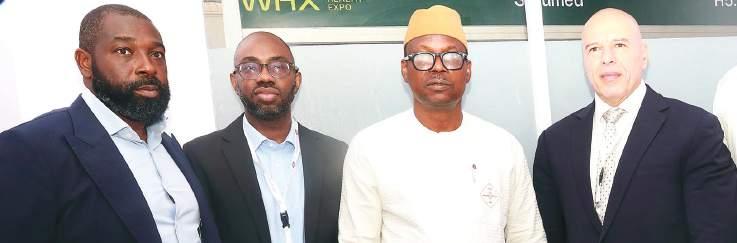
L-R: General Manager, African Region, GE Healthcare, Mohammed Haroun; Commercial Operations Leader, Africa, GE Healthcare, Tomide Makanjuola; Minister of State for Health and Social Welfare, Dr. Iziaq Adekunle Salako; and Senior Vice President, GE Healthcare, Muhammed Abdulsalami during the opening of the World Health Expo 2026 in Lagos, yesterday
House of Representatives has raised serious concerns over what lawmakers described as a crippling funding crisis at Nigeria Centre for Disease Control (NCDC), warning that the country’s capacity to respond to a possible Ebola outbreak and other epidemic-prone diseases has been dangerously weakened.
The alarm was raised through a Motion on a Matter of Urgent National Importance sponsored by Hon. Amobi Ogah.
Ogah called on the federal government to immediately provide adequate funding to the country’s foremost public health institution to strengthen preparedness and emergency response mechanisms.
Meanwhile, as countries continued to implement measures to check Ebola disease spread, the federal government
intensified national preparedness and response measures to safeguard Nigeria against the possible introduction of the Bundibugyo ebolavirus disease (BEBOV), currently reported in parts of East and Central African region.
Federal Ministry of Health and Social Welfare reassured Nigerians that there was currently no confirmed case of Ebola Virus Disease in Nigeria.
However, it said that in line with the government’s commitment to strengthening national health security and preventing cross-border disease transmission, heightened preparedness measures had been activated nationwide.
Equally upbeat, Executive Director of World Health Organisation Health (WHO) Emergencies Programme, Chikwe Ihekweazu, yesterday said Nigeria was less likely to witness another Ebola outbreak.
During an interview on ARISE News Channel’s “The Morning Show”,
Ihekweazu grounded his position on several intervening factors, which included non-proximity to affected regions and measures being deployed to check the spread of the disease.
The former director-general of NCDC said surveillance and response systems were being strengthened across affected regions.
He also said Nigeria’s exposure to the risk of Ebola being imported into the country was limited, compared to those countries bordering Uganda and Democratic Republic of Congo.
Presenting the motion before the House on the country’s capacity to respond to a possible Ebola outbreak and other epidemic-prone diseases, Ogah stated that NCDC was Nigeria’s National Public Health Institute with the statutory responsibility of responding to infectious disease outbreaks and public health emergencies across the country.
He drew attention to a recent
Sets up six-member committee to engage Finance Ministry Seeks details of govt’s plan to clear outstanding obligations nationwide
Sunday
Aborisade in Abuja
The Senate yesterday intensified efforts to address the lingering issue of unpaid debts owed to contractors by the federal government, setting up a six-member committee to engage the Ministry of Finance and obtain details of plans to settle outstanding obligations.
The upper chamber also gave the committee a one-week deadline to submit its findings, including the federal government’s efforts toward reimbursing contractors for capital projects executed across the country.
Senate President Godswill Akpabio announced the constitution of the committee during plenary after lawmakers overwhelmingly endorsed the proposal through a voice vote.
The committee is expected to serve as a liaison between the National
Assembly and the Federal Ministry of Finance with a view to facilitating the payment of contractors who have completed government projects but are yet to receive their entitlements.
Akpabio named the Chairman of the Senate Committee on Finance, Senator Sani Musa (APC, Niger East), as chairman of the panel.
Other members are Senators Adetokunbo Abiru (APC, Lagos East), Kawu Sumaila (APC, Kano South), Abubakar Sani Bello (APC, Niger North), Isah Jibrin (APC, Niger East), and Abdullahi Yahaya (APC, Kebbi Central).
The Senate President directed the committee to immediately commence engagements with officials of the Ministry of Finance and other relevant government agencies responsible for the settlement of outstanding contractual obligations.
He said the panel’s report should
clearly indicate the status of the debts, measures already taken by the government to address the issue, and the prospects for prompt payment to affected contractors.
The move underscores growing concern over the impact of delayed payments on contractors and project delivery across the country.
Many contractors handling federal capital projects have repeatedly raised concerns over outstanding debts, arguing that prolonged delays in payment have hampered operations, increased project costs and affected the timely completion of critical infrastructure projects.
By mandating the committee to submit its report within one week, the Senate signalled its determination to obtain clarity on the issue and ensure that appropriate steps are taken to resolve the backlog of payments.
warning issued by Africa Centres for Disease Control and Prevention (Africa CDC), which on May 15, confirmed an outbreak of the Bundibugyo strain of Ebola virus in the Ituri Province of Democratic Republic of Congo.
According to the lawmaker, the outbreak has already become a major public health emergency in Central Africa and poses a significant threat to other African countries, including Nigeria, particularly, because of porous borders and inadequate cross-border surveillance systems.
Ogah expressed concern the Bundibugyo strain currently had no licensed vaccine or targeted medical treatment, making prevention, preparedness, and rapid response the only viable strategies for containing any potential spread.
The lawmaker recalled that on May 25, 2026, NCDC officially placed Nigeria at high risk of Ebola importation.
He stated that in the public health advisory, Director-General of NCDC, Dr. Jide Idris, disclosed that the centre had intensified national coordination activities and activated preparedness measures, while the National Emergency Operations Centre was on alert mode.
However, Ogah questioned the
country’s actual level of preparedness, alleging that NCDC received no operational funding in 2025 and no capital releases had so far been made against its approved 2026 budget allocation.
He also lamented that overhead releases to the agency had been irregular and grossly inadequate, describing the situation as a violation of established international standards and an abuse of the provisions of the Appropriation Acts.
“How then can the preparedness of the centre for emergencies be guaranteed?” the lawmaker asked.
According to him, prolonged underfunding, coupled with uncertainty over future releases, has severely weakened the agency’s ability to discharge its critical health security responsibilities.
He observed that the challenge had been compounded by a significant decline in external donor support, which previously supplemented government funding for disease surveillance, outbreak preparedness, and emergency response activities.
The House was informed that NCDC was currently facing a series of operational challenges that threatened its effectiveness.
Among the challenges highlighted was the failure to pay vendors for
critical goods and services for more than one year, a situation that had stalled strategic projects, including zonal laboratories, treatment centres, and isolation facilities.
Ogah also disclosed that the agency now had dangerously limited resources for simulation exercises, preparedness drills, and after-action reviews that were necessary to identify weaknesses and improve outbreak response systems before emergencies occur.
He warned that laboratory reagents, consumables, and other essential materials required for disease screening and diagnosis were almost completely exhausted, thereby limiting the country’s capacity to detect and respond swiftly to infectious disease outbreaks.
The lawmaker revealed that biosafety and biosecurity infrastructure for handling highly infectious pathogens remains grossly inadequate, while intensive care and oxygen support systems needed for managing severe disease cases are also severely limited. He added that funding constraints had negatively affected the training and retraining of Rapid Response Teams across the country and weakened surge workforce deployment systems that were critical during public health emergencies.
President Bola Tinubu on Tuesday evening returned to Abuja after the Eid-el-Kabir holiday in Lagos, during which he undertook a series of important political, governmental, and national engagements.
Tinubu, whose official plane, Nigeria Air Force 1, touched down at Presidential Wing of Nnamdi Azikiwe International Airport, Abuja, at 5:17pm, was received by Minister of the Federal Capital Territory, Nyesom Wike; Chief of Staff to the President, Hon. Femi Gbajabiamila; National Security Adviser, Nuhu Ribadu; Inspector General of Police, Tunji Disu; and
other senior government officials.
During the Sallah holiday period, the president received Vice President Kashim Shettima and several groups, including the leadership of the senate, led by Senate President, Senator Godswill Akpabio, for the traditional Sallah homage.
Members of Nigeria Governors’ Forum led by its Chairman and Governor of Kwara State, AbdulRahman AbdulRazaq; All Progressives Congress (APC) stakeholders from Oyo State, including its governorship candidate, Senator Sharafadeen Alli; as well as APC candidates for the House of Representatives and House of
Nigerian Navy. He inaugurated three Nigerian Naval vessels - NNS Oloibiri, NNS Mambila, and NNS Gurara - on the occasion.
On the same day, the president received His Excellency Romuald Wadagni, President of the Republic of Benin, in a meeting that reinforced the longstanding bond of friendship, regional cooperation, and economic partnership between the neighbouring countries.
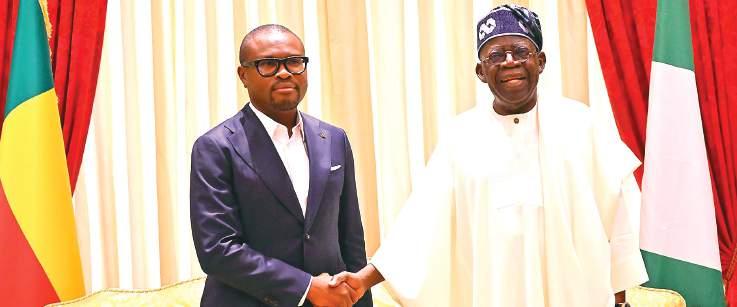
TINUBU RECEIVES PRESIDENT OF BENIN...
President
Letter read nearly two months after purported submission
The announcement of the resignation of House Minority Leader, Kingsley Chinda, yesterday raised fresh questions over how the lawmaker retained one of the most prominent opposition positions in the National Assembly despite emerging as the governorship candidate of the ruling All Progressives Congress (APC) in Rivers State.
Chinda’s resignation letter, dated April 23, 2026, was read by Speaker Tajudeen Abbas during plenary on Tuesday, almost two months after it was purportedly written.
The development has renewed scrutiny of the circumstances under which the Rivers lawmaker continued to occupy the Peoples Democratic Party (PDP) leadership position while simultaneously pursuing, and eventually securing the APC governorship ticket.
Besides, before now there was no public announcement that Chinda formally defected from the PDP to the APC before clinching the governorship candidature of the ruling party in Rivers, raising questions over the legality of the action.
His emergence as the APC standard bearer may have therefore created an obvious conflict with his continued oc-
cupation of the Minority Leader’s office for the period, a position traditionally reserved for a member nominated by opposition parties.
The delayed reading of the letter also raises procedural questions as to why the resignation, which was purportedly submitted on April 23, was not read since then? Again, did Chinda continue to function as Minority Leader after that date? At what point did the PDP caucus become aware that its leader had accepted the ticket of a rival political party? And why was a replacement not announced immediately?
The delay in the announcement has now fuelled questions over why a resignation from one of the principal offices of the House would remain unannounced for such a lengthy period, especially given the significant political developments involving the lawmaker during the intervening weeks.
Chinda, who represents Obio/ Akpor Federal Constituency of Rivers State, had until Tuesday remained known by the public as Minority Leader of the PDP caucus despite pursuing his governorship ambition on the platform of the APC.
However, the House did not provide any explanation for the almost two-month interval between the date on the letter and its eventual
Confusion over how PDP chief emerged in APC without quitting opposition post
presentation during plenary.
The controversy comes against the backdrop of heightened political realignments in Rivers State, where the battle for control of the state’s political structure has intensified ahead of the next governorship election.
Recall that in a surprising political stunt, Chinda, a political ally of the Minister of the Federal Capital Territory (FCT), Nyesom Wike, recently emerged as the APC governorship candidate for Rivers State ahead of the 2027 general election.
As part of the ongoing twist, the court-reinstated leadership of the APC in Rivers State had days ago declared all the nominations in the just concluded primaries of the party in the state as null and void. The primaries had produced Chinda, following the withdrawal of Governor Siminalayi Fubara from the primaries.
Besides Chinda, other lawmakers whose defections were also announced on the floor of the House included: Etanabene Benedict, representing Okpe/Sapele/Uvwie Federal
Constituency of Delta State, who defected from the Labour Party (LP) to the PDP, while Auwalu Gwalabe, representing Katagum Federal Constituency of Bauchi State joined the Allied Peoples Movement (APM) from the PDP.
Similarly, Najimdeen Oyedeji, representing Iseyin/Itesiwaju/Kajola/ Iwajowa Federal Constituency, Folajimi Oyekunle, representing Ibadan North Federal Constituency, and Abbas Adekunle Adigun, representing Ibadan North-East/Ibadan South-East
Federal Constituency, all in Oyo State, announced their defection from the PDP to the APM. In the same vein, Anthony Adepoju, representing Ibarapa North Federal Constituency of Oyo State, defected from the PDP to the APM; Adedeji Olajide, representing Ibadan NorthWest/Ibadan South-West Federal Constituency, also moved from the PDP to the APM, while Makanjuola Sunday Ojo, representing Ogo-Oluwa/ Surulere Federal Constituency, defected from the PDP to the APM.
Says Nigeria has less than 8,000 physiotherapists
Onyebuchi Ezigbo in Abuja
Millions of Nigerians recovering from stroke, injury, surgery, or mental health conditions will soon have better access to care.
That was because the federal government on Tuesday said it had taken steps to improve the standard of medical rehabilitation services in Nigeria.
It said current statistics put the
number of accredited professional physiotherapists in the country at less than 8,000.
Addressing a media parley in Abuja on Tuesday, Registrar and Chief Executive Officer of Medical Rehabilitation Therapist (Registration) Board of Nigeria (MRTB), Professor Rufai Ahmad, said the country currently had a good understanding of rehabilitation.
Ahmad said the National Reha-
Kuni Tyessi in Abuja
Policy inconsistencies and poor infrastructure are driving manufacturing investors away from Nigeria to neighbouring countries, Dr. Chris Ndibe, former General Manager of the Calabar Free Trade Zone, has said.
Speaking yesterday at the launch of his two books, “Reimagining Free Zones in Nigeria” and “Accelerating Growing Economies Through Free Trade
Zones” in Abuja, Ndibe warned that Nigeria’s economic enclaves need a complete overhaul to remain competitive.
Ndibe disclosed that a presidential committee set up three years ago to reform the sector has yet to deliver tangible results, stalling key growth initiatives and the uncertainty, he said, is already costing Nigeria direct investment.
Ndibe blamed the zones’ underperformance on the National Assembly’s failure to review
the governing Nigeria Export Processing Zones Authority Act and the law, he noted, has remained unamended for over 33 years.
“The books explore repositioning free trade zones as dynamic economic institutions rather than mere regulatory structures, whilst highlighting global strategies for industrialisation and export competitiveness,” he explained
“Last year, I lost a job. Two firms contacted me, and they had paid
me 50% for the job, but they later called me and said, ‘Chris, you can hold whatever we have given you, we are moving to Cotonou.
“First of all, in Nigeria, the act we are using is stale. I just have to say it. We cannot, in a dynamic society like the world is going today, use an act which is already 33 years old. It was passed by IBB in 1992. Modern economic realities necessitate a review every five to ten years to remain globally competitive.”
bilitation Policy, Strategic Plan and Monitoring and Evaluation Framework were currently being developed.
He said the Coordinating Minister of Health and Social Welfare, Professor Ali Pate, had approved the imple- mentation of the WHO Rehabilitation 2030 Initiative, “Which focusses on strengthening leadership and governance, rehabilitation financing, increase in number, distribution and competence of rehabilitation workforce, enhancing services delivery at all health care levels, generating and use of data for rehabilitation policies and reforms and ensuring availability of assistive devices.”
Ahmad said the Rehabilitation Technical Working Group set up by the minister, with support of the Medical Rehabilitation Therapists Board and relevant stakeholders, had also completed a systematic rehabilitation situation assessment in Nigeria.
He stated, “These efforts will help Nigeria bridge the identified gaps in delivery of rehabilitation services in the country. In a proactive approach, there are inter-ministerial efforts to establish foundation for the implementation of WHO Rehabilitation 2030 Initiative.
“The Coordinating Minister of Health and Social Welfare approved
the integration of rehabilitation in Primary Health Care and consideration of Rehabilitation Services and Products in Health Insurance.”
The MRTB boss said the efforts will help take the services to the community and primary health care levels, reduce out of pocket expenses, and enhance universal health coverage.
In addition, Ahmad said the federal government had approved a Public Private Partnership project between Medical Rehabilitation professionals and Health facilities that did not have medical rehabilitation services.
He explained that the measure will significantly improve service delivery and reduce unemployment among medical rehabilitation professionals in Nigeria.
The registrar said the Minister of Education had approved the establishment of medical rehabilitation programmes in 20 universities across all regions of the country.
He also said Minister of Humanitarian Affairs and Poverty Reduction had approved the revitalisation of all rehabilitation centres in the country to provide transition clinics that will help those transitioning from acute to community care.
Fund also unlocked N221bn in total property value and supported delivery of 475 housing units nationwide
Deji Elumoye in Abuja
President Bola Tinubu on Tuesday hailed the growing impact of Ministry of Finance Incorporated Real Estate Investment Fund (MREIF), which had delivered N128 billion in affordable mortgages to 1,859 Nigerian families across 25 states under the Renewed Hope Agenda.
The beneficiaries, spread across the six geopolitical zones, haD accessed mortgages of up to 20 years at a fixed interest rate of 9.75 per cent per annum with a 10 per cent minimum equity contribution, providing a pathway to home ownership that had largely been unavailable to many Nigerians for almost six decades.
Tinubu, in a release issued by his Adviser on Information and Strategy, Bayo Onanuga, stressed that one of the biggest barriers to home ownership in Nigeria had been the absence of affordable long-term mortgage financing.
According to him, “For years, many Nigerians could afford monthly rent but could not access the type of financing required to purchase a home. That reality kept countless families out of home ownership and limited their ability to build lasting assets.
“The progress recorded by MREIF shows that with the right policies, strong institutions and effective partnerships, we can expand access to home ownership and create op-
political parties’ primary election recess.
portunities for more Nigerians to build wealth through asset ownership.”
Beyond the mortgages already delivered, the fund unlocked N221 billion in total property value and supported the delivery of 475 housing units through offtake guarantee projects.
With an average mortgage beneficiary age of 42 years old, MREIF reflected strong demand among working Nigerians who had historically faced limited access to affordable long-term mortgage finance.
The president also stated that MREIF was one of several complementary engines driving a wider housing transformation under the Renewed Hope Agenda, working
determined to fight them, and we are fighting them.”
alongside the Renewed Hope Cities and Estates Programme and the financing interventions and social housing programmes of Family Homes Funds Limited.
He stressed that affordable mortgage finance was what converted completed units into genuine home ownership, closing the loop between construction and access.
For nearly six decades, Nigeria struggled to build a mortgage market capable of providing affordable long-term housing finance at scale.
MREIF, a N1 trillion housing finance platform whose pilot phase comprised N250 billion in concessionary and commercial funding, was established to help close the gap by mobilising
long-term capital for mortgage lending through a combination of government support, private sector management, and institutional investment.
Building on the fund’s early achievements, the administration expects further capital mobilisation to support increased mortgage lending, deepen participation by institutional investors, and expand access to affordable housing finance across the country.
MREIF is sponsored by the Ministry of Finance Incorporated and managed by ARM Investment Managers Limited.
MREIF’s Series 2 commercial issuance is rated AAA by Agusto & Co. and AA by GCR Ratings,
AKPABIO: KIDNAPPERS, TERRORISTS TARGET NIGERIA, NOT POLITICAL PARTIES Chuks Okocha, Olawale Ajimotokan, Sunday Aborisade, Linus Aleke, Juliet Akoje, Kuni Tyessi in Abuja, Hammed Shittu in Ilorin, Yinka Kolawole in Osogbo, James Sowole in Abeokuta, Laleye Dipo in Minna, Kemi Olaitan in Ibadan, Gbenga Sodeinde in Ado Ekiti and Yemi Kosoko in Jos
President of the Senate, Godswill Akpabio, yesterday, cautioned politicians, aspirants, and public commentators against exploiting Nigeria’s security challenges for political advantage, insisting that insecurity should be confronted as a national emergency rather than a partisan issue.
According to Akpabio, all the criminals – terrorists, kidnappers, and bandits – only target Nigeria and its people and not political parties, as being insinuated in some quarters.
He also directed the senate leadership to urgently conclude arrangements for the proposed national security summit, saying lawmakers must intensify efforts to strengthen the country’s security architecture amid growing concerns over violent crimes and kidnappings.
Akpabio spoke at the resumption of plenary after Senate’s Sallah and
The senate president’s remarks came as the upper chamber observed a minute silence in honour of victims of the recent abduction of schoolchildren and teachers in Oyo State, including two educators and a child who reportedly lost their lives in connection with the incident.
Describing the tragedy as an assault on the nation’s collective humanity, Akpabio said the continued targeting of schools and innocent citizens underscored the urgent need for national unity and coordinated action against insecurity.
“The abduction of schoolchildren and teachers in Oyo State is not merely an attack on innocent citizens; it is an assault on our collective humanity,” he said.
According to him, the country must remain united in confronting criminal elements, who threaten national stability and public safety.
Akpabio stated, “There is always a temptation to divide, to accuse and to seek advantage from tragedy. There is no country in the world without challenges and there is no country without crime.
“That is why security agencies are created—to fight crime. We are
Akpabio warned political actors against turning national tragedies into platforms for political mobilisation or publicity. He reiterated that criminals did not discriminate on the basis of political affiliation, religion, or ethnicity.
According to him, “Politicians and aspirants must resist that temptation for such cheap publicity. Those who kidnap our children, terrorise our communities and murder innocent citizens do not distinguish between party, faith or ethnicity.
“Their assault is directed against Nigeria itself. Therefore, our response must be equal to the challenge. We must stand united, firm and resolute.”
The senate president urged Nigerians to continue to support lawful measures aimed at strengthening security, protecting schools, and vulnerable communities, and ensuring that perpetrators of violent crimes were brought to justice.
He expressed confidence in the resilience of Nigerians and the capacity of the country’s institutions to overcome prevailing security challenges.
“The challenge before us is real. But so too is the courage of our people,
the resilience of our institutions and the enduring promise of Nigeria,” he said.
Earlier, Akpabio led senators in mourning the victims of the Oyo kidnapping incident, paying tribute to two teachers, Mr. Michael Oyedokun and Mr. Adesiyan Adegboye, as well as a child who also lost his life.
He said the deaths represented a painful loss not only to their families but also to the country, stating that the safety of children and teachers must remain a priority for government at all levels.
He said, “We share the pain of the bereaved families. Their loss is our loss. Their sorrow is our sorrow. Their pain is our pain.”
Expressing hope that those being held would regain their freedom, Akpabio commended the efforts of security agencies and urged them to sustain operations aimed at rescuing victims and dismantling criminal networks.
The senate president subsequently directed Senate Leader and Clerk of the senate to urgently fix a date for the long-awaited National Security Summit.
According to him, the senate must use the summit to review previous resolutions, assess existing security
NESTOIL’S REBUTTAL TO THE PRESS RELEASE IN JUNE 2026 BY ABUBAKAR SULU-GAMBARI, SAN
injunctive reliefs in favour of the purported receiver/manager, he has asked the public to proceed as if the decision of the Supreme Court has no bearing or effects on his exercise of powers as receiver manager. This same person had, upon issuance of ex parte orders by the Federal High Court and Court of Appeal (now set aside by the Supreme Court) taken out paid publications indicating that those inappropriate (and now declared as unlawful) orders implied that the public should only deal with him. Now that he has completely lost all judicial cover for his purported receivership, he has resorted to assuming the status of interpreter of the law to hoodwink the general public. If he did not need the orders that have now been set aside to function, why did he and his appointors apply to obtain them in the first place, especially in clandestine manners that the Supreme Court has now berated.
For the avoidance of doubt, while the Supreme Court in SC/ CV/1130/2025 set aside all the ex parte Orders of the Court of Appeal dated 27 November 2025
in favour of Mr. Sulu-Gambari, the same Supreme Court, by its previous judgment of 10th April 2026 in SC/CV/46/2026 held that the authority of the purported receiver to act is at the heart of and subject of interrogation of the suit filed by his appointors at the Federal High Court and he therefore cannot purport to exercise powers of a receiver in the face of such suit. The Supreme Court reiterated similar sentiments in its judgment of 1st June, 2026 whilst setting aside the ex parte orders which gave Mr. Sulu-Gambari judicial cover by holding that the orders overreached the pending action at the Federal High Court and were unconstitutional or in breach of mandatory constitutional stipulations. For completion, Mr. Sulu-Gambari has deliberately concealed or failed to disclose that the exercise of any powers purportedly arising from the alleged Deeds of Appointment has since been restrained, suspended and placed in abeyance by subsisting Orders of the Federal High Court, Abuja Division, presided over by Hon. Justice P. O Lifu in Suit No. FHC/ABJ/CS/2534/2025
since December 1, 2025. Mr. Sulu-Gambari is a defendant in that suit in person, he is aware of the orders and the orders are extant and unchallenged till date.
Consequently, any assertion that the Receiver/Manager is at liberty to exercise unfettered powers over Nestoil Limited, Neconde Energy Limited or their assets is inaccurate, misleading and contrary to the present legal realities.
Mr. Sulu-Gambari, by his mere saying so cannot re-create
orders already set aside by the Supreme Court or re-enact a scenario as if the Court orders permitting him to act are still extant. Nestoil and Neconde reserve all their rights in the circumstances. Whilst the actions and recalcitrance of Mr. Sulu-Gambari, SAN will be addressed at the relevant quarters, the public, financial institutions, contractors, regulators and all stakeholders are therefore therefore advised to remain guided accordingly.
Signed: Management
strategies, and identify additional measures capable of strengthening the country’s security framework.
He stated, “It is on that note that I want to urge the Leader of the Senate to quickly work with the Clerk of the Senate and fix a date for us to conclude our security summit.
“In spite of the tragedies we are facing, we must engage in serious discussions, review our resolutions and recommendations and examine everything we can do to further strengthen the efforts of our security services.”
Makinde
Oyo State Governor, ‘Seyi Makinde, yesterday, called on governments at all levels to work together to confront the present security challenges and rescue the pupils and teachers abducted recently in Yawota and Ahoro Esinele communities of Oriire Local Government Area.
Makinde made the call while receiving leaders and members of Nigeria Labour Congress (NLC), Nigeria Union of Teachers (NUT), and National Association of Nigerian Students (NANS), who came on a peaceful/solidarity rally to demand quick and safe release of the abductees.
He stated that the incident was a national distress, warning against attempts to politicise it or trade blames.
Makinde said the challenge was beyond politics, because the perpetrators had demonstrated a complete disregard for humanity. He added that it was time for everyone to work together to surmount the challenge.
Speaking with the union leaders, Makinde appealed to students, workers, and teachers across the state to continue to trust the government, assuring them that every available resource is being deployed to secure the release of the abducted children and their teachers.
The governor stated, “I have had the opportunity to engage with the leadership of NANS, NUT and NLC. Let me say this clearly, this is a time of national distress. It is not the time to trade blame and to play politics. I am personally distressed.
“My own father was a primary school teacher. He actually taught at Ahoro Dada, which is less than 15 kilometres to where this incident happened. My father was there between 1959 and 1960 and if something like this had happened to him, maybe I wouldn’t have even been born.
“So, it is not the time for us to say, ‘It is the president that should have handled this, it is the governor or the local government.’ This is the time to pull together as one.”
Makinded stressed, “We are not dealing with normal human beings. Just think briefly, how will somebody take a fellow human being and slaughter him? Is that somebody that is normal?
“So, these are not normal people. I can only appeal to you, the students, the workers, the teachers to, please, have trust in your government. We are doing our best.”
The governor emphasised that both the federal and state governments were collaborating to ensure the successful rescue of the abducted people.
He assured the labour leaders, teachers, and students that once the abductees had been successfully rescued, his administration will consider suggestions aimed at strengthening the state’s security architecture in the long term. He stated, “I have heard from the federal government, and I have been meeting with the security operatives sent here over the past two weeks. We shouldn’t provide oxygen to the people that want to see us divided.
“The response at this time should be to pull together and allow the
Continued on page 28
OBOREVWORI: TINUBU’S RE-ELECTION MY NUMBER ONE PROJECT ENO: A’IBOM WILL VOTE HIM FOR MAKING FUNDS AVAILABLE TO STATES
of development at the subnational level.
The two governors, who spoke separately during interviews on ARISE Television, also expressed confidence that their states would overwhelmingly support the president in the next election, citing both political realities on the ground and the tangible impact of federal reforms on state finances.
Declaring that his own re-election was no longer a political concern, having already been settled, Oborevwori said his focus had shifted entirely to securing victory
for Tinubu, describing it as his number one project.
According to him, apart from being an in-law to Delta state, returning Tinubu who’s married to Oluremi, an Itsekiri woman, to office would strengthen the state’s voice at the national level and open up greater opportunities for appointments and federal patronage.
“So on the issue of the contest, governorship is not an issue. It’s not an issue. We talk about how to deliver, Mr. President, my president, President Bola Ahmed Tinubu, which is my number one
project. That’s the project, that’s my project. This is because that project is bigger than any other projects.
“This is so that the burden I’m carrying will be light for me because I’m carrying a lot of burden as a governor. People are depending on the state. So that by the time we deliver, we’re able to at least export some people to the national level. So that I will have a voice. Because the report card that I will show will give the state a lot of opportunities for appointment.
“Among the candidates that have emerged, he (Tinubu) is the only
one that has affiliation to Delta State. Because Deltans are wise now. The man is an in-law here. So, you need to be evil to vote against your in-law. So, it’s a family affair,” he maintained.
Oborevwori insisted that the All Progressives Congress (APC) had little to fear because the government had delivered tangible results to the people. The governor further predicted that the voting pattern that favoured Labour Party (LP) presidential candidate, Peter Obi, in
Continued on page 12
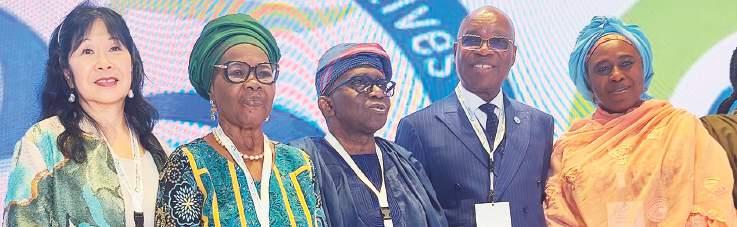
Mary Woodard Lasker Professor of Health Sciences, Harvard T.H. Chan School, Prof. Phyllis Kanki; Professor of Haematology and Blood Transfusion, Prof. Ibironke Akinsete; Former Minister of Health and Nigeria Ambassador Designate to Canada, Prof. Isaac Adewole; Chief Executive Officer, APIN Public Health Initiatives, Prof. Prosper Okonkwo; and Special Adviser to the President on Health, Dr. Salma Ibrahim Anas, at the event marking the 25th anniversary of APIN Public Health Initiatives in Abuja, yesterday
Describes him as an honest, sincere person, iconic nationalist and committed democrat Rejoices with award-winning journalist, Idowu Ajanaku
Deji Elumoye in Abuja
President Bola Tinubu paid glowing tribute to his long-time friend, Alhaji Yusuf Ali, as he clocked 90 on June 2.
In a message issued Tuesday, the president described the celebrant as an iconic Nigerian, unavowed nationalist, and committed democrat.
Tinubu stated, “I am elated to join the family, friends and protégés of my friend and brother, elder statesman Alhaji
Yusuf Garba Ali, to celebrate this iconic Nigerian on his 90th birthday, June 2.
“We give Almighty Allah the glory for keeping you through these years and, especially, for your indelible contributions to the development of Nigeria through your long career in the petroleum sector, sports administration as chairman of the Nigeria Football Association and politics.
“Alhaji Yusuf Ali and I have walked together for a long time, in gloom and in happiness, in victory and through
setbacks. In all these years, I have found him to be an honest and sincere person, an unavowed nationalist, a committed democrat, and a friend, indeed.”
The president wrote of Ali, “Born in Jos in 1936 to parents originally from Kano, Alhaji Yusuf has, through the years, fostered familial and communal ties and mentored generations of Nigerians in business and politics.
“Alhaji Yusuf cut his teeth in active politics during the transition to the
Second Republic, when he took leave of his position as Regional Manager of Total to contest for a seat in the Constituent Assembly and serve as a councillor of Rano in Kano State. Later in his career, he served as Managing Director of UniPetrol for 10 years.
“As the national chairman of the defunct All Peoples Party (APP), a chieftain of the Action Congress of Nigeria(ACN) and as a founding father of the All Progressives Congress (APC),
our democracy benefited a lot from his wisdom and dedication.”
Tinubu stated, “I have benefited from his committed friendship, wisdom and wise counsel.
“Alhaji Alli’s wisdom, leadership and political experience proved useful in those giddy days of the formation of APC. He remains, to this day, a personal friend and supporter. He stood by my side on my journey to the presidency.
“I pray to Almighty Allah to grant
I was detained for over three hours by DSS operatives, says Ndibe
Linus Aleke in Abuja
The Department of State Services (DSS), has denied arresting or detaining Prof. Ndibe at the Murtala Muhammed International Airport on June 1, 2026, or at any other location on that date.
In a statement on Tuesday, the Deputy Director of Public Relations and Strategic Communications at the Service’s National Headquarters, Favour Dozie, explained that the DSS interaction with the academic was part of an ongoing review of old Watch-List Actions (WLAs).
According to the Service, the current Director-General, upon assuming office, directed a review of longstanding WLAs, some of
which date back to the military era, to ensure that citizens are not unnecessarily inconvenienced or embarrassed by pre-existing watch-list records.
In the statement titled, “Re: Arrest of Professor Okey Ndibe – Setting the Records Straight,” the DSS said:
“In this regard, all those who had previously been watch-listed while on transit, are routinely interfaced with as a prerequisite for a review and possible downgrade of the Action.
“This, being a precursor to a final delisting in accordance with international best practices. It is pertinent to state that the foregoing process is aimed at ensuring that before the final delisting, that
activities, travel histories as well as current activities of these individuals are not in furtherance of and do not still conform with the reasons for the initial WLA.
“Suffice to point out that since the inception of the current Management, many Nigerians, including journalists have benefited from this process.
“This is despite the fact that the Service conducts this clearance to take care of Watch List requests from other Agencies. A case in point is that of Mr. Lanre Arogundade, Executive Director of the International Press Centre, IPC, whose delisting was approved in May 2025, after over a decade on the Watchlist.
“In the same vein, Prof. Ndibe
has been on Watchlist since January 29, 2013. Meanwhile, his case has been reviewed and downgraded. Thus, the interface with him at the airport, was geared towards the final delisting of his details from the Action. As part of the routine interface involved in the process, after barely an hour of his interaction with the Service, he was cleared and escorted.
“Note that, even on his Facebook post, he referenced the professional, courteous and decorous conduct of Service operatives, who continue to scale their respect for the rule of law and human rights under the new Leadership.”
The Service reiterated that the review process would continue
to ensure that all Nigerians are treated fairly and in accordance with the law.
“The DSS therefore urges citizens affected by the Service WLA, who wish, to formally report same to the National Headquarters to facilitate ongoing process. However, regardless of any formal request, the attempt at hygiene regarding the WLA, will be sustained,” the statement concluded.
Meanwhile, Nigerian-born academic and writer, Prof Okey Ndibe, insisted that he was detained and questioned for more than three hours by operatives of the Department of State Services (DSS) after arriving in Nigeria from the United States.
you better health so that you can continue making your contributions to our fatherland and witness the full dawn of the Nigeria we both dream of.” Equally, on Tuesday, the president congratulated multiple-award-winning journalist and political strategist, Idowu Ajanaku, on his 60th birthday, June 2. Tinubu, in a release issued by his Adviser on Information and Strategy, Bayo Onanuga, rejoiced with Ajanaku, the Commissioner for Information and Orientation in Ondo State, on reaching the milestone age, and commended his courage, vibrancy, and dedication to the noble profession of journalism over many decades.
The president acknowledged the contributions of the communications and political strategist to democracy and good governance in Nigeria, and recalled his valiant efforts against tyranny in the days of military rule.
Tinubu lauded the loyalty and commitment of the skilled writer and analyst in strengthening the progressive movement in the South-west, serving as Senior Special Assistant on Public Affairs and Special Adviser on Information and Strategy in Lagos, before successfully leading the media campaign of former Governor Rotimi Akeredolu.
The president also commended Ajanaku for using his experience and network in journalism to project the achievements of both the national and state governments, and for exploring various media platforms to bridge understanding of policies and the thrust of the Renewed Hope Agenda.
Onyebuchi Ezigbo in Abuja
A leading policy and development advocacy organization, the Policy and Legal Advocacy Centre, PLAC, has said that Nigeria is yet to meet her expectations in terms of improvement in politics and development despite over 25 years of democratic rule. In the political sphere, the Centre said that the country has never in its history witnessed the limiting of political space, threat of a one party
and poor women representation in governance as it is at present.
Speaking at the orientation workshop for 40 PLAC-National Assembly Interns in Abuja, sponsored by the European Union, the Executive Director of PLAC, Mr. Clement Nwankwo, said the country has been grappling with the issues of development and democratic governance for over two decades now.
He said: “It’s every time we hear that the conditions in the country
will improve, and sometimes people say that the condition continues to deteriorate.”
He expressed regret that Nigeria has been struggling with generating 3000 4000 kilowatts of power for the last 20 years, thus making it difficult for the population to enjoy stable electricity.
“I haven’t seen anyone who says, oh, politics has improved, or that conditions have improved. The reality, of course, is that things have improved, but they could be better.
“A lot of us are very worried about how slow things are in getting better, and what we worry about that, it means that we want to see our country develop when we are satisfied with where we are, and it means that we have nothing to add to the development of the country, but this country can be so much, so much, so much better”.
Nwankwo said the choice of the 40 participants in the internship programme was a product painstaking exercise reflecting
fairness and professionalism.
Nwankwo told the interns that they should be worried about what politics means and what the politicians are doing with the future of the country adding that as young people the future of Nigeria is in their hands.
“You who are here must feel sufficiently angry, about where the country is and feel challenged as a result to do something different,” he said.
He said the purpose of the legisla-
tive internship is to enable the interns understand how democracy works, and how they can, in whatever space they find themselves make their contributions to the development of the country.
A Board member of PLAC, Dr. Mero Mandara, lamented the poor state of affairs in the country especially the very slow pace of development in the country. She said that the country has continued to witness decreasing inclusion of women in the politics.
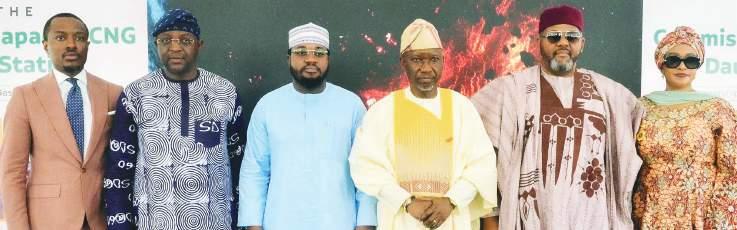
L-R: Special Assistant to the President on Digital Media, Mr. O’tega Ogra; Senior Special Adviser to the President on Media and Public Communication, Mr. Sunday Dare; Chief Executive Officer, Rolling Energy Ltd, Alhaji Mubarak Dambata; Minister of State for Petroleum (Gas), Chief Ekperikpe Ekpo; Executive Chairman, Presidential Initiative on CNG and Electric Vehicles, Mr. Ismaeel Ahmed; and Representative of the Authority Chief Executive/Regional Coordinator of NMDPRA, Hajiya Maijidda Abulkadir, during the inauguration of the High Capacity Daughter Booster Station by the Minister at Jahi District, Abuja, at the weekend
Adedayo Akinwale in Abuja
The Independent National Electoral Commission (INEC) has launched an investigation regarding the alleged unauthorised access to the Commission’s Continuous Voter Registration (CVR) database and the subsequent publication of information on a candidate in the recent primaries of a political party in the Federal Capital Territory (FCT)
Lere Olayinka, media aide to the Minister of FCT, Nyesom Wike, had shared the personal data of Nollywood actor, Emeka Ike from the portal of the Commission.
Against this background, Ike threatened to take legal action against Olayinka for sharing his voter information via an INEC administrative webpage Ike, a native of Imo State, contested the House of Representatives seat for the AMAC/Bwari Federal Constituency in the Federal Capital Territory under the Nigerian Democratic Congress and lost.
INEC National Commissioner and Chairman, Information and Voter Education Committee, Mohammed Haruna, in a statement issued Tuesday revealed the Commission
has immediately commenced a thorough investigation to establish the facts surrounding the incident. He noted: “The attention of the Independent National Electoral Commission (INEC) has been drawn to allegations currently circulating on social media and in some sections of the media regarding the alleged unauthorised access to the Commission’s Continuous Voter Registration (CVR) database and the subsequent
publication of information on a candidate in the recent primaries of a political party in the Federal Capital Territory.
“The Commission takes this allegation seriously and has immediately commenced a thorough investigation to establish the facts surrounding the incident.
“As part of the ongoing Continuous Voter Registration (CVR) exercise nationwide, authorised INEC Registra-
tion Officers were granted controlled access to specific components of the CVR system to enable them register new applicants, process requests for transfer of registration and update voter records where necessary.
“Such access is restricted to official duties only and is withdrawn at the conclusion of the exercise.
“The audit trail from the preliminary investigation has enabled the Commission to identify the user
account through which the information was accessed.
“Accordingly, relevant personnel have been questioned, and all units connected with the incident are cooperating fully with the investigation.”
Haruna stressed the Commission was also examining all technical, administrative and operational factors associated with the matter in order to establish individual responsibility and determine the circumstances sur-
The Nigeria Security and Civil Defence Corps (NSCDC) has launched a strategic capacity-building programme aimed at strengthening operational efficiency, enhancing research capabilities, and accelerating digital transformation across its formations nationwide.
Speaking at the opening of a twoday training on the implementation of operational deliverables and research methodology in Abuja, Commandant General of the Corps, Prof. Ahmed Audi, declared that the NSCDC occupies a unique and indispensable position within Nigeria’s security architecture.
According to the NSCDC boss, the Corps’ responsibilities in protecting critical national assets and
As Nigeria marks 33 years since the historic June 12, 1993 presidential election, the civil society organization, Enough is Enough (EiE) Nigeria, in partnership with crowdfunding platform Crowdr, has launched the One Million Voters Campaign aimed at mobilising and registering one million Nigerians ahead of the 2027 general elections.
The initiative, which combines voter mobilisation and crowdfunding, seeks to address low electoral participation in the country, particularly
among young Nigerians, through voter registration drives, civic education, youth engagement and voter protection activities.
EiE Nigeria said the campaign comes against the backdrop of declining electoral participation, noting that voter turnout during the 2023 general elections stood at less than 27 per cent, leaving nearly three out of four eligible Nigerians outside the decision-making process.
According to the organisation, many eligible voters were either not registered, had not collected their Permanent Voter Cards (PVCs), or
lacked adequate information and support to effectively participate in the electoral process.
The campaign, supported through public contributions on Crowdr, is expected to fund voter registration mobilisation, PVC collection drives, civic education programmes, youth outreach initiatives and voter protection efforts across Southwest Nigeria.
The mobilisation effort will officially begin on June 12 with voter registration and civic engagement activations at the University of Lagos (UNILAG) and Lagos State University (LASU).
EiE said the activations, being implemented in collaboration with Civic Hive and LearnPolitics, ALX and The Future Project, would combine voter registration support, civic
education, peer-to-peer mobilisation and democratic engagement activities targeted at young Nigerians.
The organisation noted that the June 12 activities mark the beginning of a wider mobilisation effort expected to extend into Ogun State and other parts of Southwest Nigeria under its broader Register, Select, Vote, Protect (RSVP) strategy ahead of the 2027 elections.
Executive Director of EiE Nigeria, Ufuoma Nnamdi-Udeh, said the initiative seeks to bridge the growing gap between political awareness and civic participation among young Nigerians.
“June 12 is not just a date in our history; it is a reminder that democracy survives when citizens participate. As we look toward 2027,
rounding the use of those credentials and identify any breach of internal access-control protocols before taking appropriate action against anyone involved.
He explained that preliminary findings from the Commission’s audit trail so far, however, indicated that there was no external breach of the CVR database, no hacking incident, and no unauthorised external access to the Commission’s ICT infrastructure.
we are concerned by the growing disconnect between political awareness and civic action.
“Too many young Nigerians are frustrated with the state of the country but remain outside the democratic process. Through this campaign, we are creating practical pathways for participation. Our goal is simple: to ensure that more Nigerians are equipped and ready to shape the future of their country.”
EiE further disclosed that activities marking Democracy Day would continue on June 13 with a civic gathering designed to engage young Nigerians through conversations, storytelling, film screenings and interactive activities focused on democracy and the 2027 elections.
Insists no external breach of CVR database, no hacking incident Abia Govt Begins Bid for UNESCO Creative City Status for Aba, Plans Honouring Heroines of 1929 Women Riot
infrastructure, disaster management, intelligence gathering, and community engagement place it at the forefront of efforts to safeguard national security and public safety.
Audi said the training was designed to promote the adoption of research methodology and digitalization as key tools for achieving the Corps’ operational objectives in line with the priorities of President Bola Ahmed Tinubu’s administration.
He stressed that the increasingly complex security landscape requires officers to move beyond conventional field operations and embrace analytical thinking, research, and technologydriven solutions.
“Modern security challenges demand evidence-based approaches and innovative problem-solving
skills. Personnel must be equipped to identify emerging threats, conduct relevant research, and develop practical solutions that can improve service delivery,” he said.
The Commandant General further urged participants to ensure that the knowledge acquired during the training translates into measurable improvements across commands and formations nationwide.
Earlier, the Commandant in charge of Planning, Research and Statistics, Commandant Peter Okloho, reminded participants that the federal government evaluates the corps based on the effective delivery of its statutory mandates. He therefore charged officers to uphold professionalism and accuracy in their reporting processes following the training.
The Abia State Government has launched a bid to secure UNESCO Creative City status for Aba, popularly known as Enyimba City, while also initiating plans to honour the heroines of the 1929 Aba Women Riot.
The move is aimed at spotlighting Aba’s globally recognized strengths in fashion, leatherworks, and indigenous manufacturing, and positioning the city as a hub for culture, innovation, and tourism.
Commissioner for Information, Prince Okey Kanu, disclosed this dur-
ing a press briefing on the outcome of this week’s State Executive Council meeting chaired by Governor Alex Otti in Umuahia.
The UNESCO Creative City Status is a prestigious designation recognizing cities that place creativity, culture, and creative industries at the core of their sustainable urban development plans.
Cities with the status form the UNESCO Creative Cities Network, UCCN, launched in 2004 and now connecting nearly 500 cities worldwide.
“Aba has been enlisted under
the Design category. The bid is ongoing and we’ve recorded significant progress so far,” Kanu said. “This is designed to project Aba’s reputation as a centre of innovation and craftsmanship to the global community.”
He added the bid forms part of the Otti administration’s broader strategy to promote tourism, culture, and the creative economy. Kanu disclosed the government has approved the construction of monuments in strategic locations across Aba and Umuahia to preserve cultural heritage and boost tourism.
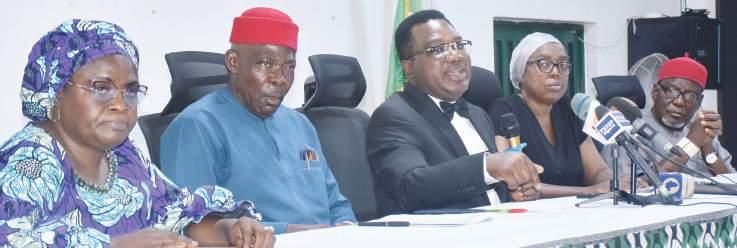
L-R: Head Procurement, National Human Rights Commission (NHRC), Mrs. Titilayo Samuel; Member of the Planning Committee, Memorial Lecture for late Humphrey Nwosu, Mr. Emeka Nwosu; Executive Secretary, NHRC, Dr. Tony Ojukwu (SAN); Director, Human Rights Institute, Dorothy Amah and Officer, Centre for Democracy and Human Rights, Fab Uche, during the press conference by the NHRC on annual June 12 memorial lecture in honour of late Prof. Humphrey Nwosu in Abuja on Monday
The global economy has entered a period of heightened uncertainty, with an overwhelming 94 per cent of the world’s leading economists expecting inflation to rise over the next 12 months, according to the May 2026 ‘Chief Economists’ Outlook’ released by the World Economic Forum (WEF).
In the same vein, it explained that
nearly nine out of every 10 of the chief economists foresee weaker economic growth, as geopolitical tensions and supply chain disruptions continue to reverberate across international markets.
The report warned that the escalating conflict in the Middle East and the closure of the Strait of Hormuz have fundamentally altered the trajectory of the global economy.
According to the report, 89 per cent
of surveyed chief economists expect global growth to weaken over the coming year, with more than one-fifth predicting a significant slowdown. The findings represent a sharp reversal from the cautious optimism that characterised global economic sentiment at the beginning of 2026.
The report highlighted the closure of the Strait of Hormuz, a critical artery for global energy shipments, as a
major economic shock whose impact is already being felt across energy, food, fertiliser and transportation markets worldwide.
Economists surveyed by the WEF rated the disruption as potentially more severe than the tariff-related turmoil experienced in 2025 and warned that prolonged closure could eventually rival the economic fallout witnessed during the COVID-19 pandemic.
Oghenevwede Ohwovoriole in Abuja
The National Youth Service Corps (NYSC), has assured Nigerians of the neutrality of corps members during the upcoming elections in the country.
NYSC Director General, Brig. Gen. Olakunle Nafiu gave the assurance Tuesday in Abuja at the 2026 Batch “B” Pre-Orientation workshop with the theme, “Strengthening the Orientation Course to Advance National Priorities and Contemporary Challenges.”
The pre-orientation workshop was aimed at reviewing the successes and gaps of previous orientation courses to aid better planning for
future orientation exercises.
Nafiu said as the elections are approaching, the NYSC needed to impart the spirit of neutrality on the corps members because elections are very important to Nigerians.
He said, “With national elections approaching, our top priority is to reinforce NYSC’s neutrality during orientation.
“Corps members must receive comprehensive civic education, understand their codes of conduct and maintain strong security awareness during electoral duties.
“We cannot afford to disappoint ourselves and those that have gone before us. We must therefore be seen to be above board in our operations
leading to the 2027 general elections and the off-cycle elections in Ekiti that comes up later this month and Osun in August this year.”
He said the security of lives and property of corps members had remained a challenge to NYSC’s operations in recent time, adding that current security environment requires increasing vigilance and strong safety protocols.
“They must promote security awareness and maintain close cooperation and collaboration with security partners to keep our camps safe.
As you return, you have a few days to reinforce your relationship and strengthen your engagement with the heads of intelligence and
Laleye Dipo in Minna
The Niger State Government has recruited 396 former UNICEF/ GAVI Workers into the state civil service bringing the number of medical personnel engaged by the government in three years to nearly 3,500
The 396 workers had been in the engagement of UNICEF/GAVI for immunisation assignments under a memorandum of understanding entered into with the government during the administration of former Governor Abubakar Sani Bello which was renewed by incumbent Governor
Mohammed Umaru Bago.
The absorption of the health workers according to the Commissioner for Health Dr Murtala Mohammed Bagana would strengthen the health sector work force.
Speaking at a brief ceremony where the absorbed workers were given their employment letters, Dr. Bagana said while government may provide modern infrastructure and medical equipment, effective healthcare delivery cannot be achieved without adequate manpower which was why the workers were absorbed.
The Commissioner noted that
Development Partners including UNICEF and GAVI had earlier identified critical shortages in human resources across health facilities in the state stating that it is the responsibility of government to solve the identified shortages.
Dr. Bagana however disclosed that “The partners had expressed willingness to invest in young healthcare professionals and sought assurances from the Niger State Government that beneficiaries of the programme would eventually be integrated into permanent service due to the long-term nature of healthcare needs”.
security agencies in your areas of operation in your respective states,” he told the corps members.
Nafiu reminded state governors of their responsibilities to the scheme, noting that “there is no doubt that improved orientation camp facilities are crucial to our operations.”
According to him, “As the corps population grows, state governments must be made aware of the importance of fulfilling their obligations to provide fitting and functional orientation camps for the scheme to utilise.
Inflation emerged as the dominant concern among respondents, with the majority agreeing that global price pressures would intensify over the next year as higher energy and food costs feed into broader consumer prices.
The survey indicated that rising fuel prices, supply chain bottlenecks and heightened financial market volatility are collectively driving inflation expectations higher across virtually every region of the world.
For Nigeria and other African economies, the findings carry significant implications. The report showed that 67 per cent of chief economists expect high or very high inflation in Sub-Saharan Africa over the next 12 months, reflecting concerns about imported inflation, higher food prices and increased energy costs.
Despite the deteriorating outlook, economists stopped short of predicting a full-scale global recession. Only 13 per cent of respondents believe the world economy is likely to enter recession within the next year, while 58 per cent expressly disagreed with that proposition.
Instead, the consensus pointed to slower growth, elevated inflation and increased market volatility rather than outright economic contraction.
The report also revealed mounting
concerns over financial markets. About 79 per cent of chief economists expect increased volatility in private debt markets over the next year, while 74 per cent foresee similar turbulence in public debt markets. Additionally, 68 per cent anticipate greater instability in global equity markets as investors navigate a more uncertain geopolitical environment.
Besides, regional outlooks varied considerably. India emerged as the strongest growth story globally, with 52 per cent of respondents expecting strong or very strong economic expansion over the next 12 months. The United States was also viewed relatively favourably, with 74 per cent predicting moderate growth supported by artificial intelligence investments, consumer spending and government expenditure. China’s prospects improved modestly, with 77 per cent expecting moderate or stronger growth, compared to 71 per cent in the previous survey. Europe, however, faces a far more challenging outlook. The survey found that 65 per cent of economists expect weak or very weak growth across the continent, while half foresee high inflation as rising energy costs increase the risk of stagflation—a combination of sluggish growth and elevated prices.
Union Bank of Nigeria’s Endless Possibilities campaign has won Bronze in the Heritage category at the 2026 Pitcher Awards, one of Africa’s foremost platforms for creative excellence.
The campaign was also shortlisted in the Craft category for Film Craft, a recognition of the artistry and technical quality behind the work.
These recognitions were awarded following adjudication alongside qualifying entries from across the African continent.
The Heritage win carries a particular resonance. It recognizes the bank’s ability to honour its rich heritage while maintaining relevance with contemporary audiences.
For more than a century, Union Bank has been woven into the fabric of Nigeria’s economic and social progress, and Endless Possibilities continues that story rather than departing from it.
Built to celebrate the ambition and resourcefulness of Nigerians who dream and create against the odds, the campaign mirrors the very qualities that have sustained the Bank across generations.
To be honoured in a category defined by history, identity and cultural continuity, is to have that legacy recognised on a continental stage.
Commenting on the award, Olufunmilola Aluko, Chief Brand
and Marketing Officer at Union Bank of Nigeria, said: “We are honoured to be recognised at the 2026 Pitcher Awards for Endless Possibilities. This achievement reflects our commitment to telling authentic stories that resonate with the Nigerian spirit and reinforce our promise to support the dreams and progress of the communities we serve.
“We are equally proud of the Film Craft shortlist, which speaks to the talent and collaboration behind the work.”
This recognition on the African stage, adds to Union Bank’s growing reputation for storytelling that is locally grounded and broadly resonant.
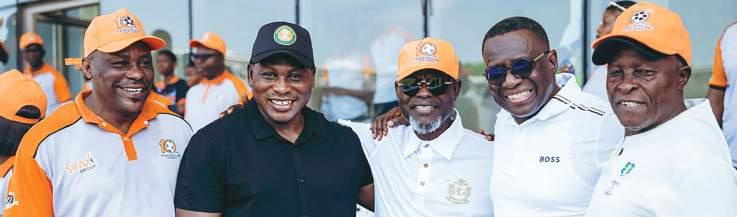
L-R: Deputy Director, Strategy and Operations, SIFAX Group, Oliver Omajuwa; Former Super Eagles Striker, Daniel Amokachi; Executive Chairman, SIFAX Group, Dr. Taiwo Afolabi; Former Chairman, Nigeria Football Association, Mr. Kodjo Williams; and President General, Nigeria Football Supporters’ Club, Dr. Rafiu Ladipo during the grand finale of the 10th edition of the Taiwo Afolabi Football Tournament held at the Onikan Stadium ... recently
Pledges reform and fiscal discipline Ambassador demands arms embargo on terrorist groups Urges global action as illicit weapons fuel terror, conflict
Michael Olugbode and Sunday Aborisade in Abuja
Nigeria’s Permanent Representative to the United Nations, Ambassador Jimoh Ibrahim, has been elected Chairman of the Fifth Committee of the United Nations General Assembly, placing the country at the helm of one of the UN’s most influential bodies responsible for administrative and budgetary affairs.
In his acceptance speech following the election, Ibrahim described the appointment as both a privilege and a weighty responsibility, pledging to guide the committee through a period marked by financial pressures, institutional reforms, and growing global challenges.
The Fifth Committee oversees the administrative and budgetary operations of the United Nations, making it central to the organisation’s ability to implement programmes and fulfill its mandates across the world.
Addressing delegates after his election, Ibrahim thanked member
states for the confidence reposed in him and vowed to work closely with all regional groups, committee officers, and the UN Secretariat to ensure effective management of the committee’s agenda.
His emergence comes at a critical time for the United Nations, which continues to grapple with financial constraints and growing demands on its resources. Ibrahim acknowledged the organisation’s fiscal challenges, noting that delayed contributions from member states have contributed to a budget deficit running into billions of dollars.
He called on countries to meet their financial obligations promptly, stressing that the sustainability of the UN depends on predictable and adequate funding.
“The challenges before us require collective responsibility and decisive action,” he said, emphasising that effective stewardship of resources would be essential to maintaining the organization’s global impact.
The Nigerian diplomat also highlighted the importance of the ongoing
UN reform agenda, describing it as an opportunity to strengthen efficiency, accountability, and institutional effectiveness across the organization.
Beyond financial concerns, Ibrahim pointed to escalating geopolitical tensions, economic uncertainty, poverty, insecurity, and rapid technological changes as issues demanding coordinated international responses.
He argued that leadership, innovation, and knowledge-driven policies would be critical in addressing these complex challenges and advancing global development.
A key theme of his address was consensus-building, which he described as the foundation of the Fifth Committee’s work. He pledged to foster cooperation among the UN’s 193 member states and ensure that differing perspectives are accommodated in the committee’s decision-making processes.
Drawing from his experience in Nigeria’s National Assembly, particularly on budgetary and inter-parliamentary
OBOREVWORI: TINUBU’S RE-ELECTION MY NUMBER ONE PROJECT ENO: A’IBOM WILL VOTE HIM FOR MAKING FUNDS AVAILABLE TO STATES
Delta State during the 2023 election would not be repeated.
He added that his administration had successfully built bridges across ethnic and religious lines in the state.
“There are two factors that happened the other time, the Christian community and the Igbo, the non-Indigenes. But I’ve been able to manage them because the Igbo, the non-Indigenes, we’re working together for the interest of the state. And I also believe that what happened that time will not happen again,” he assured.
Beyond political affiliations, Oborevwori credited Tinubu’s economic reforms for improving the state’s financial position. “The reforms and programmes are working very well in Delta State. I don’t know about other places, but I’m talking about Delta State.
“When sometimes I do commissioning, and I tell people that we have money, I tell people, where is it coming from? It’s the reforms. If the reforms are not working, we won’t get more money to pay,” he pointed out.
The governor also dismissed suggestions that former Deputy Senate President, Ovie Omo-Agege,
could pose any challenge to the APC in Delta state, describing his departure from the party as long anticipated.
“For Ovie Omo-Agege, I will not say, I will not use the word pretentious, because we saw it coming. Before he left, all his people had left over three months ago. So we all are aware. And that was why he was not serious in the contest of the primaries, because he never consulted anybody. He never consulted me. He never consulted the leaders,” he said.
The politicians maintained that the last primary election, which was disputed by the former federal lawmaker, was conducted fairly and transparently and that Omo-Agege’s defeat should have been accepted.
“He’s not somebody that he can be trusted,” Oborevwori emphasised.
Similarly, Governor of Akwa Ibom, Eno, who also spoke on Arise TV, said that people had compelling reasons to support Tinubu because federal reforms had significantly expanded the resources available to state governments.
The governor cited the APC’s overwhelming political presence in the state as evidence that the party
remained firmly in control. Eno said his support for Tinubu was based on what the administration had enabled states to accomplish.
According to him, the impact of federal reforms can be seen in infrastructure, tourism and economic development across Akwa Ibom.
“First of all, President Bola Amed Tinubu has made funding available for us to do all of the projects we have done. 1,300 kilometers of roads, and to have been able to put up 458 compassionate homes, to be able to support 12,000 elders, to be able to build hospitals.
“To be able in all the 31 local government areas, to build modern schools, solar-powered computer labs in all of the 31 local government areas. These are visible things. To be able to turn around the face of tourism in this state.
“Funding is from the presidency, and we know that we have had these funds. As a sub-national, I can tell you, to look at the reforms, to look at, say, the Calabar-Lagos superhighway that passes through Akwa Ibom, and when that highway is finished, you will understand what it is,” Eno explained.
matters, Ibrahim expressed confidence in his ability to bridge divides and build broad support for critical decisions.
Meanwhile, Ibrahim has delivered a blunt and sobering message to the international community, that small arms and light weapons have become Africa’s true weapons of mass destruction, driving terrorism, transnational crime, prolonged conflicts and humanitarian catastrophe across the continent.
Speaking on behalf of the 54-nation African Group at the 9th Biennial Meeting of States convened by the United Nations to review implementation of the Programme of Action on illicit small arms and light weapons, he placed Africa’s escalating security crisis squarely before the world body, demanding stronger global action on arms diversion, an outright ban on transfers to non-state armed actors, and sustained international support for African-led solutions.
The UN meeting, according to a statement by his Media Office yesterday in Abuja, was convened to assess progress on the Programme of Action, a landmark framework adopted twenty-five years ago to prevent, combat
and eradicate the illicit trade in small arms, as well as the International Tracing Instrument, now twenty-one years old.
The Nigerian diplomat painted a stark picture of a continent where the proliferation of cheap, easily smuggled weapons has become the single greatest enabler of instability, powering terrorist insurgencies from the Sahel to the Lake Chad Basin, feeding transnational organised crime networks, entrenching protracted conflicts and generating humanitarian crises of a scale that overwhelms the capacity of affected states to respond.
“Small arms and light weapons have become Africa’s true weapons of mass destruction,” Ibrahim declared, in remarks that encapsulated the continent’s frustration with the pace of global action.
Speaking to the African Group’s Common African Position, the framework that guides the continent’s engagement at national, regional and international levels, Ibrahim outlined four key priorities that Africa is pressing the international community to support.
He stressed that national implementation must produce tangible,
measurable outcomes rather than paper commitments. He noted that African countries have made concrete investments in legal and regulatory frameworks governing the entire life cycle of small arms and light weapons, from manufacture and marking through to stockpile management and disposal. Ibrahim placed the issue of diversion, the process by which legally held weapons find their way into the hands of terrorists, criminals and armed groups, at the centre of Africa’s agenda.
He called for stronger physical security and stockpile management measures across peacetime, conflict and post-conflict environments, and pressed for improved end-user controls, monitoring systems, cross-border investigations and information-sharing mechanisms between states. Besides, he urged the international community to take the decisive step of criminalising the conversion of deactivated, blank-firing and non-lethal firearms into fully functional weapons, a loophole that has been systematically exploited to rearm violent non-state actors across the continent.
TGI Group, Wilmar Form $12bn Joint Venture for Nigeria, Benin Food Businesses
Tropical General Investments (TGI) Group and Singapore-headquartered agribusiness giant Wilmar International have agreed to combine their businesses in Nigeria and the Republic of Benin under a new 50:50 joint venture targeting a market estimated at $12 billion.
The transaction will bring together businesses spanning agriculture, oil palm plantations, edible oils, edible nuts, rice, food manufacturing and distribution, creating one of the largest integrated food and agriculture platforms in the region.
Chairman and Chief Executive Officer of Wilmar International, Kuok Khoon Hong, said the partnership positions both companies to better serve a rapidly growing consumer market.
“Nigeria and the Republic of Benin are key consumer markets in Africa,” he said. “The combination of Wilmar’s integrated palm oil
and specialty fats capability with TGI Group’s manufacturing scale, established consumer brands and nationwide distribution platform creates a uniquely positioned business to serve consumers and contribute to the long-term development of the region.”
Founder and Chairman of TGI Group, Cornelis Vink, said the transaction combines two highly complementary businesses built around delivering quality food products.
“For more than four decades, TGI Group has built a leading position in Nigerian food manufacturing and distribution,” Vink said. “This partnership will leverage Wilmar’s global scale and expertise as well as TGI’s local knowledge to deliver innovative food solutions across Africa.”
Also speaking, Vice Chairman of TGI Group, Farouk Gumel, said the partnership reflects the Group’s
confidence in Nigeria’s future and commitment to local investment.
“By integrating Wilmar’s capabilities with TGI Group’s manufacturing scale and local market expertise, we are building a platform that will deepen domestic value addition, support smallholder farmers, create jobs and contribute meaningfully to Nigeria’s food security.”
Wilmar’s Africa Head, Santosh Pillai, described the deal as a strong strategic fit for both organisations.
“TGI Group brings strong local execution capabilities, established consumer brands and a deep distribution network,” Pillai said. “Together, we are creating an integrated platform with the scale, local insight, and operating depth to better serve consumers in Nigeria and the Republic of Benin.” The transaction is expected to close during the 2026 financial year, subject to regulatory approvals and customary conditions.

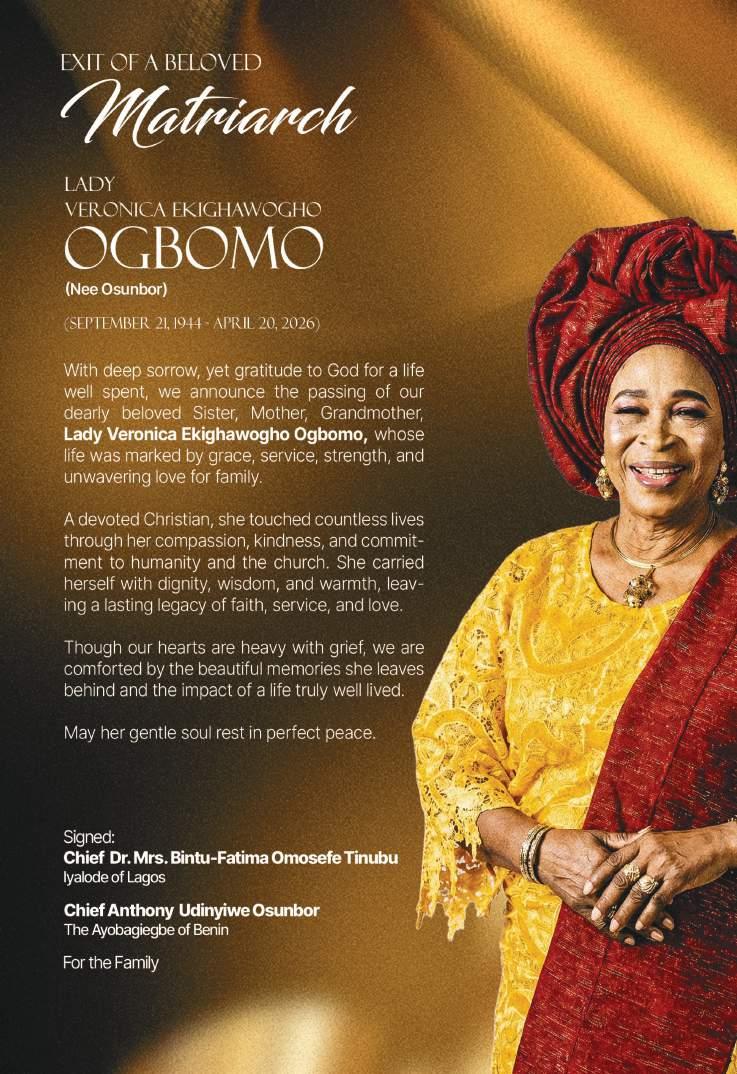

Acting Group Politics Editor DEJI ELUMOYE
Email: deji.elumoye@thisdaylive.com
08033025611 sms only
The Social Democratic Party recently in Bauchi repositioned itself as Nigeria’s ideological opposition platform, combining his 2027 presidential election candidate, adewole adebayo’s populist challenge and constitutional reform arguments against perceived authoritarian drift and economic hardship. s unday Aborisade reports.
The Abubakar Tafawa Balewa Stadium in Bauchi penultimate week, was more than the venue of a presidential nomination exercise. It was the theatre of a political rebellion against the direction of the Nigerian state and the latest attempt to redefine opposition politics in the country.
At the centre of the drama stood Prince Adewole Adebayo, lawyer, businessman and presidential candidate of the Social Democratic Party (SDP), who used his acceptance speech not merely to seek votes but to launch an ideological offensive against President Bola Tinubu, the ruling All Progressives Congress (APC), and what he described as the gradual drift toward “one-man rule.”
Yet beyond the fiery rhetoric, the Bauchi convention also revealed something deeper: an emerging effort to reposition the SDP as the ideological home of a coalition of welfarists, constitutional reformers, Pan-Africanists and antiestablishment political actors searching for an alternative to both the APC and the weakened Peoples Democratic Party (PDP).
The gathering attracted prominent opposition voices, civil society actors and ideological sympathisers, including leader of Pan Yoruba socio-political group, Afenifere, Oba Oladipo Olaitan, whose intervention at the convention framed the national crisis in stark terms.
Olaitan said, “Nigeria is bleeding. The suffering of millions today is not an act of God. It is the direct result of wrong choices and neo-liberal economic policies that place market forces and elite comfort above the welfare of the people.”
His speech reflected a growing ideological convergence between sections of the Yoruba socio-political movement and the SDP’s renewed social democratic messaging.
The significance of the Bauchi convention cannot be understood outside the long-running internal crisis that nearly crippled the SDP.
For years, the party battled debilitating leadership disputes, factional struggles and accusations of external interference. Multiple groups laid claim to the party structure at different times, while court cases and disputes over conventions weakened its national visibility.
Party insiders frequently accused powerful actors within the ruling establishment of attempting to infiltrate or destabilise opposition parties ahead of major elections. However, the APC has consistently denied the allegations.
The struggle intensified as opposition realignments gathered momentum after the 2023 elections. The SDP became attractive to political actors searching for a platform perceived as ideologically clearer and less encumbered by the internal contradictions consuming larger parties.
It was against this background that the Bauchi convention acquired unusual symbolic importance. For Adebayo and his supporters, merely holding the convention successfully became a statement of political survival.
“We are at the danger of one-man rule,” Adebayo warned. “The most oppressed political party today is the APC itself because what we are doing here today, they cannot do it. They wait for one person to choose everybody for them.”
The statement captured the convention’s underlying message: that the battle ahead was not simply electoral but existential for multi-party democracy in Nigeria.
Adebayo’s speech stretched beyond the conventional language of presidential acceptance addresses. It combined populist anger, anti-elite rhetoric, constitutional idealism and sweeping economic promises.
He painted a picture of a country broken by unemployment, insecurity, corruption and elite indifference.
“Why do presidents go abroad for medical treatment while women are giving birth under trees?” he asked repeatedly in a speech structured around the frustrations of ordinary Nigerians.
He accused the Tinubu administration of worsening economic hardship through fuel subsidy removal, excessive borrowing and taxation policies that, according to him, have deepened poverty.
His attack on the president was unusually personal and politically aggressive.
“I am an enemy of poverty and poverty is Tinubu’s friend,” he declared.
For supporters, the language reflected the urgency of national frustration. Critics, however, viewed parts of the speech as excessively combative and provocative.
Nevertheless, the address succeeded in energising sections of the opposition base hungry for a forceful challenge to the APC government.
More importantly, Adebayo attempted to distinguish the SDP from personality-driven politics by anchoring his message on Chapter II of the Nigerian Constitution. The section deals with the Fundamental Objectives and Directive Principles of State Policy.
According to him, governance must return to the constitutional obligation of ensuring welfare, justice and social democracy.
“The resources of Nigeria will be used for the welfare and security of Nigerians,” he said, citing constitutional provisions.
“That is why we can never be partners of the APC because they do not believe in using the resources of Nigeria for the welfare of Nigerians.”
One of the most striking features of the SDP convention was the deliberate attempt to revive ideological politics in a political environment largely dominated by power blocs, defections and ethnic calculations.
This effort was amplified by political thinker and SDP member, Olusegun Babalola, whose extensive intervention on Section 21 of the Constitution sought to intellectualise the party’s direction.
Babalola argued that Nigeria’s failure was not merely economic but civiliza -
But in a political climate often criticised for lacking philosophical depth, the s DP convention introduced a rare attempt to fuse constitutionalism, welfarism, PanAfrican thought and populist opposition into a coherent political narrative.
tional.
Drawing from global examples including China, India, Singapore and South Korea, he contended that successful states combined modern economic systems with indigenous constitutional traditions and moral frameworks.
According to him, Nigeria has failed to transform its cultural heritage into an effective developmental framework because it reduced culture to festivals, dances and symbolism rather than integrating indigenous systems of accountability into governance structures.
His thesis was ambitious: that Nigeria’s political crisis is partly the consequence of a constitutional order detached from indigenous moral legitimacy.
“The Rise of the rest is ultimately the rise of those who understood their culture not as a memory to be displayed, but as a living constitution to be lived,” Babalola argued.
He praised Adebayo for making Chapter II of the Constitution central to his political programme, describing it as an opportunity to reconnect governance with social welfare, accountability and national purpose.
While such arguments may appear highly academic for Nigeria’s roughand-tumble politics, they reveal the SDP’s attempt to present itself as more than merely another opposition vehicle.
The party is increasingly projecting itself as a platform seeking ideological clarity in a political system often accused of lacking philosophical direction.
Perhaps one of the most politically consequential developments from the convention was the visible alignment between sections of Afenifere and the SDP. Olaitan’s endorsement was significant not only because of Afenifere’s historical influence in Yoruba politics but also because it reflected growing unease within sections of the South-West political establishment over the country’s economic and democratic trajectory.
“This is why Afenifere stands firmly with the SDP,” Olaitan said. “The SDP is not just another political party; it is the party that best reflects the values of social justice, equity, and genuine concern for the masses.”
The endorsement echoed the ideological tradition of the old progressive politics associated with Chief Obafemi Awolowo, which is, welfarism, state-led development and social investment.
Olaitan criticised neo-liberal economic policies and called for a return to peoplecentred governance driven by public investment in infrastructure, education, healthcare and local industries.
The message resonated with Adebayo’s own promises of free education, universal healthcare, industrial revival and decentralised economic development. Whether this alignment matures into a broader political coalition remains uncertain, but it signals the SDP’s ambition to occupy ideological territory once dominated by the old progressive movements in Nigeria.
Despite the excitement surrounding the Bauchi convention, the SDP still faces formidable obstacles. Nigeria’s electoral politics remains heavily shaped by incumbency power, financial influence, regional structures and elite bargaining.
The APC retains enormous institutional advantages while the PDP, despite internal divisions, still possesses wider national structures than the SDP.
NOTE:
United Bank for Africa (UBA) Plc has strengthened its longstanding relationship with the University of Lagos (UNILAG) with the inauguration of a new Innovation Hub and Business Office, a project aimed at promoting collaboration between academia and industry, supporting innovation and entrepreneurship, and expanding opportunities for students and researchers. Chiemelie Ezeobi reports that beyond that, the bank renewed its support for the university's Professorial Chair in Finance, reinforcing a partnership that has spanned decades
L-R: Deputy Vice
For decades, universities have been recognised as centres of learning. Increasingly, however, they are also becoming incubators of innovation, entrepreneurship and economic transformation.
It is within this context that United Bank for Africa (UBA) Plc has commissioned the UBA Innovation Hub and Business Office at the University of Lagos (UNILAG), a project that speaks not only to the bank's relationship with the institution but also to its broader vision for Africa's future.
The new facility stands as a physical expression of an idea that has gained increasing relevance in recent years: that the future of economic development depends on stronger collaboration between academia and industry.
At a time when African economies are seeking new pathways to growth, innovation and job creation, investments that connect students, researchers and entrepreneurs with practical opportunities are becoming increasingly important.
The inauguration of the facility at UNILAG therefore represents more than an expansion of banking services. It is an investment in talent, ideas and enterprise.
The relationship between UBA and the University of Lagos is not a recent one. Long before innovation hubs became a feature of university campuses, the bank had already established a presence within Nigeria's higher education system.
UBA was the first bank to establish a campus branch in Nigeria during the 1960s, helping to pioneer financial inclusion and institutional banking support within universities.
Over the years, that relationship has evolved beyond banking transactions into a wider commitment to supporting education and human capital development. The inauguration of the Innovation Hub and Business Office adds another chapter to that history.
For UBA Group Chairman, Tony Elumelu, the
occasion carried personal significance. As an alumnus of the University of Lagos, the project represented a return to the institution that helped shape his journey.
"Returning to my alma mater for this commissioning makes this moment particularly meaningful. Universities remain the birthplace of ideas, innovation, and future leadership. Through this investment, UBA is reaffirming its belief in young people and in the role institutions like the University of Lagos will continue to play in shaping Africa's future."
His remarks reflected a conviction that has become central to UBA's development philosophy: the belief that empowering people and strengthening institutions remain among the most effective ways to drive sustainable growth across the continent.
Across Africa, conversations about youth development increasingly focus on how to bridge the gap between education and economic opportunity. Graduates often leave university with knowledge and ambition but limited access to the networks, mentorship and resources needed to transform ideas into successful ventures.
The newly inaugurated four floor complex seeks to help address that challenge.
Designed as a shared platform, the facility will bring together students, academics, innovators and professionals within an environment that encourages collaboration. UBA's Business Office within the complex will provide access to banking solutions, financial advisory services, enterprise support and engagement opportunities for members of the university community.
The objective is not simply to provide financial services but to create a space where innovation can be nurtured and

UBA Professorial Chair in Finance, UNILAG, professor Isola Wakeel exclaime
where promising ideas can gain the support required to grow.
UBA's Group Managing Director and Chief Executive Officer, Oliver Alawuba, described the initiative as part of a deliberate effort to create opportunities for future generations.
"UBA continues to create platforms that connect knowledge with opportunity. This facility will provide students and the university community access to ideas, networks, innovation support, and financial services that help unlock potential and prepare future leaders for a rapidly changing world," he said.
His comments underscore a growing recognition that universities must increasingly serve as launch pads for innovation and entrepreneurship, not merely centres for academic instruction.
The event also highlighted the enduring connection between the University of Lagos and one of its most accomplished alumni.
Vice Chancellor, Professor Folasade Tolulope Ogunsola, described Elumelu as "a son of the university", noting that the qualities that later defined his success were sharpened within the institution's walls.
"The Group Chairman of UBA, Mr Tony Onyemaechi Elumelu, CFR, one of Africa's most celebrated entrepreneurs and philanthropists, is, in the truest and most meaningful sense, a son of this University."
She added: "The intellectual rigour, the ambition, and the broadness of vision that he would go on to demonstrate as he transformed a struggling bank into a pan-African institution of global stature, that fire was sharpened here."
The remarks served as a reminder of the powerful relationship between universities and the leaders they produce. They also reinforced the importance of creating environments capable of inspiring future generations to achieve similar success.
Sustaining a Legacy in Finance Education
Beyond the inauguration of the Innovation
Hub and Business Office, the occasion also provided an opportunity to reaffirm another longstanding partnership between UBA and the University of Lagos.
The university announced the renewal of UBA's sponsorship and support for the Professorial Chair in Finance, a programme that has played a significant role in advancing finance education and research in Nigeria. Alawuba described the initiative as the bank's most enduring academic contribution. "Our most enduring academic contribution remains the UBA Professorial Chair of Finance, established in January 1972 as the first-ever Finance Professorial Chair in a Nigerian university.
"It was designed to strengthen finance education, deepen banking research, and support thought leadership in Nigeria's financial sector. I am pleased that the Executive Management of UBA has approved an additional ₦61.67 million to further strengthen the Endowment Fund for the Chair and sustain its work through the current professorship tenure."
The additional funding reinforces a commitment that has endured for more than five decades and highlights the role of academia in shaping the future of the financial sector.
Beyond a Building
Ultimately, the significance of the UBA Innovation Hub and Business Office lies not in the structure itself but in what it represents. It symbolises a belief in the potential of young people, the value of partnerships between universities and industry, and the importance of creating pathways through which ideas can become enterprises and ambitions can become achievements.
As Africa continues to navigate a rapidly changing economic landscape, institutions that invest in knowledge, innovation and human capital will play a defining role in shaping the continent's future. Through its latest investment at the University of Lagos, UBA has signalled that it intends to remain part of that journey.
By Zik Zulu Okafor
Across Nigeria, a difficult conversation is unfolding. It is within legal circles, among civil society groups and across ordinary homes. The conversation raises one crucial question. ‘At what point do bail conditions stop serving justice and begin to obstruct liberty?’
This debate has intensified following recent high-profile cases involving former Kaduna State governor, Nasir El-Rufai and business magnate, Tunde Ayeni. These questions arose over the nature and weight of bail conditions imposed.
At the centre of the debate is not whether courts have the authority to impose bail conditions. They do but it has to be reasonable and within the law itself.
The deeper question is whether conditions should be so stringent that they become practically impossible to satisfy.
Still critical is the issue of whether these bail conditions should inflict mental pain and indeed worsen the psychological torture of a detainee already emotionally shattered by detention, even when no court has pronounced the accused guilty?
These are difficult but necessary questions for every democratic society that truly believes in justice, fairness, and the presumption of innocence.
For many legal observers, these questions strike at the heart of one of democracy’s oldest legal principles. And that is the presumption of innocence.
Take the case of El-Rufai for instance. The Federal High Court in Abuja reportedly granted him bail in the sum of N100 million with one surety in like sum. Then the curious conditions followed. The surety must be a Federal Civil Servant not below Grade Level 17.
The surety must reside in the high-end Maitama or Asokoro districts of Abuja. He or she must deposit original Certificate of Occupancy of a landed property with the court registry. But the judge was not done yet. The surety must provide evidence of salary payments for at least three months and this must be authenticated by a bank manager. Still, the surety would be required to further submit his tax clearance, affidavit of means, passport photographs and departmental verification.
No question, these conditions are so burdensome, so punishing and emotionally exhausting that they appear designed not merely to secure a surety, but to discourage anyone from even stepping forward. Just seeing the conditions is enough for the most courageous of men to retreat in frustration, even if the detainee was his own mother.
But if you thought the bail conditions of El-Rufai, a former governor, was tough, then wait for that of Dr. Tunde Ayeni.
The unassuming and courteous businessman, Ayeni, was granted bail in the sum of N200 million by the High Court of the Federal Capital Territory sitting in Apo, Abuja, with two sureties in like sum. At first glance, it appeared like liberty had spoken.
But it was after that pronouncement that the real test began; what could, at best, be called the sureties’ crucible.
The presiding judge, Justice Jude Onwuegbuzie proceeded to impose conditions that many would describe not just difficult, but almost insurmountable and impossible to fulfill.
The two sureties, apart from not just being federal civil servants not below Grade Level 16, were required to submit their national identity cards and letters of employment.
That alone raised questions in the mind of a discerning individual.
But the conditions did not stop there, it continued. Though expected to be ordinary salary earners
in public service, the same sureties were also required to own landed properties valued at N500 million each within the federal capital Territory.
Still, the demands did not stop here, it continued.
To make the matter more exacting and frustrating, one of the sureties was required to provide an undertaking backed by a bank guarantee of N15 billion.
A civil servant to provide a Bank guarantee in the sum of N15billion?
This is where the issue moved beyond the facts of one case and entered the territory of constitutionality. Because bail is a constitutional right of every Nigerian citizen anchored on the presumption of innocence.
This explains why these extraordinary conditions provoked intense conversations. These bail conditions were astonishing to everyone present in court on that faithful day. The show of anger could be visibly seen on the faces among legal practitioners and even observers in court.
The core issue then evidently shifted as to the disparity between the conditions of administrative bail earlier granted by the Economic and Financial Crimes Commission (EFCC) who are the prosecuting Agency and those subsequently imposed by the court, that is supposed and asumed to be the arbiter in the matter.
Here, the EFCC being the investigating and prosecuting agency is the institution that investigated the allegations, assessed the gravity, the attendant risks and eventually brought the matter before the court for adjudication. Despite being the agency directly responsible for prosecuting the case, the conditions the EFCC attached to the administrative bail it earlier granted the defendant did not carry the severity of conditions eventually imposed by the court.
The bail conditions proposed by the prosecution, the EFCC, differed significantly from those ultimately imposed by the court on two critical points.
While the EFCC requested that one of the sureties be a civil servant not below Grade Level 16 who must own a house in Abuja, it did not stipulate that the property must be valued at N500 million, as the court subsequently ordered.
More notably, the anti-graft agency did not seek the staggering N15 billion bank guarantee that later emerged as one of the court’s bail conditions.
This was considered incongruous by the legal minds in the court because it raises an important jurisprudential question. If the prosecuting authority itself did not consider such extraordinary, indeed punishing and impossible conditions necessary while the defendant remained in its custody, what considerations then spurred the court to unleash such impossible conditions for the bail when he is presumed innocent; conditions that are significantly more stringent than those contemplated by the prosecution?
And the issue again is not whether a court possesses the discretion to impose stricter conditions. It
certainly does. The concern is whether the exercise of that discretion should result in conditions so impossible, so debilitating that the constitutional right to bail becomes largely impracticable and, in fact, illusory. Ayeni’s case, Lawyers say, represents a grim situation where discretion seemed exercised in a manner that effectively transforms the grant of bail into a procedural labyrinth from which liberty becomes almost impossible to obtain. For these Legal practitioners, the bail conditions are simply distressing and concerning moreso when there appears to be no reason why the judge should impose such stiffer conditions.
Perhaps no single condition generated more disbelief among Lawyers than the requirement that one of the sureties provide an undertaking supported by a bank guarantee of N15 billion.
To the ordinary citizen, a bank guarantee may sound like a mere letter issued by a financial institution on behalf of it’s customer. It is not because it is in actual fact, much more than that.
A bank guarantee is a serious financial instrument backed by collateral, deposits, assets or established credit facilities. In commercial practice, it is regarded as being as good as cash because the bank effectively assumes financial responsibility for the amount involved.
This immediately raises a troubling question. How many serving civil servants in Nigeria possess the financial standing necessary to secure a N15 billion bank guarantee?
Indeed, some legal commentators have argued that even if the total salaries and emoluments of the Head of Service of the Federation were accumulated from the day of employment until retirement after thirty-five years of service and even without spending a kobo out of it, the amount would still fall significantly short of the threshold required to support a N15 billion Bank guarantee. If a condition requires a surety with financial capabilities far beyond what is reasonably attainable within the public service, critics argue that the issue ceases to be one of security and becomes one of impossibility.
Such an impregnable condition unfortunately leaves the detainee in judicial purgatory even when he is still presumed innocent.
This is not only a severe assault on the spirit of liberty but an unreasonable strain on the constitutional right to liberty.
Yes, justice must protect the process but in this particular instance, it thus appears that the judge may have descended into the arena of being a party to the matter as could be said that he may have overtly be taking the position of a prosecutor, however, justice must also guard against constructing walls so high that freedom becomes illusory.
For when liberty depends on conditions beyond ordinary human reach, bail risks ceasing to be a safeguard and begins to resemble detention by another name.
This is why these dialectics matter and should provoke intense dialogue with the judiciary and judicial scholars.
Not because the accused has been declared innocent but because he has not yet been declared guilty.
This conversation is all the more important because judicial discretion sits at the heart of the justice system and must not, for whatever reason, be politicized no matter who is involved. Balancing the rights of the accused against the need to ensure their appearance for trial and protect the integrity of the judicial process should be a paramount consideration and it must also provide an avenue for the accused person to defend himself.
Another unusual aspect of Justice Jude Onwuegbuzie’s ruling that instantly caused a stir and attracted legal scrutiny concerns the strange directive that the prosecution (EFCC) should verify compliance with the bail conditions before the defendant could be released. This, legally speaking, was confounding.
This is because traditionally, verification of bail conditions is undertaken through the administrative machinery of the court, particularly the registrar and
officers acting under judicial supervision. The reason is obvious. The prosecutor is not and cannot be a neutral participant in criminal proceedings. The prosecutor is an interested party whose duty is to present the case against the accused. And to have him or her convicted. That is the ultimate goal.
This explains why Lawyers in the court were practically staggered by the directive. They wondered whether assigning responsibility for confirming compliance with bail conditions to the prosecution would not risk creating an appearance of conflict with the principle of institutional neutrality that should underpin the administration of justice. No question, the likely perception that such aberrant arrangement would create is capable of undermining public confidence in the fairness of the process. In this instance, the concern of legal experts is that this unusual task assigned to the prosecutor further raises the wall against the attainment of liberty for the defendant as it makes the realisation of the bail objective more daunting.
WHEN THE COURT OF APPEAL REJECTED THE USE OF PUBLIC SERVANTS AS SURETIES IN CRIMINAL BAIL MATTERS: DASUKI v. DG, SSS & ORS (2019) LPELR-49182 (CA)
If you were in court on Monday, May 25, during the bail proceedings involving Dr. Tunde Ayeni, as this writer, who providence made to witness the proceedings owing to a mix-up in actual ruling date of another case, one thing would have struck you immediately. The atmosphere was sombre. The judge’s tone was stern, and the mood in the courtroom suggested that the verdict anticipated may not likely come with the expected relief it was expected to bring to the defendant. It felt almost like a premonition of hopelessness, dreadfully foreboding. Then came the ruling.
And once again, public servants found themselves at the centre of the increasingly contentious theatre of bail conditions. This inevitably raises a pertinent question: Are judges of the High court unaware of the Court of Appeal’s pronouncement discouraging the use of serving civil servants as sureties in criminal matters?
In DASUKI v. DG, SSS & ORS (2019) LPELR-49182 (CA), Justice Adah, JCA, expressed grave concern over the growing practice of requiring senior public officers to stand surety for persons facing criminal prosecution. The learned Justice highlighted the contradiction inherent in demanding that a public servant on Grade Level 16 and above not only stand as surety but also possess properties of extraordinarily high value.
According to the Court, such requirements are inconsistent with the realities of public service and may inadvertently undermine the very anti-corruption objectives the state seeks to advance.
Acting ex debito justitiae, in the interest of justice, the Court consequently struck out the requirement that serving public officers on Grade Level 16 and above act as sureties.
In the words of Justice Adah, JCA:
“.... Involving civil servants or public officers in the Public Service of the Federation and the State in the bail of people accused of criminal offences has never been the practice in Nigeria or any part of the civilized world.... Expecting a Level 16 Servant to own property worth N100,000,000 would run counter to the Public Service Rules and, by extension, the fight against corruption. In this respect, I will act ex debito justitiae to ensure that the aspect of involving a serving Public Servant not below the status of Level 16 Officer in either the State or Public Service of the Federation or any of its agencies is removed, and I so order.”
The question critiques ask is whether our judges are aware of this ruling or are just treating it with mute indifference?
The importance of this decision lies not merely in the relief granted to the appellant but in the broader principle it established. Bail conditions, while necessarily stringent in appropriate cases, must remain realistic, lawful and attainable. For this reason, detention before trial is meant to be an exception, not the norm.
Bennett Oghifo
The Lagos State Government has issued a final warning to estate developers operating without approved layout plans.
The Commissioner for Physical Planning and Urban Development, Dr. Oluyinka Olumide, who led an on-the-spot warning and sensitisation exercise across parts of the Eti-Osa corridor on Tuesday, said the final warning was sequel to the expiration of the grace period earlier granted to all flagged estates to regularise their planning documents.
The Lagos State Government reaffirmed its commitment to enforcing planning laws to safeguard the environment and ensure orderly development across the state.
Dr. Olumide urged members of the public, especially prospective homebuyers, to always verify the planning status of any estate before committing funds, noting that due diligence remained essential to avoid losses.
He said the state government had repeatedly empha-
sised the need for all estate promoters to obtain proper approvals before engaging in land subdivision, sales, or construction.
He explained that the affected estates had continued to operate in violation of planning regulations despite earlier notices, while stressing that the government would no longer tolerate developments that compromise orderly and sustainable urban growth.
The Commissioner reiterated that the final one-week warning issued to the erring estates marked the last opportunity for them to submit their layout plans and obtain necessary approvals.
He stated that, after the deadline, the government would apply appropriate sanctions, ranging from heavy fines to demolition, depending on the magnitude of each infraction.
The enforcement team visited, among others, Whiteoak Estate 2, behind VGC and Elite Garden Estate, developed by Bosmark Haven Properties Limited, also behind VGC, according to a statement by Mukaila Sanusi,
Director Public Affairs.
Also, the commissioner raised concerns over a report by a section of the media (not THISDAY) in which he was wrongly credited with statements suggesting that Lagos State was set for a second private refinery following confirmed talks with new investors.
The Commissioner clarified that he did not make such comments and did not at any time grant an interview or issue a statement relating to refinery development, petroleum investments, or investor negotiations.
Dr. Olumide explained that the statutory mandate of the Ministry of Physical Planning and Urban Development, especially in relation to infrastructure development, was clear and unambiguous as it involved land-use planning and control, including zoning regulations, layout approvals, and the processing of physical planning and development permits for projects, in line with approved master plans and extant planning laws.
He stressed that while any
major infrastructure project, including a refinery, was subject to planning approval and zoning compliance, decisions on investment promotion, project initiation, or sector-specific policy pronouncements fell outside the Ministry’s scope of responsibility. He described the attribution of statements on refinery investment discussions to him as inaccurate, misleading, and unprofessional, and called on media organisations to uphold accuracy and proper verification when reporting on government activities.
He urged members of the public to disregard the report, noting that all official communications from the Ministry would continue to be issued through recognised and authorised channels.
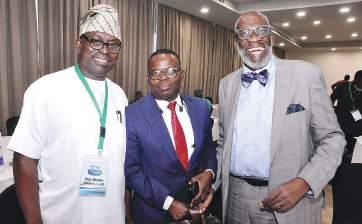
Bennett Oghifo
Julius Berger Nigeria Plc., is leading an extensive bridge rehabilitation programme in Lagos State, following its engagement by the Federal
Ministry of Works in 2023.
The assignment is designed to address years of severe structural deterioration in the critical infrastructures.
Construction works commenced in January 2024,
targeting four key transport links: the Third Mainland Bridge, Carter Bridge, Iddo Bridge, and the Iddo Bridge Underpass.
The project focuses on addressing long-standing
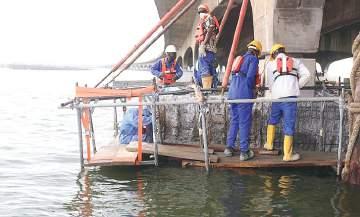
structural damage, particularly in underwater components impacted by marine corrosion, tidal forces, and sustained heavy traffic.
At Carter Bridge, rehabilitation works concentrated on degraded underwater sections and substructure elements to mitigate the effects of corrosion and tidal movement. Physical works were completed in January, and the project has now entered its close-out phase.
For the Third Mainland Bridge, engineers are carrying out structural repairs on critical components, including the deck soffit, piers, and underwater pile caps. The project is currently about 80% physically complete, with only the monitoring phase outstanding. This phase, expected to last one year, is now in its third month. Financially, approximately 60% of the budget has been allocated, with 21% of the total project
value executed to date.
At press time last week, no major construction work is outstanding on this bridge as the focus is entirely on performance validation. Essentially, the monitoring phase acts as a quality assurance and risk management step, ensuring that the extensive rehabilitation work translates into a safe, stable, and durable bridge for years to come, said a member of the project team, Friday.
The Iddo Bridge rehabilitation involves a more intensive reconstruction due to severe deterioration.
Significant portions of the bridge have been demolished and are being rebuilt using reinforced concrete girders, enhanced reinforcement systems, and strengthened structural supports. The project is actively ongoing and stands at 30% physical completion.
At the Iddo Bridge
Underpass, the existing structure was completely removed to enable full reconstruction. The scope includes continuous reinforced concrete pavement (CRCP), improved drainage systems, and the installation of modern street lighting and utility infrastructure. Construction progress has reached 38%.
CRCPs are designed to control cracking, not eliminate it as cracks occur at regular, closely spaced intervals. The reinforcement keeps cracks tight, preventing them from widening Overall, these rehabilitation efforts are designed to enhance commuter safety, extend the lifespan of critical infrastructure, and reduce structural risks along some of Lagos State’s busiest transport corridors. In addition, the improvements are expected to ease traffic flow and strengthen economic activity across the state.
Bennett Oghifo
The Lagos State Government, has sensitised key stakeholders on the Electronic Physical Planning Permit System (e-PPPS), a digital platform designed to streamline physical planning processes across the State.
Speaking at the stakeholders’ engagement held in Alausa, the Commissioner, Ministry of Physical Planning and Urban Development, Dr. Oluyinka Olumide, stated that the introduction of the
e-PPPS underscores the State Government’s commitment to leveraging technology to enhance service delivery in the built environment.
He noted that the initiative is a critical step toward establishing a fully digital infrastructure for urban management, while also improving the ease of doing business within Lagos State’s construction sector.
Dr. Olumide encouraged stakeholders and members of the public to actively engage with the platform, emphasising that its adop-
tion would foster greater efficiency, accountability, and transparency in physical planning processes. He reiterated the Government’s resolve to ensure that all development activities in the State align with established regulatory standards.
The Special Adviser to the Governor on Taxation and Revenue, Hon. Abdul Kabir Opeyemi Ogungbo, commended the initiative as a strategic move toward improving revenue generation and compliance within the built environment. He high-
lighted the importance of integrating digital solutions into governance systems to promote seamless service delivery and eliminate bottlenecks associated with manual processes.
Providing insight into the technical functionality of the platform, Mr. Victor Akinyelure, described the e-PPPS as a comprehensive “one-stop shop” for all physical planning needs. According to him, the webbased system facilitates the submission of applications, processing of approvals,
issuance of permits, and stage certification, including building certification processes.
He further explained that the platform enables users to carry out all required procedures remotely, thereby eliminating the need for multiple visits to physical offices. “The system is designed to promote transparency, efficiency, and a smart processing experience for all users, in line with global best practices.” He said.
The Lagos State Govern-
ment reaffirmed that the e-PPPS allows stakeholders to conveniently apply for permits and fitness certificates from any location, thereby simplifying procedures and reducing turnaround time.
Others at the event includes; the Permanent Secretary, Office of Physical Planning, Tpl. Olayinka Adebayo Wasiu, Executive Members of the Nigerian Institute of Town Planners, District Officers of the Office of Physical Planning, among others.


The telecom landscape now serves as the backbone of economic and social activities, writes SONNY ARAGBAAKPORE

page 21
The Nairobi Summit may have signalled the beginning of a more equal AfricaEurope relationship, argues SENATOR IROEGBU
The primaries were largely choreographed chaos, reckons BRUCE MALOGO
We just watched Nigeria’s political parties rehearse for power. Most, actually. In the course of it, they conveniently forgot to include the people. The primaries are now done. The announcements are out. But calling what happened “primaries” insults the word; it insults the process, and it insults everyone who spent valuable time watching and monitoring. It was choreographed chaos, a performance of democracy without its substance.
Everyone acquainted with the theatre understands that farce is harmless when it stays on stage. This one doesn’t. It decides who gets access to power either at the center or at the provincial level; it decides who manages public funds and our future. That turns a bad play into something worse: a tragedy written at the country’s expense. Not surprisingly, most Nigerians are not particularly shocked by all of this, because it falls into a pattern long established in a maniacal quest to capture, hold and use power. It mitigates the effects of the tragedy. Nigerians have learned to manage their expectations when it has to do with such matters as politics and political processes.
As we can now see, primaries in Nigeria are scarcely contests of ideas, like every contest in our political landscape. They are auctions. Delegates have a price list, aspirants have a budget, and the highest bidder wins. Some others win simply because they are darlings of national or provincial tin-gods. Policy doesn’t enter the room and competence is often thrown out of the window.
So, when you talk about “party primaries,” you are really talking about a peculiar bazaar: one of cash-andcarry and of filial vending. You are talking about thuggery not being just a bug; it is recruitment, intimidation and termination rolled into one. The whole exercise filters anyone who isn't willing to normalize violence or hire it out. And the message is clear: if you flinch, you are out.
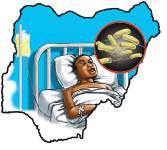
You are talking about why there are no electoral consequences for performance in this system. You can underperform, steal, insult voters to their faces and still show up in the next cycle under the same platform or a new one. After all, political parties are mere special-purpose vehicles and the law is always an ass. It doesn’t matter. Ultimately, the machine rewards persistence, not competence.
It is essentially for that reason that men and women with good learning, inflexible character, proven competence and sense of community keep their distance. The arena isn’t built for them. It is built to chew them up and spit them out, or force them to become what they despise in order to survive. So, the good ones stay out, those the wise old man would call “philosopher
kings,” the crème of the land. And the cycle of mediocrity and prebendalism continues. The principle is unambiguous: Power is everything – the beginning and the end of everything.
In the early 1990s during Gen Ibrahim Babangida’s duplicitous regime, Chief Arthur Nzeribe unwittingly let us into a certain dark creed. He was participating in the SDP-NRC melodrama of that time.
Asked why, in spite of his staggering wealth, he was desperate for a seat in the Nigerian Senate, the Oguta chief answered: “There's a limit to what money can do, but there's no limit to what power can do.” See? That’s the force, the pull, the motivation – as light to moths and blood to sharks.
Truth is, capable people don’t avoid politics because they’re scared of work. Far from it. They stay away because it is high-priced; its demands are costly. Politics demands that to survive, you have to unlearn who you are; that you assume another character and personality to fit the role. You spend years building a reputation for competence, for saying no, for delivering without theatrics. Then you step into a system where those traits are liabilities. Suddenly you need patrons, you need to move money through “consultants,” you need to smile through insults from people you know you’re better than. At some point the math is simple: you either keep your name or you keep your seat. You can’t keep both.
As we have come to understand, the system is designed to make integrity expensive and corruption cheap. A decent person walks in with skills, ideas and a clean record. To get anywhere, they have to pay the entry fee: fund godfathers, fund thugs, fund a structure that exists to make sure people like them never get too far. And for what? To spend four years fighting the machine you joined, losing every time because the machine was built by people better at losing than you are at winning.
Most of those who dare are either scorched and squashed, while others are
sucked into the cauldron. For the latter, it is like walking enthusiastically yet blindly into a hive. One retired Inspector General of Police (IGP) has not stopped wailing over how he was “pushed” (reads “beguiled”) into contesting an election that drained away his life’s savings. He didn’t go further than the primaries. Again, you ask: All for what? Most look at the equation and walk away. Not because they don’t care, and not only because they’re not masochists, but because they can’t afford the price of our neopatrimonial politics.
To be true, politics in Nigeria is a street fight. It is for those with means, mettle and muscles – those who believe in the might of the fist in the face of the law. Koreans would say, “laws are far but fists are near.” To become a consequential politician in Nigeria – that is, one who owns and commands the troops – one will, of necessity, take on the nature of the sphinx. He has to have his front paws steeped in perfidy and hind paws planted in authority. Add to that the audaciousness of Percy Shelley’s Ozymandias, the boastful king who built a massive statue of himself with the inscription: “I am Ozymandias, King of Kings: Look on my Works, ye Mighty, and despair!” To consolidate all of those, the man has to shore himself up with men and women of oratorical artistry – good talkers who put the smiles in italics and their gestures in inverted commas; such persons who are full of hot air and are deliberately provocative and intentionally controversial.
Your archetypal Nigerian politician in authority, one who remains impervious to the calls and needs of the people they preside over, is typically cold, distant and scarcely makes an effort to charm. They walk around with dead eyes. And the thing about dead eyes is that it goes with dead conscience. "Evil starts with dead eye," writes Victor Hugo in Les Misérables. Amedeo Modigliani, the 20th century Italian painter and sculptor said: “When I know your soul, I will paint your eyes.” Dead eyes are a symptom of dead conscience. It tells you of a man who has neither sympathy nor empathy –someone who would rather see the whole community burn than risk a single strand of his own hair come to harm. "Faced with someone whose eyes see nothing, think carefully and be afraid," Hugo warns. When Marie Antoinette told hungry French households to “eat cake” if there was no bread, it was about the eyes. When you hear them in Nigeria say "after all, we are better than Kenya," it's about the eyes. Malogo is a director at Oscar and Halliday Media Company and member of Nigerian Guild of Editors (NGE)
The telecom landscape now serves as the backbone of economic and social activities, writes SONNY ARAGBA-AKPORE

Although the National Telecommunications Policy published by the Federal Government in 2000 is considered outdated today, no one can deny that it clearly set a direction for Nigeria's telecommunications industry. And in what looked like a befitting tribute to President Olusegun Obasanjo (1999–2007), Dr Ernest Ndukwe, who began the implementation of the policy in what has been described as the Nigerian telecom revolution, said Obasanjo opened the floodgates for what we are seeing today.
From a paltry total of connected telephone lines of about 500,000, the sector was liberalised and freed from the monopoly enjoyed by the state-owned Nigerian Telecommunications Limited (NITEL). The Telecom Policy opened the sector for equal participation by other private companies, thus leading to the provision of telecommunications services we encounter today. Ndukwe was named Executive Vice Chairman (EVC) of the Nigerian Communications Commission (NCC) while Ahmed Joda was appointed Chairman. That was in the year 2000, and with a strong board in place, the power to implement the Telecommunications Policy 2000 was activated. Apart from other guidelines initiated by the NCC, one of the major fallouts of the document was conducting the auction for Digital Mobile Licences (DML) in January 2001.
The very successful auction, believed to be one of the most transparent globally, opened Nigeria to the world as a country with ease of doing business. In the formative months leading up to the auction, some stakeholders kicked against the adoption of Global System of Mobile Communication (GSM) and canvassed for other technologies like Code Division Multiple Access (CDMA) and Time Division Multiple Access (TDMA), a situation that led the NCC to resolve for Technology Neutrality. Strangely, all the licence beneficiaries, including MTN, Econet Wireless Nigeria (EWN) and Glo Mobile, opted for GSM. Ndukwe referred to this recently when he spoke at the industry workshop for the Review of the National Telecom Policy 2000 in Lagos. One of the architects of the 2001 Digital Mobile License auctions, Mr Paul Usoro (SAN), was there. Hosted by the NCC, the workshop, which was attended by industry representatives and key stakeholders, was a clarion call for stakeholders to revisit and review the policy in line with the growing telecommunications ecosystem. Ndukwe, at a panel session during the workshop, told the world how Obasanjo's policies rescued Nigeria from the global shame of a miserable tele-density and laid the foundation for Nigeria’s telecommunications revolution and digital transformation. He traced the country’s telecommunications journey to the liberalisation reforms that opened the sector to competition and investments. It rose from a deeply embarrassing situation of 1,250 lines per month for a

population of over 120 million to where it is today.
The government had earlier promulgated Decree 75 of 1992 to open up the industry, and at the advent of democracy in 1999, it went further to open up the sector in 2000 by the policy with effect from September 2000. Obasanjo recognised telecommunications as a major driver of the economy and decided to replace the old telecommunications framework with a new one, leading to the establishment of the National Telecommunications Policy 2000. Bottlenecks against expansion were removed, opening the sector to liberalisation and investors. “It was a breakthrough for the sector as things happened quickly beyond imagination “, Ndukwe explained. Nigeria was seen as an investor's haven in telecommunications, and the policy became a blueprint for the total liberalisation of the sector, and the rest is now history. “This process was not easy at the time. However, by the year 2001, competitive operators had been licensed to provide digital mobile services, leading to the rapid expansion of connected lines across the country.” While political uncertainties and inconsistencies in policies earlier hampered growth in the sector, all that changed from the year 2000, when the policy framework changed to open up the sector for investors. “Between 1960 and 2000, NITEL only had a subscriber base of 400,000 fixed lines. Detailed analysis showed that nearly 200,000 of these were concentrated in government offices and private organisations. That meant that fewer than 200,000 lines were available for other Nigerians. But all that changed after the liberalisation of the system,” Ndukwe lamented, advising that the NCC should, after a review of the Telecom Policy, see its next line of action as the review of the Nigerian Communications Act of 2003. It’s long overdue, especially in line with growing technology development. But the regulator must carry out regular consultations before major regulatory decisions are taken because “you cannot simply sit in an office to make decisions on the future of the sector without engaging the people who operate in it”. Looking ahead, Ndukwe advised that “this policy we are now developing should not be too prescriptive on technology because technology changes too quickly. That is why regular reviews are necessary “.
Aragba-Akpore is a member of THISDAY Editorial Board
The Nairobi Summit may have signalled the beginning of a more equal Africa-Europe relationship, argues SENATOR IROEGBU

Something shifted in Nairobi. It was not the numbers, though the numbers were striking. It was not the speeches, though some were worth hearing. What shifted was the room's geography — and the logic behind the conversation. For the first time, France and an African country co-chaired an Africa-France summit on African soil, with President Macron and President Ruto standing side by side as equals, not host and supplicant.
For decades, Africa’s engagements with major global powers have followed an almost predictable script. African leaders are invited to Paris, Washington, Beijing, Moscow, Brussels, or New Delhi. Red carpets are rolled out. Grand declarations about “strategic partnership” are made. Communiqués are signed. Photographs are taken. Then everyone flies home, while very little changes for ordinary Africans. The imbalance was often visible even in the choreography of these summits. Africa appeared less like an equal negotiating bloc and more like a guest invited to seek assistance, security guarantees, investment, or development aid.
The Africa Forward Summit, held in Nairobi on May 11 and 12, broke that script in key important ways. Nairobi appeared different in tone, structure, and ambition. For once, the summit was held on African soil, not in Europe. For once, the conversation shifted from aid to investment, from dependency to co-production, and from diplomatic rhetoric to commercial engagement. That distinction matters greatly, inspiring confidence in the possibility of meaningful progress.
Over two days, €24 billion in commitments were announced: €15 billion from French sources and €9 billion from African investors, with a focus on real projects that can inspire trust and motivate further action. According to figures announced at the summit, investment and financing commitments were unveiled across sectors, including energy transition, digital infrastructure, artificial intelligence, agriculture, healthcare, maritime development, industrialisation, sports, and logistics.
More importantly, the summit focused less on political symbolism and more on practical business partnerships. French and European companies openly discussed co-investing and co-producing with African firms inside Africa itself. Still, the true measure of success will depend on the accountability and follow-through of these commitments. If implemented seriously, that could become the summit’s most consequential outcome.
Africa does not lack resources. Africa does not lack markets. Africa does not lack entrepreneurial energy or youthful talent. What the continent has historically lacked is equitable access to capital, technology transfer, industrial partnerships, and financing systems that support value addition and manufacturing. The summit’s emphasis on co-production rather than extraction is therefore significant.
Again, it is worth noting that Africa's resource wealth and youthful ambition are evident. Still, the true test of the summit's success lies in measurable outcomes-such as increased local industrial capacity, technology transfer, and fair financing structures-that can demonstrate real progress and build trust in future initiatives.
Nigeria has already emerged with one practical example. French hospitality giant Accor and Shoreline Group signed a Letter of Intent to develop Nigeria’s first national hotel platform, with a planned $300 million investment targeting 10 hotels across eight Nigerian cities by 2030. The initiative will also establish a hospitality training academy to support skills development and job creation. That is the kind of partnership Africa should encourage: investment tied to infrastructure, skills transfer, employment, and long-term economic activity rather than mere extraction of profit.
The summit also launched the Africa-France Impact Coalition, a business platform bringing together major African and French companies with combined operations worth over €100 billion and employing hundreds of thousands across the continent. Discussions covered artificial intelligence, renewable energy, healthcare manufacturing, agriculture, digital connectivity, and infrastructure.
If this approach survives beyond speeches and summit declarations, it is crucial to establish clear monitoring and evaluation mechanisms to ensure commitments lead to real change. This could signal the beginning of something Africa urgently needs: a genuine scramble for African industrial development rather than another scramble for African raw materials. Still, Africans should approach this new enthusiasm with cautious optimism rather than emotional excitement. While history advises caution, the progress made in Nairobi offers a foundation for genuine change, encouraging a hopeful outlook for Africa's future.
Iroegbu is a journalist and a geopolitics, security, and public affairs analyst
Editor, Editorial Page PETER ISHAKA
Email peter.ishaka@thisdaylive.com
All stakeholders must do more to contain the scourge
The latest report by the Nigeria Centre for Disease Control and Prevention (NCDC) on the cholera outbreak in Borno State, with more than 4000 suspected cases and 39 associated deaths across seven local government areas is worrying. But it does not even tell the complete story of the tragedy. The Borno State government has raised the alarm that more than 3,000 people have been affected with 37 lives already lost. A few weeks ago, the NCDC Director-General, Jide Idris, warned that the country has entered the seasonal window when cholera cases historically surge, with early surveillance data already showing increasing infections across several states. “These forecasts are particularly concerning because they coincide with the period when cholera transmission typically accelerates,” Idris said. “Flooding can contaminate water sources and disrupt sanitation systems, creating conditions for rapid spread.”
when the environment is not clean; when the water system is not treated and when sanitation is not taken seriously. According to the NCDC, in communities affected by the outbreak of the infectious disease, open defecation is a common practice. “There is also inadequate WASH infrastructure and supplies including wastewater management facilities,” the agency said.
Fortunately, with effective coordination, the disease can be contained quickly. But the real challenge is to work towards its eradication from Nigeria as it has been done in many other countries. Therefore, more surveillance, more awareness, more resourcing, and better coordination will be necessary to reduce deaths from cholera and other preventable diseases.
That we are still witnessing outbreaks of cholera is a serious indictment on our healthcare delivery
For more than four decades, cholera has not only been a recurring disease in Nigeria but has also led to the death of thousands of people, especially children. Mostly contracted through drinking contaminated water and eating waste products, cholera often leads to the infection of the small intestine. That Nigerians are still afflicted by such a disease in this age tells a compelling story about the state of the country. The sad part is that in many of our states, the villagers and rural dwellers are left to rely on streams as the only source of drinking water, and there are no adequate provisions for disposing waste. In most cases, the people even rely on stagnant water for washing their clothes and other items.
The problem becomes more compounded when and where there are no modern medical facilities to assist in the treatment of the disease. Meanwhile, the spread of cholera becomes worse
T H I S D AY
EDITOR SHAKA MOMODU
DEPUTY EDITOR WALE OLALEYE
MANAGING DIRECTOR ENIOLA BELLO
DEPUTY MANAGING DIRECTOR ISRAEL IWEGBU
CHAIRMAN EDITORIAL BOARD OLUSEGUN ADENIYI
EDITOR NATION’S CAPITAL IYOBOSA UWUGIAREN THE OMBUDSMAN KAYODE KOMOLAFE T H
EDITOR-IN-CHIEF/CHAIRMAN NDUKA OBAIGBENA
GROUP EXECUTIVE DIRECTORS ENIOLA BELLO, KAYODE KOMOLAFE, ISRAEL IWEGBU
DIVISIONAL DIRECTORS SHAKA MOMODU, PETER IWEGBU, ANTHONY OGEDENGBE
DEPUTY DIVISIONAL DIRECTOR OJOGUN VICTOR DANBOYI
SNR. ASSOCIATE DIRECTOR ERIC OJEH
ASSOCIATE DIRECTOR PATRICK EIMIUHI
CONTROLLERS ABIMBOLA TAIWO, UCHENNA DIBIAGWU, NDUKA MOSERI
DIRECTOR, PRINTING PRODUCTION CHUKS ONWUDINJO TO SEND EMAIL: first name.surname@thisdaylive.com
The World Health Organisation (WHO) has consistently stressed that no human should die from preventable diseases like cholera. There is an urgent need for public enlightenment on healthy living. Experts have advised that people should ensure their food (cooked or uncooked) is properly covered while regular handwashing should be adhered to always.
Cholera kills when a person loses too much body fluids, meaning such deaths are preventable if victims are quickly rehydrated. Since no vaccine has been developed to work against cholera, what is commonly used is oral rehydration salts (ORS) as part of measures to mitigate the problem. But prevention is still very much better than cure. To that extent, our rural dwellers and the urban poor should be taught the rules of basic hygiene.
The world has moved ahead of the era where cholera kills citizens. That we are still witnessing outbreaks of cholera is a serious indictment on our healthcare delivery. Healthcare officials and other critical stakeholders in Nigeria must therefore do more in providing adequate clean water for the citizens, especially for those that are in the rural areas.
Letters in response to specific publications in THISDAY should be brief (150-300 words) and straight to the point. Interested readers may send such letters along with their contact details to opinion@thisdaylive.com. We also welcome comments and opinions on topical local, national and international issues provided they are well-written and should also not be longer than (750- 1000 words). They should be sent to opinion@thisdaylive. com along with photograph, email address and phone numbers of the writer.
By every visible and measurable indicator, the FCT under the leadership of the Minister, Ezenwo Nyesom Wike, is undergoing one of the most ambitious transformations in its history.
In less than three years, Abuja has witnessed a scale of infrastructural development, governance reforms, urban renewal, and institutional expansion that many residents and stakeholders say is unmatched since the creation of the Federal Capital Territory in 1976.
From the city centre to satellite towns and Area Councils, the evidence of transformation is impossible to ignore. Roads once abandoned have been reconstructed, bridges completed, public infrastructure revitalized, healthcare strengthened, security enhanced, and new institutional frameworks introduced to reposition the FCT for sustainable growth.
As Nigeria marks the third anniversary of the administra-
tion of President Bola Tinubu, and the historic celebration of 50 years of the creation of the FCT, the Wike-led administration has unveiled 31 landmark projects for commissioning and flag-off ceremonies across Abuja — a development many observers have described as unprecedented. The projects include the commissioning of the Outer Southern Expressway (OSEX), the Airport–Kuje Highway, Arterial Road N5 (Obafemi Awolowo Way), newly constructed Court of Appeal Complex in Dakibiyu, multiple Judges’ Quarters, water supply networks to Karu and Bwari, the Kuje–Gwagwalada Dual Carriageway, Transit Way N2 connecting Central Area to Wuse, and the remodelled Abuja City Gate.
Across Katampe, Mabushi, Wuye, Guzape, Jahi, Gaduwa, Karsana, Dakibiyu, and Wasa districts, new roads, bridges, interchanges, and engineering infrastructure are redefining urban mobility and opening up new corridors for
economic growth and residential development.
Perhaps for the first time in many years, Area Councils are also witnessing massive government presence. Roads in Kwali, Gwagwalada, Kuje, Bwari, Abaji, and AMAC are either completed or under construction, bringing development closer to communities that previously suffered years of neglect.
Beyond roads and bridges, the Administration has introduced significant governance reforms. The exemption of the FCT Administration from the Treasury Single Account (TSA) improved financial flexibility and accelerated project delivery.
Dr. Jumai Ahmadu, President of Helpline Social Support Initiative, is the Ag. Director Reform Coordination and Service Improvement Department FCTA
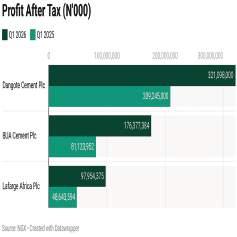
On the back of prohibitive price of cement, Nigeria’s leading cement manufacturing companies, Dangote Cement Plc, Lafarge Africa Plc and BUA Cement Plc generated an estimated N762.97 billion profit in the first quarter of 2026.
A bag of cement now cost between N12,500 and N14,000 depending on the location in the country as the government increases budget allocations to infrastructure projects and resurgence in domestic demand.
The cement sector in
Kayode Tokede
The investors in Legend Internet Plc have been reassured of stronger future earnings prospects as the company continues to expand its infrastructure, strengthen liquidity, and maintain a resilient equity base, despite weaker earnings recorded in its unaudited six-month results ended in
Nigeria is projected to experience significant growth in 2026, driven by strong demand drivers, capacity expansion, and an improving macroeconomic environment.
According to the unaudited results for the first quarter ended March 31, 2026, the whooping N762.97 billion profit is about 57 per cent increase over the N484.83 billion reported in Q1 2025.
Specifically, Dangote Cement posted N421.17 billion profit before tax, about 35 per cent increase over N311.97 billion reported in Q1 2025.
On its part, BUA Cement declared N192.68 billion
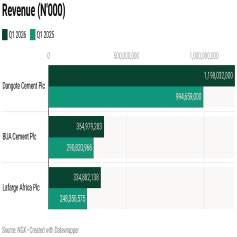
profit before tax in Q1 2026, 93 per cent increase over N99.74billion in Q1 2025 while Lafarge Africa announced N149.12 billion profit before tax in Q1 2026, up by 104 per cent when compared with N73.11billion reported in Q1 2025.
In terms of revenue, the three companies posted N1.89 trillion in Q1 2026, a growth of 23 per cent from N1.53 trillion in Q1 2025.
The breakdown showed that Dangote Cement recorded N1.2 trillion revenue in Q1 2026, up by 20.4 per cent from N994.7 billion in Q1 2025.
The Group Managing
Director and Chief Executive Officer of Dangote Cement, Arvind Pathak, said the results reflected the strength of the company’s operating model and its disciplined execution across markets.
He said, “We have delivered an outstanding start to 2026, with revenue up 20.4 per cent year on year to N1.2 trillion, driven by a strong rebound in volumes which grew 13.8 per cent across our markets.
EBITDA increased by 22.8 per cent to N567.1 billion, demonstrating the strength of our operating model, disciplined cost control, and our ability to convert growth
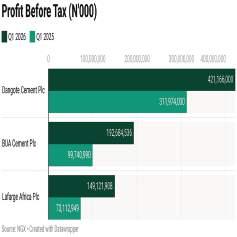
into superior profitability.”
On exports and expansion, he noted the rapid scaling of Dangote Cement’s export business and progress across key growth projects.
“Our export business continues to scale rapidly, with volumes from Nigeria up 71.6 per cent and 10 clinker shipments completed in the quarter. This performance reinforces our strategic position as Africa’s leading cement exporter,” he said.
He added, “Following the commissioning of our 3Mta grinding plant in Côte d’Ivoire, we are progressing well with our expansion projects in Itori
and Ethiopia, alongside other growth initiatives across the continent. These investments will further strengthen our footprint and keep us firmly on track to reach 80Mt of production capacity by 2030.” BUA Cement closed Q1 2026 with a revenue of N354.98 billion, a growth of 22.1 per cent from N290.82 billion in Q1 2025, while Lafarge Africa announced N334.88 billion revenue in Q1 2026, representing an increase of 34.8 per cent from N248.35billion in Q1 2025.
January 2026.
The broadband and digital services provider posted a negative earnings position of N99.34 million for the six-month period, ended in January, compared with a profit position recorded in the corresponding period of the previous year.
Chief Executive Officer, Legend Internet, Aisha Abdulaziz assured
stakeholders that the company remains focused on long-term growth and operational sustainability, noting that recent investments in network expansion and digital infrastructure are expected to strengthen service delivery and support future profitability.
“We are building for the future, and while short-term earnings may
reflect the weight of our expansion strategy, the underlying fundamentals of the business remain strong.
Our investments in fibre infrastructure, technology, and operational capacity are positioning Legend Internet for improved performance, stronger cash generation, and sustainable shareholder value in the periods ahead,”
Abdulaziz said.
Analysts noted that the earnings decline was largely driven by aggressive expansion spending, elevated administrative costs, and one-off adjustments rather than deterioration in core business fundamentals.
Revenue stood at N220.55 million during the period, supported by contributions from Legend Fiber, wholesale
bandwidth services, customer premises equipment (CPE) sales, and Legend Pay operations. Although revenue moderated compared with the previous comparable period, the company continued to deepen its infrastructure footprint with additional investments in fibre network assets.
In this interview, the Chairman of the Sage Centre for Leadership Excellence and former Managing Director of Shell Petroleum Development Company of Nigeria Limited, Dr. Mutiu Sunmonu, reflects on the origin of the centre, its evolving mission, and how its structured programmes are shaping decision-making, strengthening governance, and redefining what effective leadership looks like across Africa’s most critical sectors. Raheem Akingbolu brings the excerpts.
How has the Sage mission evolved as it engages with organisations across Africa and responds to the continent’s evolving leadership landscape?
Our mission has evolved along three clear directions. First, we have moved from a personality-led identity to an institutional one, with a defined community of Icons, Vanguards, and Fellows that carries the work forward. In its earliest form, Sage was understood largely through the lens of my personal journey—very much “Dr. Mutiu’s Centre.” That was a natural starting point, but it was never the destination.
Second, we have sharpened our focus on the systems behind leadership—governance structures, board effectiveness, and continuity— so that individual insight translates into institutional strength.
Third, we have become more intentional about sector relevance, designing engagements that speak directly to the realities of financial services, energy, technology, and other sectors that shape the African economy. The intent is that, over time, Sage becomes recognised not just as a centre, but as a reference point for how leadership ought to be practised in our context.
Could you take us through Sage’s strategic service pillars and how they work together to create tangible outcomes for organisations and their leadership teams?
At Sage, we have been deliberate in building service pillars that reflect the real demands of leadership—how decisions are made, tested, and implemented within organisations.
The first is the Sage Masterclass, which brings senior leaders together in high-trust settings to reflect on the decisions that shape institutions. It is less about teaching and more about shared experience and perspectivebuilding at enterprise and board levels. The second is the Enterprise Turnaround Clinic, which provides confidential, one-on-one advisory support to boards and executive
teams, particularly in moments of transition, risk, or growth where decisions are complex and time-sensitive.
The third is the Leadership-in-Action Labs, focused on execution—helping leaders translate decisions into organisational alignment and measurable outcomes within their teams. The fourth is the Board Excellence Academy, which strengthens governance by improving board effectiveness, accountability, and long-term institutional continuity.
Taken together, these pillars move leaders from reflection to decision, and from decision to execution, ensuring that insight is not left at the level of discussion but is translated into tangible organisational impact.
African companies face unique challenges — from regulatory shifts to market volatility. How does the Sage Centre equip leaders and boards to navigate these complexities successfully?
We start from a simple premise: leaders in our markets are not short of intelligence or ambition; they are short of time, trusted counsel, and safe spaces to think clearly under pressure. Much of what we do is designed to restore those three things.
Through our strategic pillars, our goal is to equip leaders with a sturdier internal compass and a dependable external network—so that when the environment moves, as it always does, they are neither surprised nor alone.
Speaking of one of your strategic pillars—the Vanguard Masterclass series—you recently hosted an edition focused on the financial services sector. Could you walk us through the concept behind it and the outcomes participants can expect?
Financial services is a foundational part of the economy, driving capital flows and enabling enterprise growth,
but it is also a sector under constant strain from regulation, digital disruption, economic volatility, and rising stakeholder expectations. The Masterclass series is designed as a hybrid experience that combines leadership principles with sector-specific realities, and financial services was a natural place to begin given its central role in both national and regional economic transformation.
The April edition, themed, “Leadership in Uncertain Times,” was the second in the series and was designed to create a high-trust environment where senior leaders could step back from execution and engage more deliberately on judgement, governance, and decision-making processes. It brought together Icons and Vanguards and industry leaders such as Bolaji Balogun, Managing Director and Chief Executive Officer of Chapel Hill Denham, and Dr. Hakeem Belo-Osagie, Chairman of Metis Capital Partners and former Chairman of United Bank for Africa (UBA).
A key part of the Masterclass is also its emphasis on shared experience and peer exchange. Through case-based discussions and small group conversations, participants are able to connect the themes of the session directly to the challenges they are facing in their own organisations. In terms of outcomes, what we aim for is both practical and psychological. We want leaders to feel seen—to recognise that the challenges they are navigating are not isolated. We want them to gain clarity and perspective, drawing from the experiences of others. We want them to leave with practical ways of thinking and acting that they can apply in real time. And importantly, we want to begin building a community of leaders who can continue to learn from and support one another beyond the session.
Partnerships and collaborations are key to scaling impact. Are there particular initiatives or alliances the
Centre is prioritising to broaden its reach across industries and borders?
We are very clear that Sage cannot, and should not, try to do this alone. Our model is inherently collaborative, and partnerships sit at the heart of how we intend to scale. Internally, our most important alliance is the community we are building across three tiers: Icons—established leaders whose reputations provide institutional gravitas; Vanguards—master practitioners with twenty or more years of senior leadership who are ready to transfer their wisdom; and Fellows—high-potential C-suite leaders and founders who represent the next generation. Each tier reinforces the others, and together they form the backbone of the Sage ecosystem.
Externally, we are prioritising a few categories of partnership. We are deepening relationships with sector leaders and industry bodies to shape sector-specific Masterclasses, beginning with financial services and extending into other sectors critical to the African growth story. We are also building credible media and thought leadership partnerships with academic institutions across the continent and beyond to ensure that the insights emerging from Sage contribute meaningfully to the wider discourse on African governance.
Looking at the next five to ten years, how does the Sage Centre envision influencing the broader narrative of African leadership and governance beyond the organisations it directly engages with?
Over the next five to ten years, we want to contribute to three shifts in particular. The first is a shift in language: moving African leadership discourse away from generic commentary and towards a more rigorous, home-grown vocabulary that takes our context seriously. The second is a shift in expectation: helping to establish ethical, transformational leadership as the baseline standard for serious enterprises, rather than a differentiator reserved for a few.
It is on record that the Gulf of Guinea accounted for the majority of global kidnappings at sea, earning a notorious reputation as the world’s piracy capital. However, the story is markedly different today. Nigeria, once the epicentre of maritime insecurity in the region, has recorded four consecutive years without a piracy incident in its territorial waters. Behind this remarkable turnaround lies a strategic alliance between the Nigerian Maritime Administration and Safety Agency, HLS International Services Limited and the Nigerian Navy, whose Deep Blue Project has become a continental benchmark for maritime security. Eromosele Abiodun writes
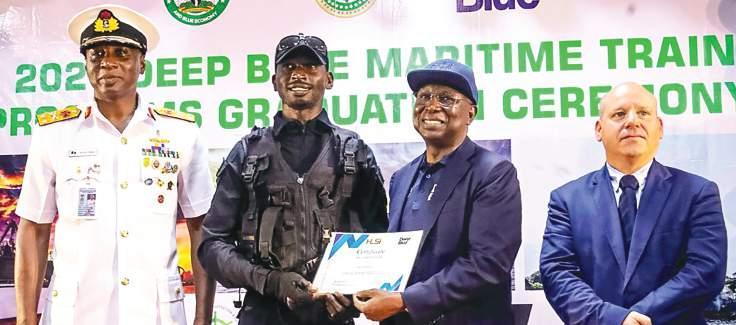
For years, pirates terrorised the Gulf of Guinea (GoG), the GoG was regarded as one of the world’s most dangerous maritime corridors. In 2017 and 2018 there were 33 and 45 piracy incidents respectively.
Stretching from Senegal to Angola and accounting for a significant share of Africa’s maritime trade, the region became synonymous with piracy, armed robbery at sea, kidnapping of seafarers, oil theft and other maritime crimes.
At the epicentre of this challenge was Nigeria, whose vast coastline, strategic location and busy shipping lanes made its waters a preferred target for criminal networks. The consequences were severe. Shipping companies paid huge war-risk premiums, investors grew increasingly concerned about maritime security, and Nigeria’s image as a maritime nation suffered significant damage.
Today, however, the narrative has changed dramatically. Nigeria has recorded four consecutive years without a piracy incident in its territorial waters, a remarkable achievement that has attracted global recognition and restored confidence among international shipping operators. Analysts attribute Nigeria’s election into category C sit at the International Maritime Organisation (IMO) to its success in the war against piracy.
At the heart of this transformation is the strategic partnership between the Nigerian Maritime Administration and Safety Agency (NIMASA) and HLS International Services Limited (HLSI), the implementation partner of the Deep Blue Project. Together, with strong support from the federal government and the Nigerian Navy, they have built one of Africa’s most sophisticated maritime security architectures.
The recent graduation of 177 maritime security personnel under the Deep Blue Project in Lagos once again highlighted the importance of the initiative in sustaining the gains already recorded in Nigeria’s maritime domain and across the Gulf of Guinea.
The years 2017 and 2018 represented one of the darkest periods for maritime security in the Gulf of Guinea.
According to reports from international maritime organisations, the region accounted for the majority of global kidnappings of seafarers during that period. Pirates frequently attacked commercial vessels, oil tankers and offshore installations, often operating with sophisticated weapons and intelligence.
Nigeria’s waters became particularly vulnerable. Criminal groups exploited gaps in surveillance, limited maritime assets and weak coordination among security agencies. Crew members aboard merchant ships were routinely kidnapped for ransom, while vessels were attacked and cargo stolen.
The International Maritime Bureau (IMB) consistently ranked the Gulf of Guinea among the world’s most dangerous maritime zones. Maritime insurers responded by imposing high war-risk insurance premiums on vessels entering Nigerian waters, significantly increasing the cost of shipping and trade.
The economic implications were profound. Higher insurance costs translated into increased freight charges, making imports more expensive and reducing the competitiveness of exports.
Foreign investors viewed the maritime sector with caution, while shipping lines sought alternative routes where possible.
Beyond the economic consequences, the situation posed a direct threat to Nigeria’s national security. The same criminal networks involved in piracy were often linked to crude oil theft, illegal fishing, smuggling and other transnational crimes. It became increasingly clear that conventional approaches alone would not solve the problem. A comprehensive,
technology-driven and multi-agency solution was required.
Recognising the urgent need for a modern maritime security framework, NIMASA partnered with HLS International Services Limited (HLSI) to implement the Integrated National Security and Waterways Protection Infrastructure, popularly known as the Deep Blue Project.
HLSI brought technical expertise, operational support and global best practices to the initiative. The company’s role extended beyond the supply of security assets to include training, capacity development, intelligence integration and operational support.
One of the project’s most significant innovations was the deployment of an integrated surveillance and response system designed to detect, track and neutralise maritime threats in real time.
The Deep Blue architecture combines air, land and sea assets under a unified command structure. These include special mission vessels, fast intervention boats, helicopters, unmanned aerial systems, armoured vehicles and a sophisticated Command, Control, Communication, Computer and Intelligence (C4i) Centre.
Through this integrated system, security agencies gained unprecedented visibility across Nigeria’s maritime domain. Suspicious activities could be detected early, analysed rapidly and responded to effectively.
Equally important was HLSI’s investment in human capacity development. Hundreds of maritime security personnel have undergone specialised training in surveillance operations, tactical interdiction, vessel boarding, intelligence gathering, communications and emergency response.
The graduation of 177 additional personnel under the latest training
programme demonstrates the continuing emphasis on capacity building. The graduates included special mission vessel officers, engineers, helicopter crews, fast intervention boat operators and boarding teams, all critical components of the Deep Blue operational framework.
This combination of technology, training and operational coordination has fundamentally altered the security landscape in Nigeria’s maritime environment.
While technology and expertise were important, the success of the Deep Blue Project would not have been possible without strong political backing from the federal government.
Recognising the strategic importance of maritime security to national economic growth, the government provided the policy support, funding and institutional coordination required to implement the project.
The government’s commitment was further demonstrated through the enactment of the Suppression of Piracy and Other Maritime Offences (SPOMO) Act. The legislation provided a legal framework for prosecuting piracy and maritime crimes, making Nigeria the first country in West and Central Africa to domesticate international anti-piracy conventions.
The law strengthened deterrence by ensuring that arrested offenders could be prosecuted and convicted under Nigerian law.
Government support also facilitated enhanced cooperation among NIMASA, the Nigerian Navy, the Nigerian Air Force, intelligence agencies and other security institutions.
This whole-of-government approach ensured that maritime security became a national priority rather than the responsibility of a single agency.
Nume Ekeghe
Union Bank of Nigeria’s Endless Possibilities campaign has won Bronze in the Heritage category at the 2026 Pitcher Awards, one of Africa’s foremost platforms for creative excellence.
The campaign was also shortlisted in the Craft category for Film Craft, a recognition of the artistry and technical quality behind the work. These recognitions were awarded following adjudication alongside qualifying entries from across the African continent.
The Heritage win carries a particular resonance. It recognisesthe bank’s ability to honour its rich heritage while maintaining relevance with contemporary audiences.
For more than a century, Union Bank has been woven into the fabric of Nigeria’s economic and social progress, and Endless Possibilities continues that story rather than departing from it. Built to celebrate the ambition and resourcefulness of Nigerians who dream and create against the odds, the campaign mirrors the very qualities that have sustained the Bank across generations. To be honoured in a category defined by history, identity and cultural continuity, is to have that legacy recognised on a continental stage.
Commenting on the award, Olufunmilola Aluko, Chief Brand and Marketing Officer at Union Bank of Nigeria, said: “We are honoured
to be recognised at the 2026 Pitcher Awards for Endless Possibilities. This achievement reflects our commitment to telling authentic stories that resonate with the Nigerian spirit and reinforce our promise to support the dreams and progress of the communities we serve. We are equally proud of the Film Craft shortlist, which speaks to the talent and collaboration behind the work.”
This recognition on the African stage, adds to Union Bank’s growing reputation for storytelling that is locally grounded and broadly resonant. As the Bank deepens its connections with audiences across the country and continent, it remains committed to work that inspires confidence, possibility and progress.
Ebere Nwoji
Mutual Benefits Assurance Plc, has announced its audited financial results for the year ended 31 December 2025, reporting a strong performance marked by significant growth in profitability, improved insurance revenue and continued expansion of its balance sheet. The results underscored the company’s resilience, disciplined execution and strategic positioning within Nigeria’s insurance industry.
The audited results, drawn from Mutual Benefits’ consolidated and separate financial statements, reflect sustained momentum across underwriting,
investment income and operational efficiency.
Highlights include a rise in insurance revenue to ₦80.05 billion, up from N66.92 billion in 2024, driven by growth across key business segments. Profit for the year increased to ₦16.42 billion, compared to N11.32 billion in 2024, reflecting strong bottom-line expansion, while profit before tax stood at N17.41 billion, up from N11.80 billion in the prior year. Furthermore, total assets expanded to N176.25 billion, compared to N147.13 billion in 2024, reinforcing balance sheet strength. In addition, total equity grew to N69.73 billion, from N54.79 billion in 2024, supported by retained
earnings and improved profitability, while earnings per share rose to 81 kobo, compared to 54 kobo in the previous year.
The leading insurer also recorded improved net investment income of N19.87 billion, supported by higher interest income, fair value gains, and disciplined portfolio management.
Equally important, Mutual Benefits reported strong operational performance, with its insurance service result improving significantly to N8.77 billion, compared to 1.07 billion in 2024.
The result reflected stronger underwriting discipline, improved claims management and enhanced reinsurance structuring.
AIICO Insurance Plc, said it was committed to improving public health outcomes and advancing sustainable community development through its support for a large-scale malaria prevention outreach in Ibadan, Oyo State.
The company said this is in commemoration of World Malaria Day 2026.
The initiative, implemented in partnership with HACEY, reached over 5,000 community members across four Primary Health Centres in Ibadan North Local Government Area, delivering targeted health education and essential preventive resources to vulnerable populations, particularly pregnant women and nursing mothers.
In a statement signed
by the Head Marketing & Communication AIICO Insurance Segun Olalandu, the company observed that malaria has remained a critical public health challenge in Nigeria, which accounts for approximately 24.3 percent of global malaria cases. Recognising the urgency of sustained intervention, AIICO’s support focused on strengthening awareness, promoting preventive behaviours, and improving access to life-saving tools within high-risk communities.
Olalandu said as part of the outreach, 600 longlasting insecticidal nets (LLINs) were distributed to pregnant women and nursing mothers, while structured health education sessions were conducted to deepen understanding of
malaria prevention, early diagnosis, and treatment.
Speaking on the initiative, The Manager, Corporate Responsibility and Sustainability at AIICO Insurance, Mrs. Abimbola Shobanjo, noted that Malaria has continued to pose a significant threat to maternal and child health in Nigeria, and addressing it requires more than awareness.
“It requires deliberate, sustained action at the community level. At AIICO, we see social impact as a core part of our responsibility, not an add-on. This outreach reflects our commitment to supporting vulnerable populations with the knowledge and tools they need to protect themselves and their families”, it stated.
Kayode Tokede
The stock market closed on a negative note as losses in PZ Cussons Nigeria Plc and 36 others N479 billion declined in the market capitalisation. Consequently, the Nigerian Exchange Limited All Share Index (NGX ASI) dipped by 874.00 points or 0.35 per cent to close at 246,686.66 basis
points with the Month-toDate and Year-to-Date returns moderated to -1.5per cent and +58.5per cent, respectively.
The stock market breadth remained weak, reflecting 37 decliners against 14 gainers. International Energy Insurance recorded the highest price gain of 9.86 per cent to close at N5.46, per share. TransNationwide Express followed with a gain of 7.14 per cent to
close at N5.10, while Neimeth International Pharmaceuticals ros by 6.80 per cent to close at N11.00, per share.
Living Trust Mortgage Bank up by 5.00 per cent to close at N4.20, while Abbey Mortgage Bank appreciated by 4.44 per cent to close at N7.05, per share.
On the other hand, PZ Cussons Nigeria and CWG led the losers’ chart by 10 per cent
each to close at N88.20 and N21.60 respectively, Associated Bus Company followed with a decline of 9.95 per cent to close at N6.88, per share. Wema Bank depreciated by 9.09 per cent to close at N30.00, while Sovereign Trust Insurance shed 8.16 per cent to close at N2.70, per share. Meanwhile, the total volume traded declined by 47.9 per cent to 587.64
million units, valued at N23.06 billion, and exchanged in 63,954 deals. Transactions in the shares of Access Holdings topped the activity chart with 113.096 million shares valued at N2.707 billion. Zenith Bank followed with 38.091 million shares worth N4.806 billion, while Consolidated Hallmark Holdings traded 35.433 million shares valued at N243.429 million.
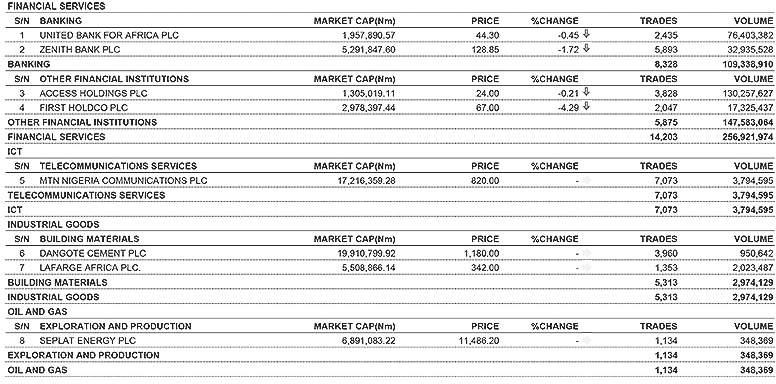
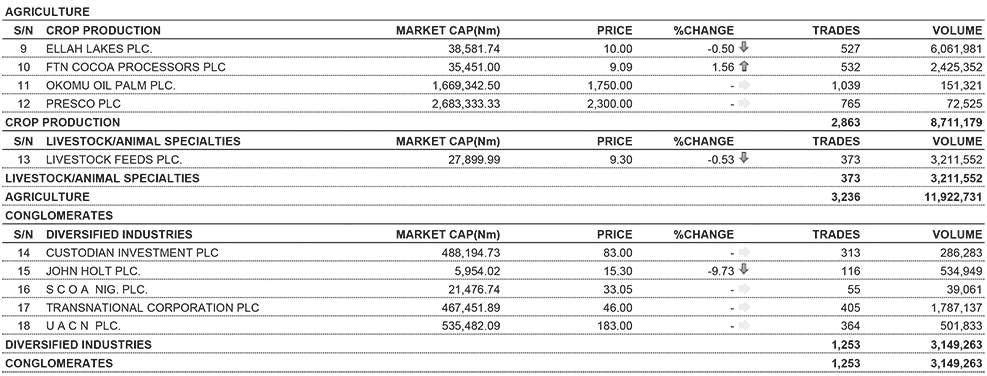
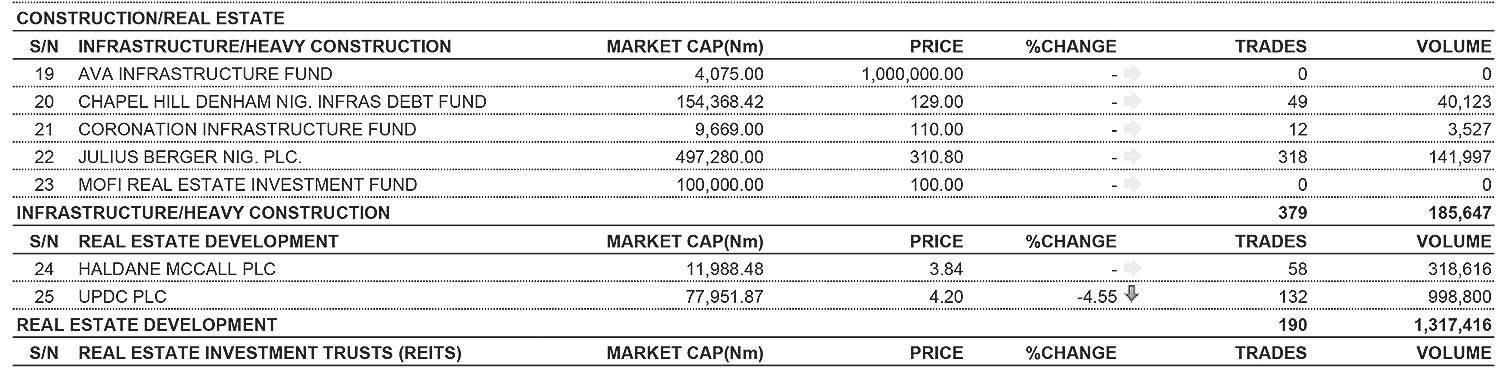
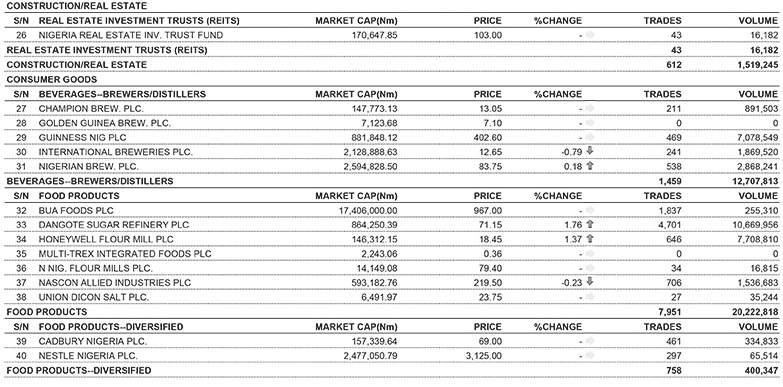
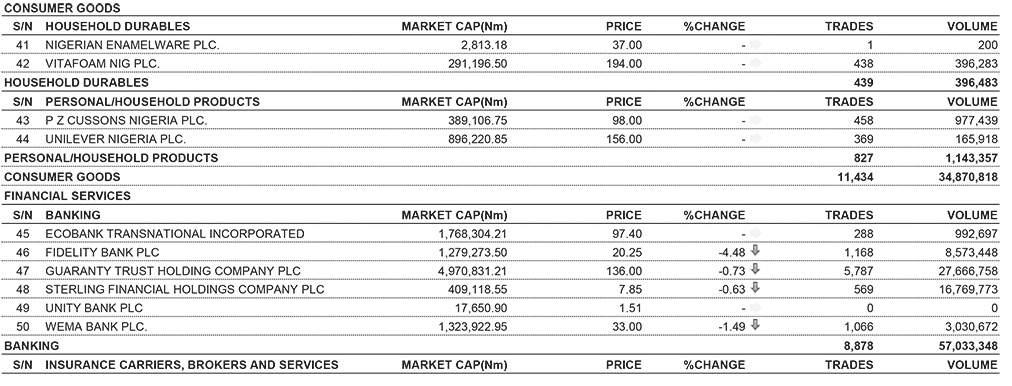
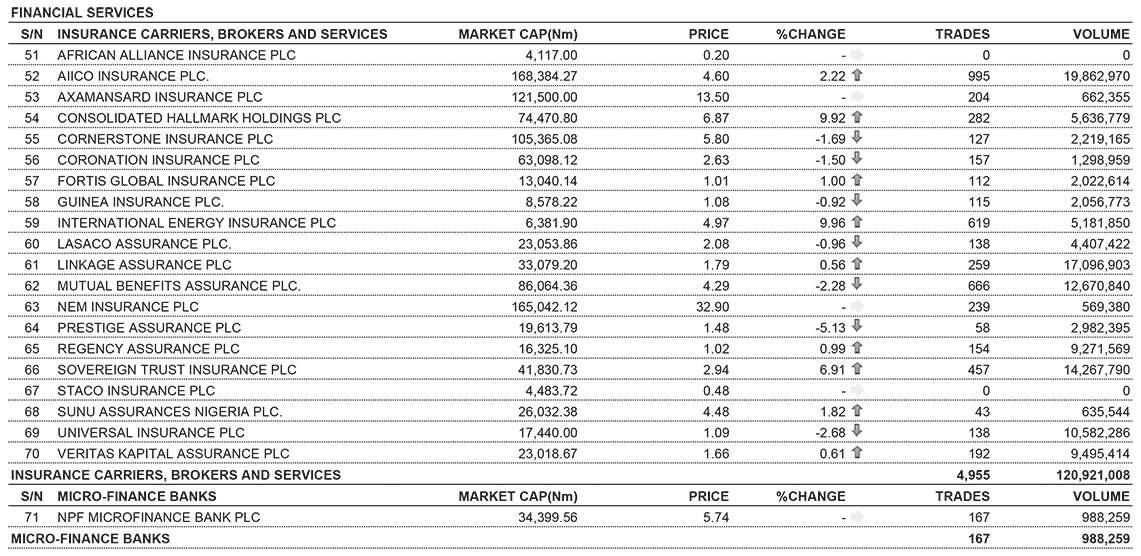
Neimeth International Pharmaceuticals traded 28.834 million shares valued at N298.761 million, while Sterling Financial Holdings Company sold 28.208 million shares worth N220.099 million. On market outlook, Cowry Assets Management Limited said the market sentiment is expected to remain mixed in the next trading session.


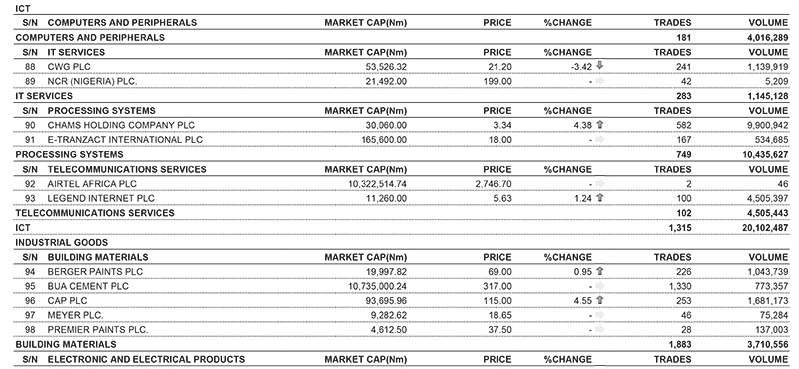
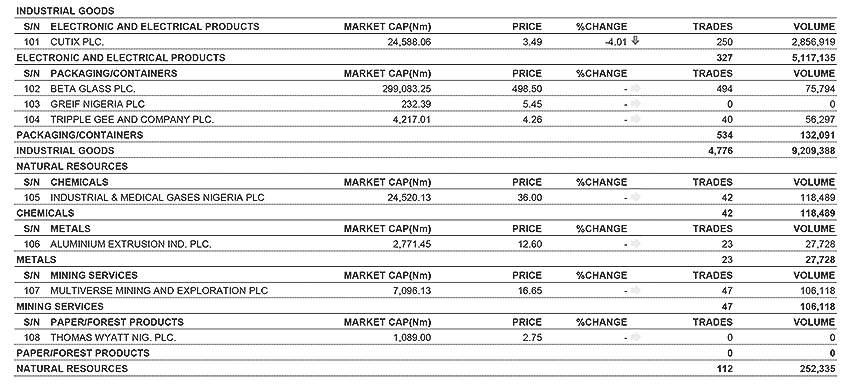

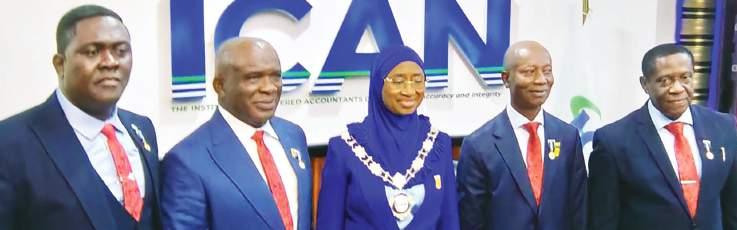
L-R: Registrar, Institute of Chartered Accountants of Nigeria, Lanre Olasunkanmi; 1st Deputy Vice President, Etofolam Osuji; 62nd ICAN President, Queensley Sofuratu Seghosime; Immediate Past President, Mallam Haruna Nma Yahaya; and 2nd Deputy Vice President, Oye Akinsulire during the investiture of the 62nd ICAN President in Lagos, yesterday
government to see this through. I can give you the assurance that our children and their teachers, by the grace of God, will return safely.”
Makinde explained, “In an atmosphere of insecurity, virtually nothing can be achieved. Nothing. Schools, hospitals, economic activities will all be grounded. We know this and because we’re not dealing with normal human beings, it is going to be a tortuous journey. All I will say is that from the presidency to the state, we will continue to put in our efforts.
“But in the meantime, please, and please, and please, it is time to unite, to confront the challenges that we have, and to bring back those children and our teachers.”
Earlier, in their separate solidarity remarks, National President of NANS, Comrade Akinteye Babatunde; State Chairman, NLC, Comrade Kayode Martins; and Chairman, NUT, Oyo State Wing, Comrade Hassan Fatai, commended the efforts of Makinde and equally charged him to intensify efforts and ensure the quick release of the abductees.
They condemned the barbaric act of kidnapping and killing of innocent people, describing the perpetrators as enemies of the country.
Atiku Faults Ribadu’s Blame of PDP Presidential candidate of African Democratic Congress (ADC), Atiku Abubakar, criticised National Security Adviser (NSA), Nuhu Ribadu, over his comments suggesting that President Bola Tinubu inherited the country’s security challenges from Peoples Democratic Party (PDP).
In a post on X, yesterday, Atiku described Ribadu’s position as “revisionism à la APC,” accusing the ruling party of attempting to shift responsibility for the worsening security situation to a government that left office 11 years ago.
According to Atiku, it is disingenuous for Ribadu to blame the inability of the Tinubu administration to secure the release of the abducted schoolchildren and teachers from Oriire Local Government Area of Oyo State on the PDP administration that was voted out of power in 2015.
He stated that the APC government should take responsibility for addressing the security challenges confronting the country rather than attributing them to previous administrations.
The former vice president also criticised the federal government’s response to the abduction. He lamented that it took Tinubu two weeks to send a delegation to visit the families of the kidnapped pupils and teachers.
He contended that Tinubu himself inherited security challenges from his predecessor, who was also elected on
the platform of APC, and, therefore, could not continue to deflect blame.
“Keep on blaming everyone except yourself while the children continue to languish in the custody of their abductors in Oyo, Borno, and elsewhere,” Atiku wrote.
Presidential candidate of Nigeria Democratic Congress (NDC), Peter Obi, expressed concern over the worsening security situation in Nigeria, lamenting the continued captivity of schoolchildren and teachers abducted in separate incidents in Borno and Oyo states.
In a statement, titled, “Concerns About Deteriorating Security,” Obi decried “the growing disconnect between the country’s worsening security challenges and the increasing focus of politicians on electoral calculations ahead of future elections”.
The former Anambra State governor stated that two weeks after the abduction of schoolchildren in Borno and Oyo states, the victims remained in captivity while government’s efforts appeared to focus on publicising the formation of a large rescue team.
He stated, “Two weeks have passed since schoolchildren were kidnapped in Borno and Oyo states, yet, they remain in captivity. Meanwhile, the government is promoting the formation of a thousand-member rescue team through the media while the children continue to suffer in the wilderness.”
Obi cited a series of recent attacks across the country as evidence of the deteriorating security situation. He referenced the killing of at least seven people and the injuring of 10 others in Gwon-Ajang Village, Foron District of Barkin Ladi Local Government Area of Plateau State, following an attack by terrorists on Sunday.
He also drew attention to an incident in Kogi State, where armed assailants, reportedly, kidnapped more than 25 persons and killed one resident during a coordinated raid on the Ayegunle-Igun Community in Kaba-Bunu Local Government Area.
According to him, the attackers, described as heavily armed, carried out the operation in a commandostyle, leaving residents terrified.
In Anambra State, Obi mourned the killing of two police officers in an attack by armed bandits, describing the incident as another painful reminder of the security challenges confronting the country.
The NDC presidential candidate recalled the abduction of 46 people, including 39 students, seven teachers and a school principal, from three schools in the Ahoro-Esinle Community of Oriire Local Government Area, near Ogbomoso, in Oyo State.
He also referenced the abduction of between 48 and 51 pupils and students in Mussa Community, Askira-Uba Local Government Area of Borno State, allegedly by Boko Haram insurgents on May 15.
Expressing frustration over the country’s priorities, Obi criticised members of the political class for focusing more on political ambitions than addressing the country’s urgent security challenges.
“Meanwhile, amid all these tragic developments, we, politicians, remain consumed by the next election, paying far more attention to political ambitions than to the safety and well-being of our children and fellow citizens,” he said.
Reps Seek Immediate Rescue of Abducted Oyo Schoolchildren, Mourn Teachers, Child
House of Representatives raised the alarm over the worsening security crisis in Oyo State, demanding the immediate rescue of dozens of schoolchildren and teachers abducted by armed bandits in Orire Local Government Area.
The lawmakers also called for far-reaching reforms, including the establishment of state police, and a decentralised security architecture across the country.
The call followed a motion of urgent public importance by Hon. Olamijuwonlo Alao-Akala, who described the situation in Ogbomoso and Orire Local Government Areas as an “unrelenting siege” that had plunged communities into grief, fear, and uncertainty.
Presenting the motion, Alao-Akala recounted how insecurity in the area escalated following a brazen attack on the Old Oyo National Park in January 2025, culminating in what he described as one of the darkest moments in the region’s history on May 16, 2025.
According to him, armed bandits stormed Baptist Nursery and Primary School in Yawota, Community Grammar School, in Esiele, and L.A. Primary School, abducting more than 30 pupils and their teachers in broad daylight.
The lawmaker painted a grim picture of the attack, saying terrified parents watched helplessly as their children and teachers were dragged into the forest by heavily armed kidnappers.
He expressed profound concern over the fate of those still being held captive, stating that many families remain trapped in anguish and uncertainty.
Alao-Akala stated, “While we sit in the comfort of this chamber, mothers in Orire are sleepless, fathers are broken, and children still in the hands of their captors are crying out for a rescue that has not yet come.”
The motion also highlighted the
gruesome killing of Mr. Michael Oyedokun, a mathematics teacher, who was among those abducted during the attack.
Following deliberations, the House called on the federal government and all security agencies to intensify efforts towards securing the immediate release of the remaining abducted pupils, teachers, and other victims.
They stressed that every hour lost in the rescue operation increased the risk to the lives of those still in captivity.
The House also urged the federal government to establish a permanent military Forward Operating Base in Orire Local Government Area in addition to the already approved deployment of 1,000 forest guards.
According to the resolution, the military base would provide a sustained and dominant security presence across the Old Oyo National Park and surrounding communities, preventing the area from serving as a safe haven for kidnappers, bandits, and other criminal elements.
Christian Association of Nigeria (CAN) declared Friday, June 12, as the start of a three-day period of national mourning, through Sunday, June 14, and designated Sunday as “Black Sunday” across churches in Nigeria.
CAN called on the federal government to declare a state of emergency on security, citing an unprecedented wave of violence sweeping across the country.
The call was contained in a communiqué issued at the 2026 National Church Denominational Leaders’ Summit held in Abuja, yesterday, with the theme, “The State of the Nation and the Way Forward.”
Reading the communique, CAN President, Arch Bishop Daniel Okoh, said the summit was convened amid worsening insecurity, economic hardship, and declining public confidence in state institutions.
Okoh lamented recent incidents of mass abductions, killings, and attacks in Oyo, Ogun, Borno, Kwara, Kogi, and other states. He highlighted the abduction of school children and teachers, as well as other terrorist activities in parts of the North-east, and areas previously considered safe.
The Christian body also made 16 resolutions, including the demand for the immediate and unconditional release of all abducted school children, teachers, and other citizens held captive by criminal elements. It urged security agencies to intensify rescue efforts until every victim regained freedom.
The document read, in part, “To honour victims, CAN has declared
Friday, June 12, as the start of a threeday period of national mourning through Sunday, June 14. It has also designated Sunday as ‘Black Sunday’ across churches in Nigeria.
“Communities are under attack, citizens are kidnapped from homes and workplaces, travellers are abducted on highways, and farmers are driven from their lands.”
The communique added, “CAN condemns the barbaric acts of murder, beheading, torture, rape, abduction and forced displacement being perpetrated against innocent citizens and we therefore remind the federal government that protection of lives and properties remains its foremost constitutional responsibility.
“CAN demands an urgent, decisive action to halt the bloodshed, including a comprehensive review of the nation’s security architecture, stronger inter-agency cooperation, and greater accountability in the fight against terrorism, banditry and violent crime.”
The CAN president also called for the immediate acceleration of constitutional and legislative processes to establish state police and other lawful decentralised security structures to improve intelligence gathering, rapid response, and local accountability.
CAN demanded a comprehensive compensation, rehabilitation, and resettlement programme for victims of terrorism, kidnapping, and violent attacks.
It insisted on the safe return of displaced persons to their ancestral communities under adequate security guarantees.
Ekiti State Governor, Biodun Oyebanji, cautioned politicians against deploying fake news and misinformation to gain political advantage ahead of the June 20 governorship election, warning that such actions can undermine the peace and stability of Ekiti State.
The governor spoke in Ado-Ekiti during a meeting with artisans and private sector operators. He expressed concern over what he described as a growing trend of false narratives aimed at heating up the polity and creating unnecessary panic among residents.
Specifically, Oyebanji condemned the circulation of unverified reports relating to security incidents in the state, saying it is unfortunate that some individuals would deliberately spread falsehoods capable of damaging the image of Ekiti for political gain.
According to him, leadership is about serving the people and protecting the collective interest of the state, not promoting fear or seeking
sympathy through misinformation.
The governor said, “I wonder how an Ekiti indigene would spread fake news that a commercial bus was hijacked and all passengers abducted.
“Such conduct is condemnable and does not reflect the values of leadership we should be promoting.”
He maintained that political contestation should be issue-based and devoid of actions capable of threatening the peaceful atmosphere for which the state is known.
Meanwhile, Ekiti State House of Assembly convened special security sessions involving heads of security agencies, traditional rulers, and community leaders as part of efforts to safeguard the state against emerging threats.
The Assembly said the engagements formed a critical aspect of its activities during the third legislative session, reflecting lawmakers’ determination to support measures aimed at sustaining peace and protecting life and property across the state.
Speaking at a press conference to mark the third anniversary of the Seventh Assembly in Ado-Ekiti, Chairman of the House Committee on Media and Publicity, Hon. Babatunde Oke, said security remained a major priority for the legislature in view of growing security concerns across the country.
Oke explained that the Assembly brought together security agencies, royal fathers, and community representatives to review the security situation in the state and explore strategies for strengthening collaboration among stakeholders.
He said the special security engagements were designed to complement the efforts of the executive arm of government and security agencies to prevent criminal activities and ensure that Ekiti remained one of the safest states in the country.
Minister of the Federal Capital Territory (FCT), Nyesom Wike, cautioned teachers against giving political coloration to the security challenges sweeping across the country.
Wike gave the advice yesterday while addressing protesting teachers and civil society organisations, who staged a protest at the Federal Capital Territory Administration (FCTA) Secretariat, to demand release of teachers and students abducted in Oyo State and other parts of the country.
He explained that insecurity was affecting all parts of the country and should be approached as a collective national challenge.
He stated that incidents of teacher abductions had also occurred in other states without attracting similar
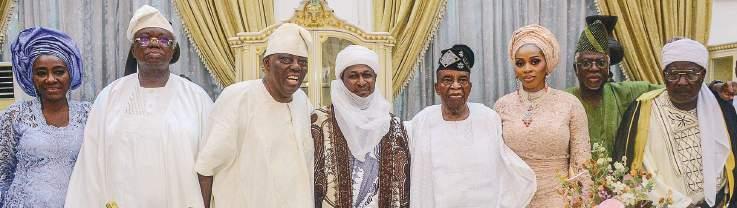
L-R: Wife of the Founder/Chairman of Gibraltar Construction Nigeria Limited, Lady Adejoke Okeowo; her husband, Sir Clement Oluwatumininu Okeowo; Founder/Chairman of the Eleganza Group of Companies, Chief Rasaki Akanni Okoya; Chief Imam of Lagos State, Sheikh Sulaimon Oluwatoyin Abu-Nolla; Founder/Chairman of the Doyin Group of Companies, Prince Samuel Adedoyin; Managing Director of Eleganza Industrial City Limited, Chief (Dr.) Folashade Noimat Okoya; Chief Gbenga Obasa, and Imam Saba Bariu Saidi, during the 29th Remembrance of Alhaja Idiat Abeke Okoya organised by her son, Chief Okoya at Oluwanishola Estate Lekki–Ajah Expressway, Lagos...recently
Ajimotokan
The federal government yesterday inaugurated the Inter-Ministerial Committee (IMC) for the 27th Democracy Day Celebration billed for June 12.
Secretary to the Government of the Federation (SGF), Senator George
Akume, inaugurating the committee, tasked members on the mandate for a successful commemoration of Nigeria’s democratic journey.
Akume chaired the committee, which comprised Minister of Information and National Orientation; Minister of Interior; Minister of the Federal Capital Territory
(FCT); Minister of Health; Minister of Foreign Affairs; Minister of Finance; Minister of Budget and Economic Planning; and Minister of Arts, Culture and Creative Economy.
Others in the committee were Minister of Defence, National Security Adviser, Inspector-General of Police, Director-General
of Department of State Services (DSS), and Commander, Guards Brigade, among others.
Akume said the Democracy Day activities would be modest but purposeful in line with the mood of the nation and the government’s commitment to fiscal responsibility.
He described the occasion as an
opportunity to reflect on the resilience, courage, and determination of Nigerians, who made immense sacrifices in the struggle for democratic governance.
Akume paid tribute to the heroes of the June 12, 1993 democratic struggle, notably the winner of the annulled election, the late Chief Moshood Abiola, whose
sacrifice led to the recognition of June 12 as Democracy Day.
The SGF stated the democratic ethos and institutions presently engrained across the country were founded on the sacrifices and struggles of patriots and democrats who fought for the enthronement of democratic rule in Nigeria.
AKPABIO: KIDNAPPERS, TERRORISTS TARGET NIGERIA, NOT POLITICAL PARTIES protests in the nation’s capital, urging citizens to adopt a more unified response to security threats.
“We are all concerned, but let us not politicise issues. That is what I will not support. We are all concerned about the security situation and how the teachers and students should be released,” he said.
The minister assured that the security agencies were intensifying efforts to rescue the victims while the federal government remained committed to ensuring their safe return.
He urged national solidarity, stating that insecurity should not be viewed through regional or political lenses as an attack on one community ultimately affected the entire country.
Wike said, “What concerns you concerns everybody, and what concerns Abuja also concerns everybody. We are all looking at how people should rise up with the same dedication.
“We are all concerned about this security situation. The government is on its toes to ensure that those who are kidnapped are rescued.”
The leadership of NUT, yesterday, threatened to shut down all public primary and secondary schools in the country if the federal government failed to address the current worsening insecurity in the country.
The development came as thousands of teachers in Kwara State, under the platform of NUT, staged a peaceful protest across major streets of Ilorin on Tuesday over the abduction of 39 students and seven teachers from three schools in Oriire Local Government Area of Oyo State on May 15.
Armed with placards with inscriptions, such as “From Chibok to Oriire: Our children are still crying,” “We say no to attacks on schools,” “A nation that cannot protect its schools has no future,” and “Stop the killing and maiming of teachers in Nigeria,” the
protesters demanded urgent action to secure the release of the victims and protect schools nationwide.
Addressing journalists in Ilorin, Deputy Secretary-General of the union in Kwara State, Mike Modesty, said fear had taken over schools and communities across the country.
“One teacher has already been killed while the others remain in captivity. We are hearing talks about negotiation. Negotiate what? The lives of our children and teachers?” Modesty asked.
In Plateau State, teachers, yesterday, joined a nationwide wave of protests demanding the immediate rescue of abducted teachers and pupils in Oyo State, warning that continued attacks on schools threaten the future of education in Nigeria.
During the peaceful march in Jos, members of NUT carried placards and chanted solidarity songs as they moved from Old Airport Roundabout to New Government House in Little Rayfield to submit a formal protest letter to Governor Caleb Mutfwang.
Addressing the crowd, Plateau State NUT Chairman, Elisha Ayimani, condemned the rising wave of school kidnappings, describing them as a direct assault on the country’s education system.
NLC Joins NUT, CSOs in Protest
Leaders and members of Nigeria Labour Congress (NLC), Nigeria Union of Teachers (NUT), and Civil Society Organisations (CSOs) in Ogun State, yesterday, joined the nationwide protest over the abduction of students and teachers in Oyo State.
The protest was a follow-up to Monday’s action during which some Ogun residents, including nursing mothers, protested.
During yesterday’s protest by NUT and other labour unions, participants carried banners bearing inscriptions and also sang solidarity songs, using megaphones to explain their plight to members of the public as they marched round Abeokuta.
“Electricity zero, security zero, the only system that we are managing
is education and now they want to collapse it. We are not going to agree with them. We shall resist all their plans,” the protesters said.
Speaking to journalists, National Chairman of Committee for the Defence of Human Rights (CDHR), Comrade Yinka Folarin, urged security agencies to double their efforts and place more premium on the value of human life.
Folarin said the protest was also meant to raise residents’ consciousness on the need to join the fight against terrorism and violence, stressing that “Nigeria belongs to us all”.
Nigerian Air Force (NAF) stepped up efforts to strengthen the operational competence of its officers as part of measures aimed at minimising civilian casualties during air operations.
The initiative came amid growing concerns over the deaths of unarmed villagers in communities located near terrorist and bandit enclaves in parts of northern Nigeria.
Last month, Amnesty International alleged that at least 100 civilians were killed when a military air strike struck the Tumfa market in Zurmi Local Government Area of Zamfara State.
In its recent human rights assessment, Amnesty International further alleged that military air strikes had “unlawfully targeted civilians” and urged the authorities to strengthen safeguards for the protection of non-combatants during military operations.
Against that backdrop, NAF intensified specialised training programmes and capacity-building initiatives designed to equip officers with advanced skills in targeting, intelligence assessment, and application of rules of engagement.
The objective was to enhance the precision of air missions and reduce the risk of civilian harm.
The initiative also reflected the service’s commitment to upholding international humanitarian principles, protecting innocent lives,
and reinforcing public confidence in military operations, particularly in conflict-affected areas, where the risk of collateral damage remains a significant concern.
Speaking at the ongoing Seminar on Civilian Harm Mitigation and Response for Strategic Level Officers, at NAF Headquarters in Abuja, Chief of the Air Staff (CAS), Air Marshal Kelvin Aneke, expressed confidence that the outcome of the seminar would further strengthen the service’s commitment to professionalism, operational excellence, and the protection of civilians during military operations.
Aneke reaffirmed that NAF remained fully committed to conducting professional, responsible, and people-centred operations in line with its constitutional mandate.
According to him, success in modern military operations can no longer be measured solely by tactical achievements but also by the extent to which civilian lives and property were protected.
He stated, “As an institution, we recognise that maintaining the confidence of the civilian population is essential to achieving lasting security outcomes.
“Consequently, the Nigerian Air Force has continued to take deliberate steps towards institutionalising civilian harm mitigation and response mechanisms, particularly at the tactical and operational levels.”
Nigeria Police Trust Fund (NPTF) called for a substantial increase in its statutory funding, warning that the country’s security challenges cannot be effectively addressed without sustained investment in modern policing infrastructure.
The call came amid Nigeria’s struggles with rising cases of kidnapping, terrorism, cybercrime, and other violent crimes in different parts of the country.
NPTF urged the National Assembly to amend its enabling law to increase its statutory allocation
from 0.5 per cent to one per cent and remove the sunset clause contained in the current legislation to ensure uninterrupted support for police development programmes.
The proposal was presented at a public hearing organised by Senate Committee on Police Affairs on a bill seeking to repeal the Nigeria Police Trust Fund (Establishment) Act, 2019 and enact a new Nigeria Police Trust Fund Act, 2026.
Addressing stakeholders, Executive Secretary of NPTF, Mohammed Sheidu, said the proposed increase in funding had become necessary in view of evolving security threats and the urgent need to equip the Nigeria Police with modern tools required for effective law enforcement.
Sheidu disclosed that the proposal had already received the backing of the National Police Council, chaired by President Bola Tinubu, after extensive deliberations on the country’s security realities.
He said members of the council, including governors, Minister of the Federal Capital Territory, Chairman of Police Service Commission, Inspector-General of Police, and other key stakeholders, agreed that improved and sustainable funding was crucial in efforts to strengthen internal security across the country.
Sheidu said the additional resources would be channelled into critical areas of police modernisation, including the deployment of advanced surveillance systems, establishment of forensic laboratories, development of command-and-control centres, acquisition of drones and expansion of digital policing infrastructure.
President of the Senate, Senator Godswill Akpabio, who declared the public hearing open, underscored the centrality of security to national development, insisting that economic growth, investment, and social stability can only thrive in a secure environment.
Akpabio said the Nigeria Police occupied a critical position within the country’s internal security framework and remained indispensable to maintaining law and order as well
as protecting life and property. He stated that the establishment of the Nigeria Police Trust Fund in 2019 had significantly enhanced police capacity through infrastructure development, specialised training programmes, and welfare support for officers and men of the force. He said changing security realities necessitated periodic reforms to ensure institutions remained effective and responsive to emerging threats. Akpabio stated, “This legislative initiative is not merely about repealing an existing law. It is about building a stronger institution that can more effectively support police modernisation, improve service delivery and contribute meaningfully to our national security objectives.”
Earlier, Chairman of Senate Committee on Police Affairs, Senator Ahmed Mallam-Madori, said the trust fund had made remarkable contributions to training, intelligence-led policing, counter-terrorism operations, infrastructure development and welfare enhancement.
A representative of the AttorneyGeneral of the Federation and Minister of Justice said the Federal Ministry of Justice had reviewed the proposed bill and found it consistent with constitutional provisions and government policy objectives on security sector reforms.
Osun State Governor, Ademola Adeleke, reassured the people of the state that his government had taken proactive steps to secure schools, urging the public to ignore recent false alarms about school kidnappings in some parts of the state.
The governor, who described the rumour as the handiwork of evil opposition elements, said fact checks from the border areas and across the state confirmed that there was no case of kidnapping.
The governor stated, “I task our people to go about their normal activities without fear. Our government has taken steps to secure our schools.

Chief Executive Officer, Parthian Technologies, Tobi Olusoga, and Chief Technology Officer, Parthian Technologies, Kole Kuyoro, at the launch of the new i-invest experience in Lagos…recently
yinka Kolawole in Osogbo
A former Osun State Commissioner for Youth and Sports, Hon. Yemi Lawal, during the administration of Governor Adegboyega Oyetola, has spoken on how the reconstruction of the Osogbo City Stadium was deliberately frustrated during the administration of the All Progressives Congress (APC) led by former Governor Oyetola.
According to Lawal, the project suffered a painful setback as a result of the opposition mounted by the APC gubernatorial candidate, Mr. Bola Oyebamiji, who at the time served as Commissioner for Finance.
In a statement issued and made available to THISDAY yesterday by Pelumi Olajengbesi, the spokesperson of The Imole Campaign Council (TICC), he noted that the revelation further confirmed what many residents of Osun State have long suspected-
that the APC governorship candidate has never been genuinely committed to the development of Osun State and the welfare of its people.
The spokesman noted that: “The attention of the good people of Osun State has once again been drawn to the disturbing revelations contained in the recent interview granted by Yemi Lawal.
“Sporting and recreational infrastructure is not merely about entertainment. Across the world, sports have become a multi-billion-dollar industry, creating employment opportunities, stimulating local economies, promoting youth engagement, and reducing social vices. Any leader with foresight would understand the immense economic and social value of investing in sports development.
“It is, therefore, shocking that an individual who now seeks to govern Osun State actually deployed his influence
A youth development organisation, Nucleus Global, has urged parents to intentionally connect with their teenagers to help them develop strong identities, purpose and resilience in a rapidly changing world.
The call was made during a parenting workshop with the theme, “Connecting with Intent: Raising Teens that Thrive,” organised by the organisation in Ibadan.
Speaking at the event, the Founder of Nucleus Global, Mrs. Olajumoke Akere, said the programme was conceived as a strategic intervention to address challenges facing modern teenagers, stating that despite technological advancements and expanding
global opportunities, many young people were struggling with identity, emotional disconnection and lack of direction.
“Every teenager still needs to be seen, heard, guided and given a sense of belonging and purpose. The world has changed significantly, and parenting approaches must evolve accordingly.
“Parents must move from merely monitoring behaviour to intentionally shaping identity and building meaningful relationships with their children,” she said.
According to her, the family remains the most influential institution in a teenager’s development and plays a critical role in preparing young people for future leadership responsibilities.
to obstruct a strategic project capable of empowering thousands of young people and positioning the state as a major sporting destination.
“Such conduct speaks volumes about Mr. Oyebamiji’s abysmal vision, his apparent indifference to the aspirations of Osun youths, and a
managerial disposition that prioritises political calculations above public interest. It is yet another example of the anti-people policies that
characterized the sadistic APC administration under which Osun was subjected to years of stagnation, hardship, and missed opportunities.”
sunday aborisade in abuja
A concerned House of Representatives aspirant on the platform of the Nigeria Democratic Congress (NDC), Hon. Julius Efeni Akbovoka, has appealed to the leadership of the party to uphold the principles of internal democracy,
Nume Ekeghe
Nigeria’s leading digital investment platform, i-invest, has unveiled a significantly enhanced platform experience designed to make investing more intuitive, accessible, and
transparency, and due process in handling the primary election for the Ughelli North/Ughelli South/Udu federal constituency of Delta State.
Akbovoka appealed yesterday during a press briefing in Abuja, where he expressed disappointment over what he described as the prolonged
rewarding for everyday investors.
The upgraded platform introduces a refreshed user experience, personalized investment journeys, and new financial capabilities that bring investing and borrowing together within a single ecosystem. The launch
uncertainty surrounding the official outcome of the primary election despite the conclusion of the exercise several days ago.
The aspirant said his decision to address journalists became necessary after repeated efforts to obtain clarification from party authorities failed to produce a definitive response regarding the
marks a major milestone in i-invest’s evolution from a digital investment platform to a comprehensive wealthbuilding solution.
status of the election outcome. According to him, his concern is not about securing undue advantage but ensuring that the democratic process established by the party is respected and that the wishes of party members who participated in the exercise are given due recognition.
Speaking at the launch event in Lagos yesterday, the Chief Executive Officer of Parthian Technologies, Tobi Olusoga, said the transformation was driven by a desire to remove barriers that have traditionally discouraged many Nigerians from participating in investment opportunities.
“For many people, investing still feels complex, intimidating, or inaccessible. We wanted to change that.
The airlift of Ogun and Kebbi States pilgrims in Saudi Arabia back to Nigeria would begin on June 4, 2026, by a Saudi-designated Nigerian Hajj carrier, Flynas.
This was announced in a statement signed by Mr. Mahmood Muhammad Abande of the Flynas Media Office on June 2, 2026.
The airline said the inbound
flights would be executed by six A330 wide-body Boeing aircraft deployed by the company.
The statement said the first return flight would transport the first contingent of Ogun State pilgrims from the King Abdulaziz International Airport in Jeddah, Saudi Arabia, to the newly established Gateway International Airport in Abeokuta, Ogun State.
The second return flight, according to the statement, will airlift the first batch of Kebbi State pilgrims from the Jeddah airport to the Sir Ahmadu Bello International Airport in Birnin Kebbi, Kebbi State, the same day.
The following day, June 5, the airline said it would conduct two additional flights from Jeddah airport to Abeokuta and Birnin
Kebbi, respectively. The statement quoted the Managing Director/CEO of First Planet Travels Limited and General Sales Agent (GSA) for Flynas in Nigeria, Alhaji Umar Kaila, as saying that the airline had concluded arrangements to conduct a seamless operation in line with international best practices.
Nume Ekeghe
Rand Merchant Bank Nigeria Limited (RMB Nigeria) has acted as Lead Issuing House and Bookrunner on the successful N15 billion five-year fixed-rate senior unsecured bond issued by
Paras Energy Funding SPV Plc under its N25 billion bond issuance programme.
The issuance, which carries a coupon of 18 per cent per annum, marks the inaugural bond from the SPV and represents a landmark transaction for Paras Energy and
Natural Resources Development Limited (Paras Energy).
Paras Energy is a privately held energy company operating across the full power value chain, spanning power generation, solar engineering, procurement and construction, substations, transmission infrastructure, and operations and maintenance. The company is a member of the African Industries Group (AIG or the Group), a diversified industrial conglomerate with deep roots in the Nigerian economy and over five decades of operations in the country.
Duro Ikhazuagbe
Nigeria’s Super Eagles got a boost with the arrival of Fulham defender, Calvin Bassey to camp ahead of today’s international friendly with Poland in Warsaw.
The arrival of the workaholic Bassey to Eagles’ Warsaw Presidential Hotel on Tuesday reassured Head Coach, Eric Chelle, that the three-time African champions will parade an impregnable backline against the White-Reds of Poland.
Bassey’s arrival brought the number of players in camp to 20, and with a good balance of personnel across the sectors of the pitch.
The Fulham defender is likely to partner Semi Ajayi in the centre, with
Igoh Ogbu and Emmanuel Fernandez also available.
Germany-based Philip Otele, who shone at the Unity Cup in London, was being expected to hit camp on Tuesday night.
Speaking about the arrival of some of his tested players, Eagles supremo, Eric Chelle, said: “Now, we have a team and we are preparing to go out there and win. Winning is the mentality that we are trying to create in the team, in the players. We will go for a win on Wednesday (today).”
Goalkeeper Maduka Okoye, who arrived in Warsaw on Monday afternoon, immediately joined the team
for training and showed excellent form. There is also goalkeeper Arthur Okonkwo, who kept a clean sheet in his first two matches for Nigeria as the Eagles won the Unity Cup in London, as well as Cyprus-based Francis Uzoho.
Zaidu Sanusi, league champion with FC Porto in Portugal, and Bruno Onyemaechi will contend for the left back slot, with captain Wilfred Ndidi, Frank Onyeka, Fisayo Dele-Bashiru, Tochukwu Nnadi, Raphael Onyedika and youngster Abdullahi Bewene available for the middle of the park.
Moses Simon, Akor Adams, Rafiu Durosinmi, Terem Moffi, Otele and
Paul Onuachu (who woke up in Warsaw on Tuesday to learn he has won the Turkish Super Lig Goal of the Season), are the men upfront. Onuachu was in flaming form at training on Monday.
Just as Poland experimented with a number of debutants in their last match (against Ukraine on Sunday), Nigeria also sent out a number of debutants in their last two games as they won the Unity Cup.
Coach Jan Urban may rely principally on in-form winger Jakub Kamizski, who came in as a substitute against Ukraine, but there are also the likes of Oskar Pietuszewski, Mateusz, Zukowski, Norbert Wojtuszek, Kacper Potulski and Oskar Wójcik.
Wednesday’s game will commence
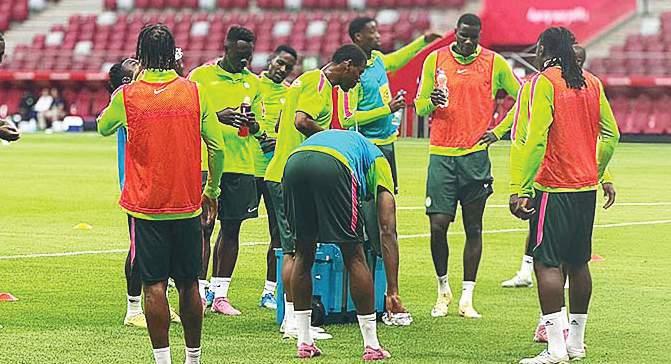
The Athletics Federation of Nigeria (AFN) has made it mandatory that participation in the National Trials scheduled to hold in Lagos as condition to be a part of Team Nigeria’s contingent to the Commonwealth Games billed to hold in Glasgow, Scotland next month.
The highly-anticipated trials will hold from June 20 to June 22, 2026, at the Yaba College of Technology (YABATECH) Sports Complex in Lagos, bringing together some of the nation’s finest athletes in what
promises to be a fiercely contested competition.
The three-day event will feature 32 track and field events for both men and women. It will also provide opportunities for athletes to stake their claims for selection.
According to the official statement issued by the Media Committee of the federation headed by Maxwell Kumoye, participation in the men and women’s 100m, 200m and 400m will be restricted to athletes who have achieved the prescribed
qualifying standards. “All other track and field events will remain open for participation,” observed the AFN spokesman.
The statement stressed that the federation believes the arrangement will ensure that only athletes in top form contest the sprint events while maintaining broad participation across other disciplines.
“Athletes are expected to arrive in Lagos on Friday, June 19, while departure has been scheduled for Tuesday, June 23.”
Guinness Nigeria PLC, through its flagship brand Guinness, hosted an unforgettable season ending watch party on Sunday as millions of fans worldwide celebrated Arsenal’s historic Premier League championship after a 22-year wait. As the Official Beer of the Premier League and Official Global Partner of Arsenal, Guinness gathered over 500 passionate supporters and football lovers at Guinness HQ in Lagos, with
a simultaneous watch party in Abuja, for a night of triumph, community, and premium enjoyment.
The grand finale marked the culmination of a monumental season-long series of Guinness MatchDay viewing parties. Throughout the season, the brand brought genuine stadium energy to bars and third spaces across more than 10 cities, including Enugu, Awka, Port Harcourt, and Ibadan, uniting over 10,000 fans in shared football experiences.
The initiative reflects Guinness Nigeria’s continued commitment to anchoring the cultural moments that matter most to Nigerian consumers.
On the night of the final match-day 38 of the English Premier League, fans watched Arsenal secure a gritty 2-1 victory over Crystal Palace to be coronated champions of England. Before that gave Bournemouth’s draw with Manchester City had handed the trophy to the London Gunners.
To further support athletes in their quest for qualification, the federation announced that accommodation will be provided for those who have attained the required standards during the qualification period.
“The list of athletes who have met the stipulated benchmarks is expected to be released in the coming days,”the statement said.
AFN President, Chief Tonobok Okowa, called on athletic stakeholders, enthusiasts and fans across the country to turn out and support the athletes during the championship.
Okowa described the trials as a significant milestone in Nigeria’s preparations for the Commonwealth Games and expressed confidence that the event would help identify the country’s best talents ahead of Glasgow 2026.
The AFN President also used the opportunity to commend the leadership of the National Sports Commission (NSC) for its continued support of the federation and Nigerian athletes, noting that the backing received has contributed significantly to ongoing efforts aimed at strengthening athletics development and improving elite athlete performance.
at 8.45pm Poland time (7.45pm Nigeria time) at the 58,000 – capacity PGE Narodowy Stadium in Warsaw.
Eagles in Camp in Warsaw:
Goalkeepers: Maduka Okoye (Udinese FC, Italy); Arthur Okonkwo (Wrexham FC, England); Francis Uzoho (Omonia FC, Cyprus)
Defenders: Oluwasemilogo Ajayi (Hull City, England); Calvin Bassey (Fulham FC, England); Bruno Onyemaechi (Olympiakos, Greece); Zaidu Sanusi (FC Porto, Portugal); Igoh Ogbu (Slavia Prague, Czech Republic); Emmanuel Fernandez
(Glasgow Rangers, Scotland) Midfielders: Wilfred Ndidi (Besiktas FC, Turkey); Frank Onyeka (Coventry FC, England); Raphael Onyedika (Club Brugge, Belgium); Fisayo Dele-Bashiru (SS Lazio, Italy); Tochukwu Nnadi (Olympic Marseille, France); Abdullahi Ibrahim Bewene (Baník Ostrava,
Forwards:
Portugal); Philip Otele (Hamburger SV, Germany)
Democratic Republic of Congo’s international friendly against Chile in Spain next week has been cancelled after authorities raised health concerns over the Ebola outbreak in the African nation.
Juan Franco, mayor of the city of La Linea de la Concepcion, has signed a decree which prevents the fixture from going ahead on 9 June as planned.
The decision was described as a “precautionary measure” and comes after recommendations from the Andalusian regional health service and the municipality’s own medical
department.
“A report by the head of the mayoralty’s health service of La Linea advised categorically against hosting the match given the health risks which might arise,” Franco said. La Linea, a coastal resort in the of around 65,000 people in the province of Cadiz close to the Gibraltar border, had been due to host the match as both nations continued their preparations for the World Cup.
DR Congo are currently based in Belgium after they cancelled a planned pre-tournament training campin the capital, Kinshasa, because
DR Congo players at training in Belgium ahead of their departure for the 2026 World Cup Tuesday evening
Austria Captain, David Alaba, has been given the all-clear to travel for the World Cup after picking up a muscle injury on Monday but midfielder Christoph Baumgartner has been ruled out of the tournament.
Former Bayern Munich and Real Madrid defender Alaba was substituted at half-time of Austria’s 1-0 friendly win against Tunisiabut has been passed fit to travel to the United States with the rest of the squad.
It is not such positive news for RB Leipzig midfielder Baumgartner, however.
The 26-year-old suffered a thigh muscle injury during Monday’s pre-
match warm-up and has been ruled out of the World Cup, the country’s football association confirmed on Tuesday.
Baumgartner is one of Austria’s more important players and enjoyed a fantastic season in Germany, scoring 17 goals and providing nine assists in all competitions for the Bundesliga club.
“This is of course very bitter news for Christoph and for us as a team,” coach Ralf Rangnick said in a statement.
“He is an important player and a central personality within our team. Now our full support is for his recovery.”
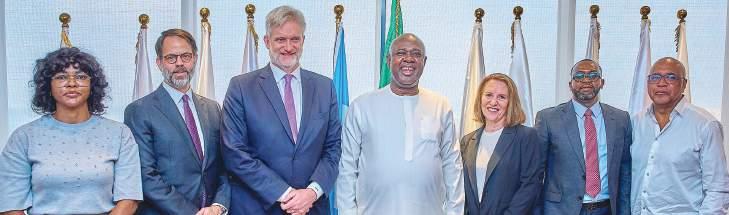
L-R: Special Assistant on Media & Communications to the Minister of State Petroleum, Amaka Okafor; President, BGR Group, Scott Eisner; Vice President, BGR Group, Lester Munson, Minister of State for Petroleum Resources (Oil), Sen. Heineken Lokpobiri, Ph.D., Senior Advisor, Valcour Global Public Strategy, Lisa Colangelo; Federal Government Project Coordinator, Femi Soneye and Special Adviser to the President on Global and Pan-African Affairs, Amb. Brian Browne, during a meeting on the U.S.–Nigeria Energy Summit in Abuja ... yesterday

Let us imagine that the opposition parties will boycott the forthcoming elections scheduled for next year. How will such a boycott affect the country and our democracy. And is boycott the best option?
Cameroun and Tanzania experienced election boycott by the opposition recently, but that has not affected the overall rating of the election results.
In year 2000, Cote D’Ivoire experienced a massive boycott by the opposition which resulted in 37.4% in participation. Same with Gambia Parliamentary election in 2002 and in guinea in 2003. Same with the Ivorian Presidential election in 2020.
The electoral boycott has become a regular tool for political opposition parties to use, especially since the end of the Cold War. With the rise of new democracies in Eastern Europe, Latin America, and Africa, an increase in contested elections also has brought with it an increase in decisions to boycott. Whereas only four percent of all elections worldwide were boycotted in 1989, that number had risen to 15 percent by 2002. In the decade 1995-2004, an average of nearly 10 elections per year was boycotted.
The opposition to Zimbabwean president Robert Mugabe also fractured over boycott discussions in 2005. That year, the opposition Movement for Democratic Change (MDC) lost 16 seats in the parliamentary elections—in part because dithering over a possible boycott kept MDC registration numbers down. Following that setback, MDC leader Morgan Tsvangarai made the fateful decision to boycott the elections for the newly-created Senate, claiming that this body would be a rubber stamp for Mugabe. Not surprisingly, this created tension within the MDC as a sizable faction believed that choosing not to participate would be a fateful error. The party splintered, Tsvangarai lost his mandate, and the ruling ZANU-PF party captured 49 of 66 seats in the Senate election against the fractured opposition. Tsvangarai was able to patch things up by choosing to participate in the 2008 elections—resulting in near-parity in seats between the ZANU-PF and the MDC—but he undercut himself in the presidential election. In the first round, Tsvangarai actually outpaced Mugabe, but the government claimed that he fell short of the 50 percent threshold necessary to avoid a runoff. In protest, Tsvangarai decided to boycott the runoff election, allowing Mugabe to triumph handily, turning victory into setback. While the eventual power-sharing deal gave the MDC an unprecedented stake in the government, Tsvangarai’s boycott allowed Mugabe to retain the top governmental position. Given the logistical preparations necessary to hold elections, opposition parties must be goaded into participation as early as possible to avoid missing registration windows or harming electoral chances. Too often, opposition parties come to the decision to participate too late to achieve the full effect. The threat
of a boycott can pay dividends but the opposition parties still have to participate in order to receive the full benefits. Choosing to sit out is almost always a losing proposition.
First, if elections receive a great deal of attention from the international community, then a boycott can be effective. Thus, the opposition’s threat of an election boycott, when it attracts the attention of international audiences, increases international pressure on the incumbent. As a result, the ruler or ruling party is forced to make concessions. The most striking example of this is South Africa’s vote in 1994, when president of the Freedom Party Mangosuthu Buthelezi’s decision to boycott the election and denounce the electoral process as unfree and unfair, led to an increase of international pressure on Nelson Mandela. Consequently, the threat of boycotting the election by Buthelezi caused the abolishment of the single vote system, and amendments to the constitution with regard to local self-government.
Secondly, if boycotts are part of the opposition’s street protest campaign, then they can pay dividends. If the opposition enjoys strong domestic popular support and a boycott is also part of their overall campaign involving street protests and other activities, then these boycotts can yield results. An example of this is the 1996 election and opposition boycott in Bangladesh. The Awami League, an opposition party, launched massive protests that swept the country along with a boycott two days before election day. The general opposition’s boycott and ongoing street protests eventually pushed the government to hold a new election and the opposition faction managed to win that election.
The slogan “Boycott the boycottables” was first introduced to Nigeria political vocabulary by Chief Ojike Mazi Mbonu (1912-1956). The slogan was a
rallying cry at that time for Nationalism. He did, in practice, generate greater enthusiasm for Nigerian traditional clothes by his “boycott” methods which involved a preference for traditional clothes as opposed to English -styled ones.
Chief Ojike did not introduce the slogans for people to boycott elections.
Chief Ojike was born in 1912 in Akeme in Arochukwu, Southern Eastern, Nigeria. He attended the Arochukwu Primary School, finishing in 1926 and taking up a teaching appointment with a mission. He returned to college in 1929 to train as a teacher at the Church Missionary Society (CMS) Training College in Waka. A brilliant student, he won the 1931 college annual prize which was a book--- AGGREY OF AFRICA, the biography of the renowned Ghanaian educationist whose ideas of Pan-Africanism left a lasting influence on the young Ejike.
On leaving college in 1931, Ojike resumed teaching at the Central School in Abagana. In 1933 he resigned to join the staff of Dennis Memorial Grammar School in Onitsha, becoming one of the few African teachers on the staff.
His involvement in politics commenced in 1936 when organized a successful teachers’ salary strike after teachers were granted an increase which excluded junior members of the profession. He resigned from teaching in mission schools in 1938 in preference to private schools. That same year he met Dr. Nnamdi Azikiwe with whom he established a long personal and political relationship.
Chief Ojike left for the United States of America in 1938 to continue his education at the Lincoln University. His stay there sharpened his political ideology for it was then that he came with other African students like Dr. Kwame Nkrumah. Together they formed in 1941, the African Students Association of America and Canada to campaign against colonialism in Africa and injustices against the Black race in general. Chief Ojike was elected its first President.
His returned to Nigeria marked an active involvement in the nationalistic politics spearheaded by Dr. Nnamdi Azikiwe who had founded the National Council of Nigerian Citizens (NCNC) and whose newspaper, the WEST AFRICAN PILOT, had become the vocal organ of the campaign for independence, Chief Ojike joined the NCNC and contributed articles to the PILOT.
In 1949, he was fined 40 pounds on a charge of sedition because of an article in which he criticized the colonial government for the shooting of 21 miners during a labour dispute at the Udi Coal Miners, near Enugu.
In 1953, he was a member of the NCNC delegation to the London Constitutional Conference which paved way for Nigeria’s Independence in October 1960. The following year he won an election on the platform of the NCNC to the Eastern Region House of Assembly, becoming the Region’s Minister of Finance; he held
that office until early 1956.
Mazi Ojike Mbonu died in 1956. There is now an Ojike Memorial Medical Centre at Arondizuogu, Imo State.
In 1979, the proprietor of the Medical Centre, Dr. Kingsley Ozumba Mbadiwe, a close friend of Chief Ojike honoured me by appointing me along with a journalist of respect, Mr. James Odafe Othinwa, as co-director of the medical centre.
In 1964, the word boycott was effectively used for the first time in the general election. Since then, there has been argument whether or not, boycott has any effect.
In 1964, the NPC returned 60 of its candidates unopposed, the NCNC at that time challenged the declaration by the NPC.
On August 20, 1964, the Nigerian National Alliance (NNA) was formed. The alliance was made up of the NPC, the leader, the NNDP controlling the government of Western Nigeria, the Mid-West Democratic Front, which formed an opposition in the Mid-Western Region and some other elements including the dynamic party of Dr. Chike Obi.
On June 3, 1964, the United Progressive for Grand Alliance (UPGA) was formed. The alliance was made up of NCNC and the Action Group. The political enmity became apparent before and after the 1964 election.
The UPGA was opposed for returning 60 candidates as unopposed including the Prime Minister, the Minister for Home Affairs, Alhaji Shehu Shagari at Sokoto West; the Minister of Economic Development, Alhaji Waziri Ibrahim, at Konduga-Mafa, and the former Ambassador to the Ivory Coast, Alhaji Abdul Razak, at Ilorin Town. To this the Eastern Region Attorney-General, Mr. Christopher Mojekwu, who was on a fact-finding tour of Northern Nigeria, said that for various reasons 60 UPGA candidates in the Northern Region had been unable to file their nomination papers. It later emerged that more NPC men were being returned unopposed in the North, by virtue of Northern Progressive Front candidates withdrawing in such seats as Yerwa, where the Minister of Commerce and Industry, Alhaji Zanna Buka Dipcharima was the candidate; and in the seats of the Speaker of the Federal House, Alhaji Jalo Waziri (Gombe Central), and the Federal Minister of Works, Alhaji Inua Wada (Sumailia)
On December 21, 1964, the Central Working Committee of NCNC rejected the 61 unopposed candidates in the North. Secretary F. S. McEwen said “we do not regard these seats as won by the NPC,” adding that the party had decided on a “course of Action.” Action Group protested against the two NNDP unopposed candidates in Ife.
Dr. Okpara NCNC leader and Eastern Premier described election arrangements as a “farce.” Sir Abubakar Tafawa Balewa, the ten Prime Minister described the NCNC as a “great liability to UPGA,” said that if they lost the election, they would blame the AG.