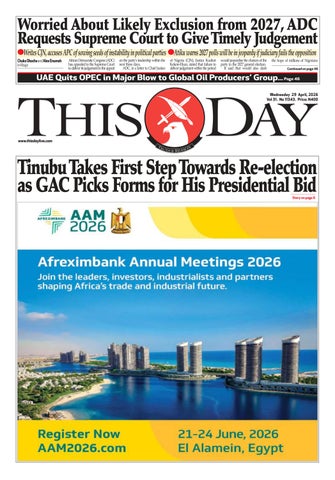
Tinubu Takes First Step Towards Re-election as GAC Picks Forms for His Presidential Bid
Chuks Okocha and Alex Enumah in Abuja






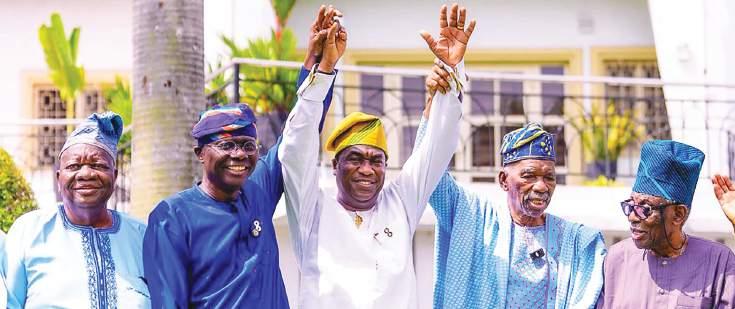
SANWO-OLU HOSTS GAC TO ENDORSE HAMZAT FOR 2027 GOVERNORSHIP...
Governor of Lagos State, Mr. Babajide Sanwo-Olu (second left); Deputy
Tinubu Takes First Step Towards Re-election as GAC Picks Forms for His Presidential Bid
Same for Hamzat as guber choice for Lagos Buba, Faleke, too Christian leaders endorse deputy governor Aspirant decries endorsements, says it’s bid to perpetuate APC’s ‘fiefdom’
Segun James, Sunday Ehigiator in Lagos and Adedayo Akinwale in Abuja
President Bola Ahmed Tinubu, yesterday, took the first major step towards realising his re-election bid in 2027 with the purchase of his N100 million All Progressives Congress (APC) Expression of Interest and Presidential Nomination Forms in Abuja.
The highest political decisionmaking body in Lagos State, Governor’s Advisory Council (GAC), which took credit for the purchase, also obtained Expression of Interest and Governorship Nomination Forms for the state’s deputy governor, Dr Obafemi Hamzat.
Chairman of GAC, Alhaji Tajudeen Olusi, stated the developments at a press conference at Marina, Lagos.
Olusi said the money for the purchase was put together by members who expressed confidence in Tinubu and Hamzat’s leadership abilities.
He, however, denied reports that Tinubu’s forms were purchased by a member of the House of Representatives from Lagos State, Hon. James Faleke, Olusi disclosed that the council had resolved to collectively purchase the party’s nomination and expression of interest forms, valued at N50 million, for Hamzat as an indication of its firm backing.
He stated that Hamzat was well-positioned to build on the achievements of previous administrations and further advance the development of Lagos.
Adding his voice, Governor Babajide Sanwo-Olu revealed that the Lagos APC purchased the presidential nomination forms for Tinubu because of the confidence they had in his administration’s
Renewed Hope Agenda and reforms.
The strategic endorsement positioned Hamzat as the leading governorship contender within APC as political activities gathered momentum ahead of the 2027 general election.
Earlier, Faleke, at the APC national secretariat in Abu-ja, stated that he, alongside other supporters, was at the headquarters to “do the needful”, expressing confidence that the re-election process of the president has begun.
He urged party faithful and
supporters across the country to key into the Renewed Hope Movement. He said the initiative was geared towards consolidating ongoing reforms and improving the welfare of Nigerians through sustainable policies.
The presidential nomination and expression of interest forms were presented to Faleke by APC National Organising Secretary, Sulaiman Argungu, after the payment of N100 million.
Faleke also purchased his own form, and that of the senator representing Lagos West, Senator
Idiat Adebule.
He stated, “So for all support groups, who have made efforts, who have contributed money to purchase the form, I have done so on their behalf, on behalf of Nigerians.
“There is no one particular person that has done this. It is on behalf of all Nigerians. Just as we did pre-2023 election, I was also privileged with some leaders to buy the form.
“Here again, I am privileged to buy the form on behalf of all Nigerians, for our president, for our
performing president. And by the grace of God, 2027 will be a reality.
“By the grace of God, he will contest and he will win the election. At the same time, I am also privi-leged, with my friend here, Honourable Ajala, to pick the form for the incoming governor of Lagos, Dr. Kadiri Obafemi Hamzat.”
Faleke added, “And let me also say that those of us who contributed money to buy this form were more than 1,000 in Lagos. It is not just one person. All of us cannot come here and pick the form. Only representatives are sent.
“And I am also lucky to be one of those who have been sent to pick the form. At the same time, I picked my own form to come back to the House of Reps. And you can see the form with me. “So, I am lucky. And I am also waiting behind to get the receipt of our incumbent senator, Senator Idiat Adebule, that I will pick the form for her from my west senatorial district.”
Asked if he was bothered by the decision of opposition leaders
Continued on page 46
Court Upholds FCCPC Powers to Investigate Medical Negligence
Tunji Bello: no commercial service sector is beyond lawful consumer protection, accountability
James Emejo in Abuja
The Federal High Court, Abuja, has affirmed the powers of the Federal Competition and Consumer Protection Commission (FCCPC) to investigate complaints by patients in the healthcare sector.
The April 15 judgement delivered by Justice Emeka Nwite, strengthened accountability in medical practice in Nigeria.
The ruling followed a suit, (FHC/ABJ/CS/1019/2021), filed by Life Bridge Medical Diagnostic Centre Limited, challenging the powers of FCCPC to investigate complaints involving healthcare services rendered to consumers.
In the suit, the plaintiff had sought declarations that the commission lacked jurisdiction to investigate complaints bordering on
alleged medical negligence, arguing that FCCPC could not act without first concluding a concurrent jurisdiction arrangement with the Medical and Dental Council of Nigeria (MDCN).
However, Nwite rejected the claims in their entirety, and held that the plaintiff, being a commercial entity providing diagnostic services for reward, is an undertaking within the meaning of the Federal Competition and Consumer Protection Act, 2018 (FCCPA), stressing that healthcare services fall within the category of services subject to consumer protection oversight under the Act.
The court further held that where a complaint bordered on consumer satisfaction, such issues might fall within the commission’s consumer protection mandate,
notwithstanding that the sector was also professionally regulated.
The court further recognised a clear distinction between the professional regulation and discipline of medical practitioners, which remained within the remit of relevant professional bodies, and consumer protection oversight relating to the quality, fairness, standards, and treatment received by consumers of healthcare services, which fell within the mandate of FCCPC.
Nwite also held that Section 105 of the FCCPA, which provided for coordination among regulators, did not constitute a condition precedent to the commission’s exercise of jurisdiction.
According to the judge, the absence of any formal agreement with another regulator does not
extinguish or suspend powers expressly conferred on the FCCPC by the statute.
The court ruled that ethical obligations, such as patient confidentiality, did not override lawful statutory investigative powers exercised in the public interest and in accordance with due process.
Reacting to the development, Executive Vice Chairman/Chief Executive, FCCPC, Mr. Tunji Bello, described the judgement as a symbolic affirmation that consumers were entitled to protection and lawful redress in all sectors where services were provided for value, including healthcare.
In a statement issued by FCCPC Director, Corporate Affairs, Ondaje Ijagwu, Bello stated that the decision affirmed the principle
that sector-specific professional regulation and consumer protection oversight were distinct statutory functions that could operate side by side in the public interest. He state that the commission’s role was not to replace professional bodies or sector regulators, but to ensure that consumers who paid for services were treated fairly and received standards consistent with law. According to him, the judgement confirms that no commercial service sector is beyond lawful consumer protection accountability. He added that FCCPC remained committed to constructive engagement with healthcare providers, professional bodies, regulators, and stakeholders to promote quality service delivery, accountability, and stronger consumer confidence.
Governor, Dr Obafemi Hamzat (middle); GAC Leader, Prince Tajudeen Olusi (second right) and GAC members, at GAC’s endorsement of Hamzat for 2027 governorship election, at Lagos House, Marina ... yesterday
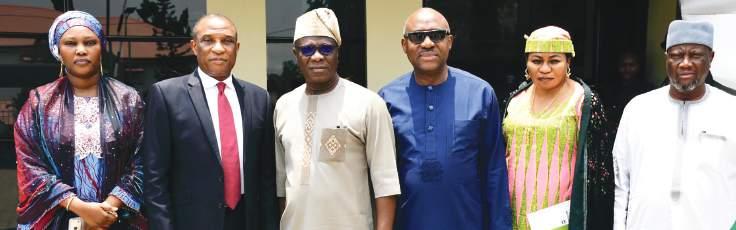
NEMSA’S COURTESY VISIT TO FCCPC...
L-R: Hajia Ummusalma Isyaku Rabiu, Executive Commissioner, Corporate Services, FCCPC; Mr. Tunji Bello, Executive Vice Chairman/CEO, FCCPC; Engr. Olusegun Adesayo, Managing Director/ CEO, NEMSA; Mr. Louis Odion, Executive Commissioner, Operations, FCCPC; Engr. Maimuna Abubakar Audu, Executive Director, Commercial Services, NEMSA; and Engr. Aliyu Abdulazeez, Executive Director, Technical Services, NEMSA, after NEMSA’s courtesy visit to FCCPC in Abuja to strengthen inter-agency collaboration.
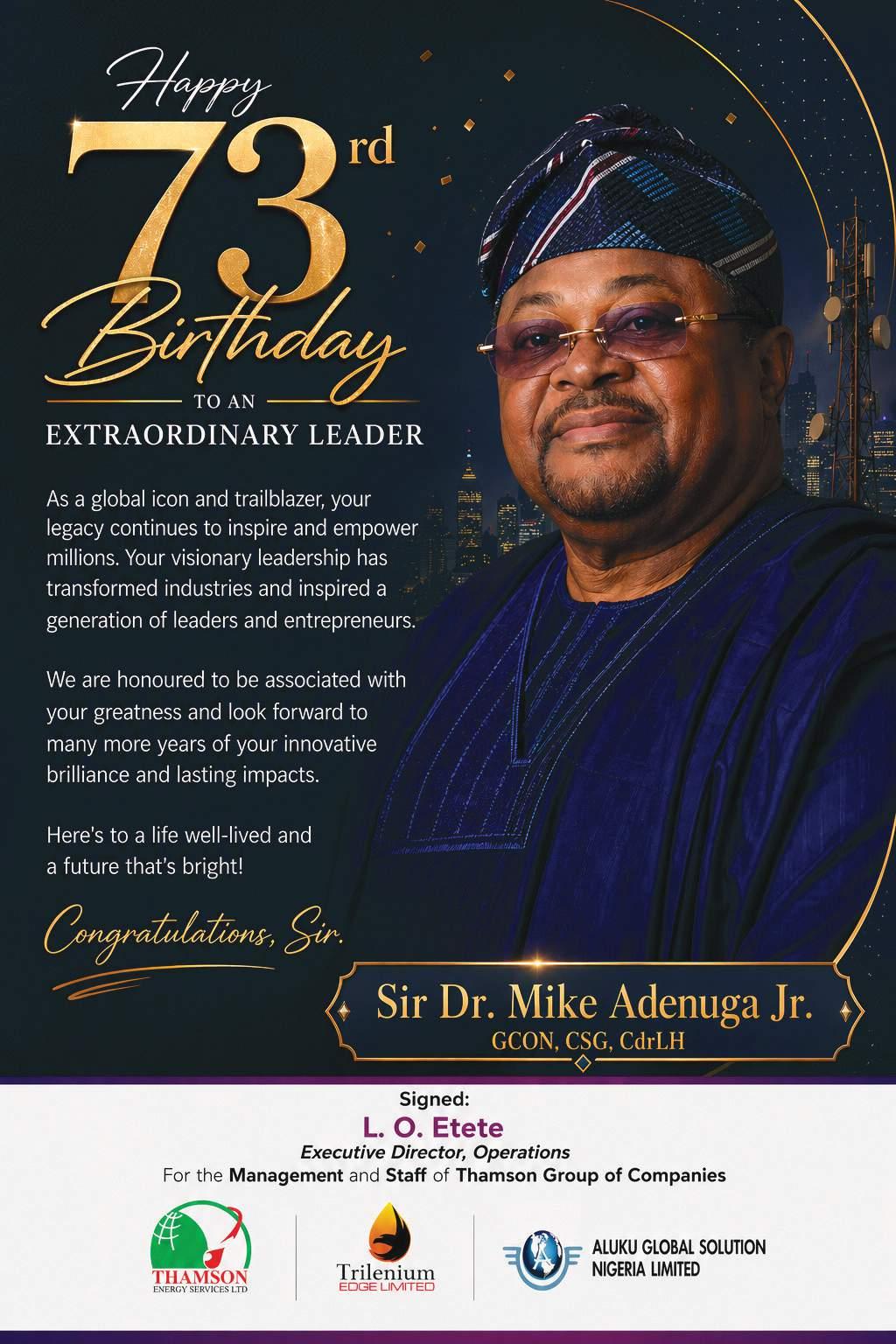
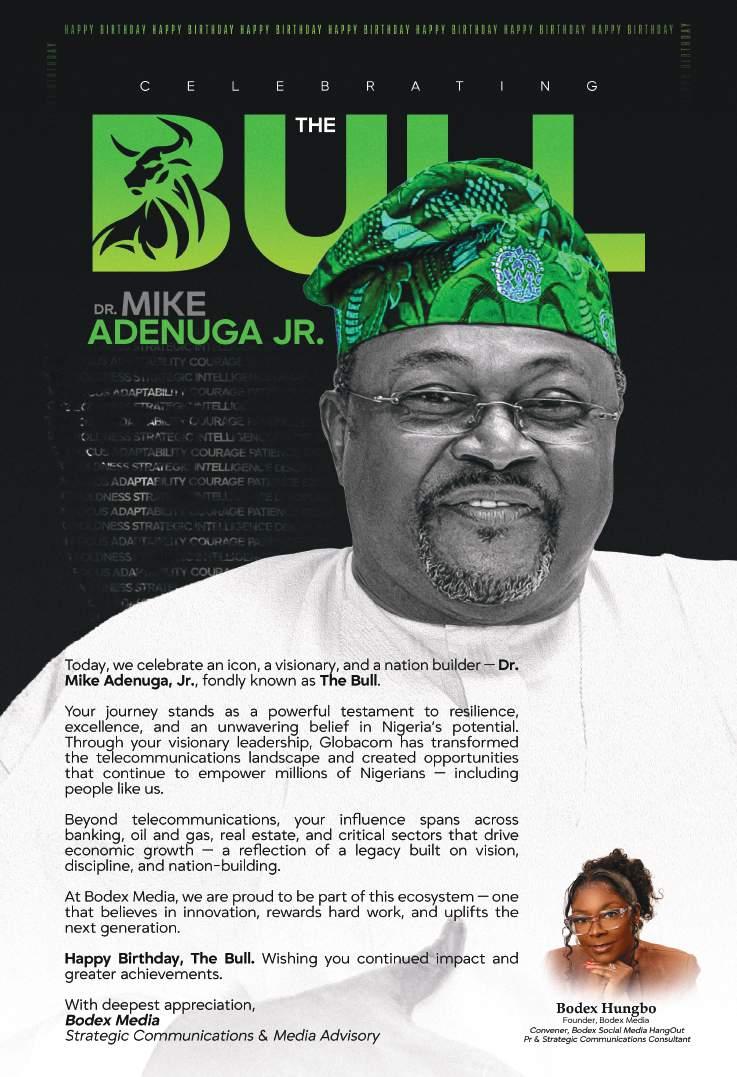
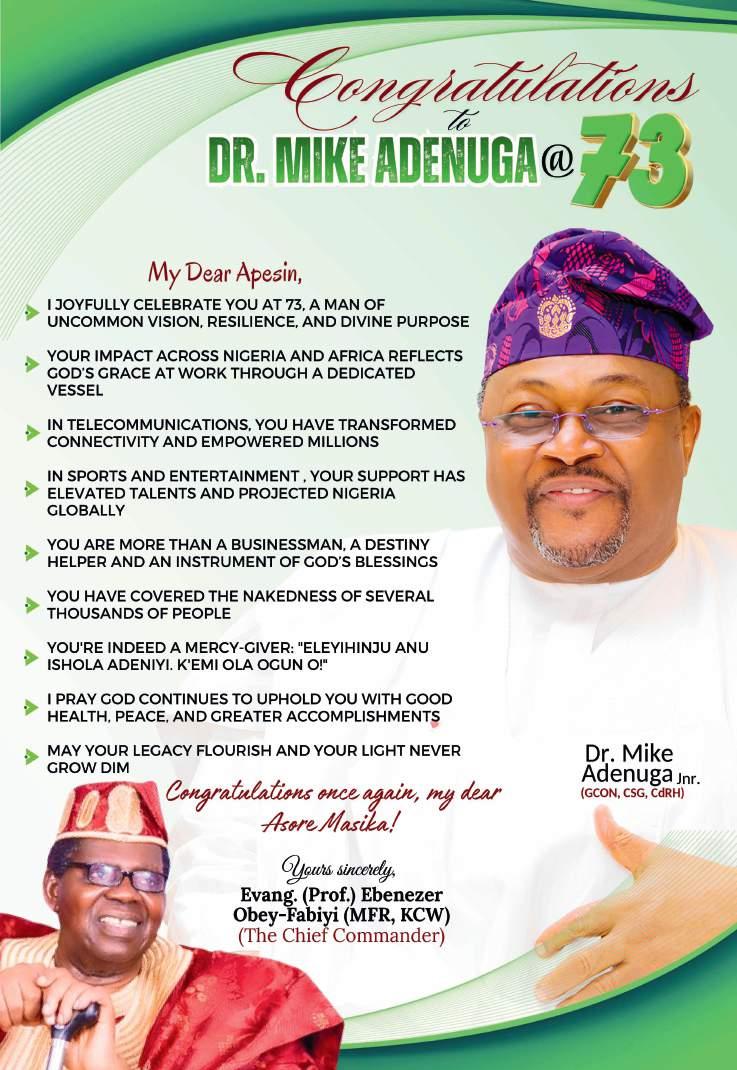
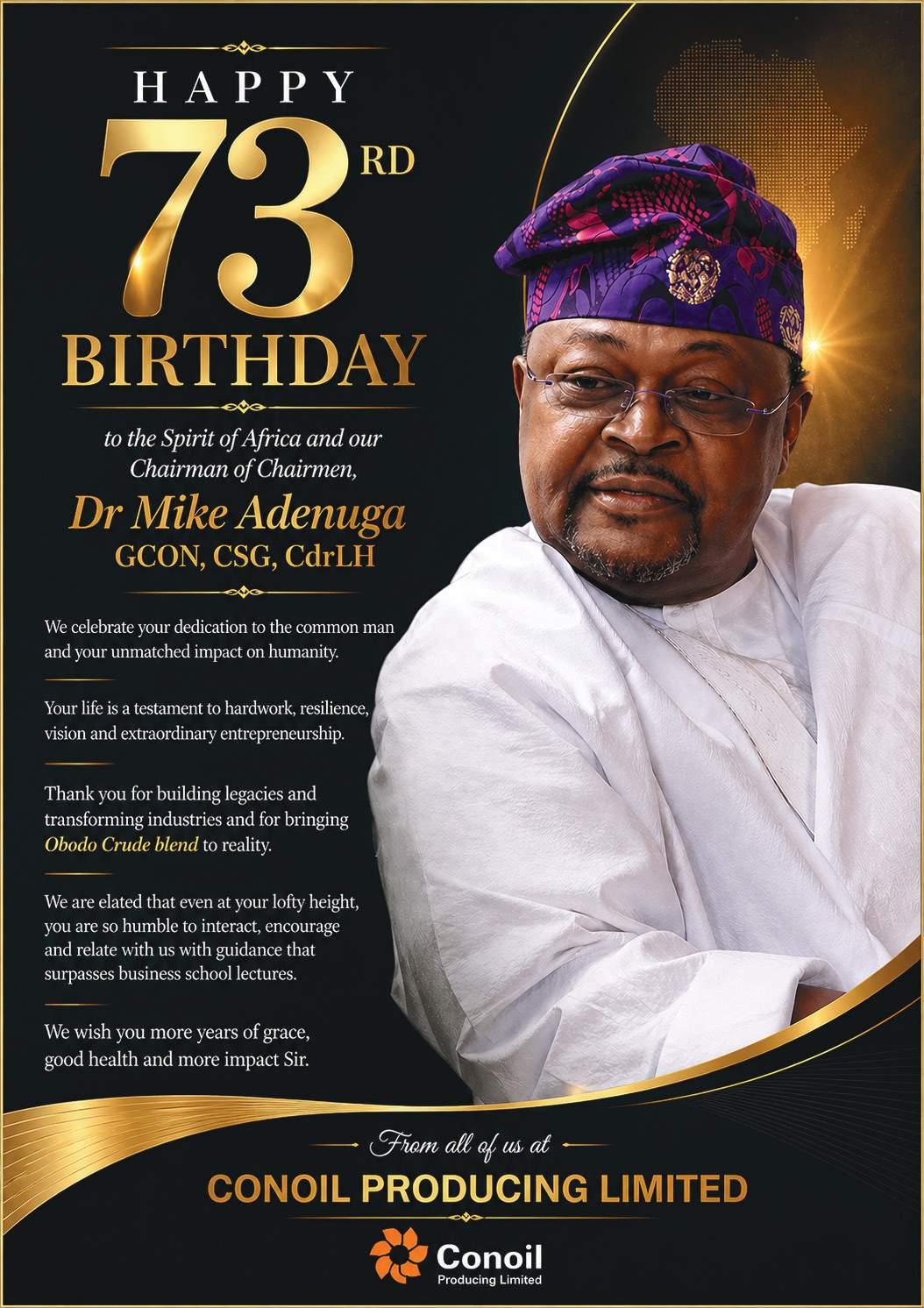
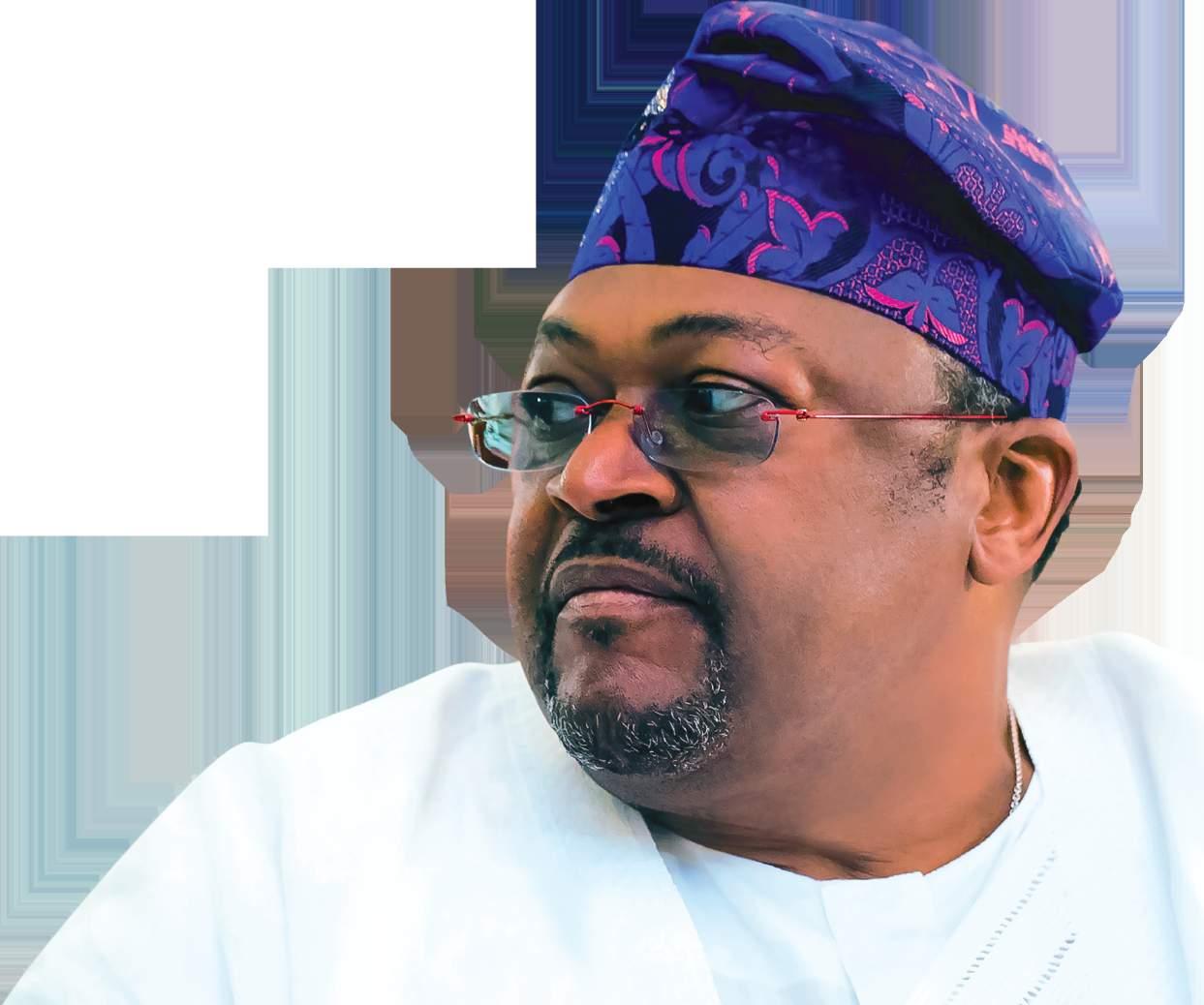
President Tinubu Pays Glowing Tribute to Business Mogul, Dr Mike Adenuga, at 73
Describes him as a colossus whose life is an affirmation of audacity of hope, belief and vision
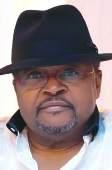
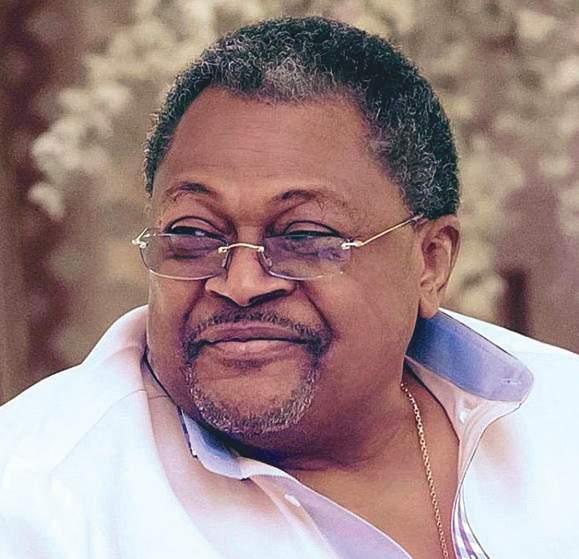
President Bola Tinubu has extolled the virtues of renowned business mogul and philanthropist, Dr Mike Adenuga, as he clocks 73 today.
an affirmation of audacity of hope, belief and vision.
Tinubu, in a sevenparagraph birthday tribute, described Adenuga as a colossus whose life was
In the congratulatory message to mark the birthday of one Africa’s foremost businessmen, Tinubu stated,
“Dr Mike Adeniyi Adenuga, chairman of Globacom and Conoil, is a colossus. From telecommunications, real estate, banking and oil and gas, he has put an imprint of
NCAN Kicks Against Raw Cashew Export Ban, Says Policy Risks 5m Jobs
Seeks trade minister’s neutrality in association’s leadership tussle
James Emejo and Mariam Adedokun in Abuja
National Cashew Association of Nigeria (NCAN) has opposed moves to ban the export of raw cashew nuts, warning that such a policy could devastate millions of smallholder farmers and destabilise the country’s cashew industry.
Speaking at a stakeholders’ engagement and Extraordinary General Meeting (EGM) of the association in Abuja, President, NCAN, Dr. Ojo Ajanaku, said the association would resist any policy that compelled farmers to subsidise local processing at their own expense.
He cautioned that ongoing efforts by certain international and vested interests to influence Nigeria’s cashew policy could undermine the sector, which he said had taken years of intervention to stabilise.
According to him, Nigeria’s cashew industry is largely driven by smallholder farmers cultivating less than one hectare of land, who already grapple with high production and logistics costs.
He recalled that in 2017, when cashew prices dropped significantly, many farmers resorted to cutting down their trees due to unsustainable returns, stressing that price stability remains the primary incentive for production.
Ajanaku stated that Nigeria, once the world’s leading cashew producer with about 700,000 metric tonnes annually, had since fallen behind competitors like Côte d’Ivoire, which now produced over one million metric tonnes annually, while Nigeria struggled with between 350,000 and 400,000 metric tonnes.
He warned that restricting farmers’ ability to sell at competitive market
prices would reverse the modest gains recorded in recent years.
He said, “Our farmers cannot be made to subsidise processing in disguise,” adding that any value addition policy must translate into improved income for producers.
The NCAN president highlighted the burden of logistics, stating that farmers often travel between five and 15 kilometres through difficult terrain before accessing transport routes, with logistics alone consuming up to 40 per cent of their earnings.
He added that production costs, including labour for farm maintenance, accounted for nearly 30 per cent, leaving farmers with minimal profit margins.
On processing, Ajanaku stated that local processors faced prohibitive financing and operating conditions, making it difficult to compete globally.
He explained that processors
Malaria Prevalence Drops from 20% to 15%, Says FG
Unveils
Onyebuchi Ezigbo in Abuja
The federal government has said that Nigeria witnessed a decline in malaria prevalence from 42 percent in 2010 to 15 percent in 2025.
This was as government unveiled a new 5-Year National Malaria Strategic Plan, (2026-2030) as part of in a proactive measure to further scale up response to malaria scourge.
A statement signed by the Assistant Director, Information and Public Relations, Ado Bako quoted the Minister of State for Health and Social Welfare, Dr. Iziaq Adekunle Salako, as having disclosed
this during the commemoration of 2026 World Malaria Day, held in Abuja. The Health Minister expressed continued federal government’s commitment to improving the health and well-being of Nigerians by strengthening national public health responses, stressing that eliminating Malaria and related diseases remains firmly in the centre of the Renewed Hope Agenda
He explained that the National Malaria Strategic Plan was drawn up in collaboration with the states, adding that interventions are designed to reflect the realities of different states and communities.
According to Salako, the plan is aligned
with the National Health Sector Strategic Blueprint (HSSB), the Sector-Wide Approach (SWAp), and the WHO Global Technical Strategy (GTS) and aims to reduce malaria parasite prevalence and mortality by 50 percent from 2025 levels by 2030.
Elaborating further on the giant strides, Dr. Salako explained that the Ministry has long established the Advisory on Malaria Elimination in Nigeria, AMEN, bringing together a distinguished council of global experts to provide technical support, evidence-based guidance, and strategic direction for a more effective path toward a malaria-free Nigeria.
operated within a short harvest window of three to four months but must store products for up to nine months, often relying on loans with interest rates as high as 25 to 35 per cent.
Combined with high energy costs, particularly for diesel-powered operations, he said processors were unable to break even under current conditions.
He maintained that banning raw cashew exports would not solve those structural challenges but would, instead, shift the burden onto farmers.
excellence on the Nigerian enterprise.
“I congratulate the Guru, a businessman with the Midas touch, on his birthday today, April 29.
“Mike’s life is an affirmation of the audacity of hope, belief, and vision. From humble beginnings, he rose to become one of Africa’s finest entrepreneurs.”
The president said of Adenuga, “His achievements in business are a testament to the immense possibilities of the Nigerian enterprise and an inspiration to the younger generation that, through hard work, innovation, and resilience, they can rise to become standout men and women of their generation.
“I commend Mike for his consistent support for our arts, culture, sports, and entertainment sectors. With his support, culturally significant festivals across the country have been sustained, as well as entertainment events that unleash the creativity of
Adenuga Nigerian youths.”
He added, “I also laud his many humanitarian endeavours across education and healthcare, and encourage him not to stop giving back to the people.
“As Mike celebrates today, I celebrate with him and pray that God Almighty continue to bless him with good health, wisdom, and renewed vision for even greater accomplishments.”
N4.5bn on Distributors
Dike Onwuamaeze
The Chairman of BUA Cement Plc, Mr. Abdul Samad Rabiu, has announced a cumulative N4.5 billion reward for the distributors of BUA Cement’s products in Nigeria.
Rabiu announced this recently in Lagos when the cement company recognised and rewarded its top performing distributors across Nigeria at the 2025 edition of its annual “Distributors’ Awards,” that was held at the Eko Hotels and Suites Convention Centre, Lagos.
He said: “To further demonstrate our appreciation, all our dealers will receive a N30 per bag bonus on all volumes purchased in 2025, with a total sum of N4.5 billion earmarked for this initiative.”
Rabiu described the awards as a
reflection of the company’s appreciation for the loyalty and performance of its distributors.
“This awards ceremony is to acknowledge the efforts of our distributors who have shown resilience and have grown with BUA Cement Plc over the years through their outstanding performance.
“Their role goes beyond selling cement. They are key contributors to socio economic development across the country,” he stated.
He said that Nigeria’s growing population presented significant opportunities for distributors to expand and deepen their impact, assuring them of the company’s continued support.
“We are making concerted efforts to increase our production capacity with the addition of Line 6 in Sokoto and the forthcoming 3 million tonnes per
annum Ososo plant.
“These investments will improve efficiency and ensure we meet growing market demand,” Rabiu said. The event was attended by prominent industry leaders, business partners, and stakeholders, making it a memorable evening of recognition, celebration, and renewed commitment to growth.
At the ceremony, outstanding distributors were rewarded with a range of prizes including cash awards, Sports Utility Vehicles, and compressed natural gas (CNG) trucks, in recognition of their exceptional performance and contribution to the company’s growth during the year under review. Two top distributors received cash prizes alongside two CNG trucks each, while other leading distributors were presented with one CNG truck each in addition to monetary rewards.
Deji Elumoye in Abuja
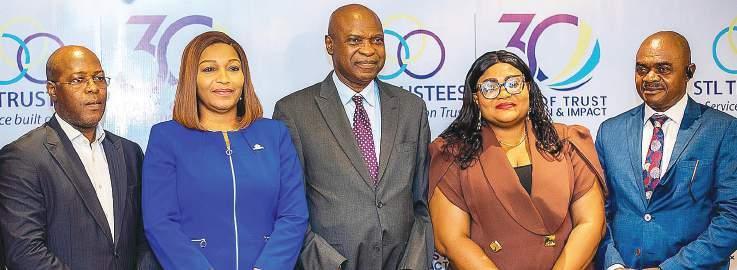
STL TRUSTEES 30TH ANNIVERSARY PRESS CONFERENCE...
L-R: Executive Director, STL Trustees Limited, Akin Oni; Managing Director/Chief Executive Officer, STL Trustees Limited, Funmi Ekundayo; Non-Executive Director, STL Trustees Limited, Dr. Temitope Oshikoya; Head, Trust Services, STL Trustees Limited, Adesola Aje, and Chief Financial Officer, STL Trustees Limited, Oko Mba, during a press conference to announce the 30th anniversary of the company, held in Lagos...yesterday
NUPRC Board Chair, Others Assume Duty, Pledge Improved Oversight
The newly inaugurated board of the Nigerian Upstream Petroleum Regulatory Commission (NUPRC) yesterday assumed duty in Abuja, with a pledge to boost the capacity of the commission in meeting its statutory mandate.
Speaking at the commission headquarters shortly after inauguration, the Chairman of the NUPRC board, Senator Magnus Abe, said the purpose of the board is to provide better leadership and oversight.
“I want to assure management that we are here strategically to work with you and see that, as much as possible, we work together to uplift the commission and to help our country,” he said.
The chairman also promised to ensure that the NUPRC gets a more befitting office to maximise staff productivity.
“I believe that of all the priorities we should have, getting proper office accommodation should take priority over everything else,” he stated.
In her remarks, the Commission Chief Executive, NUPRC, Oritsemeyiwa Eyesan,
congratulated the new board members, adding that the commission depends on them for direction in line with the Petroleum Industry Act (PIA).
Eyesan described the inauguration as coming at a most auspicious moment especially amid the current spike in oil and gas prices occasioned by the Middle East crisis. “Today, the oil and gas industry is seeing volatility because of the war in the Middle East and the transition and its impact on the industry.
“Nigeria must position itself to respond appropriately to both the energy transition imperative and the disruptions in the Middle East. I believe the Commission is positioned for the shocks or eventuality that may arise,” she added.
The NUPRC chief executive also restated the commitment of the commission’s management team to reforming the industry.
Speaking earlier at the inauguration, the Secretary to the Government of the Federation (SGF), Senator George Akume, said the event underscored the commitment of the federal government to strengthening governance in
Nigeria’s petroleum sector.
He said as the apex governance body of the commission, the board is expected to provide strategic oversight, policy direction, and institutional stability that will enhance investor confidence and promote sustainable development in the upstream sector.
“This development is firmly aligned with the Renewed Hope
Agenda of Mr. President, which prioritises strong institutions, the rule of law, and integrity in public service,” Akume stated.
While congratulating them on their appointment, the SGF charged the board members to uphold the highest standards of corporate governance, ensure accountability and transparency, and work constructively with management and stakeholders
while maintaining regulatory independence. Members of the board inaugurated include: Senator Magnus Abe (Chairman), Mrs. Oritsemeyiwa Eyesan (commission chief executive), Sunday Babalola (non-executive commissioner), Paul Jezhi (nonexecutive commissioner) and Bashari Indabawa (executive commissioner).
Others are: Muhammed Sabo Lamido (executive commissioner), Mrs. Patience Oyekunle (permanent secretary, Ministry of Petroleum Resources), Mustapha Lamorde (Executive Director, HSEC, NMDPRA) and Mr. Dalhat Muhammad Kamal (Director, Ministry of Finance) while Ms. Olayemi Adeboyejo serves as Commission Secretary/ Legal Adviser.
COVID-19 Case Triggers Senate Alarm Over Weaknesses in Nigeria’s Outbreak Response
Sunday Aborisade in Abuja
The Senate on Tuesday raised concerns over significant gaps in Nigeria’s public health emergency preparedness following the confirmation of a COVID-19 case in Cross River State, warning that systemic lapses could heighten the risk of a wider outbreak if urgent measures are not taken.
The resolution followed the adoption of a motion sponsored by Senator Ipalibo Harry Banigo (APC, Rivers West), who drew attention to
Nigeria Reports Major Strides in Basic Education as Minister Alausa Unveils NESRI Progress Report
Nigeria’s basic education sector has recorded significant improvements over the past year, according to new data released by the Minister of Education, Dr. Tunji Alausa, at the 2026 Basic Education Bootcamp in Jos.
The report, presented under the Nigeria Education Sector Renewal Initiative (NESRI), highlights major gains in access, quality, and systemwide reforms aimed at repositioning the country for a knowledge driven future.
Dr. Alausa said the administration remains committed to reducing out of school children, tackling learning
poverty, and strengthening human capital development.
Despite persistent challenges — including 45 million children aged 5–14 unable to read age appropriate text and 15 million out of school children he noted that recent interventions are beginning to reverse the trend.
Between January 2025 and January 2026, the Federal Government released N106 billion in Universal Basic Education Commission (UBEC) matching grants, one of the largest disbursements in recent years.
Additional achievements include the training of 978,000 teachers, renovation of 10,000 classrooms, distribution of 7.8 million textbooks, and N22 billion invested in teacher
professional development. School
Based Management Committees also received N2.035 billion for community driven school projects.
“These investments are already improving learning environments and teacher capacity nationwide,”
Dr. Alausa said.
The three day Bootcamp, themed “Enhancing Access to Inclusive Education and Bridging the Gap for Out of School Children in Nigeria,” brought together federal and state officials, development partners, and education stakeholders.
The gathering focused on accelerating inclusive education and strengthening state level implementation of NESRI priorities.
deficiencies in disease surveillance, funding, and rapid response capacity.
Leading the debate, Banigo said the shortcomings, if left unaddressed, could undermine national health security, stressing that government at all levels has a constitutional responsibility to safeguard citizens’ health and welfare.
She disclosed the confirmed case involved a 53-year-old foreign national who arrived in Nigeria through the Murtala Muhammed International Airport on March 17, 2026, travelled to Calabar the same day, developed symptoms on April 12, and tested positive on April 16 after PCR confirmation at the national reference laboratory.
Banigo expressed concern over
epidemiological findings indicating a timeline beyond the expected incubation period, raising the possibility of local transmission.
She added that additional suspected cases had already been identified, with contact tracing and laboratory investigations ongoing.
The lawmaker warned that Nigeria’s outbreak response capacity is being weakened by shortages of critical supplies, including viral transport media, PCR reagents, rapid test kits, and personal protective equipment.
She further noted that the Nigeria Centre for Disease Control (NCDC) has been constrained by delayed budget releases, procurement bottlenecks, and inadequate capital
funding since 2025. According to the motion, the country’s federal–state public health response framework requires stronger coordination and sustained financing, particularly in light of past experiences with COVID-19, Lassa fever, and Ebola, where delayed detection and fragmented responses worsened outcomes.
Banigo cautioned that existing gaps could result in delayed containment, increased transmission across states, and greater risks to frontline health workers due to insufficient protective equipment.
She also warned that persistent shortages could erode public confidence and weaken the nation’s epidemic intelligence system.
NESREA Seals 30 Abuja Facilities Over Environmental Violations
Michael Olugbode in Abuja
The National Environmental Standards and Regulations Enforcement Agency (NESREA) has shut down 30 facilities in Abuja for failing to comply with mandatory Environmental Impact Assessment (EIA) requirements in the construction sector.
The enforcement operation, carried out in collaboration with the media, targeted construction sites found to be in breach of
environmental regulations.
Officials said the action followed routine inspections and compliance monitoring exercises.
Speaking during a press briefing, the Director of Environmental Quality Control of the agency, Elijah Udofia, said the affected facilities ignored regulatory directives and failed to provide required environmental documentation.
According to him, the refusal of some operators to respond to official communications or meet stipulated
compliance timelines constituted a serious violation, with potential consequences for both public health and the environment.
He warned that while construction remains critical to Nigeria’s development, it also carries significant environmental risks when not properly regulated. These include poor waste disposal practices, construction on flood-prone areas, excessive emissions, and unsafe handling of building materials.
Emmanuel Addeh in Abuja
Yemi Kosoko in Jos
How Glo Is Using Artificial Intelligence As Enabler for Customer Satisfaction
By Kayode Akinyemi
The Telecommunications industry is one of the fastest growing industries in the world today, all thanks to the bludgeoning acquisition of mobile devices and internet connectivity by a large and diverse user base. Each day, telecommunication operators add thousands of new subscribers to their networks as they race to expand market share and control their industry.
However, this growth in subscribers base produces a fundamental challenge of its own: how to ensure service quality does not drop and how to prevent congestion problems as traditional methods of service delivery have proven to be inefficient and ineffective.
This is where Artificial Intelligence proves critical in the telecommunications industry to fill the inefficiency gap of the traditional service delivery system. AI improves telecom services by enabling predictive algorithms to reduce network downtime, optimizing network performance with real-time traffic management, automating customer service and customer experience improvement via AI-driven chatbots and virtual assistants. AI also enhances security through proactive threat detection and optimizes resource allocation, ensuring better service quality for users.
According to a telecommunications operator, Mr. Sacchin Arota, quoted by Express Computer.in, the global AI market in the telecommunications sector was expected to proliferate, hitting a value of $14.99 billion by 2027, and projected to grow at an impressive 42.6 percent annually from 2021 to 2027.
Such quantum leap and growth in customer base, therefore, require some innovative solutions for sustainable and continuous good customer service and excellence customer experience. Such innovations must target operational efficiency, efficient network optimisation and maintenance, enhanced security, and efficient data analysis capability.
These critical action points help telecommunication companies reduce the cost-to-serve while elevating user satisfaction and tackling complex, highdemand infrastructure management.
As a forward looking and forward thinking organisation, Globalcom Nigeria has adopted and integrated artificial intelligence as a core innovation in its customer service tool kit. Its customer centric approach and continuous quest for service excellence led to the acquisition of an ultra-modern, resource rich Customer Experience Management platform which enables predictive data analysis, optimizes its network, boosts reduced intervention-led customer service, as well as helps how Glo is using Artificial Intelligent as enabler for customer satisfaction.
The platform is a repository of customer Information, devise usage plans and trends, a complaint management tool which helps resolve
network issues and complaints on real-time basis. Unlike the old order which relied on interrogating subscribers on their complaints, the Customer Experience Management platform contains subscribers’ profiles, service records, complaint history, economic status of subscribers, categories of video streaming preferences, quality of video streaming preferences, and other critical customer Information.
In the area of network optimisation, Globacom’s Customer Experience Management platform removes the wieldy and cumbersome processes involved in “walk test” and “drive test” which required field work to determine the call drop rate, handover success rate, and call set up rate in line with industry standards. The data from these field exercises help detect where there are incidents of network congestion, network unavailability and quality issue which may cause service destruction or customer experience issues.
The CEM platform aggregates all subscribers details using their IMEI serial number and mobile device number to
determine the kind of network (2G, 3G, 4G) that the subscriber latches on to which determines service quality, speed of video streaming, and ultimately the customer experience. The customer experience management platform is an artificial intelligence tools which is also equipped to generate data on each subscriber on his video streaming choices, the kind of video watched and their sources (Netflix, YouTube, Facebook, etc), location, network status in such locations, and other vital data. This assists in ultimately managing the customer experience.
The platform’s unique feature - the PCRF (policy, control, regulation, and formulation) - prioritises each subscriber’s plans and trends and adapts them to suit his preferences. It separates subscribers using high end applications from low end applications users. Reports generated from such data can help design products for different subscribers as well as helps in delivering quality service. This feature also ensures that high net worth individuals receive proper consideration in order for their
customer experience not to be affected even during downtime.s
Additionally, the Artificial Intelligence tool helps Glo Nigeria identify where challenges or issues are on the network so that solutions can be quickly proffered before they trigger down time or service disruptions network wide. This is achieved through predictive Analysis from the large data generated by the platform.
Glo Nigeria constantly strives to give comfort, great value, and seamless service at all times to deliver unmatched customer experience to its teeming subscribers nationwide. As a network of choice, customer satisfaction remains the uncompromised goal as well as superior value creation.
As traffic expands on the network, artificial intelligence will help in efficient network management leading to efficient time and resource management, and customer satisfaction, customize product/ service for its diverse subscribers.
•Kayode Akinyemi, Fellow of Nigerian Institute of Public Relations writes from Lagos
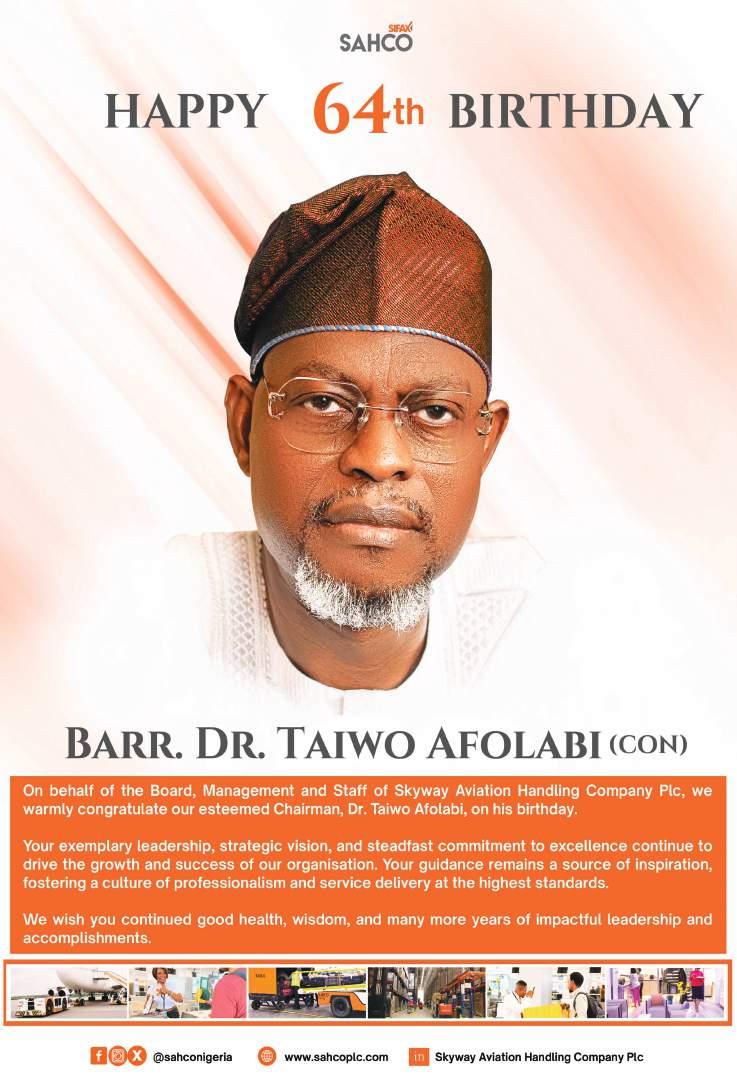
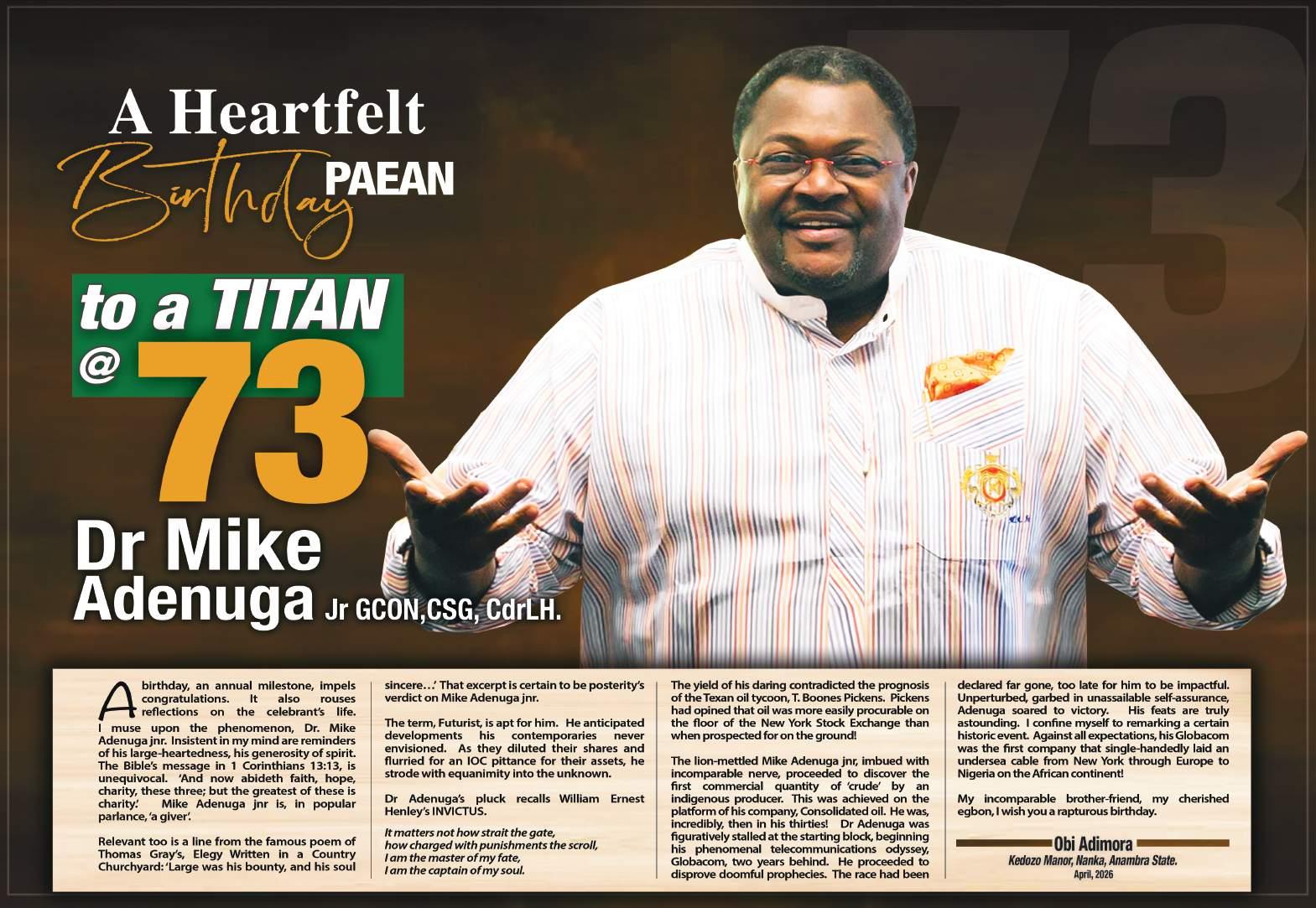
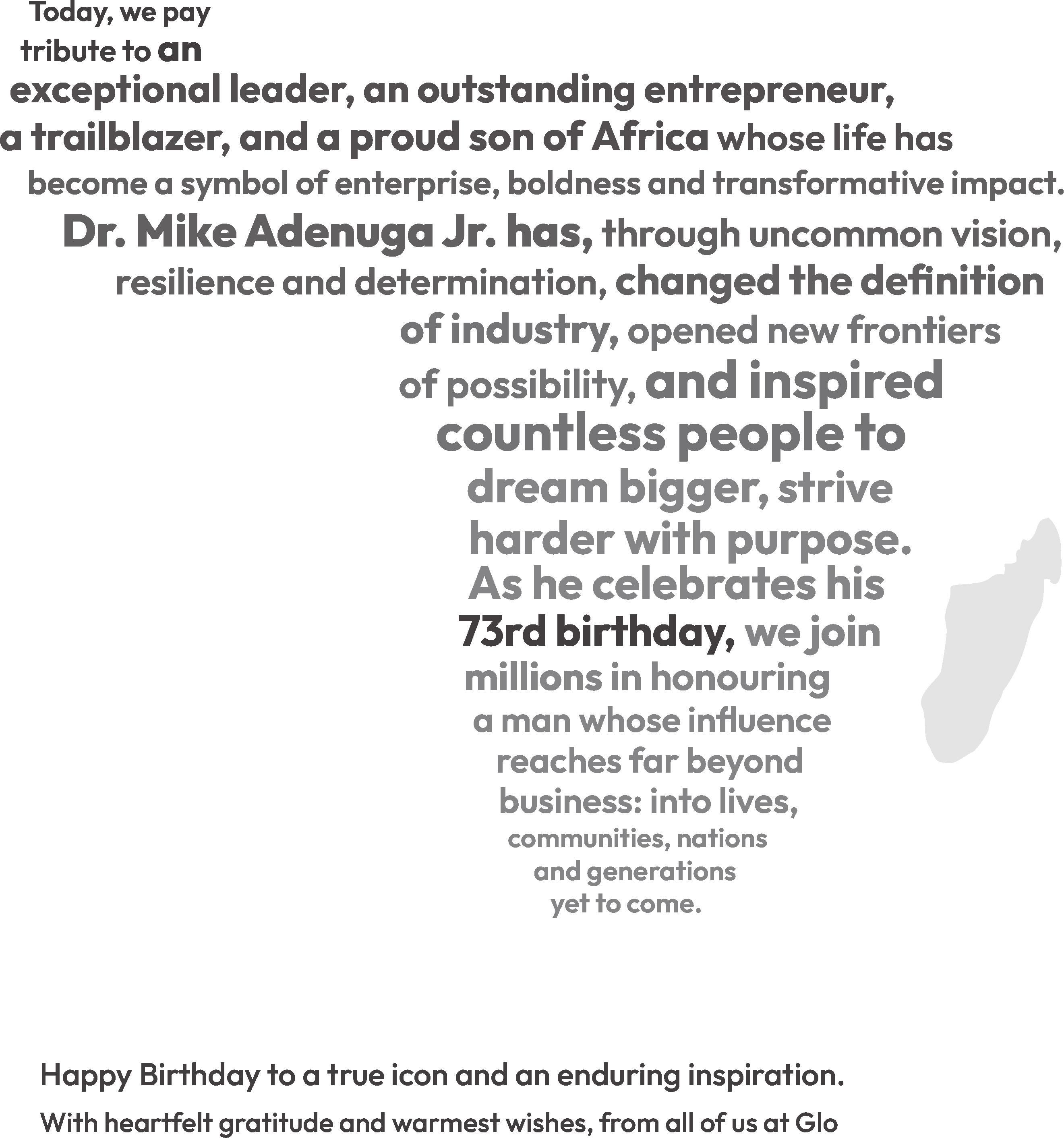
Dr. Mike Adenugu










HOSPITALITY AN ENTREPRENEUR EXTRAORDINAIRE &
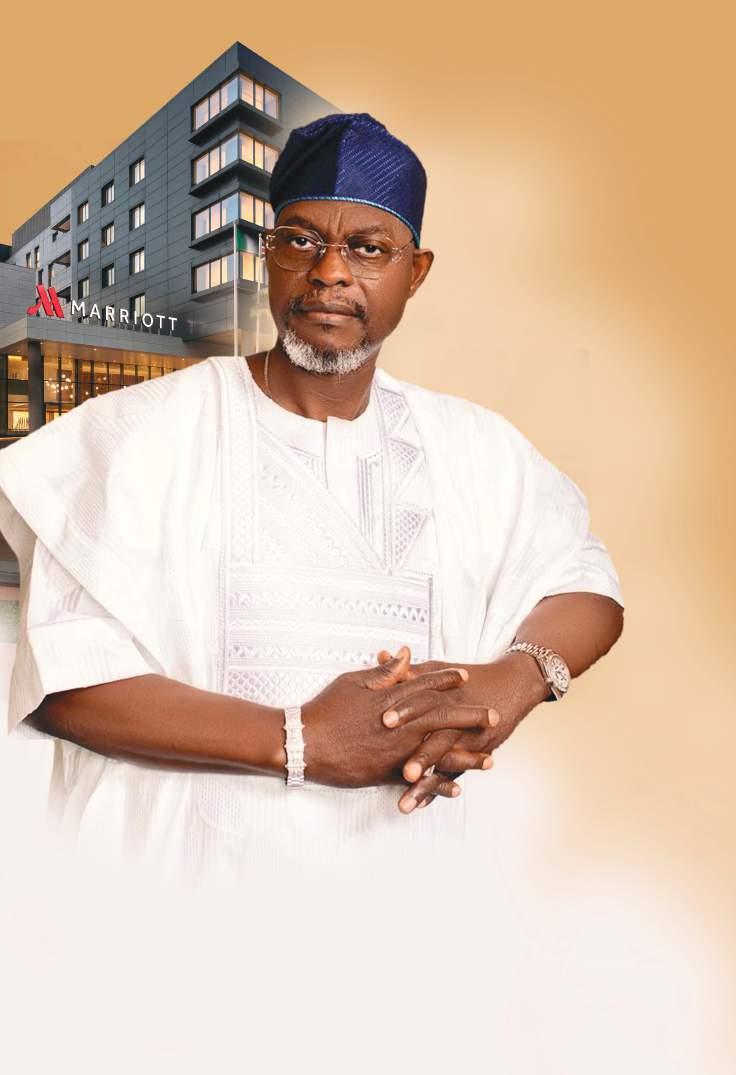
Dr. Taiwo
TITAN AFOLABI
MON, CON, CHAIRMAN MacFolly Hospitality Limited
As we celebrate you today we pray that your new age will be blessed & will bring you Love, warmth, comfort, peace, contentment & every good thing that you richly deserve. We all @ MacFolly Hospitality Ltd wish you a very Happy Birthday & long life in splendid health.
OGBUESHI CHIKE C. OGEAH, MD/CEO & ALHAJI BASHIR BELLO, CFO For MACFOLLY HOSPITALITY LIMITED, OWNERS OF THE LAGOS MARRIOTT HOTEL, Mojisola Villa, Plot J163C Oba Ladejobi Street, off Oba Akinjobi Street, GRA, Ikeja, Lagos A member of SIFAX GROUP
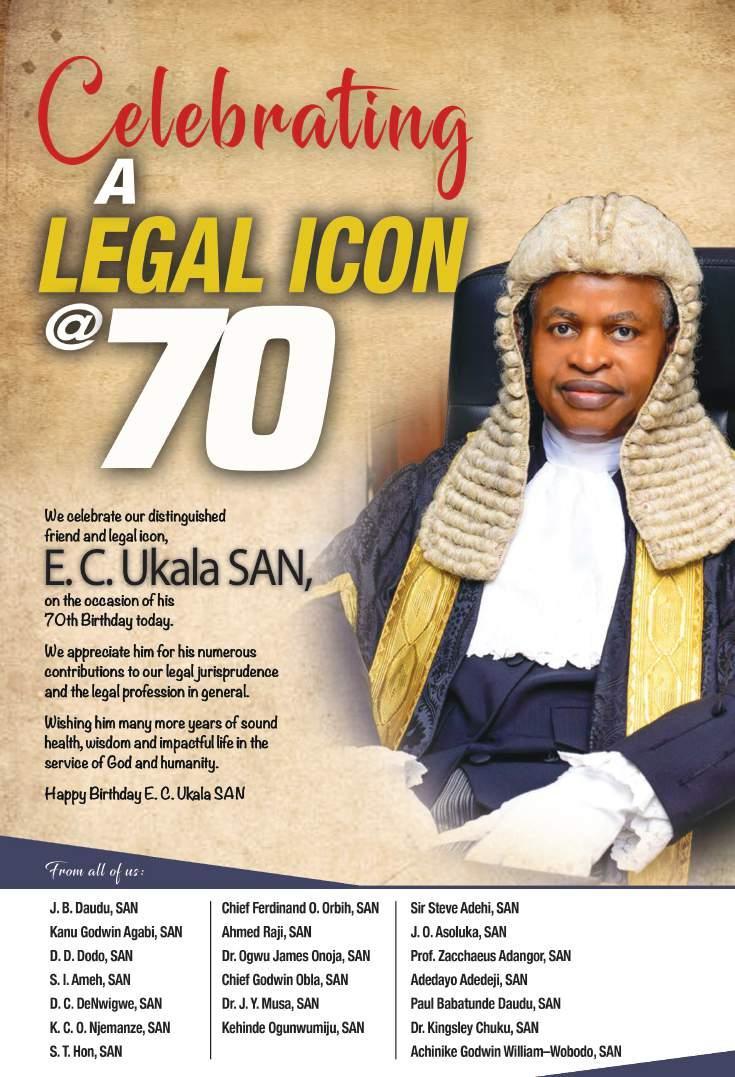
70Th BIRTHDAY
CELEBRATION
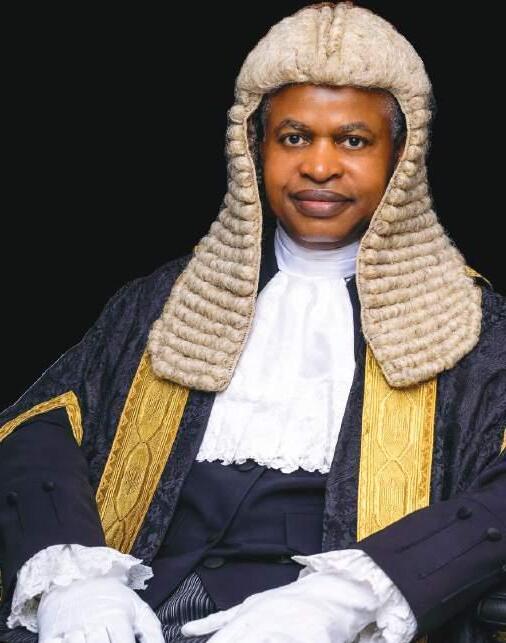
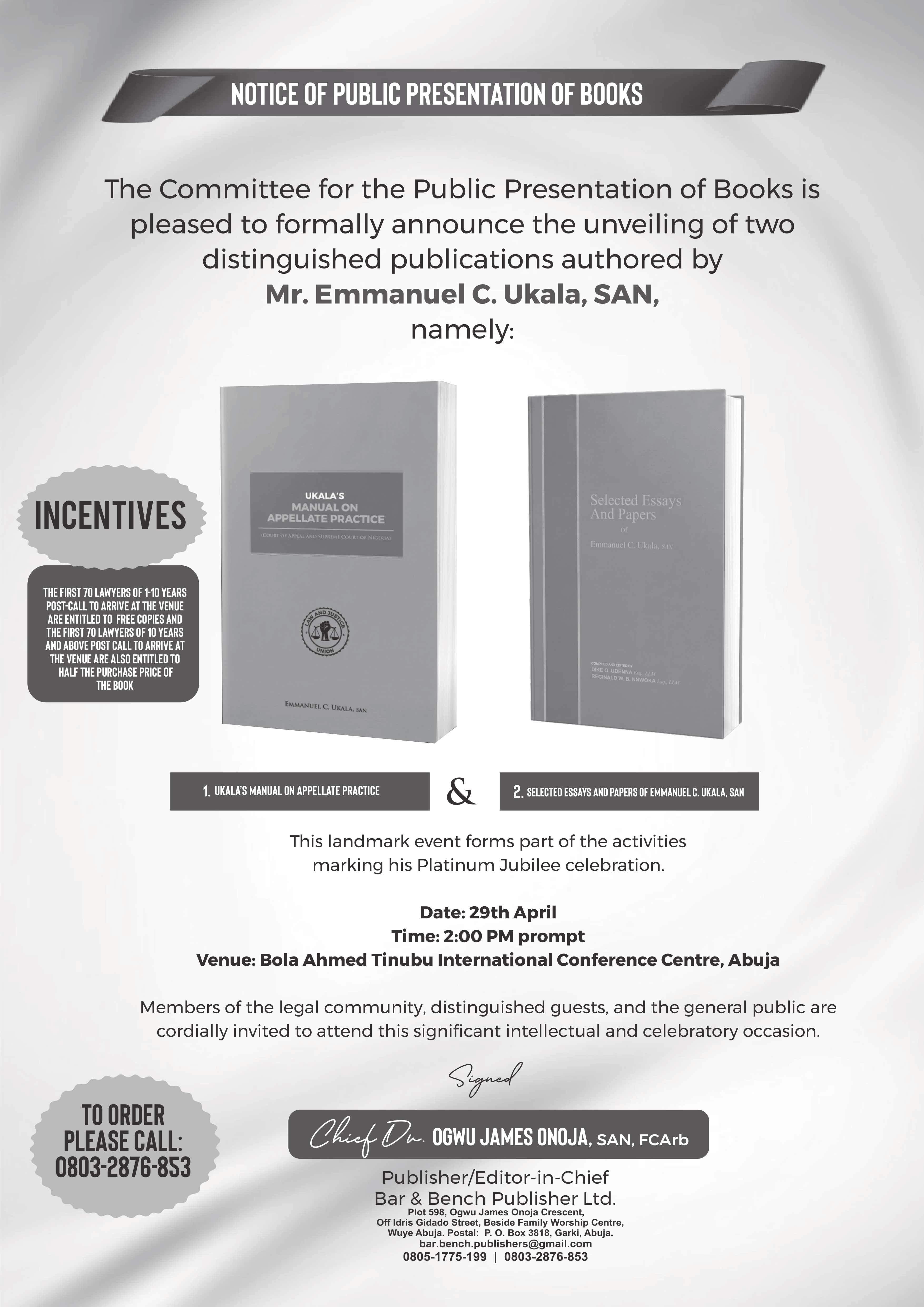
auspicious occasion of his Platinum Jubilee.
This milestone honours a life of exceptional distinction,

development of trial and appellate jurisprudence. Your
continues to resonate across the Bar and the Bench, both within Nigeria and internationally.
W
s a l
invaluable ser vice to the legal profession, and we wish you continued good health, strength, and grace in the years ahead.
Congratulations, Sir.






















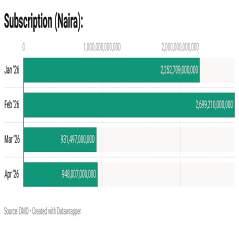
Amid moderate yields, total subscription to FGN bonds in the first four months of 2026 surged to N6.8 trillion, representing about 87 per cent increase when compared to N3.7 trillion in the first four months of 2025.
The FGN Bond auction comes against a backdrop of sustained government reliance on the domestic debt market to fund fiscal obligations amid constrained external financing conditions. It also reflects the ongoing strategy to deepen Nigeria’s sovereign yield curve
through regular re-openings across multiple maturities.
According to the FGN bond auction result obtained by THISDAY, the government through the Debt Management Office (DMO) in the first four months of 2026 offered to raise N3.15 trillion to bridging the budget deficit.
The N3.15 trillion offered is about 117 per cent increase over the N1.45 trillion offered in the first fourth months of 2025.
In all, the debt office raised an estimated N2.96 trillion in the first four months of 2026,
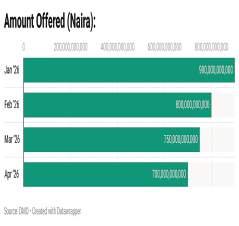
representing an increase of nearly 26 per cent over N2.36 trillion in the first four months of 2025.
Insight into the monthly FGN Bond auction by THISDAY showed that in January 2026, the DMO reopened the FEB-2031, FEB-2034 and JAN-2035 bonds, offering a total of N900.00 billion. According to the result, a total demand settled at N2.25 trillion , with the DMO eventually allotting (non-competitive allotment) N1.68 trillion at respective stop rates of 17.62 per cent, 17.50 per cent, and 17.52 per cent.
For the February 2026 FGN bond auction, the DMO reopened the AUG-2030, MAY2033 and FEB-2034 bonds, offering a total of N800.00 billion. Total demand settled at N2.6.9 trillion , with the DMO eventually allotting N524.28 billion. The stop rate on the FEB 2034, which was on-the-run last month, declined by 200 basis points to 15.50 per cent.
During the FGN bond auction in March 2026, the DMO reopened the AUG-2030, JUN-2032 and MAY-2033 bonds, offering a total of N750.00 billion. Total
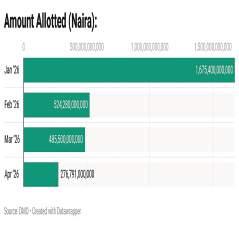
demand settled at N931.50 billion (bid-to-offer: 1.2x), with the DMO eventually allotting N485.50 billion (bid-to-cover: 1.9x).
The stop rate on the JUN-2032 and MAY-2033, which were on-the-run last month, expanded by 41basis points and 90basis points to 16.15per cent and 16.64per cent, respectively. While the stop rate on the AUG-2030 printed 16per cent.
In addition, the FGN ’s April 2026 bond auction attracted a total of N948 billion in bids—well above the N700 billion offered—
across three maturities for the months of April 2026. According to the DMO, the auction was conducted on April 27, 2026 and covered the re-opening of the 17.945% FGN August 2030 bond, the 17.95% FGN June 2032 bond, and the 22.60% FGN January 2035 bond. Investor participation was broad-based, but demand was heavily skewed toward the long end of the curve, reflecting continued preference for higher yields in a tight monetary environment.
Ebere Nwoji
The United Nations Development Programme(UNDP), has said that it would help Nigerian Insurance sector through implementation of some insurance business enhancing initiatives such as scaling the Lagos Flood Risk Insurance Model, reviving and advancing a national catastrophic insurance scheme, to be implemented collaboratively
with NAICOM and relevant disaster management agencies, including the National Emergency Management Agency (NEMA).
The UNDP also said it would strengthen systemic capacity, including actuarial development and enable insurers to mobilise domestic capital for sustainable investment.
The UNDP Regional specialist, Mr David Mueller, stated this during a courtesy
visit to the Commissioner for Insurance, Mr Ayo Olusegun Omosehin in Abuja. Mueller, expressed appreciation for the commission’s leadership and reaffirmed UNDP’s commitment to supporting Nigeria’s insurance sector especially the implementation of ongoing reforms in the industry, drawing on lessons learned from previous UNDP supported projects within the sector.
In his response, Omosehin, welcomed the UNDP team and expressed gratitude for the agency’s sustained support to the Nigerian insurance industry.
He outlined five strategic pillars underpinning NAICOM’s reform agenda and reiterated the Commission’s commitment to a transparent recapitalisation process, fostering innovation, and creating an enabling environment to significantly enhance insurance
penetration in Nigeria.
The commissioner noted that the recently enacted Nigerian Insurance Industry Reform Act (NIIRA) 2025, provided a robust legal framework for strengthening consumer protection, enhancing regulatory capacity, improving financial soundness, promoting innovation and sustainability, and expanding market access and penetration.
He further explained
that the ongoing industry recapitalisation exercise, with the first phase scheduled to conclude on 31 July 2026, was designed to reinforce the financial stability and resilience of insurance institutions. He said to support operators, NAICOM had established dedicated support mechanisms, including a recapitalisation Committee, to guide the process.
Kayode Tokede
Foreign Demand Drives
Nume Ekeghe
Nigeria’s Eurobond market extended its bullish momentum last week, with yields declining further amid sustained offshore demand, pointing to improving foreign investor
confidence in the country’s macro-economic outlook.
According to a report by Meristem, average Eurobond yields fell by 6 basis points to 6.89 per cent, from 6.96 per cent in the previous week, supported by broad-based buying
Roshe Hosts Workshop Highlighting Locally Produced Farmed Fish
Bennett Oghifo
Roshe Agro, a leading farm-tomarket fish farming company, recently hosted its highly anticipated Food x Culture Workshop, a thoughtfully curated gathering that brought together influential voices across hospitality, food service, agriculture, and culture.
The event explored the evolving relationship between farmed fish sourcing and changing consumer
expectations in Nigeria, positioning fresh, locally farmed seafood as a critical lever for business growth and national food security.
Held at the iconic Freedom Park Lagos, the workshop was graced by the Commissioner, Lagos State Ministry of Agriculture and Food Systems, Ms. Abisola Olusanya, represented by the Permanent Secretary, Mr. Emmanuel Audu, who delivered the keynote address.
PenOp Elects New President, Appoints Okoro as CEO
Ebere Nwoji
A wind of change recently blew across management cadre of Pension Fund Operators Association of Nigeria(PenOp) as the association elected Mr Donald Onuoha as its president and appointed Antonia Ifeanyi Okoro as its Chief Executive Officer. Onuoha as the new President is also the Chairman of PenOp Executive Committee.
He is currently the Managing Director/Chief Executive Officer, Fidelity Pension Managers Limited. He was elected by members of the Association to lead its
executive committee and provide strategic direction for the pension industry.
In his acceptance, speech, Onuoha thanked PenOp members for the confidence reposed in him, stating that he would continue to uphold the ideals of the pension industry while prioritising the interests of Retirement Savings Account (RSA) holders.
He added that he would work to deepen pension penetration, strengthen stakeholder engagement, and ensure the industry continues to contribute meaningfully to Nigeria’s economic development.
interest across the curve.
Demand was particularly strong in the mid-tenor segment, with bonds such as the Jan-31, Feb-32, and Feb-38 papers recording yield declines of 14bps, 12bps, and 11bps respectively, indicating renewed appetite for Nigerian sovereign risk among foreign portfolio investors.
reserves and restore policy credibility.
The sustained rally reflects improving sentiment around Nigeria’s reform trajectory, particularly in the foreign exchange market, as well as efforts to stabilise external
Meristem stated: “The Eurobond market extended its bullish momentum into this week, as average yield fell 6bps to 6.89 per cent from 6.96 per cent previously. Buying interest was spread across the curve however dominant in the belly of the curve, with bonds like the Jan-31 (-14bps), Feb-32 (-12bps), and Feb-38 (-11bps) bonds posting the strongest yield declines. Nonetheless, sell-offs was observed in the sept-28 (+2bps) in bonds.”
Kayode Tokede
The shareholders of Central Securities Clearing System Plc (CSCS), have approved the management’s N1.78 per share dividend for 2025 financial year and
Sunday Ehigiator
NASCON Allied Industries
other resolutions at the company’s 32nd Annual General Meeting (AGM) held in Lagos.
The approved dividend amounted to N8.9 billion.
The shareholders also approved the appointment
of Mr Shehu Shantali as an Executive Director and Mr Kennedy Uzoka as a Non-Executive Director.
Also, Mr Temi Popoola, Mr Nonso Okpala and Mr Samuel Onukwue who retired by rotation were re-elected as
Non-Executive Directors of the company. Speaking at the AGM, Mr Adebayo Aderemi, a shareholder urged the company to consider expanding its operations beyond Nigeria.
Plc has rewarded its shareholders with a 200 per cent increase in dividend payout, following a strong financial performance that saw its profit after tax rise by over 100 per cent to N33.5 billion for the 2025 financial year.
The company disclosed the results at its 2025 Annual General Meeting (AGM) held in Lagos,
where shareholders commended the board and management for resilience and strategic discipline despite a challenging economic environment.
Riding on the impressive performance, the Board of Directors approved a dividend of N6 per share, the highest since the company was listed on the Nigerian Exchange, reflecting confidence in its financial health and growth outlook.
Co-Founder and Chairperson of the Argentil Group, Mr Adekunle Adedeji, said:
Speaking at the event,
The Argentil Group, a leading principal investment, financial advisory, private equity, and asset management firm, has officially unveiled a new corporate brand identity, marking a pivotal milestone in its evolution since 2009. The transformation underscores its emergence as a strategic platform for investment, advisory, and capital deployment, and reaffirms its commitment to shaping the future of enterprise, markets, and sustainable value creation across Nigeria and beyond.
Glovo, a leading technology platform, and other stakeholders in the e-commerce ecosystem have called for stronger collaboration to promote inclusive growth for small and medium-sized
businesses (SMBs) and drive innovation across Nigeria’s e-commerce landscape. This was the submission from speakers at the second edition of Glovo’s flagship industry event, Future of Commerce
“Argentil was founded with a simple conviction: Africa’s growth requires capital, expertise, and institutions that understand the markets they serve. Over the past decade and more, we have worked with investors, entrepreneurs, and institutions to structure capital, execute transactions, and support businesses that power economic development across the region.”
Summit, held in Lagos.
Delivering his address, the President/Chairman of Council, Lagos Chamber of Commerce and Industry, Leye Kupoluyi, represented by the Vice President of the Chamber,
Engr. Opeyemi Aminu said that the Nigerian economy is at a defining moment, with commerce being fundamentally reshaped by technology, data and connectivity.
L-R: Shola Cardoso, Governor of the Central Bank of Nigeria (CBN),Yemi Cardoso, Mrs Folake Mobereola, the Director general Nigerian Maritime Administration and safety Agency (NIMASA); Dr Dayo Mobereola and Mr Olley Oladipo during the funeral service of late Chief Mrs. Florence Mutola Oladipo held at St. Mary’s Anglican Church Agbala Maria, Surulere, Ondo State… recently
Intelligent Mining and the Future of Sustainable Extraction
Olubi
Nigeria’s mineral endowment is not a secret. Gold, lithium, tantalum, and many other critical minerals lie beneath West Africa’s most promising geological terrain: the Pan-African orogenic belt, a region formed by ancient mountain-building processes that shaped the continent. Unlike the Birimian rocks of the West African Craton—a geologically stable area that has produced large, world-class mineral deposits (Tier 1 discoveries) across Ghana, Côte d’Ivoire, Senegal, and Mali—the Pan-African orogenic belt has not received much attention. Nigeria, occupying much of this belt, has long been seen as a “frontier” mining destination. This label quietly signals to international investors: come back when someone else has done the hard work.
The frontier label is not a geological verdict. Our rocks are not inferior. It is a verdict on data, capabilities, and infrastructure. That verdict is now being challenged — not by government policy changes or higher commodity prices. It is being challenged by a fundamental shift in what exploration technology can do, who can access it, and how quickly it can turn geological potential into investable targets. At Segilola Resources, we have spent the last two years building what we believe is a preview of how leading Nigerian mining companies will operate in the next decade. Our experience has shown that the intelligence revolution in exploration is not coming—it has arrived. The key question for investors is whether Nigerian operators will shape this transformation or simply observe it.
What “Intelligent Mining” Actually Means
The phrase “smart mining” has become a catchall for technology adoption. However, that framing misses a deeper shift: intelligent mining is not about deploying technology, but about restructuring how decisions get made. Traditionally, the geologist is primarily a data collector—spending weeks in the field, months processing results, and another cycle integrating findings before a drill target is defined. As a result, decision cycles are long, uncertainty is high, and the cost of being wrong is spread over time, making it easy to absorb but difficult to account for.
In an intelligent exploration workflow, the geologist becomes a decision architect. Data collection is increasingly automated and remote. Interpretation is accelerated by integrated platforms. Targeting becomes a probabilistic exercise — assigning confidence intervals to geological hypotheses rather than relying solely on experience and intuition. The geologist’s value shifts from knowing where to look to knowing whether the data is telling the truth.
This distinction matters because it defines which organisations create value—those with technical strength, disciplined data practices, and superior decision quality, rather than those with the largest field crews or the newest aerial surveys. At Segilola Resources, each exploration decision draws on our live, integrated data stack: drone magnetics, radiometrics, hyperspectral satellite imagery, and a structured, validated geological database. Our geologists interrogate anomalies, using advanced technology to enhance, never replace, their expert judgment.
How AI, Others Are Integrated at SROL
Let me be direct about something that is rarely said clearly in industry discussion: we are not yet using autonomous haul trucks, robotic sample preparation, or AI-driven drill rigs. That level of automation is still emerging globally, and Nigeria’s operating environment will adopt it at its own pace. In our assessment, what we have built at SROL represents a more immediately valuable and genuinely distinctive approach for the
context at our current stage of exploration.
tangible outcomes from our exploration programmes over the past two years.
experience shows that leveraging intelligent technology and practising responsible extraction are compatible—and, indeed, strengthen the long-term investment case in this sector when incorporated into everyday decision-making.
Balancing Productivity and Sustainable Extraction
Before any field activity, we ask two questions: Does this work directly test our highest-confidence geological hypothesis? Can we acquire the same information with less surface disturbance? If the answer to either is no, we redesign. A recent example makes this concrete. On a greenfield permit in southwest Nigeria, conventional geochemistry suggested a large soil anomaly warranting an extensive drill programme. Our hyperspectral and drone magnetic data refined that anomaly to a much smaller, structurally controlled target. We significantly reduced the planned drill programme — saving costs and preserving vegetation cover — while still confirming the mineralised structure. More information before the disturbance. Less waste after. That is the balance.
Advice to Other Mining Companies
SROL has deployed a drone-mounted, high-resolution magnetic data-acquisition platform. This platform now also collects radiometric data, which measures natural radiation from rocks to help distinguish different rock types (lithology) and zones of chemical change (alteration). We have integrated EnMap hyperspectral satellite data—from a German Space Agency mission that acquires images across 244 spectral bands, spanning visible to shortwave infrared—into our target generation workflow. This enables our team to identify surface accumulations of minerals such as sericite, chlorite, and carbonates, collectively known as alteration assemblages. These assemblages serve as direct indicators of gold-bearing hydrothermal systems, allowing us to pinpoint targets before anyone goes into the field.
Beyond hardware, SROL has embedded a large language model as a multidisciplinary technical intelligence system across the exploration workflow — from tectonic framework reconstruction (rebuilding the history and structure of the Earth’s crust) and geophysical dataset integration (combining subsurface measurement data), through field photograph interpretation (analyzing site images), structural kinematic analysis (studying rock movement and deformation), geochemical processing (analyzing chemical composition of samples), to executive communication. This is not a generic productivity tool. It operates directly on programme-specific data: real field photographs, real assay results (lab-tested sample measurements), real magnetic datasets, and is held accountable to the same standards of geological evidence that govern all project decisions. The practical outcomes of this integration are traceable and specific. The result is a programme being executed with the analytical depth and multi-disciplinary breadth that would normally require a specialist team of five to eight people. All of this is compressed into a single integrated workflow that operates at the pace of the project leader‘s thinking.
Measurable Improvements:
The Numbers
Intelligent mining is not merely a philosophy—it is a proven performance discipline. The table below highlights
A cost-per-line-kilometre comparison does not capture the full value proposition. Our drone platform delivers higher image resolution and streamlined logistics, without reliance on highly trained foreign crew or the need to mobilise foreign aircraft. Importantly, the data belongs to us from the moment it is recorded. Beyond cost savings, our solution enables faster decision-making, minimises friction with the local community, and ensures full local ownership of each technical step.
The broader implication deserves to be stated directly. When exploration intelligence becomes widely accessible - when a hyperspectral satellite scene costs a fraction of a conventional geophysics campaign, when a drone survey returns what an airborne programme used to take months to process - the entrance fee for serious frontier exploration drops dramatically. Tasks that once required a major’s balance sheet and a technical office in London or Perth can now be executed by a well-capitalised, technically capable mid-tier operator. This is not an aspiration. SROL has demonstrated it. Nigerian mid-tier companies no longer need to wait for a foreign major to decide Nigeria is worth the risk. We can lead our own ground.
How Smart Technology Reduces Impact
Over the past two years, our intelligent workflows have avoided cutting an estimated 3,000 kilometres of access tracks and left more than 120 square kilometres of land undisturbed—land that would otherwise have been cleared for conventional ground geophysics programmes. This is more than an environmental benefit: it is a direct result of the same technology stack that has reduced our time-to-target, delivering measurable value for our stakeholders. Precision delivers both operational efficiency and responsible resource management. We do not claim perfection. However, our
For companies looking to invest in smart technologies with strong sustainability, our primary insight is this: start with robust data foundations. Technology investments yield optimal returns only when supported by clean, reliable data, making early attention to data integrity a core investment strategy. Prioritise developing a validated, auditable geological database before purchasing equipment. Skipping this step exposes investments to unnecessary risk by compromising the value of all downstream technology.
Build one internal champion. Identify a geologist who understands both the geology and the technology — give them a small budget and a clear mandate to pilot one tool on a single permit. Let them prove the value before any company-wide rollout. The LLM-based technical intelligence approach we have described requires no significant capital investment: it requires a technically capable geologist willing to bring discipline to the data and rigour to the challenge. That is already available to most operators in this room.
Do not outsource the thinking. Use contractors for data collection, but keep interpretation in-house. That is where value is generated and where your programme’s intellectual capital resides. A foreign contractor flying a drone gives you maps. Your own geologist, working with integrated data and the right analytical tools, tells you whether those maps point to gold.
Engage regulators early. The Nigerian airspace authority and the Mining Cadastre Office are willing to work with certified operators. Build those relationships before you need them. The companies that will benefit most from a streamlined regulatory environment are the ones already in conversation with the agencies shaping it. Finally: share what you learn. Nigeria’s transition from frontier to established market will be accelerated by open technical exchange, benefiting both sector growth and investor confidence. The more credible, locally produced, publicly available data and methodology the sector generates, the faster the frontier label dies.
What Nigeria Now Needs To Do
The technology is not the constraint. The capability exists, the data is accessible, and Nigerian companies with the ambition and technical infrastructure to deploy it are demonstrating results.
•Olufemi Olubi is the Senior Geologist, Segilola Resources Operating Limited (SROL)
Olufemi Olubi
Olufemi
Nigerian
Oye Applauds Akyol’s Role in Facilitating $5bn Nigeria–TürkiyeTrade Partnership
Oluchi Chibuzor
The Chairman of the Nigeria Türkiye Business Council (NTBC) and Chairman of the Alliance for Economic Research and Ethics (AERE), Dele Kelvin Oye, has commended the outgoing Commercial Counsellor at the Embassy of the Republic of Türkiye in Abuja, Sefa Akyol, for his instrumental role in advancing efforts toward achieving the $5 billion bilateral trade target between Nigeria and Türkiye.
Oye gave the commendation during a send-forth dinner organised in honour of Akyol in Abuja, where diplomats, business leaders, and representatives of key trade institutions gathered to celebrate his contributions to strengthening economic relations between the two countries.
According to Oye, Akyol’s tenure marked a turning point in Nigeria–Türkiye commercial relations, as he consistently championed initiatives that deepened trade, investment, and institutional cooperation.
He noted that Akyol
played a strategic role in aligning the activities of the Nigeria Türkiye Business Council, the Foreign Economic Relations Board of Türkiye (DEİK), and the Nigerian Association of Chambers of Commerce, Industry, Mines and Agriculture (NACCIMA), creating a coordinated framework that enhanced business engagement between both nations.
Oye said, “We are gathered under the auspices of the Nigeria Türkiye Business Council (NTBC) to celebrate and bid a fond farewell to a remarkable diplomat, a tireless advocate for economic cooperation, and a true friend of Nigeria Mr. Sefa Akyol, the outgoing Commercial Counsellor at the Türkiye Embassy in Abuja.
“As we reflect on Akyol’s tenure, we are reminded of the profound impact that dedicated diplomacy can have on bilateral relations. The economic partnership between Nigeria and Türkiye has witnessed unprecedented growth, and at the heart of this transformation has been the strategic vision and relentless effort of our distinguished Commercial Counsellor.
“During his time in Abuja, Mr. Sefa Akyol has been instrumental in advancing the ambitious economic goals shared by our two great nations. With a clear mandate to deepen trade and investment, he worked assiduously to turn the vision of a $5 billion bilateral trade volume into a tangible reality,” he said.
“His tenure has been characterised by a proactive approach to economic diplomacy, bridging the gap between Nigerian and Turkish business communities. Akyol recognised early on that the foundation of a strong economic partnership lies in robust institutional collaboration. To this end, he has been a pivotal figure in synergizing the efforts of key organizations that drive our bilateral trade. His seamless collaboration with the Nigeria Türkiye Business Council (NTBC), the Foreign Economic Relations Board of Türkiye (DEİK), and the Nigerian Association of Chambers of Commerce, Industry, Mines, and Agriculture (NACCIMA) has created a unified front for economic engagement.”
Glo Emphasises Power of Seamless Connectivity with TV Commercials
Globacom has released two new television commercials (TVCs), “Road Trip” and “Department of Imagination”, which reinforce its commitment to seamless connectivity.
The highly engaging and entertaining commercials highlight how Glo fits into everyday life, while also pointing to a more connected and exciting future.
“Road Trip” brings a warm and familiar story to life. It follows a family journey filled with laughter and real-
life moments. When Toyin Abraham Ajeyemi struggles with poor signal, the difference becomes clear after switching to Glo. From that moment, everything changes as downloads, navigation, and entertainment become seamless and easy.
At the heart of the Road Trip experience is easy access to data, with the simple message: by dialling *312#, users can easily get a plan and stay connected, keeping everything running smoothly on the go.
The commercial also
features Bolaji Ogunmola and other cast members who add energy and humour to the story. As the journey continues, Glo proves to be a reliable partner, keeping everyone connected and entertained along the way.
In contrast, “Department of Imagination” takes viewers into a futuristic world where technology makes life easier and more exciting. Led by Richard Mofe-Damijo as the Professor, the story explores how ideas can grow into powerful experiences. WEDNESDAY,
Nigeria’s Fitness Chain Hits 30th Location with Abuja Launch
i-Fitness, West Africa’s leading fitness chain, has reached an important milestone with the official opening of its 30th branch in Games Village, Abuja. This launch marks a significant chapter in the company’s decadelong journey to increase access to quality wellness services across Nigeria’s major urban centres.
The opening of the new flagship facility reflects a broader institutional commitment to scaling wellness infrastructure. While the rollout of fitness facilities is globally recognized as a capital-intensive
venture, i-Fitness has successfully utilized a capital-efficient growth model to maintain its rapid trajectory.
Founder and Chief Executive Officer, Foluso Ogunwale, noted that the milestone represents a long-term investment in the Nigerian workforce. “This is not just about opening a 30th branch. It reflects the systems, discipline, and investment required to build a scalable business in Nigeria. Our focus is on making quality fitness accessible to more Nigerians because we see wellness as directly
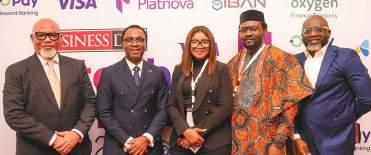
Bank, Abidemi Asunmo; President, Stakeholders in Blockchain Technology Association of Nigeria, Mr. Mela Claude-Ake and Divisional Head, Payments and Merchant Solutions, FCMB, Oladapo Alabede, at a Fintech Summit in Lagos… recently
linked to productivity, economic participation, and overall wellbeing,” he said.
As the company nears its 11th anniversary in May 2026, it remains committed to the thesis that improving access to quality fitness infrastructure is vital for shaping healthier lifestyles and supporting long-term economic outcomes in Nigeria. With 30 locations now established, i-Fitness is already exploring further expansion into new cities and potential regional growth across West Africa.
The price of OPEC basket of twelve crudes stood at $63.14 a barrel on Monday, according to OPEC Secretariat calculations.
The
Reference Basket
L-R: Director General, Africa eGovernance Conference, Dr. Adeyinka Adeyemi; Chief Technology Officer, First City Monument Bank (FCMB), Mr. Blessing Ehize; Group Head, e-Business, Premium Trust
OPEC
of Crudes (ORB) is made up of the following: Saharan Blend (Algeria), Djeno (Congo), Zafiro (Equatorial Guinea), Rabi Light (Gabon), Iran Heavy (Islamic Republic of Iran), Basrah Medium (Iraq), Kuwait Export (Kuwait), Es Sider (Libya), Bonny Light (Nigeria), Arab Light (Saudi Arabia), Murban (UAE) and Merey (Venezuela).
GTCO Shareholders Laud Highest Dividend Payout of N12.76 for 2025FY
Kayode Tokede
The shareholders of Guaranty Trust Holding Company Plc (GTCO), yesterday commended the management of the financial institution for the highest dividend payout of N12.76 kobo in the Nigerian’s banking sector for 2025 financial year.
The shareholders yesterday at the GTCO’s 5th Annual General Meeting (AGM) lauded
the Group’s impressive 2025 financial year performance and also for meeting the Central Bank of Nigeria (CBN)’s N500billion new minimum capital requirement.
Speaking at the AGM, the President of the Nigerian Shareholders’ Solidarity Association, Chief Timothy Adesiyan, expressed excitement for the management dividend payout for 2025FY, stressing that the board has demonstrated discipline to sustain its dividend
payout to shareholders.
Another shareholder, the Chairman, Pragmatic Shareholders Association of Nigeria (PSAN), Mrs. Bisi Bakare, lauded the management for paying shareholder N12.76 kobo total dividend payout in 2025, she noted that GTCO makes history as the first Nigerian bank to reward shareholders with N12.76kobo dividend payout, urging the management to maintain such gesture.
The management of GTCO had declared an interim dividend of N1.00 per share for half year ended June 2025 and final dividend of N11.76kobo in the 2025 financial year performance, bringing its total dividend to N12.76kobo for 2025 financial year.
Responding to shareholders, the Board Chairman of GTCO, Suleiman Barau, said over time, the Group has evolved from a single-line banking institution into a broader financial services
ecosystem encompassing banking, payments, funds management, and pension administration.
“This diversification is not simply a structural change; it represents a strategic effort to build an institution that can serve customers more comprehensively while creating multiple engines of sustainable growth.
“A diversified ecosystem allows the Group to operate with greater balance across economic cycles, reduces concentration
of risk, and broadens the value proposition we offer to individuals, businesses, and institutional clients,” he said.
He noted that the continuing management’s discipline underpin its risk culture. “In an environment where macroeconomic conditions remain fluid across many markets, maintaining a healthy balance sheet and strong credit practices is essential,” he said.
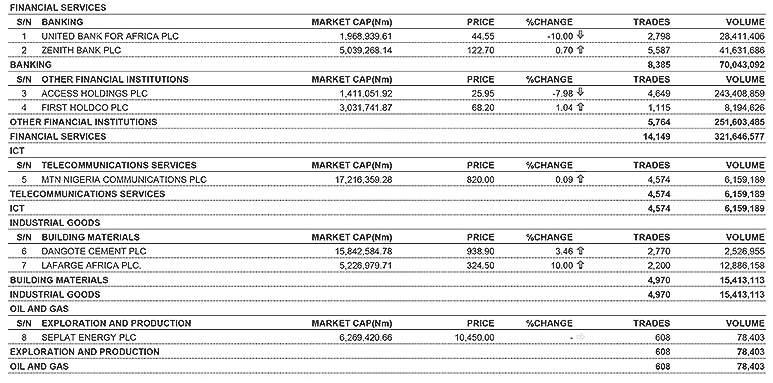
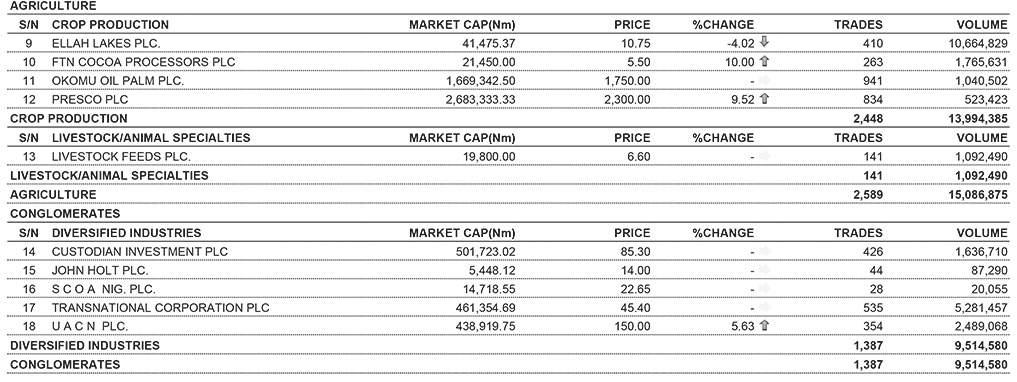
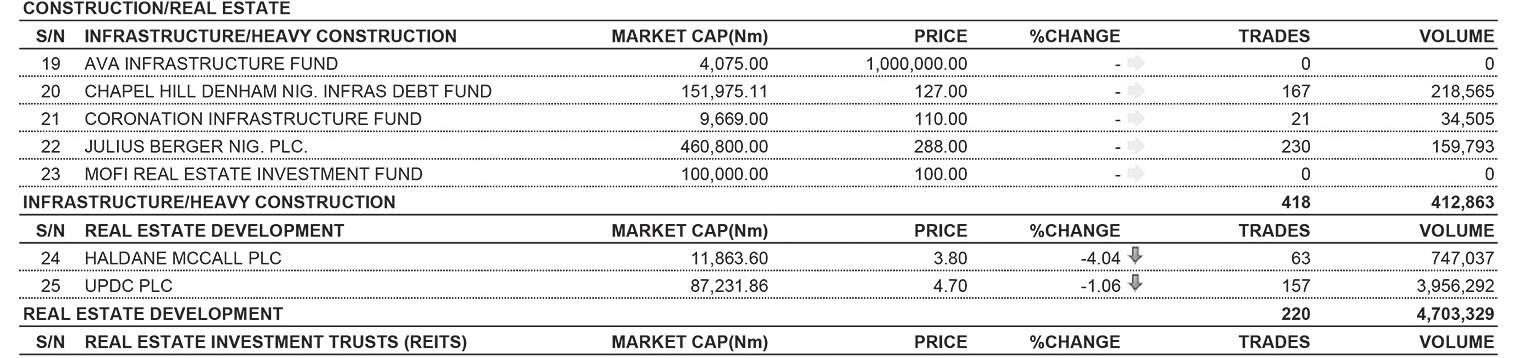
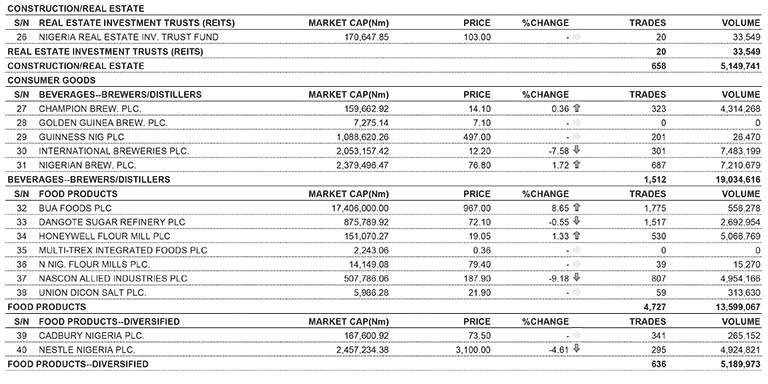
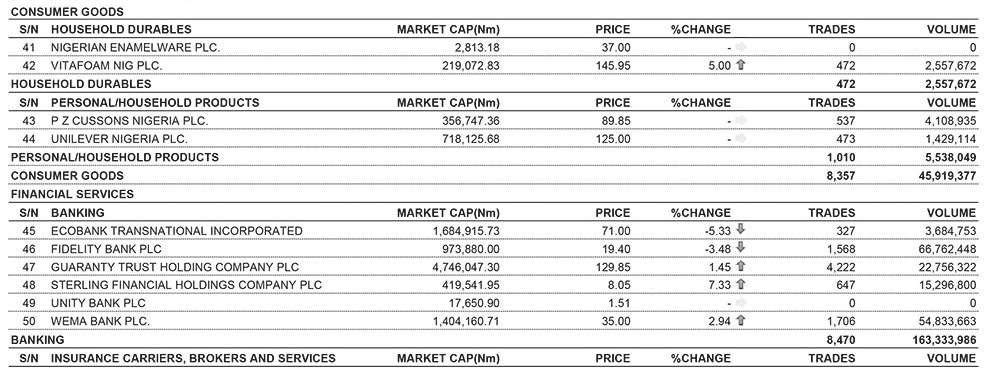
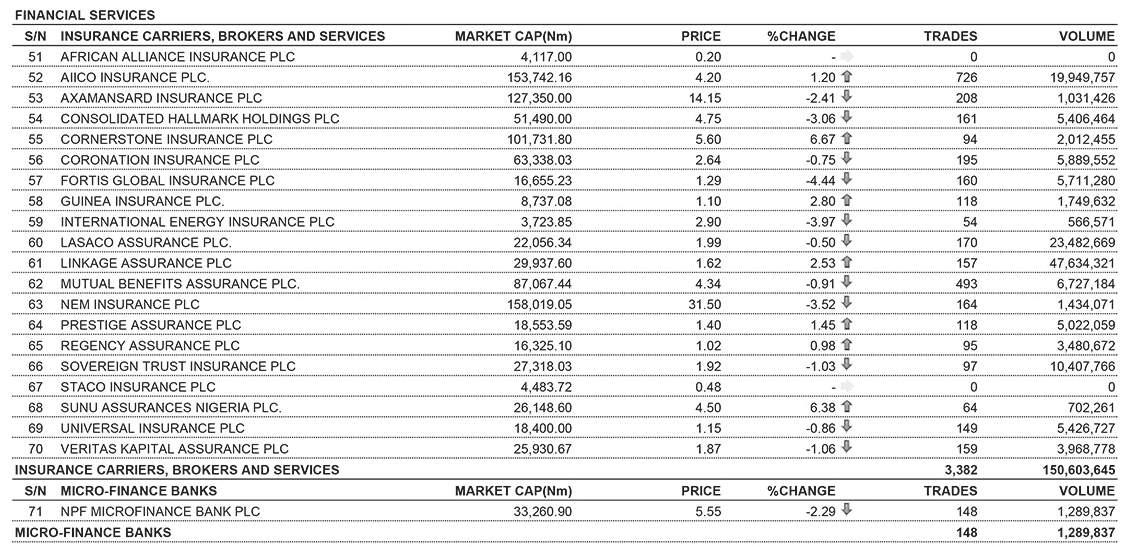
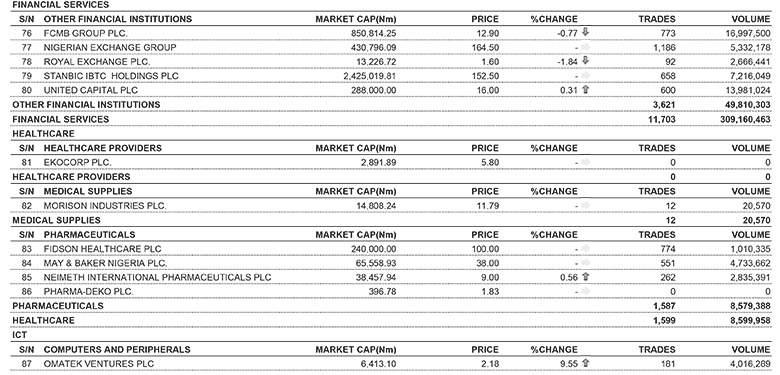
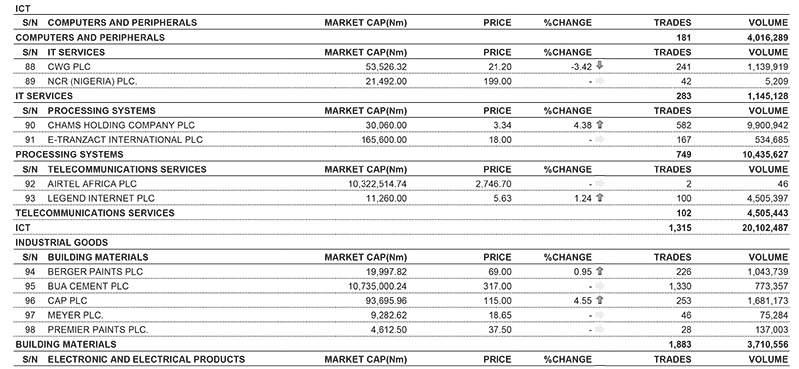
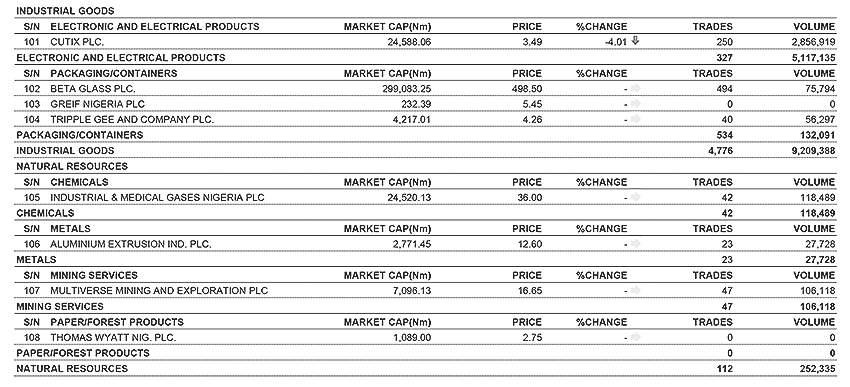
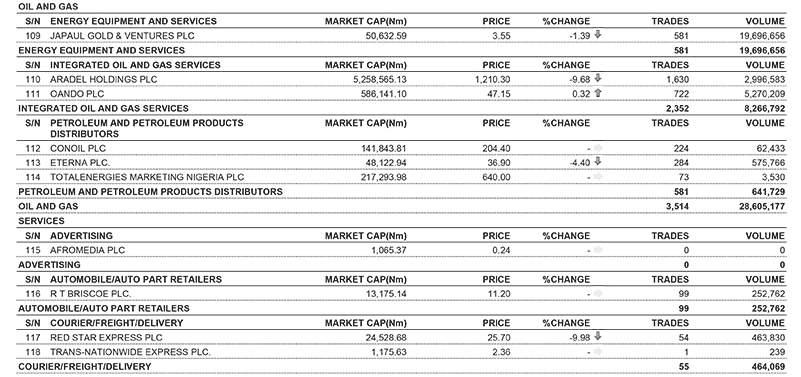
PRICES FOR SECURITIES TRADED AS OF APRIL 28/26



FROM PORTS TO FOOD
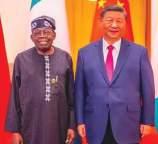
Partnership with China is driving Nigeria’s economic transformation, contends ADEOLA ADELABU
EMPIRE ON CANVAS, MORALITY IN QUESTION
Besides preserving the past, Art scrutinises the narratives through which the past is interpreted, contends PAT ONUKWULI See page 41

TUNDE OLUSUNLE argues for better welfare for those in charge of our security

MR PRESIDENT, HEED THE ‘MADMAN’
If his utterances, actions and overall behaviour betray a certain psychological imbalance, he deserves to be genuinely understood and excused. By his own account, he has been on the battlefield for well over four years, much as he should have been reassigned to other duties and replaced after two years. It is normal in the Western world for people who have experienced war and all that comes with it, to suffer posttraumatic stress disorder, (PTSD). They are expertly managed, not vilified, to get them back to normalcy. War is not waffles. The uncertainties, the ambushes, the sounds of bullets and bazookas, the booming blasts of bombs and IEDs, the crimson colour of blood. Soldiers are humans, all of these get to them no matter how tough and rugged they are.
Rotimi Olamilekan, also known as *Sojaboi,* a former personnel of the Nigerian Army, has been prominent in the news of late. In response to government's call for joiners into the Nigerian military, Olamilekan, a former lance corporal, took to the social media to call out the children and wards of the political class and the nouveau riche, to enlist in the armed forces. With its ranks massively depleted in the multipronged fight against insurgency, terrorism and banditry across the country, the Nigerian Army craves 28,000 fresh entrants. Olamilekan, a young man from the Yoruba country who is familiar with the proverb *omo'lomo la'n ran ni ise de toru, toru,* (it is the children of other people that are usually sent on distant or dangerous errands), canvassed that children of the privileged should taste of the experience of the children of commoners.
Since his summary dismissal from service, Olamilekan has been very vocal about the service conditions of ordinary soldiers. In a podcast which featured media personalities like Daddy Freeze and Omoyele Sowore, Olamilekan volunteered that his last salary before his recent eviction from service, was about N111,000.00 only. This "enhanced" takehome envelope, he observed, came into effect about a year ago. Before then, his monthly earning was N51,000.00. He subsequently posted his last pay slip to buttress his contention. Espousing on the predicament of the ordinary Nigerian soldier, Olamilekan alleged they have to procure all their accoutrements by themselves, at their own cost. According to him, the ordinary Nigerian soldier pays for his uniforms, vests, boots, helmets and needed accessories.
As would be expected, the Nigerian Army has moved to water down the
allegations of Rotimi Olamilekan. Appolonia Anele, a Lieutenant-Colonel and spokesperson of the army said in a press release on Wednesday April 8, 2026, that the submissions were false as it is the institutional responsibility of the army to provide the official gears and operational needs of troops. She contended that Olamilekan's claims were false and misleading, as troops are adequately equipped and catered for. The army she noted, maintains a structured and transparent remuneration system, with additional benefits for personnel. Uniforms, boots and protective equipment, Anele noted, are dutifully provided through established logistics systems. Soldiers, she noted, are at liberty to augment institutional provisions should they consider such, inadequate.
This piece does not intend to probe the circumstances of Lance Corporal Rotimi Olamilekan's dismissal from service. It is to request that President Bola Tinubu pays more than fleeting attention to the utterances of a lowly, young soldier, which would ordinarily be dismissed as the "rantings of an ant," to borrow the words of the flamboyant Second and Fourth Republic scholarpolitician, Dr Chuba Okadigbo. It is because the madman, despite his established mental imbalance, is capable of meaningful thought, that the respected second generation Nigerian poet, Obiora Udechukwu, titled his most successful volume of poetry, which was published in 1990, *What the Madman Said.* A whole lot is wrong with the contemporary organisational structure and operations manual of the Nigerian military in its entirety which is why it is not delivering tangibly. As Commanderin-Chief of the Armed Forces, President Tinubu must sit back, reflect and recalibrate his intelligence, security and defence workbook.
It must be of concern to the President that on Thursday April 9, 2026, the government of the United States of America, (USA), commenced the
evacuation of its embassy staff from Abuja, Nigeria's capital, hitherto the nation's safest haven. The American government is offering support in the areas of training, equipment and intelligence for the battle against insurgency, terrorism and banditry. They must be disappointed, however, at the suspect enthusiasm and ambivalent professionalism exhibited by their Nigerian counterparts which must be impeding their work. The US security advisory has identified 23 out of 36 states as red zones, which is as good as saying two-thirds of the country is besieged and traumatised.
It should agitate the President that same Thursday April 9, 2026, Oseni Braimah, a Brigadier-General and Commander, 29 Brigade, Benisheikh, Kaga council area, Borno State, was killed in an attack by Boko Haram and the Islamic State West Africa Province, (ISWAP). Some soldiers were taken down with him. Braimah is the second General to be wasted by the bloodhounds terrorising the country's North East within the last five months. Brigadier-General Musa Uba, erstwhile Commander, 25 Task Force, also in Borno State, was ambushed, abducted and executed by the very same ISWAP, November 18, 2025. Within the period, LieutenantColonels Umar Farouq, Salihu Iliyasu and Saidu Paiko, were all taken down in Kukawa local government area, Borno State. The number of officers and other ranks who have been lost alongside these senior officers is better imagined.
If I were the President, I would be thoroughly embarrassed that the annual appropriation for security and defence has been on the ascendancy in the three annual budgets prepared under my superintendence between 2024 and 2026, and approved by the national assembly, without commensurate results. Aggregated, the budgets for security for the three years 2024, 2025 and 2026, is a staggering N15.83Trillion, ($11.3Billion). Rather than positively impact national security, the ogre of insecurity is indeed festering, gaining additional hectarage and mileage across the length and breadth of the country. It is official that actual releases and cashbackings have been slow in coming necessitating perennial shifts in the lifespans of various budgets. But what exactly has been done with what has been received thus far?
Olusunle, PhD, Fellow of the Association of Nigerian Authors, (FANA), teaches Creative Writing at the University of Abuja
Partnership with China is driving Nigeria’s economic transformation, contends ADEOLA
ADELABU
Besides preserving the past, Art scrutinises the narratives through which the past is interpreted, contends PAT ONUKWULI

FROM PORTS TO FOOD EMPIRE ON CANVAS, MORALITY IN QUESTION
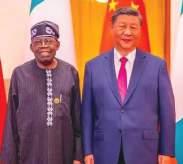
For years, Nigeria’s conversations around economic transformation have been long on ambition but short on execution. Increasingly, however, a more pragmatic pattern is emerging, one defined by structured partnerships, targeted investments, and a growing emphasis on delivery. Nowhere is this shift more visible than in the evolving relationship between Nigeria and China. As bilateral cooperation deepens, a broad portfolio of projects spanning infrastructure, manufacturing, and agriculture is beginning to reshape Nigeria’s economic trajectory. The emerging signal is clear: development is no longer being framed solely around policy intent, but around measurable outcomes.
A clear demonstration of this shift is the operational success of the Lekki Deep Sea Port. Developed in partnership with China Harbour Engineering Company (CHEC), the port stands as one of the most significant private-sector-led infrastructure investments in Nigeria in recent years. With over $1 billion in equity contribution by CHEC, the facility is now fully operational, easing port congestion, improving cargo handling efficiency, and strengthening Nigeria’s position as a maritime gateway for West Africa. Beyond its infrastructure value, Lekki Deep Sea Port is increasingly seen as a case study in what structured international partnerships can deliver when aligned with domestic priorities. It highlights a key lesson: investment alone is not sufficient; execution, governance, and operational sustainability are what convert capital into national value.
However, infrastructure is only the starting point of industrial transformation. The next frontier lies in rebuilding Nigeria’s productive base, particularly in steel. No modern economy achieves industrial depth without a functioning steel industry, and this reality places renewed attention on the revival of the Ajaokuta Steel Company. For decades, Ajaokuta has remained an unfulfilled potential. Yet, renewed collaboration involving Chinese technical and investment partners has reopened the possibility of repositioning it as a core pillar of Nigeria’s industrial ecosystem. A functional steel plant would reduce import dependency, lower production costs across sectors, and stimulate downstream industries such as construction, fabrication, and manufacturing. The strategic logic is further reinforced by Nigeria’s resource endowment, particularly iron ore deposits in Itakpe, Lokoja and Ogun state. Combined with improving logistics infrastructure, including rail and inland transport corridors, the fundamentals for a viable steel value chain are present. What remains critical is execution discipline and sustained policy continuity over time.
If infrastructure and steel represent the backbone of industrialisation, agriculture represents its most immediate and socially visible impact. In a context where food inflation continues to pressure household incomes, interventions that directly
affect food supply and pricing carry both economic and political significance. This is where the National Integrated Poultry Project becomes particularly consequential.
According to Joseph Tegbe, the project is designed to address structural constraints in Nigeria’s poultry value chain, particularly high feed costs and supply inefficiencies. By integrating large-scale poultry production with domestic cultivation of key feed inputs such as maize and soybean, the initiative directly targets the most significant cost drivers in the sector. The economic rationale is straightforward: reducing feed costs lowers production costs, and lower production costs improve affordability for consumers. In practical terms, this is expected to translate into more accessible prices for eggs and poultry products, which remain critical sources of affordable protein for millions of Nigerian households.
The implications extend beyond consumers to producers. Poultry farmers, many of whom operate under volatile input pricing and thin margins, stand to benefit from more stable feed supply chains and reduced production costs. This could enhance profitability, encourage sector expansion, and strengthen resilience across the agricultural value chain.
The scale of ambition is significant. Pilot phases are scheduled for Kaduna and Oyo States, with plans for national expansion thereafter. Each integrated facility is expected to operate at industrial scale, housing up over one million layer birds alongside substantial broiler capacity, and collectively producing millions of eggs daily. The programme is projected to generate tens of thousands of direct jobs and hundreds of thousands of indirect opportunities across farming, logistics, processing, and distribution.
Yet, Nigeria’s development history underscores an important caution: ambition does not automatically translate into impact. The country has seen several large-scale agricultural and industrial programmes falter due to weak coordination, inconsistent policy implementation, and limited accountability mechanisms. This makes execution the defining variable. Clear timelines, institutional coordination, and measurable performance indicators will determine whether these initiatives become transformational or remain under-realised potential.
Adelabu is the Lead, Media and Public Relations at the Nigeria–China Strategic Partnership
When a nation chooses what to hang on its walls, particularly in the diplomatic heart of another country, it is not merely curating art; it is curating memory, meaning, and moral posture. The controversy surrounding the installation of a Royal Navy painting depicting the 1851 bombardment of Lagos at the British High Commission is therefore not incidental. It is emblematic of a deeper, unresolved tension: the persistent inclination to aestheticised empire while neutralising its violence.
At first glance, the artwork itself appears composed, almost restrained. British warships are positioned with precision, their cannons discharging in disciplined sequence. Smoke rises over Lagos in a manner that suggests control rather than chaos. The visual syntax is unmistakable: this is not conquest, but “intervention”; not invasion, but “restoration of order.”
Yet this framing depends on a quiet but powerful semantic transformation. Language is softened, edges are blurred, and meaning is re-engineered. What was a calculated military operation to depose Oba Kosoko and restructure Lagos’s political authority becomes, in effect, a narrative of necessity. What was coercion is recast as responsibility. What was asymmetry in force is presented as balance in purpose.
This is where the moral question sharpens. The historical record makes clear that the bombardment was not an abstract clash of equals but a deliberate act of imperial projection. It resulted in regime change, the installation of Akitoye, and ultimately the incorporation of Lagos into British colonial rule by 1861. To present such an episode through imagery that foregrounds discipline while erasing disruption is not merely selective; it is sanitising.
Sanitisation is the first layer of distortion. The trauma, displacement, and human cost of the bombardment are absent, replaced by a composed spectacle of naval efficiency. War, in this rendering, becomes orderly, almost procedural. Catastrophe is repackaged as competence.
Closely following is narrative bias. The composition itself encodes hierarchy: British ships dominate the canvas, rendered with clarity and authority, while Lagosian resistance is marginalised, visually diminished, and historically subdued. The result is a familiar binary: the rational, civilising force versus the indistinct “other.” In this formulation, African agency is not simply reduced; it is structurally obscured.
From here, justification emerges almost effortlessly. If the image conveys inevitability, if British victory appears both rightful and ordained, then the methods employed recede from scrutiny. The implication, subtle but enduring, is that outcome validates process. This is the enduring logic of imperial storytelling: success confers legitimacy.
Such framing cannot be separated from
the broader function of propaganda, not necessarily in its overt, orchestrated form, but in its quieter, inherited manifestation. Historical memory is curated. The official explanation for the invasion, namely the end of the slave trade, has long been contested, with scholars such as J.F.A. Ajayi arguing that economic and political control were central motivations. Yet in celebratory depictions, such complexities are flattened. What remains is a purified narrative, coherent, affirming, and largely insulated from moral interrogation.
The reaction to the painting’s display underscores that this is not a purely academic concern. Historians, activists, and cultural institutions have described the artwork as “disgusting,” “deeply distasteful,” and emblematic of a failure to grasp the horrors of empire. Their objection is not to history itself, but to its uncritical elevation. An embassy, after all, is not a museum of detached memory; it is a living symbol of contemporary values. To display such imagery without robust contextualisation risks signalling endorsement rather than reflection.
Defenders of the artwork argue that it serves as a “provocative reminder” of history or as recognition of naval efforts to suppress the slave trade. This position is not without nuance. But it raises a critical question: can a reminder that aesthetically privileges power over suffering ever be morally neutral? Or does its very form, its composition, its emphasis, its omissions, inevitably tilt it toward glorification?
This brings us to the deeper issue: desensitisation. When war is repeatedly framed as spectacle, whether through paintings, monuments, or curated narratives, it reshapes collective understanding. Violence becomes abstracted, even dignified. Future generations may come to interpret conflict not as a failure of human systems, but as a legitimate instrument of policy, provided it is executed with sufficient discipline and followed by victory. Ultimately, what is at stake is a clash between political myth-making and human reality.
Nations, understandably, seek coherent and affirming narratives. But when those narratives depend on the neutralisation of invasion as “engagement,” subjugation as “order,” and conquest as “duty,” they cross from remembrance into moral distortion.
Dr. Onukwuli is a legal scholar and public affairs analyst. patonukwuli2003@yahoo.co.uk
Editor, Editorial Page PETER ISHAKA
Email peter.ishaka@thisdaylive.com
BANK SCAMS AND THE INSIDERS
Banks must pay more attention to curbing incidents of fraud
One of the most serious challenges facing Nigerian Banks and Other Financial Institutions (OFIs) remains incidents of fraud, particularly those that have the accoutrements of insiders. Data from the Nigeria Inter-bank Settlement System (NIBSS) and Financial Institutions Training Centre (FITC) which focus on electronic fraud is troubling. According to the NIBSS, there was a significant rise in fraud losses in banks from N11.6 billion in 2020 to N52.26 billion in 2024. The FITC also reported that in the first quarter of 2025, Nigerian banks lost N3.3 billion to fraud, signalling 137 per cent spike over the N1.39 billion recorded in the previous quarter.
Perhaps what appears more troubling is the involvement of bank staff in fraud incidents. In the first quarter of 2025, deposit money institutions reported the termination of 23 employees for their involvement in fraudulent activities.
Although a 28.1 per cent decrease from the 32 terminations recorded in the last quarter of 2024, another 28 staff members were still under investigation for alleged involvement in bank frauds during the first quarter of 2025. Digital channels continued to be the main source of risk. “Computer and web-based platforms accounted for N10.6 billion of fraud attempts in Q1 2025, while mobile application fraud contributed N2.3 billion. Fraud through bank branches also rose sharply, reaching nearly N8 billion,” the report stated.

went to his wife's Nigerian bank account first, and from there to 34 other accounts, spreading to 1,190 secondary accounts across multiple banks. By the time First Bank noticed and reported it to the police on 25 March 2024, the figure had grown from N12 billion to N40 billion, by which time he was already on the run.
A system that allows any single person to trigger financial transactions without a second approval layer speaks volumes about its vulnerability. Wema Bank also lost N847.6 million that could not be recovered to fraud as seven people, including three of its employees, were arraigned by the Economic and Financial Crimes Commission (EFCC) over an alleged N8.5 billion banking fraud in Lagos. According to investigators, the scheme involved manipulating internal banking processes, and tampering with banking data and transaction records tied to accounts domiciled in Wema Bank.
Key obligations of banks and other financial institutions revolve around complying with regulatory standards to protect and ensure safe keeping of depositor funds
EDITOR SHAKA MOMODU
DEPUTY EDITOR WALE OLALEYE
MANAGING DIRECTOR ENIOLA BELLO
DEPUTY MANAGING DIRECTOR ISRAEL IWEGBU
CHAIRMAN EDITORIAL BOARD OLUSEGUN ADENIYI
EDITOR NATION’S CAPITAL IYOBOSA UWUGIAREN THE OMBUDSMAN KAYODE KOMOLAFE
The Nigeria Deposit Insurance Corporation (NDIC) first raised the alarm in 2018. The NDIC had documented that fraud cases involving internal staff abuse surged from 231 in 2016 to 320 in 2017, signalling a 38.53 per cent increase. A recent case involving a First Bank staff who worked on the electronic products team is instructive. His job gave him legitimate access to process failed reversals for customers, and he capitalised on that access to credit several accounts with funds that were not theirs. The fraudulent postings
T H I S D AY N E W S PA P E R S L I M I T E D
EDITOR-IN-CHIEF/CHAIRMAN NDUKA OBAIGBENA
GROUP EXECUTIVE DIRECTORS ENIOLA BELLO, KAYODE KOMOLAFE, ISRAEL IWEGBU
DIVISIONAL DIRECTORS SHAKA MOMODU, PETER IWEGBU, ANTHONY OGEDENGBE
DEPUTY DIVISIONAL DIRECTOR OJOGUN VICTOR DANBOYI
SNR. ASSOCIATE DIRECTOR ERIC OJEH
ASSOCIATE DIRECTOR PATRICK EIMIUHI
CONTROLLERS ABIMBOLA TAIWO, UCHENNA DIBIAGWU, NDUKA MOSERI
DIRECTOR, PRINTING PRODUCTION CHUKS ONWUDINJO
TO SEND EMAIL: first name.surname@thisdaylive.com
Letters to the Editor
Key obligations of banks and other financial institutions revolve around complying with regulatory standards to protect and ensure safe keeping of depositor funds. And this involves acting with reasonable care and skill in handling transactions, including prompt action against fraudulent attacks on accounts. While the banks and other financial institutions may be swift to claim that they have been doing a lot to nip incidents of fraud in the bud, it begs the question whether they have been acting promptly in checkmating fraudulent attacks on accounts, particularly those involving their employees. The question: What distinct bank-wide scams protection strategies and policies are in place to trigger early warning signals, particularly to thwart insider involvement? While the CBN appears to be proactive with guidelines on how to checkmate bank frauds, the same may not be said of the Securities and Exchange Commission (SEC) which regulates digital assets like cryptos. The ease with which proceeds of bank frauds are converted into crypto as reported in some of the scams leaves much to be desired.
Letters in response to specific publications in THISDAY should be brief (150-300 words) and straight to the point. Interested readers may send such letters along with their contact details to opinion@thisdaylive.com. We also welcome comments and opinions on topical local, national and international issues provided they are well-written and should also not be longer than (750- 1000 words). They should be sent to opinion@thisdaylive. com along with photograph, email address and phone numbers of the writer.
A NATION AT A CROSSROADS
Nigeria today stands at a difficult crossroads, with challenges mounting across nearly every sector of national life. The state of affairs in our dear country demands urgent and decisive intervention, not just in words but in tangible, measurable action. From insecurity to economic hardship, the pressures facing ordinary citizens have reached a level that can no longer be ignored or downplayed.
Almost daily, reports emerge of citizens being killed or abducted in large numbers. Communities live in fear, unsure of what the next day may bring. This persistent insecurity has eroded public confidence and disrupted livelihoods, particularly in rural areas where farming, the backbone of food supply has become increasingly dangerous.
At the same time, hunger and poverty continue to deepen at an alarming rate. Families struggle to afford basic meals, and the rising cost of living has pushed
many into extreme hardship. What was once manageable for low- and middle-income households has now become a daily battle for survival, with little relief in sight.
Unemployment further compounds the crisis. Every quarter, thousands of graduates are released into the labor market through the National Youth Service Corps, yet job opportunities remain scarce. The result is a growing population of educated but unemployed youths, many of whom are left frustrated and uncertain about their future in the country.
Adding to these economic struggles is the persistent failure of power supply. For decades, successive administrations have been unable to provide stable electricity. This has crippled businesses, forcing many to shut down, relocate abroad, or reduce their workforce. The ripple effect is clear: more unemployment, reduced productivity, and a weakened economy.
The rising cost of petrol has also intensified the burden on citizens. Transportation fares have surged, affecting both workers and small business owners. For many households and enterprises that rely on generators due to unreliable electricity, the cost of fuel has become unsustainable, further limiting economic activity.
While the federal government maintains that efforts are being made to improve living conditions, these claims have yet to translate into real change for the average Nigerian. The removal of fuel subsidy, which was expected to free up funds for national development, has not produced visible benefits for the public. Instead, hardship has increased, raising legitimate concerns about transparency and accountability.
Tochukwu Jimo Obi, Obosi, Anambra State
Acting Group Politics Editor DEJI ELUMOYE
Email: deji.elumoye@thisdaylive.com
08033025611 sms only
Much Ado About Nigeria’s Rising Loan Profile
President Bola Tinubu’s quest for a $516.3 million foreign loan for the construction of Sokoto–Badagry Superhighway has intensified debate over infrastructure financing and debt sustainability, as critics including ex-Vice President, atiku abubakar and 16th Emir of Kano, Muhammadu Sanusi II warn against Nigeria’s rising borrowing profile. sunday Aborisade reports.
President Bola Tinubu’s formal request to the National Assembly for approval of a $516.3 million syndicated foreign loan for the Sokoto–Badagry Superhighway has opened a fresh chapter in Nigeria’s long-running debate over infrastructure financing and debt sustainability, pitching the promise of economic transformation against mounting concerns over fiscal prudence.
The request, transmitted to the Senate last Thursday and anchored on Sections 16 and 21 of the Debt Management Office (Establishment) Act, 2011, seeks legislative endorsement for a financing arrangement structured through Deutsche Bank and backed by a partial risk guarantee from the Islamic Corporation for the Insurance of Investment and Export Credit.
It also asks for the inclusion of the facility in the Federal Government’s borrowing plan and approval for the execution of the first 120 kilometres of the highway project.
At nearly 1,000 kilometres, the Sokoto–Badagry Superhighway is conceived as a strategic corridor linking Sokoto, Kebbi, Niger, Kwara, Oyo, Ogun, and Lagos states, stretching from Illela in the far northwest to Badagry on the Atlantic coast.
Designed as a high-capacity carriageway with provision for future rail integration and utility infrastructure, the project is positioned as a flagship initiative under the administration’s Renewed Hope Agenda.
Government projections suggest that the highway could significantly reduce travel time between Sokoto and Lagos, improve road safety, lower logistics costs, and enhance trade flows, particularly in agricultural commodities.
By connecting production centres in the north to markets and ports in the south, the project is also expected to strengthen food security and promote national integration.
These arguments found resonance within the Senate during initial deliberations on the President’s request.
Senator Adamu Aliero described the project as a landmark initiative that had lingered on the drawing board for more than five decades, noting that construction had already commenced in some sections.
He pointed to the use of reinforced concrete technology and solar-powered lighting as evidence of adherence to modern infrastructure standards, while emphasising the transformative impact the road could have on multiple regions of the country.
Senate President, Senator Godswill Akpabio also aligned with this position, characterising the superhighway as a major economic game changer capable of boosting productivity and
saving lives.
He argued that borrowing for critical infrastructure should be viewed as a strategic investment, particularly when such projects have the potential to generate long-term economic value and support repayment.
Following the presentation, the Senate referred the request to its Committee on Local and Foreign Debts with a directive to report back within one week, underscoring the urgency attached to the proposal and the expectation of swift legislative action.
However, outside the National Assembly, the proposed borrowing has drawn pointed criticism from prominent political and economic voices, reflecting broader unease about Nigeria’s rising debt profile and the sustainability of its fiscal trajectory.
According to newspaper reports, Nigeria’s total public debt stood at ₦159.28 trillion (approx. US$110.3 billion) as of December 31, 2025, with an average debt burden of ₦724,000 per citizen.
Driven by naira depreciation and new borrowing, this figure includes federal and state domestic/external obligations, with over 92% attributed to the federal government.
Former Vice President Atiku Abubakar is among the most vocal critics of the administration’s borrowing strategy, repeatedly cautioning that continued reliance on external loans without commensurate revenue growth could deepen the country’s fiscal vulnerabilities.
He has argued that while infrastructure development is essential, it must be pursued within a framework that prioritises efficient resource utilisation, transparency, and a clear pathway to economic returns.
Atiku has also stressed the need for
the government to focus more aggressively on expanding non-oil revenue sources, improving tax administration, and curbing leakages, warning that excessive borrowing risks mortgaging the country’s future without delivering proportional benefits to citizens.
Similarly, the 16th Emir of Kano, Muhammadu Sanusi II, a respected economist and former central bank governor, has raised concerns about the broader implications of Nigeria’s debt accumulation.
Sanusi has consistently emphasised that borrowing, in itself, is not inherently problematic, but becomes risky when not tied to productive investments that can generate sufficient returns to service the debt.
He has urged policymakers to adopt a more disciplined approach to public finance, warning that weak revenue performance and rising debt servicing obligations could constrain the government’s ability to fund essential services and invest in human capital.
For Sanusi, the challenge is not merely about how much Nigeria borrows, but how effectively borrowed funds are deployed.
These criticisms add a layer of complexity to the debate over the Sokoto–Badagry Superhighway, highlighting the tension between developmental ambition and fiscal responsibility.
On one hand, Nigeria faces a significant infrastructure deficit that continues to hinder economic growth and competitiveness while on the other, its fiscal space remains constrained, with debt servicing consuming a substantial share of government revenue.
The proposed loan itself carries a tenure of nine years, including a grace period of up to three years, with an interest rate tied to the Chicago Mercantile Exchange Secured Overnight Financing Rate plus 5.3 per cent.
In addition, the Federal Government is expected to provide counterpart funding of over N265.5 billion for land acquisition, compensation, and related infrastructure.
For proponents, these terms are within
o n one hand, n igeria faces a significant infrastructure deficit that continues to hinder economic growth and competitiveness while on the other, its fiscal space remains constrained, with debt servicing consuming a substantial share of government revenue.
acceptable bounds, particularly given the involvement of reputable financial institutions and the backing of a multilateral guarantee. They argue that the long-term economic benefits of the project, ranging from reduced transportation costs to increased trade and investment, could outweigh the immediate fiscal burden.
Yet, sceptics remain unconvinced, pointing to past experiences where large-scale infrastructure projects failed to deliver anticipated returns or were plagued by delays and cost overruns. They caution that without robust oversight, transparency, and accountability, even wellintentioned projects can become fiscal liabilities.
Public perception will likely play a decisive role in shaping the outcome of this debate.
For many Nigerians, the credibility of infrastructure initiatives is closely tied to their execution.
Visible progress, adherence to timelines, and demonstrable impact on daily life are critical factors in building trust and support.
The Tinubu administration, therefore, faces a delicate balancing act. It must not only secure legislative approval for the proposed borrowing but also ensure that the project is implemented efficiently and delivers tangible benefits.
Success could reinforce confidence in its economic agenda and strengthen its political standing. Failure, however, could amplify criticisms and deepen concerns about governance and fiscal management.
As the Senate Committee on Local and Foreign Debts undertakes its review, attention will focus on key issues such as the sustainability of the loan, alignment with the national borrowing plan, and the overall feasibility of the project.
Lawmakers are expected to weigh the potential economic gains against the fiscal risks, a process that will test both their oversight role and their responsiveness to public concerns.
Ultimately, the Sokoto–Badagry Superhighway represents more than a single infrastructure project. It embodies the broader choices facing Nigeria as it seeks to navigate the path to sustainable development, choices that involve difficult trade-offs between immediate needs and long-term stability, between ambition and caution.
Whether the project proceeds as planned or undergoes modifications, the debate it has sparked is likely to endure, shaping policy discussions on borrowing, infrastructure, and economic strategy for years to come.
In this sense, the highway is not just a physical link between regions, but a focal point for national reflection on how best to build the future without compromising fiscal health.
Tinubu
Akpabio
sanusi
FEaturEs NIMENA Pushes for Indigenous Classification Body to Strengthen Nigeria’s Maritime Technical Sovereignty
Nigeria’s quest to reposition its maritime sector for global competitiveness took centre stage during Singapore Maritime Week, where the Nigerian Institution of Marine Engineers and Naval Architects (NIMENA) called for the establishment of an indigenous classification body and locally driven marine standards. Uzoma Mba reports that it underscored the urgency of building technical sovereignty as a pathway to economic independence and sustainable growth within the nation’s blue economy
Nigeria’s maritime sector took a bold step toward self-reliance at Singapore Maritime Week, as the Nigerian Institution of Marine Engineers and Naval Architects (NIMENA) called for the creation of an indigenous classification body and locally developed marine standards. The move underscores a growing push for technical sovereignty as a catalyst for strengthening the nation’s blue economy and global competitiveness.
In a powerful address at the Plug and Play x NIMENA Innovation Night during Singapore Maritime Week, Engr. Dr. Eferebo I. Sylvanus, the National Chairman of the Nigerian Institution of Marine Engineers and Naval Architects, issued a clarion call for Nigeria to transition from a passive participant in the maritime sector to a globally competitive power.
Addressing a diverse gathering of international maritime leaders, policymakers, and investors, Dr. Sylvanus argued that the true potential of Nigeria’s blue economy can only be unlocked through a steadfast commitment to technical sovereignty.
He emphasized that economic independence is inextricably linked to the ability to innovate internally, stating, "Technical sovereignty is the foundation of economic sovereignty. We cannot continue to build critical sectors on imported expertise alone."
Expanding on this vision, he highlighted the necessity of self-reliance in maritime oversight, noting, "Technical sovereignty through an indigenous classification society is a very critical aspect that needs to be echoed. We must prioritise creating marine standards and ensuring indigenous local vessel classifications and standards are developed locally."
To achieve this, he advocated for the implementation of the Triple Helix model—a synergistic partnership between government, industry, and academia—to foster a robust indigenous innovation ecosystem.
Legislative Support and Policy Alignment for Maritime Growth
The event featured high-level participation from notable legislative and diplomatic figures, including Hon. Boma Goodhead, the Chairman of the House of Representatives Committee on Nigerian Content Development and Monitoring.
Emphasising the legislative commitment to these goals, Hon. Boma Goodhead stated, "Our focus remains on creating a legislative environment that mandates and supports the utilisation of local talent and resources. It is through such deliberate policy frameworks that we can ensure the maritime sector becomes a true cornerstone of our national economy."
Throughout his remarks, Dr. Sylvanus drew critical parallels between Nigeria’s aspirations and Singapore’s established success, noting that the host nation's maritime dominance was built on a foundation of policy consistency and the deep integration of academic research into industrial application.
This sentiment was echoed by session moderator John Ang, who highlighted that successful innovation must be embedded into the daily operations of institutions, noting, "The most successful innovation ecosystems are those where collaboration is not optional—it is embedded into how institutions, startups, and governments operate daily."
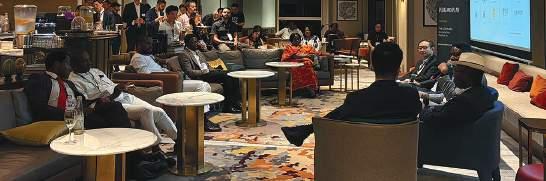
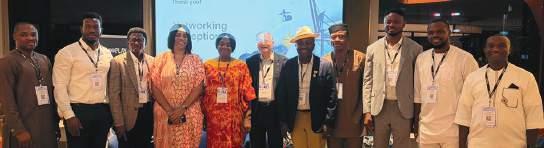
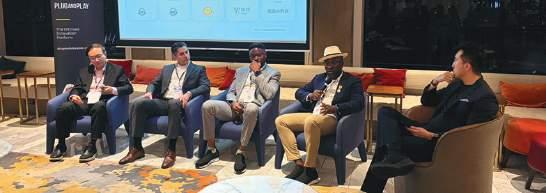
The importance of international partnership was further emphasised by Hemant Naik, who observed, "As we scale new energy shipping solutions globally, the countries that will lead are those that can de-risk innovation through strong partnerships and clear regulatory frameworks."
The gathering also welcomed Amb. Francisca K. Omayuli, Head of Mission at the Nigerian High Commission to Singapore, and Dr. Seng-Chuan Tan, President of the World Federation of Engineering Organizations, all of whom witnessed the Chairman's roadmap for a technologically independent maritime sector.
Innovation, Research, and the Future of Nigeria’s Maritime Sector Beyond theory, the discourse touched
on the practical necessity of establishing maritime technology innovation hubs and joint Nigeria-Singapore research initiatives to bridge existing gaps in technical infrastructure.
Supporting this view, Dr. Augustine Ada Elakpa reinforced the importance of indigenous research, stating, "For Nigeria to truly compete, we must invest in applied research that directly solves industry problems. Innovation must be practical, scalable, and locally relevant."
A particularly vibrant highlight occurred toward the end of the event, as the focus shifted to the frontline of digital transformation.
A cohort of startup founders and tech entrepreneurs took the stage to pitch their innovative products and maritime solutions.
These pitches were delivered directly to a global audience of prospective investors,
showcasing the high-level technical talent and entrepreneurial spirit ready to drive the next phase of Nigeria's maritime evolution.
Ultimately, Dr. Sylvanus concluded that while Nigeria possesses immense untapped opportunities in maritime logistics and offshore energy, the path forward requires a shift from potential to structured execution.
"Nigeria does not lack potential; what is required now is structured execution," he reaffirmed. "With the right alignment of policy, people, and partnerships, we can transform our maritime sector into a major driver of national economic growth." By aligning policy with the right talent and global partnerships, NIMENA believes Nigeria can transform its maritime sector into a primary engine for national economic growth and long-term stability.
The panel session
Participants during one of the sessions
R–L: Engr. John Chukwu Azuibuke, NIMENA National General Secretary; Engr. Amatari Bhine Obom, NIMENA National Vice Chairman; Engr. Elakpa Ada Augustine, NIMENA Head, Research and Development; Mr. Obinna Irrechukwu, Director of Innovation and Foreign Relations; Engr. Eferebo Ibietela Sylvanus, NIMENA National Chairman; Dr. Tan Seng Chuan, President, World Federation of Engineering Organisations (WFEO); H.E. Amb. Francisca Omayuli, Head of Mission, Nigeria High Commission, Singapore; Hon. Boma Goodhead, Chairman, House Committee on Nigerian Content Development and Monitoring; Engr. Vitalis Ahiakwu O., Chief Executive Officer, Centre for Marine and Offshore Technology Development, Rivers State University; Sotonye Melford, Network Security Adviser, CMOTD; and Sunday Unogwu, Senior Councillor, Nigeria High Commission, Singapore
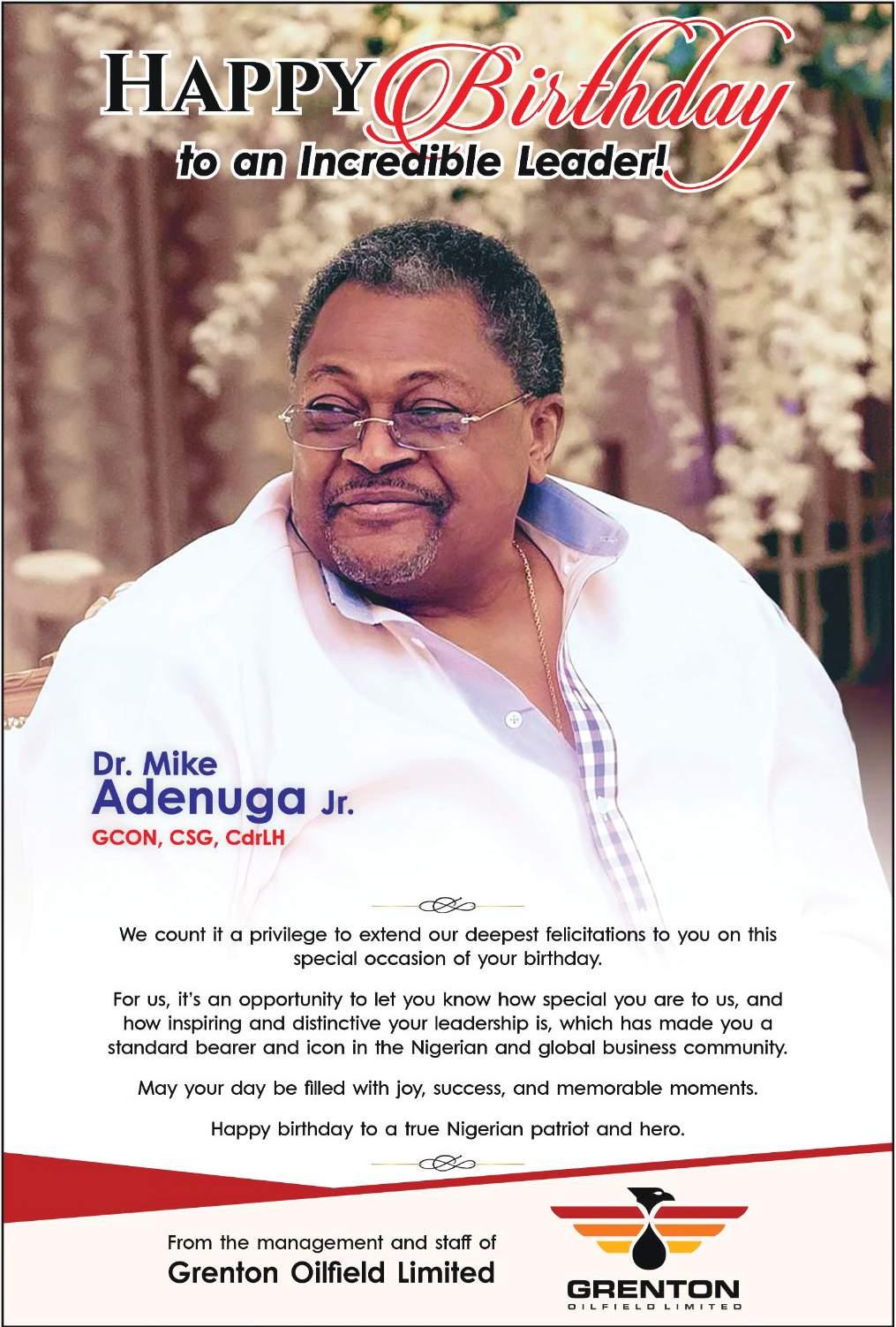
UAE Quits OPEC in Major Blow to Global Oil Producers’ Group
Development comes after Angola left in 2023
Emmanuel Addeh in Abuja
The United Arab Emirates said yesterday it was quitting the Organisation of Petroleum Exporting Countries (OPEC) and a group of allies (OPEC+), dealing a heavy blow to the oil exporting groups and their de facto leader, Saudi Arabia, at a time when the Iran war has caused a historic energy shock and unsettled the global economy.
The loss of the UAE, a longstanding OPEC member, could create disarray and weaken the group, which has usually sought to show a united front despite internal disagreements over a range of issues from geopolitics to production quotas.
UAE Energy Minister Suhail
WORRIED
Mohamed al-Mazrouei told Reuters the decision was taken after a careful look at the regional power’s energy strategies. Asked whether the UAE consulted with Saudi Arabia, he said the UAE did not raise the issue with any other country.
“This is a policy decision, it has been done after a careful look at current and future policies related to the level of production,” said the energy minister. THISDAY recalls that in March 2026, UAE’s OPEC quota was 3.4 million bpd.
The development comes more than two years after Angola exited OPEC in December 2023 after growing frustration with the group’s production quota system. At the time, the trigger was
OPEC’s decision to reduce Angola’s crude oil production target to reflect years of declining output caused by ageing oilfields and underinvestment. Luanda rejected the lower quota, arguing it constrained its efforts to revive production and attract new investment. For Angola, which relies heavily on oil revenues to support its economy, the cuts were seen as limiting its fiscal recovery rather than stabilising the market.
By leaving OPEC, Angola signalled a desire for greater autonomy over its oil policy, allowing it to set production levels based on national priorities rather than collective agreements. However, the move also means it forfeits influence within one of the world’s most powerful oil alliances
and must navigate global price volatility without the backing of coordinated supply management. However, OPEC Gulf producers have already been struggling to ship exports through the Strait of Hormuz, a chokepoint between Iran and Oman through which a fifth of the world’s crude oil and liquefied natural gas normally passes, because of Iranian threats and attacks against vessels.
Mazrouei said the move would not have a huge impact on the market because of the situation in the strait. But the UAE exit from OPEC represents a win for the U.S. President Donald Trump, who has accused the organisation of “ripping off the rest of the world” by inflating oil prices.
Trump has also linked U.S. military support for the Gulf with oil prices, saying that while the U.S. defends OPEC members they “exploit this by imposing high oil prices”.
The move came after the UAE, a regional business hub and one of Washington’s most important allies, criticised fellow Arab states for not doing enough to protect it from numerous Iranian attacks during the war.
Diplomatic Adviser for the UAE President, Anwar Gargash, criticised the Arab and Gulf response to the Iranian attacks in a session at the Gulf Influencers Forum on Monday.
“The Gulf Cooperation Council countries supported each other logistically, but politically and militarily,
Suhail
Mohamed al-Mazrouei
I think their position has been the weakest historically,” Gargash said. “I expect this weak stance from the Arab League and I am not surprised by it, but I haven’t expected it from the (Gulf) Cooperation Council and I am surprised by it,” he added.
ABOUT LIKELY EXCLUSION FROM 2027, ADC REQUESTS SUPREME COURT TO GIVE TIMELY JUDGEMENT intending to vote for ADC and its candidates at the general election slated for early January next year.
In the letter dated April 28, ADC’s lead counsel, Mr Shuaibu Aruwa, SAN, recalled that the apex court “graciously heard expeditiously on April 22, 2026 and judgement was thereafter reserved to a date to be communicated by the court”.
Aruwa, however, stated that they were “most respectfully constrained to request for the CJN’s kind intervention and directive in ensuring that the judgement was rendered timeously” on the grounds that the Independent National Electoral Commission (INEC), which is the fourth Respondent in the said appeal, purportedly, acting pursuant to the judgement of the lower court in Appeal No: CA/ABJ/145/2026, had removed or de-recognised the leadership of ADC.
The senior lawyer submitted that the action of INEC had left ADC without leadership at the moment even though ADC remained a recognised registered political party in Nigeria.
In addition, ADC drew the attention of the CJN to INEC’s timetable for the 2027 general election and the activities, which it said had already commenced.
The letter read, “Your Lordships would find attached copies of the INEC Press Release de-recognising the leadership of ADC and the Revised INEC Timetable for the 2027 General Elections.
“My Lord, the ADC ability to comply with these statutory requirements to participate in the
2027 General Election is wholly dependent on the timely delivery of the judgement in the instant appeal.
“Without the delivery of judgement within the next three days from the date of this letter, the ADC stands the grave and irreversible risk of being excluded from participating in the 2027 general election.
“This would disenfranchise millions of Nigerians who have subscribed to the ideals of the ADC and deny them their constitutional right to freely associate and contest elections through a political party of their choice.
“My Lord, we are mindful of the enormous responsibilities and workload of this Honourable Court. We are equally aware that justice delayed, in this peculiar circumstance, would amount to justice denied.
“The entire political future of our client and the legitimate expectations of its members nationwide now hangs in the balance.”
Last Tuesday, the Supreme Court reserved judgement in an appeal filed by Mark over the leadership tussle in ADC.
Mark, who is leading the mainstream party, is challenging the March 12 judgement of the Court of Appeal, which ordered parties to maintain the status quo ante bellum in a suit instituted by aggrieved members of the party.
In the appeal marked SC/ CV/180/2026, the former senate president argued that the appellate court exceeded its jurisdiction by intervening in what he described as the internal affairs of a political
party.
The appeal stemmed from a ruling delivered by the Court of Appeal on March 12, which dismissed Mark’s appeal against a September 4, 2025 ruling of the Federal High Court.
The suit at the Federal High Court was filed by Nafiu Bala, a factional national chairman, who was challenging an alleged take-over of ADC by Mark.
Meanwhile, the coalition party said the crises in the opposition political parties were not merely internal, but orchestrated by the ruling APC to shrink the democratic space.
ADC National Publicity Secretary, Malam Bolaji Abdullahi, in a tweet, accused APC of sowing the seeds of
to send a consensus candidate to try to wrest power from Tinubu, Faleke said the coming together of opposition parties was part of democracy.
According to him, “First, let me tell you that political parties can come together as a part of democracy. When we do our work, they will do their work.”
Equally, yesterday, the senator for Bauchi South Senatorial District, Senator Shehu Buba, purchased his governorship nomination forms for Bauchi State’s first job.
Buba stated, “I thank God for allowing us to witness another cycle of elections. As we have seen, I am physically present to obtain
national instability by engineering leadership crises in major opposition parties.
Abdullahi stated that the Dr Hakeem Baba-Ahmed-led Peoples Redemption Party (PRP) had been enjoying stable leadership until rumours began to circulate that the coalition leadership was considering PRP as an option.
“Although this is not true, it took only that single whiff of speculation for a faction to emerge almost overnight in what had been a historically tranquil political party, challenging the leadership of Baba-Ahmed,” Abdullahi stated.
He said the APC-led federal government might continue to deny any involvement in the crises within other parties, but the pattern was
my nomination forms.
“I am also calling on Nigerians, or those aspiring to contest various positions being advertised by the party, that they should. We were asked to come here, and we are here. I have obtained my own form now.”
Asked if he stood a chance against the ruling Peoples Democratic Party (PDP) in Bauchi State, Buba said he stood a good chance, stressing that the PDP government in the state has failed.
He said, “We stand a very good chance to take over Bauchi from the ruling PDP. I am optimistic because Bauchi is an APC state, and you can attest to that.
Kenyan President: My Comments on Nigeria’s Spoken English Taken Out of Context
Emmanuel Addeh in Abuja
The President of Kenya, William Ruto, has backtracked on his recent remarks suggesting that Nigerian-accented English was incomprehensible, stressing that his comments were taken out of context.
Speaking at a mining conference in the Kenyan capital, Nairobi, attended by Nigeria’s Minerals Minister, Dele Alake, who earlier jokingly raised the issue, Ruto took to the stage to explain that the comments were made during a private meeting.
“And the people of Nigeria have mandated me to inform you and assure you that Nigerians speak good English,” Alake stressed.
But insisting that ‘’somebody misrepresented the facts,” Ruto reminded the audience at the mining development conference that Nigerians were his in-laws. One of his daughters, June, is married to a Nigerian businessman. Ruto had faced a barrage of criticism, especially online, after he seemingly boasted about how Kenya’s education system was producing some of the best human capital in the world, with strong English proficiency.
“We speak some of the best English in the world, that is true. If you listen to a Nigerian speaking, you don’t know what they are saying. You need a translator even when they are speaking English,” he stated.
While Nigeria has more than 500 languages which have largely shaped its intonation, Kenya’s Bantu, Nilotic and Cushitic mix gave rise to its own accents.
Ruto said rather jokingly that he was expecting that there would be no consequences from his in-laws (Nigerians) after the backlash from the remarks he made last week while meeting with Kenyans in Italy.
While explaining his position, Ruto emphasised that the whole of Africa speaks good English, stressing that if one doesn’t speak excellent English in countries like Nigeria, they will need a translator.
“I was captured, I was speaking to my fellow citizens somewhere and somebody... It was supposed
to be a private conversation, but somebody decided that it should be public. But they also misrepresented the facts.
“The facts are that I was talking about how we in Africa speak very good English. All of us. In fact, in some countries like Nigeria, if you don’t speak excellent English, like the one we speak in Kenya, you may need a translator for you to understand the excellent English of Nigeria.
“ So that was the comparison by somebody who decided to take it out of context. But I think it is as well that we can have this conversation. And my in-laws, I hope there will be no consequences,” Ruto stated.
visible.
“The world can see what is happening. More importantly, they can see where this path leads,” he added.
The ADC spokesperson warned that a political strategy anchored in sabotaging every opposition platform was ultimately self-destructive.
“When people are left with no options, they are, in reality, left with no choice,” he warned.
Atiku Warns 2027 Elections Will Be in Jeopardy If Judiciary Fails the Opposition
Former Vice President Atiku Abubakar raised fresh concerns over the state of Nigeria’s democracy, cautioning that the integrity of
the 2027 general election may be undermined if the judiciary fails to act decisively in ongoing political parties’ disputes.
In a statement shared on his social media platforms, yesterday, Atiku reacted to a formal letter addressed to the CJN by counsel representing ADC led by Mark. He stated, “It is increasingly evident that Nigeria’s democracy, and, indeed, the integrity of the 2027 general election is in serious jeopardy. Democracy itself is now facing an existential threat.
“However, I do not want to believe that the judiciary, long regarded as the last hope of the common man, would align with the ruling APC in any effort that could undermine or destroy our democratic foundations.”
AS GAC PICKS FORMS FOR HIS PRESIDENTIAL
“The PDP government has failed the people of Bauchi. Being the first person to obtain the form as an aspirant, rest assured that, if I get the ticket, we will send the PDP out.”
Lagos Christian Leaders Endorse Hamzat
Christians leaders in Lagos State, yesterday, endorsed Hamzat as the APC governorship candidate.
Rising from a meeting held at the Chapel of Christ the Light, Alausa, Ikeja, the leaders said the endorsement followed a series of spiritual and physical consultations across the state, where the consensus was that Hamzat came across as the best candidate.
The spiritual leaders stressed that they had come to the realisation that Hamzat was God’s choice for the state, hence, their endorsement.
Speaking on behalf of the Christian NGO Coordinating Group, the chairman, Rev. Sam Ogedengbe, said there was need for continuity in Lagos and Hamzat had shown his mettle as a grassroots leader and a man of the people.
Ogedengbe said, “Having heard from God that he is the right choice for the state, the group also has prepared to support him financially, morally and spiritually to actualise his dream.”
Corroborating Ogedengbe’s position, the vice chairman of the group, Bishop Kayode Williams, said they had started the support for Hamzat long before others came out with their endorsements.
Williams insisted that Hamzat was the most preferred, most qualified, and most eligible candidate
for Lagos.
Adeoye Slams Endorsements of Hamzat, Says It’s Bid to Perpetuate APC’s ‘Fiefdom’
A Peoples Democratic Party (PDP) governor-ship hopeful in Lagos State, Laja Adeoye, criticised the recent endorsements of Hamzat as the next governor of the state, describing them as a calculated move to entrench the dominance of APC ahead of the 2027 elections.
Adeoye, in a statement yesterday, said the endorsements by Sanwo-Olu and other APC leaders amounted to a “coronation ceremony” aimed at sustaining what he called a longstanding political stranglehold over the state.
He stated that the move reflected a desperate attempt by the ruling party to maintain control of Lagos, accusing it of running the state “on autopilot, like a rudderless ship drifting aimlessly in turbulent waters”. Adeoye said, “The endorsement of Hamzat is not about service to Lagosians; it is about protecting the vested interests of a tiny cabal that has placed its iron boots on the throat of the people.”
The PDP aspirant alleged that APC had, over the past 24 years, treated Lagos as a private estate where “contracts are awarded to cronies, resources are siphoned to godfathers, and governance has become a family affair devoid of innovation or empathy”.
He added, “The same tired script is being replayed: recycle the same faces, recycle the same failures, and expect a different result. That era is dying.”
TINUBU TAKES FIRST STEP TOWARDS RE-ELECTION
BID
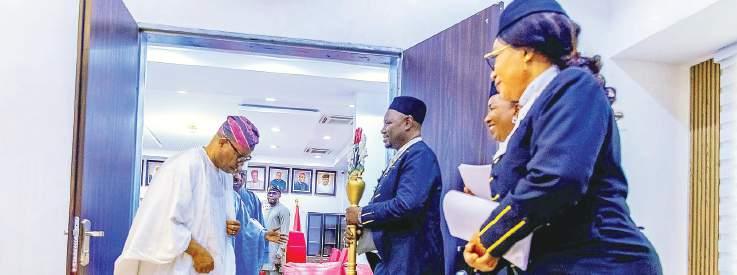
AKPABIO PERFORMING THE MANDATORY BOWING FOR THE MACE...
President of the Senate, Senator Godswill Akpabio (left), performing the mandatory bowing for the
Senate Pushes Police Trust Fund Overhaul, Raises Allocation to 1% Amid Sharp Fiscal Concerns
Advances bill for second reading; lawmakers warn of pressure on Federation Account Demands stronger accountability safeguards
Sunday Aborisade in Abuja
The Senate on Tuesday advanced efforts to overhaul police funding by passing the Nigeria Police Trust Fund (Establishment) Bill, 2025, for second reading, proposing to
raise the statutory allocation to 1 per cent of revenue accruing to the Federation Account, even as lawmakers expressed concerns over its fiscal and constitutional implications.
The bill sponsored by Senate
Leader Opeyemi Bamidele seeks to repeal the 2019 Act and replace it with a more robust legal and institutional framework for funding, administering, and supporting the Nigeria Police Force.
Leading the debate, Bamidele
described the proposal as a strategic national security intervention aimed at addressing chronic challenges confronting the police, including inadequate funding, obsolete equipment, poor infrastructure, and low personnel morale.
FG, Delborough Sign Agreement on Construction of Seven-star Hotel in Abuja
Olawale Ajimotokan in Abuja
The federal government has signed an agreement with Delborough Hotel for the construction of a Seven-star luxury hotel in Abuja.
The Lease agreement was sealed yesterday in Abuja between the National Council for Arts and Culture (NCAC) and the owner of Delborough, Dr. Stanley Uzochukwu, for the hotel to be constructed at the Arts Village, Abuja.
Minister of Art, Culture, Tourism
and Creative Economy, Hanatu Musa Musawa, noted the lease agreement had given meaning to President Bola Tinubu’s clear directive that the tourism industry be used to diversify the economy.
“About a year and a half ago, I was in Lagos and somebody said to me, ‘why not try the Delborough Hotel?’ At that time, I was rather uncomfortable because I’m one of these people who like your comfort zone.
“By chance, I stumbled on the Delborough Hotel. Honestly, for
those who have not been there or those who have been there, it is almost like being teleported to a hotel or to an industry in Dubai.
There is no difference with being in the Delborough Hotel in Nigeria to being in a seven-star hotel in Dubai or somewhere else,” Musawa said.
She described the Nigerian brand as one that can be transformed into an international brand and exported to the outside world.
“But before you do that internationally, you have to be able to show the world that you as a Nigerian
PTAD Disburses N1.73 Billion to Pensioners Under Defined Benefit Scheme
have taken ownership of it. And the easiest way for us to be able to do that is to bring it into the capital city of Nigeria” Musawa added.
She assured of the commitment of the federal government to the partnership, saying within the next few days, it will ensure that the hotel project is sustained for posterity.
In his remarks, Chairman of Stanel Group, Dr. Stanley Uzochukwu, said the coming of Delborough to Abuja will boost tourism, connect businesses and create jobs.
He described the agreement as a very special moment and one that showed that all their back-end hard work was being recognized by the government.
He argued that Nigeria’s changing security environment, characterised by insurgency, banditry, kidnapping, and cybercrime, requires a modern and better-resourced policing system.
He noted that the bill introduces a diversified funding model that extends beyond government allocations to include development levies, international grants, and private sector contributions.
It also proposes strengthened governance structures, including a multi-stakeholder board and a Project Implementation Committee to enhance transparency, accountability, and efficient project execution.
However, the proposal triggered a wave of concern among senators.
Senator Abdul Ningi cautioned that increasing statutory deductions could significantly shrink the Federation Account, warning that cumulative allocations might reduce funds available for sharing among the three tiers of government.
He also raised issues about accountability, particularly regarding donor funding.
Senator Ibrahim Dankwambo questioned the coherence of the
funding framework, especially amid ongoing national discussions on state policing, and called for clearer policy alignment.
In the same vein, Senator Abdulfatai Buhari expressed reservations about fund management, advocating a performance-based disbursement system to ensure measurable outcomes and curb waste.
Chief Whip Mohammed Tahir Monguno defended the bill, maintaining the proposed funding mechanism is constitutionally valid when backed by legislation enacted by the National Assembly.
In his remarks, Senate President Godswill Akpabio clarified that the bill targets not only funding gaps but also structural inefficiencies in the administration of the Trust Fund.
He acknowledged concerns about accountability and stressed the need for a framework that guarantees visible impact across police formations nationwide.
After extensive deliberations, the Senate adopted the bill through a voice vote and referred it to the Committee on Police Affairs for further legislative work, with a report expected within two weeks. Clears N32,000 pension increment
James Emejo in Abuja
The Pension Transitional Arrangement Directorate (PTAD) said it has disbursed a total of N1.73 billion to 54,206 eligible pensioners under the Defined Benefit Scheme (DBS). This marked the full settlement of arrears arising from the N32,000 pension increment approved by the National Salaries, Incomes and Wages Commission (NSIWC), which took effect from July 29, 2024.
In a statement, PTAD Head, Corporate Communications, Olugbenga Ajayi, the directorate also noted that it successfully completed payment of the outstanding one-month arrears of the N32,000 pension increment beneficiaries.
Under the Parastatals Pension Department (PaPD), 25,804 DBS
pensioners were paid a total of N825.72 million, bringing the total arrears paid to PaPD Pensioners to the full 13 months due.
Similarly, under the Tertiary Education and Health Pension Department (TEHPD), 28,402 DBS Pensioners were paid a total of N908,864,000 bringing the total arrears paid to TEHPD Pensioners to the full thirteen (13) months due.
The arrears, applicable to DBS Pensioners under both PaPD and TEHPD, covered a thirteen (13)-month period from August, 2024 to August, 2025.
The statement noted that PTAD had earlier paid 12 months of these arrears in phases between December 2024 and December 2025.
With this final payment, all outstanding obligations of the N32,000
pension increment have now been fully settled, it noted.
The directorate further reiterates that DBS Pensioners from Peoples Bank of Nigeria, Assurance Bank, Nigeria Reinsurance, NICON Insurance, NITEL/MTEL, Petroleum Training Institute (PTI), and PHCN, who have already benefited from pension increases of 10.66 per cent and 12.95 per cent respectively, are exempted from the N32,000 pension increment, as stated in the NSIWC Circular Ref. No. SWC/S/04/S.542/ III/461 dated September 27, 2024.
The statement also reaffirmed the directorate’s commitment to ensuring the welfare and dignity of DBS pensioners through transparency, accuracy, and timely pension administration in line with President Bola Ahmed Tinubu’s Renewed Hope agenda.
NDLEA, Customs Forge Alliance to Tackle Drug Trafficking
The National Drug Law Enforcement Agency (NDLEA) and the Nigeria Customs Service (NCS) have formalized a strategic partnership aimed at strengthening border security and combating drug trafficking across Nigeria.
The agreement was reached during a high-level meeting at the NDLEA headquarters in Abuja on Monday, where a joint communiqué was signed by NDLEA Chairman, Buba Marwa, and the Comptroller-General of Customs, Bashir Adewale Adeniyi.
Both agencies acknowledged the growing sophistication of transna-
tional organized crime, stressing that a coordinated institutional response is essential to effectively disrupt illicit drug networks.
Under the new framework, NDLEA and Customs will enhance intelligence sharing through a secure and structured platform designed to enable early detection and prevention of criminal activities.
The collaboration will also see the deployment of joint task forces at key operational points, including seaports, airports, and land borders.
The agreement further seeks to eliminate operational overlaps and reduce inter-agency friction by clearly defining roles and respecting each agency’s legal mandate.
A Standing Inter-Agency Committee will also be established to promptly address disputes and ensure smooth coordination.
Speaking on the development, both Marwa and Adeniyi emphasized that the partnership represents a critical step toward strengthening Nigeria’s security architecture while maintaining the efficiency of legitimate trade operations.
They reiterated their commitment to professionalism, mutual respect, and national interest, noting that aligning the capabilities of both agencies would create a more effective barrier against the trafficking of illicit substances.
mace before procession into the Senate for Plenary, yesterday
PHOTO:
Michael Olugbode in Abuja
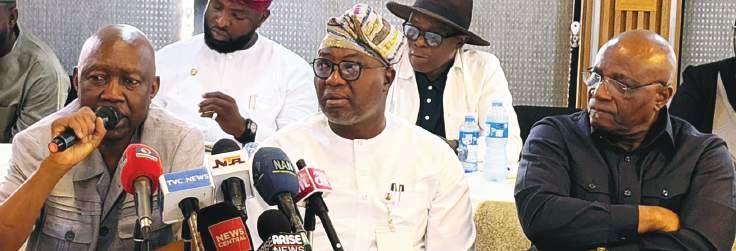
MEDIA TOUR OF FG PROJECTS UNDER THE RENEWED HOPE AMBASSADORS CITIZEN CONNECT INITIATIVE...
L-R:
and Director of Communications, Renewed Hope Ambassadors; Mr. Bayo Onanuga, Special Adviser to the President on Information and Strategy, at the press briefing on the North West Media Tour of Federal Government Projects under the Renewed Hope Ambassadors Citizen Connect Initiative in Abuja on Monday
EFCC Witness: How Union Bank Kept
N51bn from Arik Loan Transaction
Says bank acted as guarantor, not lender, in foreign loan arrangement Tells court proceeds were not used to offset Arik’s alleged foreign loan obligations
Wale Igbintade
An Assistant Director of the Economic and Financial Crimes Commission (EFCC), Bawa Usman Kaltungo, has told a Special Offences Court in Lagos that Union Bank of Nigeria Plc allegedly retained about N51 billion realised from a disputed Arik Air loan transaction instead of applying the funds to offset outstanding obligations.
The witness made the allegation yesterday while testifying before Justice Mojisola Dada in the ongoing N76 billion alleged fraud trial involving the former Managing Director of the Asset Management Corporation of Nigeria (AMCON), Ahmed Kuru, and other defendants.
Others standing trial include the former receiver-manager of Arik Air, Kamilu Omokide; the airline’s Chief Executive Officer, Roy Ilegbodu; Super Bravo Limited; and Mohammed Abbas Jega.
They are facing charges of conspiracy, stealing, abuse of office, and making false statements relating to alleged fraudulent conversion of Arik Air’s assets valued at N76 billion and $31.5 million.
Led in evidence by Senior Advocate of Nigeria, Wahab Shittu, Kaltungo told the court that Union Bank was not the direct lender to Arik Air but only acted as a guarantor in a foreign loan transaction that was later restructured and controversially transferred to AMCON.
According to him, the bank subsequently reclassified the facility as a non-performing loan (NPL) and sold it to AMCON on the premise that Arik Air had defaulted entirely on its obligations.
He, however, insisted that this representation was misleading.
Kaltungo told the court that Arik Air had already repaid about 38 per cent of the foreign loan before the facility was reclassified and sold.
He argued that despite this partial repayment, Union Bank proceeded with the sale of the loan for approximately N51 billion.
The EFCC official further alleged that instead of using the proceeds from the transaction to offset the outstanding foreign loan exposure or reconcile the repayment already made by Arik Air, Union Bank retained the entire N51 billion.
He told the court that this devel-
opment created what investigators considered a financial discrepancy, arguing that the bank remained accountable to Arik Air to the extent of the repayments already made to foreign lenders.
Kaltungo’s testimony forms part of the prosecution’s broader case examining how Arik Air’s assets and financial obligations were managed, transferred, and settled
through a complex web of banking and receivership arrangements.
The witness also gave details of other financial transactions involving the airline, including the sale of aircraft and shares.
He told the court that Arik Air’s shares in Zenith Bank were sold for over N2 billion, while aircraft belonging to the airline were disposed of for about $105.7 million.
He stated the aircraft sale proceeds were converted at an exchange rate of N360 to the dollar, amounting to over N32 billion.
However, he alleged that only about N9.2 billion was applied to loan obligations, leaving more than N28 billion unaccounted for.
The EFCC investigator also told the court that the airline’s financial management suffered from poor
2027: I will Continue with Gov
record-keeping and documentation gaps, which made it difficult to fully trace several transactions.
In a striking revelation, Kaltungo said investigators discovered a brandnew aircraft engine missing from storage during an inspection. He stated that there was no documentation authorising its removal, no inventory record, and no explanation from relevant personnel.
AbdulRazaq Legacies
in Office, Says Bolarinwa, Kwara APC Guber Aspirant
A former member of the House of Representatives Committee on Information and Communication, Hon. Bashir Omolaja Bolarinwa, yesterday declared his intention to vie for the gubernatorial seat of All Progressives Congress (APC) in Kwara state come 2027 with a pledge to ensure the continuity on the legacies of Governor AbdulRahman AbdulRazaq so as to advance the socio-economic development of the state.
Bolarinwa who is also a frontline gubernatorial aspirant of APC stated this in Ilorin during his official declaration to seek the gubernatorial ticket of the APC in the state.
He said: “This is a sincere call to service, to consolidate and build upon the impactful work of His Excellency, Governor AbdulRahman AbdulRazaq, whose administration has served our people commendably.
“The fact remains that governance is a continuum; no one individual can do it all, but together, we can achieve even more.
Southern Nigeria Royal Fathers Reaffirm Support for FG’s Economic Policies
Pledge to promote national unity, development
Emmanuel Ugwu-Nwogo in Umuahia
Traditional rulers from the southern half of Nigeria have collectively reaffirmed their support for President Bola Tinubu’s administration in its efforts to implement policies “directed at economic emancipation and national stability”.
The royal fathers under the umbrella of Southern Nigeria Traditional Rulers Council (SNTRC), led by His Imperial Majesty, Oba Dr. Enitan Ogunwusi, Ojaja II, the Ooni of Ife, stated their position at
a “crucial meeting” held in Port Harcourt, Rivers State.
According to a press release by the Publicity Secretary of the Council, His Eminence, Dr. Eberechukwu Oji, Eze Aro of Arochukwu Kingdom, made available to the media Tuesday, the meeting which was held on Thursday April 23, 2026, “ended on a strong consensus”.
Among the resolutions was that the SNTRC would strengthen its institutional framework, using it as a platform to promote unity across the region, and “contribute meaningfully to the overall development and
progress of Nigeria”.
The gathering of the royal fathers, which was hosted and officially declared open by the Governor of Rivers State, Sir Siminalayi Fubara, was attended by prominent royal fathers from across the three geopolitical zones of southern part of Nigeria.
To realise its goals the Council particularly reaffirmed its “unrelenting commitment to fostering unity among traditional institutions in Southern Nigeria and pledged continued support for national development and stability”.
The well-attended meeting
brought together the Chairman of the Council, state executive chairmen, and members from the South-South, South-East, and South-West geopolitical zones.
They collectively stressed the critical need for unity, inclusivity, and collaboration in driving both regional progress and national development.
The Chairman of the Council and Ooni of Ife had in his address at the plenary expressed profound gratitude to all members for their dedication and reiterated that the body remained “strictly apolitical”.
“Together, we can shape a future that reflects the true potential of our“Aspeople. we reflect on where we are as a state, my focus today is on where we must go and the urgent work that remains to be done for our people”.
Bolarinwa, a former state chairman of APC stated, “Today, I stand before you not just as a politician, but as a son of the soil, one who has walked this journey with you, shared in your hopes, understood your struggles, and remained committed to the progress of our dear Kwara State.
“With gratitude to Almighty Allah for His guidance, and with humility in my heart, I, Hon. Bashir Bolarinwa, PhD, hereby formally declare my intention to contest for the office of the Governor of Kwara State.”
Bolarinwa noted: “My decision is not borne out of personal ambition alone, but from a clear conviction, a strong sense of duty, and a passionate desire to serve our people at a higher capacity.
“My political journey has been one of service, sacrifice, and results.
From the grassroots as a Councillor, to serving as a Local Government Chairman, to representing our people at the National Assembly, and further strengthening our democracy as our state party chairman—each step has prepared me for this.
“Together, we built structures, strengthened our party, and played
key roles in shaping the political direction that brought renewed hope to our state.
“But today, our focus must go beyond politics. It must be about the future of Kwara State. Our state stands at a critical point where we must deepen development, expand opportunities, and ensure that governance truly reflects fairness, inclusion, and justice.
“We must build a Kwara where no district feels left behind; where every child has access to quality education; where our youths are empowered with meaningful opportunities; where our farmers and traders are supported; and where our economy works for all.
“I believe strongly in equity, unity, and collective progress. It is time to consolidate our gains while also ensuring balance and inclusiveness across all regions of our state.
“My vision is clear: To decisively tackle and comprehensively address insecurity at all levels, ensuring the safety of lives and property across every part of the state.
“To uphold peace, unity, and fairness across all communities and to deliver people-centered governance driven by transparency and accountability.
“To strengthen our economy through innovation, agriculture, and enterprise development to invest in education, healthcare, and infrastructure that improves everyday life.
Hammed Shittu in Ilorin
Engr. Finbarr Zirra, Director of Rail Development, Federal Ministry of Transportation; Mr. Tunde Rahman, Senior Special Assistant to the President on Media and Special Duties
DRIVING COLLABORATION BETWEEN LASAA AND NATIONAL THEATRE...
R-L: The Managing Director/CEO, Lagos State Signage and Advertisement Agency (LASAA), Prince Fatiu Akiolu, and the General Manager, National Theatre Lagos, Mrs. Tola Akerele, during a courtesy visit to the agency aimed at driving collaboration, yesterday
Shettima: Nigeria Ready to End Malnutrition with
Nutrition 774 Initiative
NCN
adopts
Gives
Deji Elumoye in Abuja
10-year national policy on food and nutrition for FEC ratification
states, FCT three months to inaugurate own nutrition councils
Nigeria has expressed its readiness to end malnutrition in the country with the launch of Nutrition 774 Initiative.
Speaking at the 15th meeting of the National Council on Nutrition (NCN) held virtually on Tuesday, Vice President Kashim Shettima while underscoring the efficacy of the Nutrition 774 Initiative, explained that
the programme is an indication that the government is pragmatic and fully ready to end malnutrition.
According to him: “It (Nutrition 774 Initiative) reminds us that the success of our nutrition reform will not be judged by federal announcements, but by co-coverage of interventions and household outcomes across all 774 local government areas.
“From Yobe to Bayelsa, from Katsina to Cross River, from Na-
sarawa to Ebonyi, every Nigerian child must be seen as the face of this national assignment. Behind every statistic is a child whose future is at stake. Behind every percentage is a mother, a family, a community, and a country either rising to its duty or retreating from it.”
He, however, observed that the National Nutrition Bill is the legislative backbone of the ongoing effort, and “must protect nutrition
financing from the uncertainties of political cycles” as well as “define obligations across federal, state, and local governments.
Also, the National Council on Nutrition (NCN) on Tuesday adopted the National Policy on Food and Nutrition (NPFN), 2026-2035 and directed the Federal Ministry of Budget and Economic Planning to present the policy to the Federal Executive Council for ratification.
Nigeria Police Need Deeper Reform, Not State Policing, to Function Effectively, Security Expert Momodu Asserts
A security and law enforcement expert, Sule Momodu, has called for comprehensive reforms of the Nigeria Police Force, arguing that such measures are more critical to improving internal security than the proposed establishment of state policing by the Tinubu administration.
Momodu, a former Deputy Commander-General of the National Drug Law Enforcement Agency (NDLEA), maintained the existing federal policing structure can be strengthened and decentralised without creating separate state police formations.
He stressed the need for a review of relevant provisions of the 1999 Constitution (as amended), alongside the effective implementation of the Police Act, to address structural challenges limiting the Force’s performance.
He said, “Section 215(4) of the Constitution should first be amended to empower state governments to give directives to Commissioners of Police, who must comply.
There should be no requirement to refer such directives to the president or any designated minister or Inspector General of Police (IGP). In effect, the provision ought to be
expunged so that a Commissioner of Police cannot, under any guise, refuse to obey a lawful order from a state governor.”
Speaking further on the debate over state policing, Momodu expressed concern about Nigeria’s socio-political realities.
He said, “My main concern is that many Nigerians still identify primarily along ethnic and religious lines rather than as citizens of one nation. In that context, state policing could prove counterproductive.
“For instance, if Plateau State had its own police during the Angwan Rukuba incident, and the perpetrators were said to be non-indigenes, tensions could easily have escalated against residents from other states. This is why I believe state police, in its current conception, may create more problems than it solves.”
As an alternative, he proposed a decentralised federal policing model.
“Instead, the existing federal structure should be decentralised. We already operate both federal and state laws, so a practical approach would be to appoint two Commissioners of Police per state: one responsible for enforcing state laws and the other for federal laws.
“In the Federal Capital Territory, there should likewise be a State Commissioner of Police and a
Federal Commissioner of Police.
The appointment of the State Commissioner should require the approval of the state governor and, ideally, the officer should be an indigene of the state, while the Federal Commissioner may come from any part of the country.
“It is also necessary to revisit existing police circulars. For example, the directive that a Commissioner of Police should serve in a state for two years must be enforced. Officers from the rank of constable to inspector should be deployed
to their states of origin, as this is critical to effective policing.”
Momodu also highlighted the importance of logistics and operational support, urging state governments to play a more active role.
He noted that police divisions must be equipped with functional vehicles to respond effectively to crime.
“The argument that policing is solely a federal responsibility should not prevent states from providing necessary support.
The council’s approval followed a painstaking process of ratification by critical stakeholders in Nigeria’s nutrition sector comprising public and private sector sponsors.
The adoption of the policy was part of decisions taken by the council at its 15th meeting held virtually and chaired by Shettima.
Summarizing the Council’s decision, the Vice President urged members of Council to be guarded by the reality that behind every statistic discussed at the meeting “is a Nigerian child whose life chances are being written by what” the government does or fails to do in the months ahead.
“We will be judged not by our deliberations but by our deliveries. Not by what we decided in April 2026, but by what mothers and children in the 774 local government areas experience by 2035,” he added.
Shettima described the NPFN 2026-2035 as “the most consequential nutrition policy this country has produced,” saying “it is multi-sectoral by design, evidence-based by discipline, and grassroots by orientation.”
He said: “It is not a Federal Ministry of Budget and Economic Planning document. It is not a Federal Ministry of Health and
Social Welfare document. It belongs to every Ministry, every State, every LGA, every ward, and every household represented in the work of this Council.
“Council mandates the Federal Ministry of Budget and Economic Planning to onward-transmit the document to the Federal Executive Council for final approval, and directs every nutrition-relevant Ministry, Department, and Agency to align its sectoral policies, plans, and budgets with the provisions of the NPFN within twelve months.
“Council further directs that all 36 states and the FCT operationalise State Multisectoral Plans of Action for Food and Nutrition within six to nine months.”
Council also approved the extension of the timeline for the submission of a draft bill on National Nutrition by six weeks and directed that the draft must be submitted to the National Assembly within eight weeks.
The Vice President commended the composition of the adhoc committee, noting that “this is the right room to draft this Bill in.
“Council approves the requested extension. Council also reaffirms that the Bill must be transmitted to the National Assembly within eight weeks from today,” he said.
UK Launches Creative Fund to Strengthen Nigeria’s Film, Fashion, Music Industries
Michael Olugbode in Abuja
The UK-Nigeria Tech Hub has unveiled a new Creative Fund aimed at boosting local production capacity across Nigeria’s film, fashion, and music industries.
The initiative, backed by the UK Government, is designed to address critical gaps in technical skills, infrastructure, and access to modern production tools within Nigeria’s creative sector.
The fund aligns with the goals of the UK-Nigeria Economic
Transformation and Investment Partnership (ETIP) Creatives Working Group, launched in 2025, and follows commitments made during Bola Ahmed Tinubu’s state visit to the United Kingdom in March 2026.
Speaking on the launch, Director of the Tech Hub, Oyinkansola Akintola-Bello, said the initiative represents a shift from policy discussions to practical action.
She noted that while Nigeria’s creative industry already contributes significantly to the economy, more support is needed to enable creatives
to produce high-quality work locally rather than outsourcing key technical processes abroad.
Funded under the UK’s Digital Access Programme and implemented by Tech4Dev, the Creative Fund draws on findings from a 2024 study of Nigeria’s creative ecosystem.
The research revealed that the sector employs about 4.2 million people and contributes roughly $3 billion annually to the country’s GDP, despite facing structural challenges.
These challenges include limited access to formal financing, heavy
reliance on self-taught skills, and the outsourcing of high-value technical work outside Nigeria. The fund will support projects across film, fashion, and music, particularly those with strong potential for scalability, job creation, and local impact.
It will also help cover technical gaps by funding access to specialists such as visual effects artists, sound engineers, and post-production experts, as well as digital tools like content delivery systems and AI-powered production technologies.
Linus Aleke in Abuja
8TH POLICY IMPLEMENTATION ASSISTED FORUM ON DIG ONCE POLICY...
L-R: Managing Director/CEO, Impulso Integrated Services Limited, Akinyele Oludare; Director, Solutions Architects, Equinix West Africa, Oluwasayo Oshadami; Team Lead, Business Metrics Limited (BML), Omobayo Azeez; Chief Strategy and Executive Officer, Zora Communications Limited, John Nwachukwu; and Group Chief Technology and Information Officer, Alphabeta Consulting LLP, Olumide Idowu, at the 8th Policy Implementation Assisted Forum (PIAFo) on Dig-Once Policy organised by BML in Lagos... recently
Diezani Closes Defence at London Trial, Denies Bribery Allegations
Witness alleges Kola Aluko misrepresented key details in Harrods-linked
Wale Igbintade
Proceedings at the Southwark Crown Court, London, in the trial of former Nigerian Minister of Petroleum Resources, Diezani Alison-Madueke, continued yesterday and reached a key stage as the defence closed its case following her final testimony, in which she denied all allegations of wrongdoing.
Alison-Madueke also denied claims of bribery, secret meetings, improper travel arrangements, and receipt of luxury gifts or financial benefits linked to oil sector actors.
Throughout her testimony, Alison-Madueke consistently denied the allegations, insisting she neither initiated nor requested meetings for improper purposes.
She maintained that many of the arrangements under scrutiny were handled by state institutions or third parties, rather than by her, personally.
A key feature of her defence was her insistence that there was no direct evidence linking her to personal financial benefit from the transactions being examined.
She told the court she had no knowledge of several of the financial dealings presented and did not manage personal or third-party accounts referenced by the prosecution.
The court also heard that former President Goodluck Jonathan declined to give evidence via video link and could not be compelled to attend proceedings, a development the defence cited as a gap in the evidential chain involving key witnesses.
Alison-Madueke was crossexamined on transcripts, travel records, and recorded conversations involving business associates, including Jide Omokore and Kola Aluko, relating to interactions around 2014 and 2015, including meetings said to have taken place in the United Kingdom.
She told the court she did not request a meeting with Aluko in the UK. She explained that she was already in the country for other engagements and he had sought to meet her team.
The former minister maintained that she was not responsible for logistical arrangements, stating that such
matters were handled by institutions, such as Nigerian National Petroleum Corporation (NNPC).
“I was not the logistics person for any of these trips,” she said.
On travel arrangements, she said she could not clearly recall whether a particular trip was official or personal, a point prosecutors linked to a travel request described as personal.
She rejected the suggestion that the visit was arranged to facilitate any improper meeting.
Alison-Madueke also told the court she was undergoing cancer treatment during parts of the period under review, adding that her health affected her recollection of certain events. This, the defence argued, provided context for any perceived inconsistencies in memory.
On allegations that she received luxury gifts and other benefits from oil sector associates, she acknowledged references in conversations but strongly denied that they amounted to bribes or inducements.
She rejected claims involving handbags, furniture, yachts, or properties, insisting they were misinterpretations of business-related discussions and commentary on industry conduct.
Alison-Madueke told the court that some of her remarks were advisory in nature, aimed at encouraging discretion among associates during a sensitive period in the oil sector, rather than instructions or endorsements of wrongdoing.
A recorded conversation in which she was said to have used strong language suggesting willingness to face jail alongside others was also examined.
The prosecution argued it demonstrated awareness of wrongdoing, but she rejected that interpretation, stating that it reflected colloquial expression rather than an admission of guilt.
She insisted there was no consciousness of wrongdoing.
The court also reviewed communications suggesting attempts by individuals to compile damaging material against her during her tenure.
Alison-Madueke said she was aware of politically motivated efforts to undermine her position but maintained that such claims did not amount to evidence of wrongdoing.
The defence further argued that much of the prosecution’s case relied on interpretations of conversations and financial records, rather than direct evidence of misconduct, and challenged the completeness and context of several recorded excerpts. Financial records involving associates, including Prince Momoh, were also examined.
She told the court she had no direct knowledge of several transactions and denied awareness of claims that payment cards were used for her expenses in London.
She repeatedly emphasised that official expenses, such as travel and accommodation, were handled through state institutions, particularly the NNPC, reinforcing the defence position that she did not personally control or authorise such expenditures.
She also told the court she had been unable to travel freely since 2015 due to ongoing investigations and said searches had been conducted
at her property during inquiries. She added that she initially believed she was dealing primarily with Nigerian authorities and did not fully understand the scale of proceedings in the United Kingdom at the outset.
Alison-Madueke maintained throughout the proceedings that the allegations were based on assumptions, interpretations, or contested readings of conversations and records, and not on direct proof of wrongdoing or personal enrichment.
The cross-examination concluded after further questioning on travel arrangements, charitable payments, and alleged third-party benefits, marking the close of the defence case.
In separate proceedings, Tony Mulcahy concluded his testimony in a strand of evidence involving disputed ownership claims and alleged financial misrepresentations linked to businessman Kola Aluko and associates.
Mulcahy was cross-examined on links between Alison-Madueke, Aluko, and Jide Omokore regarding luxury goods purchased from Harrods, their storage, and intended delivery.
The prosecution sought to establish shifting references to ownership in correspondence, suggesting uncertainty over the true client behind the transactions.
Omokore was said to have acknowledged ownership of the goods, but Mulcahy insisted he required written confirmation and assurances over outstanding storage and logistics payments.
Delivery arrangements were cancelled in August 2015 due to unresolved payment issues, with further correspondence in September reinforcing the same concerns.
By late September 2015, Mulcahy wrote to lawyer Donald Amamgbo warning that he would withhold cargo due to non-payment and later
transactions
confirmed he had done so, effectively ending his involvement.
He told the court he was unaware of any formal transfer of ownership until later discussions where Omokore asserted ownership. Under cross-examination, Mulcahy conceded he had been misled on several occasions by Aluko, stating, “Yes, he lied.”
He also confirmed financial disputes escalated over several years, with debts reaching £405,000, and said he eventually placed his company into administration before restructuring operations.
By late 2012, he said, he had begun to doubt the reliability of information provided by Aluko.
However, he maintained that Alison-Madueke herself did not directly mislead him and was cooperative when disputes arose. Mulcahy formally concluded his testimony following crossexamination.
Oando Receives NIPetE Officials, Says Localisation Key to Global Competitiveness
Oando, one of Africa’s leading integrated energy solutions companies, has received officials of the Nigerian Institution of Petroleum Engineers (NIPetE) on a visit to its Lagos head office.
The meeting focused on local capacity development, technology adoption, and Nigeria’s competitiveness, with Managing Director, Oando Energy Resources (OER), Dr. Alex Irune emphasising that “globalisation is localisation.”
The engagement, a statement from Oando said, provided a platform for both organisations to explore collaboration opportunities while examining broader shifts shaping the global energy landscape. Central to the discussions was how Nigeria can strengthen its engineering ecosystem in response to increasing global emphasis on domestic capability and value
retention.
Irune noted that leading economies are increasingly investing in domestic capabilities, from technology development to data infrastructure, to retain value and strengthen resilience.
“Countries that build their own capacity will have the advantage,” he said, pointing to a growing shift towards self-sufficiency in critical sectors.
Within this context, discussions explored the role of indigenous engineering solutions in driving industry competitiveness, particularly the need to move from development to real-world application.
A key focus was a locally developed reservoir simulation software, presented as a potential alternative to established international platforms. Oando indicated its readiness to evaluate and benchmark such tools within its operational environment.
“We are open to engaging with and testing locally developed solutions within our operations,” Irune said. “If we rely on foreign solutions when we have local capability, we are sending value out of our economy.” The emphasis on performance, Oando said, reflects a broader approach to ensuring that local innovation is competitive, scalable, and aligned with industry standards.
Beyond technology, the meeting highlighted the importance of strengthening Nigeria’s engineering talent pipeline.
Participants noted the need to better align academic training with industry requirements, particularly as the sector evolves in response to advancements in data, artificial intelligence, and computational capabilities.
“There are changes happening globally at an accelerated pace,” Irune said. “We need to be deliberate about how
we build our own capacity, from education to industry application,” he added.
Chairperson of NIPetE, Yetunde Aladeitan, said the visit was aimed at strengthening collaboration with industry leaders capable of supporting the growth of indigenous engineering solutions.
“This engagement is about ensuring that Nigerian engineers and locally developed solutions are not just created, but are positioned for real industry adoption,” she said. “We are looking to deepen collaboration with organisations like Oando that have the capacity to validate, deploy, and scale these solutions.”
She added that the institution is expanding its focus on training and capacity building to support the development of industry-ready professionals and strengthen local content across the sector.
Emmanuel Addeh in Abuja
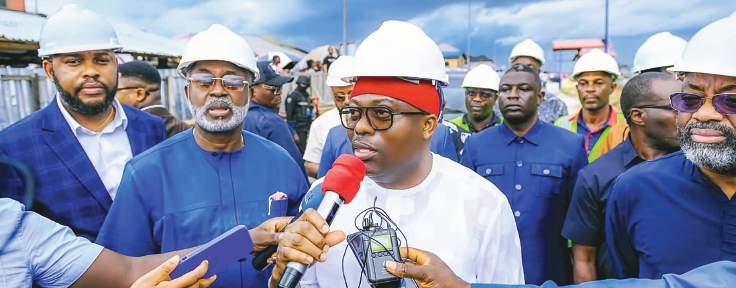
FUBARA TARGETS JANUARY FOR INAUGURATION OF NEW CREEK ROAD MARKET...
Rivers State Governor, Sir Siminalayi Fubara, addressing journalists during the inspection tour of the ongoing construction of Creek Road Market in Port Harcourt, yesterday
Colleagues, Friends, Associates, Others Hail Banmore at Posthumous Book Presentation
Ebere Nwoji
Family, colleagues, friends and associates, yesterday, gathered in Lagos, to celebrate the immediate past Managing Director of Staco Assurance Plc., Dr. Olawale Banmore, who passed on December 27, 2025, at a posthumous book presentation.
Renown journalist, Dr. Reuben Abati, who reviewed Banmore’s book on insurance, quoted the deceased as saying, “Trust is the foundation of the insurance business to achieve sustainable growth.”
The quote, an extract from the book, titled, “The Claims Advantage, How Smart Insurance Firms Win and Keep Customers,” was considered a professional advice by Banmore to his professional colleagues in the business of insurance in Nigeria.
Discussing the insurance business in Nigeria at the event held at the Nigeria Institute of International Affairs (NIIA), Victoria Island, Lagos, Abati said the perception was that insurance firms were quick to collect premium but when it was time to pay claims, they came up with stories.
“When people do not trust insurers, why then should they buy insurance?” he asked, saying, this has affected the reputation of the insurance firms.
He, however, stated that when claims were processed smoothly, efficiently and in a trustworthy manner, the result would be customer
Nigerian Army Denies Alleged Torture, Dehumanisation of Suspects in Its Detention
Hosts air force war college to boost air power strategy in North West
Linus Aleke in Abuja and Onuminya Innocent in Sokoto
The Headquarters of 8 Division, Nigerian Army, has denied allegations of torture, brutalisation, dehumanising treatment and reprisal attacks against detainees at the 8 Division Provost Group Detention Facility in Giginya Cantonment, Sokoto, following claims linked to the death of Lance Corporal Bala Hudu.
The response came amid a trending petition authored by Malcolm Omirhobo, a human rights lawyer.
Acknowledging the petitioner’s civic interest, the Army said it was necessary to correct what it described as misinformation while reaffirming its commitment to discipline, professionalism and respect for human rights.
In a statement, the Acting Deputy
Director of Army Public Relations, 8 Division/ Sector 2 Operation Fansan Yamma, Lieutenant Colonel Olaniyi Osoba, explained that, “In setting the record straight, in April 2023, the late Lance Corporal Bala Hudu killed a commercial motorcycle operator in Katsina State, leading to a military police investigation and subsequent court martial proceedings.
“During the proceedings, it was discovered that the late soldier had underlying health conditions, including hyperopia, allergic conjunctivitis and high blood pressure, for which he was receiving medical care at the 8 Division Medical Services and Hospital.
“Due to his health status, he was granted unrestricted access to his family and legal counsel and remained under continuous medical supervision, with a nursing assistant
assigned to him.
“However, on 15 April 2026, he was admitted at the Accident and Emergency unit with complaints of headache, body weakness and rapid breathing. He was diagnosed with severe right lobar pneumonia and malaria.”
Osoba added that the soldier’s condition deteriorated on 17 April 2026, leading to his death, likely due to complications from his underlying ailments.
He noted that the General Officer Commanding 8 Division immediately convened an independent Board of Inquiry, which is ongoing.
The Army described allegations of torture and intimidation as “categorically false,” stressing that its detention facilities operated in line with international standards and uphold detainees’ welfare.
Marafa Makes U-turn, Quits ADC for NDC, Cites Dissatisfaction with APC, Insecurity
Sunday Aborisade in Abuja
The Zamfara Central Senator in the 7th and 8th National Assembly, Kabir Marafa, has defected from the African Democratic Congress (ADC) to the Nigeria Democratic Congress (NDC), two weeks after he asked his followers to embark on massive registration to join the ADC. Marafa, who was Chairman, Senate Committee on Petroleum Resources (Downstream) in the 8th Senate, cited dissatisfaction with developments
in the All Progressives Congress (APC), worsening insecurity in the North-West, and the need for a stable political platform ahead of future elections.
Marafa, who was formally received into the NDC in Abuja, yesterday, said his decision followed extensive consultations and a careful assessment of the country’s political landscape. He maintained that his move was voluntary and driven by conviction rather than compulsion. He was welcomed to the party
by the National Chairman of the NDC, Senator Moses Cleopas; the National Leader of the Party, Senator Seriake Dickson and others in Abuja.
“We gave the APC enough time and committed ourselves fully, but the outcome was not commensurate with our efforts.
“Beyond that, the level of insecurity in Zamfara and across the North-West remains deeply troubling. There is an urgent need for a platform that prioritises effective governance and the safety of citizens,” Marafa said.
It added that the GOC maintained zero tolerance for abuse and invited the petitioner and other interested parties to appear before the Board of Inquiry from 29 April to 10 May 2026.
Meanwhile, the 8 Division has hosted participants of the Air Force War College Course 12/2026, as part of a National Study Tour designed to enhance the strategic use of air power for national security and development.
In a statement by Osoba, it said the visit “serves as a critical link between state-level operations and the strategic deployment of air power in safeguarding national security.”
satisfaction, increased customer acquisition in a business that relied heavily on word-of-mouth, stronger brand equity and market leadership.
Abati observed, “The author recognises that there are challenges, such as fraud and misrepresentation. Nigeria is a country where claimants try to exploit loopholes in the system, regulatory bottlenecks and bureaucratic hurdles, outdated claims processing systems, low financial literacy and misinterpretation of policies on the part of policy holders.”
He stated that for each of the challenges bedevilling insurance the business in Nigeria, Banmore’s book offered a multi-layered approach as solution and proposed a call for change as to how insurance firms handled claims.
According to Abati, this then becomes a practical manual on the how of the business, the nitty-gritty of claims management, how claims are planned to ensure efficiency and clear communication, claims control to prevent fraud especially the use of technology and AI- driven fraud detection systems.
In his tribute, chief host and Chairman, THISDAY Editorial Board, Mr. Olusegun Adeniyi, said Banmore passed at the early hours of December 27, 2025 at the age of 62.
Describing him as “Wale my cousin”, Adeniyi said he was a
seasoned insurance professional with nearly three decades of experience. Adeniyi said Banmore rose to the pinnacle of the insurance industry through grit, intellect, and uncom- mon resilience.
He previously held top leadership roles within the Royal Exchange Group, including Group Managing Director and Managing Director of Royal Exchange Prudential Life, Adeniyi stated.
Across these roles, he said Banmore was known for his strategic clarity, turnaround leadership, and deep understanding of risk, governance, and institutional reform.
He said Banmore held degrees from the University of Ibadan and went on even while battling prolonged illness to secure both MPhil and PhD in Strategic Marketing from Babcock University.
An insurance technocrat and one of Banmore’s professional friends, Bode Opadokun, a former Managing Director at Sanlam General Insurance, described Banmore as a very generous, modest, and exceptionally humble fellow, who cared for his friendsChairmanunconditionally. of the occasion and former Commissioner for Insurance during Banmore’s tenure as Managing Director of Royal Exchange Assurance, Alhaji Mohammed Kari, described him as somebody that had broken new grounds.
Tinubu Moves to Reconstitute Human Rights Commission, Sends Names to Senate
Sunday Aborisade in Abuja
President Bola Tinubu has formally asked the Senate to confirm 15 nominees for appointment into the governing board of the National Human Rights Commission (NHRC), in a move aimed at strengthening the country’s human rights protection framework.
The request, conveyed in a let- ter addressed to Senate President Godswill Akpabio and read during plenary on Tuesday, seeks the recon- stitution of the commission’s board in line with statutory provisions.
At the centre of the nominations is Dr. Salamatu Hussaina Suleiman, who has been proposed as chairman of the board, while Dr. Anthony
Ojukwu (SAN) is to serve as Executive Secretary.
The list also includes 13 other nominees drawn from diverse professional backgrounds, including the media and legal sectors.
Notable among them were journalists Ayo Adewuyi of the Nigerian Television Authority and Maupe Ogun of Channels Television, as well as legal practitioner Chinonye Obiaku (SAN).
The president said the nominations were made pursuant to Section 2(3) of the National Human Rights Commission (Establishment) Act, 2010, which empowers him to constitute the board subject to Senate confirmation.
He explained that the reconstitu-
tion of the board was necessary to enhance the institutional capacity of the commission and enable it to more effectively discharge its mandate of promoting and protecting human rights across the country.
Following the presentation of the request, the Senate referred the nominations to its Committee on Judiciary, Human Rights and Legal Matters for screening and report within two weeks. If confirmed, the new board is expected to play a critical role in reinforcing NHRC’s oversight functions, particularly at a time of heightened concerns over rights protection and accountability in Nigeria.
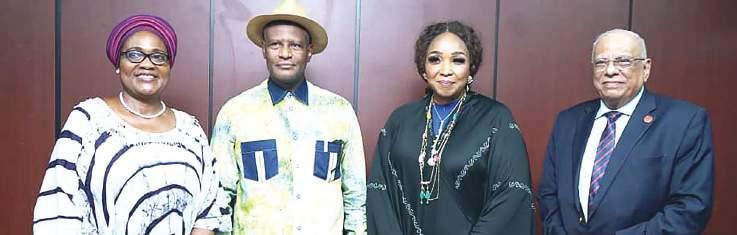
COURTESY VISIT...
L-R: Lagos State Permanent Secretary,
and Chancellor and Founder President, American International University, West Africa, Mr. Dinesh Shukla, during a courtesy visit to the Ministry of Tourism, Arts and Culture, Alausa, Ikeja... recently
Nigeria Sliding into Deeper Division, Needs Structural Reform, Declares Ayo Opadokun
A chieftain of the National Democratic Coalition (NADECO), Chief Ayo Opadokun, yesterday, warned
that Nigeria’s continued unity and stability might be endangered if the country failed to undertake far-reaching constitutional and governance reforms.
He made this known at a national conference themed: ‘Building a Fractured Nation: The Imperatives of Ethnic Harmony Towards Democracy and Sustainable Development’’,
organised by the Nigerian Human Rights Community in Lagos. Opadokun said Nigeria was increasingly plagued by deep ethnic, religious and regional divisions, with
citizens gradually losing faith in one another amid rising mistrust and inequality. He described the situation as a troubling reality, noting that
Osun Poll: INEC Pledges Level Playing Field, Warns Against Vote Buying, Others
Yinka Kolawole in Osogbo
Security outfits, ethnic groups endorse Adeleke for second term Osun governor did not squander any trillion naira, says spokesperson massively and also defend their votes.
The Osun State Resident Electoral Commissioner (REC), Oluwatoyin Babalola, yesterday, pledged the commitment of the Independent National Electoral Commission (INEC) to conduct a free, fair, and credible governorship election in the state, assuring all political parties that they would be treated equally under the law.
Babalola stated this during a courtesy visit to the Correspondents’ Chapel of the Nigeria Union of Journalists (NUJ) in Osogbo.
The REC explained that her deployment to Osun was part of routine administrative redeployment by the Commission, stressing that Resident Electoral Commissioners did not determine their places of assignment. According to her, postings were handled strictly by INEC headquarters in Abuja.
“Posting is a regular exercise in INEC, handled by the Chairman and National Commissioners. A REC does not choose where to serve. I was previously in Ondo State and have now been posted to Osun,” she said. Reacting to concerns and protests that trailed her assumption of duty, Babalola urged stakeholders to have confidence in the electoral system, clarifying that INEC officials were neutral actors whose responsibility was to ensure credible elections.
She stressed that INEC was not a participant in elections but an impartial manager of the process.
“INEC officials do not vote. We are not partisan actors. Our duty is to ensure a free, fair, transparent, and credible process,” she stated.
Babalola noted that electoral integrity remained the cornerstone of the Commission’s operations, adding that adherence to due process, transpar-
ency, and accountability was key to managing the pressures associated with the job.
“Pressure is part of every job, but what matters is how you manage it. For us, doing what is right and building public trust are essential,” she added.
Traditional Security Outfits, Ethnic Groups Endorse Adeleke for Second Term
Governor Ademola Adeleke’s re-election bid received a boost, yesterday, as traditional security outfits and ethnic groups endorsed him as the candidate of choice for the August 15, 2026 governorship election.
The endorsement which occurred at an elaborate event in Osogbo, saw the local security and ethnic groups take turns to announce their preference for Adeleke to continue in office beyond November 2026 and vow to vote for him
Convener of the event, Chief Lukman Ayodeji (aka Sango of Africa), said the endorsement was marked by the widespread support for the work that Adeleke was doing, noting that the groups came together to show that the people would always rally behind any leader that delivers for them.
Representative of Agbekoya, Chief Aremu Abiodun said the people trusted Adeleke and would reward him with an overwhelming vote in the August 15, 2026 poll.
Association of Hunters in Osun led by Oba Ogunlade Oluwasanjo assured the governor that they were backing him for a second term on the strength of his performance across sectors, vowing that they would resist any attempt to manipulate or rig the upcoming governorship poll.
The Odua Peoples Congress (OPC) through Comrade Kazeem Oriade, said it would work vigorously for
Emefiele: Suspects Admitted Withdrawing $6.2m
A witness of the Economic and Financial Crimes Commission (EFCC) in the ongoing trial of a former Governor of the Central Bank of Nigeria (CBN), Mr. Godwin Emefiele, yesterday told the High Court of the Federal Capital Territory (FCT) that some suspects confessed to fraudulently withdrawing the sum of $6.23 million from the apex bank.
Among the allegations the antigraft agency leveled against the former CBN boss in the 20-count amended charge was that he conspired with some other persons to move from the apex bank the sum of $6,230,000, purportedly meant for international election observers for the 2023 general election.
In the charge marked: FCT/ HC/CR/577/2023, he was also accused of criminal breach of trust,
forgery, abuse of office, as well as conferring corrupt advantages on two companies, April 1616 Nigeria Ltd and Architekon Nigeria Ltd, while in office.
He had, however, denied committing the alleged offences and has since been admitted to bail.
In his bid to prove the allegations, the EFCC has called 13 witnesses since the trial began nearly three years ago, with the 14th Prosecution Witness (PW14) testifying at yesterday’s proceedings.
The PW14, the Commissioner of Police in Charge of Special Fraud Unit, Lagos, Eloho Edwin Okpoziakpo, narrated before Justice Muazu, how he and three other police officers were deployed to assist Mr. Jim Obaze, who was appointed by President Bola Ahmed Tinubu as a Special Investigator, to investigate the CBN and other government business entities.
The CP claimed that he assisted the Special Investigator in taking statements, interrogating persons who were complicit one way or the other, and also provided intelligence to aid the special investigator’s work.
Led in evidence by the prosecution counsel, Rotimi Oyedepo, SAN, the witness disclosed that in the course of their investigation, they got an intelligence on $6.23 million that was fraudulently taken from the Abuja branch of the CBN with the defendant’s approval, adding that, they investigated the intelligence and interrogated Emefiele.
“Investigation revealed that the money was fraudulently taken because some of the suspects, including Maishanu, who we investigated, confessed.
“The Office of the Secretary to the Government of the Federation denied ever requesting money for
the governor’s re-election, conveying the assurance of its National President, Iba Gani Adams, that every necessary support would be accorded him to succeed in the poll.
‘Adeleke Didn’t Squander Trillion Naira’
Osun State Governor, Senator Ademola Adeleke did not squander state resources as projects and programmes were managed with a mantra of value for money and within the ambit of procurement laws and due process.
Speaking in an interview on Western spring Television in Osogbo, spokesperson to the governor, Mallam Olawale Rasheed, debunked the statements credited to an opposition Chieftain, Remi Omowaiye, affirming that “projects on which state funds are spent are verifiable and visible to the people of Osun state.
while Nigeria’s diversity should be a source of strength and shared prosperity, it has instead become a fault line due to poor governance and structural imbalances.
Drawing from historical experience, Opadokun pointed to the era of the Second Republic as a period when inclusive governance and a stronger sense of national purpose were evident.
According to him, political actors at the time made conscious efforts to accommodate the country’s diversity, while public service was guided by collective national interest.
“As a former Assistant Director of Organisation of the Unity Party of Nigeria, I can say without doubt that merit and party responsibility, not personal wealth, determined political opportunities,” he said, emphasising that campaigns were funded by parties rather than individuals.
He, however, lamented that subsequent military interventions disrupted Nigeria’s democratic development, concentrating power at the centre and fostering inequities that persist today.
These developments, he added, weakened accountability, encouraged sectional dominance and planted the seeds of distrust and fragmentation.
from CBN, Witness Tells Court
election observers, which was the claim that the money was meant for. We wrote to the then Office of the Secretary to the Government of the Federation, and they responded,” Okpoziakpo told the court.
According to him, the money was withdrawn using some documents, including a letter forwarding purported approval of the then President, late Muhammadu Buhari, for the $6.23million to be paid.
Asked to identify some exhibits already tendered by the prosecution and admitted as exhibited by the court, the PW14 said Exhibit PD6 was a document asking for the release of the $6.23 million directed to Emefiele, while Exhibit PD7 was the purported document giving the approval of the then President Buhari for the money, dated January 24, 2023.
The prosecution witness further
told the court that the request to release the $6.23 million was honoured, “it was treated and the money was paid.”
While further identifying the exhibits before the court, Okpoziakpo told the court that he personally recovered Exhibit PD1 - PD5 from the Abuja branch of CBN where the money was cashed.
According to him, PD1 gave details of the amount of money that was paid out in $100 bale on February 8, 2023, while PD2 was a memo from the CBN’s Director of Banking Services Department to the Abuja Branch Controller of the apex bank, giving approval to the branch controller to pay the sum of $6.23million.
Meanwhile, Justice Muazu has adjourned the case to July 2 for continuation of the hearing.
Another witness of the EFCC, Bashirudeen Maishanu, had earlier
in January this year admitted being responsible for the theft of $6.2 million from the CBN, part of which Emefiele is currently standing trial. Maishanu, who is a Deputy Director, Banking Supervision with the CBN, had admitted his complicity in the movement of the funds from the Garki branch of the CBN, when he testified before the court.
He had also admitted receiving alongside some of his friends, the sum of $2.5 million as “gift” for facilitating the release of the $6.2 million.
Besides, Maishanu, who had admitted being responsible for part of the crime for which the government is seeking punishment for Emefiele, had, in his evidence, told the court that Emefiele did not benefit from the $6.2 million fraud, nor gave his approval for the withdrawal.
Funmi Ogundare
Ministry of Tourism, Arts and Culture, Mrs. Bopo Oyekan-Ismaila; Head of Mission at Central African Embassy to the State of Qatar, His Excellency Hamodi Check; Founder/CEO, AWHPI Global Foundation, Princess Moradeun Ogunlana;
Alex Enumah in Abuja
COVID-19 Fraud: Osun Deposes Apetumodu, Declares Stool Vacant
yinka Kolawole in Osogbo
The Osun State Government has officially deposed the Apetumodu of Ipetumodu, Oba Gbenga Joseph Oloyede, and declared the revered royal stool vacant with immediate effect.
The decision was conveyed in a statement issued by the Commissioner for Information and Public Enlightenment, Kolapo Alimi, who said the action followed extensive
consultations, a thorough legal review, and subsequent approval by the State Executive Council (EXCO).
According to the Commissioner, the removal of the monarch was carried out in strict compliance with the provisions of the Osun State Chiefs Law and other relevant statutes regulating the conduct and administration of traditional institutions in the state.
Alimi further disclosed that government has withdrawn
STL Trustees Marks 30th Anniversary, Surpasses N2bn Capitalisation Threshold
STL Trustees Limited, Nigeria’s foremost nonbank-affiliated trust company, has unveiled its 30th anniversary logo, marking the milestone with a declaration of market leadership and a clear commitment to regional expansion across Africa. The company has surpassed the N2 billion recapitalisation requirement prescribed for trusteeship companies by the Securities and Exchange Commission (SEC). Specifically, STL Trustees has recorded capital in excess of N2.5 billion and shareholders’ funds exceeding N20 billion, well
ahead of the regulatory deadline.
Managing Director/CEO, STL Trustees Limited, Mrs. Funmi Ekundayo, disclosed these at a media parley held to commemorate the firm’s 30-year journey since its incorporation in 1996.
She said: “Our vision is to position STL Trustees as not just a market leader in Nigeria, but a reference point for trusteeship services across Africa. Over the next five to 10 years, we aim to deepen our expertise, leverage technology to expand our service offerings, and continue to set the standard of excellence in the trusteeship sub-sector.”
the Staff of Office and all instruments of authority previously conferred on Oba Oloyede, effectively bringing his reign to an end.
While the state government
did not explicitly state all the grounds for the deposition in the statement, the action was believed to be connected to the monarch’s past legal troubles in the United States.
over charges bordering on fraud.
Reports indicated that the traditional ruler was found guilty by a US court for his involvement in a scheme related to identity theft and fraudulent financial transactions.
Police, EFCC Rescue Abducted Victims from Sea Pirates
Linus aleke in abuja and Okon Bassey in Uyo
Pirate activities appear to be resurfacing in Nigeria’s waterways as operatives of the Nigeria Police Force, in collaboration with the Economic and Financial Crimes Commission (EFCC), rescued 14 victims abducted by sea pirates along the Calabar–Oron waterways.
The incident marks a concerning development for Nigeria’s maritime domain,
which in recent years had recorded a significant decline in piracy.
The country had earned a piracy-free status, largely attributed to sustained government and naval operations, with the International Maritime Bureau (IMB) consistently removing Nigeria from its list of high-risk maritime nations.
However, the latest attack suggests a potential setback, raising fresh concerns about
security along the nation’s waterways.
In a statement, Force Public Relations Officer, Anthony Placid, said the victims were rescued through sustained intelligence-driven operations and strong inter-agency collaboration.
He explained that acting on credible intelligence, joint operatives intensified surveillance and carried out targeted operations across identified flashpoints,
leading to the safe rescue of all victims without harm. The victims, he added, are currently undergoing medical evaluation and debriefing before being reunited with their families. Reacting to the development, the InspectorGeneral of Police, Olatunji Disu, commended the joint security team for the successful operation, describing it as a testament to effective coordination and intelligence-led policing.
DELSU Ranked Best State University in 2025, Says Vice Chancellor
sylvester idowu in Warri
The Vice Chancellor of Delta State University (DELSU), Abraka, Professor Samuel Asagba, yesterday disclosed that the Institution was ranked the best state university in Nigeria in 2025.
Aside from that, he said the institution was also ranked the best in the South-east and South-south and 12th overall nationally in the same period.
Odu’a Investment, Ibadan Economic Team, to Partner on SMEs Growth
Kemi Olaitan in ibadan
The Group Chairman of Odu’a Investment Company Limited (OICL), Otunba Bimbo Ashiru, yesterday pledged stronger collaboration with the Olubadan of Ibadanland, Oba Rasidi Ladoja, to accelerate the economic growth and investment in the ancient city of Ibadan, Oyo State.
Ashiru, who pledged when he led the Board of Directors and management team of the conglomerate to the monarch at the Oke-Aremo, Ibadan palace, described Oba Ladoja
as a visionary leader with a strong economic focus, noting that the palace had already reached out on areas of collaboration.
According to him, the conglomerate received and reviewed a letter from the Olubadan Economic and Investment Committee, expressing readiness for transparent and constructive engagement.
He said: “I am happy that we have a visionary leader in Kabiyesi; someone who is a chemical engineer and who also attended Harvard Business School. He has an
economic team and has written to us on how we can collaborate.
“Odu’a Investment Company remains irrevocably committed to Ibadanland. We will not relent until every idle asset is productive and every willing son and daughter of Ibadan finds dignified work to do.
“Small businesses are very important because they are the drivers of any economy in the world, accounting for about 90 per cent globally. In that area, we are going to support the palace and Kabiyesi.”
Dash MFB Lowers Transaction Fees to N5 to Support Customers
ayodeji ake
Dash Microfinance Bank (MFB) has officially announced its “Near-Zero” fee policy, offering transactions at a flat rate of just N5 in bid to ensure banking remains affordable to its customers amid rising costs.
The financial landscape continues to evolve and the Central Bank of Nigeria (CBN) has just pegged the charges for ATM card issuance and maintenance at N1,500.
However, Dash MFB said it is committed to ensuring that the cost of moving money remains minimal, hence the
this strategic initiative.
The initiative has positioned Dash Microfinance Bank as a leader in financial inclusion, directly addressing the pain points of millions of Nigerians by lowering the barrier to digital payments.
By introducing the N5 flat-rate fee, Dash MFB is providing a necessary buffer for customers currently adjusting to the updated card charges.
Commenting, the Managing Director/CEO of Dash MFB, Rotimi Awofisibe, said: “We believe that banking should be easier and made just for you. With the new
N1,500 card charges, we wanted to find a way to give back to our customers. By offering N5 transactions, we are empowering the student, the trader, and the professional to move money freely without the fear of high service costs.”
According t him, Dash MFB distinguishes itself by integrating seamlessly into the daily routines of its users.
Beyond the ultra-low transaction fees, the platform is optimised for: Seamless transit Integration: top up transport wallets like Shuttlers instantly for a friction-free commute.
Professor Asagba disclosed during a press conference ahead of the 18th convocation ceremony of the institution.
He said the university is deepening international partnerships as part of efforts to boost capacity and global visibility, adding that the institution is strengthening
academic collaboration with institutions in China, Canada, the United States of America, and South Africa.
“They are ready to assist us in several areas. They have offered to train five of our staff, and this collaboration will enhance our visibility and improve our ranking,” he said,
adding that DELSU has also secured virtual international teaching engagements.
Responding to a question on the poor state of hostels, Prof Asagba assured all that rehabilitation works were underway, stressing that “by the time students return for the new session, they will see noticeable changes.”
Oba Oloyede, who ascended the throne as the Apetumodu of Ipetumodu, had earlier been convicted in the United States



FOR ANIOMA, IJEBU, OGOJA, IBADAN, OTHER STATES
eastern region had three new States carved out from it. These were the East Central State, Rivers State and the South-Eastern State. Another state creation exercise took place in 1976 following the ouster of General Yakubu Gowon in a military coup led by General Murtala Mohammed.
On assumption of office, he (General Murtala Mohammed) created the following States: Anambra, Bauchi, Benue, Imo, Niger, Ogun and Ondo, bringing the total number of States to nineteen, from the original twelve States created by General Yakubu Gowon. It took another eleven years (1987) for State creation exercise to be undertaken in the country. That was under the regime of General Ibrahim Babangida GCFR (1985 – 1993).
In 1987, General Ibrahim Babangida created two States namely, Akwa Ibom and Katsina. He also created nine additional States in 1991. These were: Abia, Enugu, Delta, Jigawa, Kebbi, Osun, Kogi, Taraba and Yobe. It is instructive to note that Akwa Ibom State was carved out from Cross River State, while Katsina State was created from Kaduna State. Similarly, Adamawa and Taraba States were carved out from the former Gongola State, and Enugu State out of Anambra State, while Edo and Delta States replaced the old Bendel State. Also, Yobe State was created from Borno State, and Jigawa out of Kano State, while Kebbi and Osun States were carved out from Sokoto and Oyo States respectively. Kogi State came from Kwara and Benue States. Altogether, there were thirty (30) States by 1991.
General Sani Abacha GCFR (20 September 1943 – 8 June 1998) became Nigeria’s next military Head of State in 1993 after ousting the Chief Ernest Shonekan-led Interim National Government (ING). Due to stringent agitations for more States, General Sani Abacha set up the National Constitutional Conference (NCC) which recommended, among other things, the creation of new States. Thus, on October 1, 1996, he created six additional States namely, Ebonyi (from Abia and Enugu States), Bayelsa (from Rivers State), Nasarawa (from Plateau State), Gombe (from Bauchi), and Ekiti (from Ondo).
The movements for the creation of states in Nigeria can be traced back to 1937 when Dr. Nnamdi Azikiwe (born November 16, 1904, Zungeru, Nigeria—died May 11, 1996, Enugu) advocated in his book THE POLITICAL BLUEPRINT OF NIGERIA, a federal
form government for the country and the division of the country into eight constituent units based on geographical configuration. Dr. Azikiwe was later joined by Chief Obafemi Awolowo (6 March 1909 – 9 May 1987) who, in a book, PATH TO NIGERIA FREEDOM published in 1947, proposed a redivision of Nigeria into Ten Federating units with ethnic, linguistic and cultural affinity as the basis of division. However, Chief Obafemi Awolowo writing in 1966 seemed to have modified his stand when he shifted ground and advocated a redivision of the country into eighteen states---nine in the North and nine in the South based on linguistic and cultural affinity as well as economic viability of States in the Federation.
Chief Awolowo’s submission at that time was that the COR state with the population of 717,000 Ibibio; 435,000 Annang; 428,000 Ibo; 251,000 Ijaw; Ogoni 156,000 and Efik 75,000. He alerted that the genuine cause of the minorities in the then Eastern Region should be created.
Chief Awolowo re-echoed this demand on May 1, 1967 in Ibadan at a meeting of Western Region Leaders of Thought on the need for the creation of more states especially COR state meaning Calabar, Ogoja and Rivers states. He told the meeting on that day “We have been told that an act of secession on the part of the East would be a signal in the first instance for the creation of the COR state by decree
which would be backed, if need be, by use of force”.
In 1963 as a result of the 1962 Western Region Crisis the pressure for the state creation which resulted in subsequent declaration of a state of emergency in the former Western Region, the Mid-West Region (now Edo and Delta states), was created out of the then Western Region. The creation of the new Region tended to have intensified and encouraged the demands for the creation of more new states in other parts of the country as we have witnessed over the years.
Further in his May 27, 1967 broadcast, General Gowon declared “this is why the first item in the political and administrative programme adopted by the Supreme Military Council last month is the creation of states for stability. This must be done first so as to remove the fear of domination. Representatives drawn from the new states will be more able to work out the future constitution for this country which can contain provisions to protect power of the states to the fullest extent desired by the Nigerian people”.
Although there is no magic formula for determining the optimum number of states in any Federation, certain specific criteria must be spelt out if the entire exercise of State-Creation is to be conducted in a rationale and fair manner.
Any meaningful exercise in State-Creation has to be guided by specific and well-defined political consideration. First, there is the need to maintain and strengthen our federal system of government which must continuously reduce suppression and discord in every new step taken. In our earnest attempt to redraw the political map of Nigeria and satisfy the legitimate yearnings and aspirations of the generality of our people, we must guard against the proliferation of States which will not only reduce states to glorified local governments, but more importantly enable the Federal Government to become stronger and stronger, through which process the country may inadvertently revert to a unitary system of government.
Although the Creation of New States would bring states government closer to the people thereby making government particularly at the state level, more accountable and more efficient each new state must be in a position to function effectively in a Federal Structure where the constituent units are
usually coordinated and mutually independent. In applying this political consideration to the present exercise in States Creation however, we must remember that the United States of America with fifty States and Switzerland with twenty-five cantons have adhered strictly to the principles of Federalism. What is more, both the Constitution and revenue allocation systems have clearly defined the structural, functional and relationships between the various levels of government in Nigeria.
Secondly, there is the need to promote peace and political stability in the country. Today, the issue of State creation is so crucial and fundamental that peace and stability cannot be guaranteed without some action taken about it. Apart from the everincreasing desire to attract more revenue, political and other appointments and patronage from the Federal establishments, the State creation promoters are vigorously envisaging the successful emergence of a political structure that shall perpetually disallow any ethnic group to hold a position which can enable it to dominate all the others put together.
State creation exercise must be sufficiently related to the needs and aspirations of the various groupings in Nigeria. The continued agitations for creation of more States is a direct result from bad government---leadership and discriminatory policies of the various state governments. Indeed, even if the National Assembly was to make every hamlet in this country, there would continue to be demands for State Creation so long as there is a corrupt, autocratic and purposeless government or government or governments particularly at the state level.
The basic motivation in the demands for States Creation is the promotion of accelerated and balanced economic development. States Creation, it is often argued, makes for the greatest possible diffusion of economic power which in itself guarantees even development. It is also often asserted that some State Creation demands are masterminded by few selfish individuals with the hope of becoming big fish in small waters if and when the New State is created. Be that as it may, certain specific dimensions of economic viability constitute relevant considerations in any sensible exercise in State-Creation.
Continues online
GOVERNING THE ECONOMY: CHOICES, TRADE-OFFS AND NATIONAL PRIORITIES 1
TheNiche Annual Lecture Series represent a bold attempt at reminding us, the Nigerian people, of who we could become only if we are determined to pay the price required to transform potential to reality. I am glad that not minding our litany of missed opportunities, many of us are refusing to give up on the promises that this great country holds. On this note, distinguished ladies and gentlemen, permit me to acknowledge with great reverence and honour, Their Royal Majesties, Khalifa Muhammadu Sanusi II, CON, Emir of Kano, and Igwe Alfred Nnaemeka Achebe (Agbogidi), CFR, Obi of Onitsha, who have graciously joined us as Chairman and Royal Father of today’s event respectively. The 2 royal fathers in our midst, accomplished professionals and portraits of grace and dignity, embody the greatness and eternal acclaim of our heritage. Commendations are also due to all patriotic Nigerians who have gathered from all walks of life to listen and share important ideas on how to improve the economic and social realities of our people.
I will never stop talking about the critical connection between politics and the economy, how politics drives critical economic outcomes and why none of us can afford the luxury of political indifference. Understandably, a lot of people are disillusioned by the disappointments of the years past but again, the irrefutable truth is that things would continue to deteriorate if we insist on staying away from the field of play. The importance of participating in the political process has little to do with convenience or comfort, it is rather a patriotic duty to our fatherland that we can no longer shy away from. Political processes and decisions require the collective input of every adult member of the society for they are the ultimate determinants of our social and economic destinies. Yes, for the average person, the independent nonpartisan, political participation begins and ends at the polling unit, it is entirely about who wins or loses at the ballots. Unfortunately, it goes beyond that; the orientation of active citizenship demands that we dig deeper to know about the candidates and the political parties they represent, their economic philosophies and just about every small piece of information that would help in shaping our decisions. The entire idea of active citizenship is demanding but a small price to pay when compared to the long-term misery that attends indifference. The crisis of unemployment, poverty and the collapse of institutions cannot be separated from citizens’ disinterest
in the political affairs of their communities. While voting in election is critical, political participation, however, is far beyond what happens at the quiet cubicle where the final decision to go with party
A over party B is made; it is about the vigilance to keep the victors on their toes through legitimate channels of engagement. Unfortunately, majority of us do not even see the need to cast our ballots. It is therefore not surprising that voter turnout over the last 5 general elections has fallen from 57% in 2011 to less than 30% in 2023. As stakeholders in the Nigerian project, we ought to be worried that majority of our compatriots are increasingly shying away from participation at the ballots. This may be a good time to reconsider our attitude to the electoral process because so much, including our economic security and prosperity, is hinged on it.
To now turn our attention to the subject of today’s discourse, Economic Governance: Choices, Trade-offs and National Priorities, I would begin by saying that the foundation of economic governance, defined succinctly as the capacity and efficiency of institutions at developing rules, processes and systems that mitigate abuses, is firmed on political choices and behaviours. It is impossible to separate incompetent political leadership from the manifestations of economic decline such as drastic tanking of the size of the gross domestic product (GDP), widespread unemployment, reduced investment appetite and all such developments that ultimately lead to high poverty levels and endemic anxiety within the community. Political opportunism and parochial disposition of leaders are cancerous to economic development and have been known to ruin several economies around the world. As has been said many times in the past, economics does not respond to emotions or sentiments, it is guided by thoughtful decisions and the judgement of those who wield the instruments of power. It is therefore impossible to achieve accelerated economic development when those who sit at the decision-making table are ignorant of economic laws and dynamics. The foundation of economic governance is built on the decisions made by those who pull the levers of power; ultimately, the outcome of their choices impact our daily experiences. In a political system driven by mercantilism, desperation for power and corruption across multiple nodes in the value chain, things are bound to go from bad to worse because no system has endless supply of resources to feed
the bottomless greed of political actors, including voters who see votes as wares for sale to the highest bidder. If we treat election seasons as bazaars, a time to extract and squeeze whatever we can out of the system, it becomes inevitable that the primary pursuit of those who win elections would not be to serve the community, but to recoup what has been invested and stack up resources for the next round of polls.
It may be tough to accept but strong and resilient institutions cannot be built on the back of a corrupt political culture, one that favours just about anyone with a deep wallet to buy voters, electoral officials, media practitioners and the instruments of violence. We saw the devastations of desperate politicking firsthand in Abia in 2015 when the votes were decided, not at the polling units but by some underhand deals that eventually set the State on a difficult trajectory. In the end, everything went downhill; it got so bad that basic social services like urban waste management and maintenance of public infrastructure were abandoned. Thousands of families lost their breadwinners as the party that stole the mandate of the people enacted an unofficial policy to deny workers and retirees their entitlements. In the 8 years that followed, entrepreneurs suffered severe losses as social services collapsed and when they could no longer afford to live with the nightmare, they quietly packed their bags, those who found buyers sold their property, and then bid their goodbyes. Abia, I can say with every sense of conviction, is proof that economics cannot be separated from politics. Within Nigeria and around the world, evidence abound that it is nigh-impossible to build a robust economy on the foundation of political corruption. Reckless leaders don’t build strong institutions and those who win elections by dishonest means cannot abide by the demands of ethics and prudence while in office. I am often asked what we have done differently in Abia and my response is simple: changing the behaviour of the political leadership. Investors are not returning to Aba because everything has suddenly turned perfect; no, they are coming back because they have seen a clear difference in the disposition of the current leadership. The institutions are becoming more responsive, not because we hired angels to run them; things are changing at the ministries, departments and agencies for the simple reason that we entrusted leadership to individuals who understand what it means to lead with a clear
service-orientation — men and women who appreciate the principles of stewardship. In Abia, we have not only restored the faith of our people in government, we have effectively demonstrated that agencies of government can be alive to their responsibilities — that political office holders are actually servants of the people, not their masters. With the streets of our urban centres cleaner than they have ever been, consistency in the execution and delivery of large-scale capital projects and an unyielding commitment to the security of lives and property, it is easy to understand why old businesses are returning, even as new enterprises open in record numbers across our State.
The modest gains we have recorded in Abia is down to a new orientation to public sector leadership. Abians, since 2015 rejected the old political culture of elite compromise. They were undeterred by the disappointments of 2015 and 2019 but remained resolute in their conviction that once we get it right politically, everything else would fall in place. The events of the last 35 months have simply proved that they understood something that some of us may need to pay great attention to: politics, when done right, expands the sea of economic opportunities for everyone, builds confidence and sets the community free from the agony of destitution and helplessness. The interesting thing is that once the fundamentals are in place, you may not have to wait for ages to see the manifestation of progress in the daily experiences of the population; it is about the small changes that eventually aggregate to great things, schools that actively educate the young and prepare them for the opportunities of the future, businesses that make profit and employ the products of our schools and vocational centres, hospitals that attend to the sick, support the health and wellbeing of the population, roads that fast-track the movement of people and goods, farms that feed the population and an economy that supports the hard work of its population, inspires dreams and drives innovation. Again, these are no abstract ideas, in fact, they are fundamental to the growth and development that we seek.
(To be continued)
The above is the first part of Governor Otti’s presentation at the 5th Edition of The Niche Annual Lecture Series Held at the Nigerian Institute of International Affairs, Lagos, on Thursday, April 23, 2026.
President Bola Tinubu
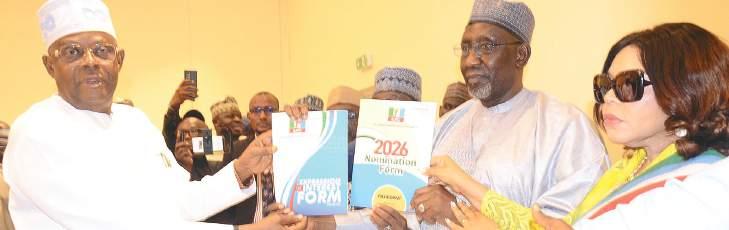
FALEKE TAKES APC PRESIDENTIAL INTEREST FORMS FOR TINUBU...
L-R: Chairman, House of Representatives Committee on Finance, Hon. James Abiodun Faleke collecting the Expression of Interest and Nomination Forms for President Bola Ahmed Tinubu from the APC, National Organizing Secretary, Abubakar Muhammed
ERIC TENIOLA

For Anioma, Ijebu, Ogoja, Ibadan, Other States
On May 27, 1967, the then Head of State, General Yakubu Dan-Yumma Gowon (91) GCFR, said “the main obstacle to future stability in this country is the present structural imbalance in the Nigeria Federation”. No doubt, the General’s statement is as true today as at when he made the broadcast. It was in the broadcast that he created twelve states out of the four regions in existence at that time. The instability keeps on widening daily in the country. And it depends on which area it has effect on you. The main focus now is on the coming general elections and all other issues are secondary. In fact, the only job in town now, is party politics. There are no factories, there are no industries. To survive in the present-day Nigeria is to be a politician and that is why sycophancy and party fanaticism have
become rampart. Governance seems suspended. Inspite of flattering
words of hope by government, nothing has changed. No improvement, the poor citizens are still lamenting. Life generally, is becoming unbearable. The killings still continue on innocent ones and nobody knows when it will end.
We have carried democracy to the extreme to the extent that it has more or less crippled the country.
But the issue of restructuring and the creation of new states with other issues will not go away. They will be addressed after the election. President Bola Tinubu GCFR or anyone to be elected President, in the next year’s Presidential election will have no other choice but to address these outstanding issues.
The issue before us is the creation of states.
Between 1960 and 1966, Nigeria still operated the regional arrangement. However, between 1967 and 1996, the country had to be split into thirty-six States.
The first state creation exercise was undertaken by the regime of General Yakubu Gowon GCFR in 1967. Prior to General Gowon’s ascension to power, General Aguiyi Ironsi GCFR was Nigeria’s first military Head of State but following his assassination in July 1966, General Gowon became the new military ruler of the country. He dissolved the four regions in the country and subsequently created twelve States on May 5, 1967. Six States were carved out from the former northern region. These were: the North-Western State, the North-Eastern State, Kano State, North Central State, Benue-Plateau State and Kwara State. The former western region was split into two States: the Western State and Lagos State. The former mid-western region became the Mid-Western State, while the former
Continued on page 55

Governing The Economy: Choices, Trade-Offs And National Priorities 1
There is no silver bullet for solving Nigeria’s myriads of economic challenges because economics is about cold, hard facts, not vanities. With high level of unemployment, especially amongst the youth population, rising incidence of poverty and growing sense of helplessness amongst our compatriots, it would be uncharitable to wish these unsettling realities away or imagine that waving a certain magic wand would make them go away in the twinkle of an eye. No, the issues are foundational, so there is no room for quick fixes. However, I refuse to submit to the position of cynics who argue that our situation
is entirely hopeless because it is not. Even then, I would also not take the overly optimistic view that a turnaround is imminent because that could be misleading.
Our country has a great destiny and its future will certainly remain bright. Even then, the world cannot afford to wait in perpetuity for Nigeria to begin to play to its full strength. Quietly, it has moved on, hoping that someday, our country may catch up but whether that day would be in this decade or in the coming century, or perhaps never, will depend largely on what we do in the days and years that follow. If we have learnt anything from the frustrations
of the last six decades, it is the truth that there is a direct correlation between political choices and the daily experiences of the population. While I would not be overly simplistic to suggest that one good leader would make all our problems disappear, in fact that thinking may be at the heart of our present challenges, it is, however, beyond argument that a good leadership system across board, one that understands the dynamic laws of economics and the intersection of political behaviour and public welfare, would certainly go a long way in taking us closer to our dream Nigeria. It is not all gloom and doom but true progress cannot run on self-deceit;
this is not the country our parents envisioned on Independence eve in 1960.
Let me at this auspicious moment, appreciate most respectfully, the management and decision-makers at ACCLAIM COMMUNICATIONS LIMITED, publishers of the TheNiche newspaper, for putting this event together. Special gratitude is due to the Managing Director/Editor-in-Chief of the publication, Ikechukwu Amaechi, for his continuing service to our nation and for committing everything at his disposal, especially his intellect and passion, to noble causes and ideas.
Continued on page 55

Senate President Godswill Akpabio
Argungu and National Women Leader APC, Dr. Mary Alile in Abuja yesterday
PHOTO: ENOCK REUBEN